Recently in the city of Parañaque, local police officers successfully organized a buy-bust operation which resulted in the apprehension of two construction workers who possessed illegal drugs, according to a Manila Bulletin news report.
To put things in perspective, posted below is an excerpt from the Manila Bulletin news report. Some parts in boldface…
Authorities from the Parañaque City Police Station Drug Enforcement Unit (SDEU) conducted a buy-bust operation leading to the arrest of two construction workers in possession of P102,000 worth of shabu on Dec. 3.
The Southern Police District (SPD) said the suspects were identified as Tisoy, 27, and Niño, 33. They were arrested at around 8:10 a.m. at San Juan De Coastal, Barangay San Dionisio, Parañaque City.
The police said that members of the SDEU launched a buy-bust operation for the arrest of the suspects after receiving reports of their illegal drug activities in the said place.
Tisoy was caught in possession of seven grams of shabu, including the subject of sale, and Niño with four grams, totaling 15 grams worth P102,000.
The suspects were detained at the Parañaque City Police custodial facility and were charged with violations of Sections 5 and 11 of RA 9165.
Let me end this post by asking you readers: What do you think about this recent development? If you are a resident of Parañaque, are you thankful to the police for successfully arresting the suspects? Is there a serious illegal drug problem in your local community right now?
For more South Metro Manila community news and developments, come back here soon. Also say NO to fake news, NO to irresponsible journalism, NO to misinformation, NO to plagiarists, NO to reckless publishers and NO to sinister propaganda when it comes to news and developments. For South Metro Manila community developments, member engagement, commerce and other relevant updates, join the growing South Metro Manila Facebook group at https://www.facebook.com/groups/342183059992673
Welcome back readers, fellow geeks and electronic gaming fans!
In this edition of the Retro Gaming Ads Blast (RGAB) series, we will take a look at another batch of retro gaming print ads – including arcade flyers – from the 1970s to the 1990s.
For the newcomers reading this, Retro Gaming Ads Blast (RGAB) looks back at the many print ads of games (console, arcade, computer and handheld) that were published in comic books, magazines, flyers, posters and newspapers long before smartphones, social media, the worldwide web and streaming became popular. To put things in perspective, people back in the 1980s and 1990s were more trusting of print media for information and images about electronic games and related products.
With those details laid down, here is the newest batch of retro gaming print ads for you to see and enjoy…
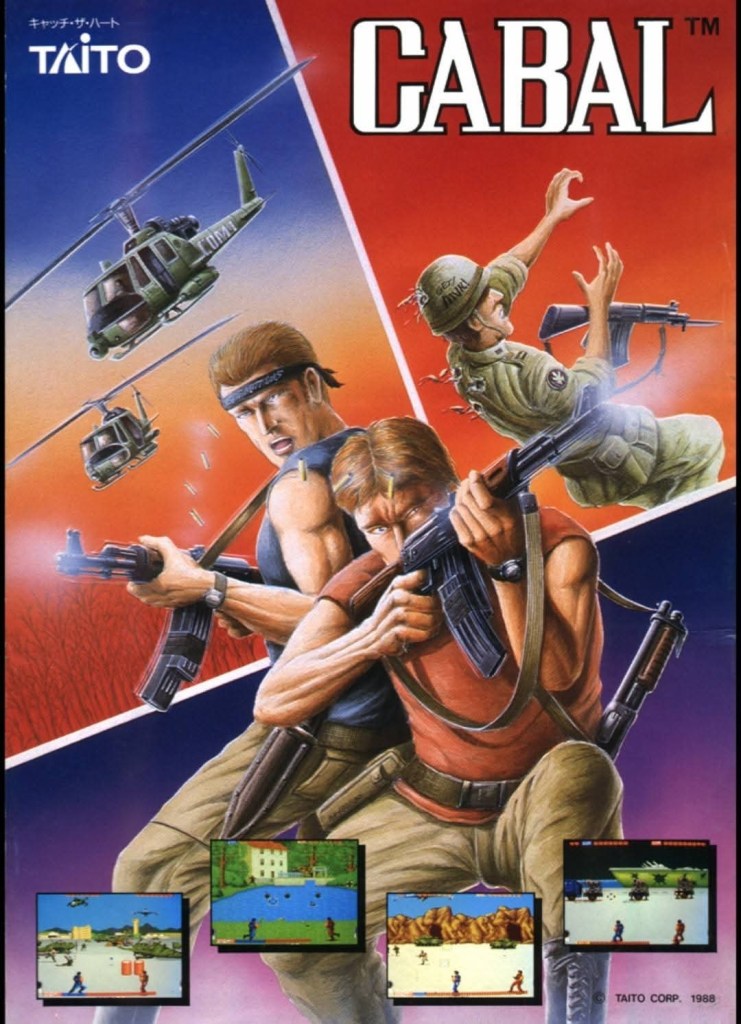
1. Cabal Japanese arcade flyer/poster
Can you feel the action and intensity here?
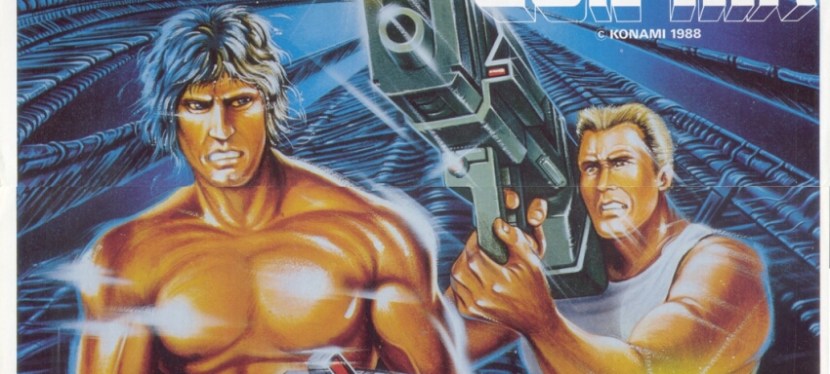
When it was first released in video arcades in Japan in late 1988, Cabal was another game inspired by military action movies of Hollywood which explains the art work done for the arcade flyer and poster shown above. The Vietnam War was still fresh in people’s minds and the concept of having one or two players firing their weapons against enemy soldiers resonated with gamers who saw Hollywood’s military action flicks. That said, it is not surprising that Cabal became a huge hit in Japan before getting released in arcades around the world.
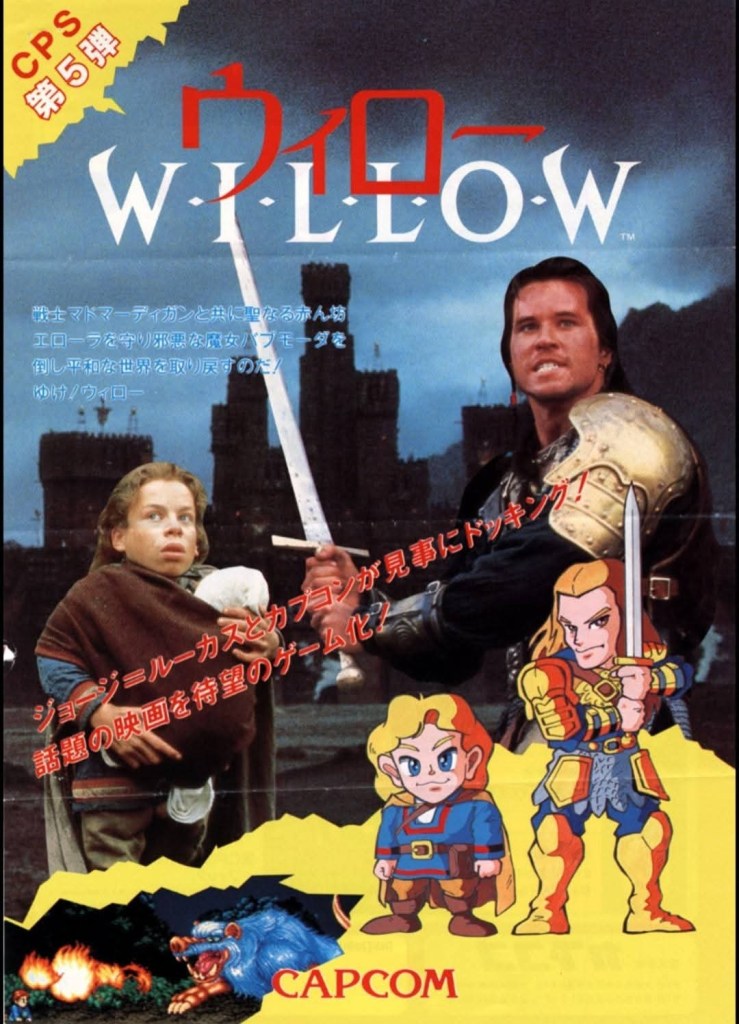
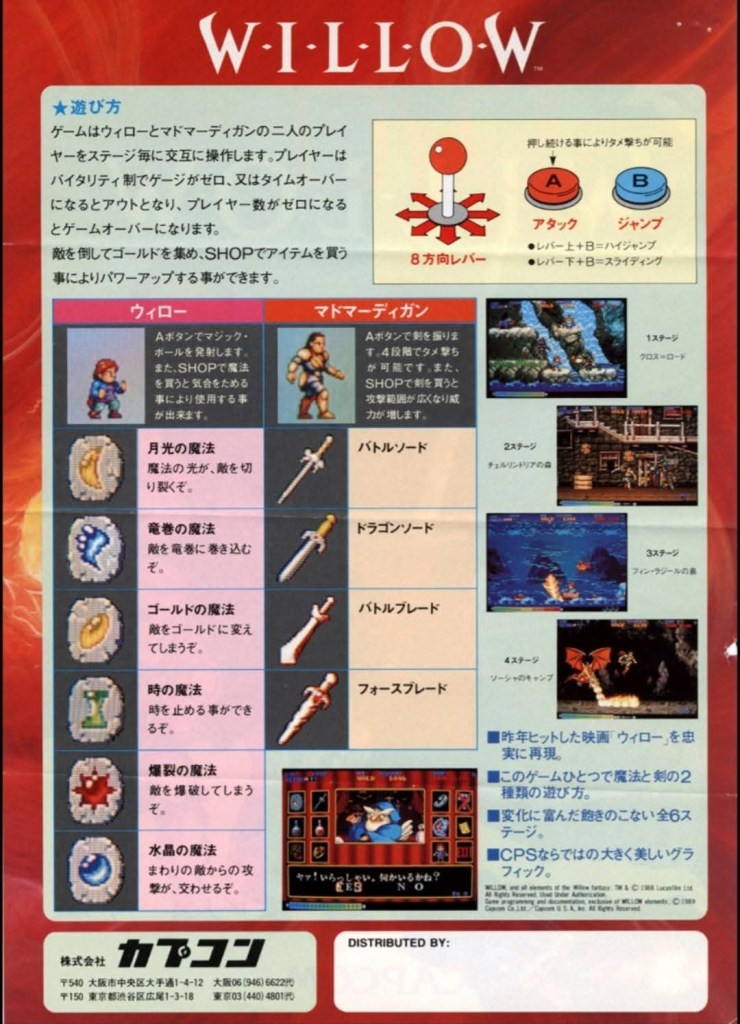
2. Willows Japanese arcade flyer
The front.
The rear.
Remember the 1988 high fantasy adventure film Willow? That film was produced by George Lucas and was a bold new production of Lucasfilm shifting away from Star Wars. Believe it or not, an official arcade game adaptation of Willow was made by Capcom and they promoted it by having images of Val Kilmer and Warwick Davis on the front of the arcade flyer (opposite the illustrated versions of their characters). The game, which was a side-scrolling platform game with run-and-gun elements, went on to be an arcade hit in Japan and eventually pleased gamers worldwide.
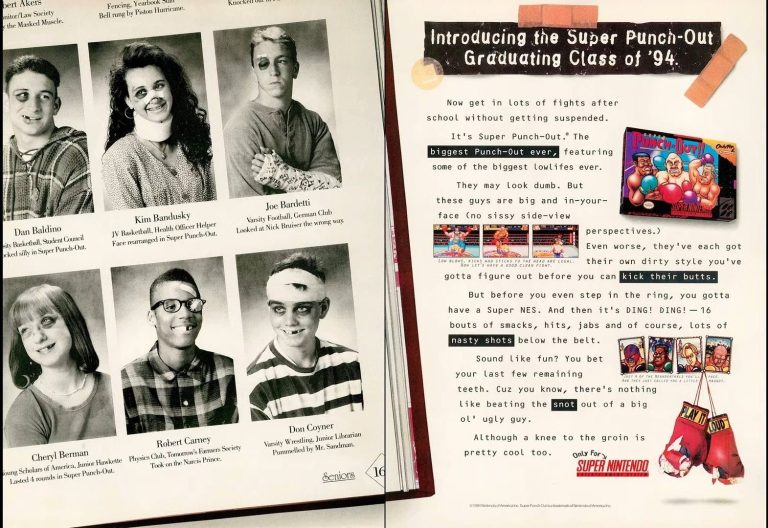
3. Super Punch-Out!! North American print ad
This is funny to look at.
Historically, Nintendo’s Punch-Out!! series started in the arcade in 1984 and the first game was the result of the company’s effort to make a new game using arcade cabinets with two screens. The 2nd game – Mike Tyson’s Punch-Out!! – became a huge critical and commercial hit (over 2 million copies sold in 1988) on console and it made great business sense for Nintendo for release another Punch-Out!! for its console gamers to enjoy in the comfort of home. In 1994, Super Punch-Out!! was released on the Super Nintendo Entertainment System (SNES) in America and to promote it, the company came up with a hilarious 2-page ad that showed fictional high school graduates with boxing-related injuries. The imagery creatively connected with the words “biggest Punch-Out ever” and “Graduating Class of ‘94”.
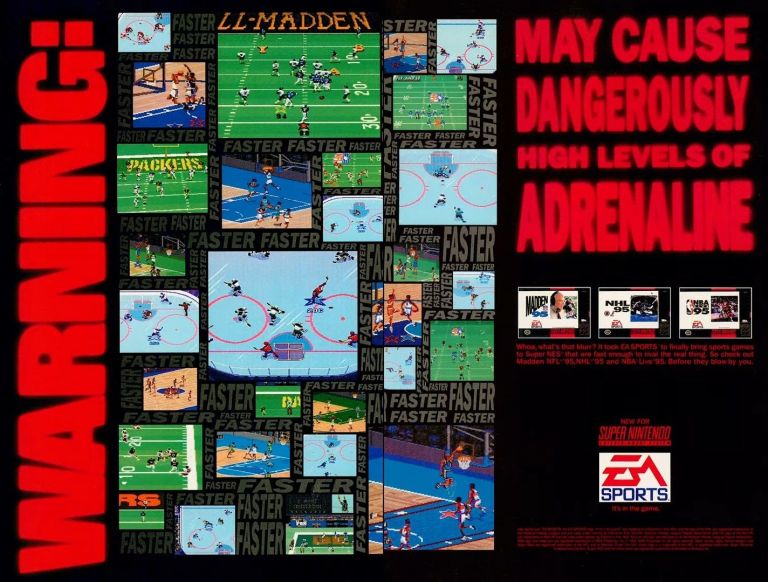
4. EA Sports 3-in-1 SNES games print ad
EA Sports games on the SNES.
In 1994, Electronic Arts (EA) released their sports games NBA Live 95, NHL 95 and Madden NFL 95 for consoles at the time. Even though the Sega Genesis sold better than Super Nintendo Entertainment System (SNES) in America at the time, EA went on to aggressively market their 3 sports video games on Nintendo’s console using a 3-in-1 games print ad. In retrospect, the SNES for the most part had better graphics and sounds than the Genesis which is reflected clearly on EA Sports games of the time. This print ad still looks fun and exciting.
5. Atari Jaguar CD print ad
Were you able to play any game on the Atari Jaguar with the CD add-on included?
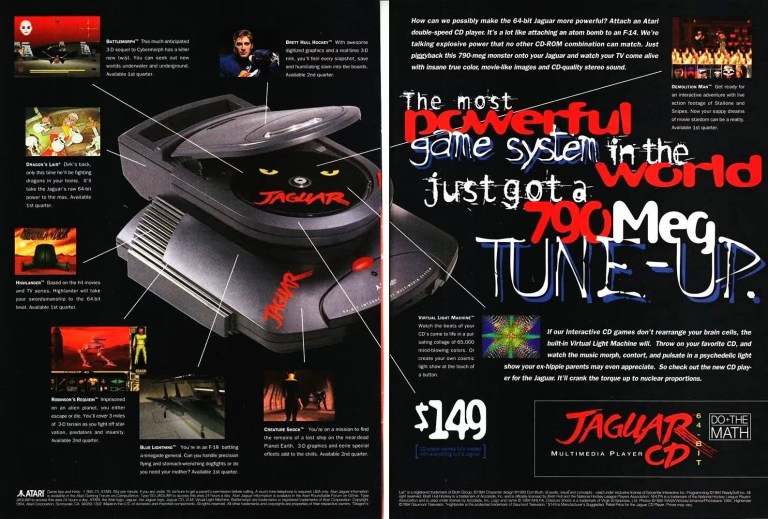
Apart from the obvious advances of technology that impacted video games, the 1990s is also known for the rise of CD-ROM as a medium for gaming. In an effort to boost sales of the Atari Jaguar console (launched in America in 1993 for around $250) and capitalize on the trust of the fans and console owners, Atari launched a CD-ROM add-on device for about $150 in 1995. To promote it, the company went aggressive with the 2-page ad showing the add-on fully connected on top of the main console, showing off some games and posting a text description emphasizing hardware power and the advantages that come with the CD technology. Even in the captured image, the Atari Jaguar CD still resembled a toilet. This is an aggressive ad campaign that failed as less than 20,000 Atari Jaguar CD units were sold by the time it was discontinued in 1996.
6. 3DO print ad
While it lacks intensity, this 3DO ad emphasized the games.
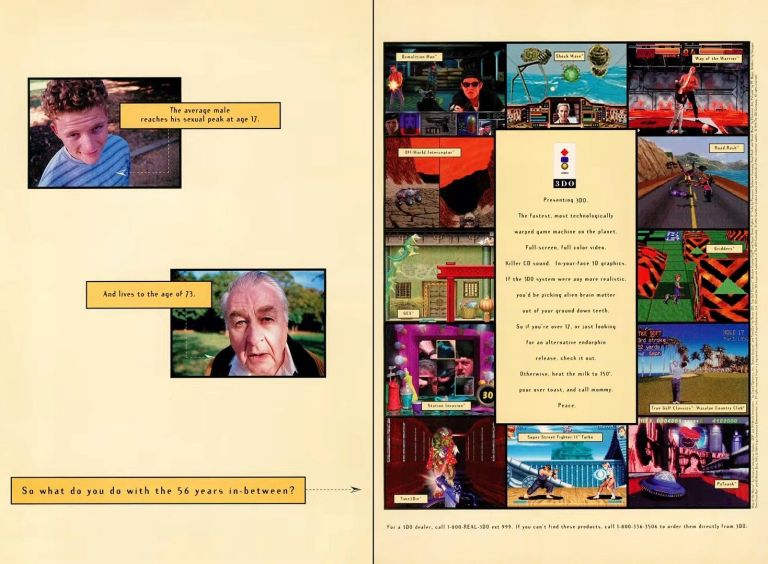
Without showing any hardware, the 3DO Company came up with this 2-page print ad that had a slightly adulterated tone (look at the left page) and aggressively marketed the 3DO console games available at the time. Games like Demolition Man, Shock Wave, Road Rash and Super Street Fighter II Turbo were the standout titles which clearly showed the company made the effort to emphasize gaming more than multimedia features. This 1990s ad tackled the generations with a touch of humor.
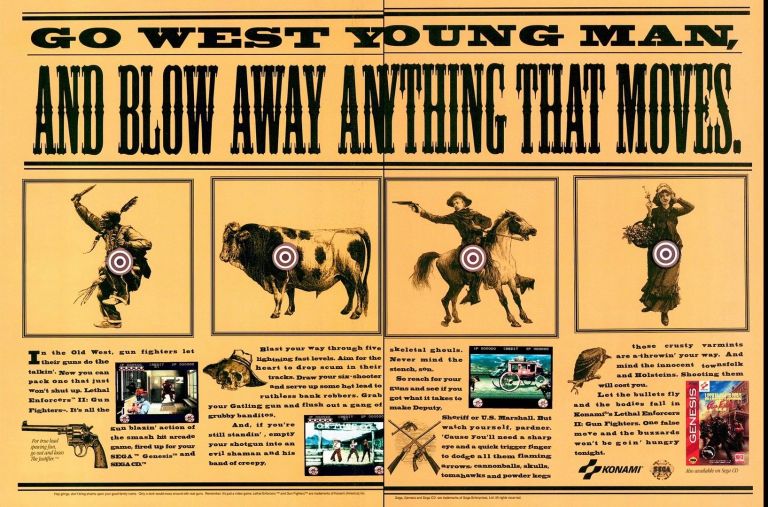
7. Lethal Enforcers II: Gun Fighters Sega Genesis print ad
This is a fun ad to look at.
When Lethal Enforcers II: Gun Fighters was released in the arcades in 1994, it became a commercial success for Konami which went on to announce it would port the game to consoles of Nintendo and Sega at the time. While the port for the Super Nintendo Entertainment System (SNES) was never released, Lethal Enforcers II: Gun Fighters made its way to the Sega Genesis and Sega CD. The print ad of the Sega Genesis version (Sega CD mentioned in small text) had an inspired design emphasizing the Old West, shooting and the conflict between cowboys and Indians. The screenshots gave people the clear idea that Old West was the setting (versus modern day in the previous game). This is still fun to look at.
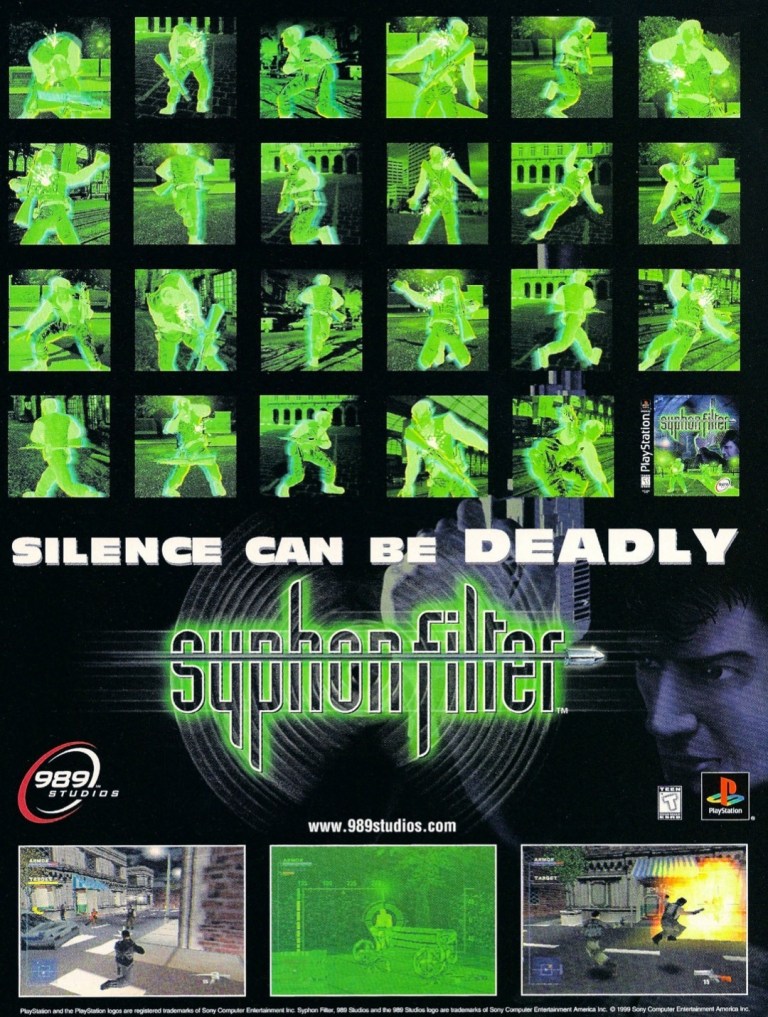
8. Syphon Filter
Syphon Filter went on to become a surprise hit game in 1999.
In 1999, Sony’s 989 Studios released Syphon Filter exclusively on the PlayStation console. This single-page print ad showed a few screenshots on the bottom and several action snippets with a night vision touch ultimately emphasizing the stealth aspect within the gameplay. The marketing proved to be effective as the game sold a lot at retail and went on to establish a new game franchise exclusive to PlayStation consoles.
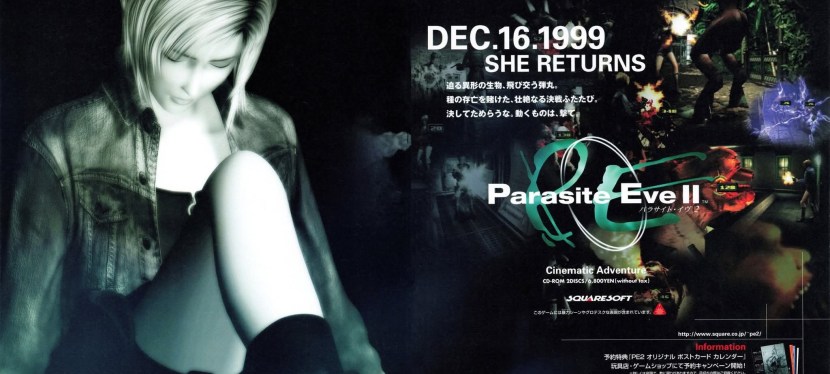
9. Parasite Eve II Japanese print ad
Were you a big fan of Aya Brea and the Parasite Eve franchise in the late 1990s?
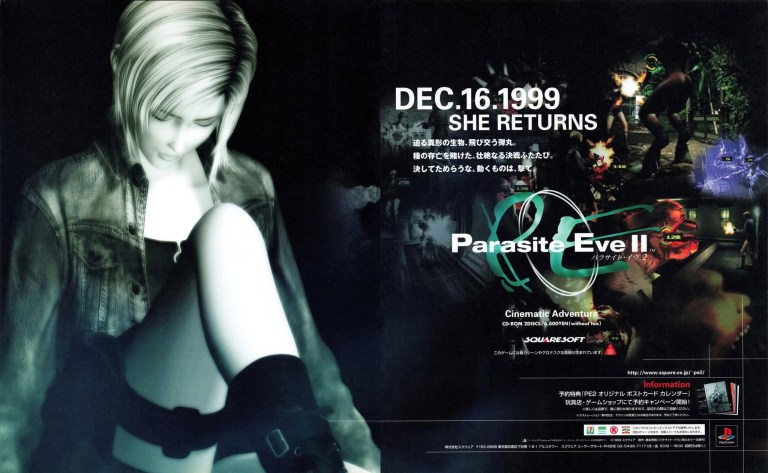
Following the critical and commercial success of Parasite Eve in 1998, SquareSoft proceeded with Parasite Eve II and the production (note: initially for a spin-off game before becoming a sequel) did not even involve the main creators of the first game. Instead the company had a different team of developers – including those who previously worked on Resident Evil games for Capcom – in Osaka to make the sequel. This explains why Parasite Eve II had stronger survival horror gameplay resembling a Resident Evil game. As major changes were made during the production, it was decided that Aya Brea would become the main protagonist and already the character was already popular with gamers. That being said, the marketing of Parasite Eve II for the Japanese market heavily featured Aya Brea with subtle sexiness, beauty and action in mind. The marketing intensified leading to its eventual December 16, 1999 release in Japan.
Welcome back readers, fellow geeks and electronic gaming fans!
In this edition of the Retro Gaming Ads Blast (RGAB) series, we will take a look at another batch of retro gaming print ads – including arcade flyers – from the 1970s to the 1990s.
For the newcomers reading this, Retro Gaming Ads Blast (RGAB) looks back at the many print ads of games (console, arcade, computer and handheld) that were published in comic books, magazines, flyers, posters and newspapers long before smartphones, social media, the worldwide web and streaming became popular. To put things in perspective, people back in the 1980s and 1990s were more trusting of print media for information and images about electronic games and related products.
With those details laid down, here is the newest batch of retro gaming print ads for you to see and enjoy…
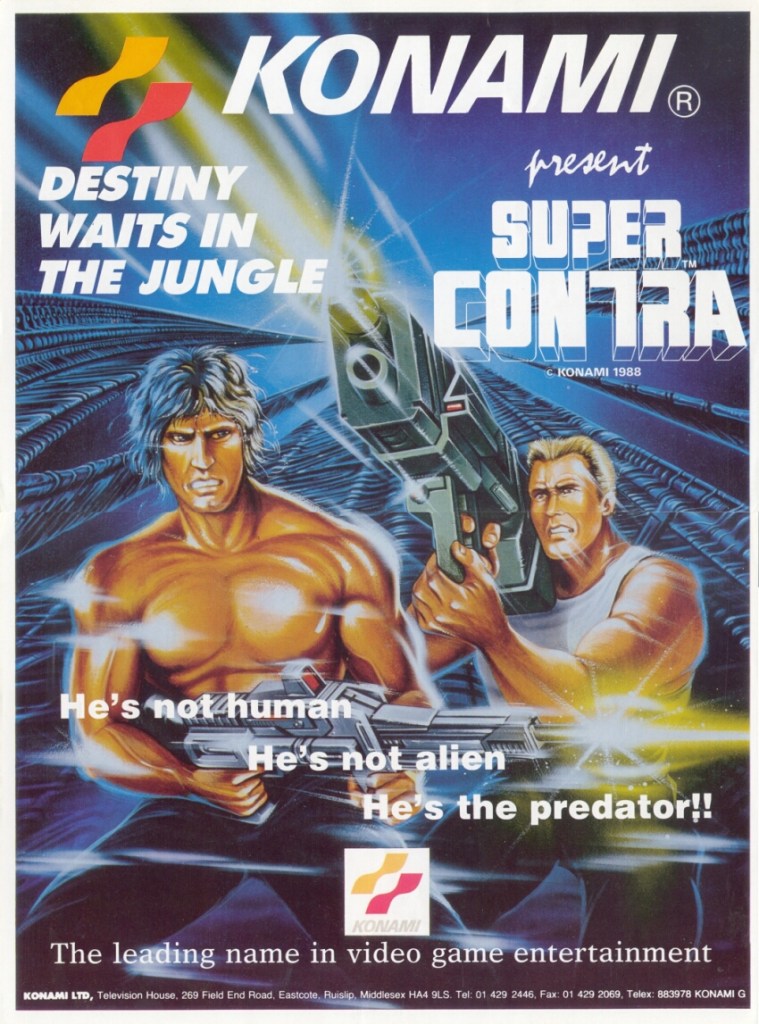
1. Super Contra North American arcade flyer
Have you seen many Hollywood action movies of the 1980s? Does this arcade flyer remind you of something?
After Konami struck gold with Contra in 1987, it was inevitable that sequels and spin-offs will be made. In 1988, they released the follow-up Super Contra in the arcades and to promote it in America, the company came up with artwork that easily gave gamers the impression they are seeing Sylvester Stallone as a fantasized Rambo and another armed guy who might remind them of Arnold Schwarzenegger’s character in Commando or Dutch in Predator. To capitalize on the movie references even more, the American arcade flyer had the line “He’s not human. He’s not alien. He’s the predator!!” As it was the 1980s, this creative approach to promotion was not surprising as Konami and its game makers were influenced by Hollywood movies.
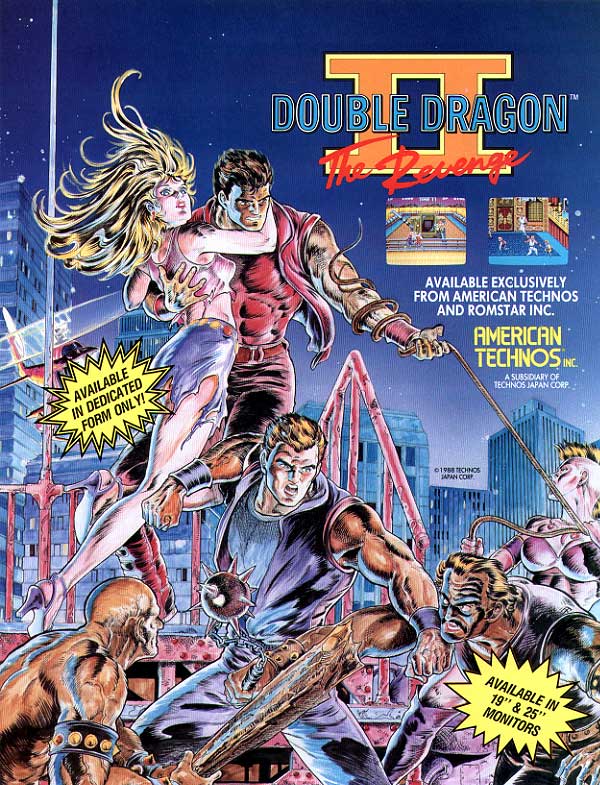
2. Double Dragon II: The Revenge North American arcade flyer
The artwork used in this arcade flyer remains intriguing to look at.
I never played Double Dragon II: The Revenge in the arcade, but I played it on the Nintendo Entertainment System (NES). That being said, I was surprised to see how this old North American arcade flyer has the same hand-drawn artwork used on the cover of the NES version. Take note that the arcade game was released in 1988 while the NES port was released in early 1990. I can only guess that Technos decided to use the same artwork not only for convenience but to have a definitive image emphasizing Double Dragon II to gamers wherever they are.
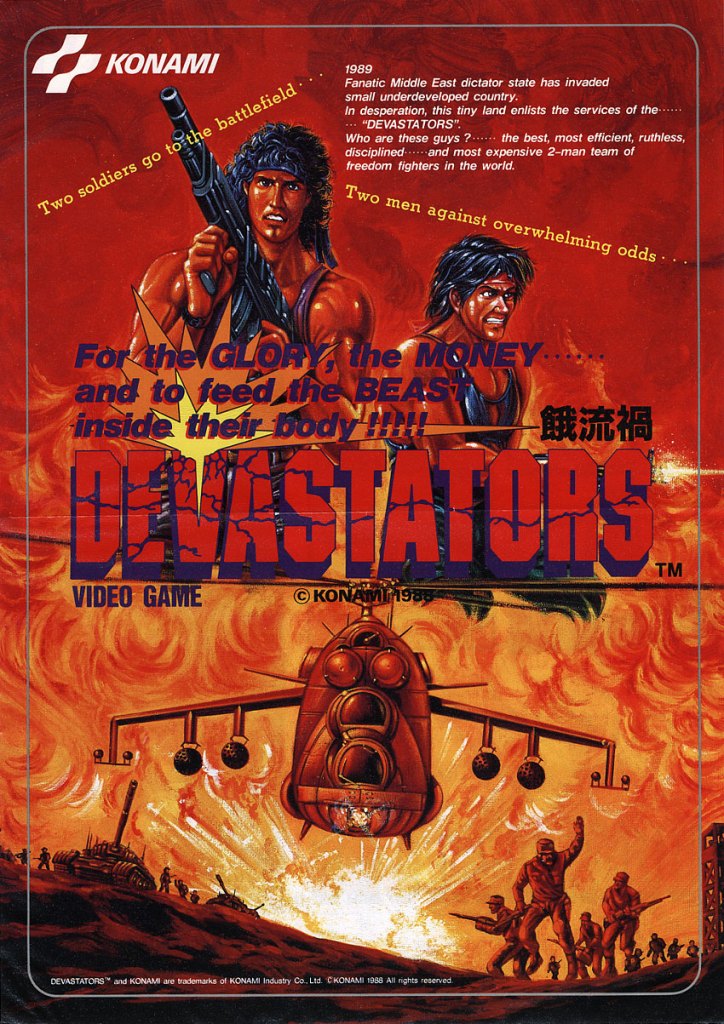
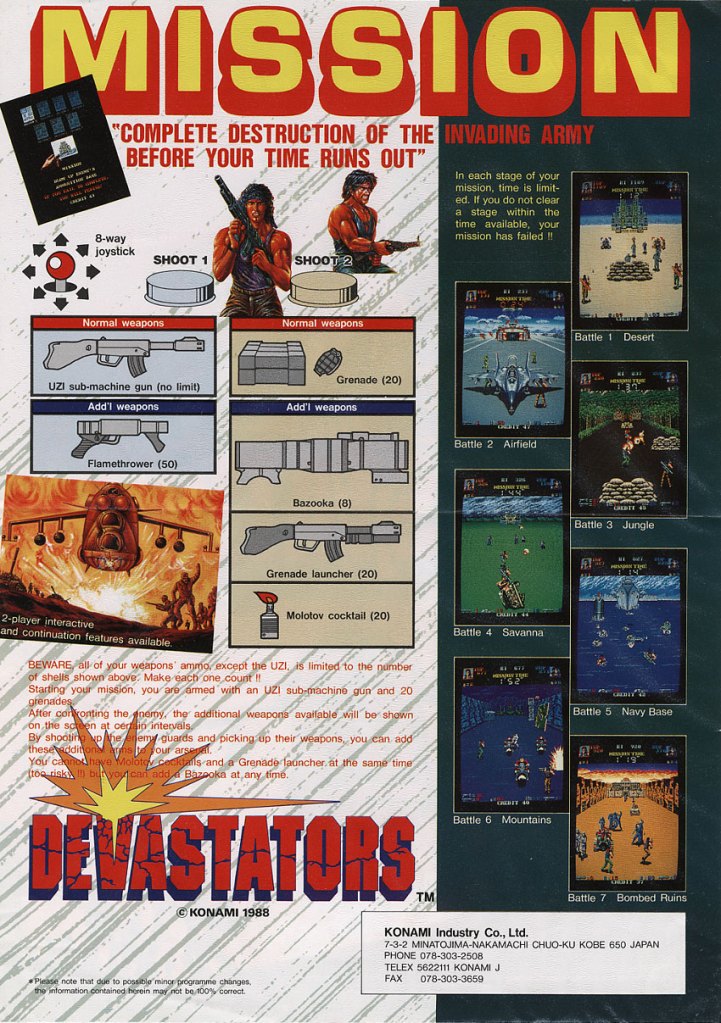
3. Devastators North American arcade flyer
The front.
The rear.
Devastators is another Konami arcade game that had a strong war theme and it was influenced by Hollywood action films of the 1980s. This particular arcade flyer for the North American market is almost identical with the Japanese arcade flyer as both have the same artwork on the front and almost the same visual layout on the rear. The most obvious difference is the use of English text for the North American flyer.
4. Assault North American arcade flyer
The front.
The rear.
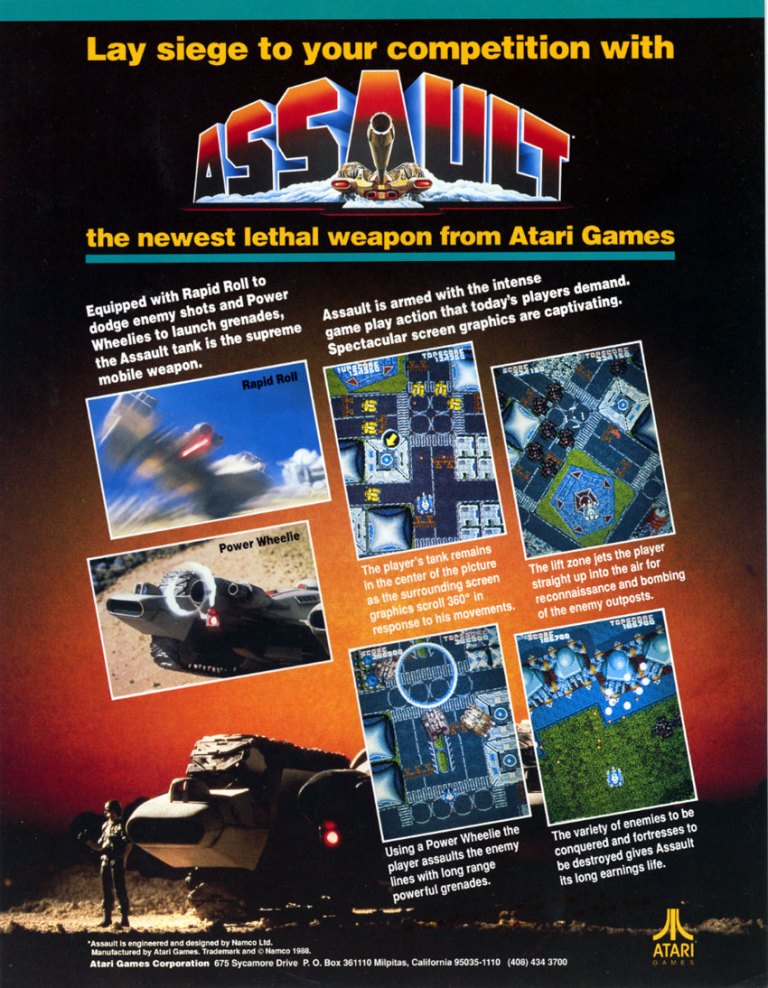
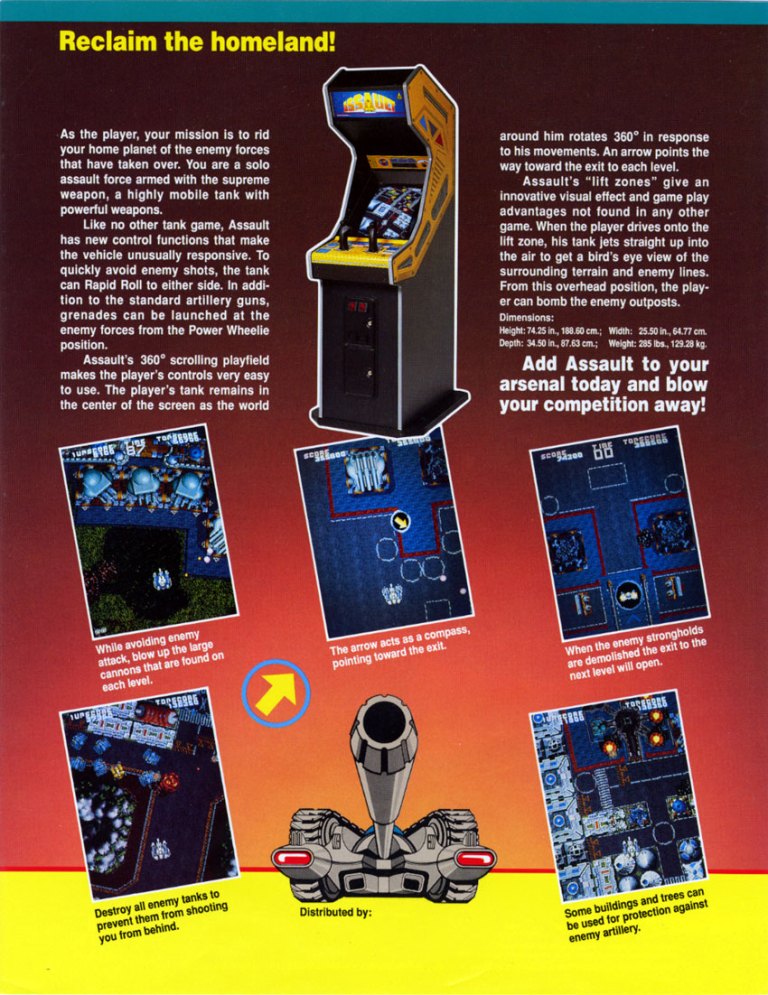
Released in American arcades by Atari, Assault is a multi-directional shooter that had a twin-stick control layout (similar with the classic Battlezone) and players experienced intense battles as well as immersive visual effects such as sprite scaling and environment rotation of up to 360 degrees. To promote the game (this originated in Japan by Namco), Atari came up with this arcade flyer that had selected screenshots and descriptive text on both the front and the rear (which showed the arcade cabinet). Assault was a hit with gamers at the arcades and it was not released on consoles until 2009.
5. Sega CD print ad
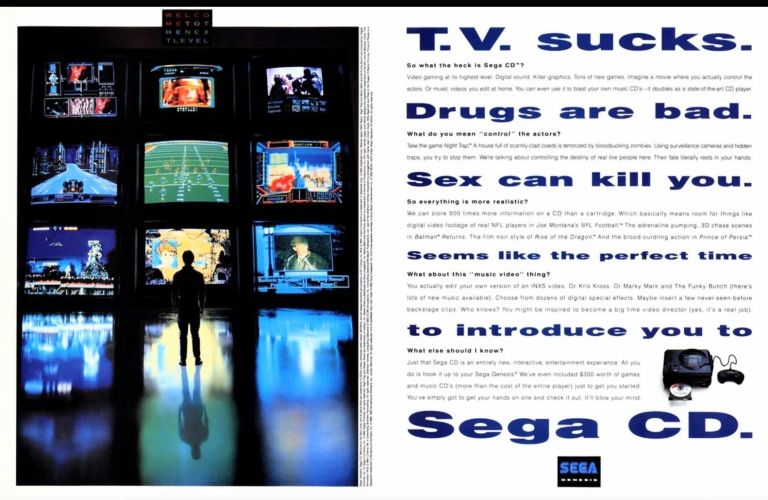
Having a socially relevant message can be catchy but it leaves little room for excitement.
As the Sega Genesis console became a huge commercial success in North America, Sega itself became ambitious about what CD-ROM technology would do for video games. Sega in Japan tasked its Consumer Products Research and Development Labs to create a CD-ROM add-on which resulted in the Sega CD (Mega-CD in other parts of the world) which launched in America in 1992. To promote the add-on towards existing Genesis console owners as well as potential new customers, Sega of America came up with the above 2-page print ad that had a social message on the right and an image of a man standing in front of large monitors (showing Sega CD game footage) on the left. While it looked like an odd way of promoting video game hardware, it still remains catchy to see.
6. Panasonic 3DO print ad
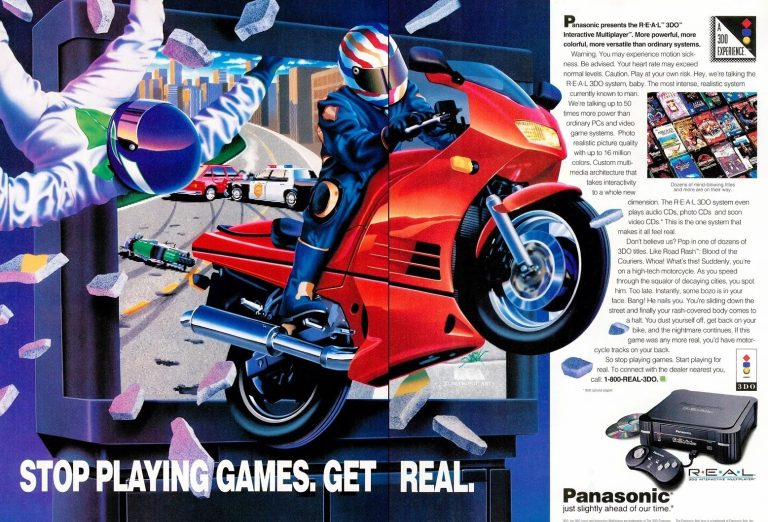
Panasonic knows how to promote entertainment hardware for people’s homes.
Still in the field of CD-ROM gaming, Panasonic had competitive presence in video gaming when its Panasonic FZ-1 R.E.A.L. 3DO Interactive Multiplayer (with technology licensed by The 3DO Company) was launched in America in 1993. If you look at the print ad closely, you will notice that the descriptive text emphasized the multimedia entertainment aspect more than video gaming. The dominating artwork used does not come from a particular video game as it was made to emphasize home entertainment in general. It’s not surprising that the Panasonic 3DO and other 3DO machines from other manufacturers failed commercially.
7. Shaq Fu print ad
The close-up of Shaquille O’Neal’s face on the left made him looked less recognizable.
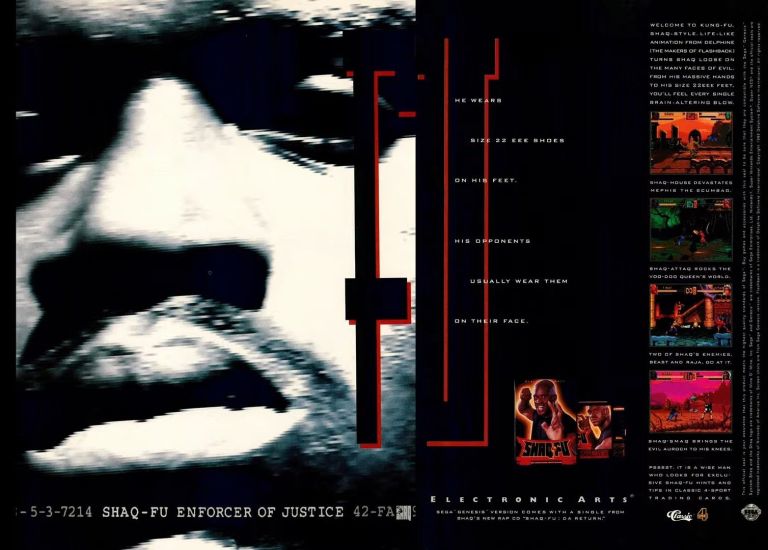
Yes, it is true! There was indeed a video game endorsed by Shaquille O’Neal and it was not a basketball game. Shaq Fu is a 1994 2D fighting game with adventure elements and a story in which gamers play O’Neal as martial artist (note: O’Neal himself participated in the game’s production). To promote the game, Electronic Arts came up with a 2-page print ad that had a very odd black-and-white close-up image of O’Neal’s face on the left leaving small screenshots and hard-to-read text on the right (even though there was some vacant space remaining. I remember seeing this ad while reading a video game magazine and the ad ended up looking more like a promotion of O’Neal (already an NBA superstar) than the game itself. By today’s standards, this print ad is an example of a marketing misfire.
8. Kasumi Ninja print ad
Do you even remember seeing this print ad in magazines?
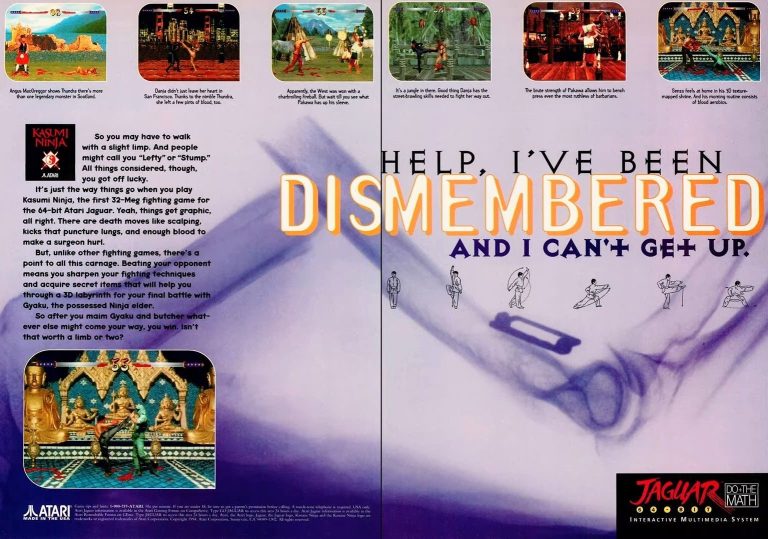
Remember the 1990s video game trends of digitized human images and disturbingly violent 2D fighting games sparked by Mortal Kombat? The Atari Jaguar-exclusive game Kasumi Ninja was made to capitalize on those trends and it failed badly. Apart from the low sales of the Jaguar console, Atari as publisher came up with the above 2-page print ad that was not appealing to gamers’ eyes and it had almost no excitement overall. This is another marketing misfire.
9. Parasite Eve North American and Japanese print ads
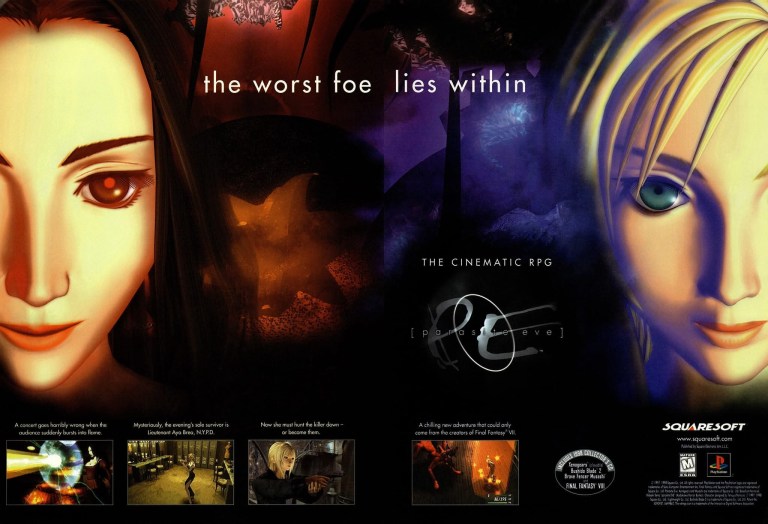
Following the successful release of Final Fantasy VII, this ad excited PlayStation gamers and JRPG enthusiasts for Parasite Eve’s 1998 release in America.
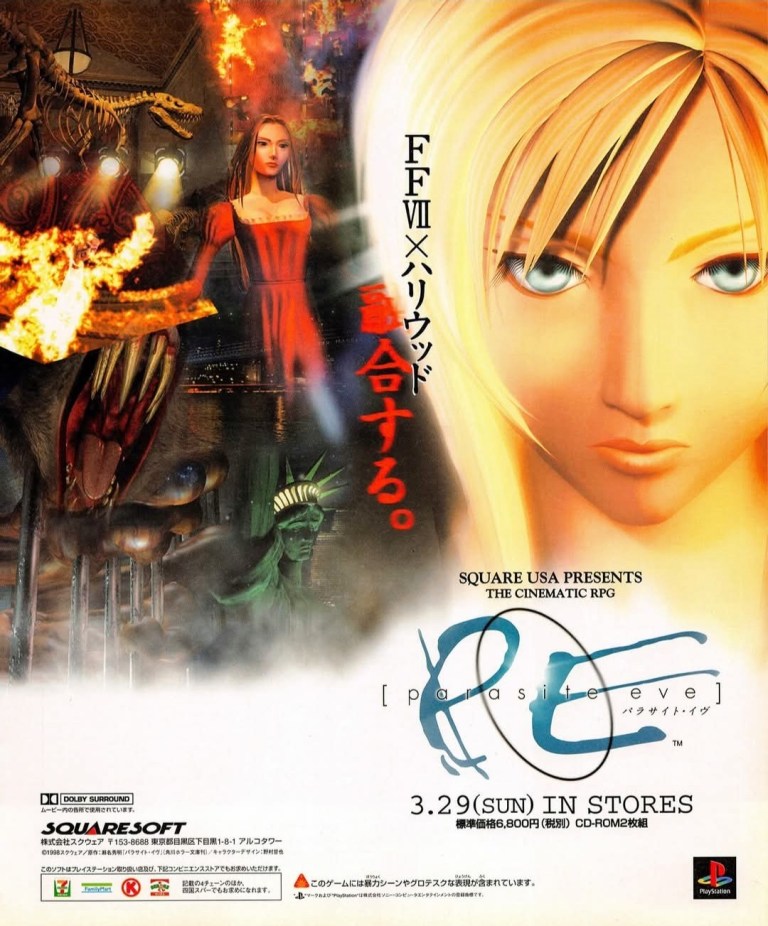
A stronger horror presentation in this print ad for the Japanese market. There were already a lot of people in Japan who enjoyed horror.
Starting in the mid-1990s, Squaresoft (now Square Enix) really became aggressive with video game creativity and experimentation as they launched several new projects that eventually got released on PlayStation in the late 1990s until 2000. One of those daring new projects was Parasite Eve which was a role-playing game (RPG) that had visual elements – particularly pre-rendered backgrounds – and a style of exploration that reminded gamers of Resident Evil. The game was a sequel to the Japanese science fiction horror novel of the same name and it involved the creativity of Final Fantasy creator Hironobu Sakaguchi (credited as producer). To promote the game, the 2-page North American print ad had protagonist Aya Brea on the right and the enemy on the left with a cryptic line placed strategically between them. The North American ad clearly stated that the game is a cinematic RPG. By comparison, the Japanese print ad of Parasite Eve has a strong horror vibe which is not surprising because of the novel’s horror elements and the fact that Squaresoft was capitalizing on the popularity of horror-related entertainment in Japan. By today’s standards, Parasite Eve is truly a product of the late-1990s and it has a dedicated fanbase.
Welcome back readers, fellow geeks and electronic gaming fans!
In this edition of the Retro Gaming Ads Blast (RGAB) series, we will take a look at another batch of retro gaming print ads – including arcade flyers – from the 1970s to the 1990s.
For the newcomers reading this, Retro Gaming Ads Blast (RGAB) looks back at the many print ads of games (console, arcade, computer and handheld) that were published in comic books, magazines, flyers, posters and newspapers long before smartphones, social media, the worldwide web and streaming became popular. To put things in perspective, people back in the 1980s and 1990s were more trusting of print media for information and images about electronic games and related products.
With those details laid down, here is the newest batch of retro gaming print ads for you to see and enjoy…
1. Intellivision print ad
Were you able to play a game on the Intellivision long ago?
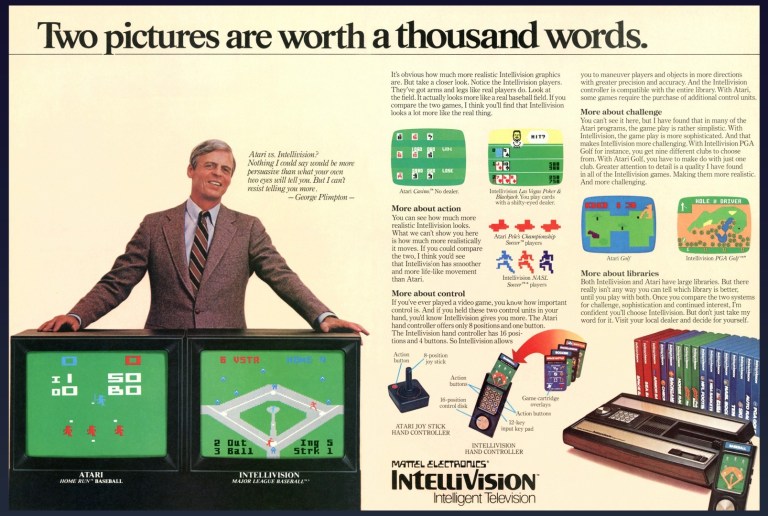
In 1979, Mattel launched their Intellivision game console in America which instantly placed them in competition with Atari’s 2600 console. In a bid to convince gain market share, Mattel daringly came up with a competitive print ad like the one above showing two TV sets (with an Atari 2600 baseball game and a similar game on Intellivision), descriptive text that explained why the intellivision and its games are better, and even mentioned Atari by name several times. Obviously the tactic did not lead Mattel to ultimate market victory but the above print ad showed it was okay for a newcomer to mention their competitor and aggressively attack it to gain customers (both newcomers and active gamers).
2. Popeye Japanese arcade flyer
The front of the flyer.
The rear.
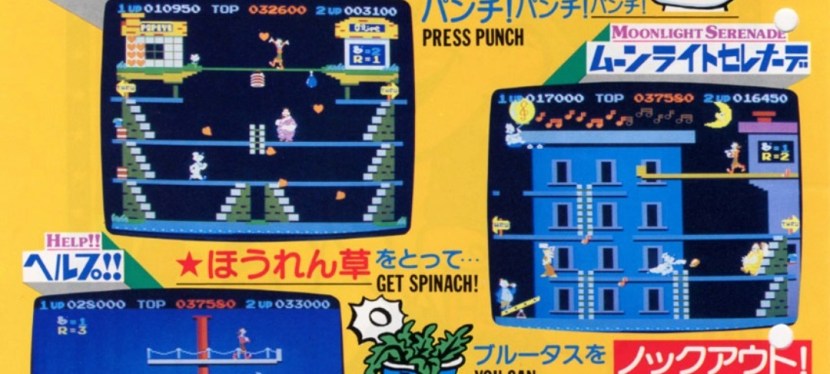
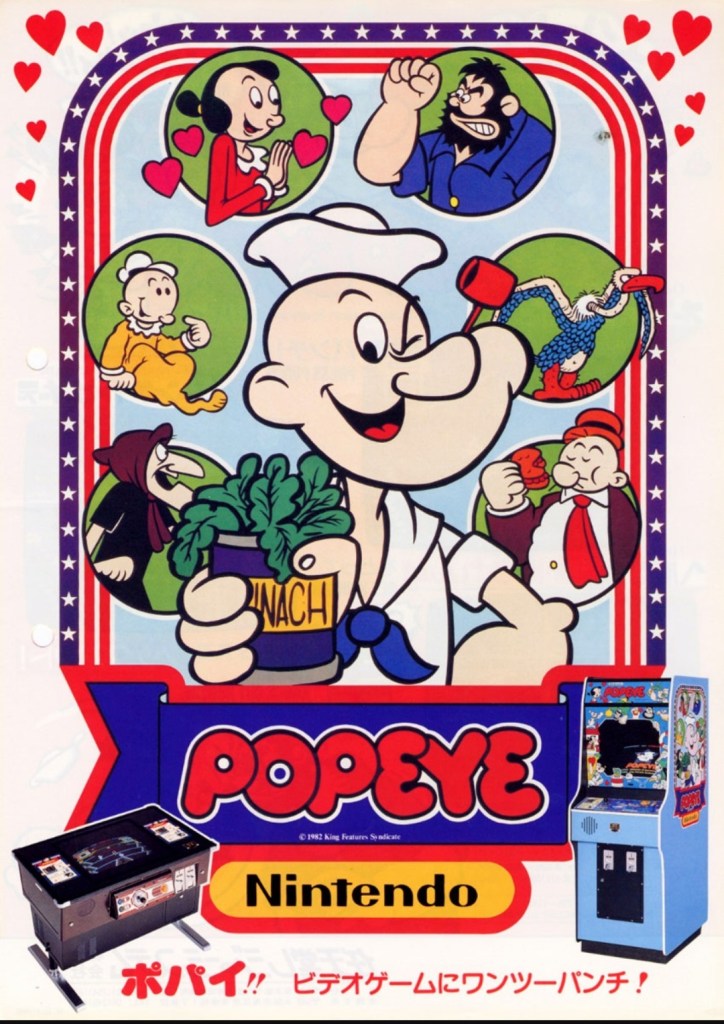
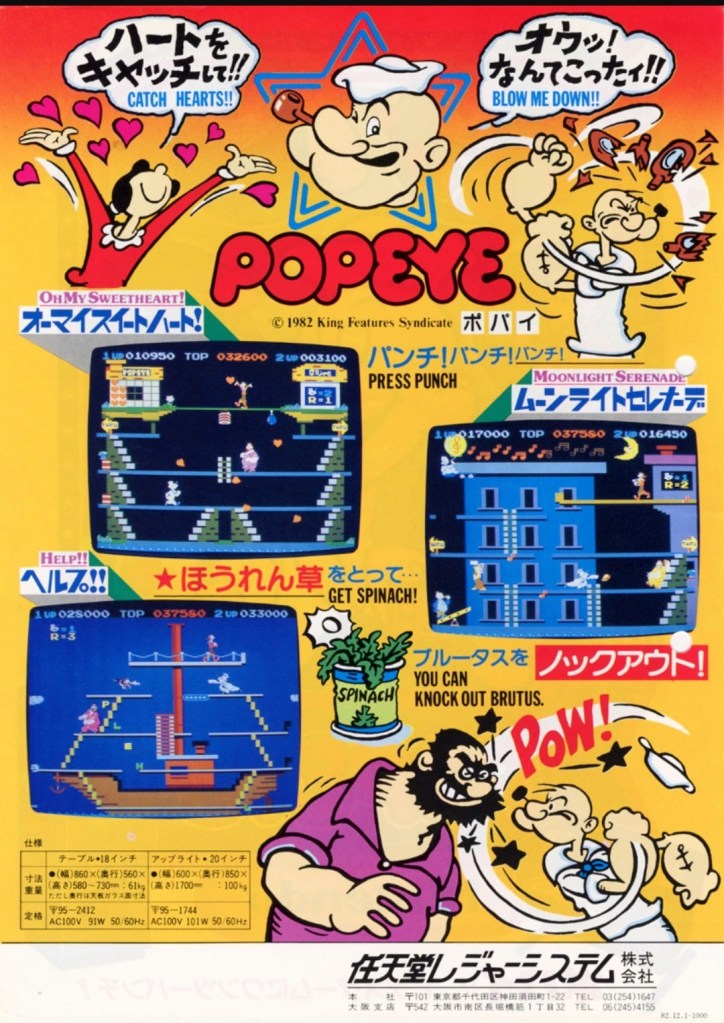
In 1982, Nintendo released the Popeye arcade game which was incidentally the result of the success of their original Donkey Kong arcade game. To promote the game, Nintendo came up with an arcade flyer that had a very lively front (note: the characters were instantly recognizable thanks to the great art used) and the rear having easy-to-read instructions on how to play the game, what levels to expect and what must be done when playing. Popeye was an arcade hit in Japan, but an even bigger hit in America. This old arcade flyer still looks nice.
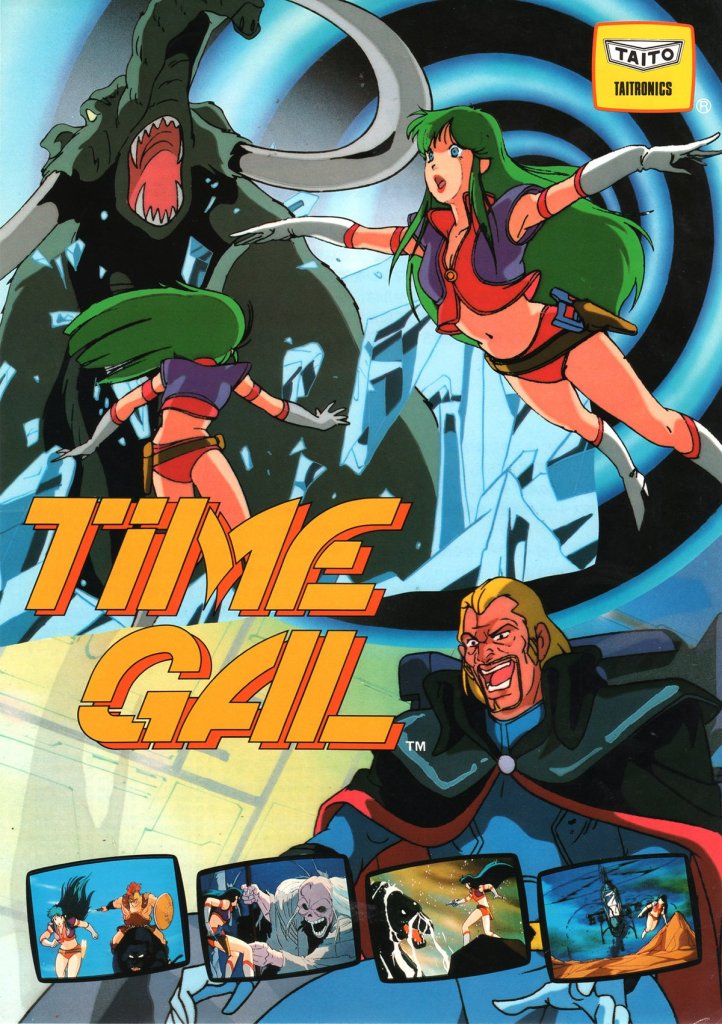
3. Time Gal arcade flyer
On face value, this one looks more like an anime promo since gameplay elements were missing.
Released in Japanese arcades in 1985, Time Gal is one of those games that used the expensive LaserDisc technology to stream pre-recorded animation (made by Toei) and challenged gamers to react quickly (using the joystick and button for commands) in order to progress in real-time. The arcade flyer has a very lively visual design making it clear to players and arcade operators that a lot of anime awaits those who play Time Gal. Technically, players watch anime cutscenes happen and react using the controls. Time Gal was an arcade hit and it made its way outside of Japan by getting ported for the Sega CD.
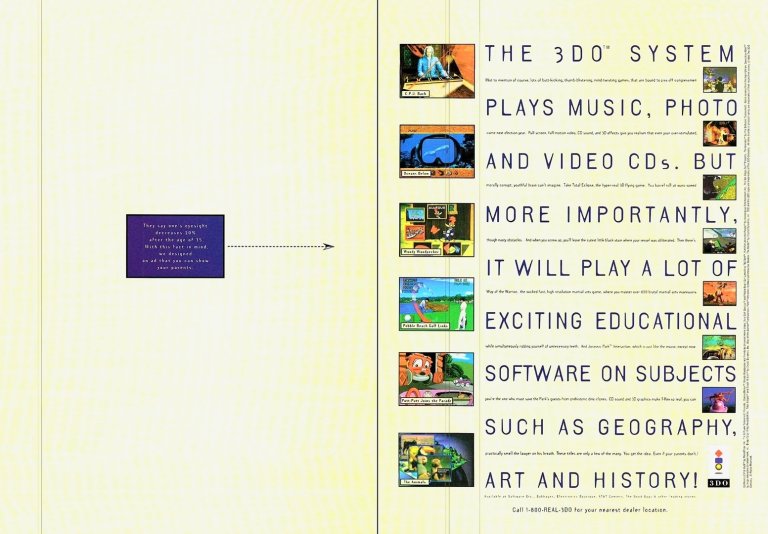
4. 3DO print ad
If you bought a 3DO long ago, was it for gaming or for home entertainment purposes?
Remember the 3DO? Developed by the 3DO Company and launched in 1993, the 3DO was designed to not only play video games but also function with multimedia features. In fact, the 3DO was initially marketed as a machine that allows users to watch videos, play music, browse digital photographs, and even immerse themselves with software focused on different topics. This is exactly what the above 3DO print ad emphasized. In retrospect, it was so odd for me to see the print ad inside video gaming magazines I read.
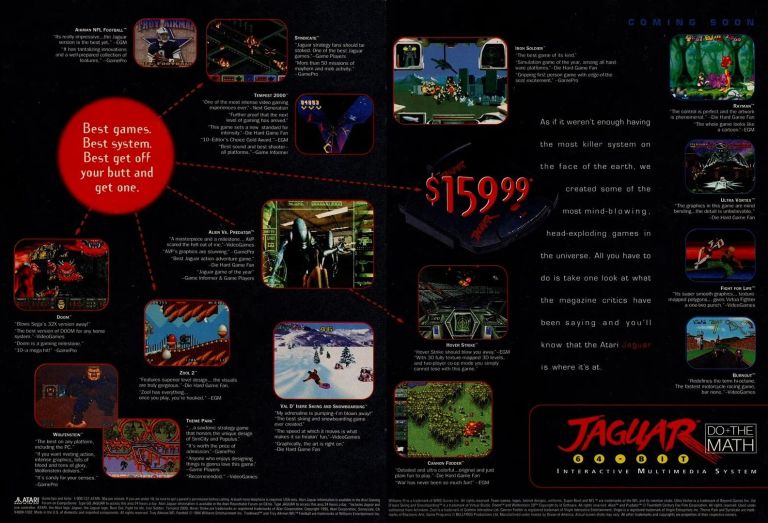
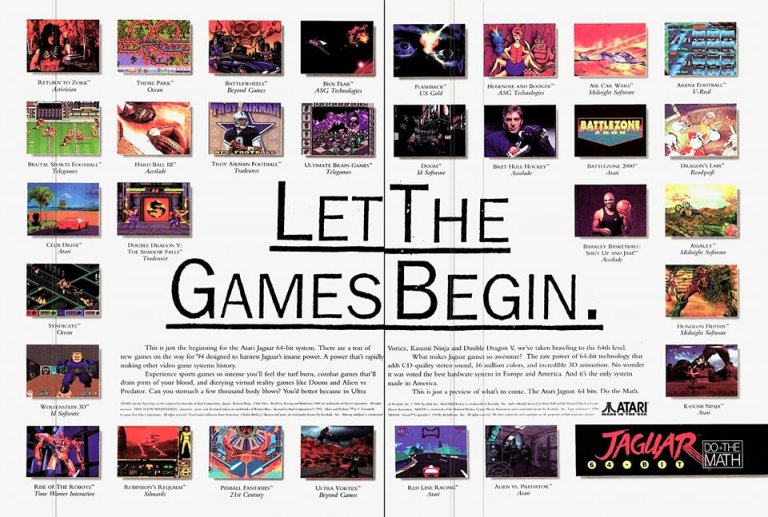
5. Atari Jaguar print ad
The strong focus on gaming was clear with Atari for the Jaguar.
Over a month after the launch of the 3DO, Atari launched its Jaguar console with a strong focus on video gaming. As console sales slowly grew in 1994, Atari came up with the above print ad – showing lots of games for the Jaguar – to lure in customers aggressively. If you look closely at the descriptive text of the ad, it mentions the Atari Jaguar as 64-bit system emphasizing that it is more powerful than other video game machines of the time. The bit count controversy harmed Atari and eventually the Jaguar failed.
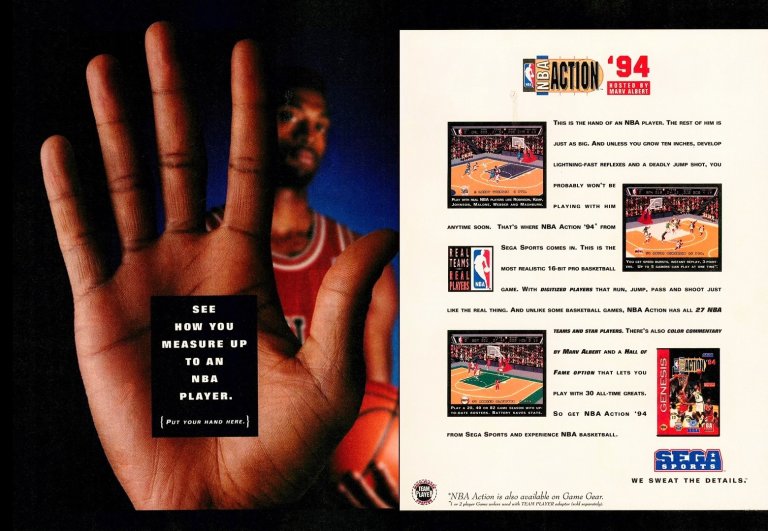
6. NBA Action ’94 print ad
Remember when Sega made NBA basketball video games that were exclusive to the Genesis console?
Remember when there were a lot of basketball video games licensed by the NBA in the 1990s? Through its own sports games brand – Sega Sports – Sega was dedicated to making exclusive sports video games for its customers and their NBA games were under the NBA Action brand. In 1994, they released NBA Action ’94 for the Genesis console and this two-page print ad they came up with had a catchy visual design (a supposed basketball player showing his palm and message to the camera on one side of the ad). Looking closely at the descriptive text, the ad mentions “most realistic 16-bit pro basketball”, “digitized players” and having all 27 NBA teams and star players. Sega Sports is no more but it’s legacy still lives on among Sega fans.
7. X-Men Sega Game Gear print ad
For X-Men fans!
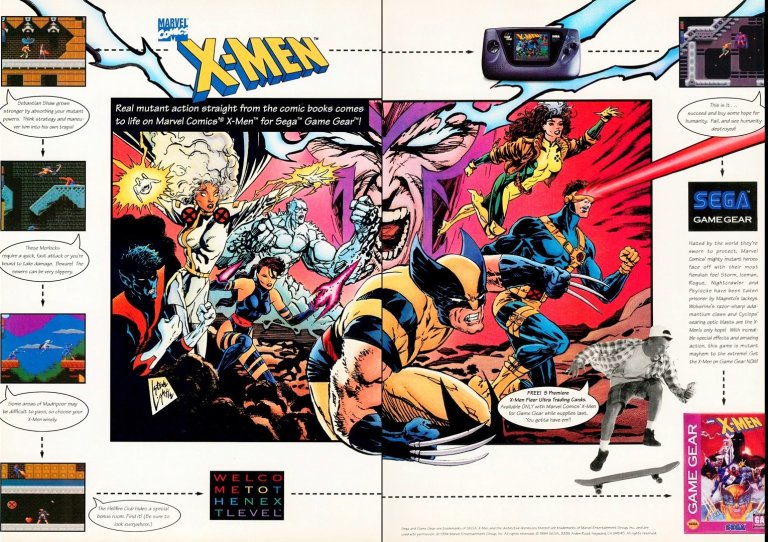
Similar to its approach with the Sega Sports brand, Sega developed exclusive games for the Game Gear. The company secured from Marvel the license to make an original X-Men game and to promote it, this 2-page print ad showcased original art of the established X-Men characters of the time while using the remaining spaces for the screenshots and descriptive text. This old print ad still looks attractive and will easily resonate with X-Men fans as well as 1990s superhero comics enthusiasts.
8. Liberty or Death print ad
American history is the core concept of this strategy game by Koei.
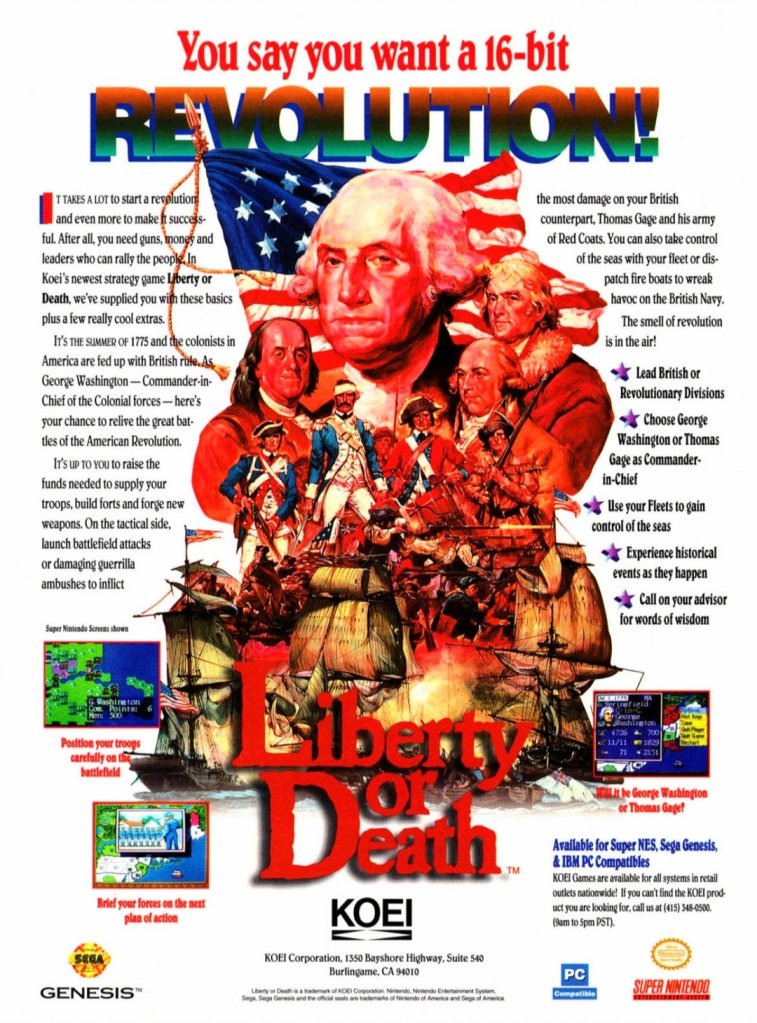
If there is anything notable about the Japanese company Koei, it is the fact that it released strategy and simulation games that tackled varied topics while making each game distinct and playable regardless of platform. In my experience, I had a lot of fun playing their business simulation Aerobiz Supersonic on the Super Nintendo Entertainment System (SNES). In 1993, Koei released their turn-based strategy game Liberty or Death which tackled American history for its setting (note: Koei already established itself with historical simulations). To sell the game, Koei came up with a print ad that had a very eye-catching historical art (George Washington, Thomas Jefferson, and Benjamin Franklin among the figures), a few selected screenshots and descriptive text that emphasized the essence of the game. This print ad is a reminder that no video game company today would make a historical simulation due to geopolitics (note: there are a lot of woke activists among video game employees today) and for business reasons.
Welcome back readers, fellow geeks and electronic gaming fans!
In this edition of the Retro Gaming Ads Blast (RGAB) series, we will take a look at another batch of retro gaming print ads – including arcade flyers – from the 1970s to the 1990s.
For the newcomers reading this, Retro Gaming Ads Blast (RGAB) looks back at the many print ads of games (console, arcade, computer and handheld) that were published in comic books, magazines, flyers, posters and newspapers long before smartphones, social media, the worldwide web and streaming became popular. To put things in perspective, people back in the 1980s and 1990s were more trusting of print media for information and images about electronic games and related products.
With those details laid down, here is the newest batch of retro gaming print ads for you to see and enjoy…
1. North American Pac-Mania arcade flyer
The front.
The rear.
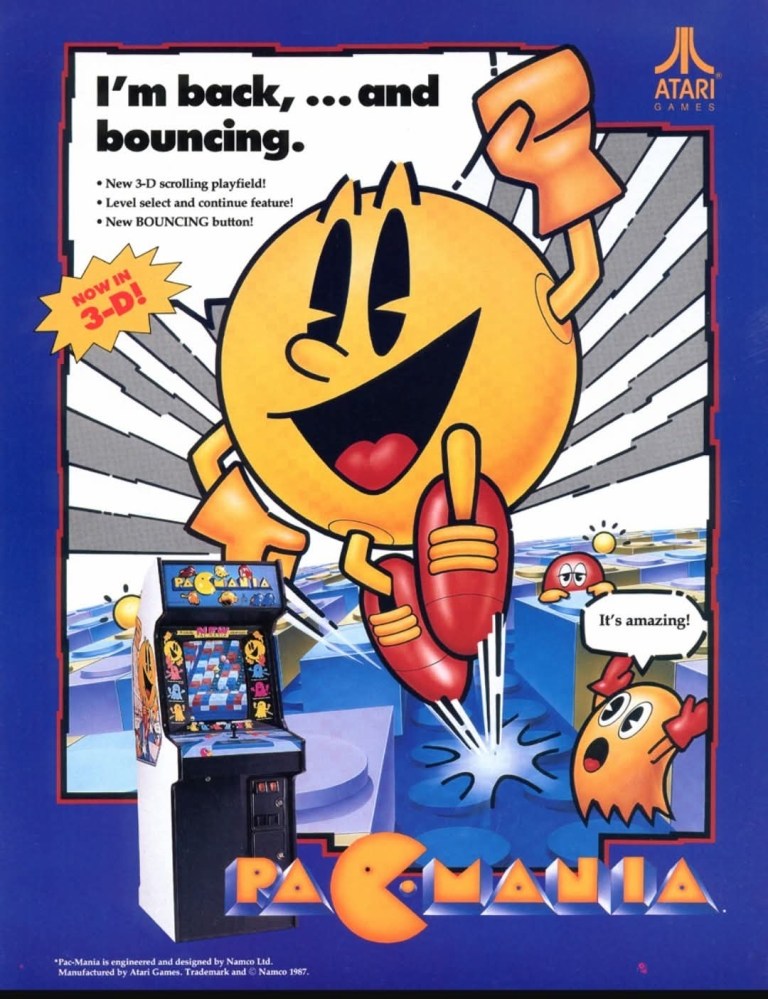
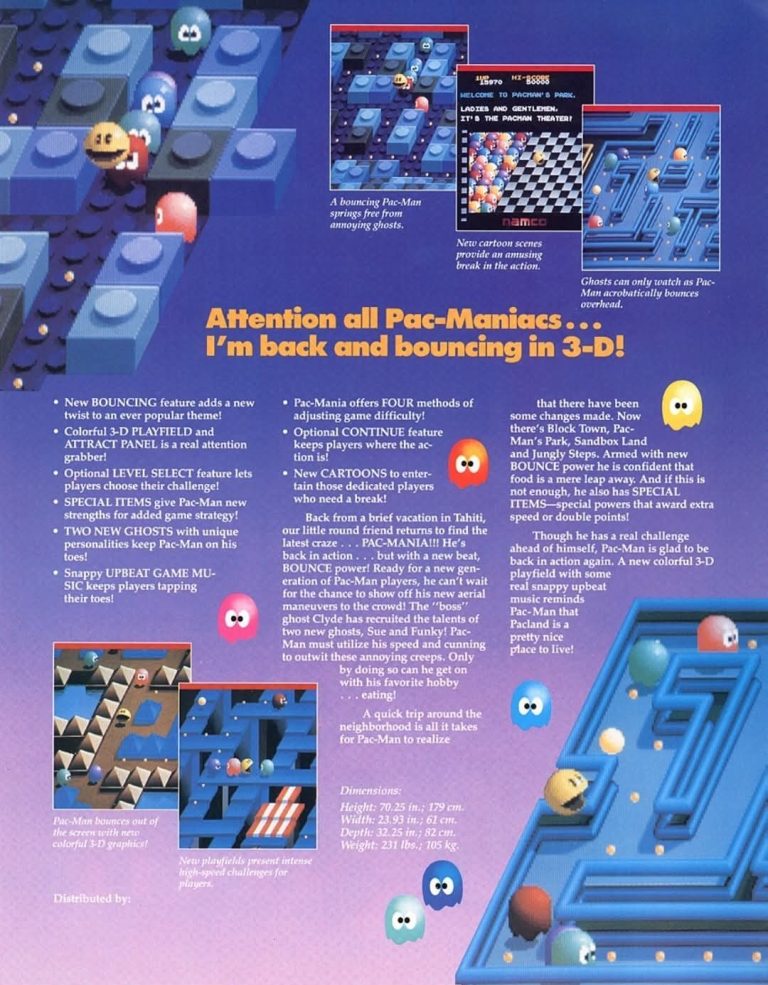
Released in 1987, Pac-Mania became a big hit among critics, fans and casual arcade gamers which added a lot to the enduring popularity of the Pac-Man game franchise. As it featured a new game design with an oblique perspective and a more 3D feel, Pac-Mania was a very serious attempt on reinventing the Pac-Man formula. For the American market, Namco licensed the game to Atari which in turn came up with the above arcade flyer that had a pretty eye-catching front cover artwork showcasing the iconic Pac-Man jumping out from a maze with the line “I’m back,…and bouncing.” The arcade cabinet was also shown and a clear message about the 3D feature of the game was shown. The other side of the flyer showed screenshots and details that are worth reading. This arcade flyer still looks attractive and informative by today’s standards.
2. Japanese Missile Command arcade flyer
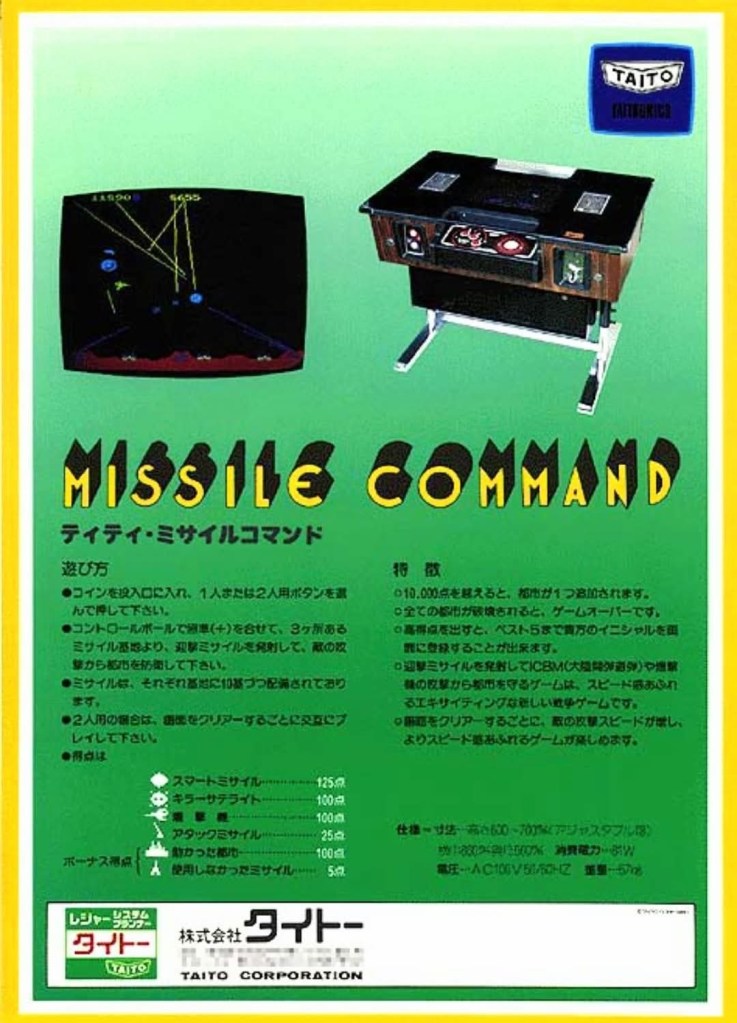
Cocktail arcade tables were popular in Japan and Taito brought Missile Command with the format.
Missile Command is a true arcade classic which I always enjoy replaying (read my retro review by clicking here). It was an instant hit in arcades in America and after Atari licensed the game to Sega and Taito for the arcades of Japan, it also achieved huge success there. Along the way, Taito released Missile Command with an cocktail arcade table format which is common in Japan. The arcade flyer Taito came up with had a very simplistic presentation of details, an image of the cocktail arcade table and one screenshot of the game. The Japanese arcade flyer clearly lacks excitement but at least it gave gamers and arcade operators a clear idea of what to expect with Missile Command.
3. Atari 2600 print ad
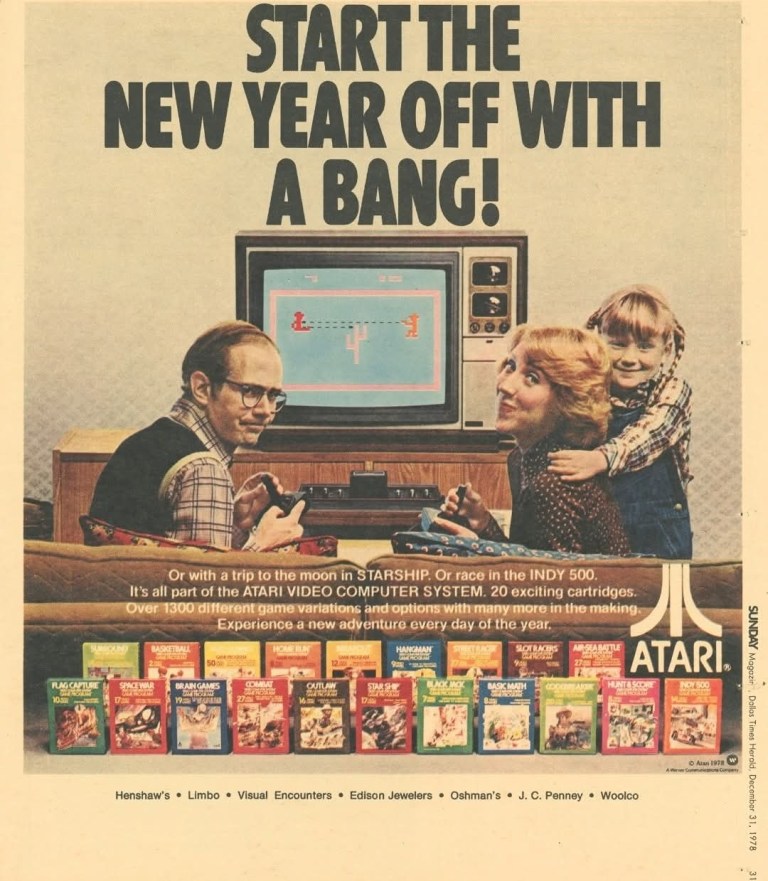
The 1978 print ad.
When the Atari 2600 was first launched in 1977, it was officially called the Atari Video Computer System (Atari VCS). The Atari company really aimed high to sell a lot of consoles to as many households as possible and they came up with a print ad like this one from 1978. While the Atari 2600 and its games were displayed, the image of a father, mother and daughter showed that the company not only targeted American families but also want to change home entertainment to be more interactive. This old ad is truly an inspired piece of work.
4. Kool-Aid Man video game print ad
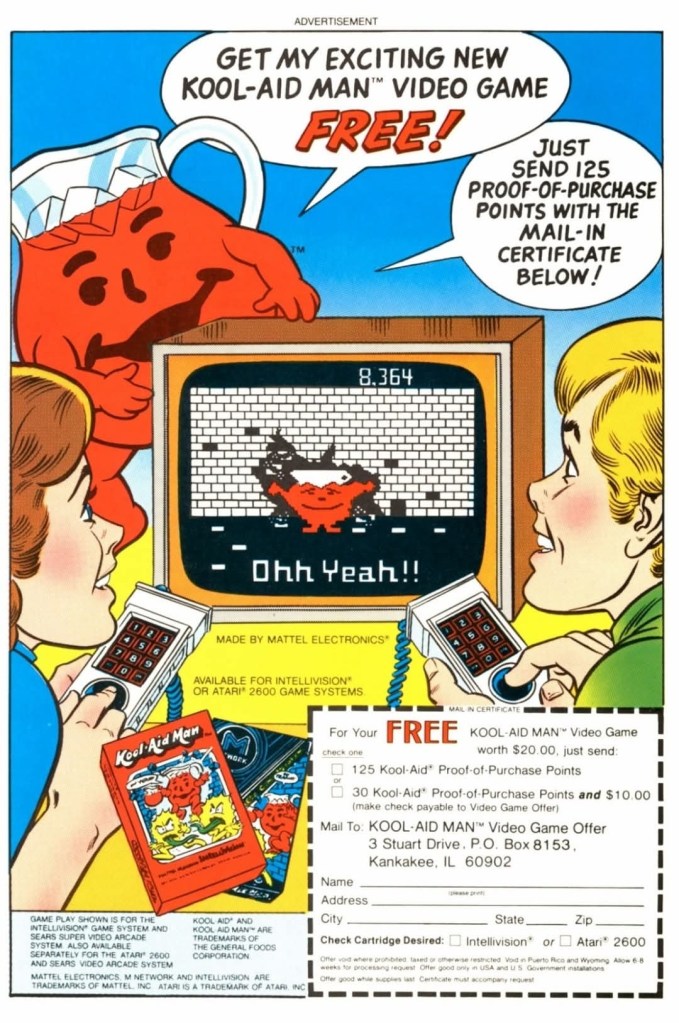
I never played the Kool-Aid Man video game.
There was a time when Kool-Aid was such a popular drink, the character Kool-Aid Man debuted in 1974 after initially starting as the Pitcher Man. A short time later, merchandising featuring the character followed and in 1983 the official Kool-Aid Man video game was released on the Atari 2600 and the Intellivision. This particular print ad appeared in some comic books I read a very long time ago and it offered customers the opportunity to get the game free by sending 125 proof-of-purchase points to the company by mail. This old ad was visually striking and was a creative way to boost sales of the drink.
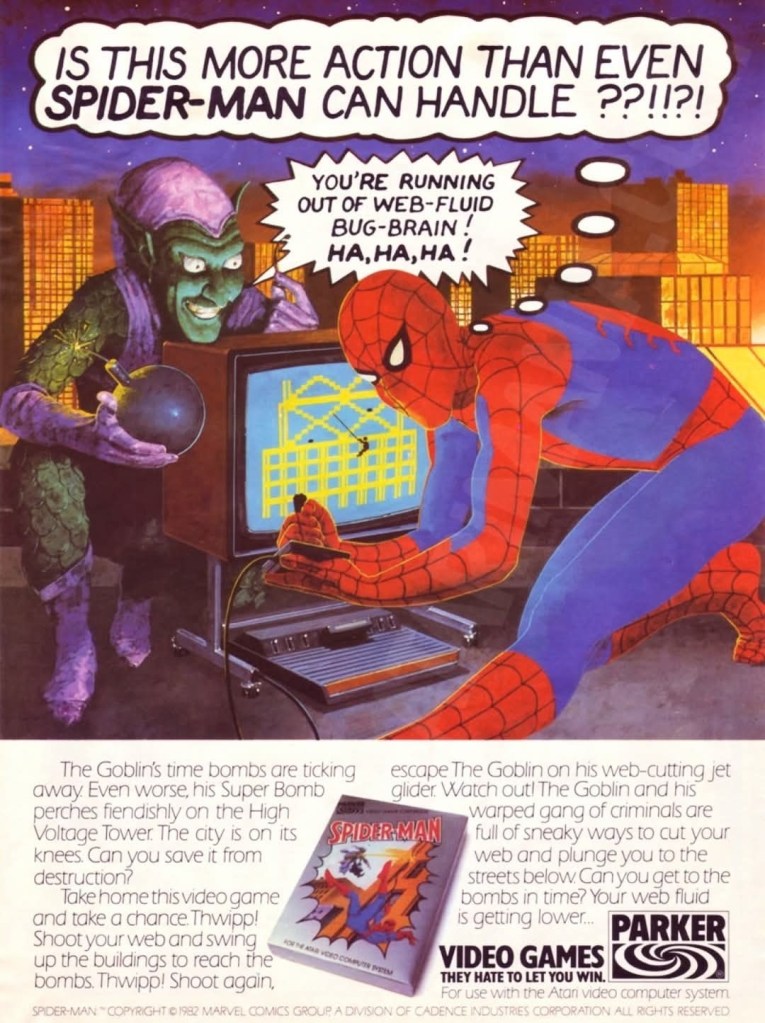
5. Spider-Man Atari 2600 game print ad
Spider-Man and Green Goblin with the Atari 2600 and the TV.
Even though the controls were rough and the game’s difficulty really went high with each new session, my friends and I still enjoyed playing the Spider-Man video game on Atari 2600 from Parker Brothers. Apart from the comic book-style print ads they came up with to promote the game, Parker Brothers went on to make this particular ad featuring Spider-Man and the Green Goblin with a TV set, the game and the Atari 2600 together all presented with a totally different art style. This is still a fun ad to look at.
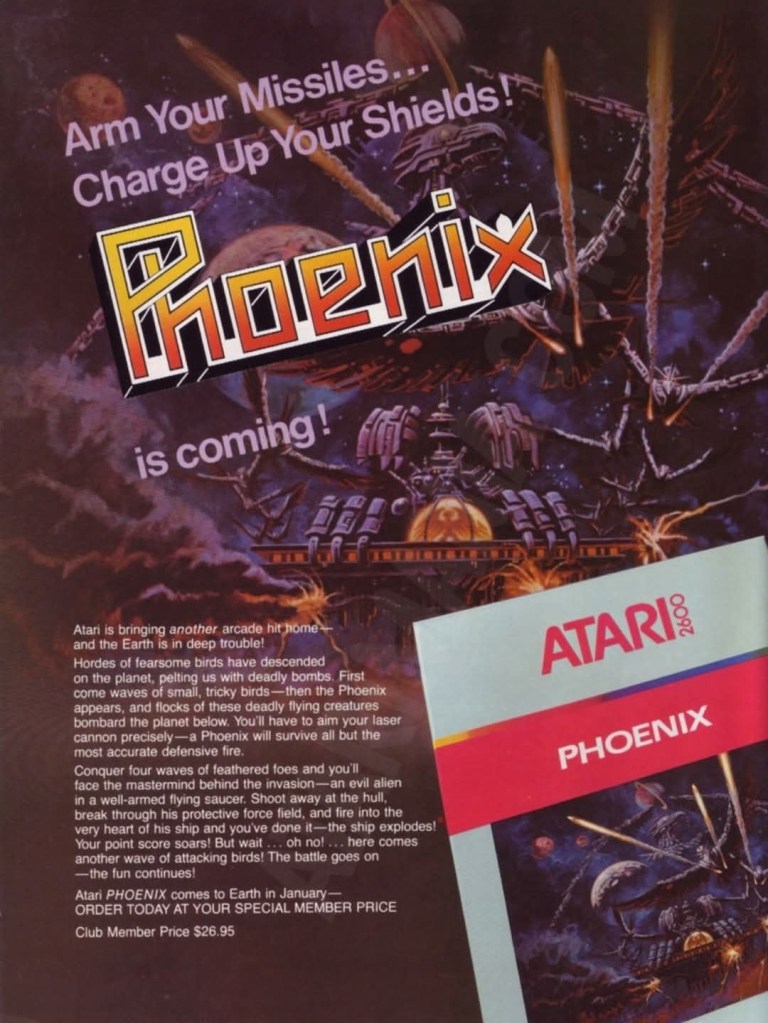
6. Phoenix game print ad
This is still an impressive print ad.
After playing shooter-type games like Space Invaders and Centipede on the Atari 2600, my friends and I experienced something familiar yet fresh with Phoenix. Atari secured from Taito the rights to make the Atari 2600 port of the game, and they came up with a dark print ad that showcased the official painted art work, a portion of the video game’s box and the line “Arm Your Missiles…Charge Up Your Shields! Phoenix is coming!” Having played the game many times, those highlighted words really captured the essence of Phoenix gameplay.
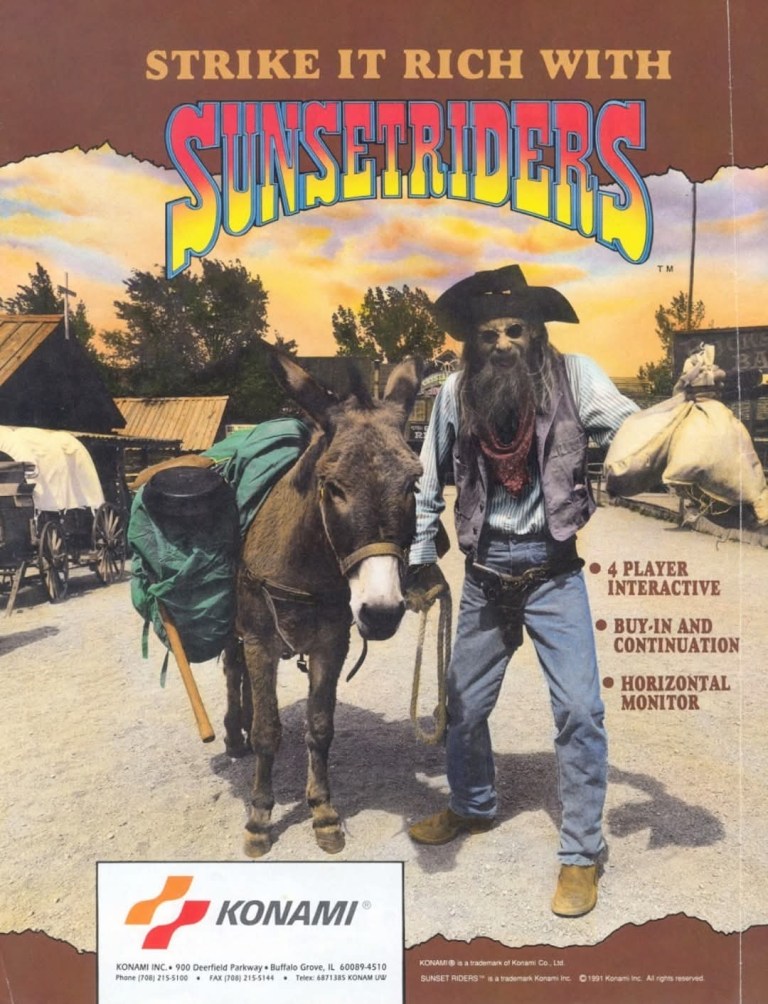
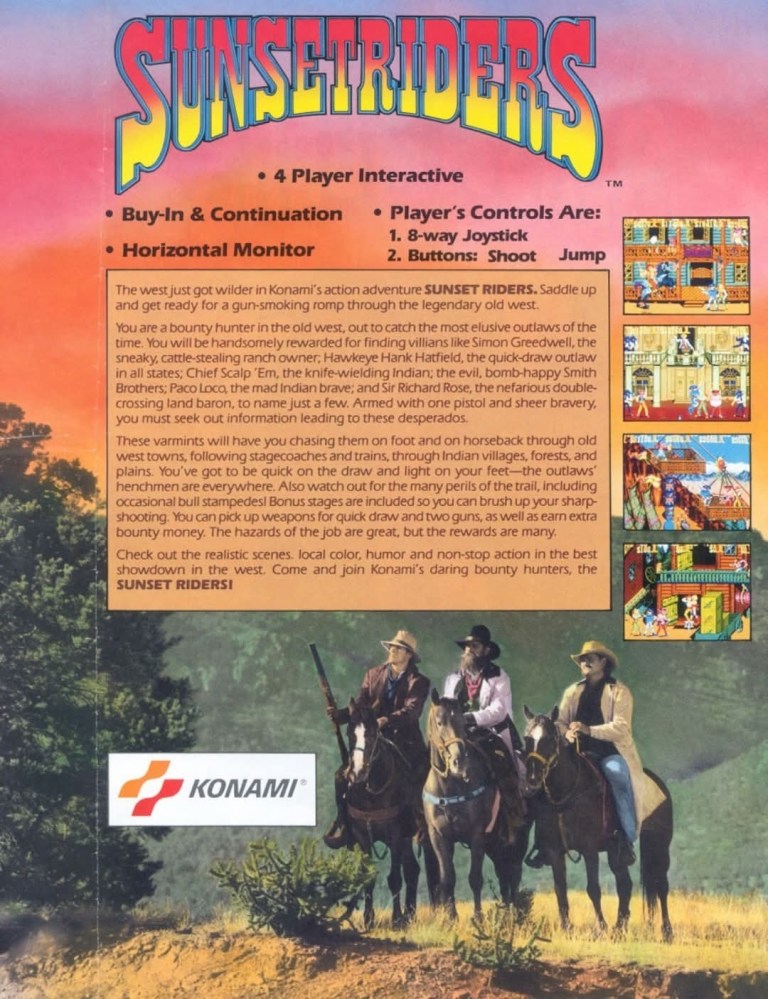
7. Sunset Riders North American arcade flyer
The front.
The rear.
Released in arcades in 1991, Sunset Riders was a critical and commercial hit raking in more success to Konami. For the American arcades, Konami came up with this print ad showing a creepy looking cowboy carrying a bag of money (related to the “strike it rich” line) with his donkey with him. The rear of the ad shows another photograph of 3 cowboys on their horses, the four screenshots and the creative text description. Too bad we don’t see flyers like this anymore.
8. Parker Brothers’ 6-game print ad
Parker Brothers 6-game print ad.
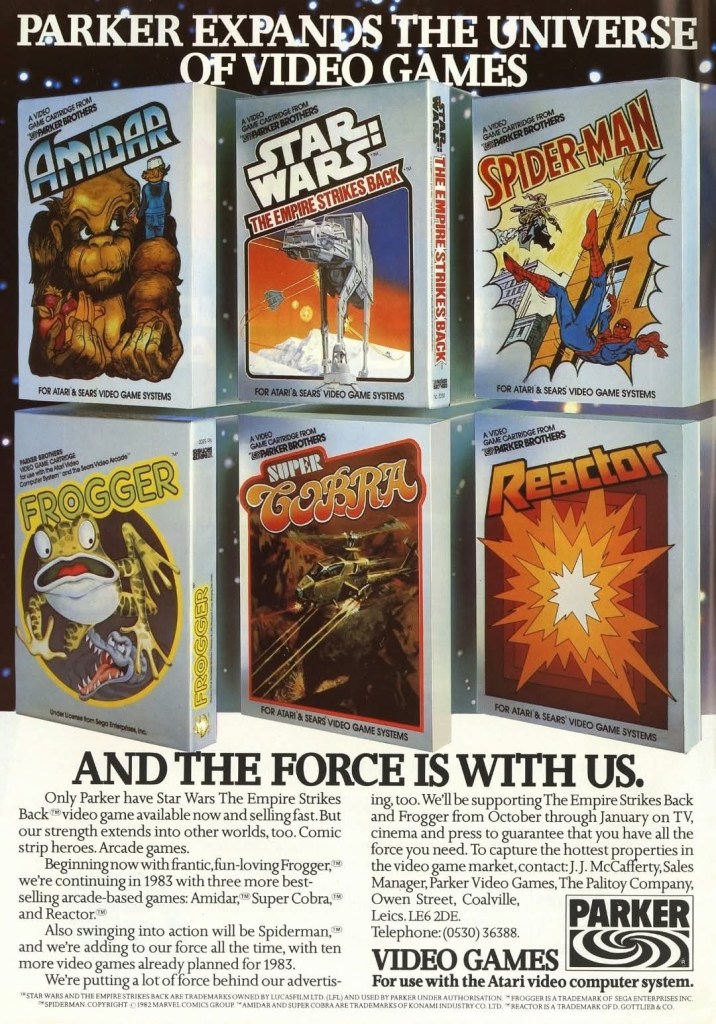
Quite arguably, Parker Brothers was the 2nd most prominent publisher of video games on the Atari 2600 console next to Atari itself. Out of the six games presented in this old print ad, I only played Spider-Man and Super Cobra. Each game’s box had a unique art style and collectively they made this ad look exciting. Times were really different back in the 1980s.
Welcome back readers, fellow geeks and electronic gaming fans!
In this edition of the Retro Gaming Ads Blast (RGAB) series, we will take a look at another batch of retro gaming print ads – including arcade flyers – from the 1980s and 1990s.
For the newcomers reading this, Retro Gaming Ads Blast (RGAB) looks back at the many print ads of games (console, arcade, computer and handheld) that were published in comic books, magazines, flyers, posters and newspapers long before smartphones, social media, the worldwide web and streaming became popular. To put things in perspective, people back in the 1980s and 1990s were more trusting of print media for information and images about electronic games and related products.
With those details laid down, here is the newest batch of retro gaming print ads for you to see and enjoy…
1. E.T. the Extra-Terrestrial Atari 2600 print ad
If you have seen Steven Spielberg’s 1982 movie, were you able to play the Atari 2600 video game? I did!
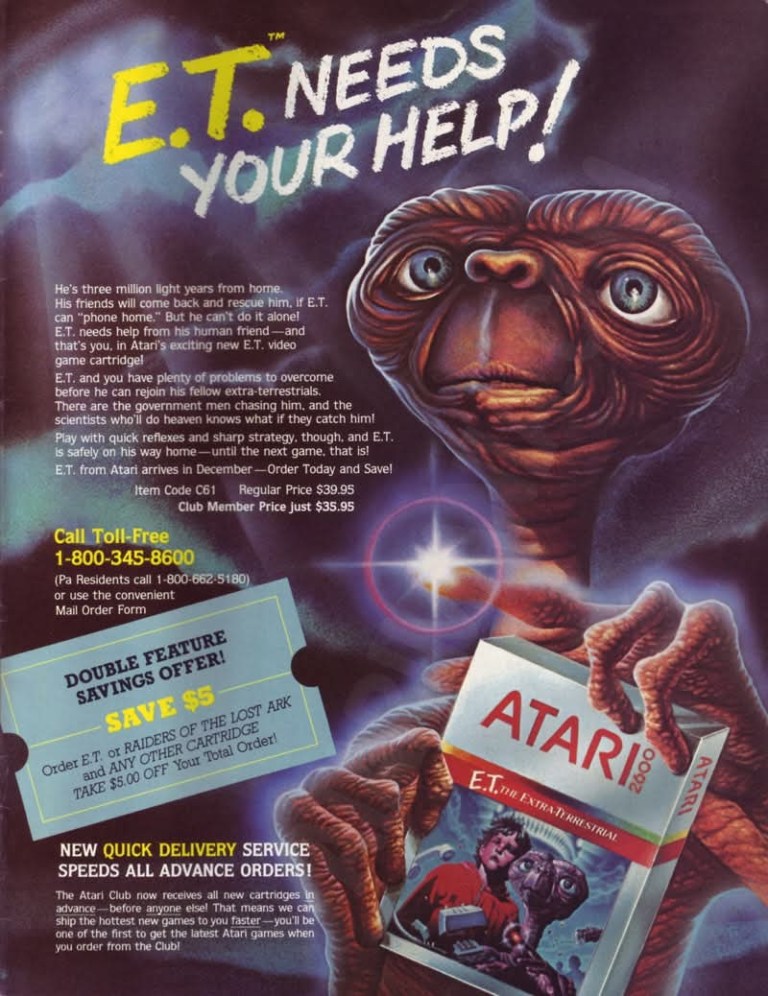
Atari invested a lot on its video game based on Steven Spielberg’s E.T. the Extra-Terrestrial as the film was a massive box office success. In addition to their Atari 2600 video game print ad showing E.T. with Elliot, they ran another print ad with a concept of the sci-fi character needing people’s help. They came up with original artwork showing E.T. holding a box of the Atari 2600 E.T. video game, then posted details about how to acquire a copy of the game (with prices for regular customers and club members) and posted a toll-free 1-800 phone number. They also offered a $5 discount for those who order the E.T. or Raider of the Lost Ark video game and another cartridge. This old ad had commerce written all over it.
2. Bulls vs. Lakers and the NBA Playoffs Sega Genesis print ad
Before NBA Live, there was this old NBA video games series by Electronic Arts.
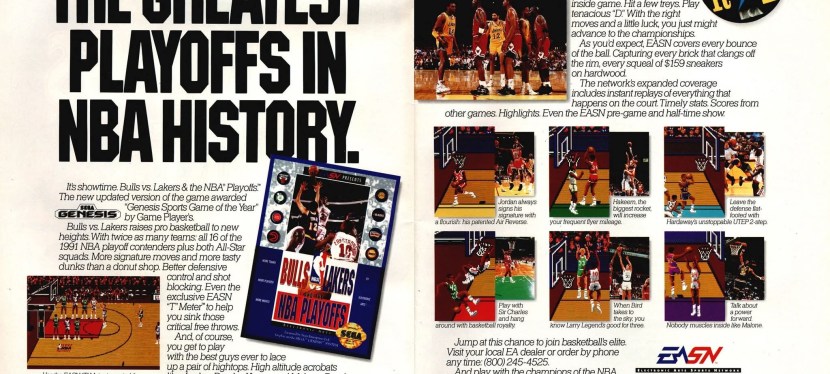
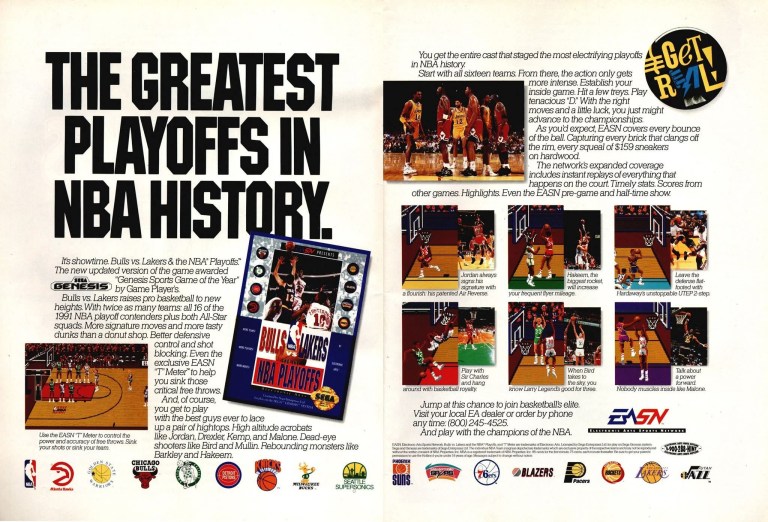
Based on the 1990-91 NBA season and the NBA finals match-up between the Chicago Bulls and the Los Angeles Lakers, Bulls vs. Lakers and the NBA Playoffs was Electronic Arts’ exciting game for the Sega Genesis which already had lots of sports-loving gamers. They made a 2-page print ad that was cleverly designed to make both gamers and NBA fans excited. It is not an accident that the ad showed comparative images (in-game footage and real-life basketball photos) of NBA superstars like Larry Bird, Michael Jordan, Karl Malone and Charles Barkley on the right. With the strong visual presentation, emphasis on popular NBA players and other details posted, this old ad is still fun and exciting to look at.
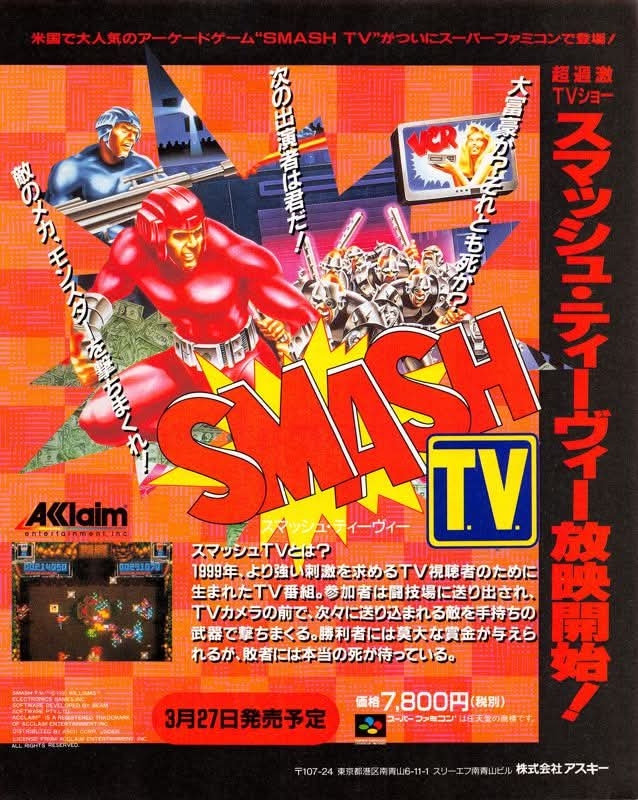
3. Japanese Smash T.V. print ad
The Japanese print ad of Smash T.V.
Yes, it is true! The console port of the arcade classic Smash T.V. was released on the Super Family Computer (Super Famicom) in Japan back in the 1990s. While I cannot understand the Japanese text shown on the ad above, it still looks exciting as the official artwork plus a screenshot of the game were displayed. The revealed retail price of 7,800 Yen is alone eye-catching as there were many games in Japan launched below that price in the next console generation. I can only wonder how many gamers in Japan bought and enjoyed Smash T.V.
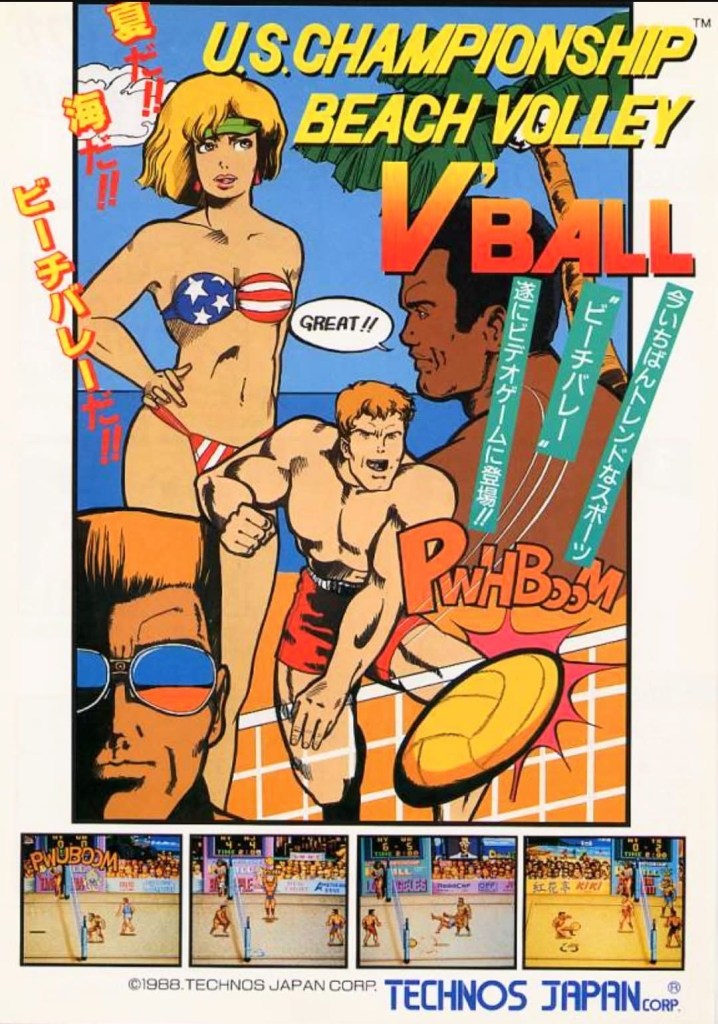
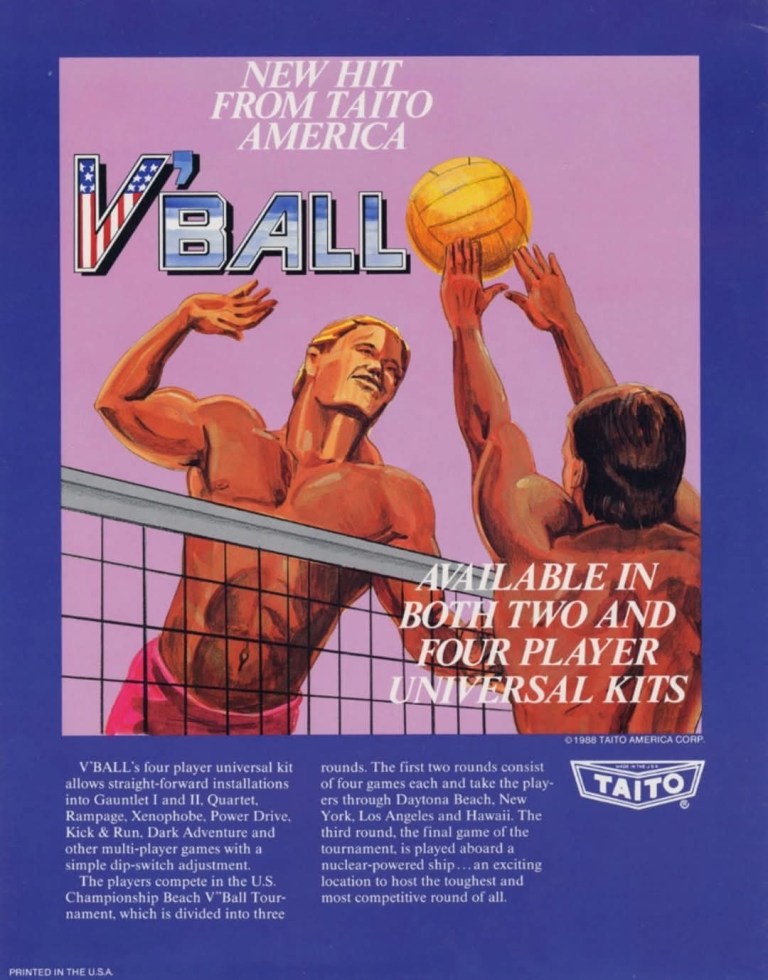
4. U.S. Championship V’Ball arcade flyers
The very colorful and striking arcade flyer for the Japanese market.
The American arcade flyer.
In 1988, Technos – the company behind the Double Dragon video games – released U.S. Championship V’Ball in video arcades in Japan and in America. The way it was promoted in Japan, Technos came up with an arcade flyer that had a comic-inspired hand-drawn artwork that easily gave viewers a strong American beach volleyball vibe. For the American arcade market, Taito (licensed by Technos) used different artwork showing two men in action. If you ask me, the Japanese arcade flyer is more dynamic to look at. Regardless of art style and presentation, both arcade flyers emphasized beach volleyball to gamers clearly.
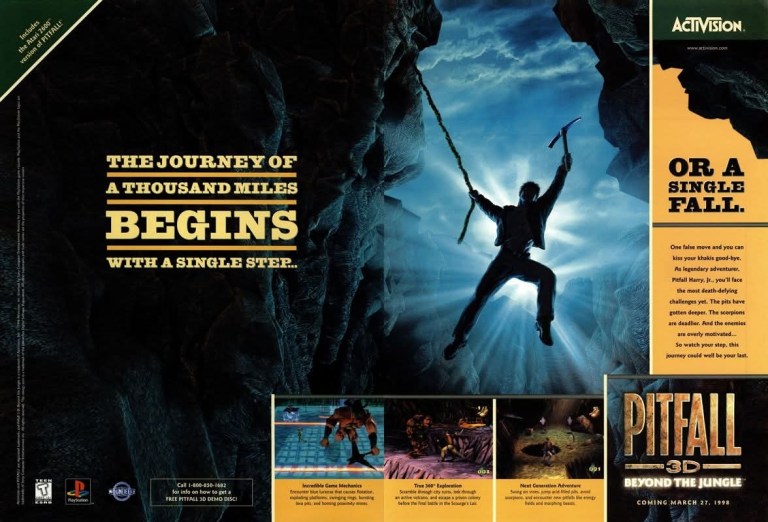
5. Pitfall 3D: Beyond the Jungle print ad
The 2-page print ad of Pitfall 3D: Beyond the Jungle.
When Activision decide to make a new Pitfall video game with polygonal graphics and with 3D platform gameplay, it was not surprising at all as this was the trend that defined 1990s gaming. In 1998, Pitfall 3D: Beyond the Jungle was released for the PlayStation and it received a divisive reception from the critics. If you look closely at the print ad, the words “Next Generation Adventure” was written in the lower-right part and it was clear the game’s quality did not justify them.
6. Atari 2600 and games print ads
Our household had an Atari 2600 console and many games.
Atari’s promotion of its console, the games and interactive entertainment with the TV.
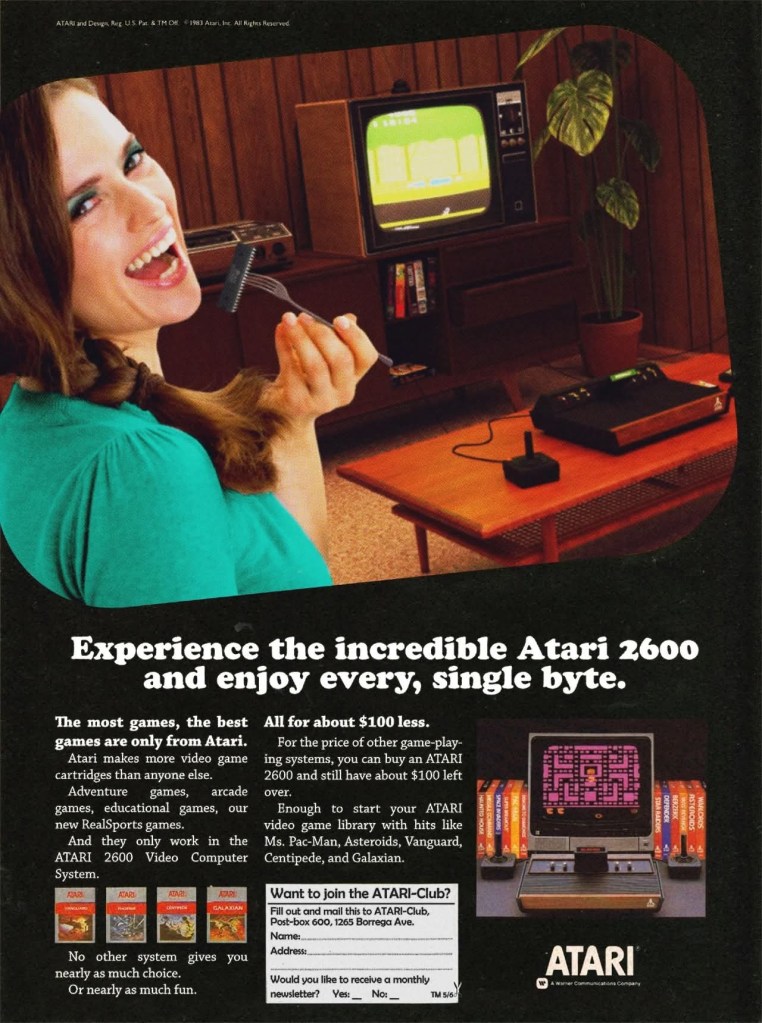
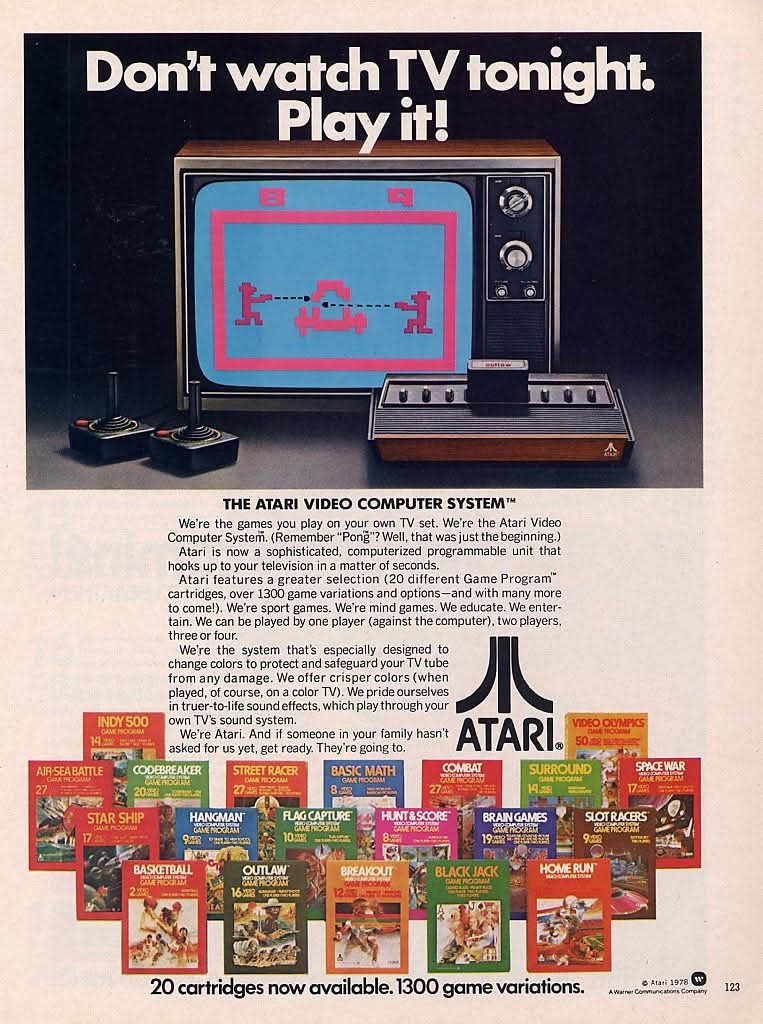
For a number of years decades ago, Atari dominated the video game console market in America with the Atari 2600 sold in the millions. While Atari today is no longer the video game giant it used to be, there is no denying the fact that they really changed the way people enjoyed the use of their television sets in American homes by offering them lots of video games for the Atari 2600 console. By looking at the above print ads, you can see that the company was not only aggressive with their marketing but also made interactive electronic entertainment more acceptable to countless families.
7. Burning Rangers North American print ad
I remember this ad from video game magazines I read in 1998.
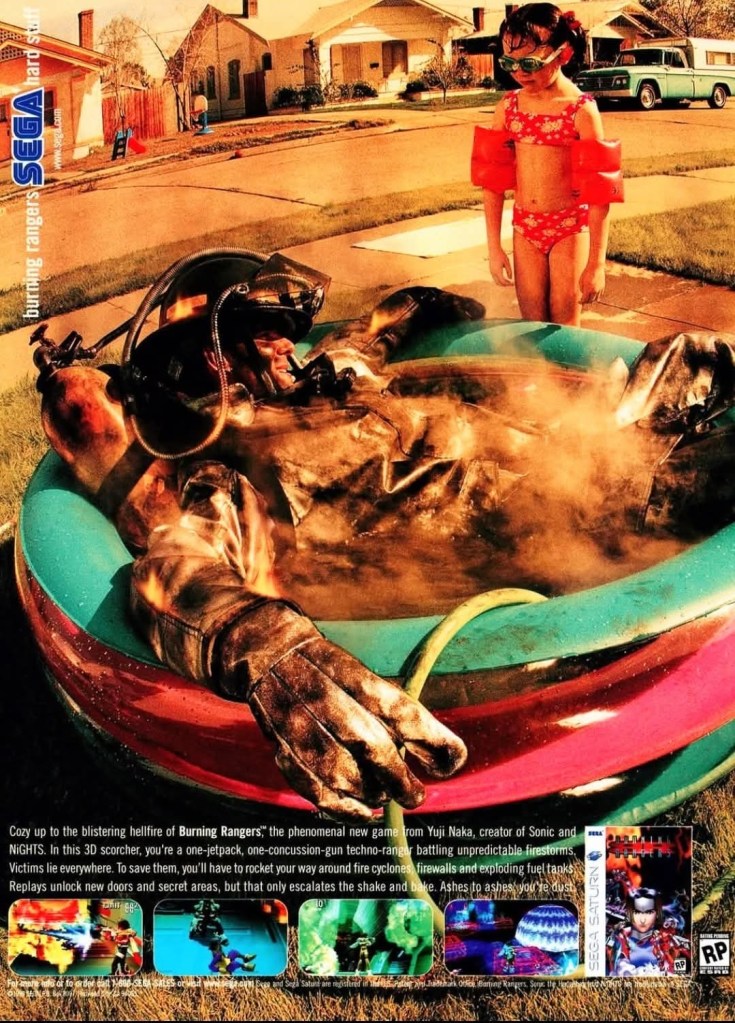
Released in 1998 for the Sega Saturn, Burning Rangers was a high-quality exclusive game. To promote it in America, Sega came up with the print ad showing a few screenshots and a dominating image of a fire fighter cooling down on a kid’s personal pool. The image emphasized the element of fire in the game even though it lacked the more sci-fi elements used on the characters and setting. It should be noted that by 1998, the Sega Saturn was no longer in high demand in America as gamers overwhelmingly chose PlayStation and Nintendo 64 (N64) consoles and games. In retrospect, this was one of Sega’s final hard marketing moves done with a Saturn game.
Welcome back readers, fellow geeks, nostalgia buffs and electronic gaming fans!
In this edition of the Retro Gaming Ads Blast (RGAB) series, we will take a look at another batch of retro gaming print ads – including arcade flyers – from the 1980s and 1990s.
For the newcomers reading this, Retro Gaming Ads Blast (RGAB) looks back at the many print ads of games (console, arcade, computer and handheld) that were published in comic books, magazines, flyers, posters and newspapers long before smartphones, social media, the worldwide web and streaming became popular. To put things in perspective, people back in the 1980s and 1990s were more trusting of print media for information and images about electronic games and related products.
With those details laid down, here is the newest batch of retro gaming print ads for you to see and enjoy…
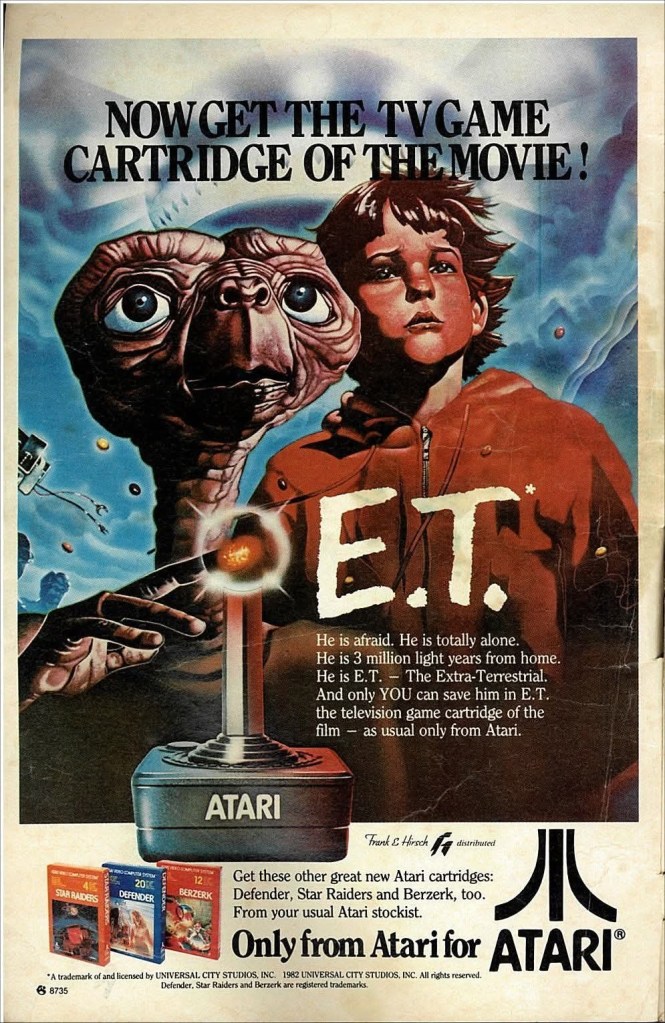
1. E.T. the Extra-Terrestrial Atari 2600 print ad
I saw the movie and played the Atari 2600 game.
Way back in 1982, Steven Spielberg’s small production E.T. the Extra-Terrestrial touched countless moviegoers and became a massive hit around the world. Along the way, an official video game adaptation for the Atari 2600 console was made by Atari anticipating big success coming. The above print ad appeared in many comic books I read and the artwork easily caught my attention since I saw the movie. Apart from the fact that the artist’s take on the boy Elliot did not resemble actor Henry Thomas, no screenshot of the game was shown which is very odd because Atari made the adaptation their biggest offering to consumers. As typical of the times, Atari inserted a few other games below for conveniently promoting them along with E.T. and the Atari 2600. Given the massive failure of the game, this print ad is a sad reminder from gaming’s past.
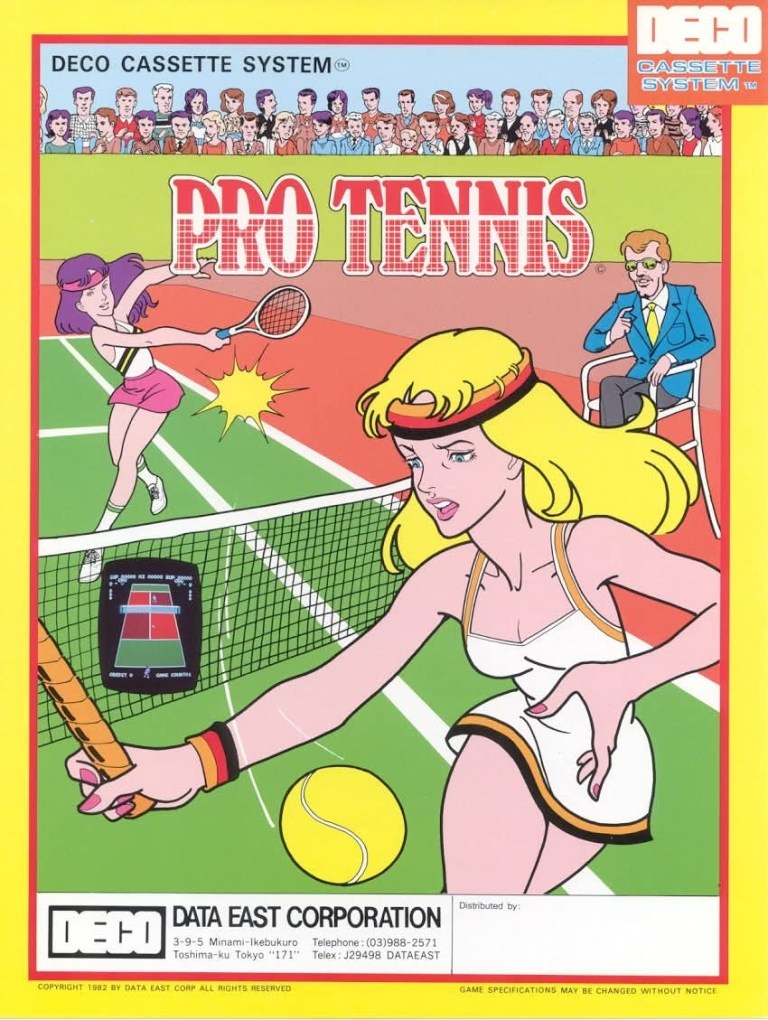
2. Pro Tennis arcade flyer
The artwork has a comic book look.
Still in 1982, Data East released Pro Tennis in the arcades. This arcade flyer has a pretty neat hand-drawn artwork that looked like it came from a comic book, and the ad makers managed to insert one screenshot to make it clear to both players and arcade operators what to expect. This is still a nice flyer to look at.
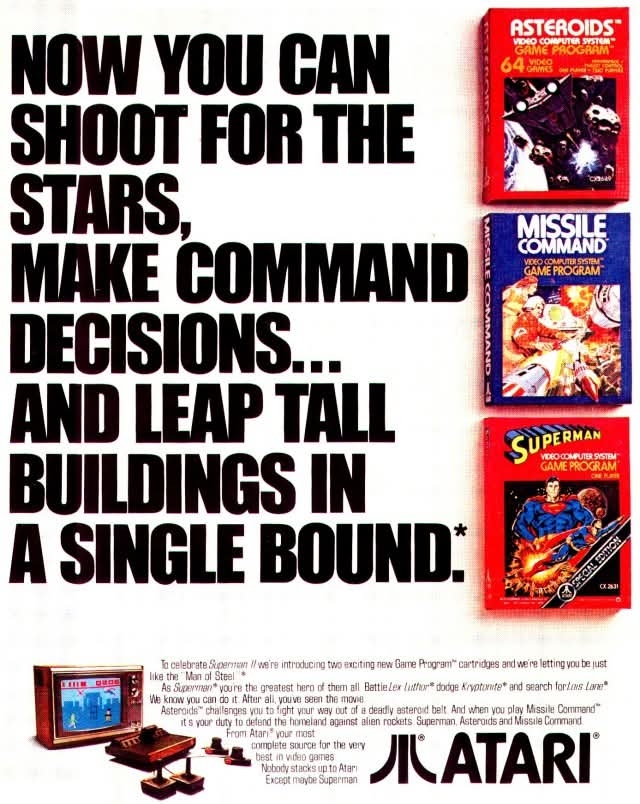
3. 3-in-1 Atari 2600 print ad
I was able to play Missile Command, Asteroids and Superman on Atari 2600 a long time ago.
In the old days, we had an Atari 2600 console in our household and it lasted around 5 years for electronic entertainment. Atari was known for aggressively marketing its consoles and video games, and the above print ad was their creative way of promoting 3 games – Superman and the classics Missile Command and Asteroids – together. The biggest feature of the print ad was the large-sized text description that strongly reflected what each game was about. This is a memorable ad!
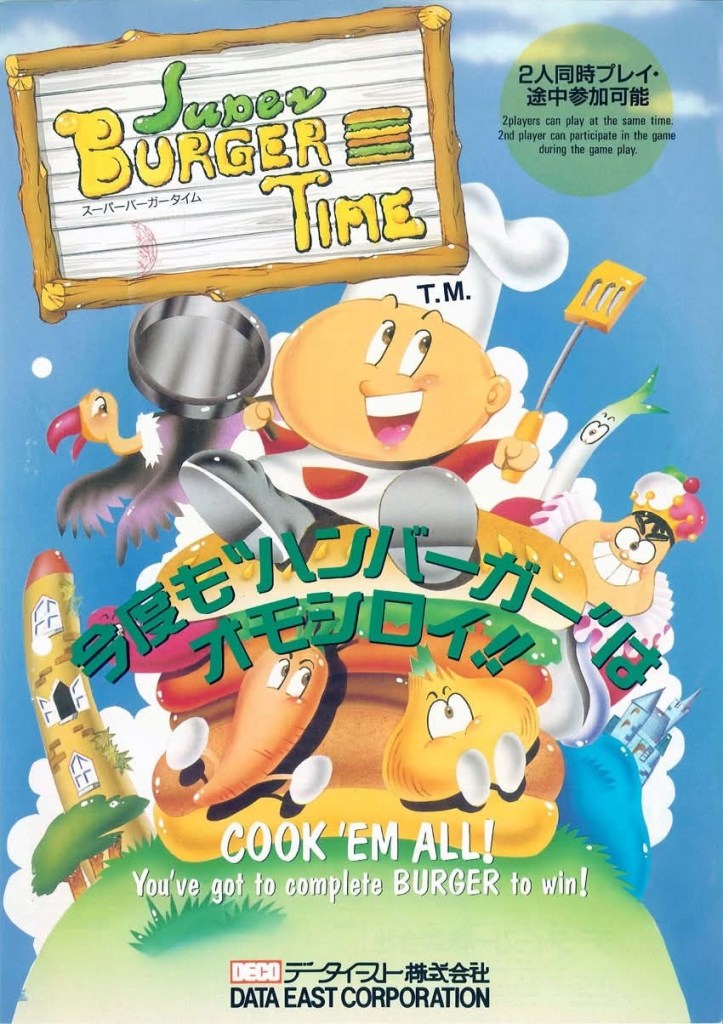
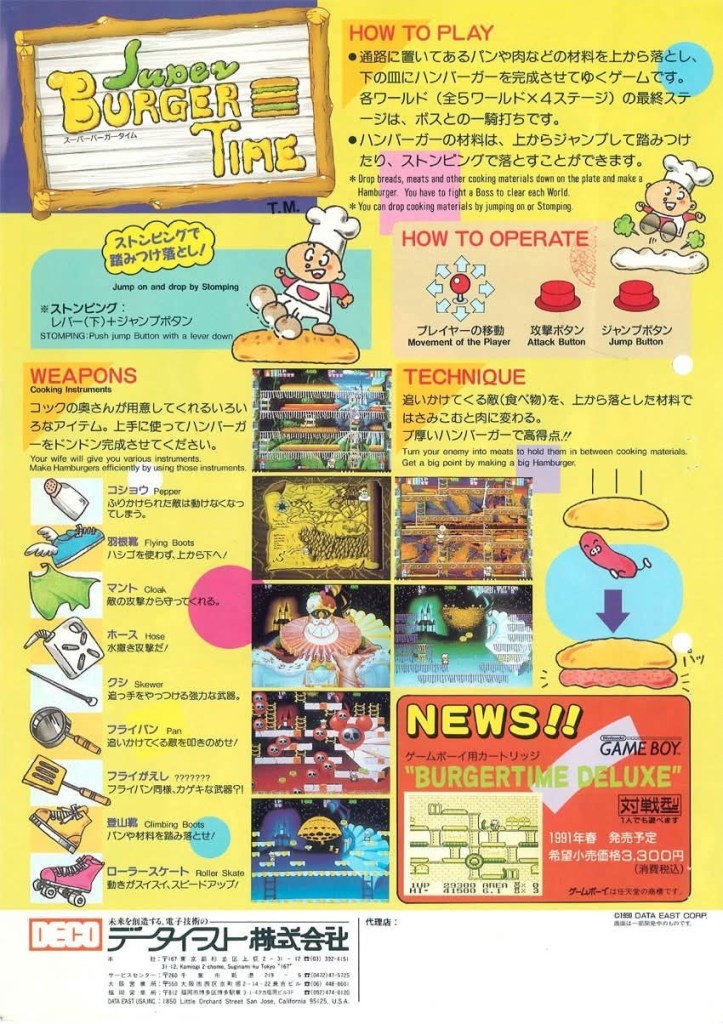
4. Super BurgerTime Japanese arcade flyer
The front.
The rear.
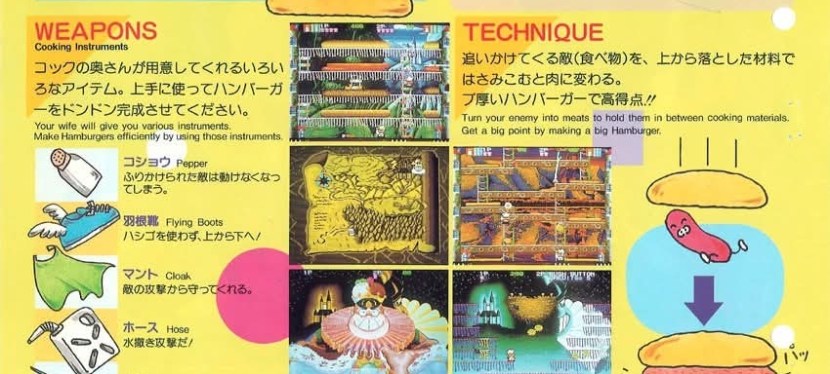
Remember the arcade classic BurgerTime? The sequel Super BurgerTime was released in Japanese arcades in late-1990 and the arcade flyer the producers came up with had a very cartoony art style. The rear of the flyer was filled with lots of details, instructions and screenshots to really have arcade operators and players informed. The producer even inserted a new portion promoting BurgerTime Deluxe on Nintendo Game Boy.
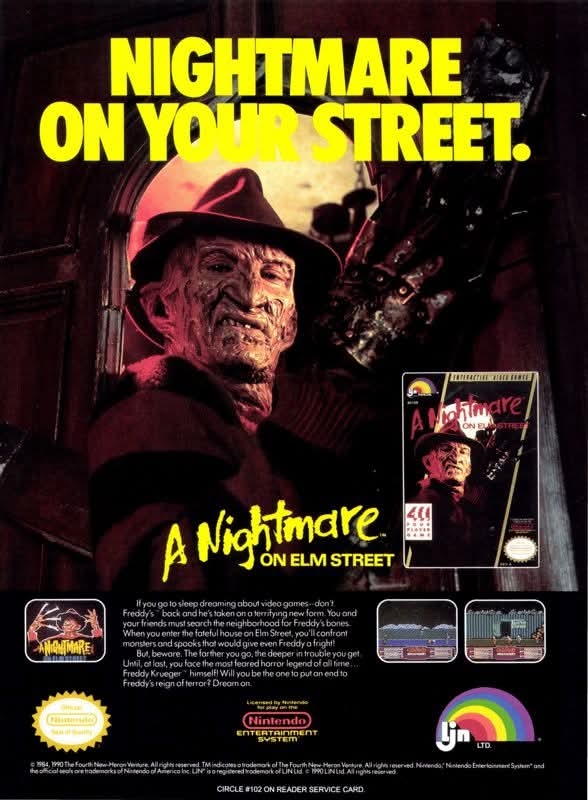
5. A Nightmare on Elm Street NES print ad
If you were able to play this game on the NES, did you have nightmares?
By the end of the 1980s, there were already five movies of the A Nightmare on Elm Street franchise that got released in cinemas and a dedicated following of fans was present. Eventually, an official video game adaptation was released on Nintendo Entertainment System (NES) in 1990 which was surprising since the movies were all rated R and the console itself was popular with young gamers (kids to teenagers). To promote the game, the notorious publisher LJN came up with a print ad that prominently showed series antagonist Freddy Krueger (played by Robert Englund), a few screenshots, the text description and the game box cover. Look back at this old print ad is strange because it shows Freddy Krueger TWICE which means the ad makers could not come up with any original artworks nor a different background for the antagonist.
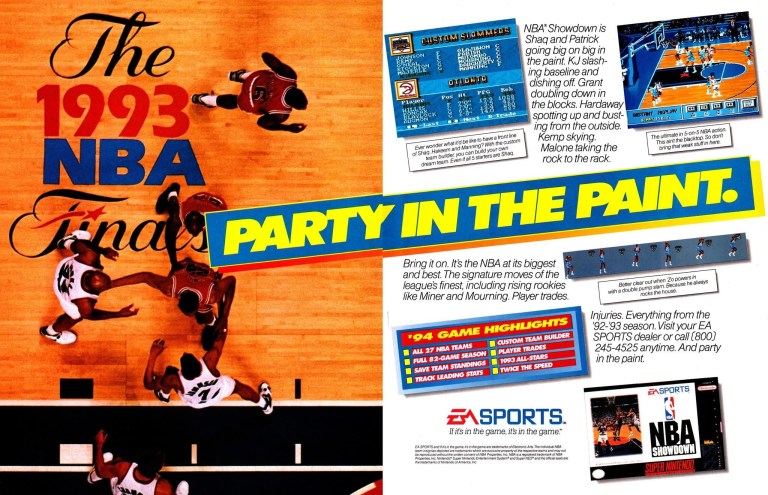
6. NBA Showdown print ad
While this ad did not mention Michael Jordan, he was still included in the video game.
By 1993, EA Sports (Electronic Arts’ sports brand) arguably established itself as the leader of NBA-licensed video games. At the time, console gamers can expect each new NBA game from the publisher to have full rosters and statistics of players based on the season and playoffs that passed. NBA Showdown, which reflected the 1992-93 season, was promoted with this 2-page print ad that had a rectangular image taken during the 1993 NBA Finals (Chicago Bulls and Phoenix Suns) placed on the left, screenshots and text description on the right. The ad made references to Shaquille O’Neal, Patrick Ewing, Tim Hardaway and other NBA players to excite gamers. This ad is still good to look at.
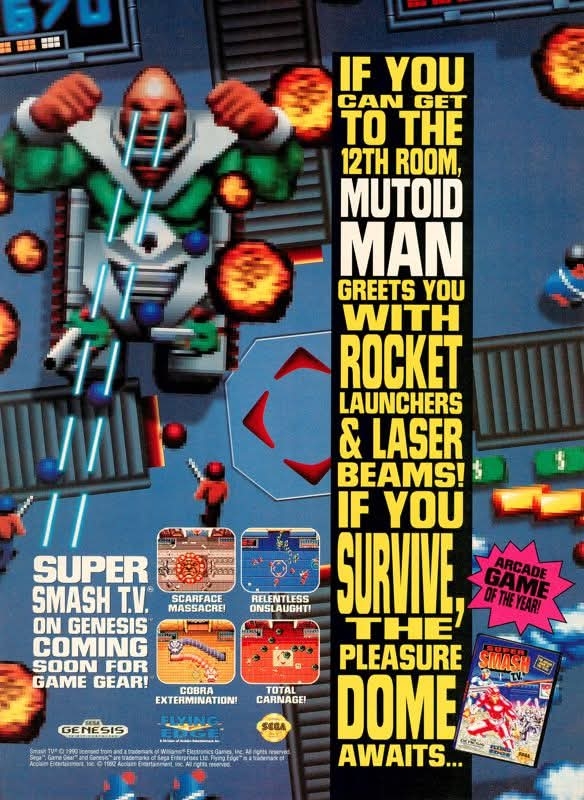
7. Super Smash T.V. Sega Genesis print ad
Were you able to play the Sega Genesis version?
In 1991, the arcade classic Smash T.V. was ported to the Sega Genesis console under the title Super Smash T.V. and this print ad had a rectangular layout showing a zoomed-in capture of game footage with the huge enemy Mutoid Man. The stylized line (in rectangular layout) strongly reflected what gamers could expect in the game. The ad maker also inserted the confirmation that a Game Gear version was coming. This ad is a unique way of promoting both the Genesis and Game Gear versions of Smash T.V.
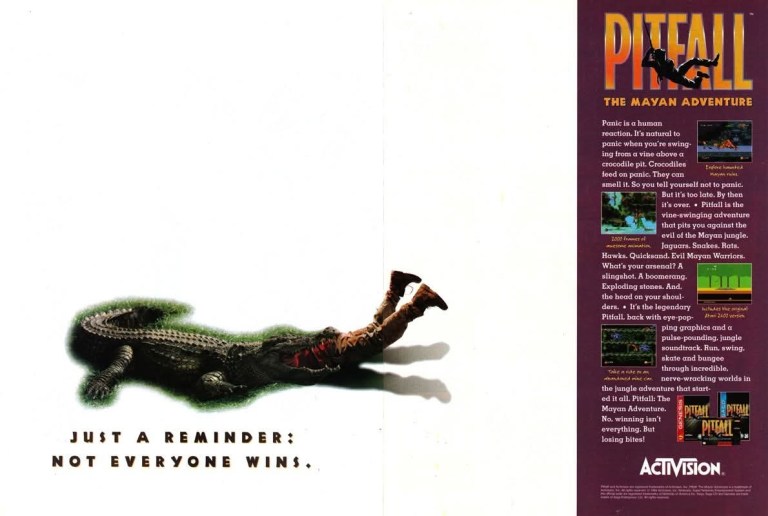
8. Pitfall: The Mayan Adventure print ad
This print ad is still eye-catching and entertaining to look at.
In the mid-1990s, Activision went big with the comeback of the Pitfall! game series by releasing Pitfall: The Mayan Adventure on multiple consoles. This two-page print ad had a touch of dark comedy by using a prominent image of a crocodile swallowing a person while avoiding blood and gore. With the little space remaining, the ad makers crammed in the text description and screenshots plus the game’s package covers. Notably, the text description maintained its tone and focused on describing the game properly. The marketing campaigns of Activision was effective as Pitfall: The Mayan Adventure went on to sell in the millions.
Welcome back readers, fellow geeks and electronic gaming fans!
In this edition of the Retro Gaming Ads Blast (RGAB) series, we will take a look at another batch of retro gaming print ads – including arcade flyers – from the 1980s and 1990s.
For the newcomers reading this, Retro Gaming Ads Blast (RGAB) looks back at the many print ads of games (console, arcade, computer and handheld) that were published in comic books, magazines, flyers, posters and newspapers long before smartphones, social media, the worldwide web and streaming became popular. To put things in perspective, people back in the 1980s and 1990s were more trusting of print media for information and images about electronic games and related products.
With those details laid down, here is the newest batch of retro gaming print ads for you to see and enjoy…
1. Operation Wolf American and Japanese arcade flyers
Operation Wolf for American arcades.
Operation Wolf for Japan.
In the late 1980s, Taito achieved massive success in arcades around the world with Operation Wolf. Released during the late stage of the Cold War and with many militaristic action movies already released by Hollywood, Operation Wolf attracted a lot of money from countless players as well as praise from game critics. For the American market, Taito came up with a colorful yet gritty looking arcade flyer that had nice hand-drawn artwork and enough details and screenshots to give readers a useful look at what to expect. The Japanese arcade flyer meanwhile has an even grittier looking original artwork that strongly emphasized war, guns and action. In retrospect, I look both arcade flyers a lot.
2. Centipede Atari 2600 and Atari 5200 print ad
I played Centipede a lot on Atari 2600.
While I completely missed out on the arcade version of Centipede, I managed to play its Atari 2600 version a lot. Ultimately, the simple game design and unique challenges resulted in lots of fun-filled bouts in my experience. To promote the game’s versions on Atari 2600 and Atari 5200, the game giant came up with this particular print ad that had two near-identical artworks that reflect the concept of Centipede. The ad also has some catchy expressions in the text description. This old ad is still fun to look at.
3. Atari RealSports print ad
Long before EA sports video games, there was this.
Way back in 1982, Atari launched its RealSports line of sports video games mainly to revitalize sports gaming for their consoles. In fact, RealSports was the result of a critical and aggressive ad campaign by competitor Intellivision which had its Sports Network series of games. In this RealSports print ad, a large image of Atari’s baseball game was used probably to emphasize the scope of the field. The ad had screenshots of the volleyball and football games, while the text description reflected Atari’s aggressive response to Intellivision. This ad is an early example of competition between rival game console makers focused on sports gaming.
4. Lethal Enforcers Sega CD print ad
When was the last time you bought a video game with a hard copy and a peripheral bundled together?
Porting light gun games from the arcade to the console is very difficult and tricky to do. This is what Konami did in the early 1990s when they released a version of the arcade hit Lethal Enforcers on the Sega CD console and the package had a light gun with the game on disc. To promote the Sega CD version, Konami came up with a 2-page print ad with the catchy line “You won’t find a toy like this in any Cracker Jack box.” In addition, their ad had a few paragraphs of descriptive text to not only excite gamers but also gently inform them that Lethal Enforcers was also available on the Sega Genesis (note: this console is required for the Sega CD add-on to work) and the Super Nintendo Entertainment System (SNES). Overall, this old ad has a strong visual approach and a clever marketing strategy.
5. Pitfall II: Lost Caverns Atari 2600 print ad
A very stylish layout to promote the game.
In 1982, Activision struck gold with the huge success of Pitfall! which became an influential model of designing platform games. Of course, the publisher (now owned by Microsoft) did not stop there as they went on to make the sequel Pitfall II: Lost Caverns to not only keep the success going but also to exceed the standard they set with the first game. Activision came up with a print ad that not only told gamers of Pitfall Harry’s next adventure but also express humor visually. In line with Activision’s policy of crediting its creators (note: Atari was notorious for refusing to credit its game makers during this era), game designer David Crane was acknowledged in the ad.
6. Team USA Basketball print ad
See your favorite NBA player from the 1990s?
In 1992, a lot of people were obsessed with the Dream Team Olympic basketball squad of the United States as its roster had NBA legends like Larry Bird, Magic Johnson, Michael Jordan, Karl Malone, Charles Barkley and David Robinson to name a few. In fact, the Dream Team became the most popular attraction among all teams in any sport of any country that participated in the summer Olympics in Barcelona. Knowing how popular the squad really was, Electronic Arts (EA) made the video game Team USA Basketball and released it on the Sega Genesis which was already a popular console for sports video games. EA came up with this eye-catching 2-page print ad that strongly emphasized the Dream Team, international basketball gaming, and the company’s tested design on 2D basketball video games. In retrospect, this print ad is still amusing and exciting to look at.
7. Jungle Hunt Atari 2600 and Atari 5200 print ad
Do you fine the parallel artworks amusing or disturbing?
Following the huge success of Jungle Hunt (previously titled as Jungle King), Atari saw potential Dollar signs and made a deal with Taito to publish ports under their own brand for the Atari 2600, Atari 5200 and 8-bit computers. As with the Atari console ads of Pitfall II: Lost Caverns and Phoenix, Atari came up with a print ad that featured two parallel artworks that look similar with each other as they promoted Jungle Hunt for Atari 2600 and Atari 5200. To their credit, the artworks used were detailed and eye-catching, and the descriptive line of words displayed carried a possible reference to 1975’s Jaws.
8. GameShark print ad
A James Bond-inspired way of promoting GameShark.
Remember GameShark? For the newcomers reading this, GameShark is the brand of a line of products released on different video game consoles and personal computers (Windows specifically) that gamers use to cheat in video games. GameShark was popular at a time when not too many people had access to the Internet nor did gamers had the means to search for cheats online, and codes were needed to enable cheating. GameShark became so popular, more ambitious and stylish print ads were realized such as this James Bond-inspired 2-page ad. On face value, this ad looked like it was a promoting a particular game but ultimately it was about promoting GameShark with style, cool and some sexiness.
Welcome back readers, fellow geeks and electronic gaming fans!
In this edition of the Retro Gaming Ads Blast (RGAB) series, we will take a look at another batch of retro gaming print ads – including arcade flyers – from the 1980s and 1990s but with focus on Star Wars games that were released during the era of George Lucas. This is the Star Wars Special of RGAB.
For the newcomers reading this, Retro Gaming Ads Blast (RGAB) looks back at the many print ads of games (console, arcade, computer and handheld) that were published in comic books, magazines, flyers, posters and newspapers long before smartphones, social media, the worldwide web and streaming became popular. To put things in perspective, people back in the 1980s and 1990s were more trusting of print media for information and images about electronic games and related products.
With those details laid down, here is the newest batch of retro gaming print ads for you to see and enjoy…
1. 1983 Star Wars arcade game flyer
The front of the flyer.
The rear of the flyer.
Just weeks before the Star Wars movie Return of the Jedi was released in cinemas in 1983, Atari released the Star Wars arcade game which became a tremendous hit around the world. Both Star Wars fans and gamers of the time loved the game as it provided a very immersive and fun-filled arcade experience. The print ad Atari released has a nice artwork on the front (showing a portion of the Death Star, two TIE Fighters, a Rebel X-Wing Fighter and Darth Vader’s image) and the text description plus the pictures of two arcade machines on the back. While no screenshots were shown, the print ad still had strong visual impact to catch the attention of players and arcade operators. This arcade flyer still looks great!
2. Star Wars: Return of the Jedi – Death Star Battle Atari 2600 print ad
Parker Brothers really stood out among publishers of games on the Atari 2600 and they even had the Star Wars license.
Considering the massive success that Star Wars and The Empire Strikes Back had in cinemas, merchandising and other entertainment media, it was not surprising that games based on Return of the Jedi were produced. For the Atari 2600, Parker Brothers produced Star Wars: Return of the Jedi – Death Star Battle which my friends and I played a lot in 1983. The print ad Parker Brothers came up with has a very eye-catching design showing a Rebel pilot flying a space ship (supposedly the Millennium Falcon which is the only playable ship in the game) towards the Death Star. The visual design is a stroke of genius because it appeals strongly to Star Wars fans while highlighting a major battle in the film which influenced the core concept of the game. This is a classic Star Wars game ad.
3. Star Wars Arcade Japanese market flyer
This arcade game was one of the first fully polygonal Star Wars games released.
In the 1990s, Sega acquired the license to produce Star Wars games for the arcades and they had the hardware for polygonal graphics. In 1993, the released Star Wars Arcade which is a space shooter that offered gamers the freedom to fly their Rebel space ship in 3D space with environments and huge space ships rendered in polygons. As you can see in the arcade flyer for the Japanese market, Sega went hard with their presentation showing 3 carefully selected screenshots (amazing for the time) and a picture of the arcade machine which had an elaborate control set-up, seats and decorations. As Star Wars Arcade was released more than a year before the polygonal game consoles Sega Saturn and Sony PlayStation hit the market, this arcade flyer was mind-blowing to gamers who were on the verge of playing video games with polygonal visuals.
4. Super Star Wars print ad
Yes, JVC was involved with the Super Star Wars trilogy starting with this one.
In 1992, Star Wars fans who enjoyed playing 2D side-scrolling games saw their dream of the next great Star Wars console experience come true when Super Star Wars was released on the Super Nintendo Entertainment System (SNES). With the SNES technology, more detailed visuals and improved audio brought the Star Wars universe to life and the addition of 3D-like playable sequences (made possible by Mode 7 effects) made Super Star Wars a very unique console experience. The print ad only showed three screenshots and three paragraphs of descriptive text but the use of images from the 1977 movie poster added a lot of punch to the visual presentation. This ad is both eye-catching to gamers and long-time Star Wars fans.
5. Star Wars: TIE Fighter print ad
This game offered gamers the opportunities to be with the dark side.
In 1994, LucasArts released Star Wars: TIE Fighter which offered gamers the opportunity to play an Imperial pilot serving Darth Vader on missions set between The Empire Strikes Back and Return of the Jedi. This print ad has a sharp visual design enhanced by Darth Vader’s iconic look in the background. The selected screenshots shown were good to look at but the artwork used to present the TIE Fighters really stood out. This solid looking print ad does come with a bit of disturbance as the Galactic Empire in Star Wars lore are evil.
6. Super Star Wars: Return of the Jedi print ads
Nothing like seeing Harrison Ford, Carrie Fisher and Mark Hamill as the Star Wars icons on a video game ad.
I never played the portable editions of Super Star Wars: Return of the Jedi. Have you?
As far as gaming on the SNES was concerned, the Super Star Wars trilogy of games really kept fans and casual gamers busy. By the time Super Star Wars: Return of the Jedi was released in 1994 on the SNES, there was already immense speculation about the Star Wars prequel trilogy and George Lucas himself started writing them that same year. The 2-page print ad of the game on SNES had a creepy photo of Emperor Palpatine on one side, the other characters on the other side, and six selected screenshots displayed on the lower part. The way the print ad was design reflects that the game is the end of the trilogy like the 1983 film itself. Super Star Wars: Return of the Jedi was also released on Game Gear and Game Boy and the ad makers made the right decision to use the Death Star and space battle image as the background so that the portable games would stand out.
7. Star Wars: Masters of Teräs Käsi print ad
I wonder if George Lucas ever regretted approving this Star Wars fighting game. It was so rough and unpolished with its quality.
If there is any sub-par Star Wars game released in the 1990s, it is none other than Star Wars: Masters of Teräs Käsi on the PlayStation. The 1997 game was LucasArts’ attempt to cash in on the booming fighting games genre and they took a huge risk of making it entirely polygonal. Instead of using photographs or hand-drawn art, the ad makers used a fully rendered 3D polygonal models of Luke Skywalker and Boba Fett which was alienating to look at. In fact, those polygonal models looked very different from the in-game polygonal models of Skywalker and Boba Fett presented during gameplay. This print ad is a sad reminder about an ill-conceived concept for Star Wars that materialized into an actual product.
8. Star Wars: Shadows of the Empire print ad
If you have read the novel, were you able to play this video game?
LucasArts and Nintendo teamed up with something ambitious – a video game adaptation of Star Wars: Shadows of the Empire that was released exclusively to the Nintendo 64 (N64). Released in late 1996, Star Wars: Shadows of the Empire was part of the multimedia entertainment project of the same name and it is the result of LucasArts’ decision to be an early adopter of the N64 for business-related reasons. The 2-page print ad shown here has a dark, star-filled background which captivating screenshots on the left and the N64 controller standing out. This print ad strongly expresses that gamers would need the N64 in order to play Star Wars: Shadows of the Empire in the comfort of home.
9. Star Wars Trilogy arcade flyer
The front.
The other side.
Before the Star Wars Prequel trilogy started with The Phantom Menace, Sega came out strongly by releasing Star Wars Trilogy Arcade in arcades around the world. Released in 1998, the game was arguably Sega’s most ambitious Star Wars-licensed game ever as it was made with the powerful Model 3 hardware, it came with unique controls and the game was designed as a polygonal rail shooter focused on key segments from the original trilogy of films. Sega wisely used dynamic artwork for the front of the flyer giving viewers the impression that the X-Wing fighter was approaching them closely. At the rear, three screenshots only showed space battles which was a wise decision by Sega to keep the surprise intact for gamers until they play the game. Having played this in the arcade myself, I can assure you that Star Wars Trilogy Arcade has more varied types of gameplay and challenges. It’s a lot more than flying and shooting in space, and it has a lot of stuff that Star Wars fans will love.
Welcome back readers, fellow geeks and electronic gaming fans!
In this edition of the Retro Gaming Ads Blast (RGAB) series, we will take a look at another batch of retro gaming print ads – including arcade flyers – from the 1980s and 1990s.
For the newcomers reading this, Retro Gaming Ads Blast (RGAB) looks back at the many print ads of games (console, arcade, computer and handheld) that were published in comic books, magazines, flyers, posters and newspapers long before smartphones, social media, the worldwide web and streaming became popular. To put things in perspective, people back in the 1980s and 1990s were more trusting of print media for information and images about electronic games and related products.
With those details laid down, here is the newest batch of retro gaming print ads for you to see and enjoy…
1. G.I. Joe: A Real American Hero arcade flyers
G.I. Joe: A Real American Hero arcade flyer for the Japanese market.
The North American arcade flyer of G.I. Joe.
Back in the 1980s, my friends and I saw lots of episodes of G.I. Joe: A Real American Hero on TV and there were lets of toys of it available. I also read some comic books of G.I. Joe. While there were G.I. Joe video games, I never got to play its early 1990s arcade game from Konami. By comparing the two arcade flyers of G.I. Joe: A Real American Hero, the American flyer excels visually showing the characters with a powerful war-themed background. The Japanese flyer had smaller space for the same artwork and displayed the arcade cabinet (take note of the controls laid out to accommodate up to four players). Between the two, I prefer the American arcade flyer.
2. Alien 3 Japanese arcade flyer
With this arcade flyer, Sega clearly showed arcade operators what to expect when ordering machines of Alien 3: The Gun.
Watching Alien 3 inside the cinema in 1992 was one of the worst moviegoing experiences I ever had. By the time video games based on the movie were released, I was surprised to see how action-packed and entertaining they looked. The one Alien 3 game that captivated me was Sega’s Alien 3: The Gun in the arcades as its design and concept contradicted the essence of the film. The Japanese arcade flyer has this aggressive approach on laying down the details, displaying the arcade machine and displaying carefully selected screenshots to excite both gamers and arcade operators. This arcade flyer still looks good today.
3. Super Cobra arcade flyer
A great artwork emphasizing the concept of Super Cobra.
First released in Japanese and America arcades in 1981, Super Cobra is a 2D side-scrolling shooter in which players pilot an armed helicopter through tight caverns while facing enemies capable of firing. The American arcade flyer has great artwork that almost perfectly captures the essence of the game. This is another old arcade flyer that has aged well.
4. The Amazing Spider-Man vs. The Kingpin print ad
Back in 1993, animated sequences included in video games were still new and even exciting.
Moving forward to the year 1993, gamers in America who owned a Sega Genesis console were being motivated by Sega to upgrade their gaming experience with the Sega CD add-on. Along the way, Sega really ramped up efforts to have more games supporting the Sega CD and one of them was The Amazing Spider-Man vs. The Kingpin. The Amazing Spider-Man vs. The Kingpin on Sega CD was actually an updated version of the original 1991 game and Sega’s team included several improvements to take advantage of the CD-ROM technology of the add-on. This print ad showed Sega’s hard work on selling the game.
5. Soulstar print ad
The artwork of this print ad has very strong sci-fi vibes.
Released in 1994 for the Sega CD (Mega CD in other markets), Soulstar was sci-fi 3rd-person shooter that delivered amazing visuals, fun gameplay and an immersive experience of space travel to gamers. This European market print ad is a very effective way to promote the game using carefully selected screenshots, amazing artwork and a cleverly written text description. Still a fine print ad to look at.
6. Batman Returns print ad
This print ad effectively promoted both the game and the movie. In retrospect, the line “Our new Batman game is anything but tame” turned out to be true as lot of parents who brought their kids to the cinemas for Batman Returns were turned off by the adulterated elements.
In 1992, Batman Returns played in a lot of cinemas but its very dark tone and adulterated elements prevented it from matching the huge box office success of its 1989 predecessor. Regardless, a lot of licensed video games based on the movie were released and in early 1993, Konami released a Batman Returns video game on the aging Nintendo Entertainment System (NES). This print ad used a photograph from the filming of an scene that actually had Michelle Pfeiffer as Catwoman, dominating over the iconic Batman. Also displayed were screenshots, the game’s box cover (showing Pfeiffer, Michael Keaton and Danny DeVito as their respective characters) and the text description. Even if you did not like the movie, this old print ad is a solid way of promoting both the game and the movie. The line “Our new Batman game is anything but tame” strangely turned out very true.
7. The Terminator games print ads
The Terminator for Sega Genesis.
The Terminator for Sega CD.
Released in cinemas in 1984, The Terminator was a surprise hit as well as a career-booster for Arnold Schwarzenegger and James Cameron. What is very notable is the fact that several video game adaptations of The Terminator were released on consoles in the early 1990s. I can only guess this was done to capitalize on the resurgence of the Terminator franchise in connection with Terminator 2: Judgement Day’s much-anticipated release in cinemas. The Sega Genesis version print ad features a digitized close-up of Schwarzenegger’s Terminator while the 2-page Sega CD version print ad used a lot of the space for large text (with an incomplete shot of Schwarzenegger’s Terminator on the edge of the 2nd page) emphasizing “He’s Back” and “The Terminator” while leaving little space for text descriptions and screenshots. Between the two, I find the Sega Genesis ad more effective with its promotion of the game.
8. Defender arcade flyer
More choices of a very successful game for arcade operators also means more ways for players to play it.
Even though it had a soft start in the early 1980s, the classic game Defender went on to become a massive commercial success in the arcades. Being a major attraction in America’s video game industry, Williams unsurprisingly went on to release this particular arcade flyer to sell to operators different types of Defender arcade machines that could fit into their respective joints while providing gamers choices on how to play the game. Some players preferred to stand in-front of a tall arcade cabinet while others prefer to play the game looking down on the screen. This flyer is an example as to how a company can keep their biggest success moving on while offering business clients more choices.