Another step towards a nuclear-powered Philippines happened as the energy giant Meralco signed a memorandum of understanding (MOU) with Export-Import Bank of Korea (KEXIM) and Korea Hydro & Nuclear Power (KHNP) for a strategic partnership on the development of nuclear energy projects in the country, according to a BusinessWorld news report.
To put things in perspective, posted below is an excerpt from the news report of BusinessWorld. Some parts in boldface…
MANILA ELECTRIC CO. (Meralco) has signed a memorandum of understanding (MoU) with Korea Hydro & Nuclear Power (KHNP) and the Export-Import Bank of Korea (KEXIM) to collaborate on the development of nuclear energy projects in the Philippines.
The partnership aims to leverage South Korean expertise to evaluate the feasibility of nuclear power through a multi-faceted approach.
Under the agreement, the three organizations will conduct joint discussions on reactor design and engineering, exchange technical and regulatory information, and work to “strengthen the Philippines’ nuclear legal and institutional frameworks.”
The scope of the MoU also covers early-stage project development, including “public acceptance initiatives, project planning, and site selection studies.”
The companies will focus on business and financial modeling, with KEXIM specifically exploring “potential financing structures and credit facilities” for Meralco’s prospective projects.
Meralco Chairman and Chief Executive Officer Manuel V. Pangilinan highlighted the strategic importance of the collaboration, saying “Partnering with KHNP and KEXIM gives us access to proven global expertise and enables us to study technology, business models, and financing options with greater depth. This MoU marks an early but consequential step in this important process.”
He also said that nuclear energy is a critical component of the company’s long-term strategy to ensure energy security.
“Nuclear energy is a way to diversify our portfolio and reinforce energy security, while offering a degree of insulation from fuel market fluctuations,” he said.
He added that Meralco’s initiative is “complementary to the Philippine government’s efforts to lay the groundwork for its nuclear power program” as the utility provider assesses how the technology can best contribute to its future operations.
KHNP, a subsidiary of Korea Electric Power Corp., is currently the largest power generation company in South Korea, while KEXIM serves as the nation’s state-owned official export credit agency.
Meralco is the country’s biggest private electric distribution utility, serving 39 cities and 72 municipalities. It also has interests in power generation through wholly owned units and equity stakes.
Let me end this post by asking you readers: What is your reaction to this recent development? Now that the MOU has been signed, do you feel more confident about the future of a nuclear-powered Philippines? Do you think new nuclear power facilities in the country will be realized in your lifetime?
For more South Metro Manila community news and developments, come back here soon. Also say NO to fake news, NO to irresponsible journalism, NO to misinformation, NO to plagiarists, NO to reckless publishers and NO to sinister propaganda when it comes to news and developments. For South Metro Manila community developments, member engagement, commerce and other relevant updates, join the growing South Metro Manila Facebook group at https://www.facebook.com/groups/342183059992673
Having been to the Subic Bay Freeport Zone many times already, the former US Naval base has been a strong engine for tourism, commerce and investments for the Philippines over the decades. Each time I visited, there was also something new to discover and the economic modernization happened gradually.
In a serious bid to enhance investments and accelerate the growth of tourism, the Subic Bay Metropolitan Authority (SBMA) announced that it has teamed up with the Leechiu Property Consultants (LPC) and their officials had important talks recently.
To put things in perspective, posted below is an excerpt from the official announcement of the SBMA. Some parts in boldface…
Subic Bay Metropolitan Authority (SBMA) officials met with executives of Leechiu Property Consultants (LPC) to explore collaborative initiatives to accelerate tourism growth and investment promotion here.
Led by SBMA Business and Investment Group’s Senior Deputy Administrator (SDA) Renato Lee III, discussions focused on expanding high-impact tourism segments including cruise ship tourism, wreck diving, forest trails, and Meetings, Incentives, Conferences, and Exhibitions (MICE) activities.
David Lee-Chiu, CEO of Leechiu Property Consultants highlighted Subic Bay’s deep-water port and strategic location as key advantages in positioning the Freeport as a competitive cruise ship destination in Luzon.
Lee-Chiu also noted that increased cruise calls would drive growth across hospitality, retail, transport, and local enterprises.
Meanwhile, SBMA Chairman and Administrator Eduardo Jose L. Alino also mentioned “wreck diving” as a strong niche market, with Subic Bay’s historic shipwrecks that continue to attract both domestic and international divers.
Also discussed was the development and promotion of forest trails and eco-tourism experiences, recognizing Subic Bay Freeport’s protected forest areas as prime assets for sustainable tourism, nature-based recreation, and eco-adventure activities.
Let me end this post by asking you readers: What is your reaction to this recent development? If you have visited the Subic Bay Freeport Zone over the past three months, how was your stay and did you find the place worth revisiting? Do you think the SBMA can still achieve so much more in terms of tourism growth and business?
Disclaimer: This is my original work with details sourced from reading the comic book and doing personal research. Anyone who wants to use this article, in part or in whole, needs to secure first my permission and agree to cite me as the source and author. Let it be known that any unauthorized use of this article will constrain the author to pursue the remedies under R.A. No. 8293, the Revised Penal Code, and/or all applicable legal actions under the laws of the Philippines.
Welcome back, superhero fans, 1990s arts and culture enthusiasts, Image Comics fans and comic book collectors! Today we go back to the mid-1990s to examine one of the many tales of the WildStorm universe as published by Image Comics.
To put things in perspective, Jim Lee’s WildStorm universe quickly expanded after launching WildC.A.T.s: Covert Action Teams in 1992. Other WildStorm properties followed such as StormWatch, Gen13, Team 7 and Wetworks. By 1994, things went rolling with the WildStorm projects and the production team of Jim Lee decided to expand the lore by having key characters Grifter (WildCATs) and Backlash involved in a story told in a mini-series. The said characters are actually former teammates of Team 7.
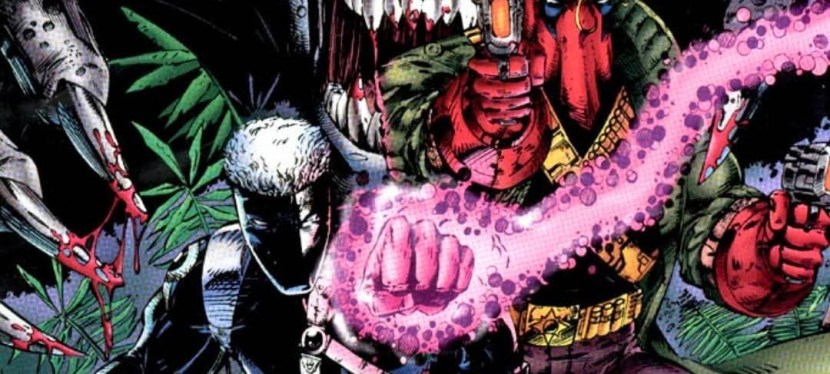
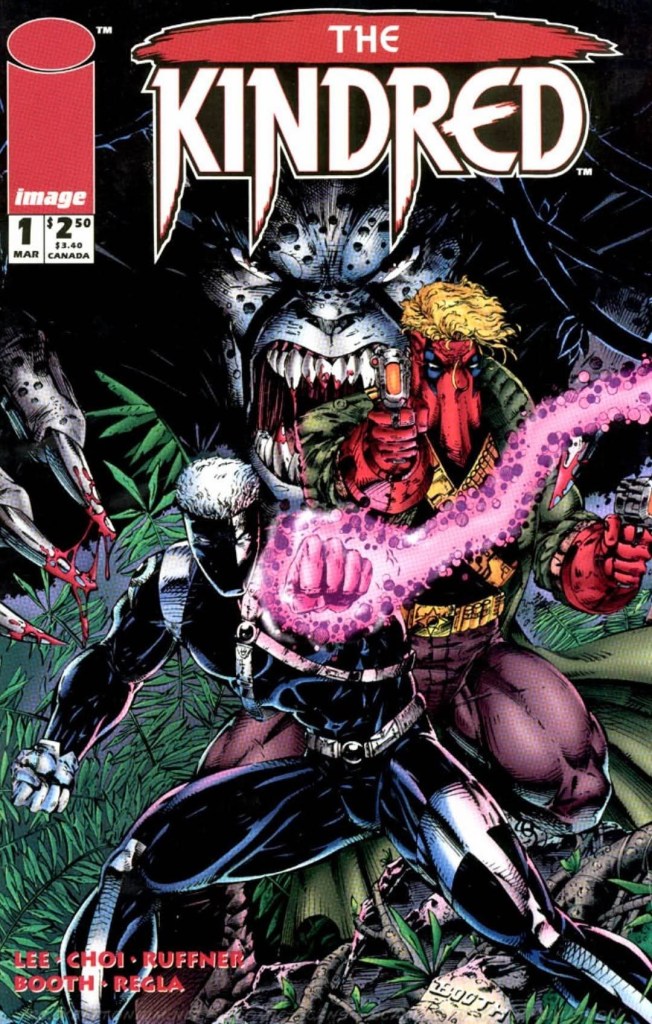
With those details laid down, here is a look back at The Kindred #1, published by Image Comics in 1994 with a story written by Jim Lee, Brandon Choi, Sean Ruffner and Brett Booth. Booth illustrated the comic book.
The cover.
Early story
The story begins in New York City. Even as darkness envelopes the city that never sleeps, thousands of its denizens walk the streets in relentless pursuit of their hopes and dreams. One man walks alone and his thoughts are not filled with dreams of the future. Instead, he has nightmares from the past.
The man is Marc Slayton and he knocks the door communicating with Jack. He converts himself into vapor and easily enters the building moving towards Jack. He emerges as Backlash and tells Jack that he needs classified information on an alien race known as the Daemonites. It turns out, Backlash needs Jack’s hacking abilities to bypass the government’s bureaucracy and secrecy.
Suddenly, the armored members of Black Razor emerge behind Backlash…
Quality
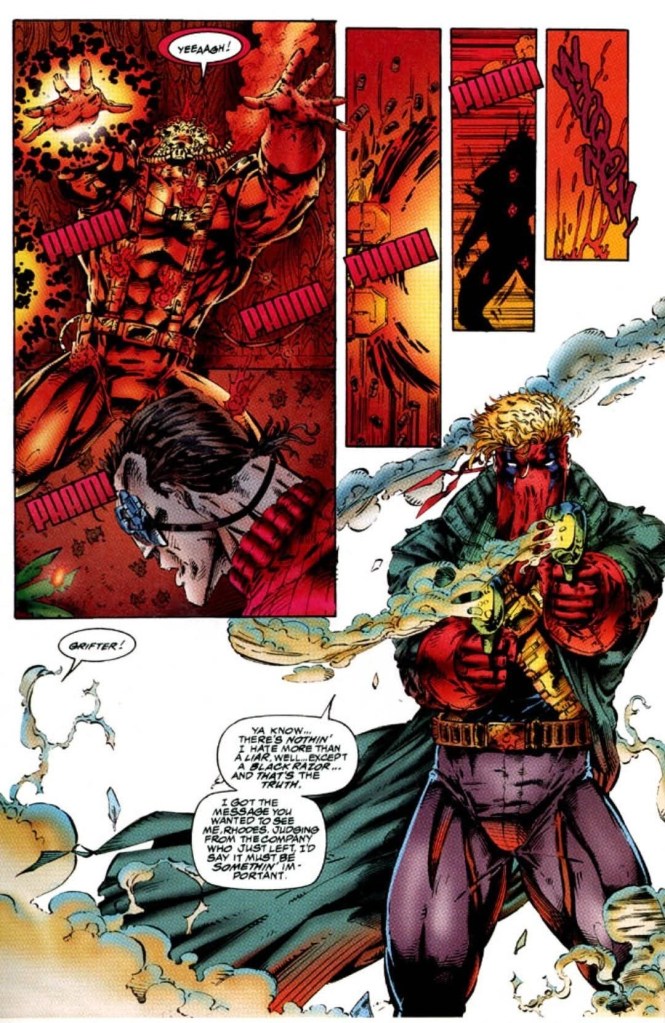
Grifter appears in a violent way of helping someone.
I like this comic book. This is a tale that has strong elements of the 1990s WildStorm universe all over it, specifically paramilitary influence and intrigue. As this was released before Team 7 #1 (a tale set in the past), it was the WildStorm creators’ way of getting former teammates Grifter and Backlash together after being separated for a long time. The result is a dangerous mission launched while bringing key elements from the past back for the two heroes to encounter. Conveniently, this comic book added to the pre-release anticipation of the Team 7 mini-series.
More on the plot itself, Backlash wants crucial information about the Daemonites (monsters from space that are ugly, dangerous and capable of possessing people) and it so happens he has been targeted by IO (International Operations) for the mentioned mission. The way Backlash was portrayed involved his past coming back at him, dealing with IO and having to decide to participate or not. Clearly, Backlash here is cornered more than once and it is a sign that something intriguing and dangerous awaits him.
Grifter’s presence here is directly linked with his exit from WildCATs #8. Similar with Backlash, Grifter is in search for answers and he shows no intention of having a friendly reunion with his former teammate. Along the way, you will see the masked gunslinger being more analytical as the plot went on and his determination to find answers is really strong. Grifter here is also a huge risk-taker which is a nice touch.
Speaking of elements of the past, this comic book has some notable connections with other developments and parts of the WildStorm universe. A certain scene here could convince WildStorm fans to revisit the WildCATs mini-series.
Conclusion
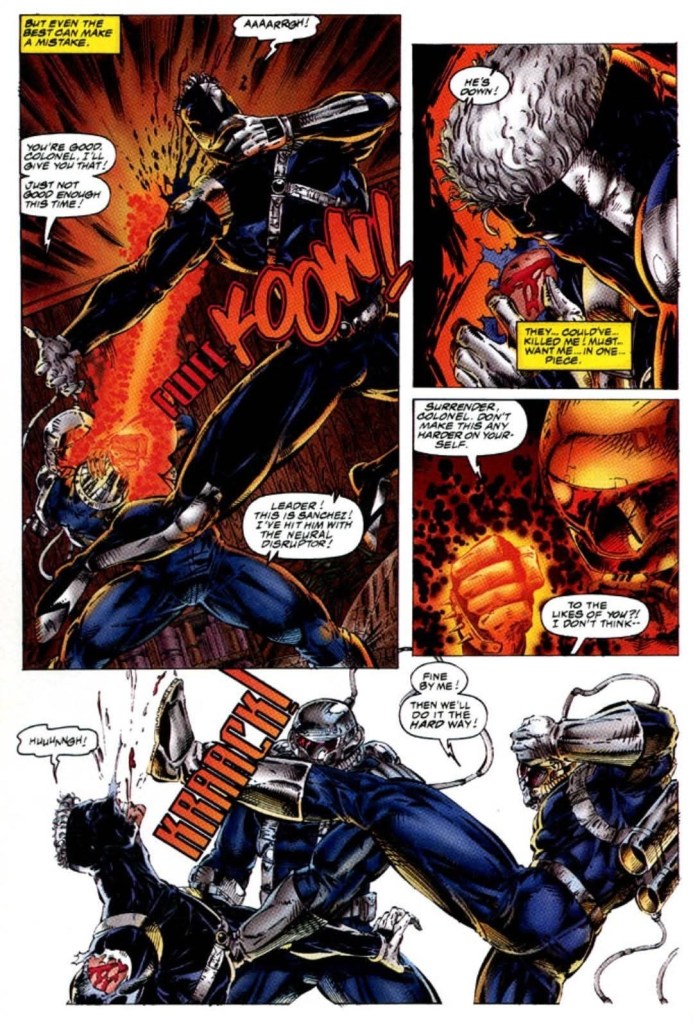
Backlash hit hard by Black Razor members.
Considering the way the story was told and the high amount of expository dialogue executed, The Kindred #1 (1994) is clearly a build-up comic book that will eventually lead to the true essence of this mini-series. What I enjoyed the most here was how the creative team portrayed Backlash and Grifter. They are former teammates of Team 7 who each have grudges, personal problems and secrets that could potentially widen the gap between them. At the same time, the creative team succeeded in setting up the threat by showing the violent kidnap of John Lynch (the former leader of Team 7) and the rise of a new enemy who is very driven by revenge. Ultimately, this comic book succeeded in convincing me to read the next issue.
As many countries around the world are already struggling with the economic disruptions and the spike in oil prices as a result of the ongoing chaos in the Middle East, Japan has decided to release its own oil reserves and it could happen as early as Monday (March 16), according to a news report by Kyodo News.
To put things in perspective, posted below is an excerpt from the news report of Kyodo News Some parts in boldface…
Japan will begin drawing down its oil reserves as early as next Monday to deal with a possible sharp rise in gasoline and other petroleum product prices amid the Middle East conflict, Prime Minister Sanae Takaichi said.
Takaichi told reporters on Wednesday that Japan will release 15 days’ worth of reserves held by the private sector and then one month’s worth of government-held oil without waiting for a decision coordinated by the International Energy Agency.
It will be the first time Japan has released its government oil reserves individually, not in an internationally coordinated way, since the stockpiling of oil began in 1978.
Japan’s dependency on the Middle East for crude oil is “prominently high” compared with other countries and imports are expected to “significantly drop late this month or later,” necessitating measures to prevent a disruption to the supply of gasoline and other petroleum items, Takaichi said.
Citing the possibility that the average price of domestic retail gasoline could surpass 200 yen ($1.26) per liter, Takaichi also said she aims to keep the price at around 170 yen by utilizing a government fund.
The price of gasoline hit as low as 154.70 yen in mid-January but rose to 161.80 yen per liter as of Monday, according to industry ministry data.
“We will flexibly review the support measures to ensure continuous relief for the public even if the (Middle Eastern) situation is prolonged,” Takaichi said.
Japan imports more than 90 percent of its oil from the Middle East, making it highly vulnerable to the effective closure of the Strait of Hormuz, which has prevented the transportation of oil and gas from suppliers in the Persian Gulf, after the U.S. and Israel attacked Iran late last month.
As of the end of December, Japan had 470 million barrels of oil reserves equivalent to 254 days of domestic consumption, of which 146 days’ worth were government-owned, 101 days held by the private sector, and the remainder jointly stored with oil-producing countries.
Let me end this piece by asking you readers: What is your reaction to this development? Do you think Japan made the right decision to release its oil reserves good for fifteen days? Do you think Japan will be able to find new and alternative sources of oil so that it can cut its reliance on Middle East oil?
Even as the United States is busy working alongside Israel on the war against the Islamic terrorist state of Iran, the Trump administration announced that it will launch tariff investigations on several countries including trade partners like Japan, according to a news report by Kyodo News. The probes are meant to find out if unfair trading practices exist.
To put things in perspective, posted below is an excerpt from the Kyodo News report. Some parts in boldface…
U.S. President Donald Trump’s administration said Wednesday it will launch tariff investigations into what it sees as unfair practices by China, Japan and over a dozen other American trading partners.
According to U.S. Trade Representative Jamieson Greer, the move is intended to “uncover a variety of unfair trading practices related to excess capacity in production” in the manufacturing sector, and replace Trump’s sweeping tariff regime that was invalidated by the Supreme Court in February.
“Our view is that key trading partners have developed production capacity that is really untethered from the market incentives of domestic and global demand,” Greer told reporters.
The other trading partners facing the investigations, carried out under Section 301 of the Trade Act of 1974, are the European Union, Bangladesh, Cambodia, India, Indonesia, Malaysia, Mexico, Norway, Singapore, South Korea, Switzerland, Taiwan, Thailand and Vietnam, Greer said.
The statute, which allows the U.S. government to impose tariffs in response to a foreign country’s alleged unfair practices, was a favorite tool of Trump for justifying higher tariffs on Chinese imports when he started a trade war with Beijing during his first term as president.
After the U.S. top court on Feb. 20 struck down a large chunk of Trump’s far-reaching tariff agenda as imposed under the International Emergency Economic Powers Act, his administration introduced a new 10 percent global duty.
However, the new 10 percent surcharge, relying on a different legal framework, can only last 150 days unless Congress approves an extension.
Greer said the Trump administration seeks to complete the investigations as quickly as possible and prepare for new Section 301 tariffs within the 150-day period.
The statute requires consultations with the governments of the targeted trading partners before tariffs can be imposed.
Let me end this piece by asking you readers: What is your reaction to this development? Do you think the United States is doing the right thing with the multiple trade investigations? How do you think the Trump administration will adjust its tariff policy once the 150-day period expires?
For decades, the Subic Bay Freeport Zone has been a hot spot of commerce, tourism and varied types of businesses which resulted in the creation of new jobs. Recently, the Subic Bay Metropolitan Authority (SBMA) officially confirmed that the Freeport workforce exceeded 170,000 in 2025 which is an improvement of over 4% compared with 2024.
To put things in perspective, posted below is an excerpt from the official announcement of the SBMA. Some parts in boldface…
The workforce in the country’s premier Freeport totaled 171,653 in 2025, according to the annual report by the Subic Bay Metropolitan Authority (SBMA).
According to a report from the SBMA Labor Department, this figure reflects a 4.4 percent increase from last year’s 164,400 recorded in 2024.
SBMA Chairman and Administrator Eduardo Jose L. Aliño said that the increase in the number of workers here results from President Ferdinand R. Marcos Jr.’s mandate to provide more employment opportunities for Filipinos.
He said that Olongapo City remains the biggest source of manpower, with 70,769 residents working here. He added that this was followed by Zambales with 31,621; Bataan with 22,897; National Capital Region with 7,077; Pampanga with 5,492; Tarlac with 2,199; and the remaining 31,598 from other parts of the country, including foreign workers.
Around 70.60 percent of workers, or 121,187, are male, while the remaining 29.40 percent, or 50,466 workers, are female, and employed by 4,744 Subic companies. Despite the disparity, female workers outnumbered male workers in the manufacturing sector, with 18,951 females and 18,242 males employed across 111 manufacturing companies in Subic.
Meanwhile, the Subic Bay Freeport’s services sector remains the biggest employer, which clocked at 67.32 percent of the workforce, with the manufacturing sector making up 21.67 percent. These are followed by the construction sector with 7.36 percent, and shipbuilding/marine-related services with 3.64 percent.
Aliño added that the services sector also has the biggest number of companies, with 4,129, followed by the construction sector with 356 companies, then shipbuilding/ marine-related services with 148 companies, and lastly the manufacturing sector with 111 companies.
He further said that more companies are still looking for employees, thru the SBMA Labor Department’s regular conduct of job fairs and posting job openings via online portals and bulletin boards at their offices near the Subic Bay Gym.
“Jobseekers can click on the SBMA Career Portal, where we provide an official list of vacancies from various Freeport locators. We encourage applicants to check the Subic Gym bulletin board for scheduled examinations and interviews,” he said.
Let me end this post by asking you readers: What is your reaction to this recent development? If you are managing a business, have you thought about expanding and setting up a place inside the Subic Bay Freeport Zone? What is your current impression about the business and work environment inside Subic Bay right now?
The establishment of online pre-entry immigration checks and much higher residency fees could become a reality as the Japanese government approved a bill to amend the immigration control law, according to a Kyodo News report.
To put things in perspective, posted below is an excerpt from the news report of Kyodo News Some parts in boldface…
The Japanese government on Tuesday approved a bill to amend the immigration control law to establish an online pre-entry screening system for overseas arrivals and significantly increase residence status application fees for foreigners.
The Cabinet-endorsed bill will be submitted to the current Diet session, and if enacted, the government aims to implement the entry eligibility screening system called the Japan Electronic System for Travel Authorization, or JESTA, in fiscal 2028.
The amendment includes raising the upper limit for visa application and renewal fees from 10,000 yen ($63) to 300,000 yen, marking the first increase since 1982.
The introduction of JESTA aims to prevent terrorism and illegal employment, according to the Immigration Services Agency. It would target the current 74 countries and regions whose citizens are exempt from obtaining short-stay visas.
Several days before traveling to Japan, applicants would be required to provide information online, including their name, the purpose of their stay, and the locations they intend to visit. Those suspected of traveling for illegal employment or other violations would be denied boarding on aircraft and ships.
Fees are currently set at 10,000 yen for application for permanent residency and 6,000 yen for residence period renewals.
It has been pointed out that these fees, which cover only actual costs and are also allocated to coexistence measures, are significantly lower than those in Western countries.
The number of foreign residents in Japan at the end of 2025 stood at approximately 4.13 million, a record high.
The government would aim to use the increased cap to cover system costs for efficient visa screening and the establishment of consultation services.
The amendment sets the cap at 300,000 yen for permanent residency applications and 100,000 yen for visa extensions and similar procedures.
The limits have been set in anticipation of future inflation. Going forward, the specific amounts for each fee would be determined by government ordinance with the aim of applying them within fiscal 2026.
According to sources, the permanent residency application fee is being considered at around 200,000 yen, while other fees would range from 10,000 yen to 70,000 yen depending on the intended period of stay.
Let me end this piece by asking you readers: What is your reaction to this development? Do you think the proposed changes will make a tremendous impact on immigration in Japan? Do you expect the bill to be approved this year? How far do you think Japan should go with reforming their immigration system?
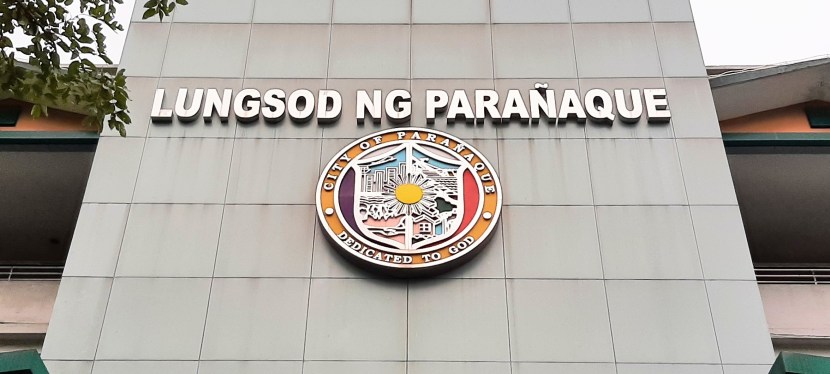
Recently in the city of Parañaque, the local police officers successfully conducted a buy-bust operation the resulted in the two suspects arrested and the seizure of illegal substances worth P442,000, according to a news report by the Manila Bulletin.
To put things in perspective, posted below is an excerpt from the news report of the Manila Bulletin. Some parts in boldface…
Police arrested two drug suspects, including a newly identified high-value individual (HVI), during a drug operation and seized P442,000 worth of shabu in Parañaque on March 6.
Parañaque City Police Chief Col. Nicolas Pinon identified the suspects as Jero, 21, a newly identified HVI, and DJ, 22, a street-level individual (SLI). Both are residents of Taguig City. They were arrested around 1:40 a.m. along Sitio Pag-Asa, Barangay Sun Valley, Parañaque City.
Police said members of the Station Drug Enforcement Unit (SDEU) conducted the buy-bust operation as part of their continuing campaign against illegal drugs.
The suspects were arrested after an undercover police officer, posing as a buyer, was able to purchase a sachet of shabu from them.
Operatives recovered from the suspects an additional three plastic sachets of suspected shabu weighing about 65 grams with an estimated street value of P442,000. Also seized were a silver-colored iPhone, a block coin purse, a driver’s license, P850 in buy-bust money, and a red Honda PCX motorcycle.
Let me end this post by asking you readers: What do you think about this recent development? If you are a resident of Parañaque, are you thankful to the local police for the successful buy-bust operation? Do you think Parañaque will not become a drug-free city anytime soon?
For more South Metro Manila community news and developments, come back here soon. Also say NO to fake news, NO to irresponsible journalism, NO to misinformation, NO to plagiarists, NO to reckless publishers and NO to sinister propaganda when it comes to news and developments. For South Metro Manila community developments, member engagement, commerce and other relevant updates, join the growing South Metro Manila Facebook group at https://www.facebook.com/groups/342183059992673
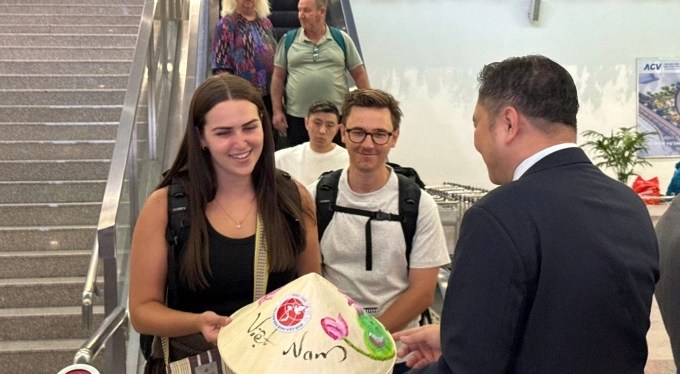
Having traveled to many destinations around the world, I am always mindful about how much money I carry, how much do products and services cost, and what exactly should I pay for. Vietnam, which attracted a record 21.2 million foreign tourists last year, has a disturbing trend of foreign tourists getting overcharged for services and products, according to a VnExpress news article.
To put things in perspective, posted below is an excerpt from the news report of VnExpress. Some parts in boldface…
Gouging tourists is giving Vietnam a bad name despite its sustained promotional efforts, insiders warn.
They want the authorities to hike fines manifold and deploy technology-based monitoring systems to prevent the insidious practice.
Chi Mai, 35, a Hanoi-based tour guide whose family has lived in the capital for three generations, says incidents of overcharging have become so common that they no longer surprise locals.
“Even residents buying 200 grams of pickled fruit in the Old Quarter without first checking the price can be charged double. It’s not surprising that foreign tourists are asked to pay four or five times.”
The repeated reports of such instances leave her disheartened, she says.
“If authorities fail to tackle this issue in a decisive manner, Vietnam’s international tourism promotion efforts will prove ineffective.”
On Feb. 24 an American tourist was charged VND1 million (US$38) for a seven-kilometer trip, 14 times the usual fare, by a motorbike-taxi driver in Hanoi. The driver admitted to the violation, apologized to the tourist and promised not to repeat the act.
Earlier cases also drew attention. In January Hanoi authorities fined a street vendor for charging two foreign tourists nearly four times the normal price of a conical hat.
In July 2025 a group of Filipino tourists were charged VND1.4 million ($53) for a taxi ride of less than 1 km, 50 times the normal fare.
Two months later an Australian family reportedly paid VND1.2 million for a cyclo trip, three times the regulated rate.
Overcharging and aggressive solicitation are not confined to Hanoi and have been reported across other tourist hubs such as Ho Chi Minh City and Da Nang.
Nguyen Tien Dat, CEO of Hanoi-based tour operator AZA Travel, says overcharging tends to occur more frequently in destinations with large numbers of international visitors.
He recounts a personal experience in Da Nang where a taxi driver took a longer route from the airport while Dat was on a phone call. Only after he protested strongly did the driver adjust the fare.
“Even veteran tourism professionals such as tour guides and travel agency executives can fall victim to such practices, and international visitors are even more exposed,” Mai says, adding she has frequently intervened to help tourists resolve pricing disputes.
Tran Trung Hieu, deputy director of the Hanoi Department of Tourism, acknowledges that gouging remains an issue, particularly in areas such as the Old Quarter and during major festivals.
Failure to publicly display prices and forcing customers to make purchases are fraudulent practices, he says.
The department has established a tourist hotline and increased security presence on pedestrian streets during weekends, he says.
“Price gouging, at worst, discourages visitors from returning.“
In Da Nang, the Department of Culture, Sports and Tourism has formed a rapid response team to address complaints and conducts regular inspections of tourism service providers.
There are task forces to monitor commercial fraud, counterfeit goods and non-compliance with pricing regulations.
Authorities on Phu Quoc Island recently established a tourism rapid response team to protect visitors and address service-related concerns amid a tourism boom.
Let me end this piece by asking you readers: What is your reaction to this development? If you were able to travel overseas over the past twelve months, were you excessively charged for a service or for a product you purchased? Does the trend of overcharging tourists in Vietnam discourage you from visiting the country? Do you think the authorities in Vietnam will be able to solve the problems?
Disclaimer: This is my original work with details sourced from reading the comic book and doing personal research. Anyone who wants to use this article, in part or in whole, needs to secure first my permission and agree to cite me as the source and author. Let it be known that any unauthorized use of this article will constrain the author to pursue the remedies under R.A. No. 8293, the Revised Penal Code, and/or all applicable legal actions under the laws of the Philippines.
Welcome back, 1990s arts and culture enthusiasts, video game enthusiasts and comic book collectors! Today we go back to the late-1990s to examine another issue of the magazine-sized comic book series titled Resident Evil: The Official Comic Book Magazine.
The launch issue of Resident Evil: The Official Comic Book Magazine was surprisingly entertaining. That’s not to say it was excellent as it had some flaws here and there. It succeeded with creative stuff by WildStorm to give readers and RE fans a wider lore of Resident Evil by reconnecting them with the first video game and slowly connecting them to Resident Evil 2. The interview with RE creator and producer Shinji Mikami (still a prolific video games industry producer) was indeed a good bonus.
As many of us know, Resident Evil 2 was a huge critical and commercial hit in 1998. By the time WildStorm continued publishing another issue of the official comic book magazine, enthusiasm for Resident Evil was intensified and many new gamers who enjoy RE2 on PlayStation became fans.
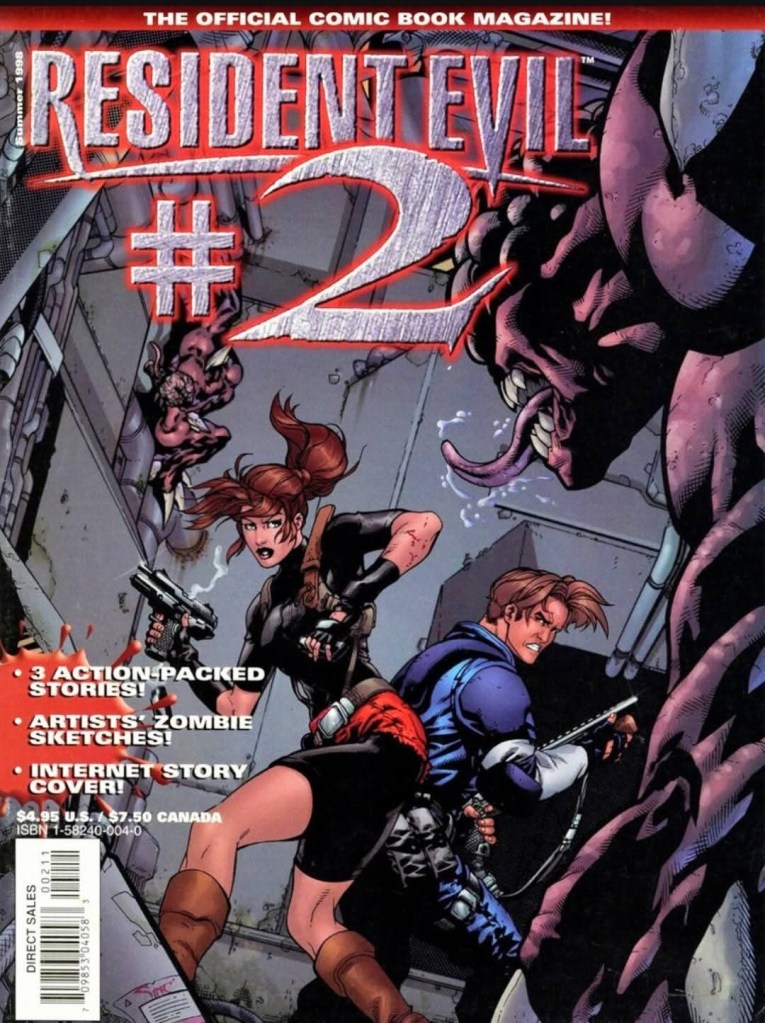
With those details laid down, here is a look back at Resident Evil: The Official Comic Book Magazine #2, published by WildStorm/Image Comics in 1998 with short stories written by Ted Adams and Kris Oprisko, and drawn by Carlos D’Anda and Lee Bermejo.
The cover.
Early stories
A New Chapter of Evil (Resident Evil 2 adaptation) – Inside a police car moving along the street in the middle of a zombie-fested Raccoon City, Leon Kennedy and Claire Redfield tried to figure out what has been happening around them. Leon notices an over-speeding truck is about to hit them from behind. The two managed to get out of the car before it got hit by the truck. From a distance, Leon tells Claire to make her way to the Raccoon City police station where they can meet again.
Mutant Menagerie – After getting left behind by the armed men who shot him, chief researcher William Birkin clutches an overlooked vial of the G-virus and injects himself with it. He soon mutates into a large, deformed monster capable of killing anyone easily. Propelled by sheer willpower to save his life’s work, Birkin simply thinks about infecting many. The next day at the zoo of Raccoon City, a monstrous roar catches the attention of a security guard who rushes outside only to find his two colleagues dead and their bodies torn apart.
Lock Down – Barry Burton, who has been experiencing recurring nightmares since the disastrous mission at the Spencer mansion, visits a facility to seek the help of a psychiatrist. As he approaches the office of the psychiatrist, he noticed someone looking strange.
Quality
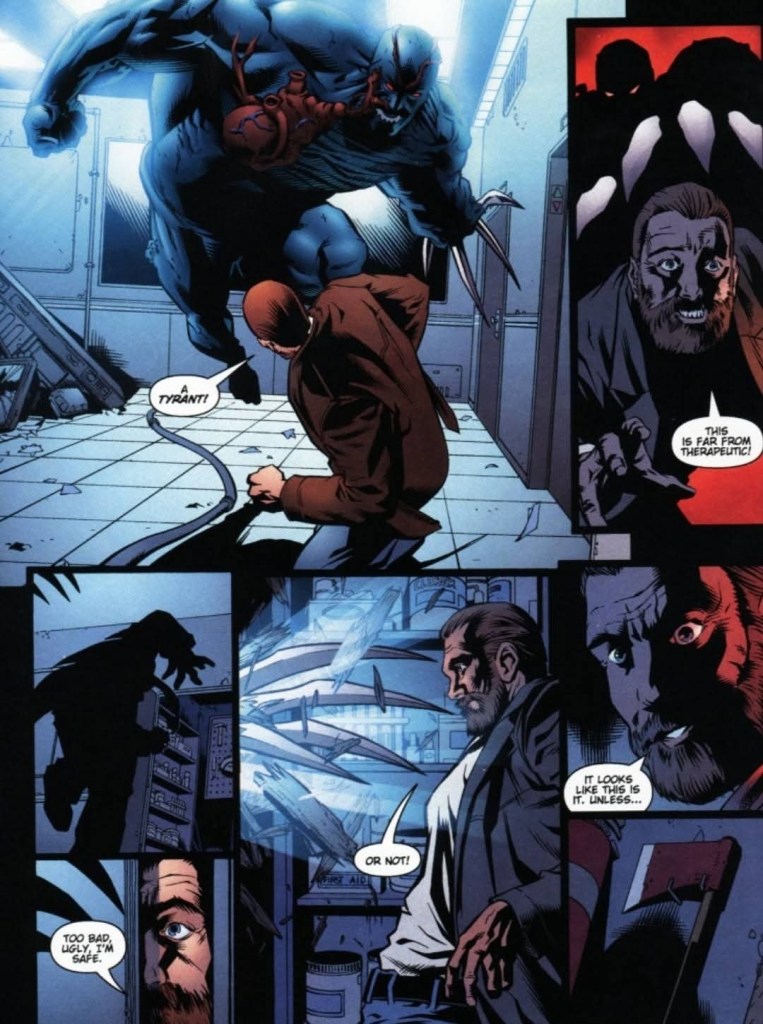
Barry Burton suddenly encounters a Tyrant!
In this 2nd issue, the WildStorm team prepared three short stories with the first one serving as the illustrated adaptation of Resident Evil 2’s story (specifically with Leon on Scenario A and Claire on Scenario B).
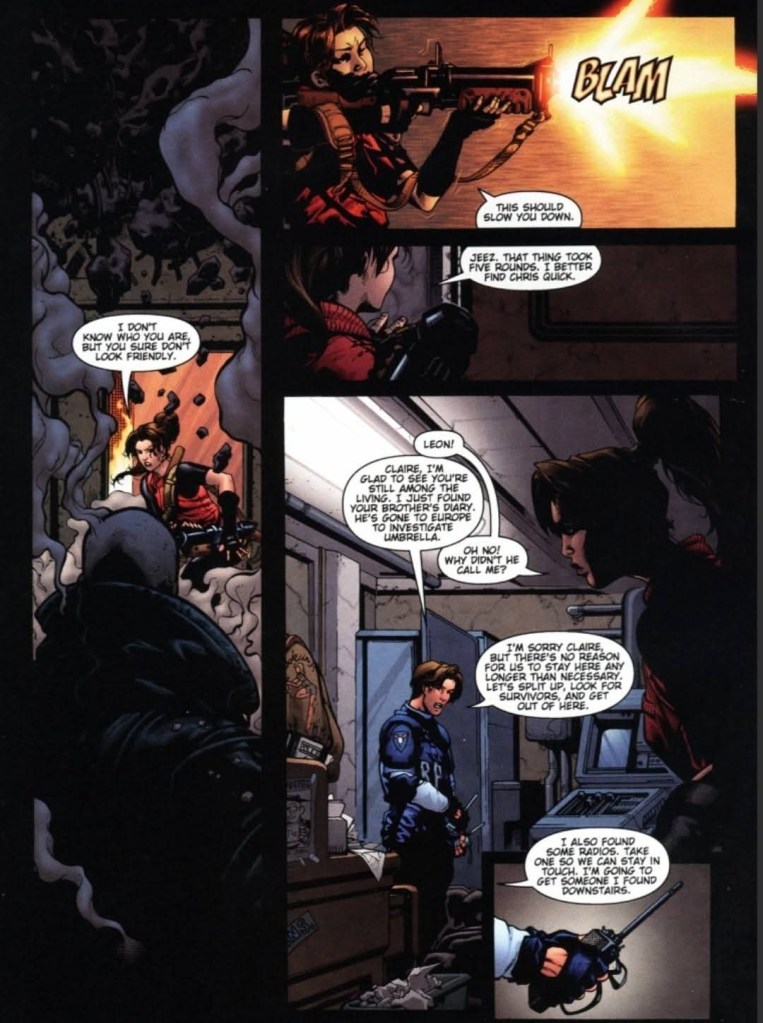
The RE2 adaptation titled A New Chapter of Evil is very sloppy and so poorly done. The assigned writer and artist forcibly crammed the entire Resident Evil 2 story into a limited number of pages. The result is a very rushed approach on storytelling and the noticeable lack of care on the presentation. Having played RE2 a number of times myself, I can easily say that the order of scenes from the game were sloppily chained together in illustrated format to unbelievably occur next to each other without any proper spacing. That also means leaving no space for the reader to slow down to be able to absorb the details and to understand what has been going on.
Since there were not enough pages allocated, the visual presentation also suffered. Each battle with a monster happened too fast and not enough panels could be made to emphasize clearly what happened. The same thing also happened in key scenes of the story.
In the scene in which Claire Redfield encountered the office of the corrupt chief of police (with the dead body of a blonde woman on his desk), the creative team showed the two having a really short talk quickly followed by Claire meeting Sherry for the first time (without even showing Claire moving out of the chief’s office) followed by showing them descending on a motorized lift and quickly encountering the chief (who somehow teleported ahead of them).
The cramming of scenes, dialogue and bad visualization happened all throughout this Resident Evil 2 adaptation. One has to wonder why WildStorm decided not to use the entire 2nd issue for the adaptation. This literary adaptation of RE2 is absolutely bad and it is clearly an embarrassing piece of work of WildStorm’s publishing.
The short story Mutant Menagerie is an attempt to connect to the lord of RE2 by having the mutated William Birkin as the monster with the zoo as the environment. The protagonist is the zoo security guard Patrick Brady who is unsurprisingly in a major disadvantage. Creatively, this tale provides readers an interesting look at what would happen had the G-virus infected the animals in the zoo which added a new element of danger in the zombie crisis within the Resident Evil universe. The story has some Rambo-vibes when it came to the protagonist taking extreme measures to deal with the infected zoo animals.
While Mutant Menagerie is clearly non-canon as the presence of Birkin in the zoo made no sense at all in relation to what was shown in Resident Evil 2 (Birkin’s presence was limited to the NEST facility underneath Raccoon City), this short story became more relevant as the Raccoon City Zoo officially appeared in Resident Evil Outbreak: File #2 (released SIX YEARS after this comic book). This short story is an intriguing and satisfying piece of fan fiction.
The third tale Lock Down is a serious attempt to give RE fans a look at what happened to Barry Burton after the events of the 1996 game. This one has some Die Hard vibes as you will see Burton as a desperate action hero who happens to be present during a very unfortunate series of events. You will also see how he strives hard to solve problems without Jill Valentine, Chris Redfield and Rebecca Chambers to assist him. Artist Lee Bermejo did not compromise with the graphic violence and gore, and his approach on visual dynamism was nicely executed. His visualization of Burton is pretty good too.
While the series of unfortunate events here makes the tale believable, there is something weird as the narrative went on. The building itself has secrets of its own and scenes such as Barry Burton suddenly encountering a Tyrant felt like a nightmare from nowhere. It is implied that the laboratory, the postal center, the smelly sub-basement and the penthouse could have all been established by Umbrella within the city. This short story is actually entertaining and surprising.
Conclusion
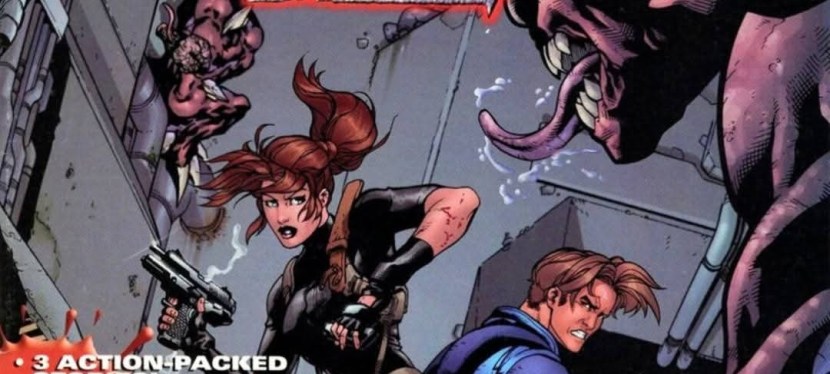
Claire Redfield and Leon Kennedy in the Resident Evil 2 adaptation.
The main feature story of Resident Evil: The Official Comic Book Magazine #2 (1998) – the official adaptation of Resident Evil 2’s story – is clearly the failure and is an obvious waste of time. What prevented this comic book magazine from becoming a total disaster were the short stories Mutant Menagerie and Lock Down which were entertaining and surprising to read. That said, it is mind-boggling that WildStorm did not use this entire issue to properly tell the Resident Evil 2 story and give the creative team enough space to ensure a quality adaptation. I wonder how Capcom and the Resident Evil 2 developers reacted to this issue’s RE2 adaptation.
Overall, Resident Evil: The Official Comic Book Magazine #2 (1998) is serviceable.






 Author Carlo Carrasco