The Subic Bay Metropolitan Authority (SBMA) announced that it has released almost P220 million in revenue shares to the City Government of Olongapo and seven other local government units (LGUs).
To put things in perspective, posted below is an excerpt from the SBMA’s official announcement. Some parts in boldface…
The Subic Bay Metropolitan Authority (SBMA) released a total of PHP 218,115,671.26 in revenue shares to eight local government units (LGUs) contiguous to this premier freeport zone.
SBMA Chairman and Administrator Eduardo Jose L. Aliño said that this amount released on Tuesday, July 21, 2026,represents the revenue shares for the first semester of 2026, which is 10.24 percent higher than that of last year’s comparative period.
The recipient LGUs areOlongapo City,the municipalities of Subic, San Marcelino, Castillejos, and San Antonio in Zambales, and the towns of Dinalupihan, Hermosa, and Morong in Bataan.
Taking into account the population and land area,Olongapo was allocated the largest amount of PHP 50,420,165.72, received by Olongapo City Mayor Atty. Rolen Paulino, Jr. This was followed by Subic, Zambales, which received PHP 32,871,521.46, accepted on behalf of Mayor Jonathan John Khonghun.
The remaining LGUs received their allocations as follows: Dinalupihan, Bataan, with PHP 27,438,313.68, accepted on behalf of Mayor German Santos, Jr.; San Marcelino, Zambales, with PHP 26,272,445.97, received by Mayor Elvis Soria; Hermosa, Bataan, with PHP 23,422,520.27, accepted on behalf of Mayor Atty. Anne Adorable-Inton; Castillejos, Zambales, with PHP 19,817,470.23, received on behalf of Mayor Jeffrey Khonghun; Morong, Bataan, with PHP 19,340,287.10, received on behalf of Mayor Leila Linao-Muñoz; and San Antonio, Zambales, with PHP 18,532,946.83, received by Mayor Dr. Arvin Antipolo.
TheLGU shares are sourced from five percent corporate taxes paid by business locators in the Subic Bay Freeport. They aredistributed among LGUs based on population (50%), land area (25%), and equal sharing (25%).
OIC-Deputy Administrator for Finance Editha Marzal, along with the finance team, led the distribution of the LGU shares.
Marzal noted that the net shares distributed to the LGUs include not only the current collection period’s allocations but also the 10 percent retention withheld during the first semester of the 2024 distribution.
Let me end this post by asking you readers: What is your reaction to this recent development? Do you see the increased amount of revenue shares as a sign of better economic activities and finances within the Subic Bay Freeport Zone? Do you think the revenue shares would be higher once the Luzon Economic Corridor (LEC) and Pax Silica activities finally start economic activities in the near future?
For decades, the Subic Bay Freeport Zone has been a hot spot of commerce, tourism and varied types of businesses which resulted in the creation of new jobs. Recently, the Subic Bay Metropolitan Authority (SBMA) officially confirmed that the Freeport workforce exceeded 170,000 in 2025 which is an improvement of over 4% compared with 2024.
To put things in perspective, posted below is an excerpt from the official announcement of the SBMA. Some parts in boldface…
The workforce in the country’s premier Freeport totaled 171,653 in 2025, according to the annual report by the Subic Bay Metropolitan Authority (SBMA).
According to a report from the SBMA Labor Department, this figure reflects a 4.4 percent increase from last year’s 164,400 recorded in 2024.
SBMA Chairman and Administrator Eduardo Jose L. Aliño said that the increase in the number of workers here results from President Ferdinand R. Marcos Jr.’s mandate to provide more employment opportunities for Filipinos.
He said that Olongapo City remains the biggest source of manpower, with 70,769 residents working here. He added that this was followed by Zambales with 31,621; Bataan with 22,897; National Capital Region with 7,077; Pampanga with 5,492; Tarlac with 2,199; and the remaining 31,598 from other parts of the country, including foreign workers.
Around 70.60 percent of workers, or 121,187, are male, while the remaining 29.40 percent, or 50,466 workers, are female, and employed by 4,744 Subic companies. Despite the disparity, female workers outnumbered male workers in the manufacturing sector, with 18,951 females and 18,242 males employed across 111 manufacturing companies in Subic.
Meanwhile, the Subic Bay Freeport’s services sector remains the biggest employer, which clocked at 67.32 percent of the workforce, with the manufacturing sector making up 21.67 percent. These are followed by the construction sector with 7.36 percent, and shipbuilding/marine-related services with 3.64 percent.
Aliño added that the services sector also has the biggest number of companies, with 4,129, followed by the construction sector with 356 companies, then shipbuilding/ marine-related services with 148 companies, and lastly the manufacturing sector with 111 companies.
He further said that more companies are still looking for employees, thru the SBMA Labor Department’s regular conduct of job fairs and posting job openings via online portals and bulletin boards at their offices near the Subic Bay Gym.
“Jobseekers can click on the SBMA Career Portal, where we provide an official list of vacancies from various Freeport locators. We encourage applicants to check the Subic Gym bulletin board for scheduled examinations and interviews,” he said.
Let me end this post by asking you readers: What is your reaction to this recent development? If you are managing a business, have you thought about expanding and setting up a place inside the Subic Bay Freeport Zone? What is your current impression about the business and work environment inside Subic Bay right now?
Disclaimer: This is my original work with details sourced from John Chicano by means of an interview and research. Anyone who wants to use this article, in part or in whole, needs to secure first my permission and agree to cite me as the source and author. Let it be known that any unauthorized use of this article will constrain the author to pursue the remedies under R.A. No. 8293, the Revised Penal Code, and/or all applicable legal actions under the laws of the Philippines.
A Chat with 2019 SEA Games Gold Medalist and Southeast Asia’s Triathlon King – John Chicano
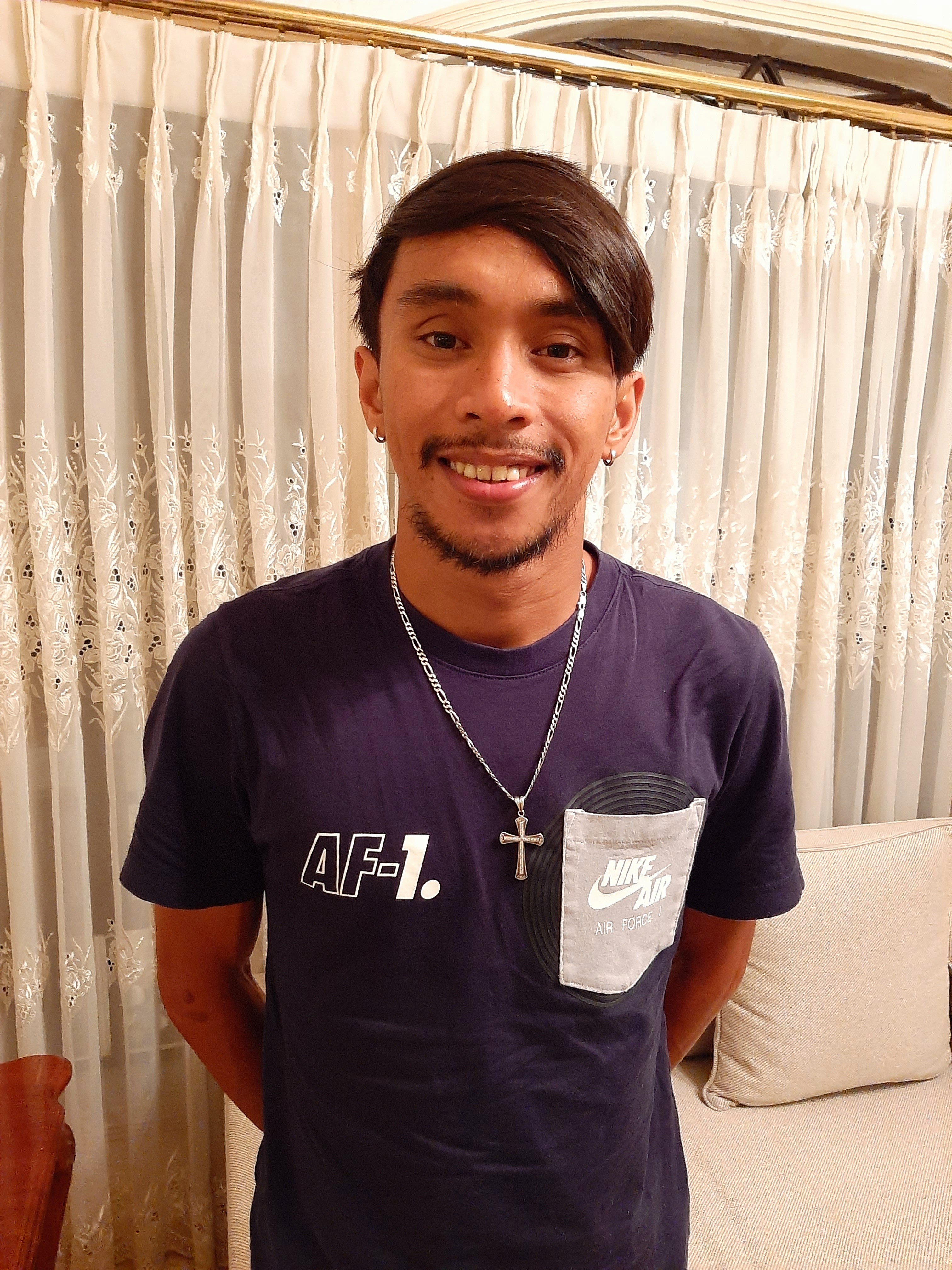
Southeast Asia’s best male triathlete John Leerams Chicano.
Since he first participated in the Southeast Asian Games (SEA Games) in 2017, John Leerams Chicano raked in notable honors for the Philippines and took his career in the multisport of triathlon (swim-bike-run) even higher.
Today, Chicano is one of the highest-ranking members of the National Team of triathlon and this past December, he won the gold medal in the men’s triathlon event of the 2019 SEA Games that was held at the Subic Bay Freeport Zone (so close to his native Olongapo City). With that big victory, he established himself as Southeast Asia’s newest triathlon king replacing Nikko Huelgas (2015 and 2017 SEA Games gold medalist). It was also the big reward for the long road (about a decade) he literally took engaging in multisport events like triathlon and duathlon.
Recently I met Chicano and had a nice chat with him.
For you, my readers, here is a look at 3-time SEA Games medalist John Chicano.
A quick look at his background
John Chicano has been engaging in triathlon for many years now and has been a member of the Philippine team along the way. He represented the country in many events of the Triathlon Association of the Philippines (TRAP), most notably the annual Subic Bay International Triathlon (SUBIT). He also raced in other triathlon events organized by Bike King Philippines and other race organizers. On livelihood, he previously worked as a bike mechanic as well as a janitor. He now has his own family to support.
When it comes to triathlon at the SEA Games, he made his debut in the 2017 edition of the games held in Malaysia and won the silver medal in the individual men’s triathlon event next to teammate Nikko Huelgas who won the gold medal back then (note: Huelgas first won the SEA Games gold in 2015). His achievement was recognized by the media and the national government which in turn rewarded him (along with all other medalists) with cash incentives in accordance to Republic Act Number 10699.
Winning the SEA Games gold medal at Subic Bay
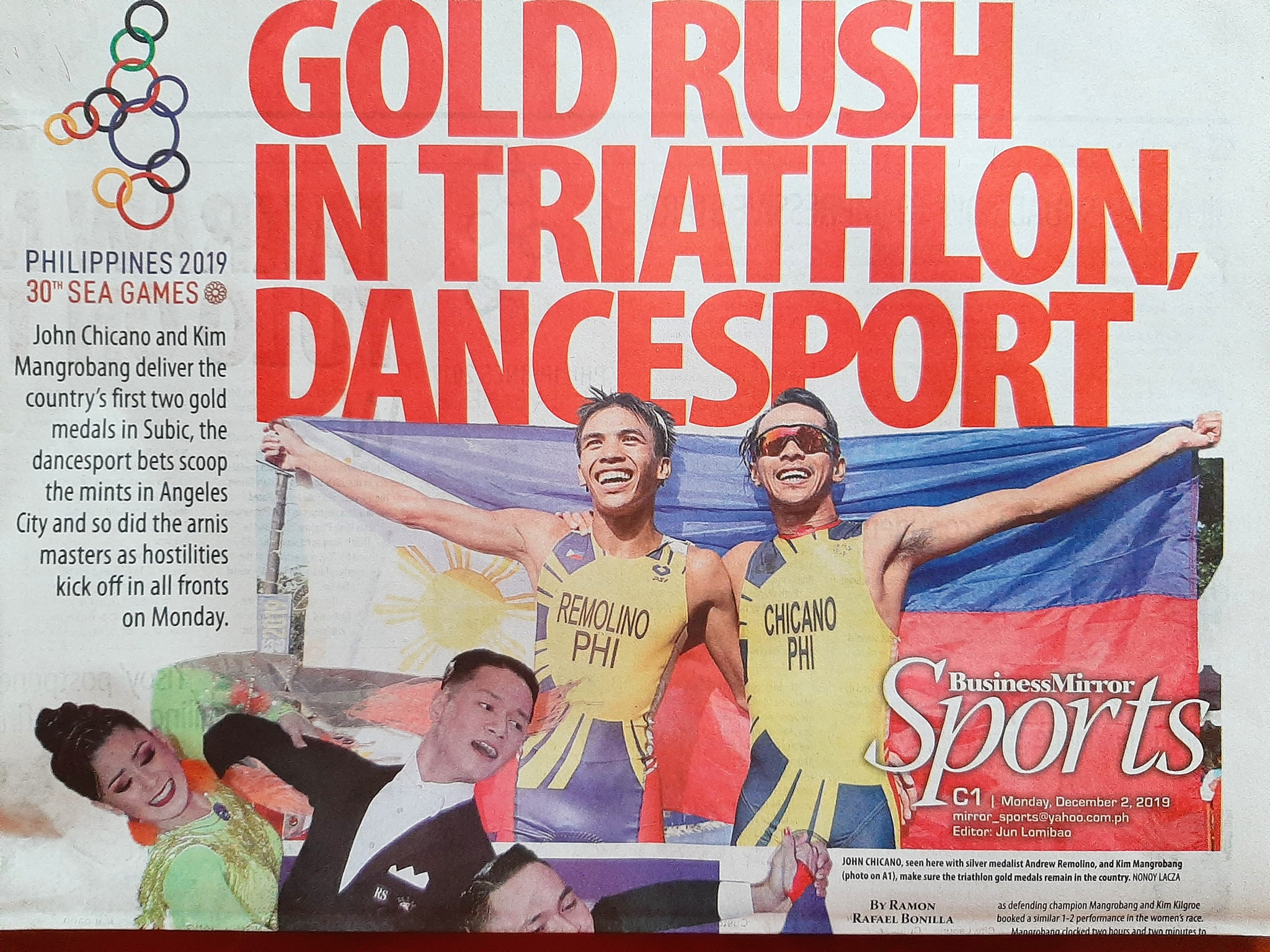
On the early morning of December 1, 2019, the SEA Games men’s triathlon event started with Chicano and Cebu-based teammate Andrew Kim Remolino representing the nation. After going through the pressure and enduring the pain of the 1.5 kilometer swim – 40 Km bike – 10 Km run event, Chicano won the gold medal in 1 hour, 53 minutes and 26 seconds. Remolino followed with 1:55:03 to win the silver medal, completing the 1-2 punch for the Philippines.
“We were confident in the sense that we prepared well for the SEA Games which includes three months of training at Clark,” Chicano said. “While I was confident to win, there were a few moments of uncertainty since the big competition (men’s triathlon) could turn out to be unpredictable.”
During the December 1 event, Chicano and Remolino raced together during the 40-kilometer bike leg and on the spot they came up with a new strategy to win gold and silver. At that particular stage, another foreign competitor biked near them. Earlier in the swim leg, Remolino was the first to emerge from the sea while Chicano was 4th (an Indonesian and a Singaporean were slightly ahead of him). During the 10-kilometer run leg, Chicano and Remolino built up their lead as a country and, ultimately, he gave it his all to win the gold, literally upgrading from silver (2017 SEA Games). The victory was witnessed by the top sports officials, the coaches, the Triathlon Association of the Philippines (TRAP), the Subic Bay Metropolitan Authority officials, the spectators, corporate sponsors and, of course, Chicano’s family.
“It was a very happy moment for me to cross the finish line for the gold medal. I even felt like crying for happiness back then,” Chicano recalled the very moment he won the gold and became Southeast Asia’s best. “This was the big payback for almost ten years of effort racing in triathlon and growing to be stronger and more competitive. My triathlon effort and build-up started in 2010, preceded by biking in 2009. The feeling was so tremendous and happy.”
Chicano and teammate Andrew Kim Remolino on the sports section of the December 2, 2019 edition of Business Mirror.
During the medal awarding ceremony, Chicano thought deeply about his SEA Games achievement and that he could bring further honors to the nation (plus his locality) in the years to come. The day after that, Chicano and teammates Remolino, Kim Mangrobang and Kim Kilgroe got tremendous spotlight together in the national newspapers which was expected considering their victorious achievements.
Chicano (3rd from right) with his teammates who won medals in the 2019 Southeast Asian Games – (from L to R) Claire Adorna, Kim Kilgroe, Kim Mangrobang, Andrew Kim Remolino and Fer Casares. (photo source – Kim Mangrobang Facebook page)
His SEA Games gold medal achievement not only raked in praise from many, financial rewards also came in from the national government (RA 10699), the City Government of Olongapo, corporate sponsors and other generous parties. Chicano even got to visit the Philippine Senate and met with Senator Richard Gordon.
Chicano and Kim Mangrobang on the front page of the December 2, 2019 edition of the Manila Times.
Chicano with coach Melvin Fausto and Senator Richard Gordon. (photo source – Subic Bay Community Center Facebook page)
As of this writing, Chicano is strongly focused on triathlon and he believes that what he achieved so far as a triathlete, and also as Southeast Asia’s best male triathlete, will be remembered for a long time and perhaps inspire the next generation of Filipinos to excel in sports.
When it comes to the near future, Chicano will go to Australia very soon to attend the Annual General Meeting and Awards Night of the FilOz Triathlon Club as their Guest Speaker. After that, he will undergo triathlon training for a few more weeks there in Australia.
From this point on, I recommend you all to take a close look at Chicano in triathlon events both local and overseas. He is, after all, Southeast Asia’s reigning triathlon king.
Thank you for reading. If you find this article engaging, please click the like button below and also please consider sharing this article to others. Also my fantasy book The World of Havenoris still available in paperback and e-book format. If you are looking for a copywriter to create content for your special project or business, check out my services and my portfolio. Feel free to contact me as well. Also please feel free to visit my Facebook page Author Carlo Carrasco and follow me at HavenorFantasy@twitter.com