Disclaimer: This is my original work with details sourced from reading the comic book and doing personal research. Anyone who wants to use this article, in part or in whole, needs to secure first my permission and agree to cite me as the source and author. Let it be known that any unauthorized use of this article will constrain the author to pursue the remedies under R.A. No. 8293, the Revised Penal Code, and/or all applicable legal actions under the laws of the Philippines.
Welcome back superhero enthusiasts, 1980s arts and culture enthusiasts, Marvel Comics fans and comic book collectors! Today we go back to the year 1985 to examine a small part of the Marvel Comics shared universe through a tale of the Amazing Spider-Man monthly series.
For this particular review, we will explore the first chapter of The Assassin Nation Plot storyline that took place within the Amazing Spider-Man series.
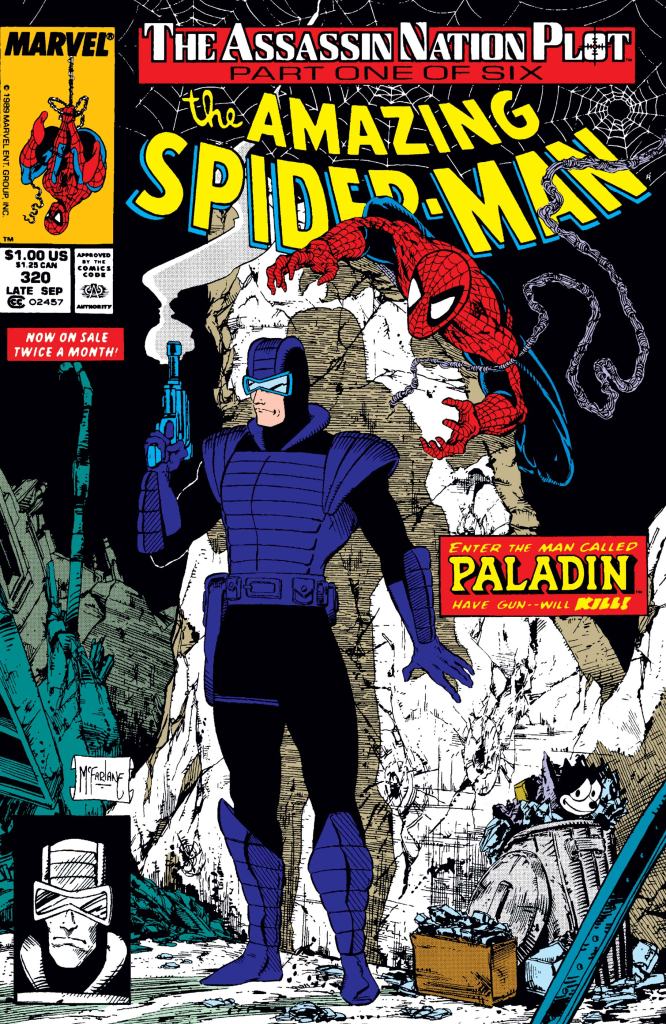
With those details laid down, here is a look back at Amazing Spider-Man #320, published in 1989 by Marvel Comics with a story written by David Michelinie and drawn by Todd McFarlane.
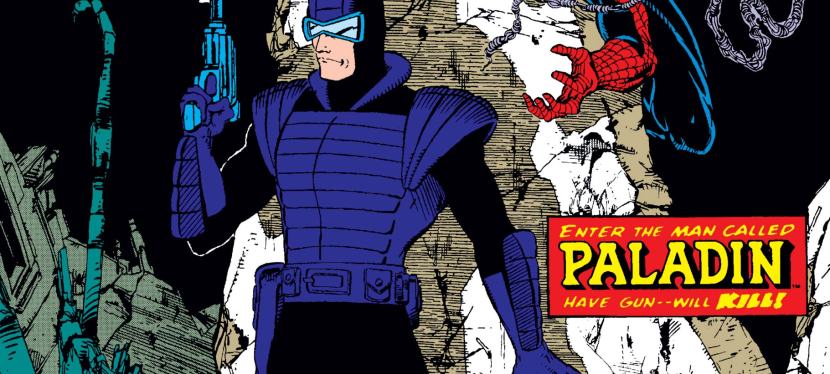
The cover.
Early story
The story begins inside Empire State University where Peter Parker – working as an assistant in the science lab – takes advantage of the free time and resources to create web fluid using a new formula. He notices that the acetylene torch does not even leave a smudge on the new web he made.
To his surprise, his boss doctor Evan Sloan catches him doing an interesting experiment. Parker comes up with a convincing excuse for the experiment which spares him from getting into trouble. After promising doctor Sloan he will get on the neutron project first thing in the morning of Thursday, Parker leaves, secretly changes into Spider-Man and equipped his brand new web. He then leaves the university and moves deep into the city…
Quality
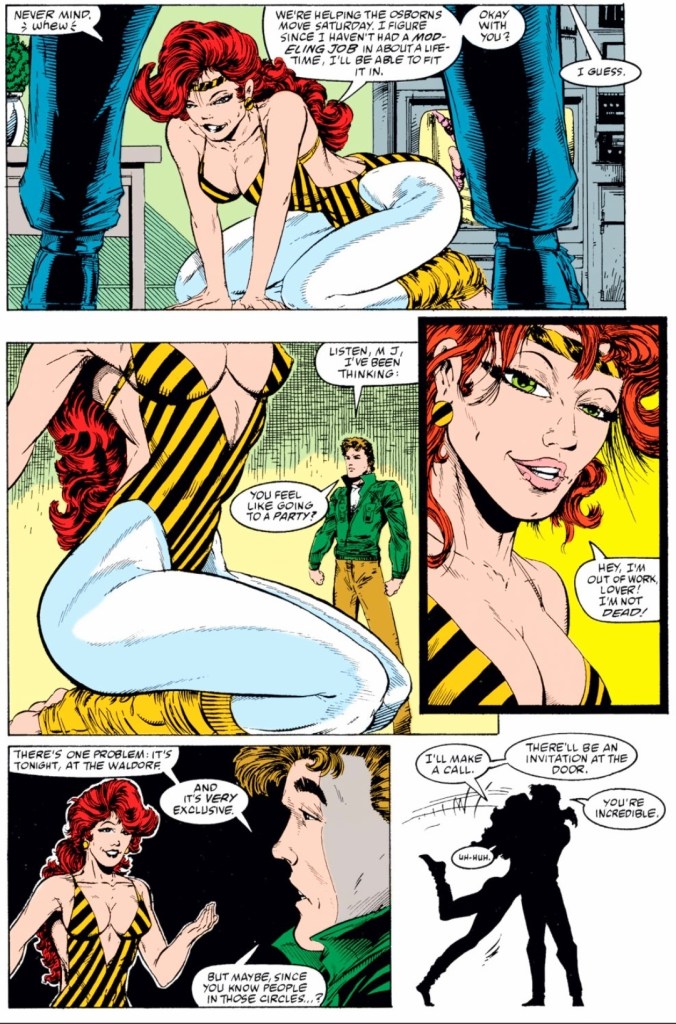
Peter Parker and Mary Jane having a discussion.
I really like the story David Micheline came up with as the start of The Assassin Nation Plot storyline. This is clearly not your typical good-versus-evil superhero tale starring the webslinger. Instead, there are layers of secrecy, suspense and intrigue that involves a powerful private organization, private armies and diplomats.
Instead of facing off with super villains, Spider-Man finds himself in the middle of something very big brewing behind the scenes, and that puts him in deep danger. That being said, Michelinie’s approach on building up the details of the plot moved very smoothly and the payoff for each buildup was executed on a timely manner. The buildup of details was never boring nor too slow to absorb, and Todd McFarlane excelled with visualizing the plot while still delivering dynamic superhero action.
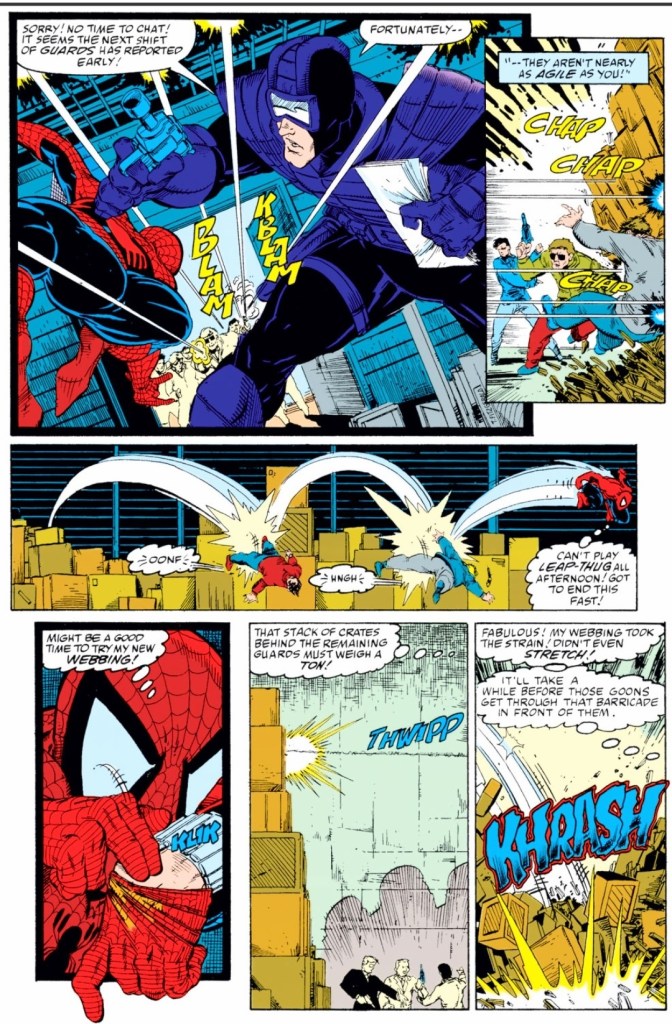
I should mention that the character Paladin has a strong presence in the story and there were moments when he outweighed Spider-Man in terms of importance.
Conclusion
Spider-Man and Paladin targeted by armed guards.
Amazing Spider-Man #320 (1989) is indeed a very solid story to read and a powerful start of The Assassin Nation Plot storyline. With the way the core concept was presented, this comic book symbolically showed that there are high stakes and other matters that are clearly too overwhelming for Spider-Man to deal with. The story is nicely paced and the creative team knew when and how to execute worthy payoffs for each buildup. By the time I reached the end of the comic book, I became convinced to read the next chapter of this storyline.
Disclaimer: This is my original work with details sourced from reading the comic book and doing personal research. Anyone who wants to use this article, in part or in whole, needs to secure first my permission and agree to cite me as the source and author. Let it be known that any unauthorized use of this article will constrain the author to pursue the remedies under R.A. No. 8293, the Revised Penal Code, and/or all applicable legal actions under the laws of the Philippines.
Welcome back superhero enthusiasts, 1980s arts and culture enthusiasts, Marvel Comics fans and comic book collectors! Today we go back to the year 1985 to examine a small part of the Marvel Comics universe through a tale of the Amazing Spider-Man monthly series.
For this particular review, the Amazing Spider-Man comic book does not involve Tom DeFalco and Ron Frenz. Instead, we will see the creative contribution of Bob Layton who already established himself within Marvel Comics on the Iron Man monthly series. Layton is the same guy who co-founded Valiant Comics with former Marvel Comics editor-in-chief Jim Shooter.
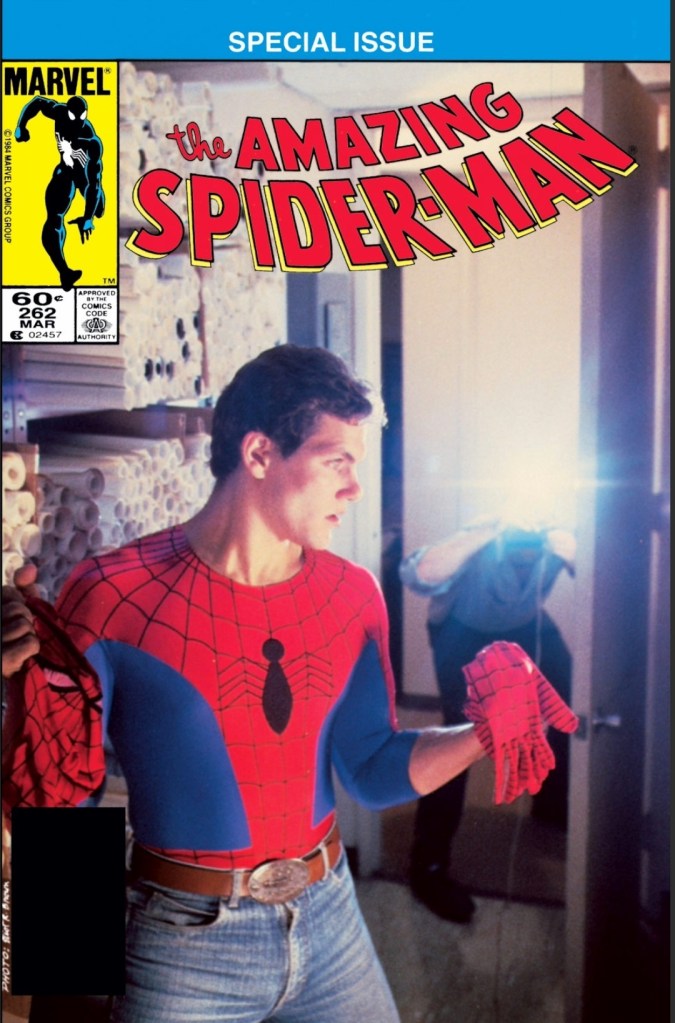
With those details laid down, here is a look back at Amazing Spider-Man #262, published in 1985 by Marvel Comics with a story written and illustrated by Bob Layton.
The cover.
Early story
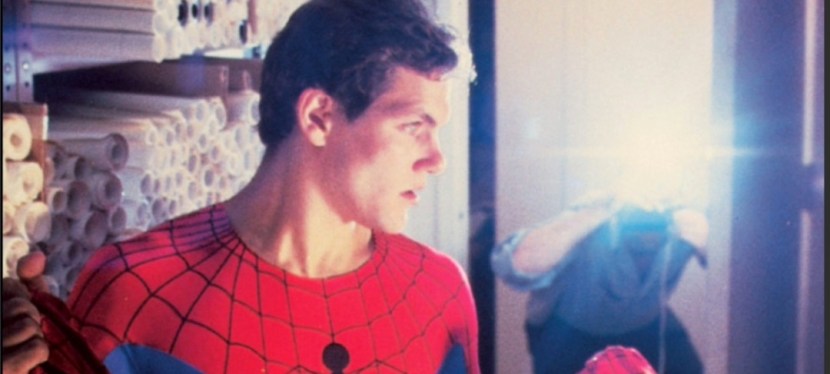
The story begins as Spider-Man arrives at the Newark International Airport in New Jersey distracting a few air traffic control operators. As he makes his way into a deserted baggage room, Peter Parker intends to change clothes as he has a journalistic assignment from the Daily Bugle to photograph President Ronald Reagan who is set to arrive soon. For Peter Parker, the assignment is crucial as he needs to earn money.
Elsewhere within the airport, the sleazy tabloid news photographer D.J. Jones makes his way through and he intends to photograph something unusual or embarrassing about Reagan. He accidentally bumps into a lady whose items fall down. Jones pretends to be kind to her as he secretly takes her wallet while helping her collect her belongings.
As Jones decides to take the lady’s money, he goes into one of the baggage rooms to get rid of the wallet. Inside, he accidentally spots Peter Parker (still wearing the upper half of his Spider-Man costume) changing clothes and quickly photographs him. Jones starts to run away compelling Parker to chase him knowing that his secret identity will get exposed if he fails…
Quality
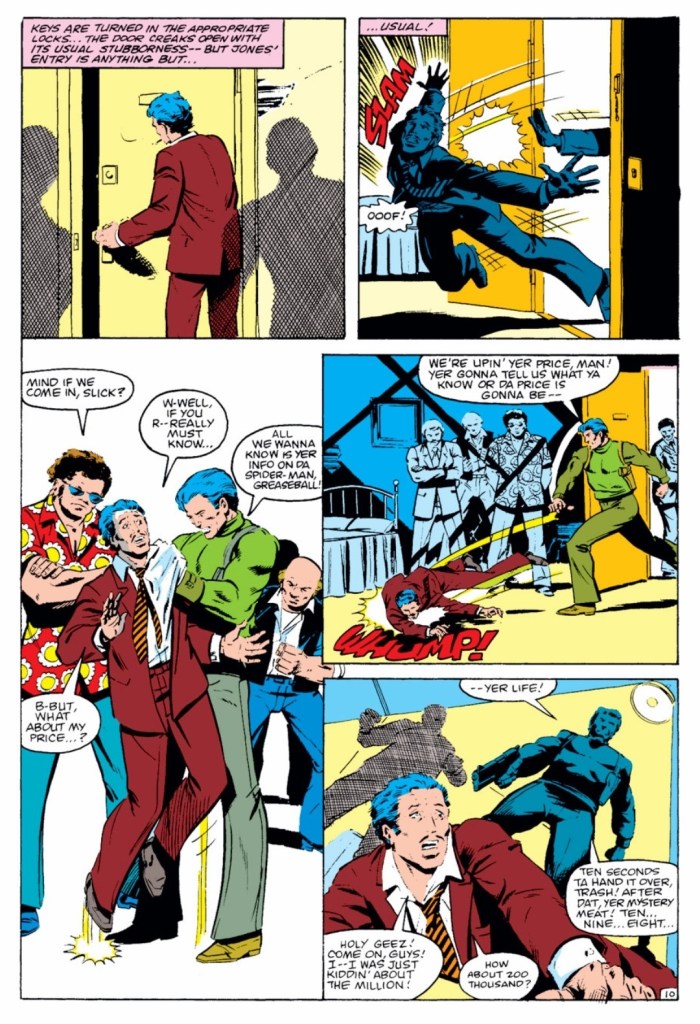
This is what happens when you carry very valuable information with you which the mob wants.
I really like this Spider-Man tale crafted by Bob Layton. For one thing, it tackles the concept of having your secret identity being discovered by someone who has a record of unethical behavior as well as the opportunity of using the acquired confidential information (the secret identity) for financial gain (at the expense of the affected person). Layton’s story also reconnected Spider-Man to a significant part of his legacy (the death of his Uncle Ben and the identity of the man who killed him) which opens up moral and ethical challenges on his part.
Character development of Spider-Man in this story is short yet substantial to read. As he recalls the painful lesson he learned about his uncle’s death, he remembers how guilt (by previously allowing a crook to get away who later turns out to be the same person responsible for the death of Uncle Ben) overwhelmed his early desire for revenge and this compels him to re-evaluate the responsibility he carries with his superhuman abilities.
Instead of utilizing a super villain, Layton presented D.J. Jones as the antagonist that Spider-Man has to overcome somehow. Jones is not exactly evil, he’s just unethical and sleazy. As a human being, Jones is a turn-off but he is not murderer nor a bank robber. The sleazy photographer is an ordinary man who, like Peter Parker, is trying to survive with his occupation which in turn makes him determined to get the big scoop to rise high.
Conclusion
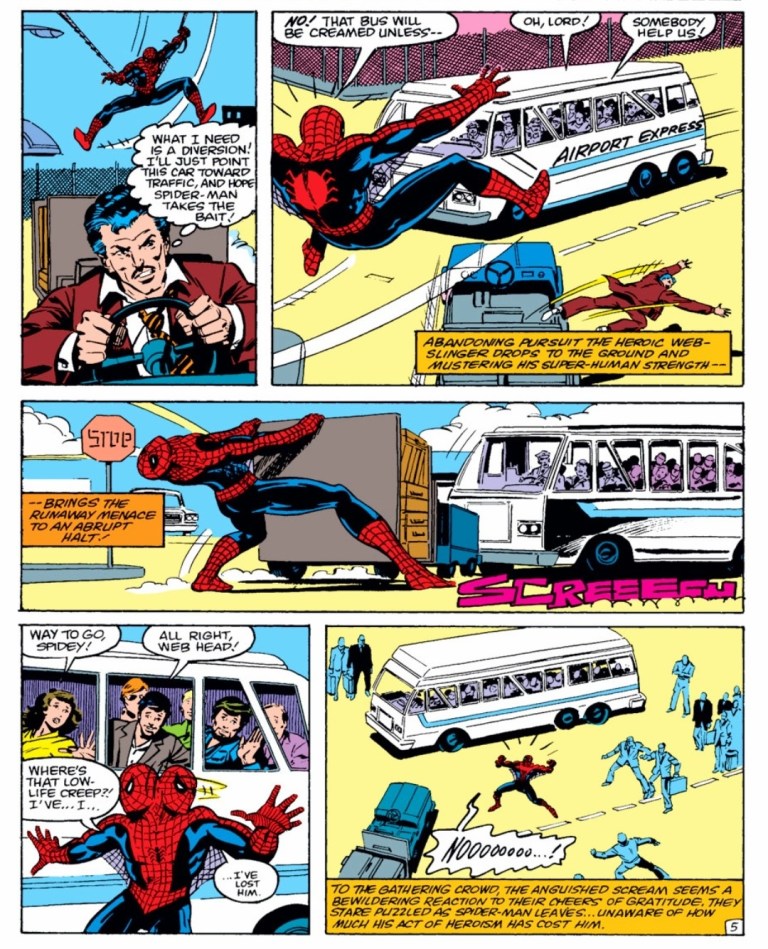
Spider-Man ended up having to save the lives of many innocent people resulting in losing track of the man he was chasing.
Amazing Spider-Man #262 (1985) is a very inspired work by Bob Layton who clearly researched the history of Spider-Man and tackled the crucial themes (note: power, responsibility, morality and ethics) through the story. The plot is simple yet engaging to follow and the character development is really solid. This is great writing by Layton and his approach on superhero spectacle (the action scenes) works well within the narrative.
Disclaimer: This is my original work with details sourced from reading the comic book and doing personal research. Anyone who wants to use this article, in part or in whole, needs to secure first my permission and agree to cite me as the source and author. Let it be known that any unauthorized use of this article will constrain the author to pursue the remedies under R.A. No. 8293, the Revised Penal Code, and/or all applicable legal actions under the laws of the Philippines.
Welcome back superhero enthusiasts, 1980s arts and culture enthusiasts, Marvel Comics fans and comic book collectors! Today we go back to the year 1984 to examine a small part of the Marvel Comics universe through a tale of the Amazing Spider-Man monthly series.
In my previous retro review, additional stress in Peter Parker’s life was realized when Mary Jane revealed to him that she knows he and Spider-Man are one and the same. Some time later when things calmed down, Spider-Man went to the headquarters of the Fantastic Four eventually finding out the shocking truth about the alien costume he has been wearing since the events of Secret Wars.
With those details laid down, here is a look back at Amazing Spider-Man #259, published in 1984 by Marvel Comics with a story written by Tom DeFalco, and drawn by Ron Frenz.
The cover.
Early story
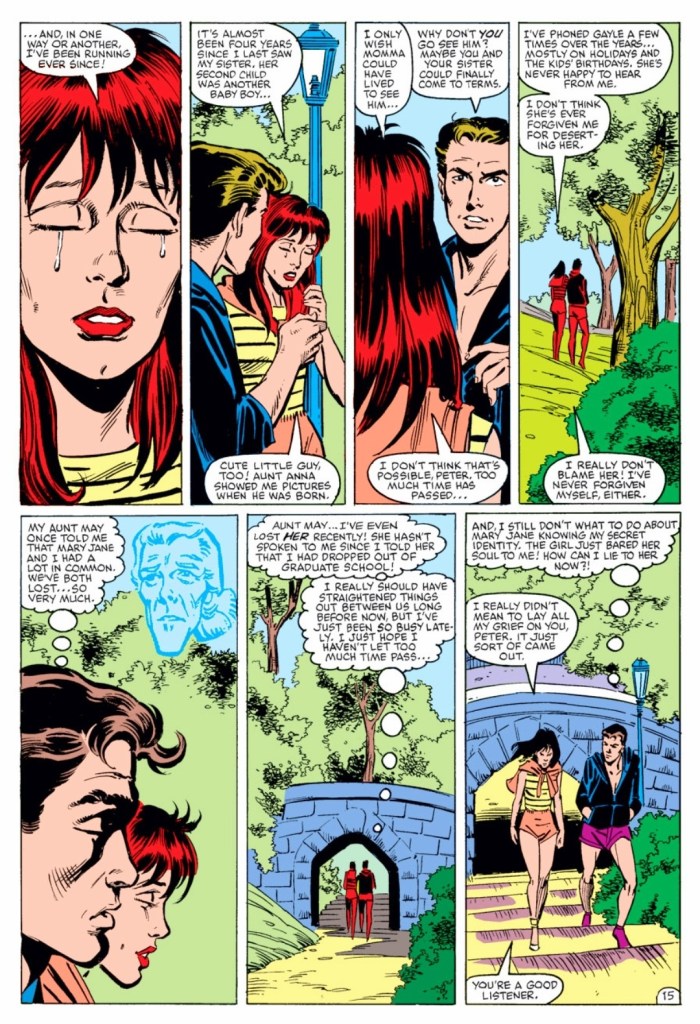
The story begins in New York City where Peter Parker and Mary Jane casually spend time walking within a large park. Knowing that Peter is already feeling uneasy about her knowing his secret identity as Spider-Man, Mary Jane reveals to him stories of her past and the domestic challenges that she, her sister and their parents went through.
Elsewhere in the city, the Hobgoblin makes his moves expressing his intention to engage with the business side of crime…
Quality
Mary Jane Watson and Peter Parker spending a lot of quality time together at the park.
When it comes to developing a supporting character with sheer depth, this comic book really stands out as Spider-Man literally got pushed to the side. The main story here focuses closely on Mary Jane whose experiences with her family from the past got dramatized big time. You will see flashbacks of her youth, her closeness with her sister and mother, and tension she went through when her father became stressed and resentful. The DeFalco-Frenz duo really set up the blocks of past developments that built up Mary Jane’s personality and her portrayal here is clearly a major character turning point in Spider-Man’s corner of the Marvel Comics shared universe of the time.
As for her relationship with Peter Parker/Spider-Man, Mary Jane here is less of a romantic partner and more of a friend looking for a shoulder to cry on. While it is a fact that several comic books in the 1970s showed Mary Jane and Peter romantically linked, her portrayal in this comic book marked a major turning point of her personal development and her destiny with the webslinger. The writing by DeFalco here is very rich with drama and believability.
Conclusion
Flashbacks from Mary Jane’s past with her family.
Amazing Spider-Man #259 (1984) is still significant to read after all these decades. Mary Jane, who eventually got married to Peter Parker, has been redefined very heavily in this tale and she eventually became one of the most essential Spider-Man-related characters in the years that followed. Looking back at this old story (which happened shortly after Spider-Man separated from the alien costume), it was clear that Marvel Comics decided Mary Jane would be the definitive leading lady of Spider-Man.
Disclaimer: This is my original work with details sourced from reading the comic book and doing personal research. Anyone who wants to use this article, in part or in whole, needs to secure first my permission and agree to cite me as the source and author. Let it be known that any unauthorized use of this article will constrain the author to pursue the remedies under R.A. No. 8293, the Revised Penal Code, and/or all applicable legal actions under the laws of the Philippines.
Welcome back superhero enthusiasts, 1980s arts and culture enthusiasts, Marvel Comics fans and comic book collectors! Today we go back to the year 1984 to examine a small part of the Marvel Comics universe through a tale of the Amazing Spider-Man monthly series.
In my previous retro review, Puma had encountered Spider-Man not once but twice. During the first encounter, Black Cat got in the way to defend her beloved webslinger. A short time later, Mary Jane Watson gets involved unexpectedly and the story ended with something that struck Peter Parker very deep inside.
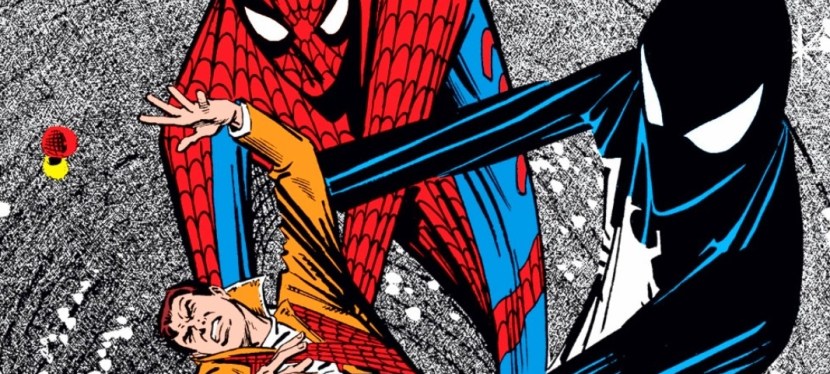
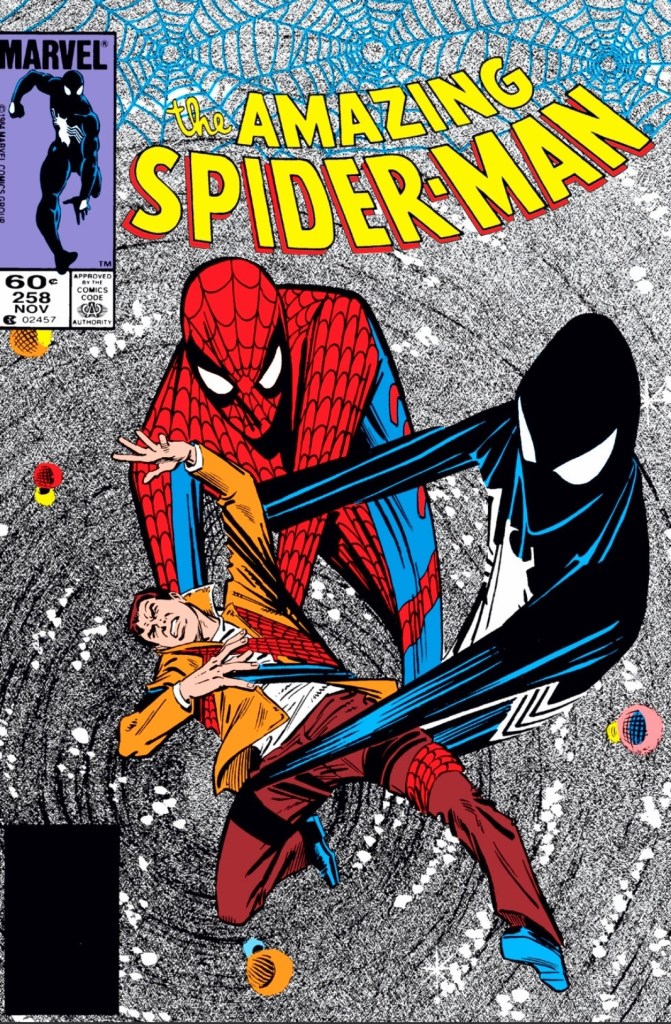
With those details laid down, here is a look back at Amazing Spider-Man #258, published in 1984 by Marvel Comics with a story written by Tom DeFalco and drawn by Ron Frenz.
The cover.
Early story
The story begins inside Peter Parker’s apartment in New York City. He is struggling deep inside as he is shocked by Mary Jane’s revelation that she knows he and Spider-Man are one and the same person. She tells him that she knew his secret for years. Peter then begins to think that this is all Puma’s fault.
As Mary Jane begins to leave, Peter tries to talk with her. She tells him that he will deny everything and that she cares about him. She added that knowing his secret identity is why she originally left New York. She had to get away from him (and Spider-Man).
Suddenly, Black Cat arrives through the window. Her presence causes Mary Jane to realize something about them…
Quality
Very clearly the alien costume has its own intelligence and is the main reason why Peter Parker remained exhausted and sleeping too long.
I really like the writing of this comic book. Tom DeFalco showed strong consistency with developing the newcomer (and a formidable foe) Puma and his rivalry with Spider-Man, while also leaving sufficient room to develop Peter Parker who is now in deeper stress dealing with the complexities of his connections with Mary Jane and Black Cat.
What is most notable about the plot is the finally crafted resolution to Peter Parker’s use of the alien costume (the symbiote from Secret Wars that would later bond with Eddie Brock to form the murderous Venom) by having the Reed Richards and Johnny Storm of the Fantastic Four involved in a captivating manner. I won’t reveal what happened but I can assure you readers that this particular plot element alone makes this comic book very worthy of your time and attention. That being said, Spider-Man’s saga took a serious turn from here.
As with the previous issues, Ron Frenz’s fine art really brought DeFalco’s script into life here and this includes Spider-Man’s crossover with the mentioned Fantastic Four members, dynamic shots of the webslinger and fine dramatic expressions on characters’ faces.
Conclusion
With Black Cat and Mary Jane both present with Peter Parker, the tension and uncertainty grew only stronger.
Amazing Spider-Man #258 (1984) is yet another great read from the DeFalco-Frenz duo. The stakes were raised higher and the pay-offs were really solid in this comic book. As mentioned earlier, this story marked the resolution of Spider-Man’s bond with the alien costume, and also paved a new path for future tales of the webslinger. Spider-Man’s crossover with Reed Richards and the Human Torch (which lasted several pages) is easily one of most crucial scenes of entire Marvel Comics stories of the year 1984 and its significance would be realized in relation to the origin and further tales of Venom.
Disclaimer: This is my original work with details sourced from reading the comic book and doing personal research. Anyone who wants to use this article, in part or in whole, needs to secure first my permission and agree to cite me as the source and author. Let it be known that any unauthorized use of this article will constrain the author to pursue the remedies under R.A. No. 8293, the Revised Penal Code, and/or all applicable legal actions under the laws of the Philippines.
Welcome back superhero enthusiasts, 1980s arts and culture enthusiasts, Marvel Comics fans and comic book collectors! Today we go back to the year 1984 to examine a small part of the Marvel Comics universe through a tale of the Amazing Spider-Man monthly series.
In my previous retro review, Puma was introduced and quickly made an impact on the plot that connects the Rose with Spider-Man (who foiled the Rose’s criminal operation with the help of Black Cat). Puma is not a one-dimensional villain as he is quite principled. Ultimately, issue #256 served as an entertaining build-up of the conflict between Spider-Man and Puma.
With those details laid down, here is a look back at Amazing Spider-Man #257, published in 1984 by Marvel Comics with a story written by Tom DeFalco and drawn by Ron Frenz.
The cover.
Early story
The story begins on top of a building in New York City. Puma grabs the head of the helpless Spider-Man (who just suffered the dislocation of his arm and endured the pain of shoving it back into place before eventually succumbing to the intense pain). He does not strike immediately as he finds the act of eliminating the webslinger almost too easy and he remembers the Rose promised him of a worthy foe.
Just as Puma starts his move to kill Spidey, Black Cat suddenly strikes him out of nowhere. Puma quickly recovers his balance and tells Black Cat to go away. Suddenly, Puma notices something in her. Using his heightened senses, he sees Black Cat’s aura then jumps at her. He quickly realizes he miscalculated with his movement and finds himself overshooting her. In a desperate attempt, Puma grabs a pipe but it quickly broke and causes him to slide on the rooftop and hit the edge.
As Puma picks himself up, the roof beneath him gives in and he falls down…
Quality
Spider-Man’s 2nd encounter with Puma is action-packed and fun to read. Pay close attention to the details.
There is no doubt that the story of this comic book is pretty much a big pay-off to the build-up of the previous issue. Not only that, the creative team continued to gradually develop Puma not only as a formidable foe of Spider-Man but also as a sensible and believable new addition to the Marvel Comics universe of the time.
Here, you will see Spider-Man in a truly vulnerable state which symbolically shows that wearing the alien costume has its limits when it comes to protecting and enhancing him. As seen in the final pages of issue #256, Spider-Man struggles a lot physically and, for the first time ever, struggles to command the symbiote (not realizing it is organic and has its own intelligence). With Spidey in a serious physical disadvantage, you will see Black Cat getting a nice share of the spotlight. Not only does she bravely face off with Puma, her concern for Spidey (note: she knows he is Peter Parker) intensifies in a very believable way. She still loves him but could not figure out why Peter prefers to live like a normal person when he could dedicate himself on being a hero every day as Spider-Man.
As for Puma, the creative team developed him even further both in his animalistic form and in his civilian identity as the head of Fireheart Enterprises. As the man Thomas Fireheart, he is a really intelligent man who analyzes a lot of details before making his next move. You will see more of his intellectual side as he deals with both his corporate affairs as well as his contracted service for the Rose (who in turn is serving the Kingpin).
The plot in this comic book is deeper and more elaborate. Without spoiling much, you will get to see the Puma-Rose-Kingpin connection and, more notably, you will see how complex and intense the situation becomes for Peter Parker when he encounters Puma for the 2nd time. The story is very good, you just have to read it.
Conclusion
Spider-Man, Black Cat and the alien costume.
Like the previous issue, Amazing Spider-Man #257 (1984) is a great read but in the form of a great pay-off to the build-up that preceded it. The DeFalco-Frenz duo succeeded in developing the newcomer Puma into a significant Marvel Comics universe addition and their portrayal of an injured Spider-Man is very captivating. That being said, I encourage you all to pay close attention to the literary details revealed during the banter between Spidey and Puma which will resonate with you when you read the next issue.
Welcome back readers, fellow geeks and electronic gaming fans!
In this edition of the Retro Gaming Ads Blast (RGAB) series, we will take a look at another batch of retro gaming print ads from the 1980s and 1990s. In addition, there will be a few flyers of arcade games as well as promotional posters of a notable console game that was released only in Japan.
For the newcomers reading this, Retro Gaming Ads Blast (RGAB) looks back at the many print ads of games (console, arcade, computer and handheld) that were published in comic books, magazines, flyers and newspapers long before smartphones, social media, the worldwide web and streaming became popular. To put things in perspective, people back in the 1980s and 1990s were more trusting of print media for information and images about electronic games and related products.
With those details laid down, here is the newest batch of retro gaming print ads for you to see and enjoy…
1. M.I.A.: Missing in Action arcade flyer
This is an effective way of catching the attention of both players and arcade operators. I can imagine the woke, the SJWs and rabid feminists getting easily offended by this.
Konami was a very prominent producer of games back in the 1980s. Not only did the company produce high-quality and enjoyable military-themed games on consoles and computers, Konami also made its presence felt in the highly competitive sector of arcade games. In 1989, they released the arcade conversion kit of M.I.A.: Missing in Action and this flyer is the best know promotion of it. M.I.A.: Missing in Action is the follow-up to Konami’s hit game Rush’n Attack.
Visually, the flyer’s display of four screenshots combined with a dominating photographic image of prisoners of war (POWs) getting delightfully released by an attractive female Rambo-type rescuer were designed to catch the attention of young adult and adult gamers. The text descriptions (note: there were more details on the back of the flyer), however, were geared towards arcade operators who were looking for new games to acquire without the hassle of having to buy an entire arcade cabinet. That being said, this flyer was a clever way to appeal to arcade operators and the people who love playing arcade games.
2. Fonz arcade flyer
Simplistic yet effective to look at. If you are an arcade operator, this flyer conveniently has key information displayed.
Believe it or not, Sega was already active in arcade games way back in the 1970s. In this particular flyer, Sega’s arcade game Fonz (also called Moto-Cross, Man T.T.) offered players the unique experience of driving a digital vehicle using actual handlebars on the machine that were meant to create an immersive and realistic feel. If you look closely, the flyer has lots of details written with arcade operators and players in mind.
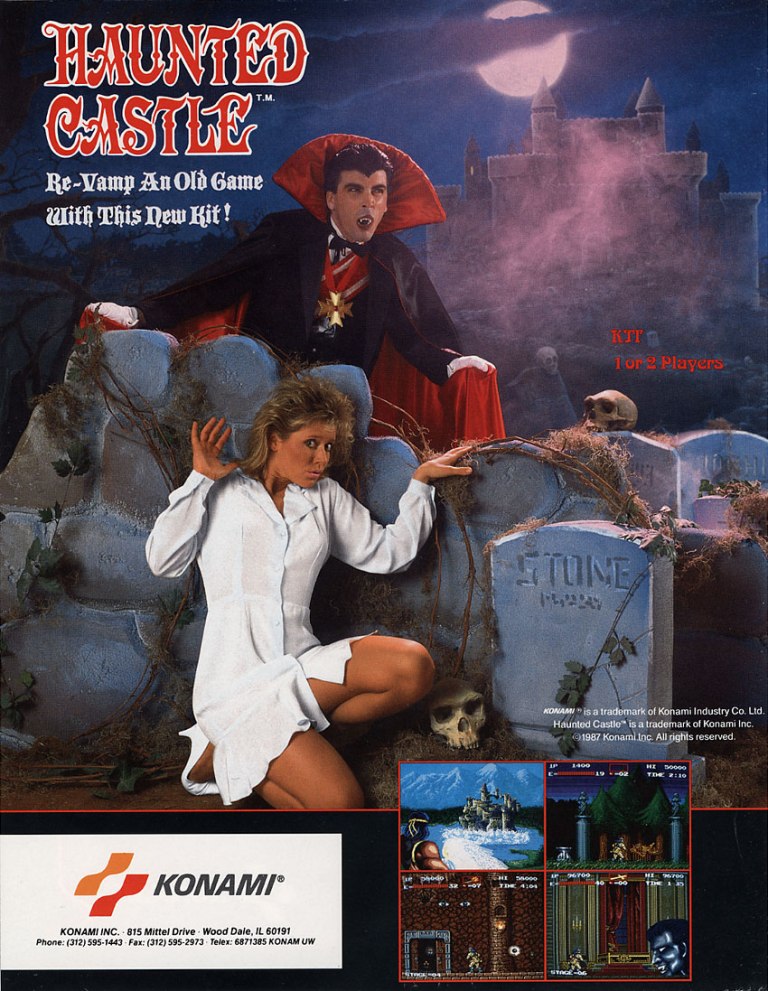
3. Haunted Castle arcade flyer
Indeed, this game is part of the Castlevania game franchise. It was one of the first Castlevania games released for arcades.
Arguably, Konami is best known for the Castlevania game series which covered handheld gaming devices, personal computers, video game consoles and even arcades. Haunted Castle (Japanese title: Akumajō Dracula) is the 2nd arcade game of the Castlevania franchise and it is not a port of any console game. Like the arcade flyer of M.I.A.: Missing in Action, this one was crafted to lure the attention (and money) of arcade operators looking for conversion kits to replace their old games. The visual presentation is eye-catching and even though the Castlevania brand was nowhere to be seen, Castlevania fans could tell this this arcade offering was part of their favorite game franchise.
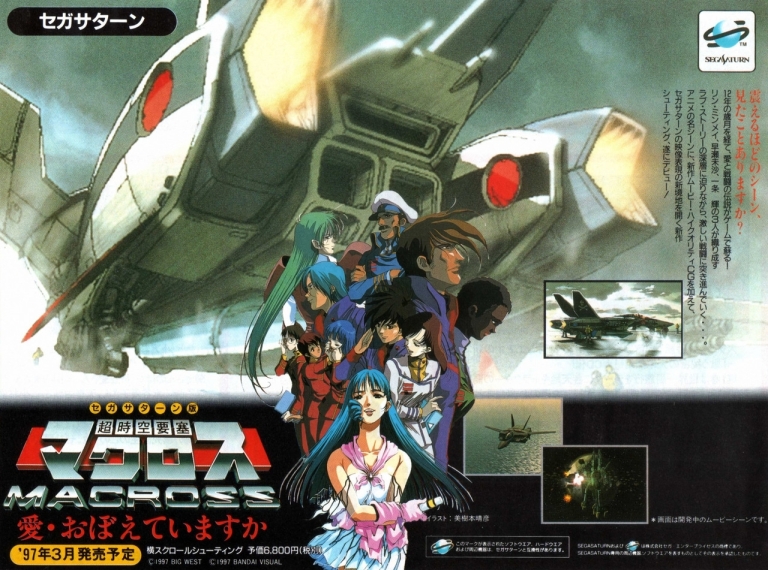
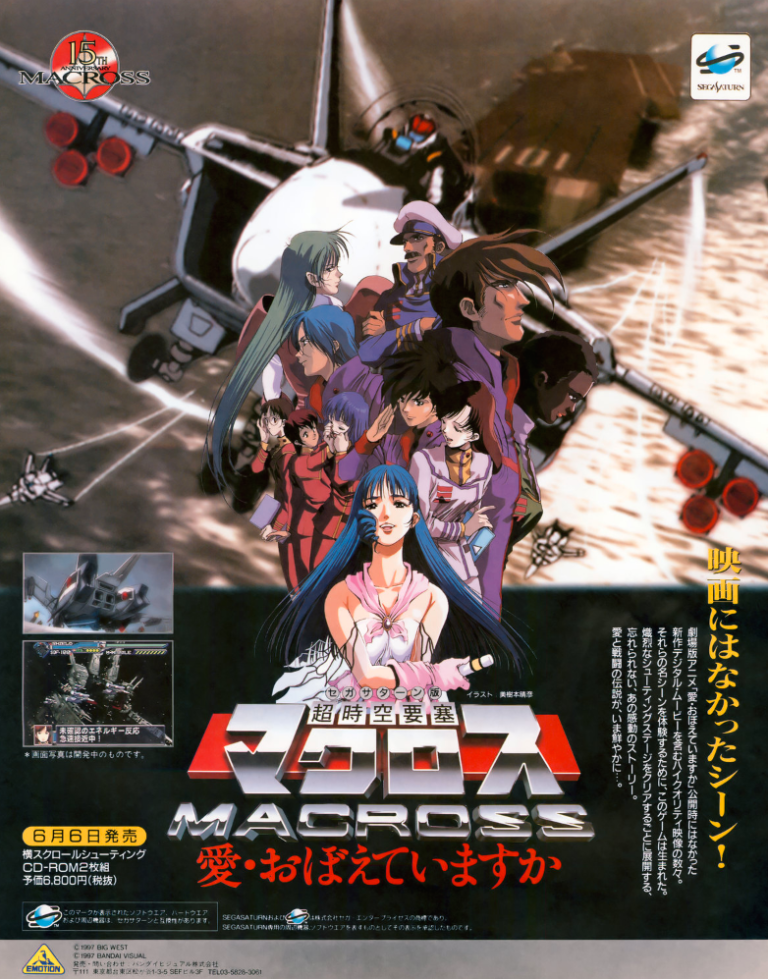
4. The Super Dimension Fortress Macross: Do You Remember Love? flyer and poster
The poster promoting the release of the game for Sega Saturn in Japan.
The flyer promoting the Sega Saturn game’s 1997 release as well as the 15th anniversary of Macross.
In 1997, the 15th anniversary of the Macross multimedia franchise was celebrated in Japan and among the highlights was the release of The Super Dimension Fortress Macross: Do You Remember Love? on the Sega Saturn. To promote the game and the franchise itself, lots of flyers and posters were released in Japan. If you look at the illustrated images on the promotional materials closely, you will realize that they are not from the original 1982-83 Macross anime TV series but rather from the The Super Dimension Fortress Macross: Do You Remember Love? animated movie of 1984 (read my retro movie review by clicking here).
While it might be baffling to some as to why the original anime TV series was not used as the source material for the 15th anniversary celebration through gaming, the 1984 anime feature film was actually more adaptable for a video game project (read my retro review by clicking here). It is so obvious, you just have to ask yourselves this question – how can the game developers compress the entire concepts of the 36-episode Macross anime series into one game while ensuring fun gameplay? Regardless, the game was a lot of fun to play and I enjoyed playing the PlayStation version in 1999.
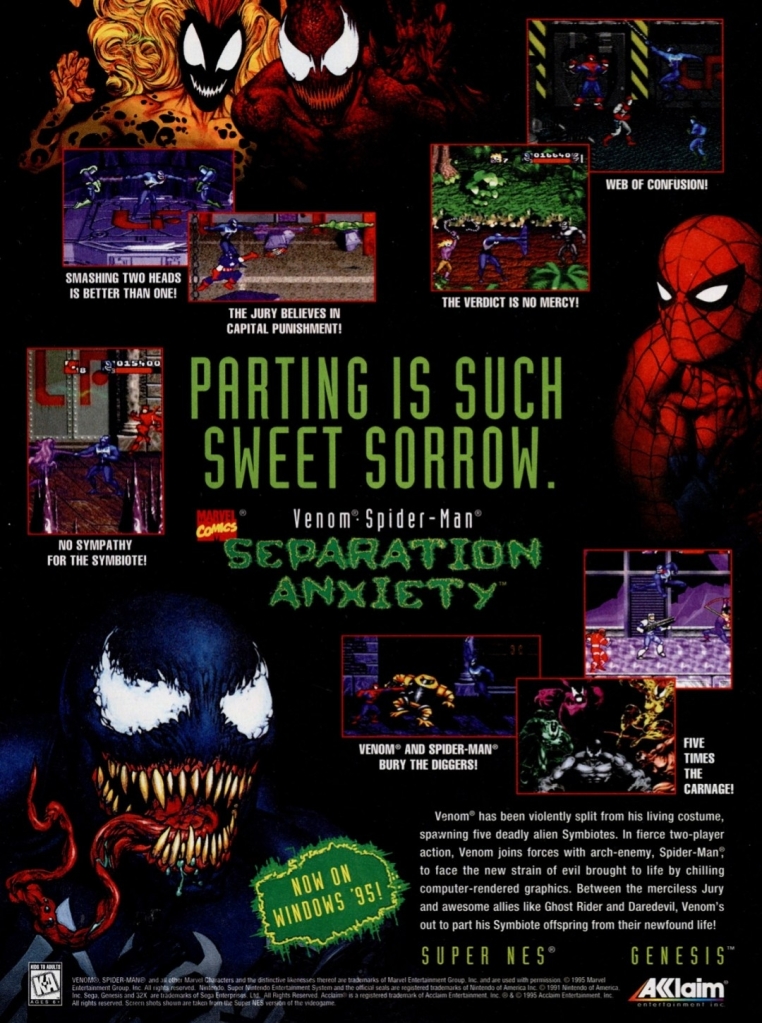
5. Venom/Spider-Man: Separation Anxiety print ad
A clear effort to sell the game to gamers as well as fans of Spider-Man and Venom.
In 1994, Acclaim released Spider-Man and Venom: Maximum Carnage (based on the 1993 comic book storyline Maximum Carnage) on Super Nintendo Entertainment System (SNES) and Sega Genesis ultimately becoming popular with comic book fans and gamers who enjoyed sidescrolling beat-them-up games.
Subsequently, Acclaim and develop Software Creations reunited to release the sequel Venom/Spider-Man: Separation Anxiety a year later on the two leading 16-bit consoles as well as on personal computer (PC). If there is anything notable about this eye-catching print ad, it is the fact that its visual presentation (with graphics on-par with the previous year’s game) cleverly hides the fact that it did not have much new to offer gamers with regards to gameplay and story cutscenes (which the previous game prominently had). Eventually, this game attracted weaker reviews from game critics and has since been forgotten.
6. Tecmo Super Bowl SNES print ad
From the time when Tecmo was still a strong producer of sports video games.
In 1991, Tecmo Super Bowl was released on the aging Nintendo Entertainment System (NES) and because its game design greatly entertained gamers, it became a tremendous commercial success. Not even the very high launch price of $54.99 stopped it from selling a lot.
To keep the commercial success and public interest going, Tecmo announced a new version of the game for the more powerful SNES console with the simple title of Tecmo Super Bowl. If you look closely at the print ad, you will notice that gameplay screenshots were not used at all. Instead, they showed images of the nicely illustrated art works they prepared as eye candy for the game with the intention of making it look cinematic. This is very curious because gameplay itself was the main selling factor of the NES version of Tecmo Super Bowl. I can only guess that Tecmo was not ready to show gameplay images by the time this print ad was made.
7. X-Men 2: Clone Wars print ad
The art used is too alienating for promoting this game.
During the age of the 16-bit consoles, there was a variety of X-Men video games released and produced by different companies. In 1993, an X-Men game published by Sega was released exclusively on the Genesis console which turned out to be fun for gamers and received mostly positive reviews from the critics. Sega went on to publish the sequel X-Men 2: Clone Wars and this print ad caught my attention because of how exaggerated the characters looked. It’s so strange, it’s as if the artist took visual reference from a somewhat blocky 3D polygonal portrait then tried to make them look hand-drawn. I wonder if anyone from Sega regretted this.
Disclaimer: This is my original work with details sourced from reading the comic book and doing personal research. Anyone who wants to use this article, in part or in whole, needs to secure first my permission and agree to cite me as the source and author. Let it be known that any unauthorized use of this article will constrain the author to pursue the remedies under R.A. No. 8293, the Revised Penal Code, and/or all applicable legal actions under the laws of the Philippines.
Welcome back superhero enthusiasts, 1980s arts and culture enthusiasts, Marvel Comics fans and comic book collectors! Today we go back to the year 1984 to examine a small part of the Marvel Comics universe through a tale of the Amazing Spider-Man monthly series.
The era when Spider-Man came back from deep space (refer to Secret Wars) with a new black costume (the symbiote that would later help form Venom) that itself had special abilities was indeed a very notable time in superhero comics history. As if Spidey’s troubled personal life was not enough, he had to deal with new villains that were formidable and tough to deal with.
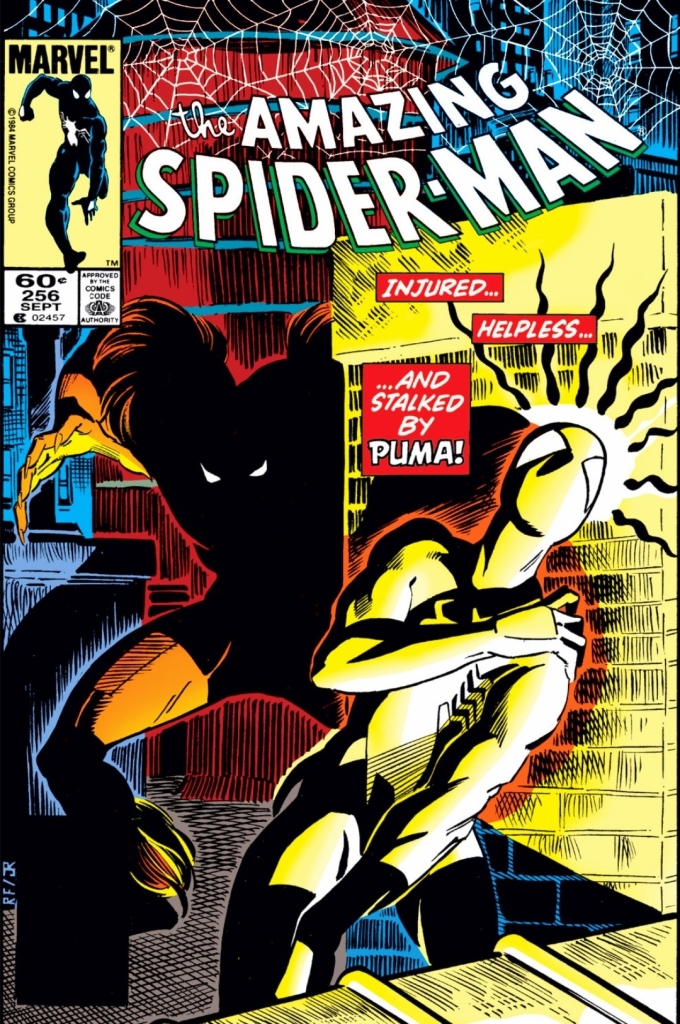
With those details laid down, here is a look back at Amazing Spider-Man #256, published in 1984 by Marvel Comics with a story written by Tom DeFalco and drawn by Ron Frenz.
The cover.
Early story
The story begins inside a warehouse when Spider-Man suddenly catches a lot of men by surprise. The men turned out to be doing something illegal with lots of stolen good contained in boxes. Quite fearlessly, the webslinger knocks out many of them while Black Cat takes pictures (assistance for Peter Parker) from a distance above. Black Cat eventually gets involved in the physical struggle and the bad guys all got defeated afterwards.
After the struggle, Spider-Man and Black Cat (who know each other personally) have a short sentimental talk before parting ways. As soon as he arrives home, Peter Parker starts developing the pictures in preparation for much-needed income from the Daily Bugle.
Elsewhere in New York (the next morning), the warehouse raid caused by Spider-Man and Black Cat makes immediate impact on the secret operations of the Rose who in turn wants the hero dead. The Rose (who reports to the Kingpin) then sends a message to New Mexico to contact the one person capable of killing Spider-Man…the Puma.
Quality
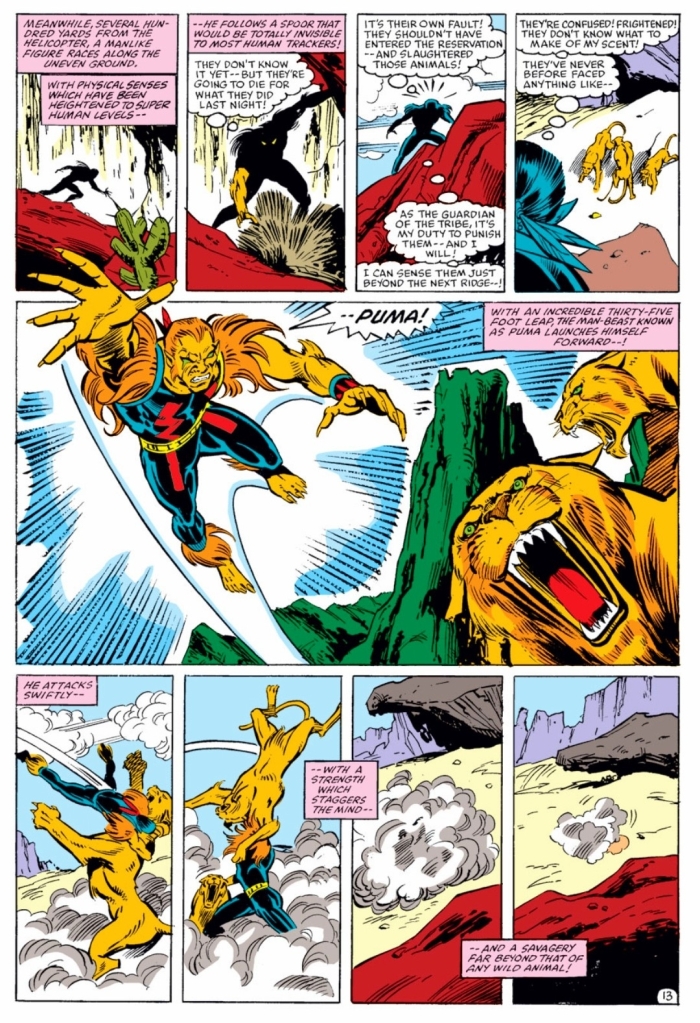
Puma in his animalistic form deep within the harsh wilderness of New Mexico.
I can state that within the age of Spider-Man wearing the alien costume, this particular tale has a strong debut of a new foe and the plot itself is quite intriguing. Tom DeFalco cleverly paced the introduction of Puma whose civilian personality is that of a very focused business executive. The creative team took the inspired approach of defining Puma with the harshness of the New Mexico wilderness contrasted with that of his civilian identity spending time in the bustling urban environment of New York City.
Not only is Puma very powerful and focused, he also has a high standard when it comes to accomplishing tasks showing no fear nor hesitation with regards to potential obstacles ahead of him. Clearly, Puma is not your typical super villain but a very principled and very capable figure. When compared to Wolverine, Puma shares some common animalistic elements with him but he consistently maintains control of himself. This makes him a dangerous force of opposition towards Spider-Man.
Spider-Man here is usual self. His personal problems and lack of a stable life are taking their toll on him just as he continues to keep doing good (example: fighting crime). It should be said that when Puma first strikes at him, the creative monotony with the webslinger suddenly got snapped causing a new series of unfortunate developments that test him. It is also revealed here that using the alien costume does not spare him from serious physical injury.
Conclusion
These panels show how vulnerable Peter Parker really is as the alien costume comes to him willingly.
Amazing Spider-Man #256 (1984) is a great read. The build-up with Puma is very powerful and his presence really made a huge impact on the reading experience. By the time the story ended, I was very convinced to read the next issue.
Disclaimer: This is my original work with details sourced from reading the comic book and doing personal research. Anyone who wants to use this article, in part or in whole, needs to secure first my permission and agree to cite me as the source and author. Let it be known that any unauthorized use of this article will constrain the author to pursue the remedies under R.A. No. 8293, the Revised Penal Code, and/or all applicable legal actions under the laws of the Philippines.
Welcome back superhero enthusiasts, 1980s arts and culture enthusiasts, Marvel Comics fans and comic book collectors! Today we go back to the year 1984 to examine a small part of the Marvel Comics universe through a tale of the Amazing Spider-Man monthly series.
Between the developments of 1980s Secret Wars limited series and the debut of Venom was the time when Peter Parker wore a black new costume as Spider-Man which happens to be the alien costume he gained while spending time with other superheroes in deep space (refer to Secret Wars #8). There was this gradual approach done by the creators to tell new tales of Spider-Man who has the symbiote attached to him most of the time.
With those details laid down, here is a look back at Amazing Spider-Man #255, published in 1984 by Marvel Comics with a story written by Tom DeFalco and drawn by Ron Frenz.
The cover.
Early story
The story begins when a black costumed figure arrives at the balcony of a tall building during night time in New York City. He carefully makes an unlawful entry into the place to steal something. The figure was the Black Fox who intends to take valuables not to feed his greed but to properly subsidize his retirement. When he touches an exquisite-looking vase, it disappears and suddenly a monstrous ape appears from nowhere surprising him. Soon enough, he finds himself surrounded by more apes and faces their human leader (one who referred to the apes as pets).
Meanwhile at his apartment, a very tired Peter Parker washes his black costume (the symbiote), reflects on recent events he went through and then goes to bed. During the night, the black costume comes to life and slowly slithers its way into the bedroom wrapping itself on the sleeping Peter…
Quality
The sneaky Black Fox has no chance of escaping Spider-Man (wearing the alien costume that would later lead to the start of Venom).
I want to start with the force of opposition the creative team came up with. This is about the powerful villain the Red Ghost who has super-apes under his control and vast wealth and resources to organize criminal activities. Red Ghost here is not your typical villain as he is actually strategic, smart and even philosophical clearly knowing what he is doing and what he needs to keep on doing crime. The retiring old thief Black Fox happens to be the very criminal that Red Ghost needs for a special task involving the machine called the Cosmicizer which is essential to his need of vastly increasing his cosmic-ray induced powers.
The Red Ghost is struggling with certain limits which are related to his need of the Black Fox to accomplish something for him with the assistance of the super apes. That being said, the presentation of evil awaiting Spider-Man in this tale is a clever move by DeFalco and Frenz.
As for the iconic webslinger, you will see more of Peter Parker’s personal struggles balancing his life between real-world living and performing as Spider-Man to help people and solve problems. In this tale, his personal life is at a low point and it does not help that his has a strained link with his Aunt May. Even though he has the alien costume that is capable of aiding him a lot, there are still problems that the superhero simply cannot solve. The dramatization here is pretty good and the way the final conflict with the main villain turned out was a pretty nice pay-off.
Conclusion
Peter Parker’s sleep has been disorderly since he brought home with him the symbiote.
Amazing Spider-Man #255 (1984) is an entertaining and intriguing read. The creative team’s decision to have the established Fantastic Four foe Red Ghost as the definitive villain for Spider-Man turned out to be a smart move and what they did was fun to read. The presence of Black Fox (note: this comic book is his debut) added a layer of depth to the plot and his declared desire to retire from the life of crime made him an intriguing addition to the Spider-Man list of villains.
Disclaimer: This is my original work with details sourced from reading the comic book and doing personal research. Anyone who wants to use this article, in part or in whole, needs to secure first my permission and agree to cite me as the source and author. Let it be known that any unauthorized use of this article will constrain the author to pursue the remedies under R.A. No. 8293, the Revised Penal Code, and/or all applicable legal actions under the laws of the Philippines.
Welcome back superhero enthusiasts, 1980s arts and culture enthusiasts, Marvel Comics fans and comic book collectors! Today we go back to the year 1984 to examine a small part of the Marvel Comics universe through a tale of the Amazing Spider-Man monthly series.
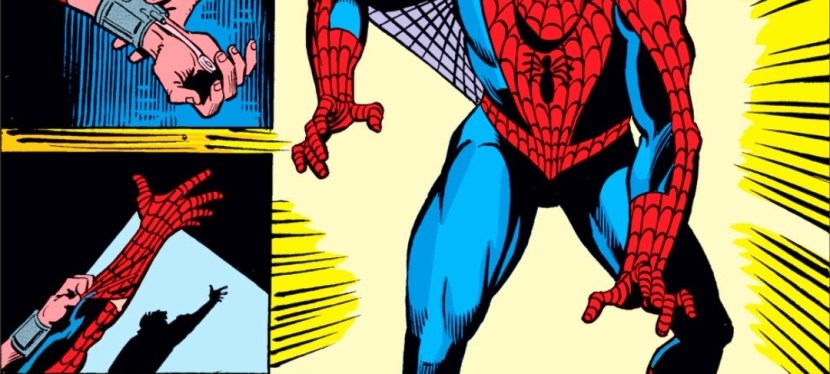
By now, you readers should be aware that I reviewed a lot of comic books about Spider-Man and his deadliest enemy Venom. It is already established through comic book history that the iconic webslinger is responsible for the establishment of Venom as he brought into the world the alien costume (the symbiote) coming from deep space (as told in the Secret Wars limited series), and he also became responsible for the destruction of Eddie Brock’s career in journalism. Of course, Venom did not debut immediately after Spider-Man’s return from Secret Wars and there was a lot more about the symbiote when it was with Peter Parker.
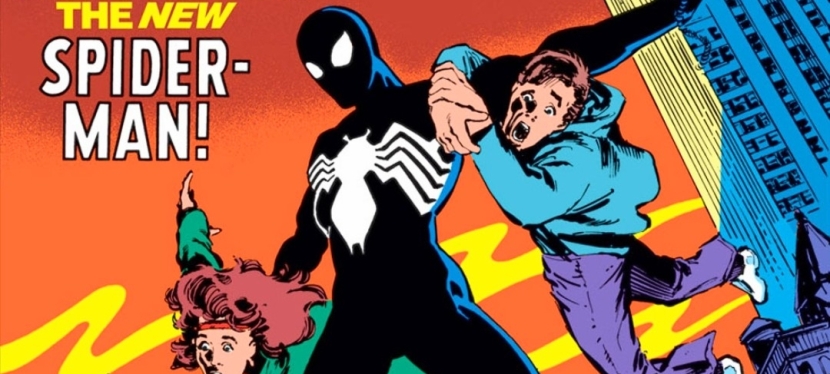
With those details laid down, here is a look back at Amazing Spider-Man #252, published in 1984 by Marvel Comics with a story written by Roger Stern and Tom DeFalco, and drawn by Ron Frenz. This comic book marked the first appearance of the alien costume.
The cover.
Early story
The story begins inside the New York headquarters of the Daily Bugle. It has been observed that several superheroes such as Captain America, Thor, Spider-Man, Iron Man, the X-Men and the Avengers have been missing this resulted in a rise of crime. Publisher J. Jonah Jameson and editor-in-chief Joe Robertson discuss the newest edition of their newspaper.
Meanwhile over at Central Park where police officers and others stand by an area that was closed off, a physical structure suddenly appears spreading bright light to onlookers. Suddenly Spider-Man (wearing a new dominant black costume) leaps out of the structure carrying Dr. Connor (the Lizard) surprising the people.
After realizing they have returned home at last after spending lots of time and struggle in deep space (Secret Wars), Spider-Man could not help but feel jubilant to be home. As the police officers don’t realize that they are talking with the same webslinger due to the new costume, one of them was about to draw his gun which prompted the superhero to use his web on him.
Suddenly, the Avengers, Captain America, Thor and Iron Man emerge from the physical structure which provided Spider-Man relief as he thought that only he and Dr. Connors made it home. With the people focusing on the other superheroes, Spider-Man and Dr. Connors slowly exited. Connors asked him what are they going to tell the world about all they have seen and experienced in deep space…
Quality
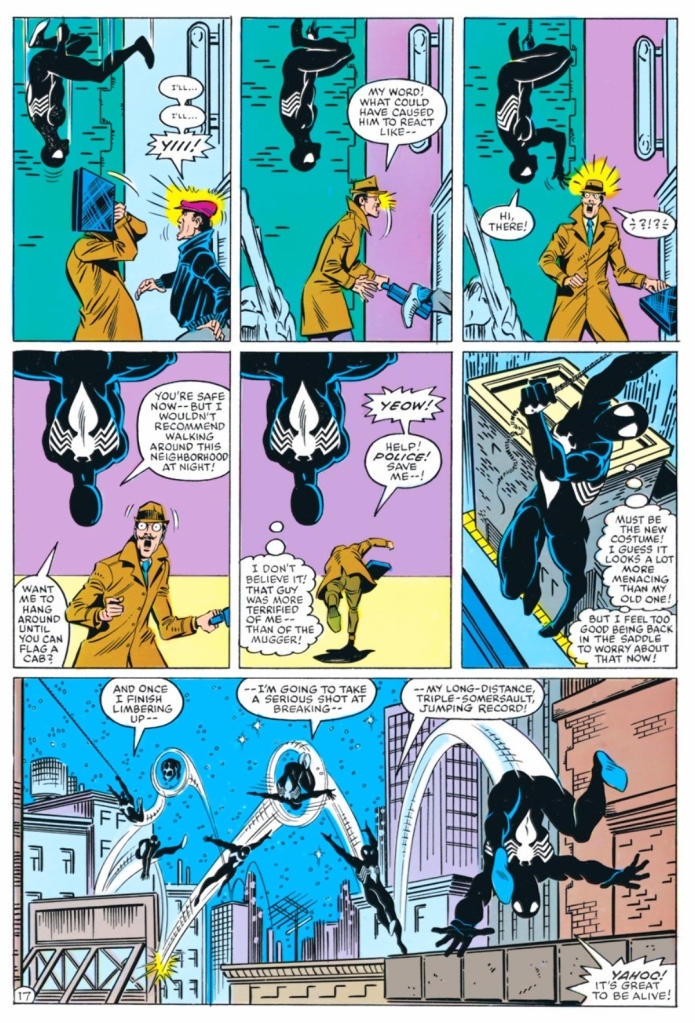
Spider-Man’s first night in New York wearing the alien costume .
I really like this story. I first read this a long time ago and I re-read it all over again for this retro review, and still this story engaged me a lot. There is a lot of richness in the script and you will get to see Peter Parker transitioning into a series of major changes that await him. Without spoiling the plot, there is no hero-versus-villain element here at all. It is all about Spider-Man who just arrived home from a major conflict (and also one of the most significant comic events ever published by Marvel Comics) and the alien costume saga truly began right here. The Venom debut did not happen until a few years later in reality.
In accordance to what was established in Secret Wars (not to be confused with the 2015 series of the same name) and the standards of then editor-in-chief Jim Shooter, the creative came up with a tale that not only showed a different Spider-Man but also portrayed him in ways that defied the tropes and creative ideas the preceded this comic book.
For one thing, Peter Parker is literally like a fish out of water here. As far as the whole world is concerned, only days passed when the superheroes went to deep space. But for the webslinger, a lot more time passed as so many battles, discoveries and intriguing events took place for him along with the others. That being said, Peter Parker’s perception of reality and track of time really got messed up and the weight of Secret War’s events really turned out overwhelming on him. This was well dramatized in the scene wherein Peter – who realized that so much time had passed – he had to call his aunt May fearing that she must be worried sick over him. There was also the moment when by walking down the street, he realized how much he missed not only his home but also the local surroundings.
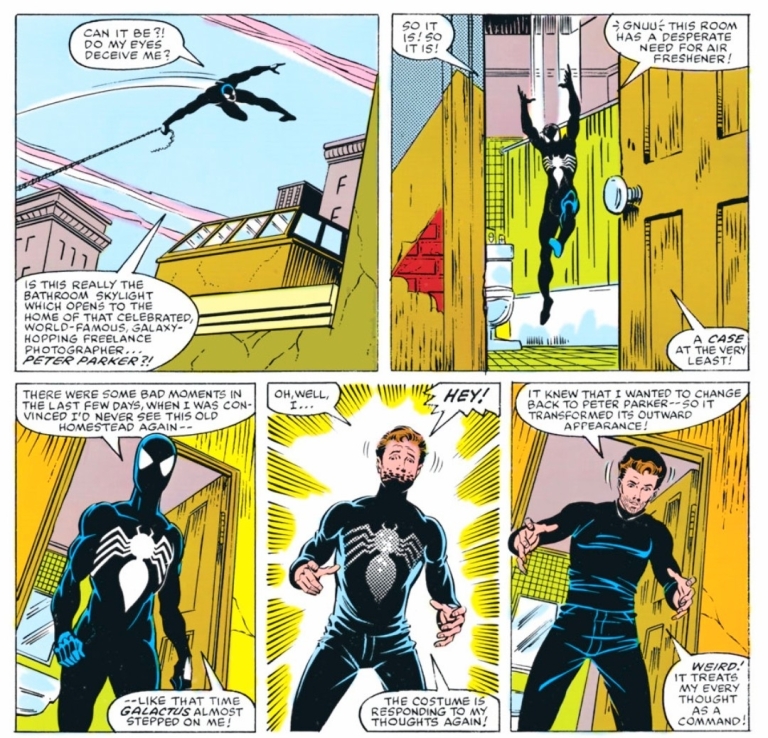
It was also in this comic book when Peter started getting more oriented with the alien costume he first got in Secret Wars #8 (which was actually published after this comic book) and started to enjoy the benefits with the way it responds to his thinking. Of course, at this stage, he has yet to realize the unfortunate truth about the living costume he brought home and this story really kicked off a new and profound stage in the comic book history of Spider-Man
Conclusion
When Spider-Man finally arrived home after spending so much time during Secret Wars.
Amazing Spider-Man #252 (1984) is still a great comic book to read all over again. This was released during the time when Secret Wars (1984) was still being published and years before Venom’s big debut in the series’ 300th issue. In my view, the alien costume saga was a big turning point in the literary history of Spider-Man and the creators who got involved in this comic book really sowed the seeds of compelling and intriguing events that followed. What is intriguing is that all of these significant developments started when a Marvel Comics reader from Illinois came up with the idea of a new costume for Spider-Man, wrote to them and the publisher responded to acquire his idea for over $200 (click here).
This comic book is also a reminder of how significant Jim Shooter’s rule at Marvel Comics really was and I can say that the Marvel’s literary universe of the 1980s should not be ignored.
Welcome back readers, fellow geeks and electronic gaming fans!
In this edition of the Retro Gaming Ads Blast (RGAB) series, we will take a look at another batch of retro gaming print ads from the 1980s and 1990s.
For the newcomers reading this, Retro Gaming Ads Blast (RGAB) looks back at the many print ads of games (console, arcade, computer and handheld) that were published in comic books, magazines, flyers and newspapers long before smartphones, social media, the worldwide web and streaming became popular. To put things in perspective, people back in the 1980s and 1990s were more trusting of print media for information and images about electronic games and related products.
With those details laid down, here is the newest batch of retro gaming print ads for you to see and enjoy…
1. Konami’s 3-in-1 sports games print ad
Long before the advent of major league sports video games, Konami was prolific with sports video games.
Back in the 1980s, Konami was a prominent gaming company as they released a lot of games that became hits in the arcades, on home computers and gaming consoles. Considering the limited amount of games publishers were allowed to release on the Nintendo Entertainment System in America, what Konami released were really fun games to play and their contributions of sports-based video games on the NES were significant. Possibly due to a lack of marketing budget at the time, they promoted Blades of Steel, Double Dribble and Track & Field II with this single-page ad showing the game box covers and screenshots. Ultimately, this print ad was sufficient in giving gamers a clear idea of what to expect with the three games.
2. The Adventures of Bayou Billy print ad
Bayou Billy looks inspired by the cinematic hero Crocodile Dundee. This video game even had a comic book adaptation published by Archie Comics.
Still with Konami, the Japanese publisher released in America the non-military adventure game The Adventures of Bayou Billy for the NES which was a revised version of their 1988 Family Computer game titled Mad City (see the differences by clicking here). This game really looked like it was influenced by Hollywood action/adventure movies of the era and it provided gamers gameplay styles of light gun shooting, beat-them-up action and racing. The titular hero looks very inspired by the cinematic hero Crocodile Dundee. This print ad is very stylish and also eye-catching. I think it has done a good job to make viewers interested in the video game.
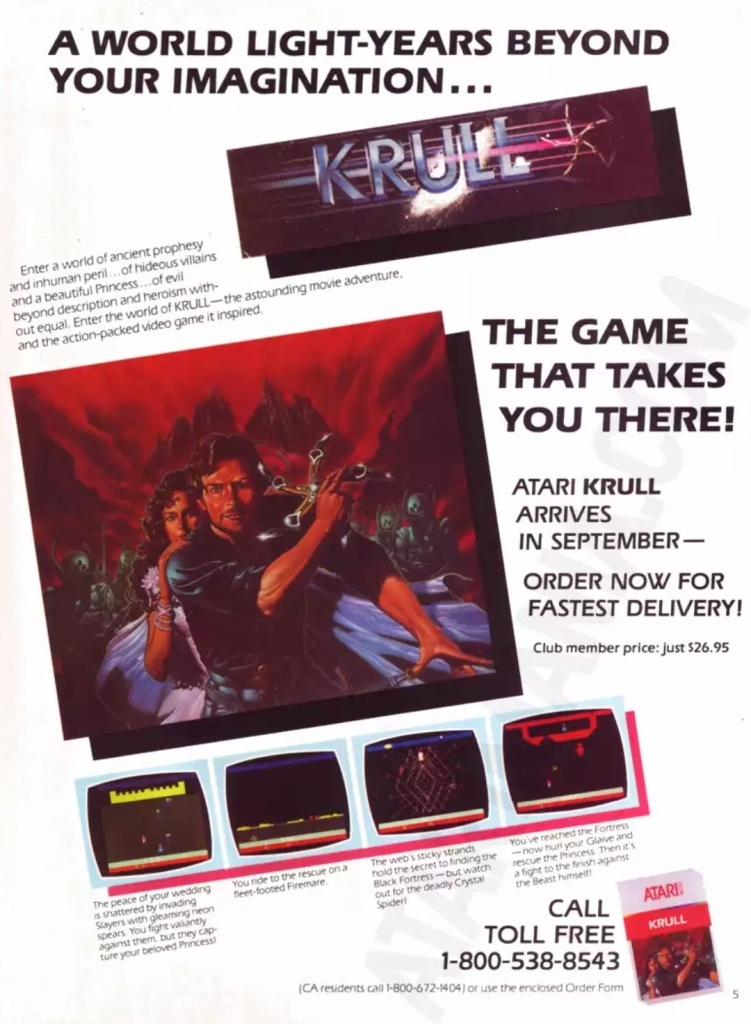
3. Krull Atari video game print ad
I never got to play this Krull video game on Atari 2600, nor its arcade game.
Way back in 1983, I was fortunate to see the science fantasy movie Krull inside the movie theater here in the Philippines. When I saw this print ad, I easily got excited for the Atari 2600 video game adaptation but never got to play it. This print ad does its job showing what Krull’s game looked like and the ad makers cleverly used painted art reflecting the movie’s characters and the armored enemies from space. I should add that between the time I saw the movie and the time I first saw this print ad, I became aware of the existence of the Krull arcade game by watching an episode of Starcade on TV.
4. Rocket Ranger NES print ad
Really great and detailed painted artwork in this print ad.
When Rocket Ranger on the Amiga in 1988, it had fancy visuals and a strong cinematic vibe that worked smoothly with the game design. This game was developed by Cinemaware which developed a reputation of releasing games based on classic film genres. In 1990, a version of Rocket Ranger for the NES was published by Kemco/Seika and print ads using painted art were made to promote the game. This particular print ad made heavy use of painted art which was captivating to look at while conveniently keeping people’s minds off the downgraded visuals of the NES version.
5. Michael Jordan: Chaos in the Windy City print ad with contest entry
Some gamers thought this was a basketball video game.
Yes, it was all true. There definitely was a video game that NBA legend Michael Jordan endorsed. First released on Super Nintendo Entertainment System (SNES) in America in 1994, Michael Jordan: Chaos in the Windy City was a side-scrolling action game in which gamers play a digital version of Jordan who has to save his friends, fight enemies and move from one location to the next in order to progress. The fact that an image of Michael Jordan holding two balls was used in this print ad (as well as on the game cover) in a dominating fashion made some gamers think this was a basketball game. The display of screenshots was so small, it did not help the situation. Lastly, the available of a contest entry form in this print ad was meant to promote not only the game but also GamePro magazine.
6. Gun.Smoke print ad
Gun.Smoke was indeed a fun game to play on NES. Therefore, the promotion is justified.
This print ad of the NES port of Gun.Smoke has strong imagery and literary descriptions the strongly emphasize the Old West concept and setting. The screenshots displayed are too small but the descriptions more than made up for it. Ultimately, what this print ad emphasized was realized as the NES version of Gun.Smoke itself captured the continuous action and excitement of the arcade version and the graphical limitations of the console did not matter much. I myself played this game and it was a lot of fun.
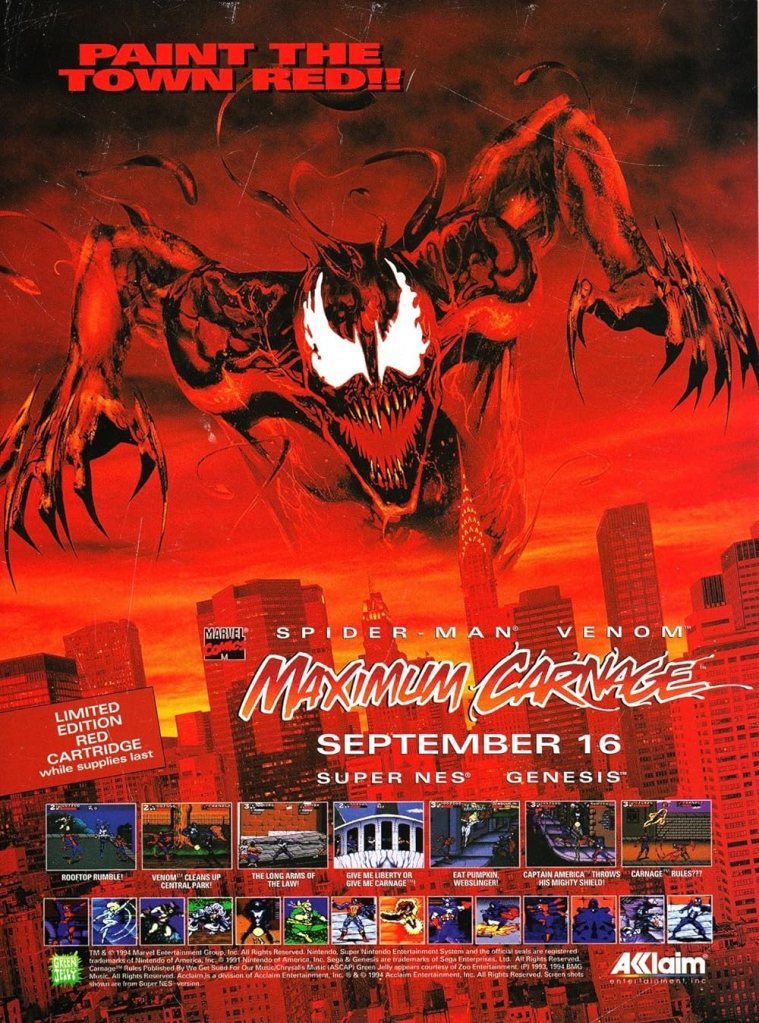
7. Spider-Man and Venom: Maximum Carnage print ad
This add appeared in my comic books and magazines I read in 1994.
Back in 1993, Marvel Comics published the huge Maximum Carnage crossover storyline which covered many issues of the four monthly Spider-Man comic books and two issues of the quarterly Spider-Man Unlimited series. Considering the high popularities of Venom and Carnage at the time, it was not surprising that Marvel took advantage by having Maximum Carnage licensed to Acclaim to create a video game adaptation in the form of a beat-them-up.
Spider-Man and Venom: Maximum Carnage was released for SNES and Sega Genesis in 1994, and game developer Software Creations really adapted story to fit with their side-scrolling game design. Between playable stages are cutscenes that actually were digitized versions of actual comic book panels. This red-colored print ad had a dominating image of Carnage and screenshots with text descriptions. The ad makers even went the extra mile by inserting screenshot cut-outs showing individual characters such as Firestar, Venom, Spider-Man, Carnage, Cloak and Dagger, Iron Fist, Captain America and more. Whatever your opinion is about the Maximum Carnage storyline or the video game adaptation, there is no denying that this was a very eye-catching print ad.