Disclaimer: This is my original work with details sourced from reading the comic book and doing personal research. Anyone who wants to use this article, in part or in whole, needs to secure first my permission and agree to cite me as the source and author. Let it be known that any unauthorized use of this article will constrain the author to pursue the remedies under R.A. No. 8293, the Revised Penal Code, and/or all applicable legal actions under the laws of the Philippines.
Welcome back superhero fans, enthusiasts of 1990s arts and culture, and comic book collectors! As the old saying goes…if you’ve got a problem that needs solving, you call The Solution. What if, for example, The Solution is in another world dealing with major problems and are out of reach?
In the previous two issues I reviewed (click here and here), The Solution got themselves in conflict with the powerful alien force called the Vyr as their member Shadowmage (also referred to as Aera) stole the Vorlexx from them many years prior. During the confrontation in France, the Vyr captured Aera who managed to discreetly pass the Vorlexx to Lela Cho (Tech) before their separation. Since after, The Solution traveled to different worlds with the Vorlexx and teamed up with a man called Harmonica who is knowledgeable about the Aerwan and the Darkur. Unbeknowst to them, the Vyr are watching them from a distance.
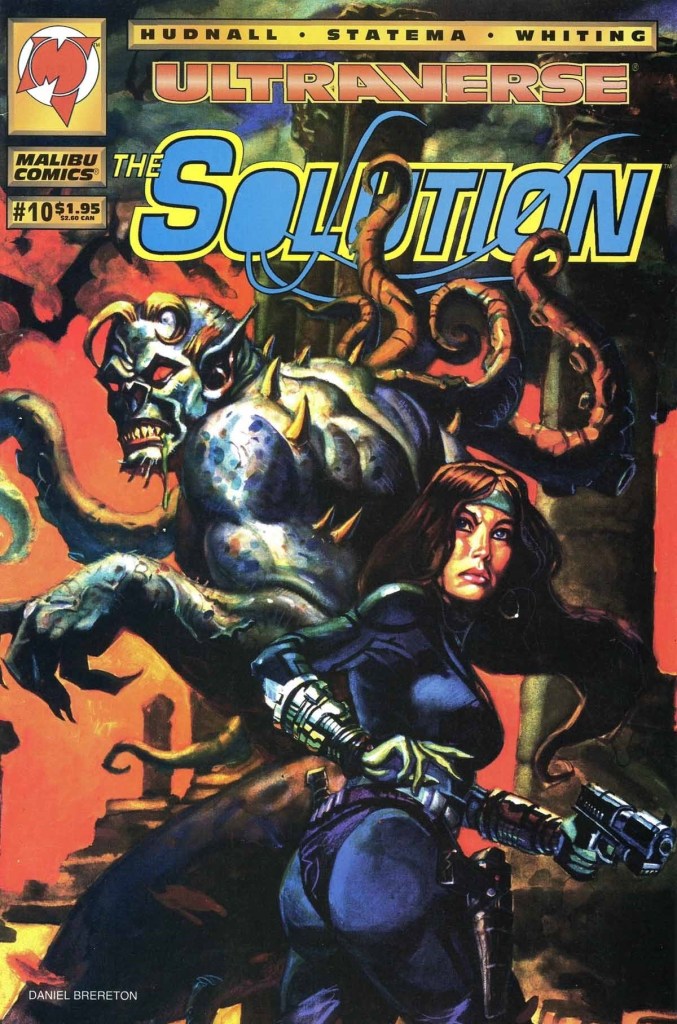
With those details laid down, here is a look back The Solution #11, published by Malibu Comics in 1994 with a story written by the late James Hudnall and drawn by John Statema with ink work by Barbara Kaalberg.
The cover.
Early story
The story begins with Dropkick, Harmonica, Tech and Vurk in a desperate situation. Just as they need to get away fast, Dropkick notices that the Vorlexx is not working. Harmonica points to the cliffs as the only way out. With his wings, Vurk takes Tech with him to fly up while Harmonica takes Dropkick. As soon as they arrived up the cliff, they find themselves facing the massive Aerwan army whose members are scattered across the ground and the air. An Aerwan military leader tells The Solution to surrender the Vorlexx.
Meanwhile, the Vyr are watching the live video feed of The Solution and the Aerwan army. Shadowmage, who has been restrained in a very painful and humiliating position, has been watching her friends since they exited the cave. While she still remains unharmed by her captors, she knows that her torments are just beginning. The Vyr want her to see what will happen to her friends…
Quality
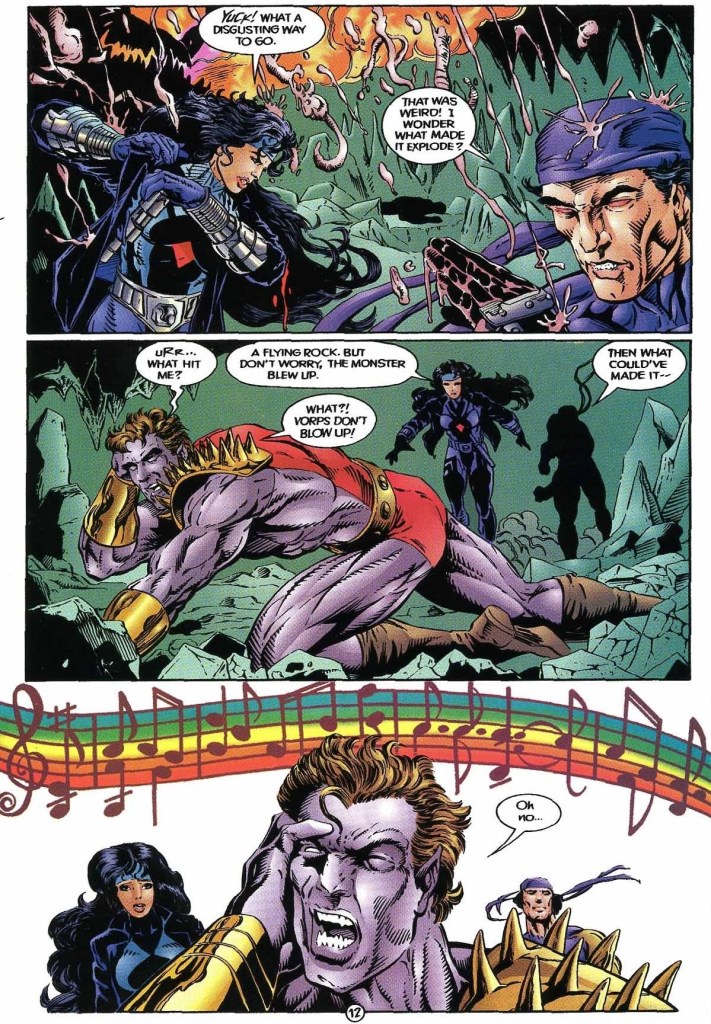
In the middle of a major battle between two alien armies, The Solution were really pushed to their limits as they pursue their dangerous rescue mission of their captured teammate.
Wow! The storytelling and visual presentation in this comic book got even wilder and the sci-fi element of this particular storyline really went into overdrive! For one thing, much of the tension which started building up in issues #9 and #10 paid off big time in the early part of this comic book as the inevitable battle between the Darkur (Vurk’s people) and the Aerwans (Shadowmage’s people) which easily made The Solution and Harmonica ending up tiny in the middle. Of course, as this is still about the team’s desperate attempt to rescue Aera from the very powerful Vyr, you will really see Lela Cho, Vurk, Dropkick (who carries the Vorlexx) struggle a lot in close encounters with aliens just as they keep on trusting Harmonica (whom they formed an uneasy alliance with) to help them. It is compelling to see how the three mentioned Solution teammates not only struggle to survive but also strive to overcome great odds knowing that if they fail, Aera/Shadowmage will perish. Very clearly, this is a very high-stakes story that James Hudnall prepared and the way I see it, this storyline really added a lot to the development of The Solution.
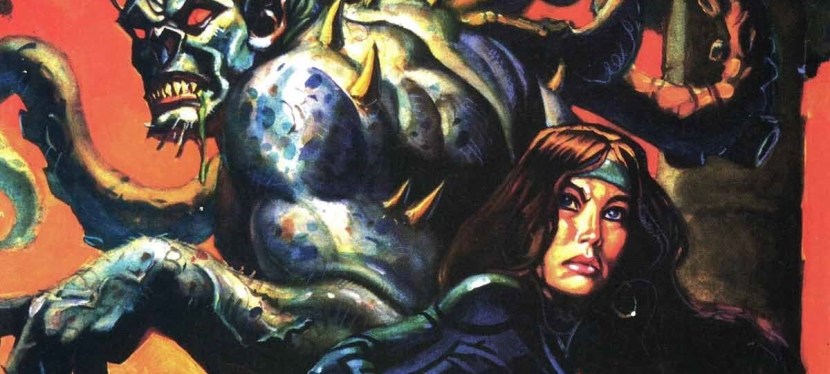
As for the art, I can say that this, in my opinion, is John Statema at his grandest with the Ultraverse. While being supported by by Barbara Kaalberg’s detailed ink work, Statema really captured the wild sci-fi tale Hudnall prepared and showed The Solution within a very strange environment surrounded by death and uncertainty. A lot of this comic book’s pages are filled with action scenes (note: lots of bloody scenes but without the color red) that are also nicely structured and each member of The Solution had the appropriate dynamic visuals that fitted nicely with their respective big moments. More notably, Statema really worked hard showing the many, many Aerwans and Darkur warriors who filled the pages – especially the two 2-page shots that each showed a wide view of the field – and succeeded in presenting monsters that were scary and very alien in design.
Conclusion
This is one of two epic views in this comic book by illustrator John Statema, inker Barbara Kaalberg and the colorists. Look at all the details!
The Solution #11 (1994) is a wild Ultraverse concept that succeeded in engaging and entertaining me from start to finish. It is a great pay-off to what was built up since The Solution #9 and having the team lost in another world in their pursuit of their captured teammate really moved this series forward. In fact, when it comes to expanding the boundaries of the Ultraverse itself, this comic book really achieved that! This is also the most ambitious sci-fi tale of the UV that I’ve read. The ironic thing is that this comic book is not even the conclusion to its storyline. There is still more to come and I can say I’m really motivated to read the next issue.
If you are seriously planning to buy an existing hard copy of The Solution #11 (1994), be aware that as of this writing, MileHighComics.com shows that the near-mint copy of the regular edition costs $16 while the near-mint copy of the newsstand edition costs $48.
Overall, The Solution #11 (1994) is highly recommended!
+++++
Thank you for reading. If you find this article engaging, please click the like button below and also please consider sharing this article to others. If you are looking for a copywriter to create content for your special project or business, check out my services and my portfolio. Feel free to contact me with a private message. Also please feel free to visit my Facebook page Author Carlo Carrasco and follow me on Twitter at @HavenorFantasy as well as on Tumblr at https://carlocarrasco.tumblr.com/
Disclaimer: This is my original work with details sourced from reading the comic book and doing personal research. Anyone who wants to use this article, in part or in whole, needs to secure first my permission and agree to cite me as the source and author. Let it be known that any unauthorized use of this article will constrain the author to pursue the remedies under R.A. No. 8293, the Revised Penal Code, and/or all applicable legal actions under the laws of the Philippines.
Welcome back, superhero fans, 1990s culture enthusiasts and comic book collectors! Today we revisit the Ultraverse of Malibu Comics and examine one of its many stories told through an issue of the Sludge comic book series.
In my previous retro review about Sludge #4 (1994), we got to see an inspired monster-versus-monster conflict between the protagonist and a huge, intelligent alligator aced with elements of society, urban legends, idolatry and journalism. That particular issue also showed more of the creative side of series artist Aaron Lopresti when it comes to writing. The next issue reviewed also involved Lopresti as writer.
With those details laid down, here is a look back at Sludge #5, published by Malibu Comics in 1994 with a story written and drawn by Aaron Lopresti.
The cover.
Early story
The story begins in New York City. Darkness descends on Manhattan like a shroud, providing haven for those who shun the light. As a man and a lady walk down the sidewalk talking to each other, a very hideous human-like monster comes out of the shadow of the alley and grabs them both.
In the sewers, Sludge hears one of the victims scream which compels him to run to where the trouble happened. As soon as he climbs out of the sewer, he sees the monster in the alley which makes eye-contact with him. As Sludge approaches the alley, the monster gets away leaving the dead bodies of the man and woman behind. As Sludge examines the dead bodies and realizes that the monster ate them, a police car with two officers arrived.
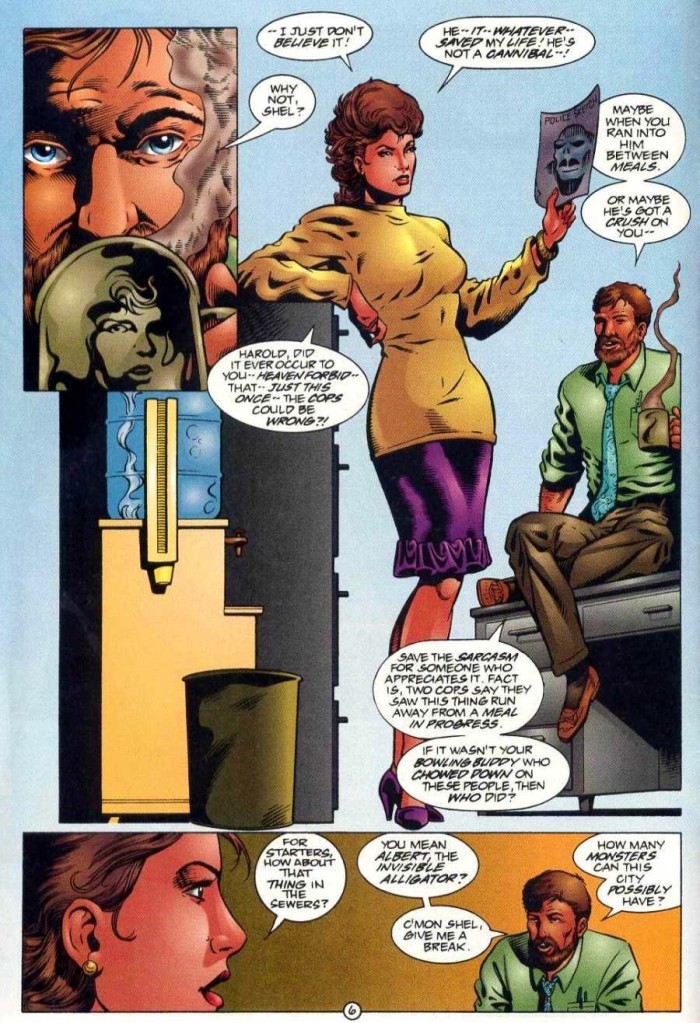
In reaction, Sludge quickly grabs one part of the police car and turns it upside down to buy himself time to get back into the sewer. The details of the encounter between the police and Sludge made it to Shelley, the same New York Daily Globe news reporter who encountered him and the intelligent alligator Veffir Voon Iyax. She discusses the newest information with her skeptical boss…
Quality
Obvious parallel to Mary Shelley’s Frankenstein here.
Let me start first with what is obvious with regards to the plot and presentation. Similar to what happened in Sludge #2, there is noticeably less spotlight on Sludge as creative space had to be used to develop the new monster, emphasize its background story (with an additional new character who has significance) and there were even scenes focused on Shelley and what goes on inside the office of her newspaper which became aware of the events that took place.
The next thing I want to point out is the creative inspiration used in this particular story. This comic book has really clear parallels to the literary classic Frankenstein: or, The Modern Prometheus and there was even a mention of its author Mary Shelley. That being said, there is a scientist-and-walking-abomination aspect with regards to the mentioned additional significant character connected with the new monster. That is not to say that this comic book copied Victor Frankenstein and his nameless monster, rather Aaron Lopresti took inspiration from them, mixed things up and implemented them in telling this new tale of Sludge. When it comes to keeping things fresh in telling another Sludge story, I can say that Lopresti succeeded.
More on the story itself, this one has a clever mix with regards to the dimensions used. In here, Sludge is more determined on helping people who shouted for help while Shelley won’t give up on finding out the truth about the tragic events in their city. Without spoiling the details, I can say that there is this deep dramatization about the monster and the new character responsible for its return from the dead.
As for the quality of the writing, Aaron Lopresti’s work here is not only expressive but also impressive. There is this one page near the end that has these few yet powerful words that strongly connect with the images of Sludge and the monster (who is so creepily drawn!).
Conclusion
This is the 2nd straight Sludge comic book that has reporter Shelley and her newspaper focused on what has been happening. At this point, Shelley had encountered Sludge.
Sludge #5 (1994) in my view is another inspired and intriguing Ultraverse tale to read! While issue #4 had parallels to the 1980 film Alligator, this comic book took inspiration from Mary Shelley’s most famous work of fiction which added elements about resurrection, man’s abuse of science, and the consequences of dealing with the unnatural into Sludge’s side of the Ultraverse. I should state that this comic book also has the scariest looking monster Aaron Lopresti drew for the Ultraverse at the time of publication.
If you are seriously planning to buy an existing hard copy of Sludge #5 (1994) be aware that as of this writing, MileHighComics.com shows that the near-mint copy of the regular edition costs $16 while the near-mint copy of the newsstand edition costs $48.
Overall, Sludge #5 (1994) is highly recommended.
+++++
Thank you for reading. If you find this article engaging, please click the like button below and also please consider sharing this article to others. If you are looking for a copywriter to create content for your special project or business, check out my services and my portfolio. Feel free to contact me with a private message. Also please feel free to visit my Facebook page Author Carlo Carrasco and follow me on Twitter at @HavenorFantasy as well as on Tumblr at https://carlocarrasco.tumblr.com/
Disclaimer: This is my original work with details sourced from reading the comic book and doing personal research. Anyone who wants to use this article, in part or in whole, needs to secure first my permission and agree to cite me as the source and author. Let it be known that any unauthorized use of this article will constrain the author to pursue the remedies under R.A. No. 8293, the Revised Penal Code, and/or all applicable legal actions under the laws of the Philippines.
Welcome back superhero enthusiasts, 1990s culture enthusiasts and comic book collectors! If you’ve got a problem that needs solving, you call The Solution. For the newcomers reading this, The Solution was spearheaded by the late James Hudnall who also led the storytelling of the Hardcase monthly series.
In my previous The Solution retro comic book review, the team had to act as a result of what Aera had done long before she even joined her teammates. Alien forces had arrived on Earth which sparked a chain reaction of unfortunate events. Ultimately, Aera was taken away but not before handing over to Lela, Vurk and Dropkick the one powerful thing that the Vyr wanted – the Vorlexx.
With those details laid down, here is a look back The Solution #10, published by Malibu Comics in 1994 with a story written by the late James Hudnall and drawn by John Statema.
The cover.
Early story
The story begins with Dropkick hitting his alien teammate Vurk and accuses him for trying to leave their snatched teammate Aera in the hands of the Vyr. As Vurk transforms into his more monstrous form, Tech comes in between them and tells them to stop and come to their senses. As they have the Vorlexx, Tech insists that they should leave Earth before the Vyr comes back to get the precious items.
Holding the Vorlexx, Tech states that they should all travel together to Vurk’s homeworld and anticipate that the Vyr will come there searching for them. She stresses that they might stand a better chance of rescuing Aera this way. Vurk warns Tech that the Vorlexx will corrupt its user every time it gets used.
Tech issues a command to the Vorlexx and they all disappear to another world…
Quality
Lela Cho, Dropkick and Vurk struggle during their quest to save Aera.
While the story of the previous issue brought the fantasy elements of the series raised really high, things went even higher this time as the team went to new worlds far away from Earth which results completely alien environments with creatures that people of Earth had not encountered. This helped pave the way for an encounter between The Solution and a giant monster that reminded about some classic sci-fi tales of EC Comics (note: the Weird Science series) from the 1950s.
More on the plot itself, James Hudnall crafted a script that succeeded in building up suspense and tension as Tech (Lela Cho), Dropkick and Vurk push through with their very difficult mission to rescue Aera. Along the way, you will get to see really nice character moments such as Lela’s leadership traits and Vurk using his knowledge of his past encounters with the Vyr.
There is also a notable twist in the tale which I won’t spoil. In fact, I encourage you readers and those who are just discovering the Ultraverse and The Solution to read this comic book to find out. That twist really added depth to the plot and resulted in some memorable reactions from The Solution.
Conclusion
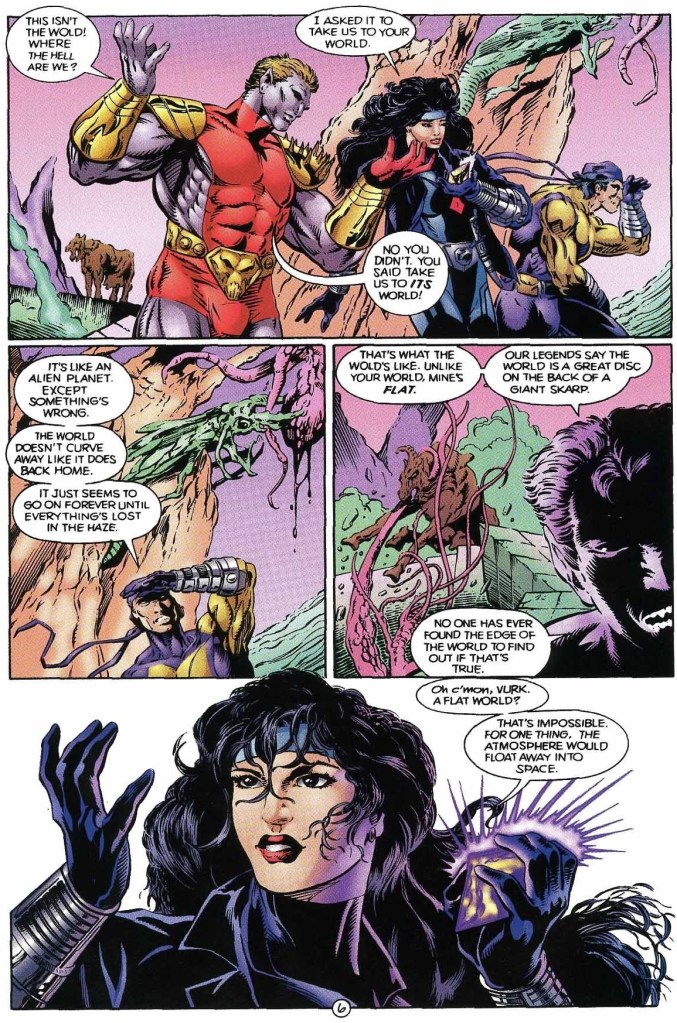
The Solution arrived in an alien world by mistake.
The Solution #10 (1994) is fun and engaging to read. As it follows The Solution’s dangerous attempt to save Aera in unknown parts of the universe, the story became more of a science fiction misadventure that remains believable and stable thanks to Hudnall’s strong writing. John Statema’s return as illustrator in this comic book easily raised the visual quality higher compared to the previous issue. I can say that Statema, by this point in this Ultraverse series, is clearly the definitive artist of The Solution.
If you are seriously planning to buy an existing hard copy of The Solution #10 (1994), be aware that as of this writing, MileHighComics.com shows that the near-mint copy of the regular edition costs $16.
Overall, The Solution #10 (1994) is recommended.
+++++
Thank you for reading. If you find this article engaging, please click the like button below and also please consider sharing this article to others. If you are looking for a copywriter to create content for your special project or business, check out my services and my portfolio. Feel free to contact me with a private message. Also please feel free to visit my Facebook page Author Carlo Carrasco and follow me on Twitter at @HavenorFantasy as well as on Tumblr at https://carlocarrasco.tumblr.com/
Before I begin, I want to make clear to all of you reading this that I never got to play Cyberpunk 2077 on any platform when it was first launched in late-2020. Like anyone else, I waited years for that game and I was excited too but Cyberpunk 2077 was released just a few weeks after Xbox Series X and PlayStation 5 launched. At that very time in December 2020, I was focused on raising funds for Xbox Series X than buying new games for my console at the time – the Xbox One (which stopped functioning in mid-2021 after 6 years of use). I can also say that the exposure of Cyberpunk 2077’s very flawed state on consoles plus the criticism that followed convinced me to stay away from CD Projekt Red’s promised epic video game.
Very recently, CD Projekt Red not only polished Cyberpunk 2077 with Xbox Series X and PlayStation 5 in mind, they also released a free 5-hour trial version (with patch 1.5) which I decided to download and play to really experience the game for the first time ever. This post I’m writing is clearly not a game review but my own observation about what Cyberpunk 2077 offered and what I experienced in the five hours I played.
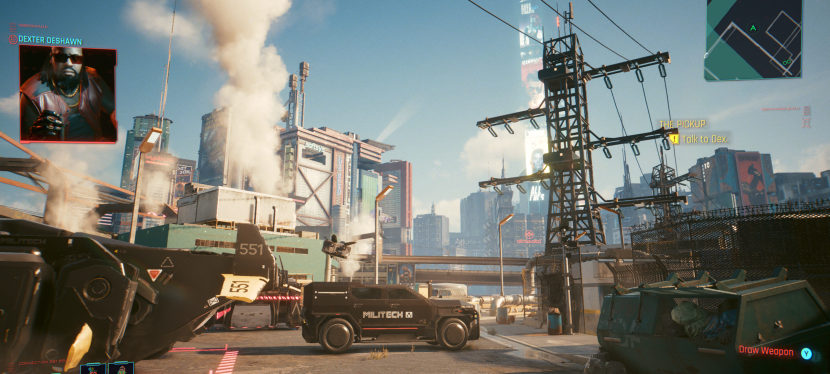
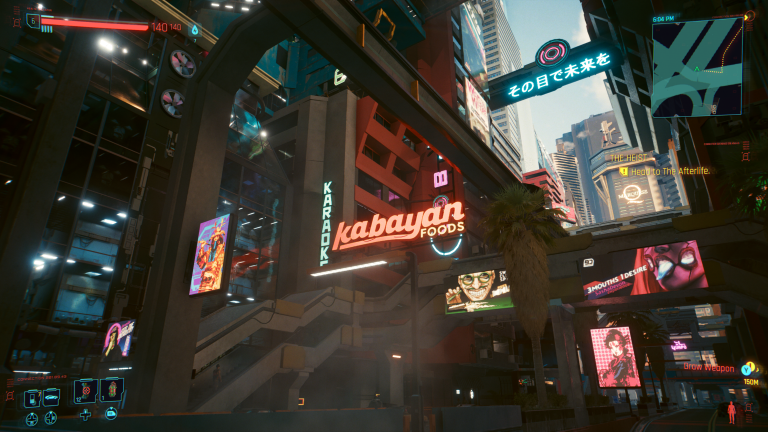
I was in the second half of my 5-hour playtime with the free trial version of Cyberpunk 2077 when I reached this place.
After downloading it, I got to play the free trial version on my Xbox Series X with the performance mode chosen as I wanted to play the game with the best frame-rate possible. I customized V in female form and chose Streetkid as her lifepath as I was eager to discover Night City.
While I knew five hours was rather limiting to make tremendous story progress or discover much of the city, I still went on with the main storyline of V, discovered the key characters, and went through the tutorials to learn the basics of combat (both guns and melee weapons), stealth, hacking and, late in my limited playtime, the braindance (note: you get to experience life through another person’s own views and experiences in first-person view and externally).
The shooting in this game still lacks precision and accuracy when compared to what The Outer Worlds and Fallout 4 have.
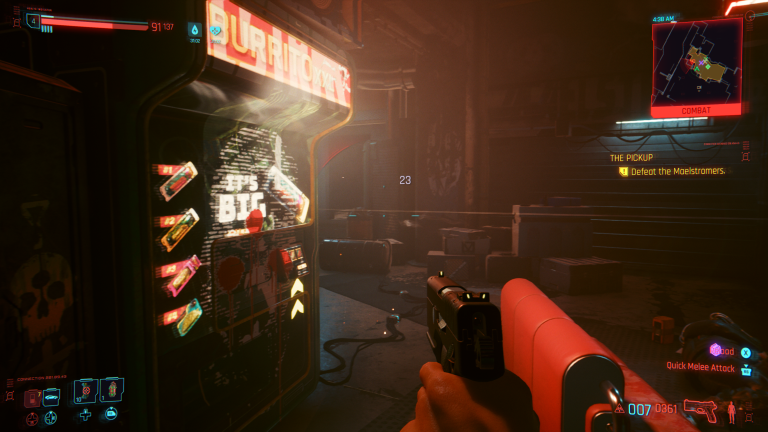
On combat, I find the shooting rather lacking in precision in terms of aiming and controller response when compared to what I’ve played in first-person role-playing games (RPGs) The Outer Worlds and Fallout 4. In fairness, the impact of shots fired against enemies in Cyberpunk 2077 is rather strong, especially when you use powerful weapons like the shotgun. The melee combat meanwhile can be challenging to pull off precisely. Even with the immersive first-person view, I had a bit of trouble estimating if my character’s fists or weapon would be able to reach the opposition figure. I also had similar results with regards to blocking the opposition’s melee attacks on my character. Ultimately, I managed to overcome the opposition to complete the tutorial. Stealth gameplay is challenging as well not only because it was difficult to estimate the farthest reach of the view of the opposing character or security cameras/drones, but also because I found moving around lacking precision.
Now that’s an eye-catching in-game reference to the Philippines and the Filipino people.
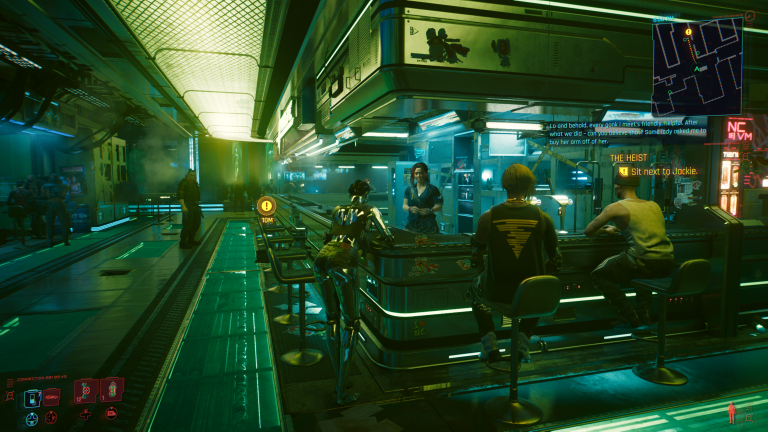
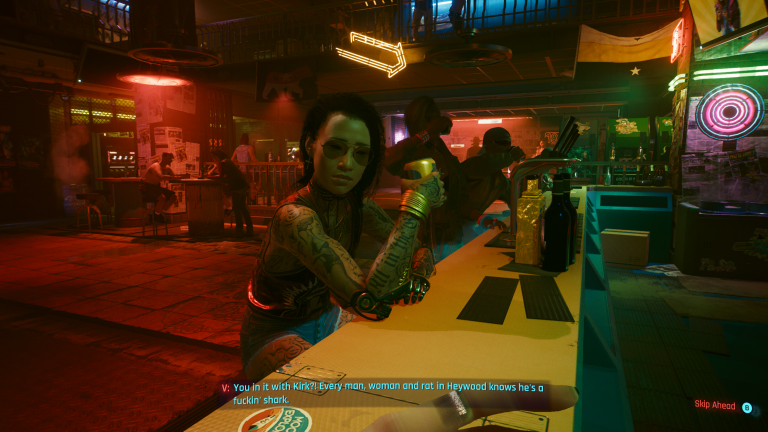
There is nothing like facing a highly detailed character nearest to you at the bar.
The hacking system of the game is well-designed and easily outclasses that of Ubisoft’s hacking-oriented open-world games Watch Dogs and Watch Dogs 2. Hacking in Cyberpunk 2077 is not only more user-friendly but also comes with options that make sense within the game’s concept and the many different digital set-ups in each different location I have been to. Since I was limited by the 5 hours allowed in the trial version, I got to use the hacking system as far as I could and I saw how more options become available once I got to level up V’s character level, attributes and tech capabilities. I was enjoying the in-game hacking by the time my trial ended.
Braindance is like a video record of events experienced by other people in which players will get to review, move forward or backward, and be able to spot/scan new details in order to progress. While it is very immersive to see and experience happenings through the eyes and memory of another character, the video editing aspect of braindance is where the detective work really happens which I enjoyed. This part of the gameplay really pushed me to be observant with the moments and details to progress.
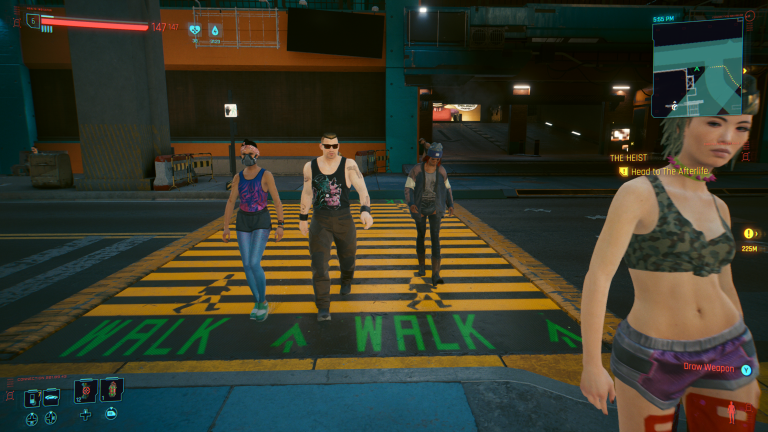
When it comes to exploration in Cyberpunk 2077, I can clearly say that moving down the many sidewalks, streets and varied spots of Night City is really intense and immersive to play. For one thing, the first-person view itself is immersive visually and the immersion got enhanced a lot more with the very clever sound editing (all those cars moving around, the people and their steps, the sound of products coming out from vending machines, the sound of the street barbeque being cooked, the voices of people talking and more) as well as the high number of civilians around me doing their own things. As I never got to play this game in its debut version of late-2020, I could not tell if the in-city exploration was this dense and lively. What I can say is that exploring Night City on foot, going through the alleys, entering establishment that are open and observing the people around is a very engaging gaming experience for me.
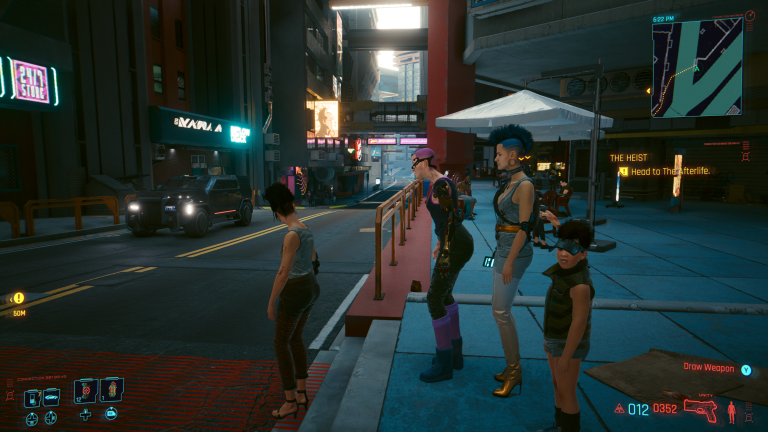
Depending on timing and location, the number of pedestrians you walk with in Night City can range from a few to several people, including kids.
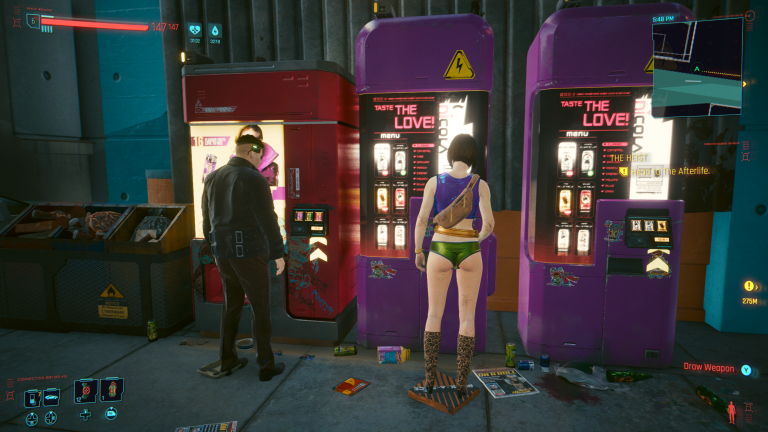
You will witness non-playable characters (NPCs) move around, talk and even purchase goods at vending machines.
Like in real life, you walk across the street only when the green light is on for pedestrians. You can have V do jaywalking but that is risky as there are a lot of cars that move along the roads in real time.
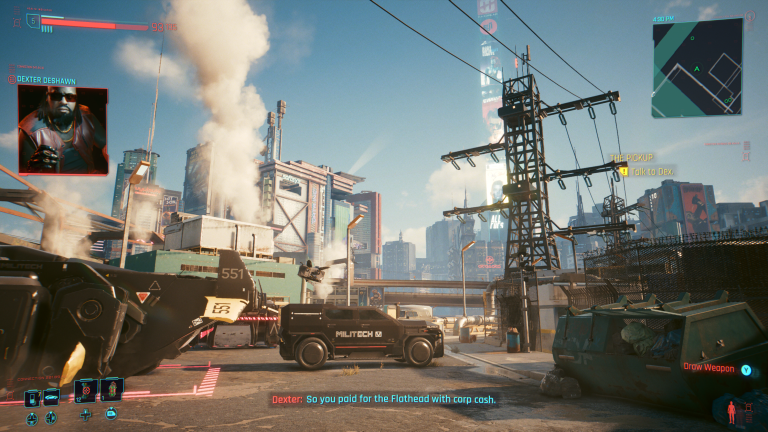
Going back to combat, the use of an inhaler to keep V’s hit points (note: life) up easily reminds me of The Outer Worlds. In addition, the food and drinks you purchased at vending machines are also helpful to keep not only your life up but also your stamina. As V is cybernetic, hacking is easily a major part of the gameplay and as you upgrade the character’s cyberwear, V will eventually gain more high-tech capabilities like scanning people and machines for information and more.
Conclusion – For the sake of the people who have not yet played Cyberpunk 2077, I decided not to reveal much about the story of V in my limited playtime. I can say, however, that players are allowed freedom to choose places to visit and activities to do. There is also the freedom for players to take time away from doing main story mission in favor of side-activities or moving around freely to do what you think you could do. My playtime ended as I was in the middle of a main story mission that involved the supporting character Jackie, a high-tech small robot (pet-like in design) and infiltrating rooms and devices while V stays inside the room of a very high-end hotel.
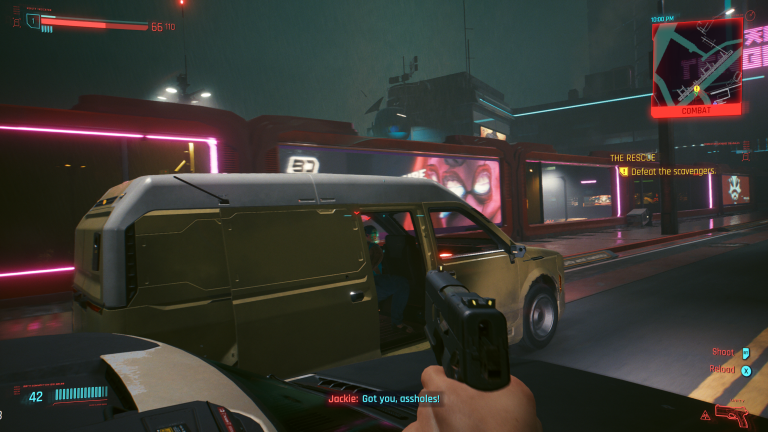
There is a lot of shooting in this game.
As of this writing, Cyberpunk 2077 is selling at 50% off on the Xbox online store. Now you must be wondering…should you buy the game now that it has been polished and updated with the current generation of game consoles?
In my honest opinion, I prefer to wait first for CD Projekt Red to improve the game even more. I can say that I had an overall positive experience playing the Streetkid path of V during my 5-hour trial play and I had an astounding experience exploring Night City on foot and discovering many new places which show how talented CD Projekt Red’s designers and artists really are. As mentioned earlier, the shooting aspect is still lacking which is unfortunate because it is clear that shooting is the core method of combat. If you don’t like shooting, melee combat is available but that one also needs more refinement to be truly responsive and engaging.
As much as I enjoyed my five hours with Cyberpunk 2077’s free trial, I am not yet convinced to buy the game’s full version for my Xbox Series X now. Not even the 50% discount is enough to convince me to buy it. The game is fun and has its unique ways of entertaining me, but there is still more work needed be done to really make it the great game it was promised to be. To say the least, CD Projekt Red is moving on the right direction on improving the game.
Of course, you my readers who have the means to buy and play Cyberpunk 2077 can decide for yourselves. It’s a risk to take if you really want to spend your hard-earned money on the game now. I’d rather wait for further improvements to be made first before buying it.
What you see here is only a small part of Night City. There’s so much to discover in this game! Are you willing to spend your hard-earned money on Cyberpunk 2077 now?
+++++
Thank you for reading. If you find this article engaging, please click the like button below and also please consider sharing this article to others. If you are looking for a copywriter to create content for your special project or business, check out my services and my portfolio. Feel free to contact me with a private message. Also please feel free to visit my Facebook page Author Carlo Carrasco and follow me on Twitter at @HavenorFantasy as well as on Tumblr at https://carlocarrasco.tumblr.com/
Disclaimer: This is my original work with details sourced from reading the comic book and doing personal research. Anyone who wants to use this article, in part or in whole, needs to secure first my permission and agree to cite me as the source and author. Let it be known that any unauthorized use of this article will constrain the author to pursue the remedies under R.A. No. 8293, the Revised Penal Code, and/or all applicable legal actions under the laws of the Philippines.
Welcome back, superhero enthusiasts, 1990s culture enthusiasts, and comic book collectors! Today we revisit the world of 2099 within the universe of Marvel Comics back in the 1990s, specifically through the Spider-Man 2099 monthly series.
Today we will look back at the sixth issue of Spider-Man 2099. Previously, Spider-Man struggled long and hard with the Japanese agent called the Specialist not knowing that they are being monitored by powerful forces behind the scenes. As Alchemax’s Tyler Stone wanted Spider-Man, something unexpected happened before issue #5 ended.
With those details laid down, here is a look back at Spider-Man 2099 #6, published in 1993 by Marvel Comics with a story written by Peter David and drawn by Ricky Leonardi.
The cover.
Early story
The story begins in downtown New York which is the historic and original section of the city located far below the modern-day society and its skyscrapers (referred to as Uptown). Lots of people are living in poverty in downtown New York and even so they are not spared by people who claim to have authority over them as public service personnel. A woman and her child got approached by two men who believe that the mother is two months behind her security payments.
As the physical struggle between them went on, they all found themselves close to a dead end with a pile of trash located on it. Suddenly, a human arm comes out pushing the trash out of the way which stuns them all. Spider-Man then emerges and asks for help…
Quality
Spider-Man of 2099 is so weak and vulnerable, he could not even swing his way around and has to take a ride in downtown New York City.
If there is anything clear about this comic book, it is the fact that Peter David portrayed the futuristic Spider-Man as not only struggling for survival but also as a fugitive complete with a brand-new physical environment which is a dark, far futuristic vision of 20th century New York City. The good news is that David succeeded with what he executed and to say the least, this story has a completely different feel compared to issues #2, #3, #4 and #5.
On Spider-Man, the protagonist was shown to be very vulnerable. His fall from uptown to downtown really wrecked his health and due to the genetic modifications that happened to Miguel O’Hara in issue #1, his above-normal (albeit slow) recovery and strength to even move out the medical facility while being injured are justified creatively. Spider-Man being hunted together by Private Eye and their downtown counterparts (note: there is a clash of cultures and attitudes between them which was nicely dramatized) adds a new layer of suspense mixed with tension which easily reminds me of the fact that the futuristic web-slinger is just a worm within the futuristic and oppressive society of New York in 2099 under Alchemax (note: clearly anti-corporatism is a key element of Marvel 2099 which can be deceiving and misleading to readers, especially those who are vulnerable to the lies and deception of socialists, Marxists, Communists, liberals and other elements of the Satanic Left).
As expected, Peter David further dramatized relationships or connections between the supporting characters. He further spiced up the script with the gradual first appearance of a key 2099 villain for Spider-Man to face off with. I won’t reveal which villain is that and I encourage you to find out by reading this comic book.
Conclusion
Early in the comic book.
Spider-Man 2099 #6 (1993) is fun and compelling to read. What makes it compelling is the creative way the author changed the mood of the story as it shifted into downtown New York of 2099 filled with poverty, darkness and hopeless living. Spider-Man as a fugitive here is similar yet different enough compared to how local authorities perceive the classic Spider-Man/Peter Parker. At this point of the monthly series, Spider-Man of 2099 is shown to be very vulnerable and Miguel O’Hara finally becomes desperate not just to survive but also get back home somehow.
If you are seriously planning to buy an existing hard copy of Spider-Man 2099 #6 (1993) be aware that as of this writing, MileHighComics.com shows that the near-mint copy of the regular edition costs $30 while the near-mint copy of the newsstand edition costs $90.
Overall, Spider-Man 2099 #6 (1993) is recommended.
+++++
Thank you for reading. If you find this article engaging, please click the like button below and also please consider sharing this article to others. If you are looking for a copywriter to create content for your special project or business, check out my services and my portfolio. Feel free to contact me with a private message. Also please feel free to visit my Facebook page Author Carlo Carrasco and follow me on Twitter at @HavenorFantasy as well as on Tumblr at https://carlocarrasco.tumblr.com/
Disclaimer: This is my original work with details sourced from reading the comic book and doing personal research. Anyone who wants to use this article, in part or in whole, needs to secure first my permission and agree to cite me as the source and author. Let it be known that any unauthorized use of this article will constrain the author to pursue the remedies under R.A. No. 8293, the Revised Penal Code, and/or all applicable legal actions under the laws of the Philippines.
Welcome back superhero enthusiasts, 1990s culture enthusiasts and comic book collectors! Today we revisit the future of 2099 through the Punisher 2099 monthly series.
For the newcomers reading this, Punisher of 2099 is Jake Gallows who works during the day as a law enforcer which is a nice contrast to the concept of the classic Punisher identified as Frank Castle. In Punisher 2099 #1 (1993), Jake Gallows witnesses the demise of his family that got attacked by a gang of killers led by Kron Stone who is not only the son of Alchemax’s Tyler Stone but also became the deadliest nemesis of Spider-Man 2099.
With those details laid down, here is a look back at Punisher 2099 #2, published by Marvel Comics in 1993 with a story written by Pat Mills and Tony Skinner, with art by Tom Morgan.
The cover.
Early story
The story begins with a funeral of Jake Gallows’ lost family members held at the church of Thor. In accordance to the traditions of the Thor religion, the dead bodies were placed on a burning boat floating on the water just outside the church building. As he and his fellow law enforcers watch the ritual happen, Jake confirms that he and the church of Thor do not believe in forgiveness and he himself believes in revenge.
When he is not on duty, Jake goes out as the Punisher hunting and killing criminals in his own brutal ways. Even as he does not wear a mask nor a helmet, his face is digitally covered from detection of security cameras thanks to a special technology he uses to protect his identity.
Meanwhile at an amusement park, lots of children enjoy floating in the air within an anti-gravity chamber. Kron Stone and his fellow killers arrive as they attempt to murder the children. Punisher suddenly comes out and successfully kills Stone’s companions, leaving them together in a standoff…
Quality
The Punisher has someone assisting him.
While the sub-par issue #1 was composed mostly of the build-up and emphasis of the futuristic Punisher, this story is pretty much a big pay-off to it. Quite predictably, Jake gets to meet with the gang leader responsible for the death of his family in this issue not once but twice. Along the way, the comic book writers got to emphasize Kron Stone’s wickedness more as well as his continued disregard of human life. This time, Stone’s willingness to kill many children is very disturbing and Tom Morgan’s art style clearly emphasized the villain’s evil.
Within this comic book is a visual tour of the Gallows residence which has a large underground facility and pieces of technology that Jake uses for his campaign against crime (this makes Punisher 2099 becoming similar with Batman and his Bat Cave). He also has a technology oriented partner named Matt who helps him establish a working base of operations.
There is also a sub-plot about the side of crime with the introduction of the Fearmaster who, like Tyler Stone, is with Alchemax and has influence over Public Eye. Unsurprisingly, his introduction is short.
Conclusion
Jake Gallows and Kron Stone (AKA Venom 2099) meet again, only this time the former is now in his form as the Punisher.
The best way to describe Punisher 2099 #2 (1993) is that its plot really thickened and unlike issue #1, this one has a more interesting story and the presentation done by the creative team has some entertainment value. While this is unsurprisingly the natural progression of defining the futuristic Punisher to readers, it is also a successful way of expanding his own part of the 2099 universe complete with the introduction of a new villain and conspiracy that connects to both criminals and law enforcers. To be clear, this is far from being an excellent comic book but it is clear that this one is an improvement over issue #1. In retrospect, the one thing that adds weight to this comic book is not Punisher himself nor the creative concepts involved, but rather the presence of Kron Stone who later on became Venom 2099 (read my retro reviews involving him in Spider-Man 2099 issues #35, #36, #37, #38 and #39).
If you are seriously planning to buy an existing hard copy of Punisher 2099 #2 (1993) be aware that as of this writing, MileHighComics.com shows that the near-mint copy of the regular edition costs $90 while the near-mint copy of the newsstand edition costs $200.
Overall, Punisher 2099 #2 (1993) is satisfactory.
+++++
Thank you for reading. If you find this article engaging, please click the like button below and also please consider sharing this article to others. If you are looking for a copywriter to create content for your special project or business, check out my services and my portfolio. Feel free to contact me with a private message. Also please feel free to visit my Facebook page Author Carlo Carrasco and follow me on Twitter at @HavenorFantasy as well as on Tumblr at https://carlocarrasco.tumblr.com/
Disclaimer: This is my original work with details sourced from reading the comic book and doing personal research. Anyone who wants to use this article, in part or in whole, needs to secure first my permission and agree to cite me as the source and author. Let it be known that any unauthorized use of this article will constrain the author to pursue the remedies under R.A. No. 8293, the Revised Penal Code, and/or all applicable legal actions under the laws of the Philippines.
Welcome back, superhero enthusiasts, 1990s culture enthusiasts, and comic book collectors! Today we revisit the world of 2099 within the universe of Marvel Comics back in the 1990s, specifically through the Spider-Man 2099 monthly series.
Today we will look back at the early development of futuristic Spider-Man as published way back in 1993. The first three issues (read also my reviews of issue #2 and #3) formed a solid foundation on establishing Miguel O’Hara as his era’s Spider-Man thanks mainly to the high-quality writing done by Peter David. What issue #4 will deliver, we will find out here.
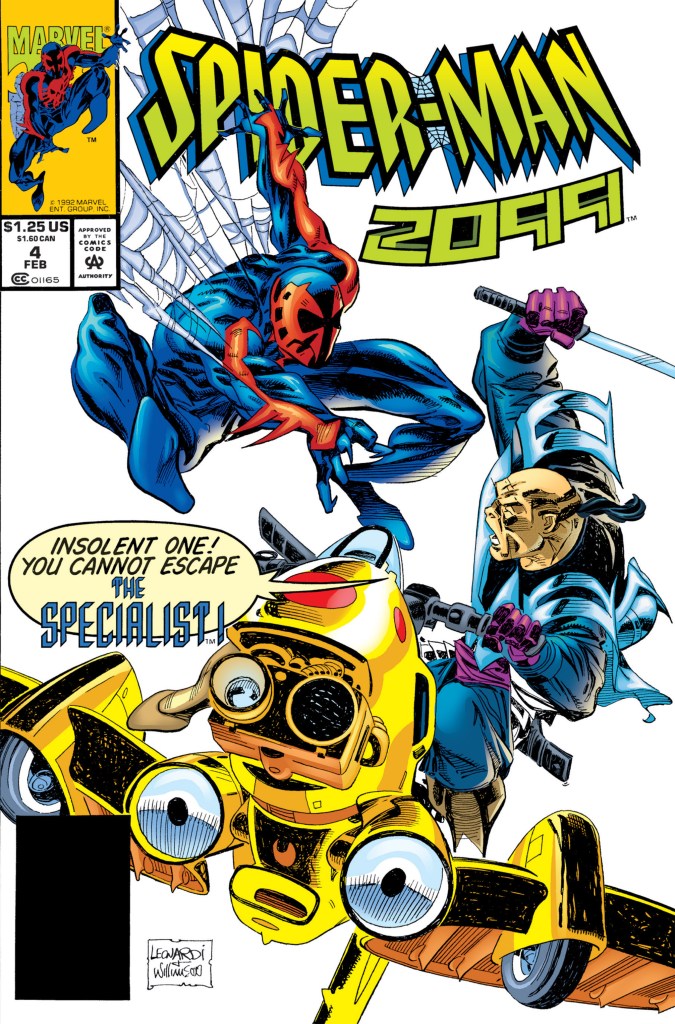
With those details laid down, here is a look back at Spider-Man 2099 #4, published in 1993 by Marvel Comics with a story written by Peter David and drawn by Ricky Leonardi.
The cover.
Early story
The story begins with Gabriel O’Hara (Miguel’s brother) and Kasey Nash trying to have a good time together inside a vehicle until a man armed with a sword interrupts them and tries to take the lady with him. As Gabriel makes his move to help Kasey, the swordman throws two sharp projectiles at him and moves away with the lady.
Over at the Babylon Towers residence, Miguel O’Hara gets visited by his boss Tyler Stone accompanied by armed personnel. Not realizing that Spider-Man 2099 and Miguel are one and the same person, Tyler tells him that the sudden appearance of the crawler put Alchemax on edge.
Tyler proposes peace between him and Miguel, offering him more of the hyper addictive substance Rapture. He tells him that Aaron Delgato was identified as the mysterious Spider-Man…
Quality
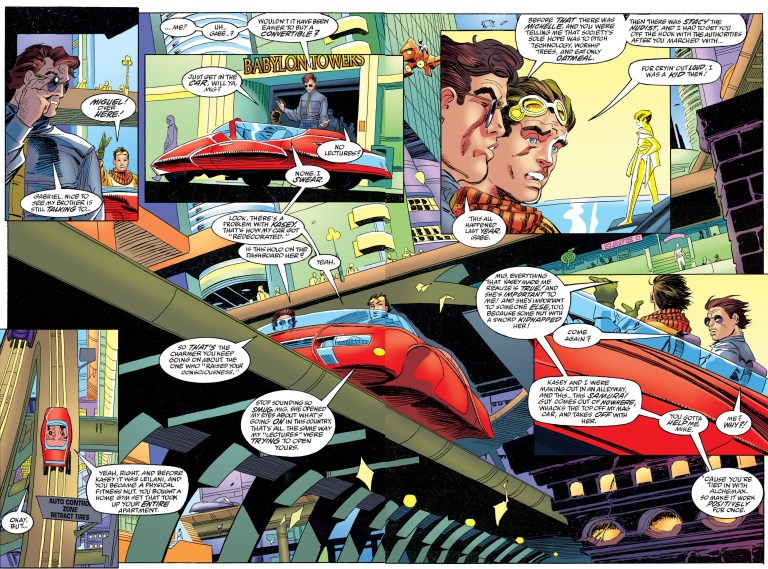
Miguel O’Hara and his brother Gabriel ride and talk.
The plot really thickened in this comic book resulting a few very interesting sub-plot branches as well as more depth on the development of Miguel O’Hara. I really like the way Peter David explored the corporate side of Miguel’s life here creating suspense about Tyler’s limited knowledge of the Alchemax incidents that happened in issues #1 and #2 which actually involved the protagonist witnessing the fall of his corporate rival Aaron (the same guy responsible for the genetic manipulation of Miguel into Spider-Man). This comic book also focuses on the strained relationship Miguel has with his brother Gabriel who clearly lacks the will to be personally responsible.
I also enjoyed the way Miguel reacts to the classic Spider-Man expression of “with great power comes great responsibility” as he struggles to set things right even as being a civilian and a superhero in his society has major hassles.
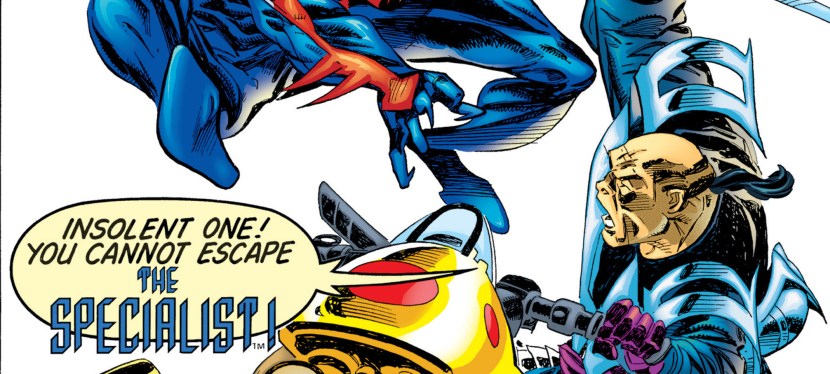
The anticipated battle between Spider-Man and the sword-wielding Specialist was structured nicely. Instead of being the typical good-versus-evil conflict, what was presented started with nice moments as Spider-Man still struggles to make the best out of his capabilities. Be aware that the fight does not conclude in this issue.
Conclusion
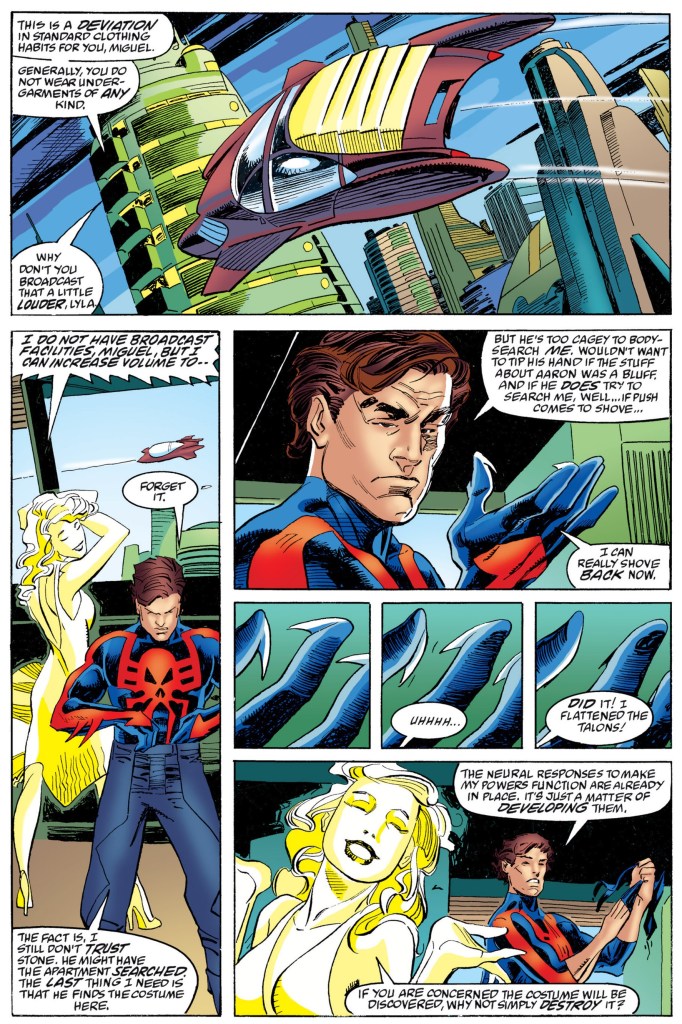
Miguel getting ready for work while having his Spider-Man costume worn.
Spider-Man 2099 #4 (1993) is a solid comic book to read. It had a nice balance of character development, plot with twists here and there, as well as a good amount of action and thrills. Its best feature, as expected, was the further development of the protagonist and you will see more of Miguel than Spider-Man. By the end of this comic book, I really felt I got to know Miguel more as a person, and not a mere character.
If you are seriously planning to buy an existing hard copy of Spider-Man 2099 #4 (1993) be aware that as of this writing, MileHighComics.com shows that the near-mint copy of the regular edition costs $30 while the near-mint copy of the newsstand edition costs $90.
Overall, Spider-Man 2099 #4 (1993) is recommended.
+++++
Thank you for reading. If you find this article engaging, please click the like button below and also please consider sharing this article to others. If you are looking for a copywriter to create content for your special project or business, check out my services and my portfolio. Feel free to contact me with a private message. Also please feel free to visit my Facebook page Author Carlo Carrasco and follow me on Twitter at @HavenorFantasy as well as on Tumblr at https://carlocarrasco.tumblr.com/
Disclaimer: This is my original work with details sourced from reading the comic book and doing personal research. Anyone who wants to use this article, in part or in whole, needs to secure first my permission and agree to cite me as the source and author. Let it be known that any unauthorized use of this article will constrain the author to pursue the remedies under R.A. No. 8293, the Revised Penal Code, and/or all applicable legal actions under the laws of the Philippines.
Welcome back, superhero enthusiasts, 1990s culture enthusiasts and comic book collectors! Today we revisit the world of 2099 within the universe of Marvel Comics back in the 1990s, specifically through the Spider-Man 2099 monthly series.
This time around, we take a look back at the early stage of the futuristic Spider-Man’s story and learn more about Miguel’s struggle in becoming something he was not ready for. On my part, the 3rd issue of Spider-Man 2099 was the first-ever hard copy of the monthly series I bought.
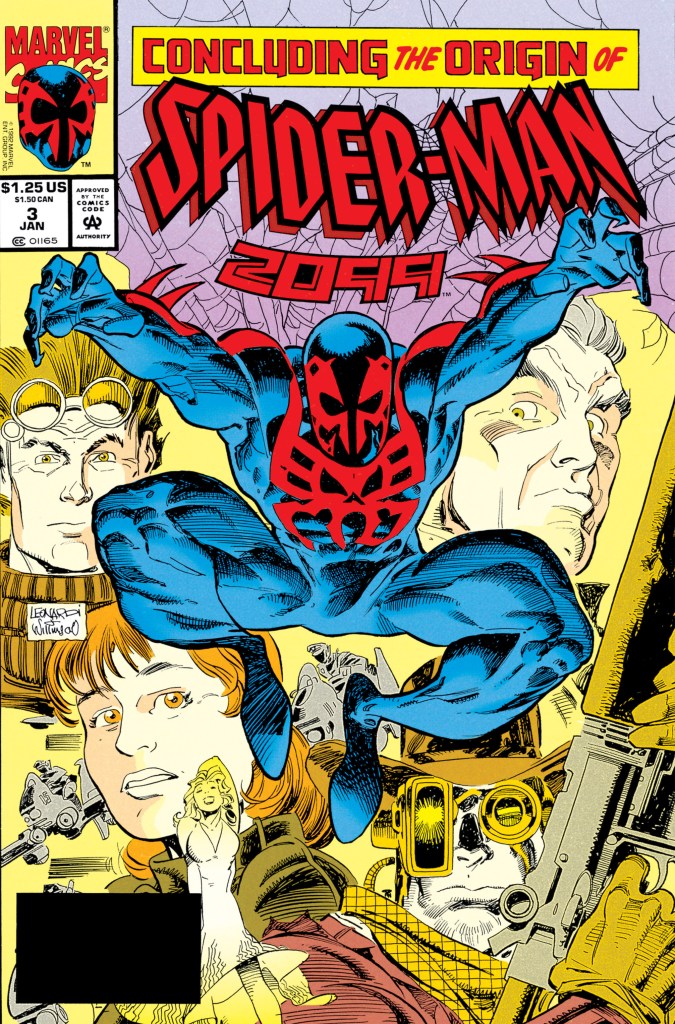
With those details laid down, here is a look back at Spider-Man 2099 #3, published in 1993 by Marvel Comics with a story written by Peter David and drawn by Rick Leonardi.
The cover.
Early story
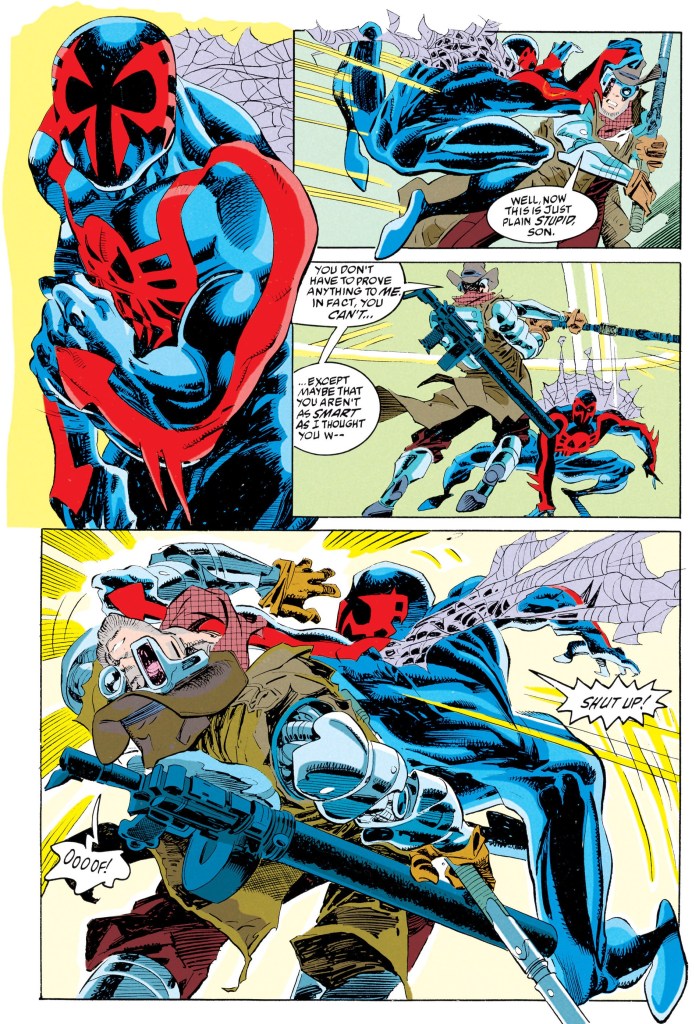
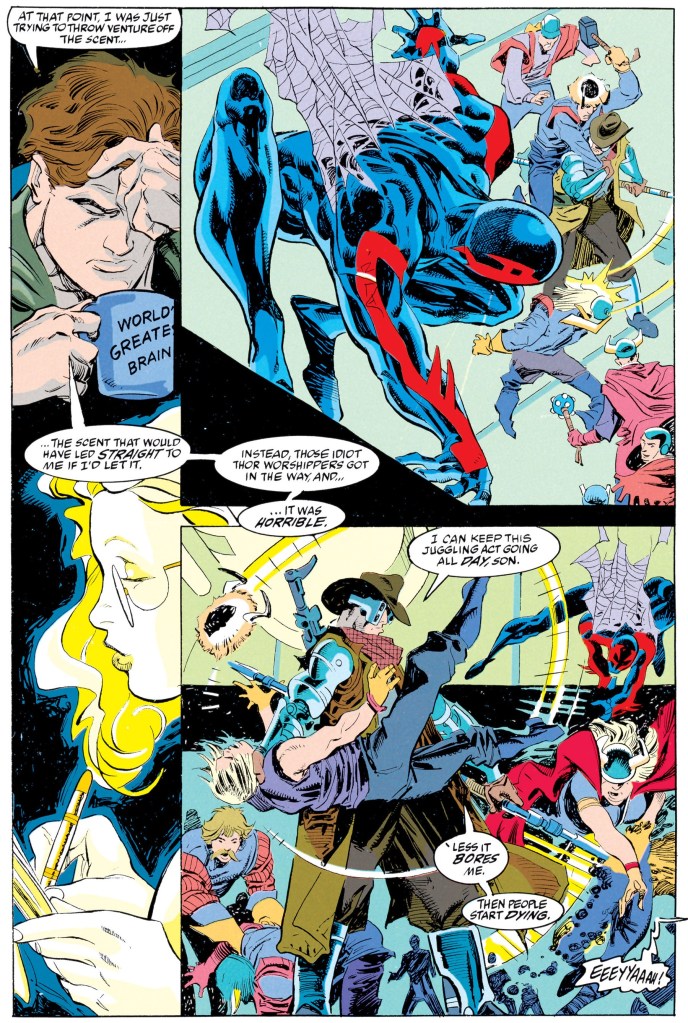
The story begins immediately after the ending of issue #2 with Miguel O’Hara in disguise as Spider-Man facing off with Venture who has been working for Alchemax’s head to find precisely him. The presence of idolaters of Thor view Venture as an enemy and Spider-Man (who knows he is being hunted by the cybernetic guy) tells them to get back to stay out of danger.
Instead of listening to him, the idolaters did the foolish thing by physically attacking Venture who is just too proficient in combat and his high-tech weapon hurts them. With great risk, Spider-Man leaps to Venture to try to convince him to leave him alone. Unfortunately he loses his balance and gets touched by Venture’s weapon which leaves his right arm numb.
Venture tells Spider-Man that Alchemax wants him…
Quality
Even though he has a numb right arm, Spider-Man 2099 still got up-close and personal with Venture.
This comic book is one action-packed thrill ride laced with solid character development. While issues #1 and #2 showed how Miguel O’Hara became Spider-Man of 2099, this story shows him in his first-ever battle with someone who happens to be doing a mission for Alchemax (Miguel’s employer no less).
Peter David carefully structured the story and the result were lots of moments in which Spider-Man 2099 witnesses the unexpected happenings which readers can relate with. As Spider-Man learns more about the enhancements within him (better reflexes, ability to leap far, etc.), he gets to do the unbelievable which is a classic superhero trope done but within a futuristic, science fiction setting. What he does with his abilities, he does his best to adjust himself. I also like the fact that Spider-Man of 2099 does not have the Spider Sense of the classic Spider-Man (Peter Park) which in a creative way adds to the suspenseful moments in this comic book series.
As for Venture, he is not your typical villain nor is a one-dimension character designed to merely provide opposition to the protagonist. He is a cybernetic bounty hunter on a mission and does not harbor any personal grudge nor hatred against Spider-Man. On his own, Venture is deadly and is clearly one of the best villains to ever take on Spidey 2099.
Conclusion
The idolaters and worshipers of Thor take on Venture which Spider-Man witnesses.
Spider-Man 2099 #3 (1993) is a very solid read and it succeeded in further defining the futuristic Spider-Man’s personality as well as his origin. The first time I read this comic book, I got very immersed in learning about the protagonist and how he does his best to save himself and overcome the opposition while finding out ways to ensure that bystanders and witnesses will not get hurt. This comic book also has an immersive sci-fi setting and shows more of the society of 2099. I can clearly say that this is one enjoyable and compelling comic book which aged nicely to this day.
If you are seriously planning to buy an existing hard copy of Spider-Man 2099 #3 (1993) be aware that as of this writing, MileHighComics.com shows that the near-mint copy of the regular edition costs $30 while the near-mint copy of the newsstand edition costs $90.
Overall, Spider-Man 2099 #3 (1993) is highly recommended.
+++++
Thank you for reading. If you find this article engaging, please click the like button below and also please consider sharing this article to others. If you are looking for a copywriter to create content for your special project or business, check out my services and my portfolio. Feel free to contact me with a private message. Also please feel free to visit my Facebook page Author Carlo Carrasco and follow me on Twitter at @HavenorFantasy as well as on Tumblr at https://carlocarrasco.tumblr.com/
Disclaimer: This is my original work with details sourced from watching V: The Final Battle and doing personal research. Anyone who wants to use this article, in part or in whole, needs to secure first my permission and agree to cite me as the source and author. Let it be known that any unauthorized use of this article will constrain the author to pursue the remedies under R.A. No. 8293, the Revised Penal Code, and/or all applicable legal actions under the laws of the Philippines.
With a very engaging story, memorable characters, intriguing concepts and innovative marketing, the $13 million production V: The Original Miniseries (simply called V back then) became a major TV hit in America over two nights in May, 1983. I personally loved watching the said mini-series back in the 1980s and I still love replaying it in this age of high-definition and Blu-ray discs. For me, at least, it is a timeless classic and it carries several lessons about the fragility of society, the rise of fascism, the spread of evil in many forms and the human desire for freedom from oppression.
The cover and the title that did not live up to its purpose.
Early story
The story begins with Mike Donovan (Marc Singer) having a nightmare of him and his son Sean (who was abducted during the events of V: The Original Miniseries) in a desperate escape attempt while inside one of the motherships of the Visitors. He wakes up in the presence of Julie Parrish (Faye Grant) and realizes they have a dangerous mission to execute at a local facility used by the red-uniformed Visitors. It turns out, the Resistance movement led by Julie has been losing ground to the alien humanoids and Mike has been helping them out while prioritizing the state of his son who has been in captivity in one of the mother ships.
During the night, a truck carrying many local civilians inside its trailer arrives at a local factory controlled by the Visitors with officer Steven (Andrew Pine) watching over. After the civilians got directed to enter the factory, it turns out they got processed and came out in the form of food cocoons. The sight shocks Julie watching from a distance with her armed teammates waiting on stand-by.
Easily the most engaging shot in this sequel. A clear reminder about the fascist takeover by the aliens from outer space.
After causing damage on the nearest fence, the Resistance begins their attempt to raid the facility and free their fellow cocooned people but the tide turned against them. It turns out, the Visitors’ troops are wearing stronger armor and bright lights were installed on the top of the facility to forcing Julie, Marc and the rest of their team to retreat. They lost some members along the way. During a closed-door meeting with the Resistance stakeholders, Mike Donovan says a key event is needed to make a significant gain against the Visitors.
Over at the mothership hovering over Los Angeles and in the presence of Diana (Jane Badler), the leader John (Richard Herd) tells Kristine Walsh (Jenny Sullivan) that a major medical announcement will be held in the form of an organized special event very soon and that she will be part of the presentation for the global TV audience…
Quality
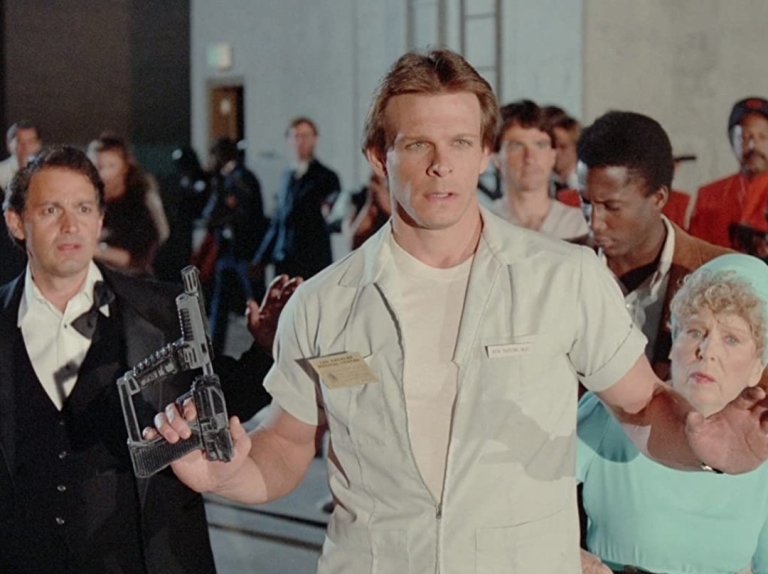
Marc Singer as Mike Donovan with Michael Durrel and Michael Wright as Robert Maxwell and Elias Taylor near him.
I’ll star first with the presentation here. This sequel mini-series was composed of three episodes totaling over 270 minutes. In what looks like to be attempts to ensure more spectacles for the viewers’ enjoyment, each episode of V: The Final Battle has a battle near the end and the creative team succeeded in not only providing on-screen action but also scored well in making the spectacle more varied while still making sense within the main narrative. For the most part, this sequel is indeed a natural progression of what was established in V: The Original Miniseries and that is something to admire given the fact that V creator Kenneth Johnson left this production early.
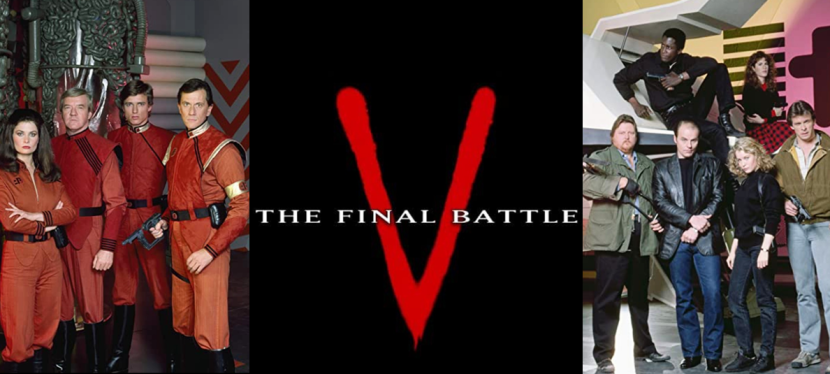
On the storytelling, V: The Final Battle expands a bit on the Visitors’ dictatorship of Los Angeles and its surrounding areas while the Resistance led by Julie Parrish and supported by close companions Robert Maxwell (Michael Durrell), Elias Taylor (Michael Wright) and Caleb Taylor (Jason Bernard) are shown to be struggling on taking down the alien humanoids even though they secured noticeably more weapons and equipment. The storytelling and the dramatization about the Resistance changes dramatically with the addition of Ham Tyler (Michael Ironside) and partner Chris Farber (Mickey Jones) in the 2nd episode and from that point on, you get to see a human opposition that becomes more flexible with their operations.
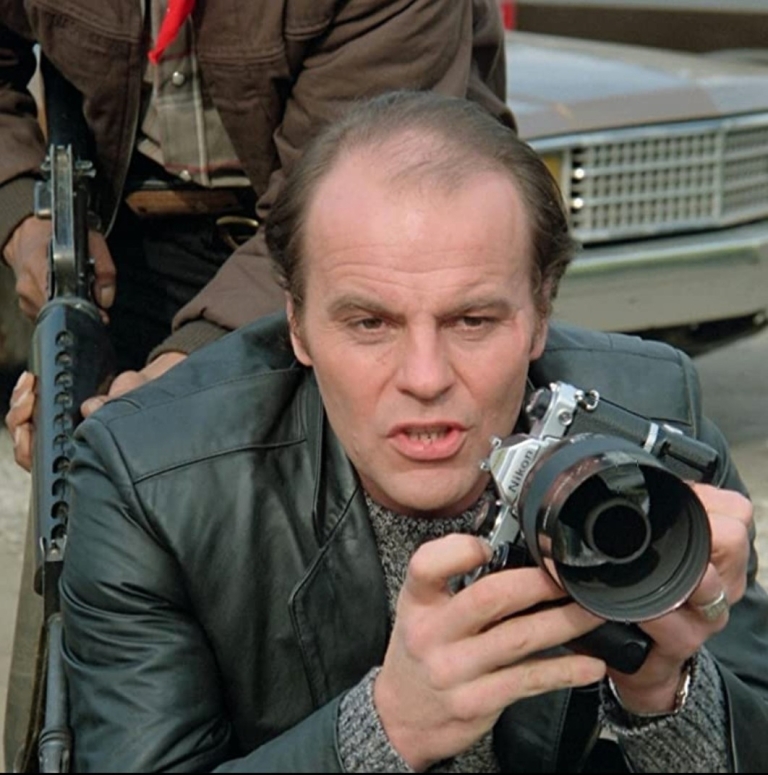
Michael Ironside as Ham Tyler is the most significant new addition to the cast.
As mentioned earlier, Kenneth Johnson’s involvement in this sequel was minimal and it is seen on the presentation. The symbolism Johnson implemented in the original mini-series that established parallels between 1980s America to the Nazi occupation of Europe did not continue here which results a more straightforward presentation of details, character moments and story progression. There was also a noticeable lack of suspense when it comes to executing big scenes with big reveals. The pacing, like in the 1983 mini-series, moves smoothly at a moderate pace throughout and there were no boring moments at all.
The quality of script is still good. For the most part, the writers managed to capture the essence of the established characters from the original mini-series as they told the further developments of this sequel. For example, Caleb and Elias’ father-and-son moments quickly remind me of what I saw in V: The Original Miniseries. Robert Maxwell’s struggle to help his troubled daughter Robin (Blair Tefkin) while assisting Julie and the Resistance is a very natural progression of what was shown in 1983. The friendship between good natured alien Willie (Robert Englund) and Harmony (Diane Cary) got developed a lot more than expected eventually adding to one particular side of the conflict. The local collaborators Daniel Bernstein (David Packer) and Eleanor Dupres (Neva Patterson) developed further with their treason towards their fellow humans as they enjoyed further the power they gained from the Visitors. These two characters will surely get on the nerves of viewers rooting for the Resistance.
Denise Galik as Maggie is a fine new addition to the cast.
David Packer returns as Daniel Bernstein.
Sarah Douglas as Pamela, a superior of Diana’s.
When it comes to new additions to the cast, Ham Tyler and Chris Farber are not the only new players to add depth to this sequel. There is also Maggie (Denise Galik) who is an attractive, brave and strategic Resistance member whose contribution makes an impact. On the downside, there is also Andrew Doyle (Thomas Hill) who is bad choice the creative team came up with as the on-screen representative of faith when he in fact represents religion, idolatry, rituals and distortion. On the side of the Visitors is Pamela (Sarah Douglas) who is a higher-ranking officer than Diana and even John. Pamela is the more militaristic type of leader who is more focused on achieving goals while keeping things in order.
If there is anything flawed about the characterization, it is the romantic relationship of Julie Parrish and Mike Donovan which starts in the first episode. Considering how dramatic the performances of Faye Grant and Marc Singer were in this sequel, Julie and Mike still don’t make a believable pair of lovers in my view. While this romantic relationship opens up new dimensions within Julie and Mike and offer viewers something new to focus, it brings down the former’s value as Resistance leader somewhat while also setting aside the hinted personal connection between her and Elias in the 2nd episode of the 1983 mini-series.
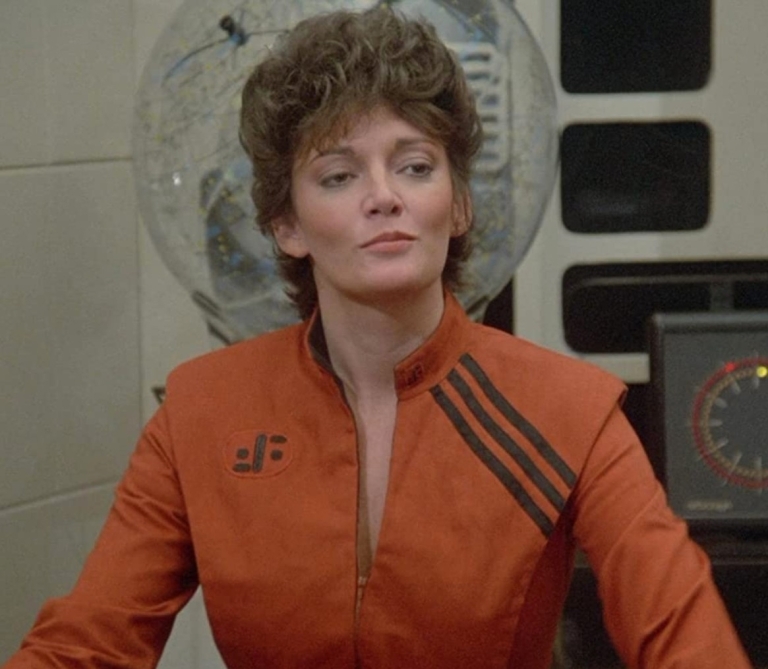
Faye Grant as Julie Parrish in the conversion process scene watched closely by Jane Badler’s Diana.
More on Faye Grant, her performance here is more varied. Not only does she play the brave and struggling leader who is talented in fighting, science and medical practice, she also portrayed Julie as an even more vulnerable character this time around. Her act as the traumatized Julie during the conversion process (read: mental and psychological torture using a more detailed form of virtual reality or nightmare generation) scenes under the watch of Diana is very dramatic and compelling to watch. Just seeing Julie in the conversion process will make grip you with despair and you will eventually feel sorry for her. I should state that the nightmare scenes of Julie were presented with a clear touch of horror.
Marc Singer as Mike Donovan is no longer the reluctant action hero but rather a driven man with a mission to get his missing son back while maintaining a secret connection with Martin (Frank Ashmore) of the Fifth Column (secret dissenters among the Visitors) hoping to achieve breakthroughs for the Resistance and their friends among the dissenting aliens. Singer did the best he could with the script provided to him and he remain likable all throughout. Other than the unbelievable romance with Julie as well as his past encounters with Ham Tyler, there is not much new to expect from the way Mike Donovan was written here. What I should point out, however, is that Mike Donovan’s support for the unholy act of abortion (along with the so-called right to abort) is very wrongful, highly immoral and makes the hero having a sinister presence within him even though he is a father searching for his son.
Jane Badler’s performance as Diana deserves admiration here. Not only did she successfully recapture the charismatic and sinister nature of her character in the 1983 mini-series, Badler was very convincing in showing the more desperate side of Diana, especially when it comes to power struggle within the ranks of the Visitors. You can clearly see the desperation and struggle as soon as Pamela appeared. This sequel also showed a lot more of Diana when it comes to personally supervising her conversion process which is much more elaborate here (note: the conversion process in the 1983 mini-series was limited to the showing of a chair with torture devices). Being the very symbol of charisma and evil in the V franchise, Diana’s place in pop culture is solid and her real-world comparative counterparts would be none other than Hillary Clinton and Kamala Harris.
Jane Badler as the ever charismatic yet very wicked Diana.
As mentioned earlier, Michael Ironside’s Ham Tyler is the most significant addition to the cast and the script. Ironside had that excellent mix of toughness, cruelty and sarcasm portrayed in here and at the same time Ham Tyler brought out very interesting and intriguing interactions with the more established Julie and Mike. As seen in entertainment history, Ironside went on to climb up the ranks in Hollywood with Total Recall (1990), Starship Troopers (1997) and in the Splinter Cell video game franchise. Ironside’s Ham is easily the fourth major character of the V franchise of the 1980s.
Going into the spectacle part of this sequel, the action is more varied as mentioned earlier and the 3-episode structure was a factor. You will see lots of shooting with the use of guns and laser blasters here and there, and with the in-story locations and props as key factors, there are action sequences that are uniquely done. There is a lot to enjoy for any V fan and casual viewers watching this sequel.
As for the special effects part of the spectacle, this one is a mixed bag similar to what was presented in the 1983 mini-series. To put things in perspective, the use of in-camera effects, practical effects and optical effects for TV back in the 1980s was ambitious. That being said, certain effect shots here did not age well such as the miniature shots looking fake (because the camera used did not have a special lens to capture visuals that would have made the miniatures look believable). I should also state that there were certain effects shots that were recycled and reused in key sequences in this sequel which remains embarrassing to see. What is even more embarrassing to see here is the very poor-quality monster effects used during the nightmare scenes (conversion process) of Julie and, more notably, the presentation of Robin’s other child. The monster effects are so fake, they are laughable to watch.
On the bright side of the special effects, the quality of the laser blasts remains good to watch right down to the precise timing with the explosions that were simulated on-set and in-camera.
Conclusion
The Visitors and Resistance key characters in the sequel.
While it has its strengths and weaknesses, V: The Final Battle is still engaging and enjoyable to watch, and at the same time it is a worthy addition for your Blu-ray collection when it comes to HD viewing (note: this is the sequel with the best visuals yet albeit with black borders on the sides). Even though creator Kenneth Johnson was not too involved on the production side, the creative team managed to deliver a long story that proved to be a natural progression of the original mini-series while providing more spectacle (especially action), developing the established characters and resolving key plot threads that started in 1983.
The lack of Kenneth Johnson’s personal touch on the presentation was noticeable and somewhat brought this sequel down a bit in terms of style. What brought V: The Final Battle’s quality down were the overall cheaper looking visual effects, the Julie-Mike love relationship and the climax of the final episode which seemed executed with desperation on the part of the creative team (note: giving a little new character instant purpose). In fairness, this sequel still succeeded in showing what fascism in America (or California specifically which is now dominated by Commies) would look like and it built up on its predecessor’s themes such as the deception of power and the collaboration with foreign enemies. This mini-series even added themes of teenage pregnancy and abortion (note: someone from the creative team wanted to promote the wrongful Roe v. Wade Supreme Court decision of 1973) to its narrative.
Does V: The Final Battle live up to its title? Absolutely not because a regular TV series that deteriorated in quality followed. In retrospect, it’s clear that this sequel marked the beginning of the decline of the V franchise in pop culture. What more, V: The Final Battle was never counted as canon in Kenneth Johnson’s 2008 novel (and sequel to the 1983 mini-series) V: The Second Generation. On its own, V: The Final Battle still has more positive stuff than negative ones and in my experience, it remains enjoyable and compelling to watch from start to finish. Compared to V: The Original Miniseries, I can say this sequel falls short. It is good, not great.
Overall, V: The Final Battle (1984) is recommended. That being said, let this 1984 mini-series remind you that there is so much evil in the real world in the forms of Iran, the terrorists of Palestine, the social justice warriors (SJWs), the Black Lives Matter (BLM) movement and liberal media to name some. Always keep in mind to avoid becoming evil no matter how tempting power in this divided world becomes to you. You also do not want to let the evil ones take over your government and have authority over you, your family members and your community. Push back against evil and stand up strong by faithfully taking sides with the one true Savior whose name is Jesus!
+++++
Thank you for reading. If you find this article engaging, please click the like button below and also please consider sharing this article to others. If you are looking for a copywriter to create content for your special project or business, check out my services and my portfolio. Feel free to contact me with a private message. Also please feel free to visit my Facebook page Author Carlo Carrasco and follow me on Twitter at @HavenorFantasy as well as on Tumblr at https://carlocarrasco.tumblr.com/
Disclaimer: This is my original work with details sourced from reading the comic book and doing personal research. Anyone who wants to use this article, in part or in whole, needs to secure first my permission and agree to cite me as the source and author. Let it be known that any unauthorized use of this article will constrain the author to pursue the remedies under R.A. No. 8293, the Revised Penal Code, and/or all applicable legal actions under the laws of the Philippines.
Welcome back, superhero enthusiasts, 1990s culture enthusiasts and comic book collectors! Today we revisit the world of 2099 within the universe of Marvel Comics as published back in the 1990s, specifically through the Spider-Man 2099 monthly series.
Back in 2020, I reviewed the three key issues of Spider-Man 2099 (click here, here and here) particularly with the entry of Venom 2099. While tragedy happened in issue #37 (a very powerful story), the futuristic Venom was still on the loose.
With those details laid down, here is a look back at Spider-Man 2099 #38, published in 1995 by Marvel Comics with a story written by Peter David and drawn by Andrew Wildman.
The cover.
Early story
The story begins with Spider-Man 2099 grieving over the death of Dana in the presence of Xina and two armed law enforcers. As one of the law enforcers approach him, Spider-Man hits and damages his helmet. The other law enforcer tells his companion to give Spider-Man some room. The grieving web-slinger asks where Venom 2099 is.
Meanwhile at another location, Miguel O’Hara’s mother saw the breaking news on TV about what the tragedy and Dana’s death. Her son Gabriel comes in and gets updated about what happened. As soon as he heard Dana’s name, he becomes concerned and focuses on the TV screen. As images of Spider-Man and Dana appeared, Gabriel begins to make a connection between them and punches the TV screen hard…
Quality
A very angry Miguel O’Hara using his corporate authority to find and get Venom 2099.
If you enjoyed the storytelling, tension and payoff that happened in issue #37, I can confirm to you that great stuff from that comic book continued smoothly in this comic book. As before, Peter David’s writing remains very engaging and gripping. So much so, issue #38 is a very believable and natural continuation of the events of the previous issue. In fact, the tension that started even as far as issue #35 continued in this comic book and at the same time David succeeded in developing the key characters further. Here, the death of Dana impacts not only Spider-Man/Miguel O’Hara, but also those connected with him.
Apart from the impact Venom 2099 left behind on those whom he victimized, the key selling point in this comic book was the portrayal of Miguel O’Hara wanting not only vengeance but also craves for the death of the vicious supervillain. I really find it very gripping to see Miguel using his authority as a high-ranking executive of his company to not only find Venom but also use company resources to get him. There was also the scene in which Miguel wants the captured living piece of Venom’s symbiote become dead which reflects the rage burning in him.
The way Peter David wrote Miguel’s rage is compelling not only because of the dramatics involved but also because it raises new questions about the personality and heart protagonist of the Spider-Man 2099 monthly series. I found myself wondering the following: Is Miguel O’Hara on the way to becoming a villain? Does he realize he is going off-track and could become a danger to others once he gets his way with Venom 2099?
When it comes to the visuals, Andrew Wildman did a really good job her. Not only was his art more detailed than what Rick Leonardi came up with, Wildman also brought to life the emotions of the characters through detailed facial expressions. Wildman also showed how skilled he is with pacing the story as well as being strategic on visualizing the spectacle.
Conclusion
Spider-Man 2099 in a very emotional state over the death of Dana.
I can clearly say that Spider-Man 2099 #38 (1995) is a great comic book to read. It is indeed a very worthwhile follow-up to the powerful and tragic story of issue #37 and the tension that started in issue #35 continued strongly in this comic book. Very clearly, Peter David carefully planned to shake up the Spider-Man 2099 series of the 1990s even as he built up Venom 2099 as the deadliest foe the futuristic Spider-Man faced. I should also state that the Spider-Man 2099 – Venom 2099 rivalry has a distinct style and flavor of its own, and there was simply nothing ripped off from the 20th century Spider-Man – Venom (Peter Parker and Eddie Brock) rivalry.
If you are seriously planning to buy an existing hard copy of Spider-Man 2099 #38 (1995) be aware that as of this writing, MileHighComics.com shows that the near-mint copy of the regular edition costs $80 while the near-mint copy of the newsstand edition costs $240. Spider-Man 2099 #38 (1995) also comes with a Venom 2099 cover edition which costs $200 for a near-mint copy.
Overall, Spider-Man 2099 #38 (1995) is highly recommended!
+++++
Thank you for reading. If you find this article engaging, please click the like button below and also please consider sharing this article to others. If you are looking for a copywriter to create content for your special project or business, check out my services and my portfolio. Feel free to contact me with a private message. Also please feel free to visit my Facebook page Author Carlo Carrasco and follow me on Twitter at @HavenorFantasy as well as on Tumblr at https://carlocarrasco.tumblr.com/













 Author Carlo Carrasco