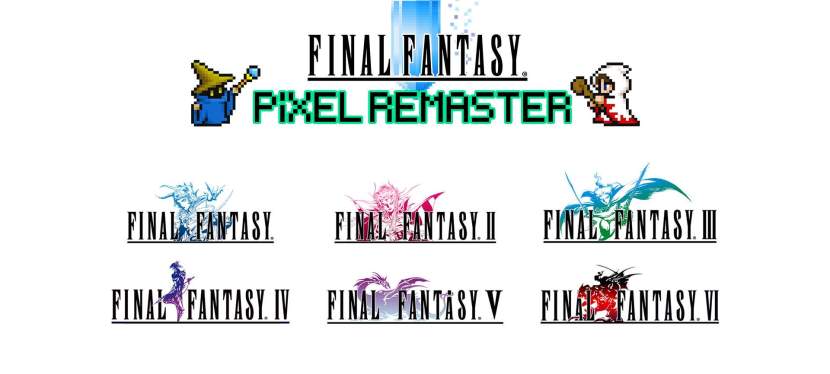
In case you missed the official Xbox presentation of the 2024 Tokyo Game Show (click here to watch), Square Enix formally announced that Final Fantasy Pixel Remaster has officially been released for Xbox Series X and Xbox Series S plus Windows PC. Watch the announcement video below.
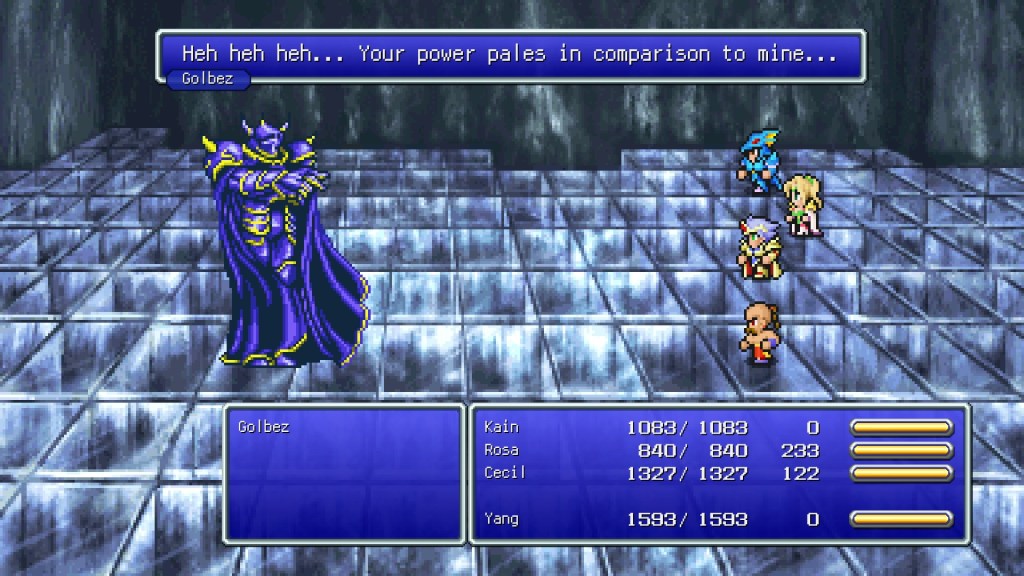
This is what Final Fantasy IV looks like in remastered form.
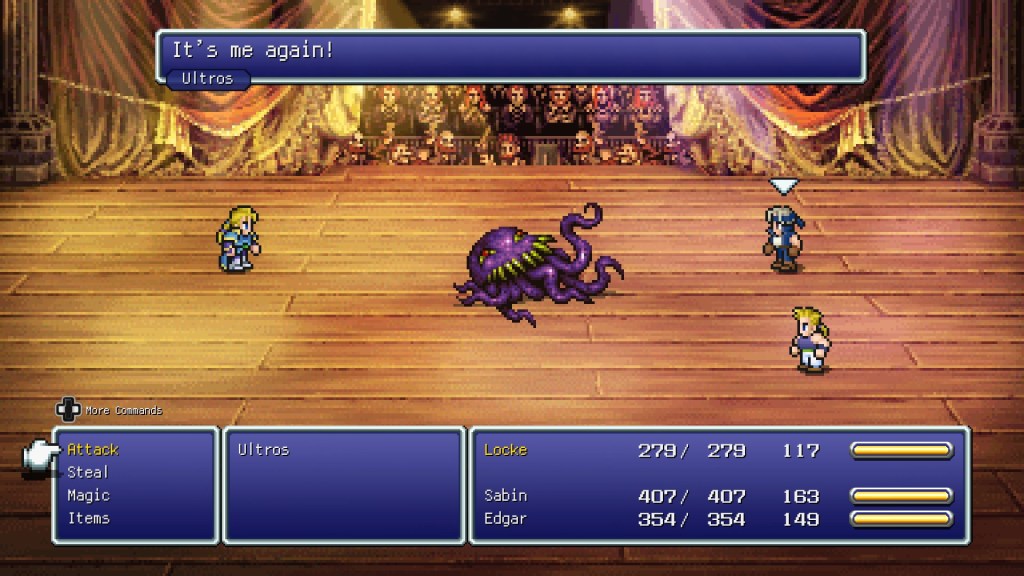
Each classic Final Fantasy game has its 2D pixel graphics and artworks updated with high-definition gaming in mind, and their soundtracks have been re-arranged. In what is a clear attempt by Square Enix to enhance the gameplay experience and user-friendliness, there were tweaks made to the user interface. Also added were extra stuff such as bestiary, illustration gallery and music player.
The Xbox and Windows PC releases of Final Fantasy Pixel Remaster is indeed a move towards the right direction by Square Enix and it is clearly the result of that company’s renewal of ties with Team Xbox. Final Fantasy Pixel Remaster was launched on other platforms previously and the Xbox ecosystem ended up being the last to have it for millions of gamers to enjoy.
For the Xbox gamers who are Final Fantasy fans as well as those who are fond of classic Japanese role-playing games (JRPGs) and those who simply love retro gaming, Final Fantasy Pixel Remaster is a very welcome addition that should not be missed. It is available now for digital purchase as a bundle but gamers are free to choose to buy the games individually based on their current taste or based on how much they could afford right now. It is clear that buying the bundle of six Final Fantasy classic games is still the best value for money.
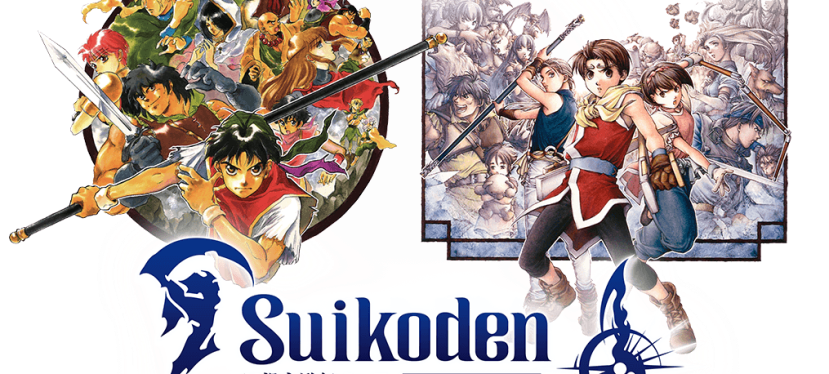
If you love classic Japanese role-playing games (JRPGs) or if you are passionate about retro gaming, then be aware that Konami finally confirmed that Suikoden I & II HD Remaster: Gate Rune and Dunan Unification Wars will be released for the Xbox Series X, Xbox Series S and Xbox One on March 6, 2025.
The good news is here is that customers who proceed with their pre-orders of the game will get the following from Konami in digital form: Prosperity Orb, Fortune Orb and 57,300 potch (in-game currency to purchase in-game items).
In the remastered collection, Suikoden and Suikoden II (read my retro review) will be released with enhancements to look more presentable in high-definition with modern game consoles in mind. According to Konami, the graphical enhancements include: Pixel sprites and environment art enhanced with new screen effects including lighting, clouds, and shadow animations Flickering flames, smoldering smoke, the movement of leaves and insects, all add up to a lively in-game atmosphere!
There are also new character drawings updated in high-definition particularly with the first Suikoden RPG with the involvement of none other than Junko Kawano (the character designer of the said game’s original version from the mid-1990s).
Konami also confirmed that there are game system improvements which are as follows: dialogue log, auto-battle, double-speed battles and more.
For the newcomers reading this, Suikoden and Suikoden II were original released on the first PlayStation console in the mid and late-1990s respectively. Those games were nicely received by gamers and video game critics which resulted in a long-lasting following. I myself played both games on the PlayStation and had a lot of fun collectively. While its predecessor was good, Suikoden II turned out to be bigger, better and more enjoyable. I should state that the sequel was clearly a direct follow-up to the first Suikoden and it was special to see memorable characters from the first game return such as Flik and Viktor. In my honest opinion, Suikoden II is one of the very best JRPGs ever released in the 1990s.
As for Suikoden I & II HD Remaster: Gate Rune and Dunan Unification Wars itself, the said collection was supposed to be released in 2023 but Konami ended up delaying it. The collection is coming out on March 6, 2025 and I can only hope that Konami’s team did a good job with the enhancements and other technical stuff to justify the delay. I know for a fact that there are gamers out there who are disappointed with Konami’s handling of re-releases or enhanced versions of their classic games. For Suikoden I & II HD Remaster: Gate Rune and Dunan Unification Wars, I’m willing to give Konami a chance to prove that it took good care of the product with fans and JRPG enthusiasts in mind.
When it comes to RPGs on Xbox, the collection will be released over a month after that of the Xbox-exclusive RPG Avowed. Xbox fans have two promising RPG releases to look forward to in the 1st quarter of 2025.
If you are an Xbox fan who is fond of Japanese role-playing games (JRPGs), then I encourage you to buy Grandia HD Collection which is available for Xbox online. I am saying this because recently I enjoyed replaying the classic JRPG Grandia on my Xbox Series X a lot and I finished it once again (my 2nd time overall including my 1999 completion of the game on PlayStation). This is not a game review of Grandia but a commentary of replaying it from start to finish.
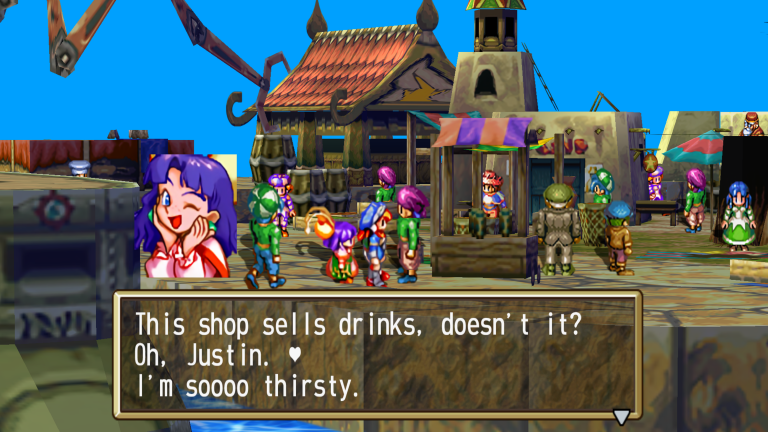
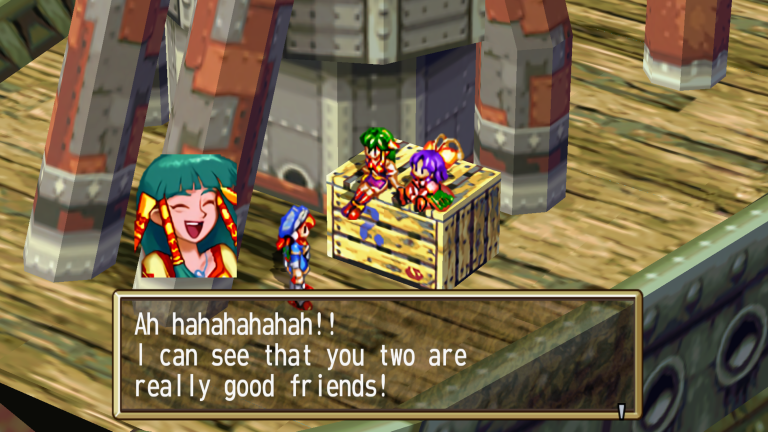
Feena and Justin are very memorable protagonists. The writers of Game Arts really did their jobs developing and defining the personalities of the characters.
For the newcomers reading this, Grandia HD Collection contains Grandia and the sequel Grandia II. Grandia was originally released on the Sega Saturn in Japan in 1997 and was ported to PlayStation shortly after. It was on the PlayStation when Grandia was translated and dubbed into English and released to gamers in the West. Grandia II was released originally on the Dreamcast console in both Japan and America in 2000. Eventually the sequel was ported to the PlayStation 2 and Windows PC in 2002.
Going back to the original Grandia, the game has visuals that were remastered and made clearer to look at while still maintaining the vibrant colors of its late-1990s version. It took me a little over fifty hours to complete on my Xbox Series X and I can say that the entire replay experience was indeed a lot of fun to do. I’m so happy and satisfied with finishing Grandia, I already got my money’s worth with the entire Grandia HD Collection. I’m currently playing Grandia II and so far I’ve been enjoying it.
Game Arts was exceptional with their work on the graphics and art style.
Without spoiling the story, I can say that Grandia was written and made to emphasize the wonders and risks of adventuring while managing to dramatize a tale of epic fantasy proportions. Along the way, the game has a memorable cast of characters – Justin and Feena are clearly the leads – and the creative team of Game Arts really ensured that their personalities got developed (as the story moved on) and became worth caring for.
The gameplay is also fun to go through once again. There is a satisfying room for exploration whenever I visited a new location and the battle system is still top-notch in terms of mechanics, presentation and functionality. I should say that the battles are not too stressful to do and that means it is more doable to do some grinding to make your characters stronger and their abilities better.
After finally defeating the main villain and completing the last conflict, it was really nice to see the story’s ending (told with a labor of love by the game developers) as well as the follow-up cut-scene that played after the end credits rolled (read: post-credits ending). It’s like 1999 all over again but with much better visuals and the benefits of playing the game on Xbox Series X connected to our 4K TV. This is both retro gaming and fantasy role-playing of great quality and deep enjoyment!
By finishing Grandia and enjoying it a lot, I already got my money’s worth with Grandia HD Collection.
There is no doubt that Grandia is the best gaming experience I’ve had on Xbox this year. That being said, I encourage you fellow Xbox gamers as well as those who love JRPGs to seriously consider buying Grandia HD Collection while it is still available.
Welcome back, my readers, YouTube viewers and all others who followed this series of articles focused on YouTube videos worth watching. Have you been searching for something fun or interesting to watch on YouTube? Do you feel bored right now and you crave for something to see on the world’s most popular online video destination?
I recommend you check out the following topics and the related videos I found.
#1HolyLandSite’s comprehensive videos about the Temple Mount in Jerusalem, Israel – I love Israel and I will always stand with it in accordance to my uncompromising faith in the Lord and His Word (the Holy Bible). During the one and only day-off of the Israel 2023 pilgrimage tour I joined, I visited the Temple Mount in the Old City of Jerusalem and it is truly one of the most significant places to visit in the entire world. The Dome of the Rock (the Muslim shrine) occupies the space where the two Jewish temples used to be and inside it is the Foundation Stone (preserved layer of mountain top rock) which is the spot where Abraham almost sacrificed Isaac before God sent the angel to intervene. Be aware that during the time of Lord Jesus, the 2nd Jewish temple was established.
HolyLandSite produced the most in-depth and most informative videos about the Temple Mount and I encourage you to watch them now.
#2 The #10 billion Apple Car disaster – You ever heard of the Apple Car? Such a project from the very same company behind iPhone actually existed and it ended up as a disaster worth an estimated $10 billion. What happened behind the scenes at Apple? Did the technology giant really believe it could make a positive impact on the automobile industry? You can find out more by watching ColdFusion’s video below.
#3 Venom: Lethal Protector revisited and explained – I should mention first that I am not a fan of the Marvel Comics super villain Venom. For the newcomers reading this, Venom emerged in the late 1980s as Spider-Man’s deadliest enemy and went on to become a murderer who somehow helped Marvel Comics sell a lot of comic books. Because comic book fans wanted more of him so much, Marvel went on to publish the Venom: Lethal Protector limited series in the early 1990s and it led to even more comic books showcasing him as an anti-hero (specifically a killer helping the powerless people). If you are interested to learn about the Venom: Lethal Protector limited series without having to go through all the trouble of finding the comic books, watch the video below. Better save your money.
#4 You, Me and the Movies’ reaction videos of the first three Jaws movies – YouTube channel You, Me and the Movies recently posted their movie reaction videos of Steven Spielberg’s Jaws (1975), Jaws 2 (1978) and Jaws 3-D (1983). Having seen all three movies before, I enjoyed these reaction videos. The first movie from 1975 is a true cinematic classic directed by a very young Spielberg and if you have not seen it, I encourage you to watch it entirely first before seeing the related reaction video. I cannot say the same about Jaws 2 and Jaws 3-D (AKA Jaws 3). Once you are ready, enjoy the videos below.
#5 Retrospective videos of Suikoden and Suikoden II – Recently, Konami announced that it will finally be releasing the anticipated collection Suikoden I&II HD Remaster Gate Rune and Dunan Unification Wars on March 6, 2025 for varied game consoles plus Steam. The said collection was supposed to have been released in 2023 but a delay happened and Konami was very silent until recently. Now that fans of the first two Suikoden games have something to look forward to in 2025, here are some retrospective videos that will help you understand what the games are and why they are still popular among Japanese RPG (JRPG) enthusiasts.
#6 The wickedness and wokeness of Rachel Zegler exposed – Actress Rachel Zegler is not worth trusting as she went ballistic while promoting the new Snow White movie from woke Disney. Not only did she go against the legacy of the classic Snow White animated movie, she sided with the pro-Palestine movement and their terrorists. While her tweet could encourage pro-Palestine believers to watch the new Snow White, it is a fact that there already a movement of people who hate Israel telling people to boycott the said movie simply because it has Israeli actress (and Wonder Woman star) Gal Gadot. By being woke and reckless, Zegler is only turning off people from watching the new Snow White and if the movie fails, it will cost Disney a lot of money. Watch and learn from the selected videos below.
#7 Popcorn in Bed reacts to King Kong (1933) and Godzilla (1954) – I really enjoy watching the movie reaction videos of Popcorn in Bed (PIB) and recently she posted new videos about two very significant movies…the original King Kong of 1933 and the original Godzilla (Gojira) film of 1954. As the two mentioned movies are cinematic classics, I encourage you to watch them first before watching Popcorn in Bed’s reaction videos. To those who saw classics already, watch the reaction videos below.
In case you missed the news – bad ones actually – be aware that the release of fantasy role-playing game Avowed has officially been delayed to February 18, 2025, according to a Windows Central news report. It was previously announced that Avowed was supposed to be released sometime in late-2024 on Xbox Series X, Xbox Series S, Windows PC and Xbox Game Pass (XGP).
To put things in perspective, posted below is an excerpt from the Windows Central news report. Some parts in boldface…
Obsidian Entertainment and Xbox Game Studios’ upcoming fantasy role-playing game Avowed is being delayed out of the year, as confirmed via the official Xbox X (Twitter) account.
“So many games coming! As such, we’re moving Avowed to Feb 18, 2025 to give players’ backlogs some breathing room,” the message reads. “Stay tuned for more from our games across Activision, Blizzard, Bethesda & Xbox Game Studios at gamescom, including our Aug 23 livestream for a look at Avowed.”
This comes hot on the heels of a report from The Verge indicating that Avowed would be delayed, which Windows Central was able to corroborate. By all accounts, this move is to allow Avowed more breathing room outside of what is shaping up to be an extremely busy fall and holiday period, with multiple Xbox first-party launches and third-party titles including Call of Duty: Black Ops 6, Indiana Jones and the Great Circle, and Dragon Age: The Veilguard.
While Avowed won’t be playable at Gamescom 2024, Xbox is hosting theater presentations revealing more of the game, alongside similar presentations for Indiana Jones and Starfield’s Shattered Space expansion.
When it arrives, Avowed will be launching across Xbox Series X|S consoles and Windows PC, as well as being included day one in Xbox Game Pass Ultimate and PC Game Pass.
As a long-time Xbox gamer, the delay of Avowed is disappointing and adding more to the disappointment is the fact that an Xbox Game Pass Ultimate subscription (note: the most expensive XGP option) is required to play it on launch day. This effectively locks out (temporarily) many Xbox Game Pass subscribers who could not afford to upgrade their current subscriptions and they have no choice but to wait first before the game becomes available to them.
Ever since it was first announced, I was looking forward to playing Avowed and it was one of the main reasons I bought the Xbox Series X console. I am also a fan of Obsidian Entertainment’s role-playing games such as Fallout: New Vegas and The Outer Worlds. In fairness, Team Xbox announced that they will do a livestream presentation of Avowed during Gamescom 2024 on August 23. Hopefully we will see the latest about the game. To ease the pain of waiting, check out the most recent video of Avowed below.
After enjoying the big reveals and surprises of the Xbox Games Showcase this past June, things went downhill in recent times. For one thing, I really don’t like the changes Microsoft is implementing on Xbox Game Pass (click here and here to learn the details). With regards to new Xbox stuff this year, the fantasy role-playing game Avowed has been delayed to February 2025 while Indiana Jones and The Great Circle still has no firm 2024 release date as of this writing.
When it comes to games I’ve been playing a lot with my Xbox Game Pass (XGP) subscription, Eiyuden Chronicle: Hundred Heroes was recently patched but it still did not solve the game crashing and shutdown on my Xbox Series X. Rabbit & Bear and 505 Games still have a lot more work to be done to significantly fix and improve Eiyuden Chronicle: Hundred Heroes on Xbox Series X.
My Xbox enjoyment improved when I started playing the original Grandia after purchasing Grandia HD Collection on the Xbox online store. For the newcomers reading this, Grandia HD Collectioncontains Grandia (released on PlayStation and Sega Saturn) and Grandia II (released on Dreamcast and PlayStaion 2) and those games have remastered visuals with high-definition TVs (HDTVs) in mind. In my experience, I played and finished Grandia on the original PlayStation console way back in 1999. I never played its sequel but will do so some time later.
As soon as I downloaded Grandia HD Collection on my Xbox Series X, I started playing Grandia for the first time in decades but with HD visuals and other refinements.
Developer Game Arts did amazing work creating the fantasy world and visual concepts that made Grandia a special game to play.
After watching a nice introduction (in animation), the story started with a short scene introducing Mullen, Lieutenant Leen and their superior General Baal. After that, the game’s focus shifted to the port town of Parm with a stylish floating camera sequence showcasing in real-time the polygonal location and the inhabitants (presented as detailed 2D animated bitmap sprites). Shortly after, the youngling Sue and the aspiring adventure Justin got introduced.
As of this writing, I played Grandia for several hours and already surpassed the End of the World (the wall that separated the initial world from the mysterious other. I already have Justin, Sue, Feena and Gadwin in my party.
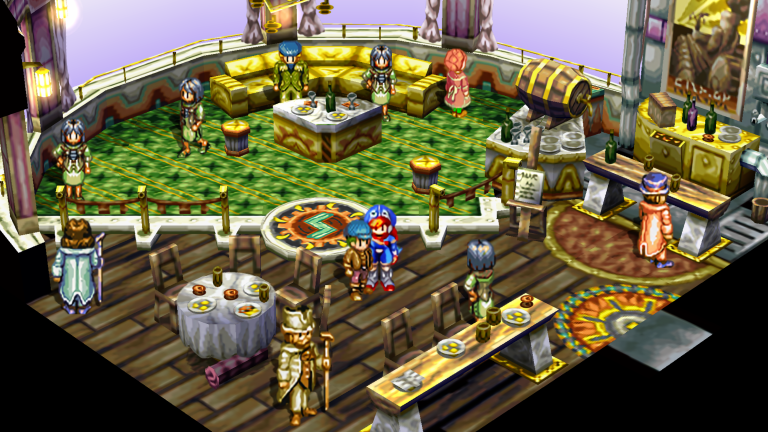
This is the lounge for the upper class passengers on board a ship. Grandia is a fine example of combining 2D sprites with detailed polygonal environments.
Much early during my playthrough – specifically before witnessing Feena’s first appearance – I had fun rediscovering the unique locations Game Arts created. The town of Parm is a pretty unique location to start the game with. The Sult Ruins were designed with with sneaking and adventuring in mind. Through these and other locations, you will see how creative the game developers really were when it came to world-building as well as giving each location its own unique style and feel.
Because it had been so long since I finished this old Japanese role-playing game (JRPG), I had to orient myself with the game’s functions using the Xbox Series X controller and the technical options that came with the software. I quickly got used to the way the characters’ moved (in response to the controller), the way I was able to move the in-game camera around and how the functions responded to the buttons pressed. In just a few minutes, the Grandia gameplay familiarity came back to me.
Battles are always fun to play and grinding (playing many battles to gain experience points to level up) is not as stressful when compared to other JRPGs.
Game Arts came up with clever views of a local community like this to give gamers a unique look of this part of the game’s world.
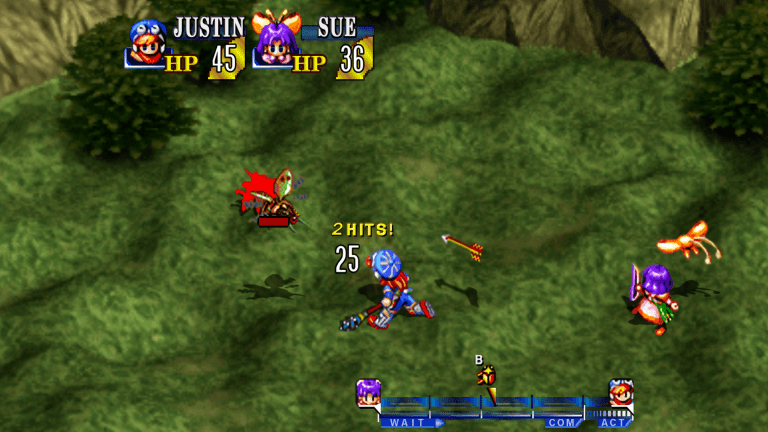
Oh yes, the battles are still a lot of fun to play! During battles, there is this bar on the lower part of the screen showing the icons of your characters and monsters/enemies moving from left to right. Once the icon reaches a crucial point at the right, the game will enable you to take your turn and decide which action to execute. Once you made your choice of action, your character will be animated accordingly. It should be noted that striking enemies will not only reduce their hit points but also delay the flow of their icons on the bar. As such, battles can be strategic with regards to the actions you take and which enemy you targeted.
With regards to leveling-up, you don’t just gain experience points to develop and improve your playable characters. You will also improve their use of weapons and magic as they involve leveling-up. Along the way, you will get opportunities to acquire weapons and armor, and you can have different types of magic implemented into your character with the use of the Mana Eggs. The freedom of choice is clearly evident in the gameplay.
In addition to enjoying the gameplay and options, I appreciate the Game Arts’ approach on telling the story, the light-hearted way of presenting the characters and how they implemented creative pay-offs to the build-ups that preceded them. I also enjoyed the many visual concepts the developers came up with to make Grandia’s fantasy world, cultures and people come to life.
While I am still several hours away from finishing Grandia again, I can say that my current enjoyment of is literally returning with a vengeance and it helped me forget about the Xbox-related disappointments.
Right now, I am enjoying Grandia in HD and I intend to finish it again.
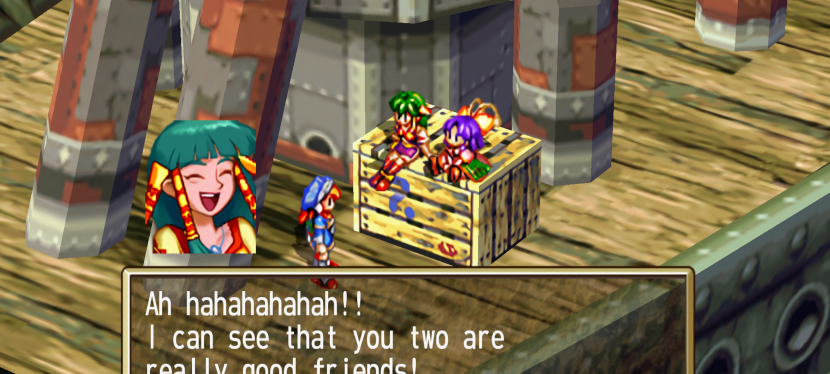
Feena with Sue and Justin. These characters are memorable and amusing to watch.
Welcome back readers, fellow geeks and electronic gaming fans!
In this edition of the Retro Gaming Ads Blast (RGAB) series, we will take a look at another batch of retro gaming print ads from the 1980s and 1990s. In addition, there will be a few flyers of arcade games.
For the newcomers reading this, Retro Gaming Ads Blast (RGAB) looks back at the many print ads of games (console, arcade, computer and handheld) that were published in comic books, magazines, flyers and newspapers long before smartphones, social media, the worldwide web and streaming became popular. To put things in perspective, people back in the 1980s and 1990s were more trusting of print media for information and images about electronic games and related products.
With those details laid down, here is the newest batch of retro gaming print ads for you to see and enjoy…
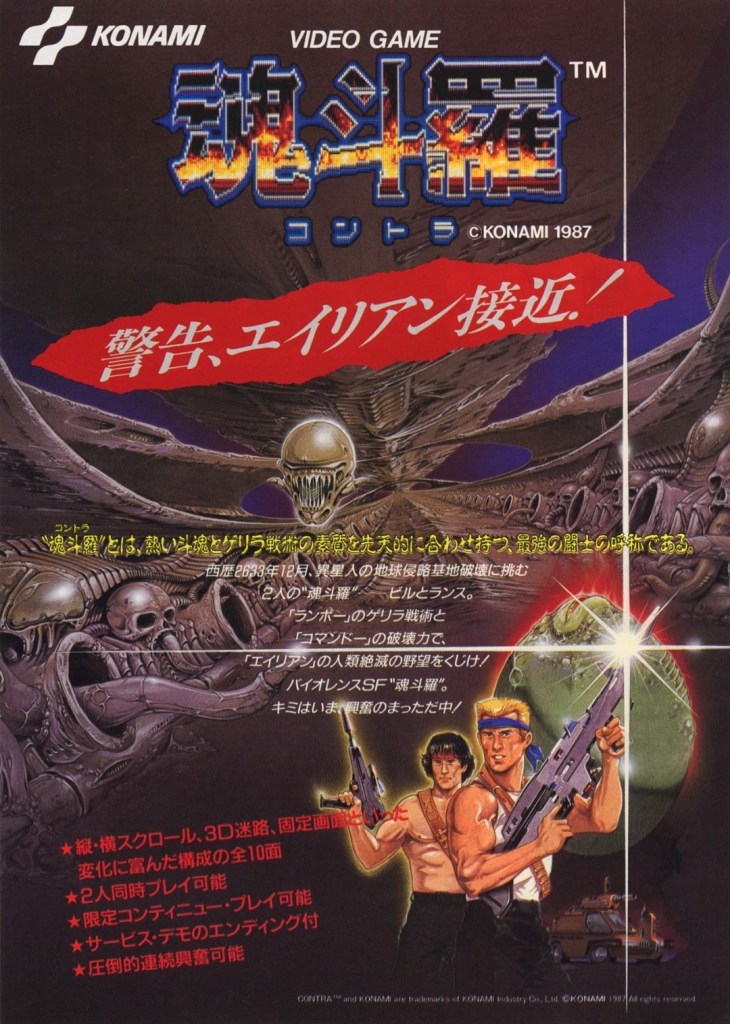
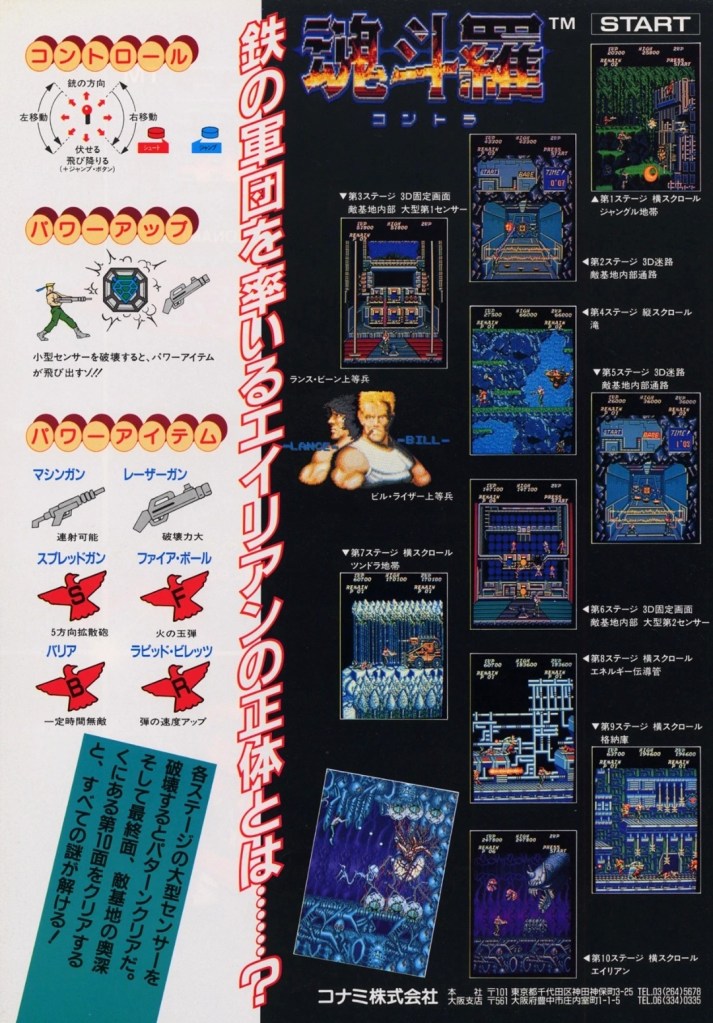
1. Japanese Contra arcade flyer
The front of the Japanese arcade flyer of Contra.
The other side of the flyer.
As mentioned before, Konami’s long-running Contra games franchise first started in the arcades in Japan. As seen in the Japanese arcade flyer, it was clear that the company not only had a clear vision of Contra’s visual concepts but also was pretty organized with explaining lots of details (examples: the 8-direction controls, types of weapons or ammunition available, level design differences) that both players and arcade operators can learn from. If you look closely at the rear of the flyer, you will see the two characters already identified as Lance and Bill which clearly showed the Japanese creators had the creative details really organized.
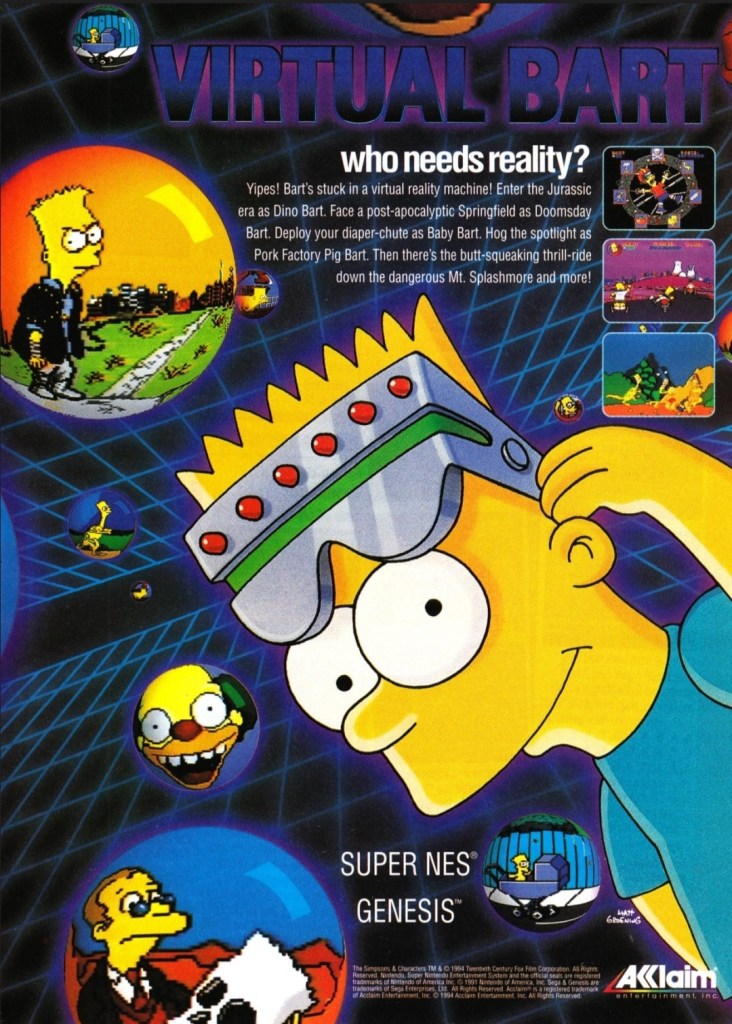
2. Virtual Bart print ad
Anyone who loved The Simpsons would easily recognize the characters of this print ad.
Decades ago, The Simpsons made big waves on television and quickly emerged as a fine addition to American pop culture. That being said, it was not surprising at all that video games based on the show got made and Virtual Bart was one of them. This Virtual Bart print ad appeared in some comic books I read in 1994 and the ad makers made efficient use of the single-page layout showing that the game was not a mere 2D side-scroller as its concept emphasized Bart Simpson’s virtual reality escapades. This game, which had mini-games and different gameplay styles, received review scores ranging from negative to positive.
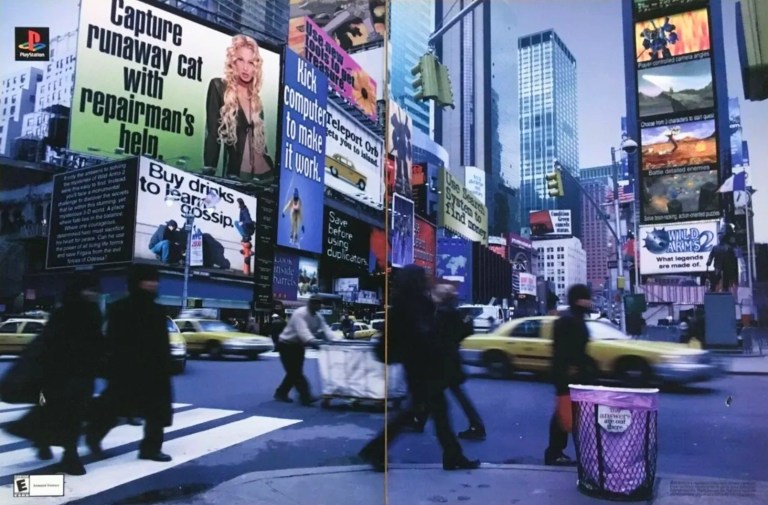
3. Wild Arms 2 print ad
This is NOT an effective way to promote a video game.
Now this is one of the most weird and the most uninteresting game print ads of the 1990s. For the newcomers reading this, Wild Arms 2 was a sequel to the 1997 hit game Wild Arms released on the original PlayStation console. Due to the 1997 game’s success, a fan base of Wild Arms was established and the 1999 sequel was anticipated by the fans. In a very odd and illogical move, Sony Computer Entertainment came up with the Times Square setting for Wild Arms 2’s North American print ad and because they allowed so much other text and images (appearing as billboard ads) on the buildings in the background, details about the game itself got overshadowed. By simply looking at this print ad, it is simply too easy to overlook Wild Arms 2 as the featured game. Can you see the references to Wild Arms 2 here?
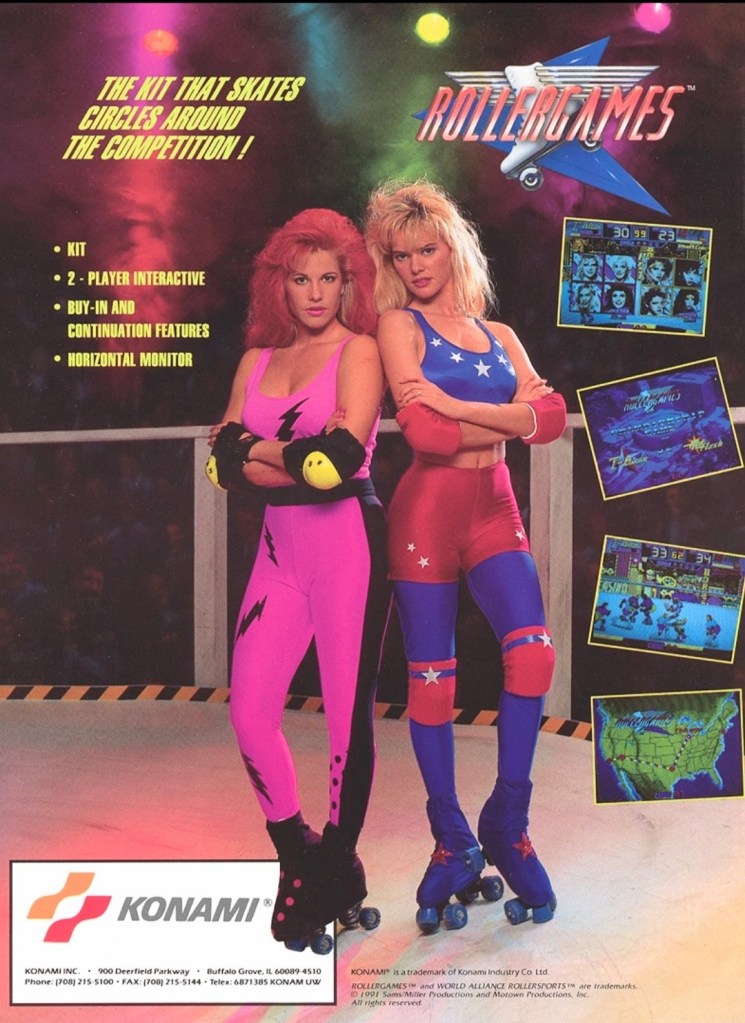
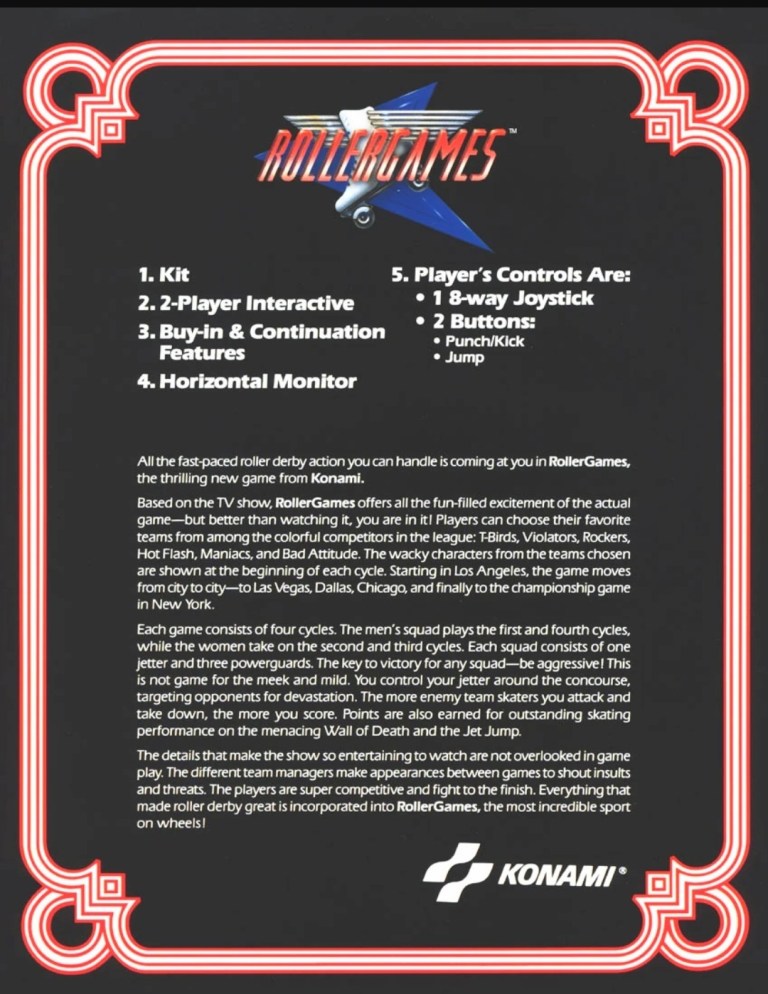
4. RollerGames arcade flyer
Pretty ladies posing on the front of the flyer.
Clearly the details were prepared with arcade operators in mind.
Based on the competition-oriented TV show, the RollerGames arcade game from Konami was both unique and fun to play. As with their other arcade flyers, Konami hired models to emphasize RollerGames’ core concept by appearing in full costume (as roller-skating participants), and then inserted screenshots of the game. The rear of the flyer had the technical details in simplistic fashion and they were clearly written with arcade operators in mind. The 3-paragraph text descriptions emphasized what players could expect, what options are available and how the game connects with the TV program it was based on.
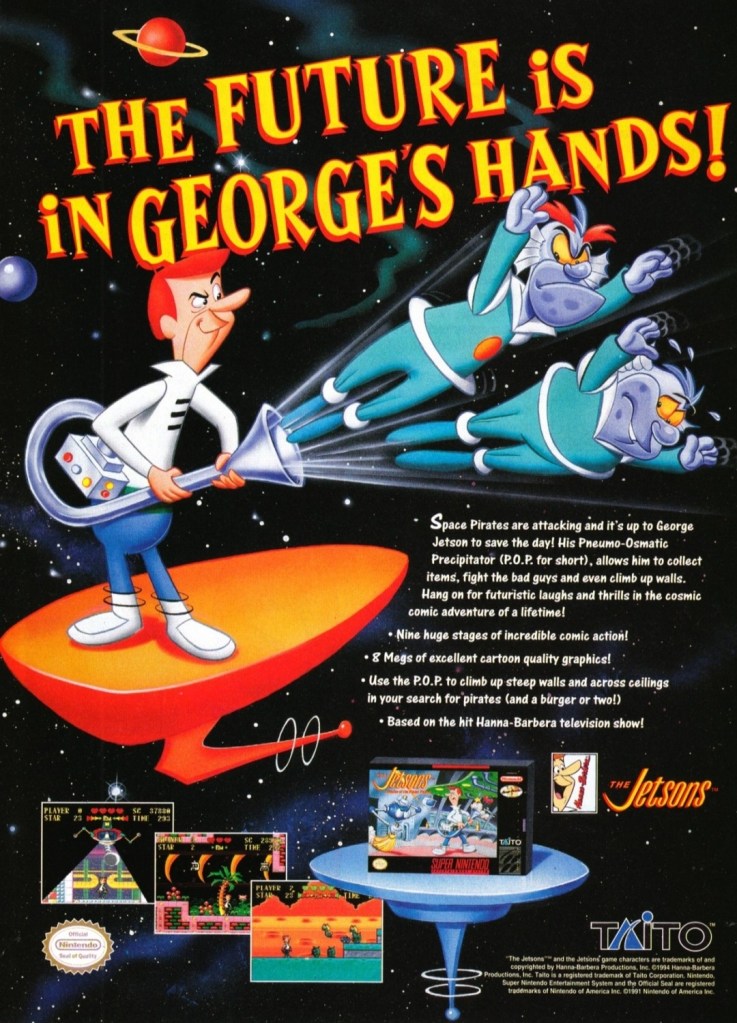
5. The Jetsons: Invasion of the Planet Pirates print ad
Anyone among you is a Jetsons fan?
Based on the animated series, The Jetsons: Invasion of the Planet Pirates was released on the Super Nintendo Entertainment System (SNES) in America as well as on the Super Famicom in Japan in the mid-1990s. This game’s print ad had eye-catching artwork, carefully laid down key details (including the promise of cartoon quality graphics) and showed a few screenshots. The game attracted mixed reviews from critics and I don’t know any fellow gamer who played it.
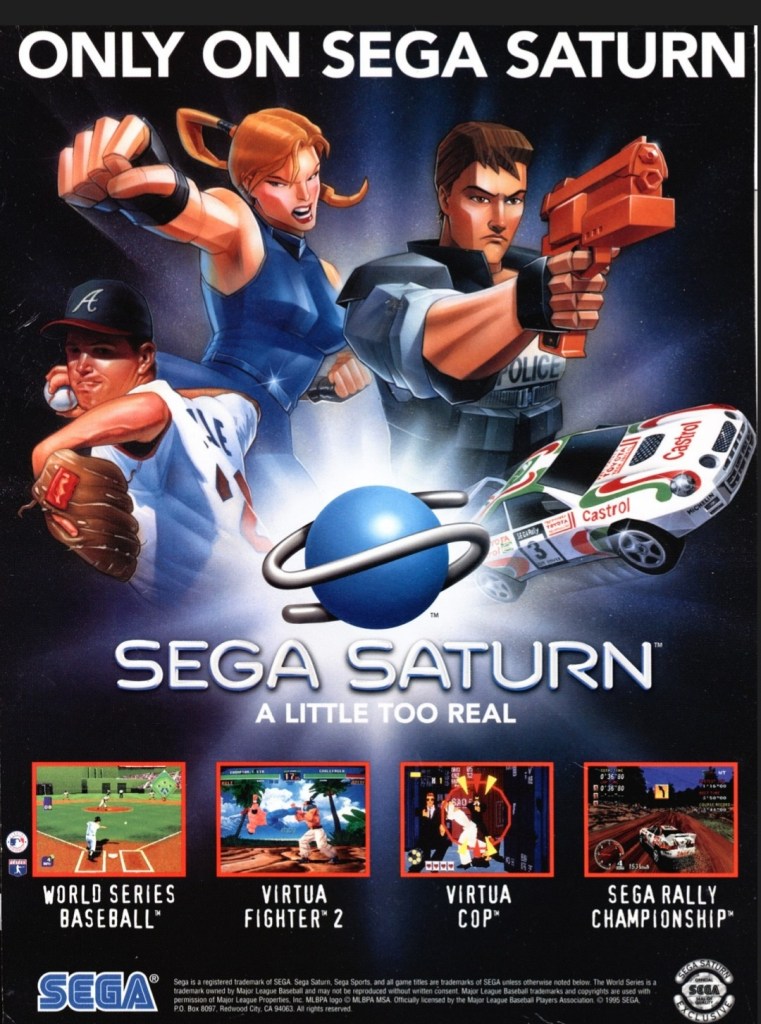
6. Sega Saturn games print ad
An aggressive single-page ad promoting the exclusive games on Sega Saturn.
If you are a game console manufacturer that also owns several game development teams, you really have to promote your hardware and software aggressively. This is exactly what Sega did in the North American market sometime after the embarrassing launch of the Saturn console there. As seen in this print ad, Sega aggressively promoted their Saturn-exclusive games – including their juggernaut Virtua Fighter 2 – to make it clear to their fans (and Saturn console owners) that they are focused to entertain them. The ad also served as Sega’s effort to lure in new gamers and potential Saturn owners given the fact that Virtua Fighter 2, Virtua Cop and Sega Rally Championship were already big arcade hits. As history turned out, the Saturn ended up a commercial disappointment in America but still succeeded in Japan.
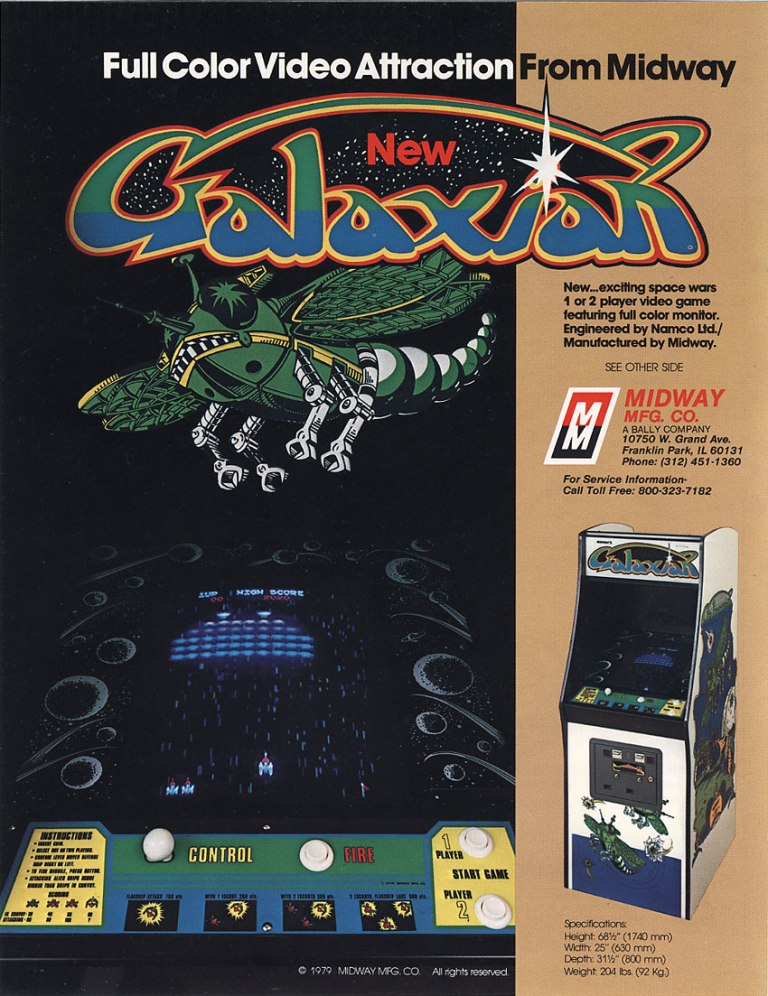
7. Galaxian arcade flyer
Have you ever played Galaxian in the arcades?
In September 1979, Namco released Galaxian in the arcades in Japan and it became a big hit there eventually finishing as the nation’s 2nd highest-earning arcade game of the year. Before the year even ended, Namco approached Midway of releasing Galaxian outside of Japan and this led to the game appearing in American arcades in November. Unsurprisingly, Galaxian drew lots of American players and their money which really helped Midway selling 50,000 arcade units in a few years’ time. This arcade flyer from Midway clearly showed what the Galaxian arcade unit looked like and how the controls were physically set up. I like the way the details and images were organized and how the limited page space was put to good use.
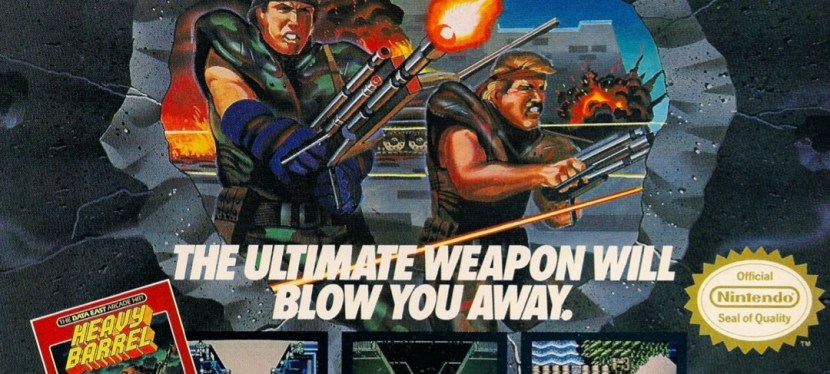
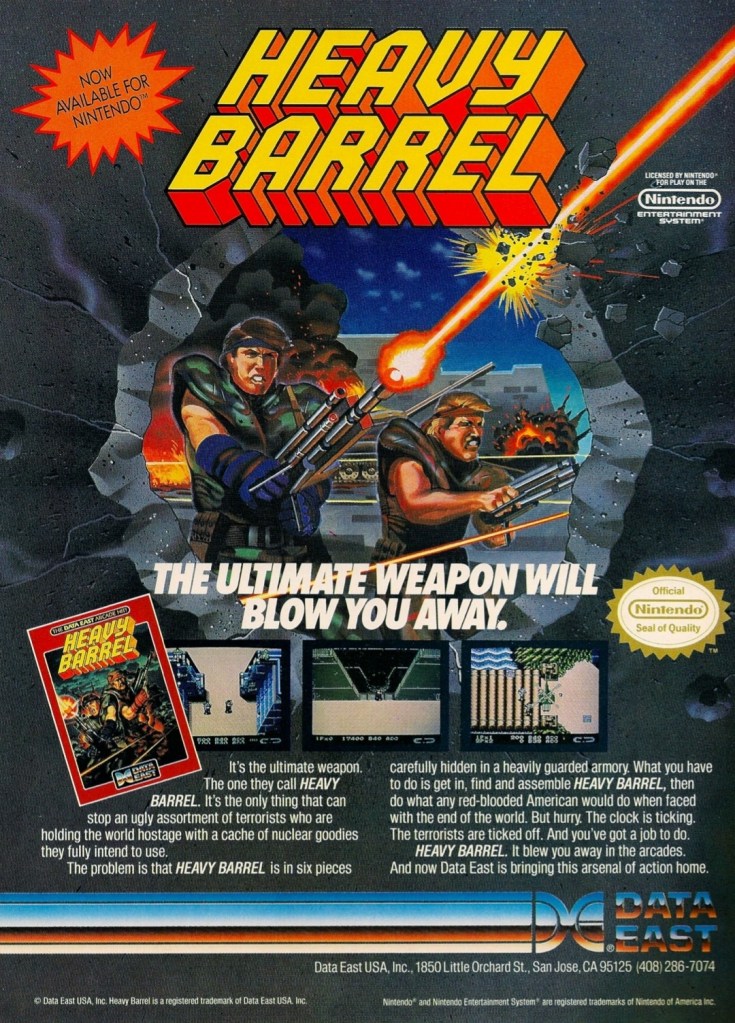
8. Heavy Barrel print ad
A really eye-catching and amusing print ad to look at.
Originally released in the arcades by Data East, Heavy Barrel was released on the Nintendo Entertainment System (NES) in 1990. Similar with Contra and Jackal, this game had a strong military theme and shooting-oriented gameplay complete with missions that instantly reminded players about war. The military aesthetic and the showing of guns are easily the most eye-catching part of this print ad geared towards the NES userbase which had lots of young children among the players. To say the least, Heavy Barrel’s print ad was entertaining to look at.
Welcome back, my readers, YouTube viewers and all others who followed this series of articles focused on YouTube videos worth watching. Have you been searching for something fun or interesting to watch on YouTube? Do you feel bored right now and you crave for something to see on the world’s most popular online video destination?
I recommend you check out the following topics and the related videos I found.
#1The miraculous rescue of hostages – In case you missed the news, the Israel Defense Forces (IDF) successfully rescued four Israeli hostages, fought with the Palestinian terrorists and brought the hostages home safely. This not some high-risk operation turned lucky. This operation was a blessing from the Lord God whose covenant with the Jewish people has always been true and standing to this day. All the praise, honor, thanks and glory to Him! Ignore the lies of the Islamo-Leftist mainstream news media and focus on the truth by watching the selected videos below…
#2 European Union (EU) elections resulted in the fall of the Satanic Left – Very recently, a series of elections took place in Europe which determined the composition of the European Union (EU) parliament. European voters who have grown sick and tired of the policies of the Satanic Left (examples: mass migration, taking care of illegal aliens at taxpayers’ expense, fascist climate change policies, government corruption) made their choices by electing more conservative and more nationalistic/patriotic candidates. In Italy, Prime Minister Giorgia Meloni saw her party gain power while the President of France had no choice but to dissolve French parliament (National Assembly) and call for a snap election. Watch and learn more from the videos below…
#3 Documentary of the Houston Rockets’ amazing 1995 NBA championship defense – Never underestimate the heart of a sports champion. That is the moral lesson behind the unbelievable successful NBA championship defense the Houston Rockets achieved in 1995. For the newcomers reading this, the Rockets won the title in 1994 but ended up ranking only 6th place on the Western Conference the following season. This meant that the Rockets had no home court advantage through the NBA Playoffs of 1995. How they defied expectations and overcame tough obstacles to win a 2nd straight NBA championship must be seen in the selected NBA documentary video. Enjoy!
#4 A very deep look back at Lost Odyssey – Lost Odyssey is not just a very notable video game released only on Xbox 360 many years ago. It was arguably the most defining, traditional Japanese role-playing game (JRPG) that can be best described as a Final Fantasy game without the name. To be clear, Lost Odyssey involved the combined talents of Japanese greats Hironobu Sakaguchi (Final Fantasy creator), Takehiko Inoue (famous manga artist) and Nobuo Uematsu (musician always know for Final Fantasy), and it was an ambitious JRPG that also happened to be an Xbox-exclusive game. If you wish to know more about Lost Odyssey, what it has in common with Final Fantasy games and why it remains a very notable game, watch the documentary below…
#5 PatmanQC’s Ring King retrospective – Retro gaming YouTuber PatmanQC published recently his retrospective video about the 1980s game Ring King (also titled as King of Boxer) which is fun and informative to watch.
#6 You, Me and the Movies’ The Blob (1958) reaction – Recently the 1958 version of The Blob was featured by You, Me and the Movies in a movie reaction video which is entertaining to watch.
#7 RK Outpost examines woke Star Wars – It is no secret that under the umbrella of the woke Disney company and the Lucasfilm leadership of Kathleen Kennedy, the established entertainment franchises of Star Wars and Indiana Jones got ruined. Sad to say, Star Wars continues to be made with extreme wokeness and rabid feminism, reaching the point of completely ruining the sci-fi franchise as we know it. Watch and learn from RK Outpost’s videos below…
#8 The evil of Palestinian terrorist group Hamas – It cannot be denied that Palestinian terrorist group Hamas is pure evil. So pure is their evil, they want nothing less than committing complete genocide against Israel and its people. To his day, pro-Palestine zealots cannot even tell the difference between good and evil, and right and wrong. For the Palestinians and its brainwashed supporters (all supported secretly by terrorist state Iran), terrorism, violence and murder are the only ways to achieve what they want. Watch and learn from the videos below…
#9 2024 Xbox Games Showcase videos – Following the lackluster Sony State of Play and Summer Game Fest, Team Xbox and its partners came out blazing with the 2024 Xbox Games Showcase recently. In my view, it was a big improvement over last year’s showcase (which itself was quite good) and there were highlights that should not be ignored. Posted below are selected videos for your viewing pleasure.
Welcome back Xbox fans, geeks and gamers! As I posted before, I enjoyed playing Senua’s Saga: Hellblade II on my Xbox Series X and eventually I managed finish it. It was indeed a short game (less than ten hours was my play time) and to my surprise, the levels were really linear (which made exploration very limited) and the puzzle-oriented challenges were less challenging compared to Hellblade: Senua’s Sacrifice.
What really impressed the most about Senua’s Saga: Hellblade II were the visuals which had high levels of photo-realism, really detailed facial expressions and astounding cinematic look. Developer Ninja Theory proved itself to be great in using Unreal Engine 5 (UE5) technology and fusing their artistry and all motion-captured performances onto their work.
Apart from solid game designers, Ninja Theory has great digital artists, technicians and very talented performers.
It would be a big shame for Microsoft to close down Ninja Theory. Such a move will destroy the credibility of Xbox.
While I enjoyed Senua’s Saga: Hellblade II and I can say it was worth the long wait, I don’t find the game replay-worthy at all. I don’t feel like wanting to repeat an entire playthrough with it right now. Perhaps in the next six months, I just might consider playing it all over again.
That being said, I really want Ninja Theory to prosper and keep on making more great games that will keep gamers entertained. I think it is also time for the Xbox studio to pause from the Senua franchise of games and start making something new that is also enjoyable to play.
What I’d like to see Ninja Theory make under the Xbox banner is a new action-adventure game that is less cinematic but more focused on large environments, platforming, deep exploration and having a new approach to action.
To understand what I’m saying, check out Ninja Theory’s past works on Heavenly Sword and Enslaved: Odyssey to the West. Watch the videos below…
Of course, there are other genres that Ninja Theory could daringly work on such as role-playing games (RPGs) much in the style of BioWare’s works specifically like Star Wars: Knights of the Old Republic (Star Wars KOTOR) and Jade Empire. They can also add their cinematic approach when making RPGs.
When it comes to zombie-oriented video games, the team behind the Senua games could make a Dead Rising-like game featuring open-world environments, varied missions and objectives, and emphasis on shooting and explosions with regards to action.
Another genre that I think Ninja Theory can challenge themselves with is turn-based tactics gaming. I believe that the Xbox first-party lineup of games is sorely lacking in this type of game. While XCOM already cornered the sci-fi realm of turn-based tactics, perhaps Ninja Theory could do a fantasy oriented game that plays well and carry the team’s cinematic touch.
The way things are right now, it remains to be seen what Ninja Theory could make next under Team Xbox and Microsoft. There is that thing called Project: Mara but there are no details as to what kind of game will turn out from that. I really want Ninja Theory to keep on making more fun-oriented games which would also feature their artistic approach that would really stand out.
Whether you like it or not, the future looks uncertain for Ninja Theory when it comes to what kind of games they will make next, and what creative direction they will take under the banners of Xbox and Microsoft.
Here is hoping Microsoft would not commit the error of closing down the team behind Senua games. I am watching your moves, Team Xbox and Microsoft.
Welcome back Xbox fans, geeks and gamers! It has been over a month since Eiyuden Chronicle: Hundred Heroes was launched on multiple platforms worldwide and like many other gamers who are currently subscribed to Xbox Game Pass (XGP), I downloaded it and played it a lot although there were a some technical setbacks that happened along the way.
For the newcomers reading this, Eiyuden Chronicle: Hundred Heroes is a brand new and stylized turn-based Japanese role-playing game (JRPG) developed by Rabbit & Bear studio which was led by the late Yoshitaka Murayama and involved the talents of notable creators who collectively worked on Konami’s Suikoden RPG series.
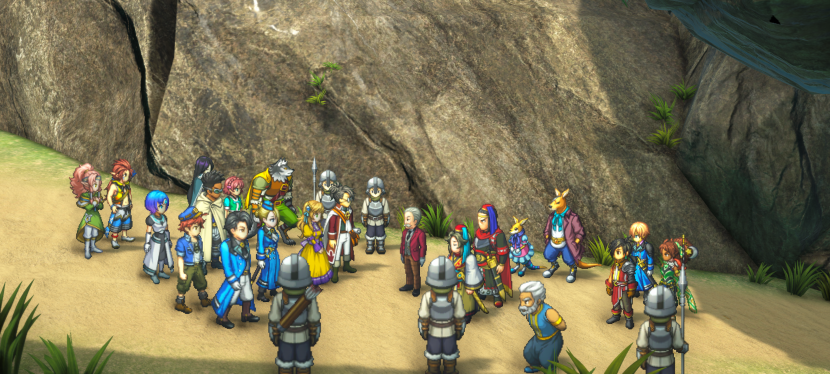
In-game world exploration is done with a 3D polygonal environment and your character is a 2D sprite.
A battle against a very large monster.
Eiyuden Chronicle: Hundred Heroes is a fantasy role-playing game that has a lot in common with the first two Suikoden RPGs in terms of fantasy concepts, gameplay, game design, mini-games, and the recruiting of many characters. Having finished Suikoden and Suikoden II on the PlayStation myself, I can clearly say that this new JRPG is technically a Suikoden game without the name.
As of this writing, I played Eiyuden Chronicle: Hundred Heroes for over 80 hours on my Xbox Series X console. While I am at the point of moving the story forward leading the army (led by the playable protagonist Nowa) in the struggle against the empire led by Dux Aldric (who reminds me a lot of Suikoden II’s Luca Blight), I have decided to focus first on side quests, resource collecting, the mini-games and recruiting more characters. This RPG was designed to allow players to have sufficient freedom to take on side activities on the side and explore the world for recruits and resources.
The cooking contest functions very much look those in Suikoden II.
Somehow General Elektra reminds me of Valeria in the first two Suikoden games.
While this is not a game review, I can say that I am enjoying Eiyuden Chronicle: Hundred Heroes with the way it was designed, how the story was written (lots of intrigue related to the in-game geopolitics which are balanced with fantasy quests), how the characters were presented and the assorted variety of gameplay content. It has been almost three years since this game (along with Rising) was first announced for Xbox Game Pass (click here and here) and considering the fun I had already, I can say the wait was worth it. The mini-games are, for the most part, fun to do and you can watch the short video clips from my progress in the game.
There were some technical setbacks along the way. Eiyuden Chronicle: Hundred Heroes did not run properly on my Xbox Series X resulting in the game crashing and even sudden console shutdowns. I got these console readings of “overheating” and “insufficient ventilation” with the game and these incidents happened only with it. As such, I had to open my Xbox, cleaned up the interior and removed as much dust as I could. Since then, the game developers patched the game but still it pushed my Xbox so hard, game crashing and sudden shutdowns still occurred from time to time. I also noticed there are certain locations within the game that resulted in the sudden acceleration of the Xbox Series X internal fan. Very clearly Rabbit & Bear’s technical support team still has a lot of work to do to meet customer satisfaction.
Each time you successfully recruit a new character, you will see this quick and flashy visual presentation.
Along the way, I observed that other games such as Resident Evil 4 remake, Shadow of the Tomb Raider, Assassin’s Creed: Valhalla, and the most recent release Senua’s Saga: Hellblade II respectively pushed my Xbox Series X to perform hard (with the internal fan run fast) but there were no game crashes and no sudden shutdowns at all. Only Eiyuden Chronicle: Hundred Heroes resulted in “overheating” and “insufficient ventilation” readings and disruptions.
Considering the hassles, I managed to get the fun and discoveries with Eiyuden Chronicle: Hundred Heroes on my Xbox. Here is hoping that the game developer will soon release another patch for Xbox Series X to make the game run well while consuming less power somehow. Given the fantastic presentation of the game, technical disruptions on Xbox Series X should not have happened at all.
There is so much to explore and discover in this game!
So what are you waiting for? If you are already a subscriber to Xbox Game Pass, you can download Eiyuden Chronicle: Hundred Heroes on your Xbox Series X, Xbox Series S, or the aging Xbox One. If you have extra money and want to support Rabbit & Bear studio, buying the digital copy of the game is the recommended option. For more information about the Suikoden-inspired JRPG, visit https://www.xbox.com/en-US/games/eiyuden-chronicle









 Author Carlo Carrasco