A Look Back at RoboCop 2 #3 (1990)

Welcome back superhero enthusiasts, 1990s arts and culture enthusiasts, Marvel Comics fans and comic book collectors! Today we go back to the year 1990 to take a close look at the concluding chapter of the comic book adaptation of the movie RoboCop 2 (1990).

In my previous retro review, I found the 2nd issue of the 3-part comic book adaptation mini-series that it lacked the impact of issue . It was understood that the comic book team was limited by the source material they had and the movie’s comedic scenes showing RoboCop not being his normal self were adapted. Those scenes did not translate into humorous comic book moments. At the very least, the build-up achieved by the comic book creators in issue (which includes several internal developments at Omni Consumer Products) sets the stage for the final issue.

With those details laid down, here is a look back at RoboCop 2 , published in 1990 by Marvel with a story written by Alan Grant and drawn by Mark Bagley based on the movie screenplay by Frank Miller and Walon Green.

The cover.

Early story

The story begins in Detroit where OCP executives press RoboCop (Officer Murphy) for answers about the spying he recently did on his ex-wife. It turns out that his wife was so traumatized over his death, there were therapists, hypnotists and other treatments involved to help her recover. As a result of the spying, his ex-wife now believes her husband is still alive. In response to questions, RoboCop gave answers that the OCP guys wanted – he is no longer a husband, no longer human, no longer Alex Murphy and he is simply a machine. The private meeting between him and his ex-wife did not go well.

Meanwhile, the City Government of Detroit organizes a telethon in an attempt to raise funds needed to pay off the $37,985,300 they owe OCP. The mayor receives a very important call from former associates of Cain (RoboCop 2).   

Shortly after, OCP realizes that the City Government could pay soon and if they fail to foreclose Detroit, their stock will plummet. With the approval from the corporation’s chief, Dr. Juliette Faxx proceeds to launch RoboCop 2 with the mind of Cain inside it…

Quality

The battle between RoboCop and his bigger rival (Cain) is action-packed and fun to read.

As it is clear that the imagery and plot developments of the movie screenplay were adapted by the comic book creators with their very own distinctive ways throughout the mini-series, this comic book succeeded in concluding its 3-part story. In fact, this is a huge pay-off to most of the build-up that took place in issues and . The much-awaited big battle between RoboCop and the Cain-controlled RoboCop 2 lasted eight pages and it was indeed action-packed and satisfying. Before the said battle took place, RoboCop 2’s debut is short, stylishly obscured visually and yet vicious to see.

Considering the huge amount of details the movie screenplay had, the Grant-Bagley duo managed to adapt the most relevant content efficiently while also telling a literary tale that is cohesive enough.

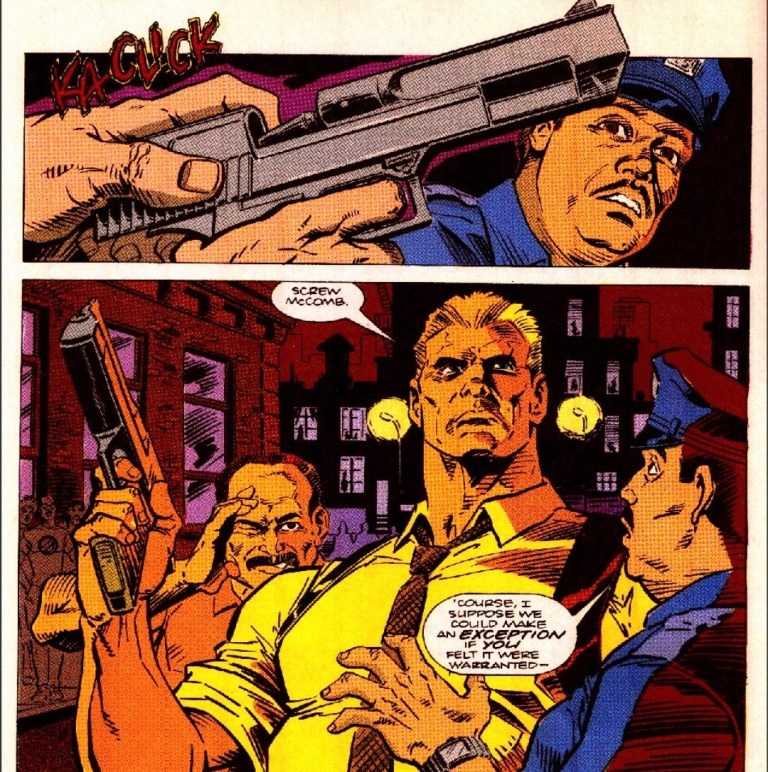
This scene did not appear in the movie.

What I found very notable is the fact that this comic book opened with RoboCop getting berated by OCP executives for his spying on his ex-wife. The said scene actually happened very early in the movie itself and to have it as an opener of this comic book added depth to RoboCop’s character development in this adaptation.

When it comes to weaknesses, there were times when Mark Bagley’s drawing of RoboCop 2 were off. RoboCop 2 was visually huge and intimidating in the movie but in this comic book, the size and scale were clearly lacking particularly in the shot where he is standing near OCP’s chief. The lack of visual details on RoboCop 2’s body showed signs of rush by the artist.

Conclusion

Is your local government leader making secret deals with criminals in real life?

RoboCop 2 (1990) is a nice pay-off to the build-up that preceded it and, more importantly, it was a satisfying mini-series conclusion. As a standalone comic book, it has a good amount of plot details, dialogue and action scenes that can delight RoboCop fans. As the conclusion of the 3-part adaptation of the 1990 movie, it has a stronger focus on RoboCop and the plot moved at a better pace than in issue . The storytelling is good and the spectacle was much improved.

Overall, RoboCop 2 (1990) is recommended.

+++++

Thank you for reading. If you find this article engaging, please click the like button below, share this article to others and also please consider making a donation to support my publishing. If you are looking for a copywriter to create content for your special project or business, check out my services and my portfolio. Feel free to contact me with a private message. Also please feel free to visit my Facebook page Author Carlo Carrasco and follow me on Twitter at  @HavenorFantasy as well as on Tumblr at https://carlocarrasco.tumblr.com/ and on Instagram at https://www.instagram.com/authorcarlocarrasco
A Look Back at Backlash #5 (1995)

Welcome back superhero enthusiasts, 1990s arts and culture enthusiasts, Image Comics fans and comic book collectors! Today we go back to the year 1995 to take a close look at one of the many tales of the original WildStorm universe through one of the comic books of the Backlash series.

For the newcomers reading this, Backlash is one of the major characters of the WildStorm universe which started in the early 1990s when the famous Jim Lee was one of the founding fathers of Image Comics. Backlash, Deathblow, Wetworks, Gen13 and WildCATS: Covert Action Teams were all connected with each other and many of the characters were linked together in the Team 7 series of prequel stories.

With those details laid down, here is a look back at Backlash , published in 1995 by Image Comics with a story written by Brett Booth, Jeff Mariotte and Sean Ruffner. Booth did the artworks.

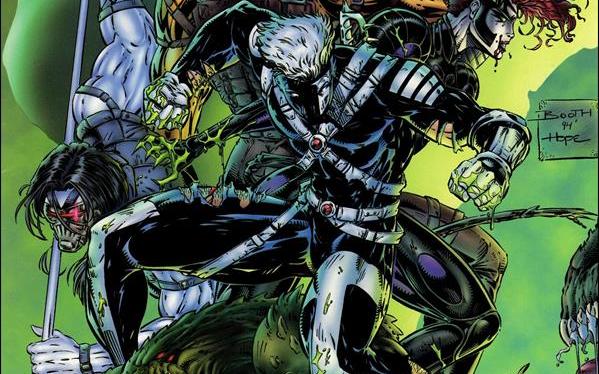
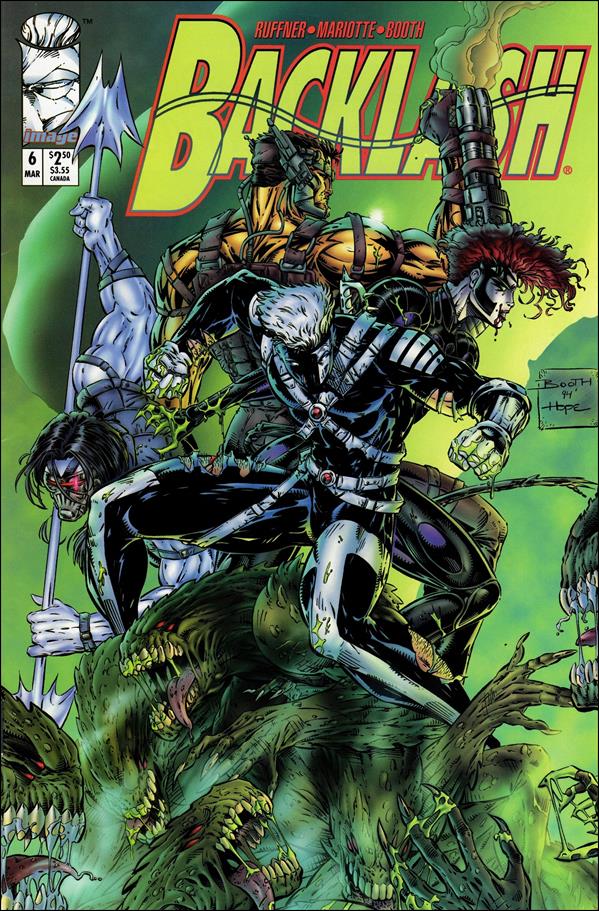
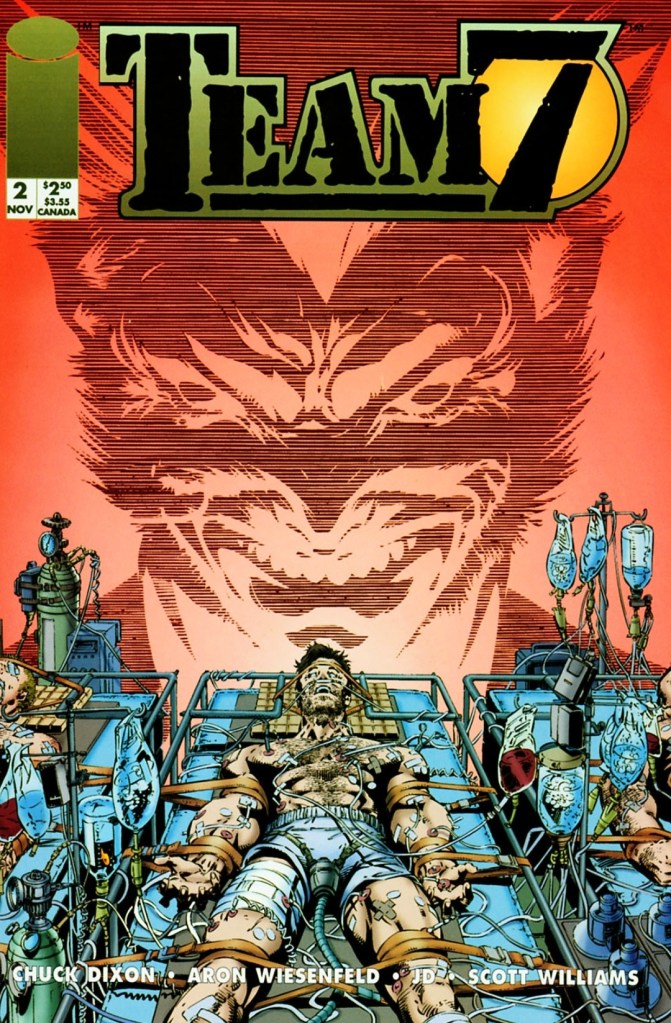
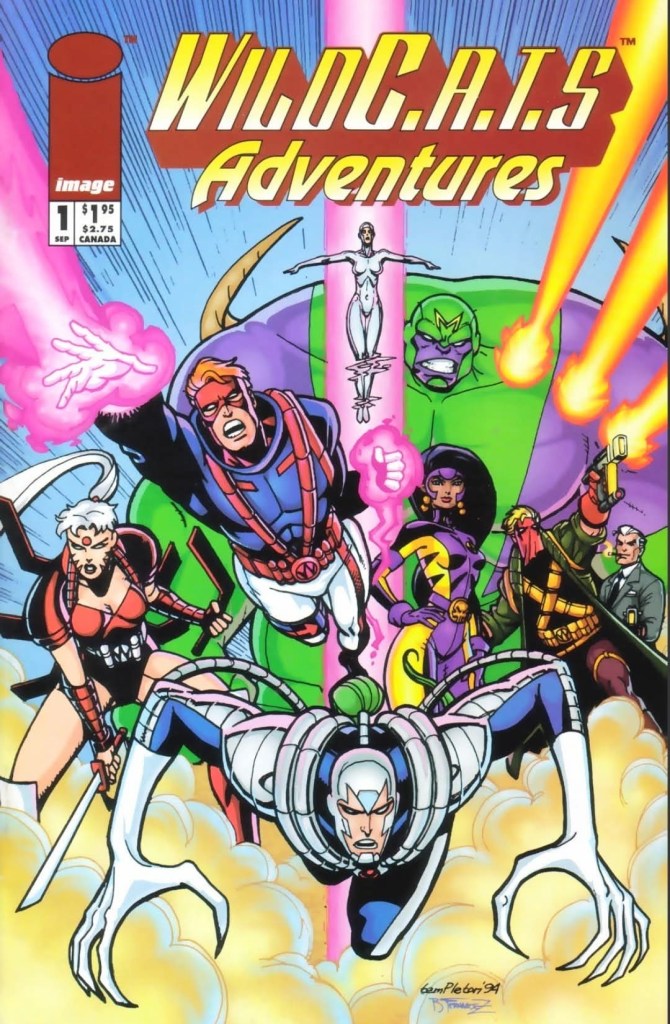
The cover.

Early story

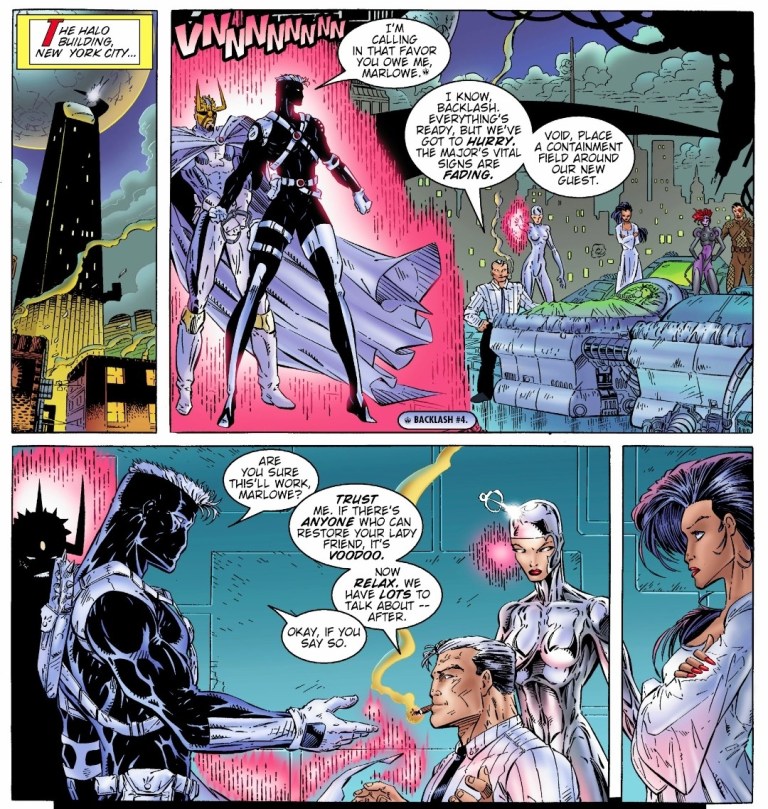
The story begins with Backlash having visions of his beloved Diane who eventually turns into a gruesome Daemonite monster. Suddenly his female companion Taboo appears to him only to betray him moments after.

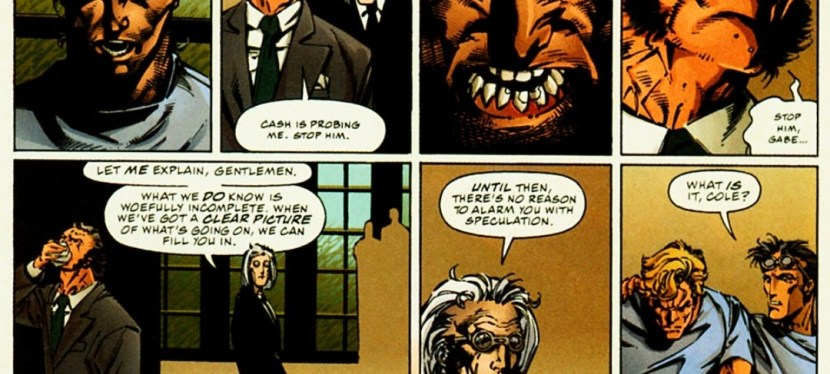
In the real world, it turns out that Backlash is helplessly restrained and connected to machines in the presence of Mindscape and his assistant Virtual Bob. Wetworks leader Jackson Dane and Taboo have been contained separately and could only watch Backlash agonizing. Backlash’s mind has been infiltrated by Mindscape through the use of virtual reality.

Mindscape has been looking for a living subjects who could become suitable for his project of combat droids which require genetic information from the subject. Even though he knows that having two live subjects would confuse the combat droids, Mindscape gives the order to have both Backlash and Dane together in cyberspace…

Quality

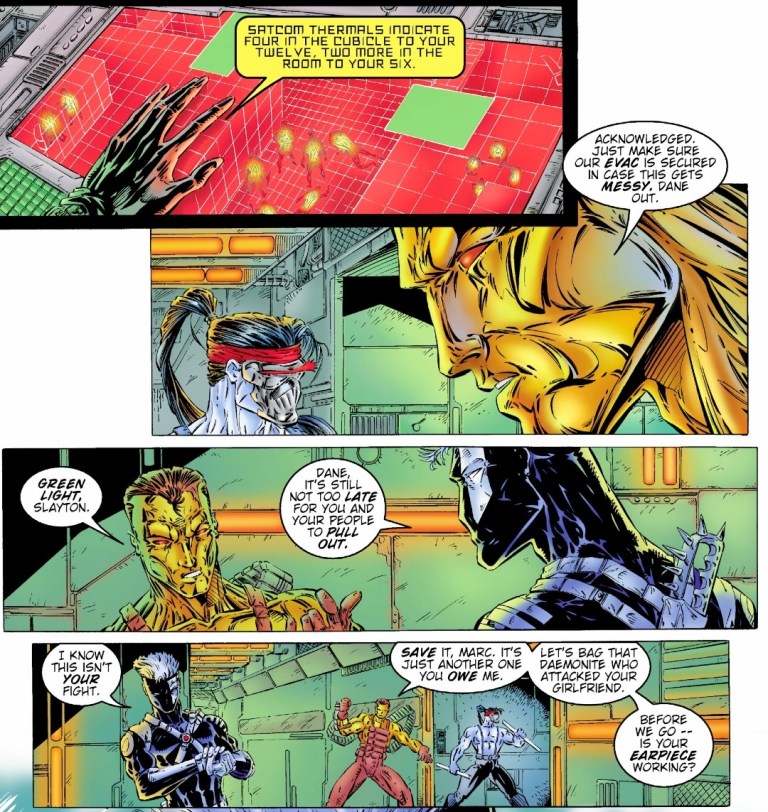
Backlash and Wetworks leader Dane face-off with Mindscape in cyberspace.

With its heavy emphasis on virtual reality and cyberspace, the creators temporarily changed their approach on storytelling and showing spectacle while managing to introduce a new villain and show more of the friendship of Backlash and Dane.

In my view, Mindscape is indeed a very interesting antagonist who is not the typical super villain who is simply being evil for the sake of it. In fact, Mindscape’s origin was efficiently told here and by the time I finished reading this comic book, I found him to be intriguing. Before he became the powerful villain here, Mindscape used to be a very talented virtual reality developer. Mindscape looks at Dane and Backlash – both of which have extensive military experience as they used to be teammates with Team 7 – not for the sake of murder but as suitable subjects for his combat drones which signifies his intention to build an army that will serve him in the real world.

As this story took place a short time after the reunion that happened late in issue #4, this comic book shows a bit more of the friendship between Backlash and Dane, revealing small details about their past together as specially trained soldiers. With the way the story here was told, there was too little room left for any character development to happen but the small details revealed about the two WildStorm heroes was enough to inspire me to revisit Team 7.

In relation to the story’s concept about virtual reality, the spectacle here is much different and absolutely wilder. You have to see it for yourselves.   

Conclusion

Being trapped and helpless, Taboo could only watch Mindscape and ask him questions.

Backlash (1995) is an entertaining and intriguing read. This comic book also served as a suitable break from the norm of showing Backlash fighting bad guys in the real world and infiltrating places to accomplish his objectives. Backlash and Dane here were portrayed to be vulnerable as their conflict with Mindscape happened in cyberspace. The final conflict was a spectacle to look at and the story’s ending was satisfying enough leaving the sense that Backlash and Dane would meet each other again.

Overall, Backlash (1995) is recommended.

+++++

Thank you for reading. If you find this article engaging, please click the like button below, share this article to others and also please consider making a donation to support my publishing. If you are looking for a copywriter to create content for your special project or business, check out my services and my portfolio. Feel free to contact me with a private message. Also please feel free to visit my Facebook page Author Carlo Carrasco and follow me on Twitter at  @HavenorFantasy as well as on Tumblr at https://carlocarrasco.tumblr.com/ and on Instagram at https://www.instagram.com/authorcarlocarrasco
A Look Back at Web of Spider-Man #31 (1987)

Welcome back superhero enthusiasts, 1980s culture enthusiasts and comic book collectors! Today we go back to the year 1987 to explore a part of the Marvel Comics shared universe through the Web of Spider-Man monthly series.

In this review, we will examine the opening chapter of one of the more significant storylines of the entire publishing history of Spider-Man… Kraven’s Last Hunt. Behind the scenes, writer J. M. DeMatteis came up with a concept about a limited series featuring the Marvel hero Wonder Man getting buried and returning from the grave. After getting rejected, the writer redeveloped his concept, proposed it to DC Comics (with Batman in mind), got rejected again and pitched the concept again to Marvel (with Spider-Man in mind) with a new villain who would really define the storyline. Marvel accepted the proposal and DeMatteis proceeded to write it while adding more Spider-Man elements to it. 

With those details laid down, here is a look back at Web of Spider-Man , published in 1987 by Marvel Comics with a story by J.M. DeMatteis and drawn by Mike Zeck.  

The cover.

Early story

The story begins with Kraven The Hunter moving and attacking like an animal interacting with life-sized figures of animals inside his castle. Afterwards, he slows down, gets a drink and walks into another large room that has an open coffin. He pulls out a black costume that carries the design of Spider-Man’s own costume. Kraven, who was a child when his parents arrived in America shortly after the overthrow of the Czar in Russia, is convinced that the world seem to have followed Russia’s sad example and he found dignity in the jungles instead of the cities. He found honor in the primal, not the civilized. He knows he will die soon and Spider-Man is the central part of his final pursuit in life.

Meanwhile in another part of New York City, Spider-Man discreetly attends the private gathering of several men in a bar who pay their last respects to the late Joe Face (a helpful friend of Spidey). As soon as he revealed himself, the men got scared of him and tension intensified. The webslinger pays his respect to Joe Face and puts several Dollar bills into the collection of funds.

Spider-Man then swings his way home…

Quality

As Spider-Man travels, Kraven the Hunter pursues him obsessively.

I want to state first that this Spider-Man tale has a dark and gritty presentation. The story feels really grounded with reality and it has an almost perfect atmosphere for the concept about Kraven getting ready to eliminate Spider-Man and do something very ambitious afterwards. The pacing of the storytelling moved at a medium pace and most notably, the build-up is really great to follow.

Without spoiling the plot, Kraven is truly the most featured character of this comic book as Spider-Man was written to be his moving target. DeMatteis invested a lot of creativity to build up Kraven not only as the definitive menace but also as a human being. Through the rich writing, Kraven is a man who developed and heavily prepared himself to achieve his goal. You will realize what he thinks about modern society, how he views life and why he is acting as if each day would be his last. As a villain, the evil of Kraven is very subtle yet he emerges as the deadliest foe of Spider-Man. This is truly a major development of the hunter when compared to his first-ever appearance in Amazing Spider-Man (1964).

Through the views of Kraven, you will realize his own perception of Spider-Man which is intriguing to read as we readers know the webslinger’s true identity while the obsessed hunter does not. In relation to his obsession with Spider-Man, Kraven truly immerses himself with what he knows  and does things that all other people would never do. I should also state that the hunter’s intense preparation has strong parallels with Batman’s approach on preparing himself for a major encounter.

As mentioned earlier, the webslinger is the target. Spider-Man appears as a disturbed and vulnerable figure and there is nothing that his powers can do to help him overcome his problems. As the build-up grows, the troubles of Spider-Man intensified which made the reading experience captivating.

Conclusion

People getting spooked by Spider-Man’s sudden appearance.

Web of Spider-Man (1987) is truly a great read and it is also a very powerful opening of its storyline. By having Kraven as the definitive character and Spider-Man as the target, this comic book really subverted expectations backed with powerful writing by DeMatteis. Along the way, Mike Zeck’s artworks truly captured the dark and gritty tone of the script and this resulted in a very captivating visual presentation.

Overall, Web of Spider-Man (1987) is highly recommended.

+++++

Thank you for reading. If you find this article engaging, please click the like button below, share this article to others and also please consider making a donation to support my publishing. If you are looking for a copywriter to create content for your special project or business, check out my services and my portfolio. Feel free to contact me with a private message. Also please feel free to visit my Facebook page Author Carlo Carrasco and follow me on Twitter at  @HavenorFantasy as well as on Tumblr at https://carlocarrasco.tumblr.com/ and on Instagram at https://www.instagram.com/authorcarlocarrasco
A Look Back at Action Comics #456 (1976)

Welcome back superhero enthusiasts, 1970s arts and culture enthusiasts, DC Comics fans and comic book collectors! Today we go back to the year 1976 to take a close look at a part of the DC Comics universe through a tale of the Action Comics monthly series.

If you know your entertainment history, you should be aware that Steven Spielberg’s Jaws made a tremendous impact on millions of people who saw the film in cinemas in the mid-1970s. The massive success of the movie caused some people to become afraid of sharks which in turn convinced them to avoid swimming alone at sea. Over at DC Comics, it just so happens that they have a super villain who is actually a highly evolved shark called The Shark (Karshon).

With those details laid down, here is a look back at Action Comics , published in 1976 by DC Comics with a story written by Cary Bates and illustrated by Curt Swan.

The cover inspired by Steven Spielberg’s Jaws.

Early story

The story begins inside the Metropolis Aquarium where Captain Strong, young boy Jayson, young girl Jill and others closely watch a tiger shark swimming. What the viewers do not realize is that the tiger shark they are watching is a super shark (The Shark) whose evolution jumped by eons as a result of a freak nuclear accident from the previous years.

The Shark is a highly evolved mutant (half-fish and half-human) endowed with fantastic mental powers. The Shark previously encountered Green Lantern (Hal Jordan) who caused him to devolve back to his primitive form as a tiger shark.

At the aquarium, The Shark moves closely towards Captain Strong and Jayson with strong glass separating them. Suddenly, Jayson is turned into a pool of jelly on the floor and The Shark uses its power to form a large stream of water to break the way out of the Metropolis Aquarium and into the air.

Meanwhile, Lois Lane and Clark Kent are riding the metro-island ferry. A giant water sprout emerges near them…  

Quality

The struggle between Superman and The Shark starts.

While it was clear that DC Comics took a creative stab on people’s awareness of the movie Jaws, the Bates-Swan duo came up with a rather fantastic way of having Superman deal with The Shark. For one thing, the creators efficiently came up with exposition to keep readers informed about who The Shark is, why he exists and what his background was within the DC Comics shared universe. Next, the creators managed to make The Shark an actual threat to the people of Metropolis which serves as an efficient build-up for the inevitable conflict with Superman. The good news here is that Bates-Swan combined efforts turned out to be gripping and believable.

When compared to the many battles Superman had against the other powerful villains, the traditional collateral damage is pretty light in this story. This is because the creators used science fiction concepts and a little bit of real-world science to explain The Shark’s powers, how the water streams used by him got formed and why he has key advantages over Superman. These creative methods more than made up for the lack of hard action and there are explanations that made sense just before the story ends.

This comic book also contains a short, standalone Black Canary tale that ultimate served as added amusement that is not related with the Superman story at all. It should interest fans of Green Arrow.

Conclusion

The Shark’s menacing face and power overwhelms Lois Lane.

Do not let the Jaws-inspired cover art fool you. Action Comics (1976) is actually an entertaining read thanks to the combined efforts of the Bates-Swan team. The Shark was a believable threat and the story was well written. To say that this comic book was just a cheap way of exploiting the popularity of Jaws by coming up with shark-related tale of Superman is not true. This old tale is a fun ride free from the politicized science and woke garbage that dominate modern-day entertainment.

Overall, Action Comics (1976) is recommended.

+++++

Thank you for reading. If you find this article engaging, please click the like button below, share this article to others and also please consider making a donation to support my publishing. If you are looking for a copywriter to create content for your special project or business, check out my services and my portfolio. Feel free to contact me with a private message. Also please feel free to visit my Facebook page Author Carlo Carrasco and follow me on Twitter at  @HavenorFantasy as well as on Tumblr at https://carlocarrasco.tumblr.com/ and on Instagram at https://www.instagram.com/authorcarlocarrasco
A Look Back at Universal Soldier #1 (1992)

Welcome back comic book readers, 1990s arts and culture enthusiasts, movie fans and comic book collectors! Today we go back to the year 1992 to take a close look at the official comic book adaptation of the action movie Universal Soldier.

Universal Soldier stood out among Hollywood action films in 1992 as it had Jean-Claude Van Damme and Dolph Lundgren as the main stars and both of them were established action movie stars each with huge followings of fans. As it grossed almost $100 million worldwide on a budget of less than $25 million, the movie was successful and eventually sparked its of franchise of movies, TV shows, video games and comic books. NOW Comics was in-charge of making and publishing the comic book adaptation of the 1992 film.  

With those details laid down, here is a look back at Universal Soldier published in 1992 by NOW Comics with a story written by Clint McElroy and drawn by Lenin Delsol. This was the first chapter of a 3-issue mini-series.

The cover showing a photographic image of star Dolph Lundgren.

Early story

The story begins in Vietnam in 1969. The American soldier Luc Deveraux arrives at a village that was secured by the U.S. Army. To his shock, he finds several dead bodies of his squad members and villagers, then encounters Sergeant Andrew Scott with two Vietnamese individuals (male and female) tied together near him. It turns out that Scott, who made a necklace composed of severed ears, has gone insane and executes the Vietnamese man. As Deveraux refuses to follow Scott’s order to shoot the Vietnamese female, the sergeant kills he. Deveraux and Scott shot each other to death and eventually their corpses were recovered by another squad to be cryogenically frozen.

A few decades later in Nevada, the elite counter-terrorism unit of the UniSol (Universal Soldier) arrives and among the members are Deveraux (identified as GR44) and Scott (GR13) who have been reanimated by the government with their past memories fully suppressed. Their team gets deployed to the Hoover Dam (Mackinley Dam in the comic book) to resolve a hostage situation…

Quality

Operating very much like robots, two Universal Soldiers take down terrorists and manipulated their communication as they make their way through to save the hostages from the remaining terrorists.

As an adaptation, I find this comic book a surprisingly accurate translation of the movie’s early part of the story (note: the literary narrative ends when Deveraux leaves with the female reporter). While not 100% of the film’s plot and visual details were captured, this comic book still succeeded in replicating the look, feel and tone of the movie. It is clear that the comic book team had access to the footage of the film and a copy of the screenplay (written by Richard Rothstein, Christopher Leitch and Dean Devlin).

Clint McElroy really stuck close to the film’s plot, the dialogue and the way the characters were portrayed. Again, not 100% of the relevant details were adapted and some liberties were taken but McElroy managed to craft a comic book narrative that was solidly structured, had sufficient details to keep readers oriented and engaged, and ensured the story moved at a satisfying pace. By the time I reached the end of this comic book, I got oriented with the story, the characters and the details shown in between.

Like in the movie, this comic book emphasizes the government’s very cold and heartless approach on handling their Universal Soldiers who are treated more like tools instead of people.

Lenin Delsol’s artwork here is really good. It is clear that he had access to the film’s production footage as several images of locations and characters here very closely resembled what was shown in the movie most of the time. When it comes to the action scenes, Delsol did not go for visual dynamism (note: the dynamic action style was common with superhero comics of the 1990s) but rather he portrayed the action with realism and varying degrees of brutality.

When it comes to visualizing the characters, it is clear that the creative team was not authorized to use the likenesses of the actors. Luc Deveraux looks absolutely nothing like Jean-Claude Van Damme while journalist Veronica Roberts does not look like Ally Walker. Ironically, there are a few images of Scott’s face that somewhat resembles Dolph Lundgren. The way I see it, it is not problematic to see the characters not resembling the actors from the film. In fact, I like the new character designs Delsol came up with for the characters.

Conclusion

This early scene sets the tone of the entire comic book. As for the characters, Deveraux look nothing like Jean-Claude Van Damme and Sergeant Scott does not look like Dolph Lundgren (note: in other images of Scott shown later in the comic book, he looked a bit like the actor).

Even though I was not a fan of the 1992 movie, Universal Soldier (1992) succeeded in keeping me engaged and entertained until the end. This is a really good adaptation of the early part of the film and I like the approach the Elroy-Densol team took on establishing the literary experience. Of course, if you want more dynamic visuals of the Hoover Dam scene or if you want that strong rated-R vibe when it comes to hard action, you should watch the movie. As of now, I am convinced to look forward to the next issue of this 3-part mini-series adaptation.

Overall, Universal Soldier (1992) is recommended.

+++++

Thank you for reading. If you find this article engaging, please click the like button below, share this article to others and also please consider making a donation to support my publishing. If you are looking for a copywriter to create content for your special project or business, check out my services and my portfolio. Feel free to contact me with a private message. Also please feel free to visit my Facebook page Author Carlo Carrasco and follow me on Twitter at  @HavenorFantasy as well as on Tumblr at https://carlocarrasco.tumblr.com/ and on Instagram at https://www.instagram.com/authorcarlocarrasco
A Look Back at What If #62 (1994)

Welcome back superhero enthusiasts, 1990s arts and culture enthusiasts, Marvel Comics fans and comic book collectors! Today we go back to the year 1994 to examine an alternate story of the Marvel Comics shared universe chronicled through the What If monthly series.

There is a lot to be said about the origin of Wolverine. There was the tale of his Canadian origin and being born with claws inside him. There was also the tale of him encountering the Hulk in Canada. And there was also the famous storyline Weapon X (written and drawn by Barry Windsor-Smith in Marvel Comics Presents to ).

With those details laid down, here is a look back at What If , published in 1994 by Marvel Comics with a story written by Kurt Busiek and drawn by Ron Randall.

The cover.

Early story

The story begins in the when Logan (Wolverine) encounters armed men who try to overwhelm him. Logan easily knocks most of them out and leaves them behind by car. It turns out the armed men are agents of a secret organization called Weapon X which has been targeting Logan for their series of unethical experiments on abducted humans (the Weapon X Project).

The organization is already dealing with problems regarding their live experiments. One living subject (with adamantium claws on his arms and some machinery on his head and shoulders) became a murderous berserker who cannot be reasoned with anymore. The subject is former Mounted Police Officer and Marine Guy Desjardins and Weapon X dropped him off at Department H.

James Hudson of The Flight took him in and officially refers to him as “Weapon X”. The live subject eventually broke loose, killed Dr. Langkowski and went to Kenora where he starts a killing spree…

Quality

Logan arrives at the scene where the Weapon X biological experiment killed several people.

I want to point out that Kurt Busiek came up with the very believable portrayal Logan who is not Wolverine, not a member of the X-Men and not even the violent fighter in the plot. This is a story about a major scientific experiment of Weapon X that went terrible wrong resulting in their living subject (with adamantium claws and other features identified with Wolverine in the mainstream Marvel universe storyline of Weapon X) going way beyond their controller and impacting Canadian society negatively. The good news here is that the story by Busiek is very well written and nicely structured.

In his civilian form as Logan, Wolverine (as we often identify him) is not the fierce slasher he is often known as. Rather he is a former tool of the Canadian government who previously resigned and decides to get involved in response to the rampage caused by the Weapon X killing machine (Desjardins).

As Logan is no slasher (note: Wolverine #75’s big revelation about Logan’s claws had no influence on this comic book’s concept), he fights with guns and a knife backed with his extensive experience in grounded combat. In relation to this comic book’s concept, you will a captivating portrayal of Logan who is truly unconnected with the X-Men and there are certain character moments that you really have to read.

Along the way, Kurt Busiek’s story not only dramatizes the classic trope about man tampering with nature but also the potential scandal of Canada’s government having top secret unethical science experiments while developing their own superhero project in the form of The Flight. Back to Wolverine, the story pounced on the conflict between being human and being animalistic with sheer believability.

With regards to the artwork, Ron Randall exerted effort to recapture some of the aesthetics of Barry Windosor-Smith’s work on the Weapon X storyline of the Marvel Comics Presents comic books. As required by the script, the visual display of action is brutal to look yet does not go over the top (with regards to graphic violence) as the creators implemented restraint restraint on the display of blood and killing blows.  

Conclusion

A new Weapon X biological experiment gone wrong.

What If (1994) is truly a great alternative tale to the established Weapon X storyline and it is also one of the more engaging portrayals of Wolverine unconnected with the X-Men. You will see Logan being more grounded with reality and you will also witness how he sees himself as a Canadian citizen who actually gets involved again with the government which he previously served. This a really compelling work by the Busiek-Randall duo.

Overall, What If (1994) is highly recommended.

+++++

Thank you for reading. If you find this article engaging, please click the like button below, share this article to others and also please consider making a donation to support my publishing. If you are looking for a copywriter to create content for your special project or business, check out my services and my portfolio. Feel free to contact me with a private message. Also please feel free to visit my Facebook page Author Carlo Carrasco and follow me on Twitter at  @HavenorFantasy as well as on Tumblr at https://carlocarrasco.tumblr.com/ and on Instagram at https://www.instagram.com/authorcarlocarrasco
A Look Back at Spectacular Spider-Man #87 (1984)

Welcome back superhero enthusiasts, 1980s arts and culture enthusiasts, Marvel Comics fans and comic book collectors! Today we go back to the year 1984 to examine a small part of the Marvel Comics shared universe through a tale of the Spectacular Spider-Man monthly series.

For this particular review, we will explore a major development in the life of the iconic Spider-Man that was told outside of the Amazing Spider-Man series.  

With those details laid down, here is a look back at Spectacular Spider-Man , published in 1984 by Marvel Comics with a story written by Bill Mantlo and drawn by Al Milgrom.

The cover.

Early story

The story begins in New York City as Spider-Man and Black Cat (his romantic partner at the time) spend quality time together. Spider-Man tells her that it is time him to show her where he lives. Together, they swing across the city and even played along a few times.

They finally arrive at the rooftop of the building where Peter Parker (Spider-Man) lives and enter via the skylight. Black Cat is shocked to see how cheap the quality of the apartment is and asks him how can a famous hero like him live in such a place.

Spider-Man begins explaining that as a civilian he works as a photo journalist and he did not become a hero to be prosperous. As he keeps on revealing threads of his past, he slowly makes his move to reveal his secret identity to Black Cat…

Quality

The relationship of Spider-Man and Black Cat develops even more.

As the cover art revealed, this tale authored by Bill Mantlo is about Spider-Man revealing his secret identity to Black Cat who was his romantic partner at this point in Marvel Comics shared universe history. The revelation served as a key turning point in the life of the iconic webslinger as well as Peter Parker’s personal handling of his interactions with the women he loved. Mantlo’s writing of the dialogue between Spidey and Black Cat is really rich and there is also this sentimental touch with how the writer handled the hero’s emotions, especially with regards to the lady’s loving him more as the costumed hero than the civilian he is. I should also state that the impact of knowing Spider-Man’s true identity has subtle emotional effects on the part of Black Cat which must be seen.

While the cover showed what happened, this comic book is still worth reading because the creative duo of Mantlo and Milgrom carefully crafted scenes that gradually led to the big revelation backed with flashbacks of Peter Parker’s private life (as portrayed in Amazing Fantasy ) and the build-up from his past romances with Black Cat. The pacing is very good and the pay-off to the build-up was worth every moment.

The conflict with the city thugs that took place near the end of the tale served as an additive to the new development of Black Cat and Spidey’s relationship.

Conclusion

Black Cat’s first-ever visit at Spider-Man residence.

Spectacular Spider-Man (1984) is a very worthy read and the creators made daring moves to move the romantic link between Spider-Man and Black Cat forward while adding variety into Peter Parker’s personality. This is a character-driven story that must be read from start to finish.

Overall, Spectacular Spider-Man (1984) is highly recommended.

+++++

Thank you for reading. If you find this article engaging, please click the like button below, share this article to others and also please consider making a donation to support my publishing. If you are looking for a copywriter to create content for your special project or business, check out my services and my portfolio. Feel free to contact me with a private message. Also please feel free to visit my Facebook page Author Carlo Carrasco and follow me on Twitter at  @HavenorFantasy as well as on Tumblr at https://carlocarrasco.tumblr.com/ and on Instagram at https://www.instagram.com/authorcarlocarrasco
A Look Back at Amazing Spider-Man #320 (1989)

Welcome back superhero enthusiasts, 1980s arts and culture enthusiasts, Marvel Comics fans and comic book collectors! Today we go back to the year 1985 to examine a small part of the Marvel Comics shared universe through a tale of the Amazing Spider-Man monthly series.

For this particular review, we will explore the first chapter of The Assassin Nation Plot storyline that took place within the Amazing Spider-Man series.  

With those details laid down, here is a look back at Amazing Spider-Man , published in 1989 by Marvel Comics with a story written by David Michelinie and drawn by Todd McFarlane.

The cover.

Early story

The story begins inside Empire State University where Peter Parker – working as an assistant in the science lab – takes advantage of the free time and resources to create web fluid using a new formula. He notices that the acetylene torch does not even leave a smudge on the new web he made.

To his surprise, his boss doctor Evan Sloan catches him doing an interesting experiment. Parker comes up with a convincing excuse for the experiment which spares him from getting into trouble. After promising doctor Sloan he will get on the neutron project first thing in the morning of Thursday, Parker leaves, secretly changes into Spider-Man and equipped his brand new web. He then leaves the university and moves deep into the city…

Quality

Peter Parker and Mary Jane having a discussion.

I really like the story David Micheline came up with as the start of The Assassin Nation Plot storyline. This is clearly not your typical good-versus-evil superhero tale starring the webslinger. Instead, there are layers of secrecy, suspense and intrigue that involves a powerful private organization, private armies and diplomats.

Instead of facing off with super villains, Spider-Man finds himself in the middle of something very big brewing behind the scenes, and that puts him in deep danger. That being said, Michelinie’s approach on building up the details of the plot moved very smoothly and the payoff for each buildup was executed on a timely manner. The buildup of details was never boring nor too slow to absorb, and Todd McFarlane excelled with visualizing the plot while still delivering dynamic superhero action.

I should mention that the character Paladin has a strong presence in the story and there were moments when he outweighed Spider-Man in terms of importance.

Conclusion

Spider-Man and Paladin targeted by armed guards.

Amazing Spider-Man (1989) is indeed a very solid story to read and a powerful start of The Assassin Nation Plot storyline. With the way the core concept was presented, this comic book symbolically showed that there are high stakes and other matters that are clearly too overwhelming for Spider-Man to deal with. The story is nicely paced and the creative team knew when and how to execute worthy payoffs for each buildup. By the time I reached the end of the comic book, I became convinced to read the next chapter of this storyline.

Overall, Amazing Spider-Man (1989) is highly recommended.

+++++

Thank you for reading. If you find this article engaging, please click the like button below, share this article to others and also please consider making a donation to support my publishing. If you are looking for a copywriter to create content for your special project or business, check out my services and my portfolio. Feel free to contact me with a private message. Also please feel free to visit my Facebook page Author Carlo Carrasco and follow me on Twitter at  @HavenorFantasy as well as on Tumblr at https://carlocarrasco.tumblr.com/ and on Instagram at https://www.instagram.com/authorcarlocarrasco
A Look Back at Amazing Spider-Man #259 (1984)

Welcome back superhero enthusiasts, 1980s arts and culture enthusiasts, Marvel Comics fans and comic book collectors! Today we go back to the year 1984 to examine a small part of the Marvel Comics universe through a tale of the Amazing Spider-Man monthly series.

In my previous retro review, additional stress in Peter Parker’s life was realized when Mary Jane revealed to him that she knows he and Spider-Man are one and the same. Some time later when things calmed down, Spider-Man went to the headquarters of the Fantastic Four eventually finding out the shocking truth about the alien costume he has been wearing since the events of Secret Wars.

With those details laid down, here is a look back at Amazing Spider-Man , published in 1984 by Marvel Comics with a story written by Tom DeFalco, and drawn by Ron Frenz.

The cover.

Early story

The story begins in New York City where Peter Parker and Mary Jane casually spend time walking within a large park. Knowing that Peter is already feeling uneasy about her knowing his secret identity as Spider-Man, Mary Jane reveals to him stories of her past and the domestic challenges that she, her sister and their parents went through.

Elsewhere in the city, the Hobgoblin makes his moves expressing his intention to engage with the business side of crime…

Quality

Mary Jane Watson and Peter Parker spending a lot of quality time together at the park.

When it comes to developing a supporting character with sheer depth, this comic book really stands out as Spider-Man literally got pushed to the side. The main story here focuses closely on Mary Jane whose experiences with her family from the past got dramatized big time. You will see flashbacks of her youth, her closeness with her sister and mother, and tension she went through when her father became stressed and resentful. The DeFalco-Frenz duo really set up the blocks of past developments that built up Mary Jane’s personality and her portrayal here is clearly a major character turning point in Spider-Man’s corner of the Marvel Comics shared universe of the time.

As for her relationship with Peter Parker/Spider-Man, Mary Jane here is less of a romantic partner and more of a friend looking for a shoulder to cry on. While it is a fact that several comic books in the 1970s showed Mary Jane and Peter romantically linked, her portrayal in this comic book marked a major turning point of her personal development and her destiny with the webslinger. The writing by DeFalco here is very rich with drama and believability.

Conclusion

Flashbacks from Mary Jane’s past with her family.

Amazing Spider-Man (1984) is still significant to read after all these decades. Mary Jane, who eventually got married to Peter Parker, has been redefined very heavily in this tale and she eventually became one of the most essential Spider-Man-related characters in the years that followed. Looking back at this old story (which happened shortly after Spider-Man separated from the alien costume), it was clear that Marvel Comics decided Mary Jane would be the definitive leading lady of Spider-Man.

Overall, Amazing Spider-Man (1984) is highly recommended.

+++++

Thank you for reading. If you find this article engaging, please click the like button below, share this article to others and also please consider making a donation to support my publishing. If you are looking for a copywriter to create content for your special project or business, check out my services and my portfolio. Feel free to contact me with a private message. Also please feel free to visit my Facebook page Author Carlo Carrasco and follow me on Twitter at  @HavenorFantasy as well as on Tumblr at https://carlocarrasco.tumblr.com/ and on Instagram at https://www.instagram.com/authorcarlocarrasco
A Look Back at Amazing Spider-Man #258 (1984)

Welcome back superhero enthusiasts, 1980s arts and culture enthusiasts, Marvel Comics fans and comic book collectors! Today we go back to the year 1984 to examine a small part of the Marvel Comics universe through a tale of the Amazing Spider-Man monthly series.

In my previous retro review, Puma had encountered Spider-Man not once but twice. During the first encounter, Black Cat got in the way to defend her beloved webslinger. A short time later, Mary Jane Watson gets involved unexpectedly and the story ended with something that struck Peter Parker very deep inside.

With those details laid down, here is a look back at Amazing Spider-Man , published in 1984 by Marvel Comics with a story written by Tom DeFalco and drawn by Ron Frenz.

The cover.

Early story

The story begins inside Peter Parker’s apartment in New York City. He is struggling deep inside as he is shocked by Mary Jane’s revelation that she knows he and Spider-Man are one and the same person. She tells him that she knew his secret for years. Peter then begins to think that this is all Puma’s fault.

As Mary Jane begins to leave, Peter tries to talk with her. She tells him that he will deny everything and that she cares about him. She added that knowing his secret identity is why she originally left New York. She had to get away from him (and Spider-Man).

Suddenly, Black Cat arrives through the window. Her presence causes Mary Jane to realize something about them…

Quality

Very clearly the alien costume has its own intelligence and is the main reason why Peter Parker remained exhausted and sleeping too long.

I really like the writing of this comic book. Tom DeFalco showed strong consistency with developing the newcomer (and a formidable foe) Puma and his rivalry with Spider-Man, while also leaving sufficient room to develop Peter Parker who is now in deeper stress dealing with the complexities of his connections with Mary Jane and Black Cat.

What is most notable about the plot is the finally crafted resolution to Peter Parker’s use of the alien costume (the symbiote from Secret Wars that would later bond with Eddie Brock to form the murderous Venom) by having the Reed Richards and Johnny Storm of the Fantastic Four involved in a captivating manner. I won’t reveal what happened but I can assure you readers that this particular plot element alone makes this comic book very worthy of your time and attention. That being said, Spider-Man’s saga took a serious turn from here.

As with the previous issues, Ron Frenz’s fine art really brought DeFalco’s script into life here and this includes Spider-Man’s crossover with the mentioned Fantastic Four members, dynamic shots of the webslinger and fine dramatic expressions on characters’ faces.

Conclusion

With Black Cat and Mary Jane both present with Peter Parker, the tension and uncertainty grew only stronger.

Amazing Spider-Man (1984) is yet another great read from the DeFalco-Frenz duo. The stakes were raised higher and the pay-offs were really solid in this comic book. As mentioned earlier, this story marked the resolution of Spider-Man’s bond with the alien costume, and also paved a new path for future tales of the webslinger. Spider-Man’s crossover with Reed Richards and the Human Torch (which lasted several pages) is easily one of most crucial scenes of entire Marvel Comics stories of the year 1984 and its significance would be realized in relation to the origin and further tales of Venom.

Overall, Amazing Spider-Man (1984) is highly recommended.

+++++

Thank you for reading. If you find this article engaging, please click the like button below, share this article to others and also please consider making a donation to support my publishing. If you are looking for a copywriter to create content for your special project or business, check out my services and my portfolio. Feel free to contact me with a private message. Also please feel free to visit my Facebook page Author Carlo Carrasco and follow me on Twitter at  @HavenorFantasy as well as on Tumblr at https://carlocarrasco.tumblr.com/ and on Instagram at https://www.instagram.com/authorcarlocarrasco