A Look Back at Spider-Man 2099 #5 (1993)

Disclaimer: This is my original work with details sourced from reading the comic book and doing personal research. Anyone who wants to use this article, in part or in whole, needs to secure first my permission and agree to cite me as the source and author. Let it be known that any unauthorized use of this article will constrain the author to pursue the remedies under R.A. No. 8293, the Revised Penal Code, and/or all applicable legal actions under the laws of the Philippines.

Welcome back superhero enthusiasts, 1990s culture enthusiasts and comic book collectors! Today we revisit the future of 2099 through the Spider-Man 2099 comic book series of the 1990s.

Last time around, Miguel O’Hara/Spider-Man found himself in a very tricky situation as he found himself in confrontation with the Specialist while making sure that Kasey Nash (the lady who is involved with Miguel’s brother Gabriel) is safe. It should be noted that at this particular point of time, Spider-Man is still adjusting to his special abilities and he also has deal with matters over his work at Alchemax in his civilian form.

With those details laid down, here is a look back at Spider-Man 2099 #5, published by Marvel Comics in 1993 with a story written by Peter David and drawn by Rick Leonardi.

The cover.

Early story

The story begins with a weakened Spider-Man who mask is being held by the sword-wielding Specialist. As soon as the Specialist realized that the mask can’t be pulled off easily, Spider-Man scratches his body with talons and gained some distance away from him enabling him to wear his mask properly.

Meanwhile inside the facility of Alchemax, Tyler Stone watches the conflict between Spider-Man the Specialist recorded live by cameras. He orders his assistant to interrupt the scheduled programming of Private Eye and direct the live feed of the fight to the entire city. Stone orders him to alert Private Eye’s personnel.

Stone specifically wants Private Eye’s armed members to converge at the fight of Spider-Man and the Specialist, but states that no apprehension will be done. Stone has something in mind for Spider-Man…

Quality

The battle between Spider-Man 2099 and the Specialist was viewed by Alchemax.

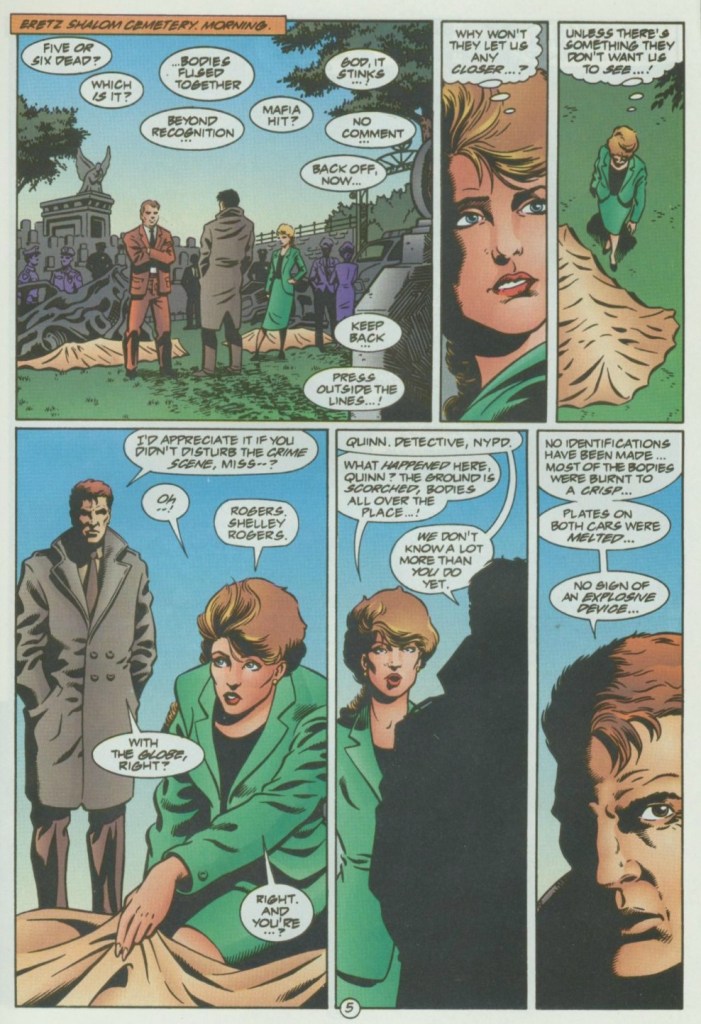
What started in issue #4, this comic book expanded greatly without letting the narrative turning dull. The fight between Spider-Man and the Specialist pretty much dominates the majority of the story, and yet Peter David successfully told stories about Kasey Nash and Gabriel O’Hara while giving readers an inside look at Alchemax and its control on society. In addition, the futuristic Stark-Fujikawa corporation was given its own spotlight in the story complete with their own connection with the Specialist.

As the universe of 2099 was further emphasized, Spider-Man got developed further as an action performer. The more Miguel used his special abilities, the more he becomes proficient not only with fighting but also with defensive moves aided by enhanced reflexes. It was also here where Spider-Man gets to use his organic web a lot more which really challenged his opponent from Stark-Fujikawa.

More the narrative, I like the way Peter David raised the stakes and intrigue all throughout. Not only will you get to see Kasey Nash, Alchemax and Stark-Fujikawa perceive the battle, there is also a short and yet intriguing scene of Gabriel O’Hara with a certain lady who would later become a crucial part of the Venom 2099 storyline (read my reviews of issues #35, #36 and #37). I should state that the battle between Spider-Man and the Specialist built up the tension for the impactful moment very near the end of the story, and that is something you must see.

Conclusion

Spider-Man reacts with his reflex and talons.

Spider-Man 2099 #5 (1993) another compelling and enjoyable read from the team of Peter David and Rick Leonardi. The stakes were really raised high in the story complete with giving the reader a greater view of the 2099 New York society under the control of Alchemax and Spider-Man himself is just a small part of it who happens to stand out among all the people because of his special abilities. Clearly, the series at this point moved swiftly from the superhero origin stage into the dangerous society of the far future.

If you are seriously planning to buy an existing hard copy of Spider-Man 2099 #5 (1993) be aware that as of this writing, MileHighComics.com shows that the near-mint copy of the regular edition costs $60 while the near-mint copy of the newsstand edition costs $180.

Overall, Spider-Man 2099 #5 (1993) is recommended.

+++++

Thank you for reading. If you find this article engaging, please click the like button below and also please consider sharing this article to others. If you are looking for a copywriter to create content for your special project or business, check out my services and my portfolio. Feel free to contact me with a private message. Also please feel free to visit my Facebook page Author Carlo Carrasco and follow me on Twitter at  @HavenorFantasy as well as on Tumblr at https://carlocarrasco.tumblr.com/

A Look Back at Spider-Man and Batman: Disordered Minds (1995)

Disclaimer: This is my original work with details sourced from reading the comic book and doing personal research. Anyone who wants to use this article, in part or in whole, needs to secure first my permission and agree to cite me as the source and author. Let it be known that any unauthorized use of this article will constrain the author to pursue the remedies under R.A. No. 8293, the Revised Penal Code, and/or all applicable legal actions under the laws of the Philippines.

Welcome back, superhero enthusiasts, 1990s culture enthusiasts and comic book collectors! Today we will take a look back at a certain crossover comic book that involved both Marvel Comics and DC Comics published in the mid-1990s. On my part, it’s been some time since I last reviewed a Marvel-DC crossover comic book. That being said, you can read about my retro comic book reviews of Batman versus The Incredible Hulk and Superman and Spider-Man on this website.

For this new retro review, we will focus on the 1995 crossover that brought two of Marvel and DC’s icons together for the first time – Spider-Man and Batman! To put things in perspective, the 1990s still remembered as the decade when Bane broke Batman’s back while the publishing of Spider-Man comic books became highly controversial with the Spider-Clone Saga. In the 1995 crossover produced the two comic book giants, Spider-Man and Batman are presented in their classic identities as Peter Parker and Bruce Wayne.

With those details laid down, here is a look back at Spider-Man and Batman: Disordered Minds published in 1995 by Marvel Comics and DC Comics with a story written by J.M. DeMatteis and drawn by Mark Bagley.

The cover.

Early story

The story begins with a nightmare in which Peter Parker’s Uncle Ben got shot by an armed man in the presence of Aunt May inside their home. Immediately Spider-Man arrives and grabs the man by the neck. The armed man creepily laughs and his face suddenly turns into the Joker. Peter Parker wakes up in bed with Mary Jane on his side. After a short talk with his wife, Peter decides to leave their apartment and swing around the city as Spider-Man.

In another nightmare, a very young Bruce Wayne witnesses the death of his parents caused by a man with a gun. He suddenly turns into Batman and grabs the gunman by the neck. The gunman suddenly turns into the horrific Carnage. Bruce wakes up and decides to reflect. As soon as his butler Alfred opens the door to check on him, Bruce immediately leaves as Batman in the middle of the night.

Somewhere that same night inside a secret facility of the Ravencroft Institute, Cletus Kasady/Carnage is restrained in a secured chamber surrounded by armed security personnel with Spider-Man and psychotherapist Ashley Kafka watching him…

Quality

The two superhero icons together.

I’ll start first with the visual quality of this crossover comic book. Mark Bagley, who was the lead artist on Marvel’s Amazing Spider-Man comic book series, delivered an unsurprisingly stylized look at the two superhero icons, super villains and characters, as well as on DC’s Gotham City (which was the most prominent location in the story).

While Bagley’s work on Spider-Man and the characters associated with him were typical of his Amazing Spider-Man of the decade, I can say that his take on Batman, Joker, Alfred, the Bat Cave and others on the DC Comics side resulted a unique look. Bagley drew Joker looking sinister, maniacal, clueless and even tamed as the plot progressed. Bagley’s Batman has a larger yet familiar style of muscular body compared to Spider-Man, and the visual presentation of his cape ranged from dynamic to looking authoritarian. There were however a few moments wherein Bagley went over the limit on emphasizing the length of Batman’s cape which resulted a few inaccuracies. Remember how there were times that Bagley drew Marvel characters’ thighs to look excessive with muscle? You will see that too on Batman here.

When it comes to artistic dynamism, it is clear that Bagley pushed himself hard creating some mixed results. Some scenes (action scenes and talk scenes included) had the appropriate amount of flash and style, while other scenes had an excessive amount. When it came to spectacle, Bagley succeeded in making the action, hard-hitting moments and explosions look very lively. To be clear, this comic book is entertaining to look at but ultimately it will resonate best with readers who are best familiar to the way Bagley draws.

For the storytelling, J.M. DeMatteis crafted a script that did not reach its full potential as there were obvious limits imposed to ensure equality on presenting the characters and the situations. This explains why in the beginning Spider-Man and Batman each had nightmares related to their respective past and end up seeing their respective super villains interchanged (Spider-Man sees Joker, Batman sees Carnage). The characters of Ashley Kafka and Cassandra Briar are not only looking too similar to each other (just imagine their characters having no colors), they both feel like cardboard cut-outs of a single character who specializes on analyzing people with dangerous minds and coming up with solutions to help them. The more known supporting characters from the respective sides of the two icons – Mary Jane and butler Alfred – made short appearances but did not really contribute much to the plot.

The limitations are also felt on the way Spider-Man and Batman – plus Carnage and Joker – were presented, right down to their interactions with each other. While it was expected that Batman and Spider-Man would be brought together by an unfortunate development, the complete absence of a fight between the two superhero icons was itself the biggest surprise here effectively defying crossover superhero tradition. Even without a fight, you will see Batman and Spider-Man do things separately in accordance to their respective traditions or character traits before getting back together leading to the big conflict with the super villains.

As for Joker and Carnage being together, the spotlight on them in this comic book is pretty limited. There simply is not enough space in this comic book to bring out the full potential of the two super villains who each are known to be murderers and psychologically dangerous. What is interesting in their limited time together is that the story emphasized the differences between them when it comes harming people. The Joker has his own sadistic style of leading people to their deaths in time-consuming ways which is opposite of the quick deaths Carnage enjoys. Considering their respective reputations, it is just a shame that this comic book not only failed to bring out the full potential of Carnage-Joker, it also failed to establish them as clear and present dangers to the public.

More on the plot itself in relation to the comic book sub-title “Disordered Minds”, the elements of mental instability, psycho-therapy, psychology and rehabilitation are present but they are all thrown out by the time the second half of the story begins, clearly making space for the crossover dynamics of Batman, Spider-Man, Joker and Carnage.

Conclusion

Joker and Carnage.

Spider-Man and Batman: Disordered Minds (1995) is a flawed crossover event comic book that just so happens to have more positive stuff than negative ones. It is enjoyable but not great and certainly not memorable. The imposed limits on the presentation made this comic book’s story feel very staged and predictable. With what little creative space was left, it is quite an achievement for the creative team to tell a cohesive and stuffed story (note: there is a lot of filler and some psychology related stuff may not interest some readers) while featuring Batman and Spider-Man the best way they could. It has enough superhero spectacle to be enjoyed although the interactions between Batman and Spider-Man and between Joker and Carnage could have been better.

If you are seriously planning to buy an existing hard copy of Spider-Man and Batman: Disordered Minds (1995) be aware that as of this writing, MileHighComics.com shows that a near-mint copy costs $120 while the near-mint copy of the signed-and-numbered edition is at $120.

Overall, Spider-Man and Batman: Disordered Minds (1995) is satisfactory.

+++++

Thank you for reading. If you find this article engaging, please click the like button below and also please consider sharing this article to others. If you are looking for a copywriter to create content for your special project or business, check out my services and my portfolio. Feel free to contact me with a private message. Also please feel free to visit my Facebook page Author Carlo Carrasco and follow me on Twitter at  @HavenorFantasy as well as on Tumblr at https://carlocarrasco.tumblr.com/

A Look Back at Sludge #3 (1993)

Disclaimer: This is my original work with details sourced from reading the comic book and doing personal research. Anyone who wants to use this article, in part or in whole, needs to secure first my permission and agree to cite me as the source and author. Let it be known that any unauthorized use of this article will constrain the author to pursue the remedies under R.A. No. 8293, the Revised Penal Code, and/or all applicable legal actions under the laws of the Philippines.

Welcome back, superhero enthusiasts, 1990s culture enthusiasts and comic book collectors! Today we revisit the Ultraverse of Malibu Comics and examine one of its many stories through the Sludge comic book series.

Previously I reviewed issue #2 of the series which was a surprising and fun comic book to read as the creative team took the risk of emphasizing the violent character Bloodstorm over Sludge himself. Ultimately, this move served as a way to not just build up tension but to expand the specific place of Sludge and the dark forces within the Ultraverse. For this retro review, issue #3 is set during the events of the memorable Ultraverse crossover story Break-Thru.

With those details laid down, here is a look back at Sludge #3, published by Malibu Comics in 1993 with a story written by Steve Gerber and drawn by Aaron Lopresti.

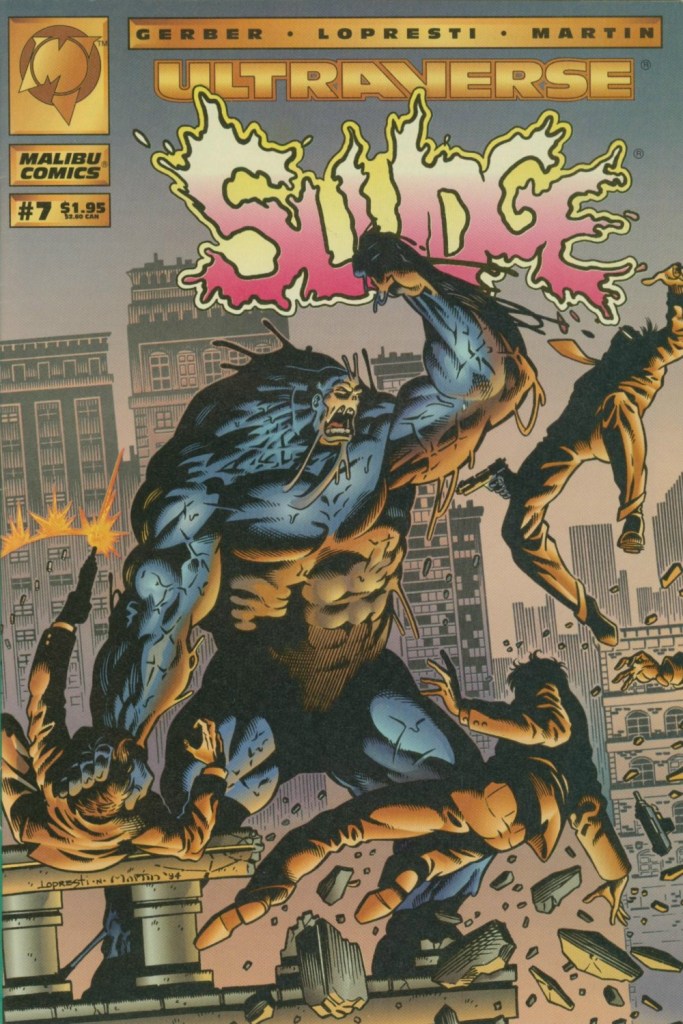
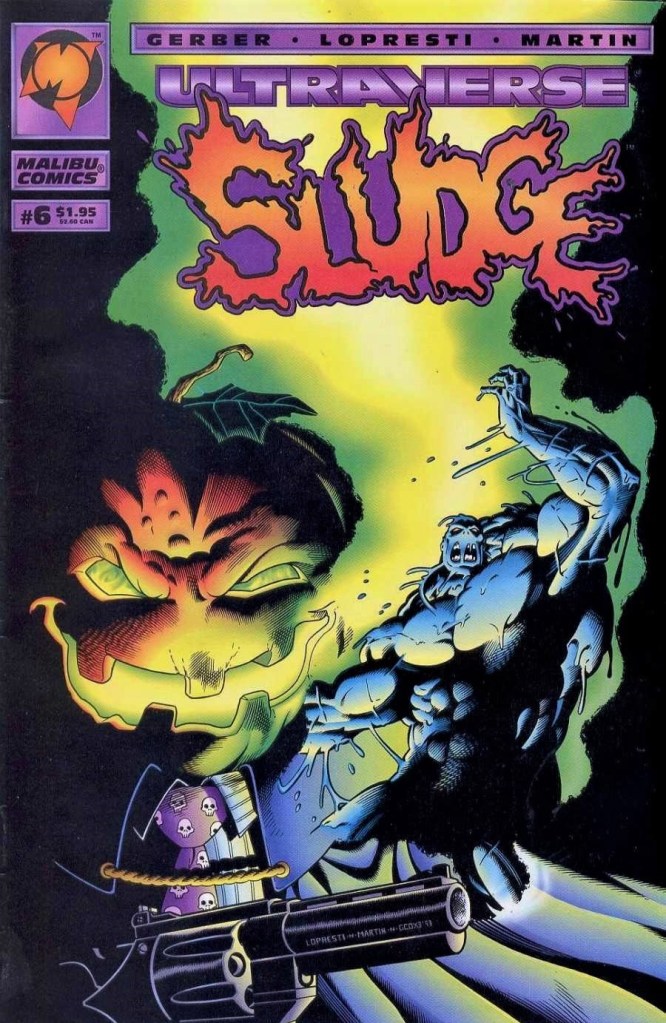
The cover.

Early story

The story begins with Sludge still lying down at the dock after just being defeated by Bloodstorm. Suddenly a mob of chaotic people (driven mad by the effects of Break-Thru that just happened) lift him up and throw him into the water without any regrets whatsoever. In hiding, Bloodstorm witnesses their act and thought to himself that he should avoid the madness happening. Suddenly, other mad people ganged up on him forcing him to react by firing his gun and set himself free from their grip. He safely makes it to his car and speeds away, even bumping off a few people on the way.

As Bloodstorm speeds away, another man in hiding who knew him and the boss Marcello was found by the mad people. Out of desperation he runs away and jumps into the water. He realizes that the people are so obsessed with going up to the sky (the Break-Thru effect), they did not bother to follow him at all.

Deep down the water, Sludge finds himself alone and getting relieved of the pain he experienced above. Feeling hopeless, he waits for the river to wash him away…

Quality

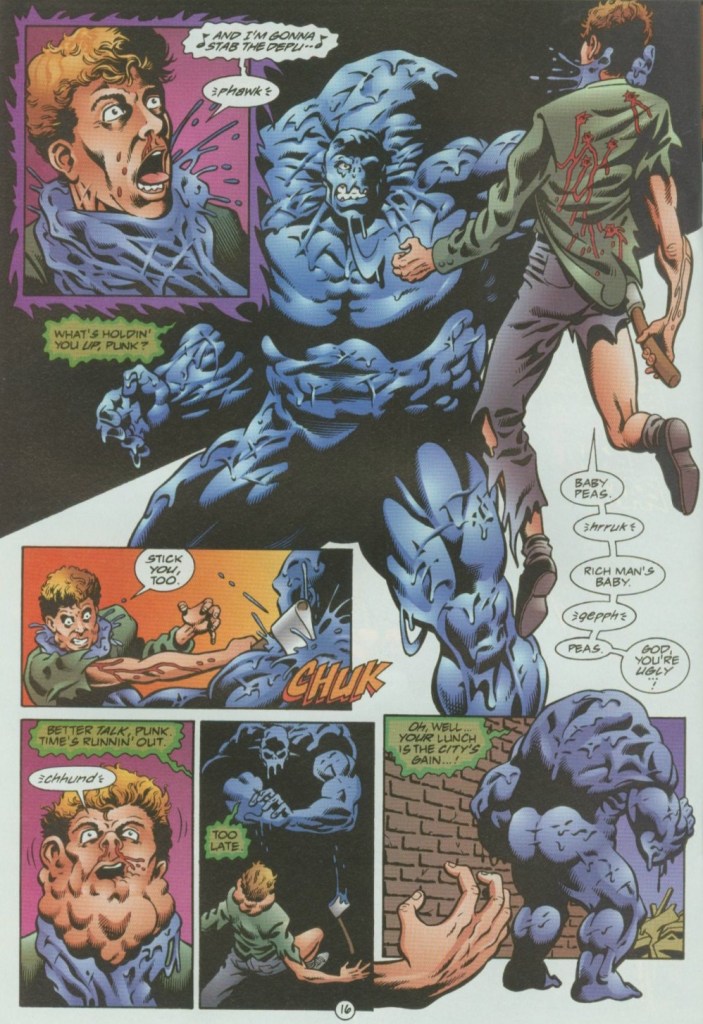
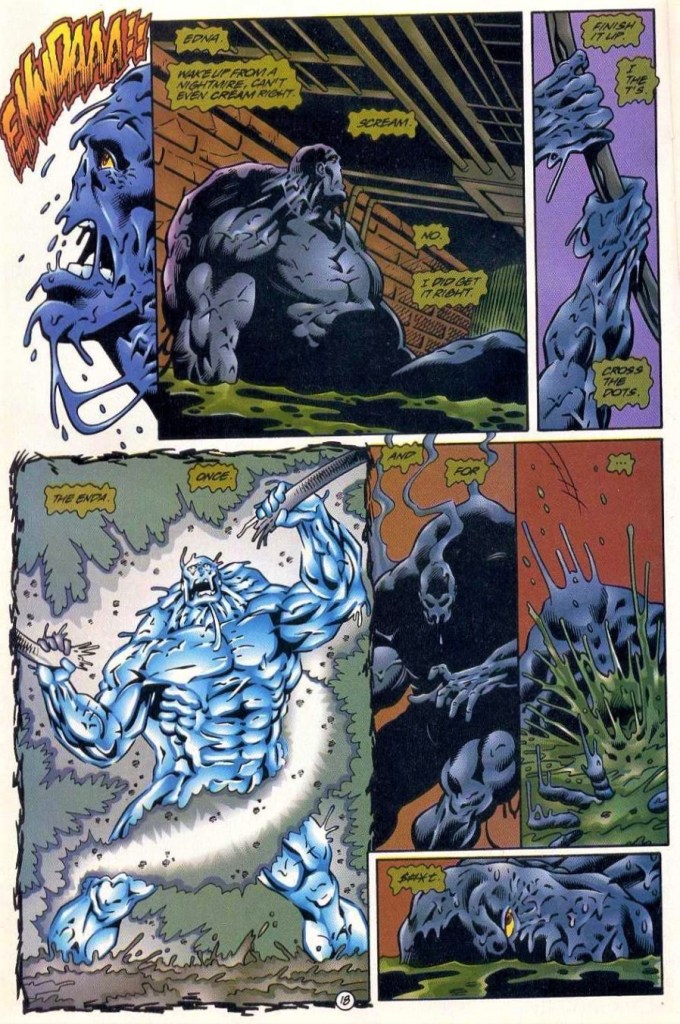
Sludge in trouble!

Being a standalone story set during the events of Break-Thru, this comic book focuses more on the protagonist while simultaneously raising the stakes with regards to the evil forces as the elements of crime gang combined with the supernatural took effect. To be clear, fantasy elements were added to this series which had darkness and grit dominating the plot of the first two issues.

This comic book has an early appearance of “lord” Pumpkin (AKA The Pump) who is the element of sorcery and, more notably, serves as the Ultraverse’s very own Satanic figure. Not only does the Pump have vast powers to take life away from others and has evil pawns to wield, he also leads and guides an apprentice (the kid gangster called Pistol) with pure wickedness, crafted plans of evil, is cunning in his ways of manipulating others to do evil, and he makes promises or deals with others who will receive some rewards but ultimately will be disregarded and lose a lot. This Ultraverse super-villain, as recorded in Malibu Comics’ publishing history, went on to become a walking symbol of pure evil, corruption, sins and danger in other UV comic books.

While there is indeed more focus on Sludge in this issue, it is the Pump who overshadows him. As for Bloodstorm, his presence has been drastically reduced here which is kind of jarring to read as he was the dominant and heavily emphasized in issue #2. Speaking of characters, the gang boss Marcello (who is Bloodstorm’s client) makes a short appearance but his connections not only with criminals but also with para-military forces emphasized his influence in the city.

More on the plot itself, this comic book is pretty loaded and the stakes were really raised high. In key scenes, Sludge finds himself in the middle of gangsters, the people driven mad by the Break-Thru effect, the para-military forces and the Pump’s ugly and evil pawns. Steve Gerber crafted a story that expectedly built up a lot and paid of strongly since the stakes were raised. I should state that Aaron Lopresti’s art here showed signs of improved creativity

Conclusion

The gang boss Marcello and Bloodstorm talk during the events of Break-Thru.

Sludge #3 (1993) is a more engaging and more intense comic book on its own complete with the literary debut of the Pump who is clearly the Ultraverse’s most evil villain. If issue #2 was twisting with the way it presented its characters, this comic book has more of its protagonist who went on to face new elements of evil while the story of Break-Thru transpired. I also noticed the Pump’s offer to Sludge symbolizes Satan offering a troubled soul a place in his force of evil. How did Sludge react to the offer from the evil one? You will have to read this comic book.

If you are seriously planning to buy an existing hard copy of Sludge #3 (1993) be aware that as of this writing, MileHighComics.com shows that the near-mint copy of the regular edition costs $16.

Overall, Sludge #3 (1993) is recommended!

+++++

Thank you for reading. If you find this article engaging, please click the like button below and also please consider sharing this article to others. If you are looking for a copywriter to create content for your special project or business, check out my services and my portfolio. Feel free to contact me with a private message. Also please feel free to visit my Facebook page Author Carlo Carrasco and follow me on Twitter at  @HavenorFantasy as well as on Tumblr at https://carlocarrasco.tumblr.com/

A Look Back at Spider-Man 2099 #4 (1993)

Disclaimer: This is my original work with details sourced from reading the comic book and doing personal research. Anyone who wants to use this article, in part or in whole, needs to secure first my permission and agree to cite me as the source and author. Let it be known that any unauthorized use of this article will constrain the author to pursue the remedies under R.A. No. 8293, the Revised Penal Code, and/or all applicable legal actions under the laws of the Philippines.

Welcome back, superhero enthusiasts, 1990s culture enthusiasts, and comic book collectors! Today we revisit the world of 2099 within the universe of Marvel Comics back in the 1990s, specifically through the Spider-Man 2099 monthly series.

Today we will look back at the early development of futuristic Spider-Man as published way back in 1993. The first three issues (read also my reviews of issue #2 and #3) formed a solid foundation on establishing Miguel O’Hara as his era’s Spider-Man thanks mainly to the high-quality writing done by Peter David. What issue #4 will deliver, we will find out here.

With those details laid down, here is a look back at Spider-Man 2099 #4, published in 1993 by Marvel Comics with a story written by Peter David and drawn by Ricky Leonardi.

The cover.

Early story

The story begins with Gabriel O’Hara (Miguel’s brother) and Kasey Nash trying to have a good time together inside a vehicle until a man armed with a sword interrupts them and tries to take the lady with him. As Gabriel makes his move to help Kasey, the swordman throws two sharp projectiles at him and moves away with the lady.

Over at the Babylon Towers residence, Miguel O’Hara gets visited by his boss Tyler Stone accompanied by armed personnel. Not realizing that Spider-Man 2099 and Miguel are one and the same person, Tyler tells him that the sudden appearance of the crawler put Alchemax on edge.

Tyler proposes peace between him and Miguel, offering him more of the hyper addictive substance Rapture. He tells him that Aaron Delgato was identified as the mysterious Spider-Man…   

Quality

Miguel O’Hara and his brother Gabriel ride and talk.

The plot really thickened in this comic book resulting a few very interesting sub-plot branches as well as more depth on the development of Miguel O’Hara. I really like the way Peter David explored the corporate side of Miguel’s life here creating suspense about Tyler’s limited knowledge of the Alchemax incidents that happened in issues #1 and #2 which actually involved the protagonist witnessing the fall of his corporate rival Aaron (the same guy responsible for the genetic manipulation of Miguel into Spider-Man). This comic book also focuses on the strained relationship Miguel has with his brother Gabriel who clearly lacks the will to be personally responsible.

I also enjoyed the way Miguel reacts to the classic Spider-Man expression of “with great power comes great responsibility” as he struggles to set things right even as being a civilian and a superhero in his society has major hassles.

The anticipated battle between Spider-Man and the sword-wielding Specialist was structured nicely. Instead of being the typical good-versus-evil conflict, what was presented started with nice moments as Spider-Man still struggles to make the best out of his capabilities. Be aware that the fight does not conclude in this issue.

Conclusion

Miguel getting ready for work while having his Spider-Man costume worn.

Spider-Man 2099 #4 (1993) is a solid comic book to read. It had a nice balance of character development, plot with twists here and there, as well as a good amount of action and thrills. Its best feature, as expected, was the further development of the protagonist and you will see more of Miguel than Spider-Man. By the end of this comic book, I really felt I got to know Miguel more as a person, and not a mere character.

If you are seriously planning to buy an existing hard copy of Spider-Man 2099 #4 (1993) be aware that as of this writing, MileHighComics.com shows that the near-mint copy of the regular edition costs $30 while the near-mint copy of the newsstand edition costs $90.

Overall, Spider-Man 2099 #4 (1993) is recommended.

+++++

Thank you for reading. If you find this article engaging, please click the like button below and also please consider sharing this article to others. If you are looking for a copywriter to create content for your special project or business, check out my services and my portfolio. Feel free to contact me with a private message. Also please feel free to visit my Facebook page Author Carlo Carrasco and follow me on Twitter at  @HavenorFantasy as well as on Tumblr at https://carlocarrasco.tumblr.com/

A Look Back at X-Men #29 (1994)

Disclaimer: This is my original work with details sourced from reading the comic book and doing personal research. Anyone who wants to use this article, in part or in whole, needs to secure first my permission and agree to cite me as the source and author. Let it be known that any unauthorized use of this article will constrain the author to pursue the remedies under R.A. No. 8293, the Revised Penal Code, and/or all applicable legal actions under the laws of the Philippines.

Welcome back, superhero enthusiasts, 1990s culture enthusiasts, X-Men fans and comic book collectors! Today we revisit the X-Men monthly series of the 1990s and look back at what happened after the ending of X-Men #28 (1994). For those who missed out on my previous X-Men retro review, issue #28 showed the X-Men being disturbed by the presence of Sabretooth living as a prisoner/patient in the mansion under the authority of Charles Xavier. Along the way, the wedding of Jean Grey and Cyclops is nearing.

With those details laid down, here is a look back at X-Men #29, published by Marvel Comics in 1994 with a story written by the Fabian Nicieza and drawn by Andy Kubert.

The cover.

Early story

The story begins inside the danger room wherein Psylocke and Sabretooth (wearing cybernetic restraints on his arms as well as a mask) engage in a sparring session while being monitored by Professor X, Warren Worthington/Archangel and Hank McCoy/Beast. Warren expresses concern about the session and Xavier replies by saying that they could not have Sabretooth develop the control he needs over his violent tendencies by having him contained in a cell every day.

After some struggle, Psylocke gains the upper hand and tells Sabretooth that she sparred without using her mutant abilities (solely out of deference to his reduced capabilities caused by the restraints) and insisted she still fought to win.

After the danger room session, Warren leaves and thinks a lot as he takes time out to watch Cyclops and Jean Grey leading the wedding preparations outdoors. Jubilee passes by with lots of mail, hands over to Warren an unusual looking envelope, then leaves. As he opens the envelope, Psylocke arrives hearing Warren talking to himself as he reads the letter. It turns out to be an invitation from the Hellfire Club…

Quality

Expository dialogue and details laid down to help readers understand the Hellfire Club.

To put things in perspective, the Hellfire Club within the Marvel Comics universe is a fictional high-class society which became a formidable force of opposition for the X-Men. Their debut during the Dark Phoenix Saga is very memorable and since that time, varied comic books – specifically X-Men comics – revisited the club from time to time.

Within the pages of this particular comic book, the Hellfire Club itself went through some changes in terms of membership and organizational structure kind of similar to the X-Men themselves. In this case, the son of Sebastian Shaw – Shinobi – gains tremendous power and even went as far as revealing to Warren/Archangel his ambitious plan to re-establish the Inner Circle and have the mentioned X-Men member (one of the pioneering students of Charles Xavier) part of it as the White King.

A key element in this story is self-pity which Archangel and Shinobi Shaw both share. For these two, there are key parts of their past that are so hurtful they respectively question their existence and purpose. Quite symbolically, Archangel and Shinobi both have fathers involved with the Hellfire Club and Psylocke herself was familiar with the club’s presence in London. More on Archangel himself, his self-pity really puts him in a very awkward place among the X-Men, especially at a time when he is supposed to be happy for his long-time teammates Jean Grey and Cyclops about to get married.

In a way, X-Men #29 was an inspired attempt to reconnect the past with the contemporary times with the Hellfire Club as the enduring factor. In my opinion, Fabian Nicieza’s work here is solid.

Conclusion

Easily the best-looking images in the comic book. Andy Kubert really rocked with this!

X-Men #29 (1994) is symbolically a quick and yet inspired way of updating readers about the state of the Hellfire Club and hint what potential conflicts they could have with the X-Men of the 1990s. Psylocke and Archangel are the most prominent X-Men members to follow here and they both have past connections with the Hellfire Club which itself is changing as Shinobi Shaw gained power. Its story is pretty intriguing and there is a descent amount of spectacle to be enjoyed. The selling point here is the story concept itself backed with solid writing by Nicieza who seem to have researched the Hellfire Club carefully. Given the legacy behind the X-Men and the fictional club, this comic book will appeal more to long-time fans of the X-Men. Reading this as a first-time discovery of the club will surely challenge newcomers.

If you are seriously planning to buy an existing hard copy of X-Men #29 (1994) be aware that as of this writing, MileHighComics.com shows that the near-mint copy of the regular edition costs $30 while the near-mint copy of the newsstand edition costs $90.

Overall, X-Men #29 (1994) is recommended.

+++++

Thank you for reading. If you find this article engaging, please click the like button below and also please consider sharing this article to others. If you are looking for a copywriter to create content for your special project or business, check out my services and my portfolio. Feel free to contact me with a private message. Also please feel free to visit my Facebook page Author Carlo Carrasco and follow me on Twitter at  @HavenorFantasy as well as on Tumblr at https://carlocarrasco.tumblr.com/

A Look Back at Wolverine #75 (1993)

Disclaimer: This is my original work with details sourced from reading the comic book and doing personal research. Anyone who wants to use this article, in part or in whole, needs to secure first my permission and agree to cite me as the source and author. Let it be known that any unauthorized use of this article will constrain the author to pursue the remedies under R.A. No. 8293, the Revised Penal Code, and/or all applicable legal actions under the laws of the Philippines.

Welcome back, superhero enthusiasts, comic collectors, 1990s culture enthusiasts and fans of the X-Men! We go back to the year 1993 when the 30th anniversary of the X-Men was celebrated with the 6-part Fatal Attractions storyline. Already I reviewed Uncanny X-Men #304 (Part 3) which was not worthy of the X-Men’s 30th anniversary celebration. X-Men #25 (Part 4) meanwhile was not only great but also shocking and had a years-long impact on X-Men comics.

So now the focus is on the 5th chapter of the Fatal Attractions storyline handled by the Larry Hama-Adam Kubert team on the Wolverine monthly series of the time. With those details laid down, here is a look back at Wolverine #75, published by Marvel Comics in 1993 with a story written by Larry Hama and drawn by Adam Kubert.

The cover.

Early story

The story begins in outer space. Carrying Charles Xavier, Wolverine, Gambit, Jean Grey, Rogue and Quicksilver (who participated in the dangerous mission in X-Men #25), the X-Men’s jet (piloted by Bishop) struggles mechanically as it was not designed for space travel. Worse, Wolverine is under very serious condition and the medical unit has been operating in full capacity dealing with his intense trauma.

In an attempt to alleviate Wolverine’s psychic trauma, Charles Xavier and Jean Grey enter his mind and discover that there is a world full of pain and horror. They see visions of a restrained Wolverine (from his Weapon X days) being attacked by Sabretooth and Lady Deathstrike. Xavier explains that they are at the epicenter of Logan’s most suppressed cataclysmic memories which were clearly triggered by the physical damage Magneto inflicted on him (see X-Men #25).

As the X-Men’s jet attempts to enter Earth’s atmosphere, its exteriors heat up dramatically shaking everyone inside. This complicates the situation on stabilizing Wolverine…

Quality

The other X-Men team members at their headquarters expressing worry and concern about the situation of their teammates struggling to come back home from space.

To be clear, this story continues the events of Fatal Attractions but with a bit more focus on Wolverine (compared to the earlier chapters of the storyline that is). There is no real battle between good and evil at all. It’s really all about Wolverine struggling to survive just as his teammates struggle to arrive home.

Before the stories of this comic book and X-Men #25 happened, Wolverine has often been portrayed to be very tough, brave and a walking machine of violence which has been reflected in other X-Men stories told in video games and movies. In this very comic book, Wolverine has been presented to coming close to death. This means Logan, at this particular stage of the history of the literary X-Men, was at his most vulnerable state. In my experience, this was both alienating and shocking to see.

With regards to the writing, Larry Hama did an excellent job with pacing the story from start to finish. Right from the beginning, the story pulls you into the X-Men’s tough situation and as each page gets turned, the tension as well as the suspense builds up until the execution of the climax. Along the way, the comic book not only portrays Wolverine struggling on the edge, it also works to make you care more or be more concerned towards him. Oh yes, the shocking moment near the end of this comic book remains very powerful and you who read this retro review should read Wolverine #75 and see it for yourselves.

Conclusion

Wolverine at his most vulnerable state.

By today’s standards, Wolverine #75 (1993) is still a very great comic book to read. In fact, I can say it is not only one of most defining chapters of the Fatal Attractions storyline as well as one of the most significant X-Men comic books of the 1990s, it is indeed a true illustrated literature classic ever published by Marvel Comics. In retrospect, this comic book marks a major turning point in the life of Wolverine who is still one of the most iconic characters in all of superhero literature. All of these were achieved thanks to the creative team of Larry Hama and Adam Kubert (whose are here was great and stylized at the same time). Hama succeeded in writing the continuation of the Fatal Attractions storyline while balancing all of the exposition and still putting Wolverine in the center. That itself is a very great work of writing.

If you are seriously planning to buy an existing hard copy of Wolverine #75 (1993), be aware that as of this writing, MileHighComics.com shows that the near-mint copy of the regular edition costs $60 while the near-mint copies of the signed-and-numbered edition and the newsstand edition cost $300 and $180 respectively.

Overall, Wolverine #75 (1993) is highly recommended!

+++++

Thank you for reading. If you find this article engaging, please click the like button below and also please consider sharing this article to others. If you are looking for a copywriter to create content for your special project or business, check out my services and my portfolio. Feel free to contact me as well. Also please feel free to visit my Facebook page Author Carlo Carrasco and follow me at HavenorFantasy@twitter.com

A Look Back at Star Wars: Shadows of the Empire #1 (1996)

Disclaimer: This is my original work with details sourced from reading the comic book and doing personal research. Anyone who wants to use this article, in part or in whole, needs to secure first my permission and agree to cite me as the source and author. Let it be known that any unauthorized use of this article will constrain the author to pursue the remedies under R.A. No. 8293, the Revised Penal Code, and/or all applicable legal actions under the laws of the Philippines.

Way back in the mid-1990s, something special happened for Star Wars fans. A brand-new story involving Star Wars icons Luke Skywalker, Darth Vader and others would be told set between The Empire Strikes Back and Return of the Jedi. That story was called Shadows of the Empire and it was released as a special event in the form of a novel (written by Steve Perry), a video game on Nintendo 64 and PC, comic books, a soundtrack, posters, model kits, toys and action figures. What was missing here was a live-action movie.   

To put things in perspective, the Shadows of the Empire multi-media event was done by Lucasfilm (note: when creator George Lucas was still in control) with its many business partners to reinvigorate the Star Wars franchise ahead of the planned special editions of the original Star Wars movie trilogy. From a business point-of-view, it made sense to release something new for fans to enjoy and more notably it was the chance for Lucasfilm and its creators to explore what happened between The Empire Strikes Back and Return of the Jedi.

A limited comic book series was released in 1996 and it involved the novel’s author as a story consultant. Back in those days, my comic book interest faded temporarily and even though I was still into Star Wars, I did not bother to buy and read the Shadows of the Empire comic books. The video game caught my attention a lot more back then. Fortunately, I found copies of the comic books and had the time to read them recently.

With those details laid down, here is a look back at Star Wars: Shadows of the Empire #1, published by Dark Horse Comics in 1996 with a story written by John Wagner and drawn by Kilian Plunkett.

The cover.

Early story

The story begins with a group of Rebel spaceships traveling together in the depth of space. Luke, who now has a mechanical hand and has been recovering from the terrible ordeal he went through at Cloud City, is with Princess Leia, C3PO and R2D2 in the medical frigate. The Rebels detect the presence of an approaching ship which they suspect to be hostile.

Luke suddenly decides to take action but is halted when he realizes that his X-wing fighter is still being refitted. In space, Wedge and the Rogue Squadron fly towards the Imperial Strike Cruiser which then releases some Tie Fighters. The personnel inside the Strike Cruiser tried to inform Darth Vader the location of the Rebel fleet…

Quality

Darth Vader!

The first thing I want to mention is that the writing done by John Wagner is solid. That being said, the story itself felt like a natural continuation of The Empire Strikes Back especially when the comic book’s narrative is focused on Luke and the Rebels. The way the recovering Luke, Leia and the two droids were presented following the end of the 1980 movie was believable, and there was that nice touch of characterization when Luke has not yet adjusted with his mechanical hand.

The story then moves into new territory when the narrative shifts on the Imperial side, especially when Emperor Palpatine gives Darth Vader a new order that has nothing to do with pursuing Luke and the weakened Rebels, but more to do with the construction of the Empire’s new weapon. This is also where the new character Xizor comes in and his presence alone confirms something that the movies did not…the Empire is in business with crime syndicates with regards to major projects.

Space ship battles look great in this comic book.

When it comes to characterization, I like the way Darth Vader handled himself when communicating with Emperor Palpatine who viewed Luke’s escape from Bespin a failure on his part. Compared with his private communication with the Emperor in the 1980 movie, Vader bravely questions him about doing business with Xizor backed with his knowledge of the prince and the ties with Black Sun. Vader, who has been part of the Empire for a long time, knew well how risky it is for them to get involved with criminals especially when military cargo is involved.

As for the visuals, Kilian Plunkett does a decent job drawing the characters. While his take makes Luke recognizable and faltered a bit on capturing Leia’s look, his illustrations on Darth Vader, the Emperor and Xizor were really good. Where Plunkett exceled visually are the locations and surroundings, the machines and the space battles (some pages were drawn really dynamically).

Conclusion

This shows how Luke has not fully adjusted with his mechanical hand.

To put it clearly, Star Wars: Shadows of the Empire #1 (1996) has three narratives (the other is about Boba Fett carrying the frozen Han Solo) to build-up on and for a debut issue of a limited series, this one has strength in its execution complete with a good amount of creative stuff that will resonate with long-time Star Wars fans (and also those who love the original Star Wars movie trilogy). It succeeds in telling what happened shortly after the end of The Empire Strikes Back as well as establishing a new sub-plot with Xizor involved. By the time I finished this comic book, I was convinced to look forward to the next issue.

If you are seriously planning to buy an existing hard copy of Star Wars: Shadows of the Empire #1 (1996), be aware that as of this writing, MileHighComics.com shows that the near-mint copy of the regular edition costs $48 while the near-mint copy of the newsstand edition costs $144.

Overall, Star Wars: Shadows of the Empire #1 (1996) is recommended.

+++++

Thank you for reading. If you find this article engaging, please click the like button below and also please consider sharing this article to others. If you are looking for a copywriter to create content for your special project or business, check out my services and my portfolio. Feel free to contact me as well. Also please feel free to visit my Facebook page Author Carlo Carrasco and follow me at HavenorFantasy@twitter.com

A Look Back at Superman Annual #10 (1984)

Disclaimer: This is my original work with details sourced from reading the comic book and doing personal research. Anyone who wants to use this article, in part or in whole, needs to secure first my permission and agree to cite me as the source and author. Let it be known that any unauthorized use of this article will constrain the author to pursue the remedies under R.A. No. 8293, the Revised Penal Code, and/or all applicable legal actions under the laws of the Philippines.

Before DC Comics ended their original superhero multiverse with Crisis on Infinite Earths (1985-1986) to restart all over again, there were a whole lot of stories about Superman ranging from the dramatic stuff, the epic tales and right down to the most outlandish tales.

As a kid, I was fortunate enough to buy myself a copy of a 1984 Superman comic book, the cover of which really intrigued and caught my interest. It was a Superman annual comic book with a $1.25 cover price which was somewhat high at the time. Its cover showed the Man of Steel himself carrying a sword pointed up.

That image made me wonder: Why would Superman have to use a sword when he is so powerful and capable without weapons? Where did that sword come from? Who made it in the first place? Is the sword so special to Superman?

With those details laid down, here is a look back at Superman Annual #10, published by DC Comics in 1984 with a story written by Elliot Maggin and drawn by classic Superman artist Curt Swan.

The cover.

Early story

The story begins in a space where a group of diverse people composed of aliens and humans are gathered together watching a live video feed Superman on a large monitor above their heads. As it turns out, the Man of Steel is in space working to prevent meteoroids from entering the planet below him. He then speeds off into space heading back to Earth.

Along time ago deep in the galaxy, a big bang effect took place creating several new fragments in the vacuum of space and among them is a long, rough object that resembles a sword. As an unknown amount of time passed, the long object gradually turns into a smooth looking sword complete with a sharp blade and a letter “S” on one end that is the same as the one Superman carries. It is referred to as the sword of Superman!

In Metropolis, Clark Kent is passed by his officemate Jimmy Olsen who mentioned that he is rushing to interview the billionaire industrialist Oswald Mandias. Two days have passed and Jimmy Olsen remained missing. As his boss Perry White heads on to the office, Clark remains and changes into Superman when the coast got clear.

As the Man of Steel flies off into the city, a Galaxy Broadcasting live report on TV shows Lana Lang reporting from the Kennedy Space Center where the new space shuttle Magellan is about to make its first-ever commercial flight to launch a mysterious new communications satellite owned by Mandias Industries…

Quality

Clark Kent/Superman being a complete stranger to others added a lot to the story.
The sword led Superman to a book about the legend of King Arthur inside the city library.

Being an annual, I can say that the Sword of Superman story was well-written and nicely visualized by the creators which made it fun and engaging to read. It is a Superman story that further adds to his being an essential hero of the original DC Comics multiverse and a key factor here is the somewhat outlandish concept that the sword that he gained was an original material of the universe from the big bang and even had connections to the unseen omnipotent force.

This story is not a simple, straightforward tale about Superman gaining a weapon required to defeat the supervillain King Kosmos. In fact, the sword opens up events that made the Man of Steel reevaluate himself, his situation and the people around him. King Kosmos, who is a time-travelling villain from the future (first appearance in DC Comics Presents Annual #2), served not just merely as the opposition but also adds a good amount of complexity within the reality of the story. For one thing, it is very intriguing and also refreshing to see people of Metropolis (even Clark’s friend Jimmy Olsen) failing to recognize Superman and perceive him with fear. This is a one-of-a-kind story of Superman that must be read, even though it is not really an epic tale.

All throughout, there is a fine balance between spectacle and intrigue. If you pay close attention to the dialogue and details, you will understand the story better and enjoy the comic book more eventually.

Conclusion

The return of King Kosmos!

I personally enjoyed reading Superman Annual #10 (1984) the first time back in 1984. The fact here is that after re-reading it recently, I do confirm that it is still an enjoyable comic book to read, and I am not even a Superman fan anymore. That is quite something! This is indeed a really good piece of Superman history from the pre-Crisis era. It also touches on themes about omnipotence, how ordinary people react to people who wield great power, and being whole with the entire universe.

If you are seriously planning to buy an existing hard copy of Superman Annual #10 (1984), be aware that as of this writing, MileHighComics.com shows that the near-mint copy of the regular edition costs $35 while the near-mint copy of the newsstand edition costs $70.

Overall, Superman Annual #10 (1984) is recommended.

+++++

Thank you for reading. If you find this article engaging, please click the like button below and also please consider sharing this article to others. If you are looking for a copywriter to create content for your special project or business, check out my services and my portfolio. Feel free to contact me as well. Also please feel free to visit my Facebook page Author Carlo Carrasco and follow me at HavenorFantasy@twitter.com

A Look Back at X-Men 2099: Oasis

Disclaimer: This is my original work with details sourced from reading the comic book and doing personal research. Anyone who wants to use this article, in part or in whole, needs to secure first my permission and agree to cite me as the source and author. Let it be known that any unauthorized use of this article will constrain the author to pursue the remedies under R.A. No. 8293, the Revised Penal Code, and/or all applicable legal actions under the laws of the Philippines.

According to the online edition of Merriam-Webster Dictionary, an oasis is something that provides refuge, relief, or pleasant contrast. In the case of X-Men 2099, the open areas of the southwestern region of the United States is a dangerous place to be in even though they are free from oppressive systems of control that dominate cities. As such, it is the southwestern region in 2099 can be compared to the Old West in history where there are lots of desolate places as well as lots outcasts and outlaws. Unlike their mainstream counterparts, the X-Men of the far future are nomads and they don’t have a long-term place of residence they could call home. Considering how dangerous the region is for the mutants, a haven of peace, security and prosperity is always ideal to them but only if it is indeed real.

That is what we will explore in the one-shot comic book X-Men 2099: Oasis here.

But before proceeding with the review, it has to be emphasized first that the one-shot comic book which was made special with the painted art of the Hilderbrandt brothers Greg and Tim. For long-time X-Men 2099 scribe John Francis Moore, Oasis was like a big dream come true. When asked during an online interview about his recollections on making X-Men 2099: Oasis and working with the Hildebrandt Brothers, Moore stated:

I was a fan of the Hildebrandt’s fantasy illustration, and I was blown away when Joey told me that they wanted to do an X-men 2099 project. I met with them in Joey’s office and they were both really great guys. I think they said they really liked Bloodhawk, so I knew he’d be a major player in whatever story we developed. They didn’t enter the project with a lot of conditions. They seemed genuinely happy to get to play in this corner of the Marvel universe.

I can’t remember ever writing a full script for any of my Marvel work. I gave them a plot and sometime later received Xeroxes of pencil art (Hildebrant art!) to dialogue. Then it went back for them to paint, and they did a phenomenal job. I only wish that it could’ve been published before the 2099 line was axed. It was a beautiful book that I think was sadly under promoted.

To find out if it is any good, here is a look back at X-Men 2099: Oasis published in 1996 by Marvel Comics with a story written by John Francis Moore and painted art done by Greg and Tim Hildebrandt.

Cover
The cover.

Early story

The comic book begins with a flashback set in Hong Kong in the year 2090. A much younger Shakti/Cerebra is on the loose trying to reach a ferry to Kowloon with a plan to hide in the back alleys of Tsimshatsui. Suddenly Lokjaw intercepts her and grabs her. They had a short history together and Lokjaw insists that Shakti should be grateful to her father who raised her to run his bio-shops. After a brief chase, something hits Lokjaw who fell into the water. It turns out Ryu Kobolt helped Shakti, and he has been instructed by his boss to offer her asylum.

11
Luna and Skullfire explore a place.

In the present day of 2099 in New Mexico, Bloodhawk flies to his desert home not knowing he is being monitored. Two people, an old man with white hair and a lady, work together to stun the X-Men member and take him with them. A short time later, inside a high-tech facility, Bloodhawk wakes up finding himself restrained and being watched over by the lady and the old man. They tell him he is in the Promised Land, a place where the sins of the old world will be washed away. Using her powers, she touches Bloodhawk’s head and slowly turns him into his normal human form.

Meanwhile outside a deserted town near the border between Colorado and Kansas, Shakti, Tim/Skullfire and Luna arrive riding motorcycles. They are checking the potential presence of a mutant nearby…

Quality

15
Really great visuals by the Hildebrandt brothers!

It is very safe to say that this is one very ambitious X-Men 2099 story ever told by John Francis Moore. It sure has an epic concept showing that Oasis in the open region not only exists, but also serves as the closest thing humanity in America has to imitating Heaven built on top of the land. Oasis is the indoor paradise where mutants and humans gather together, live in peace and work together in tremendous ways that the X-Men could only hope to achieve in Halo City (note: this story is set some time after X-Men 2099 #25).

The titular place is clearly the centerpiece of the story backed with characters and threads from the past that explain how it got established. Part of the creation of Oasis is connected with Ryu Kobolt whom Shakti got close with many years back. Of course, someone else got involved with Ryu which directly connects with the creation of Oasis.

While it is also clear that the story took some inspiration from Christianity, I should say that the approach was done by rehashing old storytelling concepts like emphasizing a charismatic person who looks godly or messianic, people getting converted with ways that are not holy, false prophets misleading those seeking salvation, etc. With the ages-old concept of the mad scientists added, then there is conflict here for the X-Men to engage with. The story touches on themes like destiny, conversion, having the power to judge people and committing genocide.

As for the characters, John Francis Moore made the right move to utilize Shakti, Bloodhawk, Skullfire and Luna of the X-Men, however the other new characters such as Memphis, Pandora and Ryu pale in comparison with regards to importance (even though Memphis and Ryu each had a good amount of the spotlight and even some character development).

When it comes to the artwork, this is one great looking superhero, sci-fi story in painted form thanks to the Hildebrandt brothers! Not only is their painted art beautiful to look at, there are also eye-catching shots of scenery, very detailed facial expressions and a very lively presentation of the action scenes and explosions! Each and every character painted – specifically Shakti, Skullfire, Bloodhawk, Luna, Memphis, Pandora and Ryu – has that touch of visual realism (note: not photo realism) that make them look more human to the eyes (especially the X-Men members when compared to how they were drawn by Ron Lim and Jan Duursema in the monthly series). This is one great looking comic book and easily one of the very best of the X-Men of 2099!

Conclusion

16
The Oasis!

X-Men 2099: Oasis is a one-shot comic book that did not match its high ambition. While it has some of the best painted superhero art of the 1990s ever, the storytelling just did not engage me that much. For one thing, its approach on taking inspiration from Christianity is very flawed not only due to rehashing storytelling concepts but also due to the fact that everything – including the titular Oasis – had to be concluded already. Even though there was a build-up leading to a final conflict, the payoff was not that great and ultimately there was a sense of rush in the 2nd half of the story.

What is also disappointing is the fact that the events told here did not really impact Shakti, Skullfire, Luna and Bloodhawk at all, nor was there anything added to the narrative of the X-Men 2099 monthly series. This is too bad because the existence of a haven where people can live in and be protected from the prejudice and violence in the region fits nicely with the concept of X-Men 2099 in the first place. Even though there was a reference to issue #25 during the first half, this comic book ended up looking like a dream story or a parallel universe tale with a $5.95 cover price! It seems to me like this was more like a cash-grab attempt to exploit comic collectors and the fans of X-Men 2099.

If you are seriously planning to buy an existing hard copy of X-Men 2099: Oasis, be aware that as of this writing, MileHighComics.com shows that the near-mint copy costs $14.

Overall, X-Men 2099: Oasis is a serviceable one-shot comic book. That being said, if you really intend to buy it, you should not pay more than $5 for it.


Thank you for reading. If you find this article engaging, please click the like button below and also please consider sharing this article to others. If you are looking for a copywriter to create content for your special project or business, check out my services and my portfolio. Feel free to contact me as well. Also please feel free to visit my Facebook page Author Carlo Carrasco and follow me at HavenorFantasy@twitter.com

A Look Back at The Solution #6 (1994)

Disclaimer: This is my original work with details sourced from reading the comic book and doing personal research. Anyone who wants to use this article, in part or in whole, needs to secure first my permission and agree to cite me as the source and author. Let it be known that any unauthorized use of this article will constrain the author to pursue the remedies under R.A. No. 8293, the Revised Penal Code, and/or all applicable legal actions under the laws of the Philippines.

As this is another retro  review of another Ultraverse comic book written by the late James Hudnall, I encourage you to take time to check out his background and other works via Comic Book Resource’s report of his death on April 2019.

In memory of James Hudnall, here are his words published near the end of The Solution #7:

The Solution is a dream team for me. I’ve been wanting to mix the genres of fantasy and cyberpunk science fiction with the super-hero genre for some time. Add my love of Japanese animation and Hong Kong cinema and you can see where I’m coming from here. This series is designed to show us some of the more bizarre and dark sectors of the Ultraverse without, hopefully, falling into the trap many similar books do where they lay it on too thick. The Ultraverse is a complex and multi-faceted universe and our books explore different sides. Here I want to delve deep into the criminal and espionage arenas as well as the magic sub-cultures that exist.

The characters themselves have a rich and interesting history that I plan to slowly unveil as the series progresses. When you first meet someone, you usually don’t know that much about the person. The characters are rather deep, as we will discover, and their personalities and more complex than you’re probably used to seeing in comics.

Now we can start this look back at The Solution #6, the Ultraverse comic book published in 1994 by Malibu Comics with a story written by James Hudnall and illustrated by John Statema (with ink work by Dennis Jensen and Mark Stegbauer).

Cover
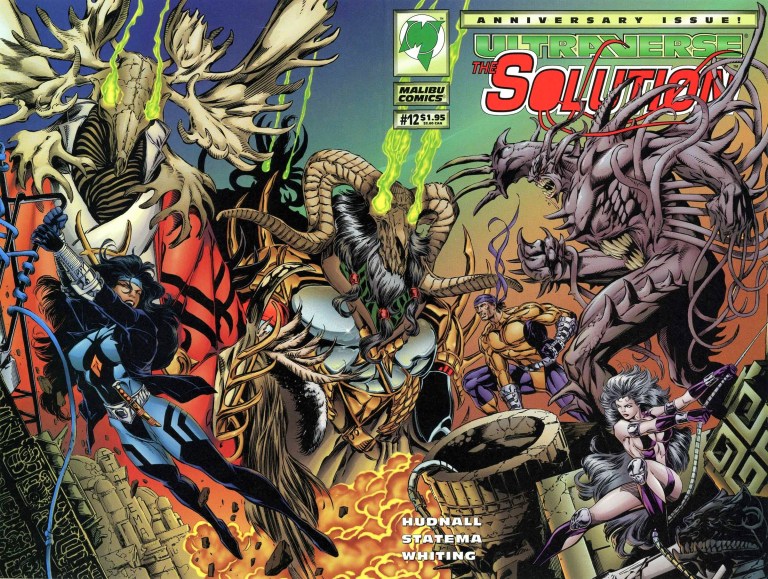
The cover.

Early story

The story begins with Lela Cho (Tech) alone paying respect to her father at his grave. She tearfully recalls what happened right after he died.

The narrative then shifts to 1993, specifically the day her father was about to get buried with many guests involved. Even though she is mourning, a man with blonde hair approaches her. His name is Kyle Sanders and he tells her she wants to talk to her about the corporation called Hypersonic. After receiving his business card, Lela feels a strange sense of dread creeping up on her.

A few days later, Lela attends a Board of Directors meeting at the headquarters of Hypersonic. She reminds them that she inherited all of her father’s shares in the company that makes her a majority stockholder and it was written in his will that she will assume his post as Chairman of the Board. Even though she already earned her Master’s Degree in Business at Harvard, the BOD members rejected her on the grounds that she’s too young and has no previous practical experience. They expressed that it would be better for her to work within the company and climb her way up.

Even though she got rejected and found herself alone, she decided not to give up and move forward by visiting NuWare, a corporation in San Francisco, California, that specializes on bio-tech implants (Wetware) that can make a person an Ultra…

Quality

20
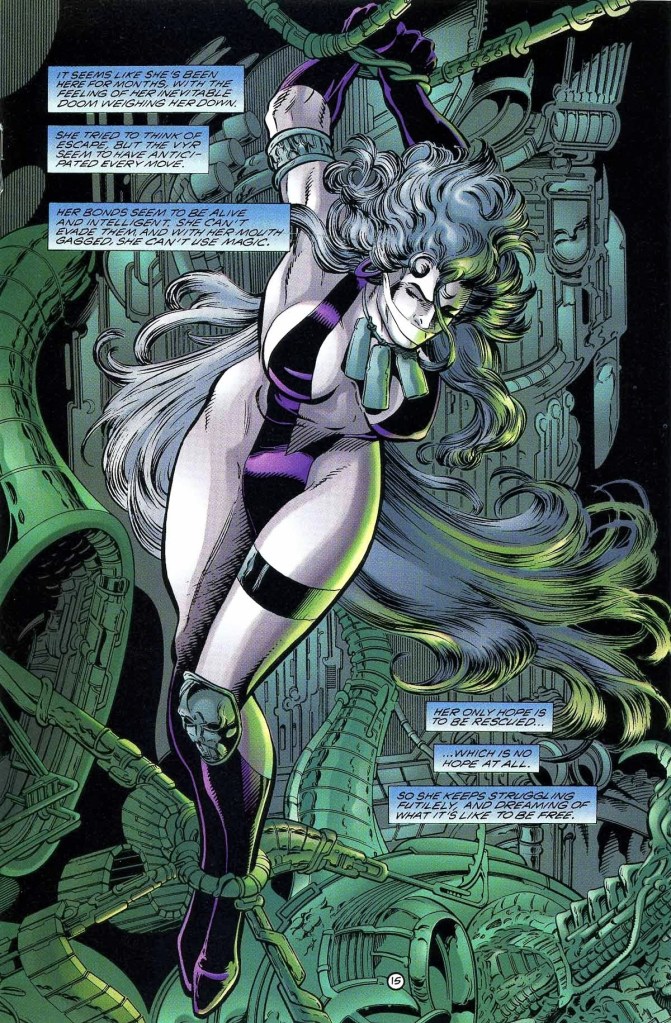
Lela Cho/Tech in action!

This is a very compelling, character-driven comic book, one of the best of the Ultraverse I read as of this writing. Clearly the late Hudnall achieved his goal of not only developing Lela Cho/Tech, but also defining her as a living part within the Ultraverse. Speaking of the Ultraverse, there is this nice and subtle connection with certain people regarding The Strangers.

Back to Lela Cho, her personality was very deeply defined by Hudnall. By the time you reach the end of this comic book, you should at least be caring about her even though her status as a super-rich lady trying to make her way up in business (while protecting herself) puts her on a different class. Ultimately her transformation into an Ultra is special to read and examine, even worthy of a cinematic adaptation.

Regarding the visuals, John Statema pulled of a great job. I love how the facial expressions he illustrated brought out the ranging emotions of the characters, specifically with Lela. When she’s mad, she really looks mad. When she is sad, you will see the sadness. Regarding action, Statema’s effort was decent.

Conclusion

11
Really nice art and good choice with the colors for the light effect.

I really liked The Solution #6. From start to finish, it kept me very engaged and ultimately it made me understand Lela Cho/Tech much better, which also made me go back to re-reading the first issue.

If you are seriously planning to buy an existing hard copy of The Solution #6, be aware that as of this writing, MileHighComics.com shows that the near-mint copy of the regular edition costs $4.

Overall, The Solution #6 is highly recommended.


Thank you for reading. If you find this article engaging, please click the like button below and also please consider sharing this article to others. If you are looking for a copywriter to create content for your special project or business, check out my services and my portfolio. Feel free to contact me with a private message. Also please feel free to visit my Facebook page Author Carlo Carrasco and follow me on Twitter at  @HavenorFantasy as well as on Tumblr at https://carlocarrasco.tumblr.com/