There is no doubt that Xbox Game Pass (XGP), a subscription service that allows customers access to lots of games for their enjoyment in return for paying a flat monthly fee, is here to stay. I myself have been subscribing to XGP since I started playing my Xbox Series X console and I can confirm to you readers that I’ve been playing a whole lot of games while saving myself a lot of money.
Along the way, I am constantly having a whole lot of fun as an XGP subscriber and I am look forward to playing highly anticipated new games like Eiyuden Chronicle: Hundred Heroes, Starfield (Xbox-exclusive) and Forza Motorsport (2023) (Xbox-exclusive) through the service in 2023! And then there are many, many other games from other game publishers – including the small and independent game makers – who signed up with Team Xbox to add their games for XGP subscribers to enjoy!
This week alone, several games will debut on Xbox Game Pass which should interest gamers who love adventure, first-person shooters, narrative gaming, mysteries, puzzles, tactical gaming, golf, ice hockey and more! Check out the new XGP additions in the Xbox.com article and also be reminded that enjoyable games such as As Dusk Falls, Deathloop and Ni no Kuni: Wrath of the White Witch Remastered are now available in the service.
Watch out for Eiyuden Chronicle: Hundred Heroes on XGP in 2023.
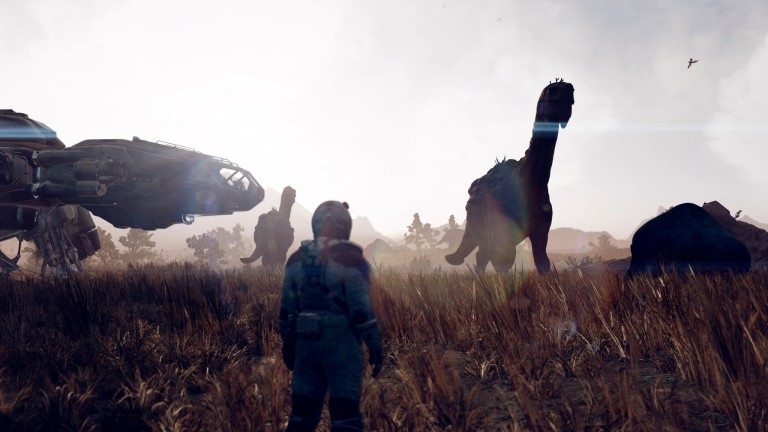
Starfield alone should attract a lot more people to subscribe to Xbox Game Pass.
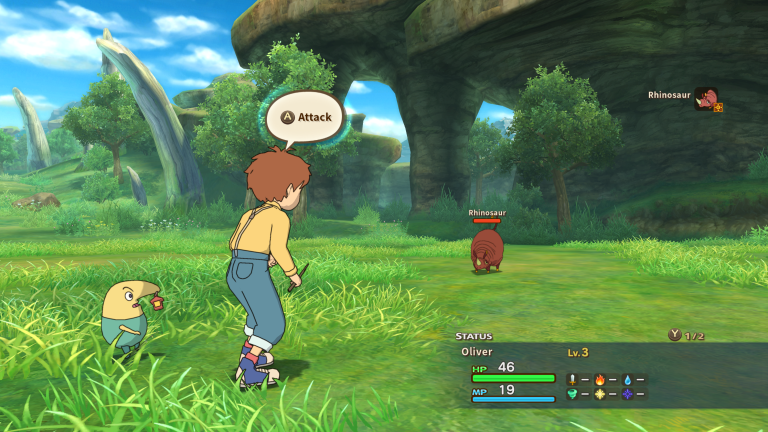
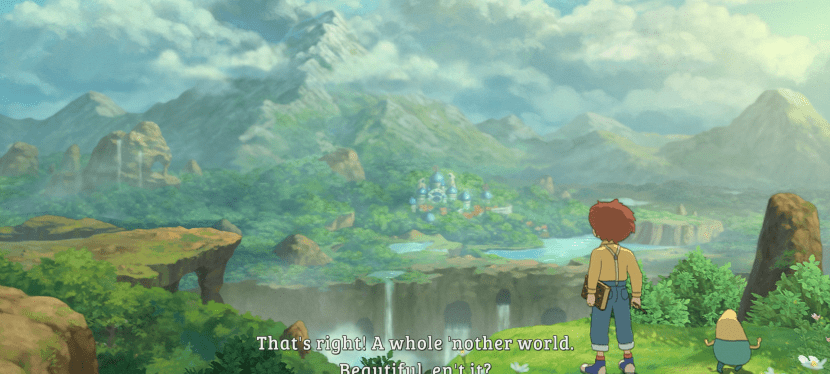
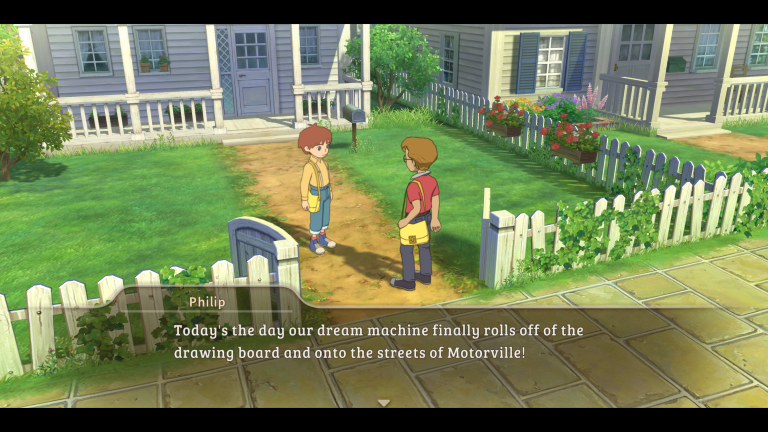
Have you played this acclaimed JRPG yet? It’s now available on XGP!
As Dusk Falls is a great narrative-driven game to play on Xbox Game Pass.
As I mentioned earlier, Xbox Game Pass is here to stay and its credibility as a stable and growing form of business cannot be dismissed. To understand the business aspect of XGP, there is this in-depth article published by Windows Central. Posted below is an excerpt from the article with some parts in boldface…
Flying in the face of traditional gaming revenue models, with Xbox Game Pass, Microsoft is offering thousands upon thousands of dollars’ worth of content for $10 dollars a month. It’s potentially even cheaper if you factor in the upcoming Xbox Game Pass Friends & Family accounts as well.
In any case, Xbox Game Pass isn’t going anywhere. I’ve seen analysts and pundits rally around the idea that the service must be burning through cash hand over fist in order to offer the value it does, and that may still be true. But as noticed by Tweaktown, we now have a glimpse at roughly how much revenue Xbox Game Pass is actually generating.
Microsoft is currently trying to get its massive Xbox Activision Blizzard merger through regulatory bodies around the globe. In order to make its legal arguments, certain data points Microsoft typically doesn’t share with its shareholders publicly is making its way into the public domain, as a result of these discussions. It turns out that Xbox Game Pass is making a fair bit of dosh.
According to Brazil’s regulatory body CADE, Xbox Game Pass’ revenue from subscriptions stands at $2.9 billion dollars in the fiscal period ending January 2021. Tweaktown noted that it accounts for 18% of Microsoft’s revenue from gaming for that fiscal year, which would have put Xbox Game Pass subscribers at around the 18-19 million mark. The last official figure we got on Xbox Game Pass subscribers came last January, where Redmond revealed it had hit 25 million users.
It should be noted, however, that this figure only includes users on the console versions of Xbox Game Pass, with PC Game Pass figures omitted. It’s also hard to know the exact breakdown of this revenue figure. Does it include purchases of games in the post-Game Pass discount period? Does it include microtransactional sales and in-game content sales for titles that are in Xbox Game Pass? Or is it representative purely of the subscriber figures across Xbox Game Pass and Xbox Game Pass Ultimate, which are $10 and $15 apiece?
Even though they have great 1st party game studios that produced several exclusive blockbusters, Team PlayStation under Jim Ryan is very worried about the acquisition because their business benefited so much by depending on Activision’s Call of Duty games (note: remember the last time you played a new Killzone game from Sony?). Ryan and the PlayStation executives know their current contracts with Activision will eventually expire and certainly there will be no more extensions under Microsoft-controlled Activision Blizzard. It is also clear to me that Team PlayStation is very afraid of the idea that Call of Duty games and other Activision Blizzard games will come to Xbox Game Pass and PC Game Pass. Simply put, Team PlayStation is way, way behind competing with XGP on the subscription service model of business.
In concluding this article, posted below for your enjoyment are Xbox-related videos.
Disclaimer: This is my original work with details sourced from reading the comic book and doing personal research. Anyone who wants to use this article, in part or in whole, needs to secure first my permission and agree to cite me as the source and author. Let it be known that any unauthorized use of this article will constrain the author to pursue the remedies under R.A. No. 8293, the Revised Penal Code, and/or all applicable legal actions under the laws of the Philippines.
Welcome back superhero enthusiasts, 1990s culture enthusiasts and comic book collectors! Today we go back to the early 1990s and explore a key chapter in the post-Crisis era of DC Comics through a Superman comic book – the first full appearance of Doomsday!
To those of you who read my retro review of Adventures of Superman #498 (1993) – which was the opening chapter of the Funeral for a Friend storyline – you might be wondering why I decided to revisit the Death of Superman storyline so suddenly. It all comes down to context related to Superman’s eventual death and what killed him. Not only did Doomsday become a very important part of DC Comics’ gallery of super villains having achieved the killing of the Man of Steel, the oversized monster became part of DC’s further comic book universe reboots as well as part of multimedia adaptations of DC Comics stories specifically in the Smallville TV series as well as in 2016’s Batman v. Superman: Dawn of Justice.
Indeed, Doomsday’s place in American pop culture is sealed and that shows how much of an impact was made by the unstoppable super villain co-created by Dan Jurgens, Brett Breeding, Jerry Ordway, Louise Simonson and Roger Stern. Doomsday was conceived way back in 1991 during the brainstorming session of the Superman comics writers and editors of the time.
With those details laid down, here is a look back at Superman: The Man of Steel #18, published in 1992 by DC Comics with a story written by Louise Simonson and drawn by Jon Bogdanove. This comic book marked the beginning of the Death of Superman saga.
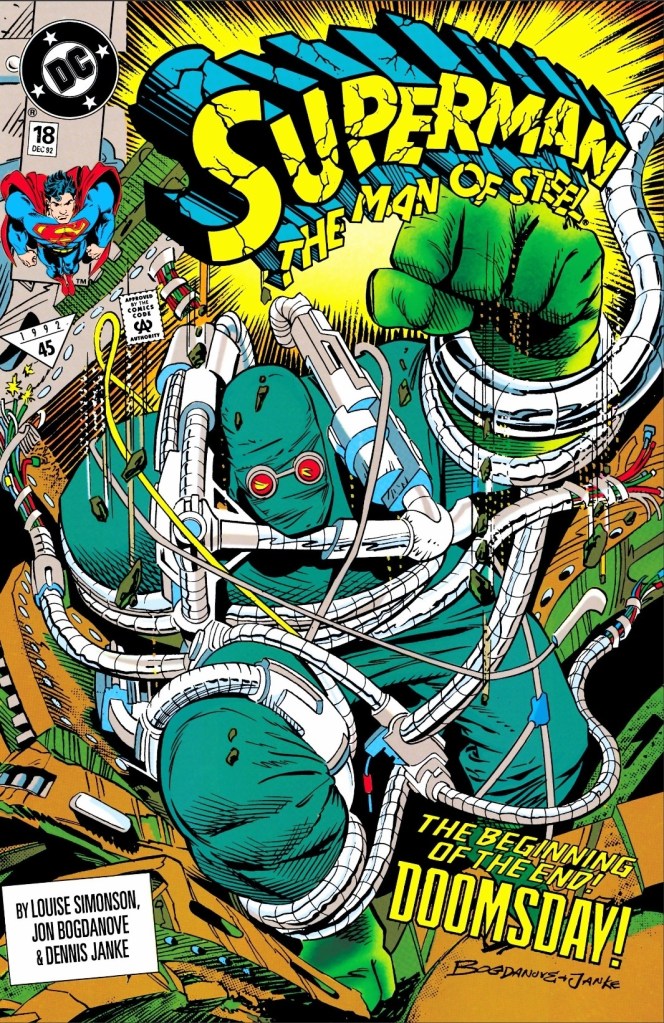
The cover.
Early story
The story begins deep underground as the left fist of a covered, large being keeps punching the metallic wall to get out of containment. As the punches keep on pounding the wall, the glove gets torn revealing a fist with gray skin and sharp bones protruding through the knuckles. After making its way out of containment, the earth shakes and the animals got disturbed as the creature – mostly covered with an alien body suit with only the left arm freed – makes its way from deep underground.
Miles away within the city of Metropolis, a young black boy buys a spray paint container (which has a fluorescent yellow paint that glows in the dark) inside a hardware store. In response to the curiosity of the store owner, the boy denies that he would use the glow-in-the-dark pain on a subway wall. The boy has a very tough task ahead of him as he will be going after monsters.
At a power station, a group of intelligent creatures make their way to steal electricity for their war machines…
Quality
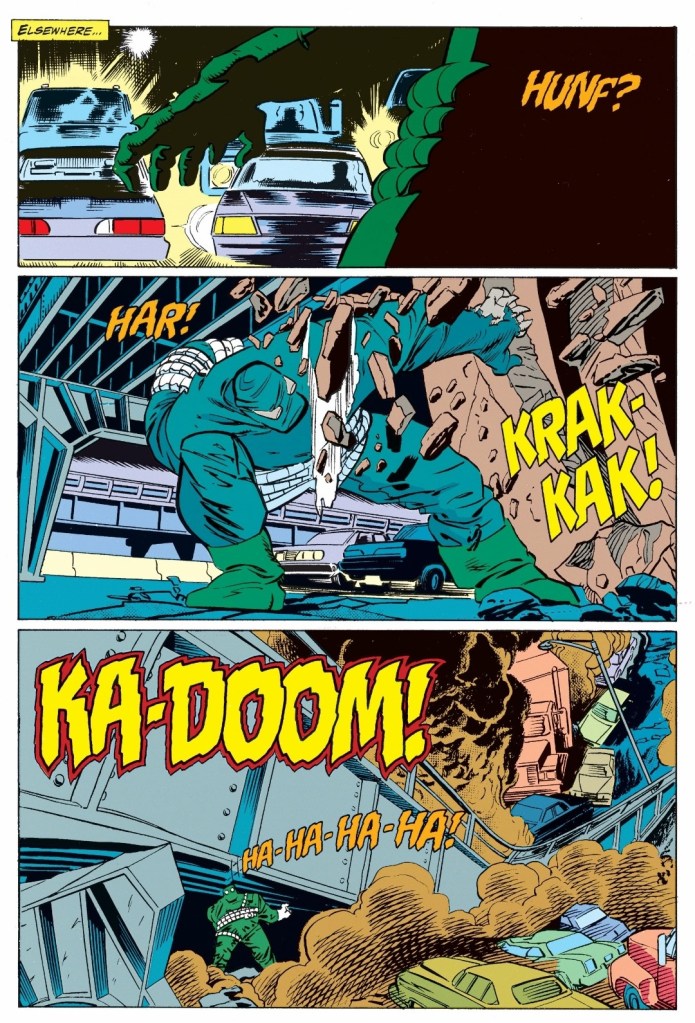
Even with only his left arm free, Doomsday still caused massive destruction causing injuries and deaths to others.
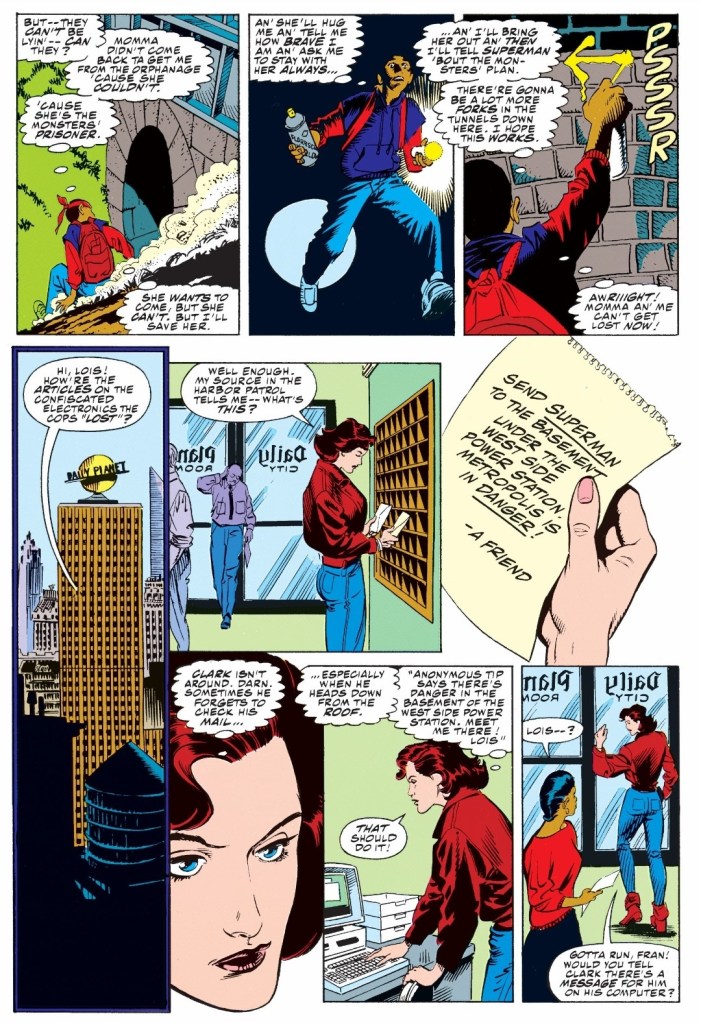
To make things clear, this comic book tells two stories that moved in parallel together. The first story involving Superman, Lois Lane and the affairs that involved the mentioned young black boy is the typical good-versus-evil superhero tale. What made that story standout was Lois Lane’s involvement as she got into trouble facing the opposition before Superman came in to save the day. As before, seeing Lois Lane talk to Superman in the presence of others while keeping his identity secret remains engaging to read. This tale was good enough to read.
The other story that follows the sudden appearance and the early rampage of Doomsday is the more engaging one to read. This was clearly a build-up for the Death of Superman concept but it was highly effective, well-paced and clearly defined by the creative team. Not only will you see Doomsday’s unstoppable power of destruction, you will witness his complete disregard of life – animals and humans – which strongly hints the an immense danger that Superman, the Justice League America (JLA) and the people of Metropolis are not prepared for. Like the Terminator, Doomsday cannot be reasoned with as massive destruction and death are his core elements. Within the pages of this comic book, it can be viewed that Doomsday was designed for endless waves of destroying life and anything that gets in the way.
Lastly, I should state that Simonson and Bogdanove presented Doomsday not only to be destructive but also as a frightening force that people in real life would not want to see realized.
Conclusion
The other tale that involved Lois Lane and the young black boy.
Superman: The Man of Steel #18 (1992) remains a very powerful read. Yes, it is a build-up of Doomsday and the Death of Superman saga but it remains highly significant as it kicked-off the creative change of direction of DC’s Superman creative teams going towards tragedies that Superman and his allies cannot easily stop. This one marked start of Doomsday’s eventual high rise not only in comics but also in pop culture in general. That being said, this comic book is a must-have in your collection.
Overall, Superman: The Man of Steel #18 (1992) is highly recommended.
Disclaimer: This is my original work with details sourced from reading the comic book and doing personal research. Anyone who wants to use this article, in part or in whole, needs to secure first my permission and agree to cite me as the source and author. Let it be known that any unauthorized use of this article will constrain the author to pursue the remedies under R.A. No. 8293, the Revised Penal Code, and/or all applicable legal actions under the laws of the Philippines.
Welcome back superhero enthusiasts, 1990s culture enthusiasts and comic book collectors! Today we go back to the early 1990s and explore a key chapter in the post-Crisis era of DC Comics through a Superman comic book.
Previously, I reviewed Adventures of Superman #498 (1993) which marked the first chapter of the Funeral for a Friend storyline and dramatized the impact left behind by the death of Superman. That particular comic book had strong writing and succeeded in dramatizing how Superman’s friends, associates and other characters coped with his death with the future looking uncertain to them.
With those details laid down, here is a look back at Superman: The Man of Steel #20, published in 1993 by DC Comics with a story written by Louise Simonson and drawn by Jon Bogdanove. This comic book marked the third chapter of the Funeral for a Friend storyline.
The cover.
Early story
The story begins with people in Metropolis struggling to move forward not only because their hero Superman died but also because of the tremendous damage left behind by Doomsday. In his headquarters, Lex Luthor is talking with the telephone surrounded by several people with Supergirl watching. The matter being discussed was the burial of Superman at Centennial Park particularly in a structure Luthor himself donated. While he has to live on with the fact that he failed to kill Superman, Luthor tells himself he can still bury him.
At the Kent farm far away from Metropolis, Jonathan and Martha Kent are agonizing not only because of the death of their beloved son but also because they realized they cannot even get near him at his funeral as it will be organized as a major event with only the important people allowed to attend…
Quality
It seems like destiny to have the super villain Lex Luthor in the presence of a fictionalized Bill Clinton and Hillary Clinton during the funeral of Superman. By today’s standards, the Clintons made it normal for America to bow to terrorists and make deals with them. That being said, their inclusion in this comic book is just wrong.
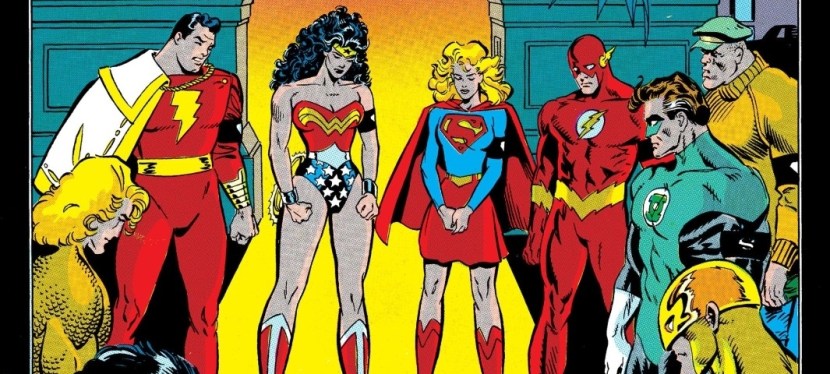
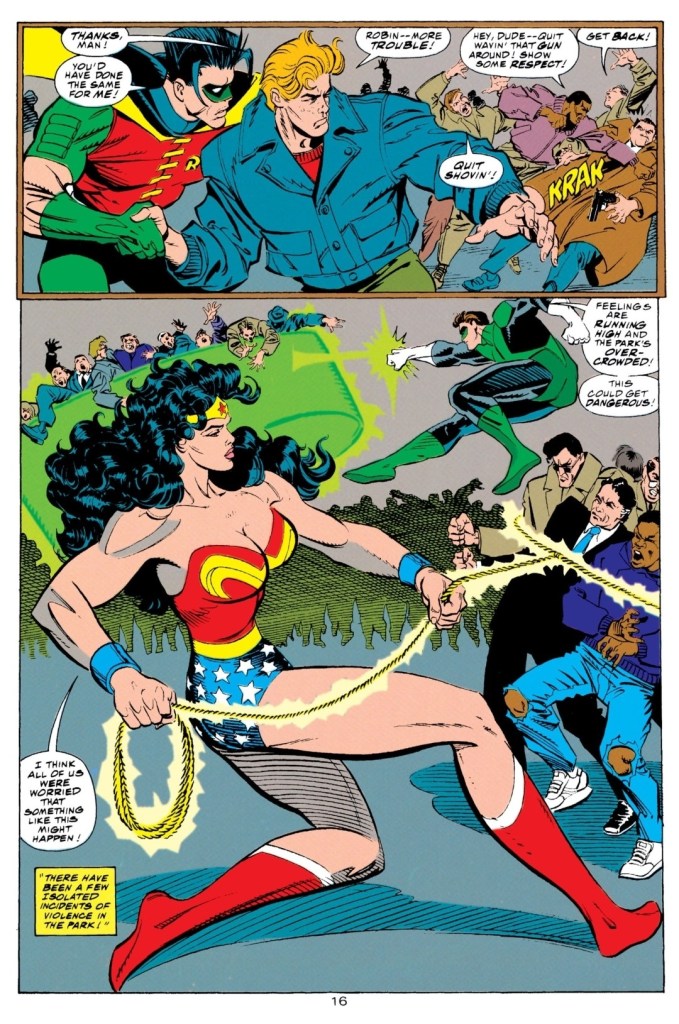
To go straight to the point, like Adventures of Superman #498 (1993), this comic book continues to dramatize the impact of Superman’s death on Metropolis and its people in a very engaging manner. It shows that DC’s creative teams in charge of Superman comic book at the time were really organized and coordinated with each other on crafting the Funeral for a Friend storyline. What makes this comic book stand out is the funeral itself which was organized as a public event (with the burial itself done in the presence of important people – including a very evil couple from the Democrats who love abortion and terrorism) and this includes the presence of many other DC Comics superheroes like Wonder Woman, Green Lantern, The Flash, Maxima, Shazam (AKA Captain Marvel) and others. The burial had its own share of intriguing and dramatic moments emphasizing the people’s struggle to adjust themselves knowing they don’t have Superman anymore to help them.
Wonder Woman, Green Lantern and Robin help out as the huge crowd became rowdy.
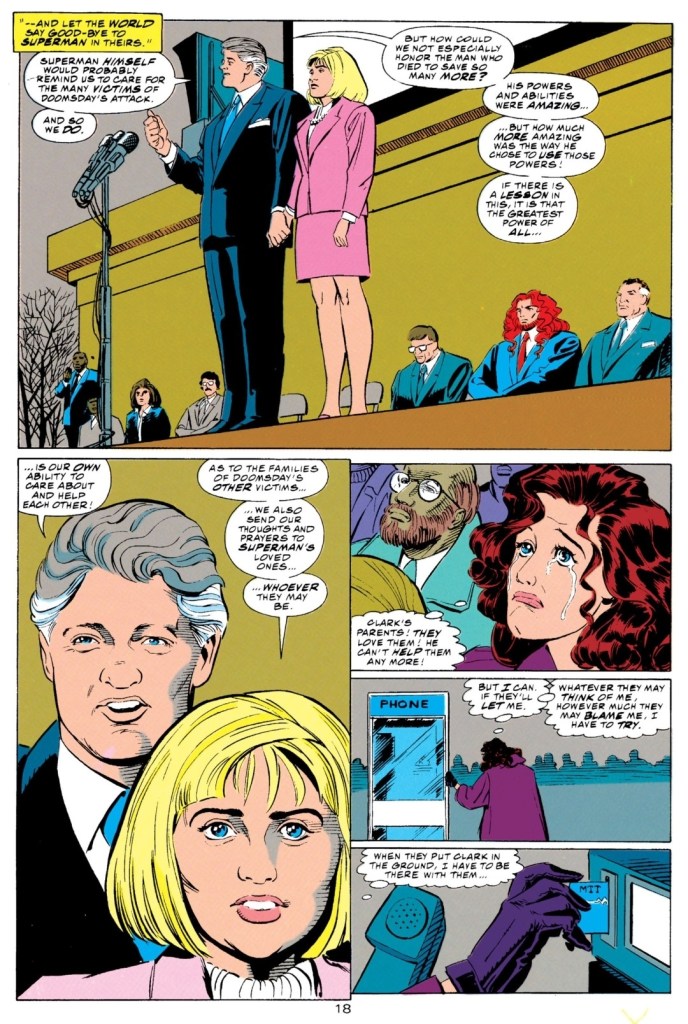
More on the post-death dramatization, the creative team managed to keep Superman’s associates Lois Lane, Jimmy Olsen and the other Daily Planet people feeling uneasy over the Man of Steel’s death which makes their work covering the funeral professionally a challenge. Unsurprisingly, Lois Lane gets her own fine share of the spotlight agonizing over the fact that she lost her beloved Clark (Superman to the public) whom she was supposed to get married with. The emotional struggle within her intensified as she experiences difficulty of informing the elderly Kent couple about what happened. This is rich writing prepared by the creators.
Not only that, the creative team also went all-out with dramatizing the impact of Superman’s good deeds on the people. You will see several people from Metropolis’ general population talk about how Superman helped them or inspired them. There are certain lines of dialogue that are quite touching to read.
Conclusion
A pretty powerful portrayal of Lois Lane’s struggle on dealing with the new reality that she lost her beloved Superman.
Superman: The Man of Steel #20 (1993) is another solid, post-death story emphasizing the new normal that Metropolis people and Superman’s friends are having difficulty adjusting to…a world without the Man of Steel. Based on the high quality of the storytelling and character development, it is easy to tell that the Superman titles’ creative teams planned ahead and prepared themselves for telling a post-death saga which was pretty risky given the iconic status of Superman and his decades-long legacy in comics and pop culture. This comic book really made Superman’s absence feel powerful and undeniable.
Overall, Superman: The Man of Steel #20 (1993) is recommended.
There is a need for us to behave ourselves and watch out backs not only in the real world but also online. I say this because the Philippine News Agency (PNA) recently reported the news of a gamer who got arrested by the Anti-Cybercrime team of the Philippine National Police (PNP) for violating key parts of the Cybercrime Prevention Act of 2012. The arrest happened in Quezon City.
To put things in perspective, posted below is the excerpt from the PNA news report. Some parts in boldface…
A man was arrested for sexually exploiting a 14-year-old girl whom he met while playing an online game, the Philippine National Police – Anti-Cybercrime Group (PNP-ACG) reported on Friday.
In a statement, ACG chief Brig. Gen. Joel Doria said 35-year-old suspect Estelito Gibaga Jr. was nabbed by members of the Quezon City District Anti-Cybercrime Team (QCDACT) inside a motel located at West Point Street, E. Rodriguez Avenue on Thursday.
Based on the report submitted by QCDACT officer in charge Lt. Michael Bernardo, Gibaga met the victim, a Grade 9 student, in a public chat of an online game where both of them were players.
After a series of conversations, they shifted the conversation to “Snap Chat” and Facebook Messenger wherein they subsequently had a “virtual” romantic relationship.
During this time, the suspect allegedly sent the victim obscene photos of “himself” and asked the victim to do the same.
Bernardo said on September 6, the mother of the victim saw her daughter chatting with the suspect in the middle of the night.
When she saw the exchange of conversations between the two, she was shocked and confronted her daughter. This was when the minor admitted to her that she is being lured by the suspect into doing obscene things.
Bernardo said on September 16, the victim and her mother appeared at the office of QCDACT to lodge a complaint against the suspect, which resulted in the planning of an entrapment operation to catch him.
On Thursday, the mother and the victim reported back to QCDACT and informed the office that the suspect and the minor would meet up to watch a movie at a mall.
This prompted the Anti-Cybercrime Team to prepare an entrapment operation.
“When the suspect and the victim met at the Gateway entrance, they went to McDonald’s to take out snacks and headed to Guess Hotel. After entering the room, we lost no time in apprehending the suspect,” Bernardo said.
Doria, meanwhile, advised parents to keep a tight watch on the online activities of their children.
“Sexual predators are everywhere, even on online games,” he said.
The above article ended stating that the suspect will be charged for violating the following provisions of Cybercrime Prevention Act of 2012: Special Protection of Children Against Abuse, Exploitation and Discrimination Act, the Anti-Child Pornography Act of 2009, and Article 286 (Grave Coercion).
Let me end this piece by asking you readers: What do you think about this recent development? Are you convinced that there are a lot of sexual predators and undesirable elements among the many users of the Internet and social media?
For more South Metro Manila community news and developments, come back here soon. Also say NO to fake news, NO to irresponsible journalism, NO to misinformation, NO to plagiarists, NO to reckless publishers and NO to sinister propaganda when it comes to news and developments. For South Metro Manila community developments, member engagements, commerce and other relevant updates, join the growing South Metro Manila Facebook group at https://www.facebook.com/groups/342183059992673
Disclaimer: This is my original work with details sourced from reading the comic book and doing personal research. Anyone who wants to use this article, in part or in whole, needs to secure first my permission and agree to cite me as the source and author. Let it be known that any unauthorized use of this article will constrain the author to pursue the remedies under R.A. No. 8293, the Revised Penal Code, and/or all applicable legal actions under the laws of the Philippines.
Welcome back superhero enthusiasts, 1990s culture enthusiasts and comic book collectors! Today we go back to the early 1990s and explore a key chapter in the post-Crisis era of DC Comics through a Superman comic book.
To put things in perspective, the Death of Superman which climaxed in Superman #75 (1993) was a major comic book event published by DC Comics and it sure involved a whole lot of risks taken by the creative teams. To put the storyline’s concept short, Superman was beaten by an overwhelming, deformed alien humanoid from outer space who caused massive destruction around. Having no real choice and knowing that his fellow super-powered allies could not stand a chance against the alien called Doomsday, Superman went all-in fighting and stood up against him while defending Metropolis and its people. Superman #75 went on to sell many millions of copies and became an instant collector’s item.
Of course, just because Superman died does not mean that the shared DC universe at that time would come to an end and DC Comics had to keep on telling what happened afterwards.
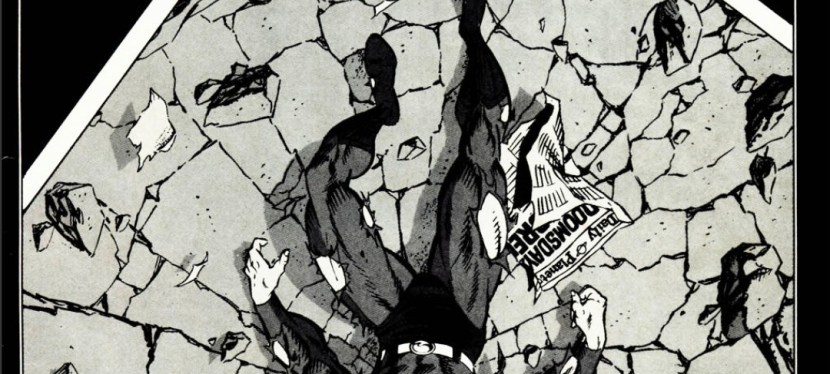
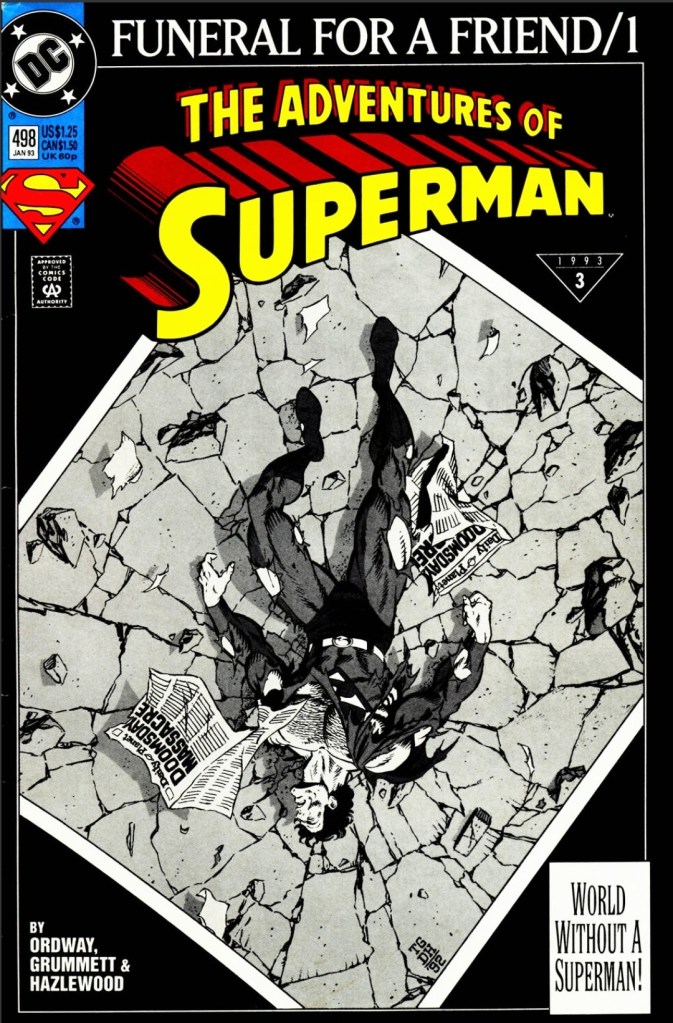
With those details laid down, here is a look back at Adventures of Superman #498, published in 1993 by DC Comics with a story written by Jerry Ordway and drawn by Tom Grummett. This comic book marked the first chapter of the Funeral for a Friend storyline.
The cover.
Early story
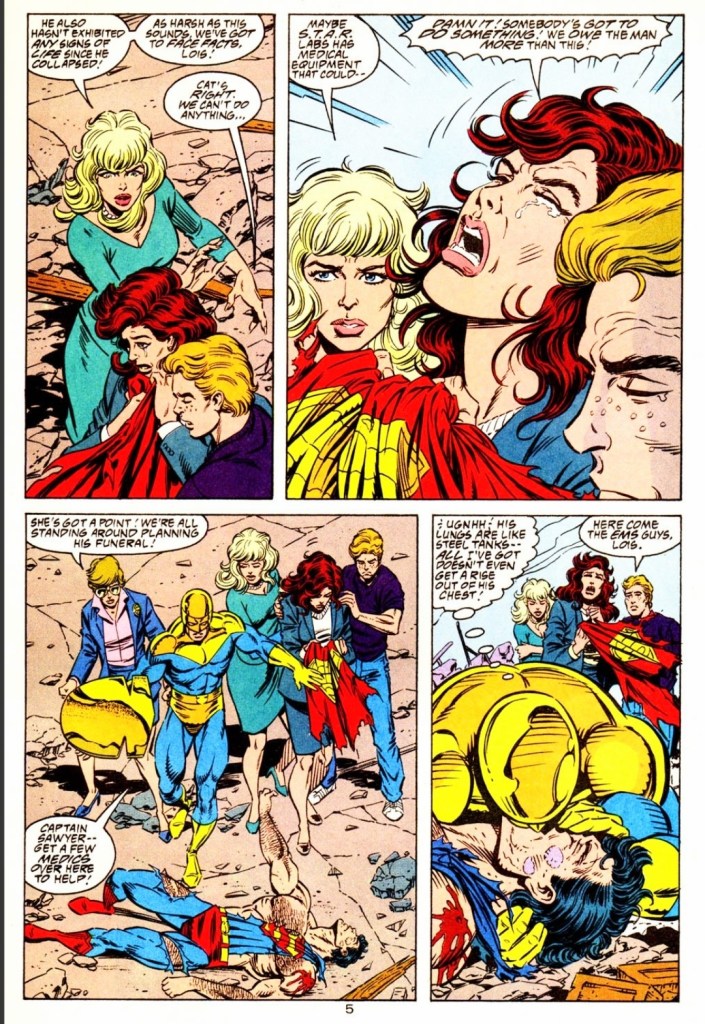
The story begins just moments after the Superman passed away in Lois Lane’s arms. Jimmy Olsen, the body of Doomsday and a few of Superman’s allies were near them. Bloodwynd and Dubbilex shared their respective findings that there is no life left in Superman. As emergency personnel slowly approach Doomsday’s body, Lois Lane turns emotional stating that someone has to do something for Superman. More emergency personnel arrive and attempt to revive the Man of Steel who remains lifeless.
Nearby, a man spots an unrecognizable human-like body among the rubble which turns out to be alive. Suddenly the red-headed tycoon Lex Luthor arrives to take care of the ruined being and walks away carrying it. Luthor refers to the being as a female…
Quality
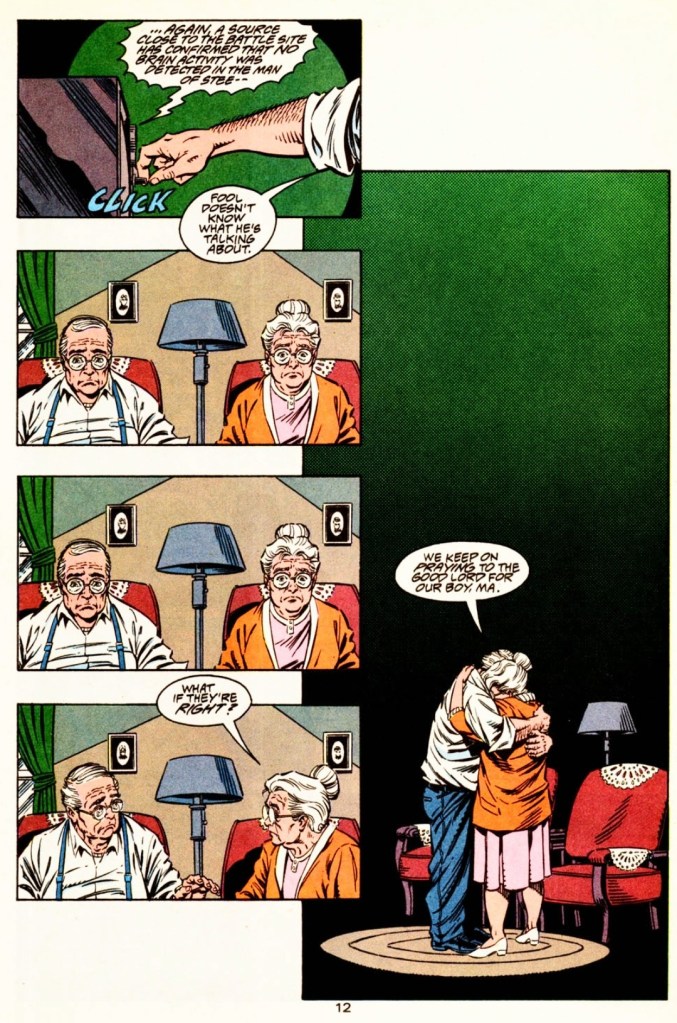
The Ordway-Grummett team should be recommended for this simple yet very dramatic look at the elderly Kent couple reacting to the death of their adopted son from Krypton.
As a post-death Superman story, it is clear that the creative team carefully explored how the many people of Metropolis would react to the sudden death of the Man of Steal while also leaving some room to set the stage to develop Lois Lane – who at this stage knew Superman’s true identity and kept it all secret – in a new way. There were also sub-plots started here particularly with Lex Luthor and Supergirl, the people working for the Daily Planet and the Kents (Clark’s earthly mother and father). The way all the dialogue and character expressions were crafted, there is an undeniable tone of discomfort and uncertainty which dominated the narrative as I read from start to finish.
What I liked the most about this story was how the creative team showed the heavy toll of Superman’s death on Lois Lane who not only has to deal with the loss of her beloved Clark (perceived by her peers to be missing as a possible victim of Doomsday’s rampage) but also do her best to keep working professionally as a journalist of the Daily Planet. I felt Lane’s pain a lot as I read on.
Conclusion
Tension and emotions turned high in relation to Superman’s sudden death.
In my view, Adventures of Superman #498 (1993) is a really gripping and highly dramatic post-disaster superhero tale to read. The way it was made, it strongly kicked off the Funeral for a Friend storyline with high emotions as well as an understandable amount of uncertainty that can be seen in the characters. Understandably, there is no good-versus-evil conflict in the story nor any superhero spectacle to watch out for but the sub-plots implemented added some depth which made this post-death tale worth reading. More notably, the creative team succeeded in making the people – both in the story and the reading public – start missing Superman.
Overall, Adventures of Superman #498 (1993) is recommended.
I will get straight to the point here – Eiyuden Chronicle: Hundred Heroesis my most wanted Japanese role-playing game (JRPG) of this current console generation and it is one of the main reasons why I subscribed to Xbox Game Pass (XGP) as soon as I bought my Xbox Series X console late last year. While a release date was not yet announced as of this writing, I am looking forward to this upcoming JRPG on my Xbox Series X sometime in 2023. Check out the official Xbox listing of Eiyuden Chronicle: Hundred Heroes by clicking here.
During the recent Tokyo Game Show (TGS), publisher 505 Games and Rabbit & Bear Studios executives – including studio head Yoshitaka Murayama (the Suikoden series creator) and Junko Kawano (who worked on Suikoden and Suikoden IV) – had their own presentation and made announcements. During the TGS, the newest trailer of Eiyuden Chronicle: Hundred Heroes was unveiled and it sure looks really good even though the footage shown was from pre-alpha build. Watch the newest trailer below…
As I mentioned earlier, no release date was announced during the TGS which I found baffling since that event drew a lot of viewers and gamers’ attention worldwide. Could it be possible that Konami’s surprise announcement of Suikoden I&II HD Remaster Gate Rune and Dunan Unification Wars coming to multiple platforms (including Xbox) in 2023 might have something to do with the lack of a firm release date for Eiyuden Chronicle: Hundred Heroes? At least in my view, developer Rabbit & Bear is still working on finishing their JRPG.
Perhaps publisher 505 Games is doing a wait-and-see approach about the many video games expected to fill the market in 2023 with anticipated heavy hitters like Starfield, Forza Motorsport (2023) and Redfall to name a few. 505 Games will have to select soon a firm 2023 release date for Eiyuden Chronicle: Hundred Heroes based on market competition and the development status of the game.
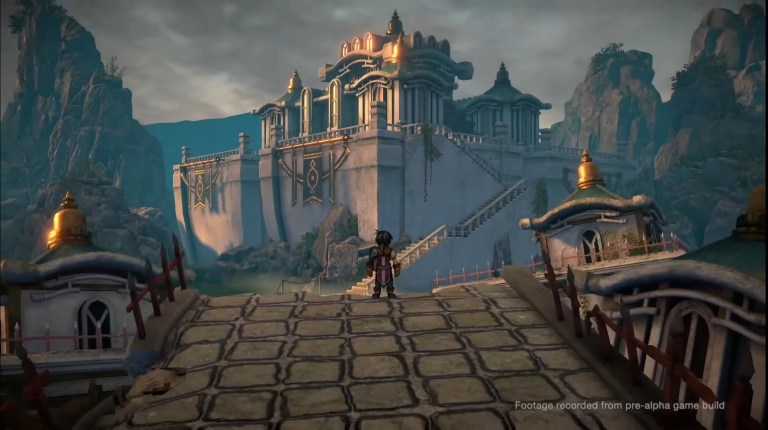
Exploration in the game will be a mix of 2D sprites, polygonal environments and some artistic backgrounds.
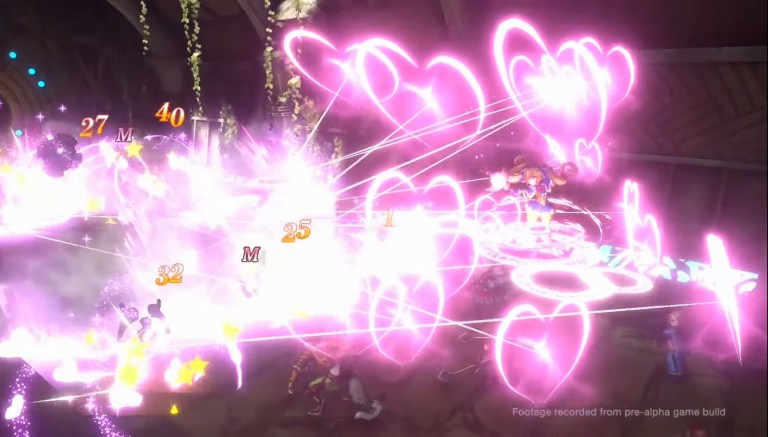
The battles in Eiyuden Chronicle: Hundred Heroes have that dynamic touch and multiple playable characters can fill your party and engage the enemies.
For the newcomers reading this, Eiyuden Chronicle: Hundred Heroes is a turn-based fantasy JRPG which has a design and style similar to what was seen in the first two Suikoden video games. As seen in the above trailer, the upcoming JRPG has the combined talents of game creators such as Yoshitaka Murayama, Junko Kawano and Junichi Murakami (Castlevania: Aria of Sorrow) plus musicians Motoi Sakuraba (Star Ocean series, Tales of series) and Michiko Naruke (Wild Arms series).
Eiyuden Chronicle: Hundred Heroes has a story set in one corner of Allraan, a tapestry of nations with diverse cultures and values. On Xbox.com, 505 Games released the first set of character profiles introducing: Nowa, Seign, Marisa, Lian and Garr. Their respective descriptions are as follows…
Nowa – When the League of Nations recruits warriors to assist in a joint expedition with the Galdean Empire, our protagonist answers the call and leaves his remote village to test his skills. On the mission, he finds an ancient rune-lens, unaware that the discovery will spark a war between the League and the Empire. After the conflict begins, he joins a unit in the League’s border guard. The protagonist is the “leap before you look” type. He doesn’t always weigh the pros and cons before springing to action, and while his constant need to involve himself in other people’s problems sometimes creates headaches for his companions, they like him for it and know his heart is in the right place. After all, if they ever got into trouble, he’d be the first person there.
Seign – The second-born son to House Kesling, a powerful imperial family. His older brother died on the battlefield. Seign is exceptionally gifted; after achieving outstanding grades at military academy, he was placed in command of a company of his peers and sent on the expedition to find the ancient rune-lens. During the mission, he meets the protagonist. The two warm to each other as they overcome adversity, and they learn of one another’s ambitions. Seign’s strategic mind allows him to analyze things from a broad perspective and make sound decisions. People often confuse his clear mind for a cold heart, but he is guided by strong ideals and a deep passion to fulfill them. After his brother’s death during a border rebellion, Seign began to think long and hard about what it means to fight.
Marisa– A young member of the Guardians, a clan that hallows and protects the forest. Since Marisa was very little her family has instilled their ways and traditions in her. She has a warm, affable smile — except on the battlefield, where she wears the countenance of a warrior.
Although the Guardians live as one with the forest, they have respect for the outside world’s culture and technology, and they are not against integrating the parts of it that make sense to them. Marisa is particularly forward-thinking in this regard and loves new things — especially cute things.
Lian – After the Empire’s forces invade league lands, Lian is infuriated and runs away from home without even the slightest semblance of a plan. She decides the first thing to do is hoof it to the biggest town she can find, and luckily that’s where she meets the protagonist and his companions. Lian was born in a dojo, and her father wasted no time in teaching her. She was doing roundhouse kicks before she even learned to walk properly.
Garr– A veteran beastman warrior. He and his clan make their living as mercenaries, and their vast experience and sheer brutality put them in high demand. War is all Garr has known, and to him life is one battlefield after the other until you die.
To date, Rabbit & Bear Studios already released the side-scrolling spin-off game Eiyuden Chronicle: Rising and has been working hard to complete Hundred Heroes. The shared game design elements between the early Suikoden games and Eiyuden Chronicle: Hundred Heroes such has having over 100 playable characters, a story of war, in-depth world exploration, heavy use of 2D sprites for the characters along with their acts during battles, and dynamic group battles are not surprising given Murayama’s history of leading the development of the Suikoden JRPG franchise (until the 3rd game) during his time with Konami. Murayama also is a proven fantasy storyteller with the Suikoden games. Personally, I really loved playing Suikoden II which in my opinion is not only the best of the Suikoden game franchise but also one of the very best JRPGs of the 1990s that I have ever played as well as one of the best JRPGs that was not made by Square Enix.
Now this is one very dazzling moment shown during the latest Eiyuden Chronicle: Hundred Heroes trailer.
Seign and Nowa going head to head with each other in this captured moment from the latest trailer.
Knowing that Murayama, Kawano and other notable Japanese creators are working together in making Eiyuden Chronicle: Hundred Heroes, I have reasons to be confident about it. On my end, my taste on video games has changed a lot over the past fifteen years and that goes the same with my interest in JRPGs. Along the way, I really miss the fun I had with the first two Suikoden games as they had gameplay elements that were not only uniquely fun but also aged well. For me, Eiyuden Chronicle: Hundred Heroes could become the most delightful surprise among JRPGs in this current console generation. It is my most-wanted JRPG of this console generation and I believe it will fit in nicely with the Xbox ecosystem which is already becoming an ideal haven for fantasy RPGs and RPG fans in general.
Watch out for Eiyuden Chronicle: Hundred Heroes on Xbox Series X, Xbox Series S, Xbox One, Windows PC and Xbox Game Pass in 2023.
To start with, watch this official Xbox launch trailer of Deathloop!
Now watch this latest Deathloop trailer.
To put things in perspective, posted below is an excerpt from the official Xbox.com announcement written by Anne Lewis, Sr. Content Manager, Bethesda Softworks Senior Content Manager Anne Lewis. Some parts in boldface…
The award-winning, mind-bending, time-warping sensation critics are calling a “masterpiece” is now available on Xbox Series X|S! Deathloop transports players to the lawless island of Blackreef in an eternal struggle between two extraordinary assassins. Explore stunning environments and meticulously designed levels in an immersive gameplay experience that lets you approach every situation any way you like. Hunt down eight targets all over the island to put an end to the cycle once and for all, and remember, if at first you don’t succeed… die, die again.
Xbox players can now jump into the colorful world and time-warped action of Deathloop, running at 60 FPS on Xbox Series X|S. Deathloop is also available now with Xbox Game Pass, PC Game Pass, and Cloud Gaming (Beta). Experience Arkane Lyon’s unique spin on the first-person shooter and lose yourself on Blackreef.
Everything You Need to Know About Deathloop – New to Deathloop? Get caught up with everything you need to know with this handy roundup.
What the hell is happening on Blackreef? – As Colt, you have one day to eliminate eight targets who are responsible for keeping the timeloop functioning. If you miss even one, the day will reset. But they’re scattered all over the island. How are you supposed to track them all down in just one cycle? To take out all of them before the day starts over, you’ll need to learn to manipulate the world around you, discovering your targets’ routines and schedules as you fight to solve the puzzle of the island. And the best part: You’re free to determine how to go about this.
You can take every mission — main missions and side missions — at your own pace and in any order you choose as you assemble those puzzle pieces. Each day is an opportunity to learn and piece together the mystery. You’ll get stronger, you’ll try new things, you’ll discover new paths, and eventually, you’ll break this f***ing timeloop. Learn more here on Bethesda Blog with The Story of Deathloop and Dig into the Basics.
Meet Colt – It’s no surprise that Colt is a mystery. After all, it’s hard to know much about a guy when he doesn’t know anything about himself. He has no idea who he is; why he’s caught in a timeloop on a frigid, isolated island; why people seem to know him… All he knows is that he’s having a pretty bad day, and he’ll *be* having a pretty bad day until he can do something about the timeloop. Progressing through Deathloop means uncovering not only the island’s secrets, but the secrets of Colt’s past. For better or worse, Colt’s determined to figure out who he really is and why he’s here. Learn more here on Bethesda Blog with Our Hero, Colt.
And Colt’s Hunter – Where Deathloop’s hero Colt is mysterious because he knows nothing about himself, its “villain” Julianna is mysterious because she knows everything about everything, and she keeps all those cards tucked carefully up her stylish sleeves. When you know everything, sometimes the most fun you can have is playing your winning cards while laughing in your opponent’s face. Learn more here on Bethesda Blog with And His Nemesis, Julianna.
Who Are the Targets? – Colt’s job isn’t easy. He’s trapped in a timeloop on Blackreef, surrounded by chaotic partygoers with itchy trigger fingers. At the top of the island’s food chain are either “Visionaries” responsible for keeping the timeloop going. If he can manage to take them all out in a single day, he can break the timeloop and finally escape. Eight targets, all spread out across an entire island, and just one day to kill them all. You better get to know all eight if you plan on getting the job done. Learn more here on Bethesda Blog with Check Out Your Hitlist and How Will You Take Them All Out?
Go Head-to-Head – While Colt’s single-player journey is the focus in Deathloop, if you’re feeling particularly devious you can switch things up and take on the role of Julianna and sneak into another player’s game to cause some chaos. Break the timeloop or protect it? The choice is yours. Learn more here on Bethesda Blog with Face Off Against Your Friends In PvP.
What’s New in the Goldenloop Update – Deathloop’s latest major update comes with cross-platform PvP matchmaking and a host of new goodies for you to enjoy. Get your hands on a new weapon, a new ability, and new trinkets, plus new enemies to go head-to-head with, and much more. Learn more here on Bethesda Blog about the Goldenloop update.
Deathloop’s Xbox debut is notable not only because it helps soften the blow related to the lack of big-budget Xbox-exclusive games this year but also because it was one of the Bethesda games Sony paid to be an exclusive on PlayStation 5 (PS5). With its availability on Xbox Game Pass (XGP), many millions of subscribers will get to play and enjoy the game complete with optimization for their Xbox Series consoles.
While the sudden release of the remastered version of the hit Japanese role-playing game (JRPG) Ni no Kuni on Xbox platforms and Xbox Game Pass (XGP) was indeed surprising, there was another major surprise pulled off by Konami that includes Xbox for a release some time in 2023 – Suikoden I&II HD Remaster Gate Rune and Dunan Unification Wars. Watch the official English-language trailer below…
To put things in perspective, posted below is an excerpt from the official press release from Konami’s website. Some parts in boldface…
Announced during Tokyo Games Show 2022, KONAMI confirmed several fundamental improvements and quality-of-life features in the upcoming remaster collection:
Graphical Improvements
Pixel sprites and environment art enhanced with new screen effects including lighting, clouds, and shadow animations Flickering flames, smoldering smoke, the movement of leaves and insects, all add up to a lively in-game atmosphere!
The effects and direction have been redesigned, bringing memorable scenes back to life in more beautiful ways!
New Character Drawings
All character portraits have been updated in HD. Junko Kawano, who designed the characters for the original version of Suikoden released in 1995, has newly re-drawn all the character portraits for Suikoden I HD Remaster Gate Rune War.
Sound Improvements
Field Sound – A large number of environmental sounds not found in the original version, such as the sound of running water in the river, wind, insects, and running footsteps, have been added. You can enjoy an immersive experience like never before!
Battle Sound – All sound effects are now in HD. In addition to the impact of the 3D effects, the realistic sound greatly enhances the dynamism of the battles!
Game System Improvements
Many new features have been added, such as dialogue log, auto-battle, double-speed battles, etc.
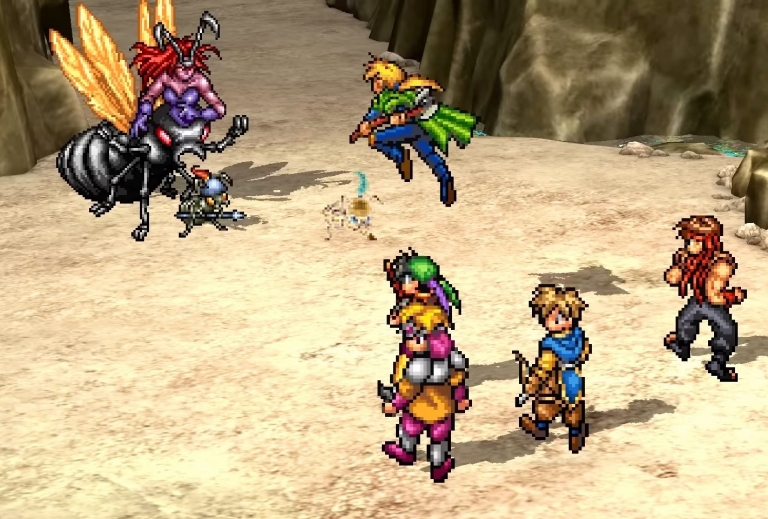
Footage of the remastered Suikoden JRPG from Konami’s official trailer.
The 2D sprites look the same but they do look sharper in HD. Even the background elements look sharper.
World exploration in Suikoden is no longer the flat 2D map it used to be.
As I have played Suikoden and Suikoden II on the original PlayStation console in the 1990s, the announcement of Suikoden I&II HD Remaster Gate Rune and Dunan Unification Wars is big dream come true for me personally. I always wanted to replay Suikoden and Suikoden II without the hassle of having to spend a lot of money to buy a PlayStation or a Nintendo console. In my experience, Suikoden II is the peak of excellence of its own franchise as the creative team listened to the fans and learned from their shortcomings on making the first game which resulted in very rich gameplay, several fun features and compelling story. Suikoden II also remains a great example of using 2D sprites aided with 3D camera movements and some polygonal effects. Read my retro review of Suikoden II at https://carlocarrasco.com/2021/07/15/a-look-back-at-suikoden-ii-1999/
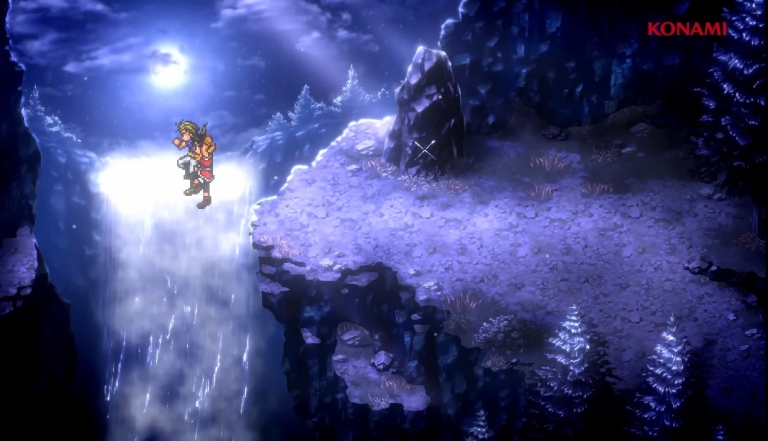
The lighting in this particular part of Suikoden II was enhanced to be dramatic looking.
Battle sequence from Suikoden II as shown in Konami’s trailer.
This touching scene from Suikoden II looks better than ever.
That being said, Suikoden I&II HD Remaster Gate Rune and Dunan Unification Wars coming to Xbox (note: Xbox One was officially listed as the Xbox console) is a big bonus not just for Xbox gamers who enjoy JRPGs but also for long-time gamers who loved the early Suikoden games who have not been spending much time with console gaming. As seen in the official press release from Konami as well as in the revealed footage in the official announcement trailer, there were several enhancements to make Suikoden and Suikoden II more presentable in today’s age of high-definition gaming. While the 2D sprites and in-game art works of the two classic JRPGs look the same (note: with some minor adjustments), I noticed the improvements on sound effects, the in-game lighting, some adjustments on textures, the higher resolution resulting in sharper images, and the redrawn character portraits (in the first game specifically).
Suikoden I&II HD Remaster Gate Rune and Dunan Unification Wars coming to Xbox is looking like a great addition on the Xbox ecosystem’s growing global appeal as the haven for fantasy RPGs gamers and also for gamers who like other types of role-playing games! For Konami, selling the two classic JRPGs on Xbox could mean bigger sales than what they achieved on PlayStation decades ago. Remember that 2023 will see the eventual release of Eiyuden Chronicle: Hundred Heroes and the Xbox-eclusive Starfield. Right now, Konami is still at work on enhancing the remastered Suikodenand Suikoden II and they will have to decide which date in 2023 should mark the release. Personally, I can hardly wait to play Suikoden I&II HD Remaster Gate Rune and Dunan Unification Wars on my Xbox Series X console. Watch out for Konami’s announcement of the official 2023 release date. Also, here is hoping Konami will do a good job remastering the two classic JRPGs and that the promises they made in their press release will be fulfilled.
For the newcomers reading this, the Suikoden game franchise’s core concept has been based on the motif of the Chinese classic novel Water Margin and the creative team back then (led by a very young Yoshitaka Murayama who is now leading Rabbit & Bear studios making Eiyuden Chronicle: Hundred Heroes) created role-playing games that had engaging fantasy stories, feature-rich gameplay and a wide lineup of characters who collectively contribute to the game endings. The first Suikoden RPG of the mid-1990s follows a protagonist whose father is one of the empire’s five generals, as he gathers his 108 Stars of Destiny and friends to fight against the oppressive rule of the Empire in ruin. Suikoden II happens three years after the first game’s story, further evolving the game systems unique to Suikoden, such as Rune magic, the 108 Stars of Destiny, home base management, and Army Battles, which were well received in the previous game. Three childhood friends, including the protagonist, are tossed about by a great whirlpool of destiny.
Historically speaking, the Suikoden video game franchise has been strongly identified with PlayStation platforms. Suikoden and Suikoden II were released on the first PlayStation console while Suikoden III, Suikoden IV and Suikoden V were released on PlayStation 2. There were also some versions of Suikoden games that got released on Sega Saturn, Windows PC and Nintendo platforms. That being said, the inclusion of Xbox One as a platform for the upcoming Suikoden I&II HD Remaster Gate Rune and Dunan Unification Wars is very notable, even exceptional.
During the Xbox TGS2022 event, I was very surprised and delighted to find out that a remastered version of the acclaimed Japanese role-playing game (JRPG) Ni no Kuni: Wrath of the White Witch was not only released for Xbox Series X, Xbox Series S and Xbox One, but also it was immediately on Xbox Game Pass (XGP)!
Officially titled as Ni no Kuni: Wrath of the White Witch Remastered, I went online with my Xbox Series X to download the game via Xbox Game Pass. The entire experience was quiet jarring as the lightning launch of Ni no Kuni on Xbox consoles and XGP was something I never ever anticipated would happen. Regardless, this sudden release is a bonus for Xbox gamers who want to play more JRPGs as well as XGP subscribers who want new content to enjoy.
From one the many battles during my play time with the game on my Xbox Series X.
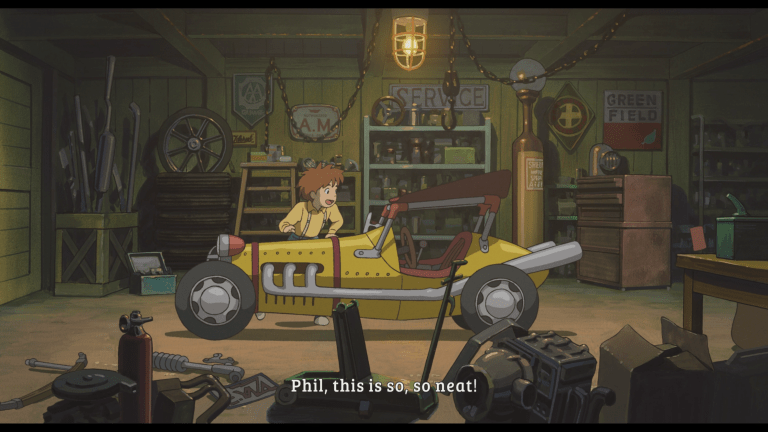
For the newcomers reading this, Ni no Kuni was a hit game released only on PlayStation 3 (PS3) in 2011-2013, followed by a remastered version in 2019 for PlayStation 4 (PS4), Nintendo Switch and PC. The game was developed by long-time JRPG developer Level-5 (which is often identified with PlayStation and Nintendo platforms) and published by Bandai Namco. Ni no Kuni is also notable for having lots of anime cutscenes produced by animation powerhouse Studio Ghibli as well as music by Joe Hisaishi.
As I’m writing this, I got to play the game and I am having fun discovering its fantasy world, learning how the game functions and the Studio Ghibli-animated scenes really look nice! I’ve got a long way to go before completing the game.
A talk scene during my play time.
This is one of the scenes animated by Studio Ghibli.
As far as Xbox gaming for 2022 is concerned, the sudden addition of the remastered Ni no Kuni into the Xbox ecosystem and XGP is helpful in relation to the lack of big-budget Xbox-exclusive games in the 4th quarter. It should be noted that RPG heavy hitters Starfield and Eiyuden Chronicle: Hundred Heroes plus the remastered versions of two certain classic JRPGs (note: here’s a hint) are scheduled for release in 2023. When it comes RPG gaming on Xbox, the Level-5-developed game is a very welcome addition given the commercial and critical achievements, fun gameplay and the nice value of having Studio Ghibli-produced animation sequences that helped emphasize the game’s fantasy concepts.
For those of you Xbox and JRPG gamers who wish to buy Ni no Kuni: Wrath of the White Witch Remastered online, click right here. If you are already an Xbox Game Pass subscriber eager for new experiences or JRPG fun, go download the game now.
In closing this piece, posted below are Xbox-related videos plus a few ones related to Tokyo Game Show 2022 for your viewing pleasure.
Welcome back, my fellow Christians, music enthusiasts and all those who seek the Heavenly Father, Lord Jesus and the Holy Spirit! As I write this, I declare that I, along with many thousands of others, got blessed by the Lord through the Planetshakers Greater Asia Tour worship event I attended on the evening September 10 at the SM Mall of Asia Arena.
For the bigger picture, Planetshakers returned to the Philippines for the first time since early 2020 (shortly before COVID-19 lockdown happened) and they organized worship events for four consecutive nights from September 8 to 11, 2022. Indeed, the Lord blessed the Philippines with Planetshakers whose music and leading of worship are clearly anointed by Him.
For the newcomers reading this, Planetshakers is a Christian church based in Australia and their worship music team produced a lot of worship songs that became not only popular with Christians around the world but also became part of their worship of the Lord. I reviewed several Planetshakers worship songs on this website and I encourage you to take to read my Christian Music Appreciation (CMA) articles of their songs by clicking here, here, here, here, here, here and here.
If you want to discover and learn more about Planetshakers, I encourage you to click here (Facebook page), here (Instagram), here (Twitter) and here (YouTube). To know more about Planetshakers itself, visit https://www.planetshakers.com/
Before attending the Planetshakers Greater Asia Tour worship event of September 10, 2022, I should say that I literally wrestled a bit to secure an Upper Box ticker online at SM Tickets’ website when the tickets where first released on July 21, 2022. On that particular day, I was in a virtual line as there were more than 2,600+ others ahead of me on SM Tickets. That was a great reminder of how popular Planetshakers worship leaders and musicians really are among my fellow Filipinos. I did not see the long line as a problem at all as I kept faith that my turn will come and that a ticket with a good seat will be available.
After more than 30 minutes waiting, I had my turn searching for whatever available tickets I could find and all the tickets for the VIP section were already sold out which is not surprising at all. Thanks to the Lord, I got myself an Upper Box ticket and successfully used my credit card to complete the transaction. Eventually, all four nights of Planetshakers worship events here in the Philippines got sold out! I picked up my ticket at an SM Tickets branch a few weeks later at the near SM shopping mall.
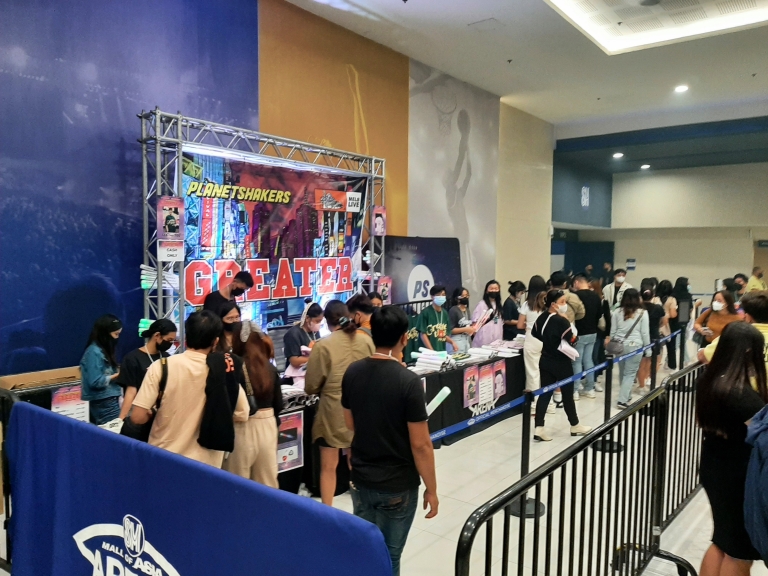
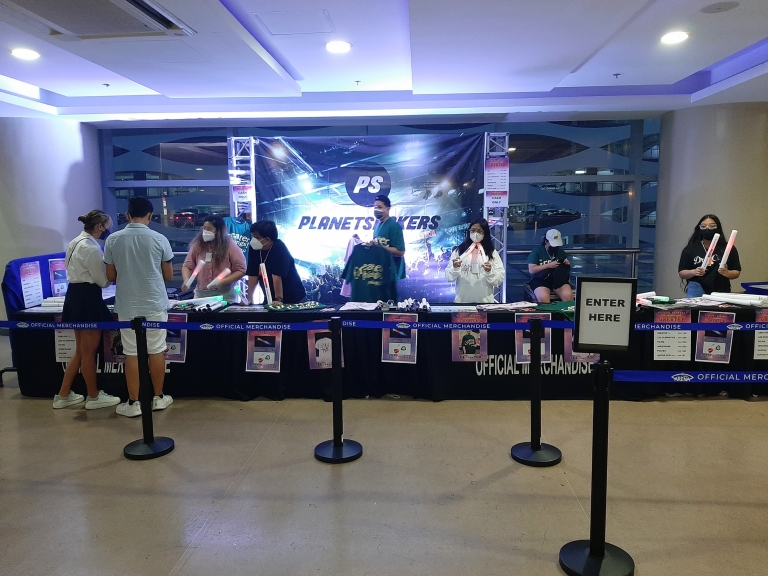
On the evening of September 10, I went inside SM MOA Arena more than 90 minutes ahead of schedule. As I arrived, I noticed Planetshakers merchandise being sold as well as backdrops related to the church for picture-taking. I bought two posters before moving upstairs.
As I made my way going upstairs, I felt the excitement and high energy around me which is not a surprise since the Planetshakers worship event was expected to be amazing as it has been anointed by the Lord.
Planetshakers Greater merchandise sold at the ground floor of the SM MOA Arena.
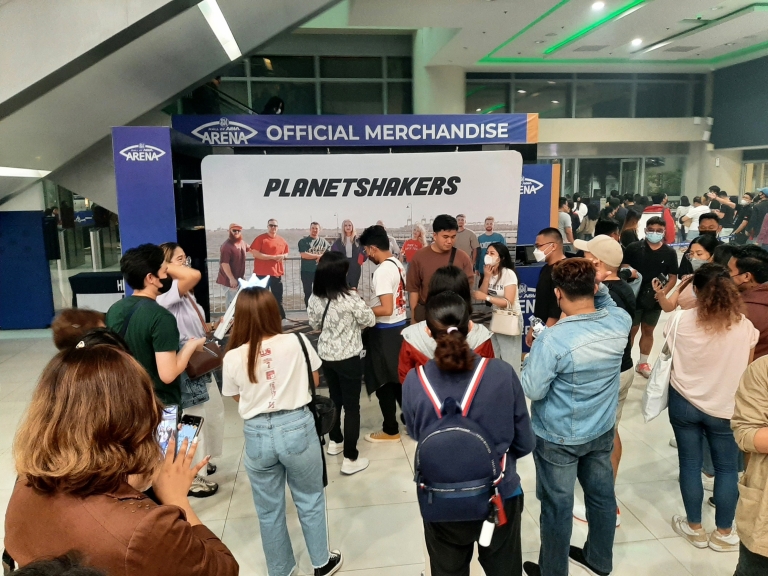
The Planetshakers backdrop for picture-taking.
Finally, with the help of an usher, I find my assigned seat in the Upper Box section of the SM MOA Arena. While the foot space was little, my seat was comfortable enough and I had a diagonal view of the stage below. Already, I was thankful to our Lord and Savior Jesus for the blessing. This event was my 2nd time in life to see Planetshakers lead worship with music but it was my first time to actually attend a Planetshakers-led event. To be clear, I first saw Planetshakers live on stage during the Jesus Global Youth Day in 2019.
Another spot for Planetshakers event merchandise at one of the upper floors of the SM MOA Arena.
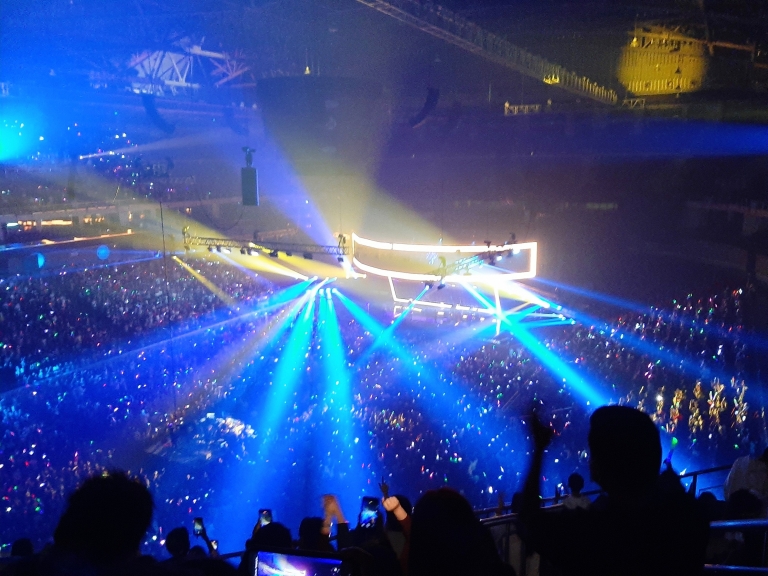
At a little past 8PM, almost all the seats were filled and then Planetshakers’ worship event started very energetically! The music was amazing and the lights on the stage and in other parts of the venue really dazzled! It was more than a raving experience…it was holy as the Holy Spirit in my heart moved within. As the music was played, I really experienced blessing from Him, I reached out to Him, expressed my thanks to Him for the blessings and emphasized the name of our Lord and Savior Jesus.
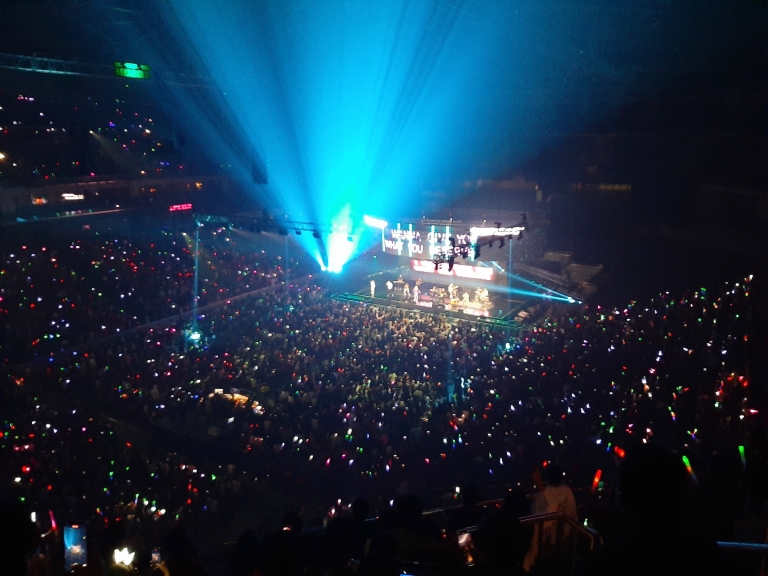
While my Upper Box seat was distant from the stage below, the monitors by the stage were clear enough to help me see who was speaking and who was on stage. Planetshakers co-founder and global senior pastor Sam Evans was there and so was Joth Hunt, their dance ministry members and the others.
The view from seat. Tremendous worship led by Planetshakers combined with music, dazzling lights and the strong faith of the attendees in the Lord proved this was an anointed event.
The worship songs played during the event was a mix of past and new (from the newest album GREATER). Each song played drew praise towards the Lord from the many thousands who attended. A lot stood up, raised and waived their hands to the Lord as the music played and the lights dazzled. The praise towards the Lord was undeniably real and powerful with Planetshakers helping lead attendees to Him. This reminds me of what was written in Chapter 150 of the Book of Psalm in the Holy Bible which goes as follows:
Praise the Lord!
Praise God in His sanctuary;
Praise Him in His mighty firmament!
Praise Him for His mighty acts;
Praise Him according to His excellent greatness!
Praise Him with the sound of the trumpet;
Praise Him with the lute and harp!
Praise Him with the timbrel and dance;
Praise Him with stringed instruments and flutes!
Praise Him with loud cymbals;
Praise Him with clashing cymbals!
Let everything that has breath praise the Lord.
Praise the Lord!
Psalm 150:1-6 (NKJV)
Very clearly, Planetshakers’ worship events are aligned closely with the above holy scripture. What I attended was a lot more than “just a concert”. It was truly worship of the Lord with Planetshakers’ worship music, modern instruments, strong focus and a strong leading of prayers to Him.
Speaking of prayers, I am very thankful to God that I personally witnessed Pastor Sam Evans leading prayersand got blessed that night. Whenever she leads prayers, it is always powerful, truly wholehearted, engaging and compelling! Pastor Sam Evans is truly anointed by the Lord to lead people to Him. The power and holiness of worship led by Pastor Sam Evans is even more tremendous when she is physically present with you. Her prayer was clearly done with all of her heart! This ultimately confirms the Lord’s blessing of the Philippines with Planetshakers and its sold-out worship events! More on the power of praying to the Lord and the truth about Him listening to us, learn from the holy scriptures below…
Call to Me and I will answer you and show you great and mighty things, fenced in and hidden, which you do not know (do not distinguish and recognize, have knowledge of and understand).
Jeremiah 33:3 (AMPC)
Then you will call upon me and come and pray to me, and I will hear you.
Jeremiah 29:12 (ESV)
Seek the Lord and His strength;
Seek His face evermore!
1 Chronicles 16:11 (NKJV)
You are the Lord who reigns over your never-ending kingdom through all the ages of time and eternity! You are faithful to fulfill every promise you’ve made. You manifest yourself as kindness in all you do.
Weak and feeble ones you will sustain. Those bent over with burdens of shame you will lift up.
You have captured our attention and the eyes of all look to you. You give what they hunger for at just the right time.
When you open your generous hand, it’s full of blessings, satisfying the longings of every living thing.
You are fair and righteous in everything you do, and your love is wrapped into all your works.
You draw near to those who call out to you, listening closely, especially when their hearts are true.
Every godly one receives even more than what they ask for. For you hear what their hearts really long for, and you bring them your saving strength.
God, you watch carefully over all your devoted lovers like a bodyguard, but you will destroy the ungodly.
I will praise you, Lord! Let everyone everywhere join me in praising the beautiful Lord of holiness from now through eternity!
Psalms 145:13-21 (TPT)
During that same event, a prepared video was played recalling Joth Hunt’s bout with cancer a few years ago. Being hit with cancer is always difficult and even heart-breaking. Ultimately, Hunt did not give up as he kept his faith in the Lord. He never gave up on God! He recovered successfully from cancer and remains active with Planetshakers to this day! Hunts’ testimony and recovery are proof that the Lord will never abandon His children and only He can heal and restore you as long as you maintain unwavering faith in Him! Learn from the following scriptures below…
Fear not [there is nothing to fear], for I am with you; do not look around you in terror and be dismayed, for I am your God. I will strengthen and harden you to difficulties, yes, I will help you; yes, I will hold you up and retain you with My [victorious] right hand of rightness and justice.
Isaiah 41:10 (AMPC)
For I know the thoughts and plans that I have for you, says the Lord, thoughts and plans for welfare and peace and not for evil, to give you hope in your final outcome.
Jeremiah 29:11 (AMPC)
Heal me, Lord, and I will be healed;
Save me and I will be saved,
For You are my praise.
Jeremiah 17:14 (NASB)
And the Lord turned the captivity of Job and restored his fortunes, when he prayed for his friends; also the Lord gave Job twice as much as he had before.
Job 42:10 (AMPC)
More on the latest album GREATER – which itself is a key theme in the latest Planetshakers tours of worship events – there is biblical significance behind its title. It is a lively reminder about the greatness of our Lord and that we must always be with Him, follow Him and walk with Him in faith. The Heavenly Father, His Son Jesus our Lord and the Holy Spirit are always greater! Learn from the scriptures below…
Great is the Lord and highly to be praised; and His greatness is [so vast and deep as to be] unsearchable.
Psalm 145:3 (AMPC)
For God so loved the world, that He gave His only Son, so that everyone who believes in Him will not perish, but have eternal life.
John 3:16 (NASB)
For the Lord your God is the God of gods and Lord of lords. He is the great God, the mighty and awesome God, who shows no partiality and cannot be bribed.
Deuteronomy 10:17 (NLT)
Yours, O Lord, is the greatness and the power and the glory and the victory and the majesty, for all that is in the heavens and the earth is Yours; Yours is the kingdom, O Lord, and Yours it is to be exalted as Head over all.
1 Chronicles 29:11 (AMPC)
And we know that all things work together for good to those who love God, to those who are the called according to His purpose.
Romans 8:28 (NKJV)
Go ahead—sing your new song to the Lord! Let everyone in every language sing him a new song. Don’t stop! Keep on singing! Make his name famous! Tell everyone every day how wonderful he is. Give them the good news of our great Savior. Take the message of his glory and miracles to every nation. Tell them about all the amazing things he has done. For the Lord’s greatness is beyond description, and he deserves all the praise that comes to him. He is our King-God, and it’s right to be in holy awe of him.
Psalms 96:4 (TPT)
Another shot from my seat. See if you can identify who is who on stage.
By the end of the September 10 worship event, I got very blessed by the Lord and I noticed many others around me left for home happy, thankful and positive. There were no signs whatsoever about disappointment and that is not surprising at all because the event was a blessing from the Lord. I felt great and deeply satisfied as I walked to the parking area to get into the car. I was overwhelmed with the Lord’s holiness and was really happy as I drove all the way back home.
Very clearly, Planetshakers and their highly successful worship events are big blessings of the Lord for the Philippines! In 2020, people prayed for His protection as COVID-19 swamped the nation. In 2021, people prayed to Him for social and economic recovery from COVID-19. This year, our faith in Him strengthened further which will lift the Philippines to emerge from the COVID-19 stronger and more confidently. Planetshakers’ events here in the Philippines are clearly part of the Lord’s plans for the Filipino people. As such, I urge you my readers to always pray to the Lord, ask for His plan for you, follow His Word and live with uncompromising faith in Him. Become a blessing to others as you get blessed by Him. Always remember that the personal relationship with the Lord is truly essential.
Always remember that God has plans for you and you only need to decide to let Him into your hear, to walk with Him, follow Him all the way and let His Spirit – the Holy Spirit – in your heart work in guiding you. Never forget that Jesus is our most definitive Lord and Savior and it is only through Him that we can connect with the Heavenly Father. That being said, the Planetshakers event I attended heavily emphasized Lord Jesus’ name as worship went on inside the SM MOA Arena. All our praise and all the glory are for God, Lord Jesus and the Holy Spirit. Always have unwavering faith in the Lord! Always praise, honor and thank the Lord with all your heart!
At this point, I encourage you all to pray to the Lord wholeheartedly and with enduring faith in Him. For true quality time with Him, be in your room with the door closed and locked, then pray to Him. As the Lord blessed our nation with Planetshakers and their four nights of sold-out worship events, I also encourage you to pray for Planetshakers so that their ministry and network of church will continue to preach God’s Word and help people come to Jesus. Pray for Planetshakers’ co-founders Russell and Sam Evans so that the Lord will bless them as they keep on working tirelessly in serving Him and leading people to Him. Pray for Planetshakers’ pastors, musicians, dance ministry members and all their employees and stakeholders so that the Lord will bless them and support them as they organize more worship services. As Planetshakers keeps on serving the Lord and help lead people to Jesus, the following holy scripture below will resonate with the faithful and those who seek Him. I also encourage you to share the scripture to others…
Those who give thanks that Jesus is the Son of God live in God, and God lives in them.
1 John 4:15 (TPT)
In ending this article, I posted below the official music videos of worship songs related to Planetshakers’ latest album. May these enlighten you, delight you and motivate you to come to God, Lord Jesus and the Holy Spirit without hesitation. Seek Lord Jesus first, follow His light and always be the fearless and aggressive church of Lord Jesus! Live by Jesus’ eternal victory! Peace and amen to you all!