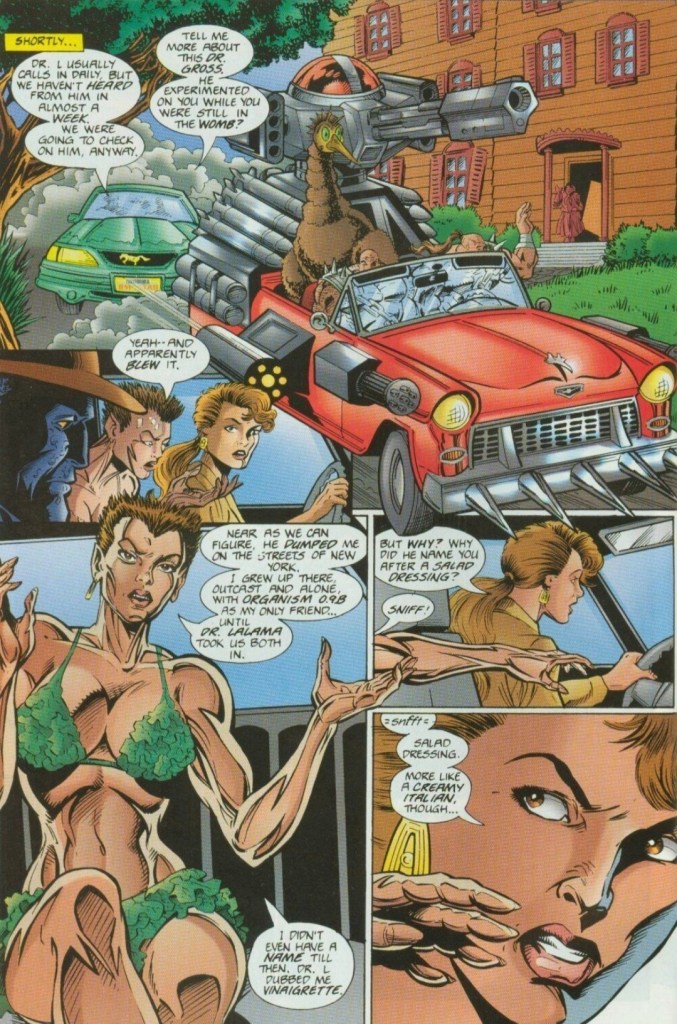
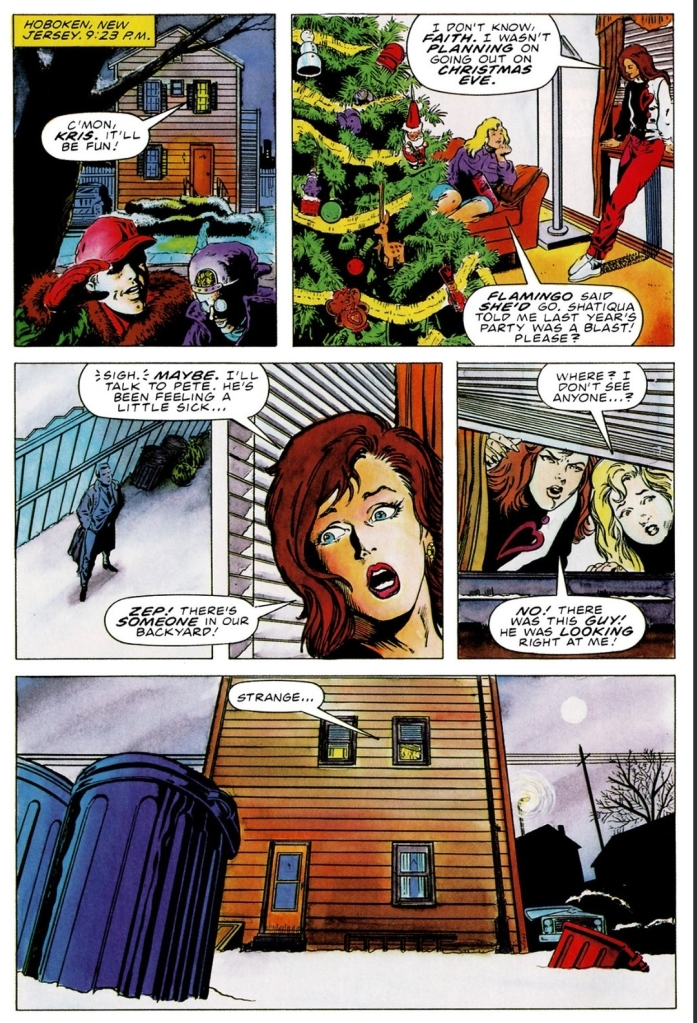
Disclaimer: This is my original work with details sourced from reading the comic book and doing personal research. Anyone who wants to use this article, in part or in whole, needs to secure first my permission and agree to cite me as the source and author. Let it be known that any unauthorized use of this article will constrain the author to pursue the remedies under R.A. No. 8293, the Revised Penal Code, and/or all applicable legal actions under the laws of the Philippines.
Hey Ultraverse fans and superhero comic book enthusiasts! Are you ready for another tale of Prime? What I am about to review is one of the anniversary Ultraverse issues published by Malibu Comics.
What could be new or special to justify the anniversary of the Prime monthly series? We can all find out in this look back at Prime #12, published by Malibu Comics with a story written by Len Strazweski and Gerard Jones, and drawn by the late Norm Breyfogle.
The cover.
Early story
The story begins with a young guy named Kuttner who tests his deadly ability to easily cut through solid objects with his powered blades on his hands. He is driven to get revenge against Prime who broke his hand previously. Kuttner, whose career in entertainment had declined, thinks he can establish a new career for himself as a powered being and Prime is his first target.
Meanwhile at school, Kevin Green (Prime) is struggling with the stress over his parents’ separation which he is guilty of. He finds it very weird to be back in school after everything he went through such as his struggles with Colonel Samuels, the Federal Government, Break-Thru and more. After slamming his locker shut, students begin to move away from him…
Quality
Symbolically, Prime meets Norm Breyfogle.
To begin with, the writing by Len Strazewski and Gerard Jones is very solid as expected. That being said, the real heart of the story in this comic book is Kevin Green’s personal struggle with life not just with the difficulty of balancing himself between his personal life and being a superhero, but also his place in local society being tainted as a result of his acts as Prime. The way that the events of the previous issues affected (in negative ways) the local community’s perception of Kevin was very compelling and straight to the point.
The strong writing, unsurprisingly, worked very well with the character development. Kevin was presented to be struggling with making the right decisions and he struggles to analyze what would happen if he presents himself to others as Prime or as simply himself. As for the scene between Prime and Kelly’s mother, there was that touch of awkwardness (through Prime) that was present as the scene raised the disturbing idea of the two possibly getting involved sexually.
When it comes to the spectacle of action, there is little to be seen here but the good news is that Norm Breyfogle illustrated them to be energetic and eye-catching. The late illustrator really knew hot to ramp up the energy for the readers making the most out of what it is limited.
Conclusion
The tremendous strength of Prime!
Prime #12 is a pretty engaging read. Was it worth the anniversary promotion? It is indeed! If you look back at Prime #1 and read all the succeeding issues leading to this one, you will notice how much Kevin Green changed as well as how his personal growth moved. In a way, Prime #12 symbolizes the growing-up pains Kevin keeps on having.
It should be stated that being 64-pages, Prime #12 is actually one of Malibu’s flip issues. The other side of this comic book is Ultraverse Premiere #3 which contains standalone short stories of Prime, War Strike and a certain villain. This comic book also has “A Primo Farewell” which is a nice tribute (by today’s standards) to Norm Breyfogle. For the newcomers reading this, Breyfogle was one of outstanding comic book artists in America and before joining Malibu Comics, he worked for other publishers like Marvel Comics, DC Comics, Eclipse Comics and First Comics. At DC Comics, his work on their icon Batman is widely remembered. Breyfogle passed away in 2018.
If you are seriously planning to buy an existing hard copy of Prime #12 (1994), be aware that as of this writing, MileHighComics.com shows that the near-mint copy of the comic book costs $8.
Overall, Prime #12 (1994) is highly recommended!
+++++
Thank you for reading. If you find this article engaging, please click the like button below and also please consider sharing this article to others. If you are looking for a copywriter to create content for your special project or business, check out my services and my portfolio. Feel free to contact me as well. Also please feel free to visit my Facebook page Author Carlo Carrasco and follow me at HavenorFantasy@twitter.com
Disclaimer: This is my original work with details sourced from reading the comic book and doing personal research. Anyone who wants to use this article, in part or in whole, needs to secure first my permission and agree to cite me as the source and author. Let it be known that any unauthorized use of this article will constrain the author to pursue the remedies under R.A. No. 8293, the Revised Penal Code, and/or all applicable legal actions under the laws of the Philippines.
Hey Ultraverse fans and superhero comic book enthusiasts! If you want to see more of Mantra and Prime cross over with each other and find out if they would impact the entire Ultraverse somehow, then you’re in for something here.
Here is a look back at Mantra #7, published in 1994 by Malibu Comics with a story written by Mike W. Barr and illustrated by Terry Dodson. This one follows the events that took place in Prime #8 (1994).
The cover.
Early story
The story begins with Mantra already captured by the Baby Doctor (a super being feared by Colonel Samuels) and his hideous companions. Prime, who was slowed temporarily by Samuels and his soldiers, flies chasing the vehicle carrying Mantra, even distracting the mother, daughter and son of Eden Blake/Mantra.
A short time later, Mantra wakes up and gets much needed assistance by Prime who breaks into the vehicle and fight those who took her captive. After much action, the moving vehicles crashes and Prime helps Mantra…
Quality
Prime to the rescue!
I’ll start with the storytelling and characterization. While Prime #8 marked the actual start of Prime and Mantra getting to know each other more, this story takes their alliance a few notches higher with an emphasis on the big guy (who is actually teenager Kevin Green inside the body) starting to care more for the beautiful eternal warrior (with the soul of the man Lukasz). I also find it refreshing to see Mantra more helpless and Lukasz (the occupant in the body of Mantra/Eden Blake) actually struggles in a really weakened physical state (this points to what happened near the end of Prime #8).
The stakes have been raised in the sense that more information about Prime’s origin was revealed and, more notably, the Doc (Baby Doctor) is a more intriguing character in the Ultraverse and this comic book makes clear why Col. Samuels is afraid of him. I liked the way Mike W. Barr used science fiction concept of genetics and even gender to add a strong element of intrigue in the plot. Speaking of gender, there are a few moments that hint of homosexuality which will make you question how much Lukasz is changing the longer her stays in a woman’s body.
Conclusion
Prime getting involved with Mantra.
Mantra #7 is a well-written comic book that succeeded in raising the stakes, deepening the Mantra-Prime friendship while delivering a satisfying, action-packed misadventure. The Doc meanwhile proved to be a worthy addition into the Ultraverse.
If you are seriously planning to buy an existing hard copy of Mantra #7 (1994), be aware that as of this writing, MileHighComics.com shows that the near-mint copy of the regular edition costs $8 while the near-mint copy of the newsstand edition costs $26.
Overall, Mantra #7 (1994) is recommended.
+++++
Thank you for reading. If you find this article engaging, please click the like button below and also please consider sharing this article to others. If you are looking for a copywriter to create content for your special project or business, check out my services and my portfolio. Feel free to contact me as well. Also please feel free to visit my Facebook page Author Carlo Carrasco and follow me at HavenorFantasy@twitter.com
Disclaimer: This is my original work with details sourced from reading the comic book and doing personal research. Anyone who wants to use this article, in part or in whole, needs to secure first my permission and agree to cite me as the source and author. Let it be known that any unauthorized use of this article will constrain the author to pursue the remedies under R.A. No. 8293, the Revised Penal Code, and/or all applicable legal actions under the laws of the Philippines.
Is Prime your favorite caped hero among the many heroes of the Ultraverse? For the newcomers reading this, Prime is an overly muscular hero of the Ultraverse who is actually a kid deep inside his fake flesh. Prime was one of the major heroes of the Ultraverse and was part of UltraForce alongside Hardcase and Prototype (two other major heroes).
In late 1993, a 2-part Ultraverse crossover was published titled Break-Thru and, with the art of the legendary George Perez, it was a big mix of characters from the UV. Prime had a role in Break-Thru and we can see what happened to him after the end of the said crossover in this look back at Prime #8 published in 1994 by Malibu Comics and written by Len Strazewski and Gerard Jones with art done by the late Norm Breyfogle.
The cover.
Early story
The story begins in outer space with Prime and Prototype re-entering planet Earth. With the heat intensifying, Prime is worried that he won’t be able to make it safely on earth. Prototype, who is flying behind him, wonders if Prime knows what he is doing by leading the way. Prototype’s life is at stake as he relies on Prime to be his flying front shield (note: for the way the flight turned out in Prototype’s perspective, read Prototype #6).
Due to the instability and intense heat, the two ultras got separated flying down. Remembering the strip of Mantra’s cape, Prime uses it and manages to receive faint communication with Mantra. Prime eventually crashes into a swimming pool. With Prime’s flesh quickly dissolving, teenage Kevin Green is exposed naked underwater and struggles. Suddenly, water pushes him up several feet and finds himself being assisted by Mantra.
The naked Kevin is carried by Mantra who transform herself into Eden Blake…
Quality
The pressure on the parents of Kevin.
Storywise, this one is a solid follow-up to the Break-Thru crossover and it succeeds in developing Prime further thanks to the combined efforts of Len Strazewski and Gerard Jones. With the narrative shifted away from Break-Thru, the story emphasizes the actions of the covert operations led by Colonel Samuels who simply won’t let Prime go free given the US government’s interests. What Samuels does not know is that someone sinister and hidden is spying on their operations. That someone is also interested in Prime and this alone added a lot of intrigue into the story.
As usual, the character development is very solid. I love the way Strazewski and Jones raise the stakes on the parents of Kevin and made them more troubled knowing their son’s involvement with the military. Kevin’s father, meanwhile, is living with the guilt of keeping the big secrets of the past.
When it comes to crossovers and interactions, the exchange between Kevin/Prime and Eden/Mantra is very compelling to read. Mantra, who knows Prime’s secret, tries to keep her identity secret. Already working for Aladdin under her Eden Blake identity, she sees an opportunity to learn more about Colonel Samuels through Kevin. For his part, Kevin wants to go home instead of getting involved again with the colonel. As their dialogue goes on, the tension really strengthened and added to the plot.
Without revealing too much, I should state that the introduction of a new character really shook the story and the big fight that followed was a great payoff to all the build-up.
Conclusion
Kevin and Mantra together.
Prime #8 is an excellent superhero comic book! The creative team of Strazewski-Jones-Breyfogle really crafted a post-Break-Thru story that did not slowed down and kept raising the stakes and the intrigue. Suspense, excitement, drama and intrigue made a great mix here.
If you are seriously planning to buy an existing hard copy of Prime #8 (1994), be aware that as of this writing, MileHighComics.com shows that the near-mint copy of the regular edition costs $8 while the near-mint copy of the newsstand edition costs $26.
Overall, Prime #8 (1994) is highly recommended!
+++++
Thank you for reading. If you find this article engaging, please click the like button below and also please consider sharing this article to others. If you are looking for a copywriter to create content for your special project or business, check out my services and my portfolio. Feel free to contact me as well. Also please feel free to visit my Facebook page Author Carlo Carrasco and follow me at HavenorFantasy@twitter.com
Disclaimer: This is my original work with details sourced from reading the comic book and doing personal research. Anyone who wants to use this article, in part or in whole, needs to secure first my permission and agree to cite me as the source and author. Let it be known that any unauthorized use of this article will constrain the author to pursue the remedies under R.A. No. 8293, the Revised Penal Code, and/or all applicable legal actions under the laws of the Philippines.
Do you happen to have any comic books of the Batman versus Predator II crossover in your collection? According to MileHighComics.com, their near-mint copies are valuable and you can sell them to make some much-needed money in this time of pandemic, government overreach and economic hardship.
Right now, I am about to finally end my review of the Batman versus Predator II mini-series and so far, I have enjoyed it a lot. To find out if this mini-series will come to a satisfying end, here is my retro review of Batman versus Predator II #4, published in 1995 by DC Comics and Dark Horse Comics with a story written by Doug Moench and drawn by Paul Gulacy.
The cover.
Early story
The story begins in the bat cave with Batman and Alfred discussing what happened lately. As it turned out, there were two other Predators on the lose apparently sent to stop the first one (who killed one of the mentioned two). Batman also mentioned the deaths of Song Sung and Terraro. Now there are two hunters remaining who may not know that the man who issued their contracts is dead.
Just before leaving with the motorcycle, Batman receives a call from Commissioner Gordon through the special line. Afterwards, he leaves.
In the city, a thug on a motorcycle starts chasing Batman which catches the attention of the local police…
Quality
From the final encounter with the hunter from space.
This comic book is a satisfying conclusion to the mini-series. In terms of writing, issue #4 delivered the payoff for what was built-up in issue #3. This results the return of Batman’s trusted ally as well as some more involvement of the police force as the stakes were raised in issue #3 with the involvement of more than one Predator. The hunter Predator – the one Batman and Huntress encountered in the first two issues – was indeed present and it was very interesting to see it pursue its encounter with the two heroes even though he was being hunted by a fellow Predator.
Having more than one Predator was initially confusing but the confusion did not last too long which readers will find relieving. As expected, the Huntress joined Batman in the final encounter and served nicely as a fighting partner whose assistance proved to be valuable. If there is any weak spot in the presentation, it’s the element of the gang and human hunters who only served to add to the death toll.
As with the first three issues of this mini-series, the action here remains very intense and quite uncompromising with its violence. Expect gunshot wounds and decapitations here and there. The hard action presented, especially in the encounters with the Predator, was indeed satisfying. I should state that the final encounter inside the space ship is very thrilling.
Conclusion
The Bat signal is an attraction to the Predator.
Batman versus Predator II #4 (1995) is a pretty solid read. What was built-up previously, got paid off nicely here. With regards to raising the stakes and making this mini-series different from its predecessor, the creative team succeeded with the resolutions they came up with. In addition, Batman and the Huntress make a solid duo and their interactions together were compelling.
If you are seriously planning to buy an existing hard copy of Batman versus Predator II #4 (1995) be aware that as of this writing, MileHighComics.com shows that the near-mint copy of the comic book costs $50.
Overall, Batman versus Predator II #4 (1995) is highly recommended!
+++++
Thank you for reading. If you find this article engaging, please click the like button below and also please consider sharing this article to others. If you are looking for a copywriter to create content for your special project or business, check out my services and my portfolio. Feel free to contact me as well. Also please feel free to visit my Facebook page Author Carlo Carrasco and follow me at HavenorFantasy@twitter.com
Disclaimer: This is my original work with details sourced from reading the comic book and doing personal research. Anyone who wants to use this article, in part or in whole, needs to secure first my permission and agree to cite me as the source and author. Let it be known that any unauthorized use of this article will constrain the author to pursue the remedies under R.A. No. 8293, the Revised Penal Code, and/or all applicable legal actions under the laws of the Philippines.
Welcome back, Ultraverse fans and comic book collectors! Would you happen to be a fan of illustrator Terry Dodson? I first saw his professional work when I read Mantra #1 way back in 1993 just as my fellow comic book collectors were discovering the newly launched Ultraverse. After the Ultraverse ended, Dodson went on to work for Marvel Comics with projects such as the Storm mini-series and X-Men related comic books. In 2000, Dodson went to DC Comics and his project with them was illustrating issues of the Harley Quinn series. He even got to work on Wonder Woman comic books six years later.
You must be wondering – how did Terry Dodson first broke into the comic book industry and what was his first project? Check out this excerpt from a published interview.
How did you break into comic books?
By doing portfolio samples and taking them to conventions and showing them around. At first it was difficult to hear the critiques, but later on that’s what I wanted to know. What I was doing wrong. Fortunately, when I broke in 1993, they were handing out jobs to anybody with a pulse. I got my first job on Mantra, for the new Malibu Ultraverse.
See? It turns out Mantra of the Ultraverse was his comic book debut.
Now that the history lesson is done, we can see more of Dodson’s work on Mantra in the look back at Mantra #5, published in 1993 by Malibu Comics with a story written by Mike W. Barr and drawn by Dodson.
The cover.
Early story
The story begins when a man named Strauss faces Mantra and Warstryke. The armed guy presses Strauss for details about some defective merchandise while Mantra mentions to him about their deal. Strauss shows defiance by defending himself with a green field to protect him. Mantra blocks the flow of air into the field, forcing Strauss to give up and lose his protective field.
After a short talk with Strauss, Mantra and Warstrike chat on top of the building. In reaction to Mantra’s handshake as a sign of thanks for helping, the armed guy tries to get sexually involved with the mystical warrior even though he knows Mantra has a male soul occupying a woman’s body. Mantra defies him and flies away.
Along the way, a demon spots Mantra flying through the air. It turns out he has been looking for her and decides to make a move in pursuit of her…
Quality
What do I think about the story by Mike W. Barr? I find it brilliantly written. As the cliffhanger ending of issue #4 got resolved early, the narrative smoothly shifts into Mantra’s other struggle – being a mother to Eden Blake’s children whom she lost quality time with due to superhero pursuits. There was also this really compelling drama between Eden and her mother (who in turn believes her daughter is failing her responsibility as a parent).
Lukasz – the male soul in Eden/Mantra’s beautiful body – is still obsessed with pursuing his search for answers but even so, he cannot simply abandon the family and household of the woman whose soul he displaced. In this particular comic book, Lukasz continued to adjust in his unexpected life as Eden.
I really like the way Mike W. Barr dramatized Lukasz dealing with family matters as well as career matters. All that led to what I would call the most unexpected superhero misadventures I’ve ever read that has something to do with the dimension of hand-drawn animation. That is something you, my readers, should read to find out. It is something very enjoyable!
In terms of visuals, this comic book showed more of the creativity of Terry Dodson. If you already enjoyed his art in the early Mantra issues, you will see something new and fresh here.
Conclusion
Mantra returns home to the family.
Undoubtedly Mantra #5 is a great comic book to read as it has an excellent mix of drama, intrigue, characterization and many bouts of great spectacle (which nicely paid-off on all the build-up). By this stage in the Mantra monthly series, Lukasz/Eden/Mantra got developed more and the stakes have been raised in relation to Eden’s meeting with her boss.
If you are seriously planning to buy an existing hard copy of Mantra #5 (1993), be aware that as of this writing, MileHighComics.com shows that the near-mint copy of the regular edition costs $8 while the near-mint copy of the newsstand edition costs $26.
Overall, Mantra #5 (1993) is highly recommended!
+++++
Thank you for reading. If you find this article engaging, please click the like button below and also please consider sharing this article to others. If you are looking for a copywriter to create content for your special project or business, check out my services and my portfolio. Feel free to contact me as well. Also please feel free to visit my Facebook page Author Carlo Carrasco and follow me at HavenorFantasy@twitter.com
I should say it out loud. I am a long-time Xbox gamer (and I was once a PlayStation fanboy until I started playing Halo: Combat Evolved, Star Wars: Knights of the Old Republic and Forza Motorsport on the original Xbox console) and it is great that the next-generation Xbox Series S and Xbox Series X consoles will have backward compatibility right from the start.
Specifically, I started my Xbox journey (with an official Xbox LIVE account) in 2006 with the Xbox 360 console. I played lots of great games on that console such as Elder Scrolls IV: Oblivion, Halo 3, Forza Motorsport 4, Lost Odyssey, Assassin’s Creed III, Grand Theft Auto V, Red Dead Redemption, Elder Scrolls V: Skyrim and the Mass Effect trilogy just to name a few.
Even though the current 8th console generation was not too rosy for Xbox due to the weak 1st party game support on the part of Microsoft, I still enjoyed gaming on my Xbox One. The Outer Worlds was one of the best sci-fi RPGs I have ever played. Fallout 4 was just as engaging and as immersive Skyrim in my experience. Also I had great fun playing Red Dead Redemption 2.
That being said, I certainly do not want my past Xbox generation game collection – both physical media and digital copies – to just go to waste. This is why I really appreciate Team Xbox for implementing backward compatibility on the two Xbox Series consoles which will launch less than a month from now. I myself enjoyed replaying my favorite Xbox 360 games on my Xbox One (a few among them were Red Dead Redemption, Lost Odyssey and the entire Mass Effect trilogy) and having the same feature for the next-generation is a very good thing!
On Xbox.com, Director of Program Management for Xbox Series X Jason Ronald explained the efforts their team made since the big breakthrough of 2015 plus other details about the tremendous addition of value backward compatibility brings to the Xbox Series S and Xbox Series X. Excerpt below:
Our compatibility journey began with the announcement of Xbox 360 Backwards Compatibility coming to Xbox One at E3 2015. I clearly remember that first magical experience of jumping into one of my favorite Xbox 360 games, Final Fantasy XIII, and instantly resuming where I had left off years before as if no time had passed at all. I was instantly transported back to that special time and all the great memories and personal connections I have made through gaming. The energy and passion from the community continues to motivate us to this day.
Through a tremendous amount of hard work, technical innovation, and partnership with the industry’s leading creators we were not only able to bring more than 500 Xbox 360 games to Xbox One, we were able to go back even further into the archives and resurrect some of your favorite franchises from the original Xbox. The very same team who created new innovative ways to preserve and enhance your existing catalog of games on Xbox One is the same team pushing the envelope again with Xbox Series X.
Maintaining compatibility presents a massive technical challenge as fundamental system and chip architectures advance across generations. Developers highly optimize their games to the unique capabilities and performance of a console to provide the best experience for their players. To make the Xbox Series X our most compatible console ever required both significant innovation in the design of the custom processor as well as the unique design of the Xbox operating system and hypervisor at the heart of our next generation platform.
With more than 100,000 hours of play testing already completed, thousands of games are already playable on Xbox Series X today, from the biggest blockbusters to cult classics and fan favorites. Many of us in Team Xbox play on the Xbox Series X daily as our primary console and switching between generations is seamless. By the time we launch this holiday, the team will have spent well over 200,000 hours ensuring your game library is ready for you to jump in immediately.
As seen in the paragraph right above, the 100,000 hours figure is very significant and it shows that no shortcuts were taken with regards to play testing and quality assurance. That figure is only rising and that is great dedication for not only Xbox fans with huge game collections but also consumers in general.
It should be noted that the more affordable Xbox Series S console will run backward compatibility a bit differently since it cannot render visuals in native 4K (it can however upscale in 4K). A September 14, 2020 update to Ronald’s article states:
the Xbox Series S runs the Xbox One S version of backward compatible games while applying improved texture filtering, higher and more consistent frame rates, faster load times and Auto HDR. As for next generation titles, Xbox Series S was designed to be the most affordable next generation console and play them at 1440P at 60fps.
The premium Xbox Series X console, unsurprisingly, has huge advantages for anyone who loves playing past games via backward compatibility. Enhanced visuals? Check! Improved frame rates? Check! Heavily reduced load times? Check! Much better performance? Check! Check out the excerpt below:
Not only should gamers be able to play all of these games from the past, but they should play better than ever before. Backwards compatible games run natively on the Xbox Series X hardware, running with the full power of the CPU, GPU and the SSD. No boost mode, no downclocking, the full power of the Xbox Series X for each and every backward compatible game. This means that all titles run at the peak performance that they were originally designed for, many times even higher performance than the games saw on their original launch platform, resulting in higher and more steady framerates and rendering at their maximum resolution and visual quality. Backwards compatible titles also see significant reductions in in-game load times from the massive leap in performance from our custom NVME SSD which powers the Xbox Velocity Architecture. As I play through my personal backlog as part of our internal testing, all of the incredible games from Xbox One and earlier play best on Xbox Series X.
The team was not content to just rely on the increased hardware performance to improve your playing experience. The team developed new platform level capabilities to ensure all of your games continue to get even better. In partnership with the Xbox Advanced Technology Group, Xbox Series X delivers a new, innovative HDR reconstruction technique which enables the platform to automatically add HDR support to games. As this technique is handled by the platform itself, it allows us to enable HDR with zero impact to the game’s performance and we can also apply it to Xbox 360 and original Xbox titles developed almost 20 years ago, well before the existence of HDR.
In addition, the new Quick Resume feature was designed to not only work with new games, but it can also be enabled for backward-compatible titles. Quick Resume enables players to resume exactly where they left off, across multiple titles, ensuring gamers can get right back to the fun in an instant.
Website Gaming Bolt recently published their own video explaining the so-called secrets of backward compatibility on Xbox Series X.
Going back to Jason Ronald’s article, it should be noted how dedicated their team is towards fans. The excerpt below:
Beginning with Xbox One X, the compatibility team developed brand new innovations that could be applied to a hand curated list of titles to enhance them even further than what was possible when they were first created. Techniques such as the Heutchy method, which enables titles to render with increased resolutions up to 4K, or applying anisotropic filtering to improve the final image quality bring these classic games up to modern standards, better than ever before.
With all of the additional power and advancements of the Xbox Series X, the compatibility team now has a veritable playground of new capabilities to innovate and push the limits of game preservation and enhancement. The compatibility team has invented brand new techniques that enable even more titles to run at higher resolutions and image quality while still respecting the artistic intent and vision of the original creators. We are also creating whole new classes of innovations including the ability to double the frame rate of a select set of titles from 30 fps to 60 fps or 60 fps to 120 fps.
The team also continues to listen to feedback from the community on additional titles you would like to see added to the compatibility program.
With the enhancements confirmed, check out Window Central Gaming’s comparative YouTube video of Monster Hunter World running on Xbox One X (currently the most powerful gaming console available) and Xbox Series X.
As of this writing, the backward compatibility feature on the Xbox Series consoles covers lots of titles of Xbox One, Xbox 360 and the original Xbox. What is expected not to be included are Kinect motion sensor games released on Xbox 360. On the side of PlayStation, PS5 is backward compatible with PS4 games only. Until now, Jim Ryan and Mark Cerny still have not figured out ways to make PS5 a compatible with the many, many games of PS1-PS2-PS3. Perhaps they never tried to do it at all, letting down their fans and consumers in general. It is weird because Sony used to be the shining example of video game backward compatibility starting with PlayStation 2 (PS2). Backward compatibility continued in the next generation with PS3 but only for the initial units. Subsequent PS3 consoles were made without the compatibility.
In ending this article, here are some more videos about Xbox Series X backward compatibility for your learning and enjoyment.
+++++
Thank you for reading. If you find this article engaging, please click the like button below and also please consider sharing this article to others. If you are looking for a copywriter to create content for your special project or business, check out my services and my portfolio. Feel free to contact me as well. Also please feel free to visit my Facebook page Author Carlo Carrasco and follow me at HavenorFantasy@twitter.com
Disclaimer: This is my original work with details sourced from reading the comic book and doing personal research. Anyone who wants to use this article, in part or in whole, needs to secure first my permission and agree to cite me as the source and author. Let it be known that any unauthorized use of this article will constrain the author to pursue the remedies under R.A. No. 8293, the Revised Penal Code, and/or all applicable legal actions under the laws of the Philippines.
It’s been quite some time since I last reviewed a Valiant comic book. Previously, I reviewed Bloodshot #6 (1993) which not only had the first appearance of Colin King (AKA Ninjak) but also had some of the spotlight on my native Philippines as a destination. To be specific, back in the 1990s, it was rare for the Philippines to get mentioned or visualized in American superhero comic books.
Anyway, we can return to the 1990s universe of Valiant Comics following the misadventure of Bloodshot in this look back at Bloodshot #7, published in 1993 by Valiant Comics with a story by Kevin VanHook and art by Don Perlin.
The cover.
Early story
The story begins 1,500 feet in the air above the Philippines with Leigh falling down followed by Bloodshot with the airplane leaving them. After some struggle, Bloodshot manages to grab her boot which turned out helpful as Leigh had been controlling her fall by gliding on the air currents. After breaking the fall, the boot of Leigh slips off separating the them. Bloodshot falls on the jungle’s foliage while the other landed safely.
Over at the Manila International Airport, the secret assassin Marco is weak and was assisted by a certain guy and placed on one of the toilets in the restroom. After being left there alone, Marco wakes up and leaves the restroom to make a telephone call. He does not realize that the same man who assisted him is trailing him.
Back in the jungle, Bloodshot gradually adjusts himself to get moving just as his nanites are healing his fractured right leg and broken rib. With no time to lose, he decides to continue his mission even though he is still injured….
Quality
Bloodshot and Ninjak in the jungle in the Philippines.
I can say that this comic book has a stronger story and better spectacle. It is indeed a solid payoff to the build-up in issue #6. Kevin VanHook took his time in pacing the story allowing readers to follow the details behind the events while giving ample spotlight to other characters. Bloodshot is still in the center of the story only this time he’s a lot more vulnerable and less capable as an action hero. As seen in the cover of this comic book, he truly is vulnerable and therefore he is presented more as a survivor striving hard to complete his detective work no matter the costs.
This is not a straightforward action tale. There is still a good amount of intrigue and espionage that happens in the Philippines (as Valiant’s creators imagined it). It should be noted that this comic book marks the first-ever appearance of Ninjak in his costumed form (note: Ninjak appeared in Bloodshot #6 in his civilian form as Colin King) as well as the first-ever personal encounter between Ninjak and Bloodshot (which was written to be believable). Artist Don Perlin cleverly crafted the way Ninjak performs action and evasive maneuvers setting the basic standards that other artists would do later in further comic book featuring the character (who eventually got his own monthly series in 1994).
Conclusion
At the Manila International Airport…
Bloodshot #7 (1993) is a great comic book to read and it also happens to be one of the more memorable character debuts Valiant Comics ever published in the 1990s. The debut of Ninjak in his costume alone makes this one a must-have and it so happens that the story and art were both of very good quality. The gritty realism applied to the tone of the presentation makes the story believable and there never was a moment when the events felt outlandish.
Going back to Ninjak, the character went on to become one of Valiant’s most original and major superheroes of all. In 1994, the Ninjak monthly series launched big time with an issue #1 that had a chromium cover and the great Joe Quesada drew the cover and interior art. In 2015, Valiant Entertainment launched another Ninjak series.
If you are seriously planning to buy an existing hard copy of Bloodshot #7 (1993), be aware that as of this writing, MileHighComics.com shows that the near-mint copy of the comic book costs $40.
Overall, Bloodshot #7 (1993) is highly recommended.
+++++
Thank you for reading. If you find this article engaging, please click the like button below and also please consider sharing this article to others. If you are looking for a copywriter to create content for your special project or business, check out my services and my portfolio. Feel free to contact me as well. Also please feel free to visit my Facebook page Author Carlo Carrasco and follow me at HavenorFantasy@twitter.com
Disclaimer: This is my original work with details sourced from reading the comic book and doing personal research. Anyone who wants to use this article, in part or in whole, needs to secure first my permission and agree to cite me as the source and author. Let it be known that any unauthorized use of this article will constrain the author to pursue the remedies under R.A. No. 8293, the Revised Penal Code, and/or all applicable legal actions under the laws of the Philippines.
Hey fellow geeks and comic book collectors plus the fans of RoboCop and Terminator! This is it! I have finally reached the end of the 4-issue RoboCop versus The Terminator mini-series of comic books spearheaded by Frank Miller.
To give a recap without spoiling plot details, issue #1 was mainly a build-up issue which did not entertain on its own. In issue #2, there was a huge pay-off to the build-up and seeing RoboCop battle the Terminator was a grand spectacle! Issue #3 meanwhile saw some very daring creative twists taken that further mixed elements of the respective Terminator and RoboCop universes together which ultimately served as a build-up for what could be a potential epic in the comic book featured in this review.
Is the build-up worth it? Did the issue #3 twists pave the way for something memorable? We will all find out in this look back at RoboCop versus The Terminator 4, published in 1992 by Dark Horse Comics with a story written by Frank Miller and drawn by Walt Simonson.
The cover.
Early story
The story begins again in the dark future when the world is ravage by the war between man and machines. As the human resistance falters, the machines of Skynet march further toward their prey. Suddenly, RoboCop flies in and hits them with a very powerful rocket.
Inside a cybernetic hideout, a familiar short-haired lady gets shaken by the blast. As a result, she will not go back in time and will no longer try to kill RoboCop. On the monitors, she watches the armed cyborg cop destroy Skynet’s troops and saved the human resistance from certain death.
Shortly after, the human warriors take a much-needed rest. Feeling restless, the lady warrior approaches RoboCop privately and states that she figured he is not a Terminator. RoboCop, whose helmet was taken off showing his human face as officer Murphy, pets a dog as the lady approaches them.
It turns out the lady’s name is Flo (short for Florence) and she starts conversing with him peacefully. She then starts trusting RoboCop, even resting by his side. RoboCop, however, knows what has been going on that the humans don’t and he knows that Skynet and its army of Terminators acknowledge him as their creator. How his decision to help the human resistance in the war against the machines will turn out remains to be seen.
Quality
Another twist, another scenario for the war between man and machines.
When it comes to its story, Frank Miller really exerted efforts to give this comic book’s final conflict an epic presentation which is no surprise since the stakes were already raised as a result of the big twists in issue #3. Epic concept aside, the concept of RoboCop helping the humans fight Skynet is indeed awesome and daring to see. There is one additional idea Miller came up with which raise the stakes even further in the war, and what that idea was about is something you readers should find out on your own by getting a copy of this comic book.
If there are any weaknesses here, it’s the presentation of the concept of time travel and time distortion which, even in this concluding part of the mini-series, remains used to justify scenario twists. As a result, the ending of this comic book made the whole conflict look and feel like a twisted, wild dream. Another thing to point out was that Skynet, even in its cybernetic form, was portrayed with human-like patterns and even tried to reason with RoboCop. This one weakened the Terminator concept a bit. Still, the series ended with enough satisfaction for me.
Conclusion
RoboCop and the human resistance.
RoboCop versus The Terminator #4 is worthy conclusion to its mini-series. On its own, it had an epic concept and the creators really did what they could to raise the stakes of the conflict as well as raising the quality of their presentation. When it comes to combining the creative elements of the Terminator and RoboCop franchises, Miller did a solid job. It’s just that time travel and time distortion were used to create new scenarios once again in this particular comic book which I found unnecessary. On the bright side, this comic book is loaded with lots of action scenes and the quality of the dialogue was improved.
If you are seriously planning to buy an existing hard copy of RoboCop versus The Terminator #4 (1992), be aware that as of this writing, MileHighComics.com shows that the near-mint copy of this comic book costs $10.
Overall, RoboCop versus The Terminator #4 (1992) is recommended.
+++++
Thank you for reading. If you find this article engaging, please click the like button below and also please consider sharing this article to others. If you are looking for a copywriter to create content for your special project or business, check out my services and my portfolio. Feel free to contact me as well. Also please feel free to visit my Facebook page Author Carlo Carrasco and follow me at HavenorFantasy@twitter.com
Disclaimer: This is my original work with details sourced from reading the comic book and doing personal research. Anyone who wants to use this article, in part or in whole, needs to secure first my permission and agree to cite me as the source and author. Let it be known that any unauthorized use of this article will constrain the author to pursue the remedies under R.A. No. 8293, the Revised Penal Code, and/or all applicable legal actions under the laws of the Philippines.
Who is the most definitive X-Men villain ever? That is none other than Magneto! Co-created by Stan Lee and Jack Kirby, Magneto made his literary debut alongside Marvel’s heroic mutants in The X-Men #1 way back in 1963. Magneto is capable of generating and controlling magnetic fields which make him dangerous since he has the power to manipulate metal and even use them as weapons against others, plus he can even cause destruction to buildings by moving the metal in them to bring them down.
What even makes Magneto more dangerous is his very strong belief that his fellow mutants are genetically superior over humans and he does not believe in the concept of mutants and humans co-existing. Character-wise, Magneto is the complete opposite of Charles Xavier/Professor X of the X-Men.
When it comes to pop culture influence, GamesRadar+ declared Magneto as the #1 best X-Men villain of all time. Even more intriguing was the super villain topping IGN’s Top 100 Comic Book Villains List. Beyond comic books, Magneto also appeared in the X-Men arcade game of 1992 made by Konami. On November 27, 1992, Magneto made his debut in the Enter Magneto episode of the popular X-Men animated series on TV. The said episode was, unsurprisingly, adapted into comic book form in issue #3 of the X-Men Adventures monthly comic book series.
How was Magneto’s debut in the said monthly series? We can find out in this look back at X-Men Adventures #3, published in 1993 by Malibu Comics with a story written by Ralph Macchio and drawn by Andrew Wildman.
The cover.
Early story
The story begins in outer space where Asteroid M is orbiting above planet Earth completely undetected. As a meteor is on-course to collide with Asteroid M, the operator of the asteroid activates its guns and hits it. While Asteroid M got spared, a smaller meteor found itself falling into Earth’s atmosphere. As it burns through the atmosphere, Charles Xavier spots it from inside his mansion.
Xavier turns his attention to Jean Grey. As they travel together, the doors open and Sabretooth enters landing on the floor. The two have yet to know him.
Over at a prison, the captured Hank McCoy/Beast thinks deeply inside his prison cell only to suddenly witness one of the walls get smashed by some powerful force. Magneto arrives and tells him he came for him…
Quality
The power of Magneto.
The writing, with credit to the screenwriters behind the animated episode, is pretty solid and the essence of the said episode was very well adapted into this comic book. As this is Magneto’s debut in the X-Men Adventure series reflecting his debut in animated series, his character is portrayed very accurately and it only made perfect sense for him to approach Beast first to try to convince him join his pro-mutant movement. More on the writing, Beast’s restraint brought out more of Magneto’s hardcore beliefs and his complete opposition towards humans.
Of course, the creators did not let down their efforts to portray the struggle mutants have under the laws of human society which is strongly reflected in Beast’s court hearing with Wolverine and Cyclops (in civilian forms) observing powerlessly. The court room drama and arguments were intense.
I should also state that there really was a nice build-up leading to the first battle (first half, actually) between the X-Men and Magneto. Unlike the battles in issues #1 and #2, the conflict here showed the X-Men more in danger which is only fitting considering how great the villain is.
Conclusion
Magneto and Beast.
X-Men Adventures #3 is a strong adaptation of the Enter Magneto episode. There is no doubt about that and most notably, the comic book creators did another good job making the TV animated episode’s concept engaging and fun to read. This comic book should be part of the collection of anyone who is passionate about Magneto.
If you are seriously planning to buy an existing hard copy of X-Men Adventures #3 (1993), be aware that as of this writing, MileHighComics.com shows that the near-mint copy of the regular edition costs $8 while the near-mint copy of the newsstand edition costs $17.
Overall, X-Men Adventures #3 (1993) is highly recommended!
+++++
Thank you for reading. If you find this article engaging, please click the like button below and also please consider sharing this article to others. If you are looking for a copywriter to create content for your special project or business, check out my services and my portfolio. Feel free to contact me as well. Also please feel free to visit my Facebook page Author Carlo Carrasco and follow me at HavenorFantasy@twitter.com
Disclaimer: This is my original work with details sourced from reading the comic book and doing personal research. Anyone who wants to use this article, in part or in whole, needs to secure first my permission and agree to cite me as the source and author. Let it be known that any unauthorized use of this article will constrain the author to pursue the remedies under R.A. No. 8293, the Revised Penal Code, and/or all applicable legal actions under the laws of the Philippines.
I am currently enjoying the Batman versus Predator II mini-series of the mid-1990s which was a joint effort between DC Comics and Dark Horse Comics. The first issue was great and nicely built up the energy for the first encounter between Batman and the Predator in issue #2. Along the way, I do enjoy the adulterated tone that came with the presentation. This made each issue look and feel like an R-rated cinematic segment.
Will the strong quality of this crossover continue in the third issue? Find out with me in this look back at Batman versus Predator II #3, published in 1995 by DC Comics and Dark Horse Comics with a story written by Doug Moench and drawn by Paul Gulacy.
The cover.
Early story
The story begins with Batman emerging from the sewer. He finds himself alone in the middle of a city street and senses danger is around him. Suddenly someone from one of the nearby buildings fires at Batman who dodges and takes cover by a car. He grabs a tool and throws it at the window which hits the rifle. And then, on the street, a man throws a grenade at the caped crusader who deflects it. The grenade enters a nearby establishment and explodes. Batman kicks the antagonist and then encounters a speeding vehicle heading towards him.
The detective fires his weapon which causes the car’s windshield to get smashed. He dodges the car and sees it crash. Suddenly the floor beneath him opens which compels him to use his grapnel to avoid falling down to spikes below.
Meanwhile at another location, the Predator dissolves the decapitated head of a man (killed in issue #2) with hot liquid and keeps the skull for his collection of trophies.
Back at the Bat Cave, Batman and Alfred analyze what happened recently. Alfred states that the Predator killed two of the seven assassins hired by Terraro to kill Batman. The great detective wonders why…
Quality
The Huntress and Batman.
Let me start with the storytelling. The writing by Doug Moench is solid and, more importantly, there is a nice payoff here in relation what was gradually built up in the first two issues – Terraro’s assassins and operations getting more lively within the plot. This alone adds some nice variety into the ongoing Batman-Predator rivalry, and symbolically the Huntress (who is after Terraro) is involved with the mafia plot and the said rivalry between Gotham’s detective and the hunter from space.
More on Batman and the Huntress, I like the way Moench wrote these two heroes as being divided even though they both face threats from the crime gang and from the Predator. Both characters are vigilantes but Batman has justice in mind while the Huntress is focused on hunting the powerful crime boss. Adding more depth to the story is the subplot about Commissioner Gordon being helpless and recovering in the hospital which complicates matters for the Gotham City police department.
Another thing that makes this issue more unique is the in-depth presentation of Batman doing detective work in the Bat Cave with Alfred providing insight. This alone makes this issue an improvement over issue #2.
When it comes to the visuals, artist Paul Gulacy continues to provide really nice artwork backed with strong support by the colorists. Gulacy took his time pacing the story by following the script closely and made key action scenes look dynamic visually when needed.
Conclusion
Remember the armor Batman wore in the previous crossover story against the Predator?
Considering all the good stuff I enjoyed in it, Batman versus Predator II #3 is a great read. It has a better balance on plotting, detective work, spectacle and intrigue. In fact, this comic book has a much more powerful ending than issues #1 and #2, and the ironic thing is that this only leads to the 4th and final issue which I’ll review soon.
If you are seriously planning to buy an existing hard copy of Batman versus Predator II #3 (1995), be aware that as of this writing, MileHighComics.com shows that the near-mint copy of the comic book costs $40.
Overall, Batman versus Predator II #3 (1995) is highly recommended!
+++++
Thank you for reading. If you find this article engaging, please click the like button below and also please consider sharing this article to others. If you are looking for a copywriter to create content for your special project or business, check out my services and my portfolio. Feel free to contact me as well. Also please feel free to visit my Facebook page Author Carlo Carrasco and follow me at HavenorFantasy@twitter.com