Welcome back fellow geeks, Blu-ray collectors and movie buffs! When it comes to cinematic martial arts and stunt works that are thrilling to watch, I can say Hong Kong action filmmakers and performers really stand out. More notably, Jackie Chan and Michelle Yeoh are the cinematic icons of Asia whose decades-old works remain memorable to this day.
That being said, if you are fond of Jackie Chan and Michelle Yeoh, and if you want something really fun to add to your collection of 4K Blu-ray movies, then you should get ready for the release of the 4K Blu-ray of the 1992 Hong Kong action film Police Story 3: Supercop (also referred to as Police Story III: Supercop) which has been set for December 13, 2022. The good news here is that advanced orders of Police Story 3: Supercop 4K Blu-ray are being accepted already. You can order it right now by clicking here.
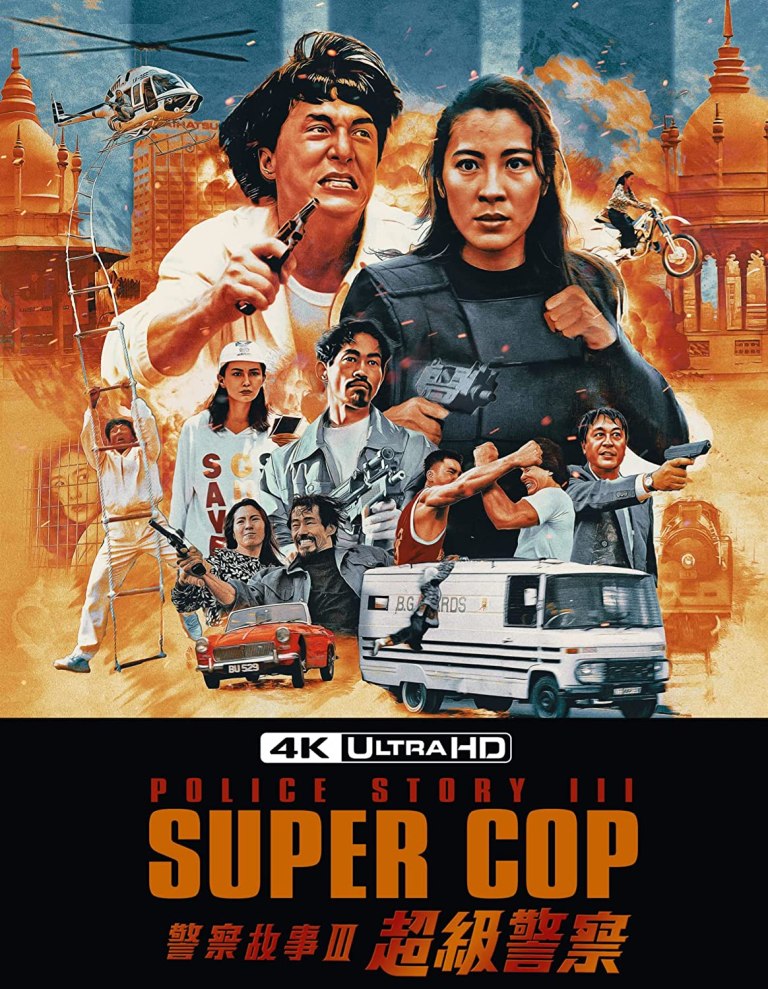
The 4K Blu-ray cover.
For the details of Police Story 3: Supercop 4K Blu-ray, posted below are technical stuff sourced from its Blu-ray.com page.
Video
Codec: HEVC / H.265
Resolution: 4K (2160p)
HDR: Dolby Vision, HDR10
Original aspect ratio: 2.39:1
Audio – TBA
Subtitles – English, English SDH
Discs – 4K Ultra HD, Blu-ray Disc, Single disc (1 BD)
Packaging – Reversible cover
Playback – 4K Blu-ray: Region free, 2K Blu-ray: Region A
Police Story 3: Supercop 4K Blu-ray will come with extra stuff and key features. Check out the official product trailer below…
I personally am interested in this upcoming 4K Blu-ray of the movie that had Jackie Chan and Michelle Yeoh as the stars. For one thing, I only saw the Dimension Films version released in 1996 simply titled Supercop and that version had some content of the original Hong Kong version cut out. I am also interested in the extra stuff related to the dangerous stunts Chan and Yeoh pulled off while making the film. Other aspects of the film’s production, which includes filming in Malaysia, are something I would like to see.
As for the movie itself, it has a lot of thrills and to watch them – as well as Jackie Chan and Michelle Yeoh themselves – again in 4K is something to look out for. On the aspects of story and continuity, this 1992 movie was the 2nd sequel to the original Police Story (1985) movie that I saw long time ago on home video. Filled with lots of action, very dangerous stunts (note: Chan doing the dangerous pole stunt with exploding electric lights inside a shopping mall was the definitive stunt to see) and car chases, Police Story became successful and spawned sequels. Police Story 3: Supercop had Chan working with Michelle Yeoh (note: this was her comeback) and in my view, they had fine chemistry together and proved how great they are with fighting and stunt work. No computer-generated images here as the action and stunts were really done by the stars with high risk and danger. Chan and Yeoh are movie legends now and their team-up in 1992 is alone a solid reason to anticipate the 4K Blu-ray release.
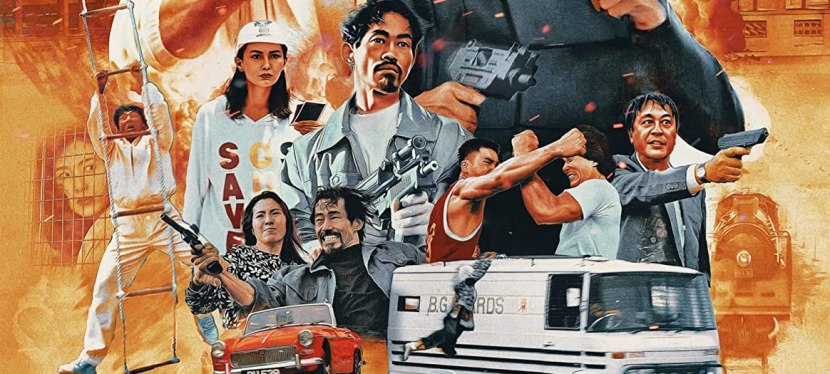
Asian region movie poster of Police Story 3: Supercop.
Watch out for Police Story 3: Supercop 4K Blu-ray on December 13, 2022.
In closing this Better than Streaming piece, posted below are Police Story 3: Supercop-related videos and some videos related to Jackie Chan and Michelle Yeoh.
Disclaimer: This is my original work with details sourced from reading the comic book and doing personal research. Anyone who wants to use this article, in part or in whole, needs to secure first my permission and agree to cite me as the source and author. Let it be known that any unauthorized use of this article will constrain the author to pursue the remedies under R.A. No. 8293, the Revised Penal Code, and/or all applicable legal actions under the laws of the Philippines.
Welcome back superhero enthusiasts, 1990s culture enthusiasts and comic book collectors! Today we go back to the early 1990s and explore a part of the Valiant Comics shared universe through the Harbinger monthly series.
In my previous retro review, the story heavily emphasized the thoughts, feelings and acts of Kris who is trying to live a normal life, maintain her relationship with Sting and also dealing with the vision she had about the infant she lost who eventually grew up to be Magnus the robot fighter. While Sting and his teammates deal with their domestic matters without the hassle of being held accountable for the crimes they committed, the Harbinger foundation keeps on training several powered young adults called Eggbreakers for dangerous missions.
With those details laid down, here is a look back at Harbinger #15, published in 1993 by Valiant Comics with a story written by Maurice Fontenot and illustrated by Howard Simpson.
The cover.
Early story
The story begins on the morning of December 15, 1992. Ax, the computer expert who turned traitor against Sting, Faith, Torque, Flamingo and Kris before (for reference, click here and here), returns home concealing his left arm with his jacket. He tells his companions that he just ran into a bit of trouble and that encountered Bloodshot. When asked about what happened to his arm, Ax just makes an excuse to move away.
Moments later, Ax is inside a large room filled with computers and other high-tech pieces of equipment. The male companion who asked about the arm realizes that Ax’s left arm is gone. Ax then admits he lost his arm and has to build himself a new arm as soon as possible.
Meanwhile inside a top secret facility of the Harbinger foundation, members of the Eggbreakers are training hard and even having fun talking as the action happen…
Quality
Nothing like a youth member getting the rare opportunity to meet the big boss right after the end of a big meeting.
I will go straight to the point here. The biggest and most surprising aspect of this Harbinger comic book is that much of the narrative focused strongly on the Harbinger foundation and its young adult members which left little spotlight for Sting, Faith, Kris, Flamingo and Shatiqua.
As this is the story of the people from the other side of the spectrum, writer Maurice Fontenot crafted a script that emphasized the Harbinger foundation to be more human than the usual sinister force that was portrayed before. You will not only see the founder and main villain Toyo Harada here but also the members of the Eggbreakers who are composed of young adults not too different from Sting and his companions. Unlike Sting’s team, the Eggbreakers are constantly trained with a high-tech facility and necessities provided by Harada who is simply uncompromising with his way on achieving things. There is also one particular young adult member who looks up to Harada as a great and positive figure who is dedicated on making the whole world a better place.
The good news here is that Fontenot’s writing is rock-solid! The character development is very in-depth, the young adults of the Harbinger foundation act and speak naturally, and strong focus on the Harbinger foundation’s internal matters and developments really gave me a clearer understanding of the organization on top of its reputation in this comic book series. That being said, Howard Simpson’s art here maintained the visual tone of the series while moving along smoothly when visualizing Fontenot’s script.
If there are any weaknesses in this comic book, it is the need to re-read it in order to get yourself oriented with who is who among the Eggbreakers and the other Harbinger foundation people. This is because there are lots of characters here.
Conclusion
The Eggbreakers in training.
Considering all the story build-up and character build-up that was focused mainly on Sting and his teammates, Harbinger #15 (1993) is clearly a major surprise and a major pay-off which ultimately adds to the anticipation of the future conflicts between the two sides. What Fontenot and Simpson presented here was outstanding work and it sure is entertaining as well as refreshing to read. At the same time, this Valiant comic book gave me some X-Men vibes but in a twisted and bastardized manner. As such, this Harbinger issue is very unique.
Overall, Harbinger #15 (1993) is highly recommended!
Disclaimer: This is my original work with details sourced from reading the comic book and doing personal research. Anyone who wants to use this article, in part or in whole, needs to secure first my permission and agree to cite me as the source and author. Let it be known that any unauthorized use of this article will constrain the author to pursue the remedies under R.A. No. 8293, the Revised Penal Code, and/or all applicable legal actions under the laws of the Philippines.
Welcome back superhero fans, 1990s arts and culture enthusiasts, Ultraverse fans and comic book collectors! Today we revisit the Ultraverse through the monthly series of The Solution.
In my previous retro review, The Solution took a major risk by going all the way to a secret place in Taiwan. Their purpose was to infiltrate the place and find out any details they could find from a planned secret meeting between heads of multiple gangs. For Tech/Lela Cho, she sees an opportunity to get her company back from the Dragon Fang gang. Dropkick expresses his concern that the whole meeting could be a trap as the Dragon Fang gang knows that Tech can hack their computers and extract information.
With those details laid down, here is a look back The Solution #16, published by Malibu Comics in 1995 with a story written by the late James Hudnall and drawn by Daerick Gross.
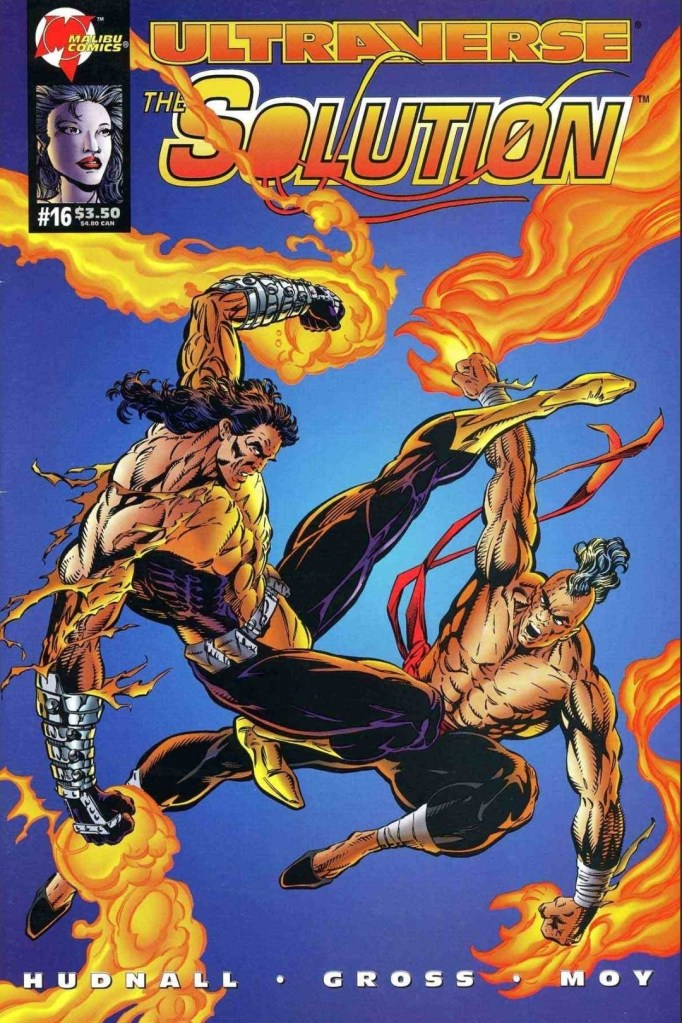
The cover.
Early story
The story begins with The Solution members apart from each other and each one has been trapped by deadly enemies. Outbreak is being fired upon by armed personnel. Shadowmage is down on the floor having been shot by one of the assassins. Dropkick finds himself attacked by another assassin. Tech is out cold and the deadly assassin Casino has her cornered.
Instead of going for the kill, Casino just talks to Tech and then calls Kwan Lun. In another part of the facility, the Communist Incoming aims his gun at the head of Shadowmage who suddenly moves and avoids the shot fired. As she finds a place to hide, she casts a spell to heal herself…
Quality
Dropkick on the losing end of the fight.
If you want action with The Solution, this comic book has lots of it as it is the continuation of the conflict between the titular team and the evil forces. Quite consistently, the creative team made each team member look vulnerable, especially with Tech who is helpless even though Casino (note: their previous encounter was in issue #7) is ironically not even fighting. While Outrage and Dropkick are on the verge of being eliminated, Shadowmage was also portrayed to be vulnerable in a gritty manner. Adding further depth to the engagement of the story is suspense.
Visually, artist Daerick Gross did a good job and judging from the way the action and sequencing were done, he seems to have researched the previous issues. His artistic takes on The Solution team members plus Casino and the assassins are nice to look at as well as recognizable.
Conclusion
Even though she was down, Shadowmage managed to avoid certain death giving her a chance to survive and take on the armed Commie.
The Solution #16 (1995) is entertaining enough for me and it also succeeded in keeping me interested for the next issue which also happens to be the final issue. As this is the 2nd-to-the-last issue of The Solution series, James Hudnall knew what defined the characters and what kind of stories would keep the fans engaged. That being said, he seemed to have set something up for the next issue as this comic book ended in a cliffhanger.
Disclaimer: This is my original work with details sourced from reading the comic book and doing personal research. Anyone who wants to use this article, in part or in whole, needs to secure first my permission and agree to cite me as the source and author. Let it be known that any unauthorized use of this article will constrain the author to pursue the remedies under R.A. No. 8293, the Revised Penal Code, and/or all applicable legal actions under the laws of the Philippines.
Welcome back superhero enthusiasts, 1990s culture enthusiasts and comic book collectors! Today we go back to the early 1990s and explore a part of the Valiant Comics shared universe through the Harbinger monthly series.
In my previous retro review, Faith encountered an old man who turned out to be highly unusual and this led to her dealing with street troublemakers. More notably, the comic book developed Faith’s personality further and she is definitely more than just the geek among her teammates.
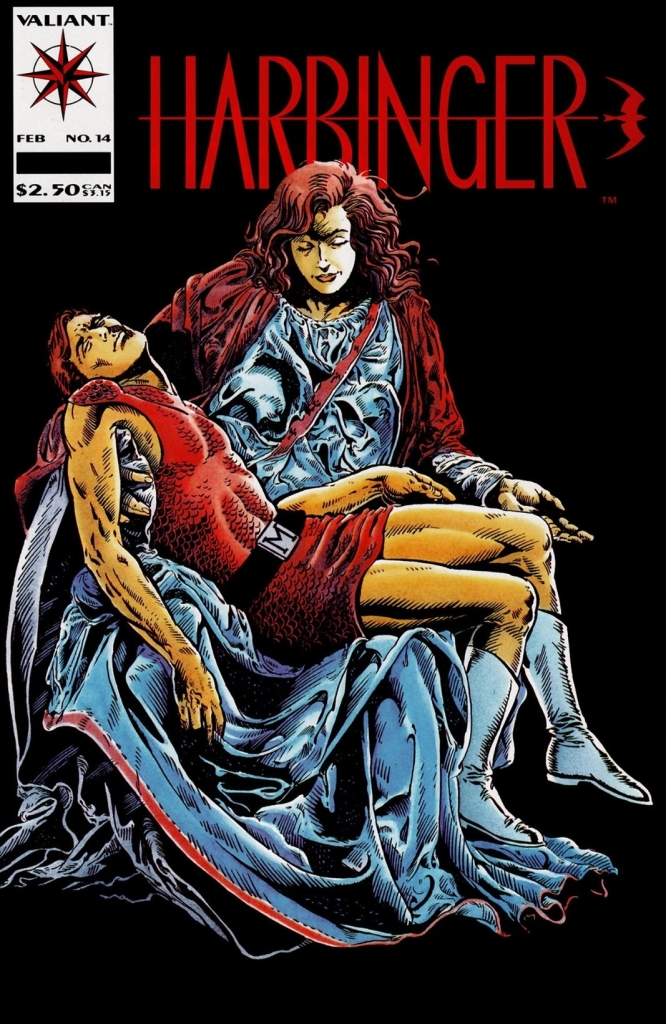
With those details laid down, here is a look back at Harbinger #14, published in 1993 by Valiant Comics with a story written by Maurice Fontenot and illustrated by Howard Simpson.
The cover.
Early story
The story begins during one of the past events in the Unity storyline as the young Geomancer tells Kris to give to him her baby as something crucial was about to happen in just a few minutes. Kris, who already knows that her infant is actually Magnus the robot fighter, unsurprisingly resists. Suddenly, energy and light formed between the two and Kris’ baby suddenly disappears which prompts the Geomancer to state that Solar is sending everyone – including the baby – to a proper place in time.
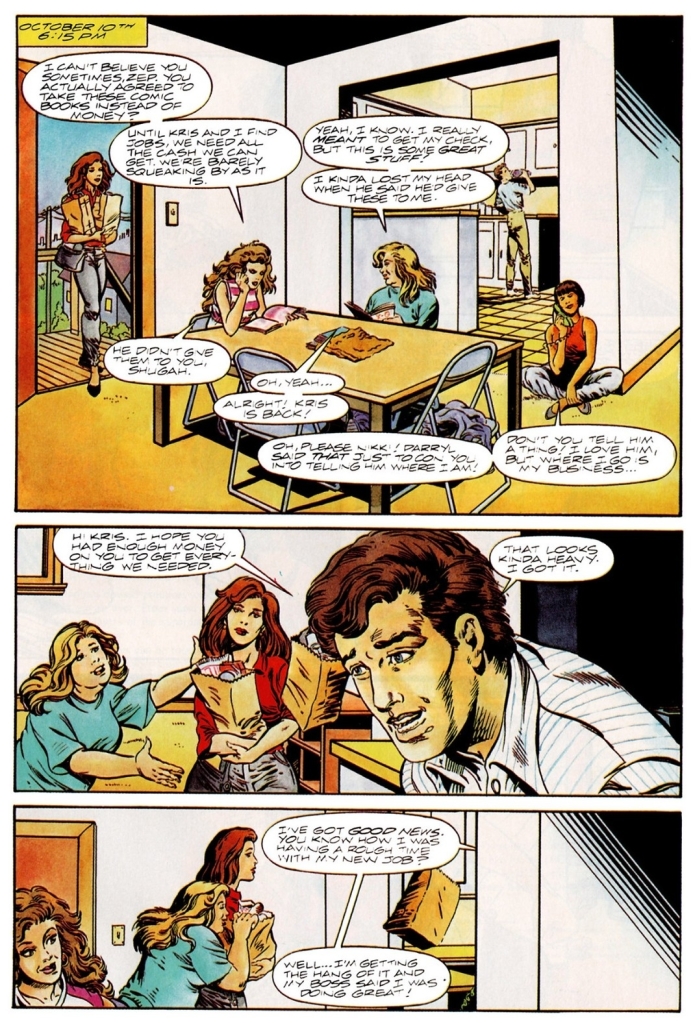
In the present day of October 9, 1992, Faith helps a kid by retrieving his kite from a tall tree not realizing that she just exposed herself as they are within a public park. Sting warns her that her act was risky as there could by anybody watching them from a distance.
A few feet away from Sting, Faith, Flamingo and Shatiqua is Kris who watches a group of children playing…
Quality
Even though most of them have special abilities, they are still vulnerable with the costs of independent living as well as being targets of the Harbinger foundation.
The story here is a complete change of direction compared to issue #13. For one thing, it takes a look back at key events that took place during the Unity crossover storyline which specifically involved Sting and his teammates. The flashbacks were done through Kris’ memory and she provides the narration (conveniently for us readers) as she shares her personal views about what happened.
More notably, the flashback and narrations reflect how much of an impact the loss of the baby truly was for Kris who even expressed that the infant – destined to be Magnus the robot fighter as an adult – must have hated her for letting him go.
Unity aside, this comic book also follows the private lives of Sting, Kris, Flamingo, Faith and Shatiqua as they now live together in a rented home. While almost all of them have special abilities, they are still vulnerable with not just the threat of the Harbinger foundation but also the with the costs and constant challenges of living independently from their respective families. It’s nice that as this was Maurice Fontenot’s debut as writer of this particular monthly series, the general tone was maintained and the story was told with realism in mind. I also like the way Fontenot dramatized the characters particularly with Sting still living with a false sense of maturity at a time when his love Kris is struggling over the visions about the past and her lost child.
This comic book also marked the series debut of Howard Simpson whose art style resembles that of David Lapham.
Conclusion
A quick look back at Unity.
Harbinger #14 (1993) has a solid touch on developing the lead characters – specifically Kris – and went as far as recalling some of the events of Unity while even having a few pages featuring one of Valiant Comics’ major characters which you can easily guess who. To put it short, this comic book ultimately served as a build-up for further confrontations with the Harbinger foundation but the characterization of Kris here is the real meat of the story. By the time you reach the end, you should be able to know Kris more. Definitely a solid read!
Overall, Harbinger #14 (1993) is highly recommended!
Welcome back, fellow geeks, Blu-ray collectors and movie buffs! Whether you are a fan of Tom Cruise, or a fan of the 1986 classic Top Gun or if you want something new and exciting to add to your collection of 4K Blu-ray movies, November 1, 2022 will be an important for you as Top Gun: Maverick4K Blu-ray will be released on that very day. Here are some good news…Top Gun: Maverick 4K Blu-ray will come with native 4K visuals and if you are convinced to go for it, you can order it in advance right now!
Top Gun: Maverick 4K Blu-ray cover.
To put things in perspective, posted below is the excerpt from the 4K Blu-ray announcement at Blu-ray.com. Some parts in boldface…
Paramount Home Media Distribution has officially announced that it will release on 4K Blu-ray and Blu-ray Joseph Kosinski’s Top Gun: Maverick (2022), starring Tom Cruise, Val Kilmer, Miles Teller, Jennifer Connelly, and Bashir Salahuddin. The two releases will be available for purchase on November 1.
Studio synopsis: Tom Cruise stars in the global phenomenon Top Gun: Maverick, the #1 film of 2022 with over $1.3 billion in worldwide box office and the highest grossing film of the producer/actor’s acclaimed career. Top Gun: Maverick has been hailed as “spectacular” (Brian Truitt, USA Today), “breathtaking” (Don Kaye, Den of Geek) and “jaw-dropping” (Sean O’Connell, Cinemablend).
After more than thirty years of service as one of the Navy’s top aviators, Pete “Maverick” Mitchell (Tom Cruise) is where he belongs, pushing the envelope as a courageous test pilot and dodging the advancement in rank that would ground him. When he finds himself training a detachment of Top Gun graduates for a specialized mission the likes of which no living pilot has ever seen, Maverick encounters Lt. Bradley Bradshaw (Miles Teller), call sign: “Rooster,” the son of Maverick’s late friend and Radar Intercept Officer Lt. Nick Bradshaw, aka “Goose.”
Posted below are the specs of Top Gun: Maverick 4K Blu-ray…
Video
Codec: HEVC / H.265
Resolution: Native 4K (2160p)
HDR: Dolby Vision, HDR10
Aspect ratio: 2.39:1, 1.90:1
Original aspect ratio: 2.39:1
Audio
English: Dolby Atmos
English: Dolby TrueHD 7.1 (48kHz, 24-bit)
Subtitles – English SDH, French
Discs – 4K Ultra HD, Blu-ray Disc, Single disc (1 BD-100)
Digital – Digital copy included
Packaging – Slipcover in original pressing
Playback – 4K Blu-ray: Region free
As for the special features and technical specs, posted below are the details sourced from Blu-ray.com…
DOLBY VISION/HDR PRESENTATION OF THE FILM
DOLBY ATMOS AUDIO TRACK
Cleared For Take Off—Witness the most intense film training program as the cast prepare themselves for filming while pulling multiple G’s in a fighter plane.
Breaking New Ground – Filming Top Gun: Maverick—Prepare to take flight as you go behind-the-scenes with the cast and crew of Top Gun: Maverick on a journey to capture the most spectacular aerial sequences ever!
A Love Letter To Aviation – Tom Cruise shares his passion for aviation as he pilots his own aircraft, a vintage World War II P-51 Mustang, which would have been the Top Gun aircraft of its day.
Forging The Darkstar – Pushing the limits beyond Mach-10, the future of aviation is unveiled through an impressive experimental aircraft specially designed for the movie.
Masterclass with Tom Cruise – Cannes Film Festival—Tom Cruise discusses his incredible career at the flagship event of the 75th Cannes Film Festival.
“Hold My Hand” – Lady Gaga Music Video—Watch Lady Gaga’s music video for her standout lead single hit on the Top Gun: Maverick soundtrack.
“I Ain’t Worried” – OneRepublic Music Video—Check out the music video to the original new song from OneRepublic.
Mission: Impossible – Dead Reckoning Part One Teaser Trailer – We all share the same fate. Watch the official teaser trailer for Mission: Impossible – Dead Reckoning Part One starring Tom Cruise. Coming to theatres 2023.
Top Gun: Maverick was released more than thirty years after its predecessor first came out. The 1986 Top Gun itself did not just make a tremendous amount of money in terms of ticket sales as it also made its mark in American pop culture complete with a memorable soundtrack and having notable actors like Val Kilmer, Michael Ironside (note: check out my retro review of V: The Final Battle plus my article about its Blu-ray release), Meg Ryan and Tim Robbinsas supporting cast members. To know more about the 1986 classic, watch Oliver Harper’s in-depth retrospective by clicking here.
More on Top Gun: Maverick, the movie’s success during this COVID-19 pandemic age is astounding as it grossed past $1 billion worldwide and literally it reinvigorated movie theaters around the world! For context, posted below is an excerpt from a recent Forbes.com article regarding the theatrical success. Some parts in boldface…
Top Gun: Maverick’s exceptional success supplied a giant lifeline to theaters and cover for studios willfully underdelivering regular theatrical products in an uncommonly sparse summer. Top Gun: Maverick accounted for 23% of the domestic summer movie line-up. That is partially because it earned around $500 million more than even the rosiest projections.
Top Gun: Maverick also came with the benefits of advanced cinematography technologies and methods which made its flight scenes very pleasing to watch. Practical effects and daring flying methods were used which added to the organic nature of the movie’s visuals which is something that computer-generate imaging (CGI) cannot do. The production team also used IMAX cameras and if the movie is still playing in the near IMAX cinema near you, I encourage you to go watch it while you still have time.
Another notable thing about Top Gun: Maverick is that it defied the wokeness of Commiewood (Communist Hollywood) and emphasized American patriotism. For the newcomers reading this, be aware that there are many millions of socialists, Marxists, Communists and unpatriotic people among young people in America who were brainwashed by the socialists who worked as so-called educators in colleges. Take note from the excerpt posted below sourced from The Daily Mail. Some parts in boldface…
Top Gun is a straightforward action movie that celebrates all that is good about our country and our military.
Add to that the handsome leading men, a romantic drama with Cruise’s love interest Jennifer Connelly, and a new generation of actors and ‘pilots,’ like Miles Teller, and you have darn sequel.
There is also a really moving scene between Maverick and Iceman (Cruise and Val Kilmer) and I am woman enough to admit I cried through it.
But above all else — the movie isn’t overly political, it isn’t depressing, it isn’t focusing on the flaws of the United States of America and why we suck and why our flag and national anthem aren’t worth honoring.
The filmmakers also took a stand against the sickening Hollywood trend of pandering to the demands of the totalitarian Chinese government.
In the 1986 original movie, there is a patch depicting the Taiwanese flag on Maverick’s flight jacket. But during 2019 previews, the patch had been removed to alleged appease Chinese censors.
Movie-goers were happy to see the flag had been restored in the film — a signal that neither the filmmakers nor Cruise are content with being lapdogs to the Chinese regime.
I absolutely loved the movie and I felt good leaving the theatre that evening.
Hollywood must wake up to the reality that ‘go woke, go broke’ is real.
Considering its major achievements that go beyond ticket sales, Top Gun: Maverick is the modern-day entertainment marvel just waiting to be discovered by a lot more people who still have not seen it. Expect Top Gun: Maverick to be among the most wanted titles on Blu-ray and 4K Blu-ray formats this coming Christmas shopping season. Watching the Tom Cruise-led movie in the cinemas, on 4K Blu-ray and Blu-ray is simply better than streaming.
Watch out for Top Gun: Maverick 4K Blu-ray on November 1, 2022.
In closing this Better than Streaming piece, posted below are Top Gun: Maverick-related videos and a few Top Gun videos for your viewing pleasure.
Disclaimer: This is my original work with details sourced from reading the comic book and doing personal research. Anyone who wants to use this article, in part or in whole, needs to secure first my permission and agree to cite me as the source and author. Let it be known that any unauthorized use of this article will constrain the author to pursue the remedies under R.A. No. 8293, the Revised Penal Code, and/or all applicable legal actions under the laws of the Philippines.
Welcome back superhero enthusiasts, 1990s culture enthusiasts and comic book collectors! Today we go back to the early 1990s and explore a part of the Valiant Comics shared universe through the Harbinger monthly series.
In my previous retro review, Sting, Faith, Kris, Flamingo and newcomer Shatiqua pursued a mission recklessly with revenge over the death of Torque as the main motivator. That story symbolically shows that the boundary between good and evil has been blurred away as Sting and his team just kept on pursuing their goals disregarding the rule of law and committing acts that make them no different from the sinister Harbinger Foundation. In some ways, Sting himself is gradually becoming as evil and abusive as his target (and former mentor) – Toyo Harada.
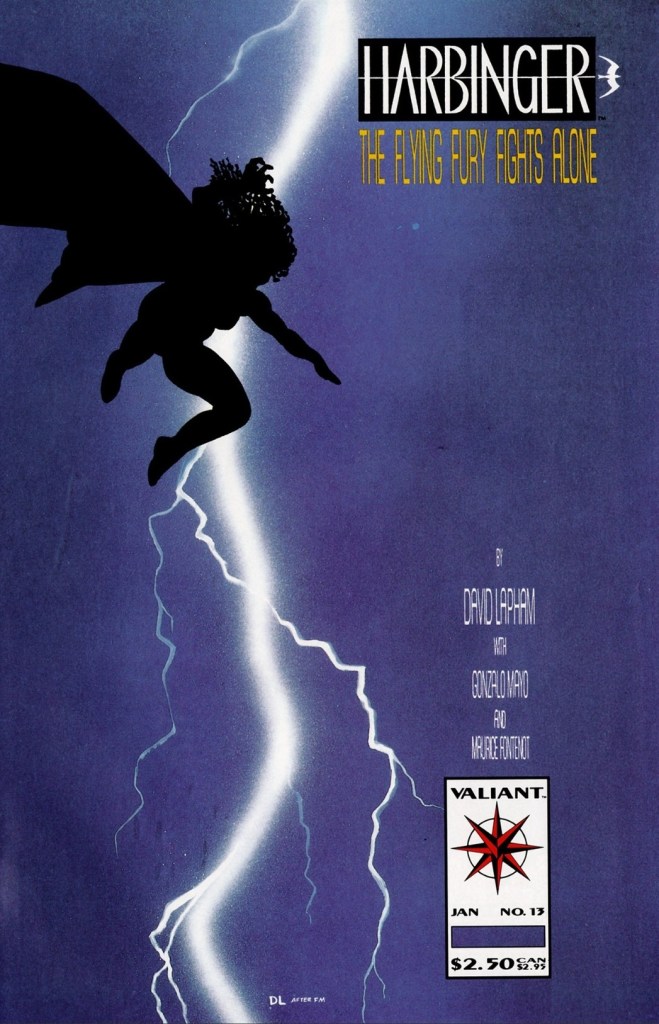
With those details laid down, here is a look back at Harbinger #13, published in 1993 by Valiant Comics with a story written and drawn by David Lapham.
The cover that closely imitates the iconic image of Frank Miller’s The Dark Knight Returns.
Early story
The story begins with Faith flying high above the streets of New York City talking to herself as she enjoys the flight as well as the flight of fantasy in her mind. After discreetly landing in an alley, she bumps into a man as she moves into the city sidewalk. Two other men could not help but laugh at what they just saw.
The man Faith bumped into gets mad, grabs her by the shirt and pulls out a knife. Suddenly, an old man comes out of nowhere and threatens the knife-wielding man which in turn prevented Faith from getting hurt. Upon realizing a lot of people are around them and watching, the knife-wielding man and his two companions move away.
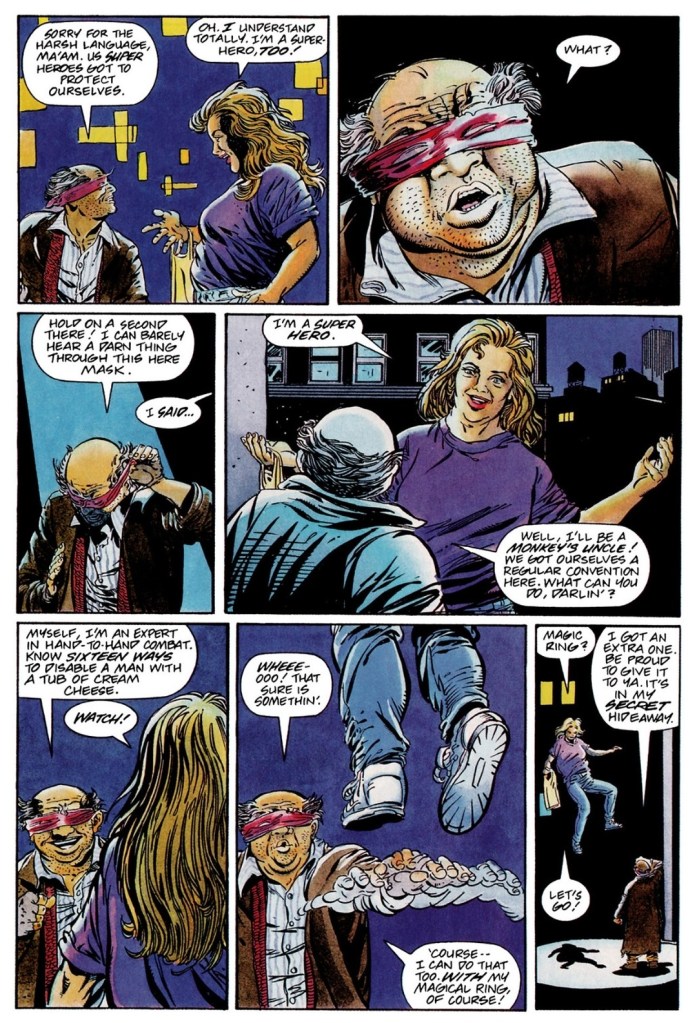
The old man then befriends Faith. She thanks him for his help…
Quality
Faith and the old man.
As I expected another Harbinger tale about Sting and his team going up against Harada’s foundation, I can say that this comic book surprised me in a rather delightful way. To be clear, this is a story mainly focused on Faith and under Lapham’s direction, readers will see her personality emphasized more than ever and what she is capable of with not just her special abilities but also with how she deals with problems.
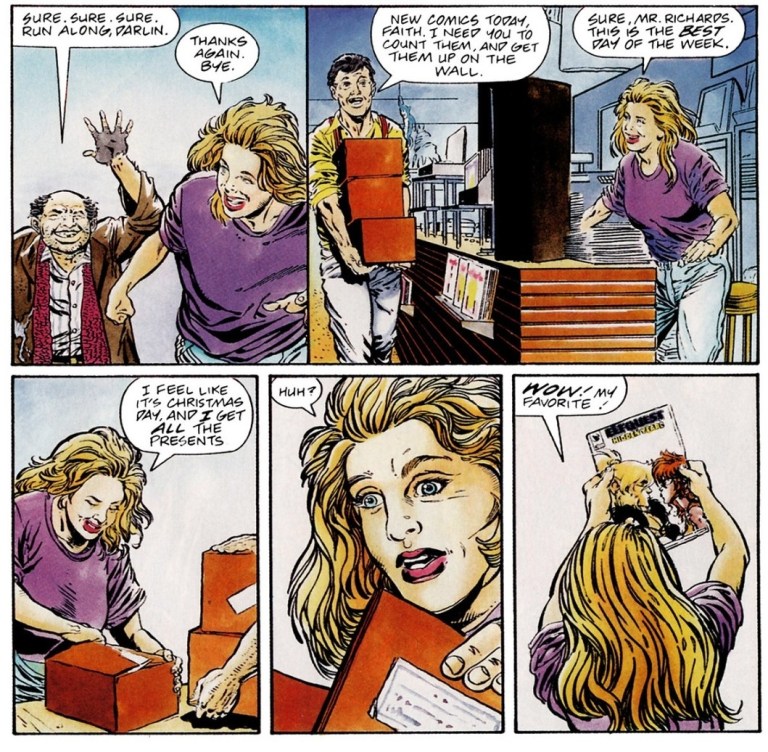
The good news here is that the writing by Lapham is solid. Faith is clearly the comic book geek among her teammates and to see her work inside a comic book store in the city is amusing as her portrayal captures how comic book fans react when they see something really fascinating or special among the many printed materials displayed. It should be noted that Faith’s independence is nicely portrayed and she has her own way of dealing with the harshness of reality without ever letting her personal obsession with entertainment overwhelm her reasoning. The ironic thing about Faith’s view of life around her is that she does not show any regrets about the crimes the she and her teammates committed.
Those who are looking for superhero spectacle will find something gritty and short with regards to Faith. Adding further zest in this comic book are fantasized excerpts from a particular comic book Faith reads in the story.
Conclusion
Faith working inside the comic book store.
Harbinger #13 (1993) is a very surprising read that clearly delivered a good bout of fun. Its main attraction is Faith herself and this comic book has the most in-depth development of her character to date. Through her, comic book readers will have something to resonate with when it comes to comic book culture and geek interests. Ultimately, David Lapham succeeded in defining Faith and telling a solid Harbinger tale mainly focused on her. In some ways, this comic book is like a relief from all the tension built up on the rivalry between Sting’s team and the Harbinger Foundation. That being said, this comic book is no filler and it fits right in the monthly series.
Overall, Harbinger #13 (1993) is highly recommended!
Disclaimer: This is my original work with details sourced from reading the comic book and doing personal research. Anyone who wants to use this article, in part or in whole, needs to secure first my permission and agree to cite me as the source and author. Let it be known that any unauthorized use of this article will constrain the author to pursue the remedies under R.A. No. 8293, the Revised Penal Code, and/or all applicable legal actions under the laws of the Philippines.
Welcome back superhero fans, 1990s arts and culture enthusiasts, Ultraverse fans and comic book collectors! Today we revisit the Ultraverse through the monthly series of The Solution.
In my previous retro review, The Solution itself was not really present in the story which was both a shock and a major disappointment. The Solution #14 (1994) refocused mainly on past villains who debuted in the early part of the monthly series and it sent a clear sign that a rematch with The Solution is bound to happen.
With those details laid down, here is a look back The Solution #15, published by Malibu Comics in 1995 with a story written by the late James Hudnall and drawn by George Dove.
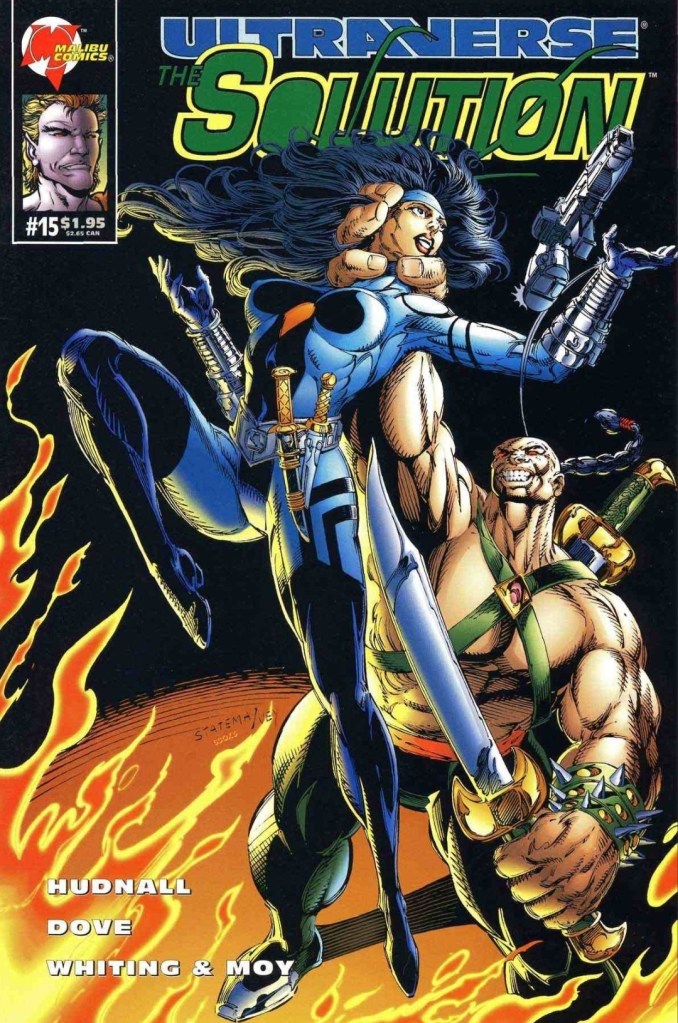
The cover.
Early story
The story begins with Dropkick inside a dark room. Tech comes in searching for him and turns the light on. She is surprised to see Dropkick with a new look complete with face paint. Dropkick insists that his new look will last and he saw the future. The man then surprises Tech once more by instantly changing into casual clothes. She then reveals to him that she found a way to get her company back.
Moments later in a meeting with Dropkick, Outrage and Shadowmage, she reveals that while searching online for information about what the Dragon Fang gang has been doing with her company, she found a memo about a meeting that was set to happen the next week somewhere in Taiwan. The heads of the gang are supposed to be there and for Tech, this is the opportunity to take them on.
As the exact location of the meeting remains unclear, Tech states that they will need to travel overseas as she needs to be near a place to check out the electronic systems. For Dropkick, the whole meeting could be a trap and he states that the Dragon Fang gang knows Tech can read their computers.
Even though she is certain that the trap is real, Tech states that they cannot pass up the opportunity to take on the enemy…
Quality
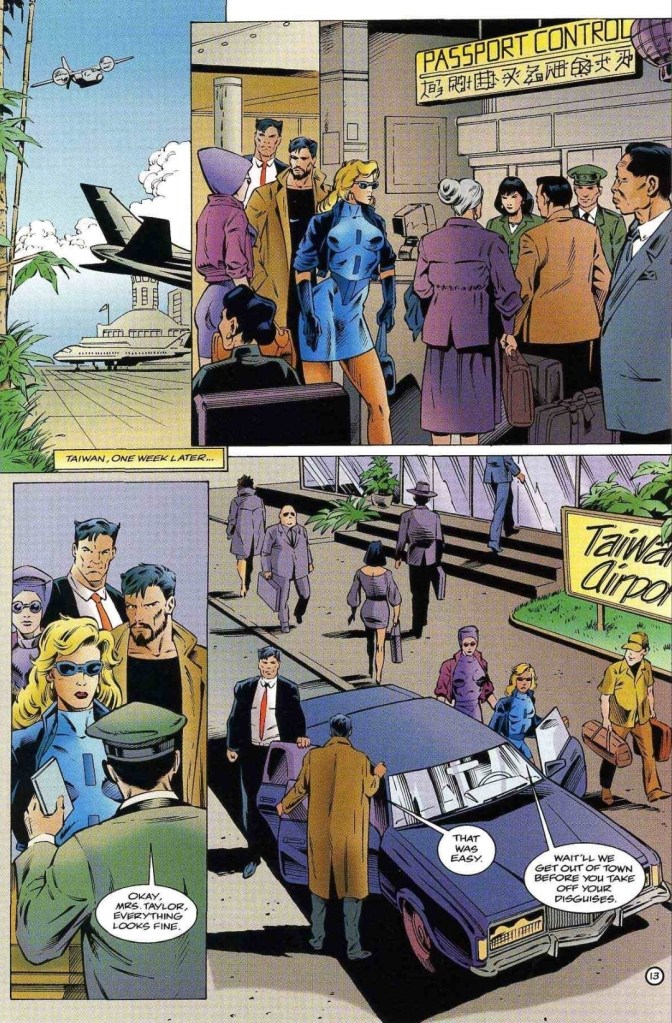
Can you recognize anyone on this page?
Now this is more like it! The Solution is indeed back and this story is pretty much a big pay-off to all the build-up done in the villains-focused story of the previous issue. Take note that this story took place just a short time after the very wild storyline told in issues #9, #10, #11 and #12.
To make things clear, there is a conflict in the story which should resonate with The Solution fans who read the early issues of the series that launched in 1993. There is indeed a rematch between the titular team and the villains (plus Casino in this issue) which fortunately was very well done and proved to be worth the wait and the build-up. Speaking of conflict, there was this surprising development that happened within the side of the villains and that alone added more depth to the plot as well as more tension to the rematch with Tech and her teammates.
Artist Greg Dove did a fine job drawing this story and he knows when to use dynamic visuals when it comes to emphasizing impact. Thanks to Dove, Casino in this issue has that femme fatale look on her face. His take on Tech, her teammates and the three other villains is also good to look at.
Conclusion
The Solution with Dropkick in his new look.
The Solution #15 (1995) marks the series’ return to normalcy (meaning fun, intrigue and engagement) and it is indeed a worthy pay-off to the disappointing previous issue. The conflict told within this particular comic book is just the start and as I reached the ending, I can say that I am anticipating what would happen next. There is a lot for fans of The Solution to enjoy here.
Disclaimer: This is my original work with details sourced from reading the comic book and doing personal research. Anyone who wants to use this article, in part or in whole, needs to secure first my permission and agree to cite me as the source and author. Let it be known that any unauthorized use of this article will constrain the author to pursue the remedies under R.A. No. 8293, the Revised Penal Code, and/or all applicable legal actions under the laws of the Philippines.
Welcome back superhero enthusiasts, 1990s culture enthusiasts and comic book collectors! Today we go back to the early 1990s and explore a part of the Valiant Comics shared universe through the Harbinger monthly series.
In my previous retro review, Sting, Faith, Kris and Flamingo adjusted themselves to normal living. As far as they are concerned, several months had passed for them during their time in the unknown world during the events of Unity. For their real world, however, very little time had passed. They also took a renewed effort to search for powered beings like themselves as part of their plan to protect themselves and be able to take down the Harbinger foundation in due time.
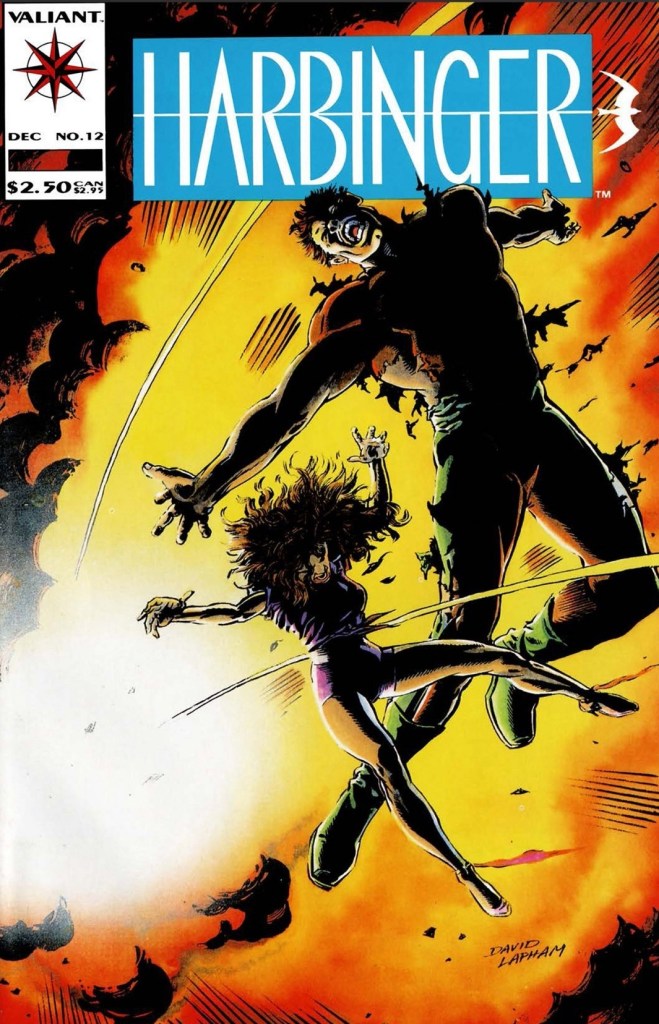
With those details laid down, here is a look back at Harbinger #12, published in 1992 by Valiant Comics with a story written and drawn by David Lapham.
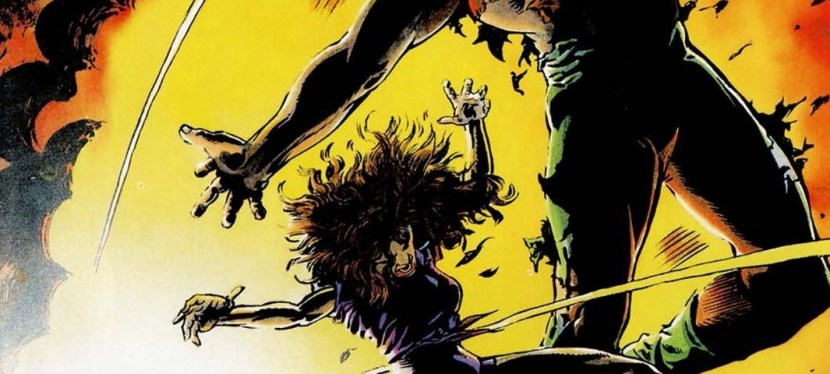
The cover.
Early story
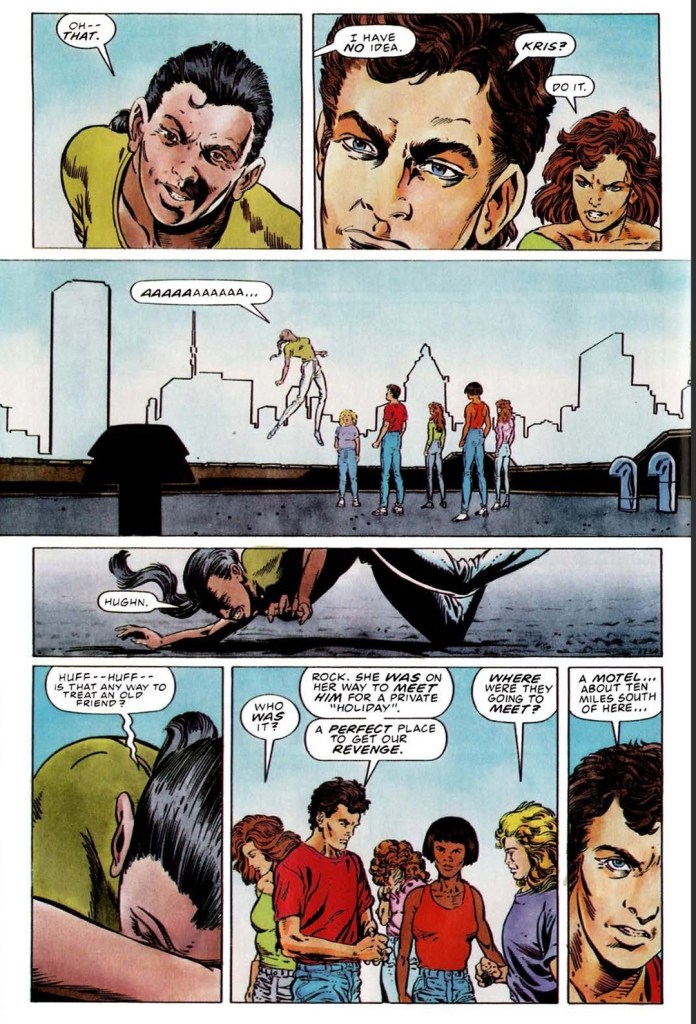
The story begins during the wee hours of September 4, 1992 inside the rented house occupied by Sting, Flamingo, Kris and Faith. Flamingo wakes up from another nightmare causing her to unintentionally burn part of her bed. Her teammates rush in to comfort her and it turns out Flamingo just had her third nightmare of the week which reflects her sadness over the death of their late teammate Torque. In response to this, Sting takes Faith with him to fly out and do some information gathering at the Harbinger office in New York.
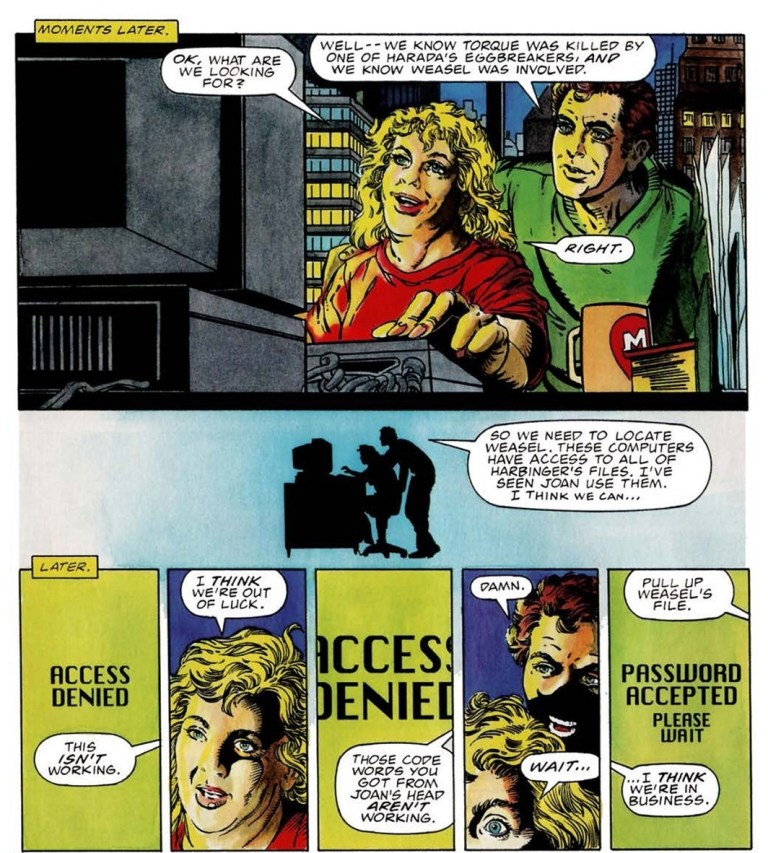
It turns out Sting had been covertly breaking in to the said office in recent times primarily to get information about the latest moves of the one organization that wants them defeated. After sneaking into the New York office of Harbinger, Sting uses his power on a Harbinger employee named Joan to get codes from her to get into the organization’s computer network…
Quality
Clearly Sting and his teammates are becoming as bad as their counterparts at the Harbinger foundation. Sting looks like he is destined to become sinister and unstoppable as his target Toyo Harada.
Considering how I felt after reading issue #11, this comic book series indeed took a turn to a new creative direction under David Lapham’s writing (note: this is the 2nd Harbinger story Lapham wrote). Not only did Sting and his teammates gain a new member with Shatiqua, they daringly pursued another dangerous mission that could be described as reckless and even idiotic. Even though they knew that the Harbinger foundation was strongly powerful and had many powered young adults as opposition, revenge over the death of Torque motivated them to take on their enemies head-on one member at a time.
David Lapham successfully portrayed Sting and his team to be as ruthless as Harbinger which strongly symbolizes the blurring of the boundary between good and evil. With regards to Sting, I saw a powerful teenager who could someday grow to be an evil leader similar to his rival and main target Toyo Harada. The mere fact that revenge was the objective for the team shows how dark Sting has turned even though he believes that he and his teammates are victims trying to survive and be free from the present danger of the Harbinger foundation.
Along the way, this comic book shows Flamingo at her most emotional state as she still clings on to the ate Torque. Her portrayal in this comic book is quite believable as it reflects the difficulties that teenagers in real life experience when it comes to letting go of the past and struggle to move forward as they carry bitterness and pain with them.
If you are looking for superhero spectacle, there is a lot to enjoy here. I won’t say how it is presented because that is something you yourselves should read and discover.
Conclusion
Breaking in and hacking into a private company’s network are crimes that Sting and Faith are comfortable with.
Harbinger #12 (1992) is a very solid read! What Jim Shooter established for this series with the first ten issues, David Lapham carefully moved the narrative forward to a new direction while still maintaining the elements that defined the main characters, why they exist and what they are fighting for. At this stage in the Harbinger series, Sting, Faith, Flamingo and Kris (plus new member Shatiqua) continue to operate as a team while disregarding the laws and morality because they truly believe that they are victims and moving targets of Harada and the Harbinger foundation. This comic book also has an excellent mix of storytelling, characterization and superhero action while still feeling like it is all grounded with reality (note: the X-Men comics published the same year as this had more fantasy elements). Right now, I’m happy with the way Lapham is handling the story and I’m looking forward to the next issue.
Overall, Harbinger #12 (1992) is highly recommended!
To be clear, I find Square Enix’s business relationship with Team Xbox lacking. The HD remastered version of Legend of Mana was very noticeably released on multiple platforms but not on Xbox. Tactics Ogre: Reborn was announced for future release for multiple platforms except Xbox. Still on Square Enix, the Final Fantasy VII remake as well as the announced sequel are exclusive to Sony’s platforms. The exclusions are clear and disturbing. Why Square Enix excluded the Xbox Series X, Xbox Series S and the Xbox One (which still has many millions of console users until now) as platforms to sell the above mentioned games remains a mystery although there is speculation that Sony Corporation and its PlayStation executives made a secret deal with the JRPG giant to specifically hurt Xbox without affecting Nintendo and Steam. Realistically, Microsoft pointed out that Sony pays game companies for blocking rights to keep games off Xbox Game Pass. Read all about it here, here and here.
While these developments are disturbing and also annoying, I still wish that Square Enix would remaster one of its classic JRPGs and release it on Xbox platforms similar to what they did with the remastered Chrono Cross. That classic RPG I’m referring to is none other than Xenogears.
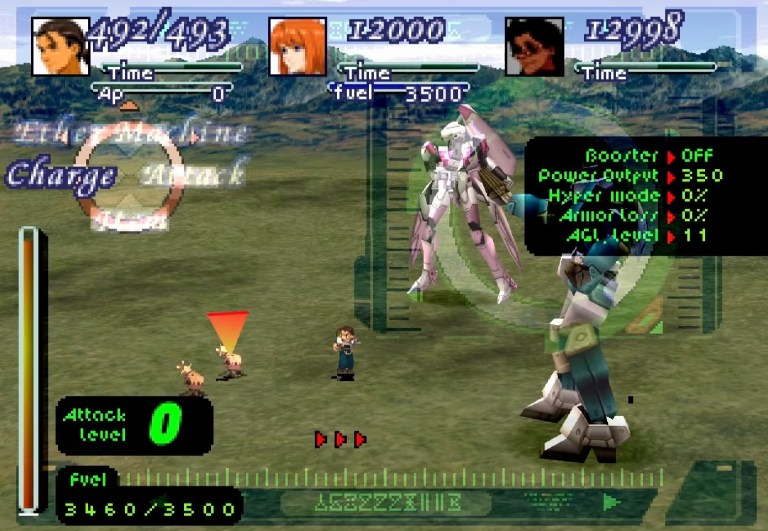
Xenogears’ battle system allowed individual persons and giant robots (called gears) to engage in battle simultaneously. Observe how the approach on in-game scale was done here.
I played Xenogears on the original PlayStation console way back in 1998 but I never got to finish it due to my academics and other external matters. It also did not help that the CD-ROM of the PlayStation deteriorated.
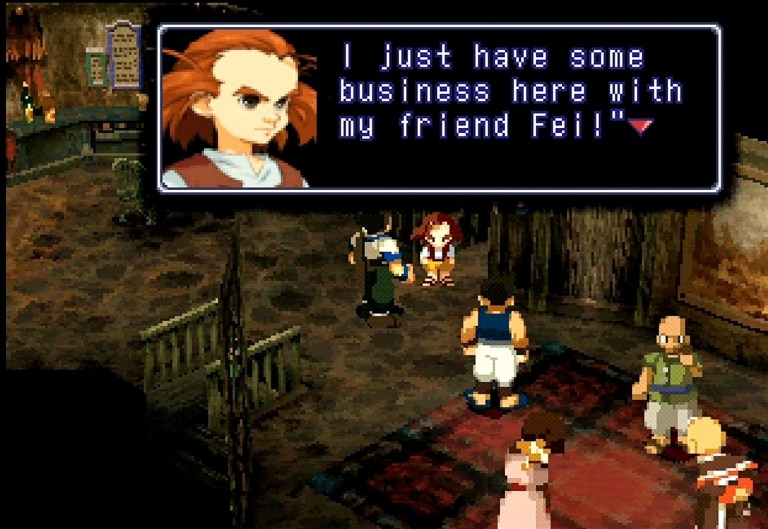
Regardless, I had a lot of enjoyment during my limited time with the said JRPG, the design of which was led by Tetsuya Takahashi. The fictional concept of Xenogears took a lot of inspiration from real-life forms of religion as well as concepts from certain intellectuals to establish the story themes, the fictional cultures and historical backgrounds within the game. At the same time, the game had this in-depth universe composed of different settings for gamers to explore. In my experience, I felt immersed into the game’s universe and I still remember the moments I got astonished discovering not only the many locations and landmarks but also the many non-playable characters (NPCs presented as 2D sprites) in the form of local communities and the in-game cultures.
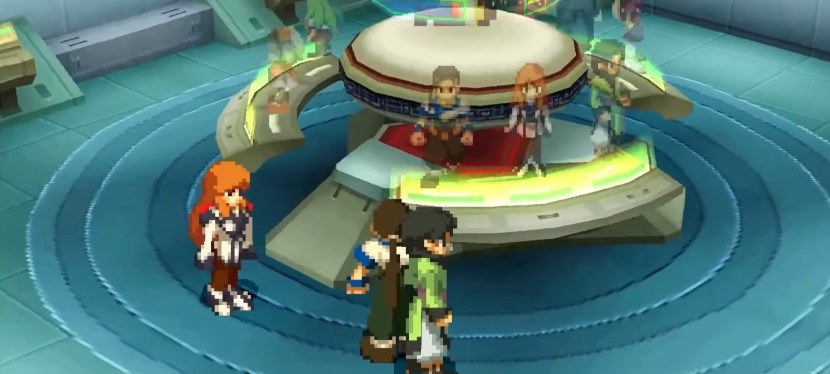
Xenogears had 3D polygonal environments and 2D sprites for the characters and creatures who move around.
In this classic JRPG, you play as Fei and you will explore a lot, fight a lot and interact with lots of characters as you go along.
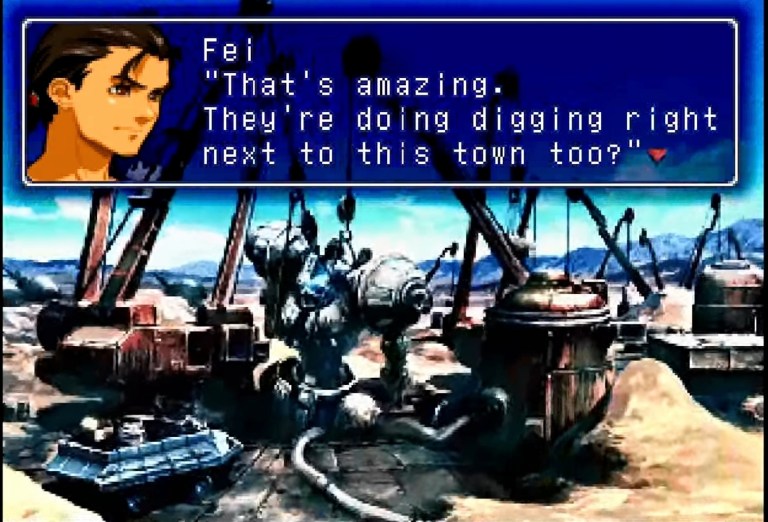
While Xenogears had a science fiction concept, it still had lots of settings and gameplay features that made it feel like a fantasy. I love the way how the creative team’s artists implemented their art styles on the environments, the characters, the machines, the interiors of places and more. Visually, this game saw the use of 2D sprites for the characters who move along a 3D polygonal environment which can be explored creatively by a camera that can be adjusted by the players. As such, this approach done in Xenogears made the game look and feel a lot like Grandia.
While Xenogears’ battle system had key elements that were common with other JRPGs, there was a clear emphasis on hand-to-hand combat that took a lot of inspiration from martial arts as well as 2D fighting games of the decade. There were these martial arts-inspired combos which required button combinations and timing which were fun to watch happen. There were also these death blows which were really rewarding when pulled off correctly. Of course, there were still some magic attacks that were nicely presented.
What made Xenogears stand out is the use of giant robots or gears in the game. Not only did the game allow me to travel with the gears, it also allowed me to engage with enemies (both the large and the small ones standing on the floor/ground) with a fully functional battle system that emphasized size, scale and impact altogether. Similar to the other battle system, the gears battle system fun and engaging in my experience. I can never forget the moment I first saw my gear crush a huge enemy with a lot of impact to seal the victory. Travel using gears, however, was hampered somewhat by the creative team who implemented platform gaming elements (note: this includes jumping from one platform to another without falling down to your death) and the controls were not really responsive enough. This is something Square Enix should consider improving if they ever remaster Xenogears.
The battle system with the individual characters is a lot of fun and also unique as the combat emphasizes combos and martial arts.
The artistic approach used in Xenogears remains captivating.
Right now, I would love to replay Xenogears and complete it but I prefer the game should be remastered and be released for Xbox consoles. I have no intention of buying a new console from Sony and Nintendo to play Square Enix JRPGs that are missing on Xbox consoles. JRPGs on Xbox are not exactly lacking (note: Eiyuden Chronicle: Hundred Heroes will be released via Xbox Game Pass in 2023 while Persona RPGs are coming to Xbox soon) but it would be great not only for Xbox gamers but also Square Enix itself to remaster Xenogears and release it on the Xbox ecosystem. That being said, I believe Xenogears itself would make a great addition into Xbox Game Pass (XGP) which already has many millions of subscribers worldwide!
Think about it carefully. Having a remastered Xenogears for sale on Xbox and also listed on Xbox Game Pass will not only be good for the Xbox ecosystem but also for Square Enix to not only sell games but also reach out to the XGP subscribers who could enjoy the said JRPG and add a lot of new players that the JRPG giant could not reach before. Not only are more Square Enix role-playing games are needed on XGP right now (note: adding Chrono Cross into it will be delightful), they can also benefit nicely as the Xbox ecosystem is gradually becoming the premier ecosystem for RPG enthusiasts in this console generation. Xbox-exclusive RPGs like Starfield, The Outer Worlds 2, Fable as well as future sequels of The Elder Scrolls and Fallout will collectively generate big game sales as well as increase the number of gamers in the Xbox ecosystem and Xbox Game Pass subscribers will grow big as well. The growth will be even bigger once Team Xbox’s acquisition of Activision Blizzard gets approved. For Square Enix to miss out on fast growing Xbox ecosystem in favor of Sony’s blocking rights will be a regrettable move.
Going back to Xenogears, I want to make it clear to Square Enix that now is the time to remaster it and release it on Xbox as well as other platforms. That being said, I also urge Team Xbox’s chief Phil Spencer, executive Aaron Greenberg and the Xbox Game Pass team to reinvigorate the business relationship with Square Enix and try to convince them to release Xenogears and other classic JRPGs into XGP and the Xbox game store. To the Xbox gamers and RPG enthusiasts reading this, I encourage you to contact Square Enix and Team Xbox to have Xenogears and other JRPGs (both classic and modern) released on the Xbox consoles and Windows PC.
In closing this piece, posted below are Xbox-related videos plus a few Xenogears-related videos for your enjoyment.
Disclaimer: This is my original work with details sourced from reading the comic book and doing personal research. Anyone who wants to use this article, in part or in whole, needs to secure first my permission and agree to cite me as the source and author. Let it be known that any unauthorized use of this article will constrain the author to pursue the remedies under R.A. No. 8293, the Revised Penal Code, and/or all applicable legal actions under the laws of the Philippines.
Welcome back superhero enthusiasts, 1990s culture enthusiasts and comic book collectors! Today we go back to the early 1990s and explore a part of the Valiant Comics shared universe through the Harbinger monthly series.
In my previous retro review, Sting, Faith, Kris and Flamingo finally arrived home after spending many months away during the events of Unity. While so much time had passed for them, very little time on Earth actually moved forward. At this stage, getting back to normal living was inevitable even though they still have a conflict with the Harbinger foundation.
With those details laid down, here is a look back at Harbinger #11, published in 1992 by Valiant Comics with a story written and drawn by David Lapham. This comic book marks takes place after the end of Unity.
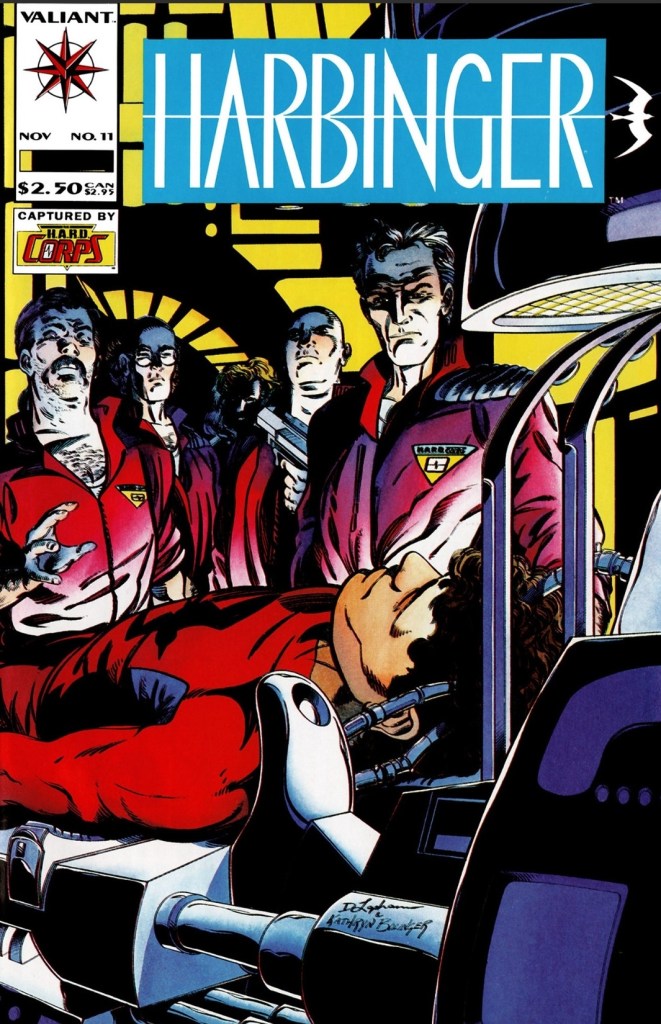
The cover.
Early story
The story begins with Faith telling Kris and Sting that she’s about to go to a big job interview. While the two conversed, Faith notices a blimp floating in the sky. To her, it seems that it has floated up there really long.
After being reminded of their planned meeting with Shatiqua, Faith flies off into the city for the job interview at a local business called Comics Jungle. Kris then approaches Flamingo whom she notices to be sounding down. Flamingo states that she has been thinking about the late Torque (father of the baby Kris had) and expresses her concern about the possibility of Shatique joining their team. Flamingo adds that she does not think they will ever get safe…
Quality
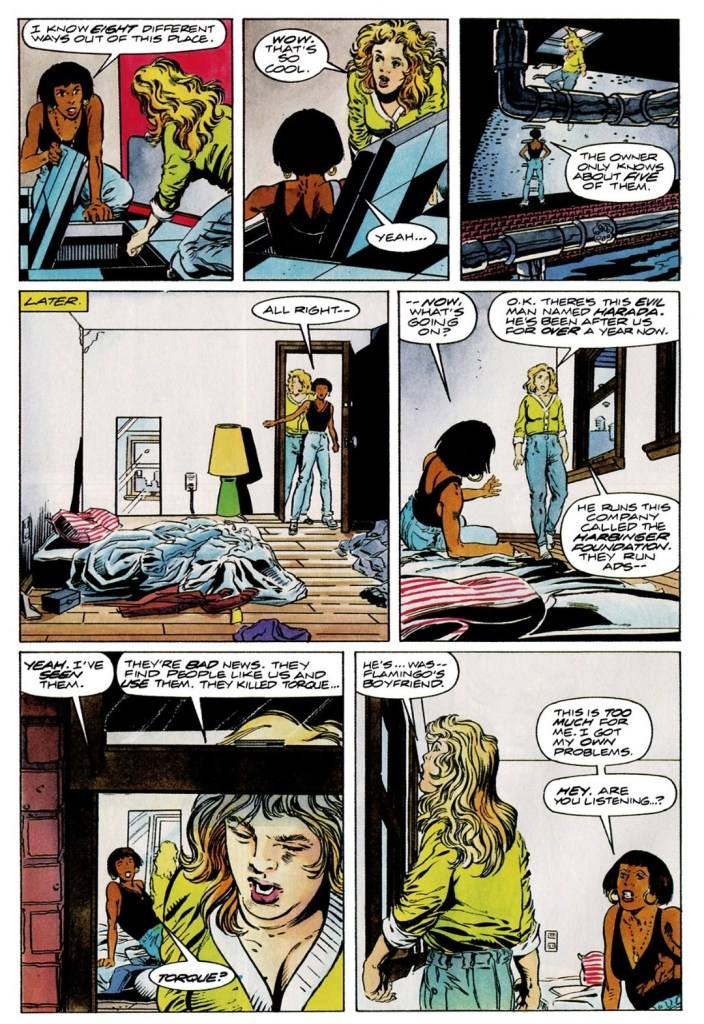
Faith and Shatiqua interact.
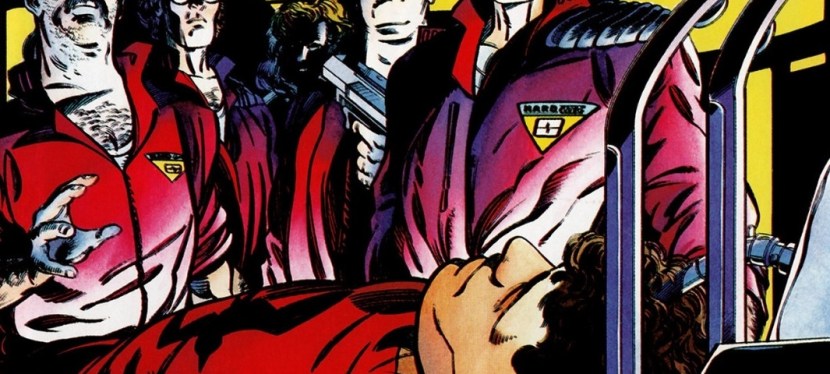
To begin with, this story marked artist David Lapham’s first time to write a Harbinger tale. Building up on what happened in the late stage of the previous issue, Lapham utilized H.A.R.D. Corps (already one of the established regular titles of Valiant Comics) for the Valiant universe crossover element. The good news here is that Lapham made good use of portraying H.A.R.D. Corps as the focused covert operations team that just so happens to be tracking Sting whom they perceive to be very powerful and too dangerous to be left free in society. This aspect of the story brings up parallels between H.A.R.D. Corps and the sinister Harbinger foundation which instantly blurred the line that separates good and evil.
As I don’t want to spoil the plot, I can confirm that as I read the comic book until the end, I literally felt the vibrations of change happening in the sense that a new direction for the Habinger series was materializing.
When it comes to the characters, Lapham did a good job developing the main characters while also shedding a good amount of the narrative on H.A.R.D. Corps’ members. There is a lot of characters to see but the good thing is that the narrative was not overwhelmed by the exposition and multiple speaking parts.
Conclusion
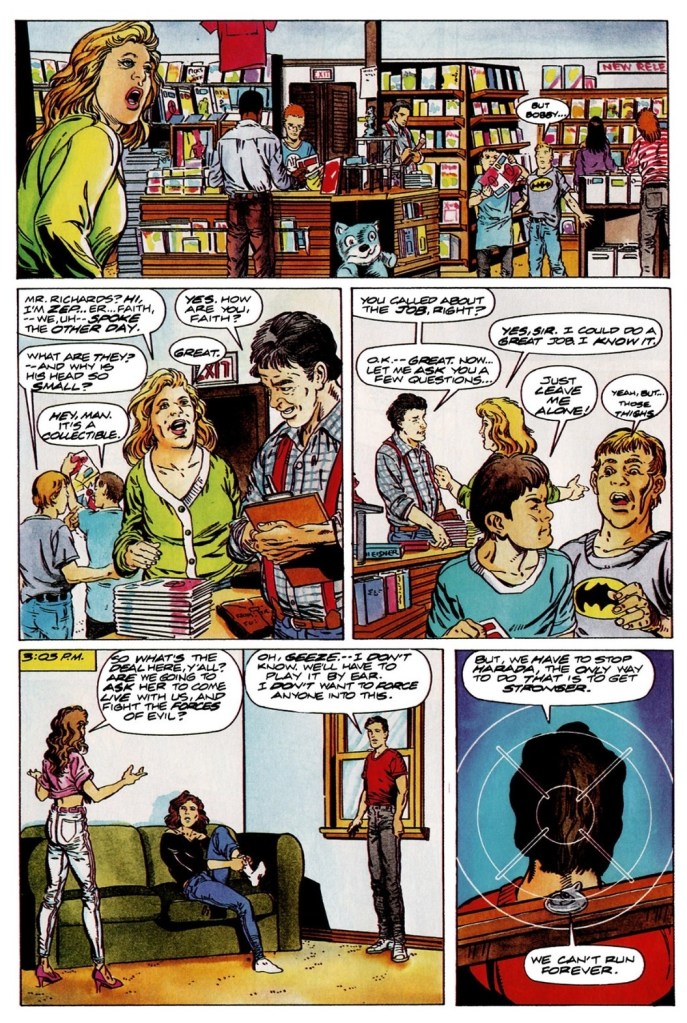
While Faith goes to the city comic book store for her job interview, Kris, Sting and Flamingo discuss internal matters not knowing they are being targeted.
Harbinger #11 (1992) delivers a fine mix of crossover, spectacle (note: lots to enjoy here) and characterization that also succeeds in telling its own concept while giving readers a hint of what changes could come soon to Sting, Faith, Flamingo and Kris. With Lapham as the new writer, the story is surprisingly very good and engaging to read. You will see a lot of entertaining elements from the previous issues within this comic book with some new intrigue added that made this particular Harbinger tale fresh to read. Lastly, I should say that the addition of H.A.R.D. Corps really added some depth into the story and the spectacle.
Overall, Harbinger #11 (1992) is highly recommended!