A Look Back at Demolition Man #1 (1993)

Welcome back movie fans, 1990s arts and culture enthusiasts, and comic book collectors! Today we go back to the year 1993 to examine the first issue of a comic book mini-series that served as the official adaptation of the movie Demolition Man.

Believe it or not, I completely missed out on Demolition Man’s theatrical run here in the Philippines. I only heard about the movie from feedback from my friends who saw it and they often mentioned the virtual reality sex scene. Strangely, they did not talk much about the match-up between Sylvester Stallone and Wesley Snipes.

The first time I saw the movie was on a rented laserdisc in 1995. As it was a Joel Silver production, the movie really had very high production values and it also had that subtle balance between hard action, science fiction and comedy. I enjoyed watching Demolition Man and its unique presentation about the future was memorable to me. Recently, I finally read the first issue of the comic book mini-series based on the movie.

With those details laid down, here is a look back at Demolition Man , published in 1993 by DC Comics with a story written by Gary Cohn (based on the screenplay by Daniel Waters, Robert Reneau and Peter M. Lenkov) and drawn by Rod Whigham. This is the first of a 4-issue mini-series.

The cover.

Early story

The story begins in 1996. Los Angeles has turned into a city of violent crime with a lot of areas left in ruin. A police department helicopter flies over the Hollywood sign bringing John Spartan (Demolition Man) to a wide, old building filled with some armed criminals. Spartan suspects that Simon Phoenix is responsible for hijacking a bus of thirty people and they all could be inside the building. The thermogram scan on the building only shows seven people and no signs of the passengers.

Determined to find the passengers, Spartan does a bungee jump to safely land on the rooftop of the building. He takes down a few thugs as he gradually infiltrates the place.

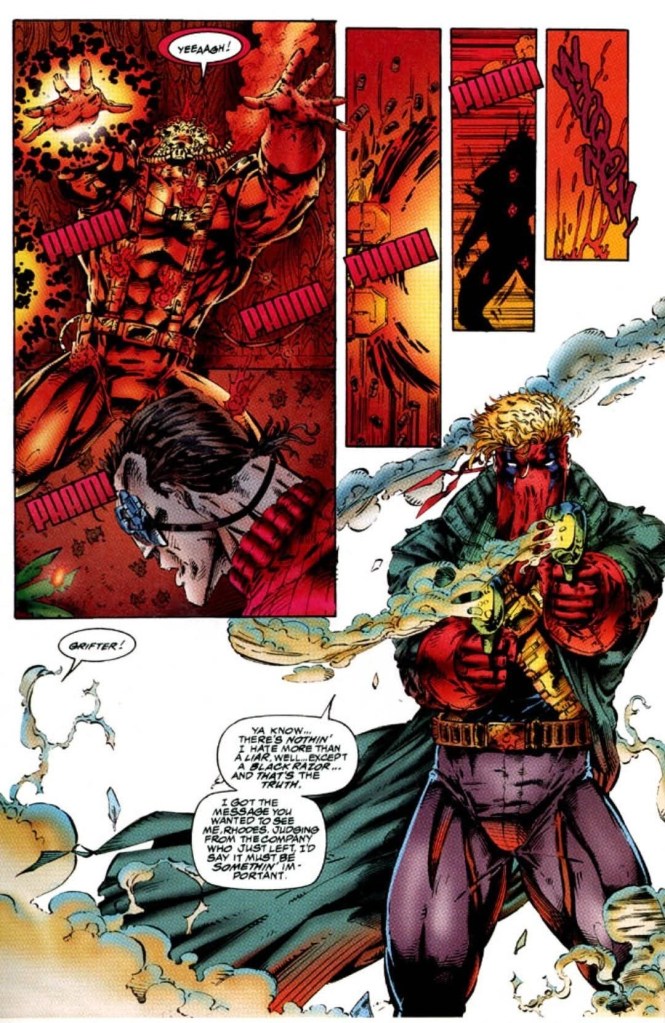
Elsewhere, Simon Phoenix sees Spartan via security camera. As Spartan eventually breaks into a large room, Phoenix releases a large amount of gasoline on the floor. Spartan and Phoenix encounter each other and an intense talk about missing passengers begins. As the Demolition Man presses for answers with guns aimed, Phoenix prepares to spark a sudden fire…

Quality

This scene never appeared in the movie. If it made it the final cut, it definitely would have slowed the film’s pace down a lot.

Having seen the movie a number of times, this comic book covers the opening and closes with a notable scene that took place after the shocking revelation about the passengers. The good news here is that the comic book creators did a really fine adaptation of the scenes from the movie. Certain moments looked and felt like they were adapted from an older version of the script (note: Spartan bidding goodbye to his wife and little daughter is the obvious scene) while some moments seem to be creative additions or expansion by the creators.

The pacing of the story is pretty good and even the slowest scenes never felt boring. This is because the writing by Gary Cohn is quite engaging and there is always some interesting or something important to read as the story goes on. That said, when the spectacle happens, the pay-off to the build-up is truly worth it.

Still on the writing, Cohn inserted a good amount of details into the dialogue as well as the moments revealing what John Spartan is thinking. This ultimately gives readers a clearer look into Spartan’s personality as well as what were the elements from his past defined him as the Demolition Man to many.

Rod Whigham is very good with visualizing the script. For one thing, he does a good job capturing the likeness of Stallone and Snipes in specific pages of the comic book. When it comes to spectacle (action, explosions and stunts), Whigham’s work ranges from efficiency to dynamic depending on what happens. This is a good looking comic book!

Conclusion

Like in the movie, John Spartan and Simon Phoenix fight surrounded by flames.

Demolition Man (1993) is a very solid adaptation and it is also a great way to start its mini-series. The comic book essentially captured the elements of several scenes from the movie and whenever the spotlight is focused on John Spartan or Simon Phoenix, I could senses Stallone and Snipes in them. The narrative flows smoothly and I had a very good reading experience. I am looking forward to the next issue.

Overall, Demolition Man (1993) is recommended.

+++++

Thank you for reading. If you find this article engaging, please click the like button below, share this article to others and also please consider making a donation to support my publishing. If you are looking for a copywriter to create content for your special project or business, check out my services and my portfolio. Feel free to contact me with a private message. Also please feel free to visit my Facebook page Author Carlo Carrasco and follow me on Twitter at  @HavenorFantasy as well as on Tumblr at https://carlocarrasco.tumblr.com/ and on Instagram at https://www.instagram.com/authorcarlocarrasco

A Look Back at Amazing Spider-Man #387 (1994)

Welcome back superhero enthusiasts, 1990s arts and culture enthusiasts, Marvel Comics fans and comic book collectors! Today we go back to the 1990s to examine a small part of the Marvel Comics shared universe through a tale of the Amazing Spider-Man monthly series.

In my previous retro review, Spider-Man had a match-up with his arch-enemy the Vulture who returned with a strong obsession within. The rematch is significant not only because it the two have a rivalry that lasted decades in reality, but also because the story was structured to function as a light reintroduction of Adrian Toomes (Vulture) for new Spider-Man fans of the 1990s.

With those details laid down, here is a look back at Amazing Spider-Man , published in 1994 by Marvel Comics with a story written by David Michelinie and drawn by Mark Bagley.

The cover.

Early story

The story begins with the Vulture absorbing energy and the youth of Spider-Man using the Juvenator in front of Dr. Sanchez. As a result, Adrian Toomes/Vulture physically turned much younger with rejuvenated skin, cancer getting health, a stronger body and his hair grown back. He declares himself as the new vital Vulture. Spider-Man is down on the floor clearly weakened and with a change of his body’s shape.

Instead of taking the opportunity to kill Spider-Man, the Vulture decides to fly away knowing that his long-time rival will have to deal with brittle bones of old age. As Dr. Sanchez tries to help him, Spider-Man feels exhausted, his lungs feeling gummy and his ears ringing. Knowing that police officers are coming, the webslinger decides to get away and leave Dr. Sanchez behind.

Moments later at the top of the building, the weakened Spider-Man takes his mask and glove off realizing that he has turned into an elderly man…

Quality

Can you recognize Peter Parker?

To get straight to the point, this continued rematch between Spider-Man and the Vulture is so outlandish (backed with the science fiction approach to life energy and the so-called fountain of youth), it almost felt like it was a story crafted for the What If series of comic books. In fact, the sudden aging of Peter Parker into an actually elderly man getting into close calls with two notable family members made this tale even more suitable for the What If series (note: What If #4 of 1989 had a severely aged Peter Parker in it).

Still on the storytelling aspect of this comic book, the creators used the fountain of youth concept to pull off a significant twist on the enduring Spider-Man/Vulture rivalry. As Spider-Man grew so old, the Vulture became much younger which in turn convinced him he could reinvent himself and put his genius of electro-magnetism to great use.  

To make things clear, this tale is not purely a Spider-Man/Vulture rivalry with sci-fi twists. In fact, there is more to the plot than meets the eye here as the Juvenator machine becomes an important element of the story (leading to something intriguing in the next issue), and a sinister revelation concluded this comic book.

Conclusion

The Vulture rejuvenated into a young man at the expense of Spider-Man.

Amazing Spider-Man (1994) is a solid follow-up to the previous issue and it also was a radical attempt to twist the Spider-Man/Vulture rivalry a lot reaching to the point of making it look and feel like a What If story. There is a good amount of suspense, character development and enough superhero spectacle that paid-off the build-up nicely. Ultimately, this tale is actually a part of a short storyline leading to the intriguing events of issue .  

Overall, Amazing Spider-Man (1994) is recommended.

+++++

Thank you for reading. If you find this article engaging, please click the like button below, share this article to others and also please consider making a donation to support my publishing. If you are looking for a copywriter to create content for your special project or business, check out my services and my portfolio. Feel free to contact me with a private message. Also please feel free to visit my Facebook page Author Carlo Carrasco and follow me on Twitter at  @HavenorFantasy as well as on Tumblr at https://carlocarrasco.tumblr.com/ and on Instagram at https://www.instagram.com/authorcarlocarrasco

A Look Back at Spider-Man #4 (1990)

Welcome back superhero enthusiasts, 1990s culture enthusiasts and comic book collectors! Today we go back to the early 1990s and explore a part of the Marvel Comics shared universe through a tale of the Spider-Man monthly series.

Having reviewed the first three issues of the Spider-Man monthly series written and drawn by Todd McFarlane (click here, here and here), I can say that the 5-part Torment storyline has a daring concept, adulterated imagery and clunky storytelling. Issues and saw Spider-Man in violent battles with the Lizard who is clearly not himself but under the control of the Haitian witch Calypso. It is inevitable Spider-Man, who has been in a long-lasting disadvantage so far, will somehow meet Calypso face to face.

With those details laid down, here is a look back at Spider-Man , published in 1990 by Marvel Comics with a story written and drawn by Todd McFarlane. This is the 4th chapter of the Torment storyline.

The cover.

Early story

The story begins in a dirty alley deep within New York City. An exhausted and disoriented Spider-Man is shocked to see a grotesque looking Kraven with the vicious Lizard beside him. The moment made him remember what happened as a result of his previous with Kraven (note: refer to the Kraven’s Last Hunt storyline) which includes him getting buried temporarily with a grave designated to him.

Eventually Spider-Man sees through the illusion and realizes that Kraven is not in front of him but Calypso with the Lizard still under her full control. With an unspoken command from Calypso, the Lizard moves towards the weakened Spidey and carries him bodily…

Quality

This portrayal of Mary Jane having a good time again in the city without her husband is clearly filler and it did not add anything to the plot.

As anticipated, the webslinger finally met the Haitian witch who had been controlling the Lizard all along. With a mostly slow pace, the story has Spider-Man being helpless in the presence of two powerful enemies and McFarlane stylishly dramatizes moments from Calypso’s past showing her acceptance of evil ways (witchcraft), her personal connection with Kraven and her desire to have a new sacrifice done.

With Spider-Man restrained a lot for most of the story, it was not surprising to see Calypso have a good share of the spotlight to herself and the Lizard is clearly portrayed as her enforcer and assistant contrasting what was presented in the first 3 issues.

Unsurprisingly, the storytelling feels choppy although the slow pace allows readers to grasp Calypso’s intentions and her main purpose in the entire storyline. The lack of spectacle allowed McFarlane to implement long segments of suspense mixed with horror. With Spider-Man doing not so much, he’s technically a supporting character symbolizing the reader’s curiosity.

Conclusion

There is nothing like waking up in the presence of two evil figures while being restrained.

Compared with the previous, Spider-Man (1990) does not have much to show and has even less entertainment value. Unless you are a die-hard fan of Calypso (so twisted and demonic under McFarlane’s handling), this particular story won’t mean much to Spider-Man faithful. The webslinger is still helpless but this is all part of the build-up for the fifth and final chapter.

In fairness, what was shown here might inspire fans to revisit Kraven’s Last Hunt and read past Spider-Man comic books showing Calypso’s connection with Kraven (note: Spider-Man and Calypso were present in Amazing Spider-Man ). In my view, this comic book is not terrible but it does not have much entertainment value nor does it have anything engaging to show. I don’t feel so motivated to proceed with issue .

Overall, Spider-Man (1990) should be avoided.

+++++

Thank you for reading. If you find this article engaging, please click the like button below, share this article to others and also please consider making a donation to support my publishing. If you are looking for a copywriter to create content for your special project or business, check out my services and my portfolio. Feel free to contact me with a private message. Also please feel free to visit my Facebook page Author Carlo Carrasco and follow me on Twitter at  @HavenorFantasy as well as on Tumblr at https://carlocarrasco.tumblr.com/ and on Instagram at https://www.instagram.com/authorcarlocarrasco

A Look Back at Mary Shelley’s Frankenstein #1 (1994)

Welcome back movie enthusiasts, 1990s arts and culture enthusiasts, and comic book collectors! Today we go back to the year 1994 to examine the first issue of a comic book mini-series that served as the official adaptation of the movie Mary Shelley’s Frankenstein.

The 1994 film – starring and directed by Kenneth Branagh and produced by Francis Ford Coppola – had a huge marketing push through the local media and in the cinemas here in the Philippines. Robert De Niro’s name alone attracted a lot of moviegoers’ attention and there were some literature enthusiasts who had the impression (or were hopeful) that the film would be faithful to the 1818 Gothic novel by Mary Shelley.

Like many others here in the Philippines, I went to the local cinema (which was half-full) to watch Mary Shelley’s Frankenstein and ended up having a mixed opinion. The production values looked grand and the cinematography (specifically the location shots and vistas) was very impressive but I felt something was off with regards to the direction which brought the storytelling down.

As with some other Hollywood movies of the time, there was a comic book adaptation of Mary Shelley’s Frankenstein in the form of a mini-series from Topps Comics. I remember seeing issue displayed at the local comic book specialty store shortly after seeing the movie but I was not interested on buying it. Recently, I finally secured a copy of the comic book and read it for the first time ever.

With those details laid down, here is a look back at Mary Shelley’s Frankenstein , published in 1994 by Topps Comics with a story written by Roy Thomas (based on the screenplay by Steph Lady and Frank Darabont) and drawn by Rafael Kayanan. This is the first of a 4-issue mini-series.

The cover.

Early story

The story begins at sea in 1794 in the middle of very cold weather. The ship carrying Captain Walton and his crew crashed on to pack ice and became trapped. The captain refuses to give up on his quest to reach the north pole and he has the crew chopping the ice. Suddenly they hear a frightening noise as something approaches.

A cloaked man emerges from the mist and it turns out he was not the source of the frightening noise. Without hesitation and right in front of the captain, the cloaked man tells the crew to bring their weapons and follow him. The captain tells the newcomer that only he gives the orders. The crew’s dogs ran away moving towards the source of the noise in the mist.

The dogs reached the source of the noise and attack it. The dogs were no match for it as they each got hit and eliminated. As the crew heard the dogs die, the captain tells everyone to move back to the ship.

Moments later, the captain and the cloaked man are inside the ship. A tall human figure slowly approaches the ship. After an exchange of words about what has been going on, the captain asked the cloaked man who he is. The man reveals he is Victor Frankenstein…  

Quality

This particular scene looked great in the movie itself. There was nothing the comic book creators could do to translate it into illustrated literature.

To make things clear, this comic book covers the film’s beginning until the scene in which Frankenstein attempts to give his creature life. As there were no printed advertisements, the comic book creators tried hard to cram several scenes into it complete with lots of details regarding the setting, the scientific thoughts of Frankenstein, experiment details and more. Indeed, a lot of the exposition in the film made it here and there were also cinematic sequences that simply could not be replicated in print format.

The illustrated opening scene replicated enough of the essence of the cinematic opening. Like the movie, the narrative moves back in time to explore Victor Frankenstein’s youth, his family, how Elizabeth became his adopted sister and how family tragedy started his path to becoming obsessed with overcoming death through science, medicine, chemistry and biology.

As it is clear that this illustrated version could never replicate the grand visuals of the film, such scenes were trimmed a lot with the readers in mind. The narrative moved between slow and medium pace similar to the film but for readers, it is a must to pay close attention to the details to truly understand the story and how Frankenstein develops.

Frankenstein here is portrayed not only as an obsessed scientist (who wants to conquer death by creating life with his own efforts) but also as a hurting man whose destiny has been altered with pain, struggle and darkness ahead. No matter what the odds were, Frankenstein believes he can achieve what is impossible while also believing he is not a mad man. Of course, Frankenstein’s own obsession blinded him so much, he fails to realize the truth that he has turned into a truly mad scientist who does not care at all about ethics, nature and morality. As such, Frankenstein is truly unlikable as the protagonist.  

While a lot of effort was done to translate the film’s plot into comic book storytelling, Rafael Kayanan did a decent job with the visuals showing ranging quality throughout. Given the historical setting and European locations of the movie reflecting the novel, it is indeed difficult for any artist to replicate the looks, the environments and the many material objects of the period. Some illustrated scenes looked detailed while others showed some signs of rush. If you are hoping to see the characters looking like the actors in the movie, you won’t find much of that here. Ironically, there were a few shots that reflected that gore and violent movements of the film.  

Apart from the story, there are two pages in this comic book that provided details about the history of Mary Shelley’s novel and how her creation impacted entertainment and pop culture in America (including the famous 1931 movie). Selected images were also included.

Conclusion

The dogs are powerless towards the unseen creature of Frankenstein.

The way I look at Mary Shelley’s Frankenstein (1994), it clearly follows the movie’s scenes visually rather than following closely the screenplay and that means translating Kenneth Branagh’s vision into comic book form here. As such, there definitely is something off with regards to pacing and storytelling. There really is not much enjoyment in this 1st issue of the comic book adaptation mini-series. In fact, this is more of a humanized portrayal of unethical science driven by one character’s obsession with conquering death.

Overall, Mary Shelley’s Frankenstein (1994) should be avoided.

+++++

Thank you for reading. If you find this article engaging, please click the like button below, share this article to others and also please consider making a donation to support my publishing. If you are looking for a copywriter to create content for your special project or business, check out my services and my portfolio. Feel free to contact me with a private message. Also please feel free to visit my Facebook page Author Carlo Carrasco and follow me on Twitter at  @HavenorFantasy as well as on Tumblr at https://carlocarrasco.tumblr.com/ and on Instagram at https://www.instagram.com/authorcarlocarrasco

A Look Back at Amazing Spider-Man #386 (1994)

Welcome back superhero enthusiasts, 1990s arts and culture enthusiasts, Marvel Comics fans and comic book collectors! Today we go back to the 1990s to examine a small part of the Marvel Comics shared universe through a tale of the Amazing Spider-Man monthly series.

Following a serious of unfortunate events that kept Spider-Man away from his wife Mary Jane (read my retro reviews by clicking here, here and here), the Amazing Spider-Man creators decided it was time to have the iconic webslinger in a new rematch with the classic villain The Vulture (specifically Adrian Toomes whose first appearance was in Amazing Spider-Man in 1963). What makes Toomes Vulture notable (note: there were other versions of Vulture in Marvel’s history) is that he is an old man who happens to be a brilliant electrical engineer who proved to be a very capable criminal. He is also a co-founder of the Sinister Six.

With those details laid down, here is a look back at Amazing Spider-Man , published in 1994 by Marvel Comics with a story written by David Michelinie and drawn by Mark Bagley.

The cover.

Early story

The story begins in the prison complex at Ryker’s Island. Adrian Toomes (Vulture) is inside his prison cell working on a small device with a guard watching from his back. It turns out the device has a tractor beam and Toomes uses it on the guard to physically slam his body on the sliding door of the prison cell. Toomes then uses the tractor beam to pull the metal bars of the other side of the cell to create an opening. He equips himself with mechanical wings and flew out of his cell and reach the speed boat prepared by two companions.

At the residence of May Parker, Peter and his Aunt May talk with an investigator. It turns out Aunt May hired the investigator to follow and observe Richard and Mary Parker. When asked by Peter, she tells him she does not think Richard and Mary are his parents. As far as the investigator is concerned, there is nothing suspicious with Richard and Mary Parker. He tells peters that his aunt needs professional help (related to Alzheimer’s Disease)…

Quality

The physical conflict between Spidey and the Vulture is intense to see!

Perceived as modern during the time of publication, the conflict between Spider-Man and the Vulture in this comic book utilized the concept of everlasting youth with science fiction (combined with the villain’s own obsession). This in turn resulted in a unique approach executed by the Michelinie-Bagley duo to make something new with the rematch between Spidey and his winged nemesis.

The Vulture here is not only very obsessed with obtaining everlasting life as there is something deep inside him that has been raging. This explains why the winged super villain is more visceral in his battle with Spider-Man which Mark Bagley visualized with dynamism and intensity. For the newcomers reading this, the two have fought each other a lot since the 1960s and this 1994 rematch was very unique. The Vulture here is not unhinged but rather strategic while being obsessed, and this made him even more dangerous for Spider-Man.

Apart from the promised rematch, this comic book continued building up the tension for the eventual tragedy in Peter Parker’s life (which happened in Amazing Spider-Man ) while also dramatizing the lasting hardships Mary Jane experiences as Peter’s wife. Peter Parker meanwhile is focused on his family and his intention to find professional help for Aunt May smoothly connected with his rematch with the Vulture.  

Conclusion

Mary Jane Parker participates in a promotional event of her TV show in a shopping mall.

There is a lot to enjoy in Amazing Spider-Man (1994). The rematch between the Vulture and Spider-Man is engaging and intriguing to read. There is also a good amount of suspense applied on the main plot as well as on the sub-plot about Aunt May being suspicious about Richard and Mary Parker. The result here is a reading experience that is entertaining and also balanced with regards to tone and storytelling.  

Overall, Amazing Spider-Man (1994) is recommended.

+++++

Thank you for reading. If you find this article engaging, please click the like button below, share this article to others and also please consider making a donation to support my publishing. If you are looking for a copywriter to create content for your special project or business, check out my services and my portfolio. Feel free to contact me with a private message. Also please feel free to visit my Facebook page Author Carlo Carrasco and follow me on Twitter at  @HavenorFantasy as well as on Tumblr at https://carlocarrasco.tumblr.com/ and on Instagram at https://www.instagram.com/authorcarlocarrasco

A Look Back at Peter Parker, The Spectacular Spider-Man #131 (1987)

Welcome back superhero enthusiasts, 1980s arts and culture enthusiasts, Marvel Comics fans and comic book collectors! Today we go back to the year 1987 to examine a small part of the Marvel Comics shared universe through a tale of the Peter Parker, The Spectacular Spider-Man monthly series.

For this particular review, we will explore the 3nd chapter of classic storyline Kraven’s Last Hunt. The storyline started in Web of Spider-Man (read my retro review by clicking here) and progressed further in Amazing Spider-Man (read my retro review by clicking here) and creators J. M. DeMatteis and Mike Zeck crafted it to last six chapters.

With those details laid down, here is a look back at Peter Parker, The Spectacular Spider-Man , published in 1987 by Marvel Comics with a story written by J. M. DeMatteis and drawn by Mike Zeck.

The cover.

Early story

The story begins inside a facility in New York City on a rainy night. Men inside work quietly moving heroin from one vehicle to another. Suddenly Kraven – wearing a black costume believing he is Spider-Man – breaks in and fearlessly attack the men who are already armed. Using very violent force, Kraven beats the men and killed the last one. Eventually, police officers and detectives broke into the facility which compels Kraven to get away fast and leaves them no opportunities to catch up. One of the detectives mentions that fifteen suspects have been hospitalized because of the individual they perceive as Spider-Man.

After climbing to the top of a building, Kraven takes his mask off. He thinks deeply about his victory over Spider-Man and becoming him. He believes he has consumed the spider’s prey and proved himself to be superior in every way. Regardless, Kraven’s obsession continues as he seeks the final proof.

Elsewhere in the city, Vermin pulls a woman into an alley and then comes out on the street as a police car approaches him…

Quality

A key scene showing how Mary Jane and Joe Robertson react to the absence of Peter Parker who was buried alive by Kraven.

In this 3rd chapter of the Kraven’s Last Hunt storyline, the iconic Spider-Man is absent again but his presence is still felt through the way people perceive him and through two notable characters who personally knew Peter Parker. At this point in the storyline, Kraven truly believes he has not only replaced Spider-Man but became even more significant than him. Kraven’s obsession with achieving both greatness and significant placed him on a collision course with Vermin, and I can say that the conflict between the them is a powerful feature of the story. Once again, DeMatteis proved how compelling his script really is and Mike Zeck easily brought the said script to life with strong imagery.

As with the previous two chapters, the darkness and grittiness of the storyline are lively which resulted in a very atmospheric reading experience. The DeMatteis-Zeck duo knew exactly how to engage readers using a powerful script and images that range from being action-packed to looking very disturbing.

Speaking of character development, Mary Jane here shows how the continued absence of her husband is wearing herself down and making her even more worried. Mary Jane is a lively symbol about how we readers miss Spider-Man and how uncertain we feel about the future of comic book storytelling without the iconic superhero.

Conclusion

Without any concern whatsoever, Kraven’s Spider-Man brutally hits the criminals with powerful strikes.

Peter Parker, The Spectacular Spider-Man (1987) is a powerful 3rd chapter of the Kraven’s Last Hunt storyline. At this point, Kraven continues to not only be Spider-Man but make others feel his impact as he strives to be greater than the genuine Spider-Man. Vermin has turned more prominent in this comic book and the big conflict between him and Kraven is a huge pay-off to what was built-up since Amazing Spider-Man . Right now, I am looking forward to the next chapter of Kraven’s Last Hunt.

Overall, Peter Parker, The Spectacular Spider-Man (1987) is highly recommended.

+++++

Thank you for reading. If you find this article engaging, please click the like button below, share this article to others and also please consider making a donation to support my publishing. If you are looking for a copywriter to create content for your special project or business, check out my services and my portfolio. Feel free to contact me with a private message. Also please feel free to visit my Facebook page Author Carlo Carrasco and follow me on Twitter at  @HavenorFantasy as well as on Tumblr at https://carlocarrasco.tumblr.com/ and on Instagram at https://www.instagram.com/authorcarlocarrasco

A Look Back at Spider-Man #3 (1990)

Welcome back superhero enthusiasts, 1990s culture enthusiasts and comic book collectors! Today we go back to the early 1990s and explore a part of the Marvel Comics shared universe through a tale of the Spider-Man monthly series.

I previously reviewed issues (click here) and (click here) which were also the first two chapters of the Todd McFarlane-led Torment storyline. McFarlane had this grand vision of a dark and more violent concept of telling a Spider-Man story and it involved another rematch with the Lizard (Dr. Connors) and some connections with the Kraven’s Last Hunt saga of 1987 (read my retro reviews by clicking here and here). McFarlane’s vision was daring but his writing style and the sub-par quality of his storytelling really brought down the overall quality of Spider-Man and .

With those details laid down, here is a look back at Spider-Man , published in 1990 by Marvel Comics with a story written and drawn by Todd McFarlane. This is the 3rd chapter of the Torment storyline.

The cover.

Early story

The story begins at the rooftop of a building in New York City. Up there, the Lizard relentlessly attacks Spider-Man causing some damage on the building. Having recovered previously, Spider-Man manages to hold his ground and punches a solid structure that hit the Lizard hard.

Meanwhile at another part of the city, the evil Haitian Voodoo priestess Calypso communicates with the Lizard telling him to take the fight against Spider-Man easy, avoid killing him and make him suffer first. Calypso is obsessed with making the webslinger an example to the world.

The fight between Spider-Man and the Lizard continues causing even more damage. Spider-Man, who has been poisoned, is having trouble concentrating as the Lizard keeps attacking him violently. Spider-Man wonders why the Dr. Connors’ (the Lizard) blood lust is so consuming…   

Quality

Todd McFarlane’s way of visualizing Spider-Man’s origin.

To get straight to the point, this comic book is simply a natural progression of the hard-hitting conflict between Spider-Man and the Lizard that started in the previous issue. In fact, this comic book shows the resumption of the battle (after a pause happened in the late stage of issue showing the fight temporarily halting which gave Spider-Man some minutes to rest).

At this stage, Spider-Man has gotten even more vulnerable and damaged. Apart from struggling with the very violent attacks of the Lizard, his own spider sense becomes a major hindrance on his mind (he could not concentrate) as the sounds of “doom-doom-doom” caused by Calypso’s sorcery becomes very unbearable. Like the previous issue, Spider-Man gets close to death and if there is anything new here it is showing the iconic superhero messed up in the garbage.

Along the way, this comic book sheds some spotlight on Mary Jane Parker (Spider-Man’s wife) who has been spending time in the city dealing with the absence of her husband. The Mary Jane scenes felt more like filler to the script by McFarlane.

Conclusion

This comic book shows the resumption of the violent battle between the Lizard and Spidey.

Apart from continuing the story, Spider-Man (1990) does not have much to show. Todd McFarlane’s visuals are great and consistently remained high (and even gory) on details, but his weak writing made this one a chore to read through. Being the 3rd chapter of the Torment storyline, this one is predictable and the pay-off is minimum. At this stage, it is clear that something huge is coming up on the last two chapters of the storyline.  

Overall, Spider-Man (1990) is satisfactory.

+++++

Thank you for reading. If you find this article engaging, please click the like button below, share this article to others and also please consider making a donation to support my publishing. If you are looking for a copywriter to create content for your special project or business, check out my services and my portfolio. Feel free to contact me with a private message. Also please feel free to visit my Facebook page Author Carlo Carrasco and follow me on Twitter at  @HavenorFantasy as well as on Tumblr at https://carlocarrasco.tumblr.com/ and on Instagram at https://www.instagram.com/authorcarlocarrasco

A Look Back at Amazing Spider-Man #293 (1987)

Welcome back superhero enthusiasts, 1980s arts and culture enthusiasts, Marvel Comics fans and comic book collectors! Today we go back to the year 1987 to examine a small part of the Marvel Comics shared universe through a tale of the Amazing Spider-Man monthly series.

For this particular review, we will explore the 2nd chapter of classic storyline Kraven’s Last Hunt. The storyline started in Web of Spider-Man (read my retro review by clicking here) and creators J. M. DeMatteis and Mike Zeck crafted it to last six chapters.

With those details laid down, here is a look back at Amazing Spider-Man , published in 1987 by Marvel Comics with a story written by J. M. DeMatteis and drawn by Mike Zeck.

The cover.

Early story

The story begins on a rainy night as a tall figure wearing a black costume and mask stands over the grave stone that read “Here lies Spider-Man slain by the Hunter.” The figure takes off his mask revealing Kraven who delightfully laughs believing he has achieved greatness by defeating Spider-Man, burying him and taken his identity.

Elsewhere in New York City, a woman struggles with walking down the sidewalk during the rain. As a rat runs near her, she loses her balance and falls on the road. Suddenly, a manhole near her opens revealing the hand of an unseen creature which pulls the lady down to the sewer. Moments later, she finds herself surrounded with rats and toxic materials. Slowly, the Vermin approaches her…

Quality

This is Kraven’s Spider-Man in action! How people perceive Spider-Man is an emerging theme in this storyline.

Considering what happened in Web of Spider-Man , it is not a spoiler to point out that the iconic Spider-Man is not really present in this very comic book. That being said, writer J. M. DeMatteis shifted the spotlight on Kraven – now in a Spider-Man costume and being the webslinger we know – while leaving some of it for Mary Jane Parker and Vermin.

Following what was established in the first chapter of Kraven’s Last Hunt, Kraven here continues with his obsession over his destiny while remembering lessons he learned not only from his personal past but also the legacy he inherited from his family. In his other obsession of becoming Spider-Man, Kraven went to the extreme being with countless spiders, consuming green liquid believing that spiderness will come into him, and more. Some may perceive him as a mad man while others might see him being mystical somewhat.

The DeMatteis-Zeck duo excelled in developing Mary Jane in this story as she feels uneasy over her husband’s absence. She really feels the weight of inconveniences and loneliness that come being married to a superhero who is far away doing something or being captured by a capable enemy. Mary Jane’s personality here shows signs of fragility too.

Vermin – the rat-like monster – is portrayed as an eater of human beings who turns out to be afraid of Spider-Man and he still remembers his past conflict not only with him ut also with Captain America. Vermin is a tragic character and the presence of rats in different parts of the story suggest that his presence in the storyline will only grow stronger. Some readers might find Vermin an abomination while there might be others who could get sympathetic towards him.

The plot itself has a strong structure and builds up nicely on what was established in the first chapter of this storyline. This time around, Kraven becomes Spider-Man and how he is perceived by others – who do not know the truth that Peter Parker is temporarily gone – is an emerging theme of the storyline.

Conclusion

Alone in the apartment, Mary Jane took action against the rat.

Filled with gritty darkness, drama and suspense, Amazing Spider-Man (1987) is an engaging 2nd chapter of the Kraven’s Last Hunt storyline. Even though Spider-Man is not present here, the DeMatteis-Zeck duo succeeded in making the tale compelling to read from start to finish. What they did to develop Mary Jane and Vermin added depth not only to this comic book but to the storyline as well. Right now, I am convinced to read the next chapter of this storyline.

Overall, Amazing Spider-Man (1987) is highly recommended.

+++++

Thank you for reading. If you find this article engaging, please click the like button below, share this article to others and also please consider making a donation to support my publishing. If you are looking for a copywriter to create content for your special project or business, check out my services and my portfolio. Feel free to contact me with a private message. Also please feel free to visit my Facebook page Author Carlo Carrasco and follow me on Twitter at  @HavenorFantasy as well as on Tumblr at https://carlocarrasco.tumblr.com/ and on Instagram at https://www.instagram.com/authorcarlocarrasco

A Look Back at What If #33 (1982)

Welcome back superhero enthusiasts, 1980s arts and culture enthusiasts, Marvel Comics fans and comic book collectors! Today we go back to the year 1982 to examine alternate stories of the Marvel Comics shared universe chronicled through the original What If monthly series.

Back in the early 1980s, Dazzler quickly became popular among comic book readers and a standalone monthly series was launched no so long after her debut in Uncanny X-Men #130. Earl on in her monthly series, Dazzler eventually encountered Galactus (the classic nemesis of the Fantastic Four) in a wild tale involving the galaxy. On the other hand, Marvel Comics published a wild tale of the conflict of Iron Man and Dr. Doom (also the nemesis of the Fantastic Four) involving time travel and the presence of King Arthur in Iron Man . Eventually, Marvel decided to make alternate tales of the mentioned stories of Dazzler and Iron Man and publish them through an issue of What If.

With those details laid down, here is a look back at What If , published in 1982 by Marvel Comics with a Dazzler story written by Dan Fingeroth and drawn by Mike Vosburg, and the Iron Man story written by Steven Grant and drawn by Don Perlin.

The cover.

Early story

What if Dazzler had become the herald of Galactus? – The story begins with Dazzler standing in the presence of Galactus, Terrax and Drone R-II. After Galactus renders his judgment on Terrax by banishing him to the depths of a black hole, he tells Dazzler she has proven herself worthy to become his new herald. As Drone R-II reminded his superior of the fact that previous heralds were forced to leave service due to their own moral codes and added that Dazzler will do the same, she questions them and stated that she does not belong in deep space and wants to go home. Galactus tells her that Earth is a planet he has sworn to devour and by becoming his herald, he will perhaps spare her home world. Dazzler finds herself cornered and reluctantly joins Galactus as his new herald. Immediately, Galactus sends her out to deep space for her first task…

What if Iron Man had been trapped in King Arthur’s time? – The story begins in the past wherein Doctor Doom and Iron Man found themselves during the time of King Arthur. After separating themselves by taking different sides – Iron Man with King Arthur and Doom with Morgana LeFay – they decide to set their differences aside for the common goal of creating a crude time machine to return to the future. Instead, Doom takes advantage of the time machine by shocking Iron Man and leaving him behind in the past. With Doom back in the future, Iron Man struggles moving on the ground only to encounter Morgana LeFay. Believing that there is no pleasure in breaking a helpless man, Morgana spares Iron Man and tells him to return to King Arthur with her pledge…  

Quality

After doing advanced work, Dazzler can only watch and witness the loss of life as her master Galactus consumes the planet.

I can start with the good news for you all…the two featured stories in this What If comic book are great to read from start to finish!

With the Dazzler tale, I enjoyed how Danny Fingeroth told the alternate reality story of the dazzling heroine becoming Galactus’ herald and working immediately to serve him. Not only does Dazzler carried tremendous powers she did not have before, she was able to quickly travel through deep space and visit planets that are suitable for her master’s consumption. Even as she wielded tremendous power, Dazzler still retains her conscience and does some analyzing of situations.

Of course, she still retained her human nature throughout and there are moments when she felt defeated or shocked which alone made her a questionable herald. Galactus himself is pretty much in character in this tale and it is very engaging to see how his actions impact not only the beings of the cosmic realm of the Marvel universe but also on Dazzler herself. Without spoiling the plot, I can say the ending is captivating and truly is worth the build-up.

The stranded Iron Man makes an impact on a battle favoring King Arthur.

Regarding the Iron Man tale, the creative team came up with the concept of having the armored superhero actually stranded in time (left behind by Doctor Doom) and getting burdened by many factors. With Doom gone early in the plot, this effectively made Iron Man the main focus and his involvement in the conflict between King Arthur and Morgana really raised the stakes.  

Not only does Iron Man have to deal with conflicts, he also became vulnerable as the era of King Arthur had very low forms of technology which made the superhero’s desire to return to the future an effort against the impossible. As the story went on, Iron Man makes impact on the conflicts between the forces of King Arthur and Morgana and the good news here is that the creative duo of Steve Grant and Don Perlin made it all believable and serious to follow.  

Conclusion

Dazzler the new herald of Galactus.
Tony Stark struggles initially with being stranded in the past.

I can say that What If (1982) is a great read! The respective tales of Dazzler and Iron Man are captivating, intriguing and enjoyable to read. The creative teams of each story succeeded in building up their respective concepts, moved the established superhero to daring creative directions, and delivered powerful conclusions. This issue of the old What If series has to read as it is a true escape from reality!

Overall, What If (1982) is highly recommended!

+++++

Thank you for reading. If you find this article engaging, please click the like button below, share this article to others and also please consider making a donation to support my publishing. If you are looking for a copywriter to create content for your special project or business, check out my services and my portfolio. Feel free to contact me with a private message. Also please feel free to visit my Facebook page Author Carlo Carrasco and follow me on Twitter at  @HavenorFantasy as well as on Tumblr at https://carlocarrasco.tumblr.com/ and on Instagram at https://www.instagram.com/authorcarlocarrasco

A Look Back at Independence Day #0 (1996)

Welcome back science fiction enthusiasts, 1990s arts and culture enthusiasts, Marvel Comics fans and comic book collectors! Today we go back to the year 1996 to take a close look at one of the licensed comic books Marvel Comics published which was part of the release of the movie Independence Day (also referred to as ID4).

Back in 1996, there was a considerable amount of hype and anticipation for Independence Day’s release in cinemas not just in America but also in other parts of the world. Following the success they achieved together in Stargate (1994), producer Dean Devlin and director Roland Emmerich teamed up again to make Independence Day which was back then the most modern cinematic portrayal of aliens invading Earth causing the people to fight back. The film creatively was also a disaster movie of its own backed with science fiction concepts and the latest special effects of the era. Independence Day went on to gross almost $820 million worldwide and I myself saw it in a fully packed cinema here in the Philippines.

As I saw the movie, I noticed details about events that took place sometime in the past and they were presented not as flashbacks but only as spoken words. There is that verbal reference about Jeff Goldblum’s character punching Bill Pullman’s character some time before the latter became US President. There are also spoken words about Randy Quaid’s character being previously abducted by aliens. As part of the marketing and publicity of the movie, Marvel Comics was licensed to publish not only a 2-part comic book adaptation but also a prequel comic book.

With those details laid down, here is a look back at Independence Day #0, published in 1996 by Marvel Comics with a story written by Phil Crain (based on ideas by Dean Devlin and Roland Emmerih) and drawn by Terry Pallot, Steve Erwin, Rod Whigham and Gabriel Gecko.

The cover.

Early story

The story begins on July 4, 1947 in Roswell, New Mexico. A thunderstorm took place in the evening compelling residents to stay inside their respective homes. As the storm went on, an unidentified flying object (UFO) of alien origin got struck by thunder causing it to crash on the field of someone’s property with a huge impact that disturbed local residents. The alien ship opens and one of its passengers (alien) ventures out into the stormy night. Injured and still in shock, the passenger slowly moves away from the ship.

The next evening, the property owner arrives and finds several pieces of debris of the crashed ship scattered on the field. He notices the metal are lighter than anything he touched, and he could see the writings were not man-made. The property owner informed the local sheriff of what he found which led to the American army sending troops to the field. The American military plane flies over them and finds the crashed alien ship.  

Quality

When Whitmore was still a US Senator and candidate for US President, he got punched by David Levinson who thought that he was having an affair with his wife Constance “Connie” Spano. This later led to the “You punched the President,” line in the movie.

As described above, this prequel comic book visually dramatizes the past events that were only mentioned in the movie particularly with regards to the Roswell UFO incident as well as Area 51 and how the government handled findings about aliens from outer space. In fact, the story here was scripted to move from one significant event to the next through the decades, and the good news here is that the exposition is not too heavy (when compared to Jurassic Park comic books of 1993) and the pacing moved at a medium pace. The result is a reading experience that is intriguing and entertaining.

The creators really went all in with their fictional portrayal of the movie’s aliens being involved in Roswell and Area 51, and the notable thing is that they really took the presentation seriously. It’s as if they were trying to tell a factual story which smoothly connects with the movie.

When it comes to the characters from the movie, you will find them in this comic book depending on the stage of the narrative and the time setting. While the characters of Pullman, Goldblum, Robert Loggia, Will Smith, Brent Spiner, James Rebhorn, Viveca A. Fox and Margaret Colin are dramatized in the 1990s scenes, you will see the younger versions of a few of them set in the 1960s scenes. The abduction scene of Randy Quaid’s character is set in the 1980s.

The Area 51 scene set in the 1960s.

As for the script written by Phil Crain, the narrative of this comic book surprisingly has a more serious and dramatic tone when compared to what was expressed in the movie. There were even a few horror elements and no comedic stuff at all. Again, this should not be surprising because this comic book was meant to dramatize past events to not only connect with the movie’s core concept but also show why certain characters acted the way they did in the film.

As this comic book involved multiple artists, it should not be a surprise that the result is of varying quality from one scene to another. In fairness, the illustrator (or illustrators) who drew the Area 51 scenes and the crashed alien ship did a good job with the details. As for the characters, pilot Steven Hiller resembled Will Smith enough, and the same can be said about Thomas Whitmore somewhat looking like Bill Pullman, David Levinson looking somewhat like Jeff Goldblum, and General Grey slightly looking like Robert Loggia. Meanwhile, Constance Pano resembled Margaret Colin more while the 1990s Dr. Okun resembled Brent Spiner in a few shots.

Conclusion

The creators went all-in to make the 1947 Roswell UFO incident a history of Independence Day.

To get straight to the point, Independence Day #0 (1996) succeeded with its main objective of establishing visually the past and emphasizing developments connecting with the blockbuster movie of 1996. It was made with a strong appeal to fans of Independence Day as well as people who simply are fond of UFOs and conspiracy theories regarding Roswell and Area 51. People who are not too interested in the movie and UFOs might not be impressed with this comic book. In my view, this prequel comic book has good enough qualities that make it worth reading and its serious narrative is both surprising and enjoyable. Ultimately, it is a worthy companion piece to the movie.

Overall, Independence Day #0 (1996) is recommended.

+++++

Thank you for reading. If you find this article engaging, please click the like button below, share this article to others and also please consider making a donation to support my publishing. If you are looking for a copywriter to create content for your special project or business, check out my services and my portfolio. Feel free to contact me with a private message. Also please feel free to visit my Facebook page Author Carlo Carrasco and follow me on Twitter at  @HavenorFantasy as well as on Tumblr at https://carlocarrasco.tumblr.com/ and on Instagram at https://www.instagram.com/authorcarlocarrasco