Welcome back, my readers, YouTube viewers and all others who followed this series of articles focused on YouTube videos worth watching. Have you been searching for something fun or interesting to watch on YouTube? Do you feel bored right now and you crave for something to see on the world’s most popular online video destination?
I recommend you check out the following topics and the related videos I found.
#1. Microsoft’s Project Milo – When Microsoft introduced the Kinect motion-sensing device (then called Project Natal) during the 2009 edition of E3 (Electronic Entertainment Expo), they had Peter Molyneux introduce Project Milo which really intrigued viewers. Even though the video presentation of Project Milo was scripted, it showed its potential as an interactive software using Kinect on Xbox 360. There are lots of details behind the scenes as Project Milo really was a project developed by Lionhead Studios which worked in a limited fashion and ended up never getting released. Watch and learn from the video below.
#2. The story of The Hershey Company and its founder – Do you often eat chocolate bars of Hershey’s? The Hershey Company is gigantic with a global presence of products, billions of Dollars in annual revenue, the operation of Hershey’s Chocolate World and even a theme park of its own called Hersheypark. Hershey’s was started by its founder Milton S. Hershey who came from a really difficult life. You can learn more about the founder and how The Hershey Company came to be by watching the video below.
#3. The kids who hacked Xbox – You do know that hacking is illegal and there is simply no excuse to do it. Believe it or not, Xbox got hacked by a group of very young gamers and they even got themselves an early build of the blockbuster game Gears of War 3. Not only that, the group also hacked many other gaming-related companies. Watch and learn from the video posted below.
#4. The Democrats are the problem for Americans – Apart from being a very corrupted political party, the Democrats are guilty of hypocrisy, lying, censorship, and distorting the facts to suit themselves. Now they have Communist Kamala Harris as their candidate for US President and that only means the party wants more of the same negative elements under Joe Biden to continue. This explanatory video shows exactly what went wrong under Biden and the Democrats, why the Democrats are not the party of common sense and why Kamala Harris is wrong for the nation’s future.
#5 Donald Trump’s Never Quit video – The 2024 US Presidential election is about to happen. In recent times, the campaign of Donald Trump released the Never Quit video which is a lot more than just political advertising. It is a stark reminder of how much life in America turned for the worse under the Biden-Harris administration. Remember the tax cuts and other reforms Trump approved as US President which really made America stronger and greater? Watch the video below and share it to others. This is about making America great again.
#6. Minty Comedic Arts’ Innerspace video – I first saw the 1987 sci-fi adventure movie Innerspace on home video. Starring Dennis Quaid, Martin Short and Meg Ryan, it was an entertaining film that had a nice mix of adventure, comedy and spectacle. Recently, Minty Comedic Arts published a trivia video about it which is fun to watch.
#7. You, Me and the Movies react to Night of the Creeps – Some of you might be aware that I enjoyed watching the 1986 mix-genre film Night of the Creeps. It was the directorial debut of Fred Dekker and it was clever blend of science fiction, horror, 1950s romance, 1980s teen comedy and detective storytelling. Recently You, Me and the Movies posted their video reaction which I find enjoyable.
#8. Beneath the Planet of the Apes examined and analyzed closely – Released in 1970, Beneath the Planet of the Apes was the sequel to the classic film Planet of the Apes. While it is easy to think that the sequel was made simply because the movie studio wanted to make more money by capitalizing on the success of the previous film, there was a lot of developments, twists and even intrigue that happened behind the scenes before filming even started. The two videos below from YouTuber Represent This should be seen and for those who have seen Beneath the Planet of the Apes, it will impact your perception about the movie’s quality and creative direction.
Before I end this post, I should say that the concept of humans evolving from apes is pure fantasy. The scientists and fantasy writers got it all wrong.
Recently, an economist predicted that the economy of the Philippines will keep growing above 6% this year and next year, according to a Philippine News Agency (PNA) news article.
To put things in perspective, posted below is an excerpt from the PNA news article. Some parts in boldface…
The Philippine economy is expected to remain one of the fastest growing economies in the region, with growth likely settling at above 6 percent for 2024 and 2025.
In his economic and market outlook released on Tuesday, BPI senior vice president and lead economist Emilio Neri Jr. said economic growth will likely hit 6.1 percent this year and further accelerate to 6.3 percent in 2025.
“The Philippine economy has been resilient despite significant headwinds like severe El Niño and devastating typhoons, still managing to grow by 6% in the first half of 2024,” Neri said.
“Looking ahead, the Philippine economy will likely continue to outperform in the region, supported by its strong consumer base,” he added.
Neri expects headline inflation to ease to 3.2 percent in 2024 and further decelerate to 2.8 percent in 2025.
“Inflation is expected to be more manageable in the coming year given the improving prospects of food supply. With El Niño now behind us and the potential increase in production, along with tariff reductions, rice may become more affordable,” he said.
Neri said lower inflation may help boost consumption in the coming year, while election-related spending could also further stimulate economic activity.
Let me end this post by asking you readers: What is your reaction to this recent development? Do you think the economy of the Philippines has enough momentum to exceed the growth forecasts of the economists for 2024 and beyond? Do you think the Philippines can do a better job on attracting more foreign investors soon?
If things go well, the recent deal made between Ayala Corp. and Japan’s Mitsubishi Corp. will likely boost the anticipated initial public offering (IPO) of e-wallet entity GCash, according to a BusinessWorld news report referencing analysts.
To put things in perspective, posted below is an excerpt from the BusinessWorld news report. Some parts in boldface…
THE RECENT deal between Ayala Corp. and Japan’s Mitsubishi Corp. is likely to increase the valuation of the anticipated initial public offering (IPO) of the electronic wallet GCash, according to analysts.
On Friday last week, Ayala Corp. announced that it was selling its 50% stake in AC Ventures Holding Corp. (ACV) to Mitsubishi for a minimum of P18.4 billion.
ACV owns 13% of Globe Fintech Innovations, Inc. (Mynt), which has two fintech companies, G-Xchange Inc., the operator of GCash, and Fuse Lending, a tech-based microlender.
“The deal reinforces the value of Mynt for its future IPO. With key investors coming in at a valuation of around $5 billion, Mynt is poised for an IPO at a much higher valuation,” Chinabank Capital Corp. Managing Director Juan Paolo E. Colet said in a Viber message.
GCash previously said it was planning an IPO but would wait for a more favorable market.
According to Mr. Colet, the IPO could happen as early as next year depending on market conditions.
“I can see the IPO within the next two to three years. Perhaps as soon as next year if market conditions are very good,” he said.
“So far, it seems Globe wants a local IPO for Mynt. But it would be better if they do a dual listing in the Philippines and a larger stock market to get the best of both worlds,” he added.
Globalinks Securities and Stocks, Inc. Trader Mark V. Santarina said in a Viber message that the deal helps GCash’s international expansion plans.
GCash services are available in 16 countries, including the United States, United Kingdom, United Arab Emirates, Italy, Australia, Canada, Germany, and other Asian countries.
“For GCash, Mitsubishi’s entry paves the way for potential international expansion, particularly into Japan, and may boost its service offerings in microlending and financial technology,” he said.
“While GCash is considering overseas listings for its IPO, there is still hope it may choose to list on the Philippine Stock Exchange (PSE) instead, which would be a significant win for the local market,” he added.
AP Securities, Inc. Research Head Alfred Benjamin R. Garcia said in a Viber message that the deal could help improve other Ayala ventures.
“With its entry into ACV, Mitsubishi is not only buying into GCash but also into other ventures under ACV like Gogoro and Zalora. We believe Mitsubishi’s expertise can help improve these businesses and maybe even accelerate the expansion of GCash into Japan,” he said.
Let me end this post by asking you readers: What is your reaction to this recent development? Do you think an IPO of GCash could happen sometime in 2025? Are you an investor waiting for the GCash IPO to happen?
BPI Wealth – the wealth management arm of the Bank of the Philippine Islands (BPI) – will establish a new mutual fund to lure in young and tech-savvy investors, according to a Manila Bulletin business news report.
To put things in perspective, posted below is an excerpt from the Manila Bulletin news report. Some parts in boldface…
Amid favorable conditions for long-term investments, the wealth-management arm of Ayala-led Bank of the Philippine Islands (BPI) will roll out before this year ends a new mutual fund eyeing young and tech-savvy investors.
BPI Wealth personal wealth head Irene Ang told a press briefing on Friday, October 18, that the forthcoming BPI Wealth Builder Multi-Asset Mutual Fund Inc. isexpected to be approved “soon” by the Securities and Exchange Commission (SEC), which regulates mutual funds, for it to be sold to the public.
This first-of-its-kind balanced, global-based and peso-subscription and -redemption fund aims to convince millennials and the Gen X generation in the country to invest and prepare for their retirement, Ang said.
Among the innovative and unique features of this mutual fund include availability for a minimum of only P1,000; accessibility on BPI’s online platforms and accredited channels to conveniently open an investment account, monitor investments, and receive cumulative rewards and benefits at no extra cost; as well as an automated and automatic top-up system allowing additional investments of at least P100 monthly.
Ang is optimistic that up to P1-billion investments in their upcoming newest mutual fund would be “easy.”
BPI Wealth president and chief executive officer (CEO) Maria Theresa D. Marcial noted that among their investors, those who onboarded via digital channels continued to engage more regularly than branch-opened accounts.
“We should push more into digital initiatives,” said Marcial, who is spearheading BPI’s “Wealth Wellness Month” this October to promote financial inclusion and literacy as well as opportunities for small investors.
Marcial disclosed that as of end-September, BPI Wealth’s assets under management (AUM) rose to a new high of P1.4 trillion, from P1.2 trillion in end-2023.
On top of the earlier goal of 20-percent AUM increase for this year, Marcial said a further 15-percent growth next year will be “reasonable.”
BPI Wealth targets P3 trillion in AUM by 2026.
Marcial cited that while mutual funds and other assets experienced a roller-coaster ride of ups and downs during the past three years due to global financial conditions, the clarity in the ongoing monetary policy easing here and abroad this year has improved prospects.
“We’re seeing markets becoming more buoyant, and fund managers are becoming more constructive across asset classes,” she said.
“Bonds are expected to do better, as interest rates go lower. And because interest rates are lower… so [in] equity we’re seeing some renewed interest,” she added.
Let me end this post by asking you readers: What is your reaction to this recent development? Do you think BPI Wealth’s newest move makes a lot of sense with today’s economic environment? Do you think a lot of millennials are willing to engage in investments?
Welcome back, my readers, YouTube viewers and all others who followed this series of articles focused on YouTube videos worth watching. Have you been searching for something fun or interesting to watch on YouTube? Do you feel bored right now and you crave for something to see on the world’s most popular online video destination?
I recommend you check out the following topics and the related videos I found.
#1Donald Trump’s decades-long journey to becoming US President – No matter what your political views are, there is no denying that Donald Trump’s incredible 2016 election victory as President of the United States was the culmination of a very long journey that started since 1980s. As Trump kept doing lots of business, he observed what went wrong in America, what the nation lost to other countries with regards to trade or diplomacy, why many ordinary Americans became forgotten, and more. Watch Trump’s journey in the video below.
#2 A look back at Street Fighter II V (anime) – If you are a long-time gamer like me, chance are, you must have played one of the many games of Street Fighter II. If you have played the games, were you able to watch the short-lived anime series titled Street Fighter II V? Loosely based on Super Street Fighter II Turbo, the anime series started in 1995 and was directed by Gisaburō Sugii who was responsible for the anime movie of 1994. I found two YouTube videos revisiting Street Fighter II V posted below for your enjoyment.
#3 Fox News interview shows Kamala Fit is too dishonest and too out-of-touch to be US President – If there is anything notable with the incumbent United States Vice President Kamala Harris – the one woke candidate the Democrats nominated after pushing Joe Biden out of the way – is that she has a very distorted view of reality and she is very unfit to become US President. Her recent interview with Fox News is the worst yet and the consequences are still being felt as I write this down. Watch the selected videos below to find out.
#4 A look back at Koudelka – During the late stage of the first PlayStation console’s life, Japanese role-playing games (JRPGs) became really popular with gamers in Europe and America. Back in 1999, the role-playing game Koudelka was released on PlayStation in Japan and an international release followed in 2000. That game did not achieve critical acclaim and was never a big seller. As many old-time gamers have forgotten about its existence, Koudelka’s production history is rather intriguing and surprising to discover.
Koudelka was developed by Sacnoth which was founded by former Squaresoft employee Hiroki Kikuta (Secret of Mana, Trials of Mana, and Soukaigi). To find out why Koudelka had an unusual RPG concept and style of gameplay, I encourage you to watch the retro gaming video below.
#5 More Iranians need Israel’s help – It is a fact that the Islamic regime of Iran has a long record of brutalizing Iranians who do not follow their evil moves. In short, the people of Iran are not their wicked government. That being said, the dissenting Iranians are reaching out to Israel for help in the form of military action against the evil regime. Watch the video of The 700 Club below. It includes statements from Iran’s Crown Prince Reza Pahlavi.
#6. George Romero was hired to make a Resident Evil motion picture – Back in the late 1990s when the Resident Evil game franchise really soared in popularity and became bankable for Capcom, a movie project was approved and the late George A. Romero (Night of the Living Dead, Dawn of the Dead, Creepshow) was hired to write and direct it. It should be noted that Capcom hired Romero to make the Resident Evil 2 commercial which became very popular and contributed to the game’s big success. Eventually, Romero’s drafts of the script got rejected and Constantin Film replaced him with Paul W. S. Anderson resulting in the 2002 Resident Evil movie.
If you are fascinated with Romero’s short-lived involvement with the Resident Evil movie project, you should watch the related videos posted below…
#7. China’s Bonnie and Clyde – Have you been following the YouTube channel Dark Asia with Megan? Every week, there is always a new episode about true crime stories that took place within Asia and the host Megan is often great with her presentation and she clearly does a lot of research. Recently an episode about China’s very own Bonnie and Clyde was released. I saw it and it is very intriguing to watch. For the newcomers reading this, Bonnie and Clyde refers to real-life American bandits and serial killers who caused a lot of trouble from 1931 to 1934. Hollywood even released a movie in 1967 glorifying them. As for who exactly were China’s Bonnie and Clyde, and what had they done, I encourage you to watch Dark Asia with Megan’s episode below.
#8. Kamala Harris supporter shouts at toddler – Going back to the 2024 US Presidential campaign, a supporter of Communist Kamala Harris (the US Vice President since 2021) was caught on camera yelling at and traumatizing a toddler. I know for a fact that liberals, Leftists, Marxists, socialists and woke Americans can be quite wild but the die-hard Kamala supporter who screamed at the toddler clearly has crossed the line. It makes me wonder if the Democrats ever oriented their supporters to be civil and in control. Watch the Sky News Australia Lefties Losing It video below.
#9. Kamala Harris got booed at her own campaign rally! – The presidential campaign of Commie Kamala Harris is clearly failing not only because the opinion polls – most of which are Left-leaning and oversampling Democrat voters – are showing her falling further behind Donald Trump but also because unfortunate events have been happening at her campaign rallies. The new embarrassment this time is Harris getting booed at her own campaign rally! Watch the videos below.
To put things in perspective, posted below is an excerpt from the Manila Bulletin report. Some parts in boldface…
The total ban on the Philippine Offshore Gaming Operations (POGO) contributed to a significant decrease in the demand for office spaces in the third quarter of the year, property brokerage firm Leechiu Property Consultants (LPC) said.
In a statement, LPC said office take-up from July to September dropped by 21 percent to only 215,000 square meters (sqm), with the POGO industry’s downsize and other tenants’ transfer to newer spaces contributing to an increase in vacancies.
The POGO industry was one of the main drivers of the residential and office markets at the time of the Duterte administration, until getting totally banned by President Ferdinand Marcos Jr. this year amid their venture into illicit areas.
“The grave abuse and disrespect to our system and laws must stop. We need to stop them and their abuse to our country,” Marcos Jr. said.
Despite the decline in office take-ups this quarter, LPC said that the country is on track to surpass the one million sqm office demand registered last year.
“The year-to-date demand for office space has reached 900,000 sqm, marking an 11 percent increase over the first three quarters of 2023,” it said.
In terms of leasing pattern, LPC said tenants are now shifting from higher-quality buildings to offices that can offer better and larger spaces.
In terms of location, the bay area continues to be the top choice, with office take-up driven primarily by government agencies occupying 80,000 sqm in the first nine months of the year. Outside Metro Manila, Cebu remains the top provincial market with the higher take-up coming from the IT-BPM industry.
Let me end this post by asking you readers: What is your reaction to this recent development? Do you think the shrinking of the office market is temporary at best and a recovery could begin before the end of the year? Do you favor the ban on POGOs?
For more South Metro Manila community news and developments, come back here soon. Also say NO to fake news, NO to irresponsible journalism, NO to misinformation, NO to plagiarists, NO to reckless publishers and NO to sinister propaganda when it comes to news and developments. For South Metro Manila community developments, member engagement, commerce and other relevant updates, join the growing South Metro Manila Facebook group at https://www.facebook.com/groups/342183059992673
By citing positive factors in its latest report, the World Bank (WB) raised its Philippine economic growth forecasts for 2024 and 2025, according to a BusinessWorld news report.
To put things in perspective, posted below is an excerpt from the BusinessWorld report. Some parts in boldface…
THE World Bank (WB) has raised its economic growth forecasts for the Philippines for this year and in 2025, driven by improved service exports and public investments.
But weak consumption and investment will keep the country’s growth below pre-pandemic levels, it said.
In its East Asia and Pacific Economic Update, the Washington-based multilateral lender now expects the Philippine economy to grow by 6% this year from 5.8%.
The Philippines could become the second-fastest growing economy in Southeast Asia, behind Vietnam (6.1%) and ahead of Cambodia (5.3%), Indonesia (5%), Malaysia (4.9%), Laos (4.1%), Timor-Leste (3%), Thailand (2.4%) and Myanmar (1%).
“Among the larger countries, only Indonesia is expected to grow in 2024 and 2025 above pre-pandemic levels, while growth in Malaysia, the Philippines, Thailand and Vietnam is expected to be below those levels,” the World Bank said.
For 2025, it forecasts Philippine economic output to expand by 6.1% from 5.9% in its April forecast.
The lender’s growth forecasts for the Philippines are at the low end of the government’s target of 6-7% for 2024 and below the 6.5-7.5% goal for next year.
The Philippine economy grew by 6.3% in the second quarter, faster than 5.8% in the previous quarter and 4.3% a year ago. In the first half, growth averaged 6%.
The World Bank said service exports and public investment have supported Philippine economic growth, but consumption and private investment remain weak.
From 2024 to 2026, the lender expects the Philippine economy to grow by an average of 6%, it said in a separate report.
This will be supported by remittances, jobs, slower inflation and external demand. However, weaker growth in China, global economic slowdown and weather disruptions are risks to the outlook.
It also projects the government’s budget deficit to fall to 4.6% of gross domestic product (GDP) by 2026 due to improved state spending. This is slightly below the 4.73% target for the year.
Better revenue collection will be supported by key tax measures, improved tax administration and higher dividends from state-owned corporations, the World Bank said.
The lender also raised this year’s growth forecast for the East Asia-Pacific region to 4.8% from 4.5% in April.
“Most East Asia-Pacific economies are expected to experience robust growth in 2024, supported by private consumption and a positive external environment,” according to the report. In 2025, the region is expected to grow by 4.4% from its previous forecast of 4.3%.
However, domestic demand is expected to moderate in the Philippines, Indonesia and Thailand, while private investment growth remains weak across the region.
“Investment growth has been declining across most countries in the region over the past two decades, with particularly sharp drops in China, Indonesia, Malaysia, and more recently, the Philippines.”
It also noted that the Philippines and Malaysia have kept a conservative fiscal stance due to their higher structural deficit this year.
Let me end this post by asking you readers: What is your reaction to this recent development? Do you think the Philippines has enough momentum to exceed the WB’s economic growth forecasts for 2024 and 2025?
Welcome back readers, fellow geeks and electronic gaming fans!
In this edition of the Retro Gaming Ads Blast (RGAB) series, we will take a look at another batch of retro gaming print ads – including arcade flyers – from the 1980s and 1990s.
For the newcomers reading this, Retro Gaming Ads Blast (RGAB) looks back at the many print ads of games (console, arcade, computer and handheld) that were published in comic books, magazines, flyers, posters and newspapers long before smartphones, social media, the worldwide web and streaming became popular. To put things in perspective, people back in the 1980s and 1990s were more trusting of print media for information and images about electronic games and related products.
With those details laid down, here is the newest batch of retro gaming print ads for you to see and enjoy…
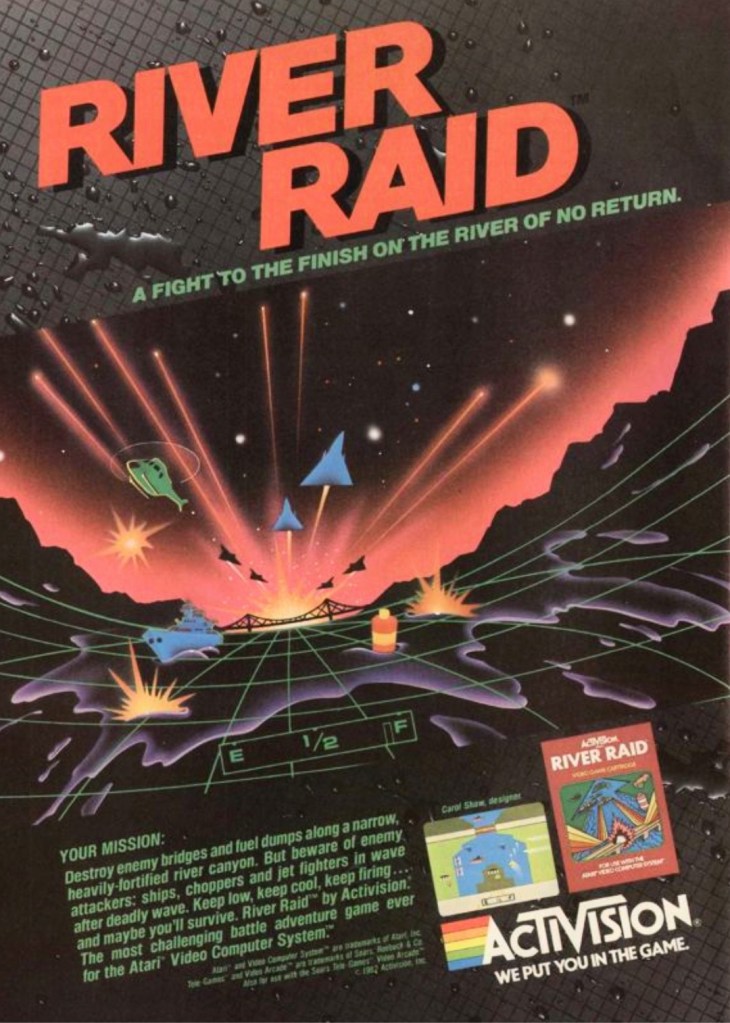
1. River Raid print ad
This River Raid print ad appeared on comic books and magazines long ago.
Decades before it became an industry giant with the best-selling Call of Duty games, Activision became a standout publisher in the early 1980s with River Raid on the Atari 2600. Designed by Carol Shaw, River Raid was a huge success ending up as the 2nd best-seller on the Atari 2600 as well as Activision’s best-selling game for the year 1983. Apart from showing one screenshot and the box cover of the game, the print ad of River Raid had this mesmerizing 3D image that caught many gamers’ attention and helped them feel like they will pilot on dangerous missions. The 3D image was futuristic in its own style became forward-moving 3D sequences in video games became reality many years later.
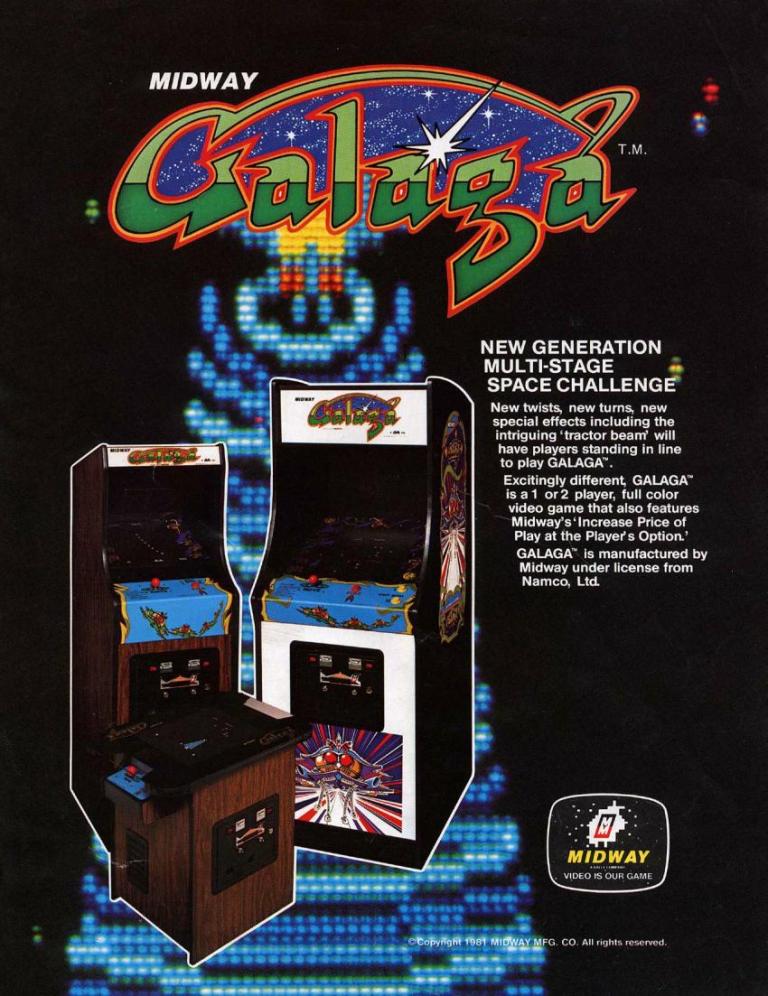
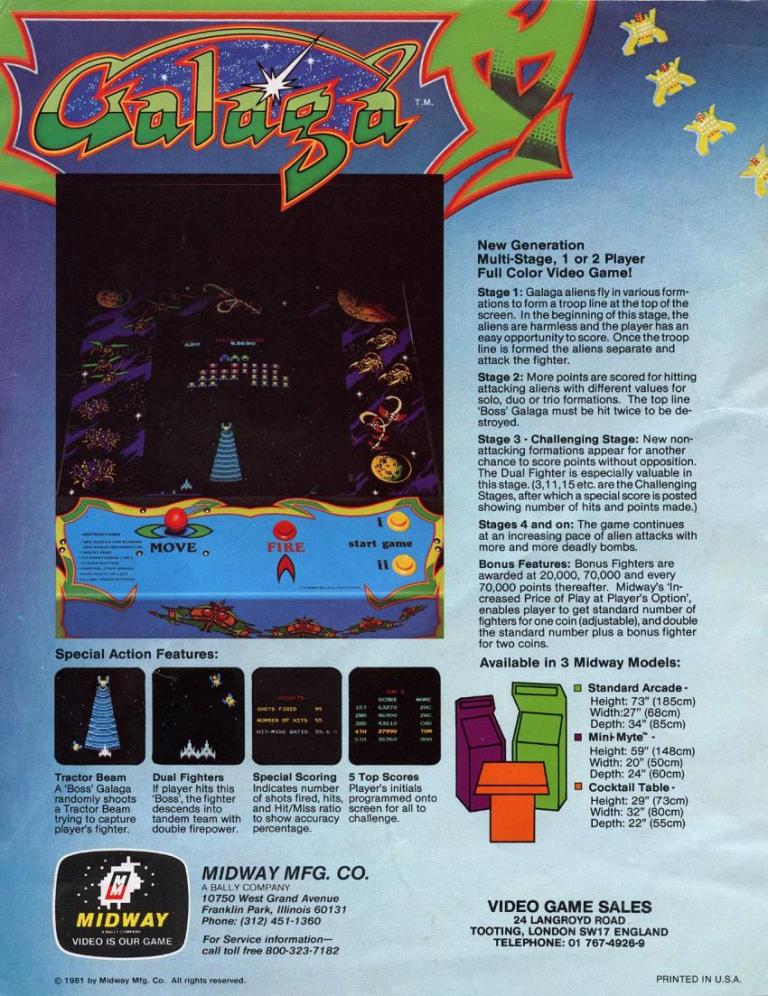
2. Galaga North American arcade flyer
The front of the flyer showing three Galaga machines that arcade operators can choose from.
Key details about Galaga were nicely presented on the rear of the flyer.
In the history of gaming, Namco’s Galaga was played by countless millions of gamers and it is still highly regarded as an arcade classic as well as one of the most enjoyable arcade games ever made. In preparation for the North American launch (October 1981), Midway prepared the arcade flyer showing the three types of machine on the front that arcade operators can choose from. On the rear is the really neat approach of explaining the details of the game, what kind of gameplay is to be expected, and how to play. Whether you are an individual player or the manager of an arcade joint, this flyer suits your needs.
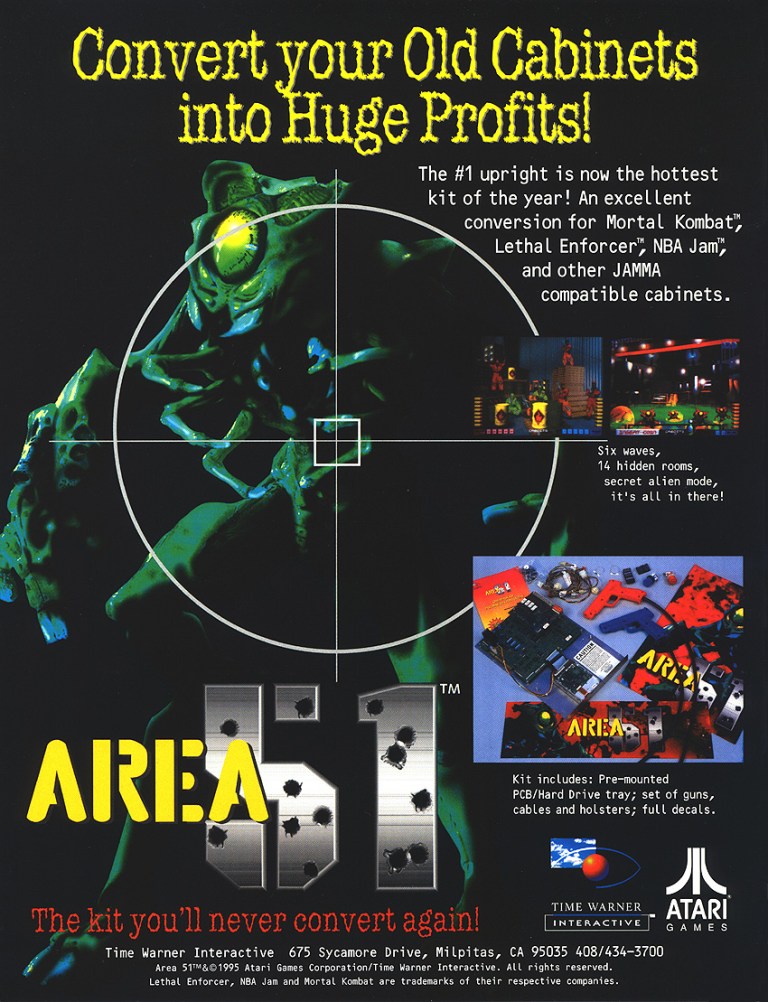
3. Area 51 arcade flyer and conversion kit flyer
The front of this Area 51 flyer had an enticing message for arcade operators as well as other business owners/managers who are interested in having a machine to add value to their business joints. Atari was already in deep money problems by the time they started making this game.
The Area 51 arcade conversion kit is a cheaper alternative for businesses who want the game.
Moving on to the 1990s, Atari was already struggling financially and desperately needed a hit to lift them up fast. A light gun shooter project was approved as arcade shooters were in good demand and after overcoming serious hurdles during production internally, Atari hired independent team Mesa Logic to take charge of development. After being granted extra time and more creative freedom, the project under Mesa Logic’s handling became a sci-fi shooter titled Area 51. The game became a huge hit in the arcades for Atari resulting in sales of more than 20,000 arcade cabinets as well as a major financial boost for the company (note: Atari still exists today). Atari went on to release Atari 51 versions for PlayStation, Sega Saturn and PC in America in 1996. The Atari 51 flyers you see here are still captivating to look at and were crucial in generating buzz among arcade operators, business joints that had space for arcade cabinets and gamers.
4. Panasonic 3DO print ad
The makers of this print ad forgot to mention the 3DO is also a game machine.
Back in 1993, the 3DO Interactive Multiplayer console manufactured by Panasonic (a licensee of the 3DO Company) was launched with a CD-ROM drive, multimedia features and gaming capabilities (with a 3-button control pad). This print ad strongly emphasized the 3DO’s ability to play high-quality sound and full-motion videos using the Sea of Cortez software which functioned as an interactive movie. Obviously, this did not resonate well with people who loved to play games and by the time the 3DO Company and its partners started marketing games, they could not save the 3DO console from fading to obscurity. The console shown in the ad is specifically model Panasonic FZ-1 R·E·A·L 3DO Interactive Multiplayer. Panasonic was one of five companies that were licensed by the 3DO Company.
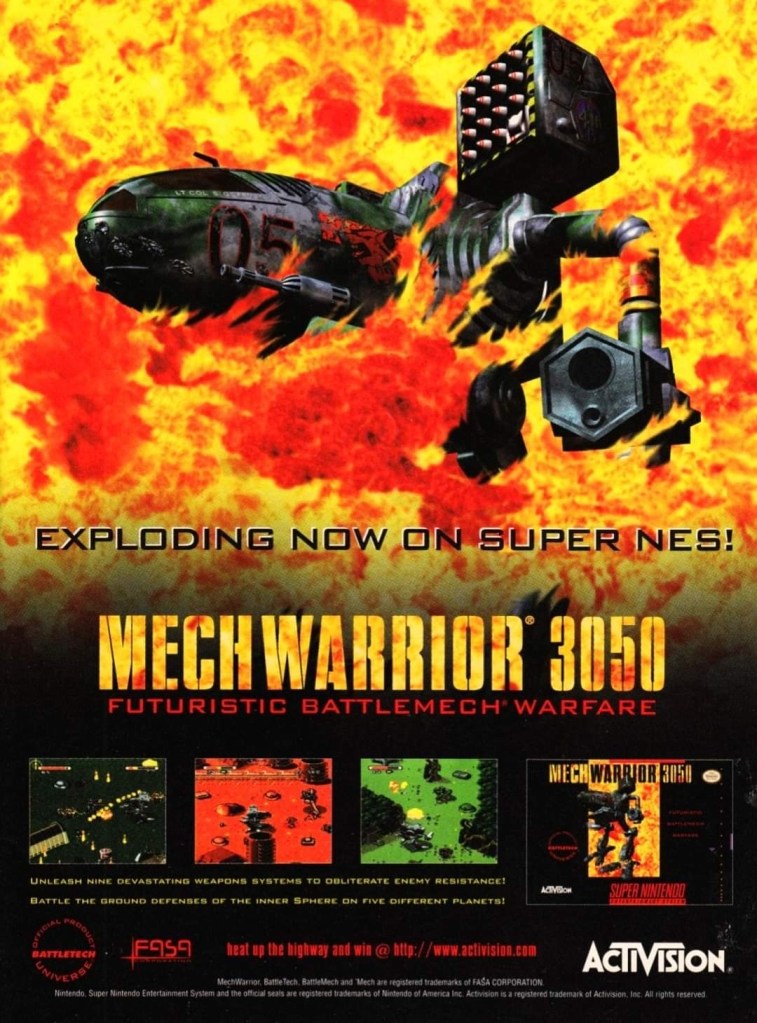
5. MechWarrior 3050 SNES print ad
If you were unaware of the 1994 game BattleTech, then this ad would have fooled you into thinking it is promoting a brand new game.
In 1995, the popular BattleTech entertainment franchise arrived on the Super Nintendo Entertainment (SNES) system with MechWarrior 3050 and its print ad had a really blazing artwork of an armed mech in fire which gave readers the illusion of a new and original game. In reality, MechWarrior 3050 was actually a port of BattleTech which was released on the Sega Genesis in 1994. The Genesis game was published by Extreme Entertainment Group while the SNES game was published by the more famous Activision. If you look closely at the MechWarrior print ad, you can tell how hard they tried to sell the game like it was brand new and all-original.
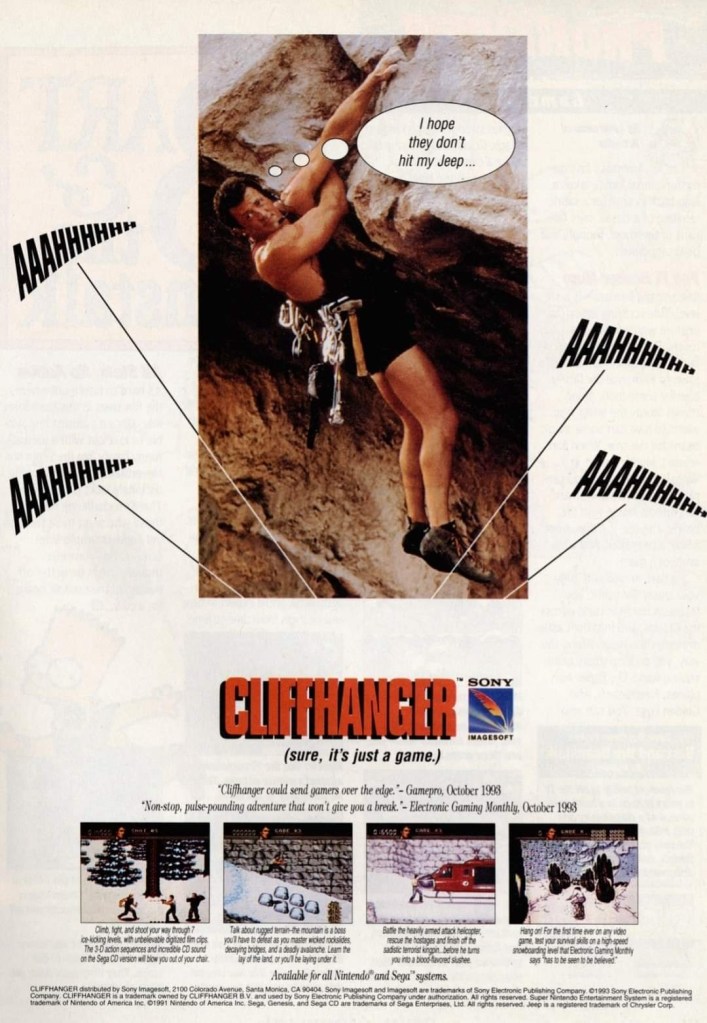
6. Cliffhanger video game print ad
This print ad had Sylvester Stallone hanging on a cliff to be relevant with the title of both the film and the game. They could not show images of Stallone in hard action scenes.
For fans of Sylvester Stallone, 1993 was a big and exciting year as the Hollywood icon appeared in two major action films – Cliffhanger and Demolition Man. Cliffhanger was released first and there were video game adaptations of it released on game consoles, handhelds and computers. This print ad of the Cliffhanger video game had an image of Stallone hanging on a cliff to emphasize the title. The ad makers cleverly posted selected gameplay screenshots and quoted GamePro and Electronic Gaming Monthly (EGM) to make the game look credible and worthy of purchasing. The marketing led to nowhere as the game received mostly negative reviews from critics and it faded to obscurity. Lastly, the Cliffhanger game ad had a noticeable amount of space wasted. They could have made the screenshots and text look somewhat bigger to sell the game.
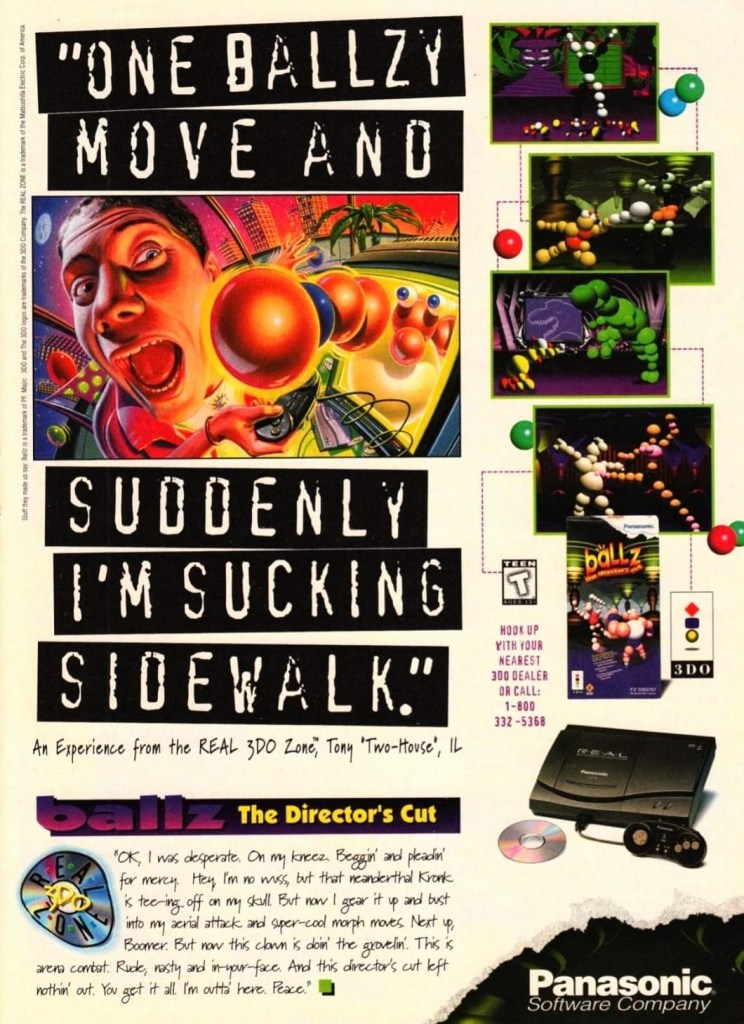
7. Ballz: The Director’s Cut print ad
I never got to play this game on the 3DO.
Here is another ad of the video game released on the failed 3DO console. As its title made obvious, Ballz: The Director’s Cut is an enhanced version of the original Ballz game of 1994 that was released on other consoles. The print ad had an eye-catching piece of artwork and posted beside it were selected shots of the gameplay. Strangely enough, the creative writing on the lower part of the ad does not make any sense and did nothing to convince gamers to play the game. As Ballz: The Director’s Cut was released in 1995, this ad shows the revised 3DO console from Panasonic (model: Panasonic FZ-10 R·E·A·L 3DO Interactive Multiplayer).
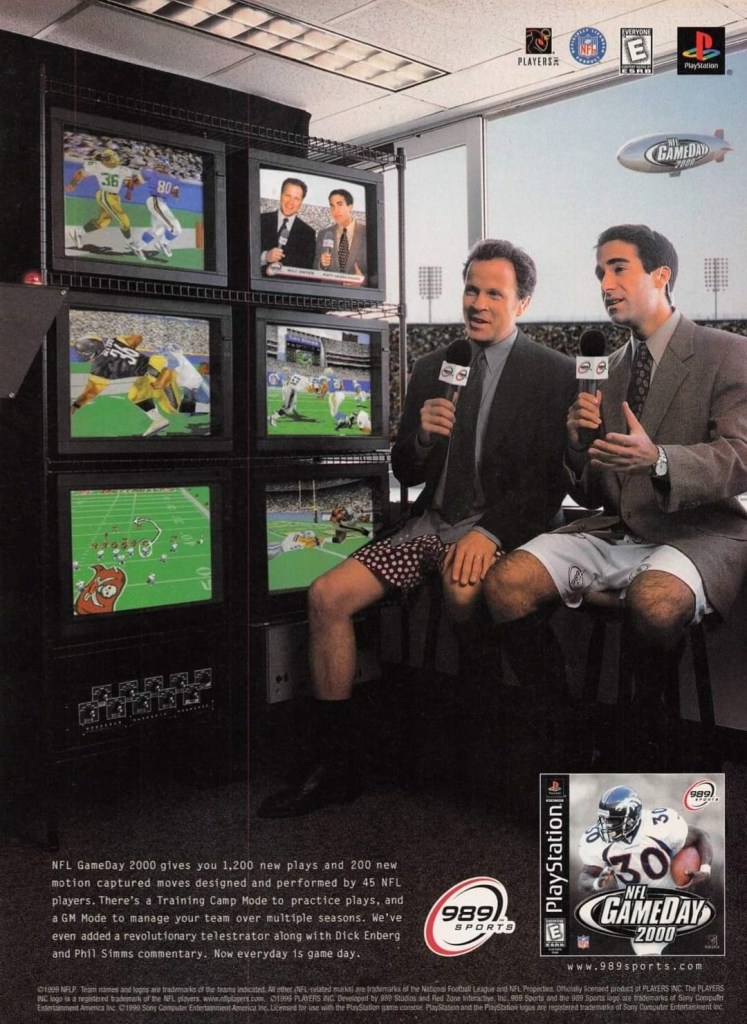
8. NFL GameDay 2000 print ad
Did you find this ad funny to look at in 1999?
To promote the PlayStation-exclusive NFL GameDay 2000, Sony publisher 989 Sports and the ad makers decided to implement a humorous look at football TV coverage by having two sportscasters wearing shorts in front of a TV camera that was only showing their heads and upper bodies. The TV sets on the side show screenshots from the game to emphasize the sports gaming experience. Ultimately the game scored mostly positive review from the critics.
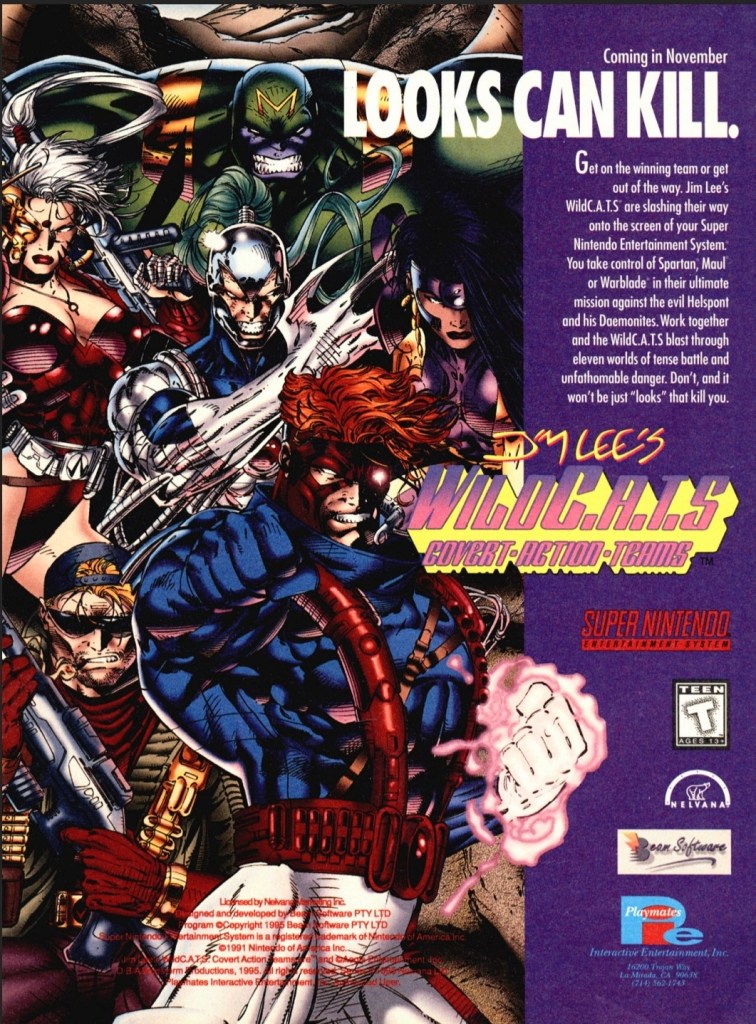
9. WildC.A.T.S: Covert Action Teams print ad
WildC.A.T.S. art by Jim Lee was used to promote the SNES video game.
When Image Comics launched in 1992, WildC.A.T.S: Covert Action Teams was Jim Lee’s creator-owned comic book franchise and its launch issue was a big seller. Years later, WildC.A.T.S. grew in popularity with comic book fans and the franchise achieved multi-media status by venturing into TV (with an animated series) and video games. This print ad promoting the video game adaptation had no screenshots to show which kept fans and gamers guessing how the game will turn out in terms of gameplay and game design. It was obvious that the people who made this print ad had to rely on the best WildC.A.T.S. artwork they could find drawn by Jim Lee. This ad made me laugh back in the old days because if you did not look closely, it might fool you into thinking it was more about comic books than the game on the SNES.
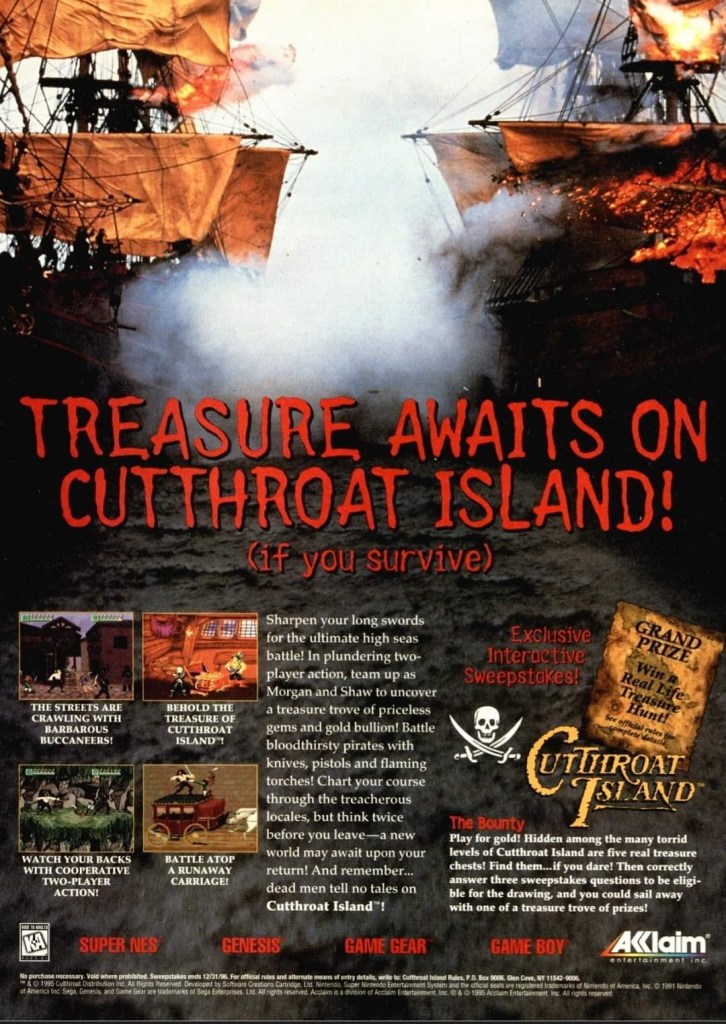
10. Cutthroat Island print ad
Exciting imagery without Geena Davis and Matthew Modine was used to promote the video game adaptation.
I never saw the Hollywood mega-flop Cutthroat Island nor have I ever played any of its multiple video game adaptations (released on SNES, Sega Genesis, Sega Game Gear and Game Boy). The video game print ad, however, caught my attention back in 1995 because the ad makers cleverly used a photograph from one the many expensive movie sequences filmed and the hard, physical work by the filmmakers was clearly visible. Then the ad makers had four screenshots placed on the lower-left part and inserted descriptive text that sounded exciting. Lastly, the ad mentioned a sweepstakes promo.
Without using any images of stars Geena Davis and Matthew Modine, this ad was a strong attempt to get gamers excited for the video game adaptation. Like the movie itself, this game flopped and has faded away to the land of the forgotten.
11. AH-3 Thunderstrike print ad
Captivating artwork, vibrant colors and orderly text descriptions made this an effective ad.
AH-3 Thunderstrike is one of the better games that was released on the Sega CD add-on (requires the Sega Genesis console) in 1993. Similar with MechWarrior 3050, the game was actually a port of Thunderhawk which itself was released on the Amiga and MS-DOS PC in 1992. The print ad showcased a captivating artwork (which was also used on the game’s box cover), a few screenshots and strategically placed text descriptions to sell the game. This ad still looks good.
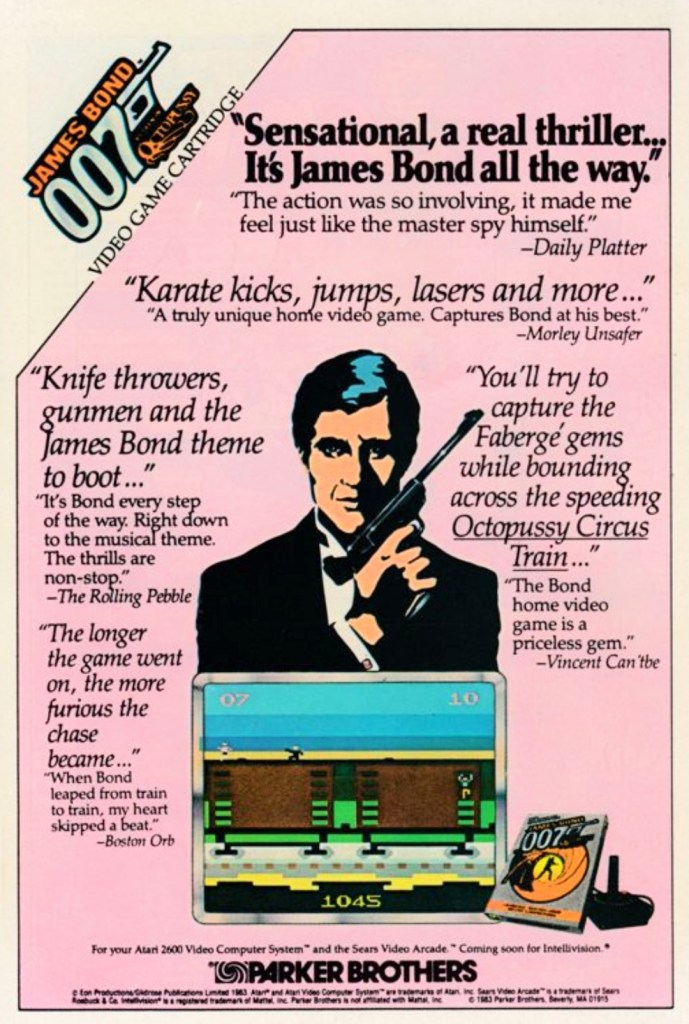
12. James Bond 007 print ad
This print ad appeared in many comic books in 1984.
This is a print ad I saw many times while reading comic books in 1984. James Bond 007 for Atari 2600 was an ambitious licensed video game as it featured levels that were inspired by missions in the James Bond movies Diamonds are Forever, The Spy Who Loved Me, Moonraker and For Your Eyes Only. Keep in mind that programmers back then had to deal with memory limitations and primitive tools to make games.
To promote the game, original art of Agent 007 was used which did not resemble the James Bond star of the time – Roger Moore. Strangely enough, the illustrated James Bond slightly resembled Timothy Dalton whose debut as 007 happened in 1987. Adding further zest to the add was the use of fictionalized quotes pointing to fantasized critics as sources (example: Vincent Can’tbe is a reference to real life critic Vincent Canby). The use of a pink background made this catchy ad look really odd.
13. Choplifter III: Rescue Survive print ad
A captivating print ad that brought gamers’ attention to the Choplifter series again.
This print ad of Choplifter III: Rescue Survive has a striking look showing a military officer who needs your help as he has been stranded behind enemy lines. The presentation reflects the long-time tradition of the Choplifter game franchise which has been about piloting an armed helicopter to the opposition’s territory, shooting at bad guys and then rescuing the hostages or prisoners-of-war (POWs). The game eventually gathered mostly positive feedback from video game critics.
14. Defender of the Crown print ad
Cinemaware took a gamble with the visual concept of this print ad.
Released in 1986 for home computers, Defender of the Crown was made with a high level of quality backed with solid artistry. To capture gamers’ attention, Cinemaware came up with this print ad showcasing a pretty model looking somewhat seductive which reflects what happens in the game when players rescue a damsel in distress. The selected screenshots showed what the game looked like on different platforms, and the lower part of the ad made the game feel like it was a historical epic waiting to be discovered. Defender of the Crown eventually became a big hit with computer gamers.
In what could be a boost for a nuclear-powered Philippines, the Department of Energy (DOE) is officially hosting the Philippine International Nuclear Supply Chain Forum (PINSCF) which will take place in Quezon City from November 13 to 15, 2024, according to a news article by the Philippine News Agency (PNA).
To put things in perspective, posted below is an excerpt from the PNA news article. Some parts in boldface…
Eyeing to lead Southeast Asia in deploying nuclear energy technology, the Department of Energy (DOE) will host the Philippine International Nuclear Supply Chain Forum (PINSCF) from Nov. 13 to 15.
Happening at Solaire Resort North in Quezon City, the PINSCF will gather local and foreign stakeholders to discuss the latest technology and innovations, as well as share best practices in the nuclear energy industry.
Expected participants in the forum are power generation companies, government agencies, embassies, academia, and other key sectors.
“We are bringing together companies from countries with proven track records in building and maintaining the critical infrastructure needed by the energy sector. This forum will showcase their innovations and best practices, offering the Philippines the opportunity to learn and benefit from their experiences,” the DOE said in a statement Wednesday.
Stakeholders from the United States, Canada, France, Japan, and South Korea, which are among the leading countries in nuclear technology, will provide insights for the Philippines as the government explores nuclear energy for a balanced, resilient, and low-carbon energy system to drive sustainable economic growth.
“As the world transitions away from fossil fuels, each nation is weighing options for achieving energy independence and security. This forum allows us to engage with the global community while ensuring that our own stakeholders are part of the discussions,” the DOE said.
Let me end this post by asking you readers: What is your reaction to this recent development? Do you wish to see the entire nation powered by nuclear energy using the latest power-generating technologies found in nuclear-powered small modular reactors (SMRs) and microreactors? Do you realize that nuclear power is more capable on providing the nation abundant energy better than the unreliable solar and wind power?
Here in Metro Manila, there is currently an oversupply of condominium units. Further rate cuts by the Bangko Sentral ng Pilipinas (BSP) could boost demand for existing condominium units and also new residential projects within the metropolis, according to a BusinessWorld news report.
To put things in perspective, posted below is an excerpt from the BusinessWorld report. Some parts in boldface…
FURTHER RATE CUTS by the Philippine central bank could help spur new residential project launches and drive take-up of existing condominiums in Metro Manila, a property consultant said.
In its third-quarter property market report, Leechiu Property Consultants (LPC) said the inventory level of condominium units in Metro Manila has reached 67,600 units across 510 buildings — “the highest since the pandemic.”
“It’s an oversupply of the buildings in the market at 29 months’ supply. (Developers) have been slowly launching new projects,” LPC Research Director Roy Amado Golez said at a briefing on Oct. 8.
Quezon City and Ortigas (plus fringe areas) have the most number of unsold condominium units at 18,000 and 13,500, respectively.
High interest rates may have dampened demand for residential condominiums in Metro Manila. LPC said 6,885 units were sold in the July-to-September period, “close to the 7,000 level for the third straight quarter.”
The Bangko Sentral ng Pilipinas (BSP) had kept its policy rate at an over 17-year high of 6.5% from October 2023 to mid-August 2024. It reduced the benchmark rate to 6.25% at its Aug. 15 meeting.
“The interest rate levels today are still at elevated levels, at 6.25%. However, we’ll be likely seeing rate cuts in October as well as December. Hopefully, those rate cuts will boost… the residential market,” Mr. Golez said.
BSP Governor Eli M. Remolona, Jr. earlier signaled the Monetary Board could deliver two 25-basis-point (bp) rate cuts at each of its two remaining meetings this year.
LPC said rate cuts would help ease lending conditions for both developers and homebuyers, as well as encourage developers to launch new projects.
Muted demand may have prompted developers to defer new residential projects. New project launches plunged by 39% to 2,145 units in the quarter ending September, which LPC said was the lowest since the pandemic.
“What developers are most likely doing now is reselling or re-launching or reintroducing marketing programs for their current inventory,” Mr. Golez said, adding that lower interest rates may provide a lift to sales in the next few quarters.
Let me end this post by asking you readers: What is your reaction to this recent development? Do you think the BSP should reduce the rates soon so that the residential market of Metro Manila will be reinvigorated? Are there any families in your local community who intend to buy a condominium unit and live in it?
For more South Metro Manila community news and developments, come back here soon. Also say NO to fake news, NO to irresponsible journalism, NO to misinformation, NO to plagiarists, NO to reckless publishers and NO to sinister propaganda when it comes to news and developments. For South Metro Manila community developments, member engagement, commerce and other relevant updates, join the growing South Metro Manila Facebook group at https://www.facebook.com/groups/342183059992673













 Author Carlo Carrasco