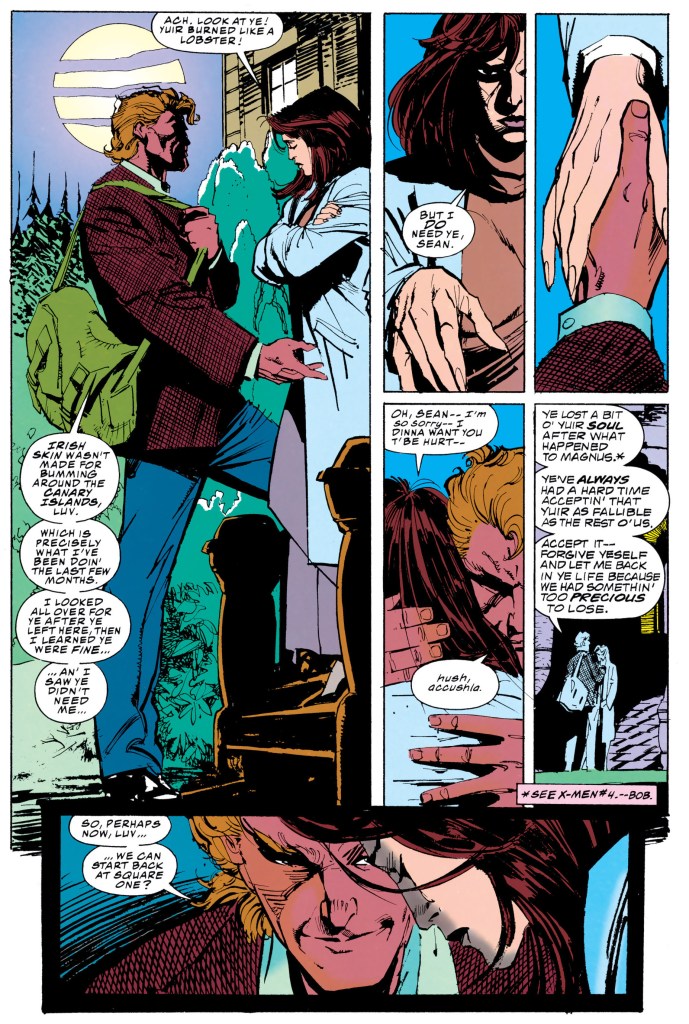
A Look Back at What If #85 (1996)

Welcome back superhero enthusiasts, 1990s arts and culture enthusiasts, Marvel Comics fans and comic book collectors! Today we go back to the year 1996 and explore a part of Marvel Comics’ universe through the reimagined tales emphasized in the What If monthly series.

Back in 1993 – the year that Marvel Comics celebrated the 30th anniversary of the X-Men – the definitive rival of the X-Men, Magneto, made a major comeback and he was so resourceful as a threat to everyone. With the massive space station Avalon as his lair, Magneto sent out Exodus to lure mutants to join him. As time passed, Magneto’s own force grew and arrogantly disrupted the funeral of Illyana Rasputin in the presence of the X-Men, X-Force, Excalibur and X-Factor (as told in Uncanny X-Men #304). As the conflict went on, Colossus betrayed the X-Men to join Magneto.

Can you just imagine what would it be like had Magneto became the ruler of mutants?

With those details laid down, here is a look back at What If , published in 1996 by Marvel Comics with a story written by David Michelinie and drawn by Arnie Jorgensen.
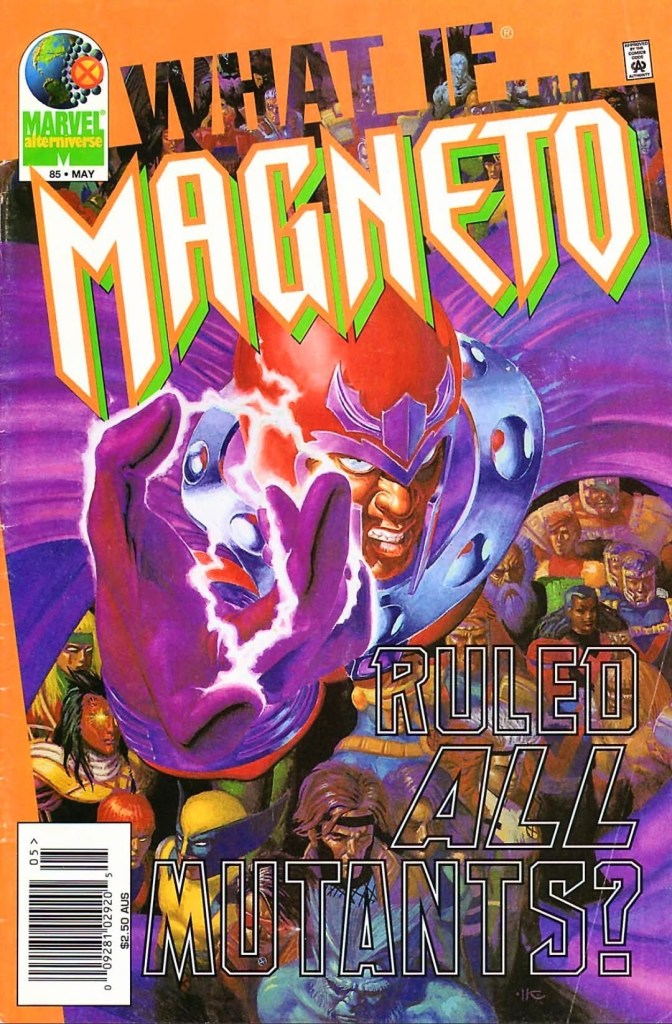
The cover.

Early story

The story begins inside Avalon with Magneto and Colossus watching recorded footage of Charles Xavier announcing his decision to stop opposing the ascension of Avalon. It turns out, Xavier’s decision paved the way for mutants to relocate to Avalon (orbiting Earth) in return for assurance that those who remain in it will do so unmolested. With the intention to let Avalon’s residents achieve their full and glorious potential, Magneto allowed the mutants to rule themselves without any dictatorship by him.

Through the years, division between Avalon’s mutants – Acolytes who believe in isolation and the Acolytes who believe in annihilation – intensified and proved that the spirit of mutant unity has faded away. As violence between the mutants went on, the number of explosions inside Avalon kept increasing…

Quality
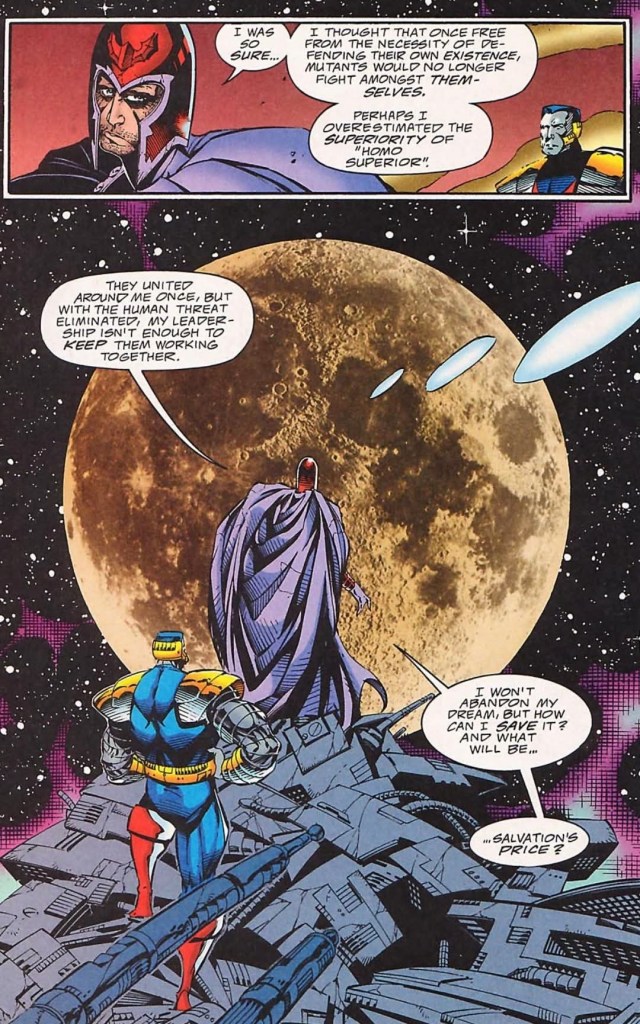
A magnificent view for Magneto, Colossus and the readers.

What I like most about this What If tale is its core concept exploring what would have happened had Magneto ruled the mutants specifically those living in his own realm (Avalon). Writer David Michelinie (best known for writing Amazing Spider-Man stories) wrote a really inspired script that emphasized Magneto’s vision of mutant utopia isolated from the twisted and complicated societies of Earth (which still has lots of people who are afraid of and hostile towards mutants) while leaving room for conflict in the form of ideological division between mutants on Avalon. As the growing division and violence are shattering Magneto’s vision of mutant utopia, the birth of an infant whose presence adds to the tension and fear of Avalon’s inhabitants.

The good news here is that Michelinie’s script is pretty solid and Arnie Jorgensen did a good enough job visualizing it all. The characters, mainly Magneto, Colossus and Beast, were portrayed clearly in character and to see the master of magnetism struggling with maintaining order on Avalon is a nice portrayal of his human side which makes him have a lot more in common with his opposite Professor X when it comes mutant matters. Considering Magneto’s long history of intense evil and obsession with leading humanity, his portrayal of insecurity, doubt and weakness is very believable to read.

Colossus, whose betrayal of the X-Men in Uncanny X-Men remains unforgettable, is the loyal and sensible servant of Magneto. Beast, meanwhile, remains the very bright and insightful mutant scientist as he has always been which makes Michelinie’s writing really impressive.

Also at the heart of the story is mutant order. Apart from the division between Avalon mutants who want full separation from humanity and those who want to conquer Earth by eliminating all human beings, the very fabric of mutant society got shaken all because of an infant who was born there on Avalon (Avalon’s first natural birth ever). I like the way this sub-plot added tension to the mutant division because it is, in some ways, socially relevant to this day. It will remind you that certain groups of people out there who would go as far as committing murder only because they are so obsessed with their foolish, worldly beliefs. Look at the Palestinian terrorists, the Iranian terrorists and the woke mobs in many parts of the world.

Conclusion
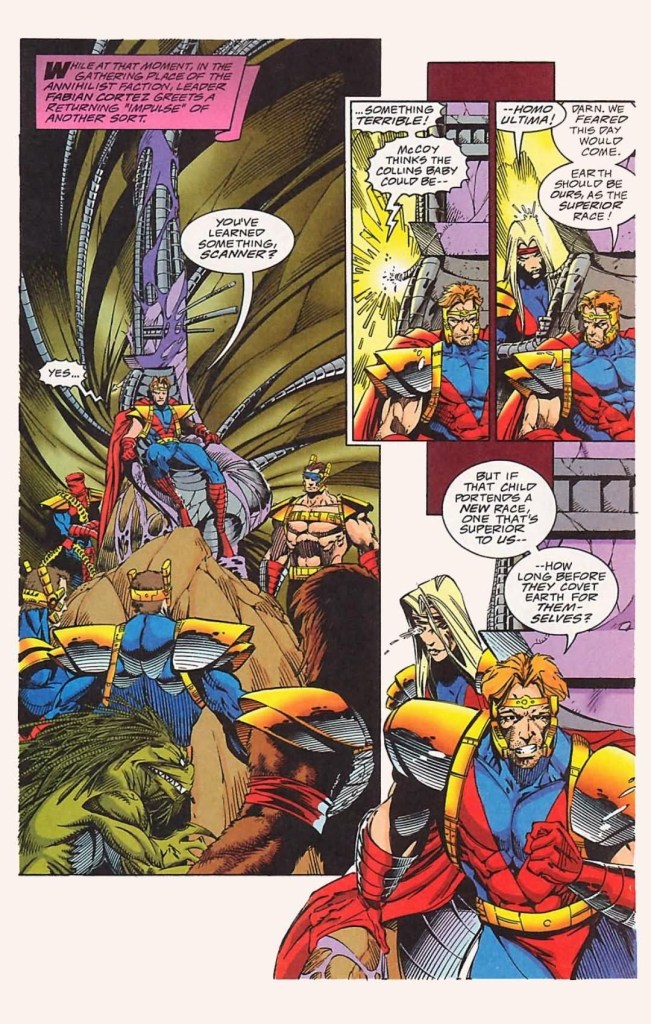
Remember Fabian Cortez and the Acolytes?

With a very solid script filled with intrigue, social relevance and portrayals, What If (1996) is a pretty engaging read. As it is strongly focused on Magneto and his mutants on Avalon, this comic book gives readers a fine dramatization of its core concept as well as developments on what would have happened had mutant utopia been realized far away from human society. I should state that for every build-up in the story, the payoff is fortunately solid. Consider this comic book a dramatic portrayal of mutants of Magneto without the involvement of the X-Men.

Overall, What If (1996) is recommended.

+++++

Thank you for reading. If you find this article engaging, please click the like button below, share this article to others and also please consider making a donation to support my publishing. If you are looking for a copywriter to create content for your special project or business, check out my services and my portfolio. Feel free to contact me with a private message. Also please feel free to visit my Facebook page Author Carlo Carrasco and follow me on Twitter at  @HavenorFantasy as well as on Tumblr at https://carlocarrasco.tumblr.com/ and on Instagram at https://www.instagram.com/authorcarlocarrasco

Retro Gaming Ads Blast – Part 11

Welcome back readers, fellow geeks and electronic gaming fans!

In this edition of the Retro Gaming Ads Blast (RGAB) series, we will take a look at another batch of retro gaming print ads from the 1980s and 1990s. In addition, there will be a few flyers of arcade games as well as promotional posters of a notable console game that was released only in Japan.

For the newcomers reading this, Retro Gaming Ads Blast (RGAB) looks back at the many print ads of games (console, arcade, computer and handheld) that were published in comic books, magazines, flyers and newspapers long before smartphones, social media, the worldwide web and streaming became popular. To put things in perspective, people back in the 1980s and 1990s were more trusting of print media for information and images about electronic games and related products.

With those details laid down, here is the newest batch of retro gaming print ads for you to see and enjoy…

1. M.I.A.: Missing in Action arcade flyer

This is an effective way of catching the attention of both players and arcade operators. I can imagine the woke, the SJWs and rabid feminists getting easily offended by this.

Konami was a very prominent producer of games back in the 1980s. Not only did the company produce high-quality and enjoyable military-themed games on consoles and computers, Konami also made its presence felt in the highly competitive sector of arcade games. In 1989, they released the arcade conversion kit of M.I.A.: Missing in Action and this flyer is the best know promotion of it. M.I.A.: Missing in Action is the follow-up to Konami’s hit game Rush’n Attack.

Visually, the flyer’s display of four screenshots combined with a dominating photographic image of prisoners of war (POWs) getting delightfully released by an attractive female Rambo-type rescuer were designed to catch the attention of young adult and adult gamers. The text descriptions (note: there were more details on the back of the flyer), however, were geared towards arcade operators who were looking for new games to acquire without the hassle of having to buy an entire arcade cabinet. That being said, this flyer was a clever way to appeal to arcade operators and the people who love playing arcade games.

2. Fonz arcade flyer

Simplistic yet effective to look at. If you are an arcade operator, this flyer conveniently has key information displayed.

Believe it or not, Sega was already active in arcade games way back in the 1970s. In this particular flyer, Sega’s arcade game Fonz (also called Moto-Cross, Man T.T.) offered players the unique experience of driving a digital vehicle using actual handlebars on the machine that were meant to create an immersive and realistic feel. If you look closely, the flyer has lots of details written with arcade operators and players in mind.

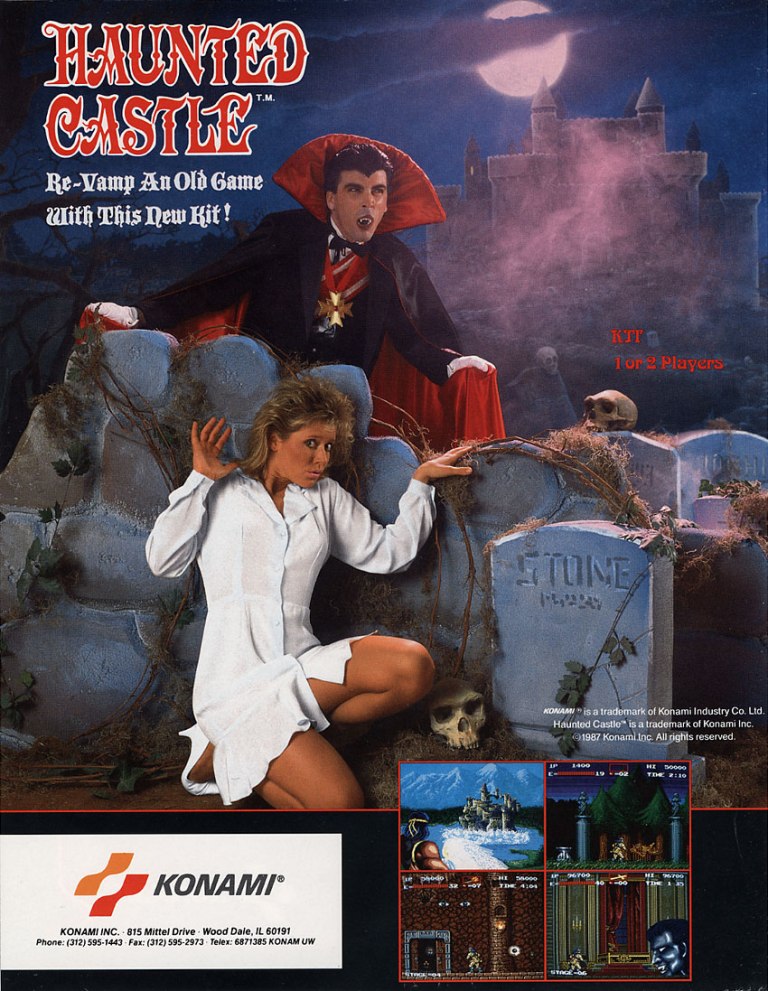
3. Haunted Castle arcade flyer

Indeed, this game is part of the Castlevania game franchise. It was one of the first Castlevania games released for arcades.

Arguably, Konami is best known for the Castlevania game series which covered handheld gaming devices, personal computers, video game consoles and even arcades. Haunted Castle (Japanese title: Akumajō Dracula) is the 2nd arcade game of the Castlevania franchise and it is not a port of any console game. Like the arcade flyer of M.I.A.: Missing in Action, this one was crafted to lure the attention (and money) of arcade operators looking for conversion kits to replace their old games. The visual presentation is eye-catching and even though the Castlevania brand was nowhere to be seen, Castlevania fans could tell this this arcade offering was part of their favorite game franchise.  

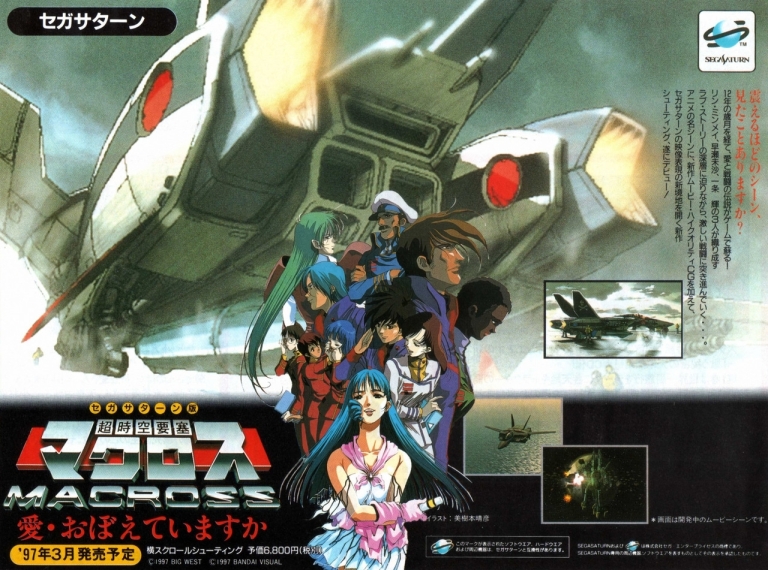
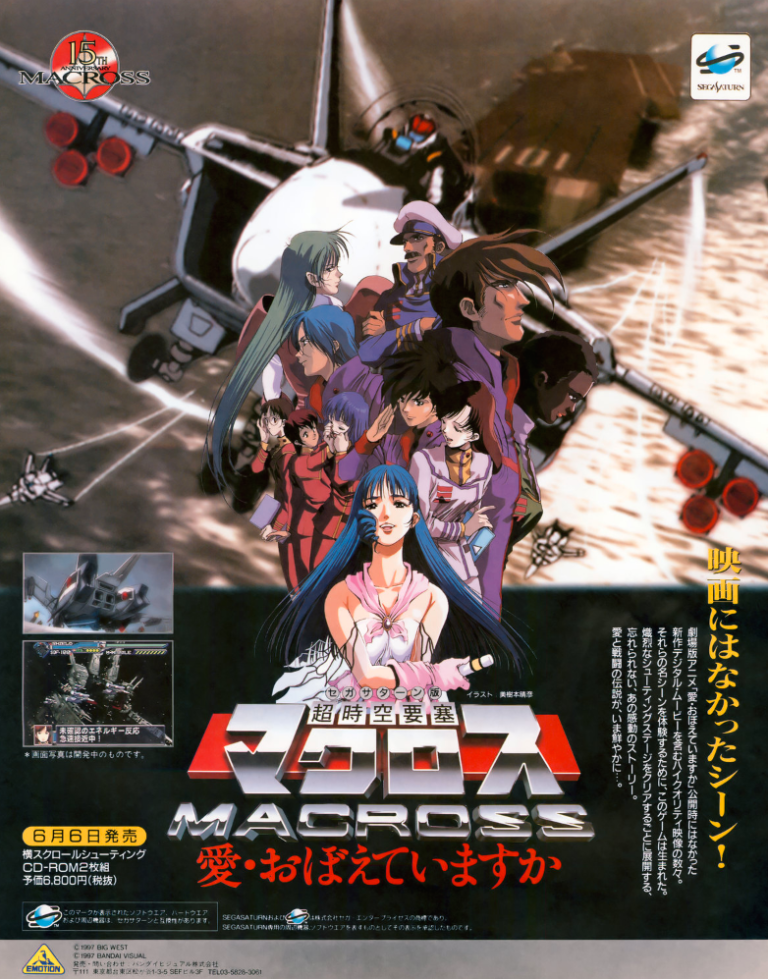
4. The Super Dimension Fortress Macross: Do You Remember Love? flyer and poster

The poster promoting the release of the game for Sega Saturn in Japan.
The flyer promoting the Sega Saturn game’s 1997 release as well as the 15th anniversary of Macross.

In 1997, the 15th anniversary of the Macross multimedia franchise was celebrated in Japan and among the highlights was the release of The Super Dimension Fortress Macross: Do You Remember Love? on the Sega Saturn. To promote the game and the franchise itself, lots of flyers and posters were released in Japan. If you look at the illustrated images on the promotional materials closely, you will realize that they are not from the original 1982-83 Macross anime TV series but rather from the The Super Dimension Fortress Macross: Do You Remember Love? animated movie of 1984 (read my retro movie review by clicking here).

While it might be baffling to some as to why the original anime TV series was not used as the source material for the 15th anniversary celebration through gaming, the 1984 anime feature film was actually more adaptable for a video game project (read my retro review by clicking here). It is so obvious, you just have to ask yourselves this question – how can the game developers compress the entire concepts of the 36-episode Macross anime series into one game while ensuring fun gameplay? Regardless, the game was a lot of fun to play and I enjoyed playing the PlayStation version in 1999.

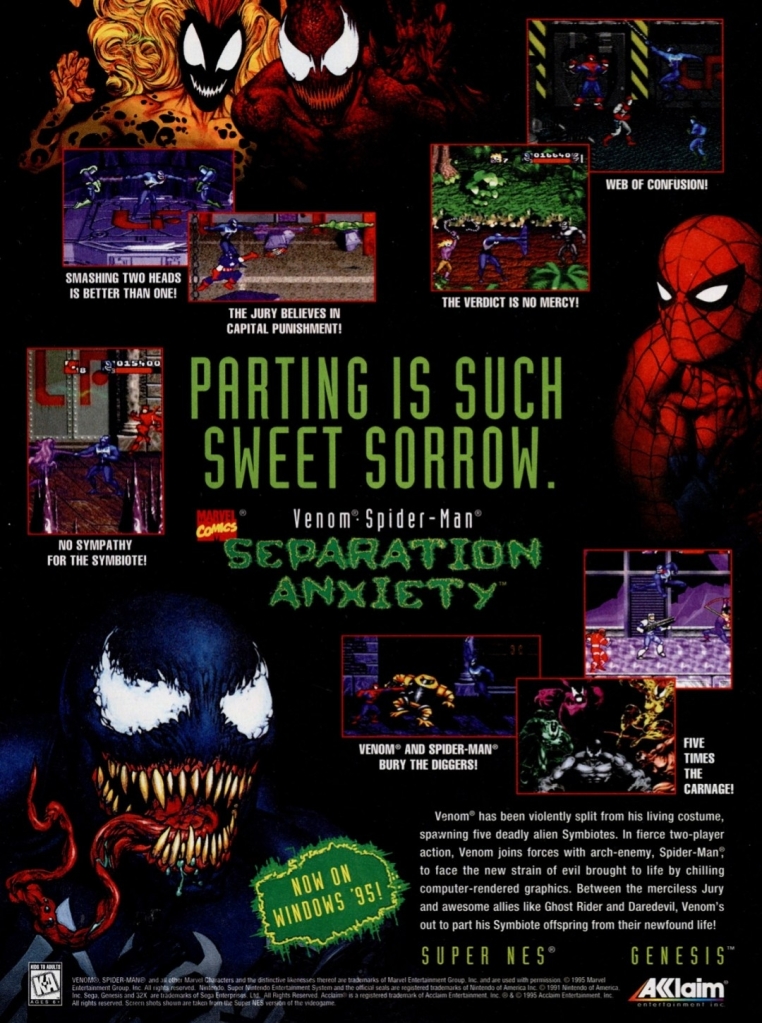
5. Venom/Spider-Man: Separation Anxiety print ad

A clear effort to sell the game to gamers as well as fans of Spider-Man and Venom.

In 1994, Acclaim released Spider-Man and Venom: Maximum Carnage (based on the 1993 comic book storyline Maximum Carnage) on Super Nintendo Entertainment System (SNES) and Sega Genesis ultimately becoming popular with comic book fans and gamers who enjoyed sidescrolling beat-them-up games.

Subsequently, Acclaim and develop Software Creations reunited to release the sequel Venom/Spider-Man: Separation Anxiety a year later on the two leading 16-bit consoles as well as on personal computer (PC). If there is anything notable about this eye-catching print ad, it is the fact that its visual presentation (with graphics on-par with the previous year’s game) cleverly hides the fact that it did not have much new to offer gamers with regards to gameplay and story cutscenes (which the previous game prominently had). Eventually, this game attracted weaker reviews from game critics and has since been forgotten.

6. Tecmo Super Bowl SNES print ad

From the time when Tecmo was still a strong producer of sports video games.

In 1991, Tecmo Super Bowl was released on the aging Nintendo Entertainment System (NES) and because its game design greatly entertained gamers, it became a tremendous commercial success. Not even the very high launch price of $54.99 stopped it from selling a lot.

To keep the commercial success and public interest going, Tecmo announced a new version of the game for the more powerful SNES console with the simple title of Tecmo Super Bowl. If you look closely at the print ad, you will notice that gameplay screenshots were not used at all. Instead, they showed images of the nicely illustrated art works they prepared as eye candy for the game with the intention of making it look cinematic. This is very curious because gameplay itself was the main selling factor of the NES version of Tecmo Super Bowl. I can only guess that Tecmo was not ready to show gameplay images by the time this print ad was made.

7. X-Men 2: Clone Wars print ad

The art used is too alienating for promoting this game.

During the age of the 16-bit consoles, there was a variety of X-Men video games released and produced by different companies. In 1993, an X-Men game published by Sega was released exclusively on the Genesis console which turned out to be fun for gamers and received mostly positive reviews from the critics. Sega went on to publish the sequel X-Men 2: Clone Wars and this print ad caught my attention because of how exaggerated the characters looked. It’s so strange, it’s as if the artist took visual reference from a somewhat blocky 3D polygonal portrait then tried to make them look hand-drawn. I wonder if anyone from Sega regretted this.  

+++++

Thank you for reading. If you find this article engaging, please click the like button below, share this article to others and also please consider making a donation to support my publishing. If you are looking for a copywriter to create content for your special project or business, check out my services and my portfolio. Feel free to contact me with a private message. Also please feel free to visit my Facebook page Author Carlo Carrasco and follow me on Twitter at  @HavenorFantasy as well as on Tumblr at https://carlocarrasco.tumblr.com/ and on Instagram at https://www.instagram.com/authorcarlocarrasco

A Look Back at X-Men Adventures Season II #8 (1994)

Welcome back superhero enthusiasts, 1990s arts and culture enthusiasts, Marvel Comics fans and comic book collectors! Today we go back to the mid-1990s to explore the adaptation of the second season of the famous X-Men: The Animated Series (X-Men TAS) in the form of the X-Men Adventures comic book series.

Before getting to the new retro comic book review, I should state that it is indeed very challenging to implement the concepts of time travel and timeline conflicts into the narrative of an established X-Men universe. As far as the X-Men TAS narrative goes, Bishop and Cable are mutants who each came from different points in the future and in different ways they each made impact with the present day X-Men as portrayed in the comics (the literary X-Men specifically).

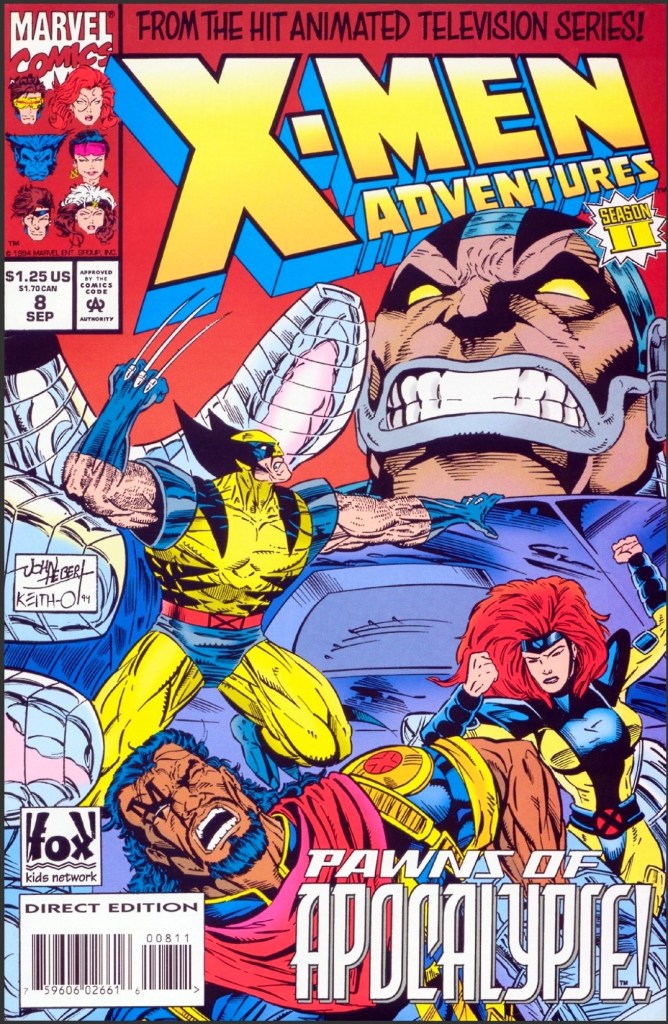
With those details laid down, here is a look back at X-Men Adventures Season II , published in 1994 by Marvel with a story written by Ralph Macchio and drawn by John Hebert. The is the 2nd chapter of the Time Fugitives storyline.

The cover.

Early story

The story begins on Earth in the far future of 3999 AD. Cable, who has been leading the fight against Apocalypse, is receiving information from his cube-shaped computer which informs him that a temporal storm has wreaked havoc with the time stream and their present is reconfiguring in response to the existence of a new past. Once realignment gets completed, everyone in the current timeline will cease to exist. Cable then learns that Bishop (who returned to the X-Men in the previous issue) is the primary chronal component of the time readjustment.

Meanwhile in the present day inside Xavier’s mansion, the X-Men listen to Bishop who explains that mutants will be blamed for the plague that a certain virus will precipitate and that the fear of the virus will make things much worse for many people. He states that the virus was not brought into being by mutants.

Beast then shares that his investigation of a viral-ridden cell sample was convincing and discovered that the virus was genetically engineered. He reveals that once the little germs spread to the mutant population and combine with mutant DNA, it could turn out incredibly deadly…

Quality

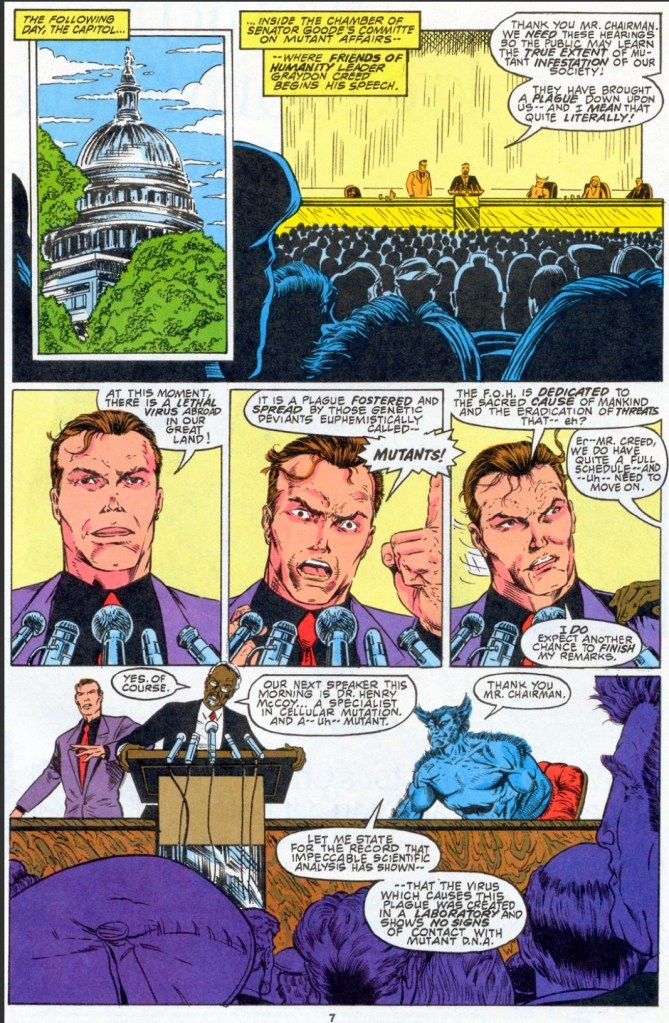
Conflict brewing in front of a huge audience.

To be straight to the point, what the creative team started in issue got strongly concluded here. With the animated episode’s teleplay being the primary reference, writer Ralph Macchio successfully crafted a script that raised the stakes of the 2-part Time Fugitives story while tying closely the gaps with regards to the time travel and timeline conflicts concepts. Without spoiling the plot, I can say that one development that took place in the present day clearly set off the stage for another futuristic mutant to not only get involved but also make a huge impact on the narrative.

As with the previous issue, this story has elements of xenophobia as well as fear of viruses and potential massive infections which added a good layer of depth to the plot. Macchio’s writing is very strong and no matter how intense the tale got as more details got presented, it still remained very readable and efficient to follow. Also, I should say that Apocalypse’s presence turned out very powerful and it should inspire readers to search for comic books of the supervillain’s conflict with the X-Men and X-Factor for insight.

John Hebert returned on the visual department and his art style really works well with both the sci-fi concept of the story and the presentation of the X-Men plus Bishop and Cable. I really admire Hebert’s stylized take on Wolverine, Cable and Bishop as he made each them look even grittier than before. There is also this creepy vibe with the way Hebert drew some of the X-Men members’ faces. Herbert is also very good with visualizing sci-fi elements such as energy forms, futuristic machines, techno-virus forms on the skin, and more. His presentation of dynamic superhero action is great to look at. This is clearly one of the best looking issues of Season II of the X-Men Adventures series.

Conclusion

Bishop explains things to the X-Men and Beast confirms key details.

X-Men Adventures Season II (1994) is a rock-solid comic book in terms of quality and impact. It concluded the 2-part story with a powerful resolution, it tied the loose ends in a very timely fashion and I really enjoyed the way how the X-Men were dramatized as Bishop and Cable got involved with them in their present day setting. So far, this is the most satisfying and more impactful issue of Season II I have read in this series.  

Overall, X-Men Adventures Season II (1994) is highly recommended.

+++++

Thank you for reading. If you find this article engaging, please click the like button below, share this article to others and also please consider making a donation to support my publishing. If you are looking for a copywriter to create content for your special project or business, check out my services and my portfolio. Feel free to contact me with a private message. Also please feel free to visit my Facebook page Author Carlo Carrasco and follow me on Twitter at  @HavenorFantasy as well as on Tumblr at https://carlocarrasco.tumblr.com/ and on Instagram at https://www.instagram.com/authorcarlocarrasco
A Look Back at Uncanny X-Men #273 (1991)

Welcome back superhero enthusiasts, 1990s arts and culture enthusiasts, Marvel Comics fans and comic book collectors! Today we go back to the year 1991 to explore a chapter of the Uncanny X-Men series that took place between X-Tinction Agenda and Mutant Genesis (the modernization point of Marvel’s mutants for the 1990s).

For the newcomers reading this, X-Tinction Agenda was a very notable part of the history of the X-Men comic book franchise as it marked the first time that the X-Men, X-Factor and the New Mutants were combined and also reunited several X-Men members who were scattered around the world. That being said, the state of mutants within Marvel Comics’ shared universe created a sense of uncertainty towards Charles Xavier’s grand dream of establishing a peaceful co-existence between humans and mutants.

With those details laid down, here is a look back at Uncanny X-Men , published in 1991 by Marvel Comics with a story written by Chris Claremont and drawn by Whilce Portacio, Klaus Janson, Jim Lee, John Byrne, Rick Leonardi, Marc Silvestri, Michael Golden and Larry Stroman.

The cover.

Early story

The story begins in the control center within the complex located deep under the ruins of Charles Xavier’s mansion. Storm (X-Men), Jean Grey (X-Factor), Cyclops (X-Factor) and Cable (New Mutants) carefully examine the worldly forces that oppose them. After Storm asked about what they could do about the opposing forces located in different parts of the world, Cable says that they should hit them hard and fast as they have the power to do so.

Storm asked Cable if violence is his only solution. Even though violence got things done for Cable, Cyclops rejects it and states that his fellow mutants (pertaining to the X-Men and X-Factor) are not like him.

As the conversation intensifies, Jean Grey tells Cable that they are not warriors and the school was not founded by Professor X to have mutants to fight wars. Cable replied that war is what they got and reminded them of the two mutants they lost and another one who ended up as a genetically engineered slave. Cable asked them if they want to see more of their fellow mutants end up badly…

Quality

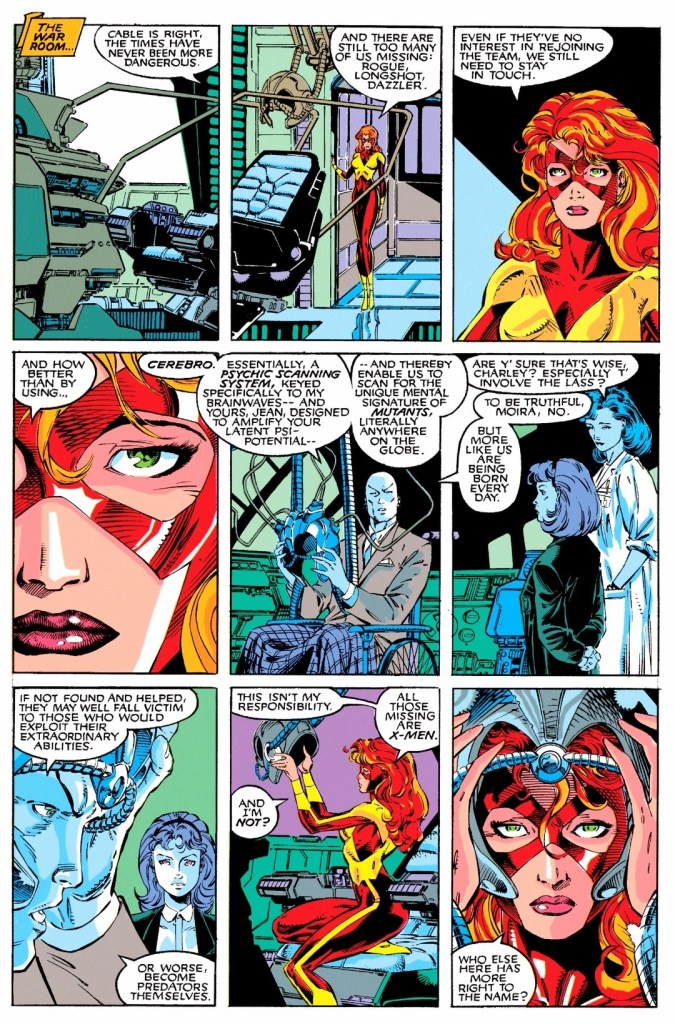
In the absence of Professor X, Jean Grey (then a member of X-Factor) revisits Cerebro and recalls what she learned long ago.

In relation to the mentioned fact that this particular story took place between X-Tinction Agenda and Mutant Genesis, this is a tale that reflects a period of transition leading to the latter. That being said, Chris Claremont took the opportunity to emphasize the current state of the X-Men and the other mutants, as well as the uncertainty ahead of them all. To be clear, this story does not have Marvel’s mutants going up against another super villain nor a group that opposes them.

The story opened very strongly with the leading figures of the X-Men (Storm), X-Factor (Cyclops and Jean Grey) and the New Mutants (Cable) being together analyzing the global situation and the forces that oppose them.

For Cable, violence is necessary for their survival and progress because he sees war against mutants already happening and there is simply no room left for error nor compromise. Very symbolically, Storm, Cyclops and Jean Grey – who all were nurtured by Professor X with his pacifist dream of bridging the gap between mutants and humans – reject Cable’s beliefs as they don’t see themselves as warriors and they do not dream of conquering their enemies at all. All the dialogue that took place in the argument are very richly written and there are layers of meanings which long-time X-Men fans will able to relate with.

Along the way, Claremont and the other creators made good use of available comic book space to develop the other characters which resulted in the gradual developments within each team of mutants. Gambit here is a brand new member of the X-Men and his talk with Storm is very sensible to read. There was also this notable Danger Room training session between Archangel and Cannonball in which the former (who is already very experienced as one of the original X-Men and a current member of X-Factor) shares wisdom to the very young mutant (who later went on to lead X-Force some time later). The creative team also inserted a few moments of humor on the other character development scenes.

Conclusion

Truly this is one of the most symbolic and most engaging arguments between the leading figures of the X-Men, X-Factor and New Mutants (which later became X-Force).

Even though it was mainly focused on character development and has no battle with any enemy, Uncanny X-Men (1991) remained a very engaging read as it tackles not only the current state of the three mutant teams of the time but also realigned their direction creatively and the results were fully realized through the eventual Muir Island saga as well as Mutant Genesis and even in further tales (including Fatal Attractions). In many ways, this comic book served as a solid foundation of things to come and this partially explains the eventual reform of the X-Men into a much larger group that had to be composed of two teams shortly after the return of Professor X (as seen in X-Men #1 and Uncanny X-Men in 1991).

Overall, Uncanny X-Men (1991) is highly recommended.

+++++

Thank you for reading. If you find this article engaging, please click the like button below, share this article to others and also please consider making a donation to support my publishing. If you are looking for a copywriter to create content for your special project or business, check out my services and my portfolio. Feel free to contact me with a private message. Also please feel free to visit my Facebook page Author Carlo Carrasco and follow me on Twitter at  @HavenorFantasy as well as on Tumblr at https://carlocarrasco.tumblr.com/ and on Instagram at https://www.instagram.com/authorcarlocarrasco
A Look Back at X-Men #30 (1994)

Disclaimer: This is my original work with details sourced from reading the comic book and doing personal research. Anyone who wants to use this article, in part or in whole, needs to secure first my permission and agree to cite me as the source and author. Let it be known that any unauthorized use of this article will constrain the author to pursue the remedies under R.A. No. 8293, the Revised Penal Code, and/or all applicable legal actions under the laws of the Philippines.

Welcome back, superheo enthusiasts, 1990s culture enthusiasts, X-Men fans and comic book collectors! Today we revisit the X-Men monthly series of the 1990s and look back at one of its most significant events it ever published – the wedding of Scott Summers/Cyclops and Jean Grey. By the time this particular comic book was published, the 30th anniversary celebration of the X-Men (note: Read my Fatal Attractions storyline retro reviews by clicking here and here) had just been concluded and that includes a major change of direction for the iconic X-Men member Wolverine. It is also notable that the X-Men had Sabretooth contained within Charles Xavier’s mansion (for retro reviews, click here, here and here).

With those details laid down, here is a look back at X-Men , published by Marvel Comics in 1994 with a story written by Fabian Nicieza and drawn by Andy Kubert.

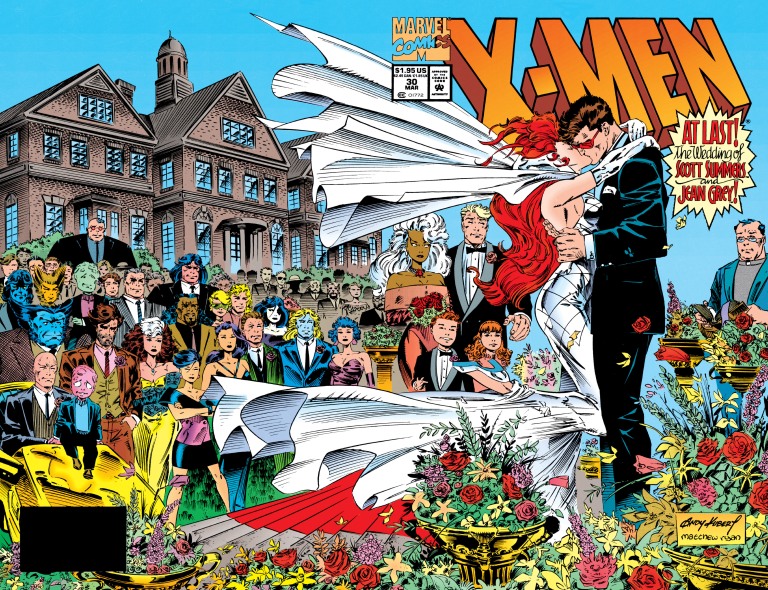
The cover.

Early story

The story begins inside Xavier’s mansion. Jean Grey reads a handwritten letter from Logan/Wolverine, who left the household after getting traumatized from their last encounter with Magneto. Logan refers to her and Scott Summers as special. While reading, Jean is already in her fancy wedding dress being assisted by her mother and storm as Rachel Summers looks on. For Jean, the wedding is about her dedication on spending the rest of her life with Scott as well as possibly gaining Rachel (who comes from one possible future) as a daughter.

Professor X with four of his original team members plus Alex Summers.

Elsewhere in the mansion, the groom Scott spends quality time with his original teammates Bobbdy Drake/Ice Man, Warren Worthington/Archangel and Hank McCoy/Beast. With them also is his brother Alex Summers/Havok. Alex tells Scott that the day of his wedding is the first day of the rest of his life which causes Bobby to say something inappropriate.

Suddenly, Professor X comes in to join them…

Quality

Jean Grey in her wedding dress with her mother, Storm and Rachel Summers present.

To get straight to the point here, this comic book serves two purposes: highlighting Scott and Jean’s relationship to an all new level with the wedding as the main event, and offering long-time or die-hard X-Men fans a whole lot of stuff to chew on. Very clearly, Fabian Nicieza wrote the script with X-Men fans in mind while also making references to the past with some creative touches or shortcuts so that the comic book would not be bloated with excessive fan service.

The wedding itself was executed nicely by the Nicieza-Kubert team and was clearly conceptualized to not only be memorable for the fans but also creatively serve as a major pay-off to all those years of Scott and Jean Grey being together early as teammates, getting separated temporarily and getting together again (note: they were also the original X-Factor team). Right after the wedding was executed, the visuals and words elevated the emotions higher and any long-time X-Men fan will find the moment sentimental.

Opposite the wedding are several scenes showing the other X-Men characters plus those from X-Factor and X-Force (with a not-so-recognizable Cable present). The dialogue written ranged from sentimental to comedic. And then there were also a few lines that I felt were just thrown in as fillers.

As far as visuals go, Andy Kubert’s art here are pretty good to look at. While he did his best to really make the story visually appealing and memorable, there were a few panels of art that look rushed.

Conclusion

So many guests. Can you recognize many of them?

Since it highlights the wedding of Scott and Jean Grey with several other X-Men-related characters mixed in, X-Men (1994) is clearly a commemorative story made with X-Men fans in mind. While a lot of work was done to make the story momentous on its own, readers who are unable to immerse themselves deeply into the X-Men mythos (plus X-Force, X-Factor and others) prior to reading this comic book won’t be able to relate to the wedding and the character moments very much. While it may not be significant to newcomers who find this comic book for the first time, it still marks a significant chapter in the history of X-Men within the Marvel Comics universe of the late 20th century. For the long-time fans who were able to read enough of Scott and Jean Grey’s times together from 1963 until the early 1990s, this is one X-Men tale that they can relate with deeply.

Overall, X-Men (1994) is recommended.

+++++

Thank you for reading. If you find this article engaging, please click the like button below and also please consider sharing this article to others as well as making a donation to support my publishing.. If you are looking for a copywriter to create content for your special project or business, check out my services and my portfolio. Feel free to contact me with a private message. Also please feel free to visit my Facebook page Author Carlo Carrasco and follow me on Twitter at  @HavenorFantasy as well as on Tumblr at https://carlocarrasco.tumblr.com/ and on Instagram at https://www.instagram.com/authorcarlocarrasco
A Look Back at X-Men #24 (1993)

Disclaimer: This is my original work with details sourced from reading the comic book and doing personal research. Anyone who wants to use this article, in part or in whole, needs to secure first my permission and agree to cite me as the source and author. Let it be known that any unauthorized use of this article will constrain the author to pursue the remedies under R.A. No. 8293, the Revised Penal Code, and/or all applicable legal actions under the laws of the Philippines.

Welcome back, superhero enthusiasts, 1990s culture enthusiasts, X-Men fans and comic book collectors! Today we revisit the X-Men monthly series of the 1990s and look back into the one of the comic books that was released in 1993 which was the year Marvel celebrated the 30th anniversary of the X-Men franchise. To be more specific, the comic book in this retro review took place right after the death of Colossus’ sister and just before the big Fatal Attractions stories in Uncanny X-Men #304 (1993) and X-Men #25 (1993).

With those details laid down, here is a look back at X-Men #24, published by Marvel Comics in 1993 with a story written by Fabian Nicieza and drawn by Andy Kubert.

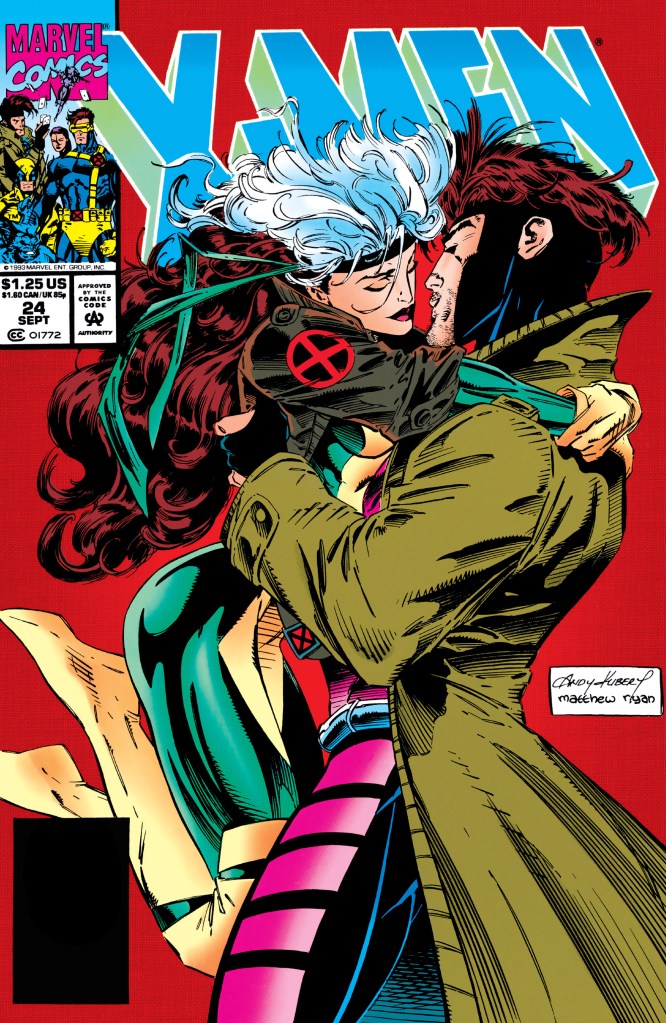
The cover.

Early story

The story begins inside a high-end restaurant wherein Rogue and Gambit, both dressed in formal attire, have dinner and spend quality time together. Their private talk turns awkward when Rogue asks him about his silence about his wife (refer to X-Men ). Gambit, in his attempt to change the subject, asks Rogue why other people do not know her real name. This leads them into staring at each other in silence.

Over the mansion, Dr. Moira McTaggert and Banshee are reunited while Charles Xavier and Beast are inside the laboratory working and analyzing as to how Illyana Rasputin died. Over at a local airport, Jean Grey and Cyclops are reunited…

Quality

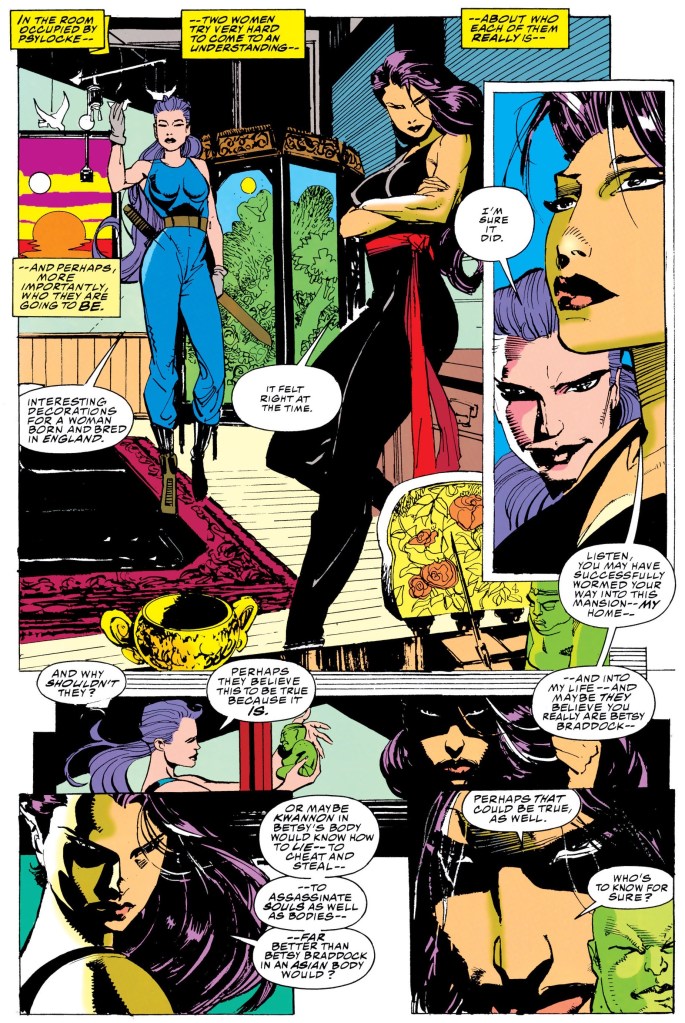
Psylocke and Revanche.

Have you heard about the expression “the calm before the storm”? That truly reflects what this comic book is all about. X-Men #24 (1993) was all about build-up of information and character developments, getting specific X-Men characters reunited, tying up some loose ends from the past while also building up tension for near-future events and more. There is no battle between good and evil here as this was written to set up the characters for specific storylines that were set to happen and Fatal Attractions was just a part of them. No superhero action here, just lots of dialogue plus romance, suspense and melodrama.

If there is anything notable here, it is the romantic time Rogue and Gambit have together. While their relationship got deeper, Fabian Nicieza also opened up the possibility that secrets between the two could still derail their romantic connection. Eventually, their relationship got strained as seen in X-Men #33 (1994).

This comic book also took time to explore further the mystery between Revanche and Psylocke, and also the negative impact Illyana’s death towards Jubilee. All throughout, Nicieza’s dialogue is solid and captured the personalities of each character.

To Andy Kubert…why did you draw Cyclops’ eyes like this?!

As for the art, I noticed there is a drop in the quality of Andy Kubert’s work in this comic book. The way I see it, his work looked rushed especially when compared to his more polished works in X-Men to 23, X-Men and others. As far as his X-Men works of 1993 are concerned, this is easily Kubert’s weakest work.

Conclusion

Banshee and Moira reunited.

X-Men #24 (1993) is easily the build-up comic book leading to the massive, highly dramatic events that took place in Uncanny X-Men , X-Men , the wedding of Cyclops and Jean Grey, the Phalanx Covenant storyline, and more. As the 30th anniversary was the most dominant event of the X-Men in 1993, this comic book served its purpose in getting key characters together as well as giving something meaningful (as opposed to being entertaining) for dedicated X-Men fans to enjoy and relate with. That being said, this comic book won’t resonate with newcomers or readers who decide to read this as their personal introduction into the lore of the X-Men within the Marvel Comics shared universe of the time.

If you are seriously planning to buy an existing hard copy of X-Men #24 (1993) be aware that as of this writing, MileHighComics.com shows that the near-mint copy of the regular edition costs $40 while the near-mint copy of the newsstand edition costs $120.

Overall, X-Men #24 (1993) is satisfactory.

+++++

Thank you for reading. If you find this article engaging, please click the like button below and also please consider sharing this article to others. If you are looking for a copywriter to create content for your special project or business, check out my services and my portfolio. Feel free to contact me with a private message. Also please feel free to visit my Facebook page Author Carlo Carrasco and follow me on Twitter at  @HavenorFantasy as well as on Tumblr at https://carlocarrasco.tumblr.com/
A Look Back at X-Men #29 (1994)

Disclaimer: This is my original work with details sourced from reading the comic book and doing personal research. Anyone who wants to use this article, in part or in whole, needs to secure first my permission and agree to cite me as the source and author. Let it be known that any unauthorized use of this article will constrain the author to pursue the remedies under R.A. No. 8293, the Revised Penal Code, and/or all applicable legal actions under the laws of the Philippines.

Welcome back, superhero enthusiasts, 1990s culture enthusiasts, X-Men fans and comic book collectors! Today we revisit the X-Men monthly series of the 1990s and look back at what happened after the ending of X-Men #28 (1994). For those who missed out on my previous X-Men retro review, issue showed the X-Men being disturbed by the presence of Sabretooth living as a prisoner/patient in the mansion under the authority of Charles Xavier. Along the way, the wedding of Jean Grey and Cyclops is nearing.

With those details laid down, here is a look back at X-Men #29, published by Marvel Comics in 1994 with a story written by the Fabian Nicieza and drawn by Andy Kubert.

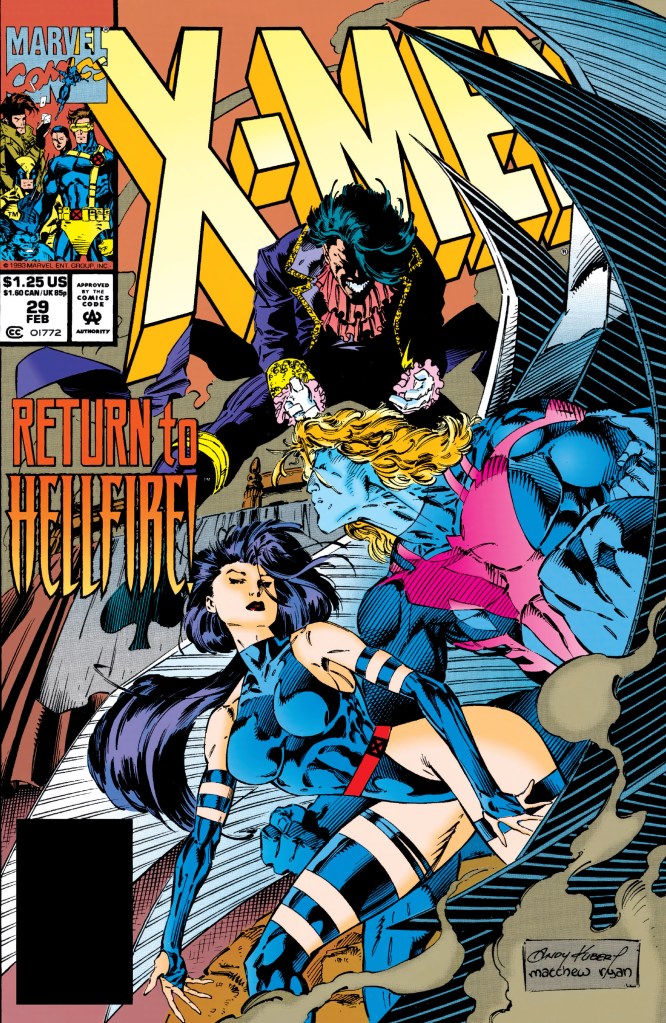
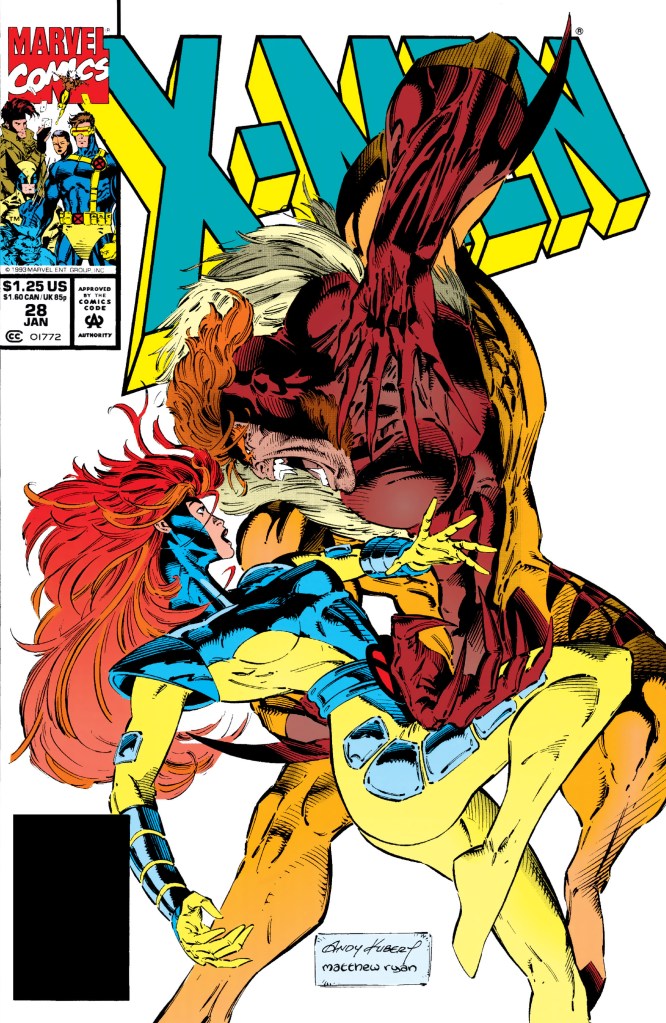
The cover.

Early story

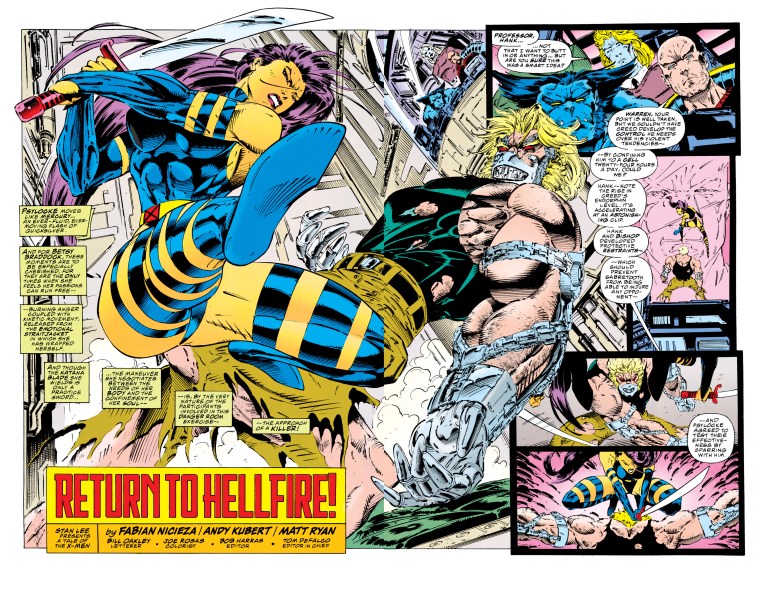
The story begins inside the danger room wherein Psylocke and Sabretooth (wearing cybernetic restraints on his arms as well as a mask) engage in a sparring session while being monitored by Professor X, Warren Worthington/Archangel and Hank McCoy/Beast. Warren expresses concern about the session and Xavier replies by saying that they could not have Sabretooth develop the control he needs over his violent tendencies by having him contained in a cell every day.

After some struggle, Psylocke gains the upper hand and tells Sabretooth that she sparred without using her mutant abilities (solely out of deference to his reduced capabilities caused by the restraints) and insisted she still fought to win.

After the danger room session, Warren leaves and thinks a lot as he takes time out to watch Cyclops and Jean Grey leading the wedding preparations outdoors. Jubilee passes by with lots of mail, hands over to Warren an unusual looking envelope, then leaves. As he opens the envelope, Psylocke arrives hearing Warren talking to himself as he reads the letter. It turns out to be an invitation from the Hellfire Club…

Quality

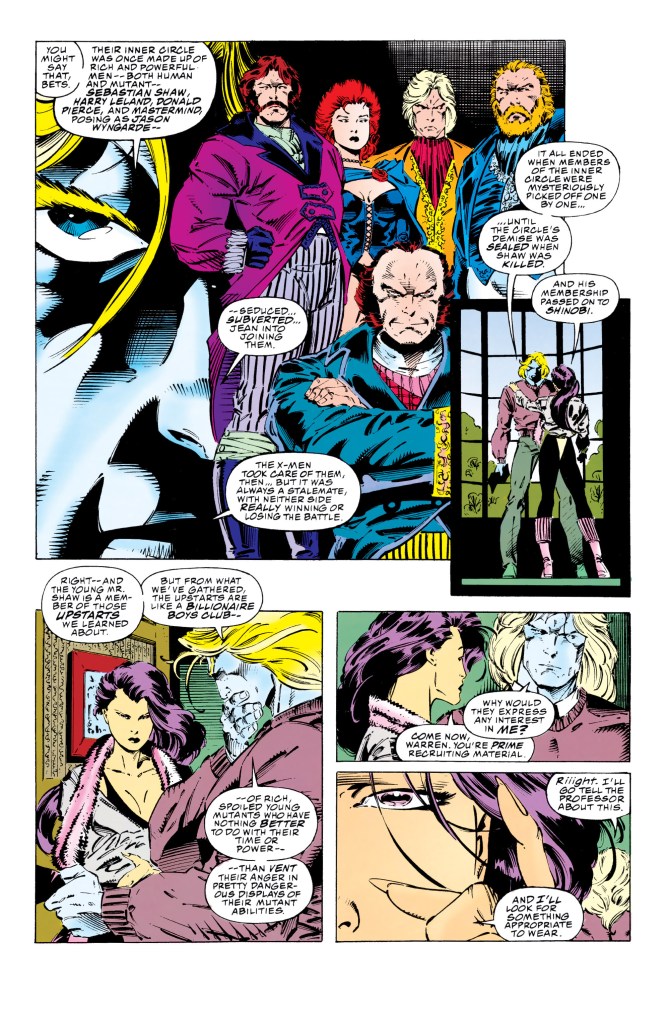
Expository dialogue and details laid down to help readers understand the Hellfire Club.

To put things in perspective, the Hellfire Club within the Marvel Comics universe is a fictional high-class society which became a formidable force of opposition for the X-Men. Their debut during the Dark Phoenix Saga is very memorable and since that time, varied comic books – specifically X-Men comics – revisited the club from time to time.

Within the pages of this particular comic book, the Hellfire Club itself went through some changes in terms of membership and organizational structure kind of similar to the X-Men themselves. In this case, the son of Sebastian Shaw – Shinobi – gains tremendous power and even went as far as revealing to Warren/Archangel his ambitious plan to re-establish the Inner Circle and have the mentioned X-Men member (one of the pioneering students of Charles Xavier) part of it as the White King.

A key element in this story is self-pity which Archangel and Shinobi Shaw both share. For these two, there are key parts of their past that are so hurtful they respectively question their existence and purpose. Quite symbolically, Archangel and Shinobi both have fathers involved with the Hellfire Club and Psylocke herself was familiar with the club’s presence in London. More on Archangel himself, his self-pity really puts him in a very awkward place among the X-Men, especially at a time when he is supposed to be happy for his long-time teammates Jean Grey and Cyclops about to get married.

In a way, X-Men #29 was an inspired attempt to reconnect the past with the contemporary times with the Hellfire Club as the enduring factor. In my opinion, Fabian Nicieza’s work here is solid.

Conclusion

Easily the best-looking images in the comic book. Andy Kubert really rocked with this!

X-Men #29 (1994) is symbolically a quick and yet inspired way of updating readers about the state of the Hellfire Club and hint what potential conflicts they could have with the X-Men of the 1990s. Psylocke and Archangel are the most prominent X-Men members to follow here and they both have past connections with the Hellfire Club which itself is changing as Shinobi Shaw gained power. Its story is pretty intriguing and there is a descent amount of spectacle to be enjoyed. The selling point here is the story concept itself backed with solid writing by Nicieza who seem to have researched the Hellfire Club carefully. Given the legacy behind the X-Men and the fictional club, this comic book will appeal more to long-time fans of the X-Men. Reading this as a first-time discovery of the club will surely challenge newcomers.

If you are seriously planning to buy an existing hard copy of X-Men #29 (1994) be aware that as of this writing, MileHighComics.com shows that the near-mint copy of the regular edition costs $30 while the near-mint copy of the newsstand edition costs $90.

Overall, X-Men #29 (1994) is recommended.

+++++

Thank you for reading. If you find this article engaging, please click the like button below and also please consider sharing this article to others. If you are looking for a copywriter to create content for your special project or business, check out my services and my portfolio. Feel free to contact me with a private message. Also please feel free to visit my Facebook page Author Carlo Carrasco and follow me on Twitter at  @HavenorFantasy as well as on Tumblr at https://carlocarrasco.tumblr.com/

A Look Back at X-Men #28 (1994)

Disclaimer: This is my original work with details sourced from reading the comic book and doing personal research. Anyone who wants to use this article, in part or in whole, needs to secure first my permission and agree to cite me as the source and author. Let it be known that any unauthorized use of this article will constrain the author to pursue the remedies under R.A. No. 8293, the Revised Penal Code, and/or all applicable legal actions under the laws of the Philippines.

Welcome back, superhero enthusiasts, 1990s culture enthusiasts and comic book collectors! Today we revisit the X-Men monthly series of the said decade, specifically on the 28th issue which takes place after the events highlighted by the 30th anniversary the X-Men (read my retro reviews of Uncanny X-Men #304 and X-Men #25), and before the wedding of Scott/Cyclops and Jean Grey (X-Men ).

With those details laid down, here is a look back at X-Men , published by MarvelComics in 1994 with a story written by the Fabian Nicieza and drawn by Andy Kubert.

The cover.

Early story

The story begins with Jubilee running through the woods desperately. She suddenly finds Wolverine on the ground. As she turns, she sees Sabretooth moving directly at her for the kill.

Jubilee suddenly wakes up from her nightmare. Jean arrives to comfort her and gets told that within the nightmare, all the X-Men were killed. Jean telepathically reaches out to Scott, Ororo/Storm and Hank/Beast and calls for an immediate private meeting outside Charles Xavier’s mansion.

Shortly after, Jean, Cyclops, Storm and Beast meet at a local pub to discuss a very questionable move recently made by their leader Charles Xavier…accepting Sabretooth into the mansion as a patient…

Quality

I really liked this scene between Professor X and two of his original X-Men members.

Let me start by confirming that this is one of the best X-Men scripts I have read from Fabian Nicieza as X-Men strongly tackled the issues it raised regarding the disturbing presence of Sabretooth on the established team of mutants. For one thing, it is dramatic to read how Jean Grey, Cyclops, Beast and Storm expressed their opinions about their boss Charles Xavier who decided to take an established animalistic killer like Sabretooth into their shared place of residence. Even though they have high-tech measures to ensure security and containment, Sabretooth is still a constant emotional problem to the X-Men.

The presence of Sabretooth brings to light Xavier’s legacy of bringing Wolverine and Rogue into the X-Men many years prior, as well as sensible questions about the X-Men founder himself. How much impact did Ilyana’s death and Colossus’ departure have on Xavier? Is Xavier losing his sanity since he erased Magneto’s mind? Is Professor X really in control with leading the team while working on several other things at the same time?

More on Sabretooth, apart from being a major disturbance, he was shown to have known Gambit from some time in the past and if you read his dialogue (while in the presence of Rogue and Gambit) closely, the French city of Paris is mentioned and it has something to do with Gambit and Sabretooth’s previous encounter. This was a build-up to a big revelation a few issues later.

Conclusion

Psylocke was no match for Sabretooth.

X-Men (1994) is not your typical good-versus-evil X-Men story but rather a dramatized look at the team feeling very uneasy mainly because of the presence of an animalistic killer within their household. In retrospect, the concept of having Sabretooth in the Xavier mansion is daring and also refreshing as it opened up opportunities for the creative team to explore new dimensions on many of the affected X-Men members. In relation to that, this comic book was published just months after Marvel published a Sabretooth comic book mini-series.

If you are seriously planning to buy an existing hard copy of X-Men (1994) be aware that as of this writing, MileHighComics.com shows that the near-mint copy of the regular edition costs $30 while the near-mint copies of the signed-and-numbered edition and the newsstand edition cost $200 and $90 respectively.

Overall, X-Men (1994) is highly recommended.

+++++

Thank you for reading. If you find this article engaging, please click the like button below and also please consider sharing this article to others. If you are looking for a copywriter to create content for your special project or business, check out my services and my portfolio. Feel free to contact me with a private message. Also please feel free to visit my Facebook page Author Carlo Carrasco and follow me on Twitter at  @HavenorFantasy as well as on Tumblr at https://carlocarrasco.tumblr.com/

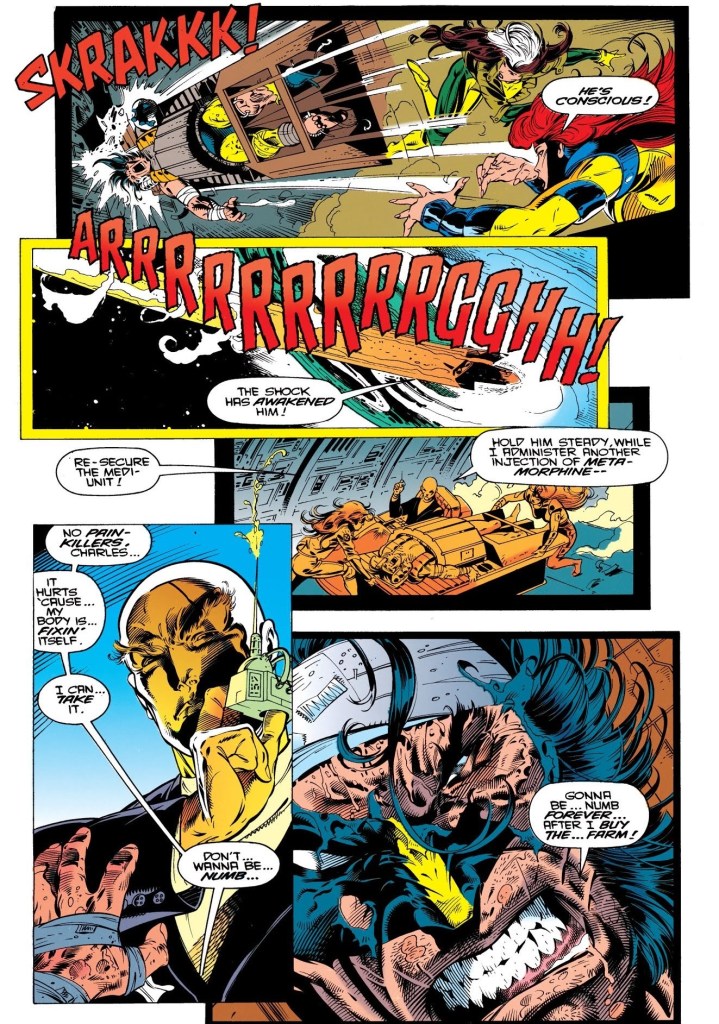
A Look Back at Wolverine #75 (1993)

Disclaimer: This is my original work with details sourced from reading the comic book and doing personal research. Anyone who wants to use this article, in part or in whole, needs to secure first my permission and agree to cite me as the source and author. Let it be known that any unauthorized use of this article will constrain the author to pursue the remedies under R.A. No. 8293, the Revised Penal Code, and/or all applicable legal actions under the laws of the Philippines.

Welcome back, superhero enthusiasts, comic collectors, 1990s culture enthusiasts and fans of the X-Men! We go back to the year 1993 when the 30th anniversary of the X-Men was celebrated with the 6-part Fatal Attractions storyline. Already I reviewed Uncanny X-Men #304 (Part 3) which was not worthy of the X-Men’s 30th anniversary celebration. X-Men #25 (Part 4) meanwhile was not only great but also shocking and had a years-long impact on X-Men comics.

So now the focus is on the 5th chapter of the Fatal Attractions storyline handled by the Larry Hama-Adam Kubert team on the Wolverine monthly series of the time. With those details laid down, here is a look back at Wolverine , published by Marvel Comics in 1993 with a story written by Larry Hama and drawn by Adam Kubert.

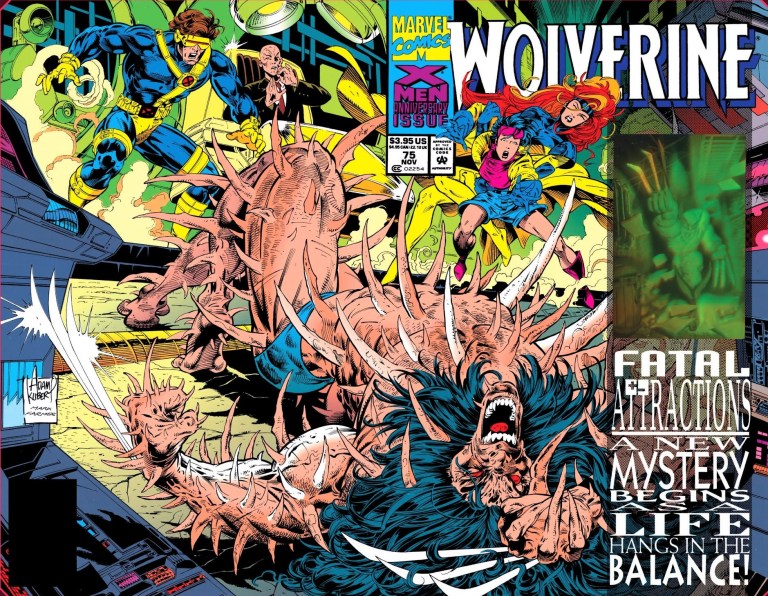
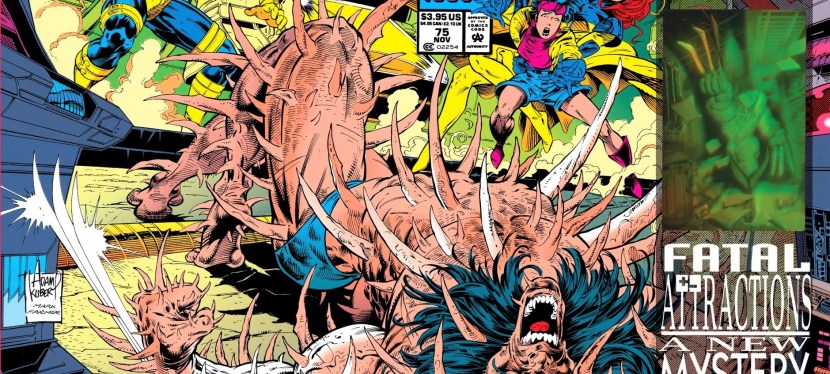
The cover.

Early story

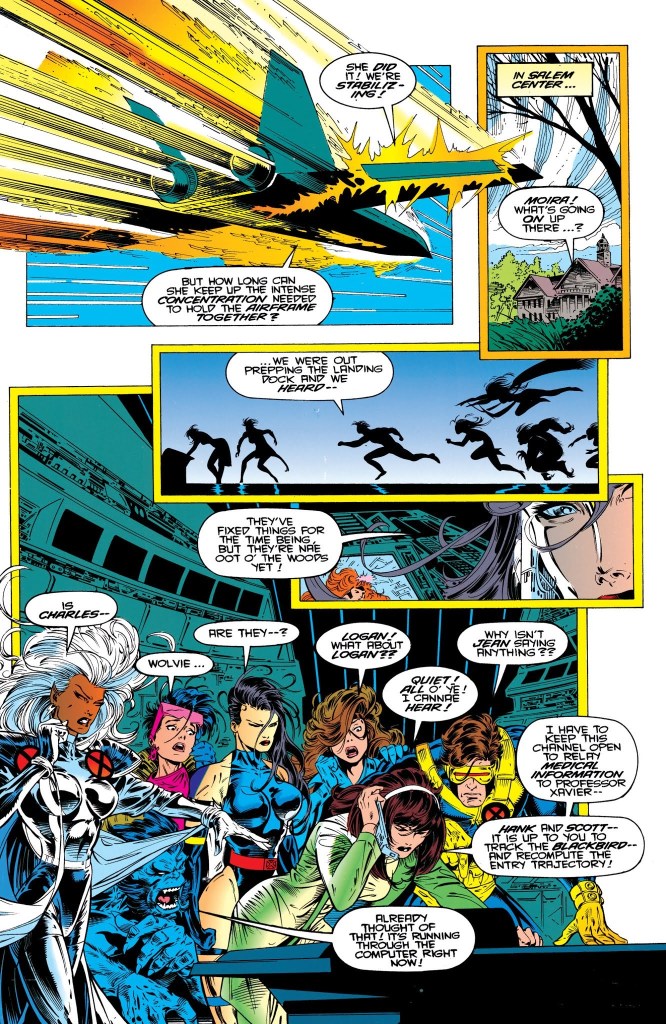
The story begins in outer space. Carrying Charles Xavier, Wolverine, Gambit, Jean Grey, Rogue and Quicksilver (who participated in the dangerous mission in X-Men ), the X-Men’s jet (piloted by Bishop) struggles mechanically as it was not designed for space travel. Worse, Wolverine is under very serious condition and the medical unit has been operating in full capacity dealing with his intense trauma.

In an attempt to alleviate Wolverine’s psychic trauma, Charles Xavier and Jean Grey enter his mind and discover that there is a world full of pain and horror. They see visions of a restrained Wolverine (from his Weapon X days) being attacked by Sabretooth and Lady Deathstrike. Xavier explains that they are at the epicenter of Logan’s most suppressed cataclysmic memories which were clearly triggered by the physical damage Magneto inflicted on him (see X-Men ).

As the X-Men’s jet attempts to enter Earth’s atmosphere, its exteriors heat up dramatically shaking everyone inside. This complicates the situation on stabilizing Wolverine…

Quality

The other X-Men team members at their headquarters expressing worry and concern about the situation of their teammates struggling to come back home from space.

To be clear, this story continues the events of Fatal Attractions but with a bit more focus on Wolverine (compared to the earlier chapters of the storyline that is). There is no real battle between good and evil at all. It’s really all about Wolverine struggling to survive just as his teammates struggle to arrive home.

Before the stories of this comic book and X-Men happened, Wolverine has often been portrayed to be very tough, brave and a walking machine of violence which has been reflected in other X-Men stories told in video games and movies. In this very comic book, Wolverine has been presented to coming close to death. This means Logan, at this particular stage of the history of the literary X-Men, was at his most vulnerable state. In my experience, this was both alienating and shocking to see.

With regards to the writing, Larry Hama did an excellent job with pacing the story from start to finish. Right from the beginning, the story pulls you into the X-Men’s tough situation and as each page gets turned, the tension as well as the suspense builds up until the execution of the climax. Along the way, the comic book not only portrays Wolverine struggling on the edge, it also works to make you care more or be more concerned towards him. Oh yes, the shocking moment near the end of this comic book remains very powerful and you who read this retro review should read Wolverine and see it for yourselves.

Conclusion

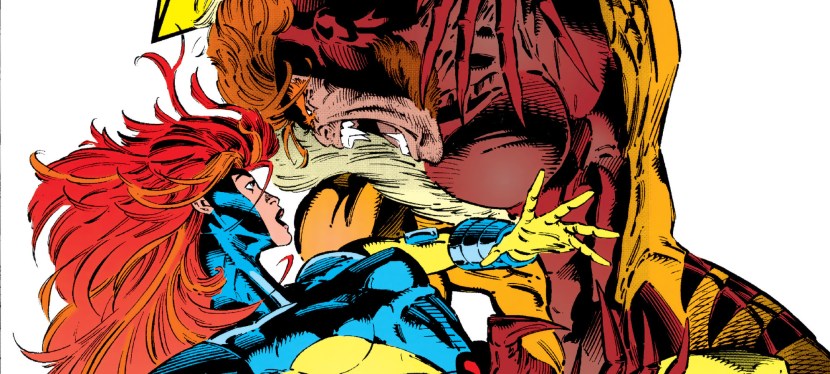
Wolverine at his most vulnerable state.

By today’s standards, Wolverine (1993) is still a very great comic book to read. In fact, I can say it is not only one of most defining chapters of the Fatal Attractions storyline as well as one of the most significant X-Men comic books of the 1990s, it is indeed a true illustrated literature classic ever published by Marvel Comics. In retrospect, this comic book marks a major turning point in the life of Wolverine who is still one of the most iconic characters in all of superhero literature. All of these were achieved thanks to the creative team of Larry Hama and Adam Kubert (whose are here was great and stylized at the same time). Hama succeeded in writing the continuation of the Fatal Attractions storyline while balancing all of the exposition and still putting Wolverine in the center. That itself is a very great work of writing.

If you are seriously planning to buy an existing hard copy of Wolverine (1993), be aware that as of this writing, MileHighComics.com shows that the near-mint copy of the regular edition costs $60 while the near-mint copies of the signed-and-numbered edition and the newsstand edition cost $300 and $180 respectively.

Overall, Wolverine (1993) is highly recommended!

+++++

Thank you for reading. If you find this article engaging, please click the like button below and also please consider sharing this article to others. If you are looking for a copywriter to create content for your special project or business, check out my services and my portfolio. Feel free to contact me as well. Also please feel free to visit my Facebook page Author Carlo Carrasco and follow me at HavenorFantasy@twitter.com
A Look Back at X-Men #5 (1992)

Disclaimer: This is my original work with details sourced from reading the comic book and doing personal research. Anyone who wants to use this article, in part or in whole, needs to secure first my permission and agree to cite me as the source and author. Let it be known that any unauthorized use of this article will constrain the author to pursue the remedies under R.A. No. 8293, the Revised Penal Code, and/or all applicable legal actions under the laws of the Philippines.

Welcome back, superhero enthusiasts, comic book collectors, fans of 1990s culture and fans of Marvel Comics! Today we revisit the adjective-less X-Men monthly series (Volume 2) that started in 1991 with the combined talents of Chris Claremont and Jim Lee. For those who are unaware, Chris Claremont had his conflict behind the scenes with then X-Men comics editor Bob Harras which led to him departing the X-Men series with issue #3.

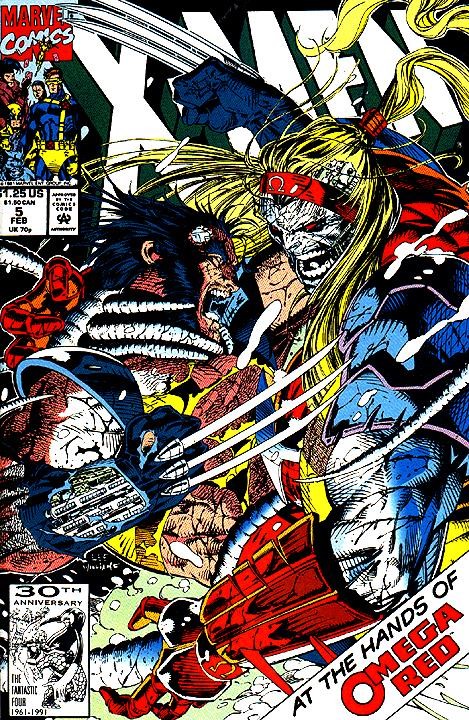
Previously I reviewed X-Men #4 which by today’s standards is highly significant and very expensive to acquire as it marked the literary debut of Omega Red who made quite an impact with X-Men fans. It should be noted that Wolverine and Omega Red had encountered each other far back in time and issue marked the renewal of their rivalry.

With those details laid down, here is a look back at X-Men , published in 1992 by Marvel Comics with a story written by Jim Lee (plot) and John Byrne (script), The art was done by Lee with ink work done by Scott Williams, Art Thibert, Bob Wiacek and Joe Rubinstein.

The cover.

Early story

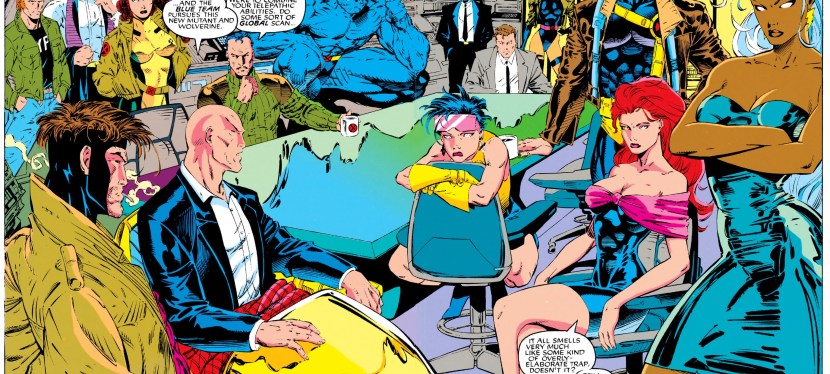
This for me is the money shot of the comic book. Although Wolverine is absent, you get to see the entire Blue and Gold teams with Charles Xavier as drawn by Jim Lee.

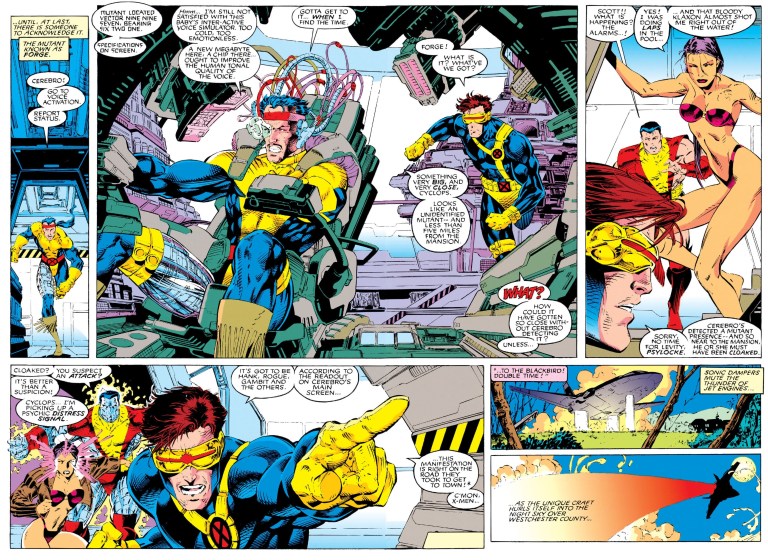
The story begins with Cerebro detecting an unidentified mutant signature in the presence of X-Men members who were out of the mansion. Forge tells Cyclops about the disturbance happening less than five miles away from their mansion. Colossus and Psylocke join in and quickly they leave the mansion with Cyclops using the Blackbird.

Not too far away, Gambit, Rogue, Jubilee and Beast are held captive inside a vehicle with an armed man in their presence. Gambit starts the effort to free his teammates using one of his charged cards.

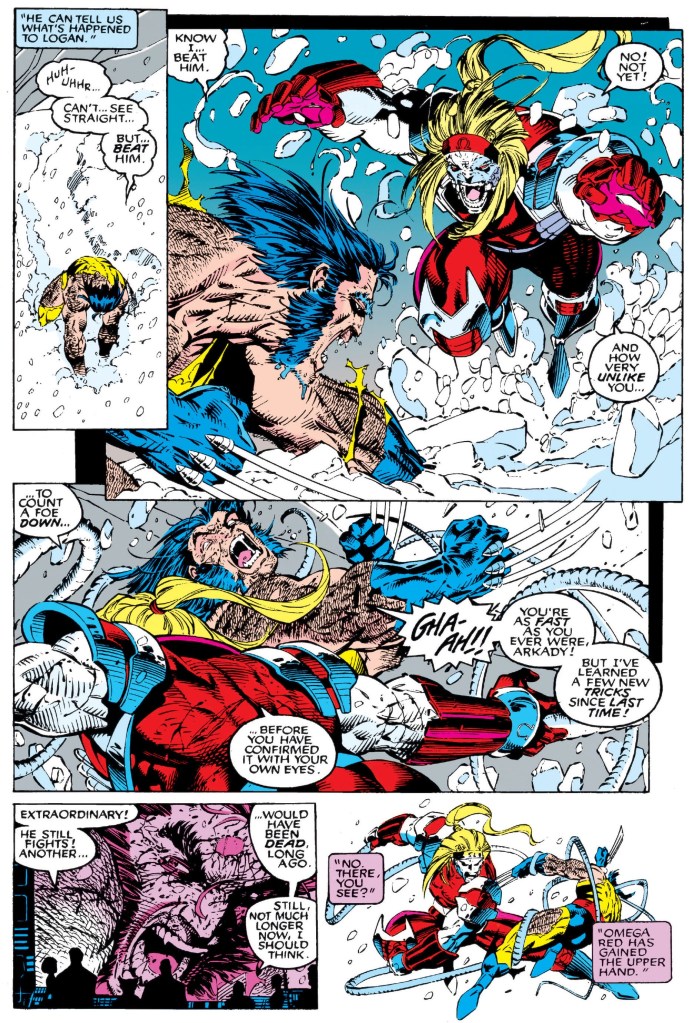
Elsewhere in a snowy place, Wolverine is seen struggling thinking he defeated his old rival Omega Red. Suddenly the Russian mutant jumped at him and the two resumed fighting. Their fight is being monitored from a distance…

Quality

The Wolverine-Omega Red rivalry is a must-see.

When it comes to storytelling, it is obvious that the writing duo of Jim Lee and John Byrne did their best to push the envelope and break new ground as far as telling an X-Men story goes. For one thing, there is the presence of paramilitary elements which are common with Jim Lee’s creations. There are even flashbacks into the past in which Wolverine (then called Logan) actually took part in a special forces operation with a few notable others. These flashbacks expands further the personal history of Wolverine in a really intriguing way. With the way the story was presented, it is clear that the new creative team pulled off serious moves in modernizing the way X-Men stories were told in comparison to the way Chris Claremont told all those many such stories during his long run.

When it comes to the visuals, Jim Lee did another great job as each page looks great and he proved to be clever with the way he visualized the script. As this comic book was inked by more than one inker, there were subtle differences with regards to contrast as well as ink intensity.

Conclusion

Cyclops and his teammates move out.

X-Men (1992) is another great comic book that involved Jim Lee’s art. Apart from the modernizing of the storytelling, this comic book further expanded the past of Wolverine while successfully giving readers more of Omega Red who is now a major supervillain of Marvel’s.

If you are seriously planning to buy an existing hard copy of X-Men (1992), be aware that as of this writing, MileHighComics.com shows that the near-mint copy of the regular edition costs $27 while the near-mint copy of the newsstand edition costs $79.

Overall, X-Men (1992) is highly recommended!

+++++

Thank you for reading. If you find this article engaging, please click the like button below and also please consider sharing this article to others. If you are looking for a copywriter to create content for your special project or business, check out my services and my portfolio. Feel free to contact me as well. Also please feel free to visit my Facebook page Author Carlo Carrasco and follow me at HavenorFantasy@twitter.com