Retro Gaming Ads Blast – Part 13

Welcome back readers, fellow geeks and electronic gaming fans!

In this edition of the Retro Gaming Ads Blast (RGAB) series, we will take a look at another batch of retro gaming print ads from the 1980s and 1990s. In addition, there will be a few flyers of arcade games.

For the newcomers reading this, Retro Gaming Ads Blast (RGAB) looks back at the many print ads of games (console, arcade, computer and handheld) that were published in comic books, magazines, flyers and newspapers long before smartphones, social media, the worldwide web and streaming became popular. To put things in perspective, people back in the 1980s and 1990s were more trusting of print media for information and images about electronic games and related products.

With those details laid down, here is the newest batch of retro gaming print ads for you to see and enjoy…

1. Japanese Contra arcade flyer

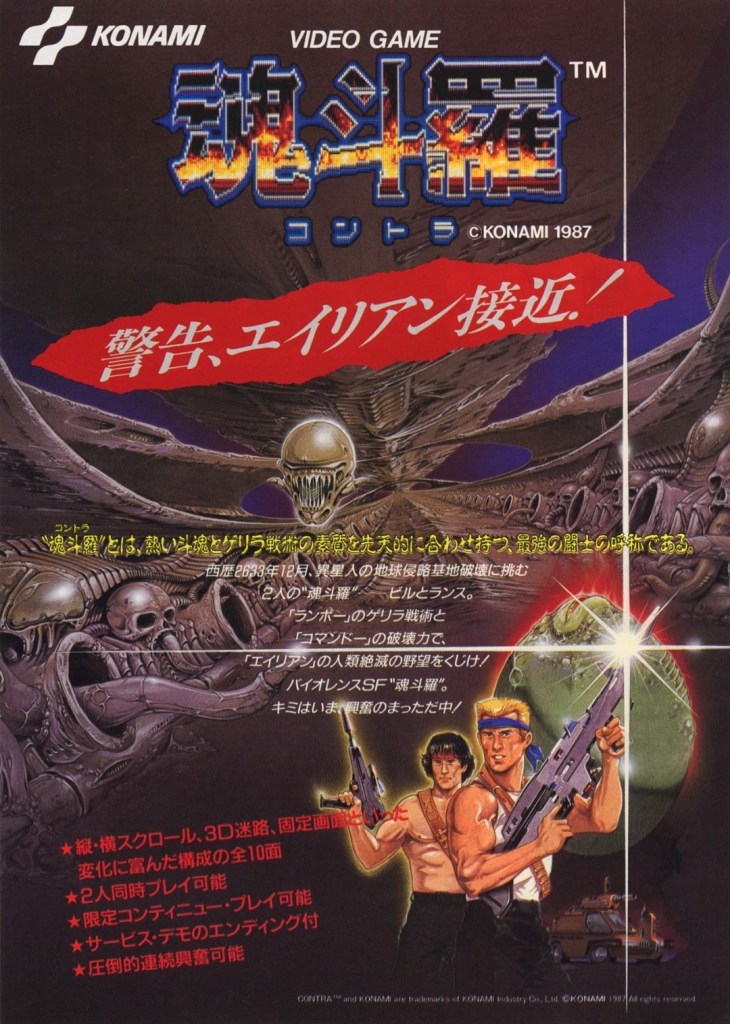
The front of the Japanese arcade flyer of Contra.
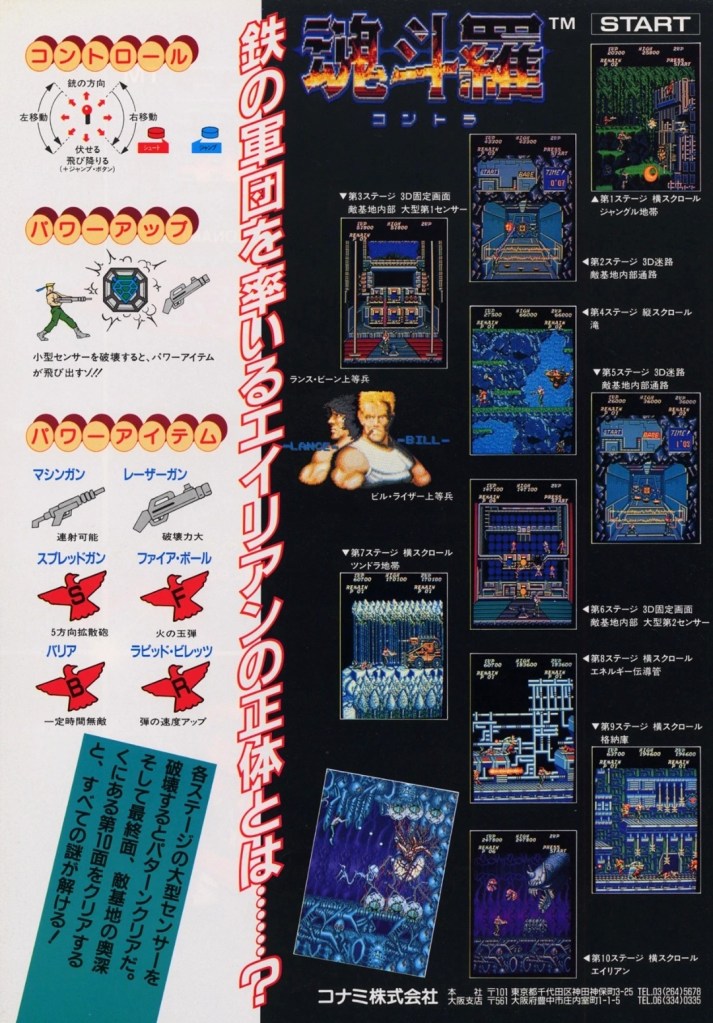
The other side of the flyer.

As mentioned before, Konami’s long-running Contra games franchise first started in the arcades in Japan. As seen in the Japanese arcade flyer, it was clear that the company not only had a clear vision of Contra’s visual concepts but also was pretty organized with explaining lots of details (examples: the 8-direction controls, types of weapons or ammunition available, level design differences) that both players and arcade operators can learn from. If you look closely at the rear of the flyer, you will see the two characters already identified as Lance and Bill which clearly showed the Japanese creators had the creative details really organized.

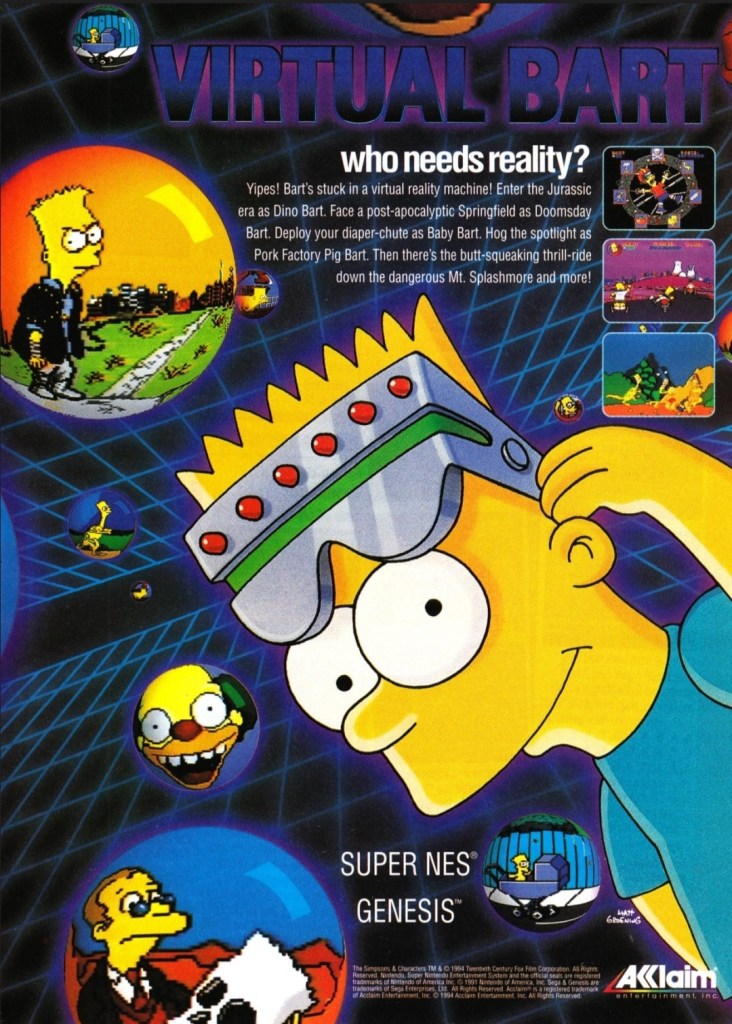
2. Virtual Bart print ad

Anyone who loved The Simpsons would easily recognize the characters of this print ad.

Decades ago, The Simpsons made big waves on television and quickly emerged as a fine addition to American pop culture. That being said, it was not surprising at all that video games based on the show got made and Virtual Bart was one of them. This Virtual Bart print ad appeared in some comic books I read in 1994 and the ad makers made efficient use of the single-page layout showing that the game was not a mere 2D side-scroller as its concept emphasized Bart Simpson’s virtual reality escapades. This game, which had mini-games and different gameplay styles, received review scores ranging from negative to positive.

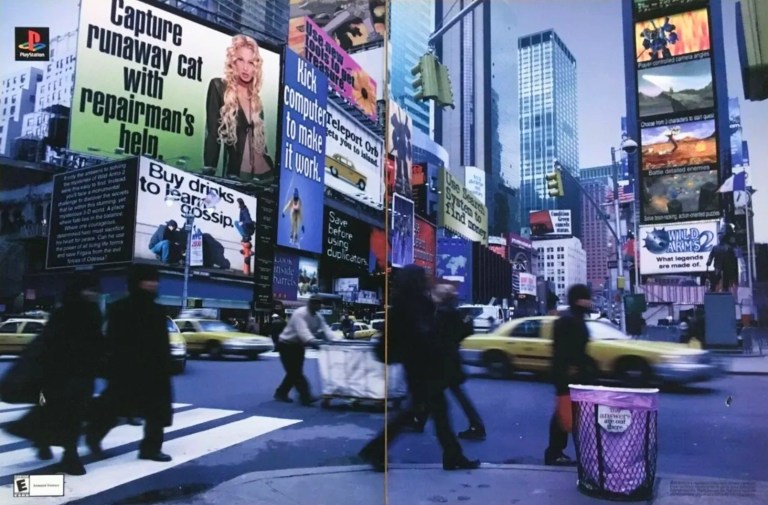
3. Wild Arms 2 print ad

This is NOT an effective way to promote a video game.

Now this is one of the most weird and the most uninteresting game print ads of the 1990s. For the newcomers reading this, Wild Arms 2 was a sequel to the 1997 hit game Wild Arms released on the original PlayStation console. Due to the 1997 game’s success, a fan base of Wild Arms was established and the 1999 sequel was anticipated by the fans. In a very odd and illogical move, Sony Computer Entertainment came up with the Times Square setting for Wild Arms 2’s North American print ad and because they allowed so much other text and images (appearing as billboard ads) on the buildings in the background, details about the game itself got overshadowed. By simply looking at this print ad, it is simply too easy to overlook Wild Arms 2 as the featured game. Can you see the references to Wild Arms 2 here?

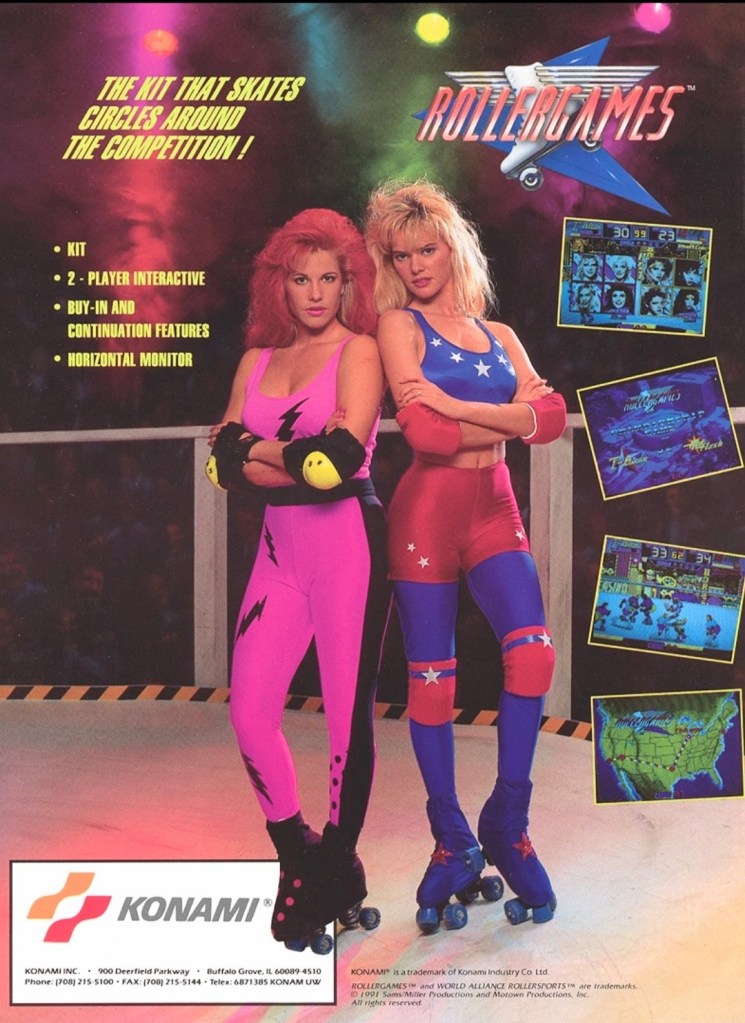
4. RollerGames arcade flyer

Pretty ladies posing on the front of the flyer.
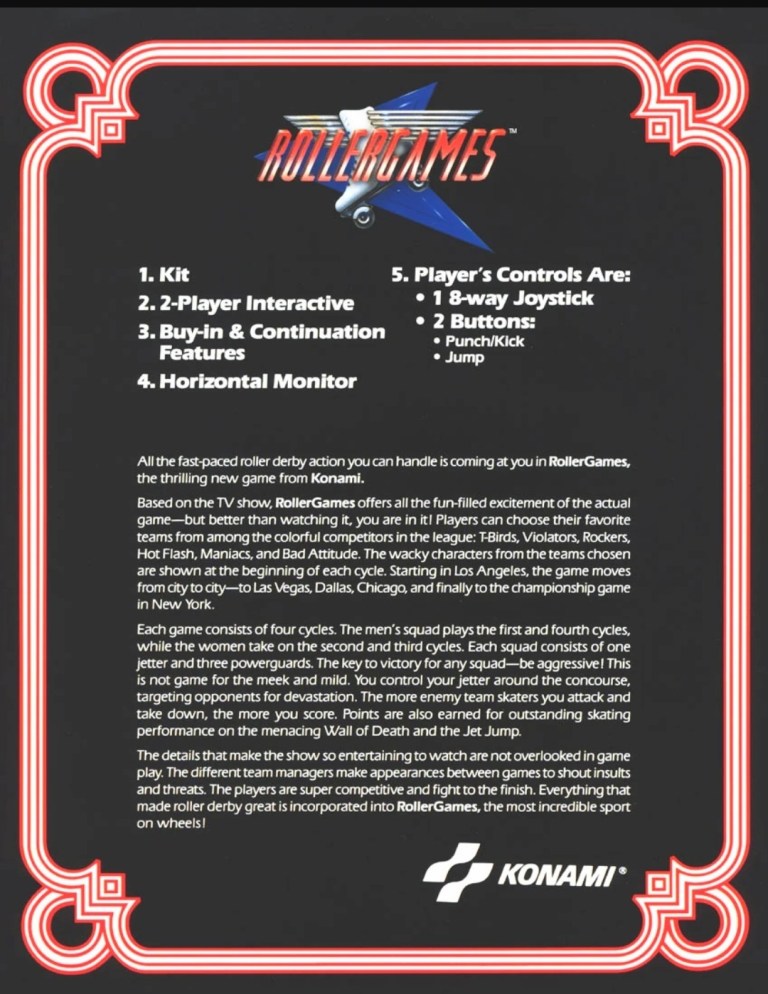
Clearly the details were prepared with arcade operators in mind.

Based on the competition-oriented TV show, the RollerGames arcade game from Konami was both unique and fun to play. As with their other arcade flyers, Konami hired models to emphasize RollerGames’ core concept by appearing in full costume (as roller-skating participants), and then inserted screenshots of the game. The rear of the flyer had the technical details in simplistic fashion and they were clearly written with arcade operators in mind. The 3-paragraph text descriptions emphasized what players could expect, what options are available and how the game connects with the TV program it was based on.

5. The Jetsons: Invasion of the Planet Pirates print ad

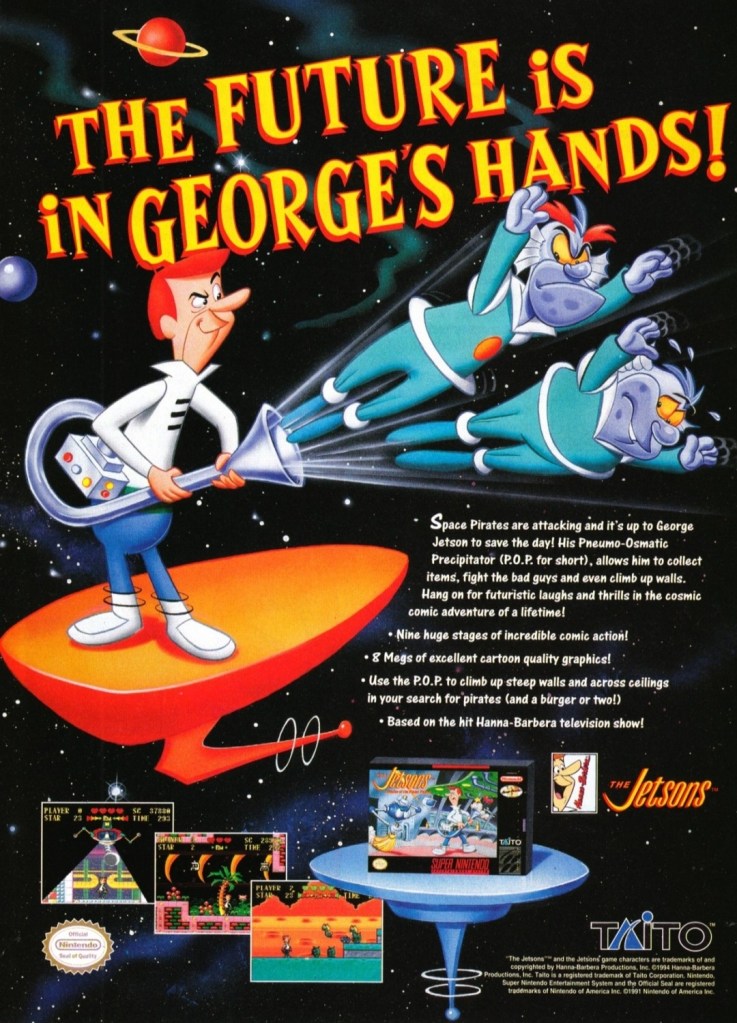
Anyone among you is a Jetsons fan?

Based on the animated series, The Jetsons: Invasion of the Planet Pirates was released on the Super Nintendo Entertainment System (SNES) in America as well as on the Super Famicom in Japan in the mid-1990s. This game’s print ad had eye-catching artwork, carefully laid down key details (including the promise of cartoon quality graphics) and showed a few screenshots. The game attracted mixed reviews from critics and I don’t know any fellow gamer who played it.

6. Sega Saturn games print ad

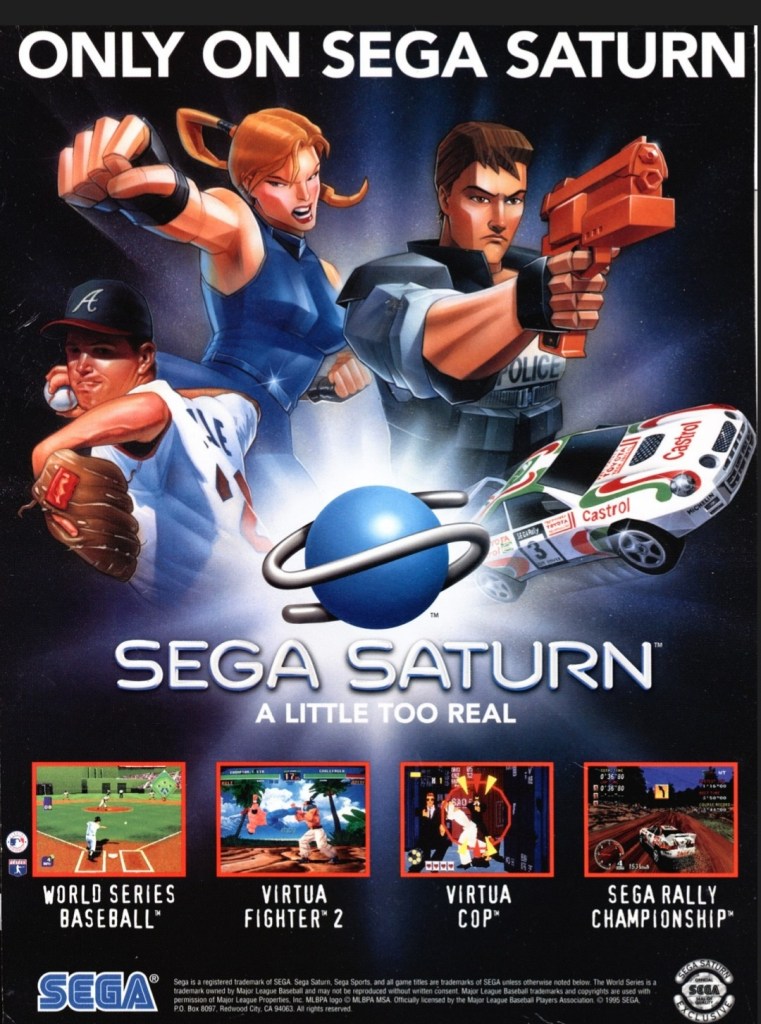
An aggressive single-page ad promoting the exclusive games on Sega Saturn.

If you are a game console manufacturer that also owns several game development teams, you really have to promote your hardware and software aggressively. This is exactly what Sega did in the North American market sometime after the embarrassing launch of the Saturn console there. As seen in this print ad, Sega aggressively promoted their Saturn-exclusive games – including their juggernaut Virtua Fighter 2 – to make it clear to their fans (and Saturn console owners) that they are focused to entertain them. The ad also served as Sega’s effort to lure in new gamers and potential Saturn owners given the fact that Virtua Fighter 2, Virtua Cop and Sega Rally Championship were already big arcade hits. As history turned out, the Saturn ended up a commercial disappointment in America but still succeeded in Japan.

7. Galaxian arcade flyer

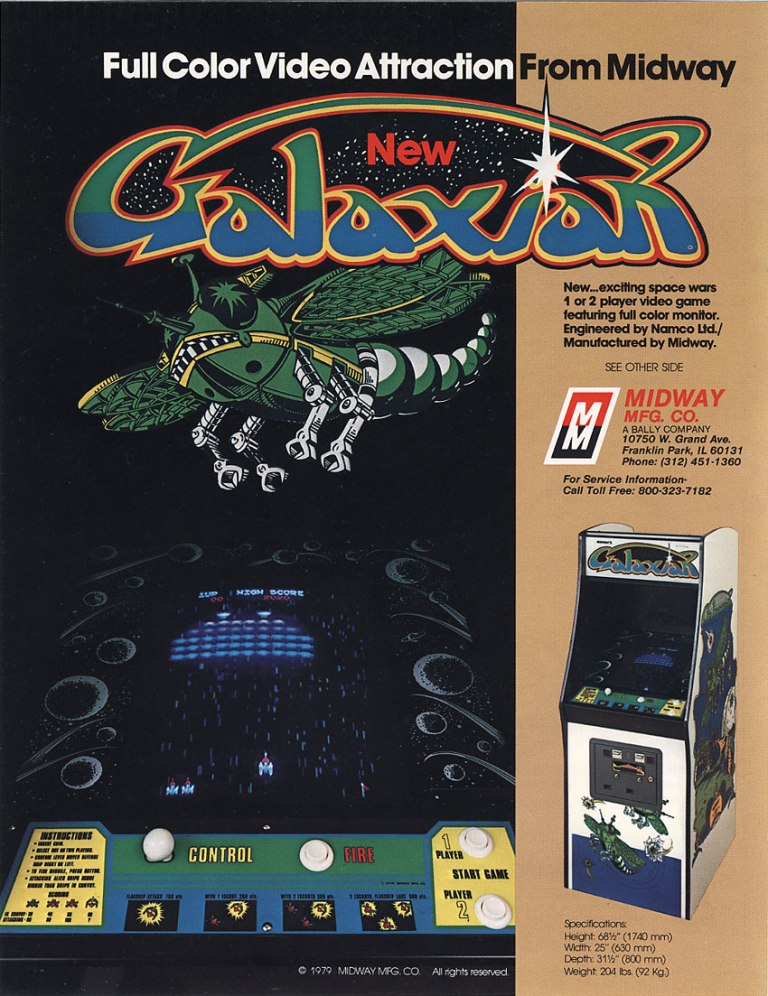
Have you ever played Galaxian in the arcades?

In September 1979, Namco released Galaxian in the arcades in Japan and it became a big hit there eventually finishing as the nation’s 2nd highest-earning arcade game of the year. Before the year even ended, Namco approached Midway of releasing Galaxian outside of Japan and this led to the game appearing in American arcades in November. Unsurprisingly, Galaxian drew lots of American players and their money which really helped Midway selling 50,000 arcade units in a few years’ time. This arcade flyer from Midway clearly showed what the Galaxian arcade unit looked like and how the controls were physically set up. I like the way the details and images were organized and how the limited page space was put to good use.

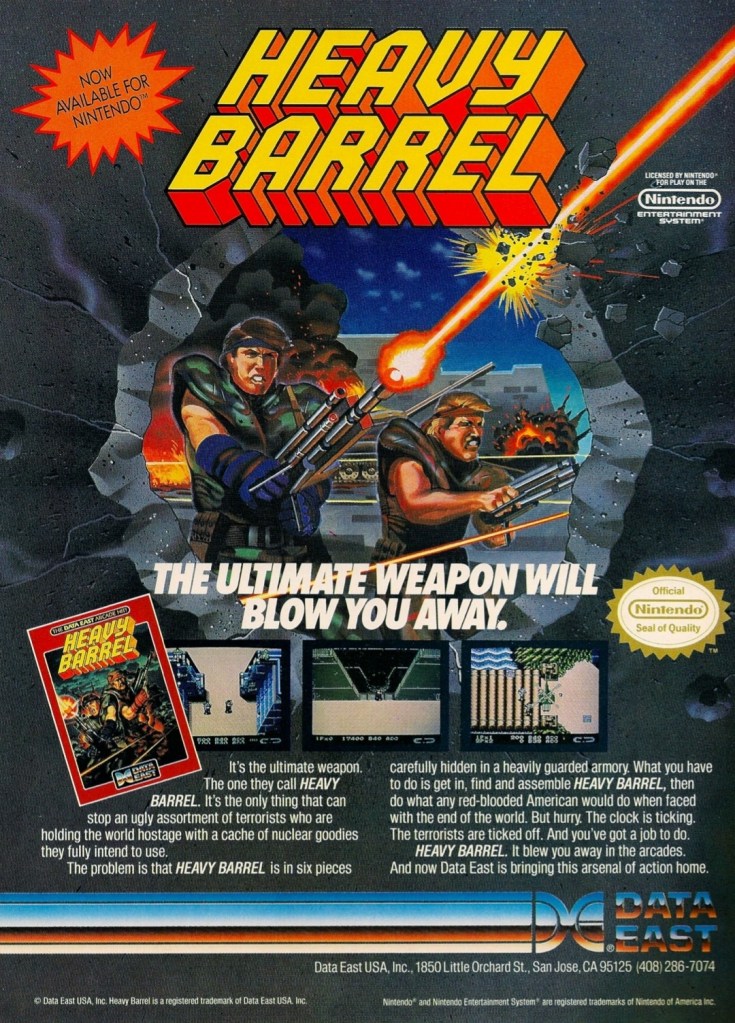
8. Heavy Barrel print ad

A really eye-catching and amusing print ad to look at.

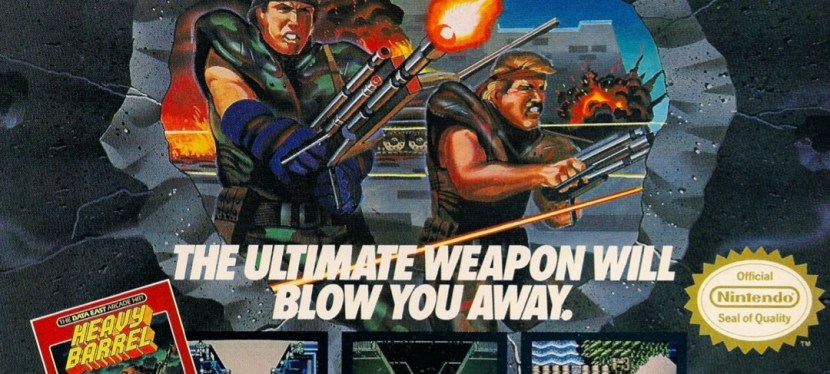
Originally released in the arcades by Data East, Heavy Barrel was released on the Nintendo Entertainment System (NES) in 1990. Similar with Contra and Jackal, this game had a strong military theme and shooting-oriented gameplay complete with missions that instantly reminded players about war. The military aesthetic and the showing of guns are easily the most eye-catching part of this print ad geared towards the NES userbase which had lots of young children among the players. To say the least, Heavy Barrel’s print ad was entertaining to look at.

+++++

Thank you for reading. If you find this article engaging, please click the like button below, share this article to others and also please consider making a donation to support my publishing. If you are looking for a copywriter to create content for your special project or business, check out my services and my portfolio. Feel free to contact me with a private message. Also please feel free to visit my Facebook page Author Carlo Carrasco and follow me on Twitter at  @HavenorFantasy as well as on Tumblr at https://carlocarrasco.tumblr.com/ and on Instagram at https://www.instagram.com/authorcarlocarrasco
Retro Gaming Ads Blast – Part 12

Welcome back readers, fellow geeks and electronic gaming fans!

In this edition of the Retro Gaming Ads Blast (RGAB) series, we will take a look at another batch of retro gaming print ads from the 1980s and 1990s. In addition, there will be a few flyers of arcade games.

For the newcomers reading this, Retro Gaming Ads Blast (RGAB) looks back at the many print ads of games (console, arcade, computer and handheld) that were published in comic books, magazines, flyers and newspapers long before smartphones, social media, the worldwide web and streaming became popular. To put things in perspective, people back in the 1980s and 1990s were more trusting of print media for information and images about electronic games and related products.

With those details laid down, here is the newest batch of retro gaming print ads for you to see and enjoy…

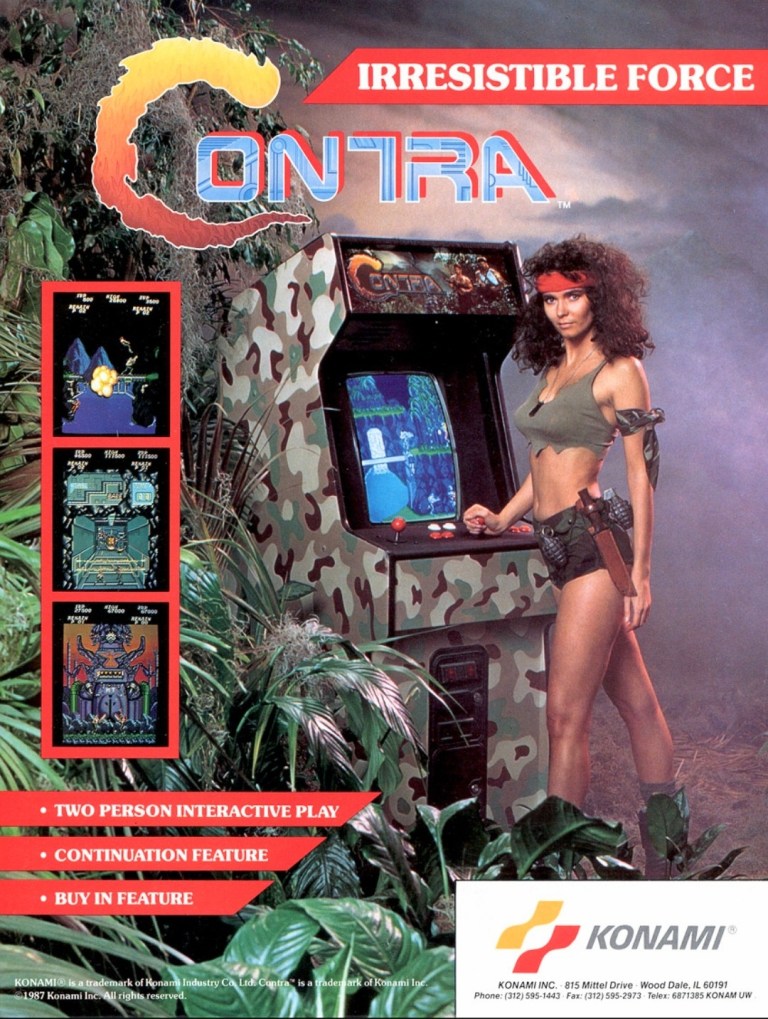
1. Contra arcade flyer

A clever visual concept by Konami towards gamers and arcade operators.
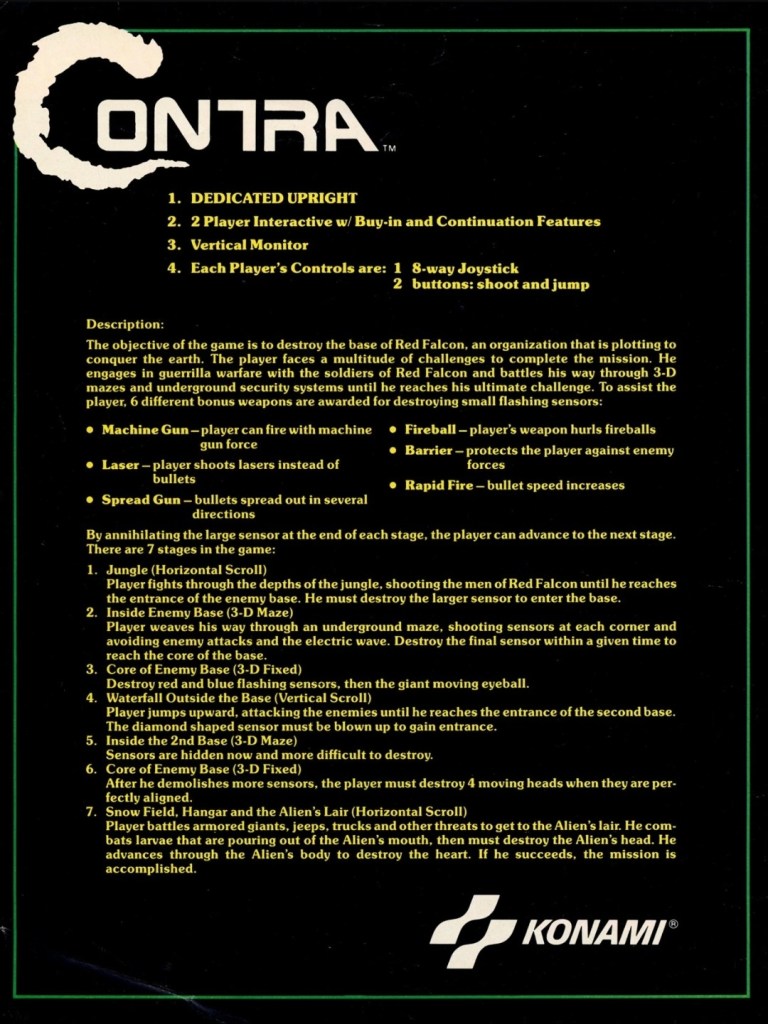
Details on the other side of the flyer.

Before it established itself as a popular gaming franchise with console gamers, Contra truly started in the arcades in 1987. First released in Japan on February 1987, Konami went on to release the game in arcades in the United States a month later and the flyer you see here was the Americanized promotion they came up with. Instead of hiring male actors or models to play soldiers, they hired a slim lady to appear with a female Rambo look standing in front of a Contra arcade machine. On the other side of the flyer are details that players and arcade operators can learn from. By today’s standards, this arcade flyer of Contra is still eye-catching and even amusing to look at.

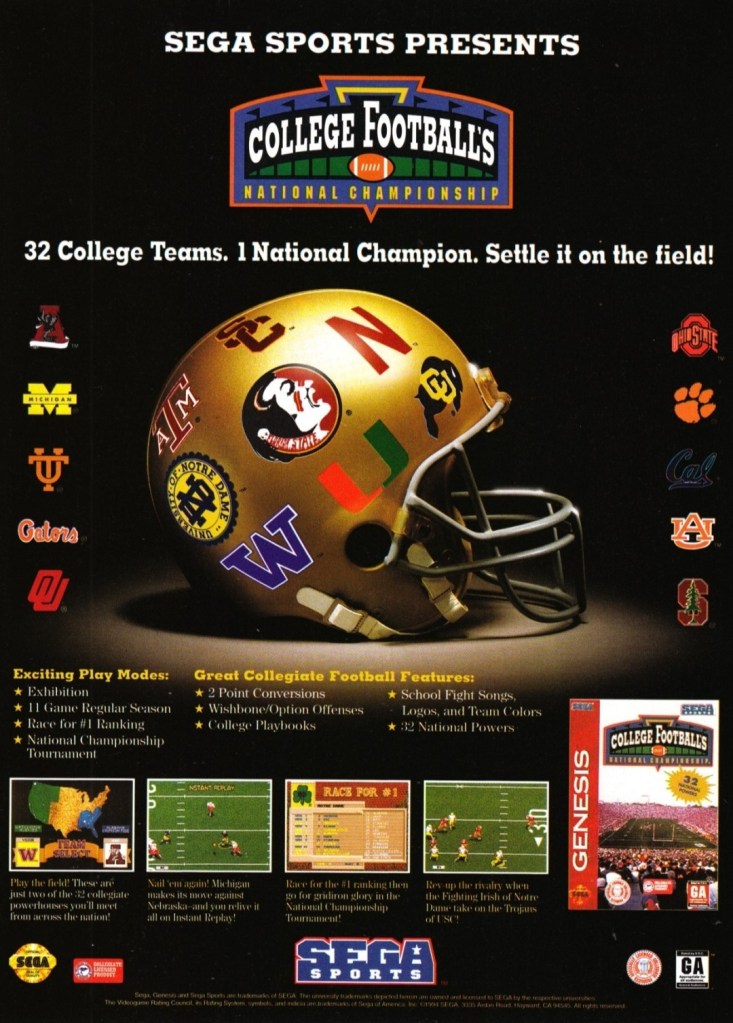
2. College Football’s National Championship print ad

This ad has a strong visual appeal to gamers who like football.

This is another one of those video game ads I saw while reading comic books in the 1990s. College Football’s National Championship was a Sega Genesis-exclusive American football video game published by Sega (with the Sega Sports brand) to capitalize on gamers who want college football to play with at home. This print ad has a nice visual presentation of the college teams’ logos, screenshots and details of what gamers could expect when they buy and play the game. College Football’s National Championship received mostly positive reviews and it must have sold well because Sega went on to release a sequel to this game.

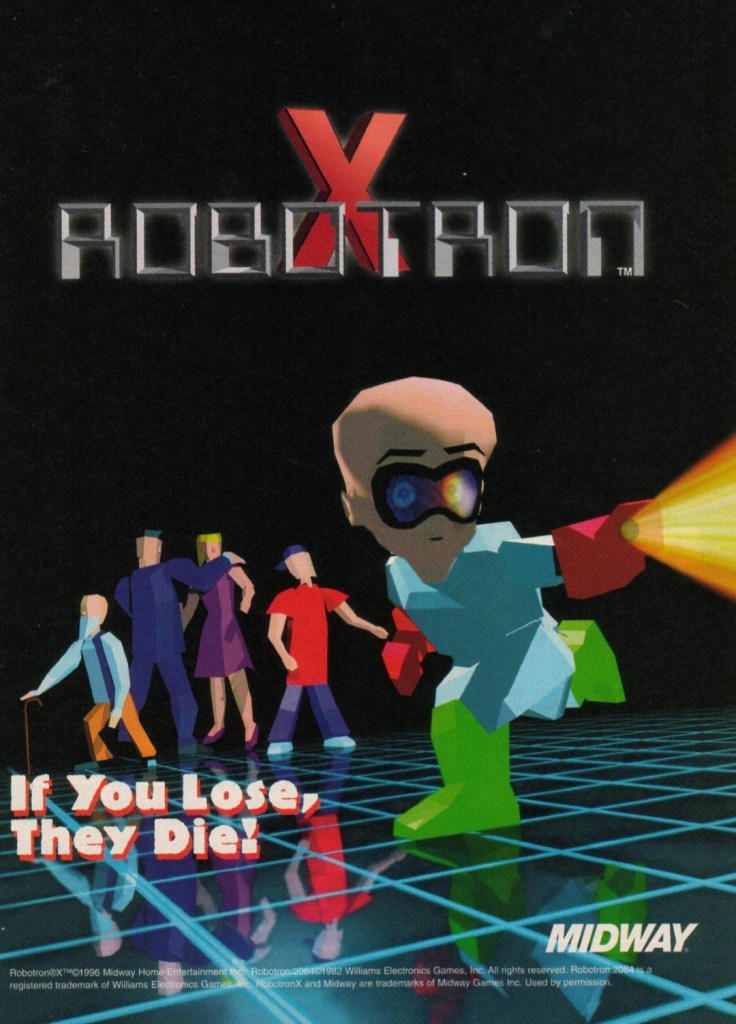
3. Robotron X print ad

This Robotron game was made at a time when 3D polygons became common for making video games.

Having played the classic game Robotron: 2084 on PC back in the 1980s, I was very surprised to see this print ad in 1996 promoting a brand new Robotron game for PlayStation as well as Windows PC. For the newcomers reading this, Robotron: 2084 was a classic which heavily influenced game designers who went on make other fan-favorite games like Smash TV and Llamatron. What makes Robotron X notable apart from being an official follow-up to the classic game was the fact that it was made at a time when game developers did their stuff to modernize gaming with 3D polygons for visuals while trying to come up with gameplay inspired by the classics. While Robotron X did not make a major impact on gaming, the classic Robotron: 2084 went on to be released in several multi-platform compilations such as Williams Arcade’s Greatest Hits, Midway’s Greatest Arcade Hits, and Midway Arcade Treasures.

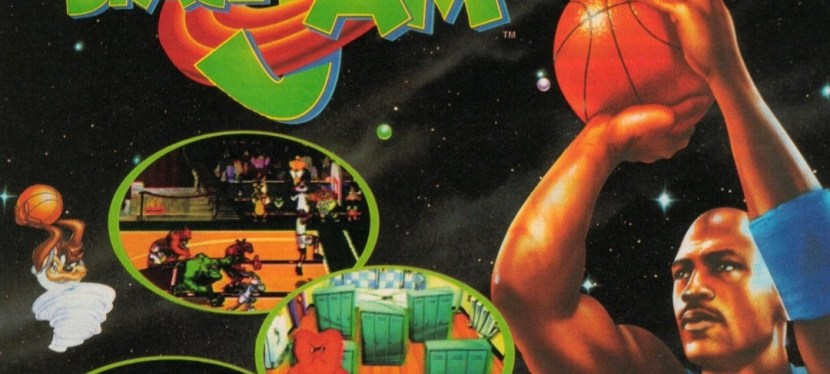
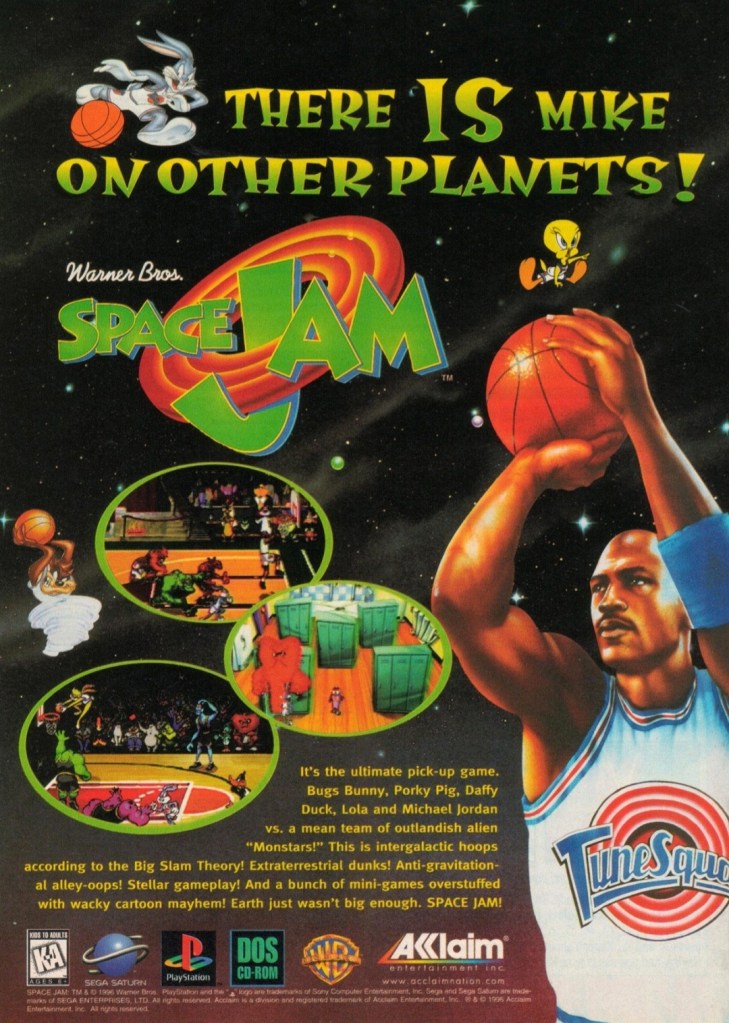
4. Space Jam game print ad

If you saw the movie in 1996, were you able to play this video game adaptation?

What makes 1996 a memorable year for basketball fans was the Michael Jordan’s return to prominence (having previously retired for less than two years before returning to the NBA in 1995) and leading a very powerful Chicago Bulls team to what was their 4th NBA championship title. In that same year, Jordan starred in the live-action/animated movie Space Jam which grossed an impressive $250 million worldwide. On the same month the movie came out, the Space Jam video game adaptation was also released on PlayStation and Sega Saturn. This print ad was part of the multimedia hype of the movie and the game itself had a very similar design and visuals concept with NBA Jam but ultimately it failed to become a hit with critics and gamers. Not even the combined visual might of Jordan and Warner Bros. characters could achieve success.  

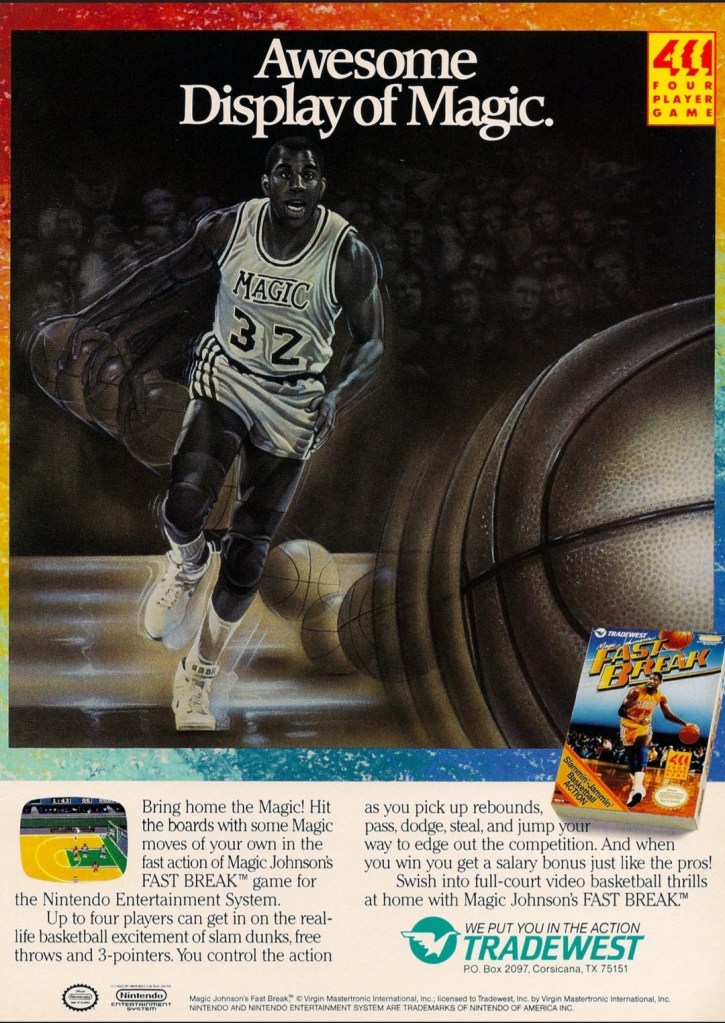
5. Magic Johnson’s Fast Break print ad

Still on basketball video gaming, the side-scrolling Magic Johnson’s Fast Break game was released on the Nintendo Entertainment System (NES) for console gamers to enjoy. Unsurprisingly, this ad had nice black-and-white art work of Magic Johnson as the dominant figure while leaving little space left to show the game box and only one screenshot. The real meat of this print ad are the details laid down in text description.

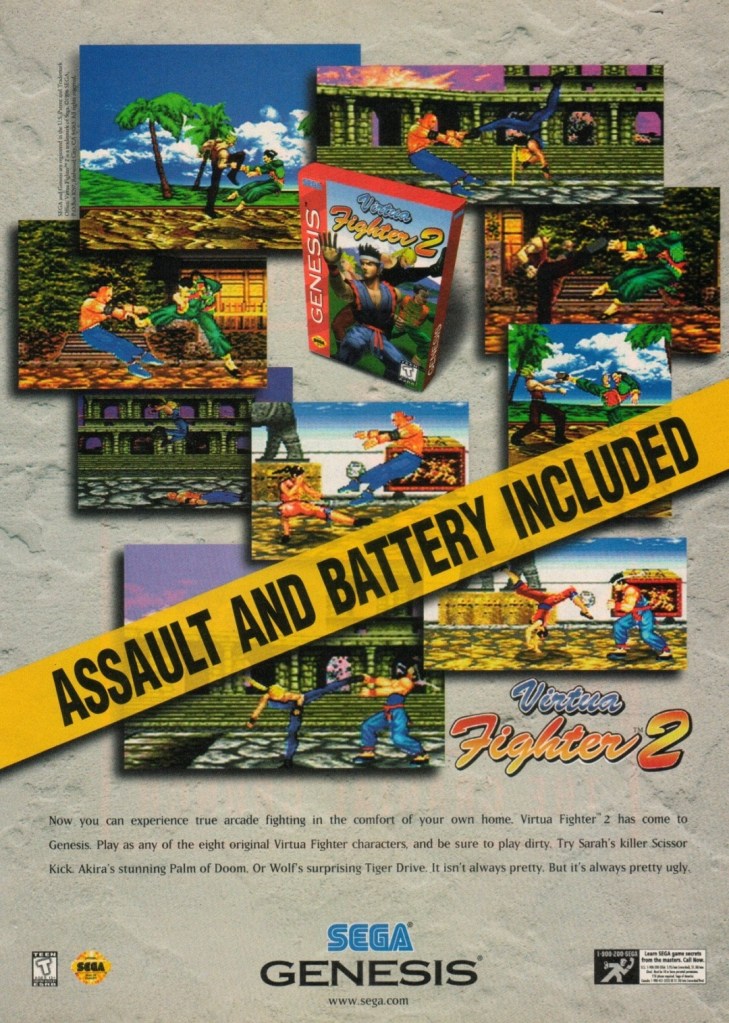
6. Virtua Fighter 2 for Sega Genesis print ad

Clearly a late effort by Sega to sell something to its many Genesis owners/fans in America at a time when PlayStation and Nintendo 64 started dominating 5th console generation sales.

In the history of arcade gaming and fighting games, Virtua Fighter 2 was a worthy follow-up to its groundbreaking predecessor. VF2 also made its way on the Sega Saturn which essentially maintained the great gameplay and 60 frames-per-second animation even though the 3D polygonal graphics were noticeably lower in quality compared to its arcade version. With VF2 in the arcades and on Saturn selling well, I was surprised to see this print ad of Sega releasing a totally different version of the game on the aging Sega Genesis console. Virtua Fighter 2 on Genesis had 2D graphics, sprites for the characters and a side-scrolling visual design. In fairness, the game developers exerted effort to recapture some of the gameplay elements within the Genesis limitations and 2D graphics. This print ad is a reminder of Sega’s American division selling a product to the remaining active Genesis owners.

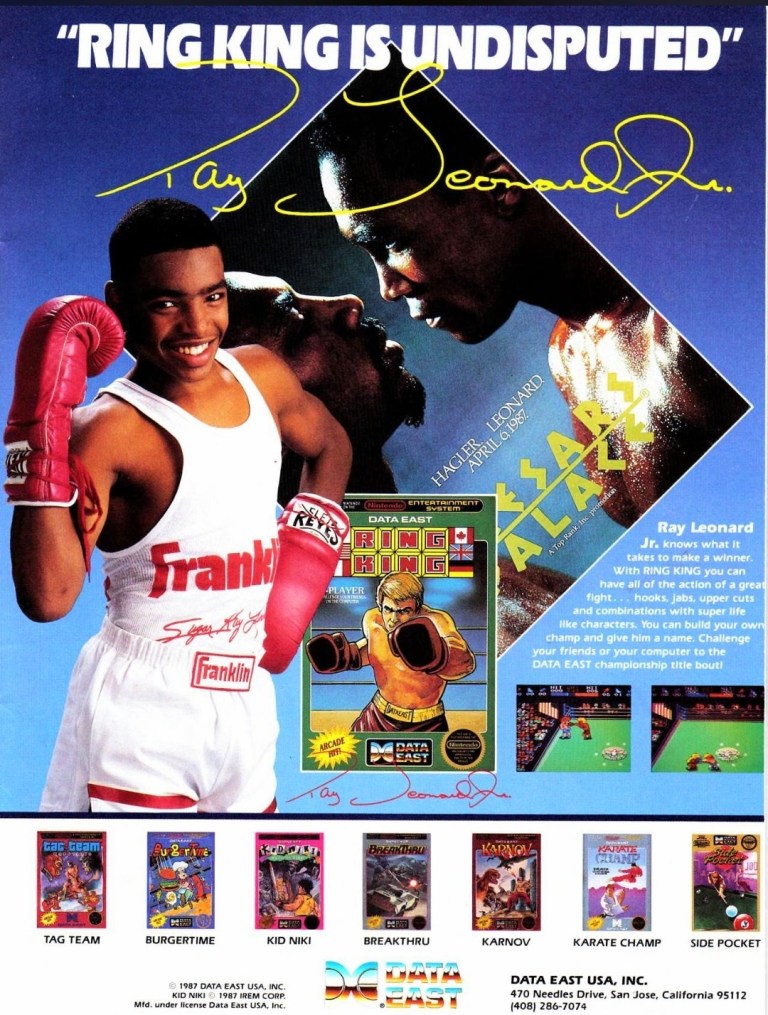
7. Ring King print ad

Ring King itself clearly lacked promotional space in this ad.

In 1987, Data East released their arcade hit game Ring King on the Nintendo Entertainment System (NES) and prepared this print ad involving Ray Leonard, Jr. (on the foreground in boxing gear) and conveniently with the famous Sugar Ray Leonard and Thomas Hearns (with the promo of their first fight together in the background). Also conveniently, the company inserted their other games on the lowest part of the ad. Ultimately, the presence of Ring King itself was minimized only showing the game cover and two screenshots. This is clearly an eye-catching ad but there was not enough emphasis on the game itself.

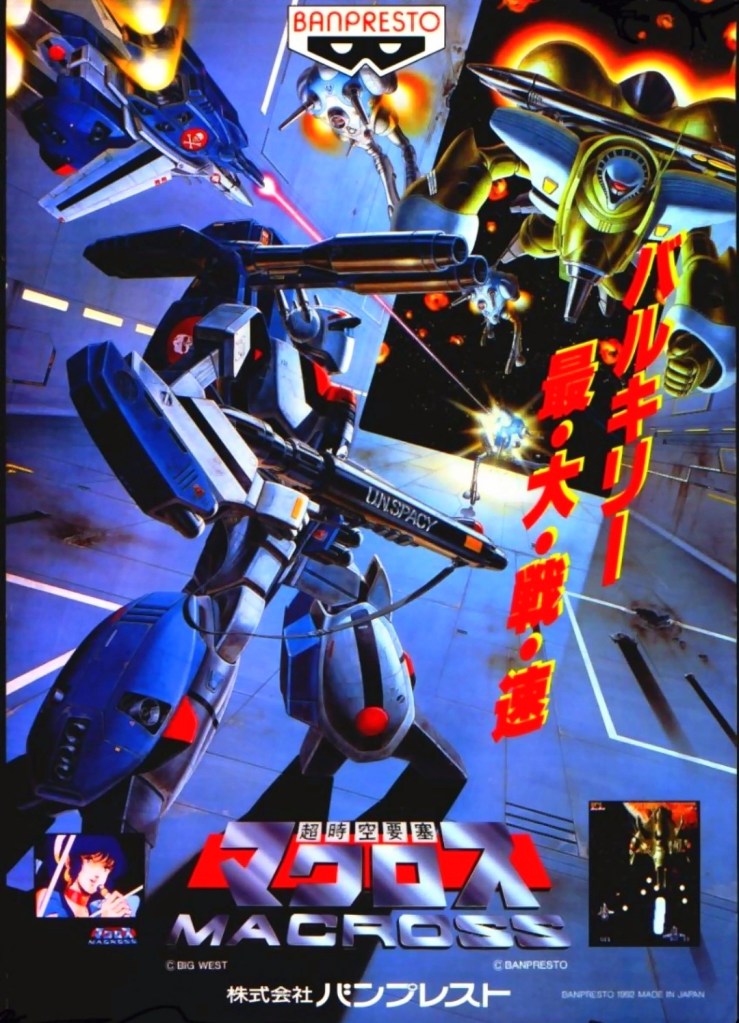
8. Super Spacefortress Macross arcade flyer

The arcade flyer released only in Japan.

Have you ever seen the classic anime movie Macross: Do You Remember Love? I really love watching that movie and I played and finished the video game adaptation on PlayStation in 1999. What I never got to play was the arcade game adaptation of it which was released by Banpresto in Japan in 1992. This flyer promoting the game has a strong visual presentation thanks to the artwork made for it. Only one screenshot was shown as well as a clip from 1984 the animated movie (note: the arcade game itself has some images directly from the film plus some newly created ones added) but this ad still had what it takes to capture the attention of the many Macross fans in Japan. This arcade game was eventually released with an English translation in America and Australia.   

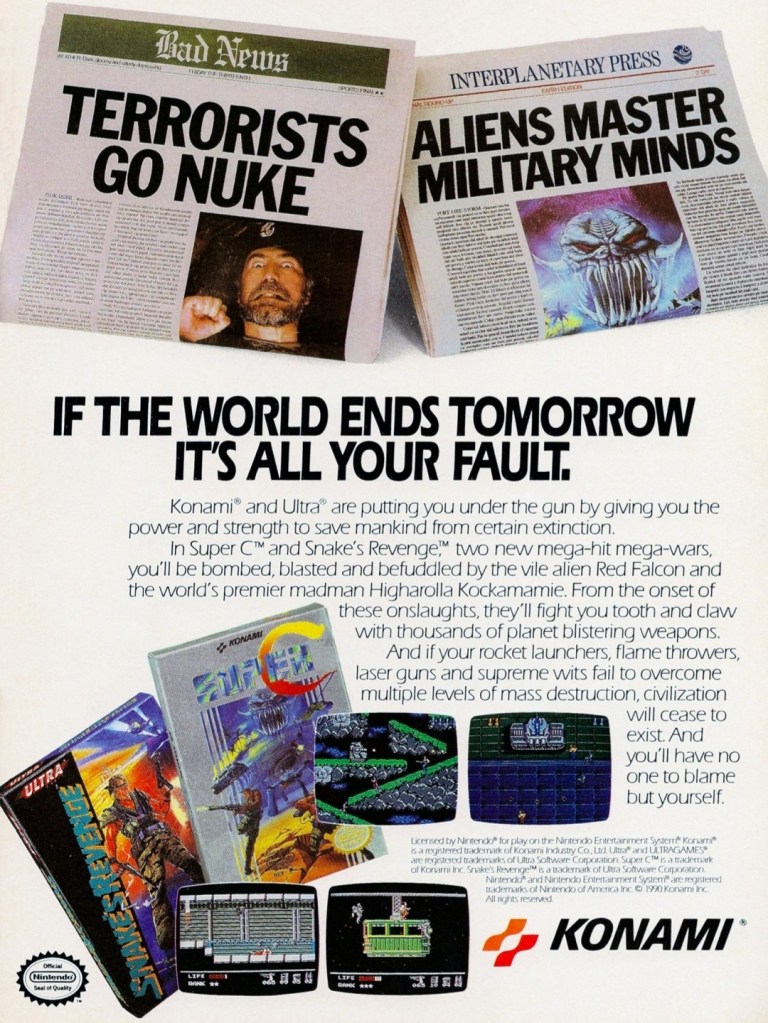
9. 2-in-1 print ad featuring Super C and Snake’s Revenge

A memorable and intriguing print ad from Konami promoting sequels.

This is one of the ads that Konami came up with to promote at least two games using a single-page ad format. I saw this ad in many comic books I read decades ago and its visual concept always caught my attention especially since I played the console game Contra a lot. At the high end of the ad were two fictional newspaper headlines highlighting the respective conflicts of Snake’s Revenge (with a nuclear danger concept) and Super C (with emphasis on alien invaders). These two games were sequels to the classics Metal Gear and Contra, and Konami clearly knew how to take advantage of the older games’ success and do their best to sell the sequels to gamers who love action-packed gaming as well as fantasized armed conflicts. Like the 2-in-1 ad showcasing Contra and Jackal, this was Konami’s aggressive move to sell war-inspired games to the NES userbase which was mostly composed of children and teenagers.

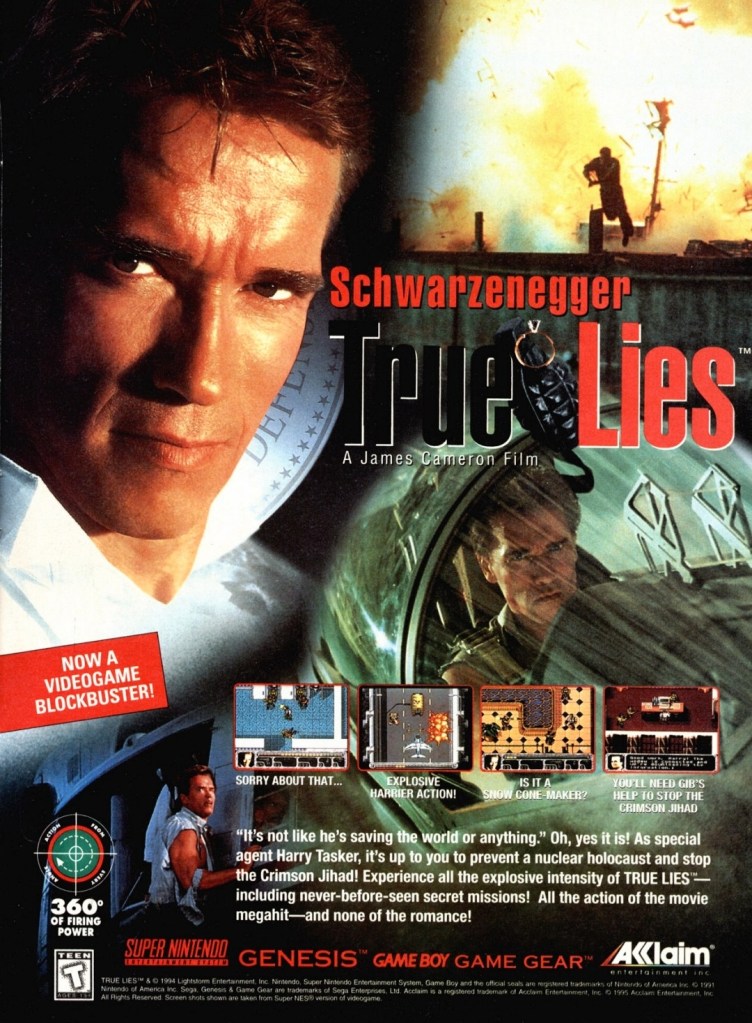
10. True Lies game print ad

There is nothing like taking advantage of the imagery of a Hollywood superstar to promote a video game based on the related movie.

Here is a video game ad I saw in many comic books I read in 1994-1995. True Lies (starring Arnold Schwarzenegger) was one of the big summer season movie hits of 1994 and the video game was part of the business tie-ins with the film. The people who made this print ad made the smart moves of showing not just one but three images of Schwarzenegger to promote the game while leaving some space to show what the game looked like. The True Lies game even had stills from the movie to emphasize the flow of the plot.

+++++

Thank you for reading. If you find this article engaging, please click the like button below, share this article to others and also please consider making a donation to support my publishing. If you are looking for a copywriter to create content for your special project or business, check out my services and my portfolio. Feel free to contact me with a private message. Also please feel free to visit my Facebook page Author Carlo Carrasco and follow me on Twitter at  @HavenorFantasy as well as on Tumblr at https://carlocarrasco.tumblr.com/ and on Instagram at https://www.instagram.com/authorcarlocarrasco
Better than Streaming: Do you have Cloak & Dagger (1984) 4K Blu-ray in your collection?

Welcome back, fellow geeks, Blu-ray collectors and movie buffs!

Decades ago, I saw on home video Cloak & Dagger (1984) which turned out to be an entertaining film to watch as I was already playing games on Atari 2600 and the arcades. After replaying by chance on cable TV years later, I finally bought myself the 4K Blu-ray and it sure was fun to watch it all over again. Check out my retro movie review of it by clicking here.

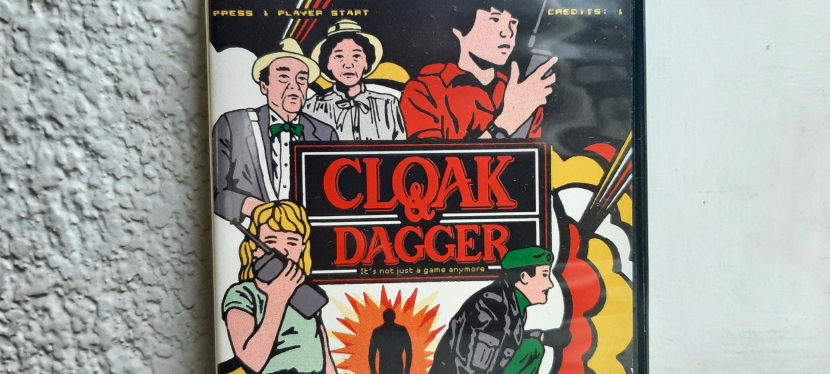
The front of my copy of Cloak & Dagger (1984) 4K Blu-ray.
The rear with the details that can be read.

For the newcomers reading this, Cloak & Dagger (1984) is a movie that involved then video game giant Atari in the creative process. The movie’s plot is not based on Atari’s arcade game of the same name (previously titled as Agent X).

Cloak & Dagger (1984) its own original plot of espionage about a young boy Davey (played by Henry Thomas, the star of Steven Spielberg’s E.T.: The Extra-Terrestrial) who witnesses a murder and receives an Atari 5200 cartridge of the game Cloak & Dagger that contains something very important. This in turn makes him a target of armed henchmen who won’t stop until they get him. Due to his reputation of being too playful and living with his wild imagination as a spy, people don’t believe Davey’s claim of witnessing a murder. This film happens to be inspired by the short story “The Boy Cried Murder” written by Cornell Woolrich.

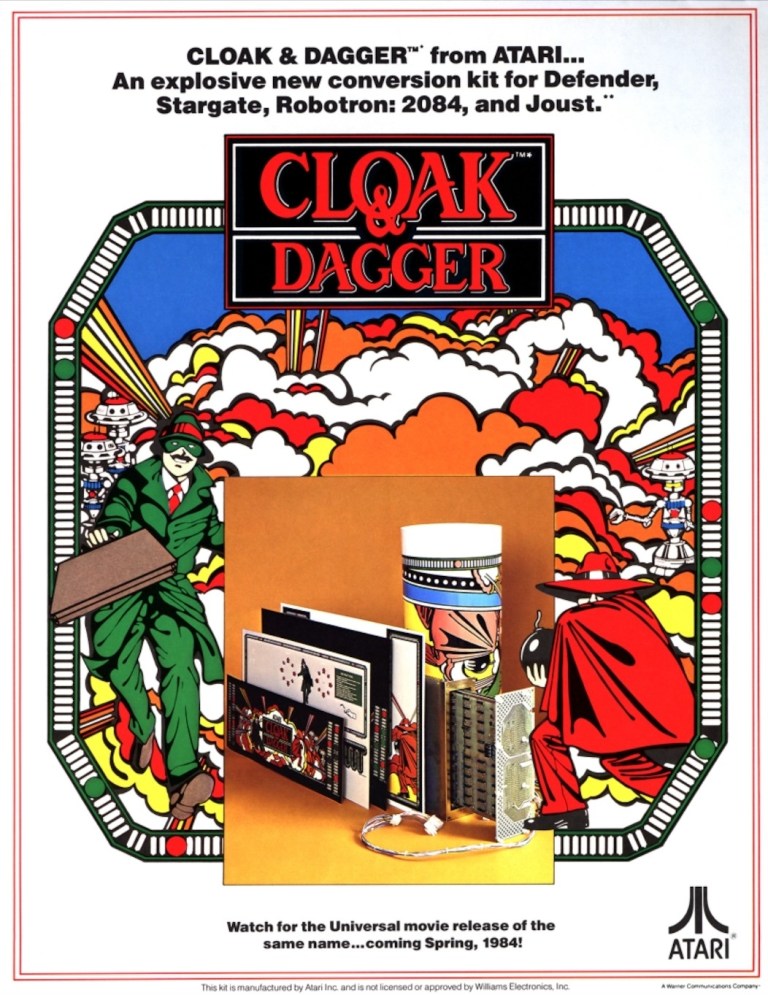
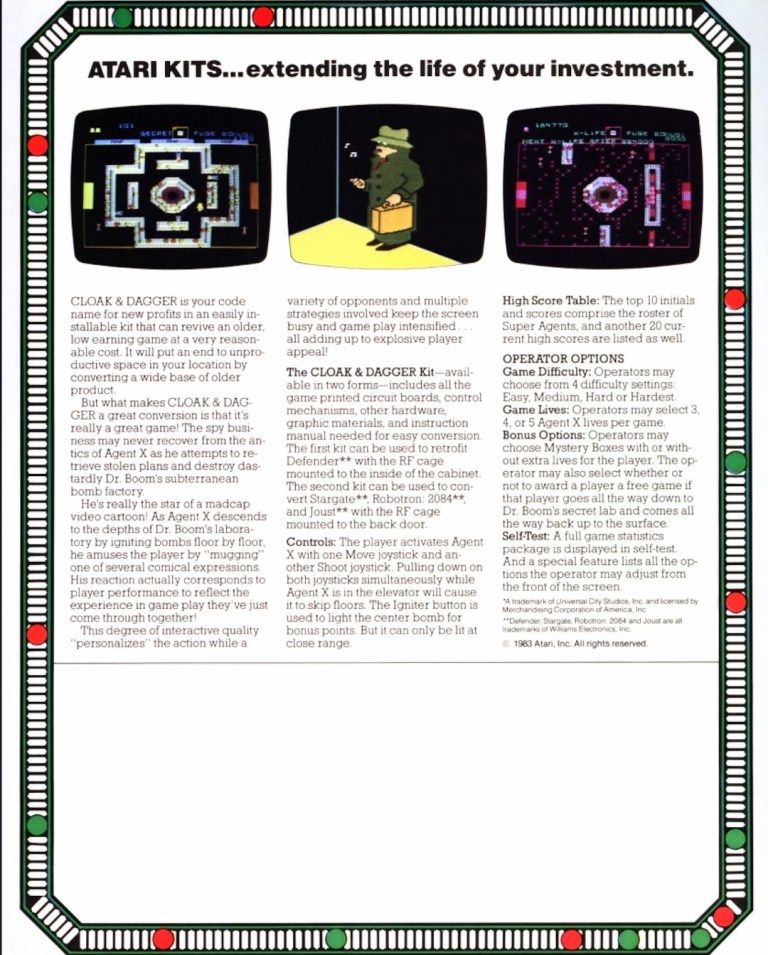
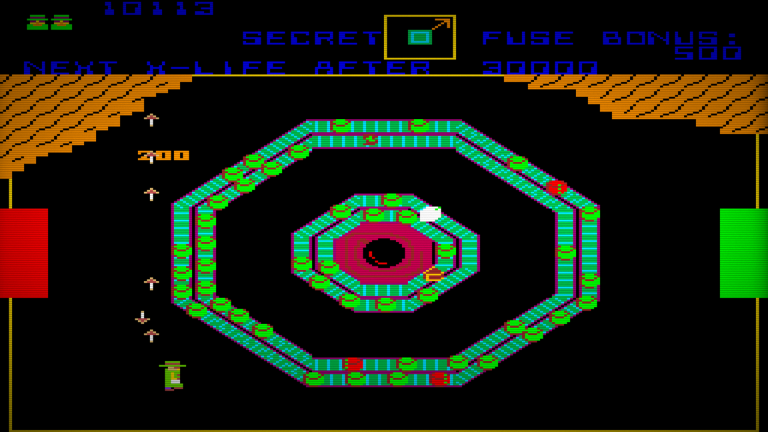
Cloak & Dagger in arcade form. Atari released it in the form of an arcade conversion kit aimed at arcade machines of certain games of its competitors.
The Cloak & Dagger arcade game can be played on your game console with the Atari 50 collection software (over 100 games). This screenshot I captured while playing it on my Xbox Series X console running Atari 50.

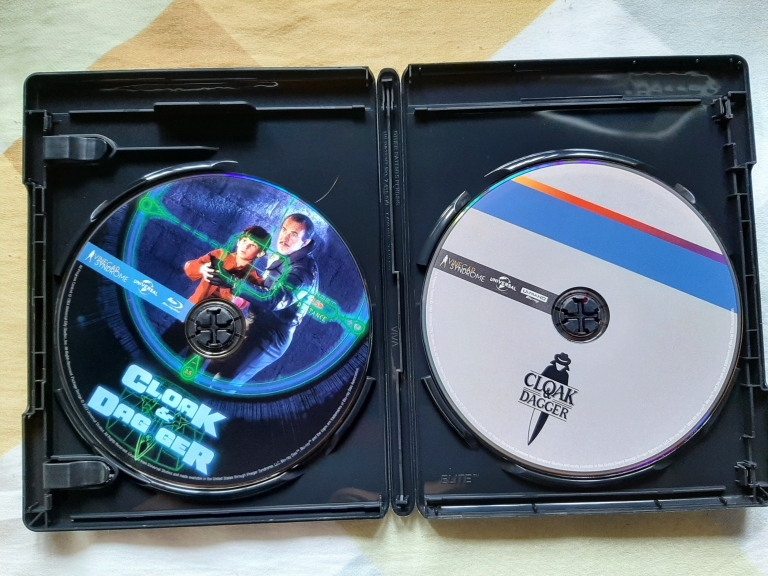
A few weeks ago, my copy of the Cloak & Dagger 4K Blu-ray arrived and it came with two discs: One 4K Blu-ray disc which contained the movie in native 4K (scanned in UHD from the 35mm film) resolution of 3840 x 2160p. The other disc has the same movie in HD (1920 x 1080p) plus the extra stuff which can provide viewers and Cloak & Dagger fans a good amount of important content which will help them learn what the video game elements in the film are, what inspired its creative process and why the film is very unique by today’s standards. There is also an informative new interview with Henry Thomas.

Since then, I saw Cloak & Dagger in 4K twice on my Xbox Series X and its 1080p version on a standalone Blu-ray disc player. Cloak & Dagger in 4K looks better than ever as the picture quality is better, images look sharper and clearer, the colors are vibrant, the small visual details (which were not visible in lower resolution before) are more noticeable now, and film grain structure has been preserved intact!

The two discs. The one on the right is Cloak & Dagger in 4K.

As for the story itself, I still find it engaging and enjoyable to watch from start to finish. Cloak & Dagger is clearly a production of its time as it carries clear Cold War references – the Soviet Union and Iran are the evil forces told in very subtle fashion – as well as video game elements and brands (note: ColecoVision even appeared in this Atari-influenced movie) that dominated America’s console gaming market long before PlayStation, Nintendo and Xbox arrived. For a movie aimed at parents and children, this one has really intense violence as it involves shooting and even some elements of terrorism.

Ultimately, I got a lot of enjoyment from my Cloak & Dagger (1984) 4K Blu-ray and I highly recommend it to Cloak & Dagger fans, gamers, physical media collectors and anyone who loves watching movies in the comfort of home. Cloak & Dagger (1984) is a very unique and fun movie that Hollywood does not make anymore. You really should see it.

In case you are interested or if you have made up your mind, you can order a copy of Cloak & Dagger (1984) 4K Blu-ray by clicking here.

If you wish to join a group of movie enthusiasts and talk about cinema, visit the Movie Fans Worldwide Facebook group at https://www.facebook.com/groups/322857711779576

+++++

Thank you for reading. If you find this article engaging, please click the like button below, share this article to others and also please consider making a donation to support my publishing. If you are looking for a copywriter to create content for your special project or business, check out my services and my portfolio. Feel free to contact me with a private message. Also please feel free to visit my Facebook page Author Carlo Carrasco and follow me on Twitter at  @HavenorFantasy as well as on Tumblr at https://carlocarrasco.tumblr.com/ and on Instagram at https://www.instagram.com/authorcarlocarrasco
Retro Gaming Ads Blast – Part 11

Welcome back readers, fellow geeks and electronic gaming fans!

In this edition of the Retro Gaming Ads Blast (RGAB) series, we will take a look at another batch of retro gaming print ads from the 1980s and 1990s. In addition, there will be a few flyers of arcade games as well as promotional posters of a notable console game that was released only in Japan.

For the newcomers reading this, Retro Gaming Ads Blast (RGAB) looks back at the many print ads of games (console, arcade, computer and handheld) that were published in comic books, magazines, flyers and newspapers long before smartphones, social media, the worldwide web and streaming became popular. To put things in perspective, people back in the 1980s and 1990s were more trusting of print media for information and images about electronic games and related products.

With those details laid down, here is the newest batch of retro gaming print ads for you to see and enjoy…

1. M.I.A.: Missing in Action arcade flyer

This is an effective way of catching the attention of both players and arcade operators. I can imagine the woke, the SJWs and rabid feminists getting easily offended by this.

Konami was a very prominent producer of games back in the 1980s. Not only did the company produce high-quality and enjoyable military-themed games on consoles and computers, Konami also made its presence felt in the highly competitive sector of arcade games. In 1989, they released the arcade conversion kit of M.I.A.: Missing in Action and this flyer is the best know promotion of it. M.I.A.: Missing in Action is the follow-up to Konami’s hit game Rush’n Attack.

Visually, the flyer’s display of four screenshots combined with a dominating photographic image of prisoners of war (POWs) getting delightfully released by an attractive female Rambo-type rescuer were designed to catch the attention of young adult and adult gamers. The text descriptions (note: there were more details on the back of the flyer), however, were geared towards arcade operators who were looking for new games to acquire without the hassle of having to buy an entire arcade cabinet. That being said, this flyer was a clever way to appeal to arcade operators and the people who love playing arcade games.

2. Fonz arcade flyer

Simplistic yet effective to look at. If you are an arcade operator, this flyer conveniently has key information displayed.

Believe it or not, Sega was already active in arcade games way back in the 1970s. In this particular flyer, Sega’s arcade game Fonz (also called Moto-Cross, Man T.T.) offered players the unique experience of driving a digital vehicle using actual handlebars on the machine that were meant to create an immersive and realistic feel. If you look closely, the flyer has lots of details written with arcade operators and players in mind.

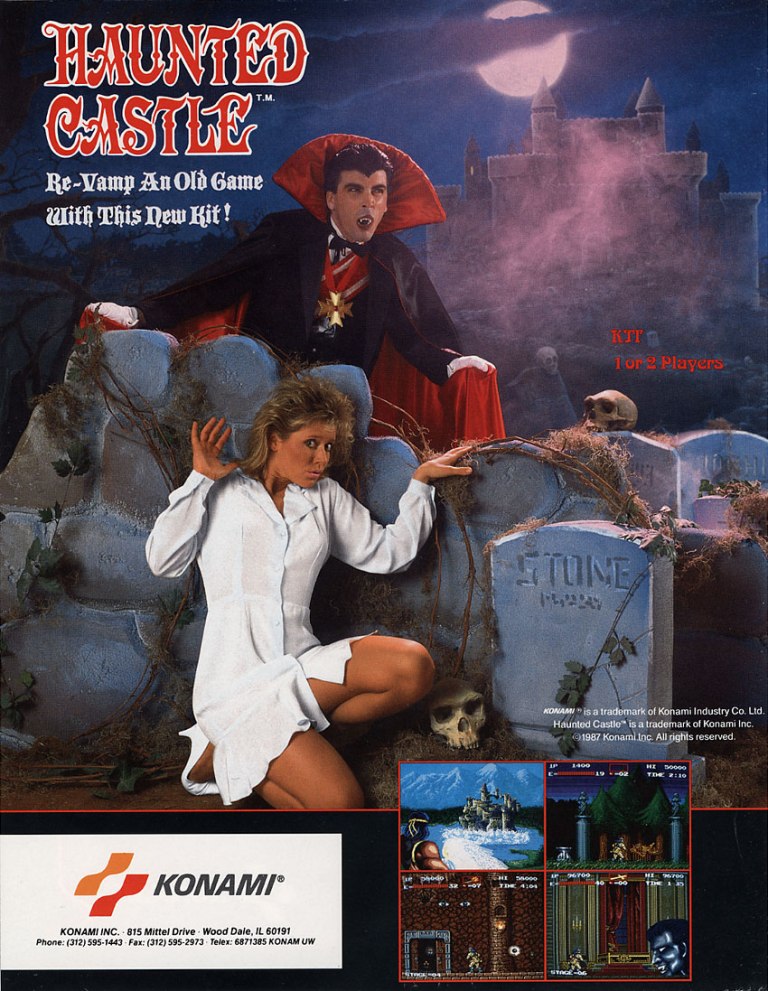
3. Haunted Castle arcade flyer

Indeed, this game is part of the Castlevania game franchise. It was one of the first Castlevania games released for arcades.

Arguably, Konami is best known for the Castlevania game series which covered handheld gaming devices, personal computers, video game consoles and even arcades. Haunted Castle (Japanese title: Akumajō Dracula) is the 2nd arcade game of the Castlevania franchise and it is not a port of any console game. Like the arcade flyer of M.I.A.: Missing in Action, this one was crafted to lure the attention (and money) of arcade operators looking for conversion kits to replace their old games. The visual presentation is eye-catching and even though the Castlevania brand was nowhere to be seen, Castlevania fans could tell this this arcade offering was part of their favorite game franchise.  

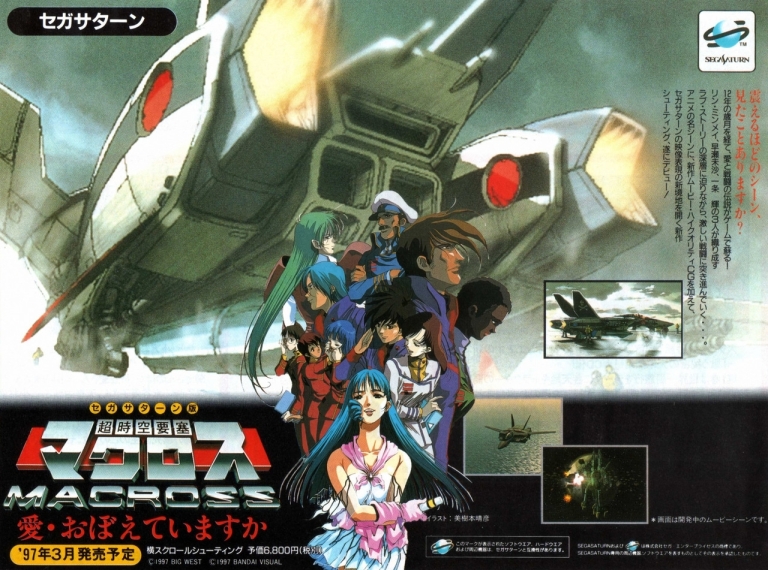
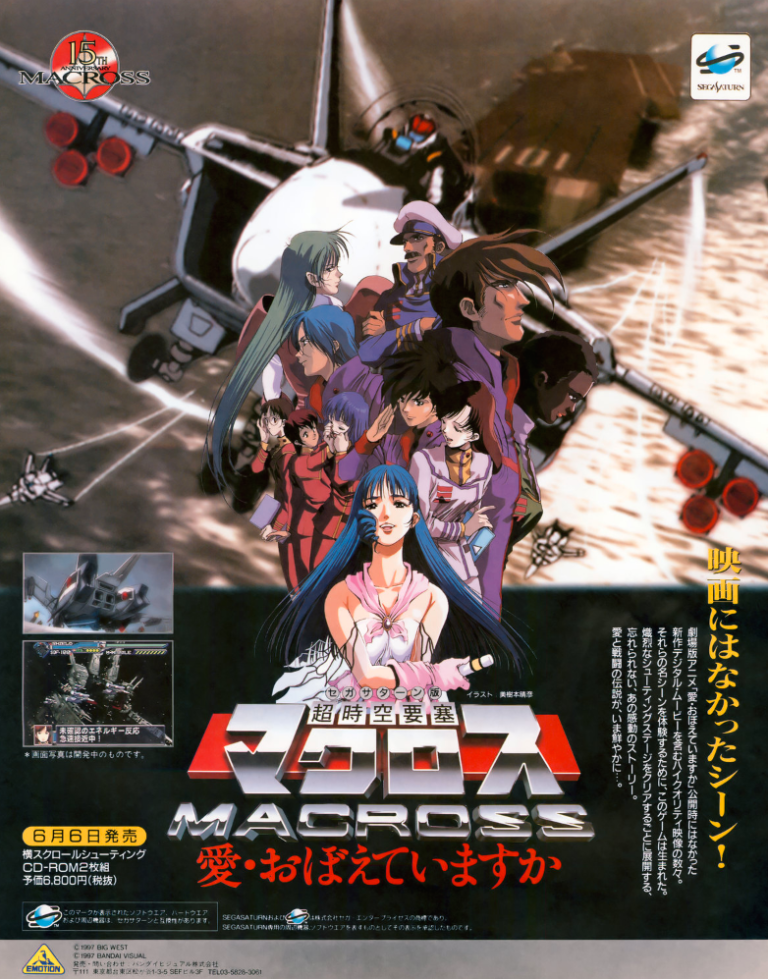
4. The Super Dimension Fortress Macross: Do You Remember Love? flyer and poster

The poster promoting the release of the game for Sega Saturn in Japan.
The flyer promoting the Sega Saturn game’s 1997 release as well as the 15th anniversary of Macross.

In 1997, the 15th anniversary of the Macross multimedia franchise was celebrated in Japan and among the highlights was the release of The Super Dimension Fortress Macross: Do You Remember Love? on the Sega Saturn. To promote the game and the franchise itself, lots of flyers and posters were released in Japan. If you look at the illustrated images on the promotional materials closely, you will realize that they are not from the original 1982-83 Macross anime TV series but rather from the The Super Dimension Fortress Macross: Do You Remember Love? animated movie of 1984 (read my retro movie review by clicking here).

While it might be baffling to some as to why the original anime TV series was not used as the source material for the 15th anniversary celebration through gaming, the 1984 anime feature film was actually more adaptable for a video game project (read my retro review by clicking here). It is so obvious, you just have to ask yourselves this question – how can the game developers compress the entire concepts of the 36-episode Macross anime series into one game while ensuring fun gameplay? Regardless, the game was a lot of fun to play and I enjoyed playing the PlayStation version in 1999.

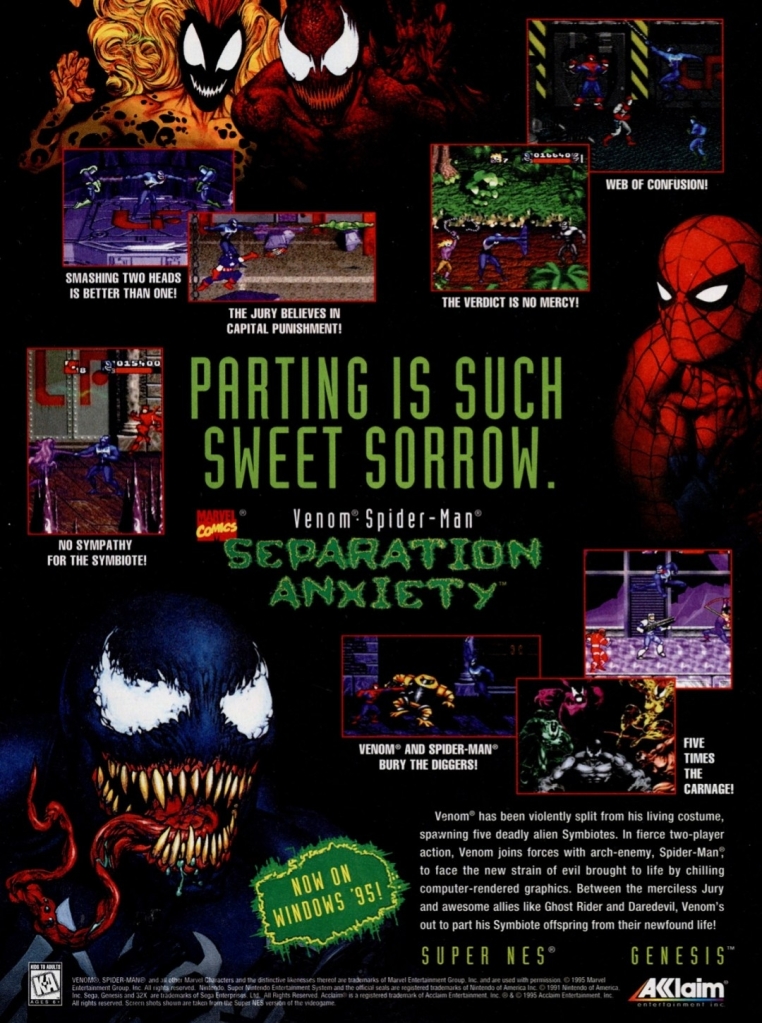
5. Venom/Spider-Man: Separation Anxiety print ad

A clear effort to sell the game to gamers as well as fans of Spider-Man and Venom.

In 1994, Acclaim released Spider-Man and Venom: Maximum Carnage (based on the 1993 comic book storyline Maximum Carnage) on Super Nintendo Entertainment System (SNES) and Sega Genesis ultimately becoming popular with comic book fans and gamers who enjoyed sidescrolling beat-them-up games.

Subsequently, Acclaim and develop Software Creations reunited to release the sequel Venom/Spider-Man: Separation Anxiety a year later on the two leading 16-bit consoles as well as on personal computer (PC). If there is anything notable about this eye-catching print ad, it is the fact that its visual presentation (with graphics on-par with the previous year’s game) cleverly hides the fact that it did not have much new to offer gamers with regards to gameplay and story cutscenes (which the previous game prominently had). Eventually, this game attracted weaker reviews from game critics and has since been forgotten.

6. Tecmo Super Bowl SNES print ad

From the time when Tecmo was still a strong producer of sports video games.

In 1991, Tecmo Super Bowl was released on the aging Nintendo Entertainment System (NES) and because its game design greatly entertained gamers, it became a tremendous commercial success. Not even the very high launch price of $54.99 stopped it from selling a lot.

To keep the commercial success and public interest going, Tecmo announced a new version of the game for the more powerful SNES console with the simple title of Tecmo Super Bowl. If you look closely at the print ad, you will notice that gameplay screenshots were not used at all. Instead, they showed images of the nicely illustrated art works they prepared as eye candy for the game with the intention of making it look cinematic. This is very curious because gameplay itself was the main selling factor of the NES version of Tecmo Super Bowl. I can only guess that Tecmo was not ready to show gameplay images by the time this print ad was made.

7. X-Men 2: Clone Wars print ad

The art used is too alienating for promoting this game.

During the age of the 16-bit consoles, there was a variety of X-Men video games released and produced by different companies. In 1993, an X-Men game published by Sega was released exclusively on the Genesis console which turned out to be fun for gamers and received mostly positive reviews from the critics. Sega went on to publish the sequel X-Men 2: Clone Wars and this print ad caught my attention because of how exaggerated the characters looked. It’s so strange, it’s as if the artist took visual reference from a somewhat blocky 3D polygonal portrait then tried to make them look hand-drawn. I wonder if anyone from Sega regretted this.  

+++++

Thank you for reading. If you find this article engaging, please click the like button below, share this article to others and also please consider making a donation to support my publishing. If you are looking for a copywriter to create content for your special project or business, check out my services and my portfolio. Feel free to contact me with a private message. Also please feel free to visit my Facebook page Author Carlo Carrasco and follow me on Twitter at  @HavenorFantasy as well as on Tumblr at https://carlocarrasco.tumblr.com/ and on Instagram at https://www.instagram.com/authorcarlocarrasco