Retro Gaming Ads Blast – Part 27

Welcome back readers, fellow geeks and electronic gaming fans!

In this edition of the Retro Gaming Ads Blast (RGAB) series, we will take a look at another batch of retro gaming print ads – including arcade flyers – from the 1980s and to the year 2000.

For the newcomers reading this, Retro Gaming Ads Blast (RGAB) looks back at the many print ads of games (console, arcade, computer and handheld) that were published in comic books, magazines, flyers, posters and newspapers long before smartphones, social media, the worldwide web and streaming became popular. To put things in perspective, people back in the 1980s and 1990s were more trusting of print media for information and images about electronic games and related products.

With those details laid down, here is the newest batch of retro gaming print ads for you to see and enjoy…

1. Tutankham print ad
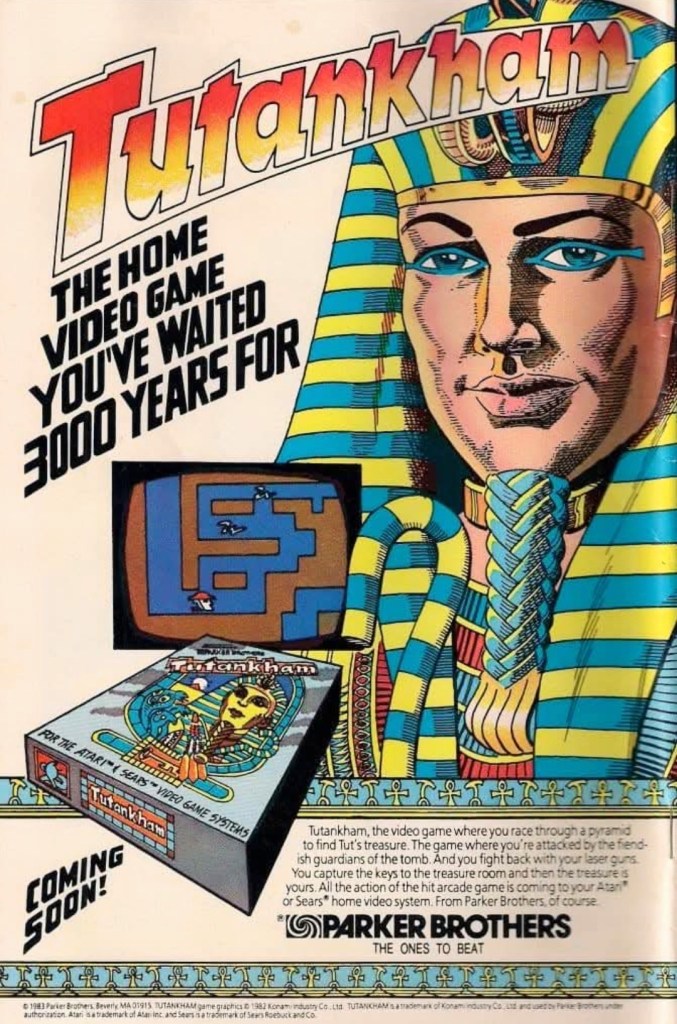
This print ad appeared in several comic books in 1983.

First released in the arcades in 1982, Tutankham is a 2D adventure game that had a mix of shooting, maze exploration and puzzle-solving with Egyptian settings and concepts. It made its way to the Atari 2600 published by Parker Brother, and it was this specific version I played. This game print ad appeared in comic books I read in 1983, and the people who made it implemented a hand-drawn art of the Egyptian pharaoh Tutankhamun dominating the space to emphasize the Egyptian setting. In fact, this ad made me think more of Egypt and left little to give me an idea of the game design.  

2. Star Trek arcade flyer
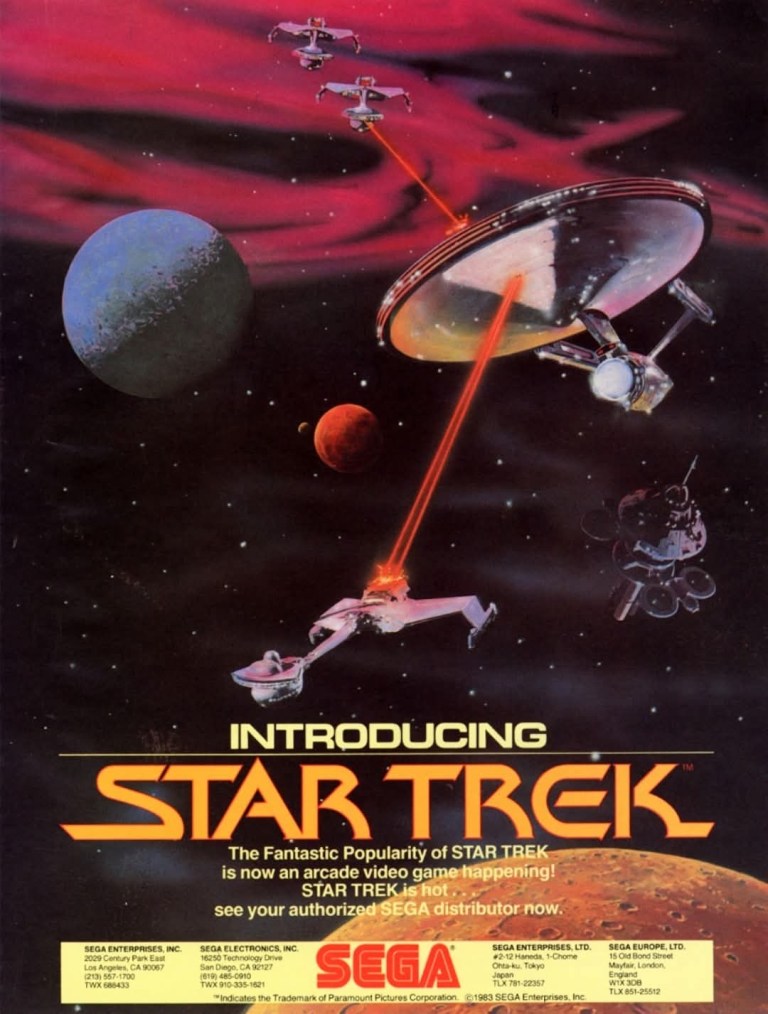
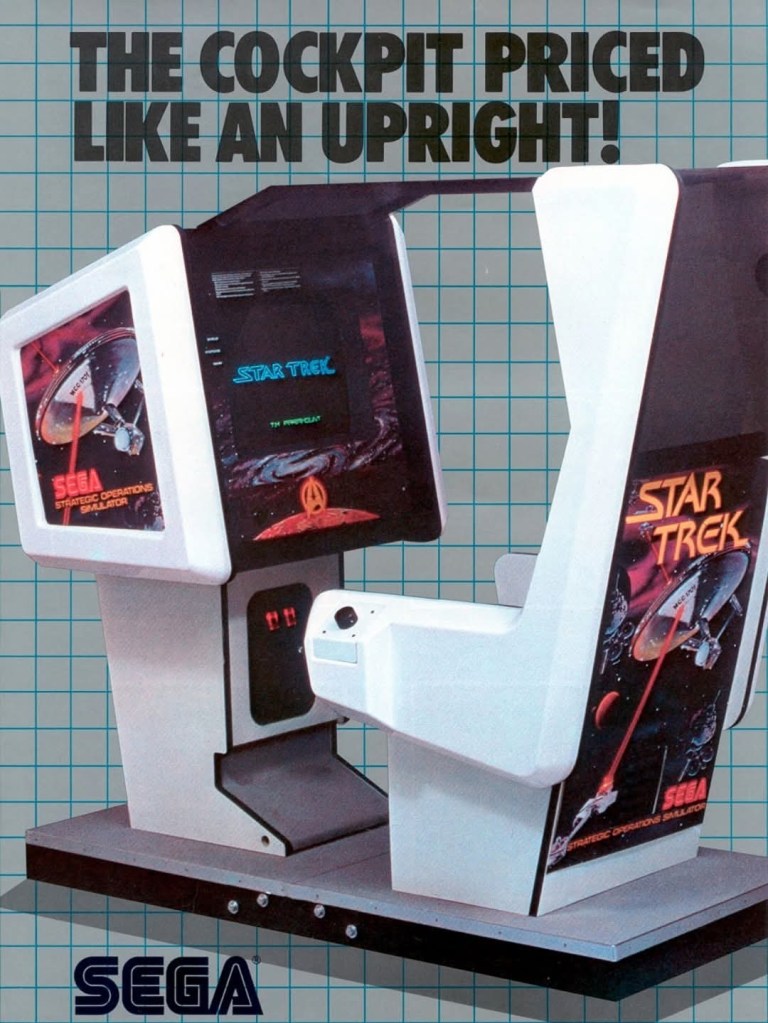
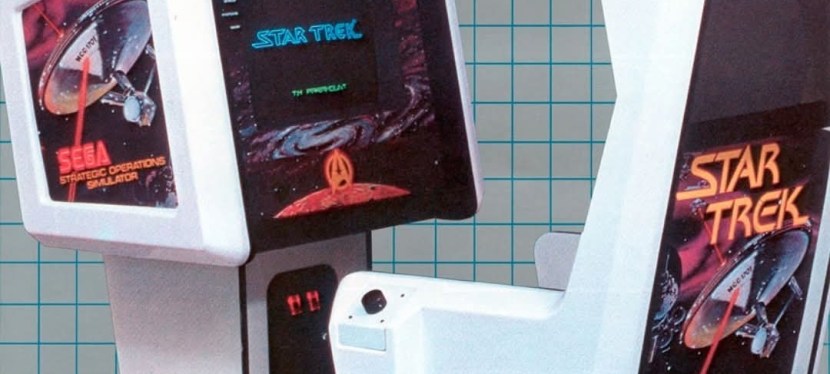
The clever use of classic Star Trek imagery was used in this initial flyer by Sega.
Back in the 1980s, a futuristic design for an arcade machine like this one was mind-blowing.

I never played the Star Trek arcade game (full title: Star Trek: Strategic Operations Simulator) Sega released in 1983. I only saw its graphics and gameplay during an episode of Starcade. With its game design and visual presentation, Star Trek was a very ambitious arcade project for its time and Sega really went in to promote it. The initial arcade flyer (first one above) was meant to grab the attention of both gamers and arcade operators. The next arcade flyer (2nd one above) showed the ambitious design of the arcade machine made with player immersion in mind.

3. Battlezone arcade flyer
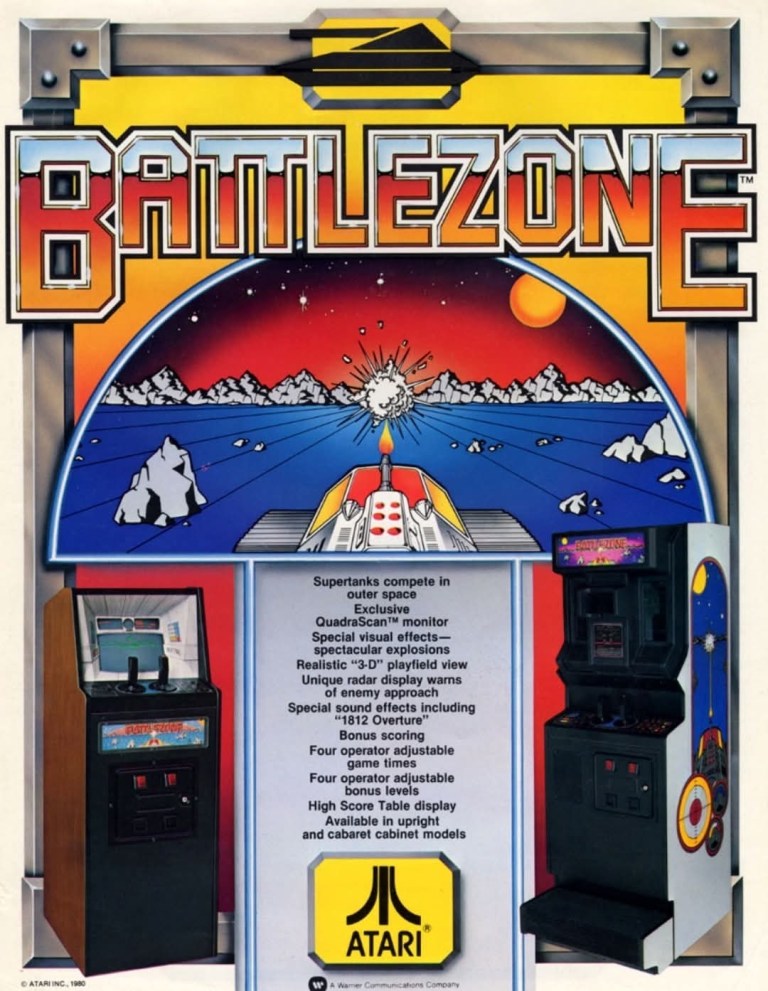
While the hand-drawn artwork was too detailed for the arcade game’s graphics, it still emphasized strongly the concept of the game.

In the history of video games, Battlezone was a groundbreaking game both visually and with game design. It was designed to give gamers an immersive experience of driving a tank with 3D graphics, fun gameplay and a first-person view. Its own history is worth researching. Atari knew it had to heavily promote their ambitious game and the arcade flyer above featured nice hand-drawn artwork while also showing the two types of Battlezone machines that arcade operators can choose from. Battlezone went on to become a highly influential arcade game.

4. Chrono Cross North American print ad
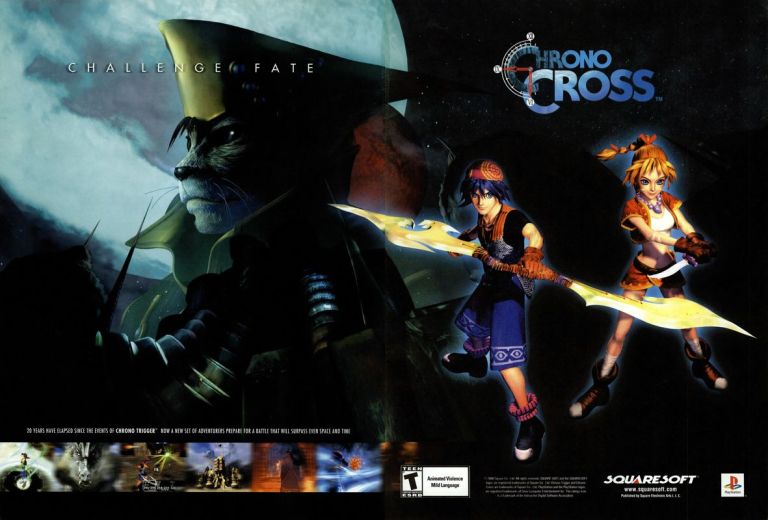
Arguably, this print ad was aimed at RPG enthusiasts, Chrono Trigger fans and gamers looking for something adventurous to play.

First released on PlayStation in Japan, Chrono Cross made its way to the said console in America just a few months before the PlayStation 2 launched there. While there was a risk that came with releasing the ambitious follow-up to the classic Chrono Trigger so late in the PlayStation’s life, Squaresoft (now Square Enix) still went on to aggressively promote Chrono Cross in America. This 2-page print ad that appeared in many gaming magazines remains captivating to look at. As typical of the time, 3D polygonal models and the epic-looking art were used in dominating fashion leaving the small space (lower-left corner) to display a few gameplay screenshots and other 3D art. Still it a fun game to play and this should remind you that Chrono Cross was recently remastered for modern consoles.

5. Ms. Pac-Man arcade flyer
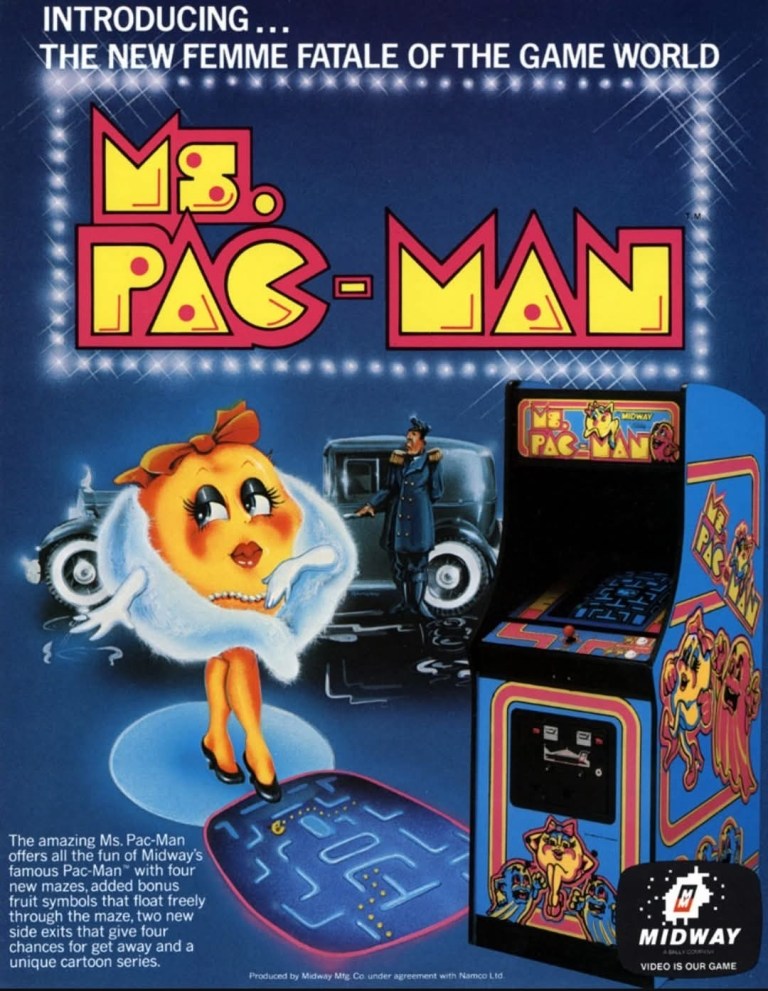
The wife of Pac-Man and the machine.

Given the fact that Pac-Man was so massively successful, it was not surprising that a sequel had to be made and released on as many arcades as possible. Ms. Pac-Man was the sequel and it was released in arcades in 1982 eventually achieving huge commercial and critical success. To promote the game, Midway’s ad makers came up with an ad showing unique art of Pac-Man’s wife looking glamorous (with a driver and a vehicle in the background) and a photograph of the arcade machine on the right. This also was one of the early arcade flyers to use the words “femme fatale”.

6. Centipede arcade flyer
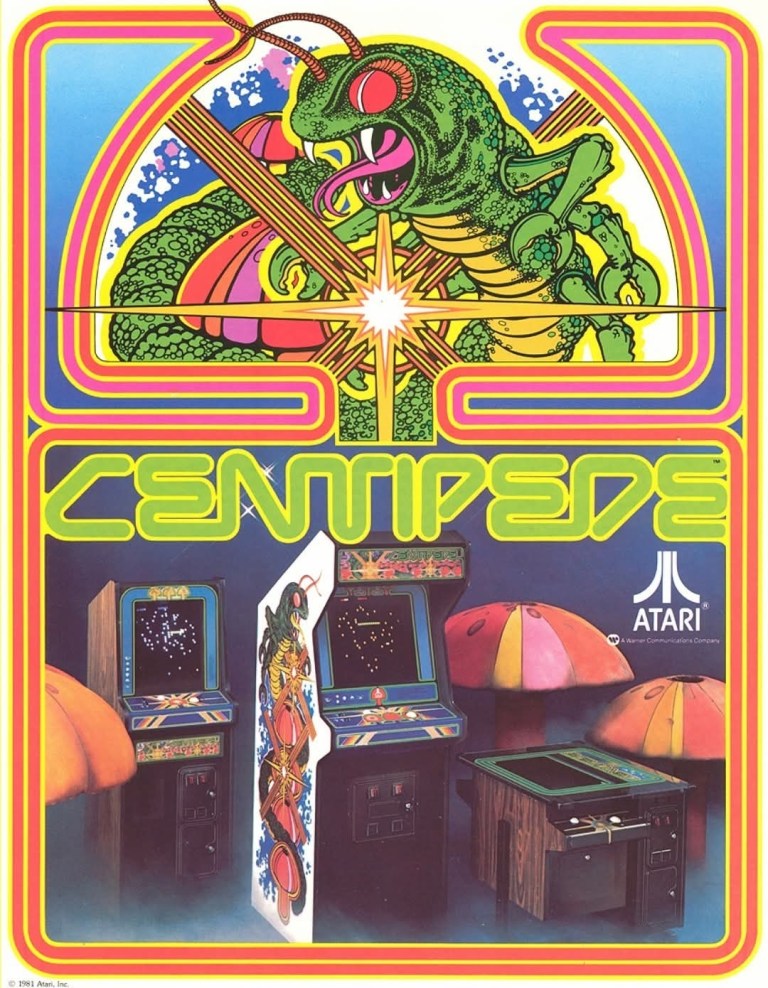
Three machines of Centipede for arcade operators to choose from.

Centipede is another arcade classic from Atari. Released in 1981, a lot of players enjoyed the game’s simplistic and yet addicting design of shooting an incoming centipede and its remaining portions that move down the field. Similar to the Battlezone arcade flyer, this game’s flyer had nice art of a centipede on the top and images arcade machines. Even by today’s standards, this flyer remains eye-catching.

7. Tempest 2000 print ad
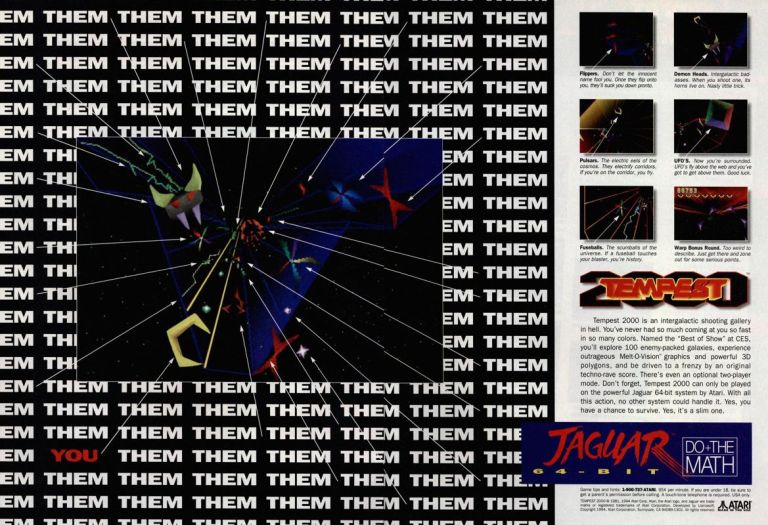
This 2-page print ad of Tempest 2000 is still captivating to look at.

Back in the 1990s, Atari went on to release their Jaguar console which was promoted as a 64-bit machine. At a gaming convention, the company met with prospective game developers over Jaguar projects and one of the developers volunteered to do Tempest (a memorable Atari arcade game). This resulted in the development of Tempest 2000 which was a remake of the classic.

As a Jaguar-exclusive game, Atari came up with an eye-catching 2-page ad showing off the 3D visual presentation (6 gameplay screenshots and one original artwork) while boasting in the text description that Tempest 2000 was named the “Best of Show” at the Consumer Electronics Show (CES). The game was released in 1994 attracting mostly positive reviews from game critics and was one of the best-selling Jaguar games (note: Tempest 2000 can now be played in the Atari 50 collection). With the Atari legacy and presentation combined, this print ad remains captivating to look at.

8. Alien vs Predator print ad
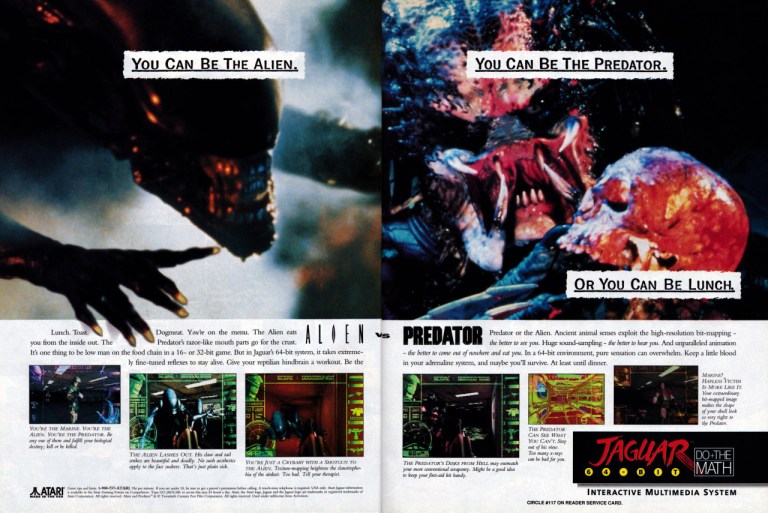
Arguably the most defining and most entertaining game on the Atari Jaguar.

If there is any game that truly defined enjoyment and the technological features of the Atari Jaguar, it is the 1994 first-person shooter Alien vs Predator. At the time of its release, it was one of the most immersive games of the Alien vs. Predator crossover franchise and it allowed players to experience what fighting the Predator or the Xenomorph was like. The game also allowed gamers to play as a Colonial Marine (human soldier).

To sell the game, Atari came up with a 2-page ad highlighting the Aliens on one page and the Predator on the other. As the Predator was shown with a grotesque human skull, the use of photographs (most likely sourced from the movies) strongly emphasize the game was aimed at the mature audience among gamers. Six screenshots of gameplay were displayed by the ad makers who were clearly aware of the high popularity of first-person shooting games. Alien vs Predator was a critical and commercial success, and its print ad is arguably the most memorable one of any Atari Jaguar game ever made.

+++++

Thank you for reading. If you find this article engaging, please click the like button below, share this article to others and also please consider making a donation to support my publishing. If you are looking for a copywriter to create content for your special project or business, check out my services and my portfolio. Feel free to contact me with a private message. Also please feel free to visit my Facebook page Author Carlo Carrasco and follow me on Twitter at  @HavenorFantasy as well as on Tumblr at https://carlocarrasco.tumblr.com/ and on Instagram at https://www.instagram.com/authorcarlocarrasco

What to watch on YouTube right now – Part 49

Happy New Year to all my readers, YouTube viewers and all others who followed this series of articles focused on YouTube videos worth watching. Have you been searching for something fun or interesting to watch on YouTube? Do you feel bored right now and you crave for something to see on the world’s most popular online video destination?

I recommend you check out the following topics and the related videos I found.

You, Me and the Movies react to The Tower (2012) – The Tower (2012) is a South Korean disaster film that drew huge audiences in its country and found some success overseas. Its concept will remind long-time movie buffs about 1974’s The Towering Inferno which itself was an inspiration for director Kim Ji-hoon. If you want to discover The Tower but you are not willing to spend time and money to see it, I encourage to watch You, Me and the Movies’ reaction video.

Alien versus Predator games history examined by Slope’s Game Room – I really enjoy watching the retro gaming videos of YouTuber Slope’s Game Room. This time around, Slope examines the history of video games featuring one of the most memorable sci-fi crossovers ever: Alien versus Predator. For the newcomers reading this, there was a time when Alien and Predator were separate sci-fi film franchises. How a crossover between them happened and what video games were made are explained in detail in the video below.

The rise of cold coffee in America – Do you like drinking coffee that is actually cold? Over the past several years in America, spending on cold coffee skyrocketed and outpaced hot coffee. To be clear, cold coffee includes iced coffee, cold brew and frozen coffee drinks. Already, cold coffee sales really grew for certain businesses that sell coffee. To find out why Americans are buying more cold coffee and what possibly started the trend, watch the video below.

Changing the Middle East – There is no denying the fact that Israel will be remembered for significant gains against Iran-sponsored terrorists in 2024. They did not have much support from Biden-led America but Israel still succeeded in eliminating Yahya Sinwar (Hamas) and Hassan Nasrallah (Hezbollah). Israel also succeeded in hitting military targets in terrorist state Iran which crippled them significantly. Also the collapse of the wicked Assad regime in Syria proved to be a huge loss for Iran which had a sinister alliance with Bashar al-Assad (who abandoned Syria).

With Donald Trump set to return as United States President on January 20, 2025, Israeli Prime Minister Benjamin Netanyahu expressed confidence of changing the Middle East. Netanyahu talked with Trump recently and you can learn more by watching CBN News’ video.

If you have accepted Jesus as your Lord and Savior, I encourage you to pray to Him in support of Israel and the new Trump administration to change the Middle East in 2025. Pray to Him for the Christians in Syria who will soon be affected negatively by the new regime’s plan to impose Sharia Law. Pray to Him for the rescue or release of the hostages of the October 7, 2023 attacks.

Lefties losing it – In case you did not notice, the Democrats in America don’t just have wicked and dishonest leaders. They also have Hollywood celebrities as Democrat activists who are actually phony intellectuals who love to fool their fellow Americans. A lot of Democrat leaders and activists are actually out of touch with the people and reality in general, which is what this Lefties Losing It video from Sky News Australia emphasized clearly. Watch and learn from start to finish.

PatmanQC examines Gun.Smoke – Developed by Capcom, Gun.Smoke debuted in the arcades in 1985 and eventually got ported to different platforms. I never played the arcade version but I had fun with Gun.Smoke on the Nintendo Family Computer (Famicom) Disk System. It was a run-and-gun shooter with an Old West setting and its designer was Yoshiki Okamoto (1942, Street Fighter II and Resident Evil). The production history of the game is quite interesting and you can find out more in PatmanQC’s video.

Ashleigh Burton reacts to The Naked Gun 2½: The Smell of Fear – I love watching Ashleigh Burton’s movie reaction videos, especially the ones that has her laughing a lot. She’s a jolly YouTuber and often entertaining. That being said, you have to watch her reaction to 1991’s The Naked Gun 2½: The Smell of Fear.

Popcorn in Bed reacts to Star Trek: Nemesis – Were you able to watch the entire Star Trek: The Next Generation (Star Trek: TNG) series from 1987 to 1994? I never had the privilege to watch all seven seasons but I managed to watch several random episodes of it and got to know the characters enough before proceeding to watch all four Star Trek: TNG movies from 1994 to 2002. Star Trek: Nemesis (2002) was released in American theaters right in the middle of intense box office competition with a Harry Potter movie, a James Bond movie and a Lord of the Rings movie. Apart from its box office failure, there was something wrong that happened behind the scenes during Star Trek: Nemesis’ production which explains its disappointing quality. If you want to discover the movie but you don’t want to spend too much time nor money on it, I encourage you to watch Popcorn in Bed’s reaction video.

+++++

Thank you for reading. If you find this article engaging, please click the like button below, share this article to others and also please consider making a donation to support my publishing. If you are looking for a copywriter to create content for your special project or business, check out my services and my portfolio. Feel free to contact me with a private message. Also please feel free to visit my Facebook page Author Carlo Carrasco and follow me on Twitter at  @HavenorFantasy as well as on Tumblr at https://carlocarrasco.tumblr.com/ and on Instagram athttps://www.instagram.com/authorcarlocarrasco

Retro Gaming Ads Blast – Part 24

Welcome back readers, fellow geeks and electronic gaming fans!

In this edition of the Retro Gaming Ads Blast (RGAB) series, we will take a look at another batch of retro gaming print ads – including arcade flyers – from the 1980s and 1990s.

For the newcomers reading this, Retro Gaming Ads Blast (RGAB) looks back at the many print ads of games (console, arcade, computer and handheld) that were published in comic books, magazines, flyers, posters and newspapers long before smartphones, social media, the worldwide web and streaming became popular. To put things in perspective, people back in the 1980s and 1990s were more trusting of print media for information and images about electronic games and related products.

With those details laid down, here is the newest batch of retro gaming print ads for you to see and enjoy…

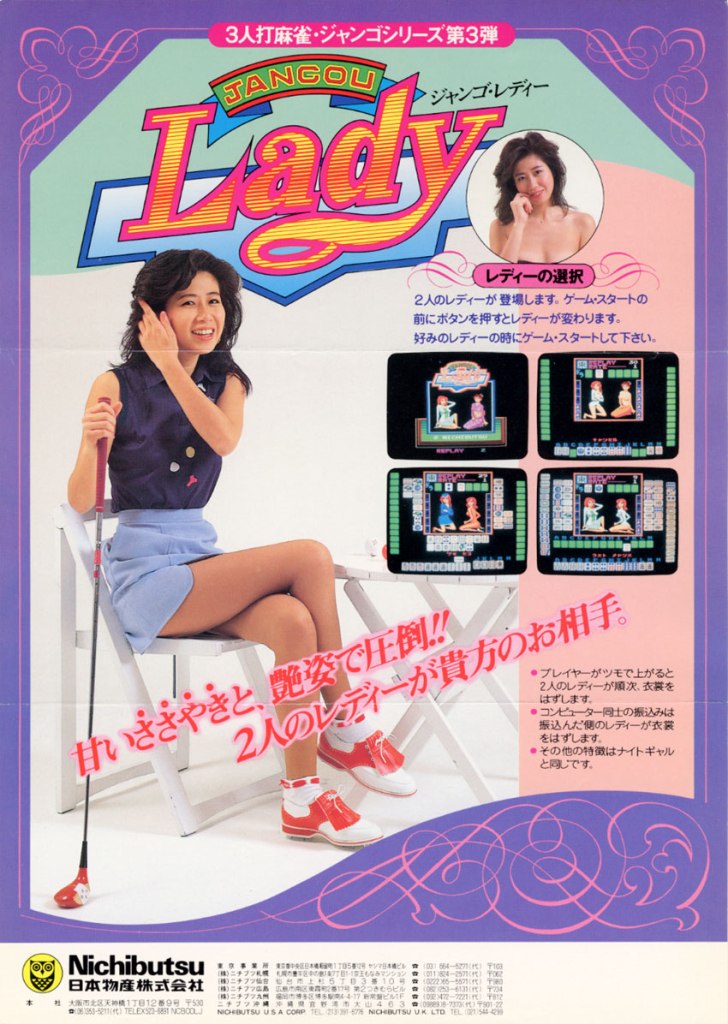
1. Jangou Lady arcade flyer

If you were to play Mahjong digitally, does sex appeal motivate you to do so?

Are you fond of playing the tile-based game Mahjong? Believe it or not, there were indeed ways to play Mahjong in digital form inside the arcade or in gambling joints in Japan. The game Jangou Lady allows users to play rounds of Mahjong but with a notable additive – the digital art of women which serves as an attraction. In the sex appeal is clearly evident on this arcade flyer from the 1980s.

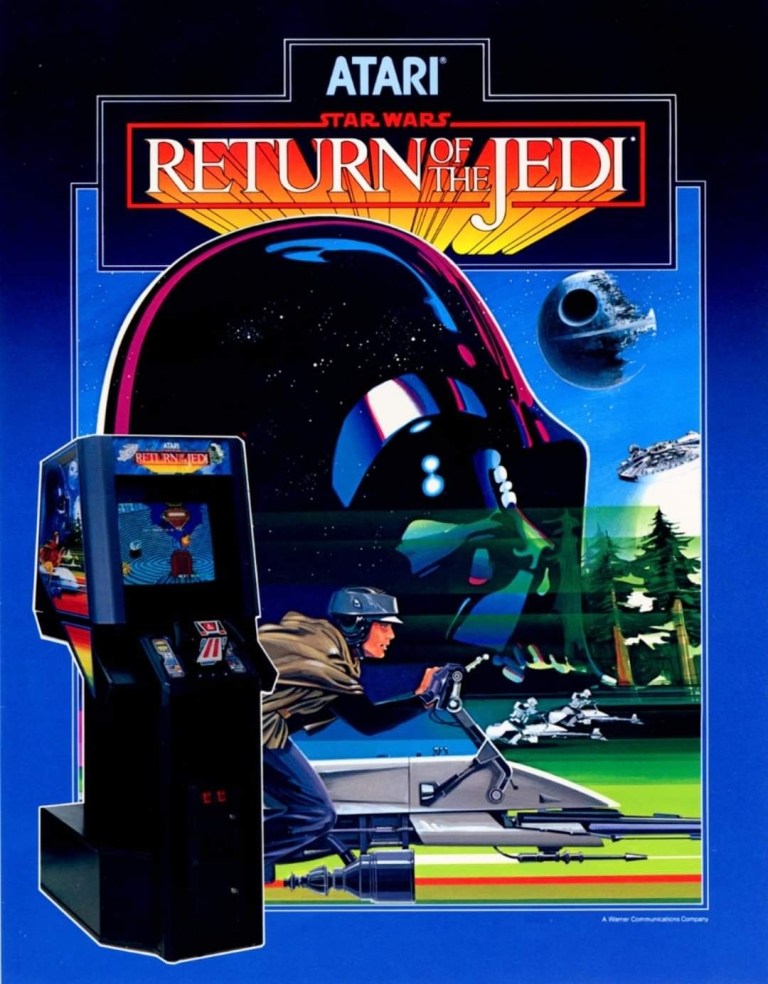
2. Star Wars: Return of the Jedi arcade flyer

Really nice art based on the movie.

Way back in 1983, Return of the Jedi delighted moviegoers in the cinemas throughout America. Behind the scenes, video game giant Atari acquired the movie license to make the 1984 arcade game Star Wars: Return of the Jedi. The arcade flyer’s front featured a highly detailed hand-drawn art of Darth Vader, the Death Star, Luke Skywalker and Storm Troopers on hover bikes, and the Millennium Falcon which reflect the selected elements of the movie that were turned into playable sections. The image of the arcade machine was understandably inserted as it came with an unusual controller. This flyer is still captivating to look at.  

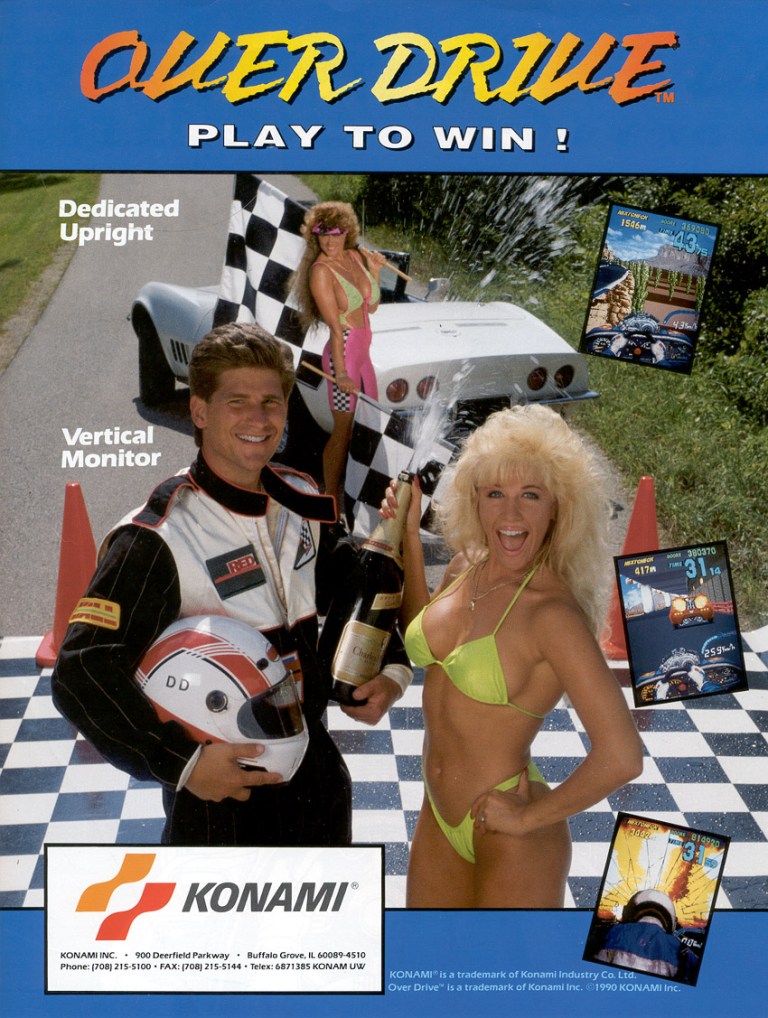
3. Over Drive arcade flyer

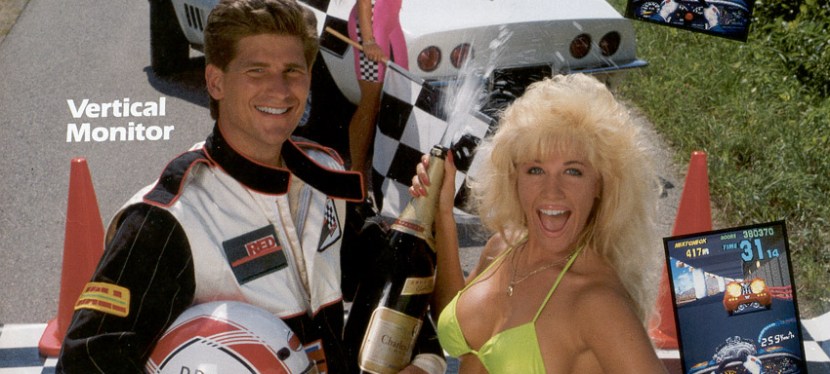
This arcade flyer is a reminder that Konami was notable for hiring pretty and sexy women for their print ads.

In 1990, Konami produced a racing game for the arcades with a unique style of presentation. That game was Over Drive and it stood out among the many racing games in the arcade mainly because of its first-person view (with a digital version of the steering wheel and driver’s hands at the bottom of the screen) and unique approach on sprite-scaling. To promote the game, Konami hired sexy models for photography for use in both the arcade flyer and the exterior images on the machine. Having sexy models posing with a winning driver added to the motorsport racing vibe needed to promote the game.

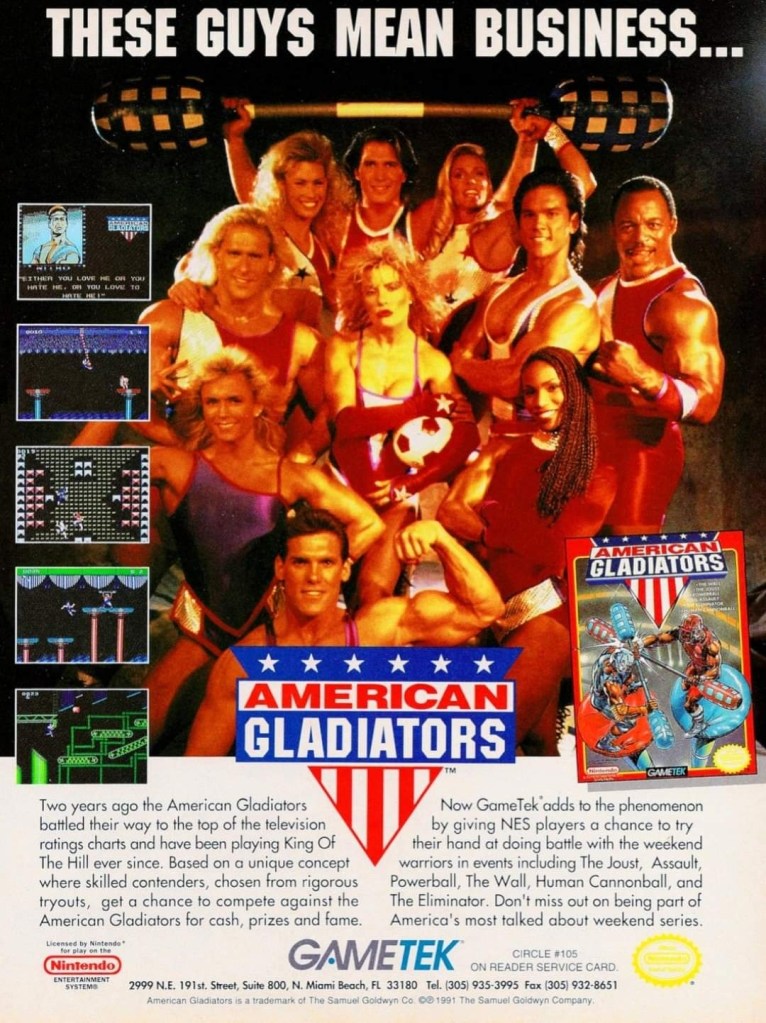
4. American Gladiators for NES print ad

I saw American Gladiators on TV but never played this game.

American Gladiators was a syndicated TV show that featured a variety of games in which amateur athletes compete with the established gladiators to succeed and become the next American Gladiator. Due to its success, it was not surprising that video game adaptations of the show were realized just a few years after its debut. In 1991, GameTek released the American Gladiators game on the Nintendo Entertainment System (NES) and promoted it with this print ad that showcased their established gladiators of the time. This ad’s design was made to catch the attention of the fans.

5. Arch Rivals for NES print ad

I remember seeing a lot of people crowding in front of an Arch Rivals machine in the local arcade long ago.

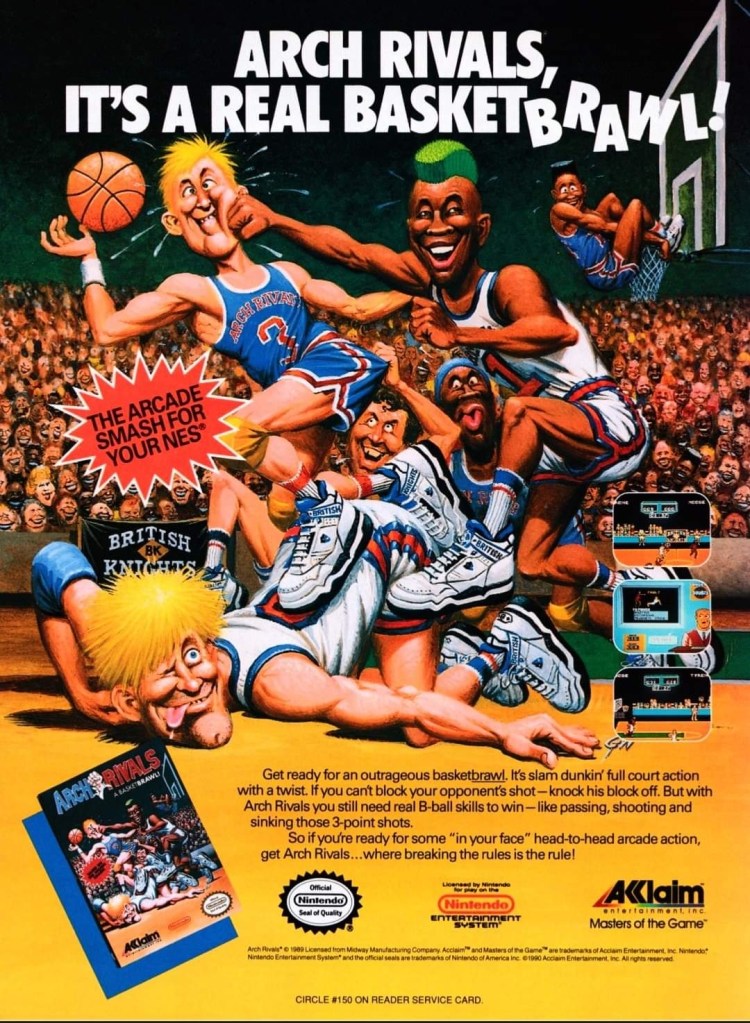
Years before NBA Jam, there was Arch Rivals. Arch Rivals was a full court basketball video game in which players are allowed to punch players from the opposition in order to steal the ball and score. Over a year after the game’s 1989 arcade debut, the NES version was released and the publisher came up with a print ad showcasing a hilarious and cartoony artwork (the same art used for the game’s box cover) which gave readers a clear idea of what to expect. The art used is timeless and it still is funny to see.

6. Sega Sports print ad

See any Sega Sports video game you like?

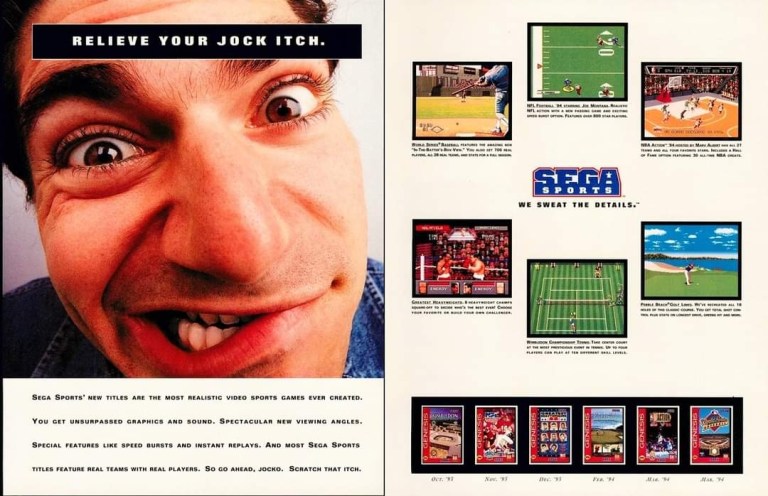
Back in the 1990s, Sega excelled with sports video games. They were so aggressive, they established their sub-brand Sega Sports and this particular print ad showed one page promoting assorted sports video games (basketball, golf, baseball, tennis, boxing and American football) for the Sega Genesis and the other page with an exaggerated image of a guy with the line “Relive your jock itch” posted. Historically, a lot of American players and owners of the Genesis are slightly older than those on NES and Super Nintendo Entertainment System (SNES) during the 1990s and the strong sports games approach is a key factor.  

7. Plumbers Don’t Wear Ties print ad

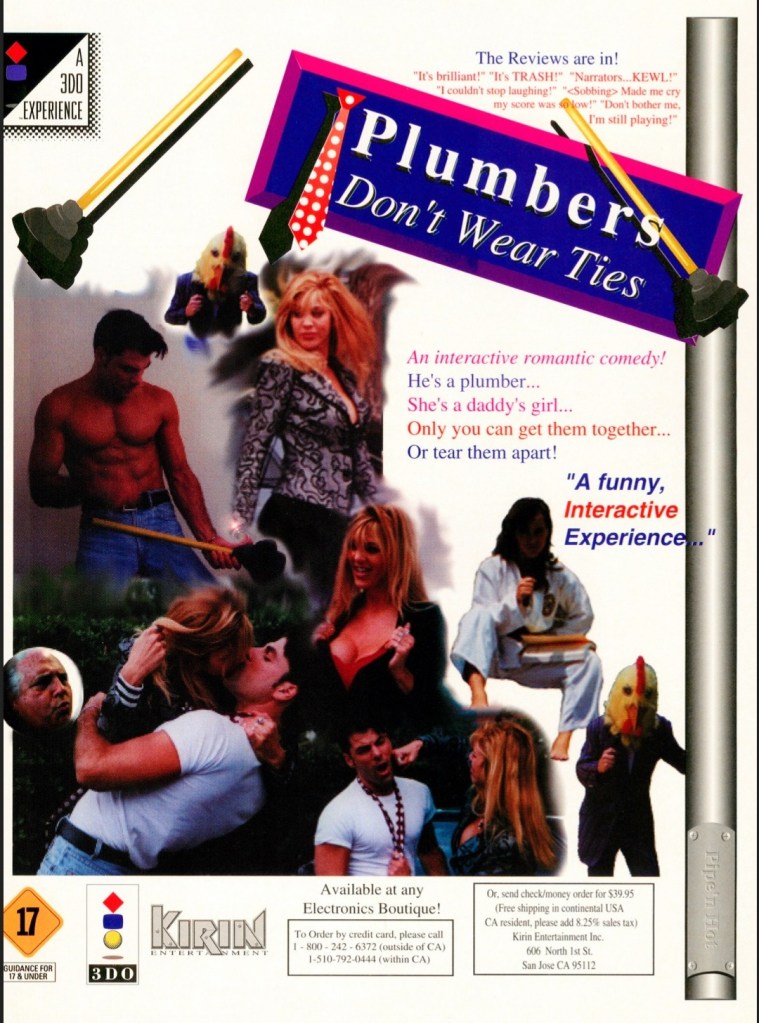
When I first saw this print ad, it did not interest me as the presentation is lousy.

The 3DO console is remembered for having a lot of games that used full-motion videos and photo slides regardless of what game designs came with them. Back in the 1990s, games designed as visual novels or dating simulations were still new in console gaming in the West. Following the PC version’s release, a 3DO port of Plumbers Don’t Wear Ties came out in 1994 and it received overwhelmingly negative reviews. The print ad here promoted the game as “an interactive romantic comedy” and fake quotes were displayed to fool ignorant readers that the game was entertaining. The print ad’s visual design had a mess of poorly implemented images. Ironically, this ad accidentally gave readers the idea that it was a slideshow game.

8. Dragon: The Bruce Lee Story and Demolition Man games print ad

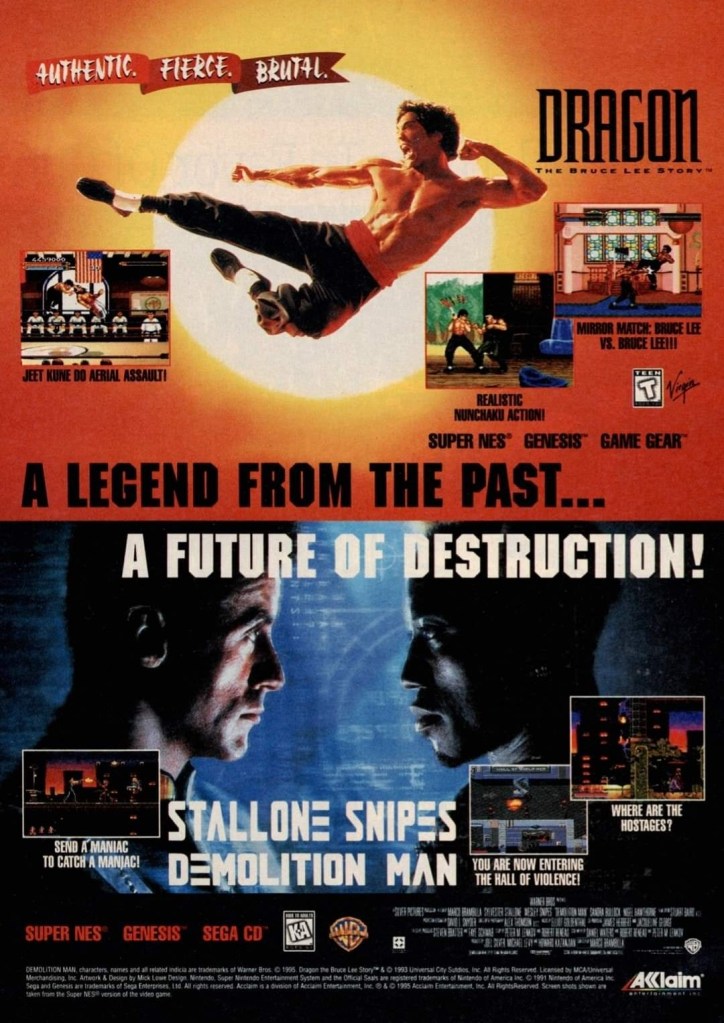
If you saw the movies, did you play their respective video game adaptations?

The 1990s is remembered for the many movie-based video games that got released. Back in those days, a lot of Hollywood movie productions had video game adaptations as part of the business process and this is evident with the Dragon: The Bruce Lee Story and Demolition Man games released by Acclaim. For this particular print ad, the marketing team came up with a single-page ad to promote the two games with heavy emphasis on movie imagery leaving little room left for screenshots and other details. The way I look at this old print ad, it seems that Acclaim was aiming for not just movie fans but also gamers who like 2D fighting games and 2D action-adventure games.

9. Army Men: Sarge’s Heroes print ad

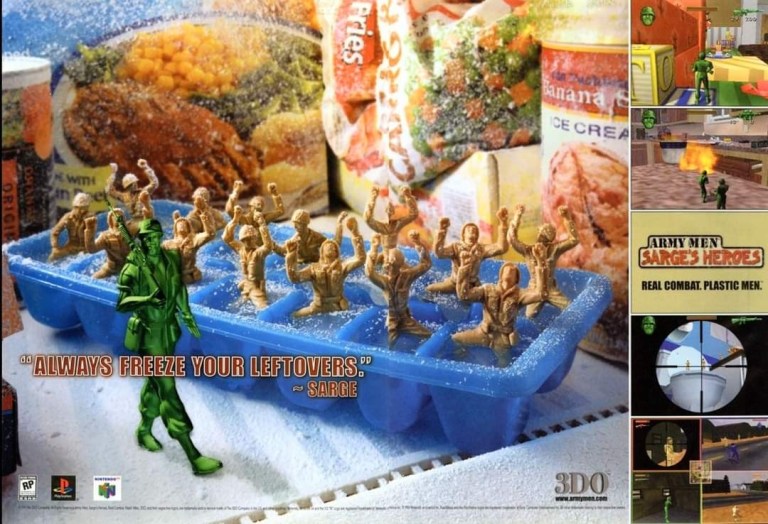
This print ad by 3DO is still funny to see.

In the late 1990s, The 3DO Company focused mainly on producing video games on multiple platforms and they had their own video game franchise based on the green plastic figures with a military theme. In 1999, they released Army Men: Sarge’s Heroes for PlayStation and Nintendo 64 (N64). To market the game, they had a hilarious visual concept of several solders freezing on an ice tray as a long green soldier marching on. This print ad always caught my attention while reading game magazines and it still is funny to stare at.

10. Sega Ages print ad

I can only speculate that Sega accepted Working Design’s financial offer for the publishing rights in North America.

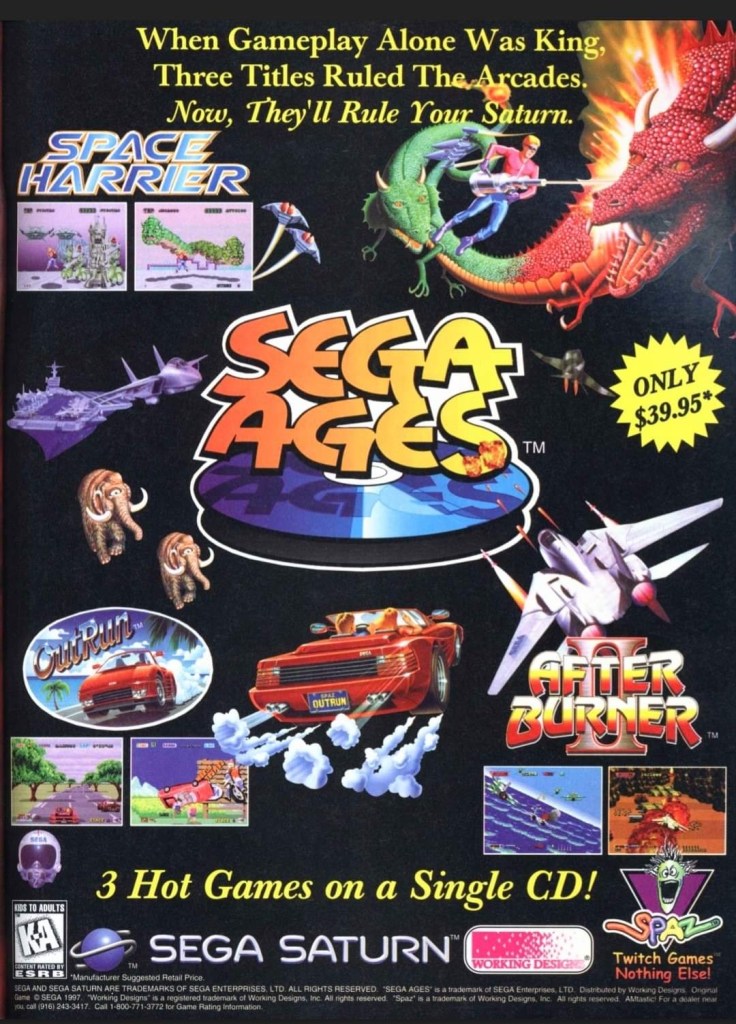
Sega Ages is a series of ports and remakes of Sega’s own games (arcade and console) bundled together as compilations released on the modern consoles of the time. While Sega itself published Sega Ages on their Saturn console and Europe, the North American compilation was published by Working Designs under their separate brand Spaz which this particular print ad showed. While the classic Sega games of After Burner II, OutRun and Space Harrier often caught my attention, this ad made me wonder why did not Sega publish this compilation on the Saturn in North America themselves. Looking at this ad now remains awkward.

11. Sega Saturn North American print ad

Did you ever own a Sega Saturn in 1995?

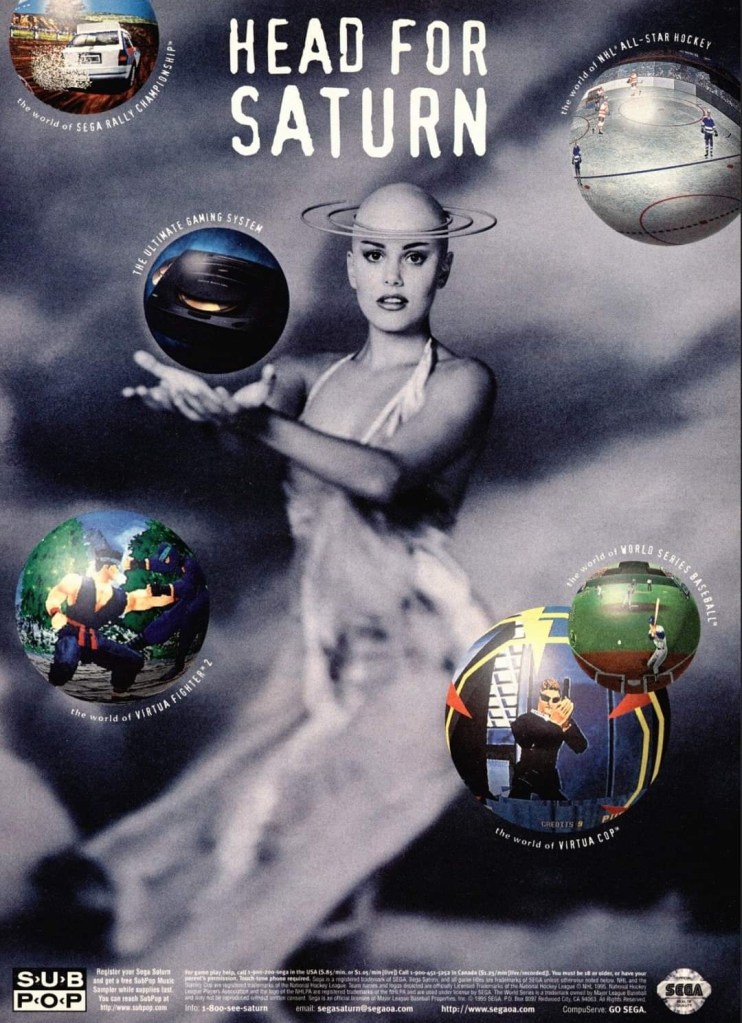
While a lot of gamers and retailers were caught off-guard by Sega’s surprise early launch of the Saturn console in America, they still went ahead aggressively marketing the machine knowing they have a few months’ head start before the American launch of PlayStation. This print ad was designed to intrigue readers showing a bald lady whose head was made to look like the planet Saturn and next to her were images of Sega’s hottest games of the time – Virtua Fighter 2 and Virtua Cop. Sega relied strongly on imagery to promote their console with this print ad. It was somewhat weird yet eye-catching.

12. NBA Action ’95: Starring David Robinson print ad

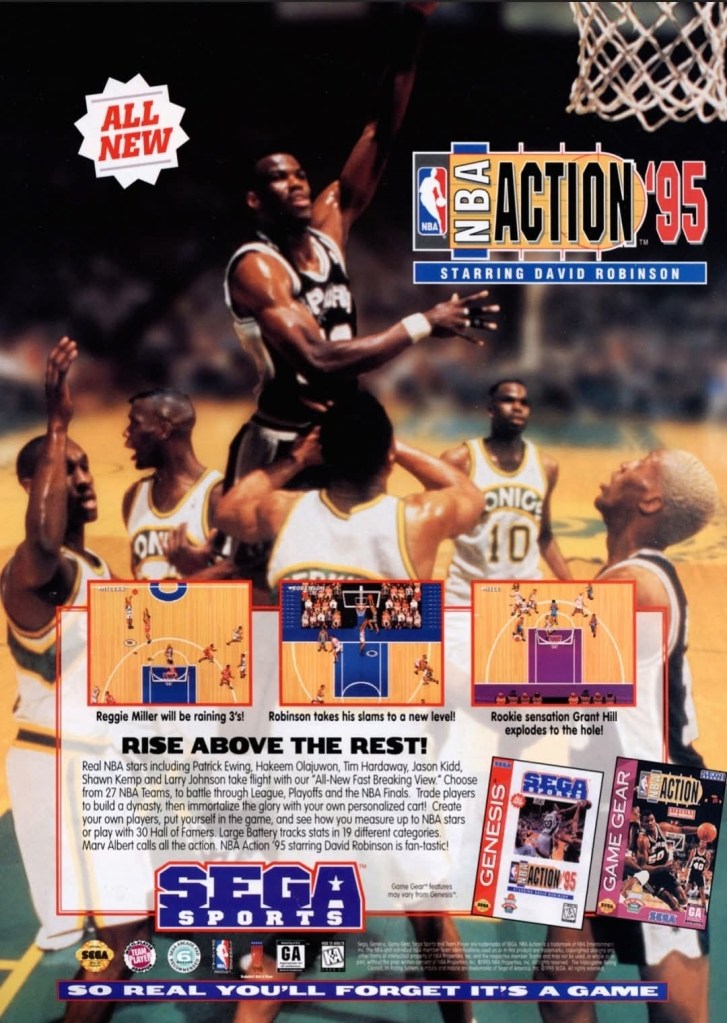
David Robinson was the MVP of the NBA in 1995 but he failed to lead his team to the NBA championship back then. He would late win the NBA championship in the shortened 1999 season.

As mentioned early, Sega was aggressive the sports videos games and almost all of them were their own console exclusives. Their tradition of hiring professional athletes as endorsers continued during the age of the Genesis and Game Gear when they hired an NBA superstar as an endorser resulting in the Sega Sports basketball game titled as NBA Action ’95: Starring David Robinson. By the time the video game was released, Robinson was already the reigning Most Valuable Player (MVP) of the NBA. This print ad of Robinson in action still looks impressive but with a big catch – the superstar’s 1995 MVP achievement was arguably forgotten as he and his team (San Antonio Spurs) got eliminated by the Hakeem Olajuwon-led Houston Rockets in the Western Conference Finals. It did not help that Olajuwon outplayed Robinson a lot in that very playoff series. That is a sad reminder that also came with this Sega Sports print ad.

+++++

Thank you for reading. If you find this article engaging, please click the like button below, share this article to others and also please consider making a donation to support my publishing. If you are looking for a copywriter to create content for your special project or business, check out my services and my portfolio. Feel free to contact me with a private message. Also please feel free to visit my Facebook page Author Carlo Carrasco and follow me on Twitter at  @HavenorFantasy as well as on Tumblr at https://carlocarrasco.tumblr.com/ and on Instagram at https://www.instagram.com/authorcarlocarrasco
Retro Gaming Ads Blast – Part 23

Welcome back readers, fellow geeks and electronic gaming fans!

In this edition of the Retro Gaming Ads Blast (RGAB) series, we will take a look at another batch of retro gaming print ads – including arcade flyers – from the 1980s and 1990s.

For the newcomers reading this, Retro Gaming Ads Blast (RGAB) looks back at the many print ads of games (console, arcade, computer and handheld) that were published in comic books, magazines, flyers, posters and newspapers long before smartphones, social media, the worldwide web and streaming became popular. To put things in perspective, people back in the 1980s and 1990s were more trusting of print media for information and images about electronic games and related products.

With those details laid down, here is the newest batch of retro gaming print ads for you to see and enjoy…

1. Raiders of the Lost Ark game print ads

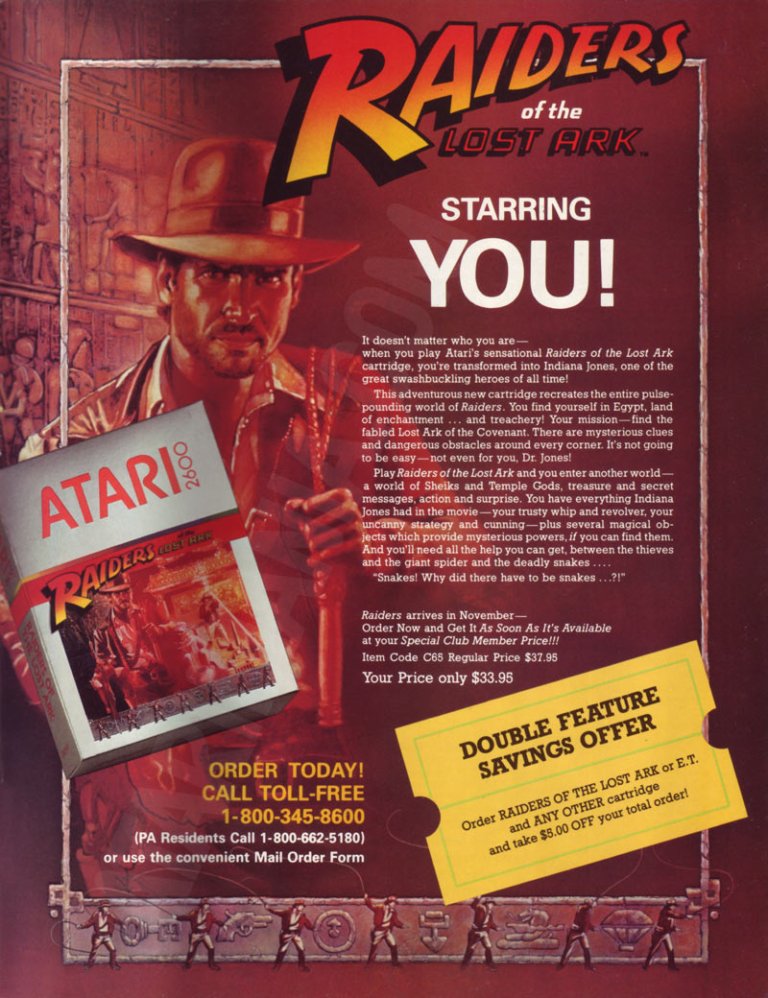
The print ad with strong Indiana Jones imagery.
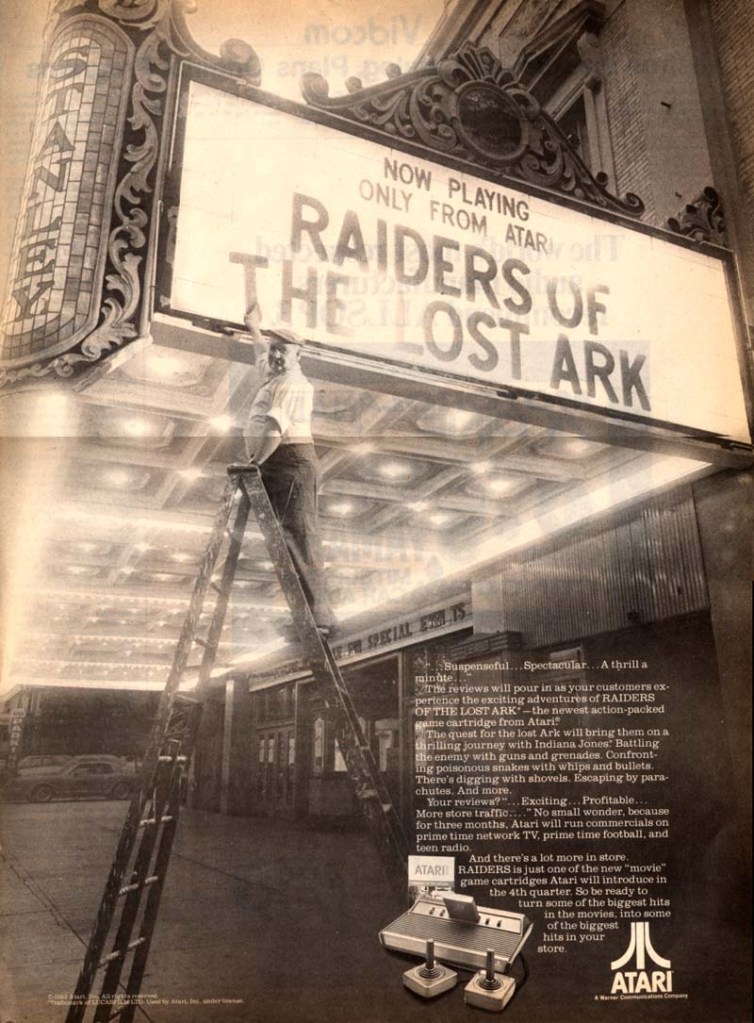
The print ad with the movie theater exterior image and the small image of the Atari 2600 console.

Directed by Steven Spielberg, Raiders of the Lost Ark was one of the best adventure movies ever made as well as the start of the iconic character Indiana Jones. Given its huge commercial success, an official video game adaptation for the Atari 2600 was released in 1982 and game designer Howard Scott Warshaw even met with Spielberg during the game’s development.

To promote the game, Atari released two print ads – one ad had a movie theater exterior visual concept to emphasize they have the official video game adaptation based on the movie while the other ad showed the game’s official artwork and game box cover while emphasizing a savings offer. Atari really did what they could to sell a game while riding on the success of Raiders of the Lost Ark.

2. Phoenix print ad

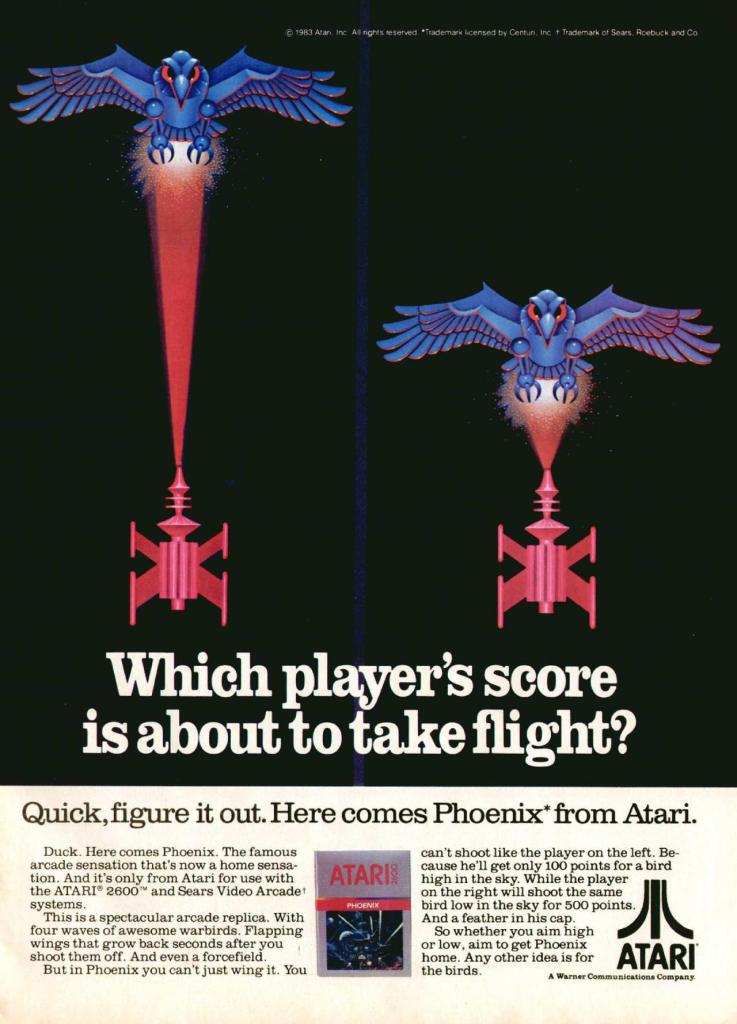
Even without any screenshots, this print ad’s art still gives viewers a clear idea of what to expect.

Similar to what they did with Galaxian and Joust, Atari made this print ad promoting Phoenix which was a 2D sci-fi shooting game that was similar with Space Invaders in design. Colorized, hand-drawn artwork resembling the 2D sprites of the game was done to capture the attention of people. The art is so good, it made up for the lack screenshots of the game. 

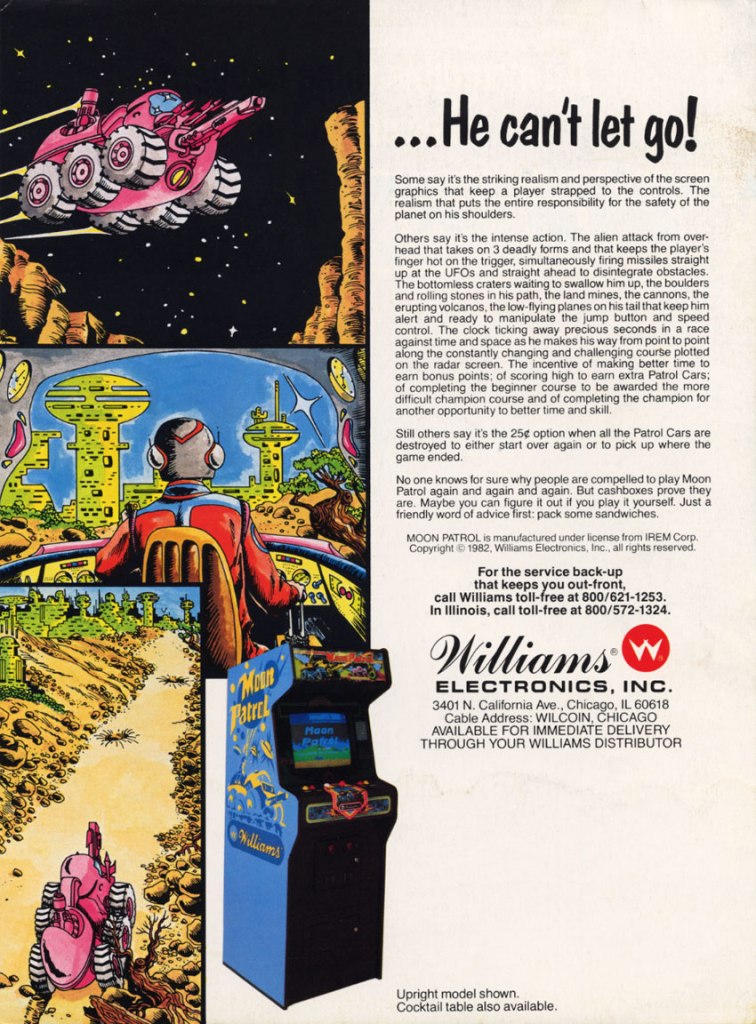
3. Moon Patrol arcade flyer

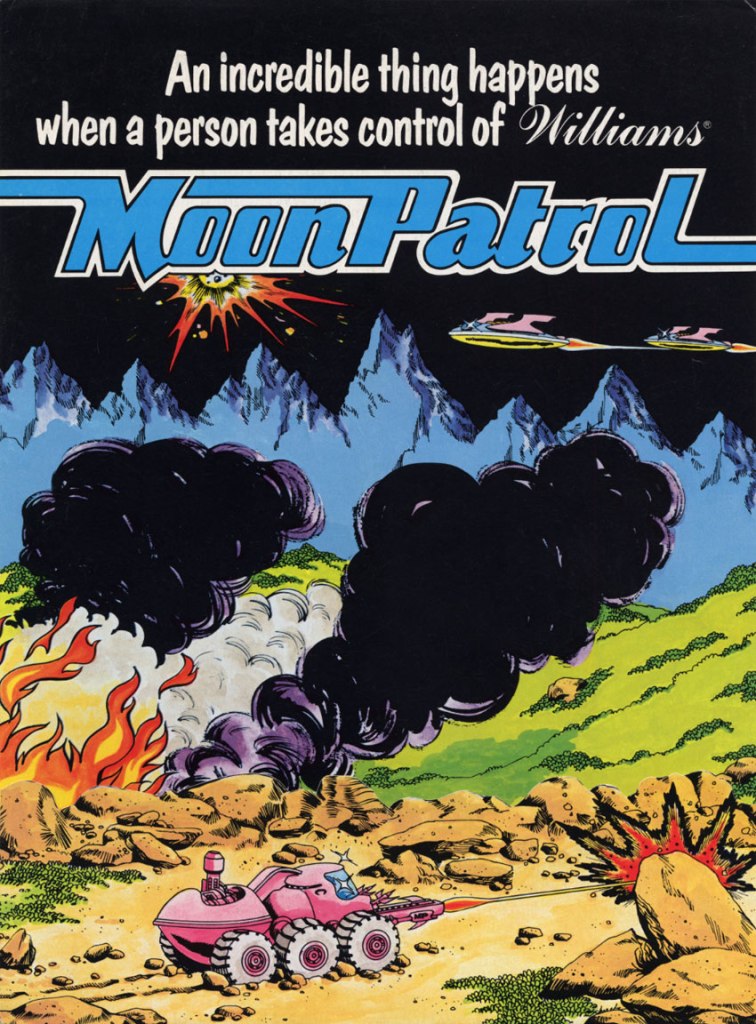
Front of the Moon Patrol flyer.
The other side of the arcade flyer.

Moon Patrol was a 2D sci-fi side-scrolling adventure game first released in the arcades in 1982. To sell the game to arcade operators, publisher Williams created the North American arcade flyer that heavily used hand-drawn comic book-style artworks on both sides while using available space on the other side for the descriptive text, contact details and the image of an arcade machine. What is very clear is that no screenshots of the game were shown to stand out which explains why a lot of hand-drawn art was used. The picture of the machine showing a screen of Moon Patrol was the closest thing to see a screenshot on this flyer. Personally, I really like the style and quality of the hand-drawn artwork as it made the flyer look lively.

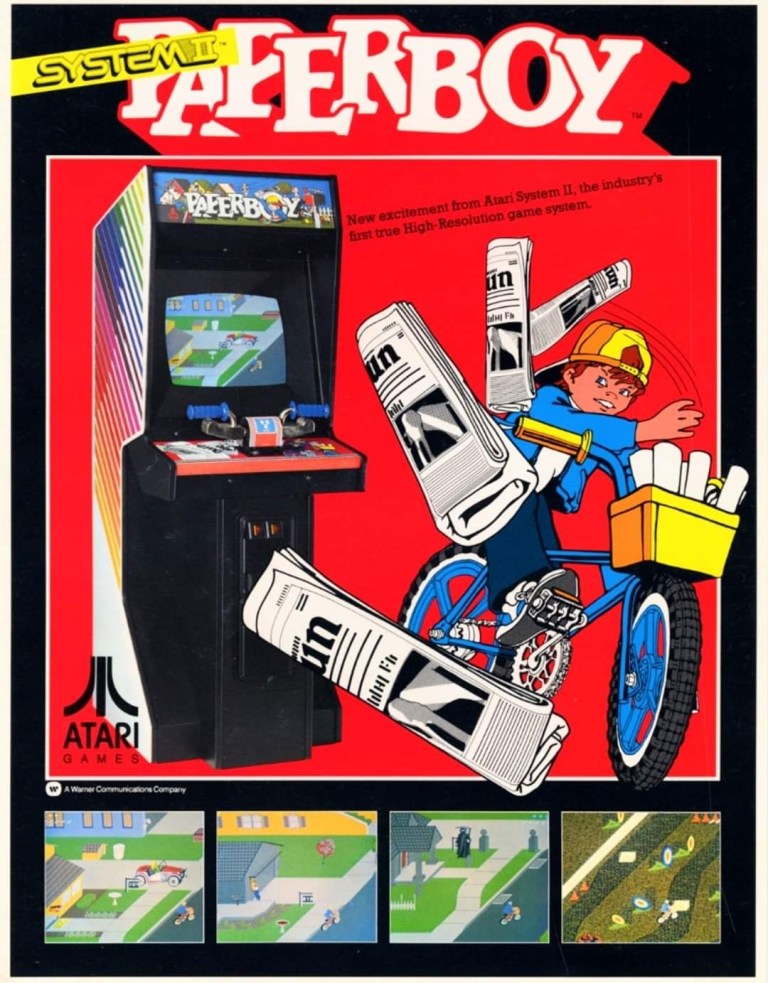
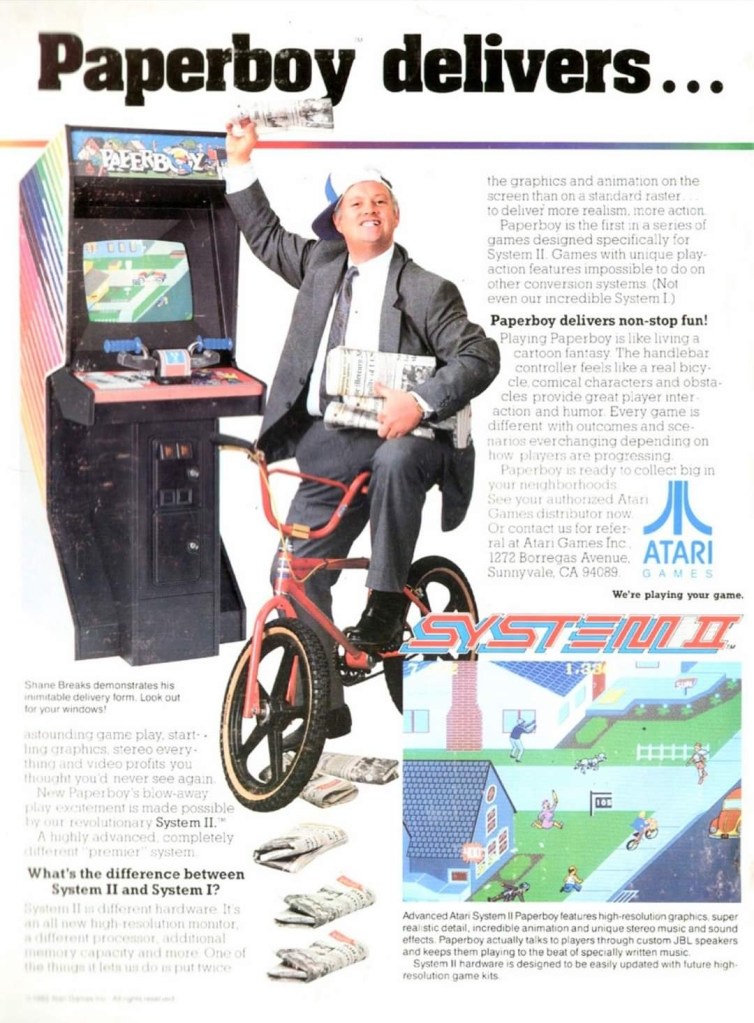
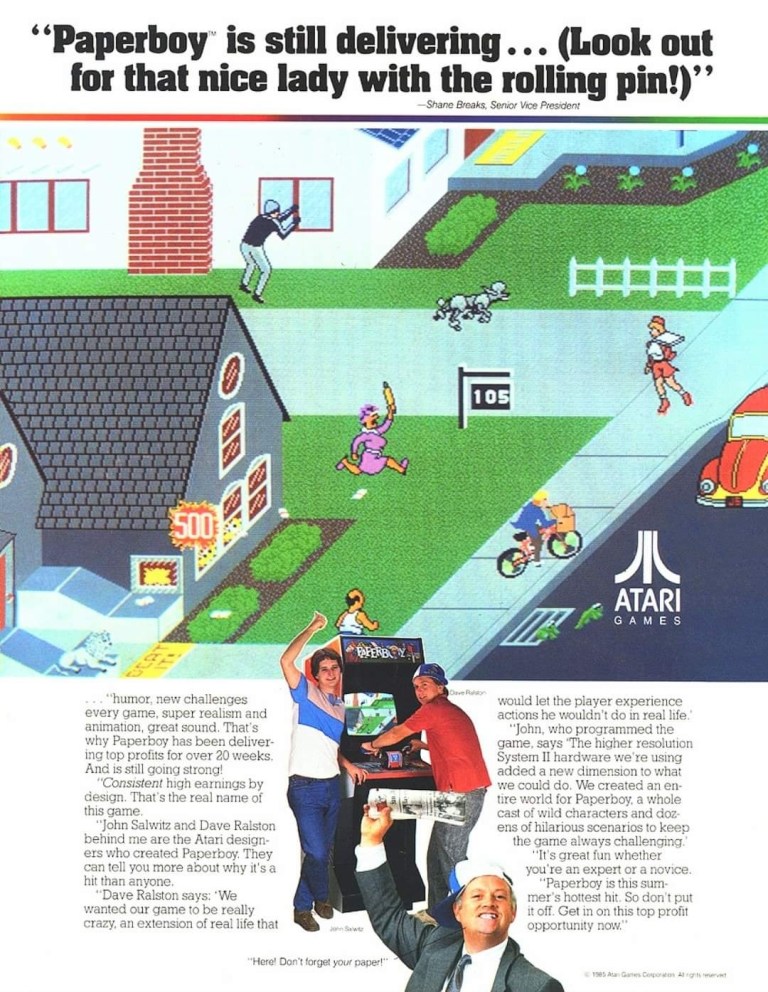
4. Paperboy arcade flyers

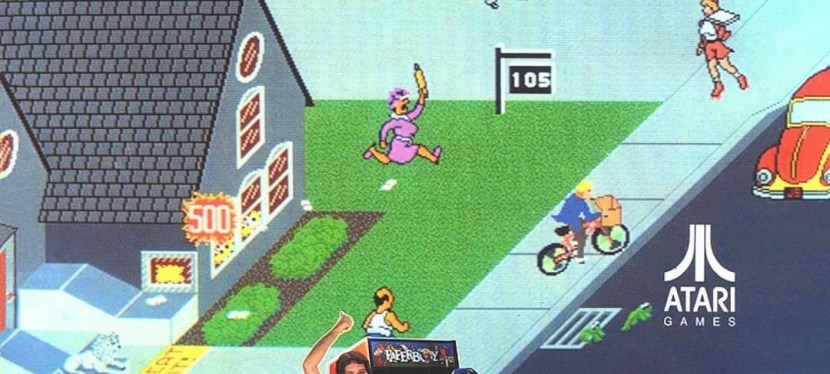
The arcade flyer showing the Paperboy machine and screenshots. The hand-drawn art is nice.
This one uses comedy showing a grown man riding a bike as a paper delivery “boy”.
I really like the stronger emphasis on the in-game graphics of Paperboy which dominates the space. What you see is what you get in the arcade.

The first time I ever played the classic Paperboy was in the arcade inside a Las Vegas hotel way back in 1989, and it sure was a challenging yet fun experience. Before its arcade debut in 1985, the developers took a lot of risks making the game which includes coming up with a bicycle handle bar for each machine to have. To promote the game, Atari made at least three arcade flyers that creatively emphasized what the game’s concept was about, how did it play, why does the machine have bicycle handlebars and why players can expect fun. Atari’s promotional efforts paid off as Paperboy became a huge hit in the arcades not only in America but also in Japan.

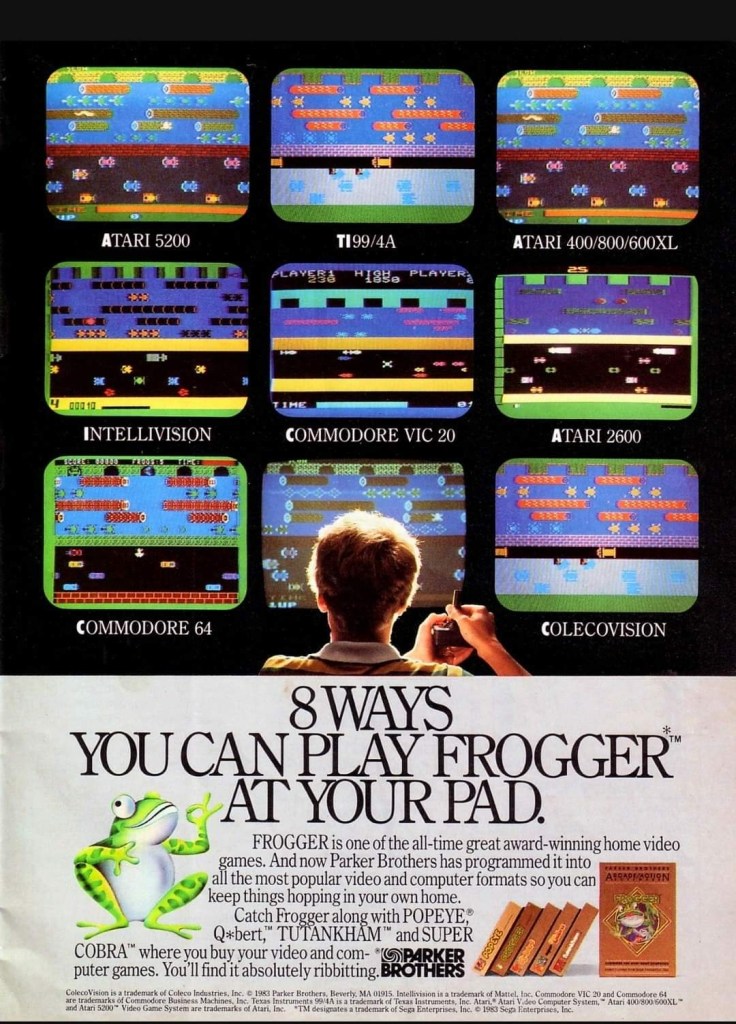
5. Frogger multi-platform print ad

This print ad is still amusing to look at.

After Frogger became a hit in the arcades, Parker Brothers secured the rights to port the game on Atari consoles, the Intellivision, TI-99/4A, vic-20, the Commodore computers and ColecoVision. To promote their Frogger ports, the single-page print ad was made showing a player in the foreground playing in front of screens that each showed what the game looked like on each platform. Parker Brothers found tremendous success selling 4 million copies of Atari 2600 version of Frogger at a time when there were only 13 million units of Atari 2600 in existence. By the year 2005, video game sales of Frogger reached 20 million worldwide across different platforms.

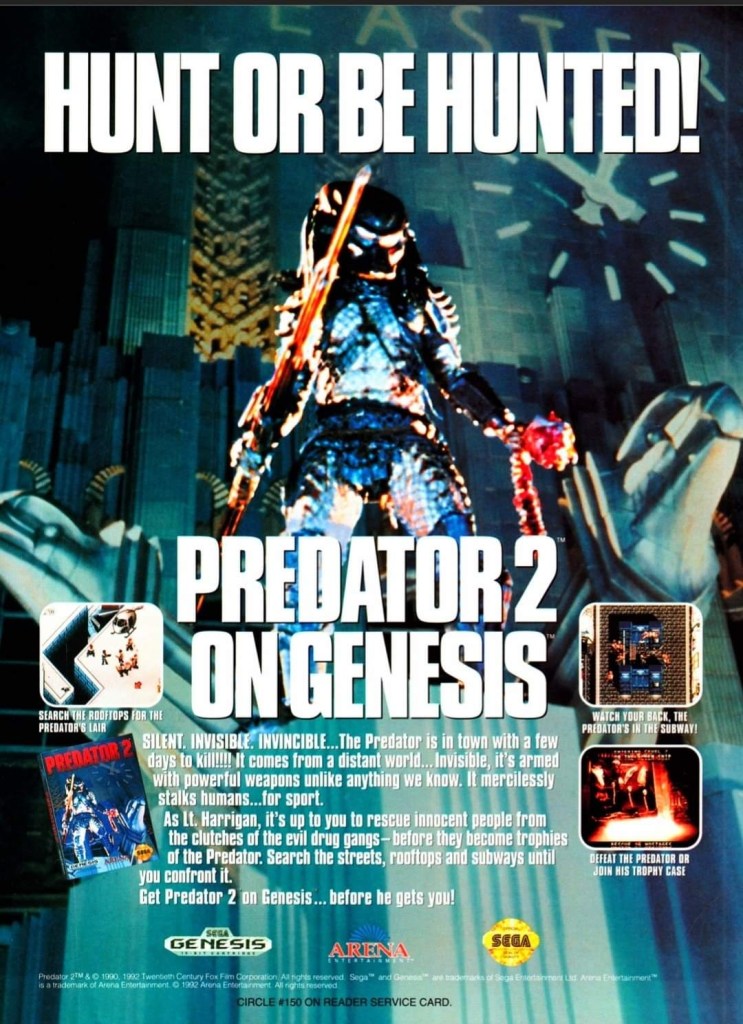
6. Predator 2 print ad

This is one very edgy print ad as used an official image from the movie.

If there is anything memorable about the 1990 film Predator 2, it is the fact that it had the story and the alien hunter itself within a metropolitan setting. That being said, the Sega Genesis Predator 2 video game had a suitable design of shooting and adventuring within the urban settings. This video game ad really captured the vibe of the movie (even showing the reddish human skull with spine on the Predator’s left hand) and clearly showed what gamers could expect. This old ad is still captivating to look at and its edgy approach is still intact.

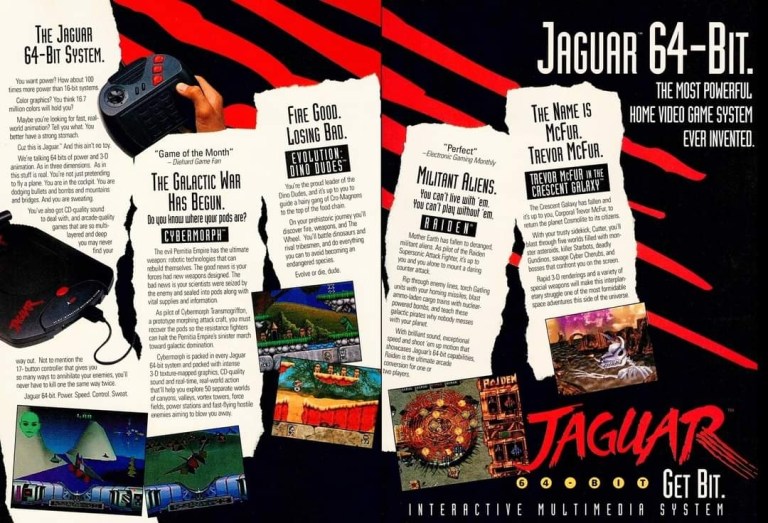
7. Atari Jaguar print ad

Did you ever own an Atari Jaguar console?

When I was reading video game magazines back in the 1990s, I always found print ads of the Atari Jaguar intriguing to look at. I was very young when I first played the Atari 2600 and its games at home, and later played some Atari games in the arcade. To me, seeing Atari Jaguar print ads like this one gave me moments of nostalgia and it made me wonder if Atari knew what it was doing with their so-called 64-bit game console. They did what they could to promote their console and the games within this 2-page print ad.

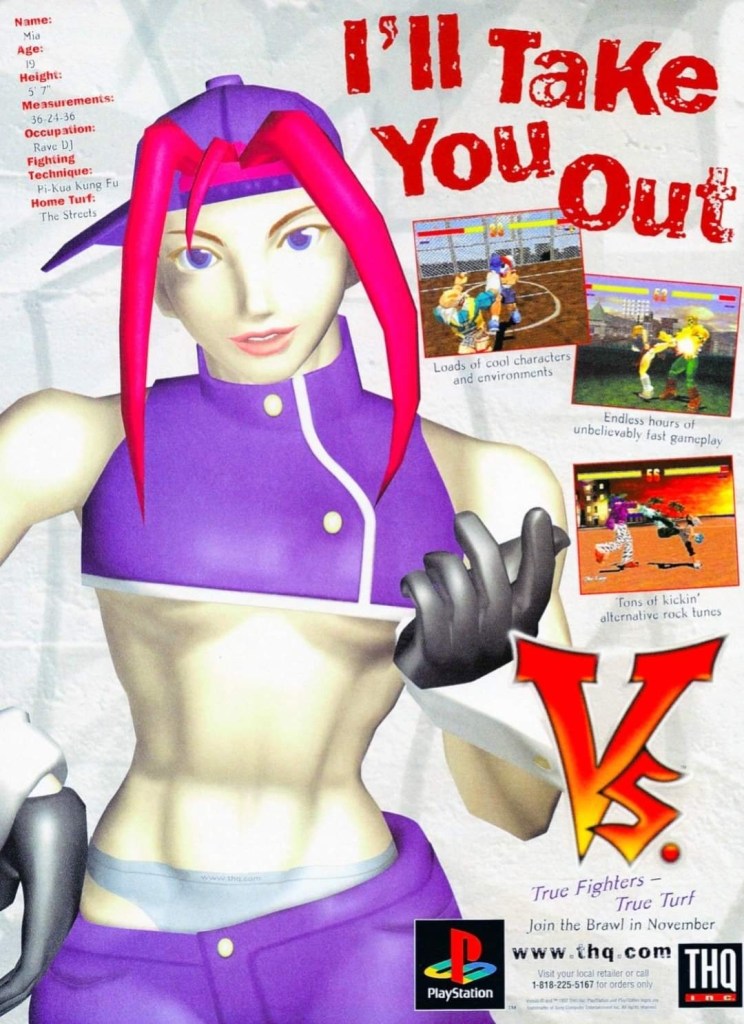
8. Vs. print ad

This print ad easily reminds me of the 1990s.

By 1997, both the arcades and the video game console market were filled with lots of 2D and 3D polygonal fighting games. Japan was the hot spot of the production of 3D polygon fighting games and the developer Polygon Magic (based in Japan) made Fighters’ Impact which Taito released in Japanese arcades and the PlayStation. The said game was picked up by THQ for a late-1997 release on the PlayStation in America under the title Vs. I never played this game but I heard that the game’s development included gang-oriented characters designed by Marvel Comics artist Kurtis Fujita. This Vs. ad is a lively reminder about the hip-hop fashion that made its way into video games.

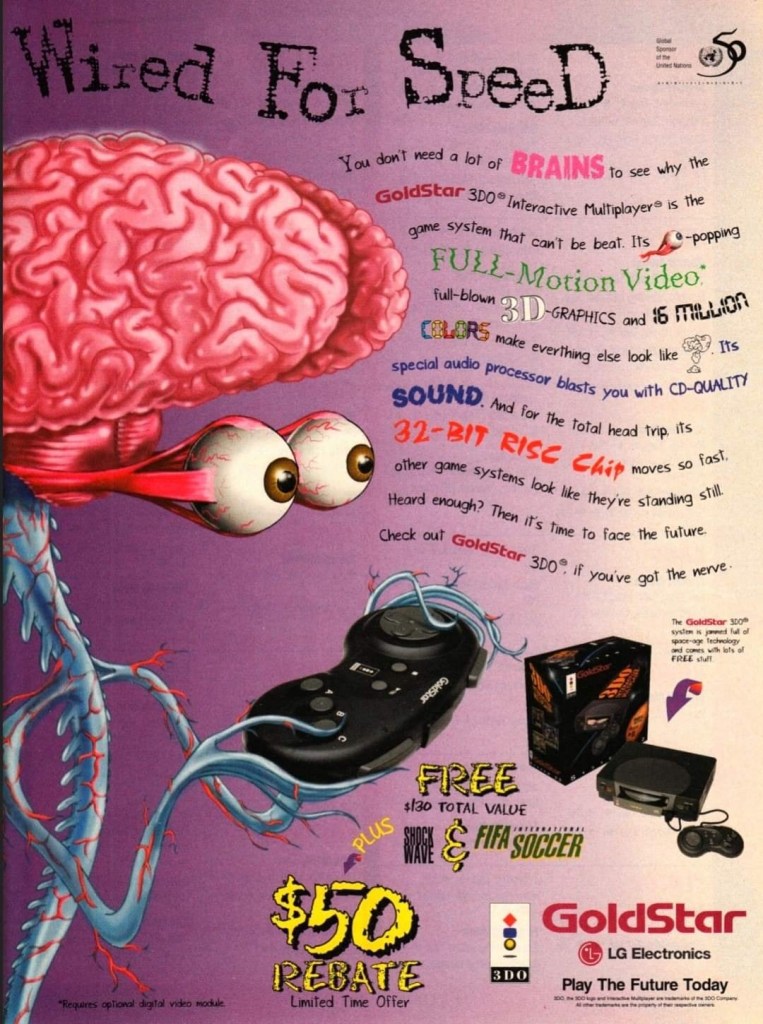
9. GoldStar/LG Electronics 3DO print ad

This is a very weird way to market a video game machine.

Back in the 1990s, the South Korean electronics company GoldStar (which was part of the umbrella of LG Electronics) had the license to produce 3DO game consoles with its own style. In some ways, the GoldStar 3DO console looked like a premium console on the outside. Unfortunately, the GoldStar 3DO print ad here had a very sloppy presentation as the ad makers used very weird art of a brain-with-eyes holding a 3DO controller leaving little space left to promote the console and games (without any screenshots). The text description was sloppily done. This is a bad example of promoting video game hardware and games.

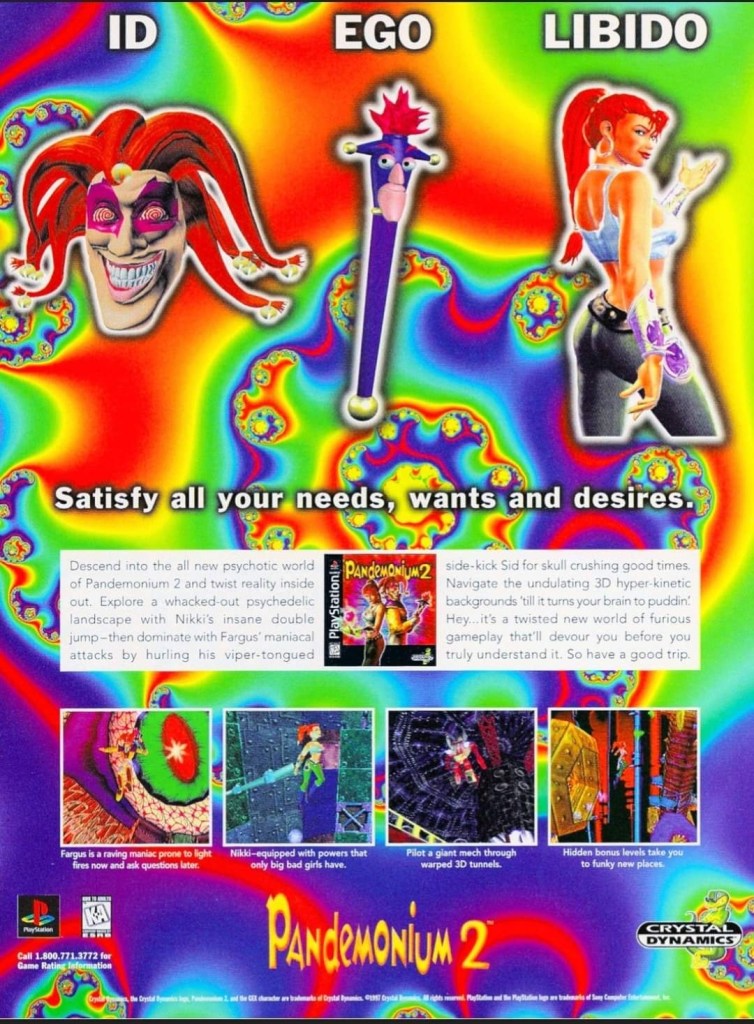
10. Pandemonium 2 print ad

I saw this ad but never played the game.

Looking back at 1997, I find it strange that I never got to play Pandemonium 2 on the PlayStation even though I saw its print ad in magazines. I had a lot of fun playing Pandemonium! on the console in 1996 but somehow missed out on its sequel. Looking back at the Pandemonium 2 print ad, I was surprised with how the game developers redesigned the two playable protagonists, especially Nikki who was clearly made to look very sexy. The word “libido” (meaning sexual drive) was deliberately placed above Nikki. The ad also had a hypnotizing mix of colors which I believe was also deliberately done by the ad makers. I can only wonder how the game played.

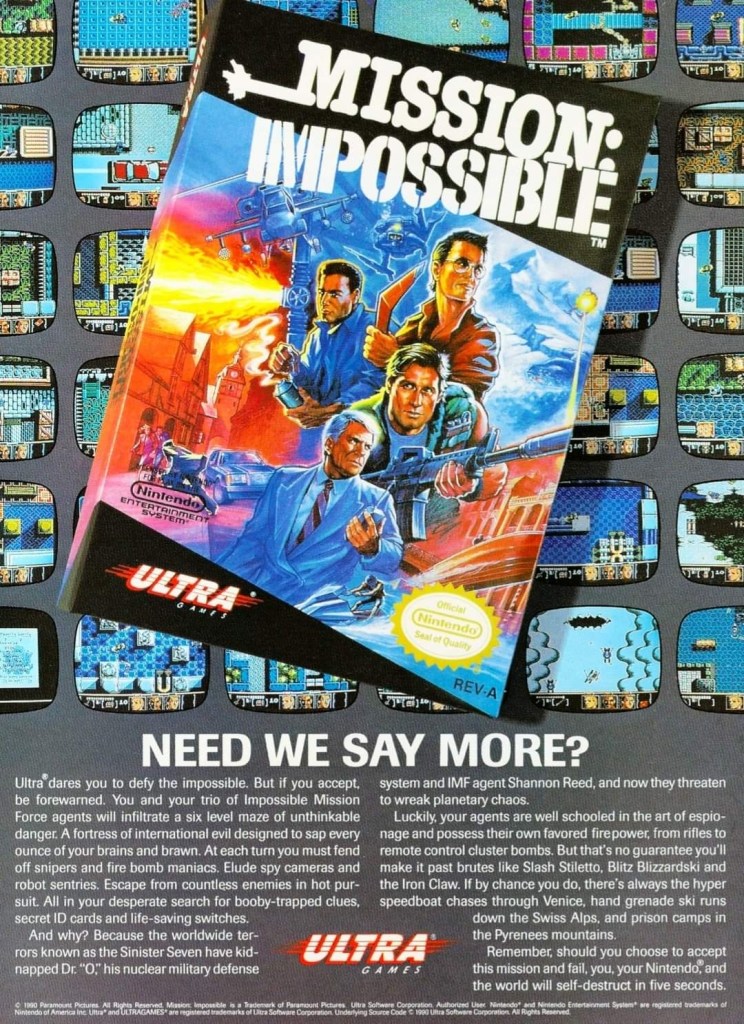
11. Mission: Impossible print ad

A captivating ad.

In 1990, Ultra Games (a label of Konami) released the Mission: Impossible video game on the Nintendo Entertainment System (NES) in America. Developed by Konami, the game was an adaptation of the 1988 TV series and it had an ambitious design with regards to level design and gameplay. To promote the game, the ad makers came up with a visual design showing the game’s box (which had a nice painted art on the cover) on the foreground and several screenshots resembling TV monitors on the background. Even by today’s standards, this print ad still looks good and captivating even if you are not too familiar with Mission: Impossible on TV.  

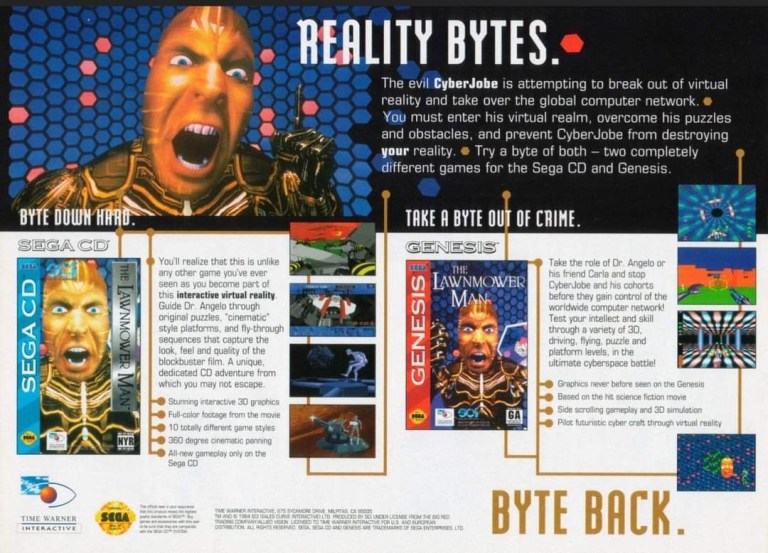
12. The Lawnmower Man Sega CD and Genesis print ad

Are you fan of The Lawnmower Man movie?

Back in 1992, there was a lot of buzz generated by the movie The Lawnmower Man as it had a disturbing concept that involved virtual reality and, more notably, author Stephen King sued the filmmakers to remove his name from the title because the film differed so much from the source material. Of course, those developments did not stop the production of video game adaptations of the movie. This print ad promoting the Sega CD and Sega Genesis versions of the game heavily used the images of CyberJobe which were among the most memorable images from the film. Looking at the ad, the ad makers could have made the screenshots look a little larger to really sell the games.

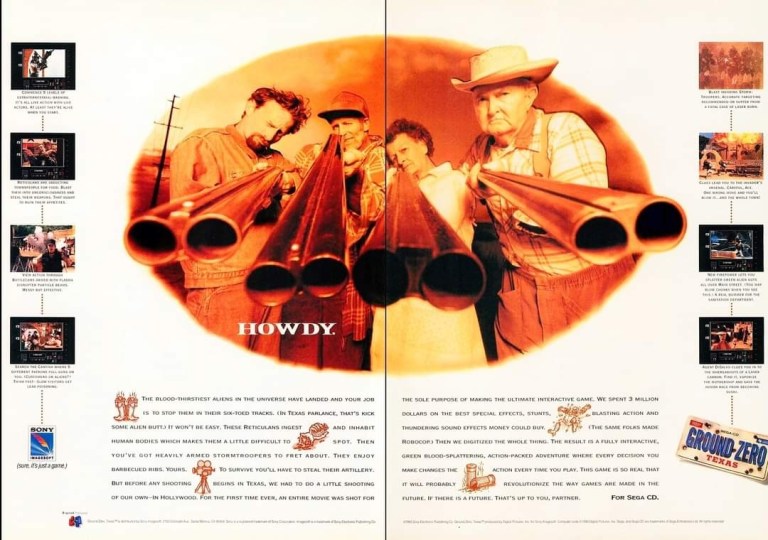
13. Ground Zero: Texas print ad

The shotguns really made this ad eye-catching.

I never played the Sega CD video game Ground Zero: Texas but I knew that it was one of those games that heavily relied on video footage while giving players moments to interact. Back in 1993, there was an increase in the number of video games that carried lots of live action footage to drive the narrative and players were given options in order to progress. What is very notable about the game is not the game design but the very 2-page ad used to promote it. The image showing four people pointing their shotguns towards the viewer was easily the most captivating part of the ad. Even though there was vacant space in between, the screenshots of the game were displayed to be really small.

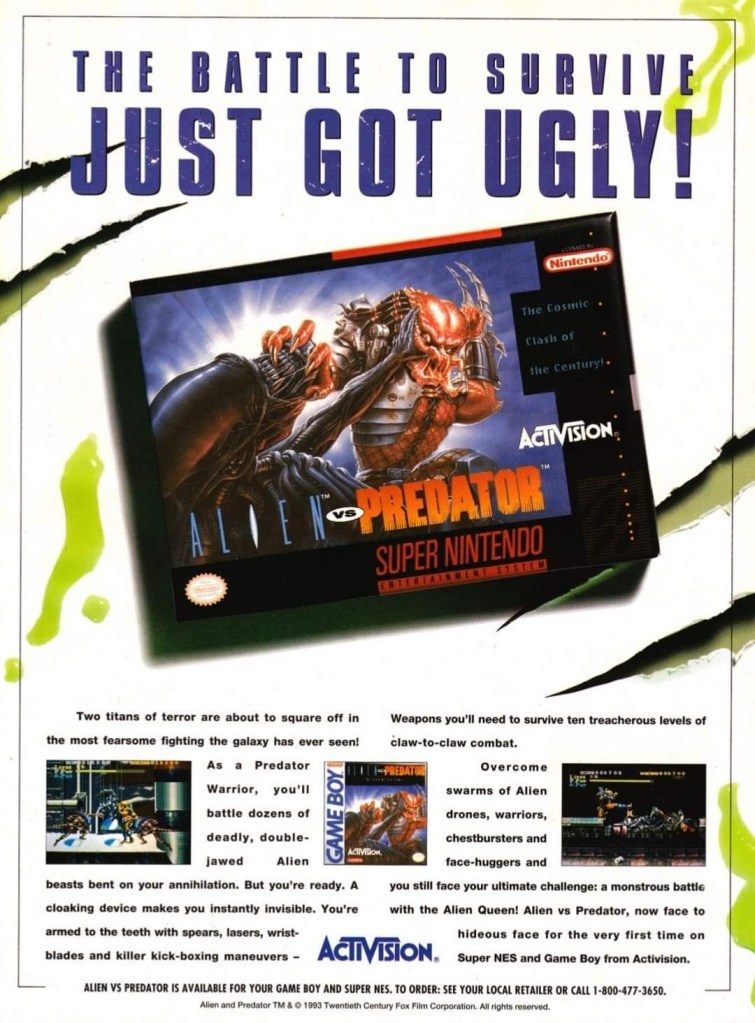
14. Alien vs. Predator for SNES and Game Boy print ad

This ad caught the attention of a lot of people back then.

Back in 1990, Dark Horse Comics launched the 4-issue mini-series of Aliens vs. Predator which turned out to be a very intriguing and engaging crossover comic book tale featuring two iconic sci-fi species of monsters. The success of the comic books led to the production of many video games which delighted both fans of Predator and Aliens. In 1993, Activision released Alien vs. Predator on the Super Nintendo Entertainment System (SNES) and the single-page print ad they came up with was engaging to look at. The SNES game box with the fine looking painted art was the main visual highlight leaving just enough space for the descriptive text, the Game Boy cover and two screenshots. Believe it or not, this video game was not related at all with the Alien vs. Predator arcade game and Atari Jaguar console game.

+++++

Thank you for reading. If you find this article engaging, please click the like button below, share this article to others and also please consider making a donation to support my publishing. If you are looking for a copywriter to create content for your special project or business, check out my services and my portfolio. Feel free to contact me with a private message. Also please feel free to visit my Facebook page Author Carlo Carrasco and follow me on Twitter at  @HavenorFantasy as well as on Tumblr at https://carlocarrasco.tumblr.com/ and on Instagram at https://www.instagram.com/authorcarlocarrasco
A Look Back at Predator #1 (1989)

Welcome back science fiction enthusiasts, 1980s arts and culture enthusiasts, movie fans and comic book collectors! Today we go back to the year 1989 to take a look at a significant event of the Predator entertainment franchise – the comic book launch of Predator.

For the newcomers reading this, Predator started as a sci-fi action movie in 1987 directed by John McTiernan (Die Hard) and starring Arnold Schwarzenegger, Carl Weathers, and Jesse Ventura to name some. The writers and creators were Jim Thomas and John Thomas. As the movie became a huge commercial success, it led to the start of its own multi-media entertainment franchise covering video games, toys, novels and comic books. It also led to the release of more movies including a crossover film with the Alien franchise.

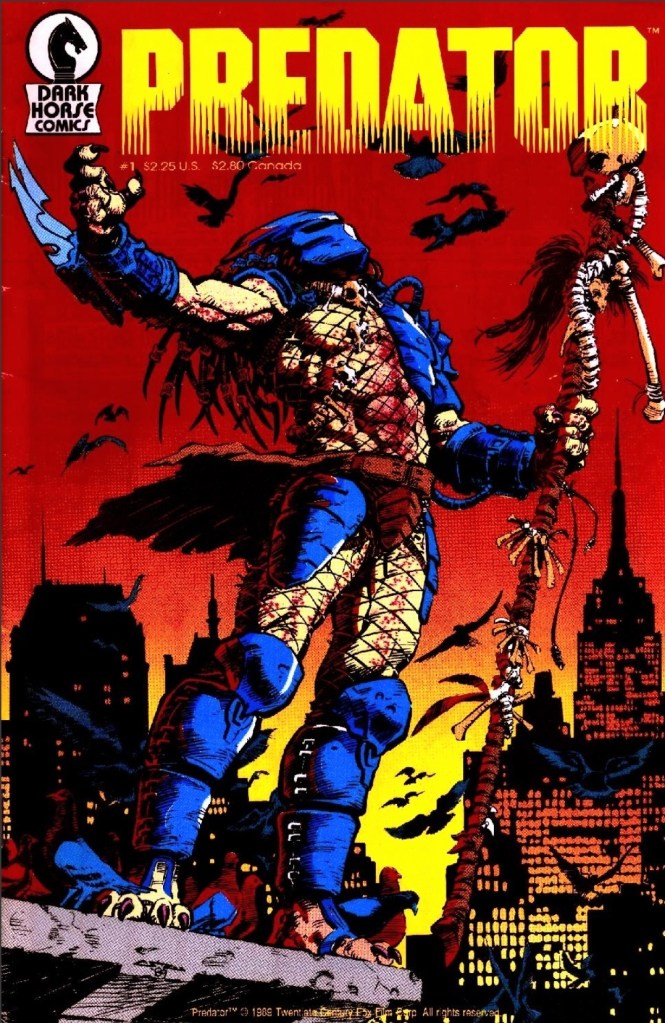
With those details laid down, here is a look back at Predator , published in 1989 by Dark Horse Comics with a story written by Mark Verheiden and drawn by Chris Warner. The is the first chapter of a 4-issue mini-series and it would later be referred to as Predator: Concrete Jungle.

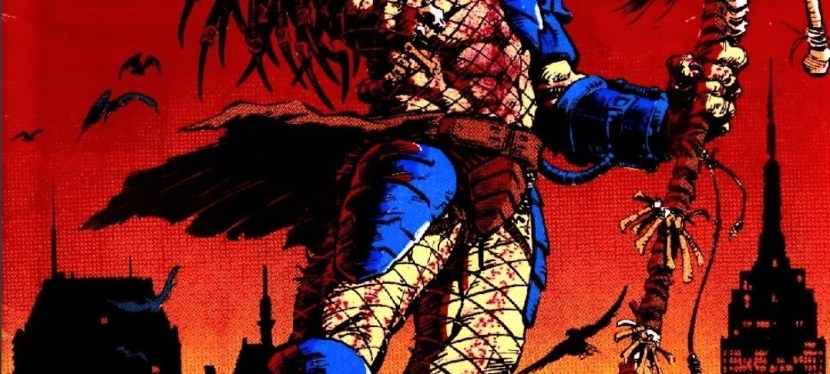
The cover.

Early story

The story begins during a very hot summer day in 1991 New York City. A man killed his own wife using a shotgun which eventually leads to the arrival of cops, medics and his arrest. The two detectives Errol Rasche and John Schaefer (brother of Dutch) have been working together in the local war against crime and they have a tendency to do things that violate their superiors’ orders.

In one of the rundown buildings of New York, a secret meeting between two gangs got terribly disrupted by a Predator who attacked from the outside. Chaos and destruction followed.

Shortly after, Rasche and Schaefer arrive outside the same building which has been surrounded and isolated by the local police. When a man suddenly fell out of the building and crashed on top of a police car, the two detectives decide to enter willfully violating the order to stay out.

Once they enter the room where the secret gang meeting was held, Rasche and Schaefer are shocked to see many skinned and dead bodies inside. Schaefer is convinced that what happened was not the result of a gang war…

Quality

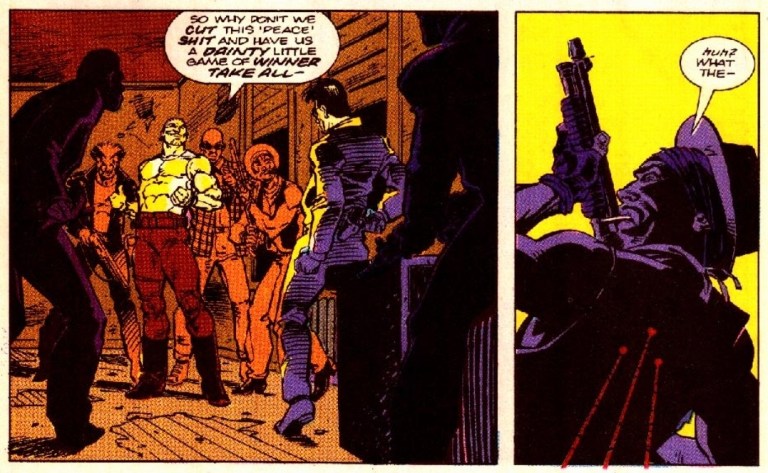
A gang meeting about to be disrupted by the unseen Predator.

This comic book – written as a not-too-obvious sequel to the 1987 movie – is absolutely very intriguing to read from start to finish. Mark Verheiden clearly wrote a crime story that happens to involve the species of deadly hunters from outer space. In fact, this comic book has very notable elements that also made it into the core concept of the 1990 movie Predator 2.

Story is set within a massive city that happens to be suffering from a heat wave – check! There is rampant crime and conflicts between gangs – check! The Predator causes huge disruptions on the criminals – check! The detectives willingly violate protocol to solve cases – check! One of the detectives is gradually getting closer to retiring and his pension – check. It’s almost as if this comic book was a huge influence on the people who made Predator 2.

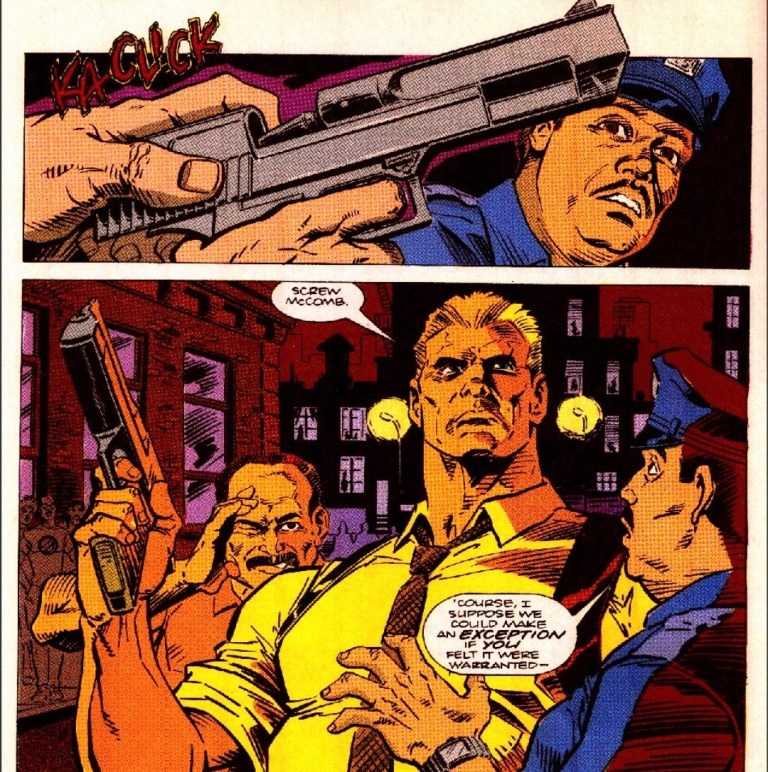
Going back to the story, this is a strong tale of crime and urban war told through the exploits of detectives Schaefer and Rasche who have worked many years together, they treat each other like brothers (similar to Predator 2’s Mike Harrigan and Danny Archuleta).

With their record of disobeying orders, Schaefer and Rasche simply involve themselves in cases believing they have the right know the details on the spot and to solve problems their way even though their superiors don’t need them. This is the anti-authoritarian portrayal of law enforcers that easily reminded me of certain TV shows and movies of the 1980s.

All throughout, the story by Verheiden is nicely structured, has lots of engaging details to follow and carefully blends sci-fi elements with detective storytelling. Verheiden clearly knows how to build up tension, keep the narrative progressing and use action or spectacle with precise timing.

When it comes to the visuals, Chris Warner’s style is very good. His approach on drawing the characters made them look exquisite and visceral at the same time. In fact, there were some shots of people in this comic book which reminded me of Todd McFarlane’s way of drawing people during his early works in comics. Lastly, I should say that Warner’s approach on hard action and his way of drawing of the Predator must be seen.

Conclusion

Rasche and Schaefer defy orders. Schaefer (holding the gun) is the brother of Arnold Schwarzenegger’s character in the Predator movie of 1987.

I really enjoyed reading Predator (1989). This is indeed really fine work by the Verheiden-Warner team and as far as building up the lore of the Predator goes, they clearly succeeded and their contributions here strongly influenced the creation of Predator 2 which opened in cinemas in late 1990. This comic book has the visceral touch and violence that make it comparable with both the 1987 and 1990 movies.

Overall, Predator (1989) is highly recommended!

+++++

Thank you for reading. If you find this article engaging, please click the like button below, share this article to others and also please consider making a donation to support my publishing. If you are looking for a copywriter to create content for your special project or business, check out my services and my portfolio. Feel free to contact me with a private message. Also please feel free to visit my Facebook page Author Carlo Carrasco and follow me on Twitter at  @HavenorFantasy as well as on Tumblr at https://carlocarrasco.tumblr.com/ and on Instagram at https://www.instagram.com/authorcarlocarrasco
A Look Back at Aliens vs. Predator #4 (1990)

Disclaimer: This is my original work with details sourced from reading the comic book and doing personal research. Anyone who wants to use this article, in part or in whole, needs to secure first my permission and agree to cite me as the source and author. Let it be known that any unauthorized use of this article will constrain the author to pursue the remedies under R.A. No. 8293, the Revised Penal Code, and/or all applicable legal actions under the laws of the Philippines.

Welcome back superhero enthusiasts, 1990s culture enthusiasts and comic book collectors! Today we go back to the year 1990 to take a close look at one of the more significant non-superhero crossover comic book events ever published – Aliens vs. Predator!

In my previous review, things changed for the worse for the humans as their colonial community gets overwhelmed by the presence of Aliens and Predators. Risking her own life, Machiko Noguchi does what she could to protect her constituents. Along the way, one certain Predator that was restrained and examined in the laboratory eerily decides to help the humans.  

With those details laid down, here is a look back at Aliens vs. Predator , published in 1990 by Dark Horse Comics with a story written by Randy Stradley and drawn by Phill Norwood. This is the final issue of the mini-series.

The cover.

Early story

The story begins with Noguchi and Miriam flying in a Copter and right below them is the chaos composed of a cattle stampede and the ongoing conflict between Alien Xenomorphs and the armed Predators. While flying, Noguchi and Miriam spot a lone Predator climbing up a tower while fighting off several Xenomorphs chasing him unrelentingly. It turns out the said Predator was Miriam’s own patient at the laboratory and she urges Noguchi to help him.

As part of the tower separates itself, the Predator is about to fall down and the Copter piloted by Noguchi comes closer to help him. Miriam uses a communicator to help the Predator realize they are helping him. As the Predator hangs on to one part of the Copter, an Alien jumps towards the vehicle causing Noguchi to react instinctively by jerking the controls. The Copter then spins on its axis as the nearby tower collapses.

The Copter begins to fall down on the street below…  

Quality

Even as this comic book is packed with lots of action scenes, thrills, and Aliens-Predator fights, the creative team succeeded in emphasizing the narrative all throughout.

I am delighted to say that the Stradley-Norwood duo succeeded with maintaining the high quality works of this mini-series and concluded it with impact. At the heart of the story is the theme of survival with the humans being symbolized as casualties of a raging conflict between the fully determined and instinctive Aliens and the strategic and technological Predators.  

Through the protagonist Machiko Noguchi, readers will realize that as a species, humans can survive not only by having a powerful will to progress backed with focus, but also by communicating and cooperating with an intelligent non-human species that shares their traits. In this case, the non-human species I’m referring to are the Predators. That being said, the Aliens are the non-human species with limited intelligence, fully determined to hunt anyone or anything, and absolutely do not care about morals nor the existence of any species they find different from themselves. All the symbolism about the three species got portrayed powerfully and creatively throughout the story here.

As before, the plot moved at a medium pace and details are emphasized through dialogue, visuals and narrations without ever dragging the pace down. This shows how the creative team proved to be efficient with explaining the details as they focused on telling the story in ways to keep readers engaged.

I should mention that the protagonist Machiko Noguchi became even more significant in this comic book. Without spoiling the details, I can say she blossomed into a heroic figure who risks her life to help many even as she faces tremendous odds. In case you are wondering, Noguchi is NOT a rip-off of Ellen Ripley as she is the colonial overseer dedicated to the corporation. It just so happens that Noguchi shares common traits with the cinematic icon such as bravery, the refusal to give up and having the will to help others even while risking her own life. I can only imagine Ripley and Noguchi conflicting with each other if they were together under normal circumstances.

Noguchis’s short but intense union with the cooperative Predator was told very believably which added depth to the story as well as impact on the conclusion.

As this is the final issue of the mini-series, the creative team really ramped up the big-payoff to what was built up before. In fact, the final conflict here seems to show that Stradley and Norwood were aware about what made the cinematic final conflicts of Aliens (1986) and Predator (1987) entertaining and memorable to moviegoers. That being said, I can say that certain action and sci-fi elements from those movies were implemented in this comic book’s final conflict which I found really engaging, inspired and fun to read.

Conclusion

The union between Machiko Noguchi and this particular Predator is a must-read!

Aliens vs. Predator (1990) is truly a great comic book as well as a powerful conclusion to this very significant comic book mini-series. The creative team not only told the whole storyline with great quality, a steady pace and strong engagement all throughout. It is also here where you will get to see Machiko Noguchi become very significant not only within the Aliens-Predator comic book universe of Dark Horse Comics but in sci-fi comics in general. The ending of this comic book is very powerful and served also as a big pay-off to what preceded it. This is a genuine sci-fi comic book classic!

Overall, Aliens vs. Predator (1990) is highly recommended!

+++++

Thank you for reading. If you find this article engaging, please click the like button below, share this article to others and also please consider making a donation to support my publishing. If you are looking for a copywriter to create content for your special project or business, check out my services and my portfolio. Feel free to contact me with a private message. Also please feel free to visit my Facebook page Author Carlo Carrasco and follow me on Twitter at  @HavenorFantasy as well as on Tumblr at https://carlocarrasco.tumblr.com/ and on Instagram at https://www.instagram.com/authorcarlocarrasco
A Look Back at Aliens vs. Predator #3 (1990)

Disclaimer: This is my original work with details sourced from reading the comic book and doing personal research. Anyone who wants to use this article, in part or in whole, needs to secure first my permission and agree to cite me as the source and author. Let it be known that any unauthorized use of this article will constrain the author to pursue the remedies under R.A. No. 8293, the Revised Penal Code, and/or all applicable legal actions under the laws of the Philippines.

Welcome back superhero enthusiasts, 1990s culture enthusiasts and comic book collectors! Today we go back to the year 1990 to take a close look at one of the more significant non-superhero crossover comic book events ever published – Aliens vs. Predator!

In my previous review, the humans of Prosperity Wells begin to get impacted by the presence of the Predators and the Aliens. A family got killed by Predator hunters at their home in the wilderness and only a young boy was able to get away and catch people’s attention in the outpost. Machiko Noguchi and her team initiate defensive measures in response to what has been happening. Two people even brought back a living Predator with them from the ruins of a Predator ship they inspected in the wilderness.

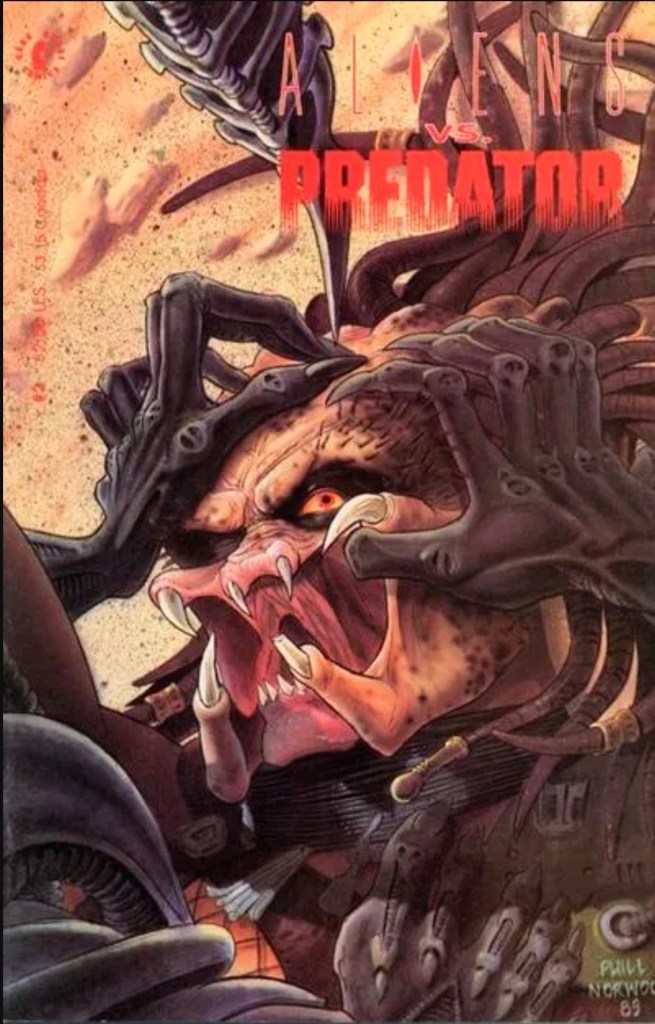
With those details laid down, here is a look back at Aliens vs. Predator , published in 1990 by Dark Horse Comics with a story written by Randy Stradley and drawn by Phill Norwood.  

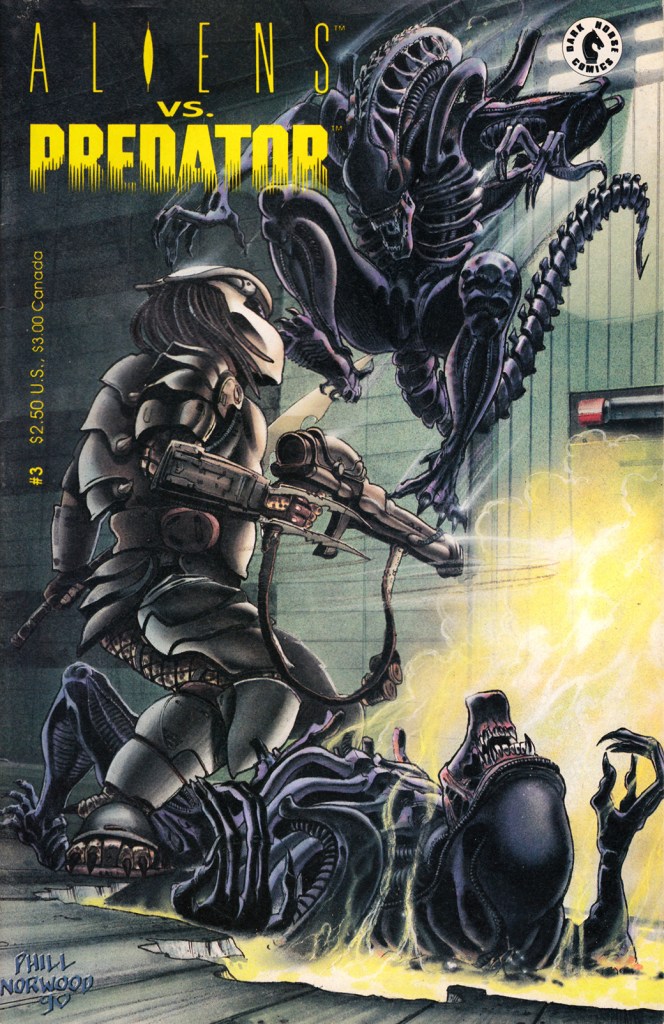
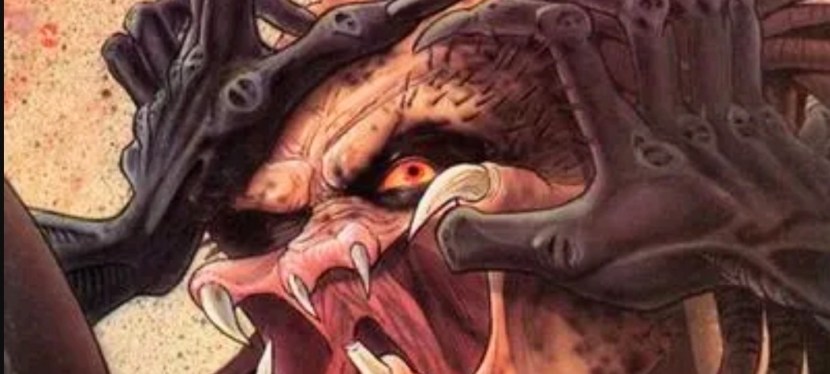
The cover.

Early story

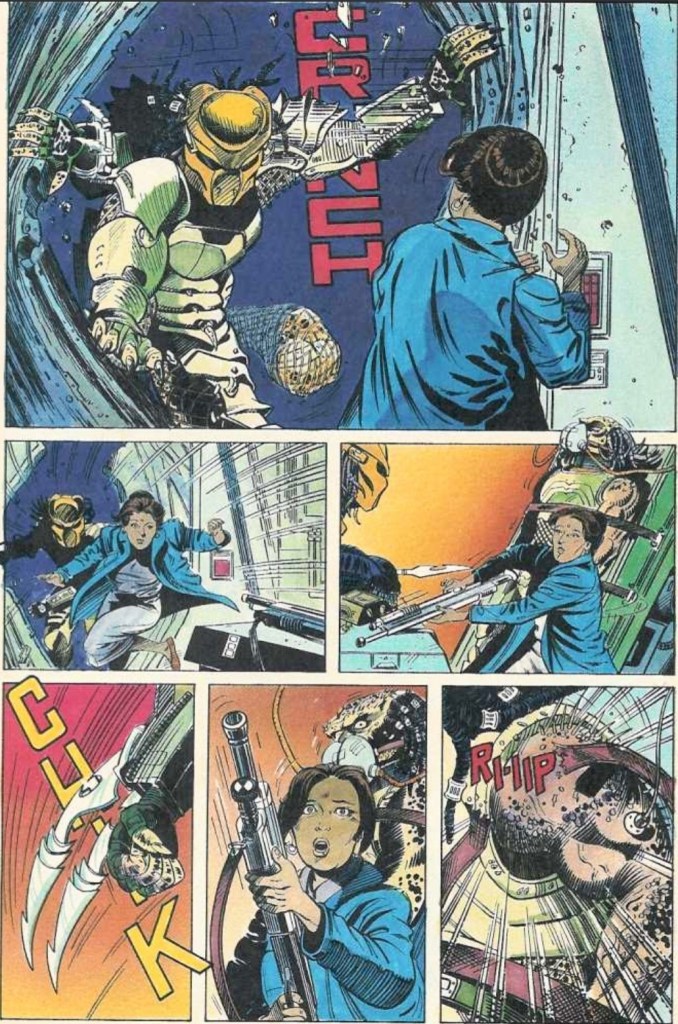
The story begins with Noguchi who finds herself in a dangerous position. In front of her is a horde of Xenomorphs and behind her is one Predator warrior who even assisted her a few moments prior. Armed with futuristic weapons, the armored warrior suddenly jumps above her and right into the Xenomorphs. The Predator efficiently slashed off the parts of a few Aliens using a bladed weapon and blew up one of them using another weapon.

The warrior eventually gets overwhelmed by more Aliens that came into the action. As the Xenomorphs focused strongly on the downed Predator, Noguchi takes advantage of the situation to run away and somehow get back to protecting the people as the outpost has been clearly invaded by two deadly non-human species.

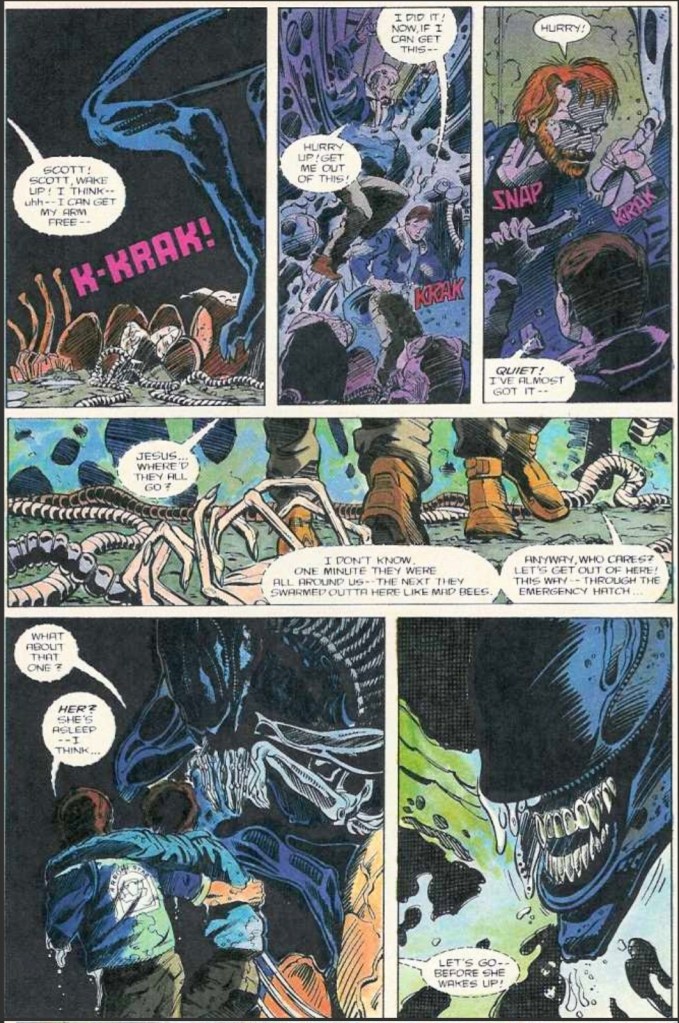
Meanwhile inside the huge cargo ship that did not launch, two crew members freed themselves from the Xenomorphs’ restraints and try to sneak by the Alien Queen which they perceived to be sleeping…

Quality

This is a fine example by the creative team on telling a sequence of intense moments without a single word of dialogue.

From a storytelling point-of-view, this one is a huge pay-off to the build-up established in the first two issues and I can say I enjoyed this one. At this stage of the 4-issue mini-series, the human colony has turned into a battle zone between the Predators and the Xenomorphs and this obviously results in a lot of action scenes and other wild turns of events. It is also in this story where you will get to see Machiko Noguchi at her bravest yet, as well as her uncompromising way of protecting her people and solving the crisis at hand. As she and her fellow humans are in the middle of a crisis, nothing straightforward could happen nor could they make solid plans with any real chance of succeeding. The decisions Noguchi made here came with risks and through her struggles, you will be able to relate with her and you will also witness how the series of unfortunate events turn out with unpredictable ways which added some suspense and surprise to the narrative.

The spectacle here, unsurprisingly, are the battles between the Aliens and Predators. Such conflicts happened mostly in the background which is effective enough to establish the chaos that the humans have to endure. One of the Predators – which does not have a name – became a notable additional supporting player to the cast and his presence and actions added some intensity to storytelling even as the narrative consistently focused on Noguchi.   

The way the story is told, this one maintains the natural progression of details from issue and even though the action has been ramped up, there were still plenty of opportunities for readers to understand the details and grasp the plot. There is also rising tension as the narrative moves forward.

Conclusion

There is nothing like trying to sneak past an Alien Queen in an area surrounded by multiple eggs laid by her.

Being a big pay-off to the huge build-up of issues and , Aliens vs. Predator (1990) is highly entertaining and compelling to read! The action scenes and chain of incidents were ramped up a lot and yet this comic book never turned into a brainless fest of violence. The creative team managed to add some breathing space to not only let readers absorb the story details but also to immerse themselves with the situations. By the time I reached the end, I experienced this great satisfaction as well as further motivation to discover how the story will conclude in the next issue.

Overall, Aliens vs. Predator (1990) is highly recommended!

+++++

Thank you for reading. If you find this article engaging, please click the like button below, share this article to others and also please consider making a donation to support my publishing. If you are looking for a copywriter to create content for your special project or business, check out my services and my portfolio. Feel free to contact me with a private message. Also please feel free to visit my Facebook page Author Carlo Carrasco and follow me on Twitter at  @HavenorFantasy as well as on Tumblr at https://carlocarrasco.tumblr.com/ and on Instagram at https://www.instagram.com/authorcarlocarrasco
A Look Back at Aliens vs. Predator #2 (1990)

Disclaimer: This is my original work with details sourced from reading the comic book and doing personal research. Anyone who wants to use this article, in part or in whole, needs to secure first my permission and agree to cite me as the source and author. Let it be known that any unauthorized use of this article will constrain the author to pursue the remedies under R.A. No. 8293, the Revised Penal Code, and/or all applicable legal actions under the laws of the Philippines.

Welcome back superhero enthusiasts, 1990s culture enthusiasts and comic book collectors! Today we go back to the year 1990 to take a close look at one of the more significant non-superhero crossover comic book events ever published – Aliens vs. Predator!

In my previous review, most of the humans living and working in Prosperity Wells are unaware about the creeping danger coming at them. Alien eggs were laid in the wilderness while a ship carrying multiple Predator hunters has landed. At the human outpost, the leader Machiko Noguchi remains disrespected as the staffers and ranchers still trust her predecessor Hiroki Shimura.

With those details laid down, here is a look back at Aliens vs. Predator , published in 1990 by Dark Horse Comics with a story written by Randy Stradley and drawn by Phill Norwood.  

The cover.

Early story

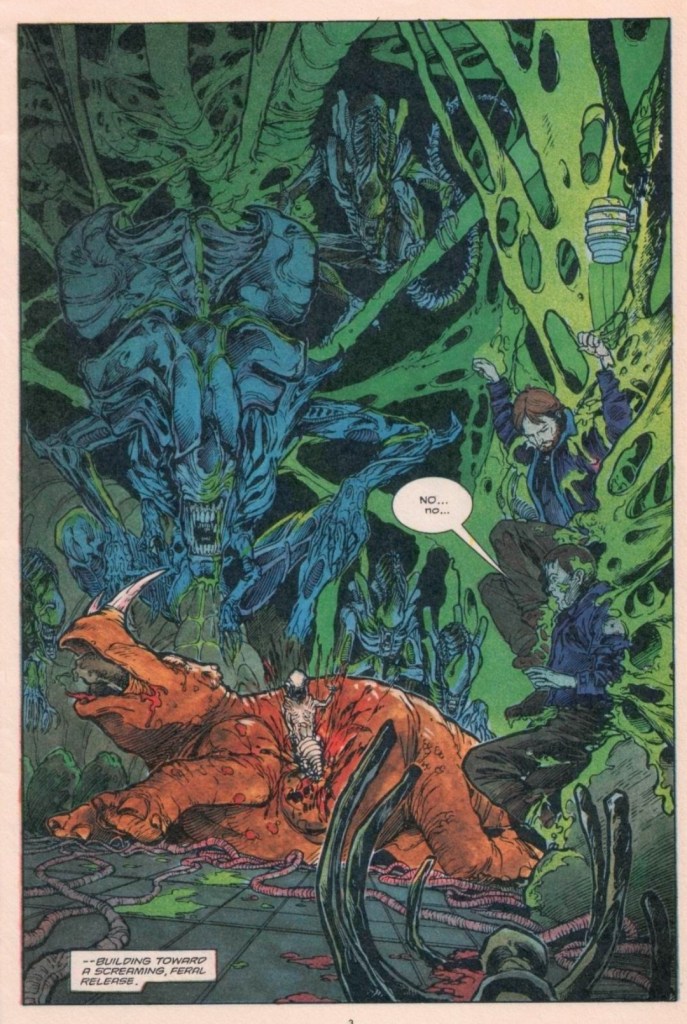
The story begins with the huge spaceship still at the launch platform of Prosperity Wells. The ship should have launched already with a huge cargo of indigenous animals – the Rynth – for export. It turns out that the two human pilots were captured by the Xenomorphs and in the presence of the Alien queen inside the ship, they witness one rynth (part of the herd from the ranching) die as a Chestburster alien comes out of its body.

Meanwhile, Machiko wakes up as her respected predecessor Shimura arrives and tells her that Dr. Revna still has not returned. During her talk with the wife (also a doctor), Machiko learns that the missing doctor was on his way to Iwa Gorge to find more aliens (note: the Facehugger alien) and that a lady worker (who made the first discovery of a Facehugger) informed him of the place.

As Machiko and Shimura analyze what they know, two outpost personnel discover the remains of a destroyed Predator space ship and, more notably, one unconscious Predator hunter…

Quality

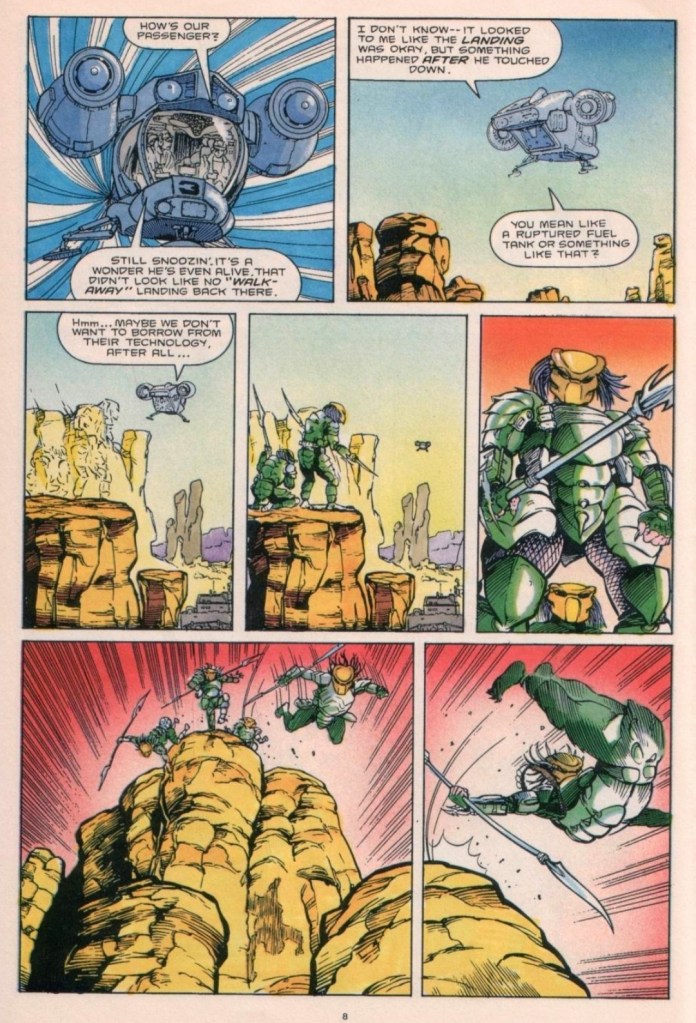
The Predators looks really odd with the colors implemented on them by the creative team of this comic book.

If you were deeply engaged in issue , then you will have a lot to be engaged with in this issue. The script by Stradley is very solid and with a medium pace, details were consistently laid out for readers’ understanding while the build-up for the inevitable chaos – between Xenomorphs and Predators with humans in the middle literally – is strongly felt.

Machiko Noguchi’s management and ability to analyze situations really get tested in this story and along the way, you will see how much the outpost changes reflecting the moves made by her administration which is ultimately a response to a brewing crisis. At this stage of the comic book mini-series, the danger of the two galactic species begin to make impact on innocent humans in violent ways. The scene showing the home of people (located some distance away from the main complex of the outpost) getting invaded by the Predators has uncompromising violence which makes the incidental action look really disturbing.

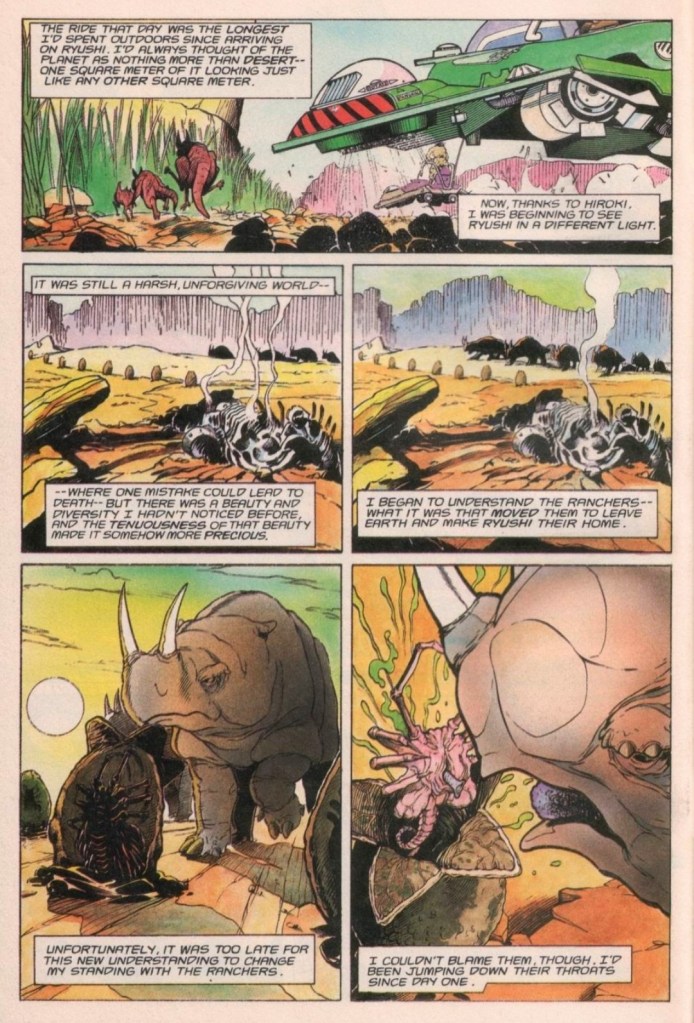
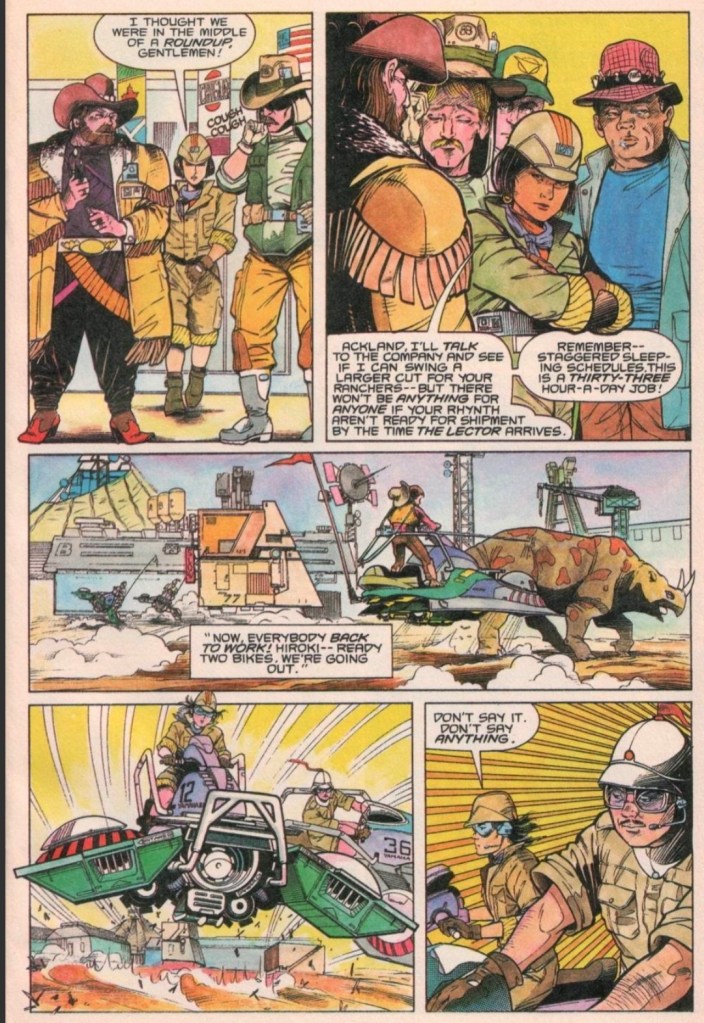
More on the human characters, this comic book has very rich dialogue backed with special attention to details implemented by Stradley. This is very evident in the scene in which Machiko, Roth, Ackland and Shimura talk intensely about what happened and what factors caused those things to happen. Through the verbal exchange, you will witness Machiko’s bravery and leadership come to life as she confronts a rebellious rancher (who insulted her in a very personal way) over the truth about what happened. Not only that, you will also feel the stress she experiences as she manages the outpost at a time of crisis.

For the fans of Predators and Aliens reading this, you will see a lot more of them in this issue and I can assure you that Norwood is really great in visualizing them and showing them with violent action that will remind you of the movies. As with the previous issue, the colors implemented on the Predators remains very odd to look at.

Conclusion

Live humans helplessly watching an animal die as a Chestburster alien comes out of it in the presence of the Alien queen.

Aliens vs. Predator (1990) is a great follow-up to issue . As expected, the stakes were raised higher and the tension really intensified as the narrative went on. The creative team really should be admired for not only crafting this high-quality chapter of the mini-series, but also for their believable and engaging build-up of the plot, the characters and conflict altogether. This comic book is a lively reminder of how great a non-superhero comic book crossover could be.

Overall, Aliens vs. Predator (1990) is highly recommended!

+++++

Thank you for reading. If you find this article engaging, please click the like button below, share this article to others and also please consider making a donation to support my publishing. If you are looking for a copywriter to create content for your special project or business, check out my services and my portfolio. Feel free to contact me with a private message. Also please feel free to visit my Facebook page Author Carlo Carrasco and follow me on Twitter at  @HavenorFantasy as well as on Tumblr at https://carlocarrasco.tumblr.com/ and on Instagram at https://www.instagram.com/authorcarlocarrasco
A Look Back at Aliens vs. Predator #1 (1990)

Disclaimer: This is my original work with details sourced from reading the comic book and doing personal research. Anyone who wants to use this article, in part or in whole, needs to secure first my permission and agree to cite me as the source and author. Let it be known that any unauthorized use of this article will constrain the author to pursue the remedies under R.A. No. 8293, the Revised Penal Code, and/or all applicable legal actions under the laws of the Philippines.

Welcome back superhero enthusiasts, 1990s culture enthusiasts and comic book collectors! Today we go back to the year 1990 to take a close look at one of the more significant non-superhero crossover comic book events ever published – Aliens vs. Predator!

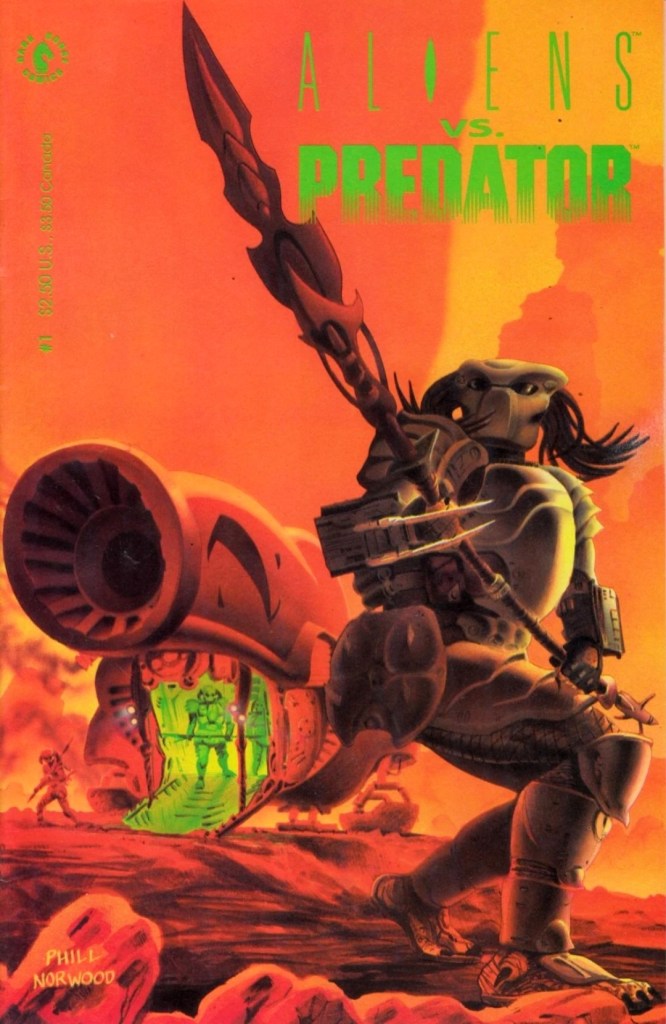
For the newcomers reading this, the respective movie franchises of Aliens and Predator started many years before the comic book crossover event happened. By the year 1990, moviegoers had enjoyed Alien (1979), Aliens (1986), Predator (1987) and Predator 2 (late 1990). Cinematic between Arnold Schwarzenegger and the Predator in the jungle and that of Sigourney Weaver and the Queen Alien became unforgettable sequences for many millions of people. It should be noted that an Alien head was shown near the end of Predator 2 emphasizing a crossover.

With those details laid down, here is a look back at Aliens vs. Predator , published in 1990 by Dark Horse Comics with a story written by Randy Stradley and drawn by Phill Norwood.  

The cover.

Early story

The story begins in space when a fast-moving ship enters the atmosphere of Ryushi, a planet at the edge of the Chigusa Corporation’s holdings in the Beta Cygni System. On the planet is Prosperity Wells, a human outpost with a population of one hundred fifteen composed of freelance ranchers, their families and a staff of corporate overseers.

The ship’s presence gets detected by operators at Prosperity Wells and one of them speculated it to be a meteor that shows no signs of breaking up. Seeking Hiroki Shimura (no longer the head of the outpost), the operator instead contacts his replacement Machiko Noguchi and informs her about the perceived meteor. After talking with the operator, Noguchi tells her predecessor near her that even though she has been leading the outpost for nearly six months, people are still reporting to him as they treat her like a stranger. Shimura tells her that she’s been trying to adapt the job to her rather than adapting herself to it, and that she cannot just run an operation while hiding from it.

Meanwhile in the wilderness, a machine starts to climb out of the pit and starts releasing Alien eggs… 

Quality

Whenever there are Alien eggs, trouble is inevitable.

I can say that this comic book is essentially one long build-up that intends to execute the conflict between the Aliens (also referred to as the Xenomorphs) and Predators later. While the two galactic species are indeed here, the narrative is told mainly through the humans whose operations – ranching, business administration, outpost activities – are emphasized with heavy and precise details. The result here is that by the end of the comic book, you will be fully immersed with the sci-fi concept, the characters and the related developments which ultimately will prepare you for the inevitable Aliens-Predator conflict. To put it clearly, Stradley crafted a script that efficiently introduces the characters (note: Noguchi is the clear protagonist), emphasize what has been going on while also moving the story forward in a well-paced manner without compromising the details.

That being said, don’t expect the Aliens and Predators to fight each other immediately here. This is one big build-up as a whole and very notably, there is nothing boring and there were no useless scenes portrayed. Everything told and shown in this comic book made sense, and if you are the kind of person who likes paying close attention to details of the story as well as the gradual development of the key characters, you will find this one an engaging read. The narrative moved at a medium pace and cleverly the suspense happens whenever the creative team gradually build-ups the tension for the inevitable Aliens-Predators fight.

As with many other entertainment tales across varied media forms, this story has a critical portrayal of the corporation slightly emphasizing greed while making the contractors (technically the laborers) look disadvantaged. It is not a one-sided portrayal against corporatism, however, as there were moments showing the contractors relying on deception (note: disregarding quality and the safety of consumers who will soon consume the products from the ranching operation) just to achieve their goals.

More on the protagonist Machiko Noguchi, she is not the typical corporate figure for readers to hate. In fact, she is somewhat sympathetic as she is has yet to earn the respect of others even though she had been working as the head of the outpost for months. The grudge against her is subtle yet clear. The comic book also made clear that she is destined for something significant in the upcoming fight between the two galactic species.

The art by Phill Norwood is very good. While the characters have that comic book aesthetic, the Aliens and Predators are easily recognizable and were drawn with sufficient visual details. What I find weird is the creative team’s approach on applying color on the Predators. Norwood also has a really nice approach on illustrating futuristic stuff (examples: the technologies, office equipment, clothes of the characters) while also emphasizing the wilderness of Ryuchi.

Conclusion

Machiko Noguchi takes charge even though she is despised by many.

Aliens vs. Predator (1990) is one very detailed build-up type of comic book that happens to be pretty engaging to read and the set-up for the expected conflict between the two species worked nicely. By the time I reached the end of this tale, I got immersed into its concept, the situations and characters. The build-up also came out with really interesting parts here and there which made the reading experience a very good one. Right now, I am eager to read the next issue.

Overall, Aliens vs. Predator (1990) is highly recommended!

+++++

Thank you for reading. If you find this article engaging, please click the like button below, share this article to others and also please consider making a donation to support my publishing. If you are looking for a copywriter to create content for your special project or business, check out my services and my portfolio. Feel free to contact me with a private message. Also please feel free to visit my Facebook page Author Carlo Carrasco and follow me on Twitter at  @HavenorFantasy as well as on Tumblr at https://carlocarrasco.tumblr.com/ and on Instagram at https://www.instagram.com/authorcarlocarrasco