A Look Back at Freex #14 (1994)

Disclaimer: This is my original work with details sourced from reading the comic book and doing personal research. Anyone who wants to use this article, in part or in whole, needs to secure first my permission and agree to cite me as the source and author. Let it be known that any unauthorized use of this article will constrain the author to pursue the remedies under R.A. No. 8293, the Revised Penal Code, and/or all applicable legal actions under the laws of the Philippines.

Welcome back superhero enthusiasts, 1990s culture enthusiasts and comic book collectors! Today we go back to the mid-1990s which was a really wild time for comic collectors. To be more specific, this newest retro comic book review revisits Ultraverse through the exploits of Freex, the monthly series about a group of young adults with unusual capabilities (or abnormalities) who are constantly on the move as they are social outcasts.

In my previous retro review, the Freex (already without Ray but with Cayman from Contrary’s institution as his replacement) continued their search deep underground and encountered the ancient being called Prometheus. Elsewhere, Atalon and his group move nuclear weapons deep underground setting up a major conflict with the nations on the surface. After some struggle and more movement, the Freex find themselves in Denver.

With those details laid down, here is a look back Freex , published in 1994 by Malibu Comics with a story written by Gerard Jones and drawn by Scott Kolins.

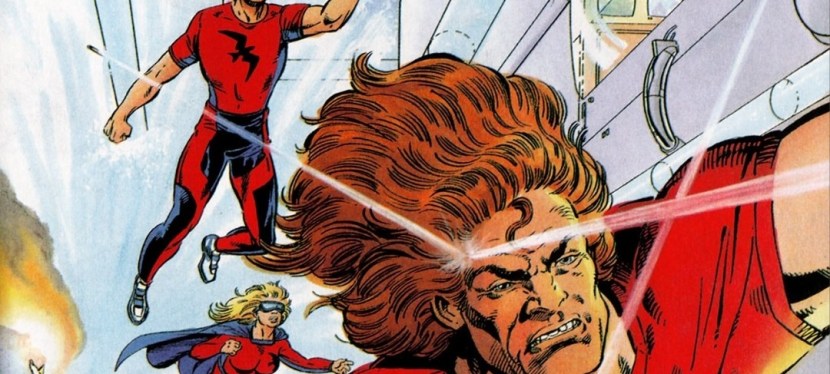
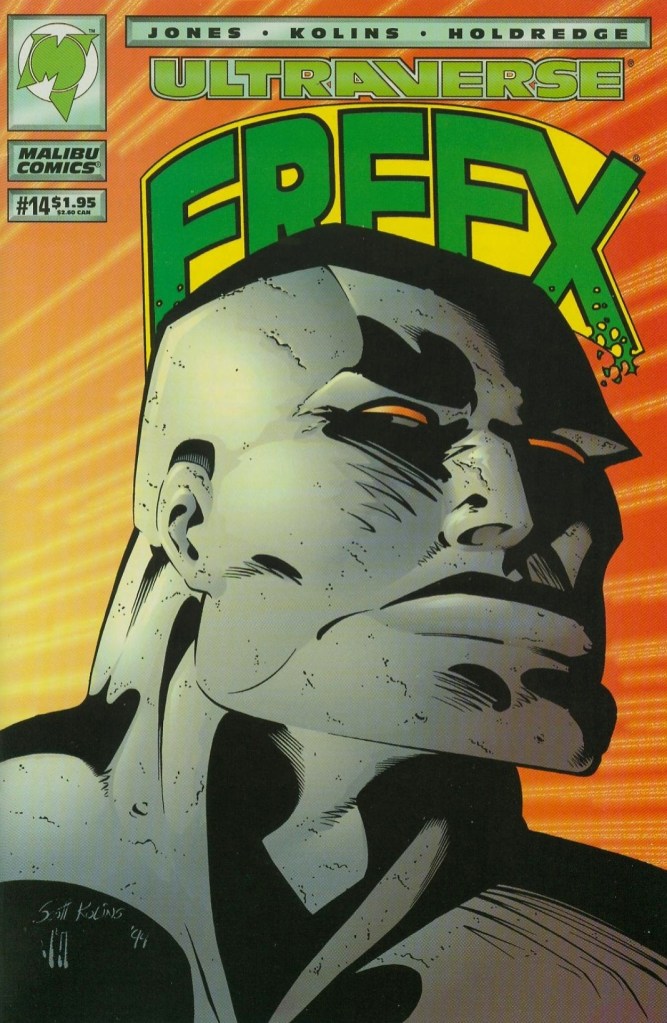
The cover.

Early story

The story begins in Denver, Colorado, where the Freex retreated into a cave dreading the assault by police officers who spotted them. It turns out, the group don’t have only the police to worry about but also the Night Patrol, a group of armed vigilante thugs who hate freaks.

As the Night Patrol start firing at him, Michael realized the protection he got was done by concentrating through the crowns and think about the suits, which he tells his teammates. As the conflict continues, one of the Night Patrol members hits Angela which in turn triggers Michael to take action by using his power to seize control of communications and motility systems and knock down the freak-hating thugs.

Suddenly, one of the Night Patrol members managed to subdue Michael. Valerie tells her teammates to strike back but it turned out unnecessary as the thug falls down. Suddenly, Contrary appears to them…

Quality

Now with Ray back with them, the Freex go back underground.

To get straight to the point, this Freex story is more about the continuing development of the team with the Old Man as their mentor but with one notable turn of events that is not really a spoiler (due to the cover art)…the return of Ray to the team.

While the plot is thinner this time around, the character development was bumped up several notches. As the Freex found themselves cornered with opposition, the reappearance of Contrary (note: she took time away from UltraForce in this particular point of time) resulted in a few notable revelations regarding how she operates, how manipulative she is and how obsessed she is with having young freaks (note: those with powers or those injected with wetware) under her own definition of care, education and nurturing. The way the script was written, this comic book made me wonder if Contrary is insane while still maintaining a good amount of control given her vast resources to organize missions. Just thinking about her organizing UltraForce operations and maintaining her institution for powered students is indeed intriguing.

More on the return of Ray – one of the pioneering members of Freex – his return is not a throwaway portrayal. Rather Ray showed clear signs of maturity apart from learning something from his time at Contrary’s institution. Morever, Ray shows he has a big heart from his teammates. This alone added some emotional impact to the end of the comic book.

Conclusion

A quick appearance of UltraForce within this Freex tale.

Freex (1994) does not have a deep story to tell, has little in terms of superhero spectacle and it recycled some misadventure elements from the previous issue to move the plot forward. The most defining things in this comic book are the respective returns of Ray and Contrary which added nicely to the character development. Any solid Freex fan will have something to enjoy, especially if they continue loving the main characters.

Overall, Freex (1994) is recommended.

+++++

Thank you for reading. If you find this article engaging, please click the like button below and also please consider sharing this article to others. If you are looking for a copywriter to create content for your special project or business, check out my services and my portfolio. Feel free to contact me with a private message. Also please feel free to visit my Facebook page Author Carlo Carrasco and follow me on Twitter at  @HavenorFantasy as well as on Tumblr at https://carlocarrasco.tumblr.com/ and on Instagram at https://www.instagram.com/authorcarlocarrasco/

A Look Back at The Night Man #8 (1994)

Disclaimer: This is my original work with details sourced from reading the comic book and doing personal research. Anyone who wants to use this article, in part or in whole, needs to secure first my permission and agree to cite me as the source and author. Let it be known that any unauthorized use of this article will constrain the author to pursue the remedies under R.A. No. 8293, the Revised Penal Code, and/or all applicable legal actions under the laws of the Philippines.

Welcome back superhero enthusiasts, 1990s culture enthusiasts and comic book collectors! Today we go back to the mid-1990s which was a pretty wild time for comic collectors. To be more specific, this newest retro comic book review revisits the Ultraverse through The Night Man monthly series.

In my previous retro review, Night Man encountered a new, murderous villain who could change into a werewolf. The mentioned villain named Nik Apocaloff is a lot more than being able to become a monster…he has a notable family background, is highly education and is connected with powerful figures like J.D. Hunt. That makes him a formidable antagonist versus Night Man and his civilian identity as Johnny Domino. Apocaloff proved to be such a powerful villain, he became the center of attention of Night Man during one of his radio broadcasts.

With those details laid down, here is a look back The Night Man , published in 1994 by Malibu Comics with a story written by Steve Englehart and drawn by Kyle Hotz.  

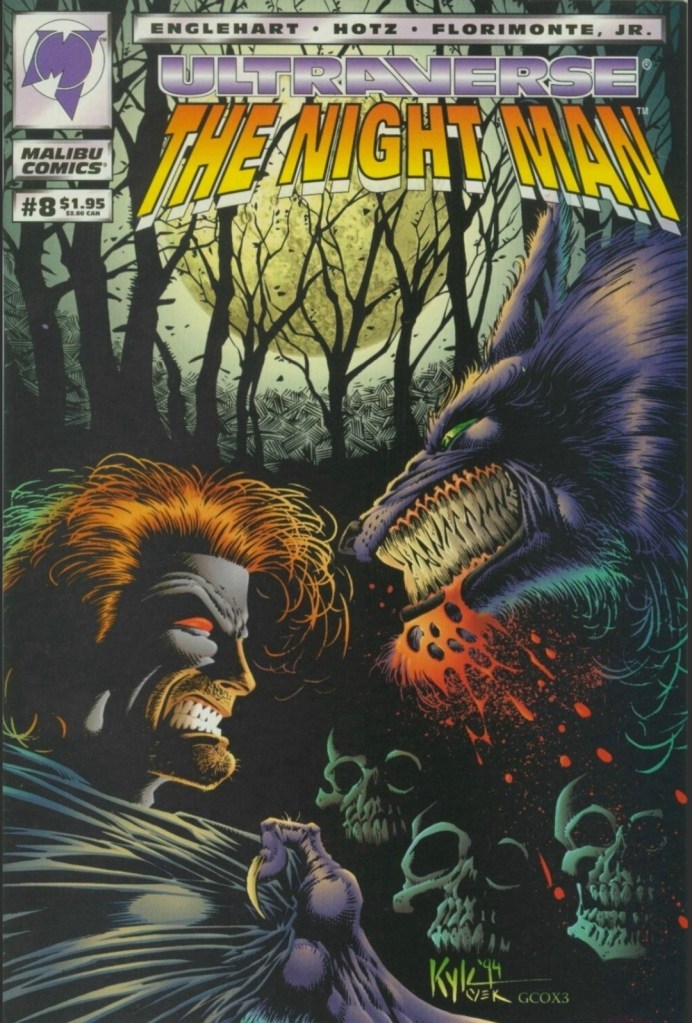
The cover.

Early story

The story begins somewhere inside one of the many rooms of city hall. An intense meeting goes on with the mayor present and what happened recently involving both the Night Man and the werewolf made an impact on the matters of discussion.

In an apartment somewhere in the city, Apocaloff is in his monster form and he just murdered a lady and consumed a lot of her flesh. Suddenly the door is knocked by someone who knew the victim. This causes Apocaloff to leave through the window and climb the steps to the rooftop. There, he changes back into his human form.

Elsewhere, Lt. Carleton Briggs arrives back in his office where Sergeant Dade is waiting. After a s short chat, they hug and kiss each other. The Night Man suddenly enters through the window…

Quality

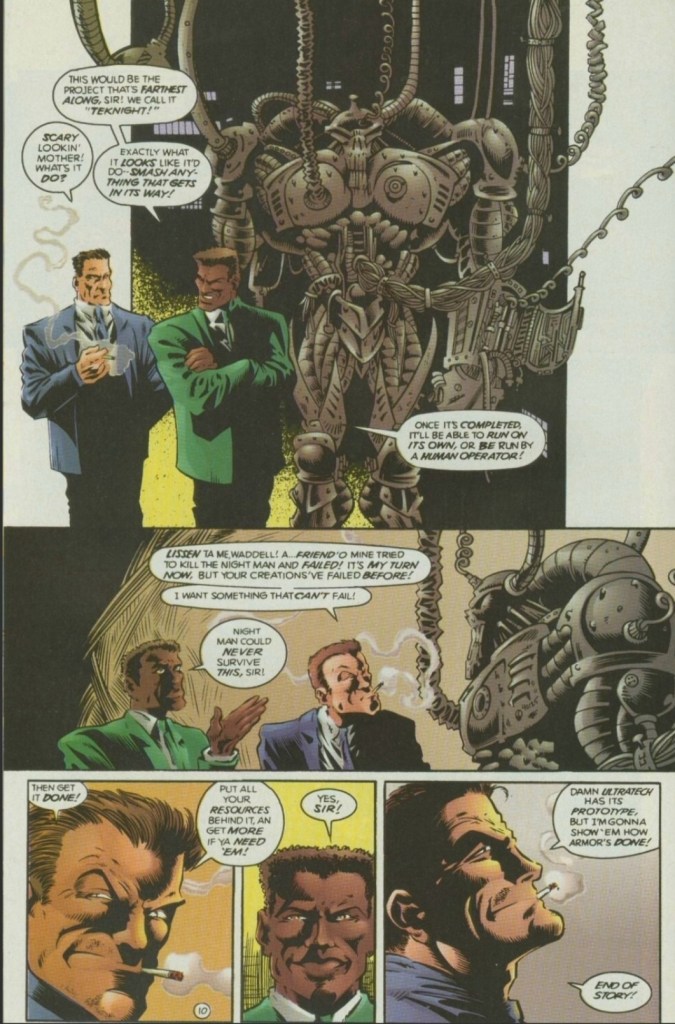
J.D. Hunt and the Teknight project.

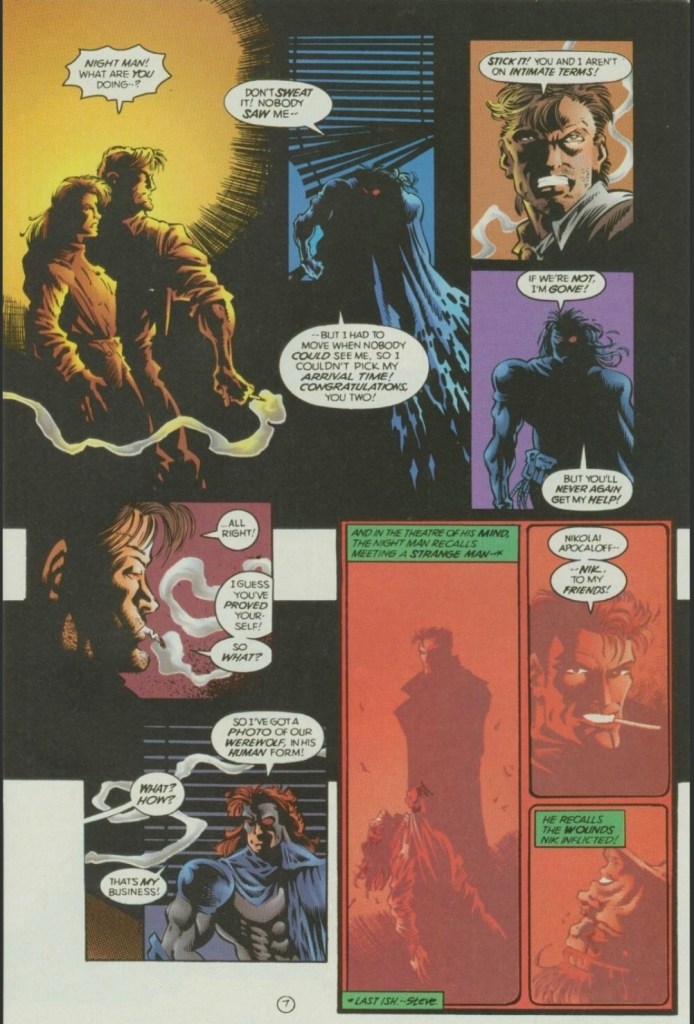
Wow! This is one very compelling tale of the Night Man. To get straight to the point, the highlight of this comic book is the rematch between the title character and Apocaloff. To be clear, the rematch was not handled with brainless action in mind but rather with a lot of strategy combined with a medium-paced approach on progression which brought back a lot of vibes from Night Man’s encounters with the members of TNTNT a few issues back. Storywise, the stakes behind the rematch are much higher as the Night Man makes a solid pitch to the local police in the fight against crime (which made me think about the key elements of Batman comic books)  while the tycoon J.D. Hunt (whom Apocaloff interacted with previously) just gave his approval for the Teknight project.

When it comes to character development, Apocaloff’s strong adherence to the past (Russian legacy, old world sensibilities, connections with California’s history) are emphasized some more. For his part, Night Man’s intelligence and approach to vigilantism got developed even more.  

Conclusion

Night Man comes to the police with evidence about Apocaloff.

The Night Man (1994) is another solid comic book of the Ultraverse. The story was told with an overall medium pace and the payoffs for each build-up were indeed satisfying. Considering the presence of the police in the story, this particular Night Man issue has the strongest similarities with DC Comics’ Batman. More importantly, this issue succeeded in developing both the titular hero and his most elaborate villain. It seems to me that Night Man and Apocaloff were made to clash with each other beyond this issue and the previous one.

Overall, The Night Man (1994) is recommended.

+++++

Thank you for reading. If you find this article engaging, please click the like button below and also please consider sharing this article to others. If you are looking for a copywriter to create content for your special project or business, check out my services and my portfolio. Feel free to contact me with a private message. Also please feel free to visit my Facebook page Author Carlo Carrasco and follow me on Twitter at  @HavenorFantasy as well as on Tumblr at https://carlocarrasco.tumblr.com/ and on Instagram at https://www.instagram.com/authorcarlocarrasco/

A Look Back at Superman III comic book adaptation (1983)

Disclaimer: This is my original work with details sourced from reading the comic book and doing personal research. Anyone who wants to use this article, in part or in whole, needs to secure first my permission and agree to cite me as the source and author. Let it be known that any unauthorized use of this article will constrain the author to pursue the remedies under R.A. No. 8293, the Revised Penal Code, and/or all applicable legal actions under the laws of the Philippines.

Welcome back superhero enthusiasts, 1980s culture enthusiasts and comic book collectors! Today we go back to the year 1983 which saw the theatrical release of Superman III that featured the late Christopher Reeve as the cinematic Man of Steel.

The 1980s was a very different time with regards to Hollywood’s handling of superhero movies. The concept of a shared cinematic universe was decades away from realization. Warner Bros. back then relied on the Salkind family to produce Superman movies and the first flick in 1978 proved to be a major hit for both viewers and critics while also establishing Christopher Reeve as the definitive live-action Superman for countless people. Unsurprisingly, a sequel was released in the early 1980s which continued box office success for the stakeholders and only led to the approval of another sequel.

Along the way, the late Richard Pryor (a major comedian already) appeared on TV and talked about Superman II which eventually led to him getting hired for Superman III. The movie was released in 1983 making a little over $80 million worldwide while also getting a noticeably weaker reception from critics. More notably, Richard Pryor had a huge chunk of the film’s spotlight as Gus Gorman while the overshadowed Christopher Reeve managed to stretch his cinematic art on playing Clark Kent and Superman (note: there is also the memorable Clark versus Superman battle). Superman III very clearly had a lot more comedy in its presentation. As part of the movie’s marketing, an official comic book adaptation by DC Comics was published.

With those details laid down, here is a look back at the Superman III comic book adaptation,  published by DC Comics in 1983 with a story written by Cary Bates and art made by the late Curt Swan and Sal Amendola.

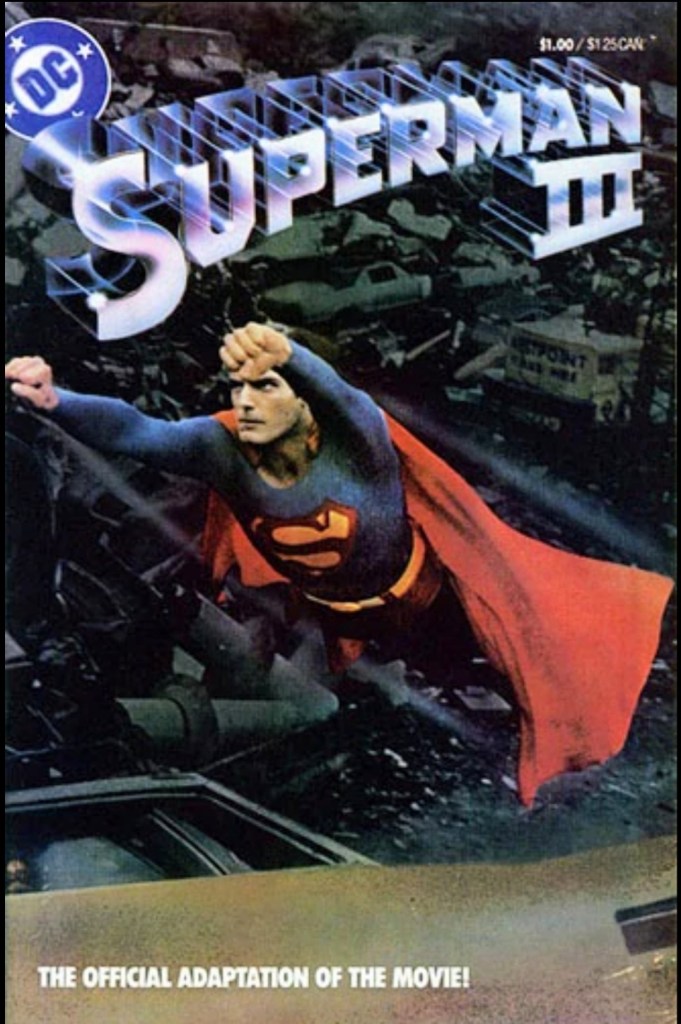
The cover.

Early story

The story begins inside the unemployment bureau of Metropolis. There, August “Gus” Gorman was told after 36 weeks of chronic unemployment, he is no longer eligible for financial assistance (read: welfare) from the city. As he was about to light his cigarette, he noticed computer job ad on the match. Gorman proceeds to the Archibald Data Processing School where he gets enrolled with several others. In front of others, Gorman does something on a computer which impressed the instructor a lot.

Over at the Daily Planet, Clark Kent/Superman, Lois Lane and Jimmy Olsen meet with Perry White at his office. Kent will be returning home to Smallville and make a news story out of it. White gives Kent his approval and then tells Lois she deserves a vacation.

Hours later, Kent and Jimmy Olsen ride the bus together going to Smallville but their ride stops as a result of a huge fire damaging a large chemical plant. A police officer reveals to Olsen that the scientists inside are worried about the plant and its stuff getting destroyed by the fire.

Kent carefully leaves the bus and discreetly changes into Superman to help solve the problem. Olsen, meanwhile, sneaks past the authorities to get to the burning chemical plant.

Over at Webcoe Industries, company head Ross Webster and his sister Vera learn that more than $85,000 worth of company funds was stolen by someone within. Just outside the office, Gus Gorman enters his fancy looking sports car which Webster, Vera and Lorelei notice. Webster asked how could one of their computer technicians afford such a vehicle worth $75,000…    

Quality

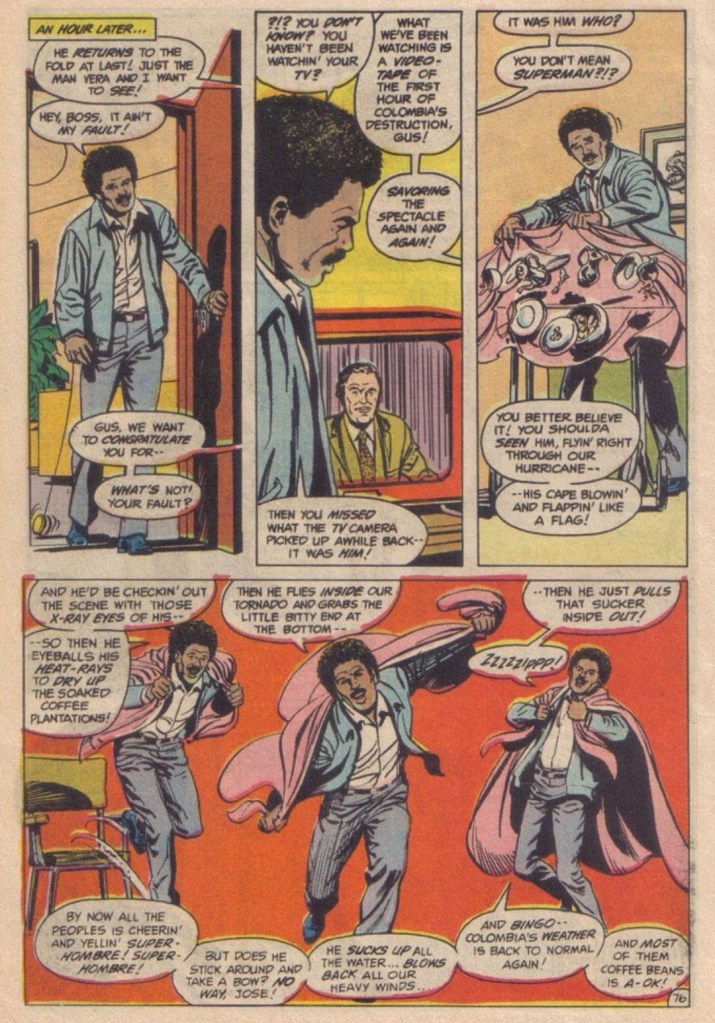
This is a creative way the comic book team used to dramatize Gus Gorman scene revealing and acting the bad news to his boss Ross Webster whose plans were thwarted by Superman.

While it is understandable that not all scenes and not all character moments from the movie  made it on print media, this comic book still managed to capture the film’s essence for the most part. The creative team pulled off their own interpretations of the events and made something entertaining and engaging even though they had to deal with the major challenge of summarizing the movie’s plot and establishing a workable comic book narrative.

I should state that the comic team creatively avoided making in-depth references about liquor and smoking which were obvious in the movie. You will not see Superman drinking liquor at a bar nor will you see Gus Gorman referring to tar listed on a cigarette pack. I suppose this was done to ensure the comic book would be released widely and be acceptable to very young readers and the parents watching them.

The battle between evil Superman and Clark Kent is best viewed in the movie. This one is a shorter and less detailed version of it.

When it comes to establishing the clear lead among all the characters featured, Superman fans should be delighted to know that the Man of Steel is indeed more prominent than Gus Gorman. Take note that in the movie, Richard Pryor’s Gus Gorman overshadowed Christopher Reeve’s Superman/Clark.

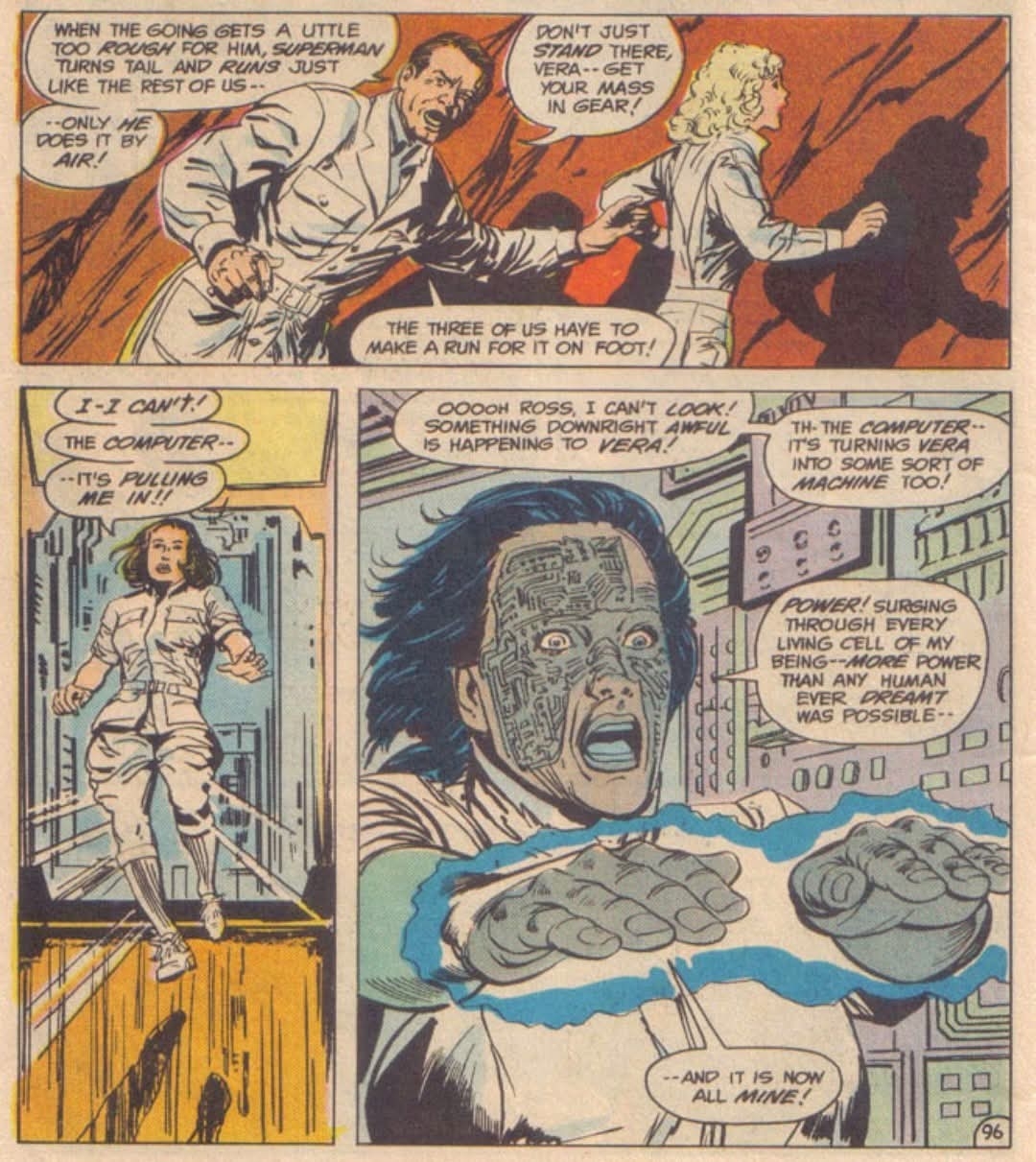
Remember the frightening sequence of Vera getting captured and turned into a cybernetic figure by the Super Computer? This is what it looks like in comic book format.

The art done by Curt Swan and Sal Amendola is decent and it seems to me that their time on visualizing Cary Bates’ script was indeed limited. That being said, it was not surprising to me that, with the exception of Ross Webster in one specific image, none of the characters resembled their cinematic counterparts. Clark Kent/Superman never resembled Christopher Reeve, and Gus Gorman looks nothing like Richard Pryor. Clearly, the artists’ focus was visualizing the narrative which they succeeded.  

Conclusion

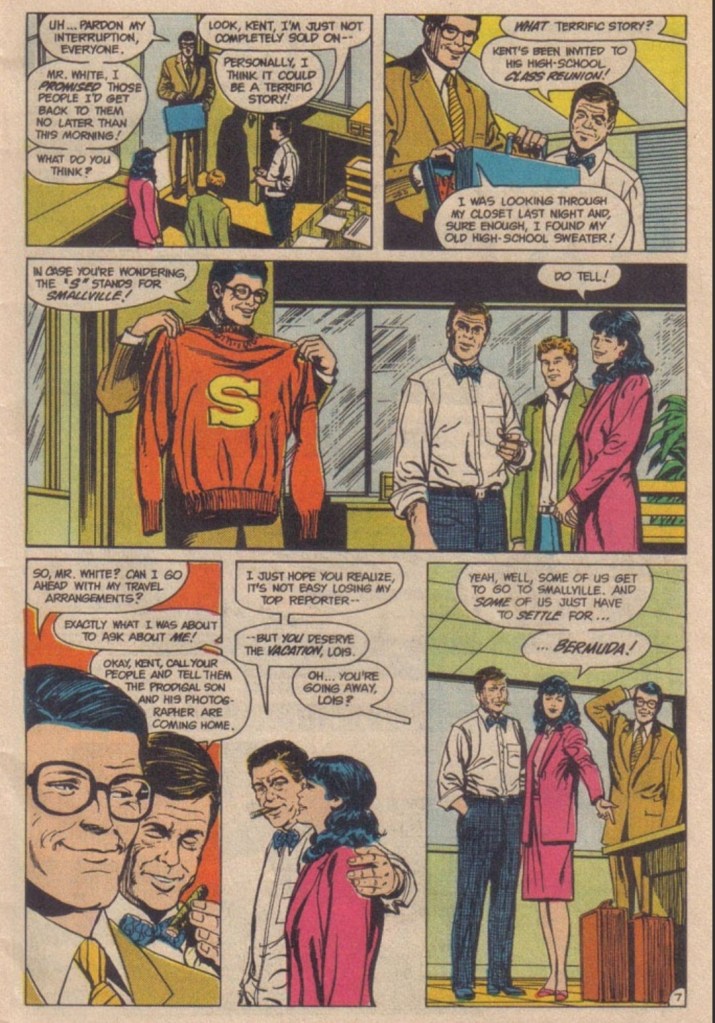
Clark Kent, Lois Lane, Jimmy Olsen and Perry White in the Daily Planet.
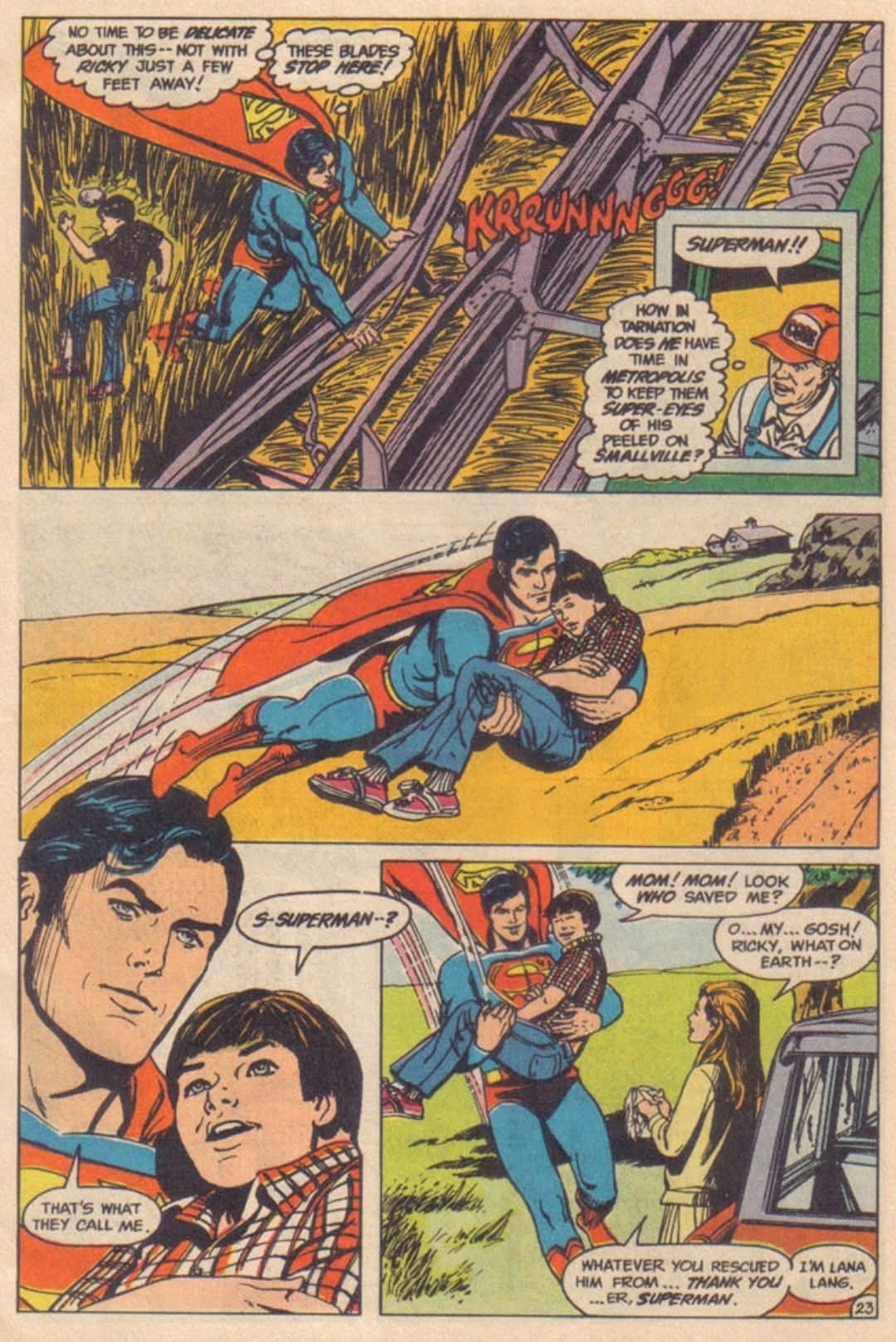
Superman saving Lana Lang’s son from certain death.

Having seen the Christopher Reeve/Richard Pryor movie in the cinema and on cable TV since 1983, I can say that Superman III (1983) is a decent adaptation. It’s not 100% faithful but it is still a worthy read as it will give you the movie’s concept and entertainment values in literary form. If you really want to full essence of film along with the cinematic moments (note: the Superman-Clark battle is the cinematic highlight) all intact, then your obvious choice is to watch the movie. If you are turned off by the movie’s wacky comedy, then the comic book adaptation will deliver to you the more serious approach on telling Superman III’s story. Let me repeat that Superman is more prominent than Gus Gorman in this comic book.

Overall, Superman III (1983) is satisfactory.

+++++

Thank you for reading. If you find this article engaging, please click the like button below and also please consider sharing this article to others. If you are looking for a copywriter to create content for your special project or business, check out my services and my portfolio. Feel free to contact me with a private message. Also please feel free to visit my Facebook page Author Carlo Carrasco and follow me on Twitter at  @HavenorFantasy as well as on Tumblr at https://carlocarrasco.tumblr.com/ and on Instagram at https://www.instagram.com/authorcarlocarrasco/

A Look Back at Harbinger #1 (1992)

Disclaimer: This is my original work with details sourced from reading the comic book and doing personal research. Anyone who wants to use this article, in part or in whole, needs to secure first my permission and agree to cite me as the source and author. Let it be known that any unauthorized use of this article will constrain the author to pursue the remedies under R.A. No. 8293, the Revised Penal Code, and/or all applicable legal actions under the laws of the Philippines.

Welcome back superhero enthusiasts, 1990s culture enthusiasts and comic book collectors! Today we go back to the early 1990s and explore a part of the Valiant Comics shared universe through the Harbinger monthly series.

For the newcomers reading this, Harbinger was created by former Marvel editor-in-chief and Valiant founder Jim Shooter (note: read my retro reviews of his works here, here, here, here and here) and artist David Lapham. Harbinger follows a few teenagers with unique abilities or powers who got involved with the Harbinger Foundation, an organization established by Toyo Harada who dreams to change the world as people know it.

With those details laid down, here is a look back at Harbinger , published in 1992 by Valiant Comics with a story written by Jim Shooter and drawn by David Lapham.

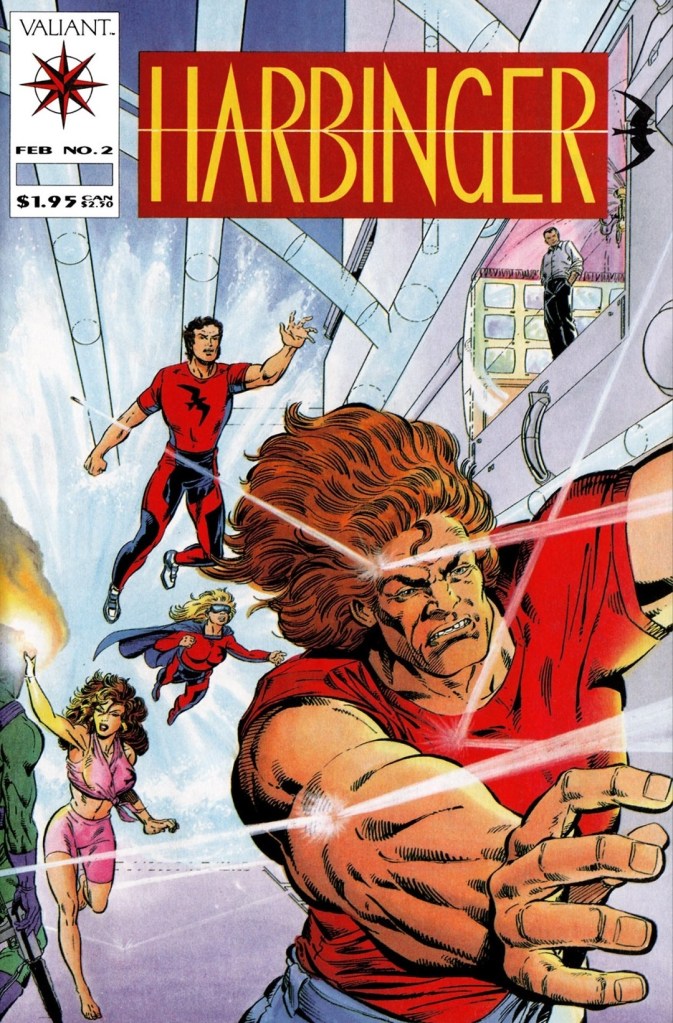
The cover.

Early story

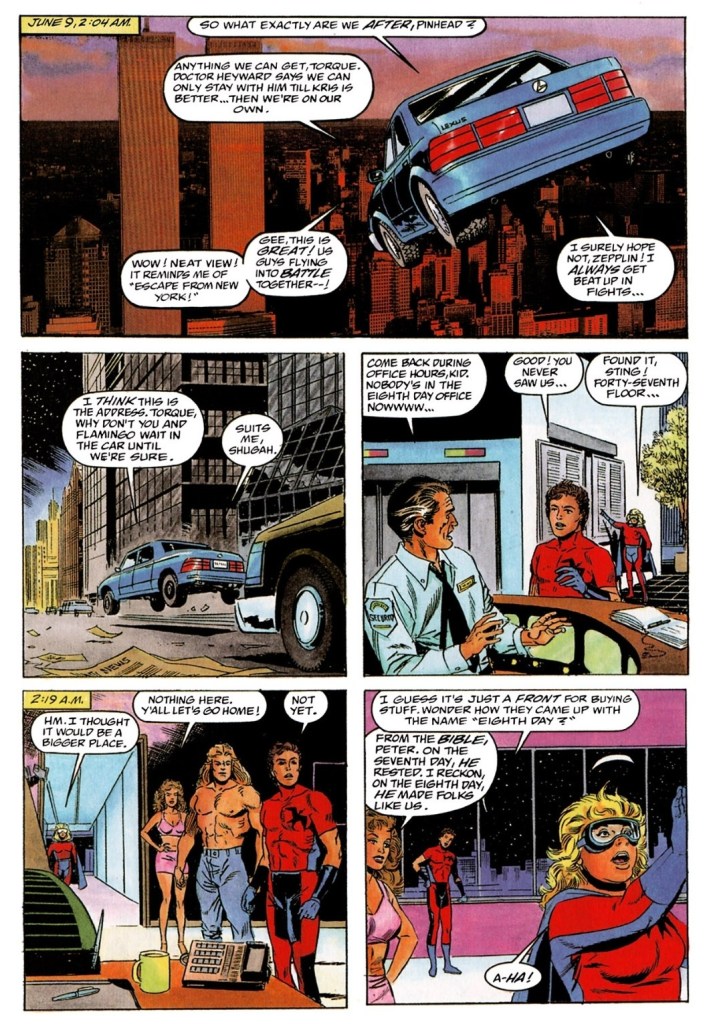
The story begins at 2:35 PM of June 2, 1991. Pete and his companion Kris are riding a car floating high above the road being followed by a helicopter. After Pete manages to communicate with the helicopter’s operators, they even settle down by landing on a road with no traffic. As Pete and the helicopter people begin talking, three people – Weasel, Eel and Lump – quickly rushed in to subdue Pete and Kris. After Pete manages to free himself from Weasel and Lump, he uses his power to lift up the car Kris drove (note: Kris is no longer in the car) and uses it as a weapon to hit Lump.

Just as Kris hits Eel on the stomach, Pete notices that the gasoline was leaking out of the car which Eel ignites with her electricity causing a huge explosion. Pete and Kris managed to survive the blast and together they fly off to a motel to rest and reorganize themselves.

The next morning, they have a meal together and Kris examines a newspaper. She notices another one of the Harbinger Foundation’s print ads reaching out to people who find themselves different or notice strange things around them. The two fugitives realize that the said foundation somehow made involved youth become dangerous. Remembering that people write and send letters to the Harbinger Foundation, Pete comes up with the idea of intercepting letters…

Quality

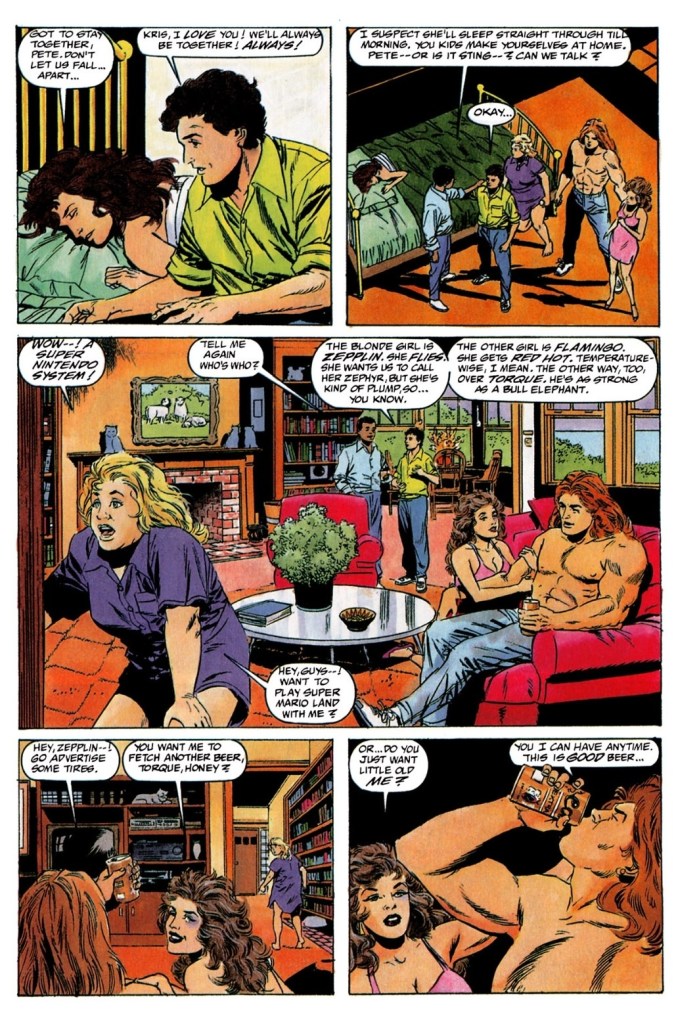
Pete, Kris and Faith.

This is one very engaging story to read. While story concepts about super-powered teenagers being desperate and struggling to realize their purpose while facing evil is not new, this comic book has a concept that remains unique even by today’s standards. Instead of seeing a group of powered teenage outcasts escaping society’s authorities or taking refuge in the home of a caring person, this comic book follows teenagers who are being targeted by a powerful organization as one of them – Pete – personally got involved with them before.

The story written by Jim Shooter is deliberately paced at a moderate level which allows readers to be able to absorb the details before moving from one chapter to the next. Along the way, Kris and Pete get to meet other powered characters like Faith, Flamingo and John. In between the introductions of the three mentioned characters, Shooter’s script managed to set up enough space for character development and interactions between the characters which have been executed to be believable. Even key elements of youth such as insecurity, fear, angst and the false sense of maturity are portrayed along the way. I should state that Shooter dramatized these characters like they were real people.

As for the Harbinger Foundation itself, it complete lacks visibility and its exposure was limited to the print ad and mentions. Still, the foundation is a clear and present danger to Pete and his companions as it has powered youth members who are dedicated to it and they also have heavily armed personnel working for them.

If you are fond of superhero spectacle, I can say that the action scenes were executed in accordance to the narrative. The spectacle of this comic book was clearly made to emphasize the plot elements and not serve as eye candy. That being said, this is a unique way of enjoying superhero spectacle.

Conclusion

The Harbinger Foundation’s pawns Weasel, Eel and Lump take on Pete and Kris.

Harbinges (1992) is a pretty engaging comic book of Valiant and at the same time it is also one of the more unique portrayals of powered teenagers who are living with tremendous odds tilted at them. The tone of the story really felt grounded in reality (the early 1990s specifically) and the character moments, action and incidents were all executed in a believable fashion.

Overall, Harbinger (1992) is highly recommended!

+++++

Thank you for reading. If you find this article engaging, please click the like button below and also please consider sharing this article to others. If you are looking for a copywriter to create content for your special project or business, check out my services and my portfolio. Feel free to contact me with a private message. Also please feel free to visit my Facebook page Author Carlo Carrasco and follow me on Twitter at  @HavenorFantasy as well as on Tumblr at https://carlocarrasco.tumblr.com/ and on Instagram at https://www.instagram.com/authorcarlocarrasco/

A Look Back at Ultraverse Year One (1994)

Disclaimer: This is my original work with details sourced from reading the comic book and doing personal research. Anyone who wants to use this article, in part or in whole, needs to secure first my permission and agree to cite me as the source and author. Let it be known that any unauthorized use of this article will constrain the author to pursue the remedies under R.A. No. 8293, the Revised Penal Code, and/or all applicable legal actions under the laws of the Philippines.

Welcome back superhero enthusiasts, 1990s culture enthusiasts and comic book collectors! Today we go back to the mid-1990s which was a pretty wild time for comic collectors. To be more specific, this newest retro review revisits the Ultraverse through a comic-like publication in the form of a guide meant for UV fans and comic collectors.

The subject at hand is Ultraverse Year One which, as written on the edge of the front cover, was designed to be the “complete guide to the Ultraverse’s first year.” It is a reference guide for those who seriously want to discover each and every Ultraverse comic book that was published during its first year. In my experience as a comic collector, the Ultraverse launch in 1993 was very memorable even though my financial limitations prevented me from acquiring each and every launch comic book and subsequent releases of the time. How useful is this complete UV guide? We can go on and find out.

With those details laid down, here is a look back at Ultraverse Year One, published in 1994 by Malibu Comics.

The cover.

Quality

I can say without a doubt that this publication is indeed a complete guide to each and every Ultraverse comic book released during its first year from 1993 to 1994 specifically. You want to know exactly how many issues of Mantra, Prime, Hardcase, The Solution, Prototype, The Strangers and others were published in the first year? This one has it all listed! You want to know which UV comic book involved the talents of Steve Gerber, Norm Breyfogle, Rick Hoberg, Len Strazewski, Aaron Lopresti, George Perez, James Hudnall, Gerard Jones, Steve Englehart, Tom Mason, Terry Dodson, James Robinson, Howard Chaykin, Mike W. Barr and many others under the Malibu Comics banner? This guide has it all listed! What months were Exiles #1, Sludge #1, Firearm , Break-Thru #1 and Mantra #1 were published? The answers to each are included. The same can also be said when it comes to which characters appeared in each comic book.

This is what each page typically looks like with details of the Ultraverse timeline on the lower part.
The timeline reveals that the male warrior Lukasz, who would later end up in woman’s body as Mantra/Eden Blake, was born in 1220 BC.

Very clearly, the Malibu Comics people worked hard to collect the essential types of information, organized them and put them all into print media form for readers and collectors to use when it comes to searching just about everything about the Ultraverse’s first year. Things did not just stop there, however.

What I found amusing to look at in each page of this Ultraverse guide are details of the shared universe’s timeline posted on the lowest part. The said timeline – which is limited to text and numbers – reveal interesting details such as what year was Lukasz (AKA Mantra) born, when did Rune begin, when was the Choice corporation established, what year did the island of Yrial’s people move up to the clouds, what years were infants injected by Wetware Mary and more. These details are actually quite encouraging to make readers discover or re-read Ultraverse comic books to see how they are dramatized on paper.

Conclusion

As you can see in the details above, Len Strazewski was involved in both the Prime and Prototype comic book series.

Ultraverse Year One (1994) is a pretty detailed guide that will not only help readers track down each and every UV comic book of the mentioned time period, but also help them spot the precise comic books that has characters included as well as the published works of varied comic book creators. If you are really determined to track down and buy all the Year One UV comic books, this guide is a must-have. If there are any weaknesses to mention, it would be the fact that each comic book’s entire plot got summarized in full which are actually spoilers.

Overall, Ultraverse Year One (1994) is recommended.

+++++

Thank you for reading. If you find this article engaging, please click the like button below and also please consider sharing this article to others. If you are looking for a copywriter to create content for your special project or business, check out my services and my portfolio. Feel free to contact me with a private message. Also please feel free to visit my Facebook page Author Carlo Carrasco and follow me on Twitter at  @HavenorFantasy as well as on Tumblr at https://carlocarrasco.tumblr.com/ and on Instagram at https://www.instagram.com/authorcarlocarrasco/

A Look Back at The Night Man #7 (1994)

Disclaimer: This is my original work with details sourced from reading the comic book and doing personal research. Anyone who wants to use this article, in part or in whole, needs to secure first my permission and agree to cite me as the source and author. Let it be known that any unauthorized use of this article will constrain the author to pursue the remedies under R.A. No. 8293, the Revised Penal Code, and/or all applicable legal actions under the laws of the Philippines.

Welcome back superhero enthusiasts, 1990s culture enthusiasts and comic book collectors! Today we go back to the mid-1990s which was a pretty wild time for comic collectors. To be more specific, this newest retro comic book review revisits the Ultraverse through The Night Man monthly series.

In my previous review, the Night Man was pitted against TNTNT which was the same group of villains who fought against The Strangers. The encounter was not only packed with solid action, the pacing was done strategically and I loved the way how the comic book creators presented the Night Man taking on each TNTNT member creatively. For this new issue, a new enemy awaits the titular hero which the scary looking cover clearly shows.

With those details laid down, here is a look back at The Night Man , published in 1994 by Malibu Comics with a story written by Steve Englehart and drawn by Kyle Hotz.  

The cover.

Early story

The story begins in an unknown place where a man talks to a lady who just died. After wearing his coat and grabbing his cane, he leaves behind a place with lots of blood around and things ruined. The body of the dead lady had been damaged so much, the flesh on the front of her upper body is gone leaving the bones exposed.

The said man walks down the street of San Francisco. As he recalls a key part of California’s history, he witnesses three armed men coming out of a jewelry store followed by Night Man. Immediately, he witnesses the city’s vigilante fight two of the men with brutal violence. The third thug (with long hair) takes the opportunity to move away only to face the man with the cane…

Quality

The new villain meeting with the tycoon JD Hunt.

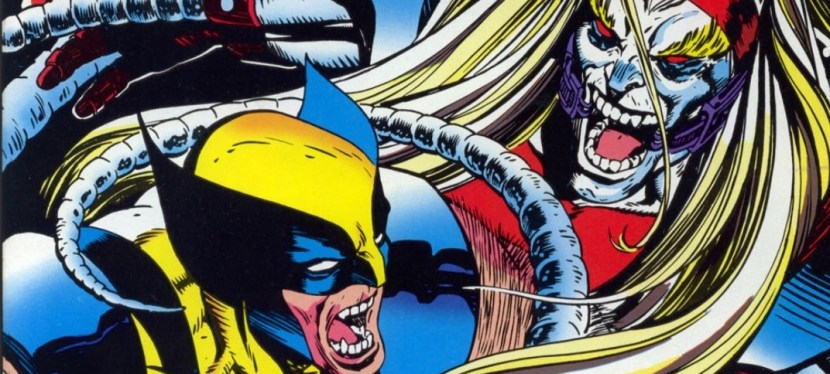
This tale of The Night Man is gritty and engaging to read from start to finish. It introduces an all-new villain who has a Russian legacy with historical connections to the city of San Francisco and northern part of California. The new figure of evil (note: quite obvious due to his murdering of the innocent) is quite a layered character and he seemed to be designed by Steve Englehart to be a recurring villain against the Night Man.

At this point in the comic book series, Night Man has established himself to be a very capable vigilante who truly believes in helping the people of the city on his own and his victories in the previous issues solidified his reputation. This essentially sets the stage for the debut of the new villain (note: the scary looking wolf on the cover) and the next big challenge for the titular hero. Without spoiling what happened, I can say the pay-off was indeed worth the build-up.

Another strong point of this comic book is the way the creators dramatized the differences and similarities between the Night Man and the new villain. Both men are violent and their each have their own obsessions directly related to their respective goals.

Conclusion

The Night Man takes on thugs as the new villain watches.

The Night Man (1994) is a pretty engaging read on its own and it shows how much the Night Man himself progressed as the Ultraverse’s San Francisco-based vigilante who really pushes himself to the limits fighting evil even though his resources are very limited. The introduction of the new villain in this comic book not only proved to be a solid addition into the Ultraverse lore but also added to the titular hero’s development as well as his vigilante justice campaign. This comic book may not be as action packed as the previous issue, but you can rest assured there is a really good quality writing here and the build-up was nicely paid-off by the end. As with the previous issues, Kyle Hotz’s gritty art made this Night Man tale really look lively and very stylish.

Overall, The Night Man (1994) is recommended.

+++++

Thank you for reading. If you find this article engaging, please click the like button below and also please consider sharing this article to others. If you are looking for a copywriter to create content for your special project or business, check out my services and my portfolio. Feel free to contact me with a private message. Also please feel free to visit my Facebook page Author Carlo Carrasco and follow me on Twitter at  @HavenorFantasy as well as on Tumblr at https://carlocarrasco.tumblr.com/ and on Instagram at https://www.instagram.com/authorcarlocarrasco/

A Look Back at Exiles #2 (1993)

Disclaimer: This is my original work with details sourced from reading the comic book and doing personal research. Anyone who wants to use this article, in part or in whole, needs to secure first my permission and agree to cite me as the source and author. Let it be known that any unauthorized use of this article will constrain the author to pursue the remedies under R.A. No. 8293, the Revised Penal Code, and/or all applicable legal actions under the laws of the Philippines.

Welcome back superhero enthusiasts, 1990s culture enthusiasts and comic book collectors! Today we go back to the mid-1990s which was a really wild time for comic collectors. To be more specific, this newest retro comic book review revisits Ultraverse through the very short series titled Exiles.

It has been years since I reviewed Exiles #1 (1993). Since after, I reviewed a lot of Ultraverse comic books and went through notable storylines such as the Atalon Saga in UltraForce, the Hostile Takeover in Prototype, The Solution, The Night Man and Solitaire, and more. That being said, it was just right that I returned to Exiles for retro reviewing.

With those details laid down, here is a look back Exiles , published in 1993 by Malibu Comics with a story written by Steve Gerber and drawn by Robb Phipps.

The cover.

Early story

The story begins with Exiles members Catapult and Mustang staring at two bodies (a large man and a lady) on the floor. It turns out their mission was a failure as Timmy Halloran (the young guy they tried to save) went missing while his mother just died.

As soon as the two step out of the house feeling bad about their failure, they suddenly find themselves confronted by several police officers. Police cars and a helicopter have surrounded the place. Just as Catapult and Mustang turned themselves in, the large man named Bruut suddenly regains consciousness and attacks the police.

The police officers respond by firing several bullets at Bruut which slowed him down. After noticing that Bruut was only regaining his strength, the two Exile members made their moves before the large man strikes the police…

Quality

Inside the headquarters of Exiles. Ghoul’s mentioning of Prime and Hardcase seems to foreshadow his eventual part in UltraForce.

As expected, the storytelling in this comic book really progressed and paid off some of the build-up that happened in issue . Here, the conflict between the Exiles and the enhanced forces of business tycoon Victor Kort got clearly defined and what they have in common other than having enhanced beings is their pursuit of individuals who carry within their bodies the Theta virus which unlocks unexpected powers or capabilities. Such developments could impact the people and the world around them when left unguarded or deliberately developed with assistance of guidance.

Amber, who was a key figure in issue , appears much less in this comic book but her purpose with the Exiles gets more elaborated. The lack of spotlight on Amber is not surprising as the creators had to emphasize the conflict between the titular team and Kort’s forces while also introducing Timmy Halloran as a new Theta-carrying individual.

There is a good amount of superhero spectacle here and along the way, the dialogue is good and got witty as well. By the time I reached the end, I found myself anticipating what would come next in issue .

Conclusion

The two Exiles members take on Bruut right in the presence of police officers.

Exiles (1993) is a worthy follow-up to its predecessor and the creators succeeded in making the conflict more engaging while cleverly releasing new details that defined what is at stake and what could follow. In retrospect, Amber Hunt later became a key figure in the 2-part Break-Thru crossover storyline (which was memorably drawn by the late George Perez) and the story here defined how much impact super beings can have on societies filled with mostly people who don’t have super powers or special talents. The conflict between the Exiles and Kort’s forces not only got emphasized a lot, their respective agendas and resources are also well defined.

Overall, Exiles (1993) is recommended.

+++++

Thank you for reading. If you find this article engaging, please click the like button below and also please consider sharing this article to others. If you are looking for a copywriter to create content for your special project or business, check out my services and my portfolio. Feel free to contact me with a private message. Also please feel free to visit my Facebook page Author Carlo Carrasco and follow me on Twitter at  @HavenorFantasy as well as on Tumblr at https://carlocarrasco.tumblr.com/ and on Instagram at https://www.instagram.com/authorcarlocarrasco/

A Look Back at Sludge #10 (1994)

Disclaimer: This is my original work with details sourced from reading the comic book and doing personal research. Anyone who wants to use this article, in part or in whole, needs to secure first my permission and agree to cite me as the source and author. Let it be known that any unauthorized use of this article will constrain the author to pursue the remedies under R.A. No. 8293, the Revised Penal Code, and/or all applicable legal actions under the laws of the Philippines.

Welcome back, superhero fans, 1990s arts and culture enthusiasts and comic book collectors! Today we revisit the Ultraverse of Malibu Comics and examine one of its many stories told through an issue of the Sludge comic book series.

In my previous retro review, the “Street Wars” storyline came to a solid and even shocking end which ultimately left Sludge free and yet desperate and unfulfilled. At this stage, Sludge is clearly a very lost soul and this opens another opportunity for readers to follow him and see where he will go next.

With those details laid down, here is a look back at Sludge , published by Malibu Comics in 1994 with a story written by Steve Gerber and drawn by Robb Phipps.

The cover.

Early story

The story begins with Sludge once again alone in the sewers. This time, he holds large quantities of the illegal substance Zuke which he believes will help him achieve something he desires in relation to his existence. Life has been very hard for him since he became a slimy creature.

Then he remembers when the mercenary Bloodstorm was forced fed with Zuke. Afterwards, he consumes the large Zuke containers expecting them to fix him. Nothing happened. No instant results whatsoever which frustrates him. Sludge then walks into the darkness.

On the city street, police officers in cars chase an unusual target…a lady riding a large bird of unknown species. After causing her pursuers to crash and explode, the lady rider reveals herself to be Vinaigrette.

Just as Vinaigrette and her speedy bird move into an alley, Sludge sees them…

Quality

Investigative journalism being done.

When it comes to the story, I can say that the Sludge series really made a serious turn towards a different direction here. Without spoiling the rest of the plot, I can say that very significant changes await readers, so much so their usual expectations towards Sludge become unnecessary. Are you so used to seeing Sludge think or talk inconsistently? Be ready for something really new about him, something that makes him more human moving a bit closer to his past life as a civilian.

Moreover, with the gang war aspect of New York already out of the narrative, this comic book not only follows Sludge more significantly, its story is also more character-driven than before. What Steve Gerber wrote here is very nicely structured and it is also clear he also adjusted his portrayal of the titular character to give readers something fresh and yet familiar to follow.

So what kind of story does this comic book present other than being a more character-driven piece? Definitely it’s not a monster story nor a superhero tale but something more of a misadventure mixed with elements of detective story plus a bit of investigative journalism (mainly due to the series’ notable lady journalist).

Conclusion

A lady and her speedy ride.

In my view, Sludge (1994) is a successful attempt by the creative team to emphasize Sludge’s exploits and personality even more while taking a new direction without ever feeling alienating. I should state that after reading back-to-back issues about the New York gang war which had the titular character caught in the middle, this comic book’s character-driven approach with Sludge is literally like a breath of fresh air. Not only will you see even more of Sludge, you will also enjoy the creators’ attempt on exploring his past life while showing lots of significant new things in connection to the changes he goes through. The story is nicely paced, the storytelling is creatively stylized and there are nice pay-offs for each build-up.

Overall, Sludge (1994) is highly recommended.

+++++

Thank you for reading. If you find this article engaging, please click the like button below and also please consider sharing this article to others. If you are looking for a copywriter to create content for your special project or business, check out my services and my portfolio. Feel free to contact me with a private message. Also please feel free to visit my Facebook page Author Carlo Carrasco and follow me on Twitter at  @HavenorFantasy as well as on Tumblr at https://carlocarrasco.tumblr.com/ and on Instagram at https://www.instagram.com/authorcarlocarrasco/
A Look Back at Freex #13 (1994)

Disclaimer: This is my original work with details sourced from reading the comic book and doing personal research. Anyone who wants to use this article, in part or in whole, needs to secure first my permission and agree to cite me as the source and author. Let it be known that any unauthorized use of this article will constrain the author to pursue the remedies under R.A. No. 8293, the Revised Penal Code, and/or all applicable legal actions under the laws of the Philippines.

Welcome back superhero enthusiasts, 1990s culture enthusiasts and comic book collectors! Today we go back to the mid-1990s which was a really wild time for comic collectors. To be more specific, this newest retro comic book review revisits Ultraverse through the exploits of Freex, the monthly series about a group of young adults with unusual capabilities (or abnormalities) who are constantly on the move as they are social outcasts.

In my previous retro reviews of Freex, the team encountered Contrary (who later became a significant part of UltraForce) and her so-called school of gifted children. Subsequently, they left Contrary’s lair but without Ray who decided to stay behind. Freex, who gained a new member in replacing Ray, went underground encountering Prime and a lone individual called Old Man. After separating from Prime, the team move further underground with Old Man and discovered a lot of things they never expected.

With those details laid down, here is a look back Freex , published in 1994 by Malibu Comics with a story written by Gerard Jones and drawn by Scott Kolins.

The cover.

Early story

The story begins deep under the Earth’s surface wherein the Freex – AJ, Angela, Michael, Valerie and new member – and Old Man encounter a huge and intimidating sentient being which has the head and tusks of an elephant. The being calls itself Prometheus and claims that he has lived underground for a very long time, created new beings and saw the development of settlements that the people on the surface are not even aware of.

Intriguingly, he reveals to the Freex that he created the substance that were injected by a certain nurse into the bodies of each team member when they were still infants which later manifested into the capabilities and abnormalities they now have…

Quality

This short scene about Atalon and his army is a prelude to the Atalon storyline in the early issues of UltraForce.

The most significant aspect about this comic book’s story is the clever approach taken by the creators to not only show the further development of Freex but also emphasize and expand the lore of the Ultraverse while connecting this series to UltraForce (the early issues written by Gerard Jones and drawn by the late George Perez) which itself had a great conflict between Atalon’s forces and Earth’s governments. To put it short, this Freex tale is a prelude to the events seen in UltraForce #0, UltraForce and the rest of the Atalon saga. The good news is that the emphasis of in-universe connection (as opposed to crossovers) was done well and nicely structured.

More on the Freex themselves, the revelation that the members’ powers were the result of being injected (by Wetware Mary) into them with the substance created by Prometheus resulted in dramatic reactions from them which also adds to the tension of their current misadventure together so far away from society. The revelation also added tremendous weight into the series’ narrative raising questions such as the following: Wow will each Freex member reintegrate into society as they know the truth about what caused them to have powers/abnormalities? Where will they go once they made it back to the surface? Will they keep secret the existence of Prometheus?

In relation, the creative team took their time to develop each member’s personality and emotions. Most notable was the portrayal of the new friendship between Valerie and their new member (indoctrinated by Contrary) which hints that something significant could happen to not only themselves but to the team itself.

What also struck me in this comic book was the way the 2nd half of the story was presented…by becoming really wild and crazy. Eerily, the confusion felt by Freex during the 2nd half was something I as a reader felt. To find out what I’m talking about, I urge to get a copy of this comic book and read it yourselves.

Conclusion

This page revealed more about the origins of the Freex members.

While the 2nd half of the story had a crazy ride, I still found Freex (1994) to be really engaging and intriguing mainly on the big revelation and UltraForce connections told in the first half. At this stage in the series, it really looked like that the team was on its way into the unknown as their own place within the Ultraverse really widened (similar to what happened on the part of The Solution in issues #10, #11 and #12).

Overall, Freex (1994) is recommended.

+++++

Thank you for reading. If you find this article engaging, please click the like button below and also please consider sharing this article to others. If you are looking for a copywriter to create content for your special project or business, check out my services and my portfolio. Feel free to contact me with a private message. Also please feel free to visit my Facebook page Author Carlo Carrasco and follow me on Twitter at  @HavenorFantasy as well as on Tumblr at https://carlocarrasco.tumblr.com/ and on Instagram at https://www.instagram.com/authorcarlocarrasco/

A Look Back at Sludge #9 (1994)

Disclaimer: This is my original work with details sourced from reading the comic book and doing personal research. Anyone who wants to use this article, in part or in whole, needs to secure first my permission and agree to cite me as the source and author. Let it be known that any unauthorized use of this article will constrain the author to pursue the remedies under R.A. No. 8293, the Revised Penal Code, and/or all applicable legal actions under the laws of the Philippines.

Welcome back, superhero fans, 1990s arts and culture enthusiasts and comic book collectors! Today we revisit the Ultraverse of Malibu Comics and examine one of its many stories told through an issue of the Sludge comic book series.

In my previous Sludge retro review, the conflict between the crime organizations intensified as the titular character continued to struggle with achieving his desired goal which includes getting involved with the Pump’s evil schemes. Eventually something unexpected happened Sludge which involved Zuke, the potent illegal substance the Pump keeps on unleashing to the public.

With those details laid down, here is a look back at Sludge , published by Malibu Comics in 1994 with a story written by Steve Gerber and drawn by Robb Phipps.

The cover.

Early story

The story begins with Sludge in pain as he pulls out a long spike from his right hand which became flesh again. This was the result of his holding Zuke which his right hand somehow absorbed. Wanting answers, he calls out to the Pump who (along with his teenage protégé) was no longer present in the room. A female ghost appears to Sludge and tells him that the crime boss is downstairs.

It turns out, the Pump has an evil plan in mind which would involve the mercenary Bloodstorm. The crime boss puts a very large capsule of Zuke into the mouth of the restrained Bloodstorm. Just as Sludge arrives, Bloodstorm becomes very enraged as a result of absorbing a high quantity of the illegal substance. Shortly after Pump quells the drugged mercenary, Sludge approaches him for more Zuke as he is convinced that the drug will turn him to normal just like how it turned his right hand back to normal.

The Pump orders Sludge to take Bloodstorm’s body back to his employer Sabatini then return. He reminds him that he has the Zuke and is capable of eradicating him…

Quality

Sludge has yet to realize he could really go up against the very evil Pump.

Now this is the most intriguing tale of Sludge in relation to the unstable relations between the gangs of New York. Vittorio, the one trusted assistant of the late crime boss Marcello, leads the gang and tries to craft a new direction with emergence in mind by negotiating a truce with the Dragon Fang while also starting efforts to duplicate the very addicting substance called Zuke which has long been an asset to the Pump’s gang. Unsurprisingly, Vittorio encounters trouble trying to win the trust of the more established crime bosses and he is also unaware that they are all being targeted by the Pump.

Once the Pump unleashes his newest move against the gangs, the situation intensifies and gets twisted which makes this a really solid reading experience. Steve Gerber crafted this story to be intense and unpredictable at the same time, while also showing how Sludge deals with his situation being powerless under the Pump. There is one notable addition to the plot which involves violent action which you must discover for yourselves.

When it comes to the visuals, Robb Phipps take on Sludge is vastly different compared to Aaron Lopresti’s Sludge. The result is that Phipps’ art style made Sludge and the other characters have that cartoony aesthetic and yet they are still recognizable. What visual style and elements Phipps had on certain issues of Mantra he illustrated (click here, here and here) are pretty much present in this comic book.  

Conclusion

A high-stakes meeting disrupted.

Sludge (1994) is another solid read and one of the most intriguing stories of the Sludge series. As the concluding chapter of the “Street Wars” storyline, this comic book has the usual elements that defined Sludge stories while also succeeding in moving the plot forward (note: the storyline conclusion is engaging, even shocking) complete with twists and noticeable intensified violence. At this point in the monthly series, Sludge is off on a path of despair and he is clearly lost. This element alone should compel readers to examine Sludge’s personality closely and analyze where he is heading to and what purpose does he have left.

Overall, Sludge (1994) is recommended.

+++++

Thank you for reading. If you find this article engaging, please click the like button below and also please consider sharing this article to others. If you are looking for a copywriter to create content for your special project or business, check out my services and my portfolio. Feel free to contact me with a private message. Also please feel free to visit my Facebook page Author Carlo Carrasco and follow me on Twitter at  @HavenorFantasy as well as on Tumblr at https://carlocarrasco.tumblr.com/ and on Instagram at https://www.instagram.com/authorcarlocarrasco/