Welcome back readers, fellow geeks and electronic gaming fans!
In this edition of the Retro Gaming Ads Blast (RGAB) series, we will take a look at another batch of retro gaming print ads – including arcade flyers – from the 1980s and 1990s.
For the newcomers reading this, Retro Gaming Ads Blast (RGAB) looks back at the many print ads of games (console, arcade, computer and handheld) that were published in comic books, magazines, flyers, posters and newspapers long before smartphones, social media, the worldwide web and streaming became popular. To put things in perspective, people back in the 1980s and 1990s were more trusting of print media for information and images about electronic games and related products.
With those details laid down, here is the newest batch of retro gaming print ads for you to see and enjoy…
1. E.T. the Extra-Terrestrial Atari 2600 print ad
If you have seen Steven Spielberg’s 1982 movie, were you able to play the Atari 2600 video game? I did!
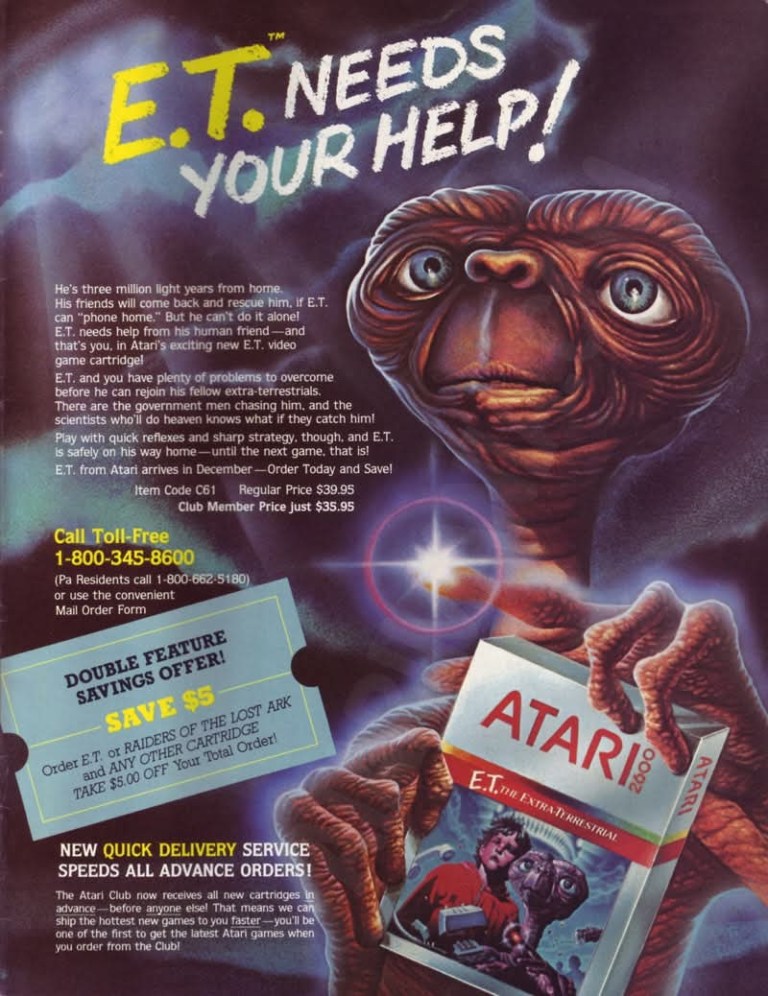
Atari invested a lot on its video game based on Steven Spielberg’s E.T. the Extra-Terrestrial as the film was a massive box office success. In addition to their Atari 2600 video game print ad showing E.T. with Elliot, they ran another print ad with a concept of the sci-fi character needing people’s help. They came up with original artwork showing E.T. holding a box of the Atari 2600 E.T. video game, then posted details about how to acquire a copy of the game (with prices for regular customers and club members) and posted a toll-free 1-800 phone number. They also offered a $5 discount for those who order the E.T. or Raider of the Lost Ark video game and another cartridge. This old ad had commerce written all over it.
2. Bulls vs. Lakers and the NBA Playoffs Sega Genesis print ad
Before NBA Live, there was this old NBA video games series by Electronic Arts.
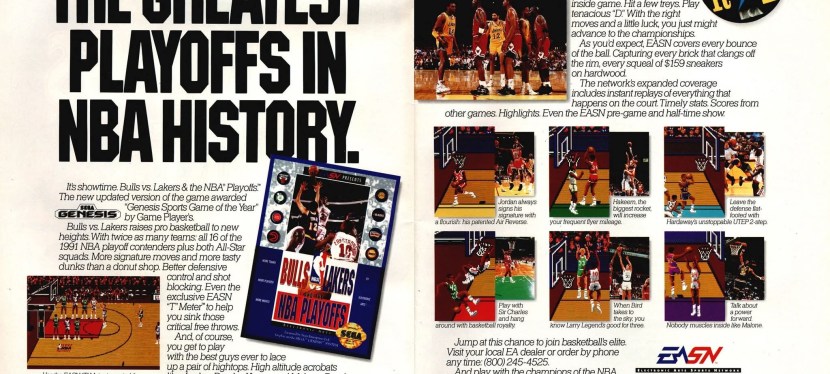
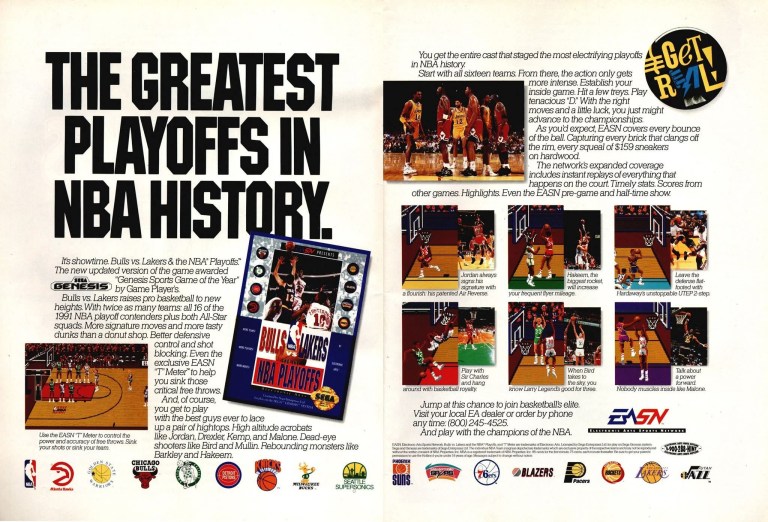
Based on the 1990-91 NBA season and the NBA finals match-up between the Chicago Bulls and the Los Angeles Lakers, Bulls vs. Lakers and the NBA Playoffs was Electronic Arts’ exciting game for the Sega Genesis which already had lots of sports-loving gamers. They made a 2-page print ad that was cleverly designed to make both gamers and NBA fans excited. It is not an accident that the ad showed comparative images (in-game footage and real-life basketball photos) of NBA superstars like Larry Bird, Michael Jordan, Karl Malone and Charles Barkley on the right. With the strong visual presentation, emphasis on popular NBA players and other details posted, this old ad is still fun and exciting to look at.
3. Japanese Smash T.V. print ad
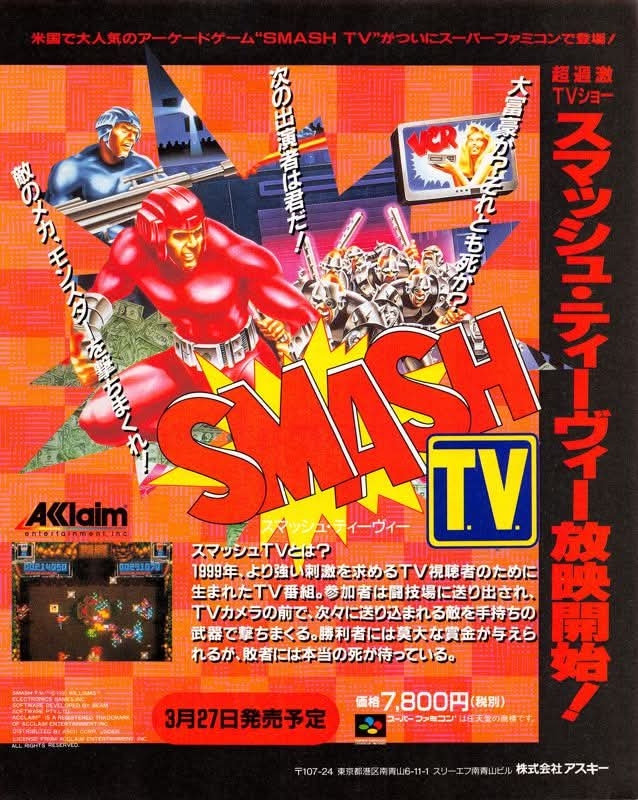
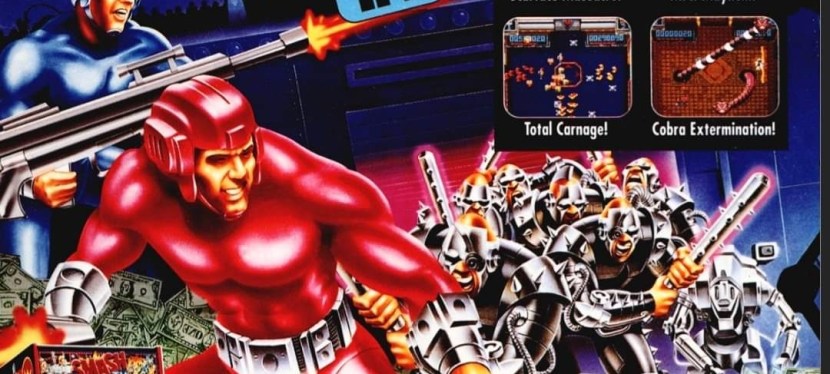
The Japanese print ad of Smash T.V.
Yes, it is true! The console port of the arcade classic Smash T.V. was released on the Super Family Computer (Super Famicom) in Japan back in the 1990s. While I cannot understand the Japanese text shown on the ad above, it still looks exciting as the official artwork plus a screenshot of the game were displayed. The revealed retail price of 7,800 Yen is alone eye-catching as there were many games in Japan launched below that price in the next console generation. I can only wonder how many gamers in Japan bought and enjoyed Smash T.V.
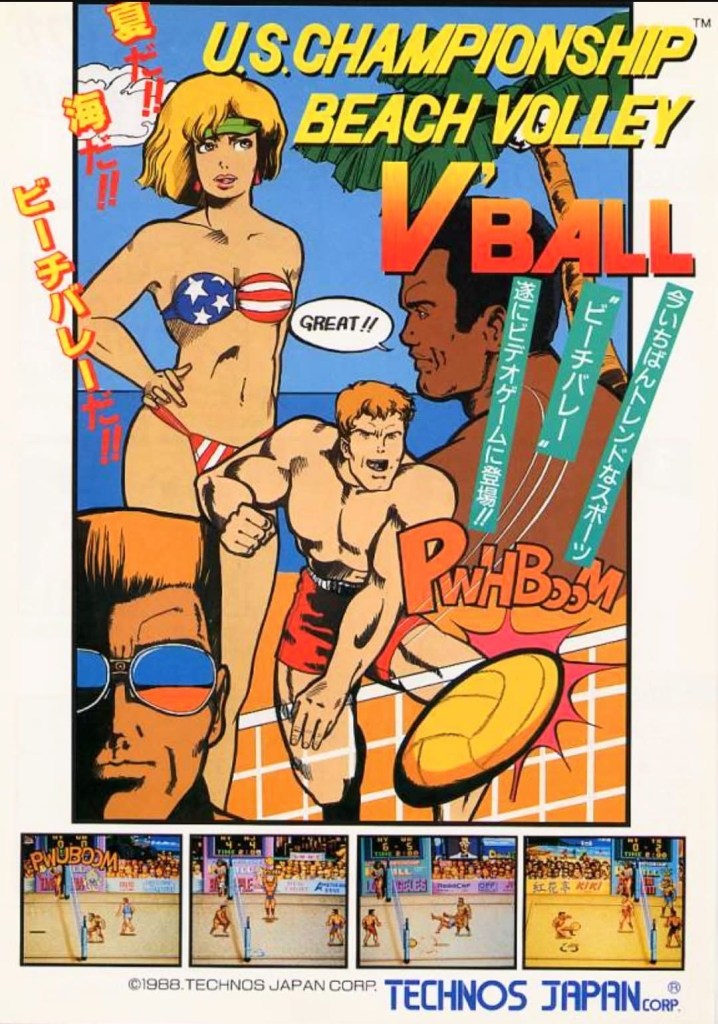
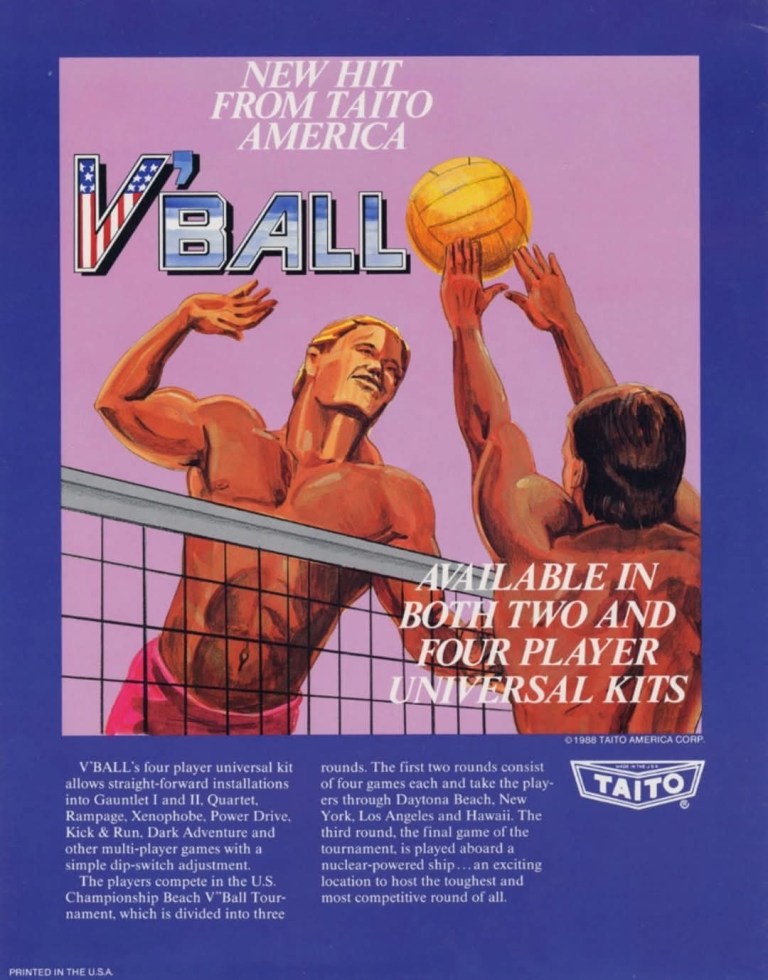
4. U.S. Championship V’Ball arcade flyers
The very colorful and striking arcade flyer for the Japanese market.
The American arcade flyer.
In 1988, Technos – the company behind the Double Dragon video games – released U.S. Championship V’Ball in video arcades in Japan and in America. The way it was promoted in Japan, Technos came up with an arcade flyer that had a comic-inspired hand-drawn artwork that easily gave viewers a strong American beach volleyball vibe. For the American arcade market, Taito (licensed by Technos) used different artwork showing two men in action. If you ask me, the Japanese arcade flyer is more dynamic to look at. Regardless of art style and presentation, both arcade flyers emphasized beach volleyball to gamers clearly.
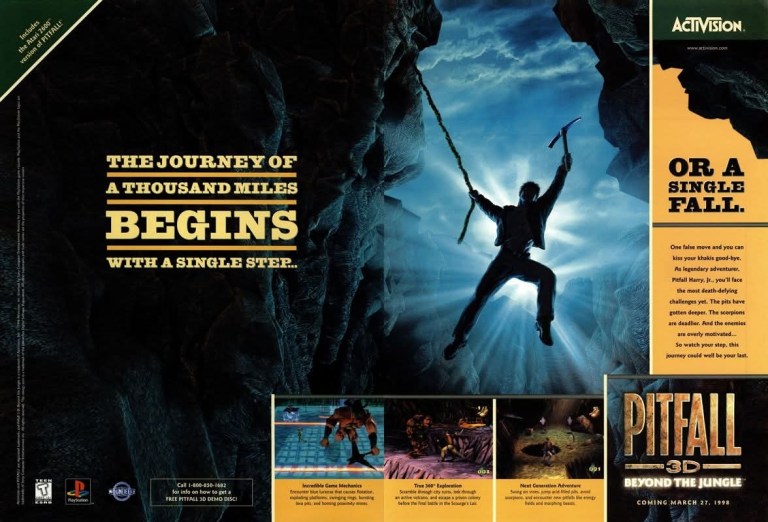
5. Pitfall 3D: Beyond the Jungle print ad
The 2-page print ad of Pitfall 3D: Beyond the Jungle.
When Activision decide to make a new Pitfall video game with polygonal graphics and with 3D platform gameplay, it was not surprising at all as this was the trend that defined 1990s gaming. In 1998, Pitfall 3D: Beyond the Jungle was released for the PlayStation and it received a divisive reception from the critics. If you look closely at the print ad, the words “Next Generation Adventure” was written in the lower-right part and it was clear the game’s quality did not justify them.
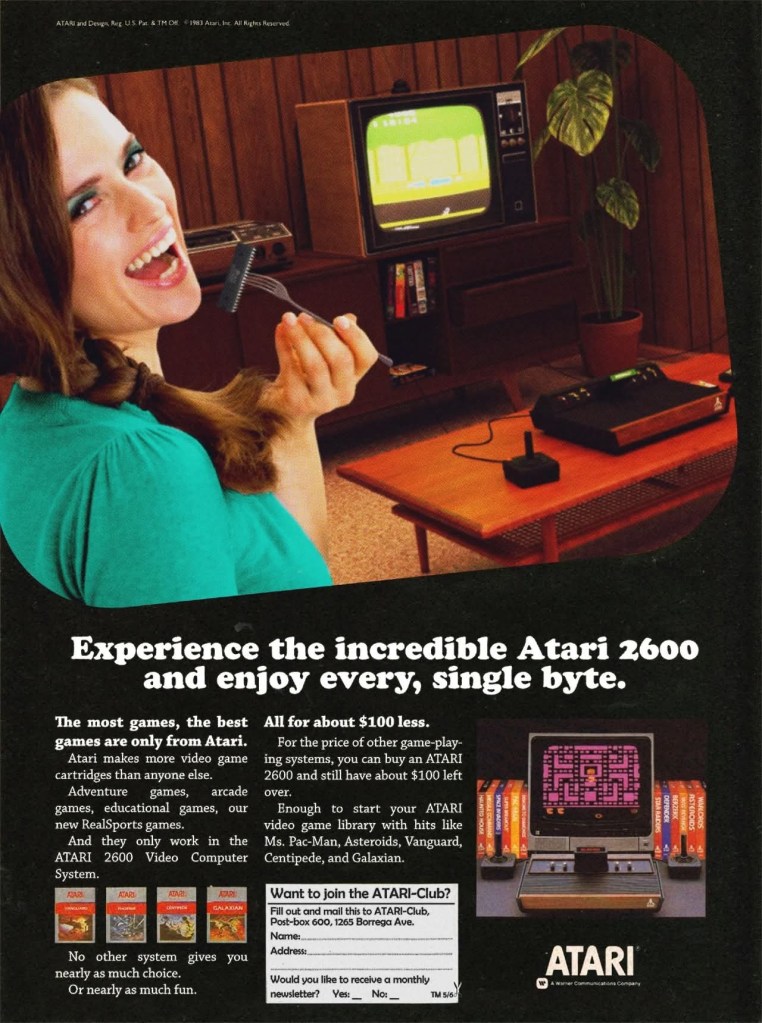
6. Atari 2600 and games print ads
Our household had an Atari 2600 console and many games.
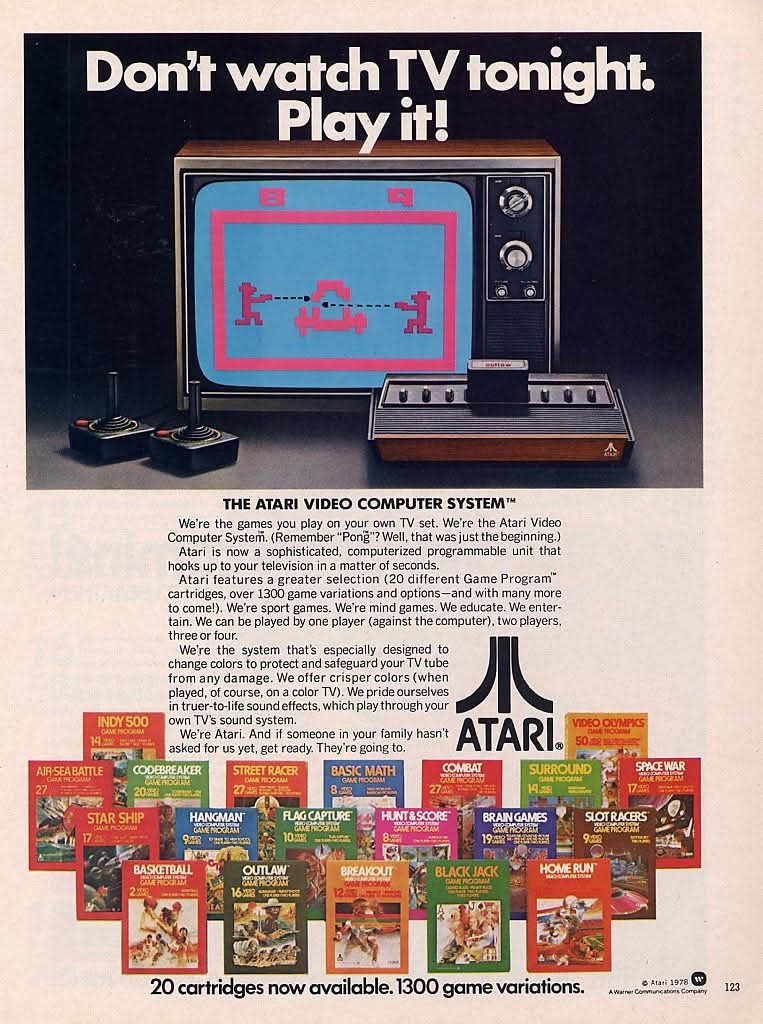
Atari’s promotion of its console, the games and interactive entertainment with the TV.
For a number of years decades ago, Atari dominated the video game console market in America with the Atari 2600 sold in the millions. While Atari today is no longer the video game giant it used to be, there is no denying the fact that they really changed the way people enjoyed the use of their television sets in American homes by offering them lots of video games for the Atari 2600 console. By looking at the above print ads, you can see that the company was not only aggressive with their marketing but also made interactive electronic entertainment more acceptable to countless families.
7. Burning Rangers North American print ad
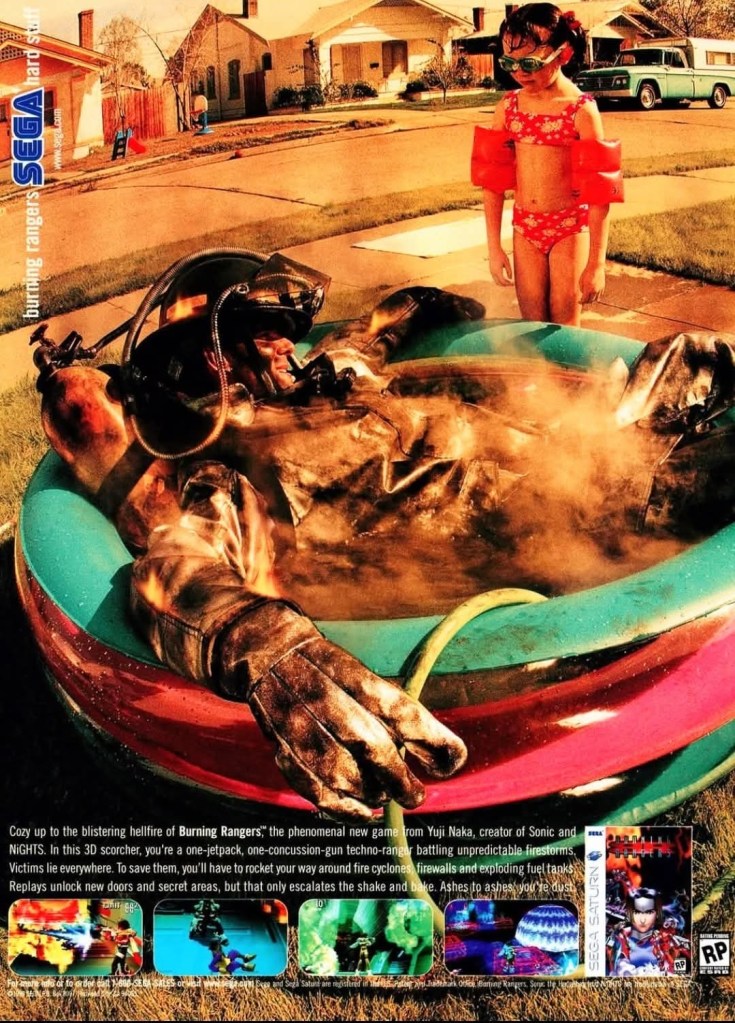
I remember this ad from video game magazines I read in 1998.
Released in 1998 for the Sega Saturn, Burning Rangers was a high-quality exclusive game. To promote it in America, Sega came up with the print ad showing a few screenshots and a dominating image of a fire fighter cooling down on a kid’s personal pool. The image emphasized the element of fire in the game even though it lacked the more sci-fi elements used on the characters and setting. It should be noted that by 1998, the Sega Saturn was no longer in high demand in America as gamers overwhelmingly chose PlayStation and Nintendo 64 (N64) consoles and games. In retrospect, this was one of Sega’s final hard marketing moves done with a Saturn game.
Welcome back readers, fellow geeks, nostalgia buffs and electronic gaming fans!
In this edition of the Retro Gaming Ads Blast (RGAB) series, we will take a look at another batch of retro gaming print ads – including arcade flyers – from the 1980s and 1990s.
For the newcomers reading this, Retro Gaming Ads Blast (RGAB) looks back at the many print ads of games (console, arcade, computer and handheld) that were published in comic books, magazines, flyers, posters and newspapers long before smartphones, social media, the worldwide web and streaming became popular. To put things in perspective, people back in the 1980s and 1990s were more trusting of print media for information and images about electronic games and related products.
With those details laid down, here is the newest batch of retro gaming print ads for you to see and enjoy…
1. E.T. the Extra-Terrestrial Atari 2600 print ad
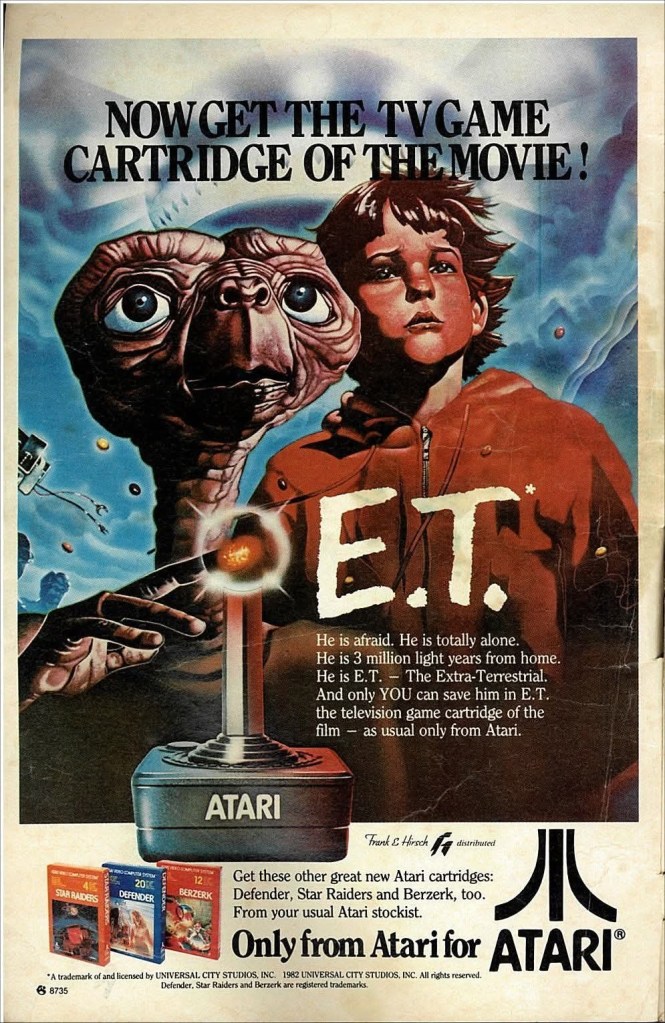
I saw the movie and played the Atari 2600 game.
Way back in 1982, Steven Spielberg’s small production E.T. the Extra-Terrestrial touched countless moviegoers and became a massive hit around the world. Along the way, an official video game adaptation for the Atari 2600 console was made by Atari anticipating big success coming. The above print ad appeared in many comic books I read and the artwork easily caught my attention since I saw the movie. Apart from the fact that the artist’s take on the boy Elliot did not resemble actor Henry Thomas, no screenshot of the game was shown which is very odd because Atari made the adaptation their biggest offering to consumers. As typical of the times, Atari inserted a few other games below for conveniently promoting them along with E.T. and the Atari 2600. Given the massive failure of the game, this print ad is a sad reminder from gaming’s past.
2. Pro Tennis arcade flyer
The artwork has a comic book look.
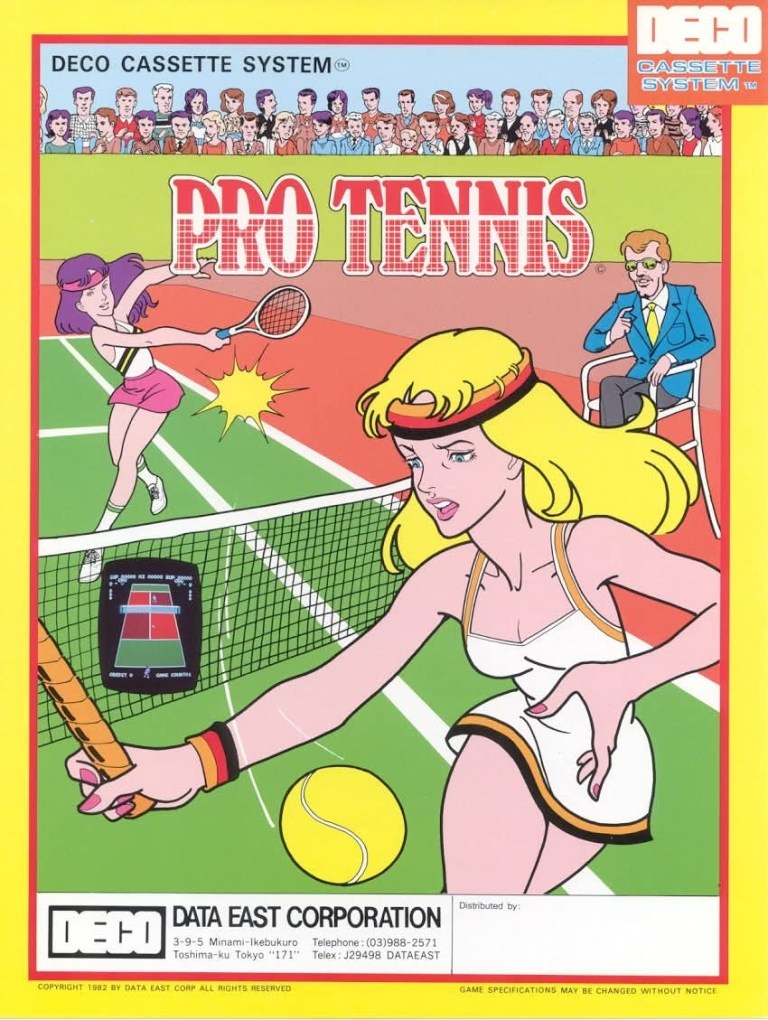
Still in 1982, Data East released Pro Tennis in the arcades. This arcade flyer has a pretty neat hand-drawn artwork that looked like it came from a comic book, and the ad makers managed to insert one screenshot to make it clear to both players and arcade operators what to expect. This is still a nice flyer to look at.
3. 3-in-1 Atari 2600 print ad
I was able to play Missile Command, Asteroids and Superman on Atari 2600 a long time ago.
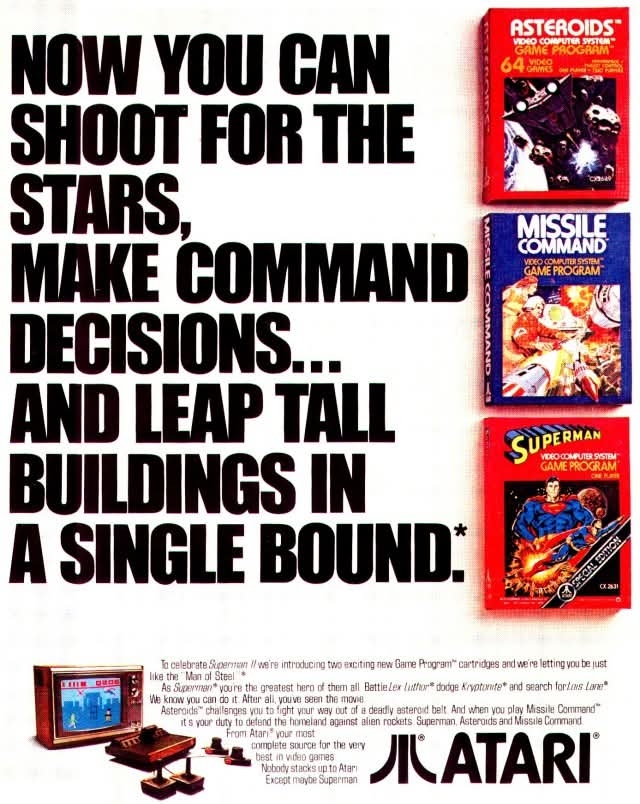
In the old days, we had an Atari 2600 console in our household and it lasted around 5 years for electronic entertainment. Atari was known for aggressively marketing its consoles and video games, and the above print ad was their creative way of promoting 3 games – Superman and the classics Missile Command and Asteroids – together. The biggest feature of the print ad was the large-sized text description that strongly reflected what each game was about. This is a memorable ad!
4. Super BurgerTime Japanese arcade flyer
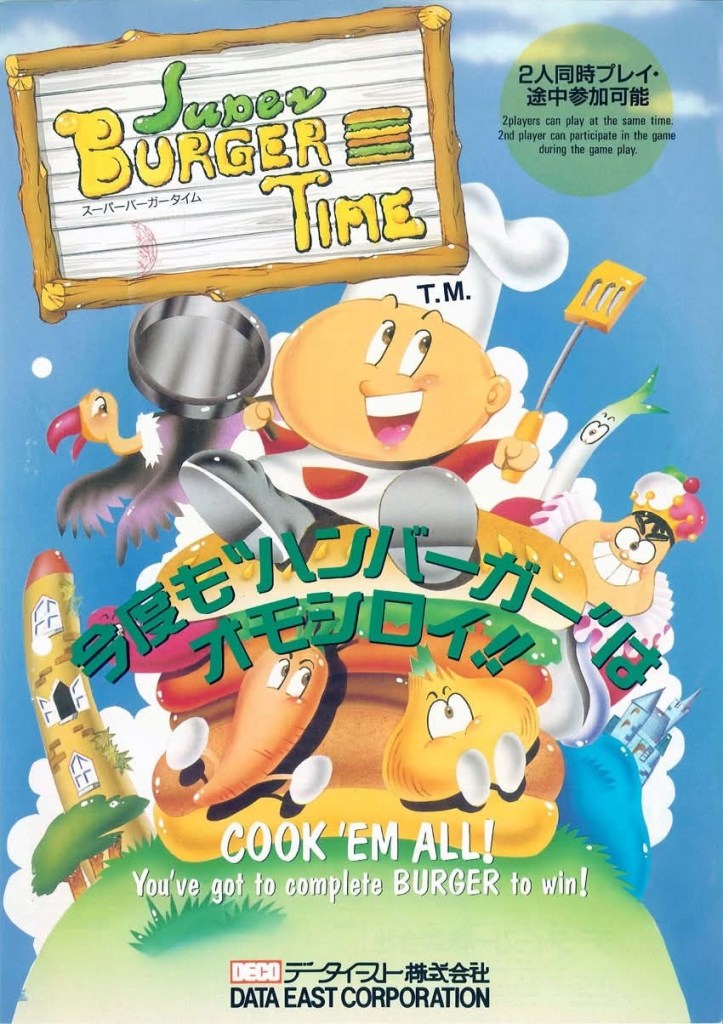
The front.
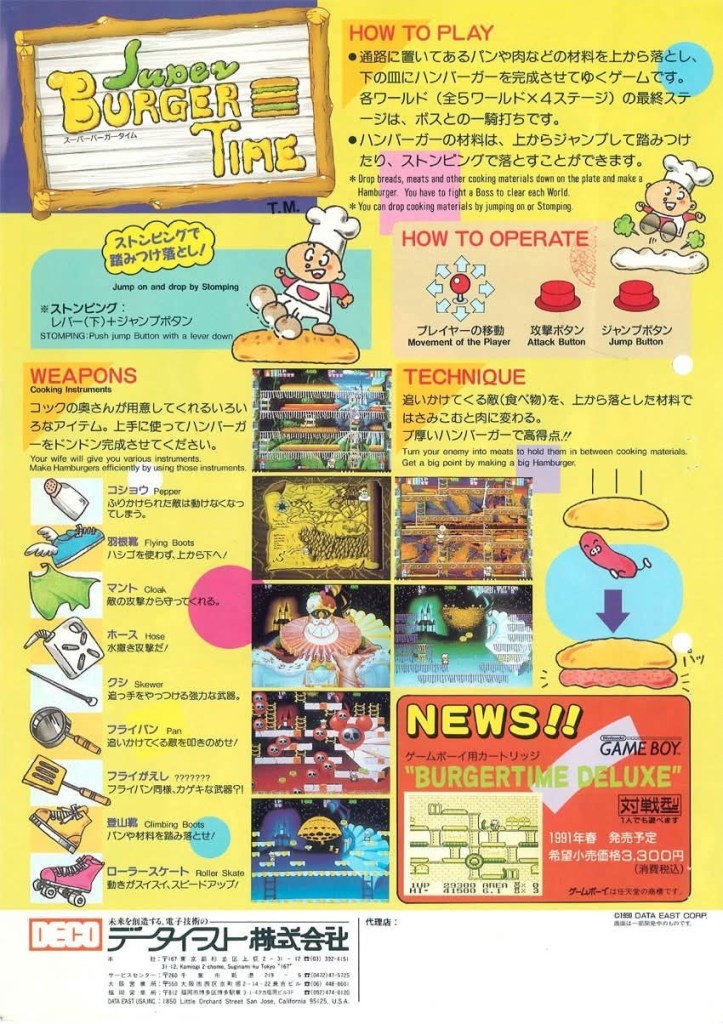
The rear.
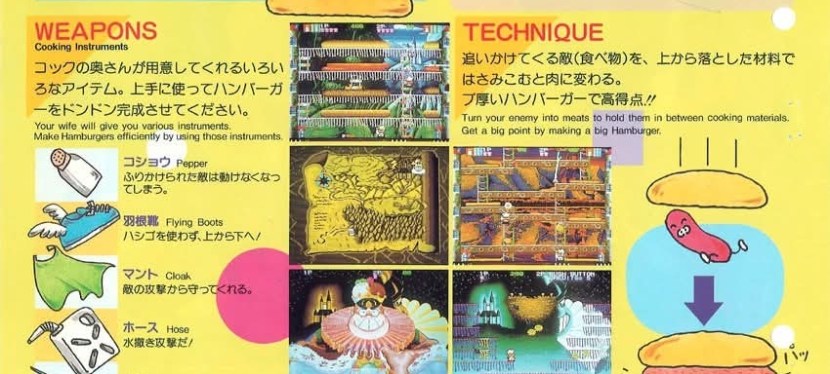
Remember the arcade classic BurgerTime? The sequel Super BurgerTime was released in Japanese arcades in late-1990 and the arcade flyer the producers came up with had a very cartoony art style. The rear of the flyer was filled with lots of details, instructions and screenshots to really have arcade operators and players informed. The producer even inserted a new portion promoting BurgerTime Deluxe on Nintendo Game Boy.
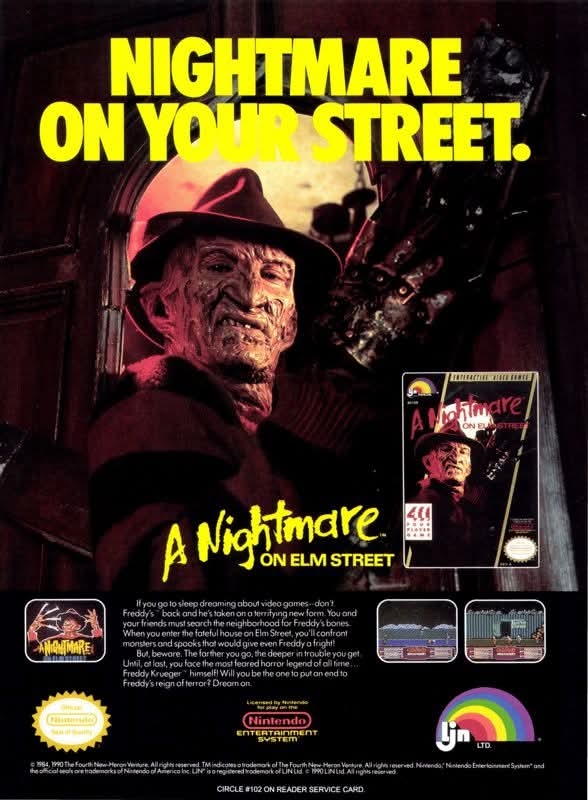
5. A Nightmare on Elm Street NES print ad
If you were able to play this game on the NES, did you have nightmares?
By the end of the 1980s, there were already five movies of the A Nightmare on Elm Street franchise that got released in cinemas and a dedicated following of fans was present. Eventually, an official video game adaptation was released on Nintendo Entertainment System (NES) in 1990 which was surprising since the movies were all rated R and the console itself was popular with young gamers (kids to teenagers). To promote the game, the notorious publisher LJN came up with a print ad that prominently showed series antagonist Freddy Krueger (played by Robert Englund), a few screenshots, the text description and the game box cover. Look back at this old print ad is strange because it shows Freddy Krueger TWICE which means the ad makers could not come up with any original artworks nor a different background for the antagonist.
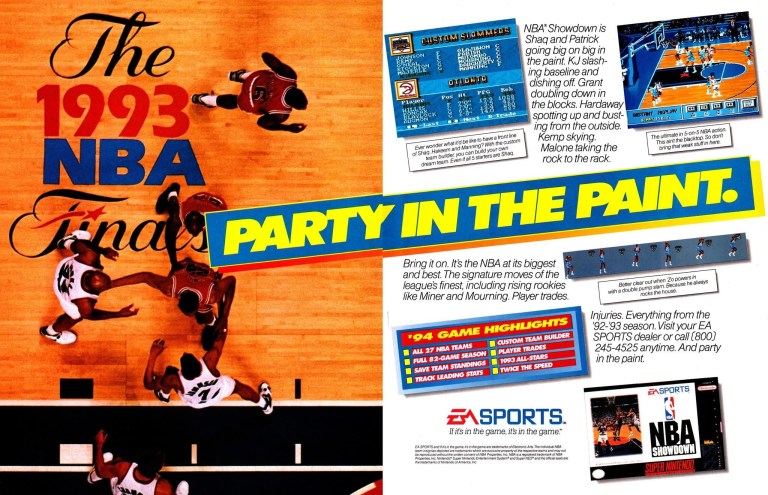
6. NBA Showdown print ad
While this ad did not mention Michael Jordan, he was still included in the video game.
By 1993, EA Sports (Electronic Arts’ sports brand) arguably established itself as the leader of NBA-licensed video games. At the time, console gamers can expect each new NBA game from the publisher to have full rosters and statistics of players based on the season and playoffs that passed. NBA Showdown, which reflected the 1992-93 season, was promoted with this 2-page print ad that had a rectangular image taken during the 1993 NBA Finals (Chicago Bulls and Phoenix Suns) placed on the left, screenshots and text description on the right. The ad made references to Shaquille O’Neal, Patrick Ewing, Tim Hardaway and other NBA players to excite gamers. This ad is still good to look at.
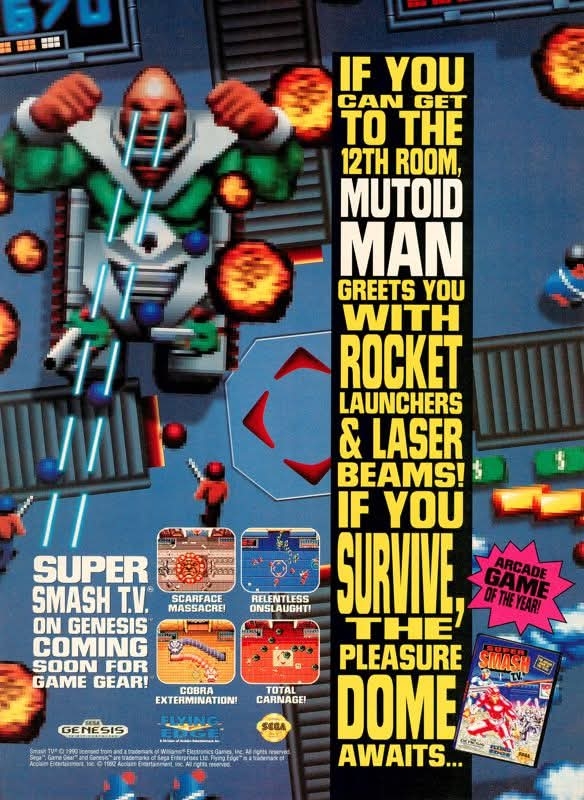
7. Super Smash T.V. Sega Genesis print ad
Were you able to play the Sega Genesis version?
In 1991, the arcade classic Smash T.V. was ported to the Sega Genesis console under the title Super Smash T.V. and this print ad had a rectangular layout showing a zoomed-in capture of game footage with the huge enemy Mutoid Man. The stylized line (in rectangular layout) strongly reflected what gamers could expect in the game. The ad maker also inserted the confirmation that a Game Gear version was coming. This ad is a unique way of promoting both the Genesis and Game Gear versions of Smash T.V.
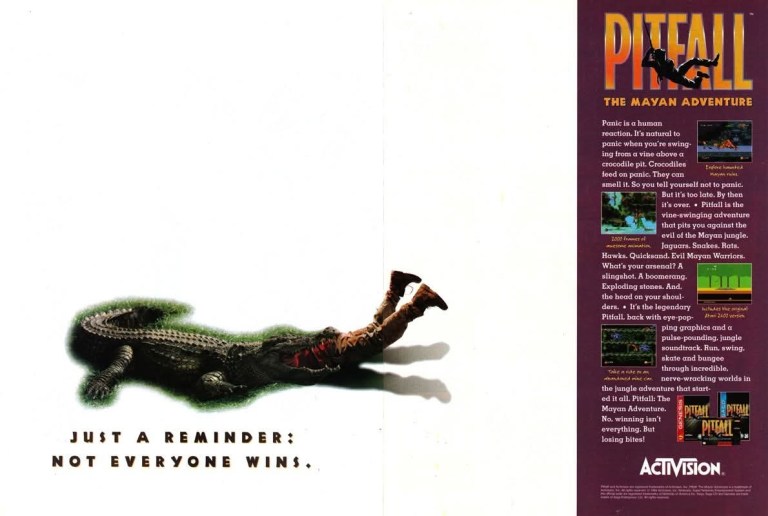
8. Pitfall: The Mayan Adventure print ad
This print ad is still eye-catching and entertaining to look at.
In the mid-1990s, Activision went big with the comeback of the Pitfall! game series by releasing Pitfall: The Mayan Adventure on multiple consoles. This two-page print ad had a touch of dark comedy by using a prominent image of a crocodile swallowing a person while avoiding blood and gore. With the little space remaining, the ad makers crammed in the text description and screenshots plus the game’s package covers. Notably, the text description maintained its tone and focused on describing the game properly. The marketing campaigns of Activision was effective as Pitfall: The Mayan Adventure went on to sell in the millions.
Welcome back Xbox fans, geeks, retro gaming enthusiasts and other gamers!
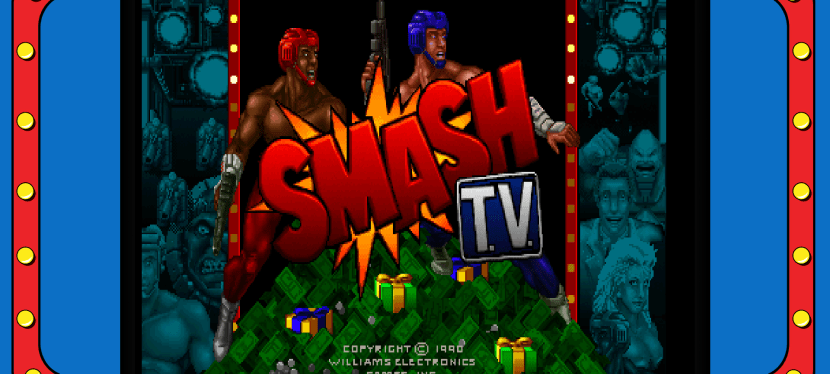
I finally did it! I finally played the arcade version of the classic game Smash T.V. as I recently purchased Midway Arcade Origins (Xbox 360) on the Xbox store. Thanks to backward compatibility, Midway Arcade Origins operated smoothly on my Xbox Series X and it comes with more than thirty arcade games owned or published by Midway Games from the early 1980s to the early 1990s.
My history of playing Smash T.V. is awkward. The very first time I played the game was not in the arcade but with the Smash T.V. port released on the Super Nintendo Entertainment System (SNES).
The classic game debuted in arcades in 1990 and during that precise point of time, I rarely visited arcades here in the Philippines. I started visiting arcades more starting in 1992 as the fighting game craze started luring new gamers driven by the popularity of Street Fighter II. To the best of my memory, I saw very few arcade machines of Smash T.V. and never got to play the game. In fact, there were very few arcade machines that had the dual joystick control set-up which was exactly required to play Smash T.V.
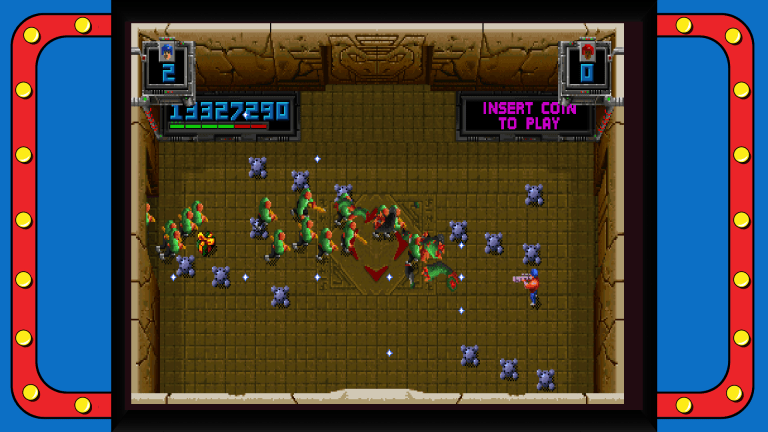
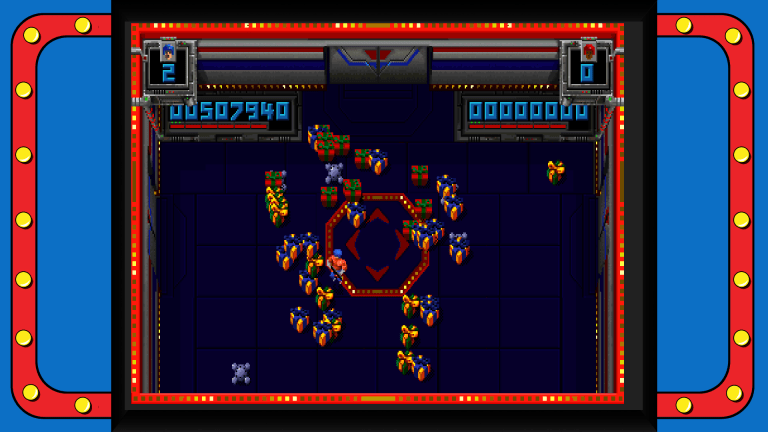
The 2D sprite activity and action can get pretty wild and intense on-screen during battle. Expect lots of waves of enemies coming in before you proceed to the next room.
To make things clear, arcade games were already popular here in the Philippines and there were lots of local arcades particularly in shopping malls. As for playing Smash T.V. on the SNES, it was fun but the SNES control pad was not ideal for the immense in-game shooting.
Going back to Midway Arcade Origins, I played Defender first and had some bouts of fun with it. After that, I went back to the main selection and scrolled through the many other games offered until I saw Smash T.V. and selected it. As soon as I started playing, I was immediately engaged as the fun kept growing as I played.
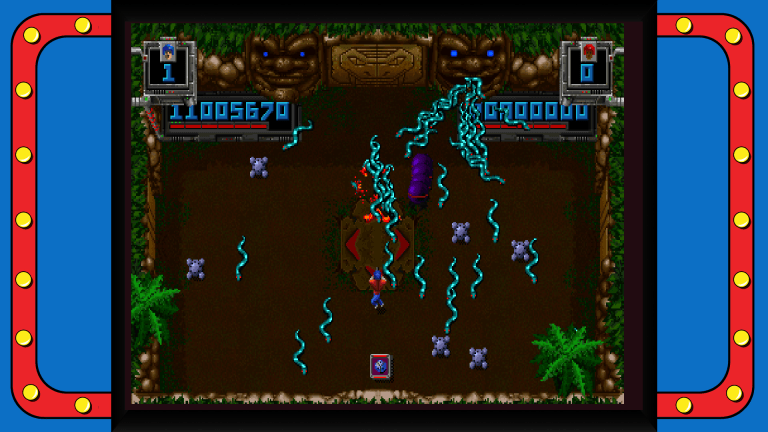
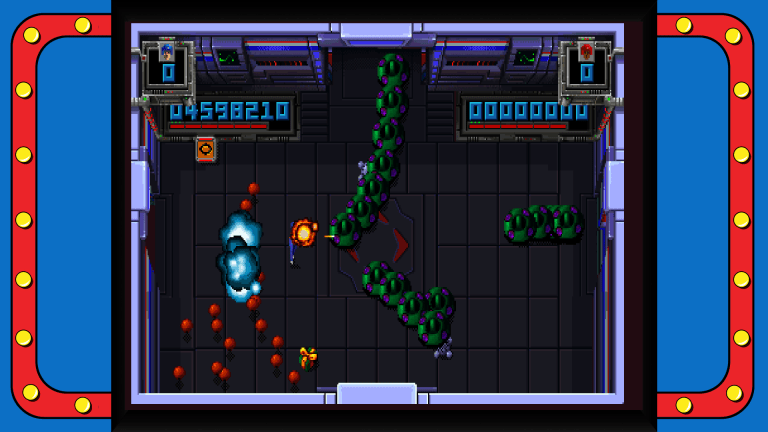
Apart from dealing with dangerous enemies, you will also encounter in-game hazards such as this room releasing snakes a lot.
Firstly, the game made fine use of the two analog sticks of the Xbox controller which was the closest thing to matching the dual joysticks set-up of the original arcade game. The left analog stick was for movement while the right analog stick allowed me to shoot in different directions. The severe limitations on shooting on the controller of the SNES were completely gone, and as I played the game more on Xbox, I found myself moving around enemies and obstacles while being able to fire at directions where shooting was needed.
Secondly, Smash T.V. on Midway Arcade Origins is the genuine arcade experience from the controls to the functionality, gameplay, the visual design and 2D sprites that dominated the screen. For those who don’t have the original arcade machine, this is the closest thing to enjoying the arcade fun of Smash T.V. in the comfort of home. I can also say that the game ran smoothly on my Xbox Series X and not a single case of slowdown nor any cases of visual distortions ever happened!
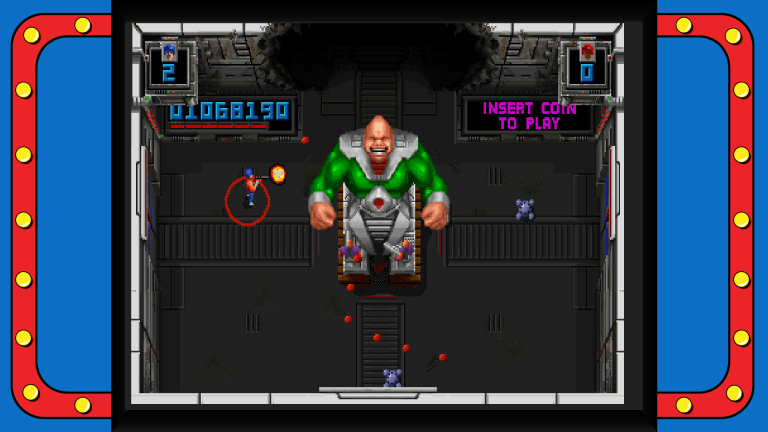
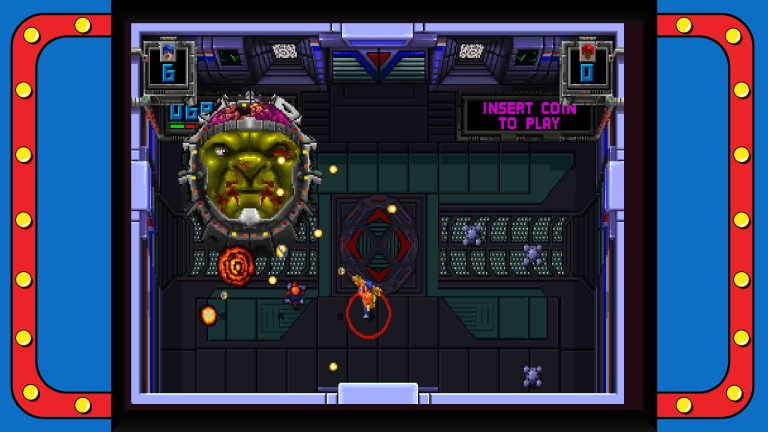
To really defeat an end-of-level boss like this one, you need to use whatever special weapons or power-ups that appeared during battle. Be mindful of the enemy’s powerful defense and attacks.
This face particular end-of-level boss deteriorates further as I kept on attacking him with special weapons.
More on the gameplay, it is undeniably challenging as many enemies enter and their different abilities to attack you ensures lots of intense moments of action and struggle to survive. The on-screen action is often intense and still the gameplay did not grow tiresome to me. More on the combat, there are always huge and powerful enemies (end-of-level boss) at the conclusion of each level and defeating them will push you to use special weapons as soon as they pop up.
Lastly, there is also the prize aspect of the game (which has a dystopian TV concept inspired by the 1987 film The Running Man starring Arnold Schwarzenegger) which allows you to collect prizes (in cash or prize items) while playing. The prizes can add a lot to your score and even your potential entry into the online leaderboards (see below).
There is nothing like collecting prizes in the game! It is as thrilling as the action.
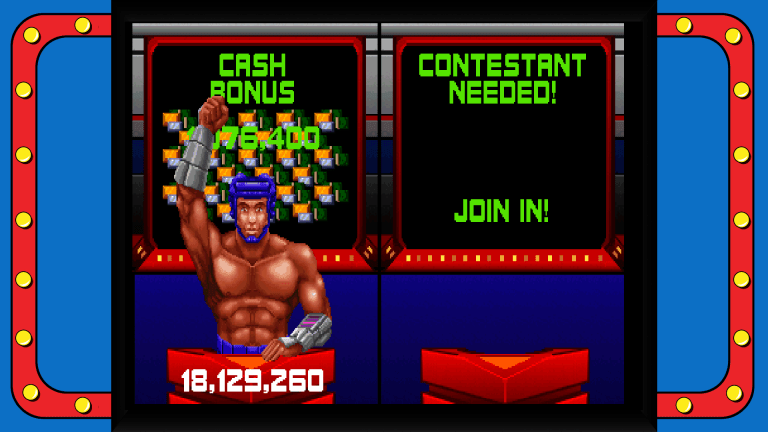
Between the levels are the bonus segments in which the value of the prizes you collected will be added to your overall score (technically in-game money earned).
Thirdly, I really like the online leaderboards and score attack mode that came with Midway Arcade Origins. For Smash T.V., the score attack challenge is to score as many points as you could using only one turn (which comes with the initial six in-game lives). Score attack does not allow any continues (that is for free play mode) and this was enough to make me focus on my skills, moves and timing when it comes to fighting waves of several enemies that entered the in-game arenas.
I was able to make my presence felt online as the servers for the leaderboards are still functioning and recording in-real time the scores achieved.
Every time you encounter new enemies, you have to observe how they move, attack and behave.
Smash T.V. is a classic not only because of its immense fun gameplay, entertainment impact and timeless game design, but also because it was a creative wonder from significant game creators such as Eugene Jarvis (Defender, Robotron 2084), John Tobias (Mortal Kombat) and Mark Turmell to name a few. The game borrowed elements from The Running Man and the creators made their own concept that mixed well with the game design they came up with. The result is a highly playable, challenging and ultimately enjoyable video game. To learn more about the creation and history of Smash T.V., watch the in-depth videos of PatmanQC and Slope’s Game Room below.
“Big money! Big prizes! I love it!”
Smash T.V. is a lot of fun and its gameplay never gets old. It is currently my favorite of all the games in Midway Arcade Origins and it is an excellent addition to my retro gaming experience on my Xbox Series X.
Welcome back readers, fellow geeks and electronic gaming fans!
In this edition of the Retro Gaming Ads Blast (RGAB) series, we will take a look at another batch of retro gaming print ads – including arcade flyers – from the 1980s and 1990s.
For the newcomers reading this, Retro Gaming Ads Blast (RGAB) looks back at the many print ads of games (console, arcade, computer and handheld) that were published in comic books, magazines, flyers, posters and newspapers long before smartphones, social media, the worldwide web and streaming became popular. To put things in perspective, people back in the 1980s and 1990s were more trusting of print media for information and images about electronic games and related products.
With those details laid down, here is the newest batch of retro gaming print ads for you to see and enjoy…
1. G.I. Joe: A Real American Hero arcade flyers
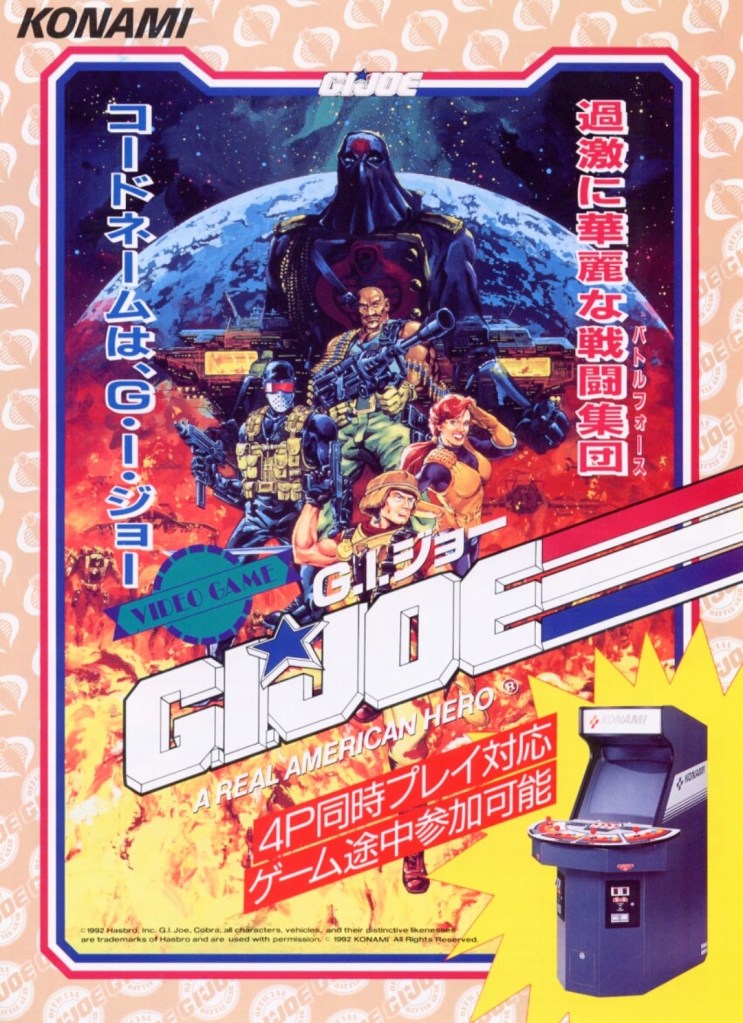
G.I. Joe: A Real American Hero arcade flyer for the Japanese market.
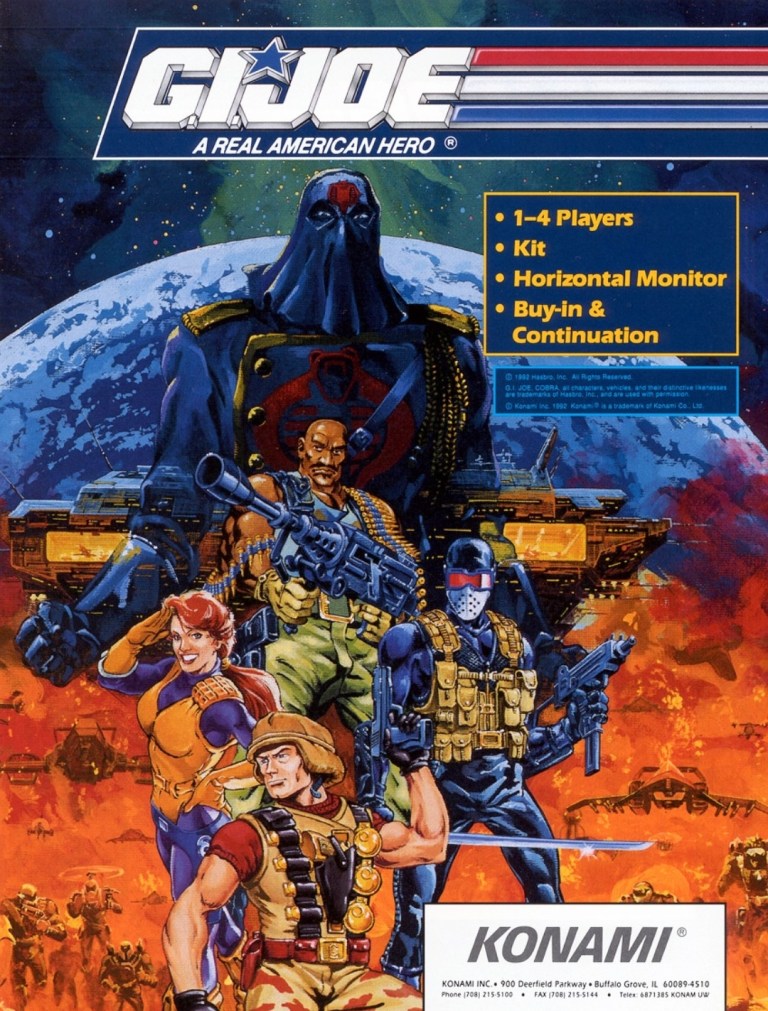
The North American arcade flyer of G.I. Joe.
Back in the 1980s, my friends and I saw lots of episodes of G.I. Joe: A Real American Hero on TV and there were lets of toys of it available. I also read some comic books of G.I. Joe. While there were G.I. Joe video games, I never got to play its early 1990s arcade game from Konami. By comparing the two arcade flyers of G.I. Joe: A Real American Hero, the American flyer excels visually showing the characters with a powerful war-themed background. The Japanese flyer had smaller space for the same artwork and displayed the arcade cabinet (take note of the controls laid out to accommodate up to four players). Between the two, I prefer the American arcade flyer.
2. Alien 3 Japanese arcade flyer
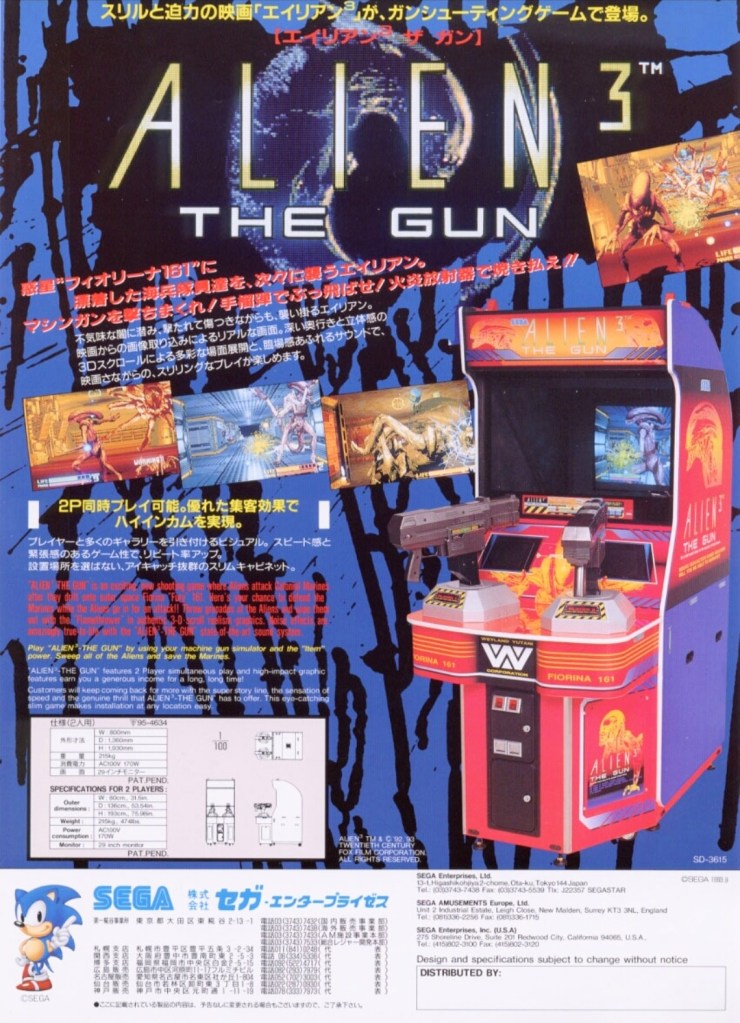
With this arcade flyer, Sega clearly showed arcade operators what to expect when ordering machines of Alien 3: The Gun.
Watching Alien 3 inside the cinema in 1992 was one of the worst moviegoing experiences I ever had. By the time video games based on the movie were released, I was surprised to see how action-packed and entertaining they looked. The one Alien 3 game that captivated me was Sega’s Alien 3: The Gun in the arcades as its design and concept contradicted the essence of the film. The Japanese arcade flyer has this aggressive approach on laying down the details, displaying the arcade machine and displaying carefully selected screenshots to excite both gamers and arcade operators. This arcade flyer still looks good today.
3. Super Cobra arcade flyer
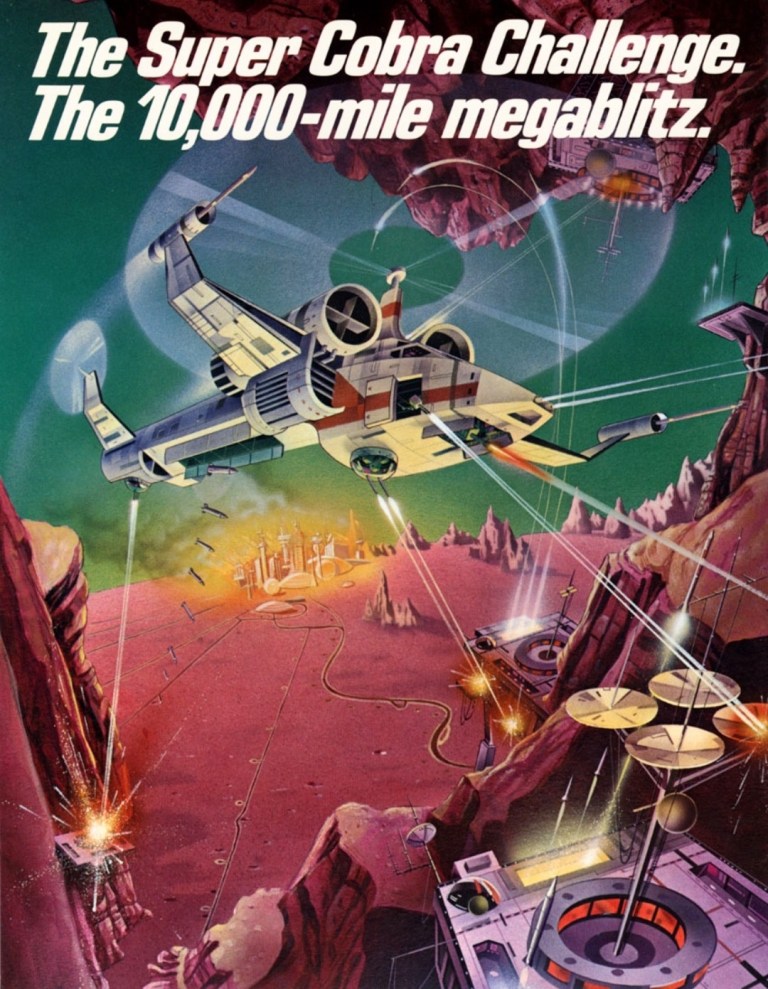
A great artwork emphasizing the concept of Super Cobra.
First released in Japanese and America arcades in 1981, Super Cobra is a 2D side-scrolling shooter in which players pilot an armed helicopter through tight caverns while facing enemies capable of firing. The American arcade flyer has great artwork that almost perfectly captures the essence of the game. This is another old arcade flyer that has aged well.
4. The Amazing Spider-Man vs. The Kingpin print ad
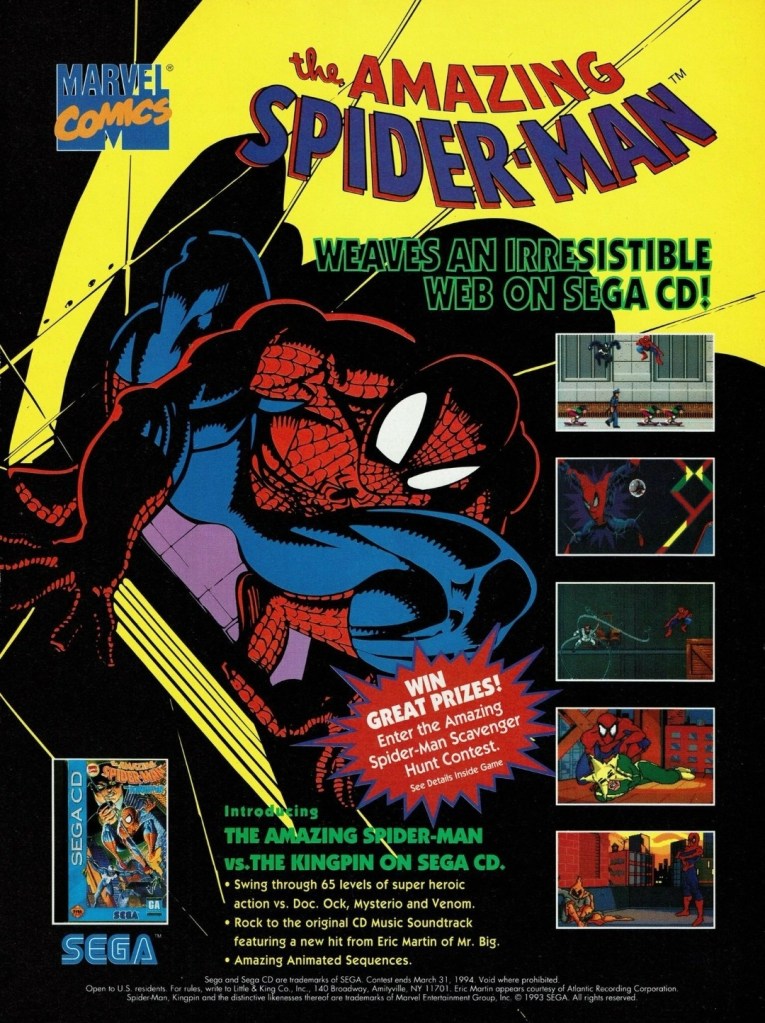
Back in 1993, animated sequences included in video games were still new and even exciting.
Moving forward to the year 1993, gamers in America who owned a Sega Genesis console were being motivated by Sega to upgrade their gaming experience with the Sega CD add-on. Along the way, Sega really ramped up efforts to have more games supporting the Sega CD and one of them was The Amazing Spider-Man vs. The Kingpin. The Amazing Spider-Man vs. The Kingpin on Sega CD was actually an updated version of the original 1991 game and Sega’s team included several improvements to take advantage of the CD-ROM technology of the add-on. This print ad showed Sega’s hard work on selling the game.
5. Soulstar print ad
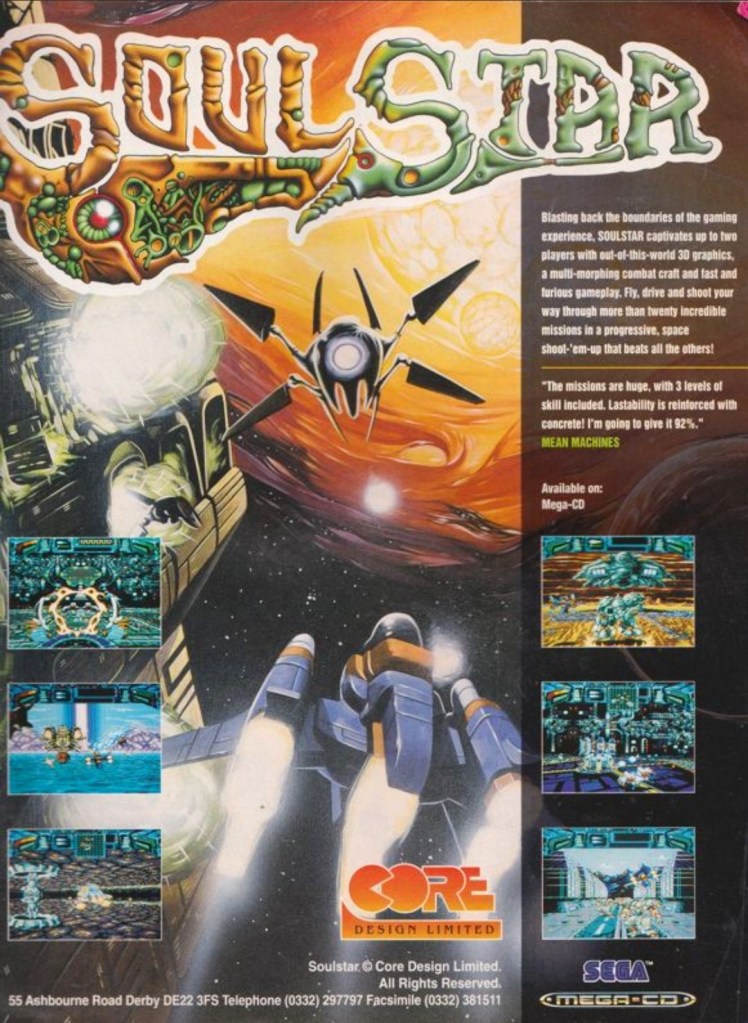
The artwork of this print ad has very strong sci-fi vibes.
Released in 1994 for the Sega CD (Mega CD in other markets), Soulstar was sci-fi 3rd-person shooter that delivered amazing visuals, fun gameplay and an immersive experience of space travel to gamers. This European market print ad is a very effective way to promote the game using carefully selected screenshots, amazing artwork and a cleverly written text description. Still a fine print ad to look at.
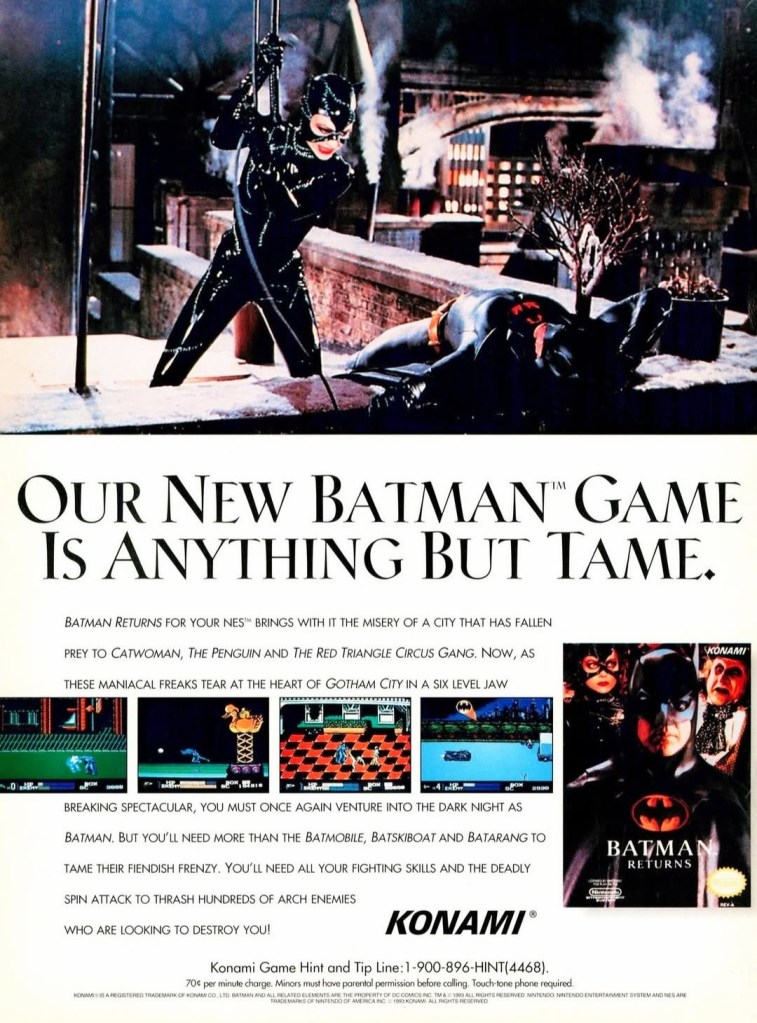
6. Batman Returns print ad
This print ad effectively promoted both the game and the movie. In retrospect, the line “Our new Batman game is anything but tame” turned out to be true as lot of parents who brought their kids to the cinemas for Batman Returns were turned off by the adulterated elements.
In 1992, Batman Returns played in a lot of cinemas but its very dark tone and adulterated elements prevented it from matching the huge box office success of its 1989 predecessor. Regardless, a lot of licensed video games based on the movie were released and in early 1993, Konami released a Batman Returns video game on the aging Nintendo Entertainment System (NES). This print ad used a photograph from the filming of an scene that actually had Michelle Pfeiffer as Catwoman, dominating over the iconic Batman. Also displayed were screenshots, the game’s box cover (showing Pfeiffer, Michael Keaton and Danny DeVito as their respective characters) and the text description. Even if you did not like the movie, this old print ad is a solid way of promoting both the game and the movie. The line “Our new Batman game is anything but tame” strangely turned out very true.
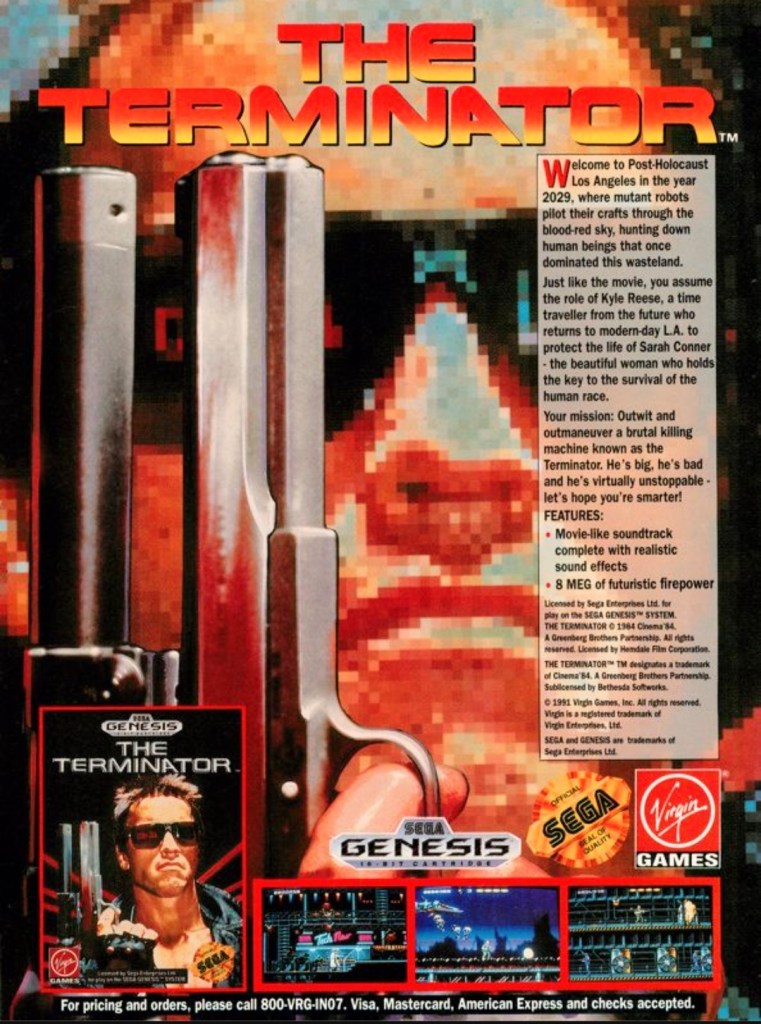
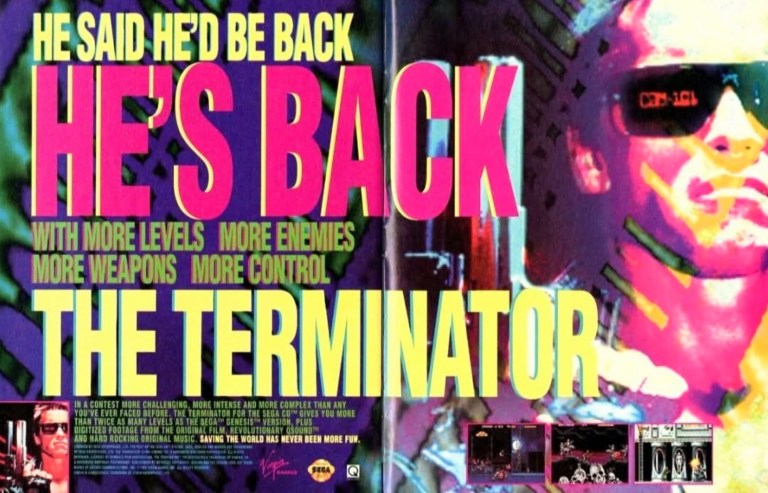
7. The Terminator games print ads
The Terminator for Sega Genesis.
The Terminator for Sega CD.
Released in cinemas in 1984, The Terminator was a surprise hit as well as a career-booster for Arnold Schwarzenegger and James Cameron. What is very notable is the fact that several video game adaptations of The Terminator were released on consoles in the early 1990s. I can only guess this was done to capitalize on the resurgence of the Terminator franchise in connection with Terminator 2: Judgement Day’s much-anticipated release in cinemas. The Sega Genesis version print ad features a digitized close-up of Schwarzenegger’s Terminator while the 2-page Sega CD version print ad used a lot of the space for large text (with an incomplete shot of Schwarzenegger’s Terminator on the edge of the 2nd page) emphasizing “He’s Back” and “The Terminator” while leaving little space for text descriptions and screenshots. Between the two, I find the Sega Genesis ad more effective with its promotion of the game.
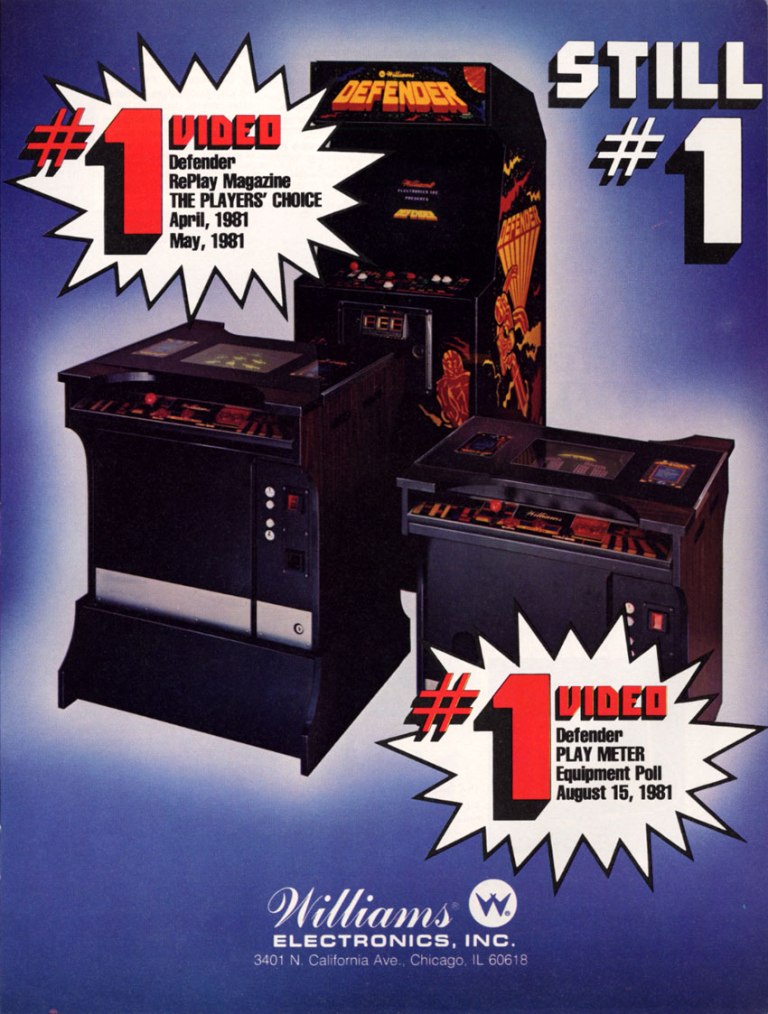
8. Defender arcade flyer
More choices of a very successful game for arcade operators also means more ways for players to play it.
Even though it had a soft start in the early 1980s, the classic game Defender went on to become a massive commercial success in the arcades. Being a major attraction in America’s video game industry, Williams unsurprisingly went on to release this particular arcade flyer to sell to operators different types of Defender arcade machines that could fit into their respective joints while providing gamers choices on how to play the game. Some players preferred to stand in-front of a tall arcade cabinet while others prefer to play the game looking down on the screen. This flyer is an example as to how a company can keep their biggest success moving on while offering business clients more choices.
Welcome back readers, fellow geeks and electronic gaming fans!
In this edition of the Retro Gaming Ads Blast (RGAB) series, we will take a look at another batch of retro gaming print ads – including arcade flyers – from the 1980s and 1990s.
For the newcomers reading this, Retro Gaming Ads Blast (RGAB) looks back at the many print ads of games (console, arcade, computer and handheld) that were published in comic books, magazines, flyers, posters and newspapers long before smartphones, social media, the worldwide web and streaming became popular. To put things in perspective, people back in the 1980s and 1990s were more trusting of print media for information and images about electronic games and related products.
With those details laid down, here is the newest batch of retro gaming print ads for you to see and enjoy…
1. Galaxian for Atari print ad
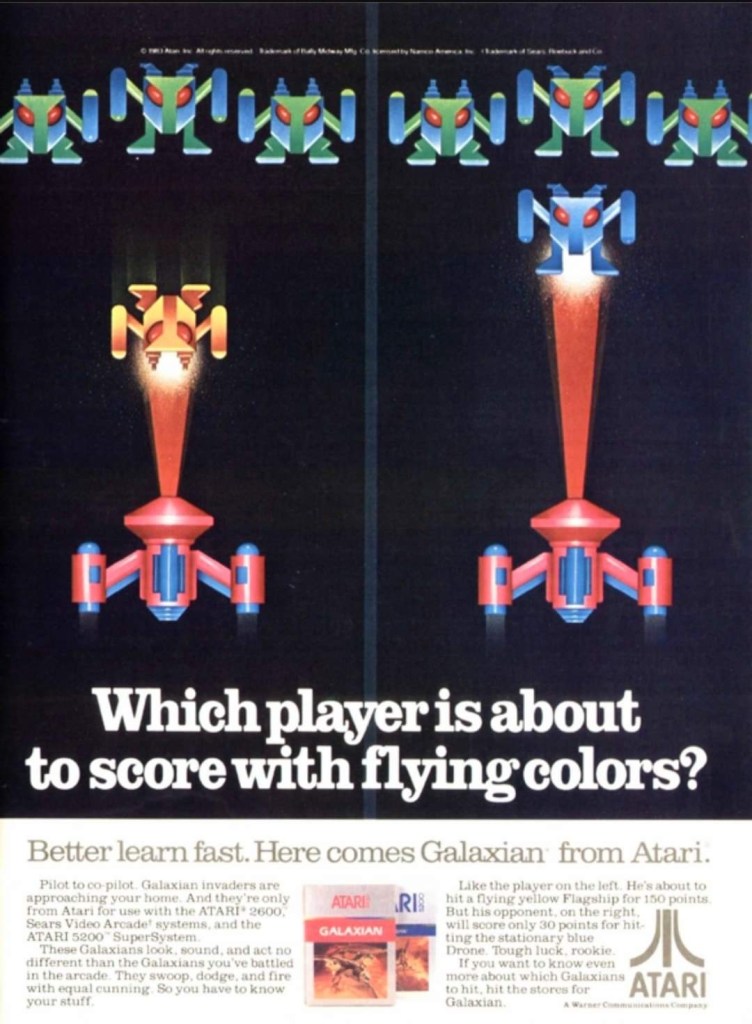
A unique approach to the art done by the advertisers.
Developed by Namco, Galaxian was a 2D sci-fi shooter that debuted in arcades in 1979. It was so successful and widely acclaimed, it got ported to varied game consoles and home computers as the years passed by. For its release on the Atari 2600 and Atari 5200, this print ad was created to catch the attention of fans and gamers by utilizing artwork that resembled the look of 2D sprites from the game. That being said, no screenshots of Galaxian on the Atari consoles were shown because the artwork used looked detailed and were attention-grabbing already.
2. 1943: The Battle of Midway arcade flyer
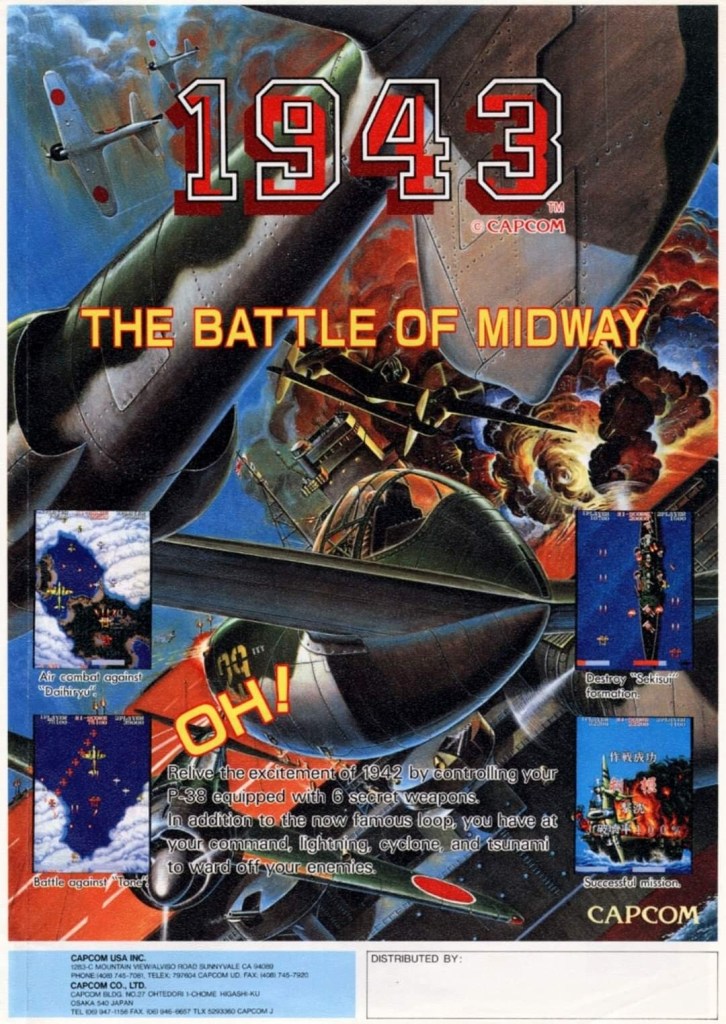
This is a fine looking flyer.
In 1987, Capcom released in the arcades 1943: The Battle of Midway which was their follow-up to 1942. The arcade flyer itself was designed to strongly promote the game using a combination of screenshots, short-but-clear text descriptions and the great looking piece of artwork which really emphasized the World War II concept. Behind it all, this game was made by Japanese developers with the Western markets in mind and the irony is that the game has players control Americans fighting the Japanese fleet.
3. Top Gunner arcade conversion kit flyer
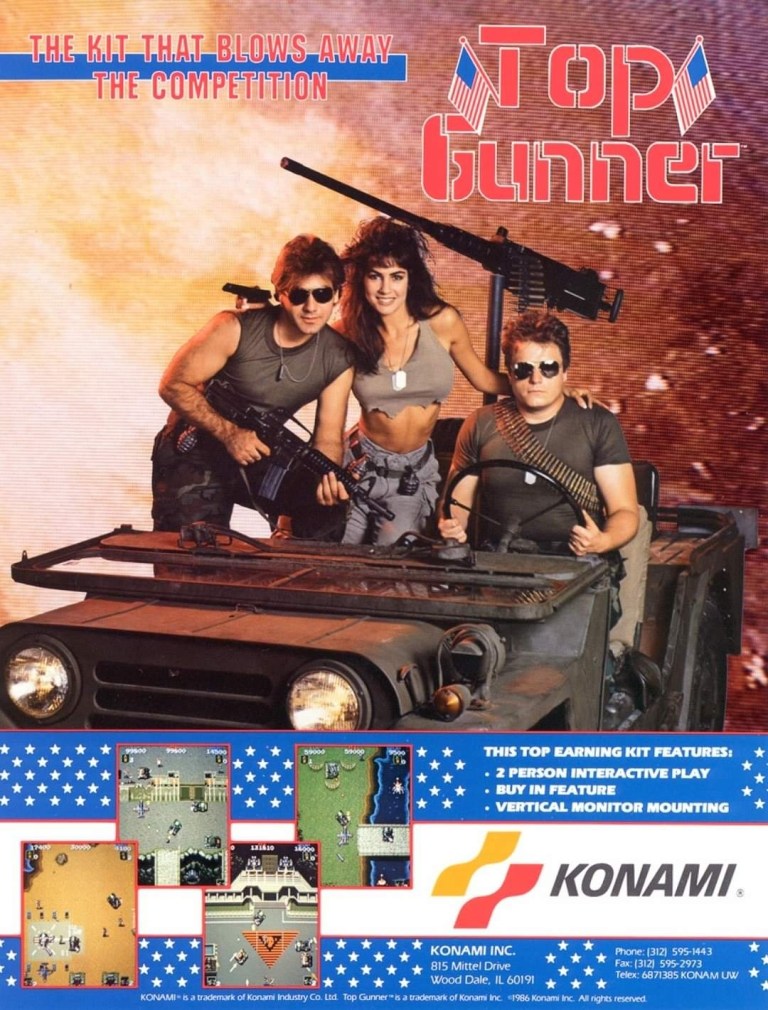
Show this nice looking image to the woke nut or modern day Communist near you. Watch and observe his or her reaction.
To make things clear, Top Gunner is actually the run-and-gun game Jackal and the alternative titles was mainly used in North American arcade distribution and also reflected Konami’s move of coming up with titles inspired by blockbuster movies of the time. To promote its 1986 arcade release in America as a conversion kit, the advertisers had three models playing soldiers on a military jeep to immerse gamers into the core concept of the game – moving armed military jeeps from one location to another while fighting bad guys. The approach used for the visual concept is indeed inspiring, especially during the Cold War. Top Gunner/Jackal became a hit in both arcades and consoles.
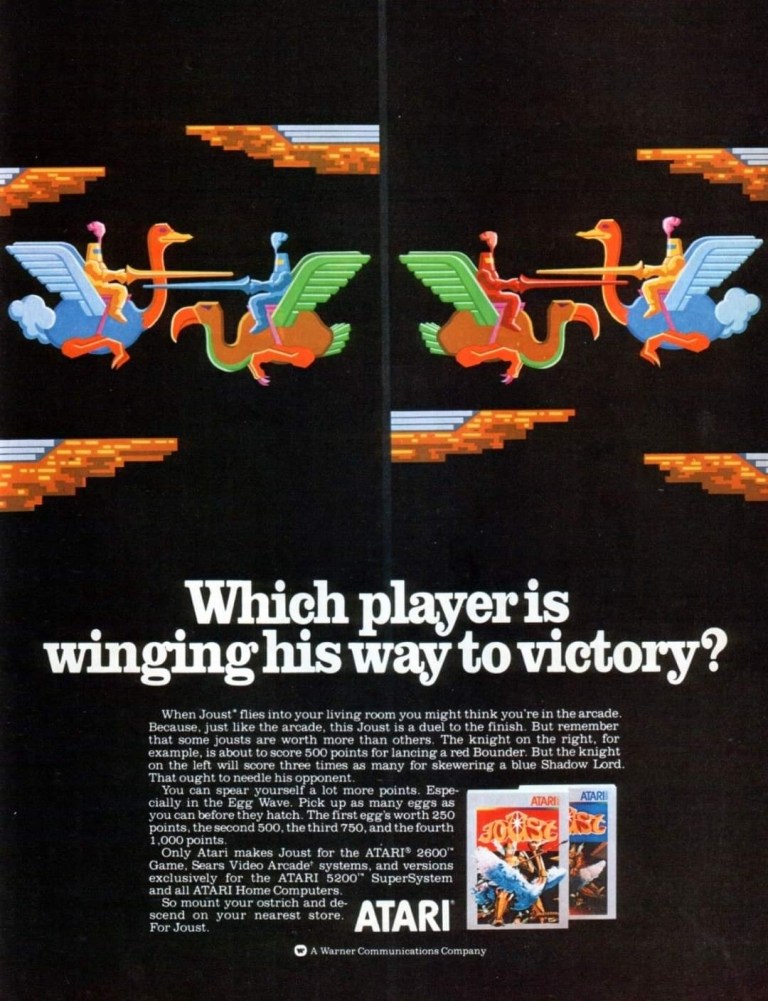
4. Joust for Atari print ad
While I played Joust on console, I don’t remember seeing this print ad before.
Made by Williams Electronics, Joust was one of those early 1980s arcade games that eventually made its way to the Atari 2600 console which was massively popular in North America. Strangely enough, the artistic approach Atari’s advertising came up with for the console version of Joust was similar with that of the ad of the Atari version of Galaxian (see item #1 above) in which artwork was used to resemble the 2D sprites of the game. Regardless, the images of this ad showed what a joust looked like – a martial game between two armed combatants going against each other while riding an animal.
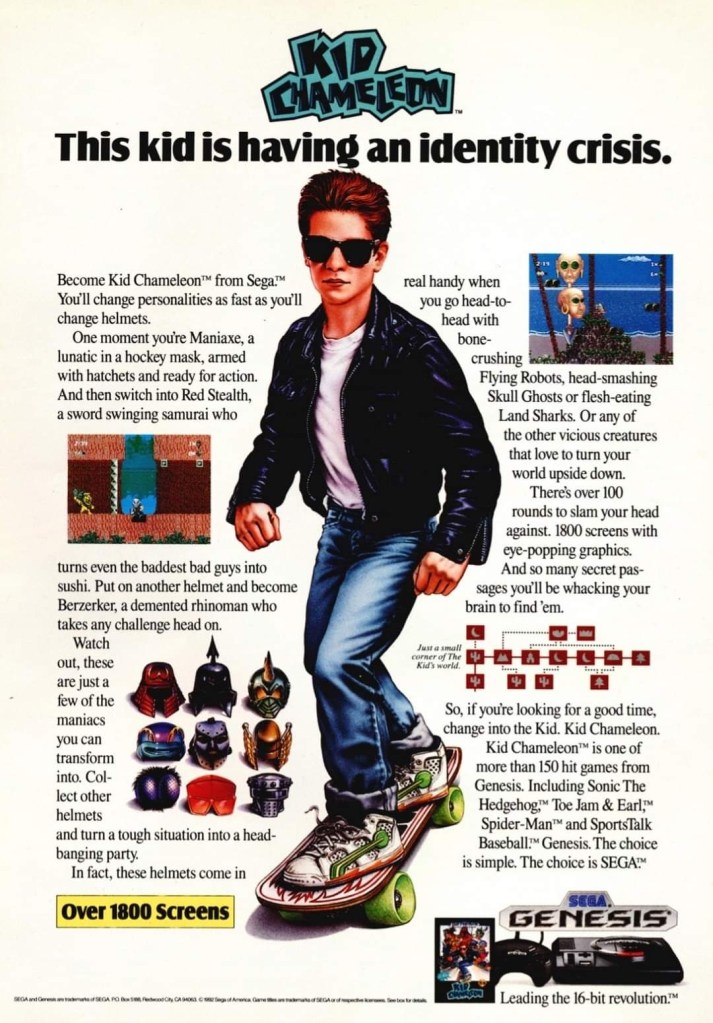
5. Kid Chameleon print ad
Can you relate with Kid Chameleon’s identity crisis?
During the early years of the Sega Genesis, Sega of America exerted efforts to make new games that were not only exclusive to their console but also stand out among the many 2D side-scrolling adventure games by coming up with a protagonist with a unique personality that could somehow resonate with young kids and teenagers.
Developed by their internal experts (Sega Technical Institute), the company released Kid Chameleon in 1992 and they came up with the above print ad that had detailed hand-drawn art of the lead character as well as a wordy text description which was a clear attempt to help young gamers (including teenagers) get connected with both the game and the protagonist. The advertisers even had space to spare to accommodate two screenshots of the game.
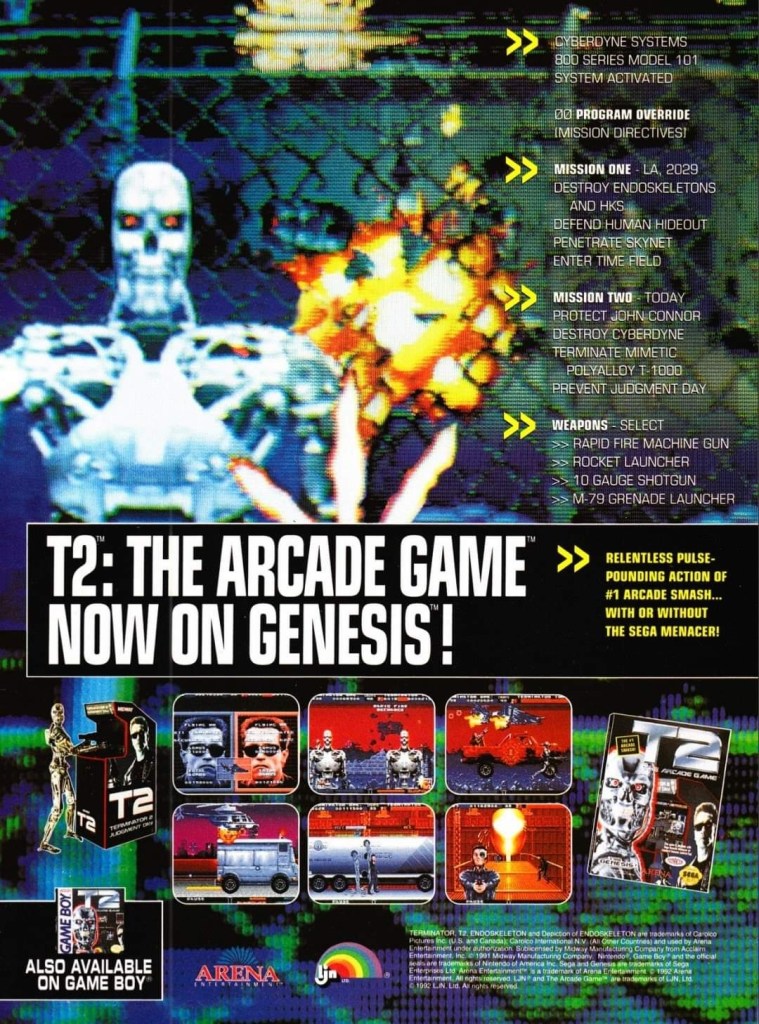
6. Terminator 2: Judgment Day (AKA T2: The Arcade Game) for Sega Genesis print ad
This print ad appeared on the many comic books I read long ago.
Back in the early 1990s, Terminator 2: Judgment Day was a massive success in the global box office and this resulted in Arnold Schwarzenegger’s popularity to soar very high while also establishing the Terminator as an essential pop culture figure. Apart from comic books and merchandise, video games based on the movie were made and the one that stood out the most was the arcade shooter game initially titled Terminator 2: Judgment Day (later retitled as T2: The Arcade Game).
The arcade mega hit eventually got ported to the Sega Genesis and this print ad really looked flashy with its visual presentation showing screenshots and a zoomed-in look at how the Terminator T-800 looked like in the Genesis version complete with a few explosions in the background. It should be noted that this flashy print ad cleverly concealed the visual downgrades and the redrawn images as the Genesis itself could never come close to matching the high quality visuals of the arcade version.
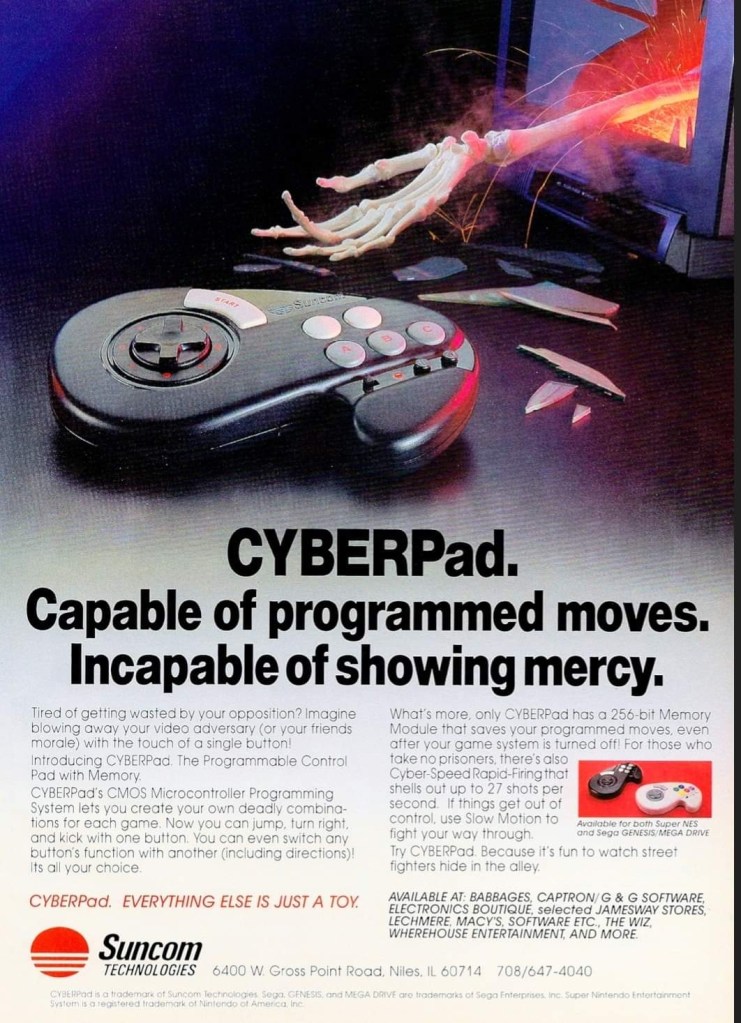
7. CYBERPad print ad
I never owned the CYBERPad, nor have I ever used one.
During the so-called 16-bit console generation (actually the 4th console generation), there were lots of licensed console peripherals made by independent companies in support of the Sega Genesis and Super Nintendo Entertainment System (SNES). The company Suncom Technologies came up with the CYBERPad controller for the two consoles and they boasted in their print ad that the product had a programmable control pad that allowed users to create combinations for each game with convenience in mind. The CYBERPad also allowed the saving of the programmable moves and it had a rapid-fire feature and even a slow-motion function. The CYBERPad was made to make the gameplay experience more user-friendly.
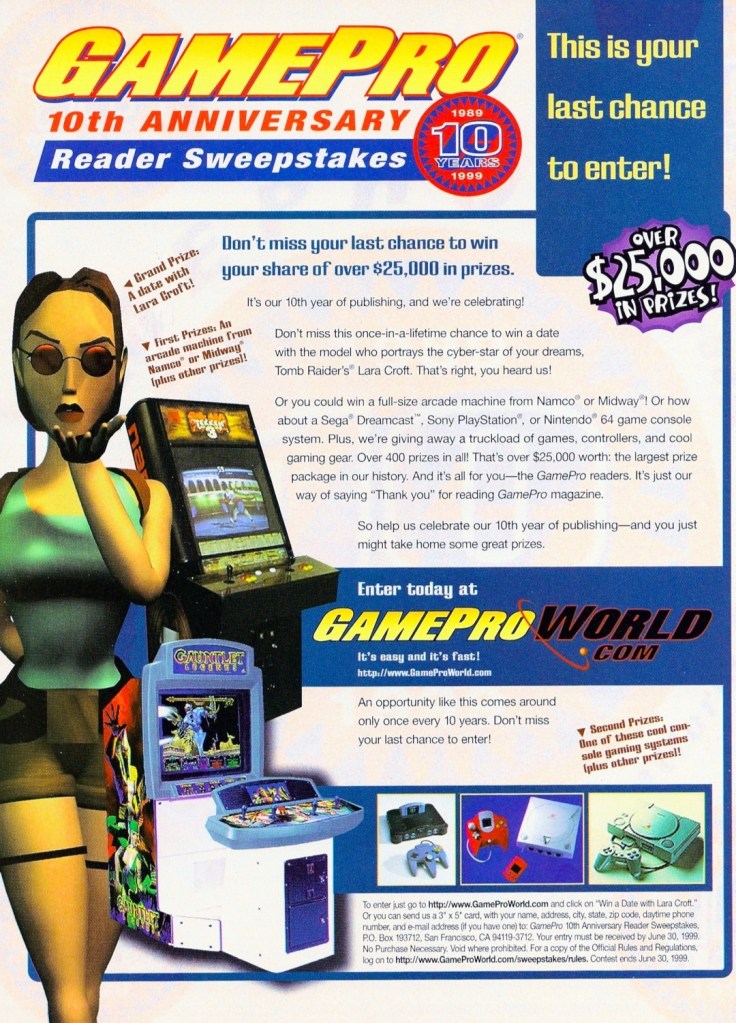
If you look closely, this print announcement by GamePro technically advertised the game consoles, the arcade game and Lara Croft to its readers.
In 1999, GamePro magazine celebrated its 10th anniversary and to keep on resonating with gamers and maintaining the loyalty of their fans, they organized a reader sweepstakes with prizes worth over $25,000 to be won by the few winners. GamePro boasted a date with an unnamed model who played the iconic Lara Croft (Tomb Raider). Certain arcade machines plus the modern consoles of the time – including the brand-new Sega Dreamcast – were also at stake. The way it was presented, this GamePro print announcement was enticing to read.
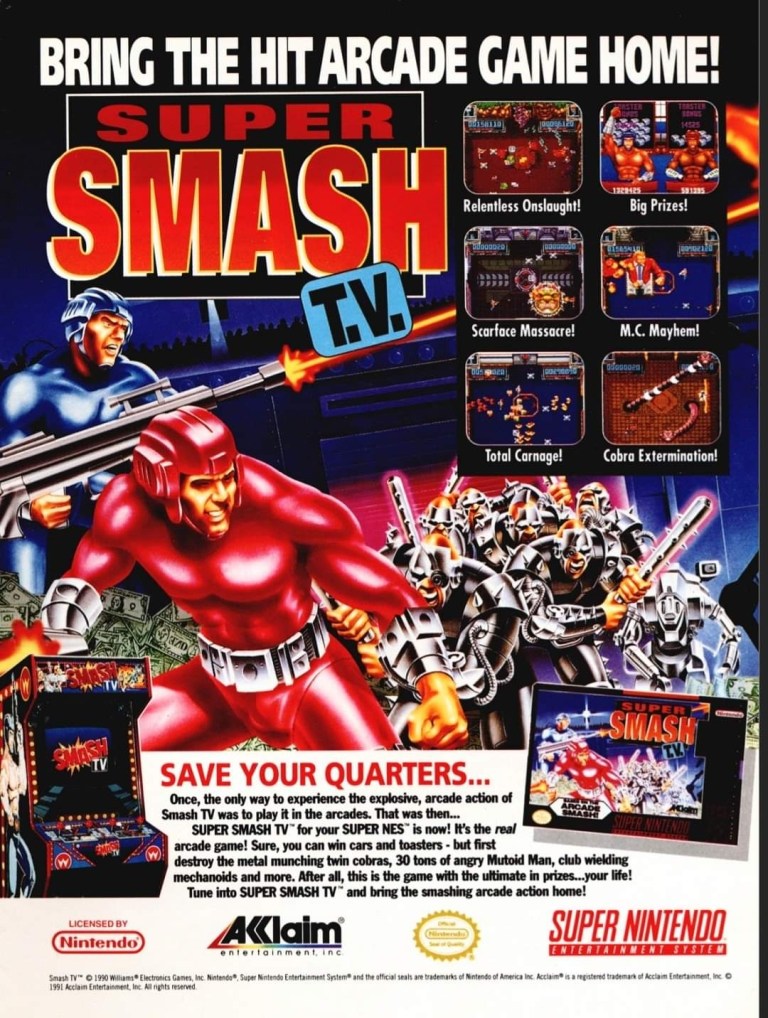
9. Smash T.V. for SNES print ad
Smash T.V. was a lot of fun on both arcade and console.
The arcade hit Smash T.V. made its way to the Super Nintendo Entertainment System (SNES) in 1992 and the publisher came up with a print ad that had captivating artwork, six screenshots and a text description that emphasized that a lot of fun awaits gamers on the console version. In my view, this old ad is still amusing to look at.
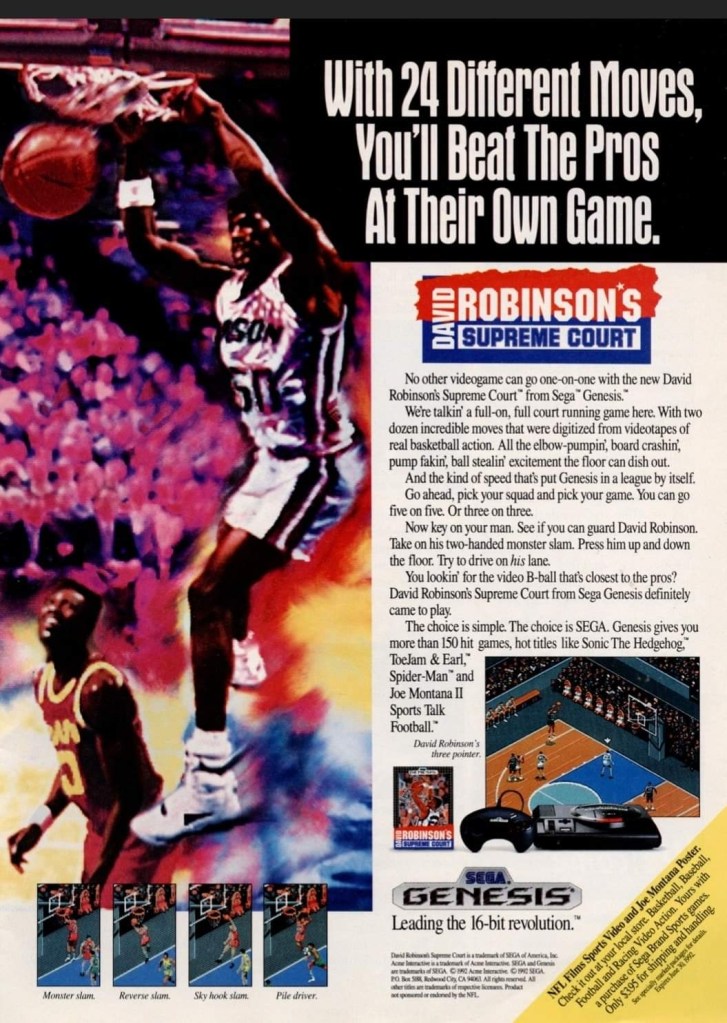
10. David Robinson’s Supreme Court print ad
It was a smart move by Sega to get NBA superstar David Robinson as the endorser of this basketball video game exclusive on the Sega Genesis. This ad was published many years before Robinson finally won an NBA championship.
As part of its strategy in competing with Nintendo during the 4th console generation, Sega of America was focused on producing exclusive sports video games for the Genesis console backed by endorsements of sports professionals. In 1992, they released David Robinson’s Supreme Court on the Genesis and unsurprisingly their print ad used a large, stylized image of the NBA superstar dunking backed with an exciting text description plus screenshots showing the game’s use of the isometric view for gameplay. This is still worth looking at.
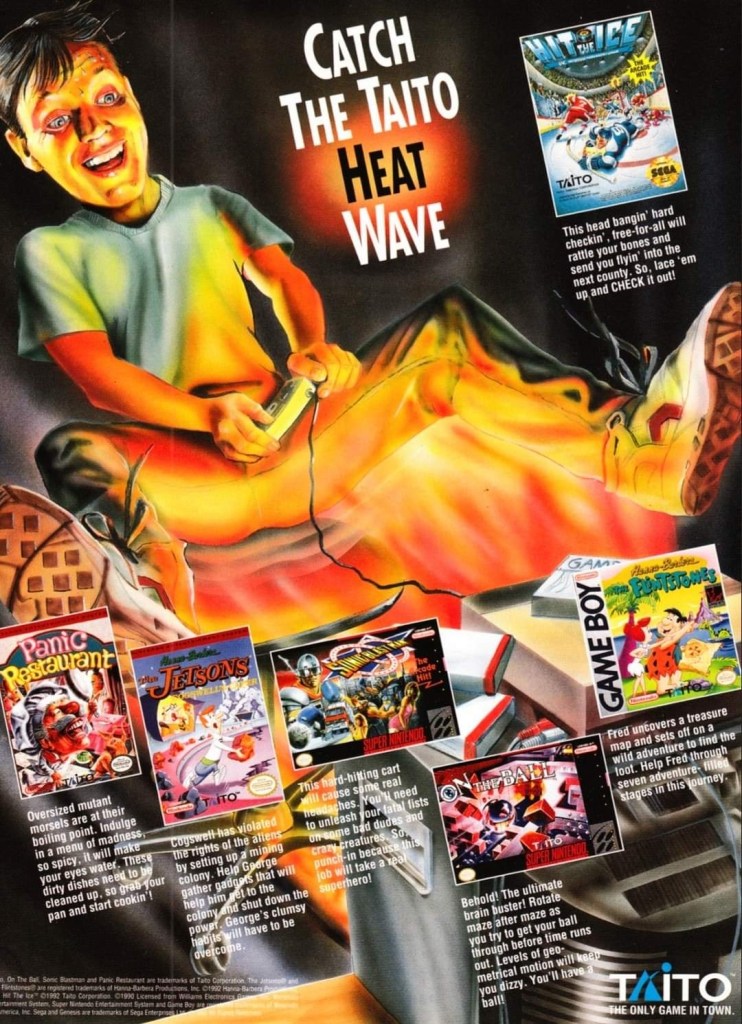
11. Taito’s “heat wave” print ad
An amusing and creative way to sell video games.
If your company lacks money to effectively market your video games individually, you can try making a single ad promoting them together. This is what Taito did in this print ad which showcases multiple games for different platforms and they used artwork of a player experiencing the so-called heat wave. This is a nice stroke of creativity on the part of Taito.
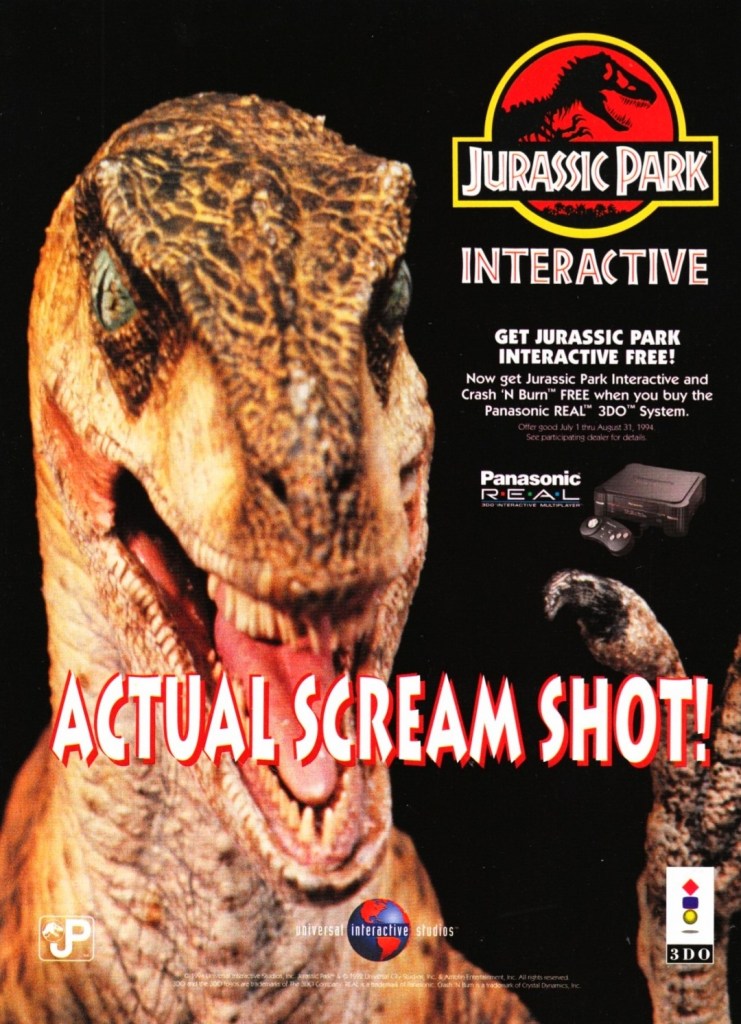
12. Jurassic Park Interactive print ad
This was a creepy print ad promoting the 3DO-exclusive Jurassic Park Interactive.
When it comes to video game consoles, having exclusive games is essential as long as they are of high quality, highly playable and enjoyable. The 3DO company acquired a license of the Jurassic Park movie and made the exclusive game Jurassic Park Interactive hoping it would sell a lot and lift up 3DO hardware sales.
This print ad, which features a zoomed-in image of the Raptor from the game, was more focused on selling the 3DO console than the video game as seen on the descriptive text. 3DO ran a promo selling the console which would entitle the buyer to get Jurassic Park Interactive and another game free. Nothing was done to describe the console’s multimedia capabilities of showing videos, images and graphics of the game (which was essentially a collection of mini-games). This print ad shows ignorance on the part of the 3DO company and the ad maker as it showed desperation happening really early in the console’s life. Notably, Jurassic Park Interactive was the only video game adaptation to use actual footage (note: the faces of the actors were edited out) and music from the film.
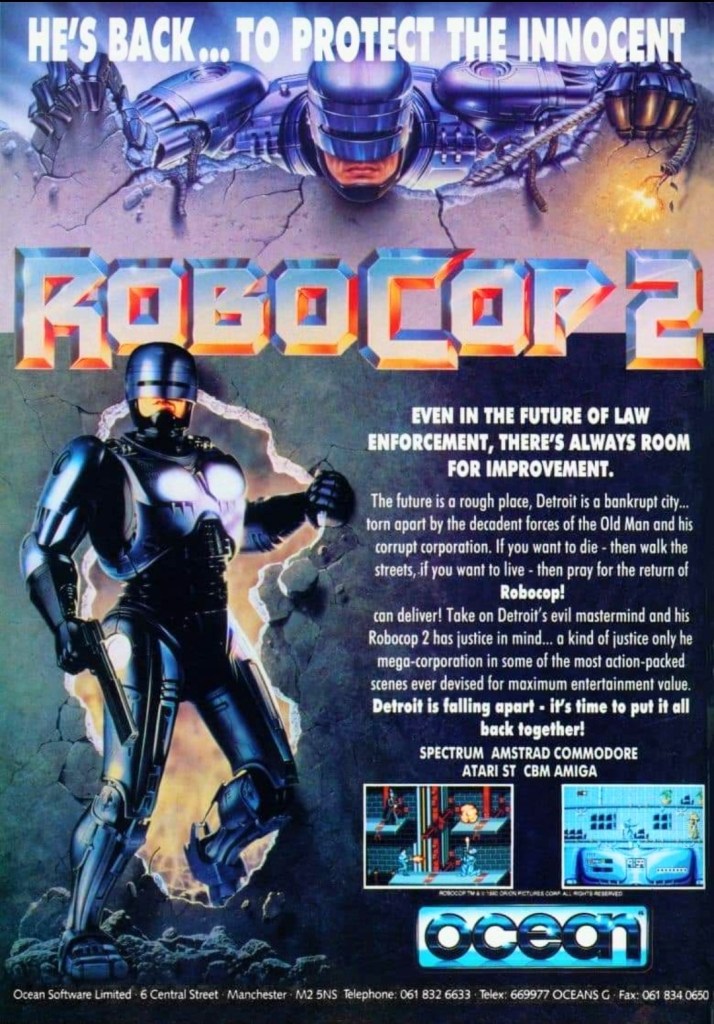
13. RoboCop 2 print ad
You want to become RoboCop to save the city of Detroit from criminals?
Way back in 1990, RoboCop 2 was a big hit in cinemas here in the Philippines and in some places around the world. As typical of the time, licenses to make video games based on the movie were released resulting in RoboCop 2 games for multiple platforms. The print ad featured two different images of RoboCop – one from the movie poster and the other from an official artwork. The descriptive text does a fine job to immerse readers into the story concept of the game but showing only two screenshots was a lackluster effort to sell the game.
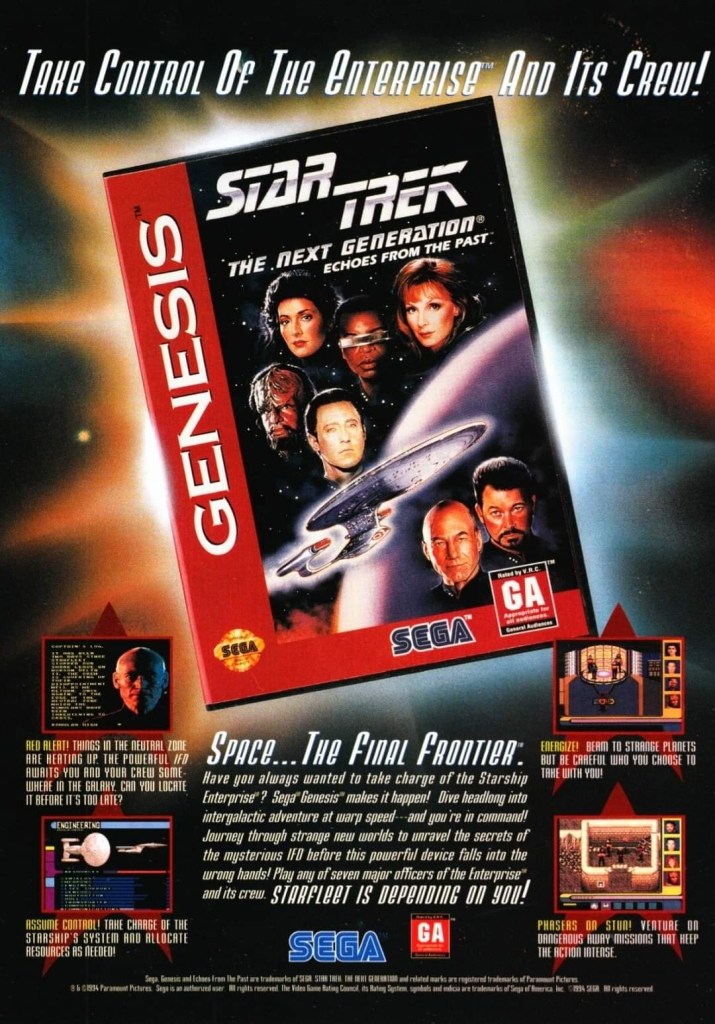
14. Star Trek: The Next Generation – Echoes from the Past print ad
Space…the final frontier waiting for Sega Genesis gamers.
Released in 1994, Star Trek: The Next Generation – Echoes from the Past delivered the Star Trek TNG adventure experience to Sega Genesis gamers. In fact, it is the exact same experience that SNES gamers got the same year. In reality, Star Trek: The Next Generation – Echoes from the Past is actually a port of Star Trek: The Next Generation – Future’s Past on the SNES and the screenshots on the print ad are giveaways about it. In fairness to the ad makers, this print ad never attempted to deceive gamers that it promoted a totally different Star Trek TNG game.
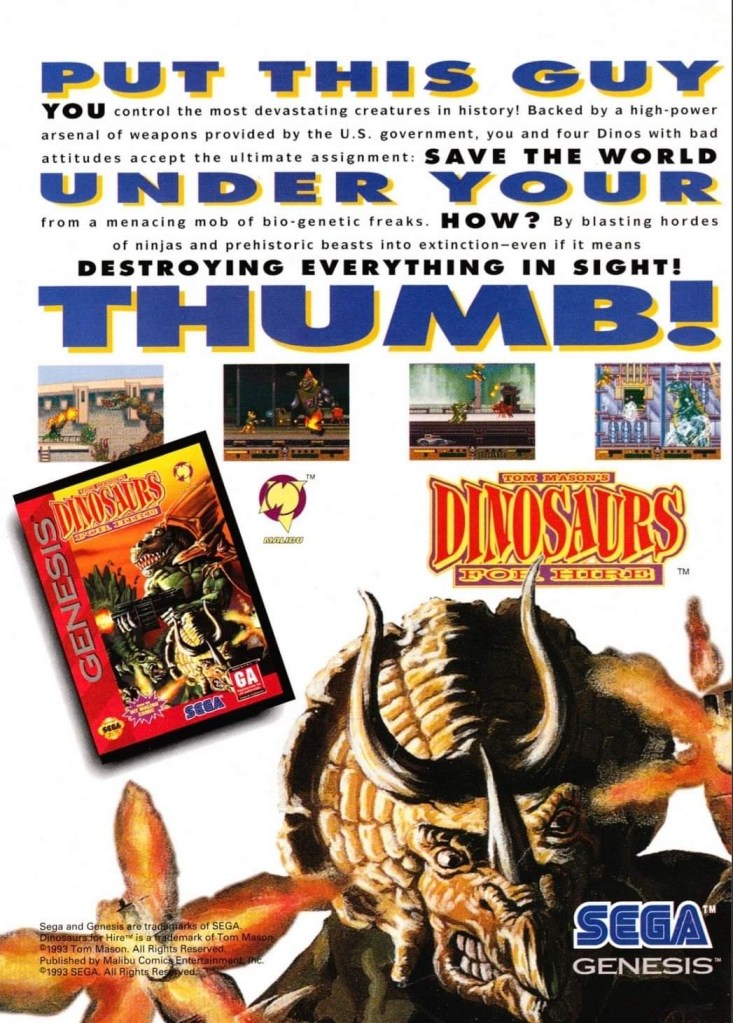
15. Dinosaurs for Hire print ad
This print ad caught my attention and made me interested in the game and the comic book series. Even though it was small, Malibu Comics’ logo was still recognizable.
Dinosaurs for Hire (sometimes referred to as Tom Mason’s Dinosaurs for Hire) was a 2D side-scrolling platform adventure game based on the comic book series of Tom Mason. Published by Sega, it was a Genesis-exclusive game and this print ad had a catchy text description, a few screenshots and the eye-catching artwork of a triceratops facing the viewer. This print ad is still good to look at. If you’re thinking about searching for existing copies of the game, I encourage you to also read some Dinosaurs for Hire comic books before playing. By the way, Tom Mason also wrote several comic books of the Ultraverse.


 Author Carlo Carrasco