Have you been searching for something fun or interesting to watch on YouTube? Do you feel bored right now and you crave for something to see on the world’s most popular online video destination?
I recommend you check out the following topics and the related videos I found.
#1The truth about the Middle East and why a two-state solution is terrible – YouTube channel travelingisrael.com published two important videos that have to be seen as each comes with in-depth explanations. One video explains why genocide, apartheid and ethnic cleansing hit several groups of people (examples: the Armenians, the Christians, the Jewish plus the dissenting people in Iran to name a few) in the Middle East through the decades. The other video is about the decades-old concept of a two-state solution involving Israel and the Palestinians (displaced people) remains terrible to implement. To this day, the evil legacy of murderer and demon Yasser Arafat remains with leaders of Palestine.
#2 Questions that pro-Palestine believers cannot answer – Still with YouTube channel travelingisrael.com, here is a video about ten questions that the pro-Palestine believers cannot answer. Let me also state that a lot of these pro-terrorist, pro-Palestine believers often rely on violence, mobbing and screaming in public rallies. So many of them have been brainwashed by Islamo-Leftists to do Satan’s work. The video below is a must-watch…
#3 Score PN’s videos about comic book adaptations of Batman movies – When it comes to relevant and fun content related to the Resident Evil entertainment franchise, YouTube channel Score PN is a great source of videos to watch. That’s not to say the channel is limited only to Resident Evil stuff as it also has videos about other entertainment properties covering movies, comic books and video games. Among the many non-Resident Evil videos the channel has, I found its two videos about the comic book adaptations of the movies Batman (1989) and Batman Returns (1992) fun and informative to watch. You can watch the two videos below…
#4 Assorted retro gaming videos – There is no doubt that content about retro gaming is really popular not only with long-time gamers but also with much younger people who became fascinated with the way games from long ago looked and played. In relation to the topic of retro gaming, I published articles focused on the decades-old electronic gaming print ads which you can read by clicking here and here. There will be more retro gaming posts on this website and while waiting for them, I recommend you watch the assorted videos I selected for your enjoyment below…
#5 Entertainment trivia videos by Minty Comedic Arts – If you are fond of trivia about movies or shows, then you can’t go wrong with the many videos published by Minty Comedic Arts. Posted below are videos of his that I selected for your enjoyment. Don’t forget to visit Minty’s channel on YouTube.
#6 Israel war updates – Going back to Israel, I have been following updates about the war against Hamas and Hezbollah not through the distorted mainstream news media but to a carefully selected few sources that are trustworthy. One such source is TBN Israel on YouTube and you can watch their recent videos about the war below. Always remember that Hamas and Hezbollah are pure evil and they are both allied with the evil regime of Iran.
Welcome back readers, fellow geeks and electronic gaming fans!
In this edition of the Retro Gaming Ads Blast (RGAB) series, we will examine print ads from the 1980s and 1990s that caught my attention and I will explain why these are worth look back at.
For the newcomers reading this, Retro Gaming Ads Blast (RGAB) looks back at the many print ads of games (console, arcade, computer and handheld) that were published in comic books, magazines, flyers and newspapers long before smartphones, social media, the worldwide web and streaming became popular. Back in the old days, many gamers trusted the print media a lot for information and images about games.
With those details laid down, here is the latest batch of retro gaming print ads for you to see and enjoy…
1. Popeye multiplatform print ad
A fine example of promoting the Popeye video game on multiple platforms visually.
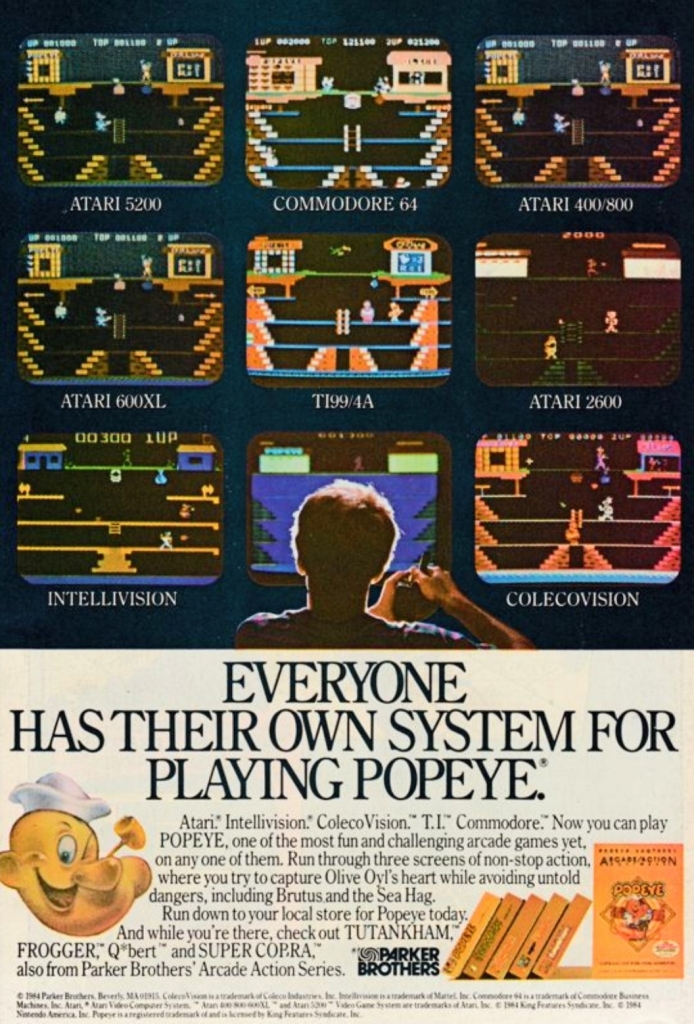
During the early 1980s, an arcade game based on Popeye was released and it became a hit with gamers who lined up and inserted coins to play. That game, which had three stages, was eventually ported by Parker Brothers to multiple platforms of Atari, ColecoVision, Intellivision, T.I. and Commodore.
The print ad you see above is a classic display of how one particular game appeared as a multiplatform release. The screenshots showed different versions of the Popeye game on multiple Atari platforms plus the others. See how different the game looks on each platform? The level of visual details and elements varied from one another as each machine had different specs that Parker Brothers had to adjust to. This is a fine example of promoting one game for different machines for those who love video games.
2. Kool-Aid Man Video Game print ad
I never got to play this Kool-Aid Man video game.
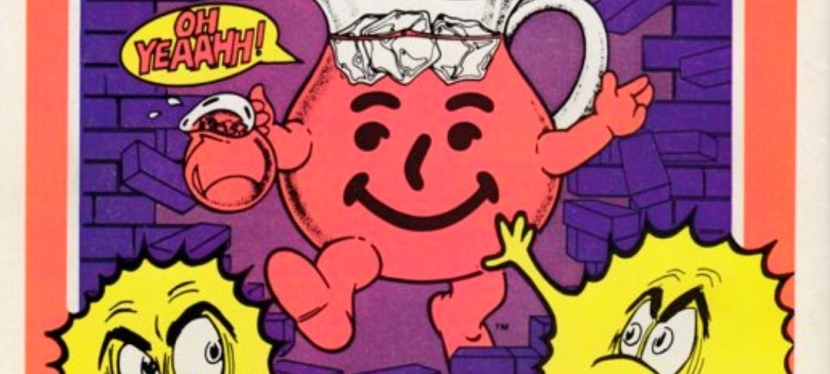
Remember Kool-Aid? For the newcomers reading this, Kool-Aid was a very popular product line of flavored juice drinks sold in powdered form. I myself used to mix Kool-Aid with ice-cold water and enjoyed drinking it. In 1954, a promotion of Kool-Aid with a touch of entertainment happened by highlighting the character Kool-Aid Man (famously known as the walking and talking pitcher filled with Kool-Aid juice). In later years, the Kool-Aid Man was often shown breaking through walls saying the line “Oh yeah!”.
The Kool-Aid Man gained tremendous attention as a pop culture figure in the 1980s when a new series of advertisements and promotions happened branching into video games and even comic books. The above print ad was a clever move to promote Kool-Aid as a drink as well as a video game for the Intellivision and the Atari 2600 consoles. Even if you were not too fond of video games in the 1980s, the Kool-Aid game ad would still make you think about the drink. Clever and entertaining!
3. Zombies Ate My Neighbors game print ad
I saw the 2-page ad many times in comic books and video game magazines.
Going into the 1990s, Konami’s print ad of the video game Zombies Ate My Neighbors (for Super Nintendo Entertainment System and Sega Genesis) appeared a lot in the comic books I read when I was much younger. Having seen lots of horror movies – including zombie flicks – the ad easily caught my attention not because of the screenshots but because of the visual style used. For one thing, there was this 1950s America-inspired imagery on the photo of the scared woman with three zombies slowly approaching her. As for the game itself, there were plenty of small-sized screenshots that had lots of interesting details and pixel art (note: 3D polygons in video games were not yet common back then) which gave me a clear idea that it was a humor and horror-laced 2D adventure. Not only that, the text descriptions combined with the fake quotes added zest into the presentation. After having examined all the details carefully, I really felt like Zombies Ate My Neighbors would be a fun-filled game to play on the SNES.
4. Lunar: The Silver Star print ad
With anime artwork used, it was easy to have the impression that the original Lunar game was based on an existing anime series or movie.
In the early 1990s, Game Arts developed and released the Japanese role-playing game (JRPG) Lunar: The Silver Star on the Mega CD platform in Japan which in some ways was also a technological breakthrough – the game came with full motion video (for short videos), animated images, and CD-quality sound (that really made the soundtrack lively to listen to). After achieving critical and commercial success in Japan, the game was picked-up by Working Designs to be localized and released in the North American market for the Sega CD (the American counterpart of the Mega CD) platform. In promoting the game for American Sega CD owners as well as American gamers in general, a print ad highlighting anime images with five screenshots and only a few words was published on both comic books and magazines.
Even though Lunar: The Silver Star’s core concept was never described in the ad, the anime imagery was still eye-catching and the chosen screenshots gave viewers a preview of the gameplay and the animated images. That being said, it was no surprise that gamers who happened to be a bit interested in anime noticed the print ad. At the same time, the ad gave some gamers the impression that Lunar was a game based on an existing anime franchise. This approach on game advertising was daring and it happened at a time when Japanese RPGs had a limited audience among gamers in North America.
5. Lunar: Silver Star Story Complete print ad
In the 2nd half of the 1990s, a remake of Lunar: The Silver Star was released in Japan titled Lunar: Silver Star Story for Sega Saturn (1996), Sony PlayStation (1998) and Windows PC (1998). While it still maintained the 2D visuals for presentation, gameplay and exploration, the remake had smooth anime sequences, new artworks, better sound effects and music. Working Designs pounced on the opportunity to localize the game in America for PlayStation and released it in 1999 with the title Lunar: Silver Star Story Complete. Not only did Working Designs work hard on localizing the game (the English dubbing and singing of the game’s songs were meticulously done), they released it with a very lavish packaging with the dedicated fans and collectors in mind.
By looking at the above print ad that magazines published, Working Designs highlighted the positive feedback quotes from EGM, Gamers’ Republic, PSM and Official U.S. PlayStation Magazine to convince gamers Lunar: Silver Star Story Complete is a great game. While the screenshots showed what kind of eye candy gamers could expect, Working Designs made sure that they would know that the lavish package includes 4 discs (2 game discs, 1 music CD and 1 CD that had video documentary of the making of Lunar), a full-color map in the form of a cloth, and a hardbound art book and instruction manual.
Considering the dynamism of the Lunar: Silver Star Story Complete print ad and the game’s packaging, I can only speculate that Working Designs had to do it aggressively because the gaming landscape changed dramatically as 3D polygonal graphics became the standard while lots of other Japanese RPGs from different publishers were released in 1999 (including the sequels Suikoden II and Final Fantasy VIII) and many of them had more elaborate game designs and visual presentations. Eventually market forces and unfortunate business events led Working Designs to closing down permanently in 2005.
6. Star Wars: Jedi Arena print ad
Remember when Luke Skywalker tested his lightsaber skills with the floating Seeker in the 1977 movie?
Back in the early 1980s, Parker Brothers was very active releasing games on the Atari 2600 console which my family had. At that same time, Star Wars was very popular (and without the wokeness and identity politics garbage of Kathleen Kennedy and woke Disney) and any new game based on the sci-fi franchise was something to be excited for. In the above print ad of Star Wars: Jedi Arena, an artwork showing the iconic her Luke Skywalker testing his lightsaber skills with the floating Seeker ball was displayed and located between Luke’s legs is a monitor showing the screenshot of the game. Looking at the text description, Parker Brothers creatively focused on the aspect of the Jedi way of using the lightsaber interacting with the Seeker ball. Having played the game myself, I can say the ad was creative and pretty much captured the core concept of the game.
Welcome back readers, fellow geeks and electronic gaming fans!
Today I am launching a brand-new series of articles titled Retro Gaming Ads Blast (RGAB) which will explore the many print ads and promotions of video games, computer games, arcade games and handheld games that were published through the decades.
For the newcomers reading this, print ads of games were widely popular and heavily relied on by gamers/players long before smartphones, social media, the worldwide web and online videos even started. Back in the old days, print media was the most common method for companies to market their games while also helping hardware (machines which played the games) reach potential buyers. Such ads appeared in magazines, comic books and newspapers. Not only that, there were several print ads of games that were made to look creative, compelling and even intriguing.
With those details laid down, here is the first batch of retro gaming print ads for you to see and enjoy…
1. Parker Brothers’ Spider-Man-led print ad
Does this ad look amusing?
Remember Parker Brothers? That was a company that started way back in 1883 founded with a strong focus on the enjoyment of games in the form of board games, cards and toys. In the late 1970s, Parker Brothers started making electronic versions of their popular board games and engaged in the video game development and publishing. They also went on to make home ports of popular arcade games in the early 1980 for several gaming platforms.
Parker Brothers was very active with making games for the Atari 2600 console which became the dominant machine for home gaming in North America in 1982. In the above print ad, their marketing heavily emphasize the Spider-Man video game for Atari 2600 and added two others games they also published – Tutankham and Amidar – which was a clever move to market multiple games. The ad’s focus on Spider-Man was amusing and even without showing a single screenshot of the game, it was enough to entice people to watch out for it. Be aware that the Spider-Man game’s development was done by Laura Nikolich who was hired by Parker Brothers at a job fair. Nikolich had full creative control on making the game and had no contact whatsoever with Marvel Comics.
2. Advanced Dungeons & Dragons: Cloudy Mountain print ad
An ad like this was strong enough to motivate gamers’ imagination and interest.
Back in 1982, Advanced Dungeons & Dragons: Cloudy Mountain was released on the Intellivision game console and I was fortunate enough to watch my next-door neighbor play it repeatedly. The above print ad – which simply referred to the game as Advanced Dungeons & Dragons – only had a few words which directly pointed to the main objective of the game…the golden crown. While only one screenshot of the game was displayed, the advertisers heavily relied on hand-drawn, comic book-style fantasy art work to sell the game.
For those who were born long after the 1980s, let me share with you that ads like these were really impressive for their time. It was common for advertisers to use art works (even though they may not accurately reflect the gameplay or game design) and post at least one screenshot to catch the viewer’s attention with the hope that it would even encourage him/her to anticipate the game. It should be noted that ads like these were strong enough to make gamers’ imagination or curiosity grow stronger.
3. Konami’s collective military video games advertising
Print ad of four games for IBM, Amiga and Commodore.
Print ad of Jackal and Contra for the NES.
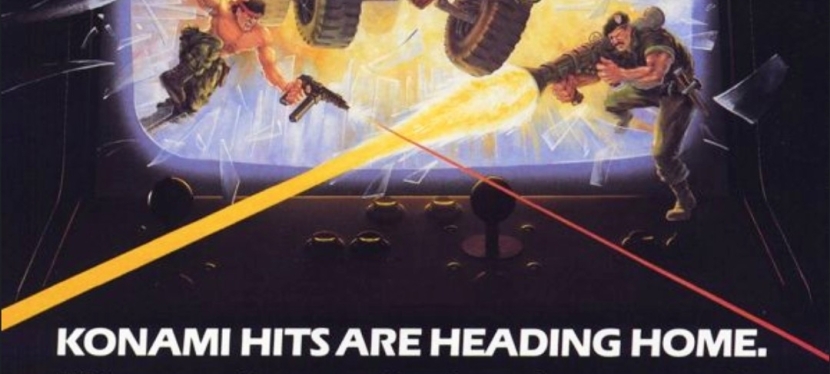
Konami, the Japanese company that has long been known for Metal Gear, Suikoden and the controversial sacking of famous game designer Hideo Kojima, was aggressive in the gaming business in the 1980s and arguably the aggressiveness was reflected in their publishing of several games that emphasized militarism during the late stages of the Cold War. In short, they made the military look cool and their activities fun to do in digital form.
While Konami has always been identified with console gaming, they actually released Rush’n Attack, Contra, Jackal and Boot Camp on IBM, Amiga and Commodore computers (as seen in the first print ad above) which were popular in the 1980s. The said ad also have a very amusing visual concept emphasizing the excitement and fun of military action games coming to gamers at home for their computers.
The 2nd print ad above – Jackal and Contra for the Nintendo Entertainment System (NES) – was very intriguing to see. It was very clear back in the 1980s that the NES always had a wholesome audience (note: a lot of buyers were parents who wanted to entertain their kids at home) and that includes a lot of very young players. To see the collective ad of Jackal and Contra (for the NES platform) having battle-hardened men in military gear holding guns was openly aggressive to perceive and instantly reminded people about the Cold War (and the menace of Communists, socialists, Marxists and terrorists) and the cultural impact of the mega blockbuster film Rambo: First Blood Part II. This is the kind of ad that would drive today’s woke-minded people crazy and even cause them to panic and pretend to be victims of militarism and patriotism. If you look at the ad closely, you will realize there is simply no room for the garbage of political correctness and wokeness.
Lastly, I myself had played Contra and Jackal with my friends on the Nintendo Family Computer (the Japanese counterpart of the NES) and both military games were a lot of fun to play from start to finish!
4. Batman Returns SNES game ad
This print ad appeared in some comic books I read in the early 1990s.
Way back in 1992, Batman Returns (the sequel to the mega blockbuster Batman movie of 1989) was released in cinemas with intense marketing and merchandising reflecting Warner Bros. intention to replicate the commercial success they had in 1989. Along the way, there were several video game adaptations of Batman Returns that were released on different platforms. Among those many video games was the Super Nintendo Entertainment System (SNES) game of Batman Returns which was developed and published by Konami in 1993 the form of a side-scrolling beat-them-up game.
The above ad was visually appealing with hand-drawn, comic book-style art dominating the spaces while leaving room for some screenshots and a written description of the game. Having seen this ad on multiple comic books I read back then, I can say that the ad was entertaining to see and was effective in making me interested in the game. I played Batman Returns on the SNES but never got to finish it. Oh yes, the game’s audio were really good and there were also digitized images from the movie for the in-game narrative.
5. Flashy Sonic the Hedgehog Japanese print ad
A dazzling approach by Sega on selling Sonic the Hedgehog.
1991 will always be remembered as the year of Sonic who eventually became not only Sega’s most defining mascot but also a video game industry icon. That same year, Sega released Sonic the Hedgehog on the Sega Genesis (referred to as Sega Megadrive in other parts of the world) console and it became a massive success with consumers and the game critics.
In the above Japanese print ad, a very captivating display of light and energy rays dominated the space leaving a minority share left for Sega’s console, screenshots and even a UFO Catcher arcade machine picture. While I could not understand the Japanese text, it seems to me that the flashy visual concept of the ad reflected Sega’s high ambitions with Sonic. How many gamers in Japan bought a copy of Sonic the Hedgehog because of this ad remains undetermined.
6. Japanese Super Star Wars print ad
A long time ago in a galaxy far, far away…
Before Nintendo released its 16-bit game console (referred to as Super Nintendo Entertainment System in America, and Super Famicom in Japan), there were lots of Star Wars video games released on varied platforms and the arcade.
With Nintendo’s 16-bit gaming platform realized, lots of game designers and business partners saw opportunities to make new games with gameplay concepts and designs using the technological advantages of the time. For LucasArts and its partners, taking Star Wars gaming into the next level was inevitable and they made it all come true in 1992’s Super Star Wars video game.
Published in Japan by JVC Musical Industries for the Super Famicom, Super Star Wars was a major leap forward in game design, visuals, sound and enjoyment. Apart from the 2D side-scrolling run-and-gun gameplay, gamers were deeply immersed into Star Wars’ universe with the Mode 7 landspeeder and X-Wing fighter sequences, as well as the first-person trench run sequence.
The Japanese print ad above cleverly presented screenshots from the game while using official imagery from the Star Wars movie poster of 1977 (look at how young Harrison Ford, Mark Hammill and the late Carrie Fisher were back then). The ad is a fine example of combining the greatness of the classic George Lucas-directed film with the highly enjoyable design of Super Star Wars. Lastly, these should remind you that there was a time when Star Wars was not yet tainted by wokeness and the garbage values of the Satanic Leftists (read: woke Disney).
Rather it’s about a pretty notable game (plus its sequel) from the 1990s that I completely missed out on. The big surprise to me was that it will be released soon for Xbox One and Xbox Series S and X owners to enjoy.
For those who are not familiar with either game, here is an excerpt from the Xbox.com article written by Ken Humphries (Senior Producer on the two games)…
Zombies Ate My Neighbors
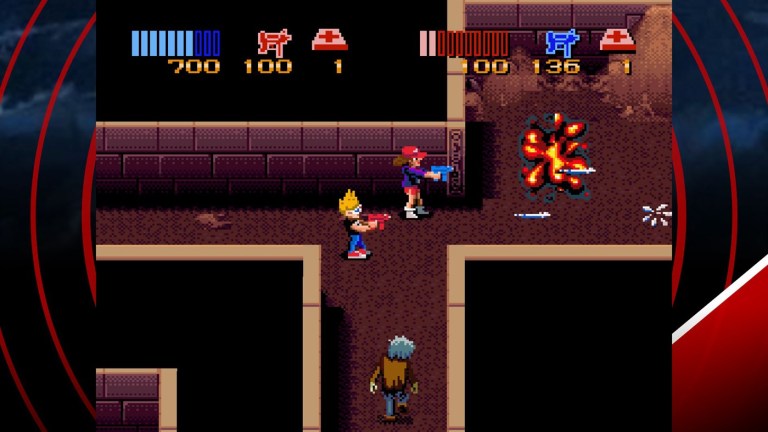
The 2-player function is a popular feature of the game.
Hey, where’s that scary music coming from? Yikes! It’s Zombies Ate My Neighbors, where you appear in every demented horror flick ever to make you hurl ju-jubes.
What are Zeke and Julie, our two wholesome teenage stars doing in a 16-bit game like this?! Trying to save the nice neighbors, cheerleaders, and babies from a fate worse than polyester!
Who could put this slice of suburbia in such goose-pimply hysteria? Zombies, relentless chainsaw maniacs, mummies, evil dolls that just won’t die, lizard men, blobs, vampires, giant ants, martians, and more.
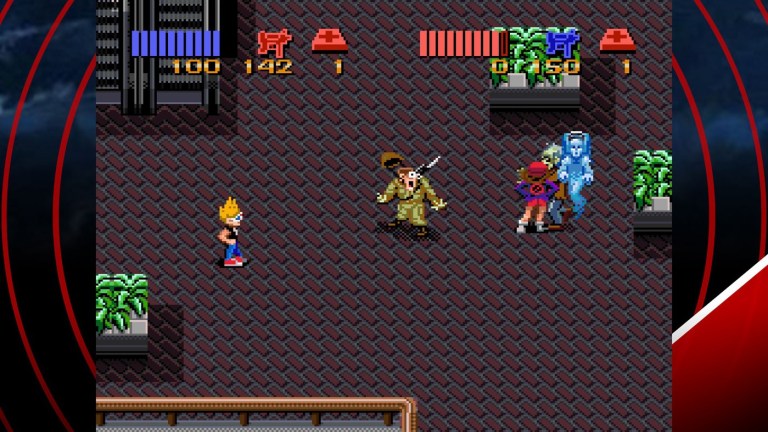
One of many levels in this game.
Will these crazy kids survive the night? Find your way through 55 horror-filled levels like a grocery store gone bad, a shopping mall awry, a mysterious island and your own back yard. Don’t miss “Weird Kids on the Block,” “Mars Needs Cheerleaders,” and “Dances w ith Werewolves.”
You can fend off the freaks with a virtual candy counter of weapons like uzi squirt guns, exploding soda pop, bazookas, weed wackers and ancient artifacts. Also grab power ups-o-rama like secret potions and bobo clown decoys. Does this game ever end?!
Ghoul Patrol
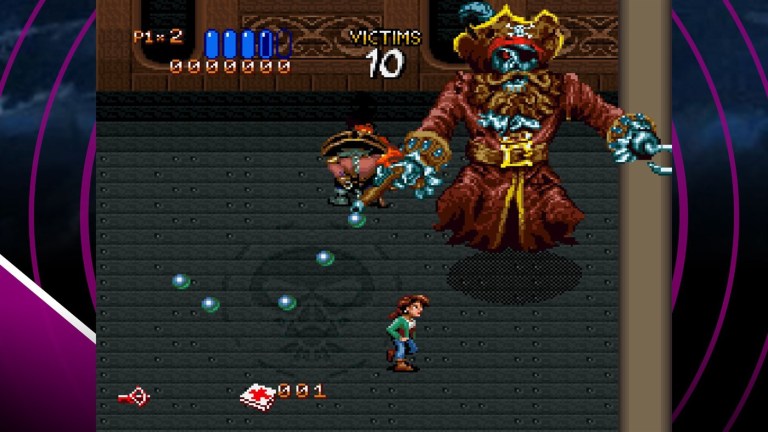
Nothing like facing an over-sized enemy in Ghoul Patrol.
Zeke and Julie, our intrepid teenagers, visit the Ghosts and Ghouls exhibit at the city library, where they find an old treasure chest containing an ancient spirit book. Naturally, they cannot resist reading it. Suddenly, a horrific snaggle-toothed spirit emerges.
Now, this snarling phantom and his dastardly minions are infesting Metropolis and slithering their way into the history books, where they plan to rewrite history with their spooky ways. Only you have the power to go back in time to de-spook an encyclopedia of zombified historic dudes.
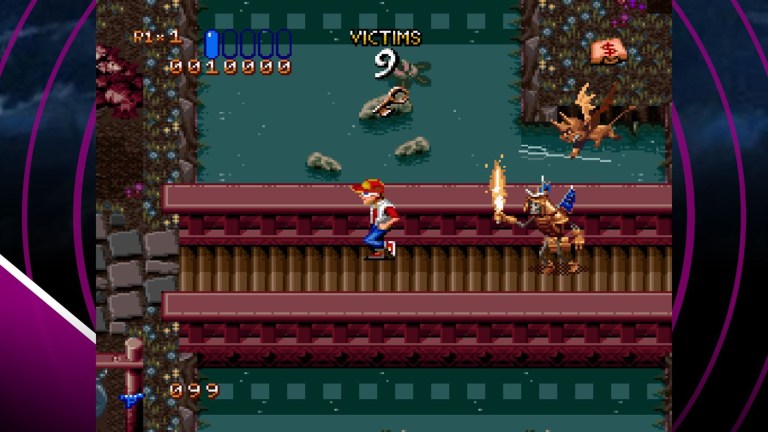
Were you able to play this game back in the 1990s?
Terminate, with prejudice, using crossbows, ping-pong ball machine guns, Martian “Heatseeker” guns, and more.
Vaporize garbage can ghosts and ninja spirits, rescue bug-eyed librarians and wigged-out pirates, dodge flying books and adolescent-eating plants!
The features for Zombies Ate My Neighbors and Ghoul Patrol are as follows…
NEW FEATURES
• Save Feature: Quickly save your progress in either game and continue your adventure wherever and whenever you want
• Museum Features: Watch a video interview with one of the original Zombies’ developers or explore numerous galleries containing game art, previously unreleased concept images and marketing assets
• Soundtrack: Listen to the entire soundtracks for both games in the included music players
• 2 Player Mode: Play the game with two player local co-op
• Achievements: Track your game progress with a set of achievements covering both games
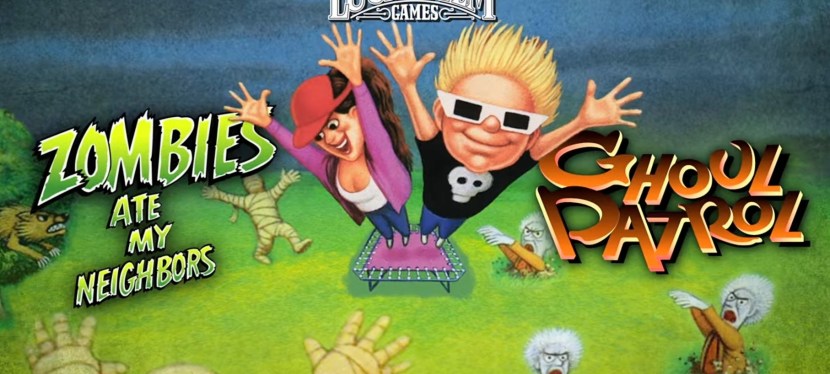
To put things in perspective, Zombies Ate My Neighbors was released in 1993 published by Konami (game developed by LucasArts) for the Super NES (SNES) and the Sega Genesis. It was not a big commercial success but it proved to be a hit with the critics of the time (plus the writers who published their reviews of it years later). Zombies Ate My Neighbors gained a cult following as it not only had enjoyable gameplay, its visual style was appealing, it had lots of visual elements related to pop culture (notably horror genre elements), a memorable soundtrack and more.
In a 2006 article published by IGN, Zombies Ate My Neighbors was described by Lucas M. Thomas as “a comical 16-bit template for the new Xbox 360 release, Dead Rising. And like that game, this one arms you with a pretty bizarre arsenal. Weed whackers, exploding soda cans and flying silverware all make an appearance to help you, or you and a friend, put a hurt on these living dead.”
Ghoul Patrol was released in 1994 for SNES, published back then by JVC (Japan Victor Company) with the development done by LucasArts. Like its predecessor, I never got to play it back decades ago. In addition, I never even saw a copy of the sequel at retail during those days.
As I never got to play Zombies Ate My Neighbors back decades ago, its upcoming release for Xbox is a very delightful surprise for me personally. I will order this (along with Ghoul Patrol) very soon.
If you are interested to order in advance Zombies Ate My Neighbors and Ghoul Patrol for your Xbox One or Xbox Series console, click here.
In ending this piece, posted below is a video retrospective on Zombies Ate My Neighbors published by GamerThumbTV plus a retro review by Cinemassacre. Be mindful of potential spoilers.
+++++
Thank you for reading. If you find this article engaging, please click the like button below and also please consider sharing this article to others. If you are looking for a copywriter to create content for your special project or business, check out my services and my portfolio. Feel free to contact me as well. Also please feel free to visit my Facebook page Author Carlo Carrasco and follow me at HavenorFantasy@twitter.com