Welcome back, fellow geeks, film enthusiasts and Blu-ray/4K Blu-ray collectors!
If you are based in England and you love the works of Arnold Schwarzenegger and James Cameron, as well as the bastardized Terminator film franchise, then you might be interested in the just announced new 4K Blu-ray of Terminator 2: Judgment Day coming from StudioCanal which you can order online right now for £60.00. It is set for a December 6, 2021 release as of this writing.
Coming out this December.
To be more specific, this newest 4K Blu-ray of the 1991 blockbuster film is a commemorative edition highlighting its 30th anniversary.
Posted below are key details of Terminator 2: Judgment Day 4K Blu-ray combo from its Blu-ray.com page.
Video
Codec: HEVC / H.265
Resolution: Native 4K (2160p)
HDR: HDR10
Aspect ratio: 2.35:1
Original aspect ratio: 2.39:1
Audio
English: DTS-HD Master Audio 5.1
English: Dolby Digital 2.0
Subtitles
English SDH
Discs
4K Ultra HD
Blu-ray 3D
Blu-ray Disc
Five-disc set (1 BD-66, 2 BD-50, 2 LPs)
Packaging
Slipbox
DigiPack, Inner print
Playback
4K Blu-ray: Region free
2K Blu-ray: Region B
And here are details of the special features and technical specs from the Blu-ray.com announcement…
PREVIOUSLY COMPLETED 4K RESTORATION OF THE FILM
T2: Reprogramming The Terminator documentary (including exclusive interviews with James Cameron, Arnold Schwarzenegger, Edward Furlong and many more) – 55 mins
2 Feature Commentaries; 23 Members of Cast & Crew (1993)/Director James & Co-Author William Wisher
The Making of T2 (1993)
Seamless Branching Of The Theatrical Version (137 mins approx.)
Special Edition Version (154 mins approx.)
Extended Special Edition Version (156 mins approx.)
2 Deleted Scenes With Audio Commentary
Trailers – T2:3D (2017)
T2 Theatrical Trailer ‘This Time There Are Two’/’Same Make New Mission’/’Building The Perfect Arnold
Optional English SDH subtitles for the main feature
Extra stuff and fine packaging aside, the above-mentioned “PREVIOUSLY COMPLETED 4K RESTORATION OF THE FILM” confirms that the new 4K Blu-ray will not have a brand new remaster which alone concerns me as a collector and fan of the movie. I’ve read Blu-ray.com’s review of the previous 4K Blu-ray of Terminator 2 (the product released by Lionsgate Films) which rated its 4K video quality with a score of 2.5 out of 5 while the 2K video quality was rated 3/5. In that same review, it was mentioned that there was a near absence of film grain and an altered color palette resulting “a kind of greenish-teal tone to several scenes that never had them before.”
Personally I’m not too confident about this upcoming release from StudioCanal. The picture quality for 2K and 4K viewing should be nothing less than excellent. As for you movie fans and Blu-ray collectors reading this, you will have to do your analysis before making the crucial decision to buy this 4K Blu-ray of Terminator 2.
Thank you for reading. If you find this article engaging, please click the like button below and also please consider sharing this article to others. If you are looking for a copywriter to create content for your special project or business, check out my services and my portfolio. Feel free to contact me as well. Also please feel free to visit my Facebook page Author Carlo Carrasco and follow me at HavenorFantasy@twitter.com
Disclaimer: This is my original work with details sourced from playing Flashback: The Quest for Identity and doing personal research. Anyone who wants to use this article, in part or in whole, needs to secure first my permission and agree to cite me as the source and author. Let it be known that any unauthorized use of this article will constrain the author to pursue the remedies under R.A. No. 8293, the Revised Penal Code, and/or all applicable legal actions under the laws of the Philippines.
We live in an age in which software exclusivity defines not only the relevance of game consoles but also nature of the entire video game industry right down to the many varied communities of very avid fans (and fanboys).
While the Super Nintendo Entertainment System (SNES or Super NES) and Sega Genesis each had their own exclusive games back in the 1990s, there was one particular game that was made for and released on not just one, not two but rather on more than fifteen different platforms – both consoles and computers – starting with Amiga way back in 1992. That game is none other than Flashback: The Quest for Identity which I first played on our Super NES back in 1994.
The cover of the game box.
For the newcomers reading this, Flashback was a 2D side-scrolling adventure game in the form of a cinematic platformer (note: similar to Prince of Persia and Out of This World) with a strong flavor of science fiction. It was cinematic in the sense that all the in-game animation were rotoscoped resulting unique smoothness combined with hand-drawn backgrounds and the computer-generated cutscenes were used in key parts of the game as the story progressed. Flashback on SNES in America even came with a Marvel Comics-published Flashback comic book and on the rear of the SNES game box were the words “The first CD-ROM game in a cartridge!”
A Flashback remake was released in 2013, followed by a port of the original game released on Sega Dreamcast in 2017, and a remastered version got released for varied platforms in 2018.
I got to play that game at a time when I have not even started playing Final Fantasy II (AKA Final Fantasy IV), Final Fantasy III (AKA Final Fantasy VI) and other great role-playing games (RPGs) of the Super NES. I also remember that Flashback was a nice change of pace for me after playing Super Star Wars: The Empire Strikes Back.
With those details laid down, here is a look back at Flashback: The Quest for Identity, released on Super NES in 1993 by U.S. Gold and developed by Delphine Software International.
The start and options screen.
Early story
The story begins with Conrad running away from two armed persons chasing him. He flies away riding a solo vehicle but those chasing him (riding a huge vehicle) managed to get close and blast his vehicle causing to crash into the forest.
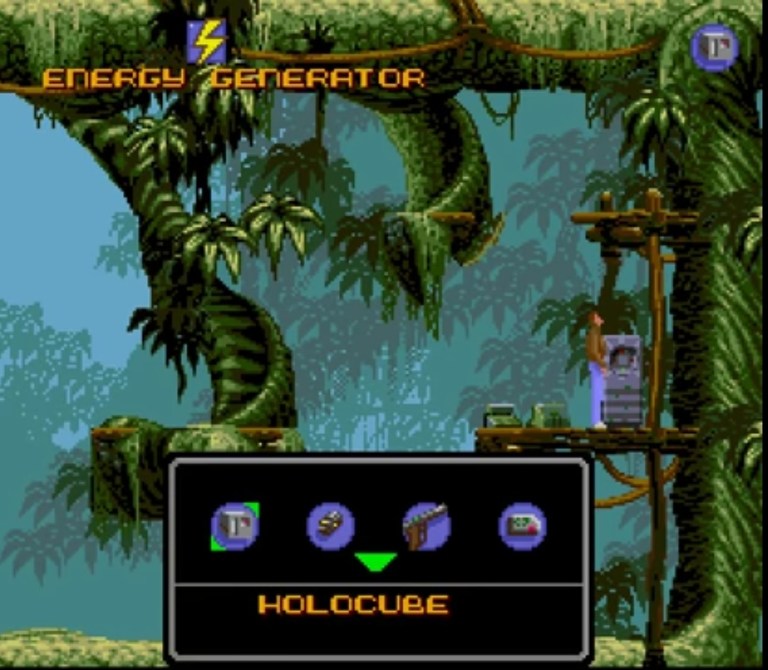
Sometime later, he wakes up and accidentally pushes a mechanical cube to fall down. He climbs down to reach it and activates it. The cube displays a holographic video of himself telling him that he recorded it without remembering it. As Conrad watches, he learns that he must contact a friend named Ian who can explain important things to him.
After viewing the message, Conrad sets off to find his way out of the jungle and somehow get to Ian in New Washington…
Game design and quality
You have to pay close attention to what’s going on, what items do you have and what the in-game prompts tell you.
This game is not your typical fast-paced, action-oriented 2D side-scrolling adventure in which you move from left to right to progress. As it is a cinematic platform game by design complete with very specific controls, players will have to be patient, adaptive and strategic in order to learn how exactly you can control your character, what moves will be executed (and when to execute). For one thing, the very fluid 24 frames-per-second animation on your character limits you in terms of control as timing is required.
To do things properly, you have to execute specific controls. To ascend on a lift, you press Up and the Y button. To do a small jump, have your character stand still and then press Up and Y button. To go down on level (on foot, no lift), stand by the edge of a level then press Down and Y button. To run and hang on to a higher floor automatically, have your character stand still, press Right and Y button, press Y button (once your character moves) and watch him pull it off. With controls like these, the usual 2D platforming approach is out of the question. In my experience, these controls are indeed challenging but never impossible to learn and eventually I got proficient with the controls as I played more.
The in-game animation for the characters are very good and there is also a sensation of weight with your character. Falling straight down from a very high place is a big no-no.
Apart from character controls, you don’t just move Conrad from one screen to the next…you also should do key objectives along the way apart from engaging in action scenes (read: shooting). That being said, you must watch out for icons that appear on screen when your character steps on a particular spot that requires interaction. For example, if you stop by a terminal, an icon will appear serving as a prompt to start the interaction. Another example is when your character steps on the same spot as an item located at which you can pick up once prompted.
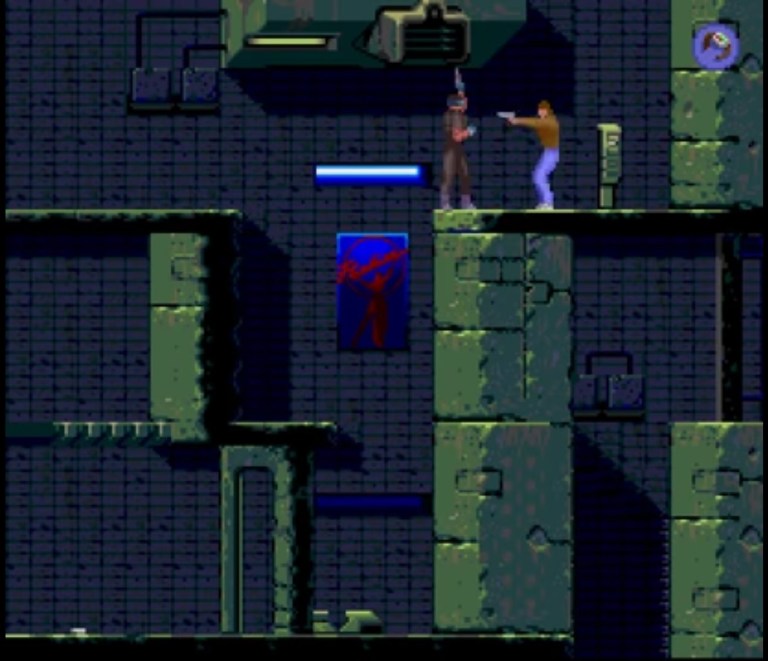
More on the action on the screen, you will encounter armed enemies as well as high-tech machines (including floating drones). To overcome them, doing straightforward shooting is not recommended as you have to be strategic before firing a shot. You have to learn how each enemy or machine moves, how much physical space is available right there and how you can maximize your limited time and space to overcome them. In fact, you will also be compelled to take advantage of whatever seconds you have while the enemies’ animation (between moves) take place. There will also be times when you need to have your character armed with the gun before jumping to a lower level where an armed enemy is located and on the lookout. Coming down armed gives you an advantage to shoot first at the enemy who
Considering the 24 frames-per-second animation, you will have to time your moves carefully, especially during moments when you face an armed enemy.
Apart from shooting, you can also use grenades which requires opening your inventory to select a grenade and then do your timing and calculation of the distance in order to pull of a successful throw and explosion. You can also throw stones to distract enemies or to apply weight on key platforms in order to open mechanical doors.
With regards to the quality of gameplay, Flashback is enjoyable but only if you get over its rather high learning curve with regards to the controls which themselves serve as the game’s advantage and even as a disadvantage. In addition to being patient and strategic, you will really have to pace yourself, think more and get used to the rather slow pace of the game in relation to its cinematic platformer design. I should state that as you keep progressing, there will be places, or new obstacles or new enemies that will compel you to change your tactics in order to overcome them. Anyone who is used to playing 2D side-scrolling games the fast and easy way might find the high learning curve and pacing of Flashback a turnoff but if they are willing to learn, adjust and pace themselves, only then can this game’s gameplay be really enjoyed.
Cut scenes like this move at a sluggish pace which shows the limitations of the SNES and cartridge technology.
As for the visuals, the obvious highlight here is the 24 FPS animation which is the result of rotoscoping and careful visualizing (note: observe those alien humanoids who morph into moving blobs). The rotoscoped animation, however, would not have been that effective had the quality of the art used for the backgrounds been made of lower quality. I can say that the background artworks here look pretty good even by today’s standards. The standout among them were the background artworks of Morph’s home planet which really looked very alien and creepy at the same time. What hurts this particular version of Flashback is the lackluster (read: choppy) frame rate whenever the computer-generated cinematic cutscenes (obviously they were meant for more powerful PCs) play which, in my experience, took me out of the story. There were also bouts of slowdown during the gameplay, especially when you encounter enough enemies that were animated sophistically.
With regards to narrative, Conrad is literally your avatar to learn, discover and interact with the many elements of the universe he is part of. There is obvious influence that the game makers took from the movie Total Recall as they crafted Conrad to be someone who lost his memory, moves on to regain it and do a lot of things as he realizes his true purpose and what is really at stake. Unlike Total Recall’s protagonist, Conrad himself is not too interesting mainly due to the way the in-game story was structured. Just play as Conrad and do what needs to be done to complete the game.
When it comes to understanding the narrative, you will have to do lots of reading. You will spot and read the short description of the prompts that appear. You’ll also have to read the on-screen text whenever your character talks with someone during the levels of the game. And there are the captions shown during the slow animated cutscenes.
Conclusion
The background artworks during the late stage of the game are great and truly creative with science fiction in mind.
I can clearly say that Flashback: The Quest for Identity on Super NESis fun and engaging mainly to those who are willing to adjust themselves to it. If you don’t have patience, if you are not willing to think while playing, if you cannot pace yourself and if you are not willing to learn all the specific controls of the game, then you should not be playing Flashback. It is a cinematic platformer and that should tell you that you will need to adjust to enjoy it.
Overall, Flashback: The Quest for Identity on SNES is recommended.
+++++
Thank you for reading. If you find this article engaging, please click the like button below and also please consider sharing this article to others. If you are looking for a copywriter to create content for your special project or business, check out my services and my portfolio. Feel free to contact me as well. Also please feel free to visit my Facebook page Author Carlo Carrasco and follow me at HavenorFantasy@twitter.com
Disclaimer: This is my original work with details sourced from reading the comic book and doing personal research. Anyone who wants to use this article, in part or in whole, needs to secure first my permission and agree to cite me as the source and author. Let it be known that any unauthorized use of this article will constrain the author to pursue the remedies under R.A. No. 8293, the Revised Penal Code, and/or all applicable legal actions under the laws of the Philippines.
Welcome back, superhero enthusiasts, comic collectors, 1990s culture enthusiasts and fans of the X-Men! We go back to the year 1993 when the 30th anniversary of the X-Men was celebrated with the 6-part Fatal Attractions storyline. Already I reviewed Uncanny X-Men #304 (Part 3) which was not worthy of the X-Men’s 30th anniversary celebration. X-Men #25 (Part 4) meanwhile was not only great but also shocking and had a years-long impact on X-Men comics.
So now the focus is on the 5th chapter of the Fatal Attractions storyline handled by the Larry Hama-Adam Kubert team on the Wolverine monthly series of the time. With those details laid down, here is a look back at Wolverine #75, published by Marvel Comics in 1993 with a story written by Larry Hama and drawn by Adam Kubert.
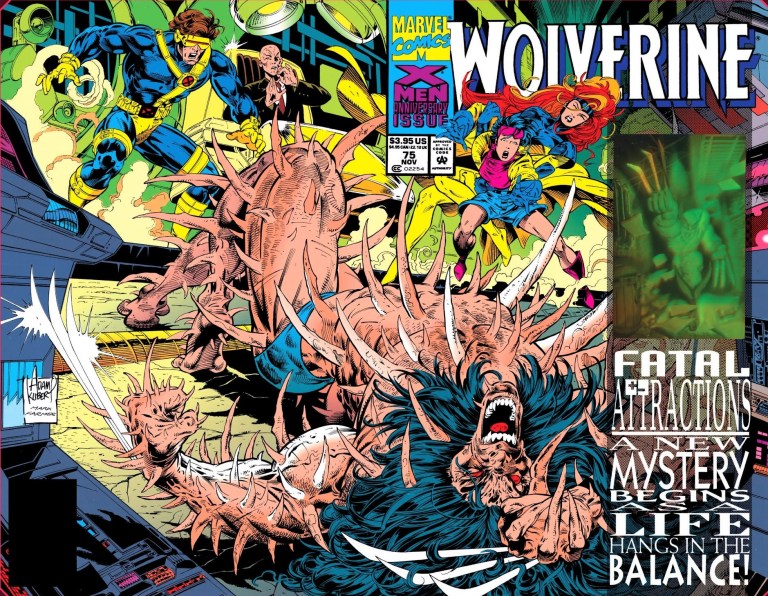
The cover.
Early story
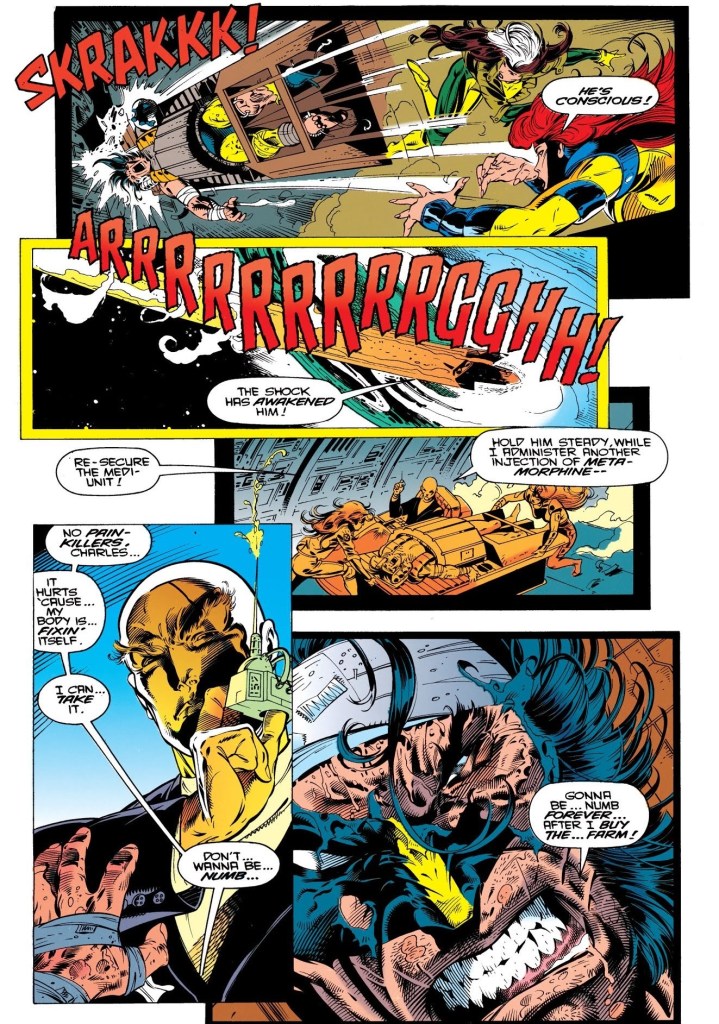
The story begins in outer space. Carrying Charles Xavier, Wolverine, Gambit, Jean Grey, Rogue and Quicksilver (who participated in the dangerous mission in X-Men #25), the X-Men’s jet (piloted by Bishop) struggles mechanically as it was not designed for space travel. Worse, Wolverine is under very serious condition and the medical unit has been operating in full capacity dealing with his intense trauma.
In an attempt to alleviate Wolverine’s psychic trauma, Charles Xavier and Jean Grey enter his mind and discover that there is a world full of pain and horror. They see visions of a restrained Wolverine (from his Weapon X days) being attacked by Sabretooth and Lady Deathstrike. Xavier explains that they are at the epicenter of Logan’s most suppressed cataclysmic memories which were clearly triggered by the physical damage Magneto inflicted on him (see X-Men #25).
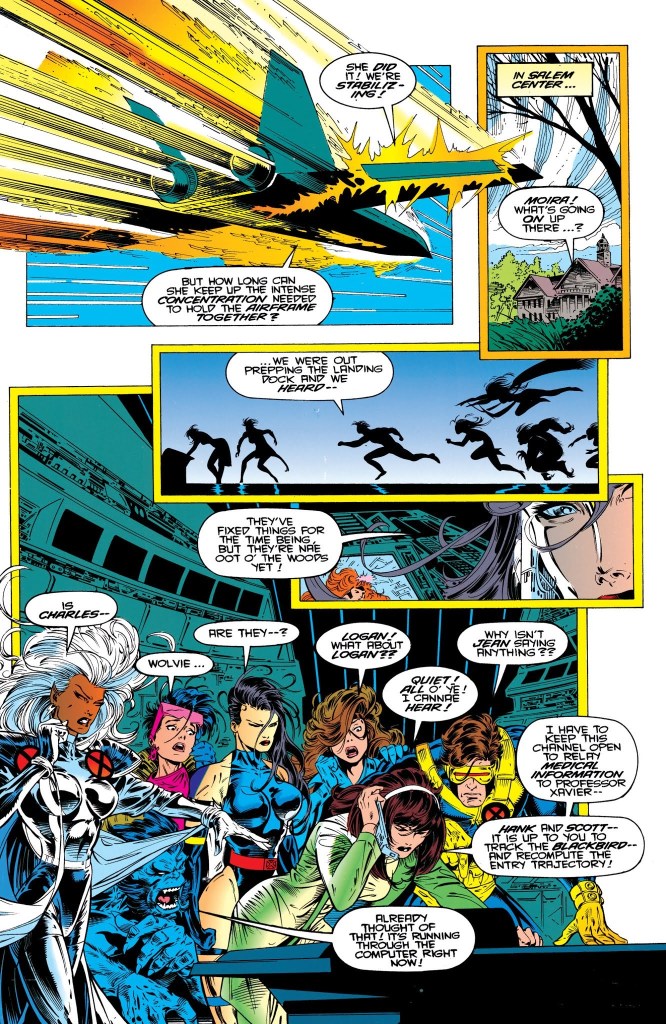
As the X-Men’s jet attempts to enter Earth’s atmosphere, its exteriors heat up dramatically shaking everyone inside. This complicates the situation on stabilizing Wolverine…
Quality
The other X-Men team members at their headquarters expressing worry and concern about the situation of their teammates struggling to come back home from space.
To be clear, this story continues the events of Fatal Attractions but with a bit more focus on Wolverine (compared to the earlier chapters of the storyline that is). There is no real battle between good and evil at all. It’s really all about Wolverine struggling to survive just as his teammates struggle to arrive home.
Before the stories of this comic book and X-Men #25 happened, Wolverine has often been portrayed to be very tough, brave and a walking machine of violence which has been reflected in other X-Men stories told in video games and movies. In this very comic book, Wolverine has been presented to coming close to death. This means Logan, at this particular stage of the history of the literary X-Men, was at his most vulnerable state. In my experience, this was both alienating and shocking to see.
With regards to the writing, Larry Hama did an excellent job with pacing the story from start to finish. Right from the beginning, the story pulls you into the X-Men’s tough situation and as each page gets turned, the tension as well as the suspense builds up until the execution of the climax. Along the way, the comic book not only portrays Wolverine struggling on the edge, it also works to make you care more or be more concerned towards him. Oh yes, the shocking moment near the end of this comic book remains very powerful and you who read this retro review should read Wolverine #75 and see it for yourselves.
Conclusion
Wolverine at his most vulnerable state.
By today’s standards, Wolverine #75 (1993) is still a very great comic book to read. In fact, I can say it is not only one of most defining chapters of the Fatal Attractions storyline as well as one of the most significant X-Men comic books of the 1990s, it is indeed a true illustrated literature classic ever published by Marvel Comics. In retrospect, this comic book marks a major turning point in the life of Wolverine who is still one of the most iconic characters in all of superhero literature. All of these were achieved thanks to the creative team of Larry Hama and Adam Kubert (whose are here was great and stylized at the same time). Hama succeeded in writing the continuation of the Fatal Attractions storyline while balancing all of the exposition and still putting Wolverine in the center. That itself is a very great work of writing.
If you are seriously planning to buy an existing hard copy of Wolverine #75 (1993), be aware that as of this writing, MileHighComics.com shows that the near-mint copy of the regular edition costs $60 while the near-mint copies of the signed-and-numbered edition and the newsstand edition cost $300 and $180 respectively.
Overall, Wolverine #75 (1993) is highly recommended!
+++++
Thank you for reading. If you find this article engaging, please click the like button below and also please consider sharing this article to others. If you are looking for a copywriter to create content for your special project or business, check out my services and my portfolio. Feel free to contact me as well. Also please feel free to visit my Facebook page Author Carlo Carrasco and follow me at HavenorFantasy@twitter.com
As far as Halo Infinite and the 20th anniversary of the Halo franchise are concerned, the Xbox Gamescom 2021 livestream looked more like a warm-up as Team Xbox officially announced during the Gamescom 2021 Opening Night Live event that much-anticipated Halo game will be released worldwide on December 8, 2021. To add more punch to Halo Infinite’s release date, a limited edition Xbox Series X console and a commemorative Xbox Elite controller were also announced. Watch the videos below…
To put things in perspective, posted below is an excerpt from the GameSpot report. Some parts in boldface…
Halo Infinite will finally release on December 8, Microsoft announced as part of the Gamescom Opening Night Live event on Wednesday. The date was no surprise, as it leaked earlier in the day.
The intro cinematic for Halo Infinite’s multiplayer season one was also revealed, along with a special-edition Halo Infinite Xbox Series X console and a special-edition Xbox Elite controller.
Some parts of the Halo community shared their disappointment over a release date in December for being later than they would have wanted. The 20th anniversary of Halo and Xbox is November 15, but there was never any indication or suggestion that Microsoft would launch Halo Infinite on or close to that day to celebrate the milestone.
A release date in December would be the latest ever in the year for a mainline Halo game. Halo: Combat Evolved launched in November 2001, Halo 2 debuted in November 2004, Halo 3 came out in September 2007, and Halo 4 launched in November 2008. Halo 5, which is the latest entry in the mainline series, premiered in October 2015.
It is no secret that 343 Industries is having difficulty completing Halo Infinite which was supposed to have launch in November 2020. The said game will be released this December with the single-player campaign and multiplayer features. The Forge and co-op campaign features will follow later.
While it is a relief for anxious Halo fans that Halo Infinite has a finalized release date, there are still no new updates regarding the single-player campaign nor anything new about the new in-game story Xbox icon Master Chief is involved in. Now that Halo Infinite will be released WEEKS PAST the actual 20th anniversary of the Halo franchise, Team Xbox has limited time to aggressively promote and emphasize the game. Meanwhile, the marketing and promotion of the other Xbox-exclusive Forza Horizon 5 is on high-gear and with no clear obstacles on the way to its November 9, 2021 release.
The limited edition Halo Infinite-themed Xbox Series X console.
Celebrate Halo’s 20th anniversary and the upcoming launch of Halo Infinite with this custom designed, first-ever Limited Edition Xbox Series X. This design was inspired by the expansive Halo universe and is wrapped with dark metallic paneling accented by iridium gold. Above the armor there is a custom star pattern as seen from the surface of Zeta Halo that extends to the top of the console and onto the fan. Below the stars, the top vent is accented in Cortana-themed blue. To top it off, the console powers on and off with custom Halo-themed sounds. The controller included in the bundle features a matching design on the front, an iridium gold 20-year mark on the back, as well as side-and-back grips to accommodate all play styles.
Play on our fastest, most powerful console ever and become the hero in Halo Infinite with a downloadable copy of the game included with this bundle. Halo Infinite on Xbox Series X|S boasts up to 4K and 60 frames per second, and Multiplayer Arena supports up to 120 frames per second, advanced 3D Spatial Sound, and more. And, with new features like Quick Resume, Auto HDR, and framerate boosting, the entire catalog of Halo games gets better on next gen.
The Elite Series 2 controller.
Also announced today, we’re excited to get the Halo Infinite Limited Edition Elite Series 2 in your hands. Ready for any mission with a customdesign inspired by the Master Chief’s iconic armor, this controller features a battle-worn, matte metallic green with an iridium gold D-pad and comes with an arsenal of swappable components and a custom carrying case emblazoned with the iconic UNSC insignia. For that Spartan-like precision, use the custom thumbstick tension adjustment tool that you can even wear like a dog-tag so you’re always ready to fine-tune your combat experience. When you’re not using your controller, keep it powered up on the laser-etched charging dock or with the custom charging cable. And, when Halo Infinite releases, don’t forget to show off this one-of-a-kind design in multiplayer sessions with an exclusive Halo Elite controller weapon charm only available with the purchase of the Halo Infinite Elite controller.
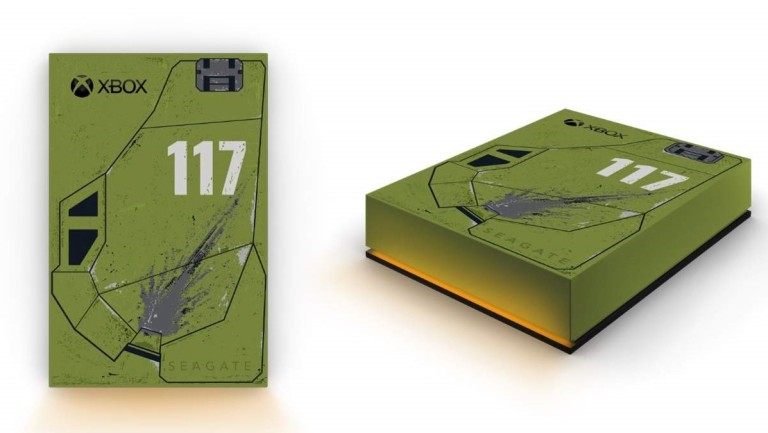
But there is even more! Team Xbox also announced the Halo Infinite Edition Razer Kaira Pro headset as well as the Halo Infinite Special Edition Seagate Game Drives for Xbox! The Seagate-made game drives (mobile hard disk drives) are priced at $99.99 for 2 terabytes and $159.99 for 5 terabytes!
The headset.
The portable drives from Seagate.
On the commercial side, Team Xbox is moving on high-gear promoting Halo’s 20th anniversary with the above products. Their true challenge remaining is ensuring that Halo Infinite will be a great game for release. Any new updates about the game and how it will turn out upon release will be seen.
In ending this piece, here are some Xbox-related videos for your enjoyment.
+++++
Thank you for reading. If you find this article engaging, please click the like button below and also please consider sharing this article to others. If you are looking for a copywriter to create content for your special project or business, check out my services and my portfolio. Feel free to contact me as well. Also please feel free to visit my Facebook page Author Carlo Carrasco and follow me at HavenorFantasy@twitter.com
Disclaimer: This is my original work with details sourced from reading the comic book and doing personal research. Anyone who wants to use this article, in part or in whole, needs to secure first my permission and agree to cite me as the source and author. Let it be known that any unauthorized use of this article will constrain the author to pursue the remedies under R.A. No. 8293, the Revised Penal Code, and/or all applicable legal actions under the laws of the Philippines.
Welcome back, superhero enthusiasts, fans of the 2099 universe of Marvel Comics, 1990s culture enthusiasts and comic book collectors! Today we revisit the X-Men 2099 comic book series by focusing on the 4th issue. Following the single storyline told in the first three issues (including the unexpected death of a certain member in issue #3) which ultimately made clear why the X-Men of 2099 exist and what their place is within an America that is totally different from what it used to be during the time of Charles Xavier and his X-Men. As such, the stage was set for more exploration and new creative directions with Xi’an and his band of nomadic mutants.
With those details laid down, here is a look back at X-Men 2099 #4, published by Marvel Comics in 1993 with a story written by John Francis Moore and drawn by Ron Lim.
The cover.
Early story
The story begins with Bloodhawk exploring a deserted, radioactive facility in the middle of New Mexico. Having a reptilian skin protects him from radiation which only adds to his personal obsession of waging a war against developers and corporate entities that he accuses of defiling the natural environment.
Suddenly, a tough female with white hair and white skin grabs Bloodhawk by the neck and by touching his head with her left hand, she triggers a bolt of agony on him. Bloodhawk then loses consciousness.
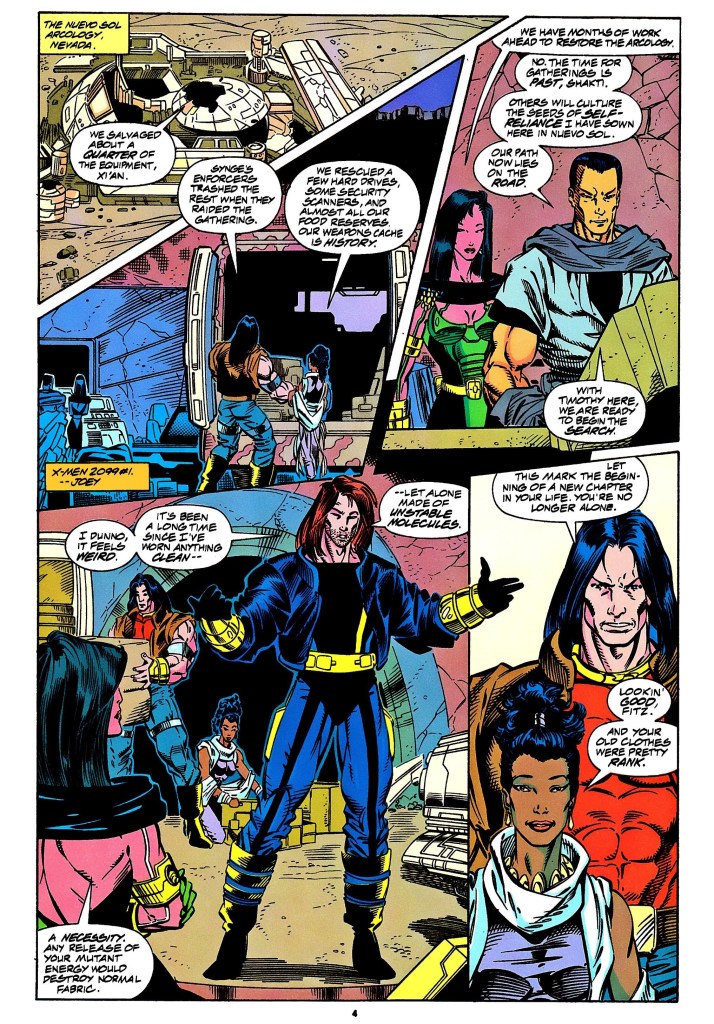
Meanwhile in Nevada, Xi’an and his X-Men salvaged whatever equipment they found at the Nueva Sol Arcology which was their haven before Synge’s enforcers invaded and ruined it. In response to Shakti’s comment that it would take months to restore the facility, Xi’an says that the time for gatherings has passed as he believes that their path lies on the road emphasizing travel to new places.
While his teammates are outside, Henri uses a computer inside the facility retrieving messages. He receives a video message from his old friend Jordan Boone who informs him about a major project called Valhalla and he was going to do something outrageous…
Quality
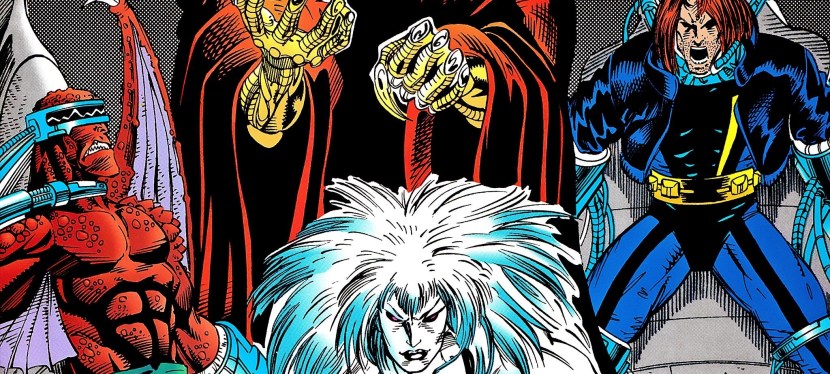
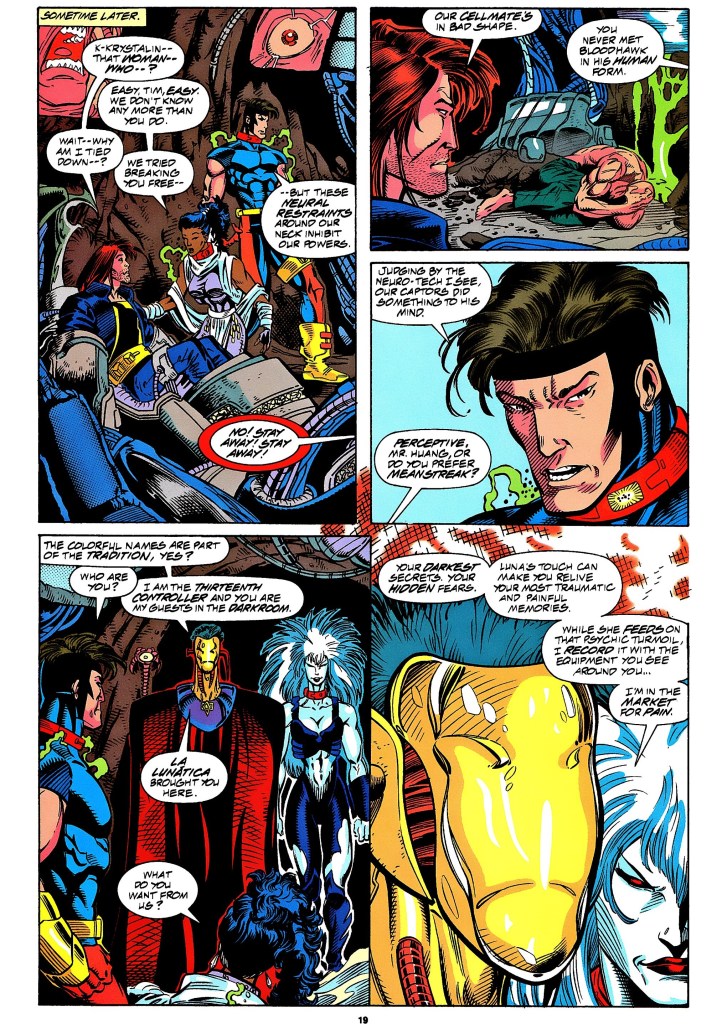
Neuro-tech, the captured X-Men, Luna and the Theater of Pain.
When it comes to narrative, I should point out that this comic book serves as a prelude to The Fall of the Hammer 2099 crossover storyline and it does a good job setting key members of the X-Men to get involved.
As an X-Men 2099 story, John Francis Moore further developed the personalities of most of the members (with Timothy Fitzgerald being the center as he slowly becomes Skullfire) and showed more of the culture within the team under Xi’an’s leadership and strict points.
Other than the focus on the mutants, a notable feature of the story is the introduction of the Theater of Pain which includes a radically intriguing masked villain who runs an operation that involves abducting people, using machines to feed on their minds and access the most painful personal memories which in turn is digitally channeled to an existing linked live audience feeding their minds. In essence, mental torture and intrusion of the mind are introduced. I should also state that the Theater of Pain here plays a major part in the story of X-Men 2099 #25. This issue also introduces Luna who eventually gets linked with Skullfire and becomes part of the X-Men.
More on the Theater of Pain concept, I found the painful flashback sequences a clever method used by the writer to emphasize selected moments from the past of Bloodhawk and Skullfire which added to the character development of this comic book.
Conclusion
One step showing Timothy slowly becoming Skullfire.
X-Men 2099 #4 (1993) is well-written and it is a significant part of the 35-issue monthly series. For one thing, it shows the start of the transformation of Skullfire’s personality, the direction Xi’an and his mutants are taking, and the start of a build-up that led to the significant events of X-Men 2099 #25. There is a lot here for X-Men 2099 fans to enjoy from start to finish.
If you are seriously planning to buy an existing hard copy of X-Men 2099 #4 (1993), be aware that as of this writing, MileHighComics.com shows that the near-mint copy of the regular edition costs $30 while the near-mint copy of the newsstand edition costs $90.
Overall, X-Men 2099 #4 (1993) is highly recommended!
+++++
Thank you for reading. If you find this article engaging, please click the like button below and also please consider sharing this article to others. If you are looking for a copywriter to create content for your special project or business, check out my services and my portfolio. Feel free to contact me as well. Also please feel free to visit my Facebook page Author Carlo Carrasco and follow me at HavenorFantasy@twitter.com
Welcome back to this latest edition of the Better than Streaming series! If you are fond of 1980s anime, especially with productions by Studio Nue (the same studio behind Super Dimension Fortress Macross), then you should be delighted to know that the entire Super Dimension Century Orguss series is coming out on Blu-ray format on September 28, 2021 and you can order it online right now!
The Blu-ray cover.
Handled by DiscoTek Media, all 35 episodes will be compiled and presented in high-definition complete with Japanese dialogue (with English subtitles). There will also be 17 episodes dubbed in English which I believe were produced at a time when U.S. Renditions still existed. As of this writing, the price is around $70.
To put things in perspective, posted below are details from the Blu-ray.com page of Super Dimension Century Orguss. Some parts in boldface…
Video
Codec: TBA
Resolution: 1080p
Aspect ratio: 1.33:1
Original aspect ratio: 1.33:1
Audio
Japanese: LPCM 2.0
English: LPCM 2.0
Subtitles
English
Discs
Blu-ray Disc
Three-disc set (3 BD-50)
Packaging
Slipcover in original pressing
Playback
2K Blu-ray: Region A
Description
Today, Kei Katsuragi‘s only concern is the love of his life. It doesn’t really matter to him that he has more than one love – after all, as a pilot for the Freedom Space Corps, he might be dead tomorrow! In the future, war has changed, and Kei is all too familiar with the horrors it can bring. Atomic, biological, and chemical weapons are all in use, but even worse than those are the dimensional weapons, ordnance capable of tearing apart even time and space!
As it happens, his next mission involves one of these terrifying weapons, the latest risky gambit in the war over the space elevator on Earth. Fleeing from the warmth of his lover (and her father’s gun) to the coldness of space, Kei fights to protect a team of engineers as they arm the dimensional weapon on-site. But when they get orders to pull out without detonating the bomb, Kei disobeys, unwilling to make the sacrifices of the day meaningless. His brash actions have dire consequences beyond just a big kaboom, as that explosion flings him into the future!
There, Kei finds himself caught in an entirely different struggle between the militaristic Chiram and the mercantile Emaan – with himself as the prize! Will this womanizing hot shot pilot make it back to his own time, or is there something more to Kei being the “singularity”?
Here is something for long-time Orguss fans as well as for those who are about to discover Super Dimension Century Orguss for the first time.
I personally am interested in this upcoming multiple-disc Blu-ray set of Orguss. For one thing, I actually saw its sequel Super Dimension Century Orguss 02 first way back in the mid-1990s and learned that there is a storyline gap of two hundred years between them. It was only a few years ago I got to watch some English-dubbed episodes (done by U.S. Renditions) of Super Dimension Century Orguss and found its sci-fi concept really intriguing. It was also a fresh change of pace as well as a different type of immersion after I indulged myself with Studio Nue’s most famous works related to the Super Dimension Fortress Macross franchise (read my retro review of Macross: Do You Remember Love?).
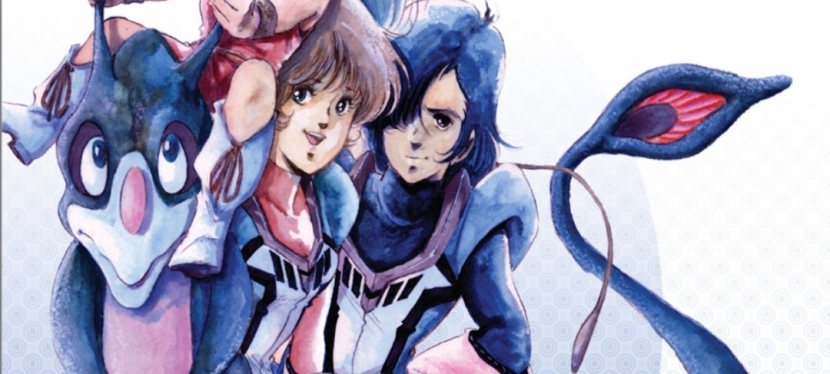
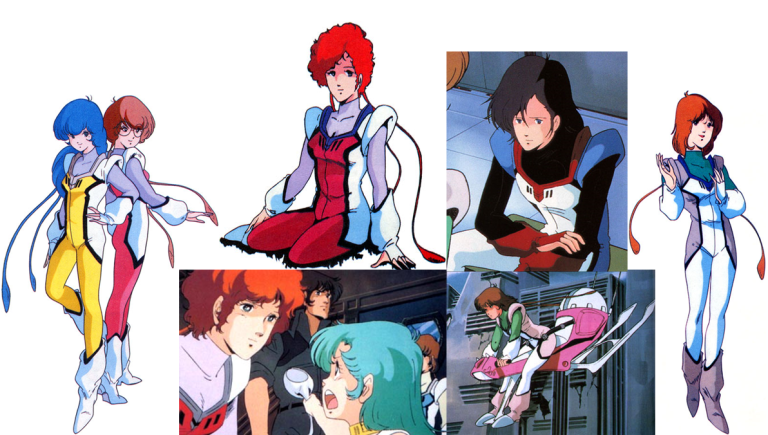
Anyone who saw Macross first will realize certain common visual elements between it and the Orguss TV series (1983-1984) which should be no surprise since they are both Studio Nue productions. Even notable Macross female characters had cameo appearances in the early Orguss episodes. It is also a fact that prolific anime director Noboru Ishiguro worked on the Super Dimension Fortress MacrossTV series, the Super Dimension Century Orguss TV seriesand the feature film Macross: Do You Remember Love?
Going back to the future Blu-ray release of Orguss, I am hoping that the image quality will be good apart from being presented in high-definition. As it is decades-old anime series, its original aspect ratio of 1.33:1 will still be retained and that means you will see thick, black borders on the left and right sides of the screen. As for the colors, I hope the technical crew will enhance the colors a bit to be presentable in HD.
The signature robot in the Orguss series.
Once Super Dimension Century Orguss comes out finally on Blu-ray disc format on September 28, 2021, only then we will find out how good the visuals and audio will be. Stay tuned for more right here!
Thank you for reading. If you find this article engaging, please click the like button below and also please consider sharing this article to others. If you are looking for a copywriter to create content for your special project or business, check out my services and my portfolio. Feel free to contact me as well. Also please feel free to visit my Facebook page Author Carlo Carrasco and follow me at HavenorFantasy@twitter.com
Disclaimer: This is my original work with details sourced from playing The Super Dimension Fortress Macross: Do You Remember Love? video game and doing personal research. Anyone who wants to use this article, in part or in whole, needs to secure first my permission and agree to cite me as the source and author. Let it be known that any unauthorized use of this article will constrain the author to pursue the remedies under R.A. No. 8293, the Revised Penal Code, and/or all applicable legal actions under the laws of the Philippines.
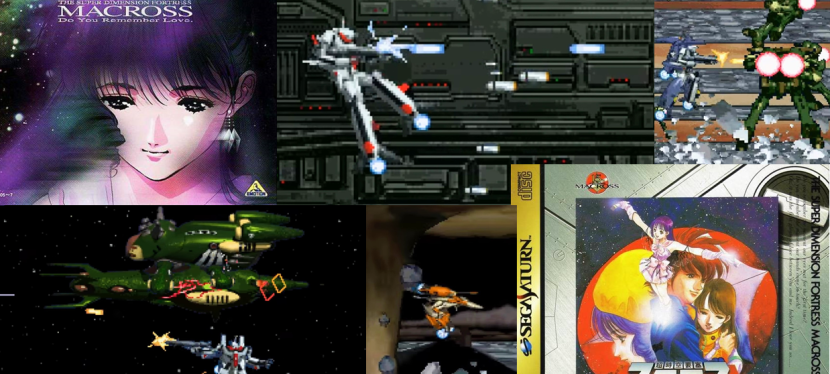
Like many other entertainment franchises in Japan, Macross also has video games based on its stories and concepts. During the fifth generation of video game consoles, Bandai released in Japan the video game adaptation of the 1984 anime movie on the Sega Saturn in 1997 and the Sony PlayStation in 1999. That game was titled The Super Dimension Fortress Macross: Do You Remember Love? and I played that 2D side-scrolling shoot-them-up game a lot during the time when 3D polygons was already the standard.
Considering its age, it is easy to wonder if the game is still fun to play by today’s standards and if the game is something that Macross fans can enjoy a lot. We can all find out in this look back at The Super Dimension Fortress Macross: Do You Remember Love?
Sega Saturn version in 1997.
Sony PlayStation version in 1999.
Early story
The story begins at sea. A Valkyrie piloted by Hikaru Ichijyo (the late Arihiro Hase) launches from the aircraft carrier Prometheus to join his teammates Max and Kakizaki led by Roy Fokker (Akira Kamiya). Suddenly a powerful beam of energy from above hits the aircraft carrier clearly showing that their world is under attack by the Zentradi.
They proceed to South Attaria Island where they immediately engaged the Zentradi forces that ravaged the city and causing trouble for the SDF-1 (Macross). After defeating several Zentradi elements, the remaining Skull Squadron forces flew to the Macross (which just launched into the air) which executes a space fold just moments before even more laser blasts from the Zentradi destroyed the entire island.
Sometime later deep in space, thousands of civilians managed to adjust to living inside the Macross. As Lynn Minmay’s (Mari Iijima) first concert happens inside the fortress, Hikaru, his teammates and many other fighters engage in a mission against the Zentradi…
Quality
Just like in the movie!
To comment on the quality of this old video game, I’ll focus on gameplay and presentation.
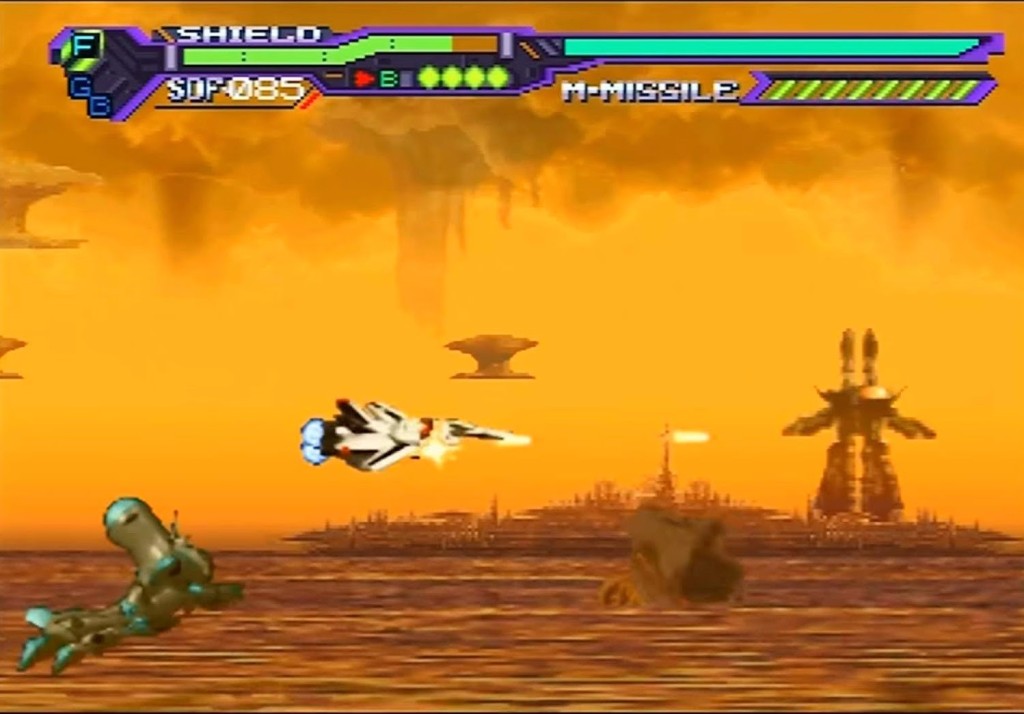
As far as gameplay goes, Macross: DYRL is essentially a 2D side-scrolling shooter literally designed to be grand not only for Macross fans but also for gamers who enjoy its design and its type of gameplay. You play as the hero Hikaru who pilots an advanced fighter plane that can also transform into an armed fighter with legs (GERWALK mode) and also into a full-sized, human-like robot (Battroid). In fighter mode, you move fast and are able to fire rockets or use your default gun. In GERWALK mode, your speed is slower but you have improved mobility that can be crucial for combat. In Battroid mode, your speed is reduced further but you are somewhat stronger and more precise when it comes to shooting enemies.
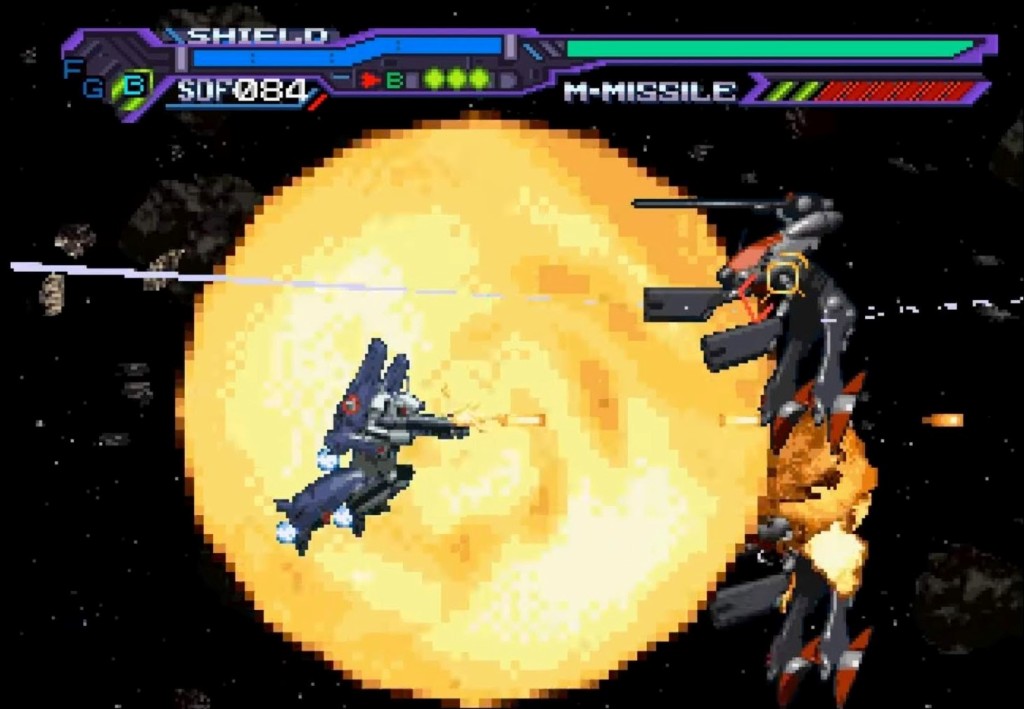
Still on gameplay, the game developers really pushed the envelope in terms if immersion as there are lots of moments in which the enemies will not only face you on your 2D plane but also move around you from the foreground to the background. Without having to do anything further, your character will be able to auto-aim and shoot at your enemy whether in the background or the foreground. Essentially, this makes the game a 2.5D shooter.
This is a fine example of you (in your 2D plane) firing at your enemy in the background.
In key parts of some levels in the game, the UN Spacy will send a shuttle to release supplies to help you replenish your shield meter.
The controls are relatively easy to learn and get adjusted to. More importantly, the controls are very responsive and they are ideal when it comes to precision on moving your character around as well as trying to shoot at specific targets.
This game was designed with several levels for you to complete essentially moving from left to right. As evidence of the game developers taking liberties during its adaptation of elements from the 1984 animated movie, several levels have boss fights for you to participate in and win in order to progress. These boss-type enemies are noticeably absent from the movie and yet they were designed to integrate into the film’s concept and also expand the concept about how elaborate the Zentradi are when it comes to their war machines against Earth. The boss-type enemies (note: they are clearly polygonal and yet they fit in well with the 2D sprite elements) are huge machines designed for space battles and there were boss fights in which some of them move into the background (which sparks moments for your character to fighter towards the background). When it comes to artificial intelligence (AI), the boss-type enemies are not really that sophisticated with their movements although a few of them have attack patterns that will push you to be more evasive and more strategic.
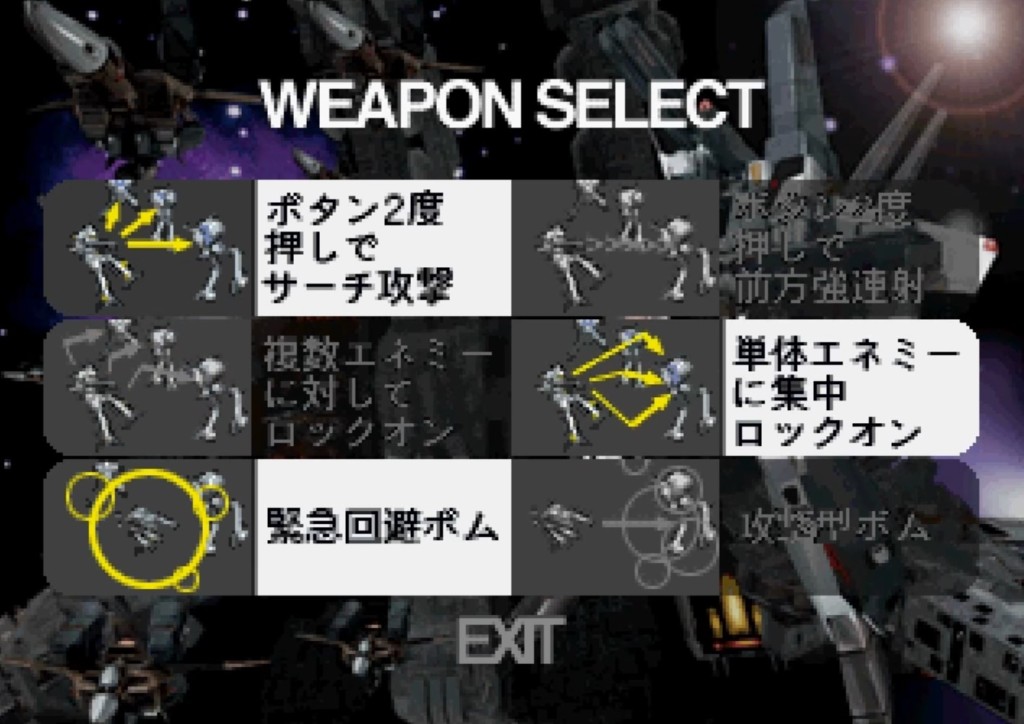
Before starting a level, you can select your weapons that can function depending on your personal preference on taking on the enemies.
Lots of great visual effects and 3D movement add to the challenge.
With regards to challenge, some parts of this game took me a few repeats before finally improving myself enough to make it to the next levels. The visual elements of the game also added to the overall challenge as seeing 2D sprites move around you 3-dimensionally.
Speaking of 2D sprites, it is clear that this game was designed to be heavy with 2D visual elements while 3D polygons are used sparingly (note: the boss battles mentioned above). As this is a side-scrolling game, the game makers clearly made lots of sprites of machines, space ships, Zentradi battle pods and other figures that Macross fans would easily recognize. The good news is that each 2D sprite was made with multiple frames of animation (complete with frames meant for 3D movement) and were made to really resemble the cinematic artworks which ultimately results making them really look lively to watch on-screen!
As for the presentation, I can see that the game developers Scarab paid great attention to the details of the animated movie to make The Super Dimension Fortress Macross: Do You Remember Love? fun and engaging for gamers in general while also becoming strongly relevant and delightful with the people who love Macross. For example, the game starts with a cinematic prologue composed of brand-new animation cels mixed with elements of 3D polygons and in my view, it fits in nicely leading to the actual cinematic opening of the movie from 1984. The cinematic prologue was meant to expand the film’s overall concept and other story expansions happened in subsequent parts of the game (such as the all-new mission told in two levels).
Observe the Zentradi surrounding Roy Fokker on his 2D plane, the foreground and background. This is a 2D sprite-heavy showcase!
The game developers paid close attention to the details of the movie and presented the visuals using video game graphics, 2D sprites and really nice in-game background artworks!
Surprise! You as Hikaru get to fight Milia temporarily before her memorable fight with Max happens!
The Super Dimension Fortress Macross: Do You Remember Love? came with selected animated sequences and still images from the 1984 movie’s very own footage meant for in-game storytelling (note: you still have to watch the movie for the best immersion). As there were some original scenes made for the game with expanding the film’s concept in mind, there are a few computer-generated animation sequences and even brand-new animated cels (note: very clearly they were drawn by people different from the ones who drew the film’s footage) showing some character moments.
When it comes to the audio, this game is clearly a labor of love with Macross fans in mind. Much of the music, songs and sound effects from the movie (as well as from the 1982-1983 anime TV series) were integrated into the game which made it very immersive for Macross fans. As for the voice actors, fans will hear the voices of their favorite Macross characters performed by the late Hase, Iijima, Kamiya, Mika Doi (Misa Hayase), Michio Hazama (Captain Global) and more. While some of their recorded lines from the movie were reused (especially Hase who died in 1996), others recorded new lines for their respective characters for the new cinematic footage as well as key parts in the game.
The art of Lynn Minmay for the new anime footage was clearly not drawn by the people behind the 1984 anime movie.
What I love best about the presentation is that the game developers replicated selected scenes from the 1984 movie using in-game graphics and art along with music, sound effects and the lines of dialogue! As a Macross fan myself, the immersion was pretty deep as I played the game and witnessed those special moments from the movie played within the in-game presentation.
Conclusion
Enjoy looking at this.
I can declare out loud that The Super Dimension Fortress Macross: Do You Remember Love? is indeed the best Macross video game I have ever played as well as the best adaptation (note: other than film) of the classic movie from 1984. This game, which excellently used 2D sprites and 3D polygons all throughout, was very clearly made to delight Macross fans while giving gamers something very enjoyable and memorable to experience. For the best immersion, it is highly recommended to watch the movie before playing this video game. Truly this video game has aged well!
Thank you for reading. If you find this article engaging, please click the like button below and also please consider sharing this article to others. If you are looking for a copywriter to create content for your special project or business, check out my services and my portfolio. Feel free to contact me as well. Also please feel free to visit my Facebook page Author Carlo Carrasco and follow me at HavenorFantasy@twitter.com
Get ready because Highlander will be released in 4K Blu-ray format on September 14, 2021. It will come with the 4K Blu-ray disc, Blu-ray (for 1080p viewing) and the digital copy. 4K Blu-ray collectors should be aware that as of this writing, there is no confirmation yet if Highlander 4K Blu-ray will come with native 4K visuals or upscaled 4K visuals.
As of now, there is really not that much information about Highlander 4K Blu-ray. It just so happens that this year marks the 35th anniversary of the movie.
For the newcomers reading this, Highlander is the story of immortality that follows a Scottish man called Connor (played by Lambert) who discovers his legacy with a legion of immortals. After living for centuries and moving to different places around the world, he eventually settles in the city of New York. Things turn intense when other immortals appear around him.
I first saw this movie on home video way back in late 1980s. I even saw its 1991 sequel Highlander II: The Quickening and even a few episodes of its TV series. I was never a fan of the Highlander franchise but I fondly remember the 1986 movie for its very scenic shots, the epic flashback set in historic Scotland, the great sword fighting and the very creepy performance of Clancy Brown as the main antagonist. Sean Connery, who died in October 2020, was also memorable in his supporting role as Ramirez. Christopher Lambert is still best known for his lead role as Connor in this movie.
To get to know more about Highlander, watch the video posted below from Minty Comedic Arts. Be warned of potential spoilers…
Thank you for reading. If you find this article engaging, please click the like button below and also please consider sharing this article to others. If you are looking for a copywriter to create content for your special project or business, check out my services and my portfolio. Feel free to contact me as well. Also please feel free to visit my Facebook page Author Carlo Carrasco and follow me at HavenorFantasy@twitter.com
By now, many of you should be aware about how much I loved watching V: The Original Miniseries and the best way to view it in high-definition is on Blu-ray. I was a kid when I first saw V: The Original Miniseries way back in the 1980s and it was a major hit not only in America but also around the world. Considering the way the 1983 miniseries ended and the success it achieved, a sequel was inevitable although it was not spearheaded by creator and genius Kenneth Johnson.
That sequel is none other than V: The Final Battle which was another mini-series that played all over the United States in 1984. It was considerably longer than its predecessor as it had three episodes and combined for more than 270 minutes playtime. V: The Final Battle, which had the now iconic Michael Ironside as the most notable addition to the highly talented cast, was a TV ratings hit as well and eventually Warner Bros. proceeded with its plan to produce a regular TV series out of Kenneth Johnson’s creation. Oh yes, like the original mini-series of 1983, I saw both V: The Final Battle and the TV series locally back in the 1980s. My first bout of replaying V: The Final Battle digitally was on DVD format more than fifteen years ago.
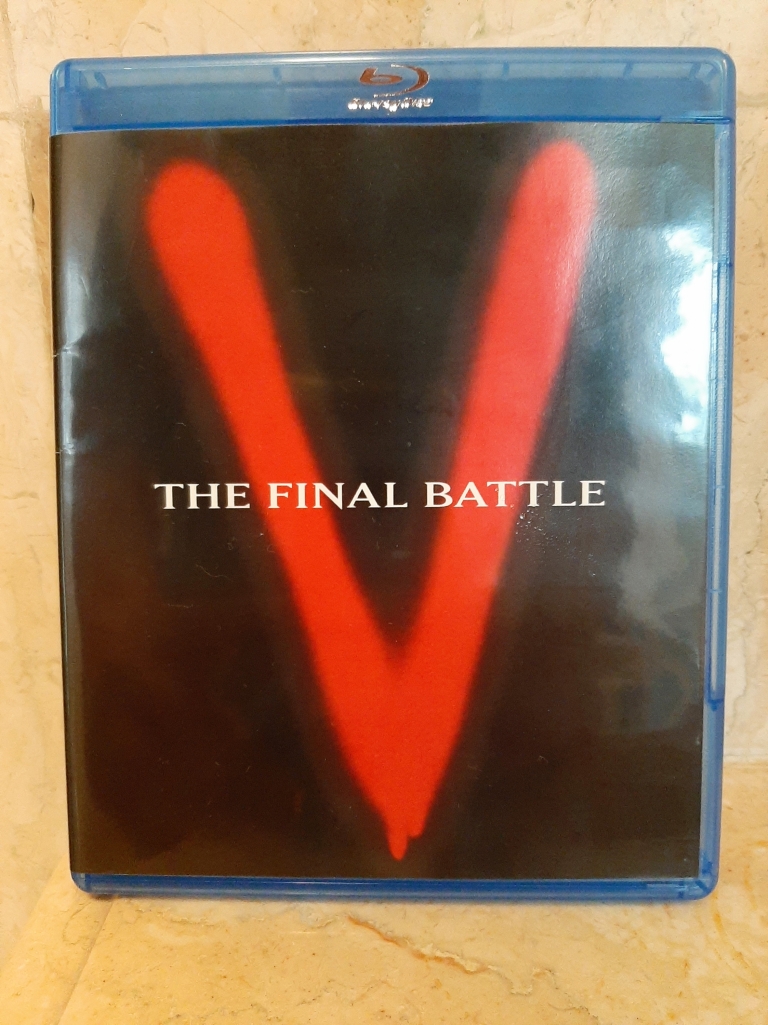
Just two days ago, I received my Blu-ray copy of V: The Final Battle which I ordered online.
The front cover of V: The Final Battle Blu-ray.
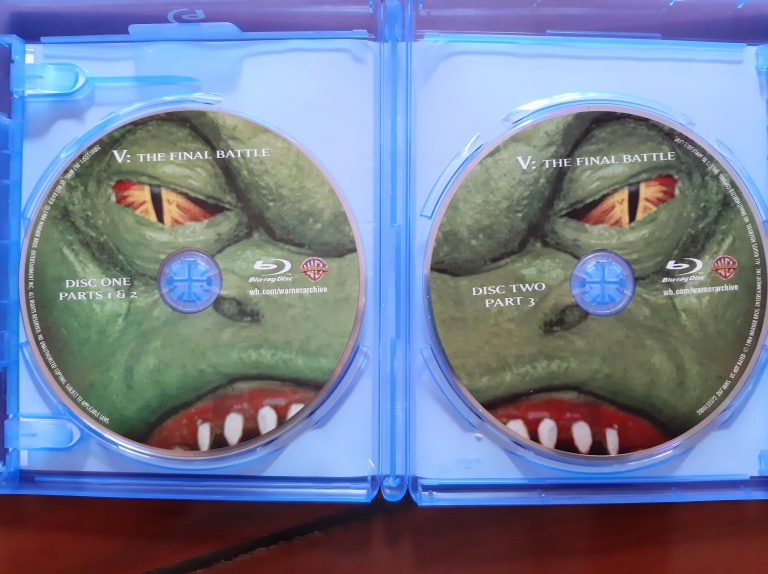
Released in April 2020 by Warner Archive, V: The Final Battle on Blu-ray comes with two discs (the first disc contained the first two episodes). Its technical specs goes as follows:
Video Codec: MPEG-4 AVC Resolution: 1080p Aspect ratio: 1.33:1 Original aspect ratio: 1.33:1
Discs Blu-ray Disc Two-disc set (1 BD-25, 1 BD-50)
Playback 2K Blu-ray: Region free
The people at Warner Bros. surely wanted to freak buyers out.
Having viewed the first episode the other night, the most telling difference I spotted right from the start was that V: The Final Battle’s footage did not fill the entire screen of our HDTV at home. In fact, what was presented was a more squarish image with black borders on both sides. This is because the sequel was formatted with an aspect ratio of 1.33:1. Having seen V: The Original Miniseries Blu-ray with its widescreen imagery (aspect ratio of 1.85:1), I found the sequel’s 1.33:1 Blu-ray look not only weird (note: I still remember that TV imagery in the 1980s were more squarish than widescreen) but somehow less immersive on our HDTV. Regardless, I still had fun and engagement replaying V: The Final Battle’s first episode. The picture quality, so far, looks good and the colors look more vibrant than ever. As for the extra stuff, there is really not much here to satisfy fans of the sequel as the Blu-ray comes only with network teasers. If you are looking for behind-scenes stuff or interviews with the cast, you will be disappointed. How is the overall quality and fun of V: The Final Battle as a whole? That will be revealed in a future review.
If you are a long-time V fan, or if you are looking for gems of the science fiction genre, or if you are looking for the standout entertainment properties of the 1980s to add to your Blu-ray collection, be aware that you can order V: The Final Battle Blu-ray online by clicking here.
In ending this piece, watch this short clip of V: The Final Battle from the Warner Archive YouTube channel. It’s got Michael Ironside as Ham Tyler doing action and a glimpse of established V franchise hero Marc Singer as Mike Donovan!
Thank you for reading. If you find this article engaging, please click the like button below and also please consider sharing this article to others. If you are looking for a copywriter to create content for your special project or business, check out my services and my portfolio. Feel free to contact me as well. Also please feel free to visit my Facebook page Author Carlo Carrasco and follow me at HavenorFantasy@twitter.com
As of this writing, there is no suggested retail price yet. Still, here are the product descriptions and specs from Blu-ray.com’s articles about The Thing 4K Blu-ray. Some parts in boldface…
SPECS
Video
Codec: HEVC / H.265
Resolution: Native 4K (2160p)
HDR: HDR10
Aspect ratio: 2.35:1
Original aspect ratio: 2.39:1
Audio
English: DTS:X
English: DTS-HD Master Audio 7.1
Subtitles
English, English SDH, French, Spanish
Discs
4K Ultra HD
Blu-ray Disc
Two-disc set (1 BD-100, 1 BD-50)
Digital
Digital 4K
Digital copy included
Playback
4K Blu-ray: Region free
2K Blu-ray: Region A
PRODUCT DESCRIPTION
DISC ONE – 4K BLU-RAY
4K RESTORATION OF THE FILM FROM THE ORIGINAL CAMERA NEGATIVE
HDR PRESENTATION OF THE FILM
DTS:X AUDIO TRACK
Audio Commentary with Director John Carpenter and Kurt Russell
John Carpenter’s The Thing: Terror Takes Shape
Outtakes
Theatrical Trailer
Optional English SDH, Spanish, and French subtitles for the main feature
DISC TWO – BLU-RAY
Main feature
Audio Commentary with Director John Carpenter and Kurt Russell
U-Control: Picture in Picture
Optional English SDH, Spanish, and French subtitles for the main feature
For those who are not too aware about this old sci-fi horror movie, The Thing tells the story of an American research team stationed in Antarctica whose lives turn upside-down after a sled dog comes to them after being hunted by a helicopter from the Norwegian research team.
Historically speaking, The Thing was released in cinemas in the United States just two weeks after Steven Spielberg’s E.T. the Extra-Terrestrial. The Carpenter-directed space alien monster film was trashed by movie critics of the time and in the American box office, Spielberg’s movie about a friendly alien creature from outer space was simply unbeatable. As time passed by, The Thing found its audience on TV and home video and its critical reception turned from negative to positive overall. In the awards circuit, The Thing was nominated for Best Horror Film and Best Special Effects (credit to Rob Bottin who went on to work on effects for RoboCop and Total Recall) in the 10th annual Saturn Awards given by the Academy of Science Fiction, Fantasy and Horror Films. Fans of actor Keith David will want to see his performance in this particular film. David also went on to work again with John Carpenter years later.
To get to know more about John Carpenter’s The Thing through trivia, watch the video posted below from Minty Comedic Arts. Be warned of potential spoilers…
Thank you for reading. If you find this article engaging, please click the like button below and also please consider sharing this article to others. If you are looking for a copywriter to create content for your special project or business, check out my services and my portfolio. Feel free to contact me as well. Also please feel free to visit my Facebook page Author Carlo Carrasco and follow me at HavenorFantasy@twitter.com