A Look Back at X-Men Adventures Season II #7 (1994)

Welcome back superhero enthusiasts, 1990s arts and culture enthusiasts, Marvel Comics fans and comic book collectors! Today we go back to the mid-1990s to explore the adaptation of the second season of the X-Men animated series in the form of the X-Men Adventures comic book series.

Before getting to the new retro comic book review, I should state that decades ago, the use of future timelines was implemented on the X-Men comics. I’m talking about the possible future where Cable and Stryfe came from, another possible future where Phoenix/Rachel Summers came from, and the more established future of the classic Days of Future Past storyline. Time travel and possible future timelines are the themes in the next X-Men Adventures comic book I reviewed recently.

With those details laid down, here is a look back at X-Men Adventures Season II #7, published in 1994 by Marvel with a story written by Ralph Macchio and drawn by Scott Rosema.
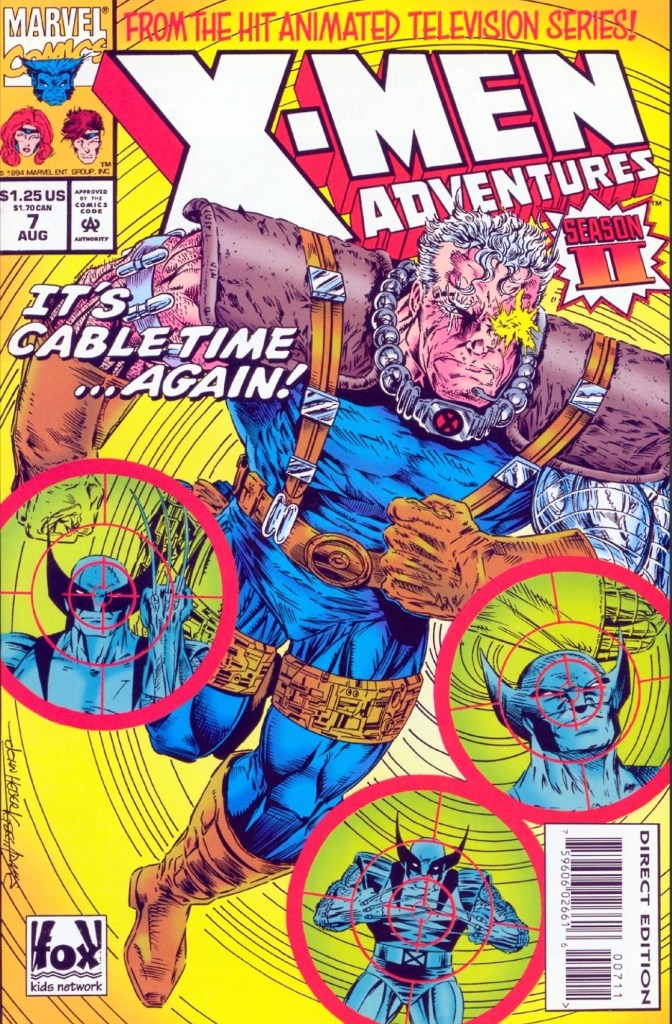
The cover.

Early story

The story begins on Earth in the far future of 3999 AD. Cable, who is fighting for the rebels, battles the deadly forces of the powers that be. It turns out, he and his teammates have been struggling a lot and their team suffered several deaths already. Even though they are very tired and heavily outnumbered, Cable refuses to give up and bravely calls for a frontal assault against their enemies.

Suddenly, Apocalypse appears on the battlefield and commands his robotic troops to destroy Cable and his fellow rebels. To Apocalypse’s surprise, a temporal storm appears and Cable notices it appearing so close to them. One of his teammates got caught by the storm which pushes Cable away. After receiving computer updates, Cable decides to get away from the robotic troops.

Meanwhile in another time period and place, Bishop returns from his mission (his interactions with the X-Men of the 20th century – click here and here) only to discover from Forge that nothing has changed and the plague still rages on…

Quality

The X-Men have a new problem to deal with.

Having read X-Men Adventures #13 and #14 of season 1, I found this particular tale (clearly a sequel to Bishop’s interaction with the X-Men after traveling through time) relatable and enjoyable. There is a strong science fiction vibe here and the time travel aspect added a lot to the build-up of tension.

Bishop here is almost the protagonist as the story showed an altered future in which Forge has no memory of the X-Men and only made a reference to a plague that has lasted for a long time. This compels Bishop to go back to the 20th century again hoping to meet the X-Men and somehow prevent the plague from bringing down society.

The impact of the mysterious virus is tremendous as so many people got infected and authorities suspect mutants to be the carriers. At this stage, the social aspects inserted by the creators really started to grow stronger within the narrative and you will see the X-Men struggling with not only the increased scrutiny on mutants but also with the manipulative tactics of anti-mutant activists who can’t help but see golden opportunities to wipe out mutants in a more clever fashion.

The dialogue here is noticeably gripping to read and the dramatization worked accordingly. There is also a good amount of superhero spectacle to enjoy here even though the X-Men have no super villains to fight with.

Conclusion
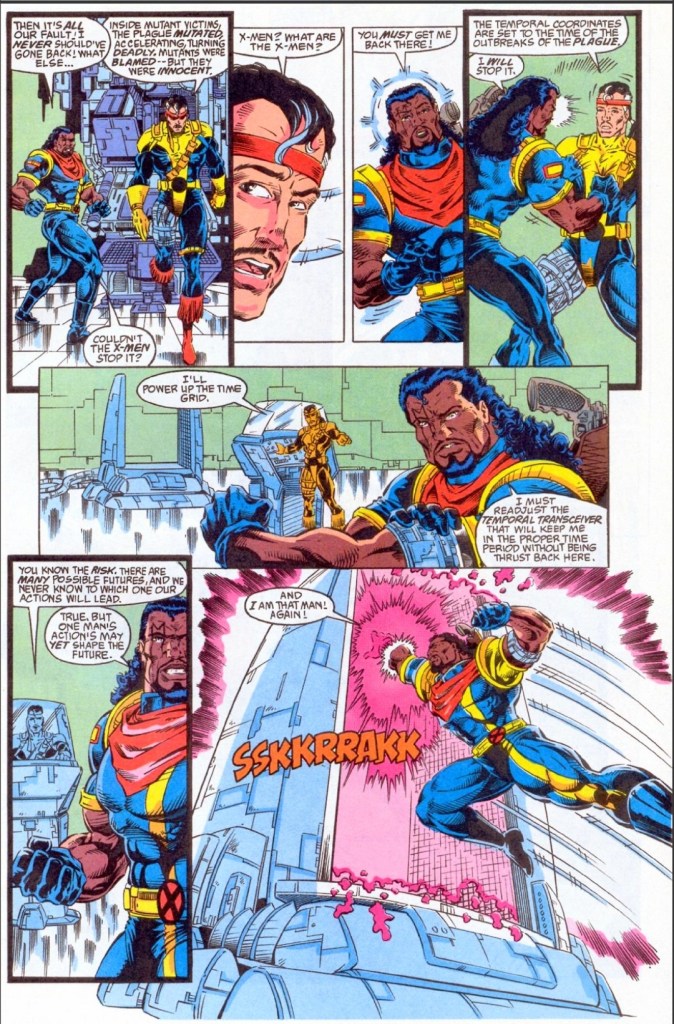
Forge has no memory of the X-Men.

X-Men Adventures Season II #7 (1994) looks like a repeat or even a remake of what happened in X-Men Adventures #13 (Season I) but its concept turned out to be not only unique with strong social commentary and sci-fi elements, but also became really engaging thanks to the fine execution by the creative team. On the aspect of social relevance, this comic book will remind you about the internment of Japanese Americans in America (1942-1946) and the COVID-19 restrictions and the quarantine on communities imposed by governments that disrupted people’s lives. As this comic book marks the first part of the Time Fugitives, I can say that I enjoyed it and I’m looking forward to the next chapter.

Overall, X-Men Adventures Season II #7 (1994) is recommended.

+++++

Thank you for reading. If you find this article engaging, please click the like button below, share this article to others and also please consider making a donation to support my publishing. If you are looking for a copywriter to create content for your special project or business, check out my services and my portfolio. Feel free to contact me with a private message. Also please feel free to visit my Facebook page Author Carlo Carrasco and follow me on Twitter at  @HavenorFantasy as well as on Tumblr at https://carlocarrasco.tumblr.com/ and on Instagram at https://www.instagram.com/authorcarlocarrasco
A Look Back at X-Men Adventures Season II #3 (1994)

Welcome back superhero enthusiasts, 1990s arts and culture enthusiasts, Marvel Comics fans and comic book collectors! Today we go back to the mid-1990s to explore the adaptation of the second season of the X-Men animated series in the form of the X-Men Adventures comic book series.

Before getting to the new retro comic book review, I should state that even though streaming is the norm for millions of people who love entertainment, it would be nice if the classic X-Men: The Animated Series (X-Men TAS) would someday get released on Blu-ray disc format. Even though many X-Men fans are streaming, there are still those who prefer collecting physical releases of what they enjoy. Really, watching entertainment with Blu-ray or 4K Blu-ray format is much better than streaming.

With those details laid down, here is a look back at X-Men Adventures Season II #3, published in 1994 by Marvel with a story written by Ralph Macchio and drawn by John Hebert.

The cover.

Early story

The story begins at the border of Kenya and Tanganyika where Mount Kilimanjaro rests. Something destructive emerges at the top of the mountain causing great disturbance on the people below. At a village, two black persons could not help but notice a demonic figure coming down at them. One of them gets possessed by it.

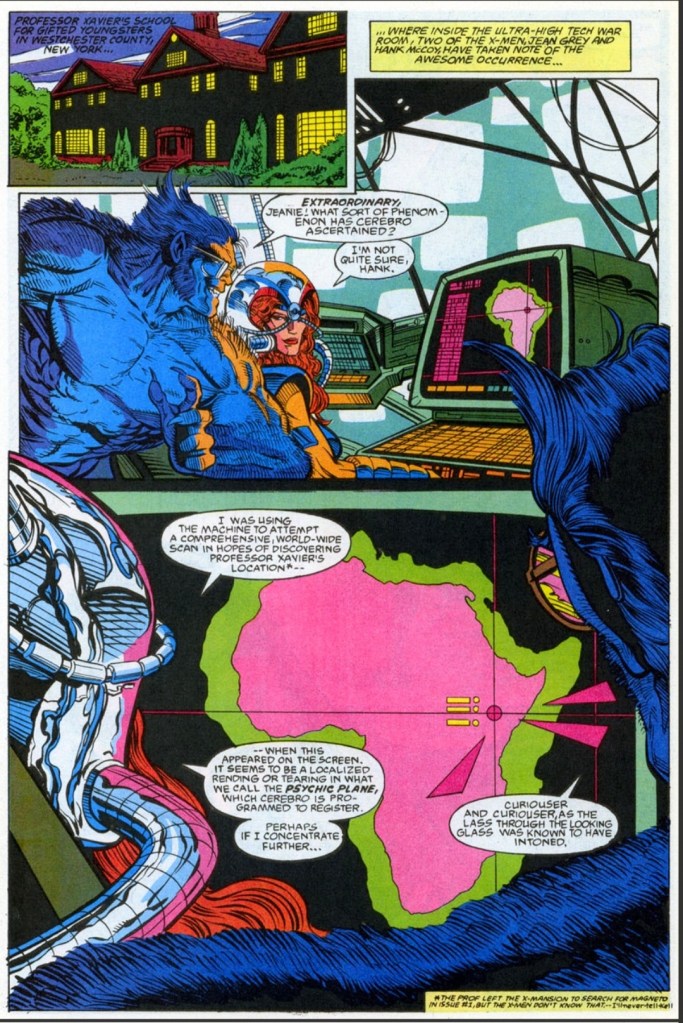
Meanwhile at their headquarters in Westchester County, New York, Jean Grey uses Cerebro to comprehensively scan the world to find Professor X’s location. What Jean detected was a psychic plane which catches Beast’s attention.

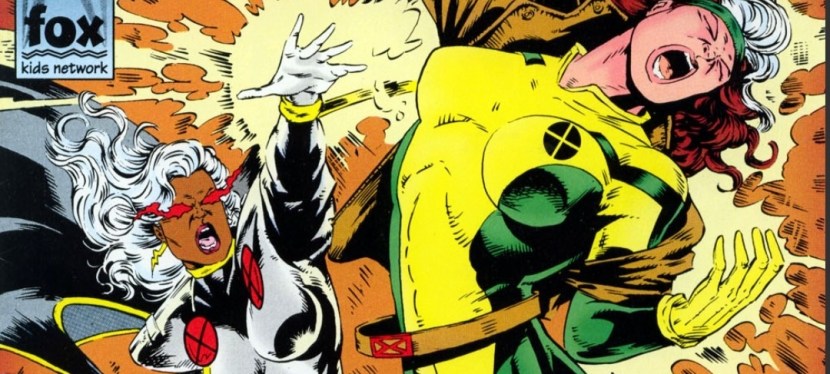
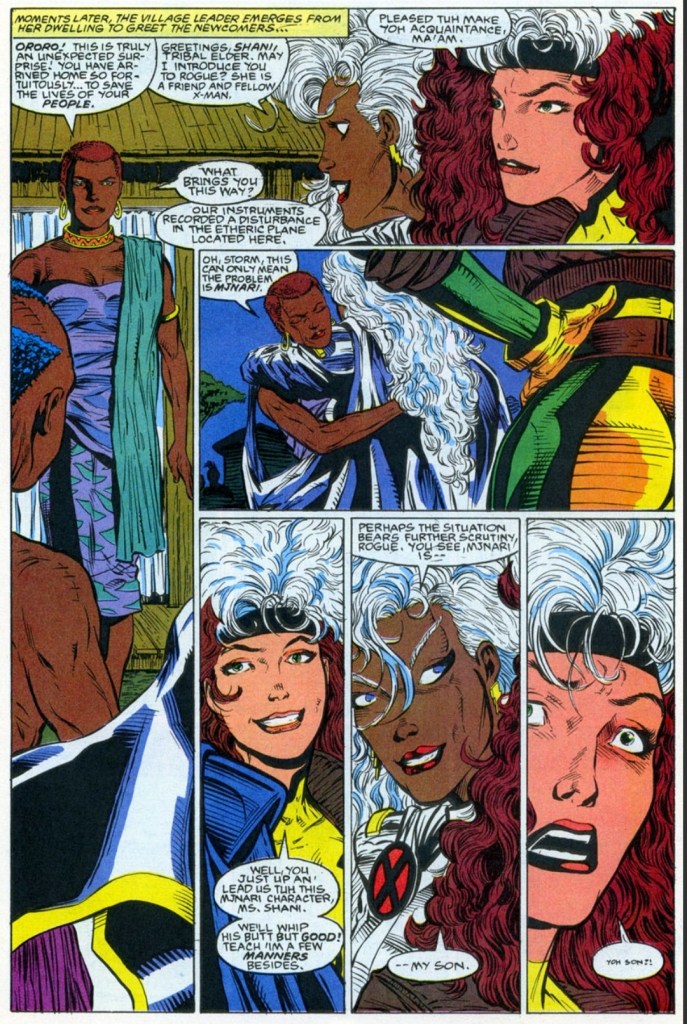
Shortly after, Rogue arrives with Storm who just returned from a hospital. As Jean updates them both, Storm realizes that the location of the psychic plane is in Africa…

Quality

Rogue in Africa with Storm.

The first thing I should confirm here is that there is a nice jump in the visual quality – in terms of style and detail specifically – thanks to illustrator John Hebert. Hebert’s work here is a nice relief compared to the rushed works of Andrew Wildman in the previous two issues, and he knows when to use the dynamic moments of spectacle and how to balance it with the calm moments. Hebert’s take on Wolverine is really good.

Regarding the story, I like the way the search for Charles Xavier – which was a sub-plot in the previous issues – unfolded while also opening the opportunity to develop Storm as she returns to Africa. In fact, this tale reveals some really engaging details from Storm’s past as well as her personal connection with a certain tribe of black people. These mentioned elements added nicely to the tension of a particular conflict that followed.

In fact, the Storm-centered story was nicely executed by the creative team and there were revelations that were gripping. Along the way, Rogue got a nice share of the spotlight and was a suitable supporting character even though the comic book had new characters.  

Conclusion

Using Cerebro has big advantages.

X-Men Adventures Season II #3 (1994) is a good read and it also has a nice change of geographic setting as it mainly focused on Africa and Storm’s reconnection with her people. Storm is clearly the main character here and this is a solid pay-off as she only had a tiny part in the previous issue. This is a tale – with themes of family, culture and the responsibility that comes with having special talents or power –  that should interest dedicated fans of Storm.

Overall, X-Men Adventures Season II #3 (1994) is recommended.

+++++

Thank you for reading. If you find this article engaging, please click the like button below, share this article to others and also please consider making a donation to support my publishing. If you are looking for a copywriter to create content for your special project or business, check out my services and my portfolio. Feel free to contact me with a private message. Also please feel free to visit my Facebook page Author Carlo Carrasco and follow me on Twitter at  @HavenorFantasy as well as on Tumblr at https://carlocarrasco.tumblr.com/ and on Instagram at https://www.instagram.com/authorcarlocarrasco
A Look Back at X-Men Adventures Season II #2 (1994)

Welcome back superhero enthusiasts, 1990s arts and culture enthusiasts, Marvel Comics fans and comic book collectors! Today we go back to the mid-1990s to explore the adaptation of the second season of the X-Men animated series in the form of the X-Men Adventures comic book series.

Before getting to the retro comic book review, I want to ask you all: have you heard about the recent controversy about the firing of the showrunner of X-Men ’97? You can learn about it by clicking here and here. In case you are wondering, I have no intention to watch X-Men ’97 knowing that Marvel under woke Disney are only using established entertainment properties to spread their sinister propaganda. Hollywood has so many Commies, it should really be called Commiewood.

With those details laid down, here is a look back at X-Men Adventures Season II #2, published in 1994 by Marvel Comics with a story written by Ralph Macchio and drawn by Andrew Wildman.

The cover.

Early story

The story begins with the newly married couple Scott Summers (Cyclops) and Jean Grey enjoying their honeymoon on a boat somewhere in the South Pacific. Jean is enjoying their privacy together free from all the pressure they experienced as X-Men members. For her, the world feels really different.

Suddenly, Jean senses something as their boat approaches an island that was supposed to be uninhabited. A man with long pink hair has been anticipating their arrival and surprises them. He uses his power to manipulate the sea water to form waves to capsize their boat and push them further to the beach.

Soon enough, Cyclops and Jean find themselves facing Mister Sinister and his henchmen…

Quality

The Summers couple helpless in the presence of Mister Sinister who has an ambitious plan for all mutants.

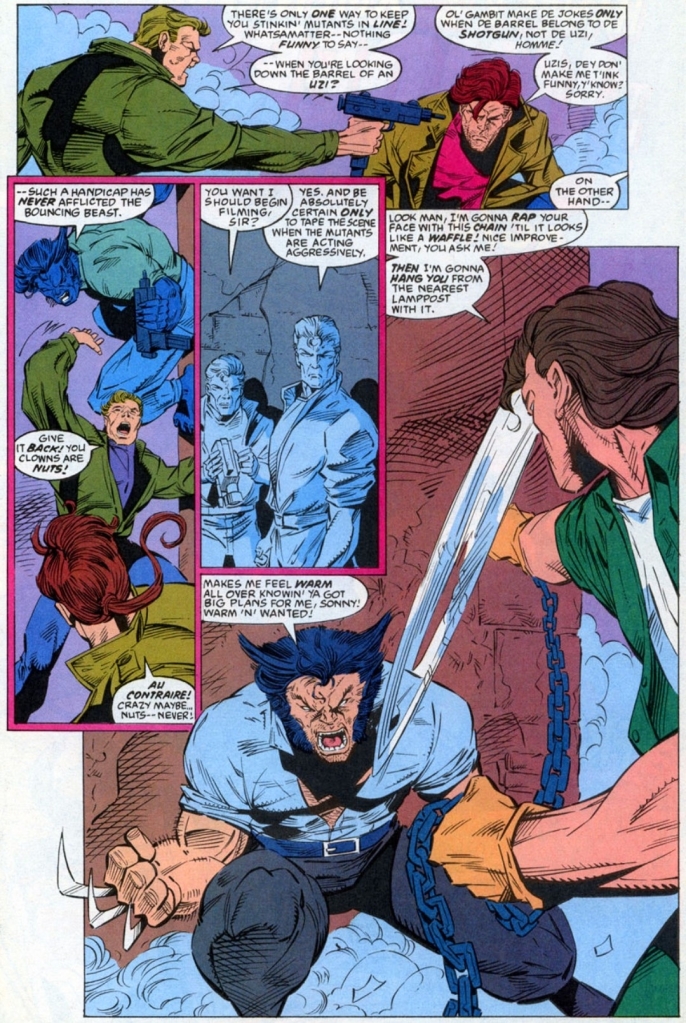
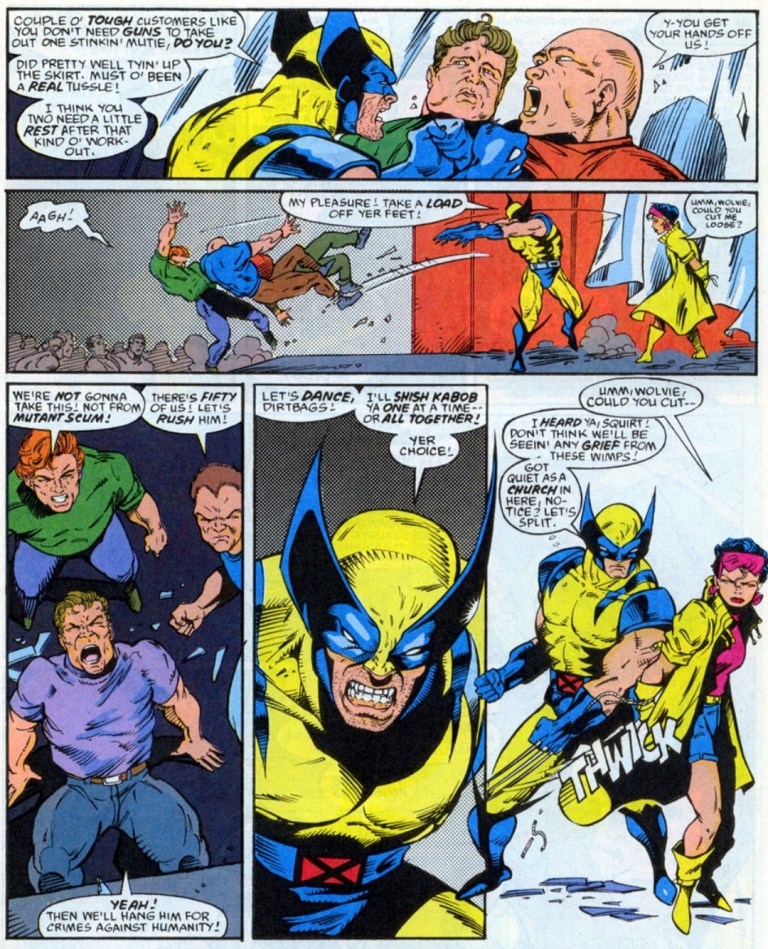
To put things clearly, this comic book is a nice pay-off to what was built up in the previous issue. Without spoiling the plot, I like the way the struggles of the X-Men were dramatized, specifically with regards to Wolverine (who was portrayed as an aggressor by the anti-mutant activists through the media) encountering the anti-mutant mob plus his interaction with Morph who got a lot more of the spotlight this time around. Morph’s return here has a bigger impact and the way things were told here will compel you to revisit the early issues of the first volume of X-Men Adventures and re-examine how he interacted with his teammates when he was still an X-Men member.

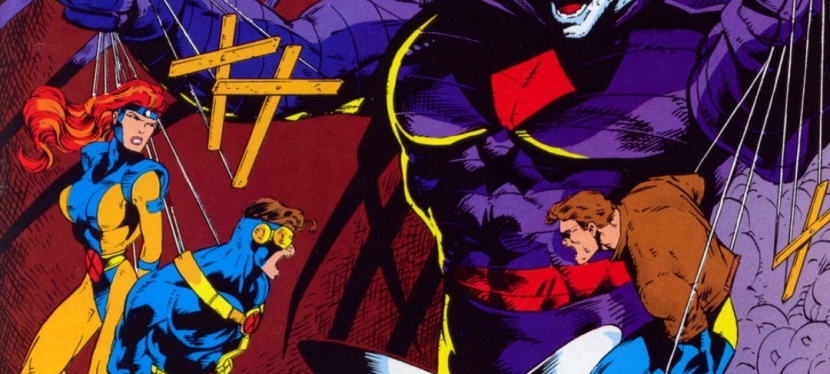
And then there is the sub-plot in which Cyclops and his wife Jean are captured by Mister Sinister and his henchmen. What I enjoyed the most in this part of the story was the efficient exposition done by the creative team to emphasize Sinister’s knowledge of Cyclops’ past and the X-Men which is connected with his master plan for the future that involves the genetic material of both Scott Summers and his wife. Sinister’s master plan for mutants is radically different from Magneto’s vision but remains essentially wicked as it involves overwhelming non-mutant people.  

Conclusion

Wolverine faces the anti-mutant activists again not for revenge but to help his teammate.

X-Men Adventures Season II #2 (1994) is an action-packed read that is also intriguing and has few plot twists that added to the engagement. It is a better read than the previous issue and any X-Men fan who enjoys Mister Sinister antagonizing Marvel’s mutants will have stuff to enjoy and that includes the promise of future conflicts. If there’s anything that bogged down this comic book’s quality, it’s the somewhat rushed look of Andrew Wildman’s art.

Overall, X-Men Adventures Season II #2 (1994) is recommended.

+++++

Thank you for reading. If you find this article engaging, please click the like button below, share this article to others and also please consider making a donation to support my publishing. If you are looking for a copywriter to create content for your special project or business, check out my services and my portfolio. Feel free to contact me with a private message. Also please feel free to visit my Facebook page Author Carlo Carrasco and follow me on Twitter at  @HavenorFantasy as well as on Tumblr at https://carlocarrasco.tumblr.com/ and on Instagram at https://www.instagram.com/authorcarlocarrasco
A Look Back at X-Men Adventures Season II #1 (1994)

Welcome back superhero enthusiasts, 1990s arts and culture enthusiasts, Marvel Comics fans and comic book collectors! Today we go back to the mid-1990s to explore the adaptation of the start of the second season of the X-Men animated series in the form of the X-Men Adventures comic book series.

Before getting to the retro comic book review, I want to address the recent controversy and criticism of the new animated series X-Men ’97, a continuation of the popular 1990s series that turned out to be woke by featuring the so-called non-binary presentation of people. In my view, this is not surprising given the fact that the very woke Disney company has owned Marvel Entertainment for many years now and its wokeness has infected the animated X-Men franchise along with the most recent movies and shows of the Marvel Cinematic Universe (MCU). Wokeness and Leftist beliefs continue to ruin entertainment and established properties as we know it. It’s the culture of Communist-filled Hollywood (Commiewood).

So how do you reject X-Men wokeness apart from avoiding X-Men ’97? You simply go back to the X-Men animated series of the 1990s as well as the comic books that adapted the stories.

With those details laid down, here is a look back at X-Men Adventures Season II #1, published in 1994 by Marvel Comics with a story written by Ralph Macchio and drawn by Andrew Wildman.

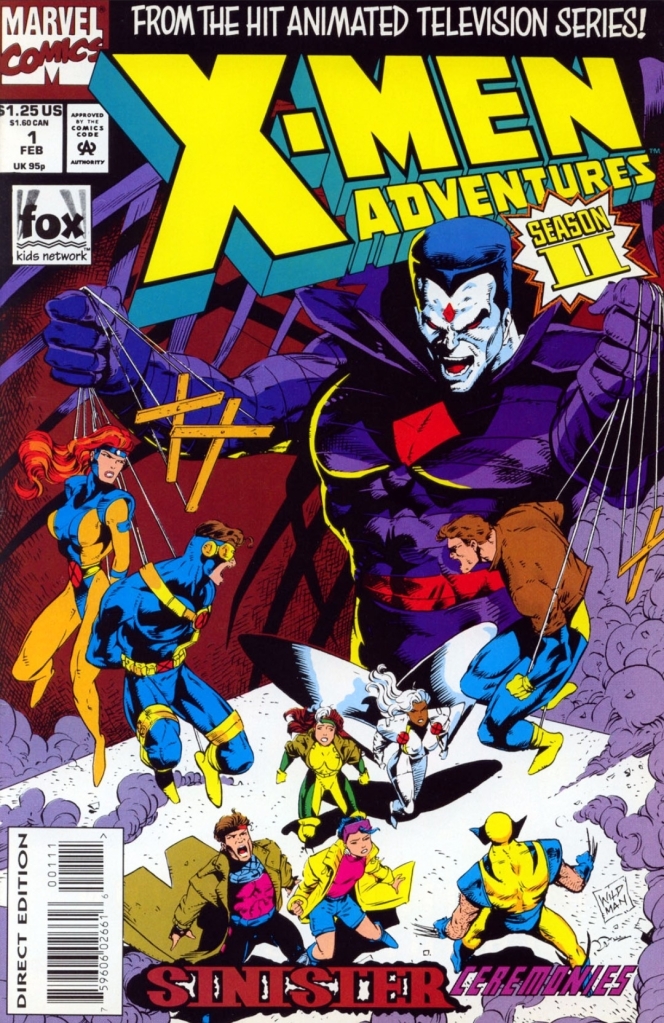
The cover.

Early story

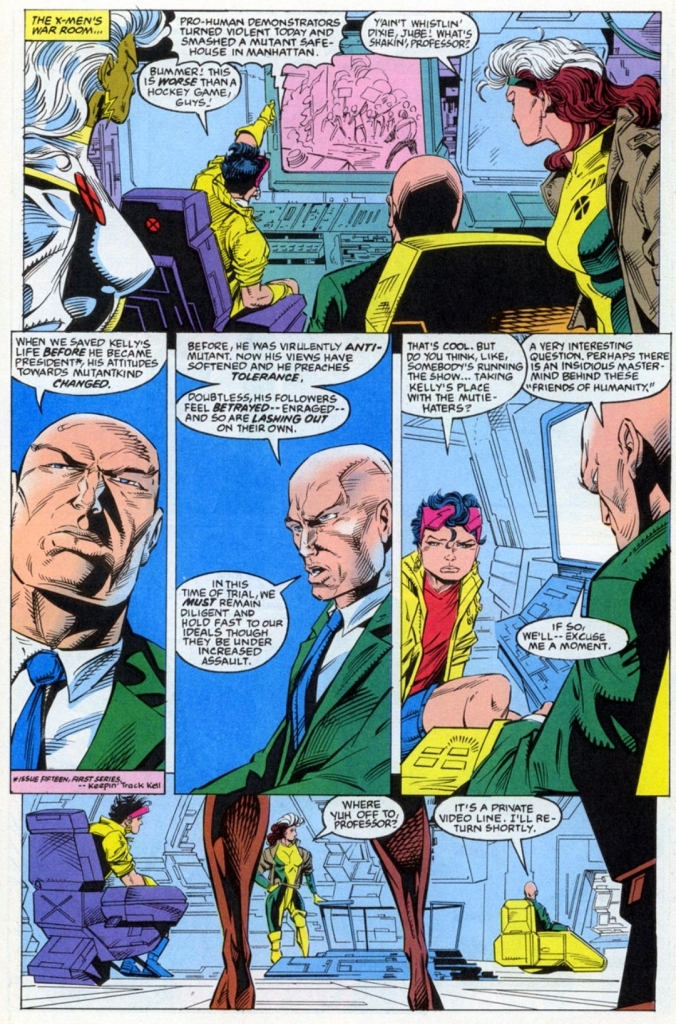
The story begins with the cosmic being the Watcher carefully examining the flow of events on Earth and what has changed for the X-Men since then. Robert Kelly, who previously had an anti-mutant agenda when he was a U.S. Senator, has since been elected as the President of the United States and openly pushes for a policy of conciliation with mutants. His action sparks social unrest.

Meanwhile inside a small church far away from the nation’s capital, the wedding of Jean Grey and Scott Summers pushes through with several members of the X-Men in attendance. Very notable was the absence of Wolverine who turned out to be inside the Danger Room (deep within Charles Xavier’s estate) fighting a giant-sized version of Cyclops…

Quality

The X-Men are troubled by the anti-mutant wave happening in public.

As the opening issue of the second volume of the X-Men Adventures comic book series, this comic book carefully sets up the tone and the plot of a series of future challenges for the X-Men which is clearly reflected on the front cover with Mister Sinister displayed prominently. The story mainly highlights X-Men’s new struggle with the wave of anti-mutant rage in the public while dealing with the absence of their leader Cyclops (on honeymoon with his new wife Jean) while leaving space for potential sub-plots such as the attraction between Jean and Wolverine, the moves of the anti-mutant radicals and, most notable of all, the secretive return of Morph (thought to have died in issue #2 of the first season).

As expected, build-up is the main approach taken by the creators on telling the story and there were some bouts of superhero spectacle (action) that spiced up the reading experience for me. Considering what has been happening in different parts of the world in recent years, the sub-plot of the rabid anti-mutant activists using tactics to destroy the X-Men’s credibility with violence and misinformation magnified through the news networks is very socially relevant.

What the rabid anti-mutant people committed in this comic book reminds me of the October 7, 2023 attacks on Israel organized by the Palestinian terrorist group Hamas in which violence, destruction and selective images of terror spread through news networks and social media were done. Similarities aside, the wave of evil is clear here and the intent of the anti-mutant believers and Palestinian terrorists obviously expresses intentions of genocide against another particular group of people.

When it comes to weaknesses of this comic book, I cannot help but find Andrew Wildman’s art looking very rushed. There is a lack of precision and detail of his art here when compared directly to his works in the first volume of X-Men Adventures.

Conclusion

The anti-mutant radicals in this comic book have a lot in common with Palestinian terrorists, the pro-Palestine activists, the Black Lives Matter activists and other members of woke mobs. Violence, arrogance, rage and misinformation are their values.

X-Men Adventures Season II #1 (1994) incidentally works well as an adaptation of the animated series, as a standalone comic book as well as being a socially relevant tale in today’s age of social media. While the concept of evil remains in X-Men lore, what was told here shows different layers of it. The X-Men themselves also looked fragile and the return of Morph is a key part of the story clearly designed with future events in mind. Finally, this comic book is a lively reminder of the era when X-Men stories were made for the fans, not the woke mob.

Overall, X-Men Adventures Season II #1 (1994) is recommended.

+++++

Thank you for reading. If you find this article engaging, please click the like button below, share this article to others and also please consider making a donation to support my publishing. If you are looking for a copywriter to create content for your special project or business, check out my services and my portfolio. Feel free to contact me with a private message. Also please feel free to visit my Facebook page Author Carlo Carrasco and follow me on Twitter at  @HavenorFantasy as well as on Tumblr at https://carlocarrasco.tumblr.com/ and on Instagram at https://www.instagram.com/authorcarlocarrasco

A Look Back at Spider-Man #2 (1990)

Welcome back superhero enthusiasts, 1990s culture enthusiasts and comic book collectors! Today we go back to the early 1990s and explore a part of the Marvel Comics shared universe through a tale of the Spider-Man monthly series.

In my previous retro review, Todd McFarlane told a tale of the iconic web-slinger with intense build-up leading to another rematch with his old nemesis the Lizard (Dr. Connors). While the writing was pretty weak, McFarlane still managed to tell a tale with a strong element of horror and supernatural stuff. McFarlane’s approach with visual violence and graphic stuff was clearly adulterated. What was presented daringly tested the limits allowed under the Comics Code Authority (CCA).

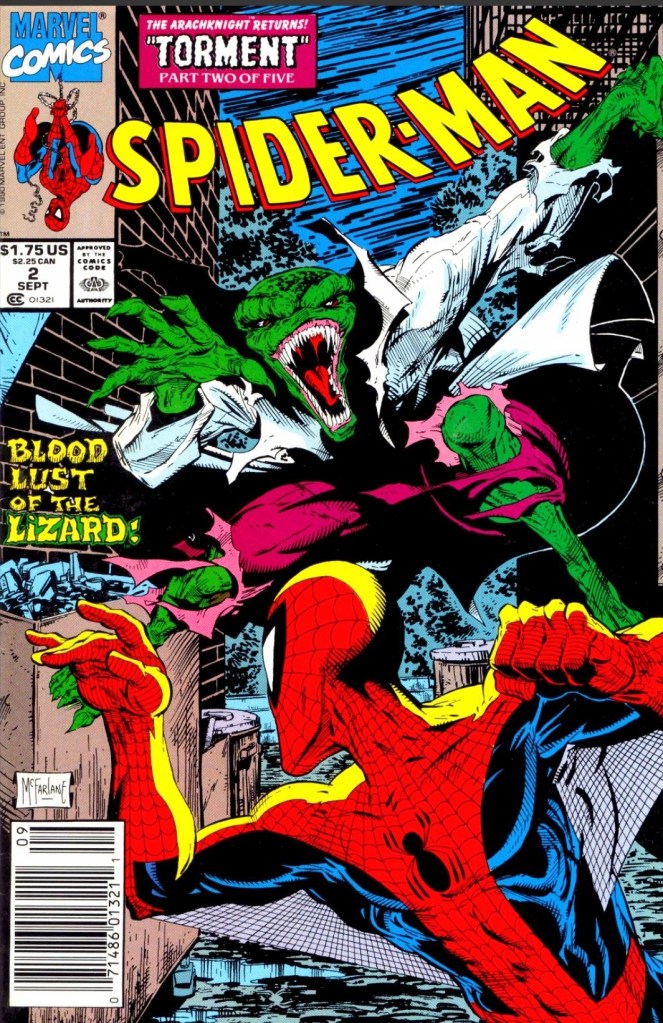
With those details laid down, here is a look back at Spider-Man #2, published in 1990 by Marvel Comics with a story written and drawn by Todd McFarlane. This is also the 2nd chapter of the Torment storyline.

The cover.

Early story

The story begins in New York City where two men got suddenly murdered by the Lizard in an alley during the night. The next morning Peter Parker reads the newspaper (showing the photograph and the news story of the Lizard’s murder of the two men) while having a breakfast moment with his wife Mary Jane. As soon as his wife mentions the word “monster”, Peter takes a 2nd look at the newspaper’s photograph and finally notices the bloody writing “CNNR” on the alley wall which makes him realize that the Lizard is back again.

Feeling very troubled, Peter leaves Mary Jane quietly and dresses up as Spider-Man to go out once again.

Elsewhere in the city, a sorceress uses her evil method of crafting a potion which creates an unrelenting sound of disturbance which Spider-Man hears. As the sound goes on, his focus and Spider Sense get overwhelmed…

Quality

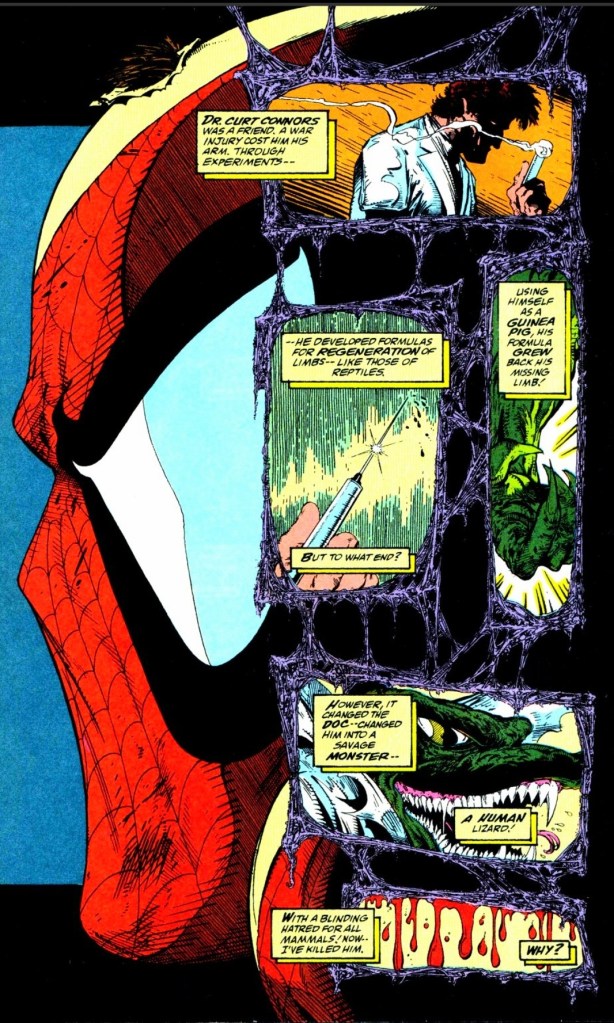
A quick look at the origin of the Lizard by McFarlane.

While the writing by McFarlane remains weak, he still succeeded in making this story a marginal improvement over the previous issue in terms of moving the plot forward, paying off a good chunk of the build-up in issue #1, and establishing his own visual corner (inspired by horror and adulterated stuff) within the Spider-Man franchise of comics of the time.

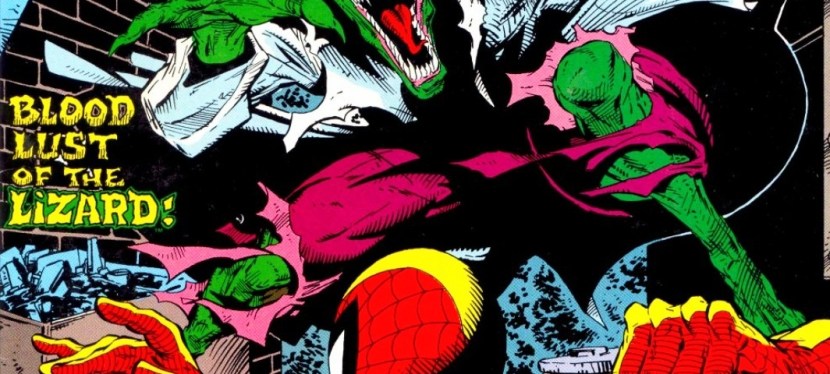
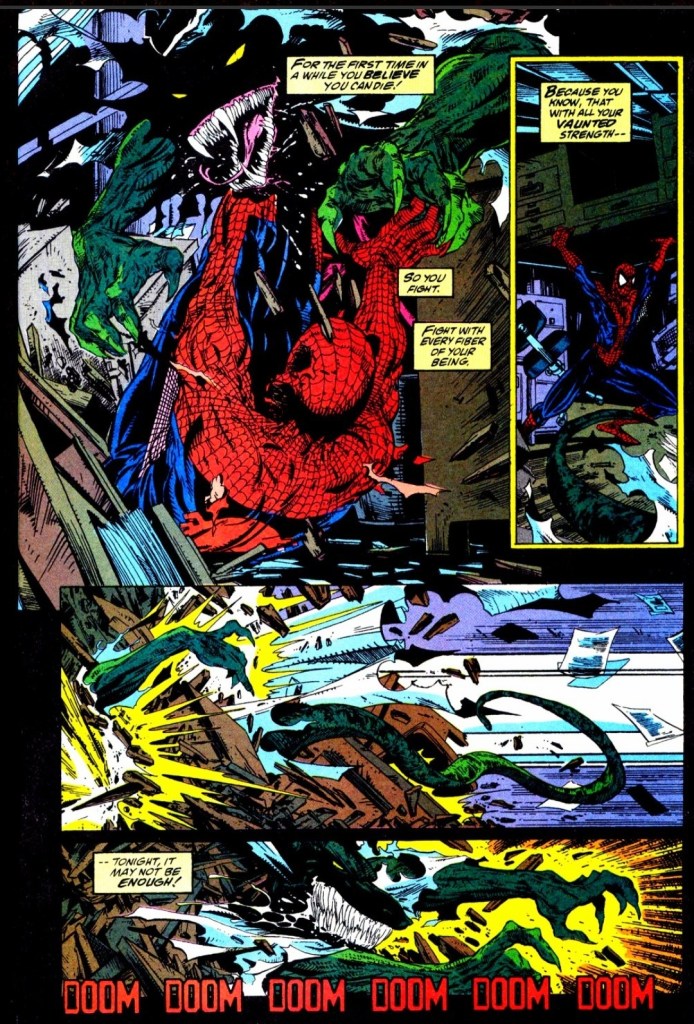
The biggest feature here is the physical conflict between Spider-Man and the Lizard. As expected, McFarlane drew the big fight with a lot of intense action, powerful violence (note: it was clear the editorial team recommended moves to tone down the graphic violence), suspense and a good amount of horror. Not only does the big fight move the story forward, it allowed McFarlane to dramatize Spider-Man as a vulnerable hero who not only has to cope with the disturbance from the sorceress far away, but also deal with the poison he got from the Lizard. That being said, Spidey also struggles with his sanity and the new fact that the Lizard has turned into a murder machine which disturbs him a lot as he personally knew Dr. Connors.

Considering what happened here and in the previous issue, there is still a greater force of evil that awaits Spider-Man and the Lizard happens to be an ultra-violent tool.

Conclusion

Many times Spider-Man finds himself in a disadvantage while fighting the Lizard.

Being the 2nd chapter of the Torment storyline, Spider-Man #2 (1990) is a slight improvement over the previous issue in terms of moving the story forward, spectacle and dramatization. While the big fight between Spider-Man and the murderous Lizard is clearly the big feature of the story, McFarlane does a good job portraying Spider-Man as vulnerable and on the edge towards defeat. McFarlane’s writing here is still weak but the other positive elements achieved outweighed the weakness.

Overall, Spider-Man #2 (1990) is satisfactory.

+++++

Thank you for reading. If you find this article engaging, please click the like button below, share this article to others and also please consider making a donation to support my publishing. If you are looking for a copywriter to create content for your special project or business, check out my services and my portfolio. Feel free to contact me with a private message. Also please feel free to visit my Facebook page Author Carlo Carrasco and follow me on Twitter at  @HavenorFantasy as well as on Tumblr at https://carlocarrasco.tumblr.com/ and on Instagram at https://www.instagram.com/authorcarlocarrasco

A Look Back at Spider-Man #1 (1990)

Welcome back superhero enthusiasts, 1990s culture enthusiasts and comic book collectors! Today we go back to the early 1990s and explore a part of the Marvel Comics shared universe through a tale of the Spider-Man monthly series.

Back in the late 1980s, Todd McFarlane proved to be a highly talented artist who helped Marvel sell a lot of issues of the Amazing Spider-Man series. McFarlane was also highly involved with the creation of Venom which not only became Spider-Man’s deadliest foe but also an icon of Marvel’s. In the year 1990, a brand new monthly series of Spider-Man was launched and it had Todd McFarlane writing and illustrating the tales.

With those details laid down, here is a look back at Spider-Man #1, published in 1990 by Marvel Comics with a story written and drawn by Todd McFarlane. This marks the beginning of the Torment storyline.

The cover.

Early story

The story begins in New York City where countless people walk to their respective destinations not realizing that the local hero Spider-Man was swinging above them. In a dirty alley, Spider-Man prevents an armed thug from harming a woman and leaves him hanging covered with a lot of web.

Elsewhere in the city, a sinister figure conducts a ritual, prays to evil forces and begins using magic.

In yet another location, a hideous creature emerges from the water. It’s the Lizard…

Quality

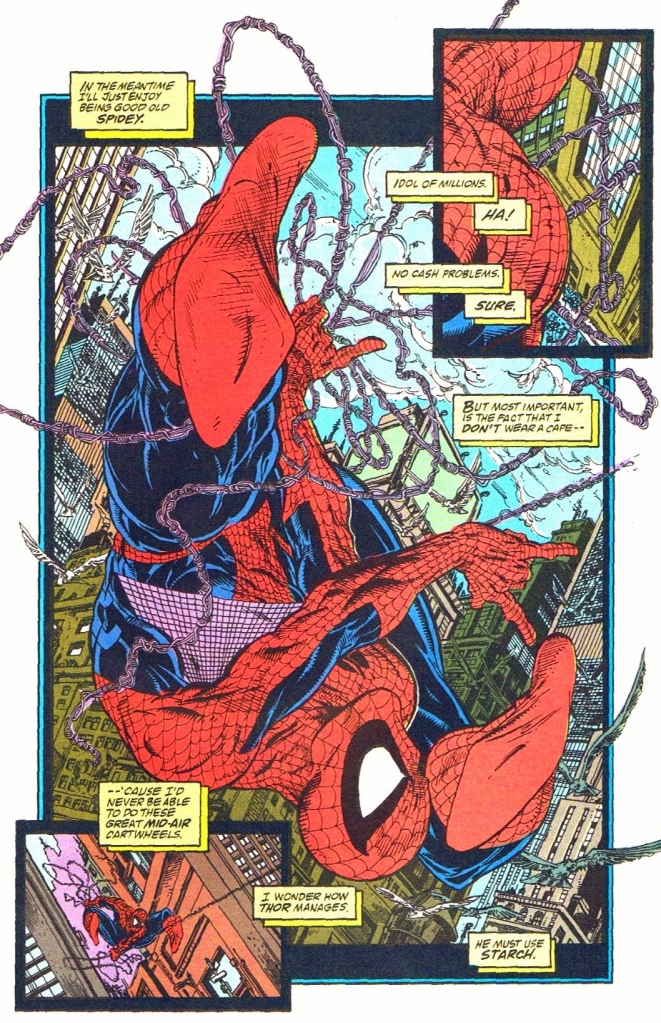
This page is an example of Todd McFarlane creating a travel sequence that allowed him to draw something great. It’s a classic example of moving back into the comfort zone.

To make things very clear here, this comic book is pretty shallow and hollow mainly due to its storytelling as this was the writing of a very young Todd McFarlane. There is no denying that his art here is great to look at from start to finish. In fact, this was one of McFarlane’s finest visual works ever with Marvel.

But if you look beyond the great visuals, the writing is very weak all throughout the issue. At best, this comic book is a grand-looking yet shallow set-up for the conflict of the Torment storyline complete with shared emphasis on the iconic web-slinger, the Lizard (looking more menacing than before) and Calypso (the one behind the magic and rituals).

In fairness to McFarlane, he added his own touch on emphasizing the personalities of Peter Parker and wife Mary Jane simultaneously as a couple. If you were used to seeing in-depth character development and witty dialogue about the two major characters as portrayed in the Amazing Spider-Man, Web of Spider-Man and Spectacular Spider-Man series of 1990, you won’t find them in this comic book. Under McFarlane’s writing, Spider-Man in this issue showed signs of sarcasm and cockiness in the first scene, and with Mary Jane he (as Peter Parker) expressed himself philosophically. To say the least, the portrayal of Spider-Man here is noticeably different under McFarlane.

The Lizard, a long-time rival of Spider-Man’s, was presented to be very violent and murderous in this issue. This was clearly McFarlane’s approach on emphasizing the force of opposition that awaits the iconic web-slinger and he obviously went for a more adulterated approach with the visuals. That being said, the violent content in this comic book is very unique and clearly stood out from the rest of the Spider-Man-related comics published by Marvel in 1990. Lastly, I should say that McFarlane’s visual take on the Lizard is the best I have seen.  

Going back to the visuals, McFarlane implemented strong elements of horror, darkness and grittiness which went along well with the adulterated approach to violence.  These mixed elements, as they turned out in reality, became part of McFarlane’s future works past Spider-Man.

Conclusion

McFarlane’s vicious and horrifying approach on visualizing the Lizard can’t be ignored. This Lizard makes the cinematic Lizard of the 2012 movie The Amazing Spider-Man look cartoony.

Spider-Man #1 (1990) is a very mixed bag when it comes to literary enjoyment. It clearly has great artwork by McFarlane whose adulterated approach on expression and spectacle made it very unique. The writing by McFarlane (who was very young at the time of production) is clearly the big letdown although his own approach on portraying Spider-Man, MJ and the Lizard are very notable. Take note that this was Todd McFarlane starting with writing while doing the art (his true strength), and at this point in comic book history his talent on telling compelling stories would not be realized until a few years later (particularly with Spawn and Image Comics). Notably, his use of visual horror and darkness predates his work in Spawn which makes his Spider-Man take very distinct. Ultimately, this comic book served as a build-up for things to come in the Torment storyline. Don’t expect too much when acquiring this comic book.

Overall, Spider-Man #1 (1990) is satisfactory.

+++++

Thank you for reading. If you find this article engaging, please click the like button below, share this article to others and also please consider making a donation to support my publishing. If you are looking for a copywriter to create content for your special project or business, check out my services and my portfolio. Feel free to contact me with a private message. Also please feel free to visit my Facebook page Author Carlo Carrasco and follow me on Twitter at  @HavenorFantasy as well as on Tumblr at https://carlocarrasco.tumblr.com/ and on Instagram at https://www.instagram.com/authorcarlocarrasco

What to watch on YouTube right now – Part 11

Have you been searching for something fun or interesting to watch on YouTube? Do you feel bored right now and you crave for something to see on the world’s most popular online video destination?

I recommend you check out the following topics and the related videos I found.

#1 Xbox-related announcements at The Game Awards 2023 – The Game Awards 2023 edition took place recently and like many of its previous editions, it was a spectacle of video game awards as well as announcements of upcoming games. Team Xbox, which now has giant publishers Activision-Blizzard-King and Bethesda under its umbrella, came out with very notable video game announcements that not only includes Hideo Kojima’s Xbox project but also a brand new game (the licensed property of a very popular entertainment brand) which I never anticipated coming. I should also state that Square Enix’s announcement of Visions of Mana includes the Xbox Series X and Xbox Series S for future release. Watch the videos (including one from a YouTuber) below…

#2 Godzilla Minus One makes impact in America – While its current theatrical distribution in America is not too great, the Japanese-made Godzilla Minus One movie managed to make an impact with moviegoers and critics there. In fact, Toho’s newest Godzilla film even topped the American box office on specific days during the week (click here and here) even though it came with English subtitles (with original Japanese voices throughout) that had to be read by moviegoers. Why is Godzilla Minus One making an impact in America? Watch the videos below…

#3 The evil of the Islamo-Left  – It is not surprising at all that Leftist elements continue to take sides with the Palestinian terrorist group Hamas while opposing Israel’s war efforts in the Gaza strip (Israel’s response to Hamas’ October 7 terrorist attacks and abduction of hostages). If you do your research of history, you will realize that the unholy alliance between Islamic terrorists and Leftists actually go a long way back. That alliance is referred to as the Islamo-Left which is composed of Islamists and Leftists who are united by their hatred for Israel and their desire to commit genocide against the Jewish people. The Islamo-Left is the evil force that needs to be rejected and defeated. I also want to state again that the Palestinians are NOT the indigenous people of Israel, the Palestinians have no right to the land of Israel, and the Palestinians are still living under the wickedness of their leaders (Hamas and the Palestinian Authority). Learn more by watching the video below…

#4 Beware of charismatic criminals – In this divided world we live in, there are certain charismatic individuals who wield so much power, they managed to deceive people and commit crimes believing they could simply get away with it all. The charismatic criminals of recent times are specifically Elizabeth Holmes (convicted), Sam Bankman-Fried (convicted) and Charlie Javice. To find out who the charismatic crooks are, what happened to them and why you must never let them deceive you, watch the videos below…

#5 Unite with the Right to push back against the Satanic Left – Shifting to geopolitics, Sky News Australia published two videos that must be seen. The first one is about the political Right gaining significant ground in the Netherlands and Argentina (following the very inspired political shift related to Giorgia Meloni’s rise to power in Italy in 2022). The 2nd video shows why the Satanic Left often leads people to social, political and economic ruin as seen in Argentina. Let these two videos inspire you and members of your community to rise up against the Leftists and be united with the Right in future elections as well as with ongoing developments of the current government. Never let the Satanic Left take even the slightest space away from you. Communists, socialists, Marxists, liberals, diversity fanatics, inclusion fanatics, LGBT activists, the woke nuts, pro-Palestine zealots and all those other wicked Leftist elements are simply too chaotic to be given power.

+++++

Thank you for reading. If you find this article engaging, please click the like button below, share this article to others and also please consider making a donation to support my publishing. If you are looking for a copywriter to create content for your special project or business, check out my services and my portfolio. Feel free to contact me with a private message. Also please feel free to visit my Facebook page Author Carlo Carrasco and follow me on Twitter at  @HavenorFantasy as well as on Tumblr at https://carlocarrasco.tumblr.com/ and on Instagram athttps://www.instagram.com/authorcarlocarrasco

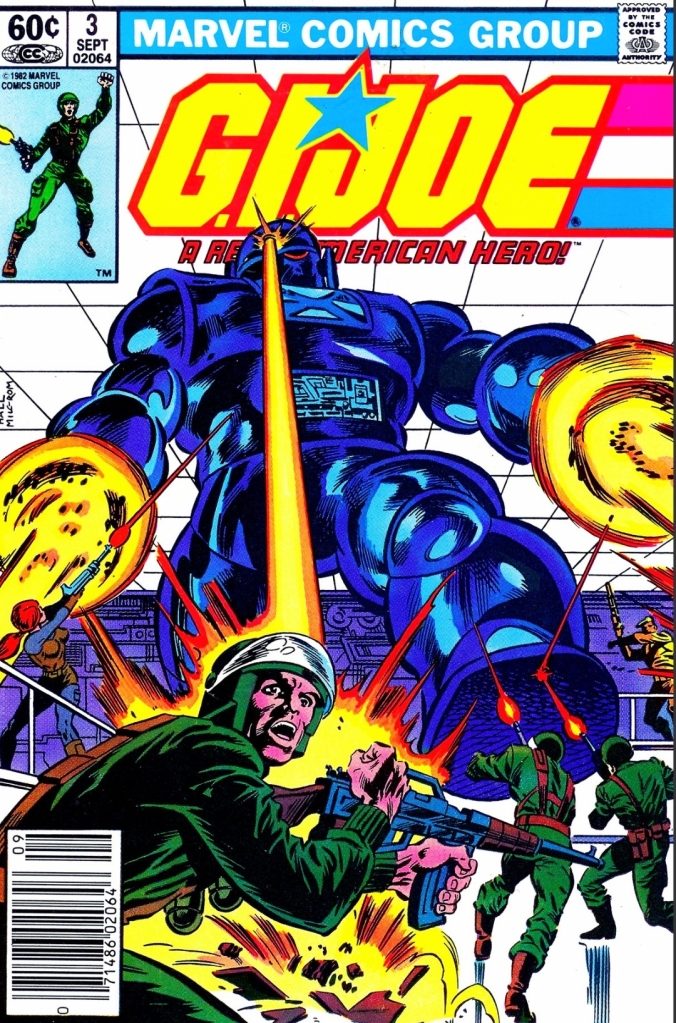
A Look Back at G.I. Joe: A Real American Hero #3 (1982)

Welcome back superhero enthusiasts, 1980s culture enthusiasts and comic book collectors! Today we go back to the early 1980s to explore Marvel Comics’ handling of a series based on the wildly popular military-themed franchise of toys – G.I. Joe: A Real American Hero.

Last time around, a small number of G.I. Joe members went to the North Pole on a mission to find answers and anyone responsible for the destruction of the American research base. The mission did not involve Cobra at all but a certain specialist who was working as a freelancer.  

With those details laid down, here is a look back at G.I. Joe: A Real American Hero #3 published in 1982 by Marvel Comics with the main story written by Larry Hama and drawn by Herb Trimpe.

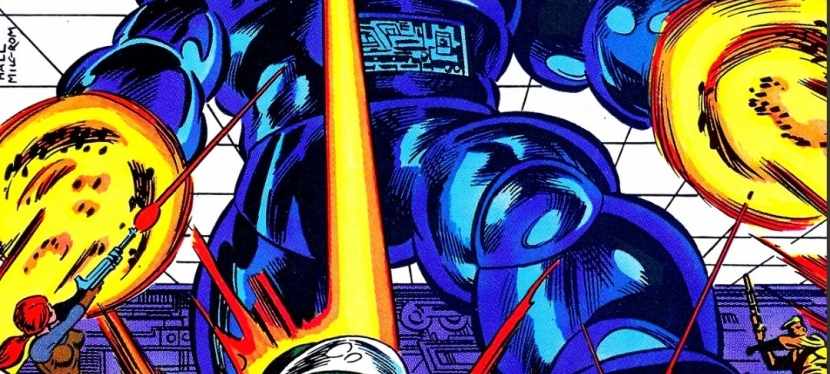
The cover.

Early story

The story begins shortly after G.I. Joe’s successful raid on a secret stronghold that belonged to their arch-rival Cobra. A huge, bulky robot was found at the site and the Joe team received orders to get the machine back to their command center – The Pit – to run preliminary scans on it.

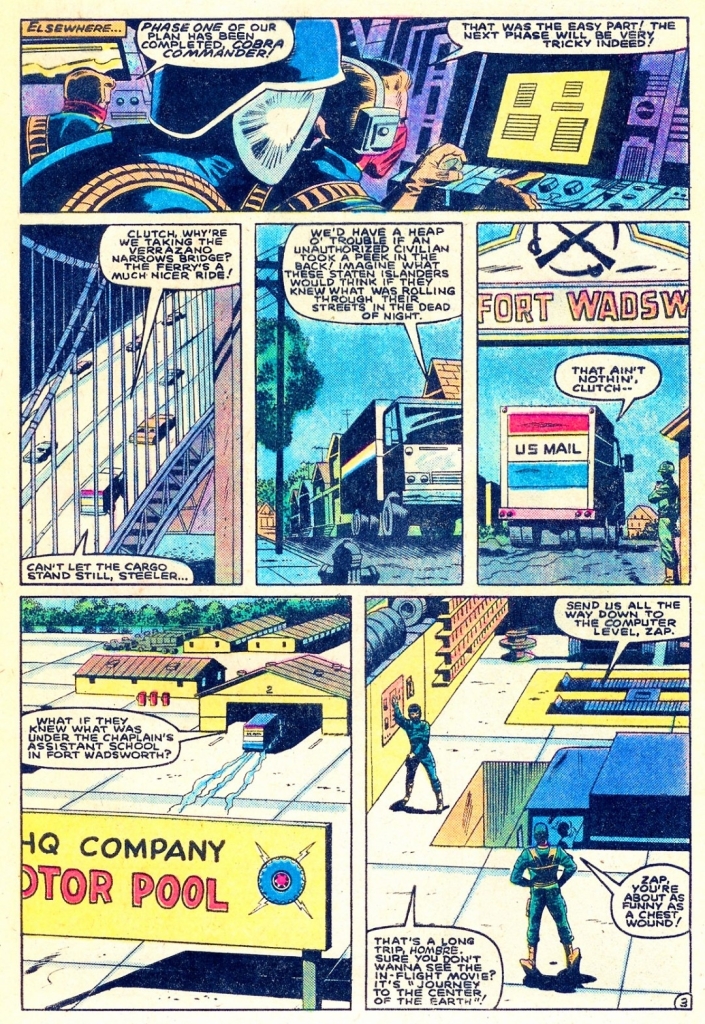
Due to the very sensitive nature of the robot and the Cobra stronghold, the military uses three trucks disguised as American mail trucks for the trips to The Pit.

Elsewhere, Cobra Commander and his team are aware that G.I. Joe is bringing the robot with them. He has a Trojan plan prepared…

Quality

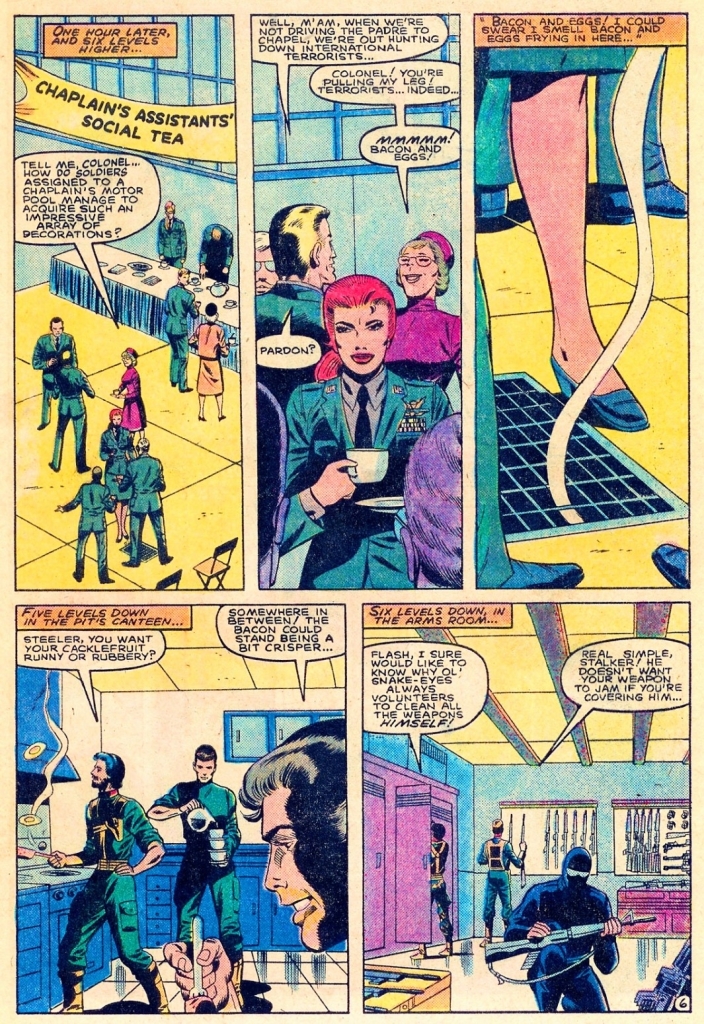
The scent of bacon and eggs reached the higher levels.

To make things clear, this is story still does not put G.I. Joe head-to-head with Cobra in combat. Instead, this is a tale about Cobra’s attempt to cause chaos on their rivals deep within a top secret stronghold of the Americans. That being said, the main character here is the huge robot of Cobra’s which really pushed the Joe team into real challenges. The robot does not even speak and its actions really drove up the tension of both the Joe team’s predicament as well as the narrative itself.

Along the way, you will get to see members of G.I. Joe becoming more tactical with their struggle to survive and solve problems. In fact, the Joe members are more versatile which reflect what they learned from extensive training.

Conclusion

Cobra Commander monitors the developments from a distance as G.I. Joe members brought with them the robot from what was once a stronghold of Cobra.

While the lack of a direct conflict between the Joe team and Cobra is evident, G.I. Joe: A Real American Hero #3 (1982) still had an unrelenting enemy in the form of Cobra’s robot that proved to be a major force of opposition. In terms of presentation, this story has a slight touch of science fiction (due to the robot) but managed to be military in nature the rest of the way. Apart from their resourcefulness, the G.I. Joe members here displayed a strong element of team work. The narrative is packed with action as well as a good amount of details that made the reading experience consistently good.

Overall, G.I. Joe: A Real American Hero #3 (1982) is recommended.

+++++

Thank you for reading. If you find this article engaging, please click the like button below, share this article to others and also please consider making a donation to support my publishing. If you are looking for a copywriter to create content for your special project or business, check out my services and my portfolio. Feel free to contact me with a private message. Also please feel free to visit my Facebook page Author Carlo Carrasco and follow me on Twitter at  @HavenorFantasy as well as on Tumblr at https://carlocarrasco.tumblr.com/ and on Instagram at https://www.instagram.com/authorcarlocarrasco
A Look Back at Uncanny X-Men #157 (1982)

Welcome back superhero enthusiasts, 1980s culture enthusiasts and comic book collectors! Today we go back to the year 1982 to take a close look at one of the many tales of the Marvel Comics shared universe told through the monthly series of Uncanny X-Men.

In my previous retro review, Charles Xavier got reunited with his beloved Lilandra, the empress of the Shi’ar Empire, as they were trapped temporarily by the Brood. Elsewhere, Corsair reveals to his son Cyclops what happened before they got separated on Earth twenty years prior. The X-Men and the Starjammers got captured by the Brood’s massive transport which turned out to be a massive organic creature. The conflict that followed saw another battle between the X-Men and the Brood but with the stakes raised higher.

With those details laid down, here is a look back at Uncanny X-Men #157 published in 1982 by Marvel Comics with a story written by Chris Claremont and drawn by Dave Cockrum.  

The cover.

Early story

The story begins in space where the X-Men and the Starjammers worked together to repair the external parts of the Starjammer ship. An incident happens in which Wolverine starts to float away from the ship while Colossus loses consciousness. One of the Starjammers saved Wolverine.

Just as the Starjammers used their advanced technology to help the unconscious Colossus, Empress Lilandra tells Professor X and a few others that she used her imperial commlink and private code to each Chanellor Araki to confirm to him that she is free and unharmed. Supposedly, Lilandra’s move should compel Araki to call off the punitive strike against Earth.

As Lilandra starts communicating with the flagship that carries Araki, Admiral Lord Samedar takes control of the ship and declares that they will execute Araki’s orders to obliterate Earth…

Quality

Kitty Pryde on the move against all odds.

Following the events of the two previous issues, this story is another engaging pay-off to the established build-up but with the stakes raised higher as Earth becomes a target of the defiant Shi’ar officials who themselves turned out to be defiant towards their empress Lilandra all along. Not only that, there is a good amount of intrigue with the way the Shi’ar people are portrayed here.

The X-Men here continue to struggle not only because of Colossus’ weakness but also because something bad happened to their leader Professor X (a must-read scene). Far away from the rest of their teammates, Nightcrawler and Kitty Pryde became major players in this particular story and what happened with them was nicely structured by Chris Claremont. This is clearly a big pay-off to what was staged in issue #155 and it sure is worth anticipating!

If you have great interest with the Brood, you will be delighted to see more of the way they communicate and how they treat foreigners like Deathbird as they live on with their uncompromising belief that their race backs winners only.

Conclusion

How the Brood treats Deathbird.

Uncanny X-Men #157 (1982) is an action-packed sci-fi tale that continued Claremont’s direction of the X-Men while also emphasizing the Brood as well as the Starjammers and the Shi’ar as crucial players in this particular storyline. There is plenty of superhero spectacle to enjoy here, a few memorable character moments and if you are fond of Chris Claremont’s works, you will enjoy the twists and surprises he pulled off here.

Overall, Uncanny X-Men #157 (1982) is recommended!

+++++

Thank you for reading. If you find this article engaging, please click the like button below, share this article to others and also please consider making a donation to support my publishing. If you are looking for a copywriter to create content for your special project or business, check out my services and my portfolio. Feel free to contact me with a private message. Also please feel free to visit my Facebook page Author Carlo Carrasco and follow me on Twitter at  @HavenorFantasy as well as on Tumblr at https://carlocarrasco.tumblr.com/ and on Instagram at https://www.instagram.com/authorcarlocarrasco
A Look Back at G.I. Joe: A Real American Hero #2 (1982)

Welcome back superhero enthusiasts, 1980s culture enthusiasts and comic book collectors! Today we go back to the early 1980s to explore Marvel Comics’ handling of a series based on the wildly popular military-themed franchise of toys – G.I. Joe: A Real American Hero.

Last time around, G.I. Joe members were sent to an island to rescue a very important woman who was kidnapped by Cobra. Along the way, the Joes faced stiff opposition and the duo of Snake-Eyes and Scarlett infiltrated the headquarters facing off with Cobra Commander and the Baroness. The comic book itself was indeed engaging and fun to read.

With those details laid down, here is a look back at G.I. Joe: A Real American Hero #2 published in 1982 by Marvel Comics with the main story written by Larry Hama and drawn by Don Perlin.

The cover.

Early story

The story begins when the United States discovers its research station in the North Pole has been attacked and left in ruin. The damage found indicates that it has been wiped out in a commando-style raid, all station personnel were found dead and all the records were missing.

After carefully assessing the available information about the ruined American base, General Austin decides to send the G.I. Joe team to the North Pole. This resulted in cutting short the respective leaves of Stalker, Breaker, Scarlett and Snake-Eyes.

After being dropped at the North Pole, the selected G.I. Joe members carefully make their way to the Russian base and decide to watch from a distance…

Quality

The character Kwinn is the most interesting character in this story.

When compared to what happened in issue #1, this comic book’s concept is smaller in scale but allows room for readers to get to know the Joes closely and follow the simplified plot which itself has details that are worth looking into.

When it comes to entertainment value, don’t expect a repeat of the bombastic action of the previous comic book. Expect to see lesser action but with more suspense and a stronger emphasis on the complexities that come with the world of espionage which itself is never simple.

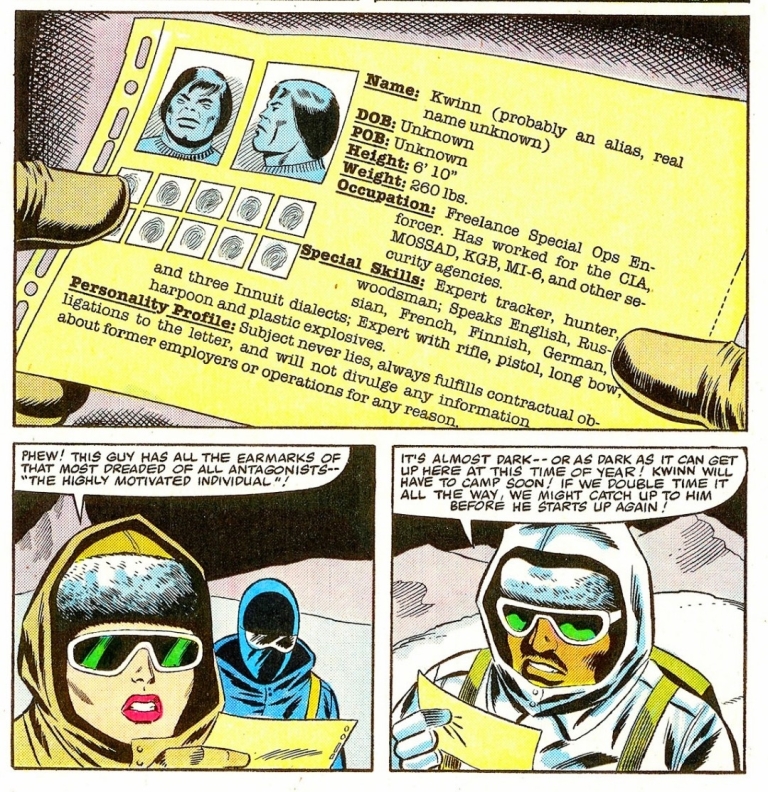
That being said, the force of opposition here is not Cobra at all but something different. The new character Kwinn is a freelance operative who is quite formidable and he sure has extensive experience that enables him to outsmart the Joes. On top of that, Kwinn’s strong adherence to his principles and code of honor made him quite a pretty deep character which are nicely reflected into the story itself. For this reason alone, this is a must-read G.I. Joe tale.

Conclusion

Have you ever experienced your leave getting canceled suddenly?

With G.I. Joe: A Real American Hero #2 (1982), the creative team of Larry Hama and Don Perlin took a very different approach that shifted away from the classic G.I. Joe/Cobra rivalry and deep into the world of espionage with a really engaging and refreshing tale. As the story features much lesser characters, you will get to know Stalker, Breaker, Scarlett and Snake-Eyes better. Kwinn is easily the most interesting and most compelling character of this comic book. While the story is fun and engaging, it may not delight fans who love to see the Joes fight the Cobra terrorists.

Overall, G.I. Joe: A Real American Hero #2 (1982) is recommended.

+++++

Thank you for reading. If you find this article engaging, please click the like button below, share this article to others and also please consider making a donation to support my publishing. If you are looking for a copywriter to create content for your special project or business, check out my services and my portfolio. Feel free to contact me with a private message. Also please feel free to visit my Facebook page Author Carlo Carrasco and follow me on Twitter at  @HavenorFantasy as well as on Tumblr at https://carlocarrasco.tumblr.com/ and on Instagram at https://www.instagram.com/authorcarlocarrasco