Disclaimer: This is my original work with details sourced from reading the comic book and doing personal research. Anyone who wants to use this article, in part or in whole, needs to secure first my permission and agree to cite me as the source and author. Let it be known that any unauthorized use of this article will constrain the author to pursue the remedies under R.A. No. 8293, the Revised Penal Code, and/or all applicable legal actions under the laws of the Philippines.
Welcome back superhero enthusiasts, 1990s culture enthusiasts and comic book collectors! Today we go back to the early 1990s and explore a part of the Marvel Comics shared universe through a tale of the Spider-Man monthly series.
Back in the late 1980s, Todd McFarlane proved to be a highly talented artist who helped Marvel sell a lot of issues of the Amazing Spider-Man series. McFarlane was also highly involved with the creation of Venom which not only became Spider-Man’s deadliest foe but also an icon of Marvel’s. In the year 1990, a brand new monthly series of Spider-Man was launched and it had Todd McFarlane writing and illustrating the tales.
With those details laid down, here is a look back at Spider-Man #1, published in 1990 by Marvel Comics with a story written and drawn by Todd McFarlane. This marks the beginning of the Torment storyline.
The cover.
Early story
The story begins in New York City where countless people walk to their respective destinations not realizing that the local hero Spider-Man was swinging above them. In a dirty alley, Spider-Man prevents an armed thug from harming a woman and leaves him hanging covered with a lot of web.
Elsewhere in the city, a sinister figure conducts a ritual, prays to evil forces and begins using magic.
In yet another location, a hideous creature emerges from the water. It’s the Lizard…
Quality
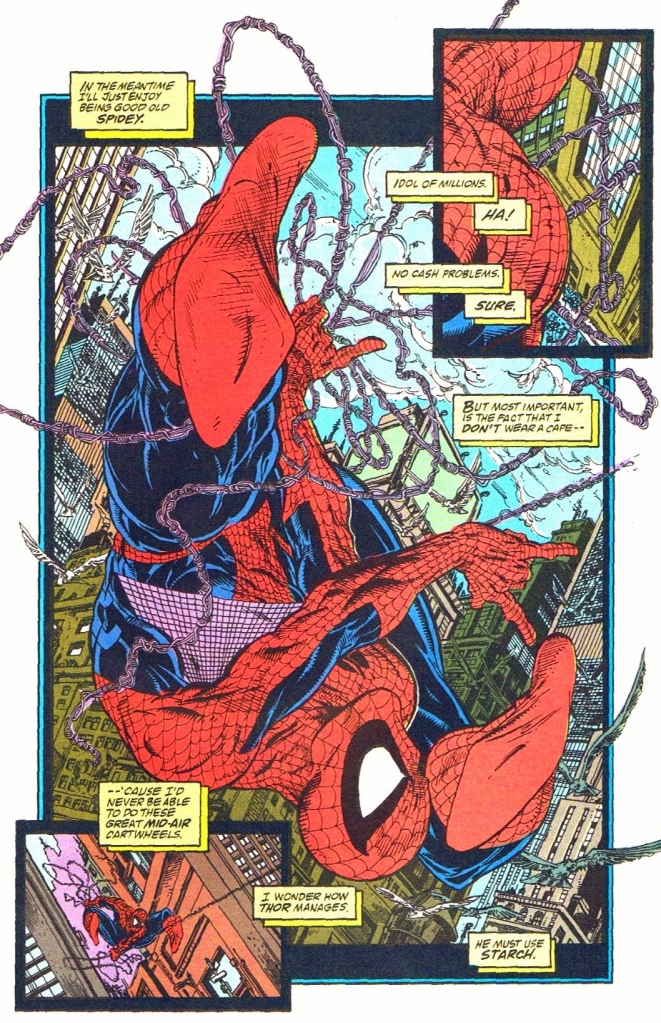
This page is an example of Todd McFarlane creating a travel sequence that allowed him to draw something great. It’s a classic example of moving back into the comfort zone.
To make things very clear here, this comic book is pretty shallow and hollow mainly due to its storytelling as this was the writing of a very young Todd McFarlane. There is no denying that his art here is great to look at from start to finish. In fact, this was one of McFarlane’s finest visual works ever with Marvel.
But if you look beyond the great visuals, the writing is very weak all throughout the issue. At best, this comic book is a grand-looking yet shallow set-up for the conflict of the Torment storyline complete with shared emphasis on the iconic web-slinger, the Lizard (looking more menacing than before) and Calypso (the one behind the magic and rituals).
In fairness to McFarlane, he added his own touch on emphasizing the personalities of Peter Parker and wife Mary Jane simultaneously as a couple. If you were used to seeing in-depth character development and witty dialogue about the two major characters as portrayed in the Amazing Spider-Man, Web of Spider-Man and Spectacular Spider-Man series of 1990, you won’t find them in this comic book. Under McFarlane’s writing, Spider-Man in this issue showed signs of sarcasm and cockiness in the first scene, and with Mary Jane he (as Peter Parker) expressed himself philosophically. To say the least, the portrayal of Spider-Man here is noticeably different under McFarlane.
The Lizard, a long-time rival of Spider-Man’s, was presented to be very violent and murderous in this issue. This was clearly McFarlane’s approach on emphasizing the force of opposition that awaits the iconic web-slinger and he obviously went for a more adulterated approach with the visuals. That being said, the violent content in this comic book is very unique and clearly stood out from the rest of the Spider-Man-related comics published by Marvel in 1990. Lastly, I should say that McFarlane’s visual take on the Lizard is the best I have seen.
Going back to the visuals, McFarlane implemented strong elements of horror, darkness and grittiness which went along well with the adulterated approach to violence. These mixed elements, as they turned out in reality, became part of McFarlane’s future works past Spider-Man.
Conclusion
McFarlane’s vicious and horrifying approach on visualizing the Lizard can’t be ignored. This Lizard makes the cinematic Lizard of the 2012 movie The Amazing Spider-Man look cartoony.
Spider-Man #1 (1990) is a very mixed bag when it comes to literary enjoyment. It clearly has great artwork by McFarlane whose adulterated approach on expression and spectacle made it very unique. The writing by McFarlane (who was very young at the time of production) is clearly the big letdown although his own approach on portraying Spider-Man, MJ and the Lizard are very notable. Take note that this was Todd McFarlane starting with writing while doing the art (his true strength), and at this point in comic book history his talent on telling compelling stories would not be realized until a few years later (particularly with Spawn and Image Comics). Notably, his use of visual horror and darkness predates his work in Spawn which makes his Spider-Man take very distinct. Ultimately, this comic book served as a build-up for things to come in the Torment storyline. Don’t expect too much when acquiring this comic book.
Welcome back, fellow geeks, Blu-ray collectors and movie buffs! Back in the late 1980s, I saw the 1988 version of The Blob – let’s refer to it as The Blob (1988) – on home video and it turned out to be a fine mix of thrills, scares and science fiction concepts that ultimately became fun to watch. Being young at a time when Internet connection and online research were not yet available, I was not even aware that The Blob (1988) was a remake of the 1958 original Blob movie that starred Steve McQueen.
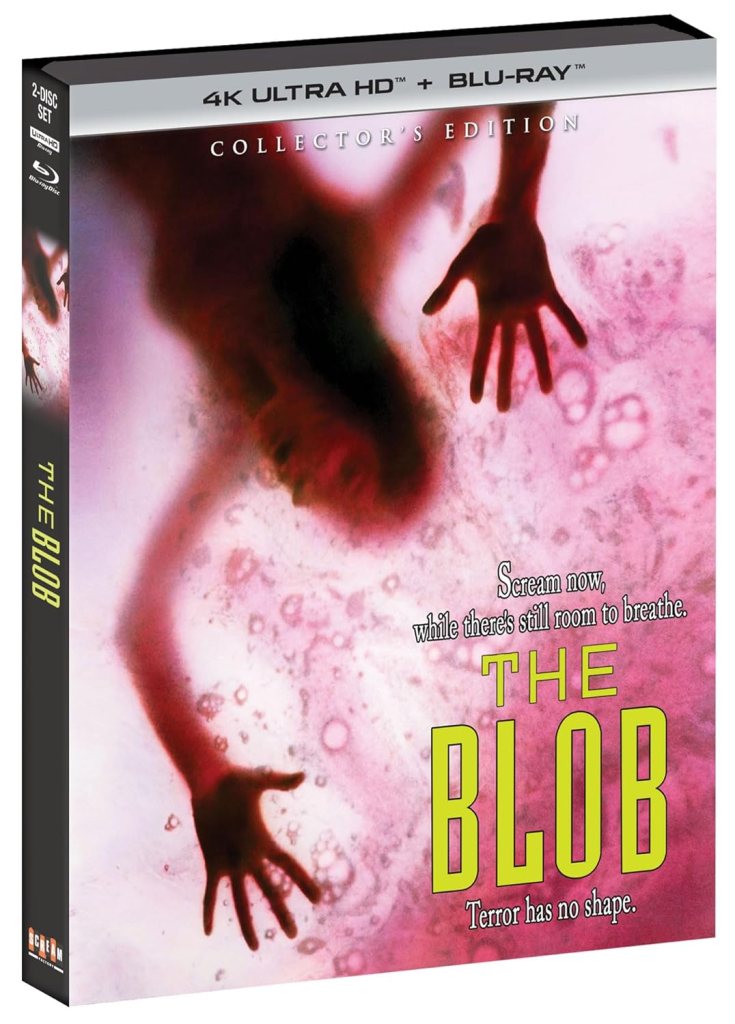
If you who love the late 1980s Blob movie and if you have been looking to add something to your home entertainment collection of Blu-ray and 4K Blu-ray movies, be aware that the Collector’s Edition 4K Blu-ray of The Blob (1988) is now available in the market and you can order it online right now and have it delivered to your home. The new release by Shout Factory! is loaded with features and it has native 4K visuals.
The Blob (1988) 4K Blu-ray cover.
To put things in perspective, posted below are the technical specs from The Blob (1988) 4K Blu-ray page at Blu-ray.com. The said website highly recommended it in its review.
Video Codec: HEVC / H.265 (84.99 Mbps) Resolution: Native 4K (2160p) HDR: HDR10 Aspect ratio: 1.85:1 Original aspect ratio: 1.85:1
Discs – 4K Ultra HD, Blu-ray Disc, Two-disc set (1 BD-100, 1 BD-50)
Packaging – Slipcover in original pressing, Reversible cover
Playback – 4K Blu-ray: Region free, 2K Blu-ray: Region A
Having seen both the 1958 and 1988 versions of The Blob, I can say to the newcomers and movie buffs reading this that you can’t go wrong with either version. I enjoyed both movies and I can say that each film has distinctive attractions for viewing. The Blob of 1958 is more sci-fi and has very little horror elements.
However, if you want thrills, the 1980s culture, stronger horror elements, stronger sci-fi elements, the creative approach done by director Chuck Russell and Frank Darabont on reimagining The Blob‘s concept, and the great-looking practical effects (note: the blob effects were made with physical stuff and a lot of man-made work without computers), then The Blob (1988) is the definitive choice. Take note I mentioned thrills as the movie has some fast-paced scenes that happen from time to time as you watch it. Considering its use of sci-fi concepts mixed with action, The Blob (1988) really stood out among the many horror movies released by Hollywood throughout the 1980s. I should also state that the remake has Kevin Dillon, Shawnee Smith, Jeffrey DeMunn, Joe Seneca, Candy Clark and Donovan Leitch Jr. in its cast.
As a 4K Blu-ray collector, I plan to acquire a copy of The Blob (1988) 4K Blu-ray in due time. I was already aware of the Blu-ray release from 2019 but I waited for the 4K version to be made.
If you want the best enjoyment possible from watching The Blob (1988) Collector’s Edition 4K Blu-ray, I highly recommend you avoid watching movie reaction videos and the spoileriffic retro movie reviews posted by YouTubers.
Disclaimer: This is my original work with details sourced from watching the movie and doing personal research. Anyone who wants to use this article, in part or in whole, needs to secure first my permission and agree to cite me as the source and author. Let it be known that any unauthorized use of this article will constrain the author to pursue the remedies under R.A. No. 8293, the Revised Penal Code, and/or all applicable legal actions under the laws of the Philippines.
Welcome back fellow geeks, pop culture enthusiasts and comic book collectors! Way back in 1982, the horror comedy anthology film Creepshow was released in cinemas featuring the combined talents of author Stephen King and the late director George Romero who were clearly inspired by the 1950s horror comic books published by EC Comics. That being said, Creepshow was a comic book movie that was not even based on a comic book.
To make things clear, the movie was first shown on the big screen in France during the Cannes Film Festival in May 1982. The comic book adaptation of Creepshow (note: read my retro comic book review) was released in July 1982 and the art it contained is not the same as the in-movie comic book (also titled Creepshow) that appeared in transition scenes. The movie’s general release in America happened on November 10, 1982 and it was successful commercially and critically. In recent times, Creepshow was released on 4K Blu-ray with lots of extra stuff for fans and moviegoers to enjoy. The said 4K Blu-ray release can be ordered online now.
Some of you might be wondering if the Creepshow movie has aged well and what exactly does it offer for younger moviegoers and movie collectors to enjoy. Some of you might be wondering if King and Romero were ever a special creative duo for cinema.
Prologue – A father very angrily berates and hits his young son after discovering the horror comic book titled Creepshow was with him. The father called the comic book’s content crap.
Father’s Day – Sylvia Grantham, her nephew Richard, niece Cass and Hank (husband of Cass) enjoy time together at the Grantham estate anticipating the arrival of Bedelia for the annual family dinner. There is a dark secret regarding Bedelia and her late father…
The Lonesome Death of Jordy Verril – A lonely farmer named Jordy witnesses the unexpected arrival of a meteorite from out space which landed violently on his farm. After realizing what it is, he touches it without any protection and gets his fingers burned…
Something to Tide You Over – a prominent man named Richard visits Harry at his home. It turns out, Harry has been having an affair with Richard’s wife Becky. Even so, Richard maintains his cool and made clear his uncompromising determination of always keeping what is his. Richard plays an audio recording of Becky’s voice which even includes a call for Harry to help her….
The Crate – In the basement level of Amberson Hall (science building of Horlicks University), a janitor accidentally finds a very old wooden crate located right under the staircase. The writings “Ship to Horlicks University via Julia Carpenter – Arctic Expedition – June 19, 1834” were marked on the crate…
They’re Creeping Up on You – A cruel businessman named Upson Pratt is alone in his well-lighted apartment. He has been suffering from mysophobia and has been living in isolation and only communicates with others using the telephone and other electronic methods. Slowly but surely, cockroaches begin to multiply in his apartment…
Quality
Two couples from different short stories of the movie: At left were Hal Holbrook and Adrienne Barbeau. At right were Elizabeth Regan and Ed Harris.
To begin with, I’d like to focus on the combined creativity of Stephen King and director George Romero. While all five short stories, the prologue and epilogue each have varying levels of quality, engagement and entertainment value, it is safe to say that Creepshow as a whole remains entertaining and intriguing to watch. This is a cinematic horror-comedy anthology that is still fun to watch from start to finish.
Very clearly, the King-Romero team were heavily inspired by the EC Comics-published horror comics of the 1950s and along the way, they added their own creative touches to make each short story not only unique but also memorable. Given the fact that Romero remains remembered for his zombie movie works, two of the five short stories can be viewed as shorter zombie tales by the director but with notable differences – the comic book-inspired visuals used (note: moody lighting, stylish backgrounds and comic-inspired frames) and the fine performances from the actors involved. As for the three other short stories that have nothing to do with zombies, I felt they reflected more of Stephen King’s concepts (note: King himself acted as Jordy) which Romero apparently directed to be reflective of the author’s works while still injecting EC Comics-inspired visuals. Speaking of comic books, the filmmakers used traditional animation (note: hand-drawn) specifically in the transition scenes when the movie moved from one segment to the next. Within the context of the movie was the comic book Creepshow which made the father mad at his son.
With moody lighting combined with Leslie Nielsen’s convincing terrified expression, this image captures the look and feel of similar moments in the horror comic books of EC Comics.
As it is clear that each short story has different concepts and varying levels of quality, entertainment and engagement, I can describe them in short results as follows: Father’s Day really looks and feels like it was written for EC Comics in the 1950s; The Lonesome Death of Jordy Verril is a clever mix of dark humor, science fiction and horror; Something to Tide You Over is very intriguing to watch and Leslie Nielsen pulled off a very unique portrayal of a villain; The Crate is a fine combination of monster horror and struggling characters with a university setting; and They’re Creeping Up on You is symbolically a socialist mobbing against someone powerful in the most unusual fashion, and it definitely is the weakest of all the five short stories as it was made to disgust viewers who are afraid of bugs. Creepshow’s prologue and epilogue meanwhile carried an anti-family theme that supposedly reflects the moral outrage against EC Comics in the 1950s made to resonate with people who love comic books at the expense of morality and family. I personally dislike the anti-family theme because I truly believe that minors should never read adulterated comic books and they should never become rebellious.
As each short story, the prologue and epilogue were strongly presented to be entertaining and engaging in varying ways, there is one aspect of the creativity that made Creepshow stand the test of time – the respective performances of the actors.
Leslie Nielsen’s portrayal of the villain Richard is the performance highlight of the entire film. Here’s a powerful man dealing with pain as a result of being betrayed by his wife by being in full control of his emotions and he keep moving on with uncompromised determination to proceed with his diabolical plans patiently and orderly. He is a very angry man who happens to be very calm. He is definitely evil who happens to be very principled. You will even see little traits of comedy in Richard and this should remind you of Nielsen’s eventual move into comedy in his later years. In the same short story, Ted Danson is believable as the man who had the affair with Richard’s wife.
In another short story, Adrienne Barbeau really stands out as the obnoxious and unhinged Wilma (AKA Billie) who is the complete opposite of her mild-mannered husband Henry (played by Hal Holbrook). She is so wild, she easily embarrasses her husband and the others who were present in the faculty social gathering. Quite symbolically, Barbeau’s act as Wilma is easily the most lively thing to watch in the said gathering. Without spoiling the plot of The Crate short story, I can say that Hal Holbrook has a nice range of displaying emotions within Henry as the story progressed. Even the guy who played the professor Dexter Stanley (Fritz Weaver) had his own share of the spotlight and displayed a good acting range as well.
Even author Stephen King himself acted in a leading role in another short story as Jordy. King is surprisingly good in being comedic and he really knows his character in and out. In the first short story Father’s Day, you will see a very young Ed Harris as part of a family waiting for the arrival of Bedelia (Viveca Lindfors). The waiting family members were nicely played by Elizabeth Regan, Warner Shook and the late Carrie Nye. They were convincing as relatives. In the final short story, the late E.G. Marshall played Upson Pratt to be so ruthless, he will irritate you.
Conclusion
Comic book-style visuals implemented cleverly in the movie.
It is clear that Creepshow (1982) remains fun and engaging to watch thanks to the combined creative efforts of the King-Romero team as well as the fine performances of the actors involved. Although the final short story starring E.G. Marshall is the least interesting tale to watch, this horror-comedy anthology has lots of good stuff to entertain viewers. By today’s standards, Creepshow (1982) is very unique and also fun to watch. If you want to see this movie with the best visuals possible today, I urge you to buy the 4K Blu-ray release.
Disclaimer: This is my original work with details sourced from reading the comic book and doing personal research. Anyone who wants to use this article, in part or in whole, needs to secure first my permission and agree to cite me as the source and author. Let it be known that any unauthorized use of this article will constrain the author to pursue the remedies under R.A. No. 8293, the Revised Penal Code, and/or all applicable legal actions under the laws of the Philippines.
Welcome back fellow geeks, pop culture enthusiasts and comic book collectors! Way back in 1982, the horror comedy anthology film Creepshow was released in cinemas and it gave moviegoers a fun time getting scared as it featured well-made short stories written by Stephen King and directed by George Romero. The two creators were strongly influenced by the 1950s horror comic books of EC Comics when they made the movie. Very recently, Creepshow was released on 4K Blu-ray loaded with lots of extras for fans and moviegoers to enjoy. The said 4K Blu-ray release can be ordered online now.
I myself first saw Creepshow on home video sometime in 1983 and got to replay it occasionally on cable TV and DVD. Strangely enough, it was only a few years ago when I first learned that there was indeed a comic book adaptation of the movie that was also released the same year it hit cinemas.
With those details laid down, here is a look back at Stepehen King’s Creepshow published in 1982 by Plum with stories written by Stephen King and drawn by Bernie Wrightson (with Michele Wrightson). The cover was illustrated by the late EC Comics legend Jack Kamen.
The cover.
Early stories
Father’s Day – Sylvia Grantham, her nephew Richard, niece Cass and Hank (husband of Cass) enjoy time together at the Grantham estate anticipating the arrival of Bedelia for the annual family dinner. It is an open secret within the family that Bedelia killed her late father Nathan Grantham who was so overbearing to her as she became responsible on nursing him full-time.
Bedelia apart from her relatives in Father’s Day.
The Lonesome Death of Jordy Verril – A lonely farmer named Jordy witnesses the unexpected arrival of a meteorite from out space which landed violently on his farm. After realizing what it is, he touches it without any protection and gets his fingers burned. Considering the rarity of the object, Jordy begins to imagine making a lot money by bringing it to the local college.
A page of the story of Jordy and the meteor.
The Crate – In the basement level of Amberson Hall (science building of Horlicks University), a janitor accidentally finds a very old wooden crate located right under the staircase. The writings “Ship to Horlicks University via Julia Carpenter – Arctic Expedition – June 19, 1834” were marked on the crate. Meanwhile a faculty party is taking place across town. During the party, the mild-mannered college professor Henry Northrup experiences embarrassment as his unhinged wife Wilma (note: referred to as Billie) talks way too much in front of professor Dexter Stanley and many others. Henry reveals to Dexter that he has grown to hate his wife. Suddenly, someone tells Dexter that a telephone call for him is waiting. It was the janitor who made the call.
Henry, wife Wilma (AKA Bilie), the janitor and Dexter Stanley in The Crate.
Something to Tide You Over – At a beach, Harry Wentworth could do nothing but remain helplessly immobile as his entire body and neck have been buried under the sand by Richard. It turns out that Harry has been having an affair with Becky, Richard’s wife. The helpless Harry expressed that he and Becky were really in love with each other. For his part, Richard has something else to show to him and he certainly has some things prepared.
Richard and Harry in Something to Tide You Over.
They’re Creeping Up on You – A wealthy and cruel businessman named Upson Pratt is alone in his well-lighted apartment. He has been suffering from mysophobia and has been living in isolation and only communicates with others using the telephone and other electronic methods. Slowly but surely, cockroaches begin to multiply in his apartment.
Upson Pratt and the cockroaches in They’re Creeping Up on You.
Quality
Starting with the storytelling with emphasis on how the comic creators selected content from the movie and translated it all into illustrated literature format with a little over sixty pages to work with, I can say that this comic book is pretty much a faithful adaptation of the film’s five short stories (note: the cinematic prologue and epilogue were never adapted). For each short story, it is clear that sufficient details from each cinematic tale were adapted and the overall concepts, acts and characterizations were pretty much maintained. This is a credible piece of illustrated literature work as each tale is not only readable but also engaging and entertaining complete with shock moments. Take note that Stephen King not only wrote all these tales for the movie, there were two tales that were previously published in literary format before Creepshow was even made. Whoever participated in the editing process behind the production of this comic book deserves commendations.
While the writing used in adapting the film’s concepts and characters turned out good, it is clearly obvious that certain cinematic elements could not be translated here. Remember how frantic and scared Dexter Stanley (played by the late Fritz Weaver) was in the movie after he witnessed the janitor got killed by the monster? Those cinematic emotions never made it in illustrated literary format here.
The artworks by Bernie Wrightson are pretty good to look at. Similar to the writing, the visuals here were made to recapture the look of the movie not in a shot-for-shot manner but with the artist’s own approach on how such scenes should be presented. That being said, I should state that the comic book panels that appeared in the movie’s transition scenes (example: still live action image slowly turning into illustrated comic book form) are NOT here at all.
You will instead see Wrightson’s own visual interpretation of the scenes from the movie and the artworks were inspired a bit by the 1950s horror comics of EC Comics and ultimately were more in line with the contemporary approach of drawing comic book art of the 1980s. The gory scenes from the movie made it in this comic book. When it comes to drawing monsters or the undead, the art result was uneven. While Wrightson’s art of the monster in The Crate was really scary to look at (in accordance to how it appeared cinematically), the work on the walking dead in Something to Tide You Over looked much less scary compared to those in the film.
While Wrightson clearly did not prioritize recapturing the likenesses of the actors to illustrate their respective characters, there were a few shots in which professor Henry Northrup somewhat looked like the late Hal Holbrook, and the illustrated Bedelia resembled the late Viveca Lindfors.
Conclusion
The best way to describe Stephen King’s Creepshow (1982) is this…it is indeed a very solid adaptation of the movie and its five short stories. While it was clear that not all the dialogue and other types of content of the movie could ever fit in this comic book, the creators did a very credible job of adapting Creepshow’s core elements and succeeded in making what they had solidly presented for readers to enjoy. Each short story from the movie turned out to be cohesive and enjoyable for reading.
When it comes to really enjoying this graphic novel, I personally would recommend you readers to watch the Creepshow movie first before reading. The film is the complete package of entertainment showcasing the combined works of Stephen King and director George Romero, while this comic book is ultimately the companion piece for those who enjoyed the movie as well as EC Comics’s horror comic books of the 1950s.
Overall, Stephen King’s Creepshow (1982) is highly recommended!
Welcome back, fellow geeks, Blu-ray collectors and movie buffs! Back in the early 1980s, I managed to watch on home video the 1982 horror comedy anthology film Creepshow which was a fine collaboration between director George Romero and author Stephen King clearly inspired by the 1950s horror comic books of EC Comics.
The good news for fans of the movie as well as those who love watching movies in the comfort of home without streaming is that the Creepshow Collector’s Edition 4K Blu-ray (2 discs inside the set) from Shout Factory is now available at retail and for ordering online. For those who want the best in visuals, Creepshow’s 4K version is in native 4K!
The 4K Blu-ray cover cleverly uses the same art from the original movie poster of 1982.
To begin with, posted below are the technical specs of Creepshow Collector’s Edition 4K Blu-ray sourced from its Blu-ray.com page. Some parts in boldface…
Packaging – Slipcover in original pressing, Reversible cover
Playback – 4K Blu-ray: Region free, 2K Blu-ray: Region A
In case you are wondering how much stuff you will get in return for purchasing Creepshow Collector’s Edition 4K Blu-ray, posted below is an excerpt from the Blu-ray.com announcement page. Some parts in boldface…
BRAND NEW 4K RESTORATION OF THE FILM FROM THE ORIGINAL CAMERA NEGATIVE (2023)
Audio Commentary With Director George A. Romero And Special Make-Up Effects Creator Tom Savini
Audio Commentary With Director Of Photography Michael Gornick
Audio Commentary With Composer/First Assistant Director John Harrison And Construction Coordinator Ed Fountain
Terror And The Three Rivers – A Round Table Discussion On The Making Of Creepshow With John
Amplas, Tom Atkins, Tom Savini, And Marty Schiff
The Comic Book Look – An Interview With Costume Designer Barbara Anderson
Ripped From The Pages – An Interview With Animator Rick Catizone
The Colors Of Creepshow – A Look At The Restoration of Creepshow With Director Of Photography Michael Gornick
Into The Mix – An Interview With Sound Re-recordist Chris Jenkins
Mondo Macabre – A Look At Mondo’s Various Creepshow Posters With Mondo Co-Founder Rob Jones And Mondo Gallery Events Planner Josh Curry
Collecting Creepshow – A Look At Some Of The Original Props And Collectibles From The Film With Collector Dave Burian
Audio Interviews With Director Of Photography Michael Gornick, Actor John Amplas, Property Master Bruce Alan Miller, And Make-up Effects Assistant Darryl Ferrucci
Tom Savini’s Behind-The-Scenes Footage
Horror’s Hallowed Grounds – A Look At The Original Film Locations Hosted By Sean Clark
Deleted Scenes
Theatrical Trailers
TV Spot, Radio Spots
Still Galleries – Posters, Lobby Cards, And Movie Stills
Still Galleries – Behind The Scenes Photos
Wow, the above sure is a lot of stuff for the long-time Creepshow fans and the Blu-ray/4K Blu-ray collectors to digest.
For the newcomers reading this, Creepshow is arguably a landmark American horror movie as it used a very unique format of telling not one, not two but five standalone horror comedy stories that each had its unique concept and different casts. As comedy is mentioned, it means there is dark humor implemented that prevents each story from being too grim with its horror. In other words, the horror in this anthology film is unique and fun to watch. Adding further zest into its creativity was the use of comic book-inspired panels and backgrounds that really captured the vibes of 1950’s EC Comics-published horror comic books. This passionate collaboration between a movie director best known for zombie movies and an author best known for horror and suspense literature really stood the test of time. Not to be outdone, however, is the movie makeup and special effects works done by fan-favorite Tom Savini.
I should also state that Creepshow several actors who made fine contributions on-screen. Horror genre standout Tom Atkins plays the angry father in the film’s prologue and epilogue. The late Leslie Nielsen, who is often remembered for cinematic comedy, cleverly plays a villain (with a fine mix of evil and humor in his performance) opposite Ted Danson. There were also Hal Holbrook and Adrienne Barbeau as a very unique couple. In the Father’s Day segment, you will see the late classic actress Viveca Lindfors as the unfortunate aunt as well as a much younger Ed Harris in a supporting role. The late E.G. Marshall is the lead star in the fifth segment. Last but not least, you will see Stephen King himself act in one of the segments concerning the crash of a meteor. Apart from the horror concepts and stylish directing of Romero, the lineup of actors alone add tremendous value to Creepshow’s overall attraction and fun value.
Leslie Nielsen.
Hal Holbrook and Adrienne Barbeau as a married couple.
Author Stephen King as Jordy.
The impact of this 1982 horror anthology movie cannot be denied. In the years following Creepshow’s release, the Twilight Zone: The Movie anthology film of 1983 (note: this one even involved Steven Spielberg directing one story), the Tales from the Darkside horror anthology TV series (created by George Romero himself) and the Tales from the Crypt horror anthology TV series were released.
To know more about Creepshow, watch the video from Minty Comedic Arts below…
If you want the best enjoyment possible from watching Creepshow Collector’s Edition 4K Blu-ray, I highly recommend you avoid watching Creepshow movie reaction videos and the spoileriffic retro movie reviews posted by YouTubers.
To put things in perspective, posted below is the excerpt and key details from the 4K Blu-ray announcement at Blu-ray.com. Some parts in boldface…
Piranha features a stellar group of talent in front of as well as behind the camera. The top-notch cast of cult stars includes Kevin McCarthy (Invasion Of The Body Snatchers), Barbara Steele (Black Sunday), Belinda Balaski (The Howling), Dick Miller (A Bucket Of Blood), Paul Bartel (Eating Raoul), and Richard Deacon (The Dick Van Dyke Show).
Special Features and Technical Specs:
DISC ONE – 4K BLU-RAY
NEW 4K RESTORATION OF OF THE FILM FROM THE ORIGINAL CAMERA NEGATIVE (2022)
DOLBY VISION/HDR PRESENTATION OF THE FILM
Audio Commentary With Executive Producer Roger Corman
Audio Commentary With Director Joe Dante And Producer Jon Davison
DTS-HD Master Audio Mono track
Optional English SDH subtitles for the main feature
DISC TWO – BLU-RAY
NEW 4K RESTORATION OF OF THE FILM FROM THE ORIGINAL CAMERA NEGATIVE (2022)
NEW Interview with director Joe Dante
Audio Commentary With Roger Corman
Audio Commentary With Joe Dante And Jon Davison
“The Making Of Piranha – Interviews With Roger Corman, Joe Dante And Actors Dick Miller, Belinda Balaski And More …
Behind-The-Scenes Footage
Bloopers And Outtakes
Still Galleries
Behind-The-Scenes Photo Gallery Featuring Photos From Creature Designer/Animator Phil Tippett’s Archives
Additional Scenes From The TV Version
Theatrical Trailers
TV Spot
Radio Spots
DTS-HD Master Audio Mono track
Optional English SDH subtitles for the main feature
Posted below are the specs of Piranha (1978) 4K Blu-ray…
Video Codec: HEVC / H.265 Resolution: Native 4K (2160p) HDR: Dolby Vision, HDR10 Aspect ratio: 1.85:1 Original aspect ratio: 1.85:1
Discs – 4K Ultra HD, Blu-ray Disc, Two-disc set (1 BD-66, 1 BD-50)
Packaging – Slipcover in original pressing
Playback – 4K Blu-ray: Region free, 2K Blu-ray: Region A (B, C untested)
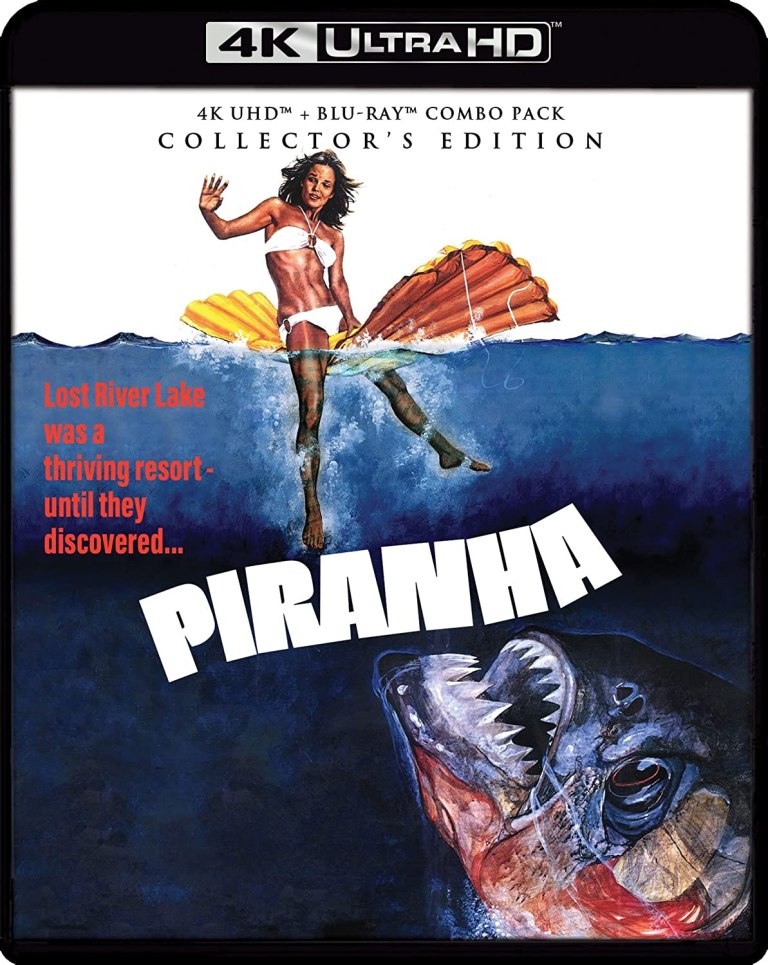
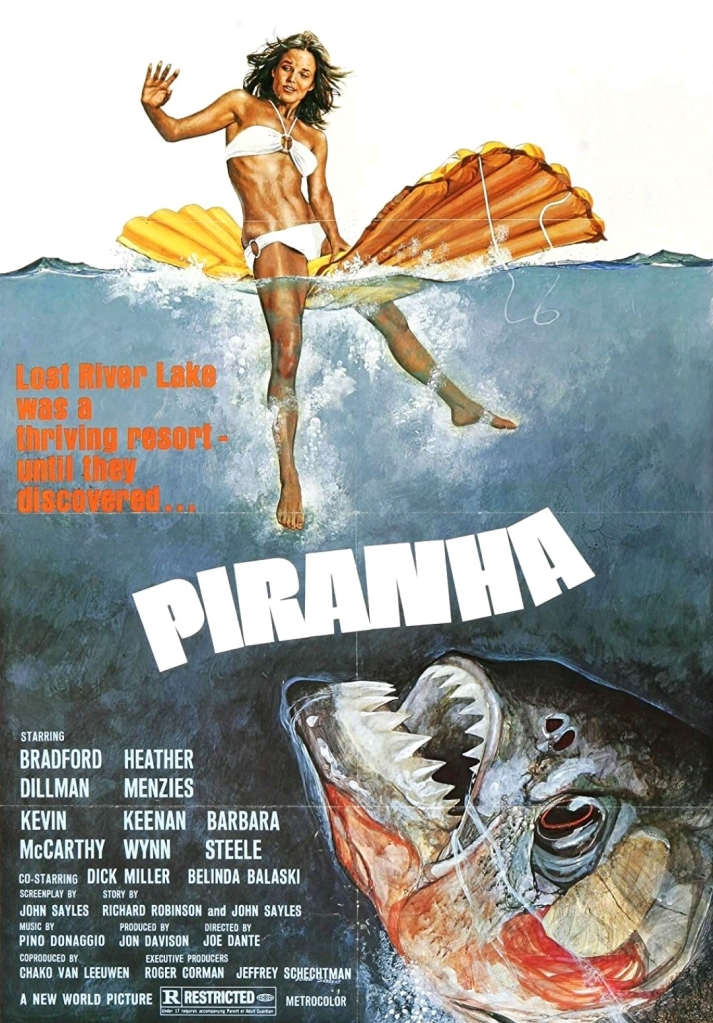
Movie poster of Piranha (1978)
In my experience, I saw Piranha (1978) a number of times since the 1980s. I never saw it in the cinema as I was too young back then but I first saw it on home video followed by showings on cable TV. Strangely enough, the 1978 movie not only spawned a sequel in 1982, it also had remakes in 1995 and 2010.
More on the 1978 movie itself, it was made just a few years after Steven Spielberg’s Jaws made tremendous impact commercially and socially. To its credit, Piranha (1978) was produced by low-budget movie king Roger Corman and it had Joe Dante as director and Kevin McCarthy as a supporting cast member. For the newcomers reading this, Dante is best known for directing Gremlins while McCarthy is best remembered for Invasion of the Body Snatchers (1956).
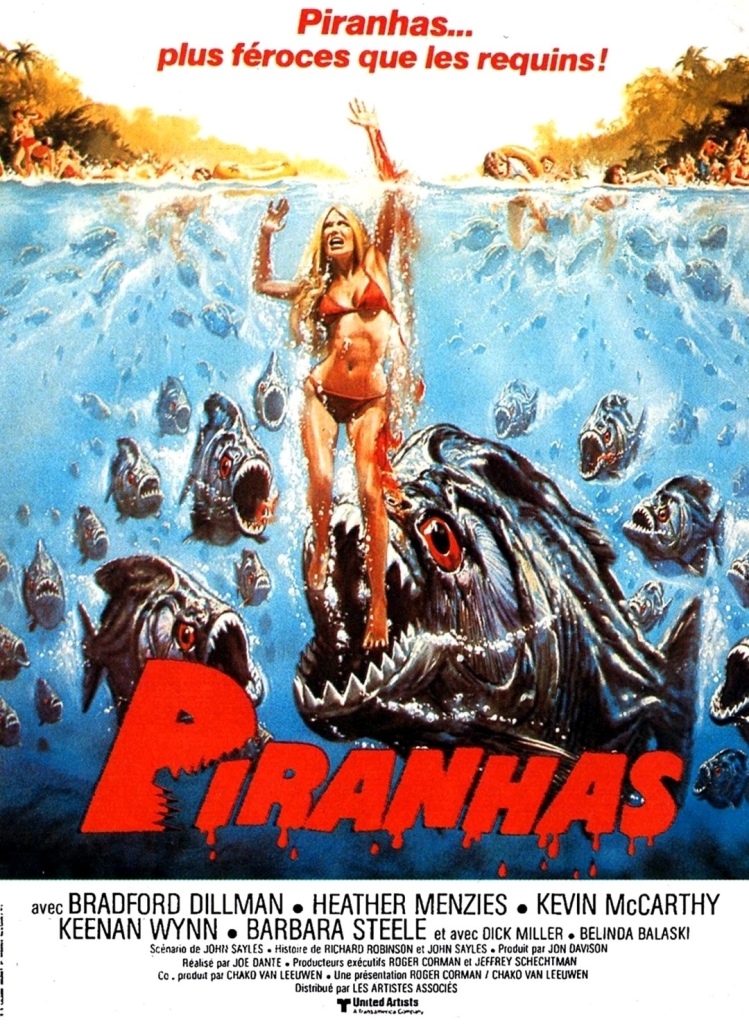
A foreign movie poster.
Ultimately, the main feature of Piranha (1978) is its emphasis on water-related fear, particularly the idea that a person in water can be eaten alive by multiple piranhas. It’s like an extension of Jaws’ influence which people afraid of the sea because they could be eaten by a shark.
Already it has been confirmed that Piranha (1978) 4K Blu-ray will come with native 4K visuals. To the best of my memory, the movie was not a very visually appealing movie. Still, the idea of it getting remastered into 4K is interesting.
Watch out for Piranha (1978) 4K Blu-ray on November 1, 2022.
In closing this Better than Streaming piece, posted below is the Piranha (1978) video.
Disclaimer: This is my original work with details sourced from watching V: The Final Battle and doing personal research. Anyone who wants to use this article, in part or in whole, needs to secure first my permission and agree to cite me as the source and author. Let it be known that any unauthorized use of this article will constrain the author to pursue the remedies under R.A. No. 8293, the Revised Penal Code, and/or all applicable legal actions under the laws of the Philippines.
With a very engaging story, memorable characters, intriguing concepts and innovative marketing, the $13 million production V: The Original Miniseries (simply called V back then) became a major TV hit in America over two nights in May, 1983. I personally loved watching the said mini-series back in the 1980s and I still love replaying it in this age of high-definition and Blu-ray discs. For me, at least, it is a timeless classic and it carries several lessons about the fragility of society, the rise of fascism, the spread of evil in many forms and the human desire for freedom from oppression.
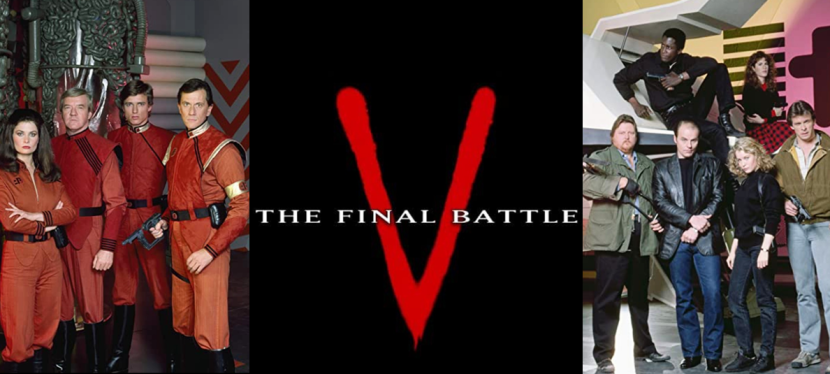
The cover and the title that did not live up to its purpose.
Early story
The story begins with Mike Donovan (Marc Singer) having a nightmare of him and his son Sean (who was abducted during the events of V: The Original Miniseries) in a desperate escape attempt while inside one of the motherships of the Visitors. He wakes up in the presence of Julie Parrish (Faye Grant) and realizes they have a dangerous mission to execute at a local facility used by the red-uniformed Visitors. It turns out, the Resistance movement led by Julie has been losing ground to the alien humanoids and Mike has been helping them out while prioritizing the state of his son who has been in captivity in one of the mother ships.
During the night, a truck carrying many local civilians inside its trailer arrives at a local factory controlled by the Visitors with officer Steven (Andrew Pine) watching over. After the civilians got directed to enter the factory, it turns out they got processed and came out in the form of food cocoons. The sight shocks Julie watching from a distance with her armed teammates waiting on stand-by.
Easily the most engaging shot in this sequel. A clear reminder about the fascist takeover by the aliens from outer space.
After causing damage on the nearest fence, the Resistance begins their attempt to raid the facility and free their fellow cocooned people but the tide turned against them. It turns out, the Visitors’ troops are wearing stronger armor and bright lights were installed on the top of the facility to forcing Julie, Marc and the rest of their team to retreat. They lost some members along the way. During a closed-door meeting with the Resistance stakeholders, Mike Donovan says a key event is needed to make a significant gain against the Visitors.
Over at the mothership hovering over Los Angeles and in the presence of Diana (Jane Badler), the leader John (Richard Herd) tells Kristine Walsh (Jenny Sullivan) that a major medical announcement will be held in the form of an organized special event very soon and that she will be part of the presentation for the global TV audience…
Quality
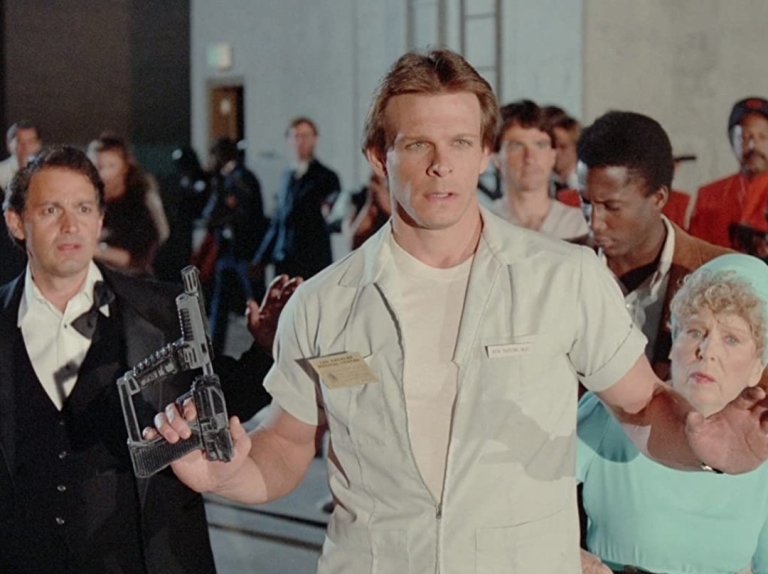
Marc Singer as Mike Donovan with Michael Durrel and Michael Wright as Robert Maxwell and Elias Taylor near him.
I’ll star first with the presentation here. This sequel mini-series was composed of three episodes totaling over 270 minutes. In what looks like to be attempts to ensure more spectacles for the viewers’ enjoyment, each episode of V: The Final Battle has a battle near the end and the creative team succeeded in not only providing on-screen action but also scored well in making the spectacle more varied while still making sense within the main narrative. For the most part, this sequel is indeed a natural progression of what was established in V: The Original Miniseries and that is something to admire given the fact that V creator Kenneth Johnson left this production early.
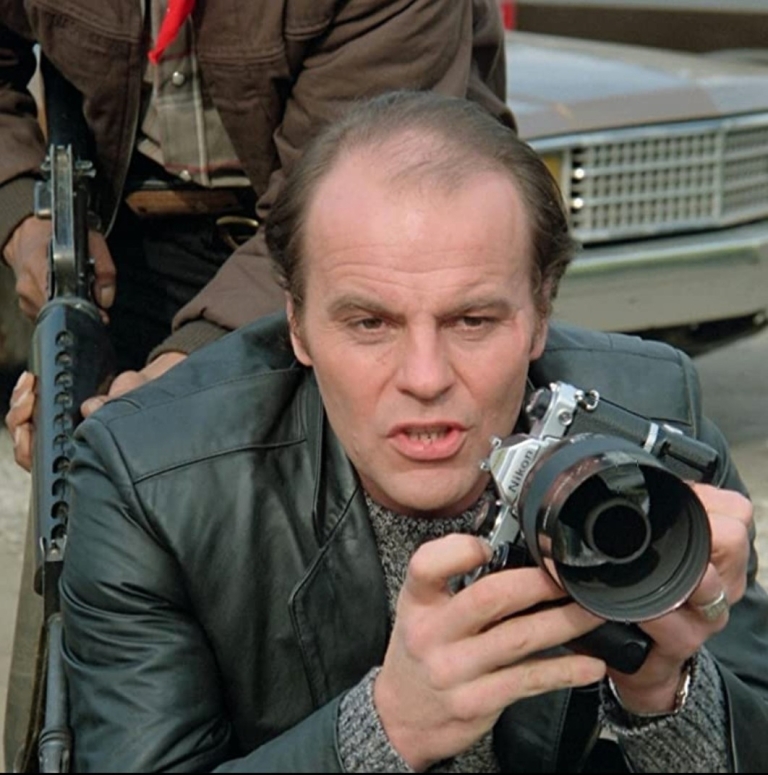
On the storytelling, V: The Final Battle expands a bit on the Visitors’ dictatorship of Los Angeles and its surrounding areas while the Resistance led by Julie Parrish and supported by close companions Robert Maxwell (Michael Durrell), Elias Taylor (Michael Wright) and Caleb Taylor (Jason Bernard) are shown to be struggling on taking down the alien humanoids even though they secured noticeably more weapons and equipment. The storytelling and the dramatization about the Resistance changes dramatically with the addition of Ham Tyler (Michael Ironside) and partner Chris Farber (Mickey Jones) in the 2nd episode and from that point on, you get to see a human opposition that becomes more flexible with their operations.
Michael Ironside as Ham Tyler is the most significant new addition to the cast.
As mentioned earlier, Kenneth Johnson’s involvement in this sequel was minimal and it is seen on the presentation. The symbolism Johnson implemented in the original mini-series that established parallels between 1980s America to the Nazi occupation of Europe did not continue here which results a more straightforward presentation of details, character moments and story progression. There was also a noticeable lack of suspense when it comes to executing big scenes with big reveals. The pacing, like in the 1983 mini-series, moves smoothly at a moderate pace throughout and there were no boring moments at all.
The quality of script is still good. For the most part, the writers managed to capture the essence of the established characters from the original mini-series as they told the further developments of this sequel. For example, Caleb and Elias’ father-and-son moments quickly remind me of what I saw in V: The Original Miniseries. Robert Maxwell’s struggle to help his troubled daughter Robin (Blair Tefkin) while assisting Julie and the Resistance is a very natural progression of what was shown in 1983. The friendship between good natured alien Willie (Robert Englund) and Harmony (Diane Cary) got developed a lot more than expected eventually adding to one particular side of the conflict. The local collaborators Daniel Bernstein (David Packer) and Eleanor Dupres (Neva Patterson) developed further with their treason towards their fellow humans as they enjoyed further the power they gained from the Visitors. These two characters will surely get on the nerves of viewers rooting for the Resistance.
Denise Galik as Maggie is a fine new addition to the cast.
David Packer returns as Daniel Bernstein.
Sarah Douglas as Pamela, a superior of Diana’s.
When it comes to new additions to the cast, Ham Tyler and Chris Farber are not the only new players to add depth to this sequel. There is also Maggie (Denise Galik) who is an attractive, brave and strategic Resistance member whose contribution makes an impact. On the downside, there is also Andrew Doyle (Thomas Hill) who is bad choice the creative team came up with as the on-screen representative of faith when he in fact represents religion, idolatry, rituals and distortion. On the side of the Visitors is Pamela (Sarah Douglas) who is a higher-ranking officer than Diana and even John. Pamela is the more militaristic type of leader who is more focused on achieving goals while keeping things in order.
If there is anything flawed about the characterization, it is the romantic relationship of Julie Parrish and Mike Donovan which starts in the first episode. Considering how dramatic the performances of Faye Grant and Marc Singer were in this sequel, Julie and Mike still don’t make a believable pair of lovers in my view. While this romantic relationship opens up new dimensions within Julie and Mike and offer viewers something new to focus, it brings down the former’s value as Resistance leader somewhat while also setting aside the hinted personal connection between her and Elias in the 2nd episode of the 1983 mini-series.
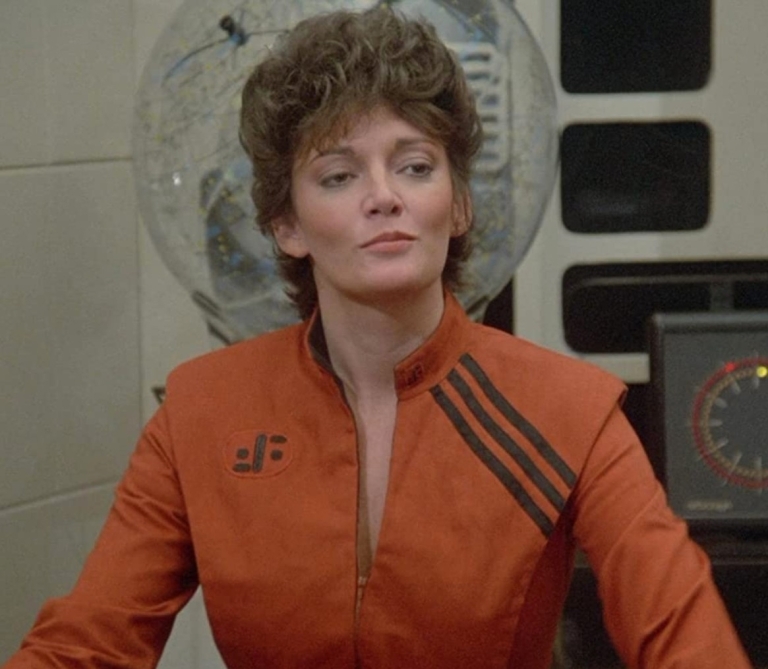
Faye Grant as Julie Parrish in the conversion process scene watched closely by Jane Badler’s Diana.
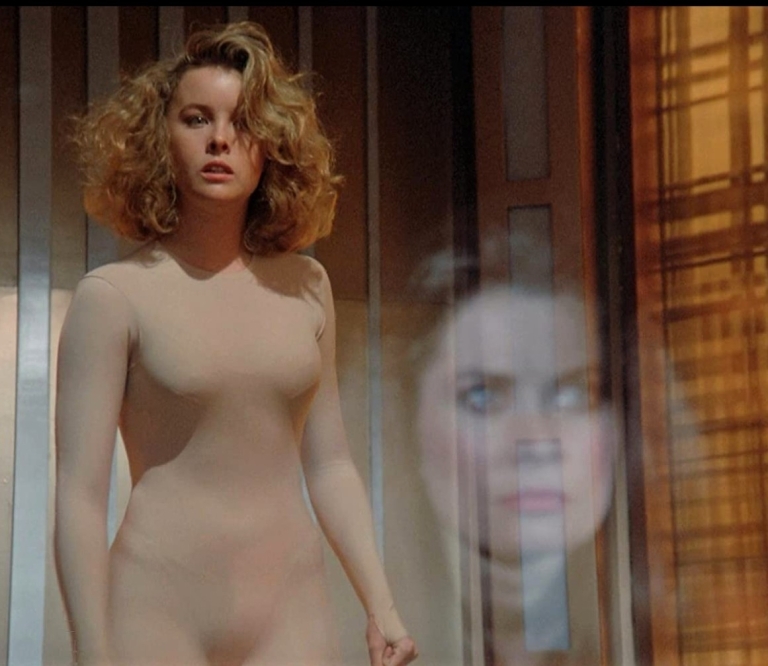
More on Faye Grant, her performance here is more varied. Not only does she play the brave and struggling leader who is talented in fighting, science and medical practice, she also portrayed Julie as an even more vulnerable character this time around. Her act as the traumatized Julie during the conversion process (read: mental and psychological torture using a more detailed form of virtual reality or nightmare generation) scenes under the watch of Diana is very dramatic and compelling to watch. Just seeing Julie in the conversion process will make grip you with despair and you will eventually feel sorry for her. I should state that the nightmare scenes of Julie were presented with a clear touch of horror.
Marc Singer as Mike Donovan is no longer the reluctant action hero but rather a driven man with a mission to get his missing son back while maintaining a secret connection with Martin (Frank Ashmore) of the Fifth Column (secret dissenters among the Visitors) hoping to achieve breakthroughs for the Resistance and their friends among the dissenting aliens. Singer did the best he could with the script provided to him and he remain likable all throughout. Other than the unbelievable romance with Julie as well as his past encounters with Ham Tyler, there is not much new to expect from the way Mike Donovan was written here. What I should point out, however, is that Mike Donovan’s support for the unholy act of abortion (along with the so-called right to abort) is very wrongful, highly immoral and makes the hero having a sinister presence within him even though he is a father searching for his son.
Jane Badler’s performance as Diana deserves admiration here. Not only did she successfully recapture the charismatic and sinister nature of her character in the 1983 mini-series, Badler was very convincing in showing the more desperate side of Diana, especially when it comes to power struggle within the ranks of the Visitors. You can clearly see the desperation and struggle as soon as Pamela appeared. This sequel also showed a lot more of Diana when it comes to personally supervising her conversion process which is much more elaborate here (note: the conversion process in the 1983 mini-series was limited to the showing of a chair with torture devices). Being the very symbol of charisma and evil in the V franchise, Diana’s place in pop culture is solid and her real-world comparative counterparts would be none other than Hillary Clinton and Kamala Harris.
Jane Badler as the ever charismatic yet very wicked Diana.
As mentioned earlier, Michael Ironside’s Ham Tyler is the most significant addition to the cast and the script. Ironside had that excellent mix of toughness, cruelty and sarcasm portrayed in here and at the same time Ham Tyler brought out very interesting and intriguing interactions with the more established Julie and Mike. As seen in entertainment history, Ironside went on to climb up the ranks in Hollywood with Total Recall (1990), Starship Troopers (1997) and in the Splinter Cell video game franchise. Ironside’s Ham is easily the fourth major character of the V franchise of the 1980s.
Going into the spectacle part of this sequel, the action is more varied as mentioned earlier and the 3-episode structure was a factor. You will see lots of shooting with the use of guns and laser blasters here and there, and with the in-story locations and props as key factors, there are action sequences that are uniquely done. There is a lot to enjoy for any V fan and casual viewers watching this sequel.
As for the special effects part of the spectacle, this one is a mixed bag similar to what was presented in the 1983 mini-series. To put things in perspective, the use of in-camera effects, practical effects and optical effects for TV back in the 1980s was ambitious. That being said, certain effect shots here did not age well such as the miniature shots looking fake (because the camera used did not have a special lens to capture visuals that would have made the miniatures look believable). I should also state that there were certain effects shots that were recycled and reused in key sequences in this sequel which remains embarrassing to see. What is even more embarrassing to see here is the very poor-quality monster effects used during the nightmare scenes (conversion process) of Julie and, more notably, the presentation of Robin’s other child. The monster effects are so fake, they are laughable to watch.
On the bright side of the special effects, the quality of the laser blasts remains good to watch right down to the precise timing with the explosions that were simulated on-set and in-camera.
Conclusion
The Visitors and Resistance key characters in the sequel.
While it has its strengths and weaknesses, V: The Final Battle is still engaging and enjoyable to watch, and at the same time it is a worthy addition for your Blu-ray collection when it comes to HD viewing (note: this is the sequel with the best visuals yet albeit with black borders on the sides). Even though creator Kenneth Johnson was not too involved on the production side, the creative team managed to deliver a long story that proved to be a natural progression of the original mini-series while providing more spectacle (especially action), developing the established characters and resolving key plot threads that started in 1983.
The lack of Kenneth Johnson’s personal touch on the presentation was noticeable and somewhat brought this sequel down a bit in terms of style. What brought V: The Final Battle’s quality down were the overall cheaper looking visual effects, the Julie-Mike love relationship and the climax of the final episode which seemed executed with desperation on the part of the creative team (note: giving a little new character instant purpose). In fairness, this sequel still succeeded in showing what fascism in America (or California specifically which is now dominated by Commies) would look like and it built up on its predecessor’s themes such as the deception of power and the collaboration with foreign enemies. This mini-series even added themes of teenage pregnancy and abortion (note: someone from the creative team wanted to promote the wrongful Roe v. Wade Supreme Court decision of 1973) to its narrative.
Does V: The Final Battle live up to its title? Absolutely not because a regular TV series that deteriorated in quality followed. In retrospect, it’s clear that this sequel marked the beginning of the decline of the V franchise in pop culture. What more, V: The Final Battle was never counted as canon in Kenneth Johnson’s 2008 novel (and sequel to the 1983 mini-series) V: The Second Generation. On its own, V: The Final Battle still has more positive stuff than negative ones and in my experience, it remains enjoyable and compelling to watch from start to finish. Compared to V: The Original Miniseries, I can say this sequel falls short. It is good, not great.
Overall, V: The Final Battle (1984) is recommended. That being said, let this 1984 mini-series remind you that there is so much evil in the real world in the forms of Iran, the terrorists of Palestine, the social justice warriors (SJWs), the Black Lives Matter (BLM) movement and liberal media to name some. Always keep in mind to avoid becoming evil no matter how tempting power in this divided world becomes to you. You also do not want to let the evil ones take over your government and have authority over you, your family members and your community. Push back against evil and stand up strong by faithfully taking sides with the one true Savior whose name is Jesus!
+++++
Thank you for reading. If you find this article engaging, please click the like button below and also please consider sharing this article to others. If you are looking for a copywriter to create content for your special project or business, check out my services and my portfolio. Feel free to contact me with a private message. Also please feel free to visit my Facebook page Author Carlo Carrasco and follow me on Twitter at @HavenorFantasy as well as on Tumblr at https://carlocarrasco.tumblr.com/
As of this writing, there is no suggested retail price yet. Still, here are the product descriptions and specs from Blu-ray.com’s articles about The Thing 4K Blu-ray. Some parts in boldface…
SPECS
Video
Codec: HEVC / H.265
Resolution: Native 4K (2160p)
HDR: HDR10
Aspect ratio: 2.35:1
Original aspect ratio: 2.39:1
Audio
English: DTS:X
English: DTS-HD Master Audio 7.1
Subtitles
English, English SDH, French, Spanish
Discs
4K Ultra HD
Blu-ray Disc
Two-disc set (1 BD-100, 1 BD-50)
Digital
Digital 4K
Digital copy included
Playback
4K Blu-ray: Region free
2K Blu-ray: Region A
PRODUCT DESCRIPTION
DISC ONE – 4K BLU-RAY
4K RESTORATION OF THE FILM FROM THE ORIGINAL CAMERA NEGATIVE
HDR PRESENTATION OF THE FILM
DTS:X AUDIO TRACK
Audio Commentary with Director John Carpenter and Kurt Russell
John Carpenter’s The Thing: Terror Takes Shape
Outtakes
Theatrical Trailer
Optional English SDH, Spanish, and French subtitles for the main feature
DISC TWO – BLU-RAY
Main feature
Audio Commentary with Director John Carpenter and Kurt Russell
U-Control: Picture in Picture
Optional English SDH, Spanish, and French subtitles for the main feature
For those who are not too aware about this old sci-fi horror movie, The Thing tells the story of an American research team stationed in Antarctica whose lives turn upside-down after a sled dog comes to them after being hunted by a helicopter from the Norwegian research team.
Historically speaking, The Thing was released in cinemas in the United States just two weeks after Steven Spielberg’s E.T. the Extra-Terrestrial. The Carpenter-directed space alien monster film was trashed by movie critics of the time and in the American box office, Spielberg’s movie about a friendly alien creature from outer space was simply unbeatable. As time passed by, The Thing found its audience on TV and home video and its critical reception turned from negative to positive overall. In the awards circuit, The Thing was nominated for Best Horror Film and Best Special Effects (credit to Rob Bottin who went on to work on effects for RoboCop and Total Recall) in the 10th annual Saturn Awards given by the Academy of Science Fiction, Fantasy and Horror Films. Fans of actor Keith David will want to see his performance in this particular film. David also went on to work again with John Carpenter years later.
To get to know more about John Carpenter’s The Thing through trivia, watch the video posted below from Minty Comedic Arts. Be warned of potential spoilers…
Thank you for reading. If you find this article engaging, please click the like button below and also please consider sharing this article to others. If you are looking for a copywriter to create content for your special project or business, check out my services and my portfolio. Feel free to contact me as well. Also please feel free to visit my Facebook page Author Carlo Carrasco and follow me at HavenorFantasy@twitter.com
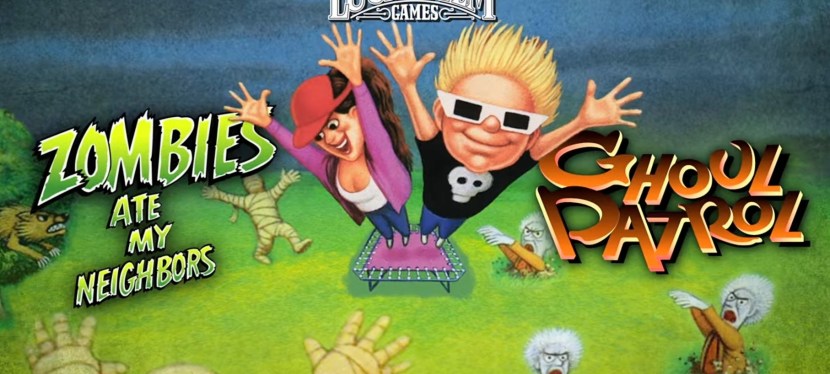
Rather it’s about a pretty notable game (plus its sequel) from the 1990s that I completely missed out on. The big surprise to me was that it will be released soon for Xbox One and Xbox Series S and X owners to enjoy.
For those who are not familiar with either game, here is an excerpt from the Xbox.com article written by Ken Humphries (Senior Producer on the two games)…
Zombies Ate My Neighbors
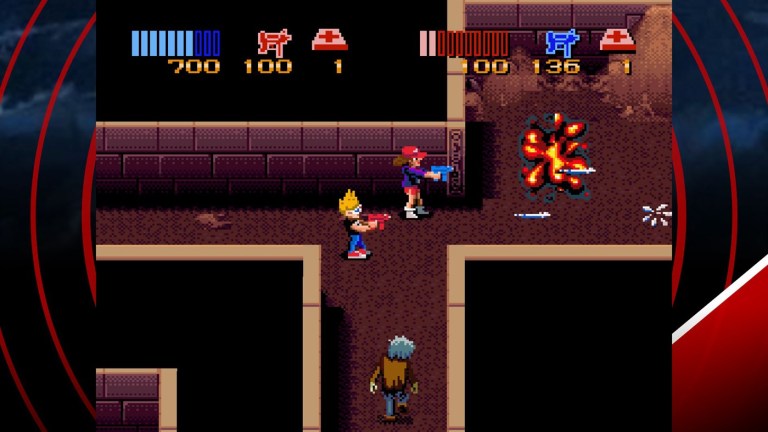
The 2-player function is a popular feature of the game.
Hey, where’s that scary music coming from? Yikes! It’s Zombies Ate My Neighbors, where you appear in every demented horror flick ever to make you hurl ju-jubes.
What are Zeke and Julie, our two wholesome teenage stars doing in a 16-bit game like this?! Trying to save the nice neighbors, cheerleaders, and babies from a fate worse than polyester!
Who could put this slice of suburbia in such goose-pimply hysteria? Zombies, relentless chainsaw maniacs, mummies, evil dolls that just won’t die, lizard men, blobs, vampires, giant ants, martians, and more.
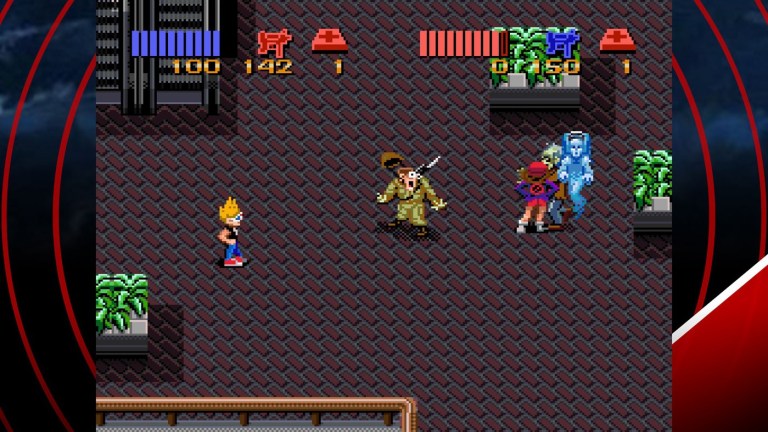
One of many levels in this game.
Will these crazy kids survive the night? Find your way through 55 horror-filled levels like a grocery store gone bad, a shopping mall awry, a mysterious island and your own back yard. Don’t miss “Weird Kids on the Block,” “Mars Needs Cheerleaders,” and “Dances w ith Werewolves.”
You can fend off the freaks with a virtual candy counter of weapons like uzi squirt guns, exploding soda pop, bazookas, weed wackers and ancient artifacts. Also grab power ups-o-rama like secret potions and bobo clown decoys. Does this game ever end?!
Ghoul Patrol
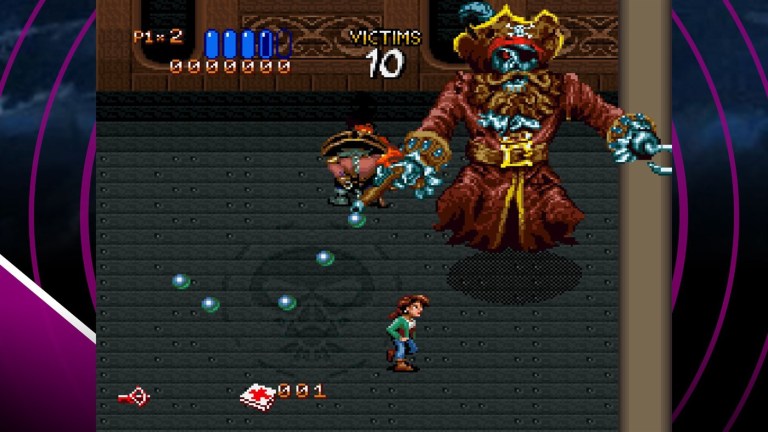
Nothing like facing an over-sized enemy in Ghoul Patrol.
Zeke and Julie, our intrepid teenagers, visit the Ghosts and Ghouls exhibit at the city library, where they find an old treasure chest containing an ancient spirit book. Naturally, they cannot resist reading it. Suddenly, a horrific snaggle-toothed spirit emerges.
Now, this snarling phantom and his dastardly minions are infesting Metropolis and slithering their way into the history books, where they plan to rewrite history with their spooky ways. Only you have the power to go back in time to de-spook an encyclopedia of zombified historic dudes.
Were you able to play this game back in the 1990s?
Terminate, with prejudice, using crossbows, ping-pong ball machine guns, Martian “Heatseeker” guns, and more.
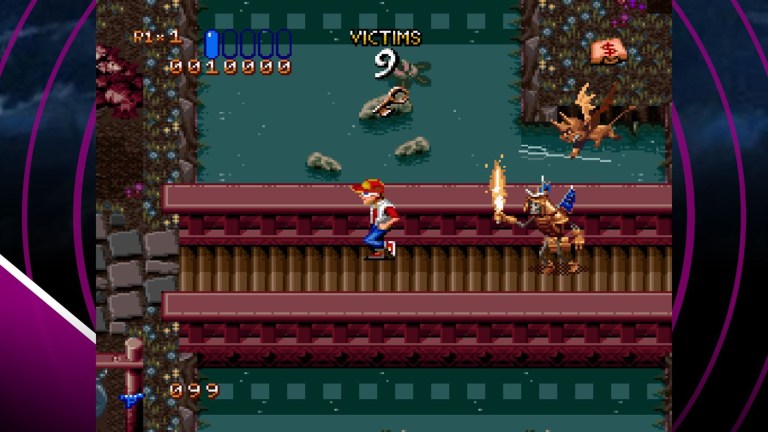
Vaporize garbage can ghosts and ninja spirits, rescue bug-eyed librarians and wigged-out pirates, dodge flying books and adolescent-eating plants!
The features for Zombies Ate My Neighbors and Ghoul Patrol are as follows…
NEW FEATURES
• Save Feature: Quickly save your progress in either game and continue your adventure wherever and whenever you want
• Museum Features: Watch a video interview with one of the original Zombies’ developers or explore numerous galleries containing game art, previously unreleased concept images and marketing assets
• Soundtrack: Listen to the entire soundtracks for both games in the included music players
• 2 Player Mode: Play the game with two player local co-op
• Achievements: Track your game progress with a set of achievements covering both games
To put things in perspective, Zombies Ate My Neighbors was released in 1993 published by Konami (game developed by LucasArts) for the Super NES (SNES) and the Sega Genesis. It was not a big commercial success but it proved to be a hit with the critics of the time (plus the writers who published their reviews of it years later). Zombies Ate My Neighbors gained a cult following as it not only had enjoyable gameplay, its visual style was appealing, it had lots of visual elements related to pop culture (notably horror genre elements), a memorable soundtrack and more.
In a 2006 article published by IGN, Zombies Ate My Neighbors was described by Lucas M. Thomas as “a comical 16-bit template for the new Xbox 360 release, Dead Rising. And like that game, this one arms you with a pretty bizarre arsenal. Weed whackers, exploding soda cans and flying silverware all make an appearance to help you, or you and a friend, put a hurt on these living dead.”
Ghoul Patrol was released in 1994 for SNES, published back then by JVC (Japan Victor Company) with the development done by LucasArts. Like its predecessor, I never got to play it back decades ago. In addition, I never even saw a copy of the sequel at retail during those days.
As I never got to play Zombies Ate My Neighbors back decades ago, its upcoming release for Xbox is a very delightful surprise for me personally. I will order this (along with Ghoul Patrol) very soon.
If you are interested to order in advance Zombies Ate My Neighbors and Ghoul Patrol for your Xbox One or Xbox Series console, click here.
In ending this piece, posted below is a video retrospective on Zombies Ate My Neighbors published by GamerThumbTV plus a retro review by Cinemassacre. Be mindful of potential spoilers.
+++++
Thank you for reading. If you find this article engaging, please click the like button below and also please consider sharing this article to others. If you are looking for a copywriter to create content for your special project or business, check out my services and my portfolio. Feel free to contact me as well. Also please feel free to visit my Facebook page Author Carlo Carrasco and follow me at HavenorFantasy@twitter.com
Disclaimer: This is my original work with details sourced from reading the comic book and doing personal research. Anyone who wants to use this article, in part or in whole, needs to secure first my permission and agree to cite me as the source and author. Let it be known that any unauthorized use of this article will constrain the author to pursue the remedies under R.A. No. 8293, the Revised Penal Code, and/or all applicable legal actions under the laws of the Philippines.
Welcome back, superhero enthusiasts, comic book collectors, fellow geeks and fans of Wonder Woman! Last time, I found George Perez’s standalone writing of the story about Wonder Woman discovering Greece and its connections to her people’s heritage a really good story. For much of the post-crisis Wonder Woman monthly series’ early stage, the stories were done by Perez and the late Len Wein. In issue #17, Perez not only succeeded in developing Diana/Wonder Woman further, he also captured nicely the wonder of discovery of new places and astonishing aspects of life while traveling overseas.
Of course, issue #17 was not purely a tourism story through the eyes of the Queen of Superheroes. There was an obvious build-up of a new villain who is aware of Wonder Woman’s presence in Greece.
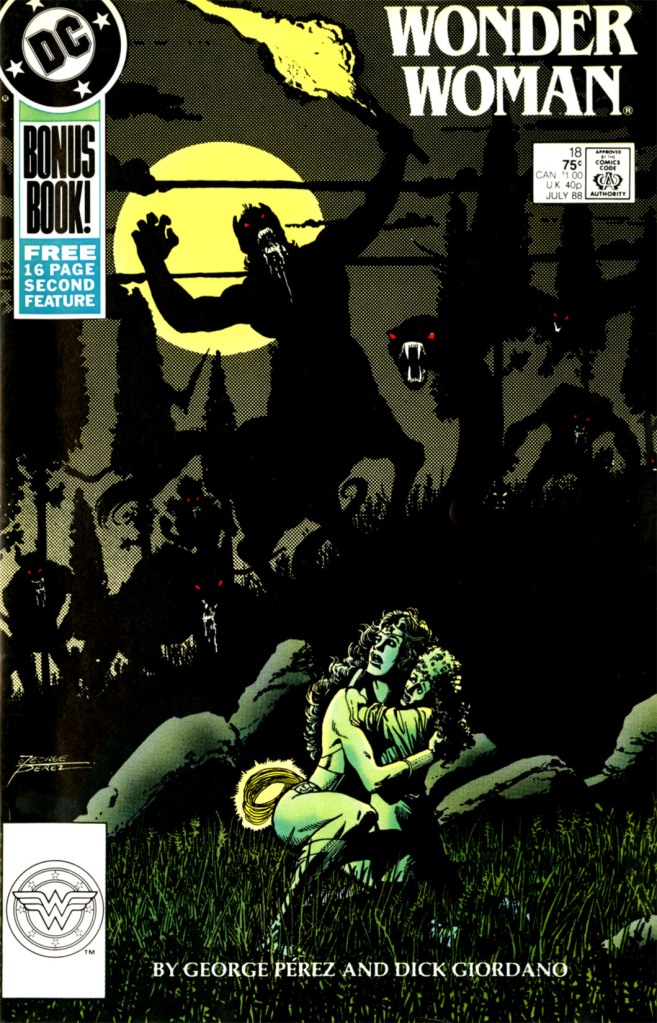
What will happen next? Who could the new force of evil be? We can find out in this look back at Wonder Woman #18, published by DC Comics in 1988 with a story written and drawn by George Perez with ink work done by Dick Giordano.
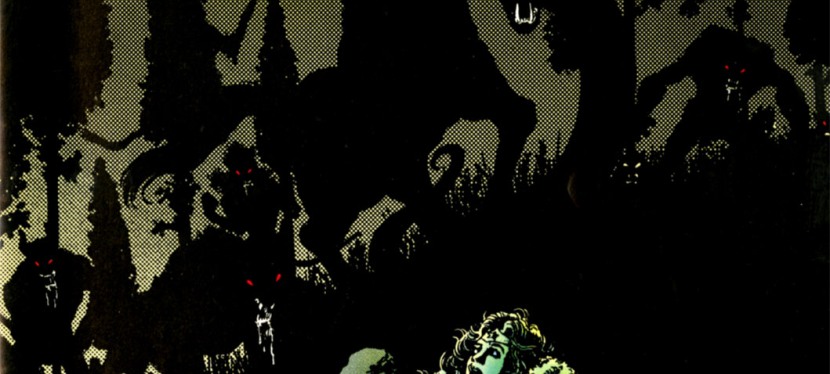
The cover.
Early story
The story begins deep in the darkness of limbo. Light sparks suddenly as Zeus, Hades and Poseidon arrive in the search of their father called Cronus. Zeus retrieves the Olympian pact. After further talking, they join forces in lighting a flame to burn the pact to make way for something new.
Meanwhile in a hospital in the Greek isle of Cephalonia, Diana wakes up surrounded by Julia Kapatelis, Vanessa, a doctor and other Greeks. Diana states that some kind of aura seemed to clutch her in a chilling grip which Julia dismisses and believes that her Amazon friend was simply tired from all the months-long pushing herself since returning from Themyscira.
Julia introduces Diana to Theophilus Ventouras and his nephew Demetrios. The older Ventouras is the owner of the wealthiest estate on the islands. He tells Diana that the governor asked him to meet her at the dock and reveals to her that a local boy was killed by a wolf which some car calling it as a “magia”.
As they continue talking, a nurse listens to them carefully just outside the door of the room they are in. She learns about Ventouras’ offer of assistance to Diana and quietly leaves. Some time later just outside the hospital, the nurse (named Angela) reveals to a man named Mikos that Diana and her group will be going to Ventourata the next day…
Quality
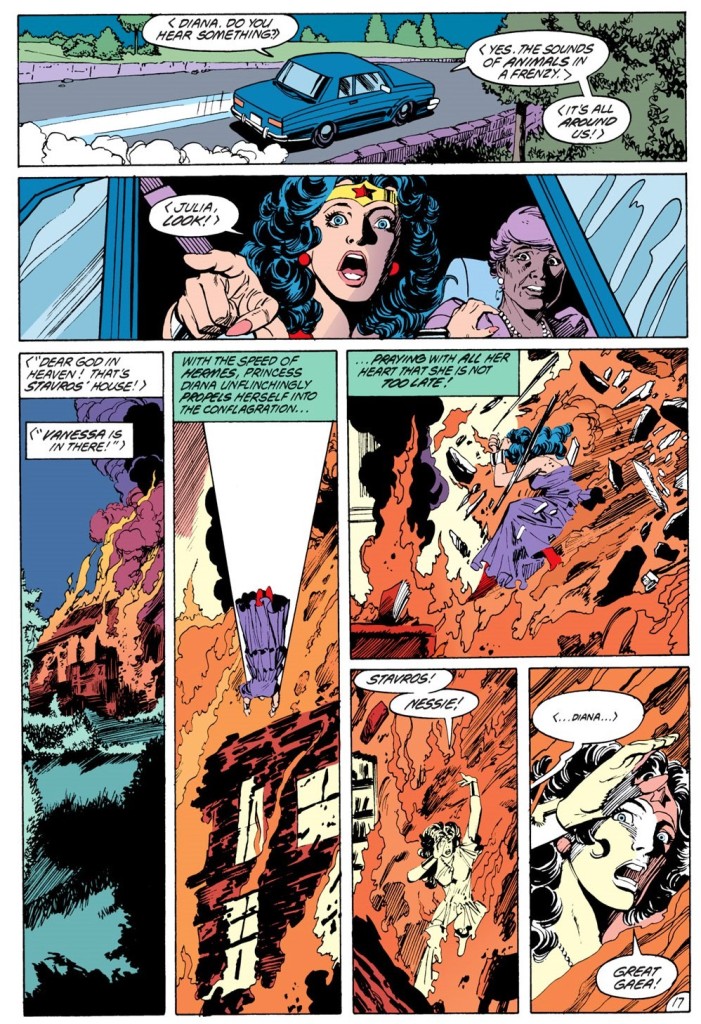
Without hesitation, Wonder Woman moves to save lives.
I can start by saying that this is another well-written tale by George Perez. Apart from the continuing focus on Wonder Woman’s discovery of Greece, the elements of fantasy, intrigue, suspense and even horror have been used more in this comic book compared to the previous issue.
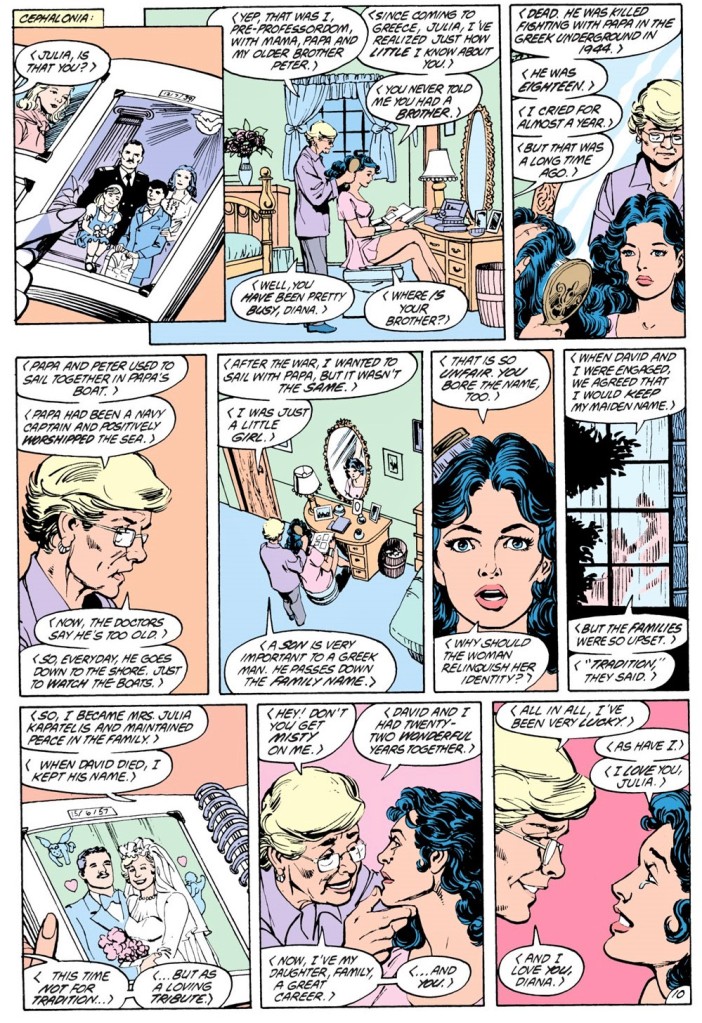
When it comes to characterization, Diana’s close relationship with the Kapatelises is deepened further as the story explored the already established Greek background of Julia. I also found engaging Wonder Woman’s unflinching moves to search for Vanessa and get her out of trouble any way she could.
For those of you who are aware about the lack of superhero spectacle in issue #17, I can share to you that there definitely is more action in this comic book and it is all nicely presented by George Perez.
Continuing what began in the previous issue, Perez ramped up further the build-up of the new force evil awaiting Wonder Woman. I won’t reveal who it is but rest assured, this comic book’s ending is pretty strong and easily justifies the build-up.
Conclusion
Diana and Julia treat each other like family.
Wonder Woman #18 (1988) successfully continued the redefining of the Queen of Superheroes in the post-Crisis era and George Perez really delivered great stuff as well as a very solid story here. From start to finish, there is a lot to enjoy and examine in the story.
If you are seriously planning to buy an existing hard copy of Wonder Woman #18 (1988), be aware that as of this writing, MileHighComics.com shows that the near-mint copy of the regular edition costs $41 while the near-mint copy of the newsstand edition costs $84.
Overall, Wonder Woman #18 (1988) is highly recommended!
+++++
Thank you for reading. If you find this article engaging, please click the like button below and also please consider sharing this article to others. If you are looking for a copywriter to create content for your special project or business, check out my services and my portfolio. Feel free to contact me as well. Also please feel free to visit my Facebook page Author Carlo Carrasco and follow me at HavenorFantasy@twitter.com