A Look Back at Harbinger #21 (1993)

Disclaimer: This is my original work with details sourced from reading the comic book and doing personal research. Anyone who wants to use this article, in part or in whole, needs to secure first my permission and agree to cite me as the source and author. Let it be known that any unauthorized use of this article will constrain the author to pursue the remedies under R.A. No. 8293, the Revised Penal Code, and/or all applicable legal actions under the laws of the Philippines.

Welcome back superhero enthusiasts, 1990s culture enthusiasts and comic book collectors! Today we go back to the early 1990s and explore a part of the Valiant Comics shared universe through the Harbinger monthly series.

In my previous review, Sting and new recruit Natalie (Stunner) were inside the stronghold of Kaliph deep within the terrorist state of Iran. Sting’s teammates went there on a high-risk mission to rescue the two even though they had no real resources to deal with Kaliph (first appearance in issue #19) and his private army, and they also had very little time to spare. Regardless, the dangerous mission proceeded and the rescue miraculously turned out successful. The success, however, came with a certain loss.

With those details laid down, here is a look back at Harbinger #21, published in 1993 by Valiant Comics with a story written by Maurice Fontenot and illustrated by Howard Simpson.
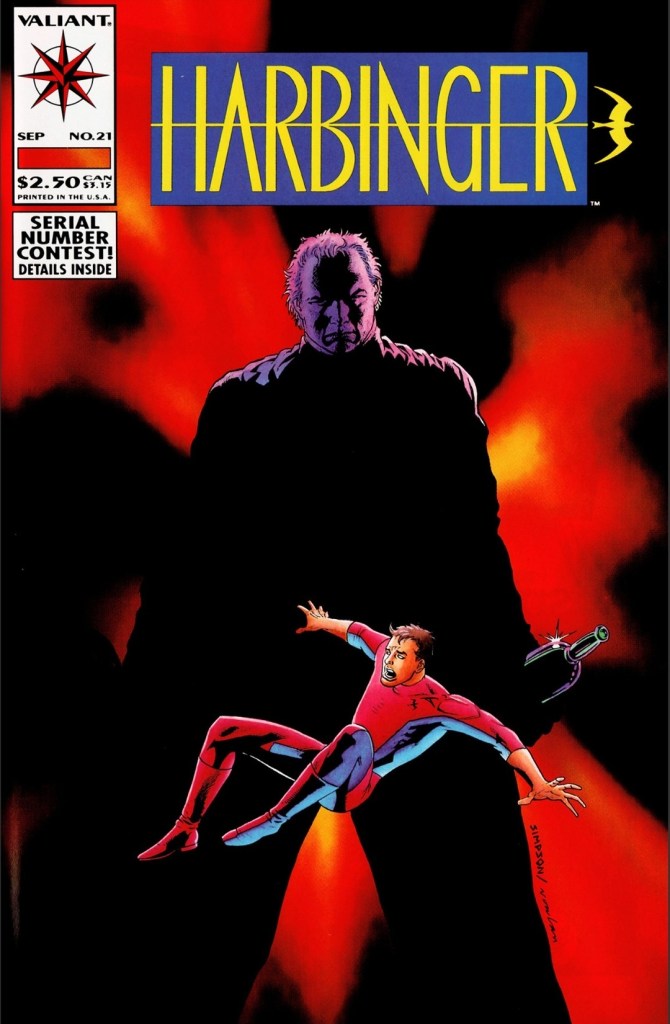
Cover.

Early story

The story begins inside the New Jersey apartment occupied by Sting and his teammates. Although weeks had passed since the dangerous mission in Iran, Sting remains in weak physical condition and he had to be carried by Faith/Zepplin and Flamingo as his lover Kris checks out a letter that was hidden from her.

Even though he is obviously not feeling well, Sting lies to Kris that he is fine. Kris reads the letter which turned out to be medical results on Sting done by Doctor Heyward. Sting was diagnosed with Mononucleosis. The weak leader of the group then falls into sleep.

Sometime later, Sting endures a nightmare and wakes up sweating and feeling very troubled…

Quality
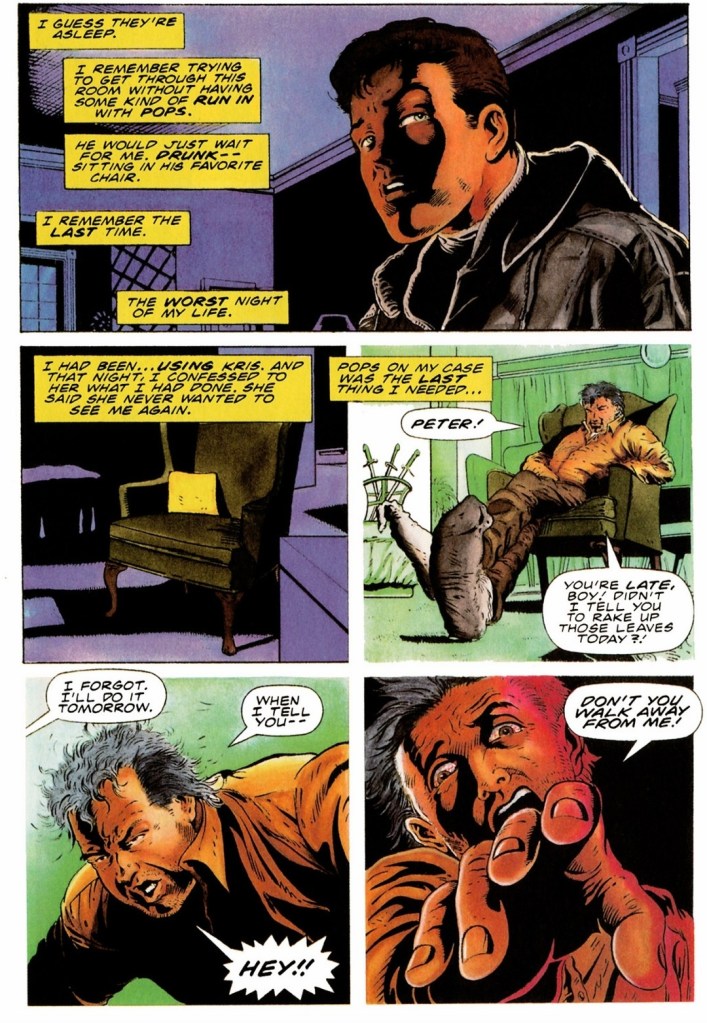
A look at Sting’s troubled relationship with his father in the past.

As a way of taking a change of direction following the previous two issues, this particular Harbinger story shifts the focus mainly on Sting and went ahead in explaining why he is such a flawed person, why he is reckless and even unworthy to be leading his teammates.

The core issue in this tale is Sting’s painful relationship with his father. Without spoiling the story details, I can say that the creative team succeed in not only dramatizing the strained father-son relationship, they also explored other elements from Sting’s past as Peter Stanchek – the young guy who had friends and lived a normal American life before his powers manifested and gradually changed everything.

More on Sting’s poor relationship with his father, the creative team came up with a pretty solid script and visuals that creatively emphasized the emotions, the pain and uncertainties on the part of the protagonist. More importantly, what they dramatized here clarified why Sting is immature, reckless and continues to live on with a distorted view of life that can be perceived as anti-family and even anti-social. Given the fact that he is unforgiving towards his father, the young team leader was revealed to be unworthy of not only of having super abilities but also unworthy of leading a group of friends who pretty much have faith in him. Sting is more than just a deeply flawed protagonist…he is also an unlikable superhero.   

Conclusion
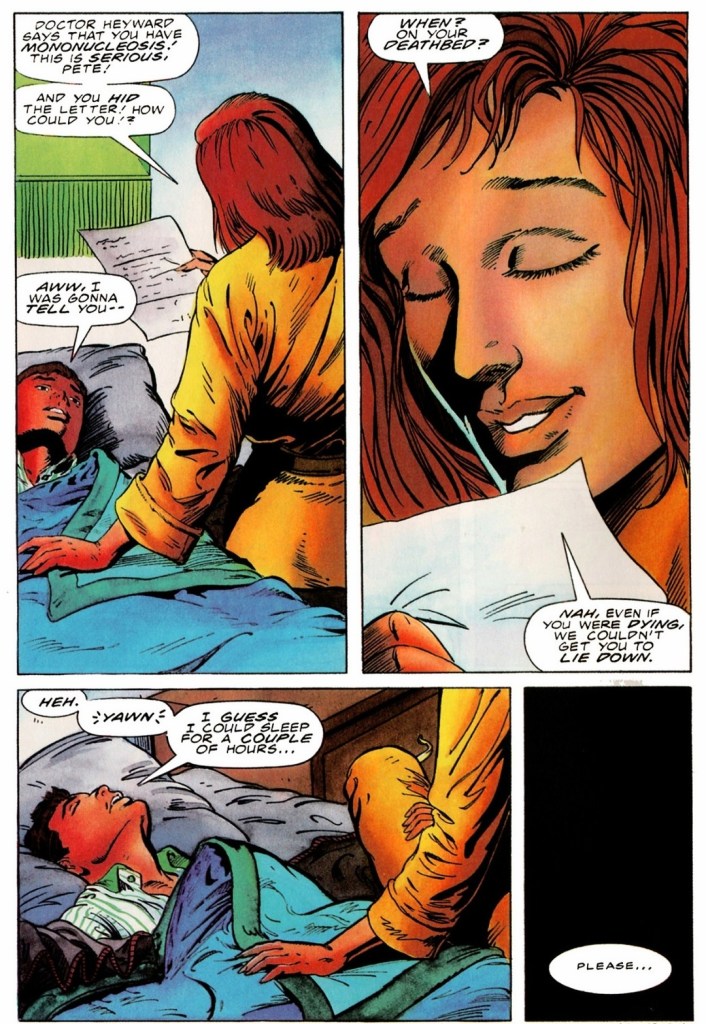
Even though he is sick, Sting still remains dishonest with Kris.

Harbinger #21 (1993) is a very power character study of Sting and the creative team deserve admiration for what is clearly the most in-depth development of the character so far in this series. It should be noted that the story, whether intention or not, clearly dramatizes that a person who rejects his or her father is often destined for frustration, pain, suffering and other negative elements in life. Even with super powers, the negative elements won’t disappear and the personal problems will continue to last long. If there is one thing that Sting could do to save himself and his family, it would be coming to his father with forgiveness and having the strong will to make peace with him and be willing to love him unconditionally. Ultimately, this comic book sets up Sting for a potential series of events that could challenge him personally as he continues to lead his team.

Overall, Harbinger #21 (1993) is highly recommended!

+++++

Thank you for reading. If you find this article engaging, please click the like button below, share this article to others and also please consider making a donation to support my publishing. If you are looking for a copywriter to create content for your special project or business, check out my services and my portfolio. Feel free to contact me with a private message. Also please feel free to visit my Facebook page Author Carlo Carrasco and follow me on Twitter at  @HavenorFantasy as well as on Tumblr at https://carlocarrasco.tumblr.com/ and on Instagram at https://www.instagram.com/authorcarlocarrasco
A Look Back at Armorines #2 (1994)

Disclaimer: This is my original work with details sourced from reading the comic book and doing personal research. Anyone who wants to use this article, in part or in whole, needs to secure first my permission and agree to cite me as the source and author. Let it be known that any unauthorized use of this article will constrain the author to pursue the remedies under R.A. No. 8293, the Revised Penal Code, and/or all applicable legal actions under the laws of the Philippines.

Welcome back superhero enthusiasts, 1990s culture enthusiasts and comic book collectors! Today we go back to the early 1990s and explore a part of the Valiant Comics shared universe through the Armorines monthly series.

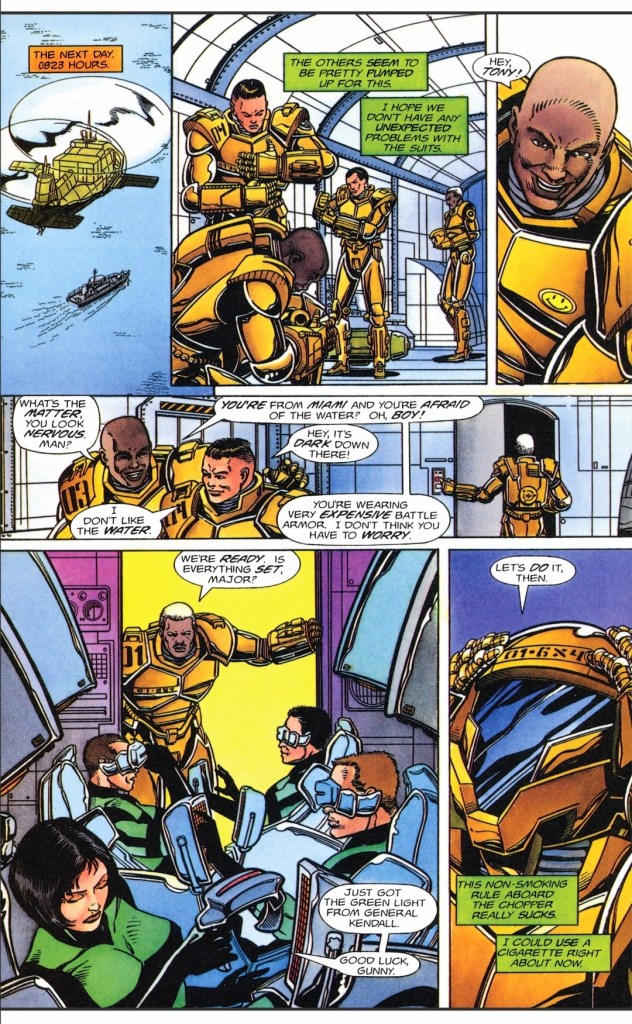
In my previous retro review, the comic book introduced us to the armored U.S. Marines (composed of members who go out on the field with armored suits and other members who serve as co-pilots via virtual reality) and their superiors. Their mission took them very deep down the ocean where they have to enter a sunken nuclear-powered submarine not knowing that something dangerous lurks there.

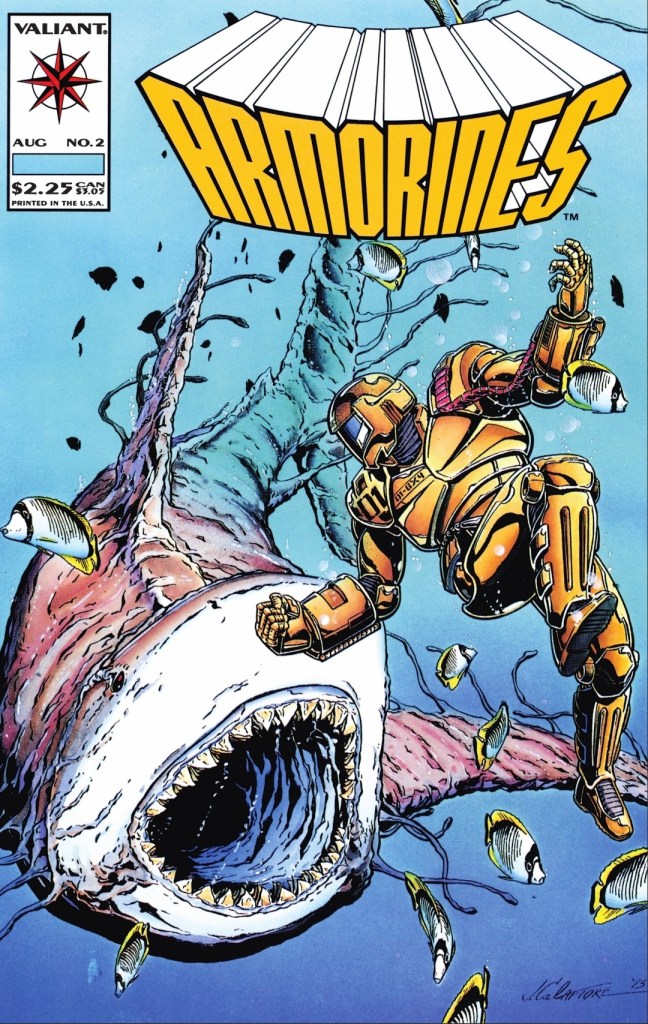
With those details laid down, here is a look back at Armorines #2, published in 1994 by Valiant Comics with a story written by Jorge Gonzalez and drawn by Jim Calafiore.

The cover.

Early story

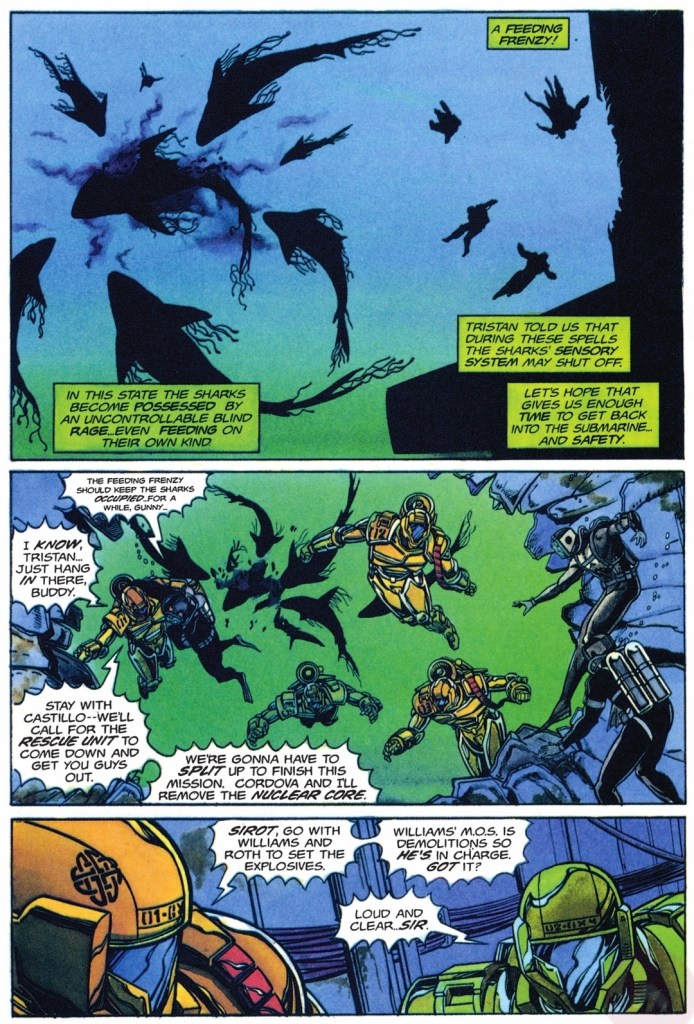
The story begins five hundred kilometers off the coast of Australia. Gunny, his armored teammates and the Navy SEALs are deep underwater on a mission at the sunken nuclear-powered submarine. They are being attacked by several large sharks that all have freakish and ruined surfaces. While the sharks don’t have any exceptional intelligence, they have lateralis systems that alert them to low-frequency vibrations and are able to detect the minute electric fields generated by the prey.

While the Armorines have energy weapons that can easily cut through flesh and hard objects, the sharks remained challenging to hit. They and the Navy SEALs struggle to keep together and focus on their mission…

Quality

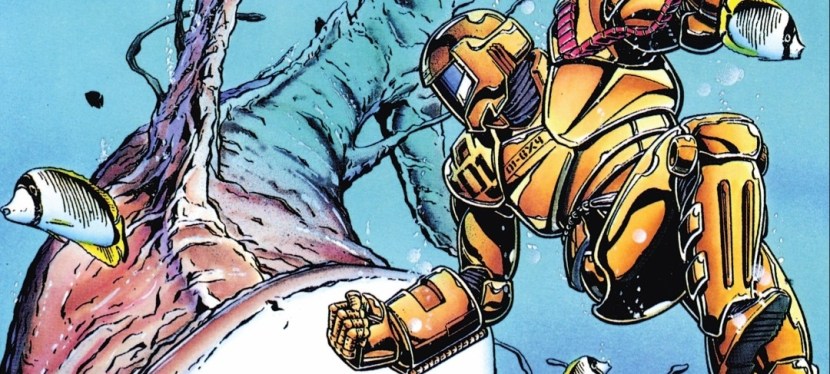
Can you just imagine yourself working on a mission deep under the sea with lots of sharks swimming nearby?

As a direct follow-up to issue #1, this comic book shows more of what the Armorines can do on a mission even though their spotlight had to be shared with the Navy SEALs who are their partners on the mission involving the sunken submarine. The spectacle readers can look forward to here are the action scenes of the Armorines using their high-tech weapons against sharks that are many times larger than each of them. The focus of the story, unsurprisingly, is the mission inside the sunken submarine and the coordination between the armored US marines with the Navy SEALs. While there is no clear villain yet, this comic book’s script has effective writing behind it and the result is a plot that turned out to be engaging enough. If you are looking for character development, you won’t find it here.

Meanwhile, Jim Calafiore’s art really shines as he successfully implemented enough visual details on the characters, the sharks, the underwater environment and the interiors of the submarine. His art on the sharks are really monstrous to look at!

Conclusion

While the Armorines did not have to worry about being shot back, the huge size, speed and the unrelenting aggression by the freaking sharks still proved to be big challenges for them.

Armorines #2 (1994) is indeed a solid continuation and progression to what came before it. While issue #1 was mainly a build-up and introductory story, this one shows the Armorines in action on the line of duty while working in tandem with their Navy SEAL brothers. While the mission is the main subject of the story leaving no real room left for any character development, there were two twists (note: science fiction in nature) that added to the depth of the story. Safe to say, I am motivated enough to look forward to the next issue.

Overall, Armorines #2 (1994) is recommended.

+++++

Thank you for reading. If you find this article engaging, please click the like button below, share this article to others and also please consider making a donation to support my publishing. If you are looking for a copywriter to create content for your special project or business, check out my services and my portfolio. Feel free to contact me with a private message. Also please feel free to visit my Facebook page Author Carlo Carrasco and follow me on Twitter at  @HavenorFantasy as well as on Tumblr at https://carlocarrasco.tumblr.com/ and on Instagram at https://www.instagram.com/authorcarlocarrasco
A Look Back at Armorines #1 (1994)

Disclaimer: This is my original work with details sourced from reading the comic book and doing personal research. Anyone who wants to use this article, in part or in whole, needs to secure first my permission and agree to cite me as the source and author. Let it be known that any unauthorized use of this article will constrain the author to pursue the remedies under R.A. No. 8293, the Revised Penal Code, and/or all applicable legal actions under the laws of the Philippines.

Welcome back superhero enthusiasts, 1990s culture enthusiasts and comic book collectors! Today we go back to the early 1990s and explore a part of the shared universe of Valiant Comics through the Armorines monthly series.

Before I start, I should state that the superhero concept of an armored human protagonist who could do many incredible things made possible by high technology made an impact on comic book storytelling for decades. Look at Marvel’s Iron Man and the Ultraverse’s Prototype for examples.

While Valiant Comics already had its own armored superhero with X-O Manowar (note: his armor is symbiotic, not technological), they decided to move forward with the concept of armored figures in the form of a military team.

With those details laid down, here is a look back at Armorines #1, published in 1994 by Valiant Comics with a story written by Jorge Gonzalez and drawn by Jim Calafiore.

The cover.

Early story

The story begins five hundred kilometers off the southern coast of Australia. Four people dive very deeply to explore nuclear-powered submarine U.S.S. Benchley which has been dormant for some time already. While exploring the interiors of the submarine, the divers got attacked by something in the dark.

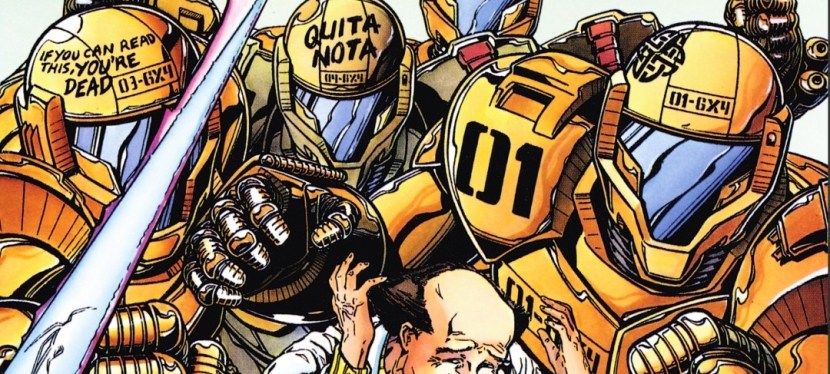
At Camp Pendleton in California, an armored U.S. marine goes through an intense training session fighting machines not knowing that there could be traps waiting to get triggered. As Gunny (the armored marine in the session) falls into a trap, his teammates, General Kendall and the scientist Zahn watch the proceedings behind the scenes as another teammate (operating with virtual reality on her high-tech station) continues to communicate with him.

As time passes by, the situation gets even worse for Gunny physically…

Quality

Armorines has members who go out on the field wearing high-tech suits of armor while there are other members who serve as co-pilots using virtual technology and constant communication behind closed doors.

In terms of storytelling, the creative team focused mainly on the build-up of not just the plot but also the importance and the ways of the Armorines themselves. As weapons of the government, Armorines are an expensive team to run due to the use of very advanced technologies for operations. The Armorines have members who go out on the field wearing high-tech suits of armor that provide enhanced protection while also carrying high-tech weapons for offense. The team also has members who stay behind closed doors to use individual stations with virtual reality and enhanced communication with their brothers on the field.

When it comes to the characters, the smoking Gunnery is noticeably the one who got the most exposure and the most development. The other Armorine members got token exposure for the readers.

More on the plot itself, there is a mission that requires the Armorines to go deep underwater to solve a mystery and do something dangerous secretly. The mission was essentially all about protecting America’s top-secret weapons from falling into the wrong hands. To be clear, the mission itself happens in the 2nd half of this comic book which ultimately serves as a pay-off to the build-up the happened earlier. In fairness to the creative team, there was a good amount of suspense presented when the mission really started moving. There definitely something worth seeing during the mission.

Conclusion

In this story, Gunny is the closest thing to a definitive protagonist.

To be very clear, Armorines #1 (1994) is not exactly the high-powered, action-packed story people could expect from seeing the armored marines looking capable of fighting terrorists and other enemies of America in militaristic fashion. This comic book’s story is indeed surprising to me and the creative team was not hesitant to push hard with the concept they came up with here. As this comic book was clearly executed with build-up, introductions and emphasizing concepts in mind, it is not surprising that the pay-off in the 2nd half led to moments of intrigue and suspense with momentum going into the next issue. Lastly, I should state that this comic book is free from political influence and its focus on the team has been very consistent.

Overall, Armorines #1 (1994) is recommended.

+++++

Thank you for reading. If you find this article engaging, please click the like button below, share this article to others and also please consider making a donation to support my publishing. If you are looking for a copywriter to create content for your special project or business, check out my services and my portfolio. Feel free to contact me with a private message. Also please feel free to visit my Facebook page Author Carlo Carrasco and follow me on Twitter at  @HavenorFantasy as well as on Tumblr at https://carlocarrasco.tumblr.com/ and on Instagram at https://www.instagram.com/authorcarlocarrasco

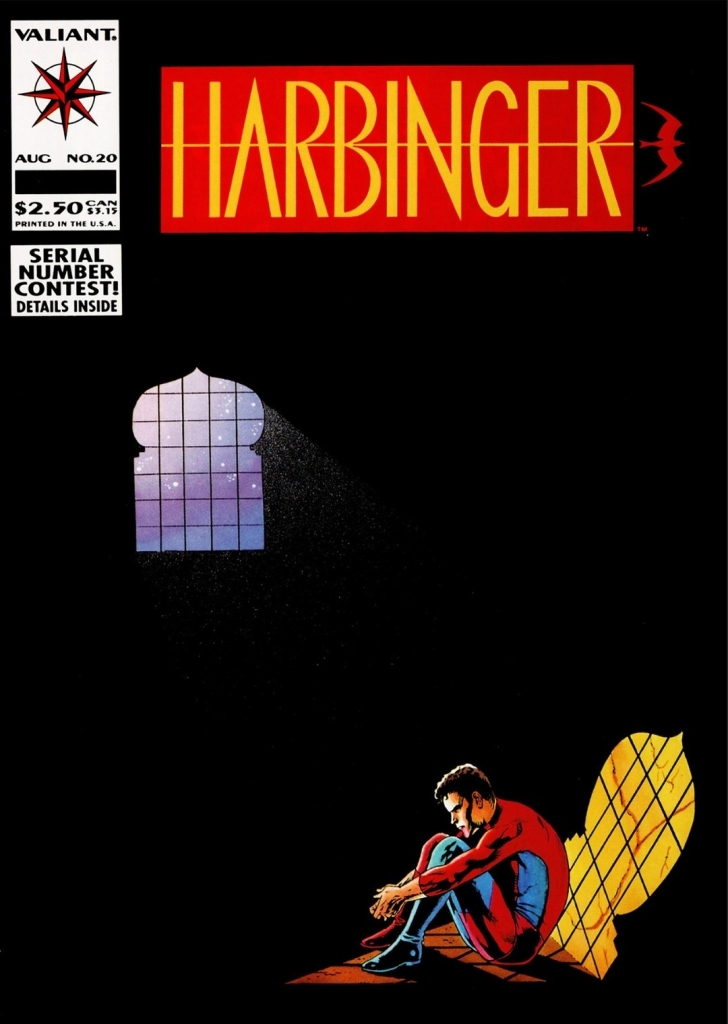
A Look Back at Harbinger #20 (1993)

Disclaimer: This is my original work with details sourced from reading the comic book and doing personal research. Anyone who wants to use this article, in part or in whole, needs to secure first my permission and agree to cite me as the source and author. Let it be known that any unauthorized use of this article will constrain the author to pursue the remedies under R.A. No. 8293, the Revised Penal Code, and/or all applicable legal actions under the laws of the Philippines.

Welcome back superhero enthusiasts, 1990s culture enthusiasts and comic book collectors! Today we go back to the early 1990s and explore a part of the Valiant Comics shared universe through the Harbinger monthly series.

In my previous review, the team led by Sting daringly broke into the Harbinger Foundation’s New York facility and freed the pretty blonde Natalie Toynbee (codename: Stunner) who happened to have a big ego and was not comfortable with the organization’s rules. While Sting and his team secured Natalie as their newest member, a sinister force from Iran arrives in America. 

With those details laid down, here is a look back at Harbinger #20, published in 1993 by Valiant Comics with a story written by Maurice Fontenot and illustrated by Howard Simpson.

The cover.

Early story

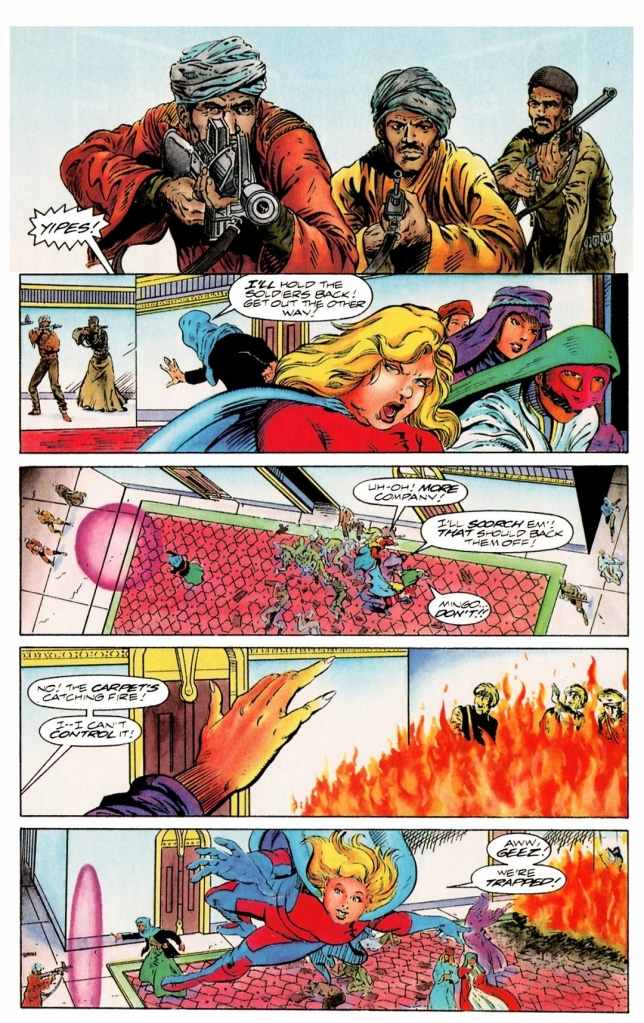
The story begins deep in the nation of Iran on February 1, 1993. Thanks to the tremendous help of Screen, the Harbinger renegades composed of Flamingo, Kris, Shatiqua and Faith/Zephyr make their way through the busy section of Mashad, carefully communicating with each other while disguised in cultural clothing. Their mission is to find the hideout of Kaliph and rescue Sting and Natalie/Stunner knowing they only have ten hours left.

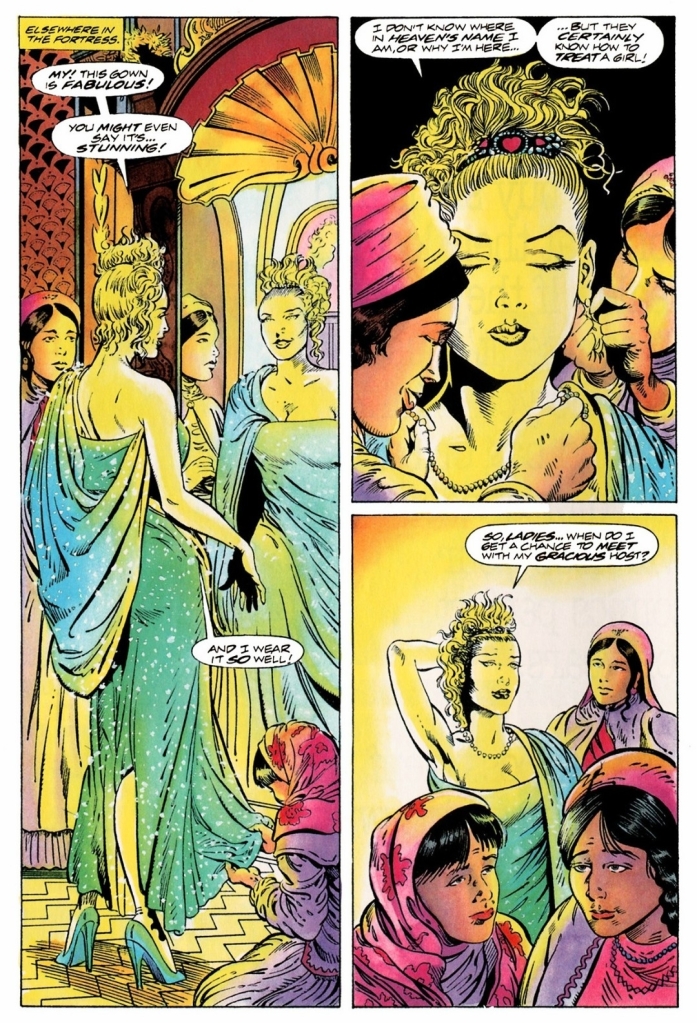
Inside Kaliph’s fortress, a very weak and uneasy Sting finds himself alone in a dark room while Natalie is being treated nicely by the servants of Kaliph in preparation for dinner with the sinister master himself…

Quality

During their rescue effort, Sting’s teammates face off with the armed Iranians of Kaliph.

In terms of storytelling, this is a very solid continuation to the events that happened in the previous issue and it was a clever move by the creators to have the story set in enemy territory which easily raised the stakes for Sting’s team. While this is not the first time that the group went out on dangerous missions going into the turf of the opposition, having Iran as the setting and Kaliph as the powerful villain really made things fresh for this particular comic book series.

It should be noted that having Sting being very vulnerable added a nice layer of depth in this tale given the fact that he is still living with a false sense of maturity as well as traces of arrogance on his part believing that he could make positive changes by fighting powerful enemies and freeing powered youth from captivity without vast amounts of resources. For the newcomers reading this, Sting and his companions do not have much money to live with nor do they have technologies or connections to be powerful as a team. They simply have their own super powers and the will to move on and make things happen which makes them different compared to many other superhero teams in comics.

There are also signs of suicidal thoughts on Sting’s part as he recklessly moved to get to Kaliph even though the villain’s men were armed. By contrast, his teammates moved cautiously into Kaliph’s fortress and the way they handled the armed Iranians was believably presented. Not to be outdone here in Natalie who got a good share of the spotlight.

This comic book’s evil Iranian Kaliph was presented to be not only powerful but also talented as a business negotiator (which makes him somewhat similar with this comic book series’ super villain Toyo Harada) and even as a host of special guests. His evil nature here got emphasized further through his treatment of people as pawns of negotiations backed by his power of manipulation.

Conclusion

Natalie Toynbee being treated nicely by the servants not realizing the evil of the man she is about to meet.

Harbinger #20 (1993) is both engaging and intriguing to read from start to finish. Having Sting’s team on a high-risk rescue mission in Iran made for a great setting and Kaliph turned out to be a more significant figure of evil. Through Kaliph and his violence-oriented servants, you will see the symbolism of the evil of Iran in real-life even though this comic book does not show any links between him and the regime that took power in 1979. Geopolitics are pretty much absent in the story but the evil presented through Kaliph make this old comic book highly relevant in relation to the evil of Iran today (for reference, click here, here, here, here, here and here). It should be noted that within the comic book, the Iranian people in general are not condemned and in real life, there are Iranians standing up against their government which itself has been sponsoring terrorists and organizing terrorism for a long time now. The brutality committed by Iran’s regime made several Iranians escape their country to be free.

Considering the very sensitive matter of Iran and other issues related with contemporary geopolitics, Harbinger #20 (1993) not only aged well but is also a living reminder that people whose minds got poisoned with wickedness, political correctness and wokeness would not dare make a comic book showing the evil of Iran. The Leftist-oriented people prefer to make deals with terrorists (for examples, click here and here).

Overall, Harbinger #20 (1993) is highly recommended!

+++++

Thank you for reading. If you find this article engaging, please click the like button below, share this article to others and also please consider making a donation to support my publishing. If you are looking for a copywriter to create content for your special project or business, check out my services and my portfolio. Feel free to contact me with a private message. Also please feel free to visit my Facebook page Author Carlo Carrasco and follow me on Twitter at  @HavenorFantasy as well as on Tumblr at https://carlocarrasco.tumblr.com/ and on Instagram at https://www.instagram.com/authorcarlocarrasco
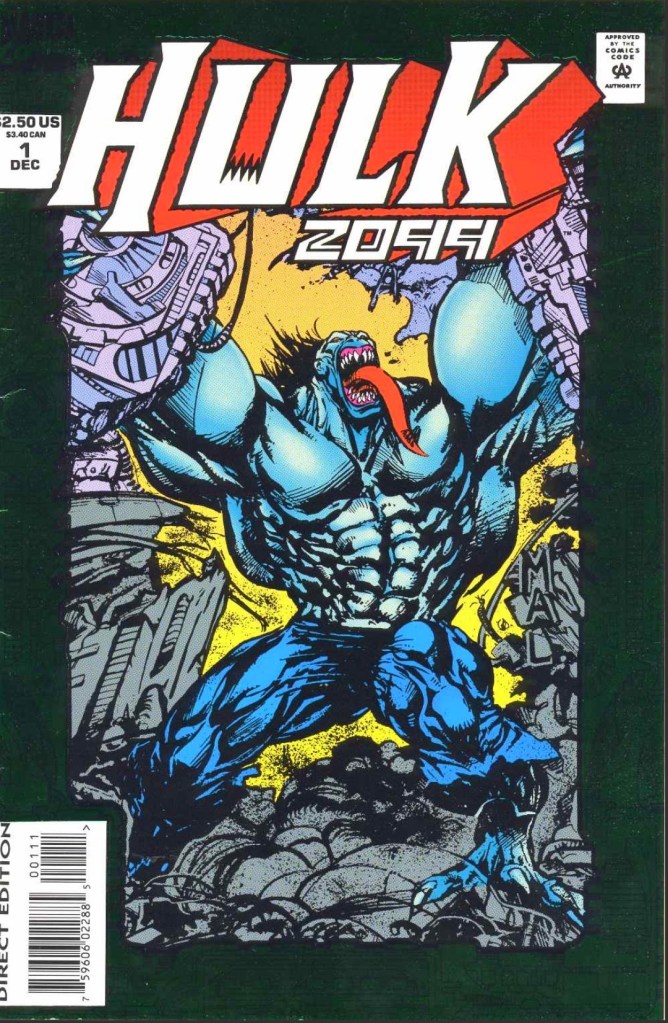
A Look Back at Hulk 2099 #1 (1994)

Disclaimer: This is my original work with details sourced from reading the comic book and doing personal research. Anyone who wants to use this article, in part or in whole, needs to secure first my permission and agree to cite me as the source and author. Let it be known that any unauthorized use of this article will constrain the author to pursue the remedies under R.A. No. 8293, the Revised Penal Code, and/or all applicable legal actions under the laws of the Philippines.

Welcome back superhero enthusiasts, 1990s arts and culture enthusiasts, Marvel Comics fans and comic book collectors! Today we go back to the wild 1990s by examining one of the many tales of Marvel Comics’ 2099 line of franchises, specifically through the Hulk 2099 monthly series.

For the newcomers reading this, Hulk 2099 first appeared in 2099 Unlimited #1 (1993) which also had his origin story told. Hulk 2099 was not a mere version of the classic Incredible Hulk with a futuristic touch. In fact, the futuristic green creature highlighted the protagonist John Eisenhart as a very selfish and obsessed Hollywood studio executive who happens to stumble upon the idolaters/worshipers of the classic Hulk Bruce Banner because he was searching for new properties and stories for his studio. Hulk 2099’s origin has notable similarities to that of the classic Hulk and gamma radiation exposure is one of them. As tales of the futuristic Hulk were told through the quarterly releases of 2099 Unlimited, Marvel decided it was time to give the green creature his own monthly series.

With those details laid down, here is a look back at Hulk 2099 #1 published in 1994 by Marvel Comics with a story written by Gerard Jones and drawn by Malcolm Davis.

The cover.

Early story

The story begins with the Hulk of 2099 destroying security droids and verbally attacking civilization. As he retains the intellect of John Eisenhart, he expresses his opposition against civilization for keeping people out of the water reclamation zone.

The story then shifts to California where Lotus Entertainment (Eisenhart’s employer) and its crew work on producing a film which is a dishonest telling of Eisenhart’s dealings with the Knights of Banner (already eliminated in 2099 Unlimited #1). During the production, one of the executives notices the absence of Eisenhart.

Elsewhere, John Eisenhart drives his flying car with Knights of Banner youth survivor Gawain as his passenger. Already struggling with the guilt over the deaths of all the adult Knights of Banner members, Eisenhart intends to end his employment and cash out of his contract. Gawain remains hostile towards Eisenhart.

Quality

The creative team used flashback images that look really similar to what was told in 2099 Unlimited #1.

If there is anything that is very obvious to talk about, it is the fact that this tale shows a radically different John Eisenhart who wants to get out of Hollywood’s multiple mazes of crookedness as he feels very guilty over what happened to the Knights of Banner. This happens just as a new entity took corporate control of Eisenhart’s employer before he could leave the company. In many ways, Eisenhart’s distress and struggle with being guilty reminds me a lot about Hardcase of the Ultraverse and the way the creative dramatized him was engaging.

For the story, there is a lot of corporate intrigue going on and Eisenhart’s failure to quit quickly was inevitable because the new enemy he faces here has a lot to do with the sudden takeover of Lotus Entertainment. At least on face value, this looks like an attempt by the creative team to change the status quo and move Hulk 2099 to a new creative direction away from what was established in 2099 Unlimited. Without spoiling the details, I can say that something very significant happened before the comic book’s ending and it will impact readers who followed the futuristic Hulk’s stories closely in the 2099 Unlimited series.

Along the way, there is a lot of action and unfortunate physical happenings which symbolize the chaos concept of the script. The notable thing here is that you won’t see very much of Hulk 2099’s monstrous form as the script was specifically written to tell a tale that went beyond one issue. Clearly, the creative team were sparing Hulk 2099 for a conflict in the next issue.

Malcolm Davis’ art has that visceral aesthetic that fits the established look of Marvel’s 2099 universe of the time but there were instances when he showed so much happening, the visuals looked chaotic and even disorienting. In fairness, his take on Eisenhart, Quirk, Gawain and others made them looked recognizable.

Conclusion

The future of Commiewood, wokeness, and dishonesty.

While its story has little of the green monster in it, Hulk 2099 #1 (1994) does a decent job building up the tension on top of the guilt-filled Eisenhart while setting up events that looked like a bold new creative direction was coming. By the time this comic book was published, several Hulk 2099 tales were already published in the quarterly 2099 series. On its own, this comic book lightly builds up the lore of the 2099 universe as it was clearly focused on Hulk 2099’s creative concept and characters.

While Eisenhart was indeed determined to change, it is a turnoff to see him lie and exaggerate details to protect himself from a certain corporate psychologist who is after the truth. There is also a lot of anti-corporate expressions here which seems to suggest that someone within the creative team had been thinking with socialist concepts and decided to use the script as an outlet of expression. The weird but true thing is that by today’s standards, Hollywood is filled with Commies/socialists/Marxists/liberals/woke nuts from the film crew up to the executives that run studios and produce films or shows that are dumb, lies about reality, self-centered and extensions of their ideologies. This showed that this comic book was prophetic in some ways.

Overall, Hulk 2099 #1 (1994) is satisfactory.

+++++

Thank you for reading. If you find this article engaging, please click the like button below, share this article to others and also please consider making a donation to support my publishing. If you are looking for a copywriter to create content for your special project or business, check out my services and my portfolio. Feel free to contact me with a private message. Also please feel free to visit my Facebook page Author Carlo Carrasco and follow me on Twitter at  @HavenorFantasy as well as on Tumblr at https://carlocarrasco.tumblr.com/ and on Instagram at https://www.instagram.com/authorcarlocarrasco

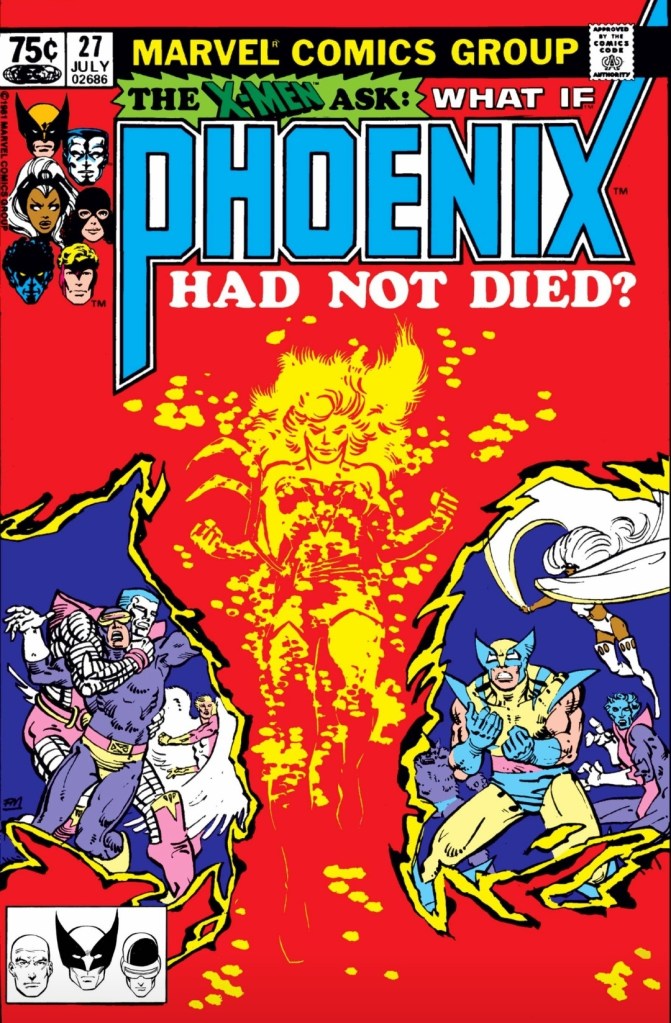
A Look Back at What If #27 (1981)

Disclaimer: This is my original work with details sourced from reading the comic book and doing personal research. Anyone who wants to use this article, in part or in whole, needs to secure first my permission and agree to cite me as the source and author. Let it be known that any unauthorized use of this article will constrain the author to pursue the remedies under R.A. No. 8293, the Revised Penal Code, and/or all applicable legal actions under the laws of the Philippines.

Welcome back superhero enthusiasts, 1980s arts and culture enthusiasts, Marvel Comics fans and comic book collectors! Today we go back to the early 1980s and examine an alternate universe portrayal of the X-Men and the Dark Phoenix saga itself as told in one of the comic books of the first volume of the series What If.

So much has been discussed about the Dark Phoenix saga of the Uncanny X-Men series through the decades. A lot point to it as the greatest X-Men ever told while some called it the true X-Men epic story that Chris Claremont and John Byrne came up with. Considering its deep impact and significance on the Marvel Comics shared universe, it was only a matter of time before the publisher decided to revisit the said storyline but explore other outcomes through the What If series.

With those details laid down, here is a look back at What If #27 published in 1981 by Marvel Comics with a story written by Mary Jo Duffy and drawn by Jerry Bingham.

The cover.

Early story

The story begins with the Watcher looking back at the events that led to the Dark Phoenix saga, who got impacted and how Jean Grey used a weapon of alien origin to end her own life and prevent the Dark Phoenix from raging.

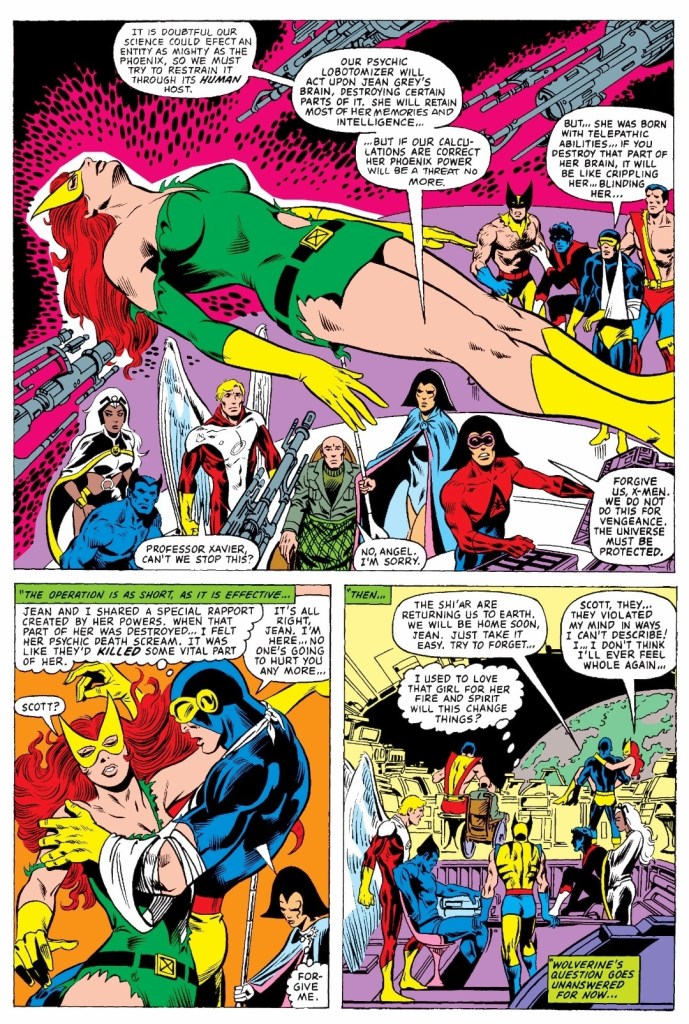
Suddenly, an alternate reality begins when Jean Grey survives and Cyclops reacts by using his optic blasts on incoming enemies until he got overwhelmed. The X-Men have been defeated and are brought to the imperial flagship of Lilandra’s grand fleet where the Shi’ar scientists prepare for the destruction of Phoenix.

Jeay Grey remains alive, floating above the X-Men and the others as Lilandra’s people prepare to start the process of the psychic lobotomizer on her. Their intention is to act upon Jean Grey’s brain and destroy certain parts of it in order to neutralize the Phoenix power within her. The operation turned out successful and Jean Grey survives once more. She and her fellow X-Men return to Earth…

Quality

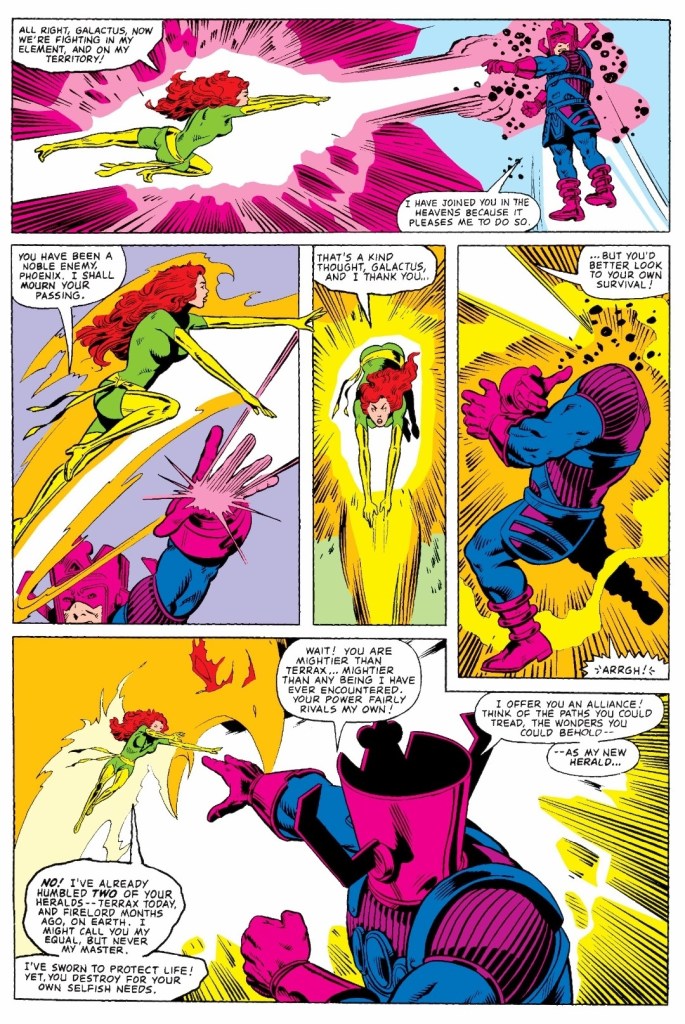
This conflict between Phoenix-powered Jean Grey and Galactus is a must-see.

This early, I can say that this is a very great exploration and portrayal of the concept about Phoenix (within Jean Grey) not dying during the Dark Phoenix saga. The script of this comic book is so great (note: solid plot structure, consistent portrayals of the characters, strong build-up with solid pay-off and more), it’s almost as if Mary Jo Duffy and Chris Claremont worked together behind the scenes.

The protagonist in this story is Jean Grey and this comic book examines her struggle with adjusting her personal life and her effort to fit in once again within the X-Men while remembering fully that as Dark Phoenix, she still remains guilty of destroying an entire solar system and committing the mass murder of five billion people.

Unsurprisingly, due to the emergence of a tremendous crisis deep in space, Jean Grey gets involved with her team going to the site on a mission. This easily puts her into a situation that makes her revive the power of the Phoenix deep within herself. While the use of the tremendous power of the Phoenix to help the X-Men looked sensible at first glance, it only signified the beginning of a chain of destruction and unfortunate developments. As expected, Jean Grey can only go so far with her good nature and her free will while having the magnificent powers of the Phoenix.

While the conflicts were portrayed well, Mary Jo Duffy’s script raises key questions about the red-head X-Men member: How can Jean Grey ever achieve a normal life and level with her X-Men teammates knowing that she carries powers that make her god-like? How can she ever forget the tragic fact that as Dark Phoenix, she murdered billions in deep space? What can Charles Xavier do to lead and guide the X-Men knowing that Jean is way too powerful? Could the love of Cyclops be helpful for Jean Grey’s personal efforts to control the Phoenix power within?

Another highlight of this story is the final seven pages. The ending is very impactful and definitely something you must see.

Conclusion

This happened after Jean Grey’s survival.

What If #27 (1981) is a classic alternate reality portrayal of the Marvel Comics universe and it surely works as a companion piece to what was established in the Dark Phoenix saga. Mary Jo Duffy’s script really captured the spirit of Claremont’s X-Men and the dramatic stuff and all the build-up led to a very tremendous ending that can disturb you or even satisfy you in the most unusual way. Most notably, this comic book really answered the question about what would happen had Phoenix did not die. The 2nd tale of this comic book – the Kree Encounter – is an interesting additive.

Overall, What If #27 (1981) is highly recommended.

+++++

Thank you for reading. If you find this article engaging, please click the like button below, share this article to others and also please consider making a donation to support my publishing. If you are looking for a copywriter to create content for your special project or business, check out my services and my portfolio. Feel free to contact me with a private message. Also please feel free to visit my Facebook page Author Carlo Carrasco and follow me on Twitter at  @HavenorFantasy as well as on Tumblr at https://carlocarrasco.tumblr.com/ and on Instagram at https://www.instagram.com/authorcarlocarrasco
A Look Back at Superman: The Man of Steel #20 (1993)

Disclaimer: This is my original work with details sourced from reading the comic book and doing personal research. Anyone who wants to use this article, in part or in whole, needs to secure first my permission and agree to cite me as the source and author. Let it be known that any unauthorized use of this article will constrain the author to pursue the remedies under R.A. No. 8293, the Revised Penal Code, and/or all applicable legal actions under the laws of the Philippines.

Welcome back superhero enthusiasts, 1990s culture enthusiasts and comic book collectors! Today we go back to the early 1990s and explore a key chapter in the post-Crisis era of DC Comics through a Superman comic book.

Previously, I reviewed Adventures of Superman #498 (1993) which marked the first chapter of the Funeral for a Friend storyline and dramatized the impact left behind by the death of Superman. That particular comic book had strong writing and succeeded in dramatizing how Superman’s friends, associates and other characters coped with his death with the future looking uncertain to them.

With those details laid down, here is a look back at Superman: The Man of Steel #20, published in 1993 by DC Comics with a story written by Louise Simonson and drawn by Jon Bogdanove. This comic book marked the third chapter of the Funeral for a Friend storyline.

The cover.

Early story

The story begins with people in Metropolis struggling to move forward not only because their hero Superman died but also because of the tremendous damage left behind by Doomsday. In his headquarters, Lex Luthor is talking with the telephone surrounded by several people with Supergirl watching. The matter being discussed was the burial of Superman at Centennial Park particularly in a structure Luthor himself donated. While he has to live on with the fact that he failed to kill Superman, Luthor tells himself he can still bury him.

At the Kent farm far away from Metropolis, Jonathan and Martha Kent are agonizing not only because of the death of their beloved son but also because they realized they cannot even get near him at his funeral as it will be organized as a major event with only the important people allowed to attend…

Quality

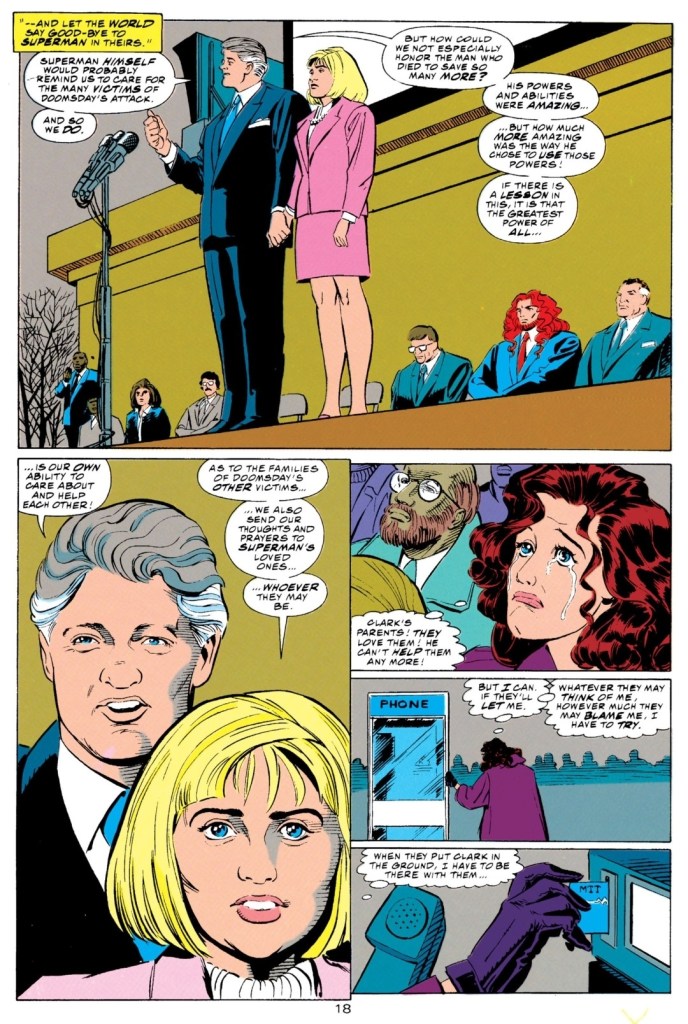
It seems like destiny to have the super villain Lex Luthor in the presence of a fictionalized Bill Clinton and Hillary Clinton during the funeral of Superman. By today’s standards, the Clintons made it normal for America to bow to terrorists and make deals with them. That being said, their inclusion in this comic book is just wrong.

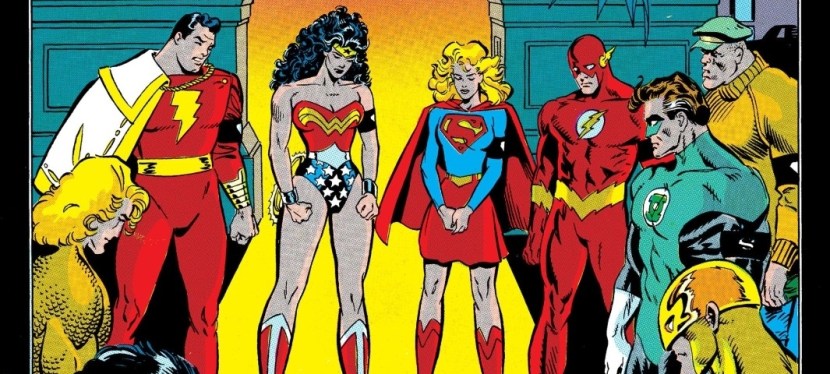
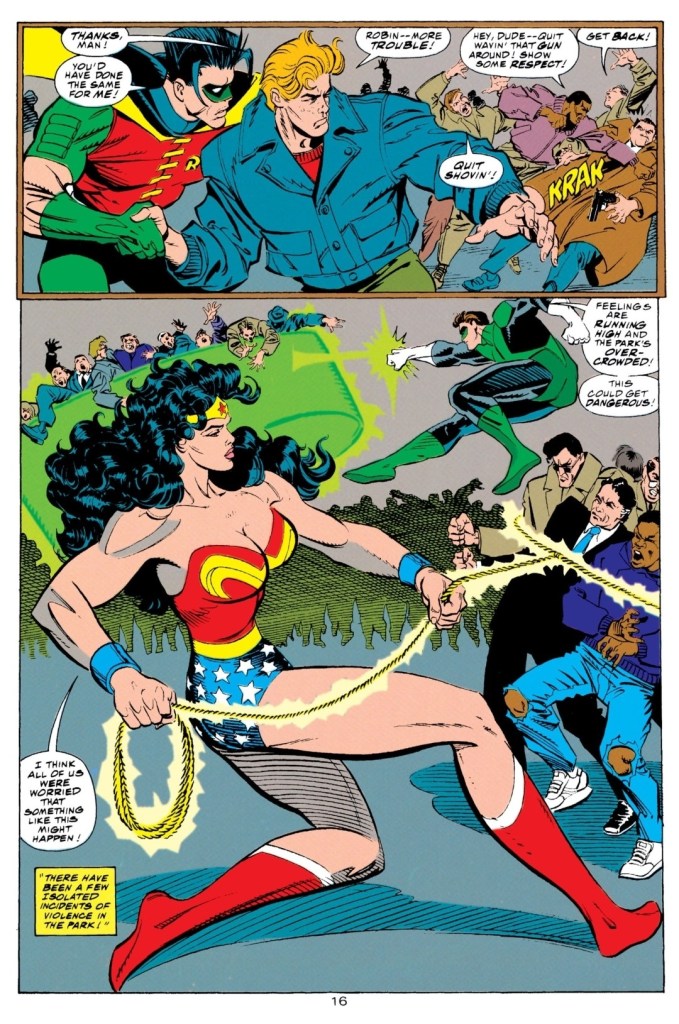
To go straight to the point, like Adventures of Superman #498 (1993), this comic book continues to dramatize the impact of Superman’s death on Metropolis and its people in a very engaging manner. It shows that DC’s creative teams in charge of Superman comic book at the time were really organized and coordinated with each other on crafting the Funeral for a Friend storyline. What makes this comic book stand out is the funeral itself which was organized as a public event (with the burial itself done in the presence of important people – including a very evil couple from the Democrats who love abortion and terrorism) and this includes the presence of many other DC Comics superheroes like Wonder Woman, Green Lantern, The Flash, Maxima, Shazam (AKA Captain Marvel) and others. The burial had its own share of intriguing and dramatic moments emphasizing the people’s struggle to adjust themselves knowing they don’t have Superman anymore to help them.

Wonder Woman, Green Lantern and Robin help out as the huge crowd became rowdy.

More on the post-death dramatization, the creative team managed to keep Superman’s associates Lois Lane, Jimmy Olsen and the other Daily Planet people feeling uneasy over the Man of Steel’s death which makes their work covering the funeral professionally a challenge. Unsurprisingly, Lois Lane gets her own fine share of the spotlight agonizing over the fact that she lost her beloved Clark (Superman to the public) whom she was supposed to get married with. The emotional struggle within her intensified as she experiences difficulty of informing the elderly Kent couple about what happened. This is rich writing prepared by the creators.

Not only that, the creative team also went all-out with dramatizing the impact of Superman’s good deeds on the people. You will see several people from Metropolis’ general population talk about how Superman helped them or inspired them. There are certain lines of dialogue that are quite touching to read.

Conclusion

A pretty powerful portrayal of Lois Lane’s struggle on dealing with the new reality that she lost her beloved Superman.

Superman: The Man of Steel #20 (1993) is another solid, post-death story emphasizing the new normal that Metropolis people and Superman’s friends are having difficulty adjusting to…a world without the Man of Steel. Based on the high quality of the storytelling and character development, it is easy to tell that the Superman titles’ creative teams planned ahead and prepared themselves for telling a post-death saga which was pretty risky given the iconic status of Superman and his decades-long legacy in comics and pop culture. This comic book really made Superman’s absence feel powerful and undeniable.

Overall, Superman: The Man of Steel #20 (1993) is recommended.

+++++

Thank you for reading. If you find this article engaging, please click the like button below, share this article to others and also please consider making a donation to support my publishing. If you are looking for a copywriter to create content for your special project or business, check out my services and my portfolio. Feel free to contact me with a private message. Also please feel free to visit my Facebook page Author Carlo Carrasco and follow me on Twitter at  @HavenorFantasy as well as on Tumblr at https://carlocarrasco.tumblr.com/ and on Instagram at https://www.instagram.com/authorcarlocarrasco

A Look Back at Superman III comic book adaptation (1983)

Disclaimer: This is my original work with details sourced from reading the comic book and doing personal research. Anyone who wants to use this article, in part or in whole, needs to secure first my permission and agree to cite me as the source and author. Let it be known that any unauthorized use of this article will constrain the author to pursue the remedies under R.A. No. 8293, the Revised Penal Code, and/or all applicable legal actions under the laws of the Philippines.

Welcome back superhero enthusiasts, 1980s culture enthusiasts and comic book collectors! Today we go back to the year 1983 which saw the theatrical release of Superman III that featured the late Christopher Reeve as the cinematic Man of Steel.

The 1980s was a very different time with regards to Hollywood’s handling of superhero movies. The concept of a shared cinematic universe was decades away from realization. Warner Bros. back then relied on the Salkind family to produce Superman movies and the first flick in 1978 proved to be a major hit for both viewers and critics while also establishing Christopher Reeve as the definitive live-action Superman for countless people. Unsurprisingly, a sequel was released in the early 1980s which continued box office success for the stakeholders and only led to the approval of another sequel.

Along the way, the late Richard Pryor (a major comedian already) appeared on TV and talked about Superman II which eventually led to him getting hired for Superman III. The movie was released in 1983 making a little over $80 million worldwide while also getting a noticeably weaker reception from critics. More notably, Richard Pryor had a huge chunk of the film’s spotlight as Gus Gorman while the overshadowed Christopher Reeve managed to stretch his cinematic art on playing Clark Kent and Superman (note: there is also the memorable Clark versus Superman battle). Superman III very clearly had a lot more comedy in its presentation. As part of the movie’s marketing, an official comic book adaptation by DC Comics was published.

With those details laid down, here is a look back at the Superman III comic book adaptation,  published by DC Comics in 1983 with a story written by Cary Bates and art made by the late Curt Swan and Sal Amendola.

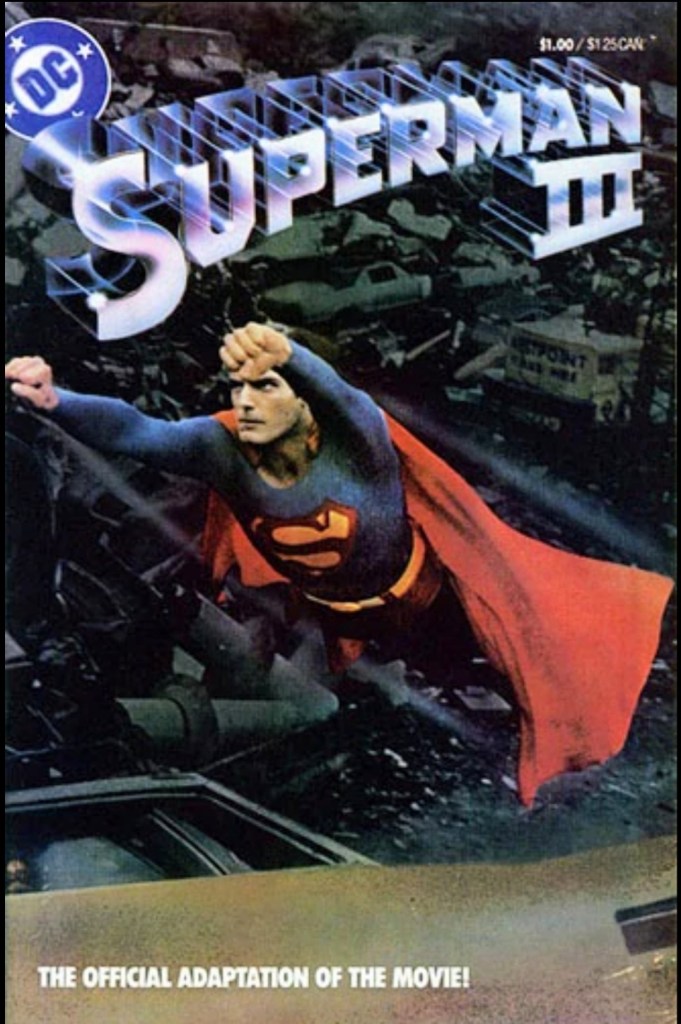
The cover.

Early story

The story begins inside the unemployment bureau of Metropolis. There, August “Gus” Gorman was told after 36 weeks of chronic unemployment, he is no longer eligible for financial assistance (read: welfare) from the city. As he was about to light his cigarette, he noticed computer job ad on the match. Gorman proceeds to the Archibald Data Processing School where he gets enrolled with several others. In front of others, Gorman does something on a computer which impressed the instructor a lot.

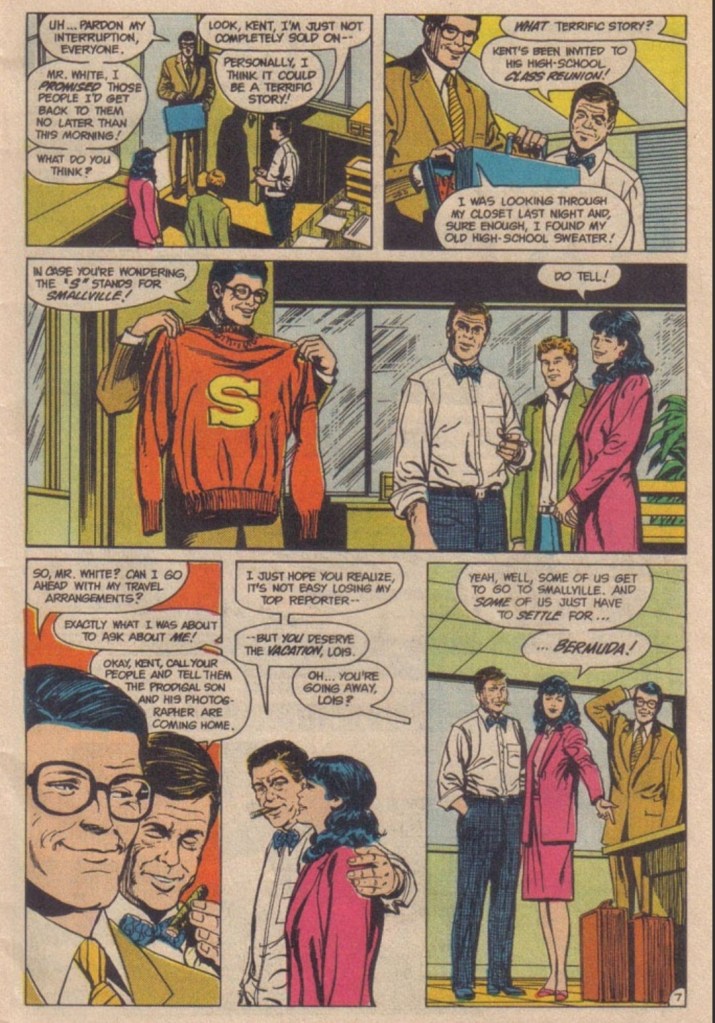
Over at the Daily Planet, Clark Kent/Superman, Lois Lane and Jimmy Olsen meet with Perry White at his office. Kent will be returning home to Smallville and make a news story out of it. White gives Kent his approval and then tells Lois she deserves a vacation.

Hours later, Kent and Jimmy Olsen ride the bus together going to Smallville but their ride stops as a result of a huge fire damaging a large chemical plant. A police officer reveals to Olsen that the scientists inside are worried about the plant and its stuff getting destroyed by the fire.

Kent carefully leaves the bus and discreetly changes into Superman to help solve the problem. Olsen, meanwhile, sneaks past the authorities to get to the burning chemical plant.

Over at Webcoe Industries, company head Ross Webster and his sister Vera learn that more than $85,000 worth of company funds was stolen by someone within. Just outside the office, Gus Gorman enters his fancy looking sports car which Webster, Vera and Lorelei notice. Webster asked how could one of their computer technicians afford such a vehicle worth $75,000…    

Quality

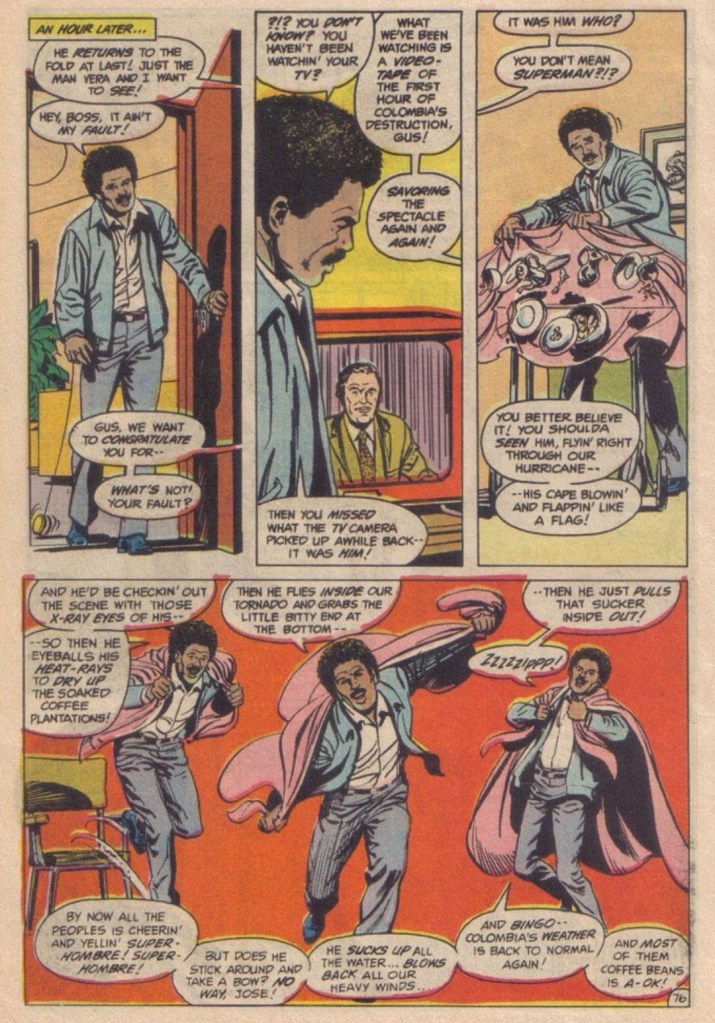
This is a creative way the comic book team used to dramatize Gus Gorman scene revealing and acting the bad news to his boss Ross Webster whose plans were thwarted by Superman.

While it is understandable that not all scenes and not all character moments from the movie  made it on print media, this comic book still managed to capture the film’s essence for the most part. The creative team pulled off their own interpretations of the events and made something entertaining and engaging even though they had to deal with the major challenge of summarizing the movie’s plot and establishing a workable comic book narrative.

I should state that the comic team creatively avoided making in-depth references about liquor and smoking which were obvious in the movie. You will not see Superman drinking liquor at a bar nor will you see Gus Gorman referring to tar listed on a cigarette pack. I suppose this was done to ensure the comic book would be released widely and be acceptable to very young readers and the parents watching them.

The battle between evil Superman and Clark Kent is best viewed in the movie. This one is a shorter and less detailed version of it.

When it comes to establishing the clear lead among all the characters featured, Superman fans should be delighted to know that the Man of Steel is indeed more prominent than Gus Gorman. Take note that in the movie, Richard Pryor’s Gus Gorman overshadowed Christopher Reeve’s Superman/Clark.

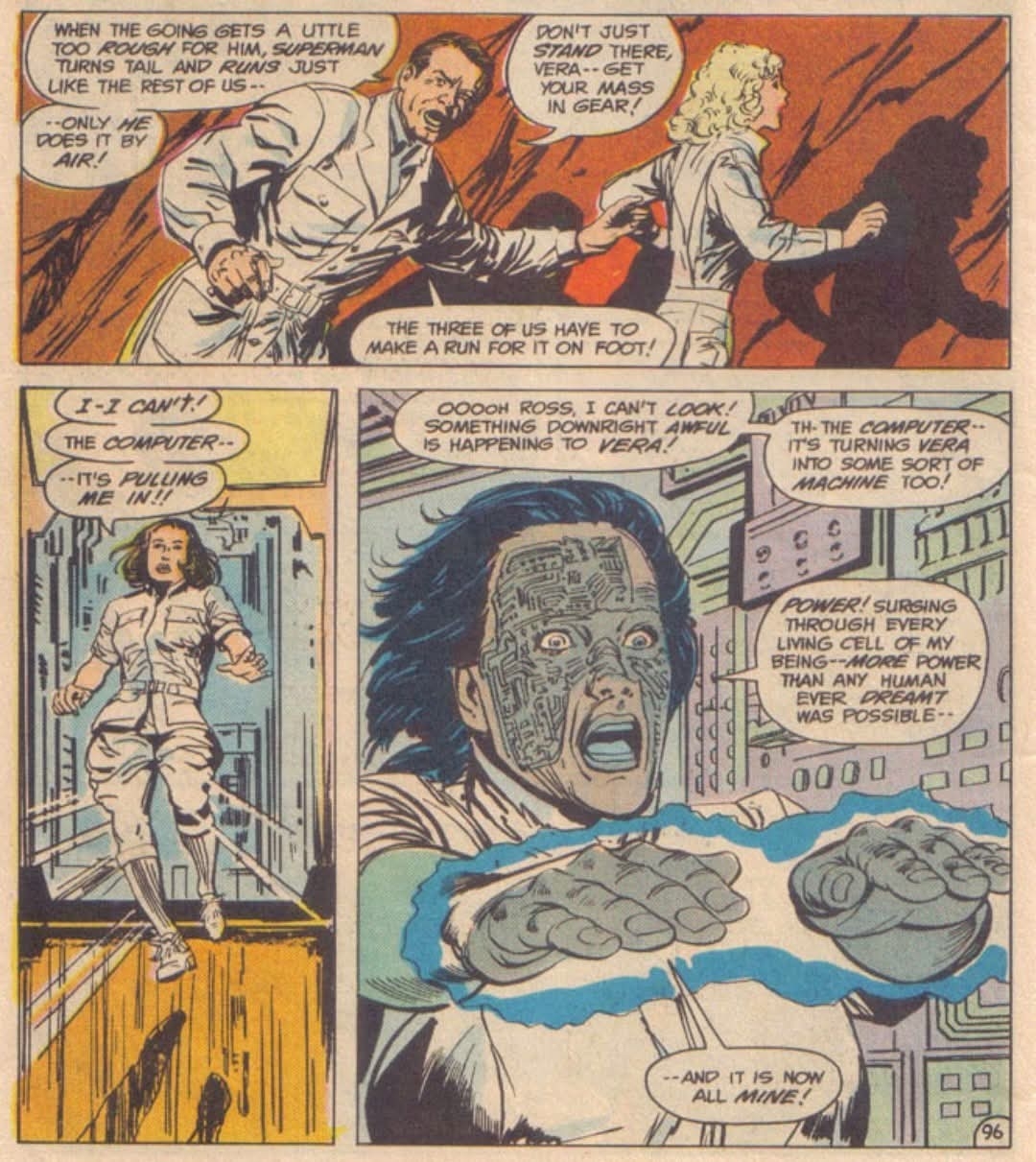
Remember the frightening sequence of Vera getting captured and turned into a cybernetic figure by the Super Computer? This is what it looks like in comic book format.

The art done by Curt Swan and Sal Amendola is decent and it seems to me that their time on visualizing Cary Bates’ script was indeed limited. That being said, it was not surprising to me that, with the exception of Ross Webster in one specific image, none of the characters resembled their cinematic counterparts. Clark Kent/Superman never resembled Christopher Reeve, and Gus Gorman looks nothing like Richard Pryor. Clearly, the artists’ focus was visualizing the narrative which they succeeded.  

Conclusion

Clark Kent, Lois Lane, Jimmy Olsen and Perry White in the Daily Planet.
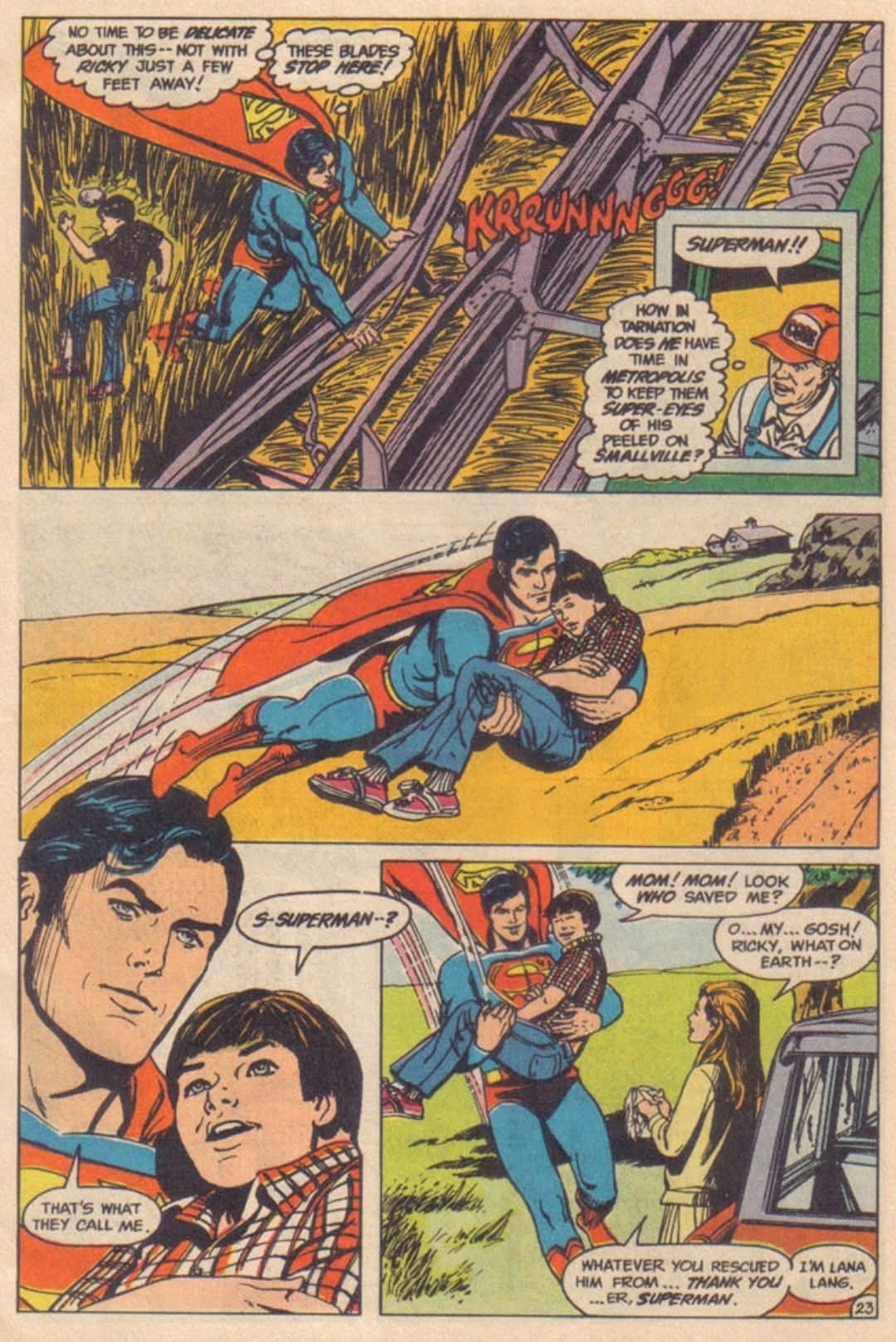
Superman saving Lana Lang’s son from certain death.

Having seen the Christopher Reeve/Richard Pryor movie in the cinema and on cable TV since 1983, I can say that Superman III (1983) is a decent adaptation. It’s not 100% faithful but it is still a worthy read as it will give you the movie’s concept and entertainment values in literary form. If you really want to full essence of film along with the cinematic moments (note: the Superman-Clark battle is the cinematic highlight) all intact, then your obvious choice is to watch the movie. If you are turned off by the movie’s wacky comedy, then the comic book adaptation will deliver to you the more serious approach on telling Superman III’s story. Let me repeat that Superman is more prominent than Gus Gorman in this comic book.

Overall, Superman III (1983) is satisfactory.

+++++

Thank you for reading. If you find this article engaging, please click the like button below and also please consider sharing this article to others. If you are looking for a copywriter to create content for your special project or business, check out my services and my portfolio. Feel free to contact me with a private message. Also please feel free to visit my Facebook page Author Carlo Carrasco and follow me on Twitter at  @HavenorFantasy as well as on Tumblr at https://carlocarrasco.tumblr.com/ and on Instagram at https://www.instagram.com/authorcarlocarrasco/
A Look Back at Wolverine #75 (1993)

Disclaimer: This is my original work with details sourced from reading the comic book and doing personal research. Anyone who wants to use this article, in part or in whole, needs to secure first my permission and agree to cite me as the source and author. Let it be known that any unauthorized use of this article will constrain the author to pursue the remedies under R.A. No. 8293, the Revised Penal Code, and/or all applicable legal actions under the laws of the Philippines.

Welcome back, superhero enthusiasts, comic collectors, 1990s culture enthusiasts and fans of the X-Men! We go back to the year 1993 when the 30th anniversary of the X-Men was celebrated with the 6-part Fatal Attractions storyline. Already I reviewed Uncanny X-Men #304 (Part 3) which was not worthy of the X-Men’s 30th anniversary celebration. X-Men #25 (Part 4) meanwhile was not only great but also shocking and had a years-long impact on X-Men comics.

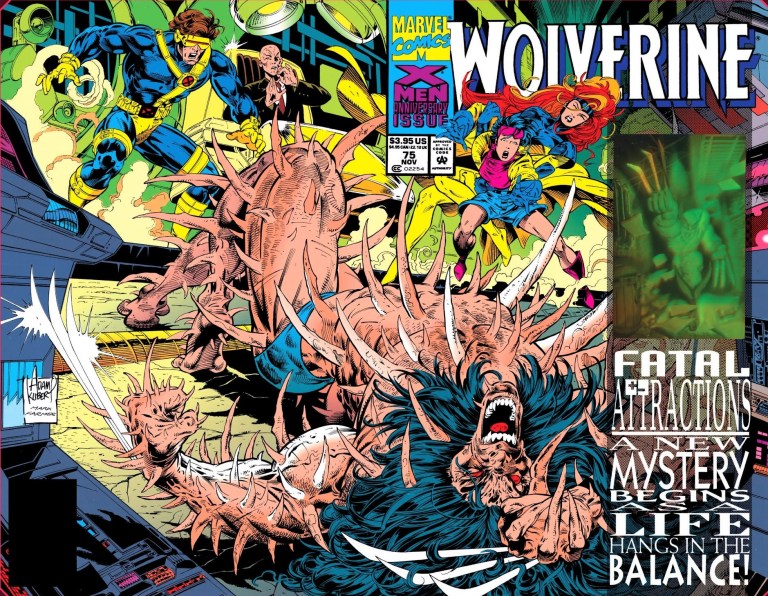
So now the focus is on the 5th chapter of the Fatal Attractions storyline handled by the Larry Hama-Adam Kubert team on the Wolverine monthly series of the time. With those details laid down, here is a look back at Wolverine #75, published by Marvel Comics in 1993 with a story written by Larry Hama and drawn by Adam Kubert.

The cover.

Early story

The story begins in outer space. Carrying Charles Xavier, Wolverine, Gambit, Jean Grey, Rogue and Quicksilver (who participated in the dangerous mission in X-Men #25), the X-Men’s jet (piloted by Bishop) struggles mechanically as it was not designed for space travel. Worse, Wolverine is under very serious condition and the medical unit has been operating in full capacity dealing with his intense trauma.

In an attempt to alleviate Wolverine’s psychic trauma, Charles Xavier and Jean Grey enter his mind and discover that there is a world full of pain and horror. They see visions of a restrained Wolverine (from his Weapon X days) being attacked by Sabretooth and Lady Deathstrike. Xavier explains that they are at the epicenter of Logan’s most suppressed cataclysmic memories which were clearly triggered by the physical damage Magneto inflicted on him (see X-Men #25).

As the X-Men’s jet attempts to enter Earth’s atmosphere, its exteriors heat up dramatically shaking everyone inside. This complicates the situation on stabilizing Wolverine…

Quality

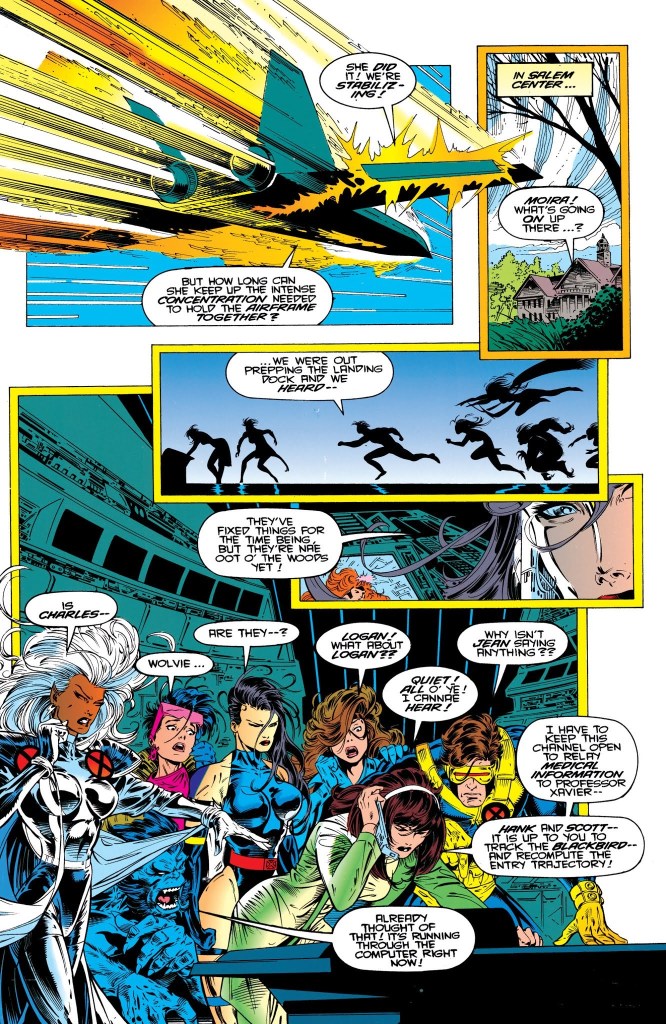
The other X-Men team members at their headquarters expressing worry and concern about the situation of their teammates struggling to come back home from space.

To be clear, this story continues the events of Fatal Attractions but with a bit more focus on Wolverine (compared to the earlier chapters of the storyline that is). There is no real battle between good and evil at all. It’s really all about Wolverine struggling to survive just as his teammates struggle to arrive home.

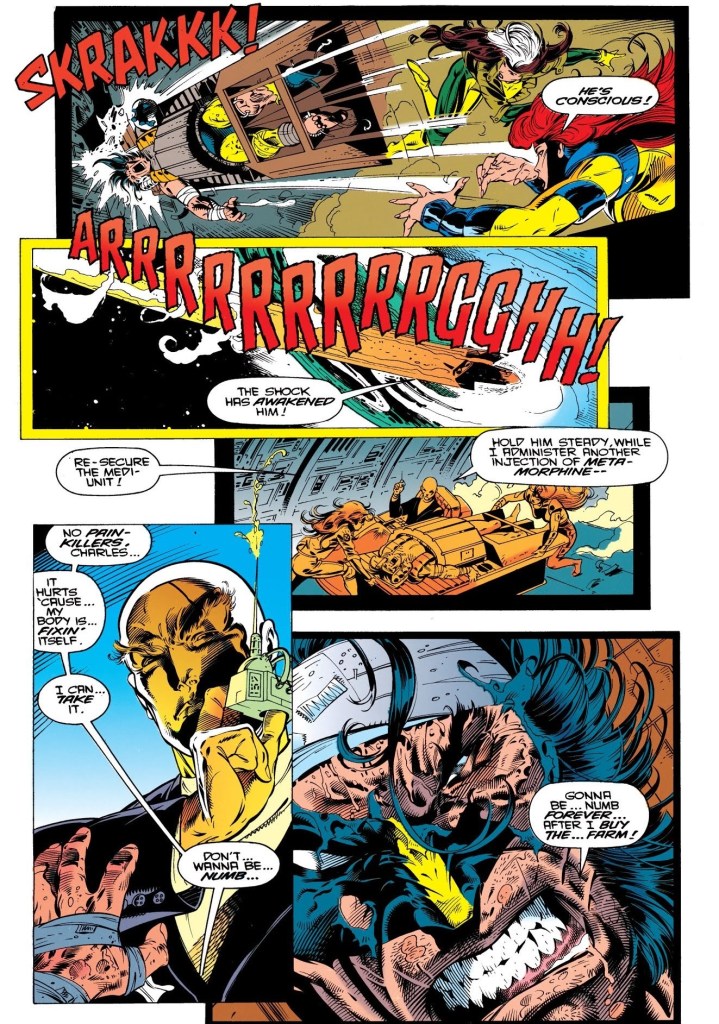
Before the stories of this comic book and X-Men #25 happened, Wolverine has often been portrayed to be very tough, brave and a walking machine of violence which has been reflected in other X-Men stories told in video games and movies. In this very comic book, Wolverine has been presented to coming close to death. This means Logan, at this particular stage of the history of the literary X-Men, was at his most vulnerable state. In my experience, this was both alienating and shocking to see.

With regards to the writing, Larry Hama did an excellent job with pacing the story from start to finish. Right from the beginning, the story pulls you into the X-Men’s tough situation and as each page gets turned, the tension as well as the suspense builds up until the execution of the climax. Along the way, the comic book not only portrays Wolverine struggling on the edge, it also works to make you care more or be more concerned towards him. Oh yes, the shocking moment near the end of this comic book remains very powerful and you who read this retro review should read Wolverine #75 and see it for yourselves.

Conclusion

Wolverine at his most vulnerable state.

By today’s standards, Wolverine #75 (1993) is still a very great comic book to read. In fact, I can say it is not only one of most defining chapters of the Fatal Attractions storyline as well as one of the most significant X-Men comic books of the 1990s, it is indeed a true illustrated literature classic ever published by Marvel Comics. In retrospect, this comic book marks a major turning point in the life of Wolverine who is still one of the most iconic characters in all of superhero literature. All of these were achieved thanks to the creative team of Larry Hama and Adam Kubert (whose are here was great and stylized at the same time). Hama succeeded in writing the continuation of the Fatal Attractions storyline while balancing all of the exposition and still putting Wolverine in the center. That itself is a very great work of writing.

If you are seriously planning to buy an existing hard copy of Wolverine #75 (1993), be aware that as of this writing, MileHighComics.com shows that the near-mint copy of the regular edition costs $60 while the near-mint copies of the signed-and-numbered edition and the newsstand edition cost $300 and $180 respectively.

Overall, Wolverine #75 (1993) is highly recommended!

+++++

Thank you for reading. If you find this article engaging, please click the like button below and also please consider sharing this article to others. If you are looking for a copywriter to create content for your special project or business, check out my services and my portfolio. Feel free to contact me as well. Also please feel free to visit my Facebook page Author Carlo Carrasco and follow me at HavenorFantasy@twitter.com
A Look Back at X-Men Adventures #7 (1993)

Disclaimer: This is my original work with details sourced from reading the comic book and doing personal research. Anyone who wants to use this article, in part or in whole, needs to secure first my permission and agree to cite me as the source and author. Let it be known that any unauthorized use of this article will constrain the author to pursue the remedies under R.A. No. 8293, the Revised Penal Code, and/or all applicable legal actions under the laws of the Philippines.

Welcome back, X-Men fans, superhero enthusiasts, 1990s culture enthusiasts and comic book collectors! Today, we take a look at the topic of slavery and its connection with the mutants within the universe of Marvel. To be more specific, slavery was emphasized in one of the episodes of the popular X-Men animated series which itself had a monthly series of comic book adaptations – X-Men Adventures!

With those details laid down, here is a look back at X-Men Adventures #7, published by Marvel Comics in 1993 with a story written by Ralph Macchio and drawn by Chris Batista.

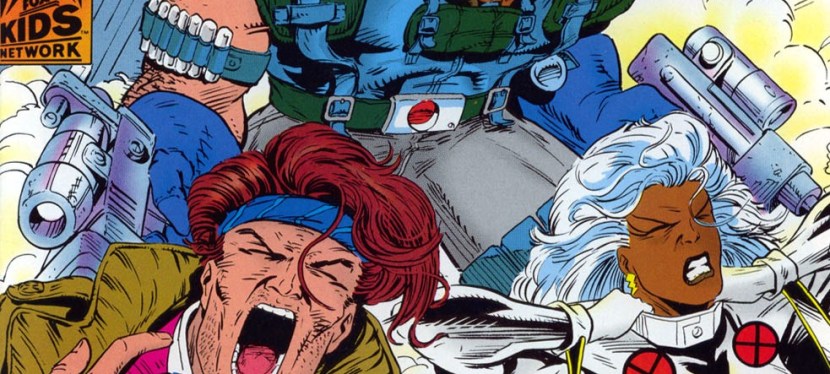
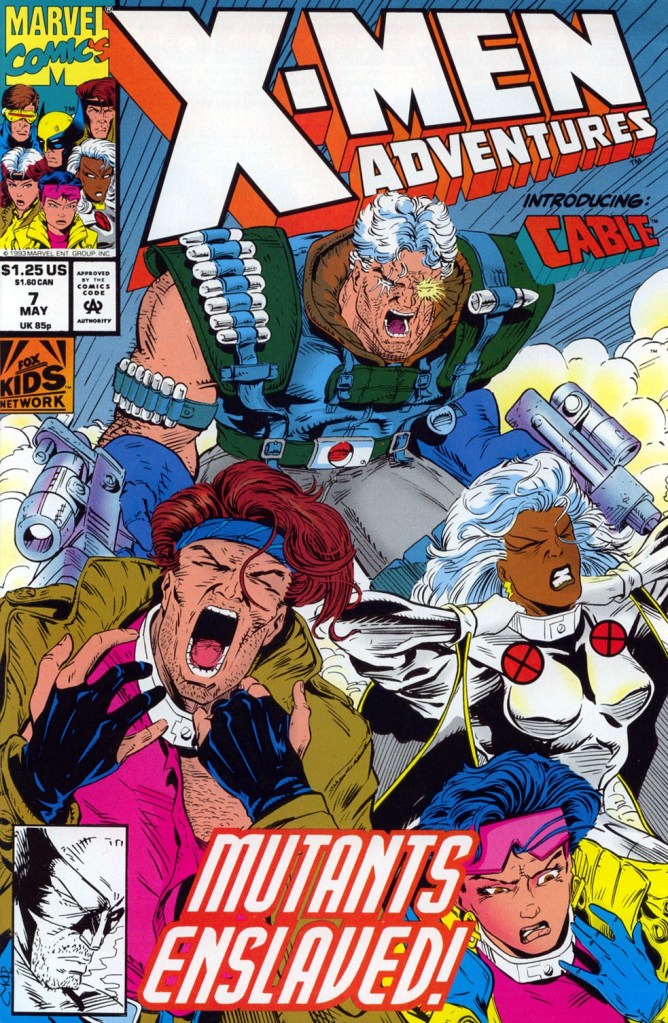
The cover.

Early story

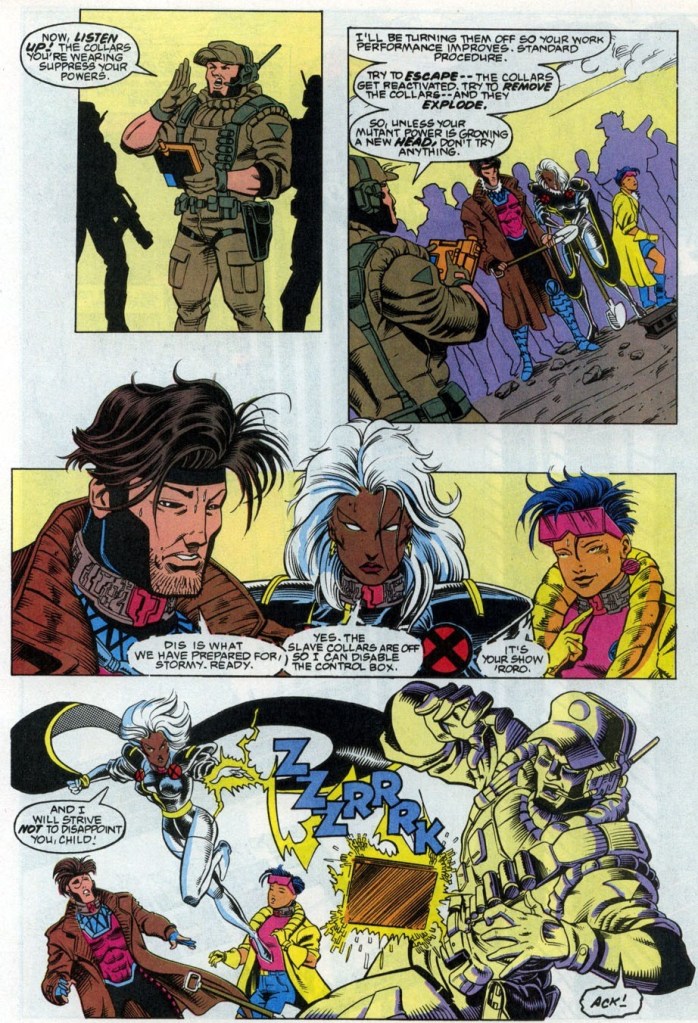
The story begins in Genosha, an island nation where mutants are designated as slaves constantly monitored by armed personnel of the state. X-Men team members Gambit, Storm and Jubilee are forced to do hard labor as they have been rendered powerless (with high-tech collars on their necks). Along with many other mutants, they are working on a key infrastructure project of the state.

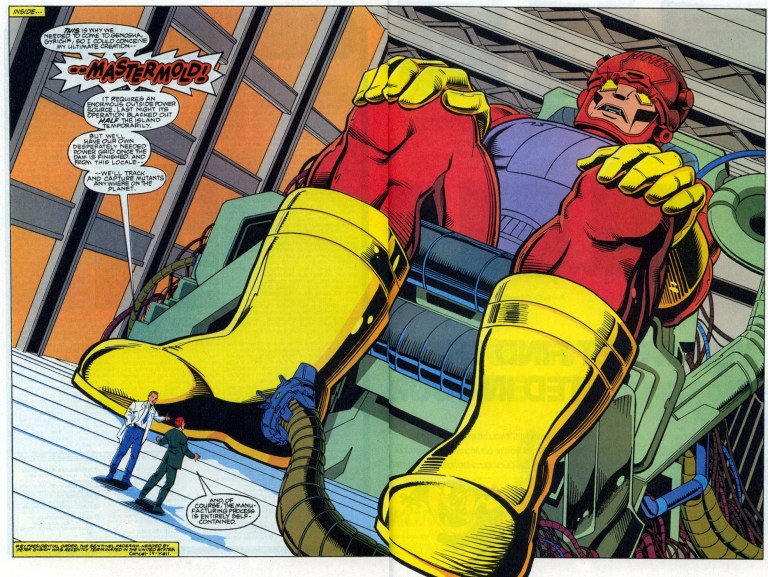
As soon as the local authorities deactivated the collars of the slaves, Storm immediately attempts to escape by flying. Immediately, the collar on her neck got reactivated which neutralized her powers and caused her to fall down to the water below. As soon as she climbs up on a rock to rest, a cable wraps itself on her right leg. Suddenly, a huge Sentinel rises above the water and pulls her…

Quality

The money shot!

Like the TV episode it was based on, this comic book does a decent job of portraying slavery and oppression with mutants in mind while avoiding the very sensitive topic of racism. To see Gambit, Storm and Jubilee portrayed as much more vulnerable characters is a nice change from their usual portrayals. While the story has a strong slavery theme, it also sheds light on the ongoing, secretive development of the Sentinels program which clearly emphasizes the growing danger that await not only the X-Men (the prime target of Trask and his team) but mutants in general.

When it comes to the art, Chris Batista did a nice job drawing not only the characters (all recognizable) but also their surroundings, the Sentinels and the framing of action scenes.

Conclusion

Gambit, Storm and Jubilee as slaves on Genosha.

I personally find X-Men Adventures #7 (1993) somewhat fun and slightly engaging to read. As this is an adaptation of the X-Men animated series episode about Genosha and mutant slavery, it clearly has a strong wholesome approach to its presentation. That being said, its depth is actually limited as it presented its themes with younger readers and new X-Men readers in mind. Unsurprisingly, the action is limited and was portrayed to avoid violence. If you want a more serious and grittier portrayal of Genosha and mutant slavery, you should read Uncanny X-Men #235 to #238, and the X-tinction Agenda storyline.

If you are seriously planning to buy an existing hard copy of X-Men Adventures #7 (1993) be aware that as of this writing, MileHighComics.com shows that the near-mint copy of the regular edition costs $30, while the near-mint copies of the newsstand edition and the Greek edition cost $90 and $200 respectively.

Overall, X-Men Adventures #7 (1993) is satisfactory.

+++++

Thank you for reading. If you find this article engaging, please click the like button below and also please consider sharing this article to others. If you are looking for a copywriter to create content for your special project or business, check out my services and my portfolio. Feel free to contact me as well. Also please feel free to visit my Facebook page Author Carlo Carrasco and follow me at HavenorFantasy@twitter.com