A Look Back at Amazing Spider-Man #252 (1984)

Welcome back superhero enthusiasts, 1980s arts and culture enthusiasts, Marvel Comics fans and comic book collectors! Today we go back to the year 1984 to examine a small part of the Marvel Comics universe through a tale of the Amazing Spider-Man monthly series.

By now, you readers should be aware that I reviewed a lot of comic books about Spider-Man and his deadliest enemy Venom. It is already established through comic book history that the iconic webslinger is responsible for the establishment of Venom as he brought into the world the alien costume (the symbiote) coming from deep space (as told in the Secret Wars limited series), and he also became responsible for the destruction of Eddie Brock’s career in journalism. Of course, Venom did not debut immediately after Spider-Man’s return from Secret Wars and there was a lot more about the symbiote when it was with Peter Parker.

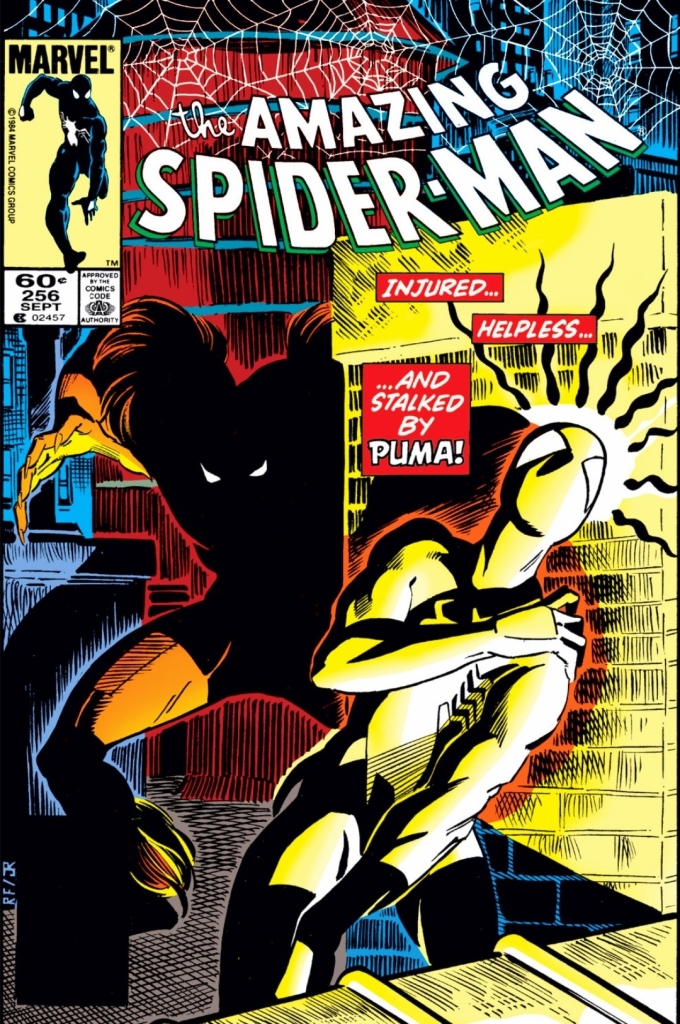
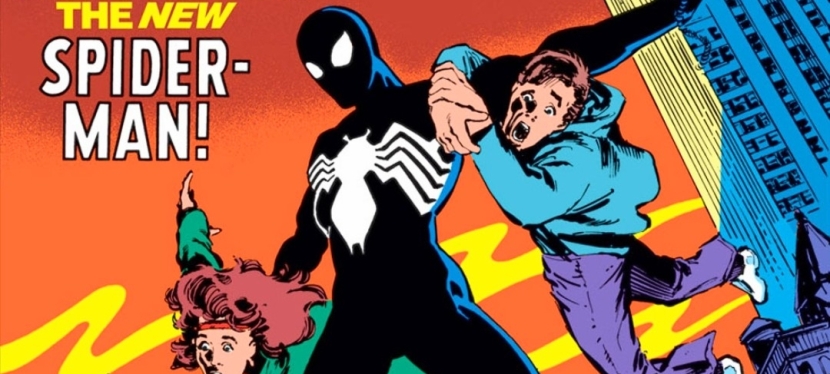
With those details laid down, here is a look back at Amazing Spider-Man #252, published in 1984 by Marvel Comics with a story written by Roger Stern and Tom DeFalco, and drawn by Ron Frenz. This comic book marked the first appearance of the alien costume.

The cover.

Early story

The story begins inside the New York headquarters of the Daily Bugle. It has been observed that several superheroes such as Captain America, Thor, Spider-Man, Iron Man, the X-Men and the Avengers have been missing this resulted in a rise of crime. Publisher J. Jonah Jameson and editor-in-chief Joe Robertson discuss the newest edition of their newspaper.

Meanwhile over at Central Park where police officers and others stand by an area that was closed off, a physical structure suddenly appears spreading bright light to onlookers. Suddenly Spider-Man (wearing a new dominant black costume) leaps out of the structure carrying Dr. Connor (the Lizard) surprising the people.

After realizing they have returned home at last after spending lots of time and struggle in deep space (Secret Wars), Spider-Man could not help but feel jubilant to be home. As the police officers don’t realize that they are talking with the same webslinger due to the new costume, one of them was about to draw his gun which prompted the superhero to use his web on him.

Suddenly, the Avengers, Captain America, Thor and Iron Man emerge from the physical structure which provided Spider-Man relief as he thought that only he and Dr. Connors made it home. With the people focusing on the other superheroes, Spider-Man and Dr. Connors slowly exited. Connors asked him what are they going to tell the world about all they have seen and experienced in deep space…

Quality

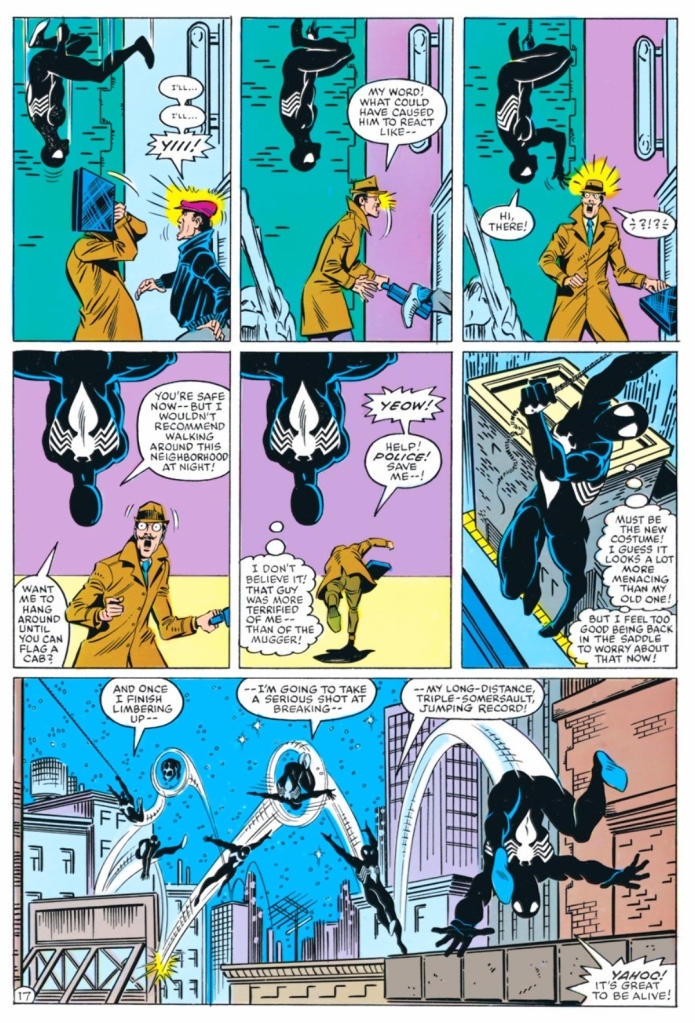
Spider-Man’s first night in New York wearing the alien costume .

I really like this story. I first read this a long time ago and I re-read it all over again for this retro review, and still this story engaged me a lot. There is a lot of richness in the script and you will get to see Peter Parker transitioning into a series of major changes that await him. Without spoiling the plot, there is no hero-versus-villain element here at all. It is all about Spider-Man who just arrived home from a major conflict (and also one of the most significant comic events ever published by Marvel Comics) and the alien costume saga truly began right here. The Venom debut did not happen until a few years later in reality.

In accordance to what was established in Secret Wars (not to be confused with the 2015 series of the same name) and the standards of then editor-in-chief Jim Shooter, the creative came up with a tale that not only showed a different Spider-Man but also portrayed him in ways that defied the tropes and creative ideas the preceded this comic book.

For one thing, Peter Parker is literally like a fish out of water here. As far as the whole world is concerned, only days passed when the superheroes went to deep space. But for the webslinger, a lot more time passed as so many battles, discoveries and intriguing events took place for him along with the others. That being said, Peter Parker’s perception of reality and track of time really got messed up and the weight of Secret War’s events really turned out overwhelming on him. This was well dramatized in the scene wherein Peter – who realized that so much time had passed – he had to call his aunt May fearing that she must be worried sick over him. There was also the moment when by walking down the street, he realized how much he missed not only his home but also the local surroundings.

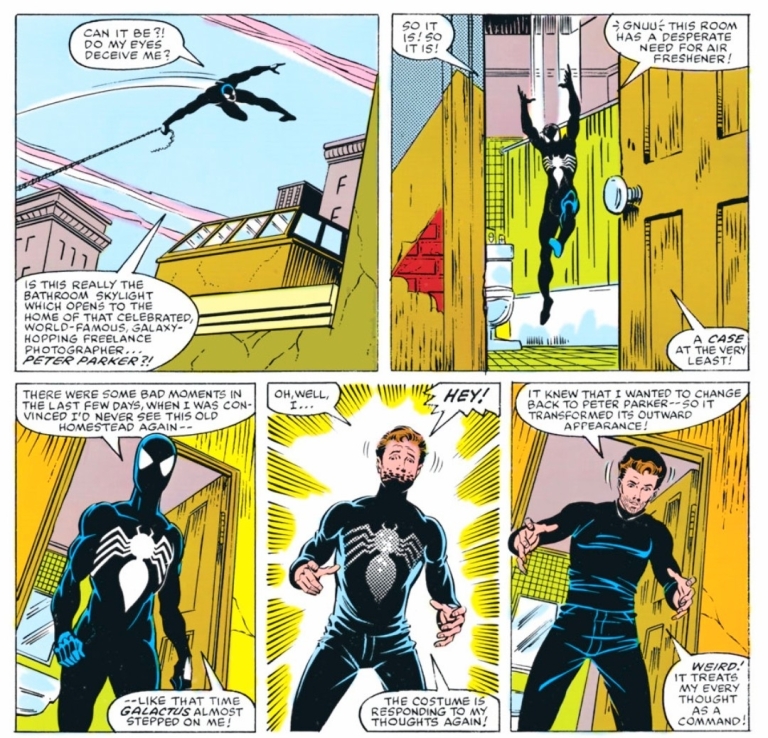
It was also in this comic book when Peter started getting more oriented with the alien costume he first got in Secret Wars #8 (which was actually published after this comic book) and started to enjoy the benefits with the way it responds to his thinking. Of course, at this stage, he has yet to realize the unfortunate truth about the living costume he brought home and this story really kicked off a new and profound stage in the comic book history of Spider-Man

Conclusion

When Spider-Man finally arrived home after spending so much time during Secret Wars.

Amazing Spider-Man #252 (1984) is still a great comic book to read all over again. This was released during the time when Secret Wars (1984) was still being published and years before Venom’s big debut in the series’ 300th issue. In my view, the alien costume saga was a big turning point in the literary history of Spider-Man and the creators who got involved in this comic book really sowed the seeds of compelling and intriguing events that followed. What is intriguing is that all of these significant developments started when a Marvel Comics reader from Illinois came up with the idea of a new costume for Spider-Man, wrote to them and the publisher responded to acquire his idea for over $200 (click here).

This comic book is also a reminder of how significant Jim Shooter’s rule at Marvel Comics really was and I can say that the Marvel’s literary universe of the 1980s should not be ignored.

Overall, Amazing Spider-Man #252 (1984) is highly recommended!

+++++

Thank you for reading. If you find this article engaging, please click the like button below, share this article to others and also please consider making a donation to support my publishing. If you are looking for a copywriter to create content for your special project or business, check out my services and my portfolio. Feel free to contact me with a private message. Also please feel free to visit my Facebook page Author Carlo Carrasco and follow me on Twitter at  @HavenorFantasy as well as on Tumblr at https://carlocarrasco.tumblr.com/ and on Instagram at https://www.instagram.com/authorcarlocarrasco
Retro Gaming Ads Blast – Part 9

Welcome back readers, fellow geeks and electronic gaming fans!

In this edition of the Retro Gaming Ads Blast (RGAB) series, we will take a look at another batch of retro gaming print ads from the 1980s and 1990s.

For the newcomers reading this, Retro Gaming Ads Blast (RGAB) looks back at the many print ads of games (console, arcade, computer and handheld) that were published in comic books, magazines, flyers and newspapers long before smartphones, social media, the worldwide web and streaming became popular. To put things in perspective, people back in the 1980s and 1990s were more trusting of print media for information and images about electronic games and related products.

With those details laid down, here is the newest batch of retro gaming print ads for you to see and enjoy…

1. Konami’s 3-in-1 sports games print ad

Long before the advent of major league sports video games, Konami was prolific with sports video games.

Back in the 1980s, Konami was a prominent gaming company as they released a lot of games that became hits in the arcades, on home computers and gaming consoles. Considering the limited amount of games publishers were allowed to release on the Nintendo Entertainment System in America, what Konami released were really fun games to play and their contributions of sports-based video games on the NES were significant. Possibly due to a lack of marketing budget at the time, they promoted Blades of Steel, Double Dribble and Track & Field II with this single-page ad showing the game box covers and screenshots. Ultimately, this print ad was sufficient in giving gamers a clear idea of what to expect with the three games.

2. The Adventures of Bayou Billy print ad

Bayou Billy looks inspired by the cinematic hero Crocodile Dundee. This video game even had a comic book adaptation published by Archie Comics.

Still with Konami, the Japanese publisher released in America the non-military adventure game The Adventures of Bayou Billy for the NES which was a revised version of their 1988 Family Computer game titled Mad City (see the differences by clicking here). This game really looked like it was influenced by Hollywood action/adventure movies of the era and it provided gamers gameplay styles of light gun shooting, beat-them-up action and racing. The titular hero looks very inspired by the cinematic hero Crocodile Dundee. This print ad is very stylish and also eye-catching. I think it has done a good job to make viewers interested in the video game.

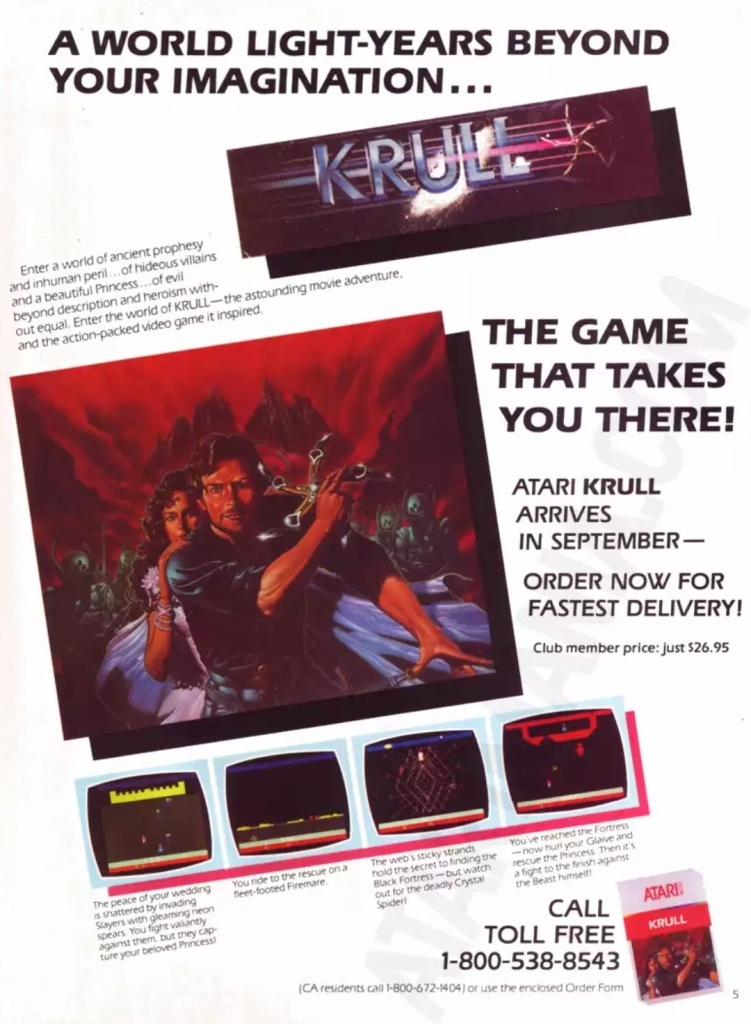
3. Krull Atari video game print ad

I never got to play this Krull video game on Atari 2600, nor its arcade game.

Way back in 1983, I was fortunate to see the science fantasy movie Krull inside the movie theater here in the Philippines. When I saw this print ad, I easily got excited for the Atari 2600 video game adaptation but never got to play it. This print ad does its job showing what Krull’s game looked like and the ad makers cleverly used painted art reflecting the movie’s characters and the armored enemies from space. I should add that between the time I saw the movie and the time I first saw this print ad, I became aware of the existence of the Krull arcade game by watching an episode of Starcade on TV.

4. Rocket Ranger NES print ad

Really great and detailed painted artwork in this print ad.

When Rocket Ranger on the Amiga in 1988, it had fancy visuals and a strong cinematic vibe that worked smoothly with the game design. This game was developed by Cinemaware which developed a reputation of releasing games based on classic film genres. In 1990, a version of Rocket Ranger for the NES was published by Kemco/Seika and print ads using painted art were made to promote the game. This particular print ad made heavy use of painted art which was captivating to look at while conveniently keeping people’s minds off the downgraded visuals of the NES version.

5. Michael Jordan: Chaos in the Windy City print ad with contest entry

Some gamers thought this was a basketball video game.

Yes, it was all true. There definitely was a video game that NBA legend Michael Jordan endorsed. First released on Super Nintendo Entertainment System (SNES) in America in 1994, Michael Jordan: Chaos in the Windy City was a side-scrolling action game in which gamers play a digital version of Jordan who has to save his friends, fight enemies and move from one location to the next in order to progress. The fact that an image of Michael Jordan holding two balls was used in this print ad (as well as on the game cover) in a dominating fashion made some gamers think this was a basketball game. The display of screenshots was so small, it did not help the situation. Lastly, the available of a contest entry form in this print ad was meant to promote not only the game but also GamePro magazine.  

6. Gun.Smoke print ad

Gun.Smoke was indeed a fun game to play on NES. Therefore, the promotion is justified.

This print ad of the NES port of Gun.Smoke has strong imagery and literary descriptions the strongly emphasize the Old West concept and setting. The screenshots displayed are too small but the descriptions more than made up for it. Ultimately, what this print ad emphasized was realized as the NES version of Gun.Smoke itself captured the continuous action and excitement of the arcade version and the graphical limitations of the console did not matter much. I myself played this game and it was a lot of fun.

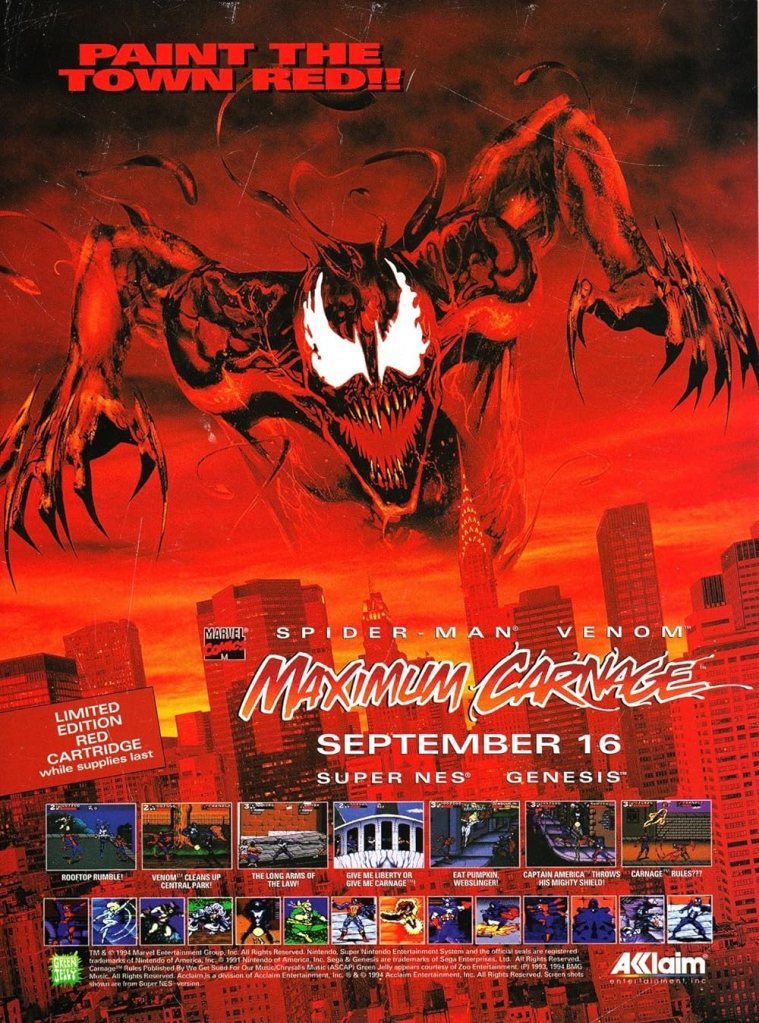
7. Spider-Man and Venom: Maximum Carnage print ad

This add appeared in my comic books and magazines I read in 1994.

Back in 1993, Marvel Comics published the huge Maximum Carnage crossover storyline which covered many issues of the four monthly Spider-Man comic books and two issues of the quarterly Spider-Man Unlimited series. Considering the high popularities of Venom and Carnage at the time, it was not surprising that Marvel took advantage by having Maximum Carnage licensed to Acclaim to create a video game adaptation in the form of a beat-them-up.

Spider-Man and Venom: Maximum Carnage was released for SNES and Sega Genesis in 1994, and game developer Software Creations really adapted story to fit with their side-scrolling game design. Between playable stages are cutscenes that actually were digitized versions of actual comic book panels. This red-colored print ad had a dominating image of Carnage and screenshots with text descriptions. The ad makers even went the extra mile by inserting screenshot cut-outs showing individual characters such as Firestar, Venom, Spider-Man, Carnage, Cloak and Dagger, Iron Fist, Captain America and more. Whatever your opinion is about the Maximum Carnage storyline or the video game adaptation, there is no denying that this was a very eye-catching print ad.

+++++

Thank you for reading. If you find this article engaging, please click the like button below, share this article to others and also please consider making a donation to support my publishing. If you are looking for a copywriter to create content for your special project or business, check out my services and my portfolio. Feel free to contact me with a private message. Also please feel free to visit my Facebook page Author Carlo Carrasco and follow me on Twitter at  @HavenorFantasy as well as on Tumblr at https://carlocarrasco.tumblr.com/ and on Instagram at https://www.instagram.com/authorcarlocarrasco
A Look Back at Amazing Spider-Man #375 (1993)

Welcome back superhero enthusiasts, 1990s arts and culture enthusiasts, Marvel Comics fans and comic book collectors! Today we go back to the year 1993 and examine a small part of the Marvel Comics universe through a tale of the Amazing Spider-Man monthly series.

In my previous retro comic book review, the insane murderer Venom returned to antagonize Spider-Man by targeting his parents. While it was a fact that Venom – who knew Spider-Man’s true identity – got into close contact with Aunt May (symbolizing the danger he poses on the Peter Parker’s family) a few years prior, going after the mother and father of Peter really raised the stakes.

With those details laid down, here is a look back at Amazing Spider-Man #375, published in 1993 by Marvel Comics with a story written by David Michelinie and drawn by Mark Bagley. This comic book marked the 30th anniversary of Amazing Spider-Man #1 (1963).

The cover.

Early story

The story begins inside one of the facilities of the closed amusement park in Brooklyn. In his vicious form, Venom tells Richard and Mary Parker (both restrained) that they belong to him and declares that he would protect them from Spider-Man.

When Richard Parker asked why would he think that they would have anything to do with Spider-Man, Venom realizes that the couple does not even know their son is the webslinger. Venom tells the couple that their innocence is what he is sworn to preserve.

Over at Manhattan, Spider-Man swings back to the Daily Bugle building and discreetly changes his clothes before moving in as photographer Peter Parker. Inside one of the offices, J. Jonah Jameson reaches out to Silver Sable by telephone…

Quality

Peter Parker had to commit a crime by trespassing into Anne Weying’s residence. His disguise as Spider-Man does not protect him from the law.

I have mixed feelings about this follow-up to the great story of the previous issue. For one thing, David Michelinie’s script had a completely different tone and direction even though he intended this comic book to conclude what issue #374 started. Another thing is that this story has even more characters added in which clearly diluted the intensity of the Venom-Spider-Man rivalry that was so intense in the previous issue.

There are two sub-plots – one of which deals with someone from Eddie Brock’s past – that were emphasized with sufficient details and the creative team integrated them into the main story. It seems that the creators intended to make the main story look grander in scope while sacrificing the very elements that made issue #374 a great and intense reading experience.

Remember the suspense and danger that came with Venom targeting the older Parker couple? Those elements are almost totally absent in this comic book even though this story concluded the previous issue’s conflict build-up. Richard and Mary Parker are both present as captives of Venom but there really is no tension nor any sense of danger here due to the drastic change of tone and direction in the script.

I should also stress that the introduction of Anne Weying (previously Anne Brock) as Eddie Brock’s ex-wife looked and felt like an afterthought inserted into the story. While Anne’s presence brought out some traces of humanity and sanity from Venom during the 2nd half of the story, it did not add much impact on the conflict between the webslinger and the symbiote-wearer murderer. Ultimately, the creative team had to do something to explain the story build-up on Venom’s part leading into the Lethal Protector limited series which is set in the city of San Francisco.

And then there was the presence of Silver Sable’s team called the Wild Pack. The Wild Pack is the result of J. Jonah Jameson’s agreement with Silver Sable with the objective of achieving a journalistic exclusive for the Daily Bugle. This particular sub-plot is really lousy and not even the dynamic looking action sequences involving the Wild Pack could hide lousiness.

If there is anything symbolic about the script, it is the emphasis on family as well as the impact that comes with elements of the past emerging unexpectedly. In this very comic book, you will get to see Eddie Brock/Venom react like a sane person in response to the sudden re-appearance of his former wife. No matter what the creative team did here, I can say that the Spidey/Venom conflict did not really intensify (note: the dynamic action scenes did not solve the shortcomings) and there was no reason to worry about the captive Parker couple.

Conclusion

The insane murderer Venom with the parents of Peter Parker.

Considering the great stuff and raised stakes that made issue #374 a very compelling read, Amazing Spider-Man #375 (1993) is clearly a disappointing conclusion. This is not a terrible comic book as it has some good stuff for fans to enjoy but the overall presentation of the creators here is not too great due to their approach with the storytelling (with two sub-plots that did not add much). Overall, I am glad I never bought this comic book (with flashy cover and more pages) at full price in 1993.

Overall, Amazing Spider-Man #375 (1993) is satisfactory.

+++++

Thank you for reading. If you find this article engaging, please click the like button below, share this article to others and also please consider making a donation to support my publishing. If you are looking for a copywriter to create content for your special project or business, check out my services and my portfolio. Feel free to contact me with a private message. Also please feel free to visit my Facebook page Author Carlo Carrasco and follow me on Twitter at  @HavenorFantasy as well as on Tumblr at https://carlocarrasco.tumblr.com/ and on Instagram at https://www.instagram.com/authorcarlocarrasco

A Look Back at RoboCop 2 #1 (1990)

Welcome back superhero enthusiasts, 1990s arts and culture enthusiasts, Marvel Comics fans and comic book collectors! Today we go back to the year 1990 to take a close look at the comic book adaptation of the movie RoboCop 2 (1990).

Before getting to the new retro comic book review, I should state that my friends and I had a fun time watching RoboCop 2 in the cinema shortly after it opened here in the Philippines. Back then, I was not yet a comic book collector and I rarely visited comic book specialty stores. That being said, I was unaware that Marvel Comics actually published an adaptation in the form of a 3-issue mini-series.

With those details laid down, here is a look back at RoboCop 2 #1, published in 1990 by Marvel with a story written by Alan Grant and drawn by Mark Bagley based on the movie screenplay by Frank Miller and Walon Green.

The cover.

Early story

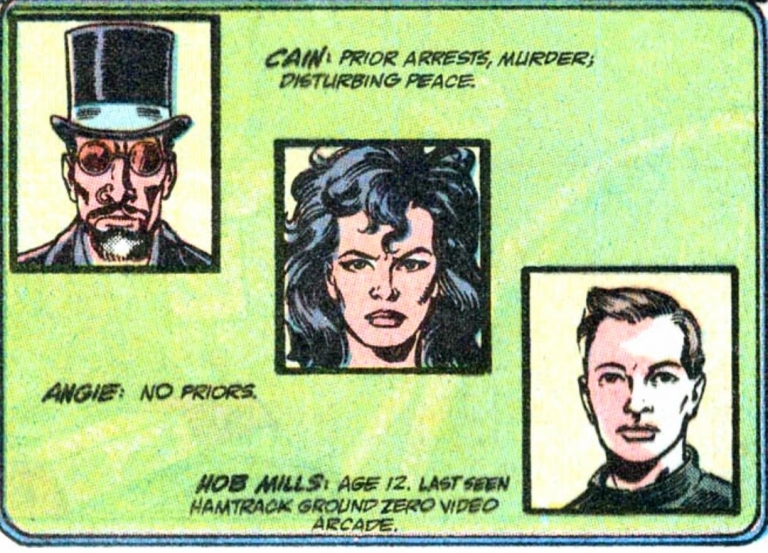
The story begins in Detroit where the cops are run by corporations and the streets have turned into red-alert war zones. Crime is overwhelming the city and the highly addictive narcotic poses the greatest threat facing societies. The surgeon general who made the public warning about nuke was killed and the crime boss Cain (leader of a cult of nuke addicts and pushers) claims responsibility. Through the news media, Cain tells the public that nuke will make people’s problems go away and people want its paradise.

Under the management of Omni Consumer Products (OCP), several of Detroit’s police officers go on strike demanding better terms from their employer. The City Government of Detroit under Mayor Kuzak missed a payment (in relation to them owing $37 million) and OCP begins to move to foreclose the city and its assets in accordance to the terms of the contract. Mayor Kuzak accuses OCP of engineering the police strike which made crime rampant.

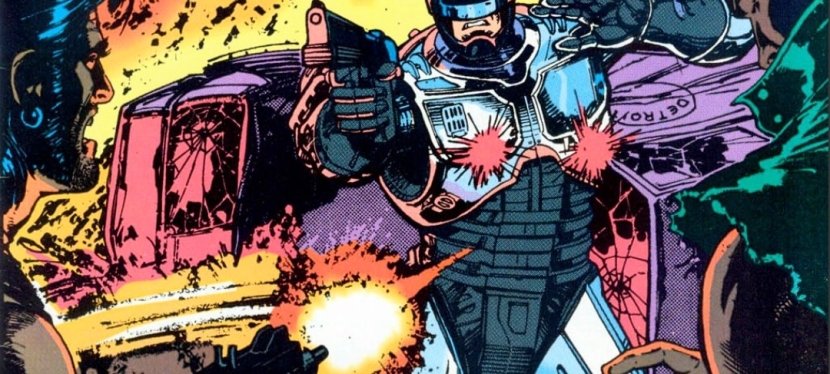
Elsewhere in the evening, the cruel activities of the thugs got disrupted by the arrival of a police car. Even though the police car got destroyed by the thugs, RoboCop emerges and begins to fight back…

Quality

There is simply no holding back for RoboCop when it comes to doing police work at a time when many police officers are on strike while crime has turned more rampant in Detroit.

This opening issue of the mini-series sticks close the basic plot of the movie (right until after Cain’s gang dismantled RoboCop) although there were a few notable differences with the sequence of events and there were scenes that showed the creative team took liberties to make the story suitable with the literary format in mind. That being said, don’t expect to see the key moments of the movie look exactly the same in this comic book and don’t expect to see the characters here looking like the actors who played them on the big screen. In terms of visual and literary presentation, this adaptation has a lot in common with the Total Recall comic book adaptation which coincidentally was released the same year.  

For me, this is indeed a really readable comic book that has its stylized approach on telling the movie’s concept. OCP is the most powerful entity in the story while Cain and his gang are clearly the force of evil that strongly pose danger not only to Detroit’s people but even to the very divided police force. Nuke as the dangerous object of the plot clearly was inspired from elements of the real life war against drugs in 1980s America which made this story socially relevant.

Very clearly these villains look nothing like actors Tom Noonan, Galyn Görg and Gabriel Damon.

Like in the movie, RoboCop here performs his law enforcement duty in an uncompromising manner even though memories of his past life as officer Murphy re-emerged deep inside. That being said, there are a few moments in which you might sympathize with the titular hero as this comic book pays close attention to the conflict between humanity and technology.

The action scenes here are sufficient but clearly don’t come anywhere close to the intensity of the film in terms of violence. Still, there is enough action for readers to enjoy.

When it comes to the visuals, the artwork done by Mark Bagley eerily looks comparable with Tom Lyle’s art in the Total Recall comic book of 1990. For the newcomers read this, Bagley became a popular artist through the Amazing Spider-Man monthly series and the Venom: Lethal Protector comic books that were released after years after this one. Having seen many of Bagley’s works published in 1992 to 1995, I can hardly recognize his art style in this comic book adaptation. The way he drew people’s faces in this comic book looks very different from those seen in Amazing Spider-Man issues. At the same time, Bagley’s own take on RoboCop has that balanced approach on depicting humanity with machinery while also making the hero look less bulky compared to the movie’s version.

Conclusion

Julie Faxx of OCP sure talks like a woke nut and rabid feminist in this scene.

RoboCop 2 #1 (1990) is clearly not a faithful adaptation of selected parts of the movie but that’s not necessarily a bad thing. This is more about the Grant-Bagley team doing their own visual presentation of the movie script copy they had and ultimately they succeeded in making this comic book a stylized and worthy reading experience. This is indeed a surprisingly entertaining read and I can say that I am looking forward to reading the next issue.

Overall, RoboCop 2 #1 (1990) is recommended.

+++++

Thank you for reading. If you find this article engaging, please click the like button below, share this article to others and also please consider making a donation to support my publishing. If you are looking for a copywriter to create content for your special project or business, check out my services and my portfolio. Feel free to contact me with a private message. Also please feel free to visit my Facebook page Author Carlo Carrasco and follow me on Twitter at  @HavenorFantasy as well as on Tumblr at https://carlocarrasco.tumblr.com/ and on Instagram at https://www.instagram.com/authorcarlocarrasco
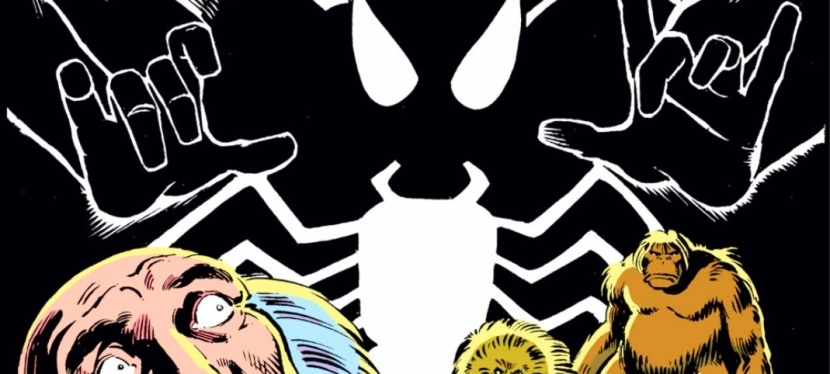
A Look Back at Amazing Spider-Man #374 (1993)

Welcome back superhero enthusiasts, 1990s arts and culture enthusiasts, Marvel Comics fans and comic book collectors! Today we go back to the year 1993 and examine a small part of the Marvel Comics universe through a tale of the Amazing Spider-Man monthly series.

In early 1993, the supervillain and murderer Venom was in very high demand among Marvel readers and comic collectors. The Venom: Lethal Protector mini-series launched with issue #1 selling a lot of copies and it portrayed Spider-Man’s greatest enemy as a very twisted and violent makeshift hero who dedicated himself to protecting what he (Eddie Brock specifically) to innocent people. As Venom was one of the few supervillains who knew Spider-Man’s true identity, the creative team behind the Amazing Spider-Man series decided to raise the stakes temporarily by having him encounter Peter Parker’s parents (the ones that appeared in Amazing Spider-Man #365).

With those details laid down, here is a look back at Amazing Spider-Man #374, published in 1993 by Marvel Comics with a story written by David Michelinie and drawn by Mark Bagley.

The cover.

Early story

The story begins inside the bunker beneath the grounds of the deserted Brooklyn amusement park. As Eddie Brock struggles to lift a very heavy piece of equipment, the symbiote forms over his body helping him lift it up above the head. Venom is obsessed with killing Spider-Man and Eddie Brock remains totally bitter over the webslinger’s responsibility on destroying his career. Eddie sees a page of the Daily Bugle on the wall and it contains a news photo of Peter Parker with his mother and father.

At New York’s famous Central Park, Peter, wife Mary Jane and his parents enjoy quality time skating on ice. Aunt May is standing on a wooden platform watching them…

Quality

Lots of intense action scenes in this comic book for fans and readers to be entertained with. The action scenes are not mindless as they serve as reflections of Venom’s powerful quest for revenge.

To begin with, I can say that this tale by David Michelinie is a very intense and dramatic read and it added a new layer of depth into the enduring rivalry between Spider-Man and Venom. At this point in Marvel Comics’ shared universe history, the two icons have encountered each other so many times, the time was right for Michelinie to raise the stakes and have the elderly Parkers (note: Aunt May excluded) as the new targets of Venom (already made obvious on the cover which in turn added tremendous stress on the part of Spider-Man and his wife.

For the newcomers reading this, Eddie Brock’s journalistic career was destroyed over the Sin-Eater story as a result of Spider-Man’s public revelation of Stanley Carter as the said figure (note: Brock’s Sin-Eater article series was based on interviews with Emil Gregg who actually turned out to be a delusional neighbor of Carter’s).

As Brock’s life went way downhill with his reputation destroyed, his hatred of Spider-Man grew and so did his quest for revenge. That being said, what happened in this particular comic book was a very reflective extension of what happened years prior. Anyone who has basic knowledge of the origin of Venom and early appearances of Brock in comics will be able to understand the intensified rivalry in this tale.  

Apart from the great story, this comic book has lots of superhero spectacle for readers to enjoy. That being said, the smashing action of the fight between Spider-Man and Venom was clearly made to be more violent which suitably reflected the supervillain’s lust for revenge. Spidey, meanwhile, had no choice but to avoid causing any more damage or harm as Venom goes after him in public surrounded with lots of bystanders. Along the way, you will see a key moment of the insanity of Venom which served as a useful pause of the fight. Finally, when it comes to the art, this comic book has some of the finest artworks I have seen from Mark Bagley.

Conclusion

At the time of this comic book’s publication, Venom was one of the few supervillains who knew Spider-Man and Peter Parker are one and the same person. The inclusion of Peter’s parents only added to the raising of the stakes.

Amazing Spider-Man #374 (1993) is undeniably a great read complete with intense action scenes, lots of intrigue and, most notably, a rock solid development of the Spider-Man-Venom rivalry. This is the kind of story that will compel long-time Spider-Man fans to revisit Venom’s origin as well as Spider-Man’s involvement with the Sin-Eater. At the same time, this tale will help readers understand the insanity and murderous mind of Venom that took place not only in the Venom: Lethal Protector mini-series in also other mini-series about the symbiotic killer that Marvel published throughout the 1990s.

Overall, Amazing Spider-Man #374 (1993) is highly recommended!

+++++

Thank you for reading. If you find this article engaging, please click the like button below, share this article to others and also please consider making a donation to support my publishing. If you are looking for a copywriter to create content for your special project or business, check out my services and my portfolio. Feel free to contact me with a private message. Also please feel free to visit my Facebook page Author Carlo Carrasco and follow me on Twitter at  @HavenorFantasy as well as on Tumblr at https://carlocarrasco.tumblr.com/ and on Instagram at https://www.instagram.com/authorcarlocarrasco

A Look Back at Wetworks #1 (1994)

Welcome back superhero enthusiasts, 1990s arts and culture enthusiasts, and comic book collectors! Today we go back to the mid-1990s to explore the comic book launch of a notable fictional team co-created by the Whilce Portacio and Brandon Choi…Wetworks.

For the newcomers reading this, Whilce Portacio was one of the highly talented illustrators who left Marvel Comics and co-founded Image Comics in the early 1990s. While his fellow co-founders Todd McFarlane, Jim Lee, Rob Liefeld, Marc Silvestri, Jim Valentino and Erik Larsen were able to launch their respective dream projects (creator-owned properties) during Image’s first year of publishing, the launch of Wetworks was delayed by two years due to a death in Portacio’s family.

As a very young comic book reader in those days, I remember hearing rumors about Wetworks inside comic book stores I visited. There were rumors of business negotiations, solicitations and scheduled launches (ranging from October 1993 to January 1994). I also noticed some comic book enthusiasts who bought old copies of X-Factor and Uncanny X-Men that Portacio illustrated while waiting for Wetworks to debut.

In the middle of 1994, Wetworks was finally launched under the Image Comics label and I still remember the day when I saw lots of copies of issue #1 displayed on the shelves and windows of comic book stores.

With those details laid down, here is a look back at Wetworks #1, published in 1994 by Image Comics with a story written by Whilce Portacio and Brandon Choi. The art was done by Portacio with ink work by Scott Williams.

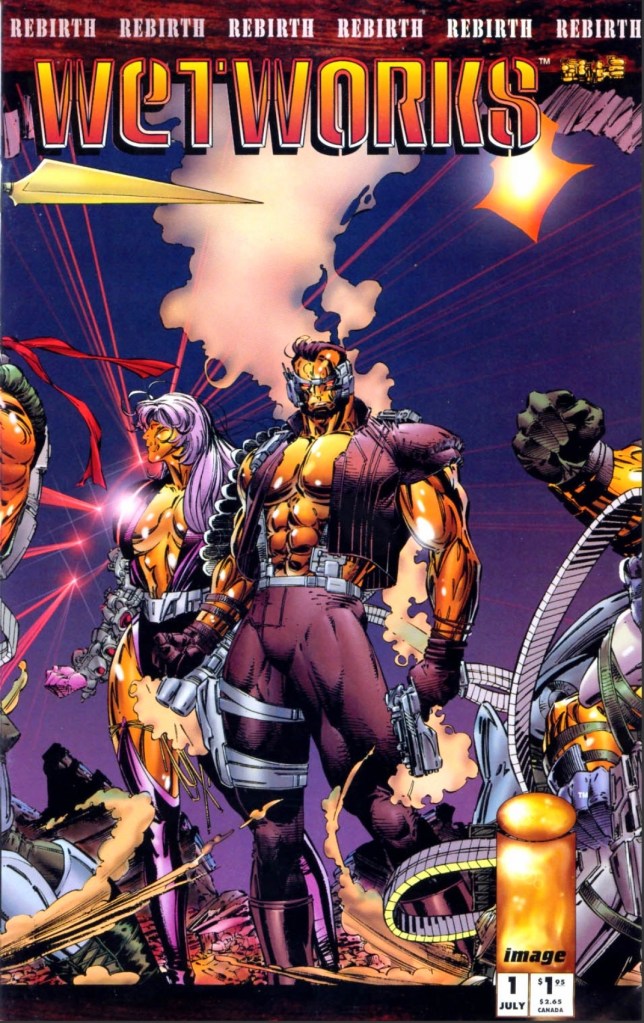
The cover.

Early story

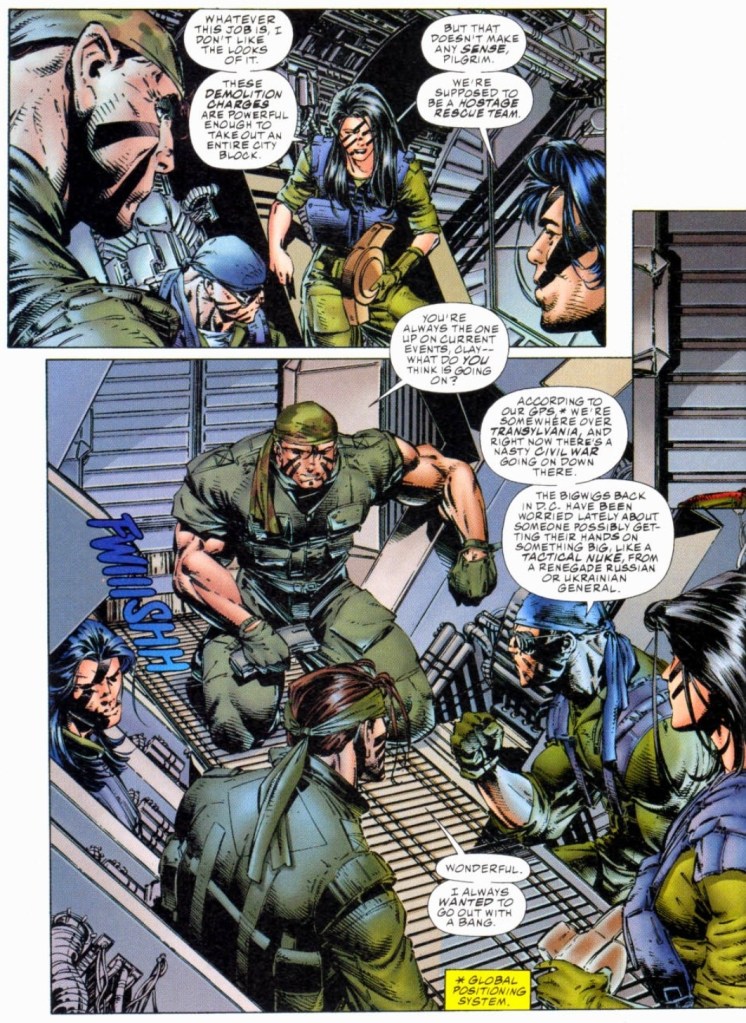
The story begins when a covert operations team working under International Operations (IO) travels to eastern Europe to infiltrate and destroy the base of operations of a certain warring faction and retrieve a biological agent (highly contagious) no matter what the cost. As it turns out, this new mission for the team (led by Colonel Jackson Dane, one of the pioneers of Team 7) started less than twenty four houses after their previous mission and their female member Pilgrim (reconnaissance specialist) pointed out that the demolition charges they are carrying are strong enough to wipe out an entire city block. Another teammate called Grail (the Filipino named Salvador Joel Alonday) stated that they are supposed to be a hostage rescue team.

Meanwhile deep inside the command center of IO in Washington, D.C., Admiral Halsey tells Miles Craven that Team 7 (the team led by Dane) are under his command and states that his sources tell him that there is more to the mission than just a group of ethnic nationalists obsessed on a biological terror campaign. It turns out, Craven sent the team to eastern Europe without fully informing them of what they are going up against. Craven insists that Team 7 are paid to put their lives on the line and to die if necessary just to get the job done. Craven then reveals to Halsey the true nature of the mission. The admiral then realizes Craven is right and certain sacrifices must be made for the greater good.

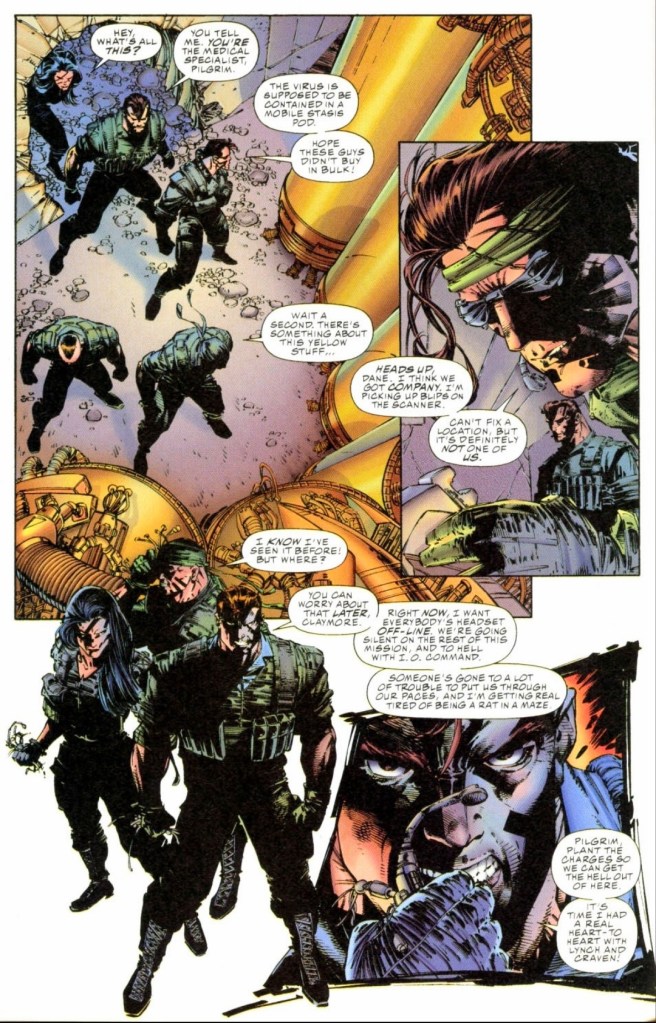
Craven and his team arrived at the location in Transylvania. They started seeing signs that someone else arrived ahead of them…

Quality

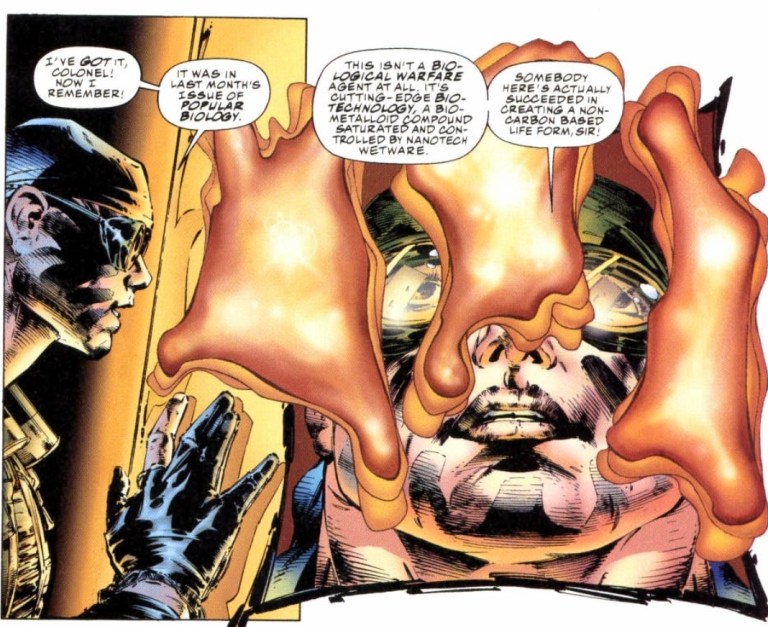
One of the team members looks at a symbiote.

I’ll start first with the fantasy concept and the storytelling. Whilce Portacio and Brandon Choi’s joint creation of Wetworks is indeed an inspired move with connections to real-life military influences the creators had. The Wetworks team – initially referred to as Team 7 – started looking and acting like typical military squad in the world of fiction but the major twist that happened drastically redefined and refined them into the most unique military team in the world of superhero comics. It’s the closest thing to seeing G.I. Joe fused with living symbiotes (another inspired move most likely influenced by a certain Marvel murderer with a symbiote whose origin is linked with one of the most iconic superheroes ever) there is and I can say Wetworks remains relevant and stands out nicely among superhero comic book teams to this day.

With regards to the plot, it looks cliched on face value. I’m talking about the trope in which a team is sent by their powerful superiors on a mission without knowing all the crucial details needed (because the superiors hid it from them) and they eventually encounter immense danger. As mentioned earlier, the major twist in the plot not only completed a major transformation of Dane and his teammates but also ramped up the fantasy aspect of the tale to much higher levels.

Still on the plot, Portacio and Choi came up with a solid structure for the narrative. The build-up of details and tension was very good and the pay-offs (lots of spectacle plus twists) were great. As the story moved on, the suspense grew stronger and the narrative succeeded in making me care about the team led by Dane.

Meet the team members who would later become Wetworks.

When it comes to the art, Portacio’s work here (with ink by Scott Williams) still looks great and, more notably, it is a fine departure from the superhero visuals he worked in years prior. As with his past works, you will see the artist’s stylized approach on visualizing the narrative related to how he implements the panels per page.

Portacio did a very good job with the military look of Wetworks and he drew their guns with a high amount of detail that should be seen (you should try using a magnifying glass on this comic book). Not only that, his art on military hardware such as the gunships, the interiors plus equipment all have that detailed appearance. When it comes to action, I believe that Portacio took a lot inspiration from Hollywood action flicks (most notably Predator) on portraying Wetworks members using their guns and positioning during battle.

Of course, the spectacle is not totally limited to military stuff. There is a touch of fantasy and horror visuals involved which is directly related to what was set-up for Wetworks to encounter in the near future. To realize what I am saying here, you must read this comic book until the intense end.

Conclusion

Wetworks #1 from 1994 is still great to read!

I can say without a doubt that Wetworks #1 (1994) remains as gripping and as entertaining as when I first read it decades ago. In short, it has aged well and reading it all over again today is compelling and a lot of fun to do. If you ask me, this is one of the finest works ever by Whilce Portacio in terms of art and storytelling. As one of the many comic books Image published during its first few years in the industry, Wetworks #1 (1994) clearly stands out with its military theme and fantasy concept. Lastly, Wetworks is set within the WildStorm universe as dramatically symbolized with the presence of International Operations (the team’s superiors).

Overall, Wetworks #1 (1994) is highly recommended!

+++++

Thank you for reading. If you find this article engaging, please click the like button below, share this article to others and also please consider making a donation to support my publishing. If you are looking for a copywriter to create content for your special project or business, check out my services and my portfolio. Feel free to contact me with a private message. Also please feel free to visit my Facebook page Author Carlo Carrasco and follow me on Twitter at  @HavenorFantasy as well as on Tumblr at https://carlocarrasco.tumblr.com/ and on Instagram at https://www.instagram.com/authorcarlocarrasco

A Look Back at Spider-Man 2099 #41 (1996)

Welcome back superhero enthusiasts, 1990s culture enthusiasts and comic book collectors! Today we go back to the year 1996 and explore a part of the Marvel 2099 comics universe through a tale of the Spider-Man 2099 monthly series.

In my previous retro review, the futuristic webslinger encountered Goblin 2099 (note: the futuristic take on Green Goblin) who proved to be very dangerous not with weapons nor physical attacks but with influence members of the local society to rebel against him believing that he is a corporate asset. How much influence Goblin had on the people at the expense of Spider-Man is just waiting to be discovered.

With those details laid down, here is a look back at Spider-Man 2099 #41, published in 1996 by Marvel Comics with a story written by Peter David and drawn by Andrew Wildman

The cover.

Early story

The story begins with Miguel O’Hara visiting a ruined place with armed personnel escorting him. It turns out the site was the White House and Doom 2099 has already fallen as President of the United States. Miguel seeks closure as he spends time at the ruins and eventually finds the name plate from the office of Tyler Stone (Miguel’s biological father).

Meanwhile at Alchemax, corporate personnel got surprised to see Tyler Stone return confined to a hovechair due to his fragile and weakened state. This turned out to be his first time to be at work since he got shot.

Inside the laboratory, Tyler sees his deranged son Kron (Venom 2099) contained behind solid glass like a mere scientific specimen for study. After learning key details about the symbiote and how it affected his son, Tyler gives the order to have Kron executed…

Quality

Even though Goblin 2099 was not present, this scene shows how much the said villain poisoned the minds of people to harm Spider-Man.

Let me start with the writing by Peter David. It is clear to me that David confidently wrote this story to maintain the flow of intrigue, emphasize how local society’s changing, how the external events affect others and, most notably, managing to push Spider-Man 2099 to the edge complete with a brewing conflict with the very powerful Tyler Stone.  

At this stage of the monthly series of the 1990s, Miguel O’Hara’s rise within the corporate structure of Alchemax got emphasized again and Peter David inserted growing tensions for the protagonist effectively blurring the boundary that separates personal life from the corporate career. That being said, the futuristic Spider-Man in his civilian identity literally entered a gray area which will compel readers to speculate if he was still in control of matters or if he was slowly becoming evil as he gains power (this makes him comparable with the tycoon Tyler).

Still on the character development aspect of this comic book, Miguel here still showed his fragile side as the death of Dana left him with a lot of pain deep inside (which was dramatically emphasized by Andrew Wildman through his art in one very particular page). This furthers adds to questions about the sanity and mental stability of the protagonist who already wields so much power as Spider-Man and as an Alchemax executive.

Speaking of Alchemax, Tyler Stone here appeared more sinister than before and being unable to stand did not hinder him at all. His cold-hearted move to have his own biological son Kron (the futuristic Venom and the same guy responsible for the deaths of Punisher 2099’s family) executed clearly shows not only his sadistic nature but also the fact that he is living with pure worldly beliefs. His believes are so worldly, he does not really care about his own offspring. Ironically, this suggests that Tyler could be as twisted and evil as his murderous son Kron. Lastly, the connections between the late Dana and Tyler and Miguel is indeed morally disturbing.

While the cover art showed Goblin 2099, the new antagonist is nowhere to be found in this comic book. However in a very symbolic fashion, Goblin’s influence remained lively through a number of people who condemned Spider-Man 2099 so much, they went as far as actually hurting an idolater of the webslinger. This part of the story is a strong reminder that idolatry is unholy and foolish, that religion is corrupted and will never lead believers to salvation, and that socialism attacking capitalism remained a social disease in the far future.

Conclusion

Tyler Stone and his son Kron (Venom 2099) are both very evil. They have different ways of being evil.

Spider-Man 2099 #41 (1996) is indeed a great comic book to read from start to finish. Not only will you get to see the futuristic Spidey struggle with the tension both personally and professionally, you will see the big impact of Dana’s death on him too. The portrayal of negative changes in the local society (at least the society Spider-Man is part of) is pretty dramatic and what Peter David imagined about Marvel 2099 still remains socially relevant to this day. Lastly, this comic book ended very powerfully and was enough to convince me to see what happens next.

Overall, Spider-Man 2099 #41 (1996) is highly recommended!

+++++

Thank you for reading. If you find this article engaging, please click the like button below, share this article to others and also please consider making a donation to support my publishing. If you are looking for a copywriter to create content for your special project or business, check out my services and my portfolio. Feel free to contact me with a private message. Also please feel free to visit my Facebook page Author Carlo Carrasco and follow me on Twitter at  @HavenorFantasy as well as on Tumblr at https://carlocarrasco.tumblr.com/ and on Instagram at https://www.instagram.com/authorcarlocarrasco

A Look Back at Venom: Funeral Pyre #3 (1993)

Welcome back superhero enthusiasts, 1990s culture enthusiasts and comic book collectors! Today we go back to the year 1993 to take a close look at the second issue of the second Venom comic book mini-series Venom: Funeral Pyre.

In my previous review, the gang-driven violence intensifies as the Punisher makes his move armed with lots of resources (including a van loaded with weapons and computerized functions). Venom struggles to free himself from the temporary prison the Punisher placed him in. As the violence escalated, Gray Russell finds himself in much deeper trouble as the anticipated rescue does not happen.

With those details laid down, here is a look back at Venom: Funeral Pyre #3, published in 1993 by Marvel Comics with a story written by Carl Potts and drawn by the late Tom Lyle. This if the final issue of the mini-series.

The cover.

Early story

The story begins inside a building with high-tech equipment from HYDRA. Gray Russel is no longer himself but as the red-skinned, highly radiated figure Pyre. He fires a microwave blast at Venom which hurts him so much. In response to Venom’s claim that he came to rescue him, Pyre reacts with rage telling the murderous man with the symbiote that he arrived too late which resulted in the forced killing of people during the gang violence on the streets of Oakland.

Being filled with pure rage, Pyre intends to burn Venom alive. Thinking that Pyre is distracted, the Punisher leaps to get a gun on the floor which causes the radiated person to fire a microwave blast at him. The Punisher takes cover behind a machine but notices the microwaves sparking off the metal.

Venom then takes advantage of situation…

Quality

This page shows Venom at a disadvantageous state with Pyre whose microwave blasts are more than enough to kill him.

As the conclusion of the mini-series, this comic book went all-out portraying what turned out to be the final conflict involving the murderous Venom, the vigilante Punisher and the energy-filled Pyre. As a result, the narrative strongly focused on the final conflict (note: stretched out to last several pages) and never bothered to look back at the people and activities on the city street.

That being said, you will get to see more of the two established Marvel figures struggling hard against an unexpected force of opposition who was previously an undercover news reporter who infiltrated a certain gang and sent a message (delivered by a young boy) that caught Eddie Brock’s attention. At this point, it is clear that Venom’s effort to rescue Gray (who became Pyre after using a super soldier chamber left behind by HYDRA) ended in total failure and finds himself facing someone who could kill him and his alien costume together.  

If there is anything notable about this issue, it is the portrayal of Venom being highly disadvantaged and even vulnerable. There are no armed men with sonic weapons and high-tech equipment to bring Venom down but Pyre whose microwave blasts are deadlier than flame and sonic. In connection to the situation, Venom is not his aggressive self but a struggling figure who strives to survive and somehow find solutions during the heat of danger.

The Punisher, meanwhile, also struggled to survive but would simply not run away even though his chances of escape are much better. Instead, he focuses on actually eliminating Pyre without hesitation and Venom’s attempt to rescue Gray meant absolutely nothing to him.

More on Pyre, he is not really interesting nor was he ever engaging as the one powerful force of opposition that Venom and the Punisher must face. His being consumed by unrestrained rage and wielding so much power did not really raise the tension of the story. Had he eliminated the two Marvel figures who got in his way, what would Pyre do afterwards? Devastate the entire city of Oakland because he lost his identity as Gray and could not get over his involvement of taking other people’s lives while in the middle of gang activities? Would he proceed to San Francisco’s underground community and eliminate the people only because he blames Venom (note: Eddie Brock got involved with the underground people of San Francisco as seen in the Lethal Protector mini-series) for his failure of rescuing him? Pyre is nothing more than a throwaway comic book force of opposition.

From a visual standpoint, Tom Lyle once again pushed his creativity hard and showed some dynamic shots of spectacle here and there. At this stage, he proved to be very capable of visualizing Venom and the Punisher.

Conclusion

The Punisher refuses to give up and gets Microchip to assist him.

While issue #2 was a notable improvement over the first issue, Venom: Funeral Pyre #3 (1993) does not have much to offer in terms of engagement and entertainment. This is because it was crafted as a strict Venom-Punisher-Pyre conflict that provided spectacle and intrigue but ultimately ended up hollow. To see Venom at a huge disadvantage is interesting but did not add much weight to the plot. The Punisher was his usual self and in some ways overshadowed Venom for a while. Too bad there was not much space left for Venom and Punisher to fight each other again.

As the final issue of this mini-series, the story concluded with a whimper. Ultimately the Funeral Pyre storyline ended up as a diversion within the Marvel Comics shared universe that happened to attract Punisher, Venom and the gangsters of Oakland.  

Overall, Venom: Funeral Pyre #3 (1993) is satisfactory.

+++++

Thank you for reading. If you find this article engaging, please click the like button below, share this article to others and also please consider making a donation to support my publishing. If you are looking for a copywriter to create content for your special project or business, check out my services and my portfolio. Feel free to contact me with a private message. Also please feel free to visit my Facebook page Author Carlo Carrasco and follow me on Twitter at  @HavenorFantasy as well as on Tumblr at https://carlocarrasco.tumblr.com/ and on Instagram at https://www.instagram.com/authorcarlocarrasco
A Look Back at Venom: Funeral Pyre #2 (1993)

Disclaimer: This is my original work with details sourced from reading the comic book and doing personal research. Anyone who wants to use this article, in part or in whole, needs to secure first my permission and agree to cite me as the source and author. Let it be known that any unauthorized use of this article will constrain the author to pursue the remedies under R.A. No. 8293, the Revised Penal Code, and/or all applicable legal actions under the laws of the Philippines.

Welcome back superhero enthusiasts, 1990s culture enthusiasts and comic book collectors! Today we go back to the year 1993 to take a close look at the second issue of the second Venom comic book mini-series Venom: Funeral Pyre.

In my previous review, the Punisher and Venom encountered each other for the first time ever and along the way Gray – who is secretly a journalist with a mission – struggles to maintain his composure and his sanity as he finds himself in the middle of a very violent gang war in Oakland, California. The more time Gray spends time with the crime gang he joined, the tougher the situation becomes for him.

With those details laid down, here is a look back at Venom: Funeral Pyre #2, published in 1993 by Marvel Comics with a story written by Carl Potts and drawn by the late Tom Lyle.  

The cover.

Early story

The story begins with Gray and his gang companions riding a car approaching a group of people on the street. The gang leader pressures Gray to use his weapon to kill them. Gray is deeply worried not only because he has to prove his worth to the gang by killing other, but also because the rescue attempt he was waiting for had not yet happened.

Meanwhile, Venom finds himself trapped on the doorway of a building with the metal gate locked and with rays of microwave from the Punisher’s van radiating him painfully. As the Punisher leaves them behind, Venom manages to use the symbiote to reach into the van and smash the control panel inside which disabled the microwave rays.

Immediately, he recovers and breaks out to continue his mission: to rescue Gray…

Quality

The murderous Venom actually helped the Punisher.

When it comes to the storytelling, there are some improvements that made this comic book more readable than issue #1. For one thing, the exposition has been reduced which allowed the pace of the story to move faster. Most of the exposition here has been limited to Gray who at this stage of the mini-series was clearly bound to become the central object of the Funeral Pyre concept. Another thing is that the story’s structure here is simpler and easier to follow as Venom and Punisher moved on their own struggles separately before predictably getting together again.

While the mini-series has clearly been a tale of a city gang war – with a pretentious and unwilling gang member who expected to be rescued before things become too chaotic – that happened to pull the Punisher and Venom in for different reasons, Carl Potts added some elements that would resonate with Marvel Comics fans who are familiar with HYDRA and the Super Soldier aspects of the Marvel Comics universe history. Not only that, there is a science fiction-inspired setting near the end of the story that added variety to the in-story environment.

Like the first issue, this one is packed with a good amount of action scenes and that means Punisher and Venom fans have a lot of stuff to enjoy. Tom Lyle really is good with showcasing the respective spectacle of the vigilante and the symbiote-wearing murderer, and when he has the two together, his visual creativity intensifies.

Conclusion

Grey shooting blindly at the targets while riding the car of the gangsters he joined.

Venom: Funeral Pyre #2 (1993) is clearly an improved reading experience over issue #1 mainly because of the reduced information dump, the simpler plot structure and the creative showcase of Venom and the Punisher. While Gray remains uninteresting, his late-stage transformation turned out to be somewhat surprising and it was only near the end of this comic book that the Funeral Pyre concept became clear.

Overall, Venom: Funeral Pyre #2 (1993) is satisfactory.

+++++

Thank you for reading. If you find this article engaging, please click the like button below, share this article to others and also please consider making a donation to support my publishing. If you are looking for a copywriter to create content for your special project or business, check out my services and my portfolio. Feel free to contact me with a private message. Also please feel free to visit my Facebook page Author Carlo Carrasco and follow me on Twitter at  @HavenorFantasy as well as on Tumblr at https://carlocarrasco.tumblr.com/ and on Instagram at https://www.instagram.com/authorcarlocarrasco

A Look Back at Amazing Spider-Man #385 (1994)

Disclaimer: This is my original work with details sourced from reading the comic book and doing personal research. Anyone who wants to use this article, in part or in whole, needs to secure first my permission and agree to cite me as the source and author. Let it be known that any unauthorized use of this article will constrain the author to pursue the remedies under R.A. No. 8293, the Revised Penal Code, and/or all applicable legal actions under the laws of the Philippines.

Welcome back superhero enthusiasts, 1990s culture enthusiasts and comic book collectors! Today we go back to the year 1994 and explore a part of the Marvel Comics universe through one of the many tales of the Amazing Spider-Man comic book series.

In my previous retro review, Spider-Man has been caught by the Jury and gets tried in a makeshift court that is so secretive, getting help from outside is impossible. The trial explored how Spider-Man, who brought the alien costume into their world which later led to the beginning of his murderous mortal enemy, is responsible for the deaths and other tragedies connected to Venom.

With those details laid down, here is a look back at Amazing Spider-Man #385, published in 1994 by Marvel Comics with a story by David Michelinie and drawn by Mark Bagley. This issue marks the final chapter of a 3-part storyline between the iconic webslinger and the Jury.

The cover.

Early story

The story begins with a restrained Spider-Man declared guilty and sentenced to death by the so-called court of Orwell Taylor and the Jury. Just as the team members are about to execute the webslinger, their teammate Ramshot intervenes and says that Spider-Man saves lives which is a matter of public record. Disappointed by Ramshot’s behavior, Taylor mentions their secondary mission is to obtain a weapon that might allow them to eliminate their true enemy – Venom.

Taylor then says that if Spider-Man would help them destroy the greater evil, then the court would consider commuting his sentence…

Quality

Something unfortunate happens during the mission involving Spider-Man and the Jury.

Considering all the drama and tension that was built up in the previous two issues, the story here is a letdown. For one thing, all the discussions about Spider-Man being responsible for the killings and violence caused by Venom lead to nowhere as the story took a turn for the bizarre concept of the hero getting spared to work with the very team that went after him. Secondly, the mission that Spidey and the Jury worked on really did not have a justifiable goal. This resulted in a disappointing turn of events. Ironically, in this comic book you will see more of Taylor’s cunning on top of his own distorted view about justice.

If there is anything notable here, it is the fact that Spider-Man’s wife Mary Jane gets a good share of the spotlight as she literally moves towards the edge in relation to the deteriorating marriage. This shows that as Spidey spends more time away to do what is good and push back against the forces of evil, his wife gets lonelier and desperate as life turns for the worse. At the very least, this comic book expresses that the marriage of Peter and Mary Jane could be doomed.

Conclusion

This is how Mary Jane deals with loneliness and the decline in her life.

Considering what was built up and heavily dramatized in issues #383 and #384, Amazing Spider-Man #385 (1994) is a rather weak conclusion. The way Spider-Man and the Jury parted ways felt more like sudden retreat than a real finish to what was started between them. Strangely enough, the focus on Mary Jane’s decline and desperation literally saved this comic book from becoming a creative disaster. The ending does not have much to do between Spider-Man and the Jury, but it was surprising in a crude way.

Overall, Amazing Spider-Man #385 (1994) is serviceable.

+++++

Thank you for reading. If you find this article engaging, please click the like button below, share this article to others and also please consider making a donation to support my publishing. If you are looking for a copywriter to create content for your special project or business, check out my services and my portfolio. Feel free to contact me with a private message. Also please feel free to visit my Facebook page Author Carlo Carrasco and follow me on Twitter at  @HavenorFantasy as well as on Tumblr at https://carlocarrasco.tumblr.com/ and on Instagram at https://www.instagram.com/authorcarlocarrasco