A Look Back at Spider-Man 2099 #41 (1996)

Welcome back superhero enthusiasts, 1990s culture enthusiasts and comic book collectors! Today we go back to the year 1996 and explore a part of the Marvel 2099 comics universe through a tale of the Spider-Man 2099 monthly series.

In my previous retro review, the futuristic webslinger encountered Goblin 2099 (note: the futuristic take on Green Goblin) who proved to be very dangerous not with weapons nor physical attacks but with influence members of the local society to rebel against him believing that he is a corporate asset. How much influence Goblin had on the people at the expense of Spider-Man is just waiting to be discovered.

With those details laid down, here is a look back at Spider-Man 2099 #41, published in 1996 by Marvel Comics with a story written by Peter David and drawn by Andrew Wildman

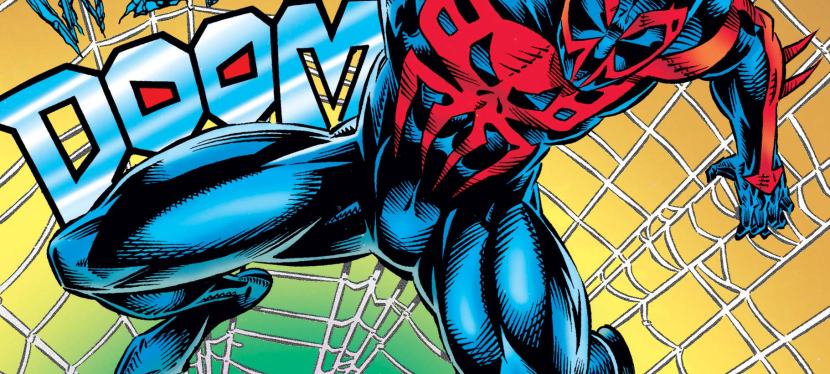
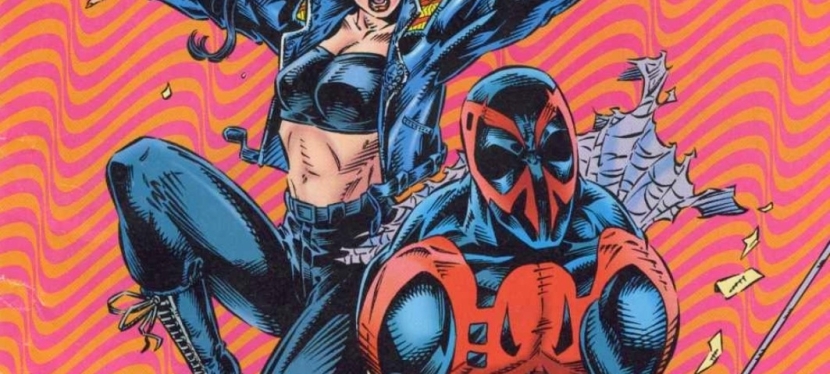
The cover.

Early story

The story begins with Miguel O’Hara visiting a ruined place with armed personnel escorting him. It turns out the site was the White House and Doom 2099 has already fallen as President of the United States. Miguel seeks closure as he spends time at the ruins and eventually finds the name plate from the office of Tyler Stone (Miguel’s biological father).

Meanwhile at Alchemax, corporate personnel got surprised to see Tyler Stone return confined to a hovechair due to his fragile and weakened state. This turned out to be his first time to be at work since he got shot.

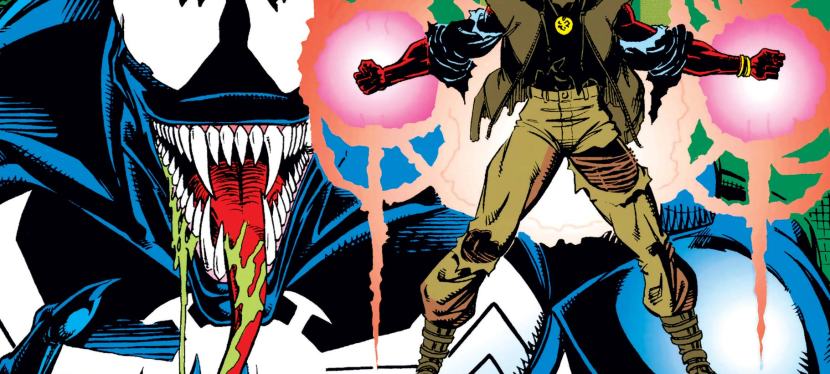
Inside the laboratory, Tyler sees his deranged son Kron (Venom 2099) contained behind solid glass like a mere scientific specimen for study. After learning key details about the symbiote and how it affected his son, Tyler gives the order to have Kron executed…

Quality

Even though Goblin 2099 was not present, this scene shows how much the said villain poisoned the minds of people to harm Spider-Man.

Let me start with the writing by Peter David. It is clear to me that David confidently wrote this story to maintain the flow of intrigue, emphasize how local society’s changing, how the external events affect others and, most notably, managing to push Spider-Man 2099 to the edge complete with a brewing conflict with the very powerful Tyler Stone.  

At this stage of the monthly series of the 1990s, Miguel O’Hara’s rise within the corporate structure of Alchemax got emphasized again and Peter David inserted growing tensions for the protagonist effectively blurring the boundary that separates personal life from the corporate career. That being said, the futuristic Spider-Man in his civilian identity literally entered a gray area which will compel readers to speculate if he was still in control of matters or if he was slowly becoming evil as he gains power (this makes him comparable with the tycoon Tyler).

Still on the character development aspect of this comic book, Miguel here still showed his fragile side as the death of Dana left him with a lot of pain deep inside (which was dramatically emphasized by Andrew Wildman through his art in one very particular page). This furthers adds to questions about the sanity and mental stability of the protagonist who already wields so much power as Spider-Man and as an Alchemax executive.

Speaking of Alchemax, Tyler Stone here appeared more sinister than before and being unable to stand did not hinder him at all. His cold-hearted move to have his own biological son Kron (the futuristic Venom and the same guy responsible for the deaths of Punisher 2099’s family) executed clearly shows not only his sadistic nature but also the fact that he is living with pure worldly beliefs. His believes are so worldly, he does not really care about his own offspring. Ironically, this suggests that Tyler could be as twisted and evil as his murderous son Kron. Lastly, the connections between the late Dana and Tyler and Miguel is indeed morally disturbing.

While the cover art showed Goblin 2099, the new antagonist is nowhere to be found in this comic book. However in a very symbolic fashion, Goblin’s influence remained lively through a number of people who condemned Spider-Man 2099 so much, they went as far as actually hurting an idolater of the webslinger. This part of the story is a strong reminder that idolatry is unholy and foolish, that religion is corrupted and will never lead believers to salvation, and that socialism attacking capitalism remained a social disease in the far future.

Conclusion

Tyler Stone and his son Kron (Venom 2099) are both very evil. They have different ways of being evil.

Spider-Man 2099 #41 (1996) is indeed a great comic book to read from start to finish. Not only will you get to see the futuristic Spidey struggle with the tension both personally and professionally, you will see the big impact of Dana’s death on him too. The portrayal of negative changes in the local society (at least the society Spider-Man is part of) is pretty dramatic and what Peter David imagined about Marvel 2099 still remains socially relevant to this day. Lastly, this comic book ended very powerfully and was enough to convince me to see what happens next.

Overall, Spider-Man 2099 #41 (1996) is highly recommended!

+++++

Thank you for reading. If you find this article engaging, please click the like button below, share this article to others and also please consider making a donation to support my publishing. If you are looking for a copywriter to create content for your special project or business, check out my services and my portfolio. Feel free to contact me with a private message. Also please feel free to visit my Facebook page Author Carlo Carrasco and follow me on Twitter at  @HavenorFantasy as well as on Tumblr at https://carlocarrasco.tumblr.com/ and on Instagram at https://www.instagram.com/authorcarlocarrasco

A Look Back at Uncanny X-Men #131 (1980)

Welcome back superhero enthusiasts, 1980s culture enthusiasts and comic book collectors! Today we go back to the year 1980 to take a close look at one of the many tales of the Marvel Comics shared universe told through the monthly series of Uncanny X-Men.

In my previous review, Dazzler was formally introduced as the X-Men encountered her. Along the way, the other newbie Kitty Pryde (Shadowcat) got involved with X-Men members Storm, Wolverine and Colossus and danger got to them. Brewing within the background were plot elements regarding the Hellfire Club and the Dark Phoenix.

With those details laid down, here is a look back at Uncanny X-Men #131 published in 1980 by Marvel Comics with a story written by Chris Claremont and drawn by John Byrne.  

The cover.

Early story

The story begins on the streets of Chicago as the 13-year-old Kitty Pryde desperately runs away from a car that has been chasing her. Just as she trips, the Jean Grey (in her form as the Phoenix) suddenly appears right in front of the car (driven by two armed personnel of the Hellfire Club) and uses her immense power to stop and damage it. This spared Kitty Pryde’s life and made her more confused. Nightcrawler suddenly appears in front of Kitty, grabs her and leap off to a higher place to be safe.

Cyclops and Dazzler arrive to see Phoenix still observing the damaged car and the two Hellfire Club personnel knocked out cold. As Dazzler is amazed by what Phoenix did, Cyclops tells Jean that his instructions were to stop the car but not turning it into scrap. Jean responds by stating that he did not feel Kitty’s stark terror nor did he sense the thoughts of the men who were in the car.

After being called from above by Nightcrawler, Cyclops, Phoenix and Dazzler make their way up to the top of the building. Nightcrawler reveals that Kitty broke away from him and dove right through the roof…

Quality

Kitty Pryde took the risk to help the X-Men free Wolverine.

Upon close inspection, this is a richly layered tale that nicely paid off some of the build-up in the previous issue while consistently building up the plot elements for the events to follow (the eventual Hellfire Club encounter and the Dark Phoenix Saga). In this issue, you will get to see the X-Men in action with Dazzler (who just joined in to help them without fully committing to joining their team) on a series of events that involve encountering Miranda Frost and finding their captured teammates.

As this was written by Chris Claremont, you will see a lot of character development (aided a lot with the use of thought balloons) and key observations emphasized (clever exposition of details) as the plot moved forward. This tale has the classic elements of good-versus-evil backed with action and some twists that will definitely keep readers entertained. It is through the dramatization and observations of the characters that made the narrative deep and by the end of it, you will most likely get to know the characters a lot more.

Apart from witnessing Dazzler’s first unofficial mission (note: misadventure) with the X-Men, you will see Kitty Pryde shine as the fragile yet capable teenager do something heroic which symbolically justified her entry into the X-Men. This story also touches on the theme of immense power which was dramatized nicely through Jean Grey and Cyclops. Cyclops here was written to be very concerned about Jean Grey having god-like powers as the Phoenix which he sees as too risky and he hopes that she will maintain self-control. Even Storm expressed the same concern about the Phoenix. All of these dramatics combined with the superhero spectacle and steady way of presenting exposition were nicely pulled off by the Claremont-Byrne team.

Finally, I want to say that Emma Frost was portrayed as a ruthless, cold-hearted and elitist super villain who happens to be one of the central figures of the Hellfire Club (which itself was being built up by Claremont-Byrne as a dangerous force of opposition for the X-Men to face). Emma Frost is not just another evil figure…she is a telepath capable of overwhelming others and she has a very high ambition of accumulating power socially, economically and politically. Clearly she was created to be a recurring evil figure within Marvel’s shared comic book universe.

Conclusion

A scene showing a few X-Men members with Dazzler and Kitty Pryde as the clear newcomers.

Even if you see Uncanny X-Men #131 (1980) as simply a build-up tale for the inevitable Dark Phoenix Saga, it is clear that the comic book still stands out on its own as it strongly paid-off what was built up in the previous issue and the high quality on storytelling was successfully maintained. This is an entertaining read and, quite notably, it develops specific characters in very believable ways. So much so, you will get to know the characters better by the time you reach the end. As for the fans of Dazzler, there are things to enjoy in this X-Men tale and it definitely is a must-read before reading Dazzler #1 (1981).

Overall, Uncanny X-Men #131 (1980) is highly recommended!

+++++

Thank you for reading. If you find this article engaging, please click the like button below, share this article to others and also please consider making a donation to support my publishing. If you are looking for a copywriter to create content for your special project or business, check out my services and my portfolio. Feel free to contact me with a private message. Also please feel free to visit my Facebook page Author Carlo Carrasco and follow me on Twitter at  @HavenorFantasy as well as on Tumblr at https://carlocarrasco.tumblr.com/ and on Instagram at https://www.instagram.com/authorcarlocarrasco

A Look Back at Spider-Man 2099 #34 (1995)

Welcome back superhero enthusiasts, 1990s culture enthusiasts and comic book collectors! Today we go back to the year 1995 and explore a part of the Marvel 2099 comics universe through a tale of the Spider-Man 2099 franchise.

In my previous retro review, Spider-Man worked together with Strange 2099 on an abrupt mission dealing with a grave digger who is obsessed with his long dead sibling just as the undead in Mexico start walking again.

With those details laid down, here is a look back at Spider-Man 2099 #34, published in 1995 by Marvel Comics with a story written by Peter David and drawn by Andrew Wildman.

The cover.

Early story

The story begins with Miguel O’Hara and Xina returning from Mexico speeding on a lonely road by car. O’Hara suddenly got scanned from a distance. Just as Xina shares to Miguel her newest observations and opinion about Spider-Man, the man suddenly got snatched from the car by uniformed authorities riding a floating vehicle. Miguel tells his abductors to let him go and one of them replies stating that he is being taken to the White House at the request of his Alchemax superior Tyler Stone.

Meanwhile inside an apartment located near the White House in Washington, DC, Dana converses with Tyler Stone by holographic call complaining that without him, the city is getting lonely for her. As soon as her communication ends, someone knocks her out cold…

Quality

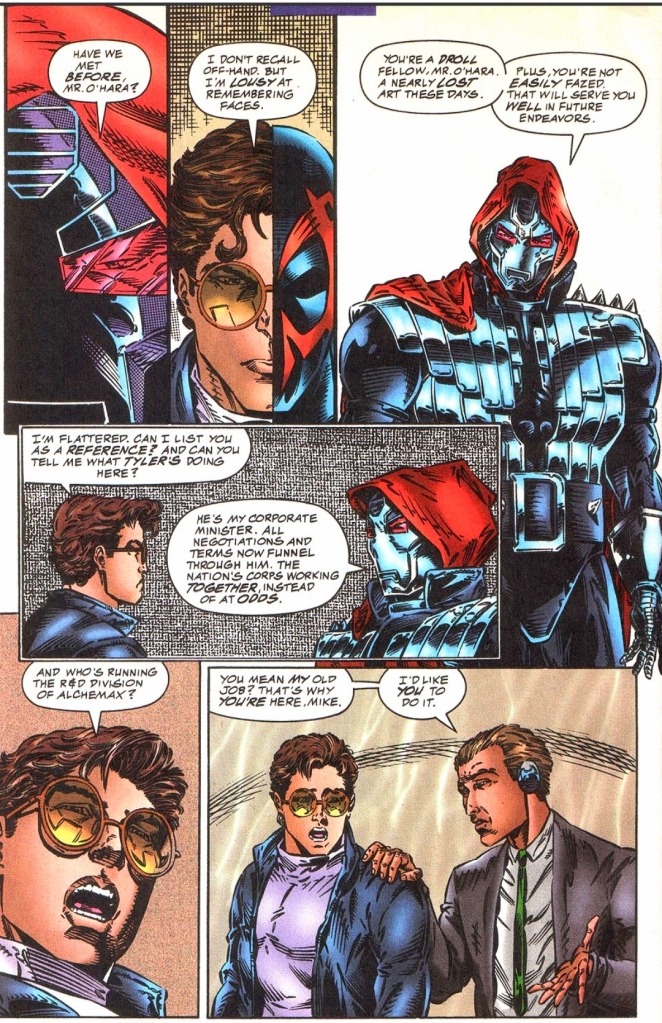
For the newcomers reading this, this page shows the first time ever that Doom 2099 sees Miguel O’Hara in person (Spider-Man 2099 without the mask and costume). Spidey and Doom encountered each other previously in The Fall of the Hammer storyline.

I will start what is very obvious about this comic book…its story is totally intriguing as it reflects a very dramatic turn of events within the 2099 realm at the time of publication. I’m talking about the rise of Doom 2099 as the new President of the United States and this comic book dramatizes in detail how the new leader impacts Miguel O’Hara’s career which adds tension to his already hectic 2nd life as the webslinger. This is all about the storyline of One Nation Under Doom and for context, you must read Doom 2099 #26 to #30.

As I just mentioned, life for Miguel became more complicated as he has to deal with the federal government under the control Doom who himself is connected with the powerful tycoon Tyler Stone (Miguel’s own boss at Alchemax). For the newcomers reading this, this is not the first time Doom and Spider-Man of 2099 encountered each other as they were together in the Fall of the Hammer storyline (read my past reviews by clicking here, here, here, here and here).

In relation to the dramatic turn of events that changed the direction of the 2099 comics franchise, I can confirm that the writing by Peter David in this comic book is indeed very strong and highly engaging to follow. You will not see a good-versus-evil superhero tale here but the impact of Doom as US President on Spider-Man and local society. Along the way, this tale has a theme about gaining absolute power, how it affects the one who gains it and how the more powerful person affects many others. You will see the mentioned theme reflected on Spider-Man who himself already has super powers and even a following of idolaters.

Compared to the previous two issues, the dialogue by Peter David here is very rich and I also enjoyed the way how he presented the exposition of details to help Spider-Man 2099 readers understand how Doom’s rise as US President impacts the titular hero and many others. Speaking of Doom, I enjoyed the way how David portrayed him here.  

Conclusion

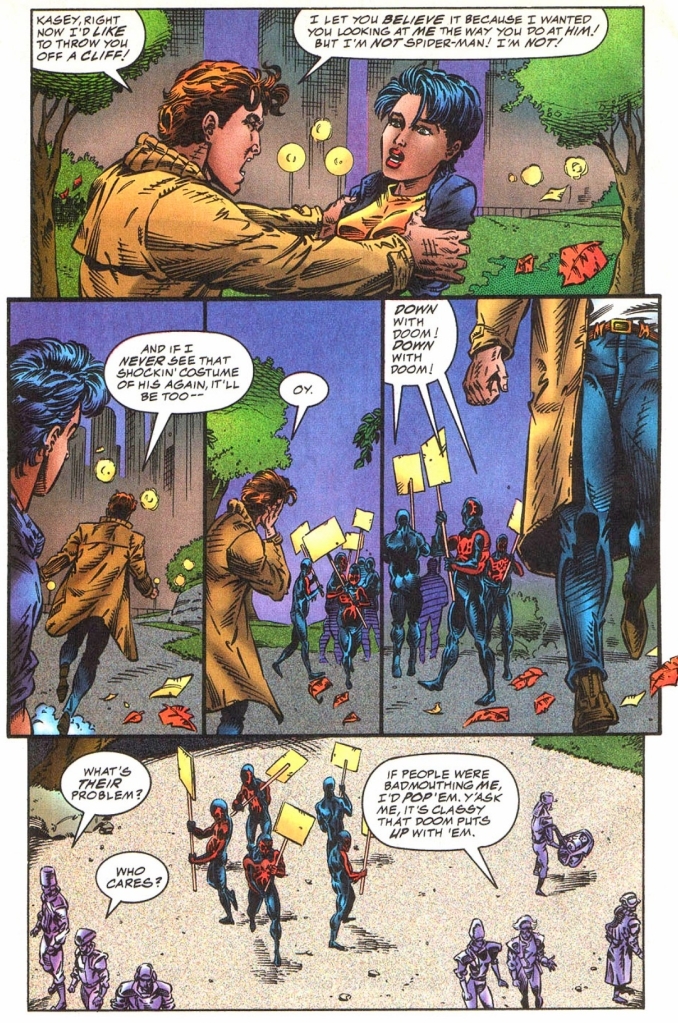
Gabriel O’Hara, Kasey and the Spider-Man 2099 idolaters doing the old fashioned way of protesting against US President Doom.

Spider-Man 2099 #34 (1995) is indeed a great comic book and one of the best tales of the original Spider-Man 2099 monthly series. As Doom’s takeover of the US Presidency really changed the direction of the entire 2099 franchise of comics in the 1990s, it was inevitable that the repercussions would be reflected in a Spider-Man 2099 tale. The result here is a fascinating tale of the futuristic webslinger that does not even have the usual good-versus-evil conflict. What you will see here is how the stakes got raised for Miguel O’Hara not only as a superhero but also as a civilian who has a strong record within Alchemax. Not only that, this is the tale that took place just before the very memorable first encounters between Spider-Man and Venom 2099 (click here, here, here and here).

Overall, Spider-Man 2099 #34 (1995) is highly recommended!

+++++

Thank you for reading. If you find this article engaging, please click the like button below, share this article to others and also please consider making a donation to support my publishing. If you are looking for a copywriter to create content for your special project or business, check out my services and my portfolio. Feel free to contact me with a private message. Also please feel free to visit my Facebook page Author Carlo Carrasco and follow me on Twitter at  @HavenorFantasy as well as on Tumblr at https://carlocarrasco.tumblr.com/ and on Instagram at https://www.instagram.com/authorcarlocarrasco

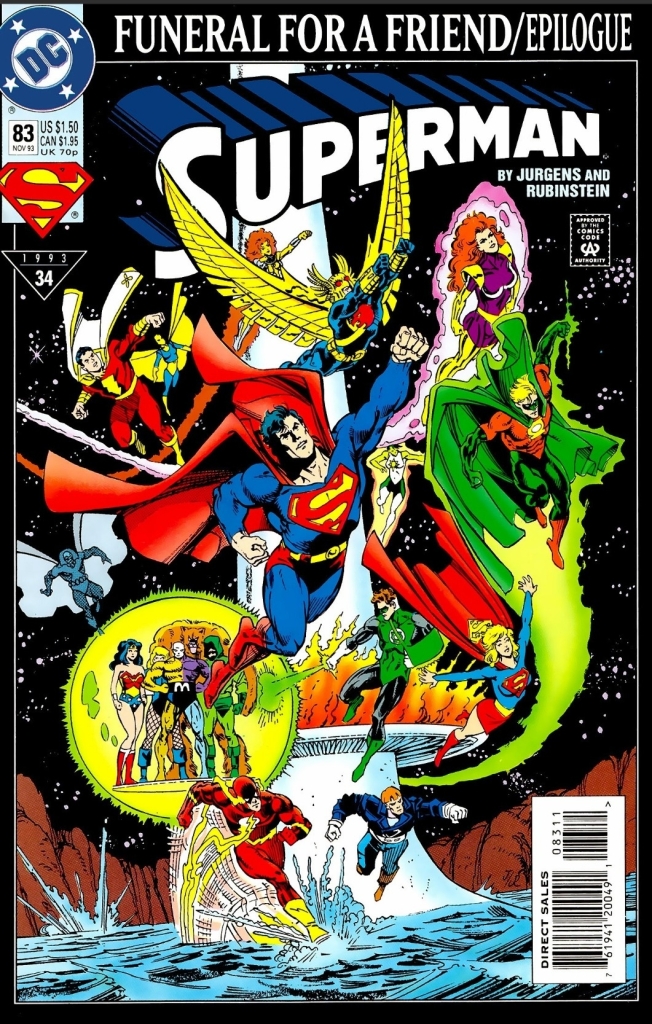
A Look Back at Superman #83 (1993)

Welcome back superhero enthusiasts, 1990s culture enthusiasts and comic book collectors! Today we go back to the year 1993 to take a close look at one of the many tales published through the Superman monthly series.

For the newcomers reading this, DC Comics published the Funeral for a Friend storyline set after Superman’s death (Superman #75). Funeral for a Friend explored the impact Superman’s death had on local society, the civil and political stakeholders, as well as DC’s many superheroes who were connected with the icon (read my retro reviews here, here, here and here). Of course, DC brought the Man of Steel back to life which led to the Reign of the Supermen storyline. This obviously meant concluding the Funeral for a Friend storyline.

With those details laid down, here is a look back at Superman #83, published in 1993 by DC Comics with a story written and drawn by Dan Jurgens with ink work by Joe Rubinstein. This is the epilogue of Funeral for a Friend.

The cover.

Early story

The story begins with Superman meeting an arriving Batman (note: Azrael playing the role as Bruce Wayne had been paralyzed by Bane) in the presence of Commissioner Gordon in Gotham City. He tells Batman that it was time for them to go to a certain ceremony which catches Azrael knowing nothing about it all forcing him to just play along. Batman resorts to making an excuse and turns Superman down, even though he learns that the entire Justice League will be involved to take care of the Engine City problem. Not wanting to spark Superman’s suspicion, Batman leaves Superman and Gordon behind. Superman then flies away.

Meanwhile, Lex Luthor, Supergirl and personnel fly towards Engine City. Luthor is obsessed with accumulating Kyptonite at the site…

Quality

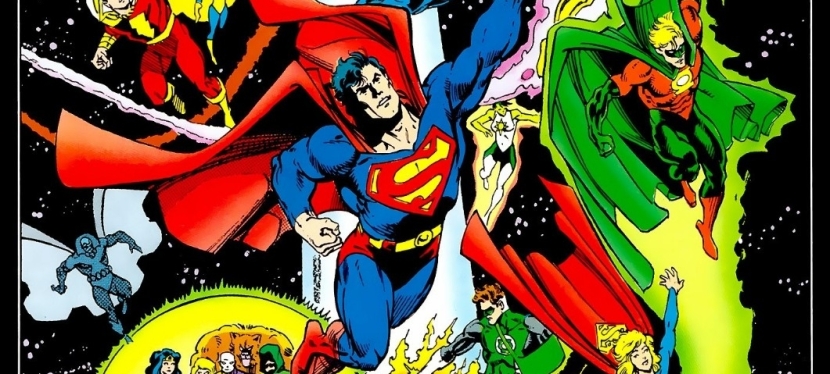
Superman, Wonder Woman, Green Lantern and the Flash with Lex Luthor and Supergirl (in the background).

As the conclusion of the Funeral for a Friend storyline, this is a mixed bag of creative concepts. It has scenes that developed established supporting characters such as Lois Lane, Jimmy Olsen, Cat Grant and Superman’s parents Jonathan and Martha Kent. The main story of this comic book has a lot more to do with the Justice League than Superman himself as a result of a huge crisis in which an actual coastal city could collapse, fall into the sea and potentially poison the aquatic life.

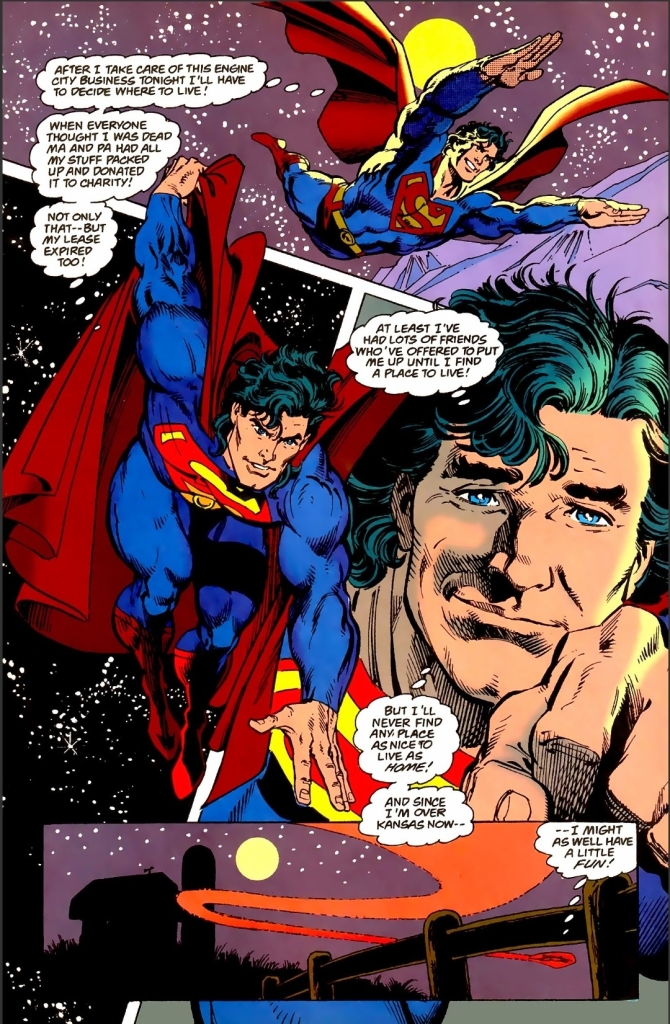
That’s not to say that Superman does not have sufficient presence in this comic book. In fact, the Man of Steel has scenes that highlight his humanity, his leadership role among the Justice League and how he is still adjusting to life after getting killed by Doomsday. What Superman fans won’t find here is superhero action versus an enemy.

Still on the Superman relevance of this comic book, Lex Luthor’s obsession with accumulating as much Kryptonite as he could reflects his diabolic nature as well as his cunning moves with distorting people’s perception. Even though he does not commit any acts of violence, Luthor’s manipulative tactics even in the presence of many superheroes showed that he simply won’t stop at anything to get what he wants and what benefits him.  

Speaking of more characters, Green Lantern (Hal Jordan) here got a good piece of the spotlight as he emphasized why Engine City should fall into the Pacific Ocean which he relates to the destruction of Coast City. Through his dialogue, you can feel his bitterness and the impact that the Coast City tragedy had on his worldview. You will also see Aquaman, Wonder Woman, Guy Gardner and others participate in the talks.

Conclusion

Pay close attention to the details, Superman fans.

Superman #83 (1993) is a nicely crafted story that happens to be more about the Justice League dealing with a big problem with Superman present. As the epilogue to the Funeral for a Friend storyline, this comic book tied up certain loose ends but ultimately focused more on building up details and tension for future events. As this story took place a short time after Superman physically returned from the dead, readers will see a still-adjusting Man of Steel here and this clearly shows that the funeral is indeed over.

Overall, Superman #83 (1993) is recommended.

+++++

Thank you for reading. If you find this article engaging, please click the like button below, share this article to others and also please consider making a donation to support my publishing. If you are looking for a copywriter to create content for your special project or business, check out my services and my portfolio. Feel free to contact me with a private message. Also please feel free to visit my Facebook page Author Carlo Carrasco and follow me on Twitter at  @HavenorFantasy as well as on Tumblr at https://carlocarrasco.tumblr.com/ and on Instagram at https://www.instagram.com/authorcarlocarrasco

A Look Back at Spider-Man 2099 #33 (1995)

Welcome back superhero enthusiasts, 1990s culture enthusiasts and comic book collectors! Today we go back to the year 1995 and explore a part of the Marvel 2099 comics universe through a tale of the Spider-Man 2099 franchise.

In my previous retro review, Miguel O’Hara arrives in Mexico with Xina and they shared a room together. It turns out his brother Gabriel was also there even occupying the next room. Elsewhere, a lady practicing sorcery (Strange 2099) is told that Spider-Man will be her ally and they will work together to fulfill a mission. Elsewhere, a grave digger performs rituals over the skeletal remains of his beloved sister. Issue #32 had a dark and totally different tone as the sci-fi element of the monthly series got pushed aside.

With those details laid down, here is a look back at Spider-Man 2099 #33, published in 1995 by Marvel Comics with a story written by Peter David and drawn by Andrew Wildman.

The cover.

Early story

The story begins when Spider-Man 2099 and his new ally Strange 2099 crash into a room on a mission they must complete. They see the grave digger clinging to a magical item that he believes should resurrect his dead sister.

In an attempt to find a solution, Strange touches the item and suddenly becomes a hideous looking monster.

Meanwhile, the streets of Mexico City suddenly gets filled with several undead people walking. On the street, Xina (walking with Kasey and Gabriel) begins to worry about Miiguel. Soon enough, some of the undead move towards them…

Quality

Spider-Man helps to ensure safety.

As this story is the continuation to the events of issue #32, this one keeps on building up on sorcery and evil forms of the supernatural as the key elements of the narrative as well as the setting. That being said, the usual science fiction element remains completely absent and this opened the opportunity for the creative team to show Spider-Man in action within a supernatural atmosphere complete with the unfortunate event of a demonic possession.

Spider-Man’s team-up with Strange (obviously the futuristic take of Dr. Strange) inevitably led to a conflict with evil and the ironic thing is that the grave digger himself is not even the villain but someone obsessed with bringing his sister back to life by means of resorting to magic and tapping the demonic force he could not even see. The Spidey-Strange team-up clearly dominated the narrative but I should say that the sorceress is not too interesting as a character and she barely has any chemistry with the futuristic web-slinger. It seems to me that Strange 2099 was created to emphasize racial diversity and rabid feminism than to really add any depth to the 2099 universe and its lineup of supporting characters.

As for the concept of the undead walking along many people who happen to be commemorating the day of the dead on the city streets, it really heightened the horror and supernatural aspects of the story while escalating the sense of danger.

Conclusion

Spidey, Strange 2099 and the grave digger.

In line with the concept of the previous issue, Spider-Man 2099 #33 (1995) is a supernatural tale of Spider-Man on a misadventure teamed up with a futuristic take on Dr. Strange. Its pay-off to the build-up in issue #32 was barely felt and I could not help but feel the presentation was rushed. Strange 2099 was simply not interesting and the grave digger’s personal pursuit over his dead sister did not have much of an impact. That being said, the concept of this 2-part story felt more like a diversion than a meaningful story. If there is anything worth focusing on in this comic book, it is Spidey himself struggling in the very nation where he previously got his costume.

Overall, Spider-Man 2099 #33 (1995) is satisfactory.

+++++

Thank you for reading. If you find this article engaging, please click the like button below, share this article to others and also please consider making a donation to support my publishing. If you are looking for a copywriter to create content for your special project or business, check out my services and my portfolio. Feel free to contact me with a private message. Also please feel free to visit my Facebook page Author Carlo Carrasco and follow me on Twitter at  @HavenorFantasy as well as on Tumblr at https://carlocarrasco.tumblr.com/ and on Instagram at https://www.instagram.com/authorcarlocarrasco

A Look Back at Venom: Funeral Pyre #3 (1993)

Welcome back superhero enthusiasts, 1990s culture enthusiasts and comic book collectors! Today we go back to the year 1993 to take a close look at the second issue of the second Venom comic book mini-series Venom: Funeral Pyre.

In my previous review, the gang-driven violence intensifies as the Punisher makes his move armed with lots of resources (including a van loaded with weapons and computerized functions). Venom struggles to free himself from the temporary prison the Punisher placed him in. As the violence escalated, Gray Russell finds himself in much deeper trouble as the anticipated rescue does not happen.

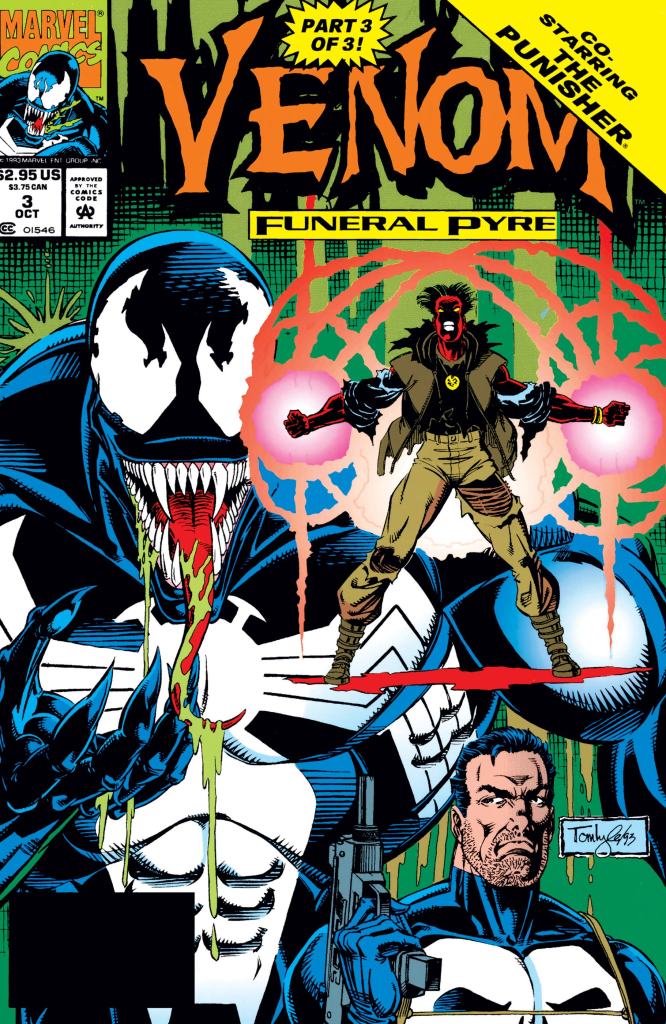
With those details laid down, here is a look back at Venom: Funeral Pyre #3, published in 1993 by Marvel Comics with a story written by Carl Potts and drawn by the late Tom Lyle. This if the final issue of the mini-series.

The cover.

Early story

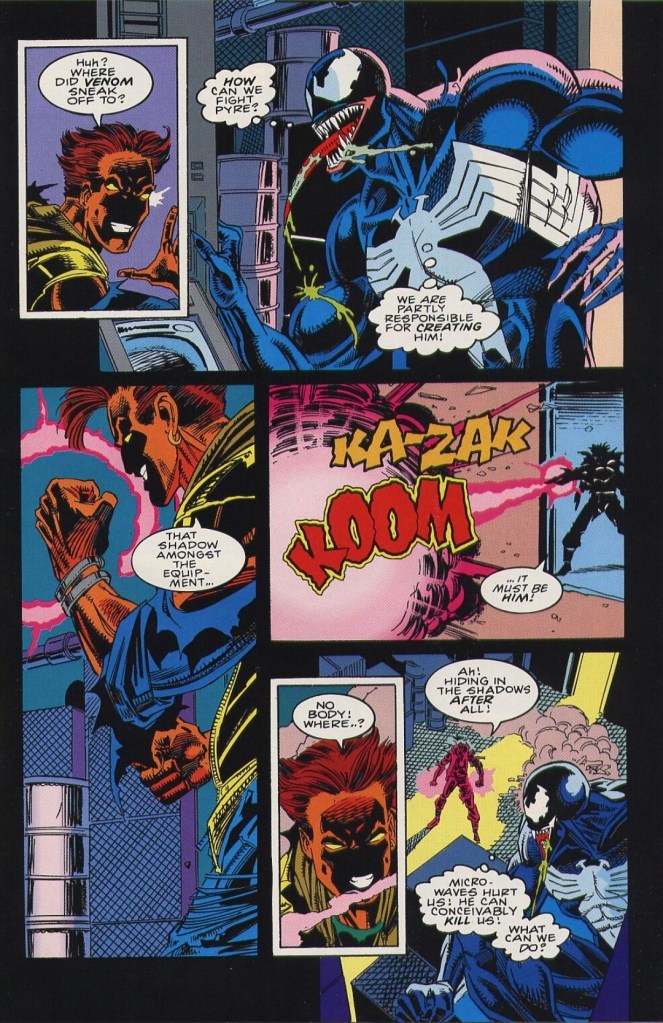
The story begins inside a building with high-tech equipment from HYDRA. Gray Russel is no longer himself but as the red-skinned, highly radiated figure Pyre. He fires a microwave blast at Venom which hurts him so much. In response to Venom’s claim that he came to rescue him, Pyre reacts with rage telling the murderous man with the symbiote that he arrived too late which resulted in the forced killing of people during the gang violence on the streets of Oakland.

Being filled with pure rage, Pyre intends to burn Venom alive. Thinking that Pyre is distracted, the Punisher leaps to get a gun on the floor which causes the radiated person to fire a microwave blast at him. The Punisher takes cover behind a machine but notices the microwaves sparking off the metal.

Venom then takes advantage of situation…

Quality

This page shows Venom at a disadvantageous state with Pyre whose microwave blasts are more than enough to kill him.

As the conclusion of the mini-series, this comic book went all-out portraying what turned out to be the final conflict involving the murderous Venom, the vigilante Punisher and the energy-filled Pyre. As a result, the narrative strongly focused on the final conflict (note: stretched out to last several pages) and never bothered to look back at the people and activities on the city street.

That being said, you will get to see more of the two established Marvel figures struggling hard against an unexpected force of opposition who was previously an undercover news reporter who infiltrated a certain gang and sent a message (delivered by a young boy) that caught Eddie Brock’s attention. At this point, it is clear that Venom’s effort to rescue Gray (who became Pyre after using a super soldier chamber left behind by HYDRA) ended in total failure and finds himself facing someone who could kill him and his alien costume together.  

If there is anything notable about this issue, it is the portrayal of Venom being highly disadvantaged and even vulnerable. There are no armed men with sonic weapons and high-tech equipment to bring Venom down but Pyre whose microwave blasts are deadlier than flame and sonic. In connection to the situation, Venom is not his aggressive self but a struggling figure who strives to survive and somehow find solutions during the heat of danger.

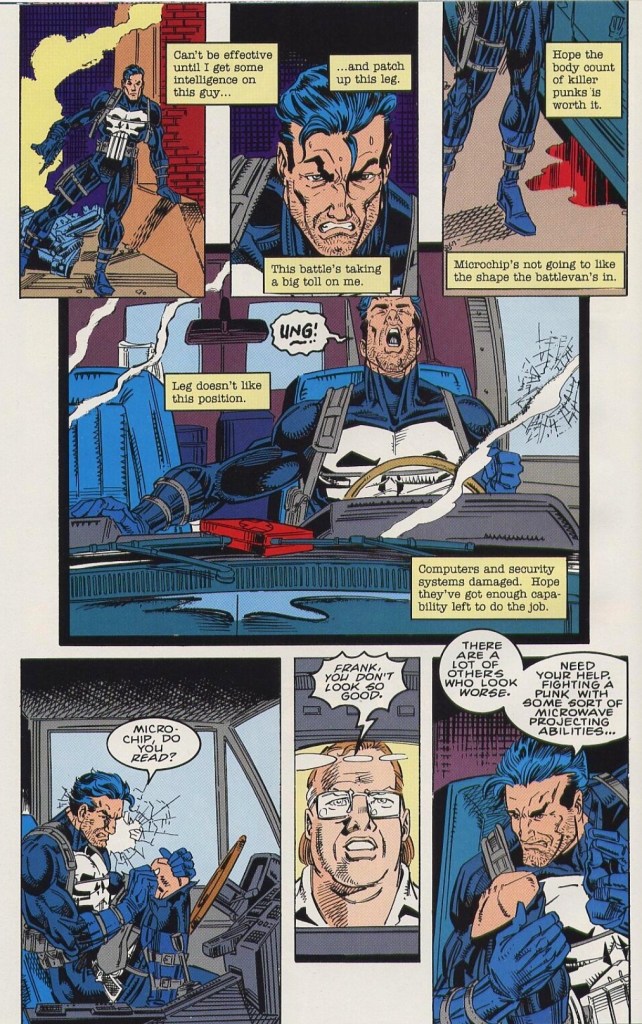
The Punisher, meanwhile, also struggled to survive but would simply not run away even though his chances of escape are much better. Instead, he focuses on actually eliminating Pyre without hesitation and Venom’s attempt to rescue Gray meant absolutely nothing to him.

More on Pyre, he is not really interesting nor was he ever engaging as the one powerful force of opposition that Venom and the Punisher must face. His being consumed by unrestrained rage and wielding so much power did not really raise the tension of the story. Had he eliminated the two Marvel figures who got in his way, what would Pyre do afterwards? Devastate the entire city of Oakland because he lost his identity as Gray and could not get over his involvement of taking other people’s lives while in the middle of gang activities? Would he proceed to San Francisco’s underground community and eliminate the people only because he blames Venom (note: Eddie Brock got involved with the underground people of San Francisco as seen in the Lethal Protector mini-series) for his failure of rescuing him? Pyre is nothing more than a throwaway comic book force of opposition.

From a visual standpoint, Tom Lyle once again pushed his creativity hard and showed some dynamic shots of spectacle here and there. At this stage, he proved to be very capable of visualizing Venom and the Punisher.

Conclusion

The Punisher refuses to give up and gets Microchip to assist him.

While issue #2 was a notable improvement over the first issue, Venom: Funeral Pyre #3 (1993) does not have much to offer in terms of engagement and entertainment. This is because it was crafted as a strict Venom-Punisher-Pyre conflict that provided spectacle and intrigue but ultimately ended up hollow. To see Venom at a huge disadvantage is interesting but did not add much weight to the plot. The Punisher was his usual self and in some ways overshadowed Venom for a while. Too bad there was not much space left for Venom and Punisher to fight each other again.

As the final issue of this mini-series, the story concluded with a whimper. Ultimately the Funeral Pyre storyline ended up as a diversion within the Marvel Comics shared universe that happened to attract Punisher, Venom and the gangsters of Oakland.  

Overall, Venom: Funeral Pyre #3 (1993) is satisfactory.

+++++

Thank you for reading. If you find this article engaging, please click the like button below, share this article to others and also please consider making a donation to support my publishing. If you are looking for a copywriter to create content for your special project or business, check out my services and my portfolio. Feel free to contact me with a private message. Also please feel free to visit my Facebook page Author Carlo Carrasco and follow me on Twitter at  @HavenorFantasy as well as on Tumblr at https://carlocarrasco.tumblr.com/ and on Instagram at https://www.instagram.com/authorcarlocarrasco

A Look Back at Spider-Man 2099 #32 (1995)

Welcome back superhero enthusiasts, 1990s culture enthusiasts and comic book collectors! Today we go back to the year 1995 and explore a part of the Marvel 2099 comics universe through a tale of the Spider-Man 2099 franchise.

As some of you may already be aware, the protagonist Miguel O’Hara got his Spider-Man 2099 costume in Mexico during the Day of the Dead festival he attended. If you are wondering if there was any comic book published that showed the futuristic Spidey on location in Mexico for the mentioned festival, there definitely is such a tale printed.

With those details laid down, here is a look back at Spider-Man 2099 #32, published in 1995 by Marvel Comics with a story written by Peter David and drawn by Roger Robinson.

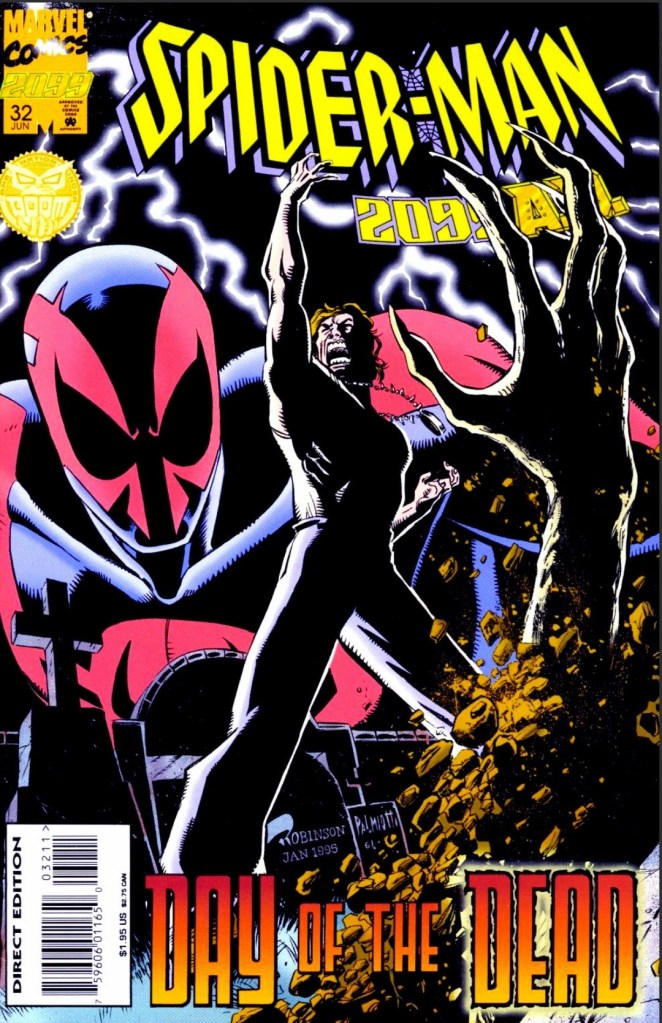
The cover.

Early story

The story begins during the middle of the night in Mexico City. At a graveyard, the night watchman catches a man digging up one of the graves and tells him that what was done was obscene. The grave digger then hits the watchman with his shovel.

Elsewhere a lady practicing sorcery sees the image of Spider-Man and she is told that he will be her ally on a mission.

At another location in Mexico, the Day of the Dead festival occurs attracting a huge crowd of attendees and bystanders. Several people wore costumes that not only reflected the dead but also of evil figures and idols.

Inside a hotel room, Miguel O’Hara watches the festival from the window and on bed near him is a naked Xina covered by a blanket. It turns out Miguel did not sleep with her but alone on the couch. As far as he is concerned, there is no romance between him and her. While Miguel focuses on the festival below, Xina nakedly stands up and enters the bathroom.

Just outside the hotel room window, Miguel sees his brother Gabriel on the very next hotel room window…

Quality

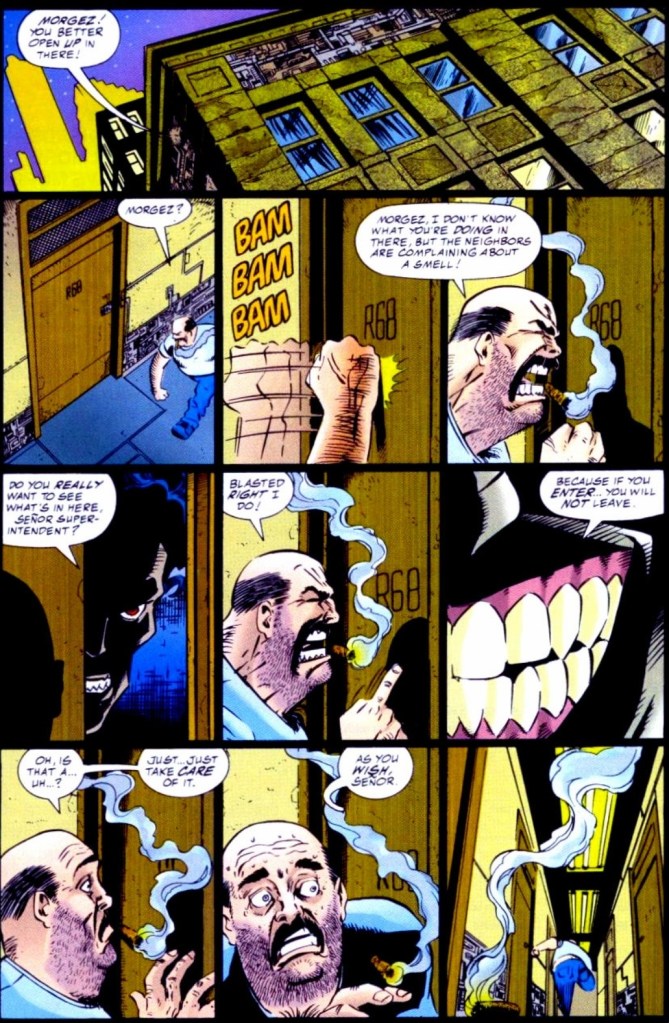
Something sinister inside.

To make things clear, this story marks Miguel’s return to Mexico and his first as Spider-Man. As typical with this 1990s monthly series, Peter David crafted a story that focused on its concept while literally planting seeds for future stories. What is notable about this tale is that Spider-Man will not only get involved in an unexpected mission with some destined to be with him, his personality gets tested again in his civilian identity as he unexpectedly encounters his brother Gabriel and the two most notable ladies – Xina and Dana – are present with them. The presence of the two ladies is significant given what happened in later issues of this monthly series (click here and here).

More on this particular story, the tone really turned dark which is deliberately done by the creators as the Day of the Dead is featured here. Apart from the dark atmosphere established by the festival, this story has elements of evil such as sorcery, the worship of evil entities, idolatry committed and rituals of the wicked performed. It should be noted that even in a predominantly Catholic nation like Mexico, there are still lots of sinners, wickedness and demonic elements present. Very clearly, the sci-fi tone of this monthly series was completely replaced with the supernatural of the evil type. Along the way, a Mexican character is introduced and he even got a good share of the spotlight.

Given the shift to the supernatural, the story was executed with the build-up of tension and the next issue in mind. Spider-Man 2099 fans will still have character moments of Miguel, Gabriel, Xina and Dana to enjoy. That being said, if you are anticipating to see superhero spectacle, there is not much to find here.

Conclusion

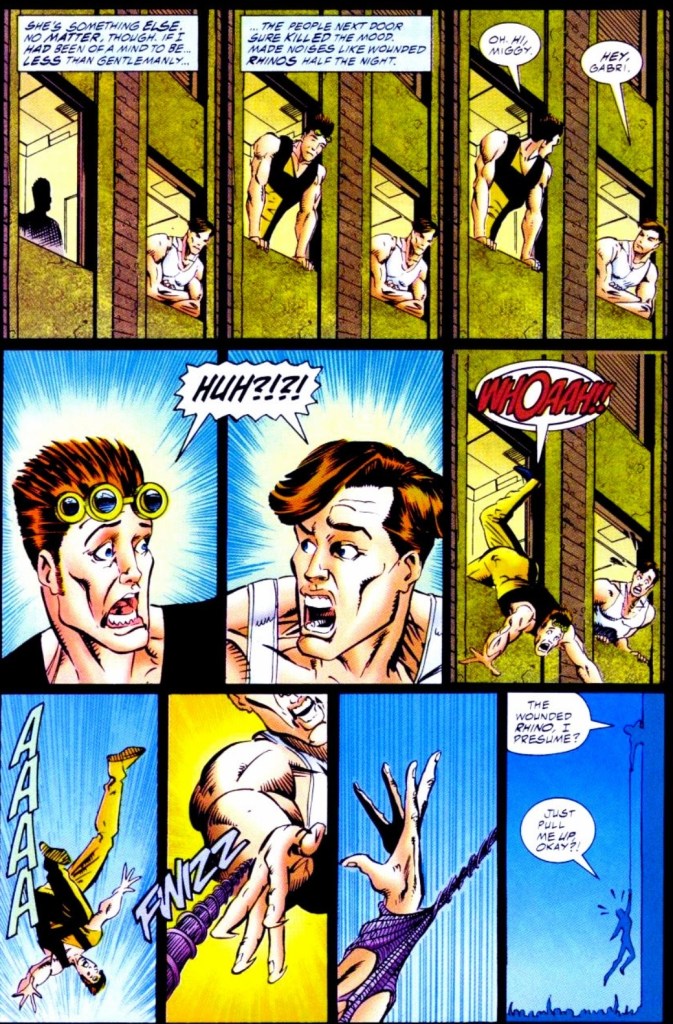
A tremendous coincidence to have the O’Hara brothers together in Mexico.

Spider-Man 2099 #32 (1995) can best be described as a build-up issue with the planned pay-offs set to happen afterwards. To the credit of the creators, having a different tone and a totally new location for Spider-Man to be in made this comic book standout somewhat compared to all the previous issues published in terms of aesthetics. The best way to enjoy this comic book is to set your expectations low, don’t anticipate superhero action and focus on the further development of the futuristic Spider-Man and the supporting characters involved.

Overall, Spider-Man 2099 #32 (1995) is satisfactory.

+++++

Thank you for reading. If you find this article engaging, please click the like button below, share this article to others and also please consider making a donation to support my publishing. If you are looking for a copywriter to create content for your special project or business, check out my services and my portfolio. Feel free to contact me with a private message. Also please feel free to visit my Facebook page Author Carlo Carrasco and follow me on Twitter at  @HavenorFantasy as well as on Tumblr at https://carlocarrasco.tumblr.com/ and on Instagram at https://www.instagram.com/authorcarlocarrasco

A Look Back at Freex #16 (1995)

Disclaimer: This is my original work with details sourced from reading the comic book and doing personal research. Anyone who wants to use this article, in part or in whole, needs to secure first my permission and agree to cite me as the source and author. Let it be known that any unauthorized use of this article will constrain the author to pursue the remedies under R.A. No. 8293, the Revised Penal Code, and/or all applicable legal actions under the laws of the Philippines.

Welcome back superhero enthusiasts, 1990s culture enthusiasts and comic book collectors! Today we go back to the year 1995 to revisit one of the many tales of Malibu Comics’ Ultraverse through the Freex monthly series.

In my previous review, the Freex encountered someone very deadly (note: Rafferty who also encountered The Strangers) and out of nowhere one of their members got killed as he made his move to protect someone’s life.

With those details laid down, here is a look back at Freex #16 published in 1995 by Malibu Comics with a story written by Gerard Jones and drawn by Klebs de Moura e Silva.   

The cover.

Early story

The story begins at midnight when Ruby arrives at a sorrowful gathering composed of Contrary, her academic students, the Night Man, the Old Man and the remaining members of Freex. They are all mourning over the dead body of Michael. Just after Old Man declared that everyone should move on and let Michael (Plug) rest, Contrary (now an established member of UltraForce) stated that her academy will keep him in the company of others like him at their Mt. Shasta Citadel headquarters as the dead Freex member does not have any known surviving family members.

The loss of Michael then begins to take its toll on Angela/Sweetface as she cries and states that there is nothing left to live for. Suddenly, something appears to the Freex…an angel-like figure who tells Angela to end the pain and join the only one who still cares for her. Valerie and Lewis try to help Angela resist the one who spoke…

Quality

The Old Man becomes the target of Freex.

What is obvious to me here is that this comic book is all about the consequences of the death of original Freex team member Michael and how his death impacted specific teammates who had really grown close with him. The plot in this comic book is pretty light as this was clearly written to have strong character dramatization and development.

While there were indeed a whole lot of characters who appeared here, this comic book highlights Sweetface as the one most affected by the sudden death of Michael. That being said, any dedicated Freex fan who seriously followed the series right from the start will be able to relate with Sweetface’s emotions and even feel her deep feelings with Michael. Incidentally, this paves the way for her to interact more with Lewis who also got impacted by the death of their teammate. As the story went on, there were key developments here that strongly symbolized that Freex will take a serious change of direction focusing more on team survival and avenging Michael while severing ties with the Old Man. Clearly the creative team were building up something for the team who at this point have been on a very long and painful journey as nomads.

All throughout, the script really is detailed, richly layered and engaging. Apart from Freex, Night Man, Contrary and her students, and other characters had their fair share of the spotlight strongly symbolizing the current state of the Ultraverse at the time.

Conclusion

Even as she is mourning over the death of Michael, Angela suddenly sees a mesmerizing vision in front of the others.

Freex #16 (1995) is indeed a solid comic book to read. The strong writing is its strongest feature and it really delivered the compelling stuff that will resonate most with the long-time Freex fans. The dramatization of the effects of Michael’s death really is strong and the new change of direction for the surviving Freex was implemented really smoothly. The lack of a good-versus-evil element was no problem at all here. By the end of the comic book, I became eager to find out what would happen next to Freex.

Overall, Freex #16 (1995) is recommended.

+++++

Thank you for reading. If you find this article engaging, please click the like button below, share this article to others and also please consider making a donation to support my publishing. If you are looking for a copywriter to create content for your special project or business, check out my services and my portfolio. Feel free to contact me with a private message. Also please feel free to visit my Facebook page Author Carlo Carrasco and follow me on Twitter at  @HavenorFantasy as well as on Tumblr at https://carlocarrasco.tumblr.com/ and on Instagram at https://www.instagram.com/authorcarlocarrasco

A Look Back at Venom: Funeral Pyre #2 (1993)

Disclaimer: This is my original work with details sourced from reading the comic book and doing personal research. Anyone who wants to use this article, in part or in whole, needs to secure first my permission and agree to cite me as the source and author. Let it be known that any unauthorized use of this article will constrain the author to pursue the remedies under R.A. No. 8293, the Revised Penal Code, and/or all applicable legal actions under the laws of the Philippines.

Welcome back superhero enthusiasts, 1990s culture enthusiasts and comic book collectors! Today we go back to the year 1993 to take a close look at the second issue of the second Venom comic book mini-series Venom: Funeral Pyre.

In my previous review, the Punisher and Venom encountered each other for the first time ever and along the way Gray – who is secretly a journalist with a mission – struggles to maintain his composure and his sanity as he finds himself in the middle of a very violent gang war in Oakland, California. The more time Gray spends time with the crime gang he joined, the tougher the situation becomes for him.

With those details laid down, here is a look back at Venom: Funeral Pyre #2, published in 1993 by Marvel Comics with a story written by Carl Potts and drawn by the late Tom Lyle.  

The cover.

Early story

The story begins with Gray and his gang companions riding a car approaching a group of people on the street. The gang leader pressures Gray to use his weapon to kill them. Gray is deeply worried not only because he has to prove his worth to the gang by killing other, but also because the rescue attempt he was waiting for had not yet happened.

Meanwhile, Venom finds himself trapped on the doorway of a building with the metal gate locked and with rays of microwave from the Punisher’s van radiating him painfully. As the Punisher leaves them behind, Venom manages to use the symbiote to reach into the van and smash the control panel inside which disabled the microwave rays.

Immediately, he recovers and breaks out to continue his mission: to rescue Gray…

Quality

The murderous Venom actually helped the Punisher.

When it comes to the storytelling, there are some improvements that made this comic book more readable than issue #1. For one thing, the exposition has been reduced which allowed the pace of the story to move faster. Most of the exposition here has been limited to Gray who at this stage of the mini-series was clearly bound to become the central object of the Funeral Pyre concept. Another thing is that the story’s structure here is simpler and easier to follow as Venom and Punisher moved on their own struggles separately before predictably getting together again.

While the mini-series has clearly been a tale of a city gang war – with a pretentious and unwilling gang member who expected to be rescued before things become too chaotic – that happened to pull the Punisher and Venom in for different reasons, Carl Potts added some elements that would resonate with Marvel Comics fans who are familiar with HYDRA and the Super Soldier aspects of the Marvel Comics universe history. Not only that, there is a science fiction-inspired setting near the end of the story that added variety to the in-story environment.

Like the first issue, this one is packed with a good amount of action scenes and that means Punisher and Venom fans have a lot of stuff to enjoy. Tom Lyle really is good with showcasing the respective spectacle of the vigilante and the symbiote-wearing murderer, and when he has the two together, his visual creativity intensifies.

Conclusion

Grey shooting blindly at the targets while riding the car of the gangsters he joined.

Venom: Funeral Pyre #2 (1993) is clearly an improved reading experience over issue #1 mainly because of the reduced information dump, the simpler plot structure and the creative showcase of Venom and the Punisher. While Gray remains uninteresting, his late-stage transformation turned out to be somewhat surprising and it was only near the end of this comic book that the Funeral Pyre concept became clear.

Overall, Venom: Funeral Pyre #2 (1993) is satisfactory.

+++++

Thank you for reading. If you find this article engaging, please click the like button below, share this article to others and also please consider making a donation to support my publishing. If you are looking for a copywriter to create content for your special project or business, check out my services and my portfolio. Feel free to contact me with a private message. Also please feel free to visit my Facebook page Author Carlo Carrasco and follow me on Twitter at  @HavenorFantasy as well as on Tumblr at https://carlocarrasco.tumblr.com/ and on Instagram at https://www.instagram.com/authorcarlocarrasco

A Look Back at Superman vs. Aliens #2 (1995)

Disclaimer: This is my original work with details sourced from reading the comic book and doing personal research. Anyone who wants to use this article, in part or in whole, needs to secure first my permission and agree to cite me as the source and author. Let it be known that any unauthorized use of this article will constrain the author to pursue the remedies under R.A. No. 8293, the Revised Penal Code, and/or all applicable legal actions under the laws of the Philippines.

Welcome back superhero enthusiasts, 1990s culture enthusiasts and comic book collectors! Today we go back to the year 1995 to examine another chapter of the Superman vs. Aliens mini-series.

In my previous retro review, an object from space on Earth and Superman (who previously as Clark Kent learned of the Kryptonian language from the signals transmitted by the object) intervened the discovery of it in the presence of Lexcorp. After much talk and an agreement, Superman went into space with one of Lexcorp’s space ships (under the watch of Dr. Kimble who leads the corporation’s space division) leaving behind Lois Lane at the space station with Kimble. Deep in space, Superman arrives and discovers a ruined city with physical signs of struggle. What he does not realize is the presence of eggs and the Xenomorphs lurking within the new environment.

With those details laid down, here is a look back at Superman vs. Aliens #2, published in 1995 by Dark Horse Comics and DC Comics with a story written and drawn by Dan Jurgens with ink work done by Kevin Nowlan.

The cover.

Early story

The story begins in space when a space ship sent home by Superman is about to collide with the space station near Earth. As one of the crew members failed to take remote control of the incoming ship, a very determined Dr. Kimble takes over the controls and eventually took command of the said ship. Lois Lane, who showed signs of self-restraint and deterioration of her professionalism as a journalist, watches. As Kimble, Lane and the crew members approach the ship at the station’s docking bay, one passenger was found dead (a Chestburster alien came out of him) while three others were still alive.

As Dr. Kimble and personnel brought the surviving passengers in the infirmary, Lois Lane takes advantage of the situation by climbing up the ship to examine it closely. She knows that without the ship, her beloved Clark Kent/Superman is stranded in space. She is completely unaware of the presence of a fully grown Xenomorph alien watching her from a dark corner.

Meanwhile at the ruined city on the other side of the galaxy, a blindfolded Superman is carefully guided by the armed Kara going to a place that has medical equipment and supplies…

Quality

Lois Lane during her encounter with the Xenomorph inside the space station.

This is a solid follow-up to what was established in issue #1. In this comic book, the creative team gradually raised the stakes as two sides of the story were told extensively in alternating fashion – the side of Superman and Kara in deep space, and the other side of Lois Lane and Dr. Kimble (clearly the 3rd most important character in this mini-series) inside the space station.

As the story went on, Superman became even more vulnerable not only because he grew weaker as he has been cut off from the sun (a primary source of energy for him), but also because struggling with the aliens wore him down a lot and he still insists on avoiding any acts of killing due to what happened to him previously. As the Man of Steel became more vulnerable, Kara (who is experienced already in fighting the Xenomorphs which she referred to as the uglies) became an even more significant character (next to Dr. Kimble) and she became a highly essential partner for the icon.

Even for us readers, Kara creatively became even more engaging as she shared memories of events (note: exposition) that happened sometime prior which explains why her city got ruined and how the Aliens arrived and made her people’s problems even worse. The visualization of the said events were efficiently done for a good immersion into the past.  

While the Superman-Kara thread emphasized survival facing tremendous odds, the Lois-Kimble thread became a more significant part of this mini-series as the space station became the new place for Xenomorph attacks. While Dr. Kimble remained obsessed with achieving results with scientific discoveries and corporate interests in mind, Lois Lane became the hunted similar in the style of Ellen Ripley in 1979’s Alien.

If you are looking for action, you will find a lot of them in both threads of the story. While just one Xenomorph on the space station led to some incidental action moments, a lot more action happened on Superman-Kara’s side of the story as they (along with a few human survivors on the ruined city) faced a huge horde of aliens that kept on attacking them from all sides. If you are looking for superhero spectacle, you won’t find it here as the action is more grounded with sci-fi’s interpretation of reality and Superman here is weaker and a lot more worn down physically. Then again, this is not surprising given the tone and concept the creators aimed for.

Conclusion

Superman and Kara struggling hard as they are surrounded by lots of Aliens. One of Kara’s fellow people is present in this shot.

Superman vs. Aliens #2 (1995) is really engaging to read and there were lots of fun moments along the way. Even as the creators were building up something for the third and final issue, they managed to pull off big pay-offs to what was built up in issue #1. While the lack of superhero-style spectacle is clear, it is not a problem at all as there is a lot of action involving the many Xenomorphs in the ruined city plus the bouts of suspense and incidental action executed during Lois Lane’s encounter with a single but deadly Alien. Considering how much fun and engagement this comic book has, it remains to be seen how the next issue will live up to it.

Overall, Superman vs. Aliens #2 (1995) is highly recommended!

+++++

Thank you for reading. If you find this article engaging, please click the like button below, share this article to others and also please consider making a donation to support my publishing. If you are looking for a copywriter to create content for your special project or business, check out my services and my portfolio. Feel free to contact me with a private message. Also please feel free to visit my Facebook page Author Carlo Carrasco and follow me on Twitter at  @HavenorFantasy as well as on Tumblr at https://carlocarrasco.tumblr.com/ and on Instagram at https://www.instagram.com/authorcarlocarrasco