Welcome back Xbox fans, geeks, RPG enthusiasts and other gamers!
The long wait for the next Xbox-exclusive fantasy role-playing game (RPG) experience is finally over as Avowed has officially been released for Xbox Series X|S, Windows PC and Xbox Game Pass (XGP Ultimate) today. Five days ago, the game developed by Obsidian Entertainment was released on early access for those who paid the premium for the privilege.
For the newcomers reading this, Avowed is the newest game from RPG specialist Obsidian Entertainment and it has a fantasy setting and a unique concept for gamers who enjoy in-depth exploration, intense action, consequential decision-making, engaging role-play and strong storytelling. Avowed is set in the fictional world called Eora and is also part of the same universe as seen in Obsidian’s Pillars of Eternity.
To get oriented, watch the launch trailer below.
Is it really great? Is it worth purchasing at all?
As of this writing, the critical reception remains questionable even though a lot of gaming publications posted their respective reviews resulting in a collective average that keeps on changing. As of now, the collective critical average for Avowed is mostly positive but additional reviews could change that.
For some insight, watch the video reviews of Avowed from MrMattyPlays, Colteastwood, GameSpot, XboxEra and Pure Xbox.
If you want to watch some extensive gameplay footage of Avowed that could help you decide to go for the game or not, watch the videos below.
Having waited more than four years to play Avowed (read my previous posts by clicking here, here and here), I will play it on my Xbox Series X console but not immediately. I’d rather wait for Obsidian to patch the game first to fix the bugs and other technical problems. I’d rather play an improved version over its launch version. Here is hoping that Obsidian will be listening to gamers’ feedback and improve the game accordingly.
I should mention that Obsidian is also working on its other high-profile video game The Outer Worlds 2 which is actually a multi-platform release (including PlayStation 5).
Welcome back readers, fellow geeks and electronic gaming fans!
In this edition of the Retro Gaming Ads Blast (RGAB) series, we will take a look at another batch of retro gaming print ads – including arcade flyers – from the 1980s and 1990s.
For the newcomers reading this, Retro Gaming Ads Blast (RGAB) looks back at the many print ads of games (console, arcade, computer and handheld) that were published in comic books, magazines, flyers, posters and newspapers long before smartphones, social media, the worldwide web and streaming became popular. To put things in perspective, people back in the 1980s and 1990s were more trusting of print media for information and images about electronic games and related products.
With those details laid down, here is the newest batch of retro gaming print ads for you to see and enjoy…
1. Asteroids Deluxe arcade flyer
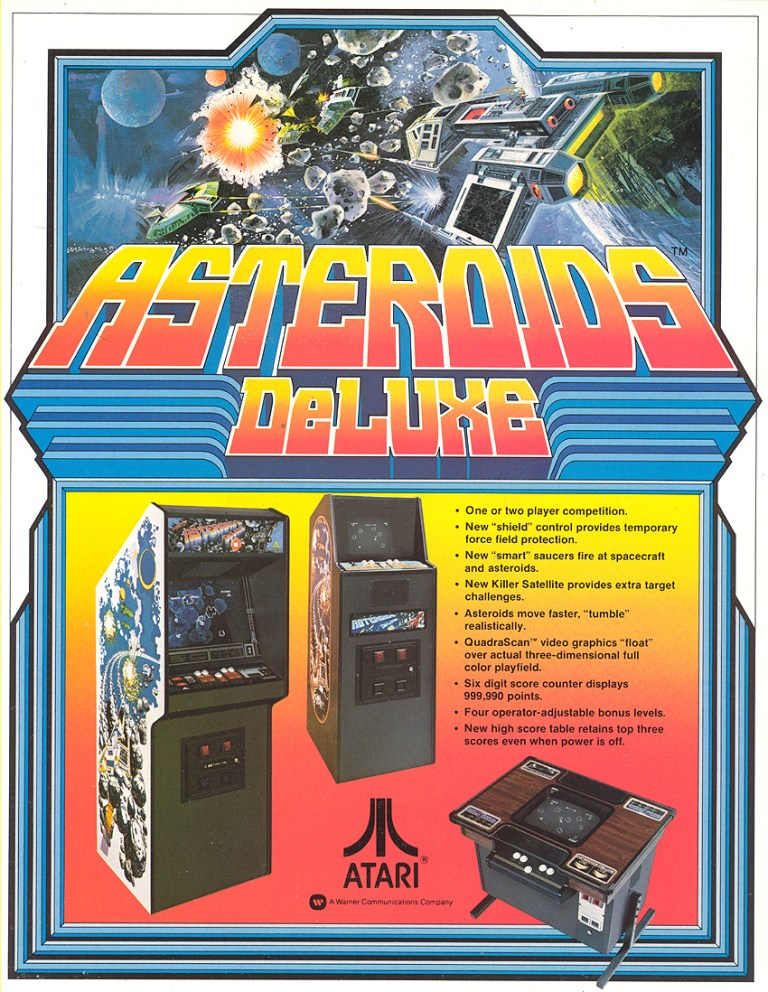
The arcade flyer for North America.
Given the fact that Asteroids was a massive hit for Atari in the arcades, it was not surprising that a sequel was made called Asteroids Deluxe. In preparation for its 1981 release, Atari made this Asteroids Deluxe arcade flyer showing three machine that arcade operators can choose from complete with technical details displayed. They even emphasized the QuadraScan video graphics as a technological advancement with regards to graphics. By today’s standards, this arcade flyer is still sensible with regards to promoting the game to both arcade operators and players.
2. Missile Command arcade flyer
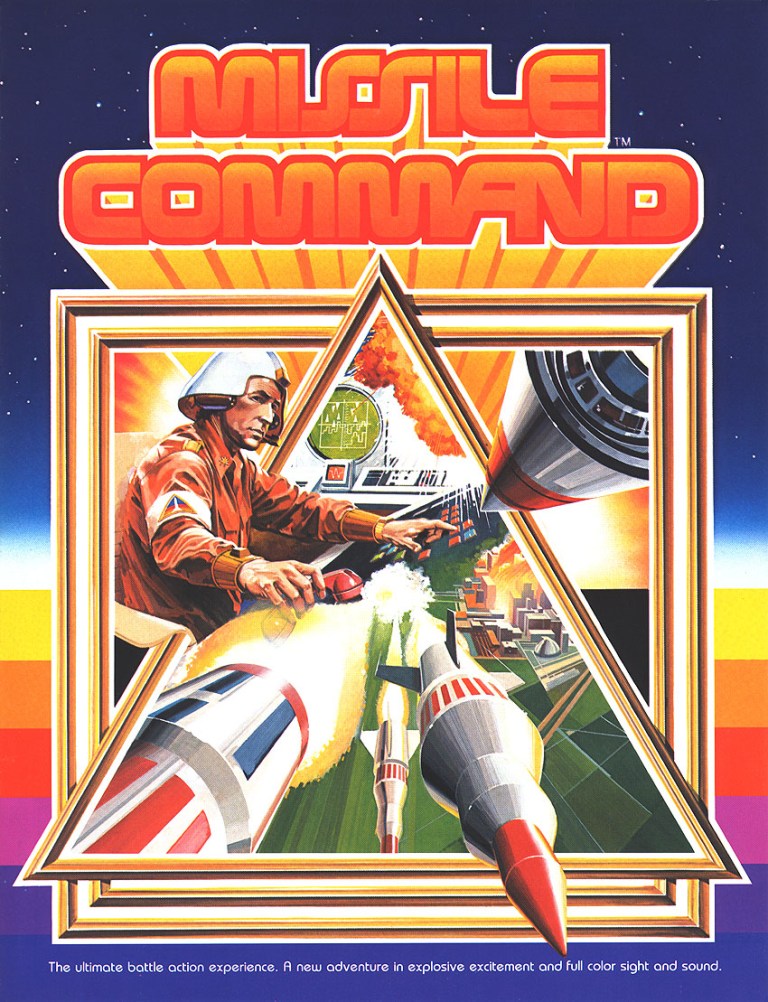
Engaging art work on display at the front of the arcade flyer.
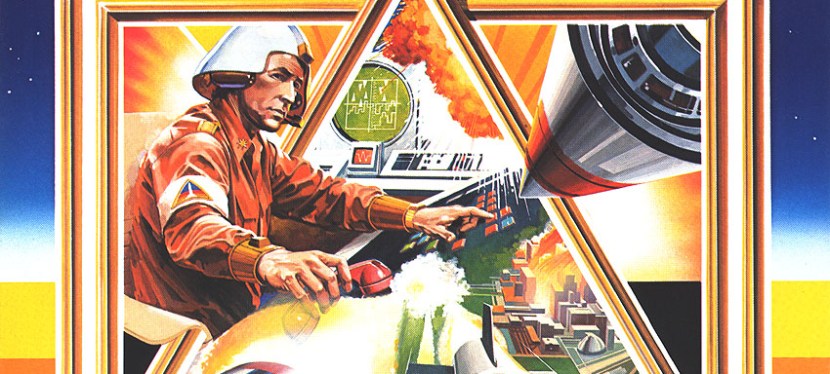
Released in the arcades in 1980, Missile Command is a classic game from Atari and its concept of defending cities from incoming enemy missiles proved to be relevant with people living with the fear of a nuclear missile attack during the days of the Cold War. In my experience, I mainly played the Atari 2600 version and it was only recently I finally started playing the arcade classic on my Xbox Series X using the Atari 50 Collection software. As for the arcade flyer itself, Atari simply used highly detailed painted art for the front which clearly emphasized the science fiction portrayal of a military officer using a console inside a base to come up with defensive response to incoming ballistic missiles. The game was a massive hit in the arcades and in my view, Atari’s simply yet direct way of promoting the concept of Missile Command with the arcade flyer remains compelling to look at.
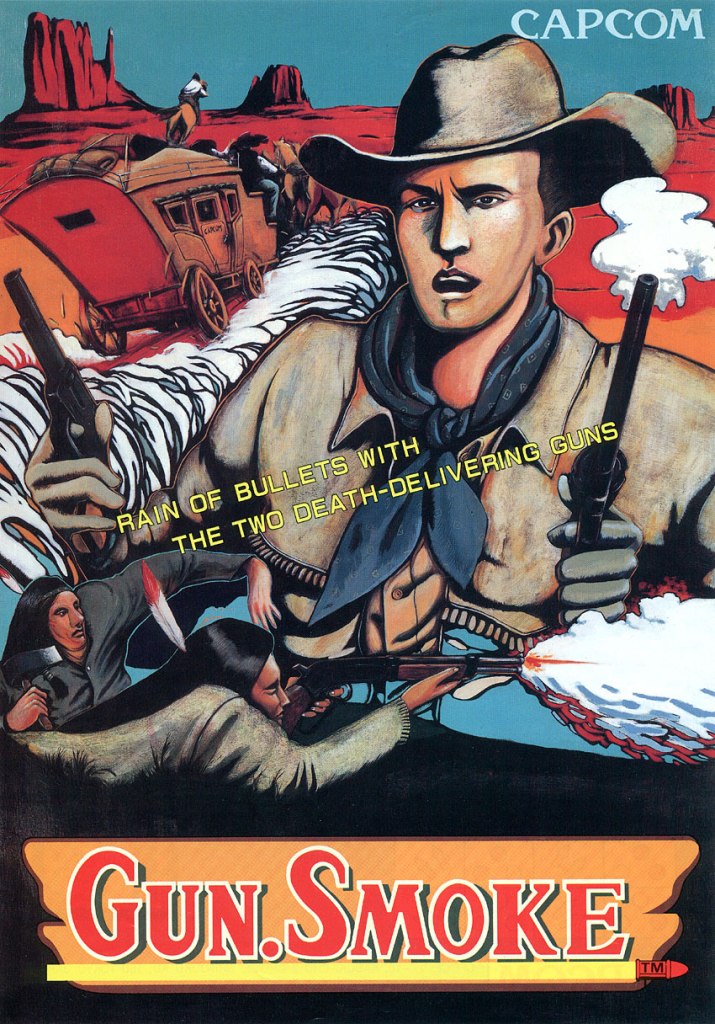
3. Gun.Smoke European arcade flyer
Nice art on the front of this arcade flyer for the European market.
Long before they struck gold with Street Fighter II, Japanese company Capcom scored a hit with gamers in the arcades with 1985’s Gun.Smoke. It was a vertically scrolling run-and-gun game with an Old West setting and it was designed by Yoshiko Okamoto (Final Fight and Street Fighter II). To promote the game for European arcades, Capcom simply used hand-drawn artwork for the arcade flyer’s front which emphasized the Wild West setting, and an American Cowboy and bounty hunter named Billie Bob who is the playable character gamers got to play. In my view, the artwork gave the game a strong Wild West image that is also memorable.
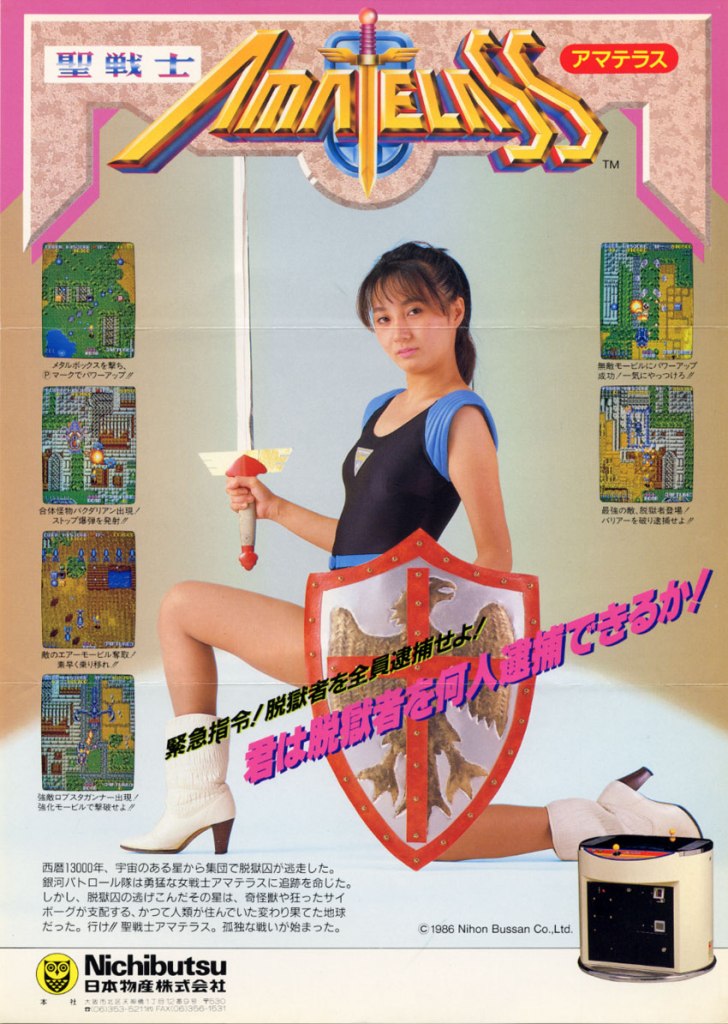
4. Sei Senshi Amatelass arcade flyer
Does the model look sexy or tough?
Released in Japanese arcades in 1986 by Nichibutsu, Sei Senshi Amatelass is a vertical scrolling run-and-gun game with a science fantasy concept. To promote the game and really sell its concept, Nichibutsu hired a model posing with a sword and a shield in fantasy inspired costume. Using the remaining spaces of the flyer, some screenshots and an image of the arcade machine were displayed. This flyer showed the company exerting effort to sell Sei Senshi Amatelass with a touch of beauty and subtle sexiness.
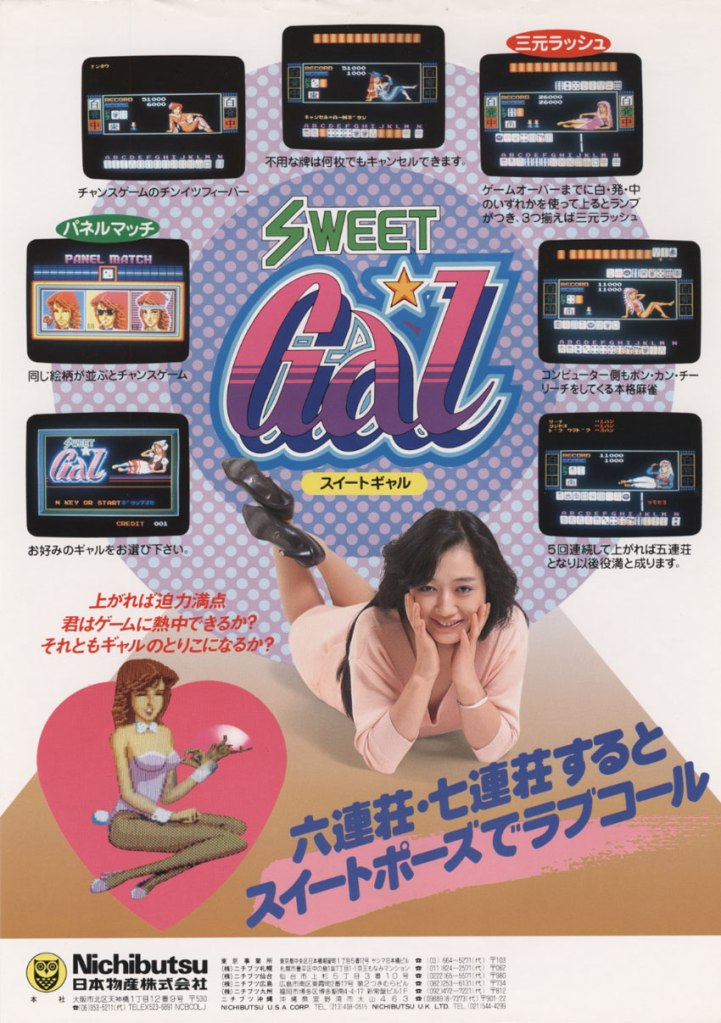
5. Sweet Gal arcade flyer
Seriously, are you interested in playing mahjong in digital form?
Here is another digital mahjong arcade game from Nichibutsu…Sweet Gal. As typical of the company, a model was hired to add subtle sexiness into the promotion of the game and they even added a digital image of a sexy girl. Sweet Gal clearly was promoted to attract men who enjoy playing mahjong in electronic format and there were some arcade spots in Japan that catered to such mahjong enthusiasts.
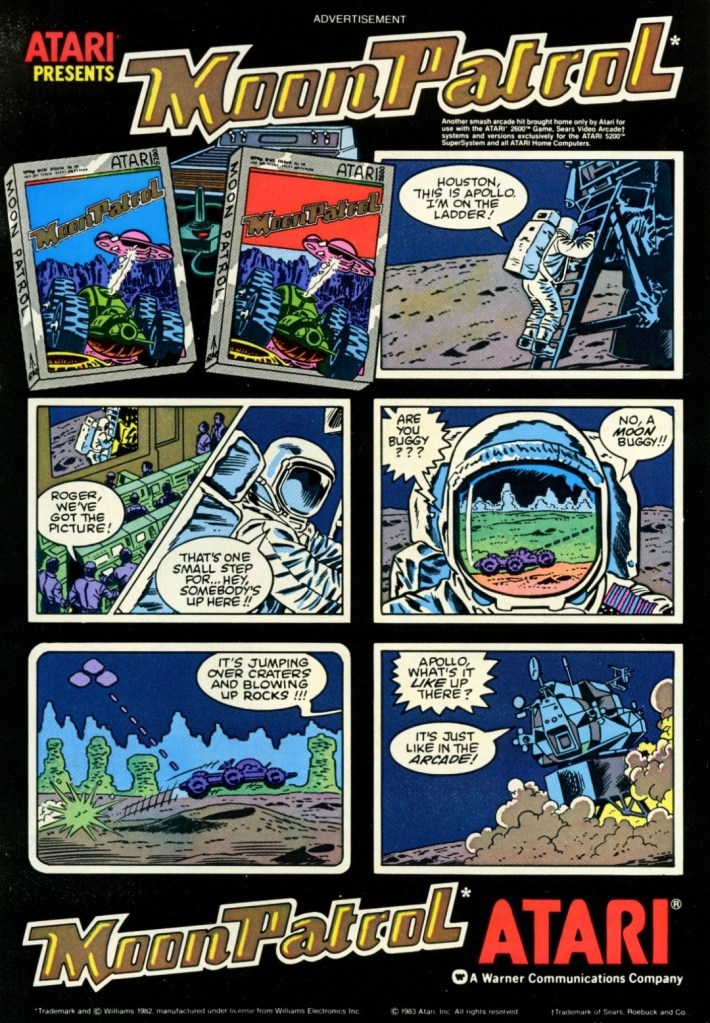
6. Moon Patrol print ad
This is a fun-looking, comic book style way of promoting a video game.
Here is one of those video game print ads I saw while reading comic books back in the early 1980s. Moon Patrol is a sci-fi, side-scrolling game by Atari known for introducing full parallax scrolling in side-scrolling games. Instead of showing screenshots of the console versions of the game, this print ad used nice looking hand-drawn artworks presented with a comic book-inspired style to emphasize the concept. I still remember how captivating this ad and its super short story was the first time I saw it. It was enough to make me interested in the game.
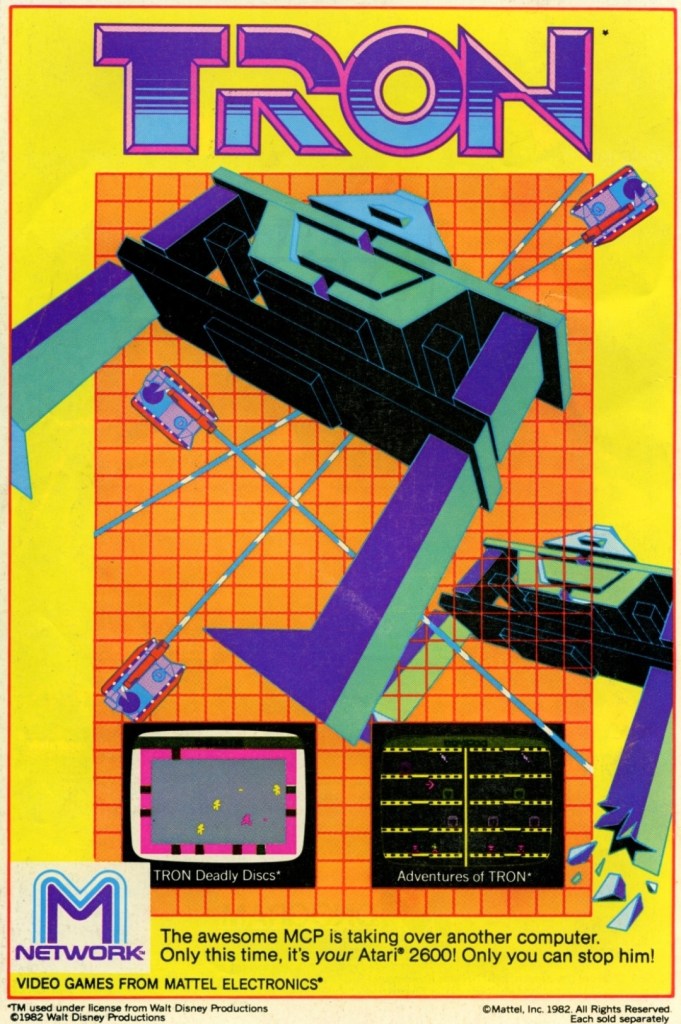
7. Tron Atari 2600 games print ad
Calling all Tron fans to look at this.
I was very captivated by the 1982 sci-fi movie Tron which I saw on home video. It had very flashy computer-generated visuals, a very memorable story and the fine performance by Jeff Bridges. Tron was also very reflective about the video game culture of its time. When I first saw this print ad while reading a comic book, I was really excited. If you look closely, it had nice artwork dominating the space and screenshots that each promoted the games Tron: Deadly Discs and Adventures of Tron. Even though the graphics were primitive, I still recognized the Tron-related images which added to my excitement.
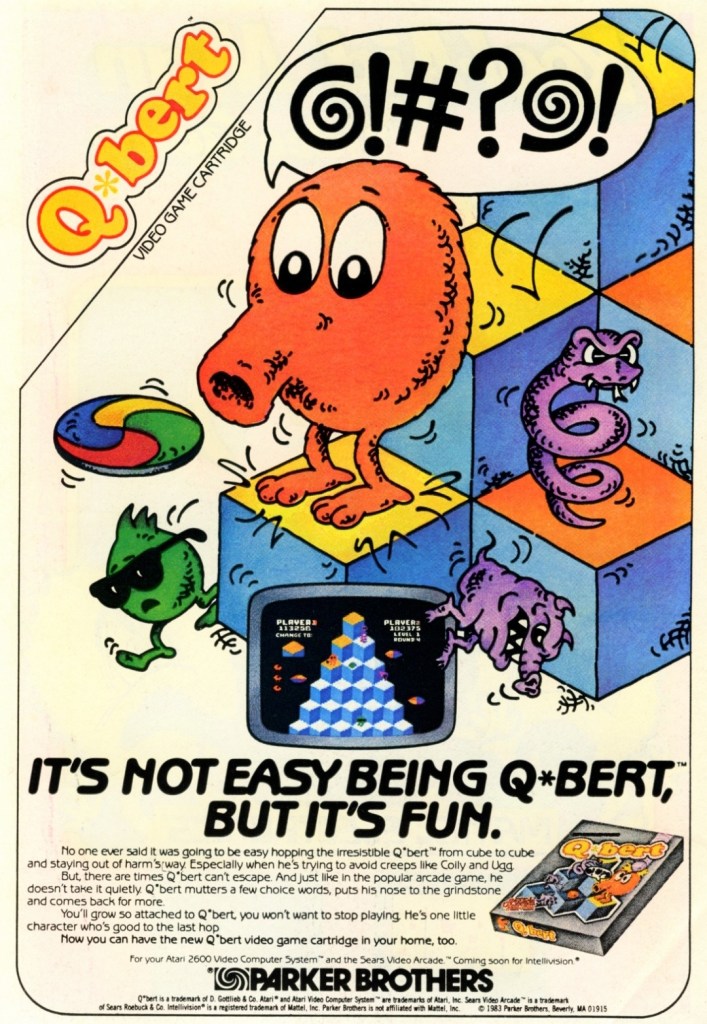
8. Q*bert print ad
This print ad by Parker Brothers really captured the essence of the game.
The puzzle-oriented 2D action game Q*bert became an arcade hit in America shortly after its 1982 release and even went on to become one of the highest grossing arcade games in 1983. Q*bert is one of those 2D games that cleverly blended puzzle play with 3D-like movement and avoidance of both obstacles and enemies. As expected, the game made its way into gaming console and this particular print ad had artwork that strongly captured the very essence of the game complete with the very catchy line “It’s not easy being Q*bert, but it’s fun.”
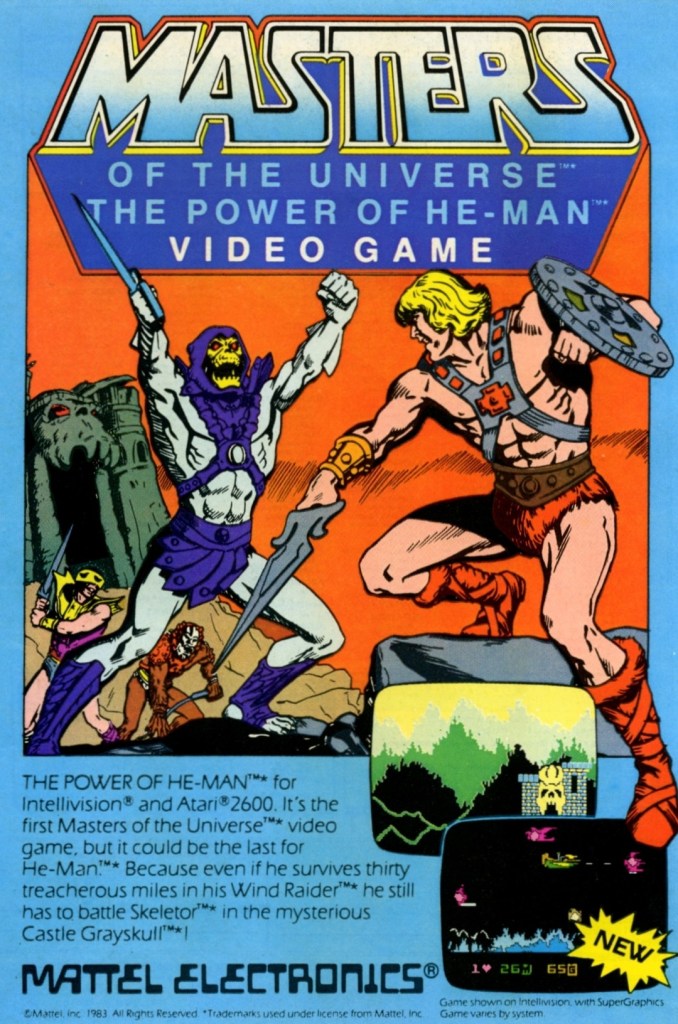
9. Masters of the Universe: The Power of He-Man print ad
Calling all He-Man fans.
I saw this print ad of Masters of the Universe: The Power of He-Man (for Atari 2600 and Intellivision) while reading a comic book long ago. Like the Tron games ad, this made me excited as I was fond of watching the He-Man cartoon series of the 1980s. While the selected screenshots caught my attention, it was the hand-drawn art of He-Man facing off with Skeletor and his minions that captivated me simply because it reminded me of the animated series. This is a fine example of promoting a video game that would instantly resonate with fans of He-Man and the Masters of the Universe franchise.
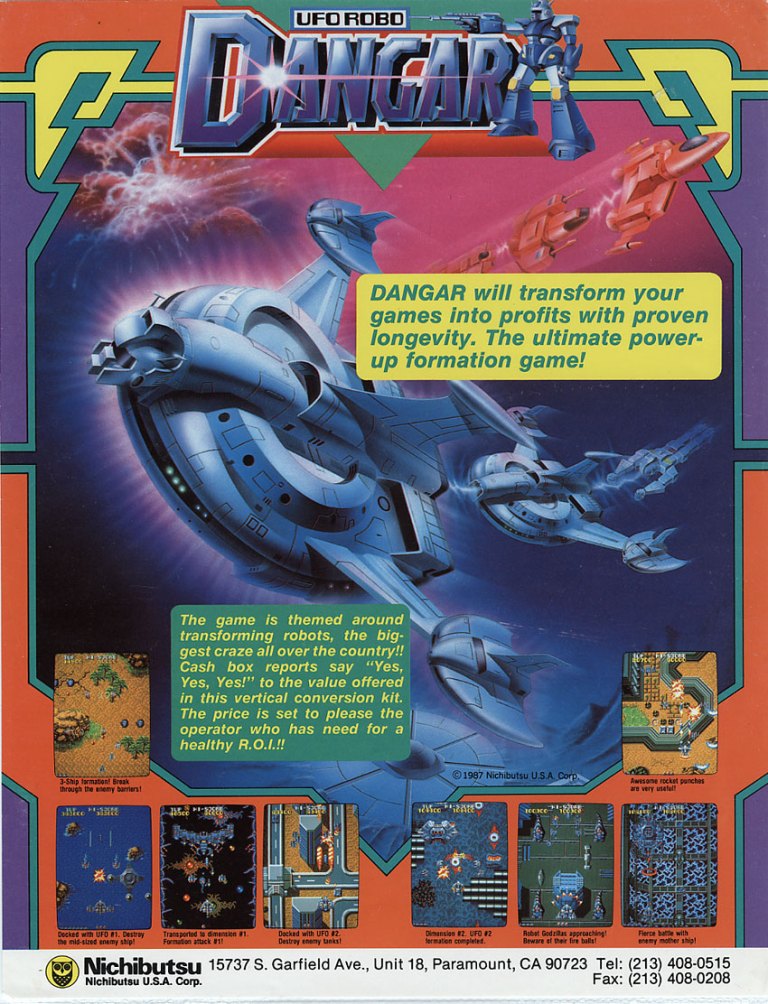
10. UFO Robo Dangar North American arcade flyer
The giant robot concept of this game gave some viewers the impression that it was based on some giant robot anime series from Japan even though the art work used does not suggest it.
Here is another arcade game from Nichibutsu but for the North American market and without the use of a model and without the subtle sexiness. UFO Robo Dangar is a 2D vertically scrolling science fiction shooting game and players get to control a giant robot (composed of flying vehicles that merged into one mechanical body) that has to go through countless waves of enemies in order to advance from one level to another. The arcade flyer used nice looking sci-fi art of ships with the game’s title having a robot and several screenshots of the game. The flyer even made a hard pitch towards arcade operators that UFO Robo Danger will transform their games into profits with proven longevity.
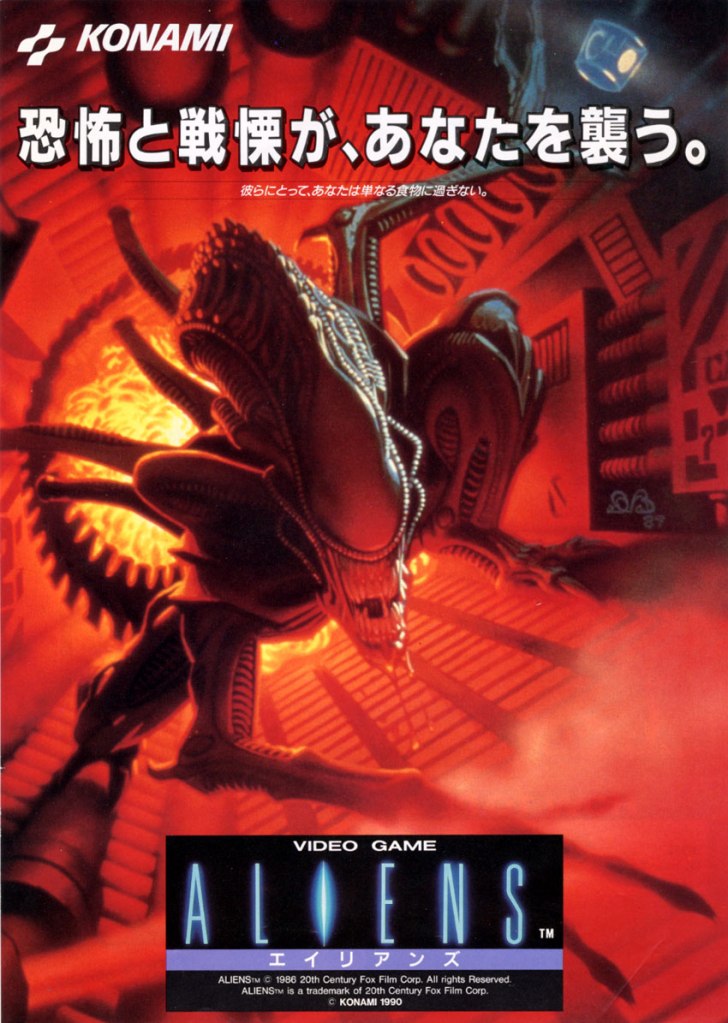
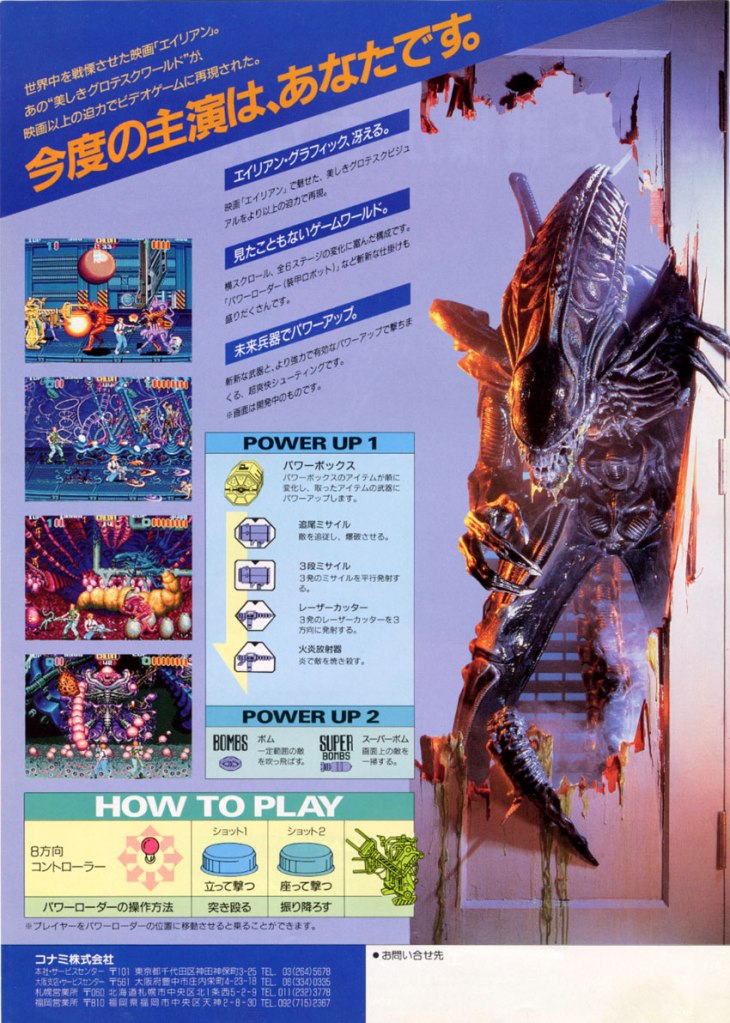
11. Aliens Japanese arcade flyer
The front.
The other side of the flyer of the 1990 arcade hit Aliens.
Quite arguably, Konami’s 1990 arcade hit Aliens is the best video game of any game design to be based on the 1986 film directed by James Cameron. Not only was Aliens a big hit in the arcades, it also won an award from the American Amusement Machine Association (AAMA). Aliens was released in Japanese arcades in February of 1990 and Konami released an arcade flyer that was much more visually striking than its North American arcade flyer. The front had detailed artwork of the Xenomorph while the rear had the instructions and screenshots presented in an orderly manner. The photograph of the Xenomorph alien was added intensity on selling the game. This is still a great looking arcade flyer.
Welcome back, fellow geeks, Blu-ray collectors and movie buffs!
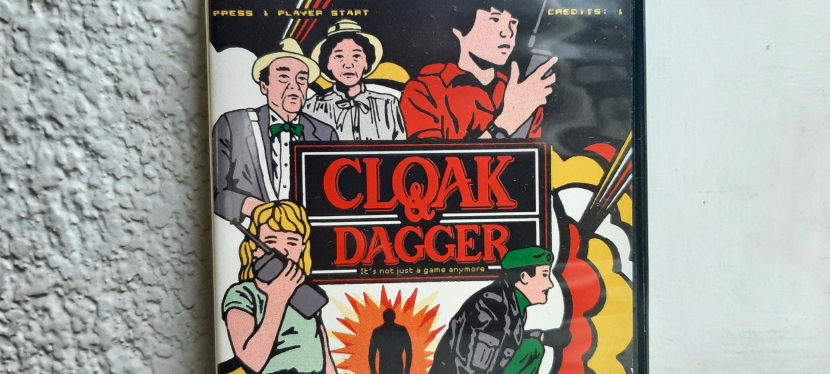
Decades ago, I saw on home video Cloak & Dagger (1984) which turned out to be an entertaining film to watch as I was already playing games on Atari 2600 and the arcades. After replaying by chance on cable TV years later, I finally bought myself the 4K Blu-ray and it sure was fun to watch it all over again. Check out my retro movie review of it by clicking here.
The front of my copy of Cloak & Dagger (1984) 4K Blu-ray.
The rear with the details that can be read.
For the newcomers reading this, Cloak & Dagger (1984) is a movie that involved then video game giant Atari in the creative process. The movie’s plot is not based on Atari’s arcade game of the same name (previously titled as Agent X).
Cloak & Dagger (1984) its own original plot of espionage about a young boy Davey (played by Henry Thomas, the star of Steven Spielberg’s E.T.: The Extra-Terrestrial) who witnesses a murder and receives an Atari 5200 cartridge of the game Cloak & Dagger that contains something very important. This in turn makes him a target of armed henchmen who won’t stop until they get him. Due to his reputation of being too playful and living with his wild imagination as a spy, people don’t believe Davey’s claim of witnessing a murder. This film happens to be inspired by the short story “The Boy Cried Murder” written by Cornell Woolrich.
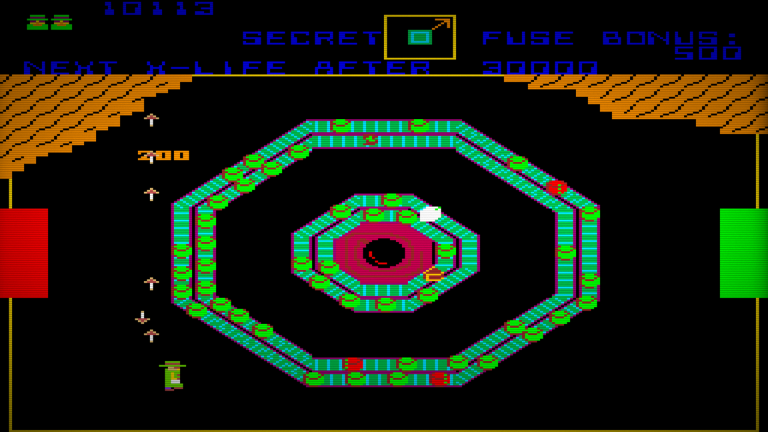
Cloak & Dagger in arcade form. Atari released it in the form of an arcade conversion kit aimed at arcade machines of certain games of its competitors.
The Cloak & Dagger arcade game can be played on your game console with the Atari 50 collection software (over 100 games). This screenshot I captured while playing it on my Xbox Series X console running Atari 50.
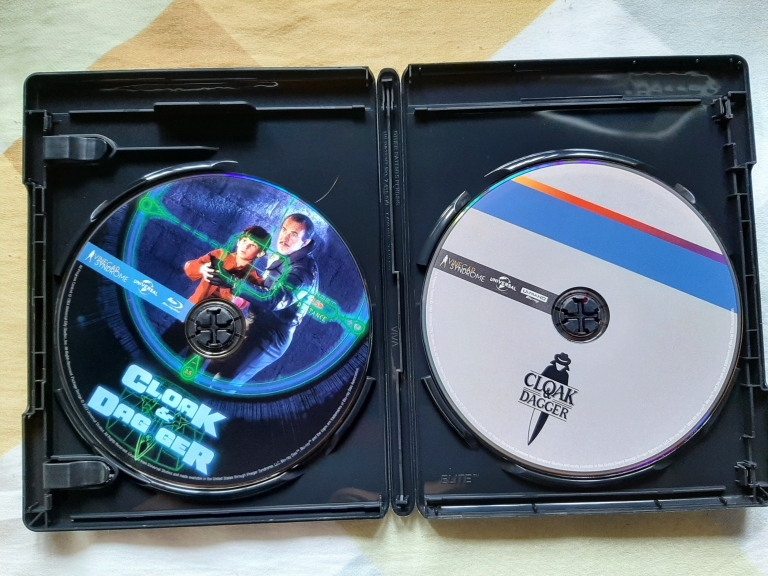
A few weeks ago, my copy of the Cloak & Dagger 4K Blu-ray arrived and it came with two discs: One 4K Blu-ray disc which contained the movie in native 4K (scanned in UHD from the 35mm film) resolution of 3840 x 2160p. The other disc has the same movie in HD (1920 x 1080p) plus the extra stuff which can provide viewers and Cloak & Dagger fans a good amount of important content which will help them learn what the video game elements in the film are, what inspired its creative process and why the film is very unique by today’s standards. There is also an informative new interview with Henry Thomas.
Since then, I saw Cloak & Dagger in 4K twice on my Xbox Series X and its 1080p version on a standalone Blu-ray disc player. Cloak & Dagger in 4K looks better than ever as the picture quality is better, images look sharper and clearer, the colors are vibrant, the small visual details (which were not visible in lower resolution before) are more noticeable now, and film grain structure has been preserved intact!
The two discs. The one on the right is Cloak & Dagger in 4K.
As for the story itself, I still find it engaging and enjoyable to watch from start to finish. Cloak & Dagger is clearly a production of its time as it carries clear Cold War references – the Soviet Union and Iran are the evil forces told in very subtle fashion – as well as video game elements and brands (note: ColecoVision even appeared in this Atari-influenced movie) that dominated America’s console gaming market long before PlayStation, Nintendo and Xbox arrived. For a movie aimed at parents and children, this one has really intense violence as it involves shooting and even some elements of terrorism.
Ultimately, I got a lot of enjoyment from my Cloak & Dagger (1984) 4K Blu-ray and I highly recommend it to Cloak & Dagger fans, gamers, physical media collectors and anyone who loves watching movies in the comfort of home. Cloak & Dagger (1984) is a very unique and fun movie that Hollywood does not make anymore. You really should see it.
In case you are interested or if you have made up your mind, you can order a copy of Cloak & Dagger (1984) 4K Blu-ray by clicking here.
Welcome back Xbox fans, geeks and gamers! It has been over a month since Eiyuden Chronicle: Hundred Heroes was launched on multiple platforms worldwide and like many other gamers who are currently subscribed to Xbox Game Pass (XGP), I downloaded it and played it a lot although there were a some technical setbacks that happened along the way.
For the newcomers reading this, Eiyuden Chronicle: Hundred Heroes is a brand new and stylized turn-based Japanese role-playing game (JRPG) developed by Rabbit & Bear studio which was led by the late Yoshitaka Murayama and involved the talents of notable creators who collectively worked on Konami’s Suikoden RPG series.
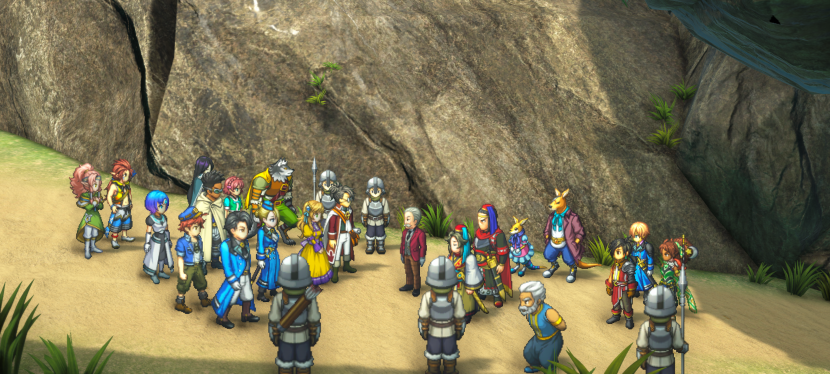
In-game world exploration is done with a 3D polygonal environment and your character is a 2D sprite.
A battle against a very large monster.
Eiyuden Chronicle: Hundred Heroes is a fantasy role-playing game that has a lot in common with the first two Suikoden RPGs in terms of fantasy concepts, gameplay, game design, mini-games, and the recruiting of many characters. Having finished Suikoden and Suikoden II on the PlayStation myself, I can clearly say that this new JRPG is technically a Suikoden game without the name.
As of this writing, I played Eiyuden Chronicle: Hundred Heroes for over 80 hours on my Xbox Series X console. While I am at the point of moving the story forward leading the army (led by the playable protagonist Nowa) in the struggle against the empire led by Dux Aldric (who reminds me a lot of Suikoden II’s Luca Blight), I have decided to focus first on side quests, resource collecting, the mini-games and recruiting more characters. This RPG was designed to allow players to have sufficient freedom to take on side activities on the side and explore the world for recruits and resources.
The cooking contest functions very much look those in Suikoden II.
Somehow General Elektra reminds me of Valeria in the first two Suikoden games.
While this is not a game review, I can say that I am enjoying Eiyuden Chronicle: Hundred Heroes with the way it was designed, how the story was written (lots of intrigue related to the in-game geopolitics which are balanced with fantasy quests), how the characters were presented and the assorted variety of gameplay content. It has been almost three years since this game (along with Rising) was first announced for Xbox Game Pass (click here and here) and considering the fun I had already, I can say the wait was worth it. The mini-games are, for the most part, fun to do and you can watch the short video clips from my progress in the game.
There were some technical setbacks along the way. Eiyuden Chronicle: Hundred Heroes did not run properly on my Xbox Series X resulting in the game crashing and even sudden console shutdowns. I got these console readings of “overheating” and “insufficient ventilation” with the game and these incidents happened only with it. As such, I had to open my Xbox, cleaned up the interior and removed as much dust as I could. Since then, the game developers patched the game but still it pushed my Xbox so hard, game crashing and sudden shutdowns still occurred from time to time. I also noticed there are certain locations within the game that resulted in the sudden acceleration of the Xbox Series X internal fan. Very clearly Rabbit & Bear’s technical support team still has a lot of work to do to meet customer satisfaction.
Each time you successfully recruit a new character, you will see this quick and flashy visual presentation.
Along the way, I observed that other games such as Resident Evil 4 remake, Shadow of the Tomb Raider, Assassin’s Creed: Valhalla, and the most recent release Senua’s Saga: Hellblade II respectively pushed my Xbox Series X to perform hard (with the internal fan run fast) but there were no game crashes and no sudden shutdowns at all. Only Eiyuden Chronicle: Hundred Heroes resulted in “overheating” and “insufficient ventilation” readings and disruptions.
Considering the hassles, I managed to get the fun and discoveries with Eiyuden Chronicle: Hundred Heroes on my Xbox. Here is hoping that the game developer will soon release another patch for Xbox Series X to make the game run well while consuming less power somehow. Given the fantastic presentation of the game, technical disruptions on Xbox Series X should not have happened at all.
There is so much to explore and discover in this game!
So what are you waiting for? If you are already a subscriber to Xbox Game Pass, you can download Eiyuden Chronicle: Hundred Heroes on your Xbox Series X, Xbox Series S, or the aging Xbox One. If you have extra money and want to support Rabbit & Bear studio, buying the digital copy of the game is the recommended option. For more information about the Suikoden-inspired JRPG, visit https://www.xbox.com/en-US/games/eiyuden-chronicle
Welcome back readers, fellow geeks and electronic gaming fans!
In this edition of the Retro Gaming Ads Blast (RGAB) series, we will examine print ads from the 1980s and the 1990s that caught my attention and I will explain why they are worth look back at.
For the newcomers reading this, Retro Gaming Ads Blast (RGAB) looks back at the many print ads of games (console, arcade, computer and handheld) that were published in comic books, magazines, flyers and newspapers long before smartphones, social media, the worldwide web and streaming became popular. To put things in perspective, people back in the 1980s and 1990s were more trusting of print media for information and images about electronic games.
With those details laid down, here is the newest batch of retro gaming print ads for you to see and enjoy…
1. Star Wars: Rebel Assault print ad
This print ad was strong enough to capture Star Wars fans’ attention and make them interested with the Sega CD.
If there is anything notable about the Sega CD (Mega CD in other parts of the world) platform, it is the fact that the machine was an add-on to be connected with the Sega Genesis (Sega Mega Drive elsewhere) console. That being said, LucasArts included the Sega CD as one of several platforms for the multiplatform release of their 1993 game Star Wars: Rebel Assault. The above print ad caught my attention with its use of 9 screenshots (emphasizing a wide look at the game’s Star Wars concept) and text description (emphasizing multi-media features connected with gameplay), and for a time it made me interested in the Sega CD. Looking back at the game’s marketing, Star Wars: Rebel Assault was designed to not only give gamers sessions of play to enjoy but also opportunities to immerse themselves deeper into the realm of Star Wars. The game even had selected video clips from the original Star Wars trilogy movies.
2. Cloak & Dagger print ad
This print ad could have used at least two screenshots from the arcade game…
In 1984, there was a movie titled Cloak & Dagger (read my retro movie review by clicking here) which was not only the 4th cinematic adaptation of the short story “The Boy Cried Murder” (written by Cornell Woolrich) but also had the real-life electronic game Cloak & Dagger as a crucial plot element. To make things clear, there was a Cloak & Dagger game released in the arcades (as emphasized in the above print ad) from Atari. Behind the scenes, the filmmakers and Atari worked together which explains the video game tie-in with the movie. While the above arcade conversion kit print ad does not show screenshots of gameplay, the four images of the playable protagonist Agent X shown were from the game’s short transition sequences (moving from one level to another) which were also displayed in the 1984 movie. Those images were enough to remind me about the movie I enjoyed.
More on the Atari connection, the movie had a cleverly presented short scene showing the young protagonist Davey (played by Henry Thomas) playing Cloak & Dagger on his Atari 5200 console with spliced gameplay footage of the arcade version shown within cuts. In real life, however, Atari never released a version of Cloak & Dagger for any console nor computer in the 1980s. Today, you can play the game on the Atari 50 collection on consoles.
3. BurgerTime print ad
This BurgerTime print ad was entertaining to look at and easily reminded viewers about food and the popular game coming home.
Back in 1982, BurgerTime (Japanese title: Hamburger) was released in the video arcades and turned out to be a big hit in both Japan and America. Seeking to capitalize on the game’s success, Mattel Electronics acquired the rights of the game from Data East and went on to release versions of it for the Intellivision, Atari 2600, Apple II and the IBM personal computer. Mattel went on to market the game for consoles and computers by coming up with a print ad (the one above) that had comic book-style hand drawn art of the playable protagonist chef Peter Pepper running away from walking versions (anthropomorphic figures) a hotdog, an egg, and a pickle. The ad showed a single screenshot which was sufficient enough to show readers the concept of the game clearly. In my experience, I never got to play BurgerTime in the arcades but I first learned about its existence thanks to the eye-catching print ad above which appeared in comic books I read. In addition, the print ad also does an effective job to remind readers about food.
4. SOS print ad
This print ad made me interested in the game as I was already aware of the historical sinking of the Titanic, and I already saw the disaster film The Poseidon Adventure.
Moving back to the 1990s, I saw the above print ad of the video game SOS for the Super Nintendo Entertainment System (SNES) while reading a comic book. The nice artwork caught my attention as it easily reminded me of the disaster movie The Poseidon Adventure (1972) as well as the real-life tragedy of the Titanic. Then I saw the screenshots on the print ad and they made me interested on the game which I later played on a rent-by-the-hour game joint. Looking back at the text description of the print ad, it did not describe what the technical and graphical features of SOS were. That being said, I was surprised to experience the game’s use of the SNES Mode 7 effects which enabled the scaling and rotating of the in-game environment which affected gameplay in many ways. Read my retro review of SOS by clicking here.
5. Star Trek: The Next Generation – Future’s Past print ad
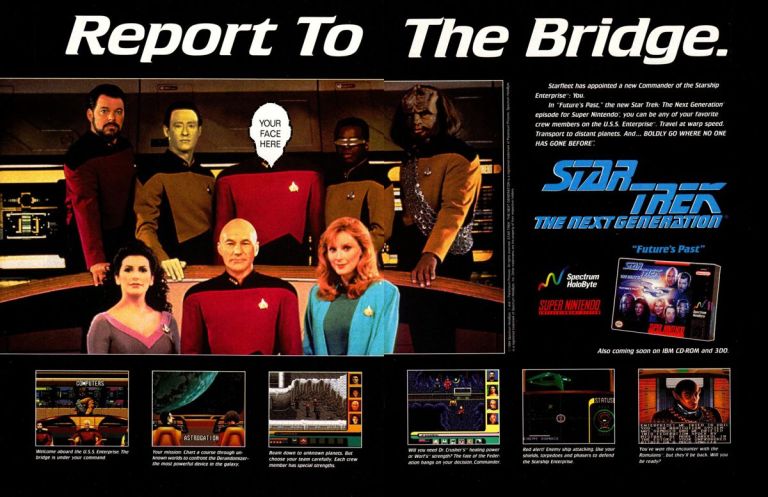
This 2-page print ad was strong enough to invite readers to literally join the Star Trek: TNG crew and go where no man has gone before. By the way, when was the last time you saw Marina Sirtis or Gates McFadden on a video game ad?
Long before wokeness ruined Star Trek in this modern age, the sci-fi franchise reached a tremendous high in popularity and projects in the 1990s as that decade had Star Trek: The Next Generation (most of its TV seasons and three movies were released within the decade), Star Trek: Deep Space Nine and Star Trek: Voyager that kept fans entertained.
Considering its high popularity, it was not surprising that a video game adaptation of Star Trek: TNG was released in 1994 titled Star Trek: The Next Generation – Future’s Past (the version for Super Nintendo Entertainment System) and I saw the above print ad while reading a gaming magazine. Using a slightly altered version of the TNG group photo, the print ad emphasized its concept that the player will be able to lead the crew of the Starship Enterprise and take part in a series of missions in different parts of space with the likes of Captain Picard, Commander Riker, Data, Worf, Dr. Crusher, Deanna Troi and La Forge. While I was never a Star Trek fan, the above print ad caught my attention with its concept, the group photo and the screenshots gave me an idea of what the game has to offer. It should be noted that Star Trek: The Next Generation – Future’s Past was released between the end of Star Trek: TNG’s final season and the theatrical release of Star Trek: Generations.
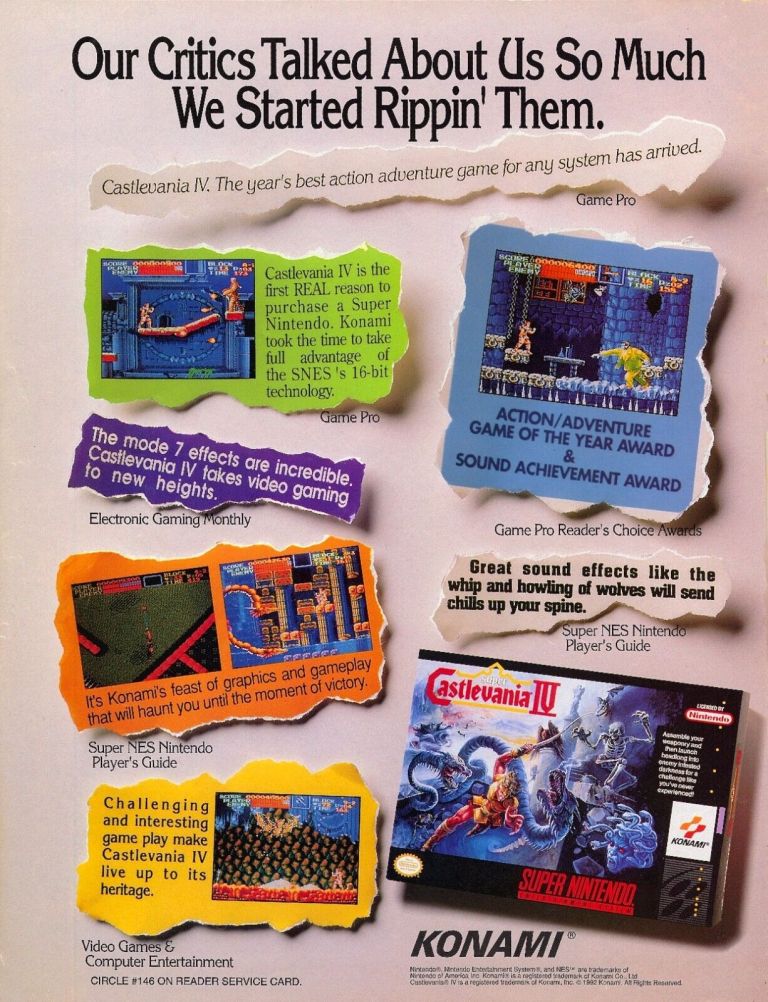
6. Super Castlevania IV print ad
This was one of the most eye-catching print ads I’ve seen about a Konami video game.
The jump in technology from one console generation to the next can be beneficial for gamers if game developers harnessed the advantages of new technologies to make new games that turned out to be more engaging and more enjoyable. Such was the case with Super Castlevania IV for the Super Nintendo Entertainment System (SNES) in 1991. The above print showed Konami highlighting the positive feedback their game received from different gaming media outlets and used screenshots to give gamers and long-time Castlevania fans exciting stuff to see. I got to play the game on the mini SNES console and I can say that in terms of visuals, controls and gameplay, Super Castlevania IV truly lived up to its title and it remains fun to play to this day.
Once the anticipated Japanese role-playing game (Japanese RPG) Eiyuden Chronicle: Hundred Heroes finally comes out on April 23, 2024, the absence of the main creator will be felt by many players as the Japan-based Rabbit & Bear Studio announced very recently that its head Yoshitaka Murayama passed away on February 6. For the newcomers reading this, Murayama is also the creator of the Suikoden RPG series of Konami where he used to work at. For my previous blog posts of Eiyuden Chronicle: Hundred Heroes, click here, here, here and here).
To put things in perspective, posted below is the excerpt from the official announcement by Rabbit & Bear Studios. Some parts in boldface…
Hello everyone,
It’s with a heavy heart and deep sadness we must inform you that the scenario writer and head of Rabbit& Bear Studios, Yoshitaka Murayama, has passed away on February 6th due to complications with an ongoing illness.
Murayama first began this journey of the creation of Eiyuden Chronicle: Hundred Heroes in 2020
through the support of his very loving fans on Kickstarter. Throughout the three-plus-year-development of the game, it was always the passion from his fans that continued to drive his creative vision and motivate him to put his all into the project.
His hard work on Eiyuden Chronicle as scenario writer was finished but as his co-workers and friends, it saddens us to know that he won’t get to see the reactions from his fans.
However, even with those feelings we need to accept the reality that he is no longer with us and continue to push his dream forward by releasing Eiyuden Chronicle to the world.
We want to maintain his legacy and vision with this game and know that he would have wanted the rich world he has created with Eiyuden Chronicle to live on.
His family sincerely appreciates your prayers and support but asks for privacy and that no flowers, mail, or other offerings be sent.
We will have more information on organizational changes to Rabbit & Bear as well as changes to some of the Kickstarter rewards in the near future.
So there you have it. The developer behind Eiyuden Chronicle: Hundred Heroes made it clear that they will not give up with fulfilling the dream of the late Murayama and there is no stopping the launch of the game (which was supposed to have been released in 2023).
More on the previous works of the late Murayama, I played Suikoden and Suikoden II (read my retro review by clicking here) on the PlayStation console in the 1990s and I had enjoyable times with them. For me, Suikoden II was the not only the best Suikoden RPG of the 1990s but also one of the best RPGs on any platform during the decade. It’s just too bad that the 1999 North American launch of Suikoden II was overshadowed by another company’s JRPG on PlayStation that same year. Considering the many Japanese RPGs that were released on PlayStation in 1999, Suikoden II was the most enjoyable one I played.
Even during his days as a young man working for Konami in the 1990s, Murayama had a very unique vision for digital role-playing and adventuring, as well as fantasy storytelling.
“Eiyuden Chronicle is really (an) evolution of my many design experiences. The many games I’ve made have helped create the foundation for this title. Since I draw my experience from previous games I’ve worked on, of course you will see a little bit of those elements in Eiyuden Chronicle,” Murayama said in response to a question that mentioned Eiyuden Chronicle and Suikoden titles.
With Murayama gone, the spotlight on the April 2024 launch of Eiyuden Chronicle: Hundred Heroes will be more crucial than before. I myself will be playing the RPG on my Xbox Series X console as soon as it launches. To get yourselves oriented with the said JRPG, watch the videos below (the last one shows Murayama and his fellow creators as special guests at an event in Taipei)…
Watch out for Eiyuden Chronicle: Hundred Heroes on Xbox Series X, Xbox Series S, Xbox One and Windows PC plus Xbox Game Pass (XGP) on April 23, 2024. For more about the JRPG, visit https://www.xbox.com/en-US/games/eiyuden-chronicle
There is no doubt that Xbox Game Pass (XGP), a subscription service that allows customers access to lots of games for their enjoyment in return for paying a flat monthly fee, is here to stay. I myself have been subscribing to XGP since I started playing my Xbox Series X console and I can confirm to you readers that I’ve been playing a whole lot of games while saving myself a lot of money.
Along the way, I am constantly having a whole lot of fun as an XGP subscriber and I am look forward to playing highly anticipated new games like Eiyuden Chronicle: Hundred Heroes, Starfield (Xbox-exclusive) and Forza Motorsport (2023) (Xbox-exclusive) through the service in 2023! And then there are many, many other games from other game publishers – including the small and independent game makers – who signed up with Team Xbox to add their games for XGP subscribers to enjoy!
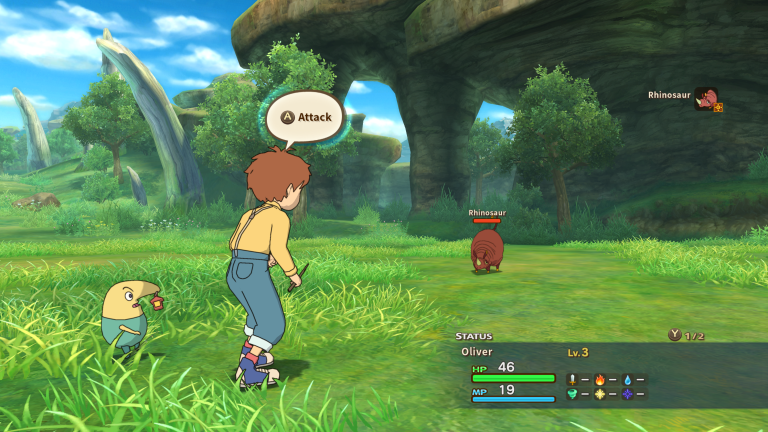
This week alone, several games will debut on Xbox Game Pass which should interest gamers who love adventure, first-person shooters, narrative gaming, mysteries, puzzles, tactical gaming, golf, ice hockey and more! Check out the new XGP additions in the Xbox.com article and also be reminded that enjoyable games such as As Dusk Falls, Deathloop and Ni no Kuni: Wrath of the White Witch Remastered are now available in the service.
Watch out for Eiyuden Chronicle: Hundred Heroes on XGP in 2023.
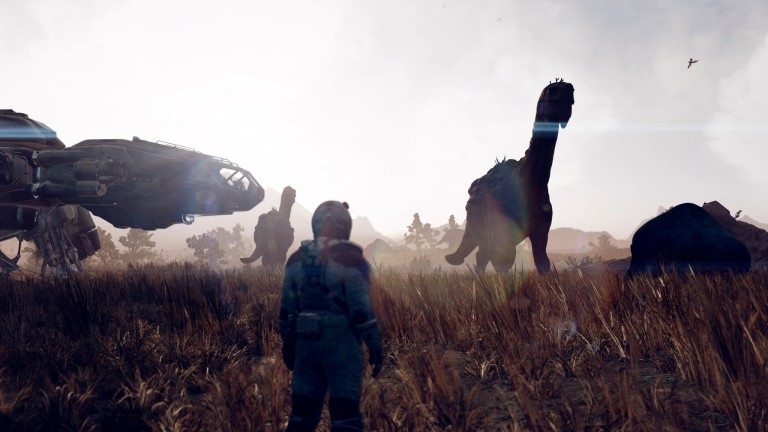
Starfield alone should attract a lot more people to subscribe to Xbox Game Pass.
Have you played this acclaimed JRPG yet? It’s now available on XGP!
As Dusk Falls is a great narrative-driven game to play on Xbox Game Pass.
As I mentioned earlier, Xbox Game Pass is here to stay and its credibility as a stable and growing form of business cannot be dismissed. To understand the business aspect of XGP, there is this in-depth article published by Windows Central. Posted below is an excerpt from the article with some parts in boldface…
Flying in the face of traditional gaming revenue models, with Xbox Game Pass, Microsoft is offering thousands upon thousands of dollars’ worth of content for $10 dollars a month. It’s potentially even cheaper if you factor in the upcoming Xbox Game Pass Friends & Family accounts as well.
In any case, Xbox Game Pass isn’t going anywhere. I’ve seen analysts and pundits rally around the idea that the service must be burning through cash hand over fist in order to offer the value it does, and that may still be true. But as noticed by Tweaktown, we now have a glimpse at roughly how much revenue Xbox Game Pass is actually generating.
Microsoft is currently trying to get its massive Xbox Activision Blizzard merger through regulatory bodies around the globe. In order to make its legal arguments, certain data points Microsoft typically doesn’t share with its shareholders publicly is making its way into the public domain, as a result of these discussions. It turns out that Xbox Game Pass is making a fair bit of dosh.
According to Brazil’s regulatory body CADE, Xbox Game Pass’ revenue from subscriptions stands at $2.9 billion dollars in the fiscal period ending January 2021. Tweaktown noted that it accounts for 18% of Microsoft’s revenue from gaming for that fiscal year, which would have put Xbox Game Pass subscribers at around the 18-19 million mark. The last official figure we got on Xbox Game Pass subscribers came last January, where Redmond revealed it had hit 25 million users.
It should be noted, however, that this figure only includes users on the console versions of Xbox Game Pass, with PC Game Pass figures omitted. It’s also hard to know the exact breakdown of this revenue figure. Does it include purchases of games in the post-Game Pass discount period? Does it include microtransactional sales and in-game content sales for titles that are in Xbox Game Pass? Or is it representative purely of the subscriber figures across Xbox Game Pass and Xbox Game Pass Ultimate, which are $10 and $15 apiece?
Even though they have great 1st party game studios that produced several exclusive blockbusters, Team PlayStation under Jim Ryan is very worried about the acquisition because their business benefited so much by depending on Activision’s Call of Duty games (note: remember the last time you played a new Killzone game from Sony?). Ryan and the PlayStation executives know their current contracts with Activision will eventually expire and certainly there will be no more extensions under Microsoft-controlled Activision Blizzard. It is also clear to me that Team PlayStation is very afraid of the idea that Call of Duty games and other Activision Blizzard games will come to Xbox Game Pass and PC Game Pass. Simply put, Team PlayStation is way, way behind competing with XGP on the subscription service model of business.
In concluding this article, posted below for your enjoyment are Xbox-related videos.
To be clear, I find Square Enix’s business relationship with Team Xbox lacking. The HD remastered version of Legend of Mana was very noticeably released on multiple platforms but not on Xbox. Tactics Ogre: Reborn was announced for future release for multiple platforms except Xbox. Still on Square Enix, the Final Fantasy VII remake as well as the announced sequel are exclusive to Sony’s platforms. The exclusions are clear and disturbing. Why Square Enix excluded the Xbox Series X, Xbox Series S and the Xbox One (which still has many millions of console users until now) as platforms to sell the above mentioned games remains a mystery although there is speculation that Sony Corporation and its PlayStation executives made a secret deal with the JRPG giant to specifically hurt Xbox without affecting Nintendo and Steam. Realistically, Microsoft pointed out that Sony pays game companies for blocking rights to keep games off Xbox Game Pass. Read all about it here, here and here.
While these developments are disturbing and also annoying, I still wish that Square Enix would remaster one of its classic JRPGs and release it on Xbox platforms similar to what they did with the remastered Chrono Cross. That classic RPG I’m referring to is none other than Xenogears.
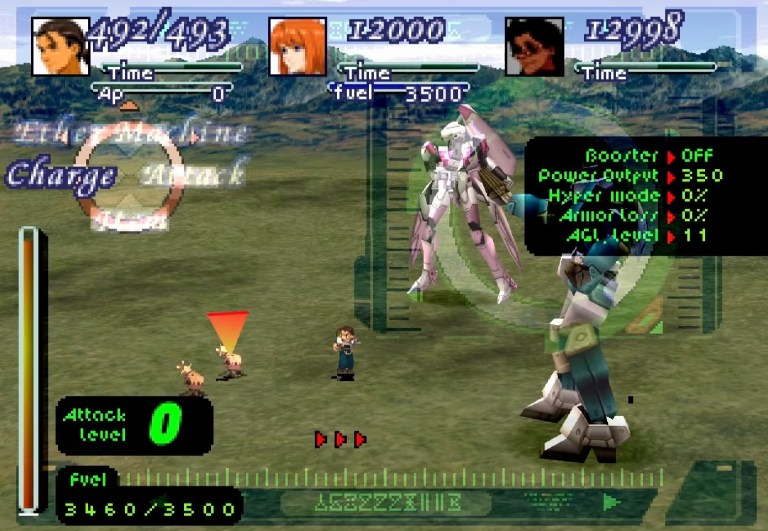
Xenogears’ battle system allowed individual persons and giant robots (called gears) to engage in battle simultaneously. Observe how the approach on in-game scale was done here.
I played Xenogears on the original PlayStation console way back in 1998 but I never got to finish it due to my academics and other external matters. It also did not help that the CD-ROM of the PlayStation deteriorated.
Regardless, I had a lot of enjoyment during my limited time with the said JRPG, the design of which was led by Tetsuya Takahashi. The fictional concept of Xenogears took a lot of inspiration from real-life forms of religion as well as concepts from certain intellectuals to establish the story themes, the fictional cultures and historical backgrounds within the game. At the same time, the game had this in-depth universe composed of different settings for gamers to explore. In my experience, I felt immersed into the game’s universe and I still remember the moments I got astonished discovering not only the many locations and landmarks but also the many non-playable characters (NPCs presented as 2D sprites) in the form of local communities and the in-game cultures.
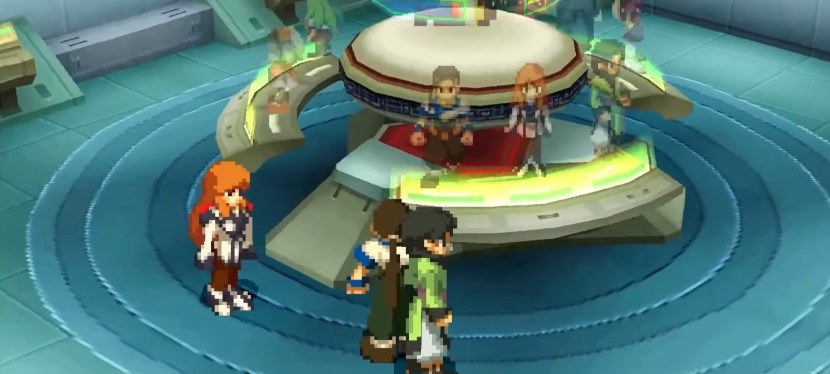
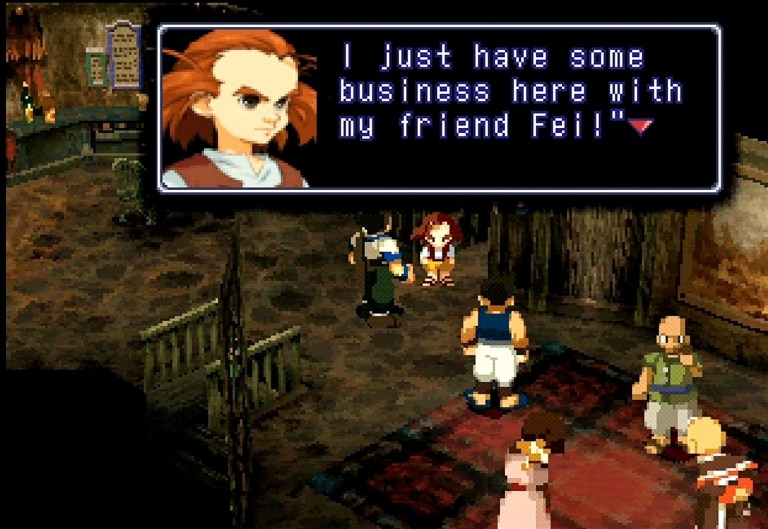
Xenogears had 3D polygonal environments and 2D sprites for the characters and creatures who move around.
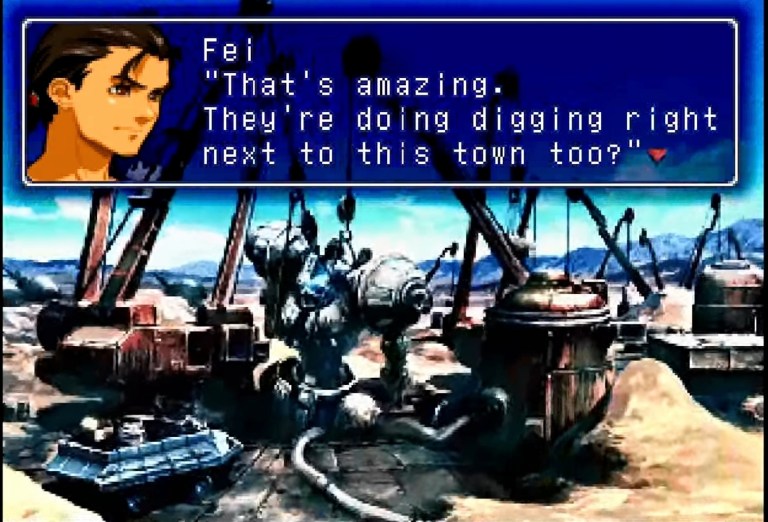
In this classic JRPG, you play as Fei and you will explore a lot, fight a lot and interact with lots of characters as you go along.
While Xenogears had a science fiction concept, it still had lots of settings and gameplay features that made it feel like a fantasy. I love the way how the creative team’s artists implemented their art styles on the environments, the characters, the machines, the interiors of places and more. Visually, this game saw the use of 2D sprites for the characters who move along a 3D polygonal environment which can be explored creatively by a camera that can be adjusted by the players. As such, this approach done in Xenogears made the game look and feel a lot like Grandia.
While Xenogears’ battle system had key elements that were common with other JRPGs, there was a clear emphasis on hand-to-hand combat that took a lot of inspiration from martial arts as well as 2D fighting games of the decade. There were these martial arts-inspired combos which required button combinations and timing which were fun to watch happen. There were also these death blows which were really rewarding when pulled off correctly. Of course, there were still some magic attacks that were nicely presented.
What made Xenogears stand out is the use of giant robots or gears in the game. Not only did the game allow me to travel with the gears, it also allowed me to engage with enemies (both the large and the small ones standing on the floor/ground) with a fully functional battle system that emphasized size, scale and impact altogether. Similar to the other battle system, the gears battle system fun and engaging in my experience. I can never forget the moment I first saw my gear crush a huge enemy with a lot of impact to seal the victory. Travel using gears, however, was hampered somewhat by the creative team who implemented platform gaming elements (note: this includes jumping from one platform to another without falling down to your death) and the controls were not really responsive enough. This is something Square Enix should consider improving if they ever remaster Xenogears.
The battle system with the individual characters is a lot of fun and also unique as the combat emphasizes combos and martial arts.
The artistic approach used in Xenogears remains captivating.
Right now, I would love to replay Xenogears and complete it but I prefer the game should be remastered and be released for Xbox consoles. I have no intention of buying a new console from Sony and Nintendo to play Square Enix JRPGs that are missing on Xbox consoles. JRPGs on Xbox are not exactly lacking (note: Eiyuden Chronicle: Hundred Heroes will be released via Xbox Game Pass in 2023 while Persona RPGs are coming to Xbox soon) but it would be great not only for Xbox gamers but also Square Enix itself to remaster Xenogears and release it on the Xbox ecosystem. That being said, I believe Xenogears itself would make a great addition into Xbox Game Pass (XGP) which already has many millions of subscribers worldwide!
Think about it carefully. Having a remastered Xenogears for sale on Xbox and also listed on Xbox Game Pass will not only be good for the Xbox ecosystem but also for Square Enix to not only sell games but also reach out to the XGP subscribers who could enjoy the said JRPG and add a lot of new players that the JRPG giant could not reach before. Not only are more Square Enix role-playing games are needed on XGP right now (note: adding Chrono Cross into it will be delightful), they can also benefit nicely as the Xbox ecosystem is gradually becoming the premier ecosystem for RPG enthusiasts in this console generation. Xbox-exclusive RPGs like Starfield, The Outer Worlds 2, Fable as well as future sequels of The Elder Scrolls and Fallout will collectively generate big game sales as well as increase the number of gamers in the Xbox ecosystem and Xbox Game Pass subscribers will grow big as well. The growth will be even bigger once Team Xbox’s acquisition of Activision Blizzard gets approved. For Square Enix to miss out on fast growing Xbox ecosystem in favor of Sony’s blocking rights will be a regrettable move.
Going back to Xenogears, I want to make it clear to Square Enix that now is the time to remaster it and release it on Xbox as well as other platforms. That being said, I also urge Team Xbox’s chief Phil Spencer, executive Aaron Greenberg and the Xbox Game Pass team to reinvigorate the business relationship with Square Enix and try to convince them to release Xenogears and other classic JRPGs into XGP and the Xbox game store. To the Xbox gamers and RPG enthusiasts reading this, I encourage you to contact Square Enix and Team Xbox to have Xenogears and other JRPGs (both classic and modern) released on the Xbox consoles and Windows PC.
In closing this piece, posted below are Xbox-related videos plus a few Xenogears-related videos for your enjoyment.













 Author Carlo Carrasco