Two Point Campus will be released on Xbox Series X, Xbox Series S, Xbox One and Windows PC via Game Pass (both Xbox and PC) on May 17, 2022

If you are the kind of gamer who enjoys simulation gaming as well as managing digital communities on your Xbox console or your PC, then you have something to look forward to on as SEGA will release Two Point Campus for Xbox Series X, Xbox Series S, Xbox One and Windows PC via Xbox Game Pass and PC Game Pass on May 17, 2022. The new game is the follow-up to the successful 2018 game Two Point Hospital (available via Xbox Game Pass as of this writing), and you can order it in advance now.

To begin with, watch this official trailer of Two Point Campus.

Developed by Two Point Studios, Two Point Campus has a school setting and players will be challenge to establish and manage a university campus complete with setting up its many parts (like classrooms and laboratories to name a few), hiring a staff of good quality educators, and managing how the students will behave in and around campus. As it is a piece of fantasy, the game has a cartoony vibe on its art and expressions.

To put things in perspective, posted below is the excerpt from the official announcement on Xbox.com written by Two Point Studios Creative Director Gary Carr.

Build your university and manage everything within it.

In Two Point Hospital there is very little time to really get to know your little people, because patients come in for their treatment, you cure them (or they die…oops) and then they leave your hospital. In Two Point Campus this process is very different. Your students will be with you for much longer during their campus experience, giving you the chance to help them on their academic journey to success, or in some cases failure. You’ll have to figure out what’s going on. Are they happy? Are they enjoying their courses? Are they making enough friends? You’ll need to take the time to get to know them, nurture them and pull them through this process. Each student has their own unique character traits, so you’ll have to cater to all their needs to develop them into well-rounded individuals who will do the legacy of your university proud.

We just really want you to care more about your little people, so in Two Point Campus we’re giving you the tools to create an incredible university experience for your students. Keep them entertained with extracurricular activities, such as socials, gigs, clubs and even ‘CheeseBall’ – the highly entertaining sports activity in Two Point Campus. However, too much of the fun stuff will result in students falling asleep during class, which impacts their grades and eventually your overall Campus prestige. It’s the perfect balancing act, to on one hand give your students the adventure of a lifetime, and on the other hand, run a successful Campus environment.

The students in classroom.

Anyone that’s familiar with Two Point Hospital will know that we like to give our games a humorous twist. That’s no different in Two Point Campus. Rather than the typical academic fare, students in Two Point County will experience some very unusual courses. They can learn how to cook giant pizzas in the Gastronomy course or attend Robotics and get into the techy stuff where they build huge robots. We really enjoyed brainstorming about all the different courses in Two Point Campus. It usually starts by thinking of theme or a pun, and from there we think of how we can build it into a course. We love thinking of big and absurd machines or items that the students interact with during their courses, so players are wondering “what on earth going on there??” 

Like Two Point Hospital, Two Point Campus is a charming, accessible, and deep management sim, but for the first time, you will be able to build your Campus from the ground up, from the buildings to the grounds they sit in. You can design stylish dormitories for your students, lay down ornamental pathways or pimp up your Campus with super cool items, such as Cheesy Gubbins vending machines. One of the things we enjoyed most at Two Point Studios when Two Point Hospital launched, was watching people play our game and get super creative with the design of their rooms and hospitals. In Two Point Campus we take this a step further, where players can go all out and design absolute masterpieces, or total trash if they wish… However, there will still be plenty of options for people who don’t like that total freedom when it comes to building. We’re keen to cater to all the different playstyles.

The above description really sounds interesting. I wonder if the game will allow players to fire socialists/Communists/Marxists among the university’s educators to prevent the radicalization of students which has been going on for a long time in North America in real life. If I were to establish the campus of my dreams, there definitely will be no Leftism and no elements of the Satanic Left. The focus will be strictly on education, no political ideologies. No socialism, no Marxism and no Communism at all!

Coming soon to Xbox consoles and Xbox Game Pass!

As mentioned earlier, if you are convinced to buy yourself a copy of Two Point Campus for your Xbox console or Windows PC ahead of time, you can do it online and you will get some bonus items in return. However, if you are already subscribing via Xbox Game Pass or PC Game Pass, you only need to wait for the May 17, 2022 launch to download it and play it without extra charge. I myself am an XGP subscriber and I will be playing Two Point Campus on my Xbox Series X this May, and only then I’ll find out how good the game will turn out.

In closing this piece, posted below are Xbox-related videos plus a Two Point Campus video for your viewing pleasure.

+++++

Thank you for reading. If you find this article engaging, please click the like button below and also please consider sharing this article to others. If you are looking for a copywriter to create content for your special project or business, check out my services and my portfolio. Feel free to contact me with a private message. Also please feel free to visit my Facebook page Author Carlo Carrasco and follow me on Twitter at  @HavenorFantasy as well as on Tumblr at https://carlocarrasco.tumblr.com/

A Look Back at Punisher 2099 #2 (1993)

Disclaimer: This is my original work with details sourced from reading the comic book and doing personal research. Anyone who wants to use this article, in part or in whole, needs to secure first my permission and agree to cite me as the source and author. Let it be known that any unauthorized use of this article will constrain the author to pursue the remedies under R.A. No. 8293, the Revised Penal Code, and/or all applicable legal actions under the laws of the Philippines.

Welcome back superhero enthusiasts, 1990s culture enthusiasts and comic book collectors! Today we revisit the future of 2099 through the Punisher 2099 monthly series.

For the newcomers reading this, Punisher of 2099 is Jake Gallows who works during the day as a law enforcer which is a nice contrast to the concept of the classic Punisher identified as Frank Castle. In Punisher 2099 (1993), Jake Gallows witnesses the demise of his family that got attacked by a gang of killers led by Kron Stone who is not only the son of Alchemax’s Tyler Stone but also became the deadliest nemesis of Spider-Man 2099.

With those details laid down, here is a look back at Punisher 2099 , published by Marvel Comics in 1993 with a story written by Pat Mills and Tony Skinner, with art by Tom Morgan.

The cover.

Early story

The story begins with a funeral of Jake Gallows’ lost family members held at the church of Thor. In accordance to the traditions of the Thor religion, the dead bodies were placed on a burning boat floating on the water just outside the church building. As he and his fellow law enforcers watch the ritual happen, Jake confirms that he and the church of Thor do not believe in forgiveness and he himself believes in revenge.

When he is not on duty, Jake goes out as the Punisher hunting and killing criminals in his own brutal ways. Even as he does not wear a mask nor a helmet, his face is digitally covered from detection of security cameras thanks to a special technology he uses to protect his identity.

Meanwhile at an amusement park, lots of children enjoy floating in the air within an anti-gravity chamber. Kron Stone and his fellow killers arrive as they attempt to murder the children. Punisher suddenly comes out and successfully kills Stone’s companions, leaving them together in a standoff…

Quality

The Punisher has someone assisting him.

While the sub-par issue was composed mostly of the build-up and emphasis of the futuristic Punisher, this story is pretty much a big pay-off to it. Quite predictably, Jake gets to meet with the gang leader responsible for the death of his family in this issue not once but twice. Along the way, the comic book writers got to emphasize Kron Stone’s wickedness more as well as his continued disregard of human life. This time, Stone’s willingness to kill many children is very disturbing and Tom Morgan’s art style clearly emphasized the villain’s evil.

Within this comic book is a visual tour of the Gallows residence which has a large underground facility and pieces of technology that Jake uses for his campaign against crime (this makes Punisher 2099 becoming similar with Batman and his Bat Cave). He also has a technology oriented partner named Matt who helps him establish a working base of operations.

There is also a sub-plot about the side of crime with the introduction of the Fearmaster who, like Tyler Stone, is with Alchemax and has influence over Public Eye. Unsurprisingly, his introduction is short.

Conclusion

Jake Gallows and Kron Stone (AKA Venom 2099) meet again, only this time the former is now in his form as the Punisher.

The best way to describe Punisher 2099 (1993) is that its plot really thickened and unlike issue , this one has a more interesting story and the presentation done by the creative team has some entertainment value. While this is unsurprisingly the natural progression of defining the futuristic Punisher to readers, it is also a successful way of expanding his own part of the 2099 universe complete with the introduction of a new villain and conspiracy that connects to both criminals and law enforcers. To be clear, this is far from being an excellent comic book but it is clear that this one is an improvement over issue . In retrospect, the one thing that adds weight to this comic book is not Punisher himself nor the creative concepts involved, but rather the presence of Kron Stone who later on became Venom 2099 (read my retro reviews involving him in Spider-Man 2099 issues #35, #36, #37, #38 and #39).

If you are seriously planning to buy an existing hard copy of Punisher 2099 (1993) be aware that as of this writing, MileHighComics.com shows that the near-mint copy of the regular edition costs $90 while the near-mint copy of the newsstand edition costs $200.

Overall, Punisher 2099 (1993) is satisfactory.

+++++

Thank you for reading. If you find this article engaging, please click the like button below and also please consider sharing this article to others. If you are looking for a copywriter to create content for your special project or business, check out my services and my portfolio. Feel free to contact me with a private message. Also please feel free to visit my Facebook page Author Carlo Carrasco and follow me on Twitter at  @HavenorFantasy as well as on Tumblr at https://carlocarrasco.tumblr.com/

A Look Back at Spider-Man 2099 #5 (1993)

Disclaimer: This is my original work with details sourced from reading the comic book and doing personal research. Anyone who wants to use this article, in part or in whole, needs to secure first my permission and agree to cite me as the source and author. Let it be known that any unauthorized use of this article will constrain the author to pursue the remedies under R.A. No. 8293, the Revised Penal Code, and/or all applicable legal actions under the laws of the Philippines.

Welcome back superhero enthusiasts, 1990s culture enthusiasts and comic book collectors! Today we revisit the future of 2099 through the Spider-Man 2099 comic book series of the 1990s.

Last time around, Miguel O’Hara/Spider-Man found himself in a very tricky situation as he found himself in confrontation with the Specialist while making sure that Kasey Nash (the lady who is involved with Miguel’s brother Gabriel) is safe. It should be noted that at this particular point of time, Spider-Man is still adjusting to his special abilities and he also has deal with matters over his work at Alchemax in his civilian form.

With those details laid down, here is a look back at Spider-Man 2099 , published by Marvel Comics in 1993 with a story written by Peter David and drawn by Rick Leonardi.

The cover.

Early story

The story begins with a weakened Spider-Man who mask is being held by the sword-wielding Specialist. As soon as the Specialist realized that the mask can’t be pulled off easily, Spider-Man scratches his body with talons and gained some distance away from him enabling him to wear his mask properly.

Meanwhile inside the facility of Alchemax, Tyler Stone watches the conflict between Spider-Man the Specialist recorded live by cameras. He orders his assistant to interrupt the scheduled programming of Private Eye and direct the live feed of the fight to the entire city. Stone orders him to alert Private Eye’s personnel.

Stone specifically wants Private Eye’s armed members to converge at the fight of Spider-Man and the Specialist, but states that no apprehension will be done. Stone has something in mind for Spider-Man…

Quality

The battle between Spider-Man 2099 and the Specialist was viewed by Alchemax.

What started in issue , this comic book expanded greatly without letting the narrative turning dull. The fight between Spider-Man and the Specialist pretty much dominates the majority of the story, and yet Peter David successfully told stories about Kasey Nash and Gabriel O’Hara while giving readers an inside look at Alchemax and its control on society. In addition, the futuristic Stark-Fujikawa corporation was given its own spotlight in the story complete with their own connection with the Specialist.

As the universe of 2099 was further emphasized, Spider-Man got developed further as an action performer. The more Miguel used his special abilities, the more he becomes proficient not only with fighting but also with defensive moves aided by enhanced reflexes. It was also here where Spider-Man gets to use his organic web a lot more which really challenged his opponent from Stark-Fujikawa.

More the narrative, I like the way Peter David raised the stakes and intrigue all throughout. Not only will you get to see Kasey Nash, Alchemax and Stark-Fujikawa perceive the battle, there is also a short and yet intriguing scene of Gabriel O’Hara with a certain lady who would later become a crucial part of the Venom 2099 storyline (read my reviews of issues #35, #36 and #37). I should state that the battle between Spider-Man and the Specialist built up the tension for the impactful moment very near the end of the story, and that is something you must see.

Conclusion

Spider-Man reacts with his reflex and talons.

Spider-Man 2099 (1993) another compelling and enjoyable read from the team of Peter David and Rick Leonardi. The stakes were really raised high in the story complete with giving the reader a greater view of the 2099 New York society under the control of Alchemax and Spider-Man himself is just a small part of it who happens to stand out among all the people because of his special abilities. Clearly, the series at this point moved swiftly from the superhero origin stage into the dangerous society of the far future.

If you are seriously planning to buy an existing hard copy of Spider-Man 2099 (1993) be aware that as of this writing, MileHighComics.com shows that the near-mint copy of the regular edition costs $60 while the near-mint copy of the newsstand edition costs $180.

Overall, Spider-Man 2099 (1993) is recommended.

+++++

Thank you for reading. If you find this article engaging, please click the like button below and also please consider sharing this article to others. If you are looking for a copywriter to create content for your special project or business, check out my services and my portfolio. Feel free to contact me with a private message. Also please feel free to visit my Facebook page Author Carlo Carrasco and follow me on Twitter at  @HavenorFantasy as well as on Tumblr at https://carlocarrasco.tumblr.com/

Sony is clearly behind as technology giants move on with their respective ecosystems

As I am writing this post, the shockwaves caused by the Xbox-Activision-Blizzard deal are still being felt. As many Xbox-haters and PlayStation fanboys online could not help but become uneasy and restless because of the deal’s effects on them, Microsoft Gaming CEO Phil Spencer had officially talked with Sony’s top executives and described what happened via his Twitter account.

From Phil Spencer himself.

Take note of Spencer’s words “existing agreements” and “our desire to keep Call of Duty on PlayStation.” Existing agreements most likely refer to what Activision Blizzard made with Sony which I believe are years-long deals on games with regards to platform releases, marketing, post-release downloadable content, etc. Of course, such agreements can last long but NOT FOREVER. The business benefit for PlayStation from Activision Blizzard will someday come to an end. 

As for Microsoft’s desire for keeping Call of Duty on PlayStation, that clearly means that the corporation of Xbox is technically in-charge of not just the COD franchise but on the decision making, marketing and releasing its games on specific platforms. Sony and its PlayStation team are not in the driver’s seat here anymore. Whatever deals Activision signed with PlayStation before the acquisition will expire and they certainly will not be renewed once Microsoft and its Xbox team takes over. In due time, future COD games as well as other upcoming games and new intellectual properties of Activision Blizzard will become Xbox-exclusive in accordance to what Spencer declared before

We have games that exist on other platforms, and we’re going to support those games on the platforms they’re on. There are communities of players. We love those communities and will continue to invest in them. And even in the future, there might be things that have either contractual things, or legacy on different platforms, that we’ll go do. But if you’re an Xbox customer, the thing I want you to know is this is about delivering great exclusive games for you that ship on platforms where Game Pass exists, and that’s our goal, that’s why we are doing this,

This brings me to my next point – Sony as a global business entity is way behind Microsoft, Apple, Google and Amazon when it comes to establishing ecosystems that result tremendous business growth and reaching billions of customers worldwide respectively. The decades-old console-focused approach by Sony with PlayStation was indeed successful but not great enough to help it grow big time. Not even their Hollywood business nor Spider-Man could lift them up greatly. The weird thing was that Sony in previous decades had established an old ecosystem before PlayStation began.

To put things in perspective, posted below is a long excerpt from a recent Nikkei Asia article. Some parts in boldface…

The 10% drop in Sony’s stock price this week following Microsoft’s announcement that it will buy game content developer Activision Blizzard shows the market has belatedly awakened to an existential flaw in Sony’s kingdom. It lacks an ecosystem.

In terrifying contrast, Microsoft is a formidable ecosystem whose component elements, such as devices, operating system, browser, search engine, applications, content, cloud memory, work hand in glove to suck in captive users and never let them go. The ecosystem effect is all too familiar to owners of PCs that run on the Windows OS, which maddeningly redirects users to Microsoft’s Edge browser and Bing search engine against their will.

It is no accident that five of the world’s seven largest companies by market capitalization — Apple, Microsoft, Alphabet/Google, Amazon and Meta/Facebook — are ecosystems. Every consumer decision to buy a device, be it a PC, smartphone, Kindle reader, or game console, entails a surrender to an interconnected ecosystem. Promiscuity among ecosystems is possible but, by design, not easy. The ecosystems are at war and want to make you their captive.

Ironically, Sony was early to recognize the strategic significance of the ecosystem effect. Its decision to acquire CBS Records and Columbia Pictures in the late 1980s was inspired by the notion that controlling entertainment content could somehow push device sales, such as Betamax VCRs and Sony Walkman.

What Sony overlooked was that it would be self-defeating to make its controlled content exclusively available on Sony devices. Very few consumers would buy a Walkman just because it was the only way to listen to Michael Jackson. And Sony’s refusal to license Michael Jackson to non-Sony device users would perversely shut down third-party royalty revenue from the controlled content. Sony saw, but misunderstood and misapplied, the ecosystem effect between devices and content.

Sony’s next, more costly, wrong turn was its failure to anticipate and keep up with the morphing of portable audio devices like the Walkman launched in 1979 and iPod in 2001 into the iPhone debuted in 2007. The iPhone integrated, in a single handheld device, all of the functions formerly provided by the multiple discrete products in Sony’s consumer electronics lineup: phone, TV, camera, video and audio player and recorder, clock, calculator, and so on.

Sony’s stock price plunged from 30,000 yen ($260) per share in 2000 to 1,668 yen in 2009. Sony and the entire Japanese consumer electronics industry are still in disarray from the iPhone paradigm shift.

Unlike Sony, Apple founder Steve Jobs was a master at creating and orchestrating an ecosystem. In particular, he understood when to link content exclusively to a device and, just as important, when not to. Even now, Apple’s iOS is available only on Apple devices, unlike Microsoft’s device-agnostic Windows OS.
Initially, Apple’s iTunes music store platform was available only on Apple’s own devices. Then, in October 2003, “the day that hell froze over,” Jobs made the strategic decision to make iTunes compatible with and freely downloadable by non-Apple devices.

The result was not only to massively increase the audience and revenues of the iTunes platform. Non-Apple device users discovered how great iTunes was and that it worked even better on an iPod, leading to a surge in new iPod owners conveniently prepped for the coming transfiguration of the iPod into the iPhone.

The same interplay between devices and content is at the center of intense competition in the $180 billion global PC gaming industry. Dedicated gamers have a choice among three game-specific consoles — Microsoft’s Xbox, Sony’s PlayStation and Nintendo’s Switch.

The choice of device, in turn, entails a menu of device-specific exclusive content. Xbox and PlayStation each offer about 2,000 titles, but the bestselling 200-300 games for each tend to be exclusive to one or the other. A gamer’s choice of console implies a decision about preferred content.

But the relationship between game devices and content is evolving rapidly, tracking changes elsewhere in the internet universe. Games today can be played on any device, PCs and smartphones, not just a dedicated game console.

Gaming is now mobile. Game content is increasingly being streamed, just like Netflix and Amazon Prime. You can play games on YouTube. And an Xbox can be used as a PC to surf the Internet and do your homework.

The immediate threat to Sony posed by Microsoft’s acquisition of Activision Blizzard is that Microsoft will make the content it is acquiring — global blockbusters like Call of Duty and World of Warcraft — exclusive to Xbox users and invite defections from PlayStation users who want to keep playing their favorite games.

But this is just one element of the multifaceted ecosystem effects Microsoft can deploy to squeeze Sony. Sony should be nervous, for example, that it has no cloud or streaming capability of its own and relies on Microsoft’s own Azure platform to deliver streaming content to Sony users.

Sony’s game and network services segment now accounts for 30% of its revenues. It is hard to see how Sony can compete in the long-term in a narrow game-specific segment without credibly competing with the likes of Microsoft, Alphabet/Google and Amazon across the board in all segments of the device-content spectrum.

From a financial point of view, Sony is not only behind the tech giants with ecosystems. Sony simply does not have the major financial muscle needed to pull off massive acquisitions of game publishers (massive meaning more than $5 billion per each acquisition) that each have lots of game developers, intellectual properties and technologies. The Japanese giant does have a business ecosystem but it’s too small and too narrow compared to its Western competitors. This also means Sony reaches much less customers worldwide.

In a possible response to Xbox-Activision-Blizzard deal, Sony can try to acquire its fellow Japanese gaming entities like Capcom, SEGA or Square Enix and integrate the entity(s) into PlayStation, but that will require not just a whole bunch of money but also willingness to not just make big offers the other party cannot turn down, but also the willingness to overcome all the legal obstacles, solve all the complications, absorb all the employees, fund future projects already in development, etc. If the PlayStation team is willing on building up its very own exclusive properties, they could expand the work forces as well as the projects of their very own game studios.

The Xbox-Activision-Blizzard deal is very hard to match not just because of the financial value and organizational weights involved, but also because the said deal covers consoles, Windows PC, mobile devices, cloud gaming, browser gaming and much more. The PlayStation ecosystem is still console-focused and so far team PlayStation released only a few of its games on PC. Is Sony even working to improve PlayStation Now? Are the PlayStation executives realizing that their 3rd party marketing deals won’t lift up their corporation and consumer base anymore? Has it occurred to the PlayStation executives that future games of the Crash Bandicoot and Spyro The Dragon franchises (both of which are permanently identified with Sony’s gaming brand due to exclusive games released on the first PlayStation console) will be released only on Xbox platforms?

As mentioned in the Nikkei Asia article above, business ecosystems are not perfect and they have their flaws that affect customers in bad ways. As such, the ecosystem powers and organizers should do their work to be more user-friendly and be more consumer-oriented. Still, the ecosystem approach to business has proven to be very effective with regards to reaching the widest number of consumers worldwide as well as driving business growth to new heights, not to mention generating economic benefits for business partners involved (example: credit card companies whose users buy on Amazon, Xbox network, Google, etc.) No amount of sales of Final Fantasy games and Street Fighter games exclusive to PlayStation consoles will ever match that. 

As for the console fanboys who still hate Xbox, they should learn to stop living with fantasy and wake up to reality. Time to grow up.

In ending this piece, posted below are videos related to Xbox and the Activision Blizzard deal…

+++++

Thank you for reading. If you find this article engaging, please click the like button below and also please consider sharing this article to others. If you are looking for a copywriter to create content for your special project or business, check out my services and my portfolio. Feel free to contact me with a private message. Also please feel free to visit my Facebook page Author Carlo Carrasco and follow me on Twitter at  @HavenorFantasy as well as on Tumblr at https://carlocarrasco.tumblr.com/

A Look Back at Spider-Man and Batman: Disordered Minds (1995)

Disclaimer: This is my original work with details sourced from reading the comic book and doing personal research. Anyone who wants to use this article, in part or in whole, needs to secure first my permission and agree to cite me as the source and author. Let it be known that any unauthorized use of this article will constrain the author to pursue the remedies under R.A. No. 8293, the Revised Penal Code, and/or all applicable legal actions under the laws of the Philippines.

Welcome back, superhero enthusiasts, 1990s culture enthusiasts and comic book collectors! Today we will take a look back at a certain crossover comic book that involved both Marvel Comics and DC Comics published in the mid-1990s. On my part, it’s been some time since I last reviewed a Marvel-DC crossover comic book. That being said, you can read about my retro comic book reviews of Batman versus The Incredible Hulk and Superman and Spider-Man on this website.

For this new retro review, we will focus on the 1995 crossover that brought two of Marvel and DC’s icons together for the first time – Spider-Man and Batman! To put things in perspective, the 1990s still remembered as the decade when Bane broke Batman’s back while the publishing of Spider-Man comic books became highly controversial with the Spider-Clone Saga. In the 1995 crossover produced the two comic book giants, Spider-Man and Batman are presented in their classic identities as Peter Parker and Bruce Wayne.

With those details laid down, here is a look back at Spider-Man and Batman: Disordered Minds published in 1995 by Marvel Comics and DC Comics with a story written by J.M. DeMatteis and drawn by Mark Bagley.

The cover.

Early story

The story begins with a nightmare in which Peter Parker’s Uncle Ben got shot by an armed man in the presence of Aunt May inside their home. Immediately Spider-Man arrives and grabs the man by the neck. The armed man creepily laughs and his face suddenly turns into the Joker. Peter Parker wakes up in bed with Mary Jane on his side. After a short talk with his wife, Peter decides to leave their apartment and swing around the city as Spider-Man.

In another nightmare, a very young Bruce Wayne witnesses the death of his parents caused by a man with a gun. He suddenly turns into Batman and grabs the gunman by the neck. The gunman suddenly turns into the horrific Carnage. Bruce wakes up and decides to reflect. As soon as his butler Alfred opens the door to check on him, Bruce immediately leaves as Batman in the middle of the night.

Somewhere that same night inside a secret facility of the Ravencroft Institute, Cletus Kasady/Carnage is restrained in a secured chamber surrounded by armed security personnel with Spider-Man and psychotherapist Ashley Kafka watching him…

Quality

The two superhero icons together.

I’ll start first with the visual quality of this crossover comic book. Mark Bagley, who was the lead artist on Marvel’s Amazing Spider-Man comic book series, delivered an unsurprisingly stylized look at the two superhero icons, super villains and characters, as well as on DC’s Gotham City (which was the most prominent location in the story).

While Bagley’s work on Spider-Man and the characters associated with him were typical of his Amazing Spider-Man of the decade, I can say that his take on Batman, Joker, Alfred, the Bat Cave and others on the DC Comics side resulted a unique look. Bagley drew Joker looking sinister, maniacal, clueless and even tamed as the plot progressed. Bagley’s Batman has a larger yet familiar style of muscular body compared to Spider-Man, and the visual presentation of his cape ranged from dynamic to looking authoritarian. There were however a few moments wherein Bagley went over the limit on emphasizing the length of Batman’s cape which resulted a few inaccuracies. Remember how there were times that Bagley drew Marvel characters’ thighs to look excessive with muscle? You will see that too on Batman here.

When it comes to artistic dynamism, it is clear that Bagley pushed himself hard creating some mixed results. Some scenes (action scenes and talk scenes included) had the appropriate amount of flash and style, while other scenes had an excessive amount. When it came to spectacle, Bagley succeeded in making the action, hard-hitting moments and explosions look very lively. To be clear, this comic book is entertaining to look at but ultimately it will resonate best with readers who are best familiar to the way Bagley draws.

For the storytelling, J.M. DeMatteis crafted a script that did not reach its full potential as there were obvious limits imposed to ensure equality on presenting the characters and the situations. This explains why in the beginning Spider-Man and Batman each had nightmares related to their respective past and end up seeing their respective super villains interchanged (Spider-Man sees Joker, Batman sees Carnage). The characters of Ashley Kafka and Cassandra Briar are not only looking too similar to each other (just imagine their characters having no colors), they both feel like cardboard cut-outs of a single character who specializes on analyzing people with dangerous minds and coming up with solutions to help them. The more known supporting characters from the respective sides of the two icons – Mary Jane and butler Alfred – made short appearances but did not really contribute much to the plot.

The limitations are also felt on the way Spider-Man and Batman – plus Carnage and Joker – were presented, right down to their interactions with each other. While it was expected that Batman and Spider-Man would be brought together by an unfortunate development, the complete absence of a fight between the two superhero icons was itself the biggest surprise here effectively defying crossover superhero tradition. Even without a fight, you will see Batman and Spider-Man do things separately in accordance to their respective traditions or character traits before getting back together leading to the big conflict with the super villains.

As for Joker and Carnage being together, the spotlight on them in this comic book is pretty limited. There simply is not enough space in this comic book to bring out the full potential of the two super villains who each are known to be murderers and psychologically dangerous. What is interesting in their limited time together is that the story emphasized the differences between them when it comes harming people. The Joker has his own sadistic style of leading people to their deaths in time-consuming ways which is opposite of the quick deaths Carnage enjoys. Considering their respective reputations, it is just a shame that this comic book not only failed to bring out the full potential of Carnage-Joker, it also failed to establish them as clear and present dangers to the public.

More on the plot itself in relation to the comic book sub-title “Disordered Minds”, the elements of mental instability, psycho-therapy, psychology and rehabilitation are present but they are all thrown out by the time the second half of the story begins, clearly making space for the crossover dynamics of Batman, Spider-Man, Joker and Carnage.

Conclusion

Joker and Carnage.

Spider-Man and Batman: Disordered Minds (1995) is a flawed crossover event comic book that just so happens to have more positive stuff than negative ones. It is enjoyable but not great and certainly not memorable. The imposed limits on the presentation made this comic book’s story feel very staged and predictable. With what little creative space was left, it is quite an achievement for the creative team to tell a cohesive and stuffed story (note: there is a lot of filler and some psychology related stuff may not interest some readers) while featuring Batman and Spider-Man the best way they could. It has enough superhero spectacle to be enjoyed although the interactions between Batman and Spider-Man and between Joker and Carnage could have been better.

If you are seriously planning to buy an existing hard copy of Spider-Man and Batman: Disordered Minds (1995) be aware that as of this writing, MileHighComics.com shows that a near-mint copy costs $120 while the near-mint copy of the signed-and-numbered edition is at $120.

Overall, Spider-Man and Batman: Disordered Minds (1995) is satisfactory.

+++++

Thank you for reading. If you find this article engaging, please click the like button below and also please consider sharing this article to others. If you are looking for a copywriter to create content for your special project or business, check out my services and my portfolio. Feel free to contact me with a private message. Also please feel free to visit my Facebook page Author Carlo Carrasco and follow me on Twitter at  @HavenorFantasy as well as on Tumblr at https://carlocarrasco.tumblr.com/

A Look Back at Sludge #3 (1993)

Disclaimer: This is my original work with details sourced from reading the comic book and doing personal research. Anyone who wants to use this article, in part or in whole, needs to secure first my permission and agree to cite me as the source and author. Let it be known that any unauthorized use of this article will constrain the author to pursue the remedies under R.A. No. 8293, the Revised Penal Code, and/or all applicable legal actions under the laws of the Philippines.

Welcome back, superhero enthusiasts, 1990s culture enthusiasts and comic book collectors! Today we revisit the Ultraverse of Malibu Comics and examine one of its many stories through the Sludge comic book series.

Previously I reviewed issue #2 of the series which was a surprising and fun comic book to read as the creative team took the risk of emphasizing the violent character Bloodstorm over Sludge himself. Ultimately, this move served as a way to not just build up tension but to expand the specific place of Sludge and the dark forces within the Ultraverse. For this retro review, issue is set during the events of the memorable Ultraverse crossover story Break-Thru.

With those details laid down, here is a look back at Sludge , published by Malibu Comics in 1993 with a story written by Steve Gerber and drawn by Aaron Lopresti.
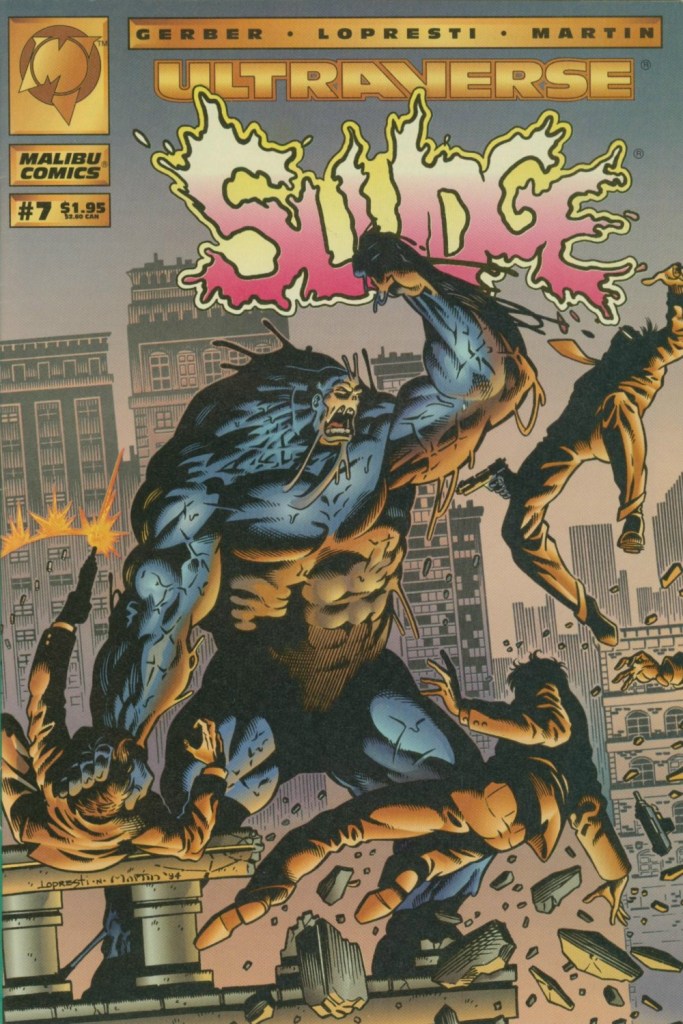
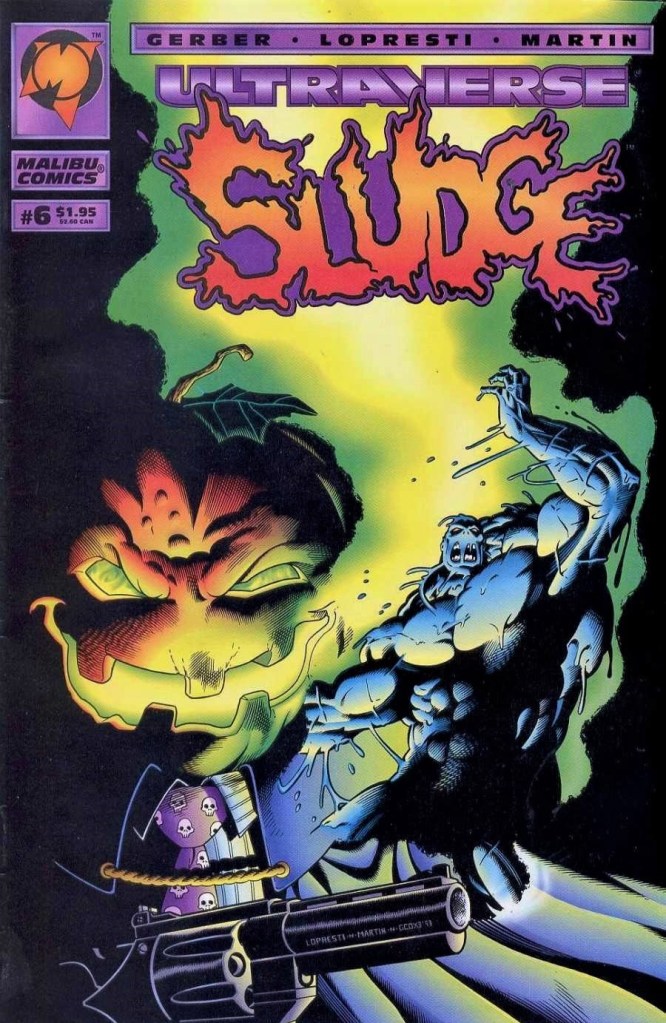
The cover.

Early story

The story begins with Sludge still lying down at the dock after just being defeated by Bloodstorm. Suddenly a mob of chaotic people (driven mad by the effects of Break-Thru that just happened) lift him up and throw him into the water without any regrets whatsoever. In hiding, Bloodstorm witnesses their act and thought to himself that he should avoid the madness happening. Suddenly, other mad people ganged up on him forcing him to react by firing his gun and set himself free from their grip. He safely makes it to his car and speeds away, even bumping off a few people on the way.

As Bloodstorm speeds away, another man in hiding who knew him and the boss Marcello was found by the mad people. Out of desperation he runs away and jumps into the water. He realizes that the people are so obsessed with going up to the sky (the Break-Thru effect), they did not bother to follow him at all.

Deep down the water, Sludge finds himself alone and getting relieved of the pain he experienced above. Feeling hopeless, he waits for the river to wash him away…

Quality

Sludge in trouble!

Being a standalone story set during the events of Break-Thru, this comic book focuses more on the protagonist while simultaneously raising the stakes with regards to the evil forces as the elements of crime gang combined with the supernatural took effect. To be clear, fantasy elements were added to this series which had darkness and grit dominating the plot of the first two issues.

This comic book has an early appearance of “lord” Pumpkin (AKA The Pump) who is the element of sorcery and, more notably, serves as the Ultraverse’s very own Satanic figure. Not only does the Pump have vast powers to take life away from others and has evil pawns to wield, he also leads and guides an apprentice (the kid gangster called Pistol) with pure wickedness, crafted plans of evil, is cunning in his ways of manipulating others to do evil, and he makes promises or deals with others who will receive some rewards but ultimately will be disregarded and lose a lot. This Ultraverse super-villain, as recorded in Malibu Comics’ publishing history, went on to become a walking symbol of pure evil, corruption, sins and danger in other UV comic books.

While there is indeed more focus on Sludge in this issue, it is the Pump who overshadows him. As for Bloodstorm, his presence has been drastically reduced here which is kind of jarring to read as he was the dominant and heavily emphasized in issue . Speaking of characters, the gang boss Marcello (who is Bloodstorm’s client) makes a short appearance but his connections not only with criminals but also with para-military forces emphasized his influence in the city.

More on the plot itself, this comic book is pretty loaded and the stakes were really raised high. In key scenes, Sludge finds himself in the middle of gangsters, the people driven mad by the Break-Thru effect, the para-military forces and the Pump’s ugly and evil pawns. Steve Gerber crafted a story that expectedly built up a lot and paid of strongly since the stakes were raised. I should state that Aaron Lopresti’s art here showed signs of improved creativity

Conclusion

The gang boss Marcello and Bloodstorm talk during the events of Break-Thru.

Sludge (1993) is a more engaging and more intense comic book on its own complete with the literary debut of the Pump who is clearly the Ultraverse’s most evil villain. If issue was twisting with the way it presented its characters, this comic book has more of its protagonist who went on to face new elements of evil while the story of Break-Thru transpired. I also noticed the Pump’s offer to Sludge symbolizes Satan offering a troubled soul a place in his force of evil. How did Sludge react to the offer from the evil one? You will have to read this comic book.

If you are seriously planning to buy an existing hard copy of Sludge (1993) be aware that as of this writing, MileHighComics.com shows that the near-mint copy of the regular edition costs $16.

Overall, Sludge (1993) is recommended!

+++++

Thank you for reading. If you find this article engaging, please click the like button below and also please consider sharing this article to others. If you are looking for a copywriter to create content for your special project or business, check out my services and my portfolio. Feel free to contact me with a private message. Also please feel free to visit my Facebook page Author Carlo Carrasco and follow me on Twitter at  @HavenorFantasy as well as on Tumblr at https://carlocarrasco.tumblr.com/

A Look Back at Sludge #2 (1993)

Disclaimer: This is my original work with details sourced from reading the comic book and doing personal research. Anyone who wants to use this article, in part or in whole, needs to secure first my permission and agree to cite me as the source and author. Let it be known that any unauthorized use of this article will constrain the author to pursue the remedies under R.A. No. 8293, the Revised Penal Code, and/or all applicable legal actions under the laws of the Philippines.

Welcome back, superhero enthusiasts, 1990s culture enthusiasts and comic book collectors! Today we revisit the Ultraverse of Malibu Comics and examine one of its many stories through the Sludge comic book series.

For the newcomers reading this, I published my retro review of Sludge back in December of 2020. I really enjoyed that Ultraverse comic book and now is a good time to revisit that series and find out what will happen next to Sludge, the UV’s most notable monster protagonist. I should state that Steve Gerber (Man-Thing) and Aaron Lopresti made a solid creative duo in Sludge .

With those details laid down, here is a look back at Sludge , published by Malibu Comics in 1993 with a story written by Steve Gerber and drawn by Aaron Lopresti.

The cover.

Early story

The story begins with a quick flashback of a young blonde boy who got bullied by other kids due to his unusual appearance and the way he expresses himself. Fast forward to the present day, an armed man (the same kid in the flashback) fires his guns on a man who was on his bed inside his residence.

After finishing the killing, the armed man enters his unusual looking car and leaves in high speed. After passing through the city streets, he drives his vehicle into his secret hideout filled with several weapons. Shortly after cleaning himself, he takes his seat in his private study and starts communicating with Mr. Barnett who tells him that bad news that something happened to his father. The killer then states, “Payment is due.”

Somewhere in lower Manhattan, a man is being beaten by two men who are enforcers of a man wearing a trench coat in their presence. The beaten man named Mikey swears he will get the money to pay off his debt but the coated man tells him that he is a week late and will be penalized.

Suddenly out of nowhere, Sludge comes out and grabs the two enforcers which frees Mike whose ear just got cut off by the coated man. Sludge then calls the coated man by his nickname…

Quality

The situation only gets more intense whenever Sludge comes in.

I’ll go straight to the point on the storytelling by Steve Gerber. The biggest surprise is here is that the focus was shifted from the titular protagonist Sludge in favor of the first appearance of Bloodstorm who is more than just a typical villain. Gerber heavily emphasized Bloodstorm’s personality as one who enjoys inflicting violence or death to others (and get paid for it) as a result of his painful childhood and his eventual acceptance of the beliefs that violence itself is always part of life. Even so, this comic book shows that Bloodstorm does not believe in inflicting misery for money and he calls it a cowardly way of earning money. Even as he finds his client’s business appalling, he still proceeds to do the dirty work to make money. This, of course, puts Bloodstorm in the dark work organized, target-focused mobbing which also puts him on the same course as Sludge. 

As with issue , the violence here is pretty intense and adulterated which goes along almost perfectly with the story’s dark and gritty tone. There is a fine mix of suspense, shock moments and the revealing of key details. I assure you all reading that that even though Sludge himself was not so dominant as the centerpiece of the story, the payoff for all the build-up was still worth reading.

Conclusion

Get to know Bloodstorm through this comic book.

Sludge (1993) is a pretty surprising comic book. One might think that it would become the natural progression of what was established in issue (which itself was the first appearance and origin of Sludge) but ultimately it took a completely different approach. I should also state that the duo of Steve Gerber and Aaron Lopresti continued to deliver compelling stuff in this comic book. While the fact that Sludge is not the dominating force in the story might turn off some readers, I can say to you that Sludge (1993) is still a very worthy read and it builds up on something waiting to be revealed in succeeding issues.

If you are seriously planning to buy an existing hard copy of Sludge (1993) be aware that as of this writing, MileHighComics.com shows that the near-mint copy of the regular edition costs $16 while the near-mint copy of the newsstand edition costs $48

Overall, Sludge (1993) is recommended!

+++++

Thank you for reading. If you find this article engaging, please click the like button below and also please consider sharing this article to others. If you are looking for a copywriter to create content for your special project or business, check out my services and my portfolio. Feel free to contact me with a private message. Also please feel free to visit my Facebook page Author Carlo Carrasco and follow me on Twitter at  @HavenorFantasy as well as on Tumblr at https://carlocarrasco.tumblr.com/

A Look Back at Spider-Man 2099 #4 (1993)

Disclaimer: This is my original work with details sourced from reading the comic book and doing personal research. Anyone who wants to use this article, in part or in whole, needs to secure first my permission and agree to cite me as the source and author. Let it be known that any unauthorized use of this article will constrain the author to pursue the remedies under R.A. No. 8293, the Revised Penal Code, and/or all applicable legal actions under the laws of the Philippines.

Welcome back, superhero enthusiasts, 1990s culture enthusiasts, and comic book collectors! Today we revisit the world of 2099 within the universe of Marvel Comics back in the 1990s, specifically through the Spider-Man 2099 monthly series.

Today we will look back at the early development of futuristic Spider-Man as published way back in 1993. The first three issues (read also my reviews of issue #2 and #3) formed a solid foundation on establishing Miguel O’Hara as his era’s Spider-Man thanks mainly to the high-quality writing done by Peter David. What issue will deliver, we will find out here.

With those details laid down, here is a look back at Spider-Man 2099 , published in 1993 by Marvel Comics with a story written by Peter David and drawn by Ricky Leonardi.

The cover.

Early story

The story begins with Gabriel O’Hara (Miguel’s brother) and Kasey Nash trying to have a good time together inside a vehicle until a man armed with a sword interrupts them and tries to take the lady with him. As Gabriel makes his move to help Kasey, the swordman throws two sharp projectiles at him and moves away with the lady.

Over at the Babylon Towers residence, Miguel O’Hara gets visited by his boss Tyler Stone accompanied by armed personnel. Not realizing that Spider-Man 2099 and Miguel are one and the same person, Tyler tells him that the sudden appearance of the crawler put Alchemax on edge.

Tyler proposes peace between him and Miguel, offering him more of the hyper addictive substance Rapture. He tells him that Aaron Delgato was identified as the mysterious Spider-Man…   

Quality

Miguel O’Hara and his brother Gabriel ride and talk.

The plot really thickened in this comic book resulting a few very interesting sub-plot branches as well as more depth on the development of Miguel O’Hara. I really like the way Peter David explored the corporate side of Miguel’s life here creating suspense about Tyler’s limited knowledge of the Alchemax incidents that happened in issues and which actually involved the protagonist witnessing the fall of his corporate rival Aaron (the same guy responsible for the genetic manipulation of Miguel into Spider-Man). This comic book also focuses on the strained relationship Miguel has with his brother Gabriel who clearly lacks the will to be personally responsible.

I also enjoyed the way Miguel reacts to the classic Spider-Man expression of “with great power comes great responsibility” as he struggles to set things right even as being a civilian and a superhero in his society has major hassles.

The anticipated battle between Spider-Man and the sword-wielding Specialist was structured nicely. Instead of being the typical good-versus-evil conflict, what was presented started with nice moments as Spider-Man still struggles to make the best out of his capabilities. Be aware that the fight does not conclude in this issue.

Conclusion

Miguel getting ready for work while having his Spider-Man costume worn.

Spider-Man 2099 (1993) is a solid comic book to read. It had a nice balance of character development, plot with twists here and there, as well as a good amount of action and thrills. Its best feature, as expected, was the further development of the protagonist and you will see more of Miguel than Spider-Man. By the end of this comic book, I really felt I got to know Miguel more as a person, and not a mere character.

If you are seriously planning to buy an existing hard copy of Spider-Man 2099 (1993) be aware that as of this writing, MileHighComics.com shows that the near-mint copy of the regular edition costs $30 while the near-mint copy of the newsstand edition costs $90.

Overall, Spider-Man 2099 (1993) is recommended.

+++++

Thank you for reading. If you find this article engaging, please click the like button below and also please consider sharing this article to others. If you are looking for a copywriter to create content for your special project or business, check out my services and my portfolio. Feel free to contact me with a private message. Also please feel free to visit my Facebook page Author Carlo Carrasco and follow me on Twitter at  @HavenorFantasy as well as on Tumblr at https://carlocarrasco.tumblr.com/

Better than Streaming: Alligator 4K Blu-ray coming out on February 22, 2022

Welcome back, fellow geeks, Blu-ray collectors and movie buffs! If you are fond of old-school creature features, suspense and horror for your home viewing, then you might be interested to know that the 1980 film Alligator will be released in 4K Blu-ray format on February 22, 2022 according to a Blu-ray.com update. Alligator 4K Blu-ray is an upcoming release prepared by Scream Factory and interested costumers can order it right now online.

To put things in perspective, posted below are key details from the Blu-ray.com article about Alligator 4K Blu-ray combo. Some parts in boldface…

The 4K Blu-ray cover.

DISC ONE: 4K BLU-RAY – THEATRICAL VERSION

  • EXCLUSIVE NEW 4K RESTORATION FROM THE ORIGINAL CAMERA NEGATIVE
  • Audio Commentary With Director Lewis Teague And Actor Robert Forster
  • Optional English SDH subtitles for the main feature

DISC TWO: BLU-RAY – THEATRICAL VERSION

  • EXCLUSIVE NEW 4K RESTORATION FROM THE ORIGINAL CAMERA NEGATIVE
  • NEW Everybody In The Pool – An Interview With Actress Robin Riker
  • NEW Wild In The Streets – An Interview With Director Lewis Teague
  • NEW It Walks Among Us – An Interview With Screenwriter John Sayles
  • NEW Luck Of The Gator – An Interview With Special Makeup Effects Artist Robert Short
  • NEW Gator Guts, The Great River, And Bob – An Interview With Production Assistant, Now Famous Actor/Director/Producer, Bryan Cranston
  • NEW Newspaper Ad Still Gallery By Drive-In Asylum
  • Audio Commentary With Director Lewis Teague And Actor Robert Forster
  • Alligator Author – An Interview With Screenwriter John Sayles
  • Additional Scenes From The TV Version
  • Promotional Materials
    • NEW Teaser Trailer (New 2K Scan)
    • NEW Theatrical Trailer (NEW 2K Scan)
    • NEW TV Spots (NEW 2K Scan)
    • Trailers From Hell – Filmmaker Karyn Kusama (Jennifer’s Body) On ALLIGATOR
    • ALLIGATOR Game Television Commercial
  • Still Gallery (Movie Stills, Movie Posters, Lobby Cards, And Behind-The-Scenes Photos)
  • Optional English SDH subtitles for the main feature

DISC THREE: BLU-RAY – EXTENDED TELEVISION VERSION

  • NEW 4K RESTORATION FROM THE OCN WITH ADDITIONAL FOOTAGE FROM AN INTERPOSITIVE
  • The extended television version is presented in high-definition for the first time ever.

Posted below are the other details from Alligator’s own page at Blu-ray.com…

Video

Codec: HEVC / H.265

Resolution: Native 4K (2160p)

HDR: Dolby Vision, HDR10

Aspect ratio: 1.85:1

Original aspect ratio: 1.85:1

Audio – English: DTS-HD Master Audio 2.0 Mono (48kHz, 24-bit)

Subtitles – English SDH

Discs – 4K Ultra HD, Blu-ray Disc, Three-disc set (1 BD-100, 2 BD-50)

Packaging – Slipbox, Reversible cover

Playback – 4K Blu-ray: Region free, 2K Blu-ray: Region A

The movie poster from 1980.

Personally, I saw Alligator on home video way back in the 1980s and sometimes on cable TV afterwards. In American pop culture, the Lewis Teague-directed movie was one of several creature feature movies that got released as part of a wave of imitators who were inspired by the massive success of Steven Spielberg’s Jaws. Alligator had a mixed-to-positive reception from the movie critics in 1980 and its ticket sales were almost four times its production budget.

How this old movie will look like in 4K interests me, and the 4K visuals have been confirmed to be native 4K. As typical with other Scream Factory releases, Alligator will come with lots of extra stuff that fans and movie buffs will eventually enjoy. Watch out for this 4K Blu-ray release on February 22, 2022.

In closing this Better than Streaming piece, posted below are Alligator-related videos for your viewing pleasure.

+++++

Thank you for reading. If you find this article engaging, please click the like button below and also please consider sharing this article to others. If you are looking for a copywriter to create content for your special project or business, check out my services and my portfolio. Feel free to contact me with a private message. Also please feel free to visit my Facebook page Author Carlo Carrasco and follow me on Twitter at  @HavenorFantasy as well as on Tumblr at https://carlocarrasco.tumblr.com/

If you wish to join a group of movie enthusiasts and talk about cinema, visit the Movie Fans Worldwide Facebook group at https://www.facebook.com/groups/322857711779576

A Look Back at Spider-Man 2099 #3 (1993)

Disclaimer: This is my original work with details sourced from reading the comic book and doing personal research. Anyone who wants to use this article, in part or in whole, needs to secure first my permission and agree to cite me as the source and author. Let it be known that any unauthorized use of this article will constrain the author to pursue the remedies under R.A. No. 8293, the Revised Penal Code, and/or all applicable legal actions under the laws of the Philippines.

Welcome back, superhero enthusiasts, 1990s culture enthusiasts and comic book collectors! Today we revisit the world of 2099 within the universe of Marvel Comics back in the 1990s, specifically through the Spider-Man 2099 monthly series.

This time around, we take a look back at the early stage of the futuristic Spider-Man’s story and learn more about Miguel’s struggle in becoming something he was not ready for. On my part, the 3rd issue of Spider-Man 2099 was the first-ever hard copy of the monthly series I bought.

With those details laid down, here is a look back at Spider-Man 2099 , published in 1993 by Marvel Comics with a story written by Peter David and drawn by Rick Leonardi.

The cover.

Early story

The story begins immediately after the ending of issue #2 with Miguel O’Hara in disguise as Spider-Man facing off with Venture who has been working for Alchemax’s head to find precisely him. The presence of idolaters of Thor view Venture as an enemy and Spider-Man (who knows he is being hunted by the cybernetic guy) tells them to get back to stay out of danger.

Instead of listening to him, the idolaters did the foolish thing by physically attacking Venture who is just too proficient in combat and his high-tech weapon hurts them. With great risk, Spider-Man leaps to Venture to try to convince him to leave him alone. Unfortunately he loses his balance and gets touched by Venture’s weapon which leaves his right arm numb.

Venture tells Spider-Man that Alchemax wants him…

Quality

Even though he has a numb right arm, Spider-Man 2099 still got up-close and personal with Venture.

This comic book is one action-packed thrill ride laced with solid character development. While issues and showed how Miguel O’Hara became Spider-Man of 2099, this story shows him in his first-ever battle with someone who happens to be doing a mission for Alchemax (Miguel’s employer no less).

Peter David carefully structured the story and the result were lots of moments in which Spider-Man 2099 witnesses the unexpected happenings which readers can relate with. As Spider-Man learns more about the enhancements within him (better reflexes, ability to leap far, etc.), he gets to do the unbelievable which is a classic superhero trope done but within a futuristic, science fiction setting. What he does with his abilities, he does his best to adjust himself. I also like the fact that Spider-Man of 2099 does not have the Spider Sense of the classic Spider-Man (Peter Park) which in a creative way adds to the suspenseful moments in this comic book series.

As for Venture, he is not your typical villain nor is a one-dimension character designed to merely provide opposition to the protagonist. He is a cybernetic bounty hunter on a mission and does not harbor any personal grudge nor hatred against Spider-Man. On his own, Venture is deadly and is clearly one of the best villains to ever take on Spidey 2099.

Conclusion

The idolaters and worshipers of Thor take on Venture which Spider-Man witnesses.

Spider-Man 2099 (1993) is a very solid read and it succeeded in further defining the futuristic Spider-Man’s personality as well as his origin. The first time I read this comic book, I got very immersed in learning about the protagonist and how he does his best to save himself and overcome the opposition while finding out ways to ensure that bystanders and witnesses will not get hurt. This comic book also has an immersive sci-fi setting and shows more of the society of 2099. I can clearly say that this is one enjoyable and compelling comic book which aged nicely to this day.

If you are seriously planning to buy an existing hard copy of Spider-Man 2099 (1993) be aware that as of this writing, MileHighComics.com shows that the near-mint copy of the regular edition costs $30 while the near-mint copy of the newsstand edition costs $90.

Overall, Spider-Man 2099 (1993) is highly recommended.

+++++

Thank you for reading. If you find this article engaging, please click the like button below and also please consider sharing this article to others. If you are looking for a copywriter to create content for your special project or business, check out my services and my portfolio. Feel free to contact me with a private message. Also please feel free to visit my Facebook page Author Carlo Carrasco and follow me on Twitter at  @HavenorFantasy as well as on Tumblr at https://carlocarrasco.tumblr.com/