A Look Back at Spider-Man 2099 #40 (1996)

Welcome back superhero enthusiasts, 1990s culture enthusiasts and comic book collectors! Today we go back to the year 1996 and explore a part of the Marvel 2099 comics universe through a tale of the Spider-Man 2099 monthly series.

To put things in perspective, there were these notable changes with both the storytelling and the character development of the futuristic webslinger as a result of the Venom 2099 saga (read my retro reviews here, here, here, here and here) as well as Doom 2099 becoming the new President of the United States (click here). Issue #39 saw the return of Vulture 2099 and the sudden appearance of Green Goblin 2099 (AKA Goblin 2099).

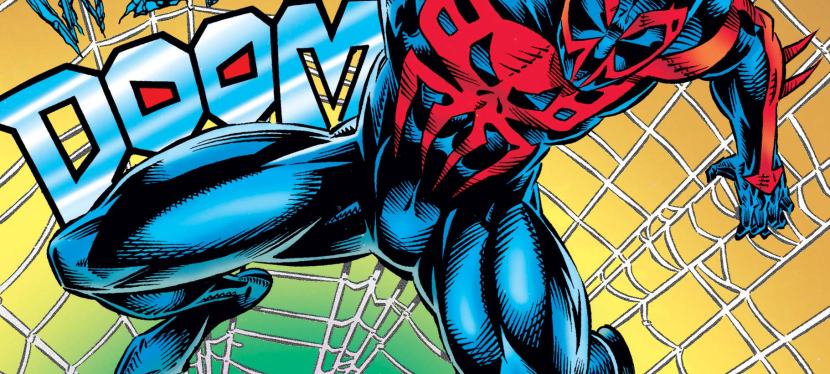
With those details laid down, here is a look back at Spider-Man 2099 #40, published in 1996 by Marvel Comics with a story written by Peter David and drawn by Andrew Wildman.

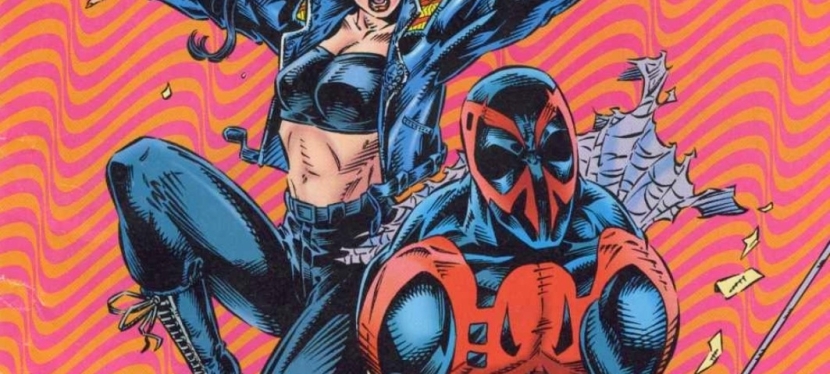
The cover.

Early story

The story begins with the tycoon Tyler Stone helplessly on bed in a medical center’s room still recovering from the gun shot incident. He tells the doctor near him that he wants to speak to Dana and demands to know what has been going on. Stone also demanded to get into contact with President Doom. In response to Stone’s demand to know the truth, the doctor regretfully tells him that Dana is dead.

Meanwhile, a swinging Spider-Man gets hit from the back by Goblin 2099. As the webslinger asked who he is, the Goblin introduces himself and tells him that he intends to expose him as a fraud. As the green/purple colored mask freak keeps on attacking, Spider-Man moves out of the way. While in movement, Goblin tells Spidey that he has betrayed the good people of downtown New York and must be forced to confess.

As he falls down fast, the webslinger suddenly finds himself clamped and restrained by the Goblin…   

Quality

Goblin 2099’s main weapon against the futuristic Spidey is influence on people and being able to convince them to reject the webslinger.

This comic book has a very intriguing tale crafted by Peter David. While this marks the first ever encounter between the futuristic versions Spider-Man and Green Goblin, this one has a strong social theme that prevented the conflict from becoming a generic good-versus-evil match-up. Goblin 2099 went after the webslinger not for the satisfaction of killing, not for the intention of dominating the whole world but for achieving social change for the members of the downtown community by destroying Spider-Man’s credibility once and for all (by exposing him as a fraud and a tool of the corporate world who should not be trusted).

This version of the Green Goblin clearly has an agenda that he seems very willing to die for and the mere fact that he interacted with Kasey (an important person for both Miguel and Gabriel O’Hara) further adds to the complexity on both the new villain as well as the downtown community. Given his obsession of destroying the hero by blaming him as a corporate stooge, Goblin 2099 here is symbolically with the Satanic Left (Communist/Marxist/liberal). These factors effectively raise the stakes and risks for Spider-Man who already has a lot of problems to deal with.

Through the fight between Spider-Man and Goblin, you will see how the people of downtown react in accordance to their perception as well as their inability to realize the truth behind Spider-Man’s social standing. The way they reacted shows impact on Spidey who himself struggles to understand their collective thinking and why they allowed themselves to be strongly influenced by the Goblin.

Along the way, there was a scene that emphasized Xina showing how Dana’s death affected her and another scene that took place at a very old New York City cathedral that clearly was crafted to build up on something for future tales of this series.

Characterization and plot aside, this comic book has a good amount of superhero action that will keep you entertained and Andrew Wildman really knows how to make action attractive to your eyes.

Conclusion

Spotlight on Xina.

Spider-Man 2099 #40 (1996) is another solid tale from the David-Wildman duo. Apart from the big impact Goblin 2099 had on Spider-Man and the people of just one community, this story successfully built-up the tension and complexity on the part of the protagonist while executing suitable pay-offs in relation to the build-up that started in the previous issue. Also I should state that it is very clear that the feature match-up in this comic book is not a rehash of classic Spider-Man and the Green Goblin. This is indeed a very intriguing Spidey 2099 tale that convinced me to look forward to the next issue.

Overall, Spider-Man 2099 #40 (1996) is highly recommended!

+++++

Thank you for reading. If you find this article engaging, please click the like button below, share this article to others and also please consider making a donation to support my publishing. If you are looking for a copywriter to create content for your special project or business, check out my services and my portfolio. Feel free to contact me with a private message. Also please feel free to visit my Facebook page Author Carlo Carrasco and follow me on Twitter at  @HavenorFantasy as well as on Tumblr at https://carlocarrasco.tumblr.com/ and on Instagram at https://www.instagram.com/authorcarlocarrasco

A Look Back at Spider-Man 2099 #34 (1995)

Welcome back superhero enthusiasts, 1990s culture enthusiasts and comic book collectors! Today we go back to the year 1995 and explore a part of the Marvel 2099 comics universe through a tale of the Spider-Man 2099 franchise.

In my previous retro review, Spider-Man worked together with Strange 2099 on an abrupt mission dealing with a grave digger who is obsessed with his long dead sibling just as the undead in Mexico start walking again.

With those details laid down, here is a look back at Spider-Man 2099 #34, published in 1995 by Marvel Comics with a story written by Peter David and drawn by Andrew Wildman.

The cover.

Early story

The story begins with Miguel O’Hara and Xina returning from Mexico speeding on a lonely road by car. O’Hara suddenly got scanned from a distance. Just as Xina shares to Miguel her newest observations and opinion about Spider-Man, the man suddenly got snatched from the car by uniformed authorities riding a floating vehicle. Miguel tells his abductors to let him go and one of them replies stating that he is being taken to the White House at the request of his Alchemax superior Tyler Stone.

Meanwhile inside an apartment located near the White House in Washington, DC, Dana converses with Tyler Stone by holographic call complaining that without him, the city is getting lonely for her. As soon as her communication ends, someone knocks her out cold…

Quality

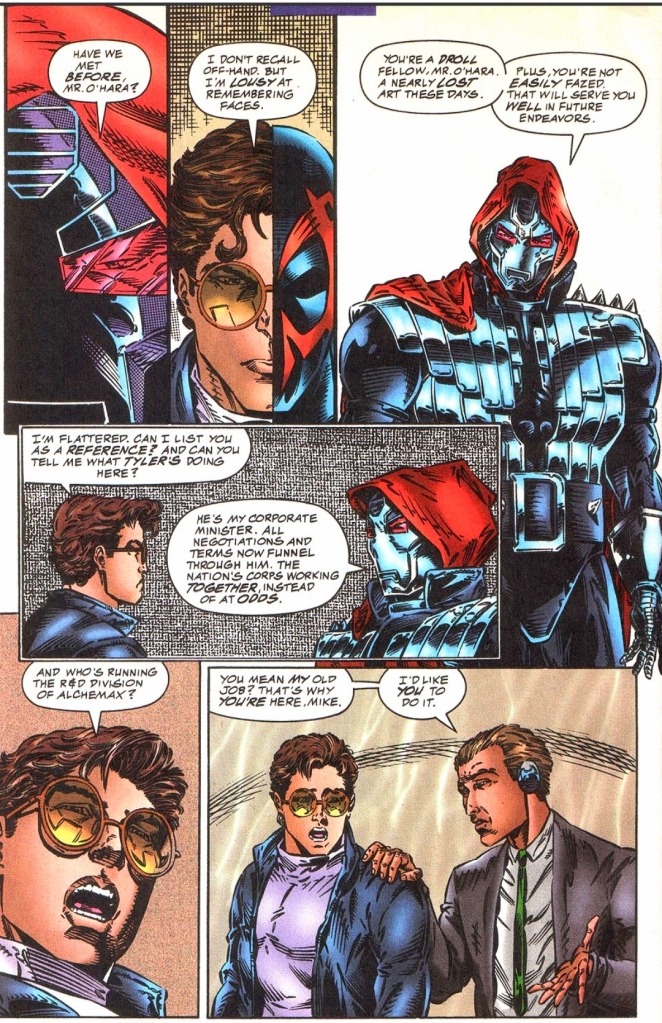
For the newcomers reading this, this page shows the first time ever that Doom 2099 sees Miguel O’Hara in person (Spider-Man 2099 without the mask and costume). Spidey and Doom encountered each other previously in The Fall of the Hammer storyline.

I will start what is very obvious about this comic book…its story is totally intriguing as it reflects a very dramatic turn of events within the 2099 realm at the time of publication. I’m talking about the rise of Doom 2099 as the new President of the United States and this comic book dramatizes in detail how the new leader impacts Miguel O’Hara’s career which adds tension to his already hectic 2nd life as the webslinger. This is all about the storyline of One Nation Under Doom and for context, you must read Doom 2099 #26 to #30.

As I just mentioned, life for Miguel became more complicated as he has to deal with the federal government under the control Doom who himself is connected with the powerful tycoon Tyler Stone (Miguel’s own boss at Alchemax). For the newcomers reading this, this is not the first time Doom and Spider-Man of 2099 encountered each other as they were together in the Fall of the Hammer storyline (read my past reviews by clicking here, here, here, here and here).

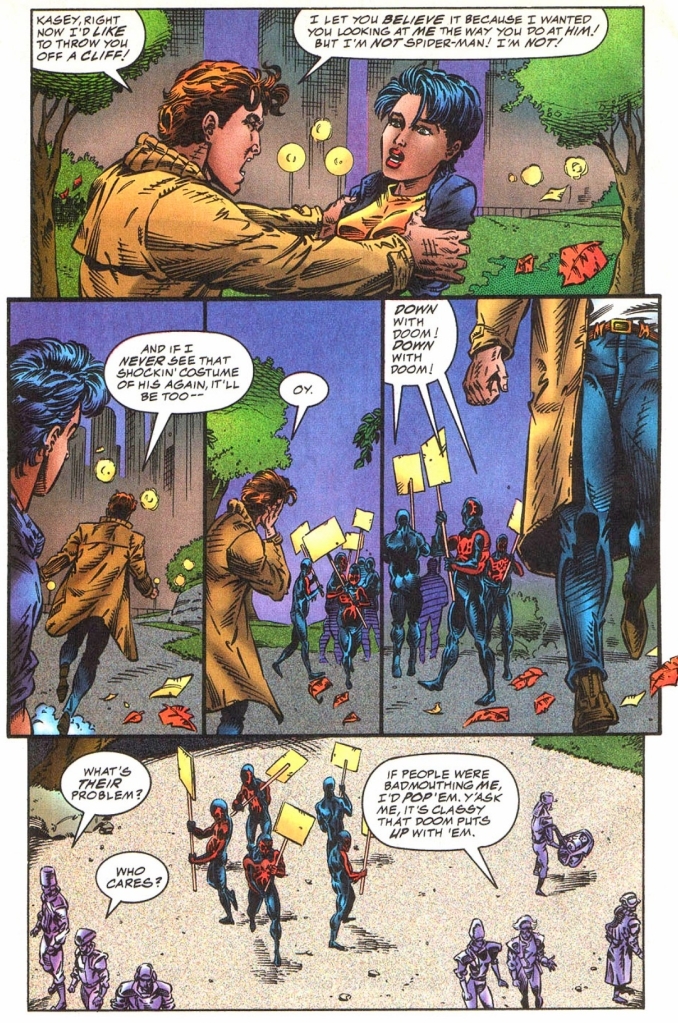
In relation to the dramatic turn of events that changed the direction of the 2099 comics franchise, I can confirm that the writing by Peter David in this comic book is indeed very strong and highly engaging to follow. You will not see a good-versus-evil superhero tale here but the impact of Doom as US President on Spider-Man and local society. Along the way, this tale has a theme about gaining absolute power, how it affects the one who gains it and how the more powerful person affects many others. You will see the mentioned theme reflected on Spider-Man who himself already has super powers and even a following of idolaters.

Compared to the previous two issues, the dialogue by Peter David here is very rich and I also enjoyed the way how he presented the exposition of details to help Spider-Man 2099 readers understand how Doom’s rise as US President impacts the titular hero and many others. Speaking of Doom, I enjoyed the way how David portrayed him here.  

Conclusion

Gabriel O’Hara, Kasey and the Spider-Man 2099 idolaters doing the old fashioned way of protesting against US President Doom.

Spider-Man 2099 #34 (1995) is indeed a great comic book and one of the best tales of the original Spider-Man 2099 monthly series. As Doom’s takeover of the US Presidency really changed the direction of the entire 2099 franchise of comics in the 1990s, it was inevitable that the repercussions would be reflected in a Spider-Man 2099 tale. The result here is a fascinating tale of the futuristic webslinger that does not even have the usual good-versus-evil conflict. What you will see here is how the stakes got raised for Miguel O’Hara not only as a superhero but also as a civilian who has a strong record within Alchemax. Not only that, this is the tale that took place just before the very memorable first encounters between Spider-Man and Venom 2099 (click here, here, here and here).

Overall, Spider-Man 2099 #34 (1995) is highly recommended!

+++++

Thank you for reading. If you find this article engaging, please click the like button below, share this article to others and also please consider making a donation to support my publishing. If you are looking for a copywriter to create content for your special project or business, check out my services and my portfolio. Feel free to contact me with a private message. Also please feel free to visit my Facebook page Author Carlo Carrasco and follow me on Twitter at  @HavenorFantasy as well as on Tumblr at https://carlocarrasco.tumblr.com/ and on Instagram at https://www.instagram.com/authorcarlocarrasco

A Look Back at Superman #83 (1993)

Welcome back superhero enthusiasts, 1990s culture enthusiasts and comic book collectors! Today we go back to the year 1993 to take a close look at one of the many tales published through the Superman monthly series.

For the newcomers reading this, DC Comics published the Funeral for a Friend storyline set after Superman’s death (Superman #75). Funeral for a Friend explored the impact Superman’s death had on local society, the civil and political stakeholders, as well as DC’s many superheroes who were connected with the icon (read my retro reviews here, here, here and here). Of course, DC brought the Man of Steel back to life which led to the Reign of the Supermen storyline. This obviously meant concluding the Funeral for a Friend storyline.

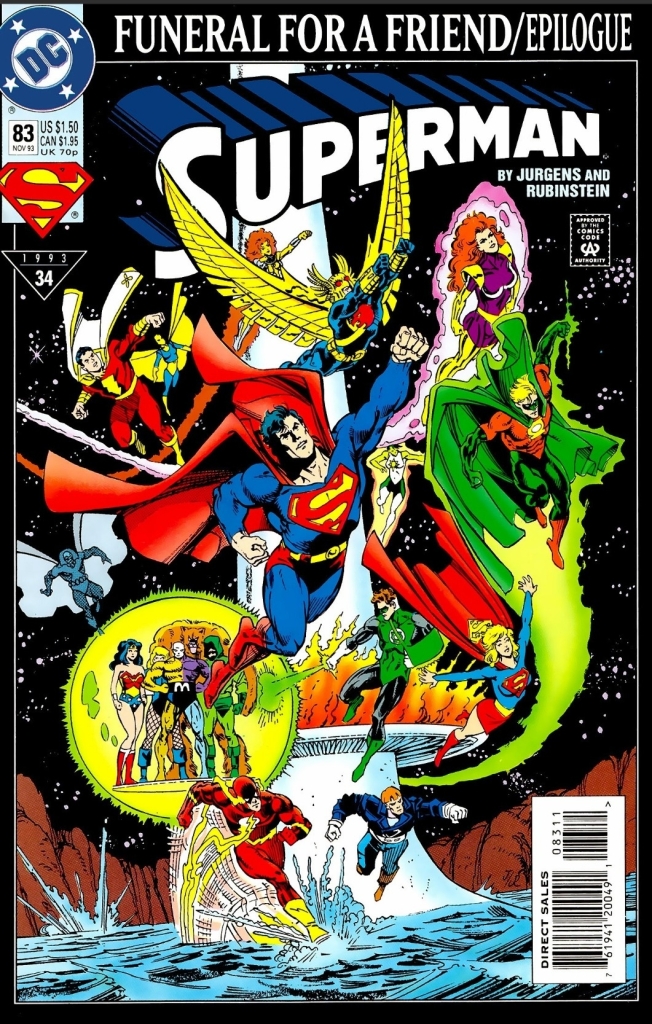
With those details laid down, here is a look back at Superman #83, published in 1993 by DC Comics with a story written and drawn by Dan Jurgens with ink work by Joe Rubinstein. This is the epilogue of Funeral for a Friend.

The cover.

Early story

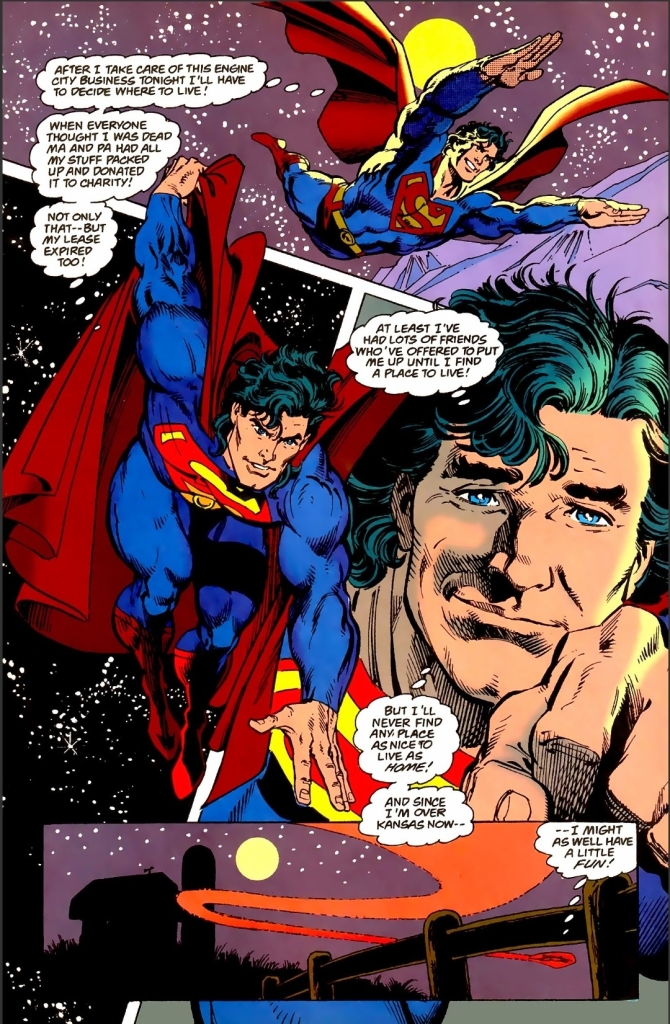
The story begins with Superman meeting an arriving Batman (note: Azrael playing the role as Bruce Wayne had been paralyzed by Bane) in the presence of Commissioner Gordon in Gotham City. He tells Batman that it was time for them to go to a certain ceremony which catches Azrael knowing nothing about it all forcing him to just play along. Batman resorts to making an excuse and turns Superman down, even though he learns that the entire Justice League will be involved to take care of the Engine City problem. Not wanting to spark Superman’s suspicion, Batman leaves Superman and Gordon behind. Superman then flies away.

Meanwhile, Lex Luthor, Supergirl and personnel fly towards Engine City. Luthor is obsessed with accumulating Kyptonite at the site…

Quality

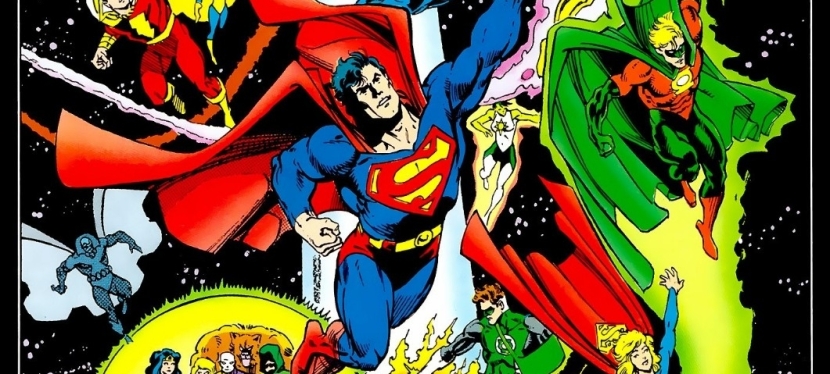
Superman, Wonder Woman, Green Lantern and the Flash with Lex Luthor and Supergirl (in the background).

As the conclusion of the Funeral for a Friend storyline, this is a mixed bag of creative concepts. It has scenes that developed established supporting characters such as Lois Lane, Jimmy Olsen, Cat Grant and Superman’s parents Jonathan and Martha Kent. The main story of this comic book has a lot more to do with the Justice League than Superman himself as a result of a huge crisis in which an actual coastal city could collapse, fall into the sea and potentially poison the aquatic life.

That’s not to say that Superman does not have sufficient presence in this comic book. In fact, the Man of Steel has scenes that highlight his humanity, his leadership role among the Justice League and how he is still adjusting to life after getting killed by Doomsday. What Superman fans won’t find here is superhero action versus an enemy.

Still on the Superman relevance of this comic book, Lex Luthor’s obsession with accumulating as much Kryptonite as he could reflects his diabolic nature as well as his cunning moves with distorting people’s perception. Even though he does not commit any acts of violence, Luthor’s manipulative tactics even in the presence of many superheroes showed that he simply won’t stop at anything to get what he wants and what benefits him.  

Speaking of more characters, Green Lantern (Hal Jordan) here got a good piece of the spotlight as he emphasized why Engine City should fall into the Pacific Ocean which he relates to the destruction of Coast City. Through his dialogue, you can feel his bitterness and the impact that the Coast City tragedy had on his worldview. You will also see Aquaman, Wonder Woman, Guy Gardner and others participate in the talks.

Conclusion

Pay close attention to the details, Superman fans.

Superman #83 (1993) is a nicely crafted story that happens to be more about the Justice League dealing with a big problem with Superman present. As the epilogue to the Funeral for a Friend storyline, this comic book tied up certain loose ends but ultimately focused more on building up details and tension for future events. As this story took place a short time after Superman physically returned from the dead, readers will see a still-adjusting Man of Steel here and this clearly shows that the funeral is indeed over.

Overall, Superman #83 (1993) is recommended.

+++++

Thank you for reading. If you find this article engaging, please click the like button below, share this article to others and also please consider making a donation to support my publishing. If you are looking for a copywriter to create content for your special project or business, check out my services and my portfolio. Feel free to contact me with a private message. Also please feel free to visit my Facebook page Author Carlo Carrasco and follow me on Twitter at  @HavenorFantasy as well as on Tumblr at https://carlocarrasco.tumblr.com/ and on Instagram at https://www.instagram.com/authorcarlocarrasco

A Look Back at Spider-Man 2099 #33 (1995)

Welcome back superhero enthusiasts, 1990s culture enthusiasts and comic book collectors! Today we go back to the year 1995 and explore a part of the Marvel 2099 comics universe through a tale of the Spider-Man 2099 franchise.

In my previous retro review, Miguel O’Hara arrives in Mexico with Xina and they shared a room together. It turns out his brother Gabriel was also there even occupying the next room. Elsewhere, a lady practicing sorcery (Strange 2099) is told that Spider-Man will be her ally and they will work together to fulfill a mission. Elsewhere, a grave digger performs rituals over the skeletal remains of his beloved sister. Issue #32 had a dark and totally different tone as the sci-fi element of the monthly series got pushed aside.

With those details laid down, here is a look back at Spider-Man 2099 #33, published in 1995 by Marvel Comics with a story written by Peter David and drawn by Andrew Wildman.

The cover.

Early story

The story begins when Spider-Man 2099 and his new ally Strange 2099 crash into a room on a mission they must complete. They see the grave digger clinging to a magical item that he believes should resurrect his dead sister.

In an attempt to find a solution, Strange touches the item and suddenly becomes a hideous looking monster.

Meanwhile, the streets of Mexico City suddenly gets filled with several undead people walking. On the street, Xina (walking with Kasey and Gabriel) begins to worry about Miiguel. Soon enough, some of the undead move towards them…

Quality

Spider-Man helps to ensure safety.

As this story is the continuation to the events of issue #32, this one keeps on building up on sorcery and evil forms of the supernatural as the key elements of the narrative as well as the setting. That being said, the usual science fiction element remains completely absent and this opened the opportunity for the creative team to show Spider-Man in action within a supernatural atmosphere complete with the unfortunate event of a demonic possession.

Spider-Man’s team-up with Strange (obviously the futuristic take of Dr. Strange) inevitably led to a conflict with evil and the ironic thing is that the grave digger himself is not even the villain but someone obsessed with bringing his sister back to life by means of resorting to magic and tapping the demonic force he could not even see. The Spidey-Strange team-up clearly dominated the narrative but I should say that the sorceress is not too interesting as a character and she barely has any chemistry with the futuristic web-slinger. It seems to me that Strange 2099 was created to emphasize racial diversity and rabid feminism than to really add any depth to the 2099 universe and its lineup of supporting characters.

As for the concept of the undead walking along many people who happen to be commemorating the day of the dead on the city streets, it really heightened the horror and supernatural aspects of the story while escalating the sense of danger.

Conclusion

Spidey, Strange 2099 and the grave digger.

In line with the concept of the previous issue, Spider-Man 2099 #33 (1995) is a supernatural tale of Spider-Man on a misadventure teamed up with a futuristic take on Dr. Strange. Its pay-off to the build-up in issue #32 was barely felt and I could not help but feel the presentation was rushed. Strange 2099 was simply not interesting and the grave digger’s personal pursuit over his dead sister did not have much of an impact. That being said, the concept of this 2-part story felt more like a diversion than a meaningful story. If there is anything worth focusing on in this comic book, it is Spidey himself struggling in the very nation where he previously got his costume.

Overall, Spider-Man 2099 #33 (1995) is satisfactory.

+++++

Thank you for reading. If you find this article engaging, please click the like button below, share this article to others and also please consider making a donation to support my publishing. If you are looking for a copywriter to create content for your special project or business, check out my services and my portfolio. Feel free to contact me with a private message. Also please feel free to visit my Facebook page Author Carlo Carrasco and follow me on Twitter at  @HavenorFantasy as well as on Tumblr at https://carlocarrasco.tumblr.com/ and on Instagram at https://www.instagram.com/authorcarlocarrasco

A Look Back at Creepshow (1982)

Welcome back fellow geeks, pop culture enthusiasts and comic book collectors! Way back in 1982, the horror comedy anthology film Creepshow was released in cinemas featuring the combined talents of author Stephen King and the late director George Romero who were clearly inspired by the 1950s horror comic books published by EC Comics. That being said, Creepshow was a comic book movie that was not even based on a comic book.

To make things clear, the movie was first shown on the big screen in France during the Cannes Film Festival in May 1982. The comic book adaptation of Creepshow (note: read my retro comic book review) was released in July 1982 and the art it contained is not the same as the in-movie comic book (also titled Creepshow) that appeared in transition scenes. The movie’s general release in America happened on November 10, 1982 and it was successful commercially and critically. In recent times, Creepshow was released on 4K Blu-ray with lots of extra stuff for fans and moviegoers to enjoy. The said 4K Blu-ray release can be ordered online now.

Some of you might be wondering if the Creepshow movie has aged well and what exactly does it offer for younger moviegoers and movie collectors to enjoy. Some of you might be wondering if King and Romero were ever a special creative duo for cinema.

With those details laid down, here is a look back at the horror-comedy anthology film  Creepshow (1982) directed by George Romero, written by Stephen King and starring Hal Holbrook, Leslie Nielsen, Adrienne Barbeau, Tom Atkins, E.G. Marshall, Viveca Lindfors, Ed Harris and more.

The movie poster.

Early stories

Prologue – A father very angrily berates and hits his young son after discovering the horror comic book titled Creepshow was with him. The father called the comic book’s content crap.

Father’s Day – Sylvia Grantham, her nephew Richard, niece Cass and Hank (husband of Cass) enjoy time together at the Grantham estate anticipating the arrival of Bedelia for the annual family dinner. There is a dark secret regarding Bedelia and her late father…

The Lonesome Death of Jordy Verril – A lonely farmer named Jordy witnesses the unexpected arrival of a meteorite from out space which landed violently on his farm. After realizing what it is, he touches it without any protection and gets his fingers burned…

Something to Tide You Over – a prominent man named Richard visits Harry at his home. It turns out, Harry has been having an affair with Richard’s wife Becky. Even so, Richard maintains his cool and made clear his uncompromising determination of always keeping what is his. Richard plays an audio recording of Becky’s voice which even includes a call for Harry to help her….

The Crate – In the basement level of Amberson Hall (science building of Horlicks University), a janitor accidentally finds a very old wooden crate located right under the staircase. The writings “Ship to Horlicks University via Julia Carpenter – Arctic Expedition – June 19, 1834” were marked on the crate…

They’re Creeping Up on You – A cruel businessman named Upson Pratt is alone in his well-lighted apartment. He has been suffering from mysophobia and has been living in isolation and only communicates with others using the telephone and other electronic methods. Slowly but surely, cockroaches begin to multiply in his apartment…

Quality

Two couples from different short stories of the movie: At left were Hal Holbrook and Adrienne Barbeau. At right were Elizabeth Regan and Ed Harris.

To begin with, I’d like to focus on the combined creativity of Stephen King and director George Romero. While all five short stories, the prologue and epilogue each have varying levels of quality, engagement and entertainment value, it is safe to say that Creepshow as a whole remains entertaining and intriguing to watch. This is a cinematic horror-comedy anthology that is still fun to watch from start to finish.

Very clearly, the King-Romero team were heavily inspired by the EC Comics-published horror comics of the 1950s and along the way, they added their own creative touches to make each short story not only unique but also memorable. Given the fact that Romero remains remembered for his zombie movie works, two of the five short stories can be viewed as shorter zombie tales by the director but with notable differences – the comic book-inspired visuals used (note: moody lighting, stylish backgrounds and comic-inspired frames) and the fine performances from the actors involved. As for the three other short stories that have nothing to do with zombies, I felt they reflected more of Stephen King’s concepts (note: King himself acted as Jordy) which Romero apparently directed to be reflective of the author’s works while still injecting EC Comics-inspired visuals. Speaking of comic books, the filmmakers used traditional animation (note: hand-drawn) specifically in the transition scenes when the movie moved from one segment to the next. Within the context of the movie was the comic book Creepshow which made the father mad at his son.

With moody lighting combined with Leslie Nielsen’s convincing terrified expression, this image captures the look and feel of similar moments in the horror comic books of EC Comics.

As it is clear that each short story has different concepts and varying levels of quality, entertainment and engagement, I can describe them in short results as follows: Father’s Day really looks and feels like it was written for EC Comics in the 1950s; The Lonesome Death of Jordy Verril is a clever mix of dark humor, science fiction and horror; Something to Tide You Over is very intriguing to watch and Leslie Nielsen pulled off a very unique portrayal of a villain; The Crate is a fine combination of monster horror and struggling characters with a university setting; and They’re Creeping Up on You is symbolically a socialist mobbing against someone powerful in the most unusual fashion, and it definitely is the weakest of all the five short stories as it was made to disgust viewers who are afraid of bugs. Creepshow’s prologue and epilogue meanwhile carried an anti-family theme that supposedly reflects the moral outrage against EC Comics in the 1950s made to resonate with people who love comic books at the expense of morality and family. I personally dislike the anti-family theme because I truly believe that minors should never read adulterated comic books and they should never become rebellious.

As each short story, the prologue and epilogue were strongly presented to be entertaining and engaging in varying ways, there is one aspect of the creativity that made Creepshow stand the test of time – the respective performances of the actors.

Leslie Nielsen’s portrayal of the villain Richard is the performance highlight of the entire film. Here’s a powerful man dealing with pain as a result of being betrayed by his wife by being in full control of his emotions and he keep moving on with uncompromised determination to proceed with his diabolical plans patiently and orderly. He is a very angry man who happens to be very calm. He is definitely evil who happens to be very principled. You will even see little traits of comedy in Richard and this should remind you of Nielsen’s eventual move into comedy in his later years. In the same short story, Ted Danson is believable as the man who had the affair with Richard’s wife.

In another short story, Adrienne Barbeau really stands out as the obnoxious and unhinged Wilma (AKA Billie) who is the complete opposite of her mild-mannered husband Henry (played by Hal Holbrook). She is so wild, she easily embarrasses her husband and the others who were present in the faculty social gathering. Quite symbolically, Barbeau’s act as Wilma is easily the most lively thing to watch in the said gathering. Without spoiling the plot of The Crate short story, I can say that Hal Holbrook has a nice range of displaying emotions within Henry as the story progressed. Even the guy who played the professor Dexter Stanley (Fritz Weaver) had his own share of the spotlight and displayed a good acting range as well.  

Even author Stephen King himself acted in a leading role in another short story as Jordy. King is surprisingly good in being comedic and he really knows his character in and out. In the first short story Father’s Day, you will see a very young Ed Harris as part of a family waiting for the arrival of Bedelia (Viveca Lindfors). The waiting family members were nicely played by Elizabeth Regan, Warner Shook and the late Carrie Nye. They were convincing as relatives. In the final short story, the late E.G. Marshall played Upson Pratt to be so ruthless, he will irritate you.

Conclusion

Comic book-style visuals implemented cleverly in the movie.

It is clear that Creepshow (1982) remains fun and engaging to watch thanks to the combined creative efforts of the King-Romero team as well as the fine performances of the actors involved. Although the final short story starring E.G. Marshall is the least interesting tale to watch, this horror-comedy anthology has lots of good stuff to entertain viewers. By today’s standards, Creepshow (1982) is very unique and also fun to watch. If you want to see this movie with the best visuals possible today, I urge you to buy the 4K Blu-ray release.

Overall, Creepshow (1982) is highly recommended!

+++++

Thank you for reading. If you find this article engaging, please click the like button below, share this article to others and also please consider making a donation to support my publishing. If you are looking for a copywriter to create content for your special project or business, check out my services and my portfolio. Feel free to contact me with a private message. Also please feel free to visit my Facebook page Author Carlo Carrasco and follow me on Twitter at  @HavenorFantasy as well as on Tumblr at https://carlocarrasco.tumblr.com/ and on Instagram at https://www.instagram.com/authorcarlocarrasco

If you wish to join a group of movie enthusiasts and talk about cinema, visit the Movie Fans Worldwide Facebook group at https://www.facebook.com/groups/322857711779576

A Look Back at Venom: Funeral Pyre #3 (1993)

Welcome back superhero enthusiasts, 1990s culture enthusiasts and comic book collectors! Today we go back to the year 1993 to take a close look at the second issue of the second Venom comic book mini-series Venom: Funeral Pyre.

In my previous review, the gang-driven violence intensifies as the Punisher makes his move armed with lots of resources (including a van loaded with weapons and computerized functions). Venom struggles to free himself from the temporary prison the Punisher placed him in. As the violence escalated, Gray Russell finds himself in much deeper trouble as the anticipated rescue does not happen.

With those details laid down, here is a look back at Venom: Funeral Pyre #3, published in 1993 by Marvel Comics with a story written by Carl Potts and drawn by the late Tom Lyle. This if the final issue of the mini-series.

The cover.

Early story

The story begins inside a building with high-tech equipment from HYDRA. Gray Russel is no longer himself but as the red-skinned, highly radiated figure Pyre. He fires a microwave blast at Venom which hurts him so much. In response to Venom’s claim that he came to rescue him, Pyre reacts with rage telling the murderous man with the symbiote that he arrived too late which resulted in the forced killing of people during the gang violence on the streets of Oakland.

Being filled with pure rage, Pyre intends to burn Venom alive. Thinking that Pyre is distracted, the Punisher leaps to get a gun on the floor which causes the radiated person to fire a microwave blast at him. The Punisher takes cover behind a machine but notices the microwaves sparking off the metal.

Venom then takes advantage of situation…

Quality

This page shows Venom at a disadvantageous state with Pyre whose microwave blasts are more than enough to kill him.

As the conclusion of the mini-series, this comic book went all-out portraying what turned out to be the final conflict involving the murderous Venom, the vigilante Punisher and the energy-filled Pyre. As a result, the narrative strongly focused on the final conflict (note: stretched out to last several pages) and never bothered to look back at the people and activities on the city street.

That being said, you will get to see more of the two established Marvel figures struggling hard against an unexpected force of opposition who was previously an undercover news reporter who infiltrated a certain gang and sent a message (delivered by a young boy) that caught Eddie Brock’s attention. At this point, it is clear that Venom’s effort to rescue Gray (who became Pyre after using a super soldier chamber left behind by HYDRA) ended in total failure and finds himself facing someone who could kill him and his alien costume together.  

If there is anything notable about this issue, it is the portrayal of Venom being highly disadvantaged and even vulnerable. There are no armed men with sonic weapons and high-tech equipment to bring Venom down but Pyre whose microwave blasts are deadlier than flame and sonic. In connection to the situation, Venom is not his aggressive self but a struggling figure who strives to survive and somehow find solutions during the heat of danger.

The Punisher, meanwhile, also struggled to survive but would simply not run away even though his chances of escape are much better. Instead, he focuses on actually eliminating Pyre without hesitation and Venom’s attempt to rescue Gray meant absolutely nothing to him.

More on Pyre, he is not really interesting nor was he ever engaging as the one powerful force of opposition that Venom and the Punisher must face. His being consumed by unrestrained rage and wielding so much power did not really raise the tension of the story. Had he eliminated the two Marvel figures who got in his way, what would Pyre do afterwards? Devastate the entire city of Oakland because he lost his identity as Gray and could not get over his involvement of taking other people’s lives while in the middle of gang activities? Would he proceed to San Francisco’s underground community and eliminate the people only because he blames Venom (note: Eddie Brock got involved with the underground people of San Francisco as seen in the Lethal Protector mini-series) for his failure of rescuing him? Pyre is nothing more than a throwaway comic book force of opposition.

From a visual standpoint, Tom Lyle once again pushed his creativity hard and showed some dynamic shots of spectacle here and there. At this stage, he proved to be very capable of visualizing Venom and the Punisher.

Conclusion

The Punisher refuses to give up and gets Microchip to assist him.

While issue #2 was a notable improvement over the first issue, Venom: Funeral Pyre #3 (1993) does not have much to offer in terms of engagement and entertainment. This is because it was crafted as a strict Venom-Punisher-Pyre conflict that provided spectacle and intrigue but ultimately ended up hollow. To see Venom at a huge disadvantage is interesting but did not add much weight to the plot. The Punisher was his usual self and in some ways overshadowed Venom for a while. Too bad there was not much space left for Venom and Punisher to fight each other again.

As the final issue of this mini-series, the story concluded with a whimper. Ultimately the Funeral Pyre storyline ended up as a diversion within the Marvel Comics shared universe that happened to attract Punisher, Venom and the gangsters of Oakland.  

Overall, Venom: Funeral Pyre #3 (1993) is satisfactory.

+++++

Thank you for reading. If you find this article engaging, please click the like button below, share this article to others and also please consider making a donation to support my publishing. If you are looking for a copywriter to create content for your special project or business, check out my services and my portfolio. Feel free to contact me with a private message. Also please feel free to visit my Facebook page Author Carlo Carrasco and follow me on Twitter at  @HavenorFantasy as well as on Tumblr at https://carlocarrasco.tumblr.com/ and on Instagram at https://www.instagram.com/authorcarlocarrasco

A Look Back at Spider-Man 2099 #32 (1995)

Welcome back superhero enthusiasts, 1990s culture enthusiasts and comic book collectors! Today we go back to the year 1995 and explore a part of the Marvel 2099 comics universe through a tale of the Spider-Man 2099 franchise.

As some of you may already be aware, the protagonist Miguel O’Hara got his Spider-Man 2099 costume in Mexico during the Day of the Dead festival he attended. If you are wondering if there was any comic book published that showed the futuristic Spidey on location in Mexico for the mentioned festival, there definitely is such a tale printed.

With those details laid down, here is a look back at Spider-Man 2099 #32, published in 1995 by Marvel Comics with a story written by Peter David and drawn by Roger Robinson.

The cover.

Early story

The story begins during the middle of the night in Mexico City. At a graveyard, the night watchman catches a man digging up one of the graves and tells him that what was done was obscene. The grave digger then hits the watchman with his shovel.

Elsewhere a lady practicing sorcery sees the image of Spider-Man and she is told that he will be her ally on a mission.

At another location in Mexico, the Day of the Dead festival occurs attracting a huge crowd of attendees and bystanders. Several people wore costumes that not only reflected the dead but also of evil figures and idols.

Inside a hotel room, Miguel O’Hara watches the festival from the window and on bed near him is a naked Xina covered by a blanket. It turns out Miguel did not sleep with her but alone on the couch. As far as he is concerned, there is no romance between him and her. While Miguel focuses on the festival below, Xina nakedly stands up and enters the bathroom.

Just outside the hotel room window, Miguel sees his brother Gabriel on the very next hotel room window…

Quality

Something sinister inside.

To make things clear, this story marks Miguel’s return to Mexico and his first as Spider-Man. As typical with this 1990s monthly series, Peter David crafted a story that focused on its concept while literally planting seeds for future stories. What is notable about this tale is that Spider-Man will not only get involved in an unexpected mission with some destined to be with him, his personality gets tested again in his civilian identity as he unexpectedly encounters his brother Gabriel and the two most notable ladies – Xina and Dana – are present with them. The presence of the two ladies is significant given what happened in later issues of this monthly series (click here and here).

More on this particular story, the tone really turned dark which is deliberately done by the creators as the Day of the Dead is featured here. Apart from the dark atmosphere established by the festival, this story has elements of evil such as sorcery, the worship of evil entities, idolatry committed and rituals of the wicked performed. It should be noted that even in a predominantly Catholic nation like Mexico, there are still lots of sinners, wickedness and demonic elements present. Very clearly, the sci-fi tone of this monthly series was completely replaced with the supernatural of the evil type. Along the way, a Mexican character is introduced and he even got a good share of the spotlight.

Given the shift to the supernatural, the story was executed with the build-up of tension and the next issue in mind. Spider-Man 2099 fans will still have character moments of Miguel, Gabriel, Xina and Dana to enjoy. That being said, if you are anticipating to see superhero spectacle, there is not much to find here.

Conclusion

A tremendous coincidence to have the O’Hara brothers together in Mexico.

Spider-Man 2099 #32 (1995) can best be described as a build-up issue with the planned pay-offs set to happen afterwards. To the credit of the creators, having a different tone and a totally new location for Spider-Man to be in made this comic book standout somewhat compared to all the previous issues published in terms of aesthetics. The best way to enjoy this comic book is to set your expectations low, don’t anticipate superhero action and focus on the further development of the futuristic Spider-Man and the supporting characters involved.

Overall, Spider-Man 2099 #32 (1995) is satisfactory.

+++++

Thank you for reading. If you find this article engaging, please click the like button below, share this article to others and also please consider making a donation to support my publishing. If you are looking for a copywriter to create content for your special project or business, check out my services and my portfolio. Feel free to contact me with a private message. Also please feel free to visit my Facebook page Author Carlo Carrasco and follow me on Twitter at  @HavenorFantasy as well as on Tumblr at https://carlocarrasco.tumblr.com/ and on Instagram at https://www.instagram.com/authorcarlocarrasco

A Look Back at 2099 Unlimited #10 (1995)

Welcome back superhero enthusiasts, 1990s culture enthusiasts and comic book collectors! Today we go back to the year 1995 to revisit one of the many tales of Marvel’s 2099 franchise focused on Spider-Man 2099 through the 2099 Unlimited quarterly comic book series!

Some time ago, I reviewed the inaugural issue of 2099 Unlimited which after all these decades remained entertaining and engaging enough to read. That comic book opened with a Spider-Man 2099 story handled by a creative team that did not involve the monthly series duo of Peter David and Rick Leonardi. Its 2nd story introduced Hulk 2099 and it efficiently told his origin story while expanding the world of 2099 convincingly.

With those details laid down, here is a look back at 2099 Unlimited #10 published in 1995 by Malibu Comics with its main story written by the late Len Wein and drawn by Andrew Wildman. The two other stories were done by the creative teams of Nancy Collins/Gary Erskine and Bob Fingerman respectively.

The cover.

Early story

The story begins with Miguel O’Hara (Spider-Man) and his brother Gabriel attending Woodstock 2099 at a wet and muddy open-air location. It turns out Miguel feels uneasy being present at the music festival which for Gabriel is too important an event to miss as they are attending the final weekend.

As they talk and walk together, trouble breaks out when a man is suddenly changing physically causing his body to rip out of his clothes. Immediately he leaves Gabriel, cuts in line to enter a portalet, changes into his disguise, opens the rear with his talons and leaps off into action as Spider-Man of 2099.

The man who ripped through his clothes has since turned even bigger and monstrous looking. He grabs a woman and was about to throw her when Spider-Man suddenly swings in to grab her and move away from the monstrous guy.

Right after Spider-Man and the lady land on the ground, the monstrous guy mutated even more and begins to charge right at him with the intention to kill him…

Quality

There is nothing like encountering Spider-Man at the more isolated parts of the city in 2099.

Focusing on what is clearly the main feature of this comic book, the Spider-Man 2099 tale “Chameleon 2099” turned out to be a really good story that sets itself apart from the monthly series while still emphasizing the essence of the titular hero. Written by the late legend Len Wein, this is a tale of the futuristic Spider-Man that was crafted to entertain and also intrigue readers. The build-up of the plot moved at a medium pace with some bouts of surprise or excitement that happened along the way. By the time the story reaches the final conflict, the plot details came together nicely and the purpose behind Spider-Man’s pursuit made a lot more sense as I kept reading. This is a must-read story and Andrew Wildman’s art really brought Len Wein’s script into life!

Without spoiling the plot, I can say that this tale sheds light on the following topics: Miguel O’Hara investigating questionable ends within the very corporation he works for; a growing society of freaks within a very high-tech society; illegal substance abuse and distribution; the loss humanity paving the way for unrestrained violence. I just love the way Len Wein fused the mentioned topics into the story and executed them all while still making the story understandable and believable.

It should be noted that Wein portrayed the titular hero as a very determined protagonist who still maintains his sanity as well as his concern for others even though he gets into very violent situations.

This comic book has two other stories that do NOT feature the other established protagonists of the Marvel 2099 universe. Not even Hulk 2099 – the one major 2099 character who debuted in the launch issue of this very same quarterly comic book series – is here. The 2nd story introduces Machina Jones (who is not so interesting) and emphasizes a dark element within the 2099 society – the implantation of wetware programs into people’s bodies which are capable of controlling both the voluntary and involuntary motor responses.

The 3rd story on the other hand is a very cartoonish look at the helplessness of 2099 society’s members who suddenly get displaced by the implementation of the urban reclamation project of Alchemax. This one does not have any of the established Marvel 2099 characters.

Conclusion

Spider-Man 2099 at the field of Woodstock 2099.

With one very solid Spider-Man 2099 tale and two other stories that never engaged me at all, 2099 Unlimited #10 (1995) is very clearly a mixed bag. The Spider-Man story is indeed the biggest feature and the main reason this comic book has good stuff. Too bad the other two stories were essentially wasted efforts.

Overall, 2099 Unlimited #10 (1995) is satisfactory. It is also the final issue of the quarterly series.

+++++

Thank you for reading. If you find this article engaging, please click the like button below, share this article to others and also please consider making a donation to support my publishing. If you are looking for a copywriter to create content for your special project or business, check out my services and my portfolio. Feel free to contact me with a private message. Also please feel free to visit my Facebook page Author Carlo Carrasco and follow me on Twitter at  @HavenorFantasy as well as on Tumblr at https://carlocarrasco.tumblr.com/ and on Instagram at https://www.instagram.com/authorcarlocarrasco

A Look Back at Freex #16 (1995)

Disclaimer: This is my original work with details sourced from reading the comic book and doing personal research. Anyone who wants to use this article, in part or in whole, needs to secure first my permission and agree to cite me as the source and author. Let it be known that any unauthorized use of this article will constrain the author to pursue the remedies under R.A. No. 8293, the Revised Penal Code, and/or all applicable legal actions under the laws of the Philippines.

Welcome back superhero enthusiasts, 1990s culture enthusiasts and comic book collectors! Today we go back to the year 1995 to revisit one of the many tales of Malibu Comics’ Ultraverse through the Freex monthly series.

In my previous review, the Freex encountered someone very deadly (note: Rafferty who also encountered The Strangers) and out of nowhere one of their members got killed as he made his move to protect someone’s life.

With those details laid down, here is a look back at Freex #16 published in 1995 by Malibu Comics with a story written by Gerard Jones and drawn by Klebs de Moura e Silva.   

The cover.

Early story

The story begins at midnight when Ruby arrives at a sorrowful gathering composed of Contrary, her academic students, the Night Man, the Old Man and the remaining members of Freex. They are all mourning over the dead body of Michael. Just after Old Man declared that everyone should move on and let Michael (Plug) rest, Contrary (now an established member of UltraForce) stated that her academy will keep him in the company of others like him at their Mt. Shasta Citadel headquarters as the dead Freex member does not have any known surviving family members.

The loss of Michael then begins to take its toll on Angela/Sweetface as she cries and states that there is nothing left to live for. Suddenly, something appears to the Freex…an angel-like figure who tells Angela to end the pain and join the only one who still cares for her. Valerie and Lewis try to help Angela resist the one who spoke…

Quality

The Old Man becomes the target of Freex.

What is obvious to me here is that this comic book is all about the consequences of the death of original Freex team member Michael and how his death impacted specific teammates who had really grown close with him. The plot in this comic book is pretty light as this was clearly written to have strong character dramatization and development.

While there were indeed a whole lot of characters who appeared here, this comic book highlights Sweetface as the one most affected by the sudden death of Michael. That being said, any dedicated Freex fan who seriously followed the series right from the start will be able to relate with Sweetface’s emotions and even feel her deep feelings with Michael. Incidentally, this paves the way for her to interact more with Lewis who also got impacted by the death of their teammate. As the story went on, there were key developments here that strongly symbolized that Freex will take a serious change of direction focusing more on team survival and avenging Michael while severing ties with the Old Man. Clearly the creative team were building up something for the team who at this point have been on a very long and painful journey as nomads.

All throughout, the script really is detailed, richly layered and engaging. Apart from Freex, Night Man, Contrary and her students, and other characters had their fair share of the spotlight strongly symbolizing the current state of the Ultraverse at the time.

Conclusion

Even as she is mourning over the death of Michael, Angela suddenly sees a mesmerizing vision in front of the others.

Freex #16 (1995) is indeed a solid comic book to read. The strong writing is its strongest feature and it really delivered the compelling stuff that will resonate most with the long-time Freex fans. The dramatization of the effects of Michael’s death really is strong and the new change of direction for the surviving Freex was implemented really smoothly. The lack of a good-versus-evil element was no problem at all here. By the end of the comic book, I became eager to find out what would happen next to Freex.

Overall, Freex #16 (1995) is recommended.

+++++

Thank you for reading. If you find this article engaging, please click the like button below, share this article to others and also please consider making a donation to support my publishing. If you are looking for a copywriter to create content for your special project or business, check out my services and my portfolio. Feel free to contact me with a private message. Also please feel free to visit my Facebook page Author Carlo Carrasco and follow me on Twitter at  @HavenorFantasy as well as on Tumblr at https://carlocarrasco.tumblr.com/ and on Instagram at https://www.instagram.com/authorcarlocarrasco

A Look Back at Venom: Funeral Pyre #2 (1993)

Disclaimer: This is my original work with details sourced from reading the comic book and doing personal research. Anyone who wants to use this article, in part or in whole, needs to secure first my permission and agree to cite me as the source and author. Let it be known that any unauthorized use of this article will constrain the author to pursue the remedies under R.A. No. 8293, the Revised Penal Code, and/or all applicable legal actions under the laws of the Philippines.

Welcome back superhero enthusiasts, 1990s culture enthusiasts and comic book collectors! Today we go back to the year 1993 to take a close look at the second issue of the second Venom comic book mini-series Venom: Funeral Pyre.

In my previous review, the Punisher and Venom encountered each other for the first time ever and along the way Gray – who is secretly a journalist with a mission – struggles to maintain his composure and his sanity as he finds himself in the middle of a very violent gang war in Oakland, California. The more time Gray spends time with the crime gang he joined, the tougher the situation becomes for him.

With those details laid down, here is a look back at Venom: Funeral Pyre #2, published in 1993 by Marvel Comics with a story written by Carl Potts and drawn by the late Tom Lyle.  

The cover.

Early story

The story begins with Gray and his gang companions riding a car approaching a group of people on the street. The gang leader pressures Gray to use his weapon to kill them. Gray is deeply worried not only because he has to prove his worth to the gang by killing other, but also because the rescue attempt he was waiting for had not yet happened.

Meanwhile, Venom finds himself trapped on the doorway of a building with the metal gate locked and with rays of microwave from the Punisher’s van radiating him painfully. As the Punisher leaves them behind, Venom manages to use the symbiote to reach into the van and smash the control panel inside which disabled the microwave rays.

Immediately, he recovers and breaks out to continue his mission: to rescue Gray…

Quality

The murderous Venom actually helped the Punisher.

When it comes to the storytelling, there are some improvements that made this comic book more readable than issue #1. For one thing, the exposition has been reduced which allowed the pace of the story to move faster. Most of the exposition here has been limited to Gray who at this stage of the mini-series was clearly bound to become the central object of the Funeral Pyre concept. Another thing is that the story’s structure here is simpler and easier to follow as Venom and Punisher moved on their own struggles separately before predictably getting together again.

While the mini-series has clearly been a tale of a city gang war – with a pretentious and unwilling gang member who expected to be rescued before things become too chaotic – that happened to pull the Punisher and Venom in for different reasons, Carl Potts added some elements that would resonate with Marvel Comics fans who are familiar with HYDRA and the Super Soldier aspects of the Marvel Comics universe history. Not only that, there is a science fiction-inspired setting near the end of the story that added variety to the in-story environment.

Like the first issue, this one is packed with a good amount of action scenes and that means Punisher and Venom fans have a lot of stuff to enjoy. Tom Lyle really is good with showcasing the respective spectacle of the vigilante and the symbiote-wearing murderer, and when he has the two together, his visual creativity intensifies.

Conclusion

Grey shooting blindly at the targets while riding the car of the gangsters he joined.

Venom: Funeral Pyre #2 (1993) is clearly an improved reading experience over issue #1 mainly because of the reduced information dump, the simpler plot structure and the creative showcase of Venom and the Punisher. While Gray remains uninteresting, his late-stage transformation turned out to be somewhat surprising and it was only near the end of this comic book that the Funeral Pyre concept became clear.

Overall, Venom: Funeral Pyre #2 (1993) is satisfactory.

+++++

Thank you for reading. If you find this article engaging, please click the like button below, share this article to others and also please consider making a donation to support my publishing. If you are looking for a copywriter to create content for your special project or business, check out my services and my portfolio. Feel free to contact me with a private message. Also please feel free to visit my Facebook page Author Carlo Carrasco and follow me on Twitter at  @HavenorFantasy as well as on Tumblr at https://carlocarrasco.tumblr.com/ and on Instagram at https://www.instagram.com/authorcarlocarrasco