Have you been searching for something fun or interesting to watch on YouTube? Do you feel bored right now and you crave for something to see on the world’s most popular online video destination?
I recommend you check out the following topics and the related videos I found.
#1Movie reaction videos by You, Me and the Movies – When it comes to watching movie reaction videos, I enjoy what the YouTube channel You, Me and the Movies posted. Go watch the five videos of theirs that I selected for your enjoyment. I also encourage you to visit You, Me and the Movies’ YouTube channel.
#2 Minty Comedic Arts’ superhero trivia videos – In recent times, superhero movies from Hollywood became irrelevant and unexciting not because of the so-called superhero movie fatigue but because they are no longer made to be fun. That being said, now is a good time to look back at the enjoyable superhero movies from the past through Minty Comedic Arts’ trivia videos below. You will learn something new and do not forget to visit Minty Comedic Arts’ YouTube channel.
#3 Looking back at the Sega Dreamcast’s American launch and legacy – It has been almost 25 years since the Sega Dreamcast console launched in the United States. The American launch turned out highly successful with almost $100 million in sales revenue achieved during the first 24 hours. For the newcomers reading this, there was a time when Sega had consoles and the Dreamcast was the last one they had before going all-in with multiplatform publishing of games. That being said, watch these videos of the Dreamcast.
#4 Assorted videos of violations and reckless driving incidents of electric bikes (e-bikes) and electric tricycles (e-trikes) in the Philippines – For the international readers and newcomers reading this, the amount of electric bikes (e-bikes) and electric tricycles (e-trikes) here in the Philippines grew dramatically over the past ten years. Because of the many incidents as well as cases of careless or reckless driving of e-bikes and e-trikes that took place, authorities in the National Capital Region (NCR) or Metro Manila took action to have such electric vehicles regulated as well as banned from traveling along major roads and highways. Hopefully in the future, e-bike and e-trike riders will be required to have their electric vehicles registered and get themselves licensed to drive. To see the incidents, watch the videos below…
#5 Rita Panahi and the Leftists who embarrassed themselves – We now move on to the more serious and real-world stuff. I can say that Rita Panahi and her segment titled “Lefties losing it” is easily the most engaging one to watch on Sky News Australia. Here you will see varied videos showing the recklessness, the shamelessness and craziness of the Leftists as captured on social media and news media. Watch and listen to the videos below…
Disclaimer: This is my original work with details sourced from reading the comic book and doing personal research. Anyone who wants to use this article, in part or in whole, needs to secure first my permission and agree to cite me as the source and author. Let it be known that any unauthorized use of this article will constrain the author to pursue the remedies under R.A. No. 8293, the Revised Penal Code, and/or all applicable legal actions under the laws of the Philippines.
Welcome back superhero enthusiasts, 1990s culture enthusiasts and comic book collectors! Today we go back to the year 1993 to take a close look at the second issue of the second Venom comic book mini-series Venom: Funeral Pyre.
In my previous review, the gang-driven violence intensifies as the Punisher makes his move armed with lots of resources (including a van loaded with weapons and computerized functions). Venom struggles to free himself from the temporary prison the Punisher placed him in. As the violence escalated, Gray Russell finds himself in much deeper trouble as the anticipated rescue does not happen.
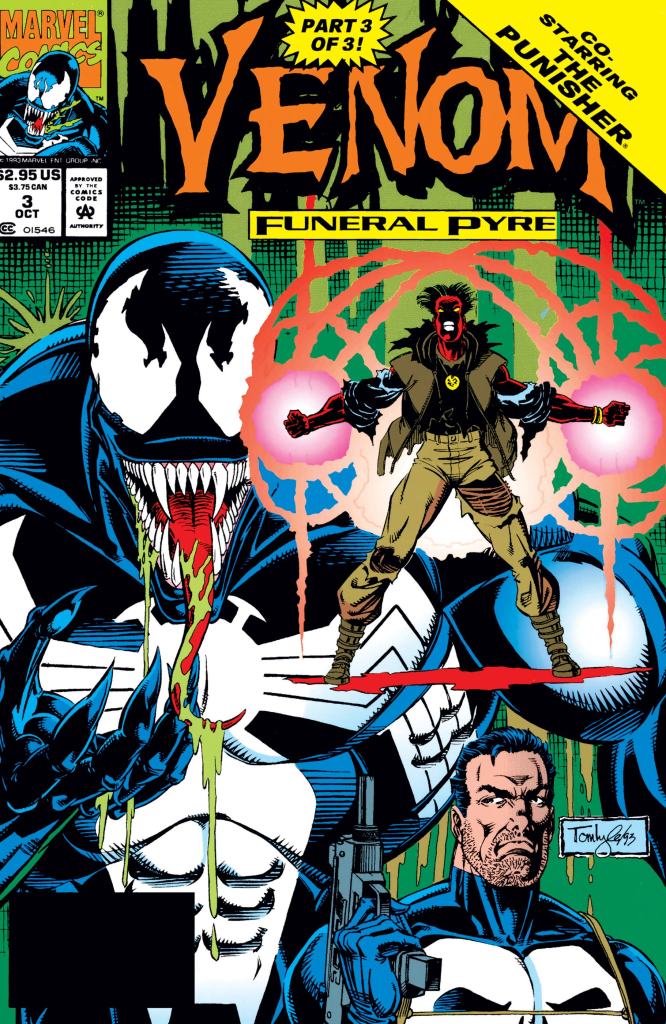
With those details laid down, here is a look back at Venom: Funeral Pyre #3, published in 1993 by Marvel Comics with a story written by Carl Potts and drawn by the late Tom Lyle. This if the final issue of the mini-series.
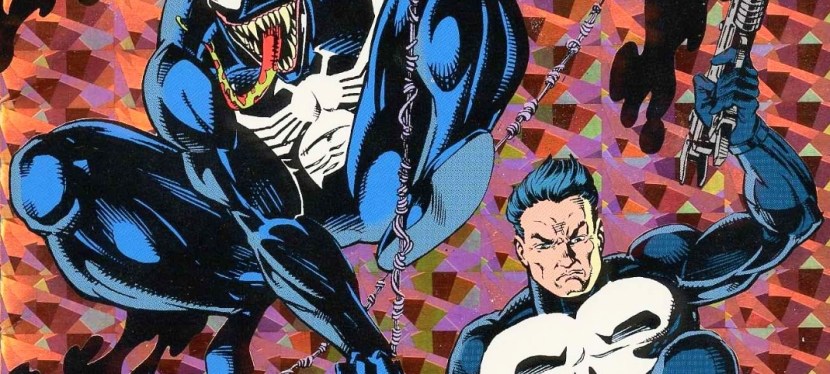
The cover.
Early story
The story begins inside a building with high-tech equipment from HYDRA. Gray Russel is no longer himself but as the red-skinned, highly radiated figure Pyre. He fires a microwave blast at Venom which hurts him so much. In response to Venom’s claim that he came to rescue him, Pyre reacts with rage telling the murderous man with the symbiote that he arrived too late which resulted in the forced killing of people during the gang violence on the streets of Oakland.
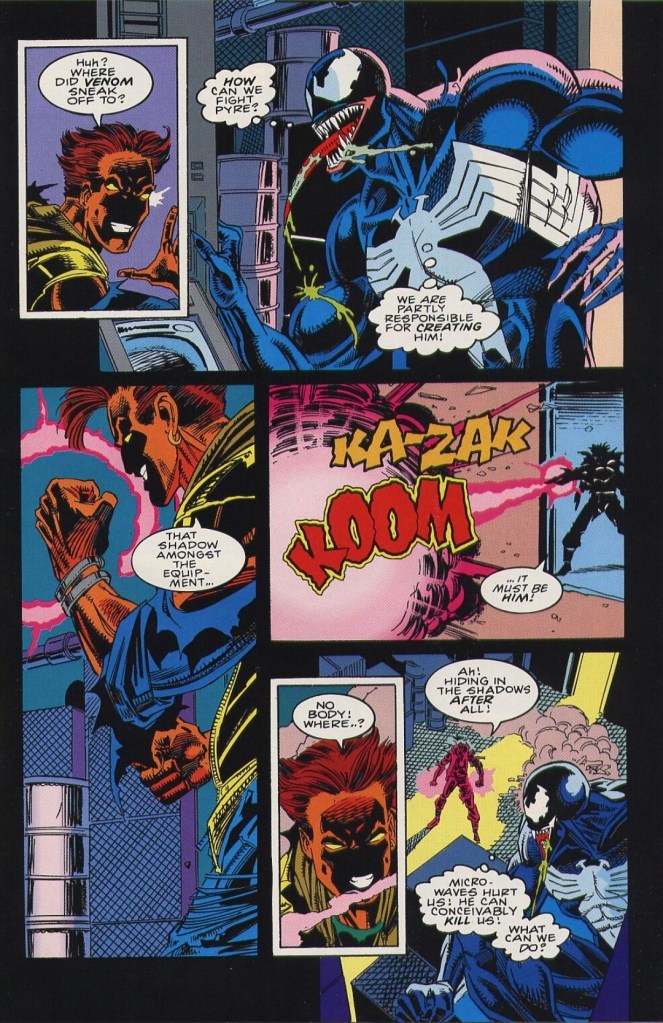
Being filled with pure rage, Pyre intends to burn Venom alive. Thinking that Pyre is distracted, the Punisher leaps to get a gun on the floor which causes the radiated person to fire a microwave blast at him. The Punisher takes cover behind a machine but notices the microwaves sparking off the metal.
Venom then takes advantage of situation…
Quality
This page shows Venom at a disadvantageous state with Pyre whose microwave blasts are more than enough to kill him.
As the conclusion of the mini-series, this comic book went all-out portraying what turned out to be the final conflict involving the murderous Venom, the vigilante Punisher and the energy-filled Pyre. As a result, the narrative strongly focused on the final conflict (note: stretched out to last several pages) and never bothered to look back at the people and activities on the city street.
That being said, you will get to see more of the two established Marvel figures struggling hard against an unexpected force of opposition who was previously an undercover news reporter who infiltrated a certain gang and sent a message (delivered by a young boy) that caught Eddie Brock’s attention. At this point, it is clear that Venom’s effort to rescue Gray (who became Pyre after using a super soldier chamber left behind by HYDRA) ended in total failure and finds himself facing someone who could kill him and his alien costume together.
If there is anything notable about this issue, it is the portrayal of Venom being highly disadvantaged and even vulnerable. There are no armed men with sonic weapons and high-tech equipment to bring Venom down but Pyre whose microwave blasts are deadlier than flame and sonic. In connection to the situation, Venom is not his aggressive self but a struggling figure who strives to survive and somehow find solutions during the heat of danger.
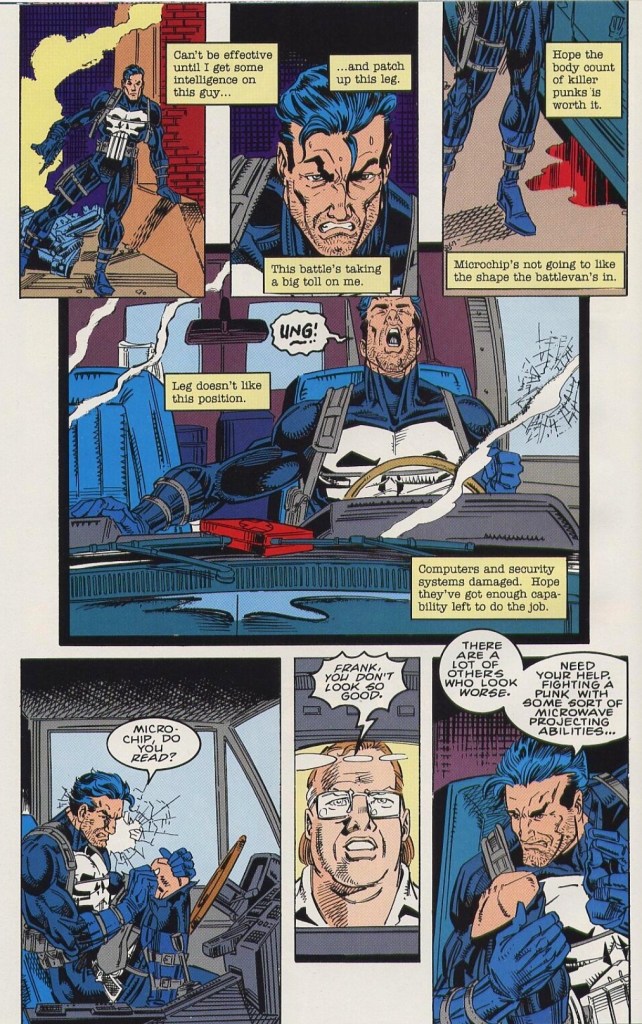
The Punisher, meanwhile, also struggled to survive but would simply not run away even though his chances of escape are much better. Instead, he focuses on actually eliminating Pyre without hesitation and Venom’s attempt to rescue Gray meant absolutely nothing to him.
More on Pyre, he is not really interesting nor was he ever engaging as the one powerful force of opposition that Venom and the Punisher must face. His being consumed by unrestrained rage and wielding so much power did not really raise the tension of the story. Had he eliminated the two Marvel figures who got in his way, what would Pyre do afterwards? Devastate the entire city of Oakland because he lost his identity as Gray and could not get over his involvement of taking other people’s lives while in the middle of gang activities? Would he proceed to San Francisco’s underground community and eliminate the people only because he blames Venom (note: Eddie Brock got involved with the underground people of San Francisco as seen in the Lethal Protector mini-series) for his failure of rescuing him? Pyre is nothing more than a throwaway comic book force of opposition.
From a visual standpoint, Tom Lyle once again pushed his creativity hard and showed some dynamic shots of spectacle here and there. At this stage, he proved to be very capable of visualizing Venom and the Punisher.
Conclusion
The Punisher refuses to give up and gets Microchip to assist him.
While issue #2 was a notable improvement over the first issue, Venom: Funeral Pyre #3 (1993) does not have much to offer in terms of engagement and entertainment. This is because it was crafted as a strict Venom-Punisher-Pyre conflict that provided spectacle and intrigue but ultimately ended up hollow. To see Venom at a huge disadvantage is interesting but did not add much weight to the plot. The Punisher was his usual self and in some ways overshadowed Venom for a while. Too bad there was not much space left for Venom and Punisher to fight each other again.
As the final issue of this mini-series, the story concluded with a whimper. Ultimately the Funeral Pyre storyline ended up as a diversion within the Marvel Comics shared universe that happened to attract Punisher, Venom and the gangsters of Oakland.
Overall, Venom: Funeral Pyre #3 (1993) is satisfactory.
Disclaimer: This is my original work with details sourced from reading the comic book and doing personal research. Anyone who wants to use this article, in part or in whole, needs to secure first my permission and agree to cite me as the source and author. Let it be known that any unauthorized use of this article will constrain the author to pursue the remedies under R.A. No. 8293, the Revised Penal Code, and/or all applicable legal actions under the laws of the Philippines.
Welcome back superhero enthusiasts, 1990s arts and culture enthusiasts and comic book collectors! Today we go back to the wild 1990s and explore a part of Malibu Comics’ Ultraverse through a tale of Freex.
Since after facing off with Contrary (who eventually became part of UltraForce) and her so-called school and students, Freex had been traveling far and long (refer to my previous Freex reviews here, here and here) and gained Old Man as a useful companion. Along the way, they encountered the unknown deep underground and even saw a powerful being. They even got to the city of Denver temporarily. As they went on, they found the path that led them back to civilization.
With those details laid down, here is a look back at Freex #15, published in 1994 by Malibu Comics with a story written by Gerard Jones and drawn by Scott Kolins. This is a flip-side comic book with Ultraverse Premiere #9 (1994) on the other side.
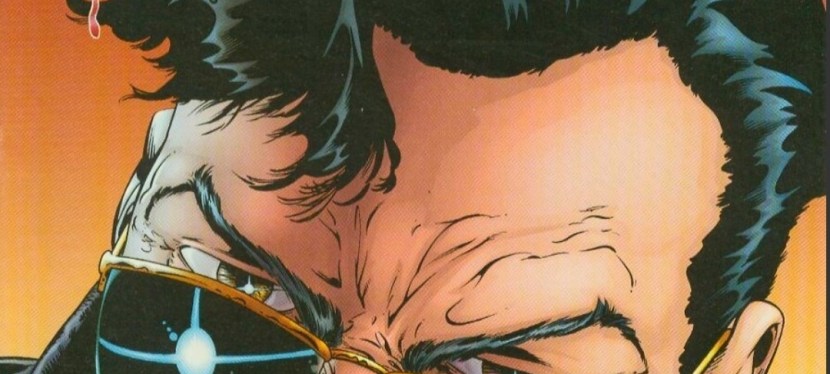
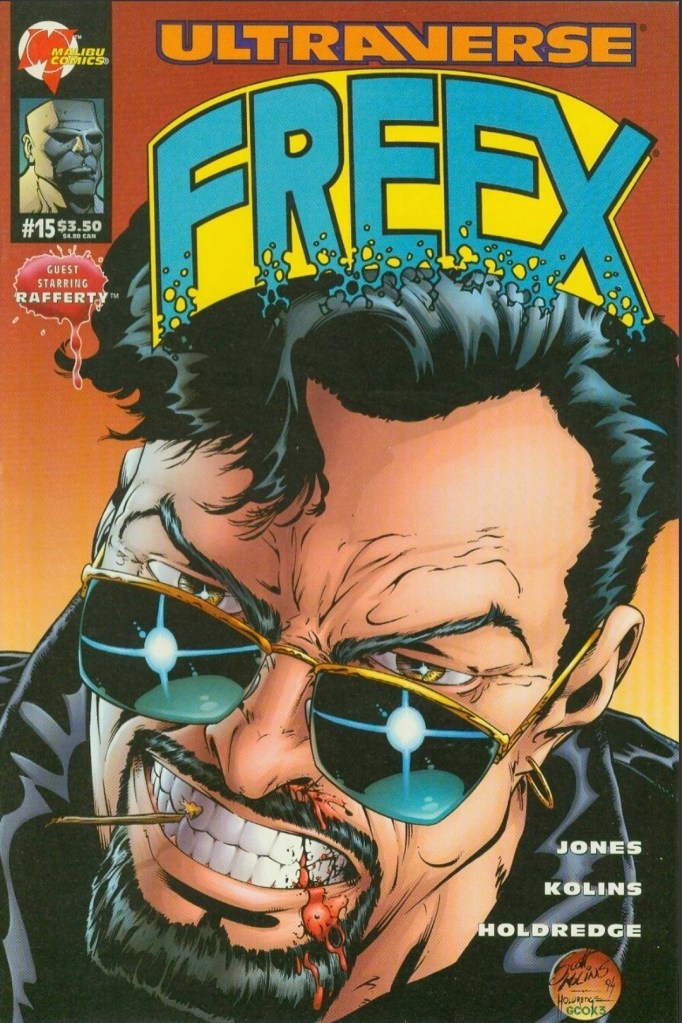
The cover.
Early story
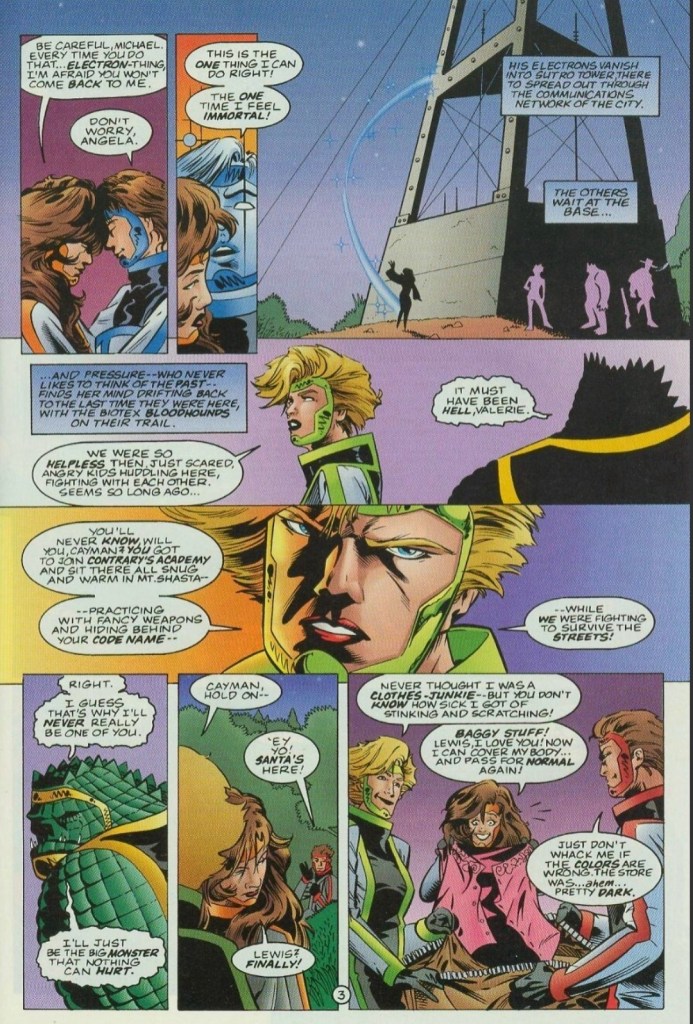
The story begins with Freex – composed of Plug, Sweet-Face, Pressure, Anything and new member Cayman – have been traveling for some time deep underground with Old Man. They find themselves back in San Francisco, the one city that brought them together. While still a long distance away from the city proper and there are no locals who could see them, the team cautiously move to a high communications tower. Michael/Plug uses his special ability to transform himself into electronic matter and makes his way through the communications network of the city to do something very important. Cayman meanwhile becomes the object of discussion between Pressure and Sweet-Face as he has yet to share with them details about himself.
As Cayman himself was part of Contrary’s academy and joined Freex recently, he has trouble gaining the trust of the others. After wearing new clothes that Lewis found, a guy suddenly appears to them. He introduces himself to them as Evan…
Quality
The very evil Rafferty monitoring Freex secretly and enjoying his advantage over them.
Considering what happened in the previous issues, this story feels like a breath of fresh air not only because of the new location the team got into but also because of strong twists that happened. Instead of going through fantastical encounters, Freex found themselves in situations that are more grounded with reality (within Ultraverse standards specifically) and more notably, the story emphasized crossover as Freex and Old Man encountered Firearm. The said crossover, quite cleverly, sets up Freex into a collision course with the serial killer Rafferty (who encountered The Strangers elsewhere within the Ultraverse). For the newcomers reading this, Rafferty is one of the most evil characters of the Ultraverse who has murdered a lot of people – including his own parents – and has developed tremendous hatred of Ultras.
The inclusion of Rafferty here also sheds light on the Freex’s past connection with the Night Man (click here and here). More notably, the said serial killer turned out to be so resourceful and totally obsessed with murdering people with special abilities, he became a formidable force towards Freex. This leads to a pretty powerful and twisting conclusion that must be seen.
Conclusion
The gang by the tower.
With a good amount of intrigue, characterization spectacle, strong dialogue and the element of crossover, Freex #15 (1994) is a pretty engaging comic book to read. The biggest feature here is having Freex in a conflict with a very obsessed killer who not only hates Ultras but also has an extensive record of murdering many people over a long period of time. In my view, the Freex-Rafferty conflict was nicely structured and it added depth to the plot. What happened in the end of this comic book should resonate with dedicated fans of Freex.
Disclaimer: This is my original work with details sourced from reading the comic book and doing personal research. Anyone who wants to use this article, in part or in whole, needs to secure first my permission and agree to cite me as the source and author. Let it be known that any unauthorized use of this article will constrain the author to pursue the remedies under R.A. No. 8293, the Revised Penal Code, and/or all applicable legal actions under the laws of the Philippines.
Welcome back superhero enthusiasts, 1990s arts and culture enthusiasts, Marvel Comics fans and comic book collectors! Today we go back to the year 1993 and explore a part of Marvel Comics’ universe through the first-ever limited comic book series featuring one of Marvel’s most iconic supervillains – Venom.
Previously, I wrote about Venom with his appearances in What If comic books (click here and here) as well as in issues of Venom: Lethal Protector (click here and here). Venom also appeared in the disappointing crossover comic book Spider-Man Meets Spider-Man 2099.
Moving back to the year 1993, the Venom: Lethal Protector limited series ended and Marvel went on to release a 2nd limited series composed of three issues complete with an all-new creative team. That series was Venom: Funeral Pyre and the most notable thing is that Venom gets to be with the Punisher (read my other retro reviews that include the character here, here, here and here).
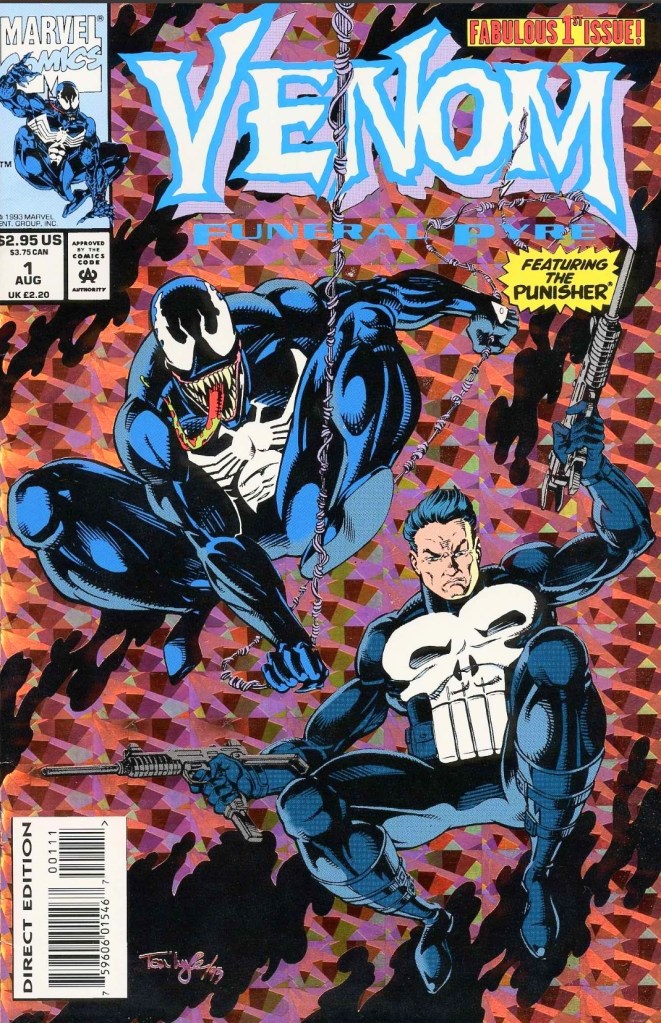
With those details laid down, here is a look back at Venom: Funeral Pyre #1 published in 1993 by Marvel Comics with a story written by Carl Potts and drawn by the late Tom Lyle.
The cover.
Early story
The story begins on the streets of Oakland, California. There, a young guy named Gray Russell watches gang members severely beat up another guy which disturbs him deeply. He is part of the gang. A short time later, he rides with the gang in a car which hits a man (who managed to have his young nephew move out of harm’s way).
Somehow the man survived and moves to another direction deliberately to lure the gang away from his nephew. As the gangsters move towards a local building, Gray separates from his harsh companions to find a phone booth. Gray finds Calvin (the nephew of the man who got hit) nearby and decides to comfort him. From a distance, they heard the gangsters beat Calvin’s uncle to death.
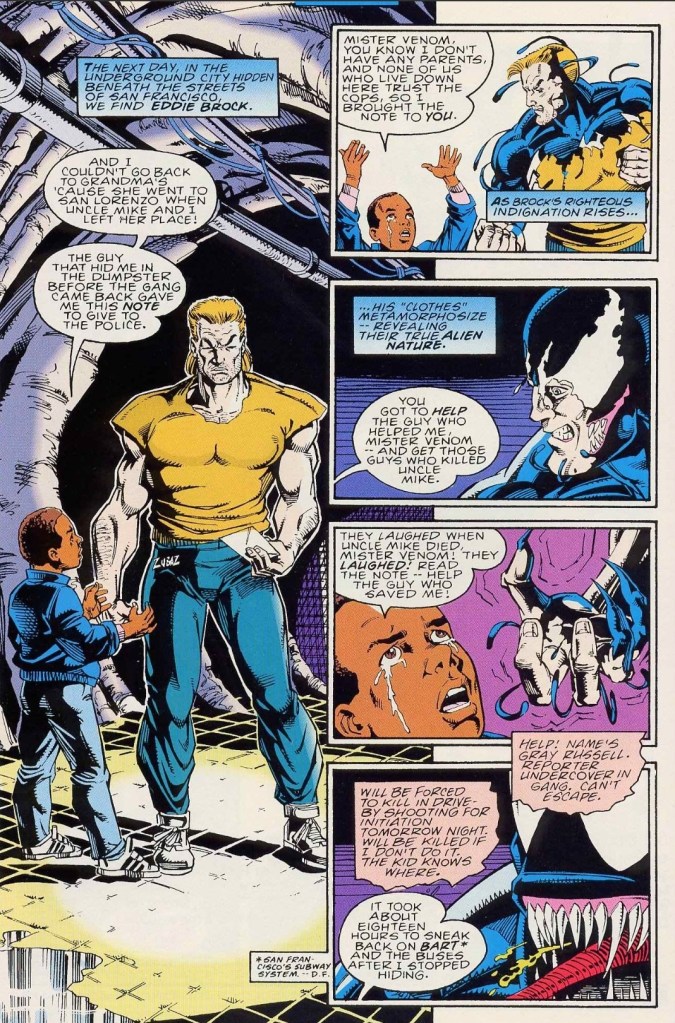
The next day in the underground city beneath San Francisco, Calvin meets Eddie Brock and hands him a note meant for the police. As Calvin reveals more details, Eddie gradually turns into Venom with his alien costume covering up his body. After learning of the death of Calvin’s uncle and hearing the young boy’s plea for help for Gray (an investigative reporter in secret within the gang), Venom agrees to help him as it is their mission to save the innocent and destroy the guilty…
Quality
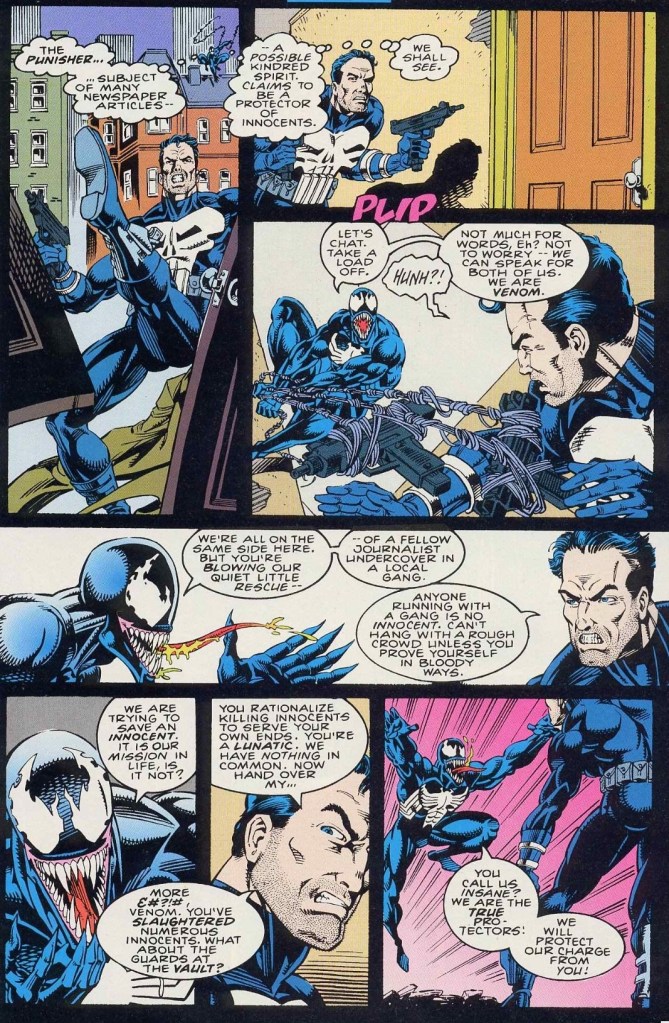
Punisher and Venom’s first-ever encounter with each other.
I want to start first the with the overall presentation crafted by the Potts-Lyle creative duo. In terms of story and setting, this comic book has a very strong urban crime vibe which is not a surprise given the fact that Carl Potts wrote lots of stories of the Punisher and his personal war against criminals. That being said, the tone is very different compared to what was shown in Venom: Lethal Protector and other Venom tales that got published before this comic book. Very clearly, this story is dark, gritty and even disturbing to read due to the subject matter of crime and senseless violence caused by people who are obsessed with violence. The fantasy elements of Venom: Lethal Protector are unsurprisingly absent here.
Carl Potts’ take on Venom’s personality is technically an extension of what was established previously. Venom, who is truly a murderer on the loose, continues to live with his very distorted code by helping the innocent by means of using violence and death on others he personally views as guilty. His getting involved in the turf of crime here is, however, a fresh approach on the super villain now acting “heroic” helping Calvin who lost his uncle. Being a former journalist himself, Eddie Brock “relates” with the investigative journalist involved with the gang.
The other major character – the Punisher – is his typical self in this story. He gets involved in the conflict in Oakland not purposely but accidentally as he was just passing by in his weapons-filled van as he heard the local police communication on local crime. The only thing notable about the way the Punisher is portrayed here is his first-ever interactions with Venom which is a crossover scene filled with a decent amount of hard action.
Gray, the investigative journalist, is presented here as technically the third major character of the story. In some ways, he even overshadows Venom and the Punisher in key parts of this comic book. He is not really an interesting character himself but there are some interesting Marvel universe details shown from his personal memories. What is clear about this uninteresting character is that the creative team planned something with him in a key role within the core concept of this mini-series.
As for the plot itself, it clearly has a dark and gritty concept of street crime in 1990s Oakland which itself plays a big part of the build-up of the story and the eventual crossover between Venom and the Punisher. The problem is that the build-up has an uninteresting character with Gray involved and there is a lot of exposition to go through before the Venom-Punisher encounter.
The encounter between Venom and the Punisher here came with the superhero comics crossover trope of the players misunderstanding the situation and each other, and getting into a conflict very early on. Both characters have their respective obsessions and so-called codes of purposes, which predictably leads them into conflict as they stayed hard-headed towards each other. While it is flawed, the Venom-Punisher crossover here is the highlight as well as the relief from having to read all the exposition and build-up.
Conclusion
A scene like this could inspire Black Lives Matter terrorists, SJWs, woke activists and North American socialists to become violent and cause havoc around America.
Venom: Funeral Pyre #1 (1993) is a flawed comic book that happens to highlight the Punisher and Spider-Man’s greatest nemesis of the time. It delivered on its promise of showcasing the two characters – a cold-hearted anti-crime vigilante and an alien costume-equipped murderer – in a crossover but the pay-off was barely enough when you take into account the build-up, the exposition and the involvement of the uninteresting third player named Gray. Compared to what was shown in Venom: Lethal Protector, this comic book clearly has an urban crime flavor which Carl Potts strongly implemented. As for the art, Tom Lyle showed he is really good in visualizing Venom, the Punisher and street gang wars.
Overall, Venom: Funeral Pyre #1 (1993) is serviceable. Definitely this is not the fabulous 1st issue described on the foil cover.
Disclaimer: This is my original work with details sourced from reading the comic book and doing personal research. Anyone who wants to use this article, in part or in whole, needs to secure first my permission and agree to cite me as the source and author. Let it be known that any unauthorized use of this article will constrain the author to pursue the remedies under R.A. No. 8293, the Revised Penal Code, and/or all applicable legal actions under the laws of the Philippines.
Welcome back superhero enthusiasts, 1990s arts and culture enthusiasts, Marvel Comics fans and comic book collectors! Today we go back to the year 1993 and explore a part of Marvel Comics’ universe through the first-ever limited comic book series featuring one of Marvel’s most iconic supervillains – Venom.
In my previous retro review, the core concept of the Lethal Protector limited series started to really take shape as issue #3’s plot got more intriguing and interesting to read while emphasizing other powerful forces Venom himself simply could not easily overwhelm. It is also the issue in which Venom’s past act of a certain murder comes to haunt him. The problem I had with that comic book was the creative team’s dramatization of Eddie Brock’s personal history which essentially ruined whatever mystery Venom had. Eventually, the comic book ended with Venom getting into trouble again.
With those details laid down, here is a look back at Venom: Lethal Protector #4 published in 1993 by Marvel Comics with a story written by David Michelinie and drawn by Ron Lim.
The cover.
Early story
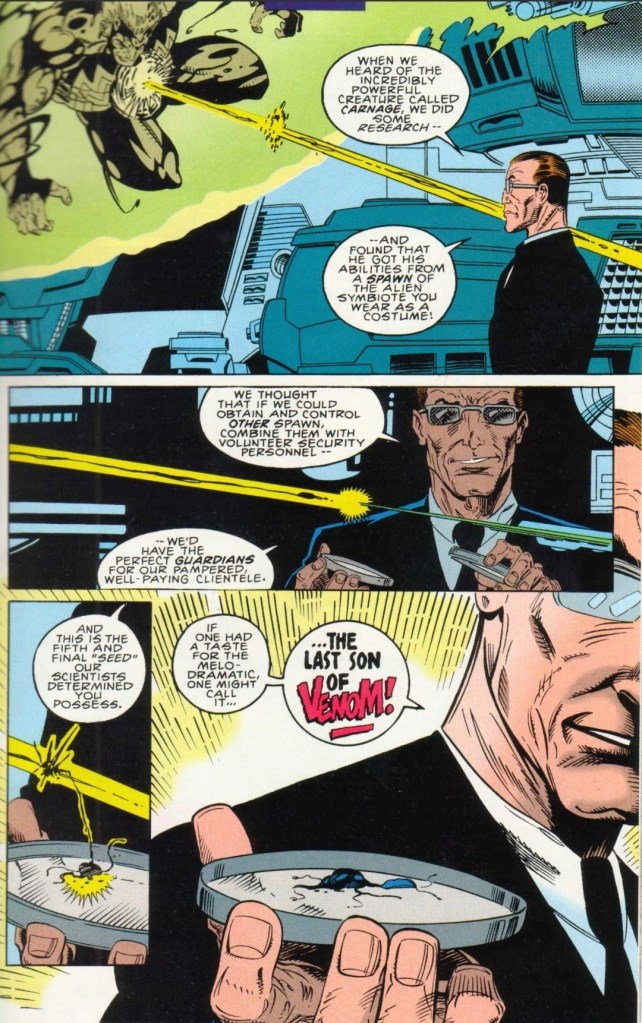
The story begins inside a high-tech facility in the Mojave Desert. Inside, Venom is in captivity floating off the floor with high-tech machines keeping him prisoner. He is a captive of the Life Foundation and they have successfully extracted another spawn from Venom’s symbiote which causes tremendous pain on the part of Eddie Brock. It turns out, a total of five “seeds” have been extracted and the organization has big plans with them.
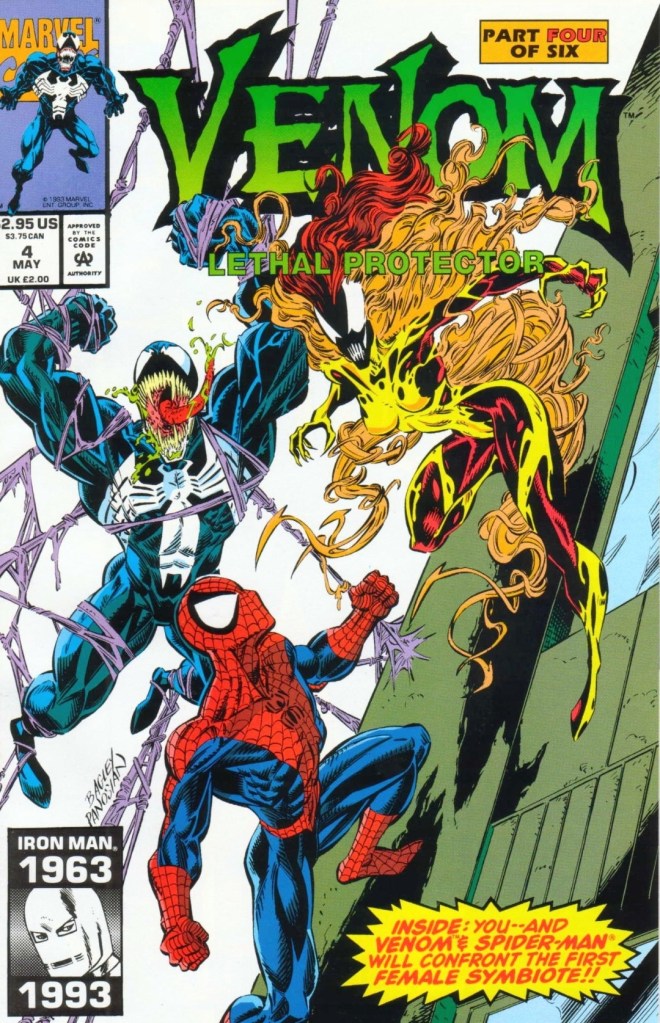
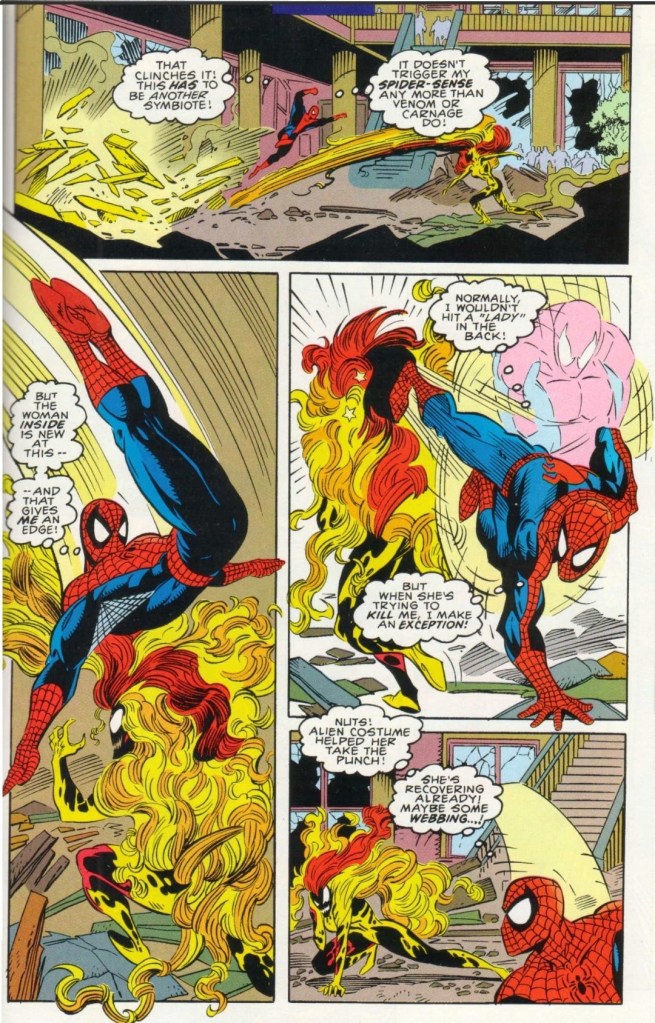
Over at Sta. Cruz in California, Spider-Man spends some of his precious time to stop some local criminals from causing anymore danger to the people. During his telephone talk with Mary Jane, he admits that has not been able to track Venom down but he has a new lead about weird creatures that have been spotted locally. A short time later, Spider-Man arrives at a shopping mall where tremendous damage of property have happened. As soon as he catches a lady and prevents her from hitting the pavement, he is shocked to see a long-haired woman wearing a living alien costume with features that are so similar to that of Venom. The symbiote-wearing woman (Scream) tells Spider-Man directly that breaking him in half will make the “little exercise” a complete success…
Quality
Spider-Man takes on the “female Venom”
To start with what is very obvious and clear, this story has Spider-Man overshadowing Venom in terms of literary presence as the plot has the titular character limited to captivity under the tight grasp of the Life Foundation. Given Spider-Man’s previous appearances in this limited series serving as a convenient tool for exposition, you will easily feel the Amazing Spider-Man monthly series’ vibes taking over this comic book’s narrative as Marvel’s icon became the protagonist of the story complete with spectacle and problem solving that drive the plot forward. This is not surprising as David Michelinie was already the lead writer of the Amazing Spider-Man monthly series and it only makes sense to shift the focus on the famous webslinger since his deadliest enemy (who has this very distorted belief about protecting the innocent and keep on murdering people he finds antagonistic) could not contribute much to the story while in captivity.
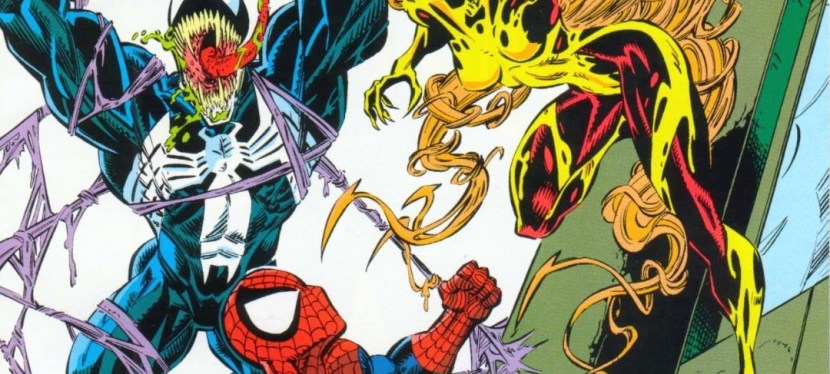
As reflected in the nice cover of this comic book, it is also Spider-Man who faces off with the “female Venom” herself Scream which leads to yet another Spidey-versus-symbiote villain battle but with a catch – Scream is simply inexperienced in battle and does not have any real strategy to deal with New York’s webslinger. That battle noticeably does not last very long and the short amount of superhero spectacle here paved the way for the creative team to make Spider-Man sneak into enemy territory and closer to Venom.
In terms of visual quality, I can say that things went way down as Ron Lim replaced Mark Bagley here. Lim’s art style of drawing people has this generic aesthetic on the characters’ faces – Mary Jane and Eddie Brock are barely recognizable. While Lim’s artistic take on Venom is clearly a big letdown compared to Bagley’s Venom (note: always looking menacing and unique), he ironically did a decent job visualizing Scream. Lim’s most dynamic shots of superhero action lacked impact. Regardless, Lim’s art is not so appealing compared to Bagley’s. Also it is quite noticeable that Lim drew Venom to be much bulkier with exaggerated muscles.
Conclusion
The most notable concept in this comic book.
Considering all the details I mentioned above, Venom: Lethal Protector #4 (1993) is technically an Amazing Spider-Man comic book that just so happens to have Venom much less significant in this particular part of his own limited series. There really was not much room for the creative team use as far as Venom is concerned. Of course, this is all part of a build-up heading into the final two parts of this limited series and it is obvious that Venom would become prominent again. This comic book’s most notable feature was its concept about the Life Foundation extracting seeds from Venom’s living costume but considering what happened, there was not much room to really build-up on the idea that more symbiote-wearing people will emerge. Scream was essentially a warm-up. Ultimately, Spider-Man fans will have a lot to enjoy here while Venom fans will not have much to enjoy.
Overall, Venom: Lethal Protector #4 (1993) is serviceable.
Disclaimer: This is my original work with details sourced from reading the comic book and doing personal research. Anyone who wants to use this article, in part or in whole, needs to secure first my permission and agree to cite me as the source and author. Let it be known that any unauthorized use of this article will constrain the author to pursue the remedies under R.A. No. 8293, the Revised Penal Code, and/or all applicable legal actions under the laws of the Philippines.
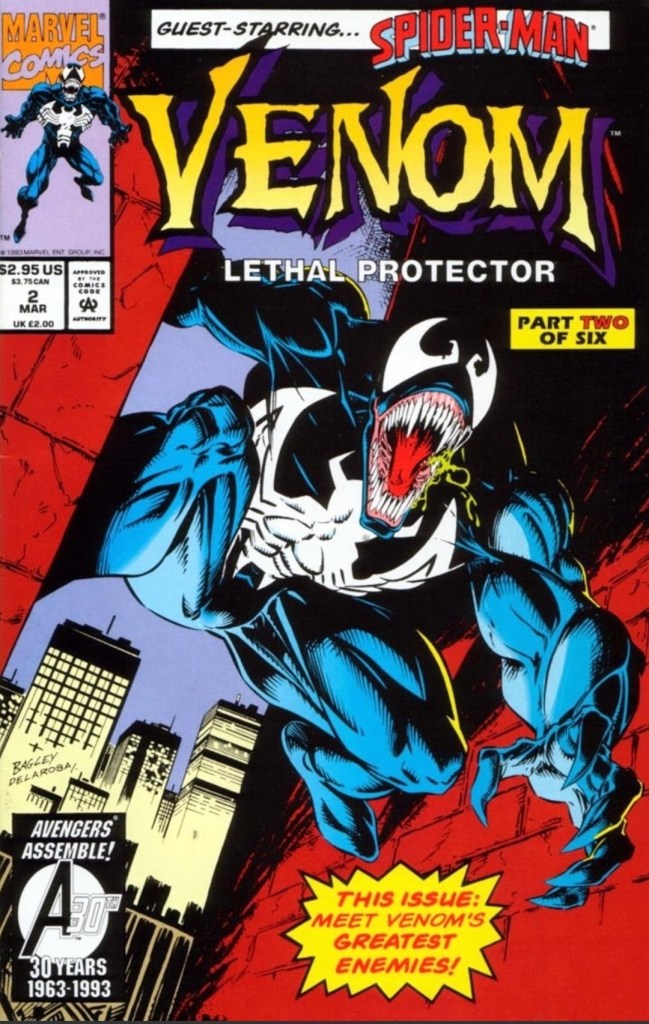
Welcome back superhero enthusiasts, 1990s arts and culture enthusiasts, Marvel Comics fans and comic book collectors! Today we go back to the year 1993 and explore a part of Marvel Comics’ universe through the first-ever limited comic book series featuring one of Marvel’s most iconic villains – Venom.
In my previous retro review, Venom discovers a long lost section of San Francisco that fell deep underground. Even though it is cut off from the resources and fresh air of modern San Francisco, the lost city section is filled with homeless people and social outcasts. Even though he helped the city dwellers by defeating the two armed mechs (employed by a powerful organization who oppose the city dwellers and are in pursuit of something related to San Francisco’s park), Venom still gets rejected by the so-called council. This only led him to returning to the surface not knowing that he is being targeted by a certain group.
With those details laid down, here is a look back at Venom: Lethal Protector #3, published in 1993 by Marvel Comics with a story written by David Michelinie and drawn by Mark Bagley.
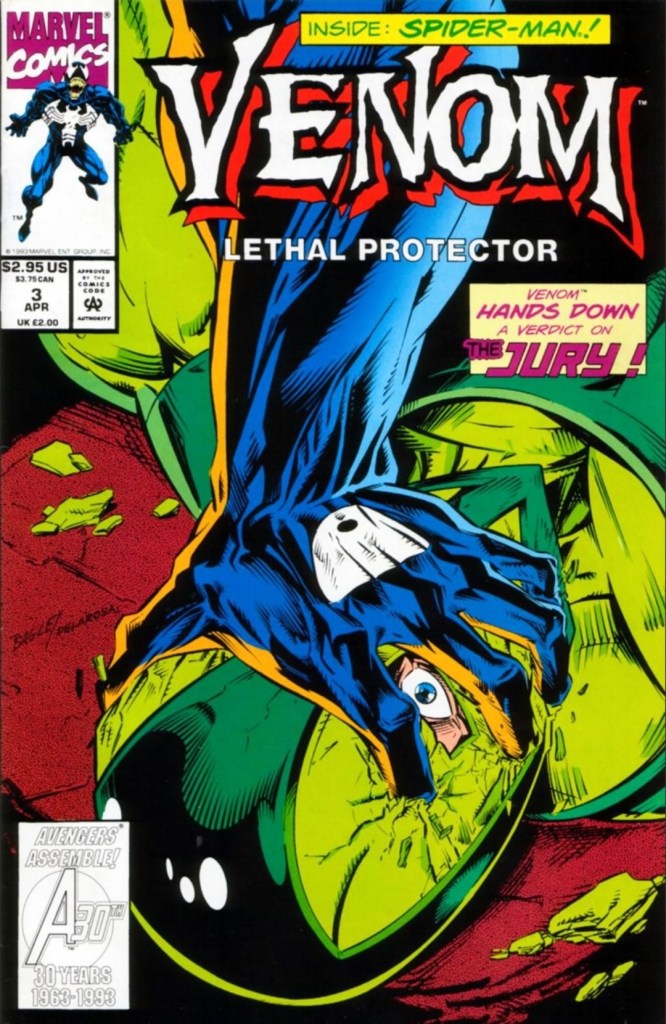
The cover.
Early story
The story begins with Venom suffering from a sonic blast while being restrained by one of the armed members of the group called The Jury. Their leader (who wears a suit and necktie) introduces himself as Orwell Taylor and he addressed Venom as Mr. Brock. It turns out Taylor spent lots of time and resources researching everything about Brock and the alien costume. More shockingly, The Jury’s leader reveals that he lost his son Hugh years ago due to Venom’s arranged killing of him as he escaped from his prison cell in the federal prison called The Vault. Hugh Taylor is the first man Venom killed when he escaped.
Venom responds by say that he and his symbiote did not want to hurt anyone. This provokes Orwell Taylor into anger and he orders The Jury to kill Venom. Due to the lengthy explanations of Orwell Taylor, Venom managed to recover and regain strength which he uses to free himself and throw one Jury member to another causing quick chaos.
After punching another Jury member, Venom then moves out of the alley and away from Taylor and his team…
Quality
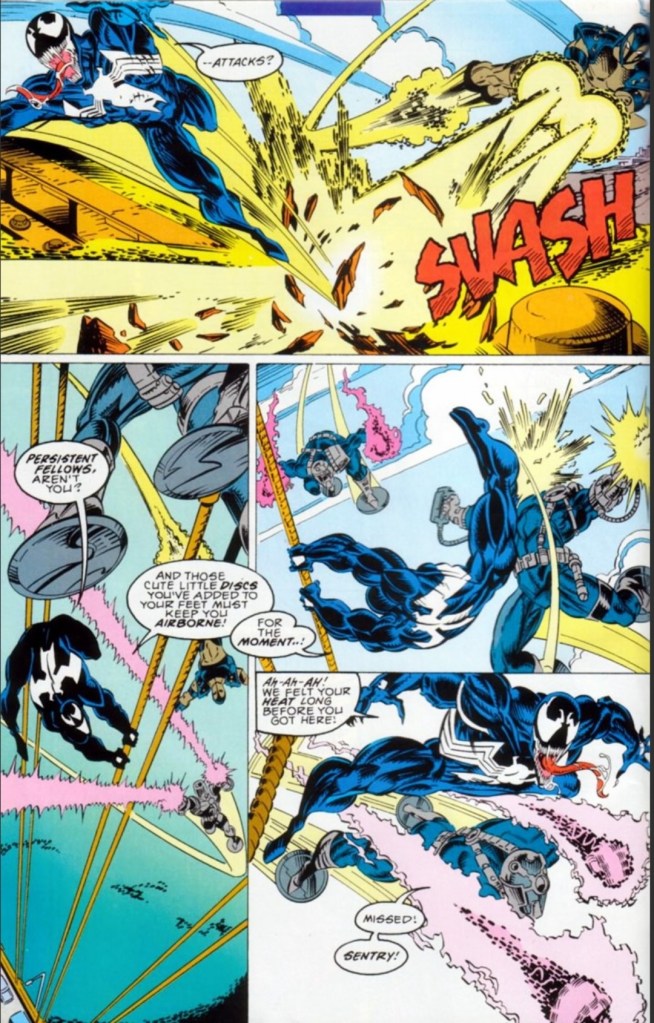
Very clearly, The Jury is a very formidable force of opposition. Their battle with Venom here comes with a lot of spectacle.
In terms of storytelling, this one is another improvement over issue #2 (which itself is an improvement over issue #1) as the plot got more interesting and even intriguing. For one thing, I like the fact that David Michelinie recalled Venom’s murderous escape from prison told way back in Amazing Spider-Man #315 (1989) and came up with the establishment of a very angry powerful father who formed the dangerous cybernetic team called The Jury. In a rather symbolic way, this comic book shows how Venom’s past comes back to haunt him and creatively, the battles between Venom and The Jury here are packed with a lot of action and visual dynamism delivered by Mark Bagley. The irony is that The Jury itself is not the main antagonist of this limited series as they are clearly presented to be a recurring force of opposition within Spider-Man’s realm in Marvel Comics’ shared universe of the time.
Still on the plot, the sinister organization hounding the dwellers of the lost city was revealed to be the Treece group whose leader is pursuing something very valuable to feed his greed. Still, even though this is already the third issue, the Treece organization’s presence is very subtle and as the force of opposition towards Venom, they are outclassed by The Jury.
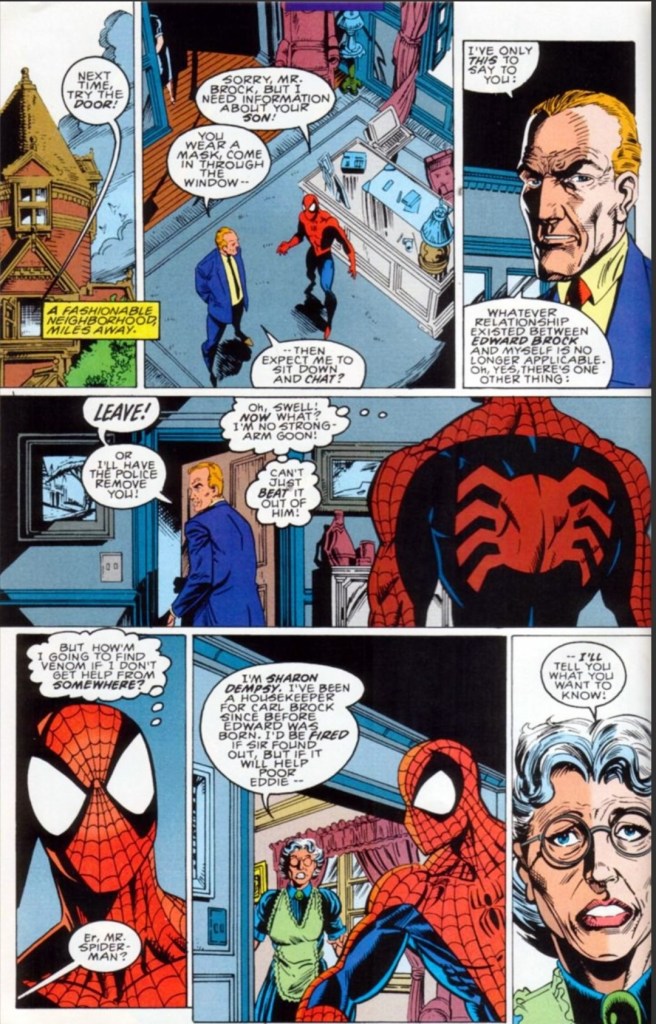
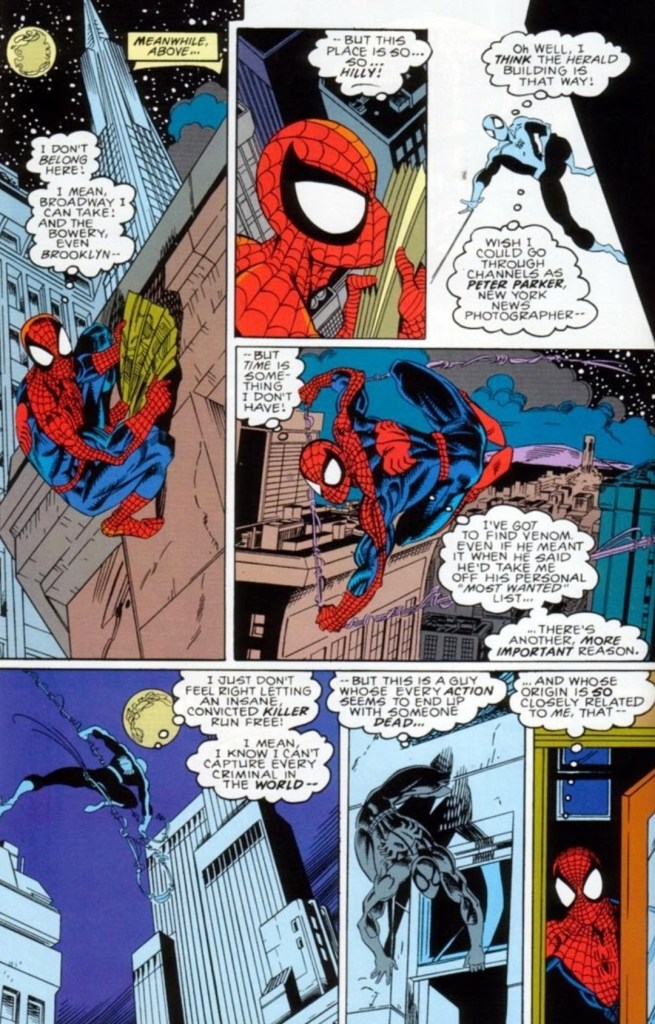
As in the previous issue, Spider-Man got a good share of the spotlight but this one is even more limiting which should delight Venom fanatics who complained about Marvel’s icon overshadowing their guy with the symbiote. Spider-Man serves mainly as a tool for exposition as the creative team showed images from the past of Eddie Brock with his father (whom Spider-Man approached for answers).
The problem here is that showing flashbacks from the past and explaining how Eddie Brock became bitter and sinister as a result of receiving almost no affection from his father ruins the mystery of Venom as a character. During the time of Todd McFarlane drawing Amazing Spider-Man comics and the early Venom tales, the mystery of Eddie Brock’s past added to the intrigue of Venom and his quick rise as the deadliest villain Spider-Man ever faced. I understand that this limited comic book series had Venom as the protagonist who was in high demand among readers of the time but for me the creative team went way too far emphasizing Eddie Brock’s past.
Nothing changes the fact that Eddie Brock aided by the alien costume is a murderer who happens to have previously been a prolific print media journalist whose career got ruined by Spider-Man which in turn led him to a downward spiral and eventually to bonding with the symbiote that once bonded with Peter Parker. The flashbacks were pointless and if there really was an attempt to humanize Eddie Brock and make him sympathetic to readers, the creative team clearly failed.
Conclusion
Spider-Man with Eddie Brock’s father in California.
Venom: Lethal Protector #3 (1993) is a mixed bag. Its plot is clearly more intriguing and more interesting to read while there was enough creative space to show The Jury as a powerful force of opposition which is the result of Venom’s murder of Hugh Taylor (read: Amazing Spider-Man #315) while making a prison escape. The spectacle of the battle between Venom and The Jury must be seen! However, the creative team’s move to dramatize Eddie Brock’s past using flashbacks back-fired in my opinion and ultimately they destroyed whatever mystery was left behind Venom. As a protagonist, Venom has no appeal whatsoever and his portrayal here only reminds me that he works best as an antagonist opposite Spider-Man. Venom as a hero for those he perceived to be innocent and helpless remains forced and unconvincing.
Overall, Venom: Lethal Protector #3 (1993) is satisfactory.
Disclaimer: This is my original work with details sourced from reading the comic book and doing personal research. Anyone who wants to use this article, in part or in whole, needs to secure first my permission and agree to cite me as the source and author. Let it be known that any unauthorized use of this article will constrain the author to pursue the remedies under R.A. No. 8293, the Revised Penal Code, and/or all applicable legal actions under the laws of the Philippines.
Welcome back superhero enthusiasts, 1990s arts and culture enthusiasts, Marvel Comics fans and comic book collectors! Today we go back to the year 1993 and explore a part of Marvel Comics’ universe through the first-ever limited comic book series featuring one of Marvel’s most iconic villains – Venom.
In my previous retro review, Eddie Brock returned to his hometown of San Francisco following the events of Amazing Spider-Man #375 (1993). Living with his very distorted belief of protecting the innocent by doing unrelenting acts of violence on others, he begins to get involved with helpless people who happened to be hounded by agents of a certain private organization that wields power. Along the way, Spider-Man arrives in the city find Venom.
With those details laid down, here is a look back at Venom: Lethal Protector #2, published in 1993 by Marvel Comics with a story written by David Michelinie and drawn by Mark Bagley.
The cover.
Early story
The story begins deep underneath the city of San Francisco. Venom, who is caught by the large mechanical fist of a walking mech (piloted by a man working for Roland Treece’s organization), finds himself on the deeply buried section of the city and around them are vagrant people who settled and became residents of a local society that the rest of America does not even know exists.
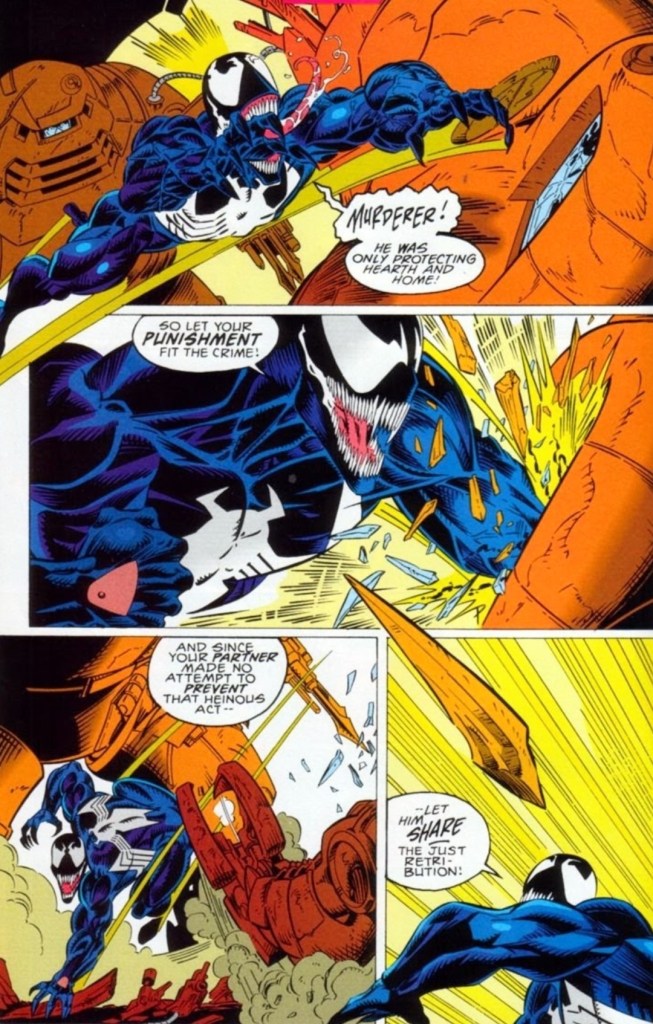
As the local residents caught the attention of the pilot, Venom breaks free by smashing the mechanical fist into pieces. Another mech suddenly jumps into place near the first one. In response to the first mech’s sudden killing of a local resident (who was armed with a shotgun), Venom jumps to it and kills the pilot inside by punching into the cockpit. Venom then grabs a long sharp object and kills the pilot of the other mech with it.
While the locals were hostile and afraid of Venom, the other people (who were assisted on the surface by Venom) come to support him and tell their fellow underground residents that he is not their enemy. One of the local council members stated that a meeting at the council hall will be held and Venom will attend it…
Quality
With exposition in mind, Spider-Man here does most of the detective work. Understandably, he is not involved with the superhero spectacle.
Compared to issue #1, this story has a more interesting setting which is the buried and forgotten section of San Francisco which was the result of the 1906 earthquake. Showing that the lost section has a local population composed of homeless people and those who reject the modern society above was a bright idea nicely executed by the Michelinie-Bagley team as it added some depth into Marvel Comics’ own version of San Francisco.
It was also in the underground city and with the residents where we get to see Venom do his own distorted acts of heroism backed by killing, and see how he fared when trying to win the trust of the locals whose members include those who read about him in the news and those who completely know nothing about him.
Through his interactions with the underground people, Eddie Brock is portrayed to be a bit more human compared to what happened in issue #1. For a man who has gotten very used to using extreme forms of violence and committing multiple acts of murder, it is surprising to see Brock looking and acting more civil in the presence of Americans (and perhaps illegal immigrants) who settled deep underground and established their own rules (note: Eddie Brock does not care about rules while having the alien costume). Still, you will see Venom engage in violent superhero action and even do a bit of detective work.
As with the previous issue, the iconic Spider-Man got a good share of the spotlight in the story as he searches for details about Venom which leads him to finding his rival’s estranged father. Spider-Man’s presence here is noticeably lessened compared to issue #1 and his own search for answers creatively served as exposition. Don’t expect to see any superhero spectacle from Spider-Man.
Without spoiling details and names, I should state that this comic book marks the debut of a ream of armed mercenaries led by a powerful man who lost a son because of what Venom did in Amazing Spider-Man #315 (1989).
Conclusion
The violent nature of Venom displayed.
Venom: Lethal Protector #2 (1993) is a marginal improvement over the first issue in terms of storytelling and setting. Part of the big build-up that happened in issue #1 started to get paid-off in this comic book which allowed for the plot to move forward at a more satisfying pace. Venom and Spider-Man share the spotlight again, but this time the edge goes to the black-wearing murderer who also has the benefit of being part of the superhero spectacle here. At this point of the mini-series, Venom is not only facing elements of the Treece organization (which has been organizing something that could impact San Francisco and its people) but also a new force of opposition that is related to something he did a few years prior. That being said, Venom is first and foremost a murderer that Marvel wanted to make big money out of.
Overall, Venom: Lethal Protector #2 (1993) is satisfactory.
Disclaimer: This is my original work with details sourced from reading the comic book and doing personal research. Anyone who wants to use this article, in part or in whole, needs to secure first my permission and agree to cite me as the source and author. Let it be known that any unauthorized use of this article will constrain the author to pursue the remedies under R.A. No. 8293, the Revised Penal Code, and/or all applicable legal actions under the laws of the Philippines.
Welcome back superhero enthusiasts, 1990s arts and culture enthusiasts, Marvel Comics fans and comic book collectors! Today we go back to the year 1993 and explore a part of Marvel Comics’ universe through the first-ever limited comic book series featuring one of Marvel’s most iconic villains – Venom.
To put things in perspective, the origin of Venom started within the events of the 1980s series Secret Wars which took place in a far-away planet. As a result of that series, Spider-Man returned home wearing the alien symbiote as a costume which turns out to have a mind of its own. After Spider-Man successful separate himself from the symbiote (again) using the loud bells of a church, the living costume eventually found a desperate Eddie Brock and bonded with him to form Venom. In the late 1980s comics of Amazing Spider-Man, Venom became the deadliest enemy Spider-Man ever faced.
Going into the early 1990s, Venom’s popularity continued to grow tremendously. He became one of Marvel’s most popular non-hero type of characters and helped sell a lot of comics for the publisher. Knowing they had something to sell, Marvel approved a 6-issue limited series showcasing Venom. It was also the most anticipated comic book among collectors right after DC Comics killed Superman with Superman #75 (1993).
With those details laid down, here is a look back at Venom: Lethal Protector #1, published in 1993 by Marvel Comics with a story written by David Michelinie and drawn by Mark Bagley.
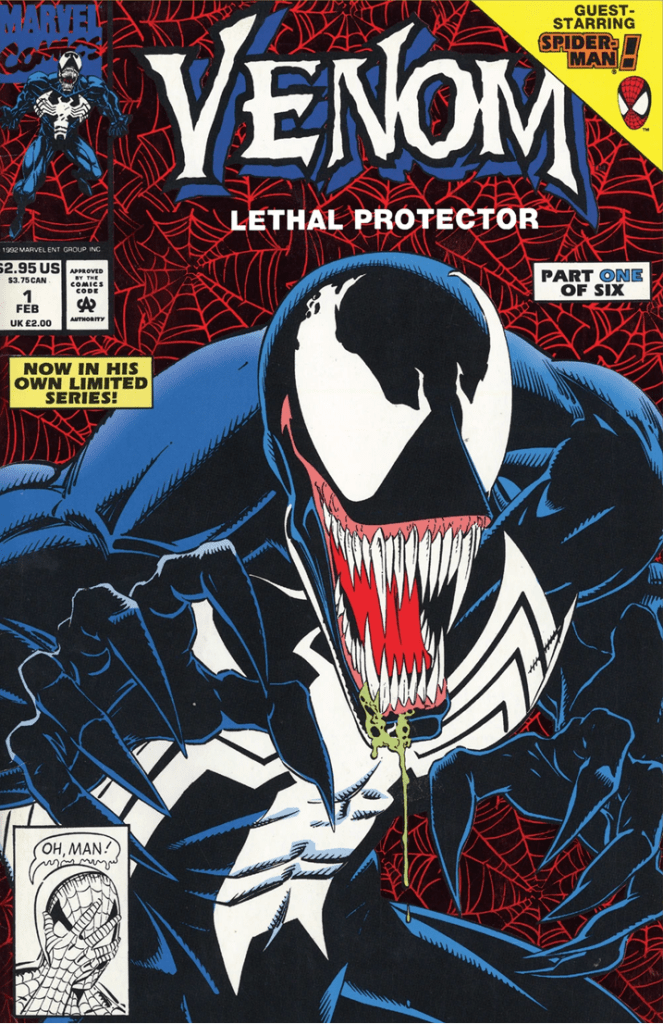
The cover.
Early story
The story begins in San Francisco, California. Deep within the city, a man cornered a lady at the dead end of an alley. Just as he was about do something bad to her, Venom leaps in at them. Totally surprised, the man was easily grabbed by Venom who lifted him and hit the wall bodily. Using his costume, Venom then chokes the man to death through the mouth and nose. Venom then picks up the lady’s purse and gives it to her. As soon as Venom leaves, the shocked lady runs away screaming.
Venom swings and leaps as he travels through the city. While traveling, Eddie Brock tells his living costume that while their hatred towards Spider-Man got reconciled a bit, the said superhero also helps the innocent. Eddie then reveals that he was born in San Francisco and they can start a new life together in it. Secretly, Venom turns into Eddie Brock in his civilian form. As Brock walks down the sidewalk, police officers nearby recognize him. It turns out. Eddie Brock was listed by police as a wanted person…
Quality
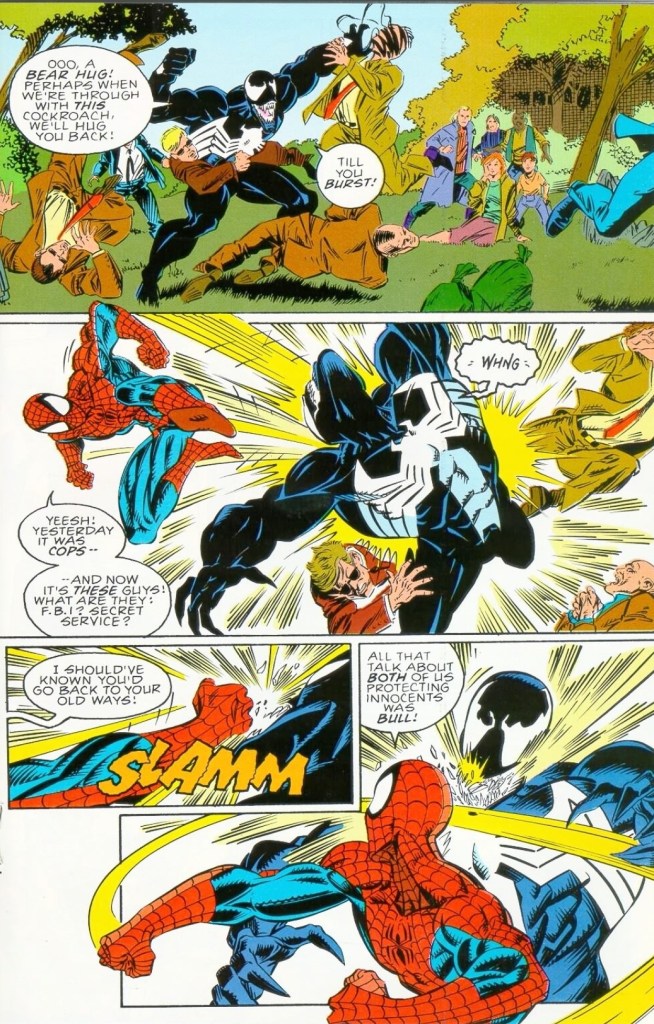
Spider-Man and Venom face each other unexpectedly.
Focusing on the plot, this story took place after the events in Amazing Spider-Man #375 (1993) which was released AFTER this particular comic book. As a standalone Venom story, this one clearly portrays him more of a vigilante in the sense that he goes up against a new force of evil that happens to be pouncing on people that Venom believes to be innocent and powerless. Unsurprisingly, Venom does not seek the help of law enforcers to help the innocent but rather he takes violent action to help the victims, going as far as to kill the so-called bad guys. The bad guys in this story work under a powerful man whose son was killed by Venom a few years prior. Within the context of this comic book, the new force of evil was introduced in subtle ways.
With extensive experience writing tales about Spider-Man and Venom, David Michelinie clearly redefined Venom’s beliefs here. Venom believes in protecting the innocent but he is much more violent and is relentless with cruelty which makes him a clear opposite of Spider-Man. Yet in a way, Venom sure talks and acts in a rather psychotic way and this alone makes him a very unlikable comic book protagonist.
Along the way, the iconic Spider-Man got a rather huge chunk of the spotlight in this comic book making him the 2nd lead next to Venom. I remember back in 1993 when there were Venom fans who complained about Spider-Man literally stealing the thunder away from his greatest enemy while there were a few Spider-Man fans who defended the icon’s guest participation in the story as he has always been linked with Venom’s origin. Considering the lack of depth in the plot, I can say Spider-Man appearance her served as a somewhat helpful filler.
Conclusion
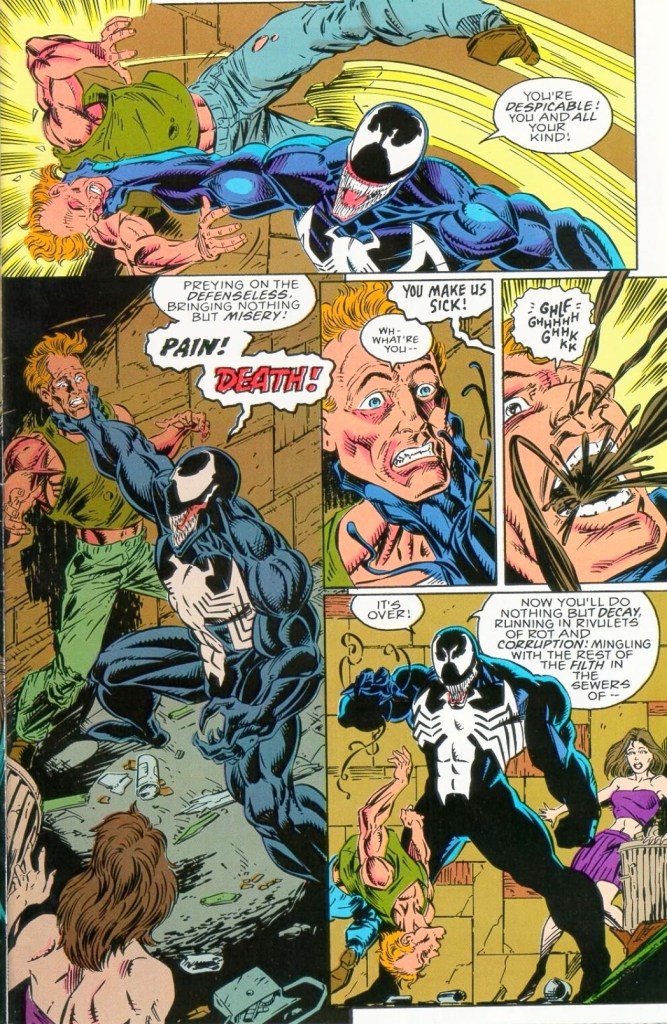
Helping victims does NOT justify killing. This makes Venom a major turn-off as a comic book protagonist.
Venom: Lethal Protector #1 (1993) is a comic book that can be alienating, especially when you are not a Venom fan. I find Venom too evil and too unbelievable to be a heroic figure even though he strong believes in protecting and helping the innocent. In my view, he is more of vigilante living with the delusion of achieving something worthwhile as he interacts with people who happen to be not assisted by the many, many Marvel Comics superheroes. It is not surprising that Venom definitely will never be a good role model. He is a murderer and the act of helping victims never justifies murder. The comic book’s plot lacks weight and Mark Bagley’s art looked a little rushed. What made this comic book interesting are Venom and Spider-Man themselves. Yes, there is a lot of superhero spectacle here but don’t expect anything new when you see Spider-Man and Venom resume their violent rivalry. This comic book is unsurprisingly a warm-up of things to come within its series. It is not a terrible literary work. It’s just not really good and it did not deserve the hype and sales of its time.
Overall, Venom: Lethal Protector #1 (1993) is serviceable.
Disclaimer: This is my original work with details sourced from reading the comic book and doing personal research. Anyone who wants to use this article, in part or in whole, needs to secure first my permission and agree to cite me as the source and author. Let it be known that any unauthorized use of this article will constrain the author to pursue the remedies under R.A. No. 8293, the Revised Penal Code, and/or all applicable legal actions under the laws of the Philippines.
Welcome back superhero enthusiasts, 1990s culture enthusiasts and comic book collectors! Today we go back to the mid-1990s which was a pretty wild time for comic collectors. To be more specific, this newest retro comic book review revisits the Ultraverse through The Night Man monthly series.
In my previous review, the Night Man was pitted against TNTNT which was the same group of villains who fought againstThe Strangers. The encounter was not only packed with solid action, the pacing was done strategically and I loved the way how the comic book creators presented the Night Man taking on each TNTNT member creatively. For this new issue, a new enemy awaits the titular hero which the scary looking cover clearly shows.
With those details laid down, here is a look back at The Night Man #7, published in 1994 by Malibu Comics with a story written by Steve Englehart and drawn by Kyle Hotz.
The cover.
Early story
The story begins in an unknown place where a man talks to a lady who just died. After wearing his coat and grabbing his cane, he leaves behind a place with lots of blood around and things ruined. The body of the dead lady had been damaged so much, the flesh on the front of her upper body is gone leaving the bones exposed.
The said man walks down the street of San Francisco. As he recalls a key part of California’s history, he witnesses three armed men coming out of a jewelry store followed by Night Man. Immediately, he witnesses the city’s vigilante fight two of the men with brutal violence. The third thug (with long hair) takes the opportunity to move away only to face the man with the cane…
Quality
The new villain meeting with the tycoon JD Hunt.
This tale of The Night Man is gritty and engaging to read from start to finish. It introduces an all-new villain who has a Russian legacy with historical connections to the city of San Francisco and northern part of California. The new figure of evil (note: quite obvious due to his murdering of the innocent) is quite a layered character and he seemed to be designed by Steve Englehart to be a recurring villain against the Night Man.
At this point in the comic book series, Night Man has established himself to be a very capable vigilante who truly believes in helping the people of the city on his own and his victories in the previous issues solidified his reputation. This essentially sets the stage for the debut of the new villain (note: the scary looking wolf on the cover) and the next big challenge for the titular hero. Without spoiling what happened, I can say the pay-off was indeed worth the build-up.
Another strong point of this comic book is the way the creators dramatized the differences and similarities between the Night Man and the new villain. Both men are violent and their each have their own obsessions directly related to their respective goals.
Conclusion
The Night Man takes on thugs as the new villain watches.
The Night Man #7 (1994) is a pretty engaging read on its own and it shows how much the Night Man himself progressed as the Ultraverse’s San Francisco-based vigilante who really pushes himself to the limits fighting evil even though his resources are very limited. The introduction of the new villain in this comic book not only proved to be a solid addition into the Ultraverse lore but also added to the titular hero’s development as well as his vigilante justice campaign. This comic book may not be as action packed as the previous issue, but you can rest assured there is a really good quality writing here and the build-up was nicely paid-off by the end. As with the previous issues, Kyle Hotz’s gritty art made this Night Man tale really look lively and very stylish.
Disclaimer: This is my original work with details sourced from reading the comic book and doing personal research. Anyone who wants to use this article, in part or in whole, needs to secure first my permission and agree to cite me as the source and author. Let it be known that any unauthorized use of this article will constrain the author to pursue the remedies under R.A. No. 8293, the Revised Penal Code, and/or all applicable legal actions under the laws of the Philippines.
Welcome back, superhero fans, 1990s arts and culture enthusiasts, and comic book collectors! Today we revisit the Ultraverse of Malibu Comics and examine one of its many stories through The Night Man monthly series.
Remember the group TNTNT? That group appeared in The Strangers #3 and proved to be a strong force of opposition against the team of Atom Bob, Lady Killer, Grenade, Zipzap, Electrocute, Spectral and Yrial. As revealed in that comic book, TNTNT – composed of Tyrannosaur, Naiad, Torso, Neu-Ronnie and Tugun – was trained and equipped by the corporation called NuWare under the watch of their powerful executive J.D. Hunt who clearly has something planned.
That being said, can you imagine what would it be like if TNTNT had ganged up on a solo ultra…like the Night Man?
With those details laid down, here is a look back at The Night Man #6, published by Malibu Comics in 1994 with a story written by Steve Englehart and drawn by Kyle Hotz.
The cover.
Early story
The story begins with Johnny/Night Man working out hard in a gym observed closely by two attractive ladies. While thinking about what happened recently, the two ladies tried to interact with him. He rejects them and continues to work out hard.
Meanwhile over at a high-tech facility in Sunnyvale, California, the group called TNTNT begins to act in a private training session surrounded by fierce looking robots. One by one, Tyrannosaur, Naiad, Torso, Neu-Ronnie and Tugun make short work of the training robots. Tyrannosaur even declares that the glory of their team is back.
However, the man operating the session from behind a control booth talks to them, reminds them that they are still employees of J.D. Hunt, and he tells them that they recovery from their loss to the Strangers will be realized only after killing the Night Man…
Quality
The TNTNT members in training.
Wow! This is one well-paced ride with a structured narrative! Without spoiling the plot details, I can confirm that the creators succeeded in delivering the big mismatch of the Night Man facing off with the 5-member TNTNT with a good amount of spectacle balanced with really interesting character moments.
By comparison with their previous appearance in The Strangers #3, the members of the TNTNT each got more defined in terms of personality in this comic book even during their pages-long encounter with the Night Man. Take for example Tugun whose culture really shaped his perception on such things like insults. Tyrannosaur meanwhile is always confident he’ll win for sure as he knows his super strength and very tough skin make him almost invincible. The way Night Man dealt with each TNTNT member was moderately paced, backed with quick details (to explain things) and was executed in rather believable ways. On characterization, Steve Englehart convincingly portrayed TNTNT like they are real people who happen to be paid and trained by some powerful employer who really wants things done for him.
At the point of this comic book’s publishing, the Night Man established himself as San Francisco’s radio commentator-in-hiding believing he can inspire people to stand up for themselves when encountering evil elements. At the same time, this comic book further emphasized connectivity within the Ultraverse. In addition to Night Man’s crossover with Freex, his encounter with TNTNT technically links him with The Strangers.
More on the writing, there are these subtle yet clear traces of socialism and anti-corporatism particularly with the way Night Man confronted a man who bought a stretch of a beach perceived by the protagonist as public. The portrayal of J.D. Hunt as a power-mad and sinister business executive is not surprising, but the way he was portrayed in dealing with his employees TNTNT symbolizes the capitalist being abusive towards his laborers. Whatever this comic book tried to say, nothing changes the fact that socialism sucks and it is wicked, twisted and corrupting.
Conclusion
Johnny focused on his workout.
The Night Man #6 (1994) is entertaining and compelling to read. Its substance is quite rich and it is surprisingly good that the creators managed to develop the TNTNT members even as they proceeded with their mission to kill the protagonist. As for Night Man, he’s clearly a vigilante with a cause and as a symbolic tool of socialism, he was portrayed to be pro-people and an arrogant opponent of capitalism. This made him look more like a foolish pawn of socialism and less of a hero.
Speaking of San Francisco, could you imagine what would it be like if Night Man was real today and witnesses how the Satanic Left of San Francisco led the city into social deterioration and disorder? Watch the videos below for insight…
If you are seriously planning to buy an existing hard copy of The Night Man #6 (1994) be aware that as of this writing, MileHighComics.com shows that the near-mint copy of the regular edition costs $16.