A Look Back at Amazing Spider-Man #381 (1993)

Disclaimer: This is my original work with details sourced from reading the comic book and doing personal research. Anyone who wants to use this article, in part or in whole, needs to secure first my permission and agree to cite me as the source and author. Let it be known that any unauthorized use of this article will constrain the author to pursue the remedies under R.A. No. 8293, the Revised Penal Code, and/or all applicable legal actions under the laws of the Philippines.

Welcome back superhero enthusiasts, 1990s culture enthusiasts and comic book collectors! Today we go back to the year 1993 and explore a part of the Marvel Comics universe through one of the many tales of the Amazing Spider-Man comic book series.

To put things in perspective, 1993 was another busy year for the iconic Spider-Man who not only had four monthly series of his own but also appeared in the Venom: Lethal Protector mini-series, the 14-part Maximum Carnage crossover and in Marvel’s major crossover The Infinity Crusade. As expected, Spider-Man survived through those storylines.

With those details laid down, here is a look back at Amazing Spider-Man #381, published in 1993 by Marvel Comics with a story by David Michelinie and drawn by Mark Bagley.  
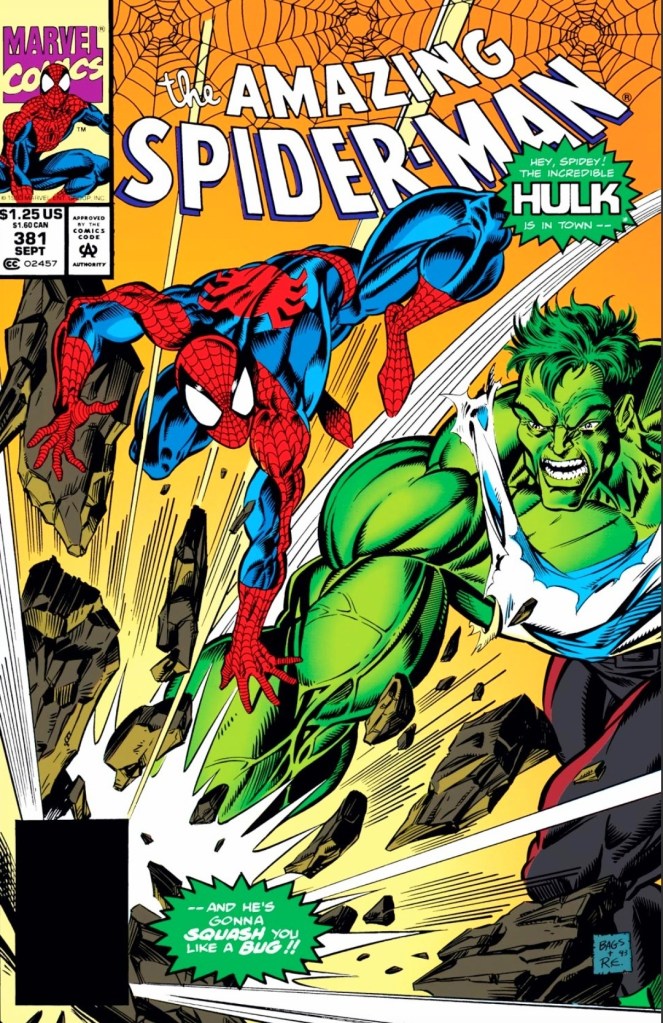
The cover.

Early story

The story begins inside the airport in New York where the incredible Hulk/Bruce Banner himself had just arrived from Scotland. Due to his tremendous size, his physical presence easily distract the people around him. Dr. Leonard Samson surprises Banner and informs him of an upcoming scientific demonstration and the scientists behind it have developed something that could have ramifications for people who got exposed to gamma radiation. Samson explains that there is a radiation virus that releases repressed emotions. The Hulk rejects Samson and leaps to the air above towards an unknow destination.

At a school yard in lower Manhattan, two kids bully another kid into giving them his lunch money. Spider-Man suddenly arrives to stop trouble and immediately the two bullies ran away…

Quality
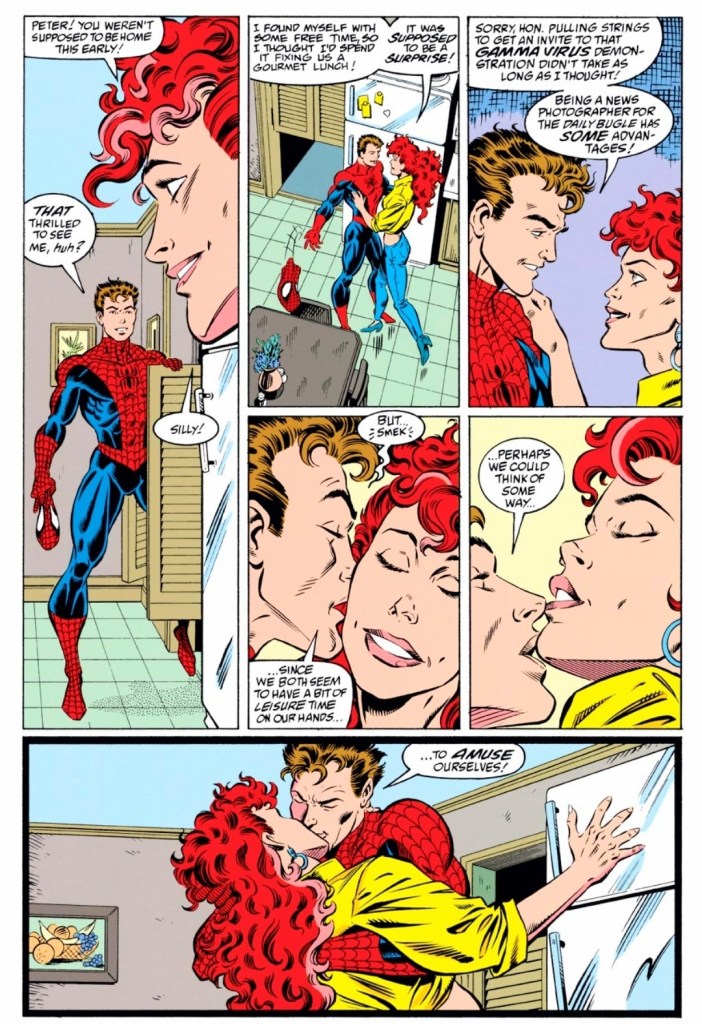
Quality time between Peter Park and wife Mary Jane.

I can say that is one of the more interesting crossovers between Spider-Man and the Hulk who at this stage in Marvel’s comic book history retained his intelligence and personality while in his huge, green-skinned form. Adding variety to the crossover was the presence of Doc Samson who was already an established and notable supporting character in comic books featuring the Hulk.

Set after the events of Maximum Carnage, the Infinity Crusade and Hulk’s time in Scotland (as told in Incredible Hulk #407), this story shows life in New York gradually normalizing. The peace, as it turns out, was only temporary as the big-time scientific demonstration in this story leads to a series of unfortunate events that compels Peter Parker to take action as Spider-Man.

The tale was nicely structured and the creative team took its time to build-up the story concept, the character motivations and execute the superhero spectacle at an overall medium pace. There is simply no boring scene nor any wasted moments. The appearances of Samson and the Hulk in this Spider-Man tale were nicely integrated and they each had their own impact on the plot. There is a lot of stuff here that fans of both Spidey and the green giant can enjoy.

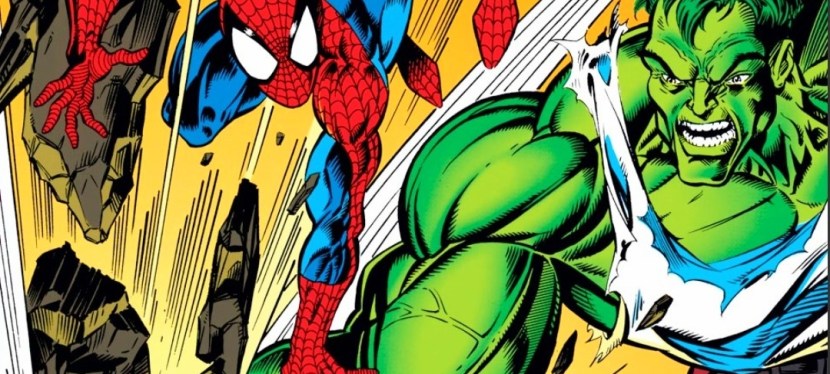
When it comes to the art, I found Mark Bagley’s take on the Hulk distinctive and intriguing to look at. The final shot of this comic book is a must-see.

Conclusion
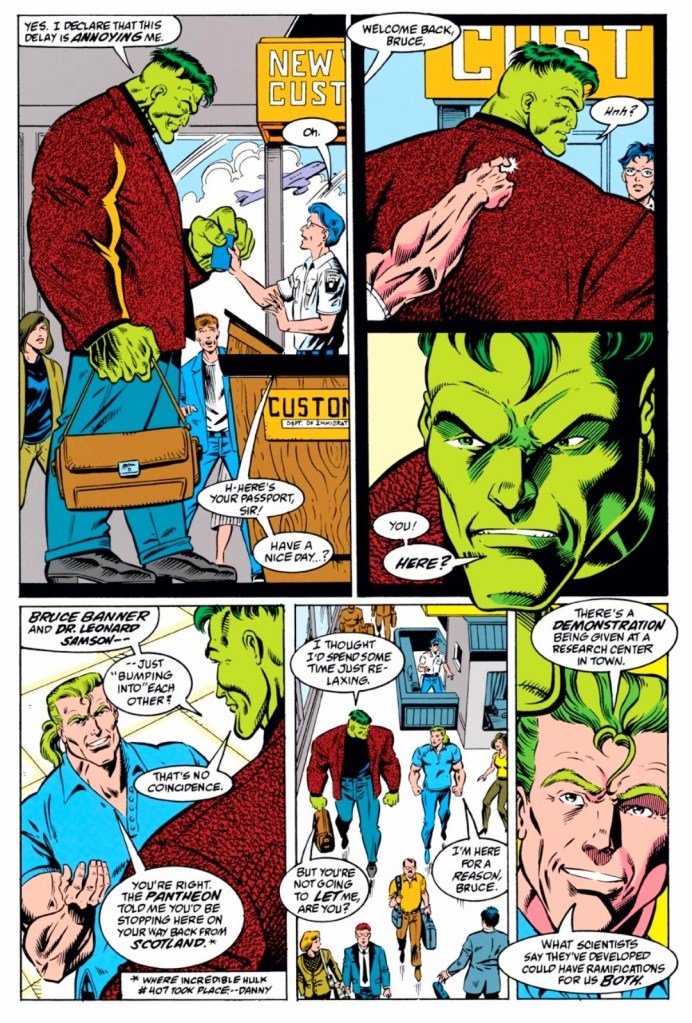
Hulk and Doc Samson at the airport.

While there clearly is no villain, Amazing Spider-Man #381 (1993) still turned out to be a fun read complete with a fine crossover between Spider-Man, Doc Samson and the Hulk. Apart from the lack of space for character development, nothing here felt half-baked with the executions of the storytelling and the spectacle. This is a fun read and it was also a modern take on the personal encounter between Hulk and Spidey during the 1990s. This comic book has something enjoyable that fans of the two Marvel icons won’t find in any of the Marvel Cinematic Universe (MCU) movies and shows.

Overall, Amazing Spider-Man #381 (1993) is recommended.

+++++

Thank you for reading. If you find this article engaging, please click the like button below, share this article to others and also please consider making a donation to support my publishing. If you are looking for a copywriter to create content for your special project or business, check out my services and my portfolio. Feel free to contact me with a private message. Also please feel free to visit my Facebook page Author Carlo Carrasco and follow me on Twitter at  @HavenorFantasy as well as on Tumblr at https://carlocarrasco.tumblr.com/ and on Instagram at https://www.instagram.com/authorcarlocarrasco
A Look Back at Armorines #1 (1994)

Disclaimer: This is my original work with details sourced from reading the comic book and doing personal research. Anyone who wants to use this article, in part or in whole, needs to secure first my permission and agree to cite me as the source and author. Let it be known that any unauthorized use of this article will constrain the author to pursue the remedies under R.A. No. 8293, the Revised Penal Code, and/or all applicable legal actions under the laws of the Philippines.

Welcome back superhero enthusiasts, 1990s culture enthusiasts and comic book collectors! Today we go back to the early 1990s and explore a part of the shared universe of Valiant Comics through the Armorines monthly series.

Before I start, I should state that the superhero concept of an armored human protagonist who could do many incredible things made possible by high technology made an impact on comic book storytelling for decades. Look at Marvel’s Iron Man and the Ultraverse’s Prototype for examples.

While Valiant Comics already had its own armored superhero with X-O Manowar (note: his armor is symbiotic, not technological), they decided to move forward with the concept of armored figures in the form of a military team.

With those details laid down, here is a look back at Armorines #1, published in 1994 by Valiant Comics with a story written by Jorge Gonzalez and drawn by Jim Calafiore.

The cover.

Early story

The story begins five hundred kilometers off the southern coast of Australia. Four people dive very deeply to explore nuclear-powered submarine U.S.S. Benchley which has been dormant for some time already. While exploring the interiors of the submarine, the divers got attacked by something in the dark.

At Camp Pendleton in California, an armored U.S. marine goes through an intense training session fighting machines not knowing that there could be traps waiting to get triggered. As Gunny (the armored marine in the session) falls into a trap, his teammates, General Kendall and the scientist Zahn watch the proceedings behind the scenes as another teammate (operating with virtual reality on her high-tech station) continues to communicate with him.

As time passes by, the situation gets even worse for Gunny physically…

Quality

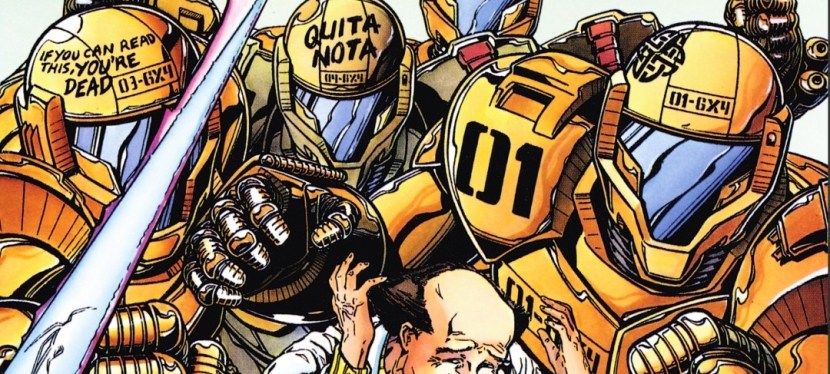
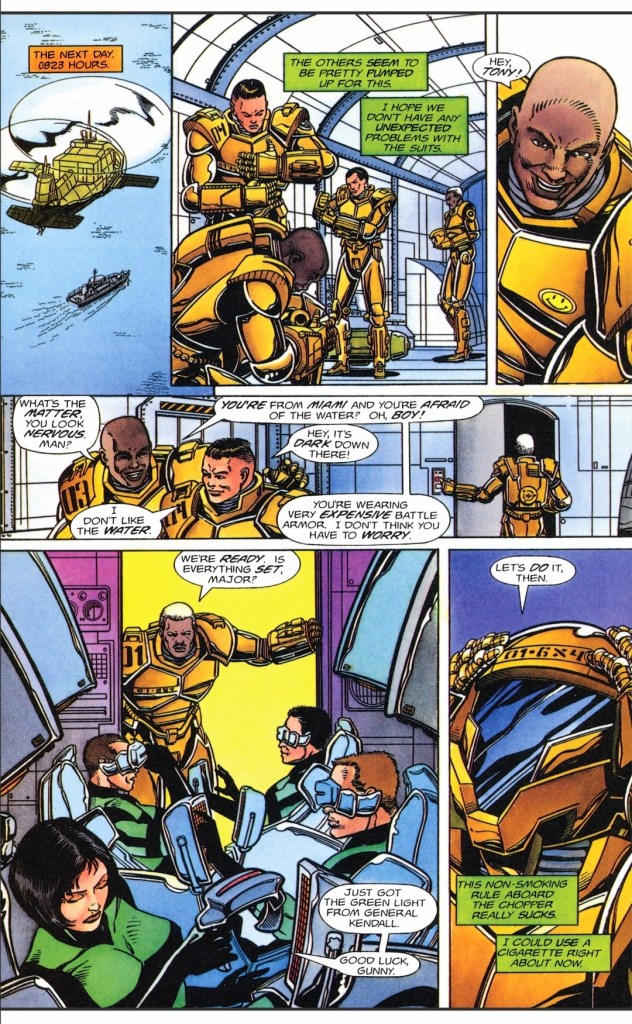
Armorines has members who go out on the field wearing high-tech suits of armor while there are other members who serve as co-pilots using virtual technology and constant communication behind closed doors.

In terms of storytelling, the creative team focused mainly on the build-up of not just the plot but also the importance and the ways of the Armorines themselves. As weapons of the government, Armorines are an expensive team to run due to the use of very advanced technologies for operations. The Armorines have members who go out on the field wearing high-tech suits of armor that provide enhanced protection while also carrying high-tech weapons for offense. The team also has members who stay behind closed doors to use individual stations with virtual reality and enhanced communication with their brothers on the field.

When it comes to the characters, the smoking Gunnery is noticeably the one who got the most exposure and the most development. The other Armorine members got token exposure for the readers.

More on the plot itself, there is a mission that requires the Armorines to go deep underwater to solve a mystery and do something dangerous secretly. The mission was essentially all about protecting America’s top-secret weapons from falling into the wrong hands. To be clear, the mission itself happens in the 2nd half of this comic book which ultimately serves as a pay-off to the build-up the happened earlier. In fairness to the creative team, there was a good amount of suspense presented when the mission really started moving. There definitely something worth seeing during the mission.

Conclusion

In this story, Gunny is the closest thing to a definitive protagonist.

To be very clear, Armorines #1 (1994) is not exactly the high-powered, action-packed story people could expect from seeing the armored marines looking capable of fighting terrorists and other enemies of America in militaristic fashion. This comic book’s story is indeed surprising to me and the creative team was not hesitant to push hard with the concept they came up with here. As this comic book was clearly executed with build-up, introductions and emphasizing concepts in mind, it is not surprising that the pay-off in the 2nd half led to moments of intrigue and suspense with momentum going into the next issue. Lastly, I should state that this comic book is free from political influence and its focus on the team has been very consistent.

Overall, Armorines #1 (1994) is recommended.

+++++

Thank you for reading. If you find this article engaging, please click the like button below, share this article to others and also please consider making a donation to support my publishing. If you are looking for a copywriter to create content for your special project or business, check out my services and my portfolio. Feel free to contact me with a private message. Also please feel free to visit my Facebook page Author Carlo Carrasco and follow me on Twitter at  @HavenorFantasy as well as on Tumblr at https://carlocarrasco.tumblr.com/ and on Instagram at https://www.instagram.com/authorcarlocarrasco
A Look Back at X-Men Adventures #10 (1993)

Disclaimer: This is my original work with details sourced from reading the comic book and doing personal research. Anyone who wants to use this article, in part or in whole, needs to secure first my permission and agree to cite me as the source and author. Let it be known that any unauthorized use of this article will constrain the author to pursue the remedies under R.A. No. 8293, the Revised Penal Code, and/or all applicable legal actions under the laws of the Philippines.

Welcome back, superheo enthusiasts, 1990s culture enthusiasts, X-Men fans and comic book collectors! Today we revisit the X-Men Adventures monthly series which was the literary adaptation of the popular X-Men animated series of the 1990s.  

If you are a long-time X-Men fan who enjoyed the comic books and the movies, then the cover of this particular X-Men Adventures issue that has Rogue on it should remind you of the mutant cure concept portrayed in the 2006 movie X-Men: The Last Stand. In the said movie, it was Rogue who went out to have her mutant powers neutralized so that she can live a normal life and no longer worry about absorbing another person’s life force.

With those details laid down, here is a look back at X-Men Adventures #10, published by Marvel Comics in 1993 with a story written by Ralph Macchio and drawn by Andrew Wildman.

The cover.

Early story

The story begins with the arrival of Cable outside a private home in the Swiss Alps. Inside, Warren Worthington (Angel) and Gisela spend quality time together by the fire. They talk about a certain Dr. Adler who is a genetics expert that Worthington sent to Scotland to conduct research.

Suddenly, Cable breaks into the place and points his gun at Worthington looking for Dr. Adler. While talking, Worthington reaches for a gun and fire it at Cable. The huge armed mutant then grabs Worthington by the head and throws him out of the home and into the snow. In response to Cable’s question, Gisela mentions that Dr. Adler has gone to Scotland. Moments later, Worthington (in his angel form) flies back into the house to protect Gisela from whatever harm Cable could do to her.

Over at Muir Island, Professor X and his long-time colleague Dr. Moira MacTaggert discuss the facility and research done there. Xavier mentions that the core of the research done by the mysterious Dr. Adler. Moira states that Adler is not officially part of the research center and he simply pays for everything he uses there.

After failing to meet Dr. Adler inside his research office, Xavier conducts a mind probe which causes a series of stake images enter his consciousness. The experience was so intense, his telepathic inquiry got disrupted abruptly. Professor X then decides to contact the X-Men…     

Quality

Rogue goes through a lot in her pursuit to become normal.

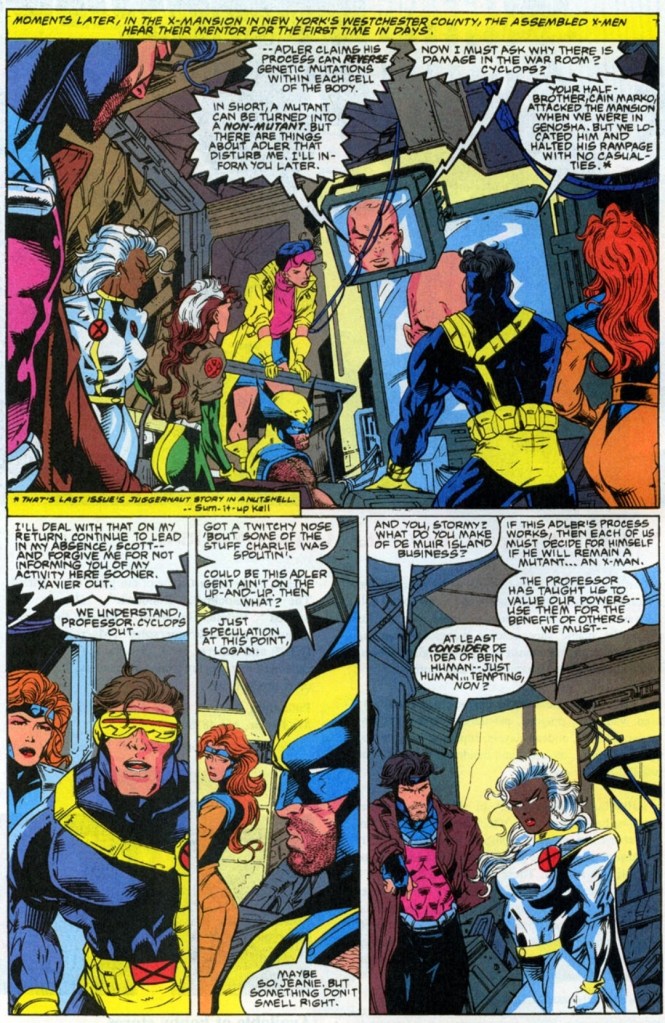
Let me start with the concept of Rogue’s pursuit to cure herself of her genetic mutation…compared to the 2006 live-action X-Men movie, the plot in this literal adaptation of the X-Men animated series episode makes more sense and is more believable to follow. Without spoiling the identities (note: to find out who they are, read this comic book), I can say that there are sinister forces behind the genetic works of Adler within the Muir Island facility. The Adler operation is just part of a grand scheme that the sinister forces have been working on and Rogue’s involvement was a surprise addition. More on Rogue’s pursuit of getting normal, what was portrayed in this adaptation was nicely structured while also cleverly avoiding the “doing it all for the sake of love” cliché. In short, she made her pursuit not for her romance with Gambit but to really change her life significantly, even if it means losing her membership with the X-Men. Through her actions, you will feel Rogue becoming desperate and reckless to be normal.

Apart from the tale of Rogue, the X-Men meanwhile have been handling themselves without Professor X and Cyclops clearly carries the responsibility of leading them all. As for Charles Xavier, his departure has been explained and incidentally he has gotten close to danger even though Dr. Moira MacTaggert is with him. The writing in this adaptation is filled with suspense, surprises and intrigue which were nicely executed with concise timing.

Conclusion

Charles Xavier makes contact with his team from far-away.

X-Men Adventures #10 (1993) is a very good read. Anyone who saw the half-baked mutant cure aspect of the 2006 X-Men movie will find the Rogue tale here more satisfying to read. This is definitely Rogue’s story with some spotlight shared with the X-Men, two other mutants who served as opposition for Rogue, and the sinister forces I mentioned. This comic book is actually the first of two parts focused on Muir Island and it certainly is a really satisfying reading experience on its own.  

Overall, X-Men Adventures #10 (1993) is recommended.

+++++

Thank you for reading. If you find this article engaging, please click the like button below and also please consider sharing this article to others. If you are looking for a copywriter to create content for your special project or business, check out my services and my portfolio. If you want to support my website, please consider making a donation. Feel free to contact me with a private message. Also please feel free to visit my Facebook page Author Carlo Carrasco and follow me on Twitter at  @HavenorFantasy as well as on Tumblr at https://carlocarrasco.tumblr.com/ and on Instagram at https://www.instagram.com/authorcarlocarrasco/.

A Look Back at What If #61 (1994)

Disclaimer: This is my original work with details sourced from reading the comic book and doing personal research. Anyone who wants to use this article, in part or in whole, needs to secure first my permission and agree to cite me as the source and author. Let it be known that any unauthorized use of this article will constrain the author to pursue the remedies under R.A. No. 8293, the Revised Penal Code, and/or all applicable legal actions under the laws of the Philippines.

Welcome back superhero enthusiasts, 1990s arts and culture enthusiasts, Marvel Comics fans and comic book collectors! Today we go back to the wild 1990s and examine an alternate universe portrayal of one of Spider-Man’s many events told through the What If monthly series!

If you are looking for a portrayal of Spider-Man going over the edge and into the extremes emotionally, you are about to experience something in this retro review of mine. Some time ago, I reviewed a What If comic book about Spider-Man becoming a murderer which was compelling but ended on a whimper.

With those details laid down, here is a look back at What If #61 published in 1994 by Marvel Comics with a story written by Kurt Busiek and drawn by Kirk Jarvinen, Andrew Wildman, Derek Yaniger and Jim Amash.

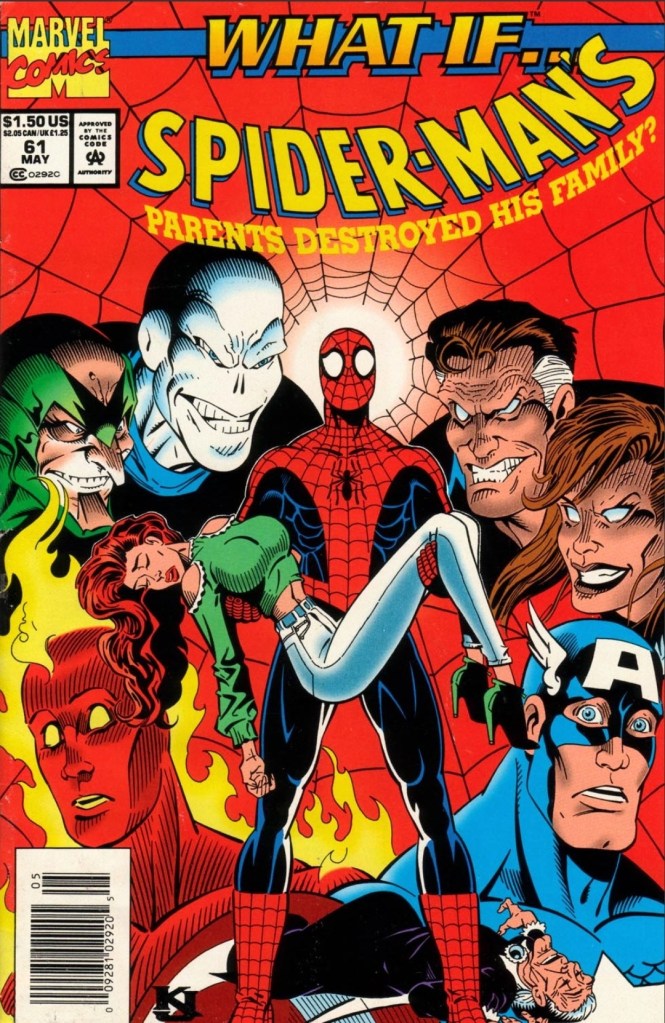
The cover.

Early story

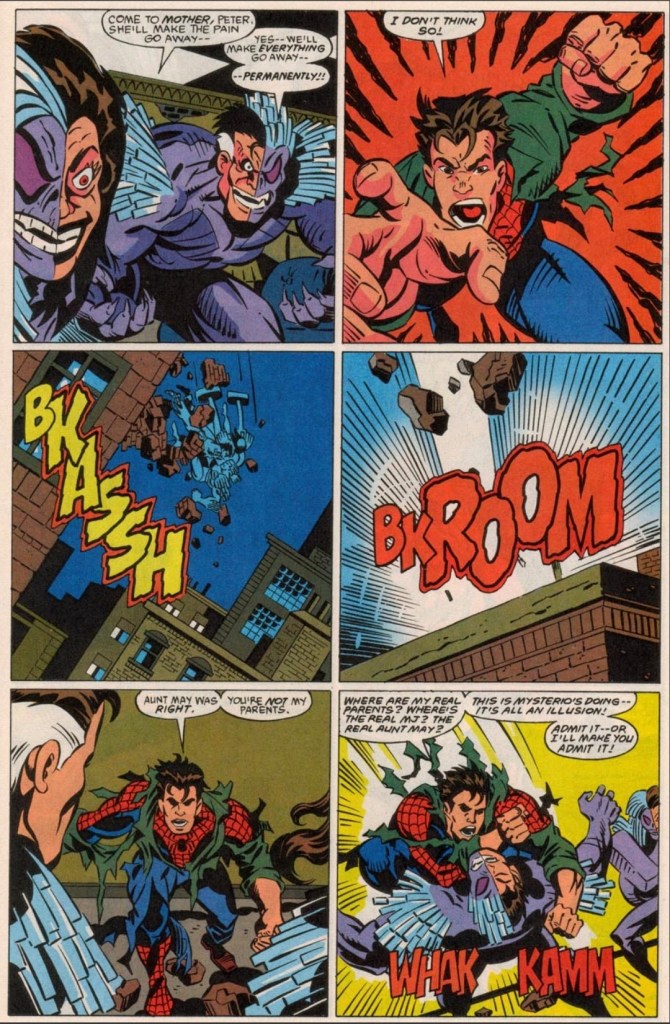
The story begins with Richard and Mary Parker (Peter Parker’s parents) arriving in the presence of Aunt May who happens to be visited by their son Peter (Spider-Man). Having learned something from a while back, Aunt May tells Richard and Mary that they are not genuine persons. Suddenly, Peter Parker’s spider sense intensifies and in an attempt to defuse the situation, he leads his aunt to walk out of the house with him. Richard and Mary watch them walk away.

It turns out, Richard and Mary are impostors and they have been working all the time for a secretive boss. Richard calls his employer under an emergency and reports that they have completed phase one of their assignment, that Aunt May knows the truth about them and is about to inform Spider-Man. Richard is then told that under no circumstances is the plan to be jeopardized and anyone who suspects must die. He is also told to flush Mary’s programming and reset her as she showed signs of acting odd to the situation.

A short time later, Richard and Mary – now in morphed forms with vastly different bodies and half their heads resembling their human selves – suddenly break into an apartment surprising Peter, his wife Mary Jane and Aunt May. Violent action by one of them accidentally ripped open Peter’s shirt, revealing his Spider-Man suit to Aunt May. Just as Peter’s aunt figures out the secret, he tells Mary Jane to grab her and get out.

However, the sight of the morphed Mary Parker shocked Aunt May and Mary Jane so much, they failed to move. Mary Parker then morphs her two hands into large, makeshift hammers, and swiftly killed Aunt May and Mary Jane. Peter is instantly shocked by their sudden deaths but deep inside, rage begins to burn…

Quality

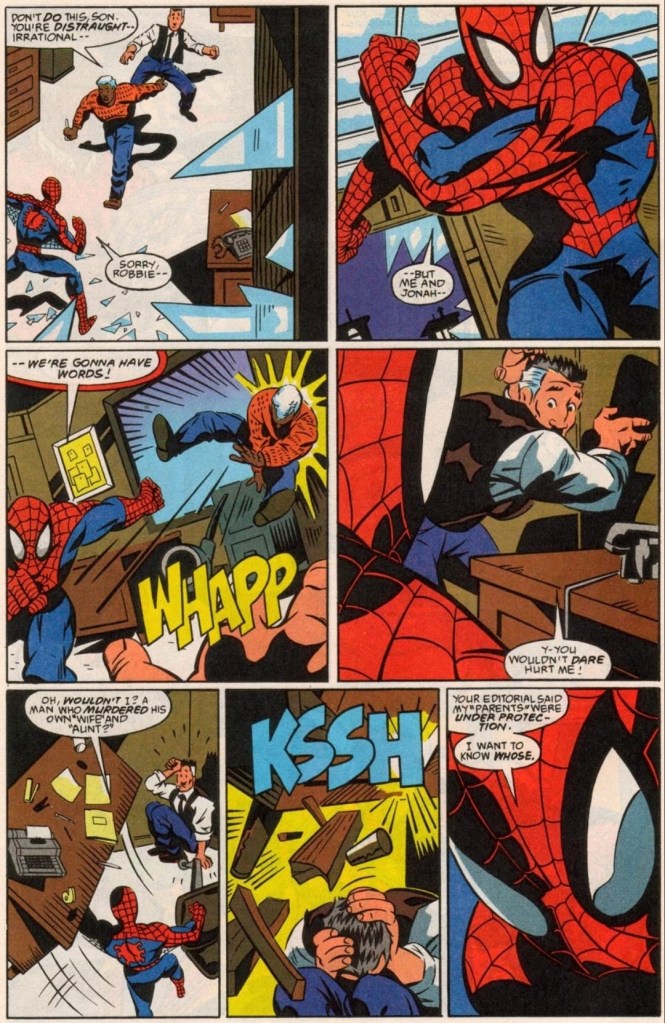
Spider-Man already over the edge and reacting violently to the abusive Daily Bugle.

I can start by confirming that Kurt Busiek’s writing is very strong and his alternate take on the events of Amazing Spider-Man #388 (1994) is indeed very solid. In one way, I find the emotional stakes for Spider-Man has been raised a lot higher than what was portrayed in the canon story. The concept of losing his beloved family members to enemies who were impostors that looked like his long lost parents is indeed disturbing as well as emotionally charged. In relation to this, Busiek and the illustrators brought to life a Spider-Man who really went over the edge by taking matters into his own hands as the loss of beloved ones led to the blurring of the boundary between good and evil. Even the boundary between innocence and guilt gets blurred which adds more depth to the emotions of the story. As I read the story, there were moments when I felt that Spider-Man became as bad as the evil ones even though he is clearly the victim and his family was targeted.

Apart from showing Spider-Man getting outraged and pushed to the limits, Busiek inserted elements about how people perceive incidents without knowing all the facts and how easily they get manipulated by a news outlet – the Daily Bugle where Peter Parker worked as a freelance photographer – whose leader does not care about ethical journalism nor the pursuit of the truth. In this age of widespread fake news and liberal news media outlets in America doing propaganda for American Communists (read: Democrats, abortionists, LGBTQ, Black Lives Matter, Antifa, the terrorists, the climate change extremists and the socialist hordes), this particular aspect of the story makes this comic book strongly relevant to read today.

The story also sheds light on Spider-Man’s connections with other Marvel superheroes who happen to be in New York City. You will see Captain America and Johnny Storm express their concern about Spider-Man’s state of mind as they themselves still tried to figure out what really happened. In short, the superheroes here showed restraint even as Spider-Man goes to the extreme being a victim as well as a fugitive.

If there are any weak points in this comic book, it would be the art which has this cartoon-like aesthetic for much of the story. Considering the serious subject matter, the visuals are quite contradicting as they make this look like it was made for much younger readers. In fairness, the quality of the art improved during the 2nd half of the story.

Conclusion

Spider-Man takes on the impostors who looked like his parents.

As far as storytelling and characterization goes, What If #61 (1994) succeeded a lot on portraying the iconic Spider-Man as the superhero who went over the limits of his emotions and his reasoning which is the result of the tragic deaths of two beloved family members caused by individuals who pretended to be his parents. This is a very solid story which also has a powerful ending. Where What If #72 failed, this comic book succeeded and even exceeded it with Spider-Man truly becoming unheroic. I should state that this comic book should convince readers to go to the Amazing Spider-Man series and follow the Lifetheft storyline in issues #386 to #388 (which were released months before this comic book). Kurt Busiek’s script is indeed great and it is easily the driving force of the comic book.

Overall, What If #61 (1994) is highly recommended.

+++++

Thank you for reading. If you find this article engaging, please click the like button below, share this article to others and also please consider making a donation to support my publishing. If you are looking for a copywriter to create content for your special project or business, check out my services and my portfolio. Feel free to contact me with a private message. Also please feel free to visit my Facebook page Author Carlo Carrasco and follow me on Twitter at  @HavenorFantasy as well as on Tumblr at https://carlocarrasco.tumblr.com/ and on Instagram at https://www.instagram.com/authorcarlocarrasco

A Look Back at What If #10 (1990)

Disclaimer: This is my original work with details sourced from reading the comic book and doing personal research. Anyone who wants to use this article, in part or in whole, needs to secure first my permission and agree to cite me as the source and author. Let it be known that any unauthorized use of this article will constrain the author to pursue the remedies under R.A. No. 8293, the Revised Penal Code, and/or all applicable legal actions under the laws of the Philippines.

Welcome back superhero enthusiasts, 1990s arts and culture enthusiasts, Marvel Comics fans and comic book collectors! Today we go back to the year 1993 and explore a part of Marvel Comics’ universe through the reimagined tales emphasized in the What If monthly series.

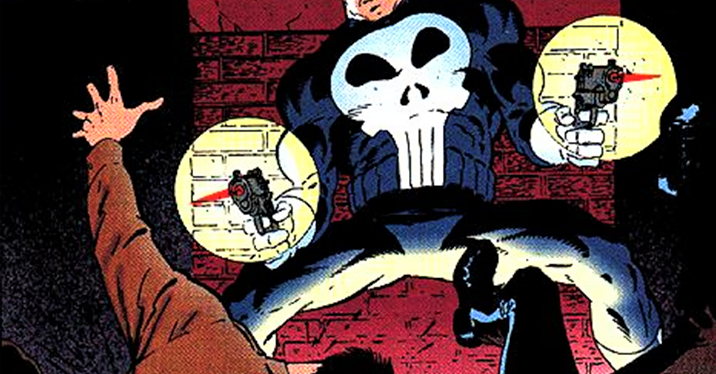
For those of you who have gotten very familiar with Marvel Comics’ vast lineup of superheroes, anti-heroes, super villains and supporting characters, the Punisher is one of the most notable characters as he is the most definitive vigilante the publisher ever has in its shared superhero universe. As a comic book protagonist, the Punisher does “good” in fighting crime but he sure is as bad as the bad guys as he commits torture, issued threats of violence, kidnapping, extortion, coercion and even murder towards them. A major factor in the Punisher’s origin (as Frank Castle) was the killing of his family (wife and two kids) committed by a mob as they witnessed acts of killing in Central Park in New York City. The tragic deaths led Castle to become the Punisher who not only relentlessly waged a personal war against criminals but also often wore dark clothes with a large white skull design on the front of his body. The skull symbolized punishment and death to his enemies.

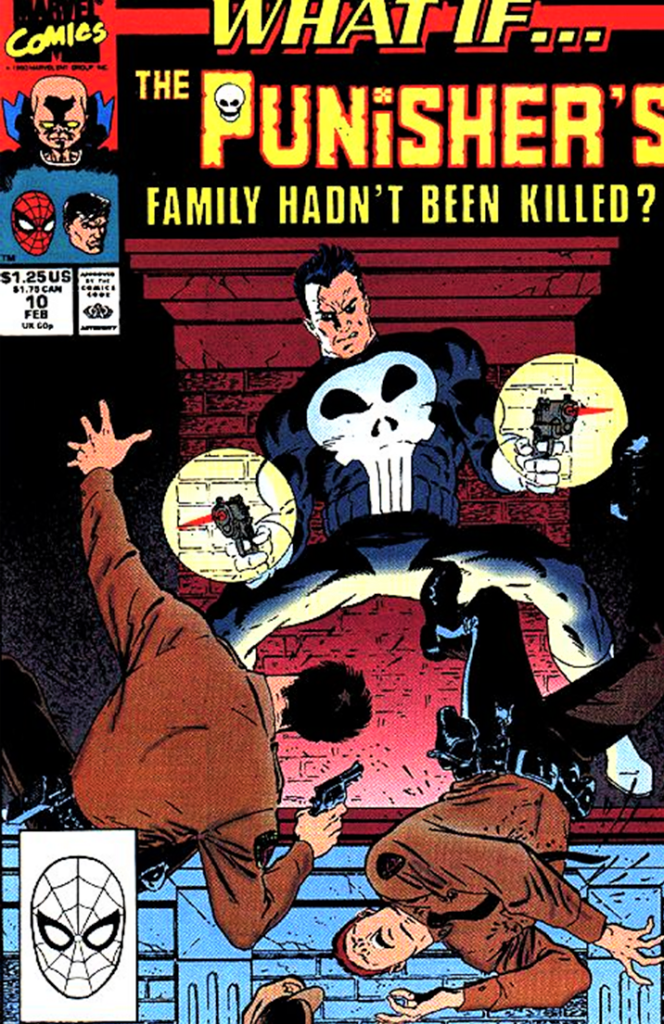
With those details laid down, here is a look back at What If #10, published in 1990 by Marvel Comics with a story written by Doug Murray and drawn by Rik Levins.

The cover.

Early story

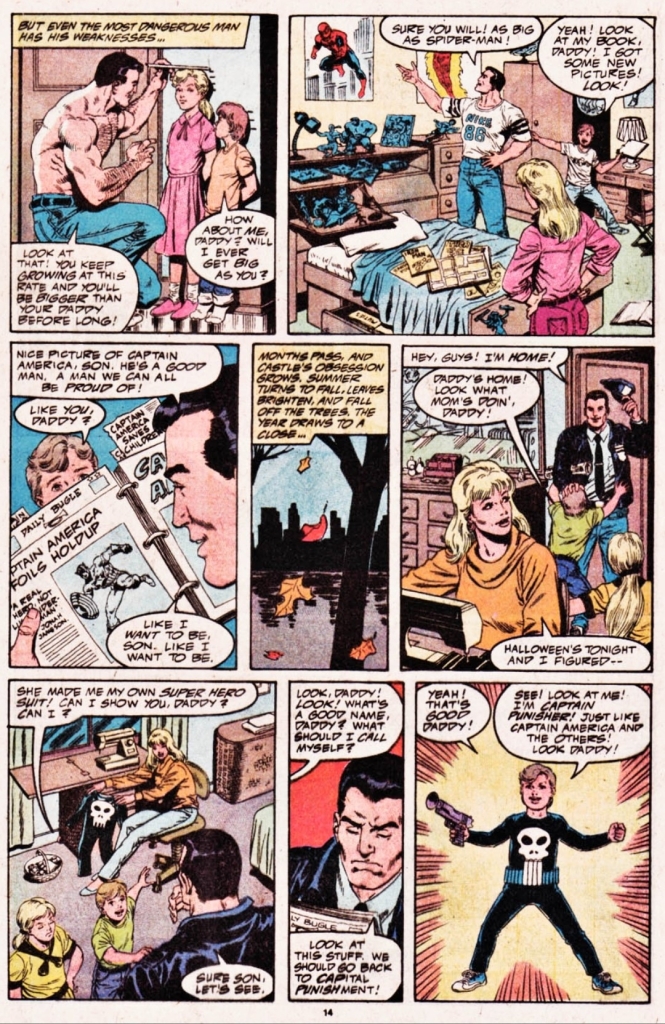
The story begins with the Watcher recalling the time Frank Castle spent with his wife and the two kids at New York City’s Central Park. There, they have fun with their picnic. At this point in time, Frank Castle had previously served his country in the Vietnam War and he carries within him bravery, the experience of violence and vast skills to use weapons.

The weather suddenly worsens as rain starts to fall down causing some inconvenience on the Castle family. Frank’s son struggles as his kite got caught by the large plant nearby. On the other side of the said plant, four armed men and their captive (hanging upside down by the tree) are startled and prepare themselves to shoot anyone who appears.

Frank, who does not realize the mob on the other side of the plant, helps his son get the kite back. The Castle family then decide to go back home not realizing that they came close to discovering and witnessing the illegal activity of the armed men. As the family kept on moving, Frank hears gunfire from a distance…

Quality

Frank Castle the family man.

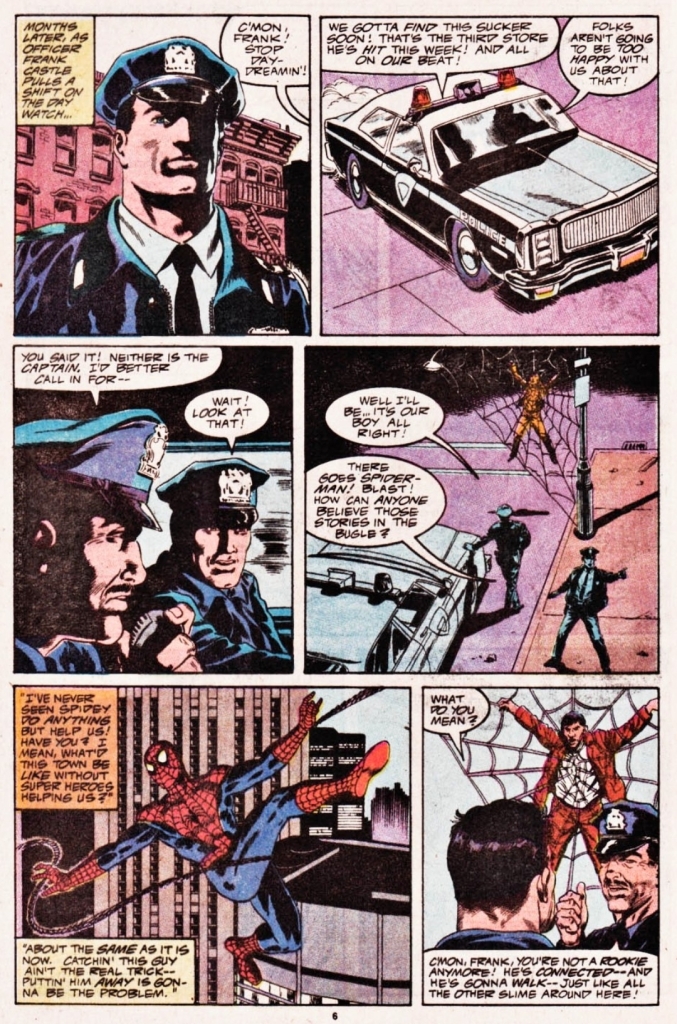
To get straight to the point about this comic book, it’s story is really engaging and it has noticeable amounts of darkness and grittiness without going overboard. While exploring what would happen had Frank Castle’s family not been killed, the comic book shows the Punisher getting involved in public safety as a New York patrolman which puts him in a unique position facing crime in radically different ways from what we comic book readers have been used to seeing. The story also explores corruption within the police and the justice system as well.

The way the events and action turned out showed the creative team focused on realism while also establishing the Punisher’s own place within the comic book’s alternate portrayal of the shared superhero universe. More on the subject matter of this comic book, there is a twist that surprised me a lot and it is something that you readers should see for yourselves.

Going back to Frank Castle, it is indeed very captivating to see him portrayed a lot more as a family man who really strives to support his wife and kids no matter how dangerous his occupation really is. The aspect of family in this comic book is very significant as it will make you realize that the definition of family in America in the 21st century has been distorted as a result of laws or court decisions that reflected wokeness, homosexuality and unrestrained feminism. In short, woke America’s believers reject the concept of the traditional family and the concept of a father leading the family is considered taboo because it goes against LGBT’s so-called values and principles.

Conclusion

Frank Castle as the police officer.

When you think about the legacy of the Punisher not only on comics but also in movies and other forms of entertainment media, you will often remember a one-man-army against criminals. What If #10 (1990) has is a really unique take on the Punisher and I can say it has a very captivating script brought to life with really good artwork. Not only does this alternate version of the Punisher shows how he affects criminals, but also how he impacts other parts of the fictional New York society within the shared universe of Marvel Comics (note: characters connected to Spider-Man and Daredevil are here). From start to finish, this Punisher tale by the Murray-Levins team turned out to be very engaging to read.

Overall, What If #10 (1990) is highly recommended!

+++++

Thank you for reading. If you find this article engaging, please click the like button below, share this article to others and also please consider making a donation to support my publishing. If you are looking for a copywriter to create content for your special project or business, check out my services and my portfolio. Feel free to contact me with a private message. Also please feel free to visit my Facebook page Author Carlo Carrasco and follow me on Twitter at  @HavenorFantasy as well as on Tumblr at https://carlocarrasco.tumblr.com/ and on Instagram at https://www.instagram.com/authorcarlocarrasco
A Look Back at X-Men #30 (1994)

Disclaimer: This is my original work with details sourced from reading the comic book and doing personal research. Anyone who wants to use this article, in part or in whole, needs to secure first my permission and agree to cite me as the source and author. Let it be known that any unauthorized use of this article will constrain the author to pursue the remedies under R.A. No. 8293, the Revised Penal Code, and/or all applicable legal actions under the laws of the Philippines.

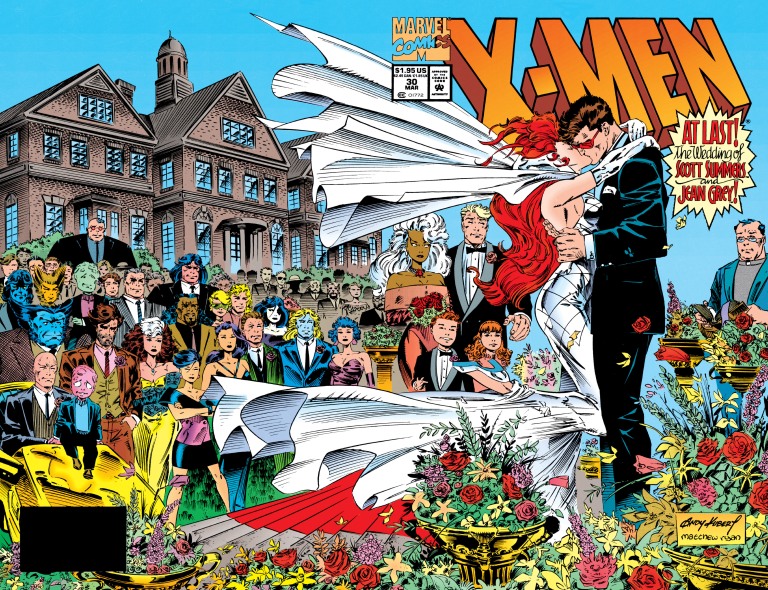
Welcome back, superheo enthusiasts, 1990s culture enthusiasts, X-Men fans and comic book collectors! Today we revisit the X-Men monthly series of the 1990s and look back at one of its most significant events it ever published – the wedding of Scott Summers/Cyclops and Jean Grey. By the time this particular comic book was published, the 30th anniversary celebration of the X-Men (note: Read my Fatal Attractions storyline retro reviews by clicking here and here) had just been concluded and that includes a major change of direction for the iconic X-Men member Wolverine. It is also notable that the X-Men had Sabretooth contained within Charles Xavier’s mansion (for retro reviews, click here, here and here).

With those details laid down, here is a look back at X-Men #30, published by Marvel Comics in 1994 with a story written by Fabian Nicieza and drawn by Andy Kubert.

The cover.

Early story

The story begins inside Xavier’s mansion. Jean Grey reads a handwritten letter from Logan/Wolverine, who left the household after getting traumatized from their last encounter with Magneto. Logan refers to her and Scott Summers as special. While reading, Jean is already in her fancy wedding dress being assisted by her mother and storm as Rachel Summers looks on. For Jean, the wedding is about her dedication on spending the rest of her life with Scott as well as possibly gaining Rachel (who comes from one possible future) as a daughter.

Professor X with four of his original team members plus Alex Summers.

Elsewhere in the mansion, the groom Scott spends quality time with his original teammates Bobbdy Drake/Ice Man, Warren Worthington/Archangel and Hank McCoy/Beast. With them also is his brother Alex Summers/Havok. Alex tells Scott that the day of his wedding is the first day of the rest of his life which causes Bobby to say something inappropriate.

Suddenly, Professor X comes in to join them…

Quality

Jean Grey in her wedding dress with her mother, Storm and Rachel Summers present.

To get straight to the point here, this comic book serves two purposes: highlighting Scott and Jean’s relationship to an all new level with the wedding as the main event, and offering long-time or die-hard X-Men fans a whole lot of stuff to chew on. Very clearly, Fabian Nicieza wrote the script with X-Men fans in mind while also making references to the past with some creative touches or shortcuts so that the comic book would not be bloated with excessive fan service.

The wedding itself was executed nicely by the Nicieza-Kubert team and was clearly conceptualized to not only be memorable for the fans but also creatively serve as a major pay-off to all those years of Scott and Jean Grey being together early as teammates, getting separated temporarily and getting together again (note: they were also the original X-Factor team). Right after the wedding was executed, the visuals and words elevated the emotions higher and any long-time X-Men fan will find the moment sentimental.

Opposite the wedding are several scenes showing the other X-Men characters plus those from X-Factor and X-Force (with a not-so-recognizable Cable present). The dialogue written ranged from sentimental to comedic. And then there were also a few lines that I felt were just thrown in as fillers.

As far as visuals go, Andy Kubert’s art here are pretty good to look at. While he did his best to really make the story visually appealing and memorable, there were a few panels of art that look rushed.

Conclusion

So many guests. Can you recognize many of them?

Since it highlights the wedding of Scott and Jean Grey with several other X-Men-related characters mixed in, X-Men #30 (1994) is clearly a commemorative story made with X-Men fans in mind. While a lot of work was done to make the story momentous on its own, readers who are unable to immerse themselves deeply into the X-Men mythos (plus X-Force, X-Factor and others) prior to reading this comic book won’t be able to relate to the wedding and the character moments very much. While it may not be significant to newcomers who find this comic book for the first time, it still marks a significant chapter in the history of X-Men within the Marvel Comics universe of the late 20th century. For the long-time fans who were able to read enough of Scott and Jean Grey’s times together from 1963 until the early 1990s, this is one X-Men tale that they can relate with deeply.

Overall, X-Men #30 (1994) is recommended.

+++++

Thank you for reading. If you find this article engaging, please click the like button below and also please consider sharing this article to others as well as making a donation to support my publishing.. If you are looking for a copywriter to create content for your special project or business, check out my services and my portfolio. Feel free to contact me with a private message. Also please feel free to visit my Facebook page Author Carlo Carrasco and follow me on Twitter at  @HavenorFantasy as well as on Tumblr at https://carlocarrasco.tumblr.com/ and on Instagram at https://www.instagram.com/authorcarlocarrasco
A Look Back at Wolverine #75 (1993)

Disclaimer: This is my original work with details sourced from reading the comic book and doing personal research. Anyone who wants to use this article, in part or in whole, needs to secure first my permission and agree to cite me as the source and author. Let it be known that any unauthorized use of this article will constrain the author to pursue the remedies under R.A. No. 8293, the Revised Penal Code, and/or all applicable legal actions under the laws of the Philippines.

Welcome back, superhero enthusiasts, comic collectors, 1990s culture enthusiasts and fans of the X-Men! We go back to the year 1993 when the 30th anniversary of the X-Men was celebrated with the 6-part Fatal Attractions storyline. Already I reviewed Uncanny X-Men #304 (Part 3) which was not worthy of the X-Men’s 30th anniversary celebration. X-Men #25 (Part 4) meanwhile was not only great but also shocking and had a years-long impact on X-Men comics.

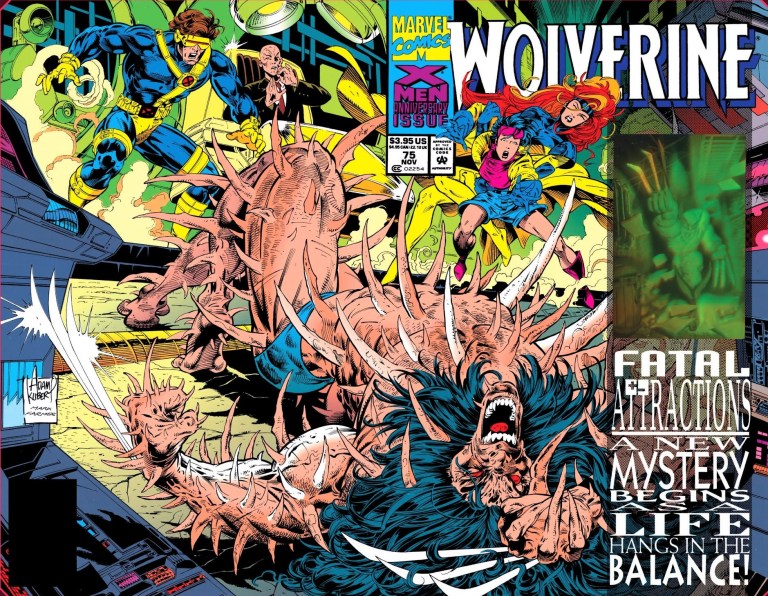
So now the focus is on the 5th chapter of the Fatal Attractions storyline handled by the Larry Hama-Adam Kubert team on the Wolverine monthly series of the time. With those details laid down, here is a look back at Wolverine #75, published by Marvel Comics in 1993 with a story written by Larry Hama and drawn by Adam Kubert.

The cover.

Early story

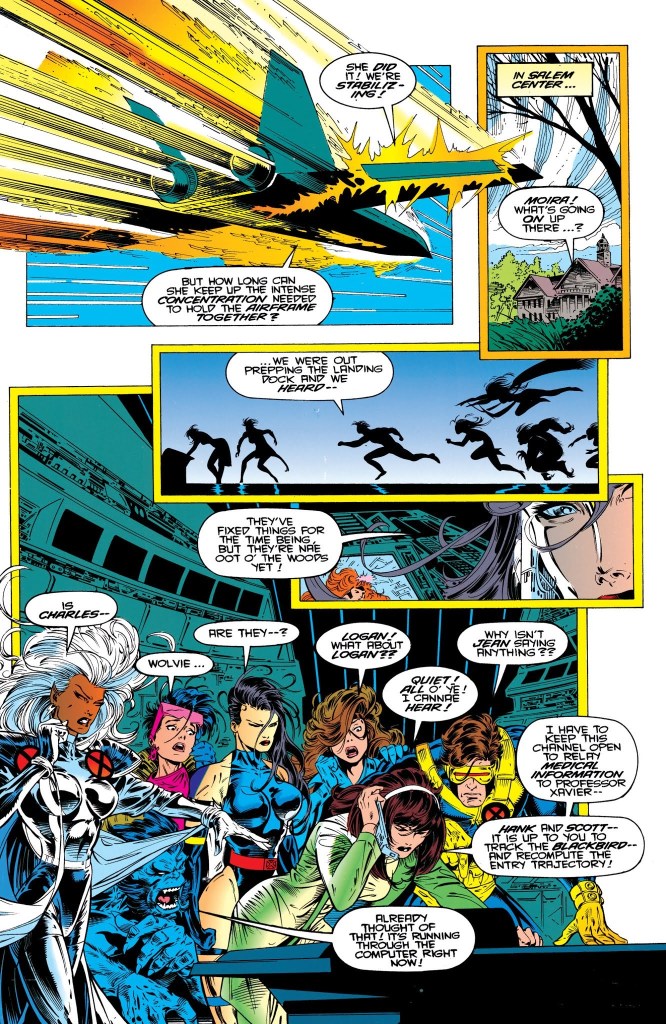
The story begins in outer space. Carrying Charles Xavier, Wolverine, Gambit, Jean Grey, Rogue and Quicksilver (who participated in the dangerous mission in X-Men #25), the X-Men’s jet (piloted by Bishop) struggles mechanically as it was not designed for space travel. Worse, Wolverine is under very serious condition and the medical unit has been operating in full capacity dealing with his intense trauma.

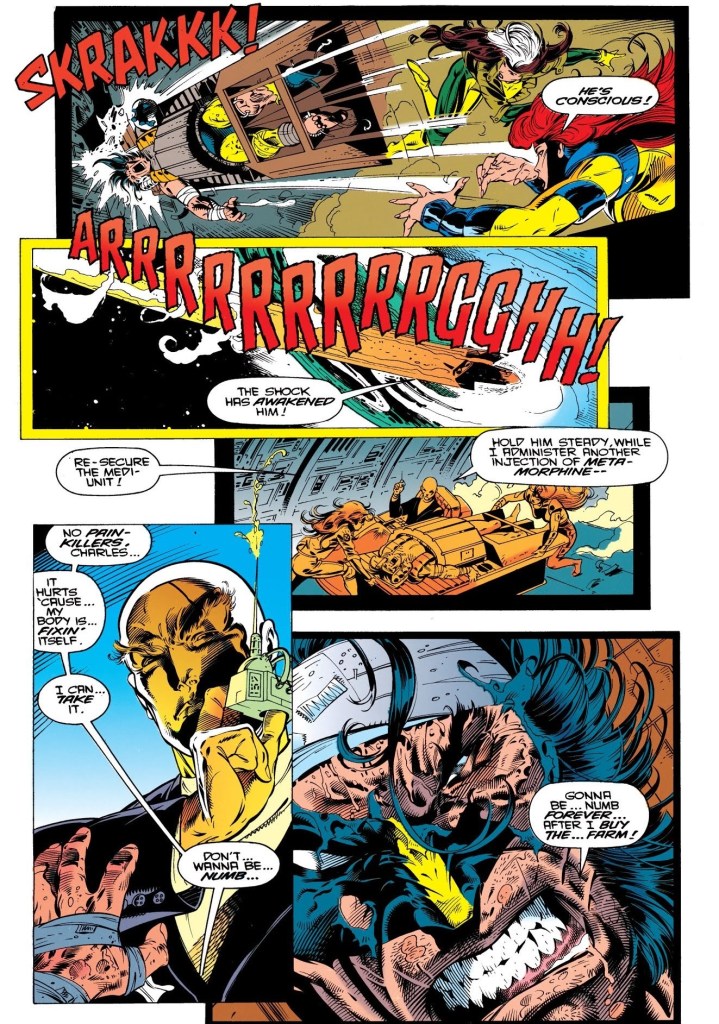
In an attempt to alleviate Wolverine’s psychic trauma, Charles Xavier and Jean Grey enter his mind and discover that there is a world full of pain and horror. They see visions of a restrained Wolverine (from his Weapon X days) being attacked by Sabretooth and Lady Deathstrike. Xavier explains that they are at the epicenter of Logan’s most suppressed cataclysmic memories which were clearly triggered by the physical damage Magneto inflicted on him (see X-Men #25).

As the X-Men’s jet attempts to enter Earth’s atmosphere, its exteriors heat up dramatically shaking everyone inside. This complicates the situation on stabilizing Wolverine…

Quality

The other X-Men team members at their headquarters expressing worry and concern about the situation of their teammates struggling to come back home from space.

To be clear, this story continues the events of Fatal Attractions but with a bit more focus on Wolverine (compared to the earlier chapters of the storyline that is). There is no real battle between good and evil at all. It’s really all about Wolverine struggling to survive just as his teammates struggle to arrive home.

Before the stories of this comic book and X-Men #25 happened, Wolverine has often been portrayed to be very tough, brave and a walking machine of violence which has been reflected in other X-Men stories told in video games and movies. In this very comic book, Wolverine has been presented to coming close to death. This means Logan, at this particular stage of the history of the literary X-Men, was at his most vulnerable state. In my experience, this was both alienating and shocking to see.

With regards to the writing, Larry Hama did an excellent job with pacing the story from start to finish. Right from the beginning, the story pulls you into the X-Men’s tough situation and as each page gets turned, the tension as well as the suspense builds up until the execution of the climax. Along the way, the comic book not only portrays Wolverine struggling on the edge, it also works to make you care more or be more concerned towards him. Oh yes, the shocking moment near the end of this comic book remains very powerful and you who read this retro review should read Wolverine #75 and see it for yourselves.

Conclusion

Wolverine at his most vulnerable state.

By today’s standards, Wolverine #75 (1993) is still a very great comic book to read. In fact, I can say it is not only one of most defining chapters of the Fatal Attractions storyline as well as one of the most significant X-Men comic books of the 1990s, it is indeed a true illustrated literature classic ever published by Marvel Comics. In retrospect, this comic book marks a major turning point in the life of Wolverine who is still one of the most iconic characters in all of superhero literature. All of these were achieved thanks to the creative team of Larry Hama and Adam Kubert (whose are here was great and stylized at the same time). Hama succeeded in writing the continuation of the Fatal Attractions storyline while balancing all of the exposition and still putting Wolverine in the center. That itself is a very great work of writing.

If you are seriously planning to buy an existing hard copy of Wolverine #75 (1993), be aware that as of this writing, MileHighComics.com shows that the near-mint copy of the regular edition costs $60 while the near-mint copies of the signed-and-numbered edition and the newsstand edition cost $300 and $180 respectively.

Overall, Wolverine #75 (1993) is highly recommended!

+++++

Thank you for reading. If you find this article engaging, please click the like button below and also please consider sharing this article to others. If you are looking for a copywriter to create content for your special project or business, check out my services and my portfolio. Feel free to contact me as well. Also please feel free to visit my Facebook page Author Carlo Carrasco and follow me at HavenorFantasy@twitter.com

A Look Back at The Strangers #16 (1994)

Disclaimer: This is my original work with details sourced from reading the comic book and doing personal research. Anyone who wants to use this article, in part or in whole, needs to secure first my permission and agree to cite me as the source and author. Let it be known that any unauthorized use of this article will constrain the author to pursue the remedies under R.A. No. 8293, the Revised Penal Code, and/or all applicable legal actions under the laws of the Philippines.

Welcome back Ultraverse fans, geeks and comic book collectors! Here is another trip back into the Ultraverse, which for me is the most defining line of superhero comics that was realized in the 1990s. The UV lasted for only a few years and along the way publisher Malibu Comics got acquired by Marvel Comics.

History aside, we are about to explore The Strangers again in the sixteenth issue of the monthly series that was spearheaded mainly by the creative duo of Steve Englehart and Rick Hoberg. Here is a look back at The Strangers #16, published in 1994 by Malibu Comics with a story written by Englehart and drawn by Hoberg.

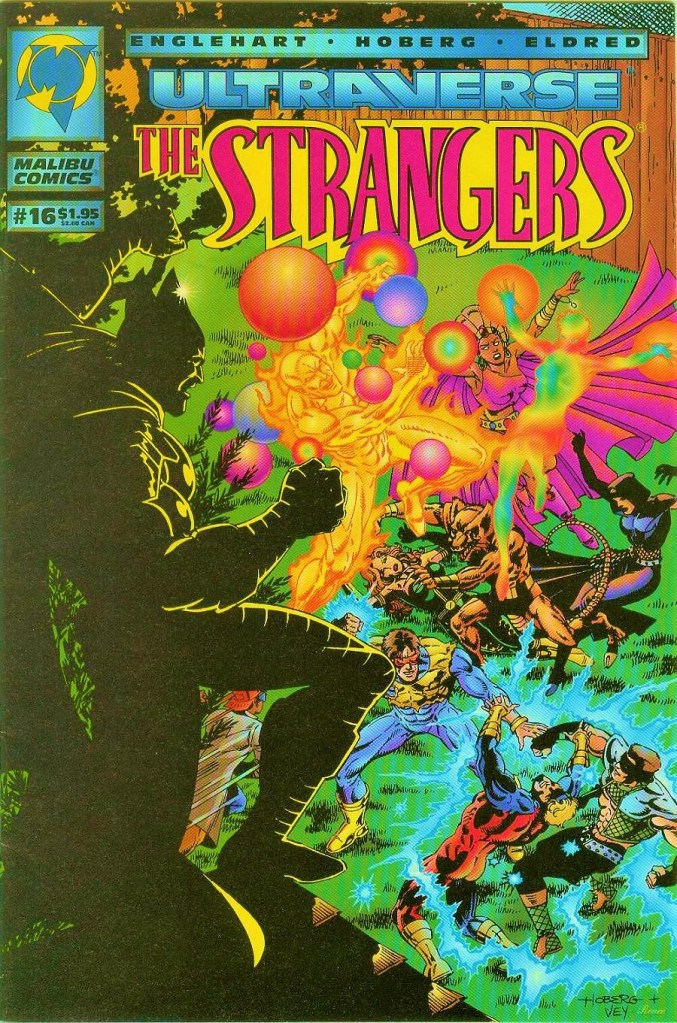
The cover.

Early story

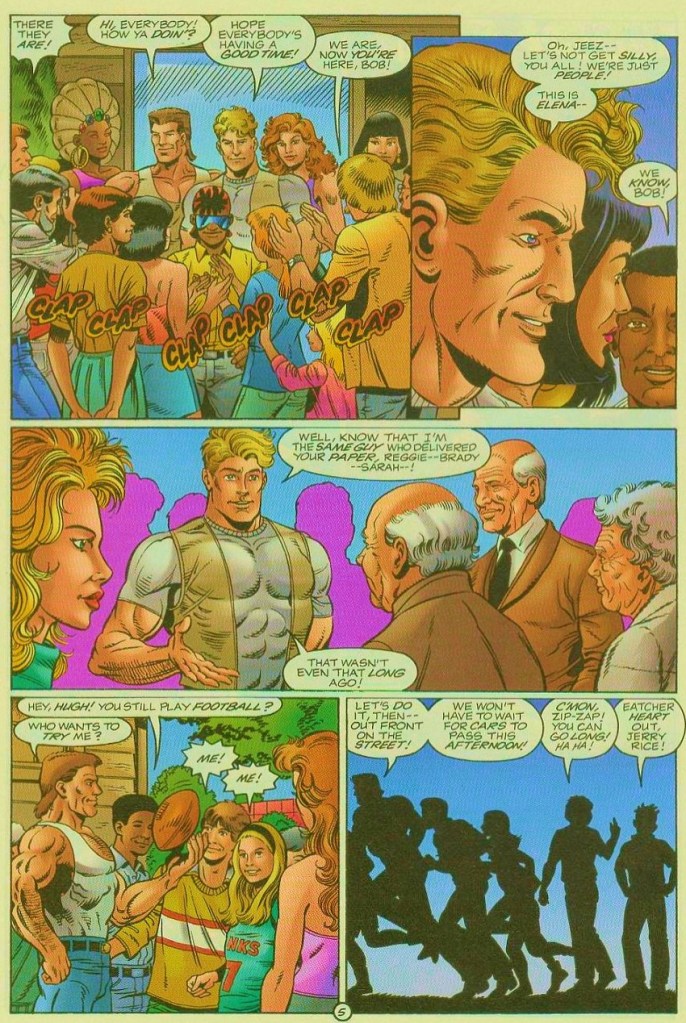
The story begins in a local community in California wherein one of the houses is hosting a block party. Already a disturbance to the neighbors (note: police officers had to temporarily close down a short stretch of the public road and restricted others from getting near), the said party offers people a chance to meet in person Atom Bob who has his teammates with him.

During a private meeting, The Strangers discuss what they encountered lately (note: this refers to their encounters with Gangsta and Brazen. Also involved was someone called the Pilgrim. As they keep talking, Lady Killer stressed that they all need to be ready for further encounters.

Meanwhile in the downtown area of the city, three costumed characters (who previously road a cable car just like The Strangers) are plotting something…

Quality

Meet the opposition.

Let me start first with the art done by Rick Hoberg with ink work by Tim Eldred. I should state that since issue #1, Hoberg not only drew characters, places, creatures and backgrounds with his captivating style, he also maintained a high level of quality and proved he can bring any comic book script into life with images. His art is so good, this comic book is fun reading again and again. I should also state that the coloring for this story is very lively and more dream-like in style thanks to the color design by Moose Baumann and interior color by Prisms.

When it comes to the story, this comic book’s concept is pretty unique and Steve Englehart deserves credit for coming up with something fresh while still leaving room for spectacle and characterization. The idea of a block party held in the middle of a community of family homes celebrating the presence of superheroes is cool and it opened up new ways to define the characters not to mention emphasizing how their presence affects people not on the city level but on the local community! Having worked as a local community newspaper journalist myself, I know what’s it like when local communities have special activities or events that bring together (or captivate) the neighbors. Along the way, the dialogue is varied (note: lots of characters other than The Strangers had lines), the portrayal of The Strangers is consistent and the story’s pace flowed smoothly.

Speaking of characterization, there is notable focus on Atom Bob and Lady Killer who already have feelings for each other. As the home of Atom Bob’s family serves as the venue of the party, you will get to see the character interact with the local neighbors and others he personally knew for a long time which is a very refreshing way of developing him. Lady Killer meanwhile tries to maintain balance between being the team’s professional leader and having feelings for Atom Bob while trying to respect his parents.

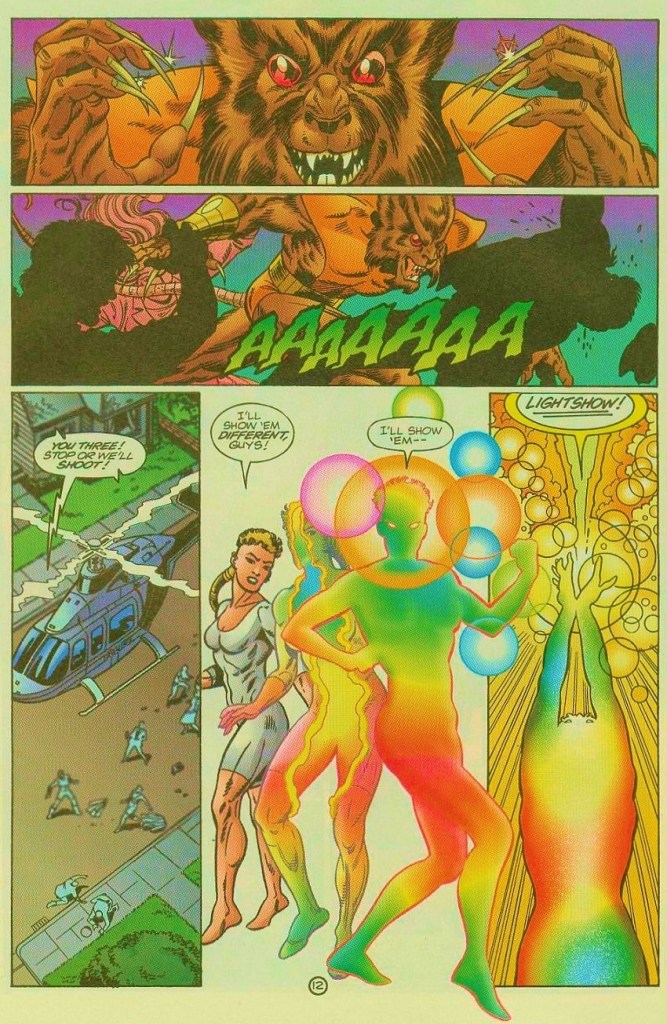
And then there is a growing group of ultras who intend to destroy The Strangers. It was at this stage in The Strangers monthly series in which a genuine opposition against the title team really started to take shape. The good news is that the Pilgrim and the other opposing ultras were not portrayed as generic bad guys but people who are struggling and have a cause.

Conclusion

The Strangers and the guests at the party.

There is no doubt that The Strangers #16 (1994) is a whole lot of fun, very compelling and intriguing to read from start to finish. Anyone who loves the title team will find something to enjoy and follow, while those who keep on enjoying the conflict between good-and-evil will find something new and entertaining here. Steve Englehart and Rick Hoberg not only continued to deliver high-quality superhero stories with The Strangers, they really were one of the best creative duos of the 1990s.

If you are seriously planning to buy an existing hard copy of The Strangers #16 (1994), be aware that as of this writing, MileHighComics.com shows that the near-mint copy of the comic book costs $8.

Overall, The Strangers #16 (1994) is highly recommended!

+++++

Thank you for reading. If you find this article engaging, please click the like button below and also please consider sharing this article to others. If you are looking for a copywriter to create content for your special project or business, check out my services and my portfolio. Feel free to contact me as well. Also please feel free to visit my Facebook page Author Carlo Carrasco and follow me at HavenorFantasy@twitter.com

A Look Back At Bloodshot #1 (1993)

Disclaimer: This is my original work with details sourced from reading the comic book and doing personal research. Anyone who wants to use this article, in part or in whole, needs to secure first my permission and agree to cite me as the source and author. Let it be known that any unauthorized use of this article will constrain the author to pursue the remedies under R.A. No. 8293, the Revised Penal Code, and/or all applicable legal actions under the laws of the Philippines.

You must have heard about the live-action Bloodshot movie (starring Vin Diesel) that failed to make big bucks at the box office. Then you must have learned about Valiant Comics.

To understand Bloodshot before reviewing the early-1990s comic book Bloodshot #1, here’s a look at the history of Valiant Comics.

1
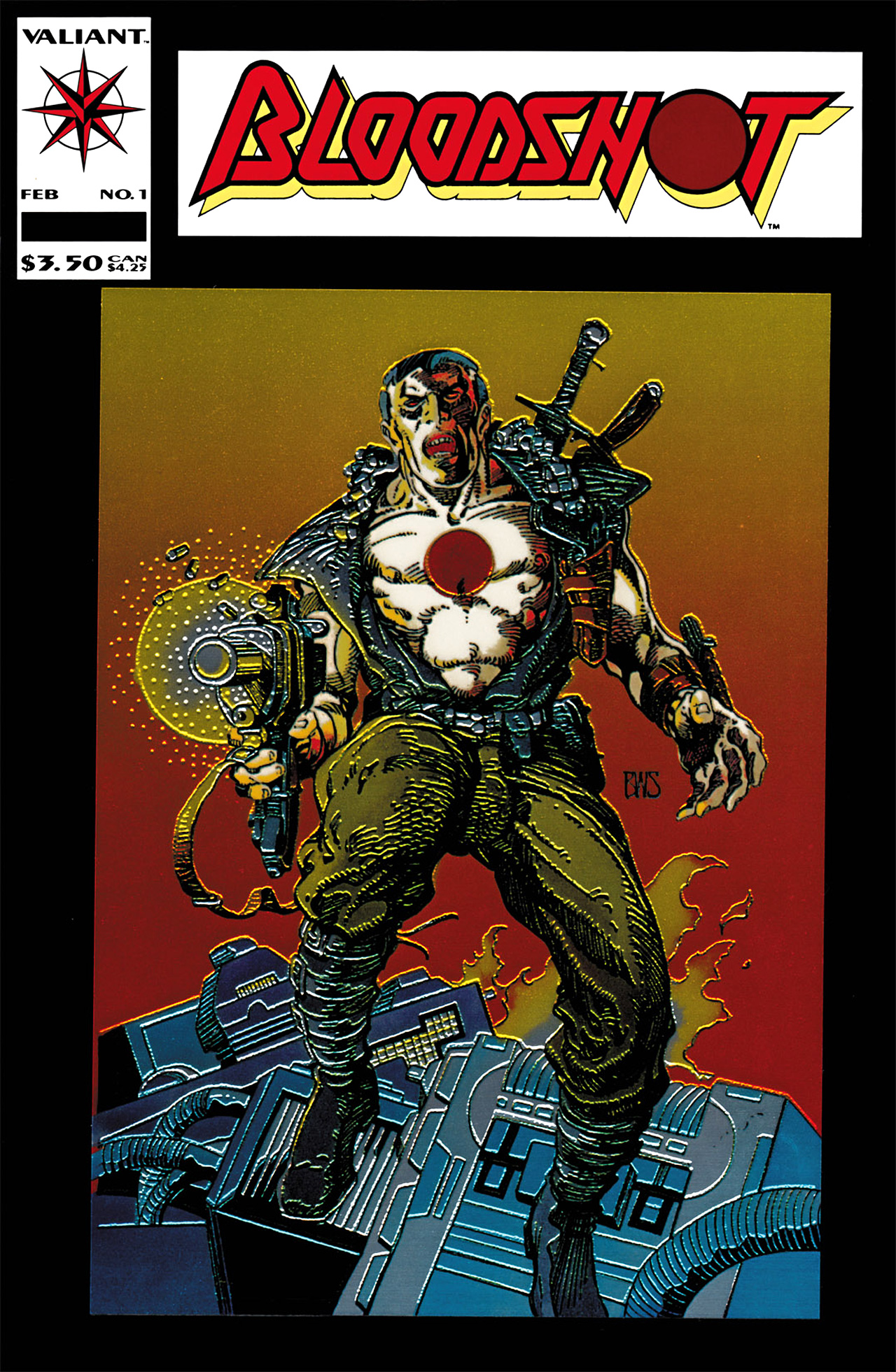
The cover with chromium and Bloodshot drawn by Barry Windsor-Smith.

In the late 1980s, a team composed of former Marvel Comics Editor-in-Chief, former Allman Brothers Band manager Steve Massarsky and some investors failed in their bid to acquire Marvel Enterprises. Instead of letting their failure stop them, they went on to establish Voyager Communications with the backing of Triumph Capital. Voyager then created the imprint Valiant Comics which went on to launch its first titles in 1991 with Magnus, Robot Fighter (which started in the 1960s in comics published by Gold Key) and Solar, Man of the Atom (also started in the 1960s through Gold Key comics).

Subsequently Valiant’s first original superhero Rai was introduced followed by other original properties like Harbinger and Eternal Warrior. It was within the pages of Eternal Warrior #4 Bloodshot made his first appearance followed by a first full appearance in Rai #0.

Then in November 1992, the same month DC Comics released Superman #75 (The Death of Superman, Valiant released Bloodshot #1 with a cover price of $3.50 (cover dated February 1993) and a very eye-catching chromium cover of Bloodshot drawn by Barry Windsor-Smith.

Now that the history lesson is done, we can finally explore Bloodshot #1 (written by Ken VanHook and drawn by Don Perlin) in this retro comic book review.

Early Story

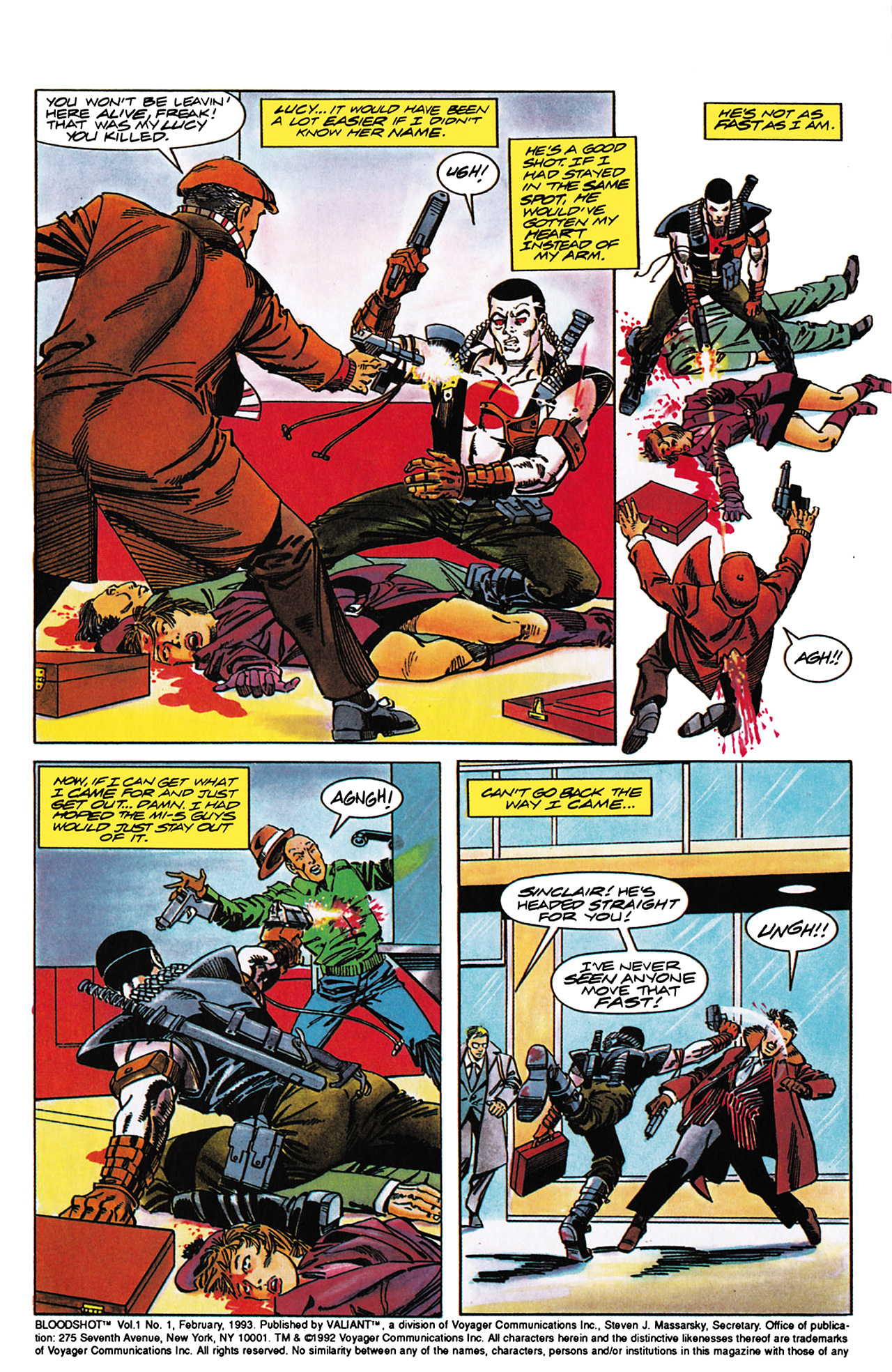
The story begins at Heathrow Airport in the United Kingdom. Immediately after a man and a woman (both wearing coats and hats) performed an exchange with a briefcase, two other men (also wearing coats) reacted to them but Bloodshot jumps into the action firing his gun, taking a shot to his arm and grabbing the briefcase. Bloodshot escapes from the airport.

4
Adulterated action!

Behind the scenes, an old man meets with Thompson and Otomo informing them that Bloodshot was an experiment of theirs under Project Rising Spirit. The project was disrupted when a young blonde male got to Bloodshot and adjusted one of the devices. The young guy was caught by one of the operators until Bloodshot (still bald and naked) got up, attacked the personnel (freeing the young guy), gathered data from their computers and escape.

The old man noticed Bloodshot’s rampage at Heathrow Airport and was able to identify him. He issues orders to Thompson and Otomo.

“I want him returned—I do not care the condition,” he said.

Quality

Looking beyond the eye-catching chromium cover, Bloodshot #1 from the early 1990s is actually engaging and intriguing to read. While it is a superhero comic book, it sure has a dark and gritty tone as well as being noticeably grounded with reality.

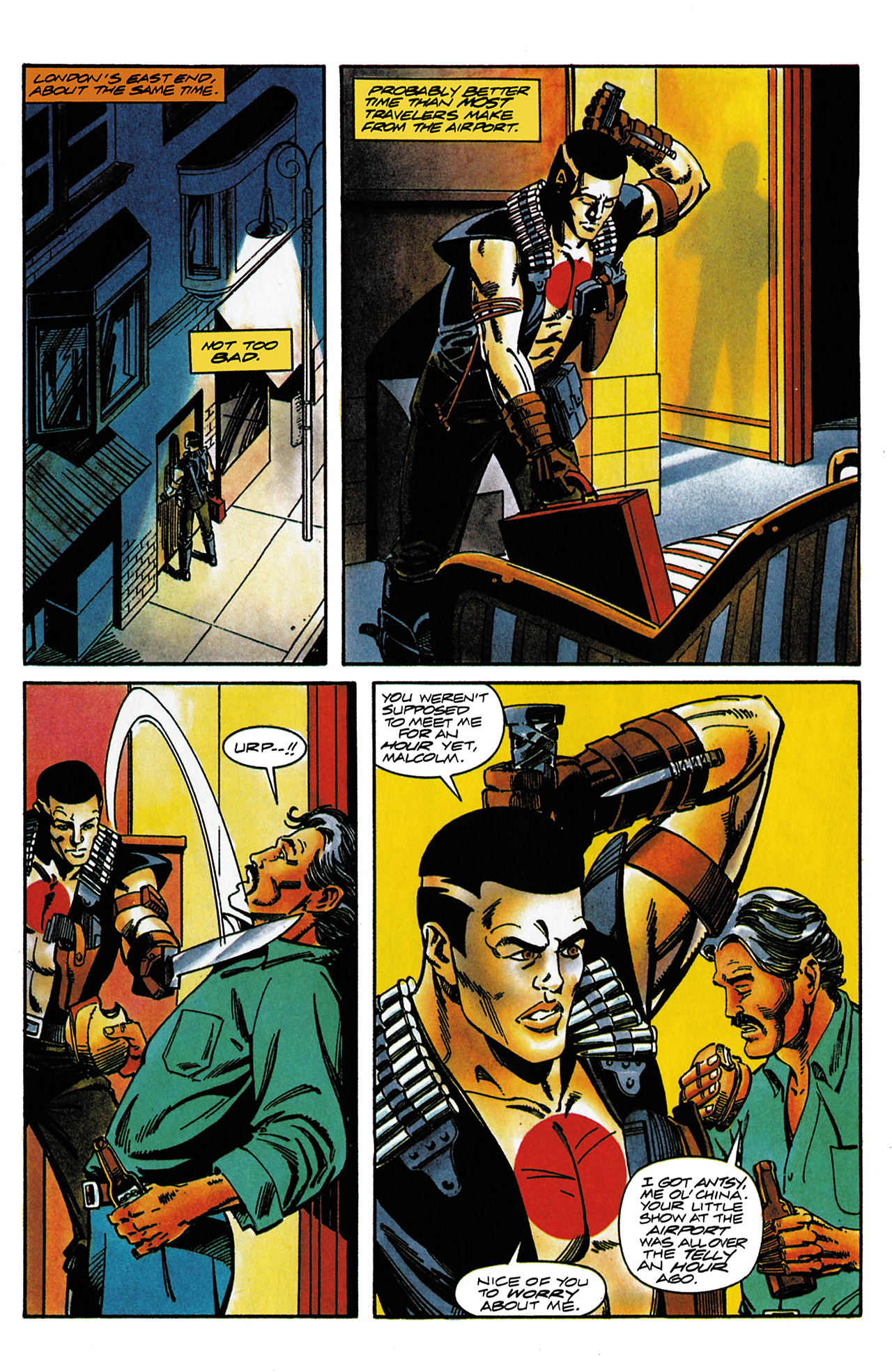
With the spectacle, the action is violent and somewhat bloody. It may look tame by today’s standards but back in the 1990s, this was exceptional and it really aimed towards older comic book readers. To put things in perspective, comparing this comic book with the typical Marvel or DC Comics superhero comic book is like comparing an R-rated action film to a PG-13 action or adventure film. Don Perlin’s artwork has a nice flow when it comes to the action and the dialogue scenes.

The writing by Kevin VanHook is good even by today’s standards. I like the way he handled expository dialogue in the first half of the comic book and from that point on, the spotlight was on Bloodshot and his exploits.

There are some weak spots in this comic book. There really was no room for real character development with Bloodshot. The comic book eerily reflected the hero’s approach to doing things: no slowing down, time to take action from here.  That’s not to say it is a brainless read but rather the plotting is decent and relied on the spectacle to make up for the absence of character development. That being said, Bloodshot as a hero who was a victim under his handlers, is hard to like. Based on this comic book alone, he is a rampaging killer looking as evil as the bad guys. It does not help that he is very unstoppable (because of nanites in his blood system which worked to enhance and heal him) and, at least in this comic book, there’s no real sense of danger for him.

When it comes to supporting characters like Sinclair and Malcolm, I can’t help but keep remembering Commissioner Gordon and butler Alfred Pennyworth in the Batman comics.

Conclusion

While it has some flaws in its presentation, Bloodshot #1 is still good and fun to read. On face value, Bloodshot looks like a typical macho action hero with guns but he actually has an interesting personality even though character development was badly lacking in this particular comic book. I also enjoyed the creator’s approach on emphasizing realism by using gangs and secret sinister organizations (which conduct unethical scientific experiments on people) on the background showing that Bloodshot himself is small player in a dangerous game of secret operations.

11

As a standalone story, Bloodshot #1 has more than enough good stuff to make up for its flaws and it is worth reading by today’s standards. This is the true value of the comic book that its flashy chromium cover does not reflect. In other words, this comic book is more than just a gimmick.

If you are a collector, be aware that as of this writing, Bloodshot #1 is worth over $40 for a near-mint copy according to Mile High Comics.

Overall, Bloodshot #1 (1993) is recommended. As a piece of amusement, the comic book is so much better than the Vin Diesel Bloodshot movie. That says a lot!


Thank you for reading. If you find this article engaging, please click the like button below, share this article to others and also please consider making a donation to support my publishing. If you are looking for a copywriter to create content for your special project or business, check out my services and my portfolio. Feel free to contact me with a private message. Also please feel free to visit my Facebook page Author Carlo Carrasco and follow me on Twitter at  @HavenorFantasy as well as on Tumblr at https://carlocarrasco.tumblr.com/ and on Instagram at https://www.instagram.com/authorcarlocarrasco
A Look Back at Spider-Man 2099 #35 (1995)

Disclaimer: This is my original work with details sourced from reading the comic book and doing personal research. Anyone who wants to use this article, in part or in whole, needs to secure first my permission and agree to cite me as the source and author. Let it be known that any unauthorized use of this article will constrain the author to pursue the remedies under R.A. No. 8293, the Revised Penal Code, and/or all applicable legal actions under the laws of the Philippines.

When Marvel Comics first launched the 2099 imprint of comic books showcasing many futuristic versions of their present-day characters – like Spider-Man, Ravage and Dr. Doom – it was inevitable that the same treatment will be applied to their popular supervillains.

In 1993, the 2099 version of Vulture was introduced and he sure proved to be one tough opponent for Spider-Man 2099. Even back then, there already was clamor for a futuristic version of Venom which at the time was riding high with readers being the featured anti-hero in several limited series (starting with Lethal Protector) of comic books.

Then in 1995, after doing a creative teaser in issue #34, Marvel formally introduced Venom 2099 by releasing Spider-Man 2099 #35. This is my review of the comic book written by Peter David and drawn by Andrew Wildman (X-Men Adventures).

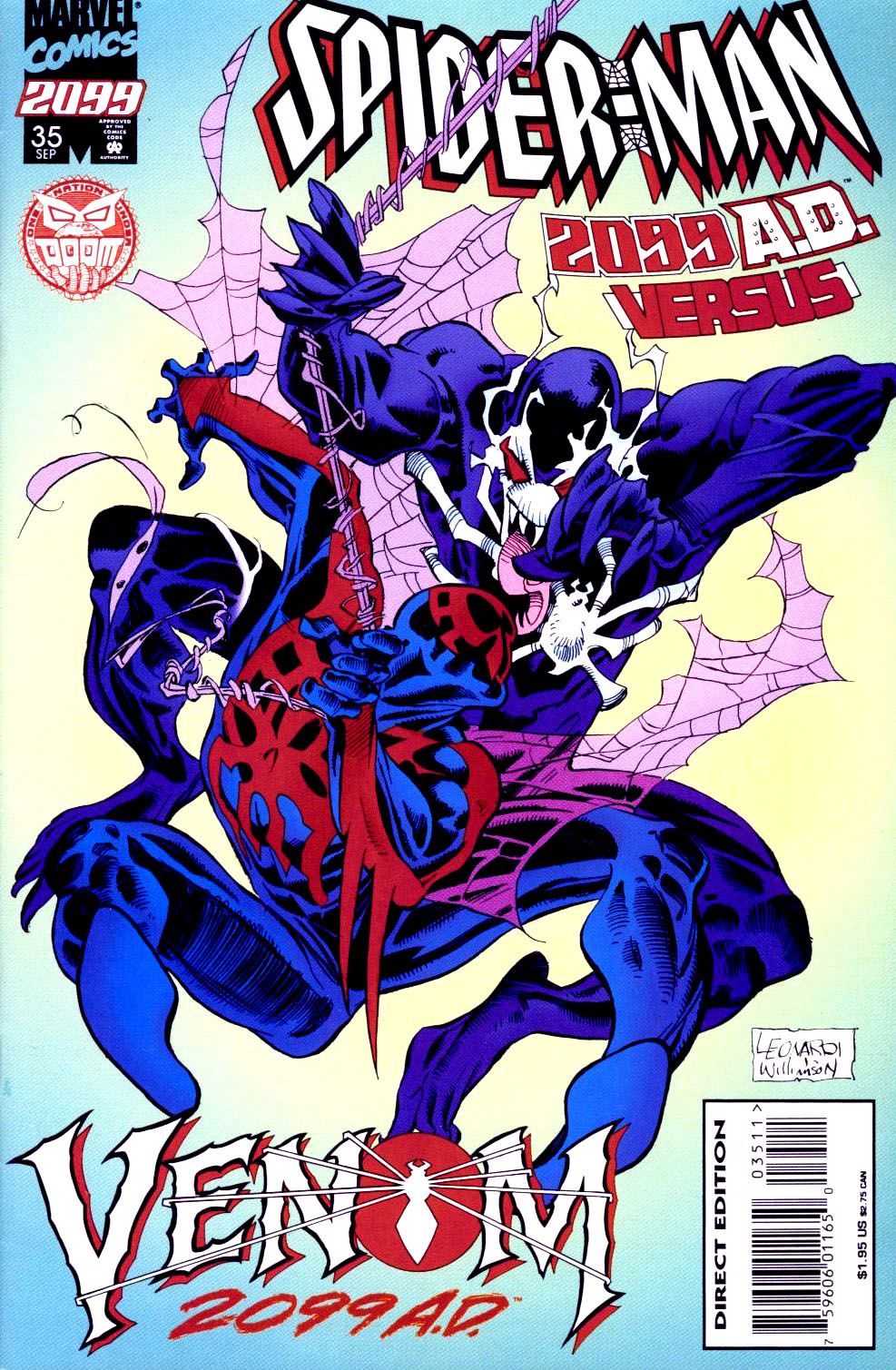
Cover
The cover drawn by Rick Leonardi.

Early story

Picking up from the events of issue #34, the story begins in Washington, DC with Dana freeing herself only to find out that Alchemax’s CEO Tyler Stone was down suffering from a gun shot and losing blood. Minutes later, emergency personnel take Stone’s body for immediate treatment.

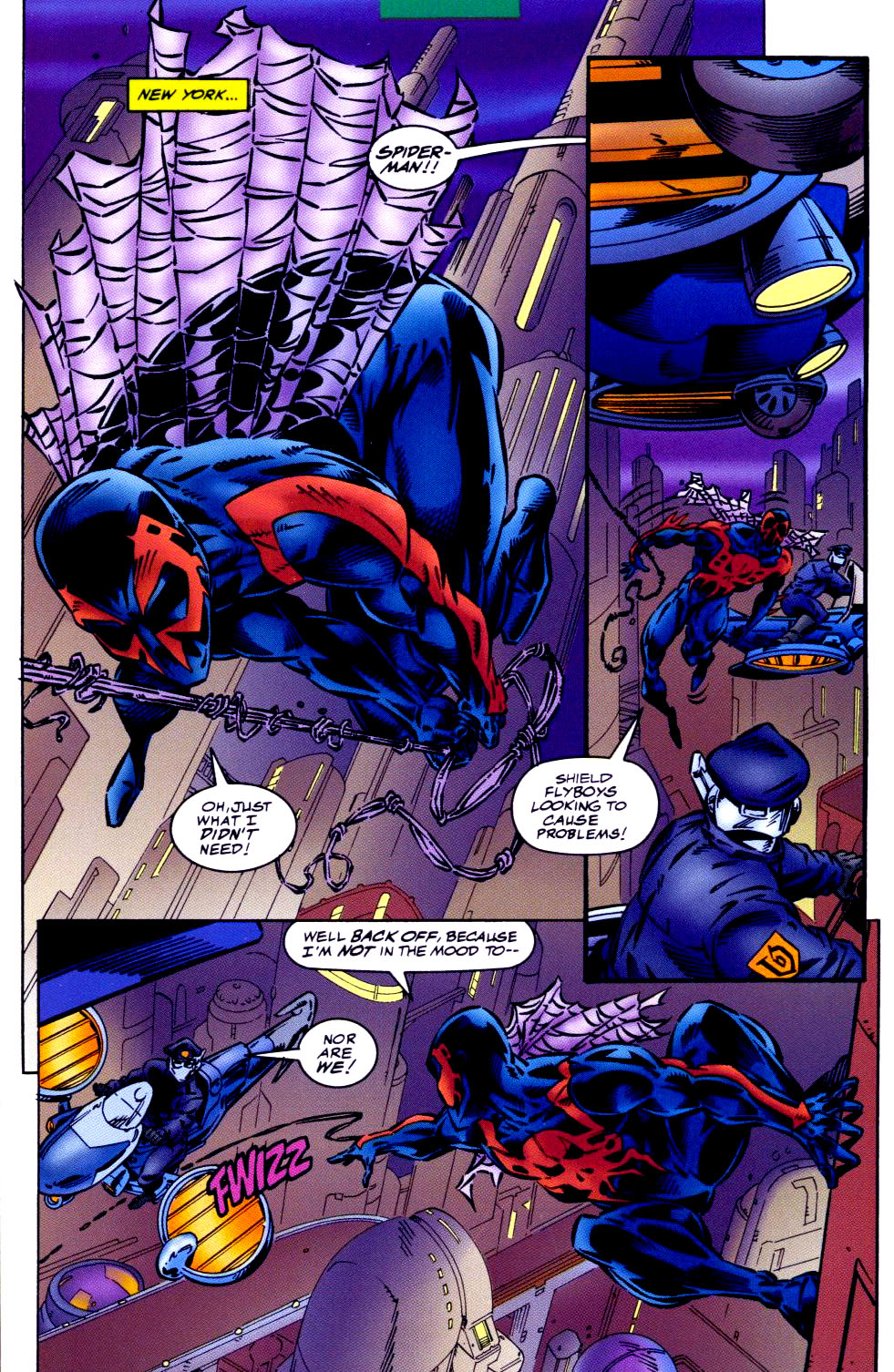
Meanwhile, Spider-Man 2099 (Miguel O’Hara) encounters the SHIELD flyboys in New York. After almost getting into trouble together, Spidey gets informed that US President Doom 2099 ordered them to leave him alone for a period of seventy-two hours while he considers a cabinet offer. Back in Washington, Dana gets interrogated by one of the authorities. President Doom enters the scene telling Dana that she will join Tyler Stone immediately in the medical center.

3
Andrew Wildman’s take on Spider-Man 2099 and the future was really nice to look at.

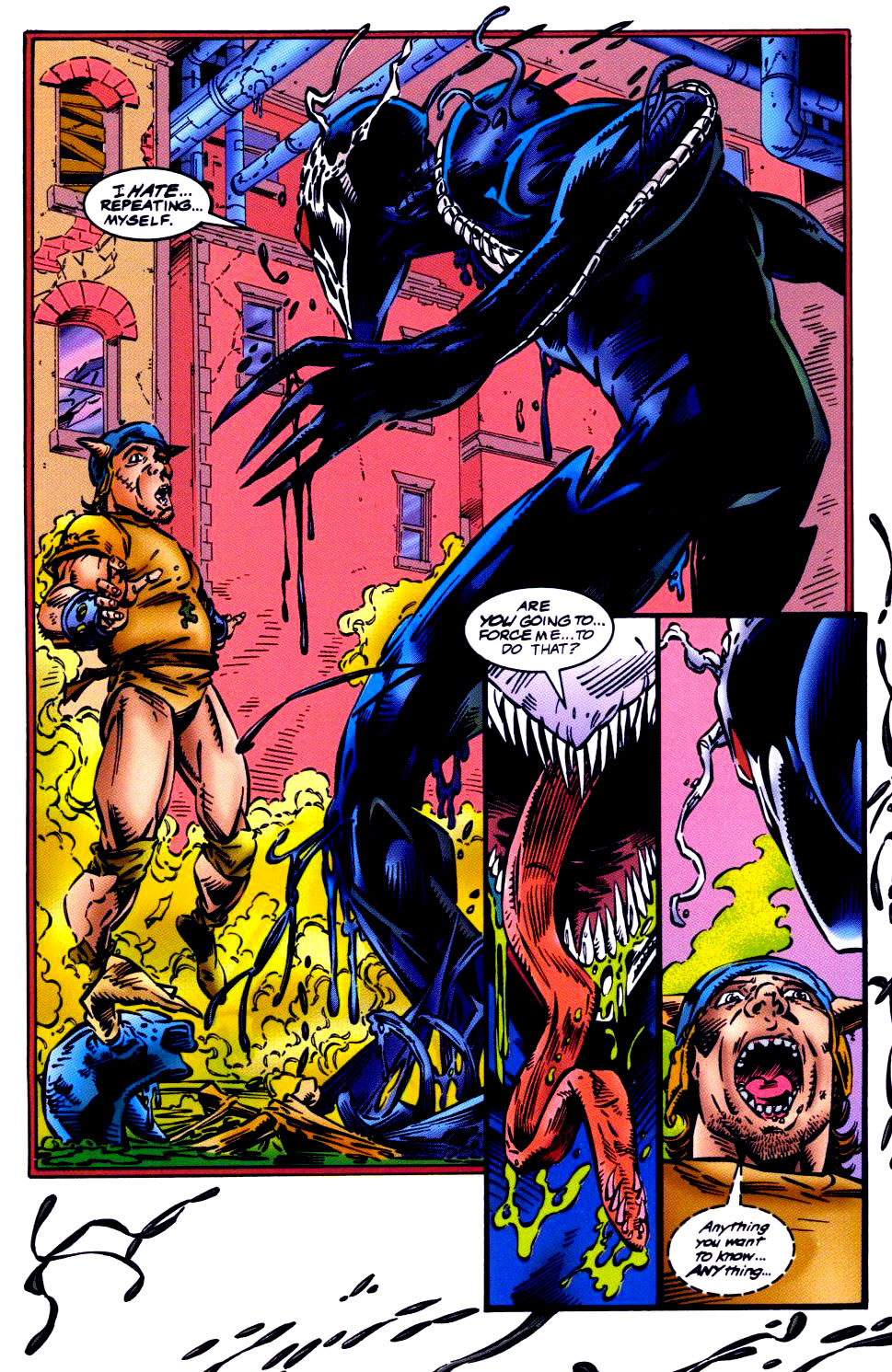
In New York, two guys sitting on the sidewalk witness a moving black liquid coming out of the sewer. The thing turns out to be a living symbiote (or alien costume) forming into a human-like shape – Venom 2099!

Quality

As with other comic books of this particular series, the writing by Peter David is pretty deep and engaging. The usual balance between dramatization, character development, plotting and spectacle is here once again but with a slight touch of horror in relation to the introduction of Venom of 2099. Speaking of dramatization, the portrayal of Venom 2099 as a vicious villain is similar to the 20th century Venom (Eddie Brock) but with a very powerful obsession to kill Miguel O’Hara and Tyler Stone.

Here’s an excerpt from the dialogue of Venom of 2099: Miguel O’Hara…and Tyler Stone…together again. We…I get to kill you…at the same time…how awfully…awfully…considerate. To show my appreciation…I’ll kill you slowly.

What makes this comic book unique is the artwork by Andrew Wildman who temporarily replaced regular illustrator Rick Leonardi. For comparison, I find Wildman’s art style a welcome thing in this comic book mainly because he draws with a lot more detail per panel and per page than Leonardi ever could. Instead of seeing the usual sketch-like art style of Leonardi, Wildman’s style is livelier and more expressive to look at. I also enjoyed Wildman’s visual take on Spider-Man 2099/Miguel O’Hara, Lyla, Tyle Stone, and the other established characters. Their facial expressions are also livelier to see.

9
Venom 2099 appears! Take note of the “liquid” at the edges of the page.

More on visuals, Wildman’s take on Venom 2099 is unforgettable. Like 20th century Venom, he has a dark suit, elongated jaw with rows of sharp teeth and an elongated tongue but with green acid dripping all the time. There are also those tentacles-like things that stretch from his body until the arms. Also his white-colored mask with large eyes make him look horrific.

Conclusion

Despite being shorter than the usual 22-pages, Spider-Man 2099 #35 is still a very engaging and fun old comic book to read. Its purpose was to build-up anticipation leading to the introduction of Venom 2099 was achieved nicely and the respective qualities of the writing and visuals are very good even by today’s standards. More on the presentation of Venom of 2099, it seems like Peter David took inspiration from movie director James Cameron on building-up tension and suspense before showing the villain. That’s a move I enjoyed in this comic book.

Overall, Spider-Man 2099 #35 is highly recommended. If you plan to acquire an existing and legitimate hard copy, be aware that the near-mint copy of it is over $100 for the newsstand version while the Rich Leonardi-drawn “Venom 2099 AD” cover version is priced at over $80 at MileHighComics.com as of this writing.


Thank you for reading. If you find this article engaging, please click the like button below and also please consider sharing this article to others. Also my fantasy book The World of Havenor is still available in paperback and e-book format. If you are looking for a copywriter to create content for your special project or business, check out my services and my portfolio. Feel free to contact me as well. Also please feel free to visit my Facebook page Author Carlo Carrasco and follow me at HavenorFantasy@twitter.com