Retro Gaming Ads Blast – Part 20

Welcome back readers, fellow geeks and electronic gaming fans!

In this edition of the Retro Gaming Ads Blast (RGAB) series, we will take a look at another batch of retro gaming print ads – including arcade flyers – from the 1980s and 1990s.

For the newcomers reading this, Retro Gaming Ads Blast (RGAB) looks back at the many print ads of games (console, arcade, computer and handheld) that were published in comic books, magazines, flyers, posters and newspapers long before smartphones, social media, the worldwide web and streaming became popular. To put things in perspective, people back in the 1980s and 1990s were more trusting of print media for information and images about electronic games and related products.

With those details laid down, here is the newest batch of retro gaming print ads for you to see and enjoy…

1. River Raid print ad
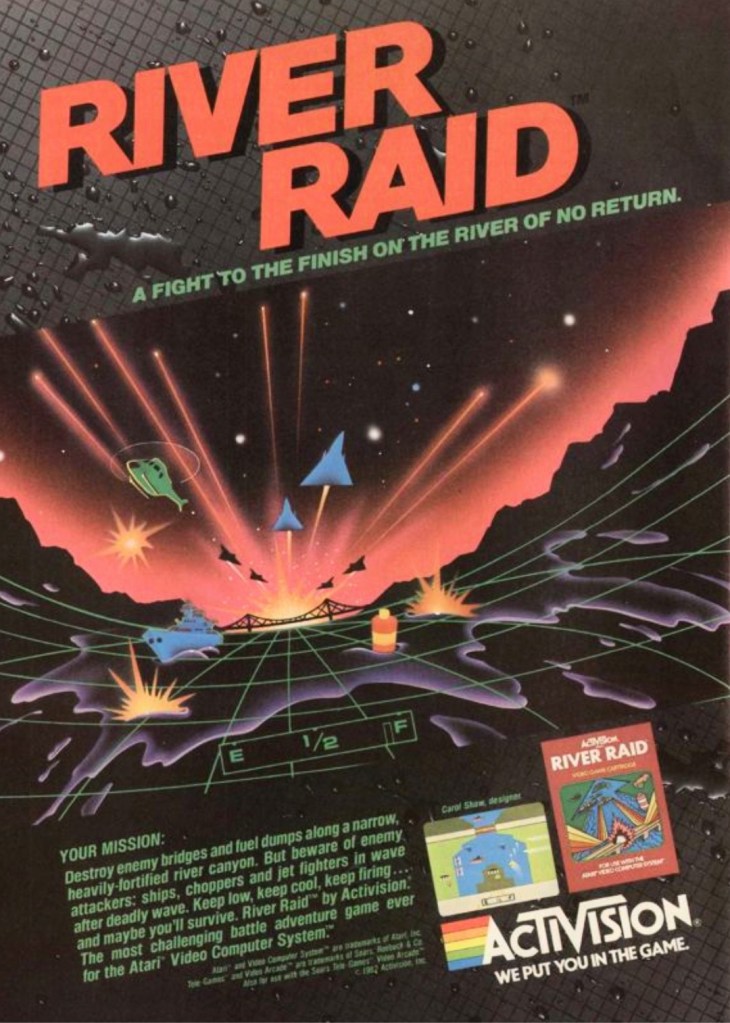
This River Raid print ad appeared on comic books and magazines long ago.

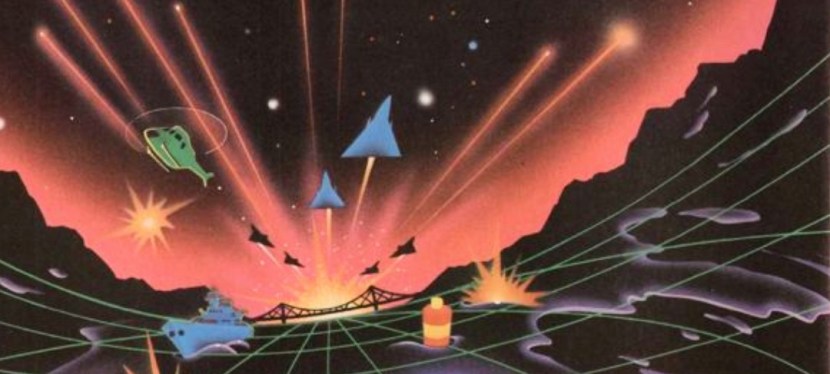
Decades before it became an industry giant with the best-selling Call of Duty games, Activision became a standout publisher in the early 1980s with River Raid on the Atari 2600. Designed by Carol Shaw, River Raid was a huge success ending up as the 2nd best-seller on the Atari 2600 as well as Activision’s best-selling game for the year 1983. Apart from showing one screenshot and the box cover of the game, the print ad of River Raid had this mesmerizing 3D image that caught many gamers’ attention and helped them feel like they will pilot on dangerous missions. The 3D image was futuristic in its own style became forward-moving 3D sequences in video games became reality many years later.   

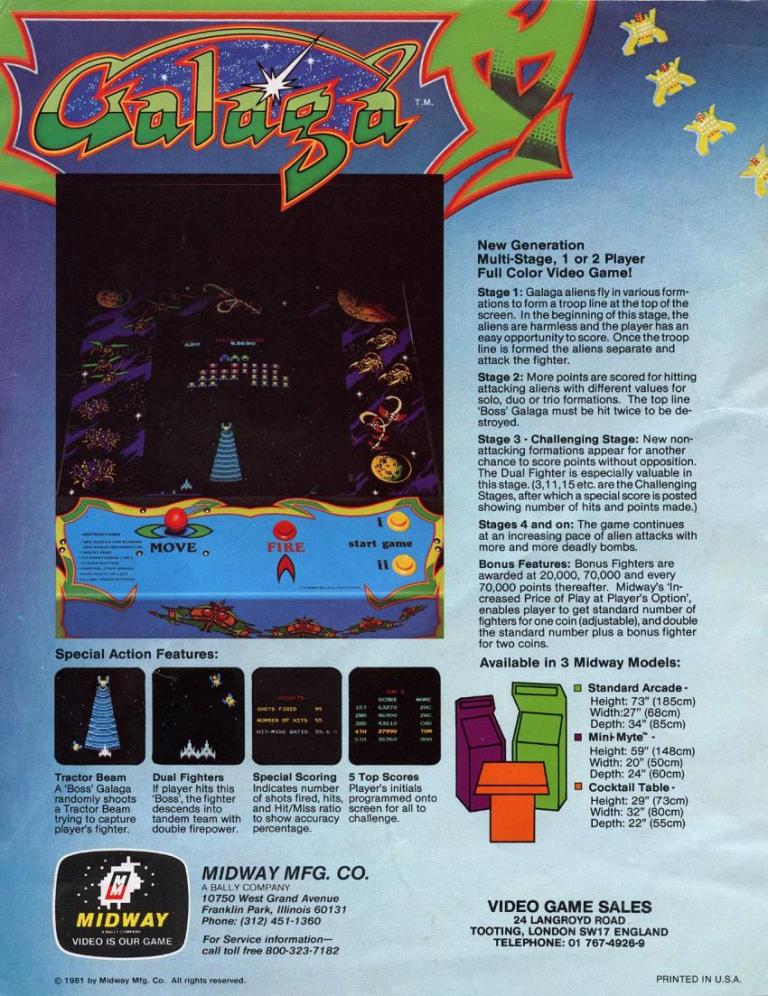
2. Galaga North American arcade flyer
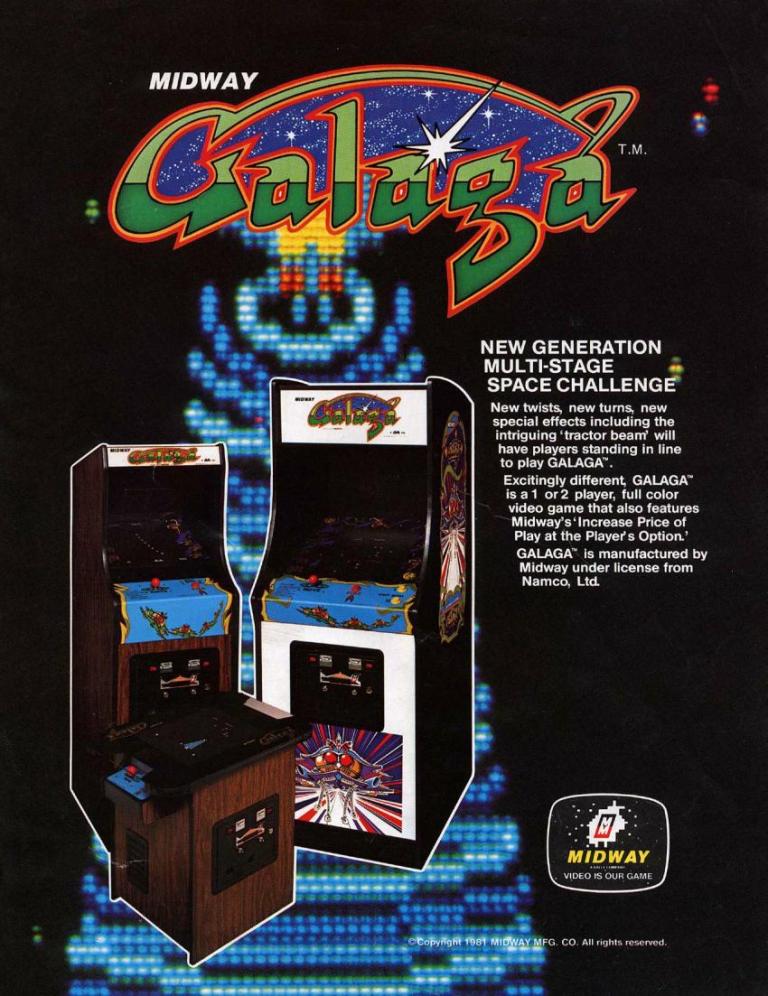
The front of the flyer showing three Galaga machines that arcade operators can choose from.
Key details about Galaga were nicely presented on the rear of the flyer.

In the history of gaming, Namco’s Galaga was played by countless millions of gamers and it is still highly regarded as an arcade classic as well as one of the most enjoyable arcade games ever made. In preparation for the North American launch (October 1981), Midway prepared the arcade flyer showing the three types of machine on the front that arcade operators can choose from. On the rear is the really neat approach of explaining the details of the game, what kind of gameplay is to be expected, and how to play. Whether you are an individual player or the manager of an arcade joint, this flyer suits your needs.   

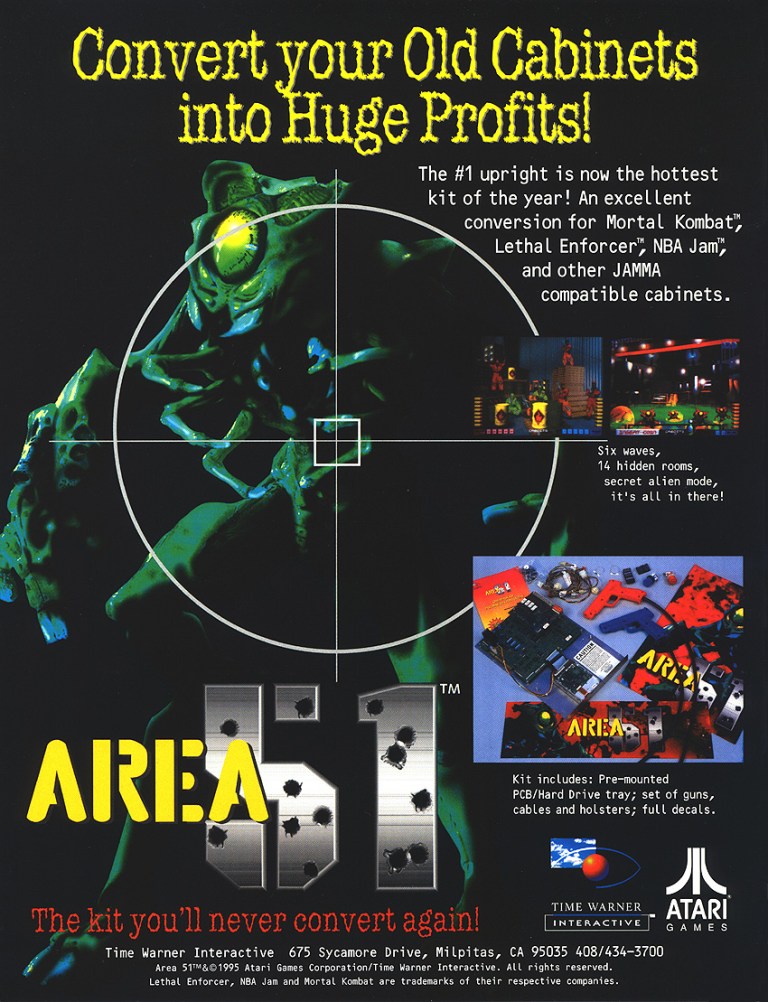
3. Area 51 arcade flyer and conversion kit flyer
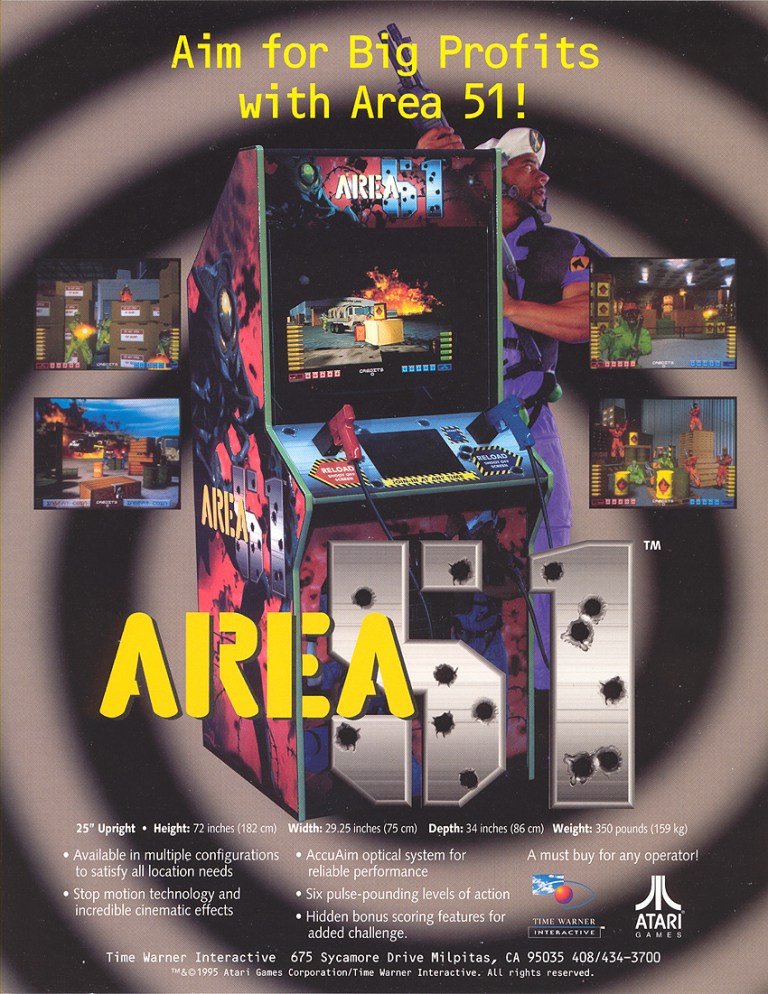
The front of this Area 51 flyer had an enticing message for arcade operators as well as other business owners/managers who are interested in having a machine to add value to their business joints. Atari was already in deep money problems by the time they started making this game.
The Area 51 arcade conversion kit is a cheaper alternative for businesses who want the game.

Moving on to the 1990s, Atari was already struggling financially and desperately needed a hit to lift them up fast. A light gun shooter project was approved as arcade shooters were in good demand and after overcoming serious hurdles during production internally, Atari hired independent team Mesa Logic to take charge of development. After being granted extra time and more creative freedom, the project under Mesa Logic’s handling became a sci-fi shooter titled Area 51. The game became a huge hit in the arcades for Atari resulting in sales of more than 20,000 arcade cabinets as well as a major financial boost for the company (note: Atari still exists today). Atari went on to release Atari 51 versions for PlayStation, Sega Saturn and PC in America in 1996. The Atari 51 flyers you see here are still captivating to look at and were crucial in generating buzz among arcade operators, business joints that had space for arcade cabinets and gamers.

4. Panasonic 3DO print ad
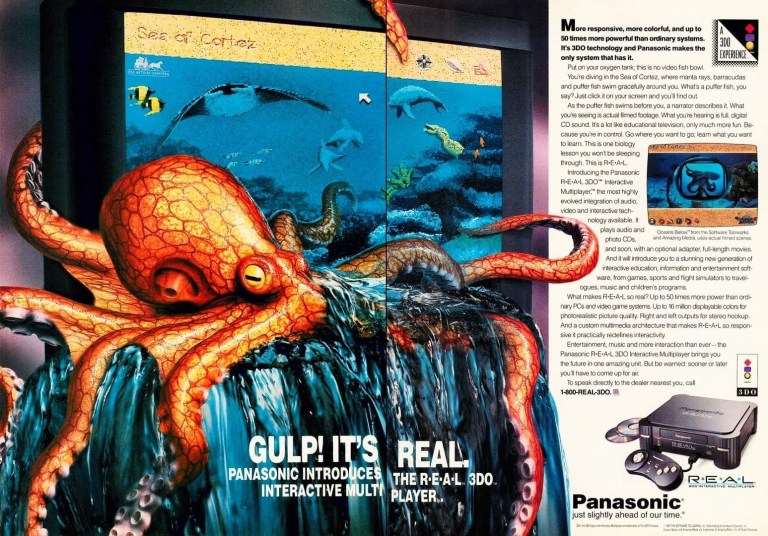
The makers of this print ad forgot to mention the 3DO is also a game machine.

Back in 1993, the 3DO Interactive Multiplayer console manufactured by Panasonic (a licensee of the 3DO Company) was launched with a CD-ROM drive, multimedia features and gaming capabilities (with a 3-button control pad). This print ad strongly emphasized the 3DO’s ability to play high-quality sound and full-motion videos using the Sea of Cortez software which functioned as an interactive movie. Obviously, this did not resonate well with people who loved to play games and by the time the 3DO Company and its partners started marketing games, they could not save the 3DO console from fading to obscurity. The console shown in the ad is specifically model Panasonic FZ-1 R·E·A·L 3DO Interactive Multiplayer. Panasonic was one of five companies that were licensed by the 3DO Company.

5. MechWarrior 3050 SNES print ad
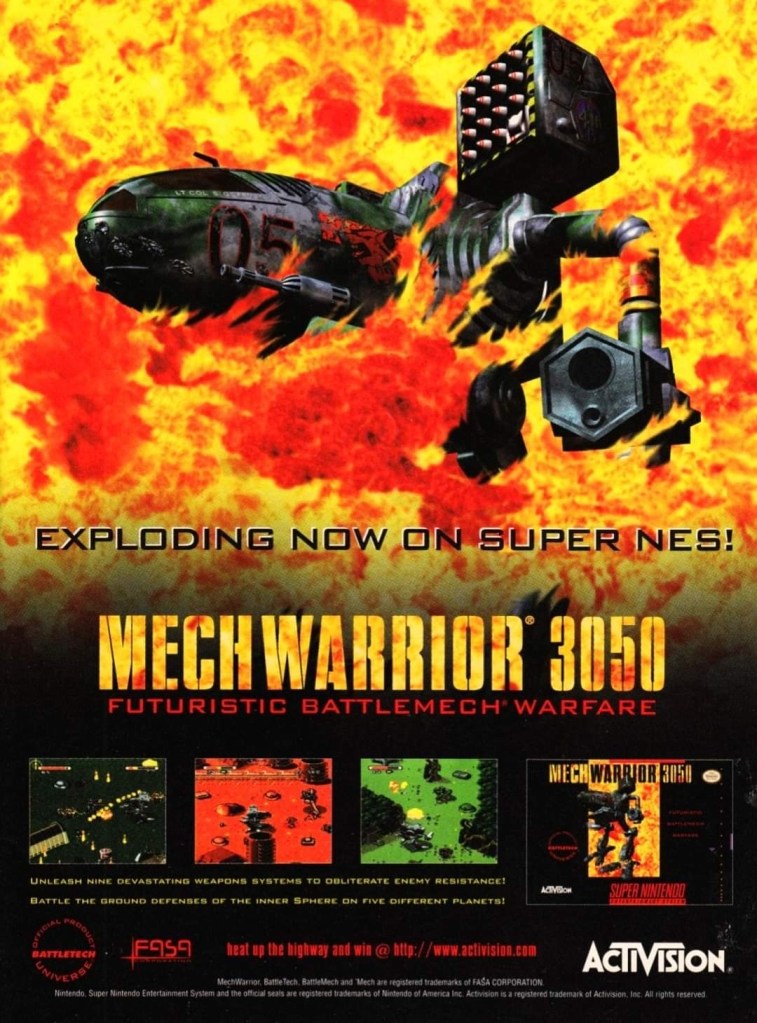
If you were unaware of the 1994 game BattleTech, then this ad would have fooled you into thinking it is promoting a brand new game.

In 1995, the popular BattleTech entertainment franchise arrived on the Super Nintendo Entertainment (SNES) system with MechWarrior 3050 and its print ad had a really blazing artwork of an armed mech in fire which gave readers the illusion of a new and original game. In reality, MechWarrior 3050 was actually a port of BattleTech which was released on the Sega Genesis in 1994. The Genesis game was published by Extreme Entertainment Group while the SNES game was published by the more famous Activision. If you look closely at the MechWarrior print ad, you can tell how hard they tried to sell the game like it was brand new and all-original.

6. Cliffhanger video game print ad
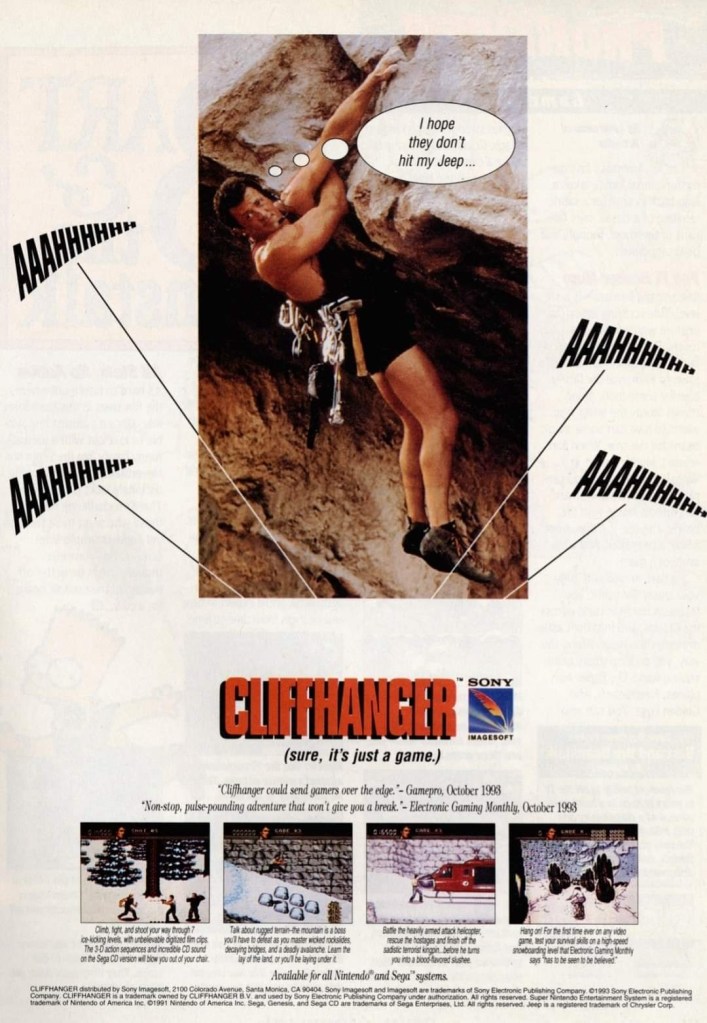
This print ad had Sylvester Stallone hanging on a cliff to be relevant with the title of both the film and the game. They could not show images of Stallone in hard action scenes.

For fans of Sylvester Stallone, 1993 was a big and exciting year as the Hollywood icon appeared in two major action films – Cliffhanger and Demolition Man. Cliffhanger was released first and there were video game adaptations of it released on game consoles, handhelds and computers. This print ad of the Cliffhanger video game had an image of Stallone hanging on a cliff to emphasize the title. The ad makers cleverly posted selected gameplay screenshots and quoted GamePro and Electronic Gaming Monthly (EGM) to make the game look credible and worthy of purchasing. The marketing led to nowhere as the game received mostly negative reviews from critics and it faded to obscurity. Lastly, the Cliffhanger game ad had a noticeable amount of space wasted. They could have made the screenshots and text look somewhat bigger to sell the game.

7. Ballz: The Director’s Cut print ad
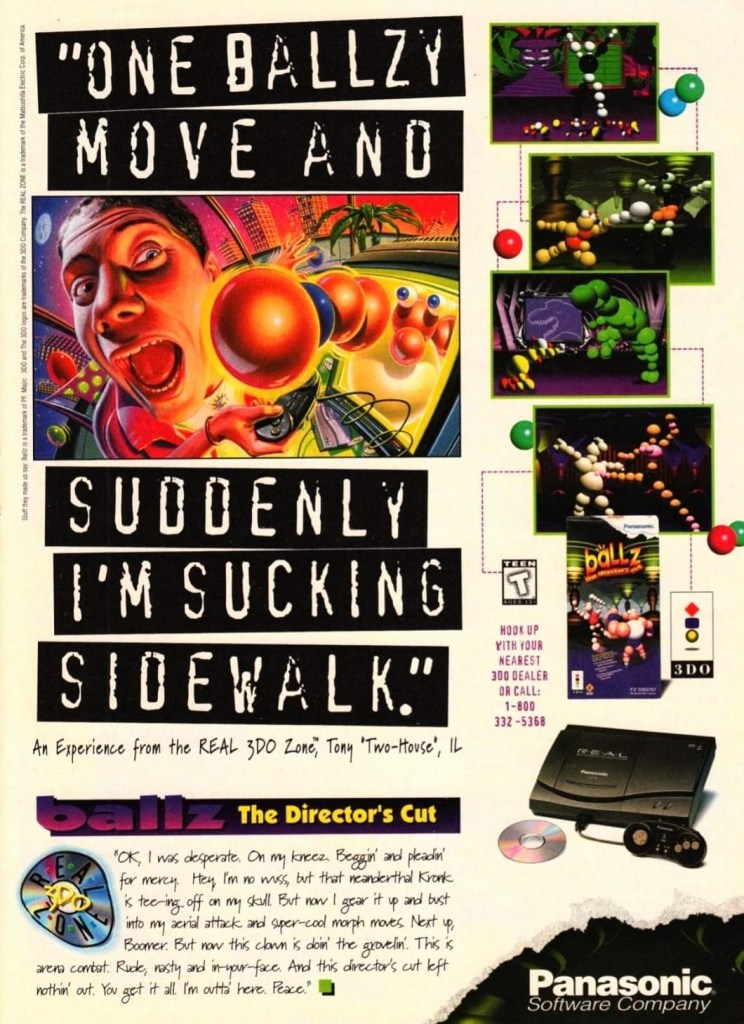
I never got to play this game on the 3DO.

Here is another ad of the video game released on the failed 3DO console. As its title made obvious, Ballz: The Director’s Cut is an enhanced version of the original Ballz game of 1994 that was released on other consoles. The print ad had an eye-catching piece of artwork and posted beside it were selected shots of the gameplay. Strangely enough, the creative writing on the lower part of the ad does not make any sense and did nothing to convince gamers to play the game. As Ballz: The Director’s Cut was released in 1995, this ad shows the revised 3DO console from Panasonic (model: Panasonic FZ-10 R·E·A·L 3DO Interactive Multiplayer).

8. NFL GameDay 2000 print ad
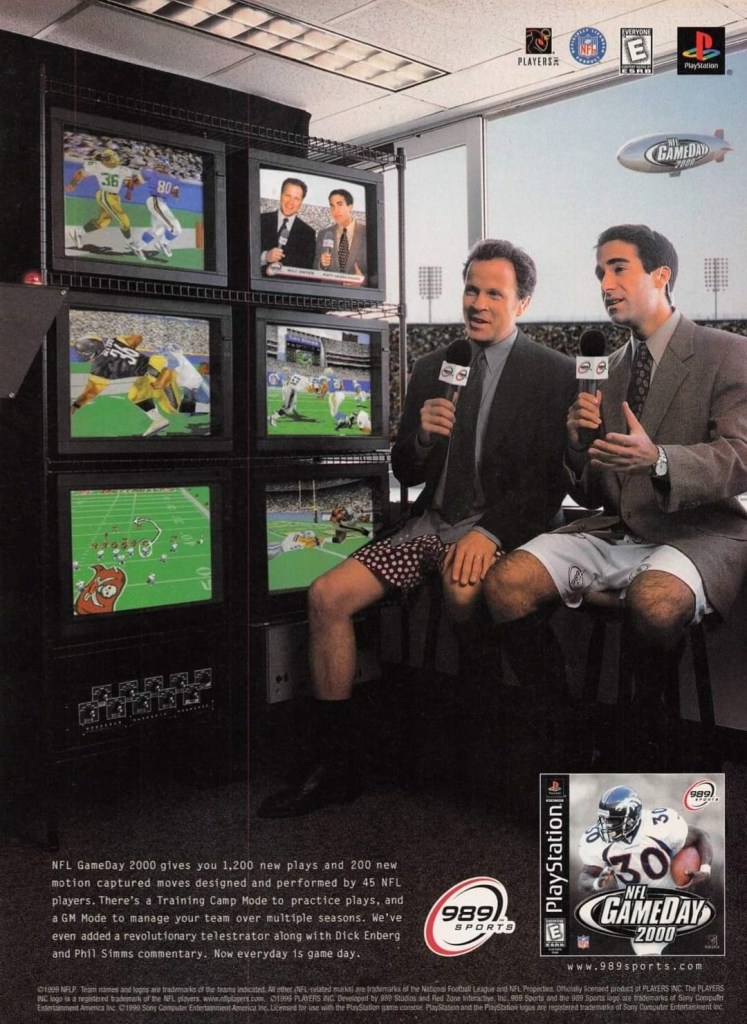
Did you find this ad funny to look at in 1999?

To promote the PlayStation-exclusive NFL GameDay 2000, Sony publisher 989 Sports and the ad makers decided to implement a humorous look at football TV coverage by having two sportscasters wearing shorts in front of a TV camera that was only showing their heads and upper bodies. The TV sets on the side show screenshots from the game to emphasize the sports gaming experience. Ultimately the game scored mostly positive review from the critics.  

9. WildC.A.T.S: Covert Action Teams print ad
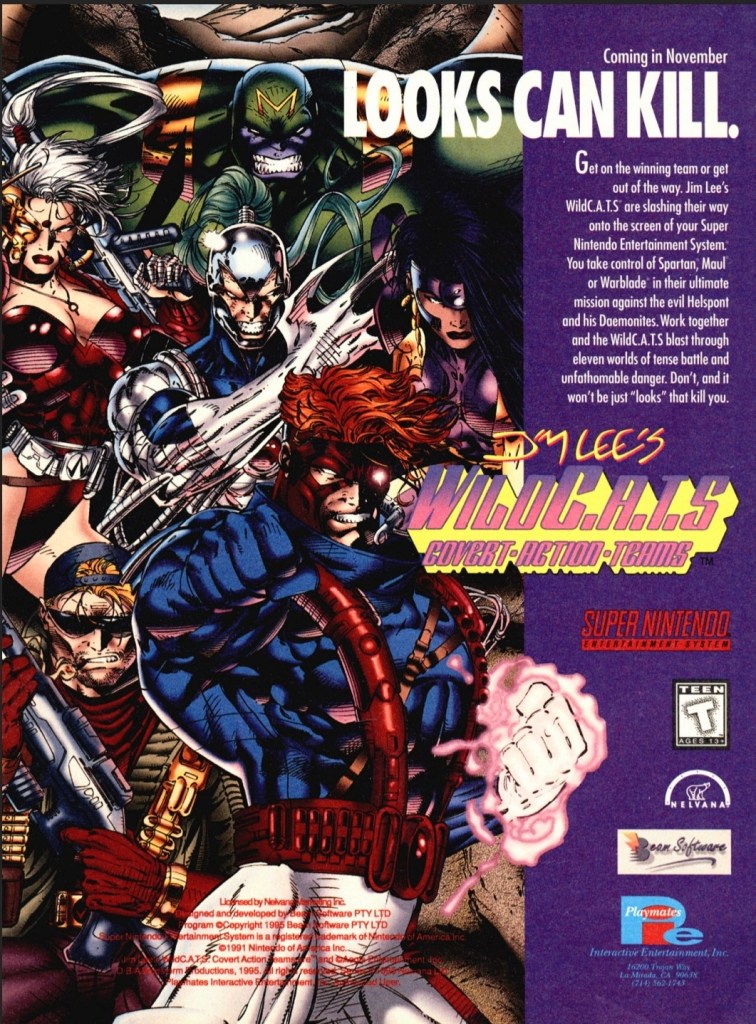
WildC.A.T.S. art by Jim Lee was used to promote the SNES video game.

When Image Comics launched in 1992, WildC.A.T.S: Covert Action Teams was Jim Lee’s creator-owned comic book franchise and its launch issue was a big seller. Years later, WildC.A.T.S. grew in popularity with comic book fans and the franchise achieved multi-media status by venturing into TV (with an animated series) and video games. This print ad promoting the video game adaptation had no screenshots to show which kept fans and gamers guessing how the game will turn out in terms of gameplay and game design. It was obvious that the people who made this print ad had to rely on the best WildC.A.T.S. artwork they could find drawn by Jim Lee. This ad made me laugh back in the old days because if you did not look closely, it might fool you into thinking it was more about comic books than the game on the SNES.

10. Cutthroat Island print ad
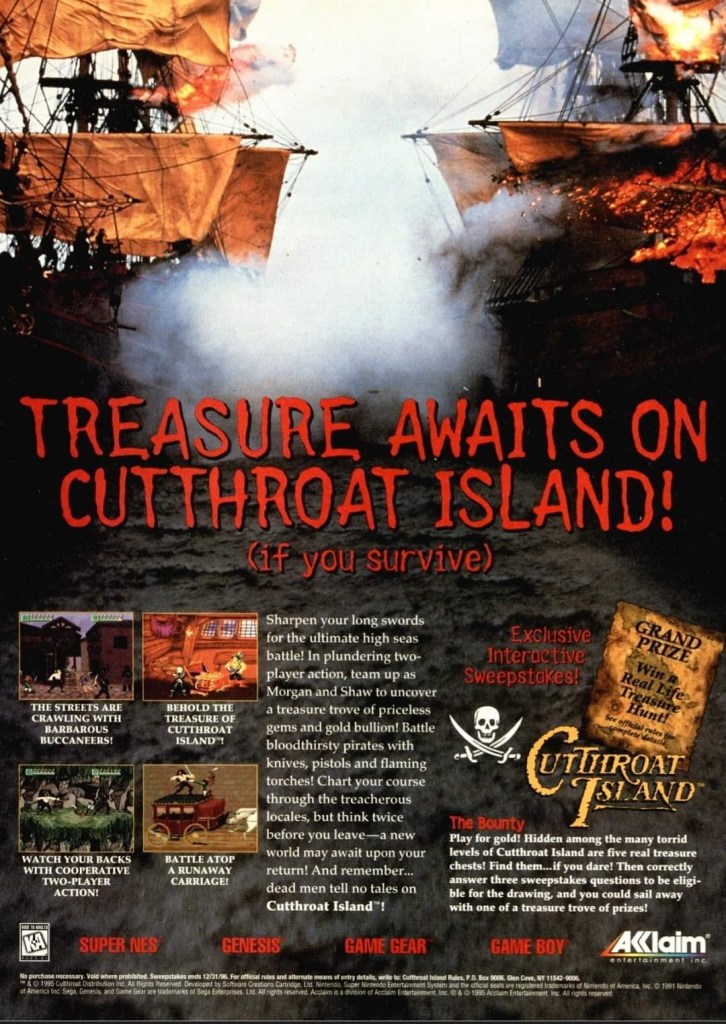
Exciting imagery without Geena Davis and Matthew Modine was used to promote the video game adaptation.

I never saw the Hollywood mega-flop Cutthroat Island nor have I ever played any of its multiple video game adaptations (released on SNES, Sega Genesis, Sega Game Gear and Game Boy). The video game print ad, however, caught my attention back in 1995 because the ad makers cleverly used a photograph from one the many expensive movie sequences filmed and the hard, physical work by the filmmakers was clearly visible. Then the ad makers had four screenshots placed on the lower-left part and inserted descriptive text that sounded exciting. Lastly, the ad mentioned a sweepstakes promo.

Without using any images of stars Geena Davis and Matthew Modine, this ad was a strong attempt to get gamers excited for the video game adaptation. Like the movie itself, this game flopped and has faded away to the land of the forgotten.

11. AH-3 Thunderstrike print ad
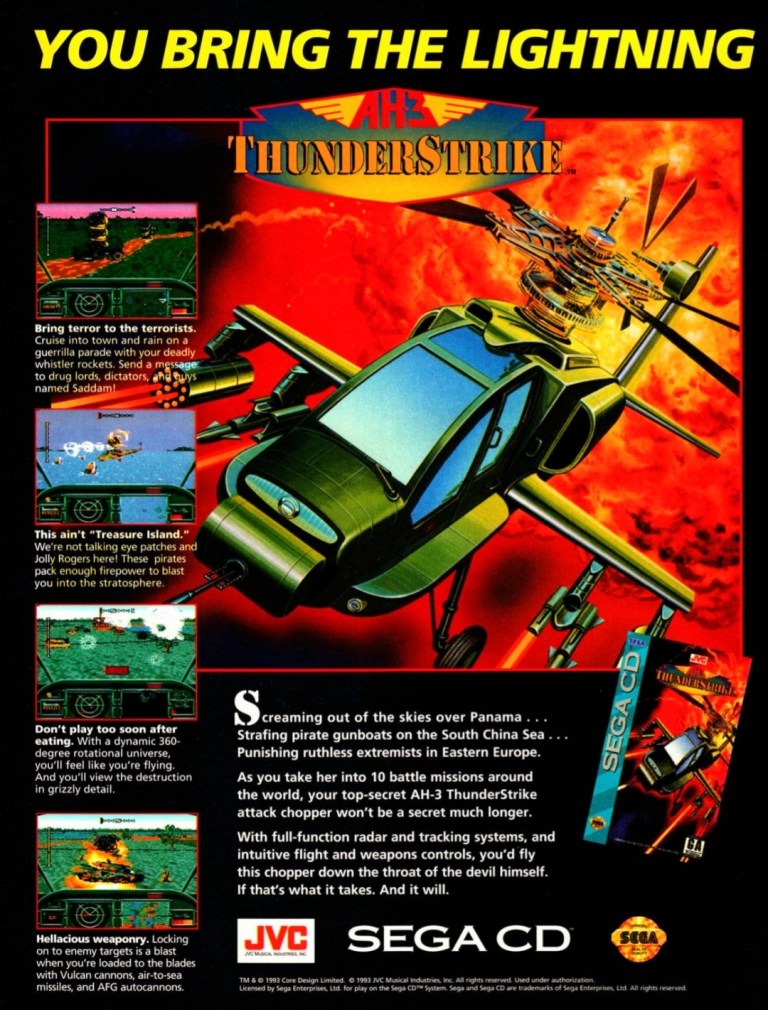
Captivating artwork, vibrant colors and orderly text descriptions made this an effective ad.

AH-3 Thunderstrike is one of the better games that was released on the Sega CD add-on (requires the Sega Genesis console) in 1993. Similar with MechWarrior 3050, the game was actually a port of Thunderhawk which itself was released on the Amiga and MS-DOS PC in 1992. The print ad showcased a captivating artwork (which was also used on the game’s box cover), a few screenshots and strategically placed text descriptions to sell the game. This ad still looks good.

12. James Bond 007 print ad
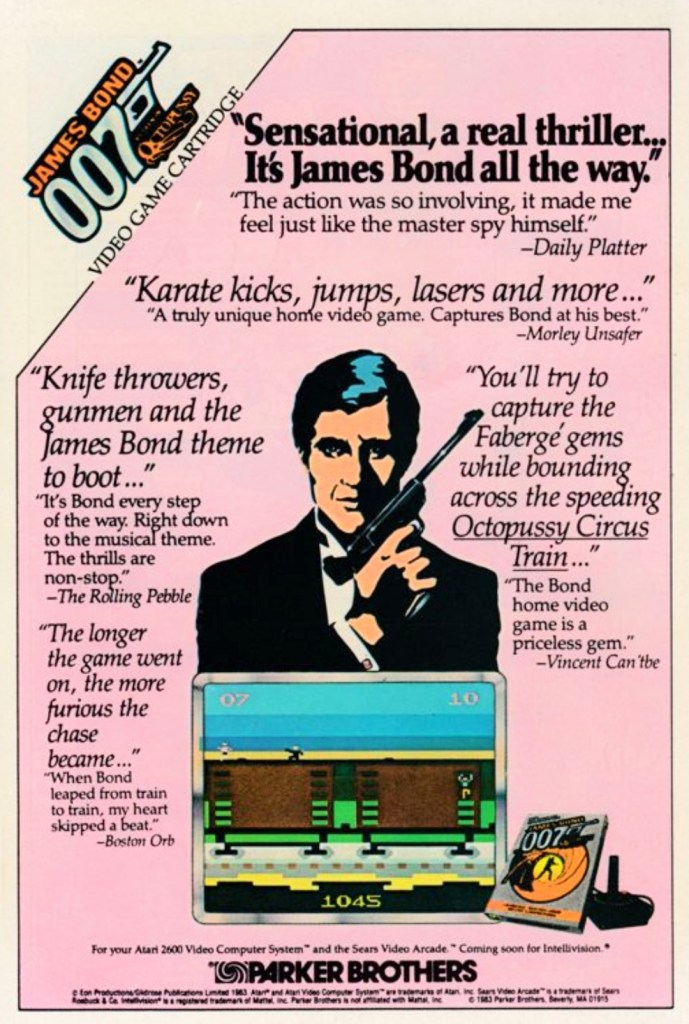
This print ad appeared in many comic books in 1984.

This is a print ad I saw many times while reading comic books in 1984. James Bond 007 for Atari 2600 was an ambitious licensed video game as it featured levels that were inspired by missions in the James Bond movies Diamonds are Forever, The Spy Who Loved Me, Moonraker and For Your Eyes Only. Keep in mind that programmers back then had to deal with memory limitations and primitive tools to make games.

To promote the game, original art of Agent 007 was used which did not resemble the James Bond star of the time – Roger Moore. Strangely enough, the illustrated James Bond slightly resembled Timothy Dalton whose debut as 007 happened in 1987. Adding further zest to the add was the use of fictionalized quotes pointing to fantasized critics as sources (example: Vincent Can’tbe is a reference to real life critic Vincent Canby). The use of a pink background made this catchy ad look really odd.

13. Choplifter III: Rescue Survive print ad
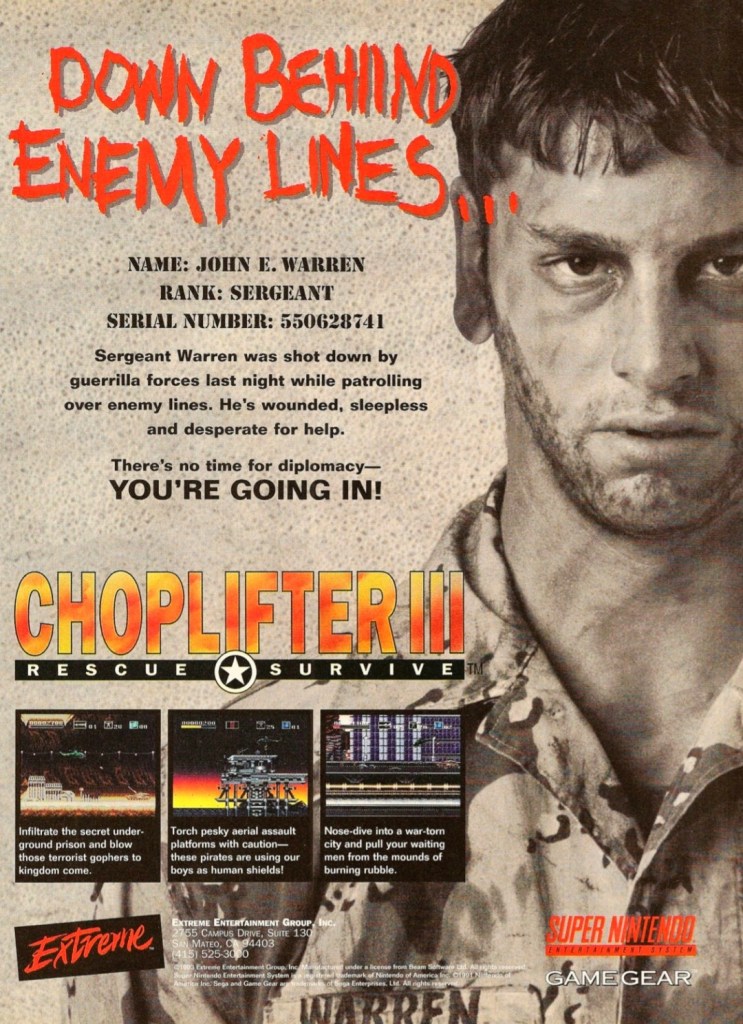
A captivating print ad that brought gamers’ attention to the Choplifter series again.

This print ad of Choplifter III: Rescue Survive has a striking look showing a military officer who needs your help as he has been stranded behind enemy lines. The presentation reflects the long-time tradition of the Choplifter game franchise which has been about piloting an armed helicopter to the opposition’s territory, shooting at bad guys and then rescuing the hostages or prisoners-of-war (POWs). The game eventually gathered mostly positive feedback from video game critics.

14. Defender of the Crown print ad
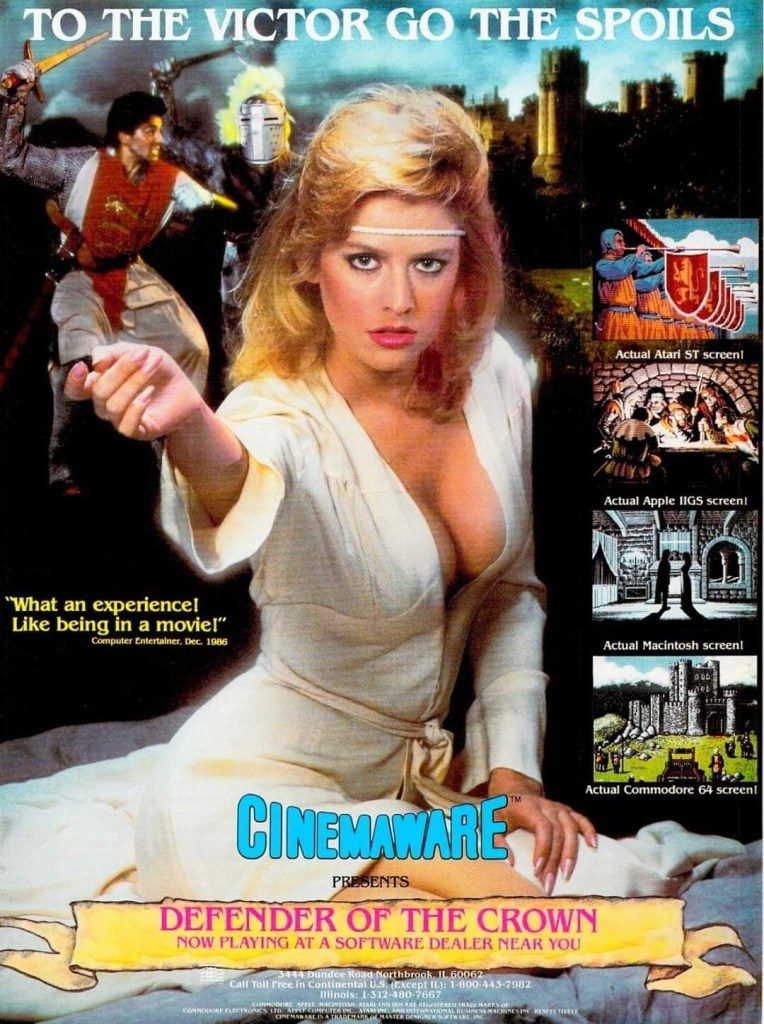
Cinemaware took a gamble with the visual concept of this print ad.

Released in 1986 for home computers, Defender of the Crown was made with a high level of quality backed with solid artistry. To capture gamers’ attention, Cinemaware came up with this print ad showcasing a pretty model looking somewhat seductive which reflects what happens in the game when players rescue a damsel in distress. The selected screenshots showed what the game looked like on different platforms, and the lower part of the ad made the game feel like it was a historical epic waiting to be discovered. Defender of the Crown eventually became a big hit with computer gamers.  

+++++

Thank you for reading. If you find this article engaging, please click the like button below, share this article to others and also please consider making a donation to support my publishing. If you are looking for a copywriter to create content for your special project or business, check out my services and my portfolio. Feel free to contact me with a private message. Also please feel free to visit my Facebook page Author Carlo Carrasco and follow me on Twitter at  @HavenorFantasy as well as on Tumblr at https://carlocarrasco.tumblr.com/ and on Instagram at https://www.instagram.com/authorcarlocarrasco
Retro Gaming Ads Blast – Part 3

Welcome back readers, fellow geeks and electronic gaming fans!

In this edition of the Retro Gaming Ads Blast (RGAB) series, we will examine print ads from the 1980s and 1990s that caught my attention and I will explain why they are worth look back at.

For the newcomers reading this, Retro Gaming Ads Blast (RGAB) looks back at the many print ads of games (console, arcade, computer and handheld) that were published in comic books, magazines, flyers and newspapers long before smartphones, social media, the worldwide web and streaming became popular. To put things in perspective, people back in the 1980s and 1990s were more trusting of print media for game details and images.

With those details laid down, here is the newest batch of retro gaming print ads for you to see and enjoy…

1. Japanese print ad of Super Star Wars: The Empire Strikes Back

Do you know any Star Wars fan who is aware of the error in this Japanese print ad of Super Star Wars: The Empire Strikes Back?

Back in 1993, the sequel Super Star Wars: The Empire Strikes Back was released on the Super Nintendo Entertainment System (SNES) in the West and on the Super Famicom in Japan. Having played all three Super Star Wars game, I can say that this sequel was a huge improvement over its predecessor technically and also with gameplay (read my retro review by clicking here).

Like its predecessor, the game was released in Japan by JVC Musical Industries and in the above Japanese market print ad, the marketing team wisely used the game’s official artwork to give gamers a clear view of the concept derived from the 1980 movie plus a few screenshots showing gameplay. What I find hilarious to read is the line (highlighted in red and all capitalized no less): MAY THE FORCE WITH YOU. Clearly someone from the Japanese marketing team who prepared that line lacked English proficiency or might not have watched the movies dubbed in English. In the 1977 movie, Han Solo said to Luke, “May the Force be with you.”  

2.  Spider-Man (Atari 2600) print ad

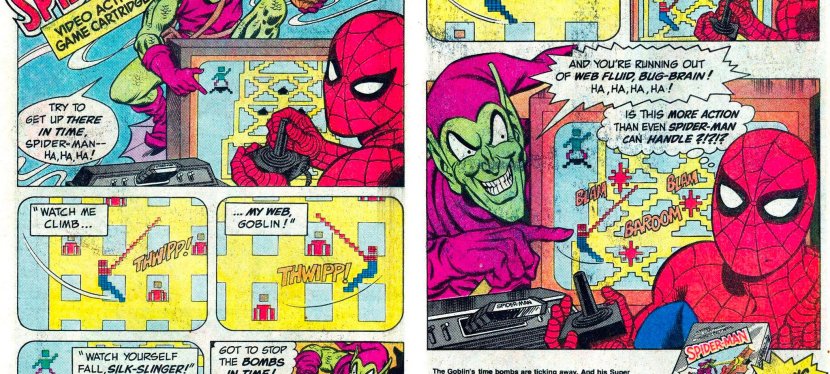
This is an entertaining way to promote a video game based on a comic book icon.

We are back again with the Parker Brothers company and their promotion of the Spider-Man video game for the Atari 2600 which I myself played long ago. Unlike before, the print ad this time was mainly about the Spider-Man game and somehow Parker Brothers coordinated with Marvel Comics to make a comic book-inspired ad. In the above print ad, Spider-Man was shown playing the game about him with an Atari 2600 controller and console, and the Green Goblin taunts him as he plays. This type of ad is a stroke of genius because it shows the Marvel Comics’ icon as a player and the gameplay was emphasized accurately. Even if viewers are not too fond of video games, they can still find themselves interested in reading the literary adventures of Spider-Man.

3. Advanced Dungeons & Dragons: Treasure of Tarmin print ad

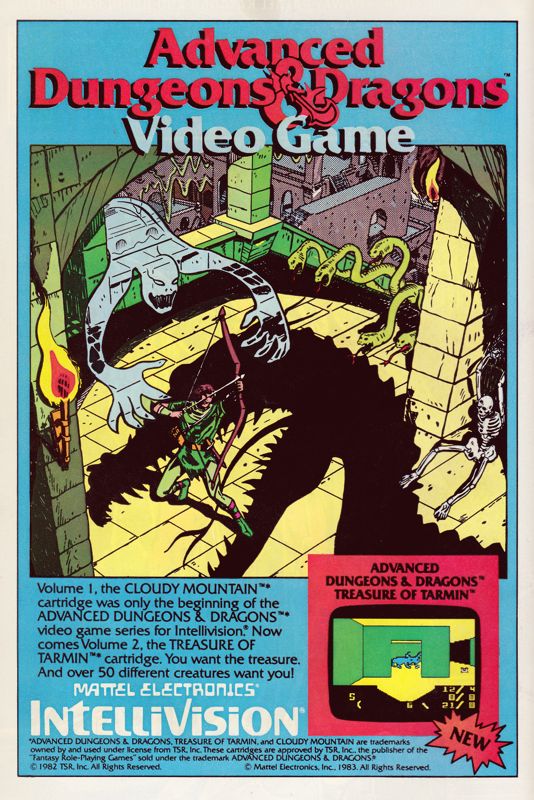
Apart from emphasizing the fantasy concept of the Dungeons & Dragons franchise, this print ad’s hand-drawn art was strong enough to spark viewers’ curiosity and make them interested in the game or even in the Intellivision console.

Here is a print ad I saw many times while reading comic books in 1983. The game at hand is Advanced Dungeons & Dragons: Treasure of Tarmin released on the Intellivision, and it is the sequel to Cloudy Mountain. Like the ad of its predecessor, the above print ad relied heavily on the spectacle of fantasy (and even a bit of horror) by having hand-drawn art as the eye candy promoting Advanced Dungeons & Dragons: Treasure of Tarmin. If you look closely, only one screenshot from the game was shown and it was enough to tell gamers that the new game has a completely different visual presentation from that of Cloudy Mountain. Considering the primitive nature of computer graphics and game design of the era, having detailed comic book-inspired artwork was effective to grab viewers’ attention with the intention to make them interested in buying the game. In today’s age of computer graphics and social media, this type of ad for video games is rare to see.

4. G.I. Joe: Cobra Strike print ad

The G.I. Joe: A Real American Hero franchise’s early entry into video games.

Going back to Parker Brothers, the company developed and published the first-ever licensed game of the G.I. Joe franchise – G.I. Joe: Cobra Strike for the Atari 2600. In promoting the game, a 2-page ad was released with comic book-style art work (featuring Cobra Commander and Duke representing different sides) dominating the space, with descriptive text and a hand-drawn illustration of the gameplay (read: not a real screenshot) as well as the game box flling the remaining space. In my personal experience, I saw this ad before I even got to watch an episode of the popular G.I. Joe: A Real American Hero animated TV series, and before I got to read an issue the related comic book series (which started before the TV series). Looking back at the above print ad, I can still remember the time when I was puzzled by the two characters simply because I was not yet familiar with them. Take note that the video game and the ad were released at a time when the G.I. Joe: A Real American Hero started rising quickly in popularity on toys, comic books and animation.  

5. Alien 3 (SNES) print ad

This print ad appeared in several comic books I read in 1993.

Way back in 1992, I had one of the most depressing cinema viewing experiences with Alien 3 which had a very troublesome production and lacked a solid foundation behind its creativity. Then in the summer of 1993, print ads of the video game Alien 3 for Super Nintendo Entertainment System (SNES) appeared in several comic books I read at the time. The above print ad was actually entertaining to look at. For one thing, the ad makers used three wide layers of screenshots from the game depicting different areas. Then I noticed the details which showed there were more aliens for gamers to encounter (versus only one in the movie) and the playable lead character Ellen Ripley was armed with guns (versus no guns in the movie) being able to fight the monsters. Not only that, the ad makers knew the specific details from the Alien film franchise which is reflected in the ad referencing the Face-hugger aliens, the acid from the creatures and, of course, the alien eggs. To this day, there are old-time gamers who found the Alien 3 SNES game more entertaining than the movie.

+++++

Thank you for reading. If you find this article engaging, please click the like button below, share this article to others and also please consider making a donation to support my publishing. If you are looking for a copywriter to create content for your special project or business, check out my services and my portfolio. Feel free to contact me with a private message. Also please feel free to visit my Facebook page Author Carlo Carrasco and follow me on Twitter at  @HavenorFantasy as well as on Tumblr at https://carlocarrasco.tumblr.com/ and on Instagram at https://www.instagram.com/authorcarlocarrasco

What to watch on YouTube right now – Part 7

Have you been searching for something fun or interesting to watch on YouTube? Do you feel bored right now and you crave for something to see on the world’s most popular online video destination?

I recommend you check out the following topics and the related videos I found.

Raiders of the Lost Ark videos

If you are feeling nostalgic about the Indiana Jones franchise and want to revisit the very first movie Raiders of the Lost Ark, then you are not alone. The new movie Indiana Jones and the Dial of Destiny (made by the woke Disney company and handled by the unpopular Kathleen Kennedy with James Mangold as director) turned off a lot of long-time fans and this incidentally created renewed interest about the very first movie from 1981. For the newcomers reading this, Indiana Jones is the joint creation of Steven Spielberg and George Lucas and they eventually collaborated together in making four Indy movies from 1981 to 2008. To learn more about Raiders of the Lost Ark and how the movie came to be, watch the videos below…

Starfield is approaching and you can prepare yourselves for it

Starfield, the epic sci-fi role-playing game (RPG) from Bethesda (Skyrim, Fallout 4), is coming out on Xbox Series X, Xbox Series S, Windows PC plus Xbox Game Pass and PC Game Pass with an official release date of September 6, 2023. For those of you who missed out on the recent Xbox Games Showcase, you can still catch up and learn more about the Xbox-exclusive Starfield by watching the videos below…

Planetshakers’ Worthy is the Lamb music video

Recently, Planetshakers released online the music video of their worship song Worthy is the Lamb (note: Words by Noah Walker and Andy Harrison, Music by Joth Hunt). The said song is indeed holy, beautiful and will help you move closer to the Lord. Just take note that this Planetshakers worship song is not to be confused with Hillsong Worship’s song with the same title. Watch the official Planetshakers music video of Worthy is the Lamb and the story video below…

Get ready for Forza Motorsport (2023) this October

It took Team Xbox and Turn 10 a long time but they finally revealed that their much-anticipated Forza Motorsport (2023) will be released on October 10, 2023 only on Xbox Series X, Xbox Series S, Windows PC plus Xbox Game Pass and PC Game Pass. In relation to the announced release date, Turn 10 released a new trailer as well as an in-depth examination of the game. Watch the following videos of Forza Motorsport (2023) below…

A look back at Indiana Jones’ Greatest Adventures

For those of you who are still feeling nostalgic or still craving for more Indiana Jones-related content, be aware that way back in the mid-1990s, there was an official video game of the cinematic icon – Indiana Jones’ Greatest Adventures. While I myself played the Super Star Wars games on the Super NES back in those days, I never got to play Indiana Jones’ Greatest Adventures which itself was an official adaptation of Raiders of the Lost Ark, Indiana Jones and the Temple of Doom and Indiana Jones and the Last Crusade and made with side-scrolling adventuring in mind with a few Mode 7 sections set up to prevent the game from being too repetitive. Check out the following videos below…

+++++

Thank you for reading. If you find this article engaging, please click the like button below, share this article to others and also please consider making a donation to support my publishing. If you are looking for a copywriter to create content for your special project or business, check out my services and my portfolio. Feel free to contact me with a private message. Also please feel free to visit my Facebook page Author Carlo Carrasco and follow me on Twitter at  @HavenorFantasy as well as on Tumblr at https://carlocarrasco.tumblr.com/ and on Instagram athttps://www.instagram.com/authorcarlocarrasco
A Look Back at Super Star Wars: Return of the Jedi

Screenshot_20200202-123104_YouTube.jpg
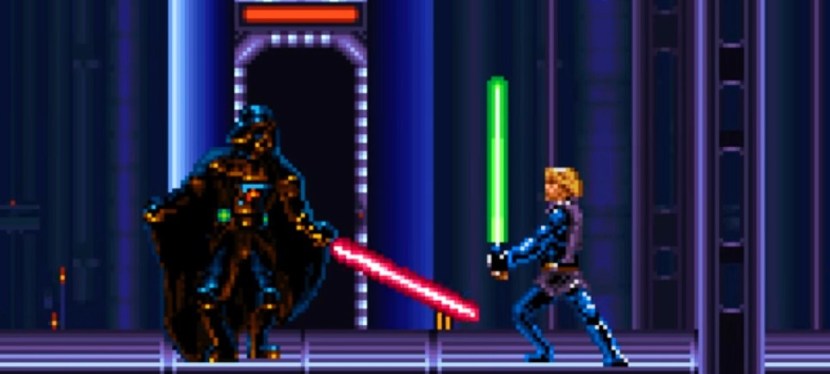
Luke Skywalker going up against the game’s final boss – Emperor Palpatine. 

By the middle of 1994, gamers and Star Wars fans who owned a Super Nintendo Entertainment System (SNES or Super NES) were treated with more 2D side-scrolling fun with Super Star Wars: Return of the Jedi. Developed by Sculptured Software and LucasArts and published by JVC, the game was the conclusion of the so-called Super Star Wars trilogy of the 16-bit era of console gaming.

Like its predecessor Super Star Wars: The Empire Strikes Back, this game is a 2-dimensional side-scrolling adventure game released just months before Sega and Sony respectively released the Saturn and PlayStation consoles (which eventually made 3D polygonal gaming popular). The game itself is based on the 1983 movie Return of the Jedi: Luke and his friends go out to save Han Solo from Jabba the Hutt and the Rebels prepare its strategy to defeat the Imperial Forces now armed with a new Death Star with the personal presence of Emperor Palpatine.

Here’s my review of Super Star Wars: Return of the Jedi.

Early story (and some notable differences from the movie)

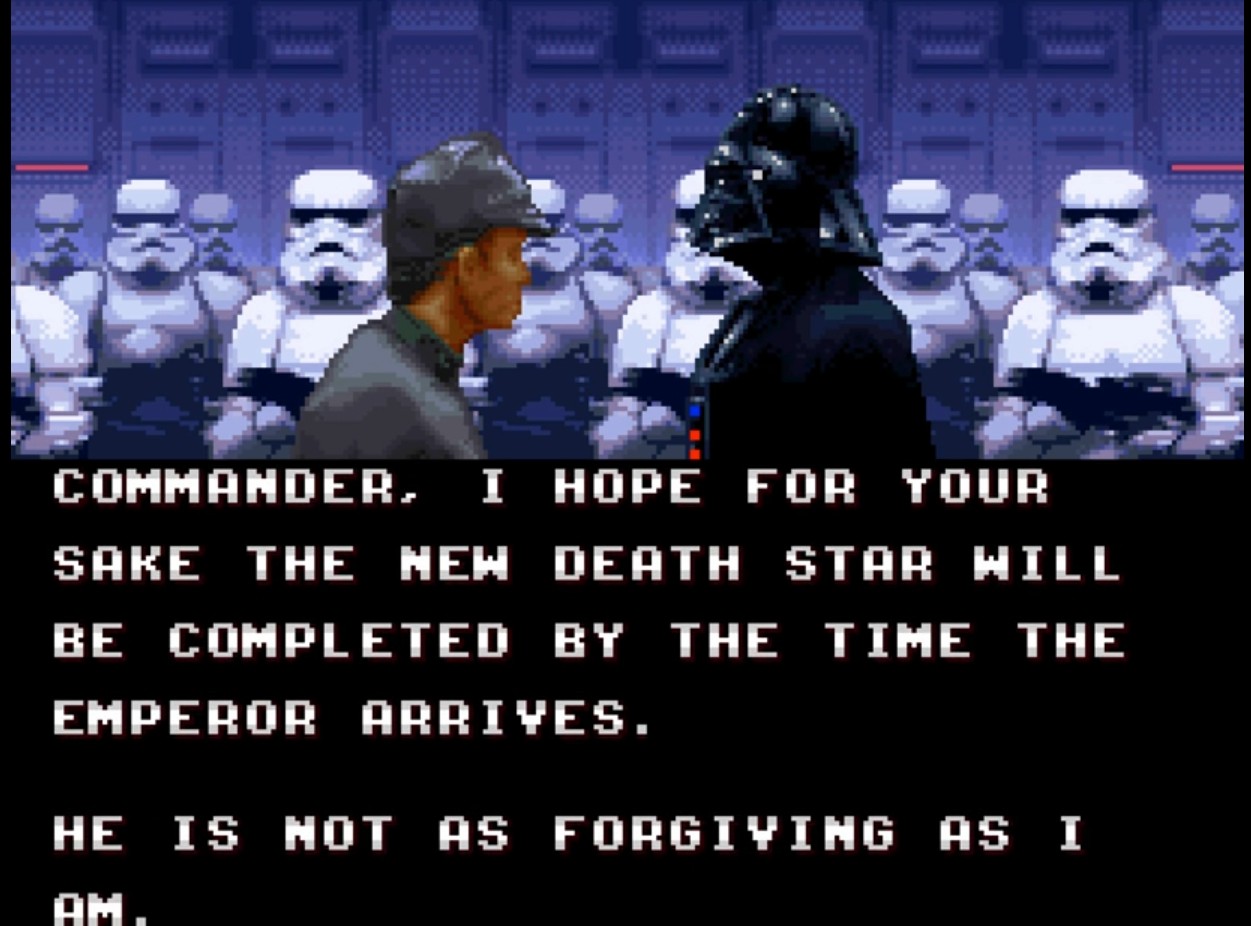
The game begins with a quick look at Darth Vader’s arrival at the new Death Star setting up the stage for the Emperor’s arrival. On Tattooine, Luke and his companions travel to the temple of Jabba the Hutt to somehow save their friend Han Solo (who got frozen in carbonite at Cloud City in The Empire Strikes Back).

Screenshot_20200202-120316_YouTube.jpg
A still cut-scene at the beginning of the game.

In order to get to the palace, Luke/Leia/Chewbacca (you get to pick which character to use) have to travel through a lengthy stretch of land filled with several forms of wild life, monsters and even Jawas blocking their way. Once inside, your character has to fight until the end of the next few levels (note: there was a boss or powerful enemy to beat) to make the story progress.

Once you have defeated Jabba and rescued Han Solo, your team regroups with the Rebels in space to start your next series of missions with the moon of Endor (with the 2nd Death Star in orbit).

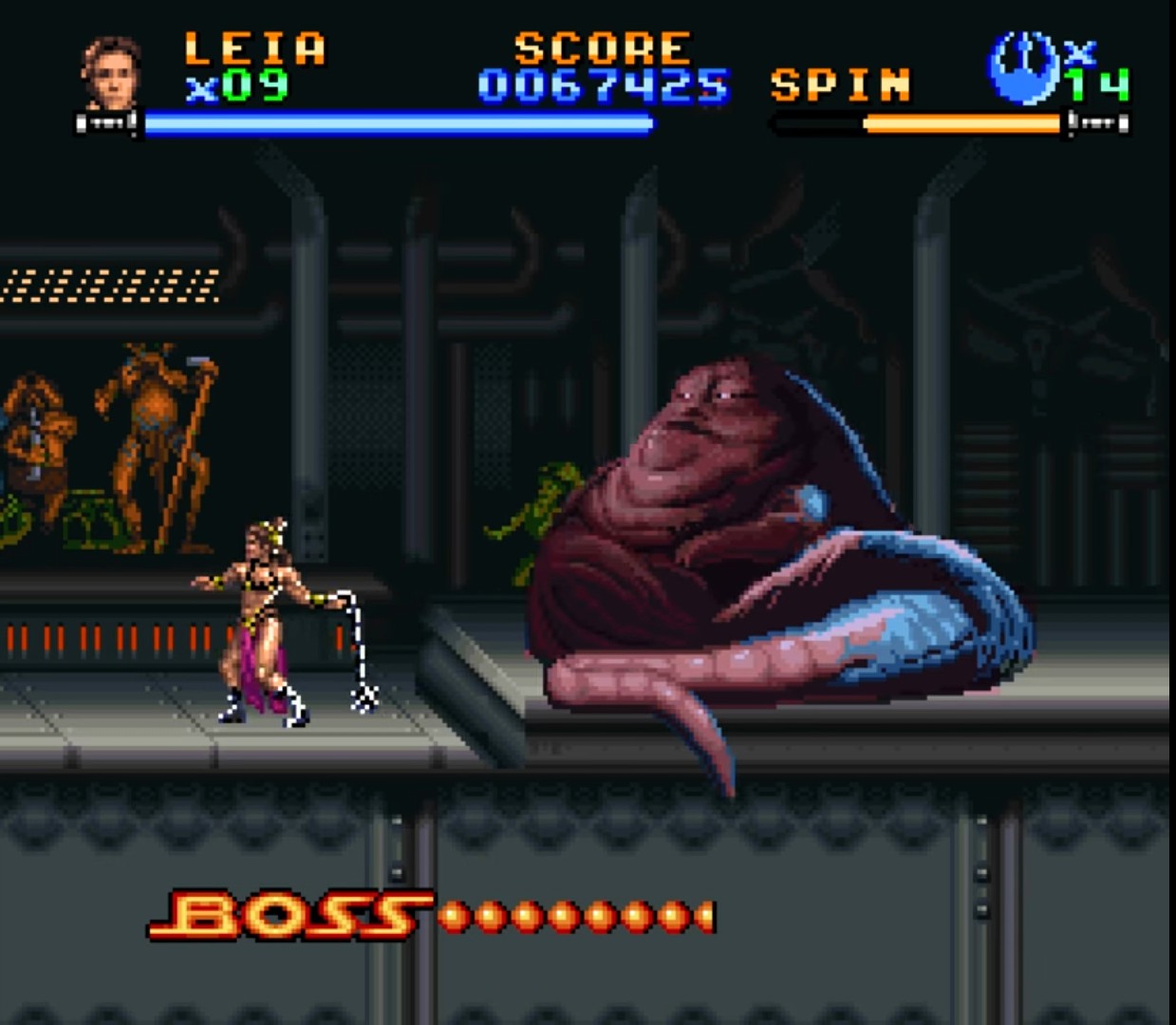
Notable differences from the movie include fighting a large monster (which used a large ball as a weapon) did not appear in the film. Also notable was Leia (in her sexy slave outfit) having to move from the end of the stage to reach Jabba the Hutt who serves as the level’s boss. Jabba’s sail barge in the game looks and feels longer than in the movie.

Screenshot_20200202-121353_YouTube.jpg
Leia, Jabba is right behind you!

Gameplay

Super Star Wars: Return of the Jedi plays a lot like its predecessor. As typical with most games of the era that used 2D sprites for visuals, the game is an action-packed side-scroller wherein you have to control your character from left to right, go up and down and complete the level by either defeating the end-level boss or by simply reaching the end (some levels have no boss). As you move on, you also get to collect power-ups and icons which are really helpful in completing the levels.

Along the way, you get to fight a whole bunch of enemies that appear to fight and stop you.  This includes not only the Imperial forces that appeared in the movie but also new additions like machines and even flying robots. You never saw Luke fight any flying robot in the movie? In this game, he gets to fight them at the Imperial facility on the moon of Endor.

Screenshot_20200202-122315_YouTube.jpg
Han Solo blasts the Stormtroopers!

Given the story structure of the movie, the game developers were able to let players pick a Star Wars character to play as before starting a level. This particular feature was prominent in 1992’s Super Star Wars but was heavily toned down (due to story structure) in Super Star Wars: Empire Strikes Back. Back to the selectable characters, there are key differences between them such as Luke using his lightsaber and Force powers, Han Solo with his blaster and grenades, Chewbacca with his crossbow and his spin attack (he does NOT do this in the movies so it’s funny), and Leia who uses different weapons as she appears (based on the story structure) as a disguised bounty hunter and as a sexy slave to Jabba. Quite odd here is the addition of Wicket the Ewok as a playable character whom you must guide fighting the bad guys in two levels that are set in the village of the Ewoks up those tall trees. The Wicket levels are easily the least interesting to play in.

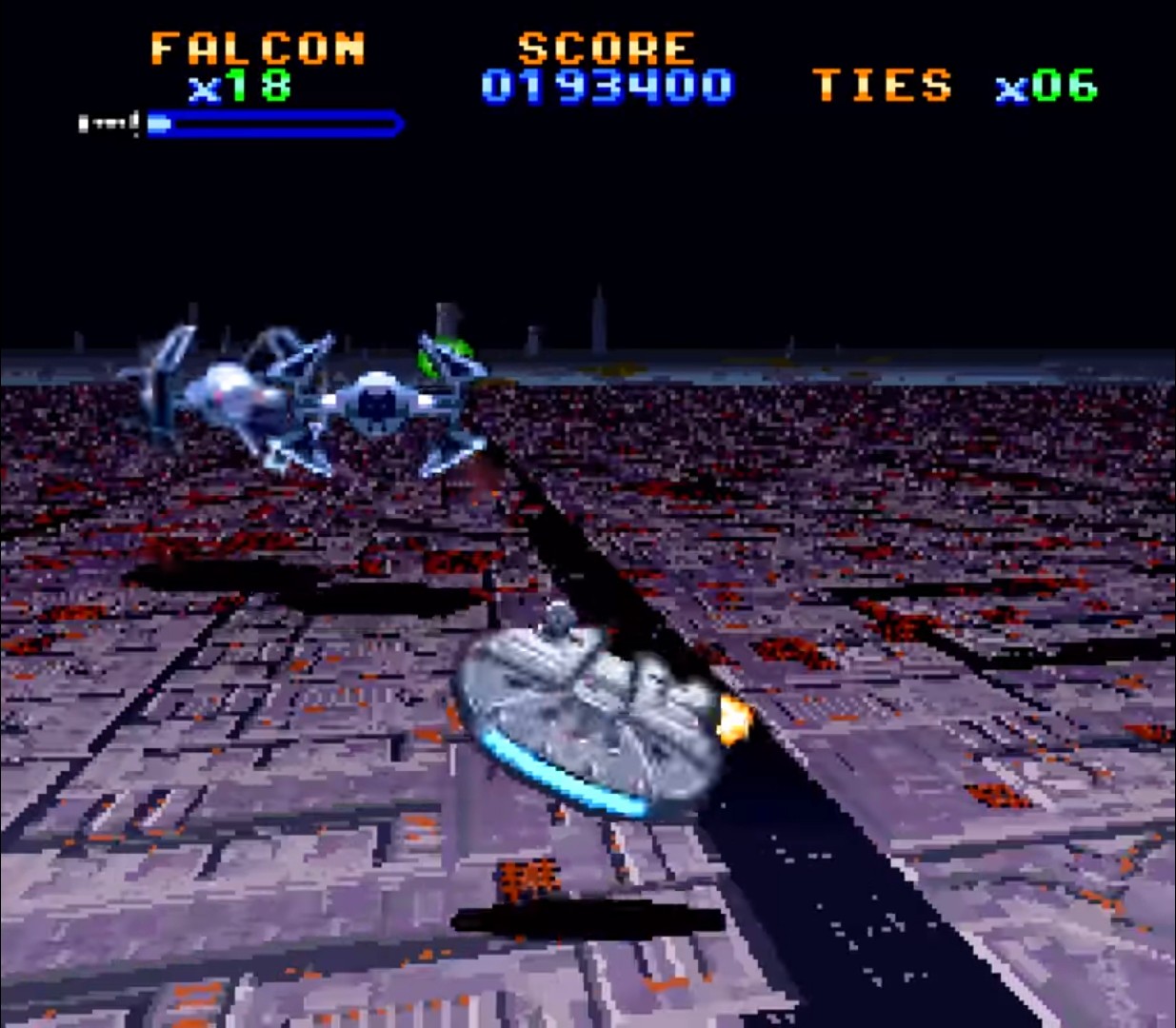
Like the previous two games, the game designers implemented levels that play differently from the standard side-scrolling adventuring. I’m referring to the Mode 7 level in which you fly the Millennium Falcon on a makeshift 3D environment on the surface of the 2nd Death Star needing to destroy a number of TIE Fighters in order to progress. I should say that this particular level lacked depth although it was cool to use the Falcon and just imagine Lando and his team inside operating it.

Screenshot_20200202-122611_YouTube.jpg
The Millenium Falcon in the Mode 7 3D environment set on the surface of the Death Star.

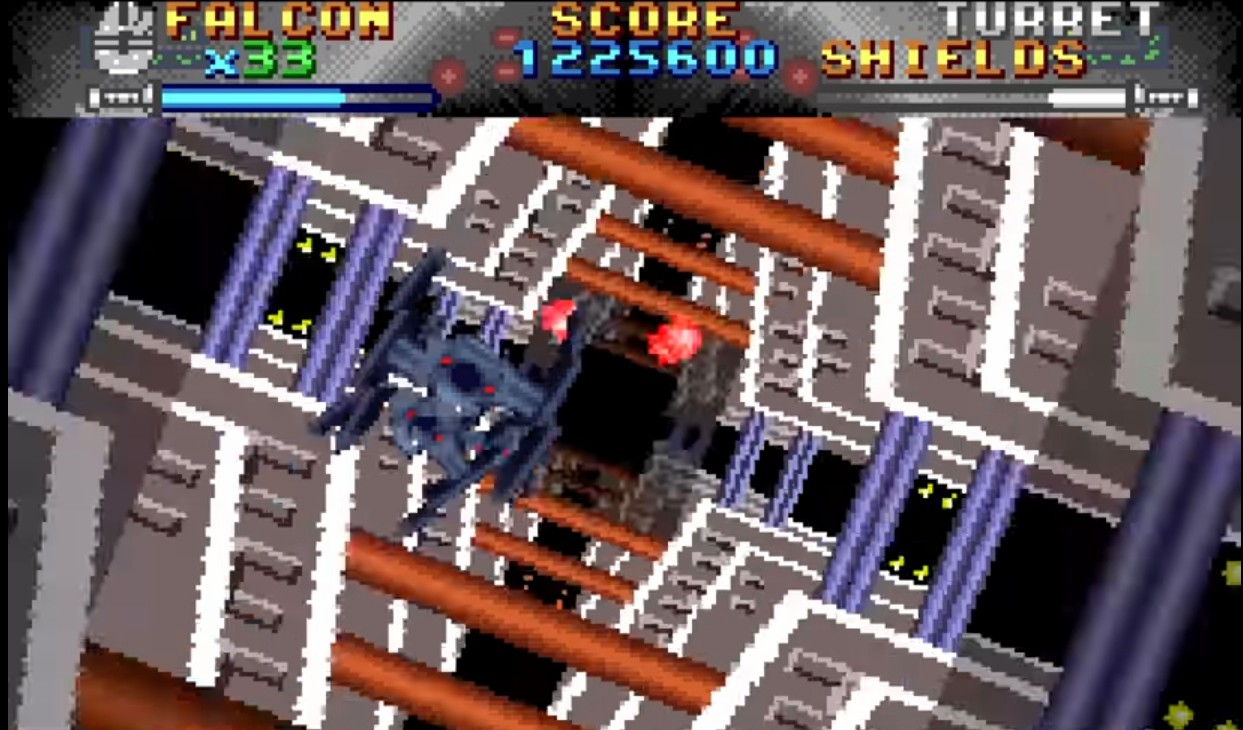
In what is a clear attempt by the game makers to push the hardware of the Super NES, they created a standalone level in which you use the top turret of the Millenium Falcon to shoot a required number of TIE Fighters while flying in space heading towards the 2nd Death Star (complete with a 3D background showing the Imperial Star Destroyers in the distance on one side). This was a very short yet cool sequence to play even though the darkness of space makes spotting the TIE Fighters a bit challenging. I liked the fact that the console’s processor was pushed hard to allow the TIE Fighters look 3D and detailed using several frames of animation as they fly around and right close to the Falcon (which itself looked detailed).

Screenshot_20200202-122004_YouTube.jpg
This 3D shooting segment in the game was fun and too short.

And then there is the speeder bike chase sequence that took place through the forest of Endor. This one is pretty shallow and has not aged well.

Screenshot_20200202-121543_YouTube.jpg
Nice visual detail on the speeder bikes but everything else felt shallow.

Finally, the game’s last stage is another hardware-intensive level that offers gamers the opportunity to experience the challenge and speed (as far as the hardware could push) of piloting the Millennium Falcon into the tunnels of the 2nd Death Star to reach the core, blast it and then escape on the way out (being chased by intense flame caused by the explosion). This level shows lots of repeating visual elements that are supposed to be the mechanical interiors of the tunnels and you can movie the Falcon in 1st-person view, speed up or down, rotate the view and tilt the direction as you move forward. Along the way, there are TIE Fighters who appear in front of you for you to shoot at. While the intention of the developers to replicate the memorable sequence of the movie is clear, the hardware limitations (and design limitations) could only go so far to make the gameplay experience solid. What bogged this particular sequence down are the bouts of slowdown (lowered frame rates) when things get hectic.

Screenshot_20200202-123735_YouTube.jpg
This sequence must be seen in motion.

Conclusion

While it is indeed a more polished game than the memorable Super Star Wars: The Empire Strikes Back, Super Star Wars: Return of the Jedi was indeed a fun and engaging game but still falls short of its immediate predecessor in terms of enjoyment and engagement. For one thing, this game noticeably was less challenging and the return of the password system makes it even easier to finish. The boss battle with Darth Vader showed the iconic villain being much easier to beat with even on the standard difficulty level. I still remember how surprising it was to beat Vader during my first time playing the game.

The non-side-scrolling levels of the game created good variety for playing. I just wished that the 3D space shooting sequence of the Falcon (with its top turret) lasted longer and the visuals of the final level looked more detailed and had less lag. As for the Mode 7 level with the Falcon on the surface of the Death Star, that one pales in comparison with the lengthy and memorable Battle of Hoth (which has the grand experience of taking down the AT-AT walkers with the tow cable).

Overall, Super Star Wars: Return of the Jedi is recommended.  By today’s standards, this game is a classic and was one of the best ever Star Wars video games of not only of its console generation but among all Star Wars games that were made with 2D sprites and pixel art. If you have a Super NES console or Nintendo’s Virtual Console, play the game once you have it.


Thank you for reading. If you find this article engaging, please click the like button below and also please consider sharing this article to others. Also my fantasy book The World of Havenor is still available in paperback and e-book format. If you are looking for a copywriter to create content for your special project or business, check out my services and my portfolio. Feel free to contact me as well. Also please feel free to visit my Facebook page Author Carlo Carrasco and follow me at HavenorFantasy@twitter.com

A Look Back at Super Star Wars: The Empire Strikes Back

In this age of photo-realistic 3D graphics in video gaming, I sure miss the days when 2D gaming and highly detailed pixel art were the standard. I’m referring to the so-called 16-bit era of the Super NES/SNES (Super Nintendo Entertainment System) back in the 1990s.

In 1991, Super Star Wars was released on the Super NES and it became a big hit with the gamers, the critics and fans. That game was heralded as one of the best video game adaptations of movies.

Naturally, a follow-up to that game was released in 1993 – Super Star Wars: The Empire Strikes Back.

That being said, here is my retro gaming review of Super Star Wars: The Empire Strikes Back.

Screenshot_20200118-222140_YouTube.jpg
The experience of using a Rebel speeder to bring down an AT-AT walker with the cable remains awesome.

Developed by Sculptured Software and LucasArts and published in America by JVC, this game is based on The Empire Strikes Back which today has been considered to be the greatest Star Wars movie ever. Of course, in order to make a cohesive video game adaptation out of the classic movie, a lot of liberties were taken when it comes to following the story. This was inevitable as the game developers needed a lot of creative freedom to make a cohesive video game.

Early story (and some notable differences from the movie)

Super Star Wars: The Empire Strikes Back begins with Luke Skywalker riding a Tauntaun. Unlike the movie, Luke (controlled by players) visits some places of the wasteland of Hoth, notably caverns and hills fighting several forms of wild life (including wampa beasts), and even some probe droids.

Screenshot_20200118-223405_YouTube.jpg
Luke jumping on to a wampa beast.

Unlike the movie, Luke does not get rescued by Han Solo in the wilderness. Instead he defeats a giant-sized probe droid and a giant-sized wampa beast (as in-game bosses) and make his way back to Echo Base to rejoin the rebels. Upon returning at the base, he finds it filled with Imperial troopers and their machines (where are Luke’s fellow rebels?) and fights his way through to fly a rebel speeder (note: without the movie co-pilot Dak) and proceed in the Battle of Hoth.

image-2.jpg
This never happened in the movie.

image-3.jpg
Luke jumping into a snow speeder without a co-pilot.

Back at Echo Base, Han Solo (player-controlled) has to make his way through a wave of Imperial enemies and machines to meet Princess Leia, secure her and ride away on the Millennium Falcon. The Falcon (player-controlled) enters the asteroid field being attacked gradually by over twenty TIE Fighters. Once all of them have been eliminated, the Falcon jumps into light speed (which contradicts the movie).

Gameplay

Super Star Wars: The Empire Strikes Back is composed mostly of 2D, side-scrolling action sequences in which players control their characters moving from left to right in order to make the game progress. The sequences are filled with lots of action-packed moments mainly due to the MANY enemies challenging the players plus sequences of shooting, jumping and using special weapons (note: the thermal detonator was awesome to use). When it comes to filling up the health meter of your character, defeating enemies result random releases of hearts (symbolizing health) which you need to pick up. Key side-scrolling segments of the game will have players facing off with in-game bosses or enemies that are large, intimidating and have their own health meters for players to reduce to zero.

As typical with most 2D side-scrolling games of the era, this game is really tough and will take gamers some patience and perseverance to complete.

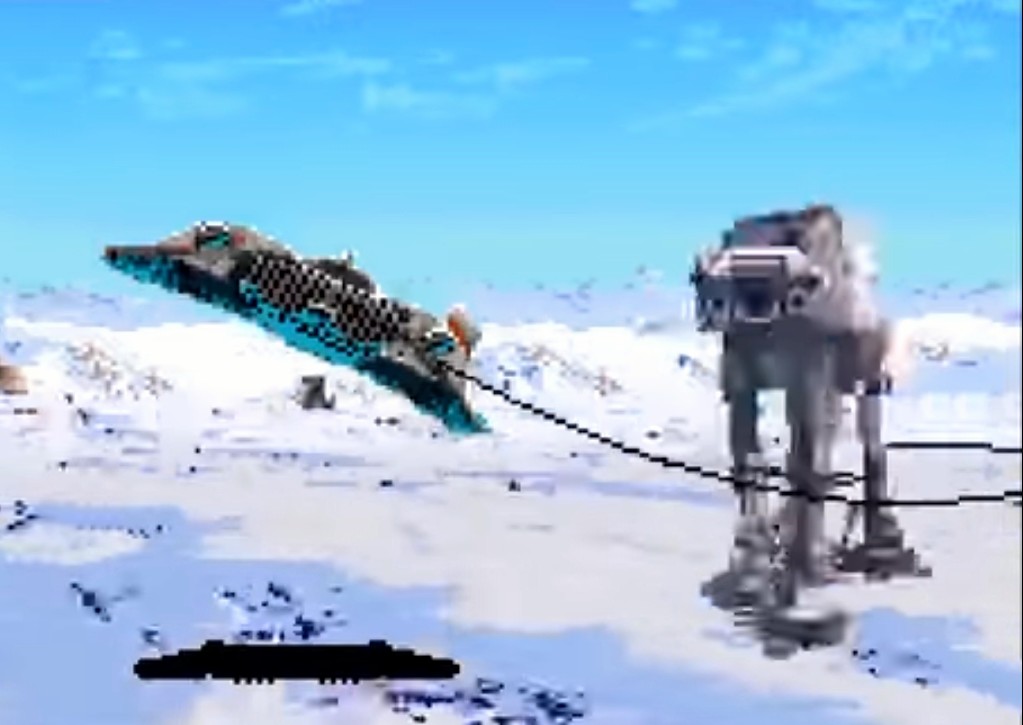
What really stood out in this game are the makeshift 3D segments (made possible by Mode 7) which were pretty extensive and really interactive. The Battle of Hoth in Mode 7 was pretty engaging as players get to fly a rebel speeder over a snowy field complete with lots of Imperial enemies (including the AT-ST walkers and the AT-AT walkers) and each of them is composed of multiple 2D sprites making them look 3D as the speeder moves around. Apart from simply shooting, the interactive sequence of tagging an AT-AT walker with a cable, flying around it and wrapping it with the cable, and then watching it fall to the ground really is an awesome gaming experience which really showed how hard the game developers pushed 2D visuals and pixel art.

Screenshot_20200118-222830_YouTube.jpg
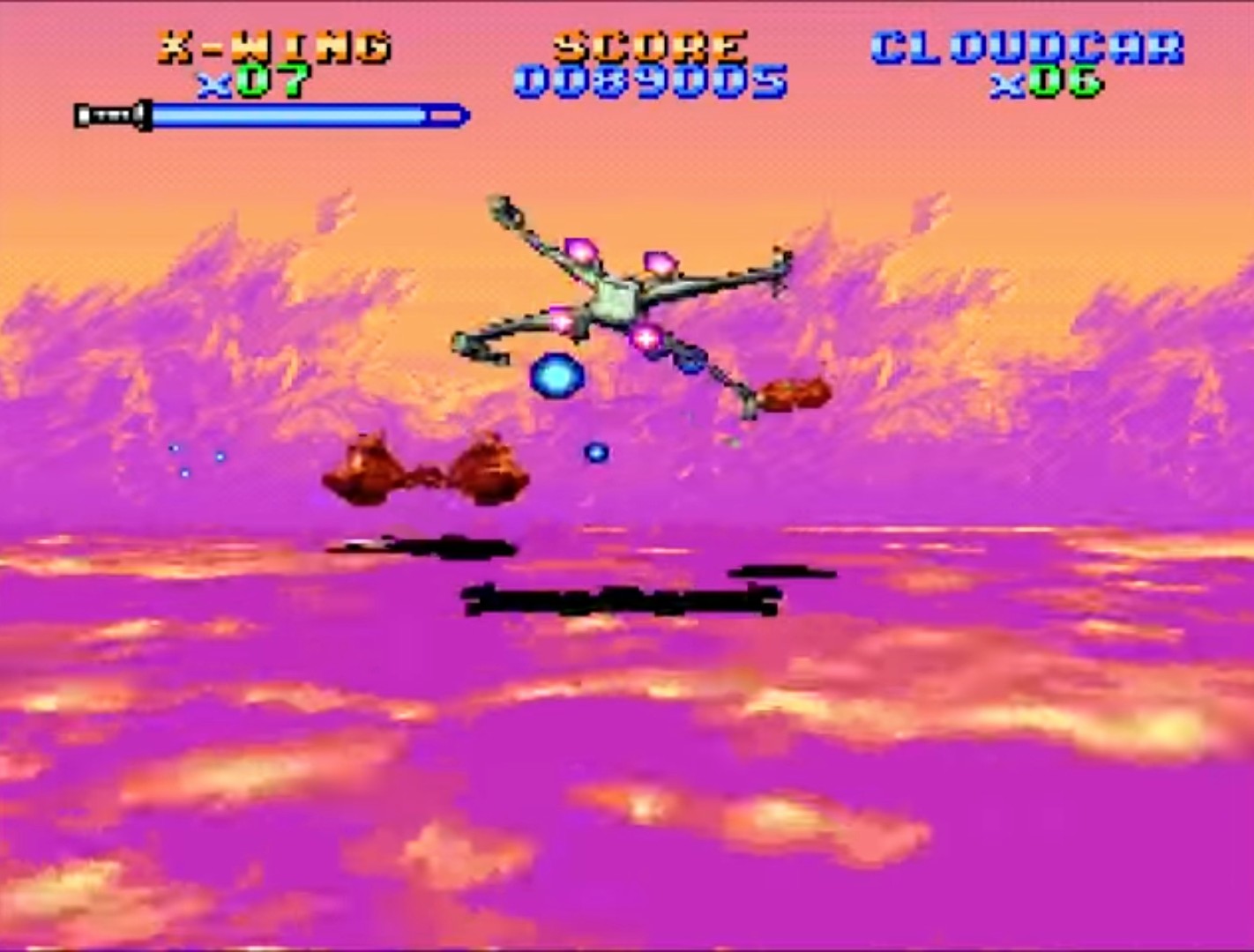
A Mode 7 sequence late in the game had players using an X-Wing fighter.

Screenshot_20200118-222213_YouTube.jpg
The Battle of Hoth was a great and lengthy use of Mode 7.

Apart from the Battle of Hoth, there was also another Mode 7 sequence involving the X-Wing Fighter approaching Cloud City. That particular sequence was noticeably shorter and did not have a standout action sequence as it was limited to the X-Wing Fighter simply shooting Bespin fighters. Another non-2D segment was the Millenium Falcon’s flight through the asteroid field which was done with the cockpit view (first-person view exactly) in which you move a cursor for targeting and moving the ship to. This segment was pretty tough because players were not only required to eliminate more than 20 TIE Fighters but also avoid incoming asteroids and maintaining the Falcon’s energy shields (which serves as a health meter)

Going back to the 2D side-scrolling segments, the use of the lightsaber by Luke remains a lot of fun to do. Not only could he slash bad guys, he could use the lightsaber defensively protecting himself from incoming energy blasts (which get deflected by the lightsaber). On the offense, Luke can jump into the air and spin with the lightsaber turned on making him an aerial slasher over the bad guys.

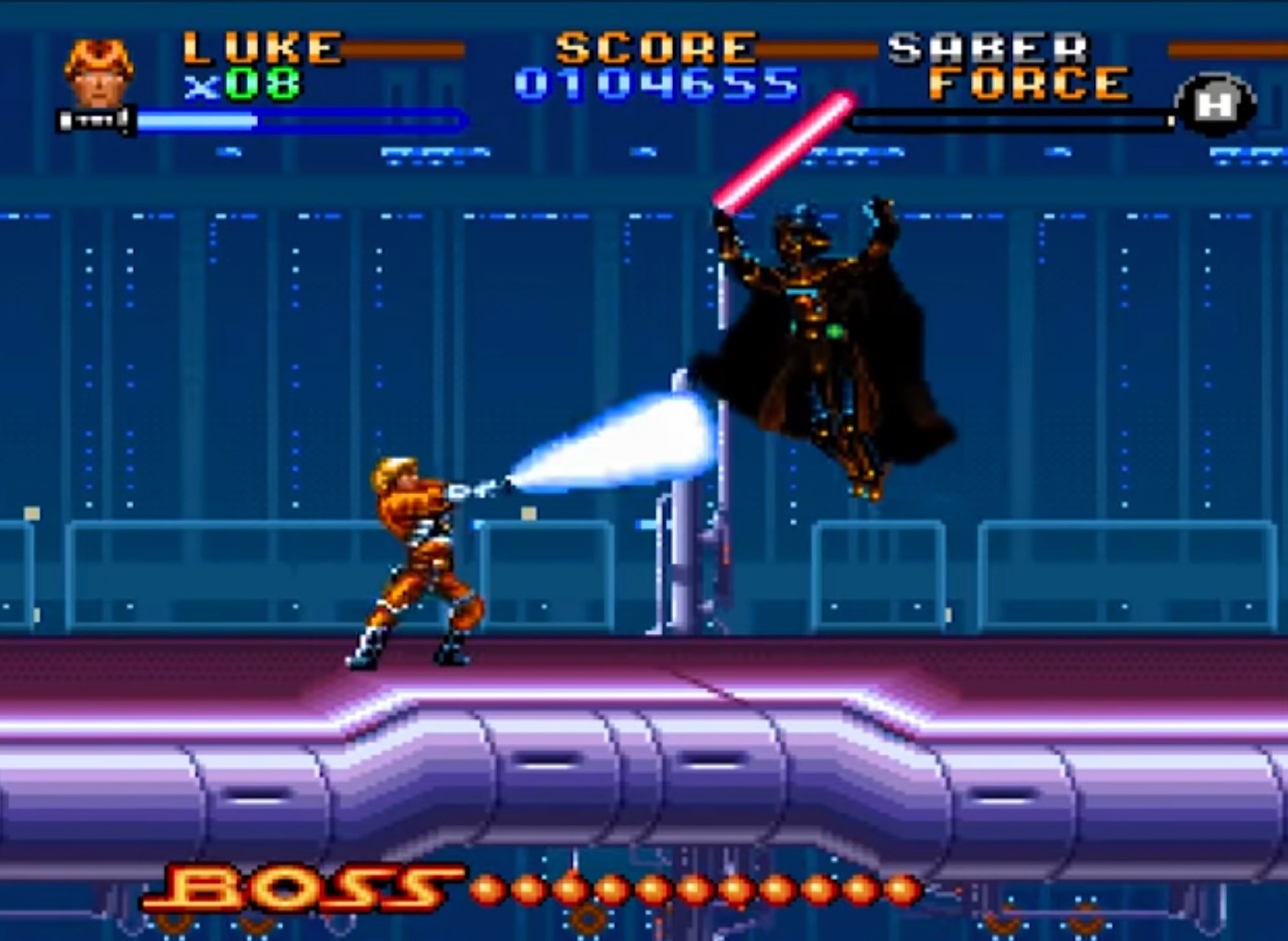
In keeping with the theme of the movie showing Luke Skywalker learning to be a Jedi, the Dagobah segment in the game has Luke gaining varied Force powers and he also has a separate Force energy meter. The Force powers can be used in subsequent segments of the game and they are quite useful when Luke encounters Darth Vader as the final boss in Cloud City.

The fights with Darth Vader were nicely designed. With creative freedom, the game developers expanded on Darth Vader’s use of the Force to move several pieces of debris and machines towards Luke who has to defend himself from all sides. Fighting Darth Vader with the lightsaber was tricky and for the most part, I had Luke slashing on villain with just enough space between them and many times I had Luke use the lightsaber on him while jumping and spinning in the air. Defeating Vader was a requirement to complete the game.

Screenshot_20200118-222758_YouTube.jpg
Very nice artwork made for the storytelling cut scenes.

Finally, like in Super Star Wars, players can also play as Han Solo (special attack: grenade throw) and Chewbacca (special attack: offensive spin) but only in specific segments of the game supposedly to keep in line with its story.

Conclusion

Even by today’s standards, Super Star Wars: The Empire Strikes Back is still a high-quality video game that is a lot of fun to play with even though it is tough (a password system is used for in-game progress so that gamers can come back to continue) all throughout. Gameplay aside, the presentation of visuals and audio is also very solid. The sprites for the in-game characters, enemies, machines and animal were detailed to look at while the background art were immersive (like in the movies, Cloud City, Hoth and Dagobah had their distinctive visuals). The Super NES audio chip was greatly used on recreating 16-bit sound from the movies, especially John Williams’ movie scores and lightsaber sound effects.

Take note that this game was released in 1993 which is significant in the sense that people had moved on since the release of the movie Return of the Jedi (1983) and the Star Wars prequel trilogy did not begin until 1999 with Star Wars Episode I: The Phantom Menace. This game was released at a time when 2D gaming was still in strong demand and most gamers did not expect that 3D polygonal graphics would reshape video gaming eventually. In retrospect, the polygon-focused gaming consoles Sega Saturn and the original Sony PlayStation launched in late 1994 or more than a year after Super Star Wars: The Empire Strikes Back.

Screenshot_20200118-223133_YouTube.jpg
The inevitable battle between Luke Skywalker and Darth Vader.

I myself had lots of fond memories playing this game back in the mid-1990s. I simply endured the many challenges of it and ultimately had a lot of enjoyment completing it. I even replayed the game from the start even though I knew how the game presented the ending and key story elements of the movie. I also got to replay The Empire Strikes Back on home video around the time I played this game.

Believe it or not, Super Star Wars: The Empire Strikes Back was the first of the Super Star Wars trilogy on the Super NES that I actually played. After completing it, I borrowed the Super Star Wars cartridge from a friend and later bought a copy of Super Star Wars: Return of the Jedi. I completed those two other games and I can clearly say that Super Star Wars: The Empire Strikes Back remains the best in game design, the best in terms of fun factor and the most memorable of them all.

If you love Star Wars and you want the best 16-bit era video game (note: you’ll need a working Super NES console or Nintendo’s Virtual Console for any Super Star Wars game) experience of it, Super Star Wars: The Empire Strikes Back is highly recommended.


Thank you for reading. If you find this article engaging, please click the like button below and also please consider sharing this article to others. Also my fantasy book The World of Havenor is still available in paperback and e-book format. If you are looking for a copywriter to create content for your special project or business, check out my services and my portfolio. Feel free to contact me as well. Also please feel free to visit my Facebook page Author Carlo Carrasco and follow me at HavenorFantasy@twitter.com