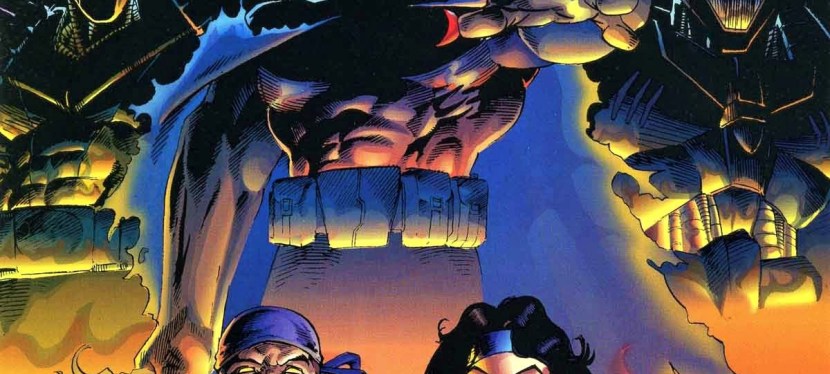
A Look Back at The Strangers #14 (1994)

Disclaimer: This is my original work with details sourced from reading the comic book and doing personal research. Anyone who wants to use this article, in part or in whole, needs to secure first my permission and agree to cite me as the source and author. Let it be known that any unauthorized use of this article will constrain the author to pursue the remedies under R.A. No. 8293, the Revised Penal Code, and/or all applicable legal actions under the laws of the Philippines.

Welcome back, superhero enthusiasts, comic book collectors and fans of Malibu Comics! Previously, I reviewed an issue of The Strangers which happened to be the 2nd-to-the-last issue of its monthly series (which itself was mostly spearheaded by the dynamic duo of Steve Englehart and Rick Hoberg).

I was about to do a retro review of The Strangers #24 but realized that there are still some other comic books of the series that I have not reviewed yet. As such, I decided to read those other issues before reviewing the final issue.

With those details laid down, here is a look back at The Strangers #14, published by Malibu Comics in 1994 with a story written by Englehart and illustrated by Hoberg.
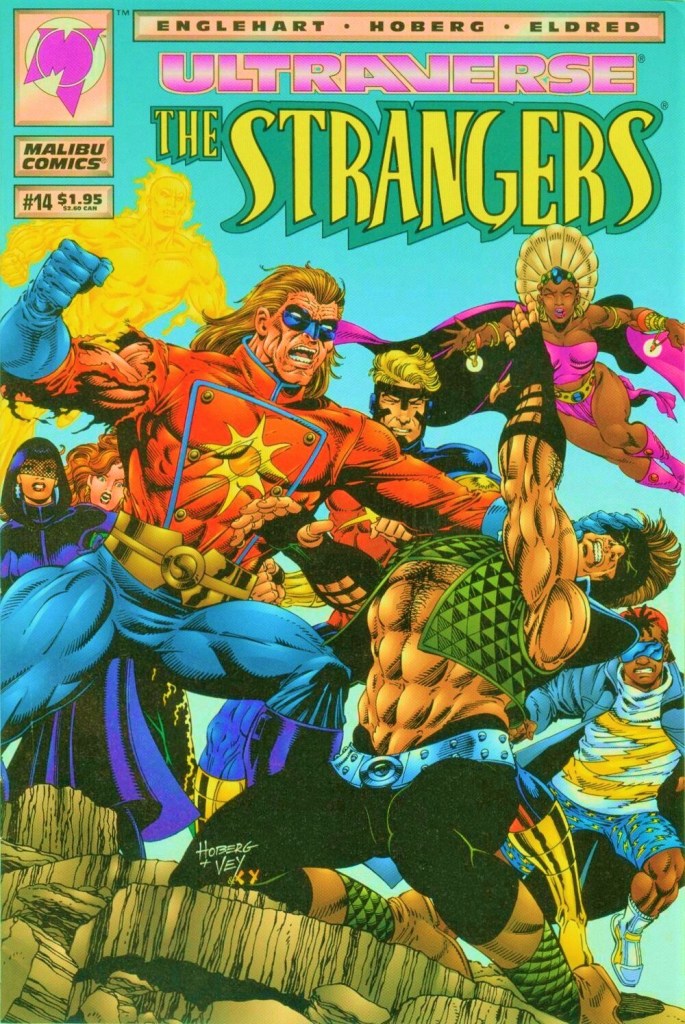
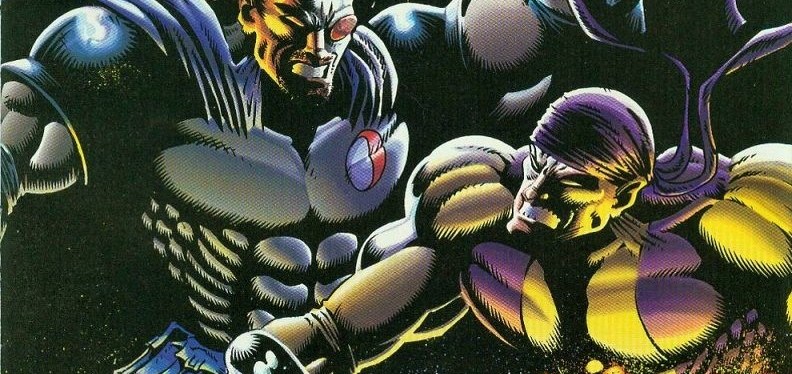
The cover.

Early story

The story begins when a strong, muscular man with long blonde hair strikes a huge rock formation high in the hills to the east of San Francisco Bay in California. While talking to himself (most likely a way to deal with his isolation), he continues to lift very large piece of rock, smashes more rocks and throws a tractor as if it was just a ball.

“I am…Powerhouse! I am Powerhouse! I…am Powerhouse,” he said to himself.

Still talking to himself, Powerhouse realizes that the world must never know about him as it has done its best to destroy him. He quietly changes into civilian clothes and drives away into the distance in his car.

On the streets of East Bay Hills in Berkeley, Hugh/Grenade and Bob/Atom Bob walk down the fancy commercial zone as they enjoy the time-off Elena/Lady Killer gave them. Soon enough, people started recognizing the two as members of The Strangers even though they are not in costume. This community buzz catches the attention of an executive at a local radio station who then picks Powerhouse (in civilian form) to go to East Bay Hills to report about Hugh and Bob…

Quality
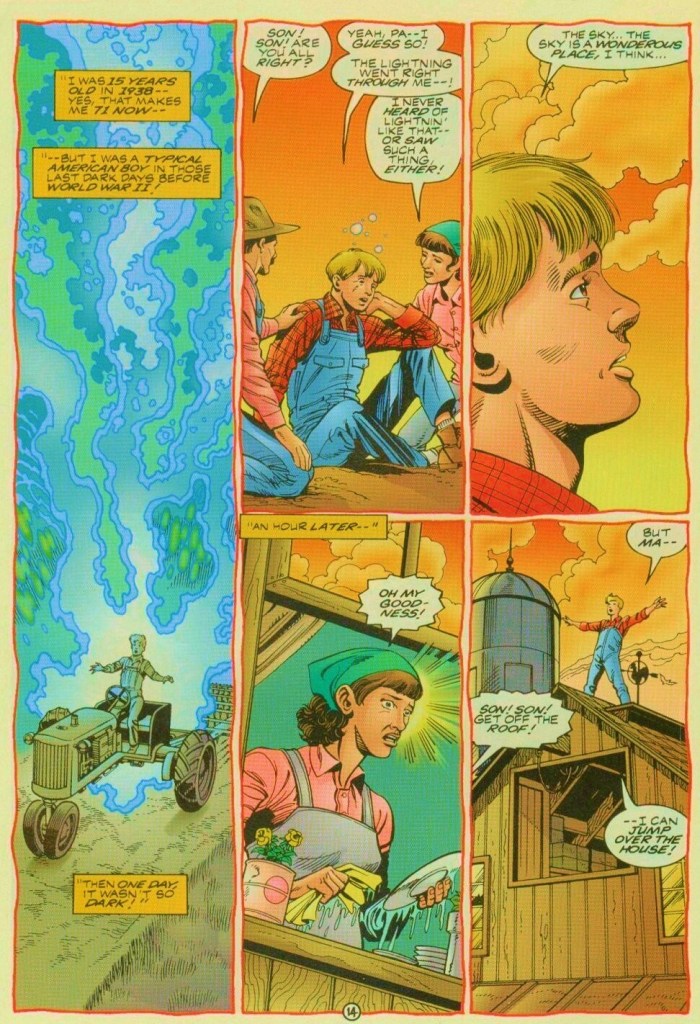
When Powerhouse first gained super abilities.

I’ll got straight to the point about what this comic book is all about. This is the story of an ultra who gained powers very long before The Strangers, Mantra, Prime, Hardcase, The Solution and all the other Ultraverse heroes even started. That being said, Powerhouse is an old man (who really does not look like in his sixties or seventies) whose life turned upside-down as a result of gaining super powers as a teenager in the year 1938 (note: this was the year Superman debuted in comics in real life). Having lost DECADES of his time in the world, Powerhouse became a man who found himself lonely and having trouble adjusting into the modern world (1993 in the Ultraverse specifically). What bothers him even more is the fact that super beings like The Strangers members Atom Bob and Grenade are gladly accepted and celebrated by the public which is the complete opposite of how he was perceived when he became a super being.

The writing done by Steve Englehart is very rich to read and through it all, you will feel the pain, frustration and anguish of Powerhouse. As usual, Rick Hoberg’s art is always great to look at and you can see in this comic book how he adjusts his style when the narrative shifts from the talk scenes into the action scenes and the like.

Conclusion
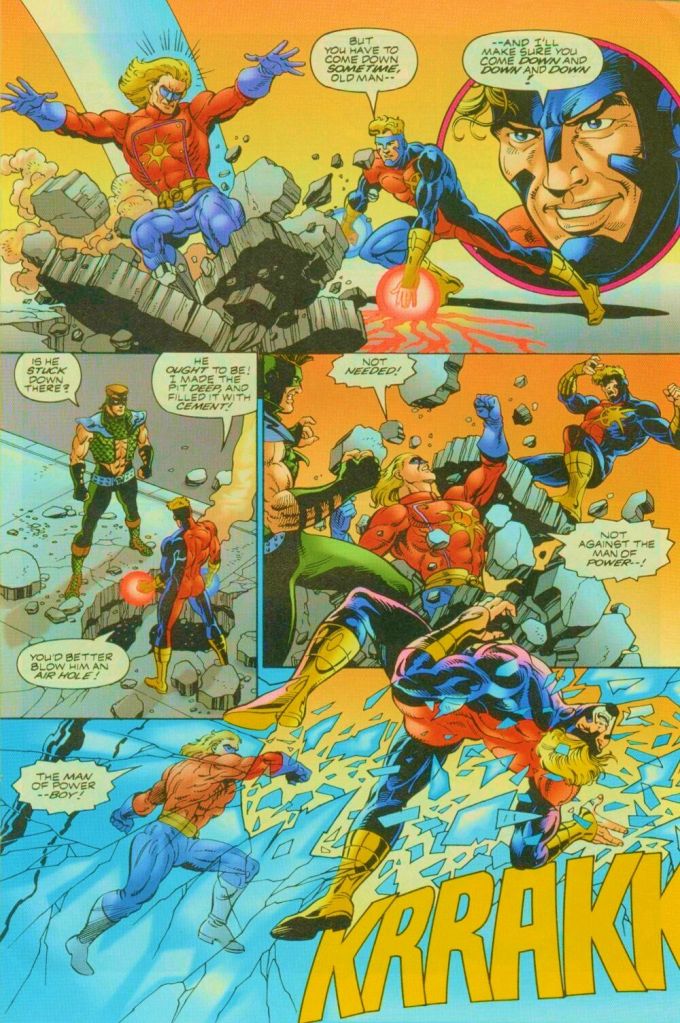
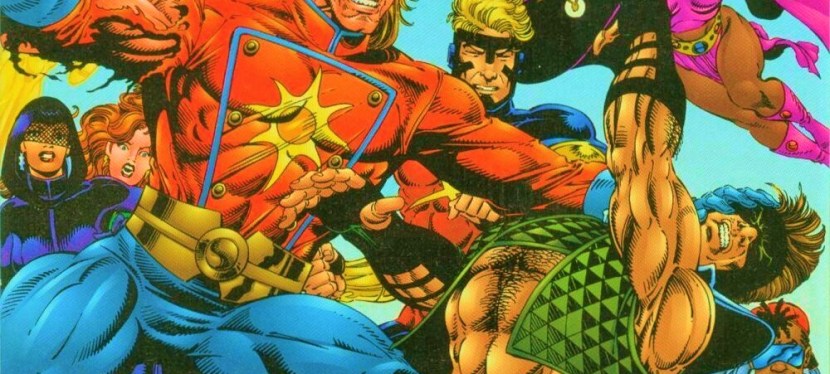
Really, you only see two of The Strangers in this comic book which contradicts what was shown on the cover art.

Fundamentally, The Strangers #14 (1994) highlights Powerhouse (both his present-day self and his origin) with Atom Bob and Grenade literally pushed out of the spotlight. Powerhouse is clearly inspired by the old ages of superhero comics and the creative team cleverly presented him as a super-powered man who finds himself struggling to fit in the 1990s. While this super being debut story is fun and engaging, its only weakness is that The Strangers have little real presence in the story (note: the cover art looks great but is really misleading).

If you are seriously planning to buy an existing hard copy of The Strangers #14 (1994), be aware that as of this writing, MileHighComics.com shows that the near-mint copy of the comic book costs $14.

Overall, The Strangers #14 (1994) is recommended!

+++++

Thank you for reading. If you find this article engaging, please click the like button below and also please consider sharing this article to others. If you are looking for a copywriter to create content for your special project or business, check out my services and my portfolio. Feel free to contact me as well. Also please feel free to visit my Facebook page Author Carlo Carrasco and follow me at HavenorFantasy@twitter.com
A Look Back at Giant Size Prototype #1 (1994)

Disclaimer: This is my original work with details sourced from reading the comic book and doing personal research. Anyone who wants to use this article, in part or in whole, needs to secure first my permission and agree to cite me as the source and author. Let it be known that any unauthorized use of this article will constrain the author to pursue the remedies under R.A. No. 8293, the Revised Penal Code, and/or all applicable legal actions under the laws of the Philippines.

Welcome back superhero enthusiasts, comic book collectors and fans of Malibu Comics! Today we revisit the Ultraverse through the 4th and concluding chapter of the Hostile Takeover crossover storyline which involved the UV’s notable heroes like Prototype, The Solution, Night Man and even Solitaire. To put things in perspective, the first three chapters were told in The Night Man #12, Solitaire #10 and The Solution #13.

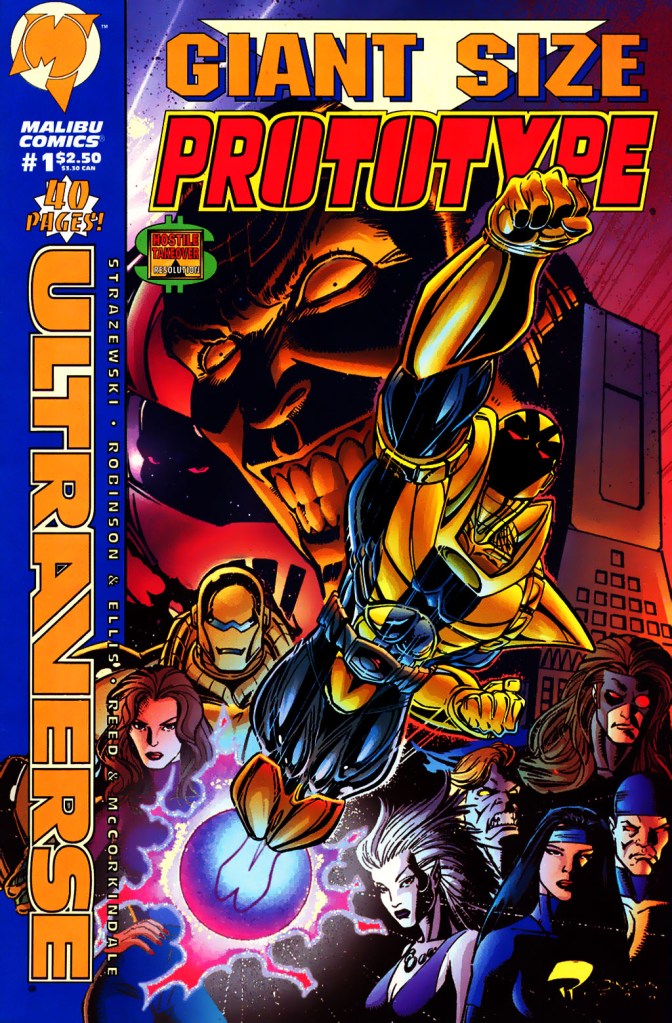
At this point in Hostile Takeover, the stakes were raised and things have turned messy not only for the UV heroes but also for the corporate figures involved. To see if everything will truly be resolved, join me in this look back at Giant Size Prototype #1, published in 1994 by Malibu Comics with a story written by Len Strazewski and drawn by Roger Robinson.

The cover.

Early story

The story begins with TV newscasts about the tremendous collapse of UltraTech as a result of corporate in-fighting which rocked Wall Street. A New York Stock Exchange analyst states on TV: Either the market insiders are completely confused about the future of UltraTech and are speculating wildly or UltraTech is right in the middle of one of the most violent hostile takeovers in corporate history!

Moments back, Prototype (Jimmy Ruiz) and Teknight battled each other while The Solution found Ranger blocking their way.

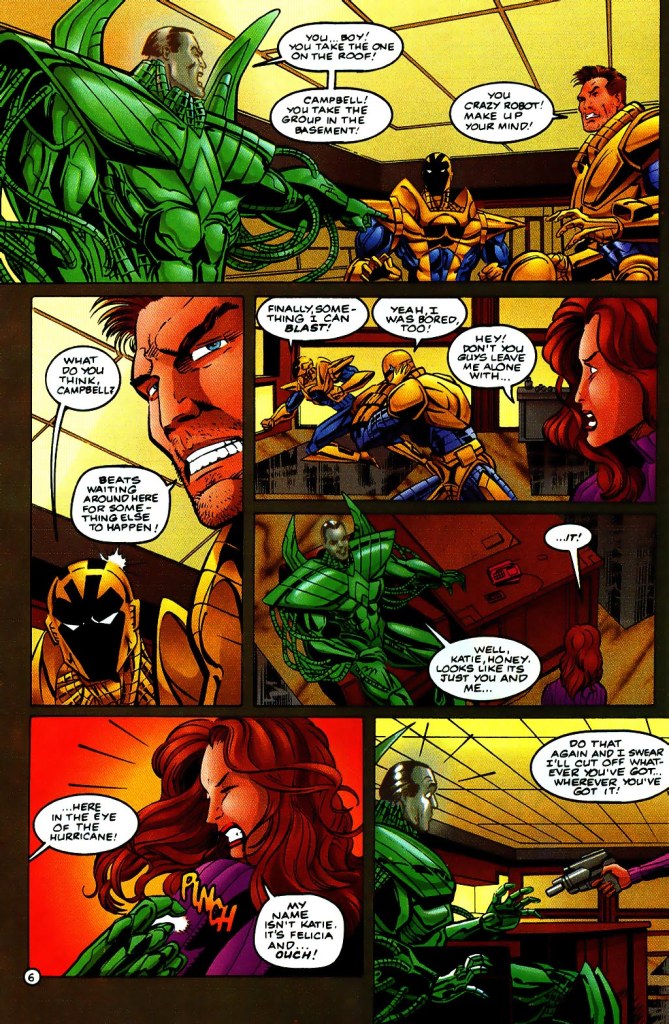
Inside the corporate headquarters, Gordon Bell could not control himself in the presence of Felicia, Jimmy and Bob Campbell. With the helicopter carrying Teknight arriving at the roof top and The Solution (with Night Man) making their way through the basement, Gordon Bell sends Prototype and Ranger to secure the place, leaving Felicia behind.  

Quality

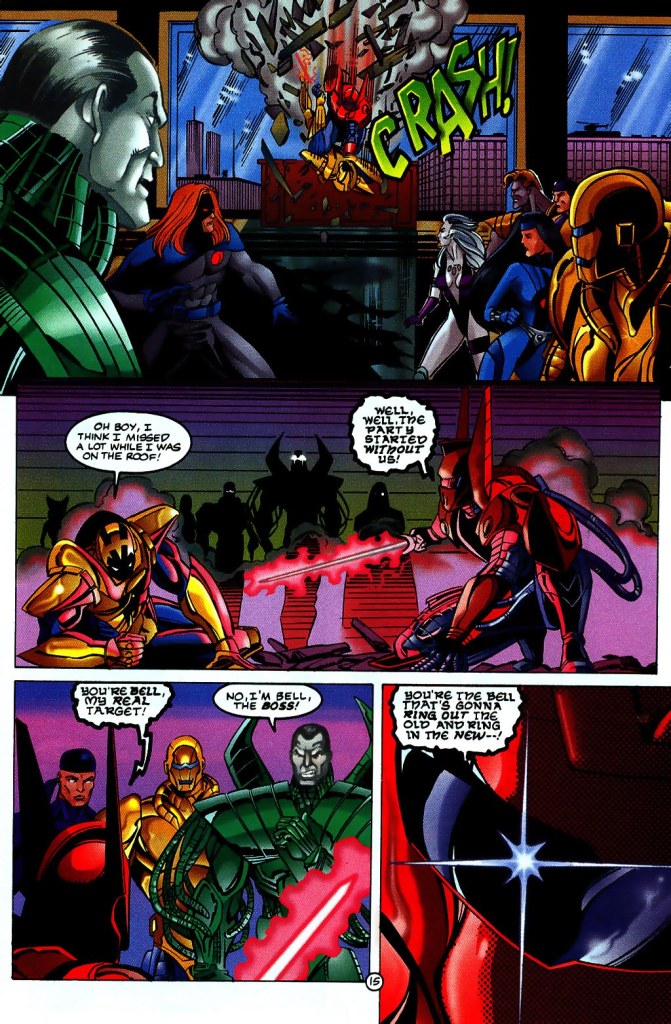
Prototype and Teknight crash into the office of Gordon Bell with The Solution and Night Man as witnesses.

As expected, corporate intrigue remains as the core concept or theme of this extensive (over 30 pages in story) comic book. Without spoiling the plot, I can say that the turmoil of UltraTech is a true turning point within the Ultraverse and its effects were really felt in my recent Prototype retro comic book review. This story also sheds light on the UV’s corporate figures J.D. Hunt and Stanley Leland and it was here where their influence is really felt.

As for the Ultraverse heroes, this story unsurprisingly shows more of what Prototype and Ranger went through in their respective participation of the events and incidents that happened throughout Hostile Takeover (which were also dramatized in smaller parts in the other comic books of this crossover storyline). There is more depth in the encounter between Prototype and Teknight, and in Ranger’s encounter with The Solution and Night Man. The good thing here is that the mentioned encounters are very well written and filled with solid dialogue by Len Strazewski, resulting more engagement between the reader and Prototype and Ranger.

As to how the Hostile Takeover storyline concluded, I would obviously not spoil it here but I can assure you all that it ended with a huge impact and some powerful images.

Conclusion

Prototype, Ranger and Felicia with Gordon Bell.

Giant Size Prototype #1 (1994) served its purpose in concluding the Hostile Takeover storyline and its best feature is its writing. It also served as a definitive turning point in the story of the titular character. As a whole, Hostile Takeover’s concept is really short and the approach to showing readers the moments of the events as seen through the eyes of different Ultraverse characters is flawed (note: this is not your typical straightforward crossover storytelling) and relied on padding to fill the narrative. In addition, there is one standalone short story that should please fans of Bob Campbell as Ranger.

If you are seriously planning to buy an existing hard copy of Giant Size Prototype #1 (1994), be aware that as of this writing, MileHighComics.com shows that the near-mint copy of the comic book costs $14.

Overall, Giant Size Prototype #1 (1994) is recommended.

+++++

Thank you for reading. If you find this article engaging, please click the like button below and also please consider sharing this article to others. If you are looking for a copywriter to create content for your special project or business, check out my services and my portfolio. Feel free to contact me as well. Also please feel free to visit my Facebook page Author Carlo Carrasco and follow me at HavenorFantasy@twitter.com
A Look Back at Wonder Woman #21 (1988)

Disclaimer: This is my original work with details sourced from reading the comic book and doing personal research. Anyone who wants to use this article, in part or in whole, needs to secure first my permission and agree to cite me as the source and author. Let it be known that any unauthorized use of this article will constrain the author to pursue the remedies under R.A. No. 8293, the Revised Penal Code, and/or all applicable legal actions under the laws of the Philippines.

Welcome back, superhero enthusiasts, comic book collectors and fans of superhero universe of DC Comics! I don’t know with you, my readers, but I love the way George Perez and his fellow writers characterized Wonder Woman during the very early stage of the post-Crisis era of DC Comics. The character development was not only a great way to achieve balance with spectacle and plotting for each story of Wonder Woman, but also a solid way to redefine the Queen of Superheroes to new fans as well as other comic book readers of the late 1980s. Such characterization efforts include redefining other key elements of the Wonder Woman concept such as the development of Themyscira and its all-women society, the struggle that the deities of Olympus had while the Amazons struggled, and most notably the way Wonder Woman and the people of man’s world adjusted to each other.

With those details laid down, we can find out more about Wonder Woman’s development in this look back at Wonder Woman #21, published by DC Comics in 1988 with a story written and drawn by George Perez with Bob McLeod credited with the finished art.

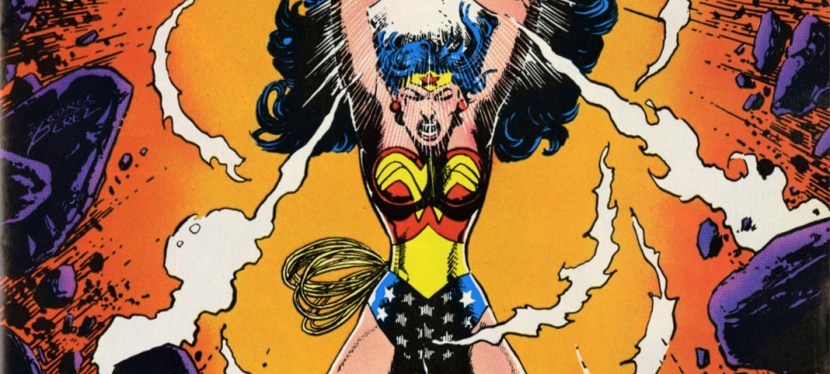
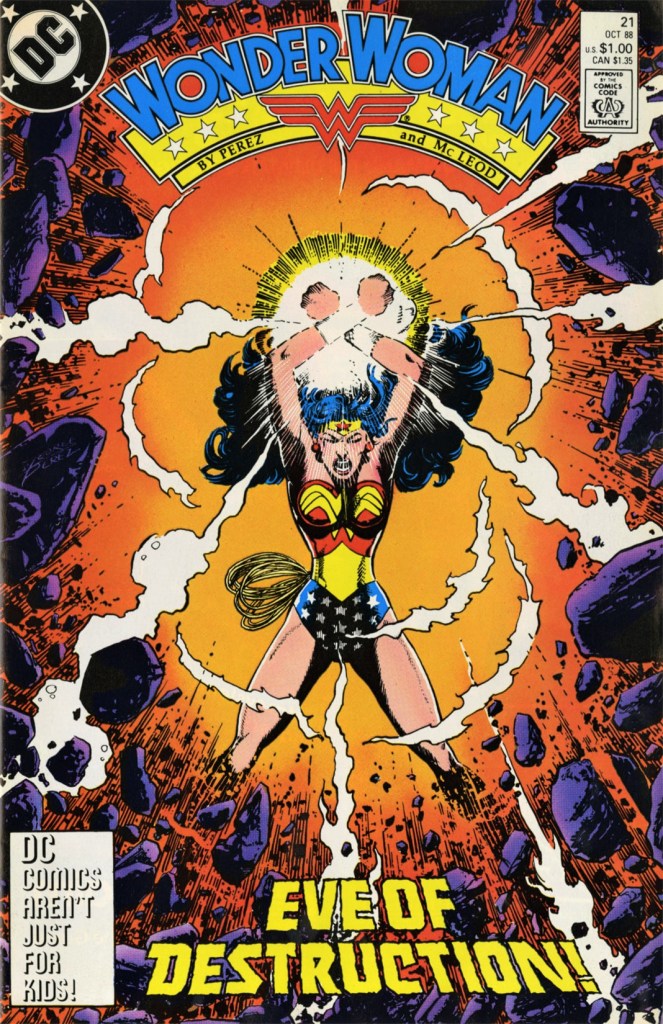
The cover.

Early story

The story begins in Themyscira. In the middle of the night, Menalippe, the oracle of the Amzons wakes up looking terrified. She makes a reference to the deities of Olympus. In Wakefield, Massachusetts, Diana/Wonder Woman, Julia Kapatelis and teenager Vanessa arrive home from the memorial service of the late Myndi Mayer. As Vanessa goes to her bedroom feeling depressed, Diana admits to Julia that she is deeply troubled over what happened in recent times. She also expressed that she can’t help feeling partially responsible for Mayer’s death.

As Julia tries to comfort Diana, several knocks were made at the house door. Upon opening it, a bird carrying a note suddenly flies into the house and heads straight to Diana who recognizes it and reads a new message written by her mother, the queen Hippolyte.

After reading it, Diana leaves for Themyscira with a promise to Julia and her daughter that she will return. Shortly after arriving in her nation, she, her mother and all their Amazon sisters assembled at the altar of Apollo and performed a ritual led by Menalippe. Menalippe claims to have made contact with the deities and states that she, Diana and Queen Hippolyte have been called to appear at the court in Mount Olympus…

Quality

The deities of Olympus were never holy and were in fact very flawed beings who happen to hold tremendous power over Wonder Woman and the Amazons.

I can say that this is a story about the foundation of Wonder Woman’s place in the DC Comic universe as it involves the link between Olympus and Themyscira. The good news here is that this story is very well written and the plot structure was nicely organized by George Perez.

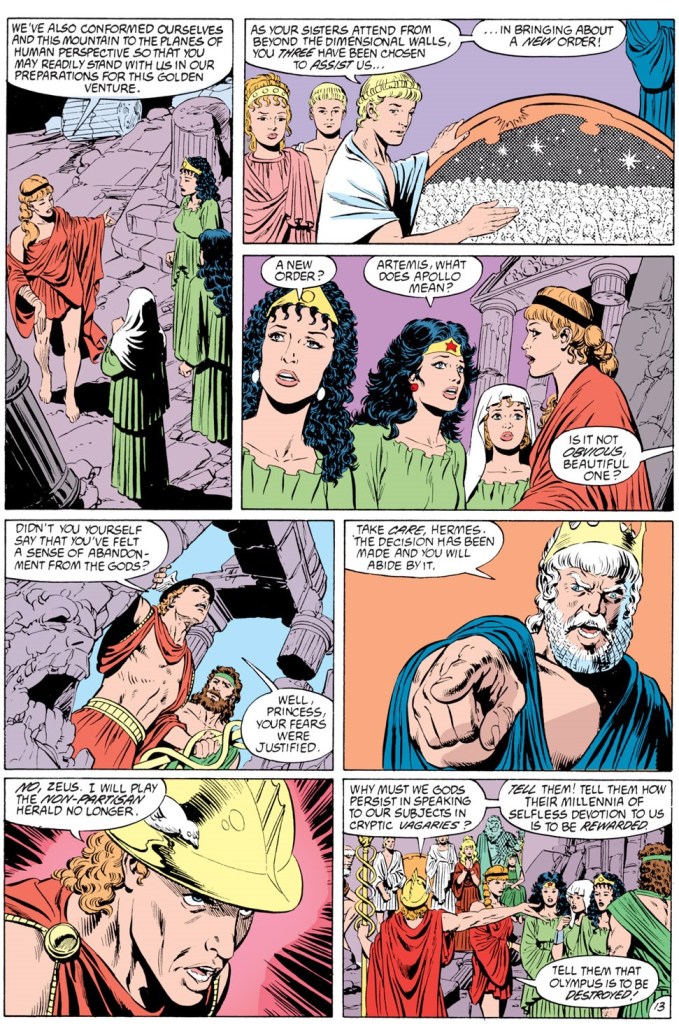
In many ways, this story is a continuation to Wonder Woman’s personal interaction with the deities of Olympus. The difference here is that her mother Queen Hippolyte and their oracle are much more involved and the deities – which include Zeus, Hera, Heracles and the rest – themselves have gotten into tremendous trouble as a result of what Darkseid did to them. This leads to the call of a new order which got the three Amazons chosen. This alone marks the new chapter in the lives of Amazons and Wonder Woman, who proved her worth in the Challenge of the Gods storyline, is unsurprisingly part of it.

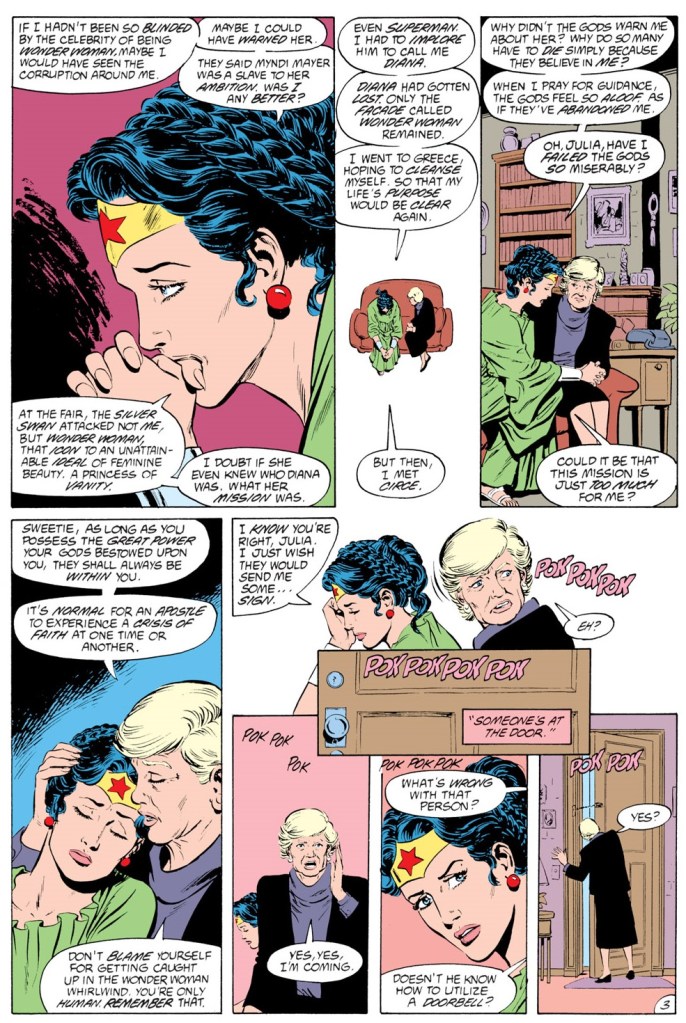
When it comes to the character development of Wonder Woman, the golden part happened early in this comic book. I love the way that George Perez portrayed Diana to be fragile as a person who realizes that her being a very powerful icon in man’s world causes both blessings and problems around her. Diana admits getting blinded by the celebrity of being Wonder Woman to the many people around her. The dialogue Perez wrote for Diana in the early scene (in the presence of Julia) is very rich and so touching, you will feel sympathy for the Queen of all Superheroes.

Conclusion

A very touching scene about Diana/Wonder Woman dealing with the responsibility of what went wrong recently.

Apart from being a new chapter for Wonder Woman and her Amazons, Wonder Woman #21 (1988) is a richly layered story to read. It does not have the usual good-versus-evil spectacle common with most superhero comic books, but the story succeeds in moving the narrative of the Amazons and Olympus deities forward while developing Diana as an even more human character (as opposed to being a superhero). This is another great work spearheaded by George Perez.

If you are seriously planning to buy an existing hard copy of Wonder Woman #21 (1988), be aware that as of this writing, MileHighComics.com shows that the near-mint copy of the regular edition costs $33 while the near-mint copy of the newsstand edition and the 2nd print edition cost $70 each.

Overall, Wonder Woman #21 (1988) is highly recommended!

+++++

Thank you for reading. If you find this article engaging, please click the like button below and also please consider sharing this article to others. If you are looking for a copywriter to create content for your special project or business, check out my services and my portfolio. Feel free to contact me as well. Also please feel free to visit my Facebook page Author Carlo Carrasco and follow me at HavenorFantasy@twitter.com
Xbox-Bethesda excitement intensifies as Phil Spencer emphasizes exclusive games plus key Bethesda games got added to Xbox Game Pass (XGP)

There is no denying that the completion of the most significant video gaming business deal of this modern age of and the integration of Bethesda into Team Xbox are leading to a brighter future in electronic entertainment not only for Xbox fans and PC gamers but also for all other people who can afford gaming.

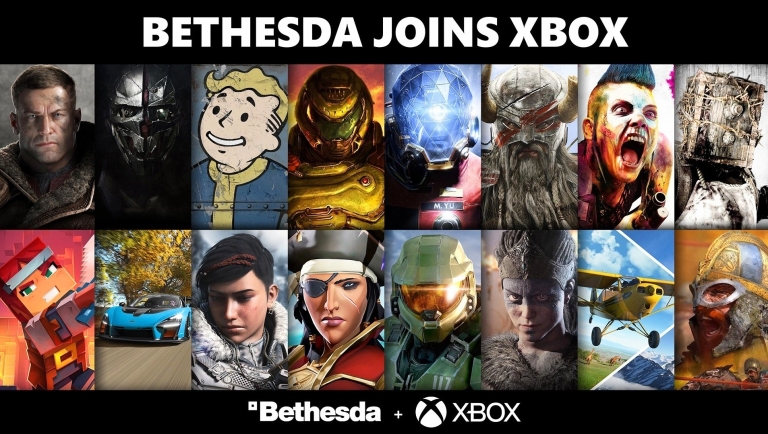
Yesterday, the fusion between Bethesda and Team Xbox was emphasized even further as top executives from both sides took part in a roundtable meeting titled Bethesda joins Xbox which was shown worldwide online. The YouTube video has been posted below for your convenience and viewing pleasure.

Here are a few notable parts of the roundtable event. Firstly, and most notably, Xbox chief Phil Spencer cautiously spoke about the plans regarding exclusive games that Xbox fans have been eagerly wanting to find out (note: key portions in bold).

“We have games that exist on other platforms, and we’re going to support those games on the platforms they’re on. There are communities of players. We love those communities and will continue to invest in them. And even in the future, there might be things that have either contractual things, or legacy on different platforms, that we’ll go do. But if you’re an Xbox customer, the thing I want you to know is this is about delivering great exclusive games for you that ship on platforms where Game Pass exists, and that’s our goal, that’s why we are doing this,” Spencer said.

Even as Microsoft-controlled Bethesda has games and fan communities on other platforms that will be supported, Xbox customers are still priorities for them and Xbox Game Pass is a key factor as it has many millions of subscribers around the world who use Xbox One consoles, Xbox Series S, Xbox Series X and Windows 10 PC.

While no titles were mentioned by Spencer, I am confident that Bethesda’s upcoming games like Starfield and Elder Scrolls VI will be released for Xbox Series consoles and Windows 10 PCs and be made available via Xbox Game Pass in the near future.

In my view, and in response to the whining of the PlayStation fanboys (who are agonizing over the Xbox-Bethesda deal) and of the people who hate Xbox spotted on social media, it does not make business sense for new Bethesda games (especially those made with big budgets for at least 3 years) to be released on PlayStation and Nintendo platforms since they are not connected with Xbox Game Pass.  If you look at Team Xbox closely, they are working hard to sell not only gaming hardware, software and DLCs, but also subscription services. In this case, Xbox Game Pass is essential and with 18 million subscribers already counted, the said subscription service is generating billions of Dollars of revenue for Team Xbox per year. Will Sony and Nintendo be willing to have Xbox Game Pass offered to their respective customers for the sake of availing new Bethesda hot new games? Unless something drastic happens, such a scenario won’t happen.

Going back to Spencer’s confirmation of exclusive games for Xbox customers, the integration of Bethesda into Team Xbox easily ensures that Xbox fans will not only have a lot of exclusive titles coming from the well-established publisher (and its many studios), they will also have a wide variety of the types of games from ALL the 23 Xbox Game Studios. The first-person shooter (FPS) genre exclusives to look forward to are Halo Infinite, the next Doom, the next Wolfenstein, the next Rage, the next Prey and so on. RPGs? Try Starfield, Elder Scrolls VI, Avowed, Fable, the next Fallout and the next The Outer Worlds.

Rest assured, Xbox fans have a whole lot of exclusive games to look forward to from Bethesda’s studios and the other Xbox Game Studios in the near future. These assured exclusive games should convince gamers to buy Xbox Series S or Xbox Series X, and then sign up immediately for Xbox Game Pass.

Going back to the media event, Todd Howard took note of the marvel of backward compatibility (itself a great, pro-gamer feature on Xbox) and described how awesome it is that old creations such as the RPG Elder Scrolls IV: Oblivion is not only playable (on current Xbox technology) but also nicely presented in 4K resolution showing how much life it still has all these years. In relation to that, Aaron Greenberg announced that Team Xbox is already working on providing FPS Boost (enhanced frame rates) on backward compatible games of Bethesda.

And then there is the other big announcement made during the roundtable event…Bethesda adding twenty games into Xbox Game Pass for subscribers to enjoy!

Specifically the games added into the said subscription service are: Dishonored Definitive Edition, Dishonored 2, Doom (1993), Doom II, Doom 3, Doom 64, Doom Eternal, Elder Scrolls III: Morrowind, Elder Scrolls IV: Oblivion, Elder Scrolls V: Skyrim, Elder Scrolls Online, The Evil Within, Fallout 4, Fallout 76, Fallout: New Vegas, Prey, Rage 2, Wolfenstein: The New Order, Wolfenstein: The Old Blood, and Wolfenstein: Youngblood.

Those mentioned games are available on Xbox Game Pass now.

In ending this, posted below for your viewing pleasure are varied gaming-related videos…including one video about the March 17, 2021 release of the next DLC expansion for The Outer Worlds (developed by Obsidian Entertainment which itself worked on Fallout: New Vegas for Bethesda long ago).

+++++

Thank you for reading. If you find this article engaging, please click the like button below and also please consider sharing this article to others. If you are looking for a copywriter to create content for your special project or business, check out my services and my portfolio. Feel free to contact me as well. Also please feel free to visit my Facebook page Author Carlo Carrasco and follow me at HavenorFantasy@twitter.com
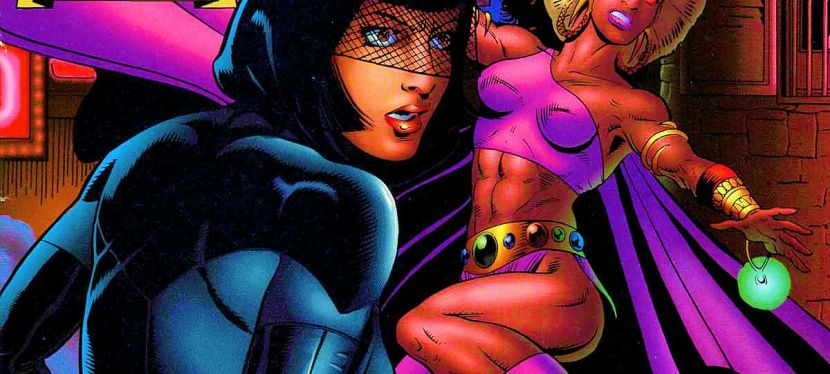
A Look Back at The Strangers #23 (1995)

Disclaimer: This is my original work with details sourced from reading the comic book and doing personal research. Anyone who wants to use this article, in part or in whole, needs to secure first my permission and agree to cite me as the source and author. Let it be known that any unauthorized use of this article will constrain the author to pursue the remedies under R.A. No. 8293, the Revised Penal Code, and/or all applicable legal actions under the laws of the Philippines.

Welcome back, superhero enthusiasts, comic book collectors and fans of Malibu Comics! I recently checked the publishing background of The Strangers and it showed that it only lasted a total of twenty-four issues. That means the end is nearing with regards to my doing retro comic book reviews about The Strangers. For the most part, I had a lot of fun reading these comic books and I can say that Steve Englehart always found ways to make each and every story fun to read and remain fresh.

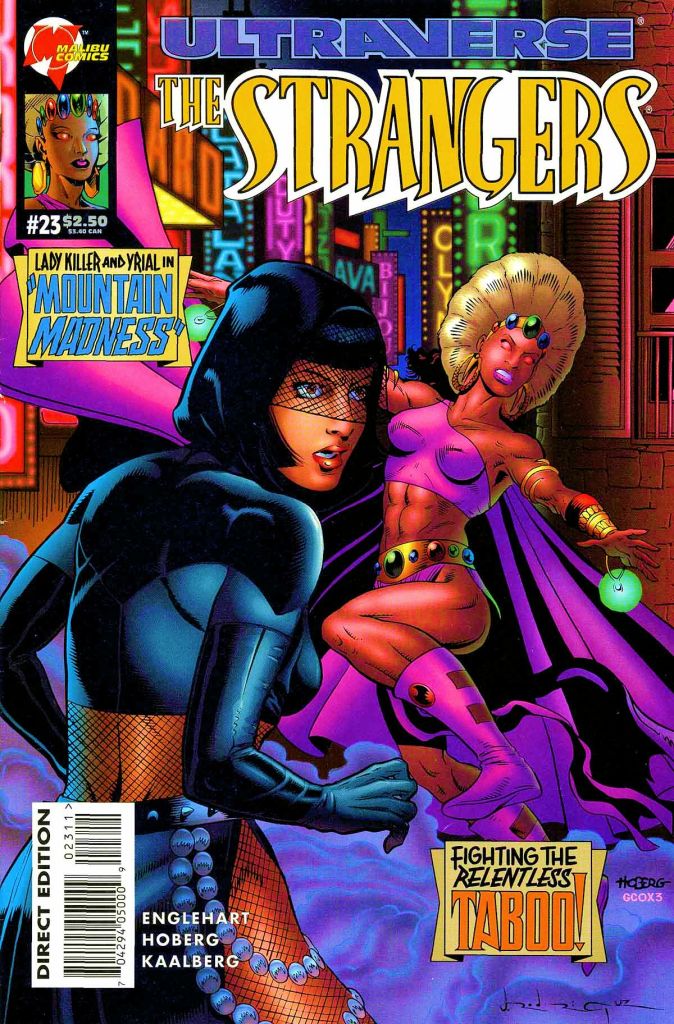
We are nearing the end of retro comic reviews of this particular comic book series and we can find out more what happens next in this look back at The Strangers #23, published by Malibu Comics in 1995 with a story written by Steve Englehart and drawn by Rick Hoberg.

The cover.

Early story

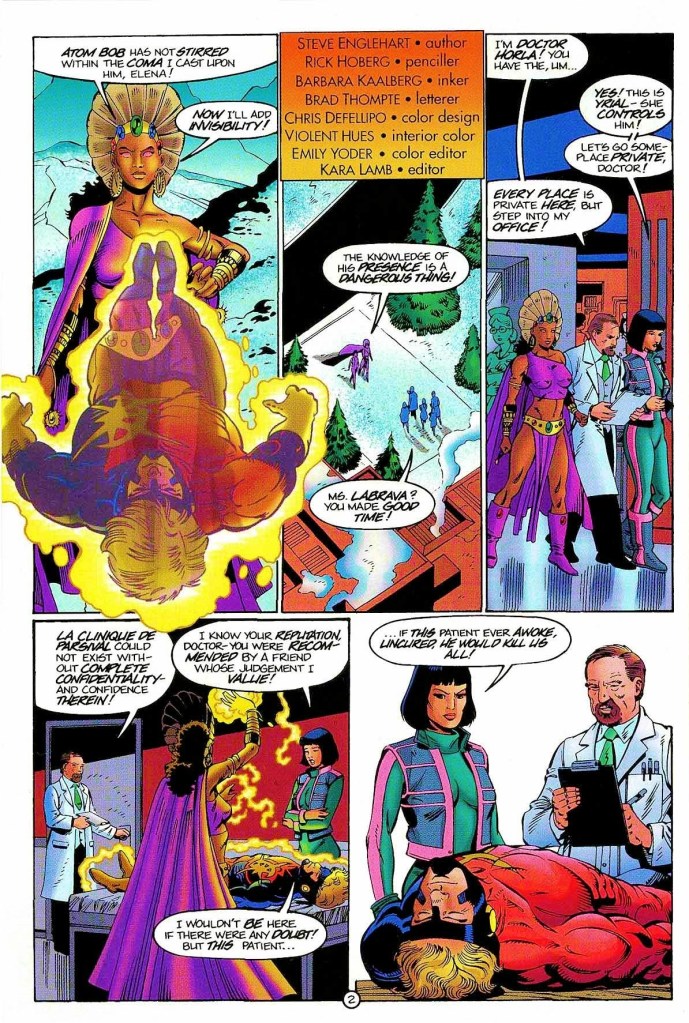
The story begins in Europe. Yrial and Lady Killer brought with them the comatose body of Atom Bob, the one man who loved the latter and betrayed their entire team. They entered a special and meet Dr. Horla. They presented Atom Bob to him as a patient and Dr. Horla expressed knowledge about the man’s power to change things which itself is very risky. As such, Lady Killer tells him that Atom Bob must remain comatose. The doctor assures her that they will report to them his condition every six months.

In response to the doctor’s suggestion of lobotomizing Atom Bob, Lady Killer rejects it and insists that if he can be returned to the man he was, then The Strangers will want him back.

After the meeting, Lady Killer and Yrial visit Andorra mainly to rest and relax. While having drinks at a fine place, a black man recognizes them. He begins to believe that Lady Killer and Yrial went there to find him and could have been working with the police in his native South Africa…

Quality

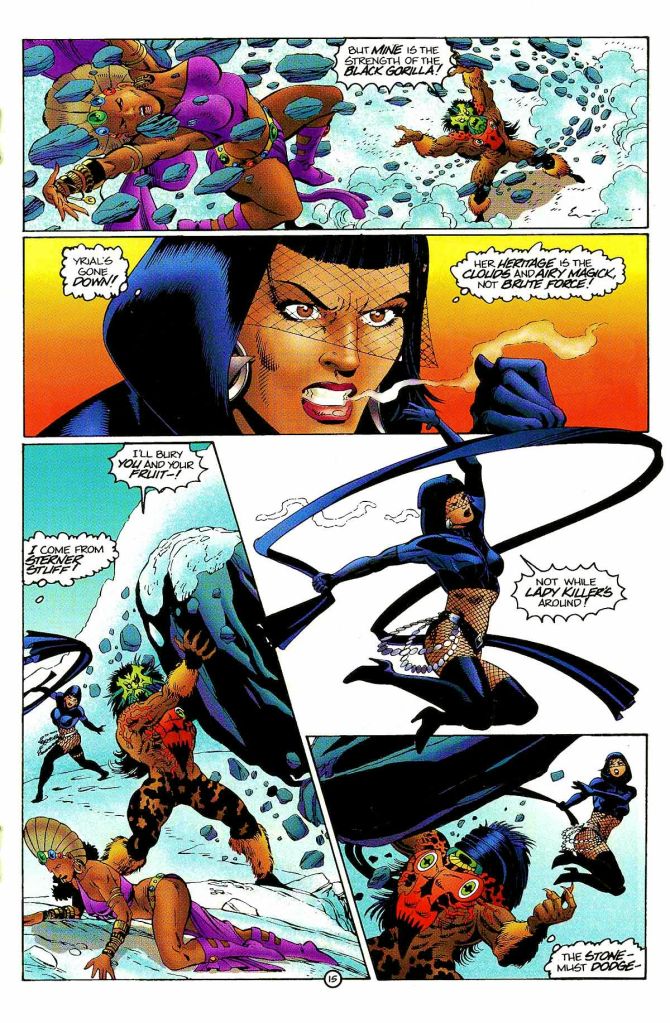
Yrial and Lady Killer in the heat of battle with a new enemy.

To make things clear, this particular story focuses mainly on Lady Killer and Yrial which is a nice change of pace given the events about their other teammates (as told in issues #21 and #22). Essentially, the story is not about the two Strangers’ friendship but rather a tale about a cursed man from South Africa who has been on the run for a long time. Without spoiling the plot, I can say that the cursed man’s encounter with Lady Killer and Yrial sparked the chain of superhero spectacle which contains lots of action that fans will enjoy.

Before the encounter, this story also serves as a continuation about The Strangers’ gradual adjustment to life without Atom Bob. By this time, Lady Killer’s stand as team leader has matured and became more decisive.

Given the way the story was structured, there was no room left for character development on Lady Killer and Yrial. That being said, the spotlight was more focused on the cursed man from South Africa and his motives were efficiently defined.

Conclusion

Bring Atom Bob into the clinic conveniently and invisibly.

To put it clearly, The Strangers #23 (1995) is really the introduction of a new villain who gets into conflict with only two members of the team. It has enough spectacle to enjoy although the story may end up disappointing fans who expected to see the personalities if Yrial and Lady Killer get more developed. For the newcomers reading this, character development is one of the most defining factors of The Strangers monthly series.

If you are seriously planning to buy an existing hard copy of The Strangers #23 (1995), be aware that as of this writing, MileHighComics.com shows that the near-mint copy of the comic costs $35.

Overall, The Strangers #23 (1995) is recommended.

+++++

Thank you for reading. If you find this article engaging, please click the like button below and also please consider sharing this article to others. If you are looking for a copywriter to create content for your special project or business, check out my services and my portfolio. Feel free to contact me as well. Also please feel free to visit my Facebook page Author Carlo Carrasco and follow me at HavenorFantasy@twitter.com
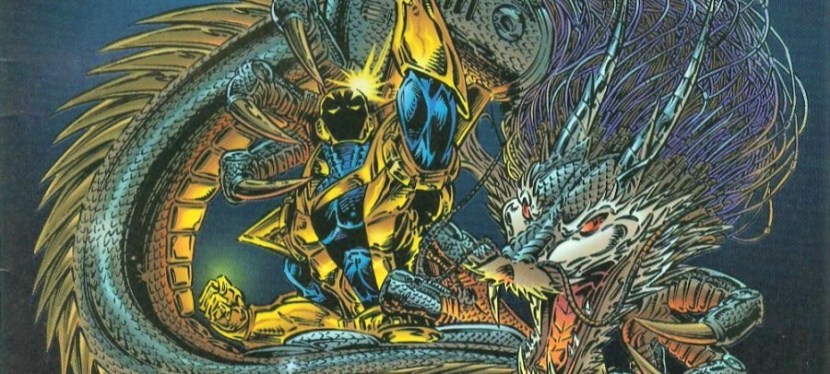
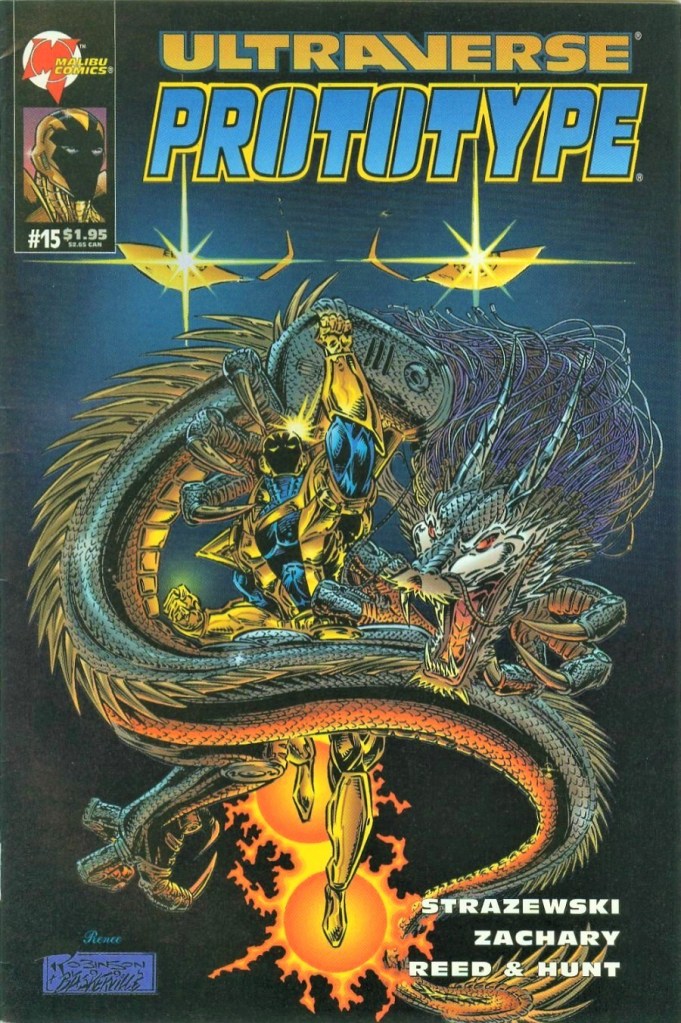
A Look Back at Prototype #15 (1994)

Disclaimer: This is my original work with details sourced from reading the comic book and doing personal research. Anyone who wants to use this article, in part or in whole, needs to secure first my permission and agree to cite me as the source and author. Let it be known that any unauthorized use of this article will constrain the author to pursue the remedies under R.A. No. 8293, the Revised Penal Code, and/or all applicable legal actions under the laws of the Philippines.

Welcome back superhero enthusiasts, comic book collectors and fans of Malibu Comics! Today, I’ve decided to take a break from the Hostile Takeover storyline of the Ultraverse and focus more on the Prototype monthly series. Last time around, a new chapter in the life of Prototype pilot Jimmy Ruiz started and in the corporate world, he took a job that paid so much less than before.

What exactly will happen to Jimmy? We can all find out in this look back at Prototype #15, published in 1994 by Malibu Comics with a story written by Len Strazewski and drawn by Dean Zachary.

The cover.

Early story

The story begins inside a top-secret facility somewhere in the city of New York. A black man is going through the painful processes of cybernetic enhancements. His name is Donovan Jones and he is told by a shadowy figure that he is a failure and only their organization can turn him into something else…more than a human loser.

“You always were an ultra, Jones…and UltraTech knew this! But they never revealed this toyou,” said the shadowy figure.

Donovan Jones expresses his hatred for UltraTech. He also expresses his intention to destroy Prototype.

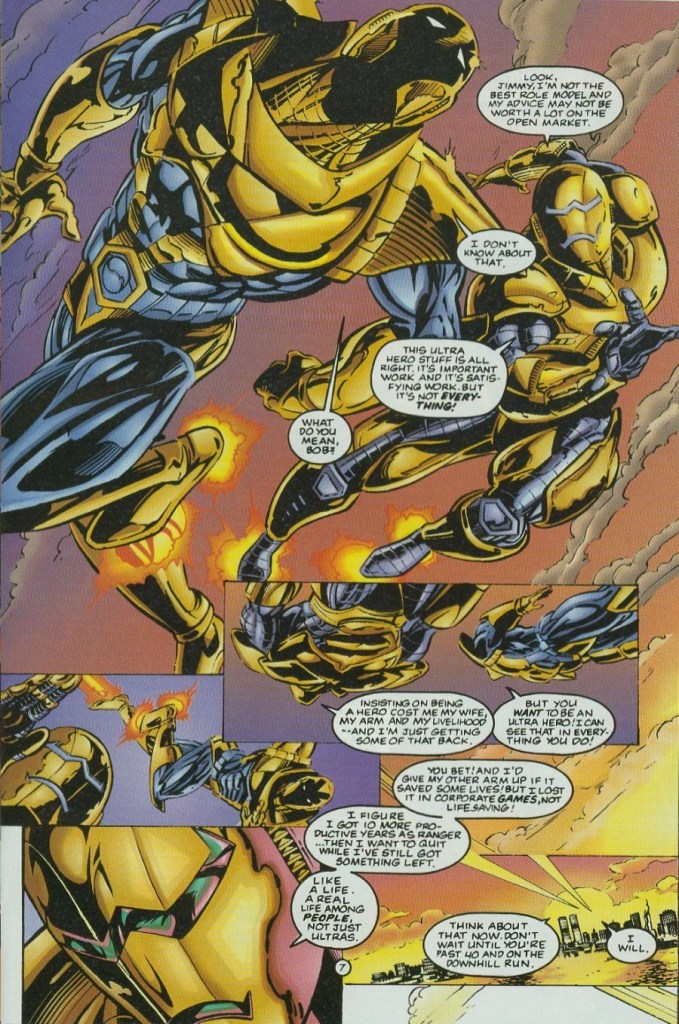
Elsewhere, a long vehicular bridge has been damaged. Helping the victims were Ranger (Bob Campbell) and Prototype (Jimmy Ruiz) trying to ensure that they could balance the bridge to prevent cars from falling over the edge. They managed to solve the problem paving the way for things to go back to normal. The affected people express their thanks and admiration to them.

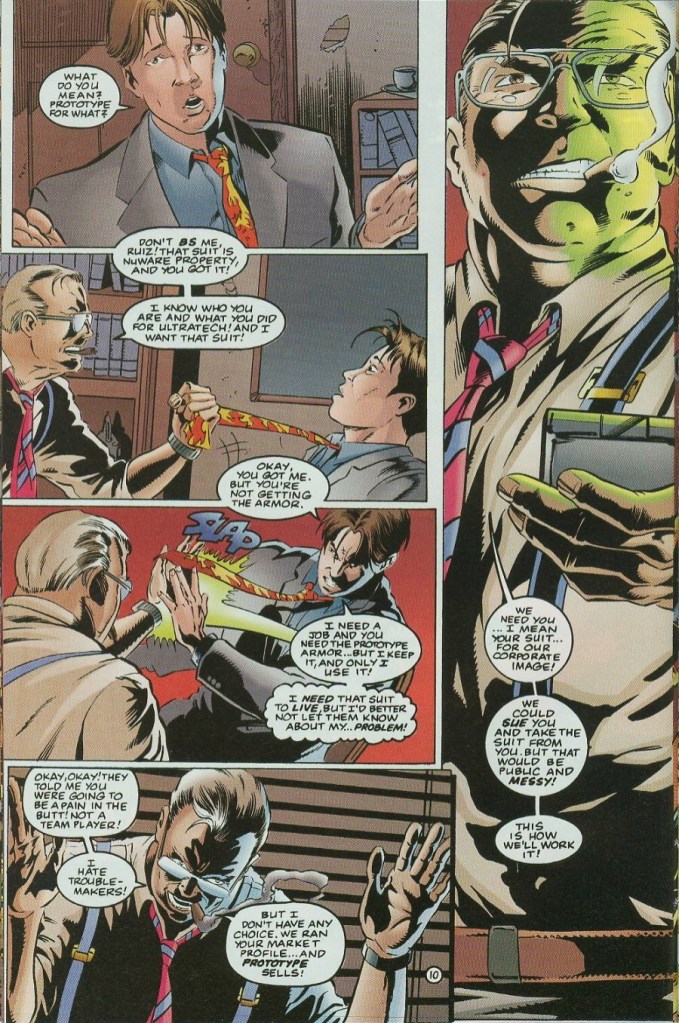
As they fly away together, Bob and Jimmy talk about matters related to being ultra heroes. A short time later, Jimmy takes the train going to New Jersey as a civilian. He arrives at the facility of Direct Contact which is a division of NuWare. It turns out this is his first day of work with them and he is still struggling with the drastic changes now that his huge perks and privileges with UltraTech are no more…  

Quality

Jimmy Ruiz in a tough situation in front with his new boss on his first day at work.

I really like the story and the way Jimmy Ruiz was portrayed. This is really fine writing by Len Strazewski and it seems he organized a plan to not only redefine the protagonist but also change the status quo around him. I liked the way Strazewski set up the first-day-on-the-job struggles of Jimmy which really showed how fragile he is as a person without the armored suit to help him. His boss really was hard on him and made things a bit complicated for him as far as the use of Prototype is concerned under the control of NuWare. I also like the way Jimmy was portrayed in trying to be very responsible about his domestic life and the future ahead of him and his pregnant darling Angella.

Apart from the in-depth characterization, there is a good amount of superhero action to keep fans satisfied. The action was nicely drawn by Dean Zachary.

Conclusion

Prototype and Ranger.

Prototype #15 (1994) is a lot of fun and pretty engaging. In fact, this comic book is a nice pay-off following the build-up that was done in issue #14. To see Jimmy Ruiz redefined as a person without the armor is compelling and the story was nicely structured by Len Strazewski. For serious Prototype fans, this is one comic book that is worth reading again and again. Lastly, this one has a very intriguing ending that you have to read and find out.

If you are seriously planning to buy an existing hard copy of Prototype #15 (1994), be aware that as of this writing, MileHighComics.com shows that the near-mint copy of the comic book costs $14.

Overall, Prototype #15 (1994) is highly recommended!

+++++

Thank you for reading. If you find this article engaging, please click the like button below and also please consider sharing this article to others. If you are looking for a copywriter to create content for your special project or business, check out my services and my portfolio. Feel free to contact me as well. Also please feel free to visit my Facebook page Author Carlo Carrasco and follow me at HavenorFantasy@twitter.com
Bethesda finally integrated into Team Xbox!

Welcome back fellow gamers, geeks and Xbox fans!

Finally, it has been accomplished and it is something truly worth celebrating and become more optimistic about the future of video games! Very recently, Microsoft announced that it has officially completed the $7.5 acquisition of ZeniMax media which effectively integrated Bethesda Softworks and its eight game studios (Bethesda Game Studios, id Software, ZeniMax Online Studios, Arkane, MachineGames, Tango Gameworks, Alpha Dog, and Roundhouse Studios) and their respective communities into Team Xbox! The completion was realized after getting approved by the United States Securities and Exchange Commission and the regulators of the European Union (EU). Bethesda themselves posted a fine video about their legacy in gaming and the confirmation of becoming part of Team Xbox. Watch it below…

Bethesda and Xbox is a formidable combination!

To put things in perspective, below is an excerpt (note: key parts in bold) from the completion announcement written by Xbox chief Phil Spencer over at Xbox.com. Pay close attention…

Now that everything is official, we can begin working together to deliver more great games to everyone. At every step building toward this moment, I’ve been inspired and motivated by the creativity, insight, and community-first approach of the talented people at Bethesda. Our goal is to give these teams the best foundation for doing their greatest work and to learn from them as we continue to build Xbox into an inclusive platform for all players.

This is the next step in building an industry-leading first party studios team, a commitment we have to our Xbox community. With the addition of the Bethesda creative teams, gamers should know that Xbox consoles, PC, and Game Pass will be the best place to experience new Bethesda games, including some new titles in the future that will be exclusive to Xbox and PC players.

As seen above, Phil Spencer led the welcoming of Bethesda into Team Xbox. This is clearly not a simple acquisition because Bethesda is a very big company complete with eight game developers (lots of very talented employees) and very well-established franchises of games such as The Elder Scrolls, Fallout, Dishonored, Doom and more.

Speaking of Bethesda’s new games, Spencer made clear that the Xbox ecosystem is not just the definitive destination for the said games, it is indeed the best. Xbox consoles clearly includes the many millions of Xbox One consoles still in use as well as the growing number of Xbox Series S and Xbox Series X consoles. PC refers to Windows 10 while Game Pass refers to Xbox Game Pass (XGP) which is a highly successful paid subscription service which has reached 18 million subscribers worldwide. No surprise, PlayStation and Nintendo consoles were excluded. Microsoft, after all, has a stake in Bethesda while Sony and Nintendo do not.

As for Spencer’s line – some new titles in the future that will be exclusive to Xbox and PC players – I believe he was referring to upcoming games divided between those that can be made only for the Xbox ecosystem (Xbox console owners and PC users), those that can be released on other platforms (note: Spencer mentioned before the case-by-case aspect) and those that are legally bound to be released on a different platform (note: Bethesda has two timed-exclusive games for PlayStation 5).

The way I see it, future games like Starfield and sequels such as The Elder Scrolls VI, Fallout 5, future Doom, future Dishonored and the like will be made Xbox-exclusive (geared more towards the Xbox Series consoles and PC) which makes business sense because Xbox consoles and Windows 10 PCs are what Xbox Game Pass subscribers use. The addition of Bethesda games into XGP will help the service attract even more subscribers from around the world! I also believe that games made with strong single-player gaming experiences in mind will be designated for Xbox and PC gamers.

Future Bethesda games that will cater more on multiplayer and on being a service (technically) can be made for multiple platforms, including the PlayStation and Nintendo consoles.

As such, Phil Spencer’s use of the words “some new titles” makes sense. In due time, I believe, Microsoft and Bethesda will make clear that the Xbox ecosystem is top priority for them and this means eventually locking out Sony and Nintendo consoles when it comes to most new Bethesda games. It should happen in the years to come.

The integration of Bethesda into Team Xbox does not necessarily mean that Microsoft will change the culture of the company to conform to its own. The tech giant will provide Bethesda funds and lots of technical support while respecting their culture. Pay close attention to Phil Spencer’s words in the excerpt below…

As we shared previously, it’s vitally important that Bethesda continues making games the way it always has. We look forward to empowering Bethesda’s creative teams to reach even more players around the world, helping make future Bethesda titles the biggest and most popular games in their history. Xbox and Bethesda have long shared a common vision for the future of gaming. Both as fans and as creators, Bethesda understands the potential of Xbox Game Pass.

The head of Xbox also took the opportunity to lead the honoring of the late Robert A. Altman, who founded Bethesda’s parent company ZeniMax Media. Read on below…

We would also like to honor the life and memory of my close friend Robert A. Altman, founder of ZeniMax Media. Robert believed deeply in the power of gaming and we are privileged to be able to continue his work by joining forces with the teams he built and led for many years.  I will miss the opportunity to work directly with him on the future of our combined teams but I know that his spirit will live on in the shared work we do and motivate us to make this partnership all he envisioned.

With the completion of the $7.5 billion deal, Team Xbox and Bethesda have officially started a brand-new chapter in the history of gaming. To say the least, Team Xbox’s years-old problem of lacking high-profile exclusive games has clearly been solved and Bethesda’s integration adds a ton of value as well as very rich intellectual properties into the Xbox Game Studios group whose other game developers include 343 Industries (Halo), Obsidian Entertainment (The Outer Worlds), The Coalition (Gears of War), Compulsion Games (We Happy Few), Double Fine Productions (Psychonauts), The Initiative (Perfect Dark), inXile Entertainment (Wasteland 3), Mojang Studios (Minecraft), Ninja Theory (Hellblade) and others. Each and every one of those game developers have new games in development and will be released exclusively on the Xbox ecosystem in the years to come. In effect, this makes Xbox Series consoles even more attractive for gamers and consumers in general. This also makes Team Xbox more competitive and even intimidating towards PlayStation and Nintendo when it comes to producing console-exclusive games.

Just what will PlayStation and Nintendo do to counter the Xbox Game Studios juggernaut now that Bethesda is part of it? Buy out Sega? Sony paying Square Enix a lot more money to secure their future games as PS5-exclusive? Sony reviving their White Knight Chronicles RPG franchise to combat Xbox RPGs from Bethesda, inXile and Obsidian? Will the troubled Sony fanboys demand PlayStation’s Jim Ryan to raise money so that the company will buy as many game studios as possible to beef up PS5 1st party games? Time will tell.

In ending this, posted below for your viewing pleasure are varied gaming-related videos including some video reviews of past Bethesda games for some fun nostalgia.  

+++++

Thank you for reading. If you find this article engaging, please click the like button below and also please consider sharing this article to others. If you are looking for a copywriter to create content for your special project or business, check out my services and my portfolio. Feel free to contact me as well. Also please feel free to visit my Facebook page Author Carlo Carrasco and follow me at HavenorFantasy@twitter.com
A Look Back at The Solution #13 (1994)

Disclaimer: This is my original work with details sourced from reading the comic book and doing personal research. Anyone who wants to use this article, in part or in whole, needs to secure first my permission and agree to cite me as the source and author. Let it be known that any unauthorized use of this article will constrain the author to pursue the remedies under R.A. No. 8293, the Revised Penal Code, and/or all applicable legal actions under the laws of the Philippines.

If you’ve got a problem that needs solving, you call The Solution. That’s how it is in the Ultraverse with regards to hiring some specialists (and wild at that) for help. For the newcomers reading this, The Solution is a heroes-for-hire group led by Lela Cho/Tech (note: read about her origin story) with three unique teammates.

In recent times, I’ve been reviewing Ultraverse comic books of The Night Man and Solitaire which formed the first two parts of the Hostile Takeover crossover storyline. From this point on we can see the 3rd chapter in this look back at The Solution #13, published by Malibu Comics in 1994 written by the late James Hudnall and drawn by Scott Benefiel.

The cover.

Early story

The story begins with a look back at the private communication between J.D. Hunt and Rex Mundi (as seen in The Night Man #12). After their talk, J.D. Hunt hires The Solution to find out what is going on at the headquarters of UltraTech in New York.

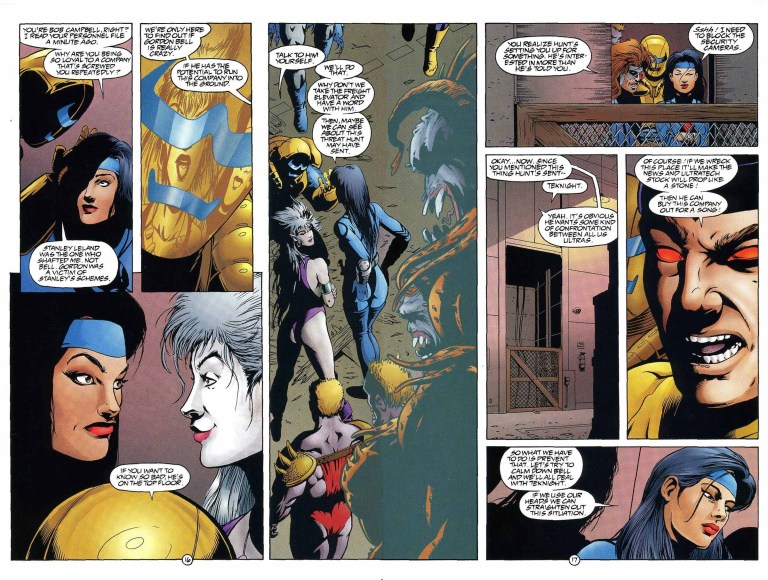
Later under the busy streets of Manhattan, the team make their way through the darkness with Aera using her magic to find the building. When asked by Troy why they took the mission considering J.D. Hunt’s reputation as a “sleaze on wheels”, Lela Cho states that she is certain that he only wants them to find information that could be used against UltraTech. She added that she does not believe Hunt.

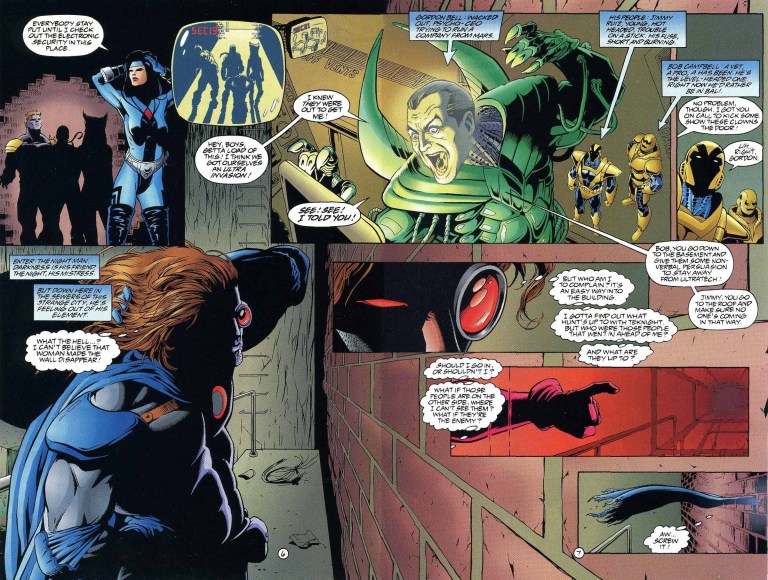
As they talk, Night Man quietly listens to them staying still. Just after Aera found the way for the team to enter the basement of UltraTech’s building, Night Man follows them. Elsewhere, Gordon Bell becomes aware of the intrusion which Prototype (Jimmy Ruiz) and Ranger (Bob Campbell) witness. Bell tells Bob to go to the basement and tells Jimmy to go to the roof…

Quality

The Solution with Night Man and Ranger.

I will start with the visual presentation. This comic book has the unusual yet engaging approach of using pairs of pages to form these wide-angle images composed of a dominating view with panels of other images filling the remaining space. It can be jarring at first but once you get the hang of the story, these visuals will flow smoothly at a nice pace. It should be noted that artist Scott Benefiel is pretty good in visualizing Night Man, Prototype and other related Ultraverse characters. He also did a good job with images of action and superhero spectacle.

As far as storytelling goes, this 3rd chapter of the Hostile Takeover crossover storyline is the most interesting and the most enjoyable to read yet. While The Night Man #12 worked as a big build-up and Solitaire #10 worked as a mere side-story, there is a good payoff in this comic book and at the same time it moved the storyline forward to the next stage.

James Hudnall also kept the details tight and the way he wrote the interactions as the established Ultraverse characters got mixed up is simply great. I really enjoyed reading Lela Cho/Tech talking with Bob Campbell/Ranger about his getting screwed by the corporation, and Night Man’s interactions with The Solution’s members were nicely done.  

Conclusion

The stage is set for conflict.

The Solution #13 (1994) is very enjoyable and compelling! It is the complete package of solid storytelling, memorable character interactions and spectacle that also adds depth to the narrative of the Hostile Takeover storyline. Superhero stuff aside, the element of corporate intrigue remains present which also serves as a lively reminder about what this crossover storyline is about.

If you are seriously planning to buy an existing hard copy of The Solution #13 (1994), be aware that as of this writing, MileHighComics.com shows that the near-mint copy of the comic book costs $14.

Overall, The Solution #13 (1994) is recommended.

+++++

Thank you for reading. If you find this article engaging, please click the like button below and also please consider sharing this article to others. If you are looking for a copywriter to create content for your special project or business, check out my services and my portfolio. Feel free to contact me as well. Also please feel free to visit my Facebook page Author Carlo Carrasco and follow me at HavenorFantasy@twitter.com
A Look Back at The Night Man #12 (1994)

Disclaimer: This is my original work with details sourced from reading the comic book and doing personal research. Anyone who wants to use this article, in part or in whole, needs to secure first my permission and agree to cite me as the source and author. Let it be known that any unauthorized use of this article will constrain the author to pursue the remedies under R.A. No. 8293, the Revised Penal Code, and/or all applicable legal actions under the laws of the Philippines.

Welcome back superhero enthusiasts, comic book collectors and fans of Malibu Comics!

I don’t know with you but I personally enjoyed reading the crossover stories of the Ultraverse. The Strangers had nice crossovers with Hardcase and Prototype in different times. The crossover encounter between Prime and Prototype was very memorable. There also was the first grand crossover of the Ultraverse in Break-Thru #1.

While the Ultraverse no longer exists, for me it was the one superhero comic book franchise or imprint that truly defined superhero comics of the 1990s. Malibu Comics really had great talents and other comic book creators who produced lots of fun comic books to read. Their creators also knew what it took to make Ultraverse crossovers stand out.

Today, we will start a close look at another particular crossover storyline within the Ultraverse titled Hostile Takeover which involves The Night Man, Prototype, Solitaire, Sludge and The Solution! With those details laid down, here is a look back at The Night Man #12, published in 1994 by Malibu Comics with a story written by Steve Englehart with Len Strazewski and James Hudnall as co-plotters. The art was drawn by John Dennis.

The cover.

Early story

The story begins in the fancy office of J.D. Hunt as he receives a call from the secretive and sinister Rex Mundi. Mundi expressed disappointment in Hunt’s handling of the so-called Ultra Problem but went on to give him a chance to redeem himself. Mundi tells Hunt to take over Ultratech which has gotten into trouble caused by Gordon Bell. Hunt noted that Ultratech is to blame for the Strangers’ hijacking of his space shuttle as the security was handled by the said company.

 After talking with Mundi, J.D. Hunt observes his employees finishing work on a high-tech armor (Teknight) and then communicates privately with The Solution. During the meeting, Hunt reveals to them that he is a major stockholder of Ultratech and he needs them to find out if they got Gordon Bell running things. The Solution takes the job.

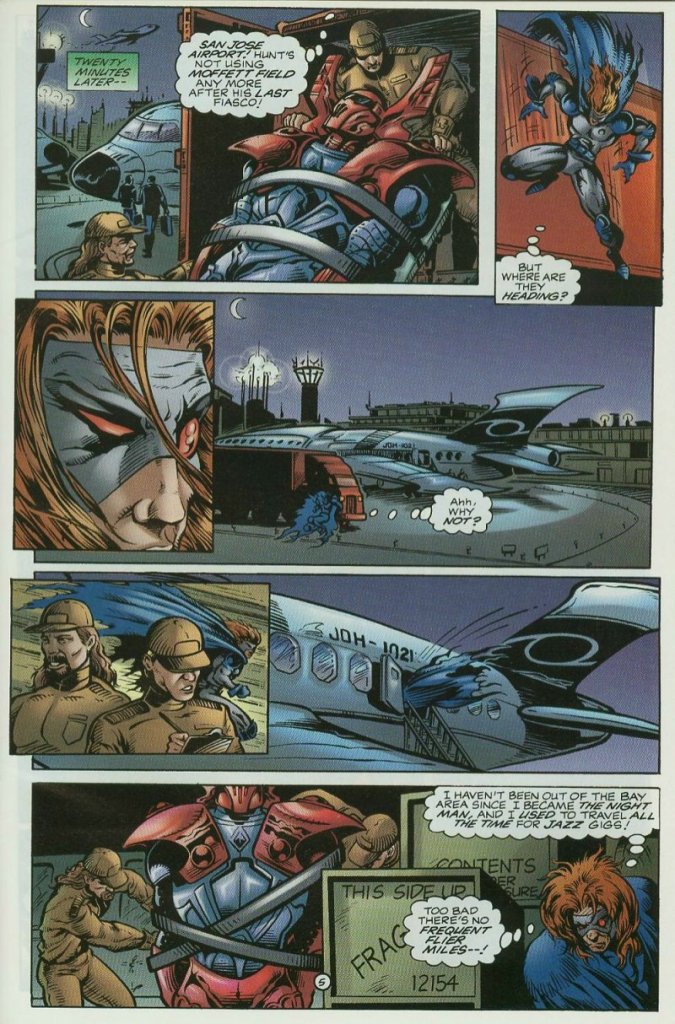
Elsewhere, the Night Man secretly jumps on the top of a moving truck which he knows carries NuWare’s secret project Teknight. Upon arrival at the airport of San Jose, California, Night Man carefully sneaks into an airplane which is where Teknight is loaded at…

Quality

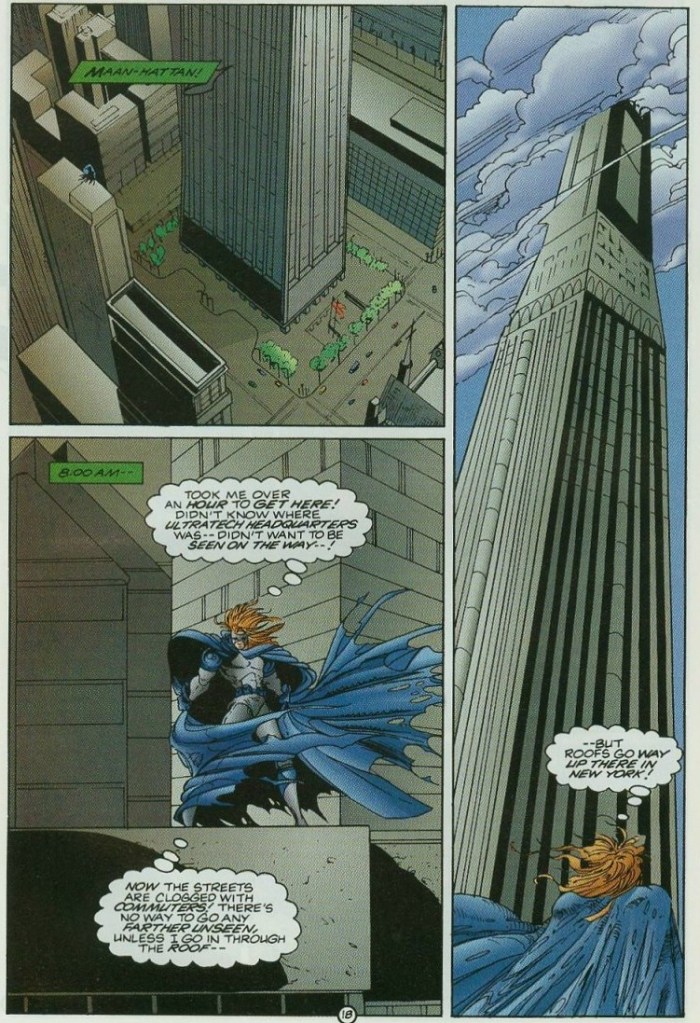
Imagine yourself being Night Man in New York and you do not have the technology nor the means to be able to rise up a skyscraper.

I’ll say it straight right now…the story of this comic book is nicely crafted. With Steve Englehart and the contributions of Len Strazewski and the late James Hudnall, this one score nice points when it came to building-up the concept behind Hostile Takeover which involves a strong sense of corporate intrigue (which was often present in comic books of Prototype). The presence of The Solution is pretty small (this is a Night Man comic book after all) but they contributed nicely to the build-up.

The story of Hostile Takeover was told mainly through the eyes of the Night Man. For the newcomers reading this, Night Man is a vigilante who also does a lot of problem solving similar to Batman. Unlike the mentioned comic book icon, Night Man does not have insufficient resources to back him up and pushes himself to travel around and complete his mission. In this comic book, you will see him really go as far as he could with tracking down the powered suit of armor of Teknight. You will also see him struggle and you might as well relate with his limitations.

There is not too much superhero spectacle to enjoy here but that’s okay because there is a nice amount of very interesting details presented in the build-up of Hostile Takeover’s concept.

Conclusion

Night Man on the pursuit as Teknight gets loaded into the jet.

Even though it lacked spectacle, The Night Man #12 (1994) is still an engaging read and it should score well with readers or Ultraverse fans who enjoy detailed storytelling. This comic book succeeds in building up the concept of Hostile Takeover while setting up the crossover elements between key Ultraverse characters. The story also emphasizes more of Night Man’s struggle to get his mission done.

If you are seriously planning to buy an existing hard copy of The Night Man #12 (1994), be aware that as of this writing, MileHighComics.com shows that the near-mint copy of the comic book costs $14.

Overall, The Night Man #12 (1994) is recommended.

+++++

Thank you for reading. If you find this article engaging, please click the like button below and also please consider sharing this article to others. If you are looking for a copywriter to create content for your special project or business, check out my services and my portfolio. Feel free to contact me as well. Also please feel free to visit my Facebook page Author Carlo Carrasco and follow me at HavenorFantasy@twitter.com

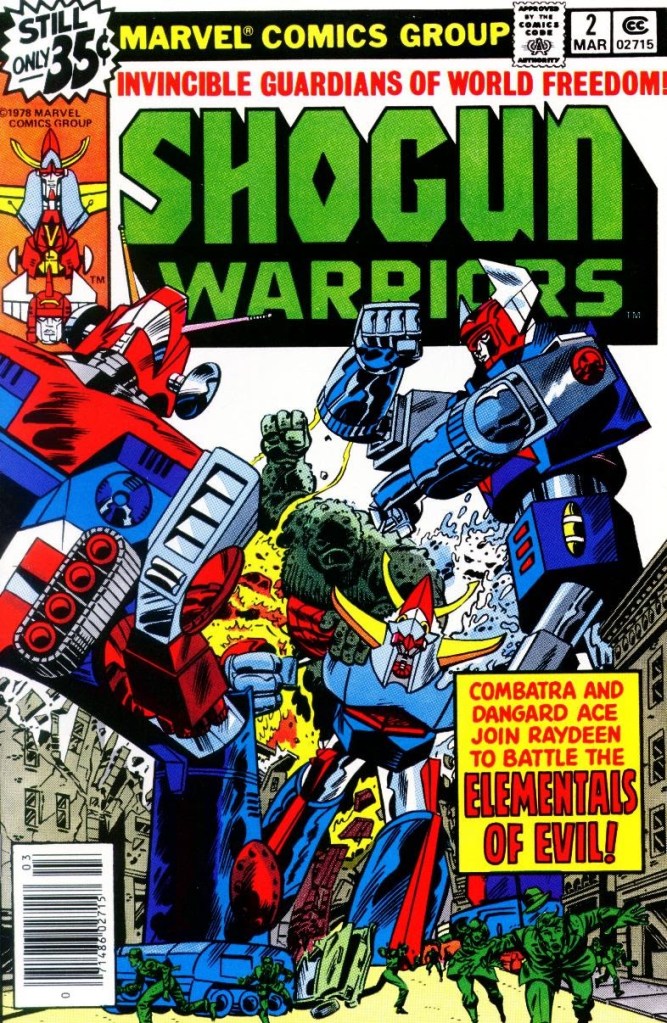
A Look Back at Shogun Warriors #2 (1979)

Disclaimer: This is my original work with details sourced from reading the comic book and doing personal research. Anyone who wants to use this article, in part or in whole, needs to secure first my permission and agree to cite me as the source and author. Let it be known that any unauthorized use of this article will constrain the author to pursue the remedies under R.A. No. 8293, the Revised Penal Code, and/or all applicable legal actions under the laws of the Philippines.

Long before Pacific Rim (2013) presented giant robots and monsters slug it out on the big screen with a strong emphasis on action and scale, there were varied animated series of such giants shown in television sets in Japan way back in the 1970s. Then by the end of the decade, Marvel Comics published the Shogun Warriors comic book series in relation to a business deal with Mattel.

Last time, only one giant robot was heavily featured as a defender for human civilization as it became a target by a force of evil that unleashed a giant monster. That robot was Raydeen and as a result of what happened, something led to the unveiling of Combatra and Dangard Ace.

To find out more, here is a look back at Shogun Warriors #2, published by Marvel Comics in 1979 with a story written by Doug Moench and drawn by Herb Trimpe.

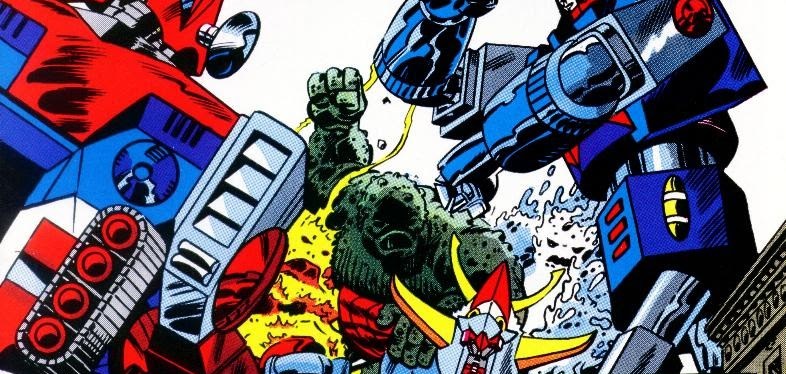
The cover.

Early story

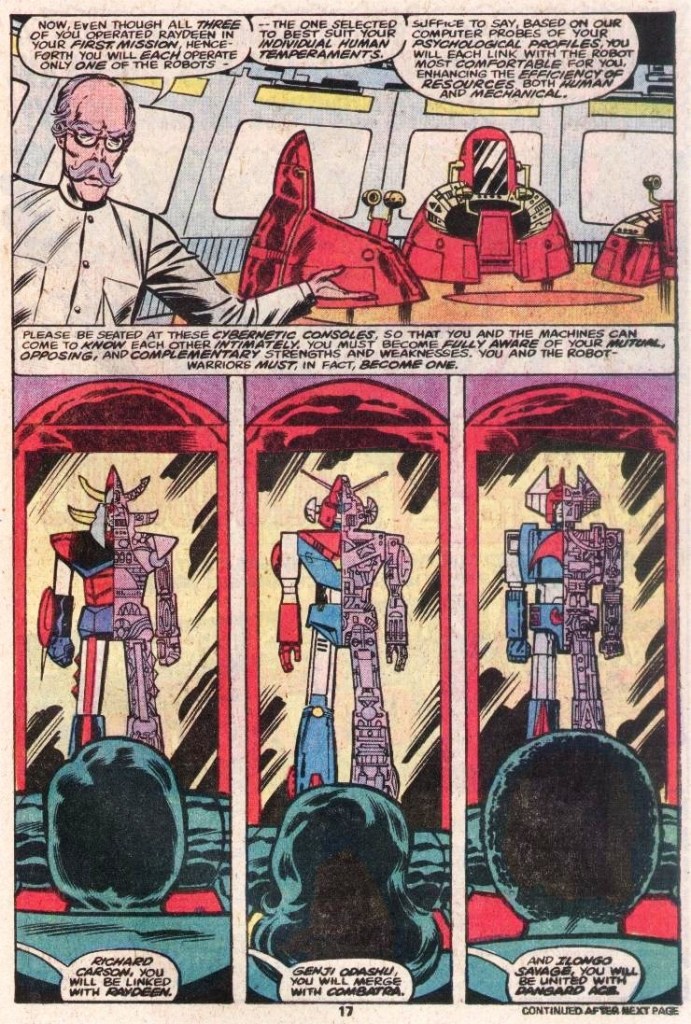
The story begins at the secret facility of Shogun. There the three pilots – Genji Odashu, Ilongo Savage and Richard Carson – are being briefed by Dr. Tambura explains to them that their first mission piloting Raydeen was not a failure at all. While acknowledging that the giant monster Rok-Korr is still a threat, he states to them that giant robots Combatra and Dangard Ace will be deployed and controlled by them.

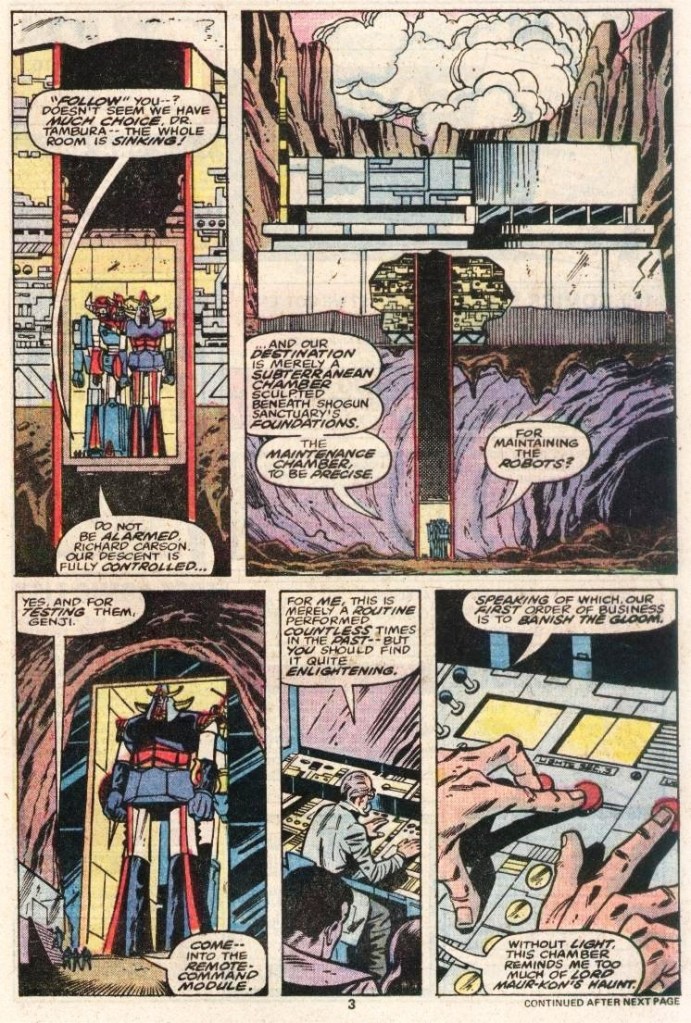
After giving them a quick tour of their subterranean chamber (where the robots receive maintenance and get tested), Dr. Tambura bring the three pilots into another place filled with high-tech controls. From there, they watch Dangard Ace, Raydeen and Combatra perform in field tests via remote control.

Meanwhile on a different island, the evil leader Maur-Kon rallies his so-called dark agents to rise and work together in seeking vengeance for their defeat in the great war chaos as they have found the forces of eternal good anticipating them. After much talk, Maur-Kon and his minions bow and kneel over bubbling magma murmuring evil phrases…

Quality

The three pilots get assigned with each robot.

Like the previous issue, this comic book has less than twenty pages of story and art. This results another heavy load of exposition or information dump on readers, and the narrative had a rushed pace. With regards to the battle between Raydeen and the giant monster, there is indeed a continuation of it. The giant monster was given some personality.

Again, there is no real character development here. The three pilots were not written to display any personality nor did the writer exert any effort to make readers relate with them. Instead, you will see them in training in speed beyond belief.

The highlight here is that Dangard Ace and Combatra finally got revealed and emphasized. Be warned, however, that there is lesser spectacle in this comic book and the story predictably served as a setup for what could be a more promising battle.

Conclusion

The pilots and the Shogun Warriors (the robots) go deep down.

Shogun Warriors #2 (1979) suffered from pretty much the same problems as issue #1. The noticeable difference here is that there is lesser action and lesser giant-sized spectacle shown here. That is not exactly surprising as the creators had to sacrifice something to make way for further explanation of the comic series’ grand concept.

If you are seriously planning to buy an existing hard copy of Shogun Warriors #2 (1979), be aware that as of this writing, MileHighComics.com shows that the near-mint copy of the regular edition costs $35 while the near-mint copies of the price-less and the Whitman editions cost $350 and $35 respectively.

Overall, Shogun Warriors #2 (1979) is less than satisfactory.

+++++

Thank you for reading. If you find this article engaging, please click the like button below and also please consider sharing this article to others. If you are looking for a copywriter to create content for your special project or business, check out my services and my portfolio. Feel free to contact me as well. Also please feel free to visit my Facebook page Author Carlo Carrasco and follow me at HavenorFantasy@twitter.com