A Look Back at Contra (1988)

Welcome back retro gaming fans and readers!

Today, we will go back to the late 1980s to examine one of the most significant console games of the decade…Konami’s Contra. To put things in perspective, Contra started in the arcades in 1987 and went on to become a big hit. Konami went on to make a version of the game for Nintendo Entertainment System (NES) in the West and the Family Computer (Famicom) in Japan that resulted in different looking graphics (both artistically and technically), reworked stages, and different and extended level designs that were done within the consoles’ limitations. In short, the home version of Contra was pretty different from the arcade version but still was made to be fun and exciting on its own.

In my personal experience, my discovery of Contra has always been on the Famicom and some time later on the NES. For this retro review, I replayed Contra (both Famicom and NES versions) via the Contra Anniversary Collection on my Xbox Series X.

With those details laid down, here is a look back at Contra, developed and published by Konami for the NES and Famicom in 1988. The NES version was released one week ahead of the Famicom version in February 1988.

The start screen of the NES version of Contra. The commando with dark hair was deliberately made to resemble Sylvester Stallone somewhat.

Game concept

In the far future, an alien army from space – Red Falcon – arrived on Earth inside a meteorite that landed on the Galuga archipelago. There, Red Falcon established an extensive high-tech base for their operations and eventually brainwashed a local human army to do what they want. Red Falcon plots to wipe out human civilization on the planet.

With the information about Red Falcon collected, the Earth Marine Corps send Contra unit members Bill Rizer and Lance Bean to the island to destroy the opposition and find out what Red Falcon has been doing…

Gameplay and quality
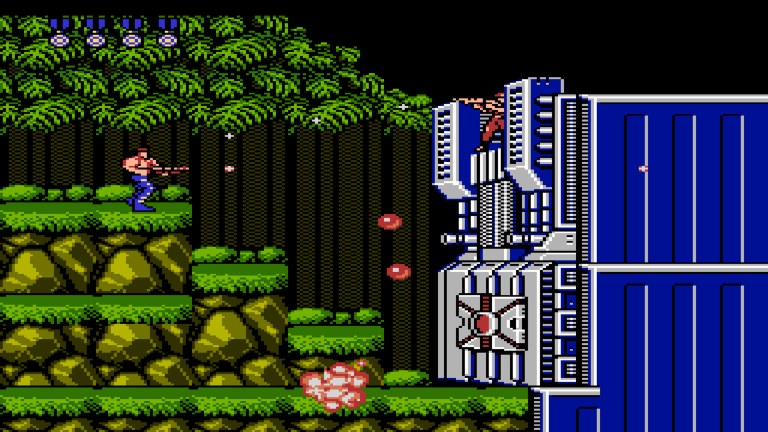
Contra is an action-packed 2D side-scrolling game with strong sci-fi and military influences.

To begin with, Contra of 1988 was made to be a nicely-paced, action-packed, side-scrolling adventure game that has some 3D-like levels in between. The game design and levels Konami came up with was done to immerse gamers into actual participation in the military campaign against the aliens and their brainwashed human soldiers. This campaign not only includes battles through the forest of the Galuga archipelago but also through the interiors of Red Falcon’s high-tech facilities, going up an elevated location with waterfalls, the snowy area and further deep into the rest of the enemy’s mechanical base.

For the most part, you play as a commando armed with a rifle with unlimited ammunition. As you shoot enemies and make your way through the 2D side-scrolling level, there will be the occasional flying capsules that you can shoot down to gain new weapons/ammunition (S for Spread Shot, M for Machine Gun, L for Laser) or some power-up (temporary invincibility or the rare ability to eliminate all enemies present on-screen) to help yourself as the wave of opposition from Red Falcon is relentless (which is reason enough to compel you to keep progressing and fighting). There are also times when the mentioned enhancements suddenly pop out after killing an enemy.
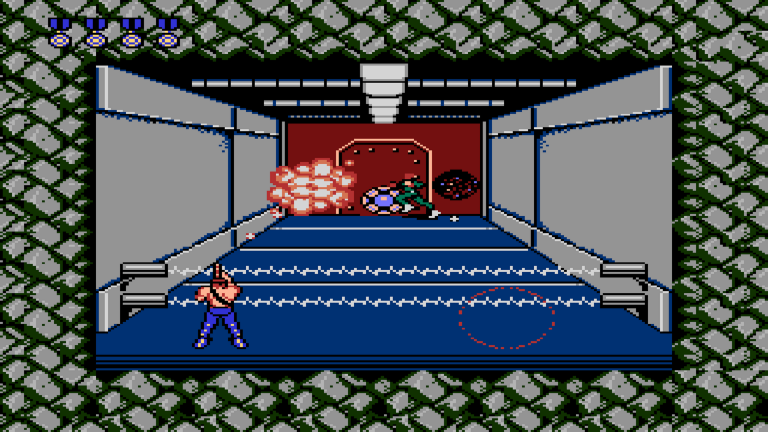
To prevent the game from getting too old with side-scrolling, Konami implemented these stages in which players face the front to attack enemies, overcome obstacles and move forward with 3D-like effects going into the next place.

By default, this game is brutally hard. Not only do the enemies keep appearing (with some of their teammates being strategically placed to fire at you), the obstacles will compel you to take your time overcoming them. In this game, one-hit death is the norm and there are many moments in which falling to your death becomes a huge risk. You get hit, you not only lose one life, you will lose whatever powerful weapons you gained.

There are also stage bosses (powerful enemies that await you at the end of a level) that will challenge you so much, you will have to adjust your strategy, pay attention to the movements and timing of the enemy, and then adjust your way fighting.

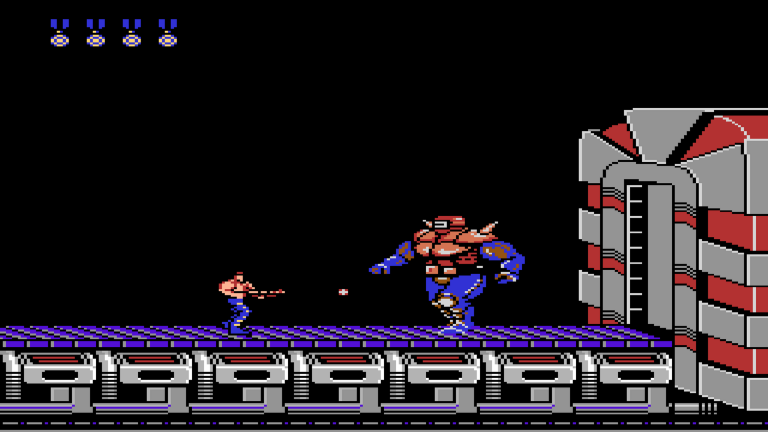
Only the Famicom version of Contra has this sequence.
I really love the sci-fi elements the game developers came up with for this classic game. There are lots of high-tech stuff to see here and this robotic enemy is just one of them.

Fortunately for us players, the controls are really tight and very responsive. You can move your characters to overcome obstacles, avoid getting hit by enemies and even move down from one platform if the space below is safer. I still remember how precise and responsive the controls were on the NES and Famicom versions, and I can say that all the responsiveness made it on the Xbox controller when I replayed Contra on Xbox Series X with the Contra Anniversary Collection I downloaded. In fact, the high precision of the controls added to the fun of shooting enemies or obstacles with the Spread Shot while moving to the right as it was meant to be.

Considering the intense difficulty of the game, players who do the famous Konami Code (Up, Up, Down, Down, Left, Right, Left, Right, B, A, and Start) will be reward with 30 lives when they start playing Contra. For Xbox gamers reading this, there is a slight difference with the Konami Code when playing Contra on Xbox consoles.
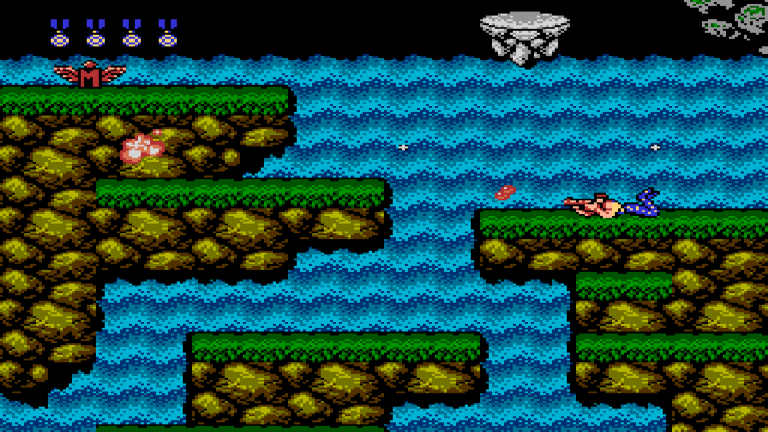
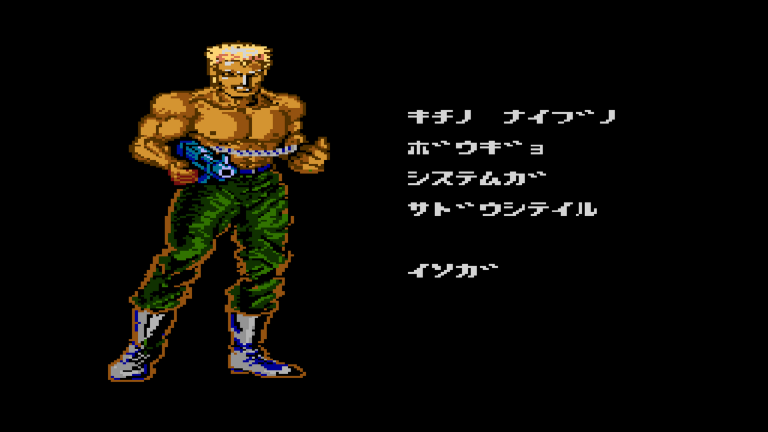
Apart from shooting, there are lots of platform gaming elements to experience here. The difficulty is very brutal and the famous Konami Code will grant you 30 lives when you do the code correctly.
This cut-scene is only available in the Famicom version.

With regards to game design, the Konami developers did a really fine job creating the levels, placing the challenges and setting up memorable boss battles for action/adventure-hungry gamers to indulge in. The developers also cleverly implemented the fictional/fantasy concepts into the game design which resulted in me getting immersed in the Contra team’s mission against the Red Falcon at their secret base.

Another highlight with playing Contra is the 2-player option and the above-mentioned Konami Code added to the fun and accessibility of. I still remember the old days of playing in a 2-player session (cooperative play essentially) of Contra at a friend’s house on a Famicom. Since my friends and I were already enthusiasts of 1980s Hollywood action movies, playing Contra was enjoyable even though the difficulty was brutal.
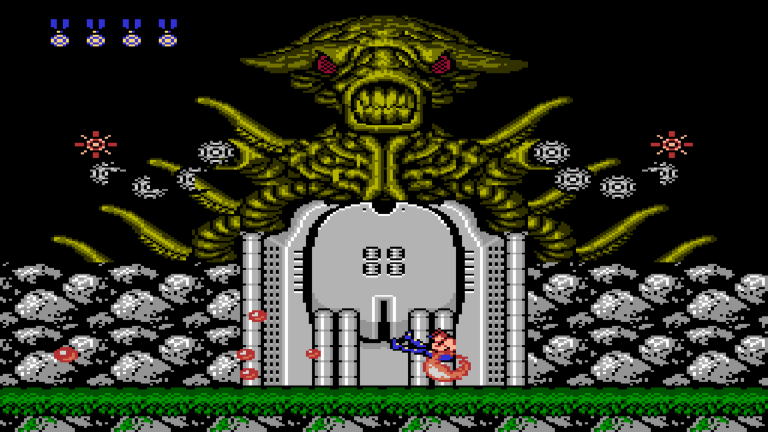
This is one of the touch stage bosses you will encounter in the game.

If there are any notable differences between the two versions of Contra of 1988, it would be the fact that the Japanese (Famicom) version has storytelling emphasized through cutscenes (with Japanese text displayed), a technical overview of the Red Falcon base at Galuga with maps displayed before you start a new level, in-game art, an additional scene that spiced up the ending and, most notably, more background/environmental animation. The additional animation on the Famicom version made the adventuring look and feel more lively and this is most evident in the final stage (lair of the alien).

Conclusion

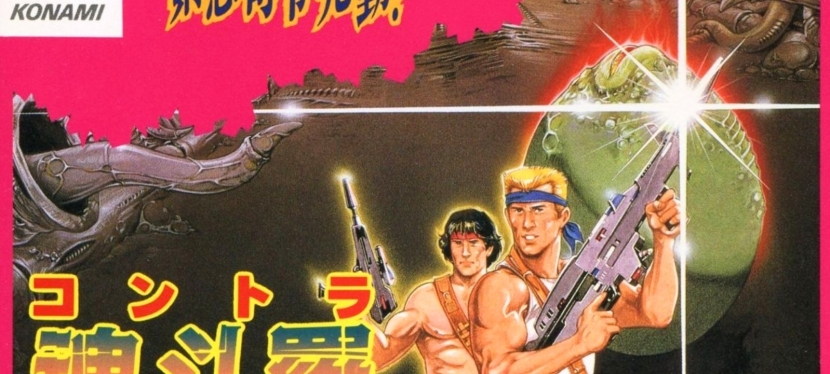
The Japanese cover art of Contra on Famicom. The Rambo-like character and the alien egg are obvious inspirations from Hollywood action movies of the 1980s.

There is no doubt in my view that after all the decades that passed since I first played it, Contra (1988) is still very engaging and a lot of fun to play whether you choose the Famicom version or the NES version. The developers who made this game succeeding in making something very enjoyable for millions of gamers and it is very clear that the makers were inspired by Hollywood action movies of the decade. In my view, the most obvious military inspirations are Aliens (1986), Commando (1985) and Rambo: First Blood Part II (1985).

Historically speaking, Contra (1988) was released at a time when militarism inspired many other game designers to come up with enjoyable games in different forms such as Cabal, Jackal, Rush’n Attack, Operation Wolf, Operation Thunderbolt to name some. Considering the overall quality and high fun factor Konami established, it is safe to say that this game is one of the finest among its militaristic gaming counterparts of its decade.

I had a grand time replaying Contra (1988) on my Xbox Series X in preparation for this review. Having played both NES and Famicom versions, I can say that the latter is the more complete and more immersive version to play. That does not necessarily mean the NES version is totally inferior. In fact, the NES version is more straightforward with the pick-up-and-play approach, and the gameplay itself is nearly identical (note: Famicom version is slightly more challenging) and very much fun to experience. If you are the player who really wants to be more immersed into the lore of Contra and absorb the military sci-fi concept Konami prepared, then the Famicom version is the one to play. That being said, now is a good time to purchase and download Contra Anniversary Collection.

Overall, Contra (1988) is highly recommended! It truly is a retro gaming gem!

+++++

Thank you for reading. If you find this article engaging, please click the like button below, share this article to others and also please consider making a donation to support my publishing. If you are looking for a copywriter to create content for your special project or business, check out my services and my portfolio. Feel free to contact me with a private message. Also please feel free to visit my Facebook page Author Carlo Carrasco and follow me on Twitter at  @HavenorFantasy as well as on Tumblr at https://carlocarrasco.tumblr.com/ and on Instagram at https://www.instagram.com/authorcarlocarrasco

Retro Gaming Ads Blast – Part 9

Welcome back readers, fellow geeks and electronic gaming fans!

In this edition of the Retro Gaming Ads Blast (RGAB) series, we will take a look at another batch of retro gaming print ads from the 1980s and 1990s.

For the newcomers reading this, Retro Gaming Ads Blast (RGAB) looks back at the many print ads of games (console, arcade, computer and handheld) that were published in comic books, magazines, flyers and newspapers long before smartphones, social media, the worldwide web and streaming became popular. To put things in perspective, people back in the 1980s and 1990s were more trusting of print media for information and images about electronic games and related products.

With those details laid down, here is the newest batch of retro gaming print ads for you to see and enjoy…

1. Konami’s 3-in-1 sports games print ad

Long before the advent of major league sports video games, Konami was prolific with sports video games.

Back in the 1980s, Konami was a prominent gaming company as they released a lot of games that became hits in the arcades, on home computers and gaming consoles. Considering the limited amount of games publishers were allowed to release on the Nintendo Entertainment System in America, what Konami released were really fun games to play and their contributions of sports-based video games on the NES were significant. Possibly due to a lack of marketing budget at the time, they promoted Blades of Steel, Double Dribble and Track & Field II with this single-page ad showing the game box covers and screenshots. Ultimately, this print ad was sufficient in giving gamers a clear idea of what to expect with the three games.

2. The Adventures of Bayou Billy print ad

Bayou Billy looks inspired by the cinematic hero Crocodile Dundee. This video game even had a comic book adaptation published by Archie Comics.

Still with Konami, the Japanese publisher released in America the non-military adventure game The Adventures of Bayou Billy for the NES which was a revised version of their 1988 Family Computer game titled Mad City (see the differences by clicking here). This game really looked like it was influenced by Hollywood action/adventure movies of the era and it provided gamers gameplay styles of light gun shooting, beat-them-up action and racing. The titular hero looks very inspired by the cinematic hero Crocodile Dundee. This print ad is very stylish and also eye-catching. I think it has done a good job to make viewers interested in the video game.

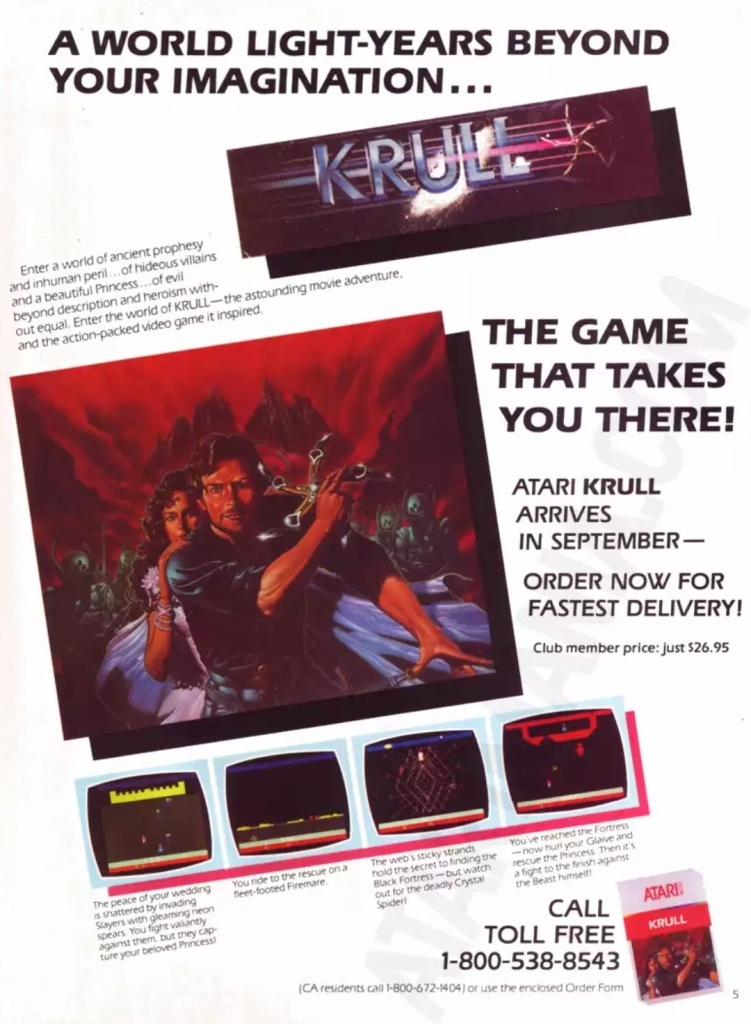
3. Krull Atari video game print ad

I never got to play this Krull video game on Atari 2600, nor its arcade game.

Way back in 1983, I was fortunate to see the science fantasy movie Krull inside the movie theater here in the Philippines. When I saw this print ad, I easily got excited for the Atari 2600 video game adaptation but never got to play it. This print ad does its job showing what Krull’s game looked like and the ad makers cleverly used painted art reflecting the movie’s characters and the armored enemies from space. I should add that between the time I saw the movie and the time I first saw this print ad, I became aware of the existence of the Krull arcade game by watching an episode of Starcade on TV.

4. Rocket Ranger NES print ad

Really great and detailed painted artwork in this print ad.

When Rocket Ranger on the Amiga in 1988, it had fancy visuals and a strong cinematic vibe that worked smoothly with the game design. This game was developed by Cinemaware which developed a reputation of releasing games based on classic film genres. In 1990, a version of Rocket Ranger for the NES was published by Kemco/Seika and print ads using painted art were made to promote the game. This particular print ad made heavy use of painted art which was captivating to look at while conveniently keeping people’s minds off the downgraded visuals of the NES version.

5. Michael Jordan: Chaos in the Windy City print ad with contest entry

Some gamers thought this was a basketball video game.

Yes, it was all true. There definitely was a video game that NBA legend Michael Jordan endorsed. First released on Super Nintendo Entertainment System (SNES) in America in 1994, Michael Jordan: Chaos in the Windy City was a side-scrolling action game in which gamers play a digital version of Jordan who has to save his friends, fight enemies and move from one location to the next in order to progress. The fact that an image of Michael Jordan holding two balls was used in this print ad (as well as on the game cover) in a dominating fashion made some gamers think this was a basketball game. The display of screenshots was so small, it did not help the situation. Lastly, the available of a contest entry form in this print ad was meant to promote not only the game but also GamePro magazine.  

6. Gun.Smoke print ad

Gun.Smoke was indeed a fun game to play on NES. Therefore, the promotion is justified.

This print ad of the NES port of Gun.Smoke has strong imagery and literary descriptions the strongly emphasize the Old West concept and setting. The screenshots displayed are too small but the descriptions more than made up for it. Ultimately, what this print ad emphasized was realized as the NES version of Gun.Smoke itself captured the continuous action and excitement of the arcade version and the graphical limitations of the console did not matter much. I myself played this game and it was a lot of fun.

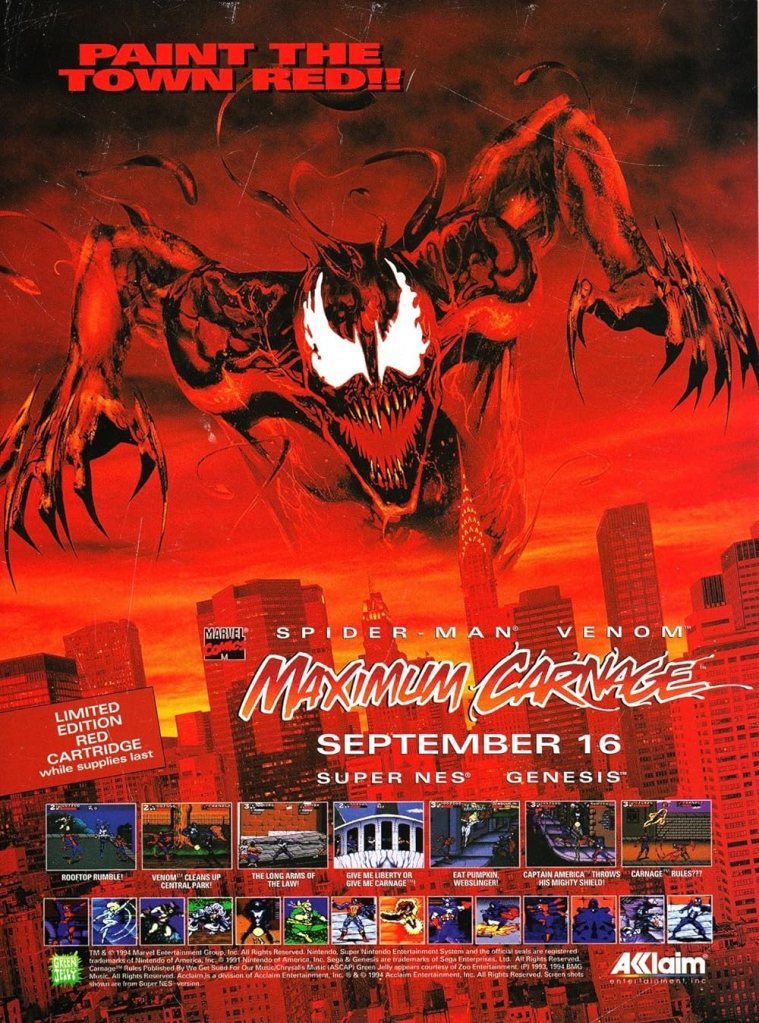
7. Spider-Man and Venom: Maximum Carnage print ad

This add appeared in my comic books and magazines I read in 1994.

Back in 1993, Marvel Comics published the huge Maximum Carnage crossover storyline which covered many issues of the four monthly Spider-Man comic books and two issues of the quarterly Spider-Man Unlimited series. Considering the high popularities of Venom and Carnage at the time, it was not surprising that Marvel took advantage by having Maximum Carnage licensed to Acclaim to create a video game adaptation in the form of a beat-them-up.

Spider-Man and Venom: Maximum Carnage was released for SNES and Sega Genesis in 1994, and game developer Software Creations really adapted story to fit with their side-scrolling game design. Between playable stages are cutscenes that actually were digitized versions of actual comic book panels. This red-colored print ad had a dominating image of Carnage and screenshots with text descriptions. The ad makers even went the extra mile by inserting screenshot cut-outs showing individual characters such as Firestar, Venom, Spider-Man, Carnage, Cloak and Dagger, Iron Fist, Captain America and more. Whatever your opinion is about the Maximum Carnage storyline or the video game adaptation, there is no denying that this was a very eye-catching print ad.

+++++

Thank you for reading. If you find this article engaging, please click the like button below, share this article to others and also please consider making a donation to support my publishing. If you are looking for a copywriter to create content for your special project or business, check out my services and my portfolio. Feel free to contact me with a private message. Also please feel free to visit my Facebook page Author Carlo Carrasco and follow me on Twitter at  @HavenorFantasy as well as on Tumblr at https://carlocarrasco.tumblr.com/ and on Instagram at https://www.instagram.com/authorcarlocarrasco

Retro Gaming Ads Blast – Part 7 (Sega Special)

Welcome back readers, fellow geeks and electronic gaming fans!

In this edition of the Retro Gaming Ads Blast (RGAB) series, we will examine print ads of Sega from the 1990s which was a notable period of time when they went from being a prominent video game company into a desperate, struggling entity by the end of the decade. All the Sega ads in this edition are promotions of their own video games that were exclusive to their consoles during the 1990s.

For the newcomers reading this, Retro Gaming Ads Blast (RGAB) looks back at the many print ads of games (console, arcade, computer and handheld) that were published in comic books, magazines, flyers and newspapers long before smartphones, social media, the worldwide web and streaming became popular. To put things in perspective, people back in the 1980s and 1990s were more trusting of print media for information and images about electronic games and related hardware.

With those details laid down, here is the newest batch of retro gaming print ads for you to see and enjoy…

1. Phantasy Star IV print ad

This was the last single-player Phantasy Star game released. There is no sign of Sega revisiting the franchise for another single-player experience.

Long before the emergence of online console gaming that involved a high number of players, Sega released Phantasy Star IV for the Genesis console in America in 1994 which was praised by gamers and critics. This one also turned out to be the last single-player role-playing game (RPG) of the Phantasy Star series as Sega eventually turned it into a series of online RPGs since the year 2000.

This print ad is significant because a lot of gamers today are not aware that Phantasy Star started as a series of single-player RPGs the same year Final Fantasy debuted in Japan. Anyone interested to play Phantasy Star IV on a modern console should buy the Sega Genesis Classics collection. 

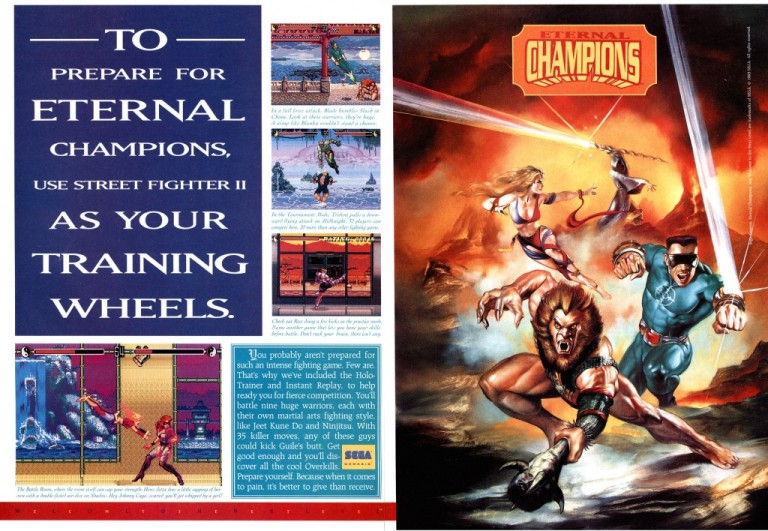
2.  Eternal Champions print ad

This 2-page print ad appeared in many comic books and some magazines that I read long ago.

Back in the 1990s, the fighting game genre became wildly popular with gamers at the arcades and on consoles at home. Capcom literally sparked a wild fire with the Street Fighter II game and its upgraded editions, and other companies went on to make their own 2D fighting games to cash in. Sega was one of them and they released their own 2D fighting game Eternal Champions for the Sega Genesis console.

Unsurprisingly, the game was marketed aggressively and this 2-page print ad really stood out as it had the great looking painted art on the right, screenshots and details of the game, and most notably made a sarcastic reference to Street Fighter II. Eternal Champions sold enough copies, it led to the release of the sequel Eternal Champions: Challenge from the Dark Side and two spin-off games. I can only guess that referencing Street Fighter II was helpful in achieving commercial success.

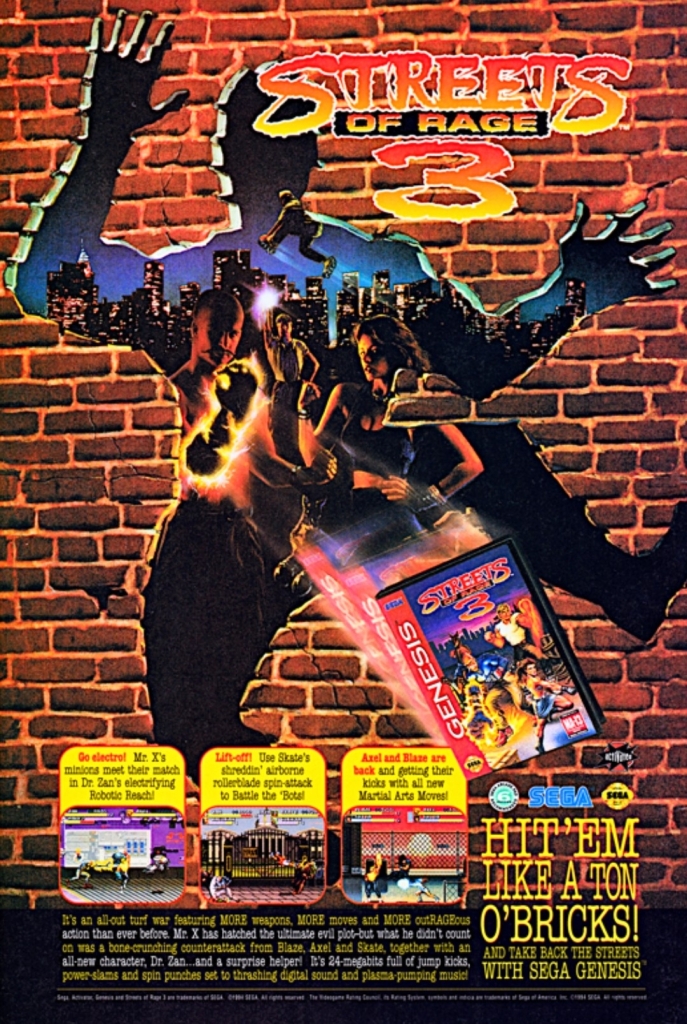
3. Streets of Rage 3 print ad

This ad caught my attention easily when I saw it in comic books I read.

Streets of Rage (Japanese title: Bare Knuckle) was one of the most defining game franchises Sega came up with and it started on the Sega Genesis console. It was a series of side-scrolling, 2D beat-them-up games that ensured action and excitement for gamers. As the first two games were critically and commercially successful, Sega was confident in aggressively marketing Streets of Rage 3 and the print ad seen had a very attention-grabbing artwork.

The artistic style emphasized power and intensity as it shows a damaged wall with the shape of a human body (symbolizing that someone was thrown through it) and then there were images of people on the other side. The game went on to attract mostly positive reviews although it paled in comparison to its predecessors in terms of sales.

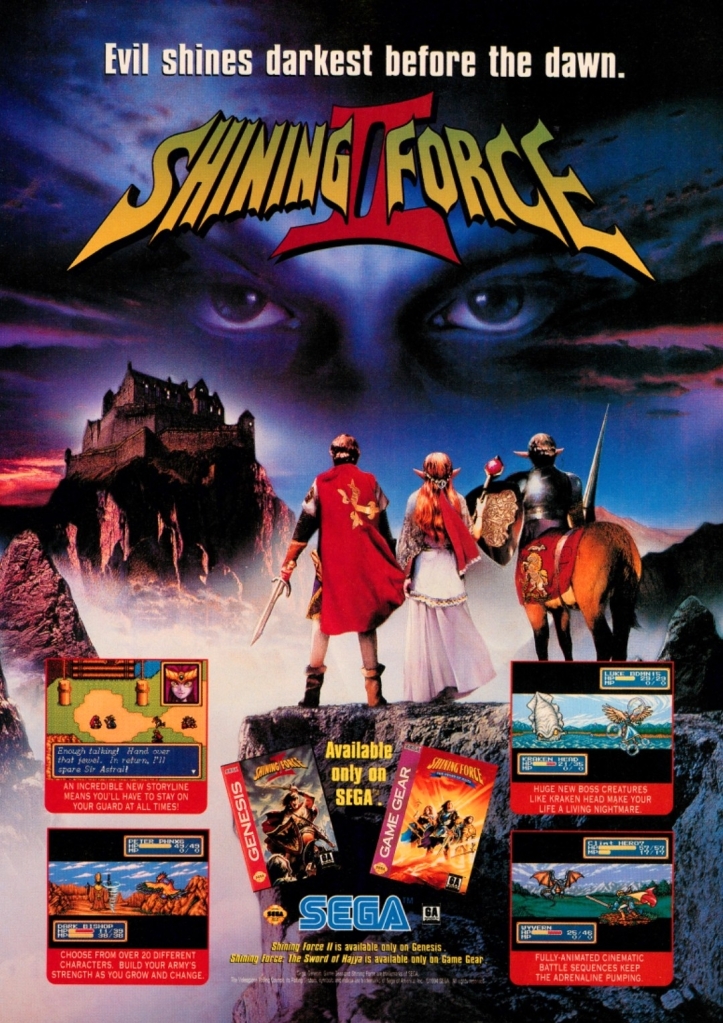
4. Shining Force II print ad

The first time I saw this ad, it made me interested to buy a Sega Genesis console to play it.

As Sega was so prolific with making and releasing games across different genres, they had their own tactical role-playing game series with Shining Force and the first game released on the Sega Genesis was a critical and commercial success. That being said, the company was confident with releasing Shining Force II on the same console more than a year later achieving critical and commercial success.

The North American print ad of the game had a visual presentation that closely captured the foreground-background style (characters facing the distance) used in-game, and the advertising team use photographic imagery to achieve a fantasy look. Very cleverly, Sega inserted the Sega Game Gear title Shining Force Shining Force: The Sword of Hajya into the ad. This print ad made me interested in acquiring a Sega Genesis for Shining Force II.

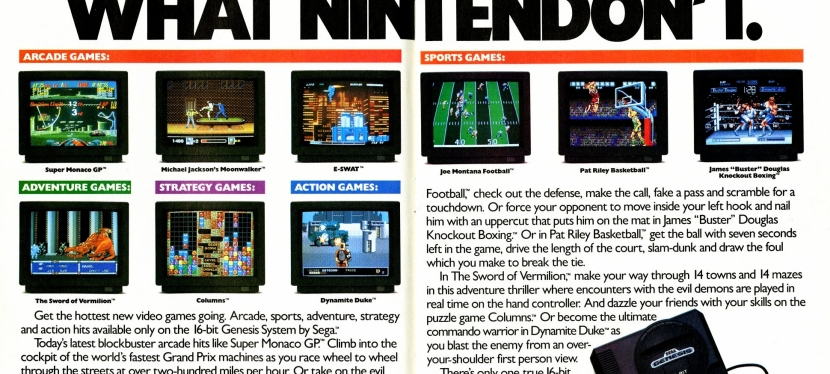
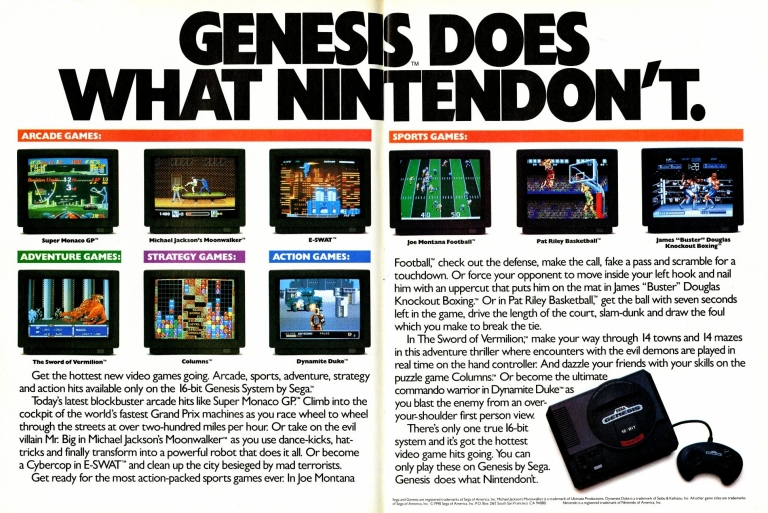
5. Genesis does what Nintendon’t print ad

With the famous line heavily emphasized, this print ad showed how bullish Sega really was in competing with Nintendo.

Now this print ad of Sega’s has the most definitive and best-known advertising line in the so-called 16-bit console generation: Genesis does what Nintendon’t. This was Sega’s aggressive marketing push to convince gamers to buy the Genesis console to play games and experience thrills of fun that they would not find on a Nintendo console at the time. Genesis was launched in America in 1989 with “16-bit” emphasized a lot, and the technological rival Super Nintendo Entertainment System (SNES) was released in the same market more than two years later.

The 2-year advantage helped Sega establish the Genesis as the next-gen machine for gaming at home and there were years in the 1990s when Sega’s console outsold Nintendo’s in America during the so-called 16-bit war. The Genesis also had lots of exclusive games plus strong software support from third-parties. While the SNES would eventually outsell the Genesis in other parts of the world, it was in America where Sega proved to be very competitive and successful. 

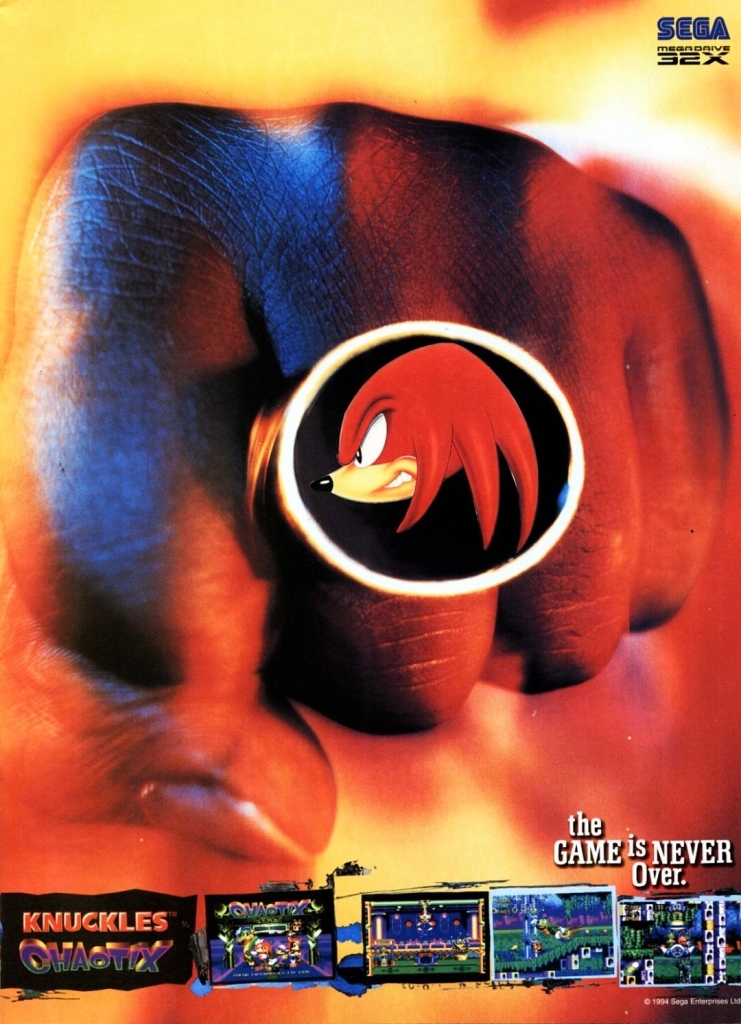
6. Knuckles’ Chaotix print ad

Sega was aggressive with marketing this game for the 32X.

In late 1994, Sega released in America and in Japan the 32X which was an add-on device for the Sega Genesis designed enhance its power while serving as a transition (a warm-up) into the so-called 32-bit era of console gaming. The 32X was the result of corporate decisions involving the American and Japanese executives of the company.

To keep 32X customers happy and boost hardware sales, Sega adjusted the development of Knuckles’ Chaotix (a Sonic spin-off) from being a Sonic project 32-bit console Sega Saturn into a standalone game for the add-on device. Even though Sega knew the game’s development was rushed, they went on to strongly promote the game and the print ad shown here was quite eye-catching.

The image of a fist with a ring showing the character Knuckles (a character from the Sonic games) emphasizes power and the colors used seem to express intensity. Then there were the selected screenshots shown without descriptive text. Although Sega tried hard, Knuckles’ Chaotix (launched in 1995) received mixed-to-positive reviews and sadly sold poorly. Unsurprisingly, the sales of the 32X dropped further and by then a lot of consumers knew that the Sega Saturn (the true successor to the Genesis) was all set to launch in America and Europe within 1995.

7. Sonic 3D Blast for Sega Saturn print ad

Too bad Sega and its teams failed to make the true Saturn Sonic game.

Back in the 1980s and 1990s, having a high-quality, console-exclusive game featuring a company mascot was crucial to sell game consoles while keeping dedicated fans happy. Like what Nintendo did with their icon Mario, Sega achieved great commercial success with the three Sonic the Hedgehog games they released exclusively on the Sega Genesis console and this naturally created expectations they would make new Sonic games on the Saturn console. Unfortunately, Sega and its teams failed to complete development of the Saturn-exclusive game Sonic X-treme and the company cancelled it which sent shockwaves through the games industry news.

With the 1996 holiday shopping season too crucial to ignore, Sega commissioned a Saturn version of the game Sonic 3D Blast which was originally made for the Genesis console. Sonic 3D Blast on the Saturn took seven weeks to make and there were some graphical enhancements implemented. While Sonic 3D Blast’s Genesis version attracted a positive reception from critics (and sold 700,000 copies), the reception for the Saturn version was mixed. This print ad of Sonic 3D Blast on Sega Saturn is a reminder of the company’s failed attempt to take their icon to the next-generation. They never replicated the big success they had with Sonic on the Genesis.

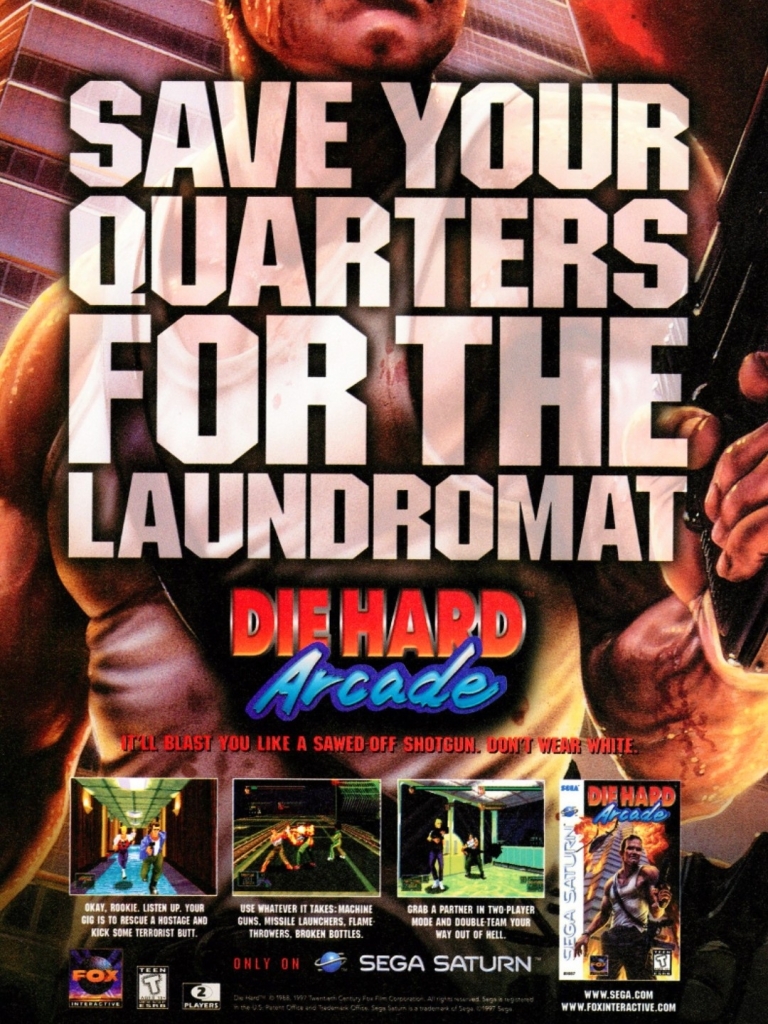
8. Die Hard Arcade print ad

Each time I saw this print ad, it easily reminded me of the classic action film of 1988.

Like many other movie franchises, Die Hard has many video game adaptations released through the decades. In 1997, Sega released Die Hard Arcade (Japanese title: Dynamite Deka) on the Sega Saturn and the game critics praised it for its fun gameplay as well as its flawless conversion of the arcade version (released in 1996). To say the least, the development history of Die Hard Arcade is not as straightforward as many would think. To get the details and explanations of the development of the game, click here.

As for the print ad itself, this one cleverly used official game art as the background with imagery which instantly reminded me of what I saw in the classic 1988 movie that starred Bruce Willis. This ad made me interested to buy a Sega Saturn or find a place to rent it to play the game.

9. Shenmue Japanese print ad

Simplistic with presentation and yet engaging to look at. The Dreamcast-exclusive Shenmue sold over a million copies in Japan alone.

When Shenmue was released exclusively on the Sega Dreamcast in Japan on December 29, 1999, it turned out to be a very mind-blowing experience for many gamers due to its ambitious game design, the intense attention to detail implemented, very high production values, in-depth exploration and very immersive gameplay.

It was the open-world game released at a time when “open-world” was not even a standard gaming term. Often called the masterpiece of the legendary game designer Yu Suzuki, Shenmue sold over 1.2 million copies in Japan and went on to be released worldwide in the months that followed. Sadly, the game failed to make a profit due to its very high budget of $70 million (which Suzuki himself said in English during an interview) and the fact that the number of Dreamcast units already sold to gamers was not massively high.

The Japanese print ad of Shenmue had a simplistic looking visual concept and yet it was engaging to look at because the way the characters appeared was how they appeared in the game during gameplay which was astounding. Take note that back in the 1990s, it was common for video game marketing materials to show human characters in high detail but in reality the polygonal models of those characters appeared looking blocky and much less detailed during gameplay.

+++++

Thank you for reading. If you find this article engaging, please click the like button below, share this article to others and also please consider making a donation to support my publishing. If you are looking for a copywriter to create content for your special project or business, check out my services and my portfolio. Feel free to contact me with a private message. Also please feel free to visit my Facebook page Author Carlo Carrasco and follow me on Twitter at  @HavenorFantasy as well as on Tumblr at https://carlocarrasco.tumblr.com/ and on Instagram at https://www.instagram.com/authorcarlocarrasco
Have you been playing Grandia HD Collection on Xbox?

Welcome back Xbox fans, geeks and gamers who love Japanese role-playing games (JRPGs)! In case you missed the news, Grandia HD Collection is now available for Xbox Series X, Xbox Series S and the aging Xbox One console and you can order the digital copy by clicking here.

For the newcomers reading this, Grandia HD Collection on Xbox consoles was officially released on March 26, 2024. It is a collection of two very solid role-playing games (RPGs) from the previous console generations, namely Grandia (originally released on Sega Saturn in Japan in 1997) and Grandia II (originally released on Sega Dreamcast in Japan in 2000). Although the said HD collection has been available for weeks, it was only very recently that an official Xbox trailer of it was published on the ID@Xbox YouTube channel and you can watch it right below…

Personally, I find it very strange why the trailer was released on the ID@Xbox YouTube channel instead of the official Xbox YouTube channel (as of this writing). Perhaps someone at Team Xbox confused the Grandia RPGs to be productions by small and independent studios which is wrong because both games were developed by Game Arts (the same team responsible for the Lunar RPGs and also a publisher of games). Right now, it seems that internal woke problems over at Team Xbox (for reference, click here, here and here) are preventing them from realizing the significance of Grandia and Grandia II.

Apart from the rather late Xbox trailer, a late Grandia HD Collection announcement was published on Xbox.com. To put things in perspective, posted below are selected excerpt from the Xbox announcement written by Gung Ho Online Community Coordinator Allyson Nicholas. Some parts in boldface…

Screenshot from Grandia. The game has fully polygonal environments and the characters and creatures are presented as detailed 2D sprites.
Screenshot of Grandia II showing Ryudo and his companions fighting a large monster. The characters and monsters are polygonal.

To read the rest of the Xbox.com announcement, click https://news.xbox.com/en-us/2024/04/10/time-for-an-adventure-grandia-hd-collection-remastered-for-xbox-one-and-xbox-series-xs-out-now/

Two fun Japanese RPGs now available for Xbox gamers to enjoy in a single collection.

For the Xbox fans who want to have a good amount of fun, there is a lot to be excited for this month and next month as Eiyuden Chronicle: Hundred Heroes (April 23) and Senua’s Saga: Hellblade II will be released on Xbox Series X, Xbox Series S, Windows PC and Xbox Game Pass (XGP) weeks apart. The good news is that Grandia HD Collection on Xbox is already available for anyone willing to purchase it. The Grandia RPGs are undeniably retro gaming highlights that RPG fans should play, especially now that both games have been remastered and enhanced with high-definition in mind.

To buy a copy of Grandia HD Collection, Xbox fans and gamers should click https://www.xbox.com/en-us/games/store/grandia-hd-collection/9n4nlqhx6j18

+++++

Thank you for reading. If you find this article engaging, please click the like button below, share this article to others and also please consider making a donation to support my publishing. If you are looking for a copywriter to create content for your special project or business, check out my services and my portfolio. Feel free to contact me with a private message. Also please feel free to visit my Facebook page Author Carlo Carrasco and follow me on Twitter at  @HavenorFantasy as well as on Tumblr at https://carlocarrasco.tumblr.com/ and on Instagram athttps://www.instagram.com/authorcarlocarrasco

Retro Gaming Ads Blast – Part 5

Welcome back readers, fellow geeks and electronic gaming fans!

In this edition of the Retro Gaming Ads Blast (RGAB) series, we will examine print ads from the 1980s and the 1990s that caught my attention and I will explain why they are worth look back at.

For the newcomers reading this, Retro Gaming Ads Blast (RGAB) looks back at the many print ads of games (console, arcade, computer and handheld) that were published in comic books, magazines, flyers and newspapers long before smartphones, social media, the worldwide web and streaming became popular. To put things in perspective, people back in the 1980s and 1990s were more trusting of print media for information and images about electronic games.

With those details laid down, here is the newest batch of retro gaming print ads for you to see and enjoy…

1. Star Wars: Rebel Assault print ad

This print ad was strong enough to capture Star Wars fans’ attention and make them interested with the Sega CD.

If there is anything notable about the Sega CD (Mega CD in other parts of the world) platform, it is the fact that the machine was an add-on to be connected with the Sega Genesis (Sega Mega Drive elsewhere) console. That being said, LucasArts included the Sega CD as one of several platforms for the multiplatform release of their 1993 game Star Wars: Rebel Assault. The above print ad caught my attention with its use of 9 screenshots (emphasizing a wide look at the game’s Star Wars concept) and text description (emphasizing multi-media features connected with gameplay), and for a time it made me interested in the Sega CD. Looking back at the game’s marketing, Star Wars: Rebel Assault was designed to not only give gamers sessions of play to enjoy but also opportunities to immerse themselves deeper into the realm of Star Wars. The game even had selected video clips from the original Star Wars trilogy movies.

2.  Cloak & Dagger print ad

This print ad could have used at least two screenshots from the arcade game…

In 1984, there was a movie titled Cloak & Dagger (read my retro movie review by clicking here) which was not only the 4th cinematic adaptation of the short story “The Boy Cried Murder” (written by Cornell Woolrich) but also had the real-life electronic game Cloak & Dagger as a crucial plot element. To make things clear, there was a Cloak & Dagger game released in the arcades (as emphasized in the above print ad) from Atari. Behind the scenes, the filmmakers and Atari worked together which explains the video game tie-in with the movie. While the above arcade conversion kit print ad does not show screenshots of gameplay, the four images of the playable protagonist Agent X shown were from the game’s short transition sequences (moving from one level to another) which were also displayed in the 1984 movie. Those images were enough to remind me about the movie I enjoyed.

More on the Atari connection, the movie had a cleverly presented short scene showing the young protagonist Davey (played by Henry Thomas) playing Cloak & Dagger on his Atari 5200 console with spliced gameplay footage of the arcade version shown within cuts. In real life, however, Atari never released a version of Cloak & Dagger for any console nor computer in the 1980s. Today, you can play the game on the Atari 50 collection on consoles.

3. BurgerTime print ad

This BurgerTime print ad was entertaining to look at and easily reminded viewers about food and the popular game coming home.

Back in 1982, BurgerTime (Japanese title: Hamburger) was released in the video arcades and turned out to be a big hit in both Japan and America. Seeking to capitalize on the game’s success, Mattel Electronics acquired the rights of the game from Data East and went on to release versions of it for the Intellivision, Atari 2600, Apple II and the IBM personal computer. Mattel went on to market the game for consoles and computers by coming up with a print ad (the one above) that had comic book-style hand drawn art of the playable protagonist chef Peter Pepper running away from walking versions (anthropomorphic figures) a hotdog, an egg, and a pickle. The ad showed a single screenshot which was sufficient enough to show readers the concept of the game clearly. In my experience, I never got to play BurgerTime in the arcades but I first learned about its existence thanks to the eye-catching print ad above which appeared in comic books I read. In addition, the print ad also does an effective job to remind readers about food.

4. SOS print ad

This print ad made me interested in the game as I was already aware of the historical sinking of the Titanic, and I already saw the disaster film The Poseidon Adventure.

Moving back to the 1990s, I saw the above print ad of the video game SOS for the Super Nintendo Entertainment System (SNES) while reading a comic book. The nice artwork caught my attention as it easily reminded me of the disaster movie The Poseidon Adventure (1972) as well as the real-life tragedy of the Titanic. Then I saw the screenshots on the print ad and they made me interested on the game which I later played on a rent-by-the-hour game joint. Looking back at the text description of the print ad, it did not describe what the technical and graphical features of SOS were. That being said, I was surprised to experience the game’s use of the SNES Mode 7 effects which enabled the scaling and rotating of the in-game environment which affected gameplay in many ways. Read my retro review of SOS by clicking here.

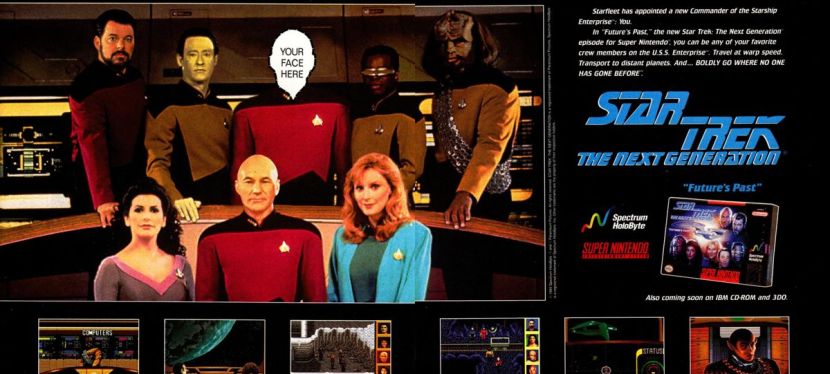
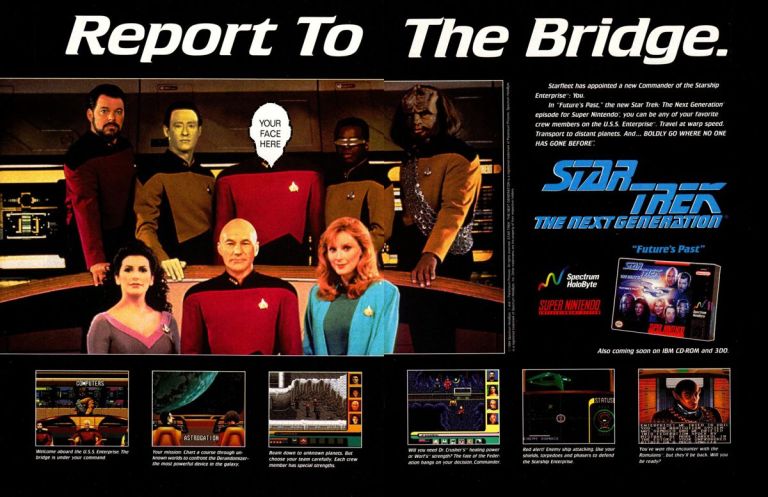
5. Star Trek: The Next Generation – Future’s Past print ad

This 2-page print ad was strong enough to invite readers to literally join the Star Trek: TNG crew and go where no man has gone before. By the way, when was the last time you saw Marina Sirtis or Gates McFadden on a video game ad?

Long before wokeness ruined Star Trek in this modern age, the sci-fi franchise reached a tremendous high in popularity and projects in the 1990s as that decade had Star Trek: The Next Generation (most of its TV seasons and three movies were released within the decade), Star Trek: Deep Space Nine and Star Trek: Voyager that kept fans entertained.

Considering its high popularity, it was not surprising that a video game adaptation of Star Trek: TNG was released in 1994 titled Star Trek: The Next Generation – Future’s Past (the version for Super Nintendo Entertainment System) and I saw the above print ad while reading a gaming magazine. Using a slightly altered version of the TNG group photo, the print ad emphasized its concept that the player will be able to lead the crew of the Starship Enterprise and take part in a series of missions in different parts of space with the likes of Captain Picard, Commander Riker, Data, Worf, Dr. Crusher, Deanna Troi and La Forge. While I was never a Star Trek fan, the above print ad caught my attention with its concept, the group photo and the screenshots gave me an idea of what the game has to offer. It should be noted that Star Trek: The Next Generation – Future’s Past was released between the end of Star Trek: TNG’s final season and the theatrical release of Star Trek: Generations.

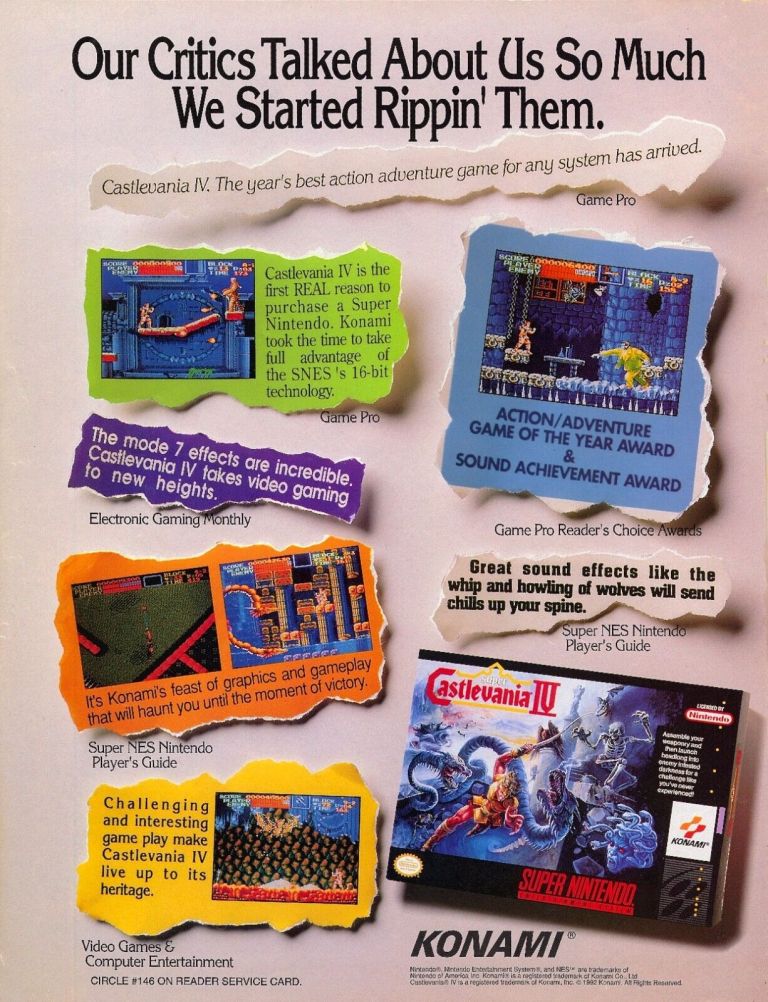
6. Super Castlevania IV print ad

This was one of the most eye-catching print ads I’ve seen about a Konami video game.

The jump in technology from one console generation to the next can be beneficial for gamers if game developers harnessed the advantages of new technologies to make new games that turned out to be more engaging and more enjoyable. Such was the case with Super Castlevania IV for the Super Nintendo Entertainment System (SNES) in 1991. The above print showed Konami highlighting the positive feedback their game received from different gaming media outlets and used screenshots to give gamers and long-time Castlevania fans exciting stuff to see. I got to play the game on the mini SNES console and I can say that in terms of visuals, controls and gameplay, Super Castlevania IV truly lived up to its title and it remains fun to play to this day.

+++++

Thank you for reading. If you find this article engaging, please click the like button below, share this article to others and also please consider making a donation to support my publishing. If you are looking for a copywriter to create content for your special project or business, check out my services and my portfolio. Feel free to contact me with a private message. Also please feel free to visit my Facebook page Author Carlo Carrasco and follow me on Twitter at  @HavenorFantasy as well as on Tumblr at https://carlocarrasco.tumblr.com/ and on Instagram at https://www.instagram.com/authorcarlocarrasco

Team Xbox sets the record straight with business update podcast, Starfield and new Indiana Jones game are still Xbox-exclusive

Wow. That was a wild ride. For several days, Xbox fans were disturbed by persistent rumors and so-called news reports that Microsoft will end its Xbox console business and go all-in with releasing multiple games (including Xbox-exclusives) on platforms outside of the Xbox ecosystem (meaning consoles like PlayStation 5 and Nintendo Switch). A lot felt that Microsoft would go the way Sega did when it quit the console business and became a multiplatform publisher.

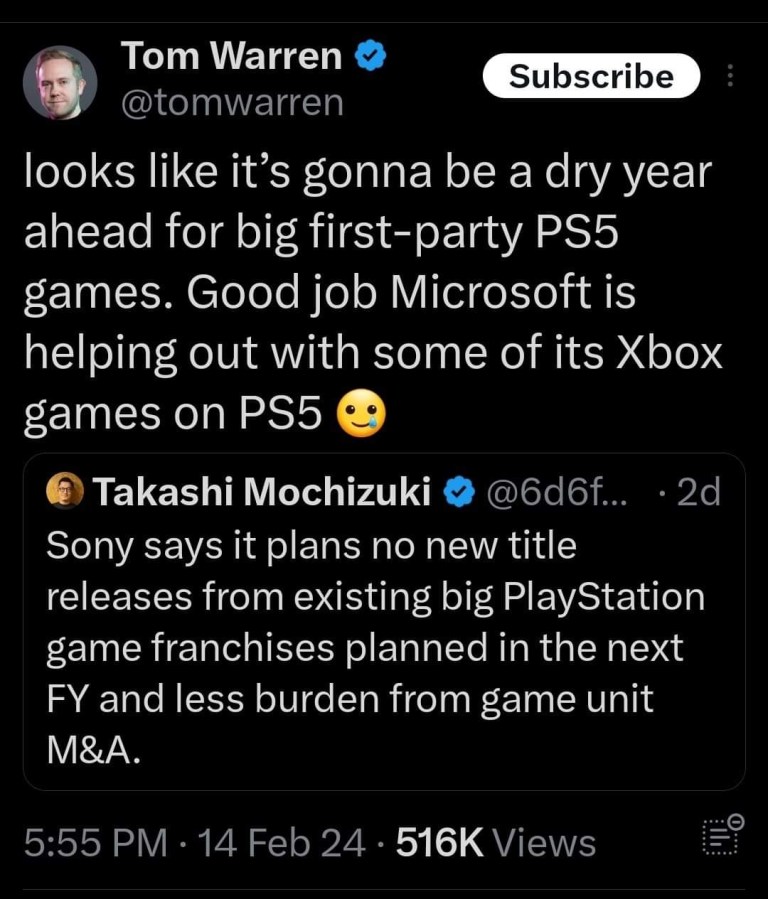
And then there were nonsensical and wild social media posts like the one below…

Fortunately, Team Xbox had its Business Update podcast on February 15, 2024 with top executives like Phil Spencer, Sarah Bond and Matt Booty answering key questions and made notable clarifications about the future of Xbox. Watch the podcast of Team Xbox below…

In relation to the above video, you can read Team Xbox’s official article online.

Xbox fans can rest assured that contrary to rush of “Xbox to end and spread its games to other consoles” news and rumors by content creators, vloggers, bloggers and the so-called journalists, Team Xbox went straight to the point that the Xbox console business will remain, there will still be Xbox-exclusive games, Xbox Game Pass service will remain within the Xbox ecosystem (you should stop dreaming about Game Pass on Nintendo and Sony consoles), Activision Blizzard games are about to be released for XGP subscribers to enjoy, and there are simply four Xbox games that will be released on platforms outside of the Xbox ecosystem.

While a lot of people speculate that Hi-fi Rush, Sea of Thieves, Pentiment and Grounded will be the Xbox games that will be released on PlayStation and Nintendo consoles, no titles have been confirmed and no specific non-Xbox platform was revealed. That being said, Starfield, Forza Motorsport (2023), Senua’s Saga: Hellblade II, Avowed, Indiana Jones and the Great Circle are still Xbox-exclusive.

“So we made the decision that we’re going to take four games to the other consoles. Just four games, not a change to our kind of fundamental exclusive strategy. We’re making these decisions for some specific reasons. We make every decision, really, with the long-term health of Xbox in mind,” Xbox chief Phil Spencer said. “And long-term health of Xbox means growing a platform, our games performing, building the best platform for creators, reaching as many players as we can.”

The way I look at Spencer’s words, it seems Team Xbox has been looking for ways to not only build up the Xbox ecosystem but also reach out to millions of players who own non-Xbox consoles by releasing a limited number of Xbox-original games that could sell and bring in much-needed revenue. The fact is the cost of making games, marketing them, distributing them and other business expenses just keep going up. As to why a heavily structured single-player game like Starfield is not coming to PlayStation 5, it seems to me that porting that massive game will be labor intensive, very time consuming and expensive to do. This means that other Xbox-original games like Sea of Thieves (obviously made with multiplayer in mind) and Pentiment (a simpler production) make more sensible and more doable releases on PS5 and Nintendo Switch. That is, if Sony and Nintendo themselves will accept such games into their respective platforms (read: protection of their first party games and their own game studios).  

As Spencer himself said, they seriously took feedback from the Xbox community. I’m glad that their team listens because there are a lot of long-time Xbox fans and physical product owners that they cannot just abandon. I myself sent tweets to Team Xbox (click here, here, here, here and here) reminding them of their legacy of investing big on Xbox-exclusive games through the console generations. I even reached out to other Xbox fans online to make themselves heard by Team Xbox.

A lot of gamers bought the Xbox Series X or Xbox Series S for Xbox-exclusive games and the big value of XGP’s service. In my view, Team Xbox itself is convinced that Xbox-exclusive games – especially the big-budget productions – are essential on maintaining fan loyalty as well as standing out in the highly competitive market of video games. In connection with having multiple Xbox game studios to produce exclusive games, I want to see Team Xbox remain competitive with Sony and Nintendo on console hardware, games and quality of gaming services. I want to see Phil Spencer and his team secure even more deals with the independent game developers on making more exclusive games. It would also be nice to see Xbox get into joint productions with the publishers in Japan like Square Enix, Capcom and From Software.

I just finished Final Fantasy IX (digital copy) on my Xbox Series X console. It was my 2nd time to complete the game. I previously completed it on PlayStation way back in 2000.

For now, Xbox is here to say, their console business will remain (even Sarah Bond promised a significant leap with the next-generation). To have a clear view of their plans, click https://news.xbox.com/en-us/2024/02/15/xbox-promise-bring-more-games-to-more-players/

As for this year, Xbox fans should watch out for exclusives coming out such as Senua’s Saga: Hellblade II on May 21 plus Avowed and Indiana Jones and the Great Circle later. Don’t forget the announced Xbox showcase this June.

+++++

Thank you for reading. If you find this article engaging, please click the like button below, share this article to others and also please consider making a donation to support my publishing. If you are looking for a copywriter to create content for your special project or business, check out my services and my portfolio. Feel free to contact me with a private message. Also please feel free to visit my Facebook page Author Carlo Carrasco and follow me on Twitter at  @HavenorFantasy as well as on Tumblr at https://carlocarrasco.tumblr.com/and on Instagram athttps://www.instagram.com/authorcarlocarrasco

Eiyuden Chronicle and Suikoden creator Yoshitaka Murayama passed away

Once the anticipated Japanese role-playing game (Japanese RPG) Eiyuden Chronicle: Hundred Heroes finally comes out on April 23, 2024, the absence of the main creator will be felt by many players as the Japan-based Rabbit & Bear Studio announced very recently that its head Yoshitaka Murayama passed away on February 6. For the newcomers reading this, Murayama is also the creator of the Suikoden RPG series of Konami where he used to work at. For my previous blog posts of Eiyuden Chronicle: Hundred Heroes, click here, here, here and here).

To put things in perspective, posted below is the excerpt from the official announcement by Rabbit & Bear Studios. Some parts in boldface…

So there you have it. The developer behind Eiyuden Chronicle: Hundred Heroes made it clear that they will not give up with fulfilling the dream of the late Murayama and there is no stopping the launch of the game (which was supposed to have been released in 2023).

More on the previous works of the late Murayama, I played Suikoden and Suikoden II (read my retro review by clicking here) on the PlayStation console in the 1990s and I had enjoyable times with them. For me, Suikoden II was the not only the best Suikoden RPG of the 1990s but also one of the best RPGs on any platform during the decade. It’s just too bad that the 1999 North American launch of Suikoden II was overshadowed by another company’s JRPG on PlayStation that same year. Considering the many Japanese RPGs that were released on PlayStation in 1999, Suikoden II was the most enjoyable one I played.

Even during his days as a young man working for Konami in the 1990s, Murayama had a very unique vision for digital role-playing and adventuring, as well as fantasy storytelling.

“Eiyuden Chronicle is really (an) evolution of my many design experiences. The many games I’ve made have helped create the foundation for this title. Since I draw my experience from previous games I’ve worked on, of course you will see a little bit of those elements in Eiyuden Chronicle,” Murayama said in response to a question that mentioned Eiyuden Chronicle and Suikoden titles.

With Murayama gone, the spotlight on the April 2024 launch of Eiyuden Chronicle: Hundred Heroes will be more crucial than before. I myself will be playing the RPG on my Xbox Series X console as soon as it launches. To get yourselves oriented with the said JRPG, watch the videos below (the last one shows Murayama and his fellow creators as special guests at an event in Taipei)…

Watch out for Eiyuden Chronicle: Hundred Heroes on Xbox Series X, Xbox Series S, Xbox One and Windows PC plus Xbox Game Pass (XGP) on April 23, 2024. For more about the JRPG, visit https://www.xbox.com/en-US/games/eiyuden-chronicle

+++++

Thank you for reading. If you find this article engaging, please click the like button below, share this article to others and also please consider making a donation to support my publishing. If you are looking for a copywriter to create content for your special project or business, check out my services and my portfolio. Feel free to contact me with a private message. Also please feel free to visit my Facebook page Author Carlo Carrasco and follow me on Twitter at  @HavenorFantasy as well as on Tumblr at https://carlocarrasco.tumblr.com/ and on Instagram athttps://www.instagram.com/authorcarlocarrasco