A Look Back at Superman #79 (1993)

Welcome back superhero enthusiasts, 1990s pop culture enthusiasts and comic book collectors! Today we go back to the year 1993 and explore a notable chapter of the post-Crisis DC Comics universe through the Superman monthly series.

Months after DC Comics published the death of Superman with the best-selling Superman (1993), the publisher went on to shake things up with the Reign of the Supermen storyline. One of the four Supermen was Cyborg Superman who first appeared in Adventures of Superman #500 (1993) and had his first story in Superman #78 (1993).

With those details laid down, here is a look back at Superman , published in 1993 by DC Comics with a story written and drawn by Dan Jurgens.   
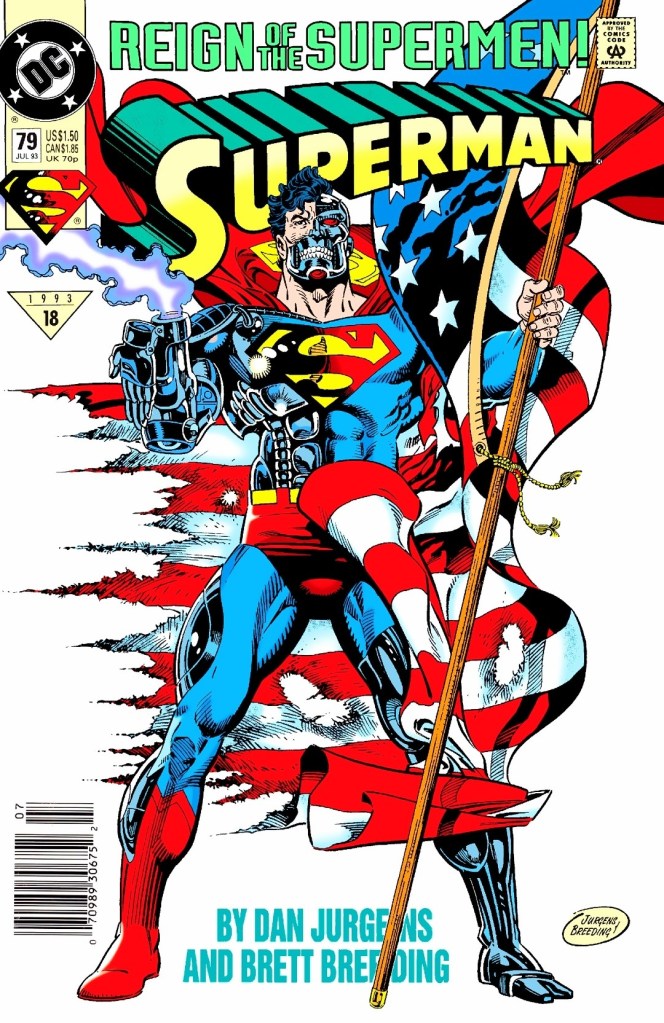
The cover.

Early story

The story begins inside a dark part of The Daily Planet with journalist Ronald Troupe starting his work in the absence of Clark Kent. Since Superman’s death, the very accomplished Kent has been absent and was perceived to have died somehow while covering Doomsday’s rampage through Metropolis. 

With Kent absent, the newspaper lost one of its best writers. This opened an opportunity for Ronald Troupe to approach Perry White to fill Kent’s slot and work. White, who was close with Kent, values hungry reporters and challenged Troupe to bring him a story so big, he could not turn it down.

With the sudden presence of the Supermen, Troupe viewed Cyborg Superman as a major subject to report about…

Quality
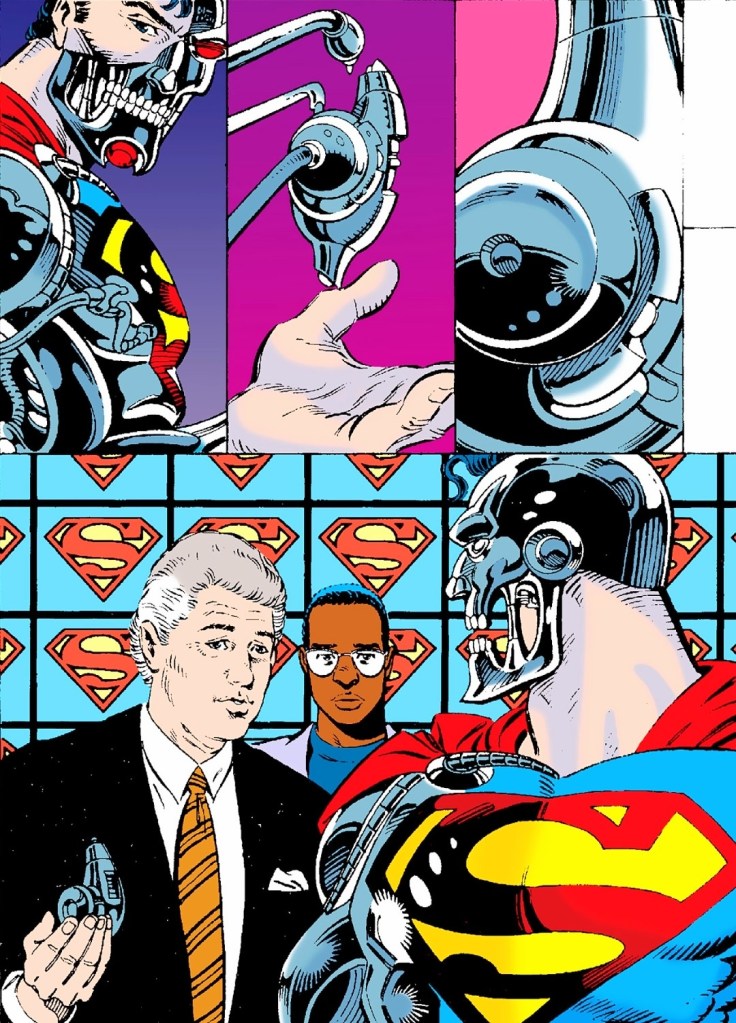
The evil Cyborg Superman handing over a device to US President Bill Clinton. This image is strangely symbolic as both of them are evil figures – one is fictional and the other is real. Clinton’s legacy of empowering Palestinian terrorists through the mass murderer Yasser Arafat still remains.

I want to start with the approach Dan Jurgens took to come up with this particular Reign of the Supermen story. Instead of telling the tale through the viewpoint of the more established Daily Planet journalist Lois Lane or photographer Jimmy Olsen, Jurgens instead used the newcomer Ronald Troupe who happened to be a hungry journalist tasked with coming up with a compelling report about Cyborg Superman. This creative approach resulted in a very fresh look at the events involving the caped cyborg complete with the use of a journalistic narrative Troupe wrote on his computer (the paragraphs are stylishly displayed on each page). The writing done was pretty lively to read from start to finish.

I do have a problem with how specific events turned out. To ensure that Troupe would encounter Cyborg Superman, the established character Max Lord (who is working directly with the US President over very sensitive matters) very unrealistically had his government-provided limousine stop (while entering the White House gate half-way) and actually got out to meet Troupe only because the reporter convinced him too easily. Even back in the 1990s, such a scenario is very unrealistic and no person working with the US President would ever stop to give a reporter special attention while compromising security of the White House.

And then there was the short sequence in which Troupe – already within the White House perimeter with several defense turrets already firing energy blasts – miraculously managed to get close to Cyborg Superman without getting hit was also very unbelievable. Very clearly, Troupe is this comic book’s magical black man.

To come up with the superhero spectacle, elements of Islamic terrorism (represented by the fictional Qurac and its terrorists) attacking the White House plus Cyborg Superman’s sudden involvement were implemented. Quite predictably, the caped cyborg became the centerpiece of the action. I can say the spectacle here was fresh and intriguing to see.

Conclusion
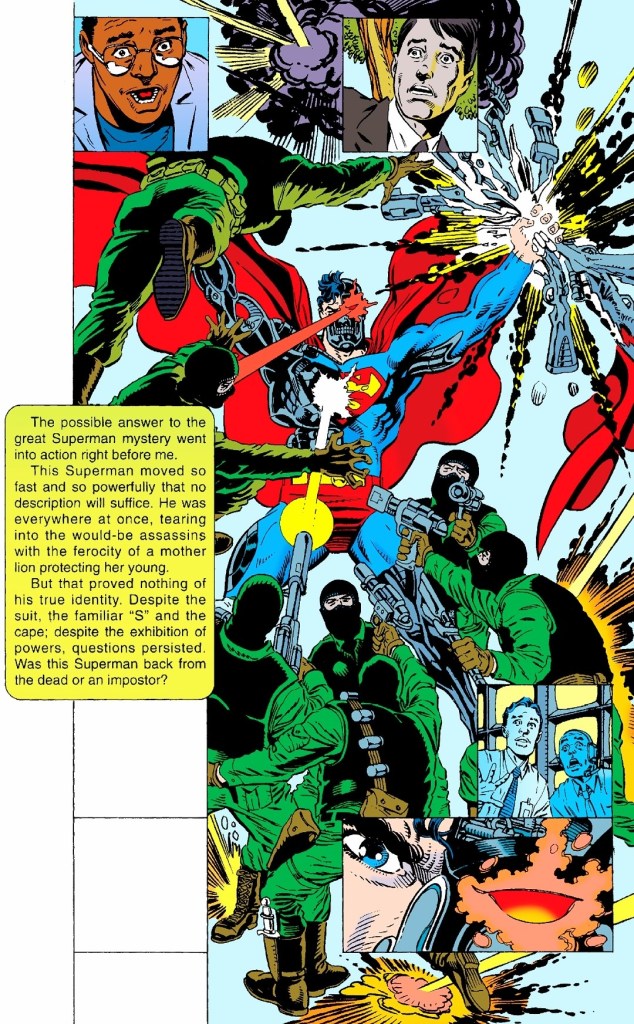
Cyborg Superman fights the terrorists of Qurac.

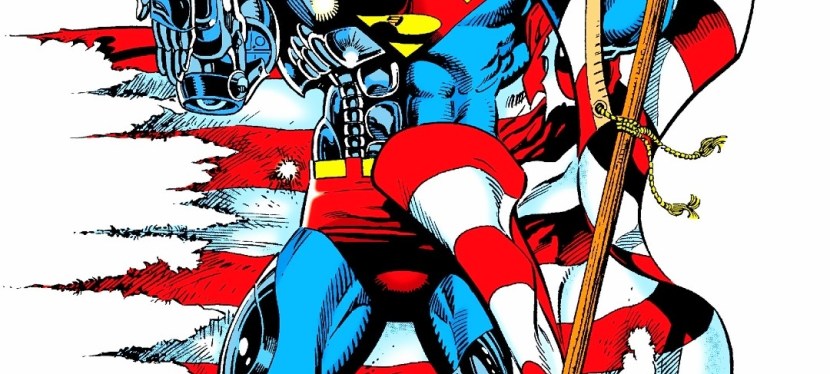
Superman (1993) has a very unique approach on storytelling but the above-mentioned unbelievable turnout of events plus Ronald Troupe being the magical black person (literally protected by plot armor) somewhat ruined the reading experience for me. By the time the story ended, the anticipated pay-off to everything that was built-up ended up weak and unsatisfying. To be clear, this is not a badly made comic book but its flaws really ruined it. Also by today’s standards, Cyborg Superman is a very evil character and having him with the American flag on the cover is disgusting.

With regards to geopolitics, having Bill Clinton as the US President made this comic book age very badly. As President, Clinton empowered Palestinian terrorists and anti-Semitic people through the mass murderer Yasser Arafat (a real-life demon) while disrespecting Israel and its people. People who love abortion, political correctness (which leads to wokeness), victimhood and LGBTQ rights also benefited from Clinton’s sinister leadership. By today’s standards, having Clinton and Cyborg Superman appear together strongly symbolize real-life evil and fictional evil in a rather creative way.

It was destiny that his wife Hillary Clinton lost the 2016 US Presidential Election to Donald Trump. This is because the Clinton legacy remains very bad for the whole world. Trump, who is now the US President once again, is already working to make serious corrections while also restoring dignity in America.

Overall, Superman (1987) is not worth your time. Only those who are really obsessed with the Reign of the Supermen storyline can enjoy it. For those looking for the iconic Superman, better look for another comic book!

+++++

Thank you for reading. If you find this article engaging, please click the like button below, share this article to others and also please consider making a donation to support my publishing. If you are looking for a copywriter to create content for your special project or business, check out my services and my portfolio. Feel free to contact me with a private message. Also please feel free to visit my Facebook page Author Carlo Carrasco and follow me on Twitter at  @HavenorFantasy as well as on Tumblr at https://carlocarrasco.tumblr.com/ and on Instagram at https://www.instagram.com/authorcarlocarrasco
A Look Back at What If #62 (1994)

Welcome back superhero enthusiasts, 1990s arts and culture enthusiasts, Marvel Comics fans and comic book collectors! Today we go back to the year 1994 to examine an alternate story of the Marvel Comics shared universe chronicled through the What If monthly series.

There is a lot to be said about the origin of Wolverine. There was the tale of his Canadian origin and being born with claws inside him. There was also the tale of him encountering the Hulk in Canada. And there was also the famous storyline Weapon X (written and drawn by Barry Windsor-Smith in Marvel Comics Presents to ).

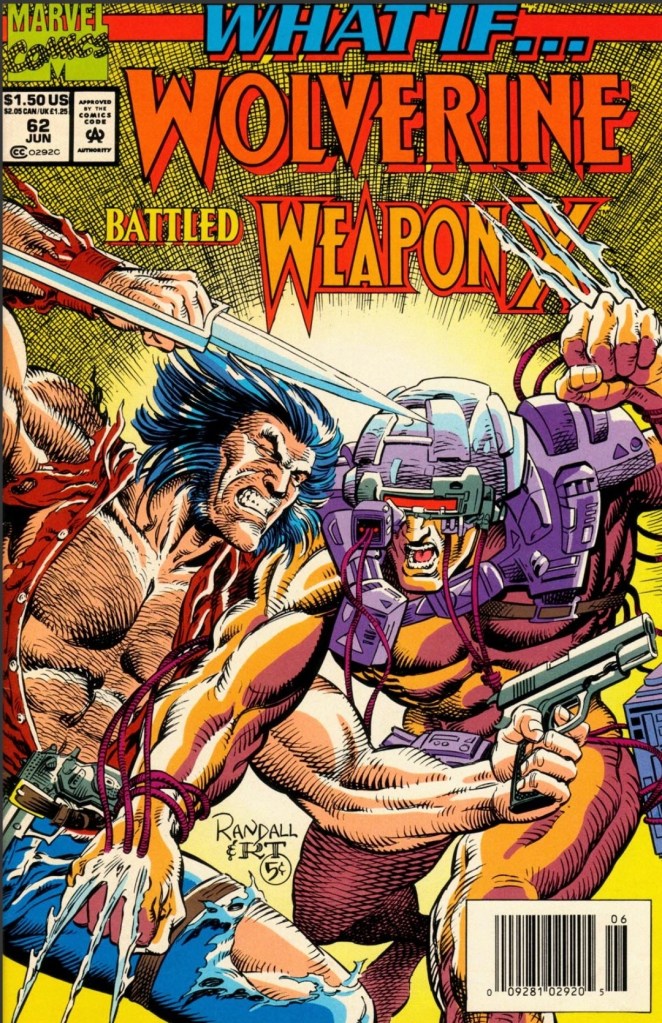
With those details laid down, here is a look back at What If , published in 1994 by Marvel Comics with a story written by Kurt Busiek and drawn by Ron Randall.

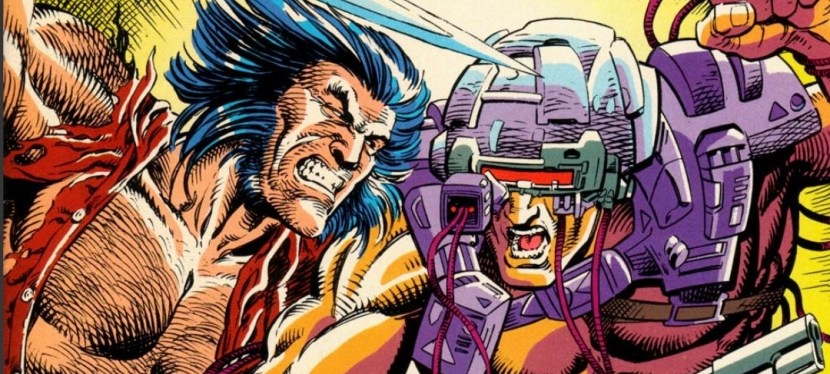
The cover.

Early story

The story begins in the when Logan (Wolverine) encounters armed men who try to overwhelm him. Logan easily knocks most of them out and leaves them behind by car. It turns out the armed men are agents of a secret organization called Weapon X which has been targeting Logan for their series of unethical experiments on abducted humans (the Weapon X Project).

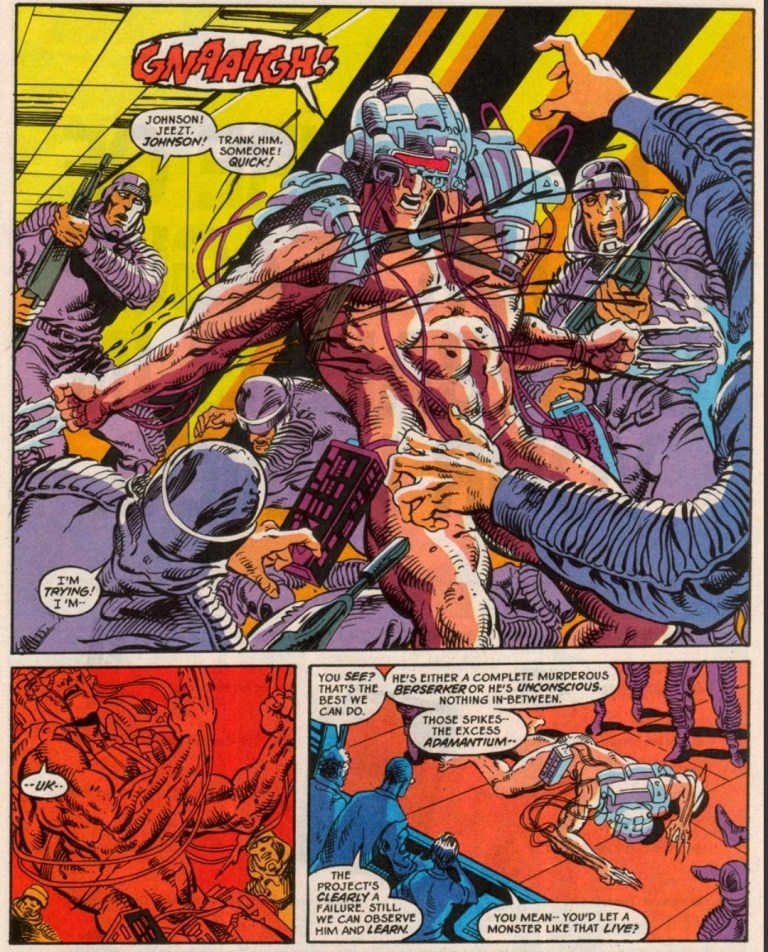
The organization is already dealing with problems regarding their live experiments. One living subject (with adamantium claws on his arms and some machinery on his head and shoulders) became a murderous berserker who cannot be reasoned with anymore. The subject is former Mounted Police Officer and Marine Guy Desjardins and Weapon X dropped him off at Department H.

James Hudson of The Flight took him in and officially refers to him as “Weapon X”. The live subject eventually broke loose, killed Dr. Langkowski and went to Kenora where he starts a killing spree…

Quality

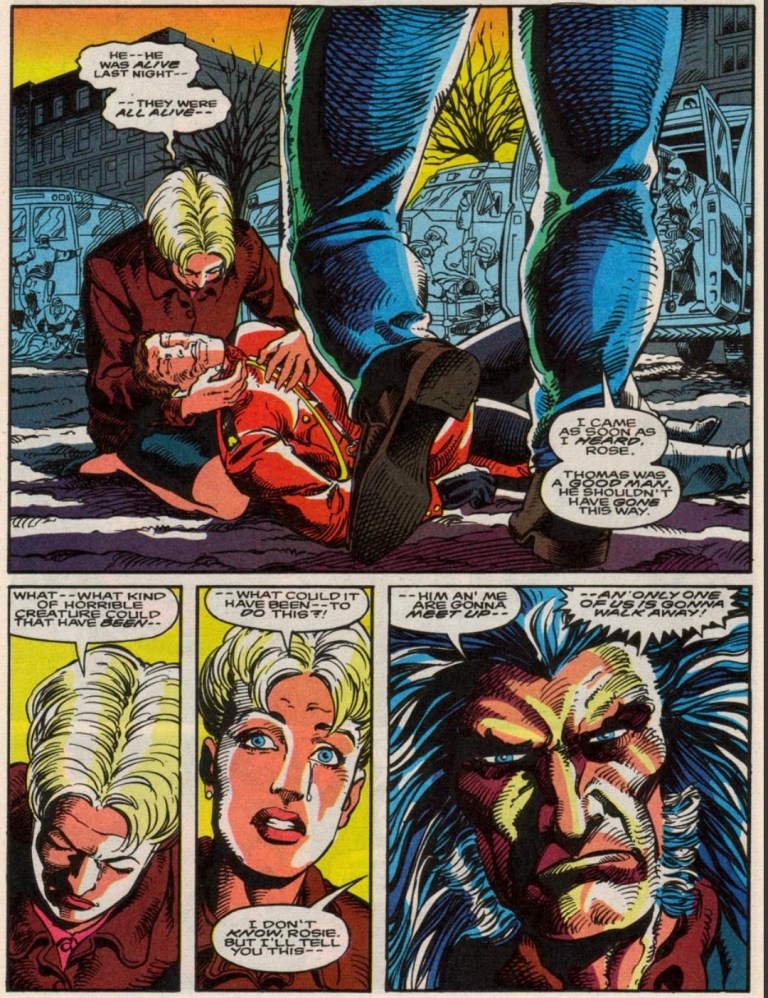
Logan arrives at the scene where the Weapon X biological experiment killed several people.

I want to point out that Kurt Busiek came up with the very believable portrayal Logan who is not Wolverine, not a member of the X-Men and not even the violent fighter in the plot. This is a story about a major scientific experiment of Weapon X that went terrible wrong resulting in their living subject (with adamantium claws and other features identified with Wolverine in the mainstream Marvel universe storyline of Weapon X) going way beyond their controller and impacting Canadian society negatively. The good news here is that the story by Busiek is very well written and nicely structured.

In his civilian form as Logan, Wolverine (as we often identify him) is not the fierce slasher he is often known as. Rather he is a former tool of the Canadian government who previously resigned and decides to get involved in response to the rampage caused by the Weapon X killing machine (Desjardins).

As Logan is no slasher (note: Wolverine #75’s big revelation about Logan’s claws had no influence on this comic book’s concept), he fights with guns and a knife backed with his extensive experience in grounded combat. In relation to this comic book’s concept, you will a captivating portrayal of Logan who is truly unconnected with the X-Men and there are certain character moments that you really have to read.

Along the way, Kurt Busiek’s story not only dramatizes the classic trope about man tampering with nature but also the potential scandal of Canada’s government having top secret unethical science experiments while developing their own superhero project in the form of The Flight. Back to Wolverine, the story pounced on the conflict between being human and being animalistic with sheer believability.

With regards to the artwork, Ron Randall exerted effort to recapture some of the aesthetics of Barry Windosor-Smith’s work on the Weapon X storyline of the Marvel Comics Presents comic books. As required by the script, the visual display of action is brutal to look yet does not go over the top (with regards to graphic violence) as the creators implemented restraint restraint on the display of blood and killing blows.  

Conclusion

A new Weapon X biological experiment gone wrong.

What If (1994) is truly a great alternative tale to the established Weapon X storyline and it is also one of the more engaging portrayals of Wolverine unconnected with the X-Men. You will see Logan being more grounded with reality and you will also witness how he sees himself as a Canadian citizen who actually gets involved again with the government which he previously served. This a really compelling work by the Busiek-Randall duo.

Overall, What If (1994) is highly recommended.

+++++

Thank you for reading. If you find this article engaging, please click the like button below, share this article to others and also please consider making a donation to support my publishing. If you are looking for a copywriter to create content for your special project or business, check out my services and my portfolio. Feel free to contact me with a private message. Also please feel free to visit my Facebook page Author Carlo Carrasco and follow me on Twitter at  @HavenorFantasy as well as on Tumblr at https://carlocarrasco.tumblr.com/ and on Instagram at https://www.instagram.com/authorcarlocarrasco
A Look Back at Wolverine #87 (1994)

Welcome back superhero enthusiasts, 1980s arts and culture enthusiasts, Marvel Comics fans and comic book collectors! Today we go back to the year 1984 to examine a small part of the Marvel Comics universe through a tale of the Wolverine monthly series.

This particular tale shows were Wolverine went and what he has been doing since he decided to leave the X-Men in Wolverine #75 (1993). Since Magneto removed the Adamantium out of him in X-Men #25 (1993) and Wolverine discovered that his claws were made of pure bones (part of him all along), he has been very determine to search for answers and the truth about himself.

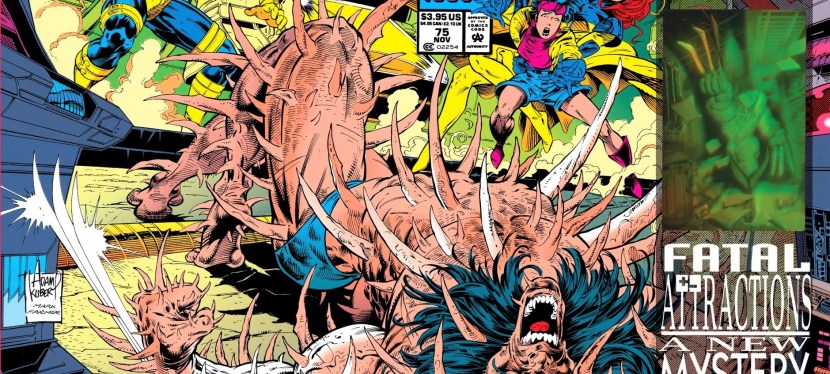
With those details laid down, here is a look back at Wolverine , published in 1994 by Marvel Comics with a story written by Larry Hama and drawn by Adam Kubert.

The cover.

Early story

The story begins in the Southeast Asian city of Madripoor (fictional) where Wolverine and his former teammate Gambit are reunited. As they walk, Gambit tells him that Sabretooth (Wolverine’s long-time rival) is staying in Charles Xavier’s mansion (refer to X-Men #28 and #29). As they talk, Wolverine notices something odd at the Princess Bar which he previously visited and there seems to be something wrong. The two decided to break in, causing damage and expecting the worst. It turns out, a lot of people are inside (including those who became friends of Logan) who prepared a surprise celebration for Wolverine.

As the celebration goes on, ninjas at the top of the building watch Wolverine carefully as they prepare to go down and kill him…

Quality

Amazingly, Wolverine managed to slash the two falling guys with his bone claws and impressed Gambit.

If you are familiar with Team X (revealed in flashbacks in X-Men #5 and X-Men #6) composed of Wolverine, Sabretooth and Maverick as black ops operatives, then the story of this comic book will really become relevant with you. In fact, reading the mentioned comic books is a must.

Without spoiling the plot, I can say that creative duo of Hama and Kubert came up with their own contribution to the Team X mythos (with flashbacks visualized in similar style to those in the above-mentioned X-Men comic books of 1992) while emphasizing how the past affects Wolverine, Sabretooth and Maverick in the present day.

What Hama-Kubert came up with was not the typical good-versus-evil superhero tale but rather a believable expansion of the Team X legacy, what the three former members have in common, and what uncertainties are they dealing with as surviving mutants. In the case of Wolverine, this tale adds depth to his solo exploits since leaving his team behind in search for answers.

Conclusion

Wolverine dancing with a pretty lady while two guys above watch them.

Wolverine (1994) is a fine character exploration and also a nice revelation about Team X. Considering how good the contributions from Hama and Kubert are, they would not be so relevant if you have never read Team X’s flashbacks in the two specific X-Men comic books published in 1992 and that alone makes this one a tricky read.

Overall, Wolverine (1994) is recommended.

+++++

Thank you for reading. If you find this article engaging, please click the like button below, share this article to others and also please consider making a donation to support my publishing. If you are looking for a copywriter to create content for your special project or business, check out my services and my portfolio. Feel free to contact me with a private message. Also please feel free to visit my Facebook page Author Carlo Carrasco and follow me on Twitter at  @HavenorFantasy as well as on Tumblr at https://carlocarrasco.tumblr.com/ and on Instagram at https://www.instagram.com/authorcarlocarrasco
Retro Gaming Ads Blast – Part 8

Welcome back readers, fellow geeks and electronic gaming fans!

In this edition of the Retro Gaming Ads Blast (RGAB) series, we will take a look at another batch of retro gaming print ads from the 1980s and 1990s.

For the newcomers reading this, Retro Gaming Ads Blast (RGAB) looks back at the many print ads of games (console, arcade, computer and handheld) that were published in comic books, magazines, flyers and newspapers long before smartphones, social media, the worldwide web and streaming became popular. To put things in perspective, people back in the 1980s and 1990s were more trusting of print media for information and images about electronic games and related hardware.

With those details laid down, here is the newest batch of retro gaming print ads for you to see and enjoy…

1. Enemy Zero print ad

I should say Sega did a solid job by making this intriguing and eye-catching print ad for Enemy Zero.

The first time I saw this print ad of Enemy Zero in the late 1990s, I was intrigued by its visual concept and it got me interested to learning more about the game. Enemy Zero was a sci-fi video game developed by Warp and released as a console-exclusive on the Sega Saturn. Since I never owned a Saturn, I never got to play the game but I was inspired to learn more about Warp (which developed the hit game D). As it turns out, Enemy Zero started as a project for PlayStation but because of Sony’s failure to fulfill the pre-orders of D on PlayStation (100,000 copies ordered but less than 30,000 copies printed by Sony), Warp’s head Kenji Eno decided to make Enemy Zero exclusive to the Sega Saturn. Enemy Zero was published by Sega worldwide while Warp published it in Japan, and the game sold between 500,000 to 700,000 copies (based on Eno’s claim).

2. Bionic Commando print ad

For the American market, Capcom showed what the game box and front cover art would look like, then added the details and two screenshots for readers to examine.

Back in the late 1980s, I played Bionic Commando and managed to finish it after enduring lots of challenges along the way. It was a very unique adventure game as it used a highly unusual method of moving from one platform to the next by means of a futuristic grappling gun. This particular print ad showcased what the game’s actual box looked like (with cover artwork made for North America) and used two screenshots from the game. This ad hardly captures the excitement and intensity that awaited gamers and yet it manages to give people a clear look at the grappling concept. While the North American version of the game has certain content altered, it still had the same gory ending (and Adolf Hitler as the main villain) as the Japanese version.

3. RoboCop print ad

This served as an extension of the impact of the very violent 1987 movie.

RoboCop made huge impact on moviegoers as well as people who love science fiction and the R-rated action films Hollywood studios released in the 1980s. That being said, it was not surprising that a video game of RoboCop was released on the Nintendo Entertainment System (Family Computer in Japan) by Data East and the print ad they came up with cleverly used imagery from the movie poster and the screenshots showed exactly what RoboCop fans expected to see such as the enemy robot ED-209 and thugs. This game strongly reflects the business trend of the 1980s when companies made merchandise and adaptations of R-rated blockbuster films to sell to kids and teenagers.

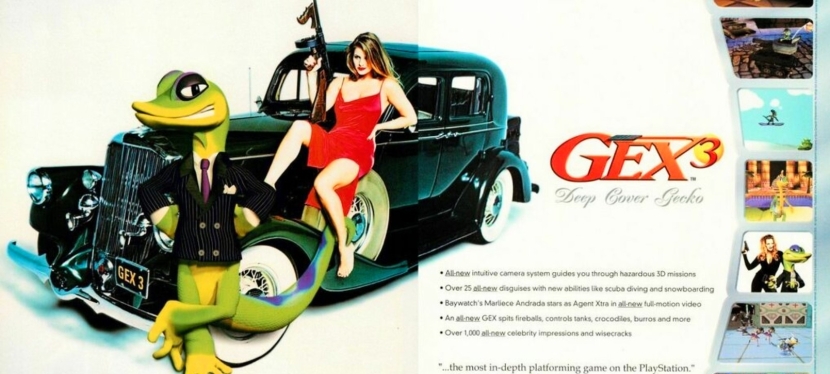
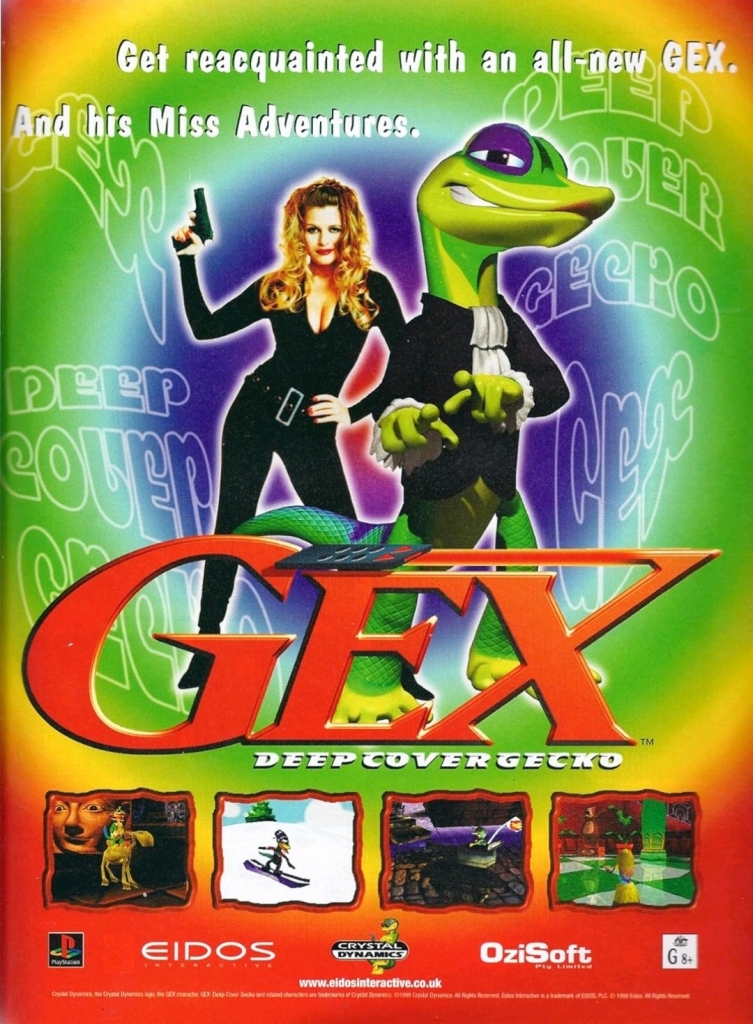
4. Gex 3: Deep Cover Gecko print ads

This print ad for Europe had a James Bond vibe.
March 1998 Playmate of the Month on the hood of the car looking at Gex.
The 2-page print ad of Gex 3: Deep Cover Gecko.

In 1999, Eidos Interactive – the company behind the wildly popular Tomb Raider games of the decade – became aggressive marketing Gex 3: Deep Cover Gecko for PlayStation and Nintendo 64. They were so aggressive, they featured actress and Playboy’s Playmate of the Month (March 1998) Marliece Andrada alongside their star character Gex in the marketing which was not limited to America. For the newcomers reading this, a multimedia approach was implemented on the narrative of the game’s PlayStation version which explains why it has full-motion video sequences featuring Andrada as the character Agent Xtra. As seen in these print ads, Eidos Interactive had Andrada looking pretty and sexy to really sell the game.

5. Barkley Shut Up and Jam! print ad

Anyone here a Charles Barkley fan?

I remember the many types of basketball video games that were released on game consoles back in the 1990s. While there were NBA video games that had in-depth rosters of players with seasonal gaming in mind, there were other basketball-related video games that were not about the said league but featured an NBA star. In this print ad, publisher Accolade prominently featured NBA star Charles Barkley to promote the game Barkley Shut Up and Jam!, posted some words emphasizing sports intensity, and showed one screenshot to assure gamers that this is a basketball game. While the critical reception was mixed, the game must have sold enough to convince Accolade to release a sequel two years later with Barkley still the endorser.

6. The Death and Return of Superman print ad

This print ad clearly aimed for the fans of the comic books as well as gamers looking for an action-packed game to play.

Now this is one very eye-catching print ad that appeared in comic books and magazines in the 1990s. Anyone who knows comics would recognize the grey fist (with sharp bones protruding on the knuckles) belonging to Doomsday who killed Superman in Superman (1993), and the bloody presentation on the famous S was very aggressive for its time. The game itself was an adaptation of the two storylines (published in 1992 and 1993 respectively) that saw Superman’s death, his return and the appearances of new Supermen. While sales figures are not available, The Death and Return of Superman eventually attracted mixed reviews from the critics.

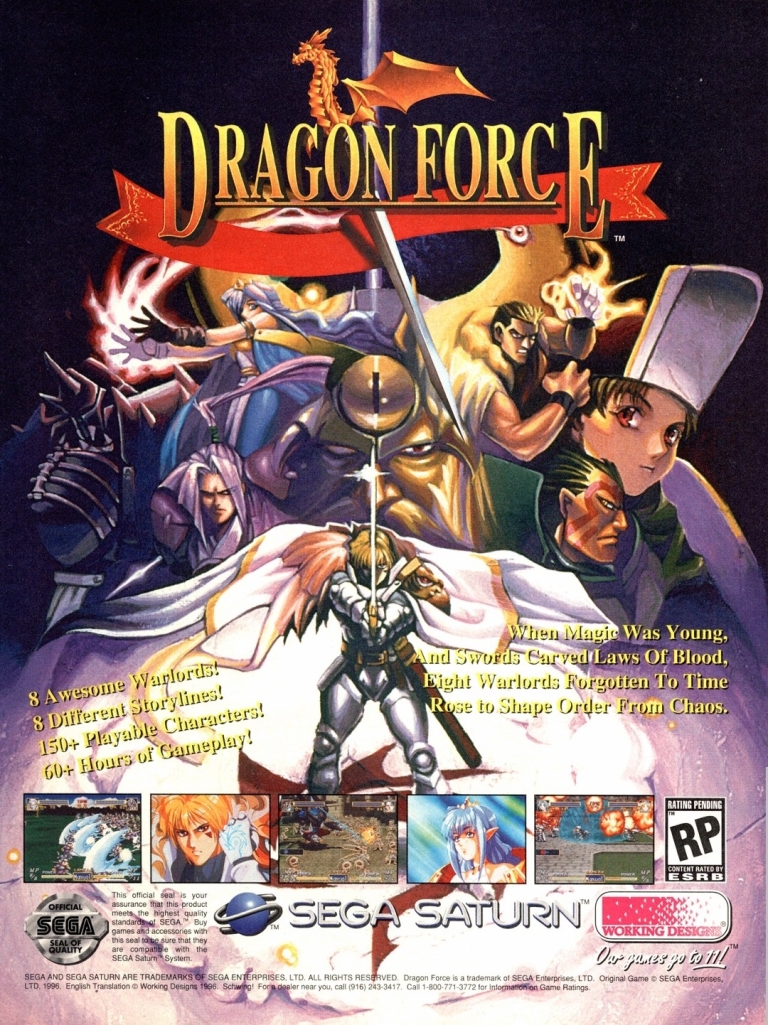
7. Dragon Force print ad

This was printed in magazines at a time when Working Designs had a strong business relationship with Sega.

While the Sega Saturn was undeniably a huge commercial disappointment in North America, the console still had some great games that was widely praised by game critics and heavily bought by gamers. One of those outstanding games on the console was Dragon Force (developed by Sega and J-Force in Japan, localized in America by Working Designs) which received great critical acclaim and achieved commercial success both in Japan and in America. The popular magazine Electronic Gaming Monthly named Dragon Force as the Saturn Game of the Year as well as Strategy Game of the Year in 1996. As a Working Designs release, this print ad has an ambitious fantasy concept visually emphasized, detailed lines of descriptions and screenshots that strongly appealed to the gamers, anime enthusiasts and those who love fantasy. This ad is also a sad reminder that the business relationship between Sega and Working Designs went downhill afterwards (read: Bernie Stolar) and the sequel Dragon Force II was never released outside of Japan.

+++++

Thank you for reading. If you find this article engaging, please click the like button below, share this article to others and also please consider making a donation to support my publishing. If you are looking for a copywriter to create content for your special project or business, check out my services and my portfolio. Feel free to contact me with a private message. Also please feel free to visit my Facebook page Author Carlo Carrasco and follow me on Twitter at  @HavenorFantasy as well as on Tumblr at https://carlocarrasco.tumblr.com/ and on Instagram at https://www.instagram.com/authorcarlocarrasco

A Look Back at G.I. Joe: A Real American Hero #1 (1982)

Welcome back superhero enthusiasts, 1980s culture enthusiasts and comic book collectors! Today we go back to the early 1980s to explore Marvel Comics’ launch of a comic book series based on the wildly popular military-themed franchise of toys – G.I. Joe: A Real American Hero.

For the newcomers reading this, Hasbro launched the G.I. Joe: A Real American Hero toyline in 1982 which was actually a revival of the original G.I. Joe series of toys (sized 12 inches) in the 1960s and 1970s. G.I. Joe: A Real American Hero toys had a new format for its action figures influenced by the success of the Micronauts and Star Wars toys. Veteran writer Larry Hama (the same guy behind the memorable Wolverine #75 of 1993) was already working for Marvel and was developing the concept of a new comic book about elite commandos fighting terrorists. Such development happened before the 1982 relaunch of G.I. Joe, and eventually Marvel’s editor-in-chief Jim Shooter approached Hama for a new comic book project based on Hasbro’s military toyline. Eventually a series of developments followed that saw the creation of the evil organization Cobra, the core villain Cobra Commander and more.

The impact of G.I. Joe as a licensed comic book series turned out positively as it helped attract new readers at the newsstands and it developed a strong following with young readers who were not highly interested with superheroes.  

With those details laid down, here is a look back at G.I. Joe: A Real American Hero published in 1982 by Marvel Comics with the main story written by Larry Hama and drawn by Herb Trimpe.

The cover.

Early story

The story begins with an Amtrak train traveling between New York City and Washington, D.C. Inside the nuclear physicist Dr. Adele Burkhart who previously served as one of the brains behind the Doomsday Project. It turns out, Burkhart was declared a traitor for denouncing the military claiming that she was misled by them to work on the said project. Inside the train, she has several security personnel guarding her as she is on her way to testify in front of a certain congressional committee.

As she speaks during a press conference inside one of the train’s cars, several flying soldiers of Cobra attacked the exterior of the train. In front of Burkhart, a few of the journalists turned out to be elements of Cobra led by the Baroness. The Baroness and her companions succeed in defeating the bodyguards and kidnapped Burkhart by means of flight.

At the Pentagon, the kidnapping of Burkhart compels the military to call in their special counter-terrorist group called G.I. Joe for a rescue operation. The stakes are high as they know that they cannot let Cobra keep Burkhart long enough to use her and they cannot let her die as the whole world is aware that they considered her an embarrassment. They ordered Colonel Clayton Abernathy (code name: Hawk) to assemble the Joe Team composed of Clutch, Flash, Breaker, Rock ‘n Roll, Scarlett, Stalker, Short-Fuse and Snake-Eyes…

Quality

Dr. Burkhart held hostage by Cobra and in the presence of Cobra Commander, the Baroness and many terrorists.

To get straight to the point, the main story (Operation: Lady Doomsday) was carefully structured by Hama to tell a story engagingly while also functioning to introduce readers to the characters and immersing them into the illustrated literary universe of G.I. Joe that is noticeably separated from the popular cartoon series. It is a classic portrayal of good versus evil laced with militarism and espionage.

The story moved at a medium pace and the approach on build-up and pay-off was executed carefully. There were scenes that had a sufficient amount of details regarding the plot or character moments (as opposed to development) that made the reading experience immersive. In short, there was no rush in the narrative while the pace never slowed down to a halt (no boring moments).

That being said, you will get to see lots of scenes that focus on the side of G.I. Joe as well as on the side of Cobra which is led by Cobra Commander (who is obsessed and scheming) followed by the Baroness (who is more focused on achieving goals but cannot do so without authority). You will see a certain gap between Cobra Commander and the Baroness which shows something seems off within their terrorist organization. This served as a creative contrast with G.I. Joe being more straightforward with the way they organize themselves.

The only weakness this comic book has is the fact that with so many characters from both the good and the bad sides, identifying them was pretty challenging especially when their military uniforms obscured their looks. Characters like Cobra Commander, Snake-Eyes, Scarlett, Rock ‘n Roll, Stalker and the Baroness are instantly recognizable.

As the main story remains a really good read, the 2nd story (Hot Potato) also written by Hama but drawn by Perlin served as a nice additive to this comic book.

Conclusion

G.I. Joe starts getting ready for the high-stakes rescue mission.

G.I. Joe: A Real American Hero (1982) is indeed a very solid reading experience. This is a strong introduction of the literary version of G.I. Joe and its portrayal of good versus evil remains believable and compelling. I also enjoyed the way the creators balanced the build-up of tension, plot and character moments with spectacle or twists utilized as pay-off. Lastly, I should say that this comic book has lots of action for you to enjoy and the execution of the action scenes made sense within the context of the stories. Remember that this marked the beginning of a memorable long run of G.I. Joe comics that reached into the 1990s. This one is a true classic and it should remind you that there was a time when political correctness and wokeness did not get in America’s way of fighting terrorists.

Overall, G.I. Joe: A Real American Hero (1982) is highly recommended!

+++++

Thank you for reading. If you find this article engaging, please click the like button below, share this article to others and also please consider making a donation to support my publishing. If you are looking for a copywriter to create content for your special project or business, check out my services and my portfolio. Feel free to contact me with a private message. Also please feel free to visit my Facebook page Author Carlo Carrasco and follow me on Twitter at  @HavenorFantasy as well as on Tumblr at https://carlocarrasco.tumblr.com/ and on Instagram at https://www.instagram.com/authorcarlocarrasco

A Look Back at Wolverine #75 (1993)

Disclaimer: This is my original work with details sourced from reading the comic book and doing personal research. Anyone who wants to use this article, in part or in whole, needs to secure first my permission and agree to cite me as the source and author. Let it be known that any unauthorized use of this article will constrain the author to pursue the remedies under R.A. No. 8293, the Revised Penal Code, and/or all applicable legal actions under the laws of the Philippines.

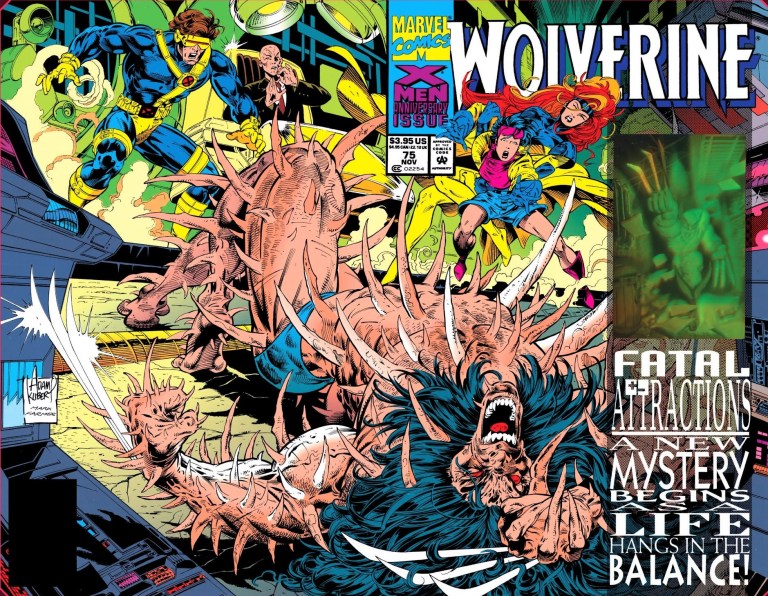
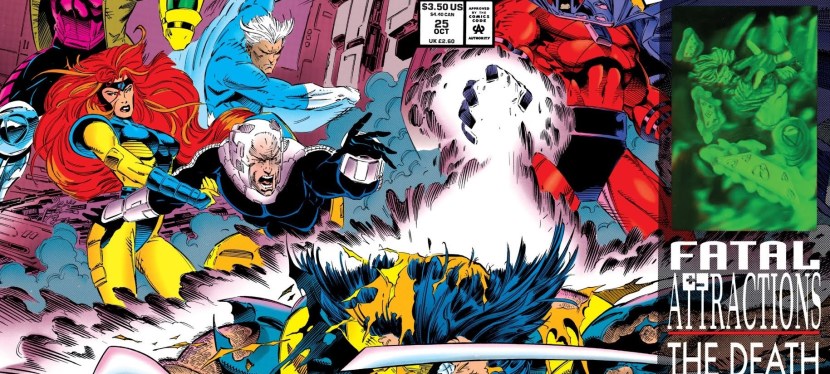
Welcome back, superhero enthusiasts, comic collectors, 1990s culture enthusiasts and fans of the X-Men! We go back to the year 1993 when the 30th anniversary of the X-Men was celebrated with the 6-part Fatal Attractions storyline. Already I reviewed Uncanny X-Men #304 (Part 3) which was not worthy of the X-Men’s 30th anniversary celebration. X-Men #25 (Part 4) meanwhile was not only great but also shocking and had a years-long impact on X-Men comics.

So now the focus is on the 5th chapter of the Fatal Attractions storyline handled by the Larry Hama-Adam Kubert team on the Wolverine monthly series of the time. With those details laid down, here is a look back at Wolverine , published by Marvel Comics in 1993 with a story written by Larry Hama and drawn by Adam Kubert.

The cover.

Early story

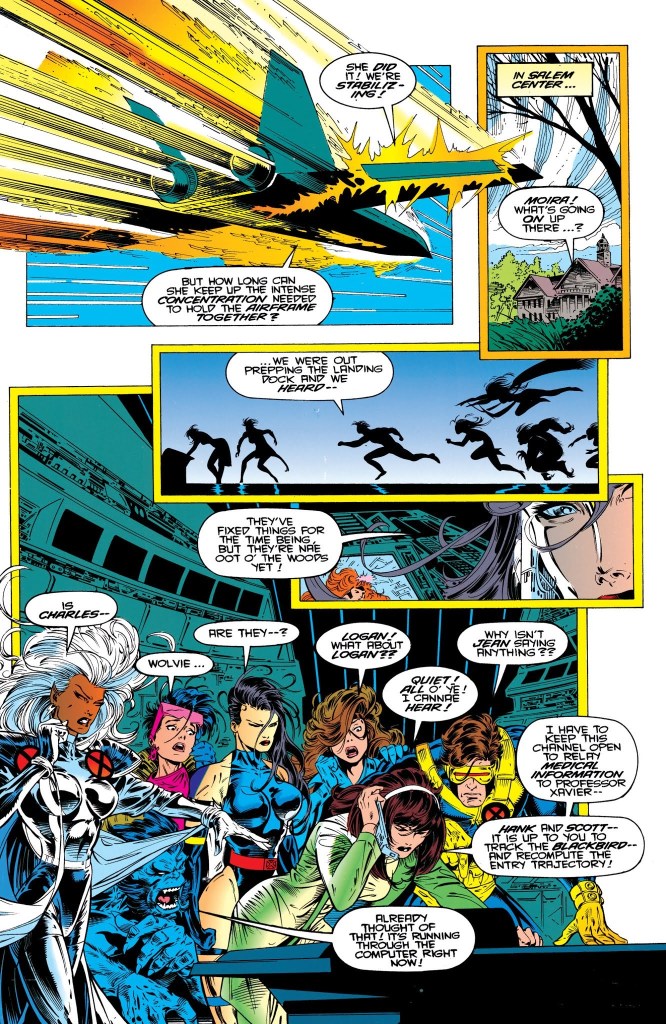
The story begins in outer space. Carrying Charles Xavier, Wolverine, Gambit, Jean Grey, Rogue and Quicksilver (who participated in the dangerous mission in X-Men ), the X-Men’s jet (piloted by Bishop) struggles mechanically as it was not designed for space travel. Worse, Wolverine is under very serious condition and the medical unit has been operating in full capacity dealing with his intense trauma.

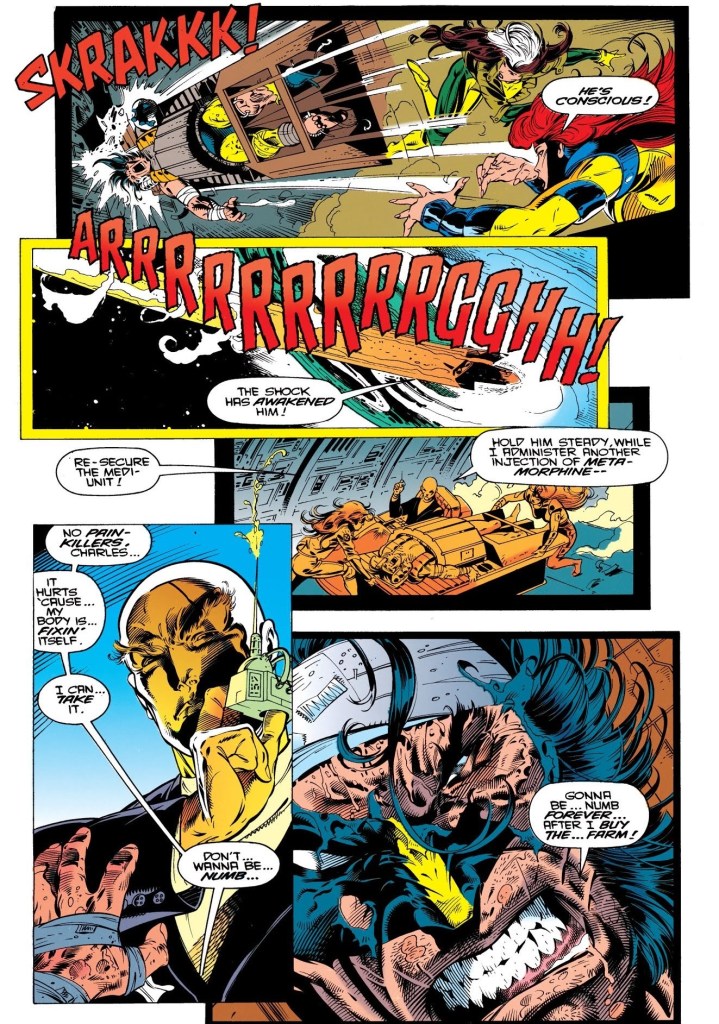
In an attempt to alleviate Wolverine’s psychic trauma, Charles Xavier and Jean Grey enter his mind and discover that there is a world full of pain and horror. They see visions of a restrained Wolverine (from his Weapon X days) being attacked by Sabretooth and Lady Deathstrike. Xavier explains that they are at the epicenter of Logan’s most suppressed cataclysmic memories which were clearly triggered by the physical damage Magneto inflicted on him (see X-Men ).

As the X-Men’s jet attempts to enter Earth’s atmosphere, its exteriors heat up dramatically shaking everyone inside. This complicates the situation on stabilizing Wolverine…

Quality

The other X-Men team members at their headquarters expressing worry and concern about the situation of their teammates struggling to come back home from space.

To be clear, this story continues the events of Fatal Attractions but with a bit more focus on Wolverine (compared to the earlier chapters of the storyline that is). There is no real battle between good and evil at all. It’s really all about Wolverine struggling to survive just as his teammates struggle to arrive home.

Before the stories of this comic book and X-Men happened, Wolverine has often been portrayed to be very tough, brave and a walking machine of violence which has been reflected in other X-Men stories told in video games and movies. In this very comic book, Wolverine has been presented to coming close to death. This means Logan, at this particular stage of the history of the literary X-Men, was at his most vulnerable state. In my experience, this was both alienating and shocking to see.

With regards to the writing, Larry Hama did an excellent job with pacing the story from start to finish. Right from the beginning, the story pulls you into the X-Men’s tough situation and as each page gets turned, the tension as well as the suspense builds up until the execution of the climax. Along the way, the comic book not only portrays Wolverine struggling on the edge, it also works to make you care more or be more concerned towards him. Oh yes, the shocking moment near the end of this comic book remains very powerful and you who read this retro review should read Wolverine and see it for yourselves.

Conclusion

Wolverine at his most vulnerable state.

By today’s standards, Wolverine (1993) is still a very great comic book to read. In fact, I can say it is not only one of most defining chapters of the Fatal Attractions storyline as well as one of the most significant X-Men comic books of the 1990s, it is indeed a true illustrated literature classic ever published by Marvel Comics. In retrospect, this comic book marks a major turning point in the life of Wolverine who is still one of the most iconic characters in all of superhero literature. All of these were achieved thanks to the creative team of Larry Hama and Adam Kubert (whose are here was great and stylized at the same time). Hama succeeded in writing the continuation of the Fatal Attractions storyline while balancing all of the exposition and still putting Wolverine in the center. That itself is a very great work of writing.

If you are seriously planning to buy an existing hard copy of Wolverine (1993), be aware that as of this writing, MileHighComics.com shows that the near-mint copy of the regular edition costs $60 while the near-mint copies of the signed-and-numbered edition and the newsstand edition cost $300 and $180 respectively.

Overall, Wolverine (1993) is highly recommended!

+++++

Thank you for reading. If you find this article engaging, please click the like button below and also please consider sharing this article to others. If you are looking for a copywriter to create content for your special project or business, check out my services and my portfolio. Feel free to contact me as well. Also please feel free to visit my Facebook page Author Carlo Carrasco and follow me at HavenorFantasy@twitter.com

A Look Back at X-Men #25 (1993)

Disclaimer: This is my original work with details sourced from reading the comic book and doing personal research. Anyone who wants to use this article, in part or in whole, needs to secure first my permission and agree to cite me as the source and author. Let it be known that any unauthorized use of this article will constrain the author to pursue the remedies under R.A. No. 8293, the Revised Penal Code, and/or all applicable legal actions under the laws of the Philippines.

As an X-Men fan, 1993 was a memorable year for me during my time of collecting comic books and enjoying what was believed to be the modernization of superhero comics in America. Gimmick covers of comic books, the post-event effects of the Death of Superman, the launch of the Ultraverse and then there was the 30th anniversary celebration of the X-Men which was wild.

To put things in perspective, Marvel Comics organized the celebration of the 30th anniversary of Spider-Man releasing lots of merchandise and, most notably, special issues of comic books that came with covers with holograms, more pages for content and a cover price that was more than double than what was normal (note: read my review of one of them). Such comic books were hot stuff for not only Spider-Man fans but also comic collectors who were often hunting for the next great collector’s item that would ensure them great wealth.

Marvel had the same business approach with the 30th anniversary of the X-Men, and there were multiple X-Men-related monthly series of comic book back then. X-Factor , X-Force , Uncanny X-Men , Wolverine and Excalibur all were released with covers with hologram cards on the front, more pages of content and inflated cover prices.

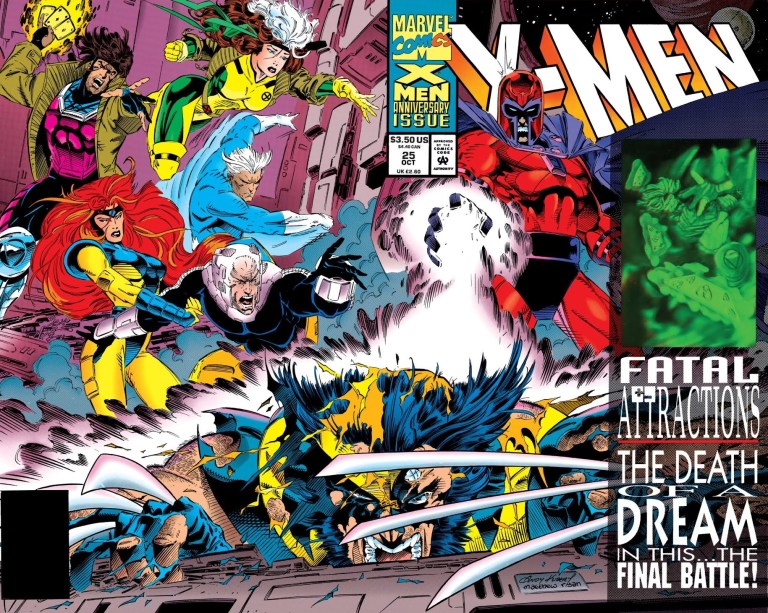
The one 30th anniversary celebration comic book of the X-Men that was most memorable to me was X-Men (Volume 2) and to this day, its plot remains very memorable for its shock value. I bought my copy of this comic book at a store in BF Homes. With the history lesson over, he is my retro review of X-Men , published in 1993 by Marvel Comics with a story written by Fabian Nicieza and drawn by Andy Kubert.

The cover.

Early story

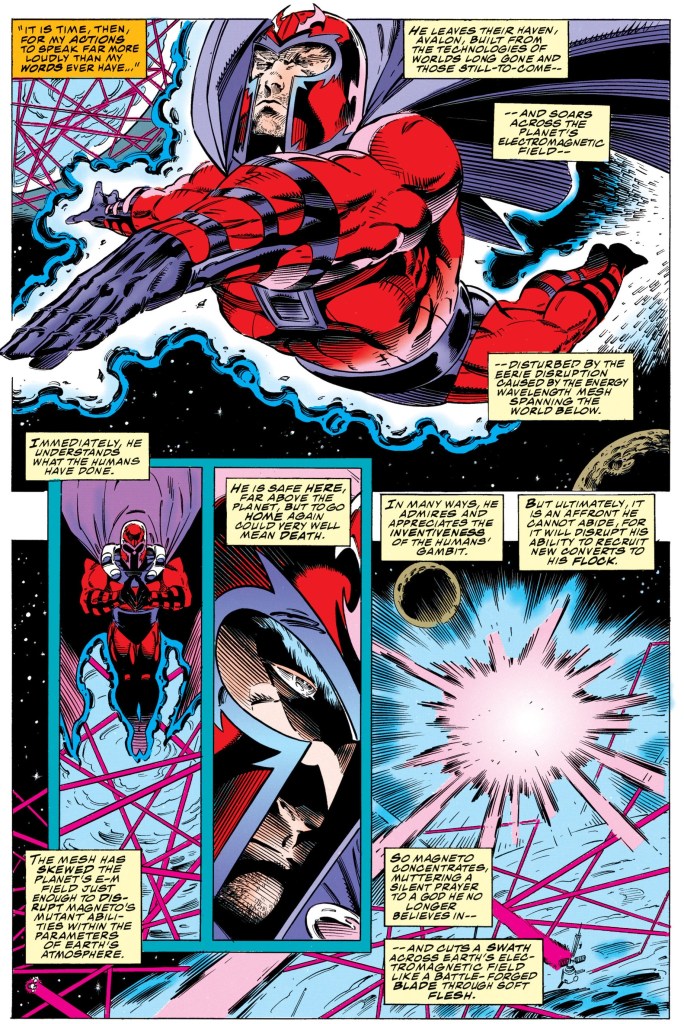
The story begins with the United Nations Security Council’s approval to initiate the alpha and beta parameters of the Magneto Protocols which literally sent waves from the White House to the Kremlin. A short time later, several satellites orbiting the Earth activate and linked with each other to form a protective mesh of electro-magnetic fire. This provokes Magneto (accompanied by Acolytes and Exodus at Avalon) to react by generating a massive pulse wave that affects the entire world. Even the Fantastic Four and Excalibur were not spared.

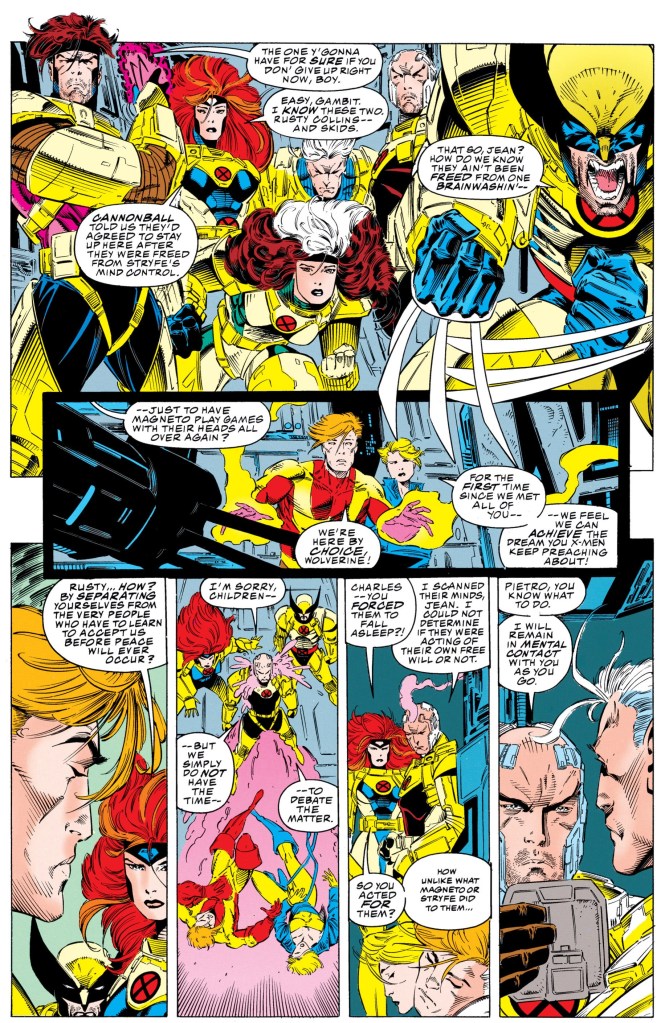
At the School of Gifted Children, Charles Xavier organizes an urgent meeting with the X-Men. Together they discussed the impact of Magneto’s pulse wave which not only rendered world’s mechanical and technological resources useless but also caused trouble (plane crashes, medical equipment failure, etc.) and deaths. For Xavier, the mere fact their team survived (aided by Shi’ar technology) is a mistake on the part of Magneto considering his capability to wipe out life around the world.

In response to Wolverine’s question, Xavier stated, “We do not have the luxury of time, nor the occasion for nobility…at this point, we are not fighting for the philosophy of a cause, a hope, or a dream, we are fighting for our very survival and if we do not win this fight, this planet will be irrevocably lost to us!”

Quality

The X-Men during their daring mission.

I can clearly declare that when it comes to the combined works done by Fabian Nicieza and Andy Kubert with the X-Men, this particularly story was not only the most ambitious collaboration of theirs but also their most compelling and finest work at the time of publishing. Very strong writing (top-notch characterization, plotting and pacing) and great art really defined this comic book!

Characterization is spot-on! Wolverine is arrogant and gritty as usual, Gambit is still the smooth-talker, Cyclops is the focused leader serving under Xavier, etc.

Without spoiling the major details, I can say that the shocking moments executed were greatly done not for the mere intention of shocking but to break new ground with regards to the characters of Wolverine and Charles Xavier. The first time I read this comic book back in 1993, I was really stunned with those particular scenes and I started to question Wolverine’s durability as well as Xavier’s sanity. And then there was the state of Magneto at the end of the story. The thing about the shocking moments was that there was an adequate amount of build-up leading to them and the pay-off was excellently done.

Conclusion

The immense power of Magneto.

There is no doubt in my mind that X-Men (1993) is the true gem of the entire X-Men 30th anniversary celebration. The creative team led by Nicieza and Kubert really outdid themselves and what happened in this comic book had consequences that lasted for a good number of years. The creative team took big risks and pulled them off nicely as the impact of the story was eventually felt in the years that followed. Lastly, unlike Uncanny X-Men (supposed to be the highlight of X-Men’s 30th anniversary celebration), this comic book is more focused and really had no creative baggage nor filler that got in the way of the storytelling.

If you are seriously planning to buy an existing hard copy of X-Men (1993), be aware that as of this writing, MileHighComics.com shows that the near-mint copy of the regular edition costs $50 while the near-mint copy of the newsstand edition is priced at $150. The near-mint copies of the signed-and-numbered edition and the gold edition cost $210 and $368 respectively.

Overall, X-Men (1993) is highly recommended!

+++++

Thank you for reading. If you find this article engaging, please click the like button below and also please consider sharing this article to others. If you are looking for a copywriter to create content for your special project or business, check out my services and my portfolio. Feel free to contact me as well. Also please feel free to visit my Facebook page Author Carlo Carrasco and follow me at HavenorFantasy@twitter.com