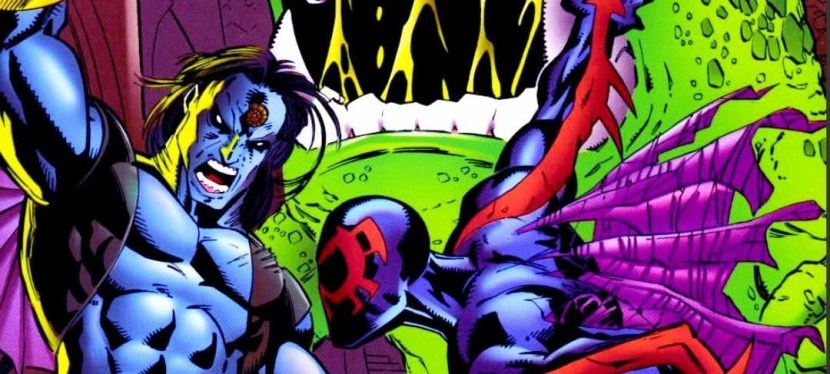
A Look Back at Spider-Man 2099 #44 (1996)

Welcome back superhero enthusiasts, 1990s culture enthusiasts and comic book collectors! Today we go back to the year 1996 and explore a part of the Marvel Comic shared universe through a tale of the Spider-Man 2099 monthly series.

To put things in perspective, the original Spider-Man 2099 monthly series that launched in 1992 lasted a total of 46 issues. The prolific author Peter David wrote the first 44 issues as he resigned from his duty in relation to the sudden firing of Marvel 2099 editor Joey Cavalieri in 1996. The previous issue was a great read.

With those details laid down, here is a look back at Spider-Man 2099 , published in 1996 by Marvel Comics with a story written by Peter David and drawn by Ron Lim.
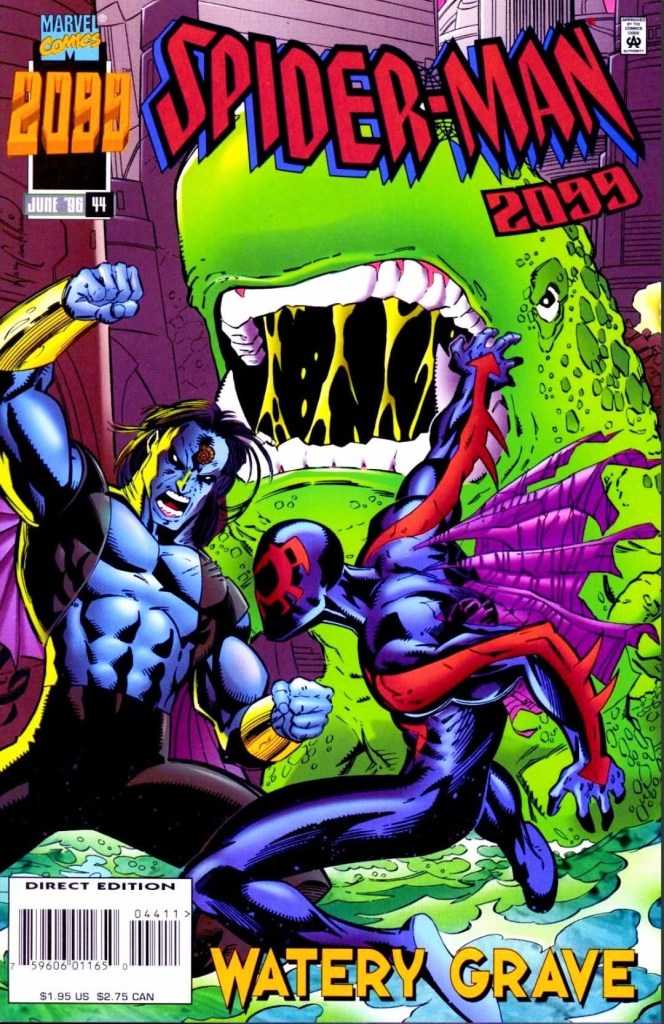
The cover.

Early story

The story begins in the City of New York already flooded and infiltrated by lots of marine life. Under the water, Spider-Man and Roman the Sub-Mariner fight each other intensely as the foot of a gigantic sea monster is about to step in. At the last moment, Spider-Man saw the huge foot and instantly flipped away to survive with the Sub-Mariner.

After getting separated, Spider-Man gets out of the water to breath and immediately spots an organic-looking horn that the Sub-Mariner used to control the huge monster. Suddenly, on the aquatic humanoids appears to get the horn. Spider-Man then used his web to get the horn first which triggered the aquatic humanoid to move fast towards him.

Quality
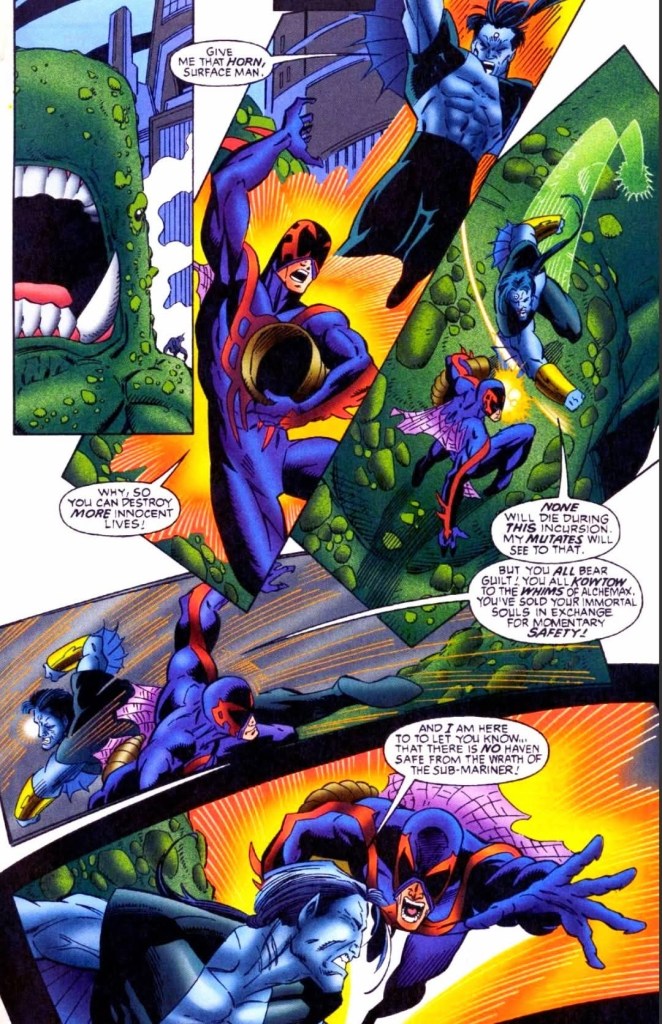
The intense battle between Sub-Mariner and Spider-Man went on even as the huge sea monster is very near them in the city.

Without spoiling the plot, this comic book is a tale about a massive disaster and also a tale about the complicated legacy of Miguel O’Hara whose personal life is even more connected with the corporation he works for.

The huge disaster of New York getting flooded (which started in the previous issue) and Spider-Man fighting the leader of the mutates (genetically designed sentient beings) concluded in a really satisfying way. The futuristic webslinger really found himself struggling with the determined Sub-Mariner (motivated by what Alchemax did to the aquatic world) while dealing with the fact that so many citizens got displaced or even got killed by not only the huge flood but also by the presence of the gigantic sea monster. The stakes were really raised high for Spider-Man and the pay-off was really good.

The rest of the comic book deals with the intense meeting between Conchata O’Hara and Tyler Stone, Xina’s time with the Net Prophet, Gabriel O’Hara’s time with “father” Jennifer. Among the three sub-plots, the conflict between Conchata and Tyler is very intense and dramatic to read. More importantly, it was crafted by Peter David to be really believable and it ultimately added tension to the background and even the future of Miguel O’Hara (now a powerful Alchemax executive). This particular sub-plot is easily the most important one this comic book has and it will compel fans to revisit the 25th issue of this monthly series as well as issue #10.

While the sub-plot of Xina and the Net Prophet does not generate enough depth for this comic book, there is a big revelation made in the sub-plot of Gabriel and “father” Jennifer which will compel fans to revisit issues #40 and #41. In fact, nothing is ever simple regarding the origin of a specific villain of the 2099 universe.

When it comes to the artwork, this comic book is a downgrade compared to what was presented in issue (drawn by Andrew Wildman). I’m not saying that Ron Lim’s art is bad, it’s just nowhere as good as that of Wildman’s art. In fairness, Ron Lim managed to make the city disaster look intense and he managed to make the characters look recognizable. In fact, Lim successfully made the Conchata-Tyler scenes look intense and dramatic.

Conclusion
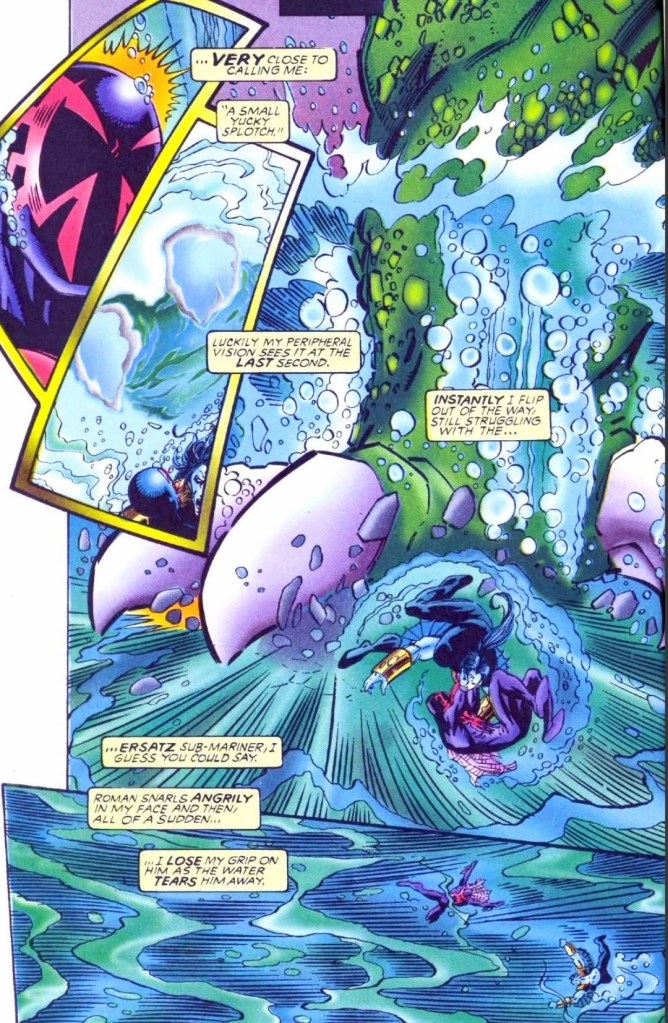
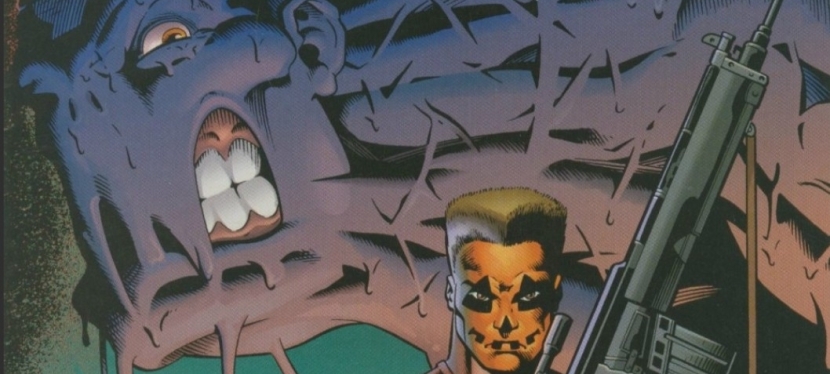
The giant monster aspect of this comic book added intensity to the battle and the disaster. There were a few Godzilla vibes here and there.

As the final Peter David-written issue of this monthly series, Spider-Man 2099 (1996) is undeniably a very solid reading experience. There were strong pay-offs executed here to what was built-up in the previous issues, and in typical fashion, David kept building up the other sub-plots. The conclusion to the Conchata-Tyler sub-plot is actually more powerful than that of the city disaster. Clearly, Peter David kept track of the character developments and events that previously happened and dramatized them nicely here. In fact, you will feel some sympathy towards Miguel O’Hara knowing how unfortunately complicated his family legacy really is.  

Overall, Spider-Man 2099 (1996) is highly recommended!

+++++

Thank you for reading. If you find this article engaging, please click the like button below, share this article to others and also please consider making a donation to support my publishing. If you are looking for a copywriter to create content for your special project or business, check out my services and my portfolio. Feel free to contact me with a private message. Also please feel free to visit my Facebook page Author Carlo Carrasco and follow me on Twitter at  @HavenorFantasy as well as on Tumblr at https://carlocarrasco.tumblr.com/ and on Instagram at https://www.instagram.com/authorcarlocarrasco

Better than Streaming: Do you have Godzilla (1954) Criterion Blu-ray in your collection?

Welcome back, fellow geeks, Blu-ray collectors and movie buffs! Way back in 1954, the original Godzilla movie (Japanese title: Gojira) made its debut in theaters in Japan. Not only did it make a huge impact with moviegoers, it paved the way for more Godzilla movies (which compelled Hollywood players to join in), imitators and made a solid contribution to global pop culture.

Of course, the original Godzilla film was decades before I was even born and as a boy, I got to watch on home video “Godzilla 1985” which was a Westernized version of The Return of Godzilla (1984). Then in 1998, I saw Roland Emmerich’s twisted version of Japan’s giant monster.

Going back to the original film from 1954, an American version of it was released in 1956 under the title Godzilla: King of the Monsters which was a recut version that had actor Raymond Burr in it as an American journalist witnessing events. That American version, which I saw partially by chance on cable TV, only made me want to see the 1954 original Godzilla movie intact.

That being said, I acquired a copy of the Godzilla (1954) Blu-ray from Criterion Collection and I can say I am really enjoying it. It definitely is a very good addition to my collection of Blu-ray movies.

The cover of the Godzilla (1954) Blu-ray release from Criterion Collection.

To begin with, posted below are the specs from the Blu-ray.com page…

The back of the Criterion Collection Godzilla (1954) Blu-ray. Pay close attention to the details because you will get a lot of stuff to enjoy with this one added into your Blu-ray movie collection.

I really enjoyed the 1954 movie directed by Ishiro Honda and I can talk more about it in detail in a future retro movie review. Going back to Criterion’s Godzilla (1954) Blu-ray, I can say that the company did a great job not only with the restoration and audio, they also loaded the disc with a whole lot of content that will appeal strongly with dedicated Godzilla fans as well as the newcomers who wish to learn more about Japan’s giant monster, its legacy and place in global pop culture. The disc also has a restored copy of Godzilla: King of the Monsters (1956) but I strongly recommend you watch the 1954 film first and foremost.

The extra stuff in the disc contains a lot of content for you to enjoy. There are interviews with certain cast and crew members, an illustrated audio essay about the tragic Lucky Dragon No. 5 vessel, an audio commentary by David Kalat, and more.

When it comes to the physical aspect of Criterion’s Godzilla (1954) Blu-ray, the packaging is both nicely done and inspired. I just love it whenever I opened the set to get to the disc, an image of Godzilla folds and forms in shape for your viewing pleasure. The set also has a booklet that contains really interesting information. Very clearly, this is so much better than streaming!

I really like this excellent packaging by Criterion Collection. Very clearly better than streaming!

In case you are interested or if you have made up your mind, you can order a copy of Godzilla (1954) Blu-ray of Criterion Collection by clicking https://www.amazon.com/Godzilla-Criterion-Collection-Blu-ray-Takashi/dp/B005VU9LKE

For the dedicated Godzilla fans as well as enthusiastic film buffs and collectors of movies on physical media, Criterion’s Godzilla (1954) Blu-ray is highly recommended! This is currently the best way to enjoy the classic movie in the comfort of your home!

If you wish to join a group of movie enthusiasts and talk about cinema, visit the Movie Fans Worldwide Facebook group at https://www.facebook.com/groups/322857711779576

+++++

Thank you for reading. If you find this article engaging, please click the like button below, share this article to others and also please consider making a donation to support my publishing. If you are looking for a copywriter to create content for your special project or business, check out my services and my portfolio. Feel free to contact me with a private message. Also please feel free to visit my Facebook page Author Carlo Carrasco and follow me on Twitter at  @HavenorFantasy as well as on Tumblr at https://carlocarrasco.tumblr.com/ and on Instagram at https://www.instagram.com/authorcarlocarrasco

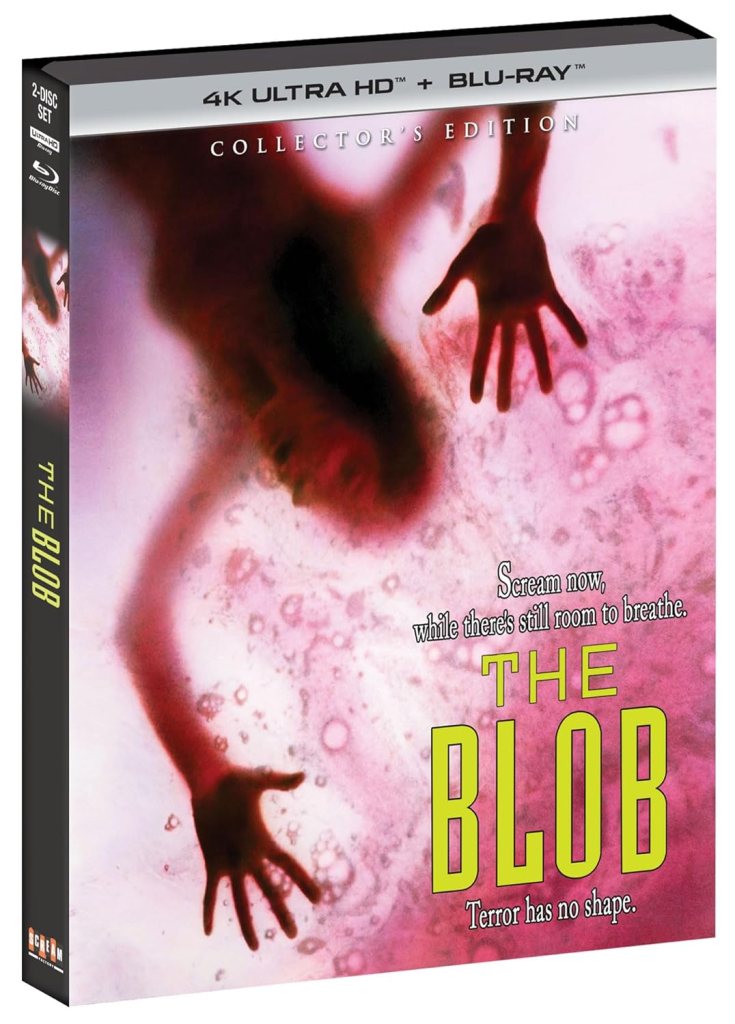
Better than Streaming: The Blob (1988) Collector’s Edition 4K Blu-ray now available

Welcome back, fellow geeks, Blu-ray collectors and movie buffs! Back in the late 1980s, I saw the 1988 version of The Blob – let’s refer to it as The Blob (1988) – on home video and it turned out to be a fine mix of thrills, scares and science fiction concepts that ultimately became fun to watch. Being young at a time when Internet connection and online research were not yet available, I was not even aware that The Blob (1988) was a remake of the 1958 original Blob movie that starred Steve McQueen.

If you who love the late 1980s Blob movie and if you have been looking to add something to your home entertainment collection of Blu-ray and 4K Blu-ray movies, be aware that the Collector’s Edition 4K Blu-ray of The Blob (1988) is now available in the market and you can order it online right now and have it delivered to your home. The new release by Shout Factory! is loaded with features and it has native 4K visuals.

The Blob (1988) 4K Blu-ray cover.

To put things in perspective, posted below are the technical specs from The Blob (1988) 4K Blu-ray page at Blu-ray.com. The said website highly recommended it in its review.


Video

Codec: HEVC / H.265 (84.99 Mbps)
Resolution: Native 4K (2160p)
HDR: HDR10
Aspect ratio: 1.85:1
Original aspect ratio: 1.85:1


Audio
English: DTS-HD Master Audio 5.1 (48kHz, 24-bit)
English: DTS-HD Master Audio 2.0 (48kHz, 24-bit)


SubtitlesEnglish SDH

Discs4K Ultra HD, Blu-ray Disc, Two-disc set (1 BD-100, 1 BD-50)

PackagingSlipcover in original pressing, Reversible cover

Playback4K Blu-ray: Region free, 2K Blu-ray: Region A 

Having seen both the 1958 and 1988 versions of The Blob, I can say to the newcomers and movie buffs reading this that you can’t go wrong with either version. I enjoyed both movies and I can say that each film has distinctive attractions for viewing. The Blob of 1958 is more sci-fi and has very little horror elements.

However, if you want thrills, the 1980s culture, stronger horror elements, stronger sci-fi elements, the creative approach done by director Chuck Russell and Frank Darabont on reimagining The Blob‘s concept, and the great-looking practical effects (note: the blob effects were made with physical stuff and a lot of man-made work without computers), then The Blob (1988) is the definitive choice. Take note I mentioned thrills as the movie has some fast-paced scenes that happen from time to time as you watch it. Considering its use of sci-fi concepts mixed with action, The Blob (1988) really stood out among the many horror movies released by Hollywood throughout the 1980s. I should also state that the remake has Kevin Dillon, Shawnee Smith, Jeffrey DeMunn, Joe Seneca, Candy Clark and Donovan Leitch Jr. in its cast.

As a 4K Blu-ray collector, I plan to acquire a copy of The Blob (1988) 4K Blu-ray in due time. I was already aware of the Blu-ray release from 2019 but I waited for the 4K version to be made.

In case you are interested or if you have made up your mind, you can order a copy of The Blob (1988) Collector’s Edition 4K Blu-ray right now by clicking https://www.amazon.com/Blob-Collectors-4K-UHD/dp/B0CC4N168B/ref=sr_1_2?crid=1IT5E0CSG6JIF&keywords=the+blob+4k&qid=1698124727&sprefix=%2Caps%2C262&sr=8-2 and at https://shoutfactory.com/products/the-blob-collector-s-edition?variant=40206057111686

If you want the best enjoyment possible from watching The Blob (1988) Collector’s Edition 4K Blu-rayI highly recommend you avoid watching movie reaction videos and the spoileriffic retro movie reviews posted by YouTubers.

If you wish to join a group of movie enthusiasts and talk about cinema, visit the Movie Fans Worldwide Facebook group at https://www.facebook.com/groups/322857711779576

+++++

Thank you for reading. If you find this article engaging, please click the like button below, share this article to others and also please consider making a donation to support my publishing. If you are looking for a copywriter to create content for your special project or business, check out my services and my portfolio. Feel free to contact me with a private message. Also please feel free to visit my Facebook page Author Carlo Carrasco and follow me on Twitter at  @HavenorFantasy as well as on Tumblr at https://carlocarrasco.tumblr.com/ and on Instagram at https://www.instagram.com/authorcarlocarrasco

A Look Back at Sludge #8 (1994)

Disclaimer: This is my original work with details sourced from reading the comic book and doing personal research. Anyone who wants to use this article, in part or in whole, needs to secure first my permission and agree to cite me as the source and author. Let it be known that any unauthorized use of this article will constrain the author to pursue the remedies under R.A. No. 8293, the Revised Penal Code, and/or all applicable legal actions under the laws of the Philippines.

Welcome back, superhero fans, 1990s arts and culture enthusiasts and comic book collectors! Today we revisit the Ultraverse of Malibu Comics and examine one of its many stories told through an issue of the Sludge comic book series.

As seen in my previous Sludge retro review, the stakes were raised even higher and Sludge finds himself in the middle of a major conflict between the gangs of the city with the involvement of the group of the Pump. By this point, the titular character is not only desperate but also is getting torn between good and evil.

With those details laid down, here is a look back at Sludge , published by Malibu Comics in 1994 with a story written by Steve Gerber and drawn by Aaron Lopresti.

The cover.

Early story

The story begins with TV news coverage doing a recap of events that shook New York City and its people – the abduction of a drug mule, the destruction of a ship filled with illegal immigrants, the destruction in the cemetery left behind by a major conflict there, and the death of crime boss John Paul Marcello which involved action by Sludge.

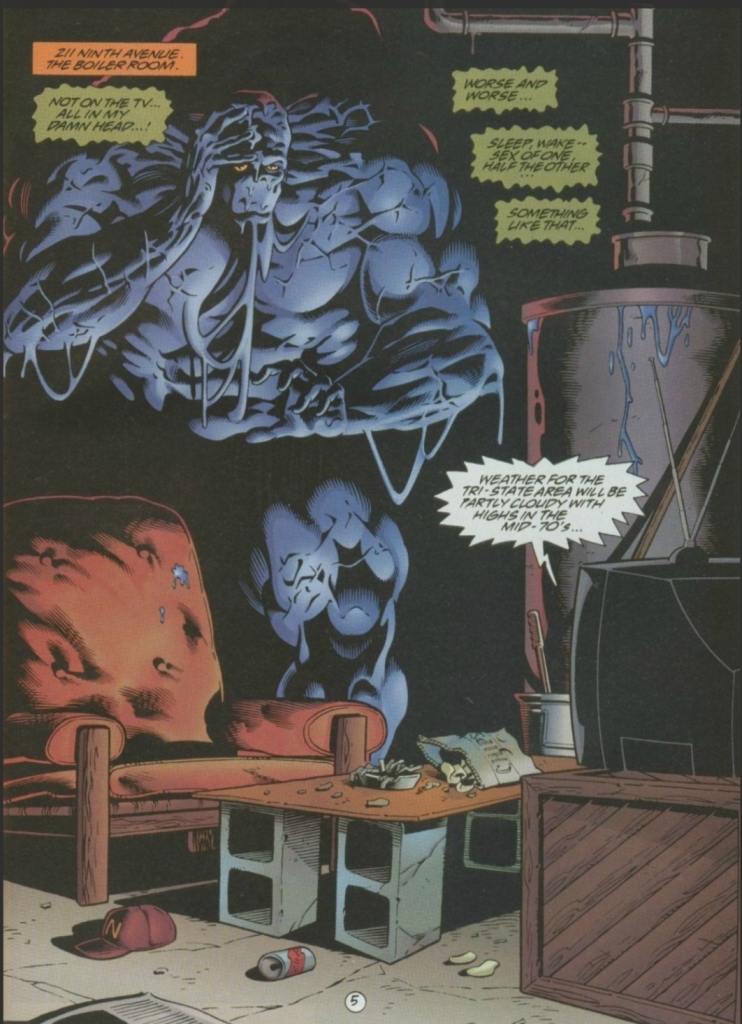
Sludge then wakes up from another nightmare and finds himself inside a boiler room which has a TV set and a chair. It turns out the place was set up by a janitor who does not even know Sludge is present. Slowly, Sludge sneaks his way back to the sewer.

At a cemetery, the burial of Marcello is being attended by many people and among them is Don Celini who regarded the late crime boss as a man of vision who made a lot of money for many people. Vittorio, the former loyal assistant to Marcello, is told by Don Celini to demonstrate leadership qualities to the heads of the other gangs. In the evening at a discreet place, Vittorio meets with Bloodstorm with a lot of money on the side…

The reporter Shelley on the pursuit for details.

Quality

To make things clear about the storytelling, the conflict between the crime gangs not only became more intense but also turned out quite intriguing. Clearly writer Steve Gerber carefully planned out the events, character developments and twists for this series. That being said, this comic book has a fine mix of suspense, crime story and even the supernatural for the narrative’s progress, and the good news is that these elements were presented in a believable way.

As presented in the previous issues, Sludge’s desperation and death wish will keep on intriguing you especially when he gets bothered by the Pump (arguably the most evil figure of the entire Ultraverse). Even as the war between gangs heat up, the story even had space for investigative journalism moments through the news reporter Shelley (who encountered Sludge in person before) whose pursuit for the facts remains unrelenting.

Conclusion

Sludge in a dark boiler room.

While the previous issue made me think deeply about the state of Sludge’s character and the gang war he became involved with, Sludge (1994) is an even more intriguing Ultraverse read complete with solid twists that must be seen. Without spoiling the story, this comic book will strongly resonate with readers who really started the Sludge series from issue (note: Bloodstorm’s involvement in this comic book will be more relevant if you have previously read his detailed introduction in issue #2). The current storyline – Street Wars – went significant steps forward in this story and I can say that the creative team of Gerber and Aaron Lopresti were successful in making me anticipate the conclusion.

Overall, Sludge (1994) is recommended.

+++++

Thank you for reading. If you find this article engaging, please click the like button below and also please consider sharing this article to others. If you are looking for a copywriter to create content for your special project or business, check out my services and my portfolio. Feel free to contact me with a private message. Also please feel free to visit my Facebook page Author Carlo Carrasco and follow me on Twitter at  @HavenorFantasy as well as on Tumblr at https://carlocarrasco.tumblr.com/ and on Instagram at https://www.instagram.com/authorcarlocarrasco/

A Look Back at Shin Godzilla (2016)

Disclaimer: This is my original work with details sourced from watching the movie and doing personal research. Anyone who wants to use this article, in part or in whole, needs to secure first my permission and agree to cite me as the source and author. Let it be known that any unauthorized use of this article will constrain the author to pursue the remedies under R.A. No. 8293, the Revised Penal Code, and/or all applicable legal actions under the laws of the Philippines.

There is no doubt that Japan’s fictional monster Godzilla (originally called as Gojira) made tremendous impact not only with the Japanese but also with other entertainment lovers around the world. Way back in 1954, the monster was portrayed as a destructive, walking symbol of nuclear weapons in the movie Gojira directed by the late Ishirô Honda.

As the years passed by, several more Godzilla movies were released by Toho Pictures. In 1998, an American-made movie about Godzilla was finally made in a disappointing form directed by Roland Emmerich. In 2014, Warner Bros. and Legendary Pictures made a more respectful film of the monster under the direction of Gareth Edwards. In 2019, the follow-up Godzilla: King of the Monsters was released and I enjoyed it a lot more than its 2014 predecessor.

Before the 2019 movie was released, Toho in Japan released Shin Godzilla (alternate titles: Shin Gojora and Godzilla: Resurgence) which was the result of the 2014 movie’s success as well as the fact that there were no restrictions in the contract with Legendary Pictures for the Japanese studio to make their own domestic versions.

Due to its lack very limited presence in cinemas here in the Philippines in 2016, I was unable to watch it on the big screen. Fortunately, it was released locally on original DVD some time after and I got to watch it in the comfort of home.

With those details laid down, here is a look back at Shin Godzilla co-directed by Hideaki Anno and Shinji Higuchi (both best known for Neon Genesis Evangelion).

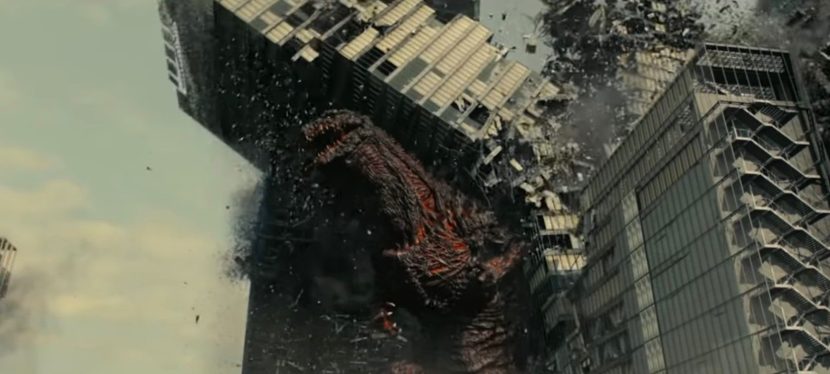
This is classic Godzilla.

Early story

The story begins at Tokyo Bay where the coast guard personnel found an abandoned yacht and searched inside. Suddenly a huge cloud of steam erupted from the ocean followed by blood-like water flooding the Tokyo Bay Aqua-Line. The tragedies compelled local authorities to take action starting with a committee meeting.

As emergency personnel save the victims in the damaged Tokyo Bay Aqua-Line, the tragedies reach the office of the Prime Minister who engages with many other government officials in an official meeting. They try to figure out what caused the incidents and, as such, theories and efforts to explain what happened were spoken until Deputy Chief Cabinet Secretary Rando Yaguchi (Hiroki Hasegawa) theorized that a living creature caused it (because he saw a viral video) which only resulted disbelief and dismissal.

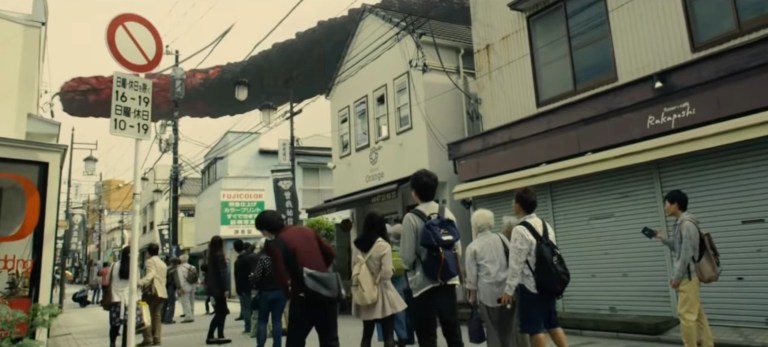
Suddenly a massive tail rises from the ocean which got captured in video and photographs by the news media which confirms Yaguchi’s hunch. As the Prime Minister and the team of officials spend more time discussing and searching for real experts (because the three scientists they just met did not produce any breakthroughs), a huge creature makes its way into one of Tokyo’s districts through a waterway causing massive damage and displacing many people as well as all boats that got in its way.  

In a press conference, the Prime Minister gave his assurance to the public that they need not worry about the creature coming to shore. Just after giving his assurance speech, an assistant approaches the Prime Minister with really bad news that the creature has been crawling inland and causing even more damage…

Quality

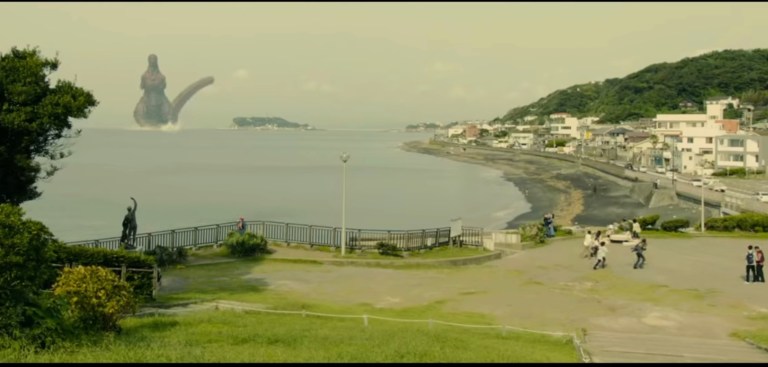
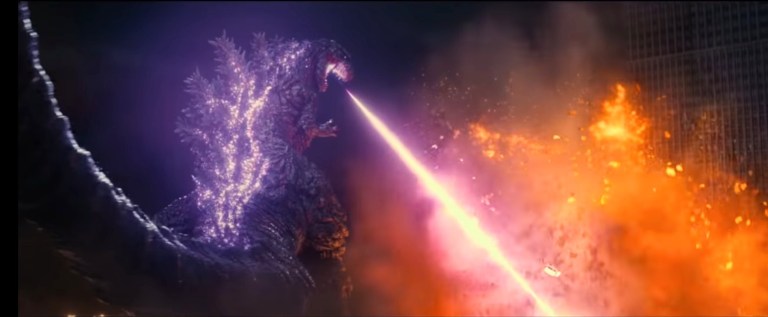
Japan’s iconic monster is not only terrifying here but also very deadly.

When it comes to presentation in comparison to all other Godzilla movies released, Shin Godzilla is very unique as it strongly brings to the viewers a very in-depth examination of the bureaucracy of the Japanese government complete with the many laws, requirements, rules and other elements of governance that made it so hard for the local authorities to respond to Godzilla’s invasion of the metropolis. There are key details that were raised such as the constitutionality of using local military force against the monster (which is not a foreign invader), which department should be in-charge of research about the same monster, etc.

Along the way, there is an overload of information – in terms of text, images and dialogue – that makes viewing quite a challenge. This makes watching Shin Godzilla a learning experience that viewers who are interested in governance and science will likely enjoy although it will alienate other moviegoers, especially those who only want to watch the spectacle of massive on-screen destruction that giant monster movies are known for. Going through all the exposition and explanations, and understanding most of it, however, will make the viewing experience worth it as these countless details do make sense in relation to Godzilla’s destructive impact on the people.

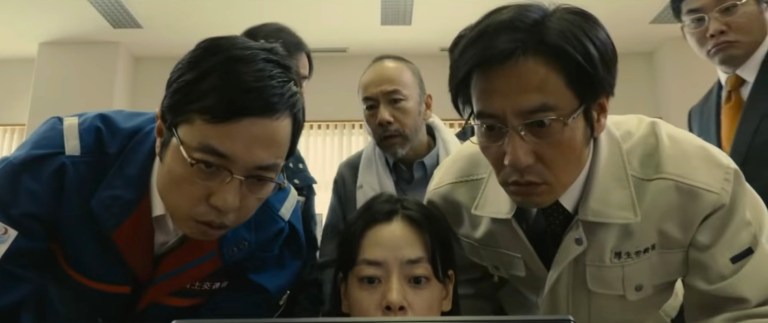
And then there is the huge cast of characters that needs to be followed. This is another big challenge for viewers because if one misses out on the key purpose a character has, then following the government’s efforts on dealing with Godzilla will make less sense. Not only will you have to follow the characters’ names, you will also have to remember their respective work titles. Apart from the government officials, there is also the huge batch of nerds and varied experts gathered by the government to do intense research. Again, those people need to be followed and remembered so you can understand what they do and how they contribute to their government’s efforts. When it comes to performances, they are collectively dramatic and you will be convinced of the pressure, the danger and uncertainty they face with Godzilla threatening Tokyo.

Better get used to seeing so many characters throughout the movie.
Hiroki Hasegawa as Rando Yaguchi.

As for the main spectacle of the movie, Godzilla, I can say that the monster here is very terrifying to watch. This is not your typical Godzilla as the Anno-Higuchi directorial duo really went all out with their creativity to remake Japan’s iconic monster into something new and deadly while still linking him creatively to the legacy of the classic Godzilla. There is even an element of evolution in this version of Godzilla and to see the Japanese military fire their expensive weapons at him really made a lot of spectacle to enjoy. I should also state that several scenes of disaster caused by the monster in this film were inspired by the tragedies of the Tōhoku earthquake and tsunami, and the Fukushima Daiichi nuclear disaster of 2011. Lastly, Godzilla here is really a super villain that is not only gigantic but also is made to be highly believable that it can destroy the nation, kill innocent civilians, demoralize the authorities and even bring Japan’s entire economy way down (note: one of the government officials explained the economic consequence of failing to defeat the monster).

When it comes to visual effects, this one is the best-looking Godzilla made by the Japanese yet! While the traditional approach of having an actor wear a rubber suit has been disregarded in favor of using modern, digital means (with motion capture), what the production team did here is very impressive as they focused strongly on having computer-generated graphics that are photo-realistic. While it is true that there were some moments of fake-looking CGI, the heavy photo-realism on the graphics of Godzilla (combined with strategic camera angles that really captured the scope and size of the monster) easily outweighed the weak spots. The lighting effects used for the laser blasts were very impressive, even competitive with what Hollywood has been doing. As for the scenes of destruction, a mix of CGI and practical effects (specifically miniatures) was used. In fact, certain scenes showing Godzilla interacting with the environment was done with pushing a prop through miniatures which resulted a high level of detail with organic and solid stuff.

The spectacle would not have been that effective, however, without the solid musical work done by Shiro Sagisu. Not only did the music add a lot to the intense sequences of Godzilla, it also brought out the sense of dread and horror out of the monster especially in the night-time scene when he was towering over a large section of Tokyo that lost power. Sagisu was also involved in Neon Genesis Evangelion.

Conclusion

The emphasis on photo-realism on the computer-generated effects is something special.

I can say it out loud that Shin Godzilla (2016) is truly a spectacle to watch complete with tons of heavy drama, tons of information and the widest cast of characters to date. It is a new version of the Japanese icon that really impresses and when it comes to movie intelligence, it easily outshines many other Godzilla flicks. While it has a lot of spectacle to keep moviegoers entertained, its heaviness with the information and large cast of characters could turn off viewers who are not used to thinking and paying attention to lots of details while watching a giant monster movie. Personally, I welcomed the information overload and made efforts on paying close attention to the details and the characters. It really takes patience and focus to truly make the most out of the story and the overall presentation.

Ultimately, I enjoyed this movie for what it is and what its message was about with regards as to how governments should respond to immense disasters, what is Japan’s place in the world of the 21st century and, most notably, what Godzilla means to Japan and the international community. This is a very solid modernization of Godzilla and the Anno-Higuchi deserve admiration.

If you are seriously planning to buy an existing hard copy of Shin Godzilla (2016), visit Amazon for the Blu-ray disc release and see if it has the right price and special features to satisfy you.  

Overall, Shin Godzilla (2016) is recommended!

+++++

Thank you for reading. If you find this article engaging, please click the like button below and also please consider sharing this article to others. If you are looking for a copywriter to create content for your special project or business, check out my services and my portfolio. Feel free to contact me as well. Also please feel free to visit my Facebook page Author Carlo Carrasco and follow me at HavenorFantasy@twitter.com

A Look Back at Prime #17 (1994)

Disclaimer: This is my original work with details sourced from reading the comic book and doing personal research. Anyone who wants to use this article, in part or in whole, needs to secure first my permission and agree to cite me as the source and author. Let it be known that any unauthorized use of this article will constrain the author to pursue the remedies under R.A. No. 8293, the Revised Penal Code, and/or all applicable legal actions under the laws of the Philippines.

Welcome back, superhero enthusiasts, comic book collectors and fans of the Ultraverse! By now, many of you should be familiar with Prime who was one of the main heroes of the Ultraverse as published in the 1990s by Malibu Comics. Many times in comics, Prime fought with lots of thugs, some very notable enemies (check out Prime #5), got involved with other notable ultras as part of a team (check out UltraForce #0 and #1), got involved awkwardly with ladies like Mantra and the mother of Kelly, and more.

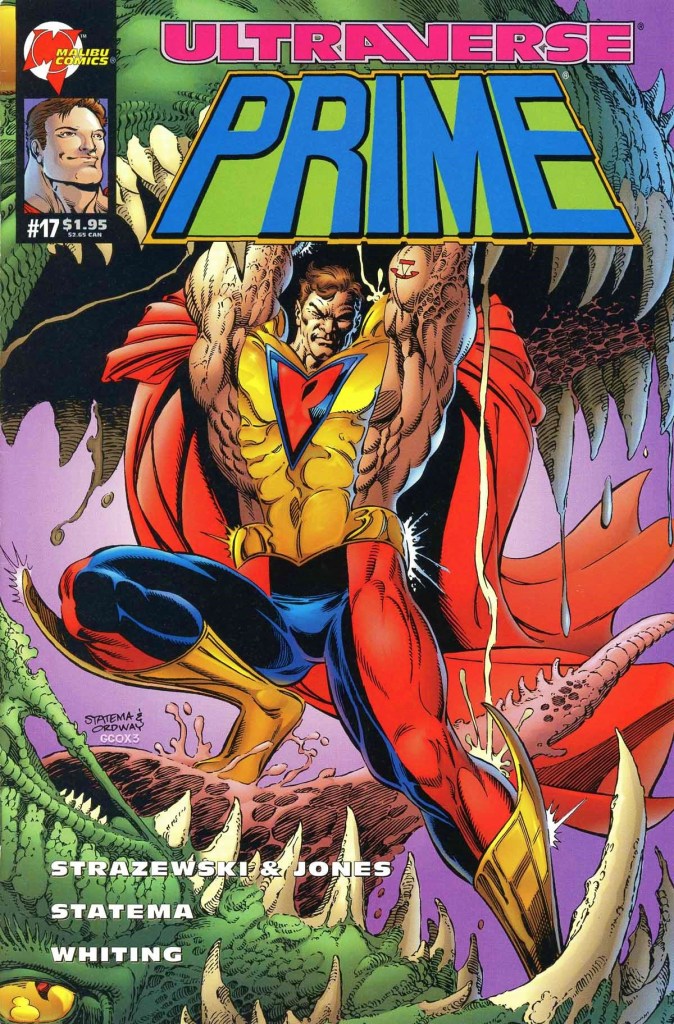
Surely, Prime (who is a teenage boy named Kevin under all the muscle) went through a lot. Now how about seeing the overly muscular ultra hero take on a monster about as large as Godzilla? We can all find out in this look back at Prime , published by Malibu Comics in 1994 with a story written by Len Strazewski and Gerard Jones, and drawn by John Statema.

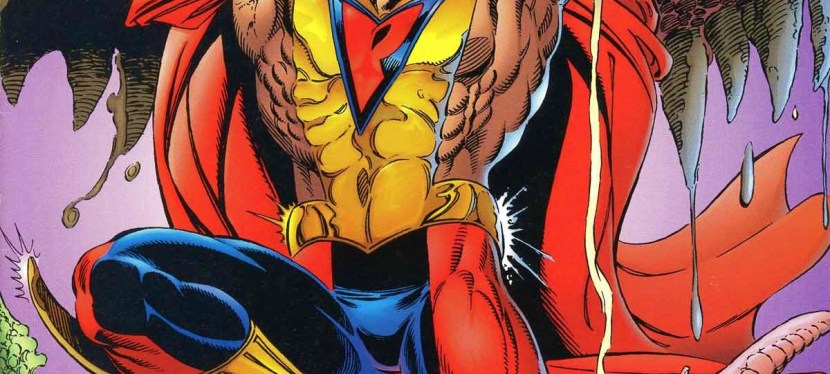
The cover.

Early story

The story begins somewhere on the bottom of the ocean. King Atalon raises an entire island to the surface of the sea claiming it will be new court of his and his people. Doing so, he releases a gigantic monster to the surface and immediately it encounters a ship. The monster grabs two men from the ship and eats them.

In the city of New York, Kevin Green and his mother have a meal together in a first-rate deli. His mother expresses her thoughts about how hard it was for him to move away from California at a short notice, leaving behind his school and his friends. She stressed that something had to be done in response to what happened to their family.

She recalled that Kevin’s father acted so strangely and left them. That being said, she did not want to make the situation worse by smothering him. Kevin thought to himself how could he tell her mother the truth that he and Prime are one and the same, and he went through different versions of his alter-ego each with a different attitude.

As Kevin and his mother traveled via the subway of the city, the giant monster in the Atlantic Ocean continues to create havoc moving towards New York…

Quality

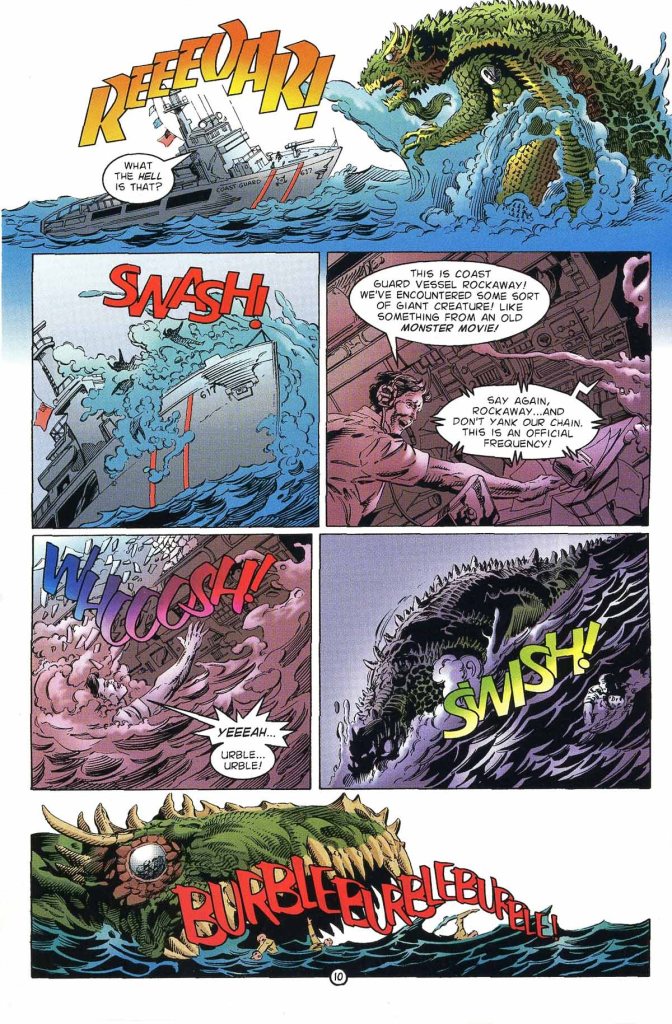
A possible Godzilla reference spotted.

From a storytelling point of view, this comic book felt like the start of a new chapter in the life of Kevin/Prime. The sudden relocation to New York sparked Kevin to look back at the events he went through in the past year which, in my opinion, helped serve as an exposition dump to help readers – especially new ones – catch up with all the details on Prime. It was also interested to learn that Kevin’s mother is from New York and her action on having themselves relocate all the way from the West Coast was convincingly done. I also like the drama that unfolded when the mother brought Kevin to a spot to view the Statue of Liberty from a distance only to be shocked and hurt over the fact that the statue’s head is missing. Through really nice dialogue, you can feel the mother’s pain.

The highlight of this comic book is the uncanny match-up between Prime and the Godzilla-sized monster. While the battle between them was not too long, showing Prime struggle with fighting the monster while thinking a lot about strategizing, searching for weaknesses and even expressing concern for his mother all added a good layer of depth to bother the hero and the encounter.

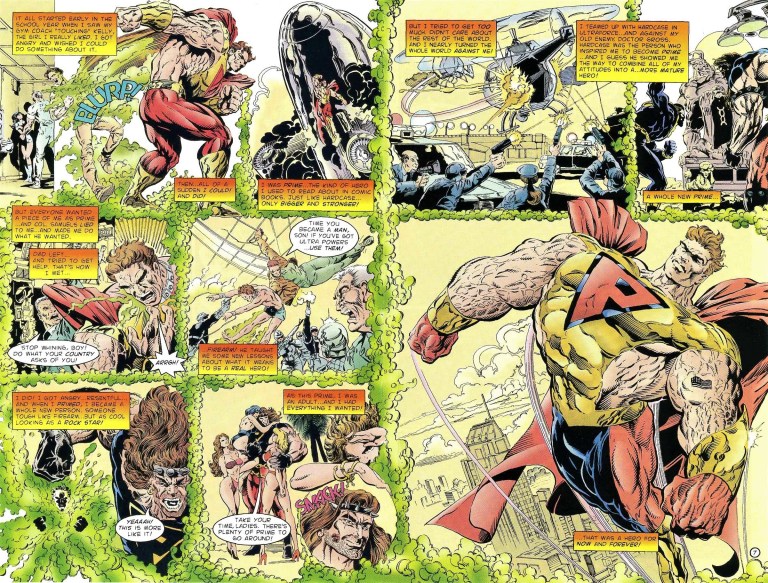
Visually, I like the work done here by John Statema. His art on the monster was clearly Godzilla-inspired but he gave it a unique look of its own, especially with the way he drew its scaled which Prime found to be very tough. I also enjoyed Statema’s take on the events that happened in Prime’s life as seen in the exposition dump early in the comic book.

Conclusion

The big exposition dump.

Prime (1994) is a fun read and definitely has the look and feel of a new turning point in the life of a superhero. It has excellent dialogue, a pretty nice build-up leading to the big battle between Prime and the monster, and most notably there is a good amount of dramatizing through Kevin’s mother.

If you are seriously planning to buy an existing hard copy of Prime (1994), be aware that as of this writing, MileHighComics.com shows that the near-mint copy of the comic book costs $8.

Overall, Prime (1994) is recommended.

+++++

Thank you for reading. If you find this article engaging, please click the like button below and also please consider sharing this article to others. If you are looking for a copywriter to create content for your special project or business, check out my services and my portfolio. Feel free to contact me as well. Also please feel free to visit my Facebook page Author Carlo Carrasco and follow me at HavenorFantasy@twitter.com