A Look Back at The Further Adventures of Indiana Jones #1 (1983)

Disclaimer: This is my original work with details sourced from reading the comic book and doing personal research. Anyone who wants to use this article, in part or in whole, needs to secure first my permission and agree to cite me as the source and author. Let it be known that any unauthorized use of this article will constrain the author to pursue the remedies under R.A. No. 8293, the Revised Penal Code, and/or all applicable legal actions under the laws of the Philippines.

Welcome back fellow geeks, pop culture enthusiasts and comic book collectors! I want to make things clear to all of you that when it comes to movies, Indiana Jones is truly an American icon who will be remembered for a long time thanks to the combined works of the legendary creative team of Steven Spielberg, George Lucas and Harrison Ford.

I love watching the films Raiders of the Lost Ark (1981), Indiana Jones and the Temple of Doom (1984), Indiana Jones and the Last Crusade (1989) and Indiana Jones and the Kingdom of the Crystal Skull (2008). While the respective qualities, artistry and fun factors of those films varied through the years, there is no denying that those are cinematic adventures worth replaying.

In case you are wondering, I have no intention to watch Indiana Jones and the Dial of Destiny (2023) since that movie was specifically handled by Kathleen Kennedy whose leadership of Lucasfilm (under the Disney banner) ruined Star Wars since 2015. It does not help that the new movie was not directed by Spielberg and clearly it does not involve George Lucas on the creative side. I should state that I reject wokeness, political correctness and identity politics which defined Kathleen Kennedy’s handling of Star Wars and Indiana Jones.

That being said, now is a good time to back into the 1980s when the Indiana Jones entertainment franchise was still new and creatively expanding into other forms of media. In fact, Marvel Comics started publishing an Indiana Jones comic book series between Raiders of the Lost Ark and Indiana Jones and the Temple of Doom.

With those details laid down, here is a look back at The Further Adventures of Indiana Jones #1, published in 1983 by Marvel Comics with a story written and drawn by John Byrne with ink work by Terry Austin.
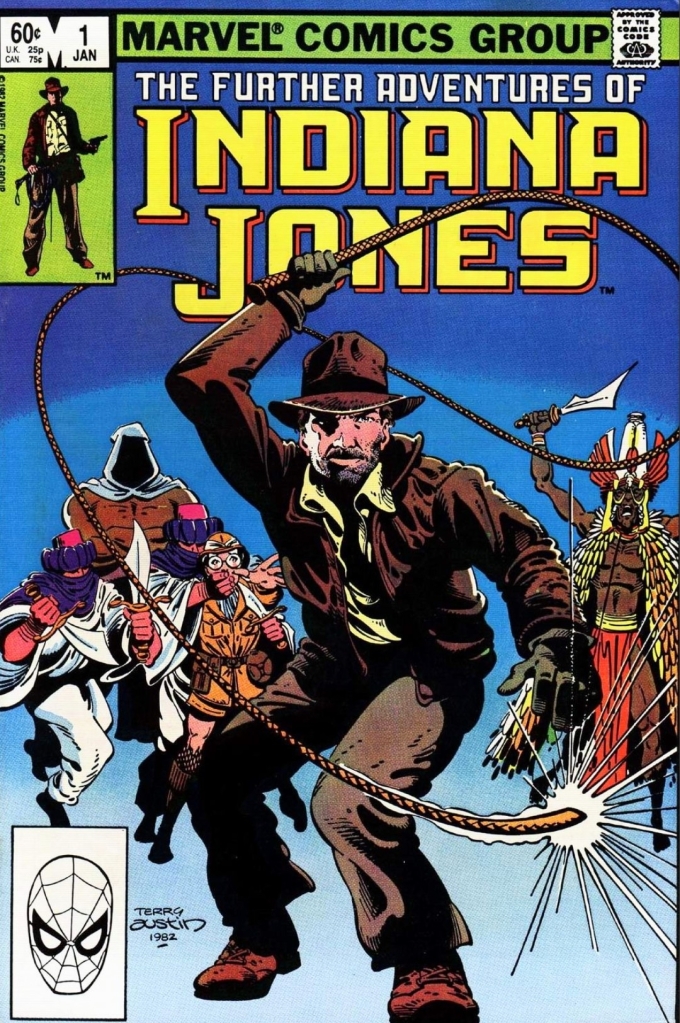
The cover.

Early story

The story begins with Indiana Jones (wearing formal attire for his academic profession) attempting to whip a small stick off the mouth of Miss Greebly who was standing very still. Jones’ superior Dr. Marcus came in to witness the stunt.

Shortly after, Jones and Marcus meet with former student Charlie Dunne who reveals to them he and his sister Edith learned the location of the Ikons of Ikammanen. Just seconds after stating he could prove that the ikons exist, Dunne suddenly gets hit on the back with a knife.

With Dunne suddenly killed and the discreet killer already gone, Jones and Marcus examine the content of the victim’s bag and find a map of coastal Africa, a photograph of a temple and an address…

Quality

Indiana Jones and Edith on a dangerous search.

I will start by stating the obvious thing about this comic book…it looks and feels like a genuine Indiana Jones adventure with clear inspiration taken from the 1981 movie. The basic elements are here: Indy does research and some detective work, he travels overseas searching for answers, faces danger along the way, and gets involved in a series of unexpected events. The good news is that John Byrne crafted a fun and high-quality literary adventure featuring the cinematic icon.

This comic book has an original story concept and deliberately the narrative flowed at a medium pace which allows build-up to immerse readers into the details, followed by some bouts of pay-off to entertain readers. I also like the way the narrations laid down the details with the intention of helping readers understand not only the situations, locations and people, but also giving them unique perspectives about Indy himself. The dialogue was well written and clearly believable. When Indiana Jones explains details, he really uses the knowledge he gained through academic research as well as recollections from his past expeditions or adventures.

I should also state that Byrne gave Indiana Jones, the other characters and locations stylized looks. I don’t mind Jones not resembling Harrison Ford at all but Byrne still made him recognizable in his own unique way. There were some location images that looked pretty detailed.

Conclusion

And just like that, Indiana Jones takes a leave from academic work for his next adventure.

The best way to describe The Further Adventures of Indiana Jones #1 (1983) is this…John Byrne and his team succeeded in making this a fun read inspired by elements of Raiders of the Lost Ark. The story has a strong adventure feel with Indy having a strong presence and the introduction of new characters were executed smoothly. For a launch issue, this one is indeed engaging to read and it succeeded in convincing me to anticipate the next issue. Ultimately it is clear that John Byrne really is an effective Indiana Jones storyteller.

Overall, The Further Adventures of Indiana Jones #1 (1983) is highly recommended!

+++++

Thank you for reading. If you find this article engaging, please click the like button below, share this article to others and also please consider making a donation to support my publishing. If you are looking for a copywriter to create content for your special project or business, check out my services and my portfolio. Feel free to contact me with a private message. Also please feel free to visit my Facebook page Author Carlo Carrasco and follow me on Twitter at  @HavenorFantasy as well as on Tumblr at https://carlocarrasco.tumblr.com/ and on Instagram at https://www.instagram.com/authorcarlocarrasco

A Look Back at Spider-Man 2099 Special #1 (1995)

Disclaimer: This is my original work with details sourced from reading the comic book and doing personal research. Anyone who wants to use this article, in part or in whole, needs to secure first my permission and agree to cite me as the source and author. Let it be known that any unauthorized use of this article will constrain the author to pursue the remedies under R.A. No. 8293, the Revised Penal Code, and/or all applicable legal actions under the laws of the Philippines.

Welcome back superhero enthusiasts, 1990s culture enthusiasts and comic book collectors! Today we go back to the year 1995 and explore a part of the Marvel 2099 comics universe through a tale of the Spider-Man 2099 franchise.

Specifically speaking, we will examine a thick one-shot comic book about the futuristic Spider-Man simply referred to as a special. Back in those days, Marvel Comics hired the famous Brothers Hildebrandt and among the projects they worked on were varied pieces of captivating art about Marvel’s 2099 universe. In relation to this particular retro comic book review, the Hildebrandt brothers made the cover art for the special comic book which contained three standalone stories.

With those details laid down, here is a look back at Spider-Man 2099 Special #1, published in 1995 by Marvel Comics with the main story “The Menace of the Man-Spider” written by Jon Peterson and drawn by Joe St. Pierre.

The cover.

Early story

The story begins at 1:45 AM inside the high-tech laboratory of Synthia when the Man-Spider (a human in a monstrous form of a huge spider) causes havoc and tries to hurt the personnel inside in response to their interference of his work. One of the troubled personnel manages to call for help as the Man-Spider tries to get them.

Just as the two workers get hit by the Man-Spider’s organic green web, armored elements of the security force arrived in response to the call and one of them fires a hot at the beast’s right arm causing a serious wound. Suddenly, the Man-Spider violently jumps away smashing through a large window going into the city. The Man-Spider escapes leaving behind a mess at the laboratory including a high amount of organic web that disgusts the people back there.

Hours later at another part of the city, Spider-Man got spotted by a floating drone which declares him as under arrest under the authority of the Public Eye. Spider-Man simply kept on swinging away to another destination until he uses his organic web on the drone and hurls it to a wall and explodes into several tiny pieces. Once alone, he changes into civilian clothes as Miguel O’Hara and rushes to Synthia’s facility…

Quality

A huge monster breaks out.

Focusing on the main story (the first story), I find this particular tale of Spider-Man of 2099 rather worthy to read even though there were some flaws here and there. Jon Peterson crafted a story that took place sometime before the 34th issue of the original Spider-Man 2099 monthly series while reflecting what was declared in issue #8 and building up something new with it. The main story was about Spider-Man getting into eventual conflict with the Man-Spider (note: it looks like someone at Marvel decided to copy DC Comics’ Man-Bat and make something new for the Marvel 2099 franchise) who in turn is an antagonist who is deeply troubled and yet not really evil. The Man-Spider is actually a man who does not have super abilities but rather high scientific intelligence and the capabilities to alter genetics using advanced technologies. The Man-Spider is not obsessed with destroying the world or murdering people, but achieving a major breakthrough backed with good intentions.

One of the most notable weaknesses of the script written by Peterson is the emphasis that Miguel O’Hara/Spider-Man 2099, Dana and the so-called resident mad scientist Antoine have a history together since their youth. This one felt very forced and ended up being unbelievable.

Still on the world-building aspect of the story, this comic book showed a true link between the company Synthia and the gigantic Alchemax which reflects what was state in issue #8. This link between the two corporations opened up opportunities for the creators to emphasize Alchemax’s moves on securing valuable stuff for the future.

Ultimately, the main story turned out to be a good read even though there were flaws that somewhat took away credibility from its core concept. I should also state that Joe St. Pierre established a rather unique look for the Spider-Man 2099 franchise. His work here is a nice alternative opposite Rick Leonardi’s Spidey 2099 art.

While the 2nd story of this one-shot was not worth reading at all, the final story has a unique concept exploring voyeurism in 2099 which accidentally reminded me about how social media in real life could ruin the public’s perception and people themselves.

Conclusion

Spider-Man 2099, Dana and the Man-Spider in a dangerous situation.

With a good enough main story, one forgetful 2nd story and a satisfactory third story, Spider-Man 2099 Special #1 (1995) is ultimately a mixed bag. You will find variety here as well as unique takes on the futuristic Spider-Man and 2099’s society from the creators, but don’t expect great stuff. I think the most die-hard Spidey 2099 and Marvel 2099 fans will enjoy this the most.

Overall, Spider-Man 2099 Special #1 (1995) is serviceable.

+++++

Thank you for reading. If you find this article engaging, please click the like button below, share this article to others and also please consider making a donation to support my publishing. If you are looking for a copywriter to create content for your special project or business, check out my services and my portfolio. Feel free to contact me with a private message. Also please feel free to visit my Facebook page Author Carlo Carrasco and follow me on Twitter at  @HavenorFantasy as well as on Tumblr at https://carlocarrasco.tumblr.com/ and on Instagram at https://www.instagram.com/authorcarlocarrasco

A Look Back at Amazing Spider-Man #385 (1994)

Disclaimer: This is my original work with details sourced from reading the comic book and doing personal research. Anyone who wants to use this article, in part or in whole, needs to secure first my permission and agree to cite me as the source and author. Let it be known that any unauthorized use of this article will constrain the author to pursue the remedies under R.A. No. 8293, the Revised Penal Code, and/or all applicable legal actions under the laws of the Philippines.

Welcome back superhero enthusiasts, 1990s culture enthusiasts and comic book collectors! Today we go back to the year 1994 and explore a part of the Marvel Comics universe through one of the many tales of the Amazing Spider-Man comic book series.

In my previous retro review, Spider-Man has been caught by the Jury and gets tried in a makeshift court that is so secretive, getting help from outside is impossible. The trial explored how Spider-Man, who brought the alien costume into their world which later led to the beginning of his murderous mortal enemy, is responsible for the deaths and other tragedies connected to Venom.

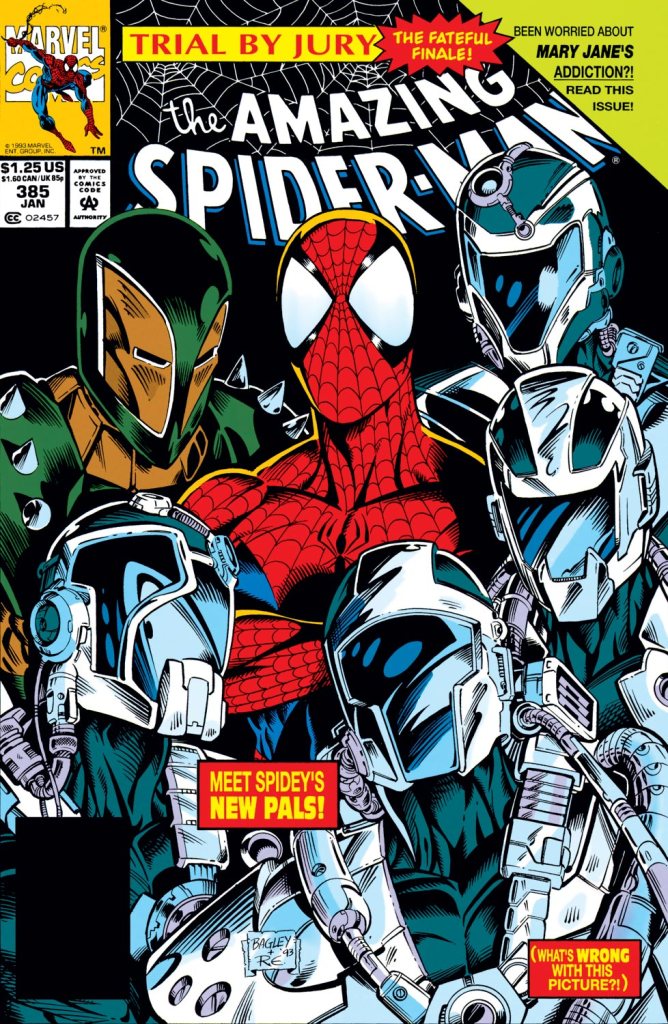
With those details laid down, here is a look back at Amazing Spider-Man #385, published in 1994 by Marvel Comics with a story by David Michelinie and drawn by Mark Bagley. This issue marks the final chapter of a 3-part storyline between the iconic webslinger and the Jury.

The cover.

Early story

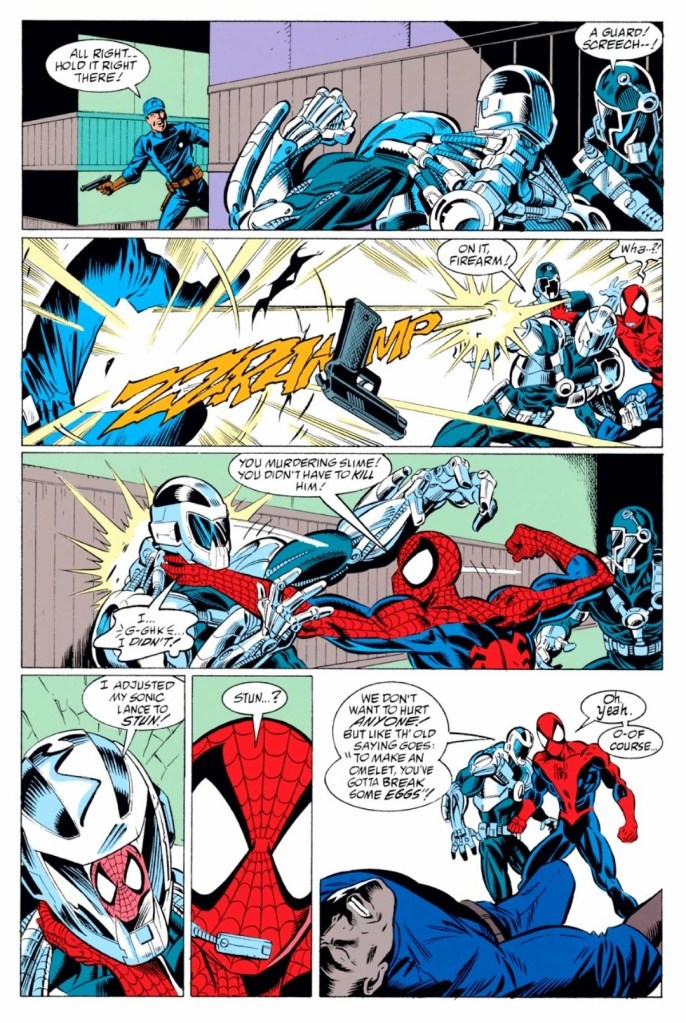
The story begins with a restrained Spider-Man declared guilty and sentenced to death by the so-called court of Orwell Taylor and the Jury. Just as the team members are about to execute the webslinger, their teammate Ramshot intervenes and says that Spider-Man saves lives which is a matter of public record. Disappointed by Ramshot’s behavior, Taylor mentions their secondary mission is to obtain a weapon that might allow them to eliminate their true enemy – Venom.

Taylor then says that if Spider-Man would help them destroy the greater evil, then the court would consider commuting his sentence…

Quality

Something unfortunate happens during the mission involving Spider-Man and the Jury.

Considering all the drama and tension that was built up in the previous two issues, the story here is a letdown. For one thing, all the discussions about Spider-Man being responsible for the killings and violence caused by Venom lead to nowhere as the story took a turn for the bizarre concept of the hero getting spared to work with the very team that went after him. Secondly, the mission that Spidey and the Jury worked on really did not have a justifiable goal. This resulted in a disappointing turn of events. Ironically, in this comic book you will see more of Taylor’s cunning on top of his own distorted view about justice.

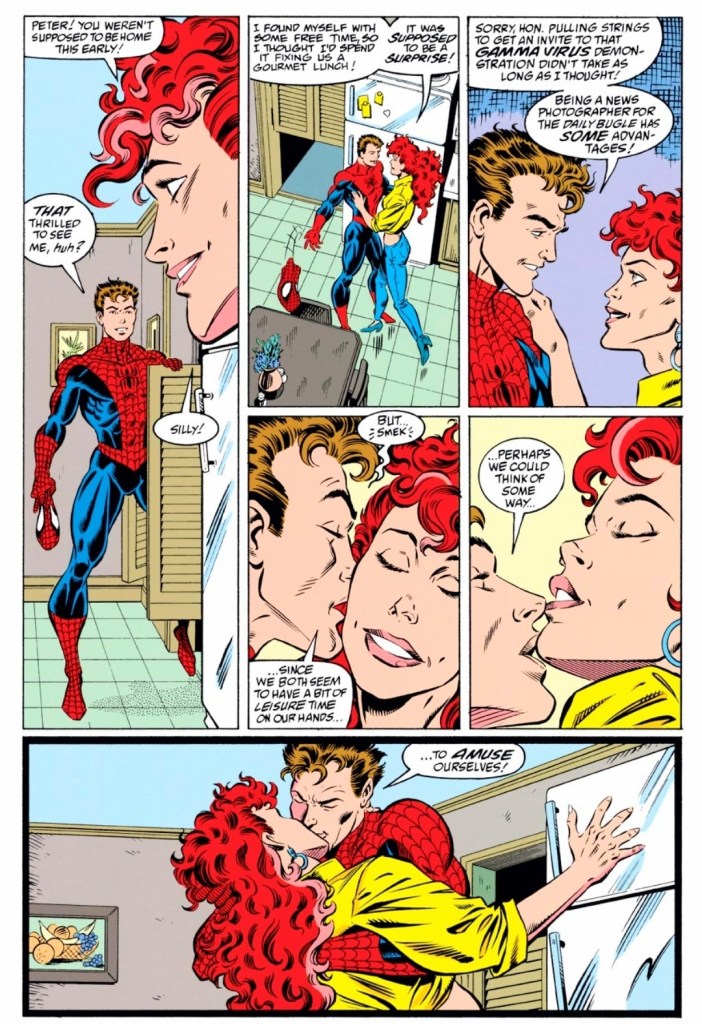
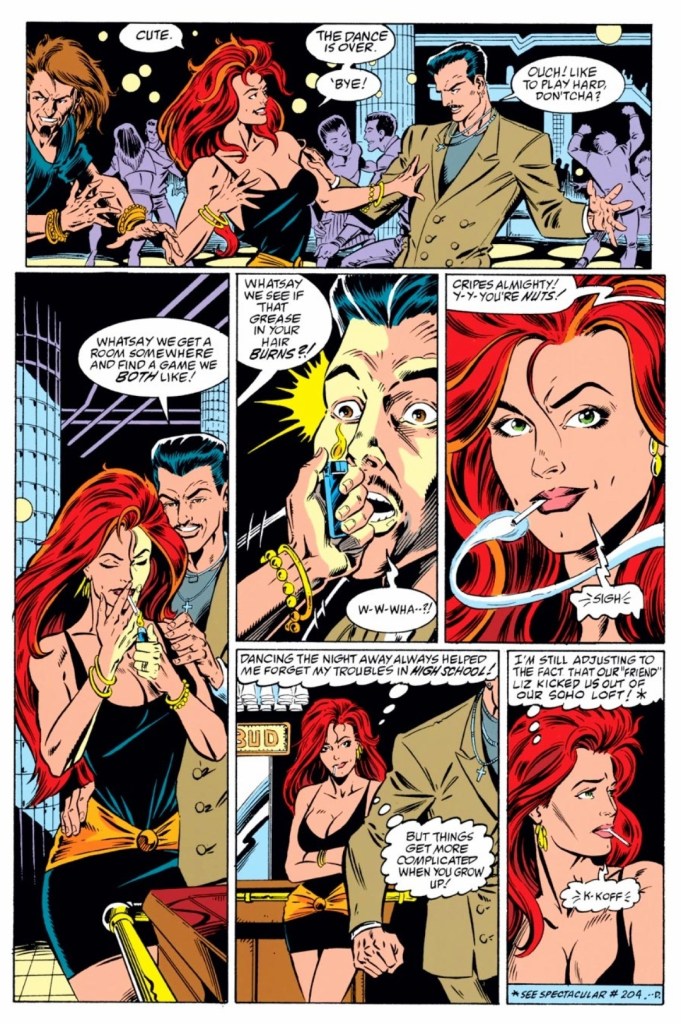
If there is anything notable here, it is the fact that Spider-Man’s wife Mary Jane gets a good share of the spotlight as she literally moves towards the edge in relation to the deteriorating marriage. This shows that as Spidey spends more time away to do what is good and push back against the forces of evil, his wife gets lonelier and desperate as life turns for the worse. At the very least, this comic book expresses that the marriage of Peter and Mary Jane could be doomed.

Conclusion

This is how Mary Jane deals with loneliness and the decline in her life.

Considering what was built up and heavily dramatized in issues #383 and #384, Amazing Spider-Man #385 (1994) is a rather weak conclusion. The way Spider-Man and the Jury parted ways felt more like sudden retreat than a real finish to what was started between them. Strangely enough, the focus on Mary Jane’s decline and desperation literally saved this comic book from becoming a creative disaster. The ending does not have much to do between Spider-Man and the Jury, but it was surprising in a crude way.

Overall, Amazing Spider-Man #385 (1994) is serviceable.

+++++

Thank you for reading. If you find this article engaging, please click the like button below, share this article to others and also please consider making a donation to support my publishing. If you are looking for a copywriter to create content for your special project or business, check out my services and my portfolio. Feel free to contact me with a private message. Also please feel free to visit my Facebook page Author Carlo Carrasco and follow me on Twitter at  @HavenorFantasy as well as on Tumblr at https://carlocarrasco.tumblr.com/ and on Instagram at https://www.instagram.com/authorcarlocarrasco

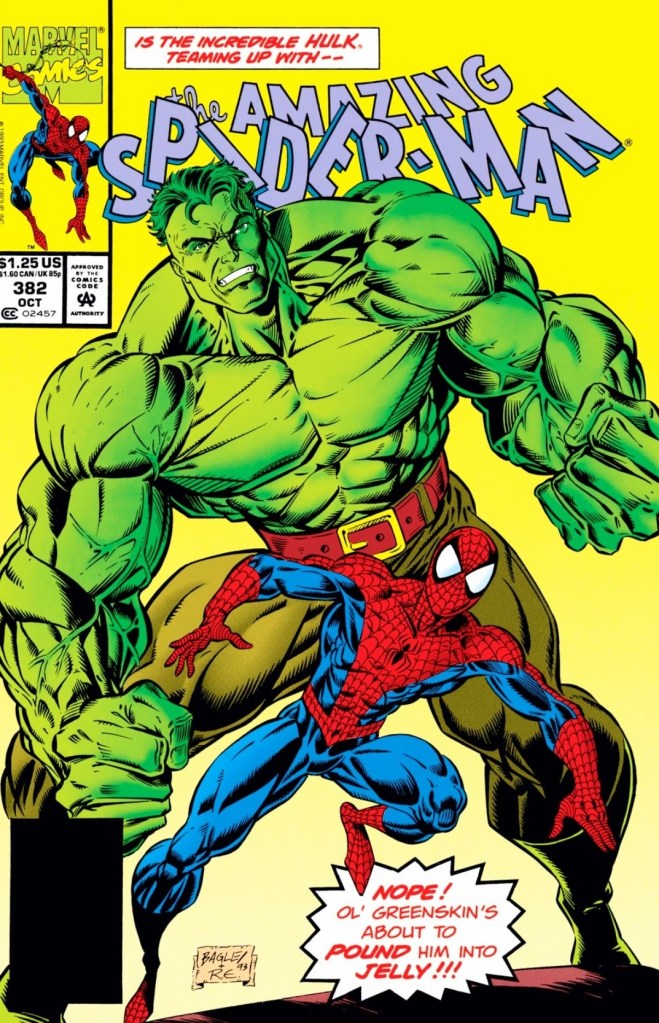
A Look Back at Amazing Spider-Man #382 (1993)

Disclaimer: This is my original work with details sourced from reading the comic book and doing personal research. Anyone who wants to use this article, in part or in whole, needs to secure first my permission and agree to cite me as the source and author. Let it be known that any unauthorized use of this article will constrain the author to pursue the remedies under R.A. No. 8293, the Revised Penal Code, and/or all applicable legal actions under the laws of the Philippines.

Welcome back superhero enthusiasts, 1990s culture enthusiasts and comic book collectors! Today we go back to the year 1993 and explore a part of the Marvel Comics universe through one of the many tales of the Amazing Spider-Man comic book series.

In my previous retro review, Spider-Man gets involved not only with the Incredible Hulk but also with Doc Samson who has a history of treating the green giant and carries a strong sense of responsibility towards him. Something, however, infected Samson and eventually the Hulk which leads to a new wave of destruction in New York City which itself is still recovering from the chaos of Maximum Carnage.

With those details laid down, here is a look back at Amazing Spider-Man #382, published in 1993 by Marvel Comics with a story written by David Michelinie and drawn by Mark Bagley.  

The cover.

Early story

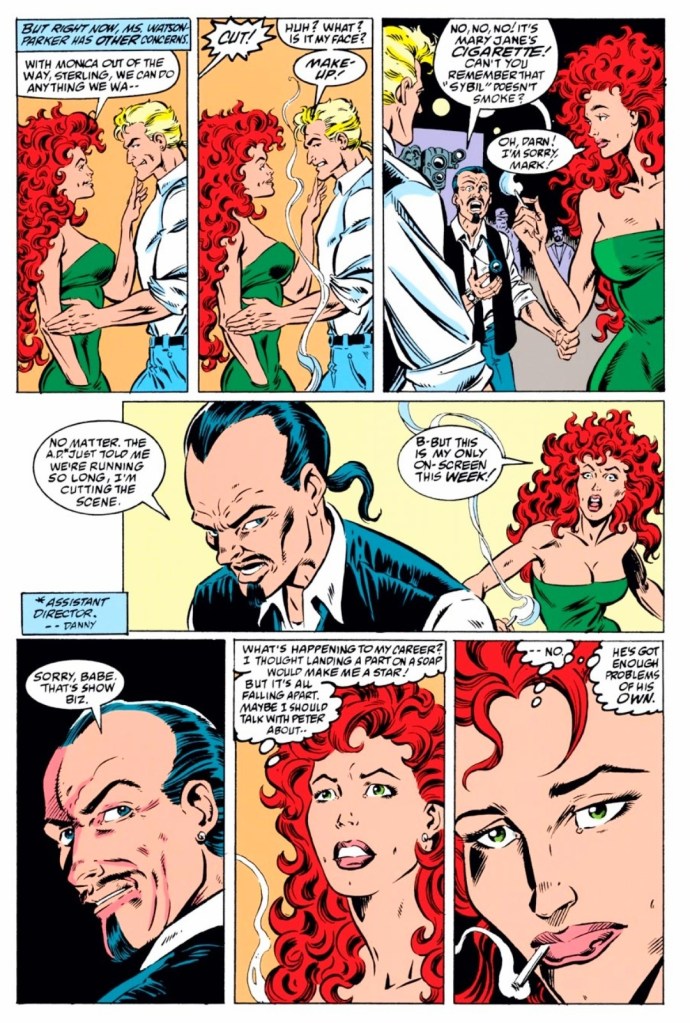
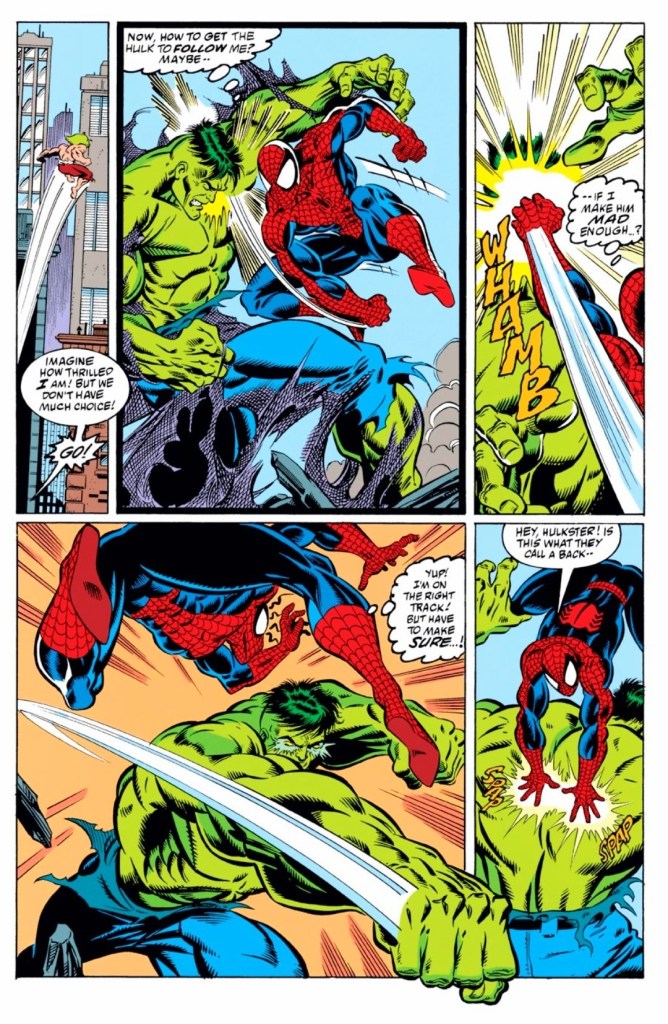
The story begins with the Hulk (note: infected with the gamma virus which is driving him to violence) striking the pavement hard causing Spider-Man and Doc Samson to move away. After a quick exchange of words with Samson regarding the virus, Spider-Man jumps towards the Hulk and hits his face in an attempt to stop him before he causes any more damage to the city.

Doc Samson desperately tries to contain the Hulk by choking him only to be grabbed and get thrown to a solid structure nearby. Now down on the pavement, Samson notices the Hulk jumping in towards him…

Quality

Mary Jane Parker in trouble with her acting career.

This story is indeed a solid and satisfying conclusion to what was started in issue #381. Not only does this comic book showcase a battle between Spider-Man and the manipulated Hulk, it also highlights Doc Samson’s importance not only as a supporting player but also as a scientist struggling with his responsibility over helping the Hulk. There is a strong sense of burden you will sense in Samson who himself caused a lot of damage when he was infected with the virus before the Hulk got infected by it.

The presentation of the virus/bacterium as the factor behind the chaos is a believable concept that highlights what would happen if people carrying gamma radiation in their bodies get infected by it.

If you are looking for fun, there is a lot of action here with lots of dynamic looking images crafted by Mark Bagley. Yes, you will see action and incidental moments between Spider-Man and the Hulk here and there, with Samson also getting a notable share of the spotlight. How the conflict concluded was cleverly done and ultimately surprising. This is something you readers will have to discover for yourselves.

Conclusion

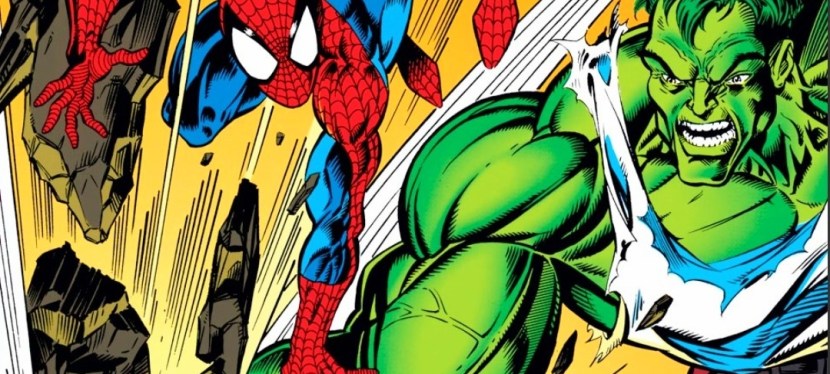
As Doc Samson goes away, Spider-Man takes on the Hulk.

Amazing Spider-Man #382 (1993) is a well-paced and satisfying conclusion to the events that started in the previous issue. At the time of its release, the comic book highlighted a modern crossover between the Hulk and Spider-Man with Doc Samson inserted as a functional third participant. The concept of the gamma virus/bacterium works well here and added a more science fictional layer to the plot. This comic book is pretty entertaining and the suspense really built-up nicely towards the climax.

Overall, Amazing Spider-Man #382 (1993) is recommended!

+++++

Thank you for reading. If you find this article engaging, please click the like button below, share this article to others and also please consider making a donation to support my publishing. If you are looking for a copywriter to create content for your special project or business, check out my services and my portfolio. Feel free to contact me with a private message. Also please feel free to visit my Facebook page Author Carlo Carrasco and follow me on Twitter at  @HavenorFantasy as well as on Tumblr at https://carlocarrasco.tumblr.com/ and on Instagram at https://www.instagram.com/authorcarlocarrasco
A Look Back at Amazing Spider-Man #384 (1993)

Disclaimer: This is my original work with details sourced from reading the comic book and doing personal research. Anyone who wants to use this article, in part or in whole, needs to secure first my permission and agree to cite me as the source and author. Let it be known that any unauthorized use of this article will constrain the author to pursue the remedies under R.A. No. 8293, the Revised Penal Code, and/or all applicable legal actions under the laws of the Philippines.

Welcome back superhero enthusiasts, 1990s culture enthusiasts and comic book collectors! Today we go back to the year 1993 and explore a part of the Marvel Comics universe through one of the many tales of the Amazing Spider-Man comic book series.

In my previous retro review, Spider-Man became the new target of The Jury, a team of armored mercenaries founded and led by the father (note: a prominent and powerful man) of one of Venom’s murder victims. Spider-Man was perceived to be responsible for bringing the living alien costume into the world which eventually resulted in the creation of Venom (note: Eddie Brock bonded with the same symbiote) who went on to cause havoc and killed a lot of people.

With those details laid down, here is a look back at Amazing Spider-Man #384, published in 1993 by Marvel Comics with a story by David Michelinie and drawn by Mark Bagley.  

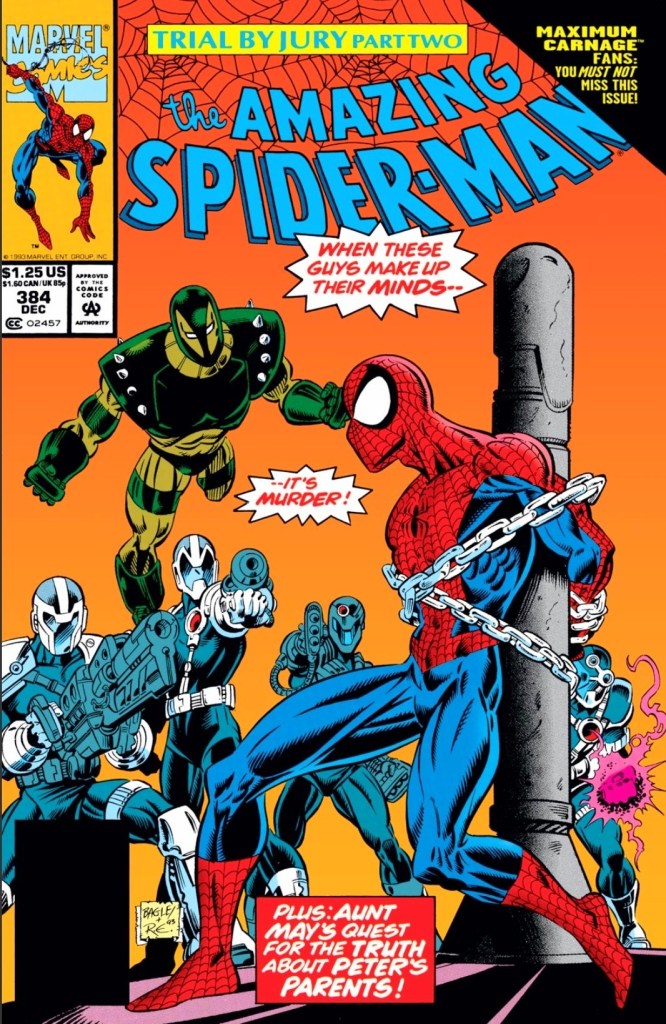
The cover.

Early story

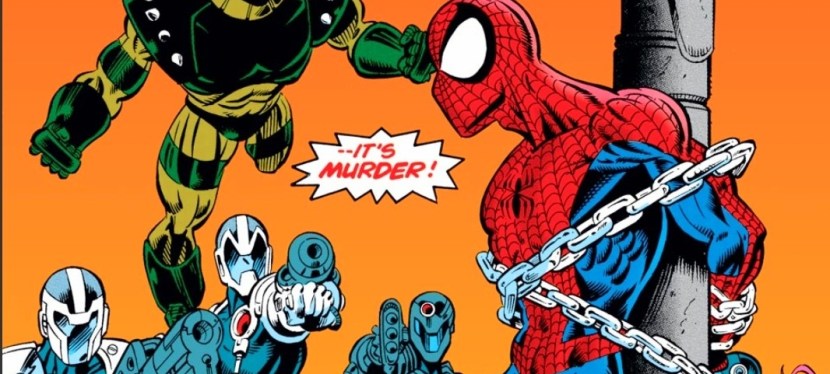
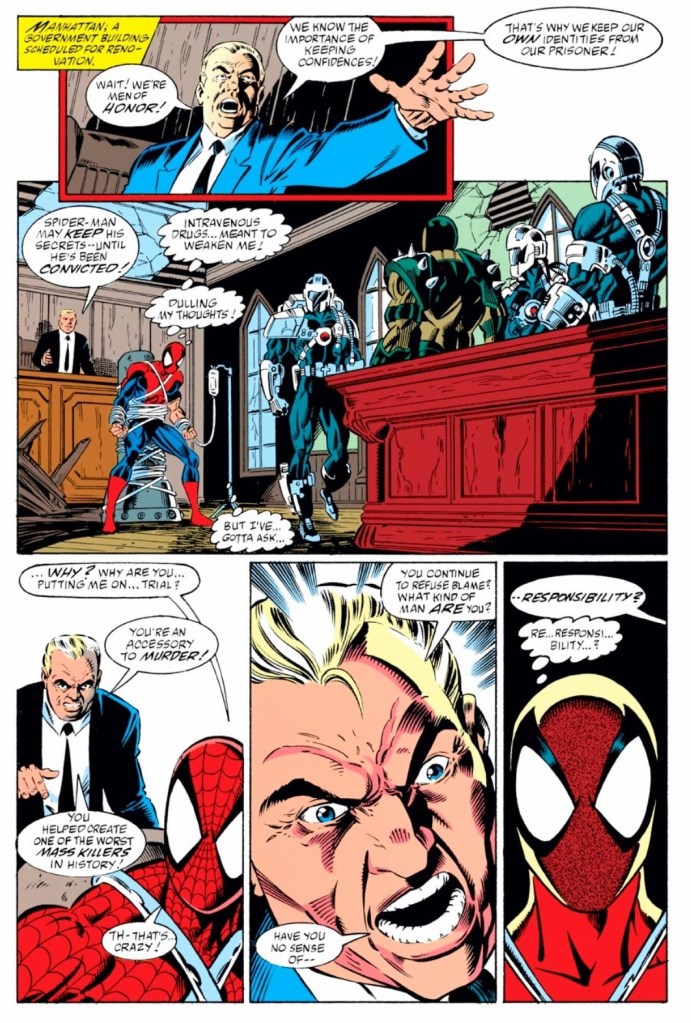
The story begins inside a certain government building in New York City scheduled for renovation. A heavily restrained and drugged Spider-Man was about to have mask taken off by one of The Jury members when their founder General Taylor intervened and insisted that they keep their honor. Spider-Man is up for questioning and scrutinization in a makeshift trial by The Jury. As the webslinger is not in the proper condition to stand trial, Taylor (in his capacity as the judge) declares a 30-minute recess.

Elsewhere, Peter Parker’s wife Mary Jane received bad news from her boss that her role in the TV show Secret Hospital will be reduced to a recurring role. This troubles her deeply as it means reduced income for her at a time when her marriage with Peter continues to go down. Spider-Man’s lack of quality time with her keeps taking its toll on her…

Quality

Spidey on trial!

Firstly, I should say that the Michelinie-Bagley team’s concept of having The Jury as the force of opposition against Spider-Man continues to do wonders creatively in this particular comic book series. In the previous issue, the webslinger was hunted and General Taylor really invested a lot of technologies to get to him in the middle of a very bustling city. In this particular issue, Spider-Man is completely vulnerable being weakened and disoriented as he is about to be tried in a makeshift court.

Along the way, Taylor and his team were portrayed to work within their own system of justice. As no court of law in New York would recognize Spider-Man’s trial, The Jury set up their own court in a very private and unusual manner.

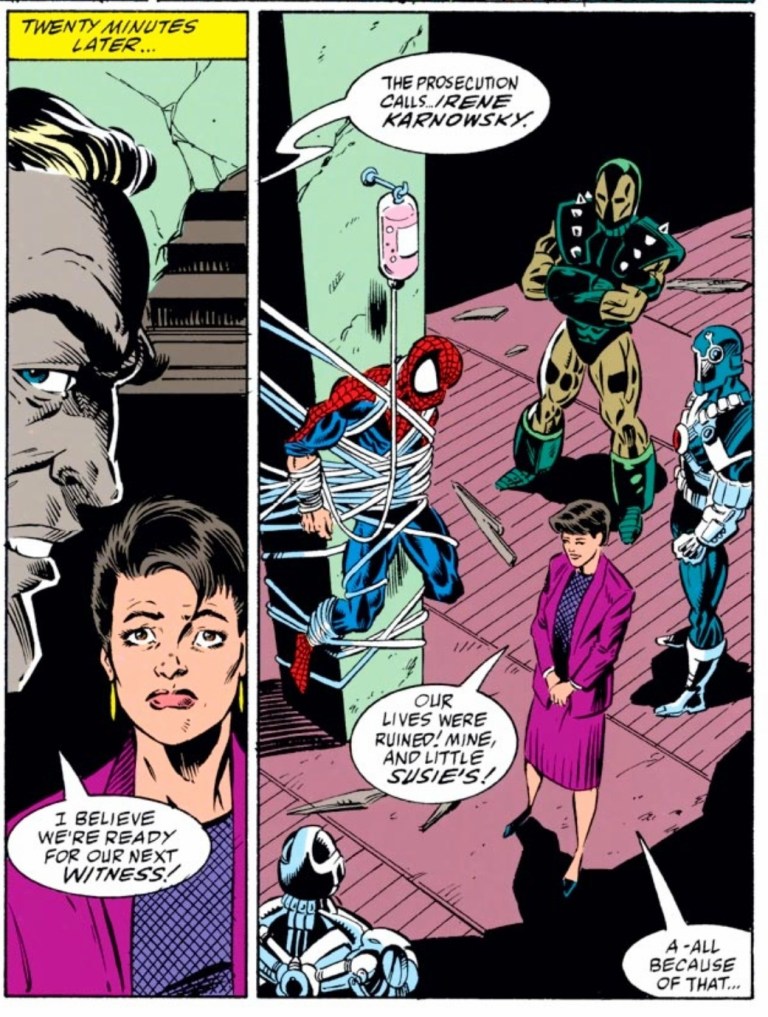
While the planned trial is the major event of this comic book’s concept, Michelinie pulled off a rather unusual move with the narrative. Just as the first witness points to Spider-Man for being responsible for Venom, the iconic webslinger then starts to wonder what the trial is truly all about and then the creative team unleashed a slew of flashbacks that looked back a key events published in certain comic books of Secret Wars, The Amazing Spider-Man and Web of Spider-Man through the years. I’m talking about Spider-Man’s first-ever encounter with the symbiote, how he got rid of it, how the symbiote bonded with Eddie Brock to form Venom, how Venom’s costume left a living seed that Cletus Kassady touched and became Carnage, etc. These flashbacks, all nicely drawn by Mark Bagley, conveniently served as an instant reference for readers to catch up with the current events but this was done at the expense of this comic book’s narrative.

More on the trial, this comic book raises layered questions about the concept of responsibility on Spider-Man. Could the iconic webslinger really be held accountable for whatever murders Venom committed along with the trauma he caused on bystanders given the fact that he really brought the alien costume into their world? Should Spider-Man also be held responsible for any murders committed by Carnage? This is one really loaded script Michelinie came up with and he really had Spider-Man vulnerable not only to The Jury but also to the questions thrown at him during the makeshift trial. To put it short, this is one very unusual Spider-Man tale ever told that carries strong relevance from the past.

As with the previous issues, this comic book sheds a limited amount of the spotlight on Mary Jane and Spider-Man’s Aunt May who at this stage has gotten paranoid with her suspicions about Peter’s parents. The dramatization turned out pretty good.

Conclusion

Spider-Man in a vulnerable state with The Jury.

While the flashbacks were excessive and made the narrative feel bloated, Amazing Spider-Man #384 (1993) still has lots of good stuff fans can enjoy. It has a pretty bold concept of having Spider-Man really trapped and left vulnerable for the makeshift trial. More notably, the narrative pounded heavily on the concept of responsibility in relation to Spider-Man’s past actions that led to the creation of Venom and even Carnage.

Overall, Amazing Spider-Man #384 (1993) is recommended!

+++++

Thank you for reading. If you find this article engaging, please click the like button below, share this article to others and also please consider making a donation to support my publishing. If you are looking for a copywriter to create content for your special project or business, check out my services and my portfolio. Feel free to contact me with a private message. Also please feel free to visit my Facebook page Author Carlo Carrasco and follow me on Twitter at  @HavenorFantasy as well as on Tumblr at https://carlocarrasco.tumblr.com/ and on Instagram at https://www.instagram.com/authorcarlocarrasco
A Look Back at Amazing Spider-Man #383 (1993)

Disclaimer: This is my original work with details sourced from reading the comic book and doing personal research. Anyone who wants to use this article, in part or in whole, needs to secure first my permission and agree to cite me as the source and author. Let it be known that any unauthorized use of this article will constrain the author to pursue the remedies under R.A. No. 8293, the Revised Penal Code, and/or all applicable legal actions under the laws of the Philippines.

Welcome back superhero enthusiasts, 1990s culture enthusiasts and comic book collectors! Today we go back to the year 1993 and explore a part of the Marvel Comics universe through one of the many tales of the Amazing Spider-Man comic book series.

To put things in perspective, the creative team behind the Amazing Spider-Man title decided to shake things up a bit by having the high-tech team called The Jury (the same team that went against Venom led by a powerful man whose son was murdered by Eddie Brock in Amazing Spider-Man #315) as the force of opposition for the webslinger.

With those details laid down, here is a look back at Amazing Spider-Man #383, published in 1993 by Marvel Comics with a story by David Michelinie and drawn by Mark Bagley.  

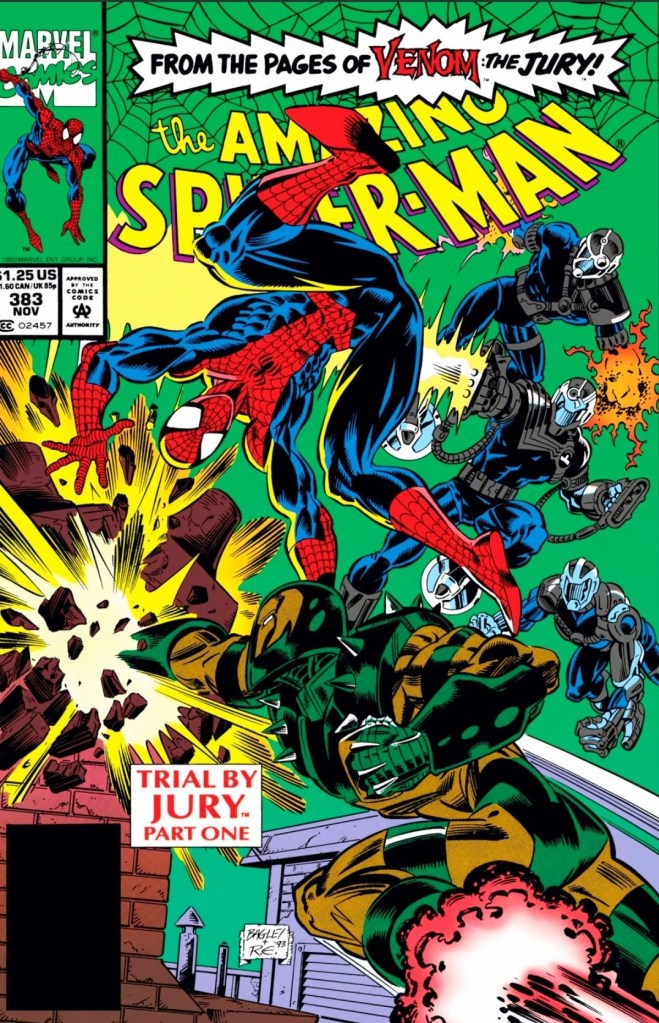
The cover.

Early story

The story begins in New York with the super-powered being Nova flying around which triggers an alert. It turns out, members of The Jury and their leader General Orwell Taylor have been monitoring and scanning areas of the city with several motion detectors to find Spider-Man. As far as Taylor is concerned, Spider-Man is highly responsible for the existence of Venom in their world and is therefore connected to the murder of his son (committed by Venom while escaping from prison in Amazing Spider-Man #315). Taylor is convinced that the if Spider-Man’s freedom is the price for stopping a monster like Venom, then that would be good.

Suddenly, the team notices that one of their motion detectors went offline. Moments later, a technician reaches the rooftop of the building and finds a motion detector severely damaged. Out of nowhere, Spider-Man grabs the technician and puts his life in danger by moving him off the edge using his fist and strength to carry him. Spider-Man pressures him for details…

Quality

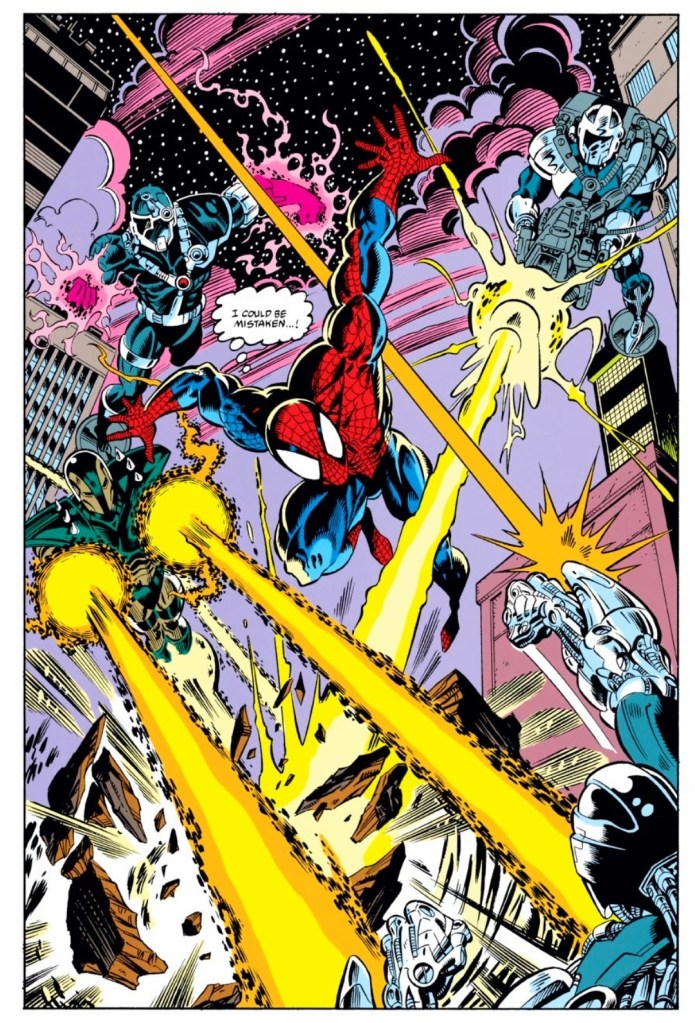
The Jury’s hunt for Spider-Man is really entertaining to read!

This is definitely one of the more engaging Amazing Spider-Man stories I read not only from 1993 but from the 1990s in general. In my view, putting Spider-Man up against The Jury is a stroke of genius on the part of the Michelinie-Bagley team and at the same time it was a sound relief after reading so much about the presence of Carnage and Venom on this particular monthly series (note: the Maximum Carnage crossover chapters and Amazing Spider-Man #375 being linked with the Venom: Lethal Protector limited series).

When it comes to The Jury, Michelinie crafted a script that justifies Taylor’s team to pursue Spider-Man after they failure on getting Venom. This shows that Taylor has acquired information about Venom’s origin being the result of Spider-Man bringing home with him the symbiote (alien costume) from his time on a far-away planet (as seen in the Secret Wars series). Creatively, this results in a very convincing portrayal of Taylor not only as a grieving father but also as a very tactical leader who uses vast intelligence and resources to achieve what he believes is justice and the means for achieving the greater good. As for The Jury’s armored members – Sentry, Ramshot, Screech, Firearm and Bomblast – Michelinie did not simply portray them as straight-forward, mission-focused people here. One of them shows hesitancy which added a nice layer of division and human weakness within the team which is felt in action-packed encounter with Spider-Man.

Being the target of The Jury, Spider-Man at this stage is deeply troubled even though the Maximum Carnage disasters are over. He is portrayed to be very disturbed by the alarm signals of his Spider Sense whenever he gets near one of the sensors of The Jury which is a unique display of his special ability.

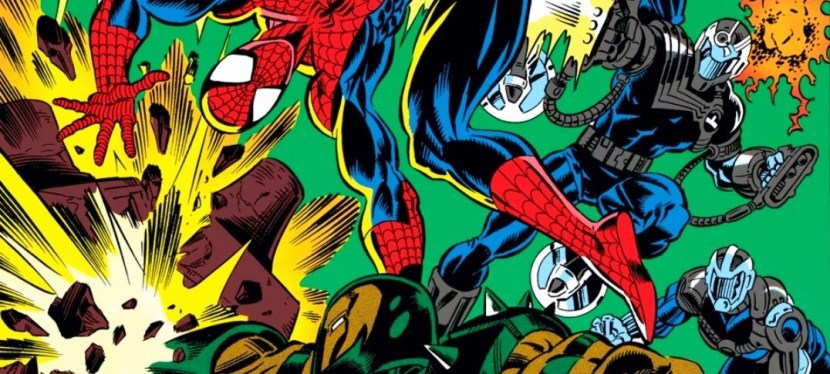
Those of you who love superhero spectacle will find a lot to enjoy here! Mark Bagley’s art on emphasizing action and stunts is fantastic to look at as The Jury pursues Spider-Man within New York. There are lots of dynamic shots, flashy high-tech images and really intense superhero action complete with collateral damage!

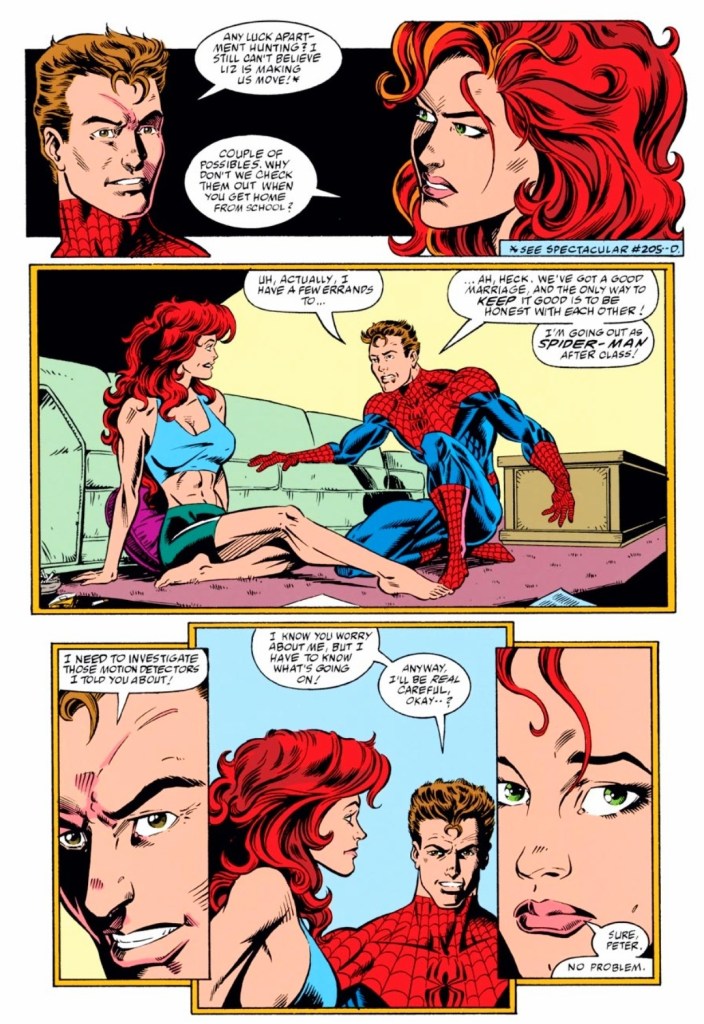
To be clear, this comic book is not simply all about the webslinger and Taylor’s team. There are some scenes here building up on Aunt May’s suspicion about Peter Parker’s parents which added suspense to the narrative.

Conclusion

As usual, Peter Parker does not have enough quality time for his wife.

Amazing Spider-Man #383 (1993) remains a very solid and highly entertaining comic book to read from start to finish. The Michelinie-Bagley team really delivered the great stuff as they launched a new concept having The Jury hunting Spider-Man in successful fashion. The Jury is clearly a very formidable team that gave Venom and Spider-Man a lot of trouble. The notable thing here is that this is only the first chapter of a new storyline with focus on Spider-Man’s responsibility with the murderous Venom (and all the victims he made).

Overall, Amazing Spider-Man #383 (1993) is highly recommended!

+++++

Thank you for reading. If you find this article engaging, please click the like button below, share this article to others and also please consider making a donation to support my publishing. If you are looking for a copywriter to create content for your special project or business, check out my services and my portfolio. Feel free to contact me with a private message. Also please feel free to visit my Facebook page Author Carlo Carrasco and follow me on Twitter at  @HavenorFantasy as well as on Tumblr at https://carlocarrasco.tumblr.com/ and on Instagram at https://www.instagram.com/authorcarlocarrasco
A Look Back at Amazing Spider-Man #381 (1993)

Disclaimer: This is my original work with details sourced from reading the comic book and doing personal research. Anyone who wants to use this article, in part or in whole, needs to secure first my permission and agree to cite me as the source and author. Let it be known that any unauthorized use of this article will constrain the author to pursue the remedies under R.A. No. 8293, the Revised Penal Code, and/or all applicable legal actions under the laws of the Philippines.

Welcome back superhero enthusiasts, 1990s culture enthusiasts and comic book collectors! Today we go back to the year 1993 and explore a part of the Marvel Comics universe through one of the many tales of the Amazing Spider-Man comic book series.

To put things in perspective, 1993 was another busy year for the iconic Spider-Man who not only had four monthly series of his own but also appeared in the Venom: Lethal Protector mini-series, the 14-part Maximum Carnage crossover and in Marvel’s major crossover The Infinity Crusade. As expected, Spider-Man survived through those storylines.

With those details laid down, here is a look back at Amazing Spider-Man #381, published in 1993 by Marvel Comics with a story by David Michelinie and drawn by Mark Bagley.  

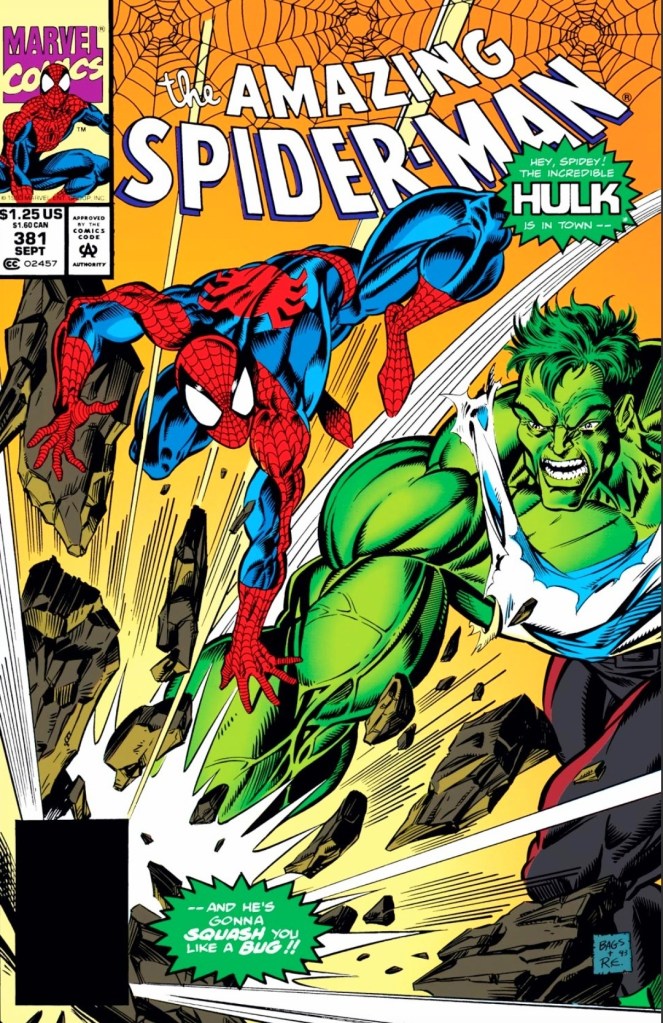
The cover.

Early story

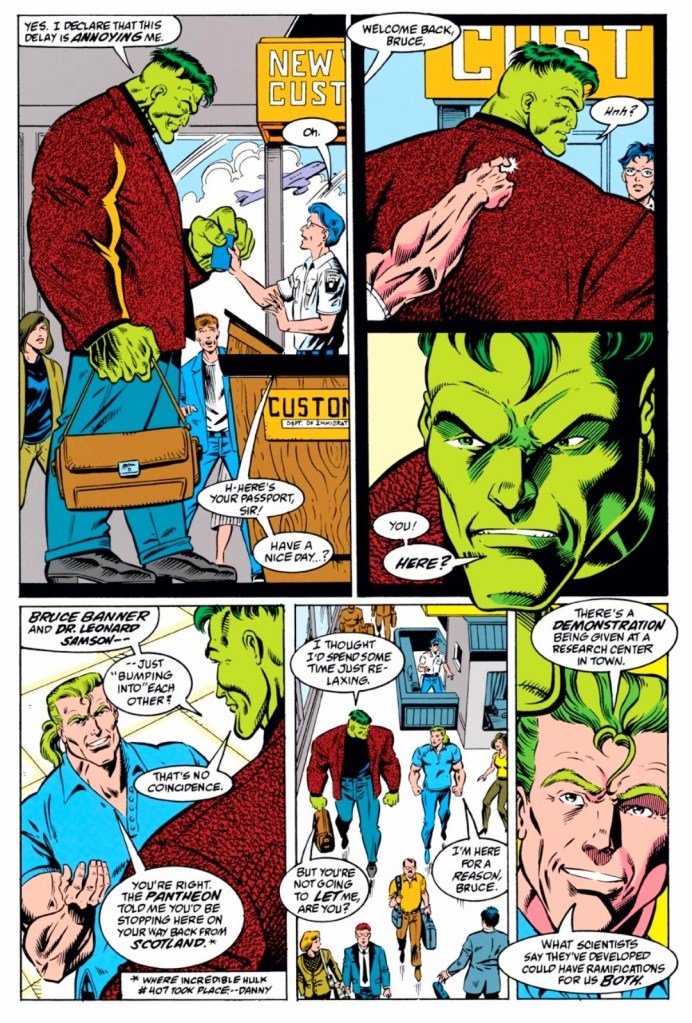
The story begins inside the airport in New York where the incredible Hulk/Bruce Banner himself had just arrived from Scotland. Due to his tremendous size, his physical presence easily distract the people around him. Dr. Leonard Samson surprises Banner and informs him of an upcoming scientific demonstration and the scientists behind it have developed something that could have ramifications for people who got exposed to gamma radiation. Samson explains that there is a radiation virus that releases repressed emotions. The Hulk rejects Samson and leaps to the air above towards an unknow destination.

At a school yard in lower Manhattan, two kids bully another kid into giving them his lunch money. Spider-Man suddenly arrives to stop trouble and immediately the two bullies ran away…

Quality

Quality time between Peter Park and wife Mary Jane.

I can say that is one of the more interesting crossovers between Spider-Man and the Hulk who at this stage in Marvel’s comic book history retained his intelligence and personality while in his huge, green-skinned form. Adding variety to the crossover was the presence of Doc Samson who was already an established and notable supporting character in comic books featuring the Hulk.

Set after the events of Maximum Carnage, the Infinity Crusade and Hulk’s time in Scotland (as told in Incredible Hulk #407), this story shows life in New York gradually normalizing. The peace, as it turns out, was only temporary as the big-time scientific demonstration in this story leads to a series of unfortunate events that compels Peter Parker to take action as Spider-Man.

The tale was nicely structured and the creative team took its time to build-up the story concept, the character motivations and execute the superhero spectacle at an overall medium pace. There is simply no boring scene nor any wasted moments. The appearances of Samson and the Hulk in this Spider-Man tale were nicely integrated and they each had their own impact on the plot. There is a lot of stuff here that fans of both Spidey and the green giant can enjoy.

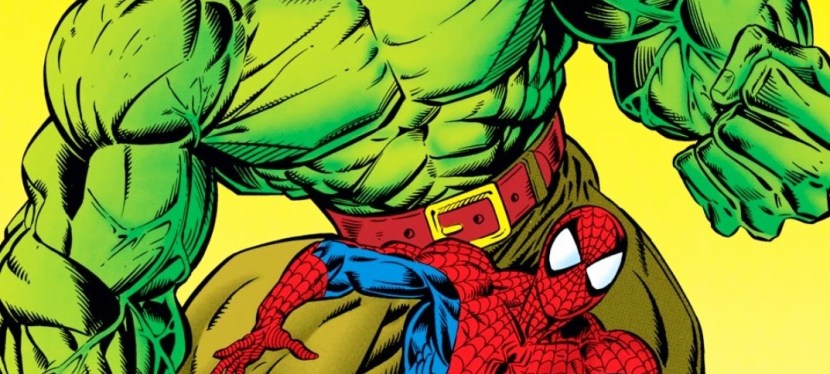
When it comes to the art, I found Mark Bagley’s take on the Hulk distinctive and intriguing to look at. The final shot of this comic book is a must-see.

Conclusion

Hulk and Doc Samson at the airport.

While there clearly is no villain, Amazing Spider-Man #381 (1993) still turned out to be a fun read complete with a fine crossover between Spider-Man, Doc Samson and the Hulk. Apart from the lack of space for character development, nothing here felt half-baked with the executions of the storytelling and the spectacle. This is a fun read and it was also a modern take on the personal encounter between Hulk and Spidey during the 1990s. This comic book has something enjoyable that fans of the two Marvel icons won’t find in any of the Marvel Cinematic Universe (MCU) movies and shows.

Overall, Amazing Spider-Man #381 (1993) is recommended.

+++++

Thank you for reading. If you find this article engaging, please click the like button below, share this article to others and also please consider making a donation to support my publishing. If you are looking for a copywriter to create content for your special project or business, check out my services and my portfolio. Feel free to contact me with a private message. Also please feel free to visit my Facebook page Author Carlo Carrasco and follow me on Twitter at  @HavenorFantasy as well as on Tumblr at https://carlocarrasco.tumblr.com/ and on Instagram at https://www.instagram.com/authorcarlocarrasco
A Look Back at Armorines #1 (1994)

Disclaimer: This is my original work with details sourced from reading the comic book and doing personal research. Anyone who wants to use this article, in part or in whole, needs to secure first my permission and agree to cite me as the source and author. Let it be known that any unauthorized use of this article will constrain the author to pursue the remedies under R.A. No. 8293, the Revised Penal Code, and/or all applicable legal actions under the laws of the Philippines.

Welcome back superhero enthusiasts, 1990s culture enthusiasts and comic book collectors! Today we go back to the early 1990s and explore a part of the shared universe of Valiant Comics through the Armorines monthly series.

Before I start, I should state that the superhero concept of an armored human protagonist who could do many incredible things made possible by high technology made an impact on comic book storytelling for decades. Look at Marvel’s Iron Man and the Ultraverse’s Prototype for examples.

While Valiant Comics already had its own armored superhero with X-O Manowar (note: his armor is symbiotic, not technological), they decided to move forward with the concept of armored figures in the form of a military team.

With those details laid down, here is a look back at Armorines #1, published in 1994 by Valiant Comics with a story written by Jorge Gonzalez and drawn by Jim Calafiore.

The cover.

Early story

The story begins five hundred kilometers off the southern coast of Australia. Four people dive very deeply to explore nuclear-powered submarine U.S.S. Benchley which has been dormant for some time already. While exploring the interiors of the submarine, the divers got attacked by something in the dark.

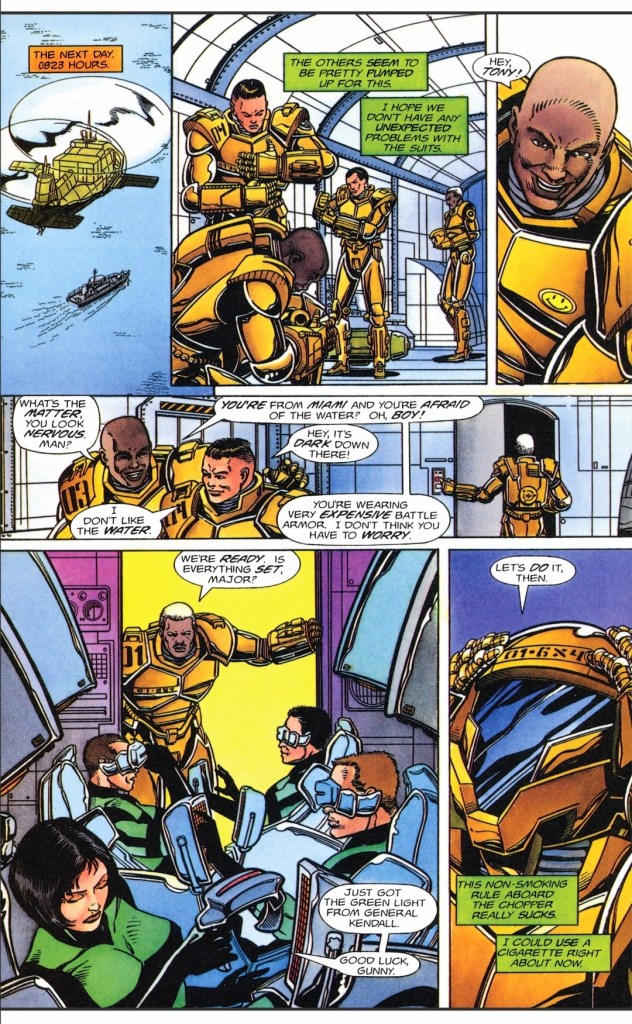
At Camp Pendleton in California, an armored U.S. marine goes through an intense training session fighting machines not knowing that there could be traps waiting to get triggered. As Gunny (the armored marine in the session) falls into a trap, his teammates, General Kendall and the scientist Zahn watch the proceedings behind the scenes as another teammate (operating with virtual reality on her high-tech station) continues to communicate with him.

As time passes by, the situation gets even worse for Gunny physically…

Quality

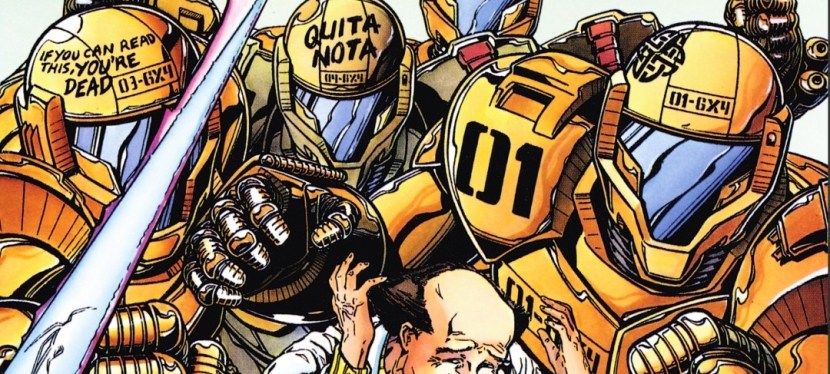
Armorines has members who go out on the field wearing high-tech suits of armor while there are other members who serve as co-pilots using virtual technology and constant communication behind closed doors.

In terms of storytelling, the creative team focused mainly on the build-up of not just the plot but also the importance and the ways of the Armorines themselves. As weapons of the government, Armorines are an expensive team to run due to the use of very advanced technologies for operations. The Armorines have members who go out on the field wearing high-tech suits of armor that provide enhanced protection while also carrying high-tech weapons for offense. The team also has members who stay behind closed doors to use individual stations with virtual reality and enhanced communication with their brothers on the field.

When it comes to the characters, the smoking Gunnery is noticeably the one who got the most exposure and the most development. The other Armorine members got token exposure for the readers.

More on the plot itself, there is a mission that requires the Armorines to go deep underwater to solve a mystery and do something dangerous secretly. The mission was essentially all about protecting America’s top-secret weapons from falling into the wrong hands. To be clear, the mission itself happens in the 2nd half of this comic book which ultimately serves as a pay-off to the build-up the happened earlier. In fairness to the creative team, there was a good amount of suspense presented when the mission really started moving. There definitely something worth seeing during the mission.

Conclusion

In this story, Gunny is the closest thing to a definitive protagonist.

To be very clear, Armorines #1 (1994) is not exactly the high-powered, action-packed story people could expect from seeing the armored marines looking capable of fighting terrorists and other enemies of America in militaristic fashion. This comic book’s story is indeed surprising to me and the creative team was not hesitant to push hard with the concept they came up with here. As this comic book was clearly executed with build-up, introductions and emphasizing concepts in mind, it is not surprising that the pay-off in the 2nd half led to moments of intrigue and suspense with momentum going into the next issue. Lastly, I should state that this comic book is free from political influence and its focus on the team has been very consistent.

Overall, Armorines #1 (1994) is recommended.

+++++

Thank you for reading. If you find this article engaging, please click the like button below, share this article to others and also please consider making a donation to support my publishing. If you are looking for a copywriter to create content for your special project or business, check out my services and my portfolio. Feel free to contact me with a private message. Also please feel free to visit my Facebook page Author Carlo Carrasco and follow me on Twitter at  @HavenorFantasy as well as on Tumblr at https://carlocarrasco.tumblr.com/ and on Instagram at https://www.instagram.com/authorcarlocarrasco
A Look Back at Hulk 2099 #1 (1994)

Disclaimer: This is my original work with details sourced from reading the comic book and doing personal research. Anyone who wants to use this article, in part or in whole, needs to secure first my permission and agree to cite me as the source and author. Let it be known that any unauthorized use of this article will constrain the author to pursue the remedies under R.A. No. 8293, the Revised Penal Code, and/or all applicable legal actions under the laws of the Philippines.

Welcome back superhero enthusiasts, 1990s arts and culture enthusiasts, Marvel Comics fans and comic book collectors! Today we go back to the wild 1990s by examining one of the many tales of Marvel Comics’ 2099 line of franchises, specifically through the Hulk 2099 monthly series.

For the newcomers reading this, Hulk 2099 first appeared in 2099 Unlimited #1 (1993) which also had his origin story told. Hulk 2099 was not a mere version of the classic Incredible Hulk with a futuristic touch. In fact, the futuristic green creature highlighted the protagonist John Eisenhart as a very selfish and obsessed Hollywood studio executive who happens to stumble upon the idolaters/worshipers of the classic Hulk Bruce Banner because he was searching for new properties and stories for his studio. Hulk 2099’s origin has notable similarities to that of the classic Hulk and gamma radiation exposure is one of them. As tales of the futuristic Hulk were told through the quarterly releases of 2099 Unlimited, Marvel decided it was time to give the green creature his own monthly series.

With those details laid down, here is a look back at Hulk 2099 #1 published in 1994 by Marvel Comics with a story written by Gerard Jones and drawn by Malcolm Davis.

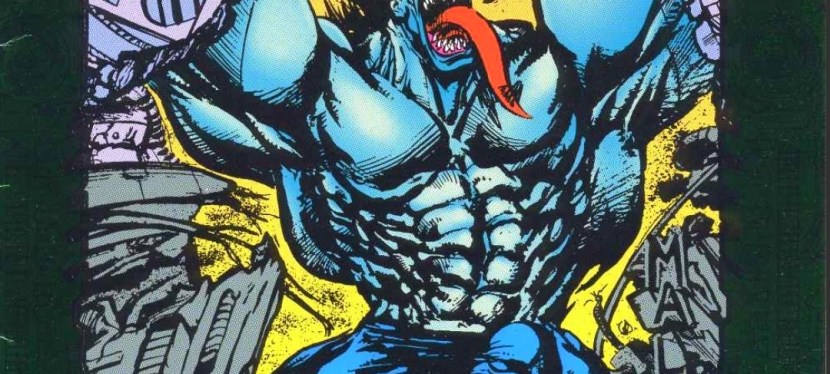
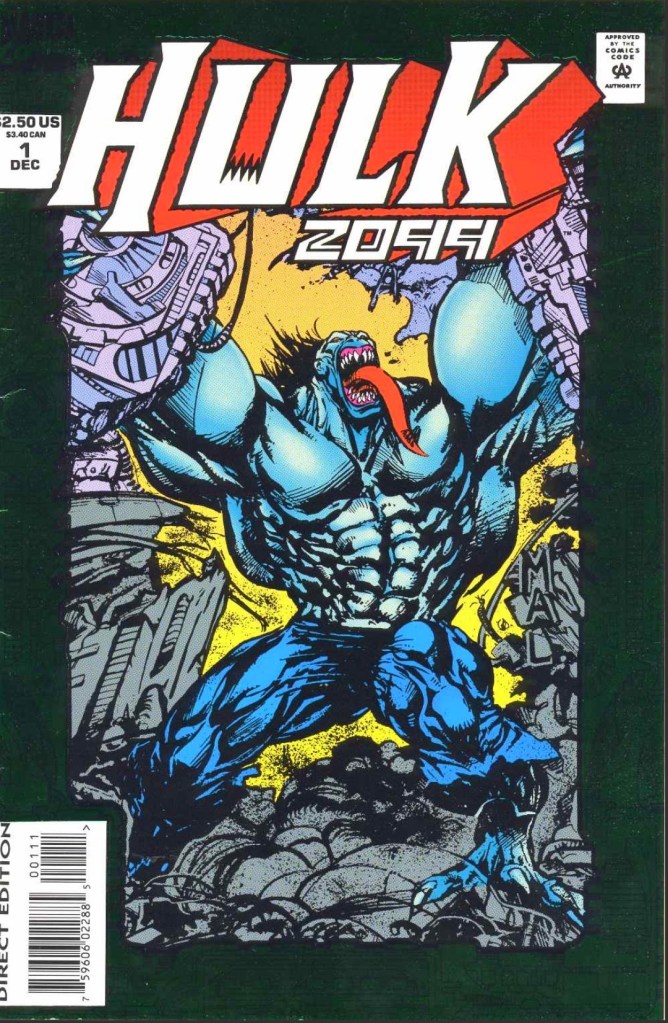
The cover.

Early story

The story begins with the Hulk of 2099 destroying security droids and verbally attacking civilization. As he retains the intellect of John Eisenhart, he expresses his opposition against civilization for keeping people out of the water reclamation zone.

The story then shifts to California where Lotus Entertainment (Eisenhart’s employer) and its crew work on producing a film which is a dishonest telling of Eisenhart’s dealings with the Knights of Banner (already eliminated in 2099 Unlimited #1). During the production, one of the executives notices the absence of Eisenhart.

Elsewhere, John Eisenhart drives his flying car with Knights of Banner youth survivor Gawain as his passenger. Already struggling with the guilt over the deaths of all the adult Knights of Banner members, Eisenhart intends to end his employment and cash out of his contract. Gawain remains hostile towards Eisenhart.

Quality

The creative team used flashback images that look really similar to what was told in 2099 Unlimited #1.

If there is anything that is very obvious to talk about, it is the fact that this tale shows a radically different John Eisenhart who wants to get out of Hollywood’s multiple mazes of crookedness as he feels very guilty over what happened to the Knights of Banner. This happens just as a new entity took corporate control of Eisenhart’s employer before he could leave the company. In many ways, Eisenhart’s distress and struggle with being guilty reminds me a lot about Hardcase of the Ultraverse and the way the creative dramatized him was engaging.

For the story, there is a lot of corporate intrigue going on and Eisenhart’s failure to quit quickly was inevitable because the new enemy he faces here has a lot to do with the sudden takeover of Lotus Entertainment. At least on face value, this looks like an attempt by the creative team to change the status quo and move Hulk 2099 to a new creative direction away from what was established in 2099 Unlimited. Without spoiling the details, I can say that something very significant happened before the comic book’s ending and it will impact readers who followed the futuristic Hulk’s stories closely in the 2099 Unlimited series.

Along the way, there is a lot of action and unfortunate physical happenings which symbolize the chaos concept of the script. The notable thing here is that you won’t see very much of Hulk 2099’s monstrous form as the script was specifically written to tell a tale that went beyond one issue. Clearly, the creative team were sparing Hulk 2099 for a conflict in the next issue.

Malcolm Davis’ art has that visceral aesthetic that fits the established look of Marvel’s 2099 universe of the time but there were instances when he showed so much happening, the visuals looked chaotic and even disorienting. In fairness, his take on Eisenhart, Quirk, Gawain and others made them looked recognizable.

Conclusion

The future of Commiewood, wokeness, and dishonesty.

While its story has little of the green monster in it, Hulk 2099 #1 (1994) does a decent job building up the tension on top of the guilt-filled Eisenhart while setting up events that looked like a bold new creative direction was coming. By the time this comic book was published, several Hulk 2099 tales were already published in the quarterly 2099 series. On its own, this comic book lightly builds up the lore of the 2099 universe as it was clearly focused on Hulk 2099’s creative concept and characters.

While Eisenhart was indeed determined to change, it is a turnoff to see him lie and exaggerate details to protect himself from a certain corporate psychologist who is after the truth. There is also a lot of anti-corporate expressions here which seems to suggest that someone within the creative team had been thinking with socialist concepts and decided to use the script as an outlet of expression. The weird but true thing is that by today’s standards, Hollywood is filled with Commies/socialists/Marxists/liberals/woke nuts from the film crew up to the executives that run studios and produce films or shows that are dumb, lies about reality, self-centered and extensions of their ideologies. This showed that this comic book was prophetic in some ways.

Overall, Hulk 2099 #1 (1994) is satisfactory.

+++++

Thank you for reading. If you find this article engaging, please click the like button below, share this article to others and also please consider making a donation to support my publishing. If you are looking for a copywriter to create content for your special project or business, check out my services and my portfolio. Feel free to contact me with a private message. Also please feel free to visit my Facebook page Author Carlo Carrasco and follow me on Twitter at  @HavenorFantasy as well as on Tumblr at https://carlocarrasco.tumblr.com/ and on Instagram at https://www.instagram.com/authorcarlocarrasco
A Look Back at What If #31 (1982)

Disclaimer: This is my original work with details sourced from reading the comic book and doing personal research. Anyone who wants to use this article, in part or in whole, needs to secure first my permission and agree to cite me as the source and author. Let it be known that any unauthorized use of this article will constrain the author to pursue the remedies under R.A. No. 8293, the Revised Penal Code, and/or all applicable legal actions under the laws of the Philippines.

Welcome back superhero enthusiasts, 1980s arts and culture enthusiasts, Marvel Comics fans and comic book collectors! Today we go back to the early 1980s and examine an alternate universe portrayal of Wolverine and some other characters as told in one of the comic books of the first volume of the series What If.

Wolverine is one of the most iconic characters of Marvel Comics and he has been part of some of my retro reviews (click here, here, here, here, here, here and here). Wolverine made his first appearance in comics in Incredible Hulk #181 which was published way back in 1974 which marked the first conflict of the two Marvel icons. Years later, Marvel decided to revisit that event with a What If story.

With those details laid down, here is a look back at What If #31 published in 1982 by Marvel Comics with a story written by Rick Margopoulos and drawn by Bob Budiansky.

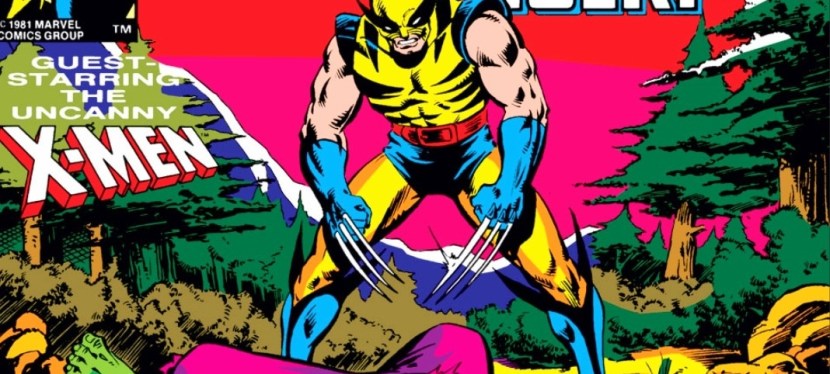
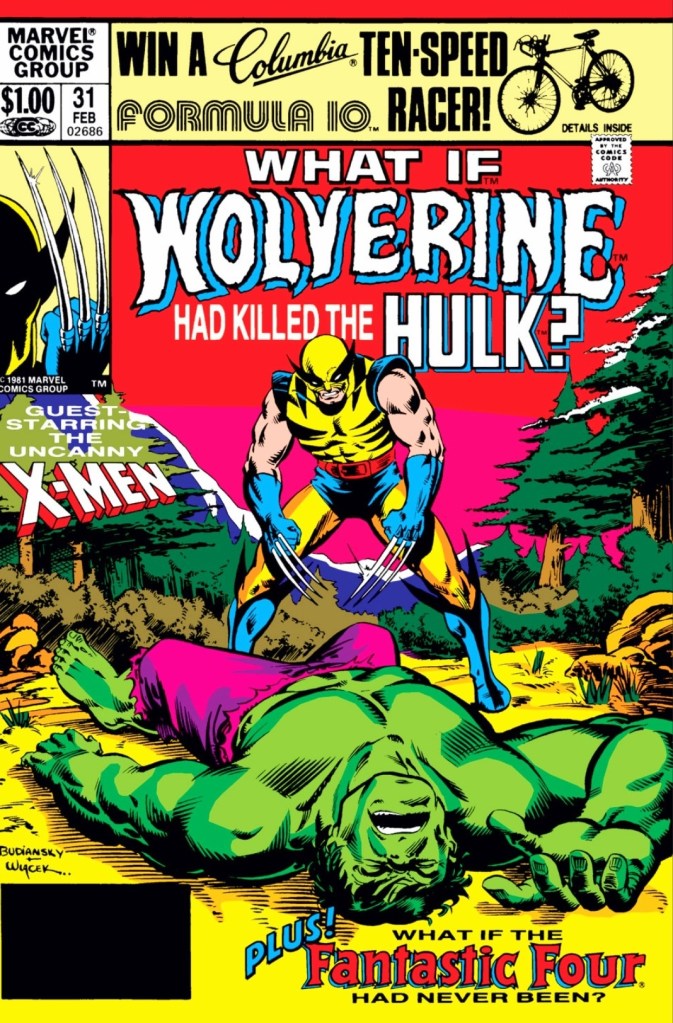
The cover.

Early story

The story begins with Wolverine and the Hulk in combat with each other in a forest within Canada. It turns out, Wolverine was sent by Canadian authorities to capture not just the Hulk but also the Wendigo.

With the Wendigo down on the ground, Wolverine and the Hulk struggle with each other. The Canadian’s speed helped him dodge the green giant’s powerful punches and as the fight goes on, so does the impulse and emotion from within. Suddenly, Wolverine decides to deliberately disobey his orders by deciding to kill the Hulk. In a few but strategic strikes with his Adamantium claws, Wolverine kills the Hulk. The Canadian authorities eventually got rid of the corpses of the Wendigo and the Hulk.

Soon enough, news about the Hulk’s death spread like wildfire all over America catching the attention of Spider-Man, the Avengers, the Fantastic Four and General Ross and his daughter Betty…

Quality

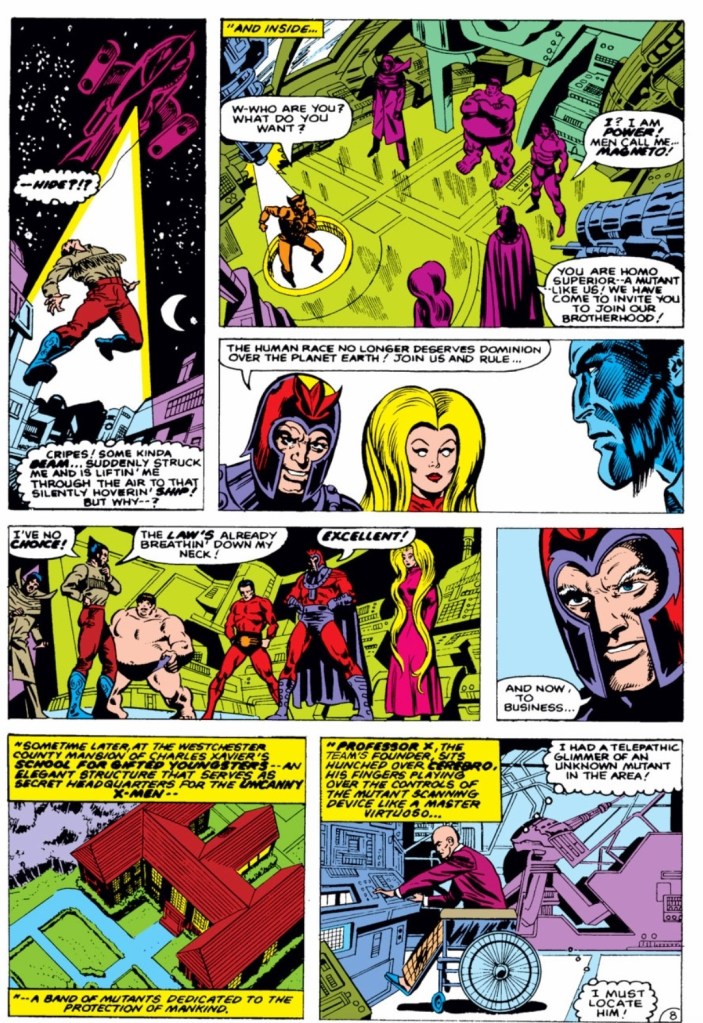
Wolverine gets abducted not by aliens from outer space but by Magneto and his Brotherhood of Evil Mutants.

To start with, I can say that I immensely enjoyed this alternate portrayal of the events that happened in relation to Wolverine’s first-ever appearance in comics. For one thing, the concept of Wolverine actually killing the Hulk is not only shocking on its own, it also set a chain reaction of events that involved or affect a whole lot of other characters within the Marvel Comics shared universe.

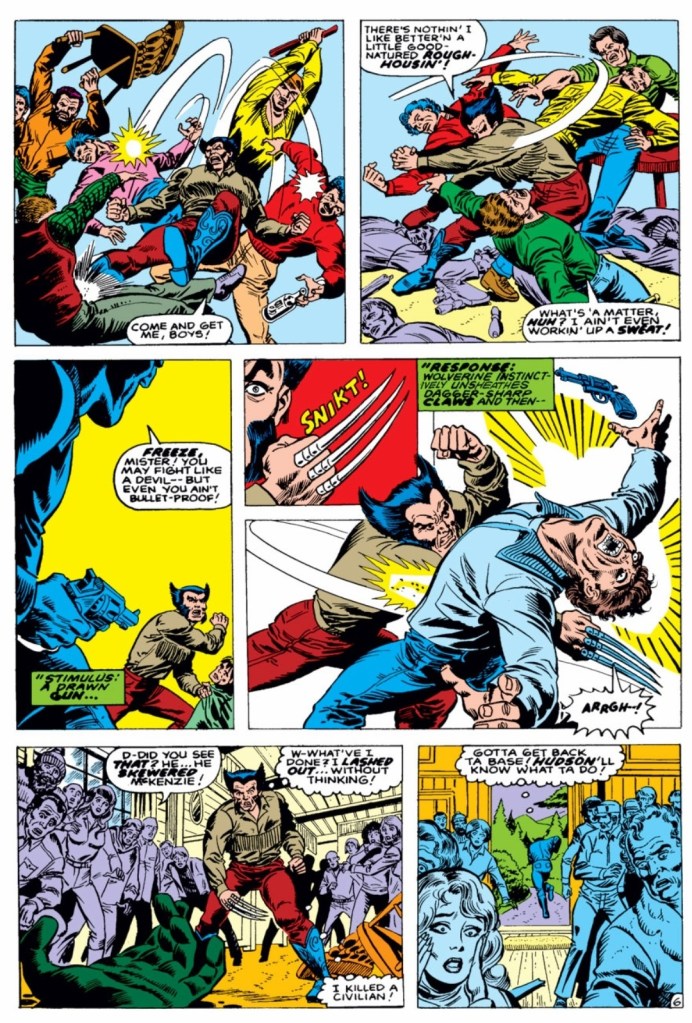
Let me start with Wolverine himself. As the story was set before he joined the X-Men, you will see Wolverine as a super-powered agent of Canada whose career really goes down as he failed to restrain his wild self from killing not once but twice. This results in a Wolverine who is deeply troubled with guilt and becomes desperate believing that running away and hiding will somehow solve his dilemma.

Wolverine’s entry into a gang of evil mutants led by Magneto (note: this comic book’s main villain) is itself worth getting this comic book. This shows Magneto – always obsessed with his belief that mutants are superior to humans – putting his diabolical plan into action with Wolverine as the key participant. This itself led to Wolverine’s encounter with the X-Men (the one team he was destined in reality to be with).

The creative team clearly exerted a lot of effort to not only ensure the plot made sense but also have a solid structure that can accommodate twists, intrigue and superhero spectacle altogether complete with enough room for character development. Lastly, I should say that this comic book’s climax is both compelling and shocking to read.

Conclusion

Wolverine’s 2nd kill in this comic book.

What If #31 (1982) is indeed a great Marvel comic book to read. It has a very engaging alternate universe portrayal of Wolverine and this paved the way for a new and fresh approach on showcasing how the X-Men and Magneto’s gang reacted with the clawed Canadian. While the scope of the consequence of Wolverine’s killing of the Hulk ultimately ending up narrowing on Marvel’s mutants could be disappointing for those who seek a bigger impact on other Marvel universe characters, what was shown here in this comic book still made sense and ultimately turned out believable. This comic book also has another tale exploring what if there was no Fantastic Four which ultimately ended up as a decent additive.

Overall, What If #31 (1982) is highly recommended.

+++++

Thank you for reading. If you find this article engaging, please click the like button below, share this article to others and also please consider making a donation to support my publishing. If you are looking for a copywriter to create content for your special project or business, check out my services and my portfolio. Feel free to contact me with a private message. Also please feel free to visit my Facebook page Author Carlo Carrasco and follow me on Twitter at  @HavenorFantasy as well as on Tumblr at https://carlocarrasco.tumblr.com/ and on Instagram at https://www.instagram.com/authorcarlocarrasco