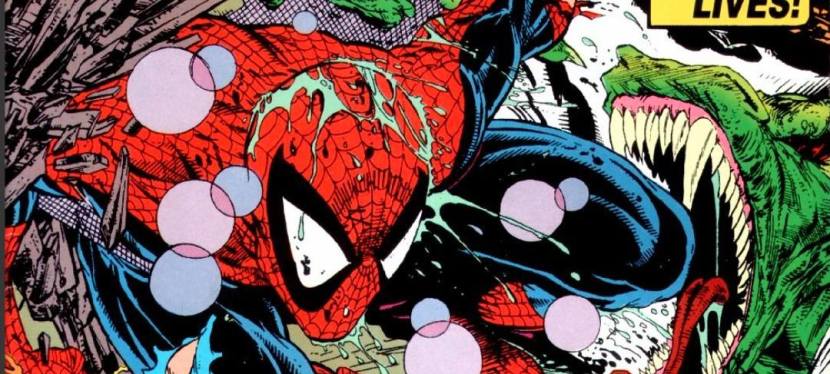
A Look Back at Spider-Man #4 (1990)

Welcome back superhero enthusiasts, 1990s culture enthusiasts and comic book collectors! Today we go back to the early 1990s and explore a part of the Marvel Comics shared universe through a tale of the Spider-Man monthly series.

Having reviewed the first three issues of the Spider-Man monthly series written and drawn by Todd McFarlane (click here, here and here), I can say that the 5-part Torment storyline has a daring concept, adulterated imagery and clunky storytelling. Issues and saw Spider-Man in violent battles with the Lizard who is clearly not himself but under the control of the Haitian witch Calypso. It is inevitable Spider-Man, who has been in a long-lasting disadvantage so far, will somehow meet Calypso face to face.

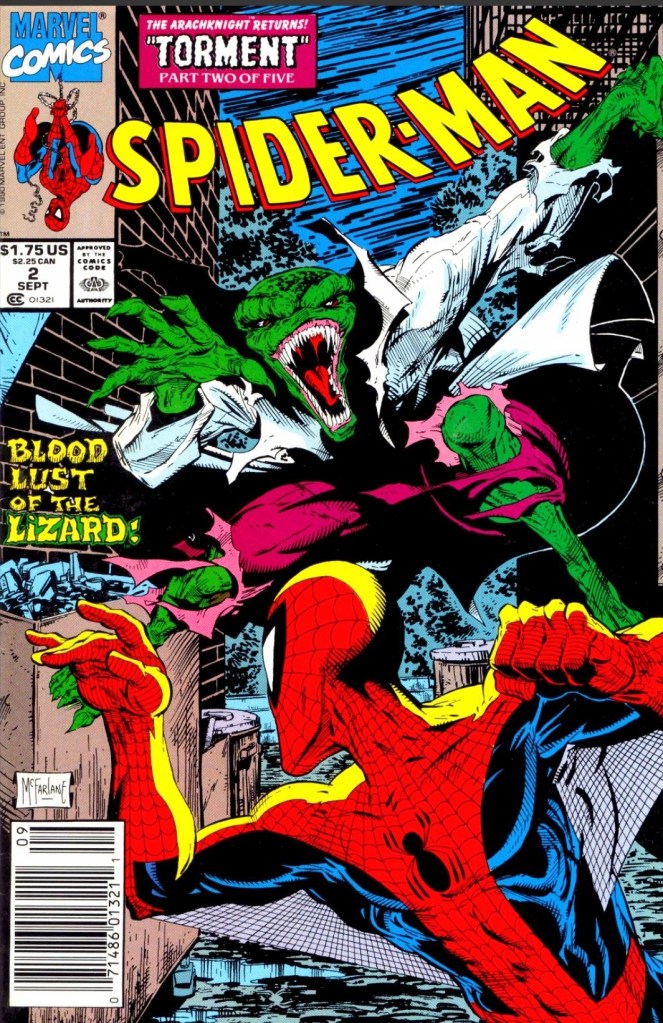
With those details laid down, here is a look back at Spider-Man , published in 1990 by Marvel Comics with a story written and drawn by Todd McFarlane. This is the 4th chapter of the Torment storyline.

The cover.

Early story

The story begins in a dirty alley deep within New York City. An exhausted and disoriented Spider-Man is shocked to see a grotesque looking Kraven with the vicious Lizard beside him. The moment made him remember what happened as a result of his previous with Kraven (note: refer to the Kraven’s Last Hunt storyline) which includes him getting buried temporarily with a grave designated to him.

Eventually Spider-Man sees through the illusion and realizes that Kraven is not in front of him but Calypso with the Lizard still under her full control. With an unspoken command from Calypso, the Lizard moves towards the weakened Spidey and carries him bodily…

Quality

This portrayal of Mary Jane having a good time again in the city without her husband is clearly filler and it did not add anything to the plot.

As anticipated, the webslinger finally met the Haitian witch who had been controlling the Lizard all along. With a mostly slow pace, the story has Spider-Man being helpless in the presence of two powerful enemies and McFarlane stylishly dramatizes moments from Calypso’s past showing her acceptance of evil ways (witchcraft), her personal connection with Kraven and her desire to have a new sacrifice done.

With Spider-Man restrained a lot for most of the story, it was not surprising to see Calypso have a good share of the spotlight to herself and the Lizard is clearly portrayed as her enforcer and assistant contrasting what was presented in the first 3 issues.

Unsurprisingly, the storytelling feels choppy although the slow pace allows readers to grasp Calypso’s intentions and her main purpose in the entire storyline. The lack of spectacle allowed McFarlane to implement long segments of suspense mixed with horror. With Spider-Man doing not so much, he’s technically a supporting character symbolizing the reader’s curiosity.

Conclusion

There is nothing like waking up in the presence of two evil figures while being restrained.

Compared with the previous, Spider-Man (1990) does not have much to show and has even less entertainment value. Unless you are a die-hard fan of Calypso (so twisted and demonic under McFarlane’s handling), this particular story won’t mean much to Spider-Man faithful. The webslinger is still helpless but this is all part of the build-up for the fifth and final chapter.

In fairness, what was shown here might inspire fans to revisit Kraven’s Last Hunt and read past Spider-Man comic books showing Calypso’s connection with Kraven (note: Spider-Man and Calypso were present in Amazing Spider-Man ). In my view, this comic book is not terrible but it does not have much entertainment value nor does it have anything engaging to show. I don’t feel so motivated to proceed with issue .

Overall, Spider-Man (1990) should be avoided.

+++++

Thank you for reading. If you find this article engaging, please click the like button below, share this article to others and also please consider making a donation to support my publishing. If you are looking for a copywriter to create content for your special project or business, check out my services and my portfolio. Feel free to contact me with a private message. Also please feel free to visit my Facebook page Author Carlo Carrasco and follow me on Twitter at  @HavenorFantasy as well as on Tumblr at https://carlocarrasco.tumblr.com/ and on Instagram at https://www.instagram.com/authorcarlocarrasco
A Look Back at Spider-Man #3 (1990)

Welcome back superhero enthusiasts, 1990s culture enthusiasts and comic book collectors! Today we go back to the early 1990s and explore a part of the Marvel Comics shared universe through a tale of the Spider-Man monthly series.

I previously reviewed issues (click here) and (click here) which were also the first two chapters of the Todd McFarlane-led Torment storyline. McFarlane had this grand vision of a dark and more violent concept of telling a Spider-Man story and it involved another rematch with the Lizard (Dr. Connors) and some connections with the Kraven’s Last Hunt saga of 1987 (read my retro reviews by clicking here and here). McFarlane’s vision was daring but his writing style and the sub-par quality of his storytelling really brought down the overall quality of Spider-Man and .

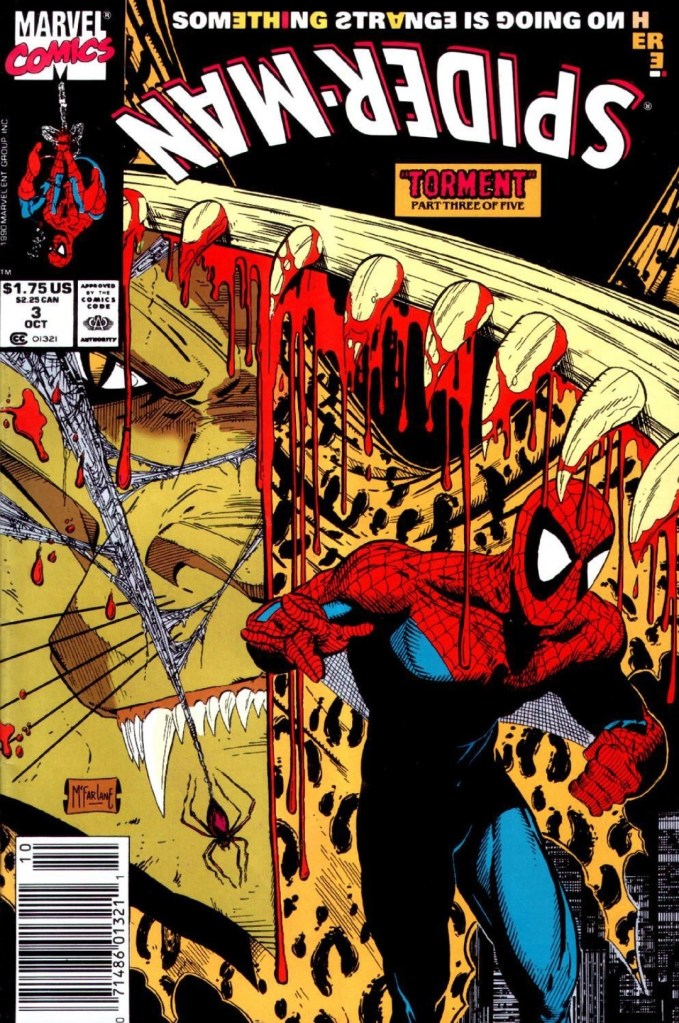
With those details laid down, here is a look back at Spider-Man , published in 1990 by Marvel Comics with a story written and drawn by Todd McFarlane. This is the 3rd chapter of the Torment storyline.

The cover.

Early story

The story begins at the rooftop of a building in New York City. Up there, the Lizard relentlessly attacks Spider-Man causing some damage on the building. Having recovered previously, Spider-Man manages to hold his ground and punches a solid structure that hit the Lizard hard.

Meanwhile at another part of the city, the evil Haitian Voodoo priestess Calypso communicates with the Lizard telling him to take the fight against Spider-Man easy, avoid killing him and make him suffer first. Calypso is obsessed with making the webslinger an example to the world.

The fight between Spider-Man and the Lizard continues causing even more damage. Spider-Man, who has been poisoned, is having trouble concentrating as the Lizard keeps attacking him violently. Spider-Man wonders why the Dr. Connors’ (the Lizard) blood lust is so consuming…   

Quality

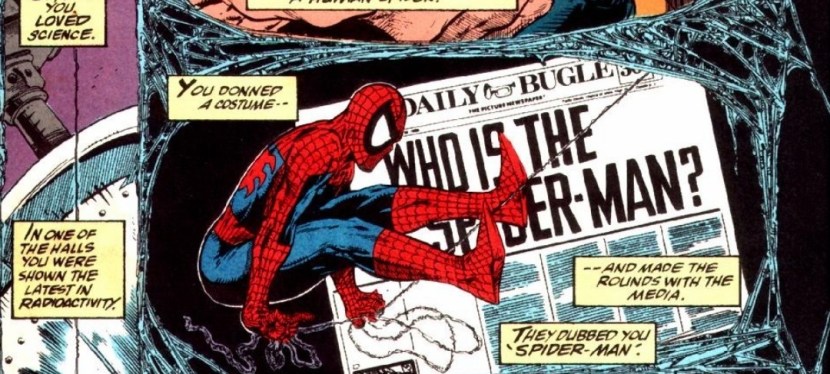
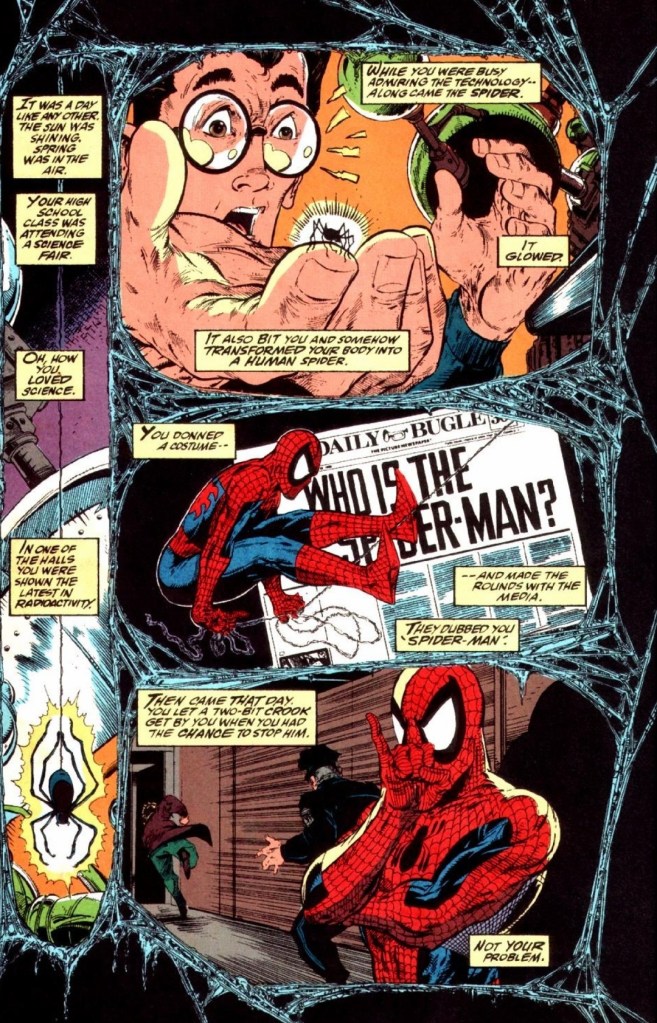
Todd McFarlane’s way of visualizing Spider-Man’s origin.

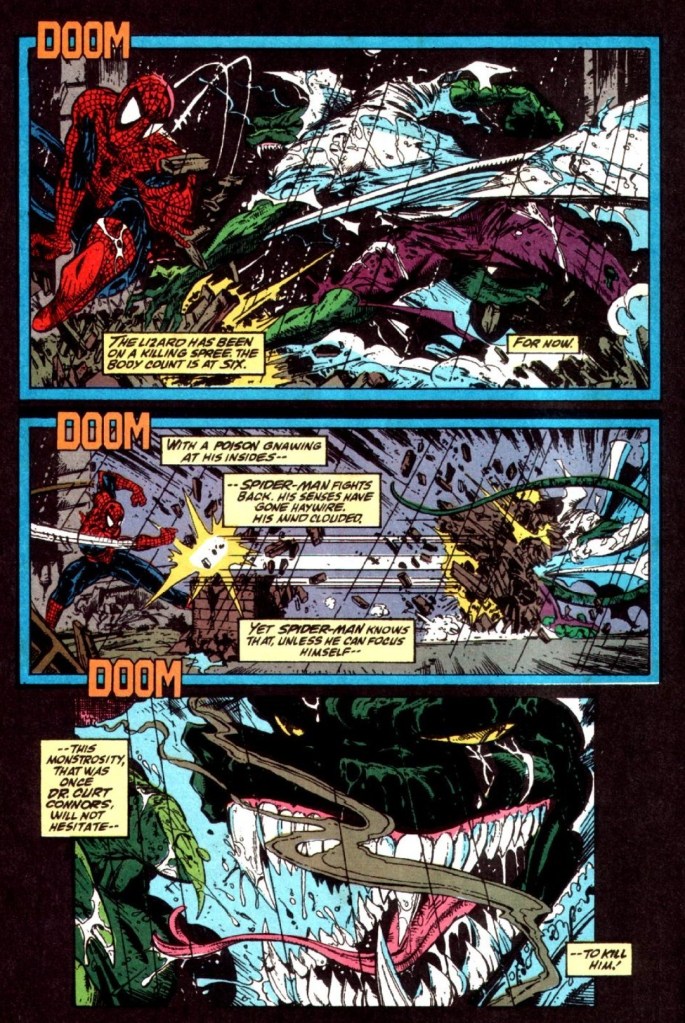
To get straight to the point, this comic book is simply a natural progression of the hard-hitting conflict between Spider-Man and the Lizard that started in the previous issue. In fact, this comic book shows the resumption of the battle (after a pause happened in the late stage of issue showing the fight temporarily halting which gave Spider-Man some minutes to rest).

At this stage, Spider-Man has gotten even more vulnerable and damaged. Apart from struggling with the very violent attacks of the Lizard, his own spider sense becomes a major hindrance on his mind (he could not concentrate) as the sounds of “doom-doom-doom” caused by Calypso’s sorcery becomes very unbearable. Like the previous issue, Spider-Man gets close to death and if there is anything new here it is showing the iconic superhero messed up in the garbage.

Along the way, this comic book sheds some spotlight on Mary Jane Parker (Spider-Man’s wife) who has been spending time in the city dealing with the absence of her husband. The Mary Jane scenes felt more like filler to the script by McFarlane.

Conclusion

This comic book shows the resumption of the violent battle between the Lizard and Spidey.

Apart from continuing the story, Spider-Man (1990) does not have much to show. Todd McFarlane’s visuals are great and consistently remained high (and even gory) on details, but his weak writing made this one a chore to read through. Being the 3rd chapter of the Torment storyline, this one is predictable and the pay-off is minimum. At this stage, it is clear that something huge is coming up on the last two chapters of the storyline.  

Overall, Spider-Man (1990) is satisfactory.

+++++

Thank you for reading. If you find this article engaging, please click the like button below, share this article to others and also please consider making a donation to support my publishing. If you are looking for a copywriter to create content for your special project or business, check out my services and my portfolio. Feel free to contact me with a private message. Also please feel free to visit my Facebook page Author Carlo Carrasco and follow me on Twitter at  @HavenorFantasy as well as on Tumblr at https://carlocarrasco.tumblr.com/ and on Instagram at https://www.instagram.com/authorcarlocarrasco
For burgers and arcade fun in BF Homes, visit Hackensack

Along the stretch of Aguirre Avenue inside BF Homes subdivision, Barangay BF Homes, Parañaque City is the 1950s-inspired diner Hackensack. To be clear, it is the BF Homes branch of the business whose other branch is located in Quezon City.

I had my first-ever visit there this past February for a lunch reunion and meeting with a dear friend of mine. We both had rice meals and drinks, and we had a nice chat while seating comfortably.

Daytime shot of a portion of the interior at Hackensack’s BF Homes branch. Comfortable seats and sufficient space for customers.
Through the window, customers can watch their food getting cooked.

I carefully examined Hackensack as it was my first time back then. I noticed they have sufficient parking spaces – spacious enough to allow double-parking – for motorists outside. Upon entering, the 1950s vibe was clearly present through the interior design and the carefully placed decorations. With the nice interiors, cool aircon system and sufficient walking space between the chairs and tables, Hackensack’s BF Homes branch is nice and comfortable to be in.

Recently, I had a 2nd visit at Hackensack in BF Homes and this time it was dinner with my family.

Food

This is the Deluxe “Smashed” Cheeseburger and Fries Combo. The cheeseburger had two Angus beef patties.

During my 2nd visit, I had the Deluxe “Smashed” Cheeseburger (double-patty) and Fries Combo and a Chocolate Milkshake. The cheeseburger itself came with two Angus beef patties, two wide tomato slices, lettuce and cheese, and it tasted really good. I’m glad I had the cheeseburger as I was getting tired of the cheeseburgers from the more popular burger-and-fries fast food restaurants. Meanwhile, the fries were well cooked and satisfying to eat.

As mentioned above, I had the Chocolate Milkshake although I ordered at least 30 minutes after I finished my cheeseburger and fries combo meal. Hackensack’s milkshake tasted mildly sweet (given the chocolate flavor) but more importantly, it also tasted freshly made.

The chocolate milkshake was tasty and satisfying.

Other food that my family enjoyed include the 1950s Onion-steamed Cheeseburger and Fries Combo, the Fried Onion Strings, Fries, the Philly Cheesesteak, Chicken Wings, and the Classic BLT (Bacon, Lettuce and Tomato). I can clearly say that my family enjoyed the food and what was served exceeded expectations.

The Fried Onion Strings was a delicious appetizer and also ideal when eating with a group of companions.
A standalone service of Fries.
The 1950s Onion-steamed Cheeseburger and Fries Combo.

Hackensack’s menu offers lots of food and drink options that customers can choose from such as the Chicken Salad Sandwich with Chips combo meal, Clubhouse Sandwich with Chips combo meal, Waffle Fries, New York Frank and Fries combo meal, Mom’s Baked Spaghetti, Monty Brewster and Fries combo meal, Homemade Apple Pie, Steak and Eggs rice meal, Rootbeer Float and more.

Arcade games plus notable comic book artworks

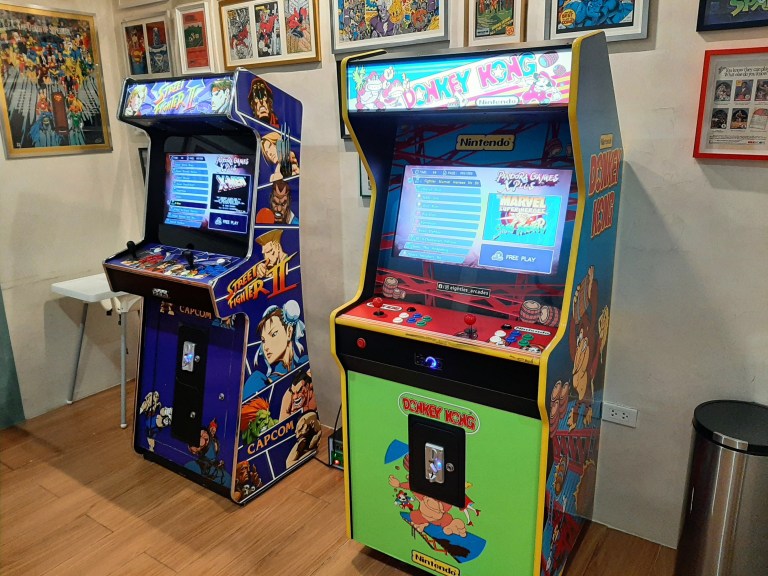
While Hackensack has a strong 1950s vibe with its food, interiors and atmosphere, the place with the two arcade cabinets (where players can stand in front of and play games) is something else. If you know your entertainment history, you should be aware already that arcade games in America (electronic games played on machines) did not exist during the 1950s.

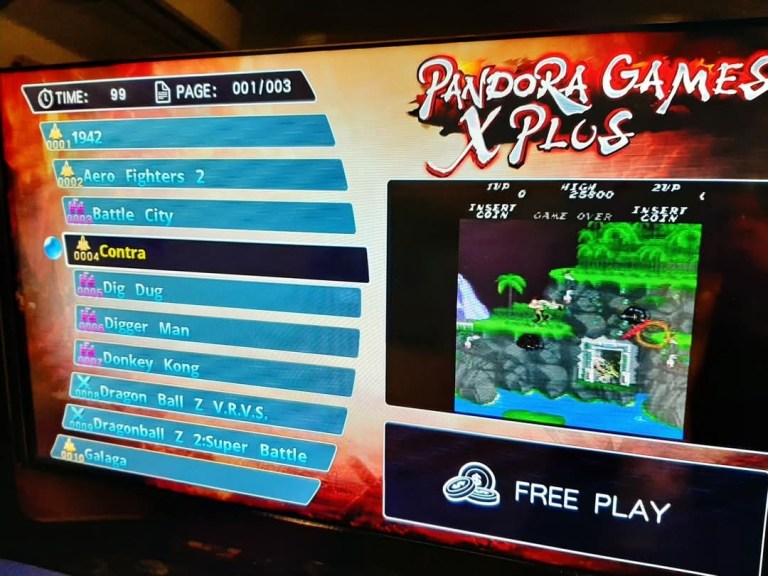
That being said, the two arcade cabinets allow users to pick games from a wide selection of titles from the 1970s to the 1990s. The beauty about have these arcade cabinets is that you can play games absolutely free! No need to insert coins or tokens at all!

The two arcade cabinets inside Hackensack. Each machine contains lots of classic arcade games and the great thing is that customers can play those games for free. Simply select the game, press the button and start enjoying retro gaming fun.
A few of the many retro games to choose from.

During my two visits at Hackensack in BF Homes, I had retro gaming fun with Galaga, Elevator Action, X-Men vs. Street Fighter, Pac-Man, the X-Men arcade game from Konami, and Donkey Kong to name some. Other arcade classic available for gamers to choose from include Street Fighter II, Battle City, 1942, Contra, Rambo III and RoboCop to name a few.

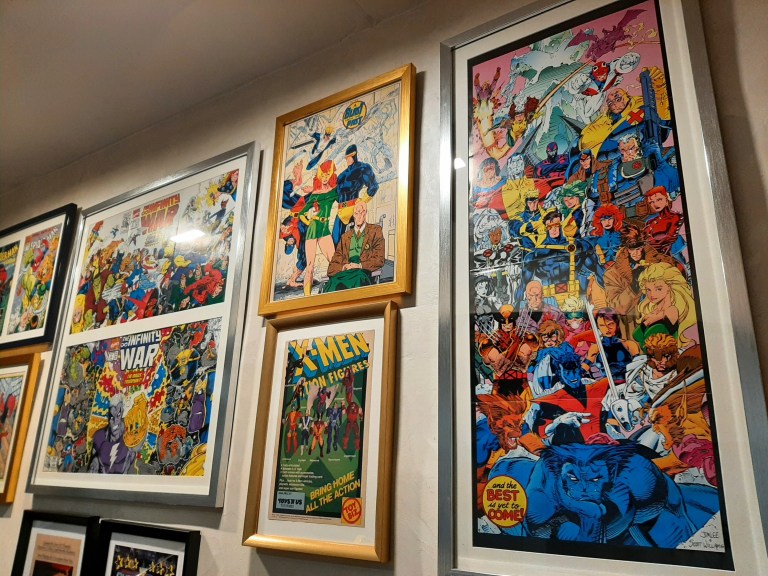
In addition to the existing retro gaming vibe the arcade cabinets provided, there were these very notable comic book covers and artworks displayed on the walls near them. Having read and collected superhero comic books in the 1990s, I recognized a lot of notable artworks there such as WetWorks by Whilce Portacio, X-Men by Jim Lee, Youngblood by Rob Liefeld, Spider-Man by Todd McFarlane, and Superman by Dan Jurgens.

Are you a 1990s comic book enthusiast? Check out the selected comic book materials displayed as decorations.

With good food, a comfortable retro place and retro gaming fun, Hackensack really stands out nicely among the many food joints inside BF Homes. As of now, it is the one place in the entire South Metro Manila where you can enjoy meals and arcade games together.

To learn more about Hackensack, visit their Facebook page by clicking https://www.facebook.com/hackensack.ph. To visit their BF Homes branch right now, click the Google Maps location link at https://maps.app.goo.gl/EHAAteZTZXwgeggw9

+++++

Thank you for reading. If you find this article engaging, please click the like button below, share this article to others and also please consider making a donation to support my publishing. If you are looking for a copywriter to create content for your special project or business, check out my services and my portfolio. Feel free to contact me with a private message. Also please feel free to visit my Facebook page Author Carlo Carrasco and follow me on Twitter at  @HavenorFantasy as well as on Tumblr at https://carlocarrasco.tumblr.com/ and on Instagram at https://www.instagram.com/authorcarlocarrasco
For more South Metro Manila community news and developments, come back here soon. Also say NO to fake news, NO to irresponsible journalism, NO to misinformation, NO to plagiarists, NO to reckless publishers and NO to sinister propaganda when it comes to news and developments. For South Metro Manila community developments, member engagement, commerce and other relevant updates, join the growing South Metro Manila Facebook group at https://www.facebook.com/groups/342183059992673

A Look Back at Amazing Spider-Man #320 (1989)

Welcome back superhero enthusiasts, 1980s arts and culture enthusiasts, Marvel Comics fans and comic book collectors! Today we go back to the year 1985 to examine a small part of the Marvel Comics shared universe through a tale of the Amazing Spider-Man monthly series.

For this particular review, we will explore the first chapter of The Assassin Nation Plot storyline that took place within the Amazing Spider-Man series.  

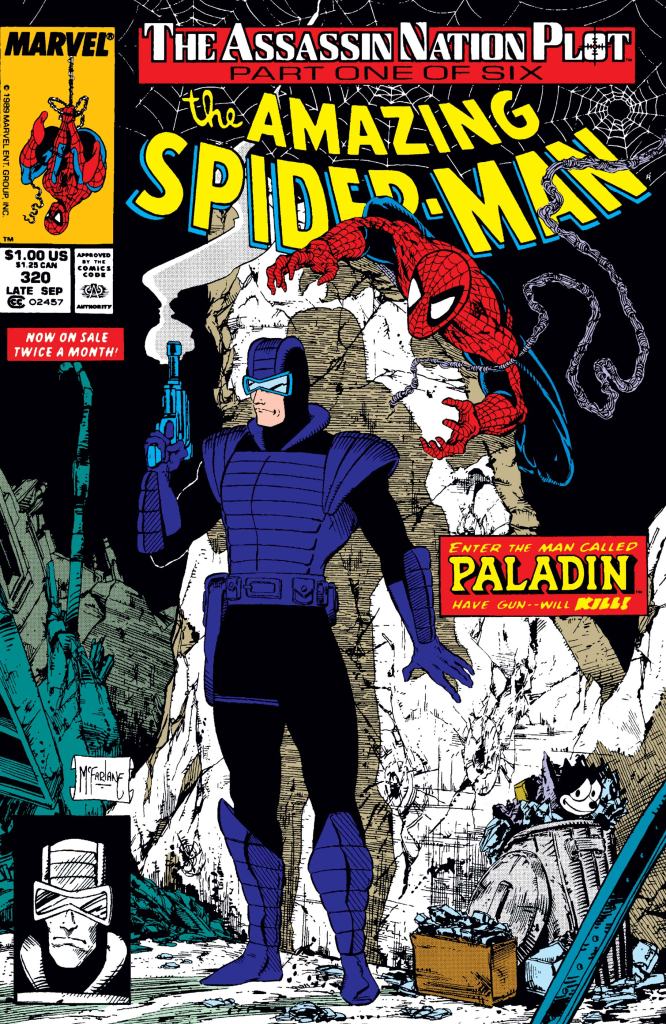
With those details laid down, here is a look back at Amazing Spider-Man , published in 1989 by Marvel Comics with a story written by David Michelinie and drawn by Todd McFarlane.

The cover.

Early story

The story begins inside Empire State University where Peter Parker – working as an assistant in the science lab – takes advantage of the free time and resources to create web fluid using a new formula. He notices that the acetylene torch does not even leave a smudge on the new web he made.

To his surprise, his boss doctor Evan Sloan catches him doing an interesting experiment. Parker comes up with a convincing excuse for the experiment which spares him from getting into trouble. After promising doctor Sloan he will get on the neutron project first thing in the morning of Thursday, Parker leaves, secretly changes into Spider-Man and equipped his brand new web. He then leaves the university and moves deep into the city…

Quality

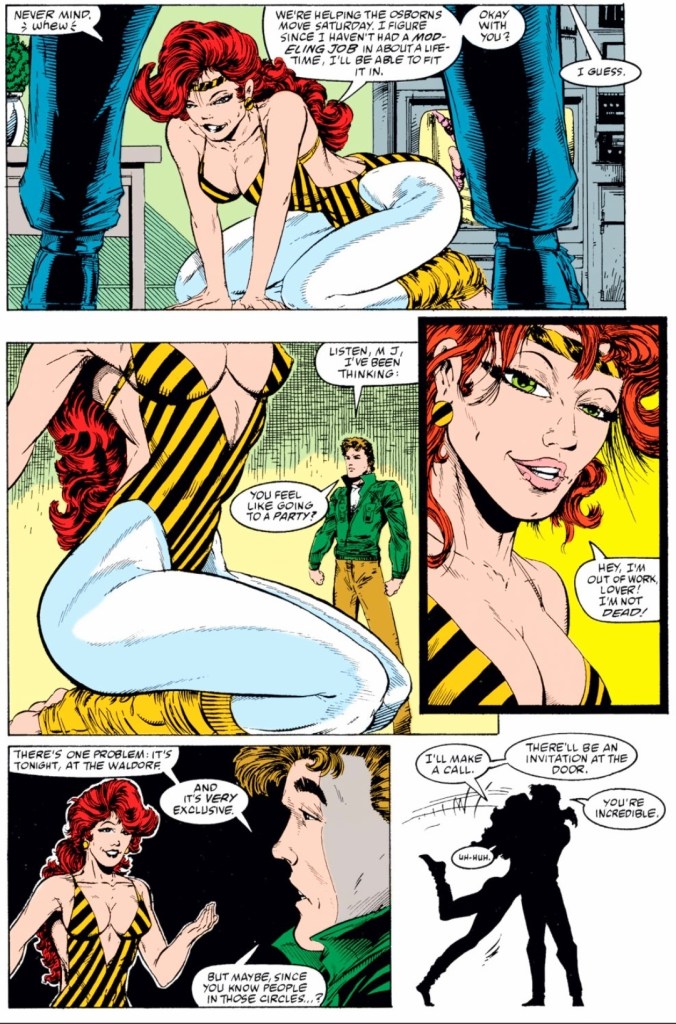
Peter Parker and Mary Jane having a discussion.

I really like the story David Micheline came up with as the start of The Assassin Nation Plot storyline. This is clearly not your typical good-versus-evil superhero tale starring the webslinger. Instead, there are layers of secrecy, suspense and intrigue that involves a powerful private organization, private armies and diplomats.

Instead of facing off with super villains, Spider-Man finds himself in the middle of something very big brewing behind the scenes, and that puts him in deep danger. That being said, Michelinie’s approach on building up the details of the plot moved very smoothly and the payoff for each buildup was executed on a timely manner. The buildup of details was never boring nor too slow to absorb, and Todd McFarlane excelled with visualizing the plot while still delivering dynamic superhero action.

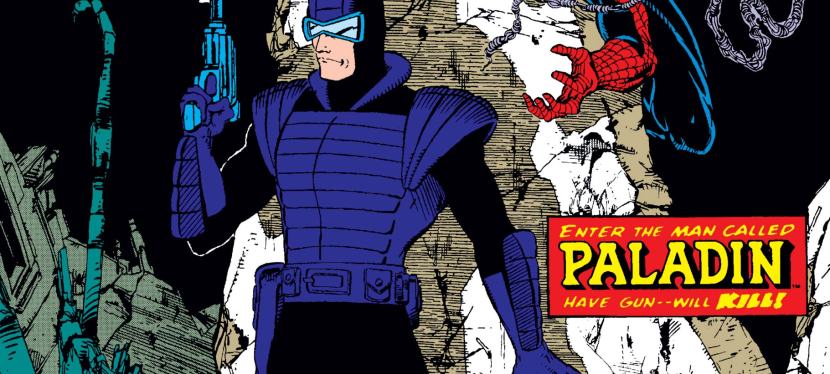
I should mention that the character Paladin has a strong presence in the story and there were moments when he outweighed Spider-Man in terms of importance.

Conclusion

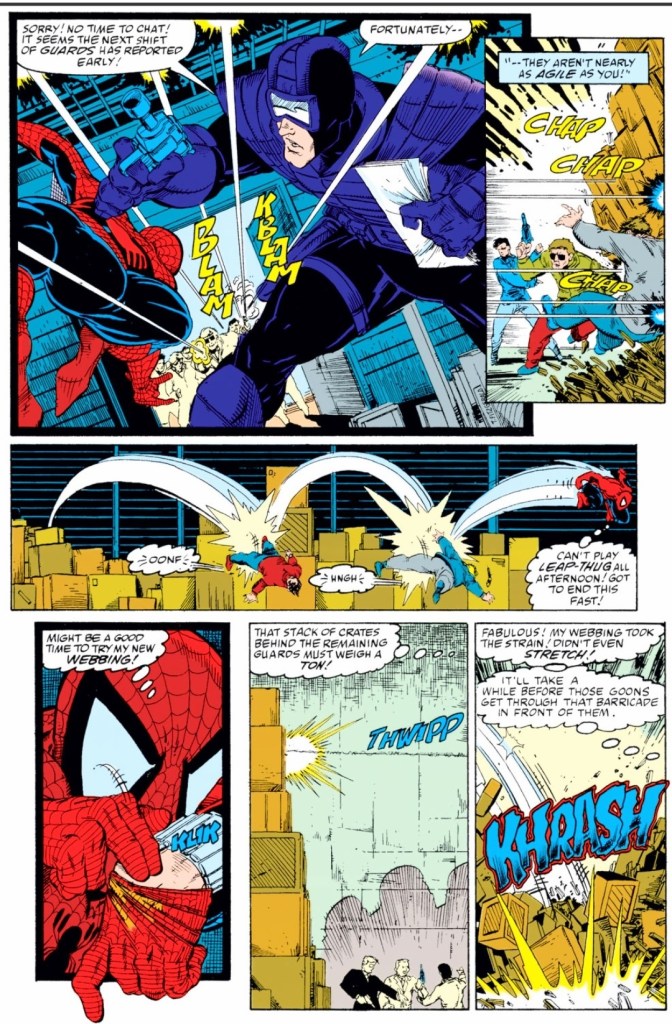
Spider-Man and Paladin targeted by armed guards.

Amazing Spider-Man (1989) is indeed a very solid story to read and a powerful start of The Assassin Nation Plot storyline. With the way the core concept was presented, this comic book symbolically showed that there are high stakes and other matters that are clearly too overwhelming for Spider-Man to deal with. The story is nicely paced and the creative team knew when and how to execute worthy payoffs for each buildup. By the time I reached the end of the comic book, I became convinced to read the next chapter of this storyline.

Overall, Amazing Spider-Man (1989) is highly recommended.

+++++

Thank you for reading. If you find this article engaging, please click the like button below, share this article to others and also please consider making a donation to support my publishing. If you are looking for a copywriter to create content for your special project or business, check out my services and my portfolio. Feel free to contact me with a private message. Also please feel free to visit my Facebook page Author Carlo Carrasco and follow me on Twitter at  @HavenorFantasy as well as on Tumblr at https://carlocarrasco.tumblr.com/ and on Instagram at https://www.instagram.com/authorcarlocarrasco
A Look Back at Spider-Man #2 (1990)

Welcome back superhero enthusiasts, 1990s culture enthusiasts and comic book collectors! Today we go back to the early 1990s and explore a part of the Marvel Comics shared universe through a tale of the Spider-Man monthly series.

In my previous retro review, Todd McFarlane told a tale of the iconic web-slinger with intense build-up leading to another rematch with his old nemesis the Lizard (Dr. Connors). While the writing was pretty weak, McFarlane still managed to tell a tale with a strong element of horror and supernatural stuff. McFarlane’s approach with visual violence and graphic stuff was clearly adulterated. What was presented daringly tested the limits allowed under the Comics Code Authority (CCA).

With those details laid down, here is a look back at Spider-Man , published in 1990 by Marvel Comics with a story written and drawn by Todd McFarlane. This is also the 2nd chapter of the Torment storyline.

The cover.

Early story

The story begins in New York City where two men got suddenly murdered by the Lizard in an alley during the night. The next morning Peter Parker reads the newspaper (showing the photograph and the news story of the Lizard’s murder of the two men) while having a breakfast moment with his wife Mary Jane. As soon as his wife mentions the word “monster”, Peter takes a 2nd look at the newspaper’s photograph and finally notices the bloody writing “CNNR” on the alley wall which makes him realize that the Lizard is back again.

Feeling very troubled, Peter leaves Mary Jane quietly and dresses up as Spider-Man to go out once again.

Elsewhere in the city, a sorceress uses her evil method of crafting a potion which creates an unrelenting sound of disturbance which Spider-Man hears. As the sound goes on, his focus and Spider Sense get overwhelmed…

Quality

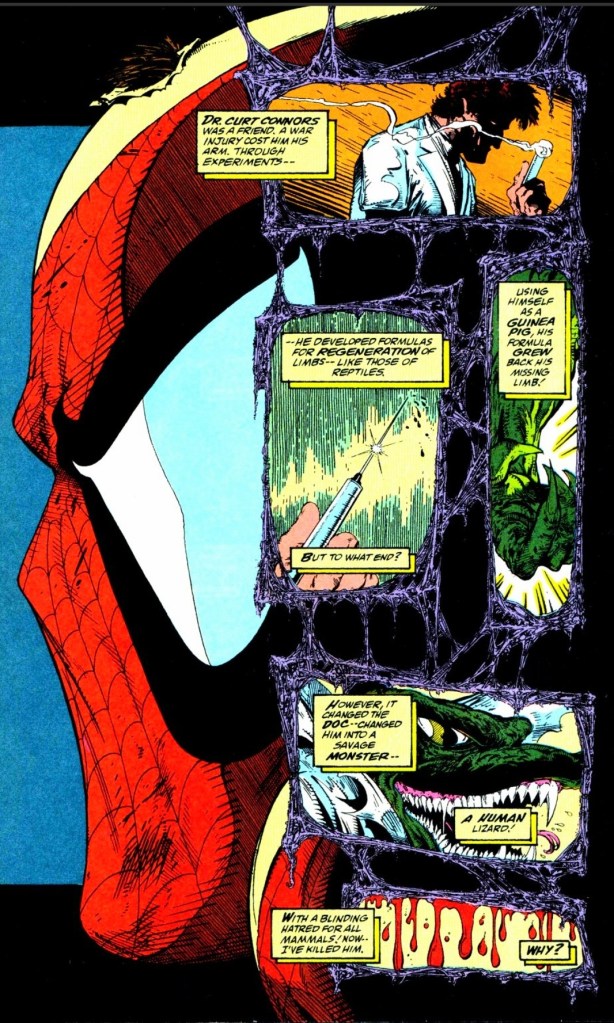
A quick look at the origin of the Lizard by McFarlane.

While the writing by McFarlane remains weak, he still succeeded in making this story a marginal improvement over the previous issue in terms of moving the plot forward, paying off a good chunk of the build-up in issue , and establishing his own visual corner (inspired by horror and adulterated stuff) within the Spider-Man franchise of comics of the time.

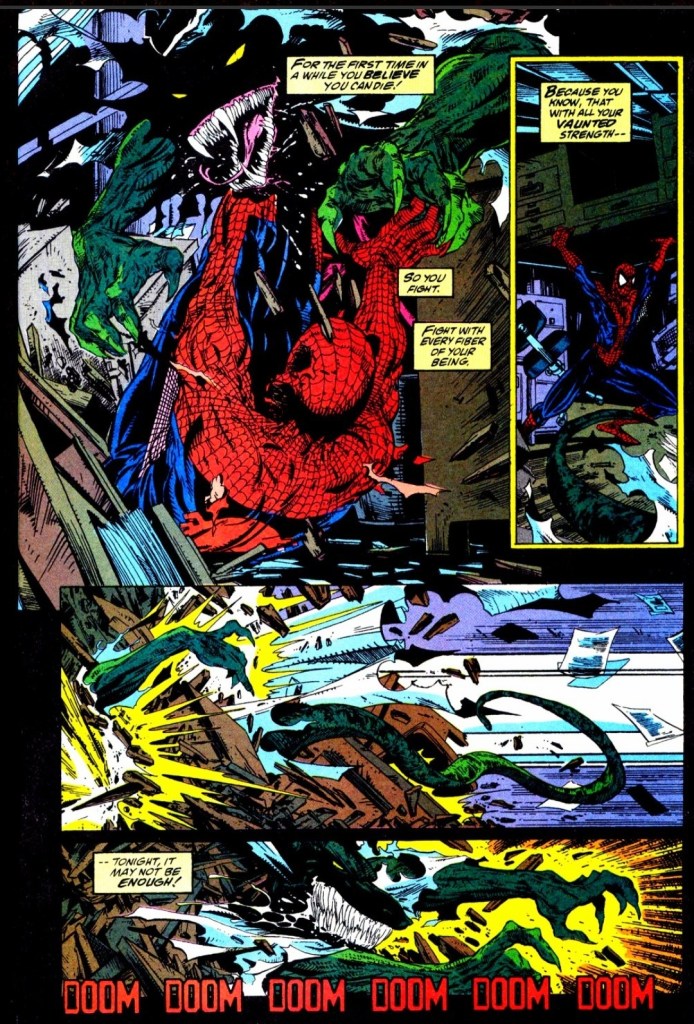
The biggest feature here is the physical conflict between Spider-Man and the Lizard. As expected, McFarlane drew the big fight with a lot of intense action, powerful violence (note: it was clear the editorial team recommended moves to tone down the graphic violence), suspense and a good amount of horror. Not only does the big fight move the story forward, it allowed McFarlane to dramatize Spider-Man as a vulnerable hero who not only has to cope with the disturbance from the sorceress far away, but also deal with the poison he got from the Lizard. That being said, Spidey also struggles with his sanity and the new fact that the Lizard has turned into a murder machine which disturbs him a lot as he personally knew Dr. Connors.

Considering what happened here and in the previous issue, there is still a greater force of evil that awaits Spider-Man and the Lizard happens to be an ultra-violent tool.

Conclusion

Many times Spider-Man finds himself in a disadvantage while fighting the Lizard.

Being the 2nd chapter of the Torment storyline, Spider-Man (1990) is a slight improvement over the previous issue in terms of moving the story forward, spectacle and dramatization. While the big fight between Spider-Man and the murderous Lizard is clearly the big feature of the story, McFarlane does a good job portraying Spider-Man as vulnerable and on the edge towards defeat. McFarlane’s writing here is still weak but the other positive elements achieved outweighed the weakness.

Overall, Spider-Man (1990) is satisfactory.

+++++

Thank you for reading. If you find this article engaging, please click the like button below, share this article to others and also please consider making a donation to support my publishing. If you are looking for a copywriter to create content for your special project or business, check out my services and my portfolio. Feel free to contact me with a private message. Also please feel free to visit my Facebook page Author Carlo Carrasco and follow me on Twitter at  @HavenorFantasy as well as on Tumblr at https://carlocarrasco.tumblr.com/ and on Instagram at https://www.instagram.com/authorcarlocarrasco

A Look Back at Spider-Man #1 (1990)

Welcome back superhero enthusiasts, 1990s culture enthusiasts and comic book collectors! Today we go back to the early 1990s and explore a part of the Marvel Comics shared universe through a tale of the Spider-Man monthly series.

Back in the late 1980s, Todd McFarlane proved to be a highly talented artist who helped Marvel sell a lot of issues of the Amazing Spider-Man series. McFarlane was also highly involved with the creation of Venom which not only became Spider-Man’s deadliest foe but also an icon of Marvel’s. In the year 1990, a brand new monthly series of Spider-Man was launched and it had Todd McFarlane writing and illustrating the tales.

With those details laid down, here is a look back at Spider-Man , published in 1990 by Marvel Comics with a story written and drawn by Todd McFarlane. This marks the beginning of the Torment storyline.

The cover.

Early story

The story begins in New York City where countless people walk to their respective destinations not realizing that the local hero Spider-Man was swinging above them. In a dirty alley, Spider-Man prevents an armed thug from harming a woman and leaves him hanging covered with a lot of web.

Elsewhere in the city, a sinister figure conducts a ritual, prays to evil forces and begins using magic.

In yet another location, a hideous creature emerges from the water. It’s the Lizard…

Quality

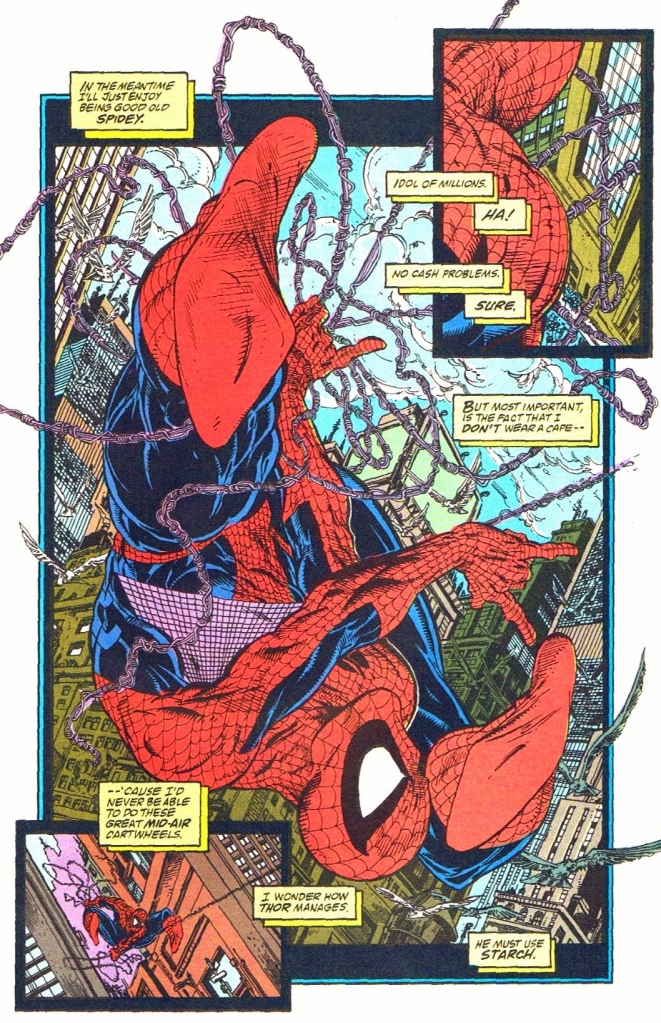
This page is an example of Todd McFarlane creating a travel sequence that allowed him to draw something great. It’s a classic example of moving back into the comfort zone.

To make things very clear here, this comic book is pretty shallow and hollow mainly due to its storytelling as this was the writing of a very young Todd McFarlane. There is no denying that his art here is great to look at from start to finish. In fact, this was one of McFarlane’s finest visual works ever with Marvel.

But if you look beyond the great visuals, the writing is very weak all throughout the issue. At best, this comic book is a grand-looking yet shallow set-up for the conflict of the Torment storyline complete with shared emphasis on the iconic web-slinger, the Lizard (looking more menacing than before) and Calypso (the one behind the magic and rituals).

In fairness to McFarlane, he added his own touch on emphasizing the personalities of Peter Parker and wife Mary Jane simultaneously as a couple. If you were used to seeing in-depth character development and witty dialogue about the two major characters as portrayed in the Amazing Spider-Man, Web of Spider-Man and Spectacular Spider-Man series of 1990, you won’t find them in this comic book. Under McFarlane’s writing, Spider-Man in this issue showed signs of sarcasm and cockiness in the first scene, and with Mary Jane he (as Peter Parker) expressed himself philosophically. To say the least, the portrayal of Spider-Man here is noticeably different under McFarlane.

The Lizard, a long-time rival of Spider-Man’s, was presented to be very violent and murderous in this issue. This was clearly McFarlane’s approach on emphasizing the force of opposition that awaits the iconic web-slinger and he obviously went for a more adulterated approach with the visuals. That being said, the violent content in this comic book is very unique and clearly stood out from the rest of the Spider-Man-related comics published by Marvel in 1990. Lastly, I should say that McFarlane’s visual take on the Lizard is the best I have seen.  

Going back to the visuals, McFarlane implemented strong elements of horror, darkness and grittiness which went along well with the adulterated approach to violence.  These mixed elements, as they turned out in reality, became part of McFarlane’s future works past Spider-Man.

Conclusion

McFarlane’s vicious and horrifying approach on visualizing the Lizard can’t be ignored. This Lizard makes the cinematic Lizard of the 2012 movie The Amazing Spider-Man look cartoony.

Spider-Man (1990) is a very mixed bag when it comes to literary enjoyment. It clearly has great artwork by McFarlane whose adulterated approach on expression and spectacle made it very unique. The writing by McFarlane (who was very young at the time of production) is clearly the big letdown although his own approach on portraying Spider-Man, MJ and the Lizard are very notable. Take note that this was Todd McFarlane starting with writing while doing the art (his true strength), and at this point in comic book history his talent on telling compelling stories would not be realized until a few years later (particularly with Spawn and Image Comics). Notably, his use of visual horror and darkness predates his work in Spawn which makes his Spider-Man take very distinct. Ultimately, this comic book served as a build-up for things to come in the Torment storyline. Don’t expect too much when acquiring this comic book.

Overall, Spider-Man (1990) is satisfactory.

+++++

Thank you for reading. If you find this article engaging, please click the like button below, share this article to others and also please consider making a donation to support my publishing. If you are looking for a copywriter to create content for your special project or business, check out my services and my portfolio. Feel free to contact me with a private message. Also please feel free to visit my Facebook page Author Carlo Carrasco and follow me on Twitter at  @HavenorFantasy as well as on Tumblr at https://carlocarrasco.tumblr.com/ and on Instagram at https://www.instagram.com/authorcarlocarrasco

A Look Back at Wetworks #1 (1994)

Welcome back superhero enthusiasts, 1990s arts and culture enthusiasts, and comic book collectors! Today we go back to the mid-1990s to explore the comic book launch of a notable fictional team co-created by the Whilce Portacio and Brandon Choi…Wetworks.

For the newcomers reading this, Whilce Portacio was one of the highly talented illustrators who left Marvel Comics and co-founded Image Comics in the early 1990s. While his fellow co-founders Todd McFarlane, Jim Lee, Rob Liefeld, Marc Silvestri, Jim Valentino and Erik Larsen were able to launch their respective dream projects (creator-owned properties) during Image’s first year of publishing, the launch of Wetworks was delayed by two years due to a death in Portacio’s family.

As a very young comic book reader in those days, I remember hearing rumors about Wetworks inside comic book stores I visited. There were rumors of business negotiations, solicitations and scheduled launches (ranging from October 1993 to January 1994). I also noticed some comic book enthusiasts who bought old copies of X-Factor and Uncanny X-Men that Portacio illustrated while waiting for Wetworks to debut.

In the middle of 1994, Wetworks was finally launched under the Image Comics label and I still remember the day when I saw lots of copies of issue displayed on the shelves and windows of comic book stores.

With those details laid down, here is a look back at Wetworks , published in 1994 by Image Comics with a story written by Whilce Portacio and Brandon Choi. The art was done by Portacio with ink work by Scott Williams.

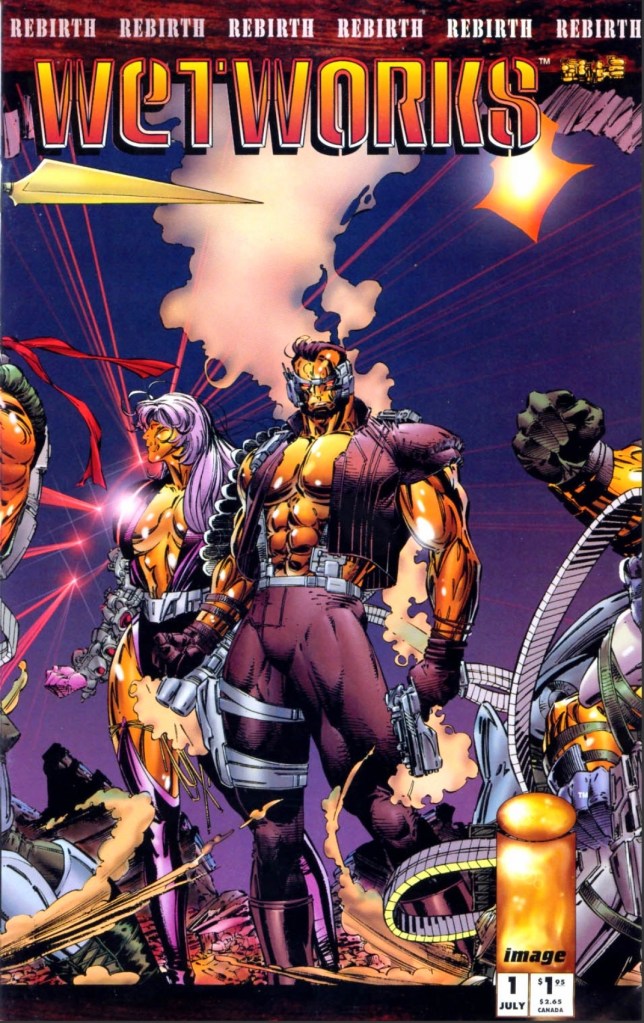
The cover.

Early story

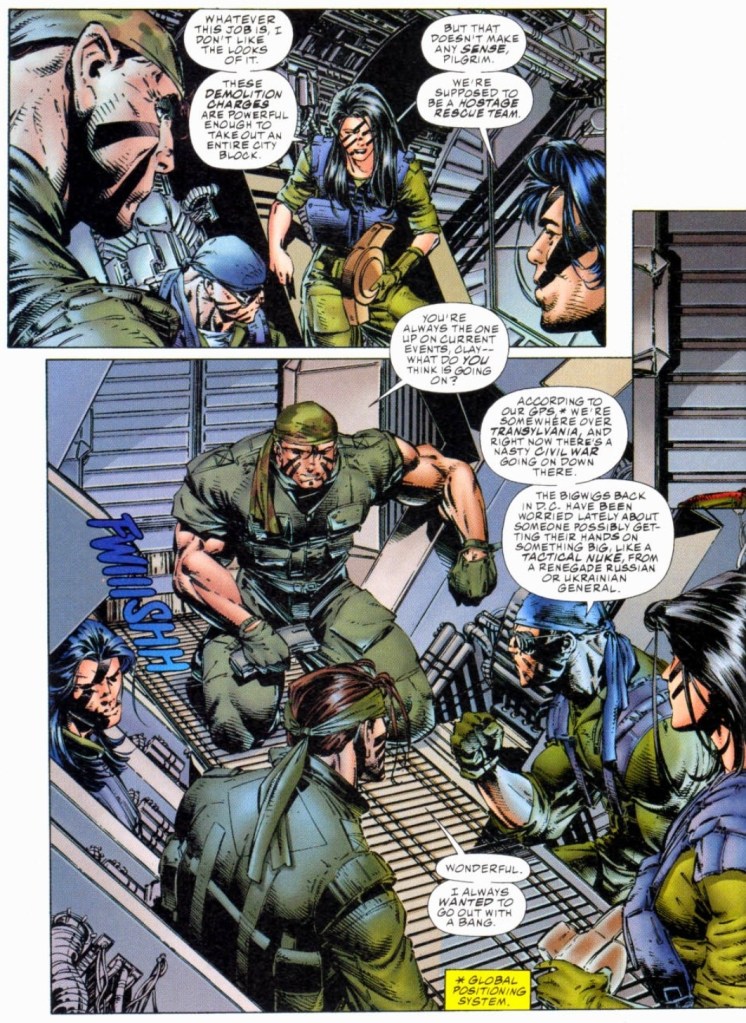
The story begins when a covert operations team working under International Operations (IO) travels to eastern Europe to infiltrate and destroy the base of operations of a certain warring faction and retrieve a biological agent (highly contagious) no matter what the cost. As it turns out, this new mission for the team (led by Colonel Jackson Dane, one of the pioneers of Team 7) started less than twenty four houses after their previous mission and their female member Pilgrim (reconnaissance specialist) pointed out that the demolition charges they are carrying are strong enough to wipe out an entire city block. Another teammate called Grail (the Filipino named Salvador Joel Alonday) stated that they are supposed to be a hostage rescue team.

Meanwhile deep inside the command center of IO in Washington, D.C., Admiral Halsey tells Miles Craven that Team 7 (the team led by Dane) are under his command and states that his sources tell him that there is more to the mission than just a group of ethnic nationalists obsessed on a biological terror campaign. It turns out, Craven sent the team to eastern Europe without fully informing them of what they are going up against. Craven insists that Team 7 are paid to put their lives on the line and to die if necessary just to get the job done. Craven then reveals to Halsey the true nature of the mission. The admiral then realizes Craven is right and certain sacrifices must be made for the greater good.

Craven and his team arrived at the location in Transylvania. They started seeing signs that someone else arrived ahead of them…

Quality

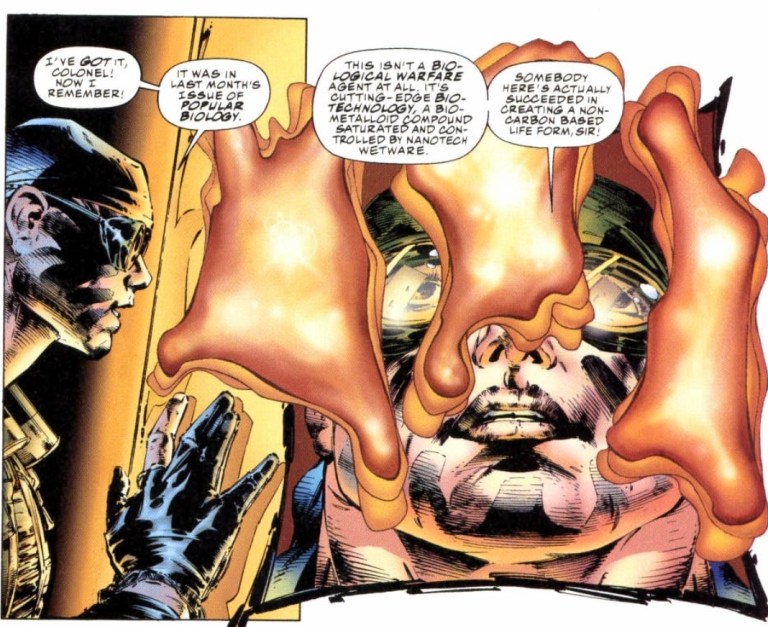
One of the team members looks at a symbiote.

I’ll start first with the fantasy concept and the storytelling. Whilce Portacio and Brandon Choi’s joint creation of Wetworks is indeed an inspired move with connections to real-life military influences the creators had. The Wetworks team – initially referred to as Team 7 – started looking and acting like typical military squad in the world of fiction but the major twist that happened drastically redefined and refined them into the most unique military team in the world of superhero comics. It’s the closest thing to seeing G.I. Joe fused with living symbiotes (another inspired move most likely influenced by a certain Marvel murderer with a symbiote whose origin is linked with one of the most iconic superheroes ever) there is and I can say Wetworks remains relevant and stands out nicely among superhero comic book teams to this day.

With regards to the plot, it looks cliched on face value. I’m talking about the trope in which a team is sent by their powerful superiors on a mission without knowing all the crucial details needed (because the superiors hid it from them) and they eventually encounter immense danger. As mentioned earlier, the major twist in the plot not only completed a major transformation of Dane and his teammates but also ramped up the fantasy aspect of the tale to much higher levels.

Still on the plot, Portacio and Choi came up with a solid structure for the narrative. The build-up of details and tension was very good and the pay-offs (lots of spectacle plus twists) were great. As the story moved on, the suspense grew stronger and the narrative succeeded in making me care about the team led by Dane.

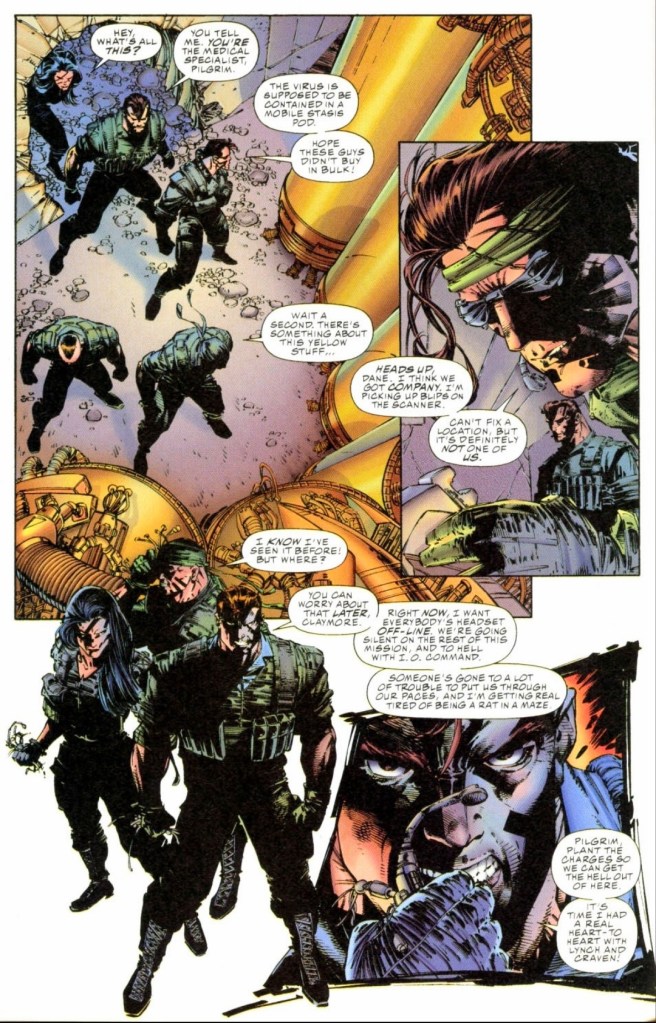
Meet the team members who would later become Wetworks.

When it comes to the art, Portacio’s work here (with ink by Scott Williams) still looks great and, more notably, it is a fine departure from the superhero visuals he worked in years prior. As with his past works, you will see the artist’s stylized approach on visualizing the narrative related to how he implements the panels per page.

Portacio did a very good job with the military look of Wetworks and he drew their guns with a high amount of detail that should be seen (you should try using a magnifying glass on this comic book). Not only that, his art on military hardware such as the gunships, the interiors plus equipment all have that detailed appearance. When it comes to action, I believe that Portacio took a lot inspiration from Hollywood action flicks (most notably Predator) on portraying Wetworks members using their guns and positioning during battle.

Of course, the spectacle is not totally limited to military stuff. There is a touch of fantasy and horror visuals involved which is directly related to what was set-up for Wetworks to encounter in the near future. To realize what I am saying here, you must read this comic book until the intense end.

Conclusion

Wetworks from 1994 is still great to read!

I can say without a doubt that Wetworks (1994) remains as gripping and as entertaining as when I first read it decades ago. In short, it has aged well and reading it all over again today is compelling and a lot of fun to do. If you ask me, this is one of the finest works ever by Whilce Portacio in terms of art and storytelling. As one of the many comic books Image published during its first few years in the industry, Wetworks (1994) clearly stands out with its military theme and fantasy concept. Lastly, Wetworks is set within the WildStorm universe as dramatically symbolized with the presence of International Operations (the team’s superiors).

Overall, Wetworks (1994) is highly recommended!

+++++

Thank you for reading. If you find this article engaging, please click the like button below, share this article to others and also please consider making a donation to support my publishing. If you are looking for a copywriter to create content for your special project or business, check out my services and my portfolio. Feel free to contact me with a private message. Also please feel free to visit my Facebook page Author Carlo Carrasco and follow me on Twitter at  @HavenorFantasy as well as on Tumblr at https://carlocarrasco.tumblr.com/ and on Instagram at https://www.instagram.com/authorcarlocarrasco

A Look Back at Amazing Spider-Man #301 (1988)

Disclaimer: This is my original work with details sourced from reading the comic book and doing personal research. Anyone who wants to use this article, in part or in whole, needs to secure first my permission and agree to cite me as the source and author. Let it be known that any unauthorized use of this article will constrain the author to pursue the remedies under R.A. No. 8293, the Revised Penal Code, and/or all applicable legal actions under the laws of the Philippines.

Welcome back superhero enthusiasts, 1980s arts and culture enthusiasts, Marvel Comics fans and comic book collectors! Today we go back to the 1980s and examine a small part of the Marvel Comics universe through a tale of the Amazing Spider-Man monthly series.

Back in the year 1988, Spider-Man fans enjoyed and got very intrigued with the first-ever Venom storyline which climaxed in Amazing Spider-Man . Some of you might be wondering what happened after the 300th issue of the series.

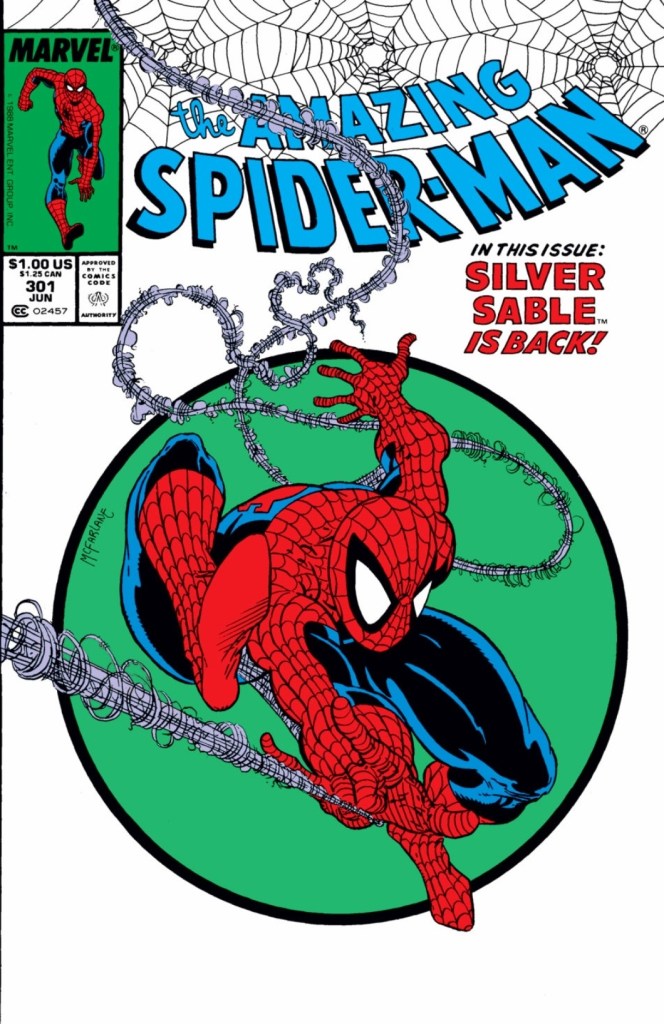
With those details laid down, here is a look back at Amazing Spider-Man #301, published in 1988 by Marvel Comics with a story written by David Michelinie and drawn by Todd McFarlane.

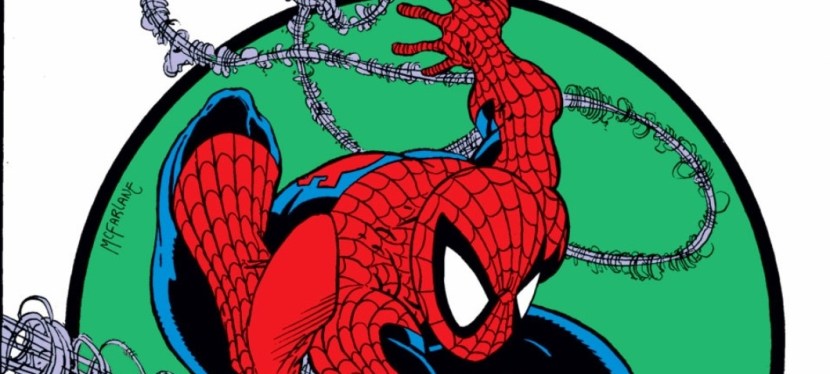
The cover.

Early story

The story begins with a group of armed personnel doing a mission inside a building. In the middle of the corridor, several over-head turrets pop out and fire paint balls at the team which used shields for protection. Moments after, they communicate with an executive called Mr. Cruz by means of live video feeds. Cruz tells them they failed the test.

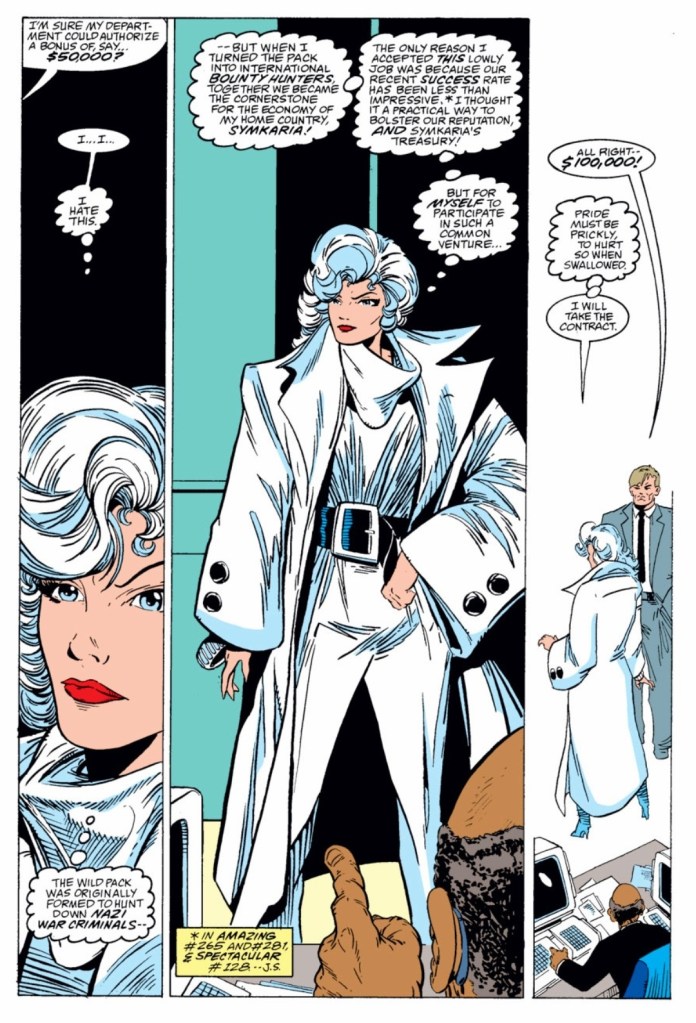
Shortly after, Mr. Cruz and Silver Sable meet with Mr. Pruett and discuss key aspects about the Pruett building’s security. It turns out Pruett himself advertised his building as being the safest locale in New York. Cruz tells him that Silver Sable’s Wild Pack team was fine to a certain extent but he feels much more confident if Sable herself would test building security. After some thinking about her team – international bounty hunters –, their role with the economy of her home country of Symkaria and the less-than-impressive success her team achieved recently, she accepts the contract from Pruett worth $100,000.

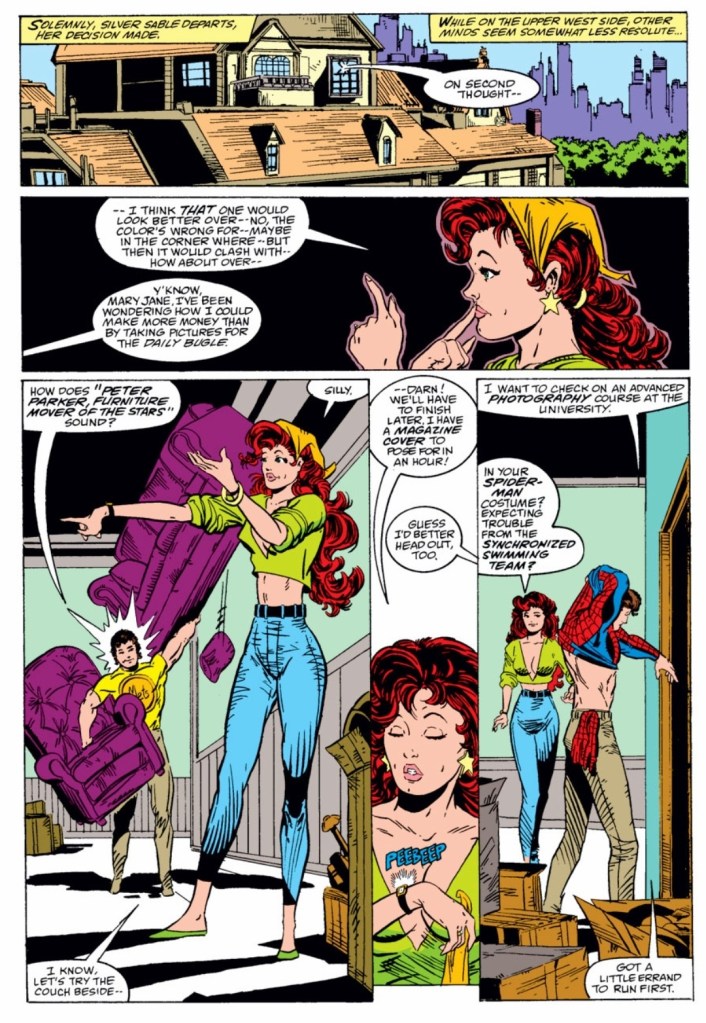
Meanwhile at another location within the city, Mary Jane Parker carefully decides where should her husband Peter (carrying a sofa and a large seat with his own super strength) should put furniture in their home. MJ then has to rush to attend a magazine cover photo session while Peter has to go out and check on an advanced photography course at a university…

Quality

The new couple Peter and Mary Jane Parker together with domestic life.

This is one of the more unique Spider-Man tales of the 1980s I have read. Silver Sable herself is the big feature of this comic book, even overshadowing the famous web-slinger. As this was published years before the Silver Sable and the Wild Pack monthly series launched, David Michelinie portrayed the character as a professional business woman who also happens to be a very capable physical fighter and infiltrator while carrying with her the pride of her homeland Symkaria. Through Silver Sable, you can see the richness of Michelinie’s writing and feel the uniqueness of her personality which makes her stand out among the many other supporting characters or heroes Spider-Man ever interacted with.

As a story set shortly after the climax of the Venom storyline, Peter Parker is portrayed to be in the middle of a transition having gone through college and recently getting married with Mary Jane. Even with the challenges and complications of life, he still finds himself stuck with the perceived obligations of the superhero life. There is also a sub-plot here about a white-haired man searching for him.

Going into the plot itself, Peter Parker could not contain himself from going out again in full costume and web-swinging as Spider-Man as he finds Mr. Cruz a suspicious figure. While it looks like the right thing to do for any superhero, it shows weakness in Peter Parker’s struggle to balance his life. The use of irony is nicely portrayed here.

Conclusion

This is how Silver Sable looked like in the late 1980s.

While the good-versus-evil element of the story is very subtle, Amazing Spider-Man #301 (1988) still succeeded in engaging and entertaining me primarily due to David Michelinie’s very solid storytelling and characterization. Unsurprisingly, Michelinie’s script is brought to life with Todd McFarlane’s fine art from start to finish. Don’t expect Spider-Man nor Silver Sable get to fight some dangerous villain in personal combat as the plot is more about suspense and intrigue laced with some twists. Still, there is plenty of superhero action to enjoy here and McFarlane’s art remains impressive. Silver Sable is very well defined in this comic book and by the end, you will get a solid grasp of herself and her background. This comic book is a must-read before you jump into the Silver Sable and the Wild Pack comic book series.

Overall, Amazing Spider-Man #301 (1988) is highly recommended.

+++++

Thank you for reading. If you find this article engaging, please click the like button below, share this article to others and also please consider making a donation to support my publishing. If you are looking for a copywriter to create content for your special project or business, check out my services and my portfolio. Feel free to contact me with a private message. Also please feel free to visit my Facebook page Author Carlo Carrasco and follow me on Twitter at  @HavenorFantasy as well as on Tumblr at https://carlocarrasco.tumblr.com/ and on Instagram at https://www.instagram.com/authorcarlocarrasco

A Look Back at Venom: Lethal Protector #3 (1993)

Disclaimer: This is my original work with details sourced from reading the comic book and doing personal research. Anyone who wants to use this article, in part or in whole, needs to secure first my permission and agree to cite me as the source and author. Let it be known that any unauthorized use of this article will constrain the author to pursue the remedies under R.A. No. 8293, the Revised Penal Code, and/or all applicable legal actions under the laws of the Philippines.

Welcome back superhero enthusiasts, 1990s arts and culture enthusiasts, Marvel Comics fans and comic book collectors! Today we go back to the year 1993 and explore a part of Marvel Comics’ universe through the first-ever limited comic book series featuring one of Marvel’s most iconic villains – Venom.

In my previous retro review, Venom discovers a long lost section of San Francisco that fell deep underground. Even though it is cut off from the resources and fresh air of modern San Francisco, the lost city section is filled with homeless people and social outcasts. Even though he helped the city dwellers by defeating the two armed mechs (employed by a powerful organization who oppose the city dwellers and are in pursuit of something related to San Francisco’s park), Venom still gets rejected by the so-called council. This only led him to returning to the surface not knowing that he is being targeted by a certain group.

With those details laid down, here is a look back at Venom: Lethal Protector , published in 1993 by Marvel Comics with a story written by David Michelinie and drawn by Mark Bagley.

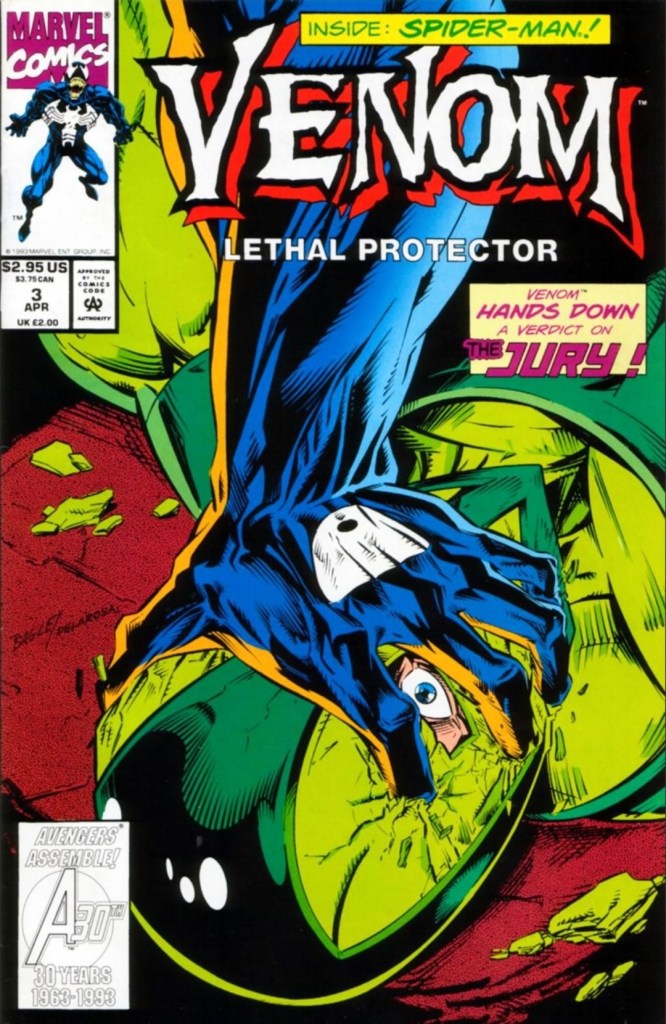
The cover.

Early story

The story begins with Venom suffering from a sonic blast while being restrained by one of the armed members of the group called The Jury. Their leader (who wears a suit and necktie) introduces himself as Orwell Taylor and he addressed Venom as Mr. Brock. It turns out Taylor spent lots of time and resources researching everything about Brock and the alien costume. More shockingly, The Jury’s leader reveals that he lost his son Hugh years ago due to Venom’s arranged killing of him as he escaped from his prison cell in the federal prison called The Vault. Hugh Taylor is the first man Venom killed when he escaped.

Venom responds by say that he and his symbiote did not want to hurt anyone. This provokes Orwell Taylor into anger and he orders The Jury to kill Venom. Due to the lengthy explanations of Orwell Taylor, Venom managed to recover and regain strength which he uses to free himself and throw one Jury member to another causing quick chaos.

After punching another Jury member, Venom then moves out of the alley and away from Taylor and his team…

Quality

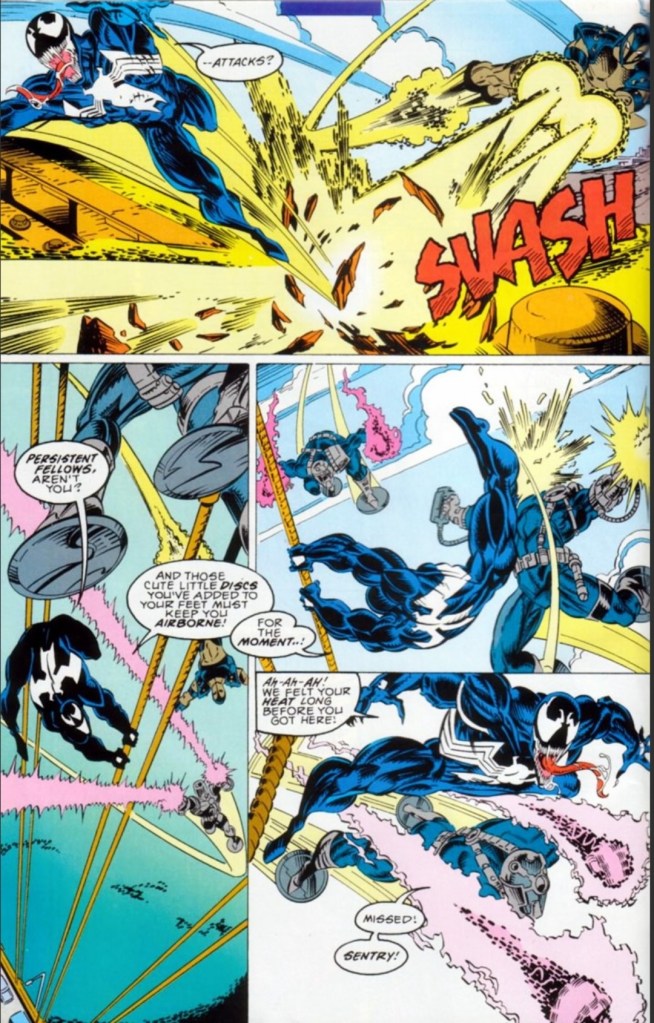
Very clearly, The Jury is a very formidable force of opposition. Their battle with Venom here comes with a lot of spectacle.

In terms of storytelling, this one is another improvement over issue (which itself is an improvement over issue ) as the plot got more interesting and even intriguing. For one thing, I like the fact that David Michelinie recalled Venom’s murderous escape from prison told way back in Amazing Spider-Man #315 (1989) and came up with the establishment of a very angry powerful father who formed the dangerous cybernetic team called The Jury. In a rather symbolic way, this comic book shows how Venom’s past comes back to haunt him and creatively, the battles between Venom and The Jury here are packed with a lot of action and visual dynamism delivered by Mark Bagley. The irony is that The Jury itself is not the main antagonist of this limited series as they are clearly presented to be a recurring force of opposition within Spider-Man’s realm in Marvel Comics’ shared universe of the time.

Still on the plot, the sinister organization hounding the dwellers of the lost city was revealed to be the Treece group whose leader is pursuing something very valuable to feed his greed. Still, even though this is already the third issue, the Treece organization’s presence is very subtle and as the force of opposition towards Venom, they are outclassed by The Jury.

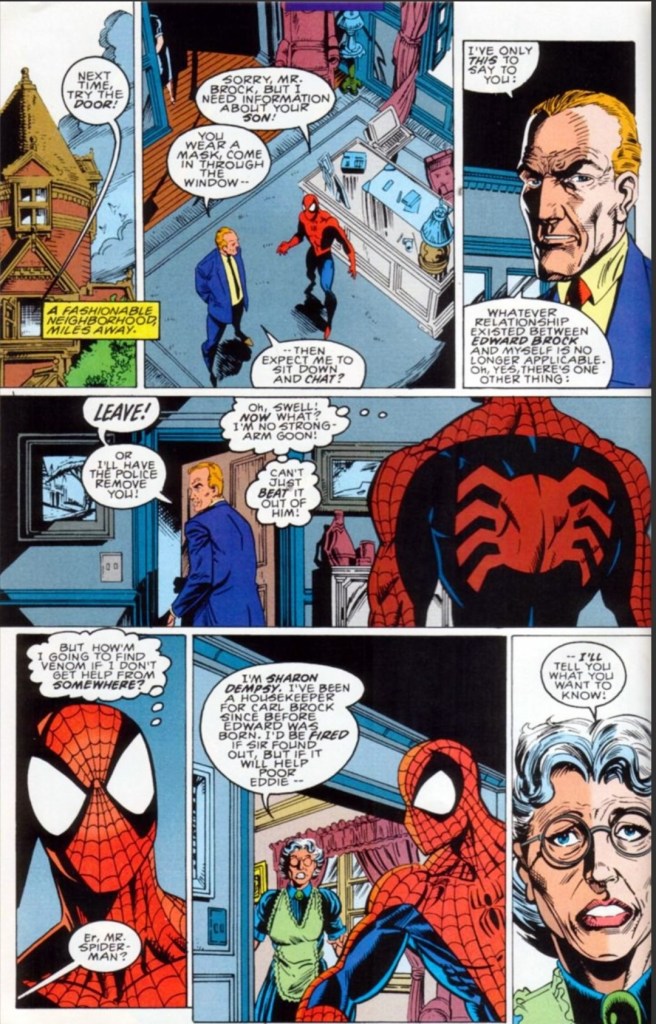
As in the previous issue, Spider-Man got a good share of the spotlight but this one is even more limiting which should delight Venom fanatics who complained about Marvel’s icon overshadowing their guy with the symbiote. Spider-Man serves mainly as a tool for exposition as the creative team showed images from the past of Eddie Brock with his father (whom Spider-Man approached for answers).

The problem here is that showing flashbacks from the past and explaining how Eddie Brock became bitter and sinister as a result of receiving almost no affection from his father ruins the mystery of Venom as a character. During the time of Todd McFarlane drawing Amazing Spider-Man comics and the early Venom tales, the mystery of Eddie Brock’s past added to the intrigue of Venom and his quick rise as the deadliest villain Spider-Man ever faced. I understand that this limited comic book series had Venom as the protagonist who was in high demand among readers of the time but for me the creative team went way too far emphasizing Eddie Brock’s past.

Nothing changes the fact that Eddie Brock aided by the alien costume is a murderer who happens to have previously been a prolific print media journalist whose career got ruined by Spider-Man which in turn led him to a downward spiral and eventually to bonding with the symbiote that once bonded with Peter Parker. The flashbacks were pointless and if there really was an attempt to humanize Eddie Brock and make him sympathetic to readers, the creative team clearly failed.

Conclusion

Spider-Man with Eddie Brock’s father in California.

Venom: Lethal Protector (1993) is a mixed bag. Its plot is clearly more intriguing and more interesting to read while there was enough creative space to show The Jury as a powerful force of opposition which is the result of Venom’s murder of Hugh Taylor (read: Amazing Spider-Man #315) while making a prison escape. The spectacle of the battle between Venom and The Jury must be seen! However, the creative team’s move to dramatize Eddie Brock’s past using flashbacks back-fired in my opinion and ultimately they destroyed whatever mystery was left behind Venom. As a protagonist, Venom has no appeal whatsoever and his portrayal here only reminds me that he works best as an antagonist opposite Spider-Man. Venom as a hero for those he perceived to be innocent and helpless remains forced and unconvincing.

Overall, Venom: Lethal Protector (1993) is satisfactory.

+++++

Thank you for reading. If you find this article engaging, please click the like button below, share this article to others and also please consider making a donation to support my publishing. If you are looking for a copywriter to create content for your special project or business, check out my services and my portfolio. Feel free to contact me with a private message. Also please feel free to visit my Facebook page Author Carlo Carrasco and follow me on Twitter at  @HavenorFantasy as well as on Tumblr at https://carlocarrasco.tumblr.com/ and on Instagram at https://www.instagram.com/authorcarlocarrasco

A Look Back at WildC.A.T.s: Covert Action Teams #1 (1992)

Disclaimer: This is my original work with details sourced from reading the comic book and doing personal research. Anyone who wants to use this article, in part or in whole, needs to secure first my permission and agree to cite me as the source and author. Let it be known that any unauthorized use of this article will constrain the author to pursue the remedies under R.A. No. 8293, the Revised Penal Code, and/or all applicable legal actions under the laws of the Philippines.

Before he became the co-publisher of DC Comics, the great Jim Lee made his debut in the comic book industry as an illustrator for Marvel Comics. Just a few short years after that, he became a fan-favorite of X-Men fans and was a major factor in the massive sales success of 1991’s X-Men #1 (Volume 2). Not only did that particular comic book established a long-lasting sales record for all comic books, Lee’s designs and visual concepts for the X-Men were adapted by the producers and creators of the fan-favorite X-Men: The Animated Series (1992-1997).

For the newcomers reading this, Jim Lee’s tenure with Marvel Comics ended in December 1991 when he, Rob Liefeld and Todd McFarlane met with the publisher and expressed that Marvel’s policies toward them were unfair and they were not rewarded well for their work. To put things in perspective, Jim Lee’s X-Men , Rob Liefeld’s X-Force and Todd McFarlane’s Spider-Man were respectively million-sellers. As such, Lee, Liefeld, McFarlane plus some more creators left Marvel and went on to establish Image Comics (which involved a production and distribution deal with Malibu Comics).

In 1992, Jim Lee’s dream project – with concepts first created in 1986 – came through free from the constraints he endured from Marvel’s editorial team and strict policies. That’s dream project was WildC.A.T.s: Covert Action Teams , which is the feature of this retro comic book review.

But before we start the review, here’s a quick look back at the conceptual history of WildC.A.T.s as written by Jim Lee himself.

“I created my first ‘professional’ comic book submission in the summer of 1986 entitled The Wild Boys involving an espionage agency called International Operations. The co-writer of that sublime piece of work was coincidentally enough – Brandon Choi – who at the time was still in college getting a double major in history and politics,” Lee wrote in the comic book’s intro.

Now that we’re done with the history, here is a look back at WildC.A.T.s: Covert Action Teams , published in 1992 through Image Comics with a story co-written by Jim Lee and Brandon Choi. Lee illustrated the comic book with ink work done by Scott Williams.

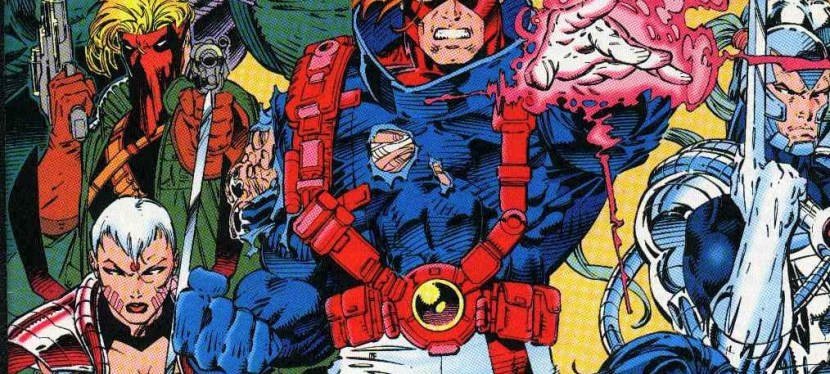
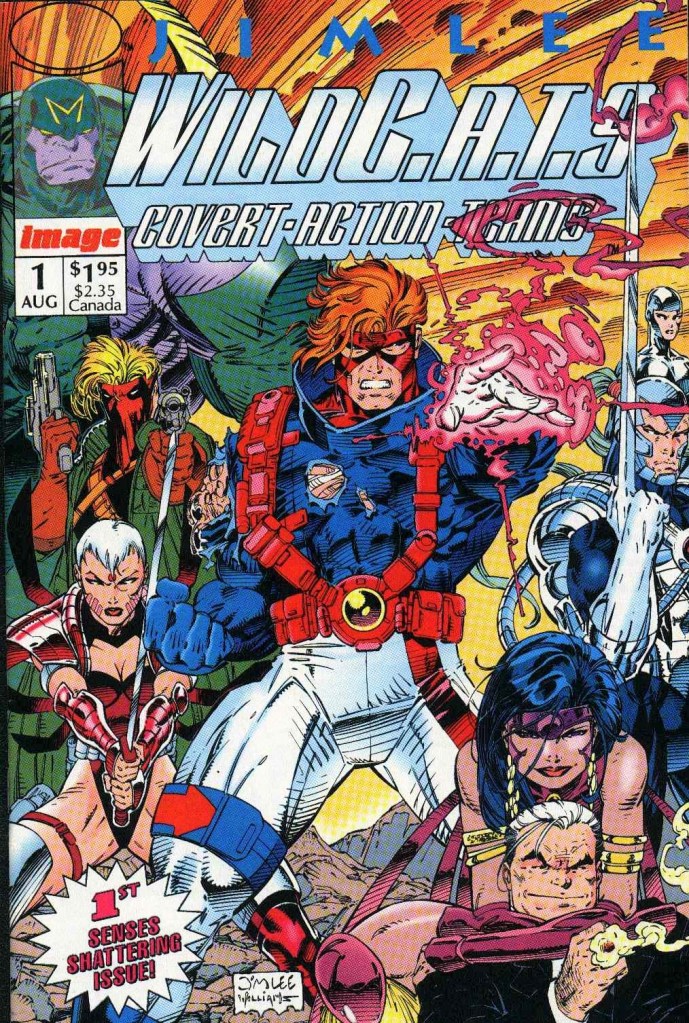
The cover.

Early story

The story begins in Antarctica in 1986. There, two men braved the cold weather searching for something with information they learned from IO (International Operations). Suddenly an orb rises from the snow and then an image of a lady wearing silver tights and wielding energy appears in front of them. After demanding them to let her have the orb, she and the energy field fade away.

In 1992, at the crisis control facility of IO in Virginia, IO’s executives carefully view video footage of Georgetown which was hit by an explosion. They suspect rogue C.A.T.s (covert action teams) could have been involved. Suddenly, the same energy field from six years earlier forms in their presence with the same lady appearing for a few moments. The energy field fades away.

In the present day, a dwarf named Jacob Marlowe wakes up in the middle of garbage in an alley. After getting hurt by two troublemakers, the same silver lady from the past appears and uses her energetic power to save Jacob. She introduces her to him as Void, claiming he came for him and she knows he was once a lord named Emp. She tells him the Cabal is a threat to humans on Earth…

Quality

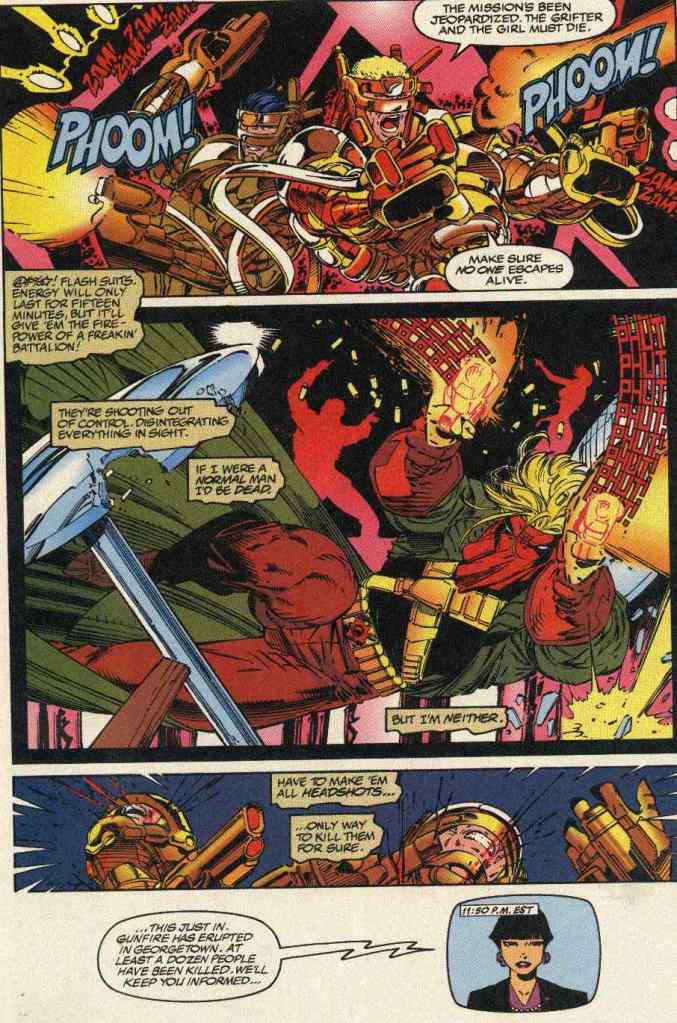
Clearly Jim Lee took inspiration from John Woo’s action movies.

When it comes to the presentation of the story, the comic book starts in a deliberately cryptic way. It’s like having very short prologues back to back and, fortunately, it works well to capture attention while building up slowly its concept. The story really begins when Jacob Marlowe arrives at his headquarters with Void as his enduring advisor and executor. The introductions of each of the team’s members – Spartan, Warblade, Maul, Grifter, Zealot and Voodoo – were decently done and never felt rushed as Jim Lee and Brandon Choi carefully paced the storytelling and really tried to balance exposition and spectacle. That being said, similar results happened with regards to the comic book’s spotlight on the Cabal and its evil leader.

With regards to the presentation of the classic conflict between good and evil, Lee and Choi came up with the concept of planet Earth being slowly infiltrated by Daemonites (who originated in outer space) with the Cabal serving like an anchor with an organized set-up for domination. Over at the WildC.A.T.s, Marlowe formed a team to fight and stop the Cabal since the lives of the people of Earth are at stake. This is a really nice concept serving as the foundation, and the irony is that, in this comic book specifically, IO was on the sideline.

When it comes to the visuals, Jim Lee must have enjoyed the liberty he had in illustrating this comic book…free from the editorial interference from Marvel and free too from the restrictions of the Comics Code Authority (CCA). The result here is a visual presentation showing more Lee’s creativity and a style different somewhat from his final works on X-Men. He clearly took more inspiration from action movies and the violence is somewhat more mature to look at. It should be noted that Scott Williams helped Lee’s art shine.

Conclusion

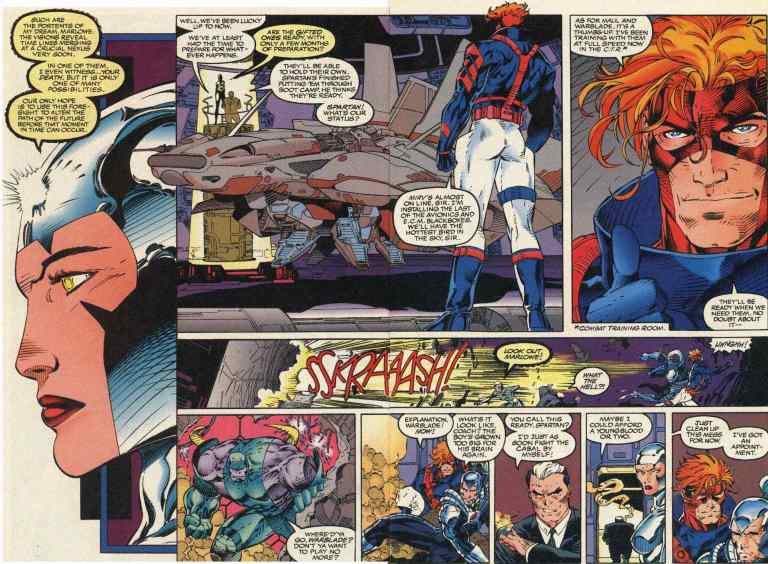
These two pages remind me somewhat of the X-Men, their jet and the Danger Room.

By today’s standards, WildC.A.T.s: Covert Action Teams is surprisingly still a good superhero team comic book to read. It’s not a literary classic but it proved to be compelling and fun enough to read from start to finish. It has a decent amount of action here and there which is understandable since Choi and Lee had to build up the concepts and the plot. If there were any weak spots, this comic book is almost devoid of character development and the clear lack of a lead character (which is still needed even for a superhero team comic book).

If you are seriously planning to buy an existing hard copy of WildC.A.T.s: Covert Action Teams (1992), be aware that as of this writing, MileHighComics.com shows that the near-mint copy of the regular edition costs $5 while the near-mint copy of the newsstand edition is priced at $16. The near-mint copy of the 3D edition costs $9 while the near-mint copy of the gold cover edition is priced at $42.

Overall, WildC.A.T.s: Covert Action Teams (1992) is recommended.

+++++

Thank you for reading. If you find this article engaging, please click the like button below and also please consider sharing this article to others. If you are looking for a copywriter to create content for your special project or business, check out my services and my portfolio. Feel free to contact me as well. Also please feel free to visit my Facebook page Author Carlo Carrasco and follow me at HavenorFantasy@twitter.com