Disclaimer: This is my original work with details sourced from reading the comic book and doing personal research. Anyone who wants to use this article, in part or in whole, needs to secure first my permission and agree to cite me as the source and author. Let it be known that any unauthorized use of this article will constrain the author to pursue the remedies under R.A. No. 8293, the Revised Penal Code, and/or all applicable legal actions under the laws of the Philippines.
Welcome back superhero enthusiasts, 1990s arts and culture enthusiasts, Image Comics fans and comic book collectors! Today we go back to the year 1995 to take a close look at one of the many tales of the original WildStorm universe through one of the comic books of the first mini-series of Team 7.
For the newcomers reading this, Team 7 is set in the past within the original WildStorm universe. This is the one special forces team that had major WildStorm heroes – Grifter (WildCATS: Covert Action Teams), Backlash, Jackson Dane (Wetworks), John Lynch (Gen13) and Deathblow – who were younger, were proficient with combat and were destined to gain special abilities that later defined them. Issue #1 reviewed last time worked well by efficiently introducing the characters while also building up the plot and there were some nice pay-offs here and there.
With those details laid down, here is a look back at Team 7 #2, published in 1994 by Image Comics with a story written by Chuck Dixon and drawn by Aron Wiesenfeld. This is the 2nd chapter of the 4-issue mini-series.
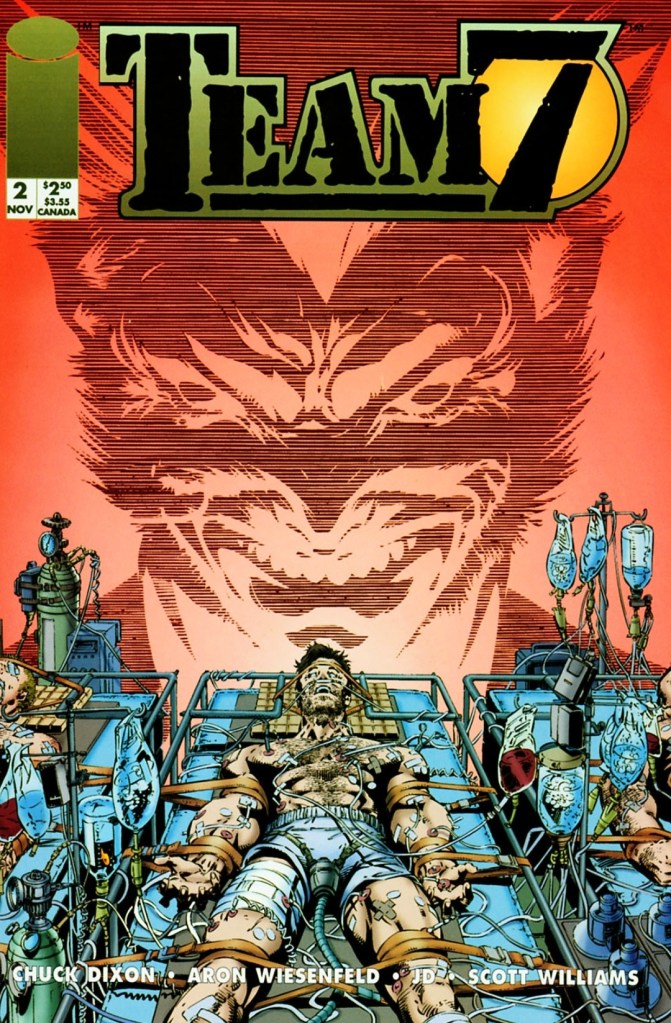
The cover.
Early story
Set in the 1970s, a team of armed escorts and some personnel wearing protective gear isolate and examine a battlefield full of dead bodies. Miles Craven and Gabriel Newman analyze the evidence around them. Craven states that what they have is too important an operation to be left to underlings and he wants Gabriel to stay with the project which could use his special talents. Shortly after, the bodies of the Team 7 members were retrieved barely alive.
Seven days later, John Lynch wakes up in a hospital bed feeling traumatized over what happened to his team during the last mission. He was told that they were exposed to a chemical agent and he had been in a deep coma for a week.
Craven then enters the room to provide Lynch crucial updates…
Quality
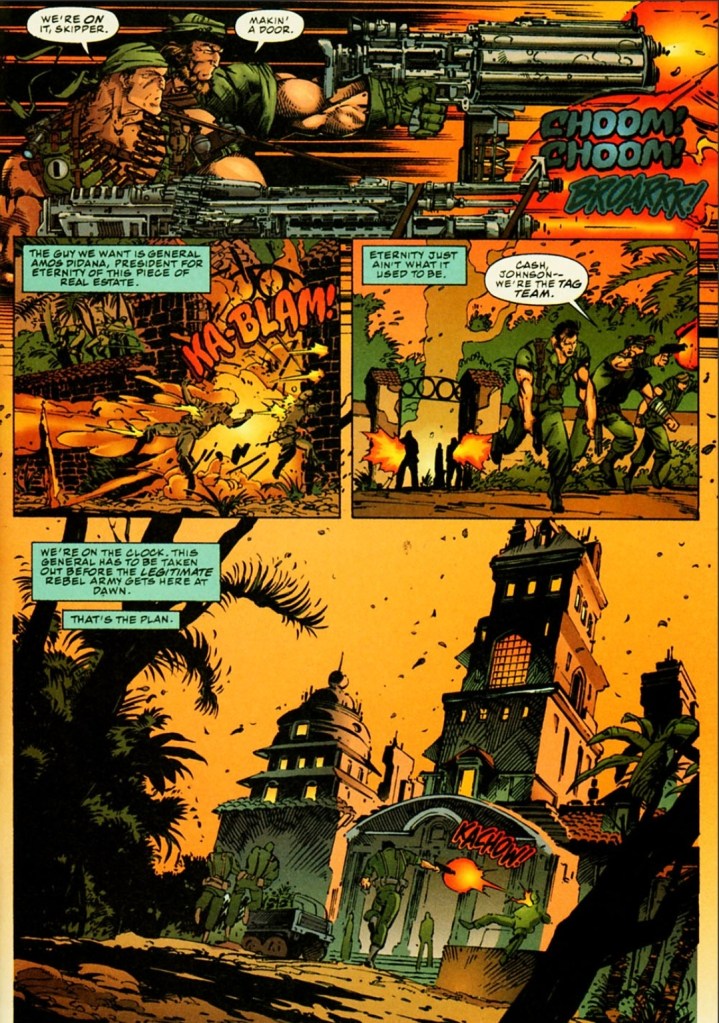
Do you recognize Deathblow and Dane on this page?
As expected, the gritty and dark storytelling from the previous issue continued in this story. Without spoiling the plot, I can say that this issue has some handsome pay-offs to what was built-up in issue #1 and there were new build-ups established along the way. Because the script was crafted to build-up the plot and sub-plot, the military action scenes are lessened which is not surprising. I can assure you that Chuck Dixon’s writing here remains pretty strong.
While the previous issue served as an efficient introduction of the younger versions of WildStorm’s heroes who are in the middle of a world full of violence and espionage, this issue shed some light as to how the heroes dealt with their new abilities (in connection with the climax of issue #1) and how International Operations is handling matters behind closed doors. The suspense kept on building up and this made the narrative more intriguing to follow. Expect to see elements of high-level espionage, unethical science and war throughout.
When it comes to the characters, Lynch (being the captain of Team 7) has a huge share of the spotlight followed by Cole Cash (Grifter). The two have different views about their special forces duty – Lynch follows the superiors while Cole realizes something is wrong about their leadership and the intelligence fed to them.
Conclusion
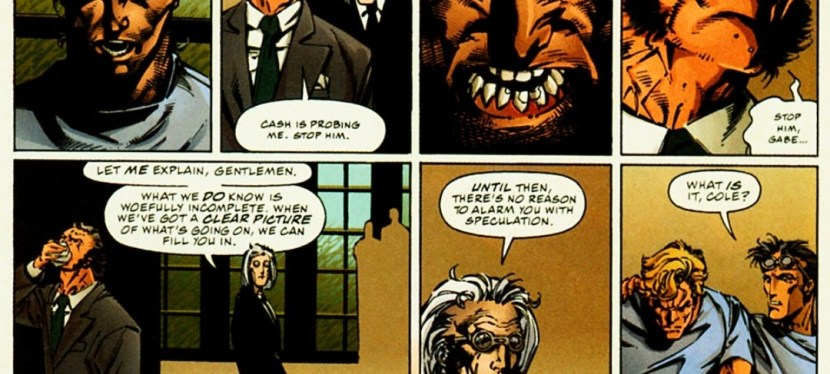
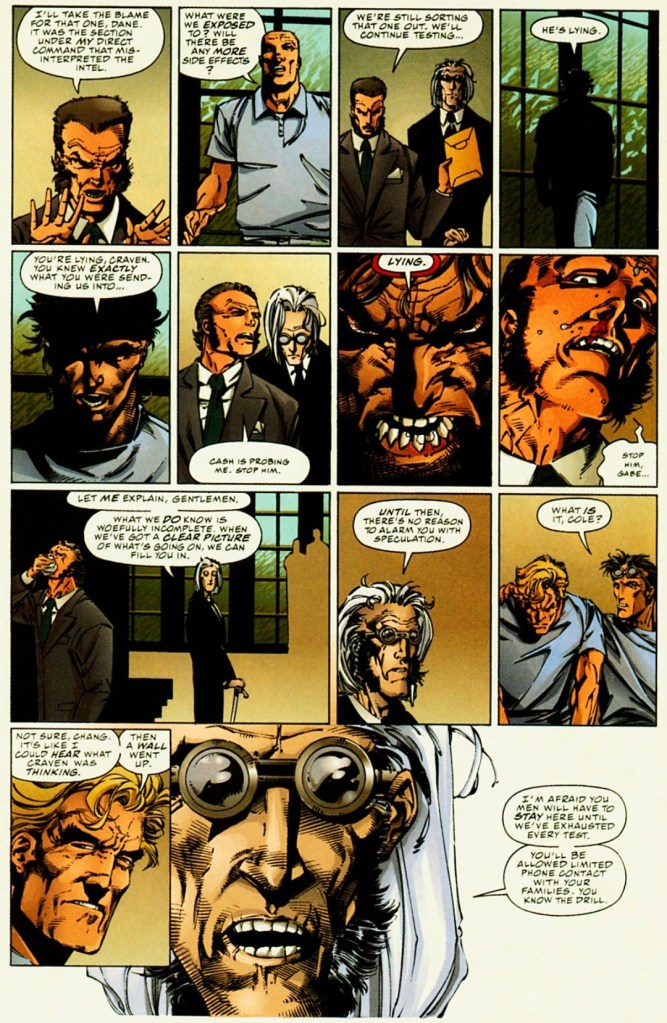
This scene showing Cole Cash (Grifter) emerging from dark with a defiant tone is a very defining moment of this comic book.
Team 7 #2 (1994) is clearly a very engaging read. It has the fine mix of war (with uncompromising violence drawn by Wiesenfeld), intrigue and the dark side of global espionage. The science fiction element here worked well in explaining the powers Team 7 members got after what happened in issue #1. This comic book also marks the beginning of showing Lynch and Cole Cash as the co-leads among the teammates. Die-hard fans of Deathblow, Dane and Backlash will have to wait a bit before their favorites get their share of the spotlight. Regardless, this is a very powerful read and a fine example of doing a prequel within the original WildStorm universe.
Disclaimer: This is my original work with details sourced from reading the comic book and doing personal research. Anyone who wants to use this article, in part or in whole, needs to secure first my permission and agree to cite me as the source and author. Let it be known that any unauthorized use of this article will constrain the author to pursue the remedies under R.A. No. 8293, the Revised Penal Code, and/or all applicable legal actions under the laws of the Philippines.
Welcome back superhero enthusiasts, 1990s arts and culture enthusiasts, movie fans and comic book collectors! Today we go back to the year 1990 to take a look at the official comic book adaptation of the movie Predator 2 (1990).
For the newcomers reading this, Predator 2 is the sequel to the 1987 movie directed by John McTiernan (Die Hard) and starring Arnold Schwarzenegger. As the movie became a huge commercial success, it started a chain of events that led to the rise of the Predator entertainment franchise covering merchandising, comic books and video games to name a few. Of course, the development of a cinematic sequel happened and both the movie studio and filmmakers took their time to make it. Predator 2 was directed by Stephen Hopkins and it starred Danny Glover, Gary Busey and Bill Paxton.
With those details laid down, here is a look back at Predator 2 #1, published in 1990 by Dark Horse Comics with a story written by Frank Henkel (based on the screenplay by Jim Thomas and John Thomas) and drawn by Dan Barry. Mark Verheiden (writer of 1989’s Predator #1) was acknowledged with special thanks. This comic book is the first of a 2-part comic book adaptation of the movie.
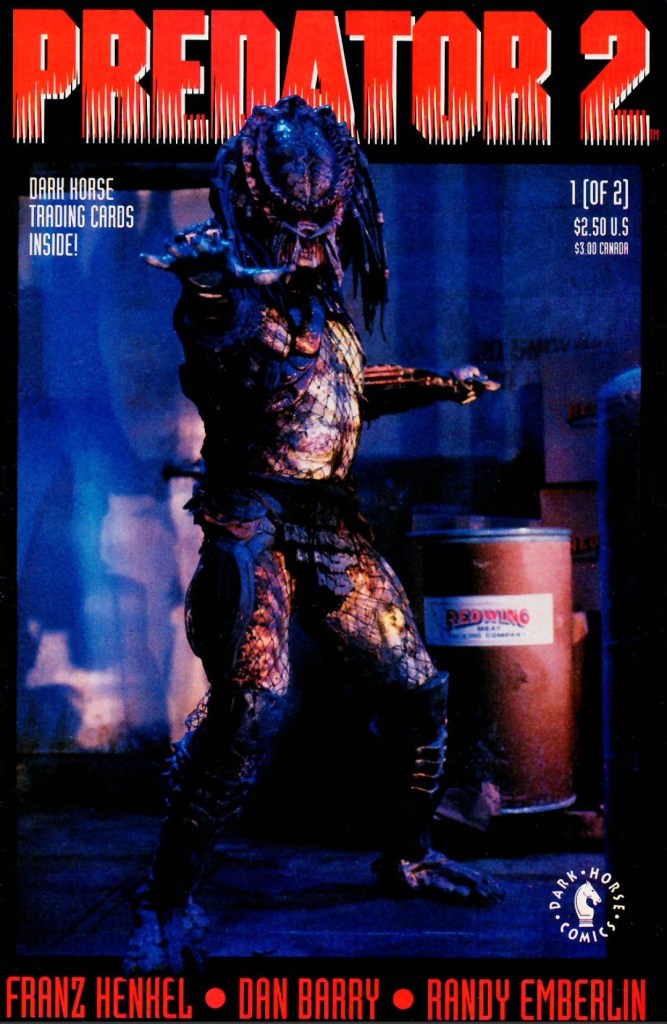
The cover.
Early story
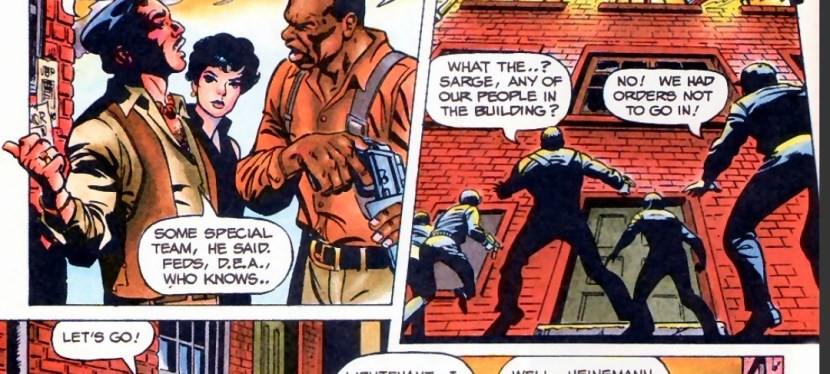
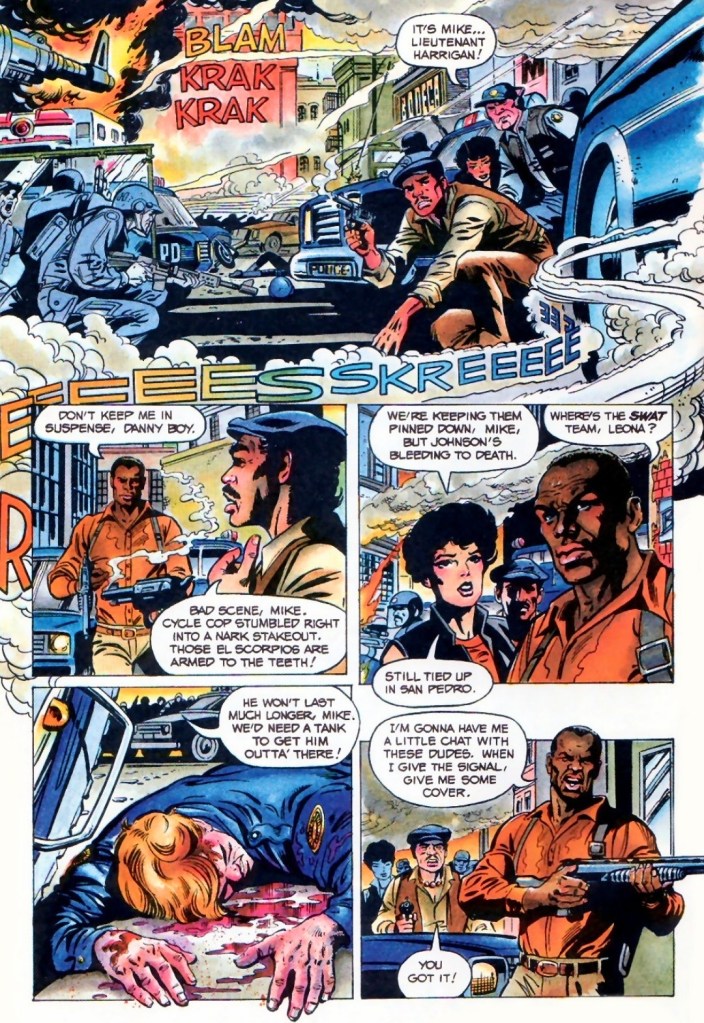
The story begins during a very hot day in 1997 Los Angeles. Police office Mike Harrigan rushes to the site of a major shootout between heavily armed gangs (Colombians and Jamaicans). The police managed to corner a gang to a building that was occupied by the foreigners. Knowing that a fellow cop is slowly bleeding to death and the SWAT (Special Weapons and Tactics) team are still stuck in traffic, Harrigan decides to take action against the armed gangsters with the support of his teammates and some police personnel.
After managing to get close to the gangsters by the building using his car, Harrigan manages to shoot them all and pave the way for his teammates to get closer. Harrigan does not realize that a camouflaged Predator is watching him from above.
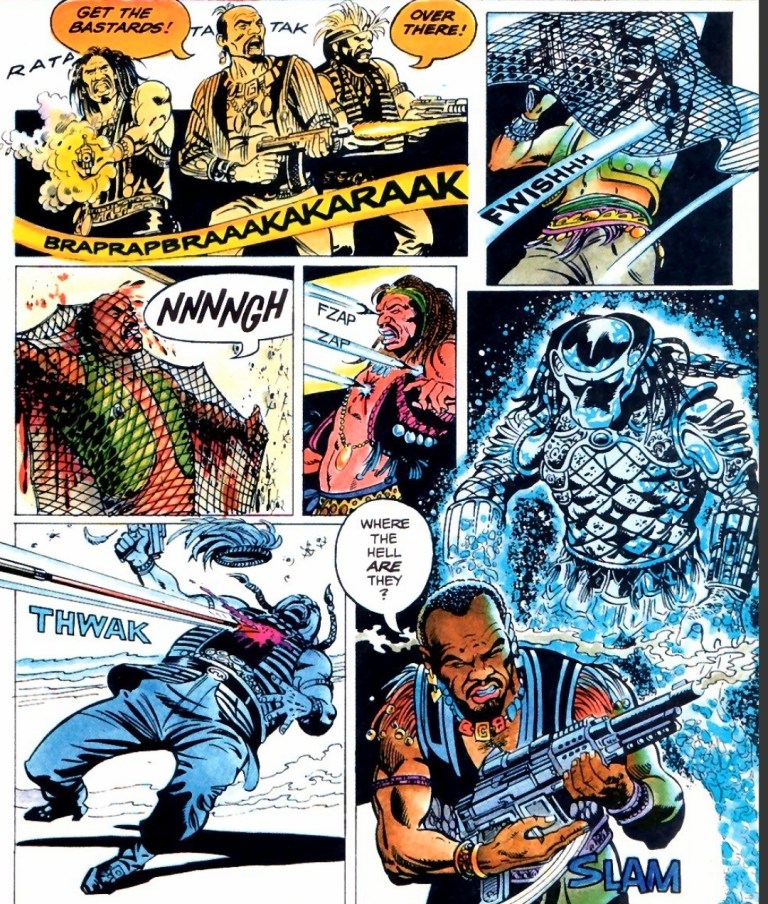
At one of the higher floors of the building, the rest of the foreign gangsters prepare themselves for the arrival of the cops by gathering guns and ammunition. Suddenly, the camouflaged Predator crashes in on them…
Quality
The Predator here is quite aggressive and even arrogant enough to suddenly fight the Jamaican gang alone.
I am surprised how entertaining this first chapter of the 2-part comic book adaptation of Predator 2 turned out to be. While the accuracy is understandably less than 100% with regards to translation from cinema to literature, this comic book’s narrative is quite faithful to the events of the movie (from the start until the King Willie scene) and the film’s vibe was strongly captured. In fact much of the dialogue spoken in the film were mostly recaptured here, and the same can be said about the way the characters were portrayed.
For brevity and the maximizing of the pages made available, creative liberties or shortcuts were taken by the creators. This means that the presentation of details was carefully done to keep readers properly informed while managing to keep the fun factor and level of intrigue strong. Indeed, writer Frank Henkel did a very good job keeping things together to make the reading experience fun and engaging.
If there is anything that this comic book exceeds the movie on, it is the graphic violence. Artist Dan Barry really ramped up the bloody scenes and gore (examples: Mike Harrigan’s killing of two foreign gangsters with a shotgun, and the scene when Harrigan and his team were stunned by the sight of the many ruined dead bodies of gangsters who were just eliminated by the Predator before they arrived) as he used his own style to make the action scenes as intense as the ones filmed by Stephen Hopkins and crew. It was obvious he saw the movie.
Barry also had his own style on visualizing the characters without the authority to use the likeness of any actor from the film. Mike Harrigan looks nothing like Danny Glover while Peter Keyes does not resemble Gary Busey. Barry’s visual take on the Predator itself has a really distinctive look when compared to how other artists drew Predators.
Barry did not aim to achieve photo realism at all with the characters (who appear with a slightly cartoonish aesthetic), the locations and action scenes but I don’t find anything problematic with his work here. In fact, I enjoyed his way of translating the movie’s visual presentation into literary format.
Conclusion
Mike Harrigan, Danny and Leona make their moves.
Predator 2 #1 (1990) is a very enjoyable read. It strongly captured the vibe of the movie complete with the dialogue and the way the characters were presented. Very clearly, the Henkel-Barry duo did really fine work in this comic book adaptation and I am convinced to move on to issue #2.
Overall, Predator #2 (1990) is highly recommended!
Disclaimer: This is my original work with details sourced from reading the comic book and doing personal research. Anyone who wants to use this article, in part or in whole, needs to secure first my permission and agree to cite me as the source and author. Let it be known that any unauthorized use of this article will constrain the author to pursue the remedies under R.A. No. 8293, the Revised Penal Code, and/or all applicable legal actions under the laws of the Philippines.
Welcome back superhero enthusiasts, 1990s arts and culture enthusiasts, Image Comics fans and comic book collectors! Today we go back to the year 1994 to take a close look at one of the many tales of the original WildStorm universe through one of the comic books of the first mini-series of Team 7.
For the newcomers reading this, Team 7 is set in the past within the original WildStorm universe. This is the one special forces team that had major WildStorm heroes – Grifter (WildCATS: Covert Action Teams), Backlash, Jackson Dane (Wetworks), John Lynch (Gen13) and Deathblow – who were younger, were proficient with combat and were destined to gain special abilities that later defined them.
With those details laid down, here is a look back at Team 7 #1, published in 1994 by Image Comics with a story written by Chuck Dixon and drawn by Aron Wiesenfeld. This is the first chapter of a 4-issue mini-series. Also this year marks the 30th anniversary of this very comic book.
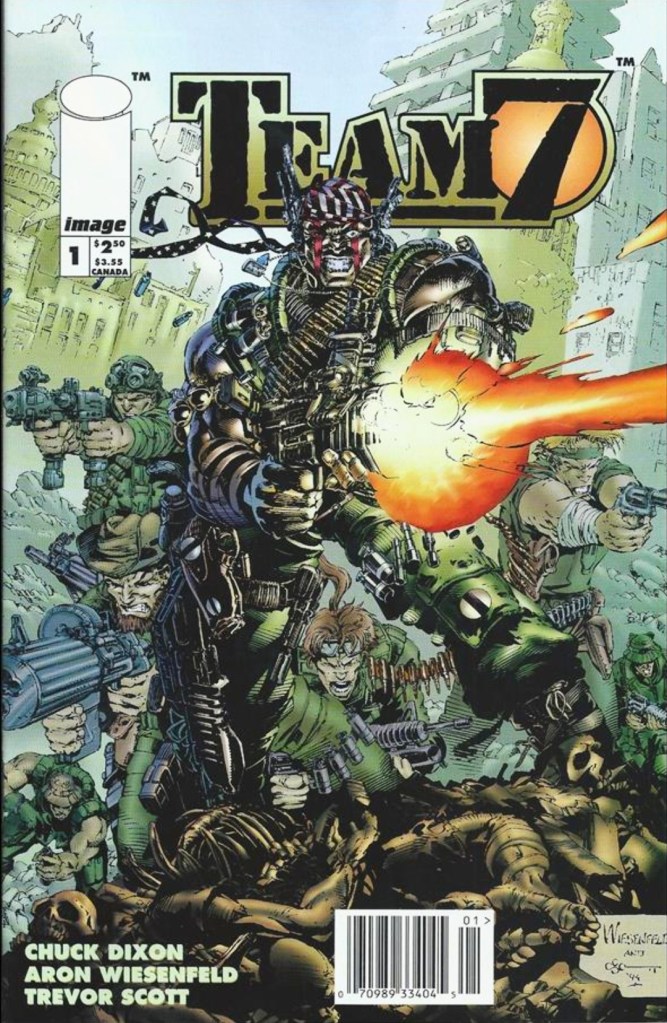
The cover.
Early story
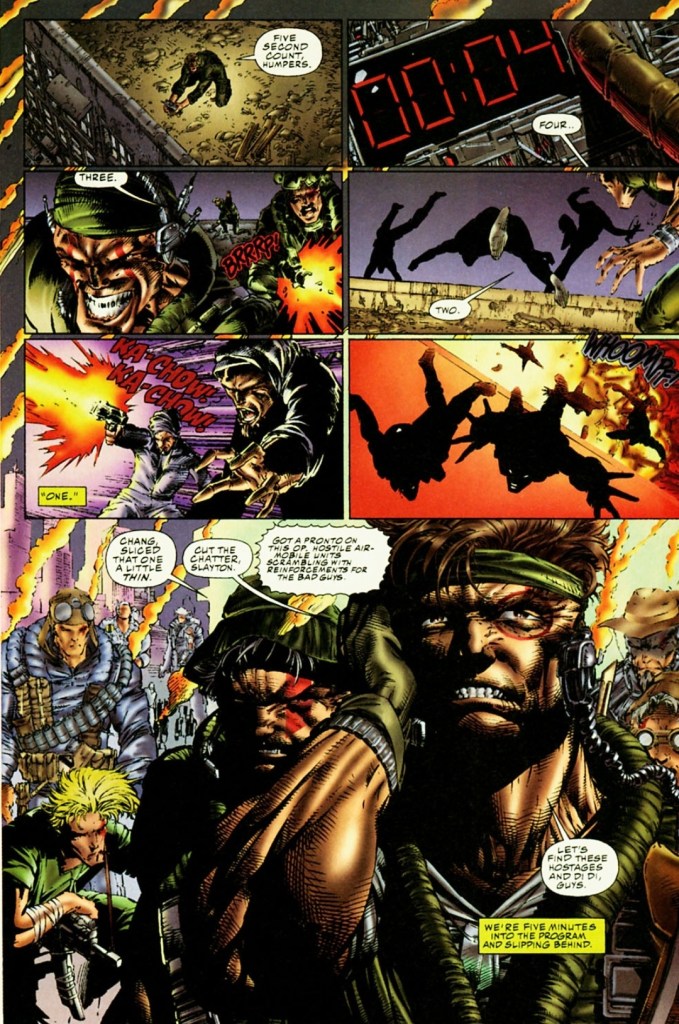
Set in the 1970s, the story begins when the United States Special Forces Team 7 arrives in Iran with the objective of rescuing hostages. Led by John Lynch, the team encounters several Iranian terrorists along the way and eliminates them as they proceed with their mission. A lot of killings and a few explosions happened as they made their way into the facility.
Eventually, Team 7 discovers that the hostages are gone as they only found stuffed dummies made to look like hostages. As they are so deep within the facility, going outside to survive an incoming powerful bombing was out of the question. They decide to go deeper knowing that the facility has a hardened sub-basement that was designed to absorb a shockwave…
Quality
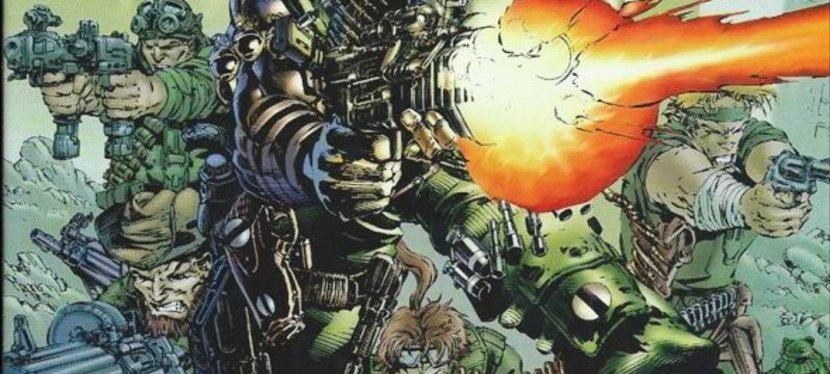
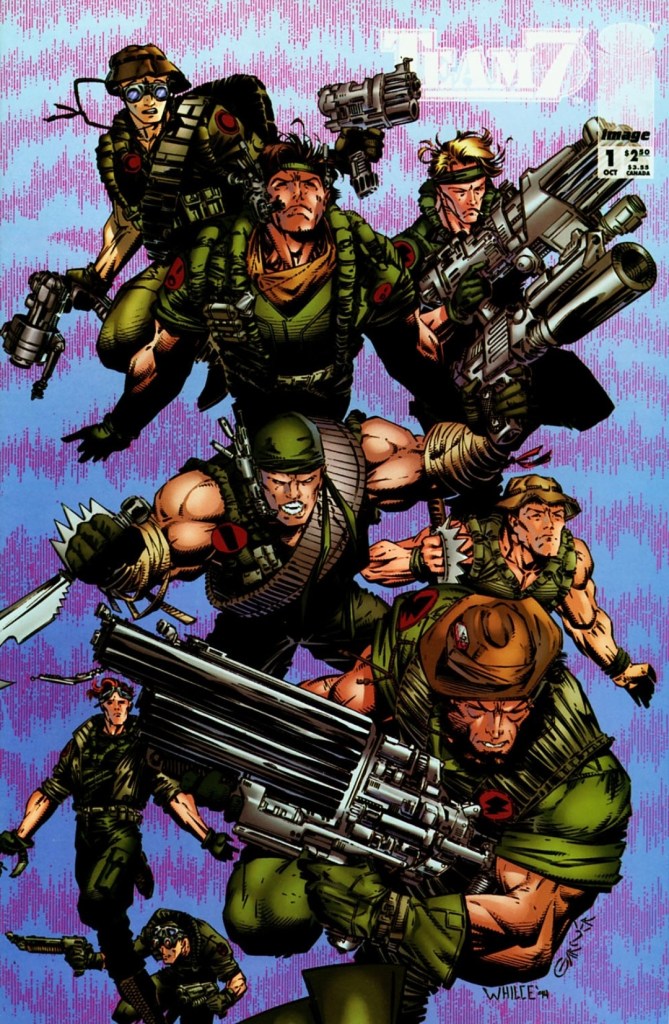
See if you could recognize the WildStorm heroes among them.
I can say out loud that this WildStorm prequel tale by the Dixon-Wiesenfield is a very inspired work of fiction that captures (intentionally or not) the vibe of R-rated Hollywood action and war movies of the 1980s. In my view, the tone and style of this comic book reminds me a lot about Predator (1987), Rambo: First Blood Part II (1985) and Full Metal Jacket (1987). Of course, this is a tale about a band of brothers who risk their lives working overseas for their country taking orders from their superiors at International Operations (IO).
As a WildStorm tale, this one efficiently puts up the building blocks needed to define the key characters who would later become major WildStorm figures in what was back then the present day stories (set in the 1990s) told through WildCATS: Covert Action Teams, Kindred, Gen13, Backlash, StormWatch and more. At the same time, readers will get a close look at the developments behind closed doors at IO which itself appeared in WildStorm comic books with a much older Lynch as director. Of course, as this is the first issue the build-up would obviously continue in the succeeding issues of the mini-series.
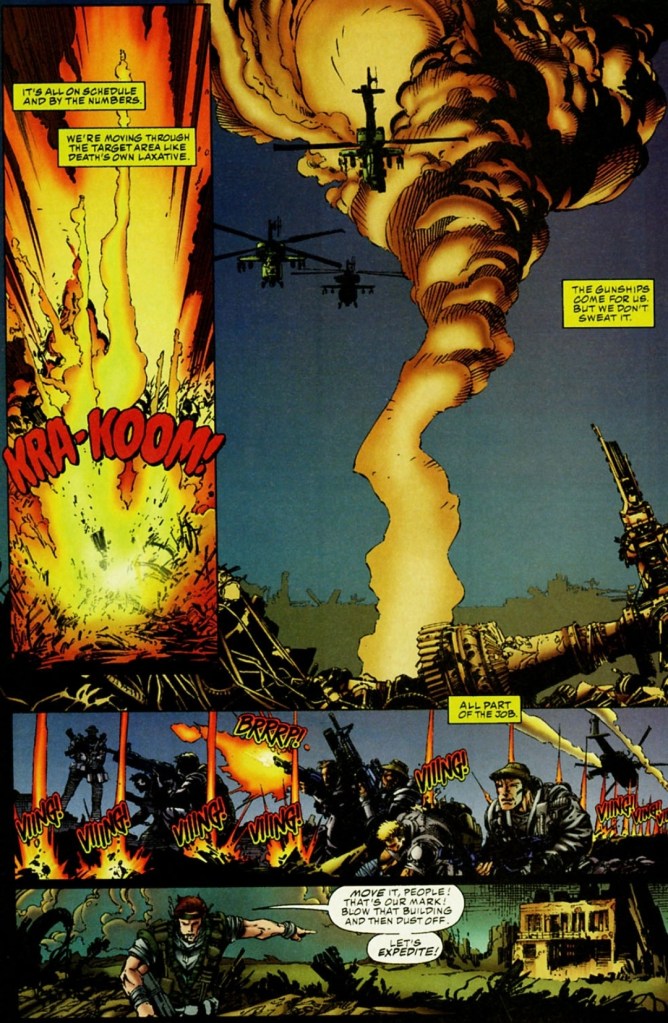
The team led by John Lynch fought the Iranian terrorists as they make their way through.
War imagery here is intense.
The story itself has themes of espionage, political intrigue, Islamic terrorism and military conflict. It was made clear here that IO has a wicked director called Craven and the young John Lynch (the protagonist and future IO director) could do nothing but receive intelligence (no matter how limited) and execute orders that put him and his teammates in grave danger.
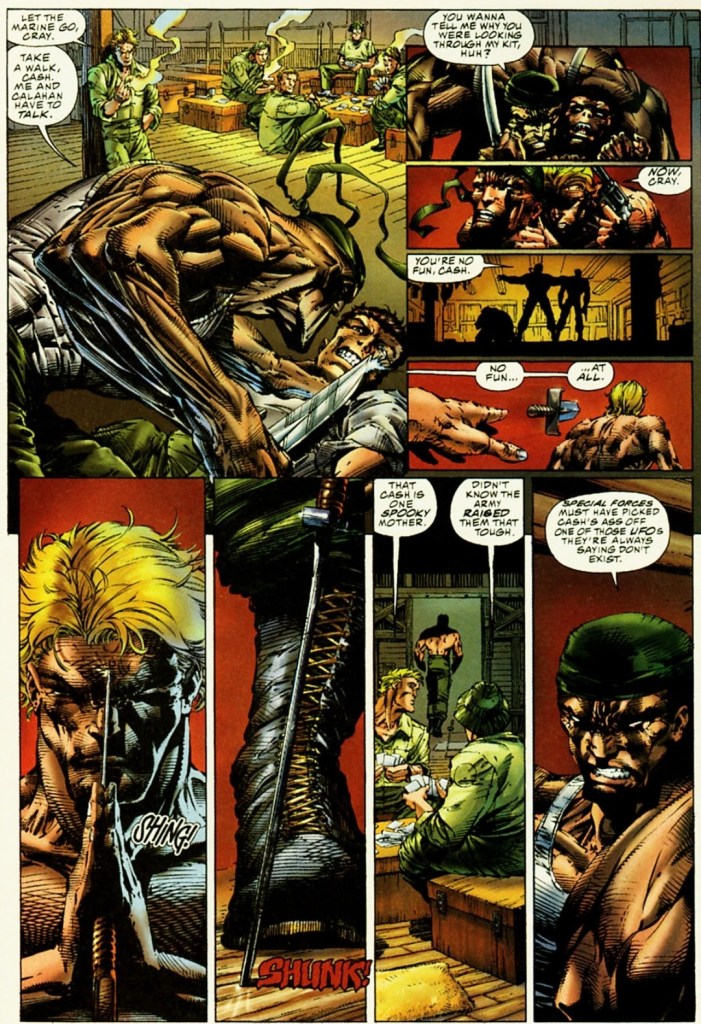
Along the way, you will see younger versions of WildStorm heroes Grifter (Cole Cash), Jackson Dane, Backlash (Marc Slayton), Deathblow (Michael Cray) as well as a few minor characters whose legacies will be felt in the present day stories (example: Gen13’s Grunge is the son of member Philip Chang). Oh yes, the banter and interactions between Team 7 members were very much inspired by what was portrayed in Predator (1987) and Full Metal Jacket (1987). While Lynch is the protagonist struggling with following orders and leading the team, the young Deathblow here clearly their most natural and aggressive eliminator.
When it comes to the visuals, Aron Wiesenfeld came up with a consistently dark and gritty look backed with uncompromising violence that strongly emphasizes the horror of war. He also has this exquisite approach on displaying the characters and the action portrayed was more of shooting, explosions and hard action. This comic book was released years before Steven Spielberg’s Saving Private Ryan (1998) hit the cinemas and caused some controversy with its display of graphical violence. In short, this is a comic book visualized with adults in mind.
Conclusion
The cover of the variant edition of Team 7 #1 drawn by Whilce Portacio.
Team 7 #1 (1994) is a very compelling read and it still remains one of the most unique comic books of the original WildStorm universe ever published. It is also one of the most defining war comic books published in the 1990s.
Considering the great work done by the Dixon-Wiesenfield duo, your enjoyment and understanding of this comic book depends a lot on how much you have oriented yourself with the mentioned WildStorm heroes who appeared in the comic books of WildCATS: Covert Action Teams, StormWatch, Wetworks and the like. I enjoyed this comic book a lot because I familiarized myself with Grifter, Backlash, Deathblow, Lynch and Dane before reading it. That being said, I urge you newcomers to get to know the said characters first before reading this comic book.
Disclaimer: This is my original work with details sourced from playing the video game and doing personal research. Anyone who wants to use this article, in part or in whole, needs to secure first my permission and agree to cite me as the source and author. Let it be known that any unauthorized use of this article will constrain the author to pursue the remedies under R.A. No. 8293, the Revised Penal Code, and/or all applicable legal actions under the laws of the Philippines.
Welcome back retro gaming fans and readers!
Today, we will go back to the late 1980s to examine one of the most significant console games of the decade…Konami’s Contra. To put things in perspective, Contra started in the arcades in 1987 and went on to become a big hit. Konami went on to make a version of the game for Nintendo Entertainment System (NES) in the West and the Family Computer (Famicom) in Japan that resulted in different looking graphics (both artistically and technically), reworked stages, and different and extended level designs that were done within the consoles’ limitations. In short, the home version of Contra was pretty different from the arcade version but still was made to be fun and exciting on its own.
In my personal experience, my discovery of Contra has always been on the Famicom and some time later on the NES. For this retro review, I replayed Contra (both Famicom and NES versions) via the Contra Anniversary Collection on my Xbox Series X.
With those details laid down, here is a look back at Contra, developed and published by Konami for the NES and Famicom in 1988. The NES version was released one week ahead of the Famicom version in February 1988.
The start screen of the NES version of Contra. The commando with dark hair was deliberately made to resemble Sylvester Stallone somewhat.
Game concept
In the far future, an alien army from space – Red Falcon – arrived on Earth inside a meteorite that landed on the Galuga archipelago. There, Red Falcon established an extensive high-tech base for their operations and eventually brainwashed a local human army to do what they want. Red Falcon plots to wipe out human civilization on the planet.
With the information about Red Falcon collected, the Earth Marine Corps send Contra unit members Bill Rizer and Lance Bean to the island to destroy the opposition and find out what Red Falcon has been doing…
Gameplay and quality
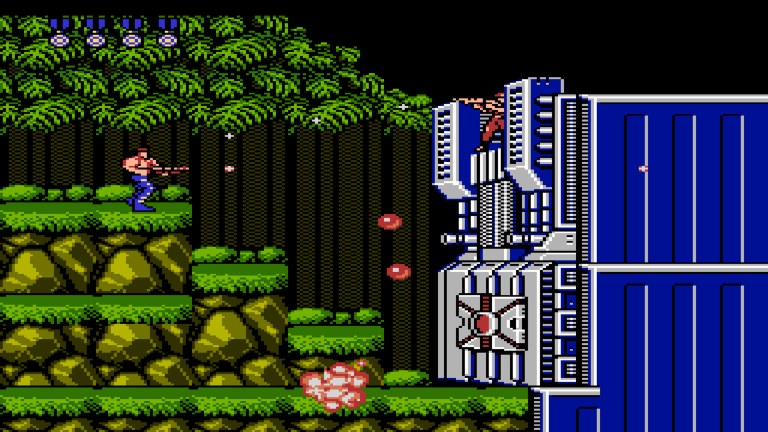
Contra is an action-packed 2D side-scrolling game with strong sci-fi and military influences.
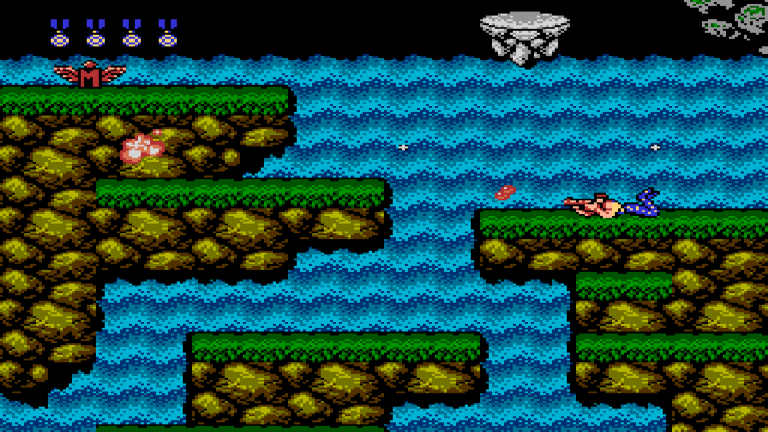
To begin with, Contra of 1988 was made to be a nicely-paced, action-packed, side-scrolling adventure game that has some 3D-like levels in between. The game design and levels Konami came up with was done to immerse gamers into actual participation in the military campaign against the aliens and their brainwashed human soldiers. This campaign not only includes battles through the forest of the Galuga archipelago but also through the interiors of Red Falcon’s high-tech facilities, going up an elevated location with waterfalls, the snowy area and further deep into the rest of the enemy’s mechanical base.
For the most part, you play as a commando armed with a rifle with unlimited ammunition. As you shoot enemies and make your way through the 2D side-scrolling level, there will be the occasional flying capsules that you can shoot down to gain new weapons/ammunition (S for Spread Shot, M for Machine Gun, L for Laser) or some power-up (temporary invincibility or the rare ability to eliminate all enemies present on-screen) to help yourself as the wave of opposition from Red Falcon is relentless (which is reason enough to compel you to keep progressing and fighting). There are also times when the mentioned enhancements suddenly pop out after killing an enemy.
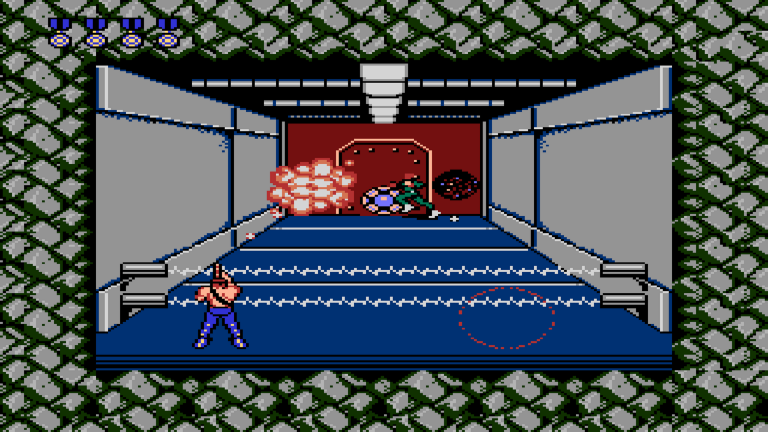
To prevent the game from getting too old with side-scrolling, Konami implemented these stages in which players face the front to attack enemies, overcome obstacles and move forward with 3D-like effects going into the next place.
By default, this game is brutally hard. Not only do the enemies keep appearing (with some of their teammates being strategically placed to fire at you), the obstacles will compel you to take your time overcoming them. In this game, one-hit death is the norm and there are many moments in which falling to your death becomes a huge risk. You get hit, you not only lose one life, you will lose whatever powerful weapons you gained.
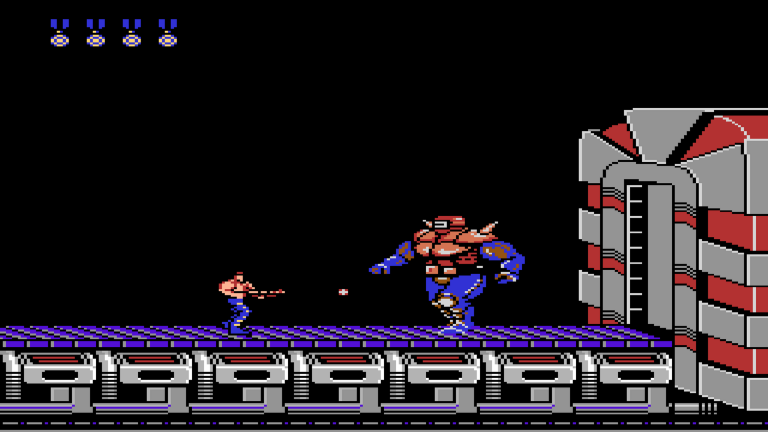
There are also stage bosses (powerful enemies that await you at the end of a level) that will challenge you so much, you will have to adjust your strategy, pay attention to the movements and timing of the enemy, and then adjust your way fighting.
Only the Famicom version of Contra has this sequence.
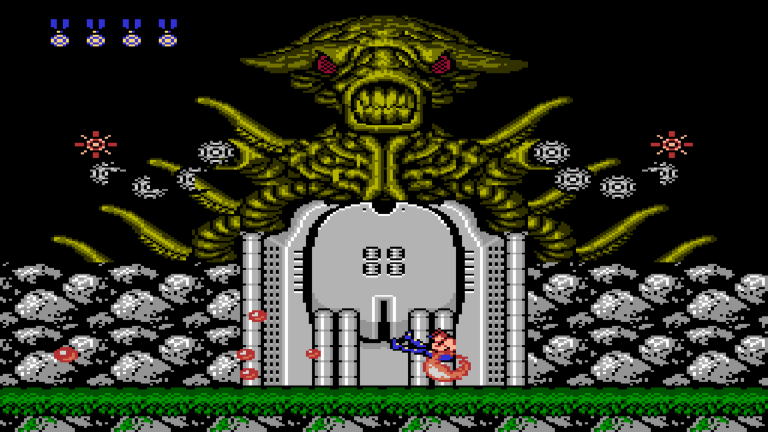
I really love the sci-fi elements the game developers came up with for this classic game. There are lots of high-tech stuff to see here and this robotic enemy is just one of them.
Fortunately for us players, the controls are really tight and very responsive. You can move your characters to overcome obstacles, avoid getting hit by enemies and even move down from one platform if the space below is safer. I still remember how precise and responsive the controls were on the NES and Famicom versions, and I can say that all the responsiveness made it on the Xbox controller when I replayed Contra on Xbox Series X with the Contra Anniversary Collection I downloaded. In fact, the high precision of the controls added to the fun of shooting enemies or obstacles with the Spread Shot while moving to the right as it was meant to be.
Considering the intense difficulty of the game, players who do the famous Konami Code (Up, Up, Down, Down, Left, Right, Left, Right, B, A, and Start) will be reward with 30 lives when they start playing Contra. For Xbox gamers reading this, there is a slight difference with the Konami Code when playing Contra on Xbox consoles.
Apart from shooting, there are lots of platform gaming elements to experience here. The difficulty is very brutal and the famous Konami Code will grant you 30 lives when you do the code correctly.
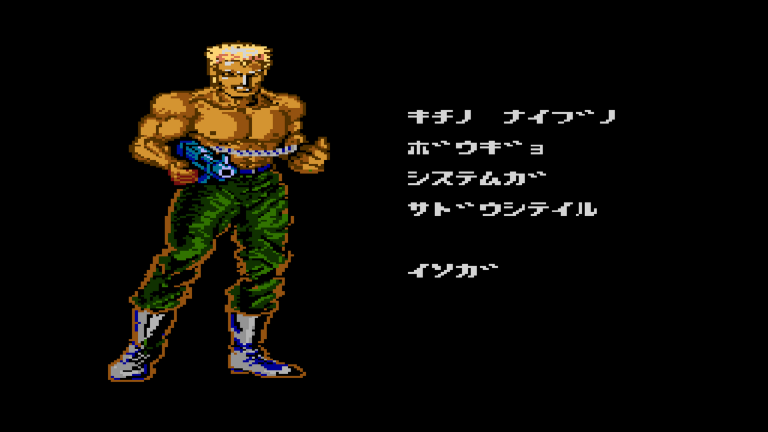
This cut-scene is only available in the Famicom version.
With regards to game design, the Konami developers did a really fine job creating the levels, placing the challenges and setting up memorable boss battles for action/adventure-hungry gamers to indulge in. The developers also cleverly implemented the fictional/fantasy concepts into the game design which resulted in me getting immersed in the Contra team’s mission against the Red Falcon at their secret base.
Another highlight with playing Contra is the 2-player option and the above-mentioned Konami Code added to the fun and accessibility of. I still remember the old days of playing in a 2-player session (cooperative play essentially) of Contra at a friend’s house on a Famicom. Since my friends and I were already enthusiasts of 1980s Hollywood action movies, playing Contra was enjoyable even though the difficulty was brutal.
This is one of the touch stage bosses you will encounter in the game.
If there are any notable differences between the two versions of Contra of 1988, it would be the fact that the Japanese (Famicom) version has storytelling emphasized through cutscenes (with Japanese text displayed), a technical overview of the Red Falcon base at Galuga with maps displayed before you start a new level, in-game art, an additional scene that spiced up the ending and, most notably, more background/environmental animation. The additional animation on the Famicom version made the adventuring look and feel more lively and this is most evident in the final stage (lair of the alien).
Conclusion
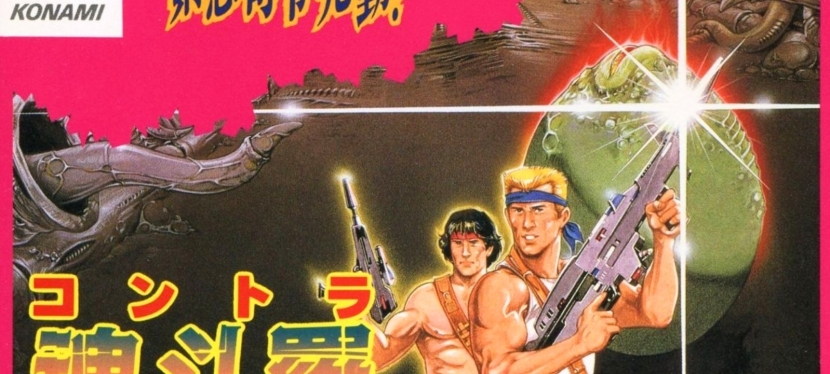
The Japanese cover art of Contra on Famicom. The Rambo-like character and the alien egg are obvious inspirations from Hollywood action movies of the 1980s.
There is no doubt in my view that after all the decades that passed since I first played it, Contra (1988) is still very engaging and a lot of fun to play whether you choose the Famicom version or the NES version. The developers who made this game succeeding in making something very enjoyable for millions of gamers and it is very clear that the makers were inspired by Hollywood action movies of the decade. In my view, the most obvious military inspirations are Aliens (1986), Commando (1985) and Rambo: First Blood Part II (1985).
Historically speaking, Contra (1988) was released at a time when militarism inspired many other game designers to come up with enjoyable games in different forms such as Cabal, Jackal, Rush’n Attack, Operation Wolf, Operation Thunderbolt to name some. Considering the overall quality and high fun factor Konami established, it is safe to say that this game is one of the finest among its militaristic gaming counterparts of its decade.
I had a grand time replaying Contra (1988) on my Xbox Series X in preparation for this review. Having played both NES and Famicom versions, I can say that the latter is the more complete and more immersive version to play. That does not necessarily mean the NES version is totally inferior. In fact, the NES version is more straightforward with the pick-up-and-play approach, and the gameplay itself is nearly identical (note: Famicom version is slightly more challenging) and very much fun to experience. If you are the player who really wants to be more immersed into the lore of Contra and absorb the military sci-fi concept Konami prepared, then the Famicom version is the one to play. That being said, now is a good time to purchase and download Contra Anniversary Collection.
Overall, Contra (1988) is highly recommended! It truly is a retro gaming gem!
Disclaimer: This is my original work with details sourced from reading the comic book and doing personal research. Anyone who wants to use this article, in part or in whole, needs to secure first my permission and agree to cite me as the source and author. Let it be known that any unauthorized use of this article will constrain the author to pursue the remedies under R.A. No. 8293, the Revised Penal Code, and/or all applicable legal actions under the laws of the Philippines.
Welcome back superhero enthusiasts, 1980s culture enthusiasts and comic book collectors! Today we go back to the early 1980s to explore Marvel Comics’ handling of a series based on the wildly popular military-themed franchise of toys – G.I. Joe: A Real American Hero.
Last time around, G.I. Joe members were sent to an island to rescue a very important woman who was kidnapped by Cobra. Along the way, the Joes faced stiff opposition and the duo of Snake-Eyes and Scarlett infiltrated the headquarters facing off with Cobra Commander and the Baroness. The comic book itself was indeed engaging and fun to read.
With those details laid down, here is a look back at G.I. Joe: A Real American Hero #2 published in 1982 by Marvel Comics with the main story written by Larry Hama and drawn by Don Perlin.
The cover.
Early story
The story begins when the United States discovers its research station in the North Pole has been attacked and left in ruin. The damage found indicates that it has been wiped out in a commando-style raid, all station personnel were found dead and all the records were missing.
After carefully assessing the available information about the ruined American base, General Austin decides to send the G.I. Joe team to the North Pole. This resulted in cutting short the respective leaves of Stalker, Breaker, Scarlett and Snake-Eyes.
After being dropped at the North Pole, the selected G.I. Joe members carefully make their way to the Russian base and decide to watch from a distance…
Quality
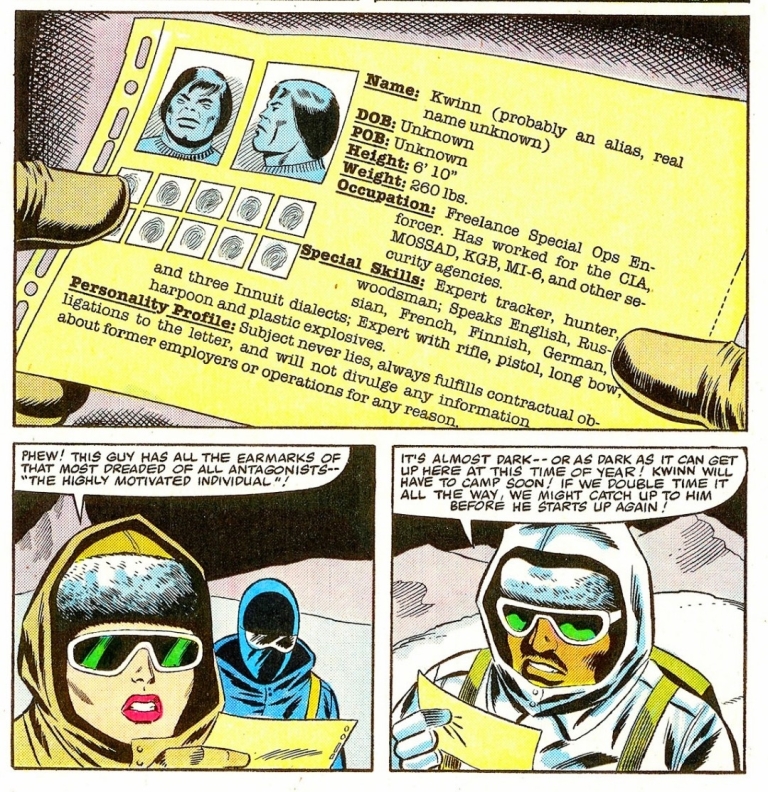
The character Kwinn is the most interesting character in this story.
When compared to what happened in issue #1, this comic book’s concept is smaller in scale but allows room for readers to get to know the Joes closely and follow the simplified plot which itself has details that are worth looking into.
When it comes to entertainment value, don’t expect a repeat of the bombastic action of the previous comic book. Expect to see lesser action but with more suspense and a stronger emphasis on the complexities that come with the world of espionage which itself is never simple.
That being said, the force of opposition here is not Cobra at all but something different. The new character Kwinn is a freelance operative who is quite formidable and he sure has extensive experience that enables him to outsmart the Joes. On top of that, Kwinn’s strong adherence to his principles and code of honor made him quite a pretty deep character which are nicely reflected into the story itself. For this reason alone, this is a must-read G.I. Joe tale.
Conclusion
Have you ever experienced your leave getting canceled suddenly?
With G.I. Joe: A Real American Hero #2(1982), the creative team of Larry Hama and Don Perlin took a very different approach that shifted away from the classic G.I. Joe/Cobra rivalry and deep into the world of espionage with a really engaging and refreshing tale. As the story features much lesser characters, you will get to know Stalker, Breaker, Scarlett and Snake-Eyes better. Kwinn is easily the most interesting and most compelling character of this comic book. While the story is fun and engaging, it may not delight fans who love to see the Joes fight the Cobra terrorists.
Overall, G.I. Joe: A Real American Hero #2(1982) is recommended.
Disclaimer: This is my original work with details sourced from reading the comic book and doing personal research. Anyone who wants to use this article, in part or in whole, needs to secure first my permission and agree to cite me as the source and author. Let it be known that any unauthorized use of this article will constrain the author to pursue the remedies under R.A. No. 8293, the Revised Penal Code, and/or all applicable legal actions under the laws of the Philippines.
Welcome back superhero enthusiasts, 1980s culture enthusiasts and comic book collectors! Today we go back to the early 1980s to explore Marvel Comics’ launch of a comic book series based on the wildly popular military-themed franchise of toys – G.I. Joe: A Real American Hero.
For the newcomers reading this, Hasbro launched the G.I. Joe: A Real American Hero toyline in 1982 which was actually a revival of the original G.I. Joe series of toys (sized 12 inches) in the 1960s and 1970s. G.I. Joe: A Real American Hero toys had a new format for its action figures influenced by the success of the Micronauts and Star Wars toys. Veteran writer Larry Hama (the same guy behind the memorable Wolverine #75 of 1993) was already working for Marvel and was developing the concept of a new comic book about elite commandos fighting terrorists. Such development happened before the 1982 relaunch of G.I. Joe, and eventually Marvel’s editor-in-chief Jim Shooter approached Hama for a new comic book project based on Hasbro’s military toyline. Eventually a series of developments followed that saw the creation of the evil organization Cobra, the core villain Cobra Commander and more.
The impact of G.I. Joe as a licensed comic book series turned out positively as it helped attract new readers at the newsstands and it developed a strong following with young readers who were not highly interested with superheroes.
With those details laid down, here is a look back at G.I. Joe: A Real American Hero #1 published in 1982 by Marvel Comics with the main story written by Larry Hama and drawn by Herb Trimpe.
The cover.
Early story
The story begins with an Amtrak train traveling between New York City and Washington, D.C. Inside the nuclear physicist Dr. Adele Burkhart who previously served as one of the brains behind the Doomsday Project. It turns out, Burkhart was declared a traitor for denouncing the military claiming that she was misled by them to work on the said project. Inside the train, she has several security personnel guarding her as she is on her way to testify in front of a certain congressional committee.
As she speaks during a press conference inside one of the train’s cars, several flying soldiers of Cobra attacked the exterior of the train. In front of Burkhart, a few of the journalists turned out to be elements of Cobra led by the Baroness. The Baroness and her companions succeed in defeating the bodyguards and kidnapped Burkhart by means of flight.
At the Pentagon, the kidnapping of Burkhart compels the military to call in their special counter-terrorist group called G.I. Joe for a rescue operation. The stakes are high as they know that they cannot let Cobra keep Burkhart long enough to use her and they cannot let her die as the whole world is aware that they considered her an embarrassment. They ordered Colonel Clayton Abernathy (code name: Hawk) to assemble the Joe Team composed of Clutch, Flash, Breaker, Rock ‘n Roll, Scarlett, Stalker, Short-Fuse and Snake-Eyes…
Quality
Dr. Burkhart held hostage by Cobra and in the presence of Cobra Commander, the Baroness and many terrorists.
To get straight to the point, the main story (Operation: Lady Doomsday) was carefully structured by Hama to tell a story engagingly while also functioning to introduce readers to the characters and immersing them into the illustrated literary universe of G.I. Joe that is noticeably separated from the popular cartoon series. It is a classic portrayal of good versus evil laced with militarism and espionage.
The story moved at a medium pace and the approach on build-up and pay-off was executed carefully. There were scenes that had a sufficient amount of details regarding the plot or character moments (as opposed to development) that made the reading experience immersive. In short, there was no rush in the narrative while the pace never slowed down to a halt (no boring moments).
That being said, you will get to see lots of scenes that focus on the side of G.I. Joe as well as on the side of Cobra which is led by Cobra Commander (who is obsessed and scheming) followed by the Baroness (who is more focused on achieving goals but cannot do so without authority). You will see a certain gap between Cobra Commander and the Baroness which shows something seems off within their terrorist organization. This served as a creative contrast with G.I. Joe being more straightforward with the way they organize themselves.
The only weakness this comic book has is the fact that with so many characters from both the good and the bad sides, identifying them was pretty challenging especially when their military uniforms obscured their looks. Characters like Cobra Commander, Snake-Eyes, Scarlett, Rock ‘n Roll, Stalker and the Baroness are instantly recognizable.
As the main story remains a really good read, the 2nd story (Hot Potato) also written by Hama but drawn by Perlin served as a nice additive to this comic book.
Conclusion
G.I. Joe starts getting ready for the high-stakes rescue mission.
G.I. Joe: A Real American Hero #1(1982) is indeed a very solid reading experience. This is a strong introduction of the literary version of G.I. Joe and its portrayal of good versus evil remains believable and compelling. I also enjoyed the way the creators balanced the build-up of tension, plot and character moments with spectacle or twists utilized as pay-off. Lastly, I should say that this comic book has lots of action for you to enjoy and the execution of the action scenes made sense within the context of the stories. Remember that this marked the beginning of a memorable long run of G.I. Joe comics that reached into the 1990s. This one is a true classic and it should remind you that there was a time when political correctness and wokeness did not get in America’s way of fighting terrorists.
Overall, G.I. Joe: A Real American Hero #1(1982) is highly recommended!








 Author Carlo Carrasco