Retro Gaming Ads Blast – Part 11

Welcome back readers, fellow geeks and electronic gaming fans!

In this edition of the Retro Gaming Ads Blast (RGAB) series, we will take a look at another batch of retro gaming print ads from the 1980s and 1990s. In addition, there will be a few flyers of arcade games as well as promotional posters of a notable console game that was released only in Japan.

For the newcomers reading this, Retro Gaming Ads Blast (RGAB) looks back at the many print ads of games (console, arcade, computer and handheld) that were published in comic books, magazines, flyers and newspapers long before smartphones, social media, the worldwide web and streaming became popular. To put things in perspective, people back in the 1980s and 1990s were more trusting of print media for information and images about electronic games and related products.

With those details laid down, here is the newest batch of retro gaming print ads for you to see and enjoy…

1. M.I.A.: Missing in Action arcade flyer

This is an effective way of catching the attention of both players and arcade operators. I can imagine the woke, the SJWs and rabid feminists getting easily offended by this.

Konami was a very prominent producer of games back in the 1980s. Not only did the company produce high-quality and enjoyable military-themed games on consoles and computers, Konami also made its presence felt in the highly competitive sector of arcade games. In 1989, they released the arcade conversion kit of M.I.A.: Missing in Action and this flyer is the best know promotion of it. M.I.A.: Missing in Action is the follow-up to Konami’s hit game Rush’n Attack.

Visually, the flyer’s display of four screenshots combined with a dominating photographic image of prisoners of war (POWs) getting delightfully released by an attractive female Rambo-type rescuer were designed to catch the attention of young adult and adult gamers. The text descriptions (note: there were more details on the back of the flyer), however, were geared towards arcade operators who were looking for new games to acquire without the hassle of having to buy an entire arcade cabinet. That being said, this flyer was a clever way to appeal to arcade operators and the people who love playing arcade games.

2. Fonz arcade flyer

Simplistic yet effective to look at. If you are an arcade operator, this flyer conveniently has key information displayed.

Believe it or not, Sega was already active in arcade games way back in the 1970s. In this particular flyer, Sega’s arcade game Fonz (also called Moto-Cross, Man T.T.) offered players the unique experience of driving a digital vehicle using actual handlebars on the machine that were meant to create an immersive and realistic feel. If you look closely, the flyer has lots of details written with arcade operators and players in mind.

3. Haunted Castle arcade flyer
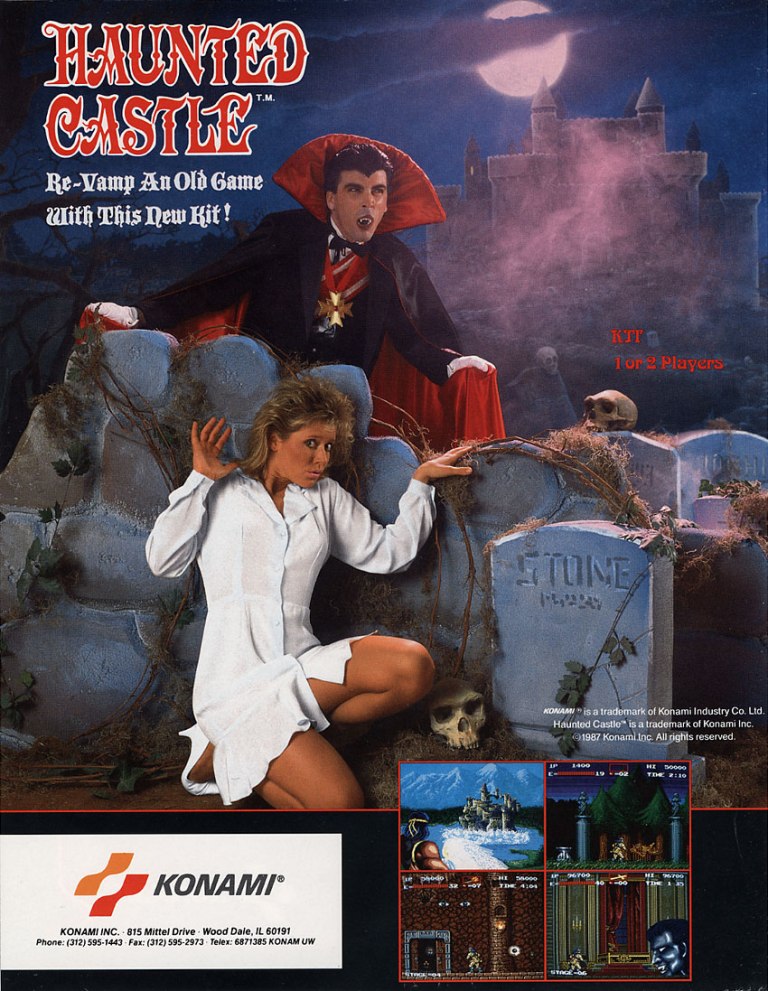
Indeed, this game is part of the Castlevania game franchise. It was one of the first Castlevania games released for arcades.

Arguably, Konami is best known for the Castlevania game series which covered handheld gaming devices, personal computers, video game consoles and even arcades. Haunted Castle (Japanese title: Akumajō Dracula) is the 2nd arcade game of the Castlevania franchise and it is not a port of any console game. Like the arcade flyer of M.I.A.: Missing in Action, this one was crafted to lure the attention (and money) of arcade operators looking for conversion kits to replace their old games. The visual presentation is eye-catching and even though the Castlevania brand was nowhere to be seen, Castlevania fans could tell this this arcade offering was part of their favorite game franchise.  

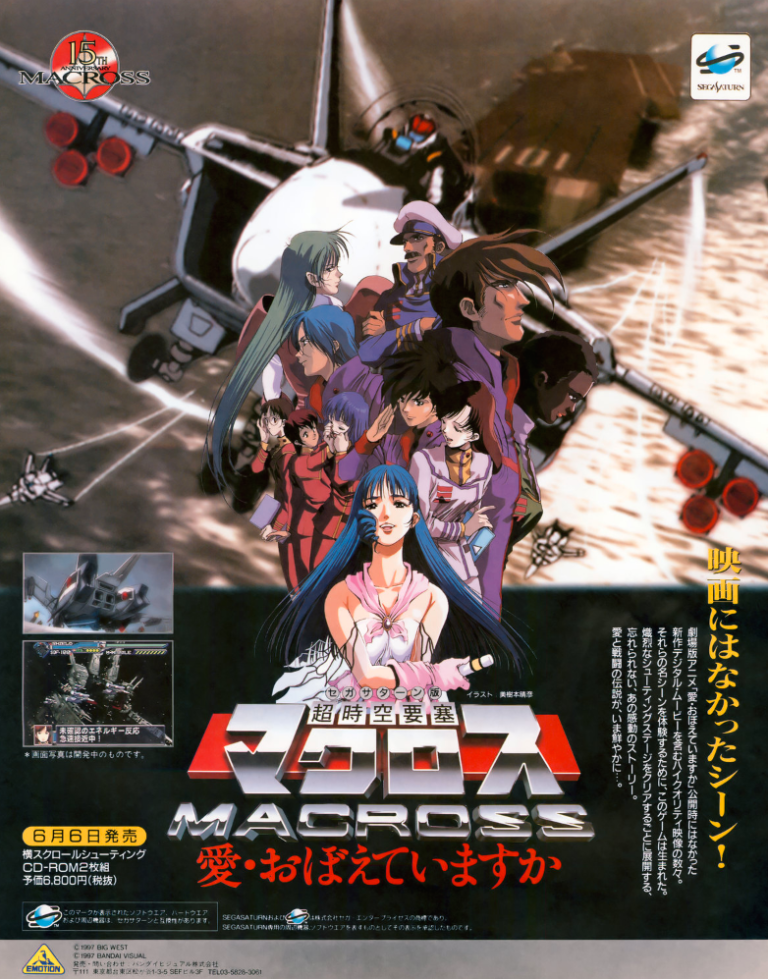
4. The Super Dimension Fortress Macross: Do You Remember Love? flyer and poster
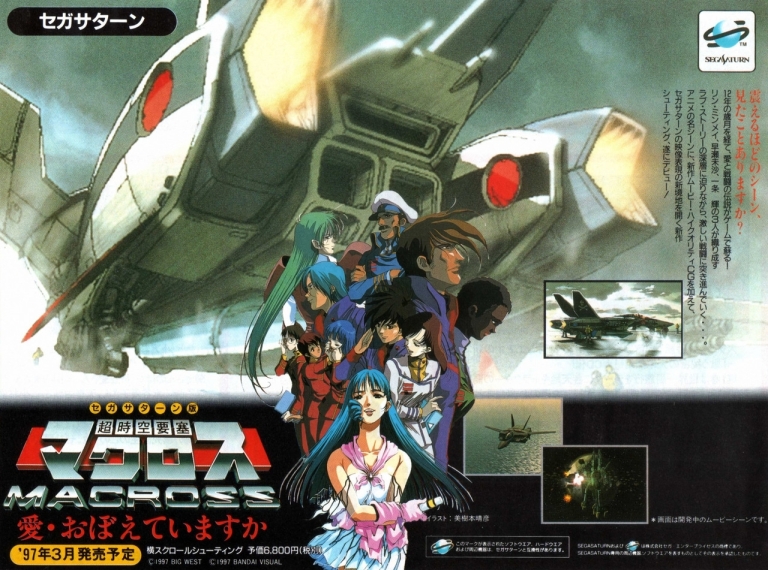
The poster promoting the release of the game for Sega Saturn in Japan.
The flyer promoting the Sega Saturn game’s 1997 release as well as the 15th anniversary of Macross.

In 1997, the 15th anniversary of the Macross multimedia franchise was celebrated in Japan and among the highlights was the release of The Super Dimension Fortress Macross: Do You Remember Love? on the Sega Saturn. To promote the game and the franchise itself, lots of flyers and posters were released in Japan. If you look at the illustrated images on the promotional materials closely, you will realize that they are not from the original 1982-83 Macross anime TV series but rather from the The Super Dimension Fortress Macross: Do You Remember Love? animated movie of 1984 (read my retro movie review by clicking here).

While it might be baffling to some as to why the original anime TV series was not used as the source material for the 15th anniversary celebration through gaming, the 1984 anime feature film was actually more adaptable for a video game project (read my retro review by clicking here). It is so obvious, you just have to ask yourselves this question – how can the game developers compress the entire concepts of the 36-episode Macross anime series into one game while ensuring fun gameplay? Regardless, the game was a lot of fun to play and I enjoyed playing the PlayStation version in 1999.

5. Venom/Spider-Man: Separation Anxiety print ad
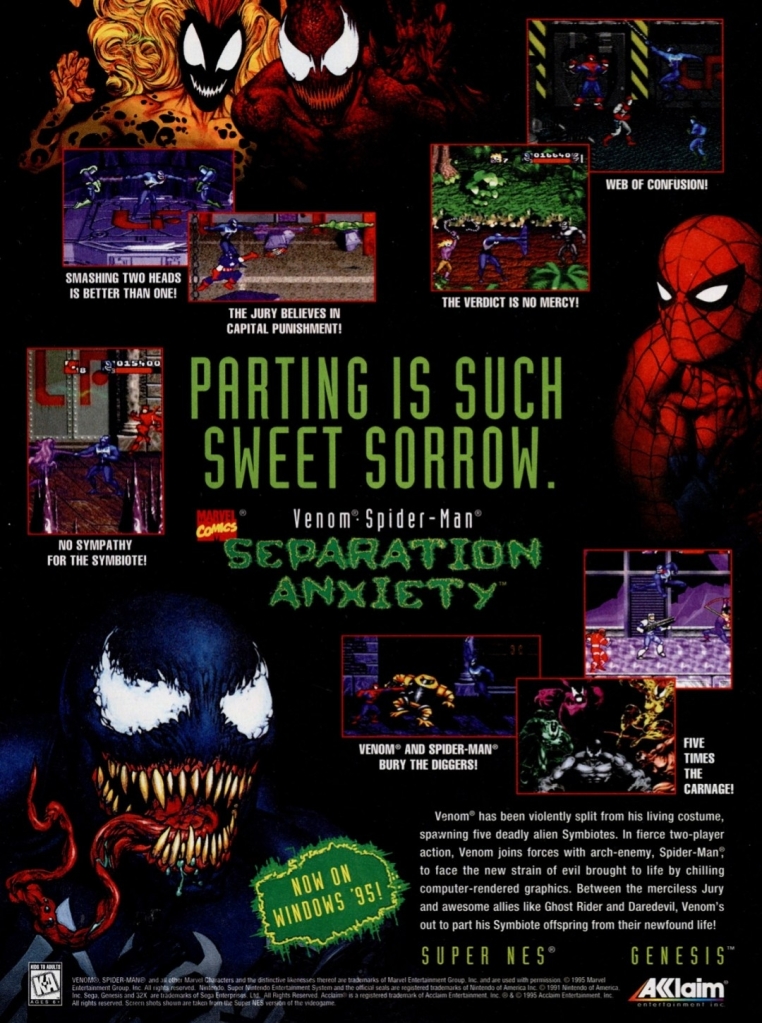
A clear effort to sell the game to gamers as well as fans of Spider-Man and Venom.

In 1994, Acclaim released Spider-Man and Venom: Maximum Carnage (based on the 1993 comic book storyline Maximum Carnage) on Super Nintendo Entertainment System (SNES) and Sega Genesis ultimately becoming popular with comic book fans and gamers who enjoyed sidescrolling beat-them-up games.

Subsequently, Acclaim and develop Software Creations reunited to release the sequel Venom/Spider-Man: Separation Anxiety a year later on the two leading 16-bit consoles as well as on personal computer (PC). If there is anything notable about this eye-catching print ad, it is the fact that its visual presentation (with graphics on-par with the previous year’s game) cleverly hides the fact that it did not have much new to offer gamers with regards to gameplay and story cutscenes (which the previous game prominently had). Eventually, this game attracted weaker reviews from game critics and has since been forgotten.

6. Tecmo Super Bowl SNES print ad

From the time when Tecmo was still a strong producer of sports video games.

In 1991, Tecmo Super Bowl was released on the aging Nintendo Entertainment System (NES) and because its game design greatly entertained gamers, it became a tremendous commercial success. Not even the very high launch price of $54.99 stopped it from selling a lot.

To keep the commercial success and public interest going, Tecmo announced a new version of the game for the more powerful SNES console with the simple title of Tecmo Super Bowl. If you look closely at the print ad, you will notice that gameplay screenshots were not used at all. Instead, they showed images of the nicely illustrated art works they prepared as eye candy for the game with the intention of making it look cinematic. This is very curious because gameplay itself was the main selling factor of the NES version of Tecmo Super Bowl. I can only guess that Tecmo was not ready to show gameplay images by the time this print ad was made.

7. X-Men 2: Clone Wars print ad

The art used is too alienating for promoting this game.

During the age of the 16-bit consoles, there was a variety of X-Men video games released and produced by different companies. In 1993, an X-Men game published by Sega was released exclusively on the Genesis console which turned out to be fun for gamers and received mostly positive reviews from the critics. Sega went on to publish the sequel X-Men 2: Clone Wars and this print ad caught my attention because of how exaggerated the characters looked. It’s so strange, it’s as if the artist took visual reference from a somewhat blocky 3D polygonal portrait then tried to make them look hand-drawn. I wonder if anyone from Sega regretted this.  

+++++

Thank you for reading. If you find this article engaging, please click the like button below, share this article to others and also please consider making a donation to support my publishing. If you are looking for a copywriter to create content for your special project or business, check out my services and my portfolio. Feel free to contact me with a private message. Also please feel free to visit my Facebook page Author Carlo Carrasco and follow me on Twitter at  @HavenorFantasy as well as on Tumblr at https://carlocarrasco.tumblr.com/ and on Instagram at https://www.instagram.com/authorcarlocarrasco

Retro Gaming Ads Blast – Part 9

Welcome back readers, fellow geeks and electronic gaming fans!

In this edition of the Retro Gaming Ads Blast (RGAB) series, we will take a look at another batch of retro gaming print ads from the 1980s and 1990s.

For the newcomers reading this, Retro Gaming Ads Blast (RGAB) looks back at the many print ads of games (console, arcade, computer and handheld) that were published in comic books, magazines, flyers and newspapers long before smartphones, social media, the worldwide web and streaming became popular. To put things in perspective, people back in the 1980s and 1990s were more trusting of print media for information and images about electronic games and related products.

With those details laid down, here is the newest batch of retro gaming print ads for you to see and enjoy…

1. Konami’s 3-in-1 sports games print ad

Long before the advent of major league sports video games, Konami was prolific with sports video games.

Back in the 1980s, Konami was a prominent gaming company as they released a lot of games that became hits in the arcades, on home computers and gaming consoles. Considering the limited amount of games publishers were allowed to release on the Nintendo Entertainment System in America, what Konami released were really fun games to play and their contributions of sports-based video games on the NES were significant. Possibly due to a lack of marketing budget at the time, they promoted Blades of Steel, Double Dribble and Track & Field II with this single-page ad showing the game box covers and screenshots. Ultimately, this print ad was sufficient in giving gamers a clear idea of what to expect with the three games.

2. The Adventures of Bayou Billy print ad

Bayou Billy looks inspired by the cinematic hero Crocodile Dundee. This video game even had a comic book adaptation published by Archie Comics.

Still with Konami, the Japanese publisher released in America the non-military adventure game The Adventures of Bayou Billy for the NES which was a revised version of their 1988 Family Computer game titled Mad City (see the differences by clicking here). This game really looked like it was influenced by Hollywood action/adventure movies of the era and it provided gamers gameplay styles of light gun shooting, beat-them-up action and racing. The titular hero looks very inspired by the cinematic hero Crocodile Dundee. This print ad is very stylish and also eye-catching. I think it has done a good job to make viewers interested in the video game.

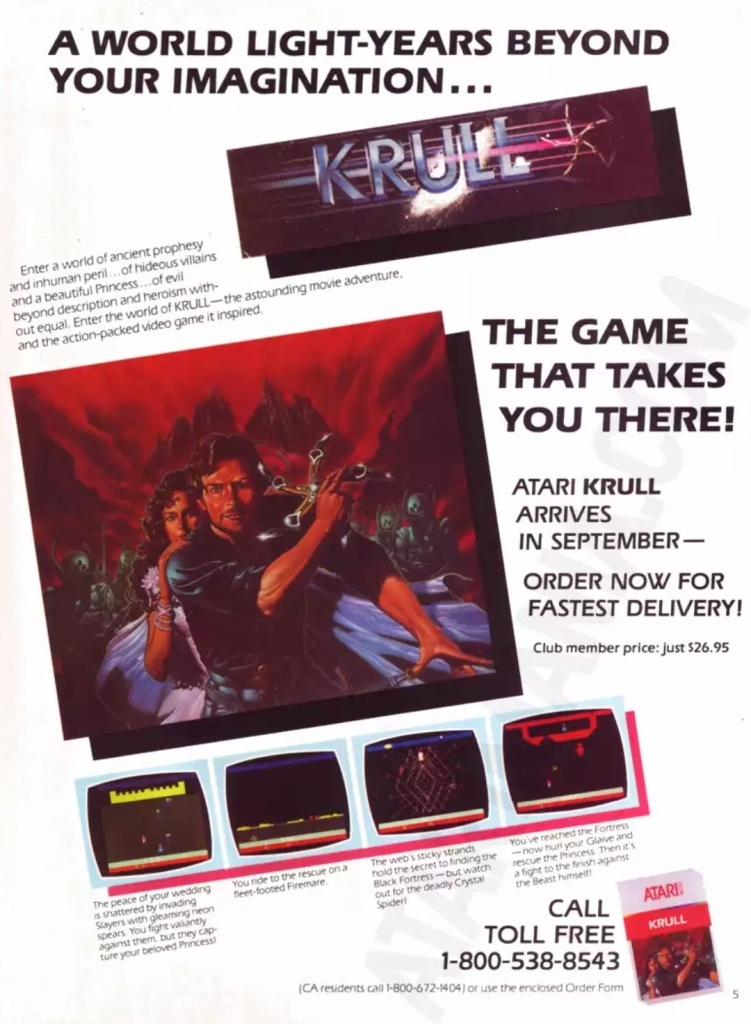
3. Krull Atari video game print ad

I never got to play this Krull video game on Atari 2600, nor its arcade game.

Way back in 1983, I was fortunate to see the science fantasy movie Krull inside the movie theater here in the Philippines. When I saw this print ad, I easily got excited for the Atari 2600 video game adaptation but never got to play it. This print ad does its job showing what Krull’s game looked like and the ad makers cleverly used painted art reflecting the movie’s characters and the armored enemies from space. I should add that between the time I saw the movie and the time I first saw this print ad, I became aware of the existence of the Krull arcade game by watching an episode of Starcade on TV.

4. Rocket Ranger NES print ad

Really great and detailed painted artwork in this print ad.

When Rocket Ranger on the Amiga in 1988, it had fancy visuals and a strong cinematic vibe that worked smoothly with the game design. This game was developed by Cinemaware which developed a reputation of releasing games based on classic film genres. In 1990, a version of Rocket Ranger for the NES was published by Kemco/Seika and print ads using painted art were made to promote the game. This particular print ad made heavy use of painted art which was captivating to look at while conveniently keeping people’s minds off the downgraded visuals of the NES version.

5. Michael Jordan: Chaos in the Windy City print ad with contest entry

Some gamers thought this was a basketball video game.

Yes, it was all true. There definitely was a video game that NBA legend Michael Jordan endorsed. First released on Super Nintendo Entertainment System (SNES) in America in 1994, Michael Jordan: Chaos in the Windy City was a side-scrolling action game in which gamers play a digital version of Jordan who has to save his friends, fight enemies and move from one location to the next in order to progress. The fact that an image of Michael Jordan holding two balls was used in this print ad (as well as on the game cover) in a dominating fashion made some gamers think this was a basketball game. The display of screenshots was so small, it did not help the situation. Lastly, the available of a contest entry form in this print ad was meant to promote not only the game but also GamePro magazine.  

6. Gun.Smoke print ad

Gun.Smoke was indeed a fun game to play on NES. Therefore, the promotion is justified.

This print ad of the NES port of Gun.Smoke has strong imagery and literary descriptions the strongly emphasize the Old West concept and setting. The screenshots displayed are too small but the descriptions more than made up for it. Ultimately, what this print ad emphasized was realized as the NES version of Gun.Smoke itself captured the continuous action and excitement of the arcade version and the graphical limitations of the console did not matter much. I myself played this game and it was a lot of fun.

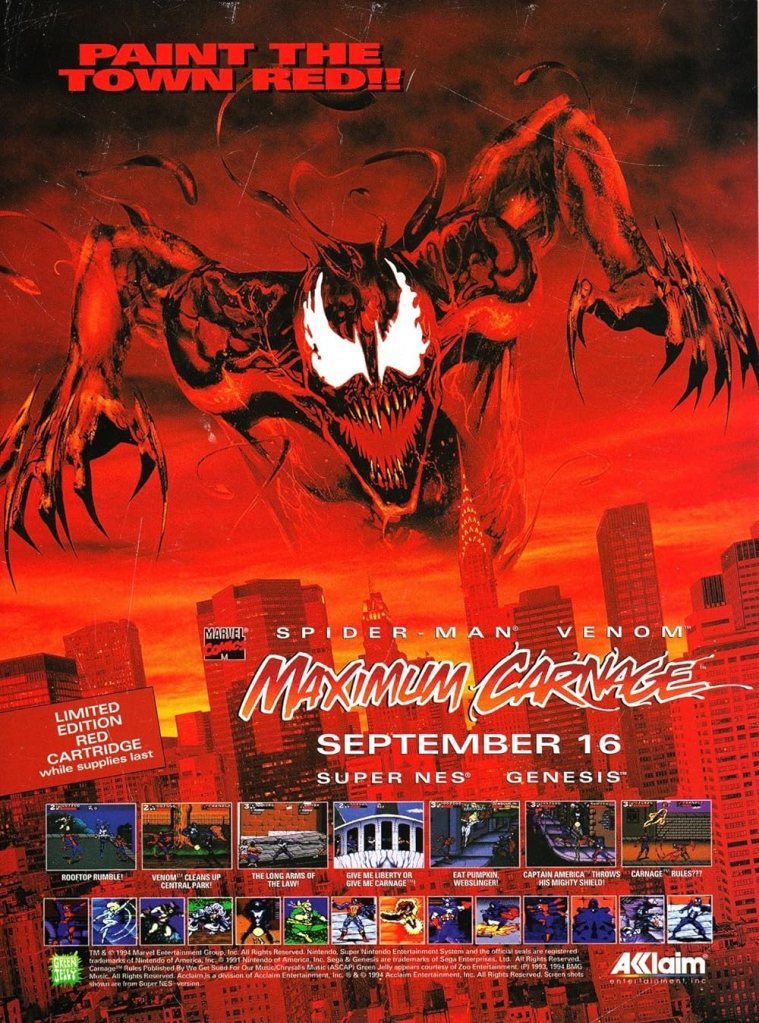
7. Spider-Man and Venom: Maximum Carnage print ad

This add appeared in my comic books and magazines I read in 1994.

Back in 1993, Marvel Comics published the huge Maximum Carnage crossover storyline which covered many issues of the four monthly Spider-Man comic books and two issues of the quarterly Spider-Man Unlimited series. Considering the high popularities of Venom and Carnage at the time, it was not surprising that Marvel took advantage by having Maximum Carnage licensed to Acclaim to create a video game adaptation in the form of a beat-them-up.

Spider-Man and Venom: Maximum Carnage was released for SNES and Sega Genesis in 1994, and game developer Software Creations really adapted story to fit with their side-scrolling game design. Between playable stages are cutscenes that actually were digitized versions of actual comic book panels. This red-colored print ad had a dominating image of Carnage and screenshots with text descriptions. The ad makers even went the extra mile by inserting screenshot cut-outs showing individual characters such as Firestar, Venom, Spider-Man, Carnage, Cloak and Dagger, Iron Fist, Captain America and more. Whatever your opinion is about the Maximum Carnage storyline or the video game adaptation, there is no denying that this was a very eye-catching print ad.

+++++

Thank you for reading. If you find this article engaging, please click the like button below, share this article to others and also please consider making a donation to support my publishing. If you are looking for a copywriter to create content for your special project or business, check out my services and my portfolio. Feel free to contact me with a private message. Also please feel free to visit my Facebook page Author Carlo Carrasco and follow me on Twitter at  @HavenorFantasy as well as on Tumblr at https://carlocarrasco.tumblr.com/ and on Instagram at https://www.instagram.com/authorcarlocarrasco

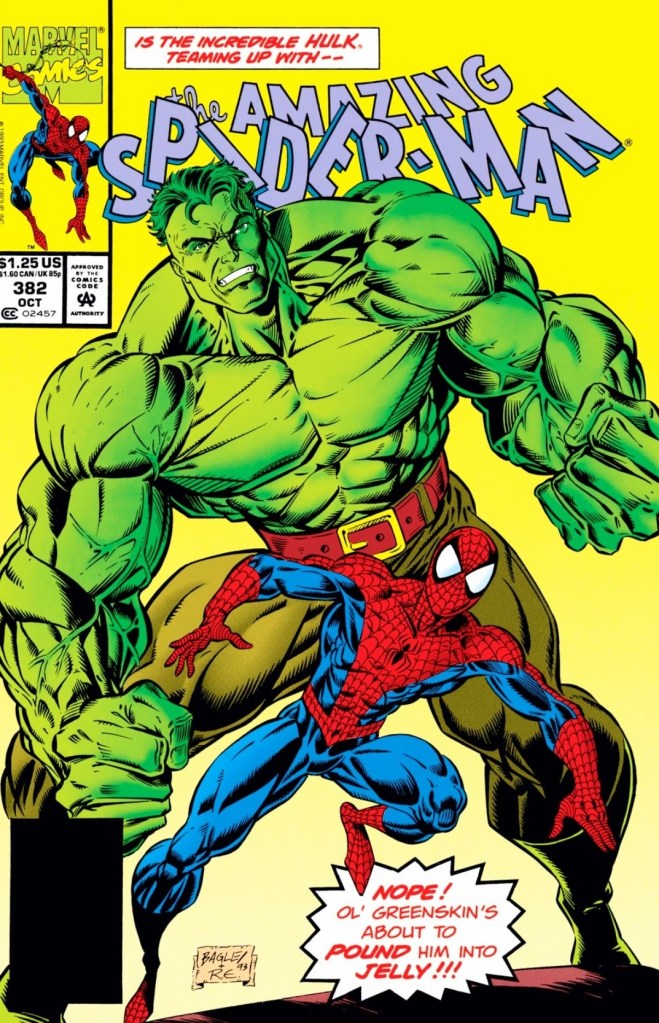
A Look Back at Amazing Spider-Man #382 (1993)

Disclaimer: This is my original work with details sourced from reading the comic book and doing personal research. Anyone who wants to use this article, in part or in whole, needs to secure first my permission and agree to cite me as the source and author. Let it be known that any unauthorized use of this article will constrain the author to pursue the remedies under R.A. No. 8293, the Revised Penal Code, and/or all applicable legal actions under the laws of the Philippines.

Welcome back superhero enthusiasts, 1990s culture enthusiasts and comic book collectors! Today we go back to the year 1993 and explore a part of the Marvel Comics universe through one of the many tales of the Amazing Spider-Man comic book series.

In my previous retro review, Spider-Man gets involved not only with the Incredible Hulk but also with Doc Samson who has a history of treating the green giant and carries a strong sense of responsibility towards him. Something, however, infected Samson and eventually the Hulk which leads to a new wave of destruction in New York City which itself is still recovering from the chaos of Maximum Carnage.

With those details laid down, here is a look back at Amazing Spider-Man #382, published in 1993 by Marvel Comics with a story written by David Michelinie and drawn by Mark Bagley.  

The cover.

Early story

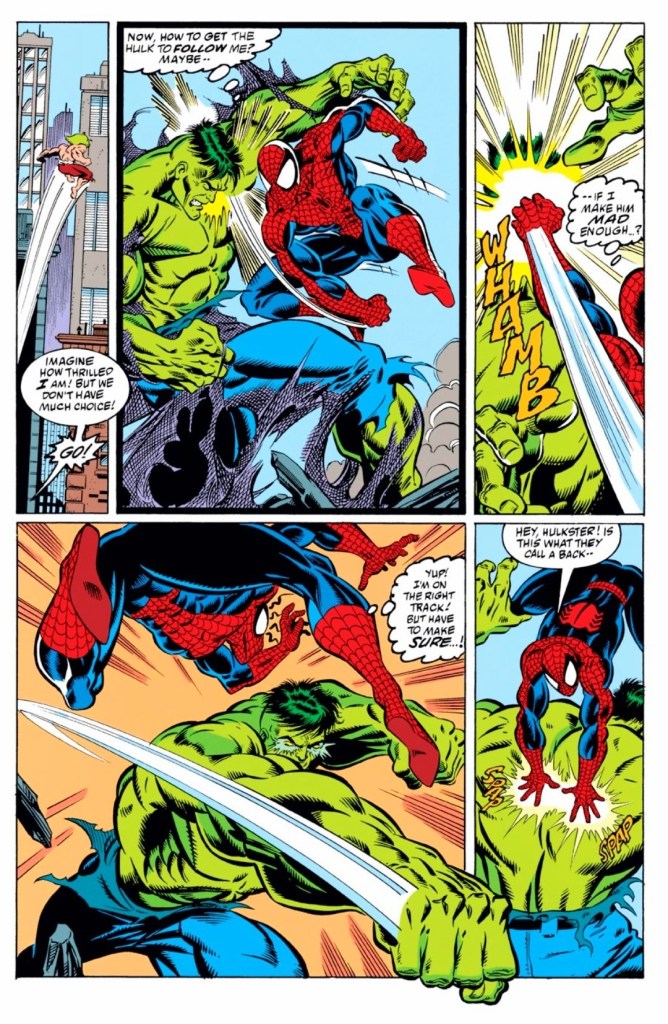
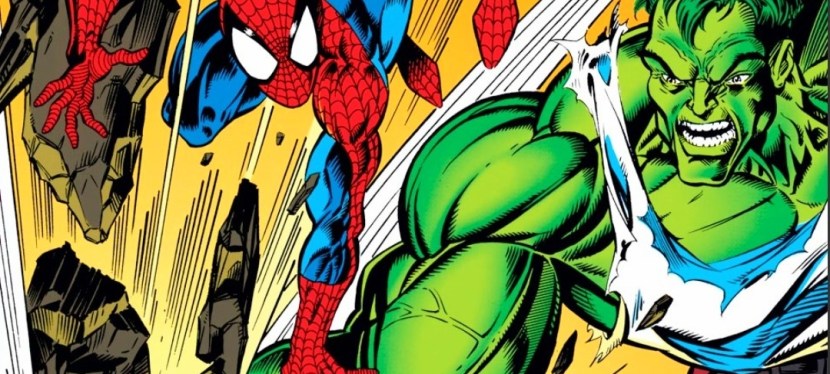
The story begins with the Hulk (note: infected with the gamma virus which is driving him to violence) striking the pavement hard causing Spider-Man and Doc Samson to move away. After a quick exchange of words with Samson regarding the virus, Spider-Man jumps towards the Hulk and hits his face in an attempt to stop him before he causes any more damage to the city.

Doc Samson desperately tries to contain the Hulk by choking him only to be grabbed and get thrown to a solid structure nearby. Now down on the pavement, Samson notices the Hulk jumping in towards him…

Quality

Mary Jane Parker in trouble with her acting career.

This story is indeed a solid and satisfying conclusion to what was started in issue #381. Not only does this comic book showcase a battle between Spider-Man and the manipulated Hulk, it also highlights Doc Samson’s importance not only as a supporting player but also as a scientist struggling with his responsibility over helping the Hulk. There is a strong sense of burden you will sense in Samson who himself caused a lot of damage when he was infected with the virus before the Hulk got infected by it.

The presentation of the virus/bacterium as the factor behind the chaos is a believable concept that highlights what would happen if people carrying gamma radiation in their bodies get infected by it.

If you are looking for fun, there is a lot of action here with lots of dynamic looking images crafted by Mark Bagley. Yes, you will see action and incidental moments between Spider-Man and the Hulk here and there, with Samson also getting a notable share of the spotlight. How the conflict concluded was cleverly done and ultimately surprising. This is something you readers will have to discover for yourselves.

Conclusion

As Doc Samson goes away, Spider-Man takes on the Hulk.

Amazing Spider-Man #382 (1993) is a well-paced and satisfying conclusion to the events that started in the previous issue. At the time of its release, the comic book highlighted a modern crossover between the Hulk and Spider-Man with Doc Samson inserted as a functional third participant. The concept of the gamma virus/bacterium works well here and added a more science fictional layer to the plot. This comic book is pretty entertaining and the suspense really built-up nicely towards the climax.

Overall, Amazing Spider-Man #382 (1993) is recommended!

+++++

Thank you for reading. If you find this article engaging, please click the like button below, share this article to others and also please consider making a donation to support my publishing. If you are looking for a copywriter to create content for your special project or business, check out my services and my portfolio. Feel free to contact me with a private message. Also please feel free to visit my Facebook page Author Carlo Carrasco and follow me on Twitter at  @HavenorFantasy as well as on Tumblr at https://carlocarrasco.tumblr.com/ and on Instagram at https://www.instagram.com/authorcarlocarrasco
A Look Back at Amazing Spider-Man #384 (1993)

Disclaimer: This is my original work with details sourced from reading the comic book and doing personal research. Anyone who wants to use this article, in part or in whole, needs to secure first my permission and agree to cite me as the source and author. Let it be known that any unauthorized use of this article will constrain the author to pursue the remedies under R.A. No. 8293, the Revised Penal Code, and/or all applicable legal actions under the laws of the Philippines.

Welcome back superhero enthusiasts, 1990s culture enthusiasts and comic book collectors! Today we go back to the year 1993 and explore a part of the Marvel Comics universe through one of the many tales of the Amazing Spider-Man comic book series.

In my previous retro review, Spider-Man became the new target of The Jury, a team of armored mercenaries founded and led by the father (note: a prominent and powerful man) of one of Venom’s murder victims. Spider-Man was perceived to be responsible for bringing the living alien costume into the world which eventually resulted in the creation of Venom (note: Eddie Brock bonded with the same symbiote) who went on to cause havoc and killed a lot of people.

With those details laid down, here is a look back at Amazing Spider-Man #384, published in 1993 by Marvel Comics with a story by David Michelinie and drawn by Mark Bagley.  

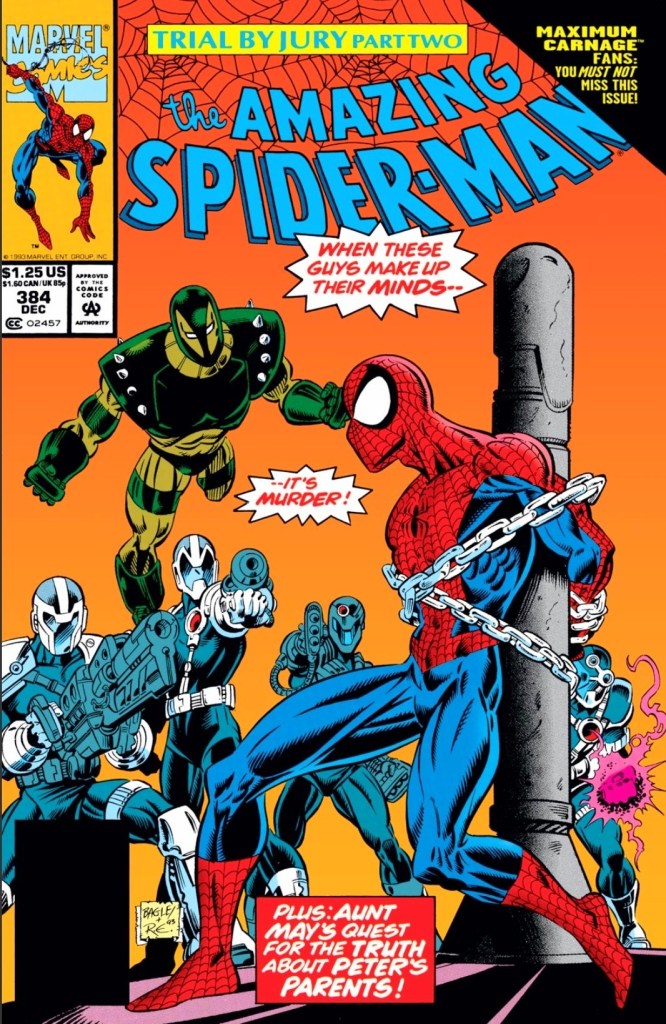
The cover.

Early story

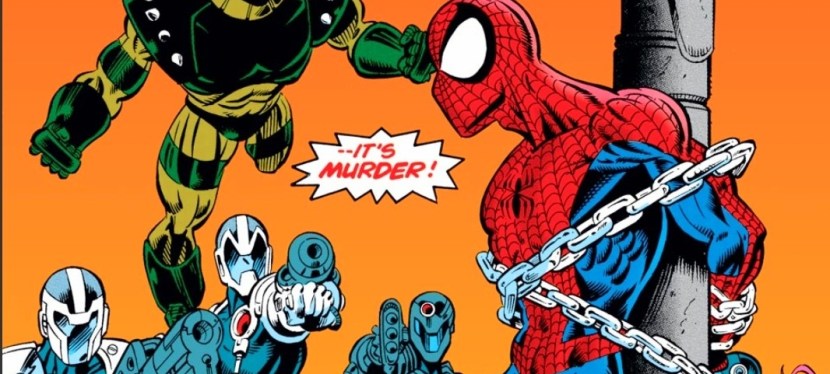
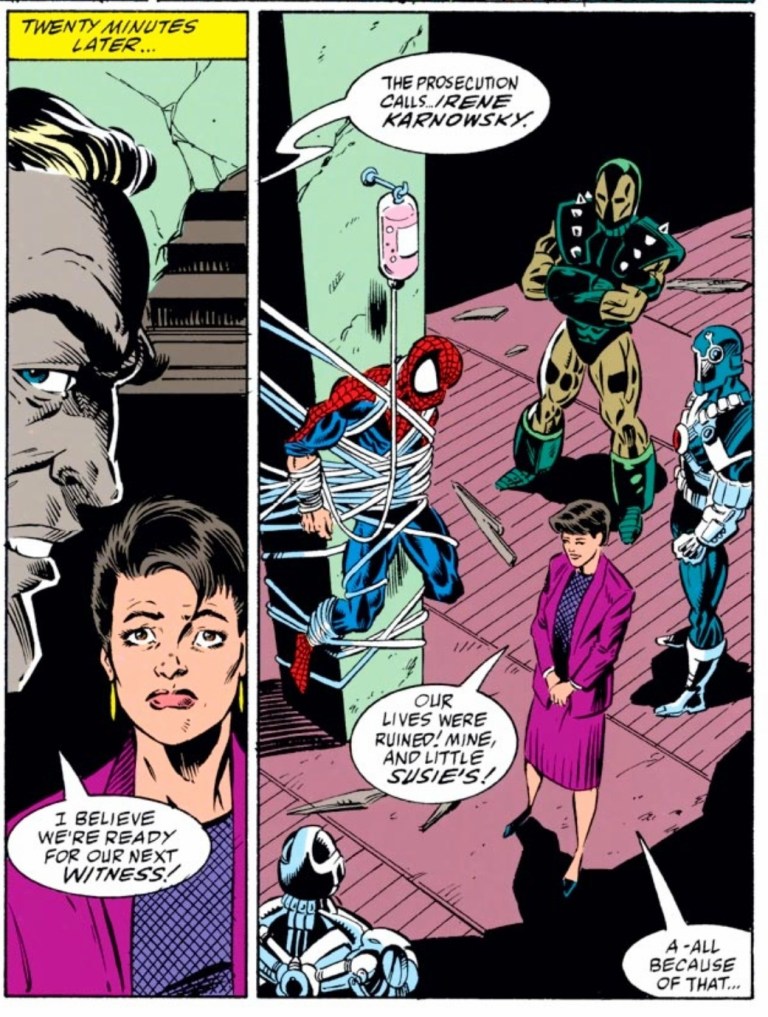
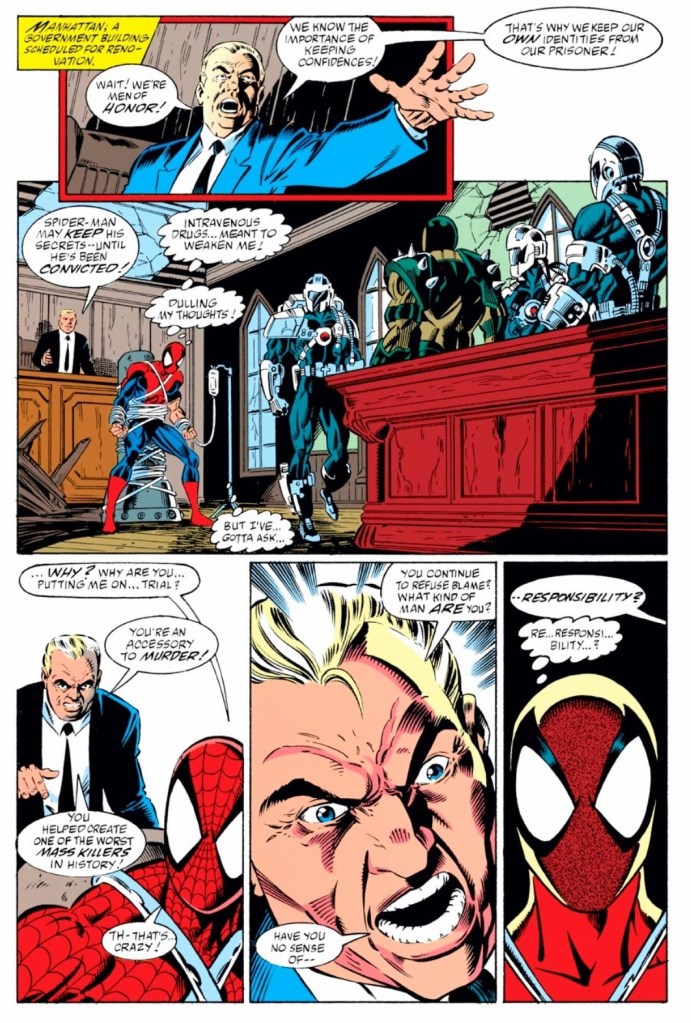
The story begins inside a certain government building in New York City scheduled for renovation. A heavily restrained and drugged Spider-Man was about to have mask taken off by one of The Jury members when their founder General Taylor intervened and insisted that they keep their honor. Spider-Man is up for questioning and scrutinization in a makeshift trial by The Jury. As the webslinger is not in the proper condition to stand trial, Taylor (in his capacity as the judge) declares a 30-minute recess.

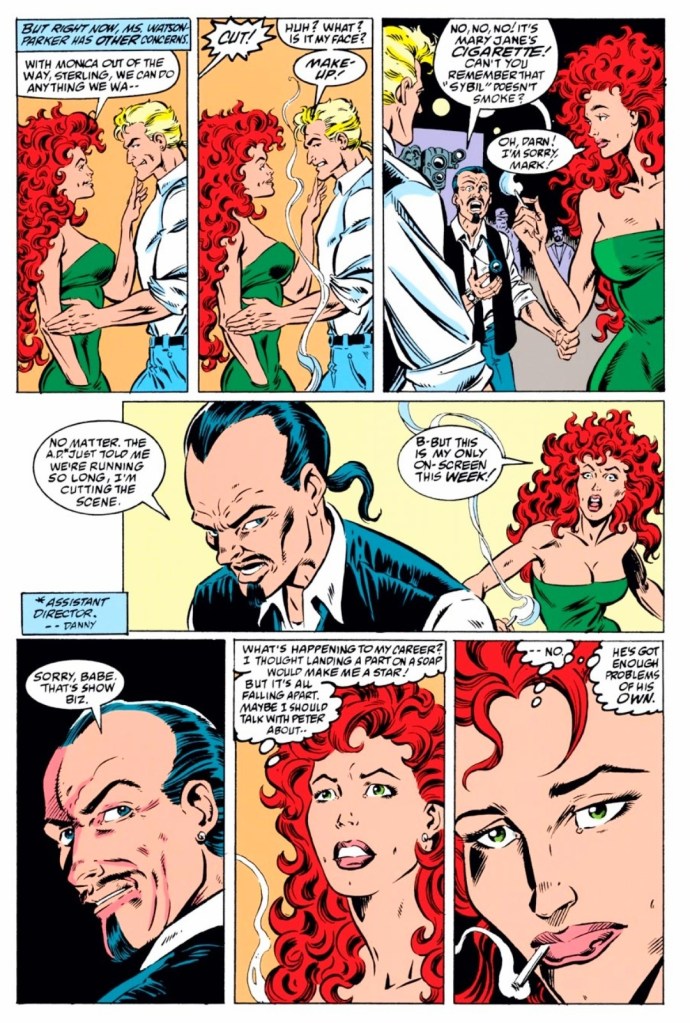
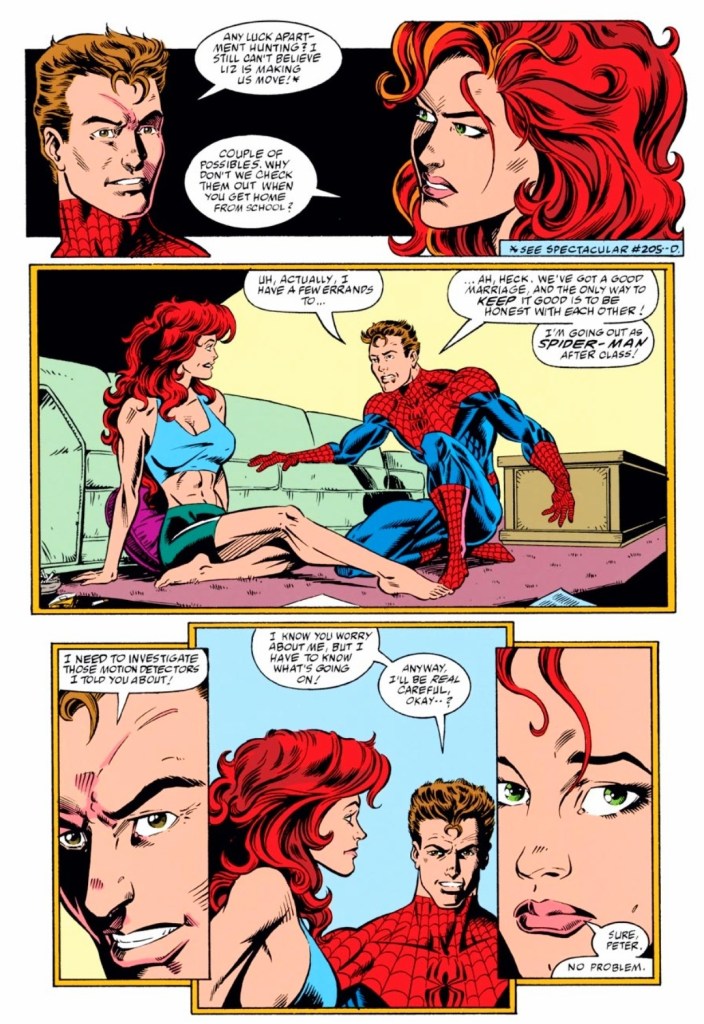
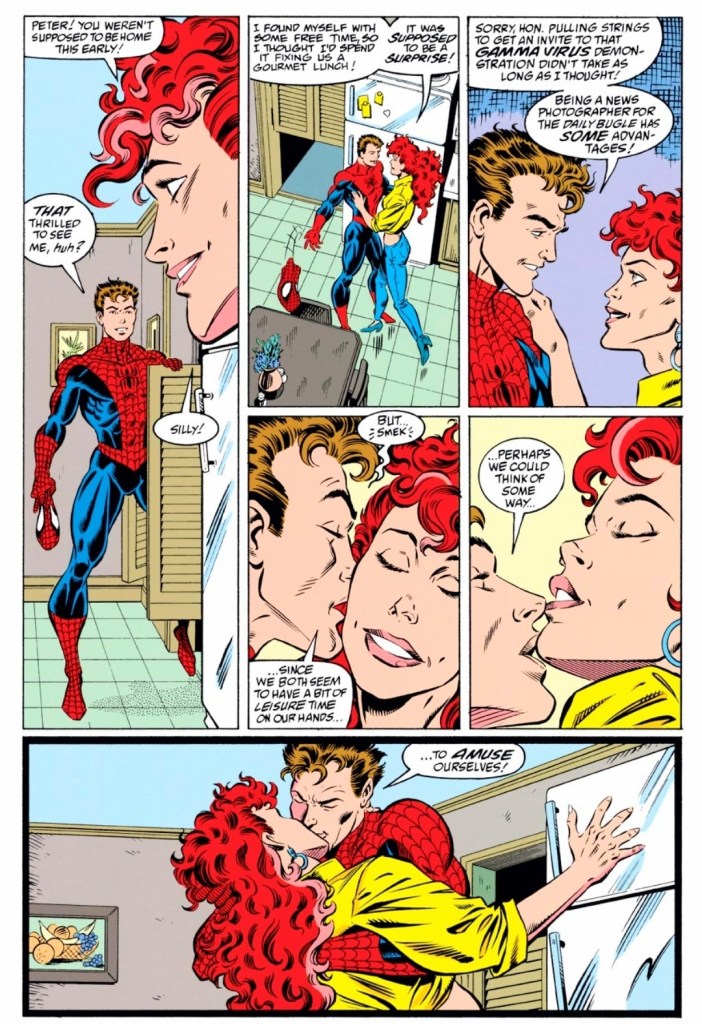
Elsewhere, Peter Parker’s wife Mary Jane received bad news from her boss that her role in the TV show Secret Hospital will be reduced to a recurring role. This troubles her deeply as it means reduced income for her at a time when her marriage with Peter continues to go down. Spider-Man’s lack of quality time with her keeps taking its toll on her…

Quality

Spidey on trial!

Firstly, I should say that the Michelinie-Bagley team’s concept of having The Jury as the force of opposition against Spider-Man continues to do wonders creatively in this particular comic book series. In the previous issue, the webslinger was hunted and General Taylor really invested a lot of technologies to get to him in the middle of a very bustling city. In this particular issue, Spider-Man is completely vulnerable being weakened and disoriented as he is about to be tried in a makeshift court.

Along the way, Taylor and his team were portrayed to work within their own system of justice. As no court of law in New York would recognize Spider-Man’s trial, The Jury set up their own court in a very private and unusual manner.

While the planned trial is the major event of this comic book’s concept, Michelinie pulled off a rather unusual move with the narrative. Just as the first witness points to Spider-Man for being responsible for Venom, the iconic webslinger then starts to wonder what the trial is truly all about and then the creative team unleashed a slew of flashbacks that looked back a key events published in certain comic books of Secret Wars, The Amazing Spider-Man and Web of Spider-Man through the years. I’m talking about Spider-Man’s first-ever encounter with the symbiote, how he got rid of it, how the symbiote bonded with Eddie Brock to form Venom, how Venom’s costume left a living seed that Cletus Kassady touched and became Carnage, etc. These flashbacks, all nicely drawn by Mark Bagley, conveniently served as an instant reference for readers to catch up with the current events but this was done at the expense of this comic book’s narrative.

More on the trial, this comic book raises layered questions about the concept of responsibility on Spider-Man. Could the iconic webslinger really be held accountable for whatever murders Venom committed along with the trauma he caused on bystanders given the fact that he really brought the alien costume into their world? Should Spider-Man also be held responsible for any murders committed by Carnage? This is one really loaded script Michelinie came up with and he really had Spider-Man vulnerable not only to The Jury but also to the questions thrown at him during the makeshift trial. To put it short, this is one very unusual Spider-Man tale ever told that carries strong relevance from the past.

As with the previous issues, this comic book sheds a limited amount of the spotlight on Mary Jane and Spider-Man’s Aunt May who at this stage has gotten paranoid with her suspicions about Peter’s parents. The dramatization turned out pretty good.

Conclusion

Spider-Man in a vulnerable state with The Jury.

While the flashbacks were excessive and made the narrative feel bloated, Amazing Spider-Man #384 (1993) still has lots of good stuff fans can enjoy. It has a pretty bold concept of having Spider-Man really trapped and left vulnerable for the makeshift trial. More notably, the narrative pounded heavily on the concept of responsibility in relation to Spider-Man’s past actions that led to the creation of Venom and even Carnage.

Overall, Amazing Spider-Man #384 (1993) is recommended!

+++++

Thank you for reading. If you find this article engaging, please click the like button below, share this article to others and also please consider making a donation to support my publishing. If you are looking for a copywriter to create content for your special project or business, check out my services and my portfolio. Feel free to contact me with a private message. Also please feel free to visit my Facebook page Author Carlo Carrasco and follow me on Twitter at  @HavenorFantasy as well as on Tumblr at https://carlocarrasco.tumblr.com/ and on Instagram at https://www.instagram.com/authorcarlocarrasco

A Look Back at Amazing Spider-Man #383 (1993)

Disclaimer: This is my original work with details sourced from reading the comic book and doing personal research. Anyone who wants to use this article, in part or in whole, needs to secure first my permission and agree to cite me as the source and author. Let it be known that any unauthorized use of this article will constrain the author to pursue the remedies under R.A. No. 8293, the Revised Penal Code, and/or all applicable legal actions under the laws of the Philippines.

Welcome back superhero enthusiasts, 1990s culture enthusiasts and comic book collectors! Today we go back to the year 1993 and explore a part of the Marvel Comics universe through one of the many tales of the Amazing Spider-Man comic book series.

To put things in perspective, the creative team behind the Amazing Spider-Man title decided to shake things up a bit by having the high-tech team called The Jury (the same team that went against Venom led by a powerful man whose son was murdered by Eddie Brock in Amazing Spider-Man #315) as the force of opposition for the webslinger.

With those details laid down, here is a look back at Amazing Spider-Man #383, published in 1993 by Marvel Comics with a story by David Michelinie and drawn by Mark Bagley.  

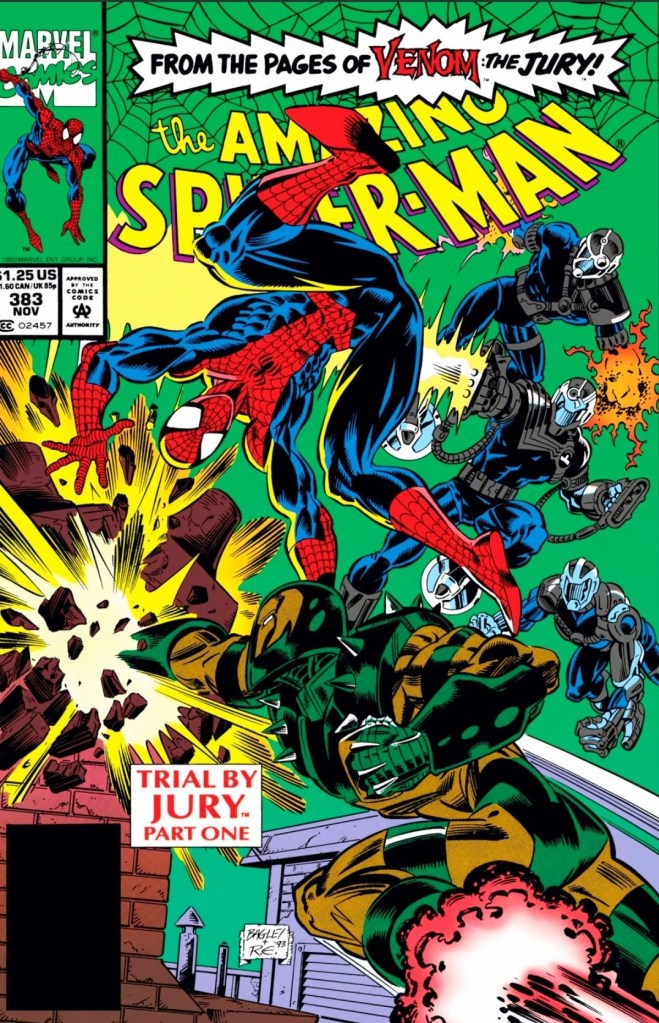
The cover.

Early story

The story begins in New York with the super-powered being Nova flying around which triggers an alert. It turns out, members of The Jury and their leader General Orwell Taylor have been monitoring and scanning areas of the city with several motion detectors to find Spider-Man. As far as Taylor is concerned, Spider-Man is highly responsible for the existence of Venom in their world and is therefore connected to the murder of his son (committed by Venom while escaping from prison in Amazing Spider-Man #315). Taylor is convinced that the if Spider-Man’s freedom is the price for stopping a monster like Venom, then that would be good.

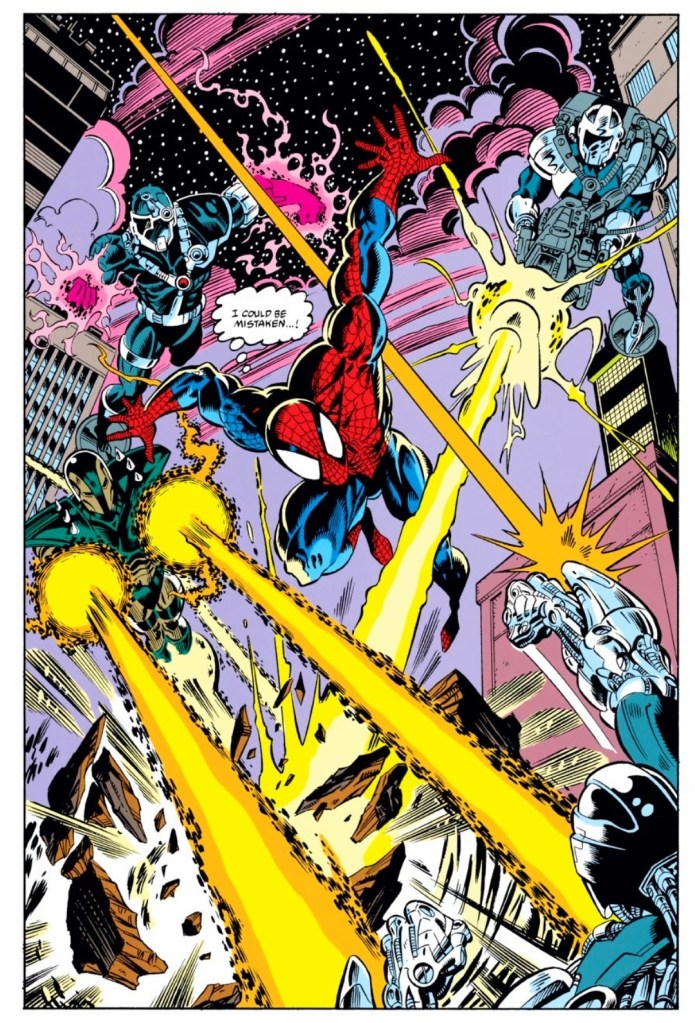
Suddenly, the team notices that one of their motion detectors went offline. Moments later, a technician reaches the rooftop of the building and finds a motion detector severely damaged. Out of nowhere, Spider-Man grabs the technician and puts his life in danger by moving him off the edge using his fist and strength to carry him. Spider-Man pressures him for details…

Quality

The Jury’s hunt for Spider-Man is really entertaining to read!

This is definitely one of the more engaging Amazing Spider-Man stories I read not only from 1993 but from the 1990s in general. In my view, putting Spider-Man up against The Jury is a stroke of genius on the part of the Michelinie-Bagley team and at the same time it was a sound relief after reading so much about the presence of Carnage and Venom on this particular monthly series (note: the Maximum Carnage crossover chapters and Amazing Spider-Man being linked with the Venom: Lethal Protector limited series).

When it comes to The Jury, Michelinie crafted a script that justifies Taylor’s team to pursue Spider-Man after they failure on getting Venom. This shows that Taylor has acquired information about Venom’s origin being the result of Spider-Man bringing home with him the symbiote (alien costume) from his time on a far-away planet (as seen in the Secret Wars series). Creatively, this results in a very convincing portrayal of Taylor not only as a grieving father but also as a very tactical leader who uses vast intelligence and resources to achieve what he believes is justice and the means for achieving the greater good. As for The Jury’s armored members – Sentry, Ramshot, Screech, Firearm and Bomblast – Michelinie did not simply portray them as straight-forward, mission-focused people here. One of them shows hesitancy which added a nice layer of division and human weakness within the team which is felt in action-packed encounter with Spider-Man.

Being the target of The Jury, Spider-Man at this stage is deeply troubled even though the Maximum Carnage disasters are over. He is portrayed to be very disturbed by the alarm signals of his Spider Sense whenever he gets near one of the sensors of The Jury which is a unique display of his special ability.

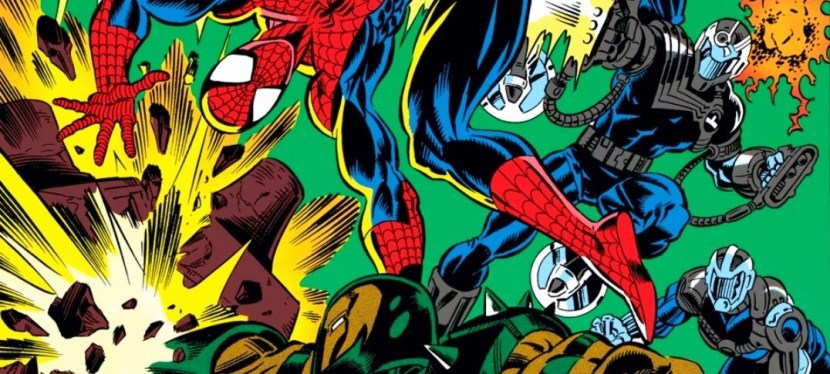
Those of you who love superhero spectacle will find a lot to enjoy here! Mark Bagley’s art on emphasizing action and stunts is fantastic to look at as The Jury pursues Spider-Man within New York. There are lots of dynamic shots, flashy high-tech images and really intense superhero action complete with collateral damage!

To be clear, this comic book is not simply all about the webslinger and Taylor’s team. There are some scenes here building up on Aunt May’s suspicion about Peter Parker’s parents which added suspense to the narrative.

Conclusion

As usual, Peter Parker does not have enough quality time for his wife.

Amazing Spider-Man #383 (1993) remains a very solid and highly entertaining comic book to read from start to finish. The Michelinie-Bagley team really delivered the great stuff as they launched a new concept having The Jury hunting Spider-Man in successful fashion. The Jury is clearly a very formidable team that gave Venom and Spider-Man a lot of trouble. The notable thing here is that this is only the first chapter of a new storyline with focus on Spider-Man’s responsibility with the murderous Venom (and all the victims he made).

Overall, Amazing Spider-Man #383 (1993) is highly recommended!

+++++

Thank you for reading. If you find this article engaging, please click the like button below, share this article to others and also please consider making a donation to support my publishing. If you are looking for a copywriter to create content for your special project or business, check out my services and my portfolio. Feel free to contact me with a private message. Also please feel free to visit my Facebook page Author Carlo Carrasco and follow me on Twitter at  @HavenorFantasy as well as on Tumblr at https://carlocarrasco.tumblr.com/ and on Instagram at https://www.instagram.com/authorcarlocarrasco

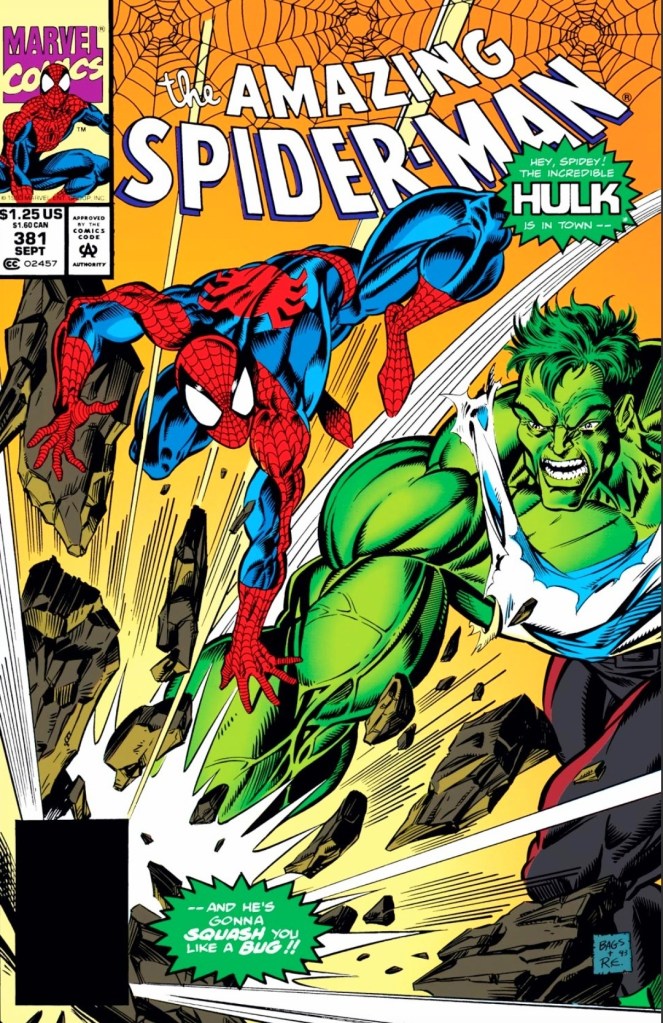
A Look Back at Amazing Spider-Man #381 (1993)

Disclaimer: This is my original work with details sourced from reading the comic book and doing personal research. Anyone who wants to use this article, in part or in whole, needs to secure first my permission and agree to cite me as the source and author. Let it be known that any unauthorized use of this article will constrain the author to pursue the remedies under R.A. No. 8293, the Revised Penal Code, and/or all applicable legal actions under the laws of the Philippines.

Welcome back superhero enthusiasts, 1990s culture enthusiasts and comic book collectors! Today we go back to the year 1993 and explore a part of the Marvel Comics universe through one of the many tales of the Amazing Spider-Man comic book series.

To put things in perspective, 1993 was another busy year for the iconic Spider-Man who not only had four monthly series of his own but also appeared in the Venom: Lethal Protector mini-series, the 14-part Maximum Carnage crossover and in Marvel’s major crossover The Infinity Crusade. As expected, Spider-Man survived through those storylines.

With those details laid down, here is a look back at Amazing Spider-Man #381, published in 1993 by Marvel Comics with a story by David Michelinie and drawn by Mark Bagley.  

The cover.

Early story

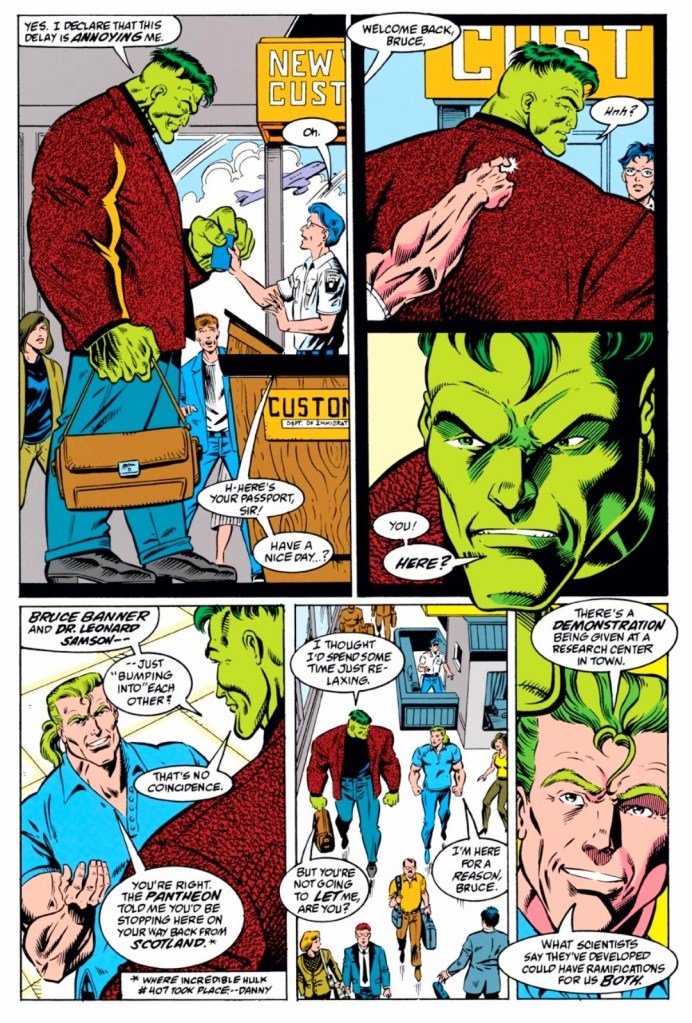
The story begins inside the airport in New York where the incredible Hulk/Bruce Banner himself had just arrived from Scotland. Due to his tremendous size, his physical presence easily distract the people around him. Dr. Leonard Samson surprises Banner and informs him of an upcoming scientific demonstration and the scientists behind it have developed something that could have ramifications for people who got exposed to gamma radiation. Samson explains that there is a radiation virus that releases repressed emotions. The Hulk rejects Samson and leaps to the air above towards an unknow destination.

At a school yard in lower Manhattan, two kids bully another kid into giving them his lunch money. Spider-Man suddenly arrives to stop trouble and immediately the two bullies ran away…

Quality

Quality time between Peter Park and wife Mary Jane.

I can say that is one of the more interesting crossovers between Spider-Man and the Hulk who at this stage in Marvel’s comic book history retained his intelligence and personality while in his huge, green-skinned form. Adding variety to the crossover was the presence of Doc Samson who was already an established and notable supporting character in comic books featuring the Hulk.

Set after the events of Maximum Carnage, the Infinity Crusade and Hulk’s time in Scotland (as told in Incredible Hulk #407), this story shows life in New York gradually normalizing. The peace, as it turns out, was only temporary as the big-time scientific demonstration in this story leads to a series of unfortunate events that compels Peter Parker to take action as Spider-Man.

The tale was nicely structured and the creative team took its time to build-up the story concept, the character motivations and execute the superhero spectacle at an overall medium pace. There is simply no boring scene nor any wasted moments. The appearances of Samson and the Hulk in this Spider-Man tale were nicely integrated and they each had their own impact on the plot. There is a lot of stuff here that fans of both Spidey and the green giant can enjoy.

When it comes to the art, I found Mark Bagley’s take on the Hulk distinctive and intriguing to look at. The final shot of this comic book is a must-see.

Conclusion

Hulk and Doc Samson at the airport.

While there clearly is no villain, Amazing Spider-Man #381 (1993) still turned out to be a fun read complete with a fine crossover between Spider-Man, Doc Samson and the Hulk. Apart from the lack of space for character development, nothing here felt half-baked with the executions of the storytelling and the spectacle. This is a fun read and it was also a modern take on the personal encounter between Hulk and Spidey during the 1990s. This comic book has something enjoyable that fans of the two Marvel icons won’t find in any of the Marvel Cinematic Universe (MCU) movies and shows.

Overall, Amazing Spider-Man #381 (1993) is recommended.

+++++

Thank you for reading. If you find this article engaging, please click the like button below, share this article to others and also please consider making a donation to support my publishing. If you are looking for a copywriter to create content for your special project or business, check out my services and my portfolio. Feel free to contact me with a private message. Also please feel free to visit my Facebook page Author Carlo Carrasco and follow me on Twitter at  @HavenorFantasy as well as on Tumblr at https://carlocarrasco.tumblr.com/ and on Instagram at https://www.instagram.com/authorcarlocarrasco

A Look Back at Spider-Man and Batman: Disordered Minds (1995)

Disclaimer: This is my original work with details sourced from reading the comic book and doing personal research. Anyone who wants to use this article, in part or in whole, needs to secure first my permission and agree to cite me as the source and author. Let it be known that any unauthorized use of this article will constrain the author to pursue the remedies under R.A. No. 8293, the Revised Penal Code, and/or all applicable legal actions under the laws of the Philippines.

Welcome back, superhero enthusiasts, 1990s culture enthusiasts and comic book collectors! Today we will take a look back at a certain crossover comic book that involved both Marvel Comics and DC Comics published in the mid-1990s. On my part, it’s been some time since I last reviewed a Marvel-DC crossover comic book. That being said, you can read about my retro comic book reviews of Batman versus The Incredible Hulk and Superman and Spider-Man on this website.

For this new retro review, we will focus on the 1995 crossover that brought two of Marvel and DC’s icons together for the first time – Spider-Man and Batman! To put things in perspective, the 1990s still remembered as the decade when Bane broke Batman’s back while the publishing of Spider-Man comic books became highly controversial with the Spider-Clone Saga. In the 1995 crossover produced the two comic book giants, Spider-Man and Batman are presented in their classic identities as Peter Parker and Bruce Wayne.

With those details laid down, here is a look back at Spider-Man and Batman: Disordered Minds published in 1995 by Marvel Comics and DC Comics with a story written by J.M. DeMatteis and drawn by Mark Bagley.

The cover.

Early story

The story begins with a nightmare in which Peter Parker’s Uncle Ben got shot by an armed man in the presence of Aunt May inside their home. Immediately Spider-Man arrives and grabs the man by the neck. The armed man creepily laughs and his face suddenly turns into the Joker. Peter Parker wakes up in bed with Mary Jane on his side. After a short talk with his wife, Peter decides to leave their apartment and swing around the city as Spider-Man.

In another nightmare, a very young Bruce Wayne witnesses the death of his parents caused by a man with a gun. He suddenly turns into Batman and grabs the gunman by the neck. The gunman suddenly turns into the horrific Carnage. Bruce wakes up and decides to reflect. As soon as his butler Alfred opens the door to check on him, Bruce immediately leaves as Batman in the middle of the night.

Somewhere that same night inside a secret facility of the Ravencroft Institute, Cletus Kasady/Carnage is restrained in a secured chamber surrounded by armed security personnel with Spider-Man and psychotherapist Ashley Kafka watching him…

Quality

The two superhero icons together.

I’ll start first with the visual quality of this crossover comic book. Mark Bagley, who was the lead artist on Marvel’s Amazing Spider-Man comic book series, delivered an unsurprisingly stylized look at the two superhero icons, super villains and characters, as well as on DC’s Gotham City (which was the most prominent location in the story).

While Bagley’s work on Spider-Man and the characters associated with him were typical of his Amazing Spider-Man of the decade, I can say that his take on Batman, Joker, Alfred, the Bat Cave and others on the DC Comics side resulted a unique look. Bagley drew Joker looking sinister, maniacal, clueless and even tamed as the plot progressed. Bagley’s Batman has a larger yet familiar style of muscular body compared to Spider-Man, and the visual presentation of his cape ranged from dynamic to looking authoritarian. There were however a few moments wherein Bagley went over the limit on emphasizing the length of Batman’s cape which resulted a few inaccuracies. Remember how there were times that Bagley drew Marvel characters’ thighs to look excessive with muscle? You will see that too on Batman here.

When it comes to artistic dynamism, it is clear that Bagley pushed himself hard creating some mixed results. Some scenes (action scenes and talk scenes included) had the appropriate amount of flash and style, while other scenes had an excessive amount. When it came to spectacle, Bagley succeeded in making the action, hard-hitting moments and explosions look very lively. To be clear, this comic book is entertaining to look at but ultimately it will resonate best with readers who are best familiar to the way Bagley draws.

For the storytelling, J.M. DeMatteis crafted a script that did not reach its full potential as there were obvious limits imposed to ensure equality on presenting the characters and the situations. This explains why in the beginning Spider-Man and Batman each had nightmares related to their respective past and end up seeing their respective super villains interchanged (Spider-Man sees Joker, Batman sees Carnage). The characters of Ashley Kafka and Cassandra Briar are not only looking too similar to each other (just imagine their characters having no colors), they both feel like cardboard cut-outs of a single character who specializes on analyzing people with dangerous minds and coming up with solutions to help them. The more known supporting characters from the respective sides of the two icons – Mary Jane and butler Alfred – made short appearances but did not really contribute much to the plot.

The limitations are also felt on the way Spider-Man and Batman – plus Carnage and Joker – were presented, right down to their interactions with each other. While it was expected that Batman and Spider-Man would be brought together by an unfortunate development, the complete absence of a fight between the two superhero icons was itself the biggest surprise here effectively defying crossover superhero tradition. Even without a fight, you will see Batman and Spider-Man do things separately in accordance to their respective traditions or character traits before getting back together leading to the big conflict with the super villains.

As for Joker and Carnage being together, the spotlight on them in this comic book is pretty limited. There simply is not enough space in this comic book to bring out the full potential of the two super villains who each are known to be murderers and psychologically dangerous. What is interesting in their limited time together is that the story emphasized the differences between them when it comes harming people. The Joker has his own sadistic style of leading people to their deaths in time-consuming ways which is opposite of the quick deaths Carnage enjoys. Considering their respective reputations, it is just a shame that this comic book not only failed to bring out the full potential of Carnage-Joker, it also failed to establish them as clear and present dangers to the public.

More on the plot itself in relation to the comic book sub-title “Disordered Minds”, the elements of mental instability, psycho-therapy, psychology and rehabilitation are present but they are all thrown out by the time the second half of the story begins, clearly making space for the crossover dynamics of Batman, Spider-Man, Joker and Carnage.

Conclusion

Joker and Carnage.

Spider-Man and Batman: Disordered Minds (1995) is a flawed crossover event comic book that just so happens to have more positive stuff than negative ones. It is enjoyable but not great and certainly not memorable. The imposed limits on the presentation made this comic book’s story feel very staged and predictable. With what little creative space was left, it is quite an achievement for the creative team to tell a cohesive and stuffed story (note: there is a lot of filler and some psychology related stuff may not interest some readers) while featuring Batman and Spider-Man the best way they could. It has enough superhero spectacle to be enjoyed although the interactions between Batman and Spider-Man and between Joker and Carnage could have been better.

If you are seriously planning to buy an existing hard copy of Spider-Man and Batman: Disordered Minds (1995) be aware that as of this writing, MileHighComics.com shows that a near-mint copy costs $120 while the near-mint copy of the signed-and-numbered edition is at $120.

Overall, Spider-Man and Batman: Disordered Minds (1995) is satisfactory.

+++++

Thank you for reading. If you find this article engaging, please click the like button below and also please consider sharing this article to others. If you are looking for a copywriter to create content for your special project or business, check out my services and my portfolio. Feel free to contact me with a private message. Also please feel free to visit my Facebook page Author Carlo Carrasco and follow me on Twitter at  @HavenorFantasy as well as on Tumblr at https://carlocarrasco.tumblr.com/

A Look Back at Robin III #3

Disclaimer: This is my original work with details sourced from reading the comic book and doing personal research. Anyone who wants to use this article, in part or in whole, needs to secure first my permission and agree to cite me as the source and author. Let it be known that any unauthorized use of this article will constrain the author to pursue the remedies under R.A. No. 8293, the Revised Penal Code, and/or all applicable legal actions under the laws of the Philippines.

Before I start this retro comic book review of Robin III , let me explain that the illustrator of the comic book, Tom Lyle, passed away last November over health-related reasons. Before dying, he had a surgery in October 2019 to remove a blood clot in his brain and subsequently fell into a coma. Apart from drawing comics, Tom Lyle was a professor of art at Georgia’s Savannah College of Art and Design (SCAD). For a look at Lyle’s expertise, watch the video from 2017 below.

When it comes to the comic book industry, Lyle started his career with AC Comics and Eclipse Comics back in the 1980s. In 1988, he worked on the art of Starman for DC Comics and went on to work on the company’s other properties and played a major role with the publishing of the three mini-series featuring Batman’s sidekick Robin (Tim Drake specifically).

After leaving DC Comics, he joined Marvel Comics as one of their illustrators on the Spider-Man monthly series. He quickly got involved in the Maximum Carnage crossover and made bigger waves with Spider-Man readers with the Clone Saga. Lyle is widely credited for designing the Scarlet Spider. With regards to his death, Marvel Comics published online a tribute for him.

Now that the short history lesson is over, let’s take a look back at Robin III published by DC Comics in 1993 with a story by Chuck Dixon and art by Tom Lyle.

Cover
The cover.

Early story

The story begins in school where Tim Drake/Robin gets confronted by his superior who noticed the bruises he got. As Tim tries to keep his secrets, the superior Ms. Hollingsworth knows that he was cared for by Bruce Wayne (Batman) while his father was in a coma. She also knows that he lives on a property bordering the estate of Wayne. She makes clear that he can speak openly to her and Tim simply denies that Bruce would never hit him. He states: “An upperclassman…a senior…I think…big kid.”

Eventually the meeting ended and Tim leaves struggling over thinking about the complications he is experiencing with his double life as a student and as a crime fighter. Since he cannot get involved with Batman and Alfred, he spends some time with Harold (who was so busy working on a machine) and eventually goes home. His father notices Tim’s bruises and states that he spends too much time at Wayne’s. This leaves Tim more conflicted within.

Elsewhere, a muscular man called Sir Edmund easily beats up his loyal followers in a bout of combat. His assistant Lynx arrives and informs him that their turf is in danger with the arrival of Russians with KGBeast involved.

In the evening, Robin meets the Huntress and start their next mission…

Quality

13
Hard action with a smooth flow of sequence by Tom Lyle.

For a story set within the realm of Batman and, at the same time, does not have Batman at all, this Robin-centered comic book is well written and engaging. To say the least, showing Tim Drake struggling with his civilian life and crime-fighting life made Robin a literary symbol about the false maturity that youth in real life often experience. That false maturity is nicely portrayed with the superhero aesthetics and fantasy elements.

Quite predictably, Robin performs detective work and analyzes crime situations like Batman only this time, he gets involved with the Huntress (note: this mini-series carries the storyline title of “Cry of the Huntress”) to find out more answers and solve the crime problem. Being a product of the early 1990s, it is no surprise that the story has fictional portrayals about the Russians (with KGBeast leading the so-called invasion of the city) and even mentioning Afghans.

14
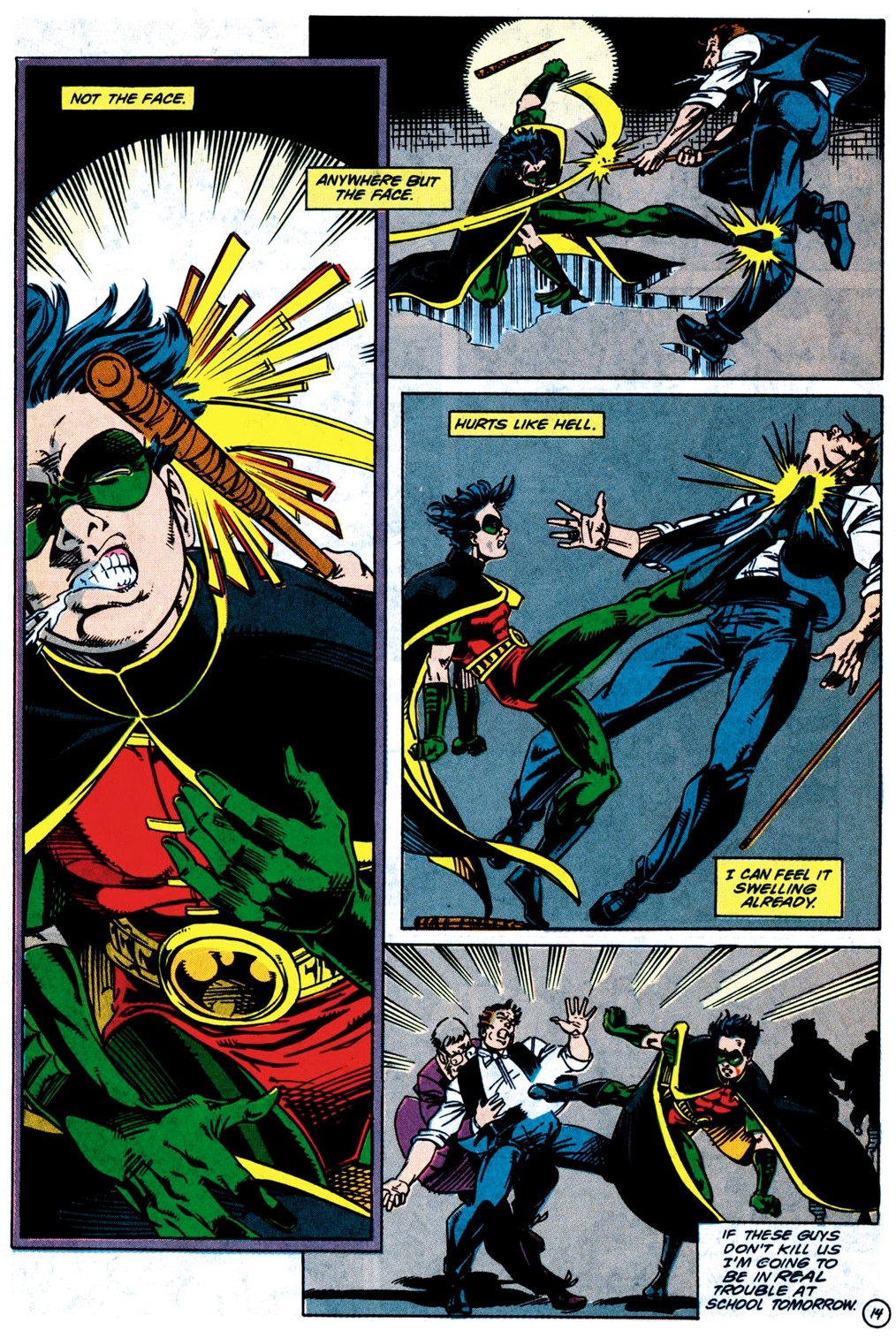
Hurting Robin on the head led to hard reactions.

Apart from the storytelling, the art by Tom Lyle here remains good to look at. Each scene, whether is it a talking scene or an action scene, looks good and Lyle has a nice touch on drawing facial expressions. When it comes to the spectacle, Lyle really shows how good he is with drawing hard-hitting physical action. I should also state how smooth the sequencing of action is drawn by him.

Conclusion

16
Robin and the Huntress make an odd crime-fighting duo.

To make things clear, Robin III is the first-ever Tom Lyle-drawn comic book I ever bought and read. By today’s standards, the comic book is still fun to read and it is compelling enough to make readers interested to read more of the mini-series. However, if seeing more of Robin fighting crime by himself is your type of Robin story, then this may not be compelling for you.

If you are seriously planning to buy an existing hard copy of Robin III , be aware that as of this writing, MileHighComics.com shows that the near-mint copy of the regular edition and the newsstand edition of the direct version costs $4 and $6 respectively. Meanwhile, the near-mint copy of the bagged edition and the unbagged edition of the deluxe version costs $4. To be clear, the deluxe version of Robin III in bagged form comes with a moving cover, a second reversible cover and additional artwork.

Overall, Robin III is recommended.


Thank you for reading. If you find this article engaging, please click the like button below and also please consider sharing this article to others. If you are looking for a copywriter to create content for your special project or business, check out my services and my portfolio. Feel free to contact me as well. Also please feel free to visit my Facebook page Author Carlo Carrasco and follow me at HavenorFantasy@twitter.com