Disclaimer: This is my original work with details sourced from reading the comic book and doing personal research. Anyone who wants to use this article, in part or in whole, needs to secure first my permission and agree to cite me as the source and author. Let it be known that any unauthorized use of this article will constrain the author to pursue the remedies under R.A. No. 8293, the Revised Penal Code, and/or all applicable legal actions under the laws of the Philippines.
Welcome back, superhero enthusiasts, 1990s culture enthusiasts, X-Men fans and comic book collectors! Today we revisit the Marvel Comics universe to examine one of the many tales of the X-Men monthly series.
Since issue #5, Omega Red was introduced and the creative team of the series inserted flashbacks showing Wolverine, Sabretooth and Maverick as paramilitary teammates from several years prior. It was also revealed that Wolverine and Omega Red encountered each other before, and their present day encounter resulted in the capture of the Canadian mutant. Wolverine managed to escape only to be recaptured by Sabretooth. Logan’s teammates were also captured by the same sinister group that has Omega Red.
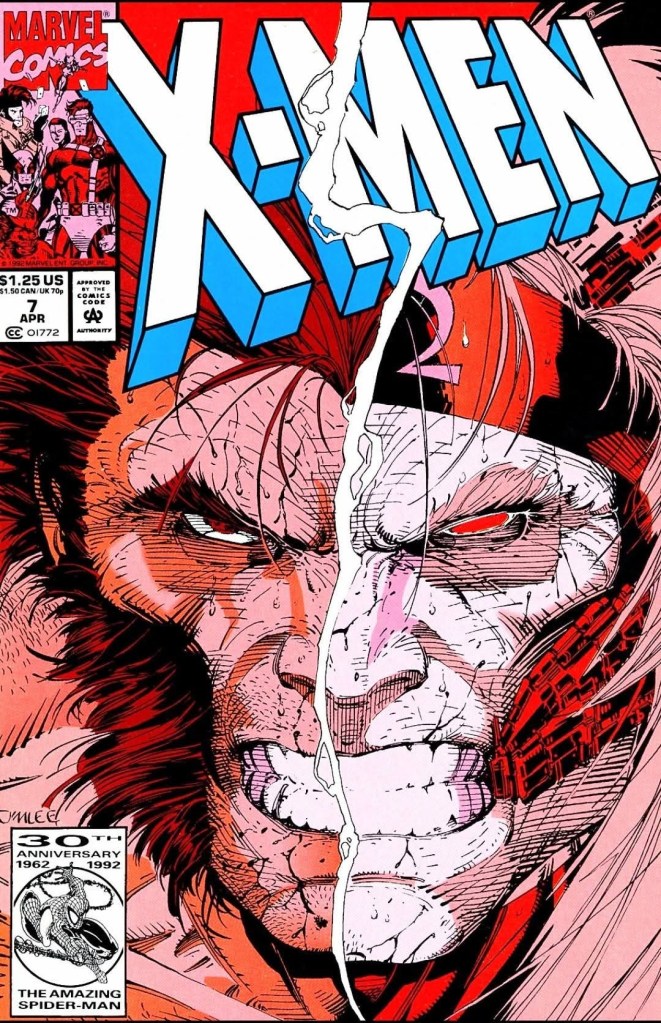
With those details laid down, here is a look back at X-Men #7, published by Marvel Comics in 1992 with a story plotted and drawn by Jim Lee, scripted by Scott Lobdell and inked by Art Thibert.
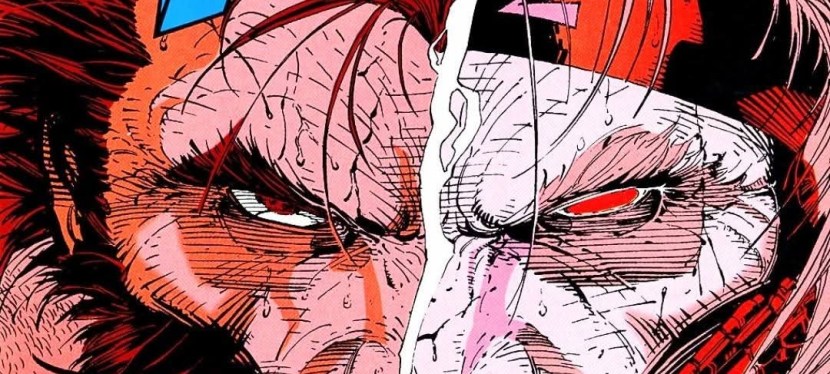
The cover.
Early story
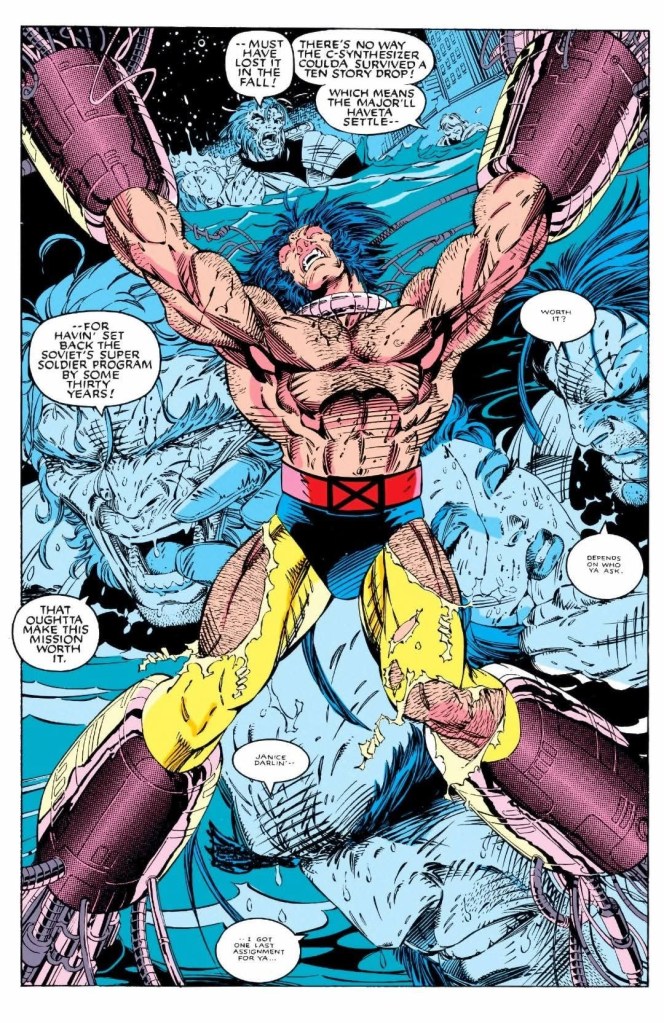
The story begins with Wolverine heavily restrained and his healing factor has been pushed to its limits. In the presence of Matsu’o Tsurayaba, Psylocke and others, Omega Red presses Wolverine for information about the carbonadium synthesizer. Matsu’o advises the Russian to not let the Canadian mutant bait him, and he shares the realization that it is impossible to mass produce his healing factor.
Matsu’o tells Omega Red that his only chance for survival rests in completing the process that was started thirty years prior. The Russian replied saying that he realizes he is dependent upon synthesizing the only metal capable of negating his death factor.
Not wanting to top, Omega Red says that he would rather pry the information from Wolverine’s brain by hand…
Quality
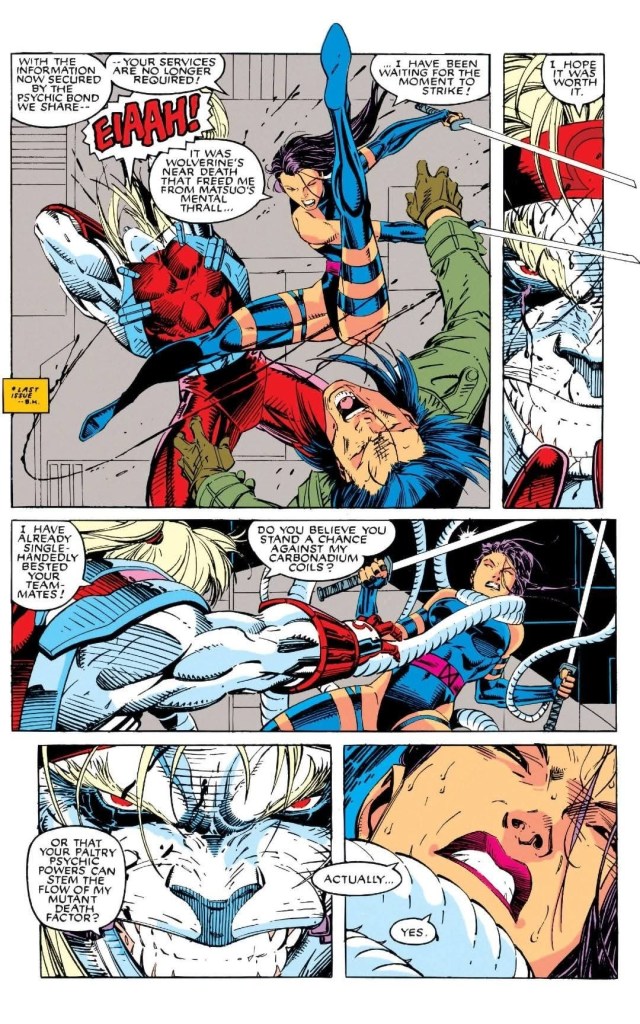
Psylocke in action versus Matsu’o and Omega Red.
To begin with, this is the conclusion to the storyline that started with issue #5. It is a cleverly paced story that had a good amount of build-up followed by big pay-offs with Jim Lee’s dynamic touch with the visuals.
Wolverine is once again vulnerable and Matsu’o’s gang already has the advantage. Matsu’o is determined to discover information about the C-Synthesizer no matter the cost (note: at the expense of Wolverine’s life). Omega Red’s death factor is much more emphasized in this issue and the goals behind the operations of the gang is made clearer here. As the story moved on, there were these clever twists that were entertaining to see leading to the chain of action-packed sequences. Without spoiling the plot, I can say that the creative team came up with a very solid conclusion in this short storyline and Maverick’s own presence has been justified as well.
As with the previous issue, scenes of Mojoworld were inserted giving readers updates about Dazzler and Longshot. Very clearly, this was the build-up leading into the 10th issue of the comic book series.
For those who enjoy visual spectacle, there is a lot to enjoy from Jim Lee here. As always, Lee draws action dynamically and made sure they are exciting to look at. Particularly, I found Lee’s carefully chosen action moments – particularly Sabretooth’s strike on Maverick and Wolverine’s strike against Omega Red – really impactful to look at.
Conclusion
Wolverine in a very vulnerable and painful state.
X-Men #7 (1992) is a very enjoyable read. It is a great conclusion to its 3-part storyline that started in issue #5 and by the time I read the end, Omega Red was clearly established as a very formidable foe of the X-Men even though he was a new addition to the lore. The writing of this comic book is very solid and the same thing can be said about the structure of the plot. Considering the time of its release, this comic book was clearly part of Jim Lee’s way of modernizing the X-Men.
Disclaimer: This is my original work with details sourced from reading the comic book and doing personal research. Anyone who wants to use this article, in part or in whole, needs to secure first my permission and agree to cite me as the source and author. Let it be known that any unauthorized use of this article will constrain the author to pursue the remedies under R.A. No. 8293, the Revised Penal Code, and/or all applicable legal actions under the laws of the Philippines.
Welcome back, superhero enthusiasts, 1990s culture enthusiasts, X-Men fans and comic book collectors! Today we revisit the 2nd series of X-Men Adventures which was the literary adaptation of the popular X-Men animated series of the 1990s.
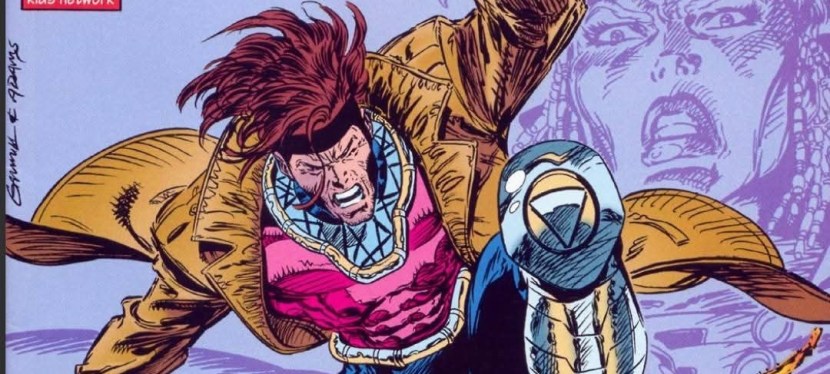
First introduced in 1990s comics published by Marvel, Gambit (Remy LeBeau) quickly emerged as one of the most popular members of the X-Men. He always looked cool, his power to charge cards (and other objects) into dangerous weapons, and his combat styling were really fascinating to see. He also has a personality that is very unique and mysterious at the same time. Eventually Gambit got his own spotlight in one of the episodes of the animated series.
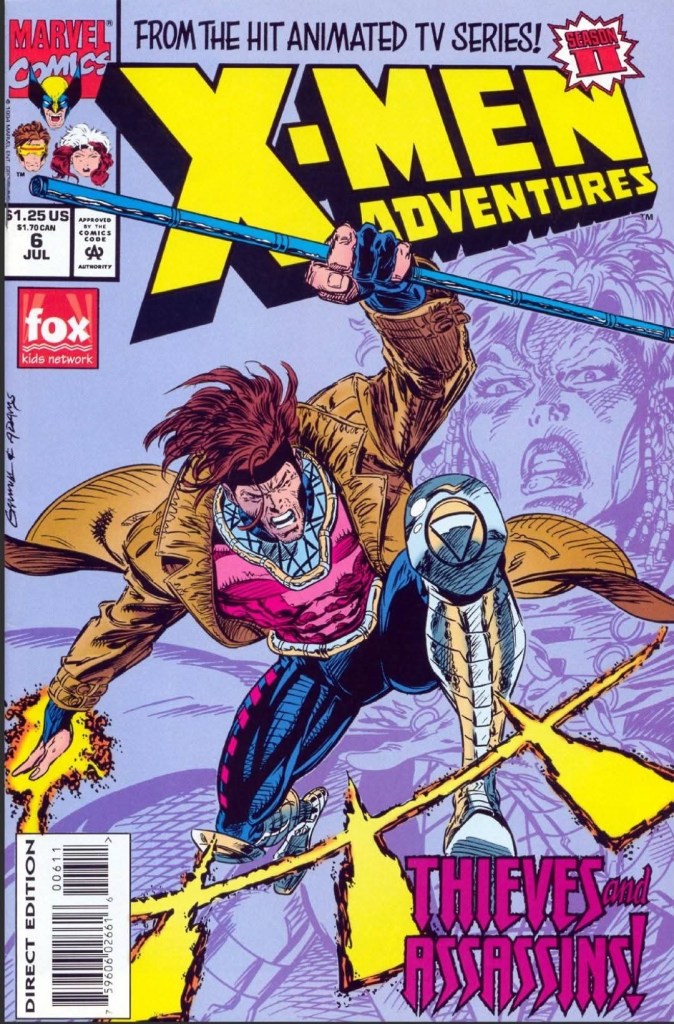
With those details laid down, here is a look back at X-Men Adventures Season II #6, published by Marvel Comics in 1994 with a story written by Ralph Macchio and drawn by John Hebert.
The cover.
Early story
The story begins with Gambit flying away from X-Men headquarters using a mini-aircraft. He is clearly on the pursuit for something. Rogue tells Wolverine and Jean Grey that their teammate received a message from New Orleans and he has to help a certain sibling who is in trouble. While speeding through the air, Gambit remembers what happened several years prior when he was part of the thieves guild. He remembered the moment Bobby became the chosen one among the thieves…
Quality
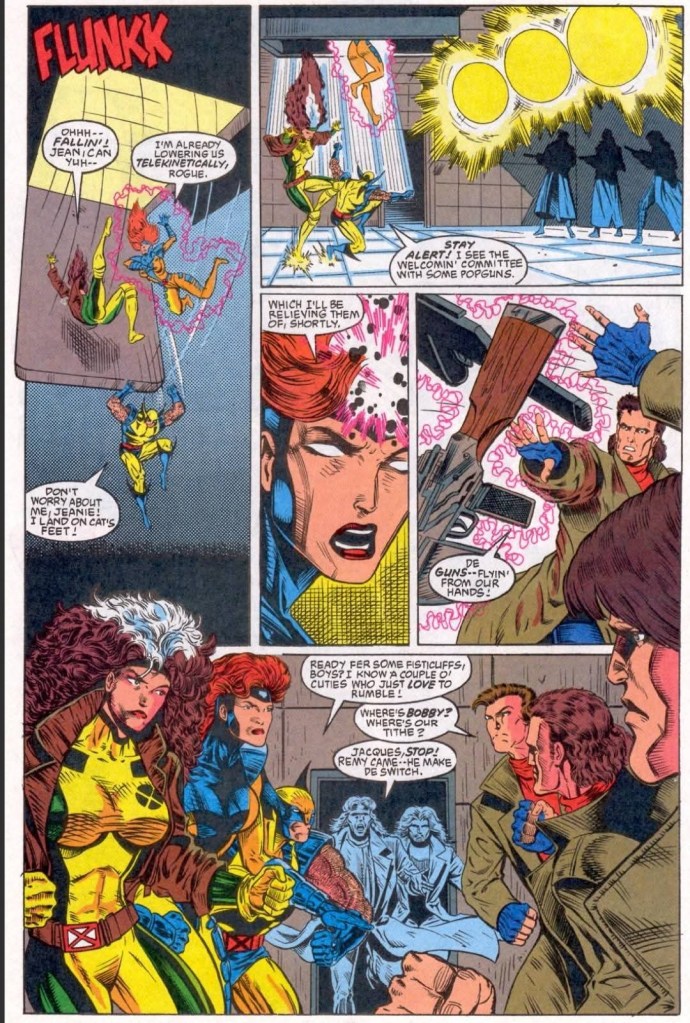
Wolverine, Rogue and Jean Grey fall down and encounter the thieves.
Anyone who followed the stories of Gambit in the X-Men comic books should be aware that there is a lot more to the past of the character than meets the eye. This comic book is a dramatization – which the animated series did – of Gambit’s involvement with a guild of thieves in Louisiana and what happens when the threads and personalities from his past return.
Upon returning to Louisiana, Gambit learns that the feud between the thieves and assassins has turned violent. Complicating matters further is an exchange the assassins want involving Bobby, the sacred tithe the thieves have and Gambit himself.
As expected, Gambit’s personality develops deeply as the story went on. The changes in him manifest when he encounters key characters from his past (example: Bella Donna) and how unfortunate events from the prior years impact him in the present. In short, this is a portrayal of Gambit that is clearly the most intriguing yet in the animated series.
Visually, John Hebert performed a good job visualizing the characters. While the X-Men are recognizable as before, Hebert’s art style gave the other characters a unique look that is gritty and sometimes creepy to see. I should mention that Hebert’s visual interpretation of Rogue reaction’s about Bella Donna described as Gambit’s woman is a great touch.
Conclusion
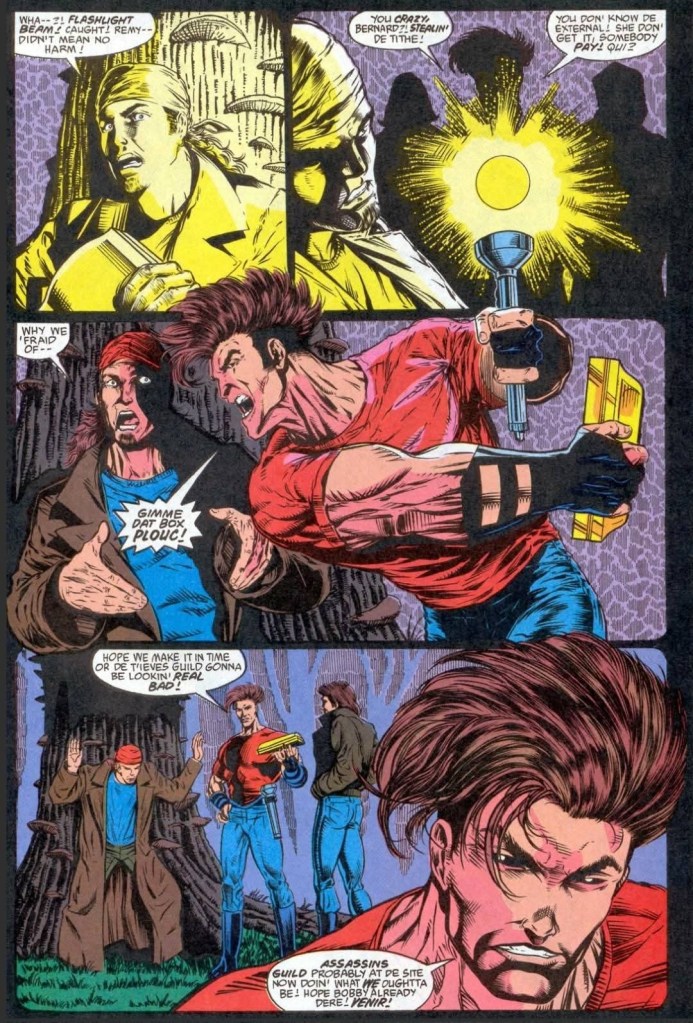
Young Gambit/Remy as a thief in Louisiana.
X-Men Adventures Season II #6 (1994) is a good read and it will delight X-Men fans who are avid followers of Gambit. This one has a nice mix of twists, action, suspense and the theme about the so-called ghosts from the past coming back to haunt some. To see more of Gambit and his Louisiana legacy, you have to read the official X-Men comic books (example: the X-Men/Ghost Rider crossover tale during the time of Jim Lee) plus the Gambit mini-series of the early 1990s. Consider this X-Men Adventures comic book a creative appetizer that happens to be fun to read.
Overall, X-Men Adventures Season II #6 (1994) is recommended.
Disclaimer: This is my original work with details sourced from reading the comic book and doing personal research. Anyone who wants to use this article, in part or in whole, needs to secure first my permission and agree to cite me as the source and author. Let it be known that any unauthorized use of this article will constrain the author to pursue the remedies under R.A. No. 8293, the Revised Penal Code, and/or all applicable legal actions under the laws of the Philippines.
Welcome back, superhero ans, 1990s arts and culture enthusiasts, X-Men fans and comic book collectors! Today we revisit the X-Men Adventures monthly series – the first series specifically – which was the literary adaptation of the popular X-Men animated series of the 1990s.
If you are familiar with the classic lore of X-Men literature, you will remember Warren Worthington as Angel who is one of the original members of the X-Men introduced in 1963. That same character would eventually get involved with the super villain Apocalypse and gain a deadlier form as Archangel.
With those details laid down, here is a look back at X-Men Adventures #12, published by Marvel Comics in 1993 with a story written by Ralph Macchio and drawn by Andrew Wildman.
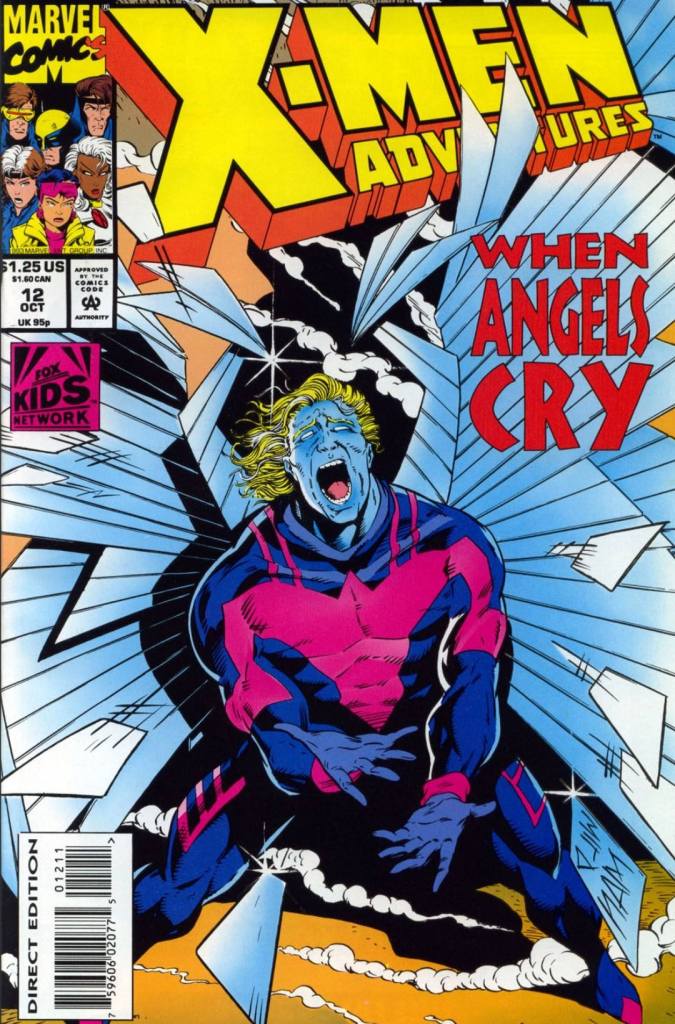
The cover.
Early story
The story begins inside a facility on Muir Island where genetic experimentation happens and draws mutants who seek a cure for the curse that makes them different. Already four mutants have arrived and were ready to undergo a grand experiment. The doctor in charge of the facility – Gottfried Adler – has already disappeared and in his place is the very powerful mutant Apocalypse.
Apocalypse succeeded in turning four mutants into his Four Horsemen composed of Archangel, War, Famine and Pestilence. For Apocalypse, the age of chaos is at hand.
Meanwhile at Charles Xavier’s School For Gifted Youngsters, the leisure session of Jubilee, Gambit, Jean Grey and Rogue suddenly ends when Storm grabs their attention and shows them TV footage that Professor X wants them to see.
TV news footage shows an important meeting happening in France for the conventional weapons disarmament. Moments later, Apocalypse crashes into the meeting with his Four Horsemen causing harm…
Quality
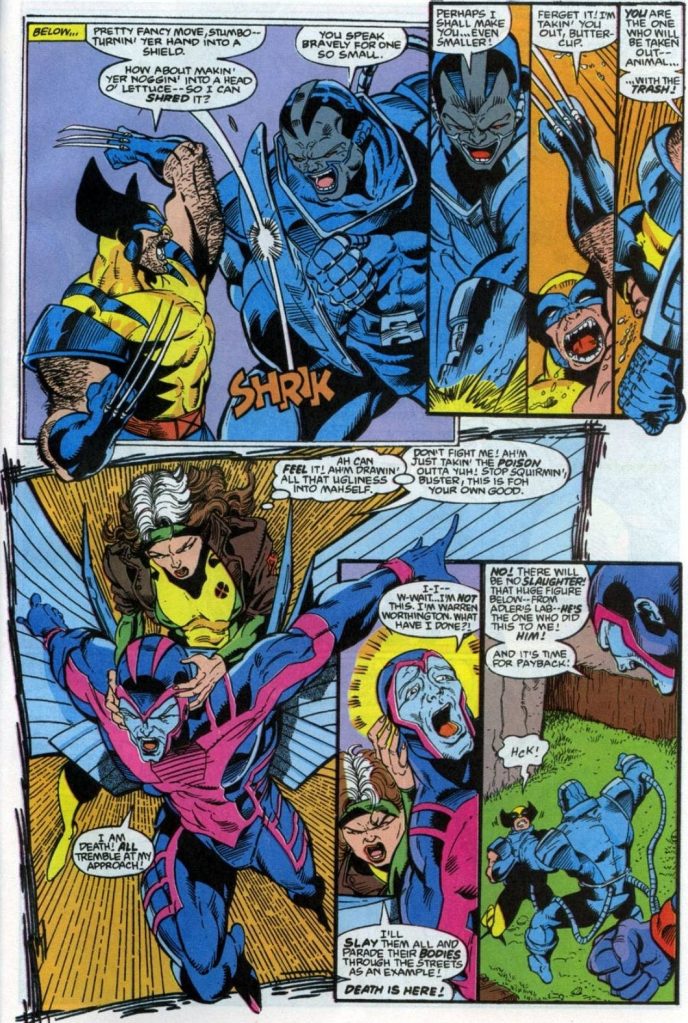
Rogue takes on Archangel while Wolverine is busy dealing with Apocalypse.
This comic book marks the emergence of Apocalypse as a tremendous force of evil following his series debut in issue #10 and short appearance in issue #11. As the main antagonist, Apocalypse – who is obsessed with survival and progress – really comes out in full force against humanity with his Four Horsemen as his deadly enforcers.
The threat of Apocalypse and his Four Horsemen towards humanity is clearly the main feature of this comic book and Macchio’s script has a good structure for the narrative. This makes the story easy to follow while still presenting a lot of details that can be absorbed efficiently. Apocalypse’s presence not only drew the X-Men to spring into action, it also drew Charles Xavier’s own fear that they would face an enemy more dangerous than Magneto.
While the main plot is consistently intense, this comic book also serves as a continuation of Rogue’s personal pursuits since issue #10 which is worth reading. Along the way, Archangel (whose new appearance started at the end of issue #11) notably got enough share of the spotlight and is easily the more captivating member of the Four Horsemen. The way Warren Worthington is portrayed here is clearly different from his literary version and that means you should not expect Professor X to claim him as one of his original X-Men members.
When it comes to the visuals, Andrew Wildman’s artistic style is present but many of the drawings here look rushed. In fairness, Wildman succeeded in making Apocalypse and the Four Horsemen look really threatening to human civilization thanks to his nice execution of visual dynamism in certain pages.
Conclusion
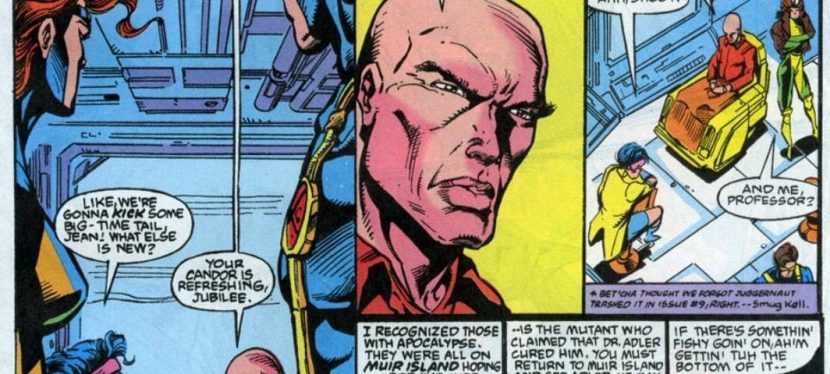
Professor X reveals his fear of Apocalypse to his team during their meeting.
X-Men Adventures #12 (1993) is a pretty good read thanks to the strong script by Macchio based on the teleplay from the animated series. It concluded the Muir Island saga in a very satisfying manner which includes putting Rogue’s subplot with solid closure (complete with a moral lesson about accepting her team as her family). By the time I reached the end of the comic book, it was clear that Apocalypse is a major antagonist with the long-term in mind.
Overall, X-Men Adventures #12 (1993) is recommended.
Disclaimer: This is my original work with details sourced from reading the comic book and doing personal research. Anyone who wants to use this article, in part or in whole, needs to secure first my permission and agree to cite me as the source and author. Let it be known that any unauthorized use of this article will constrain the author to pursue the remedies under R.A. No. 8293, the Revised Penal Code, and/or all applicable legal actions under the laws of the Philippines.
Welcome back superhero enthusiasts, 1990s arts and culture enthusiasts, Marvel Comics fans and comic book collectors! Today we go back to the mid-1990s to explore the adaptation of the second season of the famous X-Men: The Animated Series (X-Men TAS) in the form of the X-Men Adventures comic book series.
Before getting to the new retro comic book review, I should state that the subject X-Men Adventures comic book will involve Carol Danvers in a supporting role (in rather creative ways). Yes, I’m talking about the one character who in the history of the Marvel Comics shared universe was identified (in no particular order) as Ms. Marvel, Binary, Warbird and as Captain Marvel. As the subject comic book was published in 1994, Carol Danvers here is obviously not the woke garbage version played by Brie Larson in the movies.
With those details laid down, here is a look back at X-Men Adventures Season II #9, published in 1994 by Marvel Comics with a story written by Ralph Macchio and drawn by John Hebert.
The cover.
Early story
The story begins at night in New York City. There, Mystique and Mister Sinister have a serious talk. Sinister believes that without Charles Xavier’s presence, the X-Men are very vulnerable and they will eventually become disorganized and fall down quickly.
Over at the mansion of Xavier, Rogue wakes up from a very intense nightmare which prompts Cyclops and Gambit to calm her down. Rogue reveals that she has been having very disturbing visions ever since Professor X disappeared. It turns out, Xavier helped her previously by using his mental abilities to block out the unpleasant memories of hers.
Jean Grey enters the room and she reveals (in response to Cyclops’ question) that she ran a computer search on the woman Rogue saw the other day and came up with several pictures. As soon as Rogue examines the pictures, she then remembers who the woman is which causes her to be consumed by another vision from deep inside her mind. She sees Ms. Marvel…
Quality
There is a lot of stuff here that Rogue fans will enjoy.
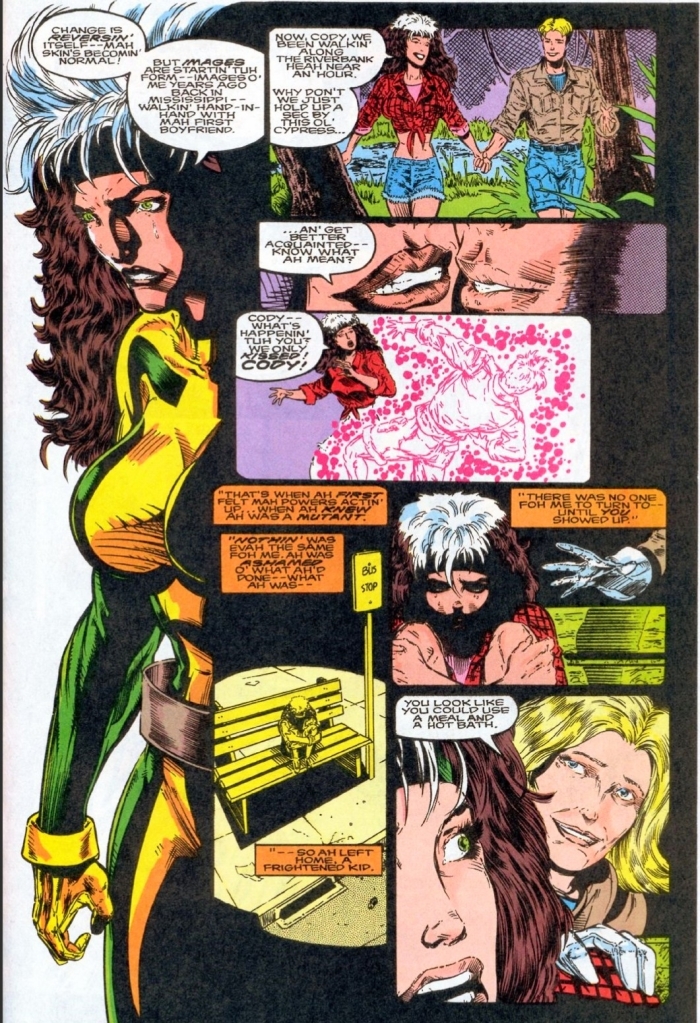
The first obvious thing about this comic book is that it is a character-driven tale told mainly through Rogue. In fact, this is actually a creative portrayal of Rogue’s origin written for TV by Marty Isengerg and Robert Skir, and Macchio’s adaptation here made a really solid reading experience for me.
Without going too much into spoiler territory, I can say that this origin story of Rogue was not only written for TV viewers in mind but also crafted to cater to what was back then the modern tastes of X-Men fans in general. I’m talking about 1990s X-Men and society specifically and the thing is, everything here aged well. Nothing here feels out of place. I should also state that Rogue’s upbringing are well worth exploring here.
The writing by Macchio and art by Hebert are of high quality and this comic book is really worth reading again from start to finish. The emotions channeled through Rogue are very intense without ever reaching to the point of showing her insane. Hebert’s art, meanwhile, fills every page with a good amount of visual details complete with strong facial expressions (including some very scary faces from Mystique and Ms. Marvel) and some dynamic superhero action that really spiced up the reading experience.
As mentioned earlier, Carol Danvers appears in a supporting role and the creative team came up with clever ways to emphasize the character both visually and through dramatics. The way Danvers is portrayed here should inspire readers to go out and read Marvel’s published comic books of her as Ms. Marvel. The same thing can be said about Rogue whose origin and gradual rise from an occasional character (a super villainess no less) to a prominent superhero told through Marvel Comics’ shared universe are worth revisiting.
Conclusion
A very disturbed Rogue in the presence of her teammates.
X-Men Adventures Season II #9 (1994) is indeed a very powerful and gripping character-driven comic book that will appeal to fans of Rogue, the X-Men and Carol Danvers. Considering the wholesome aesthetic of the X-Men animated series TV episode, this comic book has a much darker presentation that will strongly appeal to X-Men fans who want a more serious portrayal to read. As it was mainly focused on Rogue, I can say that the conflict was nicely built up and the resolution was a strong pay-off. Very clearly, the Macchio-Hebert creative duo really delivered great stuff.
Overall, X-Men Adventures Season II #9 (1994) is highly recommended.
Disclaimer: This is my original work with details sourced from reading the comic book and doing personal research. Anyone who wants to use this article, in part or in whole, needs to secure first my permission and agree to cite me as the source and author. Let it be known that any unauthorized use of this article will constrain the author to pursue the remedies under R.A. No. 8293, the Revised Penal Code, and/or all applicable legal actions under the laws of the Philippines.
Welcome back superhero enthusiasts, 1990s arts and culture enthusiasts, Marvel Comics fans and comic book collectors! Today we go back to the mid-1990s to explore the adaptation of the start of the second season of the X-Men animated series in the form of the X-Men Adventures comic book series.
Before getting to the retro comic book review, I want to address the recent controversy and criticism of the new animated series X-Men ’97, a continuation of the popular 1990s series that turned out to be woke by featuring the so-called non-binary presentation of people. In my view, this is not surprising given the fact that the very woke Disney company has owned Marvel Entertainment for many years now and its wokeness has infected the animated X-Men franchise along with the most recent movies and shows of the Marvel Cinematic Universe (MCU). Wokeness and Leftist beliefs continue to ruin entertainment and established properties as we know it. It’s the culture of Communist-filled Hollywood (Commiewood).
So how do you reject X-Men wokeness apart from avoiding X-Men ’97? You simply go back to the X-Men animated series of the 1990s as well as the comic books that adapted the stories.
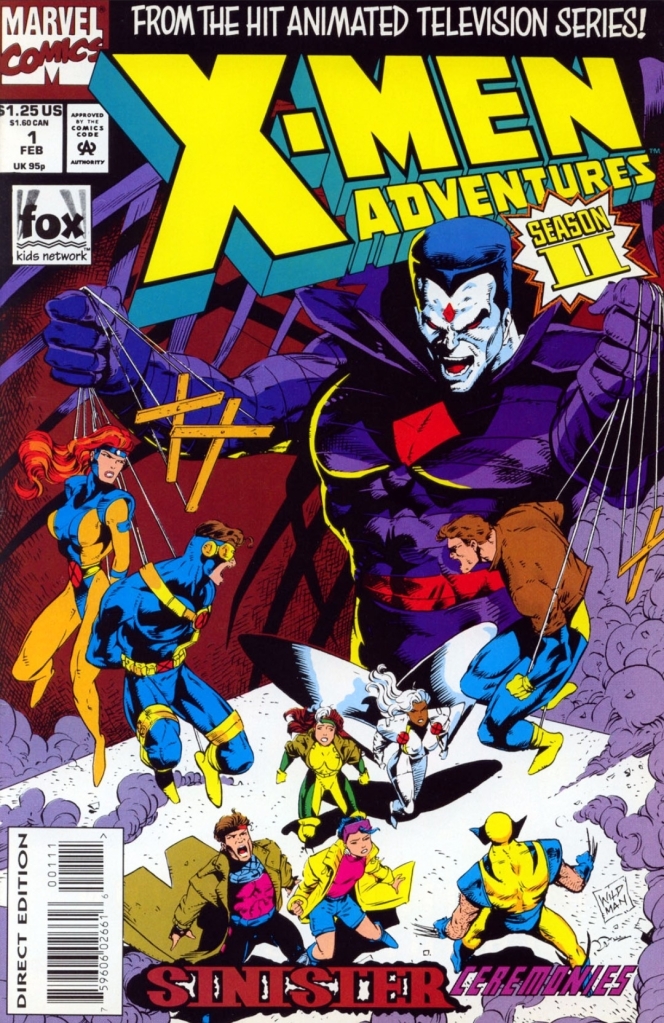
With those details laid down, here is a look back at X-Men Adventures Season II #1, published in 1994 by Marvel Comics with a story written by Ralph Macchio and drawn by Andrew Wildman.
The cover.
Early story
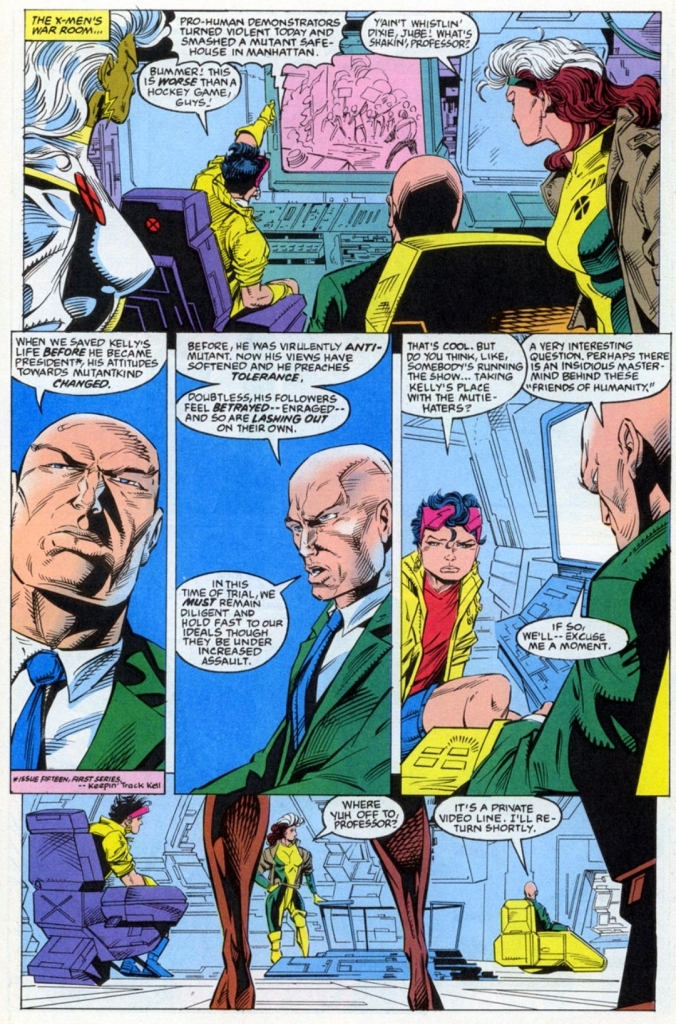
The story begins with the cosmic being the Watcher carefully examining the flow of events on Earth and what has changed for the X-Men since then. Robert Kelly, who previously had an anti-mutant agenda when he was a U.S. Senator, has since been elected as the President of the United States and openly pushes for a policy of conciliation with mutants. His action sparks social unrest.
Meanwhile inside a small church far away from the nation’s capital, the wedding of Jean Grey and Scott Summers pushes through with several members of the X-Men in attendance. Very notable was the absence of Wolverine who turned out to be inside the Danger Room (deep within Charles Xavier’s estate) fighting a giant-sized version of Cyclops…
Quality
The X-Men are troubled by the anti-mutant wave happening in public.
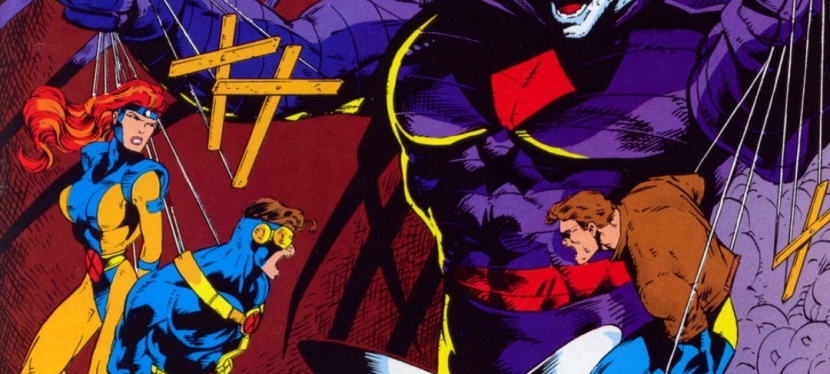
As the opening issue of the second volume of the X-Men Adventures comic book series, this comic book carefully sets up the tone and the plot of a series of future challenges for the X-Men which is clearly reflected on the front cover with Mister Sinister displayed prominently. The story mainly highlights X-Men’s new struggle with the wave of anti-mutant rage in the public while dealing with the absence of their leader Cyclops (on honeymoon with his new wife Jean) while leaving space for potential sub-plots such as the attraction between Jean and Wolverine, the moves of the anti-mutant radicals and, most notable of all, the secretive return of Morph (thought to have died in issue #2 of the first season).
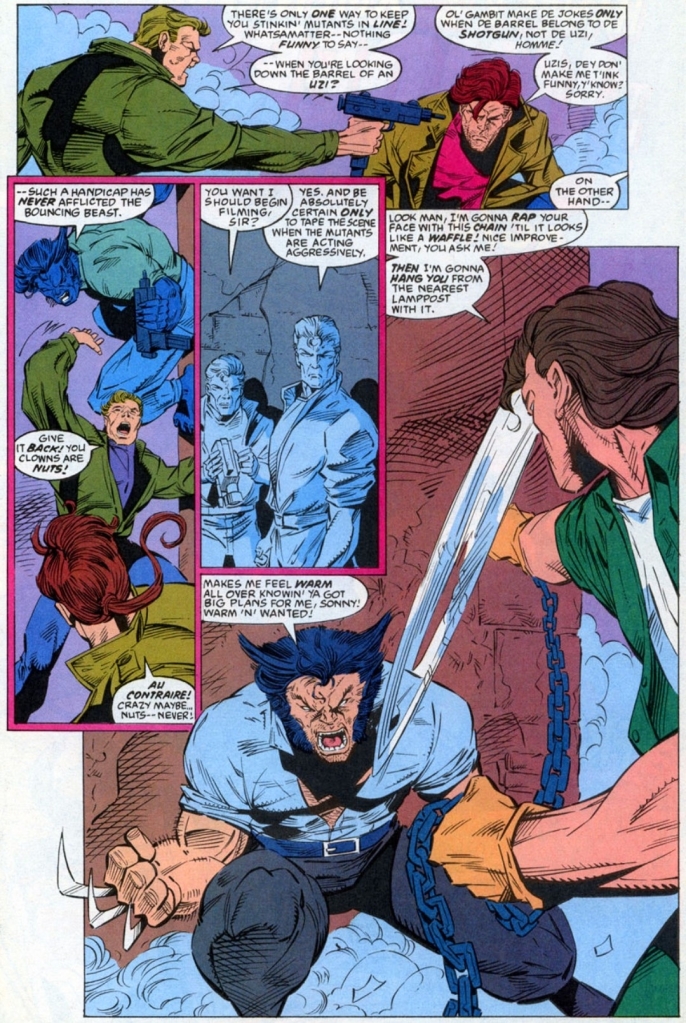
As expected, build-up is the main approach taken by the creators on telling the story and there were some bouts of superhero spectacle (action) that spiced up the reading experience for me. Considering what has been happening in different parts of the world in recent years, the sub-plot of the rabid anti-mutant activists using tactics to destroy the X-Men’s credibility with violence and misinformation magnified through the news networks is very socially relevant.
What the rabid anti-mutant people committed in this comic book reminds me of the October 7, 2023 attacks on Israel organized by the Palestinian terrorist group Hamas in which violence, destruction and selective images of terror spread through news networks and social media were done. Similarities aside, the wave of evil is clear here and the intent of the anti-mutant believers and Palestinian terrorists obviously expresses intentions of genocide against another particular group of people.
When it comes to weaknesses of this comic book, I cannot help but find Andrew Wildman’s art looking very rushed. There is a lack of precision and detail of his art here when compared directly to his works in the first volume of X-Men Adventures.
Conclusion
The anti-mutant radicals in this comic book have a lot in common with Palestinian terrorists, the pro-Palestine activists, the Black Lives Matter activists and other members of woke mobs. Violence, arrogance, rage and misinformation are their values.
X-Men Adventures Season II #1 (1994) incidentally works well as an adaptation of the animated series, as a standalone comic book as well as being a socially relevant tale in today’s age of social media. While the concept of evil remains in X-Men lore, what was told here shows different layers of it. The X-Men themselves also looked fragile and the return of Morph is a key part of the story clearly designed with future events in mind. Finally, this comic book is a lively reminder of the era when X-Men stories were made for the fans, not the woke mob.
Overall, X-Men Adventures Season II #1 (1994) is recommended.
Disclaimer: This is my original work with details sourced from reading the comic book and doing personal research. Anyone who wants to use this article, in part or in whole, needs to secure first my permission and agree to cite me as the source and author. Let it be known that any unauthorized use of this article will constrain the author to pursue the remedies under R.A. No. 8293, the Revised Penal Code, and/or all applicable legal actions under the laws of the Philippines.
Welcome back superhero enthusiasts, 1990s culture enthusiasts and comic book collectors! Today we go back to the year 1993 and explore a part of the Marvel Comics universe through one of the many tales of the Amazing Spider-Man comic book series.
To put things in perspective, 1993 was another busy year for the iconic Spider-Man who not only had four monthly series of his own but also appeared in the Venom: Lethal Protector mini-series, the 14-part Maximum Carnage crossover and in Marvel’s major crossover The Infinity Crusade. As expected, Spider-Man survived through those storylines.
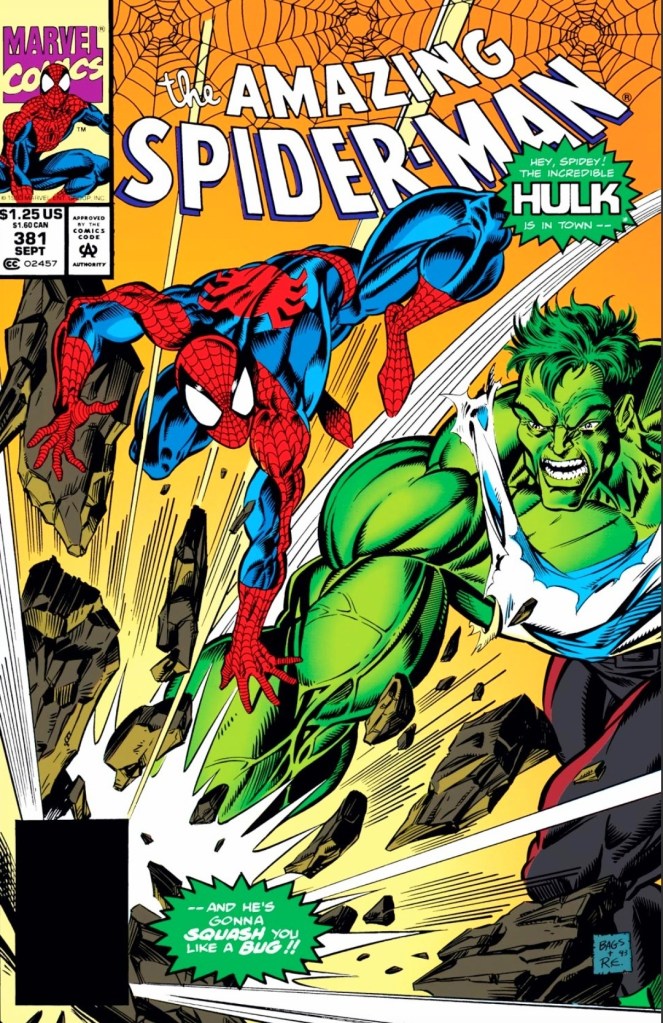
With those details laid down, here is a look back at Amazing Spider-Man #381, published in 1993 by Marvel Comics with a story by David Michelinie and drawn by Mark Bagley.
The cover.
Early story
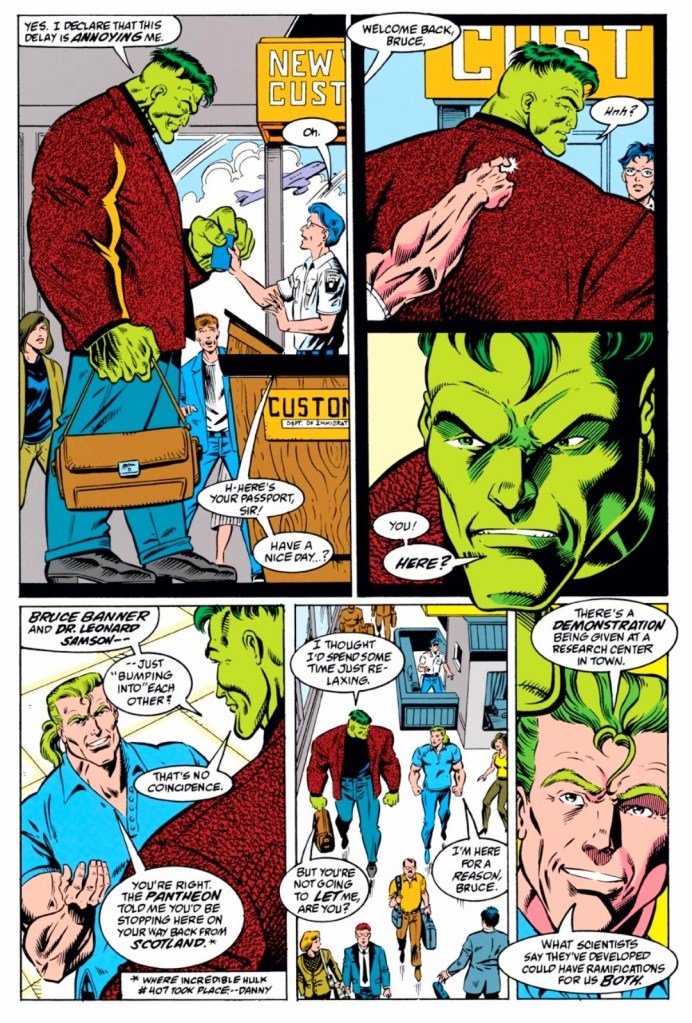
The story begins inside the airport in New York where the incredible Hulk/Bruce Banner himself had just arrived from Scotland. Due to his tremendous size, his physical presence easily distract the people around him. Dr. Leonard Samson surprises Banner and informs him of an upcoming scientific demonstration and the scientists behind it have developed something that could have ramifications for people who got exposed to gamma radiation. Samson explains that there is a radiation virus that releases repressed emotions. The Hulk rejects Samson and leaps to the air above towards an unknow destination.
At a school yard in lower Manhattan, two kids bully another kid into giving them his lunch money. Spider-Man suddenly arrives to stop trouble and immediately the two bullies ran away…
Quality
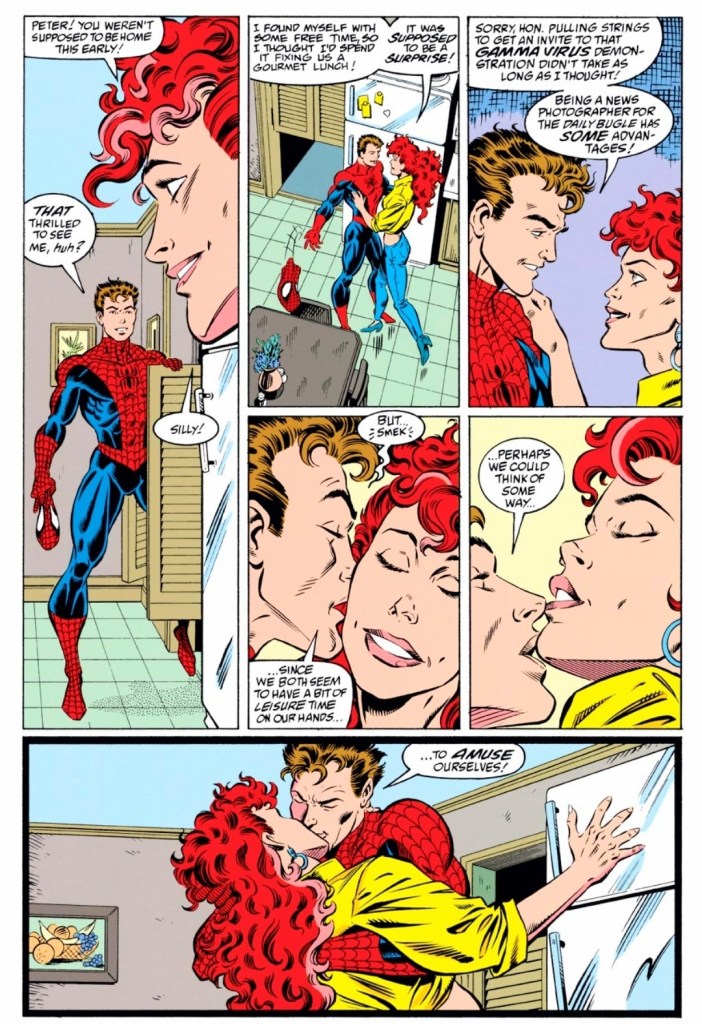
Quality time between Peter Park and wife Mary Jane.
I can say that is one of the more interesting crossovers between Spider-Man and the Hulk who at this stage in Marvel’s comic book history retained his intelligence and personality while in his huge, green-skinned form. Adding variety to the crossover was the presence of Doc Samson who was already an established and notable supporting character in comic books featuring the Hulk.
Set after the events of Maximum Carnage, the Infinity Crusade and Hulk’s time in Scotland (as told in Incredible Hulk #407), this story shows life in New York gradually normalizing. The peace, as it turns out, was only temporary as the big-time scientific demonstration in this story leads to a series of unfortunate events that compels Peter Parker to take action as Spider-Man.
The tale was nicely structured and the creative team took its time to build-up the story concept, the character motivations and execute the superhero spectacle at an overall medium pace. There is simply no boring scene nor any wasted moments. The appearances of Samson and the Hulk in this Spider-Man tale were nicely integrated and they each had their own impact on the plot. There is a lot of stuff here that fans of both Spidey and the green giant can enjoy.
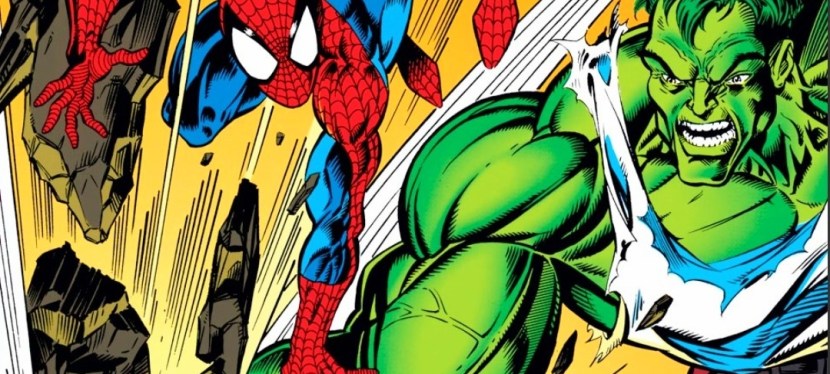
When it comes to the art, I found Mark Bagley’s take on the Hulk distinctive and intriguing to look at. The final shot of this comic book is a must-see.
Conclusion
Hulk and Doc Samson at the airport.
While there clearly is no villain, Amazing Spider-Man #381 (1993) still turned out to be a fun read complete with a fine crossover between Spider-Man, Doc Samson and the Hulk. Apart from the lack of space for character development, nothing here felt half-baked with the executions of the storytelling and the spectacle. This is a fun read and it was also a modern take on the personal encounter between Hulk and Spidey during the 1990s. This comic book has something enjoyable that fans of the two Marvel icons won’t find in any of the Marvel Cinematic Universe (MCU) movies and shows.
Overall, Amazing Spider-Man #381 (1993) is recommended.
Disclaimer: This is my original work with details sourced from reading the comic book and doing personal research. Anyone who wants to use this article, in part or in whole, needs to secure first my permission and agree to cite me as the source and author. Let it be known that any unauthorized use of this article will constrain the author to pursue the remedies under R.A. No. 8293, the Revised Penal Code, and/or all applicable legal actions under the laws of the Philippines.
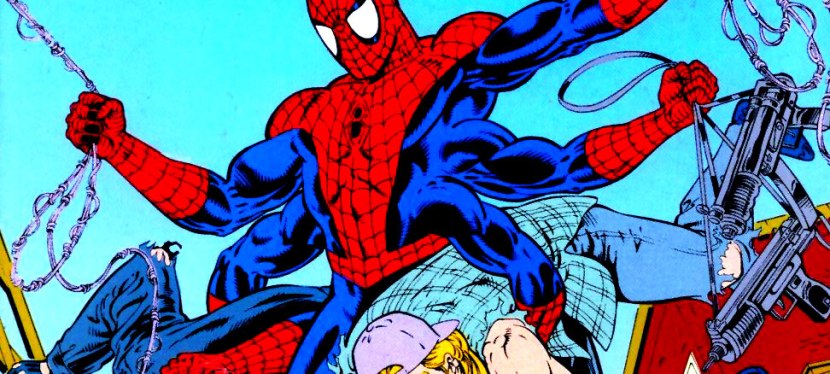
Believe it or not, there was a time when the iconic superhero Spider-Man had additional arms on both sides of his body which made him even more like a spider. Such a story was told in Amazing Spider-Man #100 and #101 published decades ago by Marvel Comics.
In 1992, Marvel Comics published What If #42 to revisit the old crazy story and tell an alternate reality of it. Take note that this comic book we’re about to examine together was released the same year Marvel celebrated the 30th anniversary of Spider-Man.
A very eye-catching cover.
Here’s a look back at What If #42 written by Michael Gallagher and drawn by Kevin West. The hot question: What if Spider-Man had kept his six arms?
Early story
The comic book begins with the Watcher telling readers a recap of what happened to Spider-Man in Amazing Spider-Man #100 and #101. It is recalled that Peter Parker got fed up with being Spider-Man as it complicated his personal life with a bunch of problems. After he attempted to eliminate his super powers by creating and using a potion, Peter Parker suddenly grew four additional arms instead.
In reaction, Parker reached out to his friend Dr. Connors/Lizard (who was in Florida) who granted him access to his laboratory in Long Island. Tried as hard as he could, Parker could not come up with a solution.
Meanwhile, many miles away, the vampire Morbius harms the crew of a ship on the sea before diving into the water. Morbius gets overwhelmed by multiple sharks and dies. His death, as it turns out, marked the end of the solution to Spider-Man’s extra arms problem. Morbius had an enzyme unique only to vampire body chemistry which would have cured Spider-Man’s condition.
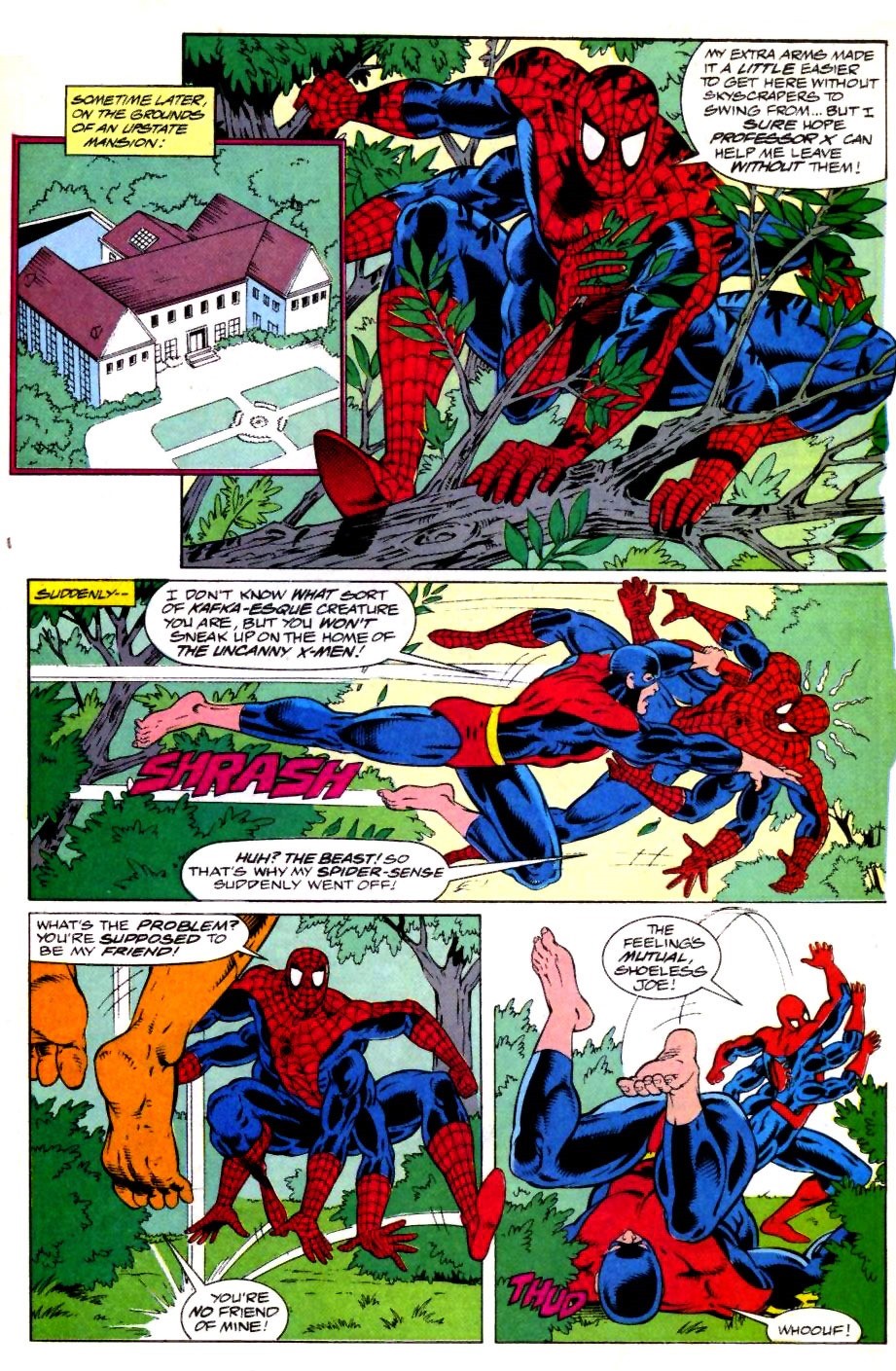
Spider-Man and Beast of the X-Men.
This leaves Spider-Man with an even longer lasting problem leading to a new reality.
Quality
The story is well written and nicely paced. There is a nice balance between storytelling, characterization and action here. As far as the alternate reality of events go, What If #42 is a smash in the sense that it nicely explores what would happen not only to Peter Parker had he actually kept those extra arms of his, but also what would happen to the people around him as well as balance of superheroes in the state of New York. If you just imagine yourself as Peter Parker having four extra arms, try visualizing how your personal life got destroyed and your connections with people you care about getting strained or even cut off. Nobody in real life would want to end up living like a freak, and this concept is well emphasized with Spider-Man.
Character development on Spider-Man is well done. As you read his lines and thoughts, you will feel the pressure and hassle he is experiencing with the extra arms. You’ll wonder how his Aunt May would react not only to those new arms but also his prolonged absence. As Peter Parker becomes very determined to find a solution in the absence of Morbius, you’ll even relate with his struggle. On top of these, the dialogue was well written and there were even a few intriguing moments.
I also enjoyed the way the comic book creators emphasized the shared universe of Marvel Comics here. You will see the X-Men and Fantastic Four plus several more Marvel characters make appearances.
Along the way, there is a nice scene at the Daily Bugle (the newspaper where Peter Parker works as a photographer) showing how sinister and abusive J. Jonah Jameson really is as he remains obsessed with destroying Spider-Man by means of distorted presentation of news. In this age of fake news, sinister propaganda, distorted views and local community print media publications being operated by people who don’t really know journalism, the Daily Bugle scene is pretty relevant by today’s standards.
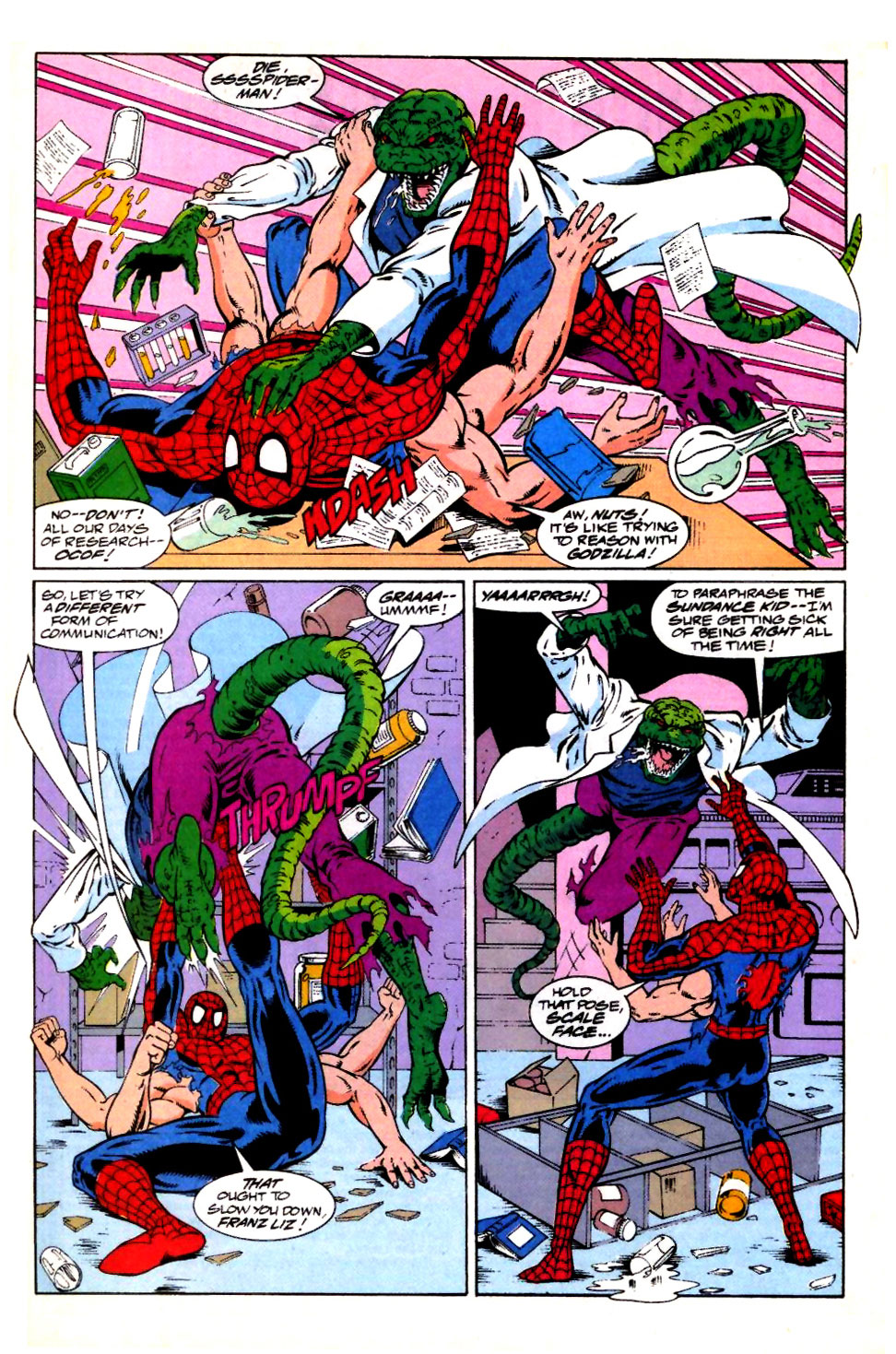
As such, Michael Gallagher’s script and story structure here are very strong. For the art, Kevin West did good work. Not only was I able to recognize the Spider-Man-related characters and other Marvel superheroes, West’s notably made the Lizard look visceral enough and the same can be said of his take on Venom. The comic book art had a nice flow as the story was told and West provided enough impact on the action scenes.
Conclusion
What If #42 is a pretty good comic book to read exploring how things would have been had Spider-Man kept those extra arms and really looked truly spider-like. Apart from the good quality of storytelling and visuals, the presence of other Marvel Comics universe characters further add some depth into the story as Peter Parker struggled to find a solution to his problem.
Spidey and Lizard!
This is the kind of story that I don’t believe we will ever see happen on the big screen. It’s just too jarring and even shocking for Sony Pictures and Marvel Studios to actually show Tom Holland as Spider-Man with extra arms. Such a cinematic move will surely outrage fans and might even put a dent on the credibility and believability of the Marvel Cinematic Universe.
If you are seriously considering buying an existing hard copy of What If #42, be aware that as of this writing based on the ratings of MileHighComics.com, a near-mint copy of the regular edition is at $12 while the near-mint copy of the newsstand edition is priced at $39.
Overall, What If #42 is recommended.
Thank you for reading. If you find this article engaging, please click the like button below and also please consider sharing this article to others. If you are looking for a copywriter to create content for your special project or business, check out my services and my portfolio. Feel free to contact me as well. Also please feel free to visit my Facebook page Author Carlo Carrasco and follow me at HavenorFantasy@twitter.com
Disclaimer: This is my original work with details sourced by means of watching the movie and doing research. Anyone who wants to use this article, in part or in whole, needs to secure first my permission and agree to cite me as the source and author. Let it be known that any unauthorized use of this article will constrain the author to pursue the remedies under R.A. No. 8293, the Revised Penal Code, and/or all applicable legal actions under the laws of the Philippines.
I just love watching superhero movies, especially the ones that were well crafted by the filmmakers complete with solid storytelling, sufficient spectacle as well as memorable performances by the hired talents (both behind and in front of the camera).
Of all the superhero movies made by the forces of Hollywood starting with 1978’s Superman, I can clearly say that 2017’s Wonder Woman is my favorite. Don’t get me wrong. I did not limit myself to just DC Comics superhero movies. I saw all the X-Men movies and their spinoffs, almost all the Spider-Man flicks, almost all of the Marvel Cinematic Universe movies and even the obscure ones. Along the way, there were some great superhero flicks that became modern-day classics like Logan and Avengers: Infinity War.
Still it is the Gal Gadot-led, Patty Jenkins-directed Wonder Woman that I loved watching the most.
Let’s start with my retro review of Wonder Woman, the one film that arguably saved the DC Comics Cinematic Universe for Warner Bros.
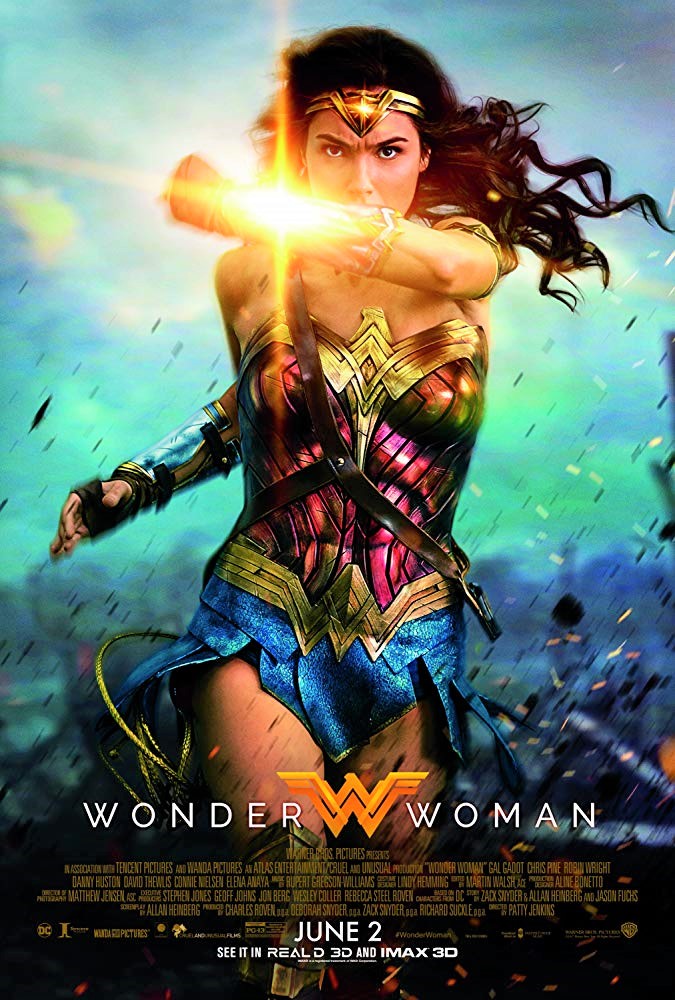
The Wonder Woman movie poster from 2017.
Early Story
The story begins sometime after the end of Batman v. Superman: Dawn of Justice during which Diana finds a long lost photograph recovered by Bruce Wayne. Then she remembers her past in Themyscira where she grew up as the only little girl among the women called the Amazons and her mother is none other than Queen Hippolyta. Concerned that the wicked Aries is still alive, Hippolyta’s sister Antiope trains Diana (initially in secret until they were discovered) to be strong, brave and more capable than their fellow Amazon warriors.
One day, Steve Trevor arrives in Themyscira becoming the first-ever man Diana ever met. Tension rises when the Germans (from World War I Earth) arrive on their island causing the Amazons to fight in defense. A lot of people lost their lives, including someone very close to Diana.
While interrogated with the Lasso of Truth, Steve reveals who he is and what he has been doing. He states that back in his world, World War I is ravaging the world costing many people their lives. This causes Diana to stand up and stop the war somehow (she believes Aries is responsible). Queen Hippolyta disapproves of Diana’s analysis. After privately meeting with Steve, Diana then starts her move for a mission to stop the war in Man’s World.
Quality
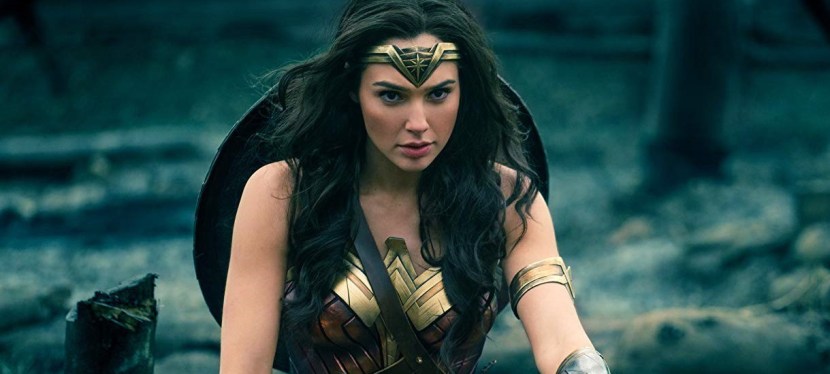
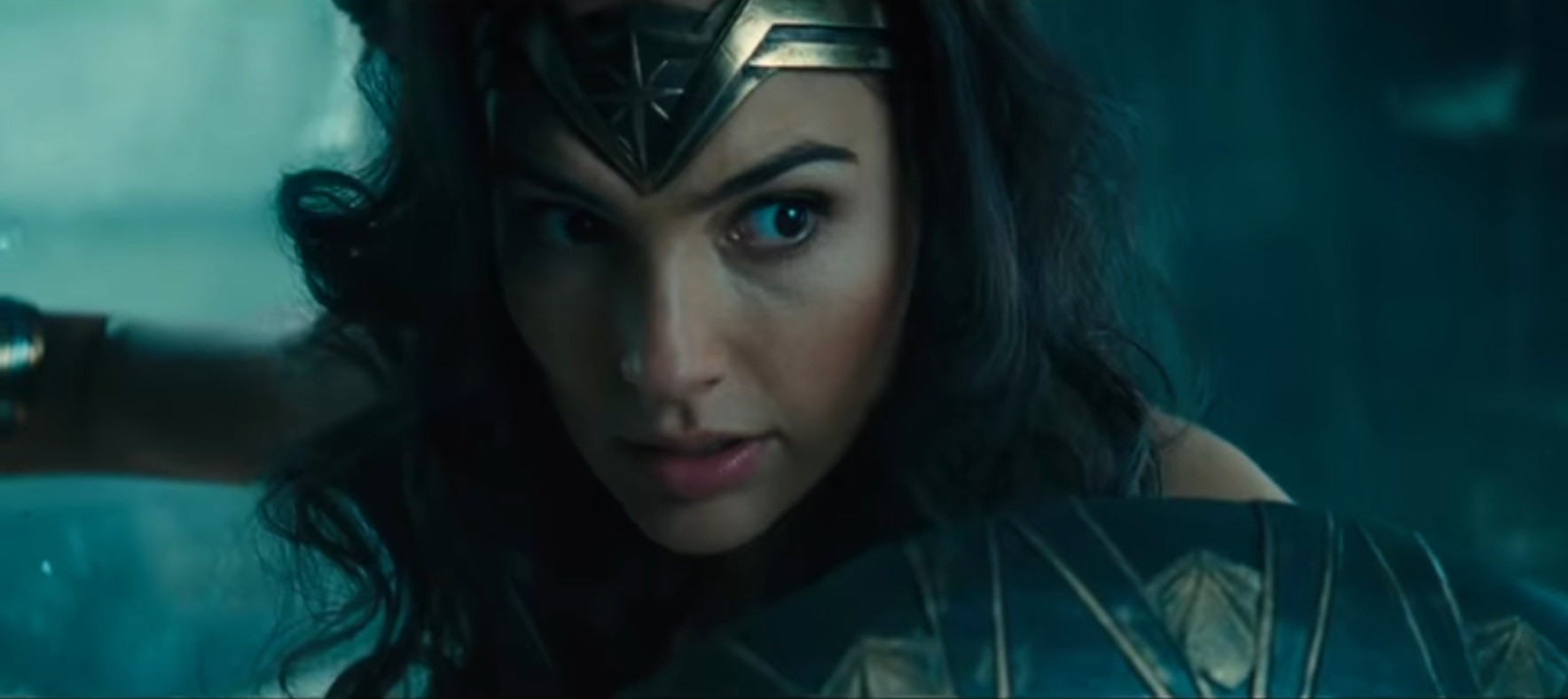
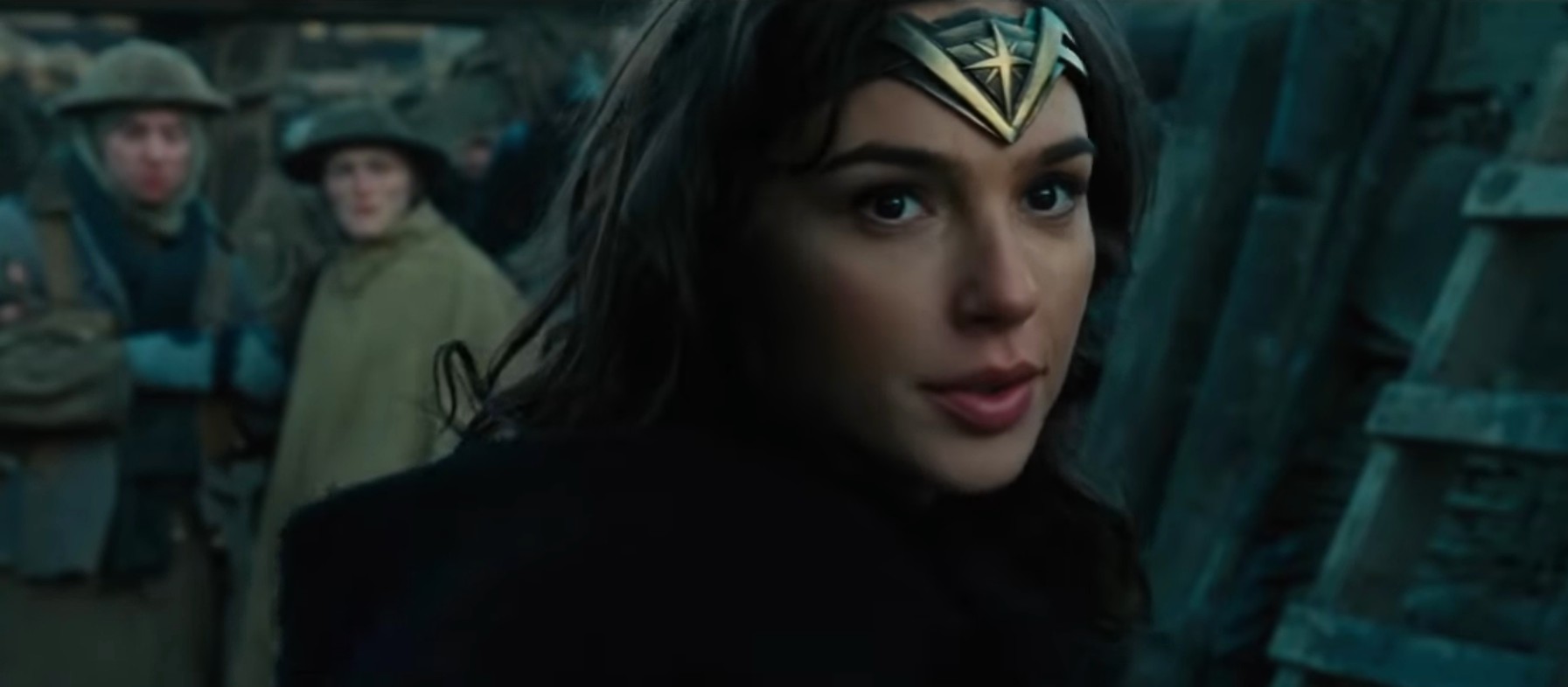
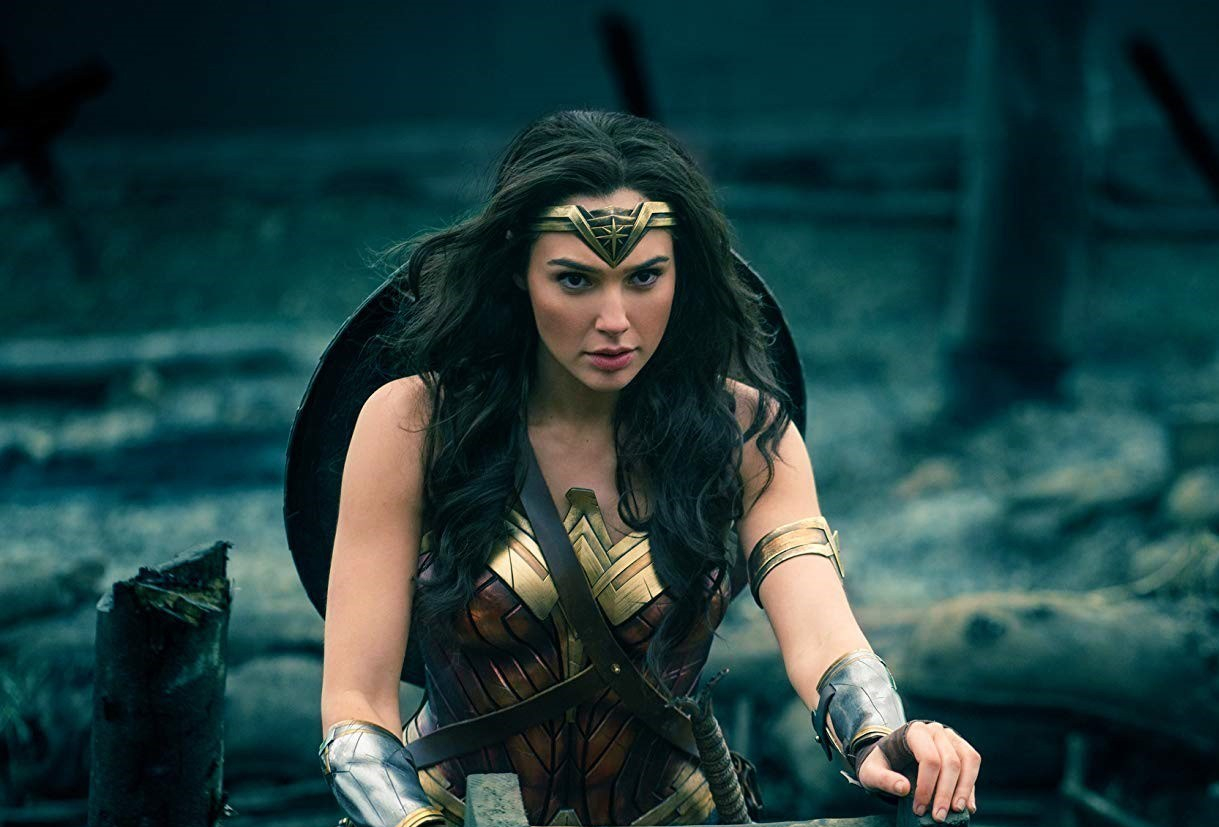
Gal Gadot as Wonder Woman in the middle of German soldiers.
Let me start with the performances. Gal Gadot definitely IS Wonder Woman in this movie. Regardless of how many versions of Wonder Woman there are in comics, the Israeli actress truly captured the essence of Diana’s early development which includes her special place among the Amazons (note: she is the only Amazon who was born in Themyscira and grew up from infant into a mature woman), her fateful meeting with Steve Trevor, her entry into Man’s World and how she adapts with the events and people outside of Themyscira. Wonder Woman’s purity on saving the world, doing what is right and emphasizing love and compassion were all nicely translated into cinematic art by Gal Gadot. From doing the action scenes to saving people, speaking her mind among her fellow Amazons and interacting with others as she adapts with Man’s World, I really love Gadot’s work on bringing Wonder Woman to life. As her cinematic work is great, there is no doubt that Gadot will always be iconic to fans of the Queen of Superheroes and superhero enthusiasts in general in the decades to come right beside Lynda Carter (who played the icon on TV), Christopher Reeve (Superman), Robert Downey, Jr. (Iron Man) and Chris Evans (Captain America). Meanwhile, the portrayals of Diana as an 8-year-old girl as well as a 12-year-old were perfectly done by Lilly Aspell (who is truly skilled with horse riding) and Emily Carey.
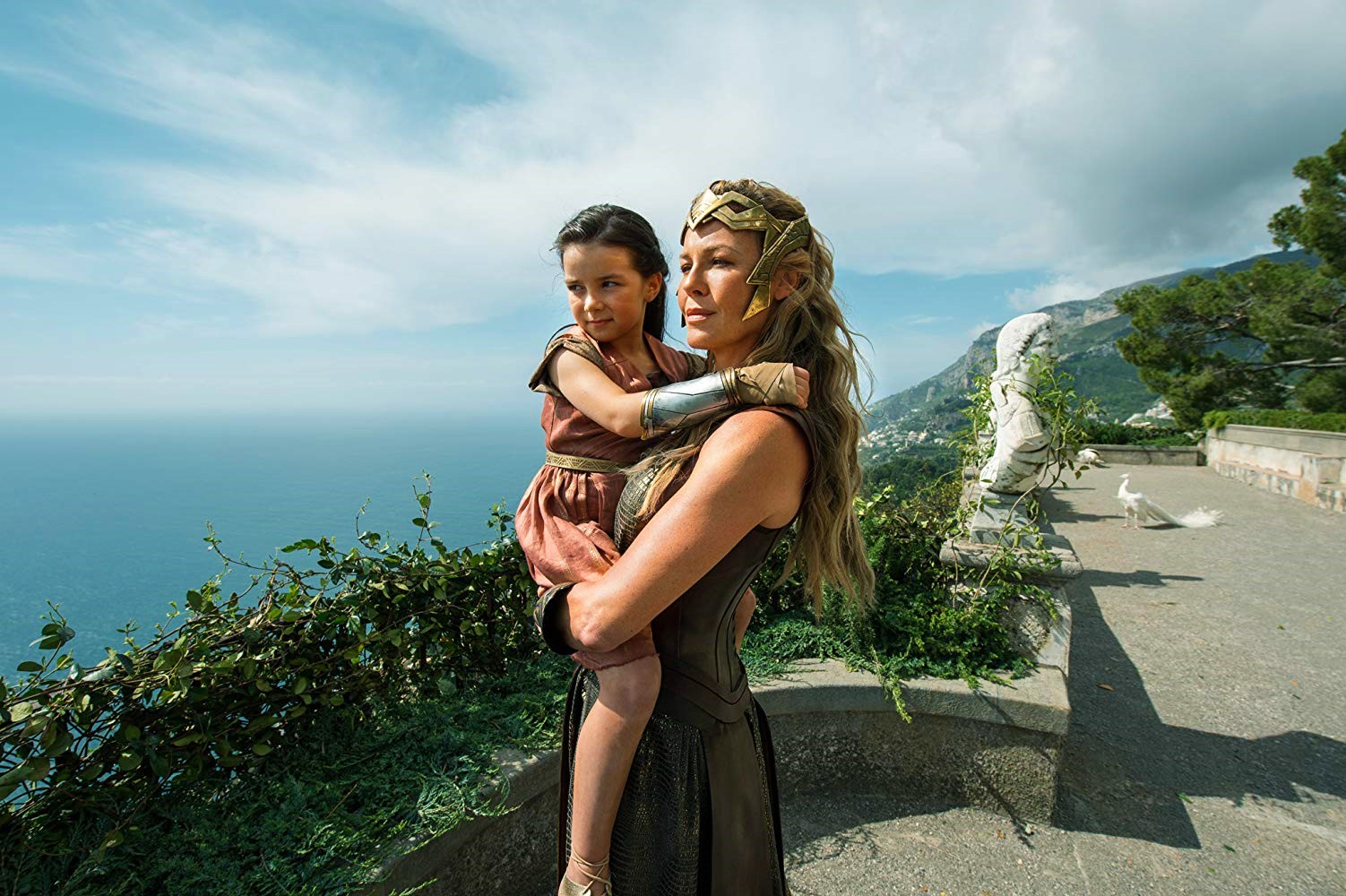
Lilly Aspell as young Diana with Connie Nielsen as Queen Hippolyta.
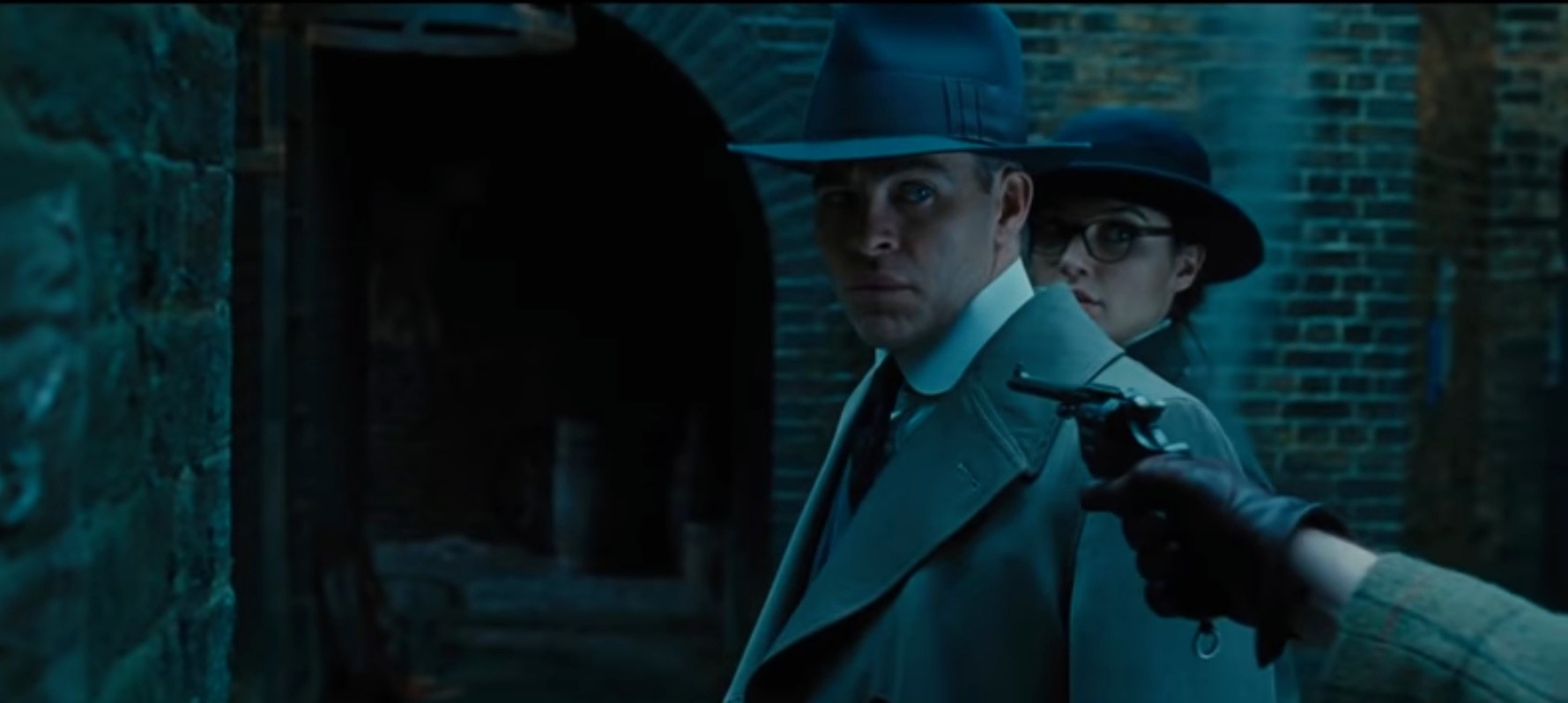
Chris Pine is excellent as Steve Trevor who is portrayed to be very dedicated to his work, brave in what he does and still shows compassion instead of arrogance towards others. He also has great chemistry with Gal Gadot and, like in the comic books, their relationship is nicely translated on the big screen. Pine’s performance here is, in my view, the best superhero movie supporting role to date.
Chris Pine as Steve Trevor with Gal Gadot as Diana in disguise.
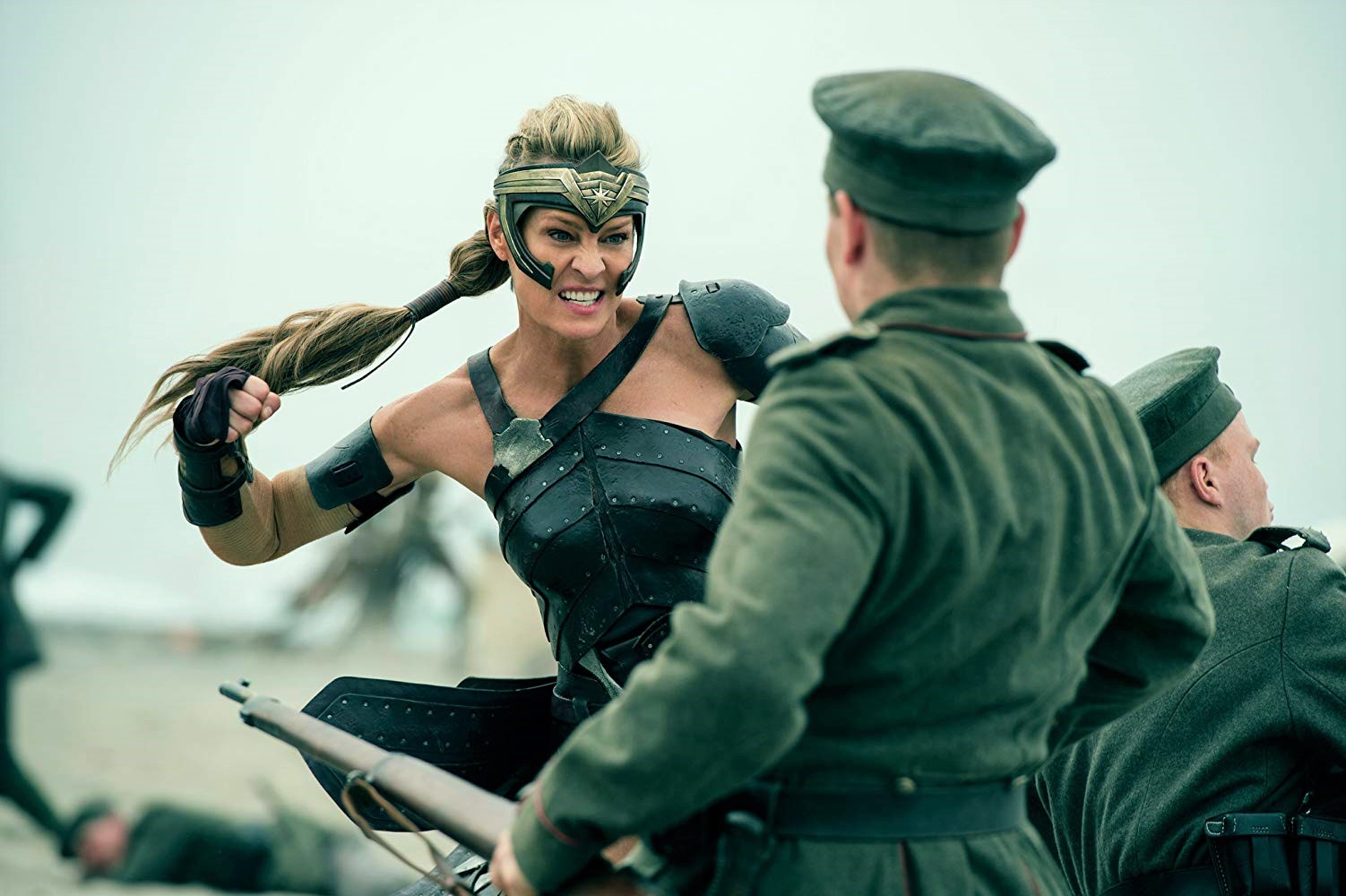
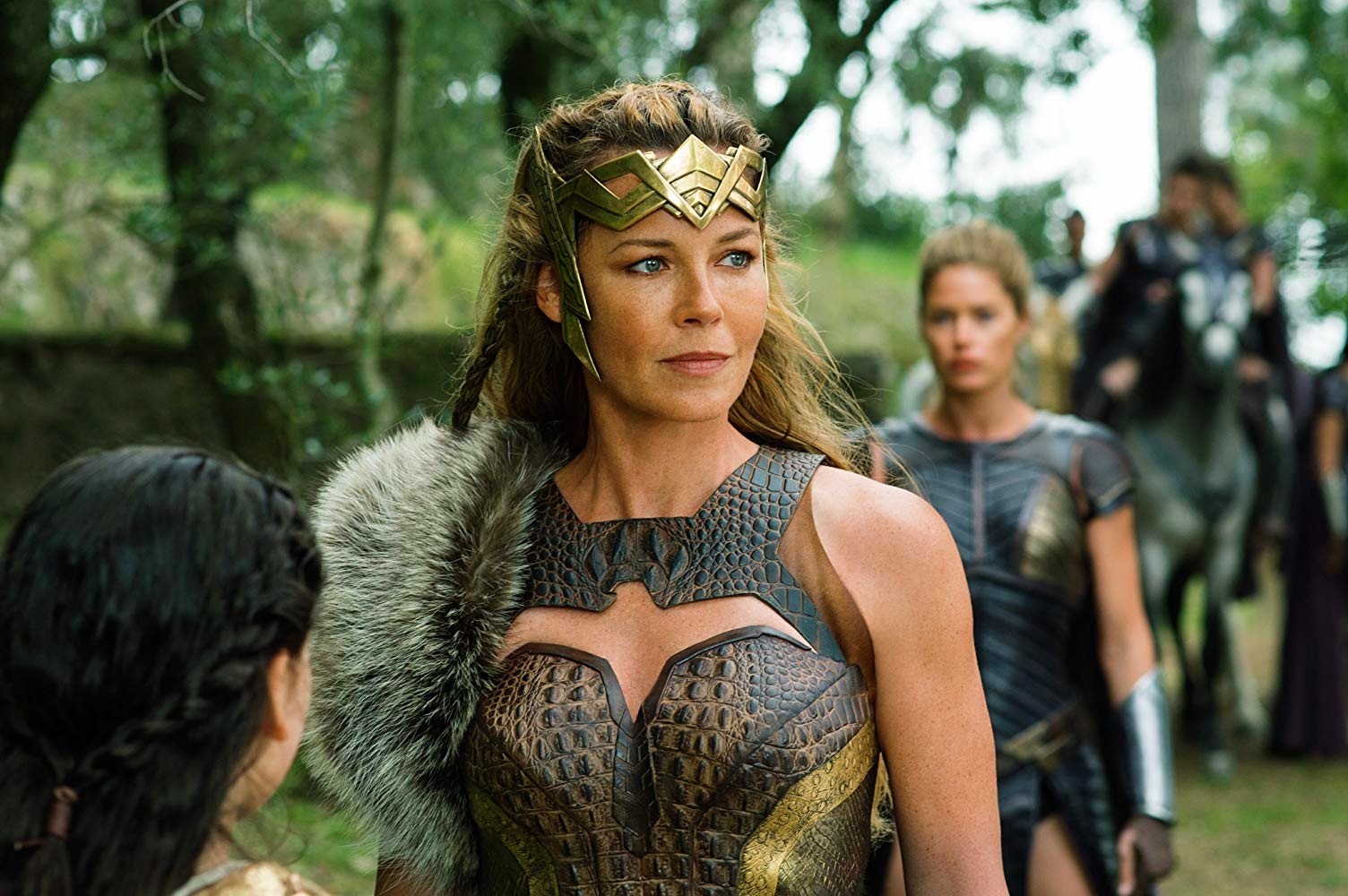
Connie Nielsen meanwhile is great in playing Queen Hippolyta and all throughout, there is always a sense of leadership complete with a touch of motherly love just like in the comic books. Her sister Antiope was nicely portrayed by Robin Wright as the one Amazon who taught Diana to be brave, strong and highly capable as an Amazon warrior.
Danny Huston, who played the lead villain in the 2009 movie X-Men Origins: Wolverine, played yet another military bad guy here but this time he’s a World War I German officer. He’s a villain with a purpose who not only fights for the glory of Germany but also strongly believes that war is natural and inevitable for humanity. In some ways, Huston’s Ludendorff reminds me Michael Shannon’s General Zod in Man of Steel.
Robin Wright is excellent as Antiope.
When it comes to presentation, this film is Patty Jenkins’ 2nd movie as director (her debut was way back in 2003) and the great turnout of Wonder Woman as a high quality movie (as opposed to being a critical and commercial success) only proved yet again that the old saying in Hollywood – The director’s second movie is his/her best movie – is true. Jenkins, who also worked on television, not only prepared a lot to make this movie but also researched Wonder Woman, developed ways to get the most out of the cast members, tweak the written story of the film (by Allan Heinberg, Zach Snyder and Jason Fuchs) and, most notably, she led the production with a lot of passion. To put it short, Wonder Woman is a labor of love (and the No Man’s Land scene is iconic) that not only resonated with fans of the Queen of Superheroes but also with the film critics and moviegoers.
Regarding storytelling, I noticed that a key story from Wonder Woman’s origin in the comics (the contest of the Amazons) did not happen at all in the film. While there were die-hard fans of the icon who complained about it, I felt that the contest of the Amazons would have made this movie more complicated and surely would have lessened the impact of World War I as a key story element. Since the purpose of this movie was to emphasize Diana’s origin and her entry into Man’s World with a major mission, I believe that the contest of the Amazons can be made cinematically later in a future movie.
The way the story was told cinematically, it also captured Diana’s reactions to the events that happened around her. The scene in which she saw the village destroyed showed how death and destruction compelled Wonder Woman to accomplish her mission even though others find ending the war impossible. Along the way, the actors – specifically Gal Gadot – really added life into the narrative with their strong performances.
When it comes to on-screen humor, which is popular among moviegoers and is almost a requirement for most new superhero movies that come out, having it done by supporting players Lucy Davis and Saïd Taghmaoui was a clever move since it allows Gal Gadot to portray Wonder Woman without any performance disruption. Considering her short screen time, Davis as Etta Candy is really funny. The amount of humor in this film, in my view, was just right and never annoying.
Spectacle? Wonder Woman is loaded with action, stunts and exciting stuff! The action involving Wonder Woman was brutal and satisfying to watch, and Patty Jenkins’ use of slow motion on key moments was great (even comparable to John Woo’s past work) and at the same time not too excessive. The Themyscira battle between the Germans and the Amazons at the beach was engaging and strategically filmed. Also, it was fitting that the action ramped up nicely starting with the iconic No Man’s Land sequence. The final battle in the film, unsurprisingly, had lots of computer-generated images (CGI) which is understandable considering the fantasy element of Wonder Woman.
More on the action, I love the way Patty Jenkins had Gal Gadot, Robin Wright, Connie Nielsen and Chris Pine perform the action themselves which all made their characters even more believable. Of course, there were certain moments in which stunt doubles were used to do the more dangerous moments on behalf of the actors.
This happened just before the iconic No Man’s Land scene.
Apart from the core cast, a lot of the actresses playing the Amazons trained for several months not just to look the part but also to perform action sequences using weapons with actual skill. The stunt coordinators and specialists hired by the filmmakers deserve praise for contributing nicely on making the cinematic Amazons highly believable. This alone not only makes Wonder Woman stand out nicely among all Hollywood superhero movies but also reflects nicely what was portrayed in the comic books.
The production design is also top-notch. I love the scenic locations of Italy used for scenes set in Themyscira. The filmmakers also did a great job recapturing the look of World War I Europe from the historical pictures to the big screen. The costume designs were fantastic, and the standout designs were, unsurprisingly, the costumes of the Amazons which really made their fantasy culture look believable. The filmmakers decided to have much more colorful visuals instead of following the look of Man of Steel, Batman v. Superman: Dawn of Justice and Suicide Squad.
On the music, the work by Rupert Gregson-Williams was great. His rendition of the Wonder Woman theme was very lively to listen to. The same can be said about the music he provided in the memorable No Man’s Land scene which had a nice build-up as Wonder Woman made her first full appearance in costume on the field. Other tunes played in the film suited the scenes well.
If there were any weak spots in this movie, it would be certain shots of action that were not filmed with precision. I’m talking about filming action scenes way too close to the camera combined with music video-style editing that’s supposed to make film look flashy. It’s not only disorienting, it also took me out of the movie.
Conclusion
Overall, Wonder Woman is one of the best-ever superhero movies ever made and easily my favorite of them all. It has an excellent balance between storytelling, character development and spectacle, and Gal Gadot gave the performance of a lifetime not only by bringing Wonder Woman into life in cinematic form but also emphasizing what the Queen of Superheroes stood for. As part of the current DC Comics Cinematic Universe, this movie stood out by having optimism and heroism as core themes (as opposed to the dark, gritty and even cynical approach of Man of Steel, Batman v. Superman: Dawn of Justice and Suicide Squad) and, more importantly, by focusing strongly on Wonder Woman instead of building up for the Justice League movie (which was released months after this one).
Apart from high-quality production values and a strong creative approach, the cast and cinematic performances are easily among the best in the superhero movie genre. Chris Pine’s Steve Trevor is an excellent example of a supporting role that is engaging without ever overshadowing the lead role. By the end of the film, you will realize the impact that Queen Hippolyta and Antiope had on Diana’s personal development.
Connie Nielsen made a great queen and mother in this movie.
Being strongly focused on heroism with optimism, director Patty Jenkins and her crew succeeded in making this film without ever succumbing to the extreme views of the Political Left in Hollywood and the loudmouth social feminists. When I see the battle between the Amazons and the German soldiers on the beach of Themyscira happen, I simply saw armed women defending their homeland not from men who intend to rape them but rather men who had no right to intrude in the first place. Even as there were scenes showing men in power in World War I Europe (putting Diana in a powerless position), there still was no feminist-inspired hatred towards men. Also the bond between Steve and Diana developing from friendship into a romantic relationship literally shut the door on extreme feminism.
As a Wonder Woman-focused story, this film succeeded on emphasizing the Queen of Superheroes to both long-time fans and mainstream moviegoers. This movie also had a nice mix of having a fantasy setting with Themyscira moving on to a historic setting with World War I Europe. On the origins of Wonder Woman herself, I don’t mind at all that the contest of Amazons was not told because this movie’s concept is already great to begin with and its running time of 141 minutes was just right.
Gal Gadot will be remembered for a very long time for her excellent portray of Wonder Woman in cinema.
With all the greatness it was made with, I kept coming back to Wonder Woman when replaying superhero movies here at the comfort of home. In the cinemas back in 2017, I saw the film three times. Ultimately, I can say out loud that Wonder Woman is highly recommended and it is truly essential!
Thank you for reading. If you find this article engaging, please click the like button below and also please consider sharing this article to others. Also my fantasy book The World of Havenoris still available in paperback and e-book format. If you are looking for a copywriter to create content for your special project or business, check out my services and my portfolio. Feel free to contact me as well. Also please feel free to visit my Facebook page Author Carlo Carrasco and follow me at HavenorFantasy@twitter.com






 Author Carlo Carrasco