A Look Back at Amazing Spider-Man #387 (1994)

Welcome back superhero enthusiasts, 1990s arts and culture enthusiasts, Marvel Comics fans and comic book collectors! Today we go back to the 1990s to examine a small part of the Marvel Comics shared universe through a tale of the Amazing Spider-Man monthly series.

In my previous retro review, Spider-Man had a match-up with his arch-enemy the Vulture who returned with a strong obsession within. The rematch is significant not only because it the two have a rivalry that lasted decades in reality, but also because the story was structured to function as a light reintroduction of Adrian Toomes (Vulture) for new Spider-Man fans of the 1990s.

With those details laid down, here is a look back at Amazing Spider-Man , published in 1994 by Marvel Comics with a story written by David Michelinie and drawn by Mark Bagley.

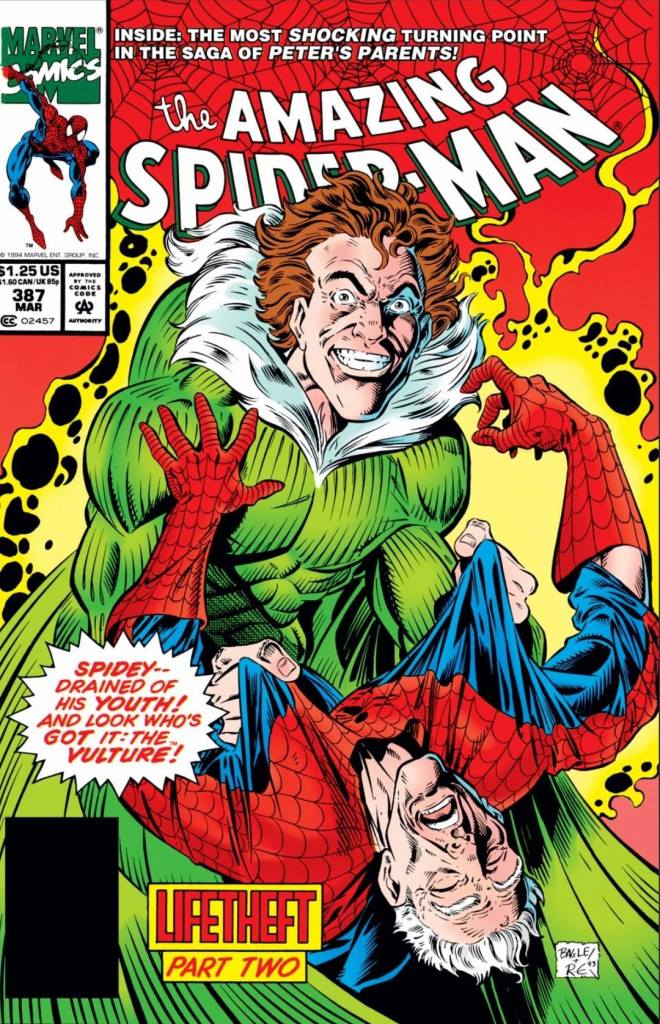
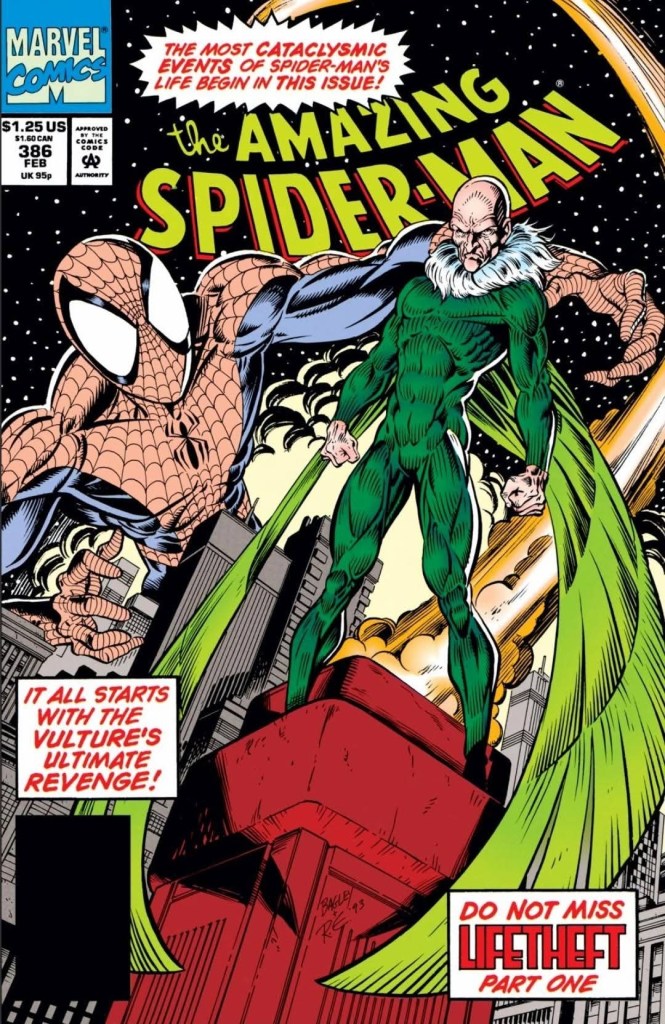
The cover.

Early story

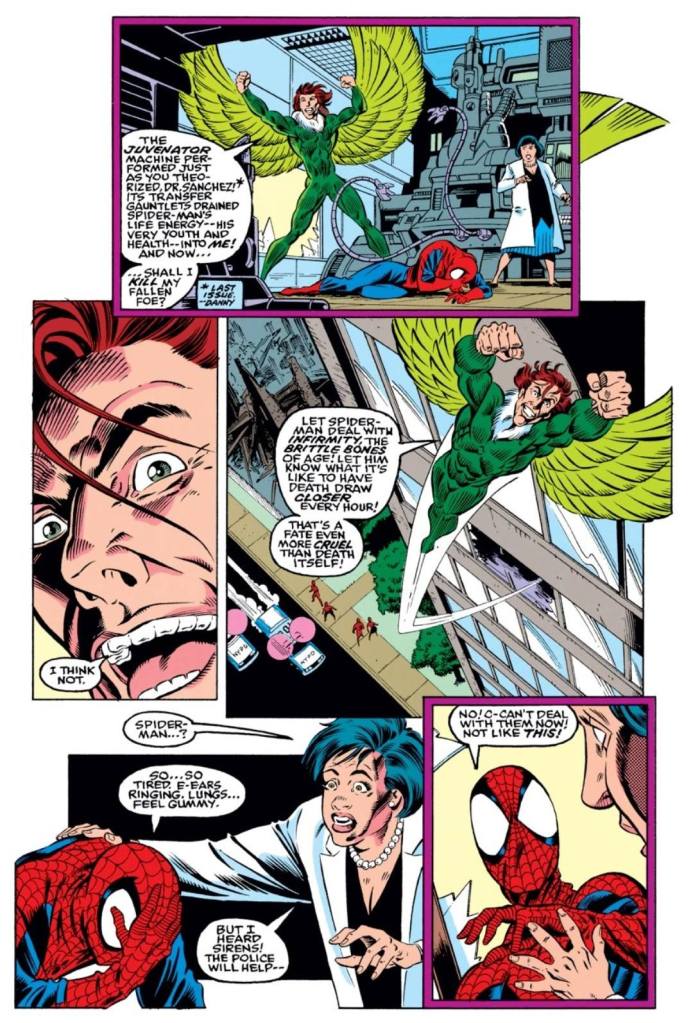
The story begins with the Vulture absorbing energy and the youth of Spider-Man using the Juvenator in front of Dr. Sanchez. As a result, Adrian Toomes/Vulture physically turned much younger with rejuvenated skin, cancer getting health, a stronger body and his hair grown back. He declares himself as the new vital Vulture. Spider-Man is down on the floor clearly weakened and with a change of his body’s shape.

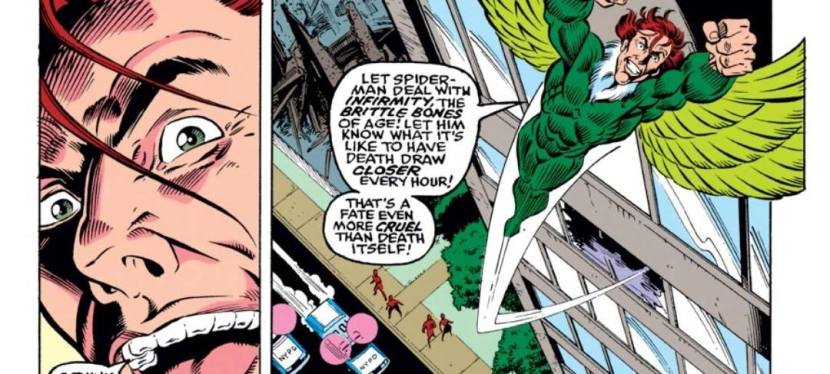
Instead of taking the opportunity to kill Spider-Man, the Vulture decides to fly away knowing that his long-time rival will have to deal with brittle bones of old age. As Dr. Sanchez tries to help him, Spider-Man feels exhausted, his lungs feeling gummy and his ears ringing. Knowing that police officers are coming, the webslinger decides to get away and leave Dr. Sanchez behind.

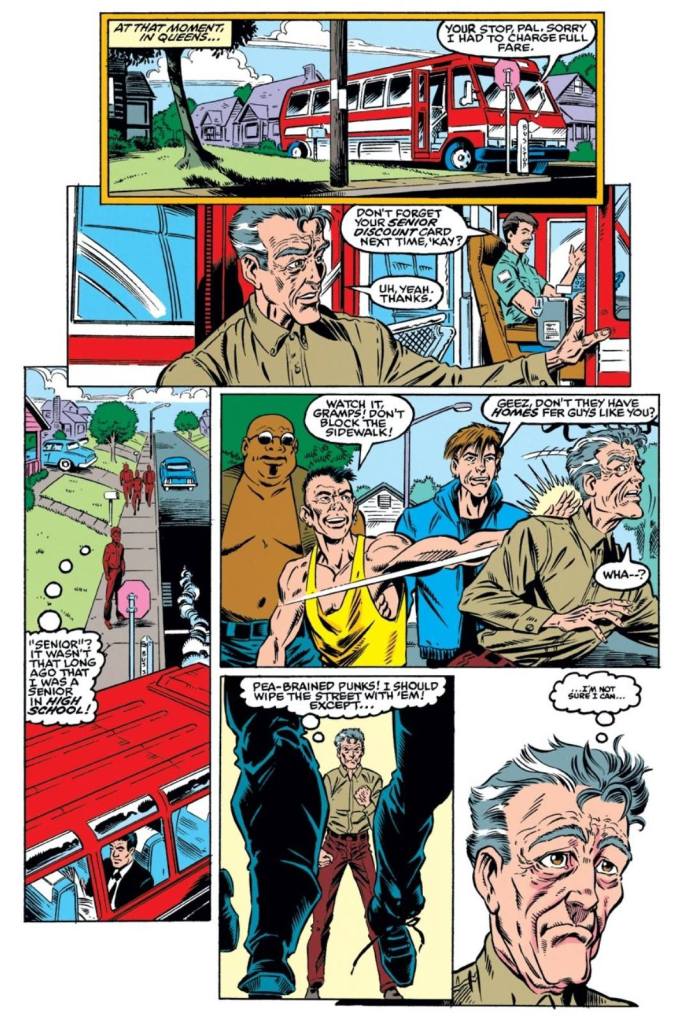
Moments later at the top of the building, the weakened Spider-Man takes his mask and glove off realizing that he has turned into an elderly man…

Quality

Can you recognize Peter Parker?

To get straight to the point, this continued rematch between Spider-Man and the Vulture is so outlandish (backed with the science fiction approach to life energy and the so-called fountain of youth), it almost felt like it was a story crafted for the What If series of comic books. In fact, the sudden aging of Peter Parker into an actually elderly man getting into close calls with two notable family members made this tale even more suitable for the What If series (note: What If #4 of 1989 had a severely aged Peter Parker in it).

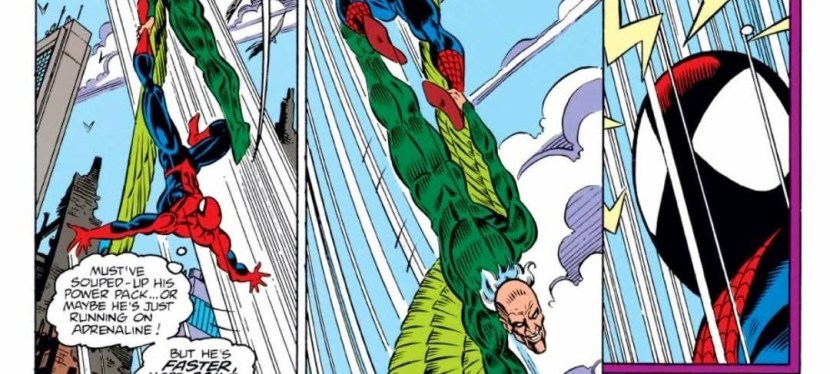
Still on the storytelling aspect of this comic book, the creators used the fountain of youth concept to pull off a significant twist on the enduring Spider-Man/Vulture rivalry. As Spider-Man grew so old, the Vulture became much younger which in turn convinced him he could reinvent himself and put his genius of electro-magnetism to great use.  

To make things clear, this tale is not purely a Spider-Man/Vulture rivalry with sci-fi twists. In fact, there is more to the plot than meets the eye here as the Juvenator machine becomes an important element of the story (leading to something intriguing in the next issue), and a sinister revelation concluded this comic book.

Conclusion

The Vulture rejuvenated into a young man at the expense of Spider-Man.

Amazing Spider-Man (1994) is a solid follow-up to the previous issue and it also was a radical attempt to twist the Spider-Man/Vulture rivalry a lot reaching to the point of making it look and feel like a What If story. There is a good amount of suspense, character development and enough superhero spectacle that paid-off the build-up nicely. Ultimately, this tale is actually a part of a short storyline leading to the intriguing events of issue .  

Overall, Amazing Spider-Man (1994) is recommended.

+++++

Thank you for reading. If you find this article engaging, please click the like button below, share this article to others and also please consider making a donation to support my publishing. If you are looking for a copywriter to create content for your special project or business, check out my services and my portfolio. Feel free to contact me with a private message. Also please feel free to visit my Facebook page Author Carlo Carrasco and follow me on Twitter at  @HavenorFantasy as well as on Tumblr at https://carlocarrasco.tumblr.com/ and on Instagram at https://www.instagram.com/authorcarlocarrasco

A Look Back at Uncanny X-Men #286 (1992)

Welcome back superhero enthusiasts, 1990s arts and culture enthusiasts, Marvel Comics fans and comic book collectors! Today we go back to the early 1990s to explore one of the many tales of the Marvel shared universe through the Uncanny X-Men series.

While issue #284 marked the turning point following the successful return of Jean Grey and the encounter with Bishop, issue #285 generated strong vibes of the sci-fi TV series Otherworld as it revealed most of the X-Men’s Gold Team members in a completely different world filled with unknown inhabitants and culture. Clearly a lot has happened following the Gold Team’s debut in issue #281 which reflects the respective contributions of the creators.

With those details laid down, here is a look back at Uncanny X-Men , published in 1992 by Marvel Comics with a story co-written by Jim Lee and Scott Lobdell (who worked on the script). The art was done by Whilce Portacio with ink work by Art Thibert.

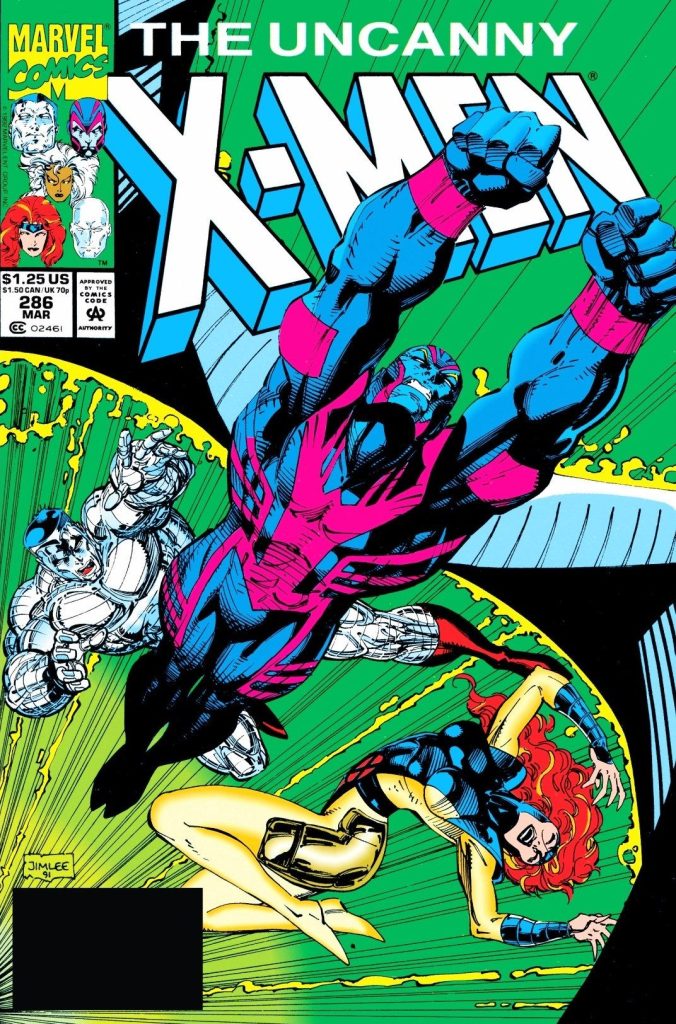
The cover.

Early story

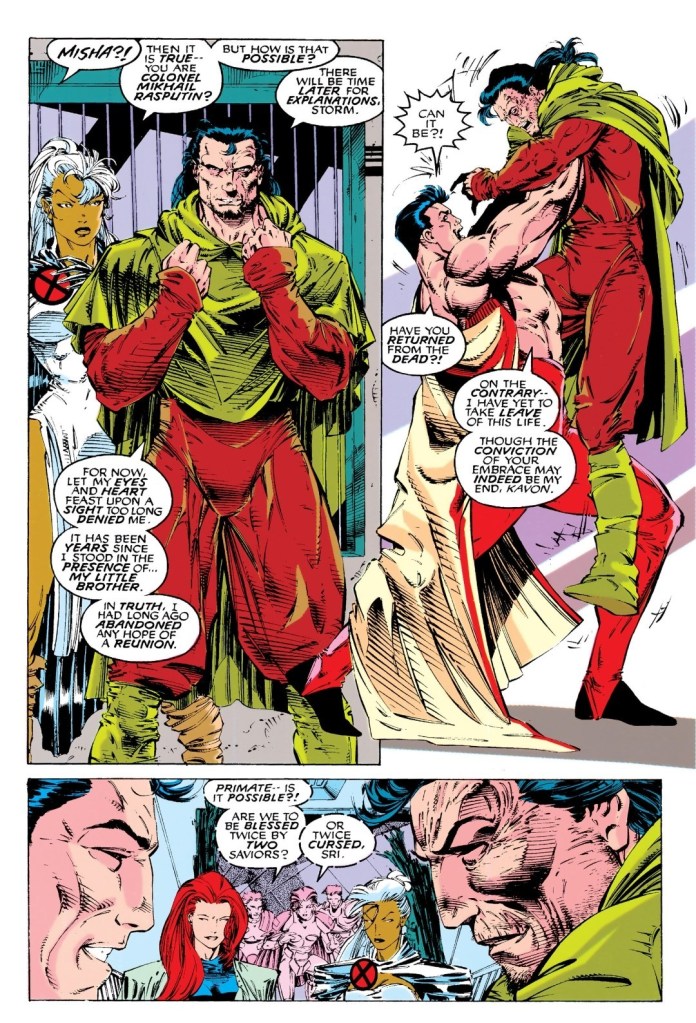
The story begins with Jean Grey, Colossus, Storm and her male companion (Mikhail Rasputin) together. While Jean is surprised and relieved to see Storm again (she was separated from the team temporarily in the last issue), Colossus is shocked to see his long-lost brother Mikhail alive and well. Mikhail reveals that so many years have passed since he last stood with his little brother and had long abandoned any hope of a reunion.

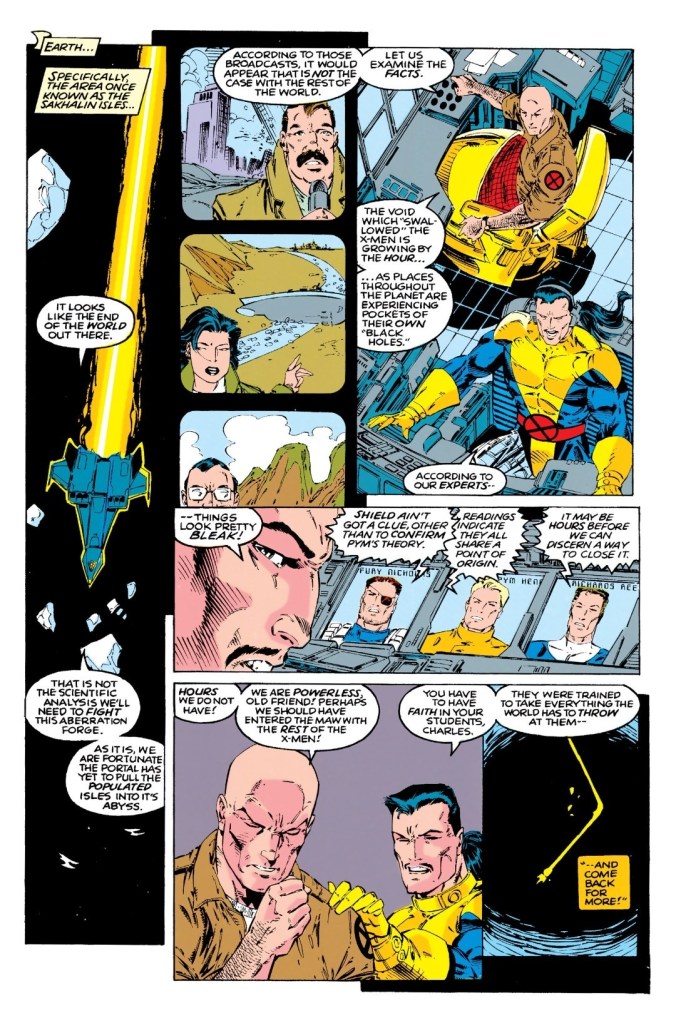
The reunion is interrupted when a portal has grown larger by the moment and it means that it is only a matter time before Earth is pulled into the realm they are in. Both worlds are at risk of getting destroyed…

Quality

Charles Xavier and Forge are still on Earth separated from the rest of the X-Men’s Gold Team members.

Following the build-up and character developments that happened in the previous issue, this X-Men tale is pretty much a strong pay-off while leaving some space for suspense and surprises. The writers intended to conclude what started in issue and along the way, they had to go through the challenges of introducing a new world, new people and the conflicts within. Mikhail Rasputin – the same guy who helped Storm in issue – is easily the most impactful addition to this tale and because of him and what he revealed, Colossus became emotional and felt like his life was crumbling as he simply could not handle the truth. Colossus’ despair and emotional state here served as the creative seeds that later led to the betrayal he would eventually commit (in Uncanny X-Men ).

The Mikhail-Colossus interaction was easily this comic book’s source of emotions which added some weight to the plot. By the time I reached the end of this issue, I felt really satisfied and at the same time curious about the state of Colossus (note: there’s a still a long road of X-Men tales before Uncanny X-Men ).

With regards to the writing, John Byrne’s intricate touch on the dialog was clearly missing but Scott Lobdell did a fine job taking over. While Whilce Portacio was credited as illustrator, there were a few pages that looked like they were drawn by someone else. The same also happened with regards to the inking in different parts of the comic book…Art Thibert’s inking has a fine touch and there were some images that had aggressive and thicker inking (it has to be the work of someone uncredited).

Conclusion

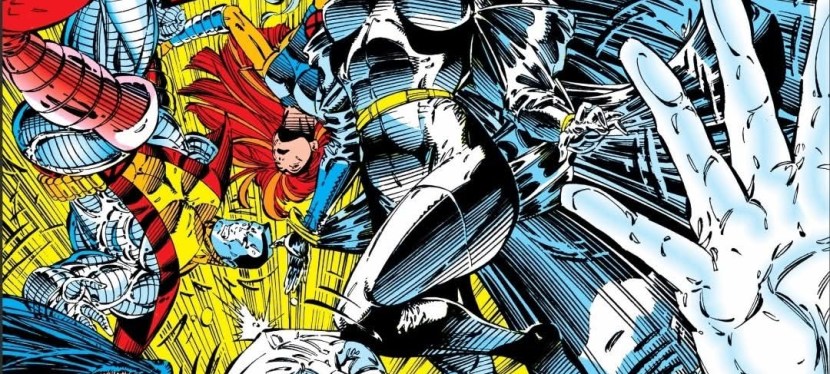
A very significant moment for the Rasputin brothers witnessed by Jean Grey, Storm and a few of the locals.

While there were some inconsistencies on the quality of the artworks, Uncanny X-Men (1992) had a really strong script and the good news here is that the creative team managed to pull off a solid conclusion. This is the kind of tale in which the X-Men utilized their skills and made tough decisions while being far away from Charles Xavier. At this particular stage of the Uncanny X-Men series, the Gold Team’s development really progressed and they became a more appealing team to follow.

Overall, Uncanny X-Men (1992) is highly recommended!

+++++

Thank you for reading. If you find this article engaging, please click the like button below, share this article to others and also please consider making a donation to support my publishing. If you are looking for a copywriter to create content for your special project or business, check out my services and my portfolio. Feel free to contact me with a private message. Also please feel free to visit my Facebook page Author Carlo Carrasco and follow me on Twitter at  @HavenorFantasy as well as on Tumblr at https://carlocarrasco.tumblr.com/ and on Instagram at https://www.instagram.com/authorcarlocarrasco

A Look Back at Amazing Spider-Man #386 (1994)

Welcome back superhero enthusiasts, 1990s arts and culture enthusiasts, Marvel Comics fans and comic book collectors! Today we go back to the 1990s to examine a small part of the Marvel Comics shared universe through a tale of the Amazing Spider-Man monthly series.

Following a serious of unfortunate events that kept Spider-Man away from his wife Mary Jane (read my retro reviews by clicking here, here and here), the Amazing Spider-Man creators decided it was time to have the iconic webslinger in a new rematch with the classic villain The Vulture (specifically Adrian Toomes whose first appearance was in Amazing Spider-Man in 1963). What makes Toomes Vulture notable (note: there were other versions of Vulture in Marvel’s history) is that he is an old man who happens to be a brilliant electrical engineer who proved to be a very capable criminal. He is also a co-founder of the Sinister Six.

With those details laid down, here is a look back at Amazing Spider-Man , published in 1994 by Marvel Comics with a story written by David Michelinie and drawn by Mark Bagley.

The cover.

Early story

The story begins in the prison complex at Ryker’s Island. Adrian Toomes (Vulture) is inside his prison cell working on a small device with a guard watching from his back. It turns out the device has a tractor beam and Toomes uses it on the guard to physically slam his body on the sliding door of the prison cell. Toomes then uses the tractor beam to pull the metal bars of the other side of the cell to create an opening. He equips himself with mechanical wings and flew out of his cell and reach the speed boat prepared by two companions.

At the residence of May Parker, Peter and his Aunt May talk with an investigator. It turns out Aunt May hired the investigator to follow and observe Richard and Mary Parker. When asked by Peter, she tells him she does not think Richard and Mary are his parents. As far as the investigator is concerned, there is nothing suspicious with Richard and Mary Parker. He tells peters that his aunt needs professional help (related to Alzheimer’s Disease)…

Quality

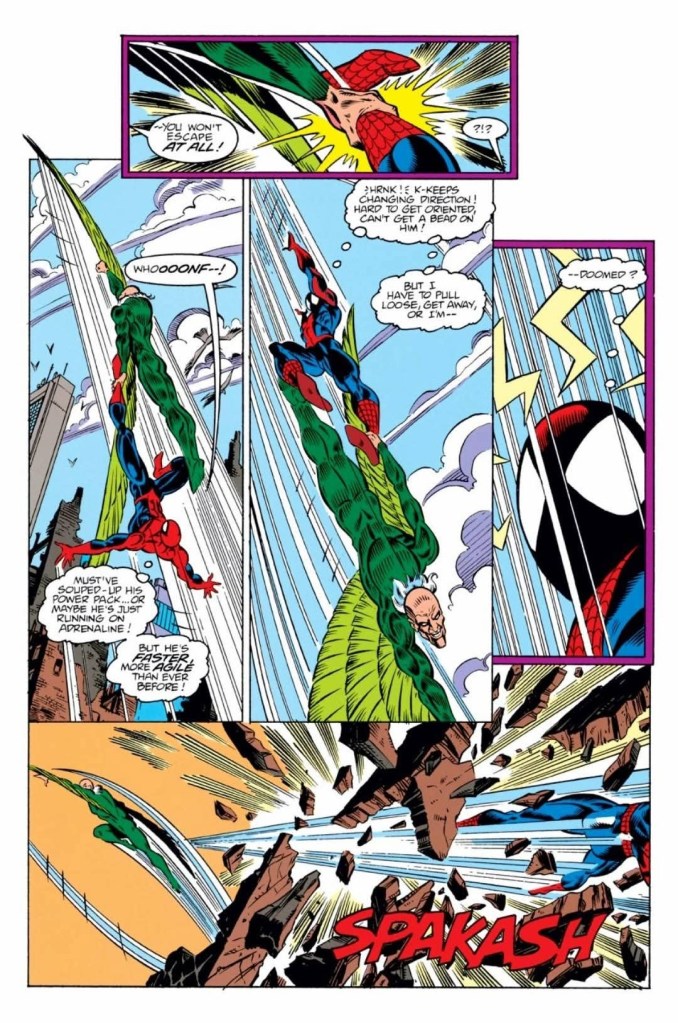
The physical conflict between Spidey and the Vulture is intense to see!

Perceived as modern during the time of publication, the conflict between Spider-Man and the Vulture in this comic book utilized the concept of everlasting youth with science fiction (combined with the villain’s own obsession). This in turn resulted in a unique approach executed by the Michelinie-Bagley duo to make something new with the rematch between Spidey and his winged nemesis.

The Vulture here is not only very obsessed with obtaining everlasting life as there is something deep inside him that has been raging. This explains why the winged super villain is more visceral in his battle with Spider-Man which Mark Bagley visualized with dynamism and intensity. For the newcomers reading this, the two have fought each other a lot since the 1960s and this 1994 rematch was very unique. The Vulture here is not unhinged but rather strategic while being obsessed, and this made him even more dangerous for Spider-Man.

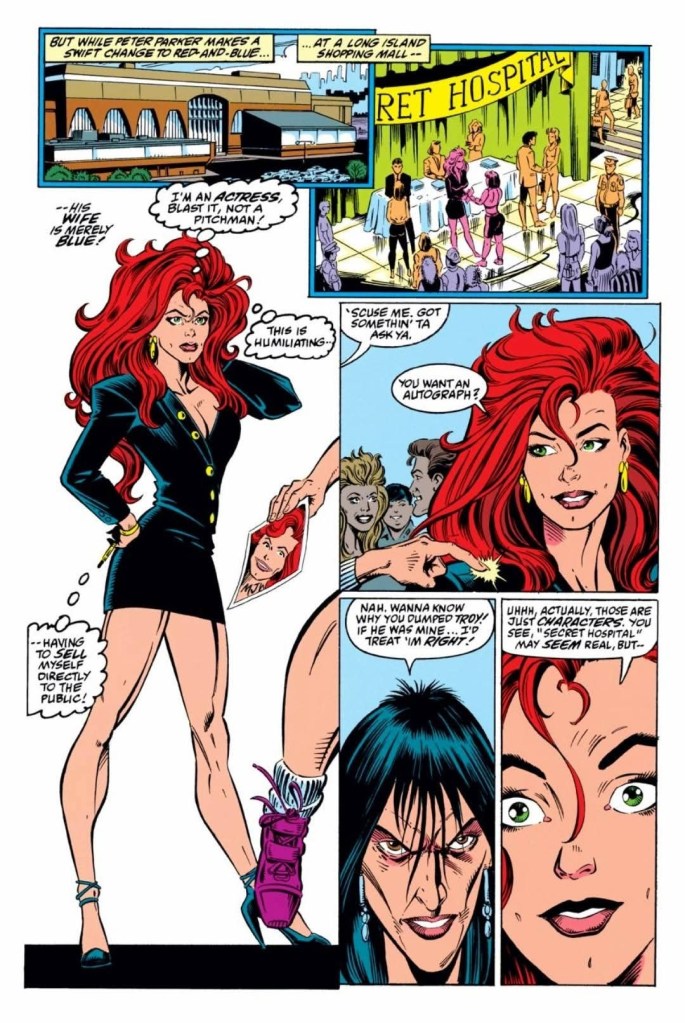
Apart from the promised rematch, this comic book continued building up the tension for the eventual tragedy in Peter Parker’s life (which happened in Amazing Spider-Man ) while also dramatizing the lasting hardships Mary Jane experiences as Peter’s wife. Peter Parker meanwhile is focused on his family and his intention to find professional help for Aunt May smoothly connected with his rematch with the Vulture.  

Conclusion

Mary Jane Parker participates in a promotional event of her TV show in a shopping mall.

There is a lot to enjoy in Amazing Spider-Man (1994). The rematch between the Vulture and Spider-Man is engaging and intriguing to read. There is also a good amount of suspense applied on the main plot as well as on the sub-plot about Aunt May being suspicious about Richard and Mary Parker. The result here is a reading experience that is entertaining and also balanced with regards to tone and storytelling.  

Overall, Amazing Spider-Man (1994) is recommended.

+++++

Thank you for reading. If you find this article engaging, please click the like button below, share this article to others and also please consider making a donation to support my publishing. If you are looking for a copywriter to create content for your special project or business, check out my services and my portfolio. Feel free to contact me with a private message. Also please feel free to visit my Facebook page Author Carlo Carrasco and follow me on Twitter at  @HavenorFantasy as well as on Tumblr at https://carlocarrasco.tumblr.com/ and on Instagram at https://www.instagram.com/authorcarlocarrasco

A Look Back at Peter Parker, The Spectacular Spider-Man #131 (1987)

Welcome back superhero enthusiasts, 1980s arts and culture enthusiasts, Marvel Comics fans and comic book collectors! Today we go back to the year 1987 to examine a small part of the Marvel Comics shared universe through a tale of the Peter Parker, The Spectacular Spider-Man monthly series.

For this particular review, we will explore the 3nd chapter of classic storyline Kraven’s Last Hunt. The storyline started in Web of Spider-Man (read my retro review by clicking here) and progressed further in Amazing Spider-Man (read my retro review by clicking here) and creators J. M. DeMatteis and Mike Zeck crafted it to last six chapters.

With those details laid down, here is a look back at Peter Parker, The Spectacular Spider-Man , published in 1987 by Marvel Comics with a story written by J. M. DeMatteis and drawn by Mike Zeck.

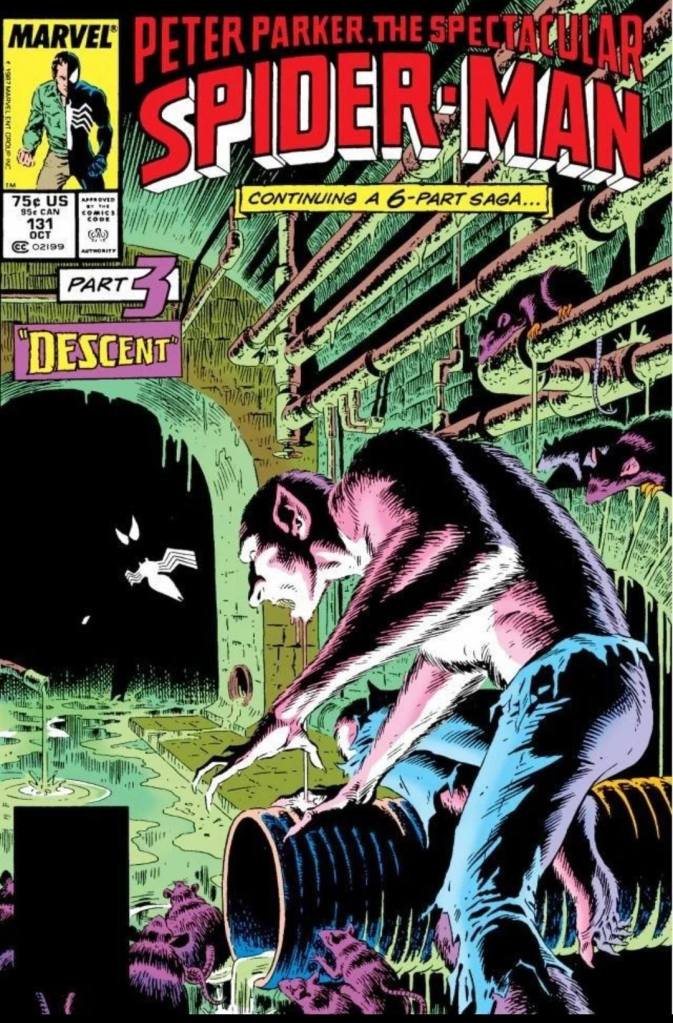
The cover.

Early story

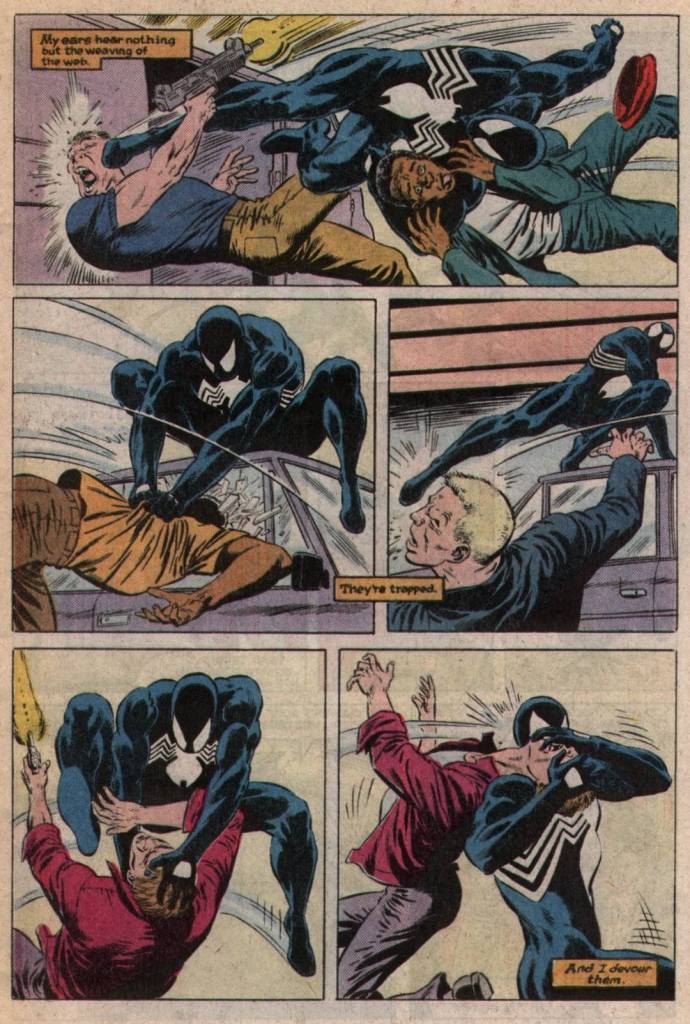
The story begins inside a facility in New York City on a rainy night. Men inside work quietly moving heroin from one vehicle to another. Suddenly Kraven – wearing a black costume believing he is Spider-Man – breaks in and fearlessly attack the men who are already armed. Using very violent force, Kraven beats the men and killed the last one. Eventually, police officers and detectives broke into the facility which compels Kraven to get away fast and leaves them no opportunities to catch up. One of the detectives mentions that fifteen suspects have been hospitalized because of the individual they perceive as Spider-Man.

After climbing to the top of a building, Kraven takes his mask off. He thinks deeply about his victory over Spider-Man and becoming him. He believes he has consumed the spider’s prey and proved himself to be superior in every way. Regardless, Kraven’s obsession continues as he seeks the final proof.

Elsewhere in the city, Vermin pulls a woman into an alley and then comes out on the street as a police car approaches him…

Quality

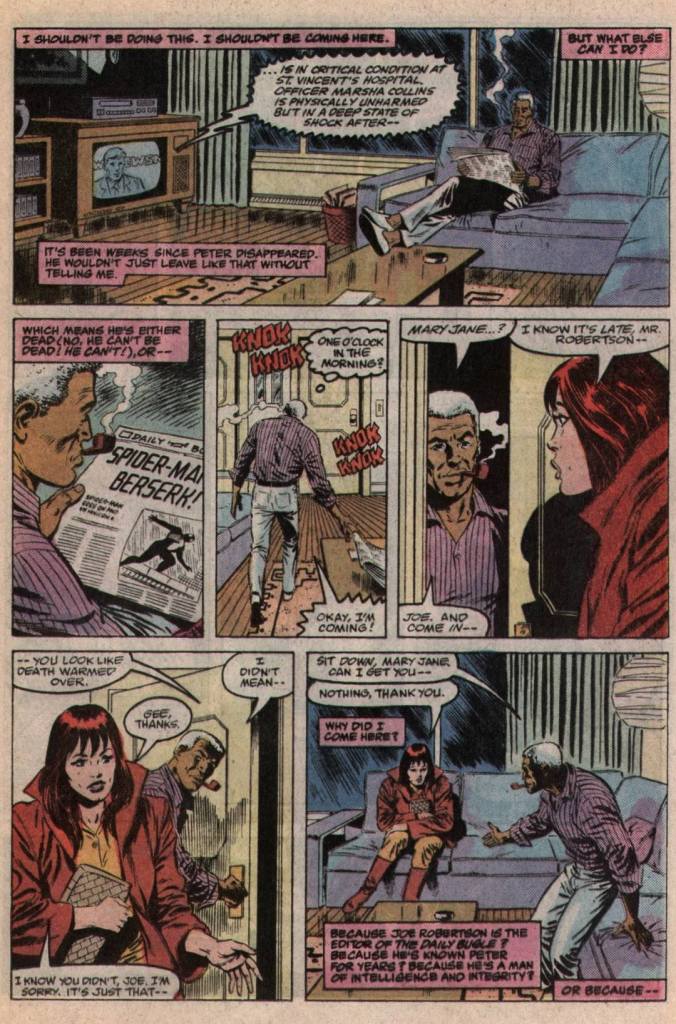
A key scene showing how Mary Jane and Joe Robertson react to the absence of Peter Parker who was buried alive by Kraven.

In this 3rd chapter of the Kraven’s Last Hunt storyline, the iconic Spider-Man is absent again but his presence is still felt through the way people perceive him and through two notable characters who personally knew Peter Parker. At this point in the storyline, Kraven truly believes he has not only replaced Spider-Man but became even more significant than him. Kraven’s obsession with achieving both greatness and significant placed him on a collision course with Vermin, and I can say that the conflict between the them is a powerful feature of the story. Once again, DeMatteis proved how compelling his script really is and Mike Zeck easily brought the said script to life with strong imagery.

As with the previous two chapters, the darkness and grittiness of the storyline are lively which resulted in a very atmospheric reading experience. The DeMatteis-Zeck duo knew exactly how to engage readers using a powerful script and images that range from being action-packed to looking very disturbing.

Speaking of character development, Mary Jane here shows how the continued absence of her husband is wearing herself down and making her even more worried. Mary Jane is a lively symbol about how we readers miss Spider-Man and how uncertain we feel about the future of comic book storytelling without the iconic superhero.

Conclusion

Without any concern whatsoever, Kraven’s Spider-Man brutally hits the criminals with powerful strikes.

Peter Parker, The Spectacular Spider-Man (1987) is a powerful 3rd chapter of the Kraven’s Last Hunt storyline. At this point, Kraven continues to not only be Spider-Man but make others feel his impact as he strives to be greater than the genuine Spider-Man. Vermin has turned more prominent in this comic book and the big conflict between him and Kraven is a huge pay-off to what was built-up since Amazing Spider-Man . Right now, I am looking forward to the next chapter of Kraven’s Last Hunt.

Overall, Peter Parker, The Spectacular Spider-Man (1987) is highly recommended.

+++++

Thank you for reading. If you find this article engaging, please click the like button below, share this article to others and also please consider making a donation to support my publishing. If you are looking for a copywriter to create content for your special project or business, check out my services and my portfolio. Feel free to contact me with a private message. Also please feel free to visit my Facebook page Author Carlo Carrasco and follow me on Twitter at  @HavenorFantasy as well as on Tumblr at https://carlocarrasco.tumblr.com/ and on Instagram at https://www.instagram.com/authorcarlocarrasco

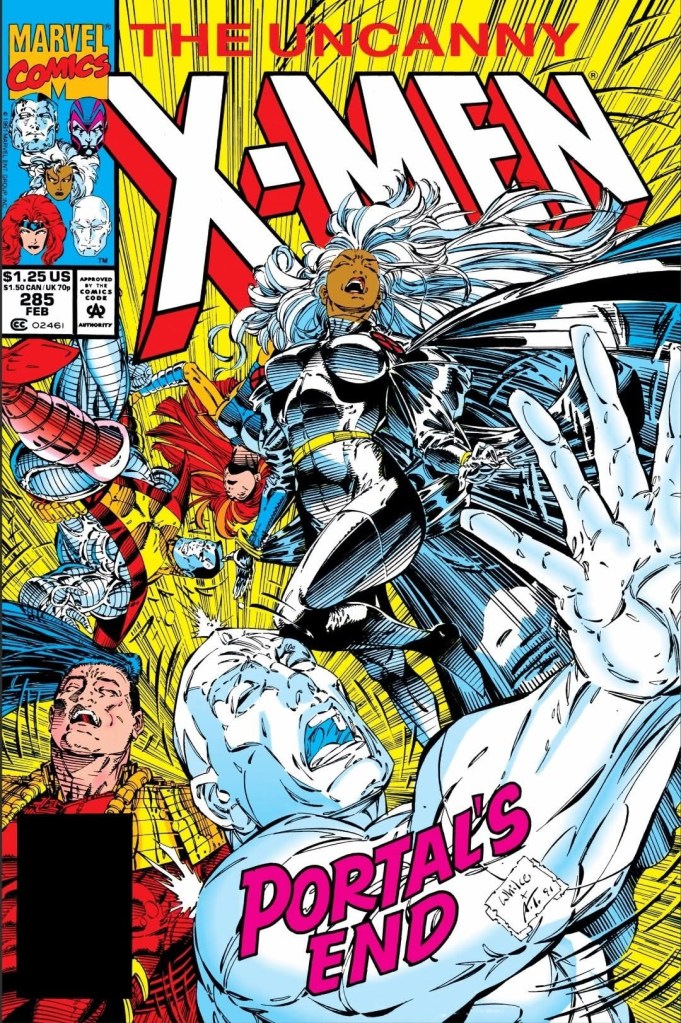
A Look Back at Uncanny X-Men #285 (1992)

Welcome back superhero enthusiasts, 1990s arts and culture enthusiasts, Marvel Comics fans and comic book collectors! Today we go back to the early 1990s to explore one of the many tales of the Marvel shared universe through the Uncanny X-Men series.

What happened in issue #284 was a turning point in storytelling and it is only a part of the early period of the X-Men – Gold Team’s operation. The X-Men were on the way home (with Jean Grey successfully retrieved and restored) following their encounters with Fitzroy’s gang and the mutant from the future Bishop only to proceed to a specific island in response to a distress call. By the end of it, something significant happened which separated the X-Men from Professor X and Forge.

With those details laid down, here is a look back at Uncanny X-Men , published in 1992 by Marvel Comics with a story co-written by Whilce Portacio, Jim Lee and John Byrne (who worked on the script). The art was done by Portacio with ink work by Art Thibert.

The cover.

Early story

The story begins with Jean Grey and Colossus (carrying a female primate) who find themselves not only disoriented but also separated from their teammates Iceman, Archangel and Storm. A unknown amount of time has passed since they were sucked forcefully into a void which turned out to be a portal into a new world of unknown origin.

As soon as they land, several primates (humans wearing armor and futuristic gadgets) immediately ganged up on them, knocking Jean Grey out successfully while ramping up their attacks on Colossus. With Colossus down after intense hits, the Russian X-Men member does not fight back and eventually saw his metallic skin turn into flesh fully exposing his human identity. The primates suddenly changed their attitude as they referred to Colossus as a returned savior who has fulfilled the prophecy they grew up with.

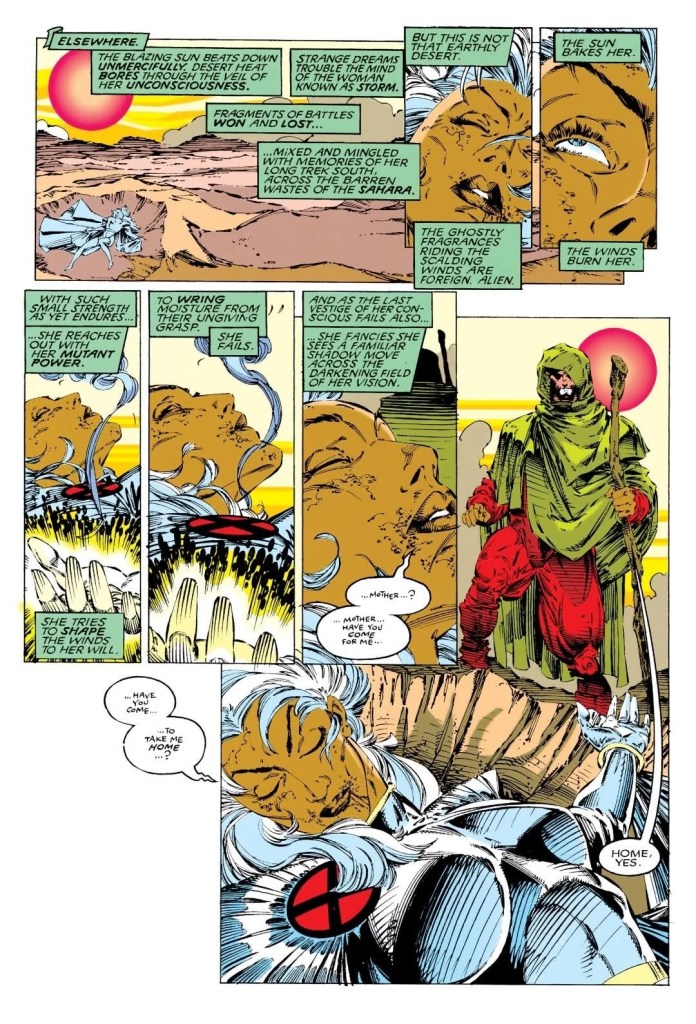
Elsewhere, in the middle of a hot desert, Storm is down on the sand feeling weak and groggy. She tries to alter the wind but fails. Suddenly, a man arrives with the intention of carrying Storm to his home…

Quality

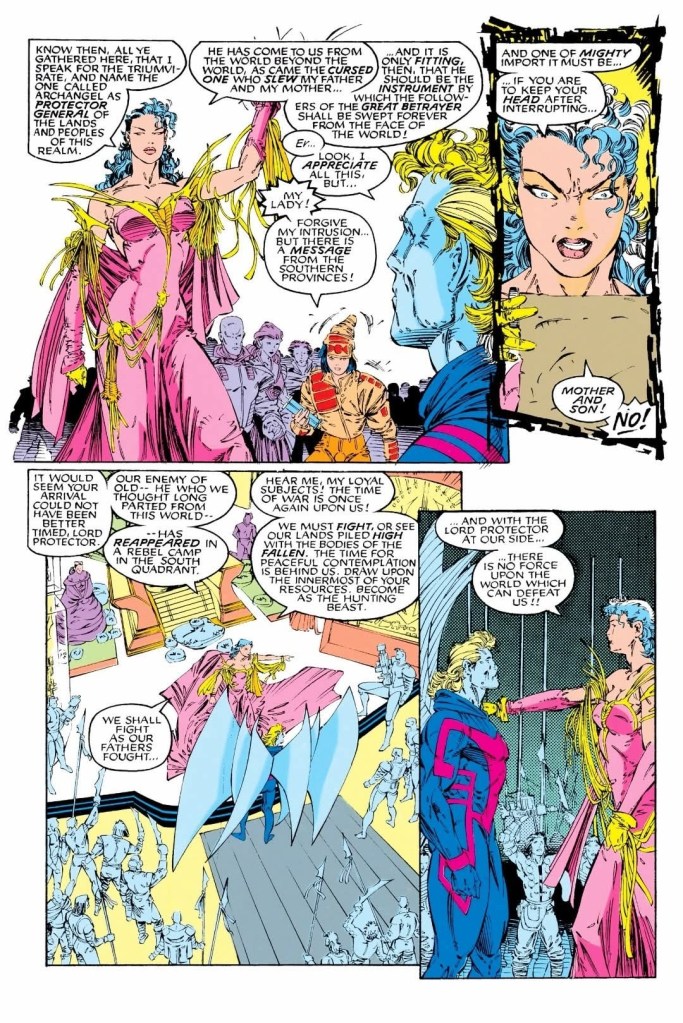
The natives in this page, Archangel is not only accepted by the leader but also perceived to be a great figure of destiny in connection with their beliefs.

This particular X-Men tale is the result of the turning point that happened in the previous issue. In this comic book, the X-Men’s Gold Team members are separated from each other and the world they are in is alien in nature and yet filled with unusual looking humans who clearly have a long-lasting culture, history and cultural norms formed through generations. This concept the creative team came up with has strong vibes of the 1980s American science fiction TV series Otherworld which I saw a very long time ago. In fact, I find the overall concept of this comic book an inspired piece of work.

Like in Otherworld, the X-Men are in a totally new and unknown world that somewhat looks like Earth but then it is not as the natives they encountered are totally unlike anything they encountered before. Like in The Empire Strikes Back, the X-Men here are separated from each other which opened up opportunities for the creators to develop the characters, show particular threads of their respective personalities (or their talents) and emphasize how they perceive new people and the new world they are in.

Without spoiling the plot, I can say that the natives of the unknown world are living with the foolishness of idolatry which can be seen at least in how they believe Colossus (in the flesh) is their savior and the fulfillment of the prophecy they were oriented with. The idolatry aspect of the tale serves as the twist on the primates’ (specifically the few who went to Earth willing to fight to the death) who first appeared to the X-Men as very daring opponents and it adds depth to the X-Men’s struggle on understanding the new world they are in.

When it comes to character development, Colossus and Jean Grey are strongly emphasized by the creative team who also managed to do the same with Iceman, Storm and Archangel. This tale also serves as a relief from the back-to-back good-versus-evil battles that took place since issue #281 and I can say the writing is solid.

Conclusion

A very helpless Storm is approached by a man in the middle of the desert.

While it lacks the usual conflict between Marvel’s mutants and evildoers, Uncanny X-Men (1992) is an inspired piece of work filled with sci-fi concepts, the overwhelming power of discovering a new world and established natives, and a lot of character development on Colossus, Storm, Jean Grey, Ice Man and Archangel. As I read the story, the mystery builds up and there were these subtle pay-offs that happened along the way. Overall, this comic book is a huge pay-off to what was established in issue and the notable thing is that the X-Men Gold Team (who have Sunfire with them) are just getting started in the unknown world.

Overall, Uncanny X-Men (1992) is highly recommended!

+++++

Thank you for reading. If you find this article engaging, please click the like button below, share this article to others and also please consider making a donation to support my publishing. If you are looking for a copywriter to create content for your special project or business, check out my services and my portfolio. Feel free to contact me with a private message. Also please feel free to visit my Facebook page Author Carlo Carrasco and follow me on Twitter at  @HavenorFantasy as well as on Tumblr at https://carlocarrasco.tumblr.com/ and on Instagram at https://www.instagram.com/authorcarlocarrasco

A Look Back at Uncanny X-Men #284 (1992)

Welcome back superhero enthusiasts, 1990s arts and culture enthusiasts, Marvel Comics fans and comic book collectors! Today we go back to the early 1990s to explore one of the many tales of the Marvel shared universe through the Uncanny X-Men series.

As of this writing, I really enjoyed reading the tales about the Gold Team of the X-Men under the co-writing of Whilce Portacio and John Byrne (click here, here and here). Following Bishop’s debut in issue , issue featured his intense first-ever encounter with the X-Men while concluding the mutants mission (retrieving Jean Grey).

With those details laid down, here is a look back at Uncanny X-Men , published in 1992 by Marvel Comics with a story co-written by Whilce Portacio and by John Byrne (script). The art was done by Portacio with ink work by Art Thibert, Scott Williams and Karl Altstaetter.

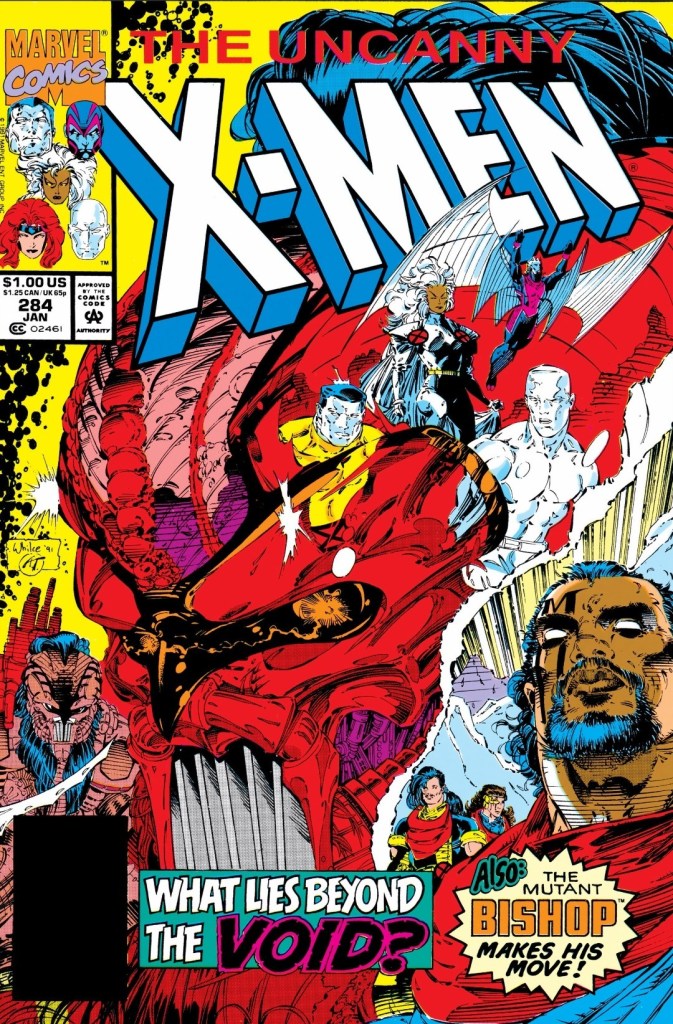
The cover.

Early story

The story begins at the Sakhali islands located off the coast of Siberian Russia and separated from Hokkaido of Japan. Previously a territory of China and explored by the Japanese, the island is now bustling with unusual activity as government officials and personnel of both Russia and Japan focus on a massive, sealed crater there. After meeting with the Russians and his fellow Japanese on location, the mutant Sunfire (Shiro Yoshida) proceeds to do a task with his immense power on the crater. The scientists quickly detect intense readings that went off the scale and it seems the void of the crater is responding to Sunfire’s assault. The void adapted its own frequencies with Sunfire’s and returns fire at him. The void then begins to change.

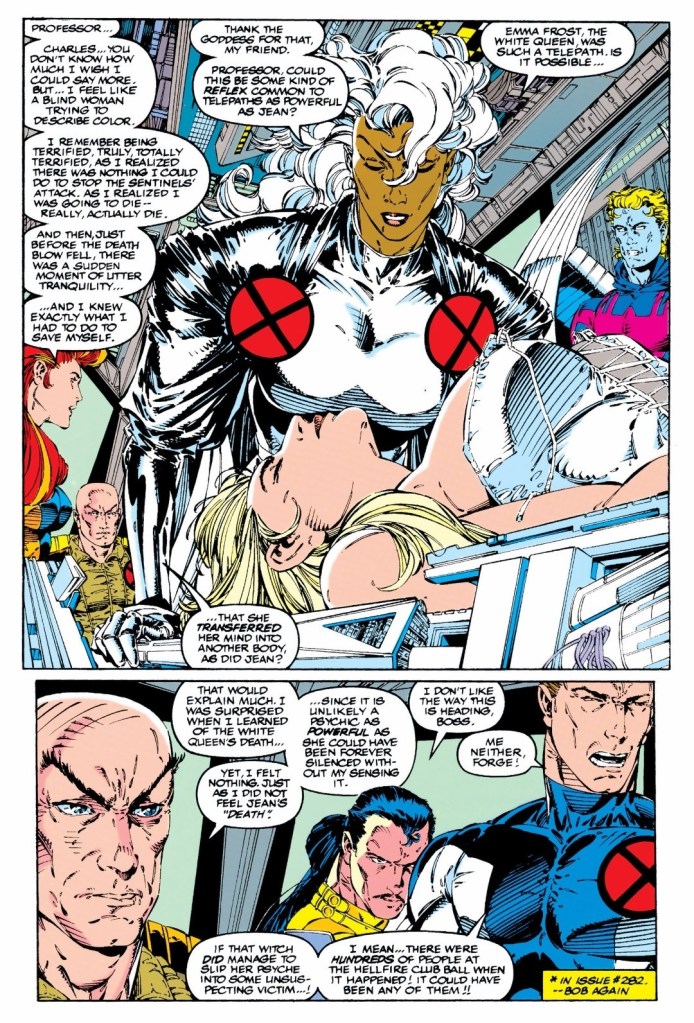
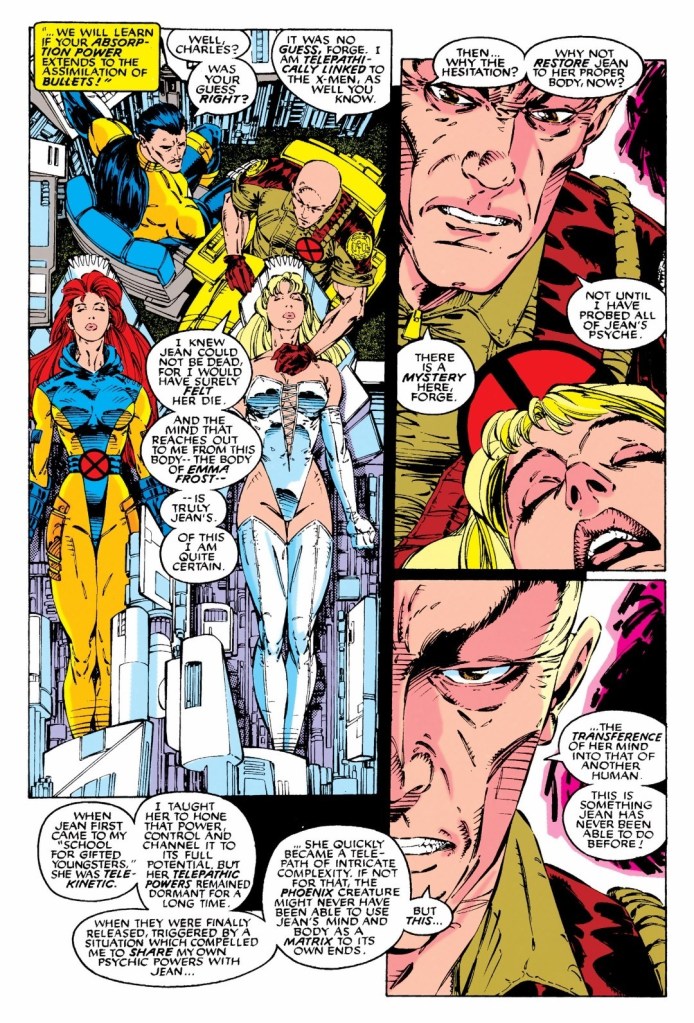
Elsewhere, the X-Men’s Gold Team are spending quality time together on board their supersonic blackbird heading home. Jean Grey, who previously occupied Emma Frost’s body temporarily, is back as herself and interacting with her teammates. With them is the unconscious body of Emma Frost (White Queen). Professor X and his mutants are uncertain as to what happened to Emma Frost’s mind and Bobby Drake (Iceman) speculates that she could have transferred her psyche into some unsuspecting victim (note: the party at the Hellfire Club’s headquarters in issue was filled with hundreds of people).

Having heard Iceman’s opinion, Professor X decides to scan Emma Frost for the last dim echo of her personality. He tells Jean Grey to join him to scan Frost. Suddenly, the X-Men receive a distress call from the Sakhalin islands…

Quality

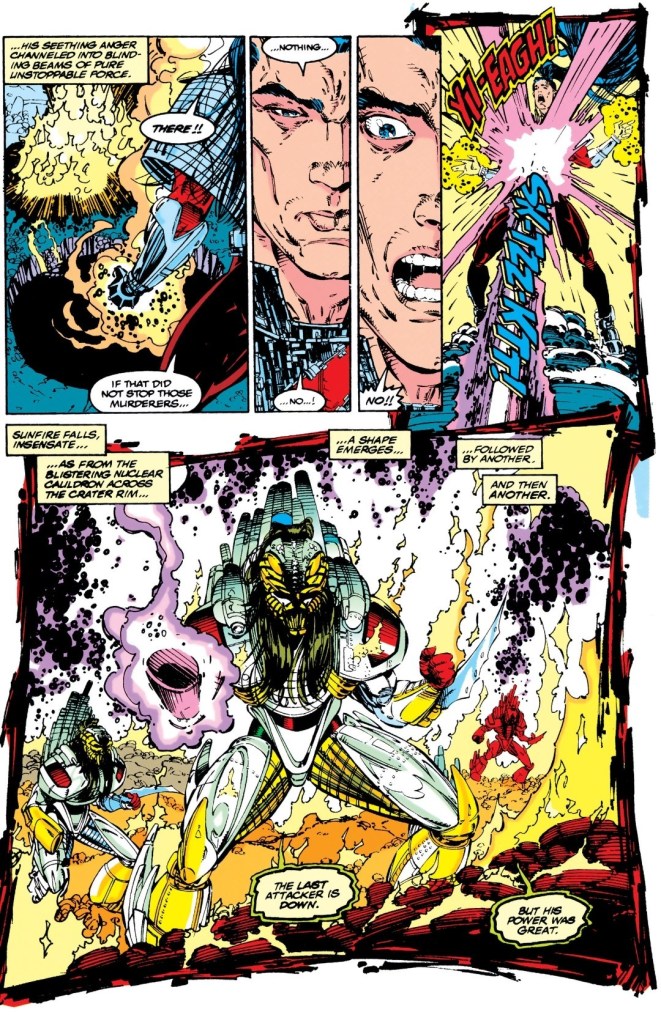
After Sunfire got hit, a new batch of enemies emerged from the void.

Following the intense and enduring events of issues until , this comic book’s concept had Charles Xavier and the Gold Team get busy yet again due to an emergency at the Sakhalin islands. This opened the opportunity for Portacio and Byrne to introduce a new conflict at the said islands (which turns into a war zone), a new force of opposition for the X-Men and giving the Japanese mutant Sunfire a share of the spotlight in X-Men comics.

At the heart of the conflict is the crater and void at the mentioned islands which brought out a strong element of mystery slowly backed up with intriguing revelations. The new force of opposition are armored, human-like beings (whose heads, hair and masks easily remind me of the Predator design of Stan Winston in the movies) who are armed, dangerous and determined to achieve their goals no matter how difficult. What is intriguing is how the new beings (referred to as aliens) remain concerned and caring with each other even during the intense moments of their encounter with the X-Men.

The climax of the conflict here is a must-see. You just have to get a copy of this comic book to find out.

When it comes to the visuals, Portacio continues to deliver solid artworks which showcased intense scenes, scenic shots, dynamic superhero action and subtle moments of drama (especially when the X-Men are together and in comfort). As there were three guys who inked Portacio’s work, there is a noticeable inconsistency with the visuals as the story went on.

Conclusion

Following their recent encounters with Bishop and Trevor Fitzroy, the X-Men still have the unconscious body of Emma Frost with them.

While some readers might find the X-Men Gold Team’s involvement in the conflict rushed, Uncanny X-Men (1992) remains an enjoyable read. As the situation is very new, the stakes are different here and for the most part, this comic book is a build-up of a new concept that just happened to be filled with a lot of action scenes. Portacio and Byrne delivered a fun-filled read with a good amount of intrigue and some surprises as they introduced a new force opposite the X-Men. And for the people are who are fond of Bishop, he and his companions are here but not with the X-Men.

Overall, Uncanny X-Men (1992) is recommended.

+++++

Thank you for reading. If you find this article engaging, please click the like button below, share this article to others and also please consider making a donation to support my publishing. If you are looking for a copywriter to create content for your special project or business, check out my services and my portfolio. Feel free to contact me with a private message. Also please feel free to visit my Facebook page Author Carlo Carrasco and follow me on Twitter at  @HavenorFantasy as well as on Tumblr at https://carlocarrasco.tumblr.com/ and on Instagram at https://www.instagram.com/authorcarlocarrasco

A Look Back at Uncanny X-Men #283 (1991)

Welcome back superhero enthusiasts, 1990s arts and culture enthusiasts, Marvel Comics fans and comic book collectors! Today we go back to the year 1991 to explore one of the many tales of the Marvel shared universe through the Uncanny X-Men series.

Uncanny X-Men #282 marked the continuing conflict between the X-Men and Trevor Fitzroy’s group, and the arrival of one of the most notable additions to Marvel’s Mutants…Bishop. To be clear, Bishop was not alone when arrived from the future through one of Fitzroy’s portals. In relation to everything that happened in the comic book, the arrival was a very powerful conclusion to read.

With those details laid down, here is a look back at Uncanny X-Men , published in 1991 by Marvel Comics with a story co-written by Whilce Portacio and by John Byrne (script). The art was done by Portacio with ink work by Art Thibert.

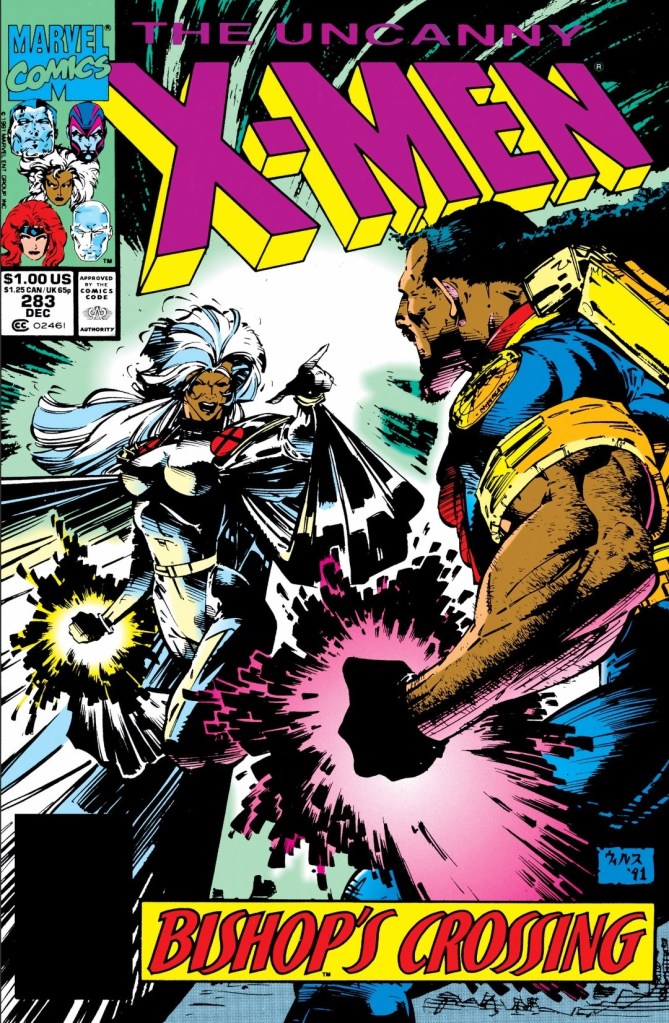
The cover.

Early story

The story begins in the arctic lair of Trevor Fitzroy. The arrival of Bishop and his two mutant companions – Malcolm and Randall – from the future caught everyone by surprise (including the X-Men). Bishop, who has Trevor Fitzroy subdued, tells his companions to throw their takes (members of Fitzroy’s force) into the portal.

Bishop intends to have Fitzroy go first which draws a loud reaction from the mutant madman. Fitzroy, who had been using the life force of captive mutants to open portals, knows exactly what would happen if he goes first. His exchange of words with Bishop shows they have a history together.

When Bishop’s companion moved a subdued person into the portal, it tore him apart. Fitzroy reveals to Bishop that the portals he created only function one-way and he tells him that he and his companions are stuck in the 20th century.

In response, Bishop assumes complete judicial authority and tells Malcolm and Randall to standby for termination sweep. The X-Men begin to react…

Quality

Professors takes a huge risk to help Jean Grey who recently occupied the body of Emma Frost.

When it comes to the creativity, this comic book is both a strong pay-off to the build-up of issues and while also serving as a new build-up focusing on Bishop’s arrival. At the heart of this tale is Bishop’s first-ever personal encounter with the X-Men which instantly expanded the lore of Marvel’s mutants a lot.

Bishop is a mutant from one possible future (of the Marvel Comics shared universe) in which Storm, Iceman, Archangel, Charles Xavier and others are remembered as legacy figures of the X-Men. In this comic book, you will see there is a good amount of depth with the way Bishop is dramatized and with many notable details on the dialogue prepared for him. Co-created by Whilce Portacio and John Byrne, Bishop is really an inspired work and clearly is not a mere addition. There is Filipino inspiration behind the creation of Bishop (click here and here) with some elements of John Ford and Prince mixed in (click here).

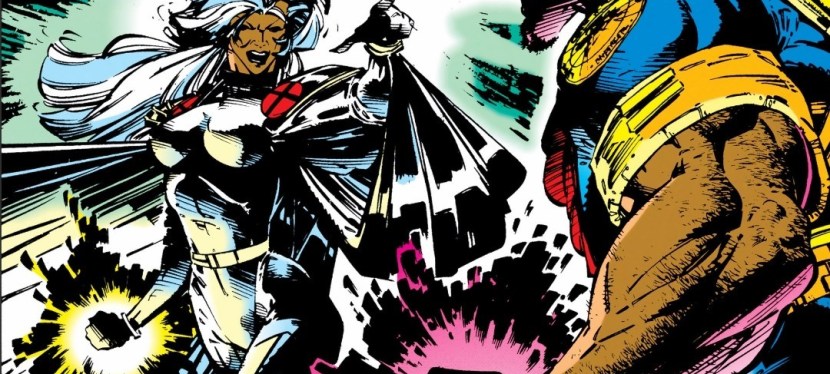
As far as the storytelling is concerned, there is notable shift of tone here as Bishop, Malcolm and Randall received much of the spotlight and yet there was still some room left for focus on the X-Men and Fitzroy’s group respectively. What makes this comic book an intriguing read is the first-ever personal encounters between Bishop and the X-Men which involved the temporary blurring of the boundary between good and evil. The interactions between Storm and Bishop are easily the most dramatic to see, and you will witness how their respective toughness (plus leadership) collide intensively.

Along the way, there is a lot superhero action to enjoy here. In fact, there are many forms action that served as extensions or pay-offs to the exchange of words between Bishop and a few specific X-Men members. Even a non-action scene like Professor X helping Jean Grey (who was in Emma Frost’s body temporarily) resulted in some visual spectacle.

Conclusion

Bishop’s first-ever encounter with the X-Men not only challenged his perception but also brought out traits of his attitude.

Uncanny X-Men (1991) is another very compelling, intriguing and entertaining read from the Portacio-Byrne duo. The X-Men lore has been expanded more and Bishop’s first encounter with the X-Men is easily the most engaging aspect of the story. At the same time, the conflict between the X-Men’s Gold Team and Trevor Fitzroy took a twist that really turned the plot to an unexpected new direction which is not surprising as Bishop’s presence made a huge impact (even on Storm herself). This is one of the best superhero stories of 1991 I have read so far.

Overall, Uncanny X-Men (1991) is highly recommended!

+++++

Thank you for reading. If you find this article engaging, please click the like button below, share this article to others and also please consider making a donation to support my publishing. If you are looking for a copywriter to create content for your special project or business, check out my services and my portfolio. Feel free to contact me with a private message. Also please feel free to visit my Facebook page Author Carlo Carrasco and follow me on Twitter at  @HavenorFantasy as well as on Tumblr at https://carlocarrasco.tumblr.com/ and on Instagram at https://www.instagram.com/authorcarlocarrasco

Retro Gaming Ads Blast – Part 35

Welcome back readers, fellow geeks and electronic gaming fans!

In this edition of the Retro Gaming Ads Blast (RGAB) series, we will take a look at another batch of retro gaming print ads – including arcade flyers – from the 1970s to the 1990s.

For the newcomers reading this, Retro Gaming Ads Blast (RGAB) looks back at the many print ads of games (console, arcade, computer and handheld) that were published in comic books, magazines, flyers, posters and newspapers long before smartphones, social media, the worldwide web and streaming became popular. To put things in perspective, people back in the 1980s and 1990s were more trusting of print media for information and images about electronic games and related products.

With those details laid down, here is the newest batch of retro gaming print ads for you to see and enjoy…

1. Intellivision print ad

Were you able to play a game on the Intellivision long ago?

In 1979, Mattel launched their Intellivision game console in America which instantly placed them in competition with Atari’s 2600 console. In a bid to convince gain market share, Mattel daringly came up with a competitive print ad like the one above showing two TV sets (with an Atari 2600 baseball game and a similar game on Intellivision), descriptive text that explained why the intellivision and its games are better, and even mentioned Atari by name several times. Obviously the tactic did not lead Mattel to ultimate market victory but the above print ad showed it was okay for a newcomer to mention their competitor and aggressively attack it to gain customers (both newcomers and active gamers).

2. Popeye Japanese arcade flyer

The front of the flyer.
The rear.

In 1982, Nintendo released the Popeye arcade game which was incidentally the result of the success of their original Donkey Kong arcade game. To promote the game, Nintendo came up with an arcade flyer that had a very lively front (note: the characters were instantly recognizable thanks to the great art used) and the rear having easy-to-read instructions on how to play the game, what levels to expect and what must be done when playing. Popeye was an arcade hit in Japan, but an even bigger hit in America. This old arcade flyer still looks nice.

3. Time Gal arcade flyer

On face value, this one looks more like an anime promo since gameplay elements were missing.

Released in Japanese arcades in 1985, Time Gal is one of those games that used the expensive LaserDisc technology to stream pre-recorded animation (made by Toei) and challenged gamers to react quickly (using the joystick and button for commands) in order to progress in real-time. The arcade flyer has a very lively visual design making it clear to players and arcade operators that a lot of anime awaits those who play Time Gal. Technically, players watch anime cutscenes happen and react using the controls. Time Gal was an arcade hit and it made its way outside of Japan by getting ported for the Sega CD.

4. 3DO print ad

If you bought a 3DO long ago, was it for gaming or for home entertainment purposes?

Remember the 3DO? Developed by the 3DO Company and launched in 1993, the 3DO was designed to not only play video games but also function with multimedia features. In fact, the 3DO was initially marketed as a machine that allows users to watch videos, play music, browse digital photographs, and even immerse themselves with software focused on different topics. This is exactly what the above 3DO print ad emphasized. In retrospect, it was so odd for me to see the print ad inside video gaming magazines I read.

5. Atari Jaguar print ad

The strong focus on gaming was clear with Atari for the Jaguar.

Over a month after the launch of the 3DO, Atari launched its Jaguar console with a strong focus on video gaming. As console sales slowly grew in 1994, Atari came up with the above print ad – showing lots of games for the Jaguar – to lure in customers aggressively. If you look closely at the descriptive text of the ad, it mentions the Atari Jaguar as 64-bit system emphasizing that it is more powerful than other video game machines of the time. The bit count controversy harmed Atari and eventually the Jaguar failed.

6. NBA Action ’94 print ad

Remember when Sega made NBA basketball video games that were exclusive to the Genesis console?

Remember when there were a lot of basketball video games licensed by the NBA in the 1990s? Through its own sports games brand – Sega Sports – Sega was dedicated to making exclusive sports video games for its customers and their NBA games were under the NBA Action brand. In 1994, they released NBA Action ’94 for the Genesis console and this two-page print ad they came up with had a catchy visual design (a supposed basketball player showing his palm and message to the camera on one side of the ad). Looking closely at the descriptive text, the ad mentions “most realistic 16-bit pro basketball”, “digitized players” and having all 27 NBA teams and star players. Sega Sports is no more but it’s legacy still lives on among Sega fans.

7. X-Men Sega Game Gear print ad

For X-Men fans!

Similar to its approach with the Sega Sports brand, Sega developed exclusive games for the Game Gear. The company secured from Marvel the license to make an original X-Men game and to promote it, this 2-page print ad showcased original art of the established X-Men characters of the time while using the remaining spaces for the screenshots and descriptive text. This old print ad still looks attractive and will easily resonate with X-Men fans as well as 1990s superhero comics enthusiasts.

8. Liberty or Death print ad

American history is the core concept of this strategy game by Koei.

If there is anything notable about the Japanese company Koei, it is the fact that it released strategy and simulation games that tackled varied topics while making each game distinct and playable regardless of platform. In my experience, I had a lot of fun playing their business simulation Aerobiz Supersonic on the Super Nintendo Entertainment System (SNES). In 1993, Koei released their turn-based strategy game Liberty or Death which tackled American history for its setting (note: Koei already established itself with historical simulations). To sell the game, Koei came up with a print ad that had a very eye-catching historical art (George Washington, Thomas Jefferson, and Benjamin Franklin among the figures), a few selected screenshots and descriptive text that emphasized the essence of the game. This print ad is a reminder that no video game company today would make a historical simulation due to geopolitics (note: there are a lot of woke activists among video game employees today) and for business reasons.

+++++

Thank you for reading. If you find this article engaging, please click the like button below, share this article to others and also please consider making a donation to support my publishing. If you are looking for a copywriter to create content for your special project or business, check out my services and my portfolio. Feel free to contact me with a private message. Also please feel free to visit my Facebook page Author Carlo Carrasco and follow me on Twitter at  @HavenorFantasy as well as on Tumblr at https://carlocarrasco.tumblr.com/ and on Instagram at https://www.instagram.com/authorcarlocarrasco

A Look Back at Uncanny X-Men #282 (1991)

Welcome back superhero enthusiasts, 1990s arts and culture enthusiasts, Marvel Comics fans and comic book collectors! Today we go back to the year 1991 to explore one of the many tales of the Marvel shared universe through the Uncanny X-Men series.

Uncanny X-Men was a great read. For most of the early 1990s, I read more X-Men stories about the Blue Team than the Gold Team. In Uncanny X-Men – which took place after X-Men #5 – the spotlight was on the Gold Team which showed the strategic leadership of Storm, the X-Men revisiting the headquarters of the Hellfire Club, Jean Grey’s own recollections of past events and the new threat of Trevor Fitzroy and the Sentinels.

With those details laid down, here is a look back at Uncanny X-Men , published in 1991 by Marvel Comics with a story co-written by Whilce Portacio and by John Byrne (script). The art was done by Portacio with ink work by Art Thibert.

The cover.

Early story

The story begins inside the School For Gifted Youngsters when the Gold Team arrives (with Colossus carrying the inactive body of Jean Grey) and disrupts the chess game between Professor X and Forge. Charles Xavier mentally examines Jean and notices that her psyche survives and has been displaced. He realizes Jean is alive but not in her body.

In New York City, Trevor Fitzroy (who is carrying the body of an inactive Emma Frost) and his Sentinels surprise Shinobi Shaw showing what is left of the cyborg of Pierce. Trevor boasted to Shinobi that he won claiming that he has terminated one of the founders of the inner circle, captured a small band of Hellions and has Emma Frost as a trophy. Very slowly, Jean Grey – now occupying Frost’s body – wakes up…

Quality

Trevor Fitzroy does not know who is inside Emma Frost’s body.

I can say out loud that this is a great follow-up to the previous issue (which itself is a great read) as it has a lot of hefty payoffs to the build-up from before. With the story concept already established in issue , the progression continued strongly, the narrative is clearer and the stakes were raised even higher.

In this issue, Trevor Fitzroy still has extreme tendencies and he might look insane or unhinged to you. Still, Fitzroy really has diabolical plans to execute and those plans involves his ability to open portals to bring in his reinforcements from far away, including the “denizens of the future.” Adding to Fitzroy’s merciless and arrogant personality is his use of the captives’ life force to energize himself to open portals. Really, he does not care much about the lives of captives as he treats them as nothing more than bodies of energy for his use. Whilce Portacio really excels in not only bringing the script to life but also showcasing the personality and expressions of Fitzroy who at this point in comic book history was a brand new villain for the X-Men.  

As for the X-Men’s Gold Team, not having Jean Grey was really disadvantageous to them which compels Professor X to actually join them on their mission. This is a notable development as Xavier is very close with Jean (his original student and fellow telepath) and he knows that great odds await their team. Xavier’s involvement added a lot to the plot itself and I love the way John Byrne and Portacio portrayed him here.

When it comes to the storytelling, the pace noticeably moved faster as a lot of payoffs to the build-up were executed here. The X-Men themselves each got their respective share of the spotlight and all of them were portrayed consistently in character. The stakes were raised here this time and the handling of all the details and developments was very solid.

Conclusion

Knowing great odds await them, Charles Xavier joins the X-Men on their mission to save Jean Grey.

Even with the stakes raised higher, the creative team delivered the great stuff Uncanny X-Men (1991) is a very worthy follow-up to the previous issue. In fact, I find this comic book more entertaining and more intriguing to read from start to finish. Fitzroy is indeed a very worthy new enemy for the X-Men’s Gold Team, and there is much that long-time X-Men fans can enjoy here.

Overall, Uncanny X-Men (1991) is highly recommended!

+++++

Thank you for reading. If you find this article engaging, please click the like button below, share this article to others and also please consider making a donation to support my publishing. If you are looking for a copywriter to create content for your special project or business, check out my services and my portfolio. Feel free to contact me with a private message. Also please feel free to visit my Facebook page Author Carlo Carrasco and follow me on Twitter at  @HavenorFantasy as well as on Tumblr at https://carlocarrasco.tumblr.com/ and on Instagram at https://www.instagram.com/authorcarlocarrasco

A Look Back at Amazing Spider-Man #293 (1987)

Welcome back superhero enthusiasts, 1980s arts and culture enthusiasts, Marvel Comics fans and comic book collectors! Today we go back to the year 1987 to examine a small part of the Marvel Comics shared universe through a tale of the Amazing Spider-Man monthly series.

For this particular review, we will explore the 2nd chapter of classic storyline Kraven’s Last Hunt. The storyline started in Web of Spider-Man (read my retro review by clicking here) and creators J. M. DeMatteis and Mike Zeck crafted it to last six chapters.

With those details laid down, here is a look back at Amazing Spider-Man , published in 1987 by Marvel Comics with a story written by J. M. DeMatteis and drawn by Mike Zeck.

The cover.

Early story

The story begins on a rainy night as a tall figure wearing a black costume and mask stands over the grave stone that read “Here lies Spider-Man slain by the Hunter.” The figure takes off his mask revealing Kraven who delightfully laughs believing he has achieved greatness by defeating Spider-Man, burying him and taken his identity.

Elsewhere in New York City, a woman struggles with walking down the sidewalk during the rain. As a rat runs near her, she loses her balance and falls on the road. Suddenly, a manhole near her opens revealing the hand of an unseen creature which pulls the lady down to the sewer. Moments later, she finds herself surrounded with rats and toxic materials. Slowly, the Vermin approaches her…

Quality

This is Kraven’s Spider-Man in action! How people perceive Spider-Man is an emerging theme in this storyline.

Considering what happened in Web of Spider-Man , it is not a spoiler to point out that the iconic Spider-Man is not really present in this very comic book. That being said, writer J. M. DeMatteis shifted the spotlight on Kraven – now in a Spider-Man costume and being the webslinger we know – while leaving some of it for Mary Jane Parker and Vermin.

Following what was established in the first chapter of Kraven’s Last Hunt, Kraven here continues with his obsession over his destiny while remembering lessons he learned not only from his personal past but also the legacy he inherited from his family. In his other obsession of becoming Spider-Man, Kraven went to the extreme being with countless spiders, consuming green liquid believing that spiderness will come into him, and more. Some may perceive him as a mad man while others might see him being mystical somewhat.

The DeMatteis-Zeck duo excelled in developing Mary Jane in this story as she feels uneasy over her husband’s absence. She really feels the weight of inconveniences and loneliness that come being married to a superhero who is far away doing something or being captured by a capable enemy. Mary Jane’s personality here shows signs of fragility too.

Vermin – the rat-like monster – is portrayed as an eater of human beings who turns out to be afraid of Spider-Man and he still remembers his past conflict not only with him ut also with Captain America. Vermin is a tragic character and the presence of rats in different parts of the story suggest that his presence in the storyline will only grow stronger. Some readers might find Vermin an abomination while there might be others who could get sympathetic towards him.

The plot itself has a strong structure and builds up nicely on what was established in the first chapter of this storyline. This time around, Kraven becomes Spider-Man and how he is perceived by others – who do not know the truth that Peter Parker is temporarily gone – is an emerging theme of the storyline.

Conclusion

Alone in the apartment, Mary Jane took action against the rat.

Filled with gritty darkness, drama and suspense, Amazing Spider-Man (1987) is an engaging 2nd chapter of the Kraven’s Last Hunt storyline. Even though Spider-Man is not present here, the DeMatteis-Zeck duo succeeded in making the tale compelling to read from start to finish. What they did to develop Mary Jane and Vermin added depth not only to this comic book but to the storyline as well. Right now, I am convinced to read the next chapter of this storyline.

Overall, Amazing Spider-Man (1987) is highly recommended.

+++++

Thank you for reading. If you find this article engaging, please click the like button below, share this article to others and also please consider making a donation to support my publishing. If you are looking for a copywriter to create content for your special project or business, check out my services and my portfolio. Feel free to contact me with a private message. Also please feel free to visit my Facebook page Author Carlo Carrasco and follow me on Twitter at  @HavenorFantasy as well as on Tumblr at https://carlocarrasco.tumblr.com/ and on Instagram at https://www.instagram.com/authorcarlocarrasco