Welcome back my readers, YouTube viewers and all others who followed this series of articles focused on YouTube videos worth watching. Have you been searching for something fun or interesting to watch on YouTube? Do you feel bored right now and you crave for something to see on the world’s most popular online video destination?
I recommend you check out the following videos I found.
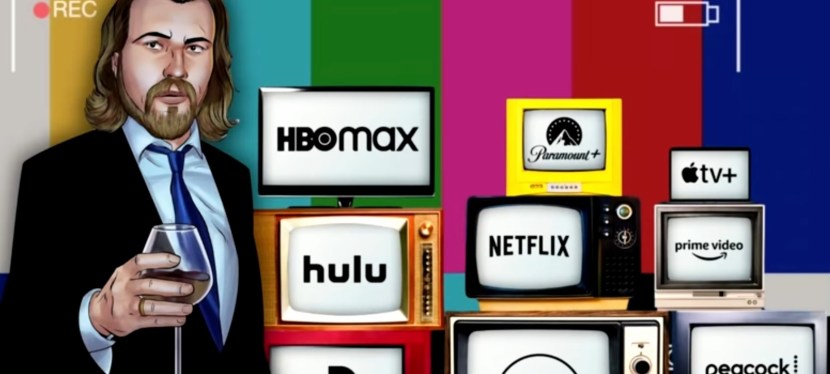
#1 Streaming wars cost Hollywood a lot – Just years ago, Hollywood companies made heavy bets on streaming believing it would be the new gold standard of business as well as a new gold mine waiting to release immense profits. Today, Hollywood ended up collectively losing a lot of money and their streaming moves added a lot of complexity and new problems to their business. Along the way, millions of customers stopped subscribing to the streaming services of Hollywood. What happened behind the scenes and who were the only business winners in the middle of the streaming wars? Find out in Midnight’s Edge in-depth analytical video below.
#2 Retrospective look at Timerider: The Adventure of Lyle Swann – As a young boy, I saw the sci-fi Western adventure movie Timerider: The Adventure of Lyle Swann and I ended up getting intrigued about its story and the ending. Even by today’s standards, this film’s core concept remains very weird or totally unique as it had lots of motorcycle thrills, cowboys with their guns, and a very unusual approach on time-travel and its consequences. To find out more about the 1982 movie, watch the selected videos below.
#3 You, Me and the Movies react to The Punisher (1989) – Remember when Dolph Lundgren played The Punisher in a low budget movie released in 1989? Even though a lot of people rejected it, the film remains important as it helped the Marvel Comics assassin start entering mainstream entertainment. Two more Punisher movies were released in the 2000s and then a TV series about The Punisher was established. To find out how Dolph Lundgren performed as The Punisher, watch the reaction video of You, Me and the Movies below.
#4 Ashleigh Burton reacts to Lethal Weapon 3 – When Lethal Weapon 3 was released in cinemas here in the Philippines in 1992, it unsurprisingly became big hit with local moviegoers and Mel Gibson was already popular among Filipinos. I missed out on the film’s cinematic run but managed to watch it on home video. If you want an enjoyable look back at Lethal Weapon 3 but you don’t have time to watch it entirely, watch Ashleigh Burton’s fun reaction video.
#5 PatmanQC examines Hook – Were you able to watch the Steven Spielberg film Hook when it was first released in cinemas in 1991? I missed out on its theatrical run (note: it opened in February 1992 here in the Philippines) but managed to watch it on home video and later played the video game adaptation on the Super Nintendo Entertainment System (SNES). That’s right! Hook had video games back then and if you want to discover more about them, watch the in-depth retro gaming video of PatmanQC below.
#6 Hamas misinformation debunked! – Let me remind you all the truth about Palestinian terrorist group Hamas…they are terrorists funded and supported by Iran and Qatar, they committed genocide against Israel and foreigners on October 7, 2023, and they are pure evil, greedy and barbaric. Hamas is also responsible for the suffering of the Palestinians (who did not join their terrorism activities) living in the Gaza strip. As America and Israel joined forces to provide humanitarian aid directly to the Gaza residents, Hamas became desperate with their tactics, lied about what happened, and they have the Islamo-Leftist mainstream news media outlets to propagate the deception worldwide. Fortunately, the misinformation of Hamas has been debunked. Watch the CBN video below.
Welcome back readers, fellow geeks and electronic gaming fans!
In this edition of the Retro Gaming Ads Blast (RGAB) series, we will take a look at another batch of retro gaming print ads – including arcade flyers – from the 1980s and 1990s.
For the newcomers reading this, Retro Gaming Ads Blast (RGAB) looks back at the many print ads of games (console, arcade, computer and handheld) that were published in comic books, magazines, flyers, posters and newspapers long before smartphones, social media, the worldwide web and streaming became popular. To put things in perspective, people back in the 1980s and 1990s were more trusting of print media for information and images about electronic games and related products.
With those details laid down, here is the newest batch of retro gaming print ads for you to see and enjoy…
1. Star Wars: The Empire Strikes Back Atari print ads
I could not forget the first time I saw this print ad while reading a comic book.
This ad showed the Atari 2600 controller.
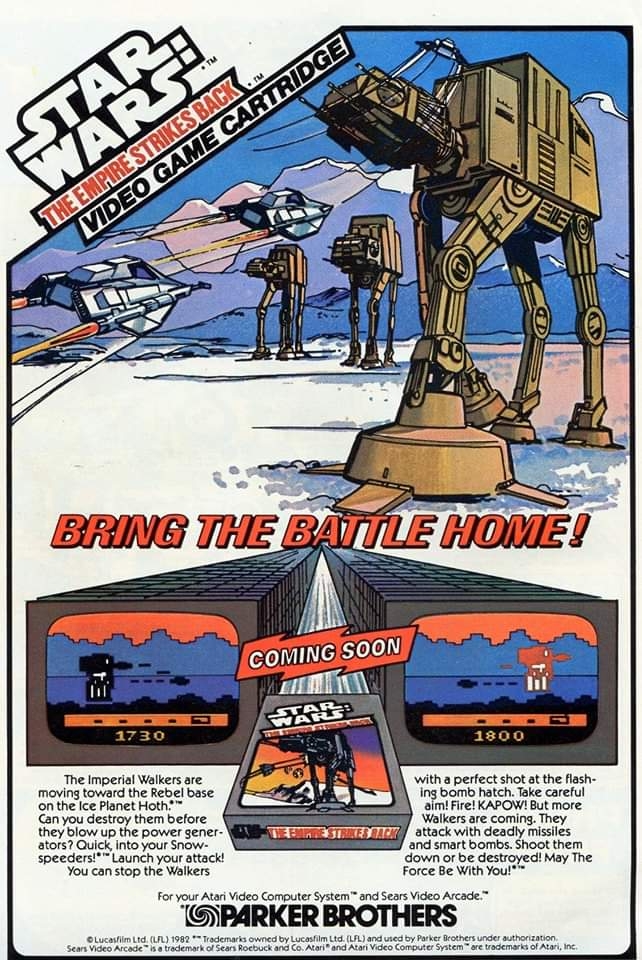
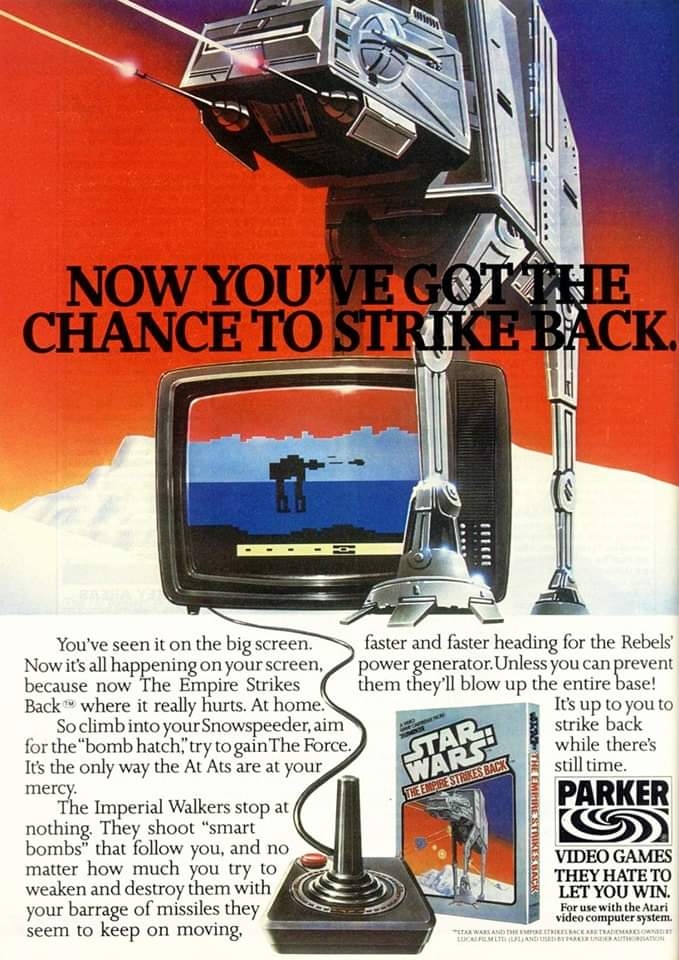
Even during its early years under George Lucas, the Star Wars entertainment franchise made its way into video games due to its massive popularity and Parker Brothers really made moves to cash in. This resulted in the Atari 2600 video game adaptation (1982) of The Empire Strikes Back which focused mainly on the memorable Hoth battles between Rebel fighters and the Empire’s AT-AT walkers. Parker Brothers came up with two print ads and each had a different visual concept: one had nicely drawn art along with two screenshots shown while the other had painted art of the AT-AT while showing the Atari joystick. These old print ads still look great and exciting.
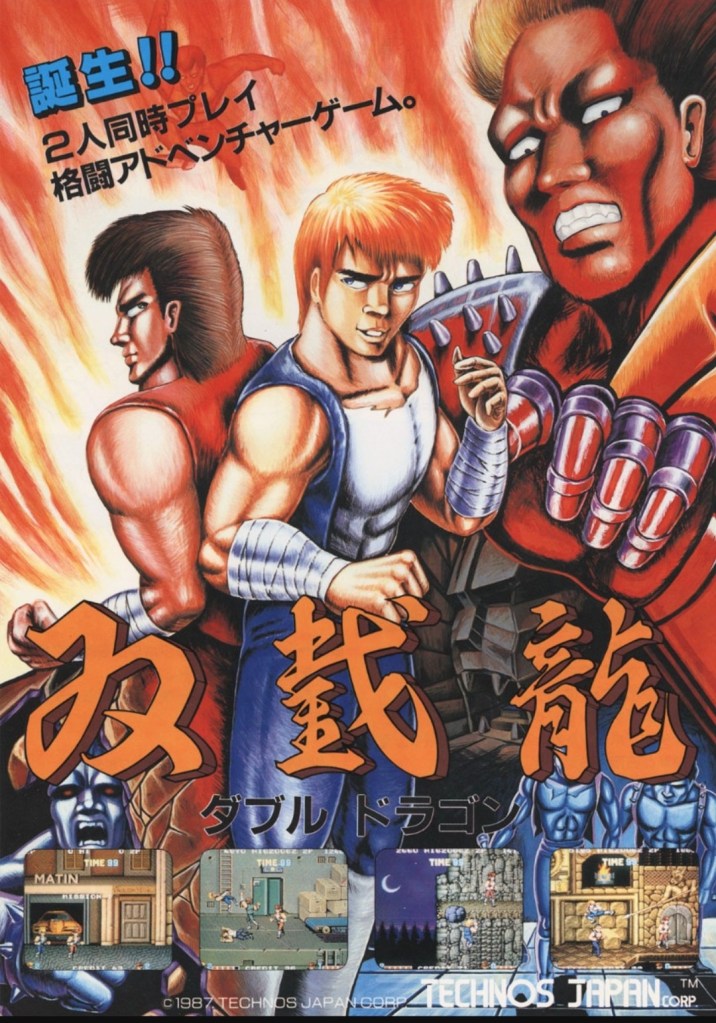
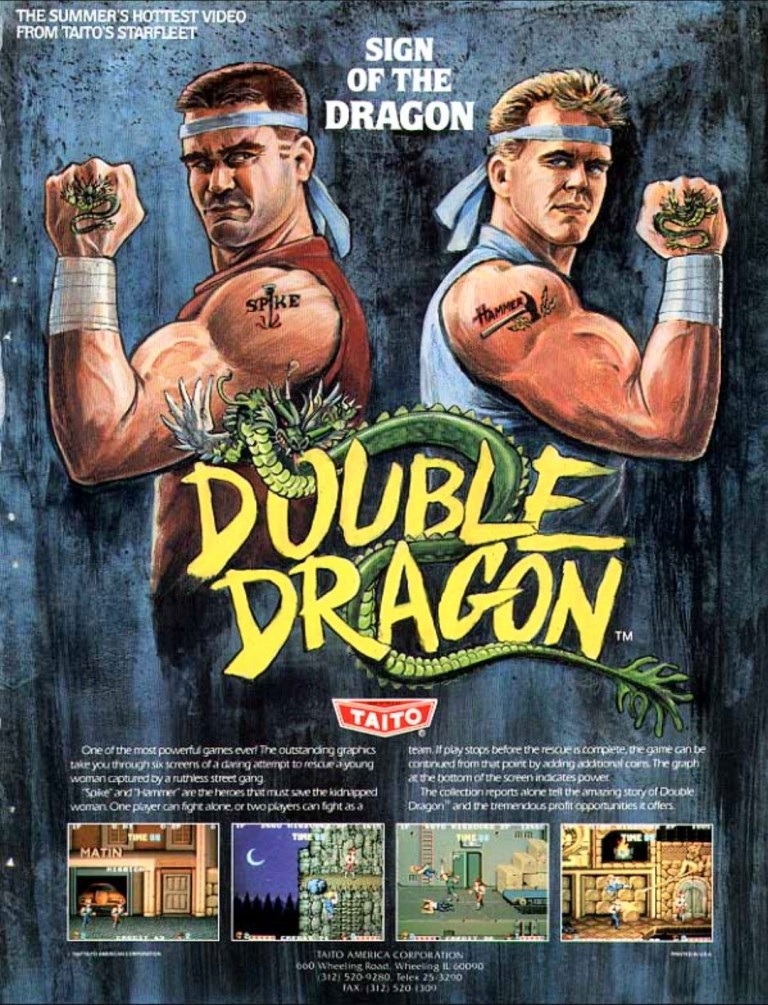
2. Double Dragon Japanese and North American arcade flyers
If you read manga (Japanese comics) in Japan, then the art style of this arcade flyer should look familiar to you.
The character designs seem inspired by 1980s Hollywood action cinema.
Released in 1987, Double Dragon became a huge hit in the arcades of Japan, America and Europe resulting in financial gains for developer Technōs Japan and publisher Taito. What I find intriguing was the fact that the Double Dragon arcade flyers for Japan and North America had drastically different art styles used to promote it. The Japanese flyer had art style that is more common with manga while the North American had artwork that seemed inspired by Hollywood action movies (as well as the rise of martial arts films in America during the 1980s). The American flyer even had the two characters identified as Hammer and Spike and they both looked American. This is a classic example of using different approaches to promote a game in each market.
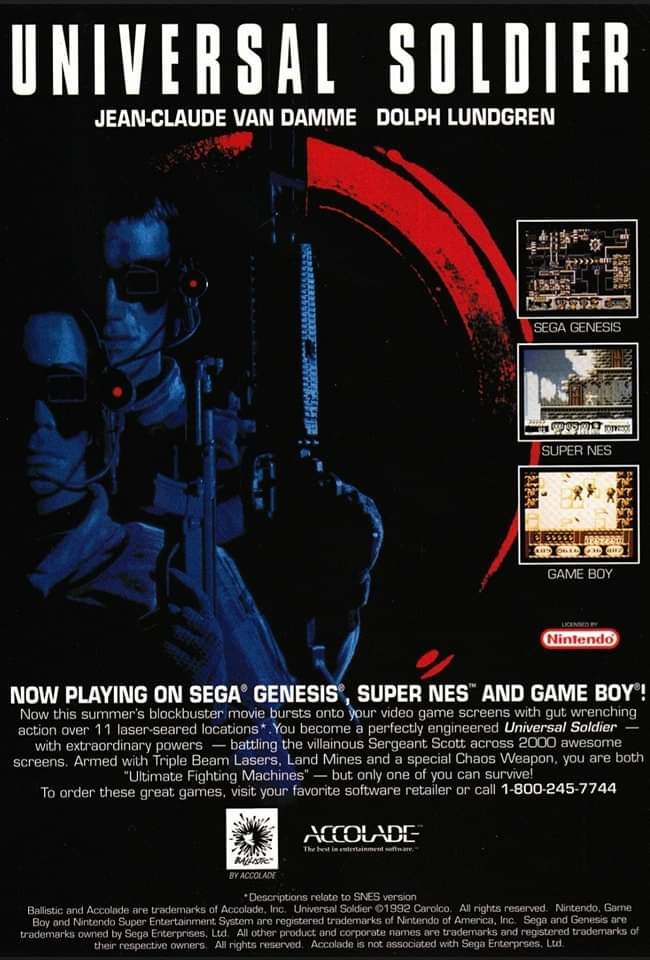
3. Universal Soldier print ad
The people who made this print ad made sure to use the names of the stars to help sell the game.
Even though its worldwide ticket sales did not reach $100 million, the 1992 movie Universal Soldier still caught a lot of attention from moviegoers simply because it had Jean-Claude Van Damme and Dolph Lundgren as the stars. Unsurprisingly, the movie had a video game adaptation and because publisher Accolade wanted to cash-in on the film’s hype, they made some deceptive moves by rebranding one of its games (already development) as a tie-in. Advertised as an official adaptation, Universal Soldier was actually a rushed conversion of Turrican II: The Final Fight. This print ad – which even showed the stars’ names – is a reminder of the deception Accolade pulled off.
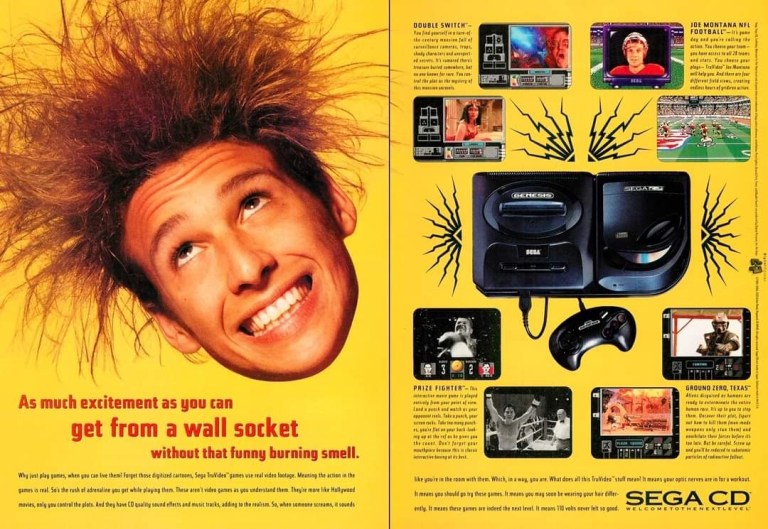
4. Sega CD print ad
Do you find this Sega CD print ad hilarious?
When Sega was making waves with its Sega Genesis (Sega Mega Drive in Japan), the company was quick to react to the growing use of the compact disc (CD) format as a useful storage medium for video games. The Sega CD (Mega CD in Japan) was released as an add-on device to work with the Genesis console and Sega’s American team came up with a series of promotions. This print ad is just one of the promotions and ad makers came up with a “crazed” or “electrified” gamer dominating one page while showing the Genesis, the Sega CD and screenshots of games (running on CD) on the other page. By today’s standards, the Sega CD print ad is funny and catchy to look at.
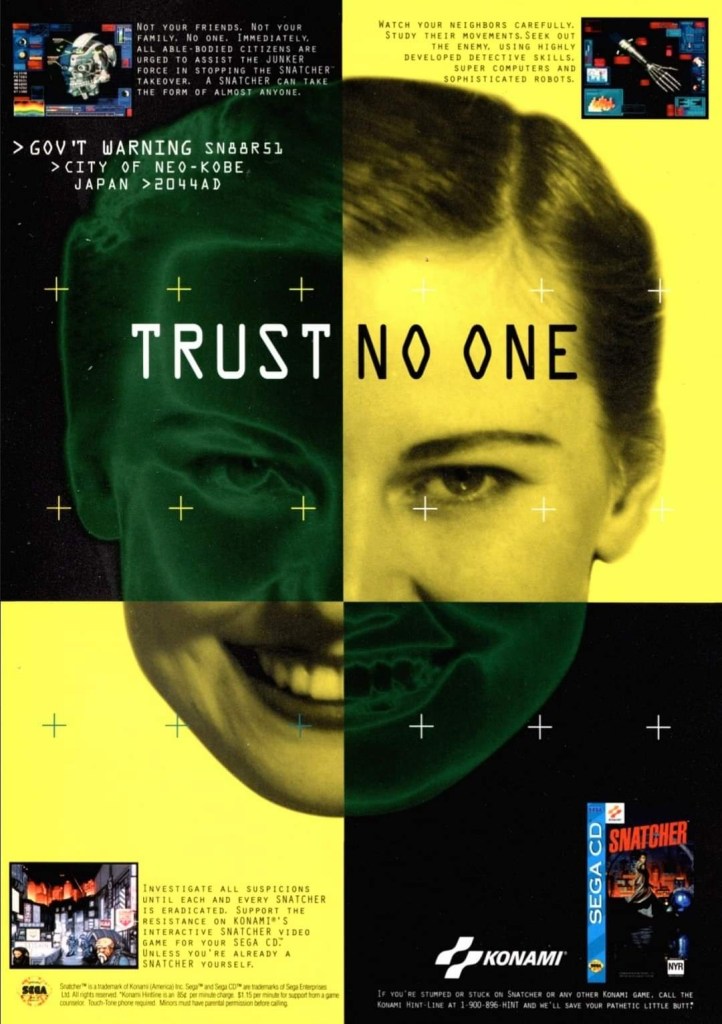
5. Snatcher for Sega CD print ad
I find this Snatch print ad looking odd. The ad makers could have done more to focus on the game itself.
First released in Japan in 1988, Snatcher was a cyberpunk visual adventure game that was one of the early works of the famous Hideo Kojima (Metal Gear series). Due to its design and approach on visuals to tell a story, it was not surprising that a Sega CD version of it got released in 1994. To promote the game to the growing number of North American Sega CD gamers at the time, Konami came up with this rather unusual print ad showing the face of a smiling lady dominating the space leaving little room to show the screenshots and the game’s cover. The visual concept is engaging but it takes effort to notice it was promoting the Sega CD version of the video game. This old ad would have worked better had the ad makers increased the sizes of the screenshots and the game cover.
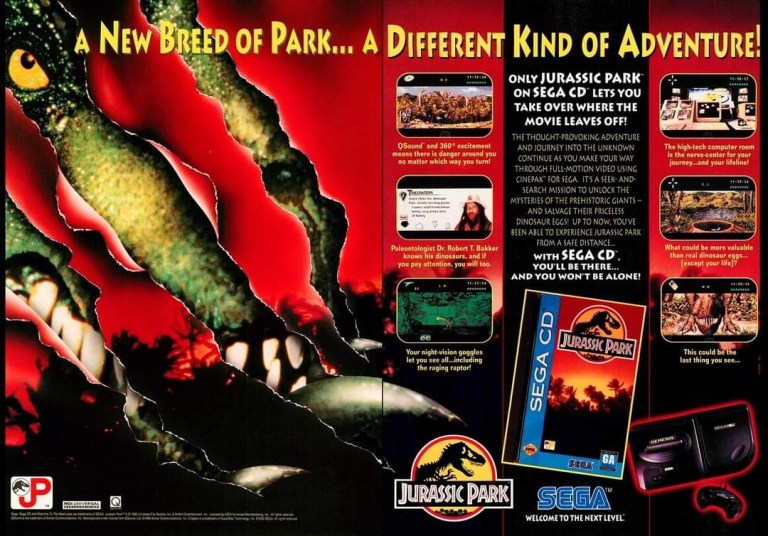
6. Jurassic Park for Sega CD print ad
Does the T. Rex look scary to you?
As part of its drive to add more games to the Sega CD add-on and help it sell more units, Sega acquired the Jurassic Park license and went on to produce an adaptation utilizing the technological features of the Sega CD. To aggressively promote the game, Sega came up with this print ad that had a Tyrannosaurs Rex (looking through spaces) on one page and then several screenshots plus text descriptions on the other. For a click-and-point Jurassic Park game, this ad was really exciting and intriguing to look at.
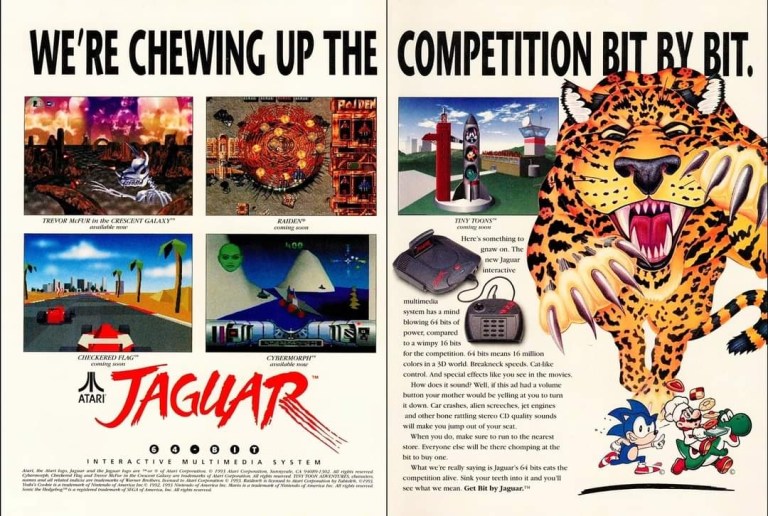
7. Atari Jaguar print ad
This was indeed an eye-catching ad.
In the early 1990s, Atari made an aggressive move to compete in the arena of video game consoles which they used to dominate from the late 1970s until 1983. This time around, they came up with the Jaguar console which had some pretty advanced technologies for the time. As part of their North American marketing campaign, Atari unleashed an ad showing game screenshots on the first page and huge artwork of a jaguar coming after Sonic, Mario and Yoshi (mascots of Sega and Nintendo respectively) symbolizing that the Atari Jaguar had more power and better technology than the Genesis and the Super Nintendo Entertainment System (SNS). While it was engaging to look at early on, this print ad is now an embarrassment as the Jaguar console failed terribly. Lastly, the marketing of the Jaguar as a 64-bit machine was never real.
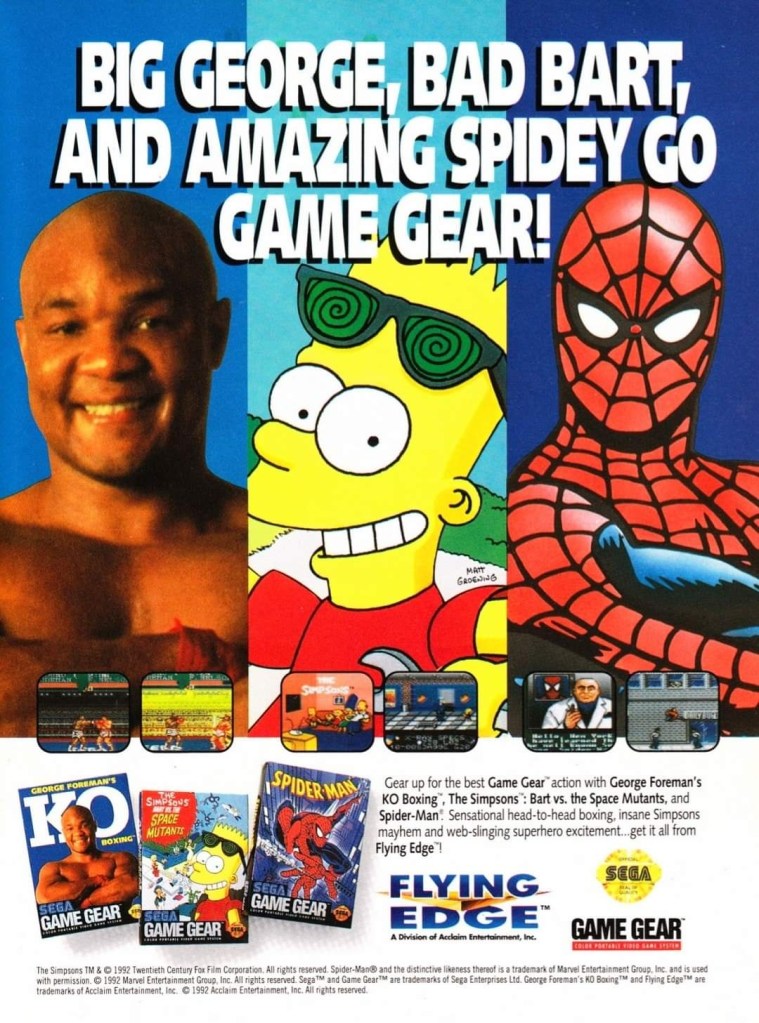
8. George Foreman, The Simpsons and Spider-Man Game Gear print ad
This ad appeared in a lot of comic books in the 1990s.
In the early 1990s, Sega released the Game Gear handheld gaming device which instantly placed them in competition with Nintendo’s Game Boy. Through its Flying Edge label, Acclaim Entertainment promoted George Foreman’s KO Boxing, The Simpsons: Bart vs. the Space Mutants, and Spider-Man for the Game Gear hoping to sell well. This 3-game print ad highlighted the popular figures who had a lot of space for attracting attention. The ad maker managed to insert two screenshots per game, the game covers and a text description to inform consumers what they were being offered. A good ad to look at.
9. Time Gal for Sega CD print ad
The presentation here looks nice but Time Gal herself looked like she was drawn by a different artist.
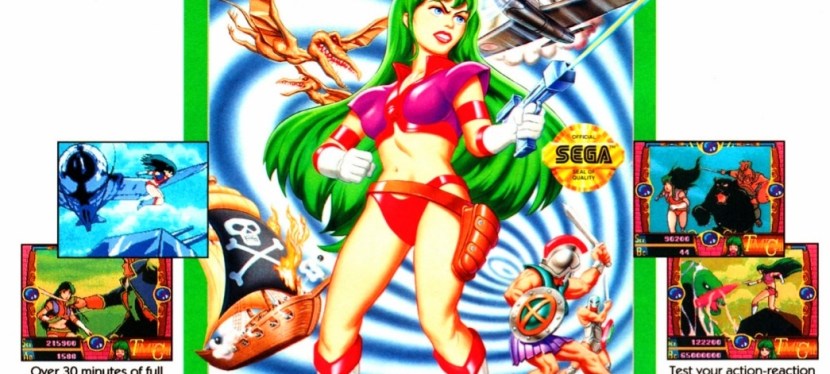
Originally released in the arcades in Japan in 1985, Time Gal made its way to the Sega CD add-on in the early 1990s. It was a highly unusual video game as it was an interactive movie (with lots of anime footage) made with the use of Laserdisc technology for its arcade version. It played lots of anime scenes and players must choose the on-screen options to execute the character’s next action in order to progress. For the Sega CD version for North America, this print was made to capture the attention of consumers using the protagonist’s sex appeal on the cover art with four screenshots placed on the sides to show what to expect. I noticed that Time Gal on the cover art looked different from how she appeared in the anime sequences. At least the ad makers tried hard to sell the game.
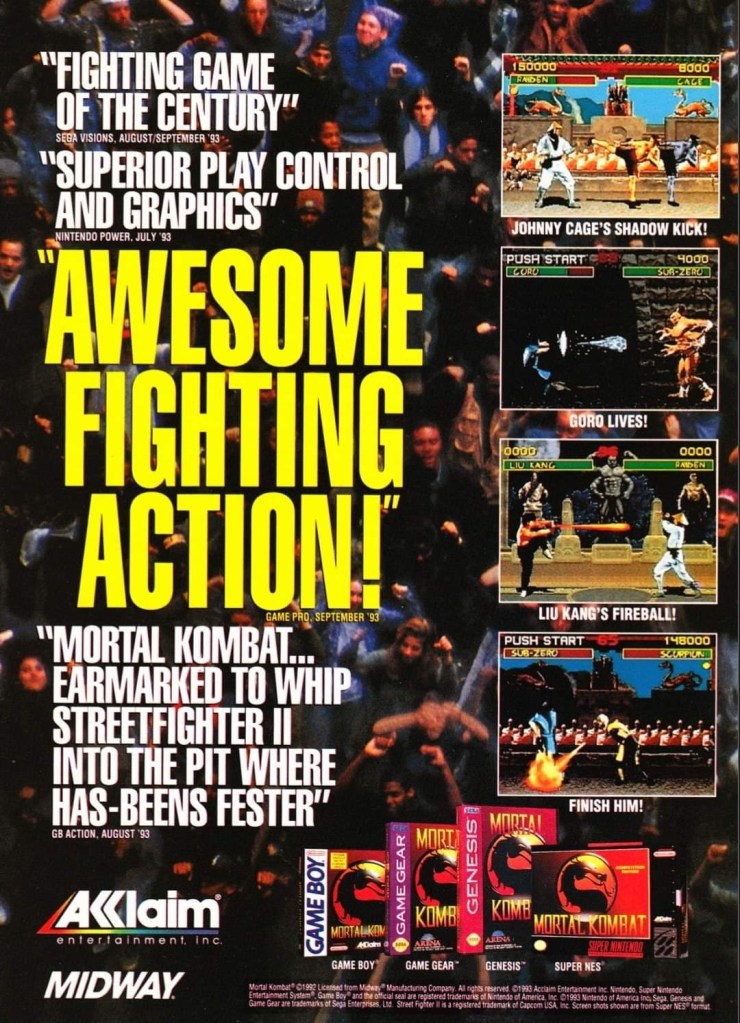
10. Mortal Kombat print ad
Still an effective ad to promote a blockbuster game and make people informed it was coming to multiple platforms.
Considering how successful it was in the arcades, the 1993 release of Mortal Kombat for game consoles and handhelds was unsurprisingly highly anticipated and publisher acclaim came up with this single-page ad. The presentation involved the use of a photographic background of many spectators (to emphasize excitement and popularity), media quotes and screenshots to effectively promote the game.
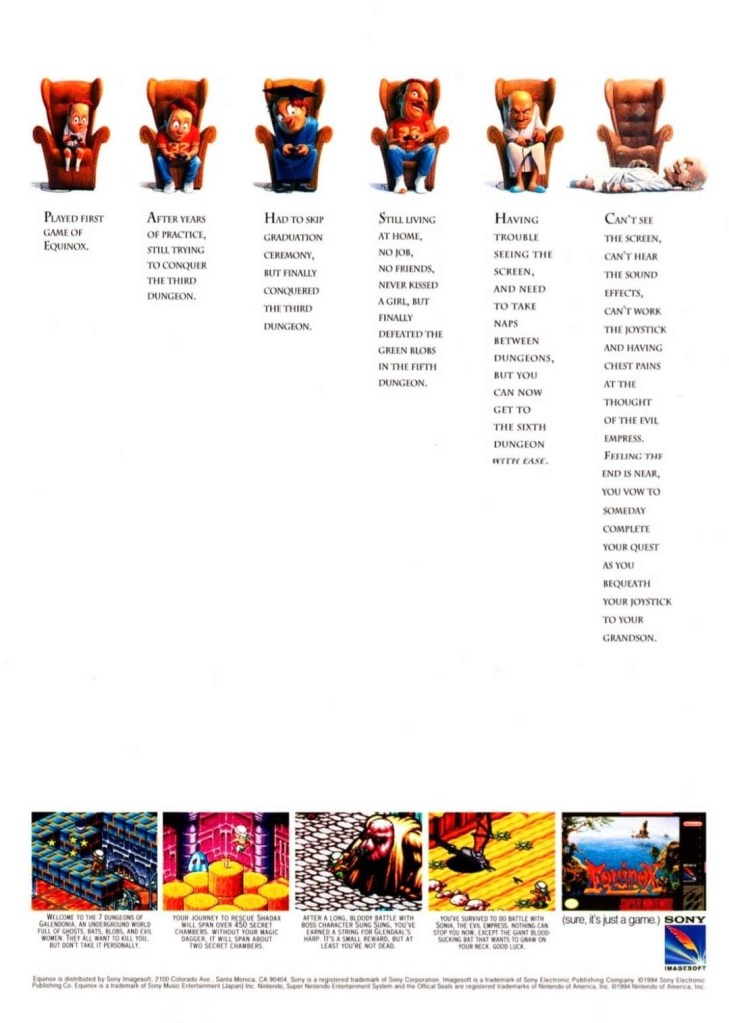
11. Equinox print ad
Take a close look. Tell me if you find it funny.
I never played Equinox but I heard the loud buzz about its design as a 3D isometric game that had elements of exploration, platform play and puzzle solving. The people responsible for this print ad emphasized the concept that the game is so addicting to play, players will still play it as they get older. This ad has a subtle yet effective approach with humor.
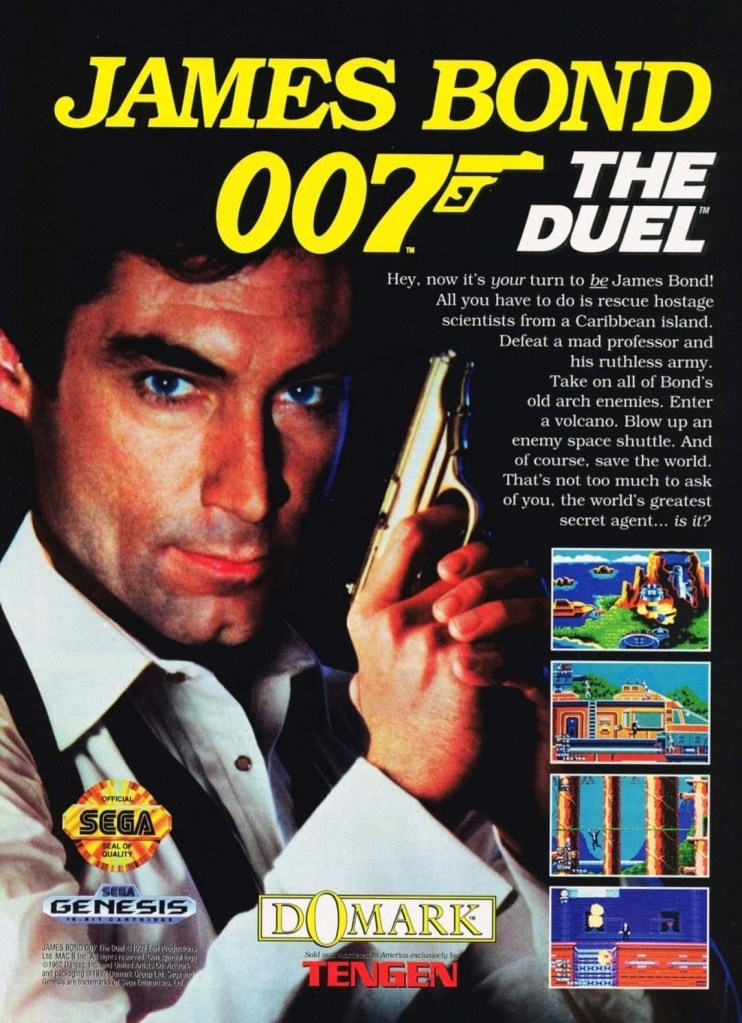
12. James Bond 007: The Duel print ad
Timothy Dalton’s image as James Bond was sourced from Licence to Kill for this game’s ad.
Here is another decades-old James Bond video game print ad I found. Released a few years after Licence to Kill, James Bond 007: The Duel was notable not for its gameplay nor game design but for the fact that it used the image of Timothy Dalton as 007 for its print ad and the opening scenes in the game itself. Dalton’s Bond image here was never new nor originally taken for the game as it came directly from Licence to Kill’s publicity library. Each time I saw this ad, I was only reminded of the 1989 movie which I still enjoy watching.
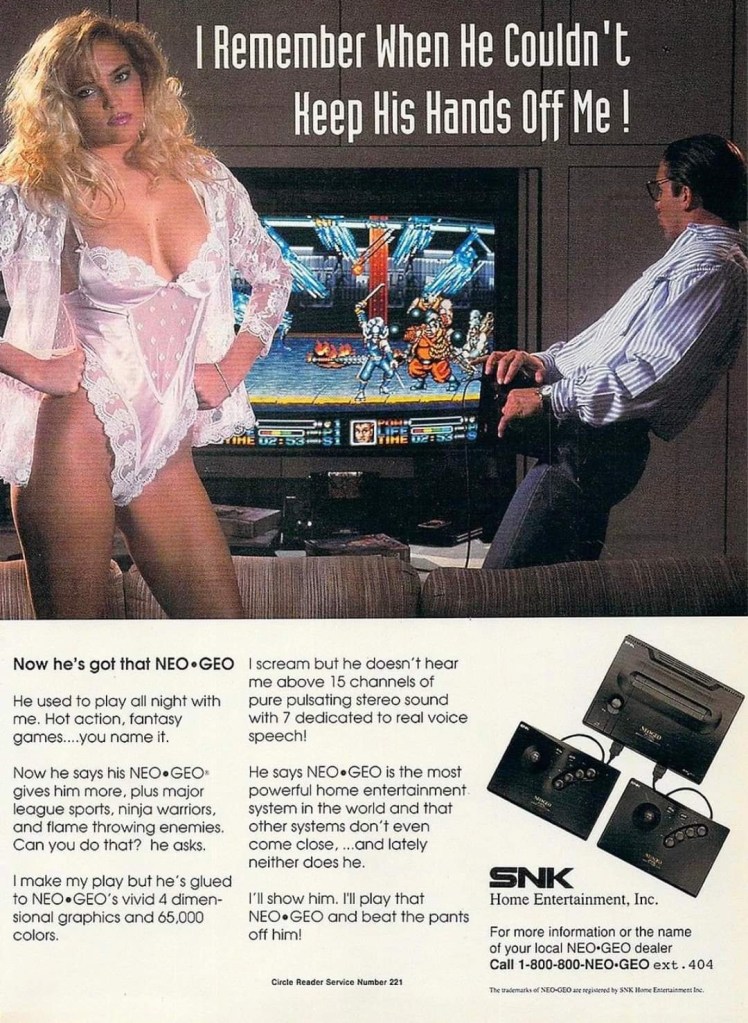
13. Neo Geo AES console print ad
Do you find this ad both sexy and funny?
Decades ago, SNK made a huge splash in the arcades with lots of really fun games released with their Neo Geo (stylized as NEO GEO) hardware. In 1990, they released the cartridge-based Neo Geo AES console in Japan and America and it carried the same technology as the arcade hardware. To promote the console in North America (note: the Neo Geo console and its games were very expensive), SNK came up with this catchy and funny print ad showing a sexy woman feeling annoyed that her man spends more time with Neo Geo gaming than with her. This was a clever way of emphasizing the arcade-perfect experience in the comfort of home, and it was funny to look at.
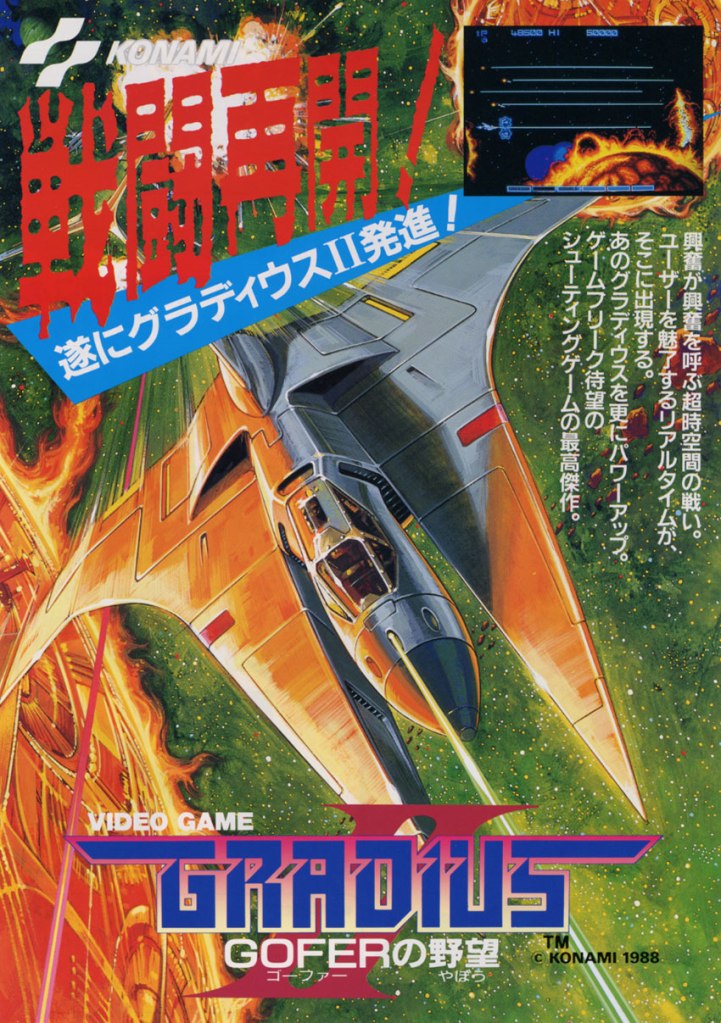
14. Gradius II Japanese arcade flyer
Great looking painted art was used for this 1988 arcade game.
Since the original Gradius was a big hit in arcades in Japan in 1985, it was not surprising that Konami released Gradius II three years later. With regards to the use of painted art, the artist showed the game’s spaceship in a dominating position emphasizing high-speed travel and excitement. The image, which also looks more colorful, is a complete reversal of the painted art used in the flyer of the previous which showed the rear of the spaceship as it moves towards a larger spaceship (the opposition). This arcade flyer art still looks great as it has a timeless charm.
Disclaimer: This is my original work with details sourced from reading the comic book and doing personal research. Anyone who wants to use this article, in part or in whole, needs to secure first my permission and agree to cite me as the source and author. Let it be known that any unauthorized use of this article will constrain the author to pursue the remedies under R.A. No. 8293, the Revised Penal Code, and/or all applicable legal actions under the laws of the Philippines.
Welcome back comic book readers, 1990s arts and culture enthusiasts, movie fans and comic book collectors! Today we go back to the year 1992 to take a close look at the official comic book adaptation of the action movie Universal Soldier.
Universal Soldier stood out among Hollywood action films in 1992 as it had Jean-Claude Van Damme and Dolph Lundgren as the main stars and both of them were established action movie stars each with huge followings of fans. As it grossed almost $100 million worldwide on a budget of less than $25 million, the movie was successful and eventually sparked its of franchise of movies, TV shows, video games and comic books. NOW Comics was in-charge of making and publishing the comic book adaptation of the 1992 film.
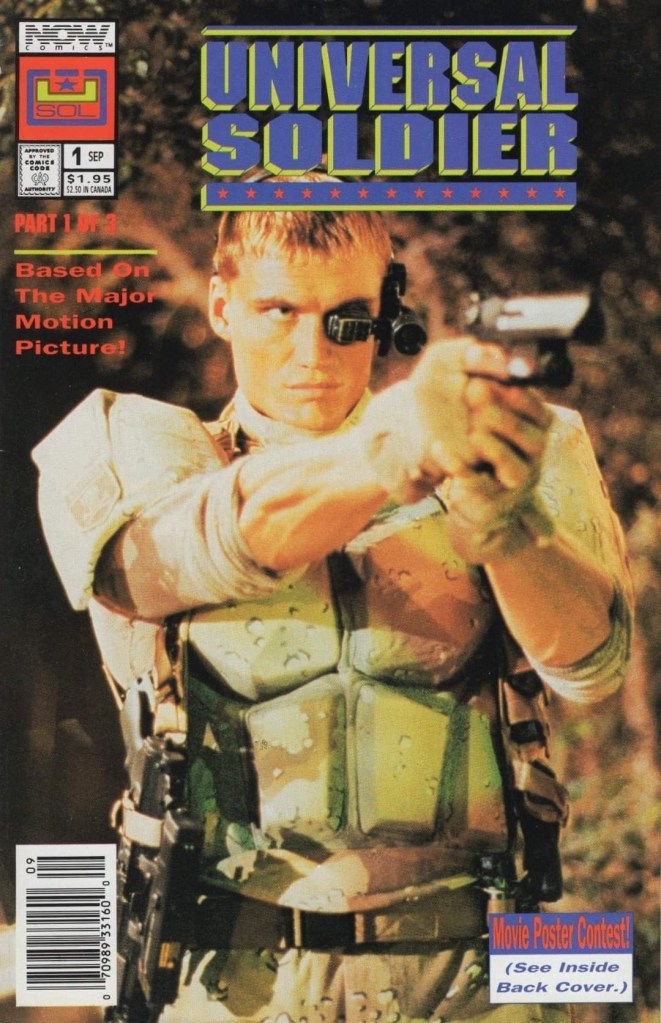
With those details laid down, here is a look back at Universal Soldier #1 published in 1992 by NOW Comics with a story written by Clint McElroy and drawn by Lenin Delsol. This was the first chapter of a 3-issue mini-series.
The cover showing a photographic image of star Dolph Lundgren.
Early story
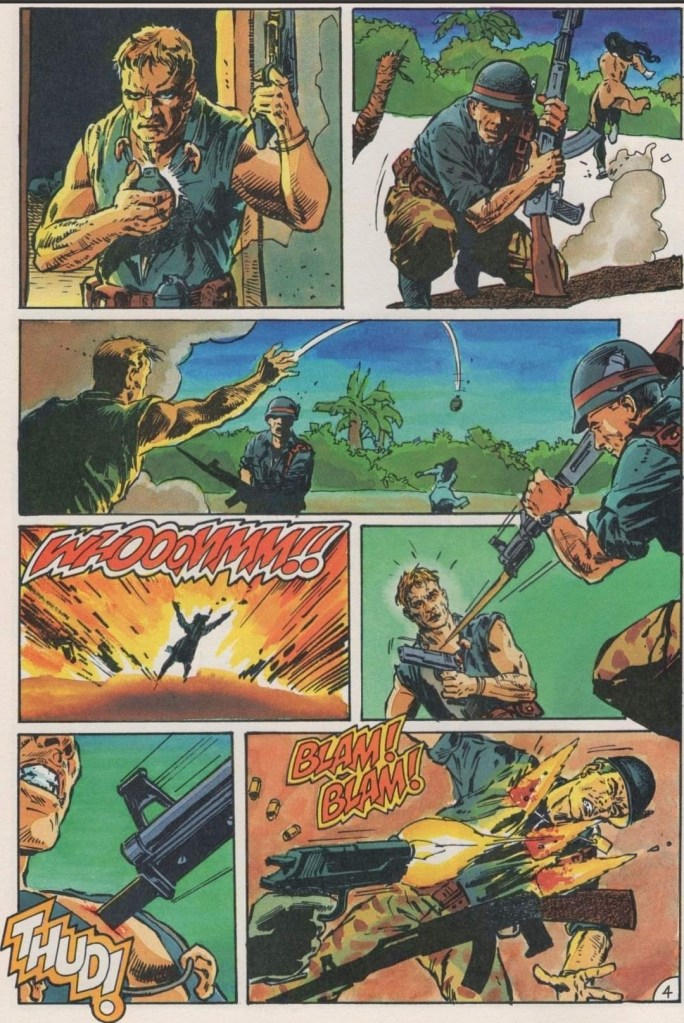
The story begins in Vietnam in 1969. The American soldier Luc Deveraux arrives at a village that was secured by the U.S. Army. To his shock, he finds several dead bodies of his squad members and villagers, then encounters Sergeant Andrew Scott with two Vietnamese individuals (male and female) tied together near him. It turns out that Scott, who made a necklace composed of severed ears, has gone insane and executes the Vietnamese man. As Deveraux refuses to follow Scott’s order to shoot the Vietnamese female, the sergeant kills he. Deveraux and Scott shot each other to death and eventually their corpses were recovered by another squad to be cryogenically frozen.
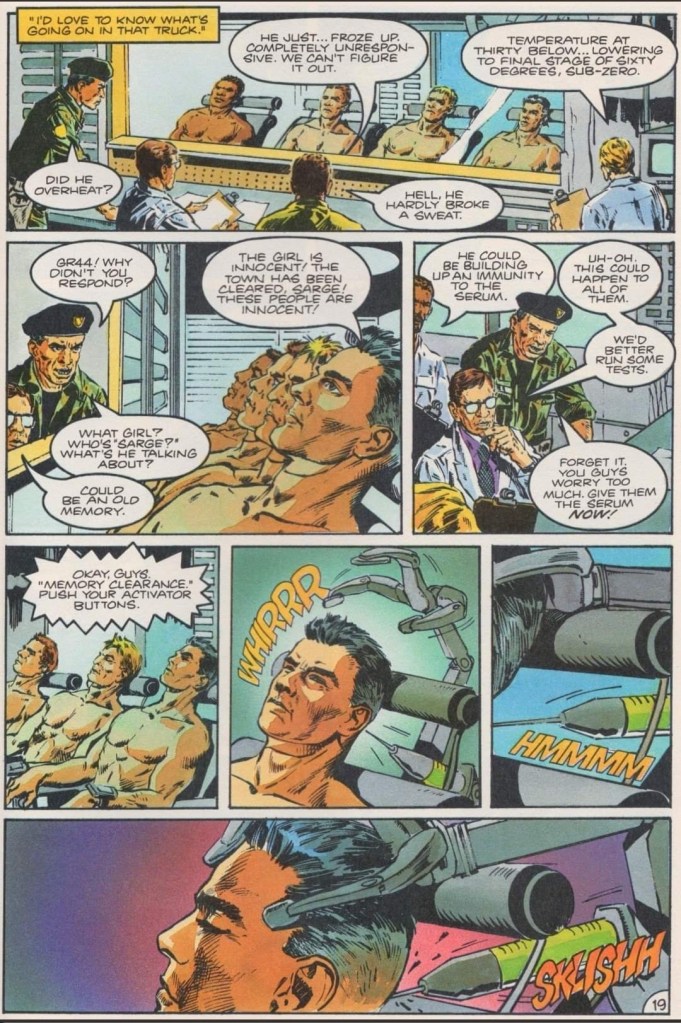
A few decades later in Nevada, the elite counter-terrorism unit of the UniSol (Universal Soldier) arrives and among the members are Deveraux (identified as GR44) and Scott (GR13) who have been reanimated by the government with their past memories fully suppressed. Their team gets deployed to the Hoover Dam (Mackinley Dam in the comic book) to resolve a hostage situation…
Quality
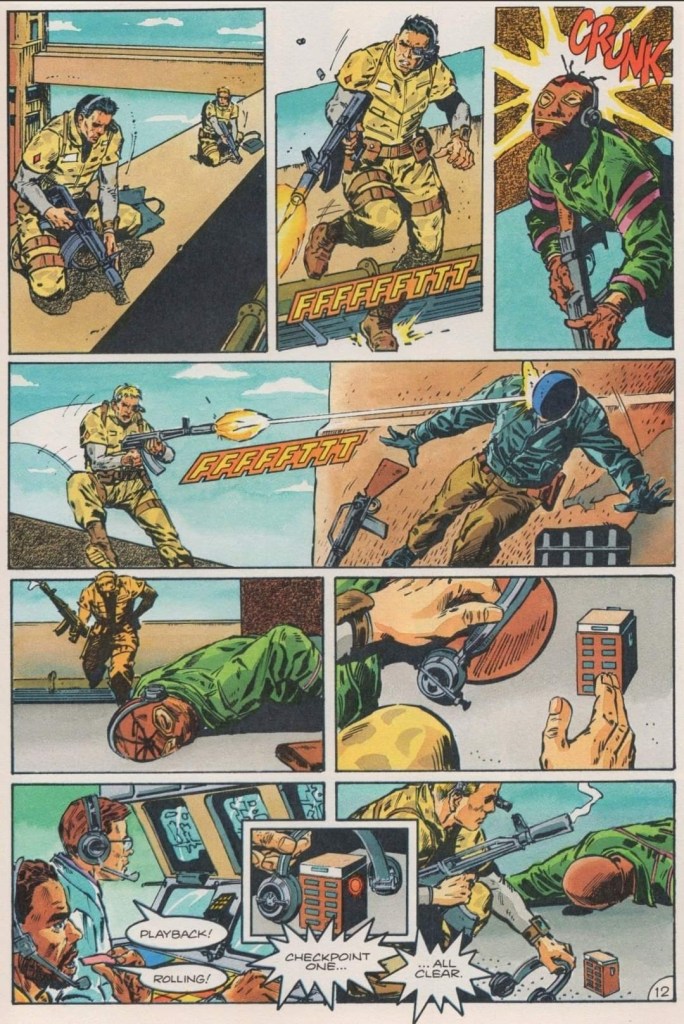
Operating very much like robots, two Universal Soldiers take down terrorists and manipulated their communication as they make their way through to save the hostages from the remaining terrorists.
As an adaptation, I find this comic book a surprisingly accurate translation of the movie’s early part of the story (note: the literary narrative ends when Deveraux leaves with the female reporter). While not 100% of the film’s plot and visual details were captured, this comic book still succeeded in replicating the look, feel and tone of the movie. It is clear that the comic book team had access to the footage of the film and a copy of the screenplay (written by Richard Rothstein, Christopher Leitch and Dean Devlin).
Clint McElroy really stuck close to the film’s plot, the dialogue and the way the characters were portrayed. Again, not 100% of the relevant details were adapted and some liberties were taken but McElroy managed to craft a comic book narrative that was solidly structured, had sufficient details to keep readers oriented and engaged, and ensured the story moved at a satisfying pace. By the time I reached the end of this comic book, I got oriented with the story, the characters and the details shown in between.
Like in the movie, this comic book emphasizes the government’s very cold and heartless approach on handling their Universal Soldiers who are treated more like tools instead of people.
Lenin Delsol’s artwork here is really good. It is clear that he had access to the film’s production footage as several images of locations and characters here very closely resembled what was shown in the movie most of the time. When it comes to the action scenes, Delsol did not go for visual dynamism (note: the dynamic action style was common with superhero comics of the 1990s) but rather he portrayed the action with realism and varying degrees of brutality.
When it comes to visualizing the characters, it is clear that the creative team was not authorized to use the likenesses of the actors. Luc Deveraux looks absolutely nothing like Jean-Claude Van Damme while journalist Veronica Roberts does not look like Ally Walker. Ironically, there are a few images of Scott’s face that somewhat resembles Dolph Lundgren. The way I see it, it is not problematic to see the characters not resembling the actors from the film. In fact, I like the new character designs Delsol came up with for the characters.
Conclusion
This early scene sets the tone of the entire comic book. As for the characters, Deveraux look nothing like Jean-Claude Van Damme and Sergeant Scott does not look like Dolph Lundgren (note: in other images of Scott shown later in the comic book, he looked a bit like the actor).
Even though I was not a fan of the 1992 movie, Universal Soldier #1 (1992) succeeded in keeping me engaged and entertained until the end. This is a really good adaptation of the early part of the film and I like the approach the Elroy-Densol team took on establishing the literary experience. Of course, if you want more dynamic visuals of the Hoover Dam scene or if you want that strong rated-R vibe when it comes to hard action, you should watch the movie. As of now, I am convinced to look forward to the next issue of this 3-part mini-series adaptation.
Overall, Universal Soldier #1 (1992) is recommended.
I can say it out loud that Aquaman, directed by James Wan (Furious 7), is easily one of the most thrilling superhero movies I’ve seen and it sure came fully loaded with a lot of fun. This is a great development on the part of Warner Bros. as it pushed to salvage and improve its DC Comics lineup of big budget superhero movies with executive Walter Hamada leading the DC Comics movie productions. I can say that Aquaman is a clear sign that the current DC Comics cinematic universe is moving away from the dark and gritty vision implemented by director Zack Snyder with 2013’s Man of Steel.
Not clear enough for you? Consider the fact that Aquaman made over $1,000,000,000 in ticket sales worldwide. Aquaman himself is not part of DC Comics trinity (Wonder Woman, Batman and Superman) and yet the character memorably played by Jason Momoa proved to be attractive to moviegoers around the world.
Firstly the story emphasizes very relevant themes like Aquaman’s origin as the human creation of a man living in the surface and of a woman who is the queen of the underwater kingdom of Atlantis. There is also attention paid to Aquaman’s heritage in the royal family, his being a half-breed made an issue on royalty, and most of all his destiny. Behind the superhero’s struggles is the conflict and light political developments concerning the underwater kingdoms laced with some elements of real world aquatic pollution caused by humans and industrial players.
For the most part, the plot manages to remain solid from start to finish and there was not a single moment where I felt lost. The movie follows Aquaman and his interactions with Mera, Black Manta and others then takes its time focusing on the underwater kingdom’s stakeholders and how their decisions affect each other. The pacing moves from moderate to fast for the most part and because there were a lot of thrills and surprises, there were never a dull nor a sleepy moment for me when I saw the film.
Performances
Actor Jason Momoa clearly was born to play Aquaman and in terms of talent he proves to be not only very capable with the action scenes but also successfully bring the DC Comics superhero to life on the big screen while still being able to perform comedy smoothly. In fact when it comes to on-screen superhero humor, I would say that Momoa is comparable with Robert Downey, Jr. (Iron Man) and I am not exaggerating here.
Then there is Mera memorably portrayed by Amber Heard. As soon as she first appeared in the film, Mera’s importance becomes hard to ignore and with regards to both screen time and interaction with Aquaman, Mera is easily the 2nd lead of the film. Because Amber Heard’s character had a lot of screen time and proved to be almost as important as the titular superhero, sometimes I felt the movie should have been titled Aquaman and Mera. Amber Heard clearly is very talented as she not only excelled with the action scenes but also emphasized Mera’s intelligence, courage and emotional range very nicely on screen.
Then there are the supporting players. Nicole Kidman’s role as the mother of Aquaman is probably the most significant supporting character performance in any of the recent DC Comics movies in recent years. Patrick Wilson delivered a very solid performance as the power-hungry brother of Aquaman while Dolph Lundgren and Willem Dafoe both played wise old men and added nice variety to the film’s strong cast. Yahya Abdul-Mateen II meanwhile was a surprising good performer even though his presence as Black Manta did not register enough screen time. I have this feeling that Black Manta will be more prominent in a future movie.
Presentation
I must say that Aquaman is indeed an epic superhero movie laced with many elements that defined Star Wars and Indiana Jones. Sure we get to see Aquaman’s development and his connection with the underwater kingdom but director James Wan and the screenwriters ensured that the movie has more than enough variety to keep moviegoers engaged. They were indeed successful.
There are key parts of the film where I felt like I was watching an Indiana Jones-inspired adventure complete with changes of interesting locations. The big battle build-up in the 3rd act reminded me a lot about Star Wars which I found intriguing and even engaging at the same time. To lighten the mood, humor and romantic comedy (nicely done between Mera and Aquaman) provided nice relief to us moviegoers.
When it comes to spectacle, this movie delivered tons of great visual stuff (great art direction by the way) complete with many moments of fast-paced, high-intensity action! Hard action, energy blasts, weapon combat, fast rides, monster encounters, the smashing of walls, the explosions and stunts really filled up the screen many times and the energy behind them all made it very hard for anyone to get bored when watching the film. It rivals Michael Bay’s Transformers on on-screen spectacle but it never felt brainless to me.
Director Wan, whose most successful movie is Furious 7, really knows how to entertain moviegoers and give them a lot of fun in return for the money they paid to watch the film. Thanks to Wan and his creative team, Aquaman is the most action-packed, most thrilling and visually stunning movie of the current DC Comics cinematic universe (formerly called DC Extended Universe or DCEU) and in some ways its epic presentation even rivals that of Avengers: Infinity War. I think James Wan should be hired for a future Justice League movie.
The music? Rupert Gregson-Williams did a solid job on making the movie lively to the ears and he succeeded on keeping up with the film’s epic concept. Gregson-Williams, by the way, also scored the music for the acclaimed Wonder Woman movie. The most memorable song in the movie is undoubtedly Everything I Need which was greatly performed by Skylar Grey. That song was truly perfect to end the film with and I remember its impact inside the theater. When it started playing, I simply stayed on my seat enjoying the song while waiting for the mid-credits scene to play.
Overall
The way it was made, Aquaman is easily one of the best superhero movies ever made as the combined talents of director Wan, the creative team and the actors fused a lot to create cinematic greatness. This movie has strong characterization, a solid story, strong performances from the actors and tons of spectacle to enjoy. Speaking of enjoyment, I strongly recommend watching Aquaman on the IMAX screen as the visual spectacle really was immersive.
I don’t know with you guys but I am already anticipating Aquaman on Blu-ray disc.
Thank you for reading. If you enjoyed this article, please click the like button below and also please consider sharing this article to your fellow comic book geeks and Aquaman fans. Also my fantasy book The World of Havenor is still available in paperback and e-book format for you to order.
Author’s Note: This article was originally published at my old Geeks and Villagers blog. What you read on this website was an updated and expanded version. In other words, this newest version you just read is the most definitive version.




 Author Carlo Carrasco