Retro Gaming Ads Blast – Part 21

Welcome back readers, fellow geeks and electronic gaming fans!

In this edition of the Retro Gaming Ads Blast (RGAB) series, we will take a look at another batch of retro gaming print ads – including arcade flyers – from the 1980s and 1990s.

For the newcomers reading this, Retro Gaming Ads Blast (RGAB) looks back at the many print ads of games (console, arcade, computer and handheld) that were published in comic books, magazines, flyers, posters and newspapers long before smartphones, social media, the worldwide web and streaming became popular. To put things in perspective, people back in the 1980s and 1990s were more trusting of print media for information and images about electronic games and related products.

With those details laid down, here is the newest batch of retro gaming print ads for you to see and enjoy…

1. Galaxian for Atari print ad
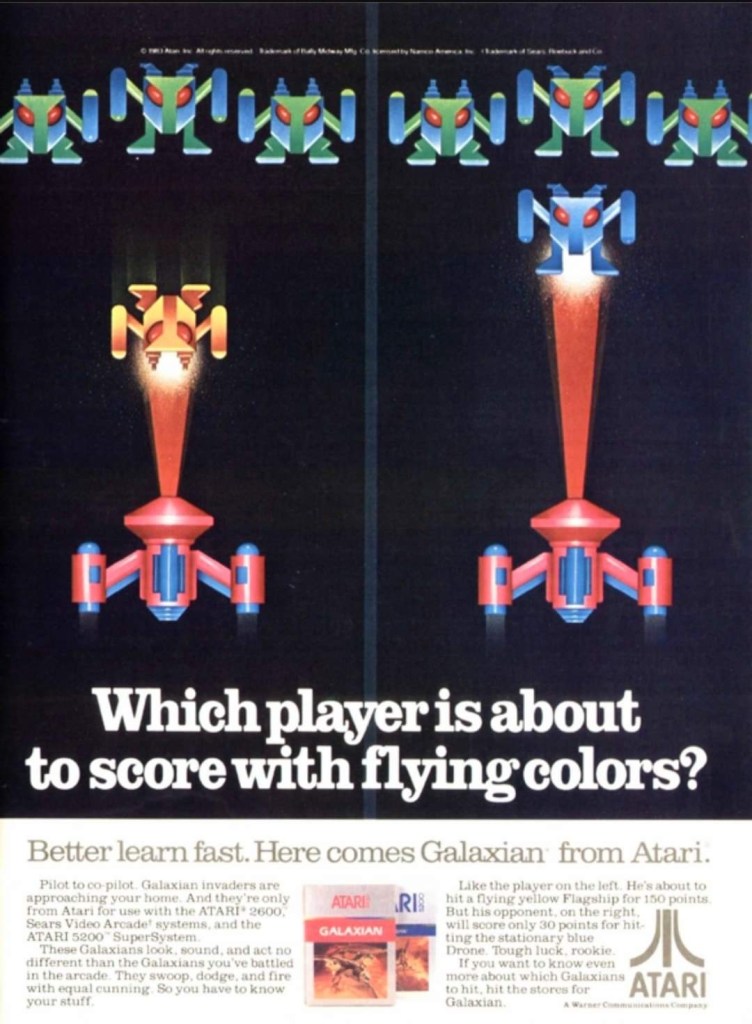
A unique approach to the art done by the advertisers.

Developed by Namco, Galaxian was a 2D sci-fi shooter that debuted in arcades in 1979. It was so successful and widely acclaimed, it got ported to varied game consoles and home computers as the years passed by. For its release on the Atari 2600 and Atari 5200, this print ad was created to catch the attention of fans and gamers by utilizing artwork that resembled the look of 2D sprites from the game. That being said, no screenshots of Galaxian on the Atari consoles were shown because the artwork used looked detailed and were attention-grabbing already.

2. 1943: The Battle of Midway arcade flyer
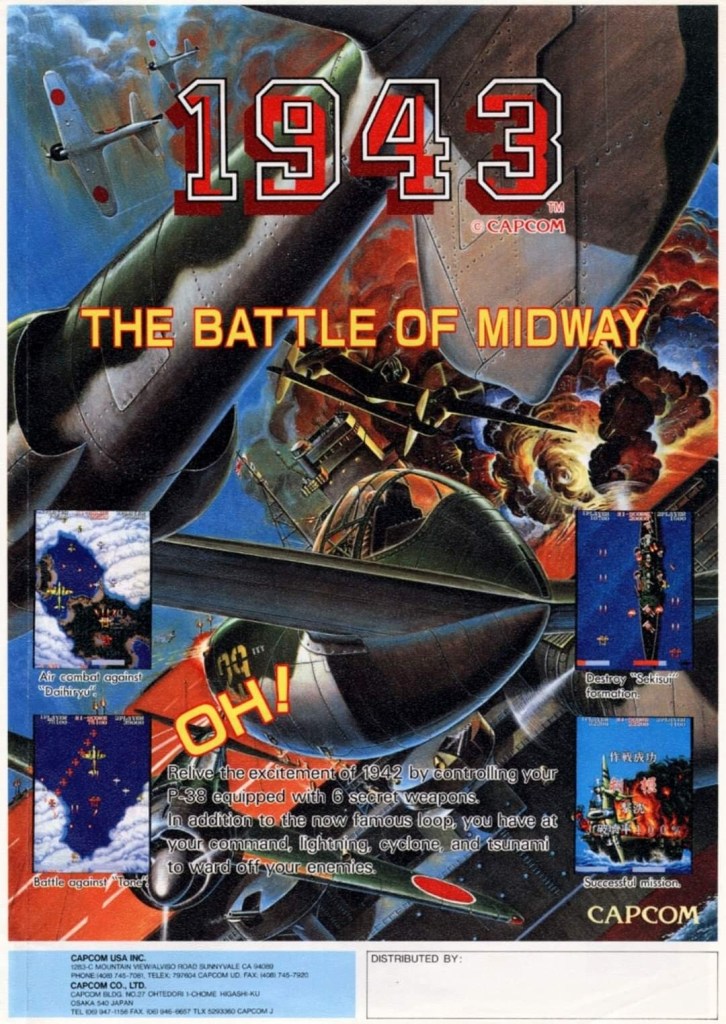
This is a fine looking flyer.

In 1987, Capcom released in the arcades 1943: The Battle of Midway which was their follow-up to 1942. The arcade flyer itself was designed to strongly promote the game using a combination of screenshots, short-but-clear text descriptions and the great looking piece of artwork which really emphasized the World War II concept. Behind it all, this game was made by Japanese developers with the Western markets in mind and the irony is that the game has players control Americans fighting the Japanese fleet.

3. Top Gunner arcade conversion kit flyer
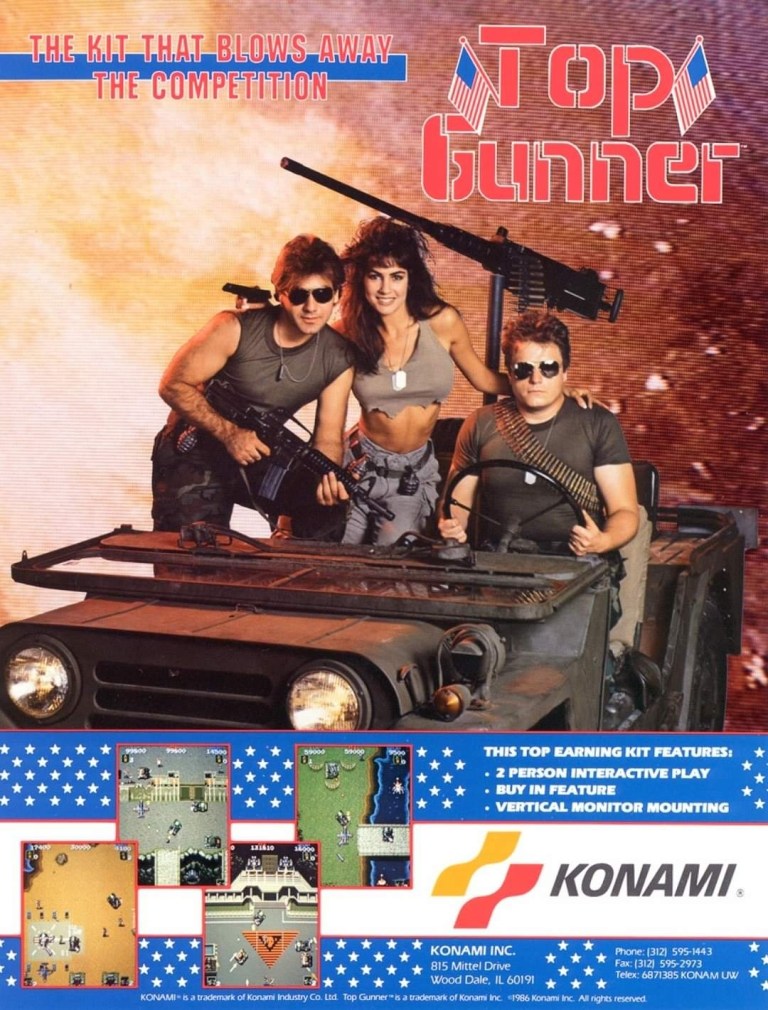
Show this nice looking image to the woke nut or modern day Communist near you. Watch and observe his or her reaction.

To make things clear, Top Gunner is actually the run-and-gun game Jackal and the alternative titles was mainly used in North American arcade distribution and also reflected Konami’s move of coming up with titles inspired by blockbuster movies of the time. To promote its 1986 arcade release in America as a conversion kit, the advertisers had three models playing soldiers on a military jeep to immerse gamers into the core concept of the game – moving armed military jeeps from one location to another while fighting bad guys. The approach used for the visual concept is indeed inspiring, especially during the Cold War. Top Gunner/Jackal became a hit in both arcades and consoles.

4. Joust for Atari print ad
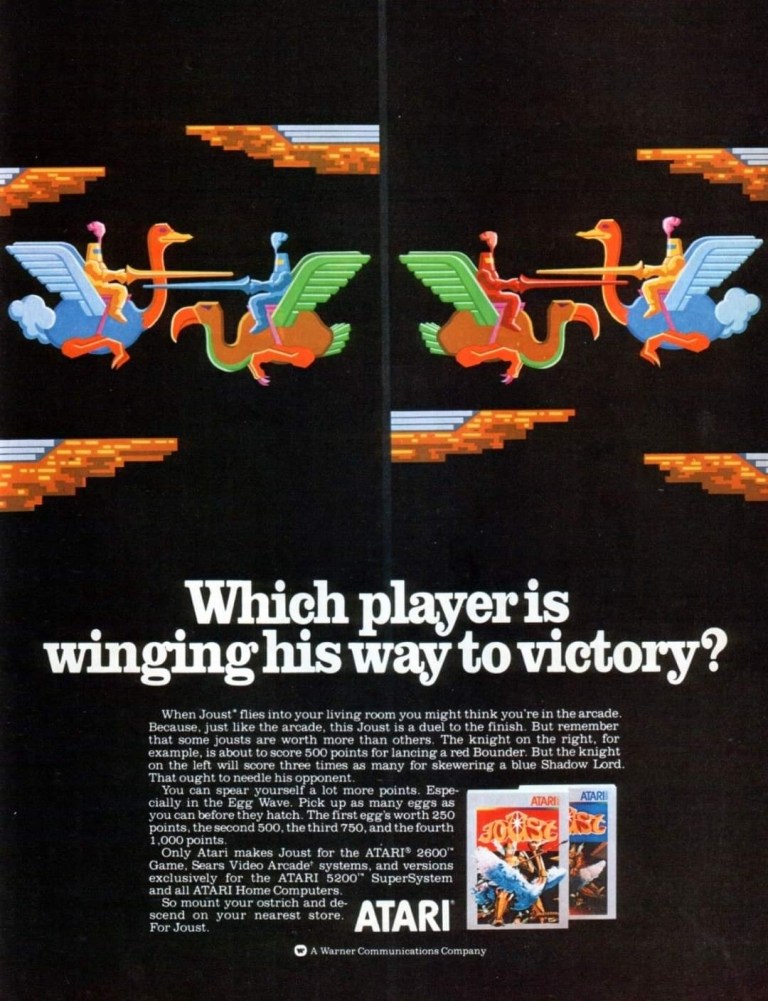
While I played Joust on console, I don’t remember seeing this print ad before.

Made by Williams Electronics, Joust was one of those early 1980s arcade games that eventually made its way to the Atari 2600 console which was massively popular in North America. Strangely enough, the artistic approach Atari’s advertising came up with for the console version of Joust was similar with that of the ad of the Atari version of Galaxian (see item above) in which artwork was used to resemble the 2D sprites of the game. Regardless, the images of this ad showed what a joust looked like – a martial game between two armed combatants going against each other while riding an animal.  

5. Kid Chameleon print ad
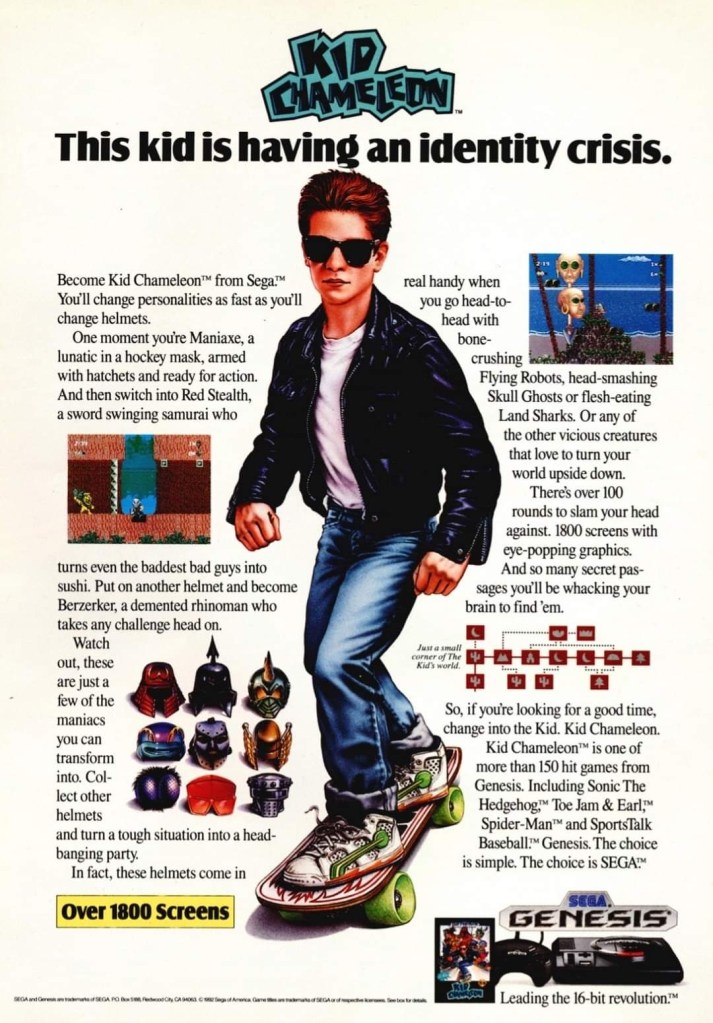
Can you relate with Kid Chameleon’s identity crisis?

During the early years of the Sega Genesis, Sega of America exerted efforts to make new games that were not only exclusive to their console but also stand out among the many 2D side-scrolling adventure games by coming up with a protagonist with a unique personality that could somehow resonate with young kids and teenagers.

Developed by their internal experts (Sega Technical Institute), the company released Kid Chameleon in 1992 and they came up with the above print ad that had detailed hand-drawn art of the lead character as well as a wordy text description which was a clear attempt to help young gamers (including teenagers) get connected with both the game and the protagonist. The advertisers even had space to spare to accommodate two screenshots of the game.

6. Terminator 2: Judgment Day (AKA T2: The Arcade Game) for Sega Genesis print ad
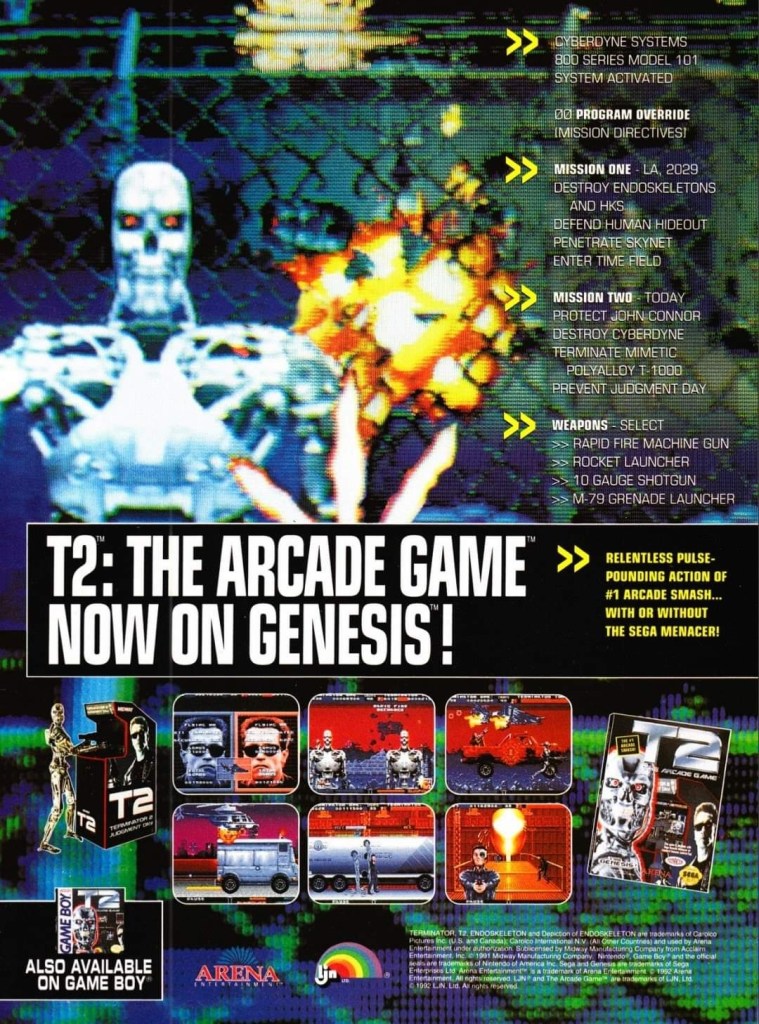
This print ad appeared on the many comic books I read long ago.

Back in the early 1990s, Terminator 2: Judgment Day was a massive success in the global box office and this resulted in Arnold Schwarzenegger’s popularity to soar very high while also establishing the Terminator as an essential pop culture figure. Apart from comic books and merchandise, video games based on the movie were made and the one that stood out the most was the arcade shooter game initially titled Terminator 2: Judgment Day (later retitled as T2: The Arcade Game).

The arcade mega hit eventually got ported to the Sega Genesis and this print ad really looked flashy with its visual presentation showing screenshots and a zoomed-in look at how the Terminator T-800 looked like in the Genesis version complete with a few explosions in the background. It should be noted that this flashy print ad cleverly concealed the visual downgrades and the redrawn images as the Genesis itself could never come close to matching the high quality visuals of the arcade version.

7. CYBERPad print ad
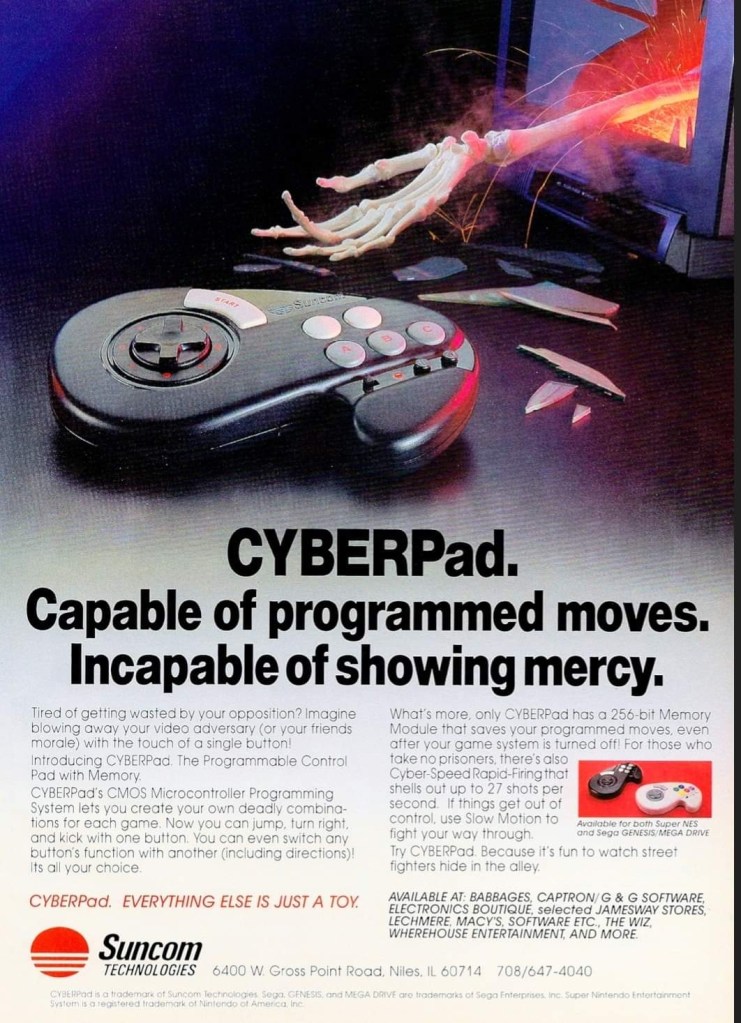
I never owned the CYBERPad, nor have I ever used one.

During the so-called 16-bit console generation (actually the 4th console generation), there were lots of licensed console peripherals made by independent companies in support of the Sega Genesis and Super Nintendo Entertainment System (SNES). The company Suncom Technologies came up with the CYBERPad controller for the two consoles and they boasted in their print ad that the product had a programmable control pad that allowed users to create combinations for each game with convenience in mind. The CYBERPad also allowed the saving of the programmable moves and it had a rapid-fire feature and even a slow-motion function. The CYBERPad was made to make the gameplay experience more user-friendly.

8. GamePro magazine sweepstakes print announcement
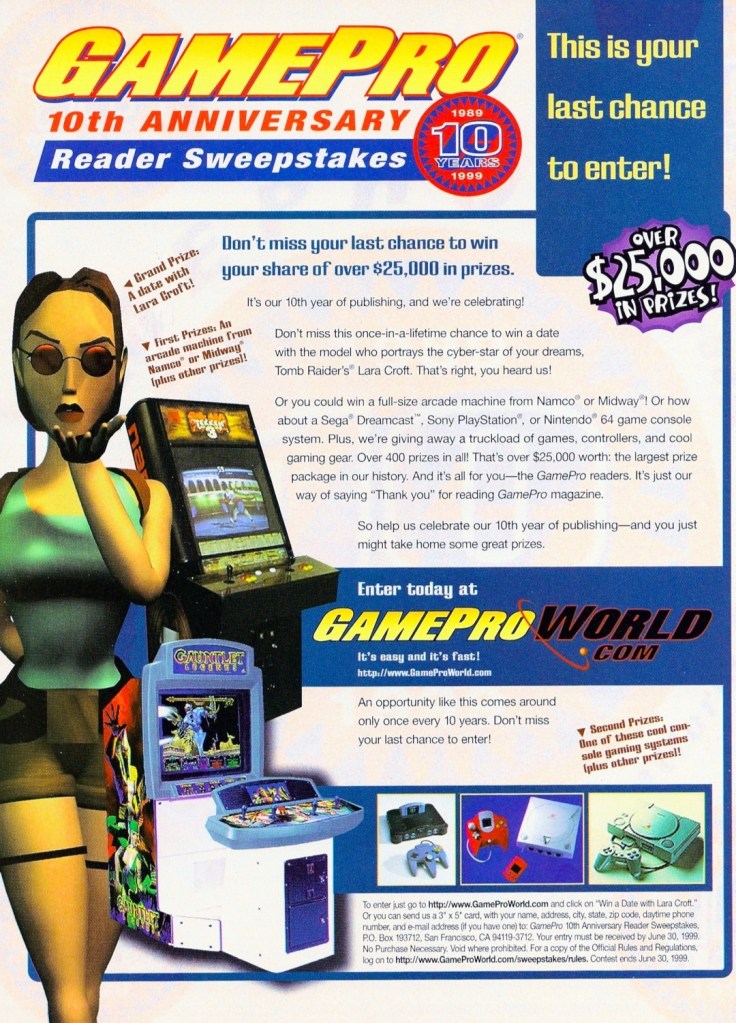
If you look closely, this print announcement by GamePro technically advertised the game consoles, the arcade game and Lara Croft to its readers.

In 1999, GamePro magazine celebrated its 10th anniversary and to keep on resonating with gamers and maintaining the loyalty of their fans, they organized a reader sweepstakes with prizes worth over $25,000 to be won by the few winners. GamePro boasted a date with an unnamed model who played the iconic Lara Croft (Tomb Raider). Certain arcade machines plus the modern consoles of the time – including the brand-new Sega Dreamcast – were also at stake. The way it was presented, this GamePro print announcement was enticing to read.

9. Smash T.V. for SNES print ad
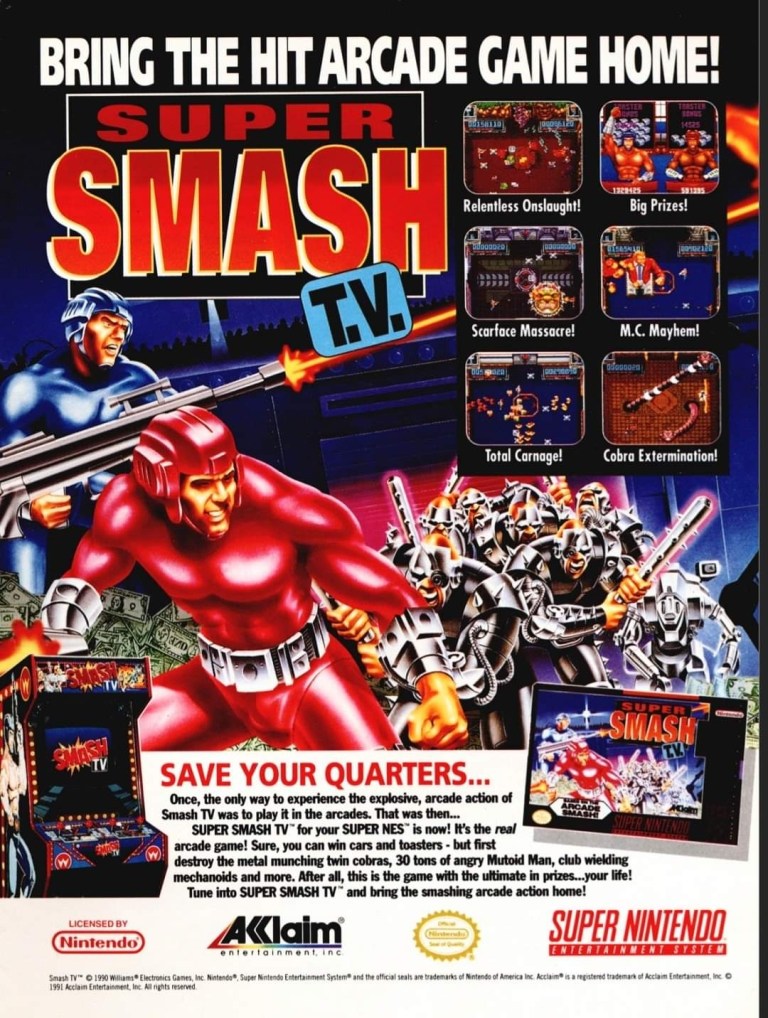
Smash T.V. was a lot of fun on both arcade and console.

The arcade hit Smash T.V. made its way to the Super Nintendo Entertainment System (SNES) in 1992 and the publisher came up with a print ad that had captivating artwork, six screenshots and a text description that emphasized that a lot of fun awaits gamers on the console version. In my view, this old ad is still amusing to look at.

10. David Robinson’s Supreme Court print ad
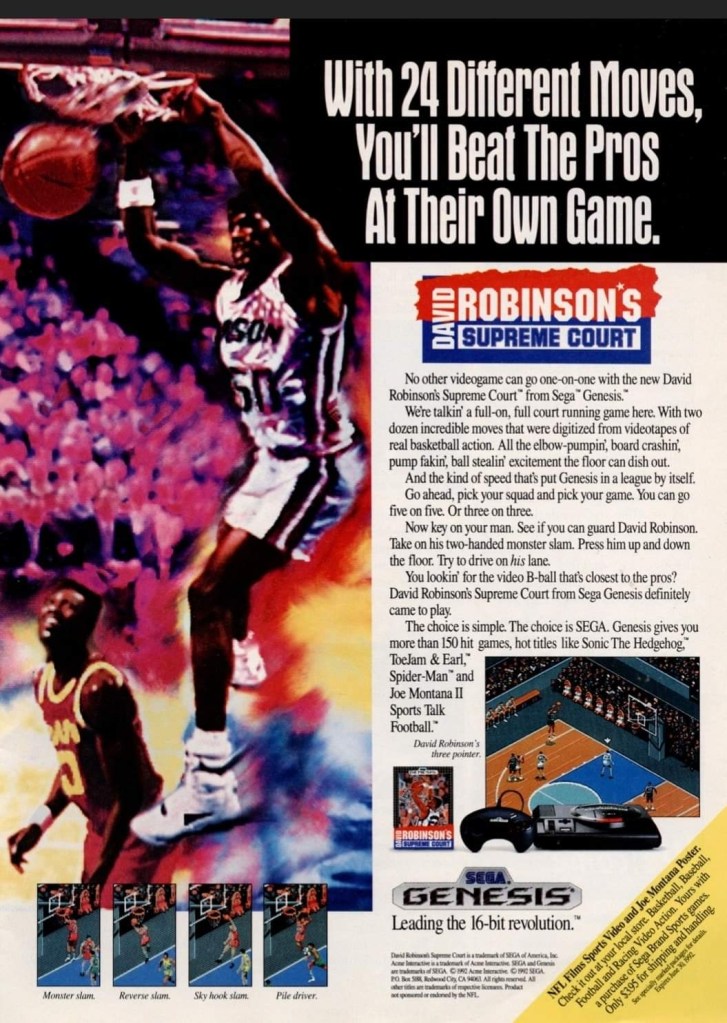
It was a smart move by Sega to get NBA superstar David Robinson as the endorser of this basketball video game exclusive on the Sega Genesis. This ad was published many years before Robinson finally won an NBA championship.

As part of its strategy in competing with Nintendo during the 4th console generation, Sega of America was focused on producing exclusive sports video games for the Genesis console backed by endorsements of sports professionals. In 1992, they released David Robinson’s Supreme Court on the Genesis and unsurprisingly their print ad used a large, stylized image of the NBA superstar dunking backed with an exciting text description plus screenshots showing the game’s use of the isometric view for gameplay. This is still worth looking at.

11. Taito’s “heat wave” print ad
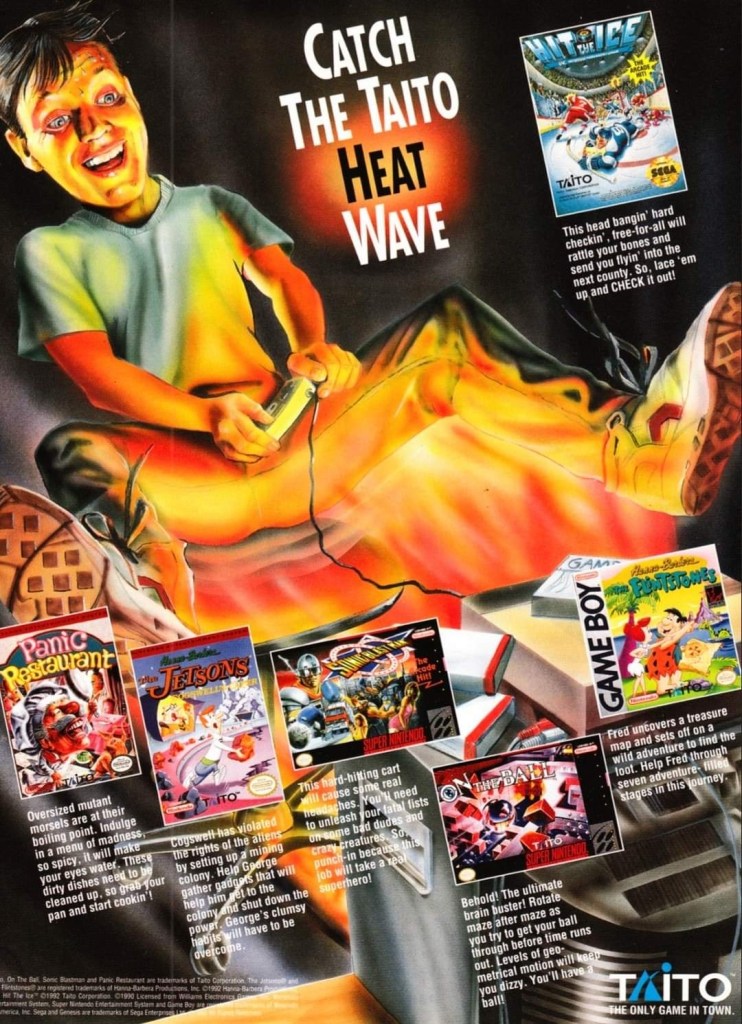
An amusing and creative way to sell video games.

If your company lacks money to effectively market your video games individually, you can try making a single ad promoting them together. This is what Taito did in this print ad which showcases multiple games for different platforms and they used artwork of a player experiencing the so-called heat wave. This is a nice stroke of creativity on the part of Taito.

12. Jurassic Park Interactive print ad
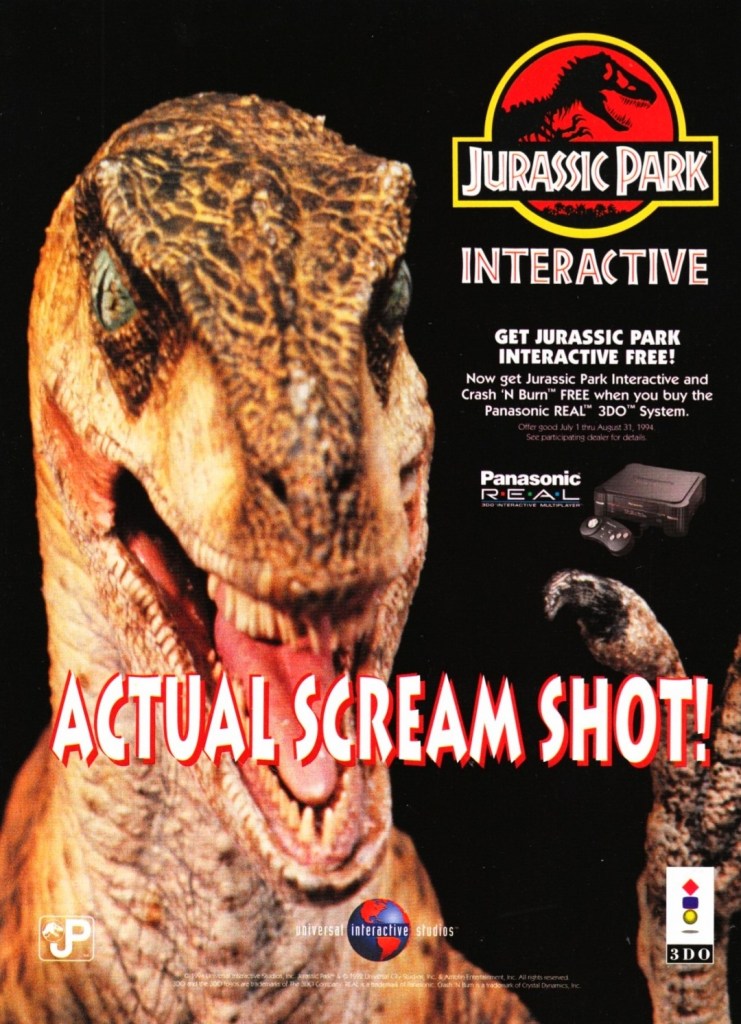
This was a creepy print ad promoting the 3DO-exclusive Jurassic Park Interactive.

When it comes to video game consoles, having exclusive games is essential as long as they are of high quality, highly playable and enjoyable. The 3DO company acquired a license of the Jurassic Park movie and made the exclusive game Jurassic Park Interactive hoping it would sell a lot and lift up 3DO hardware sales.

This print ad, which features a zoomed-in image of the Raptor from the game, was more focused on selling the 3DO console than the video game as seen on the descriptive text. 3DO ran a promo selling the console which would entitle the buyer to get Jurassic Park Interactive and another game free. Nothing was done to describe the console’s multimedia capabilities of showing videos, images and graphics of the game (which was essentially a collection of mini-games). This print ad shows ignorance on the part of the 3DO company and the ad maker as it showed desperation happening really early in the console’s life. Notably, Jurassic Park Interactive was the only video game adaptation to use actual footage (note: the faces of the actors were edited out) and music from the film.

13. RoboCop 2 print ad
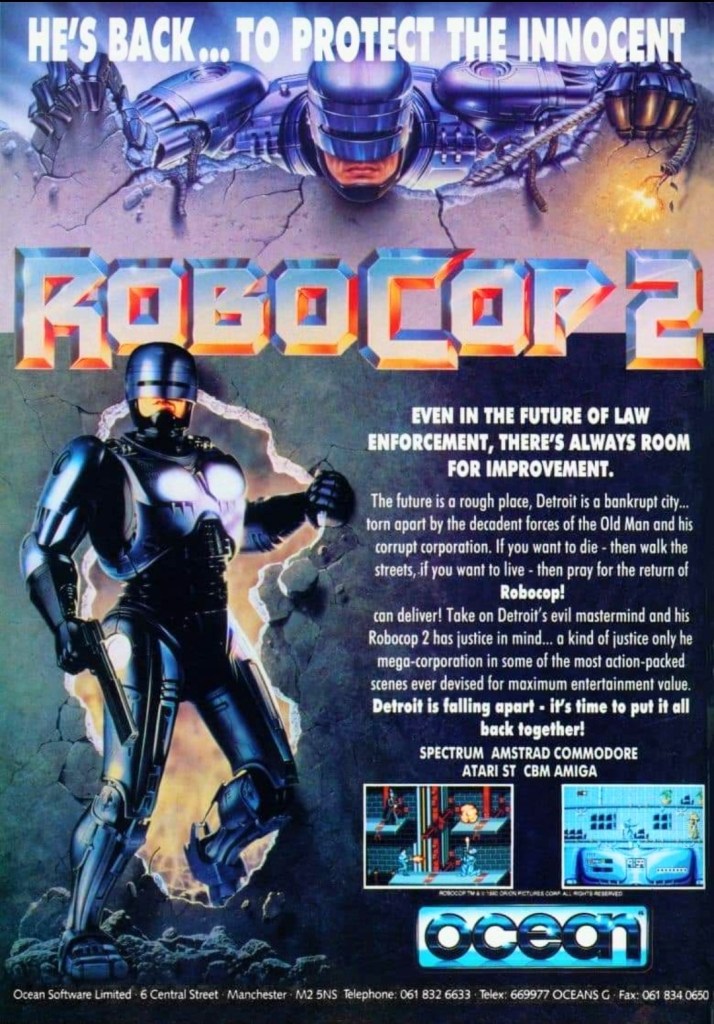
You want to become RoboCop to save the city of Detroit from criminals?

Way back in 1990, RoboCop 2 was a big hit in cinemas here in the Philippines and in some places around the world. As typical of the time, licenses to make video games based on the movie were released resulting in RoboCop 2 games for multiple platforms. The print ad featured two different images of RoboCop – one from the movie poster and the other from an official artwork. The descriptive text does a fine job to immerse readers into the story concept of the game but showing only two screenshots was a lackluster effort to sell the game.  

14. Star Trek: The Next Generation – Echoes from the Past print ad
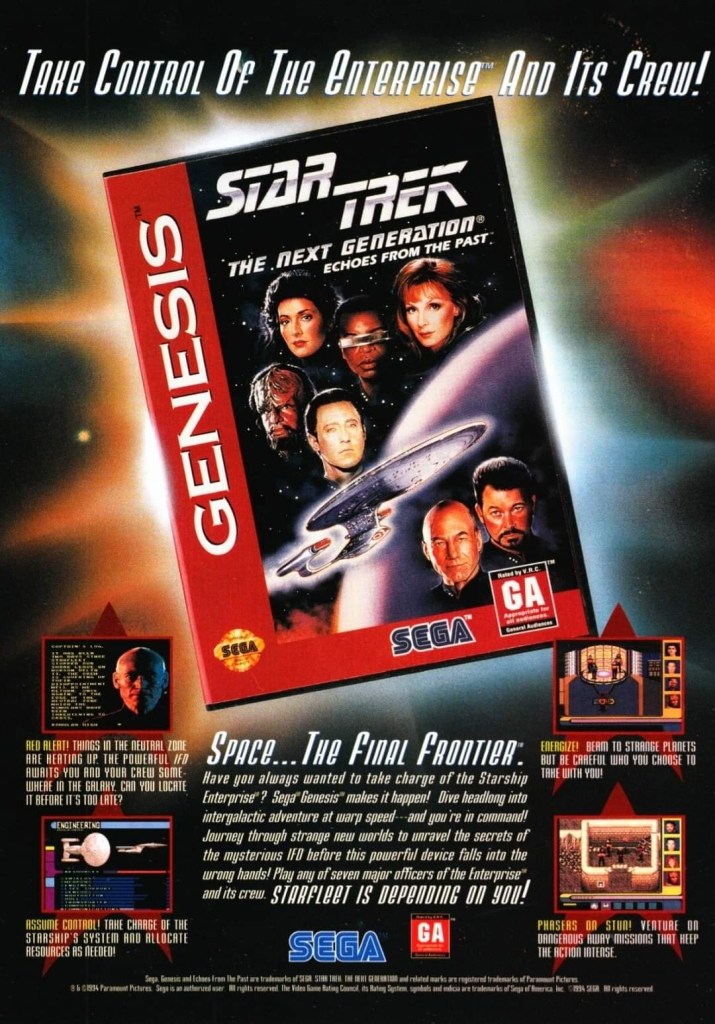
Space…the final frontier waiting for Sega Genesis gamers.

Released in 1994, Star Trek: The Next Generation – Echoes from the Past delivered the Star Trek TNG adventure experience to Sega Genesis gamers. In fact, it is the exact same experience that SNES gamers got the same year. In reality, Star Trek: The Next Generation – Echoes from the Past is actually a port of Star Trek: The Next Generation – Future’s Past on the SNES and the screenshots on the print ad are giveaways about it. In fairness to the ad makers, this print ad never attempted to deceive gamers that it promoted a totally different Star Trek TNG game.

15. Dinosaurs for Hire print ad
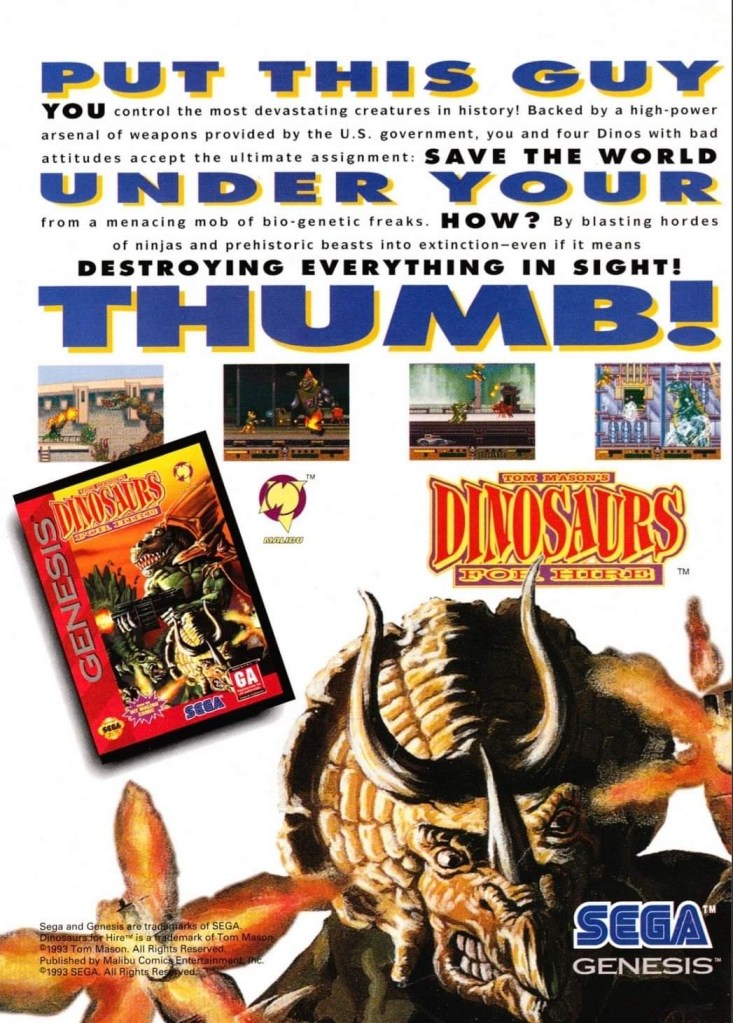
This print ad caught my attention and made me interested in the game and the comic book series. Even though it was small, Malibu Comics’ logo was still recognizable.

Dinosaurs for Hire (sometimes referred to as Tom Mason’s Dinosaurs for Hire) was a 2D side-scrolling platform adventure game based on the comic book series of Tom Mason. Published by Sega, it was a Genesis-exclusive game and this print ad had a catchy text description, a few screenshots and the eye-catching artwork of a triceratops facing the viewer. This print ad is still good to look at. If you’re thinking about searching for existing copies of the game, I encourage you to also read some Dinosaurs for Hire comic books before playing. By the way, Tom Mason also wrote several comic books of the Ultraverse.

+++++

Thank you for reading. If you find this article engaging, please click the like button below, share this article to others and also please consider making a donation to support my publishing. If you are looking for a copywriter to create content for your special project or business, check out my services and my portfolio. Feel free to contact me with a private message. Also please feel free to visit my Facebook page Author Carlo Carrasco and follow me on Twitter at  @HavenorFantasy as well as on Tumblr at https://carlocarrasco.tumblr.com/ and on Instagram at https://www.instagram.com/authorcarlocarrasco
Retro Gaming Ads Blast – Part 5

Welcome back readers, fellow geeks and electronic gaming fans!

In this edition of the Retro Gaming Ads Blast (RGAB) series, we will examine print ads from the 1980s and the 1990s that caught my attention and I will explain why they are worth look back at.

For the newcomers reading this, Retro Gaming Ads Blast (RGAB) looks back at the many print ads of games (console, arcade, computer and handheld) that were published in comic books, magazines, flyers and newspapers long before smartphones, social media, the worldwide web and streaming became popular. To put things in perspective, people back in the 1980s and 1990s were more trusting of print media for information and images about electronic games.

With those details laid down, here is the newest batch of retro gaming print ads for you to see and enjoy…

1. Star Wars: Rebel Assault print ad

This print ad was strong enough to capture Star Wars fans’ attention and make them interested with the Sega CD.

If there is anything notable about the Sega CD (Mega CD in other parts of the world) platform, it is the fact that the machine was an add-on to be connected with the Sega Genesis (Sega Mega Drive elsewhere) console. That being said, LucasArts included the Sega CD as one of several platforms for the multiplatform release of their 1993 game Star Wars: Rebel Assault. The above print ad caught my attention with its use of 9 screenshots (emphasizing a wide look at the game’s Star Wars concept) and text description (emphasizing multi-media features connected with gameplay), and for a time it made me interested in the Sega CD. Looking back at the game’s marketing, Star Wars: Rebel Assault was designed to not only give gamers sessions of play to enjoy but also opportunities to immerse themselves deeper into the realm of Star Wars. The game even had selected video clips from the original Star Wars trilogy movies.

2.  Cloak & Dagger print ad

This print ad could have used at least two screenshots from the arcade game…

In 1984, there was a movie titled Cloak & Dagger (read my retro movie review by clicking here) which was not only the 4th cinematic adaptation of the short story “The Boy Cried Murder” (written by Cornell Woolrich) but also had the real-life electronic game Cloak & Dagger as a crucial plot element. To make things clear, there was a Cloak & Dagger game released in the arcades (as emphasized in the above print ad) from Atari. Behind the scenes, the filmmakers and Atari worked together which explains the video game tie-in with the movie. While the above arcade conversion kit print ad does not show screenshots of gameplay, the four images of the playable protagonist Agent X shown were from the game’s short transition sequences (moving from one level to another) which were also displayed in the 1984 movie. Those images were enough to remind me about the movie I enjoyed.

More on the Atari connection, the movie had a cleverly presented short scene showing the young protagonist Davey (played by Henry Thomas) playing Cloak & Dagger on his Atari 5200 console with spliced gameplay footage of the arcade version shown within cuts. In real life, however, Atari never released a version of Cloak & Dagger for any console nor computer in the 1980s. Today, you can play the game on the Atari 50 collection on consoles.

3. BurgerTime print ad

This BurgerTime print ad was entertaining to look at and easily reminded viewers about food and the popular game coming home.

Back in 1982, BurgerTime (Japanese title: Hamburger) was released in the video arcades and turned out to be a big hit in both Japan and America. Seeking to capitalize on the game’s success, Mattel Electronics acquired the rights of the game from Data East and went on to release versions of it for the Intellivision, Atari 2600, Apple II and the IBM personal computer. Mattel went on to market the game for consoles and computers by coming up with a print ad (the one above) that had comic book-style hand drawn art of the playable protagonist chef Peter Pepper running away from walking versions (anthropomorphic figures) a hotdog, an egg, and a pickle. The ad showed a single screenshot which was sufficient enough to show readers the concept of the game clearly. In my experience, I never got to play BurgerTime in the arcades but I first learned about its existence thanks to the eye-catching print ad above which appeared in comic books I read. In addition, the print ad also does an effective job to remind readers about food.

4. SOS print ad

This print ad made me interested in the game as I was already aware of the historical sinking of the Titanic, and I already saw the disaster film The Poseidon Adventure.

Moving back to the 1990s, I saw the above print ad of the video game SOS for the Super Nintendo Entertainment System (SNES) while reading a comic book. The nice artwork caught my attention as it easily reminded me of the disaster movie The Poseidon Adventure (1972) as well as the real-life tragedy of the Titanic. Then I saw the screenshots on the print ad and they made me interested on the game which I later played on a rent-by-the-hour game joint. Looking back at the text description of the print ad, it did not describe what the technical and graphical features of SOS were. That being said, I was surprised to experience the game’s use of the SNES Mode 7 effects which enabled the scaling and rotating of the in-game environment which affected gameplay in many ways. Read my retro review of SOS by clicking here.

5. Star Trek: The Next Generation – Future’s Past print ad

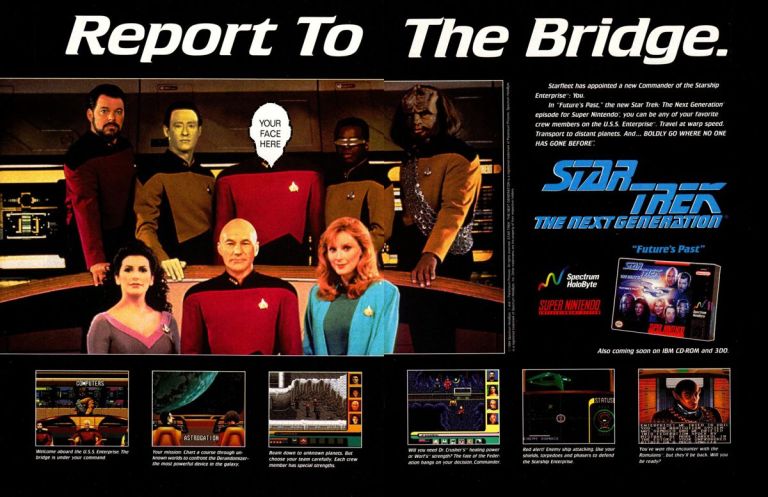
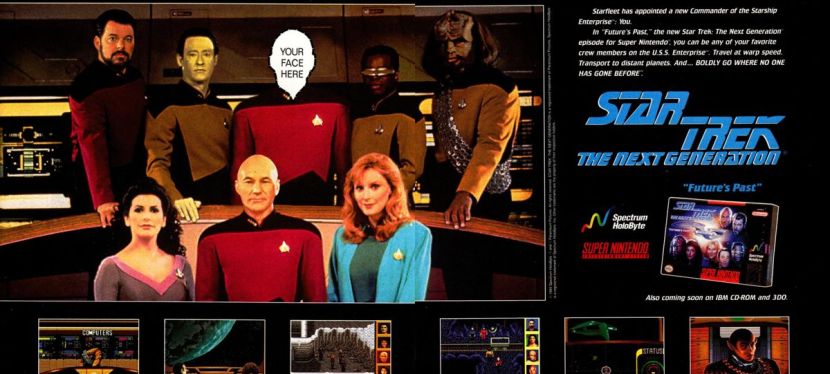
This 2-page print ad was strong enough to invite readers to literally join the Star Trek: TNG crew and go where no man has gone before. By the way, when was the last time you saw Marina Sirtis or Gates McFadden on a video game ad?

Long before wokeness ruined Star Trek in this modern age, the sci-fi franchise reached a tremendous high in popularity and projects in the 1990s as that decade had Star Trek: The Next Generation (most of its TV seasons and three movies were released within the decade), Star Trek: Deep Space Nine and Star Trek: Voyager that kept fans entertained.

Considering its high popularity, it was not surprising that a video game adaptation of Star Trek: TNG was released in 1994 titled Star Trek: The Next Generation – Future’s Past (the version for Super Nintendo Entertainment System) and I saw the above print ad while reading a gaming magazine. Using a slightly altered version of the TNG group photo, the print ad emphasized its concept that the player will be able to lead the crew of the Starship Enterprise and take part in a series of missions in different parts of space with the likes of Captain Picard, Commander Riker, Data, Worf, Dr. Crusher, Deanna Troi and La Forge. While I was never a Star Trek fan, the above print ad caught my attention with its concept, the group photo and the screenshots gave me an idea of what the game has to offer. It should be noted that Star Trek: The Next Generation – Future’s Past was released between the end of Star Trek: TNG’s final season and the theatrical release of Star Trek: Generations.

6. Super Castlevania IV print ad

This was one of the most eye-catching print ads I’ve seen about a Konami video game.

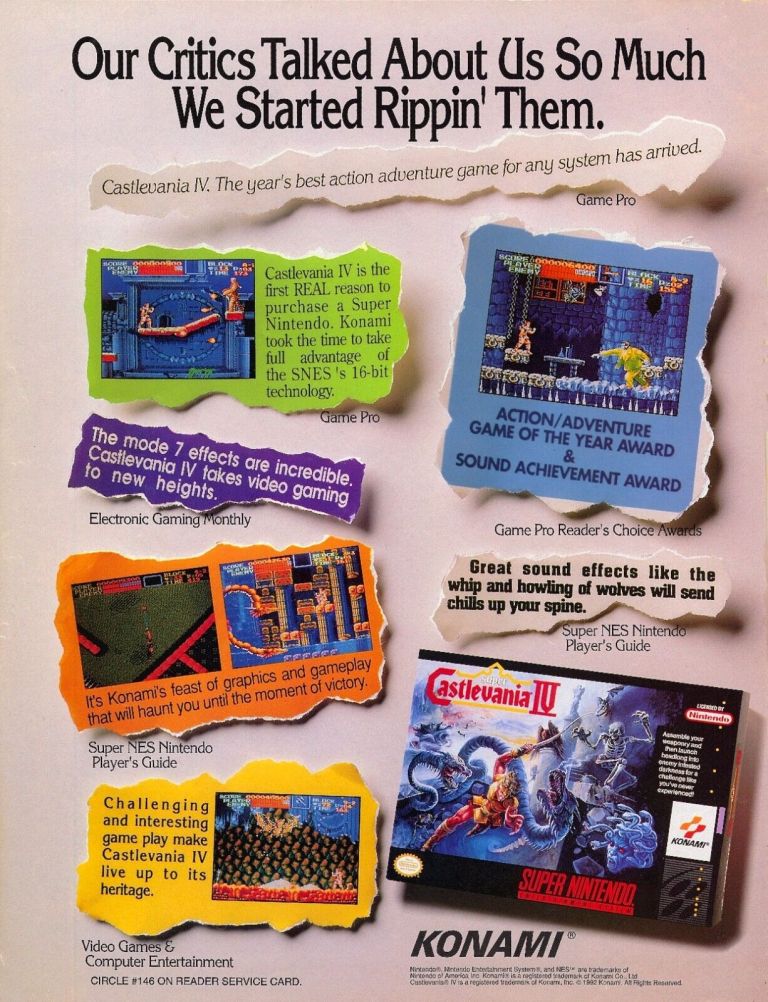
The jump in technology from one console generation to the next can be beneficial for gamers if game developers harnessed the advantages of new technologies to make new games that turned out to be more engaging and more enjoyable. Such was the case with Super Castlevania IV for the Super Nintendo Entertainment System (SNES) in 1991. The above print showed Konami highlighting the positive feedback their game received from different gaming media outlets and used screenshots to give gamers and long-time Castlevania fans exciting stuff to see. I got to play the game on the mini SNES console and I can say that in terms of visuals, controls and gameplay, Super Castlevania IV truly lived up to its title and it remains fun to play to this day.

+++++

Thank you for reading. If you find this article engaging, please click the like button below, share this article to others and also please consider making a donation to support my publishing. If you are looking for a copywriter to create content for your special project or business, check out my services and my portfolio. Feel free to contact me with a private message. Also please feel free to visit my Facebook page Author Carlo Carrasco and follow me on Twitter at  @HavenorFantasy as well as on Tumblr at https://carlocarrasco.tumblr.com/ and on Instagram at https://www.instagram.com/authorcarlocarrasco

A Look Back at Star Trek: Generations comic book adaptation (1994)

Welcome back superhero enthusiasts, 1990s culture enthusiasts and comic book collectors! Today we go back to the year 1994 to explore the official comic book adaptation of the movie Star Trek: Generations.

Star Trek: Generations was a cinematic production that symbolically served as the passing-of-the-torch from the original Star Trek crew (led by Captain Kirk) to the Star Trek: The Next Generation crew (led by Captain Picard). The most highlighted feature of the movie was the crossover between Kirk and Picard followed by working together to stop the villain. It was a crossover that fans wanted for some time prior to the film’s release.

In my experience, Star Trek: Generations was a disappointing movie as there were lots of flaws here and there. Most notably, the Kirk-Picard crossover (with William Shatner and Patrick Stewart in their most iconic roles) was nothing special as its payoff to all the build-up that preceded it was so small.

Unsurprisingly, there was comic book adaptation of Star Trek: Generations that appeared in the local comic book stores which I intentionally avoided reading back in 1994 as I anticipated the movie. Recently, I finally got to read it.

With those details laid down, here is a look back at the Star Trek: Generations comic book adaptation, published in 1994 by DC Comics with a story written by Michael Jan Friedman and drawn by Gordon Purcell based on the cinematic story by Rick Berman, Ronald D. Moore and Brannon Braga.

The cover.

Early story

The story begins with a retired James T. Kirk landing from his orbital skydiving activity in the presence of his long-time crew members and friends Pavel Chekov and Montgomery “Scotty” Scott. In response to Chekov’s reminder that they are to attend the launch ceremony of the USS Enterprise B (NCC-1701-B), Kirk as he is enjoying retirement and prefers to do other things like tri-elliptical jumping. Kirk also states that he swore he would never set foot on a starship again.

The next day, Kirk, Scotty and Chekov attend the ceremony at the Enterprise B greeted by journalists. Captain John Harriman personally tells Kirk that he read about his missions when he was in grade school.

Not so long after the Enterprise B launched into space, a distress call was received from a transport ship helplessly caught in some kind of energy distortion (with one other ship near it)…    

Quality

The crossover encounter between Star Trek’s two most iconic captains – Kirk and Picard.

As an adaptation, this comic book is surprisingly faithful to the source material for the most part. While this adaptation does not contain 100% of all the details and scenes of the movie and there were some scenes that were shortened for brevity but it certainly has quite a lot of content for readers to absorb. In fact, it will take two full readings to truly grasp the story, get to know the characters and understand the sci-fi details that Michael Jan Friedman brought from the movie script into literary format.

Like the movie, this adaptation tackles the themes of destiny, time and loss which were emphasized through Picard and Soran. While Picard would not dare to make alterations to cope with the deaths of two relatives he loved, Soran (who previously lost family members in a tragedy and temporarily made it to the a very desired realm) willingly makes tremendous acts to fulfill his goal even it means costing tremendous death and destruction along the way.

Worf, Riker, Troi and Data on the bridge of the Enterprise during their encounter with the Klingons’ Bird of Prey.

When it comes to storytelling, this one is more about the Star Trek: The Next Generation crew facing a crisis. The scenes of Kirk and his original crew members served as a glorified prologue designed to give moviegoers (as opposed to readers) one final act of heroism by the iconic captain. Kirk doing the heroic stuff early in the story was pretty much a tribute to his past while conveniently serving as a subtle build-up for the Picard-Soran conflict and the Nexus (Star Trek’s distorted version of Heaven) leaving not much left for the Kirk-Picard crossover.   

Anyone who loves Star Trek: TNG will be delighted to see their favorite characters like Picard, Data, Riker, Deanna Troi, Dr. Beverly Crusher,  Geordi La Forge and Worf here as they each had good chunks of the spotlight. If you saw the movie before reading this comic book adaptation, you will be able to spot the notable lines of dialogue they said on the big screen. As details from the movie had to be compressed for this adaptation, those who got turned off by the excessive screen comedy by Brent Spiner as Data (note: this reflects the emotion chip activated in the character) will be delighted to see the funny acts were heavily toned down in favor of maintaining the narrative. 

More on the quality, this adaptation also exposes many of the weakness and flaws of the movie itself. I am talking about the film’s lack of consistency when it comes to emphasizing the most important concepts of the story. Throughout the story, Kirk’s early heroic act had no real impact when the narrative focused on Star Trek: TNG nor was it a solid build-up for the crossover with Picard. The script emphasized the Nexus quite a lot but in different points as the narrative switched between focusing on Picard and Soran. That being said, the way the story was told made it easy to forget about Kirk and Picard coming together. Like in the movie, the Kirk-Picard crossover failed here too.

While the movie is indeed a very flawed source for this comic book, the adaptation spared readers from the monotony of the many pointless moments and sequences that moviegoers went through. This is understandable because brevity was needed to capture the cinematic story into literary format with the limited number of pages allocated.

If there is anything consistently good here, it is the art of Gordon Purcell who proved to be capable of capturing enough of the actors’ likenesses to make the characters recognizable. To be clear, the replication of the actors’ unique looks happened from time to time only.  

Purcell did a great job making Scotty (close-up at right) look so much like actor James Doohan.

You will see certain parts of the comic book showing Captain James T. Kirk looking like William Shatner and Captain Picard looking like Patrick Stewart. There were certain pages in which Soran had Malcolm McDowell’s face, Scotty looked so much like James Doohan and more. Ironically, Purcell fell short of capturing likenesses of Marina Sirtis as Troi and Gates McFadden as Dr. Crusher.

Apart from drawing the characters, Purcell nicely visualized the look of the film and his own take of the memorable saucer crash of the TNG crew’s Enterprise had a of power and impact worth seeing. Lastly, he the artist did a good job drawing the starships.

At the very end of this adaptation were a few pages that emphasized the challenges of adapting the movie into literary format which was worth reading. 

Conclusion

The scene of Picard revealing to Deanna Troi the deaths of his two relatives (obviously without Patrick Stewart’s emotional moment).

The Star Trek: Generations (1994) comic book adaptation is clearly flawed like the movie it was based on. Many of the movie’s weaknesses (including the ever disappointing Kirk-Picard crossover) made it in this comic book but the ironic thing is that the story in literary format flowed with a better pace and Gordon Purcell’s art was really attractive to look at. In fact, I can clearly say that Star Trek: Generations works better as a comic book than as a film.

Overall, the Star Trek: Generations (1994) comic book adaptation is satisfactory.

+++++

Thank you for reading. If you find this article engaging, please click the like button below, share this article to others and also please consider making a donation to support my publishing. If you are looking for a copywriter to create content for your special project or business, check out my services and my portfolio. Feel free to contact me with a private message. Also please feel free to visit my Facebook page Author Carlo Carrasco and follow me on Twitter at  @HavenorFantasy as well as on Tumblr at https://carlocarrasco.tumblr.com/ and on Instagram at https://www.instagram.com/authorcarlocarrasco

Better than Streaming: Do you have Star Trek: First Contact 4K Blu-ray in your collection?

Welcome back, fellow geeks, Blu-ray collectors and movie buffs! If you are feeling nostalgic or if you are fond of the Star Trek: The Next Generation movies of the 1990s, then you might be interested to know that they were released on 4K Blu-ray format this past April.

For the newcomers reading this, the Star Trek: TNG films were Star Trek: Generations (1994), Star Trek: First Contact (1996), Star Trek: Insurrection (1998) and Star Trek: Nemesis (2002). I have seen all those movies and I can say that all of them had their respective flaws (creatively and technically). In fact, three of those movies were disappointing and are not worth revisiting. Definitely not worth spending money for their 4K Blu-ray and Blu-ray releases, and the same goes with the entire Star Trek: The Next Generation Motion Picture Collection 4K Blu-ray set.

Among those four movies, the only one I actually enjoyed was Star Trek: First Contact (directed by Jonathan Frakes). While that movie has flaws and some questionable creative moves, the 1996 movie was still entertaining and turned out to be a lot more engaging than its 1994 predecessor. First Contact was the highlight of the Star Trek: TNG movies before things really went downhill with the 1998 and 2002 films. For the movie collectors and Star Trek fans reading this, Star Trek: First Contact 4K Blu-ray has been available since April 4, 2023. Were you able to buy a copy for your movie collection? If you did, were the visuals on the 4K Blu-ray disc really great to watch?

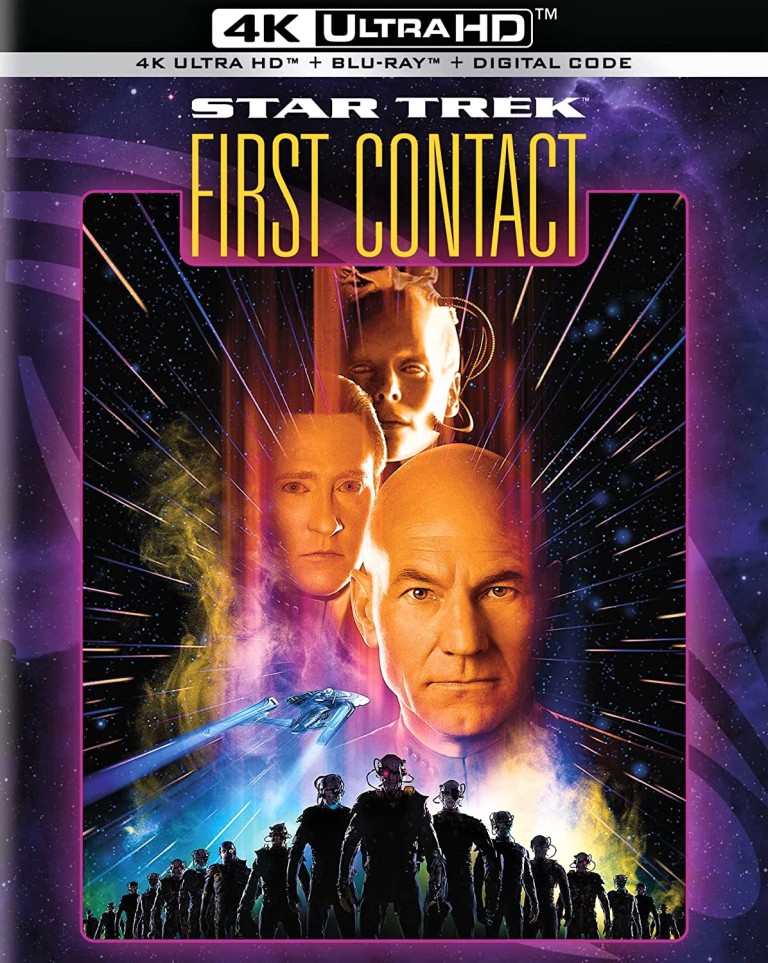
The 4K Blu-ray front cover of Star Trek: First Contact carries the popular image from the 1996 movie poster.

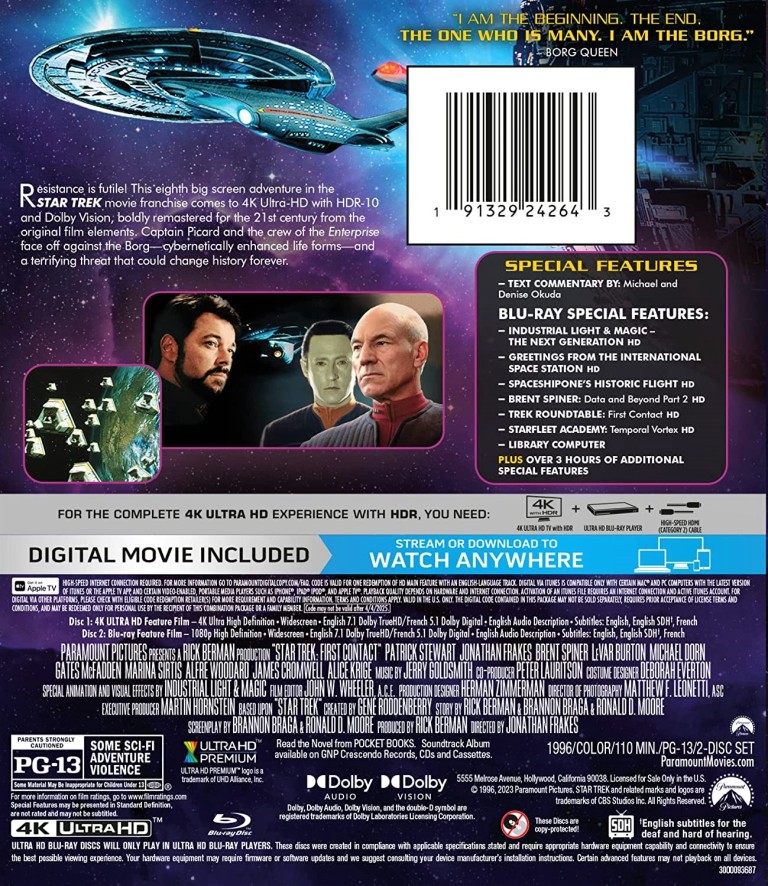
To put things in perspective, posted below are the technical details of Star Trek: First Contact 4K Blu-ray as displayed on its Blu-ray.com page

Video

Codec: HEVC / H.265

Resolution: Native 4K (2160p)

HDR: Dolby Vision, HDR10

Aspect ratio: 2.35:1

Original aspect ratio: 2.39:1

Audio

English: Dolby TrueHD 7.1 (48kHz, 24-bit)

German: Dolby TrueHD 5.1

Spanish: Dolby Digital 5.1 (640 kbps)

French: Dolby Digital 5.1 (640 kbps)

Japanese: Dolby Digital 5.1

Subtitles – English, English SDH, French, German, Japanese, Spanish, Danish, Dutch, Finnish, Norwegian, Swedish.

Discs – 4K Ultra HD, Blu-ray Disc, Two-disc set (1 BD-66, 1 BD-50)

Digital – Digital 4K, iTunes, Vudu

Packaging – Slipcover in original pressing

Playback – 4K Blu-ray: Region free, 2K Blu-ray: Region A

To be clear, I have not purchased a copy of Star Trek: First Contact 4K Blu-ray as of this writing. I am interested in it but I could not make a decision to do so due to financial and practical reasons. I recently purchased Casablanca 4K Blu-ray, Top Gun: Maverick 4K Blu-ray and a Blu-ray of the James Bond movie Licence to Kill and I really enjoyed watching those three. I am also replaying the 4K Blu-ray and Blu-ray movies I already have (note: V: The Original Miniseries and V: The Final Battle have very high replay value respectively, read about their respective Blu-ray releases here and here). As such, there’s no reason for me to rush to acquire Star Trek: First Contact’s 4K Blu-ray release.

I should also state that I was never a fan of the entire Star Trek entertainment franchise even though I enjoyed certain movies of it. While Star Trek II: The Wrath of Khan is my favorite among the movies of the classic Star Trek cast (led by Captain Kirk), Star Trek: First Contact is the only Star Trek TNG movie I ever enjoyed.  

This is the rear of the Star Trek: First Contact 4K Blu-ray. Pay close attention to the technical details as well as the listed special features.

I first saw Star Trek: First Contact on a rented VHS tape in the summer of 1998 (note: I completely missed its 1996 theatrical release) and by the end of it, I felt this impact of fun, dramatics and visual effects. It was also in that movie where I saw Captain Picard really obsessed with saving his crew and saving the humanity’s future while struggling with his post-traumatic stress disorder (PTSD) with the Borg given his history being captured and assimilated by them. The Borg themselves were really terrifying although the inclusion of a queen brings down the concept of the unrelenting collective hive.

Just years ago, I bought a DVD copy of the 1996 movie. To be clear, I never bought the 2009 Blu-ray disc. At this stage, I have yet to replay Star Trek: First Contact in HD and Ultra HD. According to the Blu-ray.com review, Star Trek: First Contact 4K Blu-ray has a great 2160p/Dolby Vision UHD presentation and that the image is “nearly perfect”. For insight watch the comparison video below…

Perhaps someday, I could add the 4K Blu-ray release of Star Trek: First Contact into my collection. I am interested in it and the 4K visuals look attractive and they could look even better on our household’s 4K UHDTV. I should state that the Blu-ray disc of the 4K Blu-ray set contains a whole bunch of extras and special features. It’s a matter of timing, pricing (note: watch out for the occasional online sale) and entertainment-related priority on my part.

In case you are interested or if you have made up your mind, you can order a copy of Star Trek: First Contact 4K Blu-ray right now by clicking https://www.amazon.com/Star-Trek-VIII-First-Contact/dp/B0BSNX5ZW8/ref=sr_1_1?keywords=Star+Trek+First+Contact+4K&qid=1684818073&s=movies-tv&sr=1-1

If you wish to join a group of movie enthusiasts and talk about cinema, visit the Movie Fans Worldwide Facebook group at https://www.facebook.com/groups/322857711779576

+++++

Thank you for reading. If you find this article engaging, please click the like button below and also please consider sharing this article to others. If you are looking for a copywriter to create content for your special project or business, check out my services and my portfolio. If you want to support my website, please consider making a donation. Feel free to contact me with a private message. Also please feel free to visit my Facebook page Author Carlo Carrasco and follow me on Twitter at  @HavenorFantasy as well as on Tumblr at https://carlocarrasco.tumblr.com/ and on Instagram at https://www.instagram.com/authorcarlocarrasco/.