Disclaimer: This is my original work with details sourced from reading the comic book and doing personal research. Anyone who wants to use this article, in part or in whole, needs to secure first my permission and agree to cite me as the source and author. Let it be known that any unauthorized use of this article will constrain the author to pursue the remedies under R.A. No. 8293, the Revised Penal Code, and/or all applicable legal actions under the laws of the Philippines.
In memory of James Hudnall, here are his words published near the end of The Solution #7:
The Solution is a dream team for me. I’ve been wanting to mix the genres of fantasy and cyberpunk science fiction with the super-hero genre for some time. Add my love of Japanese animation and Hong Kong cinema and you can see where I’m coming from here. This series is designed to show us some of the more bizarre and dark sectors of the Ultraverse without, hopefully, falling into the trap many similar books do where they lay it on too thick. The Ultraverse is a complex and multi-faceted universe and our books explore different sides. Here I want to delve deep into the criminal and espionage arenas as well as the magic sub-cultures that exist.
The characters themselves have a rich and interesting history that I plan to slowly unveil as the series progresses. When you first meet someone, you usually don’t know that much about the person. The characters are rather deep, as we will discover, and their personalities and more complex than you’re probably used to seeing in comics.
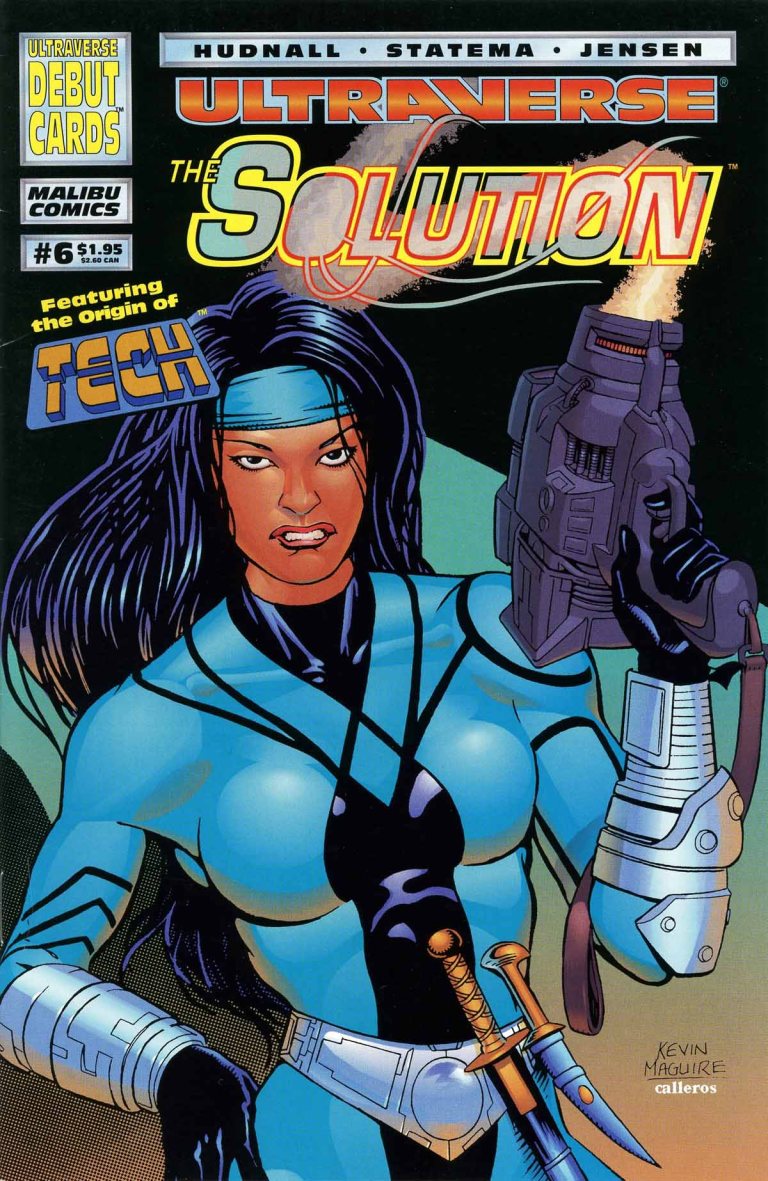
Now we can start this look back at The Solution #6, the Ultraverse comic book published in 1994 by Malibu Comics with a story written by James Hudnall and illustrated by John Statema (with ink work by Dennis Jensen and Mark Stegbauer).
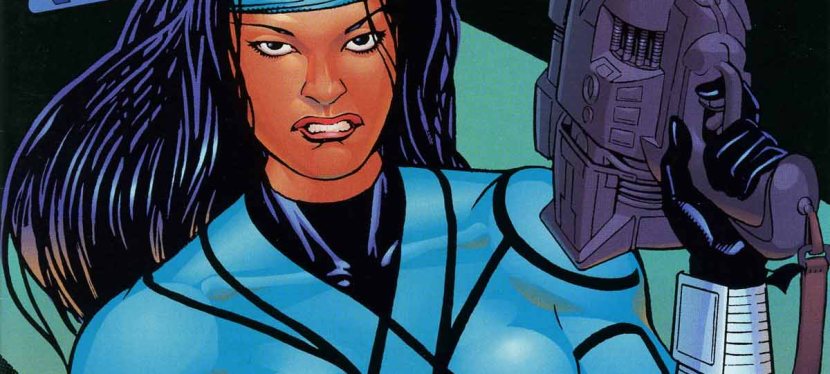
The cover.
Early story
The story begins with Lela Cho (Tech) alone paying respect to her father at his grave. She tearfully recalls what happened right after he died.
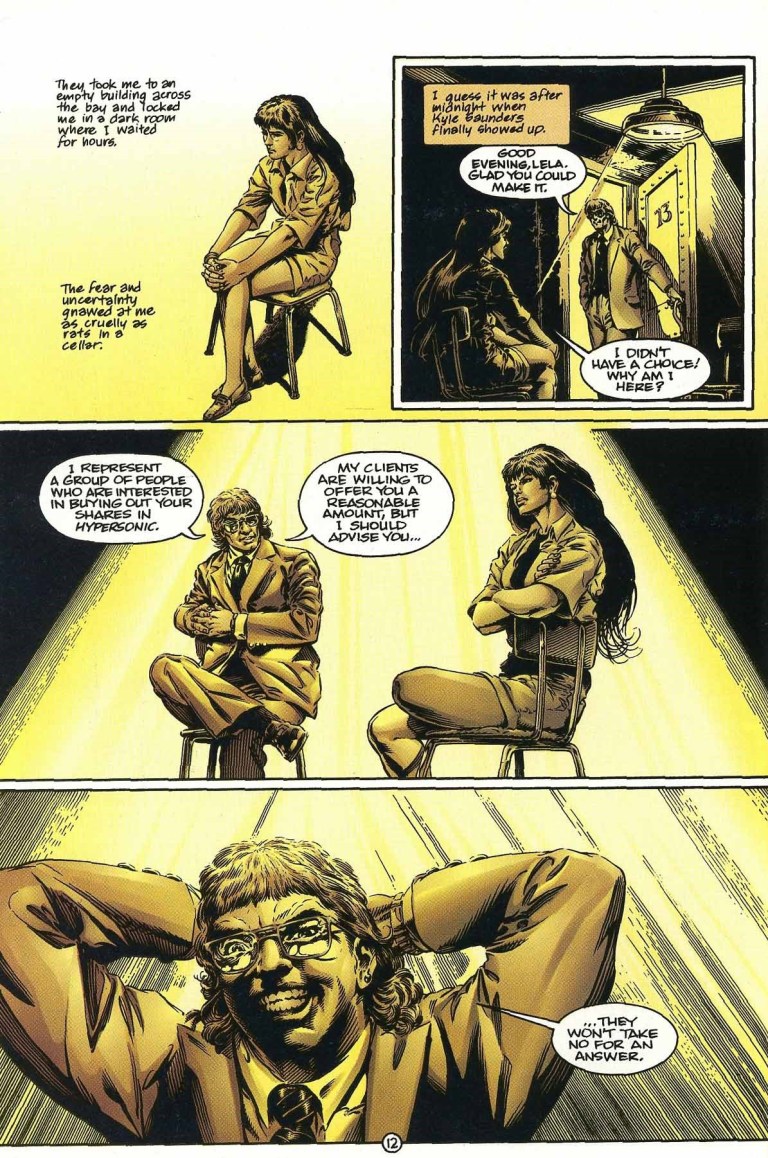
The narrative then shifts to 1993, specifically the day her father was about to get buried with many guests involved. Even though she is mourning, a man with blonde hair approaches her. His name is Kyle Sanders and he tells her she wants to talk to her about the corporation called Hypersonic. After receiving his business card, Lela feels a strange sense of dread creeping up on her.
A few days later, Lela attends a Board of Directors meeting at the headquarters of Hypersonic. She reminds them that she inherited all of her father’s shares in the company that makes her a majority stockholder and it was written in his will that she will assume his post as Chairman of the Board. Even though she already earned her Master’s Degree in Business at Harvard, the BOD members rejected her on the grounds that she’s too young and has no previous practical experience. They expressed that it would be better for her to work within the company and climb her way up.
Even though she got rejected and found herself alone, she decided not to give up and move forward by visiting NuWare, a corporation in San Francisco, California, that specializes on bio-tech implants (Wetware) that can make a person an Ultra…
Quality
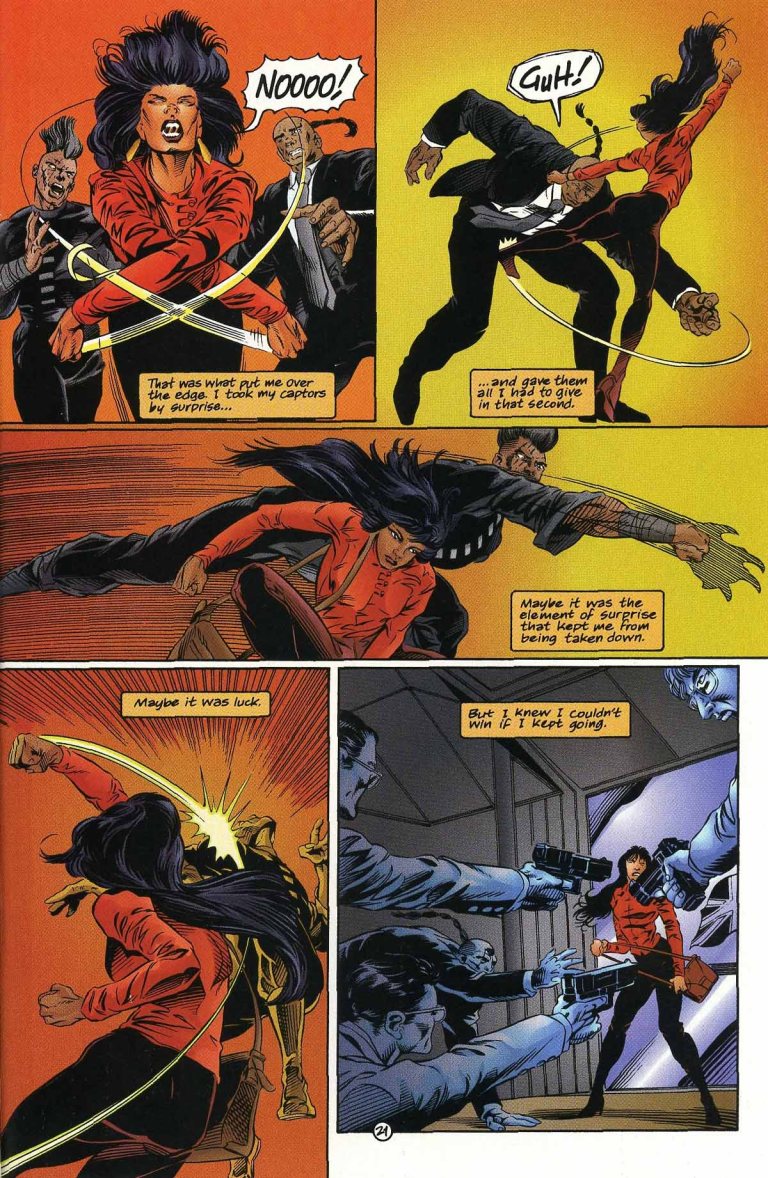
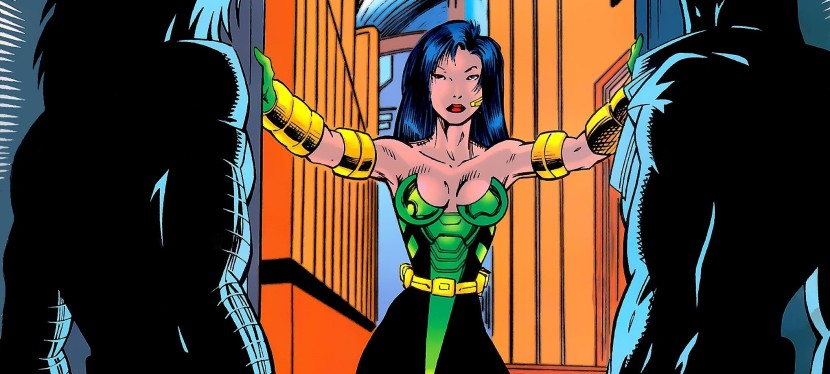
Lela Cho/Tech in action!
This is a very compelling, character-driven comic book, one of the best of the Ultraverse I read as of this writing. Clearly the late Hudnall achieved his goal of not only developing Lela Cho/Tech, but also defining her as a living part within the Ultraverse. Speaking of the Ultraverse, there is this nice and subtle connection with certain people regarding The Strangers.
Back to Lela Cho, her personality was very deeply defined by Hudnall. By the time you reach the end of this comic book, you should at least be caring about her even though her status as a super-rich lady trying to make her way up in business (while protecting herself) puts her on a different class. Ultimately her transformation into an Ultra is special to read and examine, even worthy of a cinematic adaptation.
Regarding the visuals, John Statema pulled of a great job. I love how the facial expressions he illustrated brought out the ranging emotions of the characters, specifically with Lela. When she’s mad, she really looks mad. When she is sad, you will see the sadness. Regarding action, Statema’s effort was decent.
Conclusion
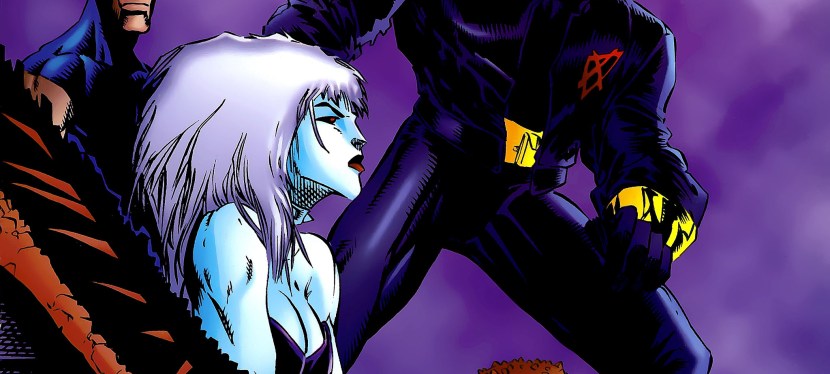
Really nice art and good choice with the colors for the light effect.
I really liked The Solution #6. From start to finish, it kept me very engaged and ultimately it made me understand Lela Cho/Tech much better, which also made me go back to re-reading the first issue.
If you are seriously planning to buy an existing hard copy of The Solution #6, be aware that as of this writing, MileHighComics.com shows that the near-mint copy of the regular edition costs $4.
Disclaimer: This is my original work with details sourced from reading the comic book and doing personal research. Anyone who wants to use this article, in part or in whole, needs to secure first my permission and agree to cite me as the source and author. Let it be known that any unauthorized use of this article will constrain the author to pursue the remedies under R.A. No. 8293, the Revised Penal Code, and/or all applicable legal actions under the laws of the Philippines.
Previously, I took a look back at Hardcase #4 which marked the crossover between Hardcase and The Strangers. It was a fulfilling read in the sense that it built-up the initial connections between the Hollywood ultra (with Choice on his side) and the team. The crossover however continued in the other Ultraverse series titled The Strangers.
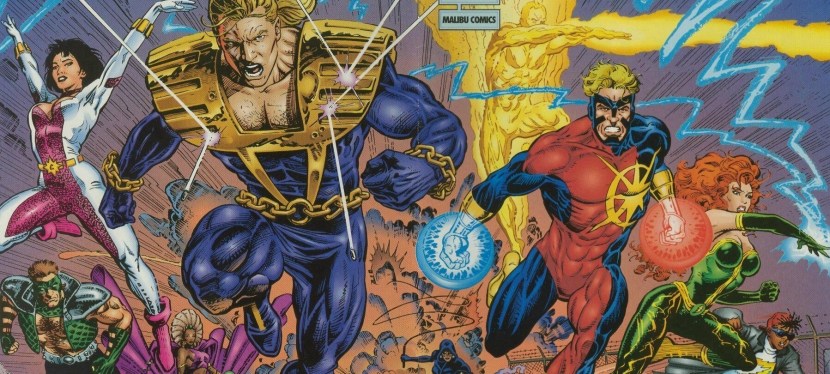
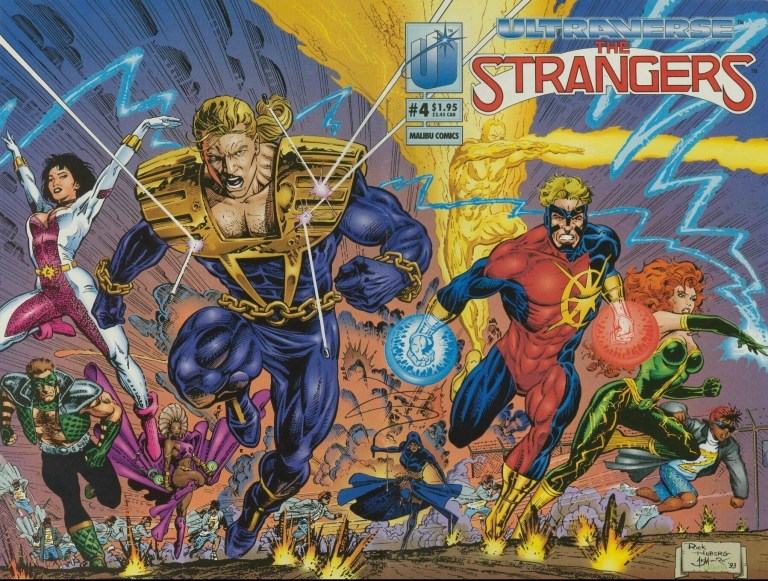
Join me on this look back at The Strangers #4, published in 1993 by Malibu Comics with a story written by Steve Englehart and illustrated by Rick Hoberg.
Same cover as Hardcase #4 but with the banner of The Strangers.
Early story
The story begins deep inside a secret facility with Hardcase and the Strangers already caught by Aladdin. Grenade tries his to break through the pink energy field separating them from Aladdin personnel but fails. The group is told that Aladdin has been watching ultras for some time and has developed was to neutralize anything ultras could do. It has been made clear to them that nobody will enter the pen until they all agree to join Aladdin.
After much talk, Hardcase and the Strangers managed to bring the energy field down and free themselves…
Quality
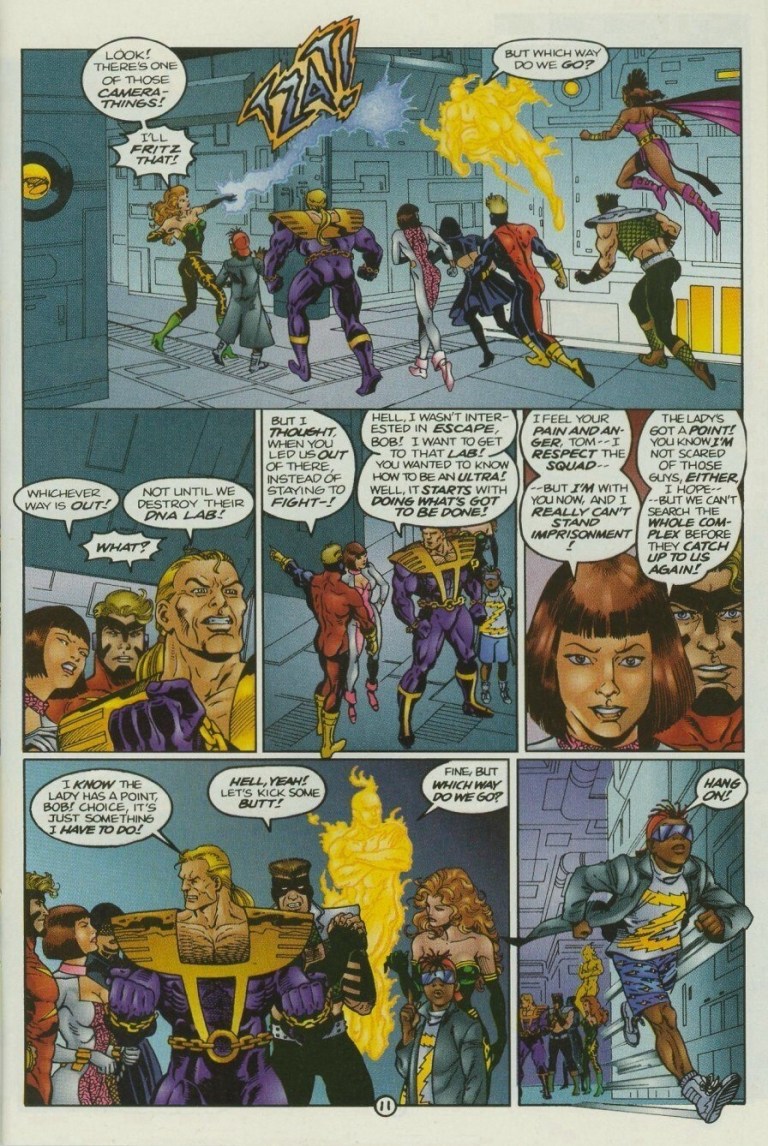
Hardcase, Choice and the Strangers inside Aladdin’s facility.
While Hardcase #4 served mainly as the build-up, this comic book serves as the big pay-off completely loaded with spectacle and fun! The creative team of Steve Englehart and Rick Hoberg, in coordination with the creative team of Hardcase, crafted this very memorable conclusion to the 2-part crossover of Hardcase and The Strangers.
Crossing over aside, this comic book provides readers a nice look at Aladdin, a secret society run by the American government focused on ultras (people with extraordinary abilities). Ultras who won’t help the government are put under lock-and-key mainly for the protection of society. Ultras who agreed to work for the government are authorized and supplied to help in the so-called grand scale.
The interactions between Hardcase (and Choice) with the Strangers that started in Hardcase #4 continued nicely in this comic book. The interactions went on to evolve into great team work in this misadventure. When it comes to superhero action, Rick Hoberg’s illustration is very wonderful to look at. Hoberg’s visual presentation on Hardcase and Choice was no less excellent, plus his art on the opposing ultras (working for Aladdin) was nicely done.
On the aspect of characterization, I liked how Yrial (the African lady who often reminds me of X-Men’s Storm) reacted so bluntly after admitting she had previous knowledge about Aladdin. There was also that nice exchange between Atom Bob and Choice, which made the guy feel idiotic and like a commercial. The exchange was noticed by Grenade and Electrocute which resulted some clever dialogue.
Conclusion
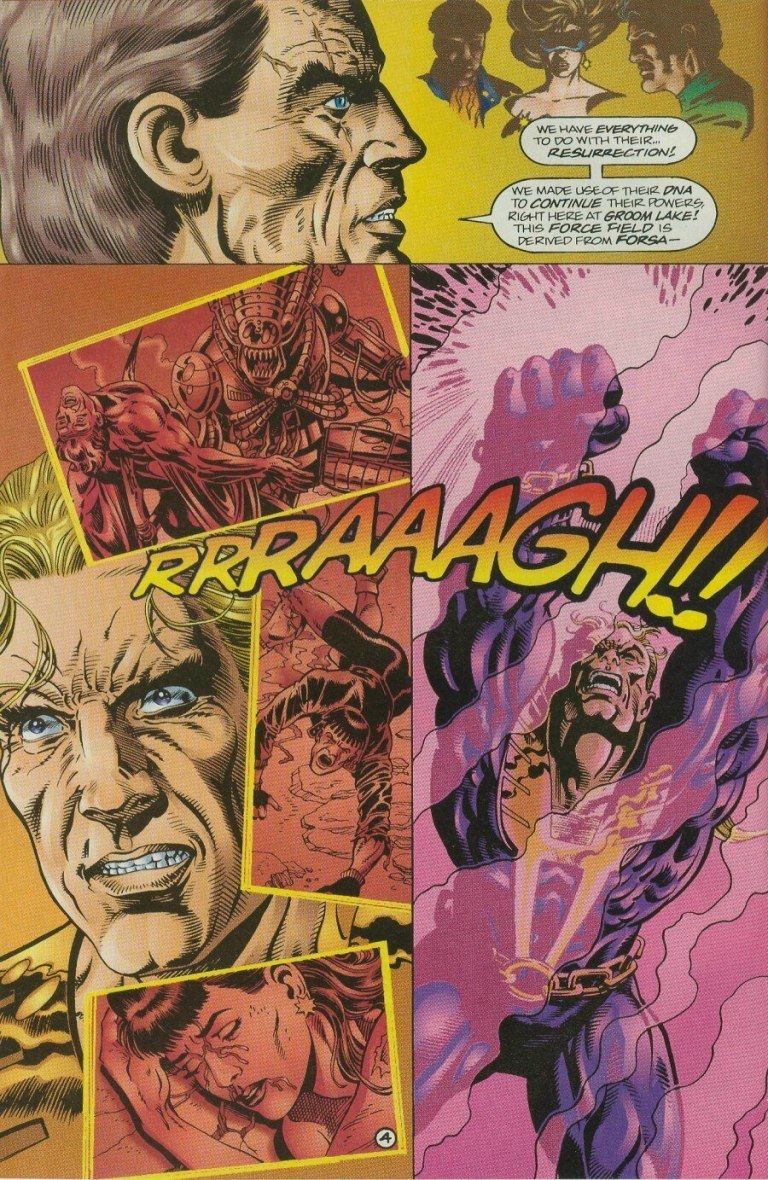
This page added more to Hardcase’s character. Nicely drawn by Rick Hoberg.
The Strangers #4is excellent and worthy of being part of your collection of comic books. It is compelling and fun to read from start to finish. By the time the story ends, this comic book should make you care more about Hardcase and the Strangers.
If you are seriously planning to buy an existing hard copy of The Strangers #4, be aware that as of this writing, MileHighComics.com shows that the near-mint copy of the regular edition costs $4. The near-mint copy of the newsstand edition is priced at $13.
Overall, The Strangers #4 is highly recommended.
Thank you for reading. If you find this article engaging, please click the like button below and also please consider sharing this article to others. If you are looking for a copywriter to create content for your special project or business, check out my services and my portfolio. Feel free to contact me as well. Also please feel free to visit my Facebook page Author Carlo Carrascoand follow me at HavenorFantasy@twitter.com
Disclaimer: This is my original work with details sourced from reading the comic book and doing personal research. Anyone who wants to use this article, in part or in whole, needs to secure first my permission and agree to cite me as the source and author. Let it be known that any unauthorized use of this article will constrain the author to pursue the remedies under R.A. No. 8293, the Revised Penal Code, and/or all applicable legal actions under the laws of the Philippines.
If you were one of the early fans of X-Men 2099 and you admire Xi’an a lot, then this next comic book I’m about review may interest you. For one thing, a whole lot has changed during the first year of the X-Men 2099 when demons from Xi’an’s past caught up with him. Since issue #25, he became much less prominent until something started building up in issue #31.
That being said, here is a look back at X-Men 2099 #32 published by Marvel Comics in 1996 with a story written by John Francis Moore and illustrated by Jan Duursema (replacing Ron Lim).
Early story
The comic book opens with a flashback set sometime in the year 2094. There on the streets of New Hope, Texas, was the gang called the Lawless led by Xi’an accompanied by his teammates including Junkpile and Ten Eagles. As a badly wounded man points his gun at him, Xi’an strikes him hard boasting supremacy.
In the present day over at Halo City, members of X-Nation spend time at a bar called The Negative Zone. They turn away a drunk blonde guy (a mutant actually) who tried to meddle with them. As the said guy leaves the bar, he bumps into a large guy who reacts by striking him. Elsewhere in the city, a large man-like beast arrives to meet Maim, Xi’an and Ten Eagles…
Quality
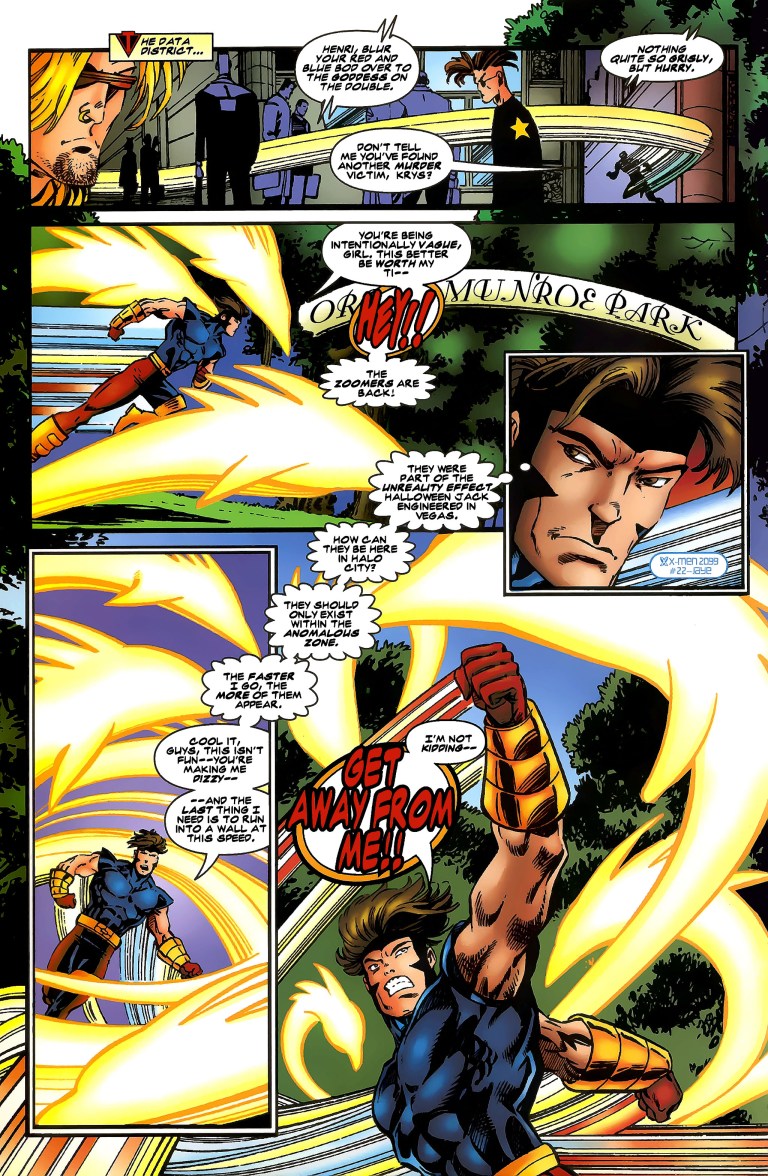
Jan Duursema’s quite good on flashy action as well as capturing the look of Meanstreak.
While the writing remains engaging and balanced with spectacle, be aware that this comic book is essentially more about the Lawless than the X-Men themselves. On face value, it looked like this was a clever set-up for a potential project featuring the Lawless complete with a villain called Foolkiller who was portrayed to be very menacing and has a major plan of his own.
Those who are followers of Xi’an will have a lot to enjoy as he slowly starts regaining the spotlight but with his old gangmates. Quite symbolically in this comic book, Xi’an even said: “It seems I cannot escape the violence of my past.”
Regarding the X-Men of 2099, their presence in this comic book is pretty short but there is a very nice reunion (note: the cover of issue #31 was technically a giveaway) that makes this story worth reading. As the reunion connected to the past, there is something brewing that would impact their future.
When it comes to the artwork, I find Jan Duursema’s work here quite good to look at. Her take on the existing X-Men members like Meanstreak, Krystalin, Metalhead, Luna and Bloodhawk was solid, and I easily recognized them. Like Ron Lim, Duursema is quite capable of visualizing action scenes. Finally, her drawing of a very angry Xi’an at the end of the story is eye-catching.
Conclusion
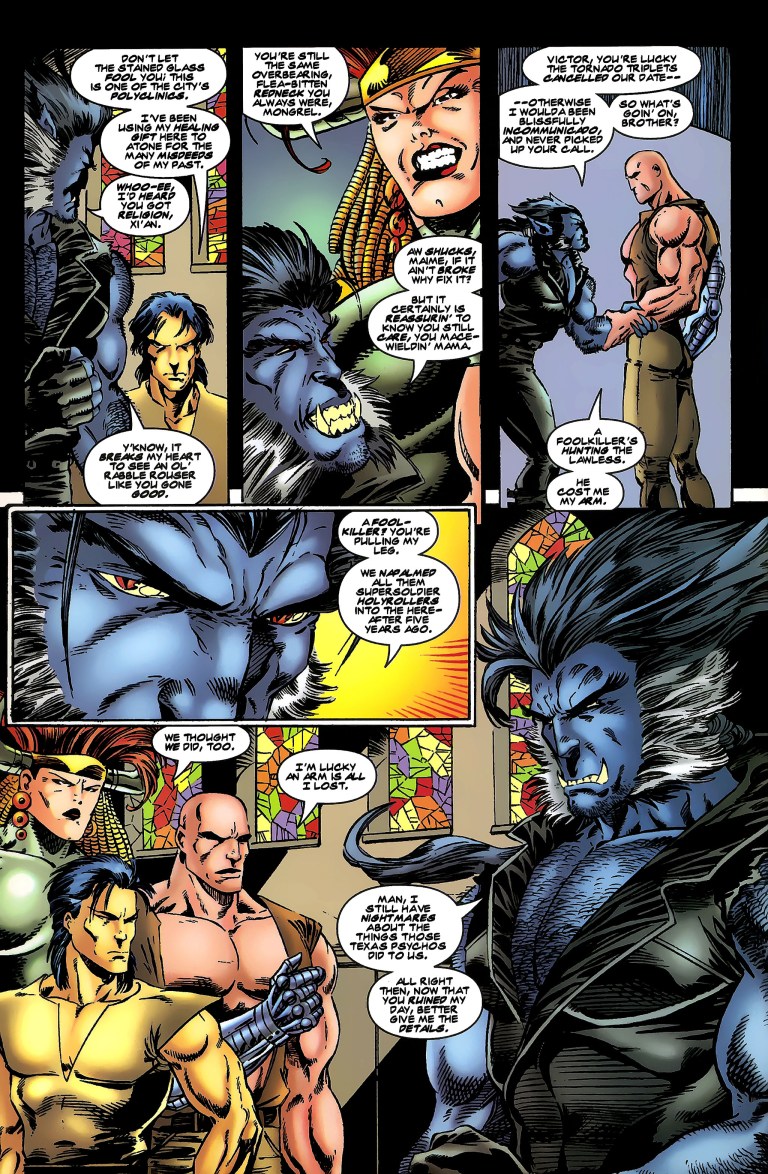
That blue-skinned beast is NOT Hank McCoy/Beast!
Given the fact that this is a story more focused on Xi’an and the return of his old gang, it’s clear that X-Men 2099 #32 will satisfy fans of the character Xi’an as well as those who want to take a short break from the main X-Men team. The short appearance of X-Nation members should delight followers of the X-Nation series.
If you are seriously planning to buy an existing hard copy of X-Men 2099 #32, be aware that as of this writing, MileHighComics.com shows that the near-mint copy of the regular edition and the newsstand edition cost $9 and $11 respectively.
Overall, X-Men 2099 #32 is satisfactory. It is enjoyable to a certain extent but don’t pay too much for this comic book.
Thank you for reading. If you find this article engaging, please click the like button below and also please consider sharing this article to others. If you are looking for a copywriter to create content for your special project or business, check out my services and my portfolio. Feel free to contact me as well. Also please feel free to visit my Facebook page Author Carlo Carrasco and follow me at HavenorFantasy@twitter.com
Disclaimer: This is my original work with details sourced from reading the comic book and doing personal research. Anyone who wants to use this article, in part or in whole, needs to secure first my permission and agree to cite me as the source and author. Let it be known that any unauthorized use of this article will constrain the author to pursue the remedies under R.A. No. 8293, the Revised Penal Code, and/or all applicable legal actions under the laws of the Philippines.
There is no doubt that George Perez’s famous handling of Wonder Woman (that became a key part of the Post-Crisis era of DC Comics) is influential for other creators. Over at Comic Book Resources, I read a 2017 article in which Wonder Woman movie director Patty Jenkins confirmed that Perez’s work on the Queen of Superheroes helped influence the movie.
Below is what Jenkins said in response to CBR’s question involving George Perez:
I think it was the fact that he expanded the role of the gods. It was always there — nothing he did contradicted what William Marston did and created, I think it only expanded upon and fleshed out who the gods are. What that relationship is, and how that works. What was a wonderful thing for us to take from.
I personally love the Wonder Woman movie and truly Gal Gadot IS Wonder Woman! As George Perez’s work on the Queen of Superheroes was influential to the director, it is clear that he set the standard on presenting Wonder Woman to the world.
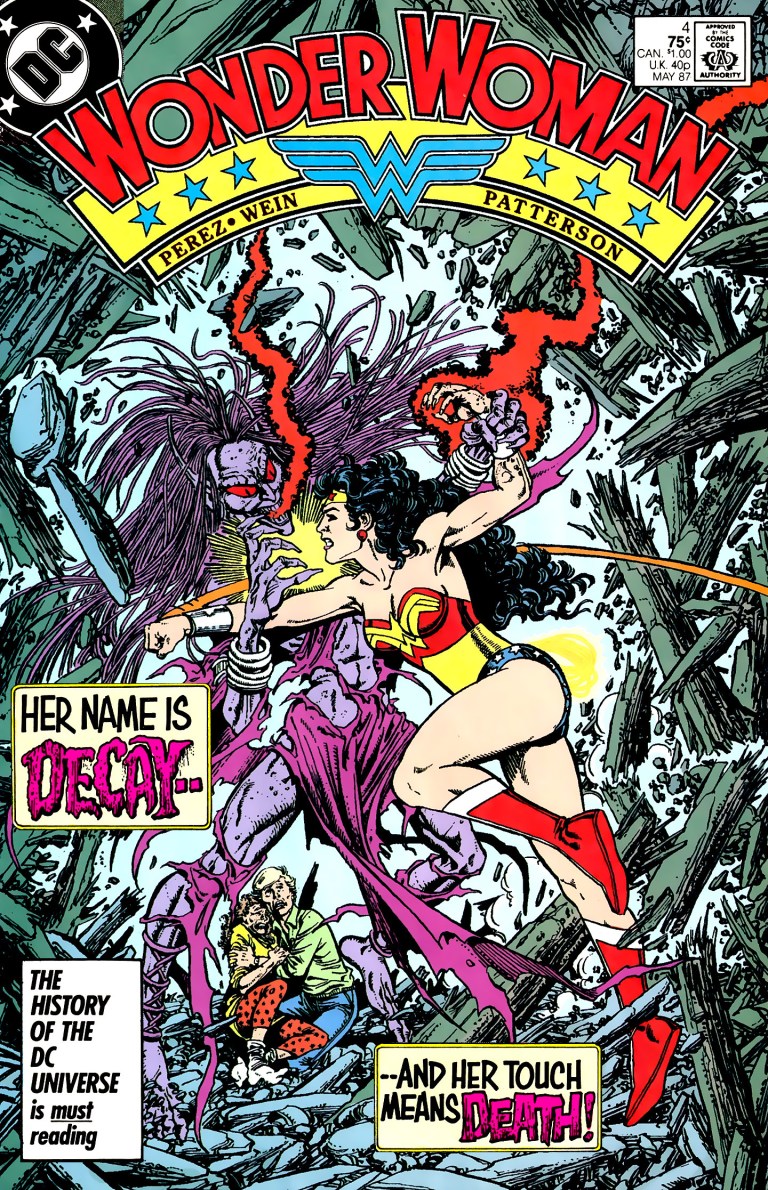
With the movie and history talk over, we can now proceed on revisiting the Post-Crisis era of DC Comics with this look back at Wonder Woman #4, published in 1987 by DC Comics with a story by George Perez and Len Wein (script) and art by Perez (inked by Bruce D. Patterson).
The cover.
Early story
The story begins with Wonder Woman carrying Julia Kapatelis and her daughter Vanessa moving away from the villainess Decay (daughter of Medusa) as a huge portion of the Kapatelis home collapses. As expected, the next-door neighbors got disturbed and went out of their homes to see what’s going on.
While taking a break just out of the rubble, Julia checks on Vanessa and asks: “What has that monster done to her?”
Suddenly, Decay rises from the rubble and answers Julia’s question directly stating she will do the same thing to her and Wonder Woman. Decay has Wonder Woman’s tiara with her.
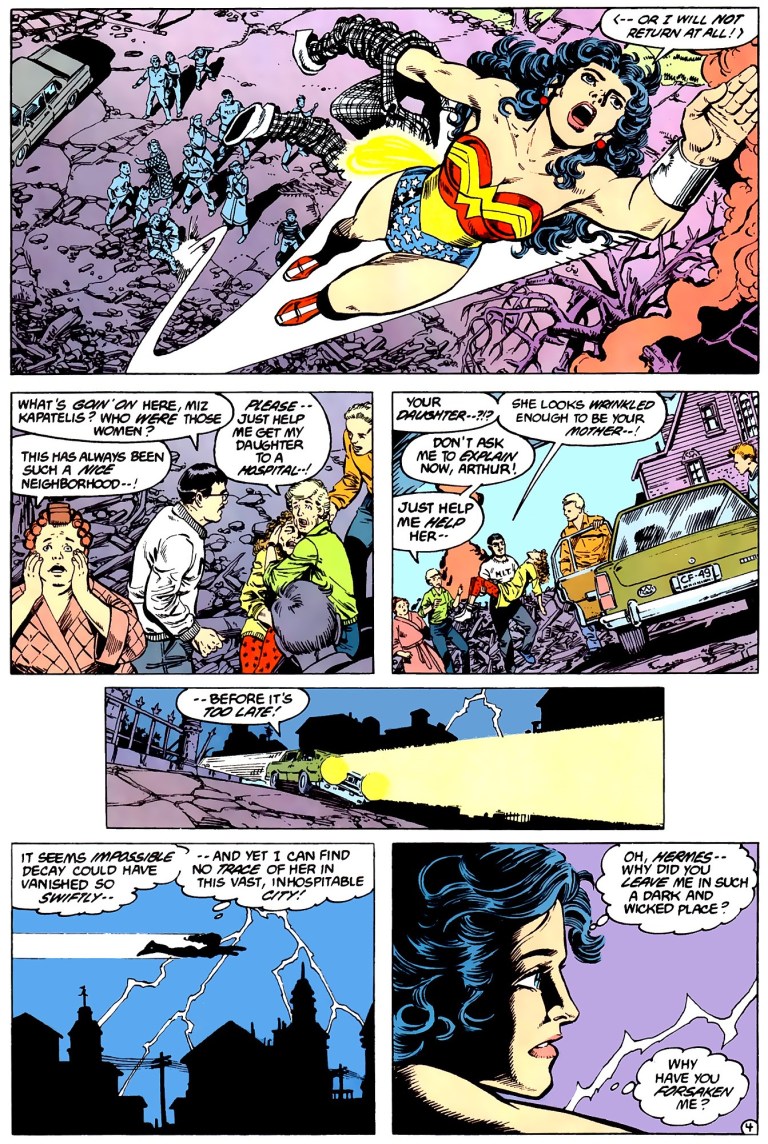
Decay’s appearance scares many onlookers. Wonder Woman tells Julia to keep the neighbors back. Decay says that she came only for the symbol of Wonder Woman’s power (the tiara specifically) which she will use to symbolize her power. Decay then flies away.
Before flying off, Wonder Woman tells Julia that she will return with a cure for her teenage daughter whose body got heavily wrinkled by Decay…
Quality
I hope Wonder Woman 1984 and future Wonder Woman live-action movies will have more hard-hitting action scenes like this.
Once again, George Perez and Len Wein crafted another excellent Wonder Woman comic book that is timeless and symbolic. While Wonder Woman #3 marked Princess Diana’s arrival in man’s world, this comic book marked her first-ever battle in the same world complete with disturbance on the local society. Take note that at this point, Wonder Woman still has yet to understand and speak English and she has not fully adjusted to the local culture and society. She also just befriended Julia, the university professor and only person who could communicate with her by talking in Greek. Even with all the trouble caused by Decay, Wonder Woman’s heroism laced with love and compassion backed by her Amazon values remains intact and this aspect alone makes this comic book worth reading.
Apart from focusing on Wonder Woman and the supporting players, the comic book gives a close look at what has been happening at Mount Olympus where the Greek gods and goddesses discuss the situation of Princess Diana. There are also a few scenes set in the American military base wherein Lieutenant Etta Candy secretly does detective work to find out what caused the anomaly that led the higher-ups to suspect Steve Trevor of wrongdoing.
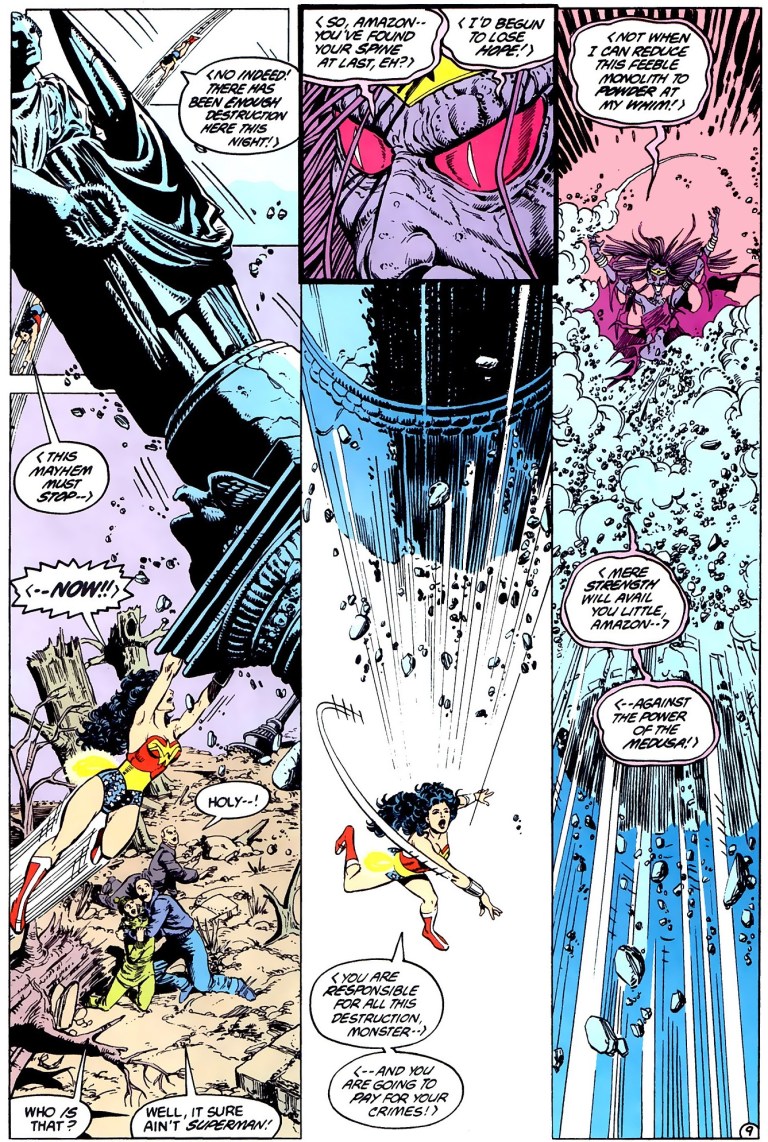
As for the artwork, George Perez’s work here is excellent as expected. When destruction is shown, there is a strong sense of danger. When hard superhero action occurs, there is a lot of impact shown! I just love looking at scenes showing Wonder Woman saving people from certain death. Also there were some really powerful executions of action here (involving Wonder Woman) that I wish future Wonder Woman movies will someday replicate.
Conclusion
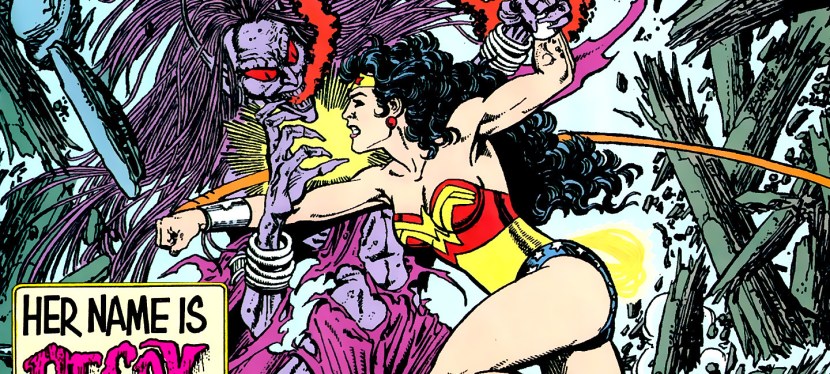
Wonder Woman striving hard to go after Decay, the monster responsible for the destruction seen here.
Wonder Woman #4 of 1987 is excellent! Apart showing the first time ever that Wonder Woman engaged in battle in man’s world, this comic book also has an intimate look on how Princess Diana struggles with focusing on her mission while adjusting to the local culture and making sure that evil beings from her culture would not succeed in destroying the people of man’s world.
If you are seriously planning to buy an existing hard copy of Wonder Woman #4, be aware that as of this writing, MileHighComics.com shows that the near-mint copy of the regular edition and the newsstand edition cost $25 and $51 respectively.
Overall, Wonder Woman #4 (1987) is highly recommended!
Thank you for reading. If you find this article engaging, please click the like button below and also please consider sharing this article to others. If you are looking for a copywriter to create content for your special project or business, check out my services and my portfolio. Feel free to contact me as well. Also please feel free to visit my Facebook page Author Carlo Carrasco and follow me at HavenorFantasy@twitter.com
Disclaimer: This is my original work with details sourced from reading the comic book and doing personal research. Anyone who wants to use this article, in part or in whole, needs to secure first my permission and agree to cite me as the source and author. Let it be known that any unauthorized use of this article will constrain the author to pursue the remedies under R.A. No. 8293, the Revised Penal Code, and/or all applicable legal actions under the laws of the Philippines.
After going through the first two issues of Warriors of Plasm, I really find the sci-fi concept of Jim Shooter and David Lapham very compelling, intriguing, unique and enjoyable. There’s nothing like witnessing an empire of a race of people living not only within a really organic world but also use living things (even creatures) as a means of technology that does not involve metal, plastic and computers. And then there were people from Earth who survived the trip to the world of Plasm and got enhanced.
Excited? Let’s now take a look a look back at Warriors of Plasm #3 published by Defiant Comics in 1993 with a story written by Jim Shooter and drawn by David Lapham.
The cover.
Early story
The story begins inside Plasm where Lorca, Sueraceen and their troops just arrived from planet Earth. Sueraceen expressed to her lover that she found it doubly infuriating that they were trashed by the five survivors (of Earth) who, ironically, were geneti-morphed (enhanced) by him. Lorca replied that he simply experimented on them and never suspected how dangerous they might be. Sueraceen suspects treason behind Lorca’s motives.
Suddenly the five earthlings – Cookie, Rick, Louise, Martin and Elvis – arrived in Plasm flying in an organic craft, completely surprising everyone. Even though they were outnumbered, the five survivors attacked Lorca’s people with the craft and bravely went down to do battle on foot. The military officer Elvis tries to hit Lorca up-close but failed.
As Lorca’s troops continue to get pummeled by the brave earthlings, hundreds of reinforcements from Thoraxolic’s legion arrive. Instead of being encouraged, Sueraceen only gets disturbed given her grudge against Thoraxolic. The reinforcements then gang up on the five survivors…
Quality
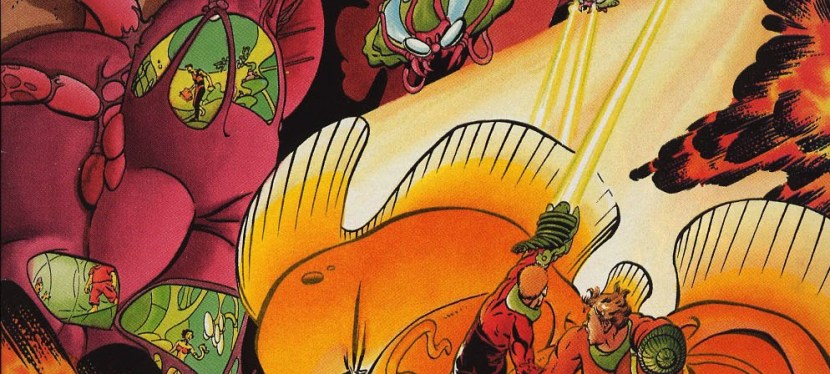
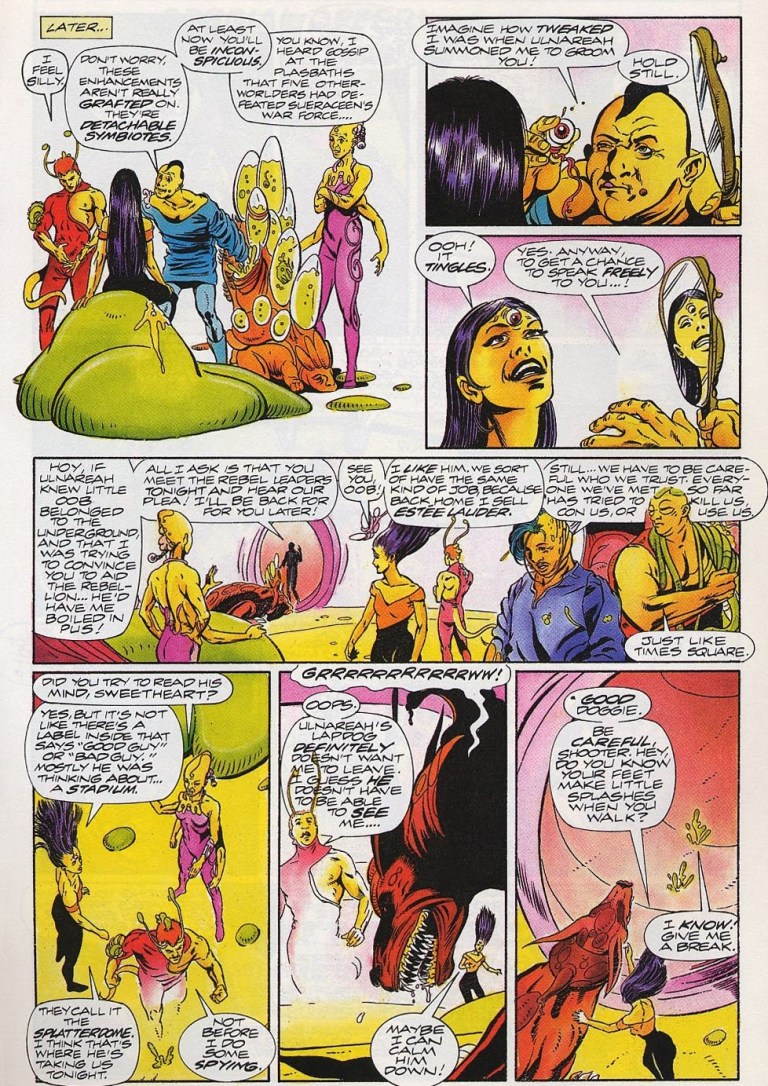
Highly imaginative character designs and environment in the Org of Plasm.
Unsurprisingly, Jim Shooter and David Lapham delivered yet another high-quality comic book and there never was a moment when the storytelling quality went down. Great dialogue, strong plot twists, in-depth characterization, spectacle and a strong sense of discovery…it’s all here!
What I like best in this comic book is the further and deep exploration of the organic world of Plasm which was done through the eyes of the five earthlings who have gotten more daring in taking on Lorca and his troops (who in issue #2 visited the Earth for a while). Let me confirm that the deeper the earthlings get into the Org of Plasm, the weirder and the more imaginative the place gets for us readers to see!
Speaking of characters, Jim Shooter’s approach on developing the five earthlings into braver, more capable people was nicely executed. By this time, Cookie, Rick, Louise, Martin and Elvis now have a more inspired, superhero team-style bond together. They are now worth caring for. Not to be outdone is the continuing intrigue on the side of Lorca.
Conclusion
Look closely.
Warriors of Plasm #3 is, unsurprisingly, another excellent comic book to read and have as part of your personal comic book collection.
If you are seriously planning to buy an existing hard copy of Warriors of Plasm #3, be aware that as of this writing, MileHighComics.com shows that the near-mint copy of the regular edition costs $4. The near-mint copy of the comic book signed by Jim Shooter is worth $7.
Overall, Warriors of Plasm #3 is highly recommended!
Thank you for reading. If you find this article engaging, please click the like button below and also please consider sharing this article to others. If you are looking for a copywriter to create content for your special project or business, check out my services and my portfolio. Feel free to contact me as well. Also please feel free to visit my Facebook page Author Carlo Carrasco and follow me at HavenorFantasy@twitter.com
Disclaimer: This is my original work with details sourced from reading the comic book and doing personal research. Anyone who wants to use this article, in part or in whole, needs to secure first my permission and agree to cite me as the source and author. Let it be known that any unauthorized use of this article will constrain the author to pursue the remedies under R.A. No. 8293, the Revised Penal Code, and/or all applicable legal actions under the laws of the Philippines.
As mentioned before, much of the stories of X-Men 2099 were set in the southwestern region of the United States which gave the team’s adventures and misadventures a unique setting completely different from what was shown in the stories of Spider-Man 2099 and Punisher 2099. Along the way, John Francis Moore and Ron Lim crafted stories that made the mutants of the far future unique when compared to the X-Men of the 20th century. Stories were, for the most part, original.
Historically speaking, the X-Men 2099 monthly series ended with a total of thirty-five issues. As such we are gradually nearing the end as we take a close look back at X-Men 2099 #31 published in 1996 by Marvel Comics with a story written by John Francis Moore and drawn by Ron Lim.
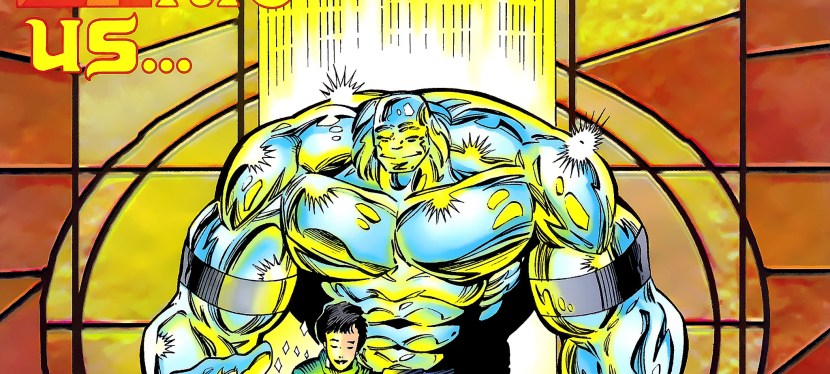
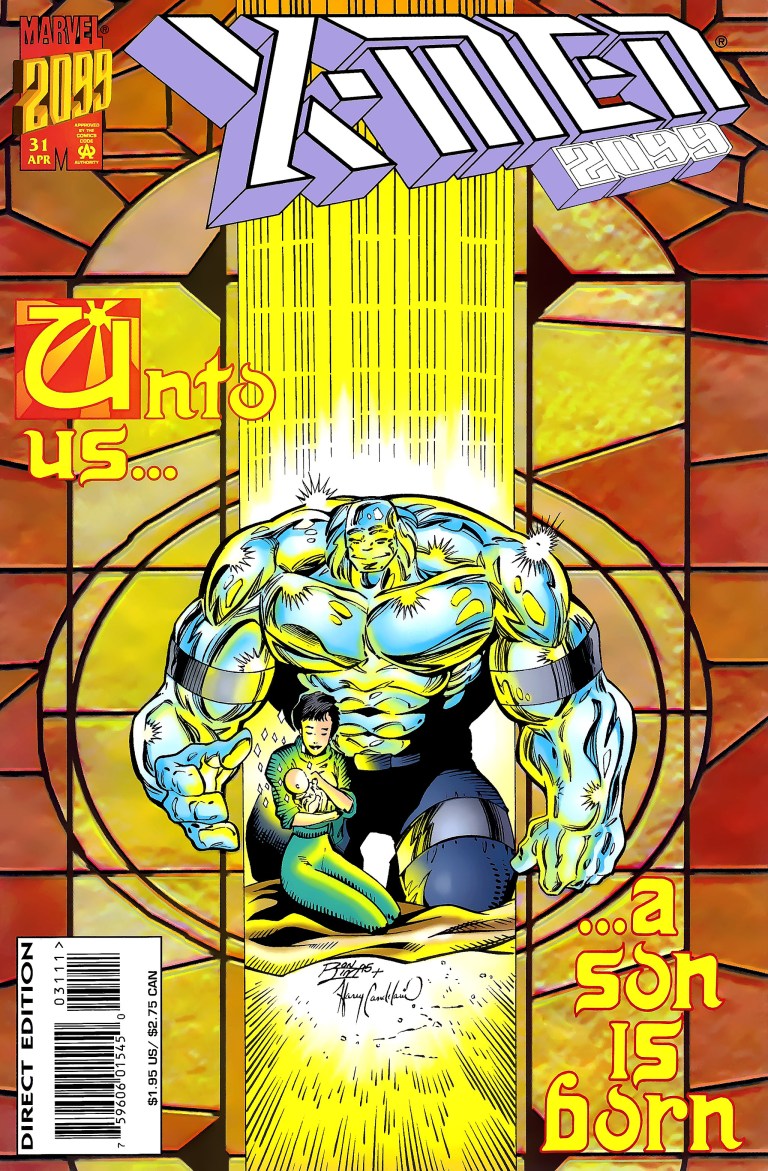
The cover.
Early story
The story begins in Mexico. There a Metro Express train moves on its track smoothly until it comes close to hitting Skullfire who was just standing in front of it. Suddenly, Meanstreak grabs Skullfire moving him out of the path of the train and on to a safe spot where Luna is. Luna reminds Meanstreak that Skullfire has not been himself since their team took out the Graverobber. Meanstreak is not convinced that Tim/Skullfire has returned to normal, and he stressed that their team almost fell apart only because one leader fell off the deep end.
Meanstreak, Skullfire and Luna on a mission in Mexico.
As it turns out, the three of them are on a mission searching for a mutant who sent them a message claiming he was being held against his will. They start moving towards to the headquarters of the Quetzalcoatl Corporation and their mission is to raid it.
Meanwhile at another location in Mexico, a gray, rock-like mutant is held prisoner in the dark. Chairman Belize contacts him via live video asking for the market overviews he requested. The imprisoned mutant does not want to cooperate.
Back at Halo City, former X-Men leader Xi’an talks with Ten Eagles (note: Krystalin met him in the wasteland some time ago) who now has a brand new cybernetic arm…
Quality
There was no surprise that John Francis Moore confidently crafted another story showing members of the X-Men separated and placed in different situations far away from each other. As such, the characters got developed more while the plot (or in this comic book, tales of each group of X-Men) thickened.
Without spoiling too much, it was refreshing to see renewed spotlight on Xi’an and Ten Eagles, which helped flesh out the personality of Krystalin. As for the mission of Meanstreak, Skullfire and Luna, it’s nice to see them out of Halo City and take things seriously to accomplish something very important.
Regarding the mysterious mutant imprisoned by a corporation’s leader, the story emphasized once again the theme of the state of mutants in 2099 – mutants are of a lower social class disregarded or exploited by the people who have more money and power (try comparing this to the classic mutants-and-humans conflict of the classic X-Men). To analyze things a bit, there is a bit of Political Leftist influence in the presentation. Come to think of it, the concept of so-called progressive diversity within the X-Men of 2099 had started since the beginning of this monthly series. I’m confident that today’s self-proclaimed socialists, social justice warriors (SJWs) and liberals will find something to relate with in this comic book.
Regarding the art of Ron Lim, he delivered solid visuals as expected. He also exerted effort on visualizing futuristic technology that made sense within Marvel 2099’s fantasy.
Conclusion
X-Men 2099 #31 is fun and worth spending time to read. Just don’t let the cover art mislead you on what to expect with the story.
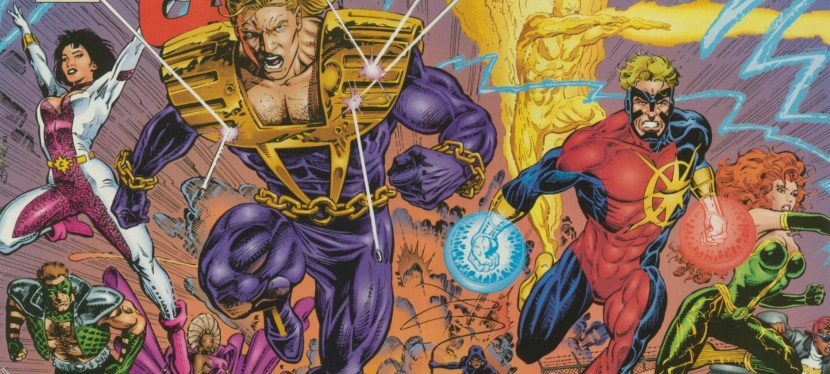
An action scene.
If you are seriously planning to buy an existing hard copy of X-Men 2099 #31, be aware that as of this writing, MileHighComics.com shows that the near-mint copy of the regular edition costs $7 while the newsstand edition’s near-mint copy costs $21.
Overall, X-Men 2099 #31 is recommended.
Thank you for reading. If you find this article engaging, please click the like button below and also please consider sharing this article to others. If you are looking for a copywriter to create content for your special project or business, check out my services and my portfolio. Feel free to contact me as well. Also please feel free to visit my Facebook page Author Carlo Carrasco and follow me at HavenorFantasy@twitter.com
Disclaimer: This is my original work with details sourced from reading the comic book and doing personal research. Anyone who wants to use this article, in part or in whole, needs to secure first my permission and agree to cite me as the source and author. Let it be known that any unauthorized use of this article will constrain the author to pursue the remedies under R.A. No. 8293, the Revised Penal Code, and/or all applicable legal actions under the laws of the Philippines.
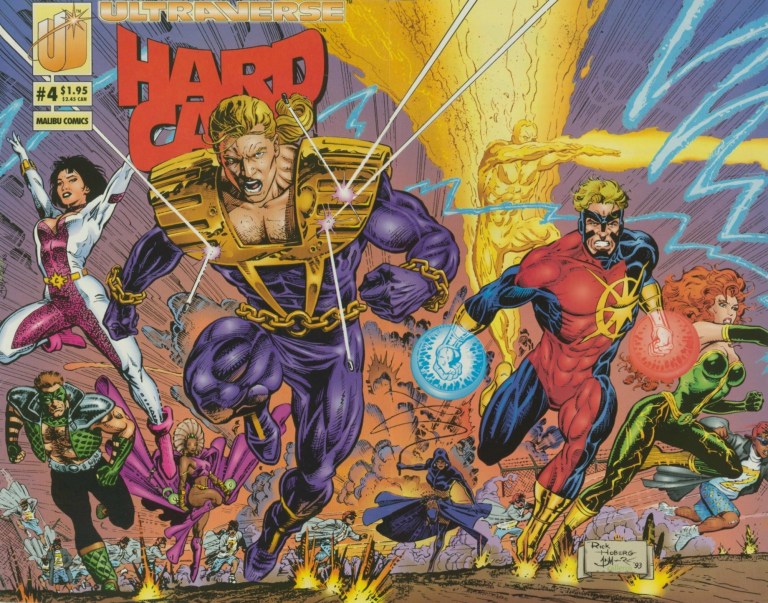
When done right by really talented people, superhero crossovers within the shared universe of a particular publisher can be fun to read. In this retro comic book review, we are about to explore one of the earliest Ultraverse crossovers ever published. To put things in perspective, the Ultraverse imprint was launched in 1993 by Malibu Comics, and there were several titles that debuted like Prime, Mantra, Hardcase, The Strangers and Prototype to name a few. Unsurprisingly, in-universe crossovers were bound to happen shortly after launch and create new opportunities of fun for fans and readers.
Here is a look back at Hardcase #4 published in 1993 by Malibu Comics with a story co-plotted by James Hudnall (writer) and Steve Englehart, and drawn by Roger Robinson.
Really nice cover!
Early story
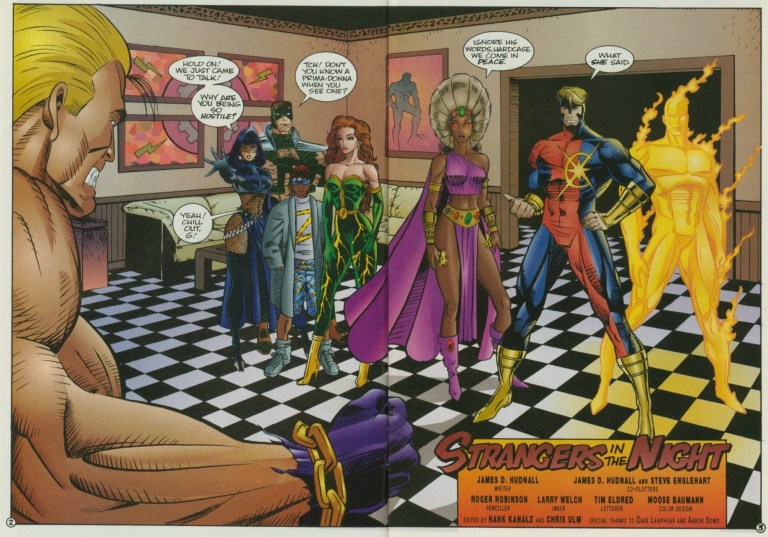
The story begins inside Hardcase’s home. He and Choice were surprised by the presence of The Strangers inside. While Hardcase was fuming mad, Lady Killer and her teammates tried to calm him down expressing they meant no harm and simply wanted to talk with him.
Imagine having strangers inside your nice home without your authority.
“Look—we’ve just come back from a fight with a bunch of ultras who wanted to kill Choice and me. And earlier today, another group showed up and took out part of my house. So, to put it mildly, I’m not exactly in a sociable mood,” Hardcase said calming down.
Eventually Hardcase and Choice talked with the Strangers….
Quality
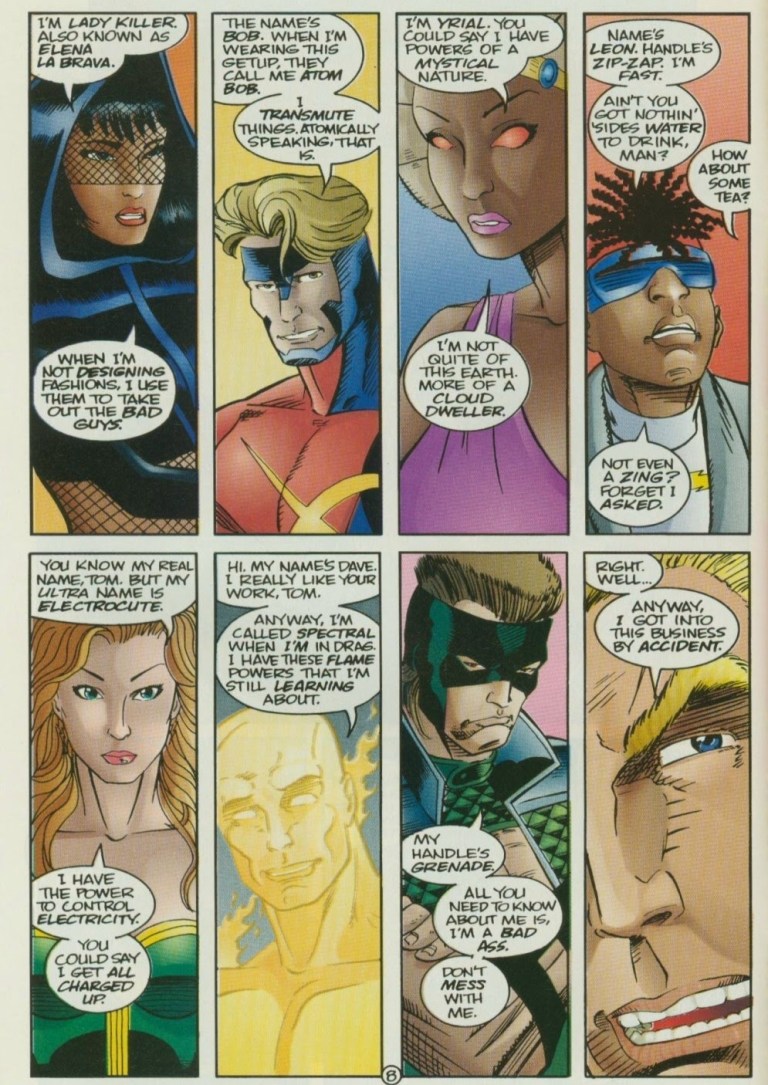
Meet the Strangers!
For the most part, this comic book is less about spectacle (unsurprisingly) but more about exposition and character interaction. This does not mean Hardcase #4 is boring, in fact it’s still compelling to read. In clever ways, this comic book has some very relevant stuff for Hardcase fans specifically lots of in-depth, additional details about him (including details about The Squad) and how he changed to be an ultra. In short, this one shows Hardcase’s origin and what happened afterwards. James Hudnall’s script here not only connected nicely with the final Squad moments in issue #1 but also deepened the details. By the time I finished reading Hardcase #4, the tragic event that opened Hardcase #1 made even more sense to me.
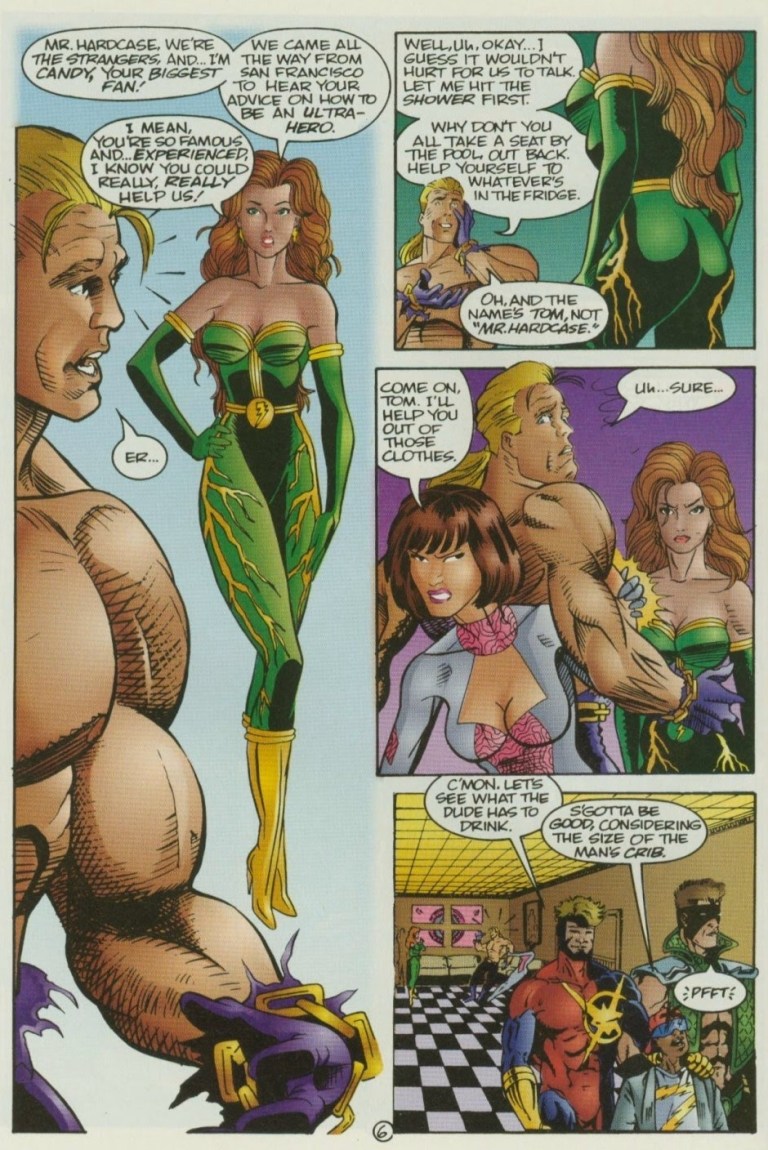
The writing is this comic book’s biggest strength not only because it fully explored more of Hardcase’s past but also due to the nice interactions Hardcase and Choice had with the Strangers. I really like the short scene when Atom Bob thought about getting Choice interested in him since he finds her really charming.
Hudnall’s writing was indeed full of exposition and yet it was nicely paced and I never felt lost with the narrative. I should also mention that the presence of the secretive organization called Aladdin is felt even strongly in the story, building up the suspense for it.
When it comes to the art, Roger Robinson did a decent job visualizing the characters. For the most part, each member of the Strangers as well as Hardcase and Choice were still recognizable visually. For the action scenes, which are not that many, his art was satisfactory.
Conclusion
The interactions are nice!
While Hardcase #4 lacked spectacle, its portrayal of the crossover between Hardcase and the Strangers still made it a good read. There is additional stuff for Hardcase fans and the interaction between him and the Strangers was nicely crafted. Ultimately, this crossover was the first of two parts leading to The Strangers #4.
If you are seriously planning to buy an existing hard copy of Hardcase #4, be aware that as of this writing, MileHighComics.com shows that the near-mint copy of the regular edition costs $4. The near-mint copy of the newsstand is priced at $13.
Overall, Hardcase #4 is recommended.
Thank you for reading. If you find this article engaging, please click the like button below and also please consider sharing this article to others. Also my fantasy book The World of Havenoris still available in paperback and e-book format. If you are looking for a copywriter to create content for your special project or business, check out my services and my portfolio. Feel free to contact me as well. Also please feel free to visit my Facebook page Author Carlo Carrasco and follow me at HavenorFantasy@twitter.com
We all live in a screwed-up world. To say the least, our world is chaotic filled with fake news, war, crime, dysfunctional governments, fascism, dictatorship, abortion, Communism, corruption, socialism, homosexuality, SJWs (social justice warriors) terrorism, atheism, religion, idolatry, secularism and the list goes on.
This is because Satan is the god of the world we live in and there are billions of unsaved and lost souls who do not realize the truth of the Word of God (the Holy Bible). They also don’t realize that they need to be saved (get born again), ask God for forgiveness, submit to Him and then accept Jesus as Lord and Savior so that they can be saved and live on as true Christians driven by faith (not religion).
As I mentioned before, being religious is NOT the same as being faithful. In fact, religion is one of the more effective tools (in tandem with atheism) used by Satan to prevent people from becoming children of God. Religion itself is a hindrance to truly becoming Christian. Religion also has a bunch of man-made unholy rules like so-called blessed sacraments which prevent people from realizing the truth in the Holy Bible. Religion also comes with traditions and rituals, which are not even holy.
Having previously lived a life of following religion, its traditions, its rituals and wrongful teachings before getting saved (I got born again in 2018), I can clearly say that idolatry is unholy and is also more evil than it appears. I fully reject idolatry and I will never let it influence me now that I’m a child of God.
To put things in perspective, let’s take a look at key holy scripture in the New King James Version (NKJV) and The Passion Translation (TPT) of the Holy Bible.
Do you not know that the unrighteous will not inherit the kingdom of God? Do not be deceived. Neither fornicators, nor idolaters, nor adulterers, nor homosexuals, nor sodomites, nor thieves, not covetous, nor drunkards, nor revilers, nor extortioners will inherit the kingdom of God.
1 Corinthians 6:9-10 (NKJV)
Surely you must know that people who practice evil cannot possess God’s kingdom realm. Stop being deceived! People who continue to engage in sexual immorality, idolatry, adultery, sexual perversion, homosexuality, fraud, greed, drunkenness, verbal abuse, or extortion—these will not inherit God’s kingdom realm.
1 Corinthians 6:9-10 (TPT)
As seen above, idolatry makes one not only an idolater but also a practitioner and follower of evil which Satan loves. Idolatry involved with religion deceives idolaters into believing they are Christian when in fact they are unknowingly serving Satan. It does not matter that an idolater prays to a statue of Jesus because that is still unholy. Worship of Lord Jesus should be done to Him directly. Praying to a painting of Jesus (or any religion icon) or to an item deemed holy by a religion-driven church or hierarchy is also unholy. Take note of the following holy scripture below as well as the words bolded for clarity.
You shall not make for yourself a carved image—any likeness of anything that is in heaven above, or that is in the earth beneath, or that is in the water under the earth; you shall not bow down to them nor serve them. For I, the Lord your God, am a jealous God, visiting the iniquity of the fathers upon the children to the third and fourth generations of those who hate Me, but showing mercy to thousands, to those who love Me and keep My commandments.
Exodus 20:4-6 (NKJV)
As seen above, verse 4 of Exodus chapter 20 makes it clear that objects (which obviously include images or painting) are not to be made at all and, at the same time, our worship must always be directed to God Himself without any hindrance. God is jealous and that alone is reason for us to reject idolatry and be respectful and obedient to Him eternally. We worship the Lord directly and definitely no object, no image and no person in between! We Christians have worship leaders and pastors to guide us to worship the Lord directly, while always remembering we each have a personal relationship with God. A church that claims to be Christian but practices idolatry and has its members worship objects and the church leader is not truly Christian.
Exodus 20: 4 also looks back to the time when Israel was surrounded by people who worshiped images that were also referred to as gods. As it is true that no human effort could represent God, God Himself forbade the making of images or objects about Him. This same truth is also applied to Lord Jesus.
Meanwhile, idolatry that does not involve religion but other things like entertainment (examples: movie stars, celebrities, superheroes, video gaming), government figures (example: politicians), sports (example: basketball superstars), culture and the like is also an abomination to the Lord.
Superhero movies have been wildly popular worldwide for the past twenty years, and those films used comic books as basis for storytelling and visual concepts. How many times have people seen Spider-Man swing above people, Superman fly high, Batman fighting criminals and Wonder Woman saving people? While I enjoy superheroes in varied forms of entertainment media, I know fully well that they are all just pieces of fiction and I NEVER worshiped any of them. I will never worship them, ever. I am a geek but I prioritized my faith in the Lord and I always will maintain my personal relationship with Him. Definitely I reject idols and idolatry.
To my fellow geeks reading this, I urge you to never engage in idolatry no matter how passionate you are with your geek interest. Don’t worship movie stars, superheroes, images and don’t let highly interactive, deeply engaging video games from enslaving you. Always look up to Lord Jesus and follow God’s Word.
Idols are truly distracting and have been used by Satan to keep the unsaved and lost souls away from God, Lord Jesus and the Holy Spirit. It’s bad enough that our world is dominated by powerful, sinister forces whose acts are further magnified by the news networks that reached billions of viewers (notably news junkies) every day.
When it comes to true Christianity, we the Christians who got born again are the Church and our true leader is Lord Jesus who has been in Heaven so long ago, and He promised to return to us here on Earth. We Christians living in the flesh here on Earth are to reject idolatry (plus religion, traditions and rituals) and focus on engaging in the enduring race of faith remaining faithful to the Lord, praying in tongues, studying the Holy Bible and applying its lessons into our lives.
Idolatry really has no place in Christianity and we Christians must never let it dominate us.
Remember God is always good, always faithful, always loving and caring, always our protector and always our source. All those idols around us are NOTHING like Him. This brings me to my next point – being an idolater means getting involved with demons and paganism. Take a close look at the holy scriptures below.
They provoked Him to jealousy with foreign gods; With abominations they provoked Him to anger. They sacrificed to demons, not to God, To gods they did not know, To new gods, new arrivals That your fathers did not fear.
Deuteronomy 32:16-17 (NKJV)
“They shall no more offer their sacrifices to demons, after whom they have played the harlot. This shall be a statute forever for them throughout their generations.”
Leviticus 17:7 (NKJV)
To put things in perspective, idolatry is the gravest sin in ancient Israel (refer to verse 17 of Deuteronomy chapter 32). The laws pertaining to the sanctity of blood prohibit involvement in the pagan practices of foreign worship. This is connected to verse 4 of Deuteronomy chapter 6 which states: “Hear O, Israel: The LORD our God, the LORD is one!”
For its part, the early church encountered similar concerns when they tackled the question of Gentiles who came from pagan backgrounds coming to faith in Jesus as the Lord and Savior. Refer to verses 20 and 29 of Acts chapter 15, as well as verse 25 of Acts chapter 21.
More on idolatry making idolaters involved with demons, pay very close attention to the holy scripture below in the New King James Version and the Passion translation. Key parts bolded for you.
Rather, that the things which the Gentiles sacrifice they sacrifice to demons and not to God, and I do not want you to have fellowship with demons.
1 Corinthians 10:20 (NKJV)
Absolutely not! However, I am implying that when an unbeliever offers a sacrifice to an idol, it is not offered to the true God but to a demon. I don’t want you to be participants with demons!
1 Corinthians 10:20 (TPT)
Very clearly in the two translations of 1 Corinthians 10:20, idolatry is absolutely wrong and it is NEVER EVER a proper form of worship to the Lord. Quite simply, you make an offer or a sacrifice to an idol, it is not for the Lord. You pray to an idol, you are not connected with the Lord. Instead, involving yourself with an idol means involving yourself with false gods or demons.
As for having statues, statuettes and images of the Lord (or those so-called icons – both the dead and the living persons – of people trapped by religion), those things are never necessary for Christians. We the faithful Children of God should always reject idols, focus on the Lord and live by His Word.Get rid of those carved idols there in your household! Get rid of those paintings or other forms of images there in your household! Stay away from those unholy parades/processions that highlight statues for worship! Avoid worshiping people no matter how charismatic they look!Reject Satan, the demons and other forms of evil!Simply worship the Lord directly and always remember Jesus is always alive and is watching us from Heaven!
Going back to 1 Corinthians 6:9-10, read it once more and you will realize that being an idolater will make you spiritually unholy and unworthy of God’s kingdom. It is undeniably true! 1 Corinthians 6:9-10 clearly shows that idolaters belong with other unholy and unrighteous elements such as sexual immorality, adultery, sexual perversion, homosexuality, fraud, greed, drunkenness, verbal abuse and extortion. Really, no faith-driven Christian would want to be deemed unworthy by God by embracing idolatry and all those unrighteous elements. The people trapped by the darkness of religion or unbelief, however, are among the idolaters, the adulterers, the covetous, the extortionists and the like. As such, those unsaved and lost souls need to be prayed over so that they will realize the Truth of God’s Word and someday make the decision to get born again and become a child of God.
As Christians driven by faith and living by God’s Word, we certainly do not want to fail in our pursuit and in our personal relationship with Him. Idolatry is a sin and this leads to the final holy scripture for this piece.
We know that we are God’s children and that the whole world lies under the misery and influence of the Evil One. And we know that the Son of God has made our understanding come alive so that we can know by experience the One who is true. And we are in him who is true, God’s Son, Jesus Christ—the true God and eternal life! So, little children, guard yourselves from worshiping anything but him.
1 John 5: 19-21 (TPT)
Now that my newest teaching about idolatry is done, I would like to reach out to all and any unsaved or lost souls among you readers. This is your opportunity to get born again and become Christian. The decision is yours, not mine.
If you seek salvation and are ready to submit yourselves to the Lord, and accept Jesus as your Lord and Savior, then pray this simple prayer in sincerity from your heart:
Dear God,
I believe that Jesus is Your Son, and that He died on the cross to pay the penalty of my sins. I believe that Jesus has been raised from the dead and that He is alive! Right now, I call on the name of Jesus. Jesus, come into my heart. I receive You as my personal Lord and Savior. Forgive me of my sins and cleanse me by the power of Your blood. Thank You for saving me and giving me eternal life! Help me now to follow Your plan for my life. Amen.
Congratulations! You are now a child of God! Praise the Lord and always be faithful to Him! No more darkness in your life caused by unbelief or religion. Your new life under Christ has truly begun!
From this point on, acquire for yourself a copy of the Holy Bible (New King James Version is recommended), study it and apply its many lessons in your life no matter what situation you are in right now. I also recommend you to join a church of born-again Christians near you and find your place in the spiritual family. Worship the Lord together with them and remember that each of you has a personal relationship with Him. Get used to Christian rock music. Your personal relationship with God is strictly off-limits to everyone, even to your family.
The Holy Spirit is in you and you are now a new creation! Remember that God loves you and He is definitely happy over your conversion.
In ending this article, I embedded these Christian worship music videos for your enjoyment and the strengthening of your faith in the Lord. No more idols and other forms of sin in your life. Move forward with Lord Jesus eternally!
Now is the time for harvest under Lord Jesus! Spread the Word of God, help save the unsaved and lost souls worldwide.
Thank you for reading. If you find this article engaging, please click the like button below and also please consider sharing this article to others. Sharing this Christian piece means spreading the good news of the Lord to others. It can help you save the unsaved souls out there.
Disclaimer: This is my original work with details sourced from reading the comic book and doing personal research. Anyone who wants to use this article, in part or in whole, needs to secure first my permission and agree to cite me as the source and author. Let it be known that any unauthorized use of this article will constrain the author to pursue the remedies under R.A. No. 8293, the Revised Penal Code, and/or all applicable legal actions under the laws of the Philippines.
I want to make things clear that I’m not really a fan of Catwoman, nor am I a big fan of Batman and other DC Comics characters related to the Dark Knight. While it is a fact that I grew up reading comic books and watching some episodes of the live-action TV series as well as varied animated series featuring Batman, I did not see much of him encountering Catwoman.
I got to watch the movie Batman Returns in 1992 showing Michael Keaton and Michelle Pfeiffer as Batman and Catwoman. Unsurprisingly Catwoman gained prominence in pop culture as a result of that movie. In 1993, DC Comics launched the monthly series of Catwoman.
Recently, I reviewed Web of Spider-Man #100 which showcased the iconic Spider-Man wearing a suit of armor. As the 1990s was a decade of excess which includes armors as a superhero comic book trend (or fashion craze), it was no surprise that DC Comics had Catwoman featured in armored form.
That being said, we can now take a look back at Catwoman #50, published by DC Comics in 1997 with a story written by Doug Moench and drawn by Jim Balent.
Early story
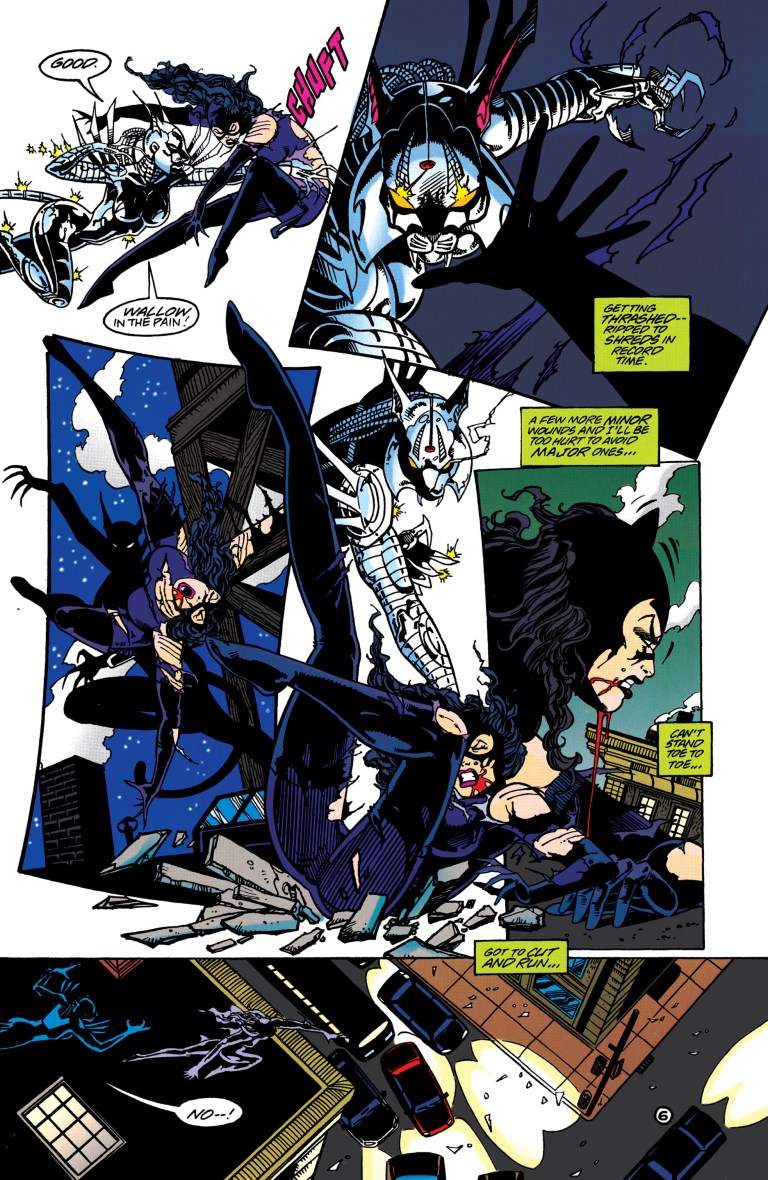
The story begins with Catwoman moving on the rooftop at night. Suddenly a small rocket is fired hitting a chimney near her knocking her out temporarily. After recovering and checking the area near her, she gets hit by Cyber-Cat (first appeared in Catwoman #42). As it turns out, Catwoman knew something about her having worked with Syntex but Cyber-Cat tells her that she’s worker for herself.
Driven by deep anger, Cyber-Cat moves at Catwoman who tries to escape. Catwoman gets hit and suffers slashes on her skin as a result of Cyber-Cat’s vicious attacks. Now losing some blood, Catwoman makes a desperate leap to another building across the street and barely makes it leaving Cyber-Cat behind.
Cyber-Cat viciously attacks Catwoman!
“Run, thief—but your run can’t last forever! I found you once, and I won’t rest until I do it agains—to finish what this night started! And remember –every time you cast your cowardly shadow across a roof…you’ll never know which gargoyle might come to sudden life,” Cyber-Cat tells Catwoman across the gap. “You’re finished, thief! Dead already!”
Badly wounded, Catwoman manages to find her motorcycle at an alley and drives on the way back to her hideout…
Quality
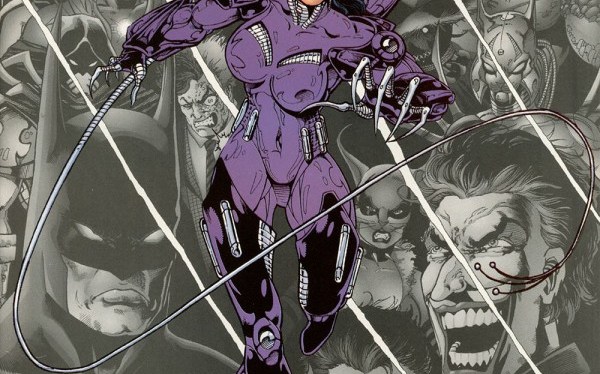
The money shot by Jim Balent! Check out the unrealistic look of the armor.
I should say that Catwoman #50 surprisingly has depth and a nice combination of spectacle, characterization, intrigue and even some detective story elements. Don’t let the cover fool you into thinking this is a shallow and terrible comic book.
For one thing, Doug Moench carefully crafted a story bringing Catwoman and Cyber-Cat back for a new conflict together, only this time the stakes are much higher given the fact that in the previous encounter, Catwoman put Cyber-Cat to shame. This explains why Cyber-Cat is not only more determined to kill Catwoman but also train harder and use cybernetic means more efficiently.
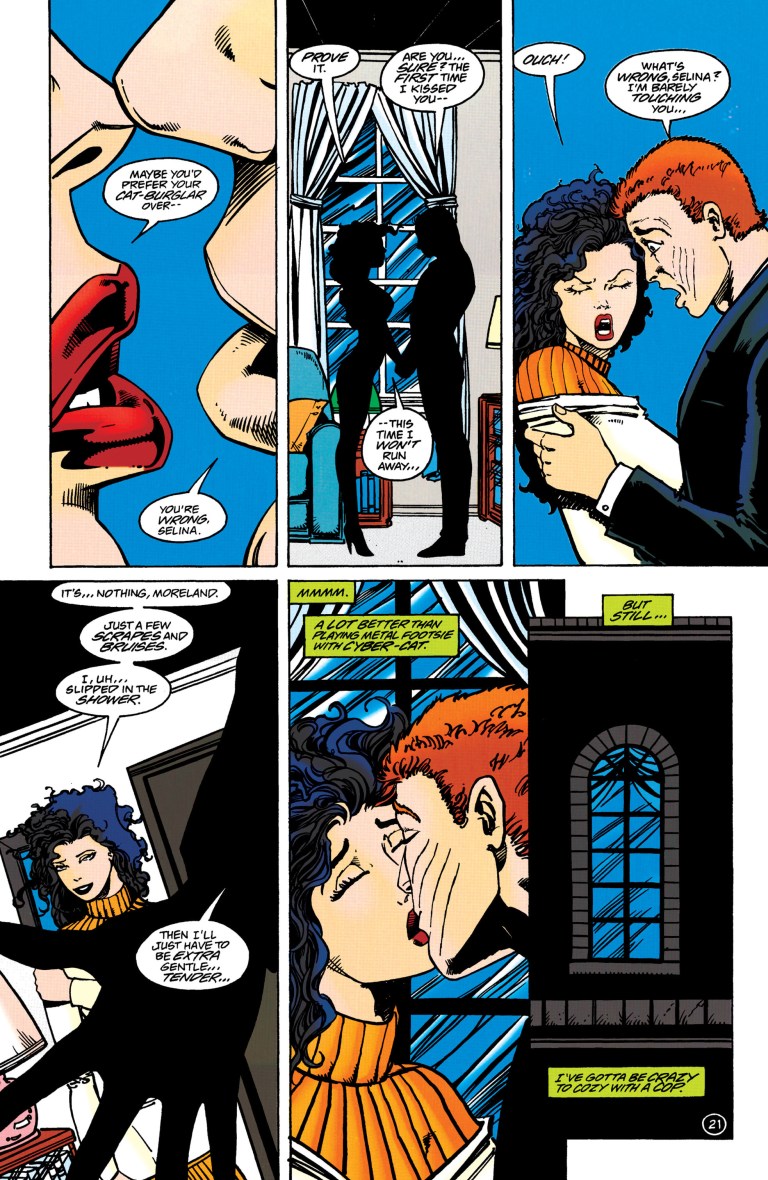
Rivalry aside, this comic book provides a nice look as to what would happen when a professional thief like Catwoman gets involved with a technology company and causes a disturbance not only in the tech sector but also with industry investigators. Doug Moench managed to insert some scenes exploring Selina Kyle/Catwoman’s social life and her involvement with a cop (who does not even know her secret criminal identity).
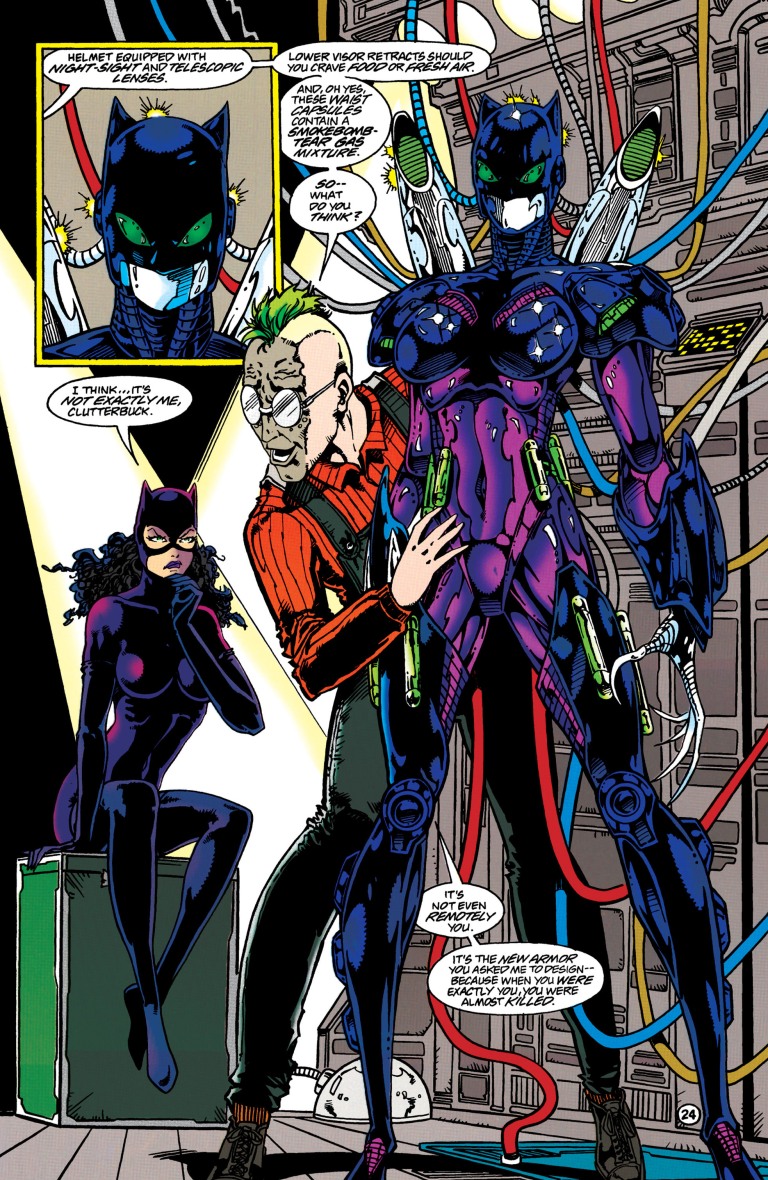
As for the Catwoman armor highlighted on the cover, I really like the way the creators efficiently implemented the “Batman approach” to preparation when it comes to assembling the armor done by Catwoman’s friend. While it is predictable that the armor helped improve her ability to fight and keep up with high-tech measures used against her, I found it rather unbelievable that she is able to maintain quick reflexes, move around fast like before and still look like she’s wearing tights (same problem with Cyber-Cat who is actually Christina Chiles behind the suit).
While the realism is not really a factor here, I should confirm that this comic book sure has a lot of action scenes and attractive visuals in the expected big battle between Cyber-Cat and the armored Catwoman. Artist Jim Balent, who helped start this monthly series, confidently paced the action and delivered lots of dynamic shots of hard action.
Conclusion
Selina Kyle the civilian.
Catwoman #50 is surprisingly fun to read and has enough depth to its story. It’s far from being brainless, really. With almost 30 pages of story and art, the creative team paced themselves to tell a cohesive story, add a bit of character development and then have Catwoman suited up for the big fight against the obsessive Cyber-Cat.
When it comes to executing the concept of having a hero or a villain using armor for a big conflict or special mission, Catwoman #50 easily beats the stuffing out of Web of Spider-Man #100 big time! Compared to that very disappointing Spider-Man comic book (featuring an armored Spider-Man), Catwoman #50 has more depth, is paced better, paid closer attention to detail (right down to the features of Catwoman’s armor), and has spectacle that is executed and presented better.
If you are seriously planning to buy an existing hard copy of Catwoman #50 (1997), be aware that as of this writing, MileHighComics.com shows that the near-mint copy of the regular edition costs $9. The near-mint copies of the deluxe, the newsstand deluxe and the newsstand editions cost $10, $22 and $17 respectively.
Overall, Catwoman #50 (1997) is recommended.
Thank you for reading. If you find this article engaging, please click the like button below and also please consider sharing this article to others. If you are looking for a copywriter to create content for your special project or business, check out my services and my portfolio. Feel free to contact me as well. Also please feel free to visit my Facebook page Author Carlo Carrasco and follow me at HavenorFantasy@twitter.com
Disclaimer: This is my original work with details sourced from reading the comic book and doing personal research. Anyone who wants to use this article, in part or in whole, needs to secure first my permission and agree to cite me as the source and author. Let it be known that any unauthorized use of this article will constrain the author to pursue the remedies under R.A. No. 8293, the Revised Penal Code, and/or all applicable legal actions under the laws of the Philippines.
With the conclusion of the 4-part storyline involving the Undead gang, the X-Men of 2099 find themselves literally back to Square One complete with Skullfire having returned. The team also accepted that their former teammate Serpentina has really come to an end. As the security handlers of Halo City, the X-Men find themselves dealing with responsibilities.
Here’s a look back at X-Men 2099 #30, published in 1996 by Marvel Comics with a story by John Francis Moore and art by Ron Lim.
The cover.
Early story
The story begins at a medical center in Halo City where Shakti/Cerebra watches her father in a coma. Her teammate Krystallin is with her. Shakti shares some threads from her past and admits to Krys that her father represented everything she despised. Suddenly their boss Morphine arrives, turning off Shakti who abruptly leaves him and Krys.
Walking alone in a part of the city, Shakti notices that some – a mutant – has been following her. She turns and sees Billy, one of the Free Radicals Krys encountered in X-Men 2099 #19. He gives her a high-tech coin. Upon receiving it, Shakti gets transported elsewhere in a flash.
Elsewhere, a ship full of passengers arrives at a dock. Among them are two young guys named Clarion and Nostromo. Even Clarion told him he will take him to Halo City, Nostromo is very uncertain of himself stating that he should not even be alive. After being told of gaining a second chance, Nostromo decided to go down the ship and join Clarion for the journey…
Quality
Nothing like getting cornered during your first ever visit to a city.
After going through all the battles and intrigue between the X-Men and the Undead in the past few issues, X-Men 2099 #30 is literally a breath of fresh air. This comic book has a well made story by John Francis Moore emphasizing youth mutants, Halo City’s continued development as a key destination diverse people, and most notably the coming of anticipated messiah among the mutants. What I also enjoyed here is the renewed focus on the state of mutants in 2099, specifically in the southwestern region of the United States.
Without going into spoiler territory, I can confirm that X-Men 2099 #30 serves as a set-up for X-Nation, which is arguably the futuristic X-Men’s version of The New Mutants. That’s not to say that this comic book is just a set-up. Other than that, its focus on Shakti and the important role she’s about to have with mutants is quite engaging.
Conclusion
This is one of the few visual references to the 20th century X-Men.
Other than being a very good comic book on its own, X-Men 2099 #30 clearly showed that John Francis Moore was very confident on taking the monthly series on yet a new direction while paving the way for expanding elements of the Marvel 2099 universe which eventually led to the establishment of a short-lived series called X-Nation 2099.
If you are seriously planning to buy an existing hard copy of X-Men 2099 #30, be aware that as of this writing, MileHighComics.com shows that the near-mint copy of the regular edition costs $7 while the newsstand edition’s near-mint copy is worth $21.
Overall, X-Men 2099 #30 is recommended.
Thank you for reading. If you find this article engaging, please click the like button below and also please consider sharing this article to others. If you are looking for a copywriter to create content for your special project or business, check out my services and my portfolio. Feel free to contact me as well. Also please feel free to visit my Facebook page Author Carlo Carrasco and follow me at HavenorFantasy@twitter.com