A Look Back at X-Men Adventures Season II #7 (1994)

Welcome back superhero enthusiasts, 1990s arts and culture enthusiasts, Marvel Comics fans and comic book collectors! Today we go back to the mid-1990s to explore the adaptation of the second season of the X-Men animated series in the form of the X-Men Adventures comic book series.

Before getting to the new retro comic book review, I should state that decades ago, the use of future timelines was implemented on the X-Men comics. I’m talking about the possible future where Cable and Stryfe came from, another possible future where Phoenix/Rachel Summers came from, and the more established future of the classic Days of Future Past storyline. Time travel and possible future timelines are the themes in the next X-Men Adventures comic book I reviewed recently.

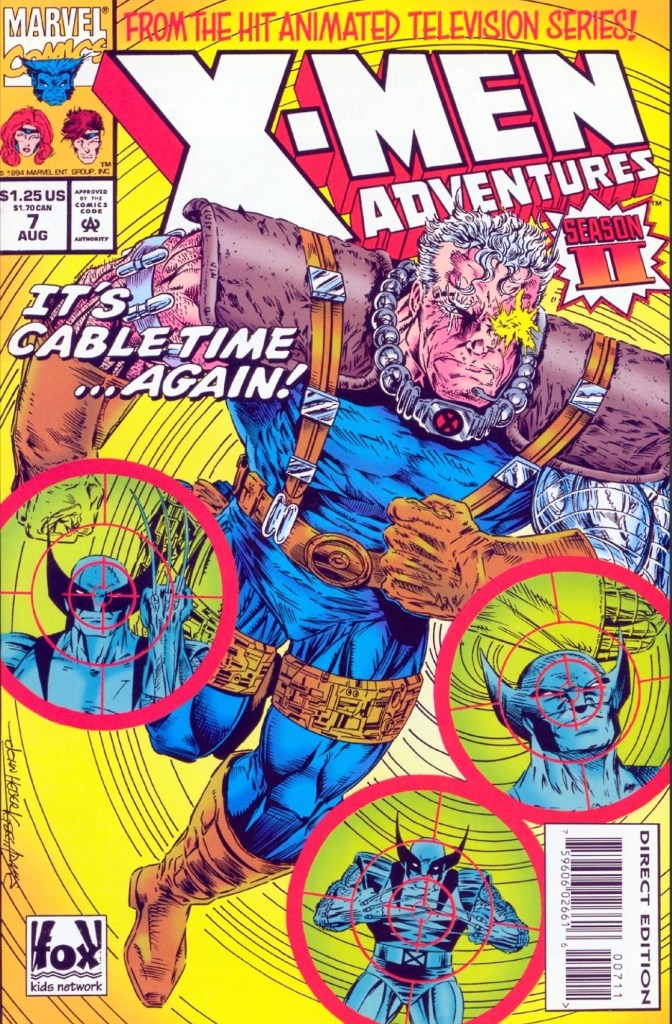
With those details laid down, here is a look back at X-Men Adventures Season II , published in 1994 by Marvel with a story written by Ralph Macchio and drawn by Scott Rosema.

The cover.

Early story

The story begins on Earth in the far future of 3999 AD. Cable, who is fighting for the rebels, battles the deadly forces of the powers that be. It turns out, he and his teammates have been struggling a lot and their team suffered several deaths already. Even though they are very tired and heavily outnumbered, Cable refuses to give up and bravely calls for a frontal assault against their enemies.

Suddenly, Apocalypse appears on the battlefield and commands his robotic troops to destroy Cable and his fellow rebels. To Apocalypse’s surprise, a temporal storm appears and Cable notices it appearing so close to them. One of his teammates got caught by the storm which pushes Cable away. After receiving computer updates, Cable decides to get away from the robotic troops.

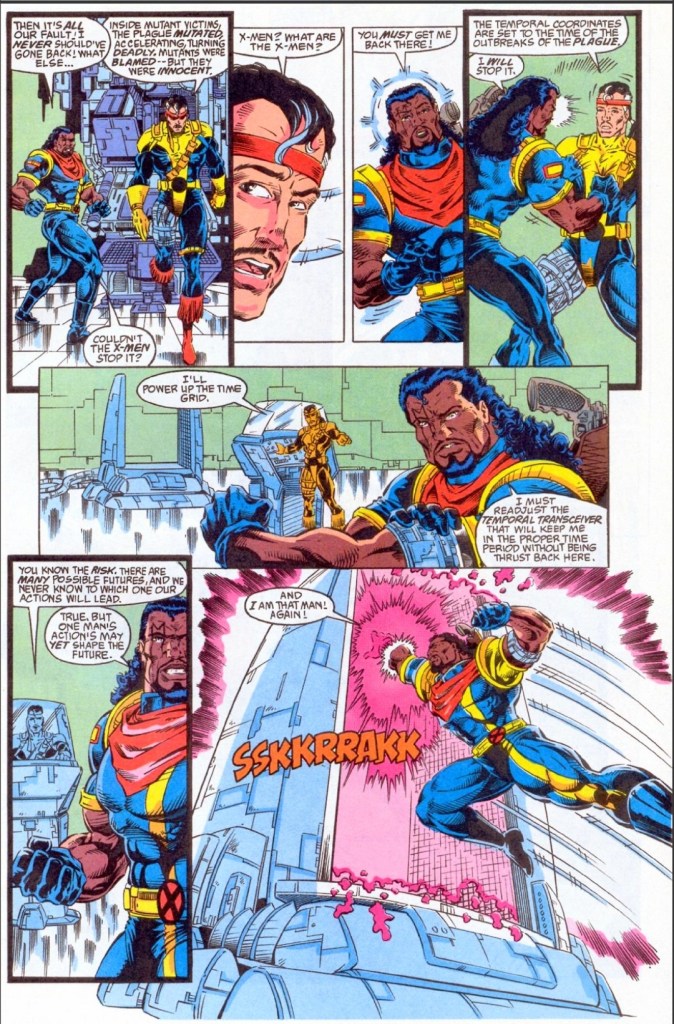
Meanwhile in another time period and place, Bishop returns from his mission (his interactions with the X-Men of the 20th century – click here and here) only to discover from Forge that nothing has changed and the plague still rages on…

Quality

The X-Men have a new problem to deal with.

Having read X-Men Adventures and of season 1, I found this particular tale (clearly a sequel to Bishop’s interaction with the X-Men after traveling through time) relatable and enjoyable. There is a strong science fiction vibe here and the time travel aspect added a lot to the build-up of tension.

Bishop here is almost the protagonist as the story showed an altered future in which Forge has no memory of the X-Men and only made a reference to a plague that has lasted for a long time. This compels Bishop to go back to the 20th century again hoping to meet the X-Men and somehow prevent the plague from bringing down society.

The impact of the mysterious virus is tremendous as so many people got infected and authorities suspect mutants to be the carriers. At this stage, the social aspects inserted by the creators really started to grow stronger within the narrative and you will see the X-Men struggling with not only the increased scrutiny on mutants but also with the manipulative tactics of anti-mutant activists who can’t help but see golden opportunities to wipe out mutants in a more clever fashion.

The dialogue here is noticeably gripping to read and the dramatization worked accordingly. There is also a good amount of superhero spectacle to enjoy here even though the X-Men have no super villains to fight with.

Conclusion

Forge has no memory of the X-Men.

X-Men Adventures Season II (1994) looks like a repeat or even a remake of what happened in X-Men Adventures (Season I) but its concept turned out to be not only unique with strong social commentary and sci-fi elements, but also became really engaging thanks to the fine execution by the creative team. On the aspect of social relevance, this comic book will remind you about the internment of Japanese Americans in America (1942-1946) and the COVID-19 restrictions and the quarantine on communities imposed by governments that disrupted people’s lives. As this comic book marks the first part of the Time Fugitives, I can say that I enjoyed it and I’m looking forward to the next chapter.

Overall, X-Men Adventures Season II (1994) is recommended.

+++++

Thank you for reading. If you find this article engaging, please click the like button below, share this article to others and also please consider making a donation to support my publishing. If you are looking for a copywriter to create content for your special project or business, check out my services and my portfolio. Feel free to contact me with a private message. Also please feel free to visit my Facebook page Author Carlo Carrasco and follow me on Twitter at  @HavenorFantasy as well as on Tumblr at https://carlocarrasco.tumblr.com/ and on Instagram at https://www.instagram.com/authorcarlocarrasco

A Look Back at WildC.A.T.S.: Covert Action Teams #15 (1994)

Welcome back superhero enthusiasts, 1990s arts and culture enthusiasts, Marvel Comics fans and comic book collectors! Today we go back to the mid-1990s to explore another notable chapter of Jim Lee’s WildC.A.T.S.: Covert Action Teams during the creator’s time with Image Comics.

For any fan, witnessing a change of creative direction can either be alienating or engaging to follow. As clearly done in the WildC.A.T.S.-Huntsman storyline done by Chris Claremont and Lee, there was a serious change of direction of the team as it involved in-depth redevelopment of Zealot, the introduction of Claremont’s creation (Huntsman), the introduction of new characters and moving certain WildC.A.T.S. members into the background. Read my retro reviews by clicking here, here, here and here.

After the publication of Erik Larsen’s creative handling of WildC.A.T.S.: Covert Action Teams with issue , a new creative team came into the picture with several new stories and the further redevelopment of the titular team in mind.

With those details laid down, here is a look back at WildC.A.T.S.: Covert Action Teams , published in 1994 by Image Comics with a story written by James Robinson and drawn by Travis Charest.

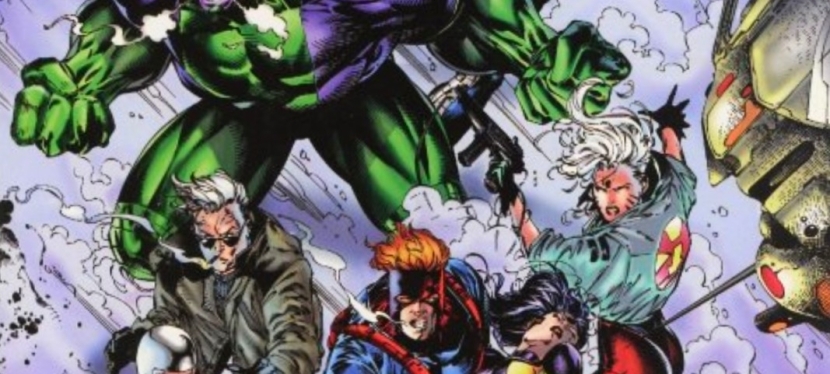
The cover.

Early story

The story begins at Jacob Marlowe’s high-end place in Aspen, Colorado. In presence of Spartan, Grifter, Void, Zealot, Voodoo, Maul and Warblade, Marlowe tells them he has important matters to attend to as he, along with other heads of corporations, has been asked by the new government to run an energy commission. The said commission is part of the government’s plan to repair the damage that was done by the possessed US Vice President Dan Quayle.

Suddenly a heavily armed helicopter arrives out of nowhere and fires at them causing a lot of damage. During the attack, Voodoo gets hit and suffers a serious injury. Grifter fires a barrage of bullets at the helicopter which causes it to explode and crash. With Voodoo out of commission, the team just lost its advantage to spot Daemonites.

The next day at the headquarters of IO (International Operations), the team Black Razors hold a meeting as their member Ben Santini has been elevated as their new leader. He leads the briefing and informs the members of the assassination attempts on the members of the commission…

Quality

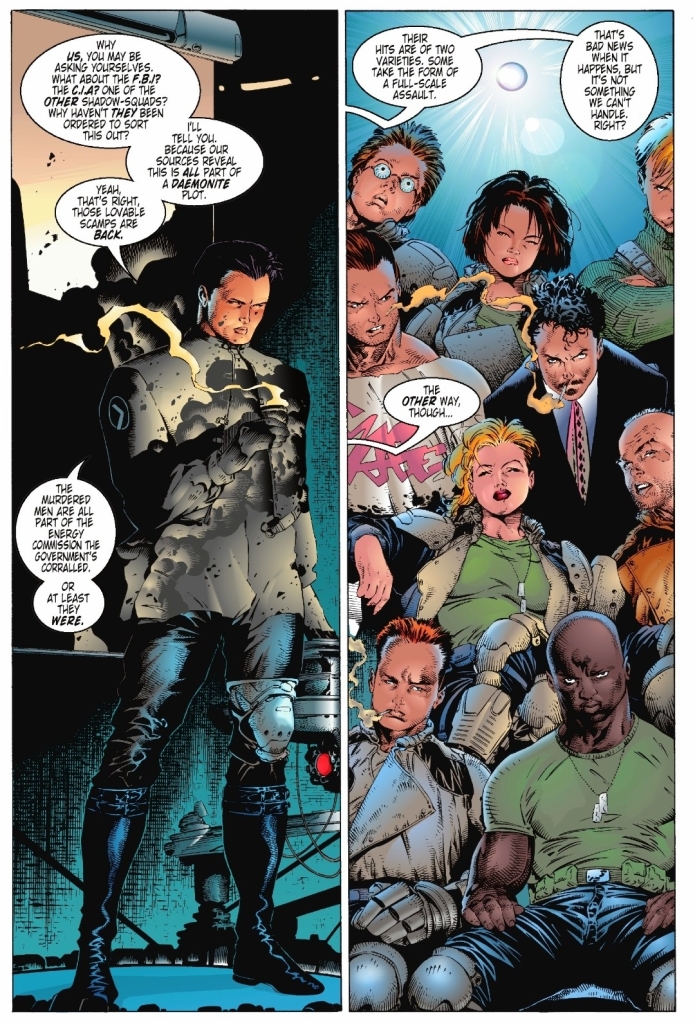
Meet Ben Santini (left), the new leader of the Black Razors. At right are the members.

When I first read this story way back in 1994, I was alienated a bit by the creative team’s approach to emphasize the Black Razors at the expense of the titular team. And yet, I was pleasantly surprised by the Robinson-Charest creative direction as the Black Razors turned out to be a sensible and strong parallel team to the WildC.A.T.S. without becoming another force of evil. While it is clear that the Daemonite threat is strong with several of the aliens hidden among members of human populations, there clearly had to be another force of opposition for the titular team to face-off with and the Black Razors (which serve IO) clearly fit in well with the concept.

Any dedicated fan of this franchise will realize that the Black Razors first appeared in the original 1992 mini-series but it was only in this issue when Ben Santini (who was shot on the knee by Jacob Marlowe) was realized as a character.

Ben Santini’s introduction here was engaging and his motivations to lead the team were made clear while other Black Razor members had their own small slices of the spotlight. Santini is not exactly evil but he has a clearly defined goal in serving his superiors at IO. This means he intends to make an impact as he struggles with the responsibilities of leading the team even as the other members are not so trusting towards him.

While the paramilitary influence within the WildC.A.T.S. series has often been present, it was noticeably revived strongly by the Robinson-Charest duo in this comic book. The story also served as a creative update of IO for readers to absorb complete with elements of espionage and geo-political developments. In some ways, this comic book made the series more grounded with reality while still maintaining some fantasy concepts to keep readers entertained.

Conclusion

Grifter successfully defeated the armed helicopter but Voodoo remained seriously injured from the attack.

I can say out loud that WildC.A.T.S.: Covert Action Teams (1994) is still great to read and the debut of James Robinson and Travis Charest as handlers of the comic book series remains rock solid in terms of quality and creativity. While the titular team and fan-favorite characters had a very limited presence in this comic book, the introduction of Ben Santini and the stronger emphasis on the Black Razors as a group of trained members (as opposed to being faceless during their appearance in the mini-series) more than made up for it. In fact, the build-up of the Black Razors has a lot of variety and nice quality work by Robinson and Charest. Ultimately, I was entertained with this comic book and it proved effective to make me look forward to the next issue.

Overall, WildC.A.T.S.: Covert Action Teams (1994) is highly recommended!

+++++

Thank you for reading. If you find this article engaging, please click the like button below, share this article to others and also please consider making a donation to support my publishing. If you are looking for a copywriter to create content for your special project or business, check out my services and my portfolio. Feel free to contact me with a private message. Also please feel free to visit my Facebook page Author Carlo Carrasco and follow me on Twitter at  @HavenorFantasy as well as on Tumblr at https://carlocarrasco.tumblr.com/ and on Instagram at https://www.instagram.com/authorcarlocarrasco

A Look Back at Ravage 2099 #15 (1994)

Disclaimer: This is my original work with details sourced from reading the comic book and doing personal research. Anyone who wants to use this article, in part or in whole, needs to secure first my permission and agree to cite me as the source and author. Let it be known that any unauthorized use of this article will constrain the author to pursue the remedies under R.A. No. 8293, the Revised Penal Code, and/or all applicable legal actions under the laws of the Philippines.

Welcome back, superhero enthusiasts, comic book collectors, 1990s culture enthusiasts and fans of Marvel Comics! To those who read my previous retro comic book reviews related to the 2099 universe of Marvel Comics, you know fully well that I found the first eight issues of the Ravage 2099 monthly series to be lackluster even though they all involved the writing of the late legend Stan Lee. After Lee stopped working, the Ravage 2099 series was taken over by Pat Mills and Tony Skinner for the writing duties and those two were in-charge of the Punisher 2099 series.

Eventually, a crossover storyline of the 2099 universe was published titled The Fall of the Hammer. It was told in five parts and each of the existing 2099 monthly series at the time – Spider-Man 2099, Ravage 2099, Doom 2099, Punisher 2099 and X-Men 2099 – had one issue forming it. The Fall of the Hammer kicked off with Spider-Man 2099 #16 which had solid writing by Peter David.

Part 2 was told in a Ravage 2099 issue. To find out the story and its quality, here is a look back at Ravage 2099 , published in 1993 (cover dated 1994) by Marvel Comics with a story written by Pat Mills and Tony Skinner, and drawn by Grant Miehm.

Early story

The story begins at the place of Paul-Phillip Ravage who is now in human form. In his presence are X-Men 2099 members Meanstreak, Krystalin and Bloodhawk. Suddenly Bloodhawk comes after Ravage and tries to make him give out information in relation to the disappearance of Jordan Boone, a friend of Meanstreak. Boone disappeared after compiling data related to Alchemax’s problem with Valhalla.

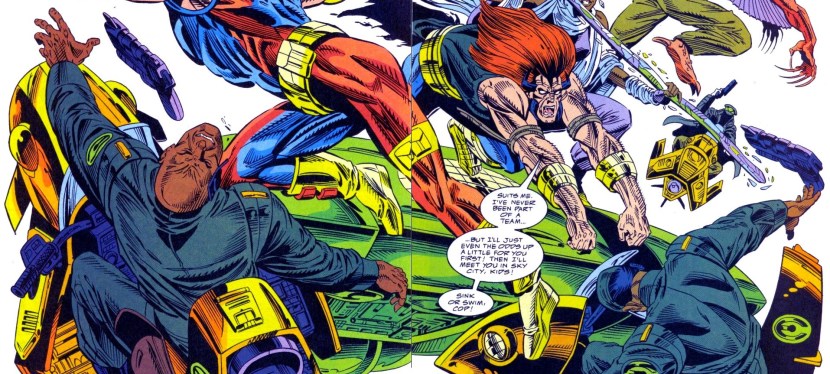
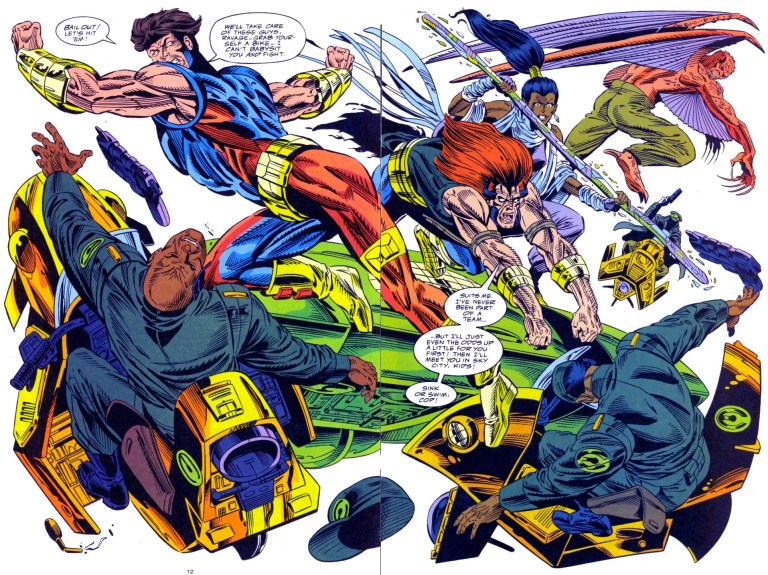
Ravage then transforms into his monstrous form which surprises Bloodhawk. After the winged X-Men member mentioned Valhalla, Ravage calms down and decides to talk with the team. Soon enough, they fly above the city streets in a vehicle heading towards Valhalla. As they approach the floating city, armed flying personnel move in to attack Ravage 2099 and the three X-Men.

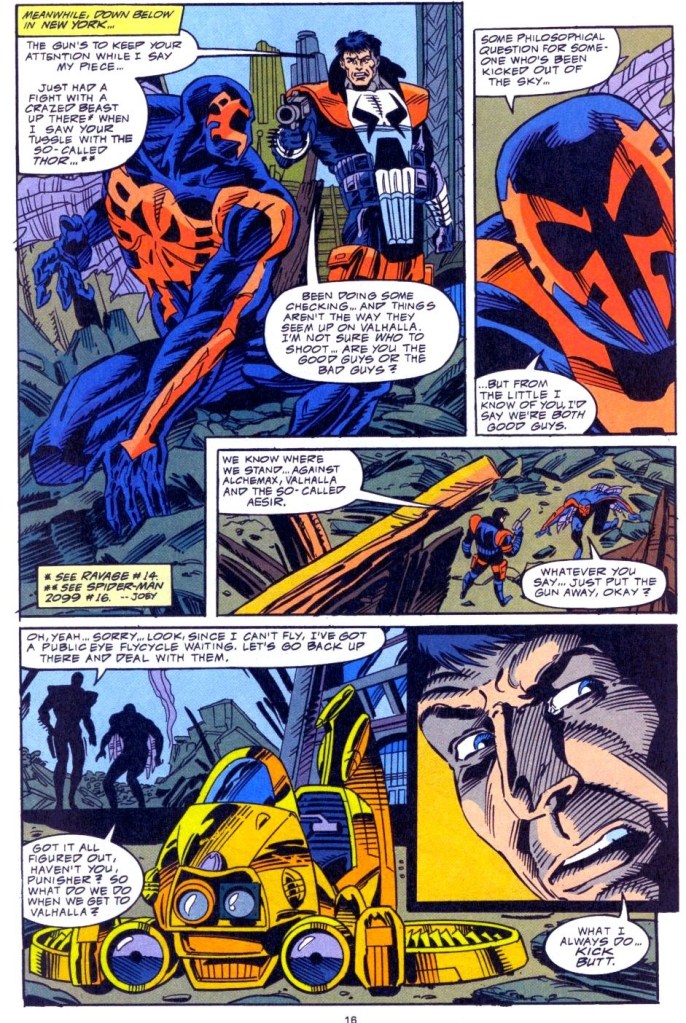
Elsewhere in New York, Spider-Man 2099 finds himself at a disadvantage as Punisher 2099 has a gun pointed at him…

Quality

2099’s Spider-Man and Punisher together.

To put it clearly, this 2nd part of The Fall of the Hammer storyline is where the 2099 heroes begin to actually cross over with each other and the first panel showing Ravage with the three X-Men members is symbolic of that. The plot here is actually simple…Ravage and the X-Men make it to Valhalla which is their common destination. The mutants want information about Jordan Boone while Ravage tries to meet Doom 2099 (whom he met in Ravage 2099 ). Apart from those objectives, there is a lot of action scenes laced with dialogue designed to move the narrative forward little by little. If you are looking for character development of Ravage, you won’t find much here. What you will find, however, are some scenes of intrigue that show Ravage getting disturbed temporarily as a result of realizing the presence of a certain someone he got close with.

As for Valhalla, the city here is more of a technical playground than an actual threat to the people and societies it flew over. What weakens the story here is the absence of 2099’s Thor.

Conclusion

The money shot of this comic book!

To a certain extent, Ravage 2099 (1994) is a somewhat entertaining read mainly due to the mix up of 2099 characters together here. The story is pretty light but at the very least fans of Ravage 2099 will find their monstrous hero in a somewhat interesting misadventure here. The concept that started in Spider-Man 2099 showing Valhalla as a floating danger is weaker here but at least this comic book sets the stage for the next chapter of the storyline decently.

If you are seriously planning to buy an existing hard copy of Ravage 2099 (1994), be aware that as of this writing, MileHighComics.com shows that the near-mint copy of the regular edition costs $16 while the near-mint copy of the newsstand edition costs $48.

Overall, Ravage 2099 (1994) is satisfactory.

+++++

Thank you for reading. If you find this article engaging, please click the like button below and also please consider sharing this article to others. If you are looking for a copywriter to create content for your special project or business, check out my services and my portfolio. Feel free to contact me as well. Also please feel free to visit my Facebook page Author Carlo Carrasco and follow me at HavenorFantasy@twitter.com