A Look Back at Spider-Man 2099 #44 (1996)

Welcome back superhero enthusiasts, 1990s culture enthusiasts and comic book collectors! Today we go back to the year 1996 and explore a part of the Marvel Comic shared universe through a tale of the Spider-Man 2099 monthly series.

To put things in perspective, the original Spider-Man 2099 monthly series that launched in 1992 lasted a total of 46 issues. The prolific author Peter David wrote the first 44 issues as he resigned from his duty in relation to the sudden firing of Marvel 2099 editor Joey Cavalieri in 1996. The previous issue was a great read.

With those details laid down, here is a look back at Spider-Man 2099 , published in 1996 by Marvel Comics with a story written by Peter David and drawn by Ron Lim.

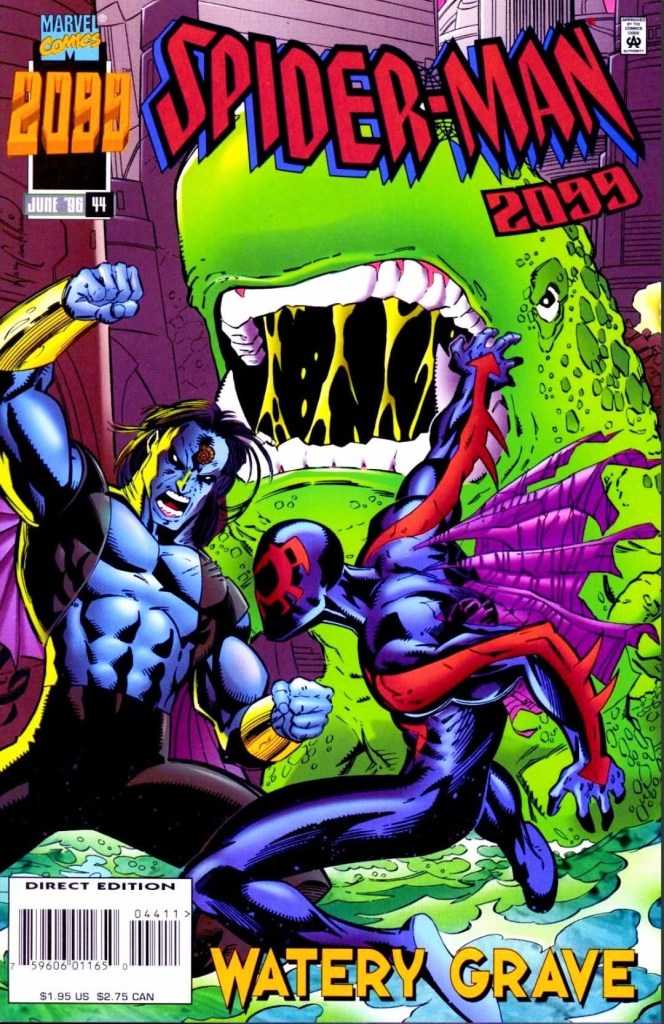
The cover.

Early story

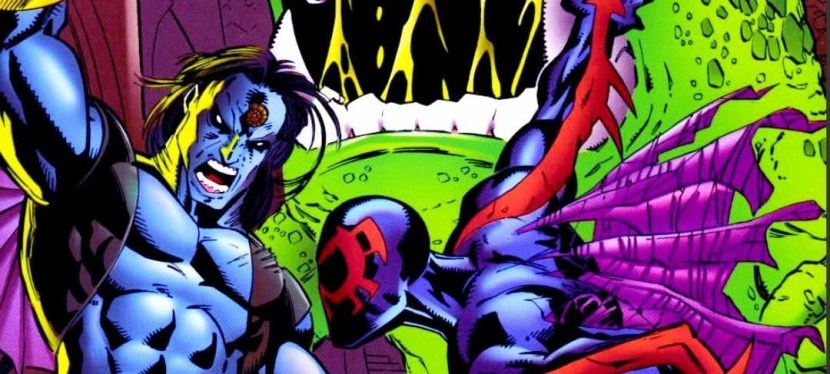
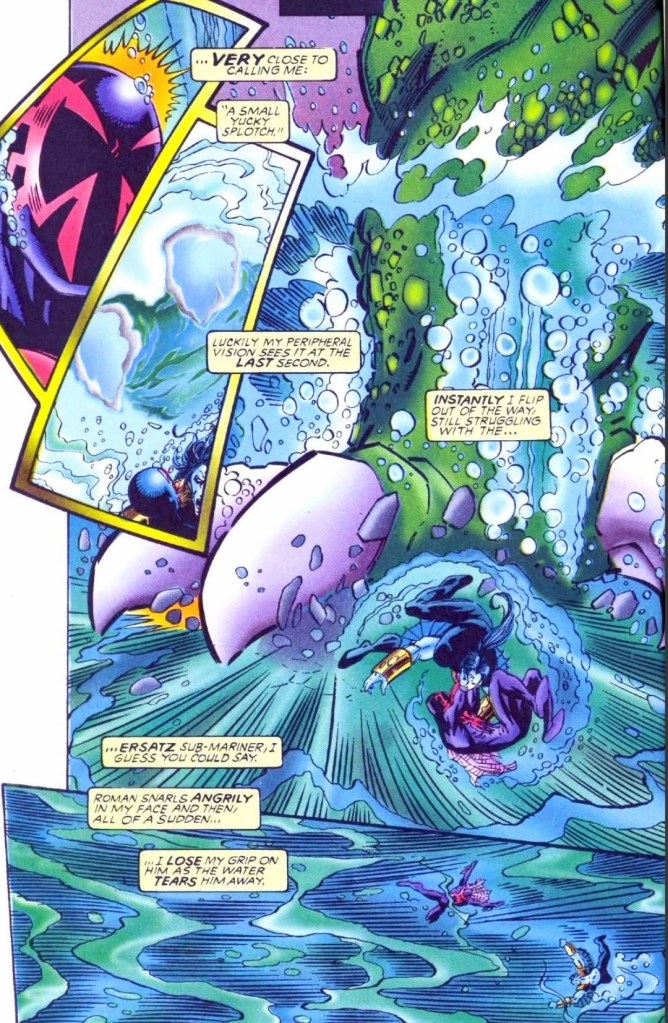
The story begins in the City of New York already flooded and infiltrated by lots of marine life. Under the water, Spider-Man and Roman the Sub-Mariner fight each other intensely as the foot of a gigantic sea monster is about to step in. At the last moment, Spider-Man saw the huge foot and instantly flipped away to survive with the Sub-Mariner.

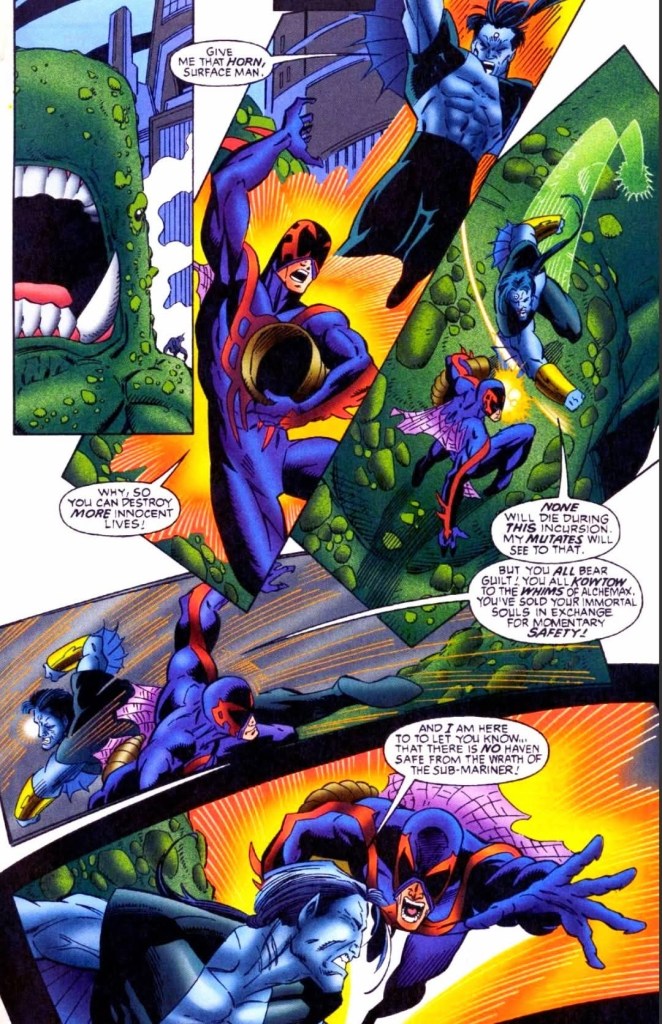
After getting separated, Spider-Man gets out of the water to breath and immediately spots an organic-looking horn that the Sub-Mariner used to control the huge monster. Suddenly, on the aquatic humanoids appears to get the horn. Spider-Man then used his web to get the horn first which triggered the aquatic humanoid to move fast towards him.

Quality

The intense battle between Sub-Mariner and Spider-Man went on even as the huge sea monster is very near them in the city.

Without spoiling the plot, this comic book is a tale about a massive disaster and also a tale about the complicated legacy of Miguel O’Hara whose personal life is even more connected with the corporation he works for.

The huge disaster of New York getting flooded (which started in the previous issue) and Spider-Man fighting the leader of the mutates (genetically designed sentient beings) concluded in a really satisfying way. The futuristic webslinger really found himself struggling with the determined Sub-Mariner (motivated by what Alchemax did to the aquatic world) while dealing with the fact that so many citizens got displaced or even got killed by not only the huge flood but also by the presence of the gigantic sea monster. The stakes were really raised high for Spider-Man and the pay-off was really good.

The rest of the comic book deals with the intense meeting between Conchata O’Hara and Tyler Stone, Xina’s time with the Net Prophet, Gabriel O’Hara’s time with “father” Jennifer. Among the three sub-plots, the conflict between Conchata and Tyler is very intense and dramatic to read. More importantly, it was crafted by Peter David to be really believable and it ultimately added tension to the background and even the future of Miguel O’Hara (now a powerful Alchemax executive). This particular sub-plot is easily the most important one this comic book has and it will compel fans to revisit the 25th issue of this monthly series as well as issue #10.

While the sub-plot of Xina and the Net Prophet does not generate enough depth for this comic book, there is a big revelation made in the sub-plot of Gabriel and “father” Jennifer which will compel fans to revisit issues #40 and #41. In fact, nothing is ever simple regarding the origin of a specific villain of the 2099 universe.

When it comes to the artwork, this comic book is a downgrade compared to what was presented in issue (drawn by Andrew Wildman). I’m not saying that Ron Lim’s art is bad, it’s just nowhere as good as that of Wildman’s art. In fairness, Ron Lim managed to make the city disaster look intense and he managed to make the characters look recognizable. In fact, Lim successfully made the Conchata-Tyler scenes look intense and dramatic.

Conclusion

The giant monster aspect of this comic book added intensity to the battle and the disaster. There were a few Godzilla vibes here and there.

As the final Peter David-written issue of this monthly series, Spider-Man 2099 (1996) is undeniably a very solid reading experience. There were strong pay-offs executed here to what was built-up in the previous issues, and in typical fashion, David kept building up the other sub-plots. The conclusion to the Conchata-Tyler sub-plot is actually more powerful than that of the city disaster. Clearly, Peter David kept track of the character developments and events that previously happened and dramatized them nicely here. In fact, you will feel some sympathy towards Miguel O’Hara knowing how unfortunately complicated his family legacy really is.  

Overall, Spider-Man 2099 (1996) is highly recommended!

+++++

Thank you for reading. If you find this article engaging, please click the like button below, share this article to others and also please consider making a donation to support my publishing. If you are looking for a copywriter to create content for your special project or business, check out my services and my portfolio. Feel free to contact me with a private message. Also please feel free to visit my Facebook page Author Carlo Carrasco and follow me on Twitter at  @HavenorFantasy as well as on Tumblr at https://carlocarrasco.tumblr.com/ and on Instagram at https://www.instagram.com/authorcarlocarrasco

A Look Back at G.I. Joe: A Real American Hero #10 (1983)

Welcome back superhero enthusiasts, 1980s culture enthusiasts and comic book collectors! Today we go back to the early 1980s to explore Marvel Comics’ extensive publishing of a comic book series based on the wildly popular military-themed franchise of toys – G.I. Joe: A Real American Hero.

Last time around, G.I. Joe found itself getting attacked within their own base (The Pit) as a result of the robot they brought in from a stronghold of their terrorist rival Cobra. It was a Trojan plan that Cobra Commander and his team organized from far away and they almost succeeded.

With those details laid down, here is a look back at G.I. Joe: A Real American Hero published in 1983 by Marvel Comics with the main story written by Larry Hama and drawn by Mike Vosburg.

The cover.

Early story

The story begins with G.I. Joe members Scarlett, Snake-Eyes and Zap reach the top of a tall New York City building that could be another stronghold of Cobra. On the street just outside of the same building, other Joe members located inside a van on the street and in the sewers carefully make their moves to ensure their operation will succeed.

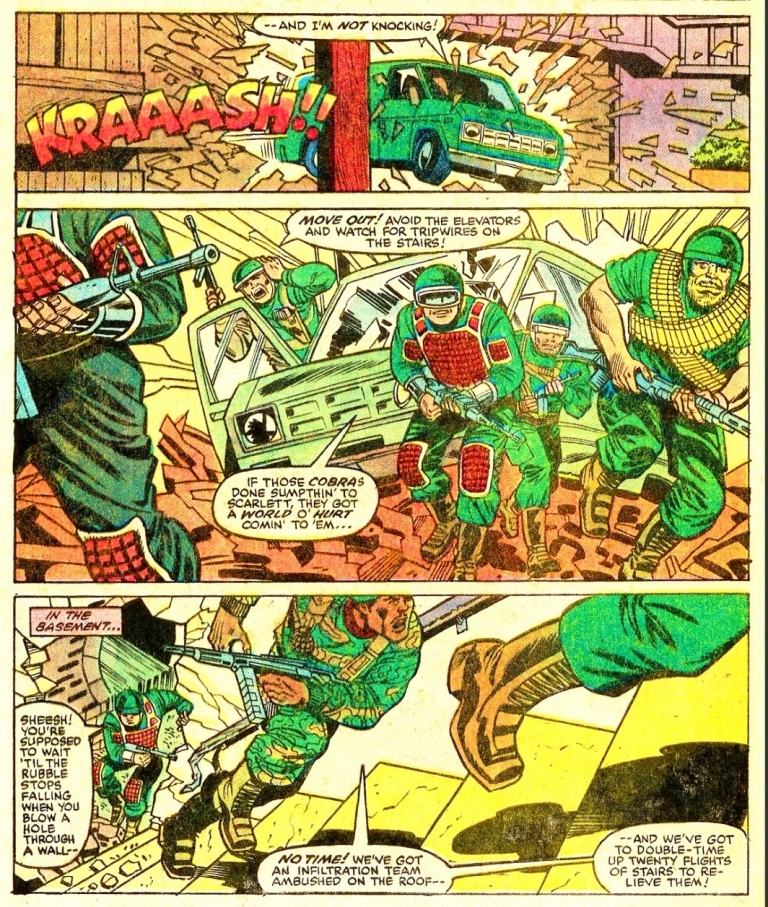
Behind the scenes inside the building, the Baroness is informed of the Joes’ presence. This causes the top of building’s roof to open causing Snakey-Eyes, Scarlett and Zap to fall down into a room. In response, the Joe members inside the van make their move into the building save Scarlett and her two teammates…

Quality

A few of the Joes captured by Cobra, and Snake-Eyes got heavily restrained.

This is another clever story written by Larry Hama highlighting the rivalry between G.I. Joe and Cobra without emphasizing the usual action-packed battles between them. Instead, this tale emphasizes Cobra being more resourceful than meets the eye. What I mean is that the terrorists here are not limited to their military culture and weapons as they also have the means to conduct scientific experimentation, establishing spies among civilians (including minors) and even having American towns as their tactical fronts.  

In many ways, this tale shows Cobra being a very diversified terrorist organization that also mastered the uses of disguise and imagery to hide themselves from American authorities right there in America. The town of Springfield symbolizes Cobra’s use of ground level fronts to hide their secret underground stronghold from being spotted which is eerily similar to how Palestinian terrorist group Hamas uses schools, hospitals and other establishments in the Gaza strip to hide their tunnels and operation places deep under. The portrayal of American minors being junior officers of Cobra is really disturbing as it reminds me of the fact that in reality, Palestinian terrorists (note: the Palestinian Authority is corrupted and practices apartheid) have brainwashed their minors to hate and to murder Jews. I should add that the Palestinian terrorists, Hamas, the United Nations (UN), Amnesty International and the many Leftist leaders of nations formed the global axis of evil we know today.

As for the characters, the new kid here is easily the most notable addition and you have to read the comic book to find out why. For the more established characters, you will see Snake-Eyes helpless and Scarlett being really vulnerable in the dream world. On the side of Cobra, Dr. Venom has really fascinating interpretations and observations about the readings of the scientific operations.

Conclusion

The other G.I. Joe members scramble to rescue their teammates.

G.I. Joe: A Real American Hero (1983) is very engaging and intriguing to read from start to finish. This comic book, which is clearly a piece of fantasy, also served as an intriguing reminder that terrorists in the real world (read: Iran, Palestinian terrorists, Hamas, Hezbollah, ISIS and others) are capable of securing or stealing large financial resources for themselves and expand their operations to infiltrate societies and take advantage of the ignorant and helpless members to be part of their wicked causes.  There were indeed lots of parallels between Cobra and the Palestinian terrorists.

Overall, G.I. Joe: A Real American Hero (1983) is recommended.

+++++

Thank you for reading. If you find this article engaging, please click the like button below, share this article to others and also please consider making a donation to support my publishing. If you are looking for a copywriter to create content for your special project or business, check out my services and my portfolio. Feel free to contact me with a private message. Also please feel free to visit my Facebook page Author Carlo Carrasco and follow me on Twitter at  @HavenorFantasy as well as on Tumblr at https://carlocarrasco.tumblr.com/ and on Instagram at https://www.instagram.com/authorcarlocarrasco

A Look Back at 2099 Unlimited #10 (1995)

Welcome back superhero enthusiasts, 1990s culture enthusiasts and comic book collectors! Today we go back to the year 1995 to revisit one of the many tales of Marvel’s 2099 franchise focused on Spider-Man 2099 through the 2099 Unlimited quarterly comic book series!

Some time ago, I reviewed the inaugural issue of 2099 Unlimited which after all these decades remained entertaining and engaging enough to read. That comic book opened with a Spider-Man 2099 story handled by a creative team that did not involve the monthly series duo of Peter David and Rick Leonardi. Its 2nd story introduced Hulk 2099 and it efficiently told his origin story while expanding the world of 2099 convincingly.

With those details laid down, here is a look back at 2099 Unlimited published in 1995 by Malibu Comics with its main story written by the late Len Wein and drawn by Andrew Wildman. The two other stories were done by the creative teams of Nancy Collins/Gary Erskine and Bob Fingerman respectively.

The cover.

Early story

The story begins with Miguel O’Hara (Spider-Man) and his brother Gabriel attending Woodstock 2099 at a wet and muddy open-air location. It turns out Miguel feels uneasy being present at the music festival which for Gabriel is too important an event to miss as they are attending the final weekend.

As they talk and walk together, trouble breaks out when a man is suddenly changing physically causing his body to rip out of his clothes. Immediately he leaves Gabriel, cuts in line to enter a portalet, changes into his disguise, opens the rear with his talons and leaps off into action as Spider-Man of 2099.

The man who ripped through his clothes has since turned even bigger and monstrous looking. He grabs a woman and was about to throw her when Spider-Man suddenly swings in to grab her and move away from the monstrous guy.

Right after Spider-Man and the lady land on the ground, the monstrous guy mutated even more and begins to charge right at him with the intention to kill him…

Quality

There is nothing like encountering Spider-Man at the more isolated parts of the city in 2099.

Focusing on what is clearly the main feature of this comic book, the Spider-Man 2099 tale “Chameleon 2099” turned out to be a really good story that sets itself apart from the monthly series while still emphasizing the essence of the titular hero. Written by the late legend Len Wein, this is a tale of the futuristic Spider-Man that was crafted to entertain and also intrigue readers. The build-up of the plot moved at a medium pace with some bouts of surprise or excitement that happened along the way. By the time the story reaches the final conflict, the plot details came together nicely and the purpose behind Spider-Man’s pursuit made a lot more sense as I kept reading. This is a must-read story and Andrew Wildman’s art really brought Len Wein’s script into life!

Without spoiling the plot, I can say that this tale sheds light on the following topics: Miguel O’Hara investigating questionable ends within the very corporation he works for; a growing society of freaks within a very high-tech society; illegal substance abuse and distribution; the loss humanity paving the way for unrestrained violence. I just love the way Len Wein fused the mentioned topics into the story and executed them all while still making the story understandable and believable.

It should be noted that Wein portrayed the titular hero as a very determined protagonist who still maintains his sanity as well as his concern for others even though he gets into very violent situations.

This comic book has two other stories that do NOT feature the other established protagonists of the Marvel 2099 universe. Not even Hulk 2099 – the one major 2099 character who debuted in the launch issue of this very same quarterly comic book series – is here. The 2nd story introduces Machina Jones (who is not so interesting) and emphasizes a dark element within the 2099 society – the implantation of wetware programs into people’s bodies which are capable of controlling both the voluntary and involuntary motor responses.

The 3rd story on the other hand is a very cartoonish look at the helplessness of 2099 society’s members who suddenly get displaced by the implementation of the urban reclamation project of Alchemax. This one does not have any of the established Marvel 2099 characters.

Conclusion

Spider-Man 2099 at the field of Woodstock 2099.

With one very solid Spider-Man 2099 tale and two other stories that never engaged me at all, 2099 Unlimited (1995) is very clearly a mixed bag. The Spider-Man story is indeed the biggest feature and the main reason this comic book has good stuff. Too bad the other two stories were essentially wasted efforts.

Overall, 2099 Unlimited (1995) is satisfactory. It is also the final issue of the quarterly series.

+++++

Thank you for reading. If you find this article engaging, please click the like button below, share this article to others and also please consider making a donation to support my publishing. If you are looking for a copywriter to create content for your special project or business, check out my services and my portfolio. Feel free to contact me with a private message. Also please feel free to visit my Facebook page Author Carlo Carrasco and follow me on Twitter at  @HavenorFantasy as well as on Tumblr at https://carlocarrasco.tumblr.com/ and on Instagram at https://www.instagram.com/authorcarlocarrasco