After months of combat, uncertainty and geopolitical ramifications, United States President Donald J. Trump announced that a deal has been reached with the Islamic terrorist regime of Iran which will be formally signed on Friday, according to a news report by Newsmax. Already, Iran confirmed an “immediate and permanent end to the war”.
To put things in perspective, posted below is the excerpt from the Newsmax report. Some parts in boldface…
The United States and Iran reached an initial agreement early Monday to open the Strait of Hormuz and further extend a shaky ceasefire in the Iran war, potentially allowing desperately needed oil and natural gas to reach the global market.
Details of the deal were not immediately released and Iran signaled implementation would not start until the signing, which key mediator Pakistan said would occur Friday in Switzerland.
But the memorandum of understanding over the war already faced intense challenges. Israel’s continued hostilities with the Iranian-backed terrorists Hezbollah in Lebanon, where Israel bombed Beirut’s southern suburbs Sunday, nearly derailed the negotiations.
Meanwhile, the deal gives just 60 days to resolve what to do about Iran’s stockpile of highly enriched uranium and its atomic program. That took years to resolve in Tehran’s 2015 nuclear deal with world powers. President Donald Trump unilaterally withdrew America from that accord in his first term, setting the stage for the tensions that culminated in the war.
“Congratulations to all!” Trump wrote on social media as he celebrated his 80th birthday Sunday with a UFC cage match fight at the White House.
He added, “I hereby fully authorize the toll free opening of the Strait of Hormuz, and, simultaneously herewith, authorize the immediate removal of the United States Naval blockade,” which was imposed in retaliation for Iran’s grip on the crucial waterway.
He soon hedged, however, saying the strait wouldn’t open until Friday’s signing.
Iran’s deputy foreign minister, Kazem Gharibabadi, confirmed the agreement on state television but said Iran would not start implementing it until it was signed Friday. He said the deal followed talks with Qatar, another mediator.
Israel, which has insisted it be allowed a freehand to pursue Hezbollah as it occupies southern Lebanon and has extended its military operations into areas its forces haven’t been in a quarter century, did not immediately comment. Israel joined the U.S. in launching the war on Feb. 28.
Let me end this piece by asking you readers: What is your reaction to this development? Do you think this US-Iran deal will stay intact until the formal signing happens on Friday? Do you suspect the Islamic terrorist regime of Iran will tell Hezbollah terrorists to keep on attacking Israel to deliberately cause diplomatic instability? Are you anticipating a surge of lies and distorted media stories about the US-Iran deal from Qatar’s Islamic terrorist news network Al Jazeera?
Following US President Donald Trump’s announcement of a deal reached with the Islamic terrorist regime of Iran, one has to wonder what it means for Israel which itself was not a party to the agreement.
In recent times, there was tension between Trump and Israel Prime Minister Benjamin Netanyahu as the Jewish state is in the middle of a conflict with Hezbollah terrorists in Lebanon. Hezbollah clearly showed the US-Iran negotiations did not matter as they kept on firing rockets at Israeli soldiers and the residents of northern Israel. Recent developments in Israel were covered by CBN News in connection with the US-Iran deal.
To put things in perspective, posted below is the excerpt from the CBN News article. Some parts in boldface…
With great fanfare, President Trump, on his 80th birthday, announced that a memorandum of agreement with Iran had been reached in Islamabad, Pakistan.
On Truth Social, Trump posted that he had authorized the end of a U.S. naval blockade against Iranian ports in the Strait of Hormuz.
“Congratulations to all!” he wrote. “Ships of the World, start your engines. Let the oil flow!”
The agreement was confirmed by officials there that “both sides have declared the immediate and permanent termination of military operations on all fronts, including in Lebanon,” adding that mediators will this week facilitate meetings to “lay the foundation for the technical talks.” A signing is expected in Switzerland on Friday.
Reaction was slow in coming from Iran, although state TV displayed a banner boasting, “US was forced to sign an agreement to end the war.”
Israel, which was not a party to the agreement, has been slow to react as well officially. Earlier on Sunday, Prime Minister Benjamin Netanyahu congratulated President Trump on his birthday. However, U.S. media reports indicated that Trump was furious with the prime minister for attacking a terrorist stronghold in Beirut over the weekend, despite continued Hezbollah rocket and drone launches against Israeli troops and residents of northern Israel.
One Israeli opposition party is blaming Netanyahu for what its leader described as a terrible deal. The leader of the Israeli Democrats Party, Yair Golan, was quoted in The Times of Israel as saying, “Tremendous military achievements won through the courage of our pilots and the blood of our fighters were erased, while Netanyahu stood aside – weak, ill, isolated, and lacking influence.”
Israelis won’t be comforted, either, by comments from United Nations Secretary-General António Guterres, who has frequently been hostile toward Israel. He praised the deal, saying, “I warmly congratulate the United States and Iran for having reached a peace deal that provides for an immediate and permanent ceasefire, the reopening of the Strait of Hormuz as well as a framework for further negotiations.”
One U.S. supporter of Israel, Sen. Lindsey Graham (R-South Carolina), welcomed the opening of the Strait, but he added a caveat, according to a report by JNS News, stating, “I will be watching closely the ensuing negotiations regarding Iran’s nuclear program and other matters.”
Graham added, “I am somewhat concerned that Iran’s view of the agreement seems different than what the American negotiating team is claiming. Under our law, any nuclear deal with Iran will be sent to Congress for review and a vote.”
An Israeli source told The Jerusalem Post on Monday that Israel will not withdraw from its security zone in southern Lebanon, despite Pakistani claims that Lebanon was included in the memorandum of agreement ceasefire between the U.S. and Iran.
For additional insight, watch the YouTube videos below.
Let me end this piece by asking you readers: What is your reaction to this development? Do you think the US-Iran deal Trump announced will compel Hezbollah to stop attacking Israel? Are you convinced that Israel made the right decision to keep its presence in the security zone in southern Lebanon? Do you suspect Pakistan is lying about the details of the US-Iran deal? Do you think the United States will be able to get all the enriched uranium of Iran to ensure it will never produce nuclear weapons?
The steel industry of the United States will receive a much-needed boost as Japanese steel giant Nippon Steel Corp. will invest up to $2.5 billion in the Pennsylvania-based Mon Valley Works over the next three years, according to a news article by Jiji Press.
To put things in perspective, posted below is the excerpt from the Jiji Press news article. Some parts in boldface…
Nippon Steel Corp. plans to invest up to 2.5 billion dollars in United States Steel Corp.’s Mon Valley Works in Pennsylvania over the next three years, the U.S. steelmaker said Monday.
“The total investment may range from approximately 2 billion to 2.5 billion dollars, more than double the original commitment” of the Japanese steelmaker, which acquired U.S. Steel last year, the Pittsburgh-based company said.
The investment includes construction of a new hot strip mill, set to replace an 87-year-old facility to produce high-value steel products such as those used in automobiles, U.S. Steel said.
The U.S. steelmaker said that the investment would generate 1.7 billion dollars in economic impact and create up to 6,381 jobs in Pennsylvania over three years.
The investment will deliver “lasting benefits to Pennsylvania workers, businesses, and communities,” U.S. Steel said.
Let me end this piece by asking you readers: What is your reaction to this development? Do you think this major investment pledge by the Japanese steel giant will be economically beneficial to the steel workers, small businesses and local communities in the state of Pennsylvania? Do you think more Japanese investment in America will lift up the nation’s economy as long as the ties between US President Donald Trump and Japanese Prime Minister Takaichi Sanae remain strong?
Due to the Philippines’ failure to comply with the US Marine Mammal Protection Act (MMPA), the United States’ ban on importing Philippine crab meat officially took effect, according to a business news report by the Philippine Star. This latest development is another embarrassment for the Philippines as it is the only Association of Southeast Asian Nations (ASEAN) member nation that failed the US comparability assessment. It should be noted that the Philippines took pride in hosting the ASEAN Summit this year.
To put things in perspective, posted below is an excerpt from the Philippine Star news report. Some parts in boldface…
As the US import ban on Philippine crab meat takes effect today, the blue swimming crab industry is bracing for massive economic losses – estimated at P6 billion to P7 billion annually – and job displacements, an industry stakeholder said.
Former E.B. Magalona mayor and crab meat exporter Alfonso Gamboa said the country’s failure to comply with the US Marine Mammal Protection Act (MMPA) led to the loss of its largest export market.
About 90 percent of Philippine crab meat production is exported to the United States, Gamboa said.
The United States National Marine Fisheries Service (NMFS) announced on May 12 that imports of Philippine blue swimming crab products would be restricted due to inadequate documentation on mandatory marine mammal protection and bycatch monitoring programs.
Gamboa, president of Saravia Blue Crab Inc., a major blue crab processing company, said the Philippines is the only ASEAN country that failed the US comparability assessment, noting that Indonesia, Sri Lanka, India, Vietnam and even China were able to comply.
“We failed because of insufficient documentation and monitoring measures concerning marine mammal protection,” he said.
Gamboa said the industry had already been experiencing difficulties since September 2025 when Philippine exporters were initially denied access to the US market. An appeal filed in January 2026 was likewise unsuccessful.
“In other words, the Bureau of Fisheries and Aquatic Resources (BFAR) did not do its job,” he said.
Gamboa estimated that around 10,000 fishermen and an additional 4,000 to 5,000 crab meat pickers in Negros, Panay, Bicol, Samar, Leyte and parts of Mindanao could be affected by the loss of the US market.
Major production areas include the Visayan Sea, Guimaras Strait, San Miguel Bay, Masbate, Sorsogon, Camarines Norte and Camarines Sur.
The Philippines exports approximately 500,000 pounds of crab meat monthly to the US, with products sourced from processing facilities in Bacolod, Iloilo, Cebu, and other coastal communities.
Although alternative markets such as China, the European Union, Canada and Australia remain available, Gamboa said they are too small to absorb the volume previously purchased by US buyers.
“These markets cannot absorb the displaced workers or the volume we used to ship to the United States,” he said.
Let me end this post by asking you readers: What is your reaction to this recent development? Do you think the government of the Philippines will be able to act quickly to gain access to the United States for its crab meat exports? Who in Bureau of Fisheries and Aquatic Resources (BFAR) should be held responsible for the failure to comply with the US Marine Mammal Protection Act (MMPA)?
Thank you for reading. If you find this article engaging, please click the like button below, share this article to others and also please consider making a donation to support my publishing. If you are looking for a copywriter to create content for your special project or business, check out my services and my portfolio. Feel free to contact me with a private message. Also please feel free to visit my Facebook page Author Carlo Carrasco and follow me on Twitter at @CarloCarrascoPH as well as on Tumblr at https://carlocarrasco.tumblr.com/and on Instagram athttps://www.instagram.com/authorcarlocarrasco
Business giants Alibaba, Baidu, BYD and many other Chinese companies have officially been identified by the United States Department of Defense (DoD) as entities that were involved with the military of Communist China, according to a Kyodo News report.
To put things in perspective, posted below is the excerpt from the Kyodo News report. Some parts in boldface…
The U.S. Defense Department said Monday it has added Alibaba Group Holding Ltd., Baidu Inc., BYD Co. and other leading Chinese companies to a long list of entities it believes to be working with China’s military.
The expansion of the list comes after U.S. President Donald Trump and Chinese President Xi Jinping agreed to stabilize bilateral relations during talks in Beijing in mid-May, despite intense geopolitical rivalry and disputes over numerous issues.
In designating the companies, the U.S. department asserted that BYD, China’s largest electric vehicle maker, and internet titans Alibaba and Baidu contribute to the country’s defense industrial base as they are affiliated with its Ministry of Industry and Information Technology.
The Pentagon believes China’s “military-civil fusion” strategy has helped modernize the People’s Liberation Army. It is required by law to annually update and publish the list of so-called Chinese military companies operating directly or indirectly in the United States.
While appearing on the list does not lead immediately to legal steps by U.S. agencies, such as export controls or sanctions, the reputations of those named can be impacted. The department is also restricted from entering into contracts with designated entities.
Let me end this piece by asking you readers: What is your reaction to this development? Do you think this development will influence other governments and corporations to avoid signing contracts with Chinese companies that have been working with China’s military? Do you think your local or regional government has signed deals with any of the Chinese companies that have been tagged by the US Department of Defense? Are you concerned that Chinese businesses have stolen technologies and other pieces of critical information from your nation’s government or the private sector?
With a thriving information technology and business process management (IT-BPM) sector, the Philippines is attracting the attention of American artificial intelligence (AI) firms due to revenues generated and the existing large employment base, according to a Manila Bulletin news report citing the United States Commercial Service (USCS).
To put things in perspective, posted below is the excerpt from the Manila Bulletin report. Some parts in boldface…
The Philippines’ information technology and business process management (IT-BPM) sector has emerged as the most viable investment destination for American artificial intelligence (AI) firms, according to the United States Commercial Service (USCS).
USCS Manila commercial specialist Easter Villanueva said the IT-BPM sector is a promising market for US-based AI companies given the revenues it generates and its large employment base.
“Given the size of this sector, AI could play an important role in modernization, productivity, and movement toward higher value services,” she said in a webinar organized by the USCS last week.
The IT-BPM sector generated more than $40 billion in revenues last year, up five percent from $38 billion in 2024, based on data from the IT and Business Process Association of the Philippines (IBPAP).
IBPAP said the industry employed 1.9 million workers last year, four percent higher than the previous year’s 1.82 million employees.
This year, the IT-BPM industry is expected to generate $42 billion in revenues and create 1.97 million jobs.
As AI threatens to disrupt the industry, Villanueva said the sector is increasingly becoming more open to integrating AI into its operations, especially when it comes to voice-based services.
“I would think that they would be very much willing to explore [AI], since it is also important for workforce development,” said Villanueva.
“They want to also protect the jobs here in this market, [so] they would want to upskill their agents to be able to integrate their daily operations with AI,” she added.
Aside from the IT-BPM sector, other promising industries for American AI companies include digital transformation, financial services, telecommunications, healthcare, energy, infrastructure, and the public sector.
Villanueva said there are also opportunities in cybersecurity, data governance, and responsible AI, especially as companies become more conscious of data privacy and security.
Based on USCS estimates, AI adoption in the country remains limited, with only about 14.9 percent of companies currently using AI tools.
“This is not yet a mature AI market, and many buyers are still learning what AI can do, what it cannot do, how much it will cost, and how results can be measured. For US companies, this means that the opportunity is not only to sell, but also to educate, build trust, and demonstrate practical value,” said Villanueva.
For AI companies looking to enter the market, she said it is critical to make their use case clear by helping address a specific problem with measurable outcomes while offering cost-effective solutions.
She also recommended that firms work with local partners for market access and implementation support, embed data privacy and AI governance measures early, and adopt a consultative approach with buyers.
“Buyers can be price-sensitive, and companies may face competition from lower-cost providers…So the opportunity is real, but it will require patience, education, and a clear business case,” Villanueva said.
Let me end this piece by asking you readers: What is your reaction to this development? Do you think several AI firms in the United States will proceed to tap the IT-BPM sector of the Philippines soon? What kind of business developments do you think will happen once American AI firms start investing in the Philippines’ IT-BPM sector? Do you think political scandals or government-related blunders of the Philippines might discourage American AI companies from investing?
Following the big meeting between Japanese Prime Minister Takaichi Sanae and Philippines president Ferdinand “Bongbong” Marcos in Tokyo, the two nations confirmed they will work together on developing the Luzon Economic Corridor (LEC) into an economic hub described as “world-class”, according to a news article by the Philippine News Agency (PNA).
To put things in perspective, posted below is an excerpt from the PNA news article. Some parts in boldface…
The Philippines and Japan have reaffirmed their commitment to transform the Luzon Economic Corridor (LEC) into a “world-class economic hub,” recognizing its strategic role in strengthening regional economic architecture and global supply chain resilience.
In a joint statement following a summit meeting in Tokyo, Japan on Thursday, President Ferdinand R. Marcos Jr. and Japanese Prime Minister Sanae Takaichi pledged to deepen cooperation on high-impact infrastructure and economic initiatives under the LEC framework.
Priority areas include rail and port modernization, clean energy, semiconductor supply chains, digital connectivity, agribusiness, and civilian port upgrades.
“They also reaffirmed their strong commitment to transforming the LEC into a world-class economic hub that strengthens global supply chains, accelerates economic development, and delivers mutual economic prosperity,” the joint statement read.
The LEC is a trilateral initiative involving the Philippines, Japan, and the United States (US) aimed at enhancing connectivity and economic growth across Luzon, particularly along the Subic-Clark-Manila-Batangas corridor.
The Philippines and Japan acknowledged the importance of trilateral cooperation with the US and coordination with like-minded partners such as Australia and India in upholding a “free and open” international order based on the rule of law.
The two leaders emphasized that strengthening infrastructure connectivity and resilience through Japan’s Official Development Assistance (ODA) is vital not only to the Philippines’ economic growth but also to regional stability.
Japan reaffirmed its support for “high-quality, resilient, and sustainable infrastructure development” to help advance the Philippines’ economic and social transformation.
The two countries also agreed to deepen cooperation in economic security, including efforts to strengthen resilient and diversified supply chains in critical minerals, renewable energy, automotive manufacturing, and advanced technologies such as artificial intelligence (AI).
They likewise committed to enhancing collaboration on digital infrastructure, including undersea cables and 5G Open RAN technologies, while promoting secure and trustworthy AI ecosystems through the Japan-ASEAN Co-creation Initiative for AI.
On trade and investment, both sides stressed the importance of full implementation of existing agreements such as the Philippines-Japan Economic Partnership Agreement, the ASEAN-Japan Comprehensive Economic Partnership, and the Regional Comprehensive Economic Partnership.
Let me end this piece by asking you readers: What is your reaction to this development? Do you think Japan’s involvement in the Luzon Economic Corridor will be beneficial to the Philippines economically? What do you think Japan can gain from developing the Luzon Economic Corridor?
Thank you for reading. If you find this article engaging, please click the like button below, share this article to others and also please consider making a donation to support my publishing. If you are looking for a copywriter to create content for your special project or business, check out my services and my portfolio. Feel free to contact me with a private message. Also please feel free to visit my Facebook page Author Carlo Carrasco and follow me on Twitter at @CarloCarrascoPH as well as on Tumblr at https://carlocarrasco.tumblr.com/and on Instagram athttps://www.instagram.com/authorcarlocarrasco
During the morning yesterday, Philippine President Ferdinand “Bongbong” Marcos received a telephone call from United States Secretary of State Marco Rubio and they discussed security and economic priorities, according to a news report by the Manila Bulletin. Rubio reaffirmed America’s commitment to peace and stability in the South China Sea and the Luzon Economic Corridor (for references, click here and here).
To put things in perspective, posted below is the excerpt from the Manila Bulletin report. Some parts in boldface…
President Marcos and United States Secretary of State Marco Rubio discussed bilateral security and economic priorities, including developments in the South China Sea and regional energy concerns, during a phone call on Monday morning, June 1.
In a Facebook post, President Marcos described his phone call with Rubio as “productive.”
“I had a productive phone call with US Secretary of State Marco Rubio this morning, during which we discussed critical regional and economic priorities, and bilateral trade matters,” he said.
“Our exchange underscored our countries’ mutual commitment to strengthening the PH-US alliance and addressing shared regional interests,” he added.
Details of the conversation were first released by the US State Department through a readout attributed to spokesperson Thomas Pigott.
“Secretary of State Marco Rubio spoke today with Philippine President Ferdinand Marcos, Jr. to discuss a range of bilateral economic and security priorities, including efforts to advance peace and security in the South China Sea,” the statement read.
According to the US State Department, Rubio also reaffirmed Washington’s commitment to the Luzon Economic Corridor — a trilateral initiative involving the Philippines, the US, and Japan aimed at accelerating infrastructure and investment projects in Luzon.
“The Secretary reaffirmed US commitment to developing the Luzon Economic Corridor and exploring ways to address the energy challenges in the region,” the statement added.
Rubio also underscored the strength of the long-standing alliance between Manila and Washington.
“The Secretary emphasized the strength of the United States-Philippines Alliance and the continued close cooperation as the two countries commemorate 80 years of diplomatic relations and 75 years as Allies in 2026, the US readout stated.
The Philippines and the United States are treaty allies under the 1951 Mutual Defense Treaty and have expanded defense cooperation in recent years amid growing tensions in the South China Sea.
Let me end this piece by asking you readers: What is your reaction to this development? Do you think the current state of ties between America and the Philippines will eventually get stronger soon? Do you think the anticipated economic benefits of Pax Silica and the Luzon Economic Corridor will be realized before the end of President Marcos’ term? Do you think the Philippines will have to drop whatever agreements it recently made with America’s enemies such as Communist China, the Palestinian terrorists and the Islamic terrorist regime of Iran?
Welcome back readers, fellow geeks and electronic gaming fans!
In this edition of the Retro Gaming Ads Blast (RGAB) series, we will take a look at another batch of retro gaming print ads from the 1980s to the 1990s.
For the newcomers reading this, Retro Gaming Ads Blast (RGAB) looks back at the many print ads of games (console, arcade, computer and handheld) that were published in comic books, magazines, flyers, posters and newspapers long before smartphones, social media, the worldwide web and streaming became popular. To put things in perspective, people back in the 1980s to the 1990s were more trusting of print media for information and images about electronic games and related products.
With those details laid down, here is the newest batch of retro gaming print ads for you to see and enjoy…
1. Taito’s 4-in-1 Print Ad
I remember seeing this ad in some comic books I read back in the 1980s.
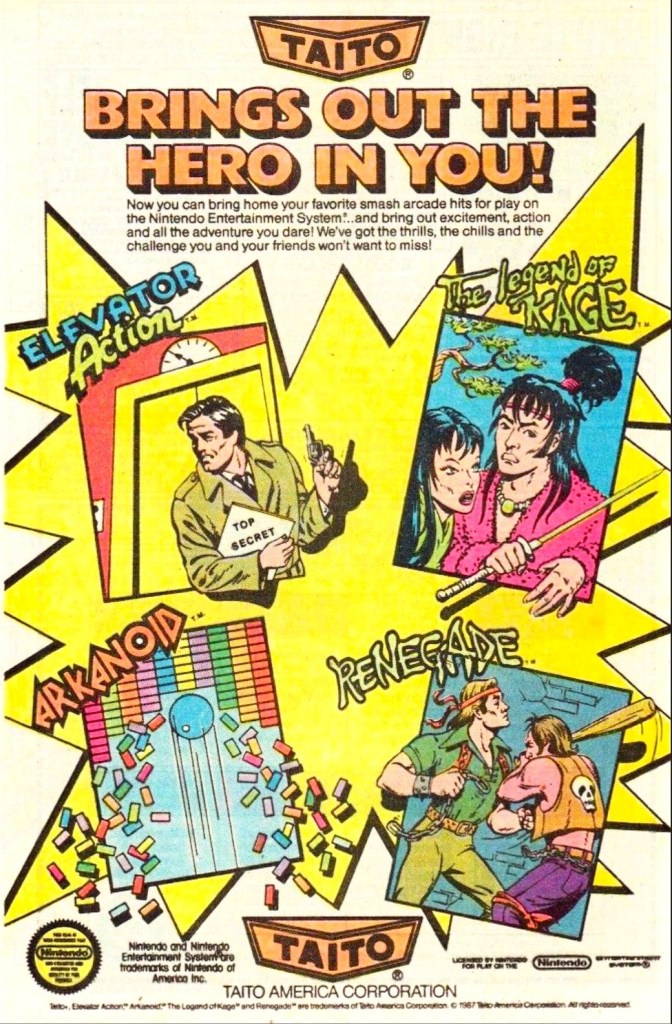
There is nothing like taking the clever approach of promoting multiple video games using only one single print ad in the size of a single page. Taito did exactly that in the 1980s when it promoted Elevator Action, The Legend of Kage, Arkanoid and Renegade for the Nintendo Entertainment System (NES) promising excitement as the mentioned games were making the jump from arcade to console. What is very notable in Taito’s single-page print ad was that it did not show any screenshots of the games. Instead, they used hand-drawn artwork to emphasize each game’s theme or setting, and leave it up to the viewers’ imagination as to how those games would look like on NES. This old ad is intriguing and amusing at the same time.
2. Chase H.Q. II: Special Criminal Investigation Print Ad
Cars and high-speed action emphasized in this ad.
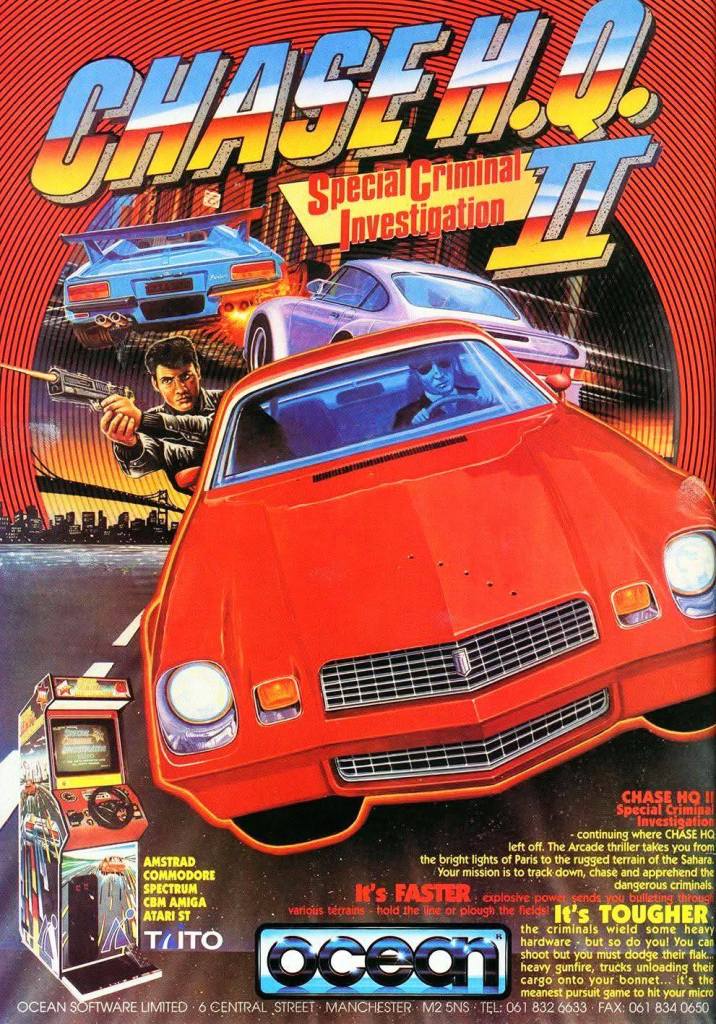
Following the huge success of the original Chase H.Q. on both arcade and consoles in the late-1980s, the sequel Special Crime Investigation was released in the arcades in 1989 and ported to game consoles and computers in the early 1990s under the title Chase H.Q. II: Special Criminal Investigation. To promote Chase H.Q. II: Special Criminal Investigation for home computers, game publisher Ocean came up with a colorful print ad showcasing a few cars, a city background and elements of gun-related action presented in nice art. The ad has an image of the original arcade machine to remind gamers that they are playing the sequel to Chase H.Q.
3. Dancing Eyes Japanese Arcade Flyer
The front.
The rear.
Released by Namco in Japan in 1996, Dancing Eyes is a puzzle arcade game that became notorious due to its overtly sexual nature. With the way it was designed, players control a small monkey called Urusu-San and crawl along a 3D grid mapped over characters (mostly ladies) or various objects. If the 3D grid is mapped over a young lady, any tile of the grid destroyed by the player exposes the lady’s underwear or skin. Such sexuality is reflected in the arcade flyer of Dancing Eyes which has a suggestive hand-drawn art on the front while the game’s mechanics are explained in the rear. Even the rear of the flyer shows sexual nature of the game with screenshots. While the game was officially released only in Japan, Dancing Eyes actually was made available for gamers to play at the arcade of X-Site amusement center inside Festival Mall in Alabang during the early 2000s and it attracted a lot of guys. I bet Namco did not know about that.
4. Sega Saturn North American Print Ad
This print ad always caught people’s attention.
When the Sega launched the Saturn console in America roughly four months ahead of schedule in 1995, the company suffered as the sales were disappointing, ties with business partners were strained and the available Saturn games were very few. By the fourth quarter of that year, more games became available for the Saturn and this gave Sega the opportunity to aggressively market the console as the one that gamers should get for their enjoyment. To promote the Saturn, Sega came up with a two-page print ad that had a dominant image of a naked woman whose private parts were cleverly covered by screenshots of the available games. Since most gamers were predominantly male from teenagers to adults, it made sense for Sega to come up with an eye-catching sexy ad to promote their console and the video games (including those from other companies). This old ad is considered by the woke and rabid feminists as very offensive today.
5. Blockbuster Video Print Ad
If you won the grand prize and wanted a lot of entertainment, you would not want to leave your home.
Back in the late 20th century, Blockbuster Video was the dominant retailer that offered customers movies in home video format for sale and for rent. Along the way, the company offered video game rentals and attracted millions of gamers around the nation. Given the tremendous growth of video gaming in America in the 1990s, Blockbuster got itself more involved by launching the Games of Summer Sweepstakes in 1996. Utilizing print ads, the sweepstakes offered the Ultimate Game Rooms – composed of a 41-inch big-screen TV, Surround Sound speakers, hi-fi VCR, NBA Jame Extreme arcade game, the Sega Saturn, the PlayStation, a gaming chair, Acclaim games for Saturn and PlayStation, and a 1-year free Blockbuster Video game rentals privilege – as the grand prizes. Do you know anyone who won in Blockbuster’s sweepstakes?
6. Independence Day (ID4) Print Ad
A nice looking ad for a game that was actually mediocre.
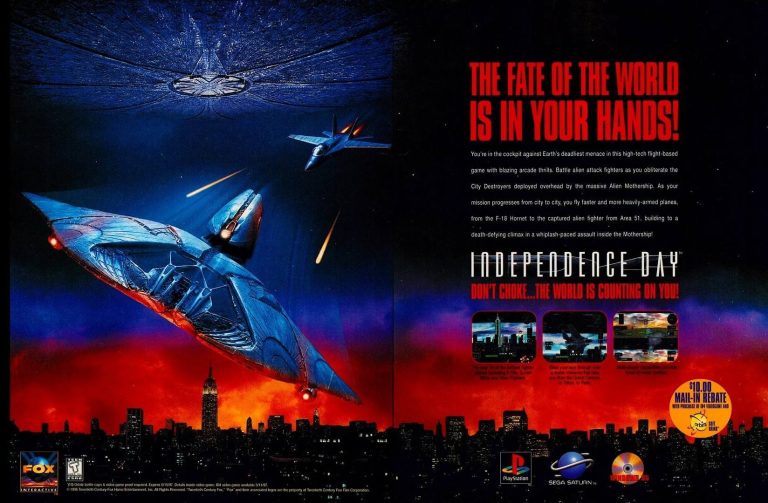
Remember how big a blockbuster Independence Day (ID4) was in cinemas in 1996? The film grossed over $800 million worldwide and it revived the disaster movie genre using modern filmmaking techniques and the latest technologies of the decade. Given the massive success of the movie, it was not surprising that an official video game adaptation was released in 1997. To promote the game, Fox Interactive (the video game company of the movie studio behind the film) came up with a 2-page print ad using official artwork from the movie showcasing the alien spaceship being attacked by a military fighter plane. The ad showed only 3 screenshots and the descriptive text was written to make gamers feel like they have the role to lead Earth’s fight against the aliens. While the art looks good, it can only go so far to hide the mediocrity of the game itself.
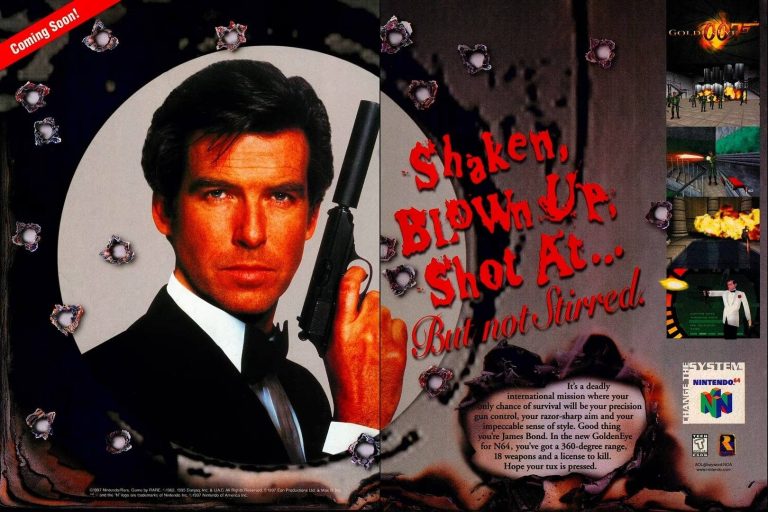
7. GoldenEye 007 Print Ad
Bond, James Bond.
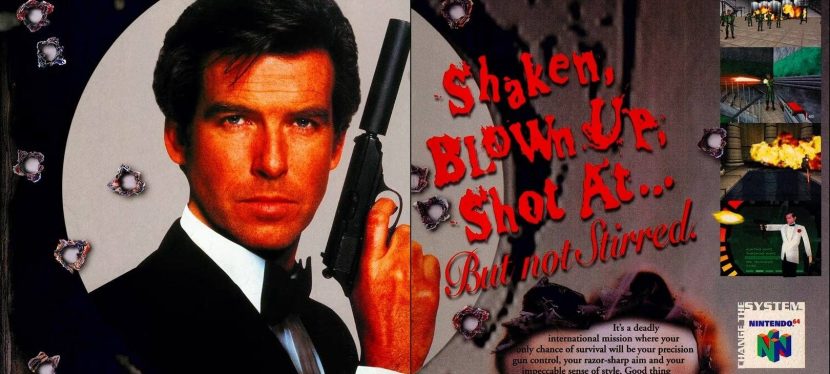
When GoldenEye achieved both critical and financial success in movies, it revived the James Bond movie franchise big-time and Pierce Brosnan was easily accepted by the public as the newest Agent 007. Several months before the movie was even released, an official video game adaptation started development. After much revisions and hard adjustments, the project evolved into a first-person shooting game for the Nintendo 64 console titled GoldenEye 007. To promote the game, Nintendo came up with a 2-page print ad that cleverly showed Brosnan as James Bond on the left and displayed the screenshots and other details on the right. This ad was easily eye-catching and it made lots of gamers excited. As history showed, GoldenEye 007 got released in 1997 and became a huge critical and commercial success while also proving that first-person shooters on game consoles can be a lot of fun.
8. North American Sega Saturn Games Promo Print Ad
There definitely was something fun offered to gamers. Who could go wrong with titles like Tomb Raider, Nights into Dreams, Virtual On and Virtua Cop 2?
As mentioned earlier, the Sega Saturn had a bad launch in America in 1995 which caused a lot of problems for the company. In 1996, Sega of America went on the offensive to really capture gamers’ attention by launching their Saturn games promo. The message of this 2-page print ad was very clear…Sega offered one free first-party game (limited to four specific games including Nights into Dreams) to those who bought two games (from a lineup of twelve specific titles). It should be noted that the Christmas season of 1996 was the most successful sales period of the Sega Saturn in America as gamers really responded to the promo. Even though some called this promo an act of desperation, nothing changes the fact that Sega succeeded during the most critical sales season of 1996.
On the sidelines of the recent International Institute for Strategic Studies (IISS) Shangri-La Dialogue in Singapore, the United States Secretary of War Pete Hegseth announced the plan to transfer a US Coast Guard Cutter to the Philippines to help its maritime security in the West Philippine Sea, according to a news report by the Manila Bulletin.
To put things in perspective, posted below is the excerpt from the Manila Bulletin report. Some parts in boldface…
The United States plans to transfer a Coast Guard cutter to the Philippines to bolster the latter’s maritime security amid ongoing tensions in the West Philippine Sea (WPS).
US Secretary of War Pete Hegseth announced the vessel transfer following a high-level bilateral meeting with Department of National Defense (DND) Secretary Gilberto C. Teodoro Jr. on Saturday, May 30, on the sidelines of the International Institute for Strategic Studies (IISS) Shangri-La Dialogue in Singapore.
“Honored to meet Secretary Teodoro for the fifth time as we bolster defense cooperation along the First Island Chain—backed by our most advanced-ever BALIKATAN exercise and a Coast Guard cutter transfer,” Hegseth said in a social media post on X (formerly Twitter).
“We continue to put Peace through Strength into action,” he added.
The meeting took place as Manila and Washington mark the 75th anniversary of the Philippines-U.S. Mutual Defense Treaty (MDT). The 1951 accord binds both nations to defend each other in the event of an armed attack in the Pacific.
During the meeting, Teodoro reaffirmed the Philippines’ “ironclad alliance” with the US. He also underscored Manila’s “strong support for the US’ commitment to strengthening partnerships in the Indo-Pacific.”
Teodoro emphasized that the Philippines stands as a “witness to the robustness of US partnerships in the region,” noting that such efforts contribute to “greater resilience and deterrence in the Indo-Pacific.”
Meanwhile, Hegseth highlighted that the frequency of their meetings underscored the “depth and consistency of Philippines-US defense cooperation.”
The Pentagon chief also commended the successful conduct of the recent Exercise Balikatan, noting it as the “largest iteration to date and a testament to the growing interoperability and readiness of both armed forces.”
The US reaffirmed its commitment to support the monitoring of the Philippines’ exclusive economic zone (EEZ) amid ongoing maritime tensions and Hegseth expressed continued American support for Philippine defense interests.
To sustain long-term operational defense ties, the Armed Forces of the Philippines (AFP) and the United States Indo-Pacific Command (US Indopacom) renewed for another 15 years the Communications Interoperability and Security Memorandum of Agreement (CISMOA), a defense agreement that allows the two forces to use secure and encrypted communications systems when operating together.
Teodoro also invited Hegseth to the ASEAN Defence Ministers’ Meeting (ADMM) Plus later this year, recognizing the upcoming occasion as an “opportunity to strengthen engagement not only with the Philippines but also with defense counterparts.”
Capitol Hill backing – Aside from his meeting with Hegseth, Teodoro also secured commitments from the US legislature during separate engagements with US Senate and House of Representatives delegations.
Teodoro expressed appreciation for the “continued bipartisan support of the United States (US) Congress for Philippine defense priorities” and reaffirmed the “enduring strength of the Philippines-US alliance.”
Meeting with a US Senate delegation led by Senator Pete Ricketts and joined by Senator Tammy Duckworth, Teodoro underscored the importance of “consistently exposing malign actions that threaten human lives, as well as regional peace and security.”
The defense chief highlighted the importance of “principled and collective action in upholding international law, particularly the United Nations Convention on the Law of the Sea (UNCLOS).”
In response, the American senators expressed appreciation for the Philippines’ “efforts in addressing malign activities and promoting adherence to international law.”
They also recognized the successful conduct of Exercise Balikatan and its contribution to “enhancing interoperability among the Philippines, the US, and other like-minded partners.”
Let me end this piece by asking you readers: What is your reaction to this development? Do you think the planned transfer of a US Coast Guard vessel to the Philippines will prove to be very helpful soon? Do you think China will be intimidated by the strong alliance between America and the Philippines?