For insight, the Philippines withdrew from the Rome Statute during the time of then President Rodrigo Duterte. The Philippines made it clear that it has a functioning judiciary and that the there is no need for the ICC to meddle. Strangely, Filipino authorities enforced the ICC arrest warrant which resulted in the arrest of former President Duterte and his transfer to The Hague for trial.
To put things in perspective, posted below is the excerpt of the BusinessWorld news report. Some parts in boldface…
THE Philippines on Tuesday distanced itself from a campaign by the administration of US President Donald J. Trump urging countries to leave the International Criminal Court (ICC), saying Washington’s latest position on the Hague-based tribunal is a matter of American policy and that Manila would continue to follow its own laws.
“The policy of the US is not within the scope of our government,” Palace Press Officer Clarissa A. Castro told reporters in a Viber group chat in Filipino.
Ms. Castro was asked to comment on a statement by US Secretary of State Marco A. Rubio, who said on Monday that “nations that refuse to reject the ICC’s false authority while relying on US assistance are likely to come under scrutiny.”
“This is a policy of the United States, and we respect their position,” Ms. Castro separately told GMA News. “At this point, we have no comment, as we are simply acting in accordance with our own laws.”
The Marcos administration has repeatedly said the Philippines has no plans to rejoin the ICC, while maintaining that its position on the tribunal is based on Philippine policy rather than that of any foreign government.
The Philippines withdrew from the Rome Statute, the treaty that created the ICC, in 2019 under former President Rodrigo R. Duterte after the tribunal opened a preliminary examination into his anti-illegal drug campaign.
Although Manila is no longer a state party, the ICC maintains that it retains jurisdiction over crimes committed while the country was still a member.
Former presidential legal counsel Salvador S. Panelo welcomed the Trump administration’s campaign against the ICC, saying the tribunal should stop what he described as interference in the affairs of sovereign states.
“The Trump administration’s launching of a government-wide campaign against the International Criminal Court, vowing to pressure countries to withdraw from the tribunal and accusing it of threatening US sovereignty, as well as other countries’ sovereignties like the Philippines, Russia and Israel is long in coming,” he said in a statement.
“The illegal and unforgivable incarceration of former President Rodrigo Roa Duterte, intruding into our country’s sovereignty with the cooperation of the Marcos administration, is a classic example of ICC’s unlawful intrusion to countries that are not members,” he added.
Mr. Duterte, 81, was arrested in March 2025 after Philippine authorities enforced an ICC arrest warrant and transferred him to The Hague, where he remains in the tribunal’s custody while facing allegations of crimes against humanity linked to his anti-drug campaign.
He has denied wrongdoing, while his supporters continue to challenge the court’s jurisdiction following the Philippines’ withdrawal from the Rome Statute.
Let me end this piece by asking you readers: What is your reaction to this development? Do you think the Philippines is in a very awkward position between the United States and the ICC? Do you think the Philippines will lose American assistance in the near future as a result of its decision to distance itself from the US campaign against the ICC? Do you support campaigns opposing the ICC?
Remember a few years ago when the administration of failed US President Joe Biden came up with a foster care rule that sought to require children who identify as LGBTQ be placed with families willing to accept them through gender identity? That outrageous rule was never implemented but the Trump administration formally eliminated it which is good for the United States, according to a news report by Newsmax.
To put things in perspective, posted below is the excerpt of the Newsmax report. Some parts in boldface…
The Trump administration on Tuesday formally eliminated a Biden-era foster care rule that sought to require children who identify as LGBTQ be placed with families willing to affirm their stated gender identity or sexual orientation.
The Department of Health and Human Services’ Administration for Children and Families (ACF) removed the April 2024 regulation from the Code of Federal Regulations, saying the move will provide clarity and help recruit more foster families nationwide.
The rule never took effect after it was struck down by the U.S. District Court for the Eastern District of Texas, but the administration said removing it entirely closes the door on the policy.
Assistant HHS Secretary Alex Adams told The Daily Wire the decision reflects the administration’s belief that more families should feel welcome to foster children.
“The message that we think it sends is that all families are welcome,” Adams said. “We have too few foster families nationally. We must roll out the red carpet, and we must ensure that there’s homes waiting on kids, not kids waiting on homes.”
The Biden administration’s rule directed federally funded child welfare agencies to ensure that children who “self-identify with an alternative sexual orientation or self-identify as something other than their sex in foster care” were placed with families that would affirm those identities.
The Trump administration said rescinding the regulation supports first lady Melania Trump’s “Fostering the Future” initiative and a related executive order calling for a government-wide effort to strengthen the nation’s foster care system.
Adams said the administration has also launched its “Home for Every Child” campaign to increase the number of foster homes available for children entering the system.
“Nationally, we have a shortage,” Adams said. “We only have 57 homes for every 100 kids coming in, so we can and must do better to ensure that there’s enough homes for kids because when there’s not enough homes, kids end up in short-term rentals, hotels, government office spaces, etc.”
Adams said families with strong religious beliefs and moral convictions make up a large share of those willing to foster children, making it critical that the federal government not discourage them from participating.
Let me end this piece by asking you readers: What is your reaction to this development? Are you delighted that US President Donald Trump and his administration scrapped the Biden-era rule and made sure it would not be revived soon? Do you think the woke, the SJWs and LGBTQ mob will react violently to this development?
Do you believe that the internationalist and justice-disrupting International Criminal Court (ICC) should meddle in your nation’s justice system? The Department of State officially launched a huge campaign to the dismantle the ICC to protect the sovereignty of the United States.
To put things in perspective, posted below is the entire announcement by the State Department. Some parts in boldface…
Today, Secretary of State Marco Rubio announced a sweeping campaign to dismantle the threat posed by the International Criminal Court to U.S. sovereignty. The campaign will feature a whole-of-government response to systematically disable the ICC’s ability to operate, target American servicemen or officials, or otherwise threaten American sovereignty.
The ICC poses an intolerable threat to U.S. sovereignty – it claims the authority to prosecute and even imprison American servicemen and officials operating on behalf of America’s national interest. Americans never signed up for this, and all American presidents since the ICC’s ratification have maintained that the ICC does not have jurisdiction over Americans. The ICC previously opened an investigation into U.S. servicemen and intelligence officers and has since refused to close these cases.
The ICC now seeks to become the unaccountable global arbiter – positioning itself above and beyond the nation state as a supranational enforcement arm of a globalist bureaucracy empowered to persecute American servicemen and officials at will. No diplomatic option will be off-limits in the campaign to dismantle the threat posed by the ICC to Americans.
The campaign will feature a wide range of actions intended to ensure that the International Criminal Court is incapable of threatening U.S. sovereignty or targeting Americans.
Actions under consideration include:
Diplomatic calls from the Secretary of State, Deputy Secretary, ambassadors, and other members of senior leadership to foreign nations highlighting the abuses of the ICC and the risks posed to Americans and other nations urging them to withdraw from the ICC
Nations that partner with American law enforcement and the U.S. military or that enjoy the benefits of the U.S. security umbrella are called upon to reject the ICC’s purported authority to prosecute American officials and servicemen
Increased scrutiny of nations that refuse to reject the ICC’s false authority while relying on U.S. assistance
Diplomatic calls urging other nations that, like America, that are not party to the Rome Statute to leverage their diplomatic networks to take similar actions alongside us
Visa revocations and travel bans for ICC personnel
Increased sanctions against the ICC and affiliated organizations
For added insight, watch the YouTube video below. Pay close attention to what US State Secretary Marco Rubio said.
Let me end this piece by asking you readers: What is your reaction to this development? Do you think the Trump administration will make huge impact against the ICC through diplomacy and legal systems? What should the US do to nations that were found to have been following the ICC while receiving American assistance? Do you consider the ICC a living international body of injustice and violator of the sovereignty of nations that bowed to its authority?
As the military conflict between the United States and the Islamic terrorist state of Iran intensifies, the State Department announced that action has been taken to cut off the financial lifelines of the evil regime.
To put things in perspective, posted below is the entire announcement by the State Department. Some parts in boldface…
The United States is taking decisive action to cut off the financial lifelines sustaining Iran’s ruling elite. Today’s action targets Ali Ansari, a Dubai-based Iranian national who has built a sprawling global network of real estate and commercial holdings — spanning Germany, the United Kingdom, Spain, Cyprus, the UAE, and beyond — on behalf of Iranian Supreme Leader Mojtaba Khamenei and other regime insiders.
The United States also sanctioned three Iran-based currency exchange houses — Mohammad Darbani and Partners, Lavasani and Partners, and Mohsen Khandan and Partners — along with their managing partners and associated front companies. By targeting these networks, the United States is directly disrupting the regime’s ability to access foreign currency and conduct international financial activity.
These actions reflect the Trump Administration’s commitment to holding accountable all those who enable the regime’s corruption and regional aggression. The United States will continue to pursue sanctions against individuals, companies, and financial institutions — including foreign entities — that facilitate illicit Iranian commerce, and will not relent until the Iranian regime ends its destabilizing behavior and its exploitation of the Iranian people.
Today’s action is being taken pursuant to E.O. 13902, which targets persons operating in Iran’s financial and petroleum sectors, E.O. 13876, which focuses on the Supreme Leader of Iran and his affiliates, and the counterterrorism authority E.O. 13224, as amended by E.O. 13886. These designations build on a series of OFAC actions targeting Iranian shadow banking and currency exchange house networks
Let me end this piece by asking you readers: What is your reaction to this development? Do you think the US will be able to cut off Iran’s links to all financial sources around the world? Could it be possible that the sinister financiers behind LGBTQ and transgender mobs and human traffickers (involved with mass migration targeting Europe) could secretly be funding the Islamic terrorist regime of Iran?
Following the disturbing ballistic missile launch of Communist China into the Pacific Ocean, the United States reaffirmed its support for the Philippines, according to a news report by the Manila Bulletin. Symbolically, the new US Ambassador to the Philippines Lee Lipton issued an official statement.
To put things in perspective, posted below is the excerpt from the report of the Manila Bulletin. Some parts in boldface…
The United States has reaffirmed its commitment to the Philippines after China test-launched an unarmed intercontinental-range ballistic missile from a submarine into the southern Pacific Ocean.
In a statement on Tuesday, July 7, US Ambassador to the Philippines Lee Lipton said the launch underscored concerns over Beijing’s nuclear weapons buildup and its implications for regional peace and stability.
“The ironclad US-Philippine Alliance has been a tremendous and transparent source of regional peace and stability for over seven decades,” Lipton said.
“Beijing’s provocative missile launch yesterday is further evidence of its rapid and secretive nuclear weapons development program, which runs counter to regional stability and is inconsistent with the pursuit of meaningful arms control discussions,” he added.
Lipton said the United States shares the Philippines’ concerns over the missile launch and remains committed to its “oldest security ally in the region.”
The statement followed a July 6 statement by US State Department spokesperson Thomas “Tommy” Pigott, who said the United States had monitored China’s test launch of an unarmed intercontinental-range ballistic missile from a submarine.
According to Pigott, the missile landed in the southern Pacific Ocean.
“At a time when the United States is working harder than ever to prevent nuclear proliferation, China is doing the opposite,” Pigott said.
He said China’s “rapid and opaque nuclear weapons buildup” remains a major concern for countries in the region and the international community.
The United States also urged China to participate in meaningful arms control talks and establish a regular notification arrangement for all intercontinental-range ballistic missile and space launches.
Such an arrangement, Pigott said, would be consistent with commitments made by the other members of the P5, or the five permanent members of the United Nations Security Council.
“The United States remains steadfast in our defense commitments to our allies and partners,” Pigott said.
The latest US statements come amid continuing concerns over China’s expanding military capabilities and increasingly assertive activities in the Indo-Pacific, including in the West Philippine Sea.
Let me end this piece by asking you readers: What is your reaction to this development? Are you concerned that China could someday attack the Philippines with ballistic missiles? Do you think this destabilizing move by China could spark the US to send more naval vessels into the Asian region? How do you think US President Donald Trump will react if ever China launches even more ballistic missiles?
The United States of America (USA) celebrated its 250th anniversary and during his 4th of July speech at the National Mall, US President Donald Trump honored the American heroes as well as the Founding Fathers of the nation, according to a news report by Newsmax.
To put things in perspective, posted below is the excerpt from the report of Newsmax. Some parts in boldface…
President Donald Trump celebrated America’s 250th anniversary in a rousing speech on the Fourth of July at the National Mall on Saturday night.
Trump delivered his remarks after 11 p.m. ET, after being delayed by over an hour due to lightning and heavy rains. But Trump said he would not be deterred in celebrating the adoption of the Declaration of Independence.
“If we have to speak in front of one person at four in the morning I’m going to be here,” Trump said in a speech streamed live on Newsmax. “There’s no way we can be deterred.”
“Tonight we come together for one of the most joyous and glorious milestones of all time,” Trump added. “For two and a half centuries, our American Republic has stood as the crowning achievement of human history.
“This country is the home of freedom. This is the land of liberty. And this is a flag that’s the banner of the most extraordinary, most exceptional, most incredible nation ever to exist on the face of the Earth.”
The president said the American people have shown more courage, done more good, righted more injustice and achieved more greatness than anyone else.
“For 250 years, the United States of America has been the hope, the promise, the light and the glory among all of the nations of the world, all over the world, they try and be like us,” Trump said.
“Nobody can be like us, and with God’s help, we will always be this,” Trump added. “Or even better. We’re going to be better.”
Trump used his speech to honor numerous veterans who fought in American wars, bringing them on stage to salute the flag while telling their tales of heroism.
Among those honored were 104-year-old Ken Schrubing, who was just 19 years old when he survived the Japanese attack on Pearl Harbor, and 101-year-old Don Graves, who fought in the Battle of Iwo Jima.
“These are the fighters and the banners of the Greatest Generation,” Trump said. “They are the greatest generation. They saved the world and they made America very, very proud. We’re very proud of you, heroes all.“
Marine Corporal Pat Finn and Private First Class Rudy Meekins, who fought in the Battle of Chosin Reservoir in the Korean War, were also honored, along with astronaut Jack Schmitt, the last American to walk on the moon, and the Artemis II flight crew.
Eleven Gold Star families were also presented with flags during Trump’s speech.
Speaking in front of the first American flags produced, Trump praised the Founding Fathers and the signers of the Declaration of Independence.
“Those 56 patriots put everything at risk, stepped onto the stage of destiny, and seized a victory for the ages,” Trump said.
Trump said the Founding Fathers have allowed America to thrive for 250 years.
“Our cause was just. Our people are brave, our culture is exceptional, and our destiny is written by God,” Trump said.
“And as we can see here tonight, after 250 years, the spirit of 1776 still lives within us all,” Trump added.
Let me end this piece by asking you readers: What is your reaction to this development? Are you delighted with the way America’s 250th anniversary was celebrated this year? Are you thankful to America’s Founding Fathers, war veterans and other brave heroes who kept the US a shining light on the world? Do you think the unpatriotic Americans will eventually realize they are wrong with their current beliefs and make a drastic change to love the United States again?
Several business executives and investors from the United States are set to visit the Philippines next week to explore investment opportunities in the nation’s infrastructure sector, energy sector, and more, according to a news report by the Manila Bulletin. The American investors will engage with their Filipino counterparts during the planned 5-day trade mission.
To put things in perspective, posted below is the excerpt from the report of the Manila Bulletin. Some parts in boldface…
More than 25 American business executives and investors will visit the country next week for a business mission as the United States (US) seeks to deepen its economic ties with the Philippines, which recently secured upper-middle-income status.
In a statement, the Department of Trade and Industry (DTI) said the US business delegation would mount a five-day trade mission across major economic areas in the Philippines from July 6 to 10.
The delegation includes business leaders and investors from the Northeast and Midwest regions of the US. The mission is organized by the DTI’s Philippine Trade and Investment Center (PTIC) in New York and the Philippine Consulates General in New York and Chicago.
The DTI said the business mission aims to strengthen economic ties between the two longtime trade partners while also encouraging US companies to invest more in the country’s growing economy.
Based on the latest country income classifications of the World Bank, the Philippines has moved up from lower-middle-income to upper-middle-income status. This was based on the country’s gross national income (GNI) per capita estimate for 2025, which reached a record $4,850.
The DTI noted that the upcoming visit also comes at a time when the Philippines is actively positioning itself as a key partner for US companies looking to expand in Asia.
During the business mission, the US delegation will meet with Philippine government leaders and local business owners to explore business, tourism, and investment opportunities.
The US business leaders will also attend business meetings, informational briefings, and tours of key economic areas in Manila, Clark, Subic, and Corregidor.
Let me end this piece by asking you readers: What is your reaction to this development? Do you see a promising future between the United States and the Philippines when it comes to economics and investment under the leadership of US President Donald Trump? Are you convinced the corruption within the Philippines is no longer a turn-off for American investors?
There is no denying the fact that fraud and other forms of crime went up in the United States whenever illegal aliens get involved. Recently an illegal alien was sentenced to eight years in prison for his involvement in an $89 fraudulent payroll scheme that saw illegal alien construction workers and their employers evade taxes, according to a news report by Breitbart. The convicted illegal alien criminal is from Honduras.
To put things in perspective, posted below is the excerpt from the report of Breitbart. Some parts in boldface…
An illegal alien has been sentenced to eight years in federal prison for his involvement in an $89 million fraudulent payroll scheme that saw illegal alien construction workers and their employers evade taxes.
“Today, we held an illegal alien from Honduras accountable for a brazen scheme that stole more than $38 million from American taxpayers to facilitate the employment of illegal aliens,” Assistant Attorney General Colin McDonald said.
“This case exposes how unchecked illegal immigration fuels widespread payroll tax fraud and underground economies that harm American workers and taxpayers,” McDonald said. “This sentence sends a strong message: Those who exploit our open borders, cheat the U.S. Treasury, and violate federal laws will face justice.”
Department of Justice (DOJ) officials detailed how the illegal alien helped operate the payroll scheme through several maneuvers to ensure that illegal construction workers were kept off the books:
According to court documents and statements made in court, from 2015 to 2022, Mario Flores, of Honduras, an illegal alien, conspired with others to create a series of shell companies to run an unlicensed check cashing and cash courier service business. These shell companies cashed approximately $89 million in checks from subcontractors in the construction industry, charging them a percentage of the dollar amount of the checks they cashed as a fee for this service. Through this scheme, construction contractors and subcontractors paid their workers in cash without withholding and paying required payroll taxes, allowing them to operate without regard to the workers’ legal authority to work in the United States. Flores also caused the filing of false tax documents with the IRS to conceal the scheme.
…
In addition, Flores and his conspirators defrauded workers’ compensation insurance companies by leasing their certificates of insurance to contractors and by providing false and fraudulent information to the insurers about, among other things, the number of workers covered by the insurance and the amount workers were paid.
“Homeland Security Investigations is committed to protecting the integrity of our financial system and enforcing our nation’s laws,” HSI’s John Condon said. “Those who orchestrate large-scale payroll tax fraud and facilitate the illegal employment of unauthorized workers will be held accountable.”
Flores pleaded guilty to one count of conspiracy to defraud the U.S. government and one count of conspiracy to operate an unlicensed money transmitting business.
Let me end this piece by asking you readers: What is your reaction to this development? Do you think America still has a lot more illegal aliens working in construction and committing fraud to this day? Do you think illegal aliens are obsessed committing fraud and harming American workers and taxpayers?
There is a surging global demand for ube (purple yam) and the United States Department of Agriculture (USDA) says the Philippines is missing out on it as its ube production declined a lot in 2025, according to a news report by the Manila Bulletin.
Ube has long been produced here in the Philippines and it has been consumed in its standalone form and also has been used as a key ingredient in making other delicacies. The strong international demand for ube of recent times is new. The purple yam is also used in certain flavors of ice cream.
To put things in perspective, posted below is the excerpt from the report of the Manila Bulletin. Some parts in boldface…
The Philippines is well-positioned to meet the surging international demand for ube (purple yam), but persistent gaps in domestic production are limiting its ability to capitalize on this export potential, according to the United States Department of Agriculture (USDA).
In a market brief dated June 26, the USDA noted that the country’s ube production has significant room for expansion given its growing global appeal, driven by consumers who increasingly favor novel flavors and plant-based products.
Citing data from the Philippine Statistics Authority (PSA), the USDA reported that the country produced only 12,483 metric tons (MT) of ube in 2025, a 6.7 percent decline from the 13,382 MT recorded the previous year.
The limited output was attributed to several constraints, including scarce planting materials, fragmented smallholder production, and insufficient processing capacity.
According to the USDA, these chronic gaps keep the ube sector underdeveloped relative to its massive market potential.
“Strengthening the ube value chain—from input supply and farm production to processing and market linkages—presents significant opportunities for increasing farmer incomes, expanding rural employment, and growing agricultural exports,” the report read.
To unlock the sector’s full potential, the USDA suggested that the government explore coordinated investment programs to address these production bottlenecks in a unified manner. One such initiative is the USDA’s Food for Progress (FFPr) program, which has identified the Philippine ube value chain as a priority sector.
In a formal notice, the USDA announced plans to award $34.12 million in funding to an eligible organization to implement a field-based project aimed at boosting ube output in both Luzon and the Visayas.
This private-sector partner will be tasked with developing a strategy aligned with existing government and donor programs to tackle key challenges, particularly where access to high-quality inputs remains limited.
Other planned interventions include training farmers on good agricultural practices and financial readiness, strengthening farmer groups and cooperatives, upgrading postharvest systems and processing quality, and promoting the adoption of sustainable technologies.
Erlier, the Department of Agriculture (DA) proposed establishing a steering committee and a technical working group to streamline government coordination and harness the ube sector’s growth trajectory.
The body would define the official scope of ube, standardize raw and processed products, and harmonize quality requirements across agencies and exporters.
Let me end this piece by asking you readers: What is your reaction to this development? Do you consider the UDSA’s assessment on Philippine ube as a serious wake-up call? What delicacies involving purple yam have you eaten lately? What do you think are the main factors as to why ube production in the Philippines declined a lot in 2025?
Welcome back readers, fellow geeks and electronic gaming fans!
In this edition of the Retro Gaming Ads Blast (RGAB) series, we will take a look at another batch of retro gaming print ads from the 1980s to the early 2000s.
For the newcomers reading this, Retro Gaming Ads Blast (RGAB) looks back at the many print ads of games (console, arcade, computer and handheld) that were published in comic books, magazines, flyers, posters and newspapers long before smartphones, social media, the worldwide web and streaming became popular. To put things in perspective, people back in the 1980s to the 1990s were more trusting of print media for information and images about electronic games and related products.
With those details laid down, here is the newest batch of retro gaming print ads for you to see and enjoy…
1. Berzerk Arcade Flyer
The front.
The rear.
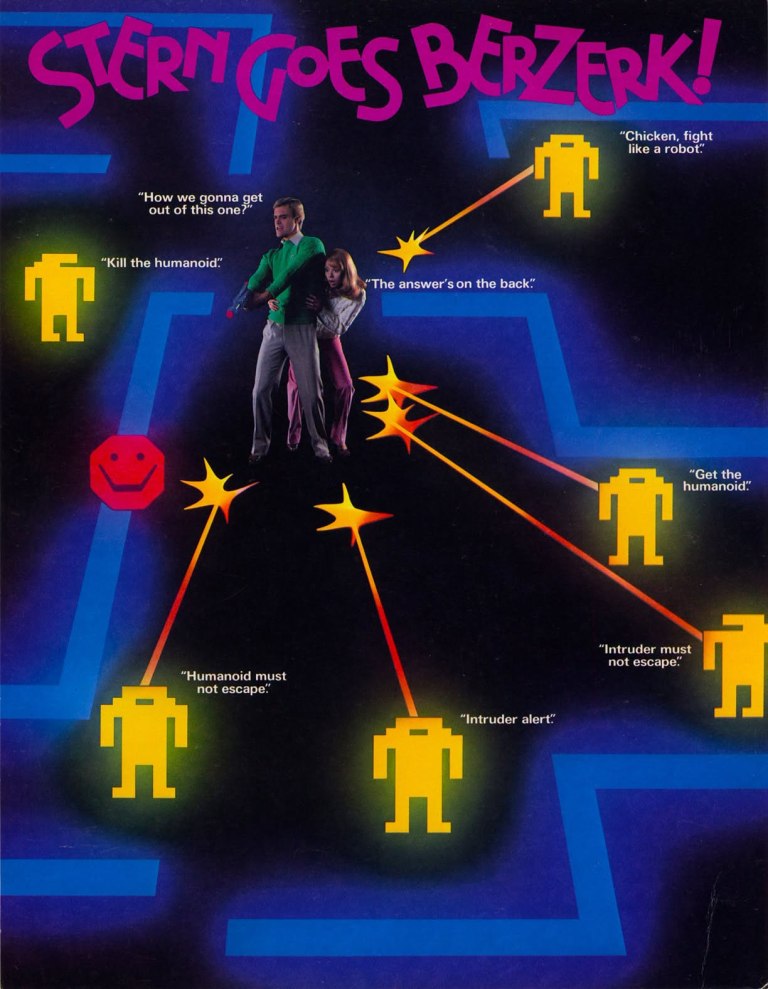
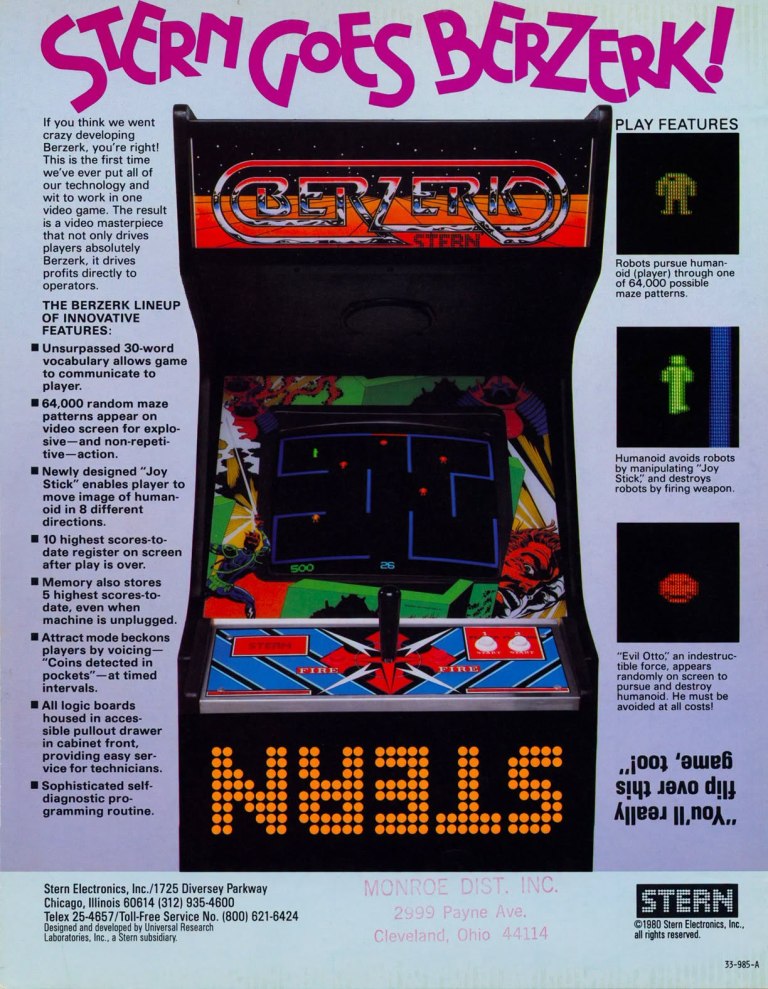
Could you imagine being trapped deep within a maze surrounded by dangerous robots (plus one other unstoppable enemy) capable firing laser blasts at you? This was the concept behind the design of Berzerk, an arcade game released by Stern Electronics in 1980. Released at a time when science fiction became wildly popular in American entertainment, Berzerk was immersive for gamers and the multidirectional gameplay feature was captivating for many. To promote the game, Stern Electronics came up with a customized visual design that blended 2D sprite elements with a photograph of two people and some hand-drawn art pieces. The front of the flyer emphasized accurate the core concept of the game while the rear explained the technical details. They even played with their company name with the line “Stern goes berzerk!”
2. Rush’n Attack North American Arcade Flyer
The arcade flyer for North America
During the late stages of the Cold War, Konami made a lot of military-themed video games which resonated not only with those who were already aware about the global conflict but also with gamers who craved for action and excitement. One of those games was Rush’n Attack (alternative title: Green Beret) which was released in American arcades in late-1985. Konami came up with an arcade flyer showing four people (looking like an American family) having a good time in front of an arcade cabinet, and three screenshots of the game were displayed on the lower half. Rush’n Attack – which was deliberately titled to resemble the phrase “Russian attack” due to its obvious Cold War setting – went on to succeed commercially and critically. One notable game review compared Rush’n Attack favorably with the movie Rambo: First Blood Part II.
3. Turbo Out Run North American Arcade Flyer
The flyer.
Following the massive success Sega achieved with Out Run in 1986, the company went on to release the follow-up Turbo OutRun three years later. As seen in their North American flyer, Sega emphasized the in-game locations, the look of the machine with the driver’s seat and steering wheel, and the excitement they can expect. Turbo OutRun went on to become successful in the arcades worldwide and it got ported to a variety of consoles and computer systems in the years that followed. On its own, the arcade flyer sparked excitement for gamers.
4. Air Duel Japanese Arcade Flyer
The artwork here is captivating to look at.
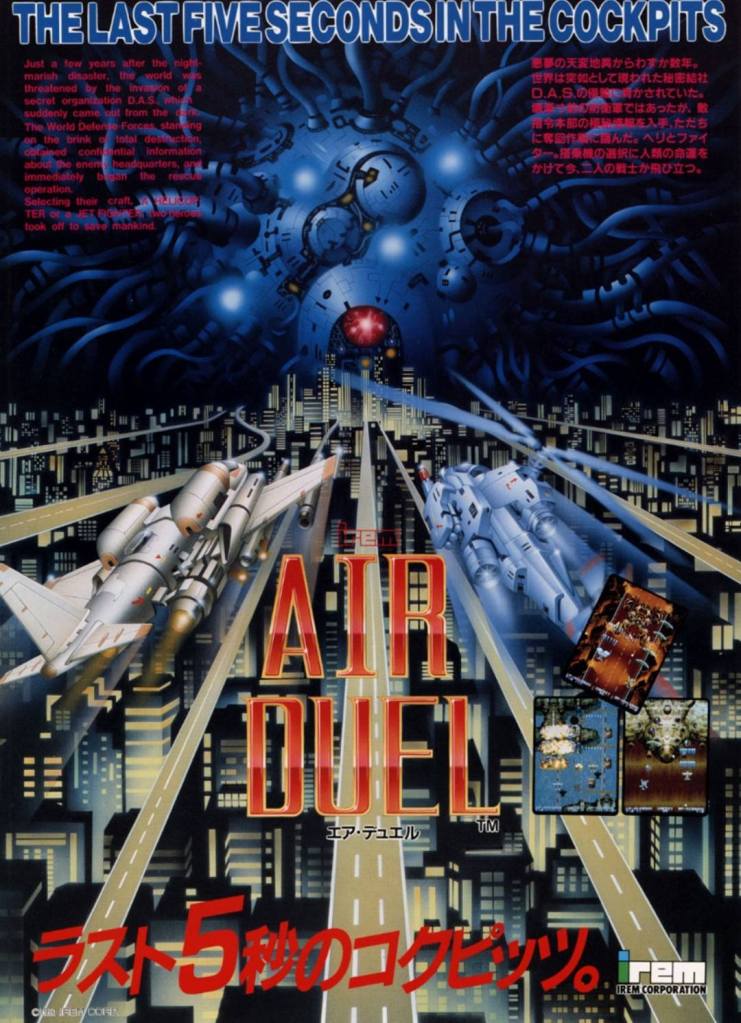
Released in Japanese arcades in 1990, Air Duel from Irem is an intense and fast-paced 2D sprite vertically scrolling shooter that attracted a lot of players. It had a war theme and its aesthetic has a mix of military and somewhat futuristic science fiction elements. The game’s arcade flyer featured a very intriguing artwork by Takashi Yamasaki showing two aircrafts flying over a city heading towards a massively large enemy in the distance. In my opinion, the artwork alone is pretty engaging to see and it’s more than enough to make me think about playing the game.
5. Spellbound Adaptor Print Ad
The Spellbound Adaptor print ad in Europe. UK design and manufacturing emphasized.
Remember back in the old days when there were hardware lockouts on game consoles that prevented users from playing games imported from different regions? In Europe, a special cheat and regional bypass cartridge called the Spellbound Adaptor was released and it allowed Super Nintendo Entertainment System (SNES) users to bypass the lockouts and play games from overseas. The Spellbound Adaptor was notably advertised in European print media showing two sexy ladies posing with the adaptor itself (on the SNES), the television and many SNES games. The ad even includes a promo of buying the adaptor with a game of choice for only £69.95. The ad is still impactful to look at.
6. Contra III: The Alien Wars North American Print Ad
Konami’s made a huge impression visually with this 2-page print ad promoting Contra III: The Alien Wars.
By the time the SNES was launched in America in 1991, a lot of gamers who enjoyed Contra games on the Nintendo Entertainment System (NES) have been craving for a sequel on the newer console. Their dreams finally came through in early 1992 when Konami released Contra III: The Alien Wars on the SNES, and it was a lot more than visual upgrade as it had groundbreaking features connected with the game developers’ clever use of the console’s technology. Konami was already aware of Contra’s huge following in America, so they came up with an aggressive looking print ad promoting Contra III: The Alien Wars. With a red-and-black background, the ad had a variety of screenshots that were tilted to look 3D (showing what the game offered) and used a minor space for the descriptive text and image of the game box. This old print ad is one of the finest ways to promote a sequel while also emphasizing the next-generation experience fans can enjoy. This ad is a classic!
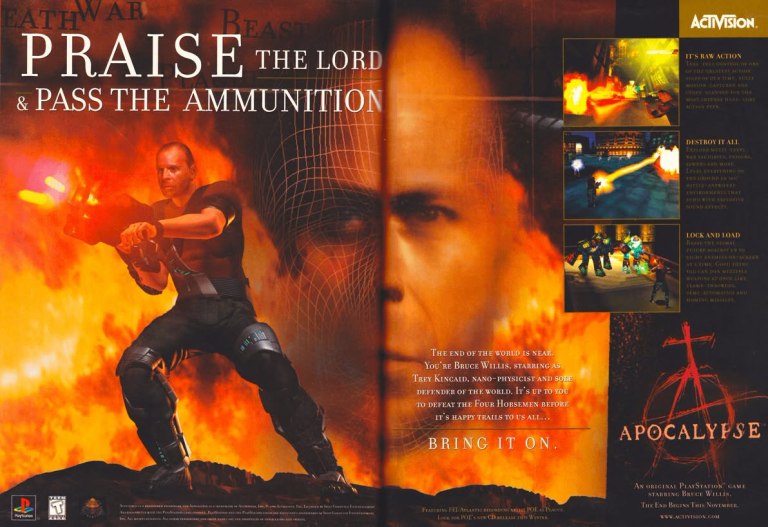
7. Apocalypse Print Ads
With Bruce Willis’ face, this 2-page Apocalypse print ad captured the attention of readers.
The more action-oriented 2-page print ad of Apocalypse. Bruce Willis is more visible here.
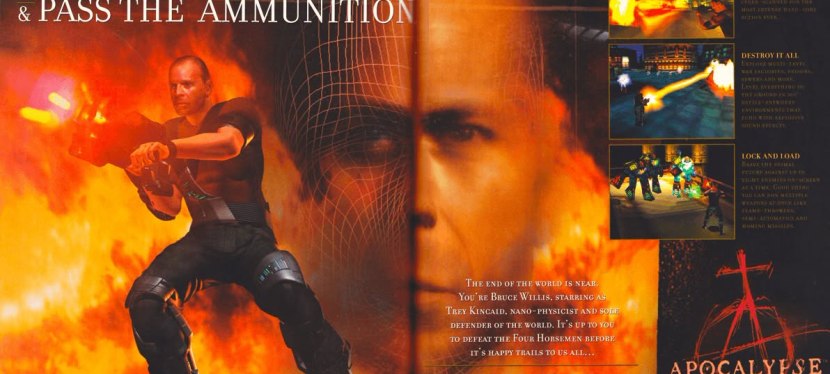
Believe it or not, Hollywood legend Bruce Willis actually starred in the ambitious video game titled Apocalypse. Before its 1998 released on PlayStation, Apocalypse started with the player character having an AI-controlled partner named Trey Kincaid to be played by Willis. Publisher Activision signed a multi-million Dollar deal with Bruce Willis to use his likeness and voice for the Trey character. Eventually the Trey Kincaid role was modified to be the playable character. Given the huge deal signed with the super star and the additional costs that came with game design revisions, Activision launched an aggressive marketing campaign for Apocalypse and they heavily used Bruce Willis’s name and imagery. Ultimately the game sold less than one million copies and yet Activision was satisfied with the sales which convinced them to go back to Apocalypse developer Neversoft for a new project.
8. R-Type Delta North American Print Ad
R-Type Delta was the 4th game of the R-Type series and also the first to be made with 3D polygons.
R-Type, the long-running series of 2D side-scrolling shooters by Irem, fully embraced 3D polygons with R-Type Delta on PlayStation in 1998. To promote the game in North America, Irem and their partner Agetec went all-in emphasizing their series shift into 3D polygonal graphics while promising new in-game weapons. Very smartly, they included positive quotes from Electronic Gaming Monthly (EGM), PlayStation Magazine (PSM) and Official PlayStation Magazine (OPM) to show credibility. In recent times, an enhanced version of R-Type Delta (R-Type Delta: HD Boosted) was released on modern game console and PC.
9. Racing Lagoon Japanese Print Ad
Have you ever played this game from SquareSoft?
Released in 1999 for PlayStation only in Japan, Racing Lagoon was one of many games SquareSoft made for a genre other than role-playing games (RPGs). Released at a time when the PlayStation already had lots of racing games available from around the world, Racing Lagoon was a racing game that had role-playing elements mixed in. To promote it, SquareSoft made a print ad that had a night-time city vibe and they showed some screenshots with a unique visual style. The in-game story was influenced by the illegal street racing trend that happened in Japan during the 1980s.
10. Resident Evil – Code: Veronica North America Print Ads
Truly a next-generation Resident Evil experience first launched on the Sega Dreamcast! I know some people who bought the console just to play Resident Evil – Code: Veronica.
The 2-page print ad of RE – Code: Veronica.
When Resident Evil – Code: Veronica was released on the Sega Dreamcast in Japan in February 2000, it delivered a next-generation survival horror experience to die-hard RE fans and it was easily one of the must-have games for Dreamcast owners of the time. Along the way, RE fans and Dreamcast owners in America were already anticipating the game. Capcom had an aggressive ad campaign for the game with US gamers in mind and this particular single-page print ad showed the fan-favorite characters Claire and Chris Redfield on one corner, six selected screenshots and quotes from the published game reviews of Game Informer, Next Generation and the Official Dreamcast Magazine. The 2-page print ad had the same elements but had the Redfield siblings on the 2nd page. I remember seeing these ads on a few gaming magazines and they made me think about buying a Dreamcast just to play RE – Code: Veronica. These old ads emphasized the strong business trust between Capcom and Sega (which itself lost a lot of money and credibility with the Sega Saturn consoles and many add-on devices released years prior).