With the Peso performing terribly in the global currency market, weakening economic growth, high inflation and fears of an economic recession growing, 2026 has not been good for the Philippines. There is a bright spot in tourism, however, as the Philippines saw its 2026 foreign tourist arrivals reach 4.11 million in the January-August period and the United States and South Korea combined for more than 1.5 million tourist arrivals, according to a news article by the Philippine News Agency (PNA).
To put things in perspective, posted below is an excerpt from the news report of BusinessWorld. Some parts in boldface…
The Philippines has recorded 4.11 million foreign arrivals from January to August, higher by 3.7 percent compared to the same period last year, the Department of Tourism (DOT) said on Tuesday.
The United States posted the highest number of share at 818,318, followed by South Korea at 727,379, Japan at 350,191, China at 310,088, and Australia at 234,156.
Also making it in the top 10 source markets are Canada with 231,972, Taiwan with 154,957, the United Kingdom with 132,370, Singapore with 126,812, and India with 77,883.
Tourism Secretary Dita Angara-Mathay said the Philippines targets to surpass its 2025 arrival figures to reach between 6.4 million and 6.8 million, or at least 7 million, by the end of 2026.
To achieve this, she said the DOT is intensifying its branding and promotions to reach more tourists in its key source markets.
The DOT is also in active talks with airlines to open up and establish more chartered flights between the Philippines and secondary cities of Korea and China.
DOT Assistant Secretary Ren Sapitan said the agency is also set to sign a contract with a creative agency in November to broaden the country’s marketing efforts and make the Philippines more visible worldwide.
Let me end this post by asking you readers: What is your reaction to this recent development? Do you think the Philippines will be able to exceed the 2025 foreign tourist arrivals number by the end of this year? Do you think the DOT is doing a good job to strengthen the Philippines’ attraction of foreign tourists? Considering the Top 10 markets of foreign tourists the Philippines attracted so far, are you convinced that the nation’s hosting of the Association of Southeast Asian Nations (ASEAN) Summit did not create any positive tourism results?
Thank you for reading. If you find this article engaging, please click the like button below, share this article to others and also please consider making a donation to support my publishing. If you are looking for a copywriter to create content for your special project or business, check out my services and my portfolio. Feel free to contact me with a private message. Also please feel free to visit my Facebook page Author Carlo Carrasco and follow me on Twitter at @CarloCarrascoPH as well as on Tumblr at https://carlocarrasco.tumblr.com/and on Instagram athttps://www.instagram.com/authorcarlocarrasco
In due time, space will be the new frontier of engaging in business and the transportation of people, cargo and the different forms of hardware. That said, the United States and Japan are moving towards that new frontier as they signed the memorandum of cooperation on space transportation business, according to news report by Kyodo News.
To put things in perspective, posted below is the entire news report of Kyodo News. Some parts in boldface…
Japan and the United States have agreed to further enhance cooperation in the space transportation business by standardizing part of the review procedures when Japanese firms launch rockets from U.S. sites and vice versa, Japan’s Cabinet Office said Tuesday.
Japan’s National Space Policy Secretariat and the U.S. Federal Aviation Administration signed a memorandum of cooperationon Monday, also aimed at streamlining regulations and intensifying information sharing.
“We would like to build a system adaptable to space business, which is widely expanding in a variety of forms,” said Takatsugu Ryuzaki, director general of the secretariat in charge of the country’s space development and utilization, after the signing.
With several spaceport projects underway in Japan, including in Kochi and Oita prefectures, the two sides will discuss guidelines for space business operators setting out specific requirements for spaceports.
In addition to rocket launches, the two security allies are considering connecting Japanese and U.S. cities via suborbital flights at an altitude of around 100 kilometers.
Let me end this piece by asking you readers: What is your reaction to this development? Do you think this new agreement by Japan and America will lead to breakthroughs of space transportation business within your lifetime? Do you think other nations will follow the standards of America and Japan on space business? Does your country have any existing spaceports?
Thank you for reading. If you find this article engaging, please click the like button below, share this article to others and also please consider making a donation to support my publishing. If you are looking for a copywriter to create content for your special project or business, check out my services and my portfolio. Feel free to contact me with a private message. Also please feel free to visit my Facebook page Author Carlo Carrasco and follow me on Twitter at @CarloCarrascoPH as well as on Tumblr at https://carlocarrasco.tumblr.com/and on Instagram athttps://www.instagram.com/authorcarlocarrasco
Welcome back readers, fellow geeks and electronic gaming fans!
In this edition of the Retro Gaming Ads Blast (RGAB) series, we will take a look at another batch of retro gaming print ads from the 1980s to the early 2000s.
For the newcomers reading this, Retro Gaming Ads Blast (RGAB) looks back at the many print ads of games (console, arcade, computer and handheld) that were published in comic books, magazines, flyers, posters and newspapers long before smartphones, social media, the worldwide web and streaming became popular. To put things in perspective, people back in the 1980s to the 1990s were more trusting of print media for information and images about electronic games and related products.
With those details laid down, here is the newest batch of retro gaming print ads for you to see and enjoy…
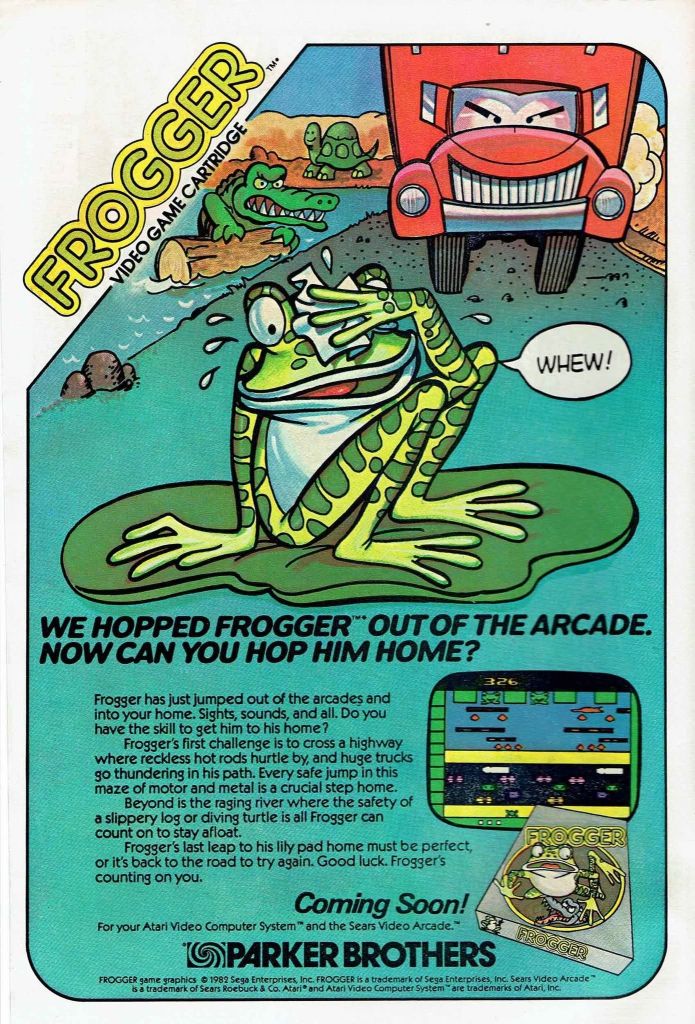
1. Frogger Print Ad
Do you find this old ad humorous?
When Frogger was first released in video arcades in 1981, it easily attracted countless gamers offering them bouts of fun and the video game critics were very impressed with it. Considering its massive arcade success, it was unsurprisingly ported to the game consoles and home computers of the time. Parker Brothers secured the license for cartridge versions and the company produced Frogger ports for not just the Atari 2600 but also the Atari 7800. This print ad they came up with had a deliberate cartoony artwork (with a touch of humor) and an artist created a hand-drawn illustration intentionally made to resemble a screenshot from the game. I saw this ad a number of times when I read comic books in 1982.
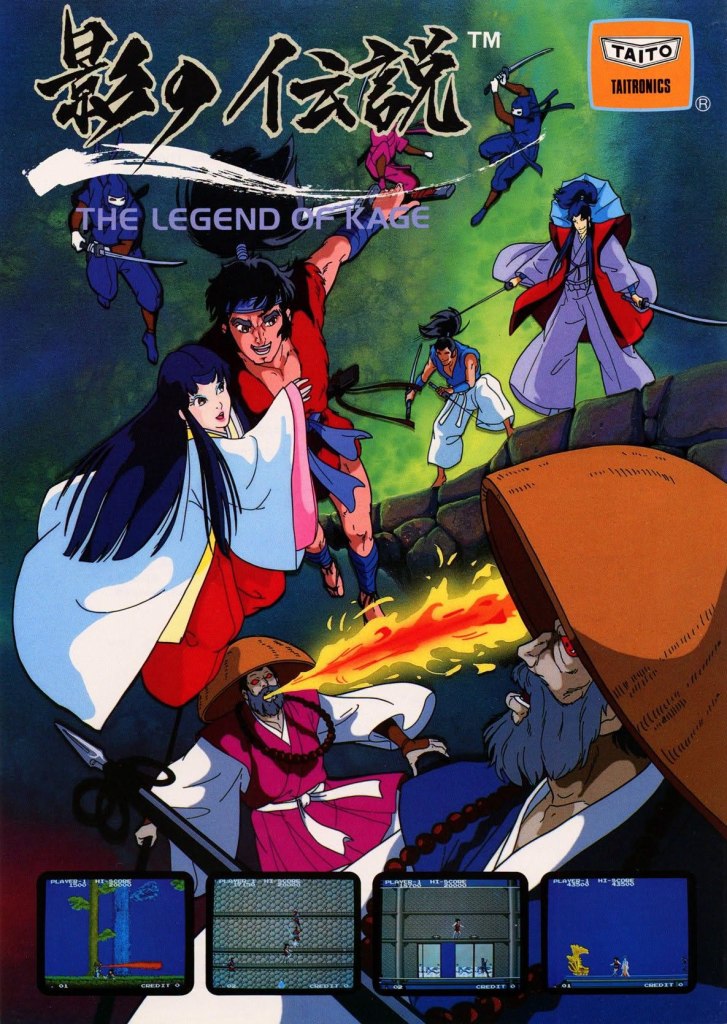
2. The Legend of Kage Japanese Arcade Flyer
Action and excitement in ancient Japan!
In my life, I never had the opportunity to play the original arcade version of The Legend of Kage and ended up playing only the Nintendo Family Computer (Famicom) port. Behind the scenes, Taito itself came close to preventing The Legend of Kage from being released in the arcades. The company placed it in a certain game show where it received praise by many which prompted Taito to give it a full arcade release. To promote the game, the Japanese arcade flyer had lively hand-drawn artwork that perfectly reflected what the game is about, who the playable hero is and what ancient Japanese setting was used. Fortunately for Taito, The Legend of Kage became a huge commercial hit and this led to the production of ports for different consoles and computers.
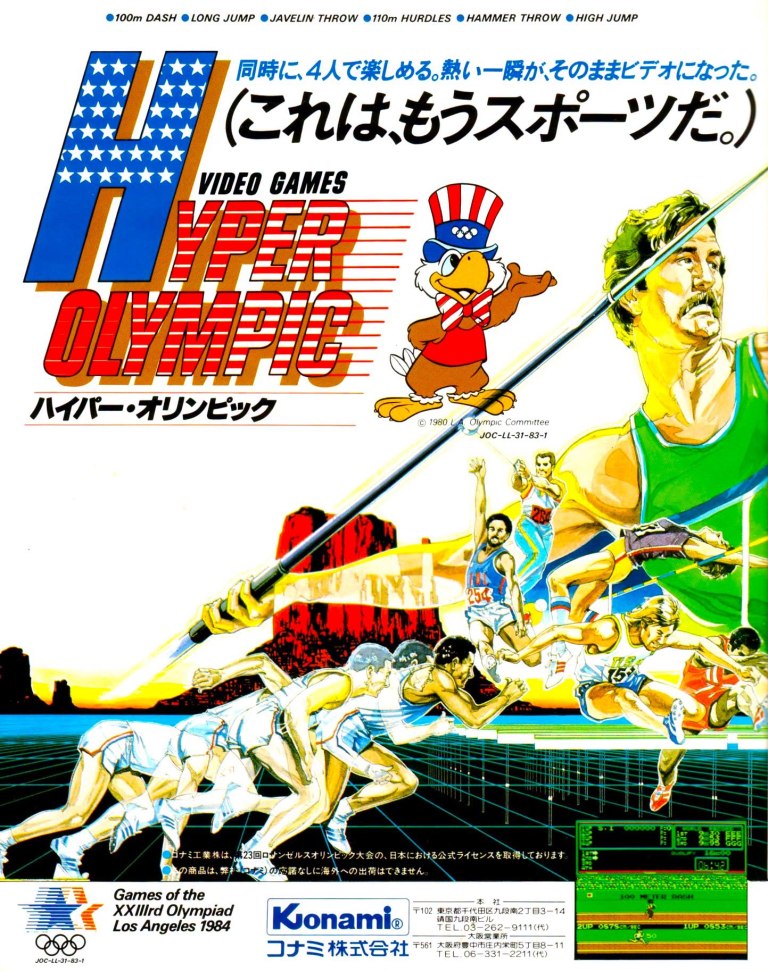
3. Hyper Olympic Japanese Arcade Flyer
Arguably the best track and field game ever made for the arcades.
In 1983, Konami released their summer Olympics-inspired arcade game Hyper Olympic (titled Track & Field in other parts of the world) which offered players the opportunities to compete in a series of events with emphasis on pressing the buttons as quickly as possible. The arcade flyer Konami came up with featured fine-looking hand-drawn artwork showing athletes competing in track and field events (with the types of events displayed at the top-most part of the flyer) while showing just one screenshot (lower right) and displaying the officially 1984 Los Angeles Olympics logo (lower left). In my view, this old arcade flyer does a good job promoting both the arcade game as well as the 1984 Olympics itself. Too bad nobody makes this kind of arcade flyer anymore.
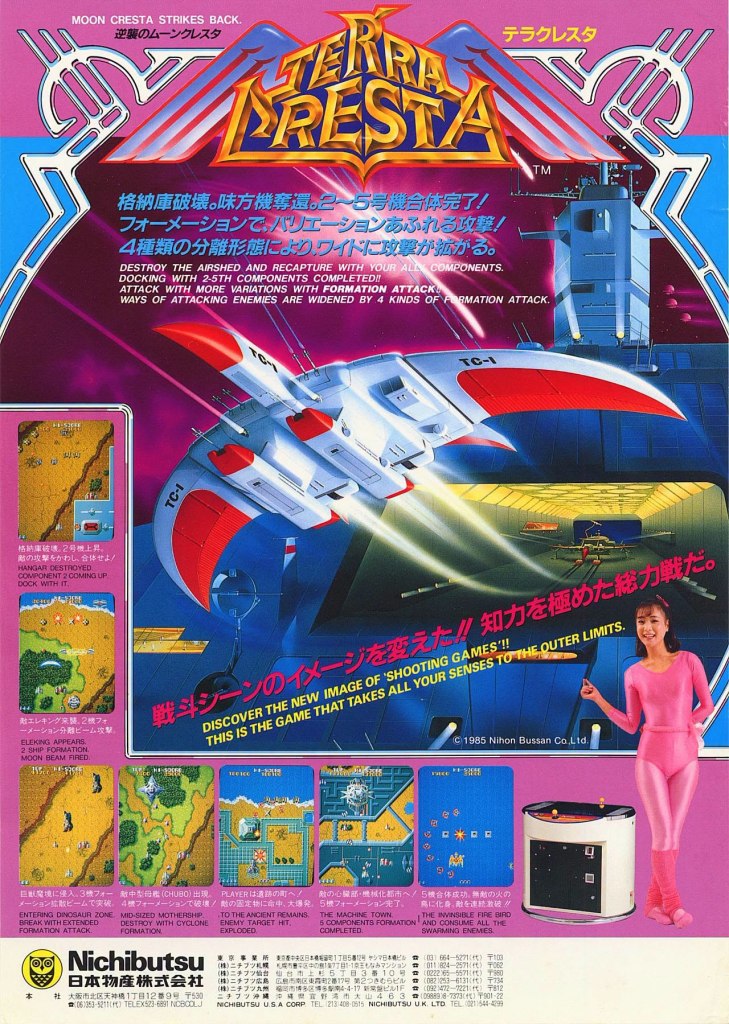
4. Terra Cresta Japanese Arcade Flyer
Did you ever play Terra Cresta in the arcades in Japan?
Nichibutsu, which produced a lot of arcade games that were released only in Japan, released Terra Cresta in Japanese arcades in 1985. It turns out Terra Cresta is a sequel to their 1980 game Moon Cresta which itself was their first big arcade hit game. Nichibutsu literally loaded the front of Terra Cresta’s arcade flyer with lots of visuals and details. As you can see, seven screenshots of the game were displayed (each with descriptive text), a fancy looking artwork that emphasized the science fiction setting, some English descriptive text, the cocktail table arcade machine and a pretty Japanese lady wearing an aerobics outfit with legwarmers (popular in the 1980s). This flyer truly has a strong 1980s flavor.
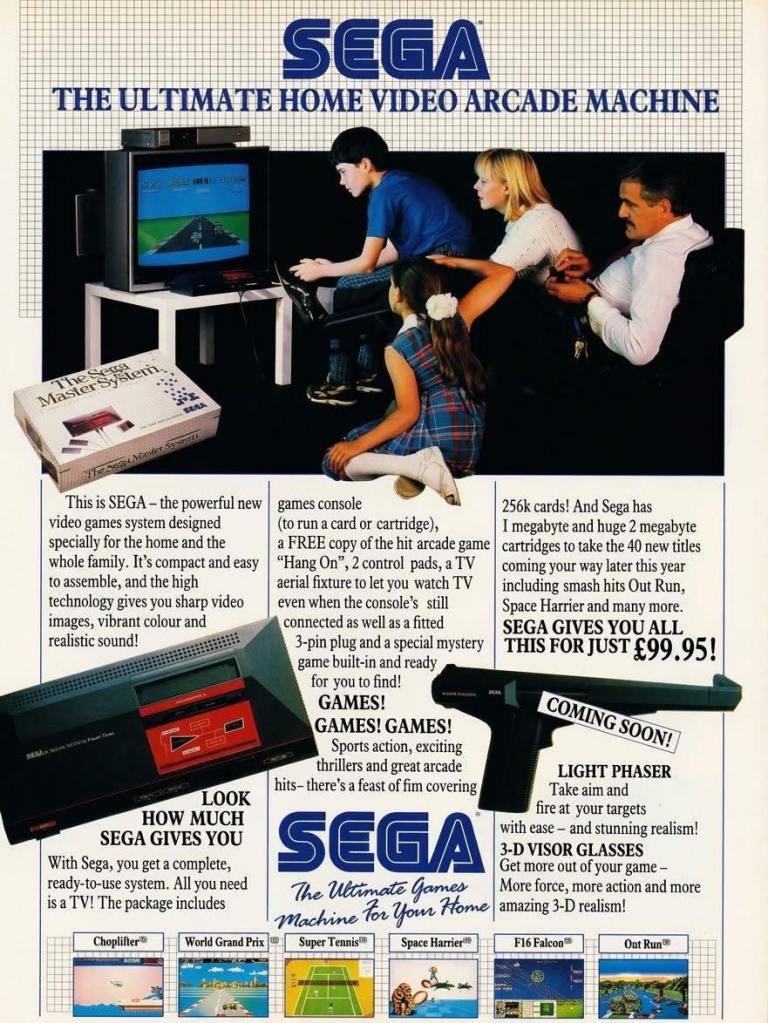
5. Sega Master System European Print Ad
From the early days of Sega’s console business.
After many years doing arcade games, Sega made the bold decision to start competing in console gaming with the release of the SG-1000 in 1983 in Japan. Even though Nintendo was a very tough competitor with the best-selling Famicom, Sega did not give up and proceeded to launch their console in America and Europe referred to as the Master System. In a serious attempt to gain customers specifically in England, Sega made a print ad showcasing a family sitting in front of a TV set with the young boy playing a racing game on a Master System. Looking at how the descriptive text was presented, it was clear that Sega emphasized bringing the arcade game experience into the comfort of home while also promising that a lot more new games will be released in the near future. This is an eye-catching ad and also a fine example of aggressive marketing by Sega.
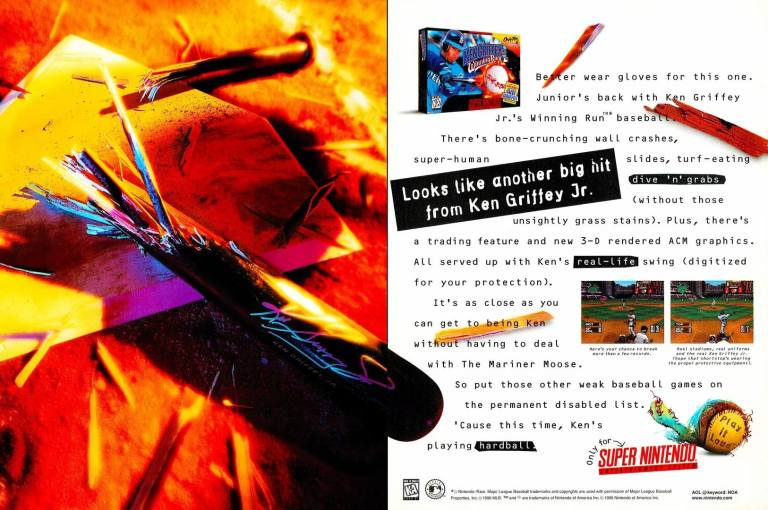
6. Ken Griffey Jr.’s Winning Run North American Print Ad
What was the best baseball video game you ever played?
Following the commercial success of the 1994 Super Nintendo Entertainment System (SNES) game Ken Griffey Jr. Presents Major League Baseball, Nintendo got Ken Griffey Jr. again as endorser and proceeded with the follow-up Ken Griffey Jr.’s Winning Run. With the highly talented Rare (Donkey Kong Country) chosen as game developer, Nintendo was highly confident with the baseball sequel and the 2-page print ad reflected that. The Ken Griffey Jr.’s Winning Run ad had a striking image of a broken baseball bat on one side while the game’s details, two screenshots and the creative description dominated the other side. While I am not so interested in baseball, I can say that this old print ad is indeed attention-grabbing.
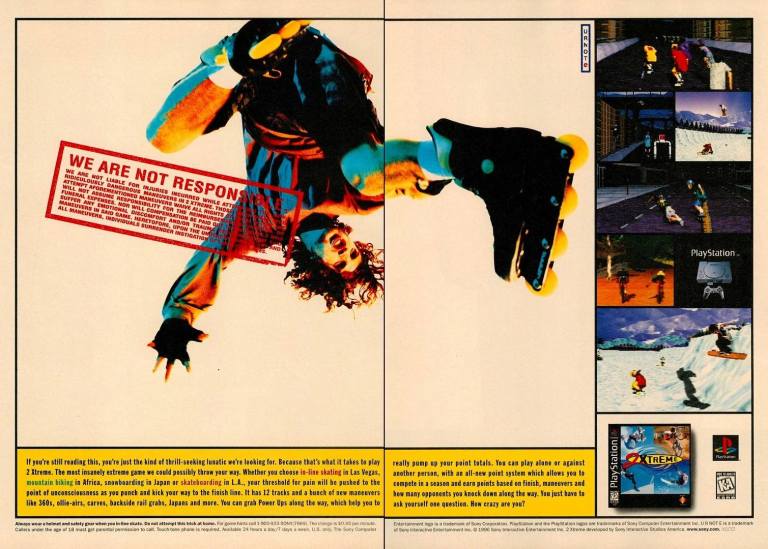
7. 2Xtreme North American Print Ad
From the time when the X Games were wildly popular.
Remember how popular the X Games (Extreme Games) were back in the 1990s? Early in the life of the PlayStation console, Sony released ESPN Extreme Games which sold over a million copies worldwide. As expected, a follow-up titled 2Xtreme was approved for a 1996 release. Sony came up with a 2-page ad that had an upside-down X Games participant with roller blades dominating most of the space and six screenshots were displayed. The descriptive text in the lower part of the ad was deliberately written to be hip and cool.
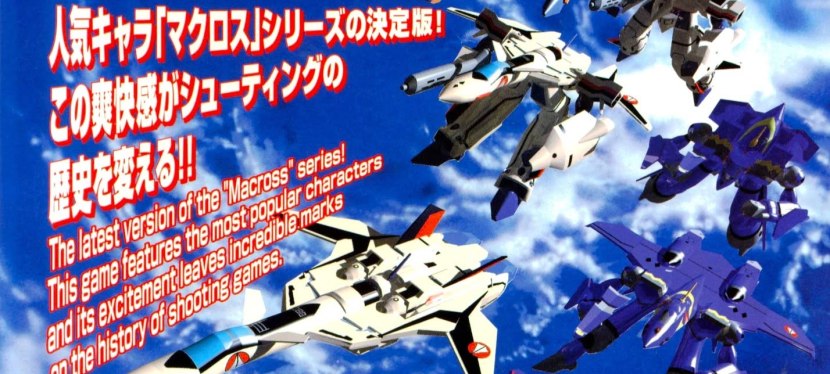
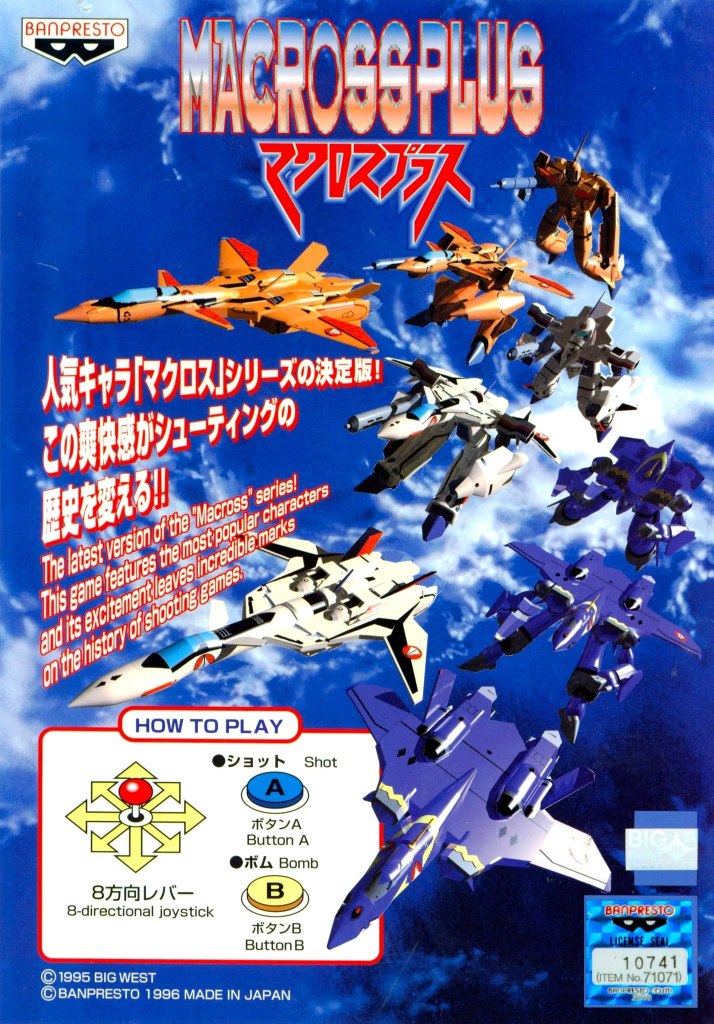
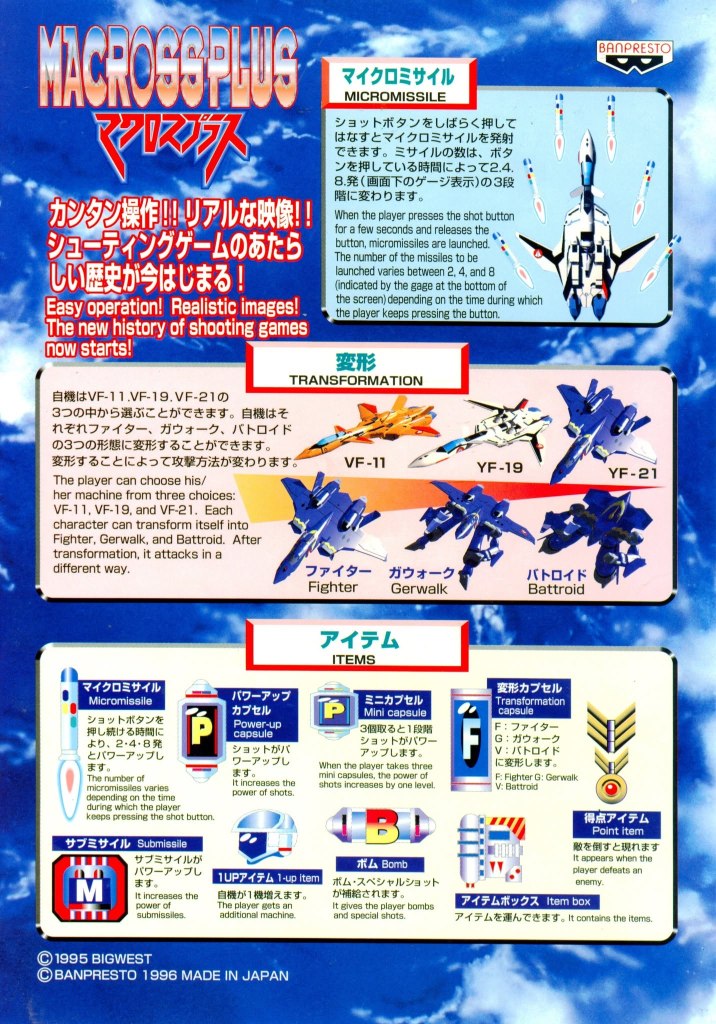
8. Macross Plus Japanese Arcade Flyer
The front.
The rear.
Based on the mid-1990s anime OAV, the Macross Plus video game from Banpresto was designed as a vertical-scrolling 2D shooter that captures the feel and intensity of the anime’s spectacle. The front of the Japan-only arcade flyer showcased the YF-19 Excalibur, the YF-21 Sturmvogel and the VF-11 Thunderbolt (plus the basic arcade controls on the lower-left) which were all rendered in 3D polygons to delight Macross fans and gamers who are interested in new 2D shooting experiences. The rear of the flyer showed additional details and it even includes English text descriptions. Strangely, no screenshots of the game were displayed. Being a long-time Macross fan, I can say this old arcade flyer is still engaging to look at.
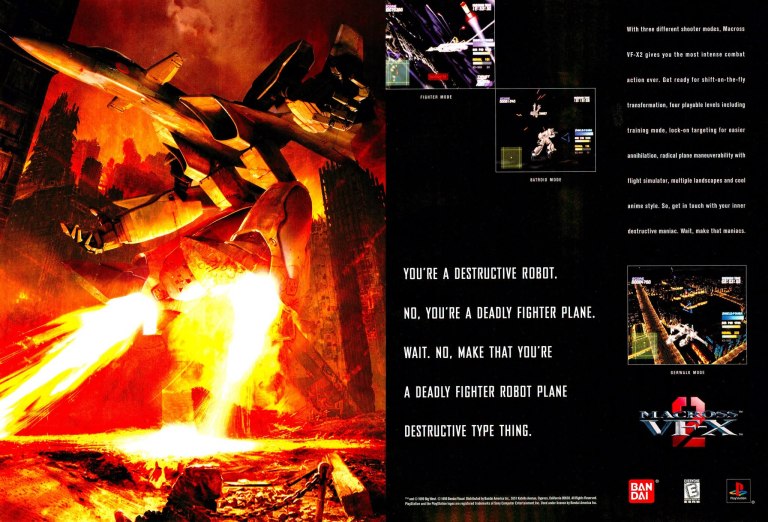
9. Macross VF-X2 North American Print Ad
An impressive looking print ad for a Macross video game that never got released in North America.
In the late 1990s, Bandai prepared to launch Macross VF-X2 (the sequel to 1997’s Macross Digital Mission VF-X) on the PlayStation console in North America. This was a very intriguing move because Bandai never brought the mentioned 1997 Macross game outside of Japan. Shortly after the official announcement of a North American release, Macross VF-X2 got featured in video game magazines, an English demo of the game (first mission only) was distributed through Official U.S. PlayStation Magazine, and Bandai came up with the 2-page print ad you see here. Unfortunately, Macross VF-X2’s North American release got cancelled because of copyright issues and legal obstacles (note: Harmony Gold held the Western rights to Robotech and actively blocked the release of genuine Macross products in America). As such, this impressive looking Macross VF-X2 print ad for North America ended up as a promotion for nothing!
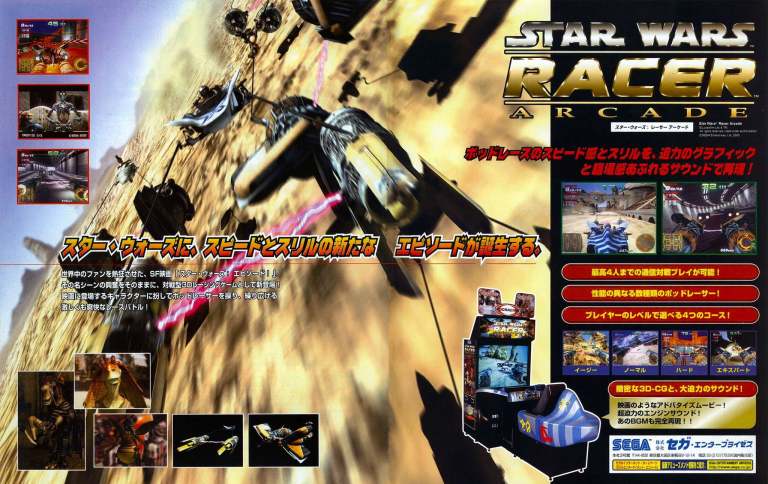
10. Star Wars: Racer Arcade Japanese Print Ad/Poster
This is one of the many video games based on Star Wars: The Phantom Menace.
In 1999, Star Wars Episode I: The Phantom Menace was a massive box office hit in theaters around the world and it marked a new era of Star Wars movies with digital effects available. Similar with 1993’s Jurassic Park, George Lucas’ movie also had a huge lineup of merchandise, action figures and video games. The pod racing from the movie became the basis for Star Wars: Racer Arcade which was released in Japan on June 2000, and then in America a month later. To help arcade operators attract gamers and Star Wars fans, a print ad and poster were released featuring a very dynamic image of pod racing from the game dominating the background, a few screenshots displayed and some computer-generated of characters and vehicles. At the lower right part of the ad/poster is the image of the arcade machine which has a huge screen, a seat and control panel. The descriptive Japanese text was written to excite both fans and gamers. Did you play this Sega-produced Star Wars game in the arcades?
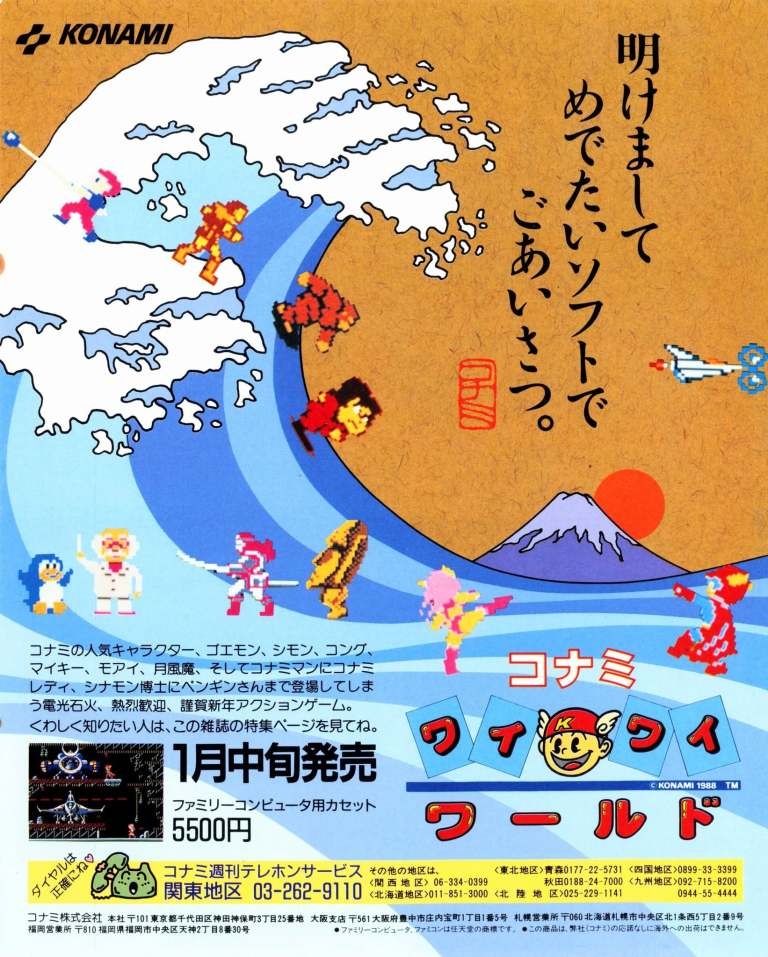
11. Konami Wai Wai World Japanese Print Ad
Can you spot Simon Belmont, Mikey Walsh and King Kong in this Japan-only print ad of Konami Wai Wai World?
Going back to the late-1980s, Konami released a 2D adventure game on the Famicom that was very ambitious as it featured side-scrolling treks, vertical-scrolling shooting sequences and, most notably, a cast of characters that emphasized crossovers between intellectual properties of gaming. I am talking about Konami Wai Wai World (sometimes called Konami World for short) which had characters, settings and elements of Konami’s own properties like Gradius, Castlevania and Twin Bee. Not only that, King Kong of King Kong 2: Ikari no Megaton Punch and Mikey Walsh of The Goonies were also featured which is astonishing because they represent entertainment intellectual properties that were licensed to Konami for video game adaptation. That said, the emphasis of crossovers and excitement was shown in the form of 2D character sprites in this Japanese print ad of Konami Wai Wai World. This is the kind of game that Konami itself will never be able to make again and to do a remake or an enhanced re-release of Konami Wai Wai World will require overcoming all the legal obstacles in the way.
The United States and Venezuela signed a major deal regarding oil and Venezuelan Acting President Delcy Rodriguez is thankful to President Donald J. Trump and State Secretary Marco Rubio for it, according to a news report by Newsmax.
To put things in perspective, posted below is an excerpt of Newsmax’s report. Some parts in boldface…
Venezuelan acting President Delcy Rodriguez thanked President Donald Trump and Secretary of State Marco Rubio for the oil agreement between the two countries.
The deal drew rave reviews from conservatives and criticism from Democrats.
“That is why we chose the path of diplomacy with the United States of America, to transform our differences into cooperation. And that cooperation into investment, production, well-being, and concrete results for Venezuelans,” Rodriguez said in a televised address Saturday.
“I thank President Donald Trump, Secretary Rubio, and his government for the efforts made by both their administration and ours, as well as the entire Venezuelan team that dedicated their time to reaching this agreement,” she said.
Rodriguez said the pact would run 25 years and target production of more than 1.5 million barrels a day.
She said Venezuela would receive about $19 a barrel, which could generate more than $209 billion for the state.
“It’s no use having our oil reserves underground just so they appear in a statistic or an accounting record and we can say we’re the country with the world’s largest reserves when we can’t convert them into development for Venezuela,” she said.
“Our reserves must be transformed into well-being, prosperity, and happiness for this country and enable us to restore our productive capacity so that we can establish ourselves as an energy and manufacturing powerhouse.“
Rodriguez added that the change would strengthen energy security in the Western Hemisphere and promote greater stability and balance in global energy markets.
Trump announced the agreement Friday, calling it “THE BIGGEST OIL DEAL IN WORLD HISTORY!”
It covers 65 billion barrels of proven reserves across 17 fields, with the U.S. receiving 55% of output, including an ownership stake.
The White House has described 100-year development rights, a term Rodriguez did not repeat.
Let me end this piece by asking you readers: What is your reaction to this development? Do you think the US-Venezuela oil deal will be beneficial for both nations? Do you think the deal will help America economically in the long run? What is your view of Venezuela since the dictator Nicolas Maduro was removed by America?
Disclaimer: This is my original work with details sourced from reading the comic book and doing personal research. Anyone who wants to use this article, in part or in whole, needs to secure first my permission and agree to cite me as the source and author. Let it be known that any unauthorized use of this article will constrain the author to pursue the remedies under R.A. No. 8293, the Revised Penal Code, and/or all applicable legal actions under the laws of the Philippines.
Welcome back, superhero enthusiasts, 1990s culture enthusiasts, X-Men fans and comic book collectors! Today we revisit the Marvel Comics shared universe to examine one of the many tales of the X-Men 2099 monthly series.
Looking back at the X-Men 2099 series of the 1990s, so much has developed during the first eleven issues released from 1993 to 1994. When I first read issue #1 in 1993, I found the futuristic X-Men really intriguing to follow and there was the expectation that the team led by Xi’an would somehow grow and make breakthroughs happen in 2099’s America. Surprisingly, members of the team got separated from each other – such as losing Metalhead to the Freakshow – and Xi’an himself changed for the worse and eventually left the team. Tim Fitzgerald/Skullfire (the weak and unsure newcomer who joined the futuristic X-Men) himself changed radically becoming unhinged and he has gotten really close with Luna (the one who messed with his mind and triggered his emotions).
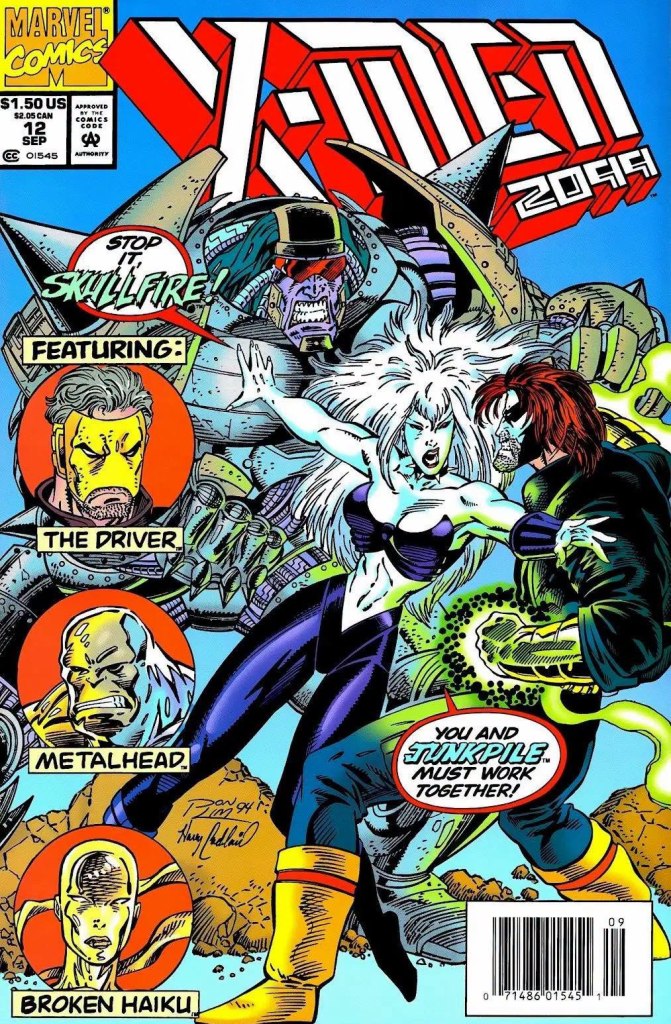
With those details laid down, here is a look back at X-Men 2099 #12, published by Marvel Comics in 1994 with a story written by John Francis Moore and drawn by Ron Lim.
The cover.
Early story
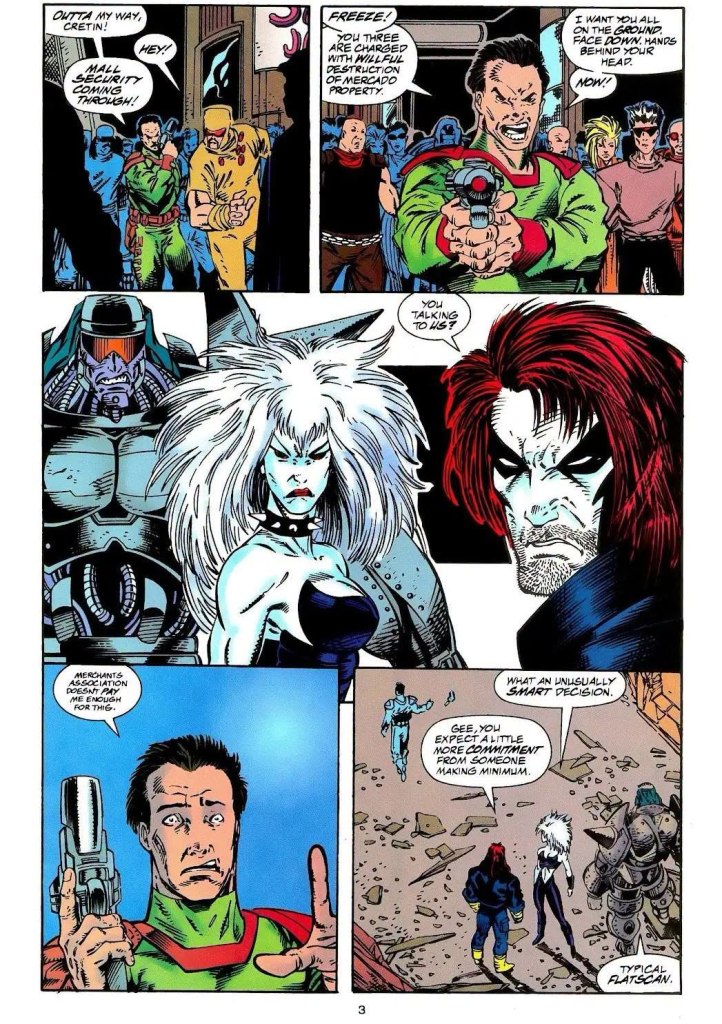
The story begins in the black market mall with Luna struggling to separate Skullfire and Junkpile from each other. Skullfire hates Junkpile whom he holds responsible for killing his friend Serpentina (the one X-Men member who welcomed him at their sanctuary). Junkpile blames Skullfire and his teammates for causing him some serious grief in Las Vegas. Luna tells them both to shut up or she would do something on both of them.
Moments later, the three of them are accused by the mall security for violating the market regulations. An armed mall security officer points his weapon at them accusing them of willful destruction of market property. The looks of Junkpile, Luna and Skullfire, however, scared him and convinced him to move away. Luna then reveals to Skullfire that she encountered Junkpile outside of Las Vegas shortly after the violent encounter with the X-Men. The three of them proceeded to a café to have a civil talk. Skullfire asks Luna about the Theater of Pain…
Quality
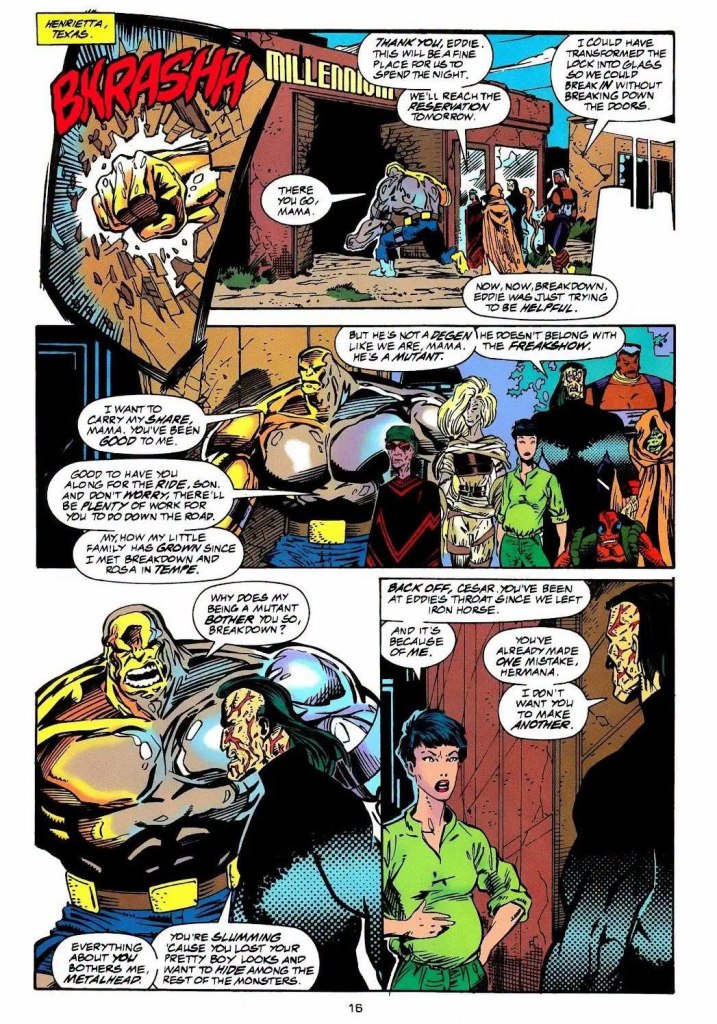
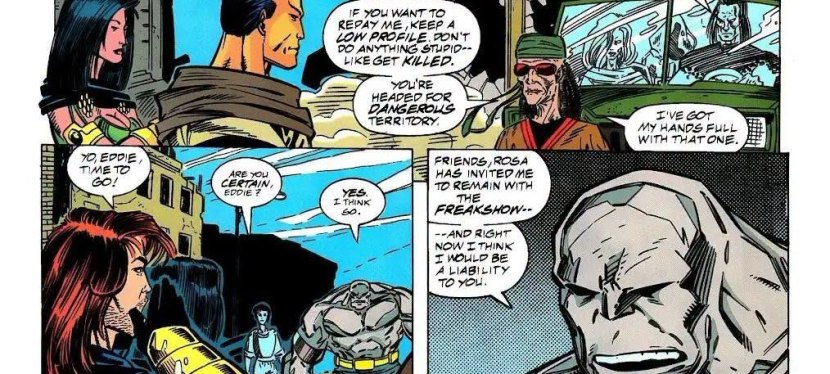
Former X-Men member Metalhead with the group of degenerates called the Freakshow. One of their members clearly rejects him given his status as a mutant.
Wow! The Moore-Lim team loaded this comic book with immense details that established the true force of opposition that awaits the X-Men. The story reveals to readers the Theater of Pain, its demonic leader Brimstone Love and what the theater’s purpose truly is. Brimstone Love and the theater were first revealed at the very end of issue #3 and this comic book offers readers a close look at them complete with very intriguing details that turned out to be worth discovering. That said, it was clear that John Francis Moore designed the Theater of Pain to be not just a planned force of evil the X-Men must face but also an actual threat to many living in 2099’s America. The Theater of Pain has a very sinister agenda and its operations involves the accumulating human misery which is a frightening concept on its own.
While Luna’s history and connection with the Theater of Pain is emphasized, Xi’an’s search for the Driver makes a lot more sense here as the former X-Men leader (now sinister and spiritually lost) communicates again with someone from his past. That said, the plot really thickened a lot in this comic book and that alone makes it engaging to follow.
As this issue follows Skullfire, Luna, Junkpile and Xi’an – plus a quick look at former X-Men member Metalhead now spending time with the Freakshow – the tone of the tale turned dark and gritty which I think was intentionally done by the creators as the Theater of Pain was strongly emphasized. That said, this is indeed inspired work.
Conclusion
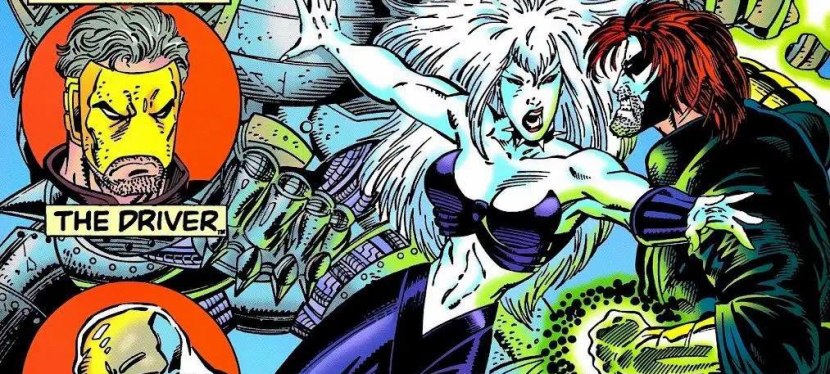
Skullfire, Junkpile and Luna look so intimidating and creepy, the mall security guy got scared and abandoned his duty.
With a dark tale and an established force of evil rising in the horizon, X-Men 2099 #12 (1994) can be described as an inspired turn of events for the monthly series as a whole. At this stage, the direction of the series really started to take shape. It is also a lively reminder that the mutants struggling in 2099 have the wilderness and its violent elements as the least of their worries. The Theater of Pain itself is a reminder about sinister yet unseen forces that are operating while lots of people remain unaware of them (note: think about the World Economic Forum and what its core organization really do behind closed doors as time passes). Lastly, the twisted developments of Skullfire and Xi’an’s respective personalities will keep you in suspense as to how the futuristic X-Men can survive without them.
The United States officially revoked the US visa of Taif Sami Mohammed Al Shakarchi, the Iraqi national who was awarded by the failed Biden Administration in 2022, according to US State Department citing her placement on the Terror Watchlist of the Federal Bureau of Investigation (FBI).
In a New York Post report, Taif Sami Mohammed Al Shakarchi’s alleged links to the Islamic terrorist regime of Iran and Iran-backed militias in Iraq drew headlines. She was also the target of two Republicans in the US House of Representatives accused of being the “key enabler of terrorist funding in Iraq.”
To put things in perspective, posted below is the entire statement of the US State Department. Some parts in boldface…
The U.S. Department of State has revoked the visa of an Iraqi national who was presented an award by the Biden Administration for her purported role in fighting corruption and her advocacy for “gender equity.”
Taif Sami Mohammed Al Shakarchi was given the International Woman of Courage Award in 2022by former Secretary of State (Antony Blinken) and former First Lady Jill Biden.
The award recognized “women from around the globe who have demonstrated exceptional courage, strength, and leadership in advocating for peace, justice, human rights, gender equity and equality, and the empowerment of women and girls, in all their diversity.”
This Iraqi national’s visa has now been revoked by the State Department following her placement on the Federal Bureau of Investigation’s Terror Watchlist. She is no longer present in the United States.
Under President Trump and Secretary of State Marco Rubio, suspected terrorists will never be allowed to remain in the United States.
Let me end this piece by asking you readers: What is your reaction to this development? Are you aware that Taif Sami Mohammed Al Shakarchi was Iraq’s Finance Minister from 2022 to 2026? Do you suspect Taif Sami Mohammed Al Shakarchi may have been involved in financing connected with Islamic terrorists? Should all her communications and interactions with the Islamic terrorist regime of Iran be investigated?
Disclaimer: This is my original work with details sourced from reading the comic book and doing personal research. Anyone who wants to use this article, in part or in whole, needs to secure first my permission and agree to cite me as the source and author. Let it be known that any unauthorized use of this article will constrain the author to pursue the remedies under R.A. No. 8293, the Revised Penal Code, and/or all applicable legal actions under the laws of the Philippines.
Welcome back, superhero enthusiasts, 1990s culture enthusiasts, X-Men fans and comic book collectors! Today we revisit the Marvel Comics shared universe to examine one of the many tales of the X-Men 2099 monthly series.
After the first seven issues of the series, it is clear that the futuristic mutants under Xi’an have tough challenges to not only survive in the dangerous and unpredictable wasteland of 2099’s America but also help their leader fulfill the ultimate goal of protecting mutants from the evil corporations in accordance to the dream of Professor X (Charles Xavier). Unlike the X-Men of the 20th century, the team of 2099 does not have vast resources nor do they have a permanent place for living and development. Xi’an himself is still struggling with the elements from his past as a violent criminal.
With those details laid down, here is a look back at X-Men 2099 #8, published by Marvel Comics in 1994 with a story written by John Francis Moore and drawn by Ron Lim.
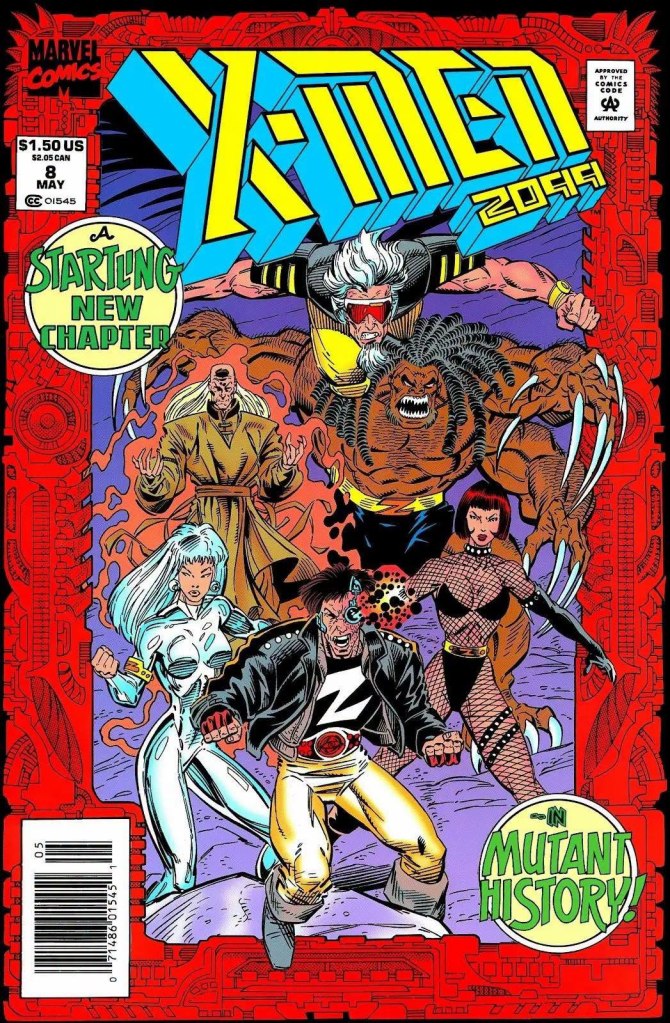
The cover.
Early story
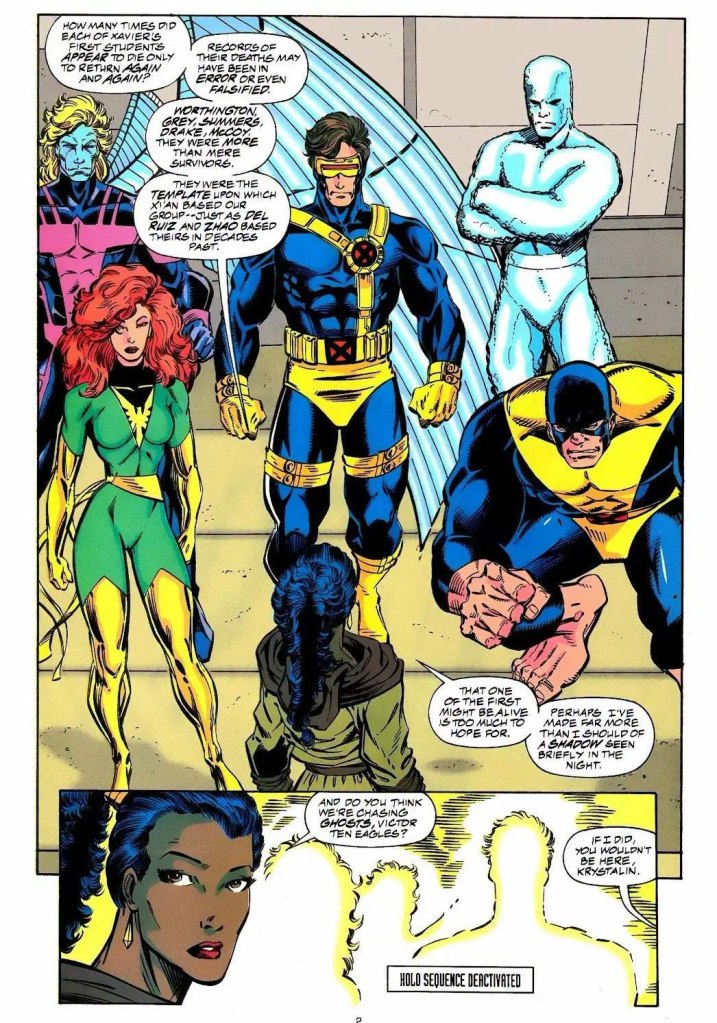
The story begins with Krystalin examining Archangel with amazement. Moments later, she sees Cyclops, Iceman, Beast and Jean Grey (in her Phoenix form). She wondered how many times did each of Professor X’s first students appear to die only to return again and again. She recalls that the records of their deaths may have been in error or even falsified. She also remembers the succeeding X-Men teams of Del Ruiz and Zhao.
It turns out the original X-Men members she saw were holograms as Victor Ten Eagles (who was a fellow outlaw with Xi’an in the old days) reveals that he opened his studio to few people and never to strangers. He allowed Krystalin in because he owes Xi’an a blood debt from their time together with the Lawless. As they talk, he explains to her his personal interest in the X-Men and the legacy.
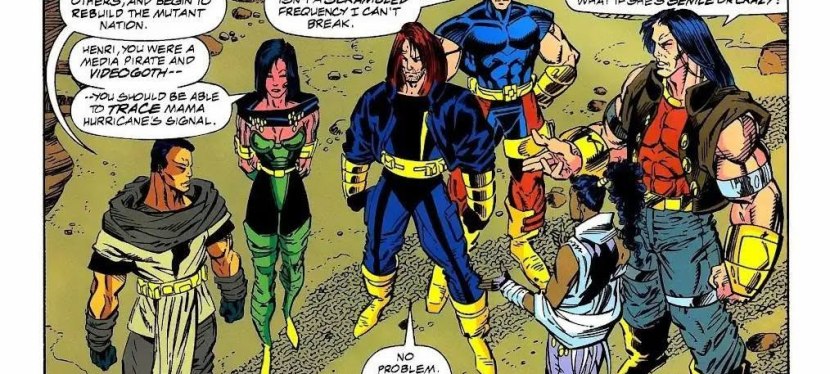
Over at Iron Horse in Arizona, Hurricane talks with two trackers who were tied up. Meanstreak uses his super speed to dismantle the trackers’ suits of armor and examine the technologies within. He finds one Tetsuo Mark 6 signal beacon that was used to monitor armor in the field. He tells Hurricane she can use it as an advance warning the next time trackers are sent after her.
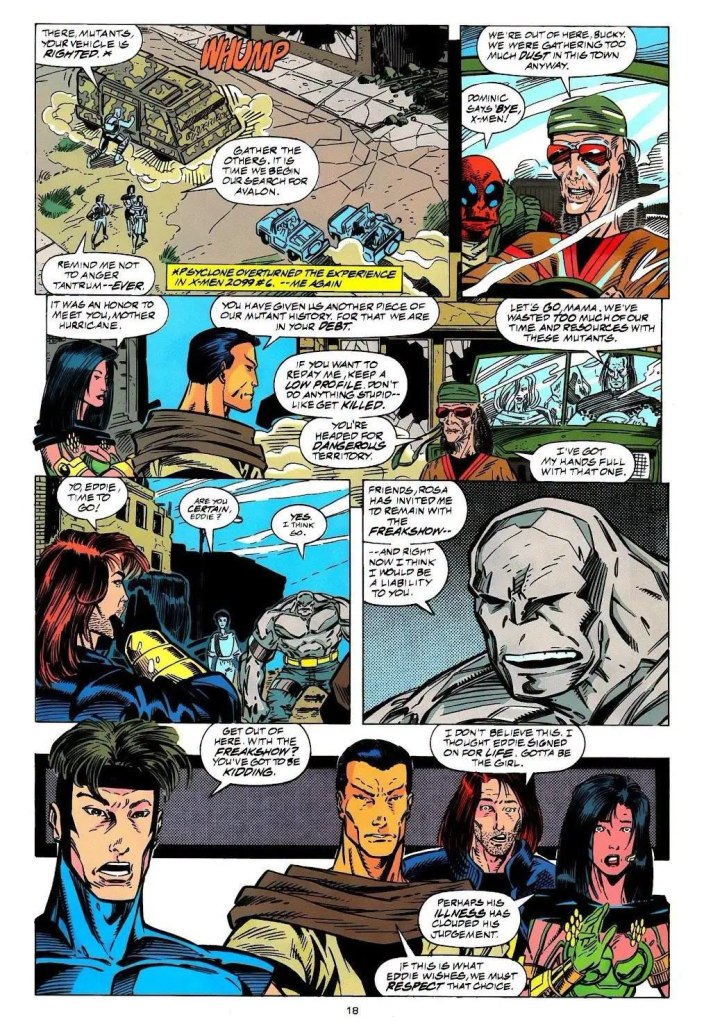
Hurricane tells the X-Men that she and the Freakshow never stay too long in one place. Moments later, the infected Metalhead tells Skullfire that he is trapped in his current metal form and could not change back…
Quality
As the Freakshow is about to leave, Metalhead surprises his fellow X-Men.
To make things clear, this X-Men 2099 comic book is very engaging to read as it is filled with a lot of details that further expanded the lore of the 2099 universe concerning mutants and legacy of the X-Men in the 21st century. As such, I really enjoyed learning about the “future history” of the X-Men, how mutants struggled to survive in a corporation-controlled America, and why the wasteland became the 21st century’s very own Old West where danger and uncertainty are constant.
If have an obsession about the 2099 universe, there is a lot to discover and enjoy here. Xi’an’s pursuit for knowledge about the mutant underground and Hurricane’s involvement is compelling to read and what was revealed is worth discovering. Meanwhile, Krystalin and Ten Eagles’ exploration of facilities as they search for answers reminds me a lot about a notable part of the story in Beneath the Planet of the Apes.
Conclusion
The closest thing to a crossover with the original X-Men.
X-Men 2099 #8 (1994) is a compelling read and it is one of the stronger references about the 2099 universe and the legacy of the X-Men from the time of Xavier to that of Zhao. The details revealed here are fine pay-offs to what was built up in the previous issues, and they connect well with the existence of Xi’an’s X-Men. This comic book will really help you understand the place of mutants in the 21st century and in my experience, the learning is enjoyable.
Overall, X-Men 2099 #8 (1994) is highly recommended.
Over a thousand rebels of the New People’s Army (NPA) and their supporters were neutralized as of August 13, according to a news article of the Philippine News Agency (PNA) citing the Armed Forces of the Philippines (AFP). Neutralized refers to the surrender, capture, or killing of enemy troops.
To put things in perspective, posted below is an excerpt from the news article of the PNA. Some parts in boldface…
The government’s campaign against communist insurgents is gaining momentum as the Armed Forces of the Philippines (AFP) reported neutralizing 1,045 New People’s Army (NPA) rebels and their supporters during operations conducted from Jan. 1 to Aug. 13 this year.
Of the total, 935 surrendered, 38 were arrested, and 72 were killed in various military operations, AFP spokesperson Col. Francel Margareth Padilla said in a media interview late Tuesday.
“A total of 661 firearms and 255 anti-personnel mines were either seized or surrendered, and 38 encampments were seized (in the same period),” she said.
Neutralized is a military term that refers to the surrender, capture, or killing of enemy troops.
“The numbers give us an indication of the operational situation, but we should look beyond the numbers. The more significant story is that 935 CTG (communist terrorist group) members and supporters chose to surrender,” Padilla pointed out.
In 2025, the military said it neutralized around 2,018 NPA members and their supporters. The bulk of whom were surrenderers, at 1,798, while 93 were arrested and 127 were killed.
Let me end this post by asking you readers: What is your reaction to this recent development? Are you thankful to the AFP for neutralizing over a thousand Communist rebels and supporters as of mid-August? Are you convinced that there are still many millions of young Filipinos who took sides with the Leftist rebels? Do you think Democrats and/or the Democratic Socialists of America (DSA) from the United States are secretly supporting Communist rebels here in the Philippines?
Thank you for reading. If you find this article engaging, please click the like button below, share this article to others and also please consider making a donation to support my publishing. If you are looking for a copywriter to create content for your special project or business, check out my services and my portfolio. Feel free to contact me with a private message. Also please feel free to visit my Facebook page Author Carlo Carrasco and follow me on Twitter at @CarloCarrascoPH as well as on Tumblr at https://carlocarrasco.tumblr.com/and on Instagram athttps://www.instagram.com/authorcarlocarrasco
Disclaimer: This is my original work with details sourced from reading the comic book and doing personal research. Anyone who wants to use this article, in part or in whole, needs to secure first my permission and agree to cite me as the source and author. Let it be known that any unauthorized use of this article will constrain the author to pursue the remedies under R.A. No. 8293, the Revised Penal Code, and/or all applicable legal actions under the laws of the Philippines.
Welcome back, superhero enthusiasts, 1990s culture enthusiasts, X-Men fans and comic book collectors! Today we revisit the Marvel Comics shared universe to examine one of the many tales of the X-Men 2099 monthly series.
In late-1993, Marvel Comics published the Fall of the Hammer crossover storyline highlighting the major figures of Marvel 2099 and the X-Men members involved were only Skullfire, Krystalin, Bloodhawk and Meanstreak. As told in Ravage 2099 #15, the said X-Men members made it to Valhalla with Ravage. After the events of Fall of the Hammer, the four X-Men members survived and eventually started traveling all the way back West in America to rejoin the rest of the team.
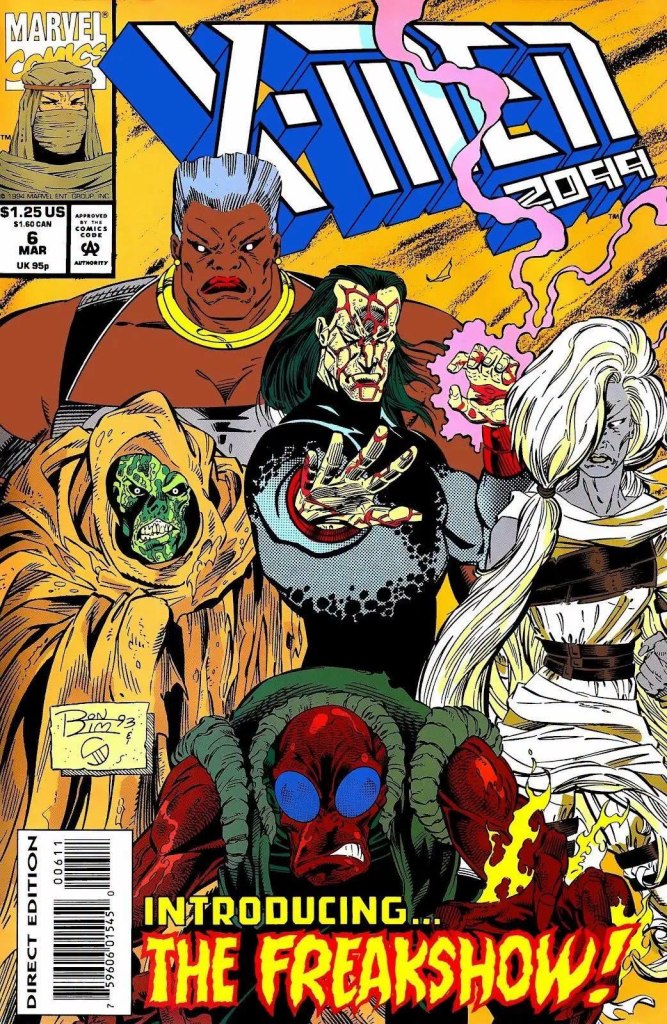
With those details laid down, here is a look back at X-Men 2099 #6, published by Marvel Comics in 1994 with a story written by John Francis Moore and drawn by Ron Lim.
The cover.
Early story
The story begins in Arizona when two fully armed personnel wearing suits of armor search for a monster-like mutant who tries to hide. The mutant is named Dominic and he eventually got corned by the two armored figures. As he is about to get shot, one of the armored guys got pushed by force somehow. The next moment, a gang of mutants called the Freakshow appears.
In the southern part of Nevada, Skullfire, Bloodhawk, Krystalin and Meanstreak travel in an aircraft going back to Xi’an and the rest of their teammates. As Bloodhawk jumps of after saying goodbye, Skullfire jumps off as well in a suicidal manner. He eventually grabs Bloodhawk by the ankle. Back at the aircraft, Krystalin and Meanstreak shared their respective observations about Skullfire’s sudden change of personality since the psychic vampire Luna messed with him…
Quality
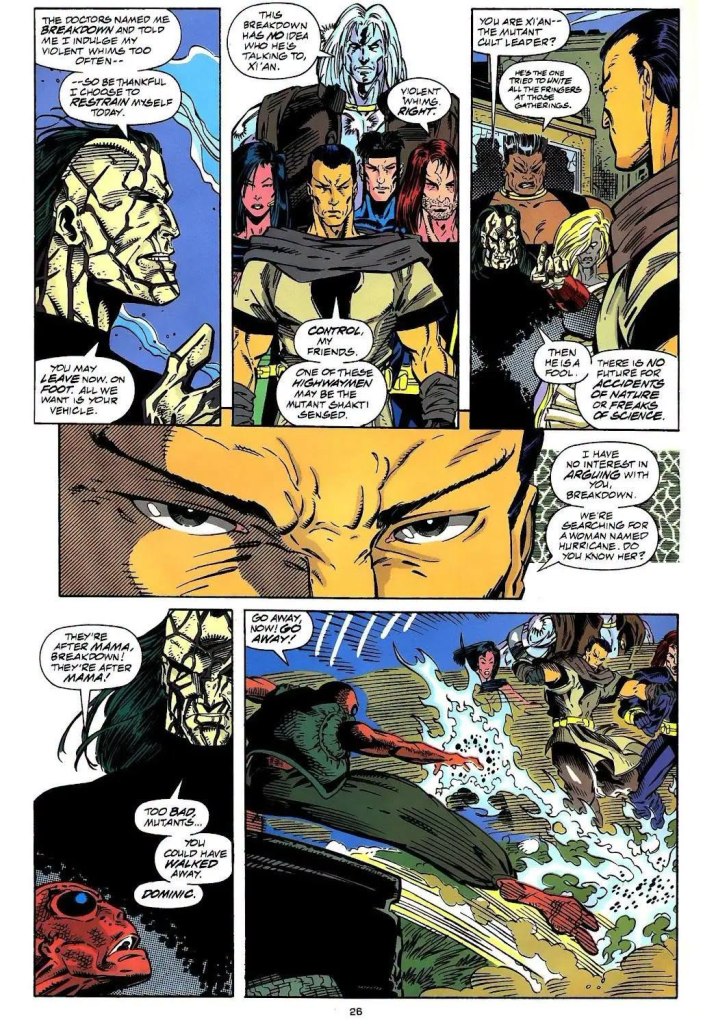
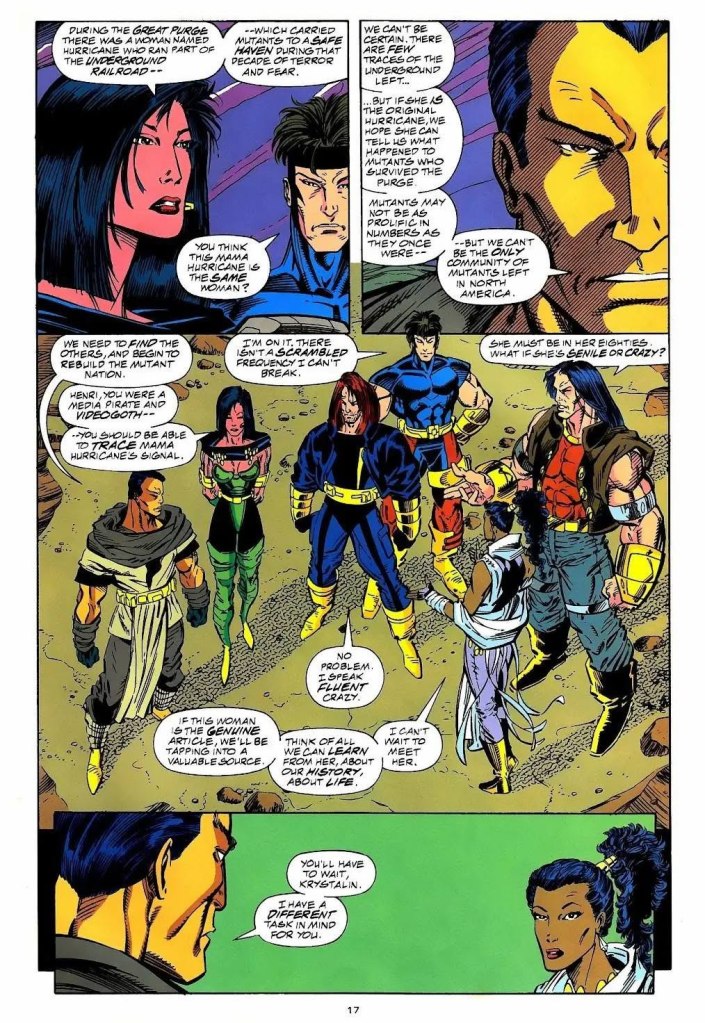
As the X-Men search for Hurricane, the Freakshow stands in their way.
The script of this comic book was finely crafted by John Francis Moore and it is amazing how efficient he got the X-Men team back (after Skullfire, Krystalin, Meanstreak returned) on track while ensuring a good amount of depth as reflected in the dynamics between the team members as the story went on. The storytelling felt natural and really believable.
Along the way, this comic book shed light on team leader Xi’an and the threads of the past that came back to haunt to him. This instantly added a new layer of development on Xi’an which established an element of uncertainty on the future of the X-Men under him (and his personal struggles). That said, Xi’an does not have the rock-solid stability of Professor X (Charles Xavier) which will remind readers how different the X-Men of 2099 are from the classic X-Men.
The X-Men are on the search for a mutant called Hurricane who has been active on resisting the corporations’ control on the nation and has long emphasized liberty and self-control on personal living. Historically, Hurricane led a part of the Underground Railroad which carried mutants to safe haven during a time of terror and fear. That said, X-Men’s search has a heavy purpose and the challenges they faced here is gripping and intriguing to follow. I should also state that Ron Lim’s delivery of dynamic action is really good to look at.
Conclusion
I really enjoyed the dynamics of the interactions between the members of the X-Men in this comic book. There is richness in John Francis Moore’s script here.
X-Men 2099 #6 (1994) is both a solid follow-up to the events of the Fall of the Hammer storyline and also a fine portrayal of how the team works under Xi’an’s leadership. More notably, it pushed the narrative of the series forward and gave us readers an in-depth exploration of the isolated places of America’s southwestern region in 2099 which is a sharp contrast to that era’s New York City dominated by Alchemax. More notably, this comic book implemented renewed focus on the state of mutants who have been living in fear, danger and uncertainty in America of 2099 which connects directly with the purpose of the X-Men as a team.
The Bases Conversion and Development Authority (BCDA) recently announced that it will ensure the Philippines will benefit a lot from the ambitious Pax Silica project as they negotiate with the United States on the final framework, according to a GMA News report.
To put things in perspective, posted below is an excerpt from the report of GMA News. Some parts in boldface…
The Bases Conversion and Development Authority (BCDA) on Wednesday said it will ensure that the Philippine side, negotiating with the US on the final framework agreement to hit the ground running for the Pax Silica project in New Clark City, Tarlac, will push for a deal that would be most beneficial for the country.
At the Kapihan sa Manila Hotel, BCDA President and CEO Joshua “Jake” Bingcang said that the government is eyeing to sign the comprehensive framework agreement for the Pax Silica initiative with the US by November.
However, Bingcang admitted that “negotiations can always take longer,” noting that the target signing “is not cast in stone as long as the two [parties] will come up with mutually agreed arrangement.”
Nevertheless, the BCDA chief said the Philippines is pushing for terms that would “most beneficial sa’tin (to us)” as negotiations for the framework deal are ongoing.
“It’s a business contract, normally it is favorable to the host country,” he said.
Bingcang said the government has also made clear that the project will operate under the BCDA’s governing legal framework and applicable investment laws.
“It would be covered by two Philippine laws —the BCDA law and CREATE MORE so the incentives provided will be covered by these two laws,” he said.
“Never in that initial arrangement that we are going to adopt anything other than the two laws,” he added.
Pax Silica is the US Department of State’s flagship initiative on artificial intelligence and supply chain security, aimed at advancing a new economic security framework among allies and trusted partners.
The Philippines in April officially joined the Pax Silica initiative, cementing its place among other 23 global signatories, including the European Union, Japan, India, Singapore, South Korea, and the United Kingdom.
As part of the initiative, Manila and Washington are working to establish a 4,000-acre industrial hub that is envisioned as a new model for AI-focused investment within the Luzon Economic Corridor.
The BCDA chief earlier clarified that the Pax Silica hub is not envisioned as a cluster of hyperscale data centers but as an industrial hub that would include the manufacturing of semiconductors and microchips used in computers, laptops, electric vehicles, and other technologies.
Bingcang said that through Pax Silica, the Philippines and its partners see an opportunity to process raw materials domestically instead of exporting them in unprocessed form.
Let me end this post by asking you readers: What is your reaction to this recent development? Do you feel confident that the BCDA will be able to secure an agreement with the Americans to ensure the Philippines will benefit from Pax Silica economically? Do you realize Pax Silica’s potential to boost manufacturing jobs and the processing of raw of materials in the Philippines?
Thank you for reading. If you find this article engaging, please click the like button below, share this article to others and also please consider making a donation to support my publishing. If you are looking for a copywriter to create content for your special project or business, check out my services and my portfolio. Feel free to contact me with a private message. Also please feel free to visit my Facebook page Author Carlo Carrasco and follow me on Twitter at @CarloCarrascoPH as well as on Tumblr at https://carlocarrasco.tumblr.com/and on Instagram athttps://www.instagram.com/authorcarlocarrasco