A Look Back at X-Men Adventures #4 (1993)

Disclaimer: This is my original work with details sourced from reading the comic book and doing personal research. Anyone who wants to use this article, in part or in whole, needs to secure first my permission and agree to cite me as the source and author. Let it be known that any unauthorized use of this article will constrain the author to pursue the remedies under R.A. No. 8293, the Revised Penal Code, and/or all applicable legal actions under the laws of the Philippines.

Welcome back, superheo enthusiasts, 1990s culture enthusiasts, X-Men fans and comic book collectors! Today we revisit the X-Men Adventures monthly series which was the literary adaptation of the popular X-Men animated series of the 1990s.  

In my previous retro review, the X-Men encountered Magneto for the first time and things turned out for the worse for Charles Xavier’s team.

With those details laid down, here is a look back at X-Men Adventures #4, published by Marvel Comics in 1993 with a story written by Ralph Macchio and drawn by Andrew Wildman.
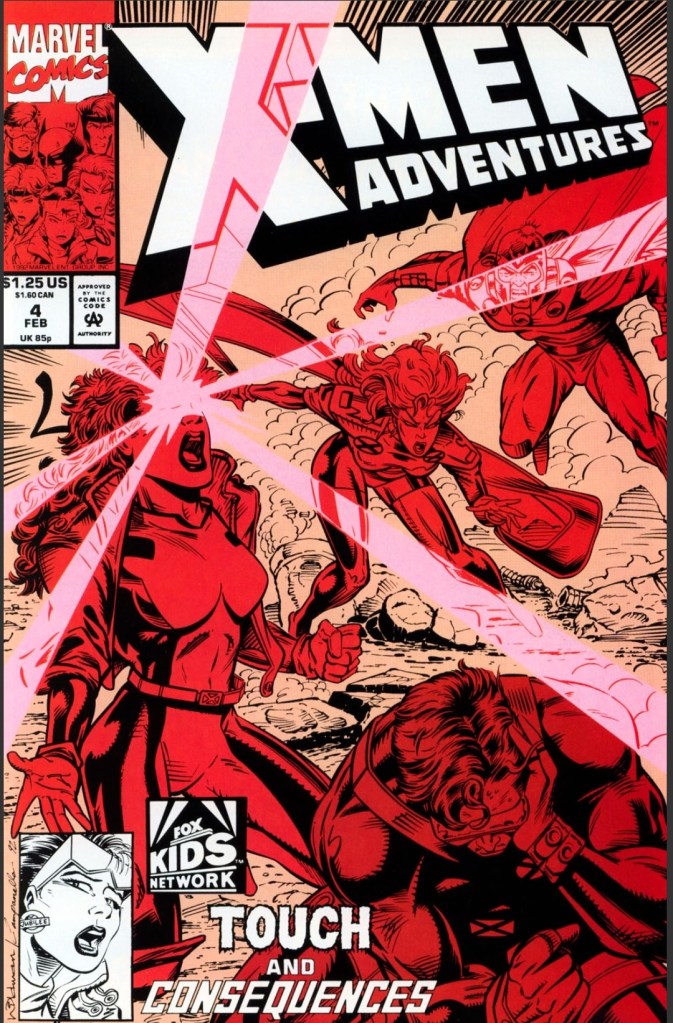
The cover.

Early story

The story begins in a ruined place where Magneto floats in the air and below him are Cyclops, Storm and Rogue who are down and looked knocked out. It turns out Rogue is still conscious and as Magneto remains unaware of her state, she makes her moves to get Storm and Cyclops back up.

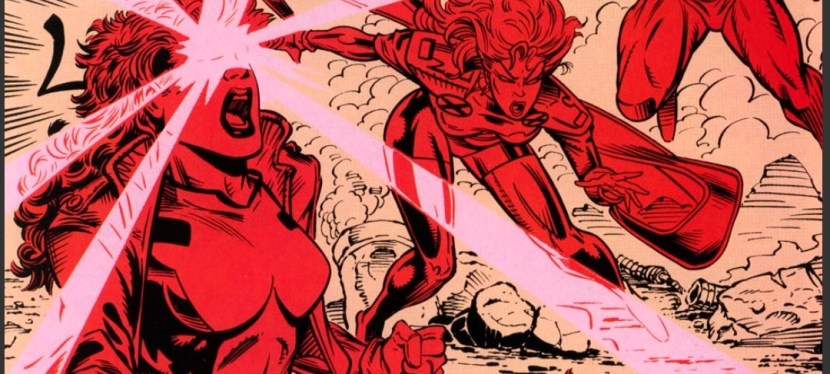
Knowing the risk of absorbing another mutant’s power by touching, Rogue executes CPR to revive Cyclops. Just moments after Cyclops gets revived, powerful beams of laser suddenly come out of Rogue’s eyes. As soon as the problem eased, Rogue then flies off towards Magneto in a mad attempt to tackle him…

Quality

The encounter between Wolverine and Sabretooth is a must-read!

To get straight to the point here, this comic book tells two succeeding events starting with the encounter between Magneto and the X-Men. In reflecting Magneto’s first appearance in the animated series, this adaptation emphasizes the first time the X-Men encountered the master of magnetism but with the contemporary character designs and visual aesthetics of the era. On face value, the encounter here looks inspired by the X-Men Blue Team’s encounter with Magneto in 1991’s X-Men #1 but in reality this one was designed in accordance to the animated series creators’ way of establishing the start of the X-Men-Magneto rivalry. There is a good amount of superhero spectacle as Storm, Rogue, Cyclops and Charles Xavier each take turns on bringing down Magneto in their own unique methods. Of course, these developments helped emphasize how powerful Magneto really is.

The other half of this comic book tale focuses more on the presence of Sabretooth as a captive of the X-Men at their headquarters, as well as the eventual rivalry between him and Wolverine. It is during the heat of Wolverine’s encounter with Sabretooth that the dialogue became very rich and engaging to read as elements of their past together got raised, and Sabretooth’s observations on how the X-Men handled things became philosophical. I also enjoyed how the philosophical writing continued within Charles Xavier’s dialogue as he attempts to nullify the rage between Wolverine and Sabretooth.

As with his past works, the art here drawn by Andrew Wildman is very good and he even pushed the limits of on-page superhero violence during two key moments of the physical struggle between Wolverine and Sabretooth (which resulted in altered colors to avoid graphic violence).  

Conclusion

The encounter between Magneto and the X-Men was pretty engaging to read.

X-Men Adventures #4 (1993) is a solid read from start to finish. By the time I reached the final page, the comic book clearly marked the beginning of the rivalry between the X-Men and Magneto (in accordance to what was set up in the animated series). This comic book emphasized the rivalry further with the clever use of dialogue and visuals (complete with the strategic use of panels on the final pages), so much so there was this genuine feel of the start of a new age.

Overall, X-Men Adventures #4 (1993) is highly recommended.

+++++

Thank you for reading. If you find this article engaging, please click the like button below and also please consider sharing this article to others. If you are looking for a copywriter to create content for your special project or business, check out my services and my portfolio. If you want to support my website, please consider making a donation. Feel free to contact me with a private message. Also please feel free to visit my Facebook page Author Carlo Carrasco and follow me on Twitter at  @HavenorFantasy as well as on Tumblr at https://carlocarrasco.tumblr.com/and on Instagram athttps://www.instagram.com/authorcarlocarrasco/.

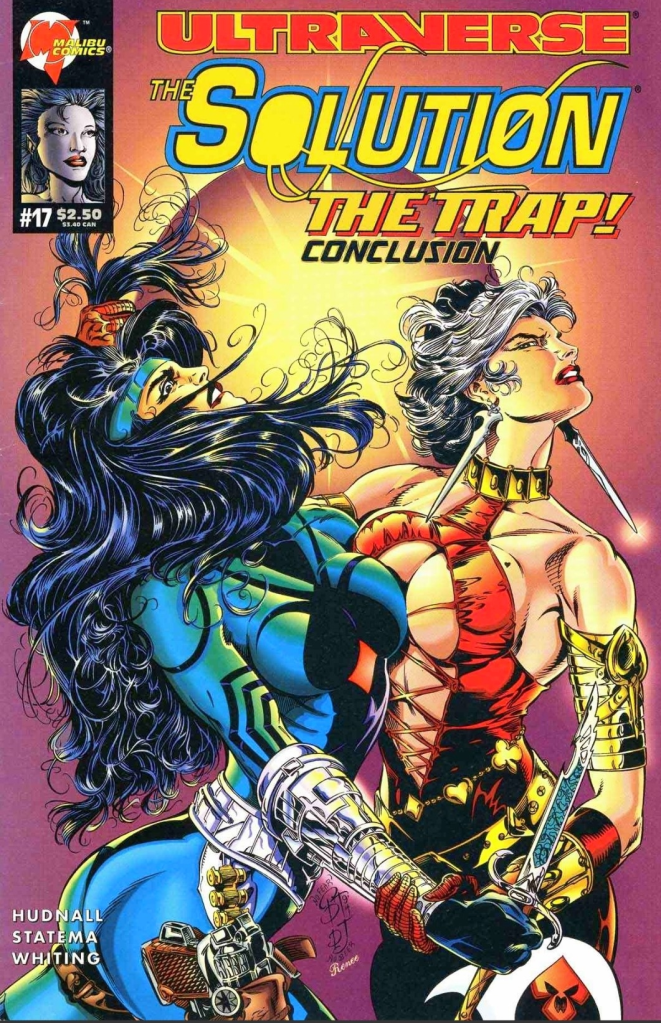
A Look Back at The Solution #17 (1995)

Disclaimer: This is my original work with details sourced from reading the comic book and doing personal research. Anyone who wants to use this article, in part or in whole, needs to secure first my permission and agree to cite me as the source and author. Let it be known that any unauthorized use of this article will constrain the author to pursue the remedies under R.A. No. 8293, the Revised Penal Code, and/or all applicable legal actions under the laws of the Philippines.

Welcome back superhero fans, 1990s arts and culture enthusiasts, Ultraverse fans and comic book collectors! Today we revisit the Ultraverse through the monthly series of The Solution. To be more precise, this review is about the 17th and final issue ever published.

In my previous retro review, The Solution daringly infiltrated a secret in Taiwan knowing that a major meeting between the heads of gangs will take place there. For Lela Cho/Tech, this is an opportunity for her to recover the company she lost to the Dragon Fang gang (read The Solution #6). Unfortunately for Lela and her teammates, the opposition were prepared for them.

With those details laid down, here is a look back The Solution #17, published by Malibu Comics in 1995 with a story written by the late James Hudnall and drawn by John Statema.

The cover.

Early story

The story begins with the arrival of the so-called lords of the Dragon Fang gang at the facility in Taiwan. As far as they know, The Solution has been brought down and the leader Lela Cho has been captured. They entered with a feeling of triumph only to see a large number of human bodies and severed body parts on the floor.

Inside, the insidious Casino has Lela Cho restrained helplessly on a high-tech chair. The Solution’s leader has been drugged by Casino who tells her that she (Lela) will be brought to some brothel in Thailand.

In another part of the facility, two armed guards approach the motionless body of Dropkick on the floor. Suddenly, The Solution’s martial artist moves and knocks the two guards out…

Quality

A very vulnerable Lela Cho in front of Casino.

In consideration of the build-up that started in the few previous issues, this particular comic book proved to be a worthy pay-off complete with a few notable twists that surprised me. Without spoiling the plot, I can say that the story is intriguing, the spectacle is plenty and the creative managed to keep things fresh. Along the way, there is some really relevant story elements that will compel you to re-read the early issues of The Solution series, especially when it comes to Casino who previously encountered the titular team.

As a good-versus-evil story, this one does not go over the edge and it certainly is not brainless entertainment. There is a lot more behind The Solution’s conflict with the Dragon Fang gang here and the impact can be felt more by those who actually started reading this particular series from issue #1.

On the visuals, John Statema’s return here is a very welcome move simply because, in my honest opinion, his style and approach to art really defined the looks of both the series and The Solution itself.  

Conclusion

Shadowmage takes on the Commie from Cambodia.

Being the concluding issue of its own series, The Solution #17 (1995) is a solidly fun and intriguing read. Not only did it conclude the build-up that preceded it, it also encouraged revisiting the earlier issues of the series for a deeper understanding of the opposition forces such as Casino and the Dragon Fang gang. While this was the last The Solution series entry, there was a promise of further adventures as it was made clear that another “era” awaited Lela Cho and her team. Unfortunately, as comic book publishing history showed, The Solution as a publishing franchise came to an end as the Ultraverse itself faded to obscurity under the banner of Marvel Comics (which acquired Malibu Comics in 1994). Take note that The Strangers concluded without a really conclusive story (there were even art works for issues #25 to #27) and Prototype ended with a story that felt like a substitute issue. That being said, the only way to keep enjoying The Solution is by simply repeat reading the entire series as well as finding the team’s appearances in other Ultraverse comic books. In my view, The Solution is one of the very best Ultraverse teams!

Overall, The Solution #17 (1995) is recommended.

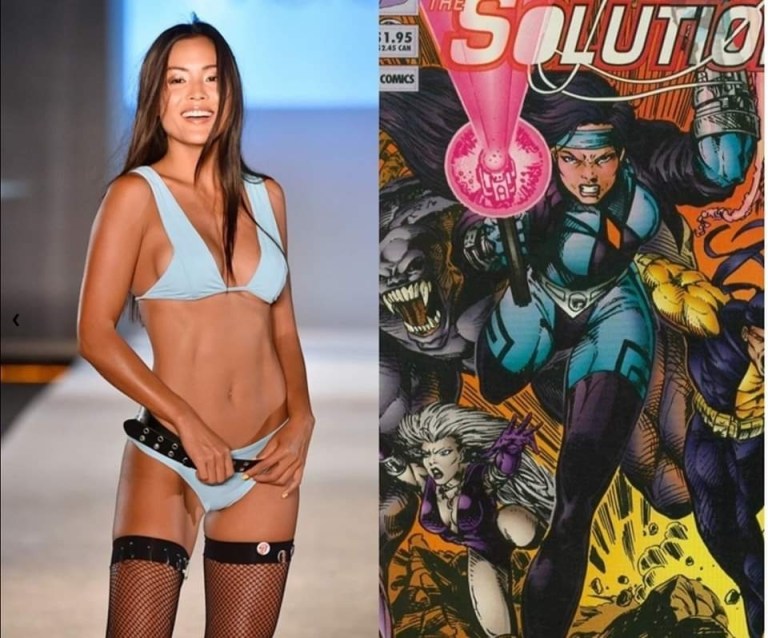
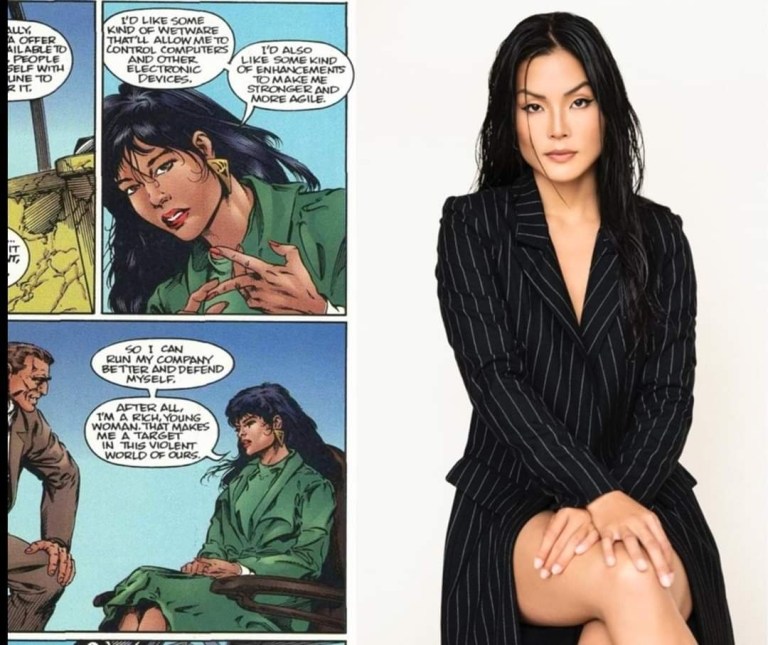
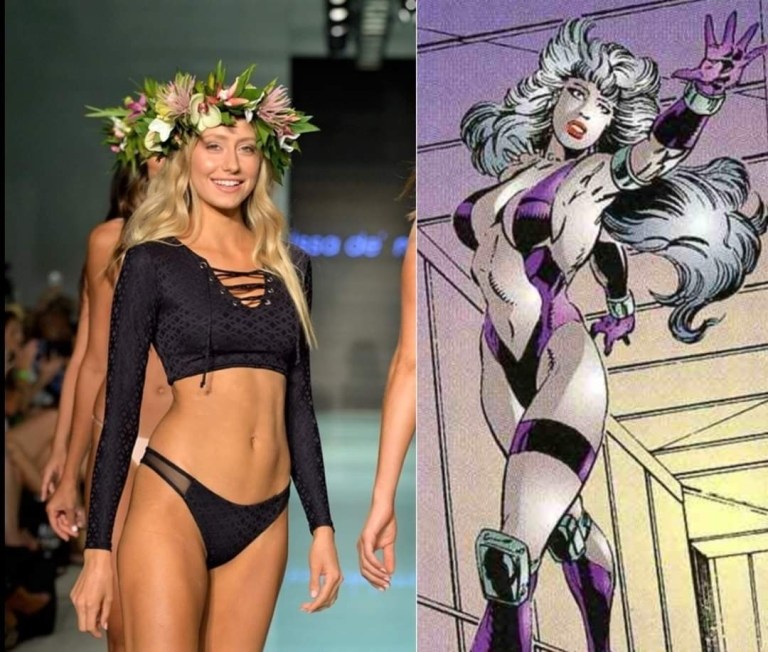
As this is end of my retro reviews of The Solution, posted below are images of fashion models whom I find suitable as cosplay photography models for Lela Cho/Tech and Shadowmage. Please tell me if the models looked their parts. Enjoy!

Model Saria Chen as Tech.
Saria Chen as Lela Cho in civilian form.
Model Shannon Barker as Shadowmage.

+++++

Thank you for reading. If you find this article engaging, please click the like button below and also please consider sharing this article to others. If you are looking for a copywriter to create content for your special project or business, check out my services and my portfolio. If you want to support my website, please consider making a donation. Feel free to contact me with a private message. Also please feel free to visit my Facebook page Author Carlo Carrasco and follow me on Twitter at  @HavenorFantasy as well as on Tumblr at https://carlocarrasco.tumblr.com/ and on Instagram athttps://www.instagram.com/authorcarlocarrasco/.

Do you want Capcom to release Breath of Fire RPGs on Xbox?

As an ecosystem, Xbox is becoming the premiere destination for gamers who love role-playing games (RPGs). Recently it was announced that Konami’s Suikoden franchise will debut on Xbox with the first two games in remastered forms in 2023. Next year, we will see the delayed Starfield and Eiyuden Chronicle: Hundred Heroes launch on Xbox Game Pass (XGP).

Given the fact that the Suikoden game franchise has always been very associated with the PlayStation brand and platform, its inevitable arrival on Xbox is indeed remarkable and it could inspire other Japanese game publishers to consider remastering their old Japanese role-playing games (JRPGs) and releasing them on the Xbox ecosystem.

I could only imagine the possibility of Capcom releasing their old Breath of Fire JRPGs on Xbox in remastered forms someday. I am interested to replay Breath of Fire IV as I never got to finish that game on the original PlayStation console (PS1). The most extensive Breath of Fire experience I had was Breath of Fire III which I managed to finish. While I never got to play the original Breath of Fire game, I played Breath of Fire II on a rented Super Nintendo Entertainment System (SNES).

It would be nice to replay Breath of Fire IV in remastered and improved form on my Xbox Series X. It’s up to Capcom to revive the franchise and make some new money with re-releasing old BOF games.

I don’t know what it would take to convince Capcom to remaster their old Breath of Fire games and have them released on Xbox One, Xbox Series S and Xbox Series X, but it would be worth a try for all JRPG-loving Xbox gamers to reach out to the Japanese publisher as well as executives of Team Xbox and express demand for those games.

For the most part, Breath of Fire RPGs have their unique take on fantasy as well as turn-based gameplay. I also noticed online gamers who are nostalgic not only with those games but also with recurring characters Ryu and Nina. Back in 2009, it was confirmed via Capcom’s online message boards that Breath of Fire as an intellectual property was put to rest.

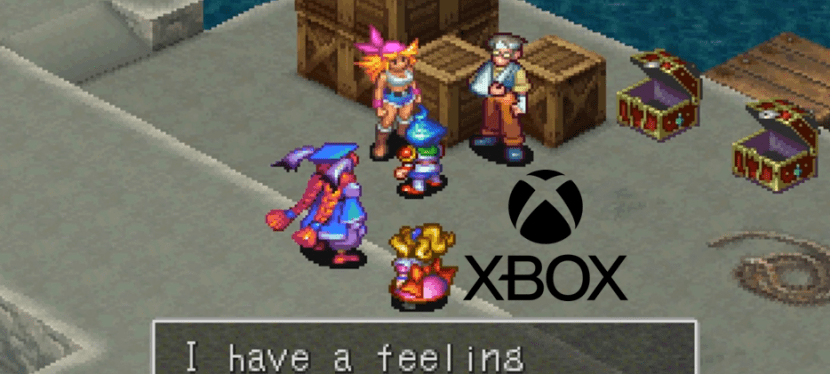
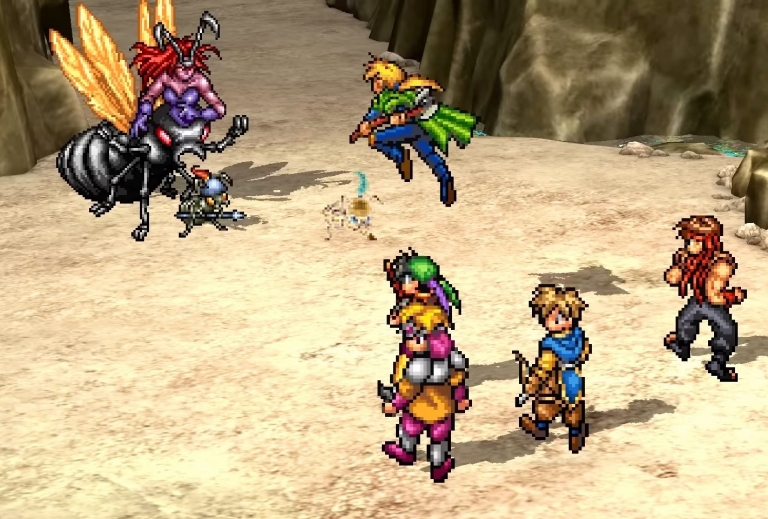
A screenshot of Breath of Fire III.

In my honest opinion, having the old Breath of Fire games released on Xbox Game Pass will surely attract the attention of the subscribers who love JRPGs and potentially revive the franchise. Remastering will also give Capcom opportunities to not only enhance the visuals but also correct whatever errors or technical flaws they find in each game. Xbox Game Pass has a lively subscriber base and already XGP has the remastered Ni no Kuni which subscribers are enjoying. Recently, Persona 5: Royal was released on Xbox. If having Breath of Fire games on Xbox platforms and XGP are enticing to you, then I encourage you to reach out to Capcom, Xbox chief Phil Spencer, Sarah Bond, Aaron Greenberg, Team Xbox and Xbox Game Pass on Twitter now.

In concluding this article, posted below for your enjoyment are Xbox-related videos plus a few Breath of Fire videos.

+++++

Thank you for reading. If you find this article engaging, please click the like button below, share this article to others and also please consider making a donation to support my publishing. If you are looking for a copywriter to create content for your special project or business, check out my services and my portfolio. Feel free to contact me with a private message. Also please feel free to visit my Facebook page Author Carlo Carrasco and follow me on Twitter at  @HavenorFantasy as well as on Tumblr at https://carlocarrasco.tumblr.com/ and on Instagram athttps://www.instagram.com/authorcarlocarrasco

A Look Back at Superman #74 (1992)

Disclaimer: This is my original work with details sourced from reading the comic book and doing personal research. Anyone who wants to use this article, in part or in whole, needs to secure first my permission and agree to cite me as the source and author. Let it be known that any unauthorized use of this article will constrain the author to pursue the remedies under R.A. No. 8293, the Revised Penal Code, and/or all applicable legal actions under the laws of the Philippines.

Welcome back superhero enthusiasts, 1990s culture enthusiasts and comic book collectors! Today we go back to the early 1990s and explore a key chapter in the post-Crisis era of DC Comics through a Superman comic book.

To be more specific, this retro review goes into one of the chapters of the Death of Superman storyline showing more of Doomsday’s rampage but before the climax of the battle with Superman. I’m talking about the 74th issue of the Superman monthly series of the time.

With those details laid down, here is a look back at Superman #74, published in 1992 by DC Comics with a story written and illustrated by Dan Jurgens.

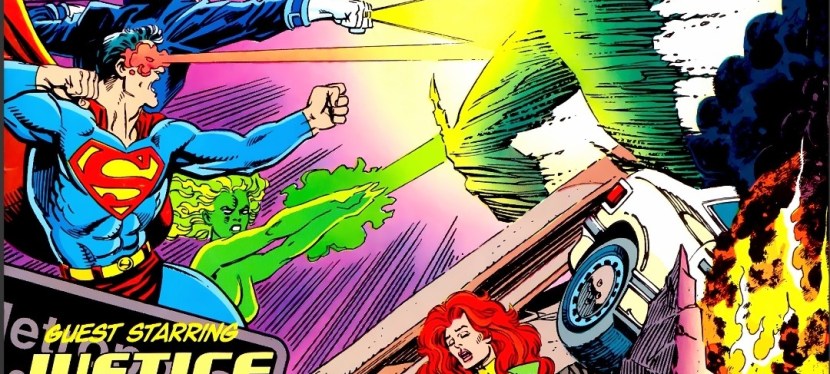
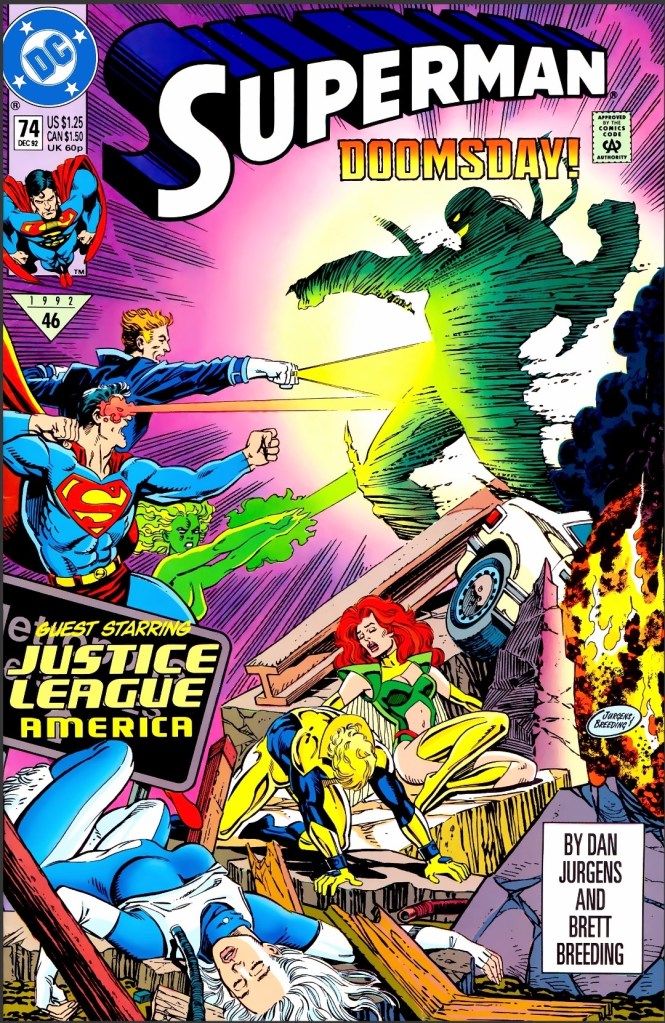
The cover.

Early story

The story begins with Ice and Maxima in the presence of a suffering Blue Beetle who just got hurt badly by Doomsday. While Ice expresses concern for Blue Beetle, Maxima could only care less about him stating that he shall perish as a warrior fallen in battle and that there is no greater honor one can attain. After Ice pleaded her to help Blue Beetle and realize the need to help others who have fallen, Maxima then uses her power to help Blue Beetle to safety. Ice then proceeds to another direction to stop Doomsday.

Meanwhile, a young guy named Mitch arrives home feeling bad about his situation. His mother is taking care of his infant sibling. After a tense talk between them, Ice suddenly crashes into their home. Mitch and his mother look outside and see Doomsday (still covered in a space suit with only his left arm unrestrained as seen in Superman: The Man of Steel #18) carrying a damaged car with his left arm.  

Suddenly Doomsday notices something – the arrival of Booster Gold and Superman…

Quality

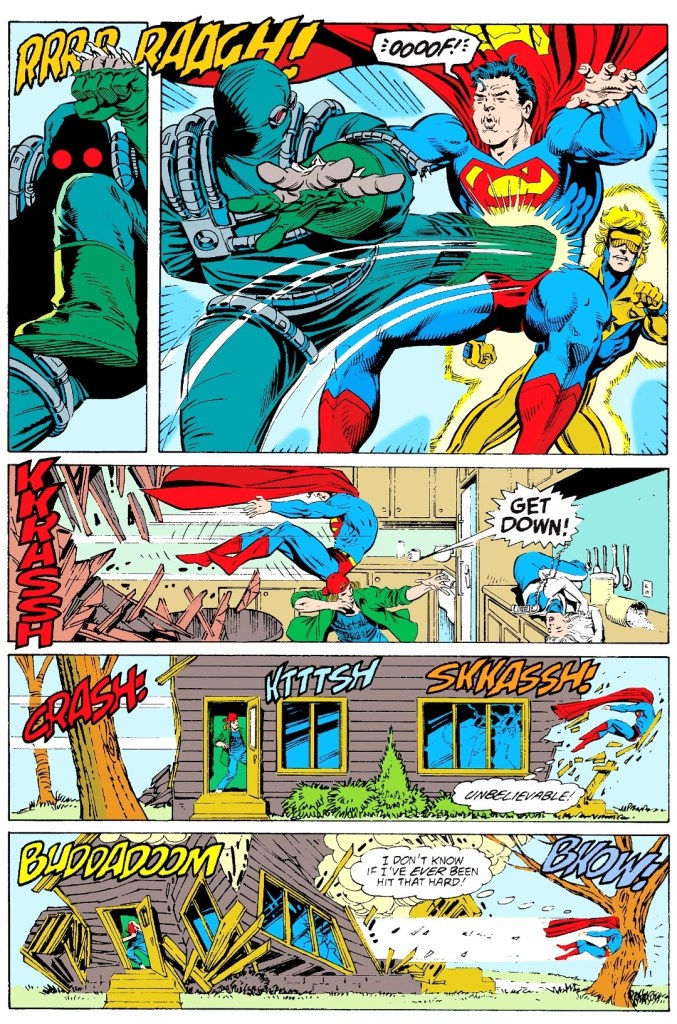
Superman struck really hard by Doomsday!

Apart from being a build-up chapter of the Death of Superman storyline, this comic book is notable for two things: It has the first-ever encounter between Superman and Doomsday in comic book history. Second is the reveal of Doomsday’s face and other physical features as a result of his space suit and restraints getting torn.

The first-ever Superman-Doomsday encounter here is symbolic as it happened just minutes after the Justice League America (JLA) got overwhelmed by the unstoppable creature from outer space. While Superman had his TV interview, his JLA teammates failed miserably during their encounter with Doomsday (as told in Justice League America #69). By the time the Man of Steel and the creature meet, the stage was set for readers to find out once and for all who is more powerful between them.

Superman’s leadership is also emphasized in this story. The JLA in this issue does not have DC’s most famous superheroes as members but Ice, Maxima, Fire, Booster Gold, Bloodwynd and Guy Gardner functioned well and added nicely to the build-up of this storyline.

There is a lot of superhero spectacle to enjoy here but the most noticeable visual features are the scenes of destruction which strongly symbolize Doomsday’s immense strength, violent nature and complete disregard of both life and logic. The showing of an American family coming close to death in the presence of Doomsday remains disturbing to see.

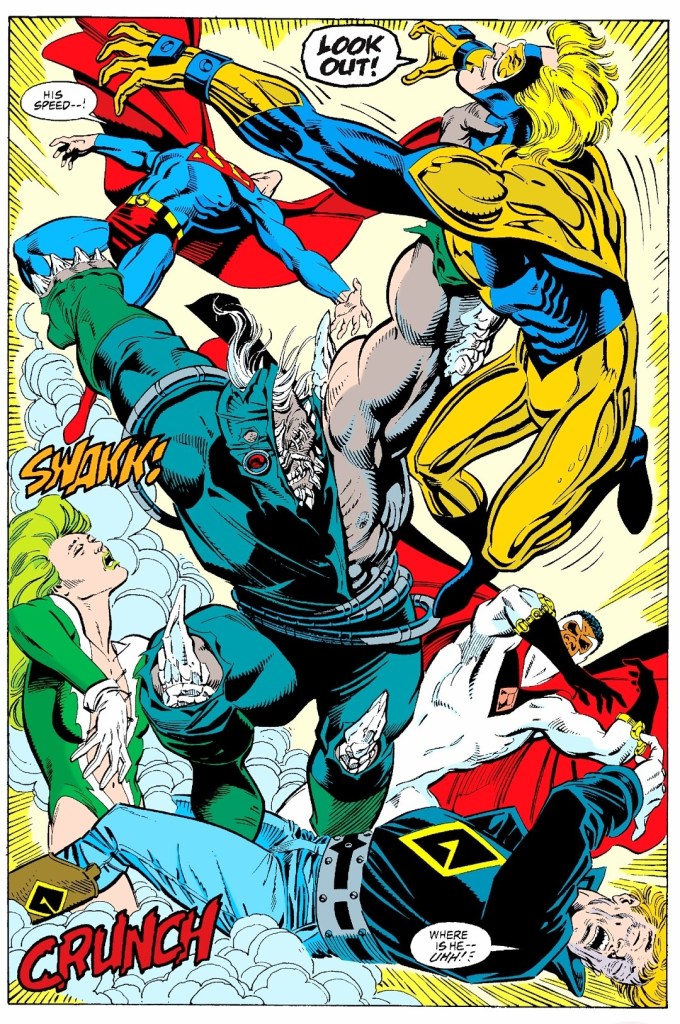
Lastly, I should state the big reveal of Doomsday’s face and other physical features is excellent and even timeless. There is this undeniable combination of fright and intimidation that Dan Jurgens visualized here. In fact, the big reveal (which happened after Superman and the JLA combined their attacks on the creature) alone is a solid reason to read this comic book.  

Conclusion

Doomsday the unstoppable force that completely disregards life and cannot be reasoned with.

Even as a build-up issue of the Death of Superman storyline, Superman #74 (1992) is still a great read on its own. Not only did it mark the first-ever encounter between Superman and Doomsday in the history of comics, it also emphasized how vulnerable and inferior the superheroes here really are. There is also the symbolism of Doomsday as the unstoppable being that completely disregards life (and can never be reasoned with) and still Dan Jurgens managed to spare some room to symbolize how the superheroes struggled in trying to stop the creature and take care of the helpless whenever they can.

Overall, Superman #74 (1992) is highly recommended.

+++++

Thank you for reading. If you find this article engaging, please click the like button below, share this article to others and also please consider making a donation to support my publishing. If you are looking for a copywriter to create content for your special project or business, check out my services and my portfolio. Feel free to contact me with a private message. Also please feel free to visit my Facebook page Author Carlo Carrasco and follow me on Twitter at  @HavenorFantasy as well as on Tumblr at https://carlocarrasco.tumblr.com/ and on Instagram at https://www.instagram.com/authorcarlocarrasco

A Look Back at Superman #76 (1993)

Disclaimer: This is my original work with details sourced from reading the comic book and doing personal research. Anyone who wants to use this article, in part or in whole, needs to secure first my permission and agree to cite me as the source and author. Let it be known that any unauthorized use of this article will constrain the author to pursue the remedies under R.A. No. 8293, the Revised Penal Code, and/or all applicable legal actions under the laws of the Philippines.

Welcome back superhero enthusiasts, 1990s culture enthusiasts and comic book collectors! Today we go back to the early 1990s and explore a key chapter in the post-Crisis era of DC Comics through a Superman comic book.

Previously, I reviewed Adventures of Superman #498 (1993) and Superman: The Man of Steel #20 (1993) which were chapters of the Funeral for a Friend storyline. In Superman: MOS #20, a large funeral took place which involved several special guests as well as other DC superheroes who paid tribute to Superman. The entire city of Metropolis is struggling to move forward as the sudden of Superman really impacted all the people, especially on Lois Lane.

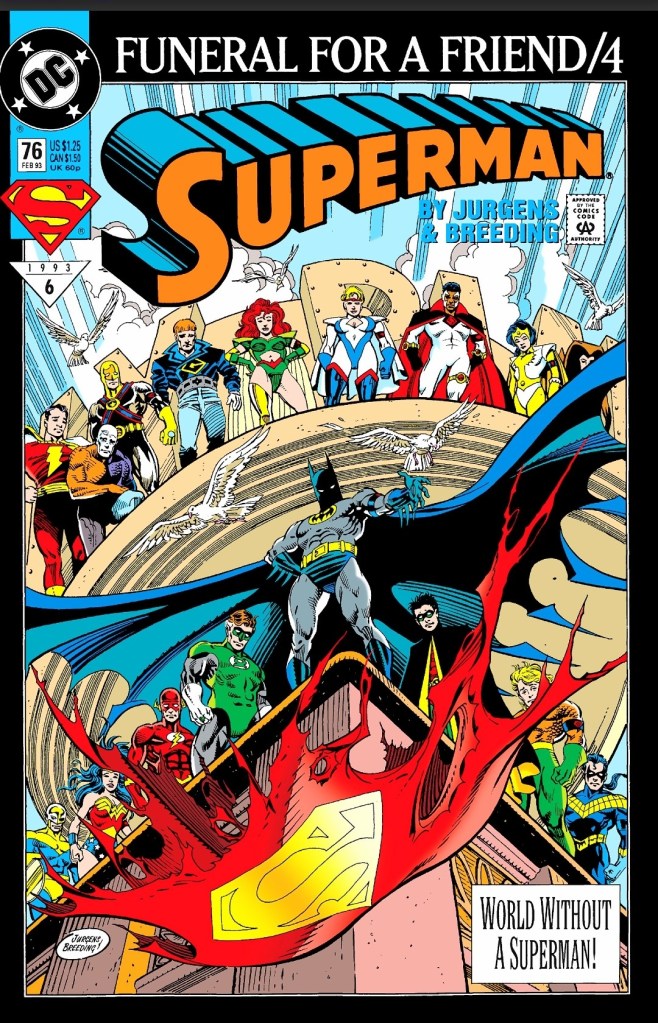
With those details laid down, here is a look back at Superman #76, published in 1993 by DC Comics with a story written and illustrated by Dan Jurgens. This comic book marked the fourth chapter of the Funeral for a Friend storyline.

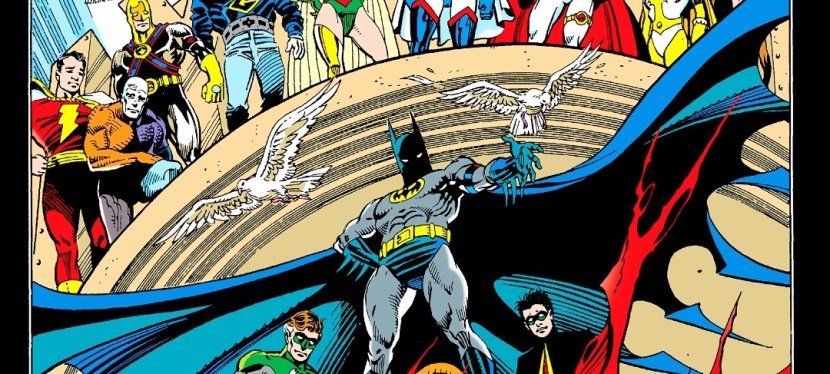
The cover.

Early story

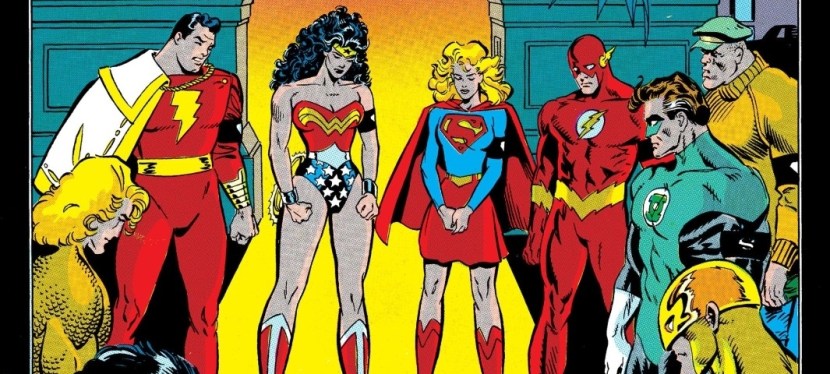
The story begins with Shazam (AKA Captain Marvel) arriving at the rooftop of the Daily Planet where the Flash, Batman, Wonder Woman, Green Lantern, Maxima and others are present. The whole city is experiencing a very somber Christmas season as the death and burial of Superman remains very strong on the people.

On the streets of Metropolis, a long-haired guy named Mitch walks down in the rain feeling troubled not only because Superman died but also due to the fact that their home got smashed during the encounter with the unstoppable Doomsday. Mitch then arrives at a gathering of people outside of a building’s front door. There are several reporters covering a lady speaking to them with a microphone. She tells them that she is Mrs. Superman…

Quality

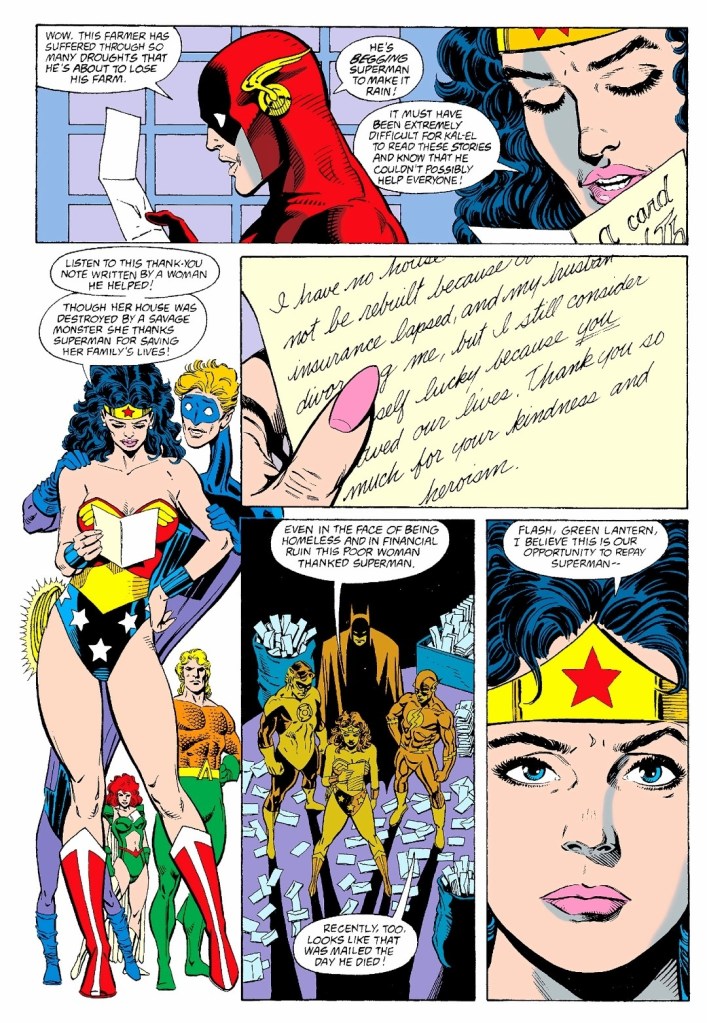
Wonder Woman reads a letter.

Being the 4th chapter of the Funeral for a Friend storyline, Dan Jurgens crafted a story that not only dramatized the post-disaster situation of Metropolis but also had notable twists and developments that proved to be worth reading.

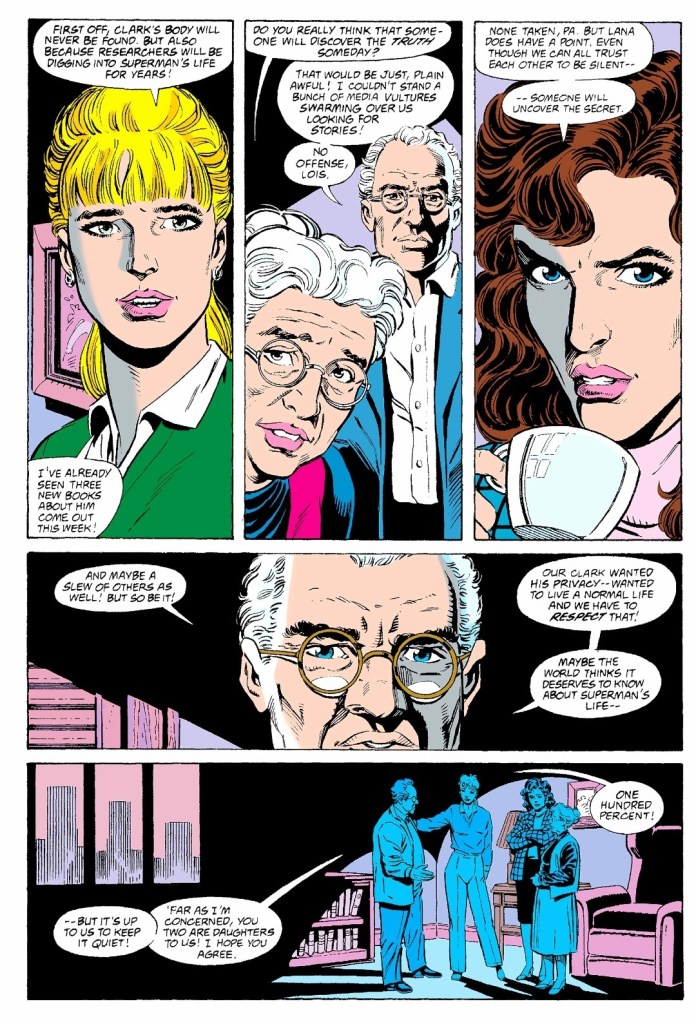
For one thing, this comic book has Lois Lane reunited at last with Clark Kent’s earthly parents Jonathan and Martha which was not only really dramatic but also had very rich dialogue written. By this point in this particular storyline, Lois Lane has gone through waves of deep emotions and pain, while getting stressed with journalistic work. As such, there is this dramatic pay-off that happened during the reunion with the elderly Kent couple.

What is most notable here is the scene in which Superman’s super-powered allies visit a local post office that literally got flooded with lots of mail from around the world addressed to the Man of Steel. On face value, such a scenario looked silly but the way Dan Jurgens crafted the dialogue and the images, the post office scene became believable and sensible to read. This shows that superheroes like Aquaman, Wonder Woman, the Flash and others do have hearts to be caring and sensible to the people.

The scene of the ordinary guy Mitch is significant as well. Clearly the character symbolizes the poor and struggling American who remembers how a complete stranger like Superman came along, stood up to fight for Mitch’s family and died in the process (while Mitch’s father was absent).

This comic book is also a Christmas tale. How Christmas was dramatized here has to be seen and you readers should get a copy of this comic book to find out why. It should be noted that there are themes of reconciliation and the nuclear family that made the Christmas tale meaningful.

Conclusion

Lana Lang, Lois Lane and the elderly Kent couple.

Even without the presence of the Man of Steel and no good-versus-evil conflict, Superman #76 (1993) is a great read as it pushed forward the Funeral for a Friend storyline while successfully telling a meaningful Christmas tale of its own complete with a very unique portrayal of the Justice League and Superman’s allies. How people deal with emotions and stress over Superman’s death was portrayed as highly believable and Dan Jurgen’s writing here was done with really high quality.

Overall, Superman #76 (1993) is highly recommended.

+++++

Thank you for reading. If you find this article engaging, please click the like button below, share this article to others and also please consider making a donation to support my publishing. If you are looking for a copywriter to create content for your special project or business, check out my services and my portfolio. Feel free to contact me with a private message. Also please feel free to visit my Facebook page Author Carlo Carrasco and follow me on Twitter at  @HavenorFantasy as well as on Tumblr at https://carlocarrasco.tumblr.com/ and on Instagram at https://www.instagram.com/authorcarlocarrasco

A Look Back at Superman: The Man of Steel #18 (1992)

Disclaimer: This is my original work with details sourced from reading the comic book and doing personal research. Anyone who wants to use this article, in part or in whole, needs to secure first my permission and agree to cite me as the source and author. Let it be known that any unauthorized use of this article will constrain the author to pursue the remedies under R.A. No. 8293, the Revised Penal Code, and/or all applicable legal actions under the laws of the Philippines.

Welcome back superhero enthusiasts, 1990s culture enthusiasts and comic book collectors! Today we go back to the early 1990s and explore a key chapter in the post-Crisis era of DC Comics through a Superman comic book – the first full appearance of Doomsday!

To those of you who read my retro review of Adventures of Superman #498 (1993) – which was the opening chapter of the Funeral for a Friend storyline – you might be wondering why I decided to revisit the Death of Superman storyline so suddenly. It all comes down to context related to Superman’s eventual death and what killed him. Not only did Doomsday become a very important part of DC Comics’ gallery of super villains having achieved the killing of the Man of Steel, the oversized monster became part of DC’s further comic book universe reboots as well as part of multimedia adaptations of DC Comics stories specifically in the Smallville TV series as well as in 2016’s Batman v. Superman: Dawn of Justice.

Indeed, Doomsday’s place in American pop culture is sealed and that shows how much of an impact was made by the unstoppable super villain co-created by Dan Jurgens, Brett Breeding, Jerry Ordway, Louise Simonson and Roger Stern. Doomsday was conceived way back in 1991 during the brainstorming session of the Superman comics writers and editors of the time.

With those details laid down, here is a look back at Superman: The Man of Steel #18, published in 1992 by DC Comics with a story written by Louise Simonson and drawn by Jon Bogdanove. This comic book marked the beginning of the Death of Superman saga.

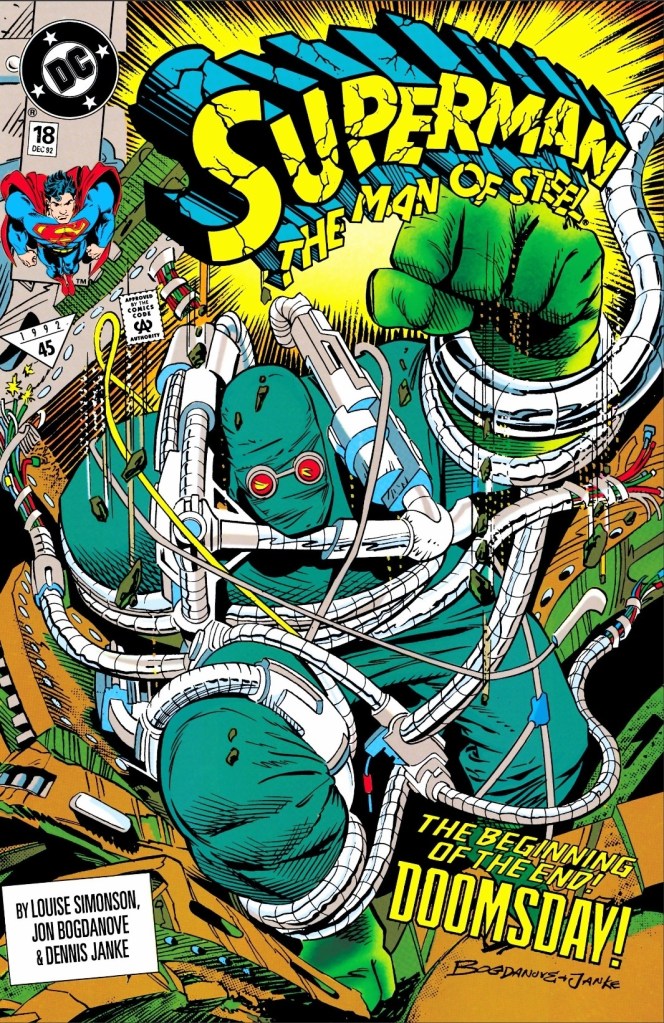
The cover.

Early story

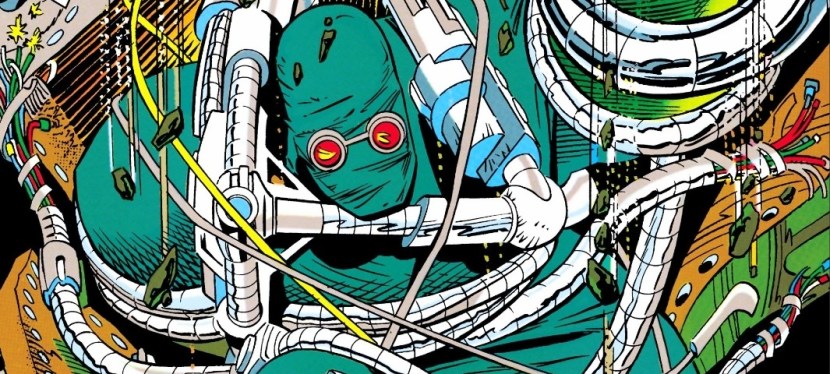
The story begins deep underground as the left fist of a covered, large being keeps punching the metallic wall to get out of containment. As the punches keep on pounding the wall, the glove gets torn revealing a fist with gray skin and sharp bones protruding through the knuckles. After making its way out of containment, the earth shakes and the animals got disturbed as the creature – mostly covered with an alien body suit  with only the left arm freed – makes its way from deep underground.

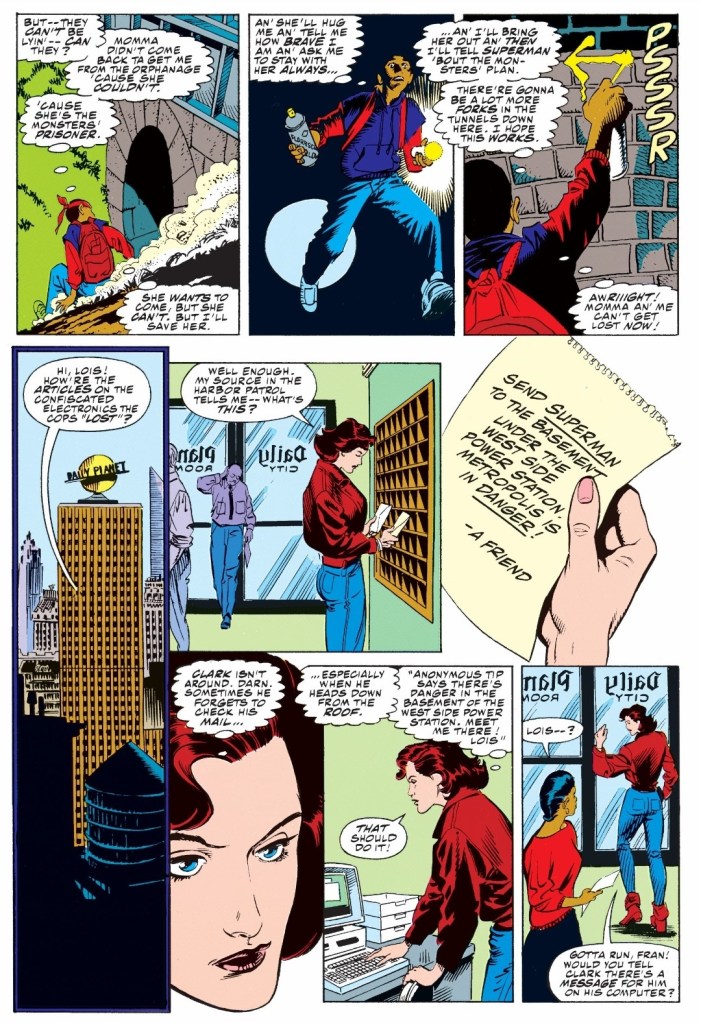
Miles away within the city of Metropolis, a young black boy buys a spray paint container (which has a fluorescent yellow paint that glows in the dark) inside a hardware store. In response to the curiosity of the store owner, the boy denies that he would use the glow-in-the-dark pain on a subway wall. The boy has a very tough task ahead of him as he will be going after monsters.

At a power station, a group of intelligent creatures make their way to steal electricity for their war machines…

Quality

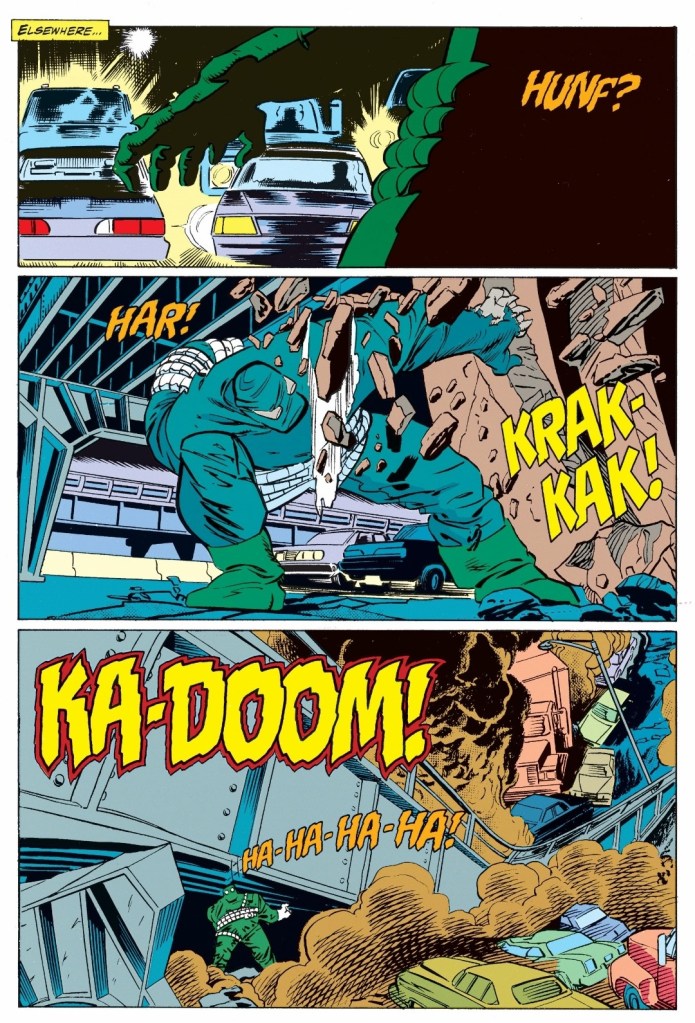
Even with only his left arm free, Doomsday still caused massive destruction causing injuries and deaths to others.

To make things clear, this comic book tells two stories that moved in parallel together. The first story involving Superman, Lois Lane and the affairs that involved the mentioned young black boy is the typical good-versus-evil superhero tale. What made that story standout was Lois Lane’s involvement as she got into trouble facing the opposition before Superman came in to save the day. As before, seeing Lois Lane talk to Superman in the presence of others while keeping his identity secret remains engaging to read. This tale was good enough to read.

The other story that follows the sudden appearance and the early rampage of Doomsday is the more engaging one to read. This was clearly a build-up for the Death of Superman concept but it was highly effective, well-paced and clearly defined by the creative team. Not only will you see Doomsday’s unstoppable power of destruction, you will witness his complete disregard of life – animals and humans – which strongly hints the an immense danger that Superman, the Justice League America (JLA) and the people of Metropolis are not prepared for. Like the Terminator, Doomsday cannot be reasoned with as massive destruction and death are his core elements. Within the pages of this comic book, it can be viewed that Doomsday was designed for endless waves of destroying life and anything that gets in the way.

Lastly, I should state that Simonson and Bogdanove presented Doomsday not only to be destructive but also as a frightening force that people in real life would not want to see realized.

Conclusion

The other tale that involved Lois Lane and the young black boy.

Superman: The Man of Steel #18 (1992) remains a very powerful read. Yes, it is a build-up of Doomsday and the Death of Superman saga but it remains highly significant as it kicked-off the creative change of direction of DC’s Superman creative teams going towards tragedies that Superman and his allies cannot easily stop. This one marked start of Doomsday’s eventual high rise not only in comics but also in pop culture in general. That being said, this comic book is a must-have in your collection.  

Overall, Superman: The Man of Steel #18 (1992) is highly recommended.

+++++

Thank you for reading. If you find this article engaging, please click the like button below, share this article to others and also please consider making a donation to support my publishing. If you are looking for a copywriter to create content for your special project or business, check out my services and my portfolio. Feel free to contact me with a private message. Also please feel free to visit my Facebook page Author Carlo Carrasco and follow me on Twitter at  @HavenorFantasy as well as on Tumblr at https://carlocarrasco.tumblr.com/ and on Instagram at https://www.instagram.com/authorcarlocarrasco

A Look Back at Superman: The Man of Steel #20 (1993)

Disclaimer: This is my original work with details sourced from reading the comic book and doing personal research. Anyone who wants to use this article, in part or in whole, needs to secure first my permission and agree to cite me as the source and author. Let it be known that any unauthorized use of this article will constrain the author to pursue the remedies under R.A. No. 8293, the Revised Penal Code, and/or all applicable legal actions under the laws of the Philippines.

Welcome back superhero enthusiasts, 1990s culture enthusiasts and comic book collectors! Today we go back to the early 1990s and explore a key chapter in the post-Crisis era of DC Comics through a Superman comic book.

Previously, I reviewed Adventures of Superman #498 (1993) which marked the first chapter of the Funeral for a Friend storyline and dramatized the impact left behind by the death of Superman. That particular comic book had strong writing and succeeded in dramatizing how Superman’s friends, associates and other characters coped with his death with the future looking uncertain to them.

With those details laid down, here is a look back at Superman: The Man of Steel #20, published in 1993 by DC Comics with a story written by Louise Simonson and drawn by Jon Bogdanove. This comic book marked the third chapter of the Funeral for a Friend storyline.

The cover.

Early story

The story begins with people in Metropolis struggling to move forward not only because their hero Superman died but also because of the tremendous damage left behind by Doomsday. In his headquarters, Lex Luthor is talking with the telephone surrounded by several people with Supergirl watching. The matter being discussed was the burial of Superman at Centennial Park particularly in a structure Luthor himself donated. While he has to live on with the fact that he failed to kill Superman, Luthor tells himself he can still bury him.

At the Kent farm far away from Metropolis, Jonathan and Martha Kent are agonizing not only because of the death of their beloved son but also because they realized they cannot even get near him at his funeral as it will be organized as a major event with only the important people allowed to attend…

Quality

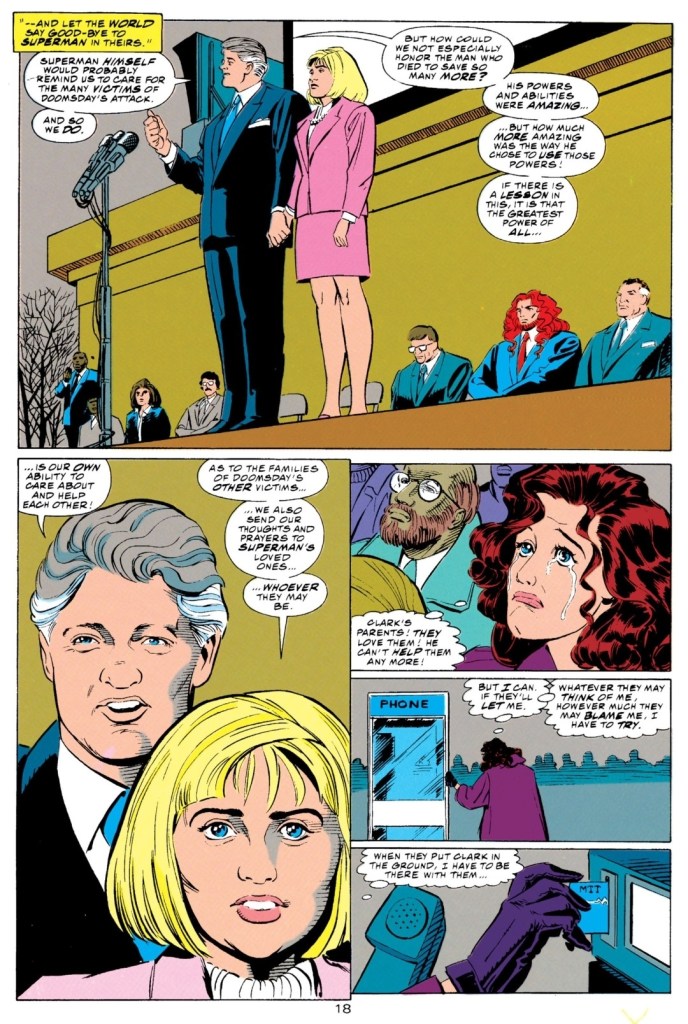
It seems like destiny to have the super villain Lex Luthor in the presence of a fictionalized Bill Clinton and Hillary Clinton during the funeral of Superman. By today’s standards, the Clintons made it normal for America to bow to terrorists and make deals with them. That being said, their inclusion in this comic book is just wrong.

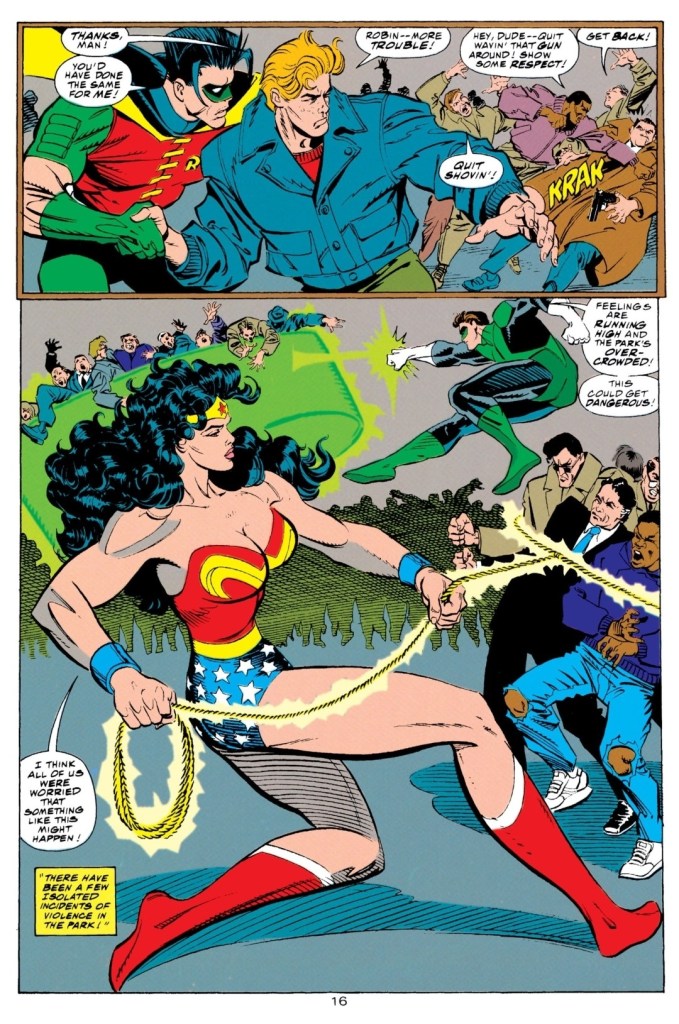
To go straight to the point, like Adventures of Superman #498 (1993), this comic book continues to dramatize the impact of Superman’s death on Metropolis and its people in a very engaging manner. It shows that DC’s creative teams in charge of Superman comic book at the time were really organized and coordinated with each other on crafting the Funeral for a Friend storyline. What makes this comic book stand out is the funeral itself which was organized as a public event (with the burial itself done in the presence of important people – including a very evil couple from the Democrats who love abortion and terrorism) and this includes the presence of many other DC Comics superheroes like Wonder Woman, Green Lantern, The Flash, Maxima, Shazam (AKA Captain Marvel) and others. The burial had its own share of intriguing and dramatic moments emphasizing the people’s struggle to adjust themselves knowing they don’t have Superman anymore to help them.

Wonder Woman, Green Lantern and Robin help out as the huge crowd became rowdy.

More on the post-death dramatization, the creative team managed to keep Superman’s associates Lois Lane, Jimmy Olsen and the other Daily Planet people feeling uneasy over the Man of Steel’s death which makes their work covering the funeral professionally a challenge. Unsurprisingly, Lois Lane gets her own fine share of the spotlight agonizing over the fact that she lost her beloved Clark (Superman to the public) whom she was supposed to get married with. The emotional struggle within her intensified as she experiences difficulty of informing the elderly Kent couple about what happened. This is rich writing prepared by the creators.

Not only that, the creative team also went all-out with dramatizing the impact of Superman’s good deeds on the people. You will see several people from Metropolis’ general population talk about how Superman helped them or inspired them. There are certain lines of dialogue that are quite touching to read.

Conclusion

A pretty powerful portrayal of Lois Lane’s struggle on dealing with the new reality that she lost her beloved Superman.

Superman: The Man of Steel #20 (1993) is another solid, post-death story emphasizing the new normal that Metropolis people and Superman’s friends are having difficulty adjusting to…a world without the Man of Steel. Based on the high quality of the storytelling and character development, it is easy to tell that the Superman titles’ creative teams planned ahead and prepared themselves for telling a post-death saga which was pretty risky given the iconic status of Superman and his decades-long legacy in comics and pop culture. This comic book really made Superman’s absence feel powerful and undeniable.

Overall, Superman: The Man of Steel #20 (1993) is recommended.

+++++

Thank you for reading. If you find this article engaging, please click the like button below, share this article to others and also please consider making a donation to support my publishing. If you are looking for a copywriter to create content for your special project or business, check out my services and my portfolio. Feel free to contact me with a private message. Also please feel free to visit my Facebook page Author Carlo Carrasco and follow me on Twitter at  @HavenorFantasy as well as on Tumblr at https://carlocarrasco.tumblr.com/ and on Instagram at https://www.instagram.com/authorcarlocarrasco

A Look Back at Adventures of Superman #498 (1993)

Disclaimer: This is my original work with details sourced from reading the comic book and doing personal research. Anyone who wants to use this article, in part or in whole, needs to secure first my permission and agree to cite me as the source and author. Let it be known that any unauthorized use of this article will constrain the author to pursue the remedies under R.A. No. 8293, the Revised Penal Code, and/or all applicable legal actions under the laws of the Philippines.

Welcome back superhero enthusiasts, 1990s culture enthusiasts and comic book collectors! Today we go back to the early 1990s and explore a key chapter in the post-Crisis era of DC Comics through a Superman comic book.

To put things in perspective, the Death of Superman which climaxed in Superman #75 (1993) was a major comic book event published by DC Comics and it sure involved a whole lot of risks taken by the creative teams. To put the storyline’s concept short, Superman was beaten by an overwhelming, deformed alien humanoid from outer space who caused massive destruction around. Having no real choice and knowing that his fellow super-powered allies could not stand a chance against the alien called Doomsday, Superman went all-in fighting and stood up against him while defending Metropolis and its people. Superman #75 went on to sell many millions of copies and became an instant collector’s item.

Of course, just because Superman died does not mean that the shared DC universe at that time would come to an end and DC Comics had to keep on telling what happened afterwards.

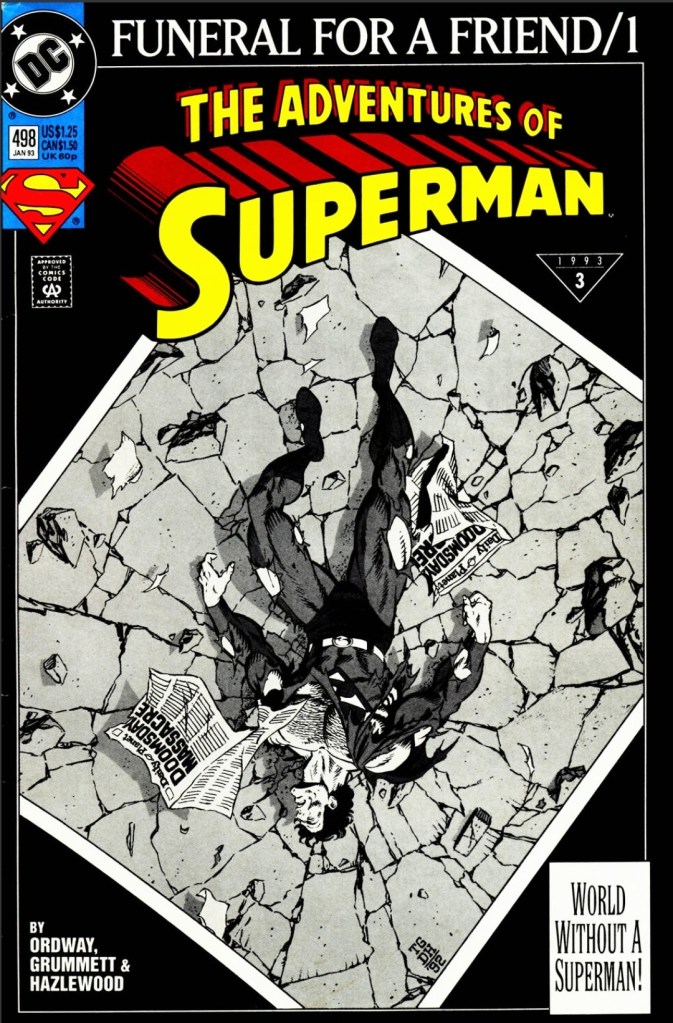
With those details laid down, here is a look back at Adventures of Superman #498, published in 1993 by DC Comics with a story written by Jerry Ordway and drawn by Tom Grummett. This comic book marked the first chapter of the Funeral for a Friend storyline.

The cover.

Early story

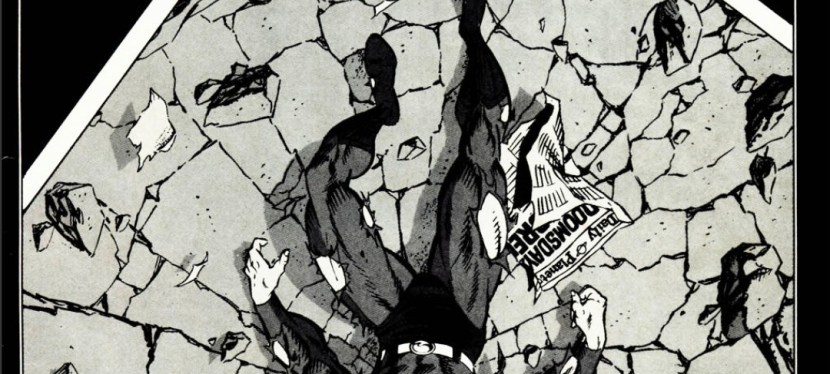
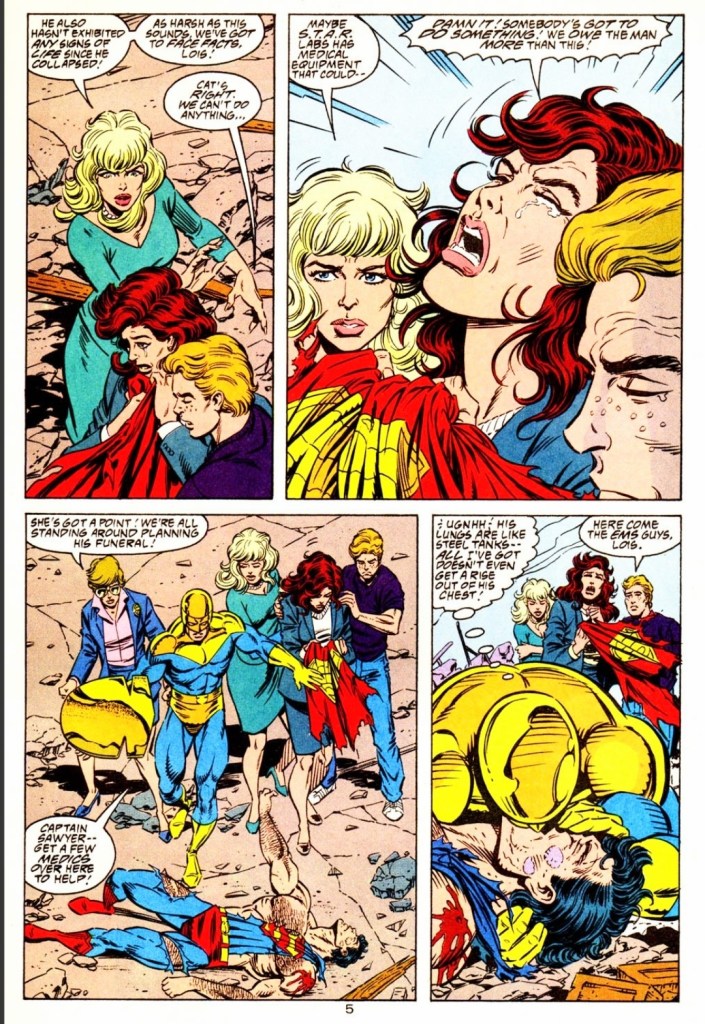
The story begins just moments after the Superman passed away in Lois Lane’s arms. Jimmy Olsen, the body of Doomsday and a few of Superman’s allies were near them. Bloodwynd and Dubbilex shared their respective findings that there is no life left in Superman. As emergency personnel slowly approach Doomsday’s body, Lois Lane turns emotional stating that someone has to do something for Superman. More emergency personnel arrive and attempt to revive the Man of Steel who remains lifeless.

Nearby, a man spots an unrecognizable human-like body among the rubble which turns out to be alive. Suddenly the red-headed tycoon Lex Luthor arrives to take care of the ruined being and walks away carrying it. Luthor refers to the being as a female…   

Quality

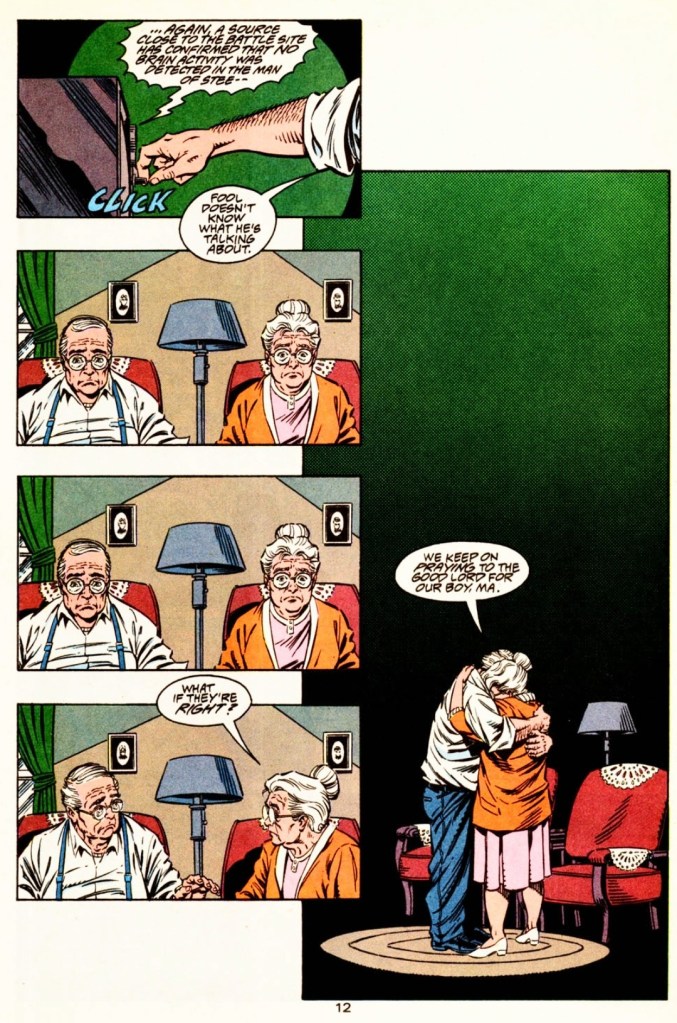
The Ordway-Grummett team should be recommended for this simple yet very dramatic look at the elderly Kent couple reacting to the death of their adopted son from Krypton.

As a post-death Superman story, it is clear that the creative team carefully explored how the many people of Metropolis would react to the sudden death of the Man of Steal while also leaving some room to set the stage to develop Lois Lane – who at this stage knew Superman’s true identity and kept it all secret – in a new way. There were also sub-plots started here particularly with Lex Luthor and Supergirl, the people working for the Daily Planet and the Kents (Clark’s earthly mother and father). The way all the dialogue and character expressions were crafted, there is an undeniable tone of discomfort and uncertainty which dominated the narrative as I read from start to finish.

What I liked the most about this story was how the creative team showed the heavy toll of Superman’s death on Lois Lane who not only has to deal with the loss of her beloved Clark (perceived by her peers to be missing as a possible victim of Doomsday’s rampage) but also do her best to keep working professionally as a journalist of the Daily Planet. I felt Lane’s pain a lot as I read on.  

Conclusion

Tension and emotions turned high in relation to Superman’s sudden death.

In my view, Adventures of Superman #498 (1993) is a really gripping and highly dramatic post-disaster superhero tale to read. The way it was made, it strongly kicked off the Funeral for a Friend storyline with high emotions as well as an understandable amount of uncertainty that can be seen in the characters. Understandably, there is no good-versus-evil conflict in the story nor any superhero spectacle to watch out for but the sub-plots implemented added some depth which made this post-death tale worth reading. More notably, the creative team succeeded in making the people – both in the story and the reading public – start missing Superman.

Overall, Adventures of Superman #498 (1993) is recommended.

+++++

Thank you for reading. If you find this article engaging, please click the like button below, share this article to others and also please consider making a donation to support my publishing. If you are looking for a copywriter to create content for your special project or business, check out my services and my portfolio. Feel free to contact me with a private message. Also please feel free to visit my Facebook page Author Carlo Carrasco and follow me on Twitter at  @HavenorFantasy as well as on Tumblr at https://carlocarrasco.tumblr.com/ and on Instagram at https://www.instagram.com/authorcarlocarrasco

Remastered versions of Suikoden and Suikoden II are coming to Xbox in 2023!

During the recent Tokyo Game Show (TGS), Team Xbox had its livestream event which was a mix of surprises and game reveals. Xbox chief Phil Spencer and Xbox CVP Sarah Bond spent time emphasizing their gaming business as well as their commitment with the game creators and gamers in Japan.

While the sudden release of the remastered version of the hit Japanese role-playing game (JRPG) Ni no Kuni on Xbox platforms and Xbox Game Pass (XGP) was indeed surprising, there was another major surprise pulled off by Konami that includes Xbox for a release some time in 2023 – Suikoden I&II HD Remaster Gate Rune and Dunan Unification Wars. Watch the official English-language trailer below…

To put things in perspective, posted below is an excerpt from the official press release from Konami’s website. Some parts in boldface…

Announced during Tokyo Games Show 2022, KONAMI confirmed several fundamental improvements and quality-of-life features in the upcoming remaster collection:

Graphical Improvements

Pixel sprites and environment art enhanced with new screen effects including lighting, clouds, and shadow animations Flickering flames, smoldering smoke, the movement of leaves and insects, all add up to a lively in-game atmosphere!

The effects and direction have been redesigned, bringing memorable scenes back to life in more beautiful ways!

New Character Drawings

All character portraits have been updated in HD. Junko Kawano, who designed the characters for the original version of Suikoden released in 1995, has newly re-drawn all the character portraits for Suikoden I HD Remaster Gate Rune War.

Sound Improvements

Field Sound – A large number of environmental sounds not found in the original version, such as the sound of running water in the river, wind, insects, and running footsteps, have been added. You can enjoy an immersive experience like never before!

Battle Sound – All sound effects are now in HD. In addition to the impact of the 3D effects, the realistic sound greatly enhances the dynamism of the battles!

Game System Improvements

Many new features have been added, such as dialogue log, auto-battle, double-speed battles, etc.

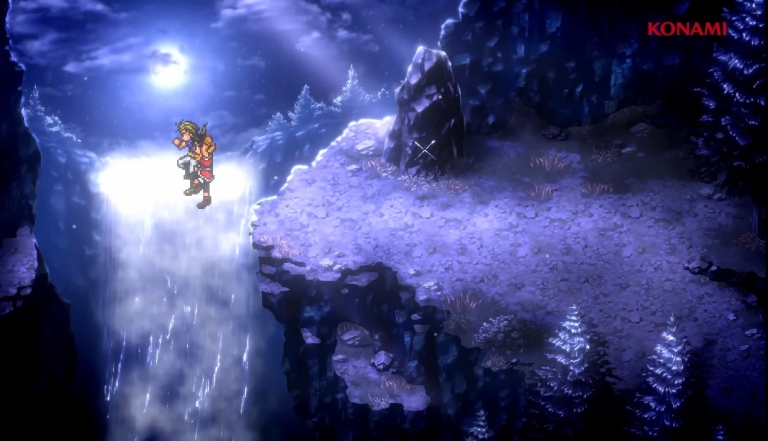
Footage of the remastered Suikoden JRPG from Konami’s official trailer.
The 2D sprites look the same but they do look sharper in HD. Even the background elements look sharper.
World exploration in Suikoden is no longer the flat 2D map it used to be.

As I have played Suikoden and Suikoden II on the original PlayStation console in the 1990s, the announcement of Suikoden I&II HD Remaster Gate Rune and Dunan Unification Wars is big dream come true for me personally. I always wanted to replay Suikoden and Suikoden II without the hassle of having to spend a lot of money to buy a PlayStation or a Nintendo console. In my experience, Suikoden II is the peak of excellence of its own franchise as the creative team listened to the fans and learned from their shortcomings on making the first game which resulted in very rich gameplay, several fun features and compelling story. Suikoden II also remains a great example of using 2D sprites aided with 3D camera movements and some polygonal effects. Read my retro review of Suikoden II at https://carlocarrasco.com/2021/07/15/a-look-back-at-suikoden-ii-1999/

The lighting in this particular part of Suikoden II was enhanced to be dramatic looking.
Battle sequence from Suikoden II as shown in Konami’s trailer.
This touching scene from Suikoden II looks better than ever.

That being said, Suikoden I&II HD Remaster Gate Rune and Dunan Unification Wars coming to Xbox (note: Xbox One was officially listed as the Xbox console) is a big bonus not just for Xbox gamers who enjoy JRPGs but also for long-time gamers who loved the early Suikoden games who have not been spending much time with console gaming. As seen in the official press release from Konami as well as in the revealed footage in the official announcement trailer, there were several enhancements to make Suikoden and Suikoden II more presentable in today’s age of high-definition gaming. While the 2D sprites and in-game art works of the two classic JRPGs look the same (note: with some minor adjustments), I noticed the improvements on sound effects, the in-game lighting, some adjustments on textures, the higher resolution resulting in sharper images, and the redrawn character portraits (in the first game specifically).

Suikoden I&II HD Remaster Gate Rune and Dunan Unification Wars coming to Xbox is looking like a great addition on the Xbox ecosystem’s growing global appeal as the haven for fantasy RPGs gamers and also for gamers who like other types of role-playing games! For Konami, selling the two classic JRPGs on Xbox could mean bigger sales than what they achieved on PlayStation decades ago. Remember that 2023 will see the eventual release of Eiyuden Chronicle: Hundred Heroes and the Xbox-eclusive Starfield. Right now, Konami is still at work on enhancing the remastered Suikoden and Suikoden II and they will have to decide which date in 2023 should mark the release. Personally, I can hardly wait to play Suikoden I&II HD Remaster Gate Rune and Dunan Unification Wars on my Xbox Series X console. Watch out for Konami’s announcement of the official 2023 release date. Also, here is hoping Konami will do a good job remastering the two classic JRPGs and that the promises they made in their press release will be fulfilled.

For the newcomers reading this, the Suikoden game franchise’s core concept has been based on the motif of the Chinese classic novel Water Margin and the creative team back then (led by a very young Yoshitaka Murayama who is now leading Rabbit & Bear studios making Eiyuden Chronicle: Hundred Heroes) created role-playing games that had engaging fantasy stories, feature-rich gameplay and a wide lineup of characters who collectively contribute to the game endings. The first Suikoden RPG of the mid-1990s follows a protagonist whose father is one of the empire’s five generals, as he gathers his 108 Stars of Destiny and friends to fight against the oppressive rule of the Empire in ruin. Suikoden II happens three years after the first game’s story, further evolving the game systems unique to Suikoden, such as Rune magic, the 108 Stars of Destiny, home base management, and Army Battles, which were well received in the previous game. Three childhood friends, including the protagonist, are tossed about by a great whirlpool of destiny.

Historically speaking, the Suikoden video game franchise has been strongly identified with PlayStation platforms. Suikoden and Suikoden II were released on the first PlayStation console while Suikoden III, Suikoden IV and Suikoden V were released on PlayStation 2. There were also some versions of Suikoden games that got released on Sega Saturn, Windows PC and Nintendo platforms. That being said, the inclusion of Xbox One as a platform for the upcoming Suikoden I&II HD Remaster Gate Rune and Dunan Unification Wars is very notable, even exceptional.

Watch out for Suikoden I&II HD Remaster Gate Rune and Dunan Unification Wars on Xbox in 2023. Also, I encourage you all to follow the official Suikoden Twitter account.

+++++

Thank you for reading. If you find this article engaging, please click the like button below, share this article to others and also please consider making a donation to support my publishing. If you are looking for a copywriter to create content for your special project or business, check out my services and my portfolio. Feel free to contact me with a private message. Also please feel free to visit my Facebook page Author Carlo Carrasco and follow me on Twitter at  @HavenorFantasy as well as on Tumblr at https://carlocarrasco.tumblr.com/ and on Instagram athttps://www.instagram.com/authorcarlocarrasco

A Look Back at Harbinger #19 (1993)

Disclaimer: This is my original work with details sourced from reading the comic book and doing personal research. Anyone who wants to use this article, in part or in whole, needs to secure first my permission and agree to cite me as the source and author. Let it be known that any unauthorized use of this article will constrain the author to pursue the remedies under R.A. No. 8293, the Revised Penal Code, and/or all applicable legal actions under the laws of the Philippines.

Welcome back superhero enthusiasts, 1990s culture enthusiasts and comic book collectors! Today we go back to the early 1990s and explore a part of the Valiant Comics shared universe through the Harbinger monthly series.

In my previous retro review, the creative team of Fontenot-Simpson told another story that built up Harbinger’s concept some more while introducing yet another new character – Screen – who is not part of the team led by Sting. The story symbolically showed the further growth of the tremendous power of Toyo Harada not only through his control of the Harbinger foundation but also of his connection with the new United States President of the time. 

With those details laid down, here is a look back at Harbinger #19, published in 1993 by Valiant Comics with a story written by Maurice Fontenot and illustrated by Howard Simpson.

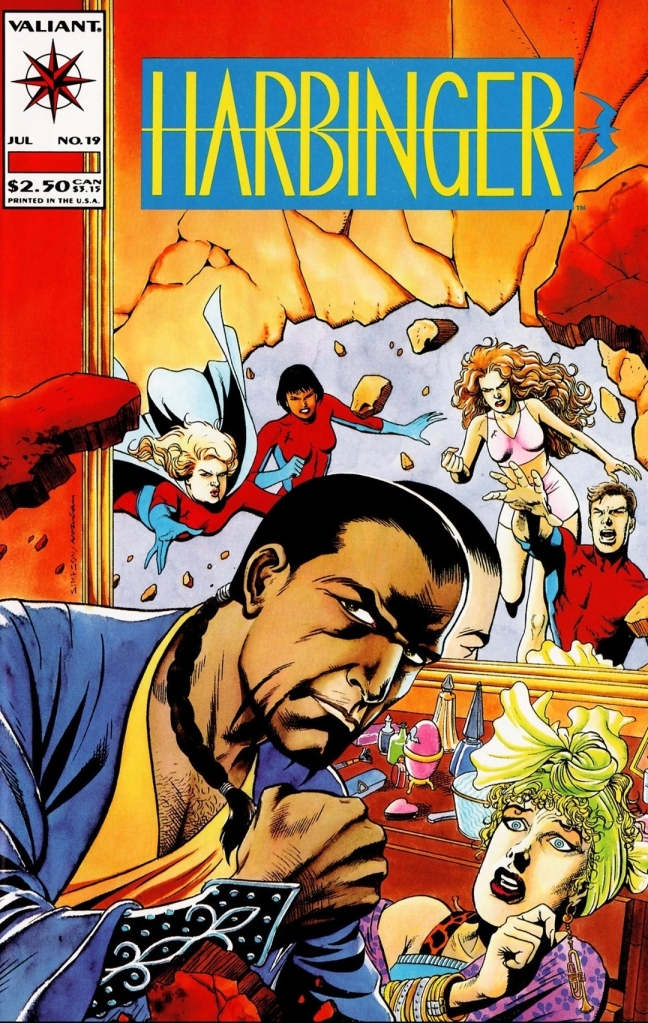
The cover.

Early story

The story begins on the afternoon of January 25, 1993. Inside the New York facility of the Harbinger foundation, a pretty blonde, young lady named Natalie Toynbee – codename: Stunner – gets scanned by the technicians handling the technologies. A technician’s request for Natalie to urinate into a cup reveals that the lady has a huge ego and pride of herself as she reacts negatively. 

Suddenly, the wall near Natalie and the technician got damaged by force unleashed by Sting who is accompanied by Faith, Flamingo and Shatiqua. Their mission is to free Natalie from the clutches of the Harbinger foundation which is a small part of their long-term vision of freeing and recruiting more powered young adults.

After subduing the Harbinger foundation personnel, Sting begins to explain to Natalie the situation and tells her to just trust him. Sting tells her to come with them which only drew more of Natalie’s ego along with skepticism. This reaction makes Faith think Natalie is not worth saving…

Quality

Imagine Iran invading America and causing terror like in this scene. Imagine Joe Biden and the Democrats allowing this to happen to Americans.

While the story was not crafted to follow-up closely on the events of issue #18, this comic book puts Sting and his teammates into a collision course with a new force of evil – the Iranians (note: issue #20 confirms their national identity) who have interests on specific young adults with powers and special abilities. Along the way, the Fontenot-Simpson team introduced a new sinister force in the form of a very manipulative Iranian named Kaliph.

Kaliph’s introduction here is easily the biggest feature of the story and he unsurprisingly overwhelms the debut of Natalie. Kaliph here works in service of his unidentified superiors and as he does his job, he uses his special ability of manipulating people’s minds through sight and sound to gain information, find directions, make them do his orders and gain access into places that he could never have had he been an ordinary person. By the end of the story, I was convinced that Kaliph was created to be an enduring or recurring villain for Sting and his team.

More on the primary characters of this monthly series, Sting and his teammates were portrayed to get more harbingers (powered young adults) to join them and become part of their long-term opposition against Toyo Harada and the Harbinger foundation, even though their own team lacks the resources needed to support themselves. The lack of resources was cleverly highlighted through Natalie’s reactions (related to her big ego) to what Sting’s team has for her to live with. Looking at the bigger picture going back to issue #1, Sting’s vision of defeating Harada and winning the trust of powered young adults without any solid foundation (specifically resources, connections and security) emphasize his recklessness and false sense of maturity as a team leader.

Conclusion

Kaliph and his companion arrive in America with a sinister plan.

In my view, Harbinger #19 (1993) is a solid change of direction for the monthly series complete with the introduction of a new, strong villain who originated from Iran which by today’s standards is the major force of terrorism in this world. The new villain Kaliph has a creepy aesthetic that other villains in this series lacked. More notably, the story remained consistently very engaging and pulled off some notable surprises which were indeed entertaining.

Overall, Harbinger #19 (1993) is highly recommended!

+++++

Thank you for reading. If you find this article engaging, please click the like button below, share this article to others and also please consider making a donation to support my publishing. If you are looking for a copywriter to create content for your special project or business, check out my services and my portfolio. Feel free to contact me with a private message. Also please feel free to visit my Facebook page Author Carlo Carrasco and follow me on Twitter at  @HavenorFantasy as well as on Tumblr at https://carlocarrasco.tumblr.com/ and on Instagram at https://www.instagram.com/authorcarlocarrasco